Vision, measurement, and (lack of) achievement

You might get the impression that I can be rather critical.  No doubt I can.  But one the thing the last couple of years has confirmed to me is that there is a still a sunny upbeat, naively optimistic, streak lurking within.    In particular, I keep being surprised by just how bad things really are at the Reserve Bank, and that despite having spent 32 (mostly quite enjoyable) years on the payroll.

A few weeks ago I wrote about the Reserve Bank’s (statutorily obligatory, but largely pointless –  given that the Governor is just about to leave, and the Governor makes all the decisions) Statement of Intent for the next three years.

Quite early in the document, in a section headed “Strategic direction”, I had come across this

The Reserve Bank’s purpose is to promote a sound and dynamic monetary and financial system. It seeks to achieve its vision – of being the best small central bank

As I noted then

It was a line one used to hear from the Governor from time to time when I worked at the Bank (somewhere I think I still have a copy of a paper that attempted to elaborate the vision), but it hasn’t been seen much outside the Bank, and if I’d given the matter any thought at all I guess I’d have assumed the goal had been quietly dropped.   Apparently not.

As an aspiration, it is one that has always puzzled me.

It is good to aim high I suppose, but isn’t it really for the owners to decide how high they want the Reserve Bank to aim? Then it is the manager’s responsibility to deliver.  I’ve not seen the Minister ask the Reserve Bank to be the “best small central bank”.    That isn’t just an idle point, because the ability to be the best will depend, at least in part, on the resources society chooses to make available to the Reserve Bank.  There are some gold-plated, extremely well-resourced, central banks around, particularly in countries that are richer than New Zealand.   I suspect New Zealand probably skimps a little on spending on quite a few core government functions including the Reserve Bank (but I’m probably somewhat biased, having spent my life as a bureaucrat), but that is a choice.    If we asked of the Reserve Bank what we ask of it now, but made available twice as many resources, we should expect better results.   As it is, there are limitations to what we should expect from 240 FTEs, covering a really wide range of responsibilities (the Swedish central bank, for example, appears to have about 40 per cent more staff, for a materially narrower range of responsibilities).

Given that the Governor has now restated the vision of having the Reserve Bank as the best small central bank, I assume he must have some benchmark comparators in mind, and assume they must have done some work to assess how they compare.  Since I assume any such documents would be readily to hand, I’ve lodged a request for them.

Specifically I asked as follows

I refer to the observation on p10 of the Bank’s new Statement of Intent, in which it is stated that the Bank’s vision is to be “the best small central bank”. I would be grateful if you could provide me with copies of any and all benchmarking exercises conducted since the vision was adopted (the start of the current Governor’s term?) indicating how the Reserve Bank is doing relative to other small central banks.

I’m not quite sure what I expected, but it wasn’t what I finally received this morning.

The Reserve Bank is declining your request under section 18(e) of the Official Information Act, because the document alleged to contain the information does not exist or cannot be found. Specifically to this ground, the Bank is declining your request as it has not conducted any benchmarking exercises since the vision was adopted indicating how the Bank is doing relative to other small central banks.

Not a thing.   No comparative tables.  Not a single paper for the Senior Management Committee or the Governing Committee.  Not a single paper for the Board, the body paid to hold the Governor to account, and to scrutinise and report on the Bank’s performance.

I’m still flabbergasted.  This is, so staff and the now the public are told, the Bank’s “vision”.  It was a distinctive emphasis introduced by the current Governor shortly after he took office, still being repeated front and centre in a key accountability document as the Governor gets ready to leave office.  And yet, he and they have apparently done nothing at all to assess where they stood at the start, and what if any progress they might have made since.   I’m sure that any junior manager at the Reserve Bank who articulated an ambitious vision for his or her own team would rightly have got pushback along the lines of “how will know you’ve achieved it?” and “who are you benchmarking yourself against”, or “what data collections processes will you put in place to enable us to assess whether you are making progress”.

Ambition is good.  Vision is good –  “where there is no vision, the people perish”.     But hand-wavy “visions” with little or nothing behind them, that apparently drive no decisions, and where there are no benchmarks, and no way of assessing progress, are worth almost nothing at all.   Within an agency, they just fuel staff cynicism.  Beyond the four walls of the institution concerned, they border on the deliberately dishonest – the sort of cheap and empty rhetoric (small beer in this case) that is corroding confidence is institutions and leaders across the Western world.     The pervasiveness of this sort of cheap rhetoric is presumably reflected in the fact that both the Minister of Finance and the Reserve Bank’s Board reviewed drafts of the Statement of Intent.  Did none of them ask: “Governor, this vision of being the ‘best small central bank’, where do you stand now, what progress have you been making, and how will we –  those charged with holding you to account – know?”?

Visions have their place.  But from independent government bureaucracies, I’d settle for consistently excellent delivery on the tasks Parliament has given them.  For too long now, we’ve not had that from the Reserve Bank, or from those charged with holding them to account on our behalf.  But when they met last week, applications for Governor’s job having closed, was the Reserve Bank Board even aware of the deficiencies?  And, even if so, did they care?

Immigrants and the right to vote

I’ve been reading Fair Borders?: Migration Policy in the Twenty-First Centuryrecently released by Bridget Williams Books in their BWB Texts series.  It is a collection of nine fairly short chapters by New Zealand authors on various aspects related (more or less loosely) to immigration policy.  Being from the BWB stable, it is a pretty left-liberal collection.   I’m hesitant about recommending it, as many of the chapters don’t offer much insight or analysis, but (a) there isn’t much being written in New Zealand on immigration policy, (b) it is pretty cheap ($14.95 from memory) and (c) the publisher (in the cover blurb) does recognise that the interests of actual or potential new migrants and the interests of New Zealanders aren’t necessarily the same.

I will come back another day to the chapter by a young economist who has recently completed a PhD on “the macroeconomic effects of immigration” at Cornell.  But today I wanted to focus on the one chapter that really caught my attention, by Kate McMillan, a senior lecturer in politics at Victoria.  Her chapter bears the title “Fairness and the borders around political community”, and isn’t really about immigration, per se, at all.   Rather she focuses on something I’d never known before, that New Zealand is very unusual internationally in when we allow new arrivals to vote.

Only five countries in the world have provisions allowing resident non-citizens to vote: Malawi, Chile, Ecuador and Uruguay –  none known these days for taking many immigrants –  and New Zealand.   In most countries, only citizens get the right to vote in national elections (there is a much wider range of rules for local elections in many countries).  The United Kingdom also allows residents who are citizens of the Republic of Ireland or “qualifying” citizens of Commonwealth countries to vote in parliamentary elections, but there is no general entitlement for non-citizens residents (including those from EU countries other than Ireland).

New Zealand’s rules seem to have evolved from something very like the British system.  Until 1975, “the right to vote in New Zealand local and national elections was granted only to British subject adults who had been resident in New Zealand for at least a year”, and similar provisions had been in place in Canada and Australia.  McMillan reports that Canada and Australia at around this time shifted to a citizenship-based voting rights model, the same choice that had been made by most new states as they decolonised in the post-war decades (Malawi presumably being the exception).

New Zealand made a different choice.   We dropped the “British subject status” requirement, and opened the franchise to any permanent resident who had been resident here for a year or more.  And, as McMillan points out, in the Electoral Act “permanent resident” doesn’t mean what it means in the immigration administration.   To become a permanent resident under that system, you need to have been on a resident visa first for two years.  But in the Electoral Act, anyone on a visa without an expiry date counts as a permanent resident.   In principle –  although it won’t be common –  someone could have arrived on 22 September last year, and be voting on 23 September this year.  The same provisions apply to Australian citizens living here (a year’s residence suffices to get the right to vote).

McMillan highlights further how unusual our voting rights rules are.  In those other four countries that allow non-citizen residents to vote in national elections all require residents to have lived in the country for at least as long as they would have to have lived there to be entitled to take out citizenship before they are allowed to vote.  (Unless you are Peter Thiel or Gabs Makhlouf), people have to spend five years here before they are entitled to apply for citizenship.  But new arrivals can vote when they’ve been here for only a year, even if they have no real intention of staying.

That doesn’t seem right to me.    It is certainly a long way out of step with international practice, including in the democratic societies we typically compare ourselves to.  To be clear, McMillan herself does not favour material changes in the rules, although she does suggest bringing the Electoral Act’s definition of “permanent resident” into line with that in the Immigration Act (which would increase the practical residence requirement from one year to two).   She suggests this change for administrative clarity (including for migrants and others on just who is entitled to enrol/vote) and because ‘the current one-year residency rules leave too much room for populist opposition”.  That seems an odd argument both because (a) her own chapter highlights just how out of step with international practice the New Zealand rules are (even compared to liberal beacons like Sweden, Canada, or Norway), and (b) because it isn’t at all clear why a shift from a one year to a two year residence requirement would satisfy the dreaded “populists”.     In almost all countries, non-citizens can’t vote in national elections at all.

A change along those lines would be a big step for New Zealand. But in a sense it would be a step away from our colonial past.   The very liberal franchise provisions are clearly a legacy of the days when (a) almost all our migrants were British, and (b) when there was only a hazy line drawn between Britain and New Zealand (or Canada and Australia) –  there wasn’t a separate New Zealand citizenship until 1948.    These days we are our own country, and it seems right that only those who have made the step of becoming citizens of this country should be able to vote, and thus directly influence how we are governed.   It isn’t an argument about immigration numbers at all.  And if and when immigrants (in large or small numbers) become citizens they should, of course, be free to vote.

There are counter-arguments, of course,  One relates to paying taxes.  If one pays taxes in a country, shouldn’t one be able to vote there?  I don’t think so.  I’ve lived and worked in three other countries, and it never once occurred to me that I should get a say in their future.  It was their country –  the citizens of those countries –  not mine.    Clearly, almost every other country in the world takes the same view –  and the handful of others who don’t also don’t receive very many new people anyway.

Taking up citizenship is an act of commitment.  It means different things to different people of course.  When the 1975 rule change was made, there was a concern about not putting pressure on people to become citizens who might have been here for decades, and barely recognised a difference between British and New Zealand citizenship (McMillan quotes from Hansard a speech by then backbench MP Michael Bassett).  Perhaps that was an argument that had some validity 40 years ago  (I don’t find it very persuasive even then, as existing rights could readily have been grandfathered, imposing a citizenship-based franchise for anyone arriving after the law was changed).     These days, it seems a very weak argument.  If you aren’t prepared to go to the modest effort of becoming a citizen, and swearing allegiance to New Zealand and its sovereign, we might be quite happy to let you live here permamently, but why should you get a say in how this country is run or governed?  You’ve chosen to remain at arms-length from us.

As McMillan reports, the select committee that considered the 1975 legislation (a) amended the initial government proposal to allow only citizens to stand for Parliament, and (b) recommended “that the issue of franchise rights be considered again the following year and that some thought be given then to whether citizenship might be the appropriate measure”.    There seems a lot of merit in an argument that if you can vote you should be able to stand for Parliament, and I don’t expect there would be many supporters for removing the requirement that only citizens can be MPs.    McMillan and a colleague sum up the 1975 changes as a product of “interplay between idealism and pragmatism, theoretically informed and ad hoc decision making, and quick-fix measures that, whether by accident or design, became a permanent and extraordinary feature of the New Zealand constitutional landscape”.   It is a quick-fix that is now well overdue for reform.

How important is the issue?   In numerical terms perhaps not too large.  As McMillan notes, the proportion of newly-eligible non-citizens who vote in the first election they are eligible for is relatively modest, and the number of new residence visas granted each year is just under one per cent of the existing population.   Most of them will be eligible for citizenship two elections afterwards.   Perhaps in some constitutency seats it might be a bit more of an issue, but the overall composition of Parliament is largely determined by the nationwide party vote.

I think it is more about taking New Zealand citizenship rather more seriously than we seem to.   Whether it is abuses like the grant to citizenship to Peter Thiel (nine days in the country and no intention of ever living here), or allowing full voting rights to people who’ve been here for as little as a year, and may have no intention of staying, we seem to treat too lightly membership of this polity.    Some of that is about our colonial history, but Canada and Australia had similar histories and they’ve moved their franchise provisions back into the international mainstream.  Perhaps part of it is the sheer numbers of New Zealanders who’ve left permanently?   Whatever the reason, reforming the voting rights provisions, to a citizenship basis – and perhaps something like five years residence for local body elections –  would seem to make sense.  I’d be comfortable with protecting existing voting rights for anyone who has lived here for more than, say, 10 years, but for anyone else, if they want a say in the government of this country, first make the step of becoming a citizen of this country.

On another topic, many readers will be aware of Radio New Zealand’s new podcast series on immigration which started last week.   I was one of the many people they interviewed as part of putting the series together.   The series is presented by an immigrant (non-citizen) and is sponsored by Massey University and so, as you might expect, the overall tone is pretty favourable to New Zealand immigration.  And there is a slightly de haut en bas tone to it all.   Having said that, it is a fairly serious-minded attempt to look at a wider range of perspectives on the New Zealand experience than one often finds.  It called to mind the line Boswell recorded in his 18th century life of Samuel Johnson

I told him I had been that morning at a meeting of the people called Quakers, where I had heard a woman preach. Johnson: “Sir, a woman’s preaching is like a dog’s walking on his hind legs. It is not done well; but you are surprised to find it done at all.”

For anyone interested in the subject, you could do worse than download the series as it released over the next few weeks.

Tightening conditions impede inflation getting back to target

Five years ago, the then incoming Governor, Graeme Wheeler, signed a Policy Targets Agreement with the then Minister of Finance.  In that document, he committed to run monetary policy with a

focus on keeping future average inflation near the 2 per cent target midpoint.

Earlier this week the CPI  was published.  It was the last such release that will appear while the Governor is still in office.

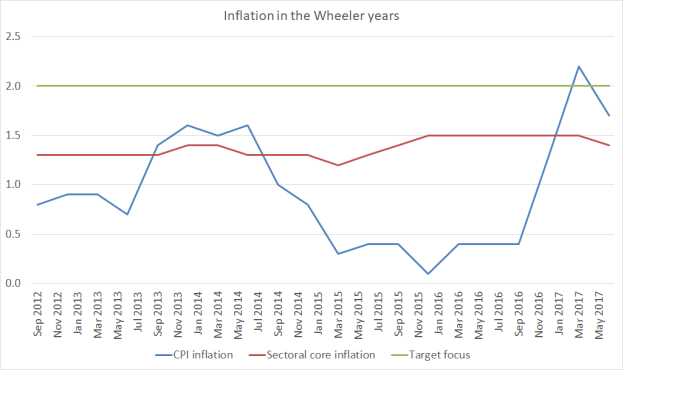
On a chart showing the 2 per cent focal point the Governor willingly committed himself and the Bank to, here are (a) the actual CPI inflation rates and (b) the Governor’s preferred measure of core inflation (the sectoral factor model measure) for the last five years.

Wheeler inflation 17

Not once in five years has core inflation (on this measure) even come close to 2 per cent.  In only a single quarter –  one of 20 – did headline CPI inflation get to 2 per cent.

Of course, the Governor can’t really be held to account for inflation outcomes in the first year or so of his term –  those outcomes were determined by choices made by Alan Bollard.  And for the next year or so, it will be Graeme Wheeler’s policy choices that have the biggest policy influence.  Nonetheless, to be so consistently far away from the newly-adopted target isn’t a great legacy.  Perhaps (but probably not) the Bank’s Board will reflect on those outcomes in their forthcoming Annual Report?

The sectoral factor model is only one measure of core inflation, albeit the most stable of them (and so the dip down in the latest release should be a bit disconcerting).  Here is the table I’ve run previously, of six measures of core inflation.

Core inflation: year to June 2017
CPI ex petrol 1.7
Trimmed mean 1.8
Weighted median 2.0
Factor model 1.7
Sectoral factor model 1.4
CPI ex food and energy 1.6
Median 1.70

The poor track record on inflation might have been more tolerable if:

  • productivity growth was really strong, driving down costs and prices.  But it hasn’t been.  In fact, there has been no labour productivity growth at all in the Wheeler years (not the Bank’s fault), or
  • if the unemployment rate was exceptionally low.   But it hasn’t been.   The current unemployment rate (4.9 per cent) is still materially above most estimates of the NAIRU, and well above pre-recessionary levels.  For what it is worth, it is also now above the unemployment rates in a couple of Anglo countries with pretty flexible labour markets (the US and the UK), which had to grapple with having reached the limits of conventional monetary policy during the post-recessionary years.
  • core inflation was still rising now (mistakes happen, but fixing them promptly makes up for quite a lot).  But, for example, the sectoral core measure is back to the same level it was in September 2015, when the Bank was just beginning to unwind its ill-judged 2014 tightenings.

Mostly, monetary policy in the Wheeler years hasn’t been well run.    When Graeme Wheeler took office core inflation had fallen quite a bit over the previous year.  A sensible response would have been to have cut the OCR.   The OCR increases in 2014 were never necessary (I choose the word advisedly –  there was plenty of time to wait and see if core inflation was in fact just about to pick up strongly).  Those increases were then unwound only rather grudgingly.

Of course, in fairness to the Bank, it did rather less badly for most of the period than most of the market economists whose views are covered in the local media.    For most of the time, most (almost all) of them were forecasting higher inflation, and a higher OCR, than the Reserve Bank was delivering.   But it isn’t much consolation, since (a) the Reserve Bank has far more analytical resources at its disposal than the private banks, and (b) the Reserve Bank is paid to conduct monetary policy, and market economists aren’t.

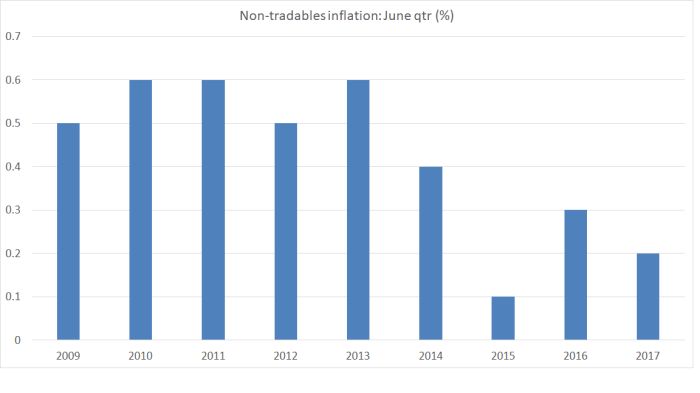
We’ll see next month what the Reserve Bank makes of the latest inflation outcomes.   But the data must be quite disconcerting.     There are some specific pockets of inflationary pressure –  building costs notably (and not that surprisingly, given the population pressures).   But here is non-tradables inflation (quarterly) for the June quarters of the last nine years.  Non-tradables inflation is what the Reserve Bank has most influence over in the medium-term.

NT june quarters

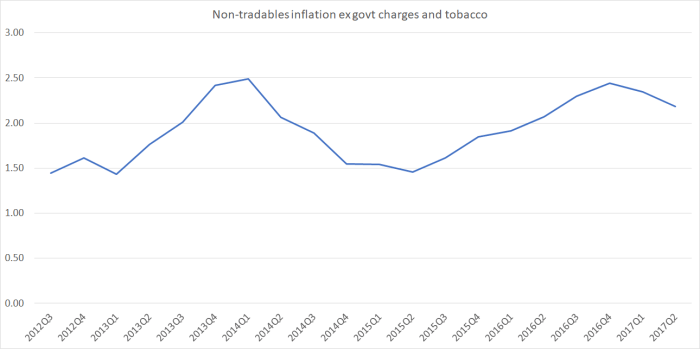
Only in 2015 was June quarter non-tradables inflation lower than it has been this year. Annual non-tradables inflation has dipped slightly to 2.4 per cent.  That might not seem too bad –  after all the target midpoint is 2 per cent – but as even the typically-hawkish BNZ noted in their commentary the other day one would really expect non-tradables inflation to be quite a lot higher to be consistent with delivering overall CPI inflation near the target midpoint.    A simple approach to a core non-tradables inflation rate is the SNZ series that excludes government charges and the cigarettes and tobacco subgroup (where taxes are being raised substantially each year).

NT ex jun 17

An annual inflation rate in this series nearer 3 per cent would be more consistent with core CPI inflation settling around 2 per cent.  At present, it is nowhere near 3 per cent, and moving in the wrong direction.

So why is inflation still (a) quite a way from target, and (b) looking to be falling again?  Broadly speaking, I reckon the answer is about (a) an economy that continues to run below capacity, and (b) tightening monetary and financial conditions.   The Reserve Bank’s latest published estimate was that the output gap is around zero (roughly, a fully-employed economy).   I noticed one local bank published an estimate the other day suggesting they thought the output gap was more like +1 per cent of GDP.     With the unemployment hovering around 5 per cent –  and best estimates of the NAIRU somewhere around 4 per cent, and demographic reasons to think the NAIRU might be falling, that simply seems unlikely.  It is much more likely there is still some excess capacity in the system, and demand growth simply hasn’t been strong enough.     The job of monetary policy is to manage interest rates in ways that deliver enough demand to keep inflation near target.

The current state of excess capacity is a long-running difference of opinion.  But what isn’t really in much doubt is that monetary and financial conditions have been tightening quite substantially in the last few quarters.

The OCR was cut to the current level of 1.75 per cent last November.   We might have expected inflation to pick up a little further since.    But retail interest rates have been rising:

  • the Bank’s measure of SME overdraft rates troughed in January 2017, and had risen by 19 basis points by June,
  • the Bank’s measure of floating mortgage rates for new borrowers troughed in October 2016, and has risen 25 basis points since then,
  • the Bank’s six month term deposit rate measure troughed in July last year and has risen 15 basis points since then,
  • one and two year fixed mortgage interest rates are also up by around 20 basis points

These aren’t large moves, but with inflation having been consistently below target (and the Bank having been repeatedly surprised) there was no good reason for the Reserve Bank to have accommodated such tightenings.

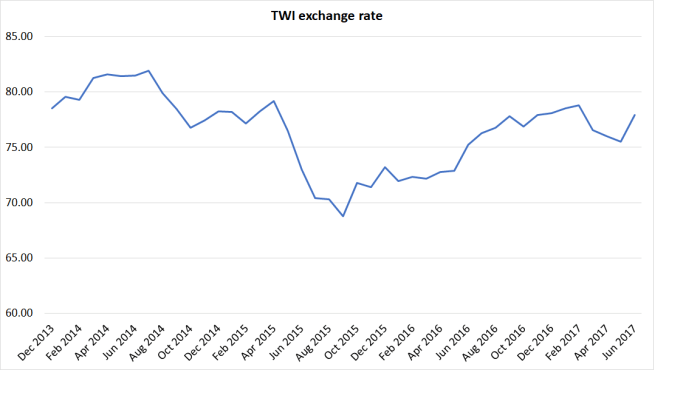
It isn’t just retail interest rates.   Here is the trade-weighted exchange rate measure

TWI july 17

The exchange rate fell quite a long way in 2015, as dairy prices fell, and the Reserve Bank began cutting the OCR.  At the time, the Governor spun tales about how this would help get inflation back to 2 per cent.  Exchange rates are somewhat variable, but broadly speaking the trend has been upwards since then.    Yes, dairy prices and the terms of trade have improved, but it all adds up to another tightening of monetary conditions when inflation has been persistently below target.

And, of course, credit conditions have also tightened.  Some of that is the Reserve Bank’s own doing –  last year’s latest iteration of the LVR controls –  but much of it isn’t: it is lenders reassessing their own willingness to lend.  We don’t have good statistical indicators of credit conditions, but there is little doubt they’ve been tightening.

It all adds up to a picture in which shouldn’t really be very surprising at all: inflation isn’t rising and may well have begun falling again.  Of course, some surprises reinforce the more systematic elements.  Weaker oil prices (for example) probably will spill over to some extent into core measures of inflation.  And unlike the situation in 2010 and 2014, this isn’t a case where the Reserve Bank has gone out actively seeking to tighten monetary conditions –  indeed, the Governor has been commendably moderate, especially relative to most local market commentators.  But it does look a lot like another case where the Bank (and the Governor personally, as single legal decisionmaker) has been too invested in a story that the economy was strong, inflation was picking up, and would continue to pick up, that it missed the way in which monetary conditions were tightening, and continued to largely (and deliberately) ignore the signals coming from the labour market.  Instead of repeatedly talking –  as the Governor does –  about how accommodative (or even “highly accommodative”) monetary policy is, the Bank would be much better advised to treat the low level of interest rates as normal, for the time being (it has after all been more than 8 years now since they were sustainably higher), and put much more weight on seeing hard evidence that (a) inflation is settling back at around 2 per cent, and (b) unemployment is nearer credible estimates of the NAIRU, before acquiescing in any material tightening in monetary conditions.   After getting it so wrong for so long, they should be willing to run the risk of core inflation heading a bit above 2 per cent for a time –  after so many years of undershoots, no one is suddenly going to think the Bank is soft on inflation if core inflation is 2.2 or 2.3 per cent for a couple of years.

Looser monetary conditions now would, most likely, be more consistent with the Bank’s mandate.  I’m not sure it is good form for the Governor to take the market by surprise with a cut from the blue as he heads out the door. But the case for establishing an easing bias in next month’s Monetary Policy Statement is beginning to strengthen.    Hawks will, of course, cite the various business and consumer confidence measures.  None is any stronger now than they’ve been over the last couple of years, and over that period inflation simply failed to pick up anything like enough to get back to target.   Expecting something different now, when the background conditions haven’t changed, is either just wishful thinking, or something worse –  including an inexcusable indifference to the lingering high number of people unemployed.


Ruminating on Auckland

Perhaps not many other long-term residents of Wellington share my taste, but I’ve always been fond of Auckland.  Partly that might just be good memories from five years there in my youth, but there is also the great physical location, a better (and certainly warmer) climate, deciduous trees, flourishing citrus trees in so many suburban gardens, and so on.   We’ve just had a family holiday there, and I was reminded again of what I liked about our largest city.  By contrast, I’ve always regarded Wellington as the public’s revenge on the public service.

Of course, as holidaymakers we didn’t have to grapple with the horror of the housing market, and between reduced school holiday traffic, the new Waterview tunnel, and largely avoiding the rush hour, not even the traffic was too problematic for us.  Coming from cramped Wellington, we were staying just off a not-overly-busy road that seemed wide enough that a whole new subdivision could have been constructed down the middle of the road.   We were mostly being tourists, but a curious and analytical 14 year old prompted discussions around the absurdities of housing supply restrictions –  explaining the oddities of the isolated high rise apartment blocks on Jervois Road, or Stanley Point, or Remuera Road, sticking out now just as those same buildings did when I was his age in the 1970s.

But staying in an older part of town I was also reflecting more generally on both past and present Auckland. 100 years ago, Auckland was the largest city in one of the two or three wealthiest countries in the world.  By the standards of the day, it must have offered ordinary working people some of the best material living standards on offer anywhere.  And if Auckland was our largest city then, it certainly wasn’t a dominant one.   In the 1911 census, the total New Zealand population had just crept above 1000000 (1008468).  And here were the total populations of the main urban areas (encompassing surburban boroughs, not just the respective city council areas).

Greater Auckland 102,676
Greater Wellington 70,729
Greater Christchurch 80,193
Greater Dunedin 64,237

Auckland’s population was just 10 per cent of the total.  At the same time Hamilton borough had a population of 3500, and Tauranga a population of 1300.

These days, Auckland makes up almost 35 per cent of the total population.   These days, with New Zealand GDP per capita around 30th in the world (depending which list one uses), there are likely to be many many cities (perhaps 100 or more, given that big countries such as the US, Germany, Japan, France, and the United Kingdom are richer than us, as well as many small countries) offering better living standards to ordinary working people than can be found in Auckland.  That would be true even on metrics like GDP per capita, with the problems accentuated by the disastrously unaffordable housing market.

Of course Auckland’s relative decline is largely part of the overall stark relative decline of New Zealand.    I’m sure we’ll see plenty of bluster from the current government in the election campaign that is getting underway, but I dug out the Prime Minister’s campaign statement from the 1911 election campaign published in the Herald on 6 December 1911.  It is partisan of course, but when Joseph Ward asserted that

The Liberal Government can claim without fear of contradiction to have made New Zealand in every department of social activity the most advanced country in the world.

Present and Future. New Zealand’s prosperity is solid and beyond question. Its population today is greater by 400,000 people than in 1893 and obviously the work of the Government has greatly increased. In the history of every country there are periodical fluctuations, seasonable ups and downs. We are influenced by the conditions ruling in other parts of the world. We cannot be always on the crest of the wave. But look round on the other countries. Mark what vicissitudes and oppressions they have passed through. Familiarise yourselves with the facts regarding the rich and resourceful United States of America, and then decide whether I am not justified in my reiterated assertion that New Zealand to-day is the most prosperous country in the world.

It is hard not to think that, even with the benefit of hindsight and the best efforts economic historians can do to compare living standards across countries, Ward was speaking the truth.   (It didn’t do his party much good, as they lost office –  after 20 years –  shortly afterwards).

These days we get fatuous comparisons of growth rates across countries, rarely adjusted for rapid population growth, but no one dares to claim New Zealand is even close to the most prosperous country in the world.

Wandering around Auckland was also a reminder of the extent to which Auckland’s economy is largely about supporting its own rapid population growth.  Check out the names on the high rises in the central city and you’ll struggle to find many New Zealand owned brands or companies (the banks and insurance companies, eg are almost all foreign-owned), and especially not if one is looking for firms making it in the international markets.  I’m all for foreign investment, but in a thriving economy it would be a two-way street –  not only would we have much more inward foreign investment but there would be a lot more offshore foreign investment too, as successful New Zealand firms took themselves to the wider world.  The pictures are never entirely black and white.  There are success stories like Air New Zealand (although with majority state ownership and the constraints of that industry who knows if it would still be New Zealand owned and run in a fully competitive market).  On a (much) smaller scale, I noticed billboards for ACG, which has taken its educational offerings abroad.

And there is, of course, the export education industry.  But even the reputable bits of that industry have the ground skewed in their favour by “industry subsidies” –  whether it is cheap access to PhD programmes for foreign students, or the way export education is bundled with preferential access to work rights and residence options in New Zealand.  And then there are the less reputable bits.  We took the kids ice-skating in Aotea Square and while they skated I contemplated the prominent building across the street with the big Cornell name and crest.  Not, surely, we thought the top US university with an operation here?  And no, it was the Cornell Institute of Business and Technology about which the authorities (and former staff) seem to have some pretty serious questions.  It was the most prominent tradables sector building I noticed in Queen St.

And yet, this is the city in which the hopes and dreams of the New Zealand agglomerationists are invested.   If the strategy –  putting more and more people into Auckland, even as New Zealanders have been leaving –  was any sort of economic success, surely we’d be seeing a succession of strong outwardly-oriented private sector businesses increasingly dominating the Auckland skyline?   But there is simply no sign of it.   Perhaps these successful firms are skulking in the suburbs and industrial areas?  I’m sure there are some highly successful examples, but there is no sign of it happening on the sort of scale needed if a non-natural resource based economy, successfully taking on the world and winning, is to develop in ways that would support top tier living standards for many more people.    If the model were correct, Auckland should be leading the way.  But it isn’t.

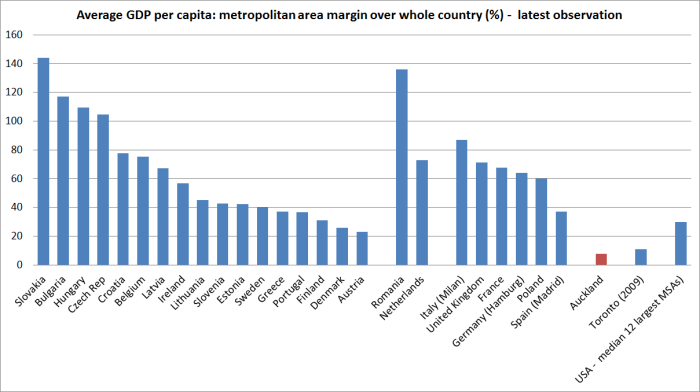
Really successful cities internationally, in economies that have gravitated away from dependence on (fixed) natural resources, tend to have GDP per capita a long way above that in the rest of the country.  And, typically, that gap is widening.

I ran this chart last year

gdp pc cross EU city margins

Here is the Auckland chart for the years since the regional GDP data began in 2000.  It shows average GDP per capita in Auckland relative to that in the rest of New Zealand (so the margin is larger than in the chart above, which uses the relationship between the biggest city and the whole country –  the biggest city typically being a large chunk of the country).

Akld GDP pc

The ratio does appear to be somewhat cyclical.  Probably what is going on is that when there is a big surge of immigrants (as in the early 2000s and recently) there is a big increase in the activity required simply to accommodate the new arrivals (building houses, roads, schools etc), but the trend is downwards.  Average incomes in Auckland are higher than in the rest of the country, but the margin is small and has been shrinking.

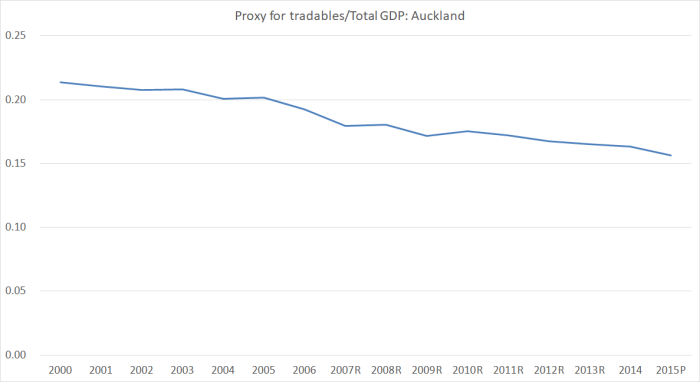
In the annual regional GDP data, SNZ also provide an industry breakdown.  As regular readers know, I’ve highlighted previously the pretty dismal state of the New Zealand tradables sector –  the main bits (agriculture and mining, manufacturing, and exports of services (mostly tourism and export education)) that compete with the rest of the world.   In real per capita terms, there has been no growth in that measure since around 2000.

We can’t do that calculation at a regional level.  But here is another proxy.    In this chart, I’ve included agriculture, forestry, fishing, mining, manufacturing, and education and traning as a loose proxy for Auckland’s tradables sector.  Of course, lots of education is totally domestic-focused, but export education is probably the main export sector centred in Auckland.   It has grown quite a bit in recent years.

akld tradables

There will be successful internationally-oriented Auckland-based firms lurking in some of the other services sectors, but (I’d assert) not many and not very large.   This simply isn’t what one should be expecting to see if the Auckland-focused (de facto, since that is what a large immigration target amounts to in practice) Think Big policy were working for New Zealanders as a whole.

It is close to a tragedy.   A deeply misguided policy, however well-intentioned, has reduced what was once one of the richest cities in the world to a rather mediocre mess: with few industries successfully competing internationally (in a small country the only long-term basis for prosperity), economic activity doing well only when a lot has to be built to accommodate yet another huge surge of new people, and houses so expensive that ever-fewer of the inhabitants can afford to buy.   It is still a great location and a wonderful climate but think how much better material living standards Auckland might offer its ordinary working people if, say, in a country of 3.5 million people, we had an Auckland of perhaps 750000.  Quite plausibly, that is how things might have played out with less overall population pressures –  deferring to the wisdom of the New Zealanders leaving, rather than superimposing politicians’ and bureaucrats’ judgements –  and a much lower average real exchange rate.

It isn’t too late to fix up New Zealand, but it does require a pretty dramatic change of course.  Wouldn’t it be wonderful if in thirty years time some campaigning Prime Minister could once again honestly make the sorts of assertions about economic and social success that Joseph Ward was making in 1911?  Sadly, judging by the political rhetoric this year none of our politicians is interested.


MBIE on how emissions reductions targets interact with immigration policy


No, that blank space wasn’t a mistake.  It was the sum total of everything MBIE has written or commissioned (analysis, advice, research, or whatever), in the period since the start of 2014 on how the appropriate or optimal immigration policy for New Zealand might be affected by commitments to reduce greenhouse gas emissions.     At the start of the period the government was considering what commitments to make under the then-forthcoming Paris climate accord.    For the last couple of years, those commitments have been firm policy.     As a reminder. this is how the Ministry for the Environment describes New Zealand’s commitments

New Zealand has recently formalised its first Nationally Determined Contribution under the Paris Agreement to reduce its emissions by 30 percent below 2005 levels by 2030. The Paris Agreement envisages all countries taking progressively ambitious emissions reduction targets beyond 2030. Countries are invited to formulate and communicate long-term low emission development strategies before 2020. The Government has previously notified a target for a 50 per cent reduction in New Zealand greenhouse gas emissions from 1990 levels by 2050.

In their recent annual stocktake, the Ministry for the Environment listed “a growing population” as the first item on their list of three particular challenges New Zealand faces in meeting the emissions reduction target.    It might not have been an issue had New Zealand chosen to specify its reduction target in per unit of GDP terms, as for example Chile did.  But instead we specified the target in terms of total reductions of emissions, and set a target for reductions that was similar to (say) that of the EU, even though our population growth rate is rapid, and the population of the EU isn’t increasing much at all.    As the Ministry for the Environment belatedly recognised, rapid population growth matters.   A large chunk even of New Zealand’s total emissions result directly from human activity (vehicles and power generation), and most of the remainder result from farm animals, with pastoral farming remaining by far the largest chunk of our export industries.

I say that the Ministry for the Environment seemed to recognise the point belatedly because I asked whether they had any analysis, research or advice on the implications of, say, our immigration policy –  which directly boosts the population, all else equal –  either before or since the government set the emissions reduction target.   Their response was on time and in full.  There was nothing at all that fitted the terms of my request.  I also included in my request whether they had raised the issue with MBIE, the government’s prime advisers on immigration policy.  They hadn’t, at all.

In parallel, I lodged a request with MBIE.    Had they perhaps thought, whether when the government was setting the emissions reduction target, or more recently when they were reviewing the residence approvals target, about the connection between  more people, and the adjustment costs of meeting the emissions reduction target.  At least in principle, it looked like one more reason why one might be cautious as to whether immigration policy was in fact likely to make New Zealanders as a whole better off.

MBIE took their time to reply, but they also replied in full.  There was nothing –  no analysis, no research, no advice or briefing to any of their ministers, no sign of any effort to flag the issue with Mfe and perhaps seek their input.  Nothing.

I’m not really sure whether to be surprised or not.   For all the rhetoric about “joined-up government” (one of the arguments for creating mega MBIE in the first place), there has never been much sign of it working well.   And for both departments there were probably sacred cows they didn’t want to touch.   Perhaps many of the MfE people are “true believers” who think the world might be a better place if we quickly moved to a carbon-free economy, regardless of the costs of doing so.  And MBIE seems to have plenty of immigration “true believers” who seem implicitly to believe –  even if they never attempt to demonstrate –  that the benefits from immigtration to New Zealand are so great that any issues around the emissions reduction target must be trivial at best, and not allowed to distract from the great project of a bigger New Zealand.

But, even allowing for all that, I’m enough of a naive and idealistic enough former public servant that in fact I am a little staggered that neither department had anything at all on the issue –  not so much as a discussion note by someone in one department or another willing to think just slightly out of the mainstream.    Perhaps it was just a response to the preferences of respective ministers –  the government after all appears to have a strong commitment to “big New Zealand” regardless of any other costs –  but even if that is the answer, it still looks like a significant failure of officialdom, which has a responsibility to point out uncomfortable tensions and costs, offering free and frank advice even (perhaps especially) when it might be unwelcome.

In earlier posts, various commenters struggled to see why the issue mattered.  It is pretty straightforward.  For all the optimism about new technologies, if they were already economic they’d already be being adopted.   Adjusting to substantially lower emissions is therefore almost certain to come at a real economic cost, and that cost will be greater the more the population pressures drive up the baseline level of emissions.  People will drive and fly, people will need/want electricity, goods need transporting and so on.   And New Zealanders demand for imports needs exports, and there is little sign yet of any systematic strong growth in the non natural resource based sectors.  Impose a heavier burden on those farm sectors –  which might be well-warranted on environmental grounds –  and it will undermine the competitiveness of those industries.  If we can’t keep selling as much stuff abroad, we can’t import as much.  Our living standards will be lower than otherwise.

If our population by 2030 was say 10 per cent lower than current immigration policy will make it, all else equal, we’d be much closer to meeting the emissions reduction commitment, and would need to impose fewer (inevitably costly) restrictions or intensified price signals to achieve the balance of the reduction target.   It is simple as this: when we use policy to import more people that means more intense pressure on all of us, and all emitting industries and activities than is otherwise necessary, to achieve the emissions reduction target the government has set itself.   That cost needs to be properly evaluated, in a robust assessment of whether the possible gains to New Zealanders from the immigration itself are large enough to outweigh the additional costs and burdens imposed via the given emissions reduction target.  At present, neither MBIE or ministers are able to (or even really attempt to) demonstrate such benefits at all.

When, in the privacy of closed seminar rooms (or even in ministerial offices), senior officials and their associates sit down to hardheadedly review immigration policy –  assuming, as I do, that this does happen on occasion –  the implications of our emissions reduction target really needs to begin to be factored into the discussions.  It is quite staggering, in a country with such an unusual immigration policy, that it has not happened until now.   It might be a question for the State Services Commissioner to look into: quite how did such significant departments overlook completely such a significant potential connection between two major areas of policy.


New Zealand First’s immigration policies

I was briefly half-encouraged when I heard that Metiria Turei had been attacking New Zealand First for having “racist” immigration policies.  Mostly it seemed like a further rather depressing attempt to suggest that any serious debate about New Zealand’s unusually large and ambitious immigration policy was illegitimate, all the while trying to look like the Greens were taking the high moral ground, even as their co-leader actually descended into mud-slinging and name-calling herself.   But….there was the hint there that perhaps New Zealand First actually had some distinctive immigration policies.  The last time I’d looked on the NZ First website what was notable mostly was how little material there was on immigration policy, and how few significant policy proposals.

But, no.    When I checked again yesterday, there still wasn’t much there.    From listening to Winston Peters over the years, or even just listening to the reaction to him, you might have supposed New Zealand First had some far-reaching and specific proposals that would change the face of immigration policy in New Zealand.  Instead what you find is this.

New Zealand First is committed to a rigorous and strictly applied immigration policy that serves New Zealand’s interests. Immigration should not be used as a source of cheap labour to undermine New Zealanders’ pay and conditions.

There have been numerous instances of administrative failure to apply immigration rules and standards.

New Zealand First will strengthen Immigration New Zealand to give it the capacity to apply immigration policy effectively.

New Zealand First will:

  • Make sure that Kiwi workers are at the front of the job queue.
  • Ensure that immigration policy is based on New Zealand’s interests and the main focus is on meeting critical skills gaps
  • Ensure family reunion members are strictly controlled and capped and there is fairness across all nationalities.
  • Ensure that there is effective labour market testing to ensure New Zealanders have first call on New Zealand jobs.
  • Introduce a cap on the number of older immigrants because of the impact on health and other services.
  • Make sure effective measures are put in place to stop the exploitation of migrant workers with respect to wages, safety and work conditions.  In Christchurch and elsewhere there is evidence of exploitation of migrant workers.
  • Develop strategies to encourage the regional dispersion of immigration to places other than Auckland. Auckland’s infrastructure is overloaded.
  • Remove the ability to purchase a pre-paid English lesson voucher to bypass the minimum English entry requirements.

And that is it.   I’m guessing that no one (or at least no political party) is going to disagree with anything in the first three mini-paragraphs.    But if no one is going to disagree, those words aren’t saying much either.

What about the specifics?   Everyone is going to sign on for avoiding the exploitation of migrant workers, even if reasonable people might differ on quite where the line would be drawn.  Even the current government took some steps in response to the Christchurch evidence.

The current labour market testing system may, or not, be working well, but on paper there are requirements in place that are supposed to prioritise potential New Zealand workers (three of the eight NZF bullet points).  Again, no one much  –  perhaps not even ACT or the New Zealand Initiative –  is going to disagree with the general goal, and nothing New Zealand First says here is very specific.  It all seems pretty mainstream stuff –  probably putting too much faith in the capabilities of MBIE for my own tastes.

New Zealand First wants to cap family union entry, and also cap the number of older people getting residence visas.  But again, how different is that to current policy, where applications for parent visas are currently suspended altogether?    Perhaps New Zealand First wants to go further in that direction than most, but it hardly has the ring of something very dramatically different.

And in calling for a larger proportion of migrants to be encouraged to places other than Auckland, NZ First seems quite consistent with the government’s policy of offering additional points for people with job offers in the regions.  And Labour want to allow regions to develop their own priority occupation lists.  Personally, I think all three are daft, and simply tend to lower further the average quality of the immigrants we get, but (sadly) there is nothing out of the mainstream in the direction NZ First seems to be proposing.

And that leaves the final bullet about English language requirements.  Without knowing anything much about it, on paper what NZ First is proposing looks reasonable enough (if we are going to have English language requirements, a prepaid voucher for a course one may never bother attending doesn’t look like much of a substitute.    But it is a level of detail that hardly seems likely to divide parties deeply.

And quite what qualifies as “racist” there –  and Turei was explicitly talking about “policies” –  is beyond me.  Except of course that she and her co-leader (the latter in his speech last week) seem determined to insist that no legitimate discussion or debate is possible about New Zealand’s unusually large immigration policy –  unless, of course, they are proposing things, in which case presumably we can all be assured of their virtue and rectitude.

What is more striking is that, for all the speeches and interviews, there is nothing in that New Zealand First list that would make any very material difference to the expected net inflow of non-citizens.   In particular, there is nothing at all about the overall level of residence approvals.  Reading this list, NZ First appears to be comfortable with a residence approvals target of around 45000 per annum (three times, per capita, the US rate of approvals), and it is the number of residence approvals that will, over time, determine the contribution of immigration to population growth, pressure on resources or whatever.     There is also nothing at all on provisions around international students, nothing about working holiday visas, and nothing specific on temporary work visas.

If one took this page of policy seriously, one could vote for NZ First safe in the expectation that nothing very much would change at all about the broad direction, or scale, of our immigration policy.     Of course, there would be precedent for that.  The last times New Zealand First was part of a government, nothing happened about immigration either.

Perhaps there is still some major announcement with some more substantive policy specifics still to come.  I see that the New Zealand First conference is being held this coming weekend.    Perhaps that will be the occasion.   But at present, there is very little there, and most of what there is isn’t a million miles from where the other parties –  including the government –  seem to have been.

Money: past and future

On Monday 10 July 1967 New Zealand adopted decimal currency. Presumably the government chose a Monday because in those days shops in only a few areas were open on Saturdays and almost all shops and other businesses were closed on Sundays.  Nothing else very significant seems to have happened in the world that day, and no one very famous was born on it.    We adopted decimal currency a year after Australia did and four years before the United Kingdom did.

But of course the dollar isn’t what it used to be.   Here is a chart of the purchasing power of $100, based in June quarter of 1967.   By 1975, purchasing power had halved (prices doubled), by 1980 it had halved again, and even since the current Reserve Bank Act was passed in December 1989, mandating the Reserve Bank to achieve and maintain a stable general level of prices, consumer prices have increased by 76 per cent.   $100 today purchases what $5.60 purchased in 1967.

purchasing power

So much for price stability.   As I was typing this I noticed that the Reserve Bank had put out a press release to mark the 50th anniversary.  The Governor notes

“This milestone is a great opportunity to reflect on a point in time and see how our banking has evolved and how our money has changed over the years.

Perhaps also an opportunity to reflect on the declining value of that money?

Of course, shifting to decimal currency itself didn’t materially alter the average inflation rate.  What did that was the establishment of the Reserve Bank itself in 1934 (at which point private issuance of banknotes was also outlawed).

purchasing power 2

Prior to the creation of the Reserve Bank, the price level tended to be quite stable over long periods of time (but rather less so in the short-term).

There are good reasons for having a Reserve Bank (although the case is less overridingly compelling than the advocates sometimes claim), but it is worth being aware of what was lost when central banks and fiat money replaced earlier systems.   We lost, for example, any sense that money today will be worth roughly what it was in your grandparents’ time and what it will be in your grandchildrens’ time.  Does it matter?   On the one hand, we don’t mess around with, say, weights and measures that way.  A metre is what it was generations ago, and what it will be generations hence.   Weights and measures are social conventions too.    A reasonable counter is that very few people, other than governments, enter into long-term nominal contracts, but that might be partly because the future price level is so uncertain, while the future length of a metre isn’t.   In practice, there seem to be wider economic advantages in some circumstances is being able to generate unexpected changes in the price level (and alter the exchange rate), but whether they are worth the costs –  including the mismanagement by governments and central banks at other times –  is worth reflecting on from time to time.

When governments monopolised note issue (through the Reserve Bank) we also lost the opportunities for competitive innovation in hand-to-hand payments media, and left ourselves reliant on monopoly government suppliers.  Those sorts of suppliers usually don’t do a particularly good job in providing high quality goods and services in other areas of commerce, and it isn’t clear why we should expect much different in banking.  The state doesn’t monopolise the issuance of electronic payments media, and look at the innovation we’ve seen there.

Regrettable (and unnecessary, even if you wanted a central bank) as the statutory prohibition of private banknotes is, one might have supposed it was becoming increasingly less relevant.   If it is true in some countries, it isn’t here.  Here is a chart of the value of bank notes held by the public as a per cent of GDP.

bank notes

If bank notes are now being used for a smaller proportion of (licit) transactions, perhaps they are still being heavily used as a store of value (as the opportunity cost of holding cash has fallen, as interest rates have fallen) and for illicit transactions?

I was interested to see the outgoing Governor comment today on future prospects for physical cash.

Despite the growth in electronic payment systems, cash in circulation continues to grow and I expect cash, as a means of exchange, to be around for a long time yet.

The problem is that not only is cash becoming more popular, but we are getting nearer the point where it could either (a) become a great deal more popular indeed (if the Reserve Bank wanted to cut interest rates very much below zero),, or (b) where that option could severely limit the ability of the Reserve Bank to use monetary policy effectively in a severe downturn.  That ability is the main reason for having a Reserve Bank, and discretionary monetary policy, in the first place.

I noticed that the Governor did qualify his observation about the future of cash, noting that he expected it to be around “as a means of exchange” for a long time yet.   Did he mean to suggest it might not be around for long as a store of value?     It is the sort of the issue the Reserve Bank needs to address more extensively and openly.

The 50th anniversary of decimal currency is a good opportunity for some fun, looking back at what the country was like at the time of the changeover.    But after a few hours of looking back, it is probably rather more important for our officials –  in the Treasury and the Reserve Bank –  to be thinking hard about the constraints their statutory monopoly is coming closer to placing on our ability to use monetary policy for what is is designed for.    I’ve long favoured removing the statutory prohibition on private banks issuing bank notes.   Perhaps doing so wouldn’t come to much, but we can’t know if we keep the prohibition in place.  Perhaps they’d develop technologies combining the convenience of hand to hand currency with the potential for a variable rate of return?

But perhaps more immediately pressing now is a clear programme of work to ensure that when the next serious downturn comes we can have both the advantages of our existing physical cash as a payments medium (and even as an anonymous store of value) and the flexibility that discretionary monetary policy is supposed to have given us.  At present, we are drifting towards the rocks –  the next serious recession, whenever it happens –  with no sign that the Reserve Bank (and other relevant agencies/ministers) are taking the risks at all seriously.    It is another issue for the Reserve Bank Board to have in mind in assessing the applicants for Governor.  After all, one dimension of leadership is looking a little further ahead than other people, and charting directions.


Options for a new Governor

Applications for the job of Governor of the Reserve Bank closed this morning.

As I’ve noted before it is a very odd business:

  • applicants don’t really know what job they are applying for (since Labour and Greens are promising material changes in the monetary policy decisionmaking model, and in the Bank’s statutory objectives, and the Rennie review may yet foreshadow changes by the current government),
  • the Board, charged with evaluating and recommending a candidate to the incoming Minister of Finance, also has no real idea what the job is.  The emphases of a Labour/New Zealand First government (say) would probably be rather different than those of a National-ACT government.

And yet, with still 2.5 months until the election, the Board will shortly settle down with their recruitment consultants to winnow down the list of applicants.  And this is a Board entirely appointed by the current government, and although the individual Board members may each be quite capable they are likely to be a different bunch of people, with different inclinations and preferences, than a Board appointed by a Labour-led government would have been.    Of course, elections have consequences –  governments get to appoint sympathetic people to the (too) numerous goverment bodies –  but it isn’t obvious why, if this year’s election leads to a change of government, the last election should so strongly influence the sort of person likely to be presented to the incoming Minister of Finance as the nomineee for Governor.

Board members have neither legitimacy nor expertise.  They aren’t elected, don’t front up to select committees or the media, don’t even maintain proper records (as required by law), and can’t be tossed out by voters if they do a poor job.   In other countries, almost every country I’m aware of, the Governor of the central bank is appointed by the Minister of Finance (or some other elected person –  eg the President in the US).  And in most countries, the Governor of the central bank has much less power than our Governor has.

In our system in particular, the Governor is a really consequential appointment.  The Governor is the sole legal decisionmaker on monetary policy and most aspects of banking regulation (as well as numerous other less important things the Bank is responsible for).  He –  and it most probably will be a he – alone gets to decide how aggressively the Bank should respond to economic downturns, or how closely it adheres to the Policy Targets.  He gets to decide how well-positioned New Zealand is for the next recession. He gets to decide whether banks are even allowed to lend to you by residential mortgage.  He could, if he chose, stake billions of taxpayers’ money on interventions in the foreign exchange markets, and if the bet goes wrong we –  not he –  lives with the consequences.    There is a gaping democratic deficit –  too much power in one person’s hands –  but is made worse by the fact that elected politicians (whom we can hold to account) can’t appoint someone in whom they have confidence to exercise these powers.  They must take a name handed to them by a bunch of company directors and the like appointed by the previous government.  The Minister can knock back any particular Board nominee, but in the end the Minister can only appoint someone that Board nominates.  And he can’t even easily replace the Board at short notice.

So who are these enormously influential members of the Board?   One member’s term expires in a week or so, and apparently he won’t be replaced until after the election.  That leaves six of them.

The chair is now Neil Quigley, vice-chancellor of Waikato University.   These days, Neil is an academic administrator, but earlier in his career he had a research background in banking regulation, financial history etc.

The vice-chair is Kerrin Vautier, a microeconomist by background, who has also been a company director and is a lay member of the High Court (under the Commerce Act).

The other four include two private sector company directors (one of whom is a director of an insurance company, even though the Reserve Bank regulates insurance companies), one lawyer, and one member whose roles seem to be mainly government appointments and not-for-profit positions.

I don’t want to be too critical of them as individuals.  I know, and have worked with, three of them at various times, and they are each able people.  But none of the six individually – or the group collectively – really seem to have the skills for making such a crucial public appointment.   They are not subject experts and have no expert advisers –  and yet they must presumably evaluate applicants’ monetary policy or regulatory inclinations/expertise – nor do they bear the downside if they make a poor recommendation.  They also have no experience in high profile public roles.   Ministers of Finance also typically aren’t experts, but (a) they have an entire Treasury to assist, and (b) they do bear the downside, since the public (reasonably enough) tend to hold elected politicians to account for the failures of public agencies.

The process is so flawed that I’ve argue before, and repeat the point today, that the Opposition parties really should indicate that, if elected, they will change the law to allow the Governor to be appointed simply by the Cabinet on the recommendation of the Minister of Finance, as is done in most other countries (perhaps with advisory quasi-confirmation hearings by a parliamentary committee).  Not only would it make our system more democratically legitimate and internationally comparable, it would also put the Board in a better position to monitor and hold to account whoever is appointed as Governor.  They’d have no incentive to simply back their own appointee, but could simply do the monitoring job  –  on whoever the Minister appointed –  as agent for the Minister and the public.

But for now, the system is as it is, and has its own momentum.  As the Board prepares for its next meeting on 20 July, they really need to start by thinking hard about:

  • what the nature of the job really is, and
  • about the outgoing Governor’s stewardship of the role during the last five years (especially bearing in mind that many of the current Board were responsible for Wheeler’s appointment).

It isn’t obvious the Board has really been doing the second with much energy at all.  I’ve written previously about their Annual Reports, which never seem to have found any cause for concern about anything, functioning more as additional legs in the Bank’s own public communications efforts.   The year just ended is the first in which the new chair, Neil Quigley, has led the Board.   Perhaps this year’s report will be a bit different and a bit more open but it is difficult to be very optimistic.    This is, after all, the same Board who defended the Governor over the OCR leak debacle, expressed no concern even after the event at the ill-fated 2014 tightening cycle, and so far have been totally silent about Graeme Wheeler’s highly inappropriate sustained attempts, including use of his senior managers, to attempt to censor a private sector critic.

When the advert for the Governor’s role first appeared, I wrote a bit about some of the surprising features of what they were asking for in their advert.  If there are governance system changes in the period ahead the Governor’s role may change, but at present it seems that there are three broad aspects to the role:

  • chief executive of an organisation with a large (but typically low risk) balance sheet, and a staff with significant policy, analysis and operational responsibilities,
  • the sole legal decisionmaker on all aspects of monetary policy, most aspects of banking regulation, and personally responsible for the Bank’s policy advice and actions in other areas,
  • a key crisis manager, and
  • the public face of an organisation whose choices at times bear heavily on the short-term performance of the New Zealand economy.

Under current law, those are features of the role at any time.   But in the current situation, there is the additional challenge of rebuilding the Bank’s capability and reputation after the Wheeler years.   Monetary policy hasn’t been well-handled.  Banking regulation appears to frustrate the banks (more than the inevitable tension between regulator and regulated).  No one now seriously looks to the Reserve Bank for “thought leadership” in the areas of its responsibility.  And, for all that the Bank likes to claim to be very open and engaged, it is perhaps akin to (say) a Singapore-government style of openness, that chooses tame interlocutors and just ignores alternative perspectives or, say, journalists who might ask hard questions.   There is a great deal of rebuilding to be done, and a good Governor over the next few years –  particularly with the prospect of legislative change –  needs to have qualities that will enable him or her not just to steward an organisation in good heart, but to lead organisational change and revitalisation.

With so much policymaking power personalised in the Governor’s hands, it is difficult to see how the right appointee won’t need to have a significant amount of directly relevant professional expertise.   Of course, monetary policy is very different from banking and insurance regulation, and quite possibly no serious candidate is particularly strong in both fields.   And on the financial sector side, it is important to recognise that this is a regulatory role –  some of my friends differ on this, but the Reserve Bank (despite the name) isn’t primarily a bank, even though it needs to understand banking to regulate it effectively.

Each of the three Governors under the current law has had an economics background. None was necessarily strong in the key technical dimensions (and of the three, only Don Brash had any prior experience in the public eye).     Ideally, we would find someone better aligned to the role (as, say, the last three Governors of the Reserve Bank of Australia have been), but there may not be such a candidate.    Really successful organisations are usually able to promote from within –  again the Australian experience –  but unfortunately the Reserve Bank here has been quite weak on developing people with the relevant senior experience (Grant Spencer has been both chief economist and head of financial stability, but he is retiring).

But if the appointee needs to have some significant professional expertise in the Bank’s areas of responsibility –  it might be different if the Governor was primarily CEO and just one voting member among five or seven on relevant committees –  technical expertise is far from all that matters.  As I noted in the earlier post, I was surprised the Board made no mention of character and judgement –  qualities that can take someone a long way, especially when times get tough and the Governor is under pressure.    Earlier in the year I wrote

For me, I’d settle for someone with the character, energy and judgement, backed up a solid underpinning of professional expertise, to revitalise the institution, rebuild confidence in it, and provide a steady hand on the policy levers, backed by high quality analysis and an openness to alternative perspectives, through both the mundane periods and the (hopefully rare) crises.  And all that combined with a fit sense of the limitations of what monetary policy and banking regulation/supervision can and should do

That still seems right.

Who might it be?   Back in February, shortly after Graeme Wheeler announced that he would be leaving, I noted

the lists of people talked about as potential candidates as Governor, be it Geoff Bascand or Adrian Orr (probably the names at the top of most lists) or others –  Rod Carr, John McDermott, Murray Sherwin, David Archer, Arthur Grimes, New Zealanders running economic advisory firms, New Zealanders who are past or present bank CEOs here or abroad etc

They still seem the most likely sort of people.  For reasons I’ve outlined before I don’t think it would be at all appropriate, let alone politically feasible, to appoint a foreigner as Governor, wielding all the power that position holds at present.     One foreign member of (say) a five or seven person Monetary Policy Committee or Financial Policy Committee might make sense at times.  But under our current law the Governor wields at least as much power as a typical Cabinet minister, and we require our Cabinet ministers to be New Zealanders.

When people occasionally ask me who I think will get the job, I usually note that Geoff Bascand must have the inside running.   He is a competent economist (albeit not mainly in macro or financial areas), knows his way around the bureaucracy, and has outside chief executive experience.   He has a number of downsides, including lack of any financial sector (or related regulatory experience), but appears to have been actively promoted by the current Governor (which perhaps should be a negative, but may not be).  The Board gets to see him every month.  A competent internal deputy is always likely to have the inside running.

I’ve heard that there is talk around Wellington that one of the CEOs of the Australian banks might be in line for the job, and Ian Narev’s name (head of CBA, parent of ASB) has been specifically mentioned.    At present, three of the group CEOs of the Australia banks are New Zealanders (one was apparently even a bank economist early in his career).   One can’t rule out the possibility completely, but none of these guys has any experience with monetary policy, nor any of being a regulator.  And they are used to running vast organisations, not ones of 250 staff.  You have to wonder whether a left-wing government –  perhaps especially one including Winston Peters –  would really be comfortable handing control of our monetary and banking system to the very wealthy CEO of an Australian bank (Narev for example took home A$12.3 million last year).   And, of course, if one were a shareholder of an Australian bank mightn’t the fact that the chief executive was looking to get out, applying for another job, be information that you might regard as material, warranting disclosure?   It seems a more plausible option if, say, the Minister could just directly appoint someone in whom they had confidence, rather than going through a drawn-out application process.

Of the people on that list, David Archer probably now isn’t widely known in New Zealand.  He holds a senior position at the Bank for International Settlements (club for central banks) but was formerly Assistant Governor and Head of Economics, and prior to that Head of Financial Markets, at the Reserve Bank.  He and Alan Bollard didn’t really get on, and David went overseas in 2004.    David would bring drive, energy, curiosity, openness, and high intellect.   On the other hand, he has been out of New Zealand for a long time now, and that does have hard-to-pin-down disadvantages.   He also doesn’t have any real experience with financial regulation –  in fact, in times past was a champion of a fairly minimalist approach (and whatever the merits of those arguments, they bear no relation to current NZ law).  He also has –  or had –  a style that works very well with some (the intellectually self-confident, perhaps even combative) but not necessarily with others.

Rod Carr remains an interesting possibility.   He was Deputy Governor for five years, and missed out on becoming Governor when Don Brash left.  He has direct banking experience (albeit 20 years ago).  He has also been a Reserve Bank Board member for the last five years, but was apparently ousted as chair by the other Board members last year.  Perhaps he will apply for Governor.  But in the various Board minutes that have been released to me in recent months, there is no sign that Carr absented himself from discussions around the process leading towards advertising for and selecting a new Governor.  Had he been planning to apply, to have absented himself (and documented that absence) would have seemed appropriate conduct.

Time will tell.  My main point is that it is a terrible way to select a person for the most powerful unelected role in New Zealand:

  • the wrong sort of people dominate the process (in principle)
  • in practice, the current Board has done a poor job, and doesn’t look well-placed to find a good replacement Governor, and
  • the timing is weird

At very least, the Board should have left applications open until the election result is clear.  That much was in the Board’s own hands.  Political leaders should have taken back to themselves the power to make (directly) such a vital appointment, as is done in other countries.  There is still time.

(And, of course, far-reaching governance reform is overdue. Ideally, the Minister would be looking for someone to oversee and implement a transition to a new model.)

It is now the school holidays.  Posts over the next couple of weeks will be quite sparse.


(Not much) investment in New Zealand

A few days ago I ran a post on the cross-country relationships between population growth on the one hand, and residential, government, and business investment on the other.   Using OECD data, averaged for each country over a couple of decades, it was apparent that (a) as one would expect, residential investment makes up a larger share of GDP in countries with faster population growth (people want a roof over their head, but (b) business investment as a share of GDP was smaller the faster the population growth a country had experienced.   New Zealand’s experience was quite consistent with these relationships.  That should prompt some introspection on the part of those –  bureaucrats, politicians, and other lobby groups –  who champion our large-scale non-citizen immigration programme, the largest such active migration programme (at least for economic reasons) in per capita terms anywhere in the world.

But today, I justed wanted to look at New Zealand’s own data on investment, and particularly the experience in the current cycle.    My starting point is this chart, using the components of gross fixed capital formation (“fixed investment” in the national accounts), as a share of GDP, going back to the 1987 when the official quarterly national accounts begin.

GFCF components to Mar 17

As I noted the other day, “business investment” isn’t an official SNZ category –  it would be great if they actually started publishing one –  but instead follows the OECD practice of subtracting general government investment (schools, roads etc) and residential investment from total investment.     It isn’t fully accurate, to the extent that some residential investment is done directly for the government (so there is some double-counting) but (a) the effect should be small, and (b) it is a consistent treatment through time.

And in case anyone is wondering what the spikes in 1997 and 1999 are, they are navy frigates.

Three things struck me from this chart.

  • First, total investment as a share of GDP (the grey line) has been rising quite strongly from the trough in 2009 and 2010, but
  • Second, total investment ex residential investment (the orange line) has barely recovered at all, and
  • Third, business investment (as proxied by the blue line) has not only barely recovered, but is now smaller as a share of GDP than in every single quarter from 1992 to 2008.   And this even though our population growth rate has accelerated strongly, to the fastest rate experienced since the early 1970s

The difference between the orange and grey line is residential investment.   It has picked up a lot as a share of GDP, but then it would have been extremely worrying if that were not the case.  After all, we had a series of destructive earthquakes in Canterbury, and huge volume of resources had to be devoted to simply restoring the existing housing stock.  And we’ve had a big acceleration in population growth.    Residential investment as a share of GDP is now higher than at any time in thirty years, although house and land price developments suggest that residential land is still being held artificially scarce.

Businesses invest when they see opportunities and can raise the finance (internally or externally to take advantage of the opportunities).     There will always be some financing constraints –  firms that don’t have the retained earnings or can’t persuade someone else to provide additional debt or equity –  but it is a little hard to believe that, as this stage of the cycle, those financing constraints are much different than usual.  It suggests that firms just don’t see the investment opportunities in New Zealand to anything like the extent they once did, even though the population is growing as fast as it ever has in modern times.     It is at least suggestive that the persistently high real exchange rate might be an important part of the explanation.

New Zealand’s quarterly national accounts data go back only to 1987, but the annual national accounts data go back to the year to March 1972.    Here is business investment as a share of GDP right up to the year to March 2017.

business investment to mar 17

Not much above recessionary levels (1991 or 2009), and showing no sign whatever of picking up.   And that is even though the population (and employment) are now much higher than would have been foreseen just a few years ago.    Investment goods do appear to have got (relatively) cheaper over time, but that seems unlikely to adequately explain how firms saw investment opportunities of around 12 per cent of GDP in the two growth phases, but only around 10 per cent now  (especially as we know we’ve now had no productivity growth for five years).

Statistics New Zealand also produces annual estimates of the capital stock.  The latest observation is for the end of March 2016, but the earlier charts suggest there is little reason to think the story for the most recent year will be any more encouraging when the March 2017 data are released later this year.  This chart shows the annual growth rate is the estimated per capita real net capital stock (excluding residential dwellings).

cap stock growth

This indicator uses all the non-residential capital stock (ie including that belonging to the government sector).  As government investment has held up more strongly than business investment (see the first chart above) and as employment has been rising faster than population, the picture for business investment per employee would probably look even more disconcerting.

And, of course, all the official capital stock numbers use reproducible capital only.  In New Zealand, in particular, land is a major input to significant parts of business production.   The quantity of land is fixed (improvements to the land are included in the investment numbers above), and that fixed quantity is spread over ever more people.

Given our very serious housing situation, with house price to income ratios among the highest anywhere in the advanced world, it should be a bit troubling when really the least poor bit in the investment data is residential investment.   But lest I inadvertently comes across sounding upbeat on that score, here is annual growth in the SNZ real residential capital stock per capita.

res cap stcok

But perhaps this too is some sort of “sign of sucess” or “quality problem”?    Most people, I suspect, would settle for signs that if we are going to have rapid policy-driven population growth, that businesses would then find it remunerative to invest much more heavily, whether in building houses or producing other stuff to sell here or abroad.


Reserve Bank DTIs and the cost of crises

I was late getting round to reading the whole of the Reserve Bank’s consultation document, that backs its bid to persuade the Minister of Finance to agree to authorise them (at some future time) to impose debt to income limits on banks’ mortgage lending.   I’d heard from some people who’d read it that it wasn’t very good, but even so I was surprised how weak the document making the Bank’s case is.  This post isn’t a substantive response to the body of the document, which will probably come in a few posts over the month or so until submissions close.  Today I wanted to focus on just one assumption they make.

The Minister of Finance insisted that the Reserve Bank include a cost-benefit analysis in the consultation document, and one that was a bit more than the usual Reserve Bank effort (an unweighted list of unquantified pros and cons).    It is hard to do so when they aren’t wanting to impose the control right now, but they made a valiant effort.   The value in these things is not in the precise bottom line number (inevitably wrong), but in forcing regulators to spell out their assumptions.

In their cost-benefit analysis, the Reserve Bank assumes that a DTI type instrument can reduce –  by a third –  the risk of a financial crisis.    And they assume that (a) financial crises are really expensive (lost GDP) and (b) that in addition to reducing the probability of a financial crises, a DTI instrument can reduce –  by a quarter –  the severity (again, lost GDP) of such a crisis.      If all three assumptions aren’t correct –  if, say, a DTI instrument could reduce the probability but not the cost, or vice versa, or if a plausible crisis wasn’t as costly as the Bank assumed –  the expected net benefits shown in the paper would simply evaporate.

So how costly are financial crises (especially one concentrated in developments around housing) in moderately well-governed market economies which (a) have their own monetary policy, and (b) haven’t run up against hard fiscal constraints?    The Reserve Bank assumes a cumulative loss of 20 per cent (of a single year’s GDP) –  and they describe that as “conservative”, meaning towards the lower end of a plausible range.

The honest answer is that we don’t really know.   The relevant historical sample (of such crises) is exceptionally small.     And even when a financial crisis happens, it is hard to disentangle the contribution of the financial crisis itself from adjustments that would have happened anyway.

Of course, there is the United States in the last decade –  the case that grabbed everyone’s attention at the time.   Plenty of writers since have described it as ‘the worst financial crisis since the Great Depression” –  in some respects (narrow financial system stresses) one could mount an argument that the recent episode was worse.    The Reserve Bank constantly like to invoke Ireland, but while that case study might be useful for some purposes, it isn’t for this one.   Ireland gave up its own monetary policy when it joined the euro, and so had little or no scope for any stabilising macro policy when the crisis hit.

So lets have a look at how things unfolded in the United States.     They had a nasty recession but they weren’t alone in that.  So one benchmark might be to look at how the US relative to, say, other moderately well-governed floating exchange rate countries, and especially ones that had lots of housing debt and house price inflation but didn’t have a domestic financial crisis.   Australia, New Zealand, Canada, and Norway seemed like a nice subset of such countries.

This chart uses IMF WEO annual data. It shows real GDP per capita for the US normalised to 100 in 2007, the last year before the recession (and before the financial crisis itself intensified).   And it shows the average for the four rising house price non-financial crisis countries on the same basis.

US vs NZ Can etc

Sure enough, the US recession was deeper than that in the average of these other four floating exchange rate countries which –  despite the debt and run-up in house prices –  avoided both housing busts and financial crises.      But the cumulative gap between the two lines (ie adding up the differences across the nine years) is just under 10 per cent, which isn’t even quite half of the “conservative” assumption the Reserve Bank is using.

Of course, even among these four countries there are some quite different experiences: Australia didn’t have a real GDP recession at all, and Norway still hasn’t regained the level of per capita income they had in 2007.  That is why it helps to average across a range of non-crisis countries.

Is it a fair test?   If anything, I think the simple difference between the two lines errs towards overstating the costs of the US financial crisis.  After all, the US ran into the effective lower bound on nominal interest rates.  Standard Taylor-rule prescriptions would have had the Fed cut interest rates a lot more than the 500 basis points they did cut by (a nice chart I have in front of me from the Boston Fed illustrates that in the previous six easing cycles the Fed had cut by an average of more like 800 basis points).    And the US went into the crisis with much less fiscal leeway than our fairly unindebted comparative sample.   And, as it happens, each of the four comparators benefited from average terms of trade in the years since 2007 that were higher than those in the previous half decade or so.    By contrast, the terms of trade for the US have been weaker than they were in the pre-crisis years.

Of course, if I compared Iceland with the four non-crisis countries, I could come out with a number that exceeds the Reserve Bank’s 20 per cent loss estimate.   But the Icelandic crisis (a) wasn’t concentrated on housing, (b) was an order of magnitude more severe (in its own financial system) than the US one, and (c) the Icelandic government ran into severe policy constraints, including exhausting their capacity to borrow.    It is an important case study, but it isn’t the sort of crisis we should be thinking about in contemplating the possible use of DTI controls here.   Arguably, even the US experience is only somewhat enlightening given that an oversupply of houses was a significant element in the US experience.   An oversupply of houses might be fine thing here one day, but it seems unlikely to be an issue here or in other Anglo countries while tight land-use restrictions are in place.  But that is an issue –  not touched on in the Reserve Bank paper – for another day.

If a reasonable “cost of crisis” were, say, a third lower than then Reserve Bank assumes then, on their assumptions about everything else, there are no net benefits from a DTI instrument.