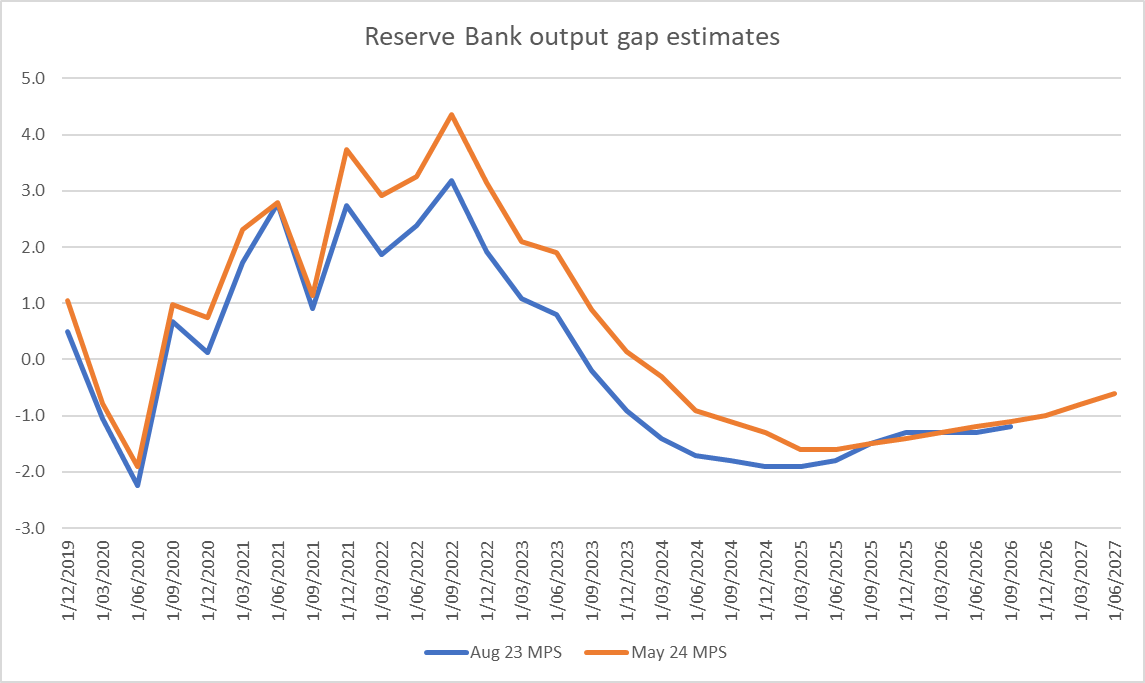
Not on the “brink of bankruptcy”

This coming Sunday will be the 40th anniversary of the 1984 election, which ushered in a decade of radical economic reform in New Zealand. The Listener magazine has a cover story (or set of them) on “Rogernomics and how it continues to shape our lives”. The first article is by Danyl McLauchlan (and isn’t bad in itself, even if it could have done with some economic policy fact-checking in a few places), which the contents page introduced with the description that the accelerated reform programme was a “momentous shift in direction for a country on the brink of bankruptcy”. The only problem with that story is that it simply wasn’t so. For decades, people from left and right have run the line, seemingly in need of a foundation myth (on the left for why their beloved Labour did so much dreadful stuff, and on the right to accentuate the case for the far-reaching reform programme, often with a subtext of “see, there really was no alternative”), but the apparent felt need for such a myth doesn’t change the underlying facts. Neither the New Zealand government, nor wider New Zealand (whatever that might mean in this context) was anywhere near the “brink of bankruptcy” in July 1984.

There was, incidentally, a time when the New Zealand government could fairly be described as having been “on the brink of bankruptcy”. The New Zealand government went into the Great Depression with government debt of around 160 per cent of GDP, the subsequent sharp fall in real and nominal GDP drove that ratio well over 200 per cent at peak, and in 1933 there was a default (most countries defaulted in those years, simply never repaying some of their prior legal debt commitments). One could argue that, for different reasons, the New Zealand government was also in deep financial strife in 1939. But it wasn’t in mid 1984.

The long-term Treasury fiscal tables only go back as far as the year to March 1972. Even then, changes in accounting practices etc mean the data aren’t fully consistent over time. But this chart captures what there is, up to the current (24/25) financial year forecasts.

As at 31 March 1984 net debt was 29.6 per cent of GDP. On the current preferred measure (including NZSF assets), central government net debt is projected to be 23.1 per cent of GDP at the end of the 24/25 financial year (and lest there be any doubt the New Zealand government is also now not on the “brink of bankruptcy”). Had the debt been increasing quite a bit over the decade running up to 1984? Certainly it had, but nowhere near as fast as many vaguely familiar with the fiscal situation then might have supposed because of the combination of inflation and financial repression (holding interest rates artificially low). Things were a mess, but solvency simply wasn’t the issue.

Finding comparable data for other advanced countries back that far is a challenge, but looking at the OECD’s patchy tables three countries showed up with much higher net debt than New Zealand back then: Belgium, Italy, and Israel (which also happen to be the three I remember being commented on most often back in the 80s). Italy was the least bad of those three back then, but with net debt ratios twice those of New Zealand.

Now, it is fair to add that the official debt numbers back in the mid 1980s didn’t necessarily capture everything. The Think Big projects were being put in place, and if the government wasn’t always a direct financier, protective barriers accomplished similar effects. The reforming Labour government eventually took a lot of that project debt back onto the Crown balance sheet, but as you can see from the chart above even at peak several years later, after a post-liberalisation financial crisis and several years of difficult economic adjustment net debt still peaked at not much more than 50 per cent of GDP. Not good (at all) but simply not then “on the brink of bankruptcy” either (about half of the advanced countries today have net debt in excess of 50 per cent of GDP – IMF data).

Things were certainly in something of a mess in mid-1984. We were just emerging from the wage and price freeze (the price freeze had been lifted earlier that year) and the big uncertainty was how things were going to unfold: would inflation stay moderately low (even the IMF noted at the time that the freeze had gone better than expected) or race back up to 15 per cent? And both the headline fiscal and balance of payments current account deficits were large.

Then again, some context is in order. Inflation really messes up the interpretation of some of these flow balance measures (something the Reserve Bank was publishing a lot of work on at the time), because a big chunk of nominal interest payments are inflation compensation and really, in economic effect, principal repayments. And when international observers really worry about countries’ fiscal policies they often pay a lot of attention to the primary balance (ie excluding finance costs). If a country is running primary surpluses, no matter how small, the debt (and debt to GDP ratios) are most unlikely to explode (in ways that really would raise real solvency/”brink of bankruptcy” issues).

So what do those long-term Treasury tables show? Coming all the way up to the current (24/25) year, we have 54 years of data. In 14 of those years (including 24/25 and the five previous years) the government is/was running a primary deficit. Only three of those years were in the 20th century. One was the year to March 1984, when the primary deficit looks to have been about 0.6 per cent of GDP. Not good (at all), but then this year’s primary deficit is projected to be a touch under 1 per cent of GDP.

The New Zealand was not then (and is not now) on “the brink of bankruptcy”. Here it is perhaps worth noting the IMF’s 1984 Article IV review report on New Zealand, which was finalised in February 1984. In those days, IMF reports were not published and were much more free and frank (this one was leaked to the New Zealand media just prior to the 1984 election, presumably by someone in the RB or Treasury): remarkably, although there is a great of angst about flow fiscal deficits (although with no sense of “brink if bankruptcy” debt stock stuff), there was no discussion of primary deficits at all.

Was the New Zealand economy performing well in 1984? No, of course it wasn’t. It was a mess in many respects, with a great deal of uncertainty, significant imbalances, and lousy productivity growth. But it also wasn’t as if nothing had changed for decades. Liberalisation had been proceeding, at times fitfully and with reversals but the direction was still pretty clear (something recognised in both IMF and OECD reports at the time). The CER agreement with Australia had come into effect just the previous year, formal current account convertibility for foreign exchange transactions had been adopted in 1982, and just a few months earlier auctioning of government bonds (rather than administratively set rates) had commenced (even if it too proceeded in fits and starts). The exchange rate had been fixed since mid 1982, although adjusted once in 1983 when Australia devalued, and the 1984 IMF report notes that it was thought most likely that the crawling peg adjustment model would resume as New Zealand emerged from the freeze. There was a strong sense among advisers of a really overdue need for better macro-stabilisation policies and microeconomic liberalisation policies but no imminent sense of crisis.

There was strong sense (including explicitly by the IMF in that February 1984 report) that the real exchange rate was probably overvalued (not only were there large current account deficits and a really adverse terms of trade, but fixing the nominal exchange rate over the previous couple of years was tending to appreciate the real exchange rate. But it had been a case argued for years.

What changed was when Sir Robert Muldoon called the election and market participants were convinced that (a) there was a high probability of Labour winning, and (b) that if they did win, it was highly likely that Labour would devalue. Roger Douglas was understood to be in favour of a devaluation, and documents that found their way into the public domain only reinforced that sense (as did rumours that a senior Labour MP had told – or strongly implied to – one significant lobby group that Labour would devalue). It was, after all, conventional economic wisdom, not in itself particularly radical.

Intense pressure on New Zealand’s fairly modest liquid foreign exchange reserves began almost instantly (and here the word “liquid” has salience, as some of the funds notionally held as foreign exchange reserves were actually kept by The Treasury in rather illiquid form). These were the days before open and unrestricted short-term capital flows, but even without that possibility, any rational exporter would seek to hold proceeds offshore for as long as possible, while any rational importer would look to make payments as soon as possible. Even just those timing effects, and there were some capital flows too, were enough to create huge pressure. The immediate cash-flow pressure was eased by the Reserve Bank offering (relatively cheap) forward cover, but that didn’t change the basic pressure.

Runs on fixed exchange rates are very hard to stop. They usually don’t start out of the blue, as this one didn’t, and can usually only be stopped if there is a universal commitment – very strongly shared across elite and political circles – not to adjust the rate. Of course, limitless reserves help a lot – including in reducing the chances of runs starting – but in those decades few countries with fixed exchange rates held very high levels of foreign reserves. Interest rate adjustments can help, at least in principle. If liquidity conditions tighten sharply and interest rates rise a lot as a run gets underway it can prompt some people to rethink. In June/July 1984 the Reserve Bank and Treasury advised Muldoon to lift the wholesale interest rates controls and allow some of those effects to work. But even had he been so minded it probably wouldn’t have worked, simply reinforcing a mood that something had to give, and soon, and that that something would be the exchange rate. It wasn’t as if runs on advanced country fixed exchange rates were that uncommon: in 1992 for example, both the UK and Sweden tried to face down runs, allowing interest rates to adjust. In Sweden short-term interest rates got briefly to 500 per cent. But both countries devalued (if you are pretty sure a 20 per cent depreciation is coming within weeks even an interest rate of 10 per cent per month won’t stop you selling). And that was, more or less, the story. It would have been cheaper if Muldoon had accepted official advice and devalued in the middle of the election campaign but……you can understand why any politician would have resisted what would have looked like a mid-campaign concession of failure.

It was an expensive mess (the reserves were eventually – very quickly – bought back at a much higher price) but it was a liquidity issue, in the context of a strongly held official view that the rate needed to be lower, not a solvency one. The country was simply not on “the brink of bankruptcy”. The devaluation itself didn’t force any of the rest of what followed – as I noted, the reserves flowed back pretty quickly once the RB was no longer compelled to defend a rather arbitrary market price that people had lost confidence in. The IMF and external creditors forced nothing either. It was all just New Zealand policymakers’ own doing. And it wasn’t even all very consistent: in fact, the devaluation was followed – in a rather panicky move by Douglas – by the reimposition of a price freeze for several more months. But the atmosphere of crisis, exacerbated by the political shenanigans in the day or two after the election (NZ not having immediate transitions like the UK) made for a great foundation myth. (And curiously there was another run on the currency seven months later, in the days leading up to floating the exchange rate. The market consensus was that a floating exchange rate would fall, perhaps a lot. They were wrong. In fact, if one looks at a graph of the real exchange rate over decades, one could argue that the official view in mid 1984 (very strongly held, and repeated internally in the months following the devaluation) was also – with hindsight – wrong.)

I’ve marked the devaluation low. It was hardly ever revisited once the exchange rate was floated. But the beliefs in 1984 were widely held, in official and private circles here, as well as abroad (eg IMF). Devaluation itself was pretty inevitable against that backdrop.

Six months ago today I wrote a post looking back at the economic outcomes that followed the far-reaching reform programme put in place over the following years. Since some of my right wing friends looked askance at the post, suggesting I was offering aid and comfort to the left, I should add that (a) I don’t hunt in a pack, and b) at the time I supported most of what was done, and c) still think a lot of it was the right thing to have done (and that much would have happened anyway, if in a more gradual and less rigorous fashion – the counterfactual was never one of no change). But it is also impossible to just look past the failure of New Zealand to reconverge with the OECD productivity leaders over the subsequent decades (we’ve dropped further behind almost all of them), or to ignore the utter disaster that has been New Zealand house prices, land use law etc. Again, we cannot know the counterfactual with any certainty. And we also cannot overlook very real gains (eg substantial trade liberalisation and much lower cost of imports etc). But it simply hasn’t been an unalloyed success story. If it were otherwise, New Zealand today would be a quite different – and better – place.

And if perhaps there are some signs that the political system is finally taking seriously the house price disaster – I’m reluctant to go further than that just yet – there is no sign at all that either side of politics much cares about the productivity failure.

Reading Reserve Bank plans and budgets

It isn’t something I’d usually recommend (or even do myself) but the useful new Twitter account @Charteddaily (basically one interesting New Zealand chart a day) posted a couple of charts drawn from the suite of Reserve Bank documents that were released last Thursday, and they piqued my interest (and, for reasons you will see below, concern).

But first, also on Thursday there was some attempt by the government to defend the extraordinary reappointment (yet again) of Neil Quigley as chair of the Reserve Bank’s board (which I’d written about, and lamented, here). The Herald’s Jenée Tibshraeny had got in touch with both the Minister of Finance and with David Seymour (both an Associate Minister of Finance, and leader of a party that had also firmly opposed Orr’s reappointment – something recommended by Quigley’s Board – and whose Finance spokesperson had only a few weeks earlier suggested that Orr (still supported by Quigley and his Board) was unfit for office). The article is headed “Nicola Willis and David Seymour confident in call to appoint…”. If you read the article carefully, Willis never actually explains why she did what she did. She says she stands by her previous criticisms of the Bank and of Orr’s reappointment – thus putting her clearly at odds with Quigley’s views – and the only new observation she makes (that Quigley played a “key role” in establishing the new RB Board) seems irrelevant (not only was that transition presumably why Grant Robertson gave him another two years in 2022, but the Reserve Bank itself shows no sign of any better performance now, whether Governor, MPC or more broadly).

I guess one should give credit to David Seymour for engaging more substantively (since he isn’t the responsible minister he could have just hidden behind Cabinet collective responsibility), but his more extended arguments simply don’t wash either. This was the bulk of his comments

None of this washes. I’m sure many people have heard the story of Orr once being pulled out of a Board meeting by Quigley to get him to calm down. That’s good, but what about the repeated active misrepresentations to FEC, or the dismissive approach Orr – Quigley’s man – routinely takes to any criticism or disagreement. And quite how losing 10 of your top 26 people in short order, several of whom had only recently been promoted by Orr, speaks to Quigley’s value I don’t know. And “chopping and changing”? Quigley has been on the Board since 2010, chair since 2016. Actually, turnover and fresh faces have value (as is widely recognised in other government appointments), especially when the institution has not itself done a good job (massive financial losses, serious inflation outbreak etc). When you can’t change the chief executive (and the government can’t until 2028) getting rid of the chair, at the end of his term, when the chair has backed the Governor all the way, was the way to signal a seriousness about wanting something different. On the evidence of the Willis/Seymour words and actions, this government – once in office – doesn’t.

And it isn’t as if the Bank – Orr or Quigley – is changing of its own accord. This was the first of the snippets that @Charteddaily had highlighted (drawn from RB Annual Reports and from the last two Statements of Performance Expectations).

That is a further 21 per cent planned increase in staff expenses in the year that began on Monday, on top of really large cumulative increases over the Orr era to date. It is just staggering, in a year when almost every other government agency is being expected to cut back, often quite materially. The Reserve Bank is funded through a five-yearly Funding Agreement, and the current one doesn’t expire until 30 June 2025, so the government couldn’t compel them to cut back immediately, but (a) there isn’t anything in the Minister’s letter of expectation (sent back in early April, only finally released last week) urging them to do so, and (b) it is in stark contrast to the voluntary savings in place by ACC, also not funded by direct parliamentary appropriations. The Orr/Quigley approach seems to be “hey, we are the Reserve Bank, we’ll just go our own way”. And there is not the slightest evidence that the Minister of Finance cares.

Then again, her government is throwing out new subsidies to fund Shortland Street.

And it is not as if they are throwing lots more money at improving their monetary policy and inflation research or analysis. Actually, comparing this year’s Statement of Performance Expectations to last year’s, in 2024/25 they plan to spend $46 million on monetary policy up just slightly from a planned $45 million in 2023/24.

So what are they spending their (well, our) money on. This was where I was really gobsmacked by a @Charteddaily tweet, trusting that the person behind that account read documents accurately but still not quite believing it.

Yes, you are reading that correctly: $35 million in 2024/25 on “engaging with the public and other stakeholders”. Since issuing physical cash (zero interest liabilities) is a highly profitable business (forecast net operating profit $483 million), this weird category of “engagement with the public and other stakeholders” is really their biggest item of spending.

I’ve been reading around their documents over the last day or so and I still find it incomprehensible, on numerous counts. First, one would normally have assumed that any costs – including communications costs – associated with the Bank’s various statutory functions (monetary policy, financial system regulation and oversight, foreign reserves etc) would have been allocated to those functions themselves. And you can see that when it comes to monetary policy there is a specific item for “Communication and implementation”. Promoting the institution itself, distinct from its specific statutory responsibilities and powers, is simply not a legitimate use of (very large amounts of) public money.

Here is a high level summary that I found on their website about this activity

But it doesn’t really help. The Reserve Bank, for example, doesn’t fund Parliament. Rather, like any public agency, it is required to front up when called, and the costs of providing information to FEC would, one would have thought, been (modest and) allocated to the respective functions (directly in the case of MPSs and FSRs, perhaps indirectly in respect of the overarching corporate documents).

Much the same goes for 6.1, with the added point that granting media interviews tends not to cost taxpayers anything. The Governor in particular seems to use his rare interviews to hand wave and distract rather than to engage with alternative perspectives or criticisms. As for speaking engagements, there is a bit of cost to them (getting out and around the country) but what has been noticeable for years is how few such engagements – at least on the record ones – they do; hardly any at all in the case of MPC members. And shouldn’t such costs be allocated to (in this case) the monetary policy function?

And so we are left with 6.2. What is proposed? Some massive advertising campaign, indirectly subsidising NZ media? Surely not, but then if not then what? A fair question for Treasury to be asking the Reserve Bank is something along the lines of what outcomes would be worse for New Zealanders if this line item was to be cut by 80 per cent?

The performance measures in the Statement of Performance Expectations are not really any more helpful

None of it tells us what they are actually spending so much money on (or why most of the costs are not allocated back to respective core functions).

There was some verbiage and effort at distraction in the Statement of Intent itself

Quite what any changes in the “media landscape” might have to do with the extent of trust people might repose in New Zealand’s central bank isn’t clear, but I guess playing distraction is better than identifying factors like:

  • presiding over the worst inflation outbreak in decades, and then trying to openly blame it on everyone than the central bank itself,
  • losing taxpayers $11.5 billion in a huge bond market punt, and then refusing to seriously engage on the extent of the loss and associated misjudgement,
  • everyone involved in these decisions (Governor, MPC members, Board chair) getting reappointed, only confirming that “accountability” has been emptied of all content,
  • the appointment of a DCE responsible for macro and monetary policy with not the slightest background in that area,
  • blackballing people with research expertise from the new Monetary Policy Committee, and then years later assserting openly that there never was such a ban,
  • a Governor who is universally known to be intolerant of debate or challenge/disagreement,
  • barely any (and then of no depth) serious speeches from key monetary policy figures through the worst inflation outbreak and period of greatest policy uncertainty in decades,
  • a central bank that shows little sign of being exclusively focused on the limited range of things Parliament instructs it to do, instead pursuing management/Board ideological causes.
  • and so on

But sure, try blaming the “media landscape”. Seems a bit more like an effort – at taxpayers’ expense, from public officials – at active disinformation.

And if you are inclined to doubt the point about loss of focus, I can only suggest reading the Statement of Intent itself. “Climate” gets more mentions than either “inflation” or “price stability”, and if that particular ratio is (much) less bad than it was in their previous Statement of Intent, what hasn’t changed is that while “inflation” gets five mentions, and “price stability” six, “Maori” features 52 times (pretty similar to the previous Statement of Intent). And, yes, I did check and it is not that they are publishing lists of all different ethnicities: neither Asian, Pacific, nor European get even a mention (and nor would you expect any of them to do so in a central bank actually focused on its mandate, which by its nature operates pretty pervasively across the entire economy, regardless of religion, ethnicity, sexuality or whatever).

But Orr and Quigley have a crusade.

I checked again the Reserve Bank Act. There is but one substantive reference to “Maori” in that legislation (in a “good employer” section) and none at all – again unsurprisingly – to the treaty of Waitangi.

But you wouldn’t guess it from reading the Statement of Intent. It starts – first substantive page – with the tree god nonsense Orr used to spout on about a few years ago (complete with dodgy economic history about the founding of the Reserve Bank). Their so-called Te Ao Maori strategy gets two whole pages, complete with links to their treaty of Waitangi statement, well before any serious discussion about monetary policy, the cash system, or the soundness of the financial system, none of it grounded in statute. It pervades the document.

Now, in fairness to Nicola Willis, her letter of expectations to the Bank’s Board is different than those from Robertson. There is nothing at all of the dubious ideological stuff that Robertson used to throw in. But what difference has it made? None, apparently, given that her letter is dated 3 April, all these corporate documents came out only last Thursday, and none will have been a surprise to the Minister, since she had to be consulted. And yet she and the Cabinet reappointed Quigley.

Just breathtaking.

I’m still at a loss to understand what they have included in that $35 million. Perhaps they will now stop stonewalling on OIAs, and stop trying to charge me for information they should have released 5 years ago (but then OIAs weren’t even mentioned in that “engagement” description). Pro-active openness also tends to be even cheaper than handling OIAs, but that is something the Bank seems totally averse to. Perhaps they could spend a bit on a better proofreader (the table that showed that $35m had a typo in its title).

But more seriously, we deserve to know what this total includes, and why they are spending so much of our money to try to make us like/respect them (when just doing their job well – and only their job – would do more of that, and have substantive benefits to us). I suspect – but can’t confirm – the $35 million includes a lot of spending on things that really can’t be tied at all to statutory functions: their climate advisers, their Maori advisers, their diversity and equity (so-called) people, their multi-national central bank indigenous network costs etc, although it is still really hard to see how it gets to $35m per annum (hard to tell how much of an increase it is for this year, as they have changed their presentation, athough a number from last year that looks to be similar is about $29m).

While pouring out lengthy bureaucratic documents they avoid real scrutiny, they don’t do their day jobs at all well (we are living with the aftermath of really bad misjudgements in 2020/21), never show the slightest contrition, and feel free to use large amounts of public money to pursue personal ideological agendas not even slightly grounded in their statutory responsibilities, they rarely engage substantively, publish next to no research, and so on.

And yet Nicola Willis (and her leader and Cabinet) seem quite unbothered and just went ahead and reappointed the chair yet again.

Then again, this is the government – that campaigned up hill and down dale on fiscal excess and waste – which yesterday announced big new subsidies for……keeping an old local soap opera going.

Astonishing indifference to a failed institution

Since taking office, the new government has replaced quite a number of chairs of government entities. I’m sure there are many others but NZTA, Health NZ, Pharmac, and the FMA are just the examples that spring to mind. It isn’t uncommon for such changes to be made, and in many government entities board members can be replaced at will by the government of the day.

It isn’t so for the Reserve Bank. Mostly, board members (including the chair) can only be replaced at the end of their terms. This is consistent with notions of the operational independence of the Reserve Bank, and much the same provisions apply to MPC members.

Two years ago the overhauled Reserve Bank Act came fully into effect and with it came a new Board. If the previous government appointed people who mostly simply weren’t fit for the responsibilities they were taking on (I compared them in an earlier post to a slightly overqualified board of trustees for a high decile high school), and in several cases had question marks around them, at least the terms of the appointees were staggered so that if there was a change of government there would in reasonable time be an opportunity for change. In fact, they left one possible position unfilled (the Board can have between 5 and 9 members). Perhaps most importantly, the previous chair Neil Quigley was given only a two year term (ending on 30 June 2024), much shorter than would normally be desirable but in what was clearly intended as a transitional appointment, smoothing the way with (a) a new Act, and (b) a large and simultaneous crop of new Board members.

As a reminder, the Reserve Bank’s Board is a very powerful body. They hold all the powers of the Reserve Bank other than those statutorily assigned to the Monetary Policy Committee. That means not just the corporate aspects (that the published Board minutes suggest they relish most), but all the prudential regulatory policy and supervisory powers, and most of the issues around the Reserve Bank’s large balance sheet. It also means that the Board has the primary responsibility for recommending the appointment of the Governor and of the external MPC members, and the responsibility for holding to account and overseeing the Monetary Policy Committee. These are very substantial powers, and in some cases at least seem to be taken very seriously (for example I noticed in a recent set of published Board minutes that a Board member had actually been presenting to the Board the paper on a set of proposed regulatory policy changes – which seems, frankly, quite unusual, but their choice I guess).

It is no secret that things have not gone well at the Reserve Bank in recent years. 

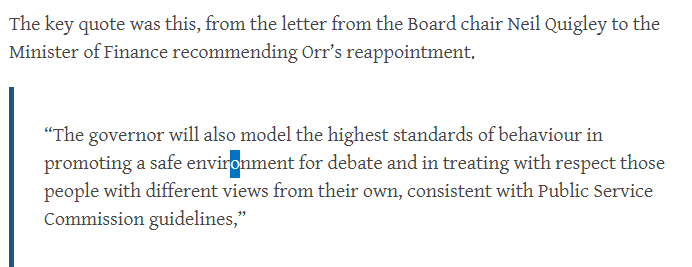
And yet late last week this announcement appeared from the Minister of Finance

Even among those with low expectations of the current Minister of Finance, it was pretty astonishing news. It isn’t really possible to get rid of the Governor – unless he had been inclined to do the honourable thing, including accepting responsibility for the macro mess, and resign – but the Board chair’s term expired just six months after the new government took office. Of the three parties in the government, the two who had been in Parliament last term – ACT and National – had both objected to Orr’s reappointment when, as his new law required, Grant Robertson had consulted them. And it was the Board, led by Quigley, that was responsible for choosing to recommend Orr. The Finance spokesman for one of the parties (ACT) had been out in public, on ACT’s official accounts, just a few weeks ago attacking Orr

And who is responsible for the Governor’s performance monitoring and accountability? Why, that would be the board, with typically a leading role played by the Board chair.

But never mind says Nicola Willis (presumably with the endorsement of the entire Cabinet), let’s give Neil yet another two years. Either the government thinks things at the Reserve Bank are going swimmingly or (much more likely) they just don’t care. That would be consistent with there being no sign of any change to how the MPC is supposed to work (eg requiring more openness and accountability), no sign yet of any Letter of Expectation from the new minister to the Bank signalling any sort of difference of direction/emphasis, and no sign at all of pressure on the Bank to voluntarily join in cutting its (bloated) expenditure authorised by the previous government, in an agreement that has another year to run.

It isn’t obvious that there would have been any political price at all if they had chosen to replace Quigley. It was widely expected. It was the end of his term. And so on.

And there are numerous reasons why this reappointment is bad.

One of them is that, no matter how good a person is, sixteen years on a single board is just too long (Quigley was first appointed in 2010). He has already been chair for eight years (the typical limit, for example, on government department chief executives in a single role). Even the Reserve Bank Act recognises this sort of issue: the Governor, for example, simply can’t be reappointed when his current term expires in 2028, and the same went for the external Monetary Policy Committee members who are turning over this year and next. And what of Board members?

Presumably Quigley’s time on the Board prior to 2022 doesn’t count formally against this constraint, but…..sixteen years (even as the Board’s role has changed over time) is simply too long (as is 10 years as chair, again almost no matter how good you are).

Then there is the Reserve Bank that he has presided over for the past eight years, as the power and responsibility of the Board was substantially increased. That is the Bank that has delivered as follows:

  • the worst outbreak in inflation in modern times, including first the most overheated economy among OECD central banks, and now a wrenching dislocation –  including deep falls in per capita GDP –  to get inflation back under control,
  • losses of around $11.5 billion dollars on the utterly unnecessary Large Scale Asset Purchase (LSAP) programme, with no material offsets or benefits to show for this rather reckless gamble,
  • the sharp decline in the volume and quality of published Reserve Bank research and analysis (Treasury is hardly a research powerhouse but is now clearly better than the RB),
  • the near-complete absence of any sort of serious speech programme from powerful senior decisionmakers,
  • the blackball placed by the Board/Bank on the appointment to the MPC in its first five years of anyone with actual or future research expertise/activity in macroeconomics or monetary policy (a policy so beyond comprehension that the documents show that not even Treasury officials in the macro area understood it)
  • the absence of robust cost-benefit analysis for the increasingly intrusive range of prudential controls the Bank has put in place,
  • the evident loss of focus on core functions, in favour of the personal ideological preferences of management (and perhaps the Board),
  • the appointment of a deputy chief executive with specific responsibility for monetary policy and macroeconomics with no background in the subjects and no evident expertise (pretty much unprecedented these days),
  • a Governor who has repeatedly lied to or actively misled Parliament (eg here, here, here, and here),
  • and so on.

Many of these things were the direct responsibility of the Governor and/or the Monetary Policy Committee, and it is pretty appalling that Orr himself was reappointed but (a) the Board is responsible for overseeing and holding to account the holders of these offices, and b) the Board recommended the appointment or reappointment of each of these people (the Governor himself, external MPC members to the limits the law allowed, and the utterly ill-qualified DCE who could not have been appointed to an MPC role without the Board’s imprimatur).   There is also no sign that the Governor is any more willing or able to engage in a constructive manner or tolerate dissent, disagreement, or criticism than ever.  He plays distraction, he plays the man.  He simply isn’t a figure of gravitas commanding general respect.  And he is Quigley’s responsibility.

“Public sector accountability” has increasingly become a sick joke, but Orr and Quigley are perhaps the New Zealand epitome of that.    Accountability –  serious practical accountability, with consequences –  was supposed to be price of power and independence.  Mess up really really badly and under this government (and the last) you don’t even get politely sent on your way when your term is up.  This government couldn’t do much about Orr now, but they could have replaced Quigley and simply chose not to do so.

As to why, who knows?  Well, the Minister presumably does but she isn’t saying (and apparently no journalists are asking).  Her statement talks of two things.  The first is “retaining his leadership and experience in central banking and monetary policy”, which can’t really be said with a straight face when one looks at the Reserve Bank’s recent record as a central bank (and Quigley has no direct involvement in monetary policy).  The second is that his reappointment ensures the Board “is well positioned to take om new members”.  Which might have been a half-plausible line in 2022, with five new members in a single day (and a new Act and responsibilities) but is a rather desperate claim now…..especially when the Minister –  in office for six months already –  has made no effort to fill the two possible vacancies that are there (one of long standing, the other arising 2-3 months ago when an existing director left for another government appointment), and there is an established cohort of existing directors carrying on.

The best explanation is that she simply didn’t care.

(The more hardbitten cynics might recall Quigley’s cosy relationship with the National Party over his university’s bid for a medical school (“a present for the start of your second term”), but Quigley is more of an opportunist, working whatever angles or sides benefit him, rather than some National hack –  he was, after all, confirmed as chair previously by the Labour government.)

I have wondered if one possibility is that the government has someone in mind who might be suitable as chair but is either not yet ready or not yet available.   Looking at the Board page I spotted this


vermeulen


“Future directors” are quite the thing in the public sector these days, and as this text says Grant Robertson encouraged the Board to appoint one. But they only got round to doing so on 1 June. Vermeulen, who seems to be Belgian, was a researcher at the ECB for a long time, switching to academe and relocating to New Zealand just a few years ago. He looks as though he could be a credible contender for some role in or around the Bank (possibly an MPC position, when another vacancy arises next year), perhaps even an effective Board member or even, one day, chair. It seems like a fairly unambiguously good appointment on the face of it. But then with actual Board vacancies outstanding, if this was anything like the backstory why wasn’t he just appointed straight onto the Board? If he doesn’t seem to have any much governance background, he looks no worse qualified overall than several existing Board members, and at least (unlike most of them) has some subject knowledge and expertise.  So the more I think about it, the less likely my charitable explanation seems.  

It is true, as the minister said, that a couple of other (underqualified) board members’ terms expire next June, but that shouldn’t have impeded replacing Quigley now –  if anything it should have helped impel change at the top starting now.  If Willis and her colleagues cared.

Finally, a reminder that Quigley hardly exemplifies the qualities one should be looking for in a chair of a powerful and prominent government agency, that needs to command widespread respect –  not just as non-partisan, but as highly capable, honourable, and marked by the utmost standards of integrity – in return for the huge degree of influence (for good, but often for ill) that the public and Parliament grants to the Bank.   The Board’s role in such an entity is to act as agent for the public, upholding all the standards citizens might reasonably expect, not to simply have the back of management and the bureaucratic institution.

Quigley can on occasion talk a good talk.    But there is little evidence that he walks the talk or insists on it from the Governor or management. 

On institutional capability for example, he was clearly primarily responsible for the extraordinary blackball put in place, preventing active experts from being appointed as external MPC members (a call all the more extraordinary when none of the internals were really expert either).   Astonishingly, OIAed documents (finally obtained recently, when they should have been released in response to a 2019 request – now subject to an appeal to the Ombudsman) show that Quigley himself had been keen on stocking the MPC with, all things, lawyers –  for a function that had almost no regulatory dimensions.

As to integrity, a series of OIAed documents last year (eg  here ) show that Quigley actively asserted to The Treasury that there had never been such a blackball –  this the person who himself in 2018 told an academic of my acquaintance that that person would not be considered for exactly that reason (research active in the broad subject area).  And then last year – when MPC positions were being advertised again and question about the blackball were being asked – together with The Treasury he tried to suggest it was all a misunderstanding, the responsibility of some midlevel Treasury manager who had somehow misunderstood everything (and by 2023 was no longer at Treasury so was no longer in a position to push back), prompting Treasury and the then Minister to repeat his simple falsehood in public statements to the media.    It was pretty despicable behaviour –  against a backdrop of public comment from the then Minister, the Minister’s then economic adviser, and the Bank itself (in 2019 and 2022) defending exactly the blackball Quigley now denies ever existing.   Just possibly by last year, Quigley – a busy man –  had ended up confusing a couple of different things (real conflicts of interest were a genuine concern for the Board in selecting MPC members), but he made no effort to clarify the situation or acknowledge any mistake.  Note that one of the other Board members from 2018/19, actively involved in the selection proceess, went on record to the Herald to (a) disagree with Quigley, b) wonder why Quigley didn’t just act to clarify things, and also, as I understand, to indicate to the Herald that they had accurately reported him.

These simply aren’t the actions of an honourable man, with any sort of commitment to the openness and transparency the Bank prefers to prattle on about rather than to practice.

On integrity, I found this line from Quigley himself in an email from 2018 (around the MPC selection process):  “the Reserve Bank can never be in the situation that the integrity of its senior decision-makers could be called into question by other roles”.

Again, fine words and no one is going to disagree.  But Quigley simply doesn’t walk the talk.  He was active in the selection of Rodger Finlay for, first, the “transitional Board” and then the full new Board of the Reserve Bank in 2021/22 at a time when Finlay was the chair of the board of the majority shareholder in the fifth largest bank in the country.  It was simply extraordinary that it happened, but nothing in the documentary record suggests that Quigley –  the Board chair – ever raised much concern.  It all finally got sorted out about the time the new Board finally took office, but (a) Finlay had been receiving Board papers and attending Board meetings for months while still having his Kiwibank ownership role, and b)  now serves as the Board’s deputy chair, with perhaps no current conflict but still tainting the Board’s standing (and any sort of commitment to strong and honest governance in the financial system) by his  prominent presence.

Then there was the case of the current Board member Byron Pepper, who was appointed to the Reserve Bank Board –  with no sign of any objection by Quigley as chair – despite being then a director of an insurance company part-owned by another insurance company that was regulated by the Reserve Bank (Board) itself.  It wasn’t illegal, but it was simply a poor appointment (particularly in the first up round of appointments to a new institution) and dreadful look.  But not to Quigley apparently, who simply seems to have no moral sense of what is right and wrong, what is an appropriately high standard of governance, just of what can be gotten away with.  Eventually, several months later, Pepper resigned from that insurance role under pressure.  OIAed documents show that Quigley still didn’t think there was anything wrong but that awkward public questions might be asked and they had to worry about the pesky OIA, which (apparently inconveniently) they had to provide “good faith responses to”.   

And what of Quigley own other roles?  Specifically, (what always seemed like it should be a fulltime job) as Vice-Chancellor of Waikato University.   Well, there Quigley and his university were recently openly reprimanded by the Auditor General for inappropriately weak procurement practices in respect of the expenditure of large amounts of public money hiring a former Cabinet minister as a lobbyist.  And this was the same Quigley, the same institution, that hit the headlines a few months ago with the oh-so-cosy, but spectacularly badly phrased (particularly from someone who was at the same chair of the Board of the Reserve Bank) fawning email to National’s then health spokesperson Shane Reti, as Quigley lobbied for a new medical school.

reti

All the evidence is that, under pressure, he lacks integrity and judgement, including any fundamental sense of what is right and wrong, and what is fit and proper in the chair of a prominent and powerful public institution.   He is unfit for office (an office he seems not to have exercised for any good –  and if the Orr we’ve seen, blustering, repeatedly actively misleading Parliament, unwilling and unable to engage constructively, pursuing personal political agendas in public office (most recently his weird FDI remarks) is the one that has benefited from any guidance, counsel, or restraint from Quigley as Board chair heaven help us).  And yet…. Nicola Willis and the Cabinet just went ahead and appointed him again.

They seem not to care at all about the decline of New Zealand public institutions (as, for example, their extraordiinary failure to appoint a Public Service Commissioner).  Cynics suggested their only real interest was in holding office themselves.   Sadly, evidence is mounting in support of that claim.

(But I have this morning lodged an OIA request with Willis’s office for all material relating to the Board appointments and vacancies.  Perhaps some more favourable material will emerge.  Time will tell, but I won’t be holding my breath.)

Note that under the amended law passed by the previous government, Willis will have been required to consult with other parties in Parliament on Quigley’s fresh appointment.  Here, of course, only opposition parties matter.  It will be interesting to see if any of them had comments to make – but between two mired in severe reputational (and worse) issues around their own members, and one that reappointed Orr (and the rest) in the first place, it is perhaps too much to hope for anything to have been said. 


ADDENDUM

Since I hope this will be my final post about the selection of those MPC members in 2018/19 (the blackball now having been removed and some better appointments made this year), the latest set of papers the Bank eventually released again confirm how the Board under Quigley has been gaming the system to give the Minister of Finance what he (at the time) wanted.  The Act is written with the clear intention that the Board selects individuals to be appointed to the MPC and recommends those specific names to the Minister.  The Minister can reject such nominations, in a process that should be documented and disclosable, but (and this was a point the Bank often made in publicly championing this unusual double veto system) cannot impose his own candidates.    Papers around the first selection process show that nothing of the sort happened.   Even when the final recommendations went up to the Minister the Board presented him with a menu of options and invited him to choose his favourites,  This was after they had already consulted him and his office, who had made it clear that they wanted at least one female appointee (even though the one chosen had no subject expertise or relevant background and may have been quite astonished at her own selection).  The latest papers also reveal that late in the process a list of names was canvassed with the Minister who still wasn’t satisfied and at that point seems to have proposed that former union economist and Michael Cullen ministerial adviser Peter Harris –  also with no relevant subject expertise –  be added to the list.  Of course, he was and was then appointed by the Minister.

To be clear, I am not a big fan of the legislated system.  I would rather, as typically in other countries, the Minister was free to choose his or her own appointees to the Board and MPC and as Governor (I have previously proposed adding non-binding “confirmation hearings” (as in the UK) as some check on inappropriate appointments). But that is not the law as it stands (and was reaffirmed in the latest amendments).  What we actually have is performance theatre on the public – pretending one system, practising another – all made possible by a compliant Board chair, Neil Quigley.    For all his poor judgement and weak leadership, he does seem to make himself useful to ministers.  But that isn’t what the chair of the Reserve Bank is supposed to be or do.

GDP-Live….has limitations

Richard Prebble, once upon a time an Associate Minister of Finance, has a column in the Herald this morning which he devotes to the twin causes of bashing the Reserve Bank and singing the praises of an interesting nowcasting data project run by a Massey academic, GDP Live. I’m quite partial to a fairly critical approach to today’s Reserve Bank of New Zealand (even had a post in mind on the very subject for today), but I don’t find Prebble’s stick to beat them with – GDP Live – particularly persuasive on this occasion.

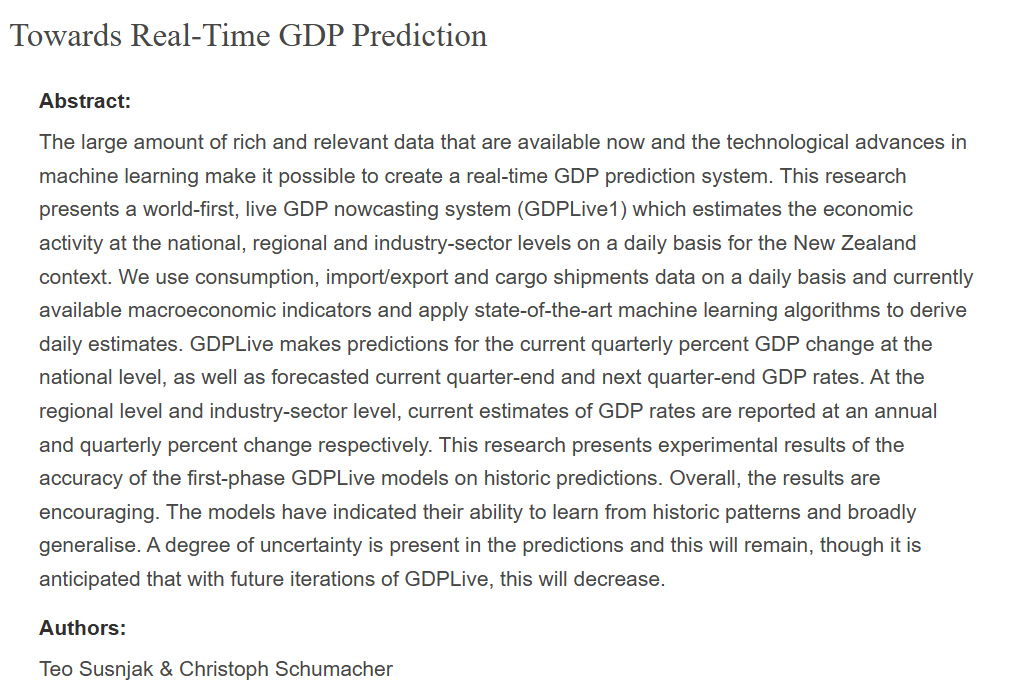
This was the abstract from the authors’ 2018 paper (on the website at the link above) on what they are doing

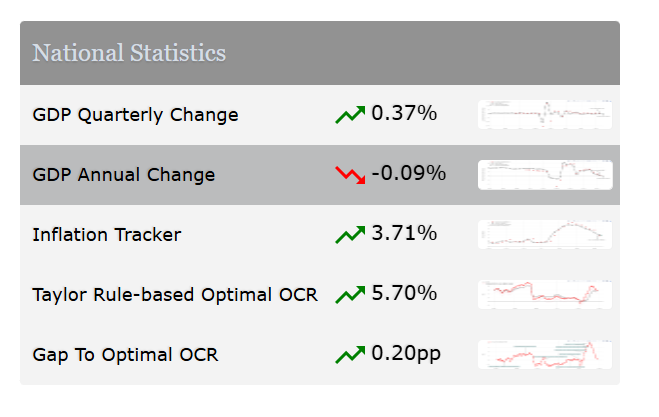
It is great to see people doing this sort of stuff and making the results available routinely and accessibly. It is particularly good to see economics academics in New Zealand doing some policy-relevant New Zealand focused stuff. They publish daily updates of quarterly estimates of several macro variables

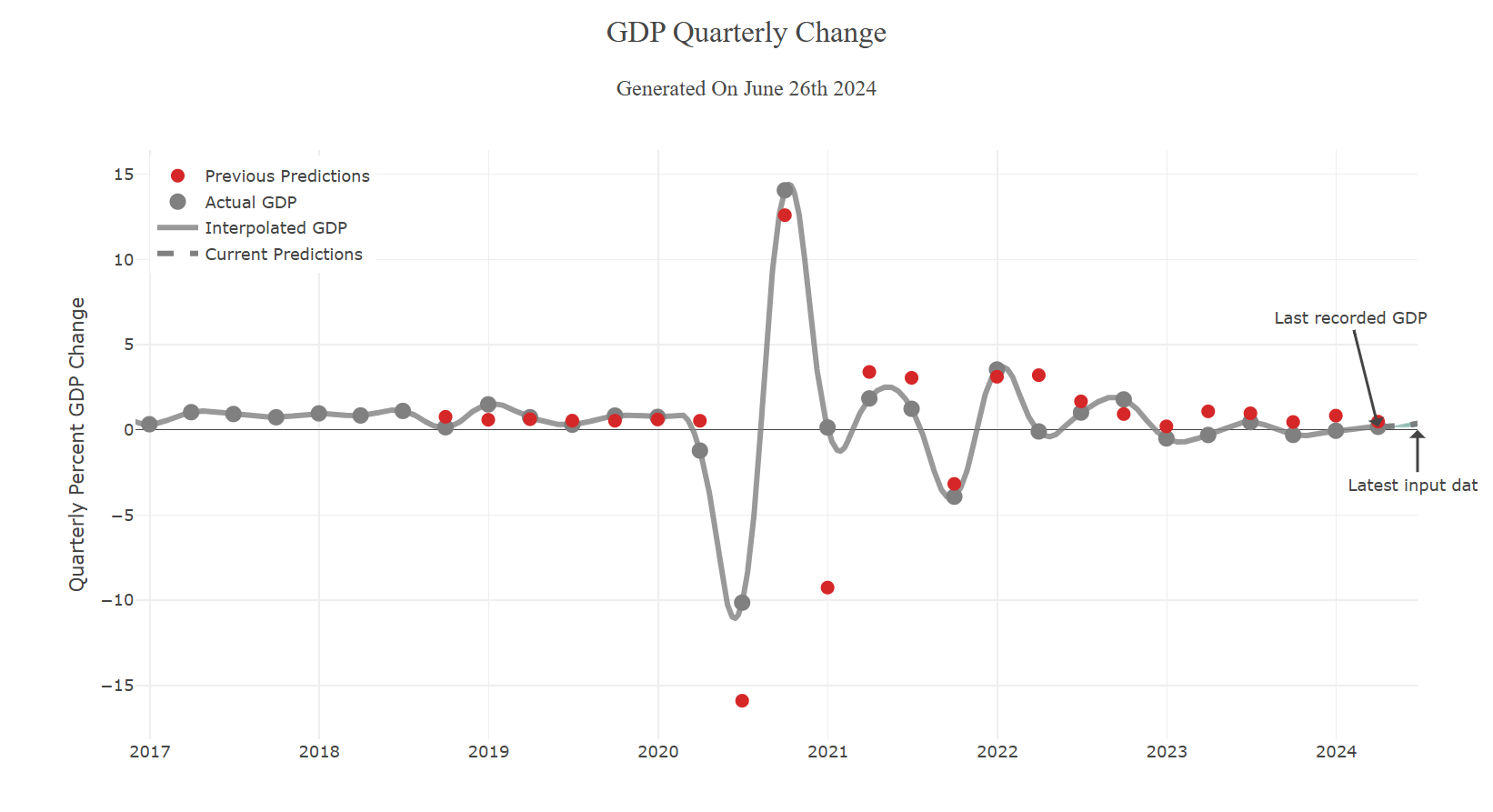
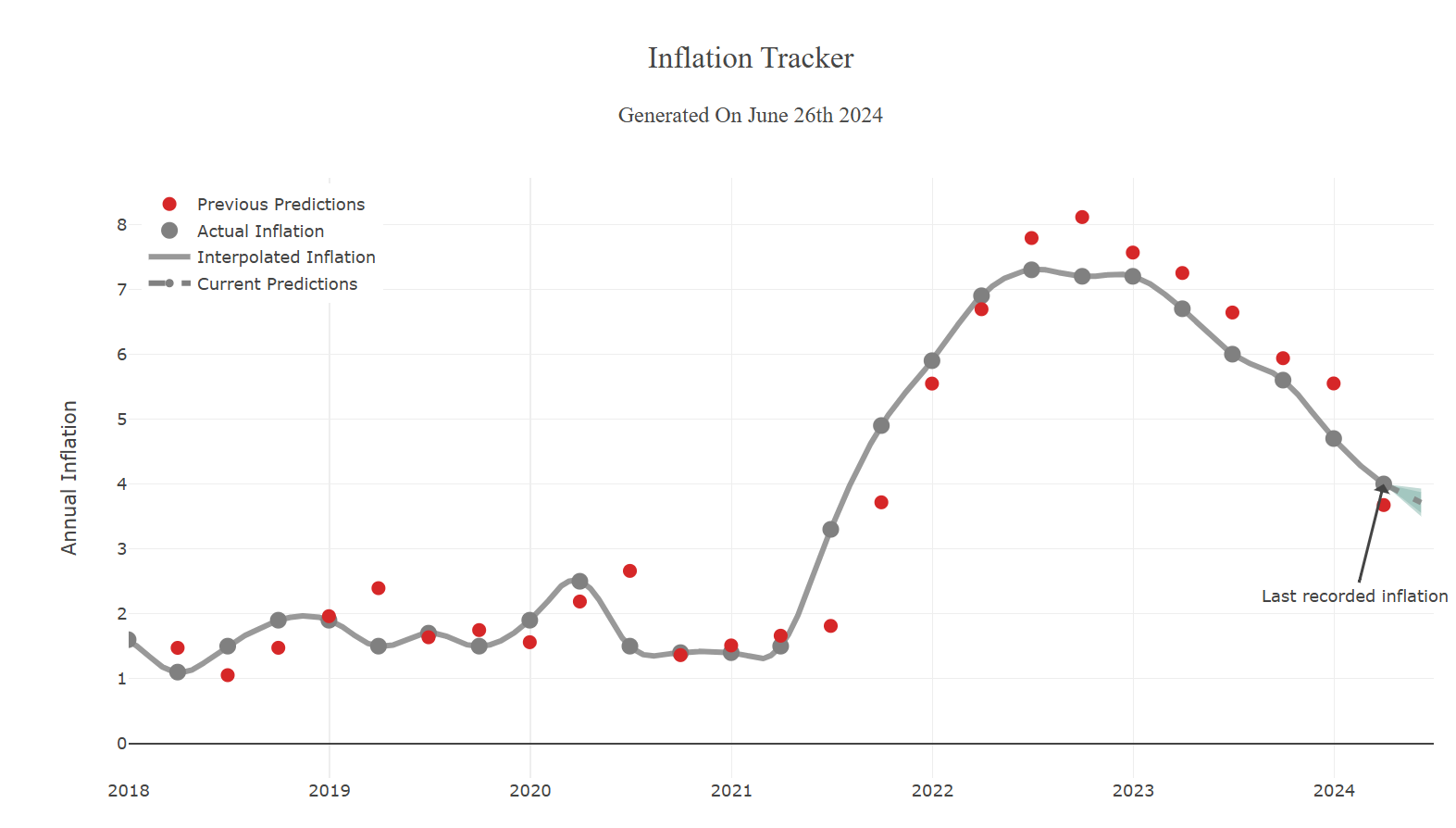
Prebble’s focus was on the quarterly change in (production) GDP numbers. Here is the GDP-Live chart for that variable

If you just give it a quick glance it doesn’t look too bad – those “previous predictions” don’t look too consistently different from the grey dots, the latest vintage of SNZ actual data (note that “latest vintage” is not innocuous, since recently published outcomes are often revised for several years as more data come available to SNZ. And while “true” GDP growth is probably what should be being aimed for, it is less use than “first release” GDP data unless users can be confident that GDP-Live is producing really quite reliable estimates of the final number that won’t settle for several years).

Here is how the “previous predictions” (red dots) are described

But scale is a bit of a problem in just eyeballing the chart. There were those two very very dramatic quarters around the first Covid lockdown, which push the scale out so far that it is very difficult to meaningfully eyeball any of the other data.

So I laboriously transcribed the red dot numbers into a spreadsheet and compared them against the latest vintage SNZ data. How accurate were the red-dot average predictions?

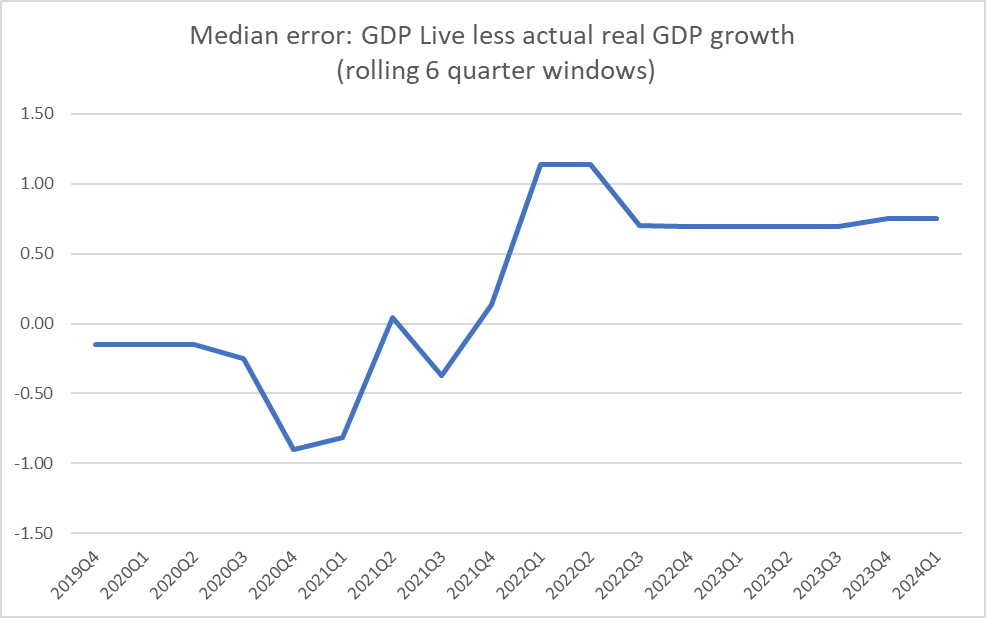
Well, not very at all (so far). Over the almost six years of observations the median gap between the red dot and the current SNZ estimate for each quarter has been 0.54 per cent (specifically, in a typical quarter the model has overestimated quarterly GDP growth by 0.54 per cent).

That isn’t great, but it also isn’t as if the errors have been predictably all on one side. For the first half of the sample – even through those really volatile Covid quarters – there wasn’t much of a bias at all. But in the last couple of years, the bias has been large and (it appears) quite persistent.

I did that chart using six-quarter rolling windows (slightly arbitrarily chosen horizon, but to capture some variation in a quite limited total sample), but perhaps as concerning is that in every single one of the last six quarters GDP-Live has materially overpredicted (the current vintage of) quarterly real production GDP growth. You can see this on the GDP-Live chart itself above, but the Covid scale issue makes those gaps look quite small. They aren’t. In fact, the smallest gap (smallest overstatement) is for the most recent (March quarter) numbers, but (a) at 0.32 per cent it is still far from small, and (b) who knows where the final SNZ number for that quarter will end up. (Not to ignore the fact that GDP(P) is itself only one proxy of “true” GDP, and GDP-Live doesn’t attempt to model GDP(E)).

The point of this post is NOT to bag the GDP-Live efforts. I’m only too keen on seeing more and better analysis and tools that make for better commentary and macro policy in New Zealand.

It also isn’t impossible that the GDP-Live estimates are less bad than RBNZ ones. I’m not going back and opening up 23 past MPS to get all the RB projections, but I did have look at those last six quarters that GDP-Live had done badly on. Straight comparisons aren’t easy.

As I understand GDP-Live they do forecasts every day during the quarter and the red dot is the average of 90 of them. It doesn’t update its estimates in the 10-11 weeks we have to wait before SNZ finally publishes their numbers. The Reserve Bank, by contrast, publishes forecasts only each quarter. The first quarter they are forecasting is actually the previous calendar quarter (so in the May MPS their first forecast/estimate was for the March quarter). By then, they might reasonably be thought to have some more data to hand than the GDP-Live model uses. On the other hand, they also publish in the May MPS a forecast for GDP growth in the June quarter. The Bank’s projections are finalised only about 7 weeks into the quarter so at that they have materially less data than GDP-Live has when its June quarter red dot is finalised in a day or two from now. The simplest comparison might then be to average the Bank’s Feb MPS and May MPS forecasts for the March quarter (the most recent hard SNZ estimates we have).

Over that period, the Reserve Bank also tended to overpredict (in five of the six quarters), but the median error (0.19 per cent per quarter) was materially less than GDP-Live’s error.

Should we put very much weight on any of this? I wouldn’t. The tool is fairly new, the sample is short (and the last six quarters just one – not immaterial – episode). Moreover, I am quite sure that the Reserve Bank is using a range of statistical models to do their (as we used to call them) “monitoring quarter” GDP growth estimates. It would be surprising if they hadn’t taken a look at what GDP-Live might offer, and particularly at such questions as to when and in what circumstances it might have done less badly than their other models or techniques. So the point of this post isn’t to bag GDP-Live or to praise the Reserve Bank, but more to caution readers, and potential readers, of Richard Prebble’s column.

GDP-Live also does real-time inflation forecasts (and here we don’t have to worry about ongoing data revisions). Unfortunately, the model doesn’t seem to have done very well when we would have valued it most, in the worst outbreak of inflation in decades (and now the abatement of inflation). In both cases, it has lagged actual CPI data (rising and falling a quarter or so later, and reaching a peak that was higher than the actual).

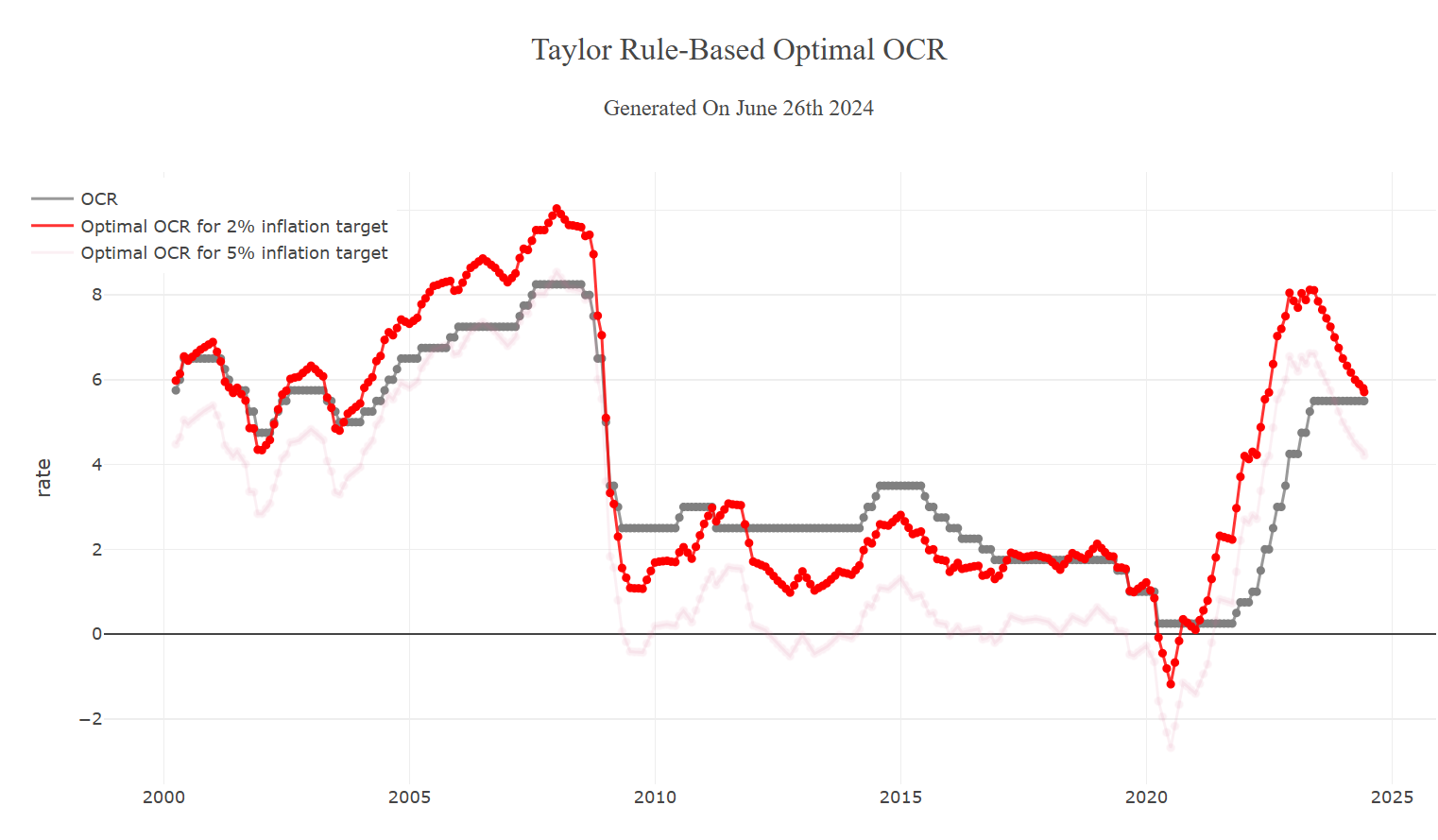
They also do a Taylor-rule based guide to what the OCR should be (over a longer period). Since one of the key uncertainties of the last 15 years has been what is, and what is happening to, the neutral real interest rate I’m sceptical of Taylor rule approaches adding much marginal value. At present, I see little external basis for thinking that the OCR should have been set at 8 per cent last June (rather than the 5.5 per cent actual), and although I was an OCRAG hawk in late 2007 – so quite like the red line being above the grey line then – I’m also sceptical that an OCR of 10 per cent then, or even 9.4 per cent by July 2008, was really what the situation called for.

But people should keep an eye on these tools, as just one piece of data to add to the analytical mill.

A Sahm-type rule for NZ? I think not.

The Treasury yesterday hosted the first in their new series of guest lectures, under the broad heading “Fiscal Policy for the Future”. In introducing the series Dominick Stephens, Treasury’s chief economist, told us that the focus would be on three sub-headings: policy dimensions around fiscal sustainability, the potential stabilising role of fiscal policy, and ideas around value for money. Which sounds fine I suppose, but it perhaps wasn’t a great example of reading the times that the first lecture was about an idea that would, when it was used, involve the Crown simply giving away a lot more money (automatically).

The guest lecturer was the left-wing (a description she embraces) American economist Claudia Sahm. Sahm was formerly an economist at the Fed and these days seems to divide her time between consulting and being chief economist for a US funds management firm.

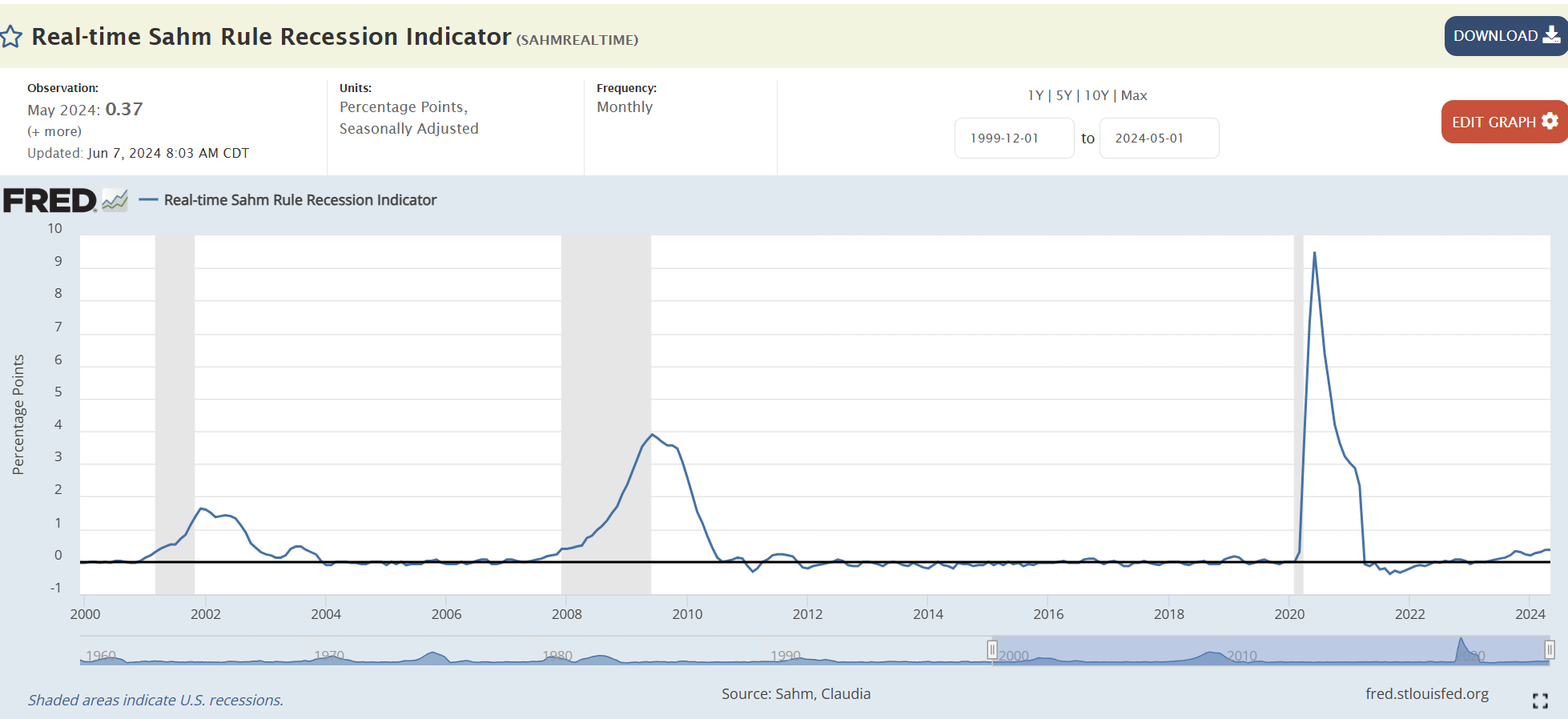
Sahm is best known for the Sahm rule US recession indicator

She didn’t develop the indicator simply for analytical interest but (as she reminded readers in a recent Substack) with a policy proposal in mind

The idea being that when the recession indicator threshold point is met, the IRS would mail out checks automatically, to lean against the incipient downturn by boosting consumer spending. It would be, in her words, a quasi automatic stabiliser

(The “automatic stabilisers” are the extent to which government budgets vary with economic cycle without any discretionary policy changes – you can think of unemployment benefits, but typically the tax side of things is much more important. We don’t have lump sum taxes, rather governments share in the gains/losses when wage bills, spending, and profits rise/fall. Relative to a lump sum taxes benchmark, the actual way we design tax systems – proportional and, in respect of income tax, progressive – tends to dampen economic cycles a bit.)

Ever since Covid Treasury seems to have been freshly keen on a more active role for fiscal policy (Stephens indicated yesterday that they are looking at making the stabilisation role of fiscal policy the topic for their next Long-Term Insights Briefing). I’ve written previously about a conference Treasury (and the RB) hosted three years ago, before it was really appreciated what a mess Covid macro management and associated misjudgements had wrought. At that point, Treasury people from the Secretary down were very upbeat, partly as a result of misapplying the hardly-surprising “insight” that if you forced people to stay home and, in many cases, not work, income support was going to be done a lot more effectively using income support tools than via monetary policy. As if it was not ever so – we provide income support to unemployed people using direct Crown payments too, rather than simply relying on monetary policy to sort everything out in the end. They were at again yesterday. Yes, there are plenty of things governments need to directly spend money on, but when it comes to macroeconomic stabilisation it is very much still “case not made”. But in fairness to Stephens, he did emphasise that if many people are Keynesians in foxholes (nasty recessions), rather fewer of them were keen on using fiscal policy to take away the punchbowl as the party was in danger of overheating. On yesterday’s showing, Sahm among them.

Anyway, that was all by way of introduction. Treasury seems to have been paying Sahm (over a period of several months) to develop her ideas in a way that might be applicable in New Zealand. If I was inclined to wonder whether this might not have been a potential budgetary saving (US macro consulting economists probably don’t come cheap), I actually found the lecture quite useful, mostly in shifting me more firmly into the camp of regarding the quasi automatic stabiliser idea as neither very workable nor very useful in the New Zealand specific context, using New Zealand macro data, and the experience of New Zealand recessions.

Sahm started by claiming that New Zealand had worse stabilisation challenges than many other (advanced?) countries, claiming that we had “really volatile output”. I wasn’t quite sure what she was basing that claim on, and just went back and dug out the OECD series of quarterly changes in real per capita GDP over the last 30 years (the period for which the data is fairly complete across the whole membership). New Zealand doesn’t really stand out – actually the median country for the variability of quarter to quarter changes over that period. What is perhaps more notable – and relevant here – is that the United States had the second lowest standard deviation of any of the OECD countries over that period. (It is also worth bearing in mind that many international comparisons, notably the OECD, use the expenditure measure of GDP, which used to be much more volatile than it has since become – an open question as to whether that is a reflection of changing reality or just better measurement by SNZ.)

Sahm is keen on the automatic stabilisers. She claims New Zealand’s are more effective than average, although in the past I’ve seen people reach the opposite conclusion (for the good reason that we have flat rate unemployment benefits rather than income-related ones, and that our tax system is not highly progressive, and our taxes as a share of GDP are not overly high). But whatever useful impact the “automatic stabilisers” have in dampening the extremes of economic cycles, it is important to remember that those features of the tax and transfers systems were put in place on their own specific individual merits, and any macroeconomic stabilisation benefits are at best nice-to-haves. We have unemployment benefits because we think people (and their kids) shouldn’t starve. We have progressive taxes because of conceptions of fairness, and proportional rather than lump sum ones for similar reasons. We have bigger governments in some countries than in others not primarily from macroeconomic stabilisation considerations, but because of differing conceptions – fought through political processes – about the role of the state.

By contrast, what Sahm is proposing is a fiscal tool that would exist solely for macro stabilisation reasons. It really is a quite different beast. To be fair to Sahm, she argues that her tool isn’t necessarily a case of more total fiscal outlays in downturns, but different or better ones. But you get the sense that her personal politics leans in the direction of bigger government rather than smaller, and as we shall see – whatever might have been the case in her US calibrations – in New Zealand it doesn’t look as though it would have worked that way.

Her New Zealand starting point was to identify the agreed upon recessions, using the official New Zealand data.

One might quibble, but lets take that list and move on

She then trawled through the New Zealand data looking for a rule that would be timely, simple, easy to understand (and legislate), involving reliable data, and free from external influence. This is the proposed rule she came up with

You will quickly see that it is quite a lot more complex than her US rule (which has just one variable – the unemployment rate – to trigger similar sized (in aggregate) payments.

Who would be eligible? Her basic proposal was that payments (around $1000 a head [UPDATE altho I suppose larger if children were excluded; she didn’t clarify one way or the other]) should be made to the bottom 80 per cent of people by income (no doubt greatly welcomed by middle class kids doing after school jobs, their older siblings at university, and the retired). In her time working with Treasury she had, it seemed, been regaled with stories of the previous government’s “cost of living” handout, and she (fairly) noted that the advantage of pre-positioning an instrument is that you can sort out all/most of those sorts of issues in advance.

Where I started getting uneasy was with the consumption indicator (I wasn’t clear whether she was using private consumption or total but what follows is relevant either way). First, as she acknowledges, she is finding empirical regularities (data mining might be a bit unfair) not laws of nature, and it is over a sample of only five recessions, (two of which really ran into each other, one of which was very very unusual in nature). Perhaps the thing that most surprised me was that there was no sign she had done her analysis using real-time data – which is what any automatic instrument would have to be keyed off. She mentioned the point in passing, but surely between Treasury and SNZ they could have got her the real time (ie first contemporaneous release) data to check?

Those revisions matter. As just an example, on a very quick Google around the eve of the 2008/09 recession this was how the Treasury March 2008 Monthly Economic Indicators report saw the latest GDP numbers

That was production GDP, up by an estimated 1 per cent. The current official estimate for that series for that quarter is an increase of 0.13 per cent.

(In passing I would note that anything that is a legislated mechanical rule then puts a great deal onus on the processes and capability and integrity of the organisation producing the data. Their staff and management will know that a great deal may rest on one tenth of a decimal point in some circumstances. In years gone, I would probably have played that down as an issue in New Zealand, but…..SNZ has been in the headlines in the last 10 days or so for reasons that don’t fill people with confidence in their integrity or capability, and in recent decades SNZ has been run by generalist public servants from the SSC/PSC stable, not fierce statisticians. It wouldn’t be my biggest worry by any means, but….)

But much the biggest issue is that inflation line in the rule. I’ve not seen anything similar in her US proposal. The general idea is that if (core) inflation is high you really don’t want to be adding automatic stimulus to the fire (any more than discretionary bits, like the “cost of living payments”). As Dom Stephens pointed out, there is an argument the restriction isn’t tough enough even as Sahm expressed it: after all the Reserve Bank is supposed to be aiming at 2 per cent, and if inflation is above target overall macro policy is still supposed to be bearing down on inflation (although here I would note the lags, and if macro policy isn’t adjusted until inflation is all the way back to target midpoint it is almost certainly rather too late). But lets stick with Sahm’s version.

She presented this chart (Treasury sent out her presentation to attendees but hasn’t yet put it on their general website)…

…and claps herself on the back. Her fitted rule, she claims, triggers in all the recessions except the 1997/98 one (which had as much to do with drought and bad domestic monetary policy as Asia). Unfortunately, I think she has been misled by some of her data, and doesn’t have any real domestic context. As a starter, from the bottom half of her table (“technical recession”) the 1989 sharp fall in consumption was from a base quarter immediately prior to an increase in GST, so at very least you’d need to adjust the rule for such (easily observable) events.

But what about the real recessions (top half of the table)? There is some ambiguity about the 87/88 event as her table says N to automatic payments but her text seems to say yes. But either way, there is absolutely no way that macro policymakers in early 1988 would have been wanting to add fiscal stimulus (automatic or otherwise). Inflation (headline and core concepts) was coming down but was far too high (for the Bank and for ministers), and every single one of the regular Reserve Bank reports in those days called for more fiscal consolidation to ease the pressure on monetary policy and the real exchange rate. Same goes for the 1991 recession. We were still trying to drive down inflation (it was too high relative to the new official target) and fiscal policy was all in a flurry by the averted threat of a double credit rating downgrade. Aggressive fiscal consolidation was the order of the day, both for fiscal reasons (primarily) but also to ease pressure on monetary policy),

Skip over 97/98 for the moment and we come to 2008/09. The sectoral model of core inflation – probably the best retrospective indicator of core trends – was well above 3 per cent all through 2008 and into 2009, so although I’m not sure what core measure Sahm is using in the table, inflation certainly wasn’t anything like acceptable to the Bank in the early days of the recession (Sahm’s focus). It was a year of fiscal expansion……but mostly because (a) Treasury misjudged the permanence of the high levels of government revenue at the peak of the boom, and (b) it was election year and the government was losing (and presumably preferred specific own-brand giveaways to mechanised ones). Even had the rule been in place, it probably wouldn’t have triggered before final Budget decisions were being made in April and early May 2008.

As for Covid, if I was trying to design an automated rule I’d just take the Covid period out of my sample. The (discretionary) wage subsidy – which might have been too generous, but did its job – was put in place in late March 2020, months before the Q1 consumption data were available. Not only would the rule have been far too late to trigger, but in the specific circumstances it would have been too small to be relevant (swamped by the size of the wage subsidy). And, as it turned out, the last thing that was needed in 2020 was more encouragement to people to spend…..when the overall policy response helped generate the worst breakout in inflation for decades.

She calls the current episode a “technical recession”, but the unemployment rate has risen already by more than a full percentage point and per capita GDP is down as much as it was in 2008/09 (and consumer spending has been very weak). So it feels like another downturn when the rule triggered but payments would not sensibly have been made because…..inflation.

It was Dominick Stephens who pointed out recessions are sometimes the solution (to inflation) not the problem to be resisted. And I think that does mark our experience out at least somewhat from the US – notably we went into the severe 2008/09 recession with a pre-existing inflation problem, and they did not.

So, curiously, what we are left with is that I can think of only one episode in the last 37 years (the data sample) when triggering the rule and making payouts might have been helpful (and I stress “might” because she isn’t modelling responses, or comparing alternatives), and that is the one of her real recessions where payments would not in fact have been made: the 1997/98 episode. Which seems a bit awkward for the proposal.

And that is before we start on the other problems with the scheme.

For example, if one could identify a new and reliable rule – for indicating that the economy was probably in recession – why not just (a) advertise it widely, and (b) pass it on with a strong commendation to the central bank MPC. If it is a great and reliable rule (a) the Bank would be likely to use it in some form or other, and (b) the markets and the public would recognise that conditions were likely to ease, and respond accordingly. And to turn things on their heads, if there is a preloaded fiscal response, doesn’t that make it more likely that the central bank will be even slower than usual (this isn’t personal to the RB, central banks generally tend to be too late) to react, relying in part on the coming fiscal hit to buy them a bit more time to wait and see? A realistic assessment of such a policy proposal would need to make allowance for those sorts of interactions.

And then there is politics. Why would any political party or coalition want to preload lump sum handouts, rather than (a) look to the RB to do its job, and (b) keep the fiscal fuel for its own spending or tax cutting priorities (and perhaps again this is a difference to the US: here the government automatically (by construction, having supply) has a majority for its own budget plans? And why would much of the public think that big handouts to beneficiaries, high school kids, the retired etc would be a great idea at a point in the cycle where – again by construction – the unemployment rate is perhaps only a little off cyclical lows – and some of those lows (as recently) may have been quite extremely low. (This is, incidentally, one of the conceptual problems with the rule – which is just based on empirical regularities. Unemployment rates do drop below sustainable levels, well below at times. There is no good reason to think that additional policy stimulus is required just because the unemployment is finally heading back towards some sort of NAIRU.)

Monetary policy isn’t perfect. Our central bank these days is certainly anything but. But the case for looking beyond monetary policy for cyclical stabilisation just hasn’t really been made convincingly, and – particularly here in the New Zealand case – a simple automated rules looks to have been as unfit for purpose as was the idea (touted a bit in the US) of having the Fed mechanically implement a Taylor rule.

Oh, and then there was the profound asymmetry. There is nothing in this sort of rule – or even a readily conceivable alternative one – that could credibly operate on the other side of the cyclical; pulling money out of the system according to some rule. It really is easier to give money away than to take it back. Much better to keep fiscal policy doing what it does best, and leave cyclical stabilisation efforts to the central bank (a case that, admittedly, would be more compelling in New Zealand were the central bank and its key public faces not so egregiously bad, and unwilling ever to admit or learn from inevitable errors).

But, as I say, I found it useful to think hard about Sahm-type rules in the specific context of New Zealand and its experiences in recent decades.

PS. Finally, I thought I’d take a look at the US Sahm rule indicator. It isn’t yet indicating that it is time for additional stimulus (0.5 is the threshold). But then the market doesn’t think the Fed should be cutting yet either. And when it is time for taking the foot off the brake, if I were an American taxpayer contemplating huge debt and deficits, I think I’d prefer to see the Fed do the stabilisation action.

PPS Sahm did not that a tool like this might be more useful when monetary policy was constrained (ie at a lower bound). But since there are ready technical solutions to lower bound issues – that don’t cost taxpayers billions of dollars – perhaps it would be better for central banks (chivvied along by Treasurys if necessary) to final fix the lower bound issues and leave monetary policy free to do its job, imperfectly (in the nature of human institutions).

UPDATE 13/6 Thinking a little more about Sahm rule types of proposal, they seem best suited to a world in which the economy is routinely running at or around capacity and then a demand-shock recession arises out of the blue (and thus an increase, even a modest one, in the unemployment rate might reasonably indicate a case for policy stimulus). But that isn’t often the case (probably generally, but certainly not in New Zealand in recent decades). As just one example, around two thirds of OECD countries had their lowest unemployment rates in the period 1995 to 2007 in 2007 itself, often in the December quarter, the very eve of the recession getting underway,

Foreign direct investment, the Governor, and governments

(Post refers to my Saturday post on recent reported comments by the Reserve Bank Governor)

Who said this?

The world is awash with savings yet New Zealand does not provide a gateway that makes it easy for that capital to enter the country.

Well, that was one Christopher Luxon on the campaign trail three months out from the election last year.

At the time, Labour was in office. This was how their Minister of Finance had articulated the Labour government’s general attitude to foreign investment, in an official directive letter required by statute and addressed to Land Information New Zealand which runs New Zealand’s overseas investment regulatory regime

He went on to outline some caveats, and no one could accuse the 2017 to 2023 governments of being unequivocally keen on all and any foreign investment (they were, after all, the government of the ban on foreigners buying houses here).

But what of the Governor of the Reserve Bank? Normally, one might expect Governors to keep any opinions on FDI to themselves (once upon a time the Reserve Bank administered the relevant legislation, but no longer) or at very most to articulate something close to government policy. It isn’t, after all, their area of responsibility (debt inflows might be a different matter).

But this was what he told his Queenstown audience a couple of weeks ago, in a speech delivered in his official capacity

Our central bank Governor seems to be saying that there is something wrong with having so much foreign investment in New Zealand, and that it is somehow related to what holds back productivity growth in New Zealand?

As I noted in Saturday’s post, it really isn’t clear what he is on about or what he is basing these quoted comments on.

It isn’t, after all, as if New Zealand has a particularly large stock of inward foreign investment.

In fact, among OECD economies we are in the bottom third, expressed as a percentage of GDP (the chart doesn’t show Ireland, Luxembourg or Netherlands which are off the scale to the right on account of company tax regime distortions – although the “true” level of FDI in each country will be quite large).

And New Zealand is well known for having a not-exactly-welcoming regulatory approach to foreign investment

People debate quite what the New Zealand number really means in substance, but our governments don’t go out of their way to make it easy.

What about the current government? Well, as it happens, the Associate Minister of Finance with responsibility for the Overseas Investment Act issued a new one of those directive letters to LINZ just a few days ago. In his press release he noted:

And in the official directive letter he wrote

That seems pretty clear (although a shame about that absurd foreign buyers ban that is still in place).

But it seems to be utterly at odds with the public views, expressed in his official capacity, of the Governor of the Reserve Bank. Not only do Orr’s comments seem out of step with most conventional economic analysis and advice (I guess there is always the Greens and Bill Sutch of dubious memory on the other side), but – on a area in which he has no policy responsibility – quite out of step with the government. He has always been free to resign and run for Parliament or establish a think-tank. But for now he is a senior and very powerful official delegated huge powers (which, as it happens, he hasn’t even exercised well).

The Governor often likes to cite the, mostly meaningless (because it simply explains what the point of having the Bank is, and nothing about powers or specific goals), purpose clause in the Reserve Bank Act

Both governments he has served under have stated that they see foreign investment as having an important role in helping lift prosperity etc. But not, it seems, the Governor.

Look, if at a private dinner party with close friends or over a beer with his mates Orr wants to muse in some neo-Sutchian or Green Party way then who are we to object (although even then good central bank Governors should be very guarded about what they say to anyone), but this was in an official speech in his official capacity. And if he reckons the ODT’s journalist has quoted him badly out of context, the onus should be on him to clear things up (but he is only likely to do so if journalists start asking him hard questions, of which there is no sign so far).

As a reminder, the Associate Minister of Finance making those foreign investment comments wasn’t just the minister actually responsible, but also the leader of the ACT Party, a senior Cabinet minister and someone who will be Deputy Prime Minister a year from now. He is also the author of a letter to the then Minister of Finance – who was required by his own new law to consult other parties in Parliament – strongly opposing the reappointment of Orr as Governor (page 15 here). There is no sign Orr has changed for the better (Seymour objected under three headings: Poor Leadership, Poor Outcomes, and Poor Focus – and you’d have to think Orr’s weird and unsubstantiated FDI comments fall smack within that third category).

It was always a bit staggering that Grant Robertson, having passed a law himself requiring that the other parties in Parliament be consulted on the appointment of a Governor (one could argue this was an amendment with merit, consistent with the idea that even if people didn’t always agree with a person serving as Governor at least it should be someone who commanded pretty wide-ranging respect across the political spectrum) went ahead and reappointed Orr over the explicit written objections of the two largest opposition parties, knowing that the law made it very difficult (probably rightly so) for him later to be dismissed if the government changed.

But Orr has shown no signs of buckling down and acting in a disciplined way that might command grudging respect from those who had been openly sceptical in his first term, even though that was the sort of line the egregious Reserve Bank Board chair used to make the case for reappointing his man

We’ll see a new, different and better Orr next time round seemed to be the suggestion…..

Orr was back on form a couple of weeks ago with his abuse of banks and of the New Zealand Initiative, when the Initiative (a body to which the main banks belong) had the temerity to disagree with and criticise the Governor and his policies. He just doesn’t get the idea that reasonable people might differ from him, let alone that as a very powerful regulator he has particular responsibilities to operate in a restrained and disciplined manner, not by implication opening the possibility of taking out on regulated entities his vengeance for daring to openly disagree.

Fortunately perhaps, the ACT Party is not an entity regulated by the Governor. On their official Twitter account I spotted this 10 days ago

Now, Todd Stephenson may be not much more than a backbencher BUT (a) he is actually a PPS to David Seymour, so not exactly marginal within ACT, and b) this statement (“he is temperamentally unfit as a steward of banking regulation”) is posted on the official Twitter account of a party that is a full member of the coalition government, a party headed by an Associate Minister of Finance no less. And, 10 days on, the post is still there (clearly wasn’t some junior staff’s fit of excess enthusiasm quickly pulled down by the powers that be).

It really is extraordinary that we have a central bank Governor:

  • openly articulating views on foreign investment (something he has no responsibility for) apparently at odds with views of successive govts,
  • attacking private entities for having the temerity to disagree with him, and implicitly holding over  bank members of that body a reminder of all the regulatory power he wields over them,
  • being openly attacked as unfit for office by a political party that is a component of the current coalition government, whose leader is an Associate Minister of Finance.

And all this with a Minister of Finance who seems not to care a jot.  A week or so ago when that NZ Initiative story broke she was at pains to try to disclaim any responsibility, but the Act is quite clear that responsibility for the Governor and Board rests squarely with her (the one person in the process accountable to Parliament and the public)

(I don’t think it is plausible to use these powers to sack the Governor – I don’t think behaviour since March last year (his reappointment) rises safely to that level, and any attempt could be judicially reviewed, in a very messy and disruptive way, but……Orr is her problem, and she so far displays no sign of any interest.)

I might suggest it was all rather Third World, but that might be unfair to them. But it is rather unsatisfactory all round, and really needs sorting out (like so many aspects of our failing public sector). Journalists with access asking hard questions might be a good start.

The Governor said what?

I’m sure there are more important issues right now amid the spiralling decline in New Zealand public institutions. One could argue there are even more important matters around the Reserve Bank (you know, the body that lost $11-12 billion for taxpayers’ in its reckless Covid interventions, gave us the worst core inflation for decades (still outside the target range several years on), and still has outstanding billions of dollars of concessional loans to banks (this even as the Governor openly bags banks for being too profitable for his tastes)).

But this one caught my eye.

Just before the last MPS a few weeks ago the Bank sent out a routine advisory about post-MPS engagements senior managers would be doing. It included this snippet

Quite probably no one much outside Queenstown and lakes area gave it another thought. The clear implication was that there’d be nothing new or newsworthy in what the Governor was saying.

But I happened to be in Dunedin a couple of days later, where I stumbled on this article in the local paper

which made it quite clear that even if Orr had been using presentation slides from the MPS that hadn’t come even close to being the limits of what he’d said.

Again, there were a few things that caught my eye.

First, there was that weird – but not new from Orr – suggestion that “price setters” might choose to alter their behaviour to help out the Bank. Rather odd really. Not only do those firms have shareholders to whom they owe legal duties, but next time inflation undershoots the target midpoint should we expect the Governor to be urging firms to make a bit more profit by helping him out and raising their prices? Charitably, I guess that probably wasn’t what he had in mind, but whatever his intent he feeds a narrative in which core inflation is anyone’s responsibility other than the Bank’s and MPC’s.

Then there was that crass line about “you’ll see one chubby former ginger dancing in the streets of Wellington when that number [inflation under 3 per cent] is reported”. I’m guessing those whose businesses were closed down, those whose jobs were lost in the process, probably won’t be sharing in the Governor’s jubilation.

Look, I’m quite sure the Governor will genuinely be pleased when inflation is below 3 per cent – hopefully, even more so when it gets near the 2 per cent midpoint he is required to focus on – but this is the same Governor who has never expressed even a shred of contrition for his part in the inflation (let alone those huge, utterly unnecessary losses – which would have paid for many many (eg) cancer drugs). It was the sort of juvenile line one might expect from a junior official. From a Governor one might have hoped for a little more gravitas. Yes, even from Orr.

But what really prompted me to write this post was those comments on productivity, immigration, and related issues. Remarkably – and they really are quite remarkable comments from a long-serving advanced country central bank Governor – they’ve had no other coverage anywhere, and seem to have sparked no follow-up comments to (for example) the Minister of Finance, the person who is responsible to Parliament and public for the Reserve Bank and the Governor.

He is reported as having said that “New Zealand’s productivity record was the OECD’s lowest” in the last couple of years. I’m not sure quite which data he is using. but our productivity growth (or lack of it) has been pretty bad. In fairness so has productivity growth in a bunch of other OECD countries (the US tends to stand out at the other end of the scale). And this is, it seems according to the Governor, due to our immigration policy. Big news if true, especially when it comes from…..the Governor of the Reserve Bank (even if it is a matter for which he and the Bank have had no responsibility whatever). He goes on – and here we get quote marks – “if we have a problem, we pour more people into it”. Look, I have been quite vocal over the last decade or more on the way I think immigration policy has been systematically harming New Zealand’s (and Australia’s for that matter) longer-term productivity performance) but a) I’m just a private commentator, while he’s the Governor, and b) I don’t think even I’d be quite that reductionist, especially in a formal setting (like a speech from the central bank Governor).

And then he is reported as going on: “Until we get capital deepening going on in the economy, we will remain in this space” [presumably meaning low productivity growth]. Which is all rather mechanistic and not very insightful at all. There aren’t just lumps of capital that some central planner decides to allocate more of, but firms in markets, making profit-maximising choices against the backdrop of the opportunities they perceive and the regulatory etc environment governments impose.

And, to save you scrolling up and down, here is the crowning set of quotes

Not entirely clear who “we” is here, but presumably he means businesses operating in New Zealand taken as a whole. And note that his comment is about reinvestment, not investment per se (as it happens, total investment as a share of GDP has been higher in New Zealand most of the last 15 years than the median of the IMF grouping of advanced countries), so quite what is he on about? We know that New Zealand has a corporate tax system (dividend imputation) that does not generally double-tax profits earned by companies with New Zealand shareholders, and so – like Australia – tends to have quite high dividend payout rates. But what is the Governor’s beef? Is he seriously arguing for a more distortionary tax system, to stop companies distributing profits as readily? You might have thought that if he was going to weigh in on such issues he might have highlighted that we (and Australia) now have one of the highest company tax rates in the world, and company tax rates really bit on foreign investment (since foreign investors can’t use imputation credits).

But no. In fact, what we get from these comments is that the Governor isn’t very happy about the foreign investment we do have. In fact, unlike almost every serious economic commentator (and in fact the government), he seems to think there is too much of it, falling back on that rank populism beloved of the Greens, the left wing of the Labour Party…..oh, and the marketing department of TSB Bank (my photo from a few years ago). Oh no, the dividends are going to…..well, the people that provided the capital.

As it happened, when I looked up the detailed balance of payments data, there had been $21.4 billion of reinvested earnings by foreign-owned companies operating here in the five years to March 2023. Quite probably some of it was more or less compelled by Orr’s own OTT additional requirements for bank capital (the staggeringly expensive insurance policy that was never subject to a proper cost-benefit analysis) – and the banks are the biggest foreign investors (collectively) in New Zealand. But you are left wondering quite what Orr is on about, and based on what. Just more of the unedifying Australian bank-bashing that he has become known for (recall how keen he seemed when those capital proposals were around for one of the Australian banks to divest and throw their business on the tender mercies of the NZX).

But just what, substantively, was the Governor on about? And how did he conclude that it was his place – charged with delivering price stability (oops) and maintaining financial system stability – to be suggesting, and it does seem to be the implication, that really we’d be better off with less foreign investment? This the same Governor who in the same speech seemed (see above) to be lamenting the relative lack of capital investment in New Zealand.

The account in the ODT ends with a couple of rather cryptic comments. The first (“that is a fundamental thinking change…”) seems to relate to his lament about foreign-owned firms paying investors dividends – which is presumably what they do when they don’t have great investment opportunities presenting themselves here. But, according to Orr, somehow the answer lies there: on this count “the more that productivity story is thought about the easier it is”. What, we should discourage foreign investors and somehow prevail on those who remain to invest here even when it isn’t financially attractive to do so? I can’t imagine that that is really what he means, but it is certainly what it sounds like.
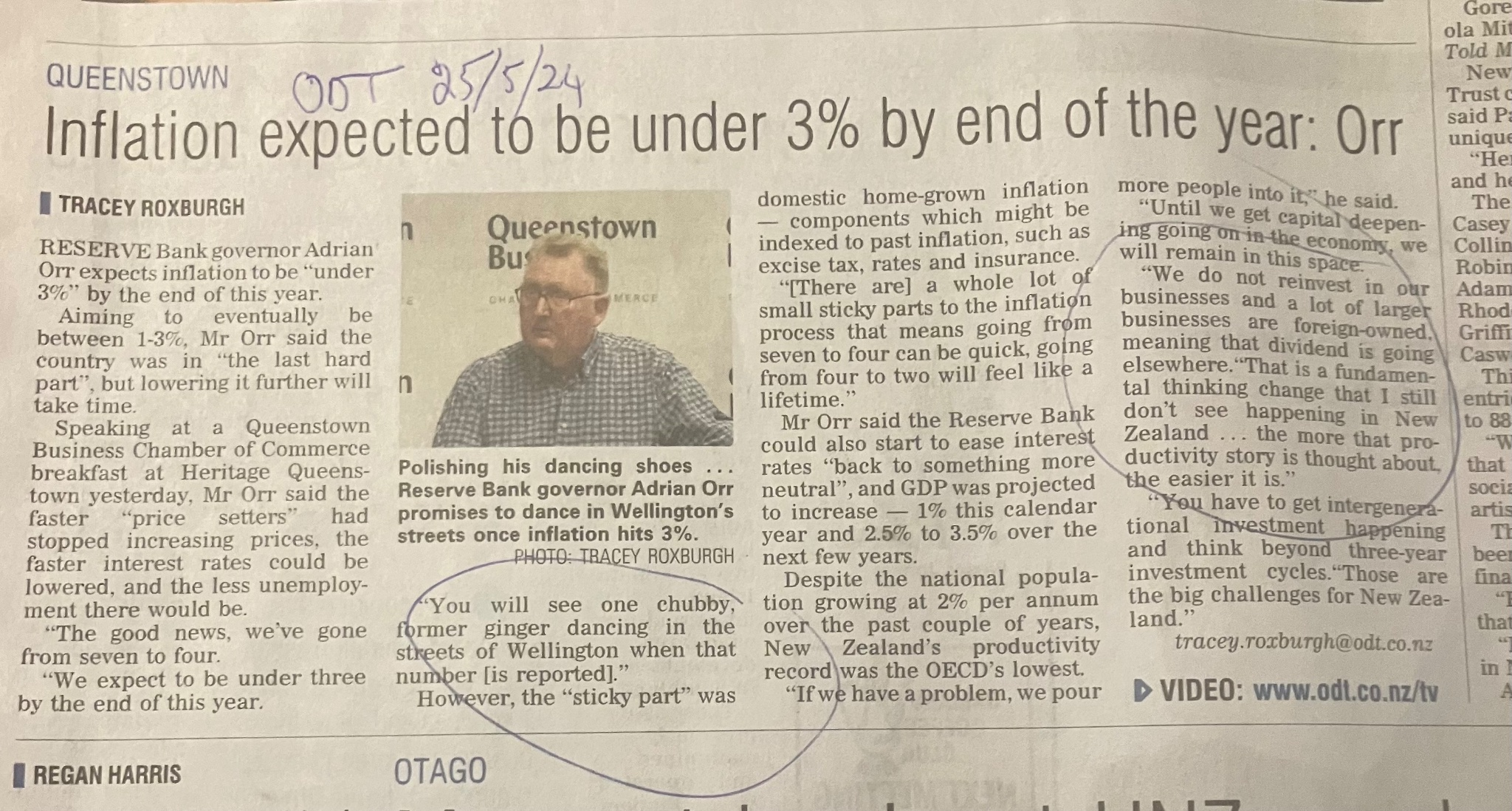
And then an old favourite of Orr’s – with almost nothing whatever to do with his actual responsibilities – is all that talk about needing “intergenerational investment”. One supposes that perhaps he had in mind really long-lived infrastructure projects – things New Zealand entities, many of them government ones, seem woefully bad at executing in a cost-effective way – but actually depreciation (whether of the market value of new ideas, or of physical capital) means that most investments anywhere are much shorter-lived than “intergenerational”. And if the Governor thinks he can be confident about what ‘intergenerational” opportunities are out there that private firms might sensibly lay hold off, perhaps he might reflect on his own state of knowledge about the things he’s actually responsible for. That inflation, for example, wasn’t exactly something he set out to deliver.

It really is woeful stuff coming from the Governor of the Reserve Bank. If one of his junior managers had gone off reservation with such thoughts at a briefing far from home one might put it down to youthful enthusiasm and inexperience. But this is one of the most powerful government officials in the land, the long-serving Governor of our central bank. And, sure, it no doubt wasn’t a fully scripted speech, but…..he was apparently on-the-record (and even if he wasn’t central bank Governors are supposed to speak guardedly, perhaps especially about things that aren’t their responsibility)….and the onus is on him when he speaks to speak well and not just throw out glib populist lines.

But it seems that – once again – there is no price to pay. The ODT journalist who wrote the story even had her email address in the article, so it would have been very easy for specialist political or business journalists to have followed up on these loose comments (and who knows what else he might have said – ODT readers probably having a limited appetite for reports of the Governor), but apparently not. No one seems to have challenged the Minister of Finance, about whether it was really appropriate for the Governor – who hasn’t been doing his day job well – to be masquerading as some sort of Green Party economic nationalist stand-in (but then just a week ago the same Minister told the press the Orr was not her responsibility – even though the Act explicitly says otherwise).

What does the rest of the world (markets and RB watchers) make of it? I guess if they didn’t happen to read the ODT they’d not have known.

Once again, it really isn’t good enough. Another government agency head still in place after failing badly (my 20 reasons why Orr should never have been reappointed, not then including the inflation numbers). And a government that seems to barely care (in Orr’s case, there is still no sign of any attempt to clip his wings – eg foreshadowing deep budget cuts, letters of expectations, forcing the MPC to be more open, appointing a Board chair who make actually represent the public interest etc; really just nothing).

There was an old line of Alan Greenspan’s that “if you think I have been particularly clear you have probably misunderstood what I said”. Orr, by contrast, straying beyond his bailiwick seems quite troublingly clear. Is there any other advanced country central bank Governor who is on record in recent times lamenting (simultaneously) the lack of investment in his economy, and the presence of too much FDI?

Comparing Treasury and Reserve Bank forecasts

I put a range of charts on Twitter late last week illustrating why, from a macroeconomic perspective, I found the government’s Budget deeply underwhelming. I won’t repeat them but will just show two here.

The first is the Treasury’s estimate of how the bit of the operating deficit not explained just by swings in the economic cycle change from 2023/24 (which was largely determined by last year’s Labour Budget) to 2024/25 (influenced by this year’s Budget choices)

On both these Treasury metrics, things are expected to be a bit worse in 2024/25 than in 2023/24. Not a lot necessarily, but things are heading in the wrong direction: a larger share of the groceries are being paid for by borrowing. And, sure, the projections have the deficits eventually tailing off and returning to surplus eventually – as they have for each of the last few years – but those numbers rely on more fiscal drag and rather arbitrary indications of what future Budget operating allowances might be. Perhaps they will deliver, or perhaps not. We don’t know and neither really do they. At this stage, anything beyond 24/25 is little than aspirational vapourware.

And consistent with that, the Treasury’s fiscal impulse measure – designed to measure the overall of fiscal activity on aggregate demand (with the central bank in mind) – is just slightly positive. Fiscal choices for the coming year aren’t estimated to ease pressure on demand and interest rates at all.

When the starting point is quite a large structural deficit, that seems, shall we say, less than ideal. Perhaps the more so when history (and common logic) suggests that the first year of a new government is usually by far the best time for a government to make tough fiscal choices and adjustments. (I dug out some old Reserve Bank estimates the other day and way back in 1976, the first Budget of that new government had a fiscal impulse of around -6 per cent of GDP. Muldoon had inherited a bigger mess than Luxon/Willis did, but…..a deficit is a deficit, and inflation and interest rates have been a problem.) If the 24/25 Budget wasn’t the year for hard choices, which one will be?

But for this post, I was more interested in comparing some of the Treasury macroeconomic forecasts in the Budget documents with those published by the Reserve Bank the previous week. Here I should stress an important difference: the Treasury economic forecasts were finished on 5 April and the Bank’s weren’t finished until a few days prior to the MPS. But my impression is that there wasn’t much in the way of crucial or very surprising domestic economic data in that period.

First, compare the outlooks for real GDP per person of working age (the RB doesn’t publish per capita projections, so this is the basis on which we can do a comparison).

Neither line represents a particularly rosy outlook. Even Treasury has us just barely back to the 22/23 level of GDP per working age population by 2026/27, but over that full period the difference between the two sets of forecasts builds to something quite substantial (a gap of 1.7 percentage points by 2026/27).

After the MPS I wrote here about how there seemed to be nothing robust behind the recovery the Reserve Bank was forecasting for next year (given that interest rates stayed high, lags were long, net immigration was declining etc), but I think one important difference between the two sets of forecasts is nearer in time.

There are really striking differences in how The Treasury and the Reserve Bank see excess demand having evolved over the last couple of years. Output gaps aren’t directly observable, but the most recent hard GDP data is still for December last year, but whether for that quarter or the estimate for the March quarter the difference in the two estimates is almost 1 per cent of GDP. On the Treasury numbers there was a significant negative output gap – posing a powerful drag on inflation all else equal – while the Reserve Bank reckons that output gap was only around zero.

Perhaps Treasury would have revised their thinking after the CPI if they’d had been able to incorporate those numbers in their forecasts, but there is nothing in the BEFU document that seems to suggest so.

If inflation has been a problem and you think that the economy has recently been only at around capacity then it isn’t too surprising that you have rather weak real GDP forecasts for the period ahead (especially the coming year). Both agencies build their forecasts around inflation eventually getting back to target midpoint; the difference is about what doing that will take.

The Reserve Bank reckons the OCR next June quarter will no lower than it is now, and may have gone higher in the interim. The Treasury forecasts the 90 day bank bill rate, and they reckon that will already be a lot lower (4.5 per cent) by next June. Quite who is closer to right (or least wrong) will matter.

As I say, perhaps the difference mostly come down to timing – the Reserve Bank had the CPI and Treasury did not – but frankly it seems too large a difference to be explained by a single inflation number.

One uncertainty is quite how fiscal policy affects the Bank’s picture. As they noted, their numbers didn’t include the Budget numbers themselves, but Westpac has noted – presumably from something the Bank has said – that the MPC had been briefed on the broad direction of fiscal policy (as you would hope, since it is one of the reasons for having the Secretary to the Treasury as a non-voting ex officio member of the MPC), and speculated that perhaps the Bank’s hawkish tone might have been explained in some sense by that understanding of the fiscals. I’m not sure what to make of that, and after all, the Bank’s chief economist was then at pains to play down the apparent hawkishness in the days following the MPS, with his weird line that somehow it was all just “model output”. More generally, the Bank has been taking a weird approach to fiscal policy over the last year, since that awkward 2023 expansionary Budget, ignoring conventional conceptions of the fiscal impulse and trying to focus attention on real government consumption and investment (in turn very different from either total government spending or a deficit/surplus measure). But for what it is worth, as the chart above shows the fiscal impulse for 2024/25 is estimated to be very slightly positive, and at the time of the HYEFU it had been estimated to be about -2.5 percentage points negative.

At very least, whatever was in the Budget simply wasn’t any help in easing pressure on demand and interest rates. Quite where too from here is going to depend a lot on just how much disinflationary pressure was already building up in the system from a now fairly prolonged period of contractionary interest rates. Given how weak last year was, and how weak things like business surveys still are, my sense would be quite a lot. But time will tell.

Underwhelming

An article in this morning’s Post, reporting comments from Paul Conway, chief economist of the Reserve Bank, prompted me to go and listen to the Governor’s MPS press conference. I’d largely given up watching them.

This was the most interesting bit of the article

although it was followed with more comments trying to reframe what the Bank had published in the MPS only a couple of days ago.

The Bank has been publishing a so-called endogenous track for short-term interest rates, as a central indication of what it believes to be required to deliver inflation at or near target 1 to 2 years ahead, for more than 25 years now. If the current crop of MPC members doesn’t yet understand how their numbers will be interpreted, that is more of a reflection on the MPC, and their chief economics adviser, than on the tool. (I’m not a big fan of publishing medium-term interest rate projections – never have been – but it is hardly a new or unfamiliar tool).

So when you published an OCR track that is revised up and out

you know the likely reaction, likely questions etc. And when you complement that numerical track by explicitly stating that the MPC actively considered raising the OCR at this very meeting, you shouldn’t be surprised you are going to be challenged. On a central track, where the OCR is averaging 5.65 per cent in the December quarter, that is consistent with a high probability of an OCR increase later this year.

If the Bank didn’t want people to take that interpretation (and both Conway’s comments in this article, and his and Orr’s comments at the press conference suggest they didn’t), they should have published different numbers. The comments from Conway in the Post article suggest that somehow the OCR projection track was outside their control – product of “its modelling tool” – when it has always been clear that the projections are the MPC’s, not some staff model (which itself has considerable human interventions pretty routinely). Perhaps it is different now, but in the many many years when I sat on the equivalent of the MPC, we used to spending huge amounts of time (arguably at times inordinate) on those last tweaks to the interest rate track, bearing in mind how any numbers would be read by outsiders. There was never a time when any published forecasts – and particularly for the interest rate track – were just some sort of machine-generated product.

Listening to the press conference for the first time in a while just confirmed a sense of how inadequate the MPC, and its chair, are for the job they’ve been charged with. They didn’t have a straight story to tell, and they were trying to back away from the clear implication of numbers they’d chosen to publish. To which one could add yet another appearance saying nothing of substance from the deputy chief executive responsible for macroeconomics and monetary policy at the Bank, or a Governor who chose to opine on productivity growth or the lack of it, suggesting that things were different (better) in Australia, even though recent productivity growth there has been just as weak as in New Zealand. Why are these people – having delivered us the inflationary mess in the first place – still in office? New Zealanders deserve better from officials – supposedly expert ones – delegated so much power. Apart from anything else they deserve real expertise and real accountability.

But then there was also a sense of how weak the media scrutiny was. Was it really the case that no journalist had wondered quite how economic growth was supposed to rebound, on these projections, with real interest rates already restrictive and set to rise further, fiscal policy restrictive, no help from the world economy, and with an expected further downturn in the net immigration impulse? In any case, none asked. None asked why if the OCR had helped lower the output gap by almost 5 percentage points so far, a continuing high OCR, rising further in real terms (as inflation and expectations fall but the OCR doesn’t), was only going to lower the output gap by a little more than 1 percentage point.

And remarkably no journalist asked, and no central banker mentioned, the very real lags in monetary policy. If the real OCR keeps rising to at least the middle of next year, won’t that be acting as a material drag on economic activity and inflation for a couple of years after that? And yet, on the Bank’s projections – the ones the Governor was presenting and journalists were supposedly questioning – quarterly inflation is back at target midpoint by the middle of next year, and – on the Bank’s telling – goes no lower from there.

The puzzles are real.

Excess demand and the Reserve Bank

After my post yesterday I had a few people get in touch, spanning the positions from what one might call extremely dovish to extremely hawkish. My key chart in that post was this one.

Pretty much any way one looked at real interest rates they (a) had been rising, and (b) on the Bank’s forecasts were set to continue to rise for another year or more, and yet – on those same forecasts – growth was set to return. It might not look like spectacular per capita growth next year, but on these numbers we are set to get back to slightly above average (for the pre-Covid decade) per capita growth before there have been any OCR cuts at all (in a period when fiscal policy is likely to be contractionary and the migration boost to demand and activity is expected to shrink). It was, and is, a puzzle.

One person objected to the use of per capita measures of GDP. As it happens, the pattern looks much the same, just a bit less marked, if one uses headline changes in real GDP. We go from an average quarterly contraction over the last five published quarters of -0.15% to quarterly growth of about 0.7% even as real interest rates rise and before the first OCR cut occurs in August next year.

The objection to using per capita numbers reflected a view – that some international agencies seem to like (the then chief economist of the OECD tried it out here a few years ago) – that it was almost inevitable that immigration surges would initially dampen GDP per capita, which would then recover over time as the migrants were absorbed. Perhaps there is something to this sort of model where many migrants are irregular or refugees, but this is New Zealand, where most migrants arrive on pre-approved work visas. Refugee numbers here are small, and illegal arrivals (as distinct from people overstaying visas) smaller still.

The New Zealand experience, over many decades, has tended to be that immigration shocks add more to demand (including derived demand for labour) than to supply in the short-run. And the experience of the last couple of years doesn’t seem inconsistent with that. There was a big unexpected influx, and yet there was no temporary dip in the ratio of employment to working age population: as it happened the absolute peak in the employment rate was in the same quarter as the estimated net migration peak (note that the Reserve Bank’s output gap estimate in fact peaked a few quarters earlier).

So I’m sticking with there being a puzzle. Where is this growth rebound supposed to be coming from, as monetary conditions tighten, fiscal policy tightens, net migration falls (further) and the world economy is assumed to jog along much as it has been?

But the real prompt for another post was looking at the output gap estimates themselves. In this week’s MPS there has been quite a big revision to the Bank’s estimates of the output gap (for the most recent estimated quarter, March 2024) and through all last year. On these numbers, only in the March quarter does the Reserve Bank think the economy crossed over to having (very slightly) excess capacity.

One could argue that it is consistent with their (prior) view that inflation has become more problematic than they realised, and harder to get down. One might also argue that perhaps the latest estimate lines up with the latest unemployment rate which, at 4.3 per cent, is probably around economists’ estimates of the NAIRU. Correct or not, a few more deeply negative GDP per capita quarters would quickly take the output gap deeply negative (monetary policy – and any other influences – has already taken the output gap down by 3 full percentage points of GDP in just 18 months.

But my interest is more in what the Reserve Bank’s revisions are now saying about just how overheated the New Zealand economy actually got in 2022. Here is a chart of the Bank’s output gap estimates over time.

As late as (say) August 2022 they thought the excess demand had peaked in late 2021 at under 3 per cent of GDP (large enough by any historical standards). Now, after successive revisions, not only is the (estimated) peak much later (September quarter of 2022) but it is much larger (4.3 per cent of GDP). All the quarters either side of that peak have also been revised up quite materially.

So big revisions upwards. But how do those estimates now compare with history? This is a chart of the Bank’s current output gap estimates this century

The economy was overheating in the mid 00s, and core inflation got a bit above 3 per cent. But it was nothing like as serious as the (now) estimated overheating in 2021 and 2022. And this was what the Bank simply totally failed to recognise for far too long (recall it was not until February 2022 that the OCR had even been raised back to the level it was just prior to Covid). Even now it is revising up its view of the extent of its own misjudgement and resulting policy mistakes. It was by far the biggest monetary policy mistake in the 34 years of Reserve Bank operational autonomy…..and no one seems to have paid any price at all (Governor and MPC members were all reappointed).

18 months or so ago the Bank came out with a review of its own performance, which unsurprisingly wasn’t very critical at all. Yes, we were told, it was clear with the benefit of hindsight they should have started tightening earlier, but it might only have been by a quarter and wouldn’t really have made much difference to outcomes. It was implausible even at the time – failing to grapple with the severity of the misread of the economy and associated capacity pressures. It has become literally incredible as time has gone on. Did others make similar misjudgements? Of course. But others weren’t delegated the power to run monetary policy, and the responsibility to get it right. No one forced them to take the job, purportedly delegated to people of real expertise.

A common response is some mix of claims that (a) other central banks were just as bad, and b) the Reserve Bank of New Zealand was relatively early in starting tightening. Even if the first claim were correct, it is no excuse: central bankers abroad also voluntarily accepted a mandate and failed to deliver. But it also isn’t really true. It is hard to get consistent output gap estimates across time and across countries, but the IMF is one source

On their current estimates – presumably different techniques to the RBNZ’s estimates – in both 2021 and 2022 New Zealand had the largest positive output gap of any of the advanced economies for which the IMF produces numbers. Imbalances of that extent occur because our Reserve Bank got it (rather badly) wrong, acting late and (for too long) sluggishly relative to the inflation pressures in our own economy (and even among this group of countries, the RBNZ was only the 3rd to start tightening; among OECD central banks it was 7th).

But accountability doesn’t appear to be something that mattered either to the previous government (concerned perhaps that suggesting the Bank had done poorly would reflect poorly on them who appointed the MPC) or to the current one (which tends to play down any role for the Bank, presumably to tar Labour with the blame for the high inflation, while claiming the credit for themselves when inflation settles down again).

And just one final (puzzling) chart. I noticed a few quarters ago (last August) that the Bank’s then output gap projections had about as much space above the zero line as below (probably a bit more below as it still hadn’t got back to zero by the end of the projection period). But this time – and it has been transitioning towards this over the last couple of MPSs – and focusing on the orange line (this week’s estimates), there is far more space above the zero line than there is below. In other words, on these numbers, we got to enjoy the excess output but don’t pay any sort of equivalent or commensurate price in lost output.

It doesn’t make a lot of sense (and would be something very different than we saw in the previous cycle, after 2008). Perhaps there really wasn’t quite as much excess demand at peak as they now think? Perhaps more pain (lost output relative to potential) will be required than they are saying (which might well come about quite easily if the implausible growth rebound they are projecting just doesn’t occur over the next few quarters).

I’m really not sure what is going on. But it doesn’t leave one with any more confidence that the Bank knows what it is doing than we can have now about how they handled the period from mid 2020 to mid 2022, which delivered us this persistently high inflation – and attendant arbitrary wealth redistributions – in the first place.