The unimaginable dystopias we live in

I’m not sure if it was planned but there was a distinctly dystopian tinge to the magazine section of the Sunday Star-Times yesterday.

The Editor’s Note dealt with the pervasiveness of dystopian themes in the modern books being read by children and “young adults”.    There have been plenty of these in and through our household –  the Wellington libraries seem abundantly stocked with them.  I’ve even read a couple –  the kids seem to like the idea (nay, strongly urge) that Dad occasionally reads one of their books.  I haven’t yet succeeded in getting my youngest to read 1984,  Brave New World, or Children of Men, although she and I both recently read The Handmaid’s Tale and The Testaments –  and I couldn’t really disagree with her, not wholly favourable, assessment of the latter as “like a young adult dystopian book”.  I guess there are all sorts of reasons for liking these dystopian books, some of which are probably less than entirely healthy, but it is interesting to ponder the alternative societies, rules, norms (and lack of them) depicted by the authors.

A bit later in the same magazine section there was just such a portrait, “Dark Days in Dystopia”, but this time about a real place, the state of California.  The column first ran in The Times (UK) and is by Gerard Baker the (British) former editor-in-chief of the Wall St Journal.   It is online only behind the paywall of The Times but the gist is in the lead blurb

“California used to represent a fantasy of Hollywood glamour and wholesome hippie-ness combined.  But now, with blackouts, crippling taxation and unaffordable housing, the Golden State is a feudal society of super-rich and serfs”

Not being that into eiher Hollywood or hippies, I guess my impression of California decades gone by was a bit different, with an emphasis on mild weather, sunny optimism, and widely-spread prosperity.  In childhood TV terms, The Brady Bunch.  In US political terms, it isn’t that long since California was a Republican state – middle (suburban) America.

Baker’s article touches on various aspects of how California has gone bad.  But the revealed preferences of individuals are often as telling as anything and –  as he notes – Americans (net) have been leaving California for years (in the ten years to 2016, a net 1 million left).

Baker makes quite a bit of the breathtakingly high tax rates in California, but his main focus is on housing, “almost unimaginably unaffordable for most Californians” which is, of course “an entirely human-made debacle”.  He quotes a (Democrat-sympathising) academic, Joel Kotkin, who “describes California as a reimagining of medieval feudalism” in which underneath the “wealthy elites” who promote and champion the panoply of problematic policies

are the modern serfs, who can barely afford the land they must rent from their masters. They have no assets, no stake in their economy and, thanks to prohibitive housing costs, have limited mobility.

The column ends

California has always been eyed as a signpost to the future.  The dystopia there might be a warning to voters everywhere.

The column might seem a touch over-written to you (it probably does to me as well) but it was some of the concrete details in the midst of the rhetoric that I latched onto.

The median home price in California is $614000 (NZ$959000), almost three times the national average. The California Association of Realtors’ housing affordability index estimates the percentage of households that can afford to purchase the median-priced home.  For California, that number was 31 per cent….for the US as a whole it was 56 per cent.

But what about New Zealand?

The median house price here is now $607500 (in October, according to REINZ).  That is a lot cheaper than California, of course.  But we, on average, are a lot poorer than Californians.

Average GDP per capita in California is about US$66000.  Here, it about NZ$62000.

In other words, the ratio of house prices to income (this time proxied by GDP per capita) is much the same here –  just a bit worse –  than in California.   I’m a bit wary of median household income figures –  just because I know the data less well – which are more often used for house price comparisons, but it doesn’t look as if the comparisons would be much different in one used that data.   We have our own human-made housing dystopia, without even the consolation of those hugely successful tech companies that also still characterise California.  We have an ongoing productivity failure.   And with few/no offsetting compensations –  between volcanoes and earthquakes, probably much the same sort of natural disaster risk, and –  for those in Auckland in particular –  congestion that seems to rank high (badly) by advanced world standards.   Who’d have imagined just a few decades ago the local dystopia we’ve let our “leaders” create?

And what of the prospects of the next generation?  One of the downsides of living with me, is that my kids get to hear my fulminations about the disgraceful government failure that is our housing market, which in turns engenders occasional, slightly despairing, comments from them about the unlikelihood of ever being able to afford a house in New Zealand.

I was having one of these conversations with one of my daughters the other day.  She was asking how much I’d paid for my first house, which is just down the street and which we walk past quite frequently.  I told her I’d paid $155000, which brought gasps of astonishment. I did hasten to point out that there was this thing called inflation and in today’s dollars that was something like $290000, but it didn’t really change the point (in our unprepossessing but pleasant suburb the median house price now appears to have passed $900000).

When we have these conversations I periodically point out that real mortgage interest rates in 1989 were a lot higher than they are now, that first home buyers probably shouldn’t be expected to buy a median house, and that there are cheaper parts of cheaper suburbs (without, say, having to fall back on the desperate expedient of relocating to my childhood home of Kawerau, where median prices have recently rocketed back up to…about $290000).  I think the kids are right to be uneasy, but smart hardworking well-educated people who marry sensibly will probably eventually be more or less okay.

But in the course of our conversation I got to think about my parents.  They bought a first house (new) in Christchurch in 1962, just before I was born.  It wasn’t a particularly big house, but it was an 809 square metre section –  bigger than most Island Bay sections. My father was 27.  Dad had gone to work at 16 –  as probably most people did in 1950 – working as a clerk at the BNZ and by this time he had his own small newsagent’s shop in Riccarton, but was just about to move back to a salaried position.  Mum didn’t work after I was born –  as probably most mothers didn’t in those days.   There wasn’t –  at least that I’m aware –  family money behind them.    But at 27, on a single income (not supported by tertiary qualifications or lots of overtime), they had their own (new) house in one of our bigger cities.

I don’t suppose it seemed extraordinary then.  It was what young couples typically did.

I’m not suggesting it is impossible now: there are, from the time to time, those stories of extraordinary young people who through hard work, thrift and a focus on one goal have purchased a house very young. But it is extraordinarily difficult now for those who are poorer, less-skilled, less well-qualified, with children.   Almost inconceivable for young people earning average incomes for their age to even think of doing it on a single income in any of our bigger cities, at least without enormous sacrifices of material living standards.    Perhaps simply impossible in Auckland.  And if the groups most severely affected aren’t exclusively Maori and Pacific, they are disproportionately so.

It is a human-made dystopia.  And the humans who lead our governments (central and local) seem quite uninterested in doing anything serious to fix the problems.

Teaching/examining economics

The NCEA level 2 economics exam took place yesterday afternoon.  I’d been helping my son with his revision and preparation, in the course of which he’d shown me various exams papers from recent years, and some guidance they’d been given on how to answer some of those (past) questions: what might get Achieved, what Merit, and what Excellence.

I wasn’t exactly reassured by what I saw.

As one example, consider this question from last year’s paper 91222 “Analyse inflation using economic concepts and models”.

The first questions were introduced with this statement

The Quantity Theory of Money states that the quantity of money circulating in the economy is equal to the monetary value of the goods and services available in the economy.

The quantity theory of money starts from the identity –  for thus it is –  MV=PT, where

M = some measure of the money supply,

P = some measure of the price level,

T= some measure of real economic activity (you could think of real GDP, but it generalises –  think volume of transactions), and

V =  the velocity of money (or how frequently the stock of money –  as defined –  turns over (“is spent”) in the period in question.   It is generally derived residually.

All that identity is saying is that the amount of money that is spent (stock multiplied by times it is used) equals value of transactions in the money economy.   The amount of money that is spent = the value of what it is spent on.  Necessarily.  By definition.  Change your definition of money –  the Reserve Bank publishes several, and there are others –  and your V will change too.

As a New Zealand example, nominal GDP in the year to March 2019 was $300.994 billion. The Reserve Bank’s broad money measure averaged $304.193 billion over that year and its narrow money measure was $68.375 billion.   So, on this measure of nominal activity, V(b)  (“broad money velocity”) was 0.99  and V(n) (“narrow money velocity”) was 4.4.

MV=PT is really known as the equation of exchange, and it only turns into a theory (about behaviour) when expressed in the idea that if you change the quantity of money most of the effect will typically be seen in the price level (or that most changes in the price level stem from changes in “the money supply”).  In the extreme, it is a simple enough idea –  in massive hyperinflations there is lots more “money” around (on any measure) and much higher prices/inflation rates (on any measure.  But the theory was mostly used in simpler stabler times (since in the midst of hyperinflations, not only does the velocity typically accelerate –  no one wants to hold money longer than they have to –  but real economic activity is also typically shrinking, perhaps rather a lot).

So what disconcerted me about the NZQA efforts?

Well, go back and look at that definition of the quantity theory of money.   Does it mention the idea of velocity?  No, not at all.

And then it talks of the “monetary value of the goods and services available”which has a fairly strong sense of stocks, not flows.   Any serious description of this equation/identity would stress that it is about transactions/turnover, not stuff that just happens to be around (whether sitting unsold on shop shelves, in factory inventories, or in the cupboards at home).

Now, in fairness to NZQA the very first question asks the students to label each of M, V, P, and T, so probably people wouldn’t be too misled by the omission of any sense of velocity in the introductory description.  But shouldn’t our teachers/examiners be taking care to be as precise and careful as possible, both to set a good example, and so as not to risk confusing or distracting kids who have read/thought a bit deeper?

The next question reads

Using the Quantity Theory of Money equation, fully explain how a 4% increase in the money supply could affect the price level, assuming other variables are constant.

As I pointed out earlier that MV=PT is an identity, I hope you can see why this question isn’t written anywhere near as carefully as it should (and quite easily could) have been.  In an identity with four variables, if one of those variables changes and two are held constant by assumptions, there is no “could” about what happens, but a “must”.  If V and T are held constant and M increses by 4 per cent then. by definition, P increases by 4 per cent.  Of necessity.

I checked the NZQA marking guide and it is clear that the examiners know this: they talk explicitly about how prices “will” rise by 4 per cent.   But then why muddy the waters for the students?   It isn’t even as if the marking guide says something like “students will get extra credit for pointing out that the 4 per cent price increase is a necessary implication, and there is no “could” about it.

The questions continue, with the third question designed to better winnow out the Excellence and Merit students from the Achieved ones.  The third question starts with a quote from a Treasury document

QTM

You’ll notice that the Treasury projections quoted are for an average annual growth rate over the next five years.  By contrast, the assumed exogenous increase in the money supply is a one-off levels increase.

The examiners don’t appear to have noticed the difference.   It is clear what they are trying to get at (P will increase less if T is also rising than if it isn’t).     That’s the answer to the third bullet above. But the marking schedule  makes it clear that they expect the students to answer that in that growth scenario the price level will rise by (about) 1.1 per cent.  But that isn’t the case at all: instead in the first year the price level would rise by about 1.1 per cent and then it each subsequent year it would fall by (about) 2.9 per cent (since T is changing and M no longer is).    But, again, there is no hint that markers should give additional credit to students who point this out.  (Although they do give extra credit to students who point out the V might change –  perhaps rise –  in a recovery.)

Again, there is really no excuse for questions this badly worded (for 16 year olds).  They could easily have posed the questions as “if the money suppply increases by 4 per cent per annum, what will happen to the inflation rate if (a) all else (V) is constant and (b) if real economic growth (in T) happens per the Treasury projections”.

It is sloppy and loose, and suggests that the examiners (and those reviewing their drafts) just haven’t thought carefully enough.  And that is even without posing questions about whether introducing year 12 kids to inflation using models that rely on exogenous money supply increases (when most increases in the money supply these days are actually endogonous –  arise simultaneously with economic activity and the credit creation process) is that most helpful way to structure the curriculum.

The other one that disconcerted was from the 2016 exam for the same level 2 NCEA standard (I didn’t go through them all systematically – these were just ones my son asked about).   This was a question about deflation.

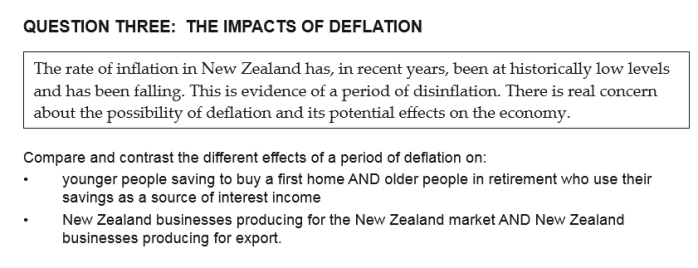
deflation NCEA

Here what disconcerted me (a lot) was the answers NZQA was looking for in its guidelines for markers.  But the question wasn’t great either.

The key starting point for thinking about the effects of inflation/deflation is that, broadly speaking, there is long-run neutrality (most real variables won’t be much affected by trend inflation/deflation), but that distributional effects can be quite powerful in respect of unexpected inflation/deflation.    Broadly speaking, (unexpected) deflation is great for people with fixed-term/rate bank deposits (the real purchasing power of their money rises) and dreadful for people with fixed-term/rate nominal debt (the real value of what they owe rises).   Otherwise, all else equal, prices, wage, interest rates etc should all adjust to whatever the inflation/deflation rate is, and to much the same extent.

The questions don’t distinguish between expected and unexpected deflation.  Perhaps that isn’t unreasonable for most year 12 students, (but what about those who had read on, or thought more deeply, perhaps even read an MPS?) but it does make quite a bit of difference, and it isn’t obvious that even the markers recognise the difference.

This is the sort of thing I mean.   In answering the first part of the question, the markers are looking for this to get Achieved

Explains the effects of deflation in New Zealand on younger people saving for their first home (e.g. Deflation will mean that people saving to buy their first home will have a lower cost of living and be able to save more).

But this is simply nonsense since one would normally expect that wage inflation would be similarly lower and the real incomes of those young savers wouldn’t be affected, and nor (generally) would the real cost of the house they were saving for.  But to the extent they already had saved some money –  and especially if it was on a long-term fixed rate deposit –  the real purchasing power of what they’ve saved will rise.

What about the old people.  Again, the Achieved standard answer

Explains the effects of deflation on older people in retirement who use their savings to provide them with income (e.g. Older people may find that they receive lower interest income if interest rates fall to offset deflation).

Indeed they may, but…..the cost of living will be lower too.  And, in fact, the real value of those bank deposits will actually increase in this scenario.

The marking guide goes on to elaborate points students would need to make to get Merit or Excellence.  But it doesn’t really improve

Fully explains the effects of deflation on younger people saving for their first home (e.g. Younger people saving for their first home may benefit from deflation because it might increase the purchasing power of their income. This may mean that they can save more of their income to put towards the purchase of their home. It may also mean that the home may become cheaper. Deflation may also lead to lower interest rates and, therefore, make loan repayments more affordable).

That final point is fair (since mortgages are nominal the upfront servicing burden is a little easier), but it is something of a distraction because it doesn’t alter the servicing burden over the full life of the loan.  And these guidance notes suggest the examiners have no sense that wage inflation will also typically be lower if there is price deflation.

Fully explains the effects of deflation on older people in retirement who use their savings to provide them with income (e.g. Older people in retirement who use their savings to provide them with income may find that the value of their assets falls, which means that selling those assets will result in less earnings. Also, if interest rates fall even though prices may have dropped, the people will receive less income and, therefore, may have falling purchasing power).

And this is worse. There is no hint that people with fixed nominal assets are those who gain from unexpected periods of deflation.  And if the value of other assets (eg houses) they are selling falls, those falls will generally (all else equal) just be in line with the fall in the price level.  That fall does not make old people (or any other seller) worse off.   And, yes, nominal interest may fall, but there is no particular reason to expect real interest rates to fall (or thus for real purchasing power to fall).

The NZQA guidance answers to the second half of the question are only a little less bad.    In fact for the “firms producing for the local market” I’m more or less okay with the required answer (as a year 12 simplification).

Fully explains the effects of deflation on NZ businesses producing for the local market (e.g. NZ businesses producing for the local market will find that the prices that they receive for their product may fall. They may also find that their costs of production fall and, therefore, the outcome may be either slightly worse off or neutral).

All else equal-  and on a simple model – you would expect both costs and selling prices to be commensurately lower and such firms to be no better or worse off on this count.  A really smart student might point out that if these firms had material debt outstanding, the real value of that debt would rise, but that is probably a complication too far for year 12 and this bit of the question didn’t mention debt.

But the exporting firms answer is more troubling

Fully explains the effects of deflation on NZ businesses producing for export (e.g. NZ businesses producing for export may also face falling costs of production; but if their markets do not have (or have less) deflation, then they may find that their profit margin rises and, therefore, they may be relatively better off).

But…….our exchange rate has been floating for 35+ years now, and I know year 12 kids get introduced to the exchange rate, and yet this suggested answer implies that the competitive position of our exporters can be improved by a period of deflation.  Over any sustained period deflation here –  not matched in other countries –  would be expected, on simple models, to see an appreciation of our exchange rate, leaving New Zealand producers neither better nor worse off as a result.   (These adjustments do actually tend to happen – you can see it in the trend appreciation of the NZD/AUD consistent with the slightly lower inflation target here than in Australia.)

You’d have to hope that a smart kid  – or just moderately well-read or alert one (they do get exercises that involve looking at real world documents like MPSs –  who made these points would get considerable credit from the markers, but if even the examiners don’t seem to be aware of the point, how many of the markers could be counted on to exercise some independent judgement.

Not one of the points I’ve made here is any sort of highly subtle or technical points.  These are just the simple implications of pretty simple models – ie the sort of standard one might be looking for year 12 kids to be taught, and to be able to understand and repeat in examinations.  But it isn’t clear, that on these questions at least, even the examiners quite understand what they are saying or asking, or how even a simple model works.

I haven’t engaged in a systematic study of all the recent economics exam papers (let alone those in other subjects, most of which I know less well).  I’d really like to think that these two sets of questions I’ve highlighted in this post are exceptions and everything else is just fine.    But, as we used to say in PNG when we saw a dead snake on the road, the real issue wasn’t so much welcoming the dead snake as wondering at all those still lurking in the same neighbourhood.

The New Zealand Initiative was out earlier this week calling for more emphasis on teaching specific bodies of knowledge in the various academic disciplines.  I don’t really disagree with them, but when exams for upper-level kids have the sorts of weaknesses highlighted here it suggests there is quite a long way to go in even getting teachers equipped to offer a systematically better offering.  As things stand, NZQA should be upping its game.  Clear questions and correct answers (to guide markers) would be a good start.


Spin….just spin

I suppose all Prime Ministers these days feel the need to spin.

Ours was at it again yesterday.   She was talking over breakfast –  a vegetarian one the Herald account tells us – to the Trans-Tasman Business Circle.  Her topic?

The topic I have been given for today – ‘The Future of Work and how the government is preparing for the economic challenges of the future’

It is pretty much downhill from there.

Countries the world over are currently grappling with digital transformation, and transitioning their economies, and New Zealand is no different in that regard.

Even if you pardon that abuse of the language (“transitioning”), does anyone have any idea what this means. Individuals and firms are getting on with their lives, looking for opportunities, as it long has been and no doubt long will be.  Are technologies different than they were fifteen years ago?  Of course.  But is our economy that different than it was fifteen ago?  Sadly, probably less so than one would hope.

That isn’t the prime ministerial spin though

Where we are different, I believe, is in the way we are responding to those challenges, turning many of them into opportunities.

The country with weak productivity growth, drifting further behind the rest of the advanced world, and with declining shares of GDP accounted for by trade with the rest of the world.

As it happens, the annual national accounts were released later yesterday morning.   I was playing around with the data and might use it for various posts in the next few days, but since the PM was talking about “digital transformation”  I thought this chart was interesting.

cap stock 19.png

Now not all of these, by any means, are about the narrow “digital transformation”, but if such a thing were happening on a large scale, in which new world-beating opportunities were being developed and seized, these indicators are among those where we might expect to see it.  As it is, over the last few years things to have been more or less going sideways.

The PM went on to first offer some context

Firstly, the NZ economy is in good heart amid the global challenges and what many believe are new economic normals,

Well, okay, believe that if you want.  But most respondents to surveys don’t share your positivity, and in general they are less likely to be motivated reasoners than a PM.  And

Secondly, the Government and Reserve Bank are doing their bit to ensure that fitness endures and it’s important business continues to work with us too – after all, we mustn’t talk ourselves into a funk

We are right, you are wrong.  Get with the message.  Or at least that seemed to be what she was suggesting.  Just a shame the data don’t tend to support her.  I’m still not sure what the Reserve Bank has to do with “that fitness” (whatever it is) –  presumably she hasn’t had it schooled into her that the OCR is typically cut (in an economy without big positive productivity shocks) because demand is weak and things aren’t going that well.  Oh, and is she perhaps aware of those big new capital requirements the Governor is wanting to impose on banks, and hence on the availability of credit to the economy?  If she is embracing those, that would be an interesting call –  her Finance Minister has been very careful to disown all responsibility.

Anyway, she gets into her stride in a section headed “It’s the economy”.

All of you in this room will know that this Government’s approach to the economy is that it is not an end it itself but, rather, a means to an end.

Which might be news if, just perhaps, she could point us to any government in history, or even just New Zealand history, for whom that was ever not so.

That of course means building strong economic foundations. And on that front we’re doing pretty damn well actually, especially amid global uncertainty.

The argument must be weak so lower the tone of the language.  No one is going to dispute that successive New Zealand governments have successfully focused on budget balance and a modest level of debt.  What about her other claims?

So far our policies have delivered growth of 0.5 percent in the June quarter and average growth of 2.4 percent in the year ending June. That shows that the New Zealand economy continues to outperform those of Australia, Canada, the Euro area, the UK, and the OECD average – basically those we compare ourselves to.

That tired old line so beloved of whoever is in office, right or left, and their champions.  Never mind that we have substantially faster population growth than all of those countries except Australia and that any reasonable and honest use of GDP statistics in a a discussion about success, wellbeing or whatever, starts from a discussion of GDP per capita.    On that score, there is nothing impressive about even our recent record, let alone the longer-run picture.

Also, recent data shows New Zealand’s manufacturing and services sectors are both expanding.

Well, yes that is probably so, but…..when your population is growing by 1.5+ per cent per annum if those sectors (ie the bulk of the economy) were actually contracting it would be really quite alarming.

We have record low unemployment and annual wage growth is at its highest level since the 2008 financial crisis. Average wages have increased by 4.2% in the last year alone.

Yes, relatively low average unemployment –  consistent with the typical person being unemployed for “only” two years in a working life –  is one of the successes of the New Zealand policy framework.  But the current rate is nowhere near a “record low” –  not even during the 30+ years of the HLFS (that was just prior to the last recession), let alone the post-war decades prior to the quarterly survey getting going.

New Zealand continues to be a good place to do business, topping the World Bank’s 2019 Ease of Doing Business index. Our globally competitive economy is underpinned with stable political and regulatory systems, an innovative well-educated population and our proximity to 60 percent of the world’s population. We are a safe place to invest.

Such a great place to do business in fact that (a) business investment remains persistently weak, especially given the surge in the population, (b) our economy is becoming more inward-focused (trade shares have been falling) and (c) another tired old line –  we are close to 60 per cent of the world’s population –  that bears just no relation to reality whatever.  Yes, we are closer to the centre of gravity of world economic activity than we were 100 years ago – when we traded mostly with the then-dominant power the UK –  but these days the UK is still closer to India and as close to China as we are.  In both cases, far away.  Oh, and we are also a long way from those leading productivity economies in Europe and North America.

And last on this list

And you’ll note that when the Reserve Bank announced its decision to hold the Official Cash Rate at 1 percent last week, its analysis confirmed the economy is in good shape, amid global economic headwinds. The Bank pointed out that employment is pretty much at its maximum sustainable level, residential investment is increasing and that economic growth is expected to rise next year, due to the Government’s investments. While the RBNZ noted that global headwinds have impacted business confidence in New Zealand, it also said that our investments are forecast to support and grow the economy next year.

When the Prime Minister says “investments” here she really just means more government spending, most of it consumption or transfers.  Probably she didn’t read the Reserve Bank’s statement, but she will have had a personal briefing from the Governor.  He too is inclined to spin, but his document had a rather lot on the downside risks –  in fact they explicitly noted, and formed policy on the basis of, the balance of risks being to the downside.  And while the Bank had rather upbeat growth forecasts, few private economists shared their optimism.

I am not wanting to suggest things are disastrously bad, at least in a short-term cyclical sense in New Zealand, but at very very least the PM is gilding the lily.   Perhaps you might think that is her job, and on a bad day I could share the cynicism, but we really should expect something better from people who hold office as leaders.

But her own summary is this

Ultimately, we have a positive story to tell, including to investors, and one of my consistent messages is that we are a stable, reliable  investment option, with plenty of success stories. Now, domestically, we  all need to act like it.

I’m right, you are wrong, get with the message.   Or so it seems.     And, yes, we do have a fair measure of political stability –  no Brexits, no civil wars etc, no impeachment hearings (just the ongoing stench of the political donations scandals) –  but that doesn’t markus out from most advanced countries, those that have been performing pretty strongly –  actually securing the productivity gains on which so much else rests –  and those, like New Zealand, that haven’t.

The next section is headed “Govt doing its bit”.  Here there is a lot about capital investment

It won’t surprise you to hear me say – infrastructure, infrastructure and infrastructure. There’s no question that we have a range of deep policy issues to address as a nation, but unless we get the basics right of providing decent housing, transport and health and education services, we’ll only compound those more complex issues. That’s why the Government’s Economic Plan, which you will have heard many Ministers talk about, is designed to build an economy that protects and improves the living standards and wellbeing of all New Zealanders through ensuring we get those most basic fundamentals right.

That’s why we are investing record amounts in hospital and school building programmes – including the fact that in our first two Budgets we’ve invested $2.45b into upgrading and building new hospital and health facilities- that’s twice as much as the previous government managed in nine Budgets – alongside large investments in transport safety, regional roads, and public transport, and we’ve done that while maintaining a responsible budget surplus.

“The Government’s Economic Plan“: that’s a good line.  I hope it got a laugh.  But perhaps the audience were more polite than that.  Infrastructure?  Well, shame about the roads that aren’t getting built, even as the population grows rapidly.  And here is another chart from the annual national accounts, showing general government investment spending as a share of GDP.

govt GFCF

Nothing startling about spending in the first full year of this government.  But perhaps it will be different in years to come.

And then the empty boasts about housing

Not to mention our comprehensive plan to fix the housing crisis which includes delivery of: more state houses than any Government since the 1970s, banning offshore speculators, expanding Housing First to end homelessness, a $400 million package for a progressive home ownership scheme, and making saving for a house deposit easier by lowering the deposit required for a Government-backed mortgage or first home grant from 10 per cent to five per cent. These are real, tangible, things that will help New Zealanders and their families.

“Comprehensive plan” and yet not a mention of the only thing that would make a durable, substantial and sustainable difference, lowering prics of houses and urban land, land use reform.  Allowing people to borrow 95 per cent LVR loans – even as her Reserve Bank keeps on LVR restrictions on private credit –  is at best papering over the cracks of the failures, chosen, of successive governments, including her own.  But give her credit for consistency:  Labour leaders (whether Little or Ardern) have never been willing to champion serious land use liberalisation.

A little further one and we get this recapitulation

Ultimately, this [Infrastructure Commission report] should all be sending two really strong signals. That we are planning for the future and that now is the time to invest. New Zealand is doing well and there are enormous opportunities if we act now. The best thing for the NZ economy at the moment is optimism, planning and investment action. We’re doing some pretty heavy lifting to shore that up in terms of spending and infrastructure investment, the RBNZ is doing its bit with record low interest rates – the private sector needs to ensure it’s on board too.

But, our economy (a) isn’t doing that well (see above) (b) and firms –  people with shareholders’ money on the line clearly aren’t seeing “enormous opportunities” to invest, either now or (in fact) for decaders past.  If it were otherwise now then, all else equal, interest rates just wouldn’t be this low –  as a macro 101 reminder to the PM, interest rates are low because demand for resources at any higher interest rates would be even weaker.

But the PM enjoins us to “only believe”, to join some sort of cheerleading squad building castles in the air.

In fact, one of my staff members asked an economist earlier this week to sum up the economy in one sentence and was told – “it’s ready for lift-off”.  I could not agree more.

Perhaps there is such an economist.  Perhaps he/she doesn’t even work in DPMC/PMO. Perhaps there even will be a bit of a recovery next year.  But just nothing suggests this economy is “ready for lift-off”.  The basic imbalances and severe structural problems haven’t been addressed, haven’t changed.

She goes on.  There is the claim

we have laid out a clear agenda. Yes, it includes change, but by now you’ll all know what that agenda entails and how we’ll deliver it.

Somehow, I suspect the farmers angsting about the current water proposals don’t see it that way.   And the government might have passed a Zero Carbon Bill, but (whatever its merits) it involves almost no substantive certainty about anything affecting business.  Do we know what is happening about Fair Pay Agreements?  And so on.

The speech goes on into a variety of other areas.  The last I wanted to comment on was this –  something to look forward to next week

Today I am also able to provide you with some insight into an upcoming announcement for the Forum. On November 25 the Forum will publish its Strategic Assessment of Future of Work Priorities. This presents four initiatives as priorities:

  • The first is Industry Transformation Plans which will ensure we add value to key sectors of our economy and leverage new opportunities. These plans – for the food and beverage, digital technology, forestry and wood processing, and construction and agritech sectors will describe an agreed vision for the future of each sector, and set out actions required to realise this vision.

(So actually, some of the “clear agenda” isn’t laid out yet, but will be next week?)

Presumably the Prime Minister takes this stuff seriously, but really who supposes that a bunch of central planners, bureaucrats and their corporate equivalents, are really likely to come up with anything useful in these “industry transformation plans”.  Haven’t we had numerous such plans before, stretching back many decades, and precisely what useful has come of them?    Market economies just don’t succeed with “agreed visions” across government and the upper tiers of existing industry players, but by competition, trial and error, creative destruction, unexpected discoveries…..all supported perhaps by governments willing to do what it takes to put a supportive overall policy environment in place.   Our goverment, much like its predecessors, is all too fond of the status quo, and unwilling to –  probably uninterested in –  getting to the bottom of why that continues to produce such mediocre economic results.

As a hint, the real exchange rate –  a key relative price that never seems to make it to the PM’s upbeat economic speeches –  remains well out of line with what you might expect for a country with such a disappointing long-run trade and productivity record.  It might be consistent with that performance, but simply isn’t consistent with delivering something much better, that “productive and sustainable” mantra ministers always keep reciting, while never doing anything much to bring about.

I guess Prime Ministers feel the need to spin, perhaps especially those who aren’t willing to do much substantial.    But it is a shame there isn’t a lot more honesty about the underwhelming state of the New Zealand economy and the reluctance of our policymakers and their advisers to do anything much about changing it.  Sheer spin might get a good headline in the next day’s newspaper, but longer-term it just feeds the growing cynicism about politicians and the political process.  It is cheap, has some short-term sugar-high effect, but is pretty deeply corrosive.  Why take seriously anything they say?
Championing social democracy not productivity

Not unlike the OECD, our Productivity Commission tends to lean left.  Not usually in some overtly partisan sense, but in a bias towards government solutions, a disinclination to focus on government failures as much as “market failures”, and a mentality that is often reluctant to look behind symptoms (which government action can sometimes paper over) to look at deeper causes and influences.

Sometimes the cheerleading for the left becomes more overt.   There was a streak of that evident in their climate change report a year or two back, but it seems particularly evident in their latest draft report out this morning.    Reflecting the change of government, the political complexion of key personnel of the Commission, the Commissioners –  while each individually capable –  appears to have shifted leftwards.

The Productivity Commission’s inquiries are into topics selected by the government of the day.  The current Minister of Finance has been keen on his “future of work” theme for years, dating back at least to when he became Labour’s Finance spokesman.  Now that he is Minister of Finance he is able to get the taxpayer to cover work in this area.  Here are the terms of reference for the current inquiry into “Technology disruption and the future of work”.

Apparently prompted by the government, the Commission appears to have begun releasing draft reports in stages.    This seems a useful step forward: potential readers or submitters might be faced with a series of 100 page drafts, not the single 500 page behemoths that the Commission often used to produce.  The draft report released last night (“Employment, labour markets and income”) is the second of five as part of this inquiry.

What it boils down to, amid various reasonable insights, is a push for a much bigger welfare state, allegedly in the cause of lifting average New Zealand productivity (and sustainable wages), without a shred of evidence or careful considered analysis connecting one to the other.    It is the sort of thing you might expect a political party to come out with –  the Labour Party conference, for example, is meeting shortly –  but not so much independent bureaucrats supposedly focused on productivity.

This, from the Commission’s press release, is the gist of what they are about.

flexicurity 1.png

I heard Sweet on the radio this morning playing up the contrast –  beloved of people championing flexicurity-  between “job security” and “income security”, claiming that New Zealand has the former (“a bad thing”) but not the latter.

The mental model that appears to be driving the Productivity Commission in this draft report is one in which we have an excessively rigid labour market, with people (and society) reluctant to face job change, and that this in turn is a big part of the reason why business investment has been low, and productivity growth has fallen far behind.  There is little or evidence adduced to support these claims, let alone the next leap that if only people were given more money more readily when they lost their jobs we’d be well on the way to solving our productivity failings.

Here is the Commission’s summary of the good and the bad, as they see it, of New Zealand’s labour markets (from p21 of their report)

flexicurity 2.png

It isn’t obvious that low labour productivity is particularly a labour market issue, but setting that to one side for now, I wouldn’t disagree with any of those bullet points.  But I’d look at the first group (“the good”) and be inclined then to suggest that this wasn’t the area to be looking if I was trying to do something about (a) economywide productivity growth or (b) adoption of new technologies by firms.  Our labour market looks pretty flexible and responsive. The Commission itself says so.

So why then the push for much higher welfare payments (call them “social insurance” if you like) to people who lose their jobs, less means-testing etc etc?  It can’t be economics –  facilitating ready movements of people from one job to another etc –  so it really has to politics; a view on a different set of income distribution arrangements.  That is stuff elections should be fought over.  But it simply isn’t that credible that the absence of these very general northern European approaches is causally connected to the failures of productivity here  (except perhaps in the reversed causation sense that richer and more productive countries may choose to be more generous).

The Commission is dead keen on us following the example of Denmark, the Netherlands, and Sweden.  These are all highly productive economies (which appear in the grouping of top tier countries –  northern Europe and the US – I often use here in productivity comparisons).  But it isn’t obvious that their labour markets function betters than ours does.  I’ve shown some comparisons re Denmark previously, when Grant Robertson in Opposition was touting the Danish “flexicurity” approach.   In that post, I concluded

I imagine that life on the unemployment benefit is a bit more pleasant in Denmark than in New Zealand, but it isn’t obvious that the Danish structure, as a package, is producing, over time, better outcomes than what we have here.  And their model is vastly more expensive, and more heavily regulated, consistent (of course) with Denmark’s position as the OECD country with the third largest share of government spending as a per cent of GDP (57 per cent).  New Zealand, by contrast, has total government spending of around 41 per cent of GDP

Perhaps more regulation and more spending was Robertson’s point.  I guess we have elections to debate such preferences, but it seems a stretch to believe it would be an approach that would make our labour market function better.  It isn’t obvious Denmark’s does.

But lets update the comparisons and extend them to include the Netherlands and Sweden as well.

First, take a look at the OECD’s indicators around employment protection legislation.  Recall the Commissioner claiming New Zealand has “job security” and suggesting we need to move further away from that.   Well, here are the comparisons.

The OECD indicators on Employment Protection Legislation
Scale from 0 (least restrictions) to 6 (most restrictions), last year available
Protection of permanent workers against individual and collective dismissals Protection of permanent workers against (individual) dismissal Specific requirements for collective dismissal Regulation on temporary forms of employment
Denmark 2013 2.32 2.10 2.88 1.79
Netherlands 2013 2.94 2.84 3.19 1.17
Sweden 2013 2.52 2.52 2.50 1.17
New Zealand 2013 1.01 1.41 0.00 0.92

New Zealand’s legislation around employment protection is more liberal on each measure than any of these flexicurity countries –  quite materially so in most cases.

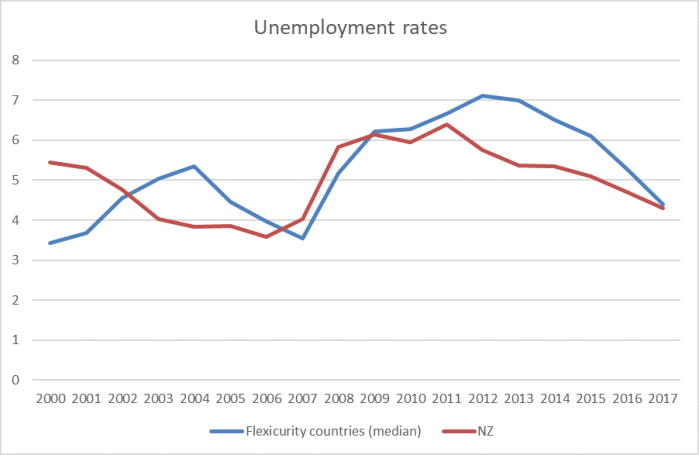
Or unemployment rates, not just a one year snapshot but a glance back over this century to date.

flexicurity 3.png

Most of the time, most years, New Zealand’s unemployment rate has been lower than that in the median flexicurity country.  The differences aren’t always large, and aren’t even always same-signed, but it isn’t an obvious advert for the alternative model.

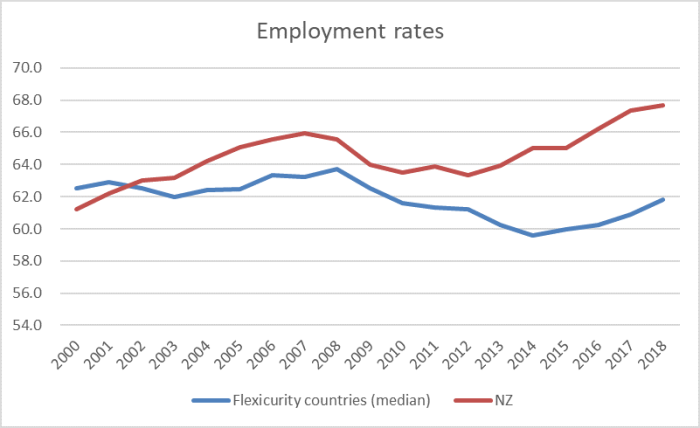
And what about employment rates?

flexicurity 4

Sweden has employment rates very similar to those in New Zealand, but taken together this group isn’t necessarily a great advert for an alternative income support model.  Of course, in richer and more productive countries more people can afford to work less etc, so I’m certainly not suggesting the whole difference is down to the presence/absence of flexicurity. Perhaps there is a political “income distribution” case to be made –  that’s one for political parties – but I’m struggling to see reasons why, evidence that, flexicurity offers potential labour market/productivity gains.

And to emphasise that flexicurity in these countries is just one component of a radically different approach to the role/size of government, here is a chart showing government spending.

flexicurity 5.png

The Commission even concedes (page 60) that materially higher income replacement rates when people become unemployed seems to be associated (in a cross-country relationship) with higher rates of (long-term) unemployment.  As they note, it isn’t an ironclad relationship –  there is always a lot of other stuff going on, which needs much more careful analysis to distinguish.   But why they would jeopardise one of the more impressive economic achievements of New Zealand this century (low averages rates of unemployment, especially long-term unemployment) isn’t clear.

Much of it comes down to this alleged “attitudes to technology” issue, even though the Commission makes no attempt at all to show that fears about technology or job displacement is somehow a major factor –  a factor at all for that matter –  in low rates of business investment in New Zealand.

They begin one section late in the report this way

flexicurity 6.png

So even though the Commission itself has concluded (reasonably, or so it appears to me) that “fears of mass job losses from automation [are] unsubstantiated” one public opinion poll is enough to suggest there is some widespread systematic structural problem.

One might well wonder whether (a) it was not ever thus (except perhaps in the hyper full-employment period of the 1950s and 60s, and (b) whether those fears are not being fed by people like the Minister of Finance.  Without evidence that any such fears are (a) much greater than usual, (b) causally connected to weak business investment in technology, and (perhaps) (c) evidence that such fears are lower in the flexicurity countries, it isn’t a great basis for proposing far-reaching policy change.

Following on from that extract we get this

Bredgaard and Daemmrich (2012, p. 2) described the Danish “flexicurity” system (Box 3.2) as a strategy for “economic competitiveness and sustainable national prosperity”.
Firms in Denmark gain competitive advantages from a mobile labour force and government funding of public services and infrastructure, while workers benefit from domestic employment opportunities and continuing training.

Well, perhaps, but I”m sure one can find champions for any country’s appraoch, but where is the systematic cross-country evidence, including relative to New Zealand (a country with lower average unemployment rates, lower long-term unemployment, higher employment).

And then there is this

flexicurity 7

But, as already noted, New Zealand not only has fewer job security protections than France –  the bad example cited here –  but fewer than those in Denmark, Netherlands, and Sweden.    And one might remind the Commission that correlation is not causation, especially when it isn’t supported by any independent argumentation to make the case that (a) flexicurity produces these poll results, and (b) more importantly, flexicurity increases the rate of uptake of new technologies across economies as a whole.   The Commission offers nothing on either point.

One could go on. The Commission notes that one “could” introduce “portable redundancy accounts” as, apparently they do in Austria. But makes no real case for doing so, and never seems to engage with (for example) the tax inefficiency (to the individual) of having various pots of money tied up in various places, all while (typically) having a mortage on the other side of the balance sheet.  They toy with ideas of mandatory redundancy, but again without any attempt to demonstrate a connection to productivity or business investment.  They worry about the ability of people who lose their jobs to service a mortgage, but never seem to adequately connect that concern to the fact that if there is a system that generates little long-term unemployment, most people are usually relatively readily able to find new jobs, and can self-insure (both formally, through mortgage protection insurance, and informally –  it isn’t common for both members of a couple to lose their jobs at once).  Mortgages in New Zealand are, of course, highly burdensome, but that is a reason to fix land supply and get the price of houses down, not to greatly enhance the welfare system.

Changing tack, I was also interested that the Commission did not touch on three other dimensions that might seem relevant to discussions around the sorts of schemes they propose:

  •  the fiscal automatic stabilisers in New Zealand tend to be quite muted.  That reflects the twin facts that our tax system isn’t highly progressive and that our unemployment benefit system is modest and pays a flat rate.     What the Commission proposes would strengthen the automatic stabilisers, but at the price of increasing the cyclical amplitude of cycles in the government’s budget balance.  There are pros and cons to such a change, but they didn’t seem to be mentioned at all,
  • the Commission rather overdoes the point about social insurance and how different New Zealand and Australia are to the rest of the world, but there is one important dimension they didn’t touch on.  In other countries, the social security systems are typically partly funded by social security taxes on wages.  That means tax rates on wages are typically higher than those on capital income.    This is a relatively attractive feature, given that business investment (especially foreign investment) tends to be quite sensitive to expected after-tax returns (and people like Andrew Coleman and me have been making this point for years).    Even if we did not increase welfare payments to the unemployed there would be a good case to lower income tax rates and raise the lost revenue through a social security tax on labour incomes.  This wasn’t a dimension the Commission touched on and while, considered politically, that might not be surprising, it is quite a gap analytically.

In sum, there is no sign that the current Productivity Commissioners have any sort of robust defensible model for thinking about New Zealand’s long-running productivity failures. In particular, they show no sign of having thought hard about why firms operating here –  and who might operate here –  have proved so reluctant to invest more heavily over long periods of time.   There is no evidence offered that excessive rigidity in the labour market, or fears of workers, is any part of the issue at all.

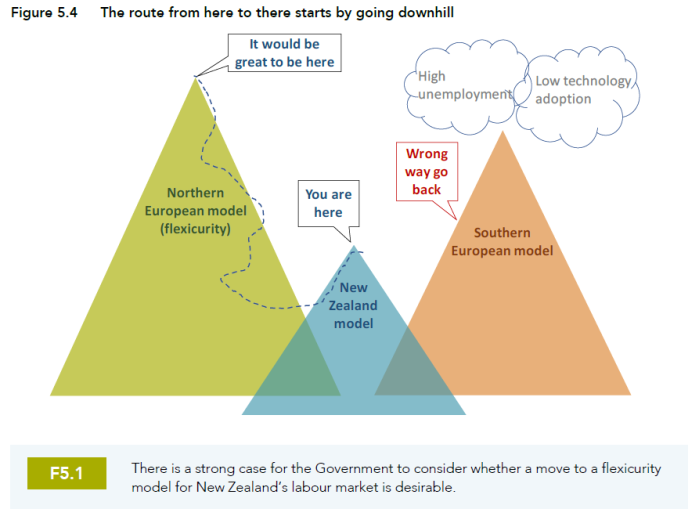
And yet they jump to champion quite radical changes in our welfare system, even including near the end of the report a folksy politicised cartoon

flexicurity 8.png

The economic case just is not made.  Sure, it would be great to have a highly productive economy, but the Commission simply has not made a serious effort to demonstrate any sort of causal connection between their (apparent) personal political preferences around unemployment benefits/social insurance and any sort of plausible path to much better productivity outcomes in New Zealand.   (And here one might note that places like France and Belgium –  with quite restrictive labour laws, much more so than the flexicurity countries –  have similarly high average rates of labour productivity.)

If they want to champion such a model –  and reasonable people can debate the merits of some aspects of it in its own right – there is an election next year. Perhaps the Commissioners might consider standing for Parliament instead of using taxpayer resources to champion a different answer to inherently political questions.


Compass gone wonky

Having delivered his Monetary Policy Statement, done his press conference, fronted up to the Finance and Expenditure Committee –  oh, and roiled the markets –  Reserve Bank Governor appears to have jumped on a plane for a quieter couple of days at conference in San Francisco.  I don’t begrudge him that –  the conference in question is usually pretty good (I got to go once) and this year’s programme looked as interesting as ever.  The topic was “Monetary Policy Under Global Uncertainty”.

The Governor was on a “Policymaker’s Panel” –  along with a Deputy Governor from Korea and a former Deputy Governor from Brazil.    It can’t have been a very in-depth panel (the programme allowed only 50 minutes in total), but we don’t hear much systematic from the Governor on monetary policy and so it was welcome that he chose to release his short (four pages or so of text) remarks.  I don’t think I’ve seen them covered in the local media at all.    That is perhaps a little surprising as, having greatly surprised commentators and markets in two MPSs in succession, his remarks to this FRBSF panel were under the heading Monetary Policy: A Compass Point in Uncertain Times.   Sounds like a worthy aspiration.  Shame about the execution.

But what did Orr have to say in his brief remarks?

First, he attempts to suggest that policy (etc) uncertainty isn’t really much of an issue in New Zealand.  Yes, he really does claim that, drawing on a measure – of the dispersion of GDP forecasts –  which isn’t an indicator of policy uncertainty at all.    Now, no one is going to claim that we have anything like the degree of policy uncertainty they face in the UK (or, thus, its major trading partners including Ireland). We don’t even have a “trade war”.   Then again, we had months of uncertainty around capital gains taxes, ongoing uncertainty about the future labour market regulatory regime, and now about the future water pollution regime. Oh, and bank capital requirements…..to name just a few.

Then we come to paragraph that I agree with, quite strongly, and yet it seems he no longer does.   In the light of the uncertainty (globally) he tells us

it is vital that monetary policy acts as a compass point for decision making

going on to note

For New Zealand, this means setting policy to achieve our price stability target and support maximum sustainable employment. It means acting decisively to prevent an unnecessary worsening in economic conditions and the un-anchoring of long-term inflation expectations. And it means recognising the limits of monetary policy.

I’m not going to disagree, but quite how he justifies his MPC’s decisions, and communications, in and around both the August and November MPSs is less clear.  As I noted the other day, in August –  when they did act “decisively” there was little attempt to invoke arguments about inflation expectations in support, then we had a couple of months of wheeling out such arguments, only for them largely to be abandoned last week when he chose to err on the side of caution, “unnecessarily” so, at least in my view, against a backdrop of inflation and inflation expectations below targets with (in their own words) downside risks.   Not much of guiding light there.

Then we get the sort of paragraph beloved of self-important central bankers

In discussing these topics, I will touch on how, since the Great Financial Crisis, central banks have been tasked with a widened set of objectives. On one hand, we appreciate the constraints faced by other institutes, and the peril that may have resulted from the crisis had central banks not stepped up to the task. On the other hand, central banks are sometimes expected to solve phenomena that are structural in nature, and that do not sit easily within the conventional realm of monetary policy. At the Reserve Bank, we are always exploring new policy options to meet our broadened mandate.

Except that, typically, central banks don’t have a wider mandate how than they did before.  That is certainly true of New Zealand –  where nothing at all (in legislation) has changed around regulation/supervision, and where the change to the formal goal of monetary policy was, in the Bank’s own telling, more cosmetic than substantive, designed to capture something about the way the Bank had long sought to operate, while altering some rhetoric.  The big change in New Zealand has been central bankers looking to extend their own reach, both within and beyond the mandate Parliament has given them –  whether LVR limits (arguably within the letter of the law), focus on “culture and conduct” (clearly not),  the Maori strategy (not), the green agenda (largely not) and so on.    Perhaps in a few corners of the world there has been a belief, by a few people, that central banks can markedly change structural growth outcomes.   If so, such a mantra has rarely, if ever, been heard here in the last decade. But it makes central bankers feel important and valued to pretend otherwise.

Keeping on through the speech, we do actually get some recognition that “policy uncertainty” –  and “regulatory requirements” –  were acting as a barrier to business investment in New Zealand.  As he notes, most of this doesn’t have much to do with monetary policy, except that monetary policy needs to take account of whatever is influncing overall demand and supply pressures/balances.

From a central bank perspective, uncertainty has one clear impact: it makes our job harder. Good monetary policy depends on reasonable forecasts. High uncertainty makes forecasting harder. There is more noise in the data and forecasts are more subject to revision. A consequence of this is that the Official Cash Rate (OCR) may be less predictable simply because the world in which we are making our decisions is less predictable.

Except that earlier he showed that chart (mentioned above) in which the dispersion of GDP forecasts has been quite a bit lower than usual in the last couple of years.  So it might be a fair point in principle, but in practice –  in recent months –  the real source of short-term uncertainty about the OCR has been……the Reserve Bank itself.    Not a point that Governor chose to address.

He then moves on to a section headed “Monetary policy response to uncertainty”.

First up is a straw man

Firstly, maintaining low and stable inflation enables organisations and individuals to carry out meaningful financial planning, by reducing overall uncertainty. This is something that is nearly impossible when prices are high and volatile or falling uncontrollably.

Neither is a world any advanced country has been dealing with in recent decades (I’m assuming he meant “inflation” was high and volatile), and in the case of “falling uncontrollably” never.

Then we do get to recent New Zealand policy

In particular, it is now more suitable for us to take a risk-management approach. In short, this means we look to minimise our regrets. We would rather act quickly and decisively, with a risk that we are too effective, than do too little, too late, and see conditions worsen. This approach was visible in our August OCR decision when we cut the rate by 50 basis points. It was clear that providing more stimulus sooner held little risk of overshooting our objectives—whereas holding the OCR flat ran the risk of needing to provide significantly more stimulus later.

And yet, wasn’t that title something about a reliable “compasss point”.   None of his August approach was flagged in advance, arguments for it unfolded only slowly even after the event, and then –  when there was still (on his own numbers) “little risk of overshooting our objectives” they abandoned that particular “least regrets” line, without explanation in advance, in the release, or subsequently.  He goes on

We can also address uncertainty through our communication and forward guidance, which are broad-ranging. We reveal our assessment of the economy—good or bad—to the public, so they can make decisions based on the best possible information amid the prevailing uncertainty. We voice the types of policies we believe may be needed to sustain long and prosperous growth—be they monetary, fiscal, or financial policies.

But that is almost exactly the opposite of what the Governor and MPC are doing.  We have still not had a single substantive speech from the Governor on monetary policy and the economy.  We haven’t at all from three of the statutory members of the MPC.  It is harder to make good decisions when central banks spring –  quite unnessary – surprises.  Oh, and actually it is no part of the Bank’s mandate to be opining on what policies are best for “long and prosperous growth” (although it is remarkable that structural policies appear not to be relevant to the Governor’s view of growth, productivity etc).

There is a final page on “Beyond conventional monetary policy” which I don’t have particular problem with.  It is good that the Governor again repeats his intention to publish their analysis. It is only a shame that (a) this process has been so long delayed, including under his predecessor, and (b) that the work done so far has not proceeded in a more open and consultative way, rather than being something akin to the “wisdom” delivered to the masses from the wise experts on the mountain top.

Orr ends in a typically upbeat tone.   I just want to highlight the last few sentences in which (as so often) he overreaches, partly in the process of distracting attentions from the failings in areas he is directly responsible for.

Yes, there is uncertainty. Yes, it is affecting us. No, monetary policy cannot directly resolve this issue. But we can offset its effects and empower others to fuel economic activity that will benefit us in both the short and long-term. There has never been a greater time to make use of accommodative monetary policy for investing in productive assets.

Yes, monetary policy has a (vitally) important stabilisation role.  It was why countries set up discretionary monetary policy many decades ago.   But it can do nothing to offset the blow to potential output created by policy uncertainty and other regulatory burdens.  It does nothing to boost our longer-term prosperity.  And as for the final sentence…….he falls into the trap again of trying to convince us that low interest rates are some exogenous gift, empowering whole new opportunities, when in fact interest rates –  long-term market-set ones and official OCRs –  are low for reasons that seem to have to do with diminished opportunities, diminished prospects for profitable investments.  Don’t get me wrong – given all that, the OCR should be lower (mimicking what real market forces would be doing if short-term interest rates were a market phenomenon), but when interest rates are falling in response to deteriorating fundamentals it is a stretch –  at very least –  to expect the sort of pick-up in business investment the Bank often forecasts but rarely gets to see.

It wasn’t a persuasive or particularly insightful set of comments.  Perhaps his San Francisco audience –  knowing little of New Zealand –  weren’t bothered, but we should be.  We should expect a lot more from such a powerful, not very accountable, public figure.

(And if you want a speech from a much more serious figure, try this one –  given at the same conference –  by Stephen Poloz, Governor of the Bank of Canada.  There is a depth and seriousness to it that is simply now not seen from senior figures in our own economic policy agencies.)

Facts

The New Zealand Initiative last night released the results of the general knowledge quiz conducted for them by a polling company.     It is a good way to get media coverage –  and I’m as much a data junkie as anyone.

The real point of the exercise was as a prop in making the case for a greater emphasis on a knowledge-based education system rather than the current skills-based focus.  I’ve told the story before about going to a meeting for parents of new entrants at the local school a decade or so ago, where the Principal –  a fairly vocal figure in the world of educational politics –  told us that they weren’t going to teach our children facts, because they would soon be outdated.  Fortunately, when I tried the NZI quiz on my now 16 year old he got 12/13, despite the New Zealand education system.

The headline, of course, was that this sample of New Zealand resident adults wasn’t particularly good at answering the NZI’s questions, many of which look pretty simple or basic (at least to the sort of people who read either NZI material or blogs like this).  Across 13 questions –  of which five were either yes/no or limited multi-choice questions –  the median proportion of respondents answering correctly was 53 per cent (that was the question about how long it took earth to orbit the sun).   And although much of this post will be a sceptical take on the significance of the survey, even I will concede to being surprised that only 32 per cent of respondents could correctly name the year the Treaty of Waitangi was first signed.  I doubt the Treaty was ever mentioned in my whole schooling, but it is (repeatedly) today, and yet the worst results were for the 18-30 age group (where only 23 per cent got the answer right).

The NZI released the detailed breakdown of the responses: we have all the answers by age, sex, metro/provincial/rural, by “deprivation decile”, and by whether schooling had taken place in New Zealand or abroad.  Curiously, there was no ethnic breakdown.

One thing I haven’t seen covered elsewhere – or, of course, in the NZI write-up – is the systematic male/female differences.   For quite a few questions there is almost no difference between male and female responses, but for seven of the questions the differences looked to be material and in only one of them did women outperform men.

Per cent correct
Female Male
How long does it take for earth to go round sun 44 62
What year was the Treaty first signed 29 35
Native Land Court purpose 32 36
Correct use of “their/there” 83 77
Derive distance travelled from speed and time 41 56
Name seven continents 39 50
Compound interest question 1 49 66
(Harder) compound interest question 23 46

I’m not sure what to make of those differences, but since I work on the assumption that women are just as intelligent as men, perhaps it suggests something about how the questions are framed, or…..? (Note that the NZI person responsible for this project is a woman.)

There were some differences between those schooled here and those schooled abroad.  Knowledge of when the Treaty was signed and about the Native Land Court was less good among those schooled abroad, while the migrants were more likely to be able to name all seven continents and to be able to answer correctly the harder compound interest question.

People from poorer areas typically knew (or could work out) fewer correct answers, but by age the answers were a bit mixed. The only one surprised me was (see above) the Treaty response where the older people were the more likely they were to know the correct answer.    Of the other questions, there were quite a few where younger people now knew more the older people now but where you would have to wonder whether those same young people will know as much 50 years hence.  There are plenty of details I learned at school that I’ve either forgotten or are now rather hazy –  while other, mostly unused, things stay locked in the brain and are never asked about in surveys or quizzes (here I’m thinking of the quadratic formula as an example).

In general, I am sympathetic to the Initiative’s cause, for a greater and more systematic emphasis on knowledge in our schools.  But I am left quite sceptical about the value of surveys like this, except as a way of getting media coverage, and perhaps feeding the self-esteem of a certain class of well-educated and knowledgeable adults.  Most people actually do manage to get through life tolerably well and the world is richer and more materially prosperous than ever (as the Initiative would often rightly point out, in pushing back against other nanny-state proposals) and I’m left wondering why, if at all, I should be bothered if people can’t answer particularly well over the phone –  perhaps caught while they are cooking dinner or doing the ironing – compound interest questions (green are the correct answers).

nzi quiz.png

Most people don’t leave a fixed amount in an account for five years and reinvest all the proceeds, there are fees and taxes, interest rates change over time, and actually if you invest for five years at 2 per cent interest per annum and spend none of it and pay not fees/taxes, you’ll end up with with $110.41 which most people would round to $110.

But this isn’t enough for the Initiative

Our poor grasp of maths is also concerning. Basic arithmetic is critical for personal financial literacy. It is difficult to understand mortgages, savings and investments without the mathematical keys. But knowledge of maths goes beyond finance to everyday life. Try renovating your house, baking a cake or calculating medicine doses without basic maths. It is true that the 20th century provided us with calculators, but if you do not understand maths you are poorly placed to check your electronic answer.

And yet people do get on.  We don’t have some mortgage default crisis, we have pretty low rates of elderly poverty, nothing about finance (at a personal or national level) seems to be spinning out of control.  And while the main thing for which I now use the formula for the area of a circle is to adjust recipes to the desired size of cake tin, somehow I expect most homemakers get on just fine without it.  (I raised some doubts about the value of “financial literacy” programmes in a post here.)

And is it particularly useful to know the antibiotics are about bacteria not viruses?  I did know that, but it isn’t particularly useful to me.  Instead, when I go to the doctor I typically take his advice, and when he prescribes something I try to follow the prescribed instructions.  It probably matters rather more –  in term of keeping antibiotics useful – that (a) doctors don’t over-prescribe and (b) patients follow instructions.  Or so I’ve been told, and I’ll operate of those rules of thumbs (especially the latter) for now.

Which brings me to the paper Briar Lipson has written using the quiz results as a prop for calls for reform of the education system.    It is a curious piece in many ways, perhaps especially coming from a think-tank which is generally regarded as fairly libertarian in its inclinations.   Their chief economist Eric Crampton often cites approvingly the stimulating work of GMU economist Bryan Caplan, one of whose books was devoted to casting considerably doubt on the value of much of education (facts-based or not) in building skills –  as distinct from certifying a work ethic, conformity, and basic intelligence.  A screening and sorting mechanism more than anything (as I’m sure knowledgeable parents recognise when they hold conversations with smart teenagers and have to distinguish between richer and deeper answers and those that will jump through the right hoops to secure NCEA credits).

I was a little amused to note her claim that

As a bicultural nation with a colonial past whose ongoing legacy is playing out in our troubling national statistics, it will never be easy to answer these questions.

It could have been written by the Maori Party, but it was actually written by someone who isn’t a New Zealander and who appears to have been in the country for not much more than two years.  It doesn’t invalidate her expertise on education itself, but that ‘our’ is surely just a bit of a stretch?

There is a quite of this black armband approach.  For example, we are told that “inequality…threatens wellbeing and prosperity”, which is a rather different (questionable) tone than we typically get from the Initiative.   I presume the audience for this is the Labour Party, but even so……facts, knowledge etc.  It carries over to the caricature of history.

For most of history, only the wealthiest had the time and resources to pursue disciplinary knowledge. For the rest of society, knowledge beyond daily experience was an unaffordable luxury. Accordingly, the ability to read and write was limited to the elite: noblemen (yes, only men) and clergymen (again, men). If you toiled for a living, your horizons were narrow.

Yes, poverty was quite limiting, but all that “only men” stuff would surely have come as quite a surprise to Hildegard of Bingen, Catherine of Siena, Anna Comnena, Teresa of Avila as just four fairly prominent examples.   Lipson’s treatment of history here is the sort of thing that makes people like me –  who fairly strong support, in principle, the idea of more systematic history in our schools –  rather nervous of what it will turn into in practice.

There is more dodgy –  or at least highly arguable – history: thus on her telling it is the Enlightenment that brought us literacy. Pretty sure it had almost nothing to do with the first New Zealand schools.

I totally agree with Lipson here

Whether you are building a house, playing the violin or deciding to immunise your child, knowledge is essential, because there is not a generic skill of problem-solving or critical thinking. As anyone who has lifted the bonnet of a broken-down car knows, problem-solving skills do not exist in the abstract.

And yet she starts her note with the observation that

For most of history, only the wealthiest in society had the time and resources to pursue disciplinary knowledge. For everyone else, knowledge beyond daily experience was an unaffordable luxury.

And yet I don’t need to know how the engine in my car works.  Most knowledge most people actually use day to day is really rather specific.

A few other questionable snippets

To converse meaningfully with each other, and evaluate the performance of our political leaders, we need to have knowledge that takes us beyond our daily lives.

Set aside the evaluation of political leaders, but does Lipson really suppose that the vast mass of people –  who couldn’t answer her quiz questions correctly –  somehow don’t manage meaningful interactions and conversations?  The revealed evidence seems to be against her on this count.  It won’t be Wellington elite dinner table conversations, but are the relations and interactions –  the thick web of connections that makes up most individuals’ place in society – any less effective or profound?

We get another of those “Wellington elite” type of perspectives in this comment

To grow into active, engaged citizens who can think critically about the wider world, children need to know about language, science, maths and culture (including but not only their own). However, only 44% of New Zealand adults can name the seven continents, let alone locate Afghanistan or South Korea on a map – countries where our defence force has personnel in the field. Issues like national defence, along with migration and trade, are all critical to New Zealand’s role in the world. But how can we expect voting-age adults to engage with New Zealand’s geopolitical challenges – and how our nation should respond to them – if they do not even know where in the world the challenges lie?

I’m simply not bothered if people can’t find Afghanistan on a map. One could mount a –  slightly flippant perhaps – argument that it would be better if fewer people could, because it would probably have meant fewer western armies and associated headlines there, and from there, over the last 18 years.  More importantly, it is delusional to suppose that a school education –  no matter how good –  is going to equip people for debates about the nature, and source, of geopolitical challenge or (to take another topic close to this blog’s heart) the pros and cons of a large scale immigration programme to a remote corner of the earth.

Lipson goes on

We might debate whether these skills are any more important this century than they were in the past; either way, we must agree it would be difficult to think critically about the Hong Kong riots without knowing something about Hong Kong’s history and geography. It would be equally difficult to evaluate policies on use of plastic without a basic knowledge of biochemistry and economics.

I think I am safe in saying that, for better or worse, most New Zealanders have little interest in the Hong Kong riots and although, in some sense, I personally might wish it were otherwise, it isn’t really clear why that is a bad thing.   (As it is our government tries to pretend to having little interest).  And –  while perhaps I’m missing something crucial –  I’m not clear quite what Hong Kong’s geography (does she mean a tight city-state, or located next to China?) really has to do with it.  Personally, when I think about Hong Kong I worry most about the fate –  persecution and repression –  that awaits my fellow Christians under mainland rule, but I wouldn’t really expect that concern to be universal.

(As for plastics, personally I found the values of choices, self-responsibility, and ensuring I  – and my kids –  don’t litter, more relevant to my views on plastics policy than my knowledge of biochemistry –  next to none –  or economics.)

You can read Lipson’s piece for yourself (and it is an important issue). I guess my bottom-line concern is that she has grossly over-reached.    Across her scattergun range of examples, she encompasses a range of topics/knowledge that few (if any) are likely to master, or have much interest in doing so –  even building on decades of adult acquisition of knowledge, not 11 or 12 years of schooling.    I’m all for getting a better balance between on the one hand concrete fact-based knowledge and sketch narratives of things like our history and that of societies to which we are heirs (the narratives, if pushed, matter more than the dates) and on the other the research, reasoning and problem solving skills the current New Zealand system tends to emphasise.

But the modern world relies on a considerable degree of specialisation –  indeed it is integral to our prosperity –  and that is as true of public life, political and social choices, as anywhere else.  I’m not promoting, let alone defending, any sort of “rule of experts” (and I’m pleased to see that here the Initiative is not heading off after things like epistocracy) but hardly anyone votes based on a comprehensive review of in-depth party policies across the board.  Even on a specific issue like climate change, few of us (really can) vote that way – I might claim some expertise in the economics, but not in the science, and there are very few people who combine both.  And values count a great deal, and yet nothing in the NZI quiz –  and almost nothing in Lipson’s note –  was about forming people in the values that make for a successful, stable, and prosperous society.

In truth, we take our lead from others –  rules, precedents, examples, people who enunciate values that relate to our own –  and leave much of the detail to others.  It is unavoidably so –  and I say this as someone who has more time, and probably more capacity, to dig into lots of issues at a fairly technical level.  We rely on others in almost all areas of life, and one could at least mount an argument that learning how to think about who and what one might trust is much more important than, say, learning the details of the Danzig question, Hong Kong’s geography, the biochemistry of plastics, or the precise reason for the establishment of the Native Land Court.   As Lipson puts it in her title, ignorance is not (generally) bliss and yet –  on the other hand – a little learning can, in Alexander Pope’s words, be a dangerous thing.

I could go on, but won’t.    But I’ll end where Lipson starts. In the entire body of her seven page text there is nothing about forming people in the values that a society should live by.  I suspect she is probably an adherent of some fact/value distinction (Winston Churchill was a real person, regardless of you views of the nature of good), and clearly there is something to that split, and yet if her goal is a functioning cohesive effective society and polity values formation is likely to be at least as important as specific factual knowledge.  It isn’t enough to say that home is the place for that, since we all know that nature abhors a vacuum and that what our schools teach is heavily value-laden, by default if not always by design.  Lipson begins with a quote, which appears to be from an Australian teacher

It is not the natural state of humans to live in relatively free, democratic societies that tolerate difference. Because of this, we need education to protect and preserve these societies; to transmit important cultural knowledge from one generation to the next, and value our civilisation.

I’m not sure those two sentences really relate to each other, but if you take seriously the second sentence –  as I do –  you’d find it bearing almost no relation to either the facts quiz that got NZI its media coverage, or to the thrust of Lipson’s appeal to teach facts.  It is about a cohesive narrative that recognises what is good and what is not, what is great (eg art, music, literature, ideas) and what is not, and takes pride in what has been built.  And that requires an ethos, a mindset, that has made sense of life and the world.   You might call it a worldview or a religion.   But it is very different from knowing the names and dates of the kings and queens, the names and dates of all our Prime Ministers (useful as, in some sense, those latter might be).    The (narrow) facts just don’t get you far.  I’d rather people “knew” that Communism has been, and is, a great evil than that, say, they knew the geography of Hong Kong or the biochemistry of plastic


People from poorer countries will come if we let them

The Herald business columnist Liam Dann had a curious column out yesterday.  When I first saw it online it had a more right-on headline [UPDATE: “Woke wonderland – how a new narrative has changed NZ”] (I didn’t read the article until my wife started quoting bits to me) but it now has the headline “NZ’s population prediction was out by 30 years – the price we are paying”.

Dann had been prompted to write the article by stumbling on a 2004 SNZ release from 2004 which apparently “forecast” (more likely, it was the medium “projection”) New Zealand’s population to get to five million in about 2050.  As it is, it appears that milestone will be reached within the next few months.

The bit that the current headline deals refers to was this

Now I can’t get past the notion that this miscalculation holds the key to many of our social infrastructure problems in 2019.

If that was the population assumption policy makers were using, then of course we have a housing shortage … of course our roads, our hospitals and our schools are crowded.

I’m a bit ambivalent on that point.  After all, it isn’t as if the projections haven’t been updated, regularly, since 2004.    And one could quite reasonably make the point that this specific issue isn’t primarily about surprisingly rapid population growth, as about successive waves of central and local governments (including the current ones) that have made too much of the system not responsive to population surprises.  Planners control where houses can (mostly can’t) be built and most of them have a deeply-held aversion to an increased physical footprint for cities, let alone competitive market processes to determine where and when development occurs.   We still don’t have congestion charging in our major cities.  And so on.  And so the pressures fall on house/land prices and in various forms of congestion or queuing.

All that said, if we were to take as more-or-less given the RMA and associated development constraints then Dann does have a point.  After all, it was the same political leaders who have repeatedly refused to act to free-up land supply etc (and in doing so were, just possibly, reflecting public preferences) who also oversaw the immigration system which has resulted in such a rapid rate of population growth.  The immigration system is much easier to tweak, to manage trend inflows of non-New Zealand citizens, than the entrenched land use issues are to fix.   In that sense blame a series of active (and, more often, passive) choices by our political leaders.

Using official SNZ data, here is how our population has changed since September 2004 (September years are the latest annual data).

population since 04

Over the full period, the population has risen by (an estimated) 842000.   Take natural increase (births less deaths) and the large net outflow of New Zealand citizens (another 315000) and you’d have been left with a pretty small rise in the population  (less than 4 per cent in total, over 15 years).

That is simply an illustrative scenario.  In the absence of large non-citizen immigration, the rate of natural increase would have been lower (immigrants, once here, have children too).  Whether the outflow of New Zealanders would have been any different is hard to know.  My own view is that there would have been a slightly smaller outflow of New Zealanders (consistent with my model, in which economic prospects here would have been improved), but there are alternative hypotheses in which some more New Zealanders might have left (wanting the brighter lights a NZ of five million could offer, but one of four million could not).

But to a first approximation, if you regard the land regulation situation as largely frozen, then almost all the subsequent pressures can be ascribed to the choice to keep on with large scale non-citizen migration regardless.  Even if you thought it really could be quite readily changed and it was just venal politicians who refused to do the right thing, then knowing that and still supporting large scale immigration (and recall that ours is among the very largest in the world per capita) is akin to knowingly inflicting the resulting house prices, congestion, queues etc on New Zealand.   It isn’t as if other countries have been so good at fixing those land (related issues).   And officials and outside observers knew these issues were a problem 15 years ago.

Of course, having raising the issue Liam Dann –  pillar of the establishment –  is keen to assure his readers that he does not, not for a minute, oppose immigration.  Thus his claim

in my lifetime this country has been vastly improved by more people and more cultural diversity.

I get the impression he must be almost 50 so presumably he is talking about immigration since about 1970.   In reality though, between about 1974 and the end iof the 1980s there wasn’t much immigration, so we are mostly talking about the last 30 years.    I can’t share his optimism, particularly about the raw numbers, in a country that has continued to drift further behind economically over that period, and whose firms have failed –  in aggregate –  to find new products/markets abroad (even though external trade is a key element in any prospective improvement in our relative prosperity).

Anyway, at this point Dann launches into a paean to the better New Zealand we now are that, to me anyway, seems more than a little detached from reality.  We are told that

Something structural has changed.

New Zealand just isn’t a place people want to leave any more.

Except of course (see above) a net 300000+ people have: just imagine if a net 7.5 per cent of the American population had left the US in 15 years.

Now a little later on, Dann does concede that any reduction in net outflows isn’t entirely good news

Australia becoming a lot less friendly to New Zealanders has influenced our net migration rates. It’s not nearly as easy to enjoy the easy life across the Tasman as “Bondi bludgers”.

In other words, poeople may still want to leave, but it is harder to do so.  And it isn’t just about the caricatured “Bondi bludger” but about the difficulty of your kids getting established and ever getting citizenship etc.  New Zealanders are worse off as a result of those tougher Australian policies.

It is also worth pointing out that New Zealanders go to Australia when the Australian labour market is strong.  It hasn’t been that strong in the last few years, after commodity prices peak and the mining investment boom began to pass.  That isn’t good for Australians, and it certainly isn’t good for New Zealanders who might want to take advantage of the higher productivity and higher material living standards abroad.

And, as it happens, the outflow has been picking up again.  Here is the net outflow of New Zealand citizens from the new SNZ migration data.

outlfow to AUs

It certainly isn’t a record outflow, but the increase is now becoming quite pronounced.  Not exactly a tale consistent with a wonderful New Zealand.

But when he talks about the migration choices of New Zealand citizens, Dann is just warming up.    The real story on his telling is

New Zealand finds itself being cast as the “woke” capital of the world.

and

We failed to see what a desirable place New Zealand has become in the eyes of the world.

Complete with all manner of gushy references to the idea that, for example

the UK and US media simply can’t get enough of the notion that this country is a liberal paradise.

Now I’m not going to deny that there are sections of the world media who seem particularly enamoured (for reasons that largely escape me) with our Prime Minister.

But….the surge in net migration this decade mostly happened on the watch of the previous lot, that outflow of New Zealanders has (and it is almost entirely coincidental) increased in the couple of years the current government has been in office, and in case Dann hasn’t noticed, the residence approvals targets haven’t changed much in 20 years now, and actual approvals have been undershooting target in the last couple of years (probably less because of lack of interest than because of processing delays by MBIE).   Because the headline target hasn’t changed much in 20 years, while the population has grown quite a bit, residence approvals for non-citizens are quite a bit less now, in per capita terms, than they were in, say, 2004 (Dann’s reference point).

And why might we doubt that Stephen Colbert (or, on the other side, Donald Trump) or the Guardian really have anything much to do with our population growth?  Well, try this chart from the new MBIE immigration dashboard, showing the top five countries for residence approvals.

R1 Residence Decisions by Nationality (1)

Four of these five countries are materially poorer than New Zealand is (and the UK, once the leading individual source country, while richer and more productive is now down to equal 4th).  Mostly people migrate when (a) the options are better for them abroad, and (b) the potential recipient country allows them to do so.  That seems pretty consistent with the New Zealand story not just now, but throughout history (think of the UK migration from say 1870 to 1970, a period when wages here were typically higher than those in UK, or of Pacific migration in the 60s and 70s).

And if there has been an increase in the (typically small) net number of US migrants since Trump, well there has been a fall in the net inflow of Brits since the Brexit vote.

trump migration.png

In combination, net arrivals from the UK and US are now about one-third of what we were experiencing from 2004 to 2007.   So much for the pulling power of the “woke paradise” rhetoric.

As just another area where our rules matter quite a lot, the MIBE data says that we now have about 200000 people here at any one time on temporary work visas.    In 2012 that number was about 100000.   That’s non-trivial share of the roughly 500000 growth in population (all needing accommodation etc) in that period.

Towards the end of his article, Dann’s sunlit uplands narrative continues

Now more than ever New Zealand has some control over that destiny.

We can choose to turn the immigration tap up or down with policy settings.

We have choices because we can rest assured that the demand is there.

Except that for most of the last 150 years it has been so.  When you are a relatively rich country –  and one that is not given to coups or civil wars and speaks the global language  – of course people will want to come.  In what we often think of as the dark years of the late 70s and early 80s plenty of people would happily have come, it was just that we chose not to let them (and reasonable people can debate that economic or social merits of that choice).    We could elect the antithesis of Jacinda Ardern and while Colbert, the Guardian and the Washington Post might not like it, it wouldn’t materially alter the broad level of interest in moving from a much poorer country (eg India, South Africa, Philippines) to quite a rich (if remote) one.

I remain convinced that we would be better off economically, and probably politically/socially as well, to be targeting a much lower rate of non-citizen immigration (perhaps 10000 to 15000 residence approvals per annum).  If we did, the population would probably level out near five million.   Without compelling evidence of incipient rapid productivity growth –  of the sort missing for at  least 70 years –  that would play better to the limited economic opportunities in this remote corner of the world.  And, as it happens, it would leave us not far below the size of the median country globally.

As it is, the existing planning ranges for residence approvals expire at the end of this year.  As I highlighted earlier in the year, the government is apparently looking at quite an overhaul of the system (although no hint they were looking at lower numbers).  The number of Cabinet meetings before the end of the year must now be dropping away quite fast.

Cutting the cake not baking a bigger one

There has been a series of Tuesday events (“Tax on Tuesday”) held at Victoria Univerisity recently, jointly promoted by Tax Justice Aotearoa, the PSA, and the university’s own Institute for Governance and Policy Studies.  I wrote about one of the earlier events here.

The final event was held this week, marketed as “Where’s the party at?”   Political parties that is.   In an event moderated by the Herald’s Hamish Rutherford, speakers from four political parties (NZ First declined the invitation) each spoke about some aspect of tax policy for 8-10 minutes, with plenty of time for questions.   It wasn’t a hugely well-attended event, but it is pretty safe to assume that the overwhelming bulk of the audience was on the left of the political spectrum, and I guess the speakers recognised that in what they chose to say.

First up was ACT’s David Seymour.  He started well, talking about twin challenges for New Zealand around (lack of) competitiveness/productivity and about (insufficient) social mobility and the spectre of entrenched disadvantage.  He was bold enough to note that there is a large group, mostly Maori, who  – rightly and reasonably –  feel that the last 30 years has not done much for them, in economic terms.  I was still with him when he argued that the way to fix the housing market was at source –  around the RMA and associated land use restrictions –  not by trying to fiddle the tax system.

But his centrepiece was an attempt to make the case for a flat rate of income tax (I think set at 17.5 per cent), scrapping our current progressive system.   He attempted to support this with the suggestion that all the rest of our tax system was flat, but I couldn’t quite see the relevance of his point, since (a) personal income tax is almost half of government revenue, and (b) we’ve chosen to achieve the desired progressivity through the income tax rather than, say, the consumption tax.    Attempting to engage his (left wing) audience he attempted to argue that we should think of “fairness” as involving the same rate of tax on every dollar of income (with a half-hearted suggestion that a poll tax could be considered even fairer, but probably wouldn’t fly politically).  Progressivity, he argued, simply doesn’t fit with New Zealand’s culture and values as an “aspirational society” and sends the wrong message, wrong values.  It wasn’t a  description of New Zealand I could recognise, at least any time in the last 100 or more years.

Anyway, Seymour then proceeded to undermine his own argument by addressing the question of “but what about the low income people whose marginal and average tax rates would then rise?”  Consistent with his logic, I’d have thought he should have just said “well, tough –  this is what fairness is, all paying the same rate on every dollar” (while perhaps making the fair point that many people on the lowest marginal tax rates aren’t there for long).  Instead he suggested two possible responses.  The first was to use the tax/transfer system to offer a credit to these people to leave them no worse off (ie progressivity, at least at the bottom, by another name) or…..and this is where I had to check I was hearing correctly…..the minimum wage could be increased further (noting that employers could “afford it” because their own tax rates would be lowered).  In a country with one of the highest ratios of minimum wages to median wages, the MP for the libertarian party appeared to be seriously proposing increasing that impost further……

The Greens finance spokesman (and Associate Minister of Finance) James Shaw –  the calm and relatively sensible face of the Green Party – was up next.  I’d never ever vote for them –  the party that, among other things, whips its members to vote for abortion –  but there was something refreshing in hearing a serving minister frankly state (in answer to a later question) that he really didn’t think taxpayer money should be spent on subsidies for the America’s Cup.  Perhaps he could next offer some thoughts on (New Zealand) film subsidies to makers of propaganda films vetted and controlled by the Chinese Communist Party?   He also spoke highly of a recent NZ Initiative report.

Anyway, on tax, Shaw was clear about where his priors were (and, of course, most of the audience weren’t minded to object).  He is keen on Northern Europe and Scandinavia.  He characterises those countries are starting by identifying what they want to achieve (desired outcomes) and then work from there to an appropriate tax system.    In all cases, that means much higher tax/GDP (and, of course, spending/GDP) ratios than in New Zealand.   From his perspective, he’d be keen on more environmental taxes and –  the Elizabeth Warren side in him coming out – on taxing wealth relatively more.

Perhaps somewhat at odds with the environmental point, he made the interesting argument –  with which I’d sympathise –  that we should hypothecate (ring fence, not into general government revenue) revenue from Pigovian taxes, lest government forget why the taxes were imposed (to deter the behaviour) and become reliant on the revenue (eg tobacco taxes).   That sounds fine –  and he went on to note, in the same vein, that his ideal carbon price in 2050 would be zero (carbon emissions would have been successfully eliminated or out-competed) – but it would leave the pot of general revenue not looking any much larger than it is today.   Despite his evident preference for a much larger government, he didn’t dwell on where the credible sources of much higher long-term revenue were in the Green Party’s view of the world.

Deborah Russell, chair of the Finance and Expenditure Committee, and a former tax academic and official, represented the Labour Party.   As she noted, she came along –  rather than the Minister of Finance or Minister of Revenue –  because people would pay less attention to her.  As she noted, Labour doesn’t have much to say because –  having junked a capital gains tax –  they are in “pretty intense” debate as to what their tax policy next year should be.

Russell –  who people seem to regard quite highly –  was an odd mix of the conventional and aspirational.   She ran a very similar line to Shaw in suggesting that we should first identify what we want to spend money on –  while noting that Labour hadn’t done those conversations that well – and only then identify how best to pluck the goose.  Since she went on to answer a question about inequality later, claiming that she wanted New Zealand to be “the most equal” country in the world, wanted “real radical equality” and supported more support for children, including a return to a universal family benefit, it seemed pretty clear that she too wanted a bigger government and thus materially more tax.

But at the same time she was talking about broad agreement on the “broad base low rate” mantra that has (mis)guided New Zealand tax policy for decades –  even though the high tax countries (eg Scandanavia) she seems to admire don’t have BBLR because they can’t (they recognise a need not to overburden business investment).   And she noted that when her Labour people talk about taxing the rich she often reminds them to think harder about “who are the rich?” and how many (few) there might be to pluck.   The Stuff article on this event played up talk that Labour is looking at campaigning on a higher maximum marginal tax rate, although it is hard to imagine there is really much money in such a proposal (and while it is one thing to campaign for higher taxes from Opposition at the end of a tired old’s government’s term –  as in 1999 –  it might be another thing now, campaigning for re-election, with Budget surpluses).

National’s Paul Goldsmith –  who has actually written a fascinating history of New Zealand tax policy –  spoke last.  He was pretty underwhelming on this occasion, perhaps concluding his audience wasn’t likely to be sympathetic anyway. He repeated the BBLR mantra, talked briefly of National’s (sensible) policy of indexing income tax thresholds, and repeated the promise of no new taxes in the first term of a National government.  He sounded quite pessimistic about fiscal prospects –  talking about the risk any new government could inherit material deficits –  which would act as a constraint on any desire National might have to do something more about lowering taxes.  As for growth/productivity/competitivess, all we heard was the short-term stuff about current low business confidence etc.

Question time followed.  James Shaw was challenged on his line, from earlier in the year, that the government wouldn’t deserve to be re-elected if it didn’t introduce a Capital Gains Tax. To his credit I guess, he looked abashed, mumbled a bit, and didn’t really pretend to have an adequate answer.

Herald columnist Brian Fallow asked about low household savings and low business investment/ “capital shallowness” (including the alleged ”overinvestment in housing” and asked what parties were proposing to do.  Here, my view of Russell started heading downhill.   There isn’t a low savings rate, she claimed, just the wrong measures of savings, and as for business investment, why 1 per cent interest rates might bring about desired change –  as if rates aren’t low for a reason –  and repeated that (deeply flawed) Adrian Orr line that interest rates are now just returning to more normal long-term historical levels.   Goldsmith and Shaw at least both suggested that any housing issues were housing market problems and need to be fixed at source.  But not one of the three of them (Seymour had to leave early) even mentioned the company tax rate (or cognate issues).     All three –  Russell and Shaw more than Goldsmith – actually seemed keen on taxing multinationals more heavily.  None showed any sign of engaging with the literature that much of the burden of capital taxation falls on wage earners.

The chair of the Tax Justice Aotearoa group noted that on OECD measures New Zealand is around the middle of the pack on inequality and asked the speakers whether they were happy with that, and if not which country they would aspire to be like.  I’ve already mentioned Russell’s response, although shouldn’t omit her suggestion that as a result we need to look a lot more seriously at what we don’t tax: wealth.  The CGT had been rejected but she argued we need to relook at options that tax wealth.

Paul Goldsmith responded that he wanted to emphasise equality of opportunity, while noting that the state –  rightly in his view –  does lots of redistribution as it is.  James Shaw, while rejecting the idea of a single country to aspire to, was quite open about aligning more with the Nordics –  in his view they had the best outcomes and were the best run.  By contrast we had “emaciated social support over several decades”, and he went on to note that we couldn’t, in his view, have equality of opportunity without much more government spending (“investment”).

It was interesting to hear both Shaw and Russell suggest that there should be more focus on desired outcomes, which should then lead us to design a tax system that would raise the (more) money.    Arguments on that sort of point are part of what politics is about.  But it was also interesting to hear both of them talk about how politicians end up disguising revenue increases in various not-very-transparent guises (levies etc) and how hard it is to make the case for higher taxes (although as Paul Goldsmith noted, one of the striking things of the CGT debate was the way Robertson/Ardern simply didn’t engage in making the case).  Perhaps the left really can make the case for much more spending, much more tax, but their own words suggest they have something of an uphill battle.

As for me, I probably came away still disinclined to vote at all next year.

But, for what it is worth, two final points.  First, it is easy to admire the Nordics.   But they’ve built really strong economic foundations, which we simply no longer have.  Here are the latest OECD real GDP per hour worked numbers

Denmark 65.4
Finland 55.3
Iceland 56.9
Norway 80.5
Sweden 61.9
New Zealand 37.3

And not one of the speakers showed any real emphasis on getting the conditions right for markedly lifting productivity (not even Seymour, despite the opening reference).    Parties just don’t seem to take the failing seriously, and continued failure to do so will increasingly constrain both public and private consumption/service options.

And, as for wealth taxes, I happened to see this table in a Cato Institute piece the other day.

wealth.png

You might end up favouring a wealth tax for some principled purpose, or just as an “envy tax”, but it isn’t likely to be the sort of option that is going to dramatically transform the size of government, in New Zealand or anywhere else.

Effective communications and consistent messaging (not)

One can debate whether or not the Reserve Bank should have cut or not.  Reasonable people can differ on that.  But their communications quite clearly needs (a lot of) work.   This post is just one illustrative example of the sort of problem there is: the role of inflation expectations in their thinking and public commentary.

Back in the August Monetary Policy Statement – the one where they announced the rather panicked 50 basis point cut, not really consistent with either the rest of the document or their own numbers – there wasn’t much mention of inflation expectations.  To be specific:

  • they are not mentioned at all in chapter 1, the main policy assessment/OCR announcement,
  • they are mentioned more or less in passing in the minutes, viz

Some members noted that survey measures of short-term inflation expectations in New Zealand had declined recently. Others were encouraged that longer-term expectations remained anchored at close to 2 percent.

with no suggestion that it was a significant part of the story

  • of the seven other references in the document, five are simply labels of charts, and one was in the standard descriptive framework section (“how we do monetary policy”).  The only other substantive reference was pretty unbothered.

Although survey measures suggest inflation expectations remain anchored at around 2 percent, firms and households continue to reflect past low inflation in
their pricing decisions.

If that had been all, a reasonable reader might have assumed expectations measures were something they were keeping an eye on, but weren’t much of a concern, or playing much of a role in the OCR decision.

But in his press conference, we got the first hint of a quite different line.  Perhaps the Governor genuinely felt differently than the majority of the MPC –  which frankly seems unlikely, given that he chairs the committee and he and has staff have a majority on it –  or perhaps he was simply casting around, more or less on the spur of the moment, for reasons to justify cutting by 50 basis points rather than the 25 points everyone had expected (50 point moves not having been used since the height of the 08/09 recession).

But whatever the reason, in answer to a question (just after the 10 minute mark here) he made the following points:

  • they’d tossed and turned between going 50 points then, or 25 points then and 25 later and,
  • over recent days they had become increasingly convinced that doing more sooner was a safer strategy to achieve their targets than a strategy of going more slowly over a longer period. He went on to note that
  • it was all about the least regrets analysis and stated that in a year’s time he would much prefer to have the quality problem of inflation expectations getting away on us, and possibly having to think about “other activity” [ tightening?]
  • that was preferable (better/nicer) than finding a year hence that they had done too little too late.

I was quite taken with those comments at the time, and commented positively on them in my own review of that MPS.  It seemed exactly the right way to think about things, especially as in the same press conference he was highlighting the risks of the OCR having to go negative (the more that could be done now to boost expectations, the less likely the exhaustion of conventional monetary policy capacity).

But do note that none of that “least regrets” perspective was reflected in the MPC minutes.

The Governor obviously took something of a fancy to this line.  In a interview with Bernard Hickey a few days later, of which we have the full transcript, he is quoted thus

“Doing the 50 points cut was interesting: whilst you get closer to zero, you also shift the probability of going below zero further away,” Orr said.

and

We’ve spent a lot of time around, I suppose, regret analysis, and I spoke about – you know, in a year’s time looking back, thinking ‘well, I wish I had done what?’ And I thought it’s – I would far prefer – and the committee agreed – far prefer to have the quality problem of inflation expectations starting to rise and us having to start thinking about re-normalizing interest rates back to, you know, something far more positive than where they are now. And that would be, you know, it would be a wonderful place to have regret relative to the alternative: which would be where inflation expectations keep grinding down.

and a few days later, in a speech given in Japan, the Assistant Governor was also now running this message (emphasis added)

A key part of the final consensus decision to cut the OCR by 50 basis points to 1.0 percent was that the larger initial monetary stimulus would best ensure the Committee continues to meet its inflation and employment objectives. In particular, it would demonstrate our ongoing commitment to ensure inflation increases to the mid-point of the target. This commitment would support a lift in inflation expectations and thus an eventual impact on actual inflation.

On balance, we judged that it would be better to do too much too early, than do too little too late. The alternative approach risked inflation remaining stubbornly below target, with little room to lift inflation expectations later with conventional tools in the face of a downside shock. By contrast, a more decisive action now gave inflation the best chance to lift earlier, reducing the probability that unconventional tools would be needed in the response to any future adverse shock.

I commented positively on that too.  It was good orthodox stuff.

And it kept coming.  In an interview with the Australian Financial Review, at Jackson Hole, a few days later, here was Orr

Q Was this [falling world rates][ front of mind when you did your recent interest rate cut?

A. It was front of mind. Without doubt the single biggest….one [factor] was domestic.  We saw our inflation expectations starting to decline and we didn’t want to be behind the curve.  We want to keep inflation expectations positive-  near the centre of the band.

And it was also referred to in passing in the folksy piece the Governor put out back here that week, noting “lower inflation expectations” as second in the list of influences on the OCR decision.

And here it was again in the Governor’s 26 September speech

We also judged that it would be better to move early and large, rather than risk doing too little too late. A more tentative easing of monetary policy risked inflation expectations remaining stubbornly below our inflation target, making our work that much more difficult in the future.

By this point – less than two months ago – any reasonable observer would have been taking note.

So what had actually happened to inflation expectations by this point?  At the time of the August MPS the Bank already knew that the 2 year ahead expectations had fallen quite a bit  –  from 2.01 per cent to 1.86 per cent in a single quarter.  That’s not huge, but it is not nothing either, and with core inflation still below 2 per cent it wasn’t something the Bank should have been that comfortable with.  The year ahead measure (noisier) had dropped by more.

As it happens, the other main inflation expectations survey –  the ANZ’s year ahead measure –  hadn’t dropped at all by the time the Bank acted in August: from May to July year ahead expectations were in a 1.8 to 1.9 per cent range.   In August – but not published until 29 August –  they fell to 1.7 per cent, and over the last couple of months they’ve fallen a bit further, the latest observation being 1.62 per cent.

As for the RB survey, there was also a slight further drop in mean expectations in the latest survey that was released on Tuesday (but which the Bank had in hand throughout its November MPS deliberations).

Both the latest ANZ and latest RB surveys were completed exclusively in the period well after the Bank’s surprise 50 point cut in August.  If the Governor (and Hawkesby) were serious about that rhetoric they’d surely have hoped to have seen at least some bounce in the latest survey –  after all, that was the logic of preferring a big cut early.   Instead, those survey measures fell a bit further (not to perilous levels of course –  in fact, current levels are just consistent with where core inflation has been for some time, a bit below the target midpoint).

During the Wheeler/McDermott years the Reserve Bank rarely if ever mentioned the market implied inflation expectations, calculated as the breakeven rate between indexed and nominal government bond yields. I used to bore readers pointing out this curious omission –  they never even explained why they felt safe totally discarding this indicator.

Inflation breakevens have been below 1.5 per cent now consistently for four years now and fell further this year.  In recent months, those implied expectations –  average inflation expectations for the coming 10 years –  were just on 1 per cent.  In monthly average terms, the low point wasn’t even July/August (ie just prior to the MPC’s bold action) but October.

Here is the chart, monthly averages but with the last observation being today’s.

breakevens nov 19

As the Governor was very keen to point out yesterday, there has been a small lift in this measure……but he was less keen to mention the level; the small lift only takes the breakeven rate back to aroud 1.13 per cent.  This time last year it was 1.41 per cent, still miles below the target midpoint.  Perhaps the recent lift will be sustained –  we should hope so –  but on any reasonable balancing of survey and market measures you could really only say things hadn’t got worse over the period since August.  On the clear words of the Governor and Assistant Governor, it was quite reasonable for analysts/markets to look at the inflation expectations data and expect it to feature prominently in this week’s MPS – after all the merits of the Governor’s August/September arguments (agree with them or not) hadn’t changed, expectations hadn’t lifted, and the Bank had given no hint they’d changed their way of thinking, yet again.

But what did the MPC have to say about inflation expectations on Wednesday?  Again there was nothing at all in the chapter 1 policy assessment/announcement, and there was just this in the minutes

The Committee also noted the slight decline in one- and two-year ahead survey measures of inflation expectations. Nevertheless, long-term inflation expectations remain anchored at close to the 2 percent target mid-point and market measures of inflation expectations have increased from their recent lows.

They were pretty half-hearted, even about those market breakevens.  No mention at all of the arguments the Governor and Assistant Governor were running only a couple of months ago, and although the minutes do now mention the idea of least regrets this was all they said

In terms of least regrets, the Committee discussed the relative benefits of inflation ending up in the upper half of the target range relative to being persistently below 2 percent.

The Governor’s comments in August certainly suggested he’d have thought it better then to run the risk of being a bit above 2 per cent (after a decade below).  But this time, the Bank as a whole has reverted back to the cautious approach the Governor was looking unfavourably on, in public, only three months ago.   We are back to “oh well, never mind”, or so it seems, and all that pre-emptive talk,  doing what they can to minimise the risk of needing to go below zero, is supposed to disappear down the memory hole?

It seems all too symptomatic of what is wrong with the way the Bank is conducting monetary policy at present.    There are few/no substantive speeches, the minutes capture little of the flavour of thinking, half the MPC members are simply never heard from (and no one knows if they have any clout or not), there is no personalised accountability (as a market commenter here noted, it is incredible that no one on the Committee was willing to record a dissent yesterday, all hiding behind the Governor)….and then we get the Governor just making up policy rationales (quite sensible ones in this case) on the fly, only to then jettison them, without explanation or a chain of articulated thought, when for some reason (still unknown) they no longer support his instincts.

Was it ever an approved MPC line?  If not, why was the Governor just making up stuff  –  and then repeating it several times in open fora?  Under the rules he is supposed to be the spokesman for the whole committee.   And if it was an approved line why (a) did it never make it into the MPS, and (b) why has the MPC now changed its thinking when there is no sign of significant rebound in expectations, the effective lower bound is still in view, and the domestic measures have actually been drifting lower?

There is little basis for observers and markets to make any reliable sense of the MPC.  We know little, that is in any way consistent, about their reaction functions, their loss functions, their models, or even their stories about what is going on locally and internationally.  Big surprises, of the sort we’ve had in New Zealand at the last two MPSs, have become quite uncommon internationally, and that is generally a good thing.  Where are we now –  18 months into the Orr governorship, 7 months into the new MPC –  simply isn’t good enough  The reforms the government initiated last year could have been the opportunity for something genuinely much better.  Instead all we seem to get is a bit more expense –  all those high fees for the silent, invisible, and unaccountable externals.

Monetary policy isn’t being handled well, and neither is bank supervision (bank capital and all that).   Together, these twin failings in the Bank’s two main functions paint the Bank and the Governor –  and those responsibe for holding them to account in a pretty poor light.    There are hints that, under pressure, the Governor may have recently toned down his act and started to operate a bit more professionally.  If so, it would not be before time, but if this week was anything to go by the tone may be a bit better but the substance of the messaging and communications still leaves a lot to be desired.  At present, the best guess (sadly) would be on another lurch, in an unpredictable direction, relying on new arguments plucked fresh from the air, with no one certain quite who they represent or how long they will last.

Good in a few parts….pretty poor otherwise

There were some good aspects to yesterday’s Reserve Bank Monetary Policy Statement:

  • the Bank has abandoned its long-running over-optimism about future productivity growth and has thus revised down its estimates of potential (GDP) growth to more reasonable rates.  Nothing in the economic strategy –  this government or its predecessor –  seemed set to deliver better, and it is good that the central bank has stopped spinning candy floss numbers (at least on that count),
  • the Governor also seemed less effervescent, and perhaps consistent with the previous point there was little or no spin about just how well the economy was doing,
  • in the document there weren’t even further direct calls for more government spending/borrowing.  This change was defended on the grounds that the message had already been given, but I doubt that was all there is to explain the change (having said something once, even loudly, rarely discourages central banks from saying them again),
  • oh, and the folksy Maori salutations at the start of the main statement –  beloved by the tree-god Governor when it was his statement alone –  seem to have quietly disappeared.  Perhaps we might hope for the eventual quiet discontinuance of the cartoon version of the statement too?

But that was about all that could be said for it.

The document itself was weak on substance, building on consistently poor (largely non-existent) communications from the Bank.

You can tell that there are problems with communications when the Governor is reduced to repeating (numerous time in the parts of the press conference I saw) “we are trying to be as transparent as possible”.  He isn’t seriously trying, and certainly isn’t succeeding.  We’ve not yet had a serious speech on the economy and monetary policy from the Governor, after seven months we’ve heard not a word from four of the MPC members (including all the externals), background papers aren’t released even with a long lag, the MPS documents themselves offer ever-less insight or sense of how (or even whether) the MPC thinks in depth about the economy, and the Bank holds data close to its chest when it could release it more promptly (asked about this latter point yesterday the Governor did undertake to review their practice).

When two successive MPS OCR wrongfoot those paying closest attention to the data and to the Bank, it suggests the problem is with the Bank, not the observers.      It would be interesting to know what advice the Bank’s financial markets staff gave the MPC about the market movements that were likely to occur as a result of yesterday’s decision.

It was only a few weeks ago that the Assistant Governor, Christian Hawkesby, gave a speech on central bank communications, probably mostly trying to fend off criticism of how they’d done in August.    In that speech he highlighted –  and overstated, at least in practical terms –  the risks if central banks do what markets expect them to do

In this scenario there is a danger that markets end up paying too much attention to our communications for what we have said ‘we will do’, leaving no one left to analyse the incoming economic data for what ‘we should do’. As a central banker, I am far more interested in listening to what ‘we should do’.

And yet, yesterday’s MPS suggested that Hawkesby and his colleagues actually had no interest in that perspective either.   As I noted in yesterday’s post, the MPC has had available to it throughout its deliberations the results of the Bank’s survey of expectations, the macro views of several dozen informed observers of the New Zealand economy. I wrote about the results yesterday.  Those respondents expected the Bank to cut yesterday (and again next year) and even so they didn’t expect two-year ahead inflation to get above 1.8 per cent and expected no rebound in GDP growth either.    Implicit in those numbers (and consistent with the mandate given to the MPC by the government) is a pretty clear view that the Bank should have cut the OCR, and should probably do so again next year.  The Bank, apparently uninterested, chooses to ignore this weight of opinion and runs with its own idiosyncratic view that even with higher interest rates they were still get the growth rebound the outside observers couldn’t see (either three weeks ago when they completed the survey or –  judging by comments from market economists in the last day –  now).  In the end, the MPC is charged with making decisions, but having got things wrong –  below target inflation –  for the last decade, the onus is surely on them to explain why they (mostly non-experts themselves) are so willing to back an away-from-consensus call.   But they made no effort to.

In fact, if you started into the document without knowing the bottom line you’d think the case for easing yesterday was pretty unambiguous.  They told us that the economy had slowed and risk were to the downside, the world economy was slowing, inflation expectations were very low and/or falling and, of course, core inflation was below target.  And all that without even so much as a single mention –  in the entire document, includung the minutes –  of the apparently significant tightening in credit conditions respondents to their own credit conditions survey were foreshadowing, those same respondents having highlighted regulatory changes (ie most likely the coming big increases in minimum capital requirements) as a big issue.

credit 4 Or perhaps the MPC is back to thinking that credit conditions really don’t matter at all?  Surely, either way it would be reasonable to explain their perspective.  Instead they seem to have simply ignored the issue (or tried to pretend the Governor’s whim wasn’t an issue –  I heard Hawkesby on the radio this morning saying they had in fact taken account of credit conditions issues, in which case the OCR decision is still more mystifying, and the absence of any reference in the official documents looks even worse).
One of the disappointing features of yesterday was that there were signs of the Wheeler Reserve Bank returning.   Under the former, not widely lamented, Governor we heard endlessly from the Bank about how stimulatory monetary conditions really were –  even as inflation just kept on falling below their forecasts.  There was a lot of that line yesterday.    As then, so now, the Bank does not have a good read on where the neutral interest rates are, and the best guide is really something like the rear-view mirror: all else equal, look at what is happening to demand (and early indicators like business activity measures) and inflation.   In the Wheeler years, there was also a strong tendency to constantly be focusing on the merest hint that something might be picking up, because of the strong belief (see above) that conditions were “highly stimulatory”.  It was all rather circular –  we think we are right because we think we are right.     There was quite a bit of that sort of flavour in yesterday’s statement too: both the forecast pick-up in growth (that few other observers appear to believe) and the repeated mysterious suggestions that inflation itself was picking up now.

In the MPS the Bank shows five core inflation measures, and also highlights as a preferred measure the (highly persistent and stable) sectoral core factor model measure

core infl nov 19

Across the wider suite of measures, there has been no lift since 2016.   And the sectoral core factor measure has been flat at 1.7 per cent for more than a year.  And core inflation is a lagging indicator in a climate where (to quote the Bank) the New Zealand economy has been slowing and the world economy has been slowing).

What about core non-tradables inflation?  The headline non-tradables inflation rate did rise recently.

core infl NT.png

The blue line is an official SNZ series, while the orange line in an RB series.  Again, no sense of any pick-up in core domestic inflation pressures –  and nor, really, would one expect there to be in an economy where activity growth has slowed, unemployment has levelled out, confidence is low, policy uncertainty is quite high, and inflation expectations (remember them) are low.

In short, there was a (welcome and overdue) pick-up in inflation a couple of years ago, but there is no sign it is continuing.  And –  since the OCR cuts this year were against the backdrop of materially deteriorating fundamentals –  there isn’t much reason to expect further increases in inflation from here on current policy (perhaps especially not when credit conditions are tightening, and RB announcements are pushing up interest and exchange rates).

Incidentally, one line –  used several times yesterday – that you shouldn’t be fooled by was the one that “the projections were consistent with either choice –  a cut or leaving the OCR unchanged”.  Well, of course…….    Unless practice has changed very very markedly from the way things were when I was closely involved in these processes, the final projections track –  especially the interest rate track –  is tailored to be consistent with the policy options and messages the decisionmakers (in my day the Governor, these days –  at least on paper –  the MPC) want to send. If the MPC wasn’t clear in its own mind last week what it was finally going to do, they’d prudently have ensured that the final track was consistent with either option.  If they’d been clear but wanted to send a message that they’d been open to a possible cut, they have done the same thing.  There is no independent evidence or perspective in (the first few quarters) of that track.

I want to circle back to the claims around the (asserted) high degree of transparency.  One of the innovations in the new monetary policy governance model is the publication of the summary record of the meeting (aka “minutes).    These are typically a bit longer than the initial policy announcement statement itself, and do provide the opportunity to note a few issues there wouldn’t otherwise be room for.  But they are proving even less enlightening than one might have feared (given the way the Governor and the Minister got together to oppose a more genuinely open model, of the sort seen in central banks in places like the US, the UK, Japan, or Sweden).

Here are four examples from yesterday’s minutes.  First, fiscal policy

The Committee discussed the impact of fiscal stimulus on the economy. The members noted that fiscal stimulus could be greater than assumed. The members also discussed the potential delays in implementing approved spending and investment programmes.

So far, so banal.  As I noted earlier, in the official documents the Bank was back to staying in its line re fiscal policy (as the Governor said, “we take fiscal policy as announced and run on that basis” –  which is how things are supposed to work).   And yet this morning on Radio New Zealand Christian Hawkesby was heard stating that “we think more fiscal spending would be helpful in stimulating the economy”.     If that is the Committee view, why isn’t it in the MPS or the minutes, if it was substantively discussed why isn’t it in the minutes, and if it is true then – given that the, as the Governor said, the Bank takes fiscal policy as given – isn’t Hawkesby’s statement further evidence that they should in fact have cut the OCR yesterday (if they think the economy needs more stimlus, and they are responsible for deploying the primary counter-cyclical tool)?

Then, the work programme on how the Bank might handle reaching the limits of conventional monetary policy

The Committee noted the Bank’s work programme assessing alternative monetary policy tools in the New Zealand environment, as part of contingency planning for an unlikely scenario where additional monetary instruments are required.

A statement which tells readers precisely nothing (especially as it is now three months since the Governor told a press conference that the work then was “well-advanced”).  As it happens, reality seems a bit better than the minutes imply because when he was asked about this work programme yesterday and bringing it to light, the Governor revealed  that they will release a document on frameworks and principles in the new year, and will (he says) be keen on feedback and discussion.  That sounds more promising, but then where does the MPC fit into all this given the unrevealing comment from the minutes (and there are longstanding doubts about just who has power over any unconventional instruments –  whether the MPC will get much say at all)?

Then we are told they had a discussion on an important immediate policy issue

In terms of least regrets, the Committee discussed the relative benefits of inflation ending up in the upper half of the target range relative to being persistently below 2 percent.

But that’s it.  We are given no insight into the arguments deployed, the competing cases made, or the conclusion.  Given their OCR decision we are left to deduce that the Committee would be quite worried indeed about (core) inflation getting above 2 per cent.  But we are given no hint of why –  despite 10 years now below that midpoint.   And this is what the Governor calls being as transparent as possible?

And finally, the OCR decision itself

The Committee debated the costs and benefits of keeping the OCR at 1.0 percent versus reducing it to 0.75 percent. The Committee agreed that both actions were broadly consistent with the current OCR projection. The Committee agreed that the reduction in the OCR over the past year was transmitting through the economy and that it would take time to have its full effect.

And, again, that is it.  No hint of the competing arguments –  which could readily be done without identifying individuals –  and no hint of why they chose to come down where they did?  What were the key costs the Committee saw to cutting the OCR (especially when both market expectations and observer implict recommendations were to cut).  There is no insight into the current decision or, importantly given the absence of speeches etc, no insight into the reaction functions/loss functions members (individually or collectively are using).  It simply isn’t very transparent at all.    The mantra overnight “just watch the data, just watch the data” isn’t really much use at all –  especially when the MPC is going to run with such a non-consensus view of the data (and/or the risks around policy reactions).

It is all pretty underwhelming and confidence-draining.   The point isn’t that a huge amount macroeconomically hung on any specific OCR decision. Nor for now is the economy in cyclical crisis –  we aren’t in recession, inflation isn’t falling away sharply.   The concern is that we have a central bank led by pygmies (no offence to the central Africans).  Not one of the MPC members –  all of whom are probably pleasant people (even the Governor if people aren’t challenging him) –  command any great respect for their insight into the economy, their judgement or intellectual leadership, or for their willingness/ability to communicate a persuasive story or a sense that they themselves have a good and robust framework for thinking about the economy.   In the case of the Treasury observer – who gets to participate not vote – it might have been her first ever significant meeting on advanced economy macro issues, but in the end responsibility rests with the voting members.  They are failing us, corralled by the unconvincing Governor.    Having substantially surprised the market (deliberately and consciously so) two MPSin a row, and chosen to ignore consensus opinion on likely economic developments, you’d have thought we’d be hearing a lot from the MPC members –  minutes that clearly outlined the issues and judgements, speeches articulating mental models and perspectives on the New Zealand economy, wide-ranging interviews (of the sort senior Fed officials give).  Instead, we have weak official stories (the MPS), unrevealing minutes and –  seven months into the new model –  not a word in public from any of the external members nor from the Bank’s chief economist.

It isn’t good enough.  The Bank’s Board should be demanding better, as should the Minister of Finance (including when he comes to appoint new Board members and the Board chair in the next couple of months).   Transparency and communications aren’t about publishing forward tracks –  one of the Bank’s own recently-departed researchers published research last year suggesting they make little difference – but about open and honest engagement, laying out the uncertainties and (inevitable) differences of possible perspective in a business characterised by so much uncertainty.  How decisionmakers demonstrate that they handle uncertainty, competing narratives and even disagreement, is the sort of thing that helps build confidence, not rote publications (let alone poor, surprising, decisions) or Soviet-style phalanxes of grey bureaucrats all lined up with the Governor.

UPDATE:

You might think I sometimes put things fairly strongly (if often at considerable length).  I wouldn’t have wanted people to miss this comment on my post left by a banker. It was both strident and succinct.

conal