Another campaign speech from the Governor

Five and a half months into his Governorship, we’ve not had a single on-the-record speech from Adrian Orr about stuff that he is actually directly responsible for.  There hasn’t been a single speech about monetary policy –  still, by law, the Bank’s “primary function“.   There hasn’t been one either about banking regulation and supervision, financial stability more generally, let alone about the regulation of insurers and non-bank deposit-takers.   That is the stuff New Zealanders’ hard-earned taxes are paying him for, the job in which he is handed a great deal of discretionary policy power.  It is almost as if –  despite all the talk, all the cartoons – he has set himself the goal of being less open, less transparent, about stuff he should be accountable for than his ill-starred predecessor Graeme Wheeler.

Because even though Orr avoids talking about what he is responsible for, he talks a great deal –  but rather loosely – about almost everything else (almost all from the liberal agenda) under the sun.    There has been infrastructure, agriculture, climate change, bank conduct –  which you might think was the Bank’s business, but isn’t (it is, by law, a prudential regulator, not a conduct one) –  and so on.    Off-the-record at a recent event he has reportedly threatened a Royal Commission on banking conduct.  It is almost as if he thinks of himself as a politician.  On the record, his only speech until recently was championing some big corporate buddies and their exercise in climate change virtue-signalling, assiduously keeping on side with the new government.

Perhaps there is a gap in the market on the left-wing side of politics, where effective and capable leadership seems to be sorely lacking (come to think of it, that is probably so on the right-wing (so-called) side of politics too).   But if Orr is pursuing the bigger prizes he simply shouldn’t be doing it from the office of Reserve Bank Governor.  It matters, or should do, that people across the political spectrum (and with no interest in politics at all) can be confident that the Governor is using his office solely for the statutory purposes, and not to advance and champion personal political agendas.  I was no great fan of Graeme Wheeler’s, but I did believe that about him –  for all his faults, he was a self-effacing public servant.   Orr gives us no reason to have that confidence in him.  That degrades the institution.

The fact that most of Orr’s publicly-championed political preferences probably chime quite well with those of the current left-wing government shouldn’t make it any more acceptable than if he were championing causes favoured by, say, ACT or the Conservative Party (although at least in that case we’d be sure he was acting independently, not shilling for his mates or his personal ideologies, or in pursuit perhaps of victories in the various turf battles around the structures and responsibilities of the Bank).  It simply shouldn’t be happening.  It is an abuse of office, and the Minister of Finance and the Bank’s (supine) Board should be calling him out and insisting on a change in behaviour.

Last Friday we had another (very long) on-the-record speech from the Governor.  This one was under the heading “Geopolitics, New Zealand and the winds of change”.   It was odd from the start.  When the advisory came round telling us the speech  –  to a Workplace Savings conference –  was forthcoming, I wondered if any incumbent central bank Governor had ever given a speech with “geopolitics” in the title.  It didn’t seem very likely.   Most largely try to stay moderately close to their knitting –  the core responsibilities of their office.  And then, on reading the speech, it was odd to find that (notwithstanding the title) there was no references to geopolitics at all – the word or the thing.   That was a relief.  But what happened I wonder?  Did his senior advisers, the Minister of Finance, or MFAT prevail on him at the last minute to remove some material?

The Governor started his speech counter-punching

I know many people will be thinking, ‘what has the Reserve Bank Governor got to say about anything long-term? Doesn’t the Bank just sit and watch for outbreaks of inflation – shifting the official interest rate on a needs-be basis? Some will even comment publicly, ‘How dare the Governor speak outside of their 1 to 3 percent inflation mandate!’

I guess that was people like me.  No one has suggested that the Governor talk only about monetary policy –  although it would be a nice change if he did talk about it (say, preparing for the next recession) –  and, after all,  the Bank has extensive financial regulatory responsibilities.  No one would think it amiss if the Governor gave us a thoughtful analysis of just what is going on in the New Zealand economy at present, and how that fits with inflation prospects or financial risks.    But we’ve heard nothing like that.   And the Governor isn’t the Minister of Finance, he isn’t head of a think-tank, he isn’t an academic: instead he is a public servant, supposed to be politically neutral, operating within a specific legislative mandate.   If the Chief Justice or the Commissioner of Police were giving speeches like Orr’s it would be at least as inappropriate.

The Governor goes on

I hope to convince you we have a strong vested interest in, and influence on, the long-term economic wellbeing of New Zealand.

“We” here being the Reserve Bank.   But this is just wrong-headed (and inconsistent with the lines run by all his modern predecessors).   A country can have low and stable inflation and be poor or just underperforming (the latter the New Zealand story for decades), and it could have quite high inflation and still do rather well (see, for example, Turkey where labour productivity had almost caught up with that in New Zealand).    Discretionary monetary policy is, almost of its nature, about shorter-term economic stabilisation –  which matters a lot, but is just a quite different set of issues than those about longer-term prosperity.  Much the same goes for banking (and related) regulation –  to the extent it has a useful place, it is mostly about avoiding or limiting the short-term (but multi year) disruption that can accompany financial crises.  But, as the US amply demonstrates, financial crises –  nasty and disruptive, and even expensive, as they can be (and often having their roots in policy choices by regulators and their masters) – aren’t inconsistent with long-term prosperity.  Oh, and relatively poor or underperforming economies can still have a high degree of financial stability –  see, for example, New Zealand.

But Orr doesn’t make a contrary case, or demonstrate his proposition. He just asserts the connection between what he wants to say and the job he is paid to do.  And then moves on to six pages of (single-spaced) text on

I summarise the key plague on economic society as ‘short-termism’. This is the overt focus on the next day, week, or reporting cycle. In contrast, by long-term, I mean anything that ranges from ‘outcomes’ over the next few years, through to an ‘idealised vision’ that could last inter-generationally.

Remarkably, he advances not a shred of evidence, or sustained analysis, in support of his proposition.   Not that that is new, of course,  A few months ago he told the Finance and Expenditure Committee that banks and their customers had too much of a short-term focus, and thus he –  presumably blessed with an “appropriate” long-term perspective –  needed to step in.  But when I asked about any work the Bank had done to support such propositions, it turned out that there was none.  It was just off the top of his head.

It probably sounds good –  especially to senior bureaucrats not much given to introspection or historical reflection – to claim that there is too much short-term thinking in the world.  If only, if only, (they probably think) people would defer to people like them, the world would be a much better place.

Someone pointed out to me yesterday that Orr’s speech was strongly reminiscent of (the great US economist) Thomas Sowell’s description of the “conceit of the anointed” in his 1995 book.   I haven’t read the book, but as I dug some reviews and extracts, I was struck by how apt the comparison seemed to be.  There was this quote for example

“In their haste to be wiser and nobler than others, the anointed have misconceived two basic issues. They seem to assume: 1) that they have more knowledge than the average member of the benighted, and 2) that this is the relevant comparison. The real comparison, however, is not between the knowledge possessed by the average member of the educated elite versus the average member of the general public, but rather the total direct knowledge brought to bear through social processes (the competition of the marketplace, social sorting, etc.), involving millions of people, versus the secondhand knowledge of generalities possessed by a smaller elite group.

It is the knowledge problem all over again.  But Orr, of course, never touches on it.  His implicit model assumes a great deal of knowledge –  known with a great deal of certainty – and it ignores the repeated failures of governments and bureaucrats even (or perhaps especially) when they were trying to take “the long view”).    The real world is one in which we know –  as individuals, even very able ones – remarkably little.  And where frequent monitoring –  what might in some abstract full-information world feel like “short-termism” –  helps ensure appropriate course corrections, incorporating what we are learning.    We have to build institutions around those realities –  human societies have done so, over millennia.  None of this features in the Governor’s world, even as he celebrates the vast lift in living standards over recent centuries, little of it down to wise and far-seeing bureaucrats.

After all, plenty of well-intentioned politicians and bureaucrats have thought they were looking to the long-term.  The insulationist economic strategies adopted in New Zealand for decades after 1938 were conceived exactly that way, and didn’t end well.   Think Big strategies in the early 1980s were certainly conceived with a long-term view in mind: they were an utter disaster all round.  The idealists who passed the Resource Management Act thought they were consciously taking a long view.  Globally, the Club of Rome people in the early 1970s were extremely well-intentioned and, for most practical purposes, totally wrong.  And that is before we get to the wildly more extreme cases of those who thought they were building the “new Jerusalem” (so to speak) in revolutions and Communist takeovers in Russia and China.  Hitler, arguably, had the long-term in mind and it would have better for everyone if he’d settled for fixing the short-term challenges Germany faced in 1933.

But Orr acknowledges none of this as he airily asserts that the biggest problem the world economy faces in “short-termism”.  Arguably, one of the problems the New Zealand economy faced in the last decade was a Reserve Bank that wasn’t short-term enough in its focus –  convinced it knew where interest rates “needed” to head back to one day, they quite unnecessarily left tens of thousands of people involuntarily in the ranks of the unemployed.  And yet the Governor has praised their stewardship through that period.

It is a long speech and I’m not going to try to unpick every paragraph, but I did think it was worth picking up a few excerpts to highlight the shallow and reactive leftish thinking on display from one of our top public servants.  Among his list of “challenges”

Environmental degradation, with climate change now well accepted as a significant impact on economies worldwide. The impacts are physical through nature, and financial through changes in consumer and investor preferences, and regulation.

Perhaps the Governor hasn’t noticed that in most advanced countries air pollution, and often water pollution is (a) far less than it was 100 years ago, and (b) is far less than it is in emerging economies (notably China and India)?   And if he thinks climate change is having a “significant impact on economies worldwide” it might have been nice to have suggested a source.  Recall that the OECD –  about as centre-left technocratic a group as they came –  suggest a modest impact over even the next 40 or 50 years.

Ageing populations are also dominating the outlook for the next 30-plus years, with Japan being the canary for us all to watch. Their population is on the decline due to their demographic profile weighted so much to the elderly. Savings and consumption patterns are changing simply due to this population swing. The older have the savings and are demanding less in goods, but more in services, especially human contact. Loneliness is a significant and growing disease. Yet the owners of capital are struggling to create careers out of caring for the elderly, at least at incomes that attract and retain the people needed. The same could be said for tourism in New Zealand.

Has “loneliness” ever featured in a central bank Governor’s speech before (it appears twice in this one)?  If not, it would be for a good reason –  central banks have nothing to say on the subject.  Is there any substance to a sentence suggesting that a fall in the population is “due to” their demographic profile.  And what on earth do the last two sentences mean?   When willing labour is scarce surely (a) prices tend to rise, and (b) there is a substitution in favour of more physical capital?

And then there is inequality — the great cause of the left.

What do I mean by inequality? Well, even if the economic ‘pie’ has grown in total, the rewards are always skewed one way or another. Over recent decades, the rewards to the owners of capital (profits) have outstripped the owners of labour (wages) more than throughout economic history.

What does the Governor mean here by “skewed”?  He doesn’t tell us.  But he claims, or so it seems, that the labour share of income is somehow doing worse (levels or changes) that at any time in history.   Even if it were true, we might expect a more careful analysis of why, and the implications of such a change.  But here is chart I ran last year using OECD data of the labour share of GDP.

lab share since 1970

It is a remarkably variegated experience.  And if one were take a more recent period, the labour share of income here has increased a bit since about 2001 (not entirely surprising given that (a) employment has been quite strong and investment weak, and (b) that wage increases have increasingly run ahead of near non-existent productivity growth.

Or one could add, in a New Zealand specific context, that to the extent that inequality has widened much at all in recent decades, much of it is down to housing costs, in turn the direct result of choices (ostensibly long-term in nature) of officials and politicians.  Consumption inequality seems to actually be less than it was (chart in this link).

You might expect a senior New Zealand public servant opining openly, from his taxpayer-funded pulpit, about what is wrong with the world to actually know, and address, some of this stuff.

After all, in what is clearly a theme of elite official opinion in New Zealand at present, we should, Orr thinks, lead the world.

But, we do have opportunities to lead the globe in positive change if we can become more long-term in our economic activity.

Or

The great news is we are small, young of nation, lightly populated, green, kaitiaki (caretaking) of spirit, not dependent on the export of fossil fuels, and have a strong rule of law and sound moral compass. Significant and bold leadership is in our grasp.

This from the little country whose leaders have let it fall so far behind the rest of the advanced world in productivity –  what opens up so many other options and choices –  in recent decades?  (And, re those fossil fuels, personally I’d swap Norway’s economy for ours any day).

But that isn’t a problem for Orr.  He reckons the productivity failure is easy to overcome

The reasoning behind the low productivity is well understood but, apparently, difficult to combat in a coordinated, persistent, manner.

So with problem identification and solutions outlined, wouldn’t we just move on to resolution? Short-termism challenges us always and everywhere.

Appparently everyone agrees on (a) the analysis, and (b) the answers.  All we need is to abandon short-termism.  The superficiality of all this, the detachedness from reality –  hasn’t he noticed that there is no agreement at all on what the nature of the problem is, reflected in quite varying policy prescriptions –  almost beggars belief.

There is more glib stuff later (amid some odd Maori mythology) about how long-termisn will be our saviour

If company boards and managers have a long-enough horizon, then there are no externalities – all issues are endogenous to their actions (eg, pollution, employment, inclusion, and sustainable profit).

This is simply nonsense.  Externalities don’t arise because people – in this case the agents of company owners –  don’t have a long enough horizon, but (largely) because property rights and interests aren’t always clearly or properly assigned.  And you can have as a long a horizon as you like and still often, probably repeatedly, be wrong.  And if you want to worry about the long-term, I’m really glad that no one much 100 or 200 years ago worried very much about notions of global warming etc.  Had they done so our current global prosperity would simply not be.  Here is a nice line from a recent speech by the (greenish) chair of the Productivity Commission

British Economist Dimitri Zenghelis draws attention to the astonishing lift in global living standards since the onset of the industrial revolution (Zenghelis, 2016). The combustion of fossil fuels has been integral to that transformation and, in his words, “capitalism was founded on carbon”.

And we should be thankful for that, even as there may now be adjustment challenges.

I wanted to conclude with a couple of examples of Orr’s thinking on matters a bit closer to his core areas of responsibilities.   There was this, for example,

We can also be unpopular with wider New Zealand, as shifting interest rates and/or implementing and altering the loan-to-value ratio that banks are allowed to lend at, are often not immediate vote winners. These activities directly cut across our human instinct for instant gratification, despite in the long-run maintaining a stable financial system and reducing the scale of financial volatility and/or crises.

And yet neither Orr, nor Wheeler before him, has shown any evidence at all that New Zealand banks were lending inappropriately, or borrowers were borrowing unwisely when five years ago the Reserve Bank intervened in a functioning housing finance market – where the banks had just come through a nasty recession unscathed –  to stop willing borrowers and willing lenders getting together to assist people into a house.  It was well-intentioned I’m sure –  so many things are –  but mostly what it looks as though it achieved was to keep ordinary New Zealanders out of houses a bit longer than otherwise, in favour of cashed-up buyers who got slightly cheaper entry levels.  Ah, but Orr (and Wheeler) know better what is good for you and me.

And then this from the second to last paragraph

We still concentrate most of our investment in housing equity – rather than productive equity – relying on leverage from offshore borrowing. This is not a formula that will create ‘capital deepening’ in our economic efforts.

It is a popular line (echoed often by the Minister of Finance), but no less incoherent as a result.  A Governor of the Reserve Bank really should know better.     What is implicit in what he said there is that there is too much housing in New Zealand (“we concentrate most of our investment in housing equity”).  And yet most people think that, given our population growth, too few houses have been built, perhaps for decades.  Given our population growth, more real resources probably should have been devoted to building houses.  I imagine his defence will be something around the price of houses, but high prices of existing houses don’t divert any real resources anywhere (they mostly just shift wealth from younger people to older people –  each new loan creating a new deposit.  As the Governor will be well aware through the latest surge in property prices over the last five years, New Zealand net international investment position (loosely, borrowing from the rest of world) has been shrinking as a share of GDP.

We deserve much better from our central bank, and particularly from an individual entrusted with so much (specific) power as the Governor.    He should stick to his knitting –  and actually get on and talk about pressing issues he is actuallly responsible for –  he should stop championing personal political causes (even, or perhaps especially, if they happen to be music to the ears of the current government), and he should invest some time in thinking hard and rigorously about the claims and arguments he so readily tosses into the wind.  Failing to do so will risk diminishing him, but (considerably more importantly) it will diminish the standing of the Reserve Bank, and mark another step in the decline of effective policy leadership from New Zealand government agencies.

Not everyone will agree though.  I noticed a Letter to the Editor in this morning’s Dominion-Post from one Dave Smith of Tawa praising the Governor’s speeches (including this specific one) as a departure from the past pattern of “bland and uninspiring speeches”.    But central banks are supposed to be about as exciting as the crash fire brigade at the airport.  Leave the soaring rhetoric and the wider political vision to the politicians.  Apart from anything else, we have some choice over them.  We have none with Orr.

He is abusing, and degrading, his office.


A couple of (RBA) housing finance charts

Comment on the Governor’s sprawling speech “Geopolitics, New Zealand and the Winds of Change” (curiously, a speech in which “geopolitics” didn’t appear at all) is held over until tomorrow.

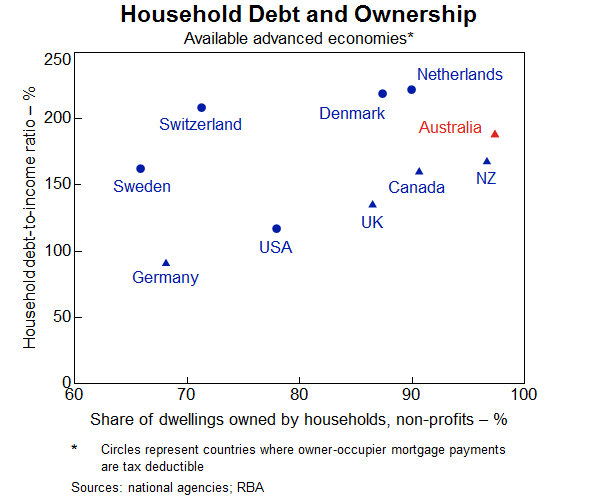
But I was reading an interesting speech from a senior RBA official, Assistant Governor Michele Bullock, which happened to include this chart.

bullock

It captures a couple of important points relevant to thinking about household debt.   You quite often see comment about how high the level of household debt is in New Zealand.  But Bullock’s chart illustrates a pretty straightforward point: when almost all your housing stock is owned by households (whether owner-occupiers or investors) you’d expect that, all else equal, household debt relative to household income (or GDP for that matter) would be higher than in countries where a larger share of housing stock is owned by other sectors.  Of the countries Bullock shows data for, New Zealand and Australia have the highest share of the housing stock owned by the household sector.  New Zealand is very close to the median country in this sample, notwithstanding the high share of houses owned by households.

The chart highlights another important point sometimes lost sight of in international comparisons (but which our own Reserve Bank sometimes acknowledges).  In some countries, interest on an owner-occupied mortgage is tax deductible.  That might, all else equal, encourage household to take on more net debt (cost of borrowing and bringing forward consumption is lower), but it certainly tends to encourage people not to rush to pay off the mortgage even as they may be accumulating financial assets (and the tax treatment of some financial assets is also often quite favourable relative to, say, the situation in New Zealand).   And so Sweden, Switzerland, Denmark and Norway have much more gross household debt outstanding –  but not necessarily any more financial system risk –  than countries with similar household sector ownership of the housing stock but a different tax treatment.   (The US is a bit of an outlier here, and from the look of it the data may not be fully comparable.)

Of course, what Bullock doesn’t highlight in her chart is two things:

  • Australia and New Zealand have high house price to income ratios by international standards, which tends to boost the amount of household debt required to accommodate such prices, and
  • Australia’s compulsory private superannuation system will, all else equal, tend to mean that Australian households will more often have substantial financial assets tied up in superannuation schemes while at the same time having large outstanding mortgage debt.  (Kiwisaver, more recent and on a smaller scale, will now be tending to have the same sort of effect in New Zealand.)

There was one other interesting chart in the Bullock speech.

bullock 2

For all the talk about households taking on more and more debt, the median advanced country’s ratio of household debt to income hasn’t changed materially in a decade, despite the fall in global interest rates.  Of course, all else equal, if interest rates had been higher debt would have been lower, but so would real and nominal GDP, asset prices, inflation (but, pace Lars Svensson, debt to GDP ratios might not have been much lower)…..and unemployment would have been higher.   All else is never equal, and it is important to remember that interest rates are low for a reason (or set of reasons) grounded in the fundamentals of the really economy, factors which central bankers and banking regulators have little influence over.

The Secretary to the Treasury and productivity

As I noted in Saturday’s post about The Treasury, the Secretary to the Treasury –  he of the rushed citizenship presumably on the grounds of some exceptional services the previous government thought he might offer to New Zealand –  gave a speech last week on productivity.

One can feel a little sorry for senior public servants venturing into the public domain.  After all, there are limits as to what the head of a government department can really say, while still retaining the confidence of his/her minister (let alone that of the State Services Commissioner).  Political masters change and with those changes there are changes in what can’t really be said in public by their most senior advisers.  All of which is probably a good reason why heads of government departments shouldn’t really give any but the most anodyne (or perhaps obscurely technical) public addresses (in fact, most simply keep quiet in public – do a search for speeches by the Secretary of Justice or the chief executive of MBIE and you won’t find much, if anything).  After all, their primary job is to advise ministers, not to act as public lobbyists for their own policy preferences  Upon leaving office they are, of course, free to champion whatever causes they like.

But all that assumes some idealised fine public servants, who have laboured to generate judicious but penetrating insights.  Wise men and women whose words shed light in dark corners, enrich our understanding, and could –  if only we listened – help resolve some of these intractable challenges that face any modern government and society.

And then there are the Makhlouf speeches.  I written about several of them here (eg here, here, here and here).  They often read fluently enough at a first glance, before quickly turning to dust under any close examination.

Last week’s effort wasn’t that much better.  At least the Secretary to the Treasury was talking about productivity –  something I noted was strangely totally absent from The Treasury’s Briefing to the Incoming Minister last year – but he didn’t have a credible or robust story to tell.

The speech was delivered in Queenstown, so Makhlouf began with some local colour –  some good, some bad.  Among the less positive indicators was

The mean income for people in the Queenstown-Lakes District in 2017 was about $51,000 compared with the national mean of $59,000.  With low incomes but the highest average weekly rental cost in the country and an average house value of more than $1.1 million, the housing affordability problem in Queenstown is in the same league as Auckland.

To which the Secretary’s response was

In response, the Government’s Housing Infrastructure Fund is contributing $76 million in 10-year interest-free loans to support an increase in Queenstown’s housing supply.

So the Secretary to the Treasury now thinks interest-free loans by the government are sensible economic policy?    This isn’t supposed to be some local MP’s party-political broadcast, but the Secretary to the Treasury, guardian of the public purse.

The Secretary then touches on the failure that is New Zealand productivity growth, recognising that we’ve done poorly (while taking no responsibility as head of the leading economic advice agency).  But there is nothing new, and litttle specific.

There are various unsupported assertions  (emphasis added)

We know that our productivity levels stem from a number of factors including weak international connections, the small size of domestic markets, low investment in knowledge-based capital and weaknesses in the allocation of labour.

as if symptoms (in some cases arguable ones) are causes, and then a string of platitudes

It remains a fundamental truth that successful economies need, among other things, a stable and sustainable macroeconomic framework, sound monetary policy and a prudent fiscal policy. It remains true that a well-regulated financial system matters, that properly functioning markets matter, that price signals matter and that incentives matter. And, perhaps most important of all, it remains true that productivity matters.

No doubt largely true (I’d quibble about the “well-regulated” financial system, substituting “sound and stable) but New Zealand has had these features for decades, and we are just slowly drifting further behind.

The second half of the speech builds off this paragraph

The Treasury believes there are a number of factors that always matter for productivity: our human capital, the management of our resources, our international connections, the dynamism of our markets and the effectiveness of our rule-making. I want to say a few words about each of these. To improve our productivity we will have to be more effective in their utilisation and the interactions between them.

First, skills matter.  As if we didn’t know.

There seemed to be two areas of focus

In the Treasury’s view, to help achieve this there should be an emphasis on attainment of cognitive and non-cognitive foundational skills and social skills that are transferable and support life-long learning, as well as greater rates of progression to higher tertiary qualifications.

But I’m not sure what the first half of the sentence really means (Great Books programmes for all, to teach people to think and write?) and the second half looks like a bid for even more tertiary education, when there is little sign that the massive public and private spend on tertiary education in recent decades has been reflected in commensurate increases in productivity or earnings.  And none of this seems embedded in some comparative analysis about whether, and to what extent, New Zealand is doing worse than other advanced countries.

The other specific was slightly surprising

I should also add that we will need to look carefully at whether our social welfare system – which was initially set up to help people make transitions from one job to another in what was expected to be a similar trade – is optimal for the changing world ahead of us.

I presume he means the bits of the system around the unemployment benefit (or whatever it is now called) since most of the social welfare system wasn’t set up to support employment transitions at all (age pensions, widows’ pensions, DPB, sickness and invalid pensions etc), but as his current political masters have, as a matter of policy, been weakening the sanctions in the welfare system that were, supposedly, designed to assist such transitions, I’m left a bit puzzled as to what the Secretary means by this cryptic observation.  Perhaps he is toying with notions of a Universal Basic Income (but, charitably, I’ll assume not)?

Then there is a section on resources.  Some of it seems sensible enough, including around water use rights.  I’m right with him when he favours congestion charging.  But I’m left wondering whether he or The Treasury really believes that either is a significant part of the story explaining our severe relative underperformance.  I don’t.

And lets just say that I rather doubt the robustness of The Treasury’s analytical framework when the Secretary includes these sentences.

The Emissions Trading Scheme is a good example of a tool that can promote the more productive use of resources. Including agriculture within its scope would provide incentives for investment in R&D or innovation in on-farm practices and improve productivity.

An ETS can, no doubt, be a good mechanism for constraining emissions, and even for doing so in a way which might be economically efficient.  But it simply isn’t a way to improve New Zealand’s economywide relative productivity and/or incomes.  Impose an impost (perhaps quite justifiably) on firms in a particular industry, and those who survive will have to adapt their production techniques, perhaps even lifting their own firm productivity.  But it will also considerably shrink the industry in question, when it is an internationally tradable industry, when efficient alternative technologies don’t yet exist, and when other countries aren’t adopting the intervention The Treasury proposes.  All else equal, New Zealanders would be poorer rather than richer if this bit of the Secretary’s prescription was adopted –  the government’s own commissioned economic modelling, by NZIER says as much.

Then Makhlouf moves on to “international connections”, one of the ill-defined buzzwords in this debate.

Mostly it is just empty conventional slogans

Improving the flow of people, capital, trade and ideas will help improve productivity. Strong people-to-people relationships build confidence and understanding and promote learning. They help our businesses to identify capabilities that will help them improve their productivity and ultimately compete and succeed in both domestic and global markets.

All of which would have sounded good in 1984, and yet we greatly liberalised immigration, got rid of most tariff barriers, signed up to all manner of trade agreements, and……the productivity gaps are larger than they were, and actual trade (exports and imports as a share of GDP) is smaller than it was.  The Secretary is either unaware of these basic facts, or simply chooses to ignore them.

I’m closer to the Secrerary’s position when it comes to foreign investment –  where he has to step delicately around the recent legislative choices of his masters –  but there is no sign that he has thought hard about why foreign investment here isn’t more attractive or, indeed, why not many New Zealand based firms do much foreign investment themselves.

There is a section on “markets” that I’m going to skip over.  I don’t particularly disagree with much in it, but there also isn’t much specific there, and nothing to suggest The Treasury has thought seriously about the connection to sustained New Zealand relative productivity underperformance.  Much the same goes for the section on Rules.  I’m all in favour of robust policy evaluation –  it is a shame it hasn’t been applied to Treasury advice on productivity –  and I’m sure there are real opportunities there, but again is there any evidence that things on that score are worse here than in other countries?  Perhaps, but if so he doesn’t mention it.

(The dig at the massive taxpayer subsidy to the cattle industry was interesting, and welcome

Speaking of incentives, I find the situation around the eradication of mycoplasma bovis an interesting one. Responsibility for the genesis and subsequent spread of the mycoplasma bovis outbreak sits with the cattle industry. The question is, should the taxpayer compensate those affected, or should the industry pay for the consequences of the industry’s making? We might also ask what incentives are signalled to the industry by these different options.

And yet, how different is it anywhere else? )

There was an odd section on co-operatives, as if it was a matter for governments to decide on the appropriate sort of vehicles through which business activity is undertaken, and one on public sector productivity, which was really no more than a footnote.

And then there was tax reform.  Mostly, it was in praise of the New Zealand tax system, including the –  highly questionable –  claim, that

the New Zealand tax system is much less distortionary than the tax systems of other OECD countries

That might be true, more or less, if we look only across activities in the same time period, but is demonstrably not true once we take account of intertemporal dimensions.  Not consuming your income now and delaying until later (ie saving –  particularly retirement savings) is much more heavily penalised by the tax system here than in almost any other advanced economy.  That is a distortion The Treasury has been consistently reluctant to address or (it seems) even acknowledge.

There is also no recognition of the possible connections between low rates of foreign investment, and low rates of business investment (symptoms he touches on elsewhere) and business tax regime, where (for example) our company tax rate –  a key consideration for foreign investors –  is now towards the upper end of the OECD range.

And then it was interesting to see that in a speech on productivity, the specific policy proposal that the Secretary devotes most space to (in the entire speech, not just this section) was the call for a capital gains tax.

But there is one area where we stand out as an outlier and which I think needs further attention. The current approach to the treatment of capital income – in particular, capital gains – is highly inconsistent. Some gains are already taxed but others are not. The result is therefore something of a patchwork, the results of which can be unfair, regressive and distortionary. A more consistent approach to the taxation of capital gains would increase the fairness of the tax system, and reduce distortions by levelling the playing field between different types of investments.

For these reasons, the Treasury has long believed there is a real case to extend the taxation of capital income. I recognise that this would come with its own risks, and give rise to higher compliance and administration costs. But there are interventions available to address these risks. The extent to which the impacts are realised – whether positive or negative – will depend significantly on the design of policy.

Some readers will support a capital gains tax.  I don’t particularly, partly because a real-world one (ie the sort many other countries actually have) just introduces a whole new set of distortions, but does anyone seriously believe that a capital gains tax –  whatever the case on “fairness” grounds –  is going to make any material difference to economywide productivity?  And if there is such a case, not even the Secretary to the Treasury advances it.

The Secretary, of course, has to keep on side with his masters, so we read this

I should also add that there are many things being done to address points I’ve just raised. The government has been working on education and training, welfare reform, tax reform and trade relations, to name just a few of the actions happening.

If the Secretary to the Treasury really believes that the goverment’s policy agenda –  at least as revealed to the public –  is going to make a helpful difference in reversing the decades of relative productivity decline, he must surely be the only such person.    But I guess that if he is going to speak in public, he has to say such stuff.

In the final paragraph of the speech there is material for both a brickbat and a rare bouquet.

The brickbat?

And the ‘we’ means everyone: businesses, workers and government seizing the opportunities offered by being part of, and closer to, the fastest-growing region in the world.

Which is simply nonsense of course,   New Zealand is incredibly remote from Asia, or from any other major part of the world economy.     We might be a little less far from some of Asia than we are from Europe or much of North America, but we aren’t even a little close to the major bits of Asia, let alone “part of” it (whatever that means).  When the Seceretary was at home in London he was closer to Mumbai or Bangalore or Delhi than he is in Wellington.  He was actually a little closer to Seoul or Shanghai too.

It is a fundamentally unserious “analysis”.

But there is a bouquet.   Early in his speech, the Secretary was rather downplaying the failure of New Zealand policy, and policy advisers, in observing that labour productivity is “now about 20 per cent below the OECD average”  –  an average considerably lowered by the entry to the OECD of a large group of emerging countries (especially in eastern and central Europe), all of whom throughout modern New Zealand history were considerably poorer and less productive than New Zealand.

But the Secretary ends

Recent research indicates that if New Zealand’s productivity caught up with the better-performing countries in the OECD, our incomes would be 50-60% higher.

It doesn’t take much “research” –  a quick download of an OECD table does the job.   Here is an extract of that table I did recently for a paper I’ve been writing on these issues.

GDP per hour worked
USD, constant prices, 2010 PPPs
1970 1990 2017
New Zealand 21.4 28.6 37.2
Netherlands 27.4 47.5 62.3
Belgium 25.0 46.7 64.6
France 21.7 43.3 59.5
Denmark 25.1 44.8 64.1
Germany 22.3 40.7 60.4
United States 31.1 42.1 63.3
Median of six 25.1 44.1 62.8
NZ as per cent of median 85.4 64.9 59.2
Source: OECD

If anything, a 50-60 per cent lift is an understatement: it would take a two-thirds lift in New Zealand productivity to match the average of this group of high-productivity countries.   And such a lift could be expected to be mirrored in commensurately higher living standards,

But it is great to see the stark magnitude of our failure –  and “failure” is the only honest word for it – as the note the Secretary ends on, even if there isn’t much sign the institution he leads has any serious answers.

And, to be entirely fair, the Governor of the Reserve Bank’s own speech last week makes the Secretary’s effort look like a fine piece of public sector analysis and communications by comparison.  I will write about the Governor’s extraordinary speech tomorrow.


Stakeholders, The Treasury, and economic failure

The Treasury runs a survey of external stakeholders every couple of years, and usually publishes the results on their website quite quickly.  Last year, the results weren’t very good, so they delayed publishing them.  In fact, it was only a few days ago, in response to an OIA request from Eric Crampton at the New Zealand Initiative, that they finally released them.

As Eric notes the results aren’t all bad, but

Among those people interacting with Treasury about its core business of economics, macroeconomics, and fiscal projection, satisfaction dropped from 70% in 2015 to 47% in 2017. The proportion of stakeholders viewing Treasury staff as well-informed dropped significantly, as did overall confidence that staff do a good job, that Treasury challenges thinking on critical issues, and that Treasury can offer insights.

Eric has been concerned for some time about The Treasury’s de-emphasis on core economics and finance skills in Treasury’s recruitment.  For example, apparently

Only four of fifteen hired by Treasury in the 2019 graduate recruitment round had at least Honours-level training in economics and finance.

And then there are specific survey results like this (the blue bits are those respondents who think Treasury is improving)

Tsy stakeholder 1

and in the same vein

tsy stakeholder 2

Not exactly positive results for an agency whose website blares at people that

“The Treasury is New Zealand’s lead advisor to the Government on economic and financial policy”

In some ways, I’m not sure what to make of the survey results.  After all, if one goes to the demographics at the back of the survey document, in the latest survey an even larger proportion than usual of the respondents are from elsewhere in the public sector itself (the blue bars are the latest survey).

tsy stakeholder 3

Consistent with that, an even larger proportion than usual of respondents live in Wellington (58 per cent, up from 50 per cent in the previous survey).

There are, I’m sure, still plenty of individual good people in the public sector (including in The Treasury), but if in the land of the blind the one-eyed man is king, what happens when the entire kingdom is blind.  The public sector more generally is greatly diminished in its policy capabilities –  the sorts of concern Victoria University’s Simon Chapple raised last week – and it isn’t clear to me why, for example, one would trust the Ministry for the Environment (of flakey analysis of plastic bags and emissions) or the Productivity Commission (this week’s Green Party cheerleading) to recognise a good, or bad, Treasury when they saw one.   Either that, or The Treasury is now so poorly performing that even the rest of the public sector recognises it –  and this survey was taken last year, before the “wellbeing Budget” silliness, championed by Treasury, got underway.

Much as I lament the reduction in the extent to which Treasury is hiring people with strong economics and finance skills, I think that is a symptom rather than the cause of the problem.  In fact, at the upper levels of the organisation there is less of a vacuum of economics skills now than there was a few years back.  At one stage, I could spot only one person with a solid economics record in their senior management group, but now there are at least three, all of whom I’ve worked with previously.

But there is still little useful analysis or advice on turning around decades of economic underperformance.  Instead, what economics skills are being deployed seem to be being used on exercises in distractions –  focusing on all manner of aspects of “wellbeing” (recent papers on Asian and Pacific New Zealander dimensions of “wellbeing” –  are we soon going to see ones on European New Zealanders’ wellbeing, or middle-aged people’s wellbeing? ), while avoiding the elephant in the room, decades of economic failure, for which The Treasury seems to have given up thinking hard about serious answers.

In putting this post together, I noticed that the Secretary to the Treasury had actually given a speech this week about productivity.  Glancing through it – I may come back to it in detail next week – it seems about as devoid of serious analysis and answers as most of the rest of Treasury’s work during the term of Makhlouf’s stewardship.   He notes that productivity matters  –  but blind Freddy knows that –  and there are lots of conventional rhetorical tropes, but he appears to have nothing to offer the government or citizens on what might make a real and sustained difference to New Zealand’s fortunes.  He can employ all the economists graduating from our universities and it won’t much any difference unless the Secretary –  or his replacement next year –  and his senior management are really interested in digging a lot deeper, and asking uncomfortable questions about why economic policy, with the best of intentions, has done so poorly for such a long time.  He is now, perhaps, somewhat constrained by the government’s commitment to the feel-good “wellbeing Budget”, but that is no excuse –  they were led down that track by a Treasury not doing its core job well, and with nothing substantive on offer for a new government had it been interested in seriously addressing the productivity growth failure.

The Treasury is New Zealand’s lead advisor to the Government on economic and financial policy.The Treasury is New Zealand’s lead advisor to the Government on e

The Treasury is New Zealand’s lead advisor to the Government on economic and financial policy.

Reserve Bank Amendment Bill – a submission

Submissions to Parliament’s Finance and Expenditure Committee on the Reserve Bank of New Zealand (Monetary Policy) Amendment Bill close today.  Despite my scepticism about the value of the process –  given that the Bank and the Minister are already actively recruiting members of their tame Monetary Policy Committee –  I did lodge a submission this morning.

The full text is here Submission to FEC Reserve Bank of NZ Amendment bill Sept 2018

Most of it covers ground I’ve dealt with here over recent months, albeit in more abbreviated form. There are two main aspects to the bill:

  • the proposed change in the statutory goal of monetary policy, and
  • the creation of a statutory Monetary Policy Committee.

On the former

The case for having active discretionary monetary policy is – and always has been – about cyclical stabilisation.   We don’t need an active Reserve Bank to deliver broadly stable price levels over the longer-term.  And nothing monetary policy can do makes any difference to unemployment in the longer-run.   But there is a strong case for active monetary policy to limit the short-term downsides from severe adverse shocks – the Great Depression was the most stark modern example (and, indeed, it was the backdrop to the establishment of the Reserve Bank of New Zealand) but the argument holds in almost serious downturn.  Monetary policy should do what it can to stabilise the economy, subject to a longer-term nominal constraint (eg price stability).  And Parliament should be upfront with citizens about this (which is the way central banks typically try to operate in practice).

The formulation in the bill at present has a number of problems:

·       the whole point of what discretionary monetary policy can do (not just here but around the world) is to avoid (or keep to a minimum, consistent with price stability) periods of significant excess capacity.  Despite the attempt to argue otherwise in the Explanatory Note, “maximum sustainable employment” is not a measure of excess capacity.  Unemployment is much closer to an excess capacity measure.  It also has a considerably greater degree of historical and public resonance.

·       the proposed wording treats employment as good in itself, whereas labour is an input (a cost, including to those who supply it).  A high-performing high productivity economy might well be one in which people preferred to work less not more.    By contrast, lower unemployment (people who want a job, are searching for it, are ready to start, but can’t find a job) is unambiguously desirable, to the extent possible.

·       the wording makes no attempt to integrate the two dimensions of the goal, and

·       it continues to suggest that active monetary policy is primarily about medium-term price stability.  But we do not need monetary policy for that goal (a Gold Standard or something similar would do fine).  Instead, medium-term price stability is more like a constraint (a vitally important one) on the use of monetary policy to keep the economy operating close to capacity.

Accordingly, I argue that goal should be worded as something like:

“Monetary policy should aim to keep the rate of unemployment as low as possible, consistent with maintaining stability in the general level of prices over the medium-term.”

It isn’t anywhere near as radical as it might seem to some.  The working definition of “stability in the general level of prices over the medium-term” (1 to 3 per cent inflation, with a midpoint focus on 2 per cent) could be kept exactly as it now.  But it is clearer, and better aligns with what we should look for from the Bank and from the new MPC.  Keeping unemployment as low as possible really matters for individuals and their wellbeing.   But this formulation also keeps clear that the Bank cannot go pursuing its own views on what the unemployment rate can or should be if medium-term price stability is jeopardised.

As for the proposed MPC

Establishing a statutory Monetary Policy Committee is a sensible, well overdue, reform.  The New Zealand model, innovative in its day, was not followed anywhere else, and the existing model is also out of step with how we run almost every other public agency (and most private ones).

Nonetheless, the Monetary Policy Committee provisions of the bill as drafted are likely to achieve relatively little. They retain a far too dominant position for the Governor –  out of step with the typical chief executive role in other Crown entities –  including enabling the Governor to be very influential in the selection process for all other MPC members.

This legislation is an opportunity for more far-reaching reform, enhancing transparency and accountability and better aligning the governance of monetary policy with practice in open democracies abroad.  Doing so would strengthen confidence in the institution, and would also increase the chances of attracting consistently good potential appointees.

There are a number of detailed suggestions to improve the bill, including

In the bill (proposed new section 63C(3) the internal members of the MPC must be a majority. It would be very unusual for a statutory decision-making body for a government agency to be comprised largely of executive staff.  It confuses roles and risks undermining the value in creating a committee.  It is also an unusual –  although not unknown –  in central banks abroad (in some cases, outsiders fill executive roles during the term of their appointment).  A better model for New Zealand would be to have the Governor and Deputy Governor and three externals as members of the MPC.  The Committee would, of course, be expected to draw on staff expertise, but as advisers (in the same way that, for example, experts in Treasury advise the Minister of Finance)

In the bill, all appointments (internal and external) to the MPC would be made by the Minister on the recommendation of the Board. This is a very unusual model in New Zealand public life, where the standard procedure – for many important and very sensitive roles – is for direct ministerial appointment (Governor-General on advice of the Minister).  That model should also be adopted for the MPC, including for the positions of Governor and Deputy Governor.  Again, such an approach is typical in other countries.  It is consistent with the fact that members of MPCs collectively wield a great deal of power, and although voters have no way of holding them to account directly, they should be able to hold to account directly those who appoint the MPC.

And

As presently worded, the role of the MPC looks to be quite narrow (“formulating monetary policy” – a term not substantively defined, and possibly not even including OCR decisions). The MPC should be given explicit statutory responsibility for all aspects of monetary policy (including advice on the remit and, for example, foreign exchange intervention, liquidity provision, issuance of notes and coins), even if some operational aspects are then delegated by the MPC to the Governor.   This issue may appear arcane, but will assume considerable salience if the effective lower bound on the OCR is reached in some future recession.

and

The transparency provisions around the MPC should be considerably strengthened, to require the publication of substantive minutes (including at least the numerical balance of any votes) and, with a suitable lag, the pro-active release of the staff papers submitted to the MPC.   At present, aided and abetted by the Ombudsman (over decades), the Bank consistently refuses to publish any background papers until many years have passed (a striking contrast to the pro-active release of papers relating to each year’s Budget).    Making these amendments would largely remove the need for the proposed Charter (which implies direct ongoing ministerial involvement in how the MPC is run, and could in future be used to degrade transparency provisions), and allow the MPC to evolve its own processes and culture over time.

I touch on provisions such as the proposed abolition of the age restriction on the Governor, provisions to avoid last year’s (almost certainly unlawful) “acting Governor” appointment while dealing effectively with the substantive issues, and the role of the Board.

The bill retains the Reserve Bank Board as the entity principally responsibility for holding the Governor to account, adding responsibility for holding the MPC to account. Successive boards have done this job quite poorly (more because of incentives and institutional design than because of individuals), and have tended to act as if their role is to defend and champion the Governor.  It will be difficult to change that dynamic, and yet more important to do so with the addition of a statutory MPC and the potential tensions between the Governor and other members.   The bill usefully provides for a more normal system in which the Minister directly appoints the Board chair.  However, other helpful changes that could be considered include:

  1. providing the Board with specific (limited) financial resources of its own (at present it relies on totally on the Governor),
  2. removing the Governor as a member of the Board,
  3. renaming the Board the Monitoring and Accountability Committee (MAC), to be clear that the entity is a quite different sort of beast than a corporate board or a typically Crown entity board (the mindset most Board members bring to the role),
  4. making clear in legislation that the MAC is not itself part of the Bank, and is primarily responsible to the Minister and the public, and
  5. requiring the timely publication of the minutes of Board meetings and the pro-active release of (most) papers presented to the Board.

I conclude

The Monetary Policy Committee provisions of this bill are unambitious and disappointing, especially when set against the expressed aspiration of a once in a generation update to the legislation to reflect the way in which the world (including central banking) has changed since 1989.  Among the features of our age are a much degree of openness, a greater recognition of uncertainty and of the benefit of an open contest of ideas, and less willingness to build institutions based on a deference.  This bill reflects almost none of that.

In considering the bill, I would urge the Committee to look closely at the experiences of open central banks in the United Kingdom, the United States, and Sweden (in particular).  All are more open than anything envisaged in this legislation, and in the way the Minister has described his intentions for how the proposed New Zealand system should work.  Each of those central banks has had strong individuals willing and able to challenge consensus views, and to debate monetary policy issues thoughtfully and openly.  They do so in part by avoiding designing a system where the Governor (chief executive) has a too-dominant formal role.  The current bill does not really address that glaring weakness in the New Zealand system.

Officials, especially those at the top of the Reserve Bank, appear to find a more open model threatening, and have made various arguments against moving towards such a model here. But the interests of officials – including the protection of their own position – are rarely that well aligned with the interests of New Zealanders.    New Zealand has the opportunity to learn from the successful models abroad, in three very different countries, adapting the insights to the specifics of New Zealand (system of government, size etc).  By doing so, Parliament would, over time, greatly strengthen the institution itself, and New Zealand processes around the design and conduct of monetary policy.  We would all be better for such change.

This shouldn’t be a particularly partisan issue.  Everyone should want a better, more resilient, better-governed institution handling monetary policy, and for the regime itself to command confidence across the political spectrum.  I hope the select committee deliberations do finally prompt the Minister of Finance and the government to reconsider, to give up their small ambitions, and to embrace the idea of more far-reaching change and improvement in the way monetary policy is governed, contested, and accounted for.

Building work

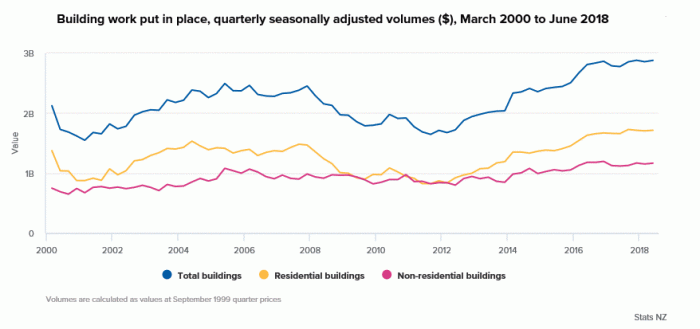
Yesterday Statistics New Zealand released the quarterly data on building work put in place. The release included this chart.

building work

SNZ like this sorts of chart, which tend to reinforce the relentlessly upbeat tone favoured by the department.

But most economic series reach new highs quite frequently, even volume measures.  Real GDP, for example, is higher this year than it has ever been before, and almost all future years will be higher again.  Knowing that doesn’t tell one much.

For a start, one usually wants to transform these series into per capita measures, particularly in a country whose population is growing relatively rapidly.  New Zealand’s population, for example, has increased by just over 25 per cent since 2000, when that SNZ chart starts.

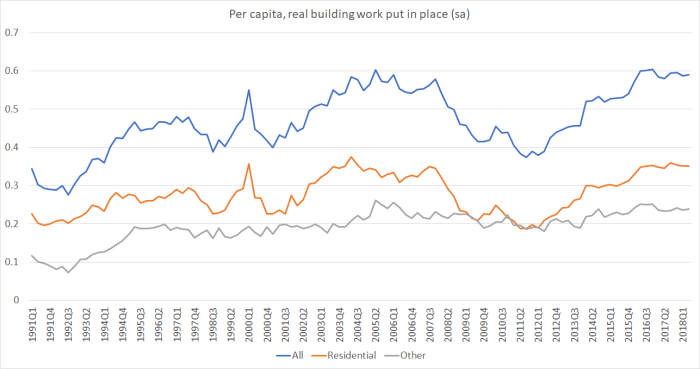
Here is the same data, over a longer run of time, in per capita terms.

BWPIP 1

In per capita terms, the volume of building work has been (a) pretty flat, and if anything falling back slightly, for the last couple of years, and (b) around the same level as the previous peaks (around 2004/05).

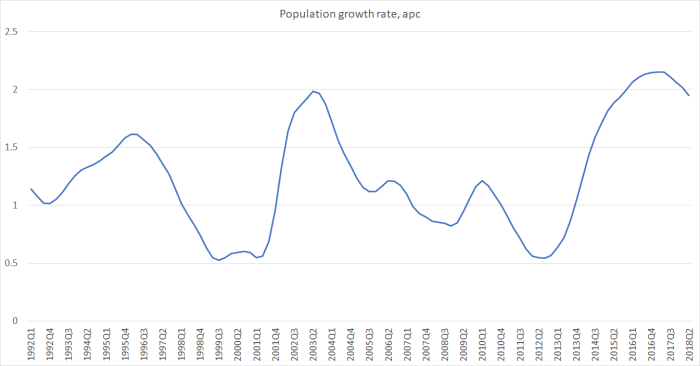
But the demand for new buildings isn’t just related to the level of the population, but to the increase in the population (with a flat population, most of the building work occurring would just be replacing the effects of depreciation of the stock).  And population increase is both high and quite volatile in New Zealand, mostly because of the effects of immigration policy and New Zealand emigration.

BWPIP 2

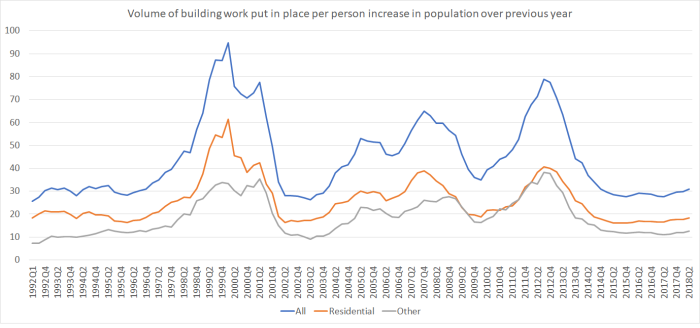
Just looking at the volume of building activity relative to population growth produces this chart.

BWPIP 3 The peaks on this measure happen when population growth is at its cyclical troughs –  unsurprisingly, since the normal base level of replacement and improvement work is still going on.
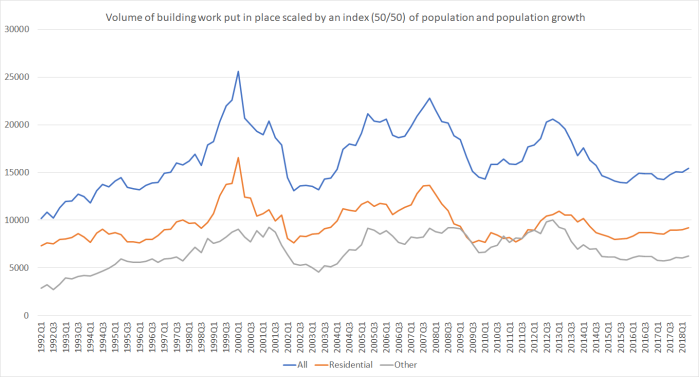
So what if we, somewhat arbitrarily, assign equal weights to the level of the population (influencing replacement/improvement demand) and the growth in the population (key driver of the demand to increase the total stock of buildings).  Doing that produced this chart.

BWpip 4.png

Two of the peaks (around 1999 and 2012) are still when population growth was at its lowest, but there is also a sustained period of strength through 2004 to 2007, a period when population growth was still quite high, but slowing.  House (and commercial property) prices were, of course, still rising.

What, if anything, to make of the current situation?

I’ve been sceptical for some time of the claim that there was insufficient building going on.  If that were so –  demand was persistently and substantially exceeding supply –  we would see prices rising strongly.  At least in Auckland that isn’t so now. On my telling, high land prices –  mostly reflecting regulatory and related constraints – have choked off large amounts of effective demand.  There are plenty of people who would like more houses at Houston or Atlanta prices, but not at Auckland (or Wellington or most other places in New Zealand) prices.  I’d consume more scallops (eg) at half the price too.  There are few/no signs I’ve seen that land prices are falling, so it is difficult to envisage much more effective demand emerging.  Unless developers themselves are making super-profits, why would the rate of new supply increase?

Having said that, population growth does appear to be beginning to slow.  If that continues and if building activity were to remain around the same levels as the last couple of years, then measures calculated relative to population growth would increase.  That seems to have happened over 2004 to 2007, so perhaps it can happen again.  But the economic climate seems less propitious now than it was then (credit conditions were looser, incomes were growing more rapidly, the terms of trade were beginning to lift, and so on).  And even then, it wasn’t enough to sustainably lower the level of house prices –  notwithstanding the temporary fall in the 2008/09 recession –  which isn’t surprising, as the core problem (land and associated infrastructure financing) had not been seriously addressed.

A new paper critiquing net-zero targets

I wrote a post a few weeks ago responding, in part, to absurd claims made in a TV interview by the Green Party co-leader and Minister for (against) Climate Change, James Shaw about the economic impact of pursuing the net-zero emissions target he and the Labour Party are championing.

He says investing in meeting our climate change goals will be a massive economic boost, rather than a burden.

“What we’re talking about here is a more productive economy, with higher-tech, higher-valued, higher-paid jobs. It’s clearly a cleaner economy where you’ve got lower health care costs, people living in warmer homes, congestion-free streets in Auckland.

“It’s an upgrade to our economy. It’s an investment, you’ve got to put something in, in order to generate that return. If we don’t, the clean-up costs from the impacts of climate change will well exceed the costs of the investment we’ve got to make to avoid the problem in the first place.”

The same tone had been evident in the officials’ Executive Summary to the government’s document consulting on the emissions targets and related issues.

This is our chance to build a high value economy that will hold us in good stead for the future. By upgrading our economy and preparing for the future, we can help make sure quality of life continues to improve for generations to come.

Believe all this, and there are no hard choices, no trade-offs, just stepping into the sunlit uplands in which enchanced prosperity and feeling good go hand in hand.

In my post on the alleged “massive economic boost” on offer, I quoted some extracts from a draft paper by my former colleague (and now Tailrisk Economics) Ian Harrison.

Ian has now put the final version of his paper on his website under the heading

The price of feeling good

A review of the emission targer options in “Our climate your say”

It is well worth reading for those who want to dig a little deeper into some of the specific issues than I have done (or had the energy for).

Here are Ian’s key conclusions.

The Zero emissions by 2050 target is a $200 billion ‘feel good’ project.  Compared to the alternative, zero carbon, target, the zero emissions target could cost an additional $200 billion; is unlikely to have a material impact on the behavior on the rest of the world; on innovation in New Zealand; or generate significant ‘co-benefits’.

The major benefit will be a ‘feel good’ factor for some people, at least until the effects of the policy start to bite.

The consultation on the options was a sham.  Our Climate did not provide an assessment of the pros and cons of the three options: zero carbon; zero carbon with a cap on other emissions; and zero emissions, that were presented. The document only promoted what appears to be the preferred option of zero net emissions by 2050. The reporting of the economic analysis was fabricated to make it appear that the three options had been considered.

The economic modelling was manipulated to reduce the economic impact of the zero emissions target.  The marginal cost of emissions reductions falls with a tougher target. This doesn’t make sense. Lower cost emission improvements should occur first, so the additional reductions under the tougher target will have a higher cost. The lower marginal cost outcome was achieved by restricting the amount of afforestation offsets (which are costless in the model) for the 50 percent reduction target, and giving the zero emissions target twice the allocation. The effect of this was to push most of the economic costs into the lower target option, reducing the marginal cost of the zero emissions option.

The reporting of the economic analysis obscured many of the negative economic impacts. Most of the results were presented as the difference between a 50 percent emissions target and a zero emissions target. This obscured the losses in getting from our current position to a 50 percent fall in emissions. Some of the modelling impacts, with prudent assumptions about technical change, are severe. For example, pastoral farming outputs fall by 60 percent, and household incomes could fall in absolute terms as the policy bites.

The economic modelling is deficient and needs to done again from scratch. The critical variable in any analysis is the rate of conversion of farmland to forestry, but this has not been modelled. There is no analysis of the optimal timing of emission reductions. The implied carbon prices appear to be unrealistically high which makes it difficult to draw conclusions from the analysis,

Climate change may have positive effects on New Zealand this century.  The Ministry has not produced a report on the costs of climate change. Our assessment is that climate change may have a small positive impact this century. The main reason is that more CO2 in the atmosphere promotes plant growth and increases output, which is significant for an economy with a large land based sector. This outweighs the economically relatively minor impacts from changes in weather patterns, and the cost of mitigating the impact of sea level rises.

Changes in the incidence of extreme weather events have been exaggerated.  Only moderate changes in extreme weather events have been projected in the UN Intergovernmental report on Climate Change. For example on the incidence of storms the report says ‘ Increase in intensity of cyclones in the south in winter but decreasing elsewhere. Increase in conditions conducive to convention storm development is projected to increase by 3-6 percent by 2070-2100 compared to 1970-2000.’

The benefits of innovations that will give New Zealand an ‘early mover’ competitive advantage have been exaggerated.   Most of the reductions in emissions will come from forest plantings, imported technology (such as electric cars), closing businesses such as New Zealand Steel, and by reducing livestock numbers. Most of this does not involve much innovation. A Ministry consultant described this innovation optimism this way. To presume that climate policy could make the difference would be a kind of exceptionalism and a serious leap of faith.

Economic costs of zero emissions target are significant.  The economic cost of the zero carbon target could be in the order of $75 billion. The additional cost of the zero emissions target, which requires twice the net abatements at a higher average cost, could be around $200 billion.

New Zealand’s sacrifice unlikely to change the world.  The argument for zero emissions is that it will encourage other countries to meet their commitments. The argument that going from a zero carbon target to a zero emissions target will make a material difference to the actions of other is at best another ‘serious leap of faith’. Depending on your viewpoint the zero emissions target is either a $200 billion vanity project, or a noble sacrifice. There are much cheaper ways of trying to influence world opinion.

Cheaper ways to influence world opinion.   Four ways of getting international attention and promoting the fight against climate change are suggested. They are: Taxes on international air travel; a ban on official business class air travel; virtual attendance at climate change conferences; travel to Wellington airport by bicycle by officials.

Or, more seriously, perhaps even to chip in an additional billion dollars a year in animal science research, to focus on the most difficult – and potentially costly – aspect of New Zealand’s emissions.  It is a great deal cheaper, on the government’s own numbers, than going full-tilt for the arbitrary self-imposed net-zero-by-2050 target.

And a couple of other extracts

Emissions framework fairness. It can be argued that the emissions measurement framework is not fair to New Zealand. Nearly half of our emissions relate to agriculture, but most of the output is exported. If the assessment was done on a consumption, or carbon footprint basis, our abatement responsibilities would exclude exports and account for the emission content of imports and would be lower considerably lower than under the current system.

By contrast, Norway is a large oil and gas producer and exporter, but does not have take responsibility for the emission consequences of its exports. Norway has just
announced that it plans to be emissions neutral by 2030 (mainly by buying international carbon credits) while planning to increase its oil exploration.

New Zealand’s emission record is often painted as poor. For example, the Productivity Commission, in its Low Emissions Economy report presented a figure showing New Zealand to have the fifth highest gross emissions per capita. If the emissions were calculated on a net footprint basis, we would be well down into the low emission end of the figure.

and

Many other countries are not doing as much as New Zealand.  As an example, consider the case of Singapore. As a high-income country [much more so than New Zealand], which is directly in the climate change firing line, we might expect a sense of urgency and substantive actions. So what is Singapore doing?

First, it signed up to a fairly soft ‘developing country’ Paris agreement target, promising that their emissions will peak in 2030. To our knowledge they have made no commitments beyond that date. In terms of what they are actually doing, we have relied on a January 2018 report from the Singapore Energy Studies Institute.   The main action is the introduction of a carbon tax, apparently to be at a fairly low level, for large companies from 2019. Between 30 and 40 companies will be affected.

In addition:

  • 2018 has been declared the year of climate action
  • Singapore will host a special ASEAN Ministerial meeting on Climate change
  • There will be some financing subsidies.

Food for thought.  And no sign –  not in the consultative document, not in the Productivity Commission report –  of any “massive economic boost” in prospect.


Ten years on

It is the season for books and articles reflecting on financial crises of a decade or so ago, the aftermath, and whatever risks might –  or might not –  be building today.  The collapse of Lehmans –  and the wise decision of the US authorities not to bail it out –  was 10 years ago this month, and although the US crisis had been underway for at least by a year by then, the Lehmans moment seems set to take a place in historical memory around the Great Recession rather parallel to the sharp falls in US share prices in October 1929 (the ‘Wall St crash’) and the Great Depression.  Not in any real sense the cause of what followed, but the emblematic moment in public consciousness nonetheless.

I’ve just been reading the big new book, Crashed: How a decade of financial crises changed the world, by esteemed economic historian Adam Tooze.  I might come back to it in a separate post, but for now would simply caution people that it is less good than his earlier books (around the Nazi economy, and the economic history of the West after World War One running into the Great Depression) had led me to hope.

But on a smaller scale, I picked up the Listener the other day and noticed on the front cover ’10 years after the GFC, former Reserve Bank governor Alan Bollard warns of new risks’.  Conveniently, I see that the article is freely available online.  The sub-heading tantalises potential readers

Former New Zealand Reserve Bank governor Alan Bollard warns that, although lessons were learnt from the global financial crisis, new risks have emerged that could trigger a repeat contagion..

Alan Bollard writes well, and often quite interestingly.  Extremely unusually (and in my view quite inappropriately), he actually published a book on his perceptions of the previous crisis in 2010, while still very fully-employed as Governor, a senior public servant.  There were quite severe limitations as to who, or what, he could be critical of (as I was reminded last night rereading my diaries of some crisis events I was closely involved in, and the Bollard published perspective on those events).     The Bank’s early reluctance to take seriously the emerging issues, as they might impinge on New Zealand, is not, for example, something you find documented in the book.

He must be in a somewhat similarly difficult position now.  He is Executive Director of the APEC secretariat, that grouping of Asian and Pacific (loosely defined) countries and territories, that includes China, Russia, the United States, Indonesia and so on.  I dare say Xi Jinping and Donald Trump won’t be watching nervously to see what Alan Bollard is saying, but the Executive Director knows that there are quite severe limits to what public servants can say while in office.

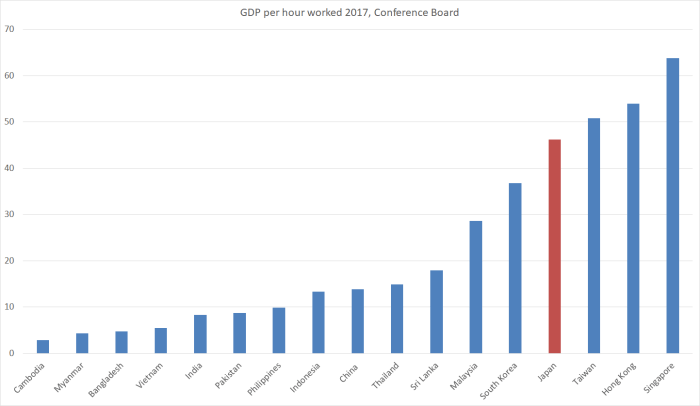
And, thus, much of the Listener article is a bit of a, perhaps slightly rose-tinted, rehash of some of the policy responses here and abroad (I will come back to deposit guarantee schemes on the tenth anniversary, next month).  There is some loose descriptive stuff on various developments in parts of the APEC region.  There was the suggestion that some countries (actually “much of the region”) in Asia is “anxiously worrying” about whether they could face a Japan-like low productivity future but to me, Japan still looks pretty attractive by regional standards.

japan

(New Zealand, for example, is at 42.)

In fact, I looked in vain for the promised analysis or description of the “new risks” that might “trigger a repeat contagion”.   Perhaps that was never Bollard’s intent, but the Listener had to attract readers to a fairly tame advertorial for APEC somehow.  The most we get is

We need to remember that the global financial crisis was originally triggered by a building bubble, and that is still on the minds of regulators throughout the region.

and

Meantime, we are very worried about the likely effects of the growing trade wars. It is too early to judge, but the stakes are high – trade growth has been the big driver behind the immense improvement in living standards through the Asia-Pacific region ……We are now on the alert for signs that these trade frictions could weaken exchange rates, hurt commodity prices, hit stock markets or cause financial volatility, against an unusual background of tightening monetary policy and loose fiscal policy in the US.

But then what more could a serving diplomat, not hired to be a high-profile problem solver (unlike, say, the head of the IMF) really say?

And it all ends advertorial style

As a big trader, New Zealand has always been susceptible to these tensions. But one international platform where they play out is coming closer: in just over two years, New Zealand will commence its year of hosting Apec. The organisation is a voluntary, consensus-driven one, where for 30 years we have promoted regional economic ties and tried out new ideas for trade and investment. As the upcoming chair of Apec, New Zealand will have to contend with continuing antiglobalisation pressures, big-economy tensions, climate-change damage and financial risks in the region. It sounds daunting, but there are many positives: We have learnt some of the lessons of the global financial crisis; banking regulation is tougher; banking chiefs are more cautious; economic demand is still growing; and the Asia-Pacific region is tied ever more closely by its trade flows.

It could have been a paragraph from a speech by one of his political masters.   I guess one wouldn’t know that one of his members (the People’s Republic of China) poses an increasing political and military threat to another (Taiwan) or –  closer to his own territory –  that few major economies have very much effective macroeconomic firepower at all when the next crisis or severe recession hits.  And really nothing at all about financial sector risks.  His final sentence –  “September 2018 should be a month much better than September 2008” –  is almost certainly true (at least outside places like Turkey and Argentina) but not really much consolation to anyone.

In his column in the Dominion-Post this morning, Hamish Rutherford touches a theme of various recent posts here: the limited macro capacity of many countries.  He rightly highlights how low global interest rates are, and the much higher levels of government debt in many countries.

To make matters worse, interest rates are already so low that some economists are speculating that if the Reserve Bank was to respond to a slowdown by slashing interest rates, in a bid to stimulate the economy, it may find that little of the money finds its way to households.

Debt levels among the world’s leading economies are, by and large, far higher than they were a decade ago. In the US, as well as threatening to kick off a global trade war, President Donald Trump’s administration is running the kind of deficit that would be wise in a recession, but at the late stage of a long economic growth cycle appears reckless.

But there was one point I wanted to take issue on.  He argues

Back in 2008, New Zealand benefited from its largest trading partner, Australia, avoiding recession and having almost no debt. This time Australia’s debt is climbing and there are doubts as to whether Canberra will have the discipline to return to a surplus, as the political state becomes more populist.

I don’t think that is true about either the past or the present.  We didn’t get any great benefit out of Australia’s fiscal stimulus in 2008/09, largely because if fiscal stimulus hadn’t been used, the Reserve Bank of Australia would probably have cut their official interest rates further.  Fiscal policy can be potent when interest rates have the effective lower limit, but they hadn’t in Australia (or New Zealand).  More importantly, and for all the New Zealand eagerness to bag Australian politics and policies, here is the OECD’s series of the net financial liabilities of the general government (federal, state, and local) for Australia and New Zealand, expressed as a share of GDP.

debt govt au and nz

Australia’s net public debt has been consistently below that of New Zealand for the entire 25 years for which the OECD has the data for both countries.  The gap is a little smaller now than it was a decade ago, and (on a flow basis) the New Zealand budget is in surplus but Australia’s isn’t.  But if there is a desire to use large scale fiscal stimulus in the next serious downturn, debt levels themselves aren’t likely to be some technical or market constraint in New Zealand, and even less likely in (less indebted) Australia.

And finally in this somewhat discursive post, a chart I saw yesterday from the BIS.

real house prices BIS

A story one sometimes hears is that low interest rates have driven asset prices sky-high setting the scene for the next nasty crisis.  Even if there are elements of possible truth in such a story, the story itself mostly fails to stop to ask about the structural reasons why interest rates might be so low.   All else equal, had interest rates been higher asset prices probably would have been lower – and CPI inflation would have undershot targets even further.  But as this particular chart illustrates, across the advanced economies as a whole real house prices now are much same as they were at the start of 2008.  That isn’t true in New Zealand (or Australia for that matter).  Interestingly, even in the emerging markets –  centre of current market unease –  real house prices are still not 15 per cent higher than they were at the start of 2008, when interest rates generally were so much higher.

But then only rarely is the next major economic downturn or financial crises stemming from quite the same set of financial risks as the last one.

The Productivity Commission’s zeal for net-zero

Among those holding the reins of power –  and their supporters –  there appears to be an almost passionate commitment to a goal of eliminating (net) all greenhouse gas emissions by 2050.  So passionate as, it seems, to care very little about the consequences for New Zealanders.  And since some of the easiest and least costly (probably actually net beneficial) ways to make big inroads on New Zealand greenhouse gas emissions run head-on into other passionately-held ideological commitments, those options simply get ignored as well.  None of this seems based on any robust analysis, either of the specific issues facing New Zealand, nor of the way in which the substantial costs of adjustment would be likely to fall most heavily on the poorest in our society.  Some, who should know better, seem to want to pretend that a major coerced reorientation of our economy would actually be net beneficial (in economic terms) to New Zealanders.

We’ve had another display of this sort of attitude today, with the release of the Productivity Commission’s final report into making a transition to a low emissions economy.   There is more than 600 pages of it.    In its evangelical tone –  not much detached analysis here – much of it could have been written by the Green Party.

There is, for example, no sign of any recognition that New Zealand may well benefit from global warming (consistent with previous OECD modelling and IPCC analysis). And yet, according to the the chair of the Commission in his Foreword.

We make that effort as a member of a global community with a shared interest in overcoming this challenge to our collective well-being. We cannot expect to influence others of the need to change if we cannot ourselves demonstrate the willingness and ability to play our part, to offer our assistance and to share the benefits of our experience.

It seems laughable to suppose that the world will be looking to a lead from New Zealand on these issues (if only because the pattern of our gases is so much different).  But even if they were, why would we sacrifice ourselves –  and our own lower income people –  on the altar of some issue which may well pose significant risks in other countries, but if anything is likely to make New Zealand a more pleasant, and productive, climate in which to live?  Mr Sherwin gives us no clues on the answer to that.

The report itself open with this claim on the first page of the Overview.

It is difficult to estimate accurately the economic costs of climate change, due to many uncertainties. Even so, broad estimates of the economic costs of escalating climate risks are daunting. Even at 2°C of warming, the Intergovernmental Panel on Climate Change (IPCC) estimates the annual economic cost at between 0.2% to 2% of global GDP, even if strong measures are taken to adapt to such change.

Deep in the body of the report, the Commission  –  which seems to have commissioned no modelling of the GDP impact of emissions reductions targets itself –  downplays the NZIER modelling results published in the recent official consultative document on a net zero target, which suggested GDP losses for New Zealand of 10-22 per cent if we pursue a proper net-zero by 2050 target.  But even half the potential losses NZIER estimated would be a lot larger than 0.2- 2.0 per cent (benefits) –  and recall the OECD modelling suggesting that the economic costs of climate change itself are concentrated in already warmer countries, not in temperate places like New Zealand.

The zeal to lead the world continues a page or two later

Further, by achieving a successful transition to a low-emissions economy, New Zealand has an opportunity to influence others in pursuing a low emissions economy. That influence can help reduce the risk of other countries failing to pursue mitigation pathways because they either do not know how to, or do not think it can be done while continuing to grow incomes and wellbeing. Such influence is likely to be particularly relevant in areas where New Zealand has expertise and experience (eg, techniques for pastoral GHG mitigation) and by implementing innovative policy solutions (eg, to reduce biogenic methane (CH4)).   New Zealand’s capacity to influence will be the greater if it can point to its own credible and substantial mitigation progress.

So, even though climate change won’t particularly adversely affect New Zealand, we should take a gigantic gamble –  that others might be hesitating about taking –  on the off chance that we can influence the world.   And all premised on the spurious benchmark that a net-zero target can be achieved “while continuing to grow incomes and wellbeing”.  The people who run the Commission really should know better than that: the benchmark shouldn’t be whether people in 2050 are better off economically than we are, but what difference the proposed policy initiatives will make to the outcomes we would have had otherwise.  Anything like a 10 to 22 per cent loss of GDP (relative to baseline) is enormous, and appears to be a risk the Productivity Commission has little interest in engaging with, such is their emotional commitment to the net-zero aspiration (or their political commitment to keeping onside with a new government).

And, of course, the Commission has a great deal of confidence in the ability and willingness of governments and public servants (people like them), to “get things right”, never once engaging with the generations –  centuries –  of records of government failure, or the limitations of human knowledge.  Thus we are earnestly told that one of the “problems” is

Discounting climate change pushes responses to it into the future. There is a tendency to punt policy choices into the future because of near-term costs and a belief that some disincentives will reduce in the future (eg, cheaper technology or increased cost of inaction). Yet as the future approaches (when action was due to occur), the salience of the short-term costs returns, creating a vicious cycle.

And yet in a country that has almost certainly benefited, probably modestly, from  global warming to date, it is almost certainly beneficial for us not to have taken action generations ago, when the technologies were not there to support such adjustment.

They more or less recognise some of this just a little later, in a rather incoherent paragraph

So, an important theme in this inquiry is that the long-term perspective must be introduced into politics and policymaking, domestically and internationally. Added to the long horizon is deep uncertainty about many aspects of the future. The combination of these two features requires political commitments and durability that spans many generations. Without durable and ambitious policies now, the signals for firms and households to move their production and consumption towards less emissions-intensive options will be weak, at best. The challenge is therefore how best to design the political and governance architecture in a way that effectively signals future policy intentions and provides a commitment to such intentions.

Long horizons and “deep uncertainty about many aspects of the future” in combination are not simply a good recipe for getting (good) “durable and ambitious policies”, or the sort of aspiration the Commission seems to have to make such issues –  with huge economic and social implications –  something bipartisan or even transcending politics.  But politics is about the sphere in which hard choices should be debated.

Ultimately though, laws and institutions will not endure unless underpinned by political consensus. Support across political parties is therefore vital; climate change is the ultimate intergenerational issue, and governments change. So, substantial cross-party support for the core elements of statutory and institutional arrangements will help provide policy permanence regardless of the make-up of the Government.

Even though, on the government’s own modelling, the adjustment costs are very large (and probably uncertain), the distributional consequences are severe, what other countries are doing in largely unknown and subject to change –  oh, and New Zealand itself isn’t particularly adversely affected by climate change.

A big part of the Productivity Commission’s vision of the path forward is afforestation on a huge scale.  At least they recognise –  unlike the NZIER modelling, which assumes the new forests are effective all a net gain –  that if this were to happen it would mostly displace existing uses of land for sheep and beef (although the Commission barely touches on the transitional economic implications of that –  there is, for example, no mention of the exchange rate in the entire report).  And even the Commission knows that this approach has its limits

Expanding forestry can achieve large reductions in net emissions up to 2050. Yet heavy reliance on forestry will create challenges in the longer term because it is not possible to expand without limit the land area under forest. With continued emissions reductions required after 2050 to achieve and maintain net-zero or negative emissions, New Zealand will need to find mitigation options for hard-to-reduce emissions sources.

Which might leave you wondering why we should massively reorient the economy now –  at likely considerable real economic cost –  to achieve an artificial goal of no specific relevance to New Zealand, net-zero by 2050.  The feel-good dimension might be fine for the Green and Labour parties, but we should expect more from the Productivity Commission.

Towards the end of their Overview, the Commission verges on the dishonest. There is a section headed, in big  bold letters

Many benefits from the transition
Investment and job opportunities

They note

An important framing point is to think about the potential cost of transitioning to a low carbon economy as an investment, rather than as a net-cost on the economy and taxpayers. With all nations playing their part, the return in the form of avoiding damaging climate damage is substantial.

Except that (a) the numbers don’t back this up (say a 2% of GDP global loss from climate change and a 10-22 per cent loss of GDP in New Zealand to get to net zero by 2050 (again, on the government’s own numbers)), and (b) thinking of something as an “investment” doesn’t make it a good call.  There was plenty of stuff the national accountants called “investment” during the Think Big era in the 1980s –  and actually late in any boom –  that was simply wasted resources.

They prattle about much of the investment being undertaken by the private sector, as if again somehow this was a good thing, or a sign of it being well-justified.  Regulation and taxes often force businesses to undertake investment spending that has little or no societal economic benefit.  Skewing the economy to achieve a net-zero target is not obviously different.

As for jobs

A low-emissions economy has the potential to be a major source of jobs growth in the future, with many jobs yet to be defined. The International Labour Organisation (ILO), for example, says that taking action in the energy sector alone to limit global warming to 2°C by the end of century can create around 24 million new jobs by 2030, more than offsetting losses in traditional industries.

But we already have something close to full employment.  We had something closer to full employment in the dark days when New Zealand protected every industry under the sun.  Market economies will generate jobs, and technological change mostly isn’t a threat to overall employment levels (any more than in the Industrial Revolution). The issue is what those jobs pay, and that is largely determined by productivity.  The Commission is curiously, conveniently, silent about the likely overall productivity losses –  those GDP losses NZIER identified will mostly be lost productivity.

I could go on quoting the politicised blather, but here is just one last quote from the Overview

New Zealand can achieve a successful low emissions economy, but there will be tough challenges. Delaying action will compound the transition challenge, making it more costly and disruptive, and limiting viable and cost-effective mitigation options in the future. If New Zealand fails to act, it risks being locked into a high emissions economy and missing potential future economic opportunities.

Mostly this is just rhetoric.  If we face difficult adjustments, including around animal emissions for which there are as yet few decent technological options –  beyond getting rid of the animals (and shifting production to other countries –  might it not make a lot more sense to delay adjustment, take advantage of economic new technologies as they arise, and so on.  After all, despite the rhetoric, neither Donald Trump, Xi Jinping, nor anyone else is looking to us to commit some sort of economic suttee, on the off chance of rising phoenix-like from the ashes.  The Commission, for example, is dead keen on electric cars, but presumably technology in that area will continue to improve, perhaps rapidly, and we might mostly be better off not leaping now, but waiting until the prices come further down.  Individual firms will make their own choices about long-term global market opportunities, and officials at the Productivity Commission are unlikely to be able to give them any useful guidance, about balancing costs and risks, opportunities and threats.

Longstanding readers will know that I had complained that the Commission’s draft report had entirely ignored the role that immigration policy had played in driving up New Zealand’s total GHG emissions in recent decades, and –  in particular – the way in which current immigration policy, if persisted with, will compound the economic difficulty of meeting any sort of low emissions target, let alone net-zero by 2050.  Population growth was treated as an exogenous constant in the draft report.   I made a submission on the draft report, again highlighting the issue and the fairly strong cross-country relationship between population growth and emissions growth (not only in total, not only in transport, but even in agriculture).

The final version of the report represents a very modest improvement.  There is no still no reference to immigration policy, past or present, in the entire document.  There is some more discussion of the contribution of population growth, and a single piece of sensitivity analysis that makes the rather obvious point that a lower population growth rate would lower the carbon price required to meet a net-zero target, but no recognition that in New Zealand – unlike many countries –  trend population growth is very directly influenced by specific policy choices around immigration.       As even the Commission notes, achieving a net zero target by 2050 will be “challenging”. Against that backdrop it seems remiss –  and highly political –  not to even put on the table the question of whether the target rates of non-citizen immigration should be revised down.  If the government and the Commission were serious about mitigating the costs of meeting such a target –  rather than pretending that there are real net economic gains –  they’d be taking a hard look at all the things that compound those costs, without providing much benefit to New Zealanders as a whole.  High rates of immigration –  to a country more remote than almost any other, with no demonstrated productivity gains over decades, and about to be put through the wringer of large structural changes undermining the competitiveness of much of the tradables sector –  look like a clear example.    But touching on such issues would challenge the priors of the elite, and we can’t have that it seems.

Productivity Commission documents come with this statement

The Productivity Commission aims to provide insightful, well-informed and
accessible advice that leads to the best possible improvement in the wellbeing
of New Zealanders.

Perhaps they think they aim to.  It doesn’t look as though they’ve done so with this report.  On the government’s own numbers –  ignored by the Commission –  the wellbeing of New Zealanders will be jeoparised.  But quite probably their advice will have improved the standing of the Commission with the new government.  Which is not at all the same thing.

This was the chart, from the government’s own modelling, that I included in a recent post

Six times the adverse impact on the bottom quintile as on the top quintile.  Breathtaking…..


Towards an MPC

A week or so ago, advertisements appeared in the major newspapers inviting applications from people wishing to be considered for appointment as external (non-executive) members of the Monetary Policy Committee.   Should you wish to apply, the advert is here, with applications closing on Friday.

All of which is quite remarkable.  The Monetary Policy Committee is to be created by legislation currently before Parliament,  and not expected to be passed until the end of the year (the select committee isn’t due to report back until early December). The appointments are not expected to take effect until April next year.  In fact, submissions on the Reserve Bank of New Zealand (Monetary Policy) Amendment Bill themselves also close on Friday.   The select committee process is supposed to involve members looking carefully at the details of the legislation, considering public submissions, and recommending any refinements or amendments the committee considers appropriate.  But you would have to wonder what the point of submitting is, at least on the MPC structure, powers etc, when the appointment process for members is already well underway.

As I’ve previously highlighted, one of the bizarre aspects of the proposed model is that the Reserve Bank Board (no doubt heavily influenced by the Governor, who is a member of the Board) get to control the appointments.  Appointees will, finally, be signed off on by Cabinet and appointed by the Minister of Finance, but the Minister will only be able to appoint people nominated by the Board.  Most of the Board members have no, repeat no, expertise in monetary policy (including its governance), and all but one of them were appointed by the previous government.  It is a weird abdication of responsibility, for a key aspect of short-term economic policy, not seen (as far as I’m aware) in any other major government appointments.  It is extraordinary that the Minister of Finance cannot directly appoint people he has judged appropriate to the role –  people who can, by their choices, have a big influence on the short-medium course of the economy.   The Minister of Finance (and his colleagues) are, after all, the only people we citizens can actually hold to account –  kick out – if things go wrong.

We’ve seen this sort of rather premature process from the Board previously.  Last year, they were advertising for candidates for a new Governor, with applications closing well before the election, even though the Board –  like everyone else –  knew that the then Opposition parties were promising reform of the Reserve Bank, including legislative change.

This time one must presume they have the approval of the Minister of Finance for kicking off the recruitment process.  After all, the advert is quite specific that there will be three external appointees, and that is a decision only the Minister can make (the legislation specifies only a range (2 or 3 externals)).  That, incidentally, guarantees that there will be four internal members –  the maximum allowed in the legislative provisions, and the bill requires an majority of internals.

That said, the process seems to have been rather rushed.  Applications are open for only two weeks, and when I contacted the recruitment firm the Bank’s Board is using to ask for the information pack and related detail, the initial response was that they didn’t yet have all the material from the client.  It took six days before the material finally arrived.

There was some interesting material in the advertisement

External MPC members need not have expertise in monetary policy or macroeconomic theory.

This is the more moderate version of what I was told the Governor had said the other day at the INFINZ function, that he didn’t want “you economists” (last I looked that was the Governor’s own background) because “we need different thinking”.

The bill itself says

The Minister may only appoint as an internal or external member a person who, in the Minister’s opinion, has the appropriate knowledge, skills, and experience to assist the MPC to perform its functions (for example, in economics, banking, or public policy).

Which is fair enough I guess, but I would hope that when the Minister finally comes to make appointments he insists that at least one of the externals in fact has a fairly strong background in monetary policy and macroeconomics.   Even the Bank’s Board –  which has no power over monetary policy at all –  has usually had such a person.  If there is no such person on the MPC, it will simply confirm from the start even more strongly what I have been arguing, that the new structure is likely to be ineffective, governor-dominated, and resembling in many ways the sort of system the Bank has had in place for the last 15 years or so (when a couple of externals  –  almost always with no economics background –  have participated in monetary policy deliberations, and provided an OCR recommendation, but have had little real influence most of time, and no accountability: any value was mostly in passing on a specific class of business anecdote).

What sort of people is the Board looking for?

External MPC members will require:

  • Exceptional intellectual acumen and communication skills
  • Experience exercising sound judgement to make effective decisions, in environments reflecting high levels of complexity and uncertainty
  • Capacity to engage with complex economic issues and make contributions which draw upon a range of relevant professional, educational and life experiences
  • Absolute integrity, reflecting genuine independence, rather than solely acting as a ‘voice’ for specific sectors or interest groups
  • The ability to operate in a manner consistent with the highly confidential nature of MPC decisions.

On the second to last of those, even the bill is a bit stronger

A person must not be appointed on the basis that the person represents a particular industry sector.

It would be quite concerning if anyone appointed to the MPC saw themselves as a representative or voice of a sector (even if not “solely”).  All members must surely be expected to operate solely from a national perspective.

But what of the first set of criteria?  I’m always a bit sceptical of adverts seeking “exceptional” anything, as there are very few people with such “exceptional” qualities anywhere.  Of the Reserve Bank’s existing senior management and Board, of those I’ve had anything to do with there are plenty of moderately capable people, but none whom I’d describe as having “exceptional intellectual acumen”.  Why does the Board think they are likely to attract such people to a part-time role, in which they will have little ability to influence policy, no independent resources, and (from what we’ve been told previously) no ability to articulate their views openly?  Oh, and not to mention people willing/able to devote 50 days a years in a part-time capacity at public sector board remuneration rates?

I’m also puzzled at the suggestion that MPC members should need “exceptional communications skills”.     Again, of management or the Board, only the Governor could possibly be considered to have such skills, and even he is often rather a loose cannon.  But more importantly, the Reserve Bank fought hard –  and the Minister sadly endorsed – a model in which MPC members will not be free to articulate anything other than an agreed MPC position on policy.  They won’t even be able to have their personal perspectives clearly recorded in the minutes of the meetings, let alone make speeches or give interviews that might seek to advance thinking or articulate a minority position, That is quite different from the situation in more open systems, notably those in the UK, the US, and Sweden: systems which function well, without any of the problems the Reserve Bank management (protecting their personal position) have tried to worry people with.

It will be interesting to see what sort of people the Board and the Minister come up with, assuming that Parliament eventually passes legislation along the lines of the current bill (and bear in mind that we have a minority government again).  It is hard to see why the roles –  probably little more than silent adjuncts to the Governor – would be attractive to really good people, or who will really be free to take them up (even an academic –  apparently not wanted by the Governor –  might struggle to commit 50 days a years, spread over the year, not just in the long summer vacation).

Potential conflicts of interest have always been a bit of an issue, and the main reason I asked for the information pack was to see how they proposed to handle that issue.  Frankly, the material I received –  which included a draft Code of Conduct –  suggested they haven’t really thought sufficiently hard about it yet.   The conflict of interest provisions look a lot like those I used to be subject to as a staff member participating in the OCR Advisory Group, but don’t really grapple adequately with the situation of part-time externals, presumably earning their living (or occupying their time) mostly doing other, non Reserve Bank, stuff.  For example, there is (reasonably enough) a prohibition on

Members must not be personally or professionally involved, directly or indirectly, in regular trading in financial markets in which the Bank has, or might have, a significant influence. This includes domestic wholesale money, bond and foreign exchange markets, interest and exchange rate futures, options and swaps markets, instruments linked to such markets, equities listed on New Zealand exchanges and prediction markets related to those issues in which the Bank might have a significant influence.

(If only the predictions market had not, in fact, been killed off by the previous government).

And under the legislation public servants and directors/employees of entities regulated by the Bank will be probibited.

But there is no sign that, say, someone in my position would be disqualified or conflicted (in terms of this specific policy), despite being a trustee of two superannuation schemes and devoting a fair chunk of my time to, at times quite vocal, commentary on aspects of economic policy.  I’d certainly regard both of those sorts of involvements as disqualifying –  even scrupulously observing confidentiality –  and I would expect most Monetary Policy Committees in other countries would do so too.

(And in case anyone is in any doubt, I have no interest in the MPC positions myself. They are set to be ineffectual figleaf positions.)

And so it will be interesting to see what people they finally manage to attract, both in the first round, and a few years later when the novelty has worn off.  A smart (but deferential) semi-retired person would probably fit the bill quite well, but since the government and the Bank have been clear they don’t want people who might rock the boat, and they apparently aren’t keen on economists, and since even the externals together will be a perpetual minority, you wonder why someone good would be interested.   Pocket money probably shouldn’t be the motivation, at least if the government were serious about putting in place a strong, well-functioning, MPC.  Of course, as it is, there is no evidence of such intent.