Debate debased

On the Herald website yesterday morning, I noticed a headine “As an immigrant, I’m terrified of Winston Peters”.    I ignored it, as clickbait.  But it was still there last night, so out of curiosity I opened the story.   The Herald is, after all, one of the main media outlets in the country, sometimes still approximating a serious newspaper, and immigration policy is one of the issues that, in a New Zealand context, I’ve given a lot of thought to.

With such a florid, emotionally overwrought, headline, I had low expectations of the article.  But I still wasn’t prepared for what I found.    The author, Ben Mack, is described as a “lifestyle columnist” for the Herald.   His previous columns include a, borderline offensive, piece on “18 reasons why New Zealand is like North Korea”.

He’s an American citizen, and despite the headline isn’t really an immigrant at all.   He is apparently here on a temporary work visa, having previously been here on a student visa.   Quite how the economic prospects of New Zealanders would have been impaired by an apparent shortage of New Zeaaland “lifestyle columnists” isn’t clear, but set that to one side for the moment.   Apparently he has hopes of eventually being granted New Zealand residency and staying on.  Many do, but it isn’t an entitlement.  When you go to a country to work on a temporary visa, you might well have to go home again –  I know, I’ve done it three times.   It is up to New Zealanders, and the New Zealand government, to decide how many people, and who, it allows to settle permanently among us.  That’s not unusual.  It is how pretty much every country in the world operates.  I suspect Barack Obama might have been too conservative to Mr Mack’s tastes and preferences, but under the Obama Administration –  as under the present US government –  the United States grants one-third as many residence visas, per capita, as New Zealand does.

But, as a temporary resident in New Zealand, Mr Mack is apparently “terrified” by Winston Peters – a long-serving democratically elected member of a long-established Parliament.   Why?  Well, that isn’t really clear.

His article begins

Winston Peters is gaslighting the entire country. Sound extreme? If anything, I think it’s an understatement, actually.

The Oxford Dictionary defines “gaslighting” as to “manipulate (someone) by psychological means into doubting their own sanity.”

That’s exactly what Mr Peters is doing. And it’s long past time we did something about it.

I’m glad he provided a dictionary definition because I’d never heard of “gaslighting” myself.   I still can’t say I recognise the phenomenon,   And as for “it’s long past time we did something about it”, surely (a) it is called democracy, freedom of expression etc etc –  all that stuff they don’t have in North Korea, and (b) the relevant “we” here is New Zealand citizens and voters (the latter category, even under our unusually liberal law, not including people on temporary work visas).

I get that Winston Peters isn’t everyone’s cup of tea (he isn’t really mine).  In fact, only 7.2 per cent of voters opted for his party.  92.8 per cent didn’t.  That’s almost as many as the 93.7 per cent of voters who didn’t opt for the Green Party.   But, you know, it is democracy.  I’m sure MMP is a strange concept to visiting Americans –  and I’m not a fan of it myself – but it was the freely chosen system adopted by New Zealand voters. If you get 5 per cent of the vote, your party gets seats in Parliament.  Personally, I think the threshold should be lower, but again the rules are the rules and one shouldn’t tamper with them lightly.  New Zealand First has now been around for almost 25 years, and the high point of its electoral support was 1996, when the party got 13.4 per cent of the vote.  And in a proportional representation system –  and such systems are pretty common –  it is rare for a single party to win a majority of seats in Parliament, and in the absence of a taste for “grand coalitions” –  arrangements that undermine the potency of political opposition, a vital part of a parliamentary democracy – that means that at times smallish parties that could readily work with either main party can get to exercise quite a bit of clout.

But –  and here is where a bit of perspective and experience of New Zealand might have come in handy to Mr Mack – not usually that much at all.   New Zealand First was in coalition with National in the mid 1990s –  Winston Peters as Deputy Prime Minister and Treasurer –  and it was in partnership with Labour for a few years from 2005 –  Winston Peters serving a Foreign Minister, and generally accepted as having done a reasonable job.   And what changed?  1996 is a while ago now, but I can recall:

  • a small increase in the inflation target, never subsequently reversed,
  • free doctor’s visits for kids under six, never subsequently reversed, and
  • a referendum on reform of New Zealand Superannuation, in which the cause Peters was advocating lost decisively.

Oh, and I think there was a Population Conference.

The 2005 to 2008 term was even less memorable, unless you were a Ministry of Foreign Affairs bureaucrat: their Minister secured them a great deal of additional money and the prospect of various new embassies.

I’m sure there was other stuff, but none of it was transformative.

Whether New Zealand First never made much difference because of Peters’ own limitation as a government politician or because he was always a minority party and legislation actually requires 61 votes, or some combination of the two, or other reasons altogether is an interesting question.  But even if the opposition bark was in some way genuinely “terrifying”, the track record in office has been such as to not leave much trace.

Mack continues

Let me get this out of the way: I have zero respect for a man who, for decades, has made populist xenophobia his stock-and-trade, and who seems to delight in causing misery for entire groups of people (his abuse of the press – people simply doing their jobs like everyone else – is unacceptable enough).

I’m sure in journalism school they do – or did –  encourage people to use words carefully.   And when young journalists didn’t, grizzled sub-editors did it for them.  But perhaps that discipline no longer exists?    The Oxford dictionary –  Mack’s own source –  defines “xenophobia” as a ‘deep-rooted fear of foreigners’.    Perhaps Peters does have that fear –  I’ve never met the man –  but I doubt Mack could produce any serious evidence for it.  Instead, as with many pro-immigration people –  be it the Greens, or the New Zealand Initiative –  “xenophobia” has become a substitute for “thinking that, just possibly, one of the highest rates of immigration in the world might not always be benefiting New Zealanders”.

And I can’t say I have much time for how Peters handles the media but…..it is a free country.

Mack continues

What’s worse is his red herring that he’s “looking out for New Zealanders”, trotting out all kinds of nonsense about how us immigrants are supposedly pushing this great nation to breaking point.

He’s ignoring that it’s immigrants who have helped build this country. It’s thanks to immigrants New Zealand punches far above its weight on the international stage than a nation with fewer people than most big cities has a right to.

Actually, I suspect “breaking point” is Mack putting words in Peters’ mouth.   But I really hope that all the politicians we elect –  and those who sought office but missed out –  could comfortably put their hand on their heart (although I guess that is more of an American idiom) and declare that they are, first and foremost, “looking out for New Zealanders”.   A pretty basic expectation surely?  Reasonable –  and unreasonable –  people might differ on what is in our best interests.  That’s the stuff of politics.  But I’m only interested in voting for parties that are interested in pursuing our best interests.   I suspect all of them fit that bill, even if none align very well with what I personally think of as our best interests.

As for the second paragraph in that little excerpt, I have no idea what he’s talking about.  I’m sure that some of those who’ve immigrated to New Zealand in the last 25 years or so –  the current wave of large scale non-citizen migration –  have made a great contribution.  Most will have done well for themselves (if they hadn’t presumably they’d have gone home again), but in what way does Mr Mack think we now “punch above our weight” more than we were doing in 1990 (say)?  In economic terms, we’ve slipped a bit further down the international league tables in that time.  Hundreds of thousands more New Zealanders have left for the better opportunities they find abroad.  Are our universities better ranked internationally? Our media more influential?   Mostly, what has happened is that our population has grown rapidly and that, compounded with our crazy land use laws, have made housing ever more unaffordable.  And New Zealand firms have found it ever harder to compete internationally.

It’s absolutely gaslighting when you look around and have no idea who is infected with New Zealand First’s noxious anti-immigrant extremism: Co-workers, classmates, friends, family, fellow shoppers at the supermarket, the clerk at the post office, the teller at the bank, the bus driver, the usher at the movie theatre …

Oh, no…..ordinary New Zealanders might share some unease about the rate of immigration in New Zealand.  How unacceptable.  Some economists do too.  And here I’m not just talking about myself.  Gareth Morgan-  who seemed to draw his votes mostly from pretty left-liberal places and professional people –  was expressing some unease too.

When you’re an immigrant like I am, you start to get a bit paranoid, wondering who might secretly want to see you forcibly removed from the country you now call home. Believe me, always having to be suspicious is incredibly damaging to your health and quality of life.

When you come on a temporary visa, you have no entitlement to stay. I quite get that worrying that the rules might change could be unsettling.  But elections are like that, not just in respect of immigration but, for example, pension ages, water rights, taxation of capital assets and so on.  Countries –  their citizens and voters –  get to make choices, and every choice has people on the other side of it.

And then the rhetoric rises to new levels of absurdity

It’s even more frightening when people with influence – like Duncan Garner recently – spout the same extremist views as Peters, then bizarrely claim it’s not xenophobic to say things like “immigration is great, but I’m not sure our traditional standard of living is enhanced by it”.

Yeah, nah bro. That’s dog-whistle politics 101. It’s the same kind of thing Hitler and the Nazis said during their rise to power. It’s the same thing the likes of Richard Spencer, Marine Le Pen, Alternative für Deutschland, Alex Jones, Milo Yiannopoulos and others spout with sickening regularity. It’s the kind of hateful rhetoric that has caused real harm.

It’s the kind of hate speech that can get people killed because it can inspire folks to physically attack immigrants.

Lets just state it simply: to prefer a low rate of immigration is not an illegitimate position.  You might think, as I do, that a high rate of immigration to New Zealand has been quite economically damaging to New Zealanders.   You might prefer social cohesion rather than ever-increasing cultural diversity.  You might just prefer to live in a small, sparsely-settled country.  Or you might just fear that politicians will never sort out of the housing market and the only way your kids will get a foothold, under say age 60, is if the population pressures (all policy-induced) are ended.   They are all arguable views –  some about evidence, some just about preferences.  They are conversations societies need to be able to have among themselves, in a mutally respectful way.    As a reminder, there is only one OECD country that actively aspires to take more immigrants than New Zealand does –  and that is Israel, where the door is open to all (but only those) who share the Jewish faith and ancestry.  The New Zealand status quo is exceptional, not normal.  Perhaps it benefits most New Zealanders –  I doubt it –  but that is the issue that should be able to be debated.

Mack continues

You’ve heard it before, but it’s worth repeating again: many immigrants sacrifice literally everything to come to New Zealand for a better life. I am one of them. In coming here, I gave up a well-paying job with serious potential for career advancement at one of the largest news organisations in Europe (an organisation which took a chance on hiring me when I had a woefully skint resume and didn’t speak a word of German at the time).

I had a nice apartment in Berlin, enjoyed the luxuries of living on a continent where I could take a one-hour flight for as little as $30 to experience a completely new culture, and had close friendships with people I’ll never forget (all the more important when you’re like me and struggle with making friends).

To which my reaction is mostly “And……?”     Yes, moving continents on a temporary work visas is a risk.  Plenty of things in life are.  And if you find it difficult to make new friends, sometimes staying at home makes sense.  Recall, that Mack comes from a far richer country than New Zealand, and if by some chance he doesn’t end up getting residence –  something he has no entitlement to –  it isn’t clear why that is our problem.

What truly makes my blood run cold is now Peters has power. Make no mistake: Peters being “kingmaker” is the worst thing to happen to this country in modern times.

I am not exaggerating.

Yes you are.  See 1996 and 2008.    (And personally, I worry a lot more about politicians of all parties who for 25 years, after each election, have done nothing to reverse our slow relative economic decline.)

And he ends – after rants at the unfitness of office of the Prime Minister and Leader of the Opposition

A change in mindset is well overdue. When we watched the 2016 US presidential election with open-mouthed shock, many felt that such a thing could never happen here, that at least a dangerous figure like Trump could never gain power in the Land of the Long White Cloud. Guess what: it’s happened.

We need to galvanise our outrage and fear into action. As much as we might like to, we can’t ignore someone like Peters. His Trumpian style of bigoted nationalism is here, now. Instead, he must be repudiated at every turn. On panels. At press conferences. At political gatherings. At workplaces. At schools. Around dinner tables. Online. Everywhere.

If New Zealand wants to have a prosperous, less hateful future, it’s time to step up, now.

The lives of thousands of people truly depend on it.

The question is: what side of history do you want to be on?

I guess he’s new to the country, a temporary resident at this stage, but has he encountered the difference between a single decision-maker system (all executive authority in the US is vested in the President) and a system of Cabinet government?  In whichever government emerges in the next week or so, members of the National Party or the Labour Party will hold either a majority of the positions, or all the positions.  Perhaps Mr Mack could devote his political energies to securing change in his own country, where he is presumably entitled to vote.

What isn’t clear in any of this is what, specifically, in New Zealand First immigration policy Mr Mack objects to.   I’ve written about it previously, drawing attention to the lack of any real specificity, and the lack of any real change to immigration policy when New Zealand First was part of government.  Personally, I count that as a flaw, but it might be a reason for Mr Mack to consider toning down his hyperventilated rhetoric.   At best –  from the perspective of someone who thinks our immigration policy is much too liberal, whether the immigrants come from Ontario, Oregon, Bangalore, Beijing, Buenos Aires or Birmingham –  we might end up with a system that reduced the average inflow to around the per capita rates Barack Obama was presiding over, in turn more liberal than the systems of many other advanced countries.  But I doubt anything like that will happen, and New Zealand will continue its slow relative decline.  Probably it will always be a nice place to live –  if very remote.  And while I’m not a fan of “what side of history do you want to be on” arguments, I’d prefer to vote for someone –  if there were such a candidate –  who was going to offer a serious prospect of reversing 70 years of relative economic decline for New Zealanders, and on building on the strengths that once made New Zealand one of the very richest and most successful nations on earth.

You might wonder why I bothered devoting so much space to Mr Mack.  His views aren’t, in themselves, very important or, apparently, grounded in much understanding of New Zealand economic history or cross-country comparative experiences.    But his column was published by one of our leading media outlets –  supposedly more than just a portal for any view anyone wants to express.  And it is inconceivable that the same outlet would publish anything so overwrought from someone on the other side of the issue  (  and nor would I encourage them to do so).  It is just the sort of contribution the New Zealand debate doesn’t need.  But, of course, the strong suggestion in Mr Mack’s column is that he isn’t interested in debate, or dialogue…..instead disagreement, in his view, should invite ostracism.

There was a much better piece on The Spinoff last week from Jess Berentson-Shaw of the Morgan Foundation, encouraging serious debate and dialogue on immigration policy issues.   I don’t agree with all of what she has to say – indeed, I suspect that when we got to the details of specific policies we might not agree on much at all –  but it is a much more constructive, eirenic, approach to thinking about how a civilised society can grapple with complex and multi-dimensional issues, in this case immigration.  She was prompted  by the faux furore over Duncan Garner’s recent column

Discussing what we value and what matters in immigration will help. Having a decent framework for the issues that matter is a really good start, so let’s continue along this constructive track. I want to buy my undercrackers in a tolerant society that can talk more reasonably about this stuff.

I might come back to some of his specifics, and her links to a brief paper by Peter Wilson and Julie Fry on a possible framework for evaluating immigration policy.

And finally, when I was responding to David Hall last week –  who objected to any suggestion immigration policy and emissions reduction policy should be linked in New Zealand –  I went back to read his introduction in the BWB Texts book Fair Borders.    Having read that introduction several times, I’m still not quite clear what specific immigration policy he would favour for New Zealand.  But I was struck by this brief comment

To echo an argument by migration scholar Alan Gamlen, if we cannot justify our migration policy while looking into the eyes of those it affects, we need to think again.

And, actually, I agree totally.  But I wonder who doesn’t?  (And actually the same comment could be made for all areas of policy.)   There are many people who are at least emotionally sympathetic to an open borders approach who seem unable to conceive that there might be reasoned, moral, and defensible arguments for –  following the practice of all states –  and putting limits on who might come and settle among us.  But I also suspect that in Hall’s quite “the eyes of those it affects” doesn’t include the New Zealanders who are already here.  Economic prosperity and stable ordered societies aren’t mostly a matter of luck, but of consistent discipline and hard work over centuries.  Successful societies need to guard what they’ve built –  not in some in insular sense, closed to outside ideas, or even in some sense of “our wealth is at the expense of your poverty” (it just isn’t) – but because what is hard- and painstakingly built can be too easily corroded, put at risk, and eventually destroyed.    They are particularly important economic considerations for an extremely remote nation with few obvious economic opportunities, which has already been in relative economic decline for 70 years.



Active monetary policy exists because unemployment matters

Monetary policy as we know it today –  discretionary choices made by central banks (or Ministers) –  is a relatively new thing.    Of course, money has been around for a very long time, and the state has often had a role in specifying the metal content of various units of money, and (not unrelatedly) what money was acceptable in settlement of tax obligations.  But there was no such thing as “monetary policy” in, say, the 16th century –  when prices rose across Europe, it was because the additional gold and silver being mined in South America, adding to purchasing power of (first) Spaniards and then more generally.     The gold rushes of the mid 19th century –  in which New Zealand had a small part –  had qualitatively similar effects.

Even in the heyday of the classical Gold Standard –  the few decades prior to World War One –  when central banks did exist in a growing number of countries (although not, for example, the US, Australia, Canada or New Zealand, there wasn’t much to monetary policy.  Convertibility into gold, at a fixed (government-set) parity, was at the heart of the regime, and variations in official interest rates –  eg by the Bank of England or the Banque de France – were largely about managing pressures on gold reserves.   If there was a net loss of reserves from the UK, the Bank of England would typically raise its interest rates.  It wasn’t a mechanical process, and central banks would at times borrow from each other to tide themselves over what were thought to be purely temporary pressures.   In places without central banks –  New Zealand was an example –  banks were obliged by law to convert their notes into gold on demand.  Banks themselves had to manage pressures on their own reserves –  whether gold, or balances held with banks in London –  by altering the interest rates they offered, and varying their credit standards (tightening credit would reduce demand for imports).

Across much of the world, World War One disrupted these arrangements.  New Zealand suspended gold convertibility on the outbreak of the war, and never restored it.  Much of the world attempted to go back onto gold in the 1920s – the UK famously restoring convertibility in 1925 –  as part of trying to restore normalcy and monetary stability.  But the restoration didn’t last.  Many authors see the attempt to return to gold, in a somewhat hybridized manner, as a key cause of the Great Depression, and by the mid 1930s the Gold Standard had been largely abandoned.  The imperatives of short to medium-term macroeconomic stabilisation displaced the belief in fixed parities.  Voters –  this was the new age of universal suffrage –  demanded that governments “do something”.  And the evidence is pretty clear that countries that went off gold earliest –  or devalued earliest –  recovered soonest from the Depression.  The imperative of doing something about really severe cyclical unemployment drove monetary actions and monetary regime choices, including the establishment in 1934 of the Reserve Bank of New Zealand.

There was an attempt after World War Two to re-establish something that looked like a system based on gold (the US offered governments –  only –  convertibility into gold, while other countries had fixed exchange rates to the US dollar), but it was a much different beast.  Most countries had quite tight controls on cross-border capital flows –  of the sort that had not previously existed in peacetime in democratic societies –  which allowed countries to use counter-cyclical domestic fiscal and monetary policy to do more to promote something akin to full employment, without too readily putting the exchange rate pegs in jeopardy.   It didn’t end the business cycle (of course), and didn’t avoid periodic exchange rate crises but for a time –  a couple of decades –  it more or less worked.  But pushed too far, under pressure of various political and demographic shocks, it broke down into the era of the Great Inflation –  loosely, from around the mid 1960s to the mid 1980s.

And thus monetary policy as we recognise it today really only dates back a few decades.  The major Western economies floated their exchange rates in the early 1970s, New Zealand and Australia did in the mid 1980s, and some advanced OECD countries (eg Sweden and Norway) only did so in the 1990s.  Tiny Iceland only floated in 2001.  Inflation targeting –  whether formally (as pioneered by New Zealand) or less formally –  makes sense only in the context of a pretty flexible (probably floating) exchange rate.  It is a regime that exist with twin goals in mind, whether or not they are written down in statute book somewhere or not.

Floating your currency allows a country to choose its own inflation rate.   That was a big consideration in the 70s and 80s: if, like Switzerland, you wanted to maintain low inflation, you couldn’t do so with a fixed exchange rate to the rest of the world that was running an inflation rate of 10 per cent.  But it also allows your country to cope better with severe adverse real economic shocks; in particular shocks specific (or more intense than typical) to your particular country.    I wrote last week about the Finnish situation in the late 80s and early 90s.    We had it pretty tough here during that period, but it was nothing like as bad as the Finnish experience – despite big structural reforms going on at the same time –  because we had our own monetary policy and could allow interest rates to fall, and the exchange rate, when times turned tough.   We didn’t give up on inflation – in fact this was the period we were getting inflation to target for the first time –  but we had an institutional arrangement that provided a better mix of low inflation and somewhat-mitigated real economic downturns.    (In fact, it wasn’t so different back in the 1960s when, faced with a big fall in the terms of trade, New Zealand chose to devalue its nominal exchange rate –  an active monetary choice –  rather than attempt to force the adjustment through lower domestic prices and wages.  Most observers –  then and now –  would have thought that alternative would have been much more costly, in unemployment and lost output.)

All of this so far is really a rather long prelude to articulating a disagreement with an eminent former colleague.

Last week, Reuters ran an article under the heading “New government in New Zealand could spell changes for pioneering central bank”, with a particular focus on what a Labour-led government might mean.   The article quoted various people (including me –  my own thoughts were elaborated here) but the comments that caught my eye were those by Arthur Grimes.  These days Arthur is a researcher at Motu –  mostly focused on issues other than macroeconomics –  a professor (of wellbeing and public policy), and generally one of the “great and the good” of New Zealand economics (president of the Association of Economists etc).  But in his younger days he spent 15 years or so at the Reserve Bank, rising to Head of Economics and then Head of Financial Markets before leaving for the private sector and academe.  In that time, he was one of those closely involved from the Bank’s side in the design of the Reserve Bank Act, and was also involved in the practical development of inflation targeting (the two developed in parallel).    Later, he ended up on the Reserve Bank’s Board, serving as chair of the Board until about four years ago.   As chair of the Board, he probably should be seen as having had prime responsibility for the appointment of Graeme Wheeler as Governor.    In many respects, were he to be interested, Grimes could have been the best of the status quo candidates to replace Wheeler permanently.

Grimes is pretty deeply committed to the status quo on monetary policy (I’m not sure what his views now would be on single decisionmaker vs a committee, although interestingly he has been a longserving Board member of the Financial Markets Authority,  where decisionmaking responsibility rests with the Board not the chief executive).

And that commitment to the status quo was on display in the Reuters article.

“It’s a huge change. We’ve had over 25 years of an extraordinarily successful monetary policy that has been copied around the world,” said Arthur Grimes, RBNZ’s chief economist in the early 1990s and Board Chair between 2003 and 2013. Any change without careful consideration and analysis would be “extraordinary”, he added.

For 28 years, New Zealand’s central bank has had the single aim of keeping inflation between a set range. But Labour wants to add employment to the bank‘s mandate, a goal shared by NZ First which also wants to broaden the Reserve Bank of New Zealand’s (RBNZ) focus to include greater management of the local dollar’s value against other currencies.

Grimes, however, argues that history proves monetary policy cannot have a sustained impact on employment.

“It would be like having someone who is running for health minister argue for a cancer drug to be used for heart issues,” said Grimes

I’m not sure what benchmarks Grimes is using to describe New Zealand’s monetary policy as “extraordinarily successful”.  There is no doubt that inflation has been much lower and more stable than it was in the 1970s and 1980s –  although not much different than it was in the 15 years prior to 1967 –  but that is true almost everywhere.  So if one is going to argue that the specifics of the way the New Zealand target/Act are specified have been “extraordinarily successful”, and need protecting, one would need to show that that particular specification has led us to have better outcomes than, say, other advanced countries that did inflation targeting differently, that specified things (formally) less tightly, than put less emphasis on formalised accountability mechanisms, or which even kept “dual mandate” types of language in their statutes and official communications/rhetoric.    The United States and Australia might be obvious cases to look at.  But it would be impossible, as far as I can see, to demonstrate such superior New Zealand performance.

Now it is no doubt true that the New Zealand (and near-parallel Canadian) early experiences with inflation targeting did influence other countries’ choices to some extent.  But it would be flattering (and fooling) ourselves to suppose that the specifics of the New Zealand model have been widely copied at all.    Indeed, in several important areas –  including governance/accountability –  what is striking is how few countries have gone the same way we did.   We remain, I think, the only inflation targeting country to have (a) twice changed its target, and (b) where monetary policy has been an election issue for some parliamentary parties or other every single election since the 1989 Act was passed.  Even on the specification of the mandate, a Reserve Bank Bulletin article a few years ago highlighted just how a wide a range of ways mandates and overarching goal for monetary policy are specified even among advanced country inflation targeters.    It is not, after all, as if what the Labour Party has proposed involves tossing out inflation targeting.  That would indeed be extraordinarily bold – not necessarily wrong, as there are plausible alternatives bruited about internationally – without a lot more work.  But simply adding a formal statutory recognition that we have active discretionary monetary policy because of concerns about shocks that can take unemployment well away from its full employment (non-inflationary) level isn’t radical or extraordinary at all.

Analogies can be powerful rhetorical devices, so it is always worth testing analogies that people propose to see if they capture a useful and valid point or not.  And it was Grimes’s analogy that really prompted this post.  He suggests that adding something –  and recall that all of us are reacting to a general point not specific proposed wording –  about unemployment to the Reserve Bank’s statutory monetary policy mandate

“It would be like having someone who is running for health minister argue for a cancer drug to be used for heart issues,” said Grimes

And that is simply an invalid analogy (assuming, as I imagine both Grimes and I do as non-medical laymen, that there is no connection between cancer drugs and heart issues).  It is generally recognised that monetary choices can have output and employment consequences and that, at times, those effects can be large, and persistent enough to be troubling for individuals and (voting) populations.     Of course, no one argues (I think) that monetary policy choices today will affect the unemployment rate 15 years hence.  If there are problems there, you need a different set of tools (labour market reforms, welfare reforms etc).  But a succession of monetary policy choices today can, if mistaken, leave the unemployment rate away from a long-term sustainable rate for some considerable time.   One could mount a plausible argument –  for example –  that the fact that the New Zealand unemployment rate has been above all official estimates of the NAIRU for some years now, while at the same time core inflation has been below target, might be one of those examples.  Choices –  risks taken, or not, under uncertainty –  have consequences.

And that sort of example (demand shocks, or surprises) is the easy case –  after all, getting inflation back to target and getting unemployment down work in the same direction.  For plenty of shocks it works the other way.  A big boost to oil prices tends to raise CPI inflation.  Attempting to prevent, or reverse, those inflation effects can only be done by monetary policy actions that would raise unemployment.   The Reserve Bank –  and those setting its specific goals –  have always considered that would (normally) be an inappropriate response.  In those circumstances, we allow a bit more inflation temporarily –  and a permanently higher price level –  to avoid unnecessary departures of the unemployment rate from its sustainable level.   We articulated that logic in public right from the very first days of inflation targeting (it is explicit in the first Monetary Policy Statements –  which I wrote and Grimes commented on).

Don’t get me wrong. There are some arguments for not including the unemployment references in the Reserve Bank Act. I was persuaded by them for a long time, even if I no longer am.    But they are fine judgements at the margin, nothing remotely like the suggestion of snake-oil peddling implicit in Arthur Grimes’ medical analogy.    Price and wage rigidities –  that exist for rational and efficient reasons –  mean that in the short to medium term, targeting inflation and targeting unemployment are inextricably linked (not mechancially, but inextricably).

Other people recognise this.   I’ve linked previously to the writings of leading academic in the field, Lars Svensson (also former monetary policy board member in Sweden, and former independent reviewer of New Zealand monetary policy), who favours explicit statutory recognition of the role that deviations of unemployment from a long-run sustainable rate play in monetary policy.    The Reuters article quotes Phil Lowe, current RBA Governor, in defence of such language in the RBA Act (although I’d argue that the RBA experience illustrates that words make less difference than people).  Janet Yellen and Ben Bernanke have similarly been comfortable in the United States, and although Alan Greenspan was a well-known hard money man (favouring, at least in principle, a “true zero” inflation average), (a) he was never that keen on inflation targeting itself, preferring to keep a considerable measure of discretion to himself, and (b) he was not averse to talking about unemployment (“we are keenly interested in what we can do to maximise sustainable employment growth and to reduce unemployment” as his biographer records him noting at a Jackson Hole conference at which Don Brash was one of the speakers).

So, of course, the specific wording a Labour-led government might seek to introduce  –  should things go their way –  should be carefully scrutinised.  But it wouldn’t be extraordinary at all to make such a change, rather it would be a pretty straightforward translation into statute of the reasons why we have a discretionary and active monetary policy in the first place.   If we didn’t care about the output and employment consequences of adjusting to shocks, we might as well just go back to the Gold Standard, or a fixed exchange rate.

Not a word of this would be particularly surprising to Arthur Grimes.  A few years ago, on leaving the Reserve Bank Board, he gave a series of lectures in the UK on central banking.   They were a pretty robust defence of the status quo, broadly defined.  In some places, I thought he claimed too much, but the underlying economics wasn’t much different than anything I’ve articulated here.   There was, for example, a nice piece on the exchange rate system headed “A floating exchange rate is the worst exchange rate regime (except for all the others that have been tried)”.  I’d agree with him entirely.  And what reasons does he give?  This is from his conclusion

Third, dynamics do matter. The evidence shows that countries that adopt a hard peg may experience greater persistence in economic cycles than those with a floating currency. If domestic prices and costs can adjust easily, a hard peg may not be problematic. But in a country with sluggish domestic price adjustment, the hard peg can result in persistent real sector imbalances as we have seen both in the upward and downward direction for several Euro-zone countries.

If we rule out a soft peg as being the worst of all worlds, how should a country decide whether to adopt a hard peg or a floating rate? The trade-offs are complex: How flexible is domestic price adjustment? How diverse are the country’s trading partners, and hence what are the effective currency impacts of pegging to a specific country or bloc? How likely is it that a government will adopt sensible economic reforms under one or other regime?

In the end, a floating rate appears to have advantages, especially in relation to persistence of real sector variables, over a hard peg. However, if the political economy is such that a country with weak policies is more likely to adopt reforms under a hard peg than under a float, then it may be better for it to retain a hard peg and be forced to reform its other policy settings.

Ultimately, in terms of long run economic performance, the choice of regime does not matter much, so we cannot expect substantive changes in long term outcomes through a change in the exchange rate regime. But while the long term destination may not change, the quality of the ride does differ depending on the chosen vehicle.

Ignoring unemployment in choosing monetary policy regimes, and conducting monetary policy, might be more like caring only about the speed at which one drove from Auckland to Wellington, not the comfort or the safety of the journey.    No one does.  In practice, no one ignores unemployment in monetary policy design either.  The question is whether explicit recognition of that fact, in statute or even in the Policy Targets Agreement, in conjuction with the appointment of a good Governor, might (a) assist communications, around what the Reserve Bank really exists for, and (b) at times, produce better outcomes, and better accountability for performance against the unemployment dimension of what we care about in monetary policy management.   Reasonable people can reach different conclusions on that point, but whichever side one lands it simply isn’t a terribly radical choice.  And, on the other hand, the status quo –  whether around the Bank itself, or short to medium term, economic outcomes, or the ongoing political debate around these issues-  isn’t so obviously superior that we should not explore alternatives.

Property prices gone crazy: Island Bay edition

Much of the media coverage of the housing market in recent months has been on prices having levelled off, or even fallen back a bit in some places.   Such things happen –  regulatory interventions have an affect for a time, elections create risks of new regulatory interventions, credit standards ebb and flow, as do restrictions on Chinese capital flows –  without necessarily signalling any more fundamental change in the market.    I noticed a Canadian article just the other day highlighting that in Vancouver house prices are already back up to the levels they were before the substantial tax on non-resident foreign buyers was imposed.  That shouldn’t be surprising.  The big trends in house prices are mostly about land use restrictions.  Neither in Vancouver nor in New Zealand have those restrictions been materially liberalised in ways that might foreshadow a significant structural fall in house prices.     And with the leaders of both our major political parties unwilling to suggest that lower house prices would be a good thing, it is difficult to be optimistic that that situation will change here, no matter which group of parties finally gets to form a government.

The situation in Auckland is, of course, far more serious than in the rest of the country.   Million dollar houses are two a penny there.   But the other day, I heard of a house sale in my own suburb, Island Bay, that left me pretty gobsmacked about the extent of the unjust redistributions of wealth that central and local governments have continued to enable and exact.

It was this house, 34 Derwent St

34 derwent st

It looks to have been very nicely restored (see the photos) but:

  • it is 113 sq metres only, with a single bathroom,
  • it is only 429 sq metres of land,
  • it has no views, and
  • as you see from the photo, it is in under a hill (on the west side, from whence would come the afternoon sun) and is very close to the house on the north.

And yet two months ago it sold for $1,047,000.

If you don’t value sun, it is quite conveniently located: there is a supermarket just around one corner, and a cinema just around another.  The bus stop is perhaps 100 metres away, and the primary school perhaps 200 metres away.

But it isn’t the most salubrious part of the street (nothing wrong with it, but they are mostly smaller workers’ cottages dating from around 1910), and did I mention the hill and the lack of sun?    Island Bay is a pleasant family spot, with a safe and swimmable beach (even if the water is not much above freezing even in February), but it is a typically a degree or two cooler than the inner city, let alone than seaside places a bit further north in greater Wellington.   It isn’t exactly Grey Lynn, even in proximity to the central city.

As a teenager, I lived a bit further down the same street, albeit in a somewhat sunnier spot (having come from Auckland, we bemoaned the lack of sun even there).  And my own first house was couple of hundred metres away.  That house was much the same size as 34 Derwent St –  although nowhere as nice as the newly-renovated interior – on a section that was almost 50 per cent larger.  It had limited morning sun, but at least got good afternon sun, and had a modicum of a view.  I sold that house in January 1995 for (in today’s dollars) $235000.    There has been some productivity (and real income) growth since then –  but real GDP per hour worked is up only 26 per cent.

How have we allowed the market to become so rigged and dysfunctional that 34 Derwent St now sells for $1,047,000?   Why do none of the main political parties appear to have the courage and vision to want to change this?    What, in their plans, would prevent the situation continuing to get worse –  wealth transferred from the young to the old, from those without to those with?


Exchange rate volatility: the New Zealand story

When Winston Peters talks about the exchange rate two things tend to be emphasised: the average level of the exchange rate (too high –  relative to some benchmark presumably based something like on tradables sector performance or external indebtedness), and the volatility of the exchange rate (too volatile).

Not everyone would agree with him on the first point, but many would.  Graeme Wheeler, former Governor, certainly did, often highlighting structural concerns about the real exchange rate.   With slightly different emphases than Wheeler, I also agree, and have been highlighting for years how our real exchange rate has diverged markedly from the sort of path that differences in productivity growth between us and other advanced economies might have predicted.  But the other common ground between Wheeler and I would be that these imbalances aren’t ones monetary policy can do anything much to fix.

By contrast, I think pretty much everyone would accept that monetary policy choices and regimes make a difference to the volatility of the exchange rate.   New Zealand’s exchange rate –  against the currency of by far its largest trading partner, the UK –  changed only once in the first 30 years of the Reserve Bank’s history.   There was some variability in the real exchange rate –  adjusting for inflation differences –  but not much.

Countries make choices about their exchange rate regimes –  and thus about their monetary policy regimes.   Some choose to fix their exchange rate, some to float, some to form common currency areas, and some to manage a non-fixed exchange rate (eg Singapore).  Of course, choices about exchange rate regimes are influenced by real structural features: it might make a lot of sense to fix to a major trading partner if your two economies are very similar, but it probably wouldn’t if your two economies were regularly exposed to very different shocks, or if there was no dominant trading partner at all.  Exchange rate regimes may change trade patterns a little, but they won’t change the underlying structural differences in two economies.

And there is a difference between short-to-medium term perspectives and longer-term ones.  In the short-to-medium term, all else equal, floating exchange rate countries will tend to have more variable real exchange rates than other countries.  In the longer-term, real structural forces will out.  We had some pretty large adjustments in the last two decades of our fixed exchange rate era.   Often it was good that we did.  When the terms of trade fall (rise) sharply, a substantial drop (increase) in the exchange rate can be a useful part of how the economy adjusts to that change in fortunes.

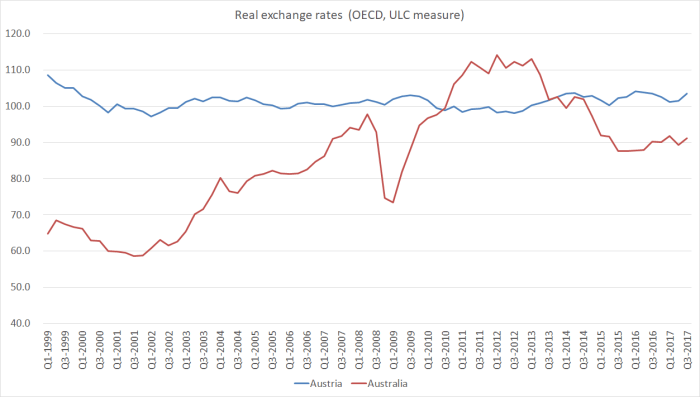
As a simple illustration of differences in real exchange rate volatility, I took the first two countries on an OECD table (Australia and Austria) and showed their real exchange rate since the start of 1999 when the euro began.

aus and aus rers

The point isn’t that Australia had Austria’s options –  it didn’t (most of its trading partners weren’t simultaneously forming a common currency area) –  or even that it would have wanted that option (in the face of very big terms of trade swings), just that there are huge differences.

And what about New Zealand?  The Reserve Bank did a useful paper a few years ago looking at the volatility issue.   In that paper, they looked back as far as the 1960s.  That had the advantage of looking through specific choices about how the exchange rate is managed –  over that period, we’ve had almost all the types of exchange rate regimes known to man, other than a common currency.     The results suggested that the volatility of the New Zealand exchange rate had been relatively high –  less so for short to medium term horizons, but more so if one focuses on longer-term exchange rate cycles.

But since Winston Peters has been talking about the potential for monetary policy regime changes to affect exchange rate volaility, here I wanted to look at a couple of shorter periods.    The current monetary policy implementation system –  the OCR –  has only been in place since the start of 1999, and as late as 1996/97 we were still using exchange rate “comfort zones” to manage the very short-term variability in the TWI exchange rate.

And who to compare us to?    The BIS has monthly broad real exchange rate indexes dating back to the start of 1994 for 60+ advanced and emerging countries.  The OECD has a couple of quarterly real exchange rate series for its 35 member countries, with complete data for all countries since 1996.  Of course, many of these countries are part of the euro, and I’ve shown results below for both all the individual countries and excluding the individual euro-area countries and including just the euro area as a whole.

There are more sophisticated ways of looking at volatility, but here I’ve just used two measures: the standard deviation of each country’s exchange rate index, and the range (high to low) expressed as percentage of the average value of the respective country’s real exchange rate index.

Here is how we’ve done relative to other countries on the BIS index.  (I’ve shown both the full period of data since 1994 and also just the last 10 years –  in case something is materially different about the most recent decade, but bearing in mind that 10 years is typically only about one exchange rate cycle).

BIS real exchange rate
standard deviation high-low range as % of average
Since Jan 1994
NZ 10.5 46.5
Australia 12.3 54.5
Canada 9.4 40.3
Japan 17.9 54.3
Israel 8.3 32.3
USA 9.2 33.1
Median of all countries 10.4 42.2
Median excluding individual euro countries 11.9 52
Last 10 years
NZ 7.1 36.8
Australia 8.5 41.5
Canada 8.1 34.3
Japan 12 40.8
Israel 4.8 23.9
USA 7.1 23.7
Median of all countries 5.5 23.2
Median excluding individual euro countries 7 28.5

Overall?   Well, our experience looks a lot like that of the median country and a little less variable than Australia’s real exchange rate over this period.   Since I first noticed the phenomenon almost a decade ago now, I’ve also been struck by the fact that exchange rate variability in New Zealand has been less than that in Japan and quite similar to that in the United States.     Over just the last decade, the amplitude of the exchange rate cycle has been larger for New Zealand and Australia than for most of these countries, but that just reflects the fact that both exchange rates fell so far in the 2008/09 crisis/recession –  surely a welcome, buffering, development.  Officials certainly thought so at the time.

I didn’t show Singapore separately, but the variability of its exchange rate over this period was similar to that for the euro-area as a whole, but materially larger than that for most individual euro-area countries.

What about the OECD measure?

OECD real exchange rate (ULC)
standard deviation high-low range as % of average
Since Dec 1996
NZ 14.6 56.7
Australia 16.3 66.4
Canada 12.4 44.5
Japan 18.8 75.1
Israel 11.2 42.6
USA 12.0 36.7
Median of all countries 10.1 40.5
Median excluding individual euro countries 12.1 48.0
Last 10 years
NZ 8.4 33.8
Australia 10.4 41.8
Canada 7.3 23.9
Japan 12.6 48.0
Israel 6.9 26.7
USA 8.6 26.7
Median of all countries 6.8 23.5
Median excluding individual euro countries 7.6 31.7

Still less variable than the exchange rates of Australia or Japan.  And at least over the last decade, little to mark us out from the median of the floating exchange rate countries (ie the series excluding the individual euro-area countries).

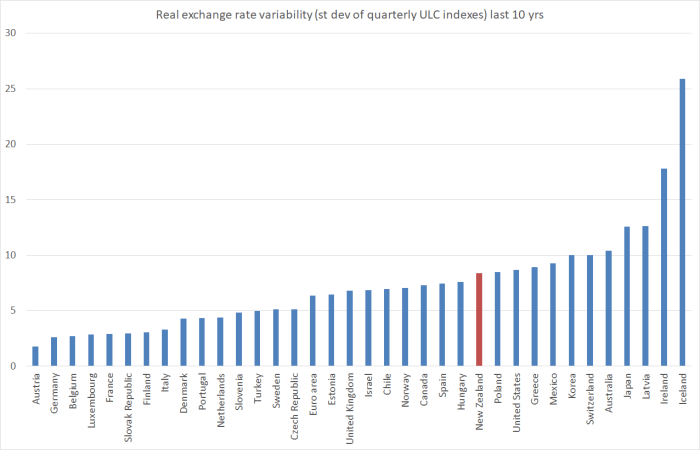
This chart is just one index for just one period, but it helps illustrate a few points.

oced rer variability

Notably:

  • all the countries to the far left of the chart are in the euro (or pegged to it –  Denmark),
  • among the floating exchange rate countries, the variance of our real exchange rate hasn’t stood out over the last decade,
  • even being in the euro is no protection from considerable real exchange rate variability if the fundamentals of your economy aren’t closely aligned to those of the large country(or countries) you are pegged too –  see Ireland and Greece.

I wouldn’t want anyone to go away from this post with a sense that I’m indifferent to real exchange rate volatility.  I’m not.  The extent of the variability in many real exchange rates is something of a puzzle, even when dressed up in “the exchange rate is an asset price” language.  On the other hand, not all real exchange rate variability is a bad thing –  many of the biggest moves see the exchange rate acting as a helpful buffer.   Exchange rate variability may also be more of an issue in a small country, where firms probably have to take their products international at an earlier stage than might be the case in a larger country.

But, equally, New Zealand’s realistic options are quite limited.  We don’t have a single dominant trading partner, with whom our economic fundamentals are well-aligned.    And with structural demand pressures so different from most of the advanced world (ie interest rates that average persistently higher), attempting to solve the problems by simply choosing a big currency to peg to would, most likely, have been a recipe for an Irish mess.

The biggest constraints on growth in the New Zealand tradables sector are the relative scarcity of good opportunities in such a remote location, compounded by the persistently high level of the real exchange rate.  Considered against that backdrop, the volatility of the exchange rate –  real or nominal –  which isn’t that unusual by the standards of countries in our sort of position is likely to be (a) a second or third order issue, and (b) one where attempted fixes could easily leave us worse off than we are now.

Implications of a new government for monetary policy

Whichever way New Zealand First decides to go, we’ll have a different government than we’ve had for the last few years.   Whatever form that government takes –  coalition, confidence and supply agreements, or just sitting on the cross-benches – New Zealand First’s votes will typically be vital for passing any legislation, and whichever party leads the government will constantly be needing to consult with New Zealand First to avoid inadvertently getting offside with them.

As issues around the Reserve Bank and the exchange rate have been a significant part of Winston Peters’ stated concerns over the years (including attempts to amend the Act through a private members’ bill, and repeated references to a Singaporean style of monetary policy), it is interesting to speculate on what difference his bloc of votes in Parliament might make to these issues over the next few years.  A journalist asked for my thoughts the other day, and this post fleshes out what I said in response to those questions.

There are probably at least three –  separable – areas worth touching on (simply as regards the Bank’s monetary policy roles):

  • the specification of the target for monetary policy, whether in the Act or the Policy Targets Agreement,
  • any changes to the legislated decisionmaking and accountability provisions for monetary policy, and
  • the type of person appointed as Governor.

I find it worthwhile to recall that Winston Peters has history in this area.  In 1996, New Zealand First was campaigning vigorously on bringing about change at the Reserve Bank.  At the time, the particular concern was that in focusing on price stability (0 to 2 per cent inflation at the time) we were encouraging/causing an overvalued exchange rate.  The proposed remedy was that we should instead target inflation around the average of our main trading partners (then a bit higher than New Zealand).    What actually happened was that as part of the horse-trading for the coalition agreement with National, Don Brash agreed to an amended Policy Targets Agreement, in which the target was raised from 0 to 2 per cent annual inflation, to 0 to 3 per cent annual inflation.  Actual inflation had been averaging about 1.5 per  cent anyway, so although the change made a small difference to policy for a short period, the difference was pretty minimal.  After that, Winston Peters –  as Treasurer – displayed little real interest in monetary policy and never bothered the Bank again.

So my starting point, in thinking about New Zealand First influence on Reserve Bank matters now, is that although I’m quite sure that the concerns Peters expresses –  including around overvalued real exchange rates –  are quite real (and in many respects valid –  shared as they’ve been by people spanning the range from Graeme Wheeler to me), in the end not much about the conduct of monetary policy is likely to change at his insistence.  And that is probably as it should be –  our real exchange rate problems are not primarily grounded in monetary policy problems.

We also know that although Peters has repeatedly talked of preferring a Singaporean model of monetary policy (a guided exchange rate, without an officially-set OCR), both Steven Joyce and Grant Robertson during the campaign flatly ruled out such a change.  They were right to do so.  I’ve explained why in a post earlier this year.    Even if such a system was desirable, it isn’t workable (at all) for New Zealand unless and until the structural demand factors behind our interest rates being persistently higher than those abroad are tackled –  and that isn’t a matter for monetary policy.

And the Singaporean model is not one of an absolutely fixed exchange rate.  It is a managed regime (historically, “managed” in all sorts of ways, including direct controls and strong moral suasion).  It produces a fairly high degree of short-term stability in the basket measure of the Singapore dollar.      But it works, to the extent it does, mostly because the SGD interest rates consistent with domestic medium-term price stability in Singapore are typically a bit lower than those in other advanced countries (in turn a reflection of the large current account surpluses Singapore now runs –  national savings rates far outstripping desired domestic investment).  As the Reserve Bank paper I linked to earlier noted

“From 1990 to 2011, the average short term Singapore government borrowing rate was 1.8 percent p.a. below returns on the US Treasury bill.”

Those are big differences (materially larger than the difference between the two countries’ average inflation rates).  And they mean that Singapore dollar fixed income assets are not particularly attractive to foreign investment funds.  By contrast, New Zealand’s short-term real and nominal interest rates are almost always materially higher than those in other advanced countries.   Partly as a result, even though Singapore’s economy is now materially larger than New Zealand’s, there is less international trade in the Singapore dollar than in the New Zealand dollar.

So a Singaporean model just is not going to be launched in New Zealand any time soon.

If Peters sides with National, what then might he secure in this area?

An obvious possibility would be a change to the Policy Targets Agreement.  There has to be a new one when a Governor is appointed, and (if they think the current interim one is lawful and binding –  which I don’t) they could also seek an immediate change.  Such changes immediately upon a change of government have been the norm rather than the exception (having happened, to a greater ot lesser extent, in 1990, 1996, 1999, and 2008).

At the start of each Policy Targets Agreement it has become customary (Peters began the pattern in 1996) to have a preamble about what the government is hoping to achieve.  The current government’s preamble reads this way:

The Government’s economic objective is to promote a growing, open and competitive economy as the best means of delivering permanently higher incomes and living standards for New Zealanders. Price stability plays an important part in supporting this objective.

It would be easy enough to craft a form of words that talked about avoiding an overvalued and excessively volatile exchange rate and promoting the tradables sector of the New Zealand economy.

But it won’t make any difference –  one iota of difference –  to the way monetary policy is conducted.  It is a statement of political aspiration –  and can perhaps be sold to the base as such –  not a mandate for the Governor.

Recall too that the Policy Targets Agreements since 1999 have required the Bank, while pursuing price stability to” seek to avoid unnecessary instability in output, interest rates and the exchange rate”.  On occasion, that provision has (modestly) influenced monetary policy choices at the margin (one reason I’ve favoured removing it), at least with a Governor who was that way inclined anyway.  In principle, the exchange rate element could be singled out and given more prominence further up the document.

Winston Peters’ private members bill sought to amend the statutory goal of monetary policy (section 8 of the Act) this way (adding the bolded words)

The primary function of the Bank is to formulate and implement monetary policy directed to the economic objective of maintaining stability in the general level of prices while maintaining an exchange rate that is conducive to real export growth and job creation.

I simply cannot see the National Party agreeing to that specific formulation. I hope they wouldn’t.  It goes too far and asks the Reserve Bank to do something that is impossible (real exchange rates are real phenomena, not monetary ones).   But could they consider a formulation like this one?

The primary function of the Bank is to formulate and implement monetary policy directed to the economic objective of maintaining stability in the general level of prices while promoting the highest levels of production, trade and employment that can be achieved by monetary policy.

It is very similar to the legislative provisions introduced by the National government in 1950, in providing a greater degree of (formal) independence for the Reserve Bank and a new focus on price stability.  But in that framing the caveat “the highest levels…that can be achieved by monetary policy” is vital.   Beyond the short to medium term, monetary policy can’t do much other than maintain stable prices.

Perhaps they could find, and agree on, some clever wording.   It would be a rhetorical victory for Peters, and since rhetoric and symbolism do matter not necessarily an insignificant one.

But, so I would argue, not one that would, on its own, make any practical difference to the conduct of monetary policy.  Reflecting back on the 25 years of advice I gave to successive Governors on the appropriate OCR, I can’t think of a single occasion when the advice would have been likely to be different under this formulation than under the current wording.

What about possible governance changes –  to the formal statutory provisions around monetary policy decisionmaking?  At present, all power is vested in the Governor personally, the Governor’s appointment is largely controlled by the Bank’s Board (unlike most countries where the Minister of Finance has the main power).

I can’t imagine that the National Party would be averse to some changes in this area.  After all, Steven Joyce commissioned the Rennie review and in doing so was presumably open to at least some modest changes (perhaps legislating something like the current internal advisory committee).   But equally, it is difficult to see why New Zealand First would regard it as any sort of win to hand power to more internal technocrats.  To the extent New Zealand First favours governance changes they probably prefer a decisionmaking Board dominated by outsiders, with a strong export sector orientation.  Perhaps it isn’t a die in the ditch issue for National, but it is harder to see the two parties reaching agreement on that sort of change, even if it did produce something that looked rather like the (generally highly-regarded) Reserve Bank of Australia.

But if Peters and New Zealand First care about making a difference to the actual conduct of monetary policy over the next few years, or even to how the Bank talks about monetary policy, the key consideration is who becomes Governor.   Whatever the formal specification of the target, whatever flowery words exist around goals, the personality, instincts, “models”, and preferences of whoever is appointed Governor matters a great deal.  Partly because it is a single decisionmaker system, and partly because as chief executive the Governor (inevitably and appropriately) has a big influence on how the institution evolves, where it focuses its analytical energies and advice etc.

But the Governor selection process has been underway for months, and the Bank’s Board – all appointed by the National government –  must be getting close to delivering an initial recommendation to whoever is appointed as Minister of Finance.   No doubt the Minister of Finance would consult New Zealand First –  whether through the Cabinet appointments process, or outside it –  and the Minister can reject a Board nomination.  But the Minister can’t impose his or her own candidate, they just have to consider the next person the Board puts forward.  Since the Board were (a) appointed under the current system, and (b) have had no concerns at all about the conduct of monetary policy or the leadership of the Bank in recent years, it seems reasonable to assume they’ll be putting forward a status quo candidate (there are no known exceptional candidates).  If so, my money is on Deputy Governor Geoff Bascand who –  as I’ve written about recently –  might be a safe pair of hands, but is unlikely to be more than that, and about whom there are some concerns (especially if, as Peters appears to, one cares about the interests of bank depositors.)

In short, if National leads the next government I wouldn’t expect any material differences on the monetary policy front, even if there are some symbolic wins for New Zealand First.  Even governance reform –  which most people think desirable –  might be hard to actually deliver (the status quo will avoid any conflicts).

And what if Labour leads the next government, requiring support of the Greens and New Zealand First for legislation?

In that case, legislative reforms are more certain, but somewhat similar questions remain about what difference they might make.

Thus, the Labour Party campaigned on amending section 8 of the Act to include some sort of full employment objective.   They haven’t provided specific suggested wording, and would no doubt want official advice on that.  The Greens have endorsed that proposal and there is no obvious reason why New Zealand First would oppose it. But they might want to try to get some reference to the exchange rate or the tradables sector included, whether in the Act itself or in the Policy Targets Agreement.  The sort of wording I floated earlier in this post might provide a basis for something workable.

I’ve also previously suggested that if Labour is serious about the full employment concern, it might make sense to amend section 15 of the Act (governing monetary policy statements) to require the Bank to periodically publish its estimates of a non-inflationary unemployment rate (a NAIRU), and explain deviations of the actual unemployment rate from that (moving) estimate.  In principle, something similar could be done for the real exchange rate, but the (theoretical) grounds for doing so are rather weaker.  Perhaps the political grounds are stronger, and such a change might encourage the Bank to devote more of its research efforts to real exchange rate and economic performance issues.

But –  and I deliberately use the same words I used above –  such legislative changes are not ones that would, on their own, make any practical difference to the conduct of monetary policy.  Reflecting back on the 25 years of advice I gave to successive Governors on the appropriate OCR, I can’t think of a single occasion when the advice would have been likely to be different under this formulation than under the current wording.

The Labour Party and the Greens also campaigned on legislative reforms to the monetary policy governance model (including a decisionmaking committee with a mix of insiders and relatively expert outsiders, and the timely publication of the minutes of such a committee.)   Although those proposals would represent a step in the right direction, they are rather weak. In particular, since Labour proposed that all the committee members would be appointed by the Governor, the change would largely just cement-in the undue dominance of the Governor.    But I’d be surprised if they were wedded to those details, and it shouldn’t be too hard to reach a tri-party agreement on a decisionmaking structure for monetary policy –  probably one that put more of the appointment powers in the hands of the Minister of Finance (as elsewhere) and allowed for non-expert members (as is quite common on Crown boards –  or, indeed, in Cabinet).

So legislative change in that area –  probably quite significant change –  seems like something we could count on under a Labour-led government.

But whether it would make much difference to the actual conduct of policy over the next few years still depends considerably on who is appointed as Governor.   Not only will whoever is appointed as Governor going to be the sole decisionmaker until new legislation is passed and implemented –  which could easily be 12 to 18 months away –  but that individual will be an important part of the design of the new legislation and the sort of culture that is built (or rebuilt) at the Reserve Bank.

As I noted earlier, the appointment process for the Governor has been underway for months.  Applications closed at a time –  early July –  when few people would have given the left much chance of forming a government.  And the Board, all appointed by the current government and strong public backers of the conduct of policy in recent years, have the lead role in the appointment.   Perhaps a new Labour-led government would reject a Bascand nomination.  But even if they did so, they have no idea which name would be wheeled up next.

There are alternatives, if the parties to a left-led government actually wanted things done differently at the Bank.   First, they could insist that the Bank’s Board reopen the selection process, working within the sorts of priorities such a new government would be legislating for.  Or they could simply pass a very simple and short amending Act to give the appointment power to the Minister of Finance (which is how things work almost everywhere else).  Of course, there is still the question of who would be the right candidate, but at least they would establish alignment of vision from the start –  a reasonable aspiration, given that the Reserve Bank Governor has more influence on short-term macro outcomes than the Minister of Finance, and yet the Minister of Finance has to live with the electoral consequences.

Over time, governance changes are important as part of putting things at the Reserve Bank on a more conventional footing (relative to other central banks, and to the rest of the New Zealand public sector).   I think some legislative respecification of the statutory goal for monetary policy  –  along the lines Labour has suggested –  is probably appropriate: if nothing else, it reminds people why we do active monetary policy at all.   But on their own, those changes won’t make any material difference to the conduct of monetary policy  –  or even to the way the Bank communicates –  in the shorter-term (next couple of years) unless the right person is chosen as Governor.  Perhaps so much shouldn’t hang on one unelected individual, but in our system at present it does.

Symbols matter, but so does substance.  It will be interesting to see which turns out to matter more to a new government with New Zealand First support.

In closing, there is a long and interesting article in today’s Financial Times on some of the challenges – technical and political –  facing central bankers.  As the author notes, in many countries authorities are grappling with a mix that includes very low unemployment and little wage inflation.  In appointing a Governor for the Reserve Bank of New Zealand, it would be highly desirable to find someone who recognises, and internalises, that the challenges here are rather different.  Unlike the US, UK, or Japan (for example) New Zealand’s unemployment rate is still well above pre-recessionary levels –  when demographic factors are probably lowering the NAIRU –  and real wage inflation, while quite low in absolute terms, is running well ahead of (non-existent) productivity growth.    There are some other countries – the UK and Finland notably –  that also have non-existent productivity growth, but it is far from a universal story.  Productivity growth carries on in the US and Australia and (according to a commentary I read last night) in Japan real output per hour worked is up 8.5 per cent in the last five years (comparable number for New Zealand, zero).

Some of these issues are relevant to monetary policy (eg unemployment gaps) and some are relevant to medium-term competitiveness (wages rising ahead of productivity growth).  We should expect a Governor who can recognise the similarities between New Zealand’s experiences and those abroad, but also the significant differences, and who can talk authoritatively about what monetary policy can, and cannot, do to help.  Perhaps even, as a bonus, one who might even be able to provide some research and advice to governments on the nature of the economic issues that only governments can act to fix.


Remoteness….occasionally a benefit

I’ve been a little unclear what to make of the Rocket Lab story.   Don’t get me wrong, I liked the idea that our regulatory systems can, on occasion, be sufficiently adaptive to cope with new and innovative industries –  even if it is far from generally true.  And I wish all the best to any New Zealander with innovations they succeed in taking to the world market, and if that includes rocket launches that’s fine.

But there was the nagging question of why such an activity would be taking place in New Zealand at all.  We aren’t exactly close to anywhere, let alone home to great centres of expertise.  But there were those government subsidies –  up to $25 million of taxpayers’ money to Rocket Lab, as well as the cost of the regulatory regime (15 to 20 bureaucrats in the “New Zealand Space Agency”).  And I recalled that the French launch their satellites from French Guiana without –  as far as I’m aware –  much else happening in French Guiana.

But there was an interesting article on Newsroom built around an interview with head of the agency, a mid-senior level MBIE official.   It answered some questions, and not in a terribly encouraging way.

There was the disarmingly frank acknowledgement of how little expertise MBIE has

The biggest challenge, Crabtree says, has been the “classic small government thing” of lacking expertise.

“We didn’t have the experience or technological depth, but the focus is on picking things up quickly but also working with international partners who can bring that to you…

“I set the challenge which was, can we move as fast as Rocket Lab?”

Where are the incentives to get things right, when the hype is all around accommodating –  and keeping pace with – Rocket Lab?  You can pick up lots of things quickly, but often you don’t know what you don’t know.    (And, to be clear, I’m not asserting a need for regulation for its own sake, and have no idea what specific regulation might –  or might not – be needed in this industry, but the general point holds.)

And then there was the answer to what New Zealand had going for it, aside from the cheque book of the put-upon taxpayer.

New Zealand has what Crabtree deems “a natural resource endowment” when it comes to space-related activities, such as a range of launch angles.

“You want to launch a rocket to the east, and you want to launch a rocket over the ocean, and you want that ocean to be relatively clear of ships, and you want the sky to be relatively clear of planes…

“There are very few places in the world that tick all the boxes.”

So that would be New Zealand, Madagascar, the Falkland Islands, and maybe Uruguay/Argentina?  Those great centres of economic activity, innovation and so on.   We have political stability going for us over each of those other places, but it scarcely sounds like the makings of  –  or even a marker of – a transformed economy, when the business has to operate in a place where nothing much else is.

Ah, but then there are the kids

Beyond the economic calculations, Crabtree hopes a booming space industry can encourage children to develop an interest in space and technology.

“Kids get interested in science either through dinosaurs or space, and we’ve had lots of dinosaur kids, but space hasn’t really had a fair go.”

The agency has been providing educational materials for schools to use, while universities also want to attract those keen on making a future contribution to the space race.

I guess at least the government is symmetrical –  we also subsidise the film industry which provides the most-frequent encounters with dinosaurs these days.

In my day, the Apollo programme, moon landings and all, was great for exciting interest in space, around the world.  Count me just a little sceptical that some rockets launching from remote sites on our east coast are going to make a material difference to the career choices of many New Zealand kids. Or that, if they did, many of the resulting –  higher value – jobs would end up in New Zealand for long.

Perhaps the industry can succeed here, standing on its own feet.  If so, I wish it well. But I’m a little uneasy about politicians and officials talking up, and then being pursued by, the hype.  Corporate welfare dollars all add up after a while.

Australia does better than us

I’m old-fashioned.  Key bureaucrats should mostly be seen and not heard.  Officials advise, ministers decide.  And ministers are the ones we get to hold to account, weakly or otherwise, through the political and electoral process.

The chief executive of New Zealand’s Ministry of Foreign Affairs and Trade doesn’t appear to give many speeches, at least not on-the-record.  That is, mostly, as it should be.  But the Secretary of the Australian Department of Foreign Affairs and Trade, Frances Adamson, gave a very interesting address in Adelaide the other day on Australia and China.  It was sufficiently clear and forthright that one can only assume she had the full endorsement of the Australian government.

The speech was given in a slightly odd context.  It was the annual lecture of the Confucius Institute at the University of Adelaide.    There are hundreds of these Confucius Institutes in universities around the world (several in New Zealand),  funded by the government of the People’s Republic of China to promote the interests of China. A couple of years back

The American Association of University Professors (AAUP) called for agreements between Confucius Institutes and nearly 100 universities to be either cancelled or renegotiated so that they properly reflected Western values of free speech.

“Confucius Institutes function as an arm of the Chinese state and are allowed to ignore academic freedom,” the AAUP said in a statement, urging US universities to “cease their involvement” with the institutes unless major reforms are instituted.

China’s network of 300 Confucius Institutes – including 11 branches in on British university campuses – can be a lucrative source of funds for universities but are exempt from many of the basic rules governing academic discourse.

They are designed to project a favourable image of China’s ruling Communist Party around the world through language and cultural programmes, but are allowed to restrict discussions of topics unpalatable to China’s ruling Communist Party such as the occupation of Tibet.

The University of Chicago has shut their Confucius Institute over related concerns.

But if Frances Adamson didn’t tackle that specific issue head-on (and had some polite remarks to her hosts), what she did say was pretty blunt, even if none of it should have been controversial in a free, open and democratic society reflecting on its relationship with an expansionist repressive authoritarian state that is moving further away from, not nearer to, the sort of values that have shaped the West.

While we are complementary economies, there is no getting around the fact that Australia and China are very different places, with different political and legal systems, values and world views.

A pretty simple statement, but I’m not sure I’ve seen its like from our own leading ministers and officials.

Partly this is because the closer we get, and the more we interact, the more we need to account for and manage the differences between us – differences that cannot be wished away but that should not prevent the further development of relations between us.
This emphasises the need for a healthy dose of tolerance, for mutual respect and for openness to the patterns of give and take that underpin any successful relationship.
We understand the hesitation in China to ‘air the laundry’ so to speak.

Australians are happy – perhaps too happy sometimes – to tell each other exactly what we think.

This of course reflects different cultural attitudes:

In China, the thinking is that proper friends will not say things that offend;

Whereas in Australia, a willingness to be frank is proof of a genuine friendship.

These characteristics apply as well to our government-level interactions, something that both sides have come to recognise (though not necessarily always accept!).

Each of our approaches has utility, and we will need large measures of both respect and candour as we conduct the far-sighted diplomacy necessary to bridge our differences and progress our common interests.

Both approaches, the saving of face and the preference for frankness, also have shortcomings.

For our part, Australians should, and I am sure will, be authentic and true to our own selves, while respecting the practice of others.

Australia is a pluralistic society: a place where open debate, individual rights and freedoms are the foundation upon which we have built our political and economic systems. We are a society that thrives on the competition of ideas.

The health and vibrancy of Australia’s democracy is fundamental to our national success – it helps explain why migrants come to our shores and why they can succeed based on their talents and hard work.

And to students, in the context of various recent reports in Australia of a minority of PRC students, and PRC-dominated Chinese students associations, trying to suppress discussion

And here I want to address my remarks to those of you who are international students:
We want you to experience our contest of ideas and participate fully in it, as it is part of what constitutes an authentic Australian education.

You have paid your money; you are surely entitled to the full experience.

No doubt there will be times when you encounter things which to you are unusual, unsettling, or perhaps seem plain wrong. And can I tell you, as someone who has studied overseas in three different continents, if you aren’t encountering strange and challenging things you aren’t getting out enough! So when you do, let me encourage you not to silently withdraw, or blindly condemn, but to respectfully engage.

The silencing of anyone in our society – from students to lecturers to politicians – is an affront to our values.

Enforced silence runs counter to academic freedom. It is only by discussion, and of course discussion which is courteous, that falsehoods can be corrected.

Respectful and patient discourse with those with whom you disagree is a fundamental skill for our ever-more-connected contemporary world.

and to a wider audience

There has been much attention in recent months to the quality and reliability of news and information available to us.

We have seen accusations of ‘fake news’ and we have seen attempts at untoward influence and interference.

This is worrying and is being taken seriously in a number of countries. In our case, the Prime Minister has said: “The sovereignty of Australia, the sovereignty of our democratic processes, free from foreign interference is a matter of the highest concern.”

The Australian Government takes seriously its responsibility to ensure a robust legal framework within which free and open debate is protected and can flourish. That work is proceeding.

As well, Governments themselves must expect, and invite, scrutiny of their actions and their policy positions.

As China becomes more important to Australia’s future and to that of the world, it follows that there will be more scrutiny of China, including the ways in which it seeks to exercise influence internationally.

All of us here, as participants in a free society, have responsibilities as well.

It is our responsibility to challenge and question ‘fake news’. We can readily reduce the risk of being manipulated by seeking out collateral and confirmatory information, by testing through a second opinion.

And when confronted with awkward choices, it is up to us to choose our response, whether to make an uncomfortable compromise or decide instead to remain true to our values, “immune from intolerance or external influence” as Adelaide University’s founders envisaged.

The prospect of public scrutiny is an excellent discipline, and a vital corrective for our political culture and our institutions, including our universities.

We want to ensure these institutions remain secure and resilient.

Our success depends in part on the legal framework, but also on the attitudes and responses of all of us when exposed to unexpected pressure.

And in contrast, what do we have in New Zealand?   Almost none of our political party leaders has been willing to comment in any substantive way on the concerns raised in the recent paper by Professor Anne-Marie Brady.    The leaders of the National Party, the Labour Party, and the Green Party seem totally unbothered about –  and unwilling to substantively discuss – having as a member of Parliament a (now) acknowledged member of the Chinese Communist Party and former member of the Chinese intelligence services, who is now widely credited as one of the National Party’s chief fundraisers.  Speeches on China topics by our own Ministers of Foreign Affairs seem mostly to take on a fawning and deferential tone, as if they are afraid of asserting, or embarrassed by, our own values.  And the Attorney-General was just reduced to making stuff up (lies) and personal attacks on institutions raising concerns.

The speech by the Australian Secretary of the Department of Foreign Affairs and Trade has been widely reported in the Australian media – and she’s just a (very senior) bureaucrat.   And what of New Zealand?

It remains striking, puzzling, and more than a little disturbing, just how little media attention either the general or the specific issues have received in the New Zealand media.    There is a column in this morning’s Herald by Bryan Gould, former Vice-Chancellor of Waikato University and former UK Labour MP prompted by the Brady paper (I’m told the column is on line but I couldn’t find it UPDATE:  here).   In it Gould opens thus:

The Herald’s readiness to report the important conclusions of University of Canterbury research into links between China and past and present New Zealand politicians and their family members is to be commended.

Surely in a serious country with media doing the job of providing searching scrutiny, it wouldn’t be cause for self-congratulation, but something just taken for granted?  A leading academic raises serious concerns about the extent of a powerful country’s influence in New Zealand and he seriously suggests that it might not be reported by the country’s largest newspaper?

It would be interesting to know whether the issues have been reported in the Chinese Herald (I gather not), but even if we stick to the English language media, just how much reporting has there in fact been?  I found a total of two stories in the Herald, one (on a quite specific element) on Stuff, nothing on Radio New Zealand (a non-commercial broadcaster with an extensive news and current affairs operation), a single story of Newsroom, nothing on TVNZ and nothing on Newshub.  Perhaps I missed the odd story, but what is striking is not the New Zealand coverage of the issues and concerns, but the lack of coverage and lack (apparently, thus far) of any sustained follow-up.    (And has the New Zealand media ever looked searchingly at those Confucius Institutes?)

The contrast with Australia is striking, worrying, and sad.  I don’t really buy the stories of extreme economic vulnerability to China, but if anything Australia’s direct economic exposure is a bit larger than ours.  And yet officials, ministers, and media in Australia are willing to speak up, and have an open and vigorous debate on the issues.  Reasonable people might differ on appropriate policy responses, but who is seriously going to defend the deafening silence as the way in which a free and open society should handle such issues?


An alternative perspective on emissions and immigration

I’ve now got off my chest my annoyance at some of the “playing distraction” rhetoric David Hall used in his Newsroom piece responding to my column urging that the Productivity Commission inquiry into a transition to a low-emissions economy should at least consider the potential role of immigration (in boosting emissions in the past, and perhaps in offering a lower-cost abatement tool in future). But I wanted to come back to some of the more substantive issues Hall raises.

Bear in mind that my column was based on a submission to the inquiry the government asked the Productivity Commission to undertake.  The terms of reference which the Commission is operating under are focused on New Zealand’s own policy responses, and how to (maximise the benefits and) minimise the costs of meeting the target which the government has set.    The focus is –  rightly in my view – on national interests (costs and benefits to New Zealanders) now that the New Zealand government has already factored in its response to the (actual and perceived) global imperatives, in establishing an emissions reduction target under the Paris climate agreement.    Having determined how much reduction in emissions we will aim for, and made those commitments to other countries in an international context, the challenge now is how best to adjust, and what mix of policy instruments might enable us to deliver on those commitments.

Hall argues that “what matters from the perspective of Earth’s atmosphere is what people emit, not where they emit it”.  Maybe so, but the New Zealand government is not now making policy for the “Earth’s atmosphere”, but around an emissions reduction target it has signed up to for New Zealand.  In that context, where the emissions happen matters.

My submission was firmly set within that sort of framework –  one set by the government and recognised by the Commission.  In fact, in the Terms of Reference the three ministers were using exactly the same sort of analytical framework I was.

New Zealand’s domestic response to climate change is, and will be in the future, fundamentally shaped by its position as a small, globally connected and trade-dependent country.  New Zealand’s response also needs to reflect such features as its hjgh level of emissions from agriculture, its abundant forestry resources, and its largely decarbonised electricity sector, as well as any future demographic changes (including immigration).

The focus of my submission was, in many respects, that the Commission had simply ignored that last phrase.  Population growth matters to emissions, all else being equal, and in New Zealand –  where non-citizen immigration is so (a) important, and (b) fully within government control –  population growth can, via immigration policy, and should be considered as an instrument to reduce emissions.    It might be uncomfortable for MBIE (champions of immigration), or for the Ministry for the Environment, but the point of Productivity Commission inquiries isn’t to make life comfortable for established interests.

Hall is clearly uncomfortable with the idea –  the pretty basic fact –  that increased populations increase emissions, all else equal.   But again, discomfort doesn’t change the stylised facts.  As he acknowledges, “road transport emissions have increased by 78 per cent since 1990”, but…..

But the fault here lies with New Zealand’s over-reliance on private vehicles. Migrants (and citizens) contribute to road traffic by necessity, because alternative means of transport are less available, indeed far less so than many migrants are used to, coming from places where travel by trains, trams, cycles and footpaths is not unusual. If low-carbon alternatives in places like Auckland were more serviceable, migrants would doubtlessly utilise them, as indeed would citizens. And if the excuse for underinvestment is the lack of markets of sufficient scale, then population increase and cultural change will drive progress.

In other words, if governments and people did things differently than they actually did, emissions would have been lower.  No doubt, but that isn’t really the point.   Each of the alternatives Hall proposes would have had both public and private costs –  and the point of the exercise is to keep those costs to a minimum.  Perhaps he’d prefer a world of light rail and trains.  Most citizens don’t seem to, at least when confronted with real world costs –  and the economics of such proposals in New Zealand is generally shocking.    Actual transport emissions would have been a lot lower than they are now if, at the extreme, the population had been constant since 1990.  And if –  and it is a proposition for debate –  the immigration that so substantially boosted the population had few, no, or even negative productivity gains for New Zealanders, those emissions reductions could have been achieved at little or no economic cost at all.    There are plenty of ways to reduce emissions, but the challenge is to find the most cost-effective ones or –  in markets –  to set up the instruments in a way that allows private agents to identify the most cost-effective means of adjustment.

In my column and submission I had noted that it is generally accepted that New Zealand typically faces quite high marginal abatement costs to reduce emissions, relative to those faced by most other advanced economies.  When I wrote that, I wasn’t even thinking of it as a controversial proposition.  But Hall wasn’t happy with the claim.

This contradicts Reddell’s claim that “all informed observers recognise that the marginal abatement costs in New Zealand, through conventional means, are high”. I’ve written for Pure Advantage about the potential of forests – both production and permanent forests – to offset agricultural emissions in a way that isn’t only cost-effective but potentially profitable. This is corroborated by other “informed observers”, such as the Royal Society of New Zealand, the Parliamentary Commissioner for the Environment and Vivid Economics. The latter’s Net Zero in New Zealand report highlights other low-cost opportunities in energy efficiency, heating technologies, agricultural efficiency, and technological advances in methane vaccines and cheaper electric vehicles.

I’m happy to alter “all informed observers” to “most observers”, but I’m not resiling from the basic point.   Warwick McKibbin of ANU, who has done a lot of modelling on climate change and emissions abatement first produced estimates 20 years ago showing that that the “marginal abatement cost in New Zealand amongst the highest in the world”.  I’ve heard him repeat the point in various seminars and lectures over the years.    Why are the costs higher here?  Among other things, because a very large chunk of our emissions are agricultural, and there aren’t yet good technologies for reducing the emissions while keeping the animals.  And because our power generation is already largely hydro-based, so can’t easily be switched to alternative fuels to reduce carbon emissions.   This is an expensive place to reduce emissions –  an equal marginal cost approach would see us adopt a less aggressive emissions reduction target than most countries.    There are papers on the web from government agencies making exactly this point.

The Productivity Commission themselves recognise these points. For example, from their issues paper, on animal emissions.

Moderate emissions cuts are possible from certain agricultural technologies (eg, low-emission feds). However, a low-cost technology that delivers dramatic reductions in biological emissions appears far off, and may not emerge. While a methane vaccine could reduce CH4 emissions by up to 40%, no successful trials of such a vaccine have so far occurred.

Actually, for all the talk of alternative technologies, the Vivid Economics paper Hall links to makes much the same point about the sorts of constraints New Zealand faces.  Here is text from the Executive Summary (of a report funded by various MPS, foreign embassies and other donors).

In meeting this challenge, New Zealand is distinctive in at least three respects: its significantly decarbonised energy sector; its large share of difficult-to-reduce land sector emissions; and its large forestry sector. Elsewhere in the world, more focus has been devoted to reducing emissions from the electricity sector than from any other sector. Huge efforts and costs are now beginning to translate into progress. But for New Zealand, these challenges are of less significance. Its power sector consists primarily of hydroelectric and geothermal resources, providing firm, reliable capacity. Even with the challenge of decarbonising other parts of the energy sector (transport fuels, heat), the resulting relatively low-carbon energy mix provides the country with a considerable competitive advantage in a world that is placing increasing constraints on emissions. Yet, at the same time, the importance of the pastoral agriculture sector to the economy and social fabric of the country creates a huge challenge, although one that is laced with opportunity. Biological emissions from agriculture account for almost half of New Zealand’s gross emissions, a higher proportion than in any other developed country. While other developed countries may choose to not prioritise reducing these emissions in the short term, following suit would have important repercussions for New Zealand in meeting future targets.

Wishing it were otherwise does not make it so.  Marginal abatement costs are typically higher here than in other countries.  Those costs may well be falling –  as eg new battery technologies for example open up new options re transport emissions –  but those technologies are available to other countries too. They don’t change the specific challenges New Zealand faces relative to other advanced countries.   The emissions target we’ve committed to, whether through belief or interest, represent a new constraint on economic performance, and that constraint is more severe for New Zealand than for most, in a country with a long-term history of real economic underperformance.

Against that backdrop it would be irresponsible to simply wave our hands and pretend that immigration isn’t an issue (for us, as New Zealand, and our governments), ploughing on oblivious to the potential real economic costs of doing so.     Immigration policy needs to be considered as one strand in thinking about how best to design a New Zealand policy response, to minimise the net adjustment costs to New Zealanders.

I’d simply taken for granted what seemed like a fairly obvious point (even Hall reluctantly acknowledged it) that increased populations will have tended to increase emissions, all else equal. But until now I hadn’t had a look at the cross-country data to see if the relationship was actually there in the data.  It might not have been –  after all, countries might have responded to the rising populations by finding techniques and market instruments to lower per capita emissions sufficiently that there was no relationship left in the observed data.

Fortunately, we have quite detailed data on gross emissions for almost all OECD countries from 1990 to 2015.  In a few cases, the data are only up to 2013 or 2014, and in all the scatter plots that follow I’ve lined up the population changes with the emissons data (eg if for a country there is emissions data for 1990 to 2014, I’ve used percentage population change over that period).  But for 30 countries there is full data for all the variables I looked at.

None of these relationships are particularly tight –  these are simple bivariate relationships, and lots else was going on in each of these countries (eg in the former Soviet bloc countries, production processes had been extremely inefficiently energy-intensive).

I start with transport emissions (actually to 2015 despite the label). As Hall noted, transport emissions in New Zealand have increased a lot, as has our population.

transport emissions

Unsurprisingly, the relationship is upward sloping.

What about manufacturing and construction emissions?

manuf emissions

(That outlier up the top is Korea, which has still been massively industrialising.)

Total gross emissions?

total emissions

Hall seemed particularly perplexed, or perhaps outraged, by my points about agriculture

As I understand him, he argues that New Zealand’s high living standards depend upon dairy exports, which makes it politically infeasible to impose costs for environmental damages. The greater the population, the greater this reliance upon the dairy sector, and so the greater the reluctance to make polluters pay.

Again it seemed pretty descriptively accurate to me (whether it is an outcome he –  or I –  like or not). But even though agricultural emissions are much more of an issue for New Zealand than for most OECD countries, I was curious as to whether there was a relationship (across countries) between population growth and growth in agricultural emissions.  I didn’t have a prior expectation, but in fact this is what I found.

ag emissions

It is actually one of the tighter relationships, so I’ll repeat the proposition from my submission/column: with fewer people it seems quite plausible that we’d have had (tighter environmental regulation and) fewer cows and fewer emissions.

I could go on showing you charts all day, but I won’t try your patience.   Somewhat to my surprise there is actually even a (weak) positive relationship between population growth and per capita emissions and emissions per unit of GDP.  I’m not quite sure why that would be, although in New Zealand (and Australia’s) case, the migrants are moving to some of the OECD countries with, already, the highest emissions per capita and per unit of GDP.

The bottom line for New Zealand is that our immigration policy, which has very substantially boosted our population, has also substantially boosted our emissions over the last 25 years.   Our experience doesn’t look out of line with that of the rest of the OECD: growing populations are associated with more emissions, whether in transport, agriculture or just in total.   Given that marginal abatement costs, even if falling, are still high here relative to those in other advanced countries, it would frankly be irresponsible for any government, concerned primarily about the interests of New Zealanders, not to have the levers of immigration policy considered when assessing the best approach for New Zealand to take to meet its commitments.   The Productivity Commission should be doing so.

In the end, though, I suspect that the real difference between me and David Hall isn’t about any of these numbers.   He concluded his article

Because when it comes to global warming, it’s the carbon intensive economy, stupid. The only genuine solution is to transform the world’s high-emissions economies into low-emissions economies, so that anyone entering them by way of birth or migration can lead a prosperous low-carbon life. Our national emissions targets are a means to this global end. Focusing on peripheral issues like migration only distracts from the work that needs to be done. But that’s what happens when you tell the story of a global problem through a nationalist lens.

But all policy is national, and there is (fortunately) no supra-national government.  We’ve played our part in the international process with our emissions reduction commitments, which are ambitious given the high marginal abatement costs here.  But Hall’s approach suggests he doesn’t really care if there are cheaper, less costly, ways for New Zealand to meet its commitments, and thus reduce costs to New Zealanders (residents and voters); what he cares about is the global.  It is certainly one perspective, but it isn’t the one the government used in setting up the Productivity Commission inquiry.  In practice, it almost certainly isn’t the one New Zealand residents and voters will be using in assessing how governments handle these issues over the next 20 years and beyond.

My own column ended this way

The aim of a successful adjustment to a low-emissions economy is not to don a hair shirt and “feel the pain”. It isn’t to signal our virtue either. Rather, the aim should be to make the adjustment with as small a net economic cost to New Zealanders – as small a drain on our future material living standards – as possible. Lowering the immigration target looks like an instrument that needs to be seriously considered –  including by the Productivity Commission – if that goal is to be successfully pursued.

I’m probably less idealistic than David Hall. Perhaps 30 years as a bureaucrat does that to one.  But in responding to a comment on my earlier post today I noted

My take is that, as a high cost abater, we should impose as little cost on NZers as possible to be seen by friends and trading partners to be making our token contribution (because obviously in global terms it is only token).

Giving serious consideration to cutting our (unusually large) immigration targets looks as though it  should be good economic policy and good (national) emissions-reduction policy.

A researcher responds to Reddell on emissions and immigration

I’m sitting here a bit puzzled at what approach to contesting or debating policy they now teach and model at Oxford University, or practice at Auckland University of Technology.

A few weeks ago, I posted here a submission I’d made to the Productivity Commission’s inquiry into how New Zealand might make a transition to a low-emissions economy, and arguing that immigration policy should at least be considered by the Commission as one material influence on total New Zealand emissions, and as a potential tool to facilitate a cost-effective pursuit of the goverment’s emissions target.   Late last week, Newsroom published a column of mine based on that submission.       In that column I noted that

New Zealand has committed to a fairly ambitious emissions reduction target as part of the Paris climate agreement.  Of course, some political parties think the target isn’t ambitious enough, but New Zealand faces an unusual set of factors that affect our ability to reduce emissions here at moderate cost.  Appropriate policy responses, and the choice of the mix of instruments we choose to deploy, need to take account of that distinctive mix.

and concluded

The aim of a successful adjustment to a low-emissions economy is not to don a hair shirt and “feel the pain”. It isn’t to signal our virtue either. Rather, the aim should be to make the adjustment with as small a net economic cost to New Zealanders – as small a drain on our future material living standards – as possible. Lowering the immigration target looks like an instrument that needs to be seriously considered –  including by the Productivity Commission – if that goal is to be successfully pursued.

The backdrop of course –  and a point made in both the submission and my column – was the arguments I have been running for some years now suggesting that immigration policy itself been damaging to our economic performance, and thus has come at some net economic cost to New Zealanders.

But one academic reader decided that rather than engage primarily on the substance of the arguments I’d made –  the bottom line of which, after all, was simply that the Productivity Commission shouldn’t just ignore the issue –  he’d try to muddy the waters with some slurs.

David Hall is a young academic researcher at AUT, having returned to New Zealand relatively recently after doing a D. Phil at Oxford.   While he was in the UK he, for a time, had a regular Listener column.   His academic background appears to be in politics rather than economics, but he has been writing about climate change policy and was the editor of the recently-published BWB Texts book Fair Borders? Migration Policy in the Twenty-First Century, a collection primarily about aspects of New Zealand’s approach to and experience of immigration.  I’ve written previously about a couple of chapters in the book (here and here).  As I noted in the latter of those posts

As much as I can, I try to read and engage with material that is supportive of New Zealand’s unusually open immigration policy.   One should learn by doing so, and in any case there is nothing gained by responding to straw men, or the weakest arguments people on the other side are making.

Newsroom has published a response by Hall to my column (they even illustrated it with a photo of my own suburb, Island Bay).    There are some points of substance in Hall’s response, and I want to come back to them in a separate post.

But it was these two paragraphs that really annoyed me

What’s striking about all this is not only Reddell’s argument is from the perspective of climate change, but also economics. He resists the orthodox view that migration has a modest positive impact on national GDP. I’m no enemy of disciplinary iconoclasm, but it does beg for robust positive arguments. Reddell’s appeals to uncertainty (economists cannot prove definitively that migration increases GDP, therefore it might not be true) do not count. Climate scientists are all too familiar with this kind of denial.

So if economic evidence cannot always carry his arguments, one can only conclude that non-economic reasons are doing some of the work. To Reddell’s credit, he is explicit about his concerns for cultural cohesion, or that “Islam is a threat to the West, and a threat to the church wherever it is found”. These are real reasons for wanting to reduce immigration, but should be debated on their ethical and sociological merits, not couched in an idiosyncratic take on climate policy.

This is frankly pretty scurrilous stuff.

Apparently, when it comes to the economics of immigration, all I’m doing is “appealing to uncertainty” not advancing any “robust positive arguments”.  This is, so he claims, the economics equivalent of “climate change denial”.

First, lets look at what I’d actually said in my column

Of course, if there were clear and material economic benefits to New Zealanders from the high target rate of non-citizen immigration (the centrepiece of which is the 45,000 per annum residence approvals “target”) it might well be cheaper (less costly to New Zealanders) to cut emissions in other ways, using other instruments. But those sort of  gains –  lifts in productivity – can’t simply be taken for granted in New Zealand. Despite claims from various lobby groups that the economic gains (to natives) of immigration are clear in the economics literature, little empirical research specific to New Zealand has been undertaken. And there is good reason – notably our remoteness – to leave open the possibility that any gains from immigration may be much smaller here than they might be in, say, a country closer to the global centres of economic activity, whether in Europe, Asia, or North America.

Even many of those who are broadly supportive of New Zealand’s past approach to immigration policy will now generally acknowledge that any gains to New Zealanders may be quite small. And for some years now, I’ve been arguing for a more far-reaching interpretation of modern New Zealand economic history: that our persistently high rates of (non-citizen) immigration have held back our productivity performance (i.e. come at a net economic cost to New Zealanders).

It isn’t controversial to suggest that there has been little empirical research specific to New Zealand on the contribution of immigration policy to New Zealand’s economic performance.  It is simply an accepted fact –  and the chair of the strongly pro-immigration New Zealand Initiative accepted as much in an exchange here last year.   I also don’t think it is controversial to suggest that any economic gains to New Zealanders may be quite small –  it was, as I recall, the conclusion of Hayden Glass and Julie Fry (both generally pro-immigration) in their BWB Texts book last year.   Remoteness is generally accepted as an issue in New Zealand’s economic performance –  even if reasonable people differ on the implications and appropriate policy responses.

And then there was the reference to “and for some years now I’ve been arguing”.  Since the point of the emissions/immigration column was to argue that the connection should be considered, not to attempt to demonstrate that immigration has been economically costly, I didn’t elaborate in that column.  But it would, to most readers, have been a hint that there was a bit more to the argument than “appealing to uncertainty”.  If Hall himself hadn’t been familiar with my arguments, Google would willingly have helped.   There are, I see, 140 posts on this blog tagged with “immigration”, and there are plenty of speeches and papers, and a lengthy commentary on the New Zealand Initiative’s major piece earlier this year making the case for New Zealand’s immigration policy.  Only last week, in a post where I outlined some specific alternative immigration policy proposals, I linked to a recent speech outlining the economic case –  specific to New Zealand –  for rather lower target rates of non-citizen immigration.  People might disagree with my economic arguments and reading of New Zealand’s economic history, but none of those arguments is a mystery to anyone interested.

(In – very  – short, (a) extreme remoteness makes if very difficult to build many high productivity businesses here that aren’t natural resource based, and (b) in a country with modest savings rates, rapid population growth has resulted in a combination of high real interest rates and a high real exchange rate, discouraging business investment and particularly that in the tradables –  internationally competitive – sectors, on which small successful economies typically depend. I add to the mix how unusually large our immigration target is and how, despite the official rhetoric, the skill levels of the average and marginal migrants are not particularly high.)

But Hall’s rhetorical strategy rests on making as if none of this extensive body of argumentation and analysis exists, that I’m playing distraction, and then falling back on the “Muslim card”.

In parallel to this blog, I maintain a little-read (and these days, little written) blog where I occasionally write on matters of religious faith and practice, and sometimes on a Christian perspective on public policy issues.  If there is a target audience it is fellow Christians and in writing there I take for granted the authority of the Bible, and of church teaching and tradition over 2000 years.  I very rarely link to it here, as there is typically little overlap in subject matter and I know that most of the readers of this blog don’t share those presuppositions.

A couple of years ago, I wrote a couple of posts about refugee policy, prompted by some domestic commentary on the possible economic case for taking more refugees (in particular from Syria).   On this blog, I wrote something fairly short and narrowly focused on the economics, noting that there were unlikely to be net economic benefits to New Zealanders.  I concluded that

None of which is an argument for not taking refugees.  Doing so is mainly a humanitarian choice, not something we do because we benefit from doing so.  I don’t have a strong view on how many refugees New Zealand should take, but I don’t think possible economic benefits to us should be a factor one way or the other.

We do good because it is right to do so, not for what it might do for us.  Whether “doing good” in this case involves taking more refugees, or donating more money to cost-effectively assist in refugee support in the region, is a more open question.

A day or so later I wrote a longer post on my Christian blog on the refugee issue through the lens of the gospel, and included a link to that post at the end of the “economics of refugees” post.   At the end of quite a long post, aimed at Christian readers (and none of which I would resile from now) I included the phrase Hall now seeks to highlight.  Here is the full text

Islam is a threat to the West, and a threat to the church wherever it is found.  Political authorities in the West were right, and well-advised, to resist in the past, and at the Battle of Tours, at Lepanto, and at the gates of Vienna, to begin to turn the tide.    We owe it to the next generations of our own people to resist the creeping inroads of Islam.  If New Zealanders convert to that faith, there is of course little we can do, but neither compassion nor common sense requires, or suggests it would be prudent, for Western countries with any sense of their own identity to take in large numbers of Syrian refugees or migrants.

Frankly, I was a bit puzzled as to how Hall –  an apparently secular academic – was aware of this obscure post, with perhaps 100 readers in total, but not of the substance of my economic arguments.  But in an email exchange overnight, he tells me that he is actually familiar with this blog, and presumably with its economic arguments, and found the Christian post on refugees through this blog.   At least that answered that question, even if it doesn’t explain his attempt to pretend that I’m not raising substantive, or developed, economic arguments.

And as he acknowledges that he is familiar with this blog, perhaps he might have considered looking at the material I’ve posted here on the issues around culture, diversity etc.      There was, for example, this address to a Goethe Institute event on diversity etc.   Or a post earlier this year where I explicitly laid out some thoughts on culture and identity issues in response to one chapter of the New Zealand Initiative’s report.

I began the post by making the point I often use

My focus has tended to be on economic issues –  and thus to be largely indifferent on that count whether the migrants came from Brighton, Bangalore, Beijing, Brisbane or Bogota.  Almost all of my concerns about the economic impact of New Zealand’s immigration programme would remain equally valid if all, or almost all, our immigrants were coming from the United Kingdom –  as was the case for many decades.

Nonetheless, I noted that there were many groups of people who I would not have welcomed large number of migrants from

So long as we vote our culture out of existence the Initiative apparently has no problem.  Process appears to trump substance.  For me, I wouldn’t have wanted a million Afrikaners in the 1980s, even if they were only going to vote for an apartheid system, not breaking the law to do so.  I wouldn’t have wanted a million white US Southerners in the 1960s, even if they were only going to vote for an apartheid system, and not break the law to do so.  And there are plenty of other obvious examples elsewhere –  not necessarily about people bringing an agenda, but bringing a culture and a set of cultural preferences that are different than those that have prevailed here (not even necessarily antithetical, but perhaps orthogonal, or just not that well-aligned).

I went on, talking about the Initiative

They take too lightly what it means to maintain a stable democratic society, or even to preserve the interests and values of those who had already formed a commuity here.    I don’t want stoning for adultery, even if it was adopted by democratic preference.  And I don’t want a political system as flawed as Italy’s,even if evolved by law and practice.   We have something very good in New Zealand, and we should nurture and cherish it.  It mightn’t be –  it isn’t –  perfect, but it is ours, and has evolved through our own choices and beliefs.  For me, as a Christian, I’m not even sure how hospitable the country/community any longer is to my sorts of beliefs – the prevalent “religion” here is now secularism, with all its beliefs and priorities and taboos – but we should deal with those challenges as New Zealanders – not having politicians and bureaucrats imposing their preferences on future population composition/structure.

But the New Zealand Initiative report seems to concerned about nothing much more than the risk of terrorism.

A commonly cited concern in the immigration debate is of extremism. The fear of importing extremism through the migration channel is not unreasonable. The bombing of the Brussels Airport in 2016, in which 32 people were killed, or the Bataclan theatre attack in Paris where 90 people were murdered, shows just how real the risk is.

The report devotes several pages to attempting to argue that (a) the risk is small in New Zealand because we do such a good job of integrating immigrants, and (b) that the immigration system isn’t very relevant to this risk anyway.

The point they simply never mention is that in many respects New Zealand has been fortunate.  For all the huge number of migrants we’ve taken over the years, only a rather small proportion have been Muslim.

I went on

They highlight Germany –  perhaps reflecting the Director’s background –  where integration of Turkish migrants hasn’t worked particularly well over the decades, while barely mentioning the United Kingdom which is generally regarding as having done a much better job, and yet where middle class second generation terrorists and ISIS fighters have been a real and serious threat.  Here is the Guardian’s report on comments just the other day from a leading UK official –  the independent reviewer of terrorism legislation –  that the UK now faces a level of threat not seen since the IRA in the 1970s.  Four Lions was hilarious, but it only made sense in a context where the issue –  the terror threat –  is real.

But the Initiative argues that few terrorists are first generation immigrants, and some come on tourist or student visas (eg the 9/11 attackers) and so the immigration system isn’t to blame, or the source of a solution.  I’d largely agree when it comes to tourists, and perhaps even to students –  although why our government continues to pursue students from Saudi Arabia, at least one of whom subsequently went rogue having become apparently become radicalised in New Zealand, is another question.   But there are no second generation people if there is no first generation immigration of people from countries/religions with backgrounds that create a possibility of that risk.  Of course the numbers are small, and most people –  Islamic or not –  are horrified at the prospect of terrorism, or of their children taking their path.  But no non-citizens have a right to settle in New Zealand, and we can reduce one risk  –  avoiding problems that even Australia faces – by continuing to avoid material Muslim migration.

Having said that, I remain unconvinced that terrorism is the biggest issue.  Terrorists don’t pose a national security risk.  Whatever their cause, they typically kill a modest number of people, in attacks that are shocking at the time, and devastating to those killed.  But they simply don’t threaten the state –  be it France, Belgium, Netherlands, the US, or Europe.  Perhaps what they do is indirectly threaten our freedoms –  the surveillance state has become ever more pervasive, even here in New Zealand, supposedly (and perhaps even practically) in our own interests.

The bigger issue is simply that people from different cultures don’t leave those cultures (and the embedded priors) behind when they move to another country –  even if, in principle, they are moving because of what appeals about the new country.  In small numbers, none of it matters much.  Assimilation typically absorbs the new arrivals.  In large numbers, from quite different cultures, it is something quite different.  A million French people here might offer some good and some bad features.  Same goes for a million Chinese or Filipinos.  But the culture –  the code of how things are done here, here they work here –  is changed in the process.

So, Dr Hall, despite your attempts to suggest otherwise, basically none of my concerns about New Zealand’s immigration policy have anything to do with Islam at all.  Very few of the huge number of migrants we’ve taken over the years have been from Muslim backgrounds. It simply isn’t an issue New Zealand has faced (unlike, say, Australia).   As I’ve said previously, my economic arguments are blind to which country, or religious background, immigrants have come from.  We’ve taken lots and lots of people, from wherever, and the numbers are –  on my argument –  the issue, not the origins.   Those arguments apply as strongly to the post-war decades –  when most of the immigration was from the UK –  as they do in the last couple of decades.    And – to revert to the emissions/immigration connection, all those migrants –  wherever they’ve come from –  have added to New Zealand’s greenhouse gas emissions.

(To be clear, I would be uneasy about large scale Muslim immigration, on non-economic grounds.  But I’m quite sure I wouldn’t be alone in that –  in an exchange on his blog earlier in the year, even strongly pro-immigration New Zealand Initiative Chief Economist Eric Crampton noted that his one area of concern might be migrants who would undermine our democratic norms.  Eric seems to be quite strongly anti-Christian (and probably anti all religions) but he acknowledged that large numbers of Wahhabi Saudi immigrants –  not in prospect –  would be a serious concern.)

In reading some more of Hall’s own views on immigration, I found an interview with him in which he notes

But we also need to redistribute power and especially to give Maori greater influence over the ends and means of migration policy. I support Tahu and Arama’s call for tangata whenua to exercise greater influence on border policy as part of an emboldened tino rangatiratanga, not least because Māori have the most to lose from unfair migration.

I don’t agree with him on that, but my own thoughts on the implications of immigration policy for the Maori place in New Zealand are in the Goethe Institute piece linked to earlier and in a fairly-read post here earlier in the year, again prompted partly by the Initiative’s report.  In it I raised, for a general audience, concerns perhaps not a million miles from some of his own.

But don’t try to pretend that (a) there are not serious economic questions to be answered about the impact of our large-scale immigration programme, or (b) that I have not posed them, almost ad nauseum.   I’ll come back to some of the specifics around population and emissions targets, and the place of national policy in a wider world, in a separate post.

Exporting to a large communist state

One of the things that seems to worry establishment people in New Zealand is a belief that our economy is somehow very vulnerable to anything that disrupts the trade of New Zealand firms with China.  It is a more-than-slightly puzzling concern, since only around 20 per cent of our exports go to China, and exports themselves aren’t an overly large share of GDP in New Zealand.   For the firms involved –  even if not the wider economy –  there are clearly somewhat greater risks, since China has a demonstrated track record of being willing to use targeted trade sanctions for “punishment”.   Those are the risks you take, as a private company, when you choose to play in that particular sandpit.

For the world economy, of course, any serious dislocation of China’s economy is a significant risk.  With interest rates in most of the world not much above zero, any serious downturn in one of the world’s two largest economies could be quite problematic (as the US recession/financial crisis in 2008/09 was).      But such downturns generally do even more damage to the economy at the centre of the problems than to everyone else.  We all have a stake in a better-managed Chinese economy, even if the Chinese authorities are showing increasingly autarckic tendencies, and even if China isn’t anywhere near as internationally connected as the major Western economies are.  But that interest isn’t a good reason to orient foreign policy around deference to China, or to refuse to have an open debate about Chinese government interference in the domestic affairs of other countries.

One case study that sometimes get mentioned when people talk about the vulnerabilities of trade with China is Finland.   After a rather difficult time in World War Two –  gallantly losing to the Soviet Union in 1939/40, and then ending up on Germany’s side –  Finland spent the post-war decades in an awkward position.  A new word was added to the international vocabulary: Finlandization

the process by which one powerful country makes a smaller neighboring country abide by the former’s foreign policy rules, while allowing it to keep its nominal independence and its own political system.  The term literally means “to become like Finland” referring to the influence of the Soviet Union on Finland’s policies during the Cold War.

And largely, no doubt, just because of geography, much of Finland’s foreign trade was with the Soviet Union during those decades (it was a highly managed and regulated trade).  Eyeballing a long-term chart, over the post-war decades to 1990 around 20 per cent of Finland’s exports were to the Soviet Union. And in the 1970s and 1980s, total exports as a share of GDP averaged just over 25 per cent in Finland.   In other words, exports to the Soviet Union were averaging about 5 per cent of Finland’s GDP, pretty similar to New Zealand exports to China today.  (A century ago, by contrast, New Zealand exports to the United Kingdom in the 1920s were 20-25 per cent of our GDP.)

The Soviet Union ended messily, at least in economic terms.   Here is a chart, using Maddison data, of real per capita GDP in the (once and former) Soviet Union.

USSR GDP

In the slump, and associated disarray, imports plummeted, including those from Finland. In fact, in 1992 Finnish exports to Russia (the largest chunk of the former Soviet Union) were less than 1 per cent of Finnish GDP.

At the time, Finland itself was going through one of more wrenching recessions seen until then in post-war advanced economies.  The unemployment rate rose from 3 per cent to over 17 per cent in just three years, and real per capita GDP fell by 11 per cent from 1990 to 1993.

The collapse of the Soviet Union wasn’t the only thing going on at the time.  There were recessions in many western economies (including New Zealand and Australia) around 1991, but Finland’s experience was particularly savage (and also worse than the experiences around the same time of other Nordic countries).

One distinctive was house prices.

finland real house prices

Real house prices rose by about two thirds (across the country) in just a couple of years, and then more than fully reversed the increase.  The 50 per cent fall in real house prices involved a very sharp fall in nominal house prices, only matched in recent times in Ireland.

To some New Zealand readers it will all seem like just the sort of stuff they worry about.  Isn’t our economy heavily dependent on trade with China, which could easily but cut off or otherwise implode, and aren’t house prices extraordinarily high?  Isn’t the great Finnish recession exactly the sort of thing Graeme Wheeler and the Reserve Bank were warning of?

No doubt there are some similarities in what they were warning about.  But if Finland offers lessons for us, they aren’t about who our firms trade with, nor even really about house prices and housing lending exposures.  Instead, they are the (now) age-old lesson about the risks of severely overvalued exchange rates, with an overlay of a warning about the transitional risks of financial liberalisation (readers will recall that New Zealand and Australia also had a tough time in that transition in the late 1980s).

Finland had had quite high inflation even by the standards of many other European countries during the great inflation of the 1970s.    Persistently high inflation, in a fixed exchange rate system, is typically accompanied by a succession of devaluations.  We went through almost 20 years of something similar in New Zealand.   But in Finland in the 1980s they decided to break the cycle, and set out to maintain a “hard markka” –  the fixed exchange rate holding down imported inflation and, supposedly, imposing domestic disciplines that would lower domestically-sourced inflation.    Much of the advanced world was disinflating at the same time, and so for a while the approach looked pretty successful.  Core inflation was 12 per cent in 1980, and not much above 3 per cent by 1986.

But the Nordic economies, including Finland, were also liberalising their domestic financial systems in the 1980s.  And a necessary corollary of a fixed exchange rate system is that, with an open capital accounts, your country’s interest rates are heavily influenced by those abroad.   And German interest rates, which had been 7.5 per cent in 1980, just kept on falling –  the Bundesbank’s discount rate was 2.5 per cent by 1988.

In process –  fixed exchange rate, falling global interest rates – what followed was a massive speculative credit and investment boom in Finland. Lending and asset prices surged.  Inflation picked up, and Finnish industry became increasingly uncompetitive internationally.  That in turn created doubts about the stability of the exchange rate peg, prompting increases in domestic interest rates.

Here is what happened to the real exchange rate

fin rer

And a measure of real short-term interest rates

fin int rates

Real interest rates didn’t peak until well into 1992, two years after the recession began.  Why? Not because inflation was a particular problem –  it was back down to not much above 3 per cent in 1992 and falling fast –  but because of the extreme reluctance of the authorities to float the exchange rate.   There had been grudging periodic adjustments under pressure, but it wasn’t until September 1992 that the markka was finally allowed to float.

In the process –  the boom over the late 80s and the subsequent bust, both heavily linked to the fixed exchange rate  –  the Finns managed to bring on themselves a very severe domestic financial crisis.   And there had been huge shifts in the shares of various components of the economy.  Here was the export share of GDP.

exports finland

Investment as a share of GDP fell from around 30 per cent at the end of the boom, to around 19 per cent at the trough.

Floating exchange rates can be messy, but unless you economy is very closely aligned to –  and integrated with –  the currency of some other country, they are usually better than the alternative.  That was certainly Finland’s experience over the crisis of the early 1990s.

And what of the financial crisis?  Surely with house prices falling by that much, residential mortage losses must have been a big part of the story?  In fact, the overwhelming bulk of the problem loans were to businesses and although many residential borrowers did get into trouble –  rapid increases in unemployment and rising real interest rates in combination can be a toxic brew –   in the end only 1 per cent of household loans were written off.   That isn’t particularly surprising, is a point made in numerous studies, and is consistent with a survey of financial crises done a few years ago by the Norwegian central bank.  As they put it

We look at a wide range of national and international crises to identify banks’ exposures to losses during banking crises. We find that banks generally sustain greater losses on corporate loans than on household loans. Even after sharp falls in house prices, losses on household loans were often moderate. The most prominent exception is the losses incurred in US banks during the 2008 financial crisis . In most of the crises we study, the main cause of bank losses appears to have been propertyrelated corporate lending, particularly commercial property loans.

And thus it was in Finland (and neighbouring Sweden for that matter).  It is a point I’ve been making about New Zealand: when severe adverse shocks hit, provided your exchange rate is floating, not only does the exchange rate fall, but interest rates typically do too.  Those are typically very powerful buffers, especially in the case of an adverse shock that isn’t global in nature.

And what of the role of the collapse in Finnish exports to the (now) former Soviet Union.  I found various books and articles on my shelves about the Finnish experience –  it was one of the handful of defining post-war crises.  None of them regard that sudden drop as a particularly important part in the Finnish recessionary story.  For anyone interested, there is an interesting recent paper by a couple of Finnish researchers.  Their summary is as follows

It is shown that empirically, the strong credit expansion resulting from the simultaneous liberalization of the domestic financial markets and international capital movements has played the most important role in explaining the changes in real economic activity in Finland during the time period analyzed. In fact, over a longer time period (1980-2005) exports to Russia emerge as a countercyclical variable: slightly contractionary after the crazy years, and expansionary during the following depression [exports to Russia recovered somewhat after the first chaotic year or two].

Exporters were fairly soon able to find alternative markets for their products, helped –  after 1992 –  by the much lower real exchange rate.

And what of the overall Finnish economy itself?  After freeing the exchange rate and allowing real interest rates to drop sharply, the economy itself rebounded quite rapidly.  By 1997, real per capita GDP was already 4 per cent above somewhat flattering boom-exaggerated 1990 levels.

finland real pc GDP  And consistent with a story I’ve run here in various posts over the years, through all that disruption and dislocation, here is the path of Finnish real labour productivity (real GDP per hour worked).
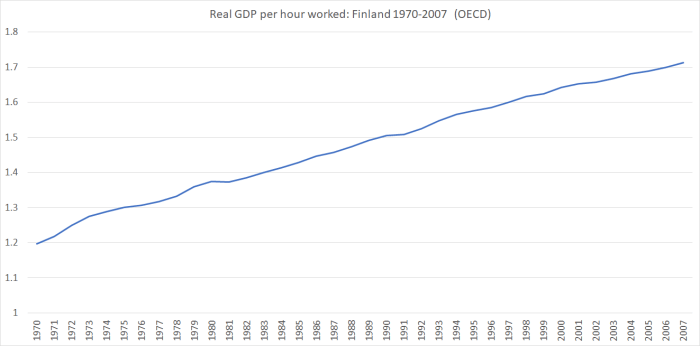
fin real gdp phw

As was the case with the numerous US financial crises in the 19th and early 20th centuries, there isn’t much sign of any enduring damage to productivity (levels or growth) from the Finnish crisis.  That’s reassuring, if not terribly surprising.

(Finland’s economic performance in the last decade has been pretty shockingly bad, including a productivity performance that –  like the UK’s –  is even worse than New Zealand’s over that period.  But that is a story for another day.)