Reserve Bank Annual Reports

Last Friday, the Reserve Bank’s Annual Reports were published.  There were two of them, both required by law.   But most people wouldn’t know that.

There was the outgoing Governor’s own report on the Bank’s performance, the annual accounts etc.  That warranted a press release, and some modest media coverage.  But buried inside the Bank’s annual report was the, quite separate, statutory Annual Report of the Reserve Bank’s Board.    It has no separate place on the Bank’s website, it wasn’t accompanied by a press release from the chairman, although this year it did actually get passing mention in the “acting Governor”‘s press release.

The Reserve Bank Board isn’t a real board, in the sense known either in the private business sector, or in the government sector.  As the Board itself notes “the Board is a unique governance body in the public sector”.  The Board largely controls the appointment of the Governor, and has some say over the recommended dividend.  But otherwise, its powers are all supposed to be about providing a level of scrutiny and monitoring of the Bank –  and in particular the Governor personally – on behalf of the Minister of Finance and the public.  In practice, at least with a public face on, the Board tends to be emollience personified –  nothing to worry about here chaps –  that has very effectively served the interests of successive Governors.

A post about the Board’s Annual Report has become a bit of an annual ritual (2015 and 2016).  But before turning to the substance of the Board’s 2017 report, I wanted to pick up just a few points in the (now former) Governor’s report.

In his final speech as Governor (which I wrote about here), Graeme Wheeler sought to (a) tell a pretty positive story about New Zealand’s economic performance over his five years in office, and (b) claim significant credit for the Bank for that (supposed) good performance.   He returns to the theme in the Annual Report

With our own economy about to enter its ninth year of expansion, it’s useful to put a longer-term focus on New Zealand’s progress. Compared to the period 1990-2012
(i.e., the 22-year period since flexible inflation targeting was first introduced), New Zealand’s economy has experienced slightly stronger GDP growth and much faster employment growth over the last five years. Headline inflation has, however, been weaker and our current account deficit has been smaller as a share of GDP, while the unemployment rate has been around its average for the period since the mid-1990s. Labour productivity growth has been disappointing, a challenge we share with many other advanced economies. While some of these economic outcomes since 2012 lie beyond the influence of Reserve Bank policy levers, the Bank’s monetary policy has been a significant driver behind the growth in output and employment.

Setting aside the minor point that there was a double-dip recession in 2010, and thus any expansion has been running for only around seven years, there is so much wrong or misleading with these claims that it is hard to believe that a serious public figure –  a public servant not a politician –  would repeat them.

Where to begin?

Perhaps with the five years in which there has been no labour productivity growth at all.  Yes, global productivity growth is weaker than it was in the 1990s and early 2000s, but few other advanced economies have experienced anything as bad as New Zealand’s productivity record in the last five years.

Or with the fact that headline GDP growth has been reasonable only because of very rapid population growth.  Growth in real per capita GDP has been pretty poor, largely reflecting the complete absence of productivity growth.  Similarly, rapid employment growth mostly reflects rapid population growth, and unemployment has been above any reasonable estimates of a NAIRU throughout the Governor’s term.

Or with the shrinkage of the export sector as a share of GDP.

Or with house prices.

Or with the fact that, over this particular five years I’m pretty sure that the Reserve Bank was the only advanced country central bank to boldly set off on what it envisaged as a large tightening phase, only to have to (grudgingly) more than complete unwind the tightenings they actually did implement.

With no global crises, no domestic crises, no domestic concerns about conventional monetary policy exhausting its capacity (unlike many other advanced countries), Wheeler should have had a fairly easy five years.   As it is, there isn’t much credit he can claim for the Bank and its monetary policy.

It is the sort of self-serving nonsense the Bank’s Board –  if it was doing its job –  should have been calling out.   Apart from being simply wrong, it isn’t even helpful.  If the Bank had really had the huge influence on medium-term economic performance that the Governor seems to be claiming, it rather undermines the case for having so much power – so many choices-  at such a remove from elected politicians.  The normal case for an independent central bank is that such an agency will keep inflation down and won’t make much difference to economic performance at all.

But there is –  again – little sign in the Board’s Report of serious scrutiny or accountability.  Even honesty seems to be at a premium.

The Board’s Reports have certainly lengthened.  Only three years ago, the Board’s report was only two pages long.    Last year’s report was four pages long.  This year’s report is six pages long, and the first four of them are quite densely-packed text.

But apparently the Reserve Bank does no wrong, ever.  So not only is the Reserve Bank Board “a unique governance body” in the public sector, but the Reserve Bank must be a unique organisation, public or private.   One wonders if it was immaculately conceived, or acquired such perfection itself?

There is two solid pages of text on monetary policy and (as far as I can see) not a word that management would feel even slightly uncomfortable with.  No areas that the Board thinks the Bank might have put greater emphasis on, no disagreement, nothing.

There is another one and a half pages on the Bank’s regulatory functions, but again apparently nothing where the Board thought the Bank might have done better, or areas where a different emphasis might have been helpful. It could all have been written by management (and may well have been).  Management will have been particularly pleased to read this

“The Board has also observed that the Bank carefully considers the feedback it receives on regulatory initiatives, bearing in mind that regulated institutions will not always agree with the regulator’s approach and the eventual regulatory outcomes.”

No doubt, although there is little evidence open to the rest of us to suggest that the Bank pays any heed to substantive feedback in its formal consultation processes.  And one might reasonably wonder whether in a moment of introspection the Board might perhaps think that “monitored institutions will not always agree with the monitor’s approach or the eventual conclusions of the monitor”, and wonder if that description has ever characterised the Board’s Annual Reports on the bank.

And so we labour on through lots of descriptive text about the activities of the Board –  with nothing on the evaluative frameworks they use, or the external advice they draw on.  As we do, we come to the odd interesting snippet such as this

“Monitoring the Bank’s relationships is a continuous process.  During the year the Board availed itself of a number of opportunities to observe how these were operating in practice, paying particular regard to any feedback on the messaging, transparency and accountability of the Bank.”

It looks as though this sentence is supposed to be meaningful, but quite what the meaning is supposed to be isn’t clear at all.    Does it mean that perhaps they were just ever so slightly uncomfortable with the heavyhanded pressure Graeme Wheeler and his senior managers brought to bear on Stephen Toplis and the BNZ (the latter an institution the Bank regulates) when Toplis criticised the Governor’s communications, even if they can’t bring themselves to say so?    One might hope so, but if people who are paid to hold a powerful agency to account won’t even criticise, even diplomatically, such egregious abuse of office, we might wonder again what use they are to citizens.   (And I did lodge an OIA request, the results of which suggests no serious concerns in private either.)

Towards the end of the Board’s report, they write about the change of Governor.  To read this report, one wouldn’t know that the Board had been well down the track towards recruiting a new permanent Governor, oblivious to the election, when the Minister of Finance forced them to stop.  You have to wonder what they gain by the omission, when the relevant material is already public.   They explicitly note that they and Treasury sought advice from Crown Law on the approach to be followed.   Despite that advice, the purported “acting Governor” appointment still appears to be unlawful.  Remarkably, the report contains nothing on the steps the Board had already taken, before the end of 2016/17 to find a new Governor, even though that appointment is one of their principal responsibilities.

Finally, as it does every year, the Board’s Report notes the Board’s relationship to the Reserve Bank’s superannuation scheme (the Board appoints half the trustees including the chair).   This is a deeply troubled fund, grappling with some pretty serious historical errors –  including some made by the Board itself, which must approve rule changes.   I’ve written previously about the role of the Bank’s (now) deputy chief executive –  who attends all Board meetings –  in these matters.   But the Board’s Annual Report simply records the heart-warming fact that the new superannuation fund chair “kept the Board informed of the work associated with the development of a new Deed for the Trust”.  On the principle that when you things you know about are wrong, it leaves one worried about the other material that one doesn’t know in detail.  On this occasion, there was no “new deed”, but some amendments to the rules (largely) to allow the superannuation fund to comply with the new Financial Markets Conduct Act.   As part of those changes, trustees were about to left in the lurch by the Bank –  unremunerated and yet with no liability insurance.    Only threats that the new rules would not be executed (requires all trustees to sign) and a written protest to the Board helped secure a backdown.  And the more serious issues, of past rules breaches, and mistakes in past rule changes, still look set to head to the courts next year.  Millions of dollars are potentially in dispute.

As I’ve written (repeatedly) before, the Reserve Bank’s Board doesn’t really serve much of a useful function.  A thoroughgoing reform of the goverance of the Reserve Bank (including the role of the Board) is well overdue, and there are signs now that whoever forms the next government it may well happen (although I am less optimstic of that if National leads the next government as even if they favour some change, they may not favour changes New Zealand First –  or the Greens if you must –  would support).   If the Board is to retain a role as an accountability and monitoring body, it too will need a shake-up.  Independent resourcing would help, but much of what is really needed is a different mindset, in which the Board finally serves the public, not acting as guardians of the Governor.  My own preference would be for the monitoring and accoutability functions to be undertaken by a Macroeconomic Advisory Council, established formally at arms-length from the Bank, the Treasury and the Minister of Finance.


A national day for lament, not celebration

Eamon de Valera, Prime Minister of Ireland, visited the German Embassy in Dublin on 3 May 1945, to pay his condolences to the Ambassador on the death of Hitler. He apparently justified it afterwards on grounds of diplomatic protocol, but it reinforced ever afterwards impressions that de Valera had been sympathetic to the Nazis.

Yesterday was the national day of the People’s Republic of China, marking the formation in 1949 of the Chinese Communist Party government. Various people have been highlighting photographs that have appeared in the Chinese-language media show National MP Jian Yang at the Chinese Embassy’s celebratory function, posing with Ambassador, the embassy counsellor, and the military attache.

and

(the latter tweet including a link to some further offshore commentary on the New Zealand situation).

Perhaps protocol more or less requires that, for example, the Minister of Foreign Affairs and assorted MFAT staffers attend national day celebrations. It is a part of normal state-to-state relationships. But there is no such obligation on obscure government backbenchers, and certainly no reason for such people to allow themselves to be photographed happily with the leading representatives in New Zealand of such a vile regime. A not unreasonable conclusion might be that Dr Yang is really rather sympathetic to, and supportive of, the PRC regime. Perhaps he just takes the view that what is in Beijing’s interests is, somehow, also in the interests of New Zealanders? Either way, with a (belatedly) self-acknowledged background like his, he shouldn’t be in our Parliament. The National Party should be ashamed to have him in its parliamentary caucus. Should be, but presumably isn’t. There is, after all, no sign that the whips have told him to lie low (and not, for example, be photographed with representatives of the PRC regime).

But, convinced as I am that Yang shouldn’t be in our Parliament – even if, as may well be the case, he has done nothing illegal – in a way, his conduct doesn’t seem out-of-step with that of our professional diplomats; neutral public servants one might hope.

The government-sponsored China Council was out openly celebrating 69 years since the Communist revolutionary victory.

And they were retweeting the enthusiasm of the New Zealand consulate in Chengdu

(note the exclamation mark. Is 68 years of a brutal murderous regime something to celebrate?)

And then somehow I stumbled on the Twitter account of the New Zealand Consul-General in Shanghai. Her tweet managed two exclamation marks.

She describes herself as “Addicted to China. From the government (MFAT) and here to help.”

I guess I can understand a passion of things Chinese, for the culture and history, but “addicted to China” doesn’t exactly suggest the sort of calm dispassion we might hope for from our senior diplomats – in dealing with a friendly country with whom we share values, let alone a brutal regime that appears to directly interfere in the New Zealand political process, and in entities and media outlets serving New Zealand (ethnic Chinese) citizens.

It is as if our entire establishment can’t bring itself to acknowledge the nature of a regime which has gone from one horror to another over the decades, barely regretting or apologising for any of them, and which now – richer and stronger than it was before, if a distinct economic laggard even in the region – poses real and new threats to its own people – the ramping up of surveillance for example – to regional stability, and to countries (including New Zealand) with a significant population of Chinese-born people. Are MFAT and the New Zealand China Council – and the New Zealand government – untroubled by any of this? Perhaps in 1938 their predecessors would have been celebrating the anniversary of the Nazi accession to power, all the while playing up the “trade opportunities”, and quietly observing that it wouldn’t do to upset the party-state?

It is a regime that is evil epitomised for this generation. Not, to be sure, North Korea and yet (a) chief protector of that evil regime, and (b) much more of threat to many more people and countries than North Korea is ever likely to be. And yet National MPs happily celebrate another anniversary of the evil. And quite probably Labour MPs do too, and would were they to form a government.

But it does prompt the question, where is the Green Party in all this?. I’m not a natural Green Party supporter and could not ever imagine voting for them. But over the years I’ve had a certain respect for them, and some of their MPs, when they’ve stood up against oppression, against surveillance, against threats to civil liberties. I was, perhaps a little strangely, an admirer of Keith Locke on this score. But on these issue – whether the specifics of Jian Yang, or the wider issues of PRC meddling- just total silence from the Greens. I’m not sure I really understand why. They don’t represent big and established business interests, and they don’t – as I understand it – have any track record of being heavily reliant on questionable fundraising. If there was ever a time to act as some sort of moral conscience, surely this is one of those?

I’ve found it a little hard to take too seriously earnest calls in the US for inquiries into Russian attempted interference in the US election last year (and am well aware of plenty of instances where the US has interfered in the elections of other countries). But if there is a case for such investigations in the US – and I think there probably is, even though Russia is a much inferior power to the US – how much stronger is the case here for a serious inquiry into the sorts of claims, and evidence, Professor Brady has outlined in her paper.

And there are simpler questions still that should be put to Dr Yang, whether by the National Party itself, or by the media. For example, can you name – say – three occasions on which, since you were elected to Parliament, you have disagreed with a policy stance taken by the PRC, and where you have spoken out clearly in defence of New Zealand interests and values? Shouldn’t be that hard. After all, South China Sea adventurism is in flagrant breach of international law. And the growth of the surveillance state in China under Xi Jinping isn’t exactly consistent with the sort of values the National Party proclaims. Or the increasing uses of “big data” highlighted in this article in the Financial Times today. Or one might ask how differently he sees the PRC being from, say, the Soviet Union or (the much shorter-lived) Nazi Germany – the latter being particularly active among the ethnic German populations in neighbouring countries in the 1930s. Does he look forward to a day when freedom of speech, freedom of religion and multi-party democracy prevails on the mainland – as it does, say, in Taiwan? As I say, it shouldn’t be hard to get clear and straightforward answers from someone who has genuinely abandoned his party (and military/intelligence) past.

Finally, while Dr Yang, MFAT, and assorted official China-promoters in New Zealand are celebrating 68 years of evil, there is this alternative perspective from Hong Kong, where people more readily appreciate the evil, the threat, that the PRC now represents.

I’m not suggesting that our government should deliberately go out of its way to upset the regime. And normal state-to-state relations (as we had in later years with the Soviet Union) are to be expected. But our governments – our diplomats – are supposed to be there to serve the interests, and values of New Zealanders. And that means, among other things, recognising and acknowledging the dreadful character of the regime they are dealing with. Hermann Goering was known to throw a good party too. Nuremberg rallies were, reportedly, spectacular.

Poor returns to tertiary education

Tertiary education was quite a theme in the recent election campaign. In my household – with three kids likely to go to university in the next decade – promises to reduce the direct costs of tertiary education were tempting.  But resisting temptation remains a virtue.

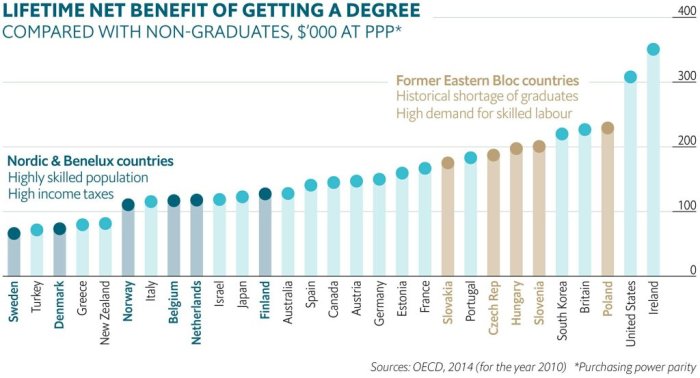
A few days ago I noticed (thanks to Jim Rose) this chart

lifetime benefit of a degree

It isn’t a new result. These OECD data have shown for some time that the economic returns in New Zealand to getting a degree are pretty low relative to those in other advanced countries.   Such results even prompted Treasury to commission some external research on the gap in private returns.

In the chart – from a few years ago – whoever put it together has highlighted two groups of countries: the Nordic and Benelux countries on the one hand, where there are already lots of skilled people, and high income taxes, and former eastern-bloc countries which are now catching up to the rest of the advanced world, and where skills are in high demand, and able to command high returns. I’m, of course, more interested in the contrast between New Zealand and those central European countries.  As I’ve written recently, 25 years ago both we and they were looking to reverse decades of poor performance and catch-up with the other advanced countries. They’ve made progress in that direction. We haven’t.

Since the net benefits are shown in dollar terms (rather than, say, as a per cent of GDP per capita or of lifetime earnings), it is probably reasonable to expect that poorer countries will be bunched towards the left of the chart. And there one finds Turkey, Greece, New Zealand and Italy. But that clearly isn’t the bulk of the story. After all, even though they are now catching up, all six of the former eastern bloc countries shown still have levels of GDP per hour worked and/or GDP per capita similar to or (generally) below, those of New Zealand.

I had a look at a few background documents from the OECD. If anything, as we shall see, the New Zealand numbers may be even worse than what is shown in this chart.

It is important to recognise the distinction the OECD draws between private and public costs and benefits. Some of these things can be easily measured (eg upfront private fees, or direct public grants to institutions or individuals). Others are more approximate. (The other aspect, which I’m not sure any of these particular indicators attempts to account for is the selection bias, in which the typical person who undertakes tertiary study has other traits – eg intelligence – that mean that they would probably earn more in the labour force than the average person who does not undertake tertiary study.)

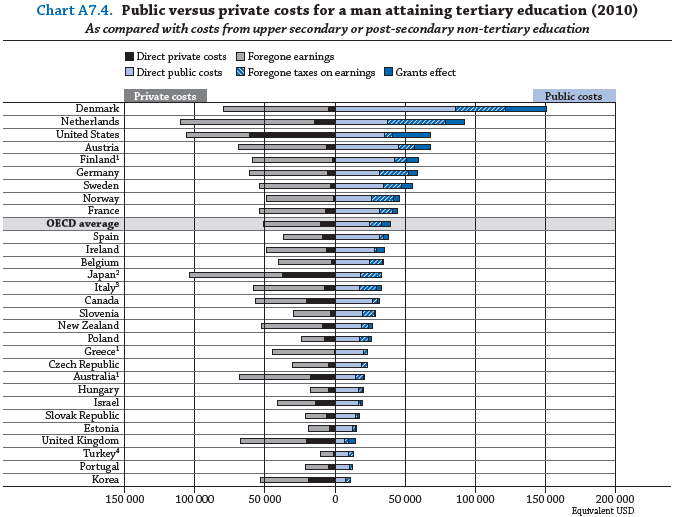
This chart is from a few years ago, and tries to break down the costs of tertiary education (in this case for a man). In New Zealand, as in most countries, the largest private cost by a considerable margin, is the foregone earnings of the student themselves.

tertiary costs

These OECD indicators assume that students do not work while studying.  In the latest OECD Education at a Glance they show estimates for 15 countries as to how much difference it would make to include reasonable estimates of actual student earnings. For New Zealand, doing so would lift the estimated returns to tertiary education by around 15 per cent, more than for most of the other countries shown. However, as you can see from the first chart above, a 15 per cent lift in returns to tertiary study in New Zealand would not alter our relative position on the chart.

The other aspect of the calculations which often doesn’t get much attention is the appropriate discount rate to use in making these calculations. It matters a lot – the costs are mostly incurred between, say, ages 18 and 22, and the economic benefits accrue over decades. A decision by an individual is a very long-lasting investment project, with significant irreversibilities (the years spent on education can’t be reclaimed).

The OECD at present adopts a very low discount rate.

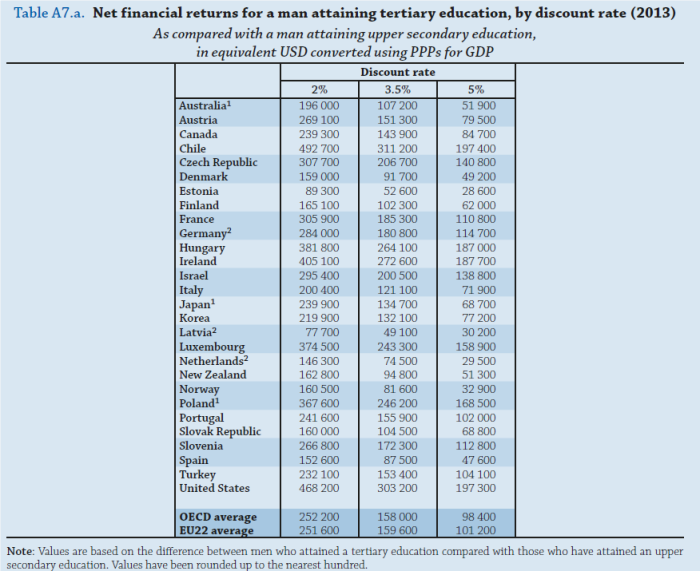
The NPV results presented in the tables and figures of this indicator are calculated using a discount rate of 2%, based on the average real interest on government bonds across OECD countries. However, it can be argued that education is not a risk-free investment, and that therefore a higher discount rate should be used.

I’d say there was no ‘it can be argued” about it. No sensible government would do a cost-benefit analysis of building more schools or universities using a discount rate of 2 per cent. The New Zealand Treasury, for example, uses a default discount rate of 6 per cent real. And as an economic proposition, an individual’s tertiary education is a pretty risky proposition, with few effective diversification options for most people.

As it happens, in the latest Education at a Glance the OECD presents a table illustrating, to some extent, what difference it makes to use a higher discount rate.

discount rates.png

Using a discount rate of 5 per cent (real) reduces the estimated benefits by around 60 per cent (relative to the 2 per cent baseline) – and these numbers are for a man, and in most countries the net benefits to tertiary education for a woman are (on average) lower than for a man.

This issue matters particularly for New Zealand which has a higher risk-free interest rate on average than any of the other countries in the table. The gap is large. On Friday, the real interest rate on the New Zealand government’s longest (23 year) inflation-indexed bond was 2.39 per cent, while that for the US government’s 20 year indexed bond was 0.77 per cent (and US yields are far from the lowest in the world). A margin of 1.5 percentage points above “world” rates hasn’t been a bad guide for New Zealand interest rates over recent decades.

Even a 5 per cent real discount rate appears too low to evaluate a personal decision to invest in a tertiary education in New Zealand. But if one takes the results for New Zealand in the table above when evaluated at a 5 per cent discount rate, and then compares them against the results evaluated at 3.5 per cent for other countries (to capture that persistent difference in real interest rates), only Latvia would offer lower returns to tertiary education than New Zealand does.

And bump up the discount rate a little more and the estimated net returns to tertiary study will soon be approaching zero or going negative.  And, remember, those estimates are for a man. The average female returns are even lower.

People will have a range of reactions to these sorts of numbers. Some will take them as supporting proposals to reduce tertiary fees or increase student allowances. Such changes might increase the net private returns to tertiary education, but they won’t (of course) change the all-up net returns (someone still has to pay).  Others seem to see tertiary education as some sort of “merit good” that people should have the opportunity to undertake, at moderate expense, whether there is an economic return – to them, or the public more generally – or not.  And, of course, for some people and some courses, a tertiary education is more akin to consumption than investment (which is not intended as a criticism).

For me, I see them as yet another marker of the failure of the economic strategy pursued by successive governments over recent decades.  Our remoteness means it is very difficult to generate consistently high returns to anything much in New Zealand for very many people. The determination of our governments to quite rapidly increase the population here, despite those apparently limited opportunities, just compounds the problem. It does so directly – the limited natural resources (our one distinctive advantage) are spread over ever more people – and indirectly, through a persistently overvalued real exchange rate and high real interest rates.

Returns to tertiary education in New Zealand are probably quite reasonable for those New Zealanders who get an education here, and then leave (but that is probably a poor investment for the taxpayer). For many of those who stay, it looks like a distinctly marginal proposition. Attempting to bring in lots more skilled people from abroad – most of whom aren’t that skilled anyway – just compounds the economic problem, even if the New Zealand taxpayer doesn’t have to pay anything for their tertiary education. There just aren’t the good economic opportunities here for a rapidly growing population, and increasing subsidies to tertiary education would seem likely to further exaggerate the evident imbalances.

In an economy that was making progress towards reversing decades of relative economic decline, there is good reason to expect that returns to investment in tertiary education (like other prospective investment returns) should be consistently high relative to those in other countries. Sadly, those returns appear to be consistently low in New Zealand – especially when evaluated at an appropriate discount rate. And, of course, we are making no progress at all in closing those productivity gaps.