Reforming Reserve Bank releases

I went into town this morning to talk to the Reserve Bank’s inquiry looking into the possible leak of last week’s OCR announcement (see last paragraph here).  I still have no idea whether there really was a leak, but it seems likely, and if so it seems likely to have come from one or other of the lock-ups the Bank runs, for analysts and for the media.

But the discussion this morning got me thinking again about some of the Reserve Bank’s processes around OCR decisions and Monetary Policy Statements. Insiders will recognize some old familiar arguments.

In many ways, it is remarkable that the Reserve Bank has not had an OCR leak, deliberate or inadvertent, before now (the memory of a couple of other earlier ones –  one deliberate and wilful, one inadvertent, are still seared in my memory).  As the Governor noted in his press conference last week, the decision to cut the OCR had been made the previous Friday –  six days before the announcement.  That delay is shorter than it used to be –  at one stage, the OCR decision was being made more than two weeks prior to release – but much much longer that it needs to be, or than is the typical practice in other countries.  In other countries, official interest rate decisions are typically announced within hours of the decision being made.  Draft news releases announcing the decision (and covering the range of possible options) must be part of the package of papers before the respective decision-making committees.

Delays have not always been that long in New Zealand. Prior to the introduction of the OCR in 1999, the Governor used to finalise any announcement on monetary policy (since we weren’t setting a specific interest rate, the announcements were more about the Bank’s overall take on things) at a 7:30am meeting in his office on the morning of the release of the Monetary Policy Statement.

The long lag between the Governor taking the OCR decision and the release of that decision arises solely because the Reserve Bank has chosen to release, four times a year, Monetary Policy Statements at exactly the same time as the OCR announcement (in fact the OCR announcement on these occasions is chapter one of the Monetary Policy Statement).  Long documents take much longer to finalise than one page OCR announcements do.

But there is no need for the two documents to be so intertwined.  Other central banks typically don’t do it that way.  In fact, in law, the Reserve Bank only has to publish two MPSs a year.    And, frankly, the MPSs (which are shorter than they used to be) often don’t add very much beyond what was in press release –  or certainly not much that couldn’t wait for a few days.  I’d favour the Bank moving to a system of monthly OCR reviews (well, 11 months a year), making the announcement the day the decision is made, and moving to publish two, or at most three, Monetary Policy Statements a year, not tied to the date of any particular OCR announcement.  On the one hand, it would improve security and markedly reduce the opportunity for inadvertent leaks, and on the other it might encourage the MPSs to become vehicles for more substantial background analysis and evaluation, along the lines of what the statutory provisions seems to envisage.

The counter-argument, of course, is that monetary policy is forecast-based, and so we need to see the forecasts to make sense of the policy.  It is fine argument in principle, but bears little relationship to reality.  Mostly, central banks respond to the immediate flow of data.  Yes, those data have implications for what happens in future, but almost all the information is typically in the initial revision of view –  about where things are right now, or perhaps a few months ago.  And, of course, as anyone who has been inside these processes knows, the forecasts are often adjusted to reflected the Governor’s priors about policy and policy messaging (the stuff dealt with in a couple of paragraphs in the press release).  That isn’t a criticism –  we know so little about the future that I think it is mostly right, proper and sensible as an approach.  But a full set of forecasts, and all the commentary that goes with them just isn’t necessary for the policy messages to be got across effectively. In fact, often less text is better than more on a policy announcement day –  there is less chance of inadvertent differences of emphasis etc.

My other suggestion is to consider discontinuing lockups.    Other central banks typically (as far as I know) don’t do them: they put the policy announcement out in the public domain, including as much or as little elaboration in the statement as the occasion warrants, and leave it to analysts and markets to work it out for themselves (sometimes with the benefit of later, open, press conferences).

There is case for lock-ups for some sorts of releases.  Government budgets seem like a reasonable example, when there is a multitude of announcements, often of complex unfamiliar material.  Or the release of major in-depth reports on some specialized aspect of government (which might be hard to report well, but perhaps not very market-sensitive).  It isn’t obvious that OCR announcements fit that bill.

Of course, the Bank does not typically do lockups for the OCR announcements that don’t come as part of Monetary Policy Statements, suggesting that –  in principle at least –  the Bank agrees that OCR announcements don’t need lockups.  The lockups must be for the rest of the MPS documents.  But they are quite familiar in structure and content, and little of the content is particularly complex or unfamiliar.

The Bank’s lock-ups come with two sets of risks.  The first is the risk of leaks.  The information in OCR announcements is enormously market sensitive –  look at how much and how quickly the exchange rate moved on last week’s announcement, creating a huge incentive for someone to try to cheat.  40 years ago it might have easy to secure people in an ordinary room, with no risk of them being able to communicate with outsiders.  Central bankers weren’t at much of a disadvantage in managing those who might want to cheat.  It is hard to believe that the playing field is quite so level these days, with all the advances in technology, including very small scale technology.   At least while I was at the Bank, the analysts’ lock-up used to occur in a room in which people could be seen quite easily from neighbouring apartments (other clever ways of signaling, getting round the rules, were covered in this recent New Yorker article –  more, outside fiction, than I had ever read about bridge).  Perhaps no one ever abused the systems, but why take the chance that someone one day finds (or just exploits) a way around the Bank’s precautions?       Perhaps they did last week.

The second risk, and perhaps more often practically important, is that the lock-ups are not just occasions when people are shut in a room with a document and left to digest it.  In these lock-ups staff, often quite senior staff, are available to answer questions and offer clarifying comments.  There is often plenty of ambiguity around Reserve Bank statements –  it isn’t like the specifics of a technical Budget announcement  –  and that creates the risk that attendees of a lock-up get information on the Bank’s views and interpretations that isn’t available to everyone else, or that people get slightly different messages depending on who they happen to talk to in the lock-ups.

It is quite valid for the Reserve Bank to have messages it wants to convey with OCR releases.  Those messages should be written down –  debated and refined internally as required –  and then be available to everyone. Further comment shouldn’t really be necessary, but if it is necessary or desirable to have occasional press conferences then at least (as the Bank does) they can be audible/visible to all (via the webcast).

On another, different, Reserve Bank topic, I was talking the other day to a business person who had been visited by Reserve Bank staff on their regular business visits, gathering conjunctural information.  This person told me that he had asked the staff whether the Bank was doing any work on reforming the governance of the institution. The staff apparently responded that they were doing so.

If this report is accurate it is quite newsworthy.  Previous reports had led us to believe that the Bank had done extensive work on possible governance reforms, but had completed the project.  They would not release any of the papers relating to the work.  Information that The Treasury released a few months ago confirmed that the Bank’s work has been discontinued, and that the Minister of Finance had indicated (against Treasury’s preferences) that he did not want work in that area continued with.  Perhaps some journalist might care to ask the Bank whether this report is accurate, and whether they do have work underway on governance reforms.  If they do, and if the Minister is becoming more interested, that would be very welcome news.   But perhaps some young economist just had the wrong end of the stick, or misinterpreted the question?
A strange op-ed from a business lobby group

There is a strange op-ed in the Dominion-Post this morning from Kirk Hope, the new chief executive of BusinessNZ.  I can’t yet see it online, but the point of the piece seemed to be that there is (a) more to New Zealand than dairy, and (b) New Zealand isn’t in a recession.

If he’d stopped there, I’d have no problem with the story.  But he went on to paint a rosy picture of how New Zealand is doing, and has been handling things, relative to other countries.

There is, for example, the claim that our rate of GDP growth (2.5 per cent in 2015)

“…is better than most developed countries.  The current rate of growth in the United States is 2.4 per cent, while in Britain it is 2.2 per cent, in Germany 1.7 per cent and in Japan 1.3 per cent.”

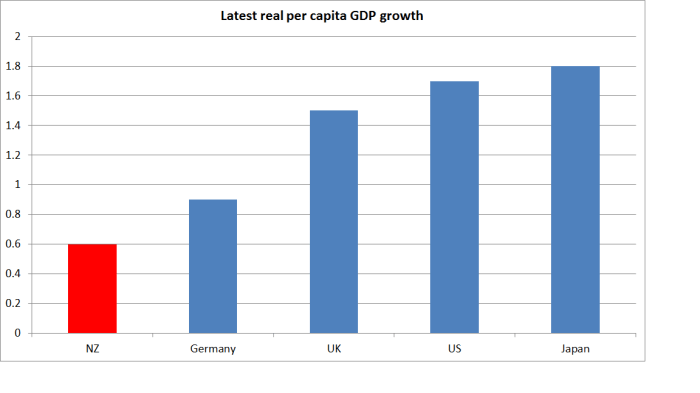
Was he perhaps not aware that New Zealand has been experiencing considerably faster population growth than all these countries?  Using the 2015 population growth data from the IMF WEO database, here is how per capita GDP growth looks for those five countries.

real gpd pc kirk hope

Spot the disappointing performer.  It gets worse, of course, because our terms of trade have been falling.  Real per capita national income actually fell a little in New Zealand last year.

In the short-term, it isn’t a disastrous performance (and there are countries we’ve done better than), but it isn’t very good either.

Amid his rampant optimism, Hope also injects this argument:

“Just as importantly, we are fortunate to have escaped one of the key mistakes made in other parts of the world in the aftermath of the global financial crisis.  While other countries chose to expand their money supply with quantitative easing to shore up their economies, New Zealand instead opted for investing in infrastructure –  roads and broadband –  which is a far more growth-enhancing approach”.

Of course New Zealand didn’t do any quantitative easing. Other countries did so only when policy interest rates got to around zero and they concluded that they couldn’t do anything much more with conventional monetary policy.

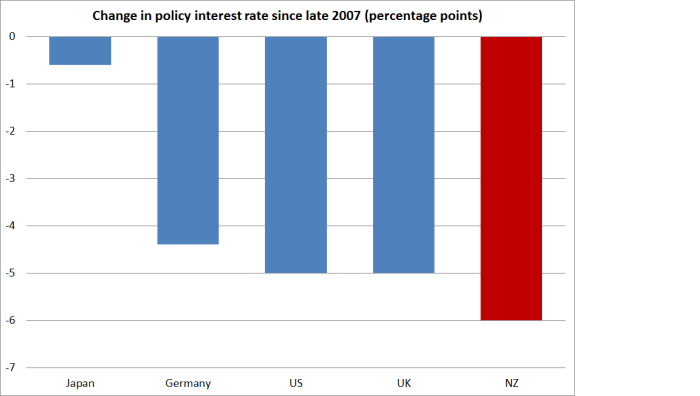
But which of Hope’s countries has cut interest rates further since 2007/08?

policy int rates

Why, New Zealand.

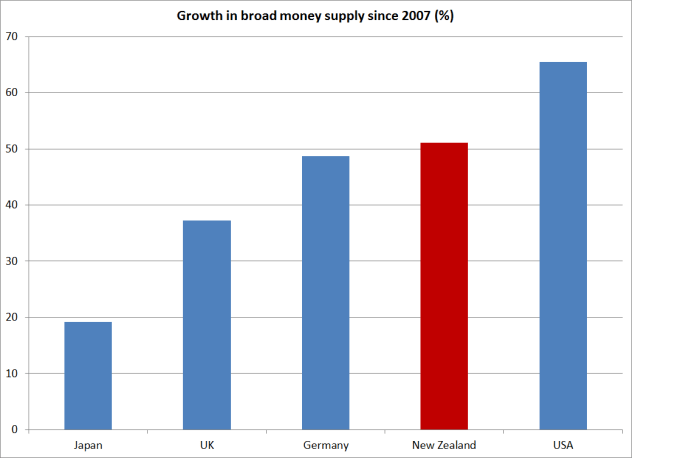
And what of the money supply itself?  Well, of the five countries, New Zealand has had the second fastest rate of money supply growth.

money supply

The euro-area as a whole has had money supply growth even weaker than the UK’s –  a mark of the problems the euro region has had.

As for “investing”, I suspect that few of Hope’s own member businesses will have been undertaking projects on quite such shaky or non-existent cost-benefit analyses as those which underpinned much of the public investment that occurs in New Zealand.  I’m still flabbergasted at the memory of asking a senior minister at a seminar a few years ago why there had been no cost-benefit analysis for one major initiative and being told, with a smile, that it was because he already knew the answer.

Thinking Big…..

…and drifting ever further behind (the rest of the advanced world).

That was the title of my address this morning to annual New Zealand Initiative Members’ Retreat in Auckland.  It is a gathering  of several dozen chief executives and senior executives of the Initiative’s corporate (and government) members.

Here is the text.

Drifting slowly ever further behind NZI retreat presentation 17 March 2016 

I was sharing a session on the economy with James Shaw, the leader of the Green Party.  I’m not sure how we got grouped together –  perhaps speakers the organisers thought the attendees would be rather suspicious of?

I talked only briefly about the current state of the New Zealand and global economies, concluding that there wasn’t much positive to look forward to over the next few years from either source, but that at least New Zealand didn’t seem to face much risk of a domestic financial crisis.

notwithstanding the obscene level of Auckland house prices, and the overhang of dairy debt, New Zealand as a whole has not been on some credit-fuelled rampant boom.  If we take the country as a whole, our dependence on foreign capital (the NIIP position as a share of GDP) has largely gone sideways for the last 25 years. Perhaps ideally it would have shrunk a bit, but this is no Greece, Spain, Ireland, or Iceland.  Or even the US –  with all that government sponsored or promoted poor quality housing lending.  Risks of a domestic financial crisis should rate very low on your list of concerns.

I got the impression that some people thought that was about the only upbeat comment in the speech.

The rest of the address was about the longer-term economic challenges facing New Zealand.  I pointed to some of the stylized facts:

  • persistently high (relative to other countries) real interest and (relative to our relative productivity trends) real exchange rate,
  • the continuing decline in our relative productivity (labour or MFP),
  • the failure to see any expansion in tradables production per capita over 15 years, and
  • the failure of Auckland incomes to rise relative to those in rest of the country, despite all the emphasis on possible agglomeration benefits and a policy focus on promoting Auckland.

I noted that New Zealand had been, and remains, a natural-resource based economy.

Modern New Zealand has always been, and remains, a natural resource-based economy, and no one is making any more land, sea or other natural resources. We find new and smarter ways to maximise what we earn from the natural resources – productivity in agriculture in recent decades, for example, has been quite impressive  –  but that doesn’t change the fact that we have a given stock of natural resources and a fairly rapidly growing number of people.    For each new person we add there are simply fewer natural resources per capita.    In a well-ordered society, abundant natural resources are a blessing not a curse, and there are plenty of opportunities for productivity gains in many of those industries.   But the stock of resources isn’t increasing, and the people are.

That wouldn’t matter if we were rapidly growing industries that were taking on the world based largely on the skills and talents of our people. After all, there are no known bounds to human creativity and ingenuity.    You could think of the US or the UK, or Belgium or Ireland.  But we aren’t.

What New Zealand exports has changed over 170 years – at one stage, gold was our largest export, perhaps whale products at one stage even earlier.  Optimists like to point out the agricultural exports have diminished in relative significance.  But if we look at all our exports, our natural resource based exports –  agriculture, oil, fish, gold, (most) tourism, forestry, aluminium –  make up probably 80 per cent of our total exports (good and services).  That proportion isn’t shrinking materially.  There are some globally successful companies based here, who don’t primarily draw on the natural resource base – Fisher and Paykel Healthcare might be the best known – but there aren’t many, and there is simply no sign of the export base transforming.  Exports of educational services have been in the headlines this year: they are a welcome boost, but we aren’t exactly selling premium Ivy League type products.

Against this background, I drew attention to the failure of our skills-based immigration programme

Unfortunately, there is not the slightest evidence that the New Zealand strategy has worked.  The formal evidence base around the economic impact of immigration to New Zealand is unfortunately still quite limited, and we never quite know what would have happened without the immigration.  But it was never a strategy that was likely to succeed.  For one thing, New Zealand is small, remote and (by advanced country standards) relatively poor – not exactly first choice for the hard-driving and ambitious best and brightest.  Our universities are middling at best, so we can’t attract many potential stars that way.  As Hayden Glass and Julie Fry  reportedly point out in their new book, our skills-based programme has been attracting less skilled people, on average, than the Australian or Canadian programmes.

And

There is simply no sign of a fast-growing knowledge-based outward-oriented tradables sector, that would lead faster national growth in productivity and incomes, emerging here. [Auckland].

And nor would I expect it to: this is a natural resource based economy, and simply not a place where those knowledge-based industries would naturally locate in any number.  Even if they started here, in many or most cases the owners could maximise value by relocating (or selling) abroad.

New Zealand might have plenty of smart people and low regulatory barriers to starting businesses but it seems to be a pretty poor place to base global business.  That seems to be our experience.  But look around the world, and you simply don’t find many such businesses on remote islands.

And

In their individual wisdom, knowing their own country, New Zealanders has been recognising that prospects for them and their families are better abroad than here.  Even last year, more left than came back.   And yet our governments –  backed more or less by all political parties –  have simply decided to bring in huge numbers of new people each year.  It is an astonishing example of a central planner’s hubris –  a whole new Think Big strategy in which governments, all with the best will in the world, mess up the stabilising adjustments that would otherwise have been underway.

Governments don’t help by messing up the housing market but, salient as that pressure is, especially here in Auckland, it isn’t the real issue. The real issue is simply that there are no new really good income earning prospects –  new highly rewarding export industries – that the much higher population is enabling us to tap.  We haven’t found new natural resources or ideas that need lots more people to take full advantage of them.  Of course, we sustain reasonable total GDP growth building to support a rising population, but it does nothing to close our productivity deficits.  And because people can’t be used for two things at once, the need to build to accommodate the ever-rising population crowds out some productive, internationally oriented, investment that would otherwise be profitable here.  If we keep on with such a strategy we’ll keep on, little by little, drifting further behind the rest of the advanced world. We are simply in the wrong place to support very many people.  No other remote island has anything like our population.  Our own people have implicitly recognised the limits of New Zealand for decades. It is governments and their official advisers who seem blind to it.

Concluding that we need to change course

Closing those gasps will take far more rigorous and robust analysis and advice from our key economic agencies, such as Treasury and MBIE, that looks hard at all the symptoms of our longer-term economic condition.  But it will also take political will, drive and vision –  and a willingness to put aside the implicit “big New Zealand” mentality that has shaped so much of our history –  from Vogel to Seddon to Holland to Holyoake to Douglas, Birch, Clark and Key. 

New Zealand isn’t in short-term crisis, and for that we can be grateful.  But our people –  our kids and grandchildren –  deserve more than leaders simply smoothing the pillow of continued relative decline, all the while pursuing a flawed “Thinking Big” more-people strategy that failed in the post-war decades, and has failed again in the last 25 years.

Depressing?  Well, several people thought so, one pointing out how fitting it was that I’d named the blog for Cassandra.  Personally, I’m a lot more optimistic than that.  I reckon there is no reason at all why a bunch of smart people can’t generate really high per capita incomes in these pleasant islands, combining our skills, institutions, and natural resources.  Various other small countries do so –  mostly from oil, but there is nothing unique about that particular resource.  We have been deluding ourselves –  or rather our politicians and officials have –  in the belief that a bigger population and bigger cities are the path to success.  There is simply no evidence they have been so far – not just in the last few years but in the many decades since the last really positive New Zealand-specific productivity shock.  But that is really quite easy to fix.  We can’t change where we are in the world, which is a big drawback in many ways – some activities are just never likely to be generated to any large extent in places like New Zealand –  but that shouldn’t hold back our living standards so long as we avoid the central planners’ ambitions to rush to populate.

But if you still reckon my presentation is bleak, James Shaw trumped it with a fairly shockingly dark joke.  (It was a Chatham House rules occasion, but he said I could say that) talking about robots and the risks they might pose he recounted a joke he’d come across on Twitter.

9 year old girl:  Daddy, will robots one day rule the world?

Father:  Yes, dear.  Probably.

9 year old girl:  Daddy, will that be before I die?

Father:  Probably dear.  Just shortly before.

Finally, I learned today that the New Zealand Initiative is planning to do some substantive work on the economics of immigration in New Zealand.  It might still be some way off, but I welcome the prospect of the work being done, and look forward to what they come up with.  Eric Crampton apparently is keen on inflows that would enhance the availability of Latin American cuisine.


Setting interest rates: no need to change the system

Andrew Little has moved on from wanting to “stiff-arm” banks over dairy foreclosures, to talking of the possibility of legislating to force banks (and other lenders?) to pass on in full any OCR changes.

It isn’t the oddest idea in the world – and personally I find the new talk of a Universal Basic Income, much as it has also been propounded by some  on the right, including Milton Friedman, rather more consequential, and worrying.  Many quite sensible countries set fixed exchange rates.

For 15 years in New Zealand –  1984 to 1999 –  we didn’t have a government agency setting interest rates at all.  For much of that time, many of us at the Reserve Bank thought that was only right and proper.  And when we first proposed an OCR-like system, many of the leading economics commentators and bank economists were pretty dismissive.  But in 1999 we simply concluded that –  like most of the rest of the advanced world –  it made more sense to set, or manage directly, an official interest rate.  And now that model is just taken for granted.

Of course, setting the OCR isn’t the same as setting the individual interest rates for each borrower, but I’m sure that if he gave it any thought that isn’t what Little means either.  Perhaps he just means that the Reserve Bank should be able to direct set some commercial bank base lending rate against which all other lending rates have to be calculated? It seems administratively cumbersome, and perhaps prone to being circumvented –  not unlike much other government regulation, including (for example) direct restrictions on mortgage lending of the sort once unknown in New Zealand but now imposed by the Reserve Bank and accommodated by the current government.  And it is not as if governments universally eschew price-setting in other markets either –  the government recently proudly announced an increase in the regulated minimum price for labour, talking of wanting to push that price (once just a market price) up as fast as possible.

One of the attractions of an OCR-type arrangement is that it is a fairly indirect instrument.  The Reserve Bank can put the OCR pretty much wherever it needs to to deliver on an inflation target.  That is an imprecise linkage, but it works pretty well (at least if the Reserve Bank is reading underlying inflation pressures correctly) and it does so without needing lots of direct controls or impinging very directly on anyone’s business or financial affairs.  The OCR is simply the rate the Reserve Bank pays on deposits banks (and any other settlement account holders) have at the Reserve Bank, and the rate at which the Reserve Bank will lend to banks on demand (against good quality collateral) is pegged to the OCR.   The amounts banks borrow from and deposit with the Reserve Bank aren’t that large : bank balance sheets total almost $500 billion, and bank deposits with the Reserve Bank are fairly stable, currently around $9 billion.  And yet changes in the rate paid on these balances, which don’t move around much, provide substantial and sufficient leverage (partly signaling, partly a change in pricing on one component of the balance sheet) for macroeconomic stabilization purposes.    It isn’t a mechanical connection, but it works.

A variety of other models might too, but the judgement has been –  not just here, but in other similar countries – that an indirect approach like the OCR is less intrusive and has fewer efficiency costs than the alternatives.

And it is not as if there is some obvious problem.  Here is a chart, drawn from data on the Reserve Bank website, showing floating residential mortgage interest rates and six month term deposit rates since 1965.  (It is an ugly chart because the mortgage rate data are monthly throughout, but the term deposit rates are quarterly until 1987).

retail interest rates

Largely, lending rates reflect deposit rates (and to some extent vice versa).   These aren’t perfectly representative indicators, just what we have.  But for the almost 30 years for which we have the full monthly data are available, the average spread between these two series was 2.45 percentage points, with a standard deviation of 0.6 percentage points.  The latest data are for February, and the spread was 2.49 percentage points.  One would expect spreads to move around a bit –  demand for individual products ebbs and flows, and the links between foreign funding markets and domestic term deposit markets aren’t instant or mechanical –  and they do, but there is no obvious or disconcerting trend.

Through the period since 1965 we have had all manner of regimes.  Direct controls on lending rates, direct controls on deposit rates, indirect controls on one, other or both, no controls at all, and then for the last 17 years direct control of the interest rates on one small component of bank balance sheets.  Go back far enough, and during the 1930s a conservative government legislated to lower all lending rates.  But it just isn’t obvious that there is any need to change the operating system now.

To a mere economist, it is a bit of a puzzle what Little is up to.  No doubt the Opposition needs to be seen to be offering alternative policies, but these issues (bank lending rates and dairy foreclosures) don’t seem like an area where there is a substantive policy issue (while there are many other areas of policy where the same could not be said, such as New Zealand’s continuing slow relative decline).  But there does seem to be quite a strain of anti-bank sentiment in New Zealand –  perhaps especially anti foreign banks, the same sentiment that gave us state-owned Kiwibank under the previous Labour-Alliance government.  Perhaps people on the left here are looking to the US and the striking degree of response Bernie Sanders is achieving for his populist message, much of which is centred on an anti Wall St message?


Inflation expectations according to the RB

The Reserve Bank yesterday released some material explaining how it sees the role of inflation expectations, and measures of inflation expectations, in monetary policy.  There was a background Analytical Note on some of the technical modelling (putting a smooth curve through the selected expectations series), and I won’t say any more about it.  But then there was an issue of the Bulletin, headed “Inflation expectations and the conduct of monetary policy in New Zealand” and an accompanying substantive press release.

Recall that articles in the Bulletin carry the imprimatur of the Governor – they speak for the Bank, and aren’t just the views of the authors.  But this short one must do even more than most given that (a) it is directly about the conduct of monetary policy, the Bank’s primary function, and (b) that John McDermott, head of the Economics Department, is himself one of the co-authors.

Frankly, I found the article a little disconcerting.  I don’t often agree with the BNZ economics team these days but they came away from the article commenting “It all feels very mechanistic” and that captured part of my reaction as well.  I’m pretty sure that the Governor isn’t as mechanical in his approach as the article might imply, but it was a little disconcerting nonetheless.

There is also a slightly eerie detachment from the real world about the article.

The authors don’t take the opportunity to illustrate whether inflation expectations matter at all, or (more specifically) whether the measures of inflation expectations they use actually affect economic behaviour of firms or households.  There are many confident statements throughout the article about how inflation expectations “will” or “do” affect various things, and they are all true within a particular model, but the authors don’t show that they reflect real-life economic behavior.    For example, the notion that expectations of future inflation might affect wage-setting sounds plausible, but it is no more plausible than the notion that employers and employees mostly have in mind the most recent trend in past inflation.  If you pushed them on it, they might well respond “well, specialist economic forecasters can’t forecast inflation remotely well, so a rule of thumb based on past trends seems better for everyone in normal circumstances”.   The same logic could easily be applied to implicit calculations of real interest rates.  Perhaps further empirical work from the Bank will shed light on all this?

I made the point last week that in relatively stable economic times, survey measures of inflation expectations may be little more than a lagged report of something people already have to hand –  data on recent trends in inflation itself.  If so, all this work on measures of inflation expectations may be largely devoid of substance –  and, if anything, simply lead the Bank to reacting more slowly to deviations of inflation from the target than it should do.

Strangely, in the entire article there was also no discussion of the length of nominal contracts.  As I’ve pointed out previously, expectations of inflation 20 years hence are very unlikely to affect much economic behavior today, and are certainly unlikely to influence inflation outcomes today.  There are simply very few nominal contracts fixed for that length of time, or indeed for anything much beyond one to two years.  So if the Bank believes that some concept of inflation expectations is affecting demand and pricing now, surely it has to be expectations about the horizons over which people are entering nominal contracts?  Most wages and prices are reviewed at least annually, and not many interest rates are fixed for much longer than two years.  These details matter.

And yet in the Bank’s material they are glided over.  Here is some text from early in the article

 One important aspect is the influence that inflation expectations will have on wage- and price-setting behaviour at horizons relevant for forecasting inflation and setting monetary policy.

A further important aspect is if inflation expectations are well anchored. In the New Zealand context, ‘well anchored’ implies long-term inflation expectations that are a) relatively stable, and b) close to the mid-point  of the current policy target range. Well-anchored inflation expectations are an important component of inflation targeting. However, determining whether inflation expectations are well-anchored is not a clear-cut decision. In practice, inflation expectations are unlikely to be continually anchored to a fixed point.  Instead, the Bank must judge whether the level and any volatility of inflation expectations are influencing wage- and price-setting behaviour in a way that is consistent with medium-term price stability.

The first paragraph on its own is fine –  although note the “will”, where “might” or “can” might better capture the uncertainty.  It is focused, it appears, on the one to two ahead horizon, which both captures the sorts of horizons over which nominal contracts are made, and the horizon over which monetary policy influences things.

But then things start getting muddled.  They introduce this concept of inflation expectations being “well anchored” –  which got a lot of attention in the MPS last week – but here they aren’t talking about expectations over the horizons of price-setters, and monetary policymakers, but out into the far future –  “long-term expectations”.   Not content with drawing the distinction, they then seek to loop back later in the paragraph to the potential disruption to current wage and price-setting behavior.  But surely if there were problems affect the current situation they would show up in the measures of expectations over a one to two year horizon?

But how much content is there to this focus on long-term expectations, as anything of relevance to current monetary policy?  My answer: not a lot.    The Reserve Bank focuses on survey-based measures.  There are quite a few longer-term survey questions, but (a) the Bank simply ignores surveys of households in its modelling, (b) there are no longer-term surveys of businesses, which (c) means that the survey measures of inflation expectations they use are all those of the same small group of economists.

As I’ve noted previously, if forced to write down my expectation for inflation in 10 years time I might well write down 2 per cent.  Why?  Well, it would have nothing whatever to do with my confidence, or otherwise, in Graeme Wheeler or John McDermott. They are unlikely to be in the same job 10 years hence, and we will have had several PTA renewals and elections before then.  I’d write down 2 per cent –  with quite wide confidence bands, and relief that nothing depended on the answer –  just because the wider world has not yet confidently settled on a target any different than 2 per cent.  If instead I wrote down 3 per cent it still wouldn’t reflect badly on Wheeler and McDermott who have to operate with the current PTA –  it might simply be a prediction that eventually central banks and governments might decide that higher targets are safer, in the presence of the near-zero lower bound.  The Bank uses these long-term measures,(and the average of them, the “perceived target focus”) as follows:

 If this measure is close to the official inflation target mid-point, this suggests the public see the Bank’s projections as credible

But this seems hard to take seriously.  The Bank’s projections cover the next couple of years. The long-term measures are about periods five or ten years hence. And they don’t even get information from “the public” –  just from a handful of economists.  The current PTA won’t be in place five to ten years hence –  indeed, most of the Opposition political parties want to have changed the framework by then –  and most probably neither will the current monetary policy decision makers.

I like lots of data, and the more surveys the better tended to be my mantra.  But there is, essentially, nothing in the long-term survey-based measures that is of any relevance to day-to-day monetary policy setting or to assessments of how well, or otherwise, the Bank is doing its job.   Expectations that far ahead, even if they were real expectations of firms and households transacting, simply don’t affect inflation today, and nor –  except perhaps in extremis –  do they provide any useful information about whether current monetary policymakers are doing their job.  The Bank really shouldn’t be taking any comfort from those surveys –  perhaps especially given that the same economists have over-predicted inflation in recent years even more than the Reserve Bank itself did.

Market-based measures are a little different.  We have limited information of this sort in New Zealand, but the gap between indexed and conventional government bonds is an implicit (if imprecise) measure of expectations.  These implicit expectations are an average expectation for the next 10 years –  different, say, than expectations for inflation 10 years hence.  At present, the implicit expectation is about 1 per cent.  Such long-term implicit expectations don’t much affect day-to-day price or wage-setting now, but at least they involve people putting their own money at stake.   They tell us something about which longer-term risks markets are currently more worried about  –  and not just in New Zealand but in various other countries, at present that is about the risk of longer-term inflation persistently undershooting targets.

The Reserve Bank really should be much more concerned about the outlook over the next one to two years, the period its decisions today are affecting.  And here the article becomes much more sobering

There is also evidence that inflation expectations have become more adaptive recently. The public is placing greater weight on past inflation outcomes rather than the inflation target when forming expectations about inflation. A shift towards more adaptive inflation expectations can help explain some of the unusual weakness in non-tradable inflation seen in recent years. This means the cost of re-anchoring inflation expectations could be higher than in the past.

And

There has been a material decline in inflation expectations recently, and the time that inflation expectations take to reach the target mid-point has increased significantly. This is likely having a dampening impact on prices, and risks becoming embedded in future wage and price decisions.

Remember that these are the shorter-term expectations, over the one to two year horizon, they are now talking about.

We shouldn’t be surprised that expectations measures have become more adaptive (backward looking) recently.  Inflation has been persistently below target for several years now.  The Reserve Bank, and private forecasters, have persistently told us that inflation would soon be back to target, but it just hasn’t happened.  The Reserve Bank seems to slowly be waking up to the fact that these persistent forecast errors might matter.

But it is striking how the explain it

The time to target has increased recently (figure 4). Low actual inflation outturns have likely driven this decline. Low inflation outturns reflect a number of factors, including global spare capacity, an elevated exchange rate, a sharp drop in oil prices, and a significant fall in dairy prices

Notice the striking omission from the list.  There is no sense in that list that monetary policy errors, even if only with the benefit of hindsight, might have played any part in the repeated undershoot of the target, and the way it now appears to be affecting inflation expectations measures.  Inflation outcomes, over time, in countries where the central bank has full policy flexibility, are the result of monetary policy choices.  It is really as simple as that.  Sometimes central banks face pressures that are hard to recognize and take account of soon enough, but their claim to autonomy is that they are the technical experts. Over the last few years our technical experts have let us down.

As the BNZ points out in its commentary, headline inflation is likely to stay low over at least the next few quarters,  It seems highly likely that survey measures of short-term (1 to 2 year ahead) inflation expectations will fall further, even if there is no further decline in core inflation (however defined).   BNZ worries that that will lead to the Bank over-easing, driven (in effect) by the impact of oil prices on headline inflation.  My worry is different.  The Bank has been continually behind the game, probably for at least the last 2.5 years.  To deliver future inflation near 2 per cent in a reasonably timely manner, the OCR should still be materially lower than it is now.  If drops in inflation expectations surveys are finally what get them over the line, then I’m thankful for small mercies –  that they eventually get there –  but by hanging so much on survey-based inflation expectations measures, especially longer-term ones, without any evidence that these measures are playing an independent role in the inflation process, they simply postpone to the last possible date responding to the evidence of low core inflation that they already have.

Here  is the chart of the Bank’s six core inflation measures from the MPS last week

core inflation chart

And here is the median of those six series the Bank has identified.

core infation median

Add in the market-based measure of inflation expectations, also currently around 1 per cent (and not having risen since the Bank began cutting the OCR), and it is a pretty clear basis for material further reductions in the OCR.

If the Bank is really worried as they seem in the article about this whole de-anchoring risk, perhaps they should treat it as the basis for a more pro-active use of policy now, to minimize the risk of further inflation undershoots and having to face a higher cost of re-anchoring expectations than in the past.

The Bank rightly points out that

Finally, real, rather than nominal, interest rates are what influence economic behaviour. A shift in inflation expectations can change real interest rates and this can influence the overall stance of monetary policy. All else equal, if inflation expectations shift down, real interest rates are likely to be higher and the Bank would need to take account of the subsequently tighter stance of monetary policy.

And yet it seems oblivious to the facts that:

  • the real OCR has risen over the last couple of years, as inflation expectations –  or the trend in core inflation –  have fallen
  • the latest reduction in the Bank’s inflation forecasts is enough that the latest OCR cut is no cut in real interest rates at all.

And, of course, the Governor apparently expected the full OCR cut to be passed into lower retail rates. Unsurprisingly that hasn’t happened, so that real retail rates –  the rates firms and households face – are providing even less relief, and less support for a pick-up in inflation.

Reflecting on the MPS and the Reserve Bank

There were some aspects of Graeme Wheeler’s comments following the release of the Monetary Policy Statement the other day that I welcomed.

He firmly pointed out that no advanced country central bank –  or, more importantly, government –  had abandoned inflation targeting since the global recession of 2008/09, and that none had lowered (or raised in fact) their inflation targets.  It is always worth keeping an open mind on possible improvements to the regime –  inflation targeting centred on 2 per cent won’t be the end of history –  but for now the Reserve Bank’s job, given to it by the government, is to get and keep inflation outcomes, over the medium-term, around the 2 per cent midpoint of the target range.

And when asked about the impact of a lower OCR on house prices, he succinctly observed “well, that’s just something we’ll have to watch”.  By conscious choice, house prices are not part of the inflation target, either in New Zealand or in most (if not all) inflation targeting countries.  It is one, important, relative price, influenced heavily by a range of other policy considerations.  And if bank supervisors should pay a lot of attention to house prices, and associated credit risks, it is a different matter for monetary policymakers.

And, of course, there was the OCR cut itself. It was the right thing to do, and on this occasion he didn’t allow himself to be locked in by his own previous rhetoric.   Probably one reason why I was less surprised by the move last Thursday than some of my fellow doves is that I’ve seen –  and been part of –  too many episodes in the past when the Reserve Bank has flip-flopped, and when speeches and statements had either backfired or been ill-considered in the first place.

The Reserve Bank now seems to be trying to make out that no one should have been surprised, and that there was nothing wrong with the Governor’s February speech (made only five weeks before the MPS).   Shamubeel Eaqub tells us that

An official told me it was this document that signalled the requirements for a cut in the March meeting

and in a soft-soap interview with the Herald this morning the Governor, clearly on a campaign to improve his image,

“professes surprise at the surprise about the cut”

At one level, this is clearly nonsense.  His markets and economics people will have pointed out to him that few people expected a cut last Thursday, whether or not they thought one was warranted.  He knew he was going to deliver a surprise.

At another, and more important, level it is also nonsense.  Of course, the February speech had the usual lines about risks and the way in which if the outlook changed so would the policy rate path.  Central bank speeches always do.

But (a) the Governor knows very well that his speech (not that of an underling, but of the decision maker himself) was interpreted hawkishly, and (b) that readers who interpreted it that way were quite reasonable to have done so.  After all, if he had thought everyone misinterpreted it on 3 February, it would have been very easy for the Bank to have corrected the perception –  journalists are always keen to talk to the Governor, although only the Herald ever seems so favoured.

Here was what I said about the speech at the time

In many respects it was an elaboration on last week’s brief OCR review statement –  “we might have to cut the OCR, and risks are tilted to the downside, but we don’t really want to”.

…Once again, the Governor simply does not seriously engage with the arguments made by those who suggest that a lower OCR would have been, and would be, preferable.  Instead, he basically makes up an inflation story that simply isn’t supported by the numbers, and attacks straw men.  The defensiveness is disheartening.

There were his assertions that core inflation was just fine, that inflation expectations were just fine (even though he knew key data were coming out shortly which were likely to move lower), that the OCR increases of 2014 had been fully reversed (without so much as a hint of a mention of real interest rates), that the economy was doing well, and house price inflation was concerning, all the time attacking those nameless critics with their “mechanistic approach” suggesting that lower headline inflation warranted a lower OCR.  It just wasn’t a speech that a capable Governor would have given had he thought there was a reasonable chance that he might be cutting the OCR only five weeks later.    Like others, I’ve gone back and read the speech since Thursday, and I stand by that conclusion.   The underlying economic and inflation position just did not change that much in the intervening few weeks.

I didn’t lose money on the episode, or have clients who did, so this isn’t just an articulation of the pain of getting it wrong and hearing from upset clients.  It was simply a(nother) poor performance from the Bank.

I’ve had people ask whether I think it is a case of the Governor not really being up to the job, or of him simply being poorly-advised.   Russian peasants, languishing in their oppression, are said to have reassured themselves “but if only the Tsar knew, if our plight were not kept from him by the venal or incompetent advisers”.

It is easy to adopt the “poorly advised” line, but I don’t think it really washes.  Apart from anything else, the Governor has been in place now for 3.5 years and his senior advisers are appointed, appraised, and rewarded by him.   Part of the chief executive’s role is to have robust advisory processes in place, including people who are willing to stand up and point out the risks in what he is saying or doing.    But, in any case, in my experience at the Bank the Governor treated speeches as very much his own product-  drafted by him, and not really receptive to any suggestions or comments that challenged his own priors.  The February speech felt at the time like the work of an embattled defensive individual, over-reacting under pressure.  Subsequent events tend to confirm it.  The MPS has a very very different tone to it than the speech.  And as I noted the other day there is no sign in it of the staff sharing the Governor’s predilection for the sectoral core factor model as a best single measure of inflation –  indeed, the text and chosen chart almost looked as if they had been placed to undermine any such suggestion.

At one level, perhaps it doesn’t matter very much.  In the end, the speech wasn’t an OCR review, and when it came to reviewing the OCR he did the right thing.  While I don’t think it is desirable to set out to surprise markets, neither do I think that such surprises in and of themselves are the worst thing in the world.

But it is symptomatic of a weak institution.  In one sense, the weakness isn’t new or specific to Graeme Wheeler.  I’d argue that for 20 years the Reserve Bank has been prone to lurches, and has lacked the solidity and consistency of some of better central banks around –  including notably the Reserve Bank of Australia.  Some of the worst examples –  eg (for those with long memories) the MCI  – occurred on the watch of my friend Don Brash.  But things have got materially worse again in the last few years.

In his interview this morning, Liam Dann includes this curious impression

You get a sense Wheeler enjoys lively debate and would love to engage more in the local discussion.

It isn’t an impression anyone else I’m aware of has of him.  While I was still at the Bank he very resistant to any internal debate or to dissenting views –  and from what I hear on the grapevine that hasn’t changed in the last year.  His speeches give no sign of an enthusiasm to engage with alternative perspectives, or even to recognize that such perspectives might have any merit (nameless critics dismissed as “mechanistic”).  And as others have pointed out –  a couple of soft-soap Herald interviews apart –  he does no serious local interviews, and thus eschews the ample opportunity he has to be part of the local discussion.    Curiously, despite being the head of a New Zealand government agency, paid in effect by the people of New Zealand, Wheeler comments to Dann that when he answers media questions his main interest is “economists and investors in the United States or Europe”.  He spent much of his working life in the US and Europe, behind the scenes, and there is nothing to suggest he is remotely comfortable in the glare of public scrutiny back home.

Add in a continued reluctance to ever acknowledge having made mistakes (in an area where mistakes are inevitable, at least for humans), the making up  on the fly of ill-supported stories (eg “it was all about petrol prices” only six weeks ago, a line that has now disappeared again),  a continued failure to get or keep inflation near target, and communications failures like the February speech, and it all adds up to much less than we deserve from such a powerful agency and its chief executive.  He doesn’t seem to have either the really superior personal insights on the economy, or the self-confidence (and recognition of his own limitations) to foster the dialogue and debate internally, that would help deliver consistently good policy, and supporting analysis.

It is good that he cut the OCR on Thursday. It was overdue.  But it is not as if the problems have gone away.  He still seems oblivious to the increases in real interest rates he has overseen, he is still defending the February speech (in the press conference he again asserted that he had to deal with –  nameless –  critics  misinterpreting the PTA), in his press statement (the bit of the MPS he focuses on most) he still asserts the centrality of the sectoral factor model measure when the rest of the document largely ignores it.  And he still forecasts that inflation will get back to target, but offers little substantial analysis to support his claim.  I do believe that he cares about persistently low inflation, but in his role performance is really what matters.  We still aren’t seeing it, and there is nothing in the content or processes to suggest we will avoid a repeat of the last 12 months, heel-dragging and ill-considered communications, in the period ahead.  That has to be a concern.  Under the governance model, the Board’s Annual Report this year should be interesting,  It probably won’t be.

Rod Oram wrote yesterday that

Our Reserve Bank was once a global leader.  It must be again.

When he arrived at the Bank, Graeme Wheeler had the mantra of making the Reserve Bank the best small central bank in the world.  I was never sure that was realistic-  after all, a lot of countries choose to devote a lot more resources to their central bank than we do (even the Governor the other day somewhat surprisingly acknowledged to FEC that it would help if he had more resources).  So, I also don’t think we can expect our central bank to be a “global leader”.

But it really should be doing quite a lot better than it is.

Finally, just a note on one other observation from the Dann interview.  In an unusual disclosure, the Governor tells us that all the 13 people who provided him with written advice on the OCR decision favoured a cut last week, leaving Dann with the impression that “it wasn’t even a line-ball call”.

It is, probably, good to know that officials were unanimous in their advice.  But

  • if those 13 people had seen the draft of the January speech were they all unanimous in being comfortable with that?
  • it is worth bearing in mind that, in my long experience on the Monetary Policy Committee(or its predecessor the OCR Advisory Group), overwhelming majority “votes” are much more common than material divisions of opinion.  It is a climate that does not encourage debate, and certainly does not encourage significant differences of opinion at the recommendation stage.   Indeed, I recall the meeting at which Deputy Governor Geoff Bascand, admittedly then new to the Bank, laid into me for an OCR recommendation which he most certainly disagreed with.  It takes a certain strong-mindedness (or sheer stupidity) to go on dissenting.

It was an unusual disclosure because the Bank has always fought hard to keep secret the advice provided to the Governor on the OCR.  But if the Governor has chosen to disclose the “vote” on this occasion, only a few days after the announcement, it is difficult to see how any of the usual OIA excuses (“free and frank expression of opinion”, “substantial economic damage to the interests of New Zealand”, or “avoiding premature disclosure”)can now be applied in future, especially in respect of decisions from some quarters past.  I have just lodged an OIA request for the voting record (aggregate only, no names, thus mirroring Wheeler’s disclosure) for all OCR decisions since mid-2013 (ie just prior to the ill-fated tightening cycle getting underway).


Labour and the dairy debt

It often isn’t clear quite what the Labour Party means.  Andrew Little is reported as follows:

Little said the banks needed to be “stiff-armed and told we’re not going to see, wholesale, farmers pushed off the land”.

His only argument for this sort of intervention –  whatever it means in practice –  appeared to be that

“We expose more New Zealand farm land to the risk of overseas ownership and I think that is a matter in which there is a national interest the Government should be alert to, and take action on.”

Which all sounds quite dramatic, and yet what follows seems like a rather damp squib.

A summit should be called and dairy cooperative Fonterra should be at the table. Farmers needed to agree on a long term plan for the cooperative to move its products up the value chain, even if that meant taking less cash out once the immediate crisis was over, to allow Fonterra to invest to generate better long term returns.

Government assistance should be provided to get farmers over the crisis, in a similar way to the help offered during drought, but it did not need to be any more than that.

So, apart from more talk, what is Labour actually proposing?

Keen as any individual bank might be to be rid of some of the more questionable exposures in its dairy book, it seems unlikely that banks, as a group, will be that keen on precipitating large scale exits from the dairy industry.  Force one farmer to sell and there won’t be any material impact on the value of dairy farms more generally.  Try to force several thousand to do so, and (a) it will be next to impossible to find buyers in the short-term, and (b) the value of the collateral banks hold could collapse.  The Reserve Bank talked last week of an extreme scenario in which dairy farm prices fell by 40 per cent, but in an illiquid market like that for dairy farms there is no reason why land values should not fall by much more than 40 per cent if serious stresses were to develop.   No one really knows what dairy land is worth in the longer-term (where will oil prices settle, where will the New Zealand real exchange rate settle are just two of the many relevant questions) but it is the sort of market where it is quite easy to envisage a severe overshoot.  I’ve been tantalized for several years by parallels to some of the very illiquid mortgage-backed products in the US –  not the ones that eventually saw huge defaults, but the ones where prices massively overshot in a climate of fear and illiquidity.

If each bank would prefer to be rid of some of its dairy exposures, each of them also knows that farm lending is going to be a major area of credit exposure in New Zealand for decades to come.  It isn’t like lending to, say, a new industry which comes to nothing and goes away.  If some individual farmers will leave the industry, the rural sector will still be around and collective memories can be powerful forces for good or ill.  Banks were scarred by their experiences in the last major rural debt shake-out  in the 1980s, and I doubt they will be eager to burn off goodwill among future potential clients.  That doesn’t mean there won’t be forced sales, but it is hard to envisage the major rural lending banks rushing for the door  (no matter how much unease the risk departments of bank HQs in Sydney or Melbourne or Utrecht might be feeling).

In some ways, a more concerning scenario for banks might be borrower panic.  If enough farmers concluded that they were working for nothing and that there was no prospect of serious relief in the next few years they could, one by one, just choose to (try to) exit the industry.  Of course, they’d still have to find buyers, but in a climate like that collateral values could collapse anyway.  From the perspective of banks, it may be preferable if most farmers doggedly fight to stay on the land, allowing banks to make the calls on who to sell up and when, having regard to the potential impact on the rest of their national dairy portfolios.  No individual farmers cares much about that.

But I still have no idea what, if anything, Labour is proposing the government or the Reserve Bank should do to “stiff arm” the banks, to prevent widespread sales.  I’m pretty sure there are no existing legal powers that could appropriately be used for that purpose.  Of course, behind the scenes all sorts of threats and pressures could be brought to bear, but surely that isn’t how we want to country to be run?    So if Labour’s call means anything much they must be talking of new special legislative provisions.    There was a great deal of resort to such measures in New Zealand during the Great Depression of the 1930s –  allowing writedowns of loans, and of interest rates. Perhaps one could mount an argument for those interventions –  on a basis of a totally unexpected collapse in the entire price level, an issue in macroeconomic mismanagement  –  but what would the case for intervention now be?

It seems pretty clear that any dairy debt losses are not likely to be large enough to threaten the health of the financial system –  especially, as this is a slowly developing situation in which banks have plenty of time to bolster their capital buffers if that is required.   And to bailout individual farmers, or the sector as a whole, would represent a material new source of moral hazard –  a message to borrowers that they need not bear the consequences of their bad choices.  That would only increase future demand for debt –  in an industry that seems likely to continue to face considerable output price fluctuations

Of course, it may be that there is nothing much to Labour’s call at all –  other perhaps than a desire to be heard.  I’m not a fan of government assistance to farmers experiencing drought conditions –  if managing weather risk is not one of the things farmers have to do, I’m not sure what is –  but if Labour is talking of things only on that scale then I probably couldn’t get too excited.  Then again, action on that scale doesn’t seem likely to make the sort of difference that would prevent “wholesale” exits and large scale increases in foreign land ownership.

Perhaps that “foreign land ownership” issue is really at the heart of Labour’s call.   I’m not an absolutist on foreign ownership of land.  After all, to be blunt, large scale English purchases of New Zealand land in the 19th century –  even if mostly, individually, on a willing-buyer/willing-seller basis, did rather dramatically and permanently change the character of the country.    But in the current situation we seem very far from that sort of risk.  And in the shorter-term, the best hope for embattled farmers, and lenders, is the presence of a contested market of keen potential buyers.

And what of the call for a summit?  It seemed like a pretty tired old suggestion, and it isn’t obvious what the role of the government is in such industry issues.  We’ve heard endless talk over the years of “moving up the value chain” and farmers (the Fonterra owners) might reasonably be sceptical of the results to date.   But summits about long-term industry strategy don’t seem that relevant to the issues of the current overhang of farmer debt.

Do I have any sympathy for indebted dairy farmers?  Yes, to some extent.  There are individuals and families involved, and the stresses –  as in any struggling small to medium business –  must be pretty intense and hard to cope with.  It isn’t something those of us who spent our working lives as government officials never face.  Then again, the upsides in the good years are also pretty extreme.  Running a leveraged business is a high-variance operation.

Cyclically, of course, farmers would be somewhat better off if we had a Reserve Bank that was doing its job better.  With core inflation probably around 1 per cent, and real interest rates higher than they were a couple of years ago (and real retail rates probably higher than they were at the start of the year), there is simply no need for the OCR to be anything like as high as it is now.  The OCR isn’t, and shouldn’t be, set with a view to supporting dairy farmers (or people in any other specific sector) but an OCR more consistent with the Bank’s own Policy Targets Agreement would (to a small extent) ease farmers’ financing costs and be likely to result in an exchange rate rather lower than it is now.  We saw the impact of last Thursday’s surprise (itself mostly a timing surprise).  It isn’t obvious that the OCR at present needs to be any higher than 1.5 per cent.  At that level, we’d be likely to see the exchange rate quite a bit lower again, and every cent off the exchange rate raises the prospective payout to diary farmers, materially affecting prospective profitability of people in the industry.  Not many farmers probably did contingency plans in which the TWI would still be above 71 even with WMP prices at current levels.

For the longer-term, if governments want to focus on more structural issues, there is a whole range of policy measures which help and hinder the dairy sector.

The ability to import large numbers of foreign dairy workers acts as a direct subsidy to the industry –  holding down industry-specific wages rates – and has probably largely been capitalized into rural land prices.   Water quality rules have been being tightened, but the ability to pollute, and pollute without paying, is another subsidy to the dairy industry.  Subsidised irrigation schemes go in the same direction.  None seems well-warranted.

And on the other hand, all tradables industries in New Zealand suffer from our very large scale immigration programme.  Whatever monetary policy is doing, the resulting quite rapid growth in the population keeps upward pressure on the real exchange rate, driving up the price of non-tradables relative to the (largely fixed) global price of tradables.  That makes it harder for firms operating here to compete in international markets, and helps explain why the per capita output of the tradables sector as a whole is no higher now than it was 10-15 years ago.    We shouldn’t be reorienting our immigration programme around the short-term needs of particular industries, but the biggest single factor New Zealand has some control over that would help the dairy industry at present would be a lower exchange rate.  A much lower immigration programme would, among other things, achieve that.  It might also allow a more hard-headed longer-term conversation about some of those industry subsidies.

Inflation forecast errors

The Reserve Bank included this chart in a prominent place (the end of the policy chapter) in the Monetary Policy Statement.

forecast errors

They never explicitly state, but clearly want us to notice, that the Reserve Bank’s errors have been a little less than those of each of the other twelve forecasters. (And we might be curious who forecaster L was.)

It would have been more helpful if the analysis from which this chart was drawn had been published with the MPS, rather than simply being described as “forthcoming”.  I’m a little sceptical of exercises of this sort, especially ones covering such a short period (three years of forecasts, which in the case of two year ahead forecasts means not even two non-overlapping observations), but it is consistent with the impression I developed sitting round the monetary policy table during that period: the Reserve Bank was constantly expecting inflation pressures to pick up, but most other private forecasters expected either more inflation  or more interest rate increases than we did.  We were wrong, but they were more wrong.

But I was a little curious.  The Reserve Bank was at pains to tell us that their modelling suggests long-term private inflation expectations are still  well-anchored at 2 per cent.

For two-year ahead forecasts, the RMSE for the Reserve Bank’s forecasts was 1.29.  If the Bank had simply forecast that inflation would have been at the midpoint of the target, each and every two year-ahead forecasts, their error would only have been 1.22.  Other forecasters must all have been projecting outcomes even further above the midpoint, on average, than the Reserve Bank did.

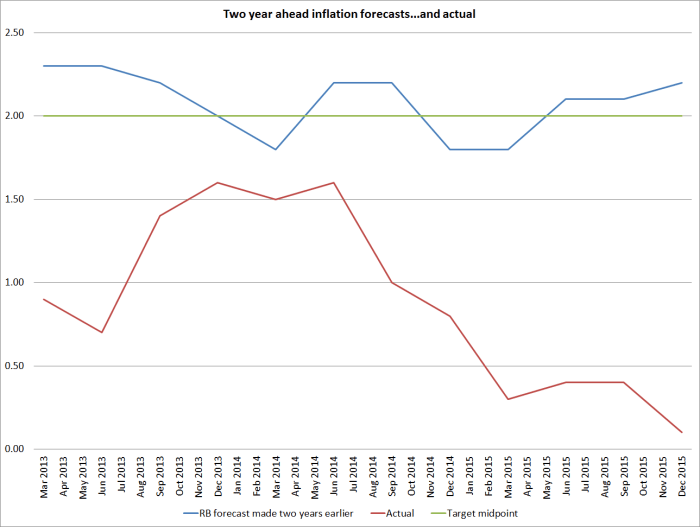
Here are the Bank’s two-year ahead inflation forecasts done over 2011 to 2013 and the associated inflation outcomes.

rb errors

It isn’t a pretty picture.

The Reserve Bank would no doubt respond that its medium-term inflation forecasts will always be near 2 per cent –  the interesting information is really in their view of what interest rate will be required to keep inflation around 2 per cent.     But we know they’ve been persistently too high on those forecasts as well – albeit perhaps less so than the private forecasters.

One other problem with the analysis is that there was a “regime change” halfway through the period.  A new Governor took office, and the 2 per cent midpoint was added to the PTA.  Private forecasters had previously often operated on the (empirically reasonable) assumption that the Bank had been content for inflation to settle in the upper part of the inflation range, and may have been forecasting on that basis.  The Reserve Bank couldn’t credibly produce those sorts of forecasts –  at least when inflation was already near 2 per cent –  so it might in part be just luck that made the Reserve Bank’s errors less than those of the private forecasters.

But as a reminder, when the Reserve Bank asserts that longer-term inflation expectations are securely anchored at 2 per cent, it is relying on forecasts produced by exactly the same set (or a subset of this group) of private forecasters.  Since they were producing worse forecasts than the Bank’s own poor forecasts in recent years, it is a mystery to me as to why we should take any comfort from their views of what inflation might be over 10 years –  a subject to which they probably devote little effort, and have little expertise or incentive to be right.  Perhaps the other “forthcoming” papers will shed light on that puzzle too?


Retail interest rates and the OCR

Various media outlets over the last day or so have asked for my views on whether banks will, or should, pass through yesterday’s 25 basis point cut in the OCR into lower retail rates.

My bottom line was

“I think there will be political pressure on the banks to cut to some extent, but I’d be surprised if it [any cut in floating mortgage rates] was anything like 25 basis points.”

It didn’t even seem a terribly controversial point.

After all, the Reserve Bank had included this chart in the MPS yesterday

funding costs

And they could have included one of credit default swap spreads for Australasian banks (as per this one at interest.co.nz).

The Bank even commented in the MPS that:

the cost of funding through longer-term wholesale borrowing has risen with the pick-up in financial market volatility (figure 4.3). The increase in longer-term wholesale costs this year adds to the increasing trend since mid-2014, which reflects a mix of global regulatory changes, concerns about commodity markets and emerging economies, and broader financial sector risks. To date, strong domestic deposit growth has limited the need for New Zealand banks to borrow at these higher rates. However, acceleration in credit growth over the past year might increase banks’ reliance on higher-cost long-term wholesale funding, leading to higher New Zealand mortgage rates.

It has been a commonplace in the recent Australian discussion that unless the Australian cash rate is lowered higher mortgage rates seem quite likely because of the rising funding spreads.

And so I was slightly taken aback to see the Governor, and his offsiders, quoted as having told Parliament’s Finance and Expenditure Committee that

“I’d expect the floating rates to come down by 25 basis points,” Wheeler told the select committee.

and that

“Banks are only raising a relatively small share of their funding from overseas at this point in time. They’re continuing to see very strong deposit growth. Most of the credit expansion that’s going on has been funded through deposits,” Hodgetts said.

Central bank governors aren’t there to provide defensive cover for banks’ pricing choices, but neither should they be winning cheap popularity points in front of committees of politicians by calling for specific cuts in retail interest rates that don’t even look that well-warranted based on their own analysis (eg the MPS quote above).

Bernard Hodgetts, head of the Bank’s macro-financial stability group, argues that rising offshore funding costs aren’t really relevant because banks haven’t raised much money in those markets recently.  But surely he recognizes the distinction between average costs and marginal costs?    For the banking system as a whole, the place where they can raise additional funding –   much of which has to be for term, to satisfy core funding ratio (and internal management) requirements  – is the international wholesale markets.  And what banks would have to pay on those markets in turn affects what they are each willing to pay for domestic term deposits.

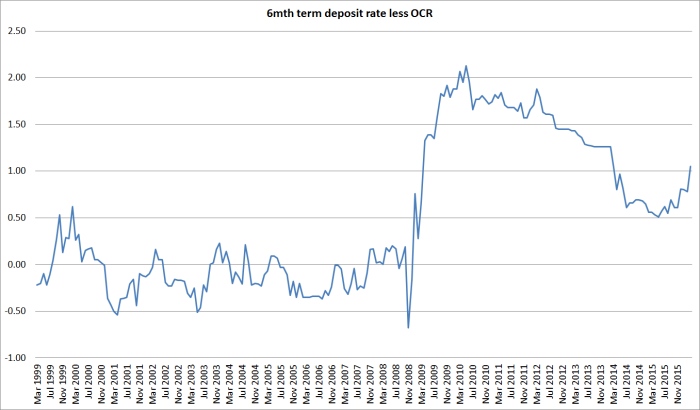
There isn’t a one-to-one mapping between rises in indicative offshore funding spreads and spreads of domestic terms deposits, but hereis a chart showing the gap between term deposit rates (the indicative six month rate on the RB website) and the OCR.

6mth TD less ocr

Unsurprisingly, it looks a lot like the indicative offshore funding spreads chart above.

And what about the relationship between floating mortgage rates and the OCR?  Here I’ve shown the gap between the floating first mortgage new customer housing rate and the OCR.  I’ve included yesterday’s OCR cut and assumed that banks eventually cut their floating mortgage rates by the 10 basis points the ANZ, the biggest bank, announced yesterday.

mortgage rates less ocr

The resulting gap doesn’t look particularly surprising.  The gap between mortgage rates and the OCR blew out during the 08/09 crisis when funding spreads and term deposit margins blew out. It came back from those peaks and has been fairly stable since –  narrowing a bit further a couple of years ago, when it looked as though funding spreads might continue to narrow (and when banks were trying to get loans on their books in face of the new LVR controls).  And now, perhaps, those spreads are widening out again –  as one might expect given the persistence of the rise in the offshore funding spreads.

All these points are really illustrative only.  I don’t have access to more precise data.  But as in any business, pricing involves some judgements.  Perhaps the political and customer pressures will mount and banks will find themselves having to pass more of yesterday’s OCR cut into lower retail lending rates than they would really like. But this is a repeated game.  Even the Reserve Bank expects one more OCR cut before too long, and many of the banks now expect at least one beyond that.  Over the course of the rest of the year, it seems likely that unless those international funding spreads start sustainably falling again, that retail interest rates will fall by less than the fall in the OCR.  It has happened before –  most notably in 2008/09 –  and will happen again.  And it works both ways: if funding spreads ever go back to pre-2008 levels, retail rates will fall further than (or rise less than) the OCR.  The Reserve Bank takes those factors into account when it sets and reviews the OCR every few weeks.

From my perspective, the prospect that retail rates might fall less than the OCR is neither good nor bad, it just is.  As in any business, costs are an important consideration in pricing, but retail mortgage banking is also a pretty competitive business.  Banks don’t need our sympathy, but we also don’t need populist anti-bank cheap shots.

The right answer for the Governor, asked by MPs whether banks would pass on the lower OCR, would surely have been something along the lines of  “That is up to them.  They operate in a competitive market, and they face a variety of cost pressures.  We’ll be keeping an eye on each stage of transmission mechanism –  between OCR changes and eventual changes in medium-term inflation –  and will adjust the OCR as required to deliver on the target set for us in the PTA”.

Really just the bare minimum

The Reserve Bank of New Zealand hasn’t had a good couple of years.  There was the  totally unnecessarily 2014 tightening cycle that was only slowly, and rather grudgingly, reversed.  More recently, we had the OCR cut in December that drove the exchange rate up, and then the Governor’s fairly strident (and defensive) speech early last month which convinced even most of the doves that he would take quite some convincing to cut the OCR again, only to move (and signal yet another easing) at the very next OCR review a few weeks later.   I don’t do on-the-record advance predictions of individual decisions, but I noted a few days ago to someone who asked that I thought a rate cut today was much more of a possibility than most of the local commentators, or market prices, were reflecting.  Nonetheless, today’s move was a pleasant, if mild, surprise.

And it is a surprise of timing, rather than of any sign that the Reserve Bank has really altered the way it is looking at things.  In the December MPS, with the OCR projected to stay at 2.5 per cent indefinitely, the inflation rate was expected to take two years to get back to the target midpoint.  And in today’s MPS, with the OCR projected to get quickly to 2 per cent and stay there indefinitely, the inflation rate is expected to take two years to get back to the target midpoint.    After so many years with inflation below the target midpoint, the Bank is still open to the charge one questioner at the press conference put to them, that they are running an asymmetric monetary policy –  quite relaxed about inflation below the midpoint of the target, but much less so about anything above the midpoint.  I don’t yet subscribe to that interpretation myself –  it is more a case of still having the wrong “model” of what is going on –  but I can understand those who see it differently.

Part of where they are going wrong is in the constant repetition of the claim that monetary policy, here and abroad, is very stimulatory.  In chapter one, the Governor again talks of “extraordinary monetary accommodation” overseas, and in chapter 2 he tells us he believes New Zealand interest rates are “very stimulatory”.    We can all accept that nominal interest rates, here and abroad, are low by, say, the standards of the previous 20 years.  But when interest rates aren’t much different than they have been for the now seven years since the worst of the crisis past, and all the while growth has been sluggish, inflation quiescent, and in most countries unemployment rates show no sign of labour markets overheating, it is difficult to know what meaning the Bank is attaching to phrases such as “very stimulatory”.  I know they are on record as believing that a neutral interest rate in New Zealand is 4.5 per cent, but if they really still practically believe that they most be some of the only people who do.  We know so little about neutral interest rates at present that it is simply unhelpful to talk of current policy being “very stimulatory”, especially if that view is feeding into the forecasts.  Probably all we can say is that policy is  easier today than it was yesterday.  But not even necessarily easier than three months ago.

I’ve pointed out before that, if anything, real interest rates (the better basis for any judgements) have been rising. not falling.  Here is the OCR updated to today, deflated by the two-year ahead measure of inflation expectations, for the last four years.

real ocr to march mps

One problem for the Bank’s story is that today’s OCR cut is barely enough to offset the fall in inflation expectations (on this particular measure or others) since the last MPS.  There is no cut in real interest rates over three months.   And as the Bank usefully highlighted, longer-term funding cost margins have been rising for some time.

funding costs

The Bank won’t want banks avoiding the longer-term funding markets –  a much larger share of longer-term funding was one of the useful post-2008 changes  – and so as things stand at present a cut or two in the nominal OCR may not be enough even to prevent real borrowing rates rising.   What has been done today is really the bare minimum that had to be done to avoid further amplifying the adverse consequences of past monetary policy mistakes.

I wanted to comment on three other aspects of the analysis or discussion in the MPS.

The first is around immigration.  At the last MPS the Bank made a fairly dramatic change of view.  They  explicitly shifted from the longstanding widely-shared view  –  supported by their own past published research – that the short-term demand effects of swings in immigration were generally greater than the short-term supply effects, choosing instead to adopt a view that either the demand and supply effects are roughly equal, or that the supply effects may even exceed the demand effects.  I asked for the background analysis or research supported this change of view. They flatly refused to release any of it (a matter currently before the Ombudsman). They said that they were preparing material in this area “with a view to publication” and I had wondered if ,say a new Analytical Note might come out today.  But there is still nothing –  no new publications, no substantive analysis in the MPS (nor even any recognition that the PLT data seriously understate what happened in the previous 2002/03 boom), just nothing.  It isn’t good enough, for a variable that is so important to short-term macro developments in New Zealand.

The second is around core inflation.  The Governor has gone out on something of a limb, explicitly relying on the sectoral core factor model measure of inflation to justify his stance.  As I’ve noted previously, it has been very unusual for the Bank to highlight any single core measure, and especially in key policy statements –  and yet the Governor has now done so in his January statement, in his February speech, and again in the press release today.  No analysis his been provided to support his preference –  and none of the market commentaries which have looked into the matter have seemed particularly persuaded.

In fact, it looks as though the staff don’t really buy into the Governor’s story either.

Here is the very sensible text from chapter 4 of the MPS

core inflation text

No mention of any priority being given to the sectoral core factor model.

And here is the chart (I’d previously highlighted how the Bank had used exactly this sort of chart when it introduced the sectoral core factor model to wider circulation).

core inflation chart

There are six measures in that chart.  The average of those six looks to be uncomfortably close to 1 per cent, the very bottom of the target range, and a very long way from the 2 per cent midpoint the Governor signed up for.

Rather more concerning than either of these points is the Bank’s repeated insistence –  in the text and at the press conference-  that longer-term inflation expectations are still “well-anchored at 2 per cent”   (not even “near” 2 per cent, bur “at” it).

They apparently have some new publications coming out soon on some of these issues, which will be welcome.  But for the moment, it isn’t clear quite what they are relying on for their view that there is no real problem with inflation expectations, let alone why they think that long-term inflation expectations (as distinct from something like a one to two year horizon) are what matter.  I discussed some of these issues here, noting that (a) very few people entered into fixed nominal contracts for any period remotely as long as 10 years, (b) that the longer-term survey measures relied entirely on economists’ forecasts.  Add to that the fact that, although the Governor said this morning that the Bank looks at market-based measures of inflation expectations, the implicit long-term inflation expectations derived from indexed and conventional government bonds get not a single mention in the entire document.    Those implicit expectations are currently just under 1 per cent –  on average, for ten years.

I’m not suggesting that these implicit expectations are a perfect representation of actual long-term expectations.  As I noted a few weeks ago, if forced to put a number on my 10 year ahead expectations, I might still say 2 per cent – recognizing that 10 years is quite a long time for conditions, and senior central bankers, to change.  But not to mention them at all seems like quite a stretch, especially when you rely instead on the expectations of a handful of economists.  And, as the Bank points out in a gotcha chart on page 8 of the MPS, if the Reserve Bank’s forecasts of inflation in recent years have been bad, those of other published domestic forecasters (ie the same economists whose inflation expectations they rely for support) have been even worse.

How much does any of this matter?

I suspect inflation expectations are less important, as some independent factor determining inflation, than the Bank or conventional wisdom would suggest.  But to the extent expectations matter they are those for 1-2 years ahead –  all now uncomfortably low.  Anything beyond that, except for bondholders, is largely of academic interest only.    But those shorter-term expectations are largely shaped by the recent trends in actual inflation.  In other words, expectations measures are a lagging indicator of something we’ve already seen (the trend in actual inflation).  The Bank has been somewhat spooked by the drop in shorter-term expectations and in a sense that is welcome –  a belated recognition that there was actually a problem with policy.  But to the extent that they so vocally continue to protest that nothing is really wrong over longer-term horizons, is a measure of how far they still are from really “getting” what has been going on. All else equal, we should expect core inflation to continue to surprise them on the low side.  They need to get inflation back up and keep it up, but there is still no sense of doing more than the bare minimum.

And three last points:

The Governor foreshadowed in his press conference an interesting issue of the Bulletin due out next week on the results of stress-testing of the dairy books of the five largest banks.  I will no doubt write about that in more detail then, but the scenario apparently involved three more seasons of a payout of around current levels, resulting inter alia in around a 40 per cent fall in dairy farm prices.  On that scenario, 44 per cent of dairy debt would be impaired, and 10-15 per cent would be in default.   If we assumed a loss given default of perhaps 50 per cent of the loan, the banking system could face losses of several billion dollars over a period of several years (especially once losses on other commercial lending associated with dairy regions were factored in) That is a lot of money, but it would not threaten the soundness of the banking system –  the capital of the banking system, at last report, was almost $36 billion, well above regulatory minima, and banks have several years to replenish any losses through other retained earnings or –  at a pinch –  by direct recapitalization from the parents.   It might seem not-very-extreme to do a stress test based on a continuation of the current payout, but equally it is difficult (although not impossible)  to believe that the exchange rate would remain anywhere around current levels if international dairy prices remained at current levels for the next few years.

Penultimately, the next time the Governor or the Minister of Finance tells you the economy has been moving along just fine, it might be worth digging out this chart from the MPS.

consumption pc

Consumption per capita showing almost zero growth over the most recent year isn’t an encouraging story.  As economists will tell you, the assumed purpose of economic life is to consume.

And finally, as I have noted to them, the Reserve Bank might want look to the security of its systems.  I had an email out of the blue at around 8 this morning-  most definitely not from someone in the Bank –  telling me that the sender had just heard that the OCR was to be cut by 25 basis points.  I have no way of knowing if it was the fruit of a leak, or just inspired speculation, and was relieved to see the foreign exchange markets weren’t moving, but it wasn’t a good look.