Three months on…

It is three months since, on the morning of the release of the last Monetary Policy Statement, a fortuitous set of circumstances brought to light a leak of the Reserve Bank’s OCR decision.  It hadn’t required any particular devious methods or technologies, and the suggestion –  including from the Reserve Bank’s own lawyer –  has been that it wasn’t the first time it had happened.  Whether that was so or not, the Reserve Bank’s systems were loose enough that it was only a matter of time before, accidentally or deliberately, a leak happened.  And ethics were loose enough at MediaWorks that the leak was apparently seen as acceptable conduct, despite the rules of the lock-up.  It took weeks for MediaWorks to own up, and even now there has been no proper accounting from them as to just what went on.

In an email yesterday about today’s Monetary Policy Statement, someone in the markets noted to me

Still waiting to read your full apology from RBNZ, I live in hope!!

It might be nice, but the words and (in)actions of Graeme Wheeler, and his associates Geoff Bascand, Mike Hannah, and Rod Carr, really speak for themselves.  How did we end up in a situation where these sorts of people govern our central bank?

But I’m still more disturbed about the secrecy with which the Reserve Bank has sought to cloak the whole affair –  telling us just as much as they want us to know.  Answers to a series of fairly straightforward OIA requests, about events that happened two to three months ago, have been kicked out to 1 July –  and such is the Reserve Bank’s track record on the OIA that I’m not optimistic we will get much even then.  Whatever the case for secrecy on some policy matters, a leak inquiry  –  especially one that confirmed an actual leak and prompted major system changes – seems like one of those things where the public should be able to expect a full and open accounting from a taxpayer funded public agency.

Instead, we have them stalling, seemingly averse to transparency and scrutiny.  Among the outstanding matters:

  • We haven’t seen the terms of reference for the leak inquiry
  • We haven’t seen the full Deloitte leak inquiry report, only a short-form public version.
  • We haven’t heard why no penalty was initially imposed on MediaWorks, only for the Governor to later change his mind and indefinitely ban them from Reserve Bank press conferences.
  • We haven’t heard why the Governor chose in his press statement to emphasise the cooperation of MediaWorks when even the short-form report makes clear that it took weeks for that company to own up, and then only when it had been approached by the inquiry team.
  • We have seen no acceptance from the Reserve Bank that its own systems had failed to keep pace with technological change, which left them open to a leak (the consequences of which could have been much more serious than they were).
  • We don’t know whether the Bank has made any serious efforts to find out whether MediaWorks staff had leaked previously, and if they did make the effort to seriously pursue the matter, what the answers were.
  • We don’t know how much involvement the Bank’s Board –  supposed to operate at arms-length from management to hold the Governor to account – had in the handling of the leak, and 14 April press statement.  The documents that have been released suggest, which shed a partial light on the matter, suggest that the answer was “too much”.
  • We haven’t seen the papers the Reserve Bank considered in reviewing the options regarding the future of lock-ups, press conferences etc.

I’m not sure what the Bank has to hide.  The answer may well be “not that much at all”.  If so, the obstructiveness and resistance to an open accounting for their handling of a serious breach is perhaps more just a reflection of an ingrained resistance to see themselves as a public body with all that means.  In particular, that they are subject to the Official Information Act as much as to any other law, and are a body from whom the public should reasonably expect a full and open accounting.  Mistakes happen, errors are made, system flaws come to light.  That is what happens with human beings and human institutions.  Embarrassing as they sometimes are, accidents  and errors will happen.  But how an institution – and a powerful individual – recognizes, accepts responsibility for, and responds to such mis-steps can tell us a lot.

As journalists and MPs gather today to scrutinize the Governor, perhaps they might like to reflect on some of this.


Some matters the Monetary Policy Statement could address

Tomorrow sees the release of the latest Reserve Bank Monetary Policy Statement.  My “rule” for making sense of the Governor’s monetary policy choices at present is that he really doesn’t want to cut the OCR –  and hasn’t for the last year –  as much because of the housing market as anything, and cuts only if reality mugs him, in the form of some key data that he just can’t escape the implications of.   I haven’t seen that sort of data in the last month or two.  Given the terms of the Policy Targets Agreement, it should have been an easy call to cut the OCR again, but it probably hasn’t been.

There is a nice, fairly trenchant, column from Hamish Rutherford in the Dominion-Post this morning on the Governor’s communications “challenges”.  I’m very sympathetic to the line of argument Rutherford is running (including his use of some BNZ analysis of monetary policy surprises).  My only caveat is that, in my view, getting policy roughly right is better than being predictable and wrong.  There were no major monetary policy surprises or communications problems in 2014.  But the repeated increases in the OCR were simply bad policy.  Grudging as it may have been, and badly communicated as it undoubtedly was, the OCR has at least been moved in the right direction for the last year.

In this post, I wanted to highlight some issues that it would be good to see the Reserve Bank change its stance on in its statement tomorrow.   If I really expected they would do so, I probably wouldn’t bother with the post, but perhaps there will be a surprise in store.  Many of them have to do with countering that persistent sense, pervading Bank documents, that the economy is doing just fine.  The Reserve Bank has an inflation target, not an economic performance one, but the argument that all is fine in the economic garden has been used repeatedly to justify keeping the OCR as high as it has been.  As a reminder, even today, in real terms the OCR now is still higher than it was when the ill-judged 2014 tightenings began.

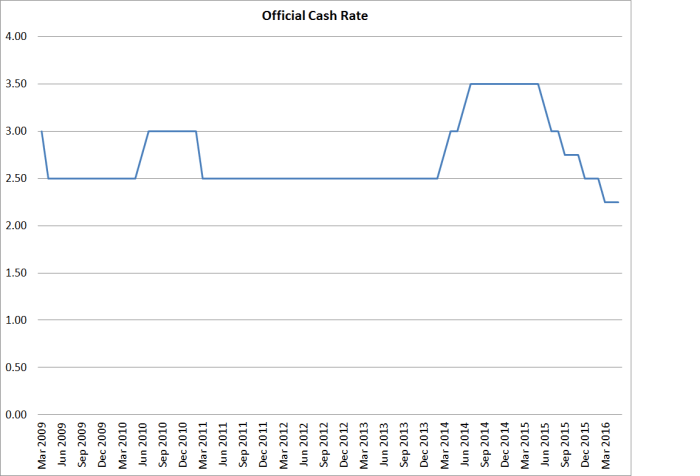
The first is the constantly repeated claim that monetary policy in New Zealand and in other countries is highly “stimulatory”.  It appears in almost every Reserve Bank policy statement or speech, and appears to be based on nothing more than the undoubted fact that interest rates (real and nominal) are currently low by longer-term historical standards.  That doesn’t make them stimulatory.  It has now been more than seven years since the rate cuts during the 2008/09 recession came to an end.  For most of the time since then the OCR has been at 2.5 per cent.  Today it is at 2.25 per cent.

ocr

Adjust for the fall in inflation expectations (around 60 basis points over 7 years on the Bank’s two-year ahead measure), and if anything real interest rates are a bit higher than they’ve typically been since 2009.

The Reserve Bank appears to still believe that a normal (or ‘neutral’) short-term interest rate might be around 4.5 per cent.  But there is nothing substantial to back that view.  The fact that inflation has been persistently below target for several years, in a weak recovery with persistently high unemployment, argues against there being anything meaningful to a claim that 4.5 per cent is a “neutral” interest rate –  a benchmark against which to measure whether monetary policy is “highly stimulatory” or not.  Better, perhaps, to look out the window, and check the current data.  That isn’t always a safe strategy, but it is better than clinging to old estimates of unobservable structural features of the economy.  Having moved to a flat track in its interest rate projections, the Bank appears to be backing away from putting much practical weight on the high estimates of a neutral –  or normal –  interest rate.  But the rhetoric still seems to matter to the Governor, and his reluctance to cut the OCR seems, in part, influenced by his sense that interest rates are already “too low”.  He has –  or at least has produced –  nothing to support that sense –  whether for New Zealand, or for most other advanced other countries.  Better to put to one side for now any estimates of neutral interest rates, lose the rhetoric, and respond to the observable data as they are.

The second point I would like to see signs of the Reserve Bank taking seriously is the persistently high unemployment rate.  At 5.7 per cent it has barely changed in the last year.  I noticed that the OECD in its new forecasts seems to treat 5.8 per cent as the natural rate of unemployment (or NAIRU) for New Zealand.  Few others do, and both the Treasury and the Reserve Bank have tended to work on the basis that our regulatory provisions (welfare system, labor market restrictions etc) are such that the unemployment rate should typically be able to settle nearer 4.5 per cent without creating any inflation problems.    Someone forwarded me the other day a market economist’s preview of this MPS, noting  with some surprise that the unemployment rate wasn’t mentioned at all.  I sympathized with the person who sent it, but pointed out that it was the Reserve Bank the market economists were trying to make sense of, and the Reserve Bank gives hardly any attention to this key indicator of excess capacity in the labour market.   Reluctance to cut the OCR might make more sense if the unemployment rate were already at or below the NAIRU.  As things stand for the last few years, there is an inefficiently large number of people already unemployed, and the Governor’s reluctance to cut just condemns many of them to stay unemployed longer than necessary.  The Governor should at least recognize that trade-off, and explain the basis for his judgements.

The third point it would be good to see the Reserve Bank explicitly addressing is the mistakes it has made in monetary policy over the last few years.  Depending on the precise measure one uses, inflation has been below the target midpoint –  a reference point explicitly added to the PTA in 2012 – for many years now.  Some of that might not have been easily foreseeable.  Some of it might even have been desirable in terms of the PTA (if the one-off price shocks were all one-sided, which they weren’t).  Humans  –  and human institutions –  make mistakes, and one test of a person or institution is their willingness to recognize, respond to, and learn from their mistakes.  Since the Governor is unwilling even to acknowledge that there were any mistakes, it is difficult to be confident that he or the institution has learned the appropriate lessons and adapted their behavior.

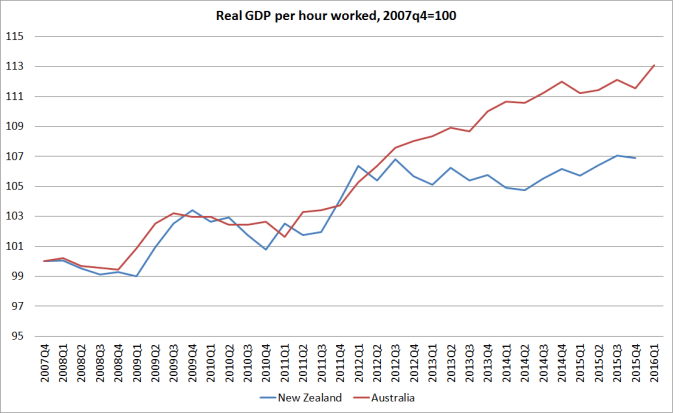
The fourth point it would be good to see the Reserve Bank acknowledge is how poor New Zealand’s productivity and per capita real GDP performance has been.  For example, here is real GDP per hour worked for New Zealand and Australia since the end of last boom.

real gdp phw june 16

Maybe data revisions will eventually close the gap, but that is the data as it stands now.

And here is per capita real GDP growth rates.

real gdp pc aapc

A pretty dismal recovery phase, by comparison with past cycles.

My point is not that monetary policy can or should target medium-term productivity growth or real GDP growth, but simply to illustrate the climate in which the Governor has been making his monetary policy calls, holding the OCR consistently higher than the inflation target required.  He likes to convey a sense –  akin to the tone of the government’s own “glee club” –  that everything is fine here but actually it is pretty disappointing.  Perhaps holding interest rates higher than was really necessary might make a little sense if the per capita GDP growth or productivity growth had been really strong –  leaning a little against the wind –  but they’ve been persistently weak.  Again, the Governor should explain the basis for his trade-offs, not pretend they don’t exist.  We’d have had a better cyclical performance if the OCR had not been kept so high.

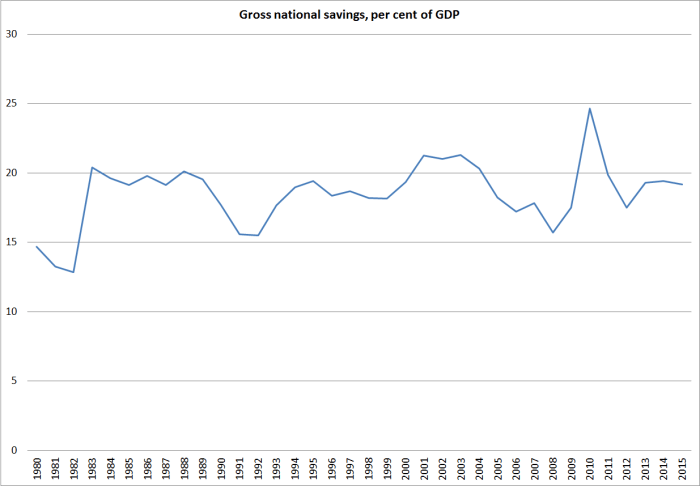
I could go on.  The Governor could usefully highlight that, although he is uncomfortable –  as everyone should be –  with current house prices, there is nothing in the turnover or mortgage approvals data (per capita) to suggest an excessively active market (high turnover is often associated with excessive optimism, and unjustifiably loose credit conditions).    And there is nothing in the consumption or savings data to suggest that high or rising house prices have spilled over into unwarranted additional consumption, putting upward pressure on inflation more generally.  I showed the chart of private consumption to GDP in a post yesterday –  stable over almoat 30 years, despite really large increases in house prices and credit.  This chart shows the national savings rate, since 1980.  There is a little year to year variability, but again no trend over 35 years now.

national savings

House prices are a national scandal, but there is no reason to think they should be treated as a monetary policy problem.

I do think the OCR should be lower –  perhaps 50 or 75 basis points lower than it is now.  In time, the Reserve Bank is likely to recognize that.  But my point here is really that when he makes his choices –  and they are personal choices, not those of a Committee –  the Governor should, and should be seen to, engage with world as it is, not as he might wish that it would be.  In that world, the unemployment rate lingers high, productivity and income growth have been persistently weak, inflation has been persistently below target, wage inflation is weak, house price inflation isn’t splling into generalized inflation pressures, and historical reference points around normal or neutral interest rates seem increasingly unhelpful.  Perhaps there is a good case for keeping the OCR at current levels, but a good case can’t simply pretend everything is rosy in the garden or that –  finally –  everything is just about to come right.

(And all that without even mentioning the exchange rate which is not only high by historical standards –  again raising doubts about those “stimulatory” claims for monetary policy –  but this morning is at almost exactly the same level it was at a year ago.  The fall in the exchange rate from the 2014 highs was supposed to help get inflation back to target.  It was a half-plausible story when the fall first happened.  It is less even than that now.)


$492500000000

That’s the Herald’s headline for its new “Nation of debt” series, where they state “New Zealand now owes almost half a trillion in debt”.

Whatever “New Zealand” and “owes” might mean.

The New Zealand government has some debt –  $109 billion of it, in gross terms, according the Herald’s numbers, spread between central and local government.  Of course, these very same entities have financial assets as well.  The financial assets aren’t as large as the financial liabilities, but by most reckonings the New Zealand public sector isn’t particularly indebted.

Another way of reckoning ‘New Zealand’s debt might be the amount New Zealand firms, households and governments owe to foreigners.  That isn’t $500bn, but –  according to Statistics New Zealand – $247 billion (gross).  Again there are some assets on the other side.  And actually the net amount of capital New Zealand resident entities have raised from abroad is largely unchanged, as a share of GDP, for 25 years.  It is quite high by international standards, but the ratio isn’t going anywhere.

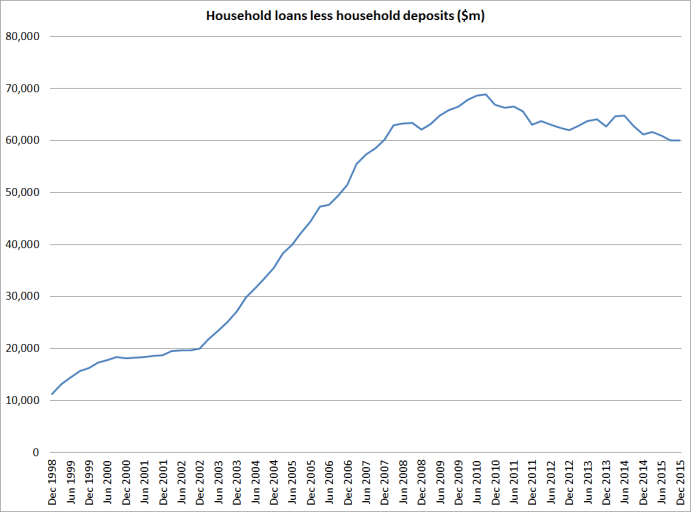
But the Herald chooses to focus simply on the gross debt of New Zealand entities, and pays no attention to what might be going on elsewhere in the balance sheet.  Since they end up focusing on households, lets do that.  The Herald focuses on $232.9 billion of gross household debt, but pays no attention to what has been going on with household deposits.  Here is the chart, using the Reserve Bank’s household statistics, of the gap between household debt and household deposits.

household debt to deposits

It rose very rapidly in the boom years of the 2000s, but has gone nowhere at all for seven or eight years now.   GDP has gone up a lot in that time, so that the ratio of this gap (between loans and deposits) to GDP is materially lower than it was back in 2007/08.    This isn’t some novel point –  the Reserve Bank has been mentioning it in FSRs for years now.

Even ignoring deposits, household debt to GDP itself has gone nowhere for eight years, after a huge increase in the previous 15 years.

household debt to gdp

Probably these ratios will increase somewhat over the next few years.  HIgh house prices, and a housing stock that turns over only quite slowly,  does that.  Here is a chart I ran a while ago illustrating how debt to income ratios keep rising for quite some time –  all else equal –  even if there is just a one-off increase in house prices.

In the chart below I’ve done a very simple exercise. I’ve assumed that at the start of the exercise, housing debt is 50 per cent of income, house prices and incomes are flat, and people repay mortgages evenly over 25 years. Only a minority of houses is traded each year, but each year the new purchasers take on new debt just enough to balance the repayments across the entire mortgage book.

And then a shock happens – call it tighter land use regulation – the impact of which is instantly recognized, and house prices double as a result. Following that shock, house purchasers also double the amount of debt they take on with each purchase, while the (now rising) stock of debt continues to be repaid in equal installments over 25 years.

In this scenario remember, house prices rose only in year 1. There is no subsequent increase in house prices or incomes. But this is what happens to the debt to income ratio:

debt to income scenario

None of this is reason to be indifferent to the scandal of house prices, especially those in Auckland.  But high house prices –  that result mainly from the interaction of population pressures and the thicket of land use restrictions which rig the market against the young – tend to increase the amount the young need to borrow from, in effect, the old to get into a first house.  It is quite risky for the borrowing cohort, but on the other side are much higher financial assets held by the older cohort, who sold the young the houses.  “New Zealand” isn’t more indebted –  one significant cohort of New Zealanders have much more debt, and others have much more financial assets.  And that outcome is mostly down to choices made by successive governments.

The Herald is also keen to run the line that people are treating their houses like ATMs –  drawing down on the additional equity to boost consumption.  No doubt some are –  and for many it will be quite rational to do so.  If you are 60 now, living in Auckland, and thinking of moving to Morrinsville or Kawerua to retire, you might as well take advantage of the rigged housing market now and spend some of your equity.  On the other hand, people trying to get on the housing ladder are having to save ever more to get started in the market (through some combination of market constraints and regulatory restrictions).  But whatever the case at the individual level, here is a chart I’ve run a couple of times recently, showing household consumption as a share of GDP.

household C to GDP

If you didn’t already know there had been a massive increase in house prices, and gross household debt, over these decades, there is nothing in overall consumption behavior to suggest a problem (or even an issue).  High house prices don’t make New Zealanders as a whole better off, they simply involve redistributing wealth from one cohort to another.  If they don’t make New Zealanders as a whole better off, we wouldn’t expect to have seen a surge in consumption.  And we don’t.

I’d hate to be one of the young taking on mortgages of the staggering size that are all too common today.  Even if house prices never come down much –  quite plausible if the land supply mess is never properly fixed –  they face a heavy servicing burden for decades.  If house prices do fall a lot, those people risk carrying an overhang of debt that could make it all but impossible to move.  And some risk of serious distress if the borrower were to be out of a job for very long.

But it isn’t “New Zealand” that owes this money.  It is one lot of New Zealanders who owe it to another lot of New Zealanders, in a market rigged by governments.  Fortunately –  and I didn’t see this in the Herald story –  even our Reserve Bank (constantly uneasy about debt and housing) has repeatedly run severe stress tests and found that the banking system is robust enough to cope with even some nasty adverse shocks.  The same, of course, won’t necessarily be able to be said for all the borrowers if something very bad does happen.


Thinking about changing immigration policy

I was going to write about the Reserve Bank’s forthcoming Monetary Policy Statement, but discussion around immigration policy continues in the media, so I thought the topic might be worth one more post.

There are all sorts of different numbers tossed around when immigration and net migration are debated.  Different numbers are relevant for different purposes, and things aren’t greatly helped by the fact that MBIE does not release regular monthly numbers on visa approvals, and so the month to month discussion is often dominated by SNZ’s permanent and long-term (PLT) migration numbers.

The centerpiece of our medium-term immigration policy is the residence approvals target: 45000 to 50000 people per annum.  That target hasn’t been changed for a long time –  it was the previous government’s target and the current government’s.  It is a large number by international standards: as I noted yesterday, in per capita terms it is around three times the number of green cards the US issues each year.  Actual approvals fluctuate a little from year to year –  I showed the chart in yesterday’s post –  but not very much, and the rules and points are tweaked a bit over time to keep near the target.  Debates about the medium-term implications of immigration, whether for population or economic performance, should really concentrate on the appropriate target level (and composition) of residence approvals.   It is important to appreciate that these days the bulk of people getting a residence approval are already in New Zealand (around 70 per cent) –  having arrived on, for example, a student or (temporary) work visa.  In most cases, granting a residence approval changes the legal status of the individual, and does not involve a new border crossing.

But, as I noted, the PLT numbers dominate the headlines.  PLT numbers (which importantly include New Zealand citizens –  not a matter of immigration policy) are only estimates.  We know exactly how many people come across our border (in and out) each month, but the split between permanent and long-term on the one hand, and short-term on the other, relies entirely on the self-reported intentions of those filling in the arrivals and departure cards.  Plans change.  As I’ve highlighted previously, Statistics New Zealand themselves have done useful work showing that at times the reported PLT numbers have been quite substantially different from the actual numbers who have come or gone for more than 12 months (I discussed this work here .  It is a great shame that SNZ is not adequately funded to produce these refined estimates on a regular basis.

Using the PLT data, one can look at either total arrivals or the net flow.

Here is total (self-reported) PLT arrivals by visa type for the last decade or so (the period SNZ provides the data for).

plt arrivals

Among other things, this chart illustrates my point above about residence visas.  About 43000 residence approvals were granted in the last year, but when people crossed the border to enter New Zealand only around 14000 arrived in the country already holding residence visas.  In granting residence approvals, policy now puts a high weight on people already having a job and being established in New Zealand, so most people who get residence approvals come first on student or work visas.  Even over this decade, one can see the rising share of these temporary visas.  Of course, not all these people stay permanently (or would want to).

And it is also worth highlighting the “not applicable” category, which captures New Zealand and Australian citizens who don’t need a visa to come and live here.  Over these 11 years, that number has fluctuated between 28000 and 36000 per annum –  not huge variation.  There is much more variation in the departures of New Zealand citizens: over the same period that total has fluctuated between 34000 and 62000 per annum.

Total PLT arrivals probably could probably be managed, more or less, with a policy target.  But it wouldn’t be very sensible to do so.  If our universities really do offer a great tertiary education there is no obvious reason why we’d want to put a policy cap on the numbers coming.  It is just another export industry.  The policy focus should be on the number, and composition, of the people (non New Zealanders) we allow to live here permanently.

What about net PLT flows?  They fluctuate enormously.  Here is the chart of annual flows since 1921.

net plt flow

Bear in mind (a) that the population is much bigger now than it was in earlier decades, and (b) that SNZ work suggesting that self-reported PLT flows don’t always accurate represent true permanent and long-term inflows. Importantly, using that analysis, the 2002/03 boom at peak was larger, as a share of population, than the current net inflow.

The average PLT inflow over the last 25 years has been just under 15000 –  a large outflow of New Zealand citizens, and a much larger inflow of non New Zealand citizens.  Perhaps this is the sort of number Winston Peters has in mind when talking about a target inflow of 7000 to 15000?

The net PLT flow cannot be managed by policy at least over short to medium-term horizons.  Cutting the residence approvals target, as I have proposed, would markedly reduced the average net inflow over time, but the cycles in net PLT would probably be about as large as ever –  just cycling around a lower mean.    Much of the variation is the change in the number of New Zealanders leaving (see above).  As I noted yesterday, when politicians talk of short-term caps or (as I heard Andrew Little call for this morning) “more agile” management of the system, it isn’t likely to be a recipe for more stability in PLT flows, but a risk of creating more (pro-cyclical) instability.   Forecasters of the net PLT flow 12 to 18 months ahead have a shocking track record.

Export education services have been flavour of the month in this debate for a while now, and I heard Steven Joyce on the radio this morning talking about how any serious cutback to immigration could put tens of thousands of jobs at risk in the export education sector.

To the extent that people are coming to study in New Zealand for the quality of educational products New Zealand firms and institutions have to offer, the Minister’s comments are almost entirely wrong.  People choose to study at Harvard or Stanford or Oxford because they are top-notch universities.

But that doesn’t look like the New Zealand story.  Here is a chart of student visas by the type of institution the student is studying at.  Unfortunately MBIE provides this data only back to 2005/06.

student vsias by type

All the growth in recent years has been in the polytech and private training establishment sectors.  I’m sure there are some excellent institutions in that sector, offering really high quality educational services rivalling the best in the world.  But one might also suspect that the stories of people using study here mostly as a way of being better positioned to get a residence visa, financed by the recent change of policy allowing students and partners to undertake a lot of paid work while they are here, has more than an element of truth to it.  If so, it isn’t that our export education industry is hugely competitive and successful, it is just another case of “export incentives” at work.  We dish out cash to the film industry, and in this industry a leg up on the residence approvals process is the subsidy.  Subsidised export industries certainly get a benefit themselves, and perhaps that benefits the people working for them.  They rarely benefit New Zealand in the long haul.  We should have learned that lessons decades ago.

Again, if our education sector was attracting real top-notch people, and encouraging them to apply for residence, there might be a net gain for New Zealand (lifting the average quality of the people we decide to let stay).  But as Treasury has noted, we aren’t doing that well at attracting really highly-skilled people.  The recent Fry and Glass book reported that we are doing less well on that score than either Australia or Canada.  And, as a reminder, these were the top five occupations for the skilled migrants last year.

Chef
Registered Nurse (Aged Care)
Retail Manager (General)
Cafe or Restaurant Manager
ICT Customer Support Officer

Those five occupations alone made up 25 per cent of the skilled migration approvals.  And skilled migrant approvals made up only around 60 per cent of the total residence approvals –  others, presumably, were not even reaching that standard.

If we were to look at changing our target level of residence approvals there are some significant questions to address.

One is how fast to make any change.  I’ve argued for pulling the target down from 45000 to 50000 per annum to 10000 to 15000 per annum, but haven’t taken a strong view on a transition path.  The housing market stresses, and long-term productivity underperformance, are sufficiently serious that there is probably a reasonably case for making the change in one step.  I wouldn’t favour a very gradual adjustment –  say, pulling the target down 5000 a year –  partly because it would be too hard to distinguish the effects of the policy change from all the other stuff going on. A middle ground might be to, say, halve the residence approvals target for five years, with a full review of the costs and benefits of that approach to be undertaken at the end of the period.

The other key question is what the composition of a lower approvals target might be.

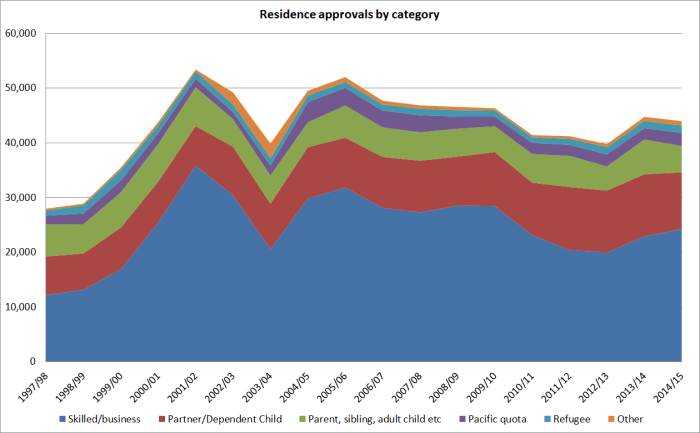
Here is a chart showing the breakdown of residence approvals, using MBIE data.

res approvals by category.png

It would be very easy to simply squeeze out skilled migrants (and their spouses and children).  Personally, I think that if we are serious about immigration serving an economic role we would need to think hard about some of the other categories.  For example, in the most recent year, around 10 per cent of residence approvals went to parents (presumably generally quite elderly) of people now living here, with a few hundred additional approvals for adult children and siblings.  There is little or no prospect of economic gain to New Zealand from this migration –  and no obvious humanitarian case either –  and a pretty good chance that (unlike most skilled migration) the net fiscal cost of these migrants will be quite substantial.

We also approved residence for 1500 people under two Pacific Island access categories.  These are presumably people who would not have qualified as skilled migrants.  Perhaps one can accommodate those sorts of numbers within a 45000 to 50000 annual target, for historical or foreign policy reasons.  Much harder questions would have to be asked if we brought our overall immigration numbers more into line with international practice.

I don’t have a particular view on appropriate refugee numbers.  If anything, at present, there is a push to increase that quota at present.  That is a legitimate choice for a country to make, but most probably to do so would further reduce the chances of the immigration programme making a meaningful economic contribution to New Zealanders.  Then again,  I read the evidence as suggesting that immigration mostly benefits the migrant, and that countries are fooling themselves if they treat large scale immigration as (as MBIE does) some sort of “economic lever” to lift medium term domestic economic performance.

There is a lot of talk about how disruptive a cut in the immigration (residence approvals) target could be. No doubt that is true for firms and sectors that are focused on meeting the needs of a rapidly rising population – be it builders or whatever (furniture and carpet shops). But a lot of that argument is built on the fallacy the immigration eases overall labour shortages. If anything, it exacerbates them: the short-term demand effects of immigration outweigh the supply effects.

Let’s say, as a deliberately extreme example, that my preferred policy – cutting the residence approvals target to 10000 to 15000 per annum was adopted tomorrow. What might we see over the following few years?

I noted yesterday that we would see house and urban land prices a lot lower, especially in places that have experienced considerable population pressure in recent years.

We’d also see a lot less building activity – across all types of construction. We’ve seen this before – when net migration was very low in the late 1970s and early 1980s the construction share of GDP was much lower than it had been before or since. Quite possibly, the PTE component of the export education industry would take a hit.

But all of these pressures would be recognised in the Reserve Bank’s economic forecasts, and monetary policy would adjust to take account of the weaker demand pressures. In fact, markets would be likely to adjust even before the Bank, so long as the policy change was well-signalled and treated as credible. Real interest rates would fall, and so would the real exchange rate. Our exchange rate stays high only because New Zealand pretty consistently offers a yield premium over those on offer in other currencies. We’d see a classic case of resource-switching. The cost of capital to firms developing businesses here would be lower, and the lower real exchange rate would be particularly attractive to firms looking at opening, or expanding, in the tradables sector. Recall, that per capita sector production has not increased for 15 years. This policy change would help reverse that shocking record. It seems likely that regions outside Auckland – in many cases, much more export focused, would get a particularly substantial boost.

What about the labour market? As I’ve already noted, high levels of immigration don’t ease overall labour market pressures, they exacerbate them in the short term. So, all else equal, a lower rate of residence approvals (not simply offset with more work visas approvals) would ease labour market pressures to some extent (offset, of course, by the easier monetary policy). Perhaps some sectors might still find it difficult to get the right people. That is what the price mechanism is supposed to deal with: higher wage rates for particular skills or sectors will, over time, draw people into those occupations. There is a price at which New Zealanders will be aged care workers or dairy hands. For firms in the non-tradables sectors, that higher price might be difficult to absorb. In a sense that is part of the point: reorienting the economy towards the tradables sectors puts pressure back on the non-tradables sectors. For firms in the tradables sectors, the lower exchange rate provides a margin that can accommodate any wage pressures that might develop in individual sectors. But I’d be surprised if those pressures were large or systematic: after all, many of the people who have been employed in sectors responding to the rapidly rising population have to find some other place to work.

Over five years, I’d expect we’d start to see material gains for New Zealanders as a whole. More affordable house prices, a larger share of the economy selling to the rest of the world, reduced pressure on unskilled New Zealanders, and so on. Successful economies typically succeed by finding ways of selling more and better stuff to the rest of the world. We’ve failed on that count (in per capita terms) for decades, but we can turn it around. I’d expect that five years after such a policy was adopted we’d have started to see our productivity performance markedly improving relative to those in other advanced countries. If global productivity performance was still weak, ours might still not be all that we’d like, but we’d almost certainly be doing less badly than our peers. The gaps between productivity levels in New Zealand and those abroad are so large that it will take decades to reverse them. But as we do, we might even find ourselves in the position the Irish finally found themselves in last decade – the huge diaspora finally started to come home.


Immigration: some follow-up points

Yesterday’s Q&A discussions on immigration seem to have attracted quite a bit of coverage.

Of course, most of that focused on the comments made by Winston Peters, and I don’t have anything much to say about those except to note two things.

First, I was interested to hear him talk of targeting 7000 to 15000 annual migrants, which was quite similar to my suggested target for residence approvals of perhaps 10000 to 15000 per annum.  The United States issues around 1 million green cards a year, and as the US had about 70 times our population that is about the same rate of per capita immigration as would be implied by my 10000 to 15000 annual range.  It isn’t a level that amounts to shutting the door.

Second, Peters has twice before been a senior minister and has never made the rate of permanent immigration a central issue in negotiations to form a government. Perhaps this time will be different.

Of my comments, most of the coverage has been around the suggestion that if the residence approvals target was cut as I suggested, house prices might be 25 per cent lower in a couple of years.  It wasn’t intended as a precise estimate, more an indication that population growth (and especially unexpected changes) make a material difference to house prices in markets where the supply response to impaired by the thicket of land use and building regulations.  However, it is quite a plausible estimate, consistent with some past empirical research on the link between population change and New Zealand house prices.

A decade ago, Coleman and Landon-Lane, in work done at the Reserve Bank, estimated that a 1 per cent shock to the population would shift house prices by 10 per cent, and more recently Chris McDonald’s Reserve Bank work produced not-dissimilar   estimates (especially for non New Zealand migrants).   Adopting my proposal to cut the residence target by 35000 per annum would, all else equal, lower the population by 1.5 per cent in the first two years.  But, more importantly, it would materially lower the expected future population, and asset markets (such as the urban land market) work on the basis of expectations.  Over a decade, again all else equal, the population would be around 7.5 per cent lower on my proposed policy than on current policy.  All else equal, urban land prices would be much lower.  Of course, all else is never equal, and with less population pressure some of the pressure to liberalise housing supply would dissipate.  But the direction of the effect on house prices is pretty clear, and the magnitude would almost certainly be quite large.

Perhaps one thing that disappointed me a little about yesterday’s programme was that discussion tended to focus on the immediate cyclical pressures, and especially those on Auckland house prices.  I guess those issues are most immediately salient, especially in Auckland, and perhaps most easily accessible to a lay audience.  My own arguments have tried to focus (a) not on the cycles in net migration, much of which are about New Zealanders coming and going, but on the trend target level of residence approvals, and (b) on the impact of New Zealand’s disappointing overall economic performance (ie the continued trend decline, over many decades, in our relative productivity).  We could fix up the land supply market –  and should –  and many of those questions and issues would, almost certainly, remain outstanding.  That said, when the advocates of the current policy can show so little evidence suggesting real economic gains to New Zealanders (as a whole) from our really large scale immigration policy (repeat, policy – the target level of residence approvals) then the appalling house price situation cries out for winding back the level of migration approvals, as one way of mitigating the adverse effects of the land use restrictions.    One could envisage an alternative world in which the real economic benefits of large scale immigration were large, clear, and demonstrable, and yet the housing market was still severely dysfunctional.  In that world, there would be some nasty potential tradeoffs if reform of land supply couldn’t be achieved.  But we aren’t in that world.  Here, it looks as though winding back migration approvals might well improve productivity prospects and improve housing affordability.   There would, and will, always be cycles in net measured migration, but the policy component is relatively easy to adjust, and to maintain at a different target level (lower or higher) than we’ve had for the past 15 years.

I was pleasantly surprised at the moderate and reasoned approach the Q&A panel took to the immigration segment.  They recognized that there are some real issues that need rational and thoughtful debate.  Nonetheless, they all still seemed in the thrall of the idea that “skill shortages mean we need migration, just perhaps a “better quality” of migrant”.   There are really just two points that need to be made in response.  The first is that empirical research suggests –  and historical casual empiricism does too –  that an influx of migrants adds more to demand rather than to supply in the short-term.  People who live in a modern economy need lots of real physical capital, and it doesn’t build itself.  So although an individual migrant might ease an individual employer’s problem, in aggregate high immigration simply further exacerbates any existing excess demand for labour (skilled or not).  Economists have recognized that for decades.  It doesn’t, of itself, make immigration a bad thing –  long term gains might still make it worthwhile –  but immigration isn’t a way of dealing with systematic skill shortages.    By contrast, a flexible domestic labour market is quite a good way: changing wage rates should signal difficulties in attracting people to particular roles/regions.  It doesn’t work overnight, and it doesn’t work in aggregate if the economy is overheating, but it works when given the chance.

The panellists also seemed taken with the idea that more should be done to get more of the migrants who do come to go to regions other than Auckland.  That seems, at least in part, to reflect a sense that something is wrong about things in Auckland (whether short term or long term) and perhaps a sense that a more successful New Zealand is likely to be one less strongly skewed away from the regions. But it risks leading to even more wrongheaded policies.  We’ve already seen that last year, when the government amended the rules to give additional bonus points to people with job offers in the regions.  Unfortunately that has the effect of lowering the average quality of the migrants who get in.  The residence approvals target is largely fixed, and the changes in the scheme rewards those who can get to particular locations, not either (a) the most highly-skilled migrants, or (b) the most rewarding and productive New Zealand jobs.  Auckland’s economic performance has been quite disappointing, suggesting it isn’t a natural place to funnel ever more people into.  But that doesn’t suggest that the solution is to funnel more people to other places instead.  It suggests focusing on the whole economy –  in particular, getting the real exchange rate sustainably down –  and letting a rather smaller number of total permanent migrants locate where the jobs and rewards are best.  In that sort of world, Auckland’s population might be materially smaller than it would be on current policy, but the population of the regions might not be much larger.  But the share of the regions in overall economic activity would be larger than it is now.  Better to cut the overall residence approvals target, and focus in on a modest number of really highly-skilled people.  The regions aren’t short of people, but Auckland seems to be awash in them (relative to the high-returning opportunities that seem to exist in Auckland).

As a final observation on the Q&A discussion, I was interested in Andrew Little’s response to questions about immigration.  He continues to toy with the idea of some sort of short-term cap on migration. I don’t think that is particularly sensible or meaningful.  No one can accurately forecast short-term fluctuations in net migration (ie the combination of New Zealanders and foreigners) and if those fluctuations can’t be forecast, one can’t run meaningful short-term caps. In the nature of things, and well-intentioned as they might be, they would simply risk exacerbating the short-term cycles in net migration: pull back approvals when net migration was at a cyclical peak, and by the time those changes took effect, often enough the natural cycle would have turned down anyway.  And vice versa when net migration is at a trough.  We are much better to run a stable and predictable programme of residence approvals, and live with the natural variation that results mostly from New Zealanders coming and going.    In my view, the target level of approvals should be lowered quite substantially, but wherever it is set it shouldn’t be messed around with –  up or down –  in response to short-term cyclical pressures.

But my concern about Little’s comments was more about the underlying message.  Twice in the space of thirty seconds, he repeated the line that “New Zealand has always been a country dependent on bringing in skills from abroad”, stressing that he would never want to change that.  It is simply a mistaken model of growth.  The prosperity of any country depends primarily on some combination of the natural resources it has and, most importantly, on the skills and talents of its own people, and the institutions (political and economic) that those people nurture.    That was true of the United Kingdom or Holland centuries ago, it was true of the United States century or more ago, it was true of twentieth century New Zealand, and it is true of every advanced successful country today.  Of course, every country draws on ideas and technologies developed in other countries. In some cases,. immigration may even have helped the recipient country a bit –  but any such gains look to be quite small – but prosperity depends mostly on a country’s own people and own institutions.  The line Little is running is certainly consistent with the implicit stance of the New Zealand elite, across the main parties, but there is little or no empirical foundation for it.  Indeed, it risks sounding like a cargo-cult mentality –  waiting for just the right people from over the water to come and bring us prosperity.  Things simply don’t work like that.  It is a shame that our political leaders aren’t willing to put more faith in the skills, talents, and energies of our own people and firms, rather than (so it seems) wanting to “trade us in” for some better group of people.  Countries don’t get successful by bringing in better people: rather, successful countries can afford to bring in more people, if they choose.

In this morning’s Herald, the other key prominent academic in the liberally-funded (by MBIE) CaDDANZ project, Professor Paul Spoonley of Massey, has an op-ed championing the current immigration policy.  It probably warrants a post of its own, but his bottom line seemed to be “keep the faith”.

Spoonley starts with this:

The International Labour Organisation estimates a 1 per cent increase in population expands GDP by between 1.25 and 1.50 per cent.

I’m not sure the source of this estimate, but it is a huge effect.  Stop and think about what it means for New Zealand, if it were true over the medium-term.  We’ve had one of the fastest population growth rates in the OECD in recent decades, and yet one of the worst productivity growth performances.  So perhaps the really rapid migration-fuelled population growth has been really really good for us, and everyone else has gone really really badly, to explain our overall disappointing performance. But where is evidence –  the telling statistics that suggest that that is really what has gone on? Professor Spoonley knows about the disappointing New Zealand economic performance, so it is a shame that he didn’t try to relate his general claim to the specific experience of New Zealand.

Spoonley then argues

Auckland gains from the effects of agglomeration. Population growth and immigration is associated with economic growth and diversity. For example, Auckland and Canterbury between them accounted for almost all the new jobs growth in New Zealand last year.

Immigration is key to this as skilled immigrants add to the human talent pool that is available to employers. They also establish new businesses and contribute to demand, including for education. Regions and cities that are not attracting immigrants are losing out on this current windfall.

It is fine theory. It just bears no relationship to  the experience of New Zealand, and Auckland in particular, in recent decades.

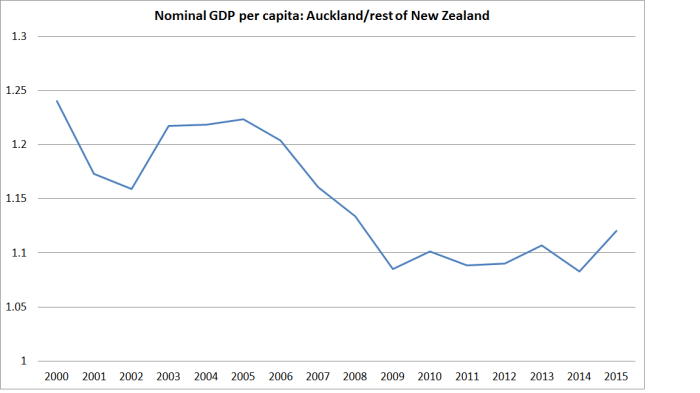
I’ve shown this chart before

ngdp akld ronz

No one disputes – Spoonley doesn’t –  that Auckland’s population growth is largely migrant-driven.  And yet Auckland’s per capita GDP has been trending down relative to the rest of the country’s over 15 years.  And the margin of Auckland’s GDP over that of the rest of New Zealand was already low relative to what we see in most other advanced economies.

Perhaps Professor Spoonley and the other New Zealand pro-immigration advocates (many of them taxpayer funded) are right about the benefits to New Zealanders of this really large scale intervention.  But even if so, surely we deserve much more evidence of those benefits than we get when leading academics simply assert over again that, whatever the short-term stresses, the Think Big programme is really working out just fine?

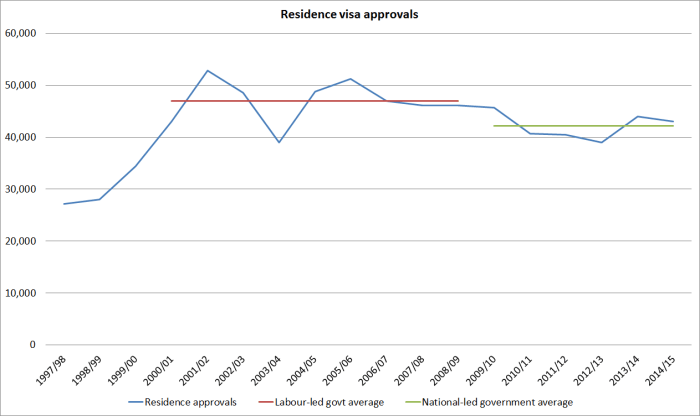
And to end a long post, just a simple chart.  It shows residence approvals for each year since 1997/98.

residence approvals

The data are only available annually, but they are hard data on the number of people MBIE has given residence visas to.  This isn’t SNZ arrivals and departures data, it is the policy core of the immigration programme –  aiming at 45000 to 50000 approvals per annum.  One of my commenters keeps trying to distract from this issue by citing PLT data. Those data are often interesting and useful (and in other ways quite limited) for various other analytical purposes, but if we want to think about the implications of the annual flow of residence approvals this is where the focus should be.  Annual approvals under this programme are not very cyclical, and haven’t varied much across the last two governments.  They are simply very high by international standard (per capita) –  three times the US level.  And on the (lack of) evidence to date of economic benefit to New Zealanders, the annual target should be wound back quite considerably.


Immigration, diversity etc: benefits?

On Wednesday the Treasury, in conjuction with GEN (the Government Economics Network) hosted Professor Jacques Poot, from Waikato University, for a guest lecture under the title “Economics of Cultural Diversity: Recent Findings”.

Poot has been researching, and writing about, the economics of immigration and demographic change for decades.  He was one of the co-authors of the influential 1988 Victoria University modelling exercise, which played a part in shifting the consensus of New Zealand economists away from a fairly longstanding and widely-shared scepticism as to whether large scale immigration to New Zealand was generating sustained economic benefits for New Zealanders. (I summarized some of that past scepticism here.)

These days Poot is Professor of Population Economics at Waikato. In that capacity, he leads a joint Waikato-Massey project, which is receiving large amounts of public funding through MBIE –  the key public sector champion of current immigration policy.  The title of the project reveals the presuppositions of the researchers: CaDDANZ, or Capturing the Diversity Dividend of Aotearoa New Zealand.   The focus isn’t on identifying whether there is a dividend, or whether instead it might possibly be a tax, but simply on how “to maximise benefits associated with an increasingly diverse population”.  Poot is a careful, thoughtful, and respected scholar, but his presuppositions are pretty clear.

I went along to hear him for all those reasons.  I’m skeptical that there are such dividends, especially in the New Zealand context, but there is no point beating a straw man argument.  I was interested to hear the case as articulated by one of the leading New Zealand academics in the area, who has published extensively abroad as well.  I wrote here recently about a recent paper by AUT professor Bart Frijns (and co-authors) which found that  cultural diversity –  measured by the nationality of company directors – seemed to have adversely affected (or at best had no effect) the overall financial performance of listed UK companies.

It is worth bearing in mind that thinking about cultural diversity is not the same as thinking about immigration per se.  In my own analysis, I’ve written skeptically about the impact of the large scale immigration programmes New Zealand has run since, at least, World War Two.  In the early period, we had large scale immigration but not much change in measures of cultural or ethnic diversity –  most of the migrants were from the United Kingdom, with a leavening of Dutch immigrants (Poot himself is an immigrant from the Netherlands).   Poot’s lecture was on cultural or ethnic diversity.  On aggregate measures he presented, that started to increase in New Zealand from the 1960s (with Pacific Island immigration) and has increased fairly steadily in more recent decades.  The UK remains the largest single source country for immigrants to New Zealand, but the overall contribution of decades of immigration programmes is that New Zealand is one of the more culturally and ethnically diverse countries in the world.  He quoted an aggregate index and summarized the current score as meaning that there is now more than a 50 per cent chance that if you encounter another person in the street that person will be of a different ethnicity to you.

As he noted, measurement isn’t necessarily easy.  What do we mean by “cultural” diversity, and how should it be best proxied?   After all, New Zealand had a considerable degree of ethnic diversity even decades ago (Maori and European New Zealanders) and to some extent there are real cultural differences between those groups (although differences within those ethnic groups may be at least as large on some other dimensions of culture –  eg religion.  Similarly, there is now a very large New Zealand born Pacific population.  Poot showed some nice charts for Auckland localities, and for New Zealand regions, on how much difference it makes whether one looks at diversity measured by birthplace or by ethnicity.  Areas around East Cape, or South Auckland, come up as highly diverse ethnically but are more homogeneous as regards birthplace.  The North Shore by contrast shows a lot of birthplace diversity but much less ethnic diversity.

But, in fact, most of Poot’s presentation was an attempt to summarise the international literature, with no attempt to apply it specifically to New Zealand.   After outlining various possible positive and negative effects that have been hypothesised, he attempted to summarise the literature on the impact of cultural diversity on various aspects of economic performance.

In the end, he couldn’t claim much for the effects of increased cultural diversity.  As he noted, studies in the area are plagued with reverse causality problems.  It is easy enough to highlight correlations in which more innovative regions are more culturally diverse, but which way does the predominant causation run?  Innovative regions will be more likely to attract newcomers, from home and abroad.  Poot’s reading of the literature is that immigration and diversity “shocks” affect innovation and productivity, but rather weakly.  The quantitative gains are typically small, and difficult to identify, and are much outweighed by other factors (at a firm or national level).  He appeared to have added a slide to his presentation in response to the Bart Frijns et al paper, but wasn’t quite sure what to make of the results.  Poot regarded it as a very good paper, and offered no obvious criticisms of the approach or methodology, except the passing observation that perhaps the UK was different.

There were some interesting questions, to which Poot didn’t really have particularly developed answers.  One economist asked about the relative economic importance of gender diversity and cultural diversity, while another –  something of a bastion of liberal thought –  asked whether we needed to think less about cultural diversity per se than about the differences in the productivity performances of different cultures, citing (eg) Weber.

How should we apply this to New Zealand?  Poot didn’t attempt to in this presentation, but as noted we have considerable ethnic, cultural, and birthplace diversity, and that diversity has increased materially in the last few decades.  And yet our overall economic performance, including on measures such as productivity, innovation, and foreign trade, have been among the worst in the OECD.   One never knows the counterfactual, but New Zealand doesn’t look like a great place to start from if one is keen to illustrate the economic benefits of cultural diversity.  There is a literature suggesting that increased ethnic diversity boosts foreign trade –  although Poot was keen not to oversell this – but then New Zealand is one of the handful of countries to have had no increase in its foreign trade share of GDP in the last 30 years or more.  Perhaps a heavily natural resource based economy is a little different?

Ian Harrison has noted some problems with some of the literature in this area in this note.

By coincidence, I got home from the Poot lecture to find a request from TVNZ to be interviewed on immigration issues for their Q&A show tomorrow.  Apparently, they have also interviewed Professor Poot for the programme.  In my recorded comments, I noted the difficulty of having a good debate about these issues in New Zealand, and noted that when I first began developing my thoughts about how our immigration policy might have affected New Zealand’s specific economic performance, there had been a lot of embarrassed silence among my then colleagues at The Treasury,  with suggestions that I risked sounding like Winston Peters, and –  in the case of one particular manager –  outrage that the issue should even be discussed at Treasury.  But Treasury’s guest lecture series remains a valuable contribution to discussion of policy issues, and I appreciated the opportunity to hear Professor Poot speak.

Loan to income limits, housing etc

I did a brief radio interview this morning on the (hardly surprising) news that the Reserve Bank had approached the Minister of Finance for initial discussions on the possibility of adding loan to income limits to the list of (so-called) macroprudential instruments the Reserve Bank could use.  Preparing for that prompted me to dig out the material on what has been done in the UK and Ireland.

It is worth remembering that the Reserve Bank does not need the Minister’s approval to impose loan to income limits.  Some years ago, Parliament amended the Reserve Bank Act in a way that seems to have given the Reserve Bank carte blanche to impose pretty much any controls it chooses, so long (in this case) as they can squeeze them under the heading of matters relating to

risk management systems and policies or proposed risk management systems and policies

This was the basis they used for the two rounds of LVR controls, and various amendments, to date.  In principle, controls could be challenged, on the basis that they were inconsistent with the statutory requirement to use the regulatory powers to promote the soundness and efficiency of the financial system.  But the reluctance of banks to take on the Reserve Bank openly –  the Bank always has ways of getting back at banks – and judicial deference on contentious technical matters effectively leaves the Governor free to do pretty much whatever he wants, at least as far as banks are concerned (the legislation gives him much less policy power over non-bank deposit takers, and none at all over lenders who don’t take deposits).

The memorandum of understanding with the Minister of Finance is non-binding, but ties the Bank’s hands to some extent.   The MOU contains an agreed list of the sorts of direct controls the Bank might use.  Legally the Bank can ignore that list.  Practically, it can’t.   But the Minister of Finance is also in something of a bind.  Since the government has been unwilling to do very much to deal with the fundamental factors driving house prices, it would risk accusations of complete dereliction of duty if the Governor came asking for the power to impose new direct controls and the Minister turned him down.  The controls might be daft, costly, and probably ineffective, but refusing the Governor’s request would be a gift to the Opposition (“do nothing Minister just doesn’t care; ignores sage Governor”, and so on).  So most probably, if the Governor wants loan to income limits added to the MOU list, they will be added.  It is still the Governor’s decision whether and how to use those powers, and if they go wrong, or prove unpopular, blame can be deflected to the Governor.  (Unlike the Minister, the Governor doesn’t have to front up in Parliament for question time each day, can’t really be sacked, and generally faces limited effective accountability –  ie questions with consequences.)

If and when loan to income restrictions are added to the list of permitted controls (not just when the Bank wants to deploy them), we should expect to see some rigorous and comprehensive analysis from the Reserve Bank, complemented by the Treasury’s advice to the Minister.  Something that showed signs of thinking hard about the possible pitfalls, and which addressed the strongest case sceptics might make would be particularly welcome from the Bank –  and novel.

Loan to income ratio limits have been applied recently in the UK and Ireland. I was interested to see a comment yesterday from Grant Robertson, Labour’s Finance spokesman, indicating that

his party could be willing to back central bank debt-to-income ratios, if they can be tailored to target investors.

However, Mr Robertson said it would not support a blanket debt-to-income ratio being introduced by the Reserve Bank as it would unfairly target first home buyers.

Presumably Robertson is unaware that in both the UK and Ireland loans to finance the purchase of rental properties (“buy to let” loans as they are known there) are explicitly excluded from the loan to income limits.  It is an instrument that, if used at all, is in effect targeted at first home buyers, usually the owner-occupiers who will borrow the largest amount relative to income (quite rationally, since they also have the longest remaining span of working life).

The fact that a few other countries adopt controls does not make them a sensible response in New Zealand.  But it is worth bearing in mind that the UK controls –  under which mortgage lenders cannot lend more than 15 per cent of their total new residential mortgages (by number) at loan to income ratios of 4.5 times or above – were explicitly envisaged as non-binding at the time they were imposed.  The Bank of England indicated that “most lenders operate within its new limit, so the measure will simply insure against potential risks to financial stability if mortgage lending standards loosen markedly in the future”.

Ireland is a little different, having come through an extreme house price boom and bust cycle, although even they noted that there was little sign that bank lending behavior was a problem in Ireland at present.  In Ireland, no more than 20 per cent of the euro value of all new housing loans for owner-occupied properties can have loan to gross income ratios in excess of 3.5.

In neither case is there a blanket ban on loans with high loan to income ratios.  Both countries have structured their limits as “speed limits” (as was done with the LVR limits here).  Presumably the same would be done here, if LTI limits are introduced.  Encouragingly, in both countries there is no differentiation by region, and our Reserve Bank should resist pressure for any regional differentiation here.

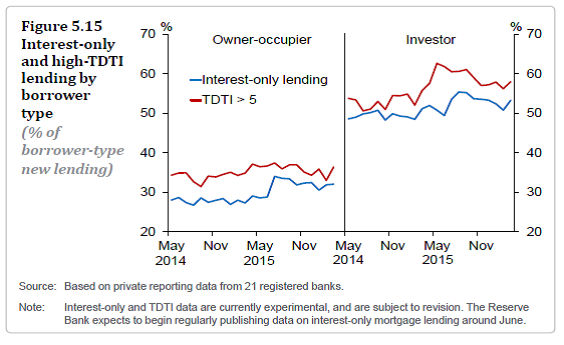
The controls are not easily compared across countries.  In one case, the limit is by number of loans, and in the other by value.  Both appear to use gross income in the denominator, but tax rates differ from country to country, and so the effective impact of the restrictions will differ for that reason alone.  Our Reserve Bank recently published a chart suggesting that around 35 per cent of new owner-occupier loans have a debt to income ratio greater than or equal to five, but since this data is the fruit of “private reporting”, and is described as “experimental and are subject to revision”, we have no way of knowing whether either the “debt” or “income” concepts they are using –  which may well differ by bank –  are even remotely comparable to those used in the UK or Irish regulation.

dti

(But it is worth noting that in the short run of experimental data, there is no sign of an explosion in the share of high debt to income lending.)

The income of a potential borrower is clearly one of things a prudent lender would take into account in deciding whether to lend money, and how much.  The same goes for the value of any collateral the borrower can pledge, any other conditions or covenants that are part of the loan contract, and as host of other factors.  But the fact that these considerations might be relevant to assessing the creditworthiness of the borrower does not mean they are things that should be regulated.  As the Irish central bank noted in its consultative document

An acknowledged weakness in the use of LTI as a guide to creditworthiness is the fact that income at the time of borrowing may not be a good guide to average income over the life of the mortgage or to the risk of unemployment. Lenders need to take this into account in their lending decisions and must not rely mechanically on LTI.

And yet LTI limits increase the likelihood that banks will manage to the rules –  breaches of which expose them to severe penalties –  rather than to the underlying credit risk  (where, all other factors aside) it is overall portfolio risk rather than the risk of an individual loan that probably matters a lot more –  especially for systemic soundness.  Curiously, an LTI limit risks making finance relatively more available to those borrowers with highly variable income –  borrow in a good year, and your loan might not be excess of the LTI threshold, and no one at the central bank cares much that in another year’s time your income might have halved.  It might be an unintended effect, but it won’t an unforeseeable one.

More generally, there is no good external benchmark for what an appropriate or prudent loan to income ratio should be.  At least with LVRs there is a certain logic in suggesting that, say, a loan in excess of the value of the property changes the character of loan (the top tranche is unsecured).  No one has any good basis for knowing whether a debt to income ratio (however either of those terms is defined) of 3 or 5, or 7 is unwise or excessively risky.

I don’t personally have a high appetite for debt – I’ve taken two mortgages in my life, both were about 2 times income, and both felt forbiddingly large at the time.  Then again, the interest rate on the second of those loans were something like 10 per cent.  But if, say, nominal mortgage interest rates were to settle at around 5 per cent –  not low by longer-term international historical standards –  then why would it be imprudent for a young couple aged 25 to take a 40 year mortgage at, say, six times their (age 25) income?  The upfront servicing burden would certainly be high, but twenty years hence even general wages increase (no ,movement up respective scales) would have halved the burden.  And why would it be imprudent for a bank to have a portfolio of mortgages which had some new mortgages at high LTIs and some well-aged mortgages with much lower LTIs?

(The same might go for investment property loans.  If someone is running a rental property business, the prudent ratio of debt to income –  whether wage income of the borrower or rental income – is likely to be much higher when rental yields are, say, 4 per cent than when they are 8 per cent.)

Don’t get me wrong.  There is something obscene about house prices in New Zealand –  and a bunch of similar countries with dysfunctional land supply markets. There is no reason why we can’t have house prices averaging perhaps 3 times income –  with mortgages to match –  but our policy choices have rigged the market, delivering absurdly high house prices.  If so, people need to be able to borrow at lot just to get a toe on the ladder.  Try to prohibit willing borrowers and willing lenders from agreeing such loans and you simply further skew policy in favour of the “haves”, and create an industry in getting round the controls.  There hasn’t been that much effort so far to get round the LVR controls –  through quite legal means, involving unregulated lenders –  but recall the Deputy Governor’s comments at the last FSR, that controls might now be with us for much longer than the Reserve Bank had first envisaged.  I’m not sure why the non-bank (and especially non deposit-taking) lenders have not been more active to date, but a further intensification of controls surely heightens the likelihood of larger scale use of alternative lenders.

Loan to value ratio controls haven’t solved, or materially alleviated, housing market pressures.  For all the rhetoric, not even the Reserve Bank’s modelling suggested they would. There is some short-term relief –  helping those not affected directly, at the cost of the more marginal potential borrowers –  but it doesn’t last.  There is no reason to think that loan to income ratio controls would be different. They tackle, rather ineffectually, symptoms rather than causes, and over time mostly alter who owns houses, not how much is paid for them.  The Reserve Bank will argue that even if the controls don’t change house prices, they still enhance financial stability, but there is not even any serious evidence of that. First, they have not shown any evidence that financial stability is threatened –  and their own tough stress tests keep delivering quite reassuring results –  and second, and perhaps as importantly, they have made no effort to analyse what risks banks will take on if controls prevent them lending as much on housing as they might like.  Banks are profit-maximizing businesses, and deprived (by regulation) of some opportunities they will surely seek out others.

Far better for the Reserve Bank to recognize that it has no mandate to control house prices (or even the growth of housing credit), and in any case it has no tools that will do much over time anyway.  Its responsibility is the overall soundness of the financial system.  If the risk weights on housing loans look wrong, let them make the case for higher weights and consult on that. If the overall capital ratios look too low, then again make the case.  Using those tools will do less damage to the efficiency of the financial system, and better secure the soundness of the system, that one new wave of direct controls after another.  At the current rate, Graeme Wheeler will be giving a good name to Walter Nash, the first person who imposed so many controls on our financial system. (I usually eschew references to Muldoon in this context, but over his full term he deregulated the financial system more than he reregulated it).

Of course, there is still no sign of those actually responsible for the house price debacle doing much about it.  I haven’t yet read the full proposed National Policy Statement, but the material I have read is full of central planner conceit, and seems unlikely to achieve very much.  And I find it seriously disconcerting –  if perhaps not overly surprising –  that the Ministry for the Environment released a supporting document yesterday on “International approaches to providing for business and housing needs” .  But this survey of international approaches drew exclusively on the UK and two Australian states (New South Wales and Victoria).  Since London, Sydney and Melbourne are some of the cities with the most dysfunctional housing markets in the world, indicated by price to income ratios similar to, or even higher than , Auckland’s, you have to wonder why MfE would look to those places for guidance or insight.  When the Productivity Commission report on land supply was released last year, I criticized them for a similar focus –  they’d visited various places, but not the functioning land supply markets of the US.

One might have hoped that government agencies, and ministers, who were serious introducing a well-functioning competitive urban land market might have devoted at least some serious analytical attention to the experiences of thriving cities in the US which manage to cope with rapidly rising populations with markets in which house price to income ratios fluctuate somewhere near 3.

Having said all this, I’m not very optimistic that the house price problems will be solved. I went to a good lecture yesterday on housing by the Chief Economist of Auckland Council, Chris Parker.  He has a lot of good analysis and ideas which I can’t discuss here –  he told us it was under Chatham House rules, under which we could say what was said, but not who said it, but he was the only speaker….. –  but I wanted to ask him the same question I’ve posed here previously: is there any example anywhere of a city or country that has materially unwound the thicket of planning controls once they were in place.  If not, perhaps we can be first.  But, if so, it doesn’t look as though we are getting there fast.

(Which does make the government’s continued indifference to the huge population growth, largely driven by immigration policy when there is no evidence that that population growth has been systematically benefiting New Zealanders, ever more inexcusable).


House prices and the Reserve Bank

House prices are not the responsibility of the Reserve Bank, any more than tomato prices are.

In its monetary policy, the Bank was charged by Parliament with maintaining a stable general level of prices.  In the Policy Targets Agreement, the Governor and the Minister of Finance agreed that, while the Bank should keep an eye on all sorts of price measures, for practical purposes the focus should be on keeping annual CPI inflation near 2 per cent.  The CPI includes rental costs and the cost of construction of new dwellings, but it does not include section prices or the prices of existing dwellings.  Parliament or the Minister could require the Bank to focus on some different index altogether –  there is nothing sacrosanct about the CPI, even as a measure of prices –  but they haven’t.  And the way the CPI treats housing is consistent with the Reserve Bank’s view as to how housing should be treated.

What about the financial regulatory side of the Bank’s responsibilities?  The Reserve Bank Act requires that the Bank exercise its regulatory powers over banks in ways that promote the soundness and efficiency of the financial system.  What matters is the overall health of the balance sheets of the financial system as a whole.  Loans secured on residential properties make up a fairly large proportion of bank balance sheets, which suggests that the Reserve Bank might reasonably want to understand the risks banks are carrying, and the buffers they have in place if things turn out less well than expected.  But it does not make house prices a policy responsibility of the Reserve Bank.

Perhaps one might make an exception to the statement if there were evidence that house prices increases were occurring primarily because of reckless lending by banks.  But even that is a higher standard than it might sound.  It doesn’t just mean that credit growth for housing might be running ahead of incomes –  one would expect that if other shocks and distortions (eg land supply or immigration) were putting upward pressure on house prices. If so, the younger generation will typically need to borrow more from older generations to get into a house, and the banks may be just the intermediaries in that process.  And even if the Reserve Bank suspected “recklessness” it would have to ask itself why, and what basis, its judgements were likely to be better than those of the banks.  After all, the Reserve Bank has nothing at stake, while the shareholders of banks have a great deal at stake (even if you think that governments would mostly bail-out creditors, shareholders usually lose a lot when things go wrong).

One might draw on past experience and international research.  But even then one has to do so carefully.  After all, as the Reserve Bank itself has highlighted, losses on residential mortgage portfolios have rarely played a central role in systemic financial crises –  and particularly not in countries with floating exchange rates (check) and with little or no direct government involvement in housing finance (check).  Very rapid housing turnover can be a sign of things going haywire –  although even then not necessarily of high risk to banks.  But in New Zealand, house sales per capita have remained well below what we saw in the previous boom, and mortgage approvals per capita also remain pretty subdued by pre 2008 levels.  And recall that in New Zealand, with the same banks we have now and the same incentives, the banking system did not get into trouble even after that boom.  During the 2008/09 recession, senior Reserve Bank and Treasury officials toured the world spreading reassuring words, and they were right to do so.

Perhaps too, the Bank might worry about the spillover from higher house prices into the rest of domestic demand.  But, in fact, over the last 25 years, despite huge increases in real house prices, the private consumption share of GDP has been essentially constant.

household C to GDP

That is largely what we should expect: after all, higher house prices don’t make New Zealand any better off, and the individuals who are better off must be offset by other individuals who are made worse off.  The Bank might also pay attention to high-level research suggesting that financial crises have typically been foreshadowed by big increases in debt to GDP ratios over relatively short periods (the few years just prior to the crisis).    But on that score, it is worth remembering that most countries that have had big increases in debt to GDP ratios have not had domestic financial crises (think of the UK, Canada, Australia and New Zealand for example).  And in New Zealand, household debt to GDP ratios have gone largely nowhere for eight years, after a huge increase in the previous 15 years.  Yes, there has been quite an increase in the last couple of years, but that is surely what one would expect when population pressures and land supply restrictions combine to push house prices up.  A higher level of credit is a typical endogenous response.    It is not, of itself, a danger signal regarding the soundness of the financial system.

This was all prompted by a piece I noticed on interest.co.nz which appeared under the heading “RBNZ has nowhere to hide from the housing market”, with the fuller heading  “Each new piece of housing-related data coming out at the moment is increasing the pressure on our central bank”.   If so, it is only because the Reserve Bank has chosen, with no good statutory justification, to put that pressure on itself.  Good central banks don’t need to “hide”.  The housing market is just another, albeit important, market.

The Reserve Bank has a relatively straightforward job. It is supposed to keep inflation near 2 per cent, which it has been failing to do.  And it is supposed to use its regulatory powers to promote the soundness and efficiency of the financial system.  There is no sign that the soundness of the system is threatened, and each new regulatory intervention impairs the efficiency of the financial system –  and provides, briefly, cheaper entry levels for those upon whom the Reserve Bank’s favour rests.

Here’s what I would expect the Reserve Bank to be doing.  They should be continually reviewing the reasonableness of the risk weights that they allow the banks to use in their capital modelling, and ensuring that they understand how different banks are assessing the same risk.  They should carry on with their programme of stress tests, which so far have shown very encouraging results in the face of very severe shock scenarios.  And then they should be leaving the responsibility for house prices and a dysfunctional housing supply market where it rightly belongs: with central and local government.  When the Reserve Bank intervenes not only does it compromise financial system efficiency, for little obvious gain on soundness, but it leaves observers with a sense that perhaps the real issues are different from what they are.  And it encourages banks to focus on managing regulatory limits rather than thinking hard about the risks they, and their shareholders, are taking on.

The Reserve Bank is not responsible for the current housing mess, and it cannot provide the solution –  not even partial or temporary solutions.  Responsibility rests with successive governments that bring in tens of thousands of non-New Zealanders each year into a system that is simply unable to generate effectively and cheaply a sufficient supply of houses.  And that isn’t a market failure, but yet another example of government failure.

And for those who worry that a lower OCR would simply push up house prices further, a reminder that one of the key ways in which monetary policy works is by raising the prices of long-lived assets – which encourages people to invest in producing more of them.  But perhaps too it is worth remembering that the real OCR has fallen by more than 600 basis points since 2008, and yet material real house price increases have only been seen in places with that fatal combination of substantial population pressures and a highly distorted land supply market.  Interest rates are low for a reason –  the economy would be even weaker and inflation lower if they were not.


Age discrimination and the next Governor

It is now June, which means it is only 15 months or so until Graeme Wheeler’s ill-starred term as Governor of the Reserve Bank ends.  Conversations begin to turn to the question of what happens next.

I’ve probably left many people unconvinced, but I still reckon there is a plausible case that the Governor of the Reserve Bank is the most powerful individual in New Zealand.  He exercises a lot of discretion with few checks and balances (perhaps especially in areas other than monetary policy) and there are no established appeal or review rights.  Many Cabinet ministers have lots of power, but they can be dismissed whenever the Prime Minister chooses.  The Prime Minister can be toppled by his or her own caucus with no notice or appeal (see Kevin Rudd, Julia Gillard and Tony Abbott –  or Jim Bolger and Geoffrey Palmer for that matter).  Judges make crucial, life-changing, decisions, but all lower court decisions are subject to appeal, and all higher courts sit as a panel of judges.  Of course, the Governor has power in only a specific range of areas, but as those areas include monetary policy and financial regulation, the effects of the Governor’s choices can be felt very widely.

A month or so ago, I wrote a couple of posts (here and here) about the curious democratic-deficit in the way in which the position of Governor is filled.  It is a choice Parliament made, but it is a very unusual one, whether considered against the models used for central banks/financial regulators abroad, or for other senior positions in the New Zealand government.  Even though the Governor wields so much power, the choice of who serves as Governor is not made by an (elected) Minister of Finance, but by the faceless, largely unaccountable, group of people who constitute the Board of the Reserve Bank.  The Minister technically makes the appointment, but he can only appoint someone recommended by the Board.  That makes the Board members the key players in the process.  Perhaps equally weirdly, the Minister gets to determine the Governor’s terms and conditions (he only has to consult the Board).  In a more reasonable assignment of roles and responsibilities, one might have thought the Minister should be able to appoint an appropriate person as Governor (as happens in most countries, including Australia), perhaps consulting the Board, and perhaps leave the Board to set the terms and conditions, perhaps in consultation with the Minister.

There are no confirmation hearings for either people appointed to the Board, or for a Governor-designate, even though between them these people will have considerable influence on the economy and financial system for years to come.  One might reasonably ask what expertise, let alone public mandate, Rod Carr, Keith Taylor, and the rest of them, have to make those sorts of selections, or why they are better placed to do so than an elected Minister.  Recall that appointing a Governor is not just akin to appointing a CEO of a government department –  who typically has little or no effective policy discretion – or the CEO of a private company.  It is about appointing a key policy (one might almost say “political”, albeit not in a partisan sense) player whose discretionary choices –  and they involve real and substantial discretion – are probably at least as significant as those of most Cabinet ministers, with the associated need to be at least as open and accountable as Cabinet ministers.   It seems like the sort of role that senior elected ministers, not faceless former finance sector executives and academic administrators, should be filling.

But unsatisfactory as the law is, it seems almost certain that it will be the law governing the next appointment of a Governor.

Someone who has paid closer attention to some of the details of those provisions than I have pointed out to me recently clause 46(1)(c) of the Reserve Bank Act.    Under the provision, no one can serve as Governor, or Deputy Governor, once they are aged 70 or over.

This provision is quite old.  The legislation was passed in 1989, and life expectancy has increased by perhaps five years since then.  In addition, New Zealand legislation passed since then has prohibited compulsory retirement ages, unless they are specifically provided for in statute (as this one is).  There is a similar statutory age limit for judges.

In a year when the race of the job of President of the United States seems set to be fought between one candidate who will turn 70 this month, and another who will turn 70 next year (who is in turn still being challenged by a sitting senator who is 74) it is a surprisingly low age limit.  Life expectancy has increased, but in fact it is almost 60 years since Walter Nash became our Prime Minister at age 75, and then left office at 78.

I’m not opposed on principle to having an age limit for the Governor.  If anything, as our law is currently written, the case might be stronger than  that for judges.  In respect of judges, the contrast is striking between our situation and that of the US Supreme Court, where judges often seem to hang on until death (as much as anything to manage succession risk), and where three of the current sitting judges are aged 77 and over.

It is, rightly, difficult to remove a sitting higher court judge even if that person’s physical and mental capabilities are evidently in serious decline.  In our system, it takes a vote of Parliament, in an address to the Governor-General.  Age limits help to protect against the indignity and awkwardness of such difficult and very public removals.   Then again, between the assignment of cases, appeal provisions, and the fact that appellate courts sit with a bench of judges, the damage a declining individual judge can do can be mitigated.

It is technically easier to remove a Governor of the Reserve Bank whose capacities were failing.  It requires only an Order-in-Council.  But in practice it would be no easier, and potentially much harder to manage in the interim.  A Governor in office has full powers to set monetary policy as he judges appropriate, and to make and vary a wide range of financial regulatory policy measures.  There is no one who can temporarily assign some of those powers to other officials, and there are no appeal rights.   And the Reserve Bank operates in the full glare of scrutiny by domestic and international markets.

But an age limit of 70 simply doesn’t seem to strike quite the right balance.  Ideally, the entire governance structure of the Reserve Bank will be revised, and if the Governor had just one vote (among say 5 or 7) on each of a Monetary Policy Committee and Financial Regulatory Committee then no age limit might be needed at all (there is none in Australia, or the United States –  Greenspan was 79 when he left office).  For now, serious consideration should be given to raising the age limit to at least 75.

As it happens, the age limit is unlikely to have been a binding consideration since the Act was passed. Don Brash left office at 61, and Alan Bollard was a similar age when he finished as Governor.  But Graeme Wheeler will, apparently, be 66 late next year.  That means he could not serve another five year term, even if he wanted one, or if the Board wanted to reappoint him.  He could, however, serve –  say –  a four year term, which might parallel the typical arrangements for government department chief executives (who typically get an initial five year appointment, and then often get a three year extension).

I hear on the grapevine that the Governor has already indicated to staff that he will not be seeking a second term.  If so, the issue is moot as it affects him.

But with more people staying longer in the workforce it might still be relevant to some of the people the Board could consider to fill the office of Governor.

For example, although it has now been 35 years since the position was filled by someone with a Reserve Bank background –  an extraordinary statistic that the Board might want to reflect on – former senior officials would no doubt be among those who might be thought of as candidates for Governor.  The Act not only requires that no one can be Governor or Deputy Governor once they turn 70, but it also requires that first terms as Governor must be for five years.

There are, for example, two current and four former Deputy Governors who are still professionally active.

Peter Nicholl was Deputy Governor in the 1990s, before going on to serve as Governor of the central bank of Bosnia.  He is still apparently professionally active on the international central banking consulting circuit. But he is 72, and so barred from serving as Governor here.

Murray Sherwin succeeded Nicholl as Deputy Governor.  He is now chair of the Productivity Commission, and in many ways could be a very good Governor if he was interested.  But it appears that he is turning 65, probably next year, and so the age-70 limit could be a constraint.

Grant Spencer is a current Deputy Governor, and will have served in that role for a decade by the time Wheeler’s term expires.  Spencer has considerable experience inside the Bank, as well as decade in relatively senior roles at ANZ, but also appears to turn 65 shortly (the first academic publication I could find dated back to 1974).

Three other current or former Deputy Governors don’t face the same issue.  Rod Carr, Adrian Orr, and Geoff Bascand are all in their 50s, and each has chief executive experience.

Where else might the Board look?  There are other senior ex Reserve Bankers, such as David Archer, former Assistant Governor and Chief Economist now in a senior role at the BIS, or Arthur Grimes.  Or if they were interested in plucking someone from an international agency, my first boss Andrew Tweedie is now the Director of Finance (not just a bean-counting job) at the International Monetary Fund.

There isn’t a strong tradition of academics moving directly into policy roles in New Zealand, and nor are there many academics working in policy-oriented research on monetary policy or financial regulation.  Then again, there are two academic administrators on the Board, either of whom might themselves be interested.

The Reserve Bank now has a major and active role as regulator and supervisor of financial institutions, and so some banking background might be a consideration the Board looks for.   There are few senior New Zealand bankers, and especially not ones with the capability to be, and to credibly front as, the single decision-maker on monetary policy.  Some of us used to worry that Mark Weldon’s friendship with the Prime Minister might have seen him succeed Alan Bollard, but perhaps the OCR leak debacle further reduces that risk.

What of public servants?  Iain Rennie, the outgoing State Services Commissioner, has a strong background in macro, and was for a time the Deputy Secretary of that part of Treasury.

Finding the right person should be quite challenging.  It is a big job, and also an unusual one.  The Bank itself isn’t a large organization, but it has quite a range of functions, where the Governor personally has a great deal of discretionary policy power.  And the Bank operates in an area where there is a huge amount of uncertainty.  Filling the role well needs management capability, it needs intellectual capacity, it needs good judgement, and it needs the self-confidence on the one hand, and the humility on the other, to recognize the uncertainties, to be willing and able to engage openly with alternative perspectives, and to acknowledge that –  being human –  from time to time the Governor will make mistakes.  Precisely because the power is so concentrated in one individual, inevitably the questioning and challenging will often focus on that individual.  The ability to embrace sustained scrutiny and work effectively in that spotlight isn’t a talent everyone has –  and nor is it needed for most roles.

From time to time, people talk about the possibility of appointing a non New Zealander as Governor.  I don’t think it is a viable or sensible option.  Think of how much political mileage there still is in New Zealand from bashing Australian banks.  How would people take to having an Australian setting our interest rates, and regulating those Australian (and other banks)?  I don’t think it is politically tenable, and neither –  given the extent of the discretion the Governor wields –  would it be desirable.  I wrote about this issue a while ago and concluded:

I think it would still be a mistake to go global.  Some aspects of the role could be done by any able person –  revitalising, for example, the Bank’s research and analysis across the range of its policy functions.  That is partly just about good second and third tier appointments, and partly about being a voracious customer for the insights that analysis throws up .  But the role also needs someone who understand the New Zealand economy, the New Zealand system of governance, and someone who understands the New Zealand financial system.  And it needs someone who is comfortable, and credible, in telling the Bank’s story – and sometimes it will be a controversial or difficult story –  to New Zealand audiences.  Plenty of people criticized Don Brash over the years, but few doubted that his heart was in this country, and that its best interests were his priority.  In a small country, with a foreign-dominated financial sector, a very powerful central bank, and ongoing controversy about the role of monetary policy and New Zealand’s economic performance, it is hard to imagine any foreign appointee successfully filling the bill.

Of course, it might be a little easier if the governance of the Bank was reformed.  For example, in a system in which the Governor was chief executive, but had no more voting rights on monetary policy or financial regulation policy matters than others members of the respective committees, the stakes are a little lower.  But even then, I think such governance reform more appropriately opens the way to the appointment, from time to time, of a foreign expert as a member of one or other of the voting committees.  Since the Bank of England’s nine-person Monetary Policy Committee was established by legislation almost 20 years ago it has not been uncommon to have a foreigner sitting on that committee. In a New Zealand context, supplementing local expertise with outside perspectives in that way could have some appeal – if New Zealand government board fees were sufficient to attract quality candidates –  but we are still likely to be best, in all but the most exceptional circumstances, to look for a Governor from home –  as we do when we choose ministers, judges, (and these days Governors-General), military chiefs and so on.

The appointment of the next Governor is further complicated by the timing.  The Governor’s term expires almost three years to the day since the last election.  In times past it wouldn’t have been a great problem –  there was a broad bipartisan consensus around the Reserve Bank.  Similarly, when the appointment of Phil Lowe was announced just a few days prior to the Australian election being called it wasn’t a problem: Labor and the Coalition don’t seem to have any material differences on the RBA.   But here all the Opposition parties are campaigning on a different approach to monetary policy.  We don’t know quite how different –  in 2014, Labour’s policy was marketed as quite different, but on closer examination it appeared pretty similar to the status quo –  and part of that would depend on the respective vote shares in a coalition that made up an alternative government.   If the government were to change, it would seem pretty unsatisfactory that an incoming government could find themselves lumbered with a Governor taking office on virtually the same day they did, for a term of five years, appointed by a Board appointed entirely by the outgoing government.  It shouldn’t matter that much, but such is the extent of the policy discretion the Governor has under current legislation, that it does.  Frankly, it should probably bother someone taking the job –  appointed, but not knowing what framework he or she will operate under.

People push back against this argument, noting that changes of government can happen in the middle of a Governor’s term.  And that is, of course, true.  But it is particularly stark when the new term would begin at virtually the same time a new government would be taking office, and when there are –  it appears –  more differences between major parties on the Reserve Bank Act than would have been the case in earlier decades.  There are no easy or comfortable ways to resolve this issue.  An early appointment keeps any announcement clear of the election campaign, but that isn’t really the issue.  Any new Governor has to be appointed for an initial term of five years.  The Acting Governor provisions of the Act can be used only to complete a Governor’s unfinished term.   I noted a while ago that one option might be to offer Graeme Wheeler a brief extension, allowing the longer-term appointment to be resolved once the make-up of the next government was clear.  Perhaps if there were a self-evidently outstanding single candidate for Governor, commanding respect on all sides of politics, it might also be less of an issue.

Under our current legislation these issues are inescapable from time to time.  A five year term will expire in an election year every 15 years, on normal cycles.  One could give the Governor a six year term, which would reduce the chance of the coincidence, but even then a snap election could bring the two dates into synch again.  Much better would be to move to a system that put much less weight on any one individual.  No other advanced country central bank/regulatory agency gives so much discretionary power to a single unelected individual.  We shouldn’t.