The Shadow Board on tomorrow’s OCR

The NZIER this morning released the results of its Shadow Board exercise. They survey nine people (currently three market economists, three business people, and three with academic affiliations) and ask them to assign probabilities for the “most appropriate level of the OCR for the economy”. In principle, I suppose “the most appropriate level for the economy” could be different from “the most appropriate level to be consistent with the requirements of the Policy Targets Agreement”, although I suspect that respondents will typically be treating the two as the same. Note that, in principle, the information in the Shadow Board responses is different from the information in financial market prices (which are close to a direct view on what the Reserve Bank will do – as distinct from what people think it should do) or from ipredict, which runs direct contracts allowing people to bet anonymously on what they think the Reserve Bank will do. When I looked just now, the prices reflected an 84 per cent chance of a 25 basis point cut tomorrow

Launching the Shadow Board was a modest but useful initiative by NZIER. It helps spark a little more debate, and a little more scrutiny, about what the Reserve Bank is doing, and puts the results in a useable (and reportable) format. It was inspired by a similar exercise in Australia (which is slightly more (too?) ambitious in that it also asks respondents for probabilities for the right rate six and twelve months ahead).

But what the Shadow Board doesn’t really do is provide any additional information on what the Reserve Bank should do. As everyone recognises, there is a great deal of uncertainty around monetary policy. Central banks talk of trying to target inflation a couple of years out, and yet have no great certainty even as to what is going on right now, let alone what will be going on 12-18 months hence.

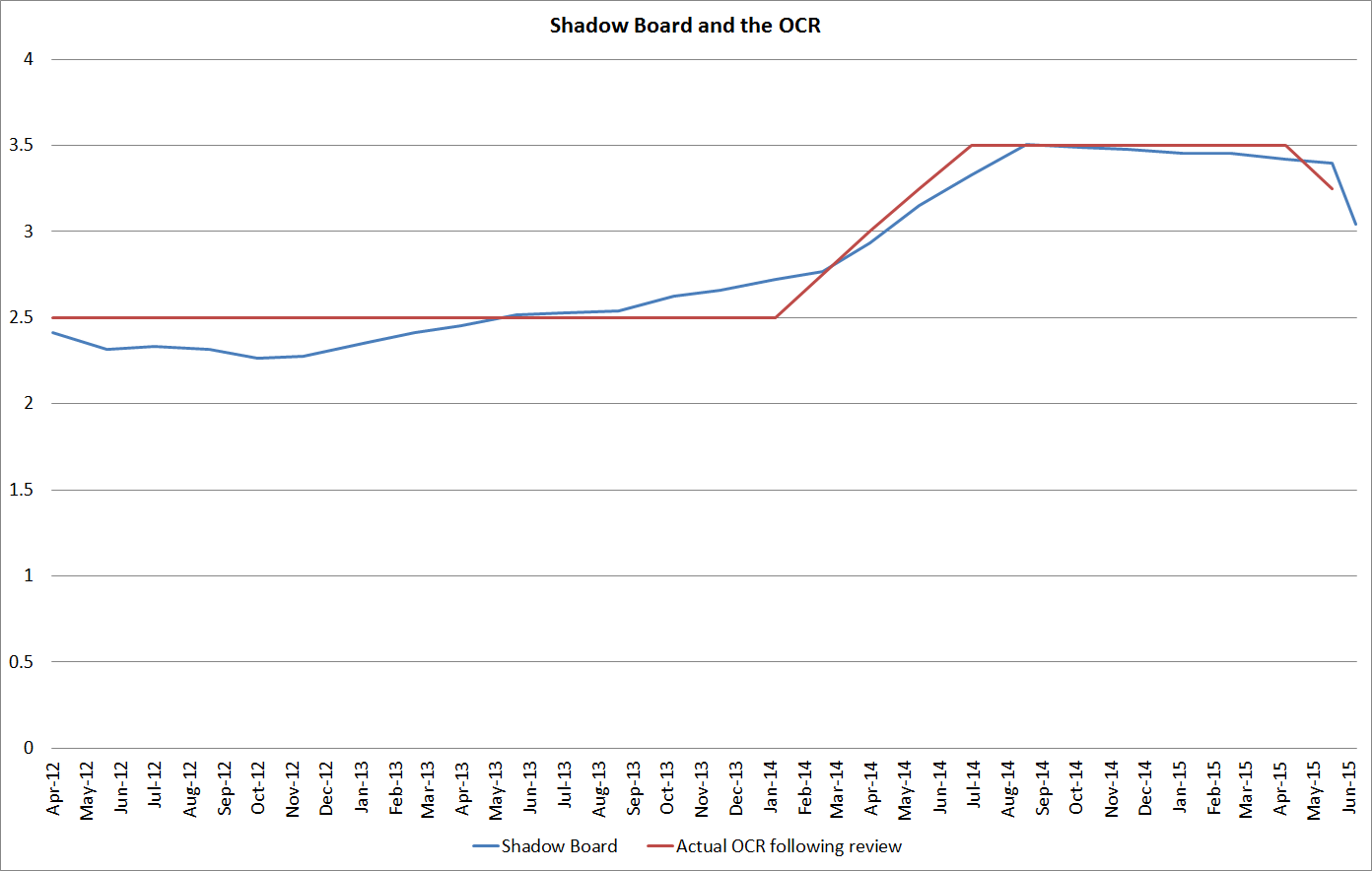
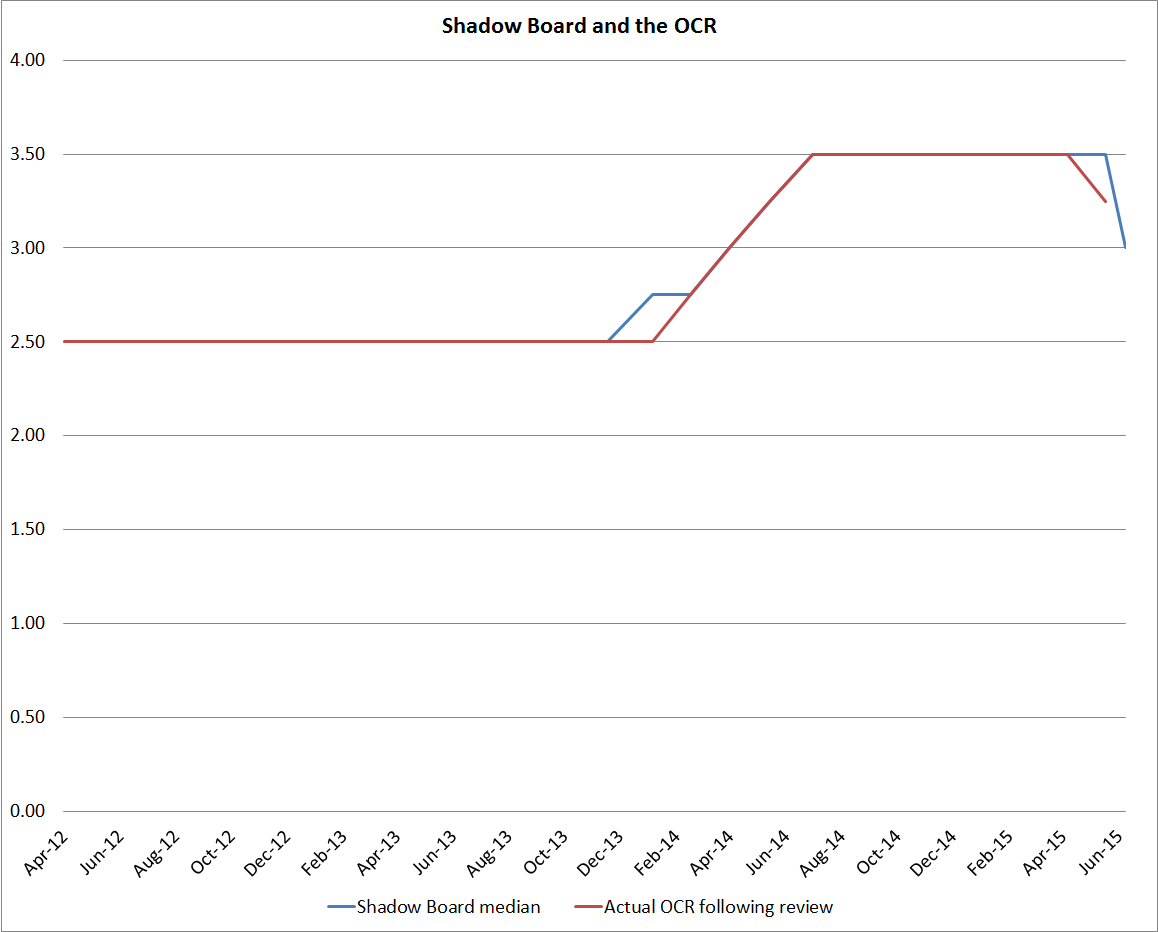
Here is a chart showing the actual OCR following the relevant review and the median view of the Shadow Board (thanks to Kirdan Lees at NZIER for sending me the historical data).

shadow board 1

They are all but identical, at least over this relatively short period. And yet the Reserve Bank has subsequently acknowledged that, with the benefit of hindsight they would have had the OCR lower in 2011 and 2012.   And most observers would now agree that the OCR did not need to have been as high as it was over the last year.

Perhaps the information is in the distribution of probabilities rather than in the median view?  Here is the mean of the views of the Shadow Board members. It does deviate a little from the actual OCR, and perhaps during last year the Shadow Board’s views were a little more cautious than the Reserve Bank was. The Shadow Board’s mean view was a little below the actual OCR, while the Reserve Bank itself was still stressing upside risks and the probable need for further rate increases.

shadow board 2

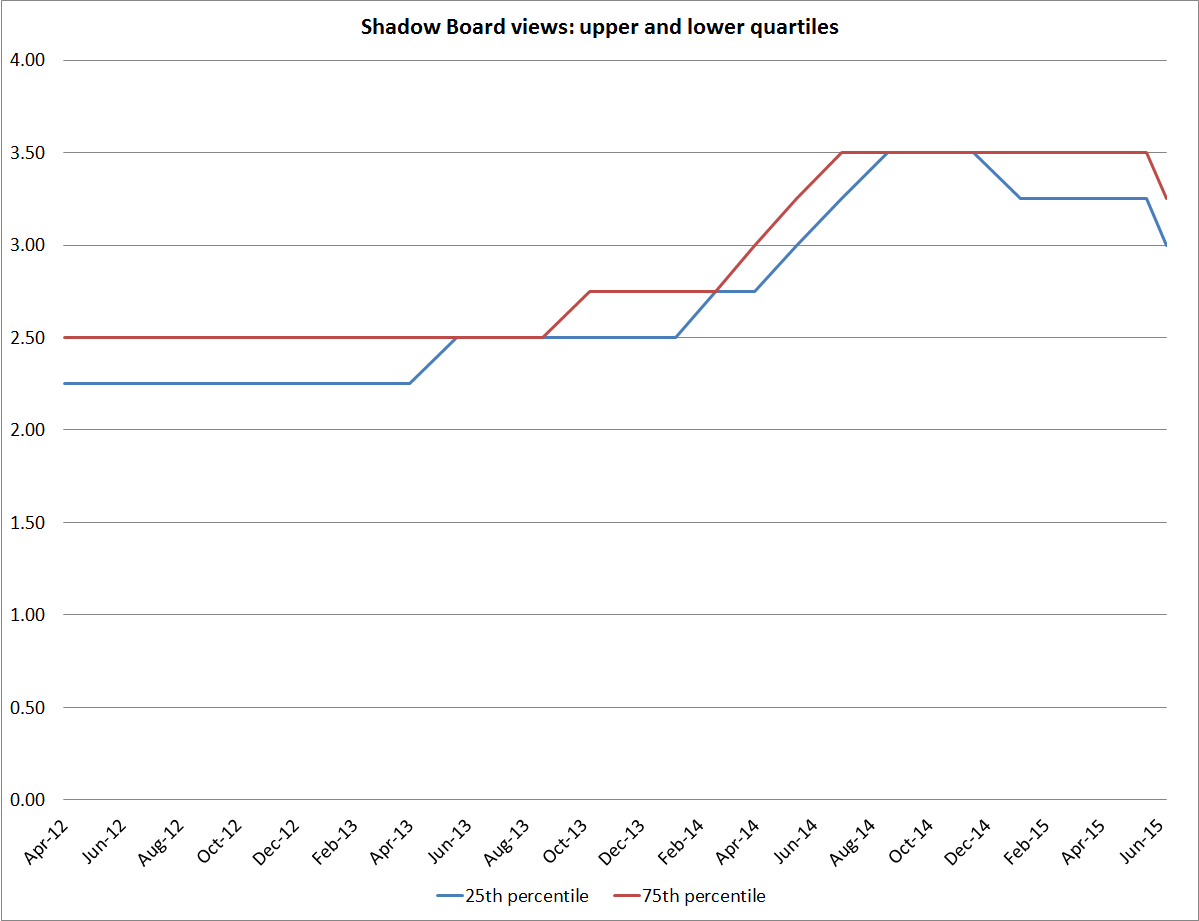
And here are the 25th and 75th percentiles. Respondents collectively put at least a 25 per cent chance on something at or below the 25th percentile being appropriate, and at least a 25 per cent chance on something at or above the 75th percentile.

shadow board 3

It is striking just how tight these ranges are. I noted back in June that most individual respondents’ views seemed excessively tightly bunched, given the huge historical uncertainty about the appropriate OCR. This time around there is a little more dispersion. The Shadow Board exercise has now been running for 27 reviews, and this is one of only three in which respondents collectively put a less than 50 per cent weight on one particular OCR (the other two were January last year, when the Reserve Bank was just about to commence raising the OCR, July last year which proved to be the last of the OCR increases).  I doubt, if I’d been assigning my own probabilities, if I would ever have put even a 40 per cent weight on any particular OCR in any particular review.

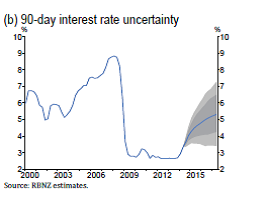
One other way of looking at the scale of the uncertainty around the OCR is the fan charts that the Reserve Bank published in the June MPS last year.  These were somewhat controversial, and are hedged around with lots of caveats in the technical notes, but the Governor presumably regarded them as a sufficiently useful device to run prominently in the main policy analysis chapter of a Monetary Policy Statement.   On the subset of shocks and uncertainties considered in that exercise, the 90 per cent confidence interval for the 90 day rate (proxy for the OCR) two years ahead was some 400 points wide. Perhaps a little embarrassingly for the Bank, that range did not even encompass an OCR of 3 per cent or less by July 2015.

fan chart

What do I take from all this?   I’d probably make only two points:

  • There is a huge amount of uncertainty in running discretionary monetary policy.  Some would argue that it is a mug’s game and only likely to introduce additional volatility.  That isn’t my view, but the uncertainty (across a range of different dimensions) is large enough that in general everyone should be a little cautious in taking a stand on a particular OCR (of course, under the current regime, the Reserve Bank must take a view, in actually setting the OCR). Mistakes won’t be uncommon –  whether by commentators or central banks – and that should be recognised, with appropriate humility, by all involved.  Of course, Reserve Bank mistakes matter more because they are charged with the power to take decisions that affects all of us in one way or another.
  • That very uncertainty highlights just how important it is that there is robust debate around a range of perspectives.  In this post, I haven’t looked at the diversity in the individual respondents’ views (partly because the panel of respondents has kept changing, and the sample is quite short), but looking through that data there hasn’t been much diversity of view across respondents either (with the creditable exception earlier in the period of Shamubeel Eaqub).    It is very easy for consensus views to form – both within the Reserve Bank – and in the wider New Zealand debate more generally.  And yet those consensus views will often be wrong.  Sometimes those looking at New Zealand from the outside have had a better take on things, but I doubt that has been consistently true (in the last year, HSBC in Sydney has been running the “rockstar economy” story, while other offshore players were rather more sceptical of the Reserve Bank’s continuing tightening cycle).  Encouraging that diversity of perspective is particularly important within the Reserve Bank, and yet it can be hard to maintain.  That is probably true in all central banks, but is a particular risk in our system, in which the Bank’s chief executive controls resources and rewards and is also single monetary policy decision-maker.  A very good single decision-maker would probably want as much debate and challenge as possible, recognising just how uncertain the game is.  A less-good one would find it too easy to discourage debate and challenge –  while never explicitly saying so, or perhaps even meaning to – preferring material that supports the decision-maker’s own priors and predilections.

David Parker and non-resident housing demand

David Parker has an interesting piece in the Herald, on how the various free trade agreements New Zealand governments have signed affect the ability of New Zealand to restrict non-resident purchases, should it wish to do so.  The heart of his argument is here:

The most favoured nation provision in article 139 does apply to existing investments and controls on new investments. If we want to further restrict the sale of farmland or houses to Chinese investors, we can. Article 139 simply requires NZ to treat China no less favourably than other countries. Clause 3 of article 139 means earlier agreements with our Australian and Pacific Island neighbours are not affected, and do not flow into the China FTA. Later agreements do flow through.

National does not believe there should be more restrictions on foreign buyers, and so the South Korean FTA does not contain the protections found in the China FTA. This creates risks if New Zealand moves to restrict or ban South Korean investment in residential property. Screening or bans are allowed for existing categories but not new categories, that is farms but not houses.

Article 139 of the China FTA means NZ can’t properly ban sales to Chinese investors but allow them to South Korean investors. Even the South Korean FTA does not limit the sovereignty of a future New Zealand government to restrict house sales to foreigners, but it does create a risk of South Korean claims.

If Parker’s reading is correct, it does appear to leave some options open. According to the MFAT website, the New Zealand-Korea FTA has not yet been ratified, and so is not yet in force.

Rodney Jones proposed a 20 per cent stamp duty on non-resident purchases in Auckland. Such restrictions or taxes are not a first-best solution. Particularly if the non-resident demand from China is likely to persist over the medium to long term, it would be much better to liberalise land-use restrictions and make it much easier to supply new houses and apartments. It is an export industry.  (But if the demand was likely to prove pretty short-term in nature, it might actually be preferable to simply absorb excess demand in temporarily higher house prices.)

But I don’t see any sign of wide-ranging liberalisation of land-use restrictions in the next few years. As I’ve noted previously, I’m not aware of other countries or major cities that have had tight supply restrictions and materially and sustainably liberalised them. Surely it must come some day, but regulation once established tends to linger for a long time. Import controls, from New Zealand’s history, were another good example.

I don’t think there is any obvious welfare gain for New Zealand in allowing extensive non-resident purchases of houses/apartments if governments also make it hard to bring new urban land to market and utilise it intensively in response to changes in demand. There is none of the technology transfer that might be associated with FDI. There is simply a redistribution – windfall gains to those who happen to own property in Auckland before the demand picked up, and windfall losses to those who would have wanted to purchase in the future. And the gain is simply the result of government-imposed and maintained supply restrictions. In that climate, I see no major problem in principle with some sort of restrictions.

And yet, I remain a little uneasy. In terms of accommodation itself – surely more important than home ownership – it is purchases of houses that are then left vacant that have the stronger adverse effects. Houses that are bought and put back on the rental market maintain the supply of accommodation. And yet we have no data on how important this “left vacant” component might be, and I don’t think the new post-October information requirements will provide any data on this split. Given that demand for house-buying seems relatively price-inelastic, even if the “left vacant” component is itself quite small, as a marginal boost to demand it could still be having quite an impact on price.

Perhaps this is where advocates of the Australian rule (“you can buy, but only a new build”) come in. The Australian rule doesn’t seem to have been very effective, but perhaps a similar one could be much more effectively policed if the authorities were serious about doing so? Perhaps it really is the minimally distortive approach if there is to be new regulation at all? The caveat to that proposition is that if the offshore demand were to prove short-lived we could be left with a nasty over-supply of the sort of housing not overly popular with most New Zealanders. An ample supply of (cheap) apartments sounds good, but real resources will have been diverted into building the properties, skewing the rest of the economy. Real resource misallocation tends to be more costly than changes in asset prices in isolation.  Perhaps that should be less of a concern starting from current house/land prices than in other circumstances?

I’m usually reasonably settled in my views as to appropriate policy responses. For now, on this issue, I’m not. Waiting for October’s data is a convenient line, but I suspect it is a bit of a cop-out. I am left rather closer to Rodney’s 20 per cent stamp duty than I was previously.

Fiscal and monetary policy interactions: some New Zealand history

The role of fiscal policy has been much-debated in recent years. I think the consensus view now is that discretionary adjustments to fiscal policy make little difference to GDP in normal times, because monetary policy typically acts to offset any demand effects. By contrast, if interest rates can’t go any lower (or central banks for whatever reason are reluctant to take them lower) then discretionary fiscal policy adjustments can have quite material impacts on near-term GDP behaviour.

These debates focus on demand effects. If the government spends less, without changing tax policy, spending across the economy as a whole is likely to be dampened to some extent, all else equal. But there are also stories about confidence effects. If the overall economic and fiscal situation is sufficiently fragile, then in principle tough and credible new fiscal initiatives could lift confidence sufficiently that the confidence effects overwhelm the demand effects.  This was the vaunted “expansionary fiscal contraction”. I’m not sure I could point to any examples in advanced countries, but others read the evidence and case studies a little differently. I’m not wanting to buy into debates about Greece here – but “credible” was perhaps the operative word in the previous sentence.

Before 2008, there was a variety of historical episodes that people often turned to when looking at the effects of fiscal contractions.  The UK experience in the early 1980s and the Canadian experience in the mid-1990s got a lot of attention.  I think the best read on the Canadian episode (with more extensive treatment here) was that substantial fiscal contraction did not have adverse effects on the Canadian economy because interest rates fell sharply,the Canadian exchange rate fell in response, and the United States – Canada’s largest trading partner – was growing strongly.

And then there was New Zealand’s experience around 1990/91. After several years of significant fiscal consolidation (which had been sufficient to generate material primary surpluses), new fiscal imbalances had become apparent by late 1990. In a major package of measures in December 1990, and in the 1991 Budget, substantial cuts to government spending were made. In combination with the earlier efforts (which were probably more important), these cuts helped lay the foundation for the subsequent decade or more of surpluses.

Former director of the Business Roundtable, the late Roger Kerr, was prone to argue that it was an example of an expansionary fiscal contraction. I’ve repeatedly argued that it wasn’t. Certainly, the recession troughed at much the same time as the 1991 Budget and the subsequent recovery was pretty strong. And, as Kerr noted, the academic economists who publicly argued that the fiscal contraction could only depress the economy further and would prove largely self-defeating ended up looking a little silly.     But the recovery had much more to do with the very substantial fall in real interest rates – as inflation was finally beaten – a substantial fall in the exchange rate, and with the recoveries in other advanced economies than with any confidence effects resulting from the tough fiscal policy measures.   By mid-1991, the new National government’s political position was so fragile that no one could have any great confidence that the fiscal stringency that was announced would be sustained (and, indeed, several of the higher profile measures were subsequently reversed). The rest of the macroeconomic policy framework, including the Reserve Bank Act, were in jeopardy. Elected in October 1990 with a record majority, the National party was 15-20 points behind in the polls only a year later, and only scraped narrowly back into government in 1993.

A few years ago, there was renewed debate here around the appropriate pace of fiscal consolidation. At the time, the government had large deficits, and the exchange rate had risen uncomfortably strongly from the 2009 lows. Some argued for a faster pace of fiscal consolidation, arguing that to do so would ease pressure on interest rates and the exchange rate. It had been the thrust of Treasury advice, and some outsiders were also making the case. Among them was then private citizen Graeme Wheeler, who had had a meeting with John Key and Bill English and had reportedly cited the experience on 1991, noting that monetary policy could offset any demand effects of faster fiscal consolidation.   Reports of this conversation had been passed back to the Reserve Bank.

Not many people at the Reserve Bank knew much about that earlier period. Newly-returned to the Reserve Bank from a secondment to Treasury, I wrote an internal paper discussing the interplay between fiscal and monetary policy over 1990 and 1991, including addressing some of the “expansionary fiscal contraction” arguments. It drew extensively on previously published material, on the now-archived files I had maintained during the late 1980s and early 1990s (as manager responsible for the Bank’s Monetary Policy (analysis and advice) section, and from my private diaries.

The Reserve Bank finally released this paper yesterday, with a limited number of deletions (I have appealed these deletions to the Ombudsman, given that they relate to events of 25 years ago, and in some cases involve deleting quotes from my own private diaries). The Bank is obviously uncomfortable about the paper. Despite the fact that the paper draws extensively from contemporary records – most of which are in the Bank’s archives – and was run past (in draft) several of senior people from the Reserve Bank in the early 1990s, the Bank has included a disclaimer on each page suggesting that the paper is primarily based on my memories, which it can’t vouch for. But, to be clear, it draws primarily on contemporary records, trying to document and explain historical events, and then to interpret them to an audience used to different ways of conducting monetary policy. Different people may read the same evidence in different ways, and access to a fuller range of records could alter some perspectives. As an example, while my files had copies of many Treasury papers, and records of many meetings with Treasury officials, I did not have access to a full set of Treasury papers comparable to the collection of Bank papers I used. As background, Graeme Wheeler was the Treasury’s Director of Macroeconomics in 1991.

A copy of the paper is here (two separate links, as that is how I got it from them).

Memo to MPC – Fiscal policy, monetary policy and monetary conditions part 1

Memo to MPC – Fiscal policy, monetary policy and monetary conditions part 2

This was an extremely tense period. The Reserve Bank Act had come into effect on 1 February 1990, and although both main parties officially supported it, it was contentious in both caucuses. In the National Party caucus, Sir Robert Muldoon and Winston Peters had been the leading sceptics. The Labour Party was almost equally split, and Jim Anderton had left the party over the direction of economic policy. Going into the 1990 election, no one knew which wing would dominate the (probable) new National government, nor which tack the Labour Party would take once it was in Opposition. Economic times were tough, and patience with the Reserve Bank was wearing rather thin as the disinflationary years dragged on. It wasn’t helped by the system for implementing monetary policy that we were using (documented here) which at one point led to our efforts being described by Ruth Richardson in Parliament as comparable to those of Basil Fawlty in the comedy classic. (Treasury and the Bank were actively at odds over the implementation arrangements – they variously hankered after money base targets or, on occasion, exchange rate rules[1]).

Last night I reread some of my diaries from the period, and dipped into Ruth Richardson’s book, and Paul Goldsmith’s biography of Don Brash, and was reminded just how fraught the period was. We spent most of 1991 not knowing whether, or how long, the monetary policy framework would last, and whether the senior management would survive. Ruth Richardson records that even at the end of 1991 when the worst of the pressures were beginning to ease, the Prime Minister Jim Bolger, in a meeting of senior ministers, canvassed the possibility of changing the Reserve Bank Act to provide an impetus to growth.

The Bank had for some time publicly argued that there was no problem with the exchange rate. As a result the Bank’s position with the new government was not helped by a change of stance quite late in the piece: the new view was that a lower real exchange rate was likely to be required to rebalance the New Zealand economy. This was an important theme in the Reserve Bank’s 1990 post-election briefing, and took the incoming Minister of Finance quite by surprise. The Reserve Bank openly making the case for a lower exchange rate seemed to provide ammunition for some of her caucus and Cabinet colleagues who were less convinced of the overriding importance of macroeconomic stabilisation.

She would have been more aghast had she realised that until the very eve of the election the Reserve Bank had been planning to recommend stepping back from the 0-2 per cent inflation target itself. This had been the outcome of some mix of unease over how (excessively) mechanical the first Policy Targets Agreement had been, and a wish to allow room for the desired depreciation in the exchange rate. The suggestion had been to keep a medium to longer-term focus on a 0-2 target, or perhaps redefine it to 1-2 per cent, but to add a 0-4 per cent “accountability range”, within which inflation could fluctuate without triggering severe accountability consequences. We stepped back from that recommendation at the last minute, in large part because of the view that to have recommended that sort of change would have left Ruth Richardson out to dry, as the only defender of a 0-2 per cent target, exposing her to (in the words of my diary two days before the election) “Peters’ and Muldoon’s ridicule and Bolger’s incomprehension”.

In terms of the fiscal policy dimensions, one of the Reserve Bank’s deletions in from this extract from my diary a couple of days after the election:

We had a marathon session in Don’s office (from 8-11) going thru para by para agreeing on a text with DTB finally showing his impatience with the last minute chaos. Changed fiscal tack in favour of a tough stance now, to help cement-in any exchange rate depn and, as important as anything it seemed, to help the Richardson faction in Cabinet.

What this captures is the somewhat uncomfortable extent to which the Reserve Bank (and Treasury, as we shall see) in this period were focused on supporting, or at least not undermining, those political players supporting the sorts of frameworks and reforms that the Bank and Treasury favoured. In the Bank, senior management came to a view in 1991 that saving the framework (the Act) was, for now, more important than price stability itself (as least in the short-term). Sceptics of this stategy – I was one – caricatured it as “the Reserve Bank Act is more important than price stability”.

Even with the benefit of long hindsight, I’m not sure what to make of the approach taken at the time. On the one hand, it is somewhat distasteful – neither the Governor nor the rest of us were elected – but on the other hand, perhaps it is just what inevitably happens in any fraught and controversial period. As it happens, we probably gave quite unnecessary ammunition to the opponents of reform through this period. In small part this was because we communicated badly and ran an implementation system that – with hindsight – was pretty bizarre. But more importantly, we held monetary policy too tight for too long – not to make any points, or reinforce any positions, but simply because we misread how strong the disinflationary forces were by then. In a serious recession, that was black mark against the Bank (and I was one of the more hawkish people on the Reserve Bank side).

During 1991, the Treasury became very focused on supporting the political position of Ruth Richardson as Minister of Finance. Some of this is captured in the paper. But much of I didn’t include, since the focus of the paper had been on the fiscal/monetary interplay. On page 15 of the paper, the Bank seems to have deleted some of this extract from my 4 September diary”

David [Archer] and I had lunch with Graeme Wheeler and Howard [Fancy][2] and were treated to a litany of gloom, of how we needed to be supporting the macro policy mix and helping get the recovery going and being very concerned about the political risks. As GW said “I wouldn’t want history to look back on me as a policymaker and say that in my confidence about the framework I hadn’t taken adequate precautions” – referring to the Bank. He was going on about how we had a “near-perfect” mon pol framework for the medium-term but that at the moment we needed to be more flexible. Both were concerned to play down 0-2, with vacuous waffle about “best endeavours” but taking the view that, in effect, 2-4% inflation wouldn’t worry them. ….. Apparently Bolger is getting worried about 1981/1932 re-runs: mass demonstrations, violence in the streets etc.

Only a few months previously the Treasury had been openly sceptical that macro policy was sufficiently tight.  It wasn’t always clear how well Treasury was reading the politics either – I had a very good relationship with Ruth Richardson’s own economic adviser, Martin Hames, and on the evening of the deleted extract above I recorded a long conversation with Martin in which “he still claims there are no real threats: says things were a lot worse at times in Oppn”.

This has been become rather a long post. It is partly about providing some context for those who think about reading the whole paper. Here are a few of my bottom lines:

  • Had we been running a now-conventional system of monetary policy implementation, many of the less important of these tensions and ructions would not have arisen.  When demand and inflation ease –  whatever the source –  the OCR is generally  cut.
  • While, with the benefit of hindsight, New Zealand was probably always going to settle at a low inflation rate (all other advanced economies did) that wasn’t remotely clear at the time.  In particular, the initial passage, and the survival, of the Reserve Bank Act was a much closer-run thing than is generally recognised. Infant mortality was a real threat
  • Neither the Reserve Bank nor the Treasury covered themselves with glory through this period in their macroeconomic analysis and policy advice.

[1] Murray Sherwin presciently argued that we should adopt an OCR. I’m still embarrassed by the note I wrote in response to that suggestion.

[2] David was the Bank’s deputy chief economist, and Howard was Treasury’s macro deputy secretary.
72 per cent want to restrict “junk food” advertising

I’m not among them.

According to the Herald 72 per cent of respondents to a recent survey favour greater government controls on “junk-food” promotions to children. Similar numbers wanted to restrict or ban “unhealthy” food brands sponsoring children’s sport.  A couple of mothers are interviewed in support of such restrictions, citing the dreaded “pester power”.

As I said, I’m not among the 72 per cent. I have three kids, have done all our family shopping for years, usually have at least one child with me when I’m at the supermarket, and two of my children play team sports, where “player of the day” certificates/prizes often come from outfits like Hell Pizza or McDonalds.

But, you know what, we just say no. I don’t encounter very much “pester power” in the supermarket aisles, and when I do I almost always say no. The children watch some television – admittedly not much of it free-to-air – but they know what it is worth pestering me about (“how about making a goat curry, pleeease Dad”) and what it is not. And they aren’t fed on an unremitting diet of lentils and kale either – we have a dessert each evening, consistent with my constant message to them (contrary to the one the schools propagandize then with) that “what matters is a balanced diet and plenty of exercise. Both kids won player of the day certificates on Saturday, but we don’t let them take advantage of the free pizza at Hell Pizza (as it happens, not because it is “junk food” but because we deplore the values that company promotes).  I hope Hell Pizza fails, but I certainly don’t think it should be banned, or should be unable to promote its business.

Just say no. It isn’t really that hard. Start young, but start. Why would we want to contract out responsibility for raising our children to the government? Too much of life is already spent trying to reverse the pernicious effects of propaganda (“evils of capitalism”, for example) from state schools.

The zero lower bound and Miles Kimball’s visit

One of my persistent messages on this blog has been that central banks and finance ministries need to be much more pro-active in dealing with the technological and regulatory issues that make the near-zero lower bound a binding constraint on how low policy interest rates can go, and hence on how much support monetary policy can provide in periods of excess capacity (and insufficient demand).

I’ve found it surprising that the central banks and governments of other advanced economies have not done more in this area. In most of these countries, policy interest rates have been at or near what they had treated as lower bounds since 2008/09. A few have been plumbing new depths in the last year or so, but half-heartedly (the negative rates have not applied to all balances at the central bank), and no one is confident that policy interest rates could be taken much below -50bps (or perhaps -75bps) without policy starting to become much less effective. The ability to convert to physical currency without limit is the constraint. There are holding costs to doing so, but for all except day-to-day transactions, the holding costs would be less than the cost of continuing to hold deposits once interest rates get materially negative. For asset managers and pension funds, for example, that shift would look attractive.  I would certainly recommend that the Reserve Bank pension fund (of which I’m an elected trustee) transferred much of its short-term fixed income holdings into cash if the New Zealand OCR looked likely to be negative for any length of time.

I’ve been surprised by the lack of much urgency in grappling with this issue in other countries. I suspect there must have been a sentiment along the lines of “well, getting to zero was a surprise, and inconvenient, but we got through that recession, it is too late to do anything now, and before too long policy rates will be heading back up to more normal levels”.     But they haven’t, despite false starts from several central banks. And each of these countries is exposed to the risk of a new recession, with little or no macroeconomic policy ammunition left in the arsenal. Interest rates can’t be cut, and the political limits to further fiscal stimulus are severe in most advanced countries.

If the rather sluggish reaction of other advanced country central banks (and finance ministries) is a surprise, the lack of any initiative by the New Zealand and Australian authorities is harder to excuse. Neither country hit the zero bound in 2008/09, or in the more recent slowdown (Australian policy rates are now at their lows, and commentators increasingly expect that New Zealand’s soon will be).  The period since 2008/09 should have shown authorities that the zero lower bound is much more of a threat that most of us previously realised (not just, for example, a Japanese oddity). It should have suggested some serious contingency planning – as, for example, the Reserve Bank of New Zealand had done as part of whole of government preparedness for the possibility of a flu pandemic. Both countries have had years to get ready for the possibility of the zero lower bound. It is not as if the experience of the countries who have hit zero is exactly encouraging – slow and weak recoveries and lingering high unemployment.

But neither New Zealand nor Australia appears to have done anything about it. Indeed, in the most recent Reserve Bank of New Zealand Statement of Intent these issues don’t even rate a mention. I’m not suggesting it is the single most urgent or important issue the central banks face. Contingency planning never is, but that does not make doing it any less important. I’m also not suggesting that New Zealand is as badly placed as some – if we were to get to a zero OCR, our yield advantage would disappear and the exchange rate would probably be revisiting the lows last seen in 2000. And we have some more room for fiscal stimulus than some other countries. But no central bank or finance ministry should contemplate with equanimity the exhaustion of monetary policy ammunition.  Nasty shocks are often worse than we allow for.

My prompt for this post is the visit to New Zealand this week of Miles Kimball, Professor of Economics at the University of Michigan (and an interesting blogger across a range of topics). Kimball has probably been the most active figure in exploring and promoting practical ways to deal with the regulatory constraints and administrative practices that make the ZLB a problem. They are all government choices. I’ve linked to some of his work previously. I noticed Kimball’s visit through a flyer for a guest lecture he is giving at Treasury on Friday, on a quite unrelated topic. I presume he will also be spending time at the Reserve Bank, addressing some of the monetary issues. This would seem like a good opportunity for some serious and enterprising journalist to get in touch with Kimball – whether directly, or via the Reserve Bank or Treasury – for an interview on some of his work in this area, and the reaction he is getting as he promotes his ideas, and practical solutions, around the world.

I’ve suggested previously that if our authorities are not willing to start on serious preparations to overcome the ZLB then the Minister should think much more seriously about raising the inflation target. I’d prefer to avoid a higher inflation target – indeed, in the long-run a target centred nearer zero would be good – but current inflation targets (here and abroad) were set before people really appreciated just how much of a constraint the zero lower bound could be. Better to act now so that in any future severe recession there is no question as to ability of the Reserve Bank to cut the OCR just as much as macroeconomic conditions warrant.

Here are some other previous posts where I have touched on ZLB issues:

On the physical currency monopoly, and thus block to innovation, held by central banks.

On a sceptical speech on these issues by a senior Federal Reserve official

How not to have a “reasoned and deliberate discussion” of housing and immigration

I noted in my post yesterday that I was a little surprised at how NBR had characterised differences between Shamubeel Eaqub and me around how to think about the contribution of immigration policy to housing demand. The description was “war of words”, something I didn’t recognise. But I hadn’t seen the article then.

As I noted yesterday, the difference is simply about how to interpret net PLT migration figures. Shamubeel uses them to conclude that immigration policy has not been a major influence on housing demand over 50 years. I pointed out, in response, that immigration policy is about how many non-New Zealanders we let in, and how long we let them stay. It does not affect the movement of New Zealanders at all. Accordingly, if we want to understand the role of immigration policy, we should focus mainly on data on the movement of non-New Zealand citizens. I have used the net inflow of non-New Zealand citizens as a proxy, while noting that it is not a perfect proxy.  On that measure, most of the trend increase in household numbers is now down to immigration policy choices.

So far I thought we just had the sort of difference that crops up all the time in analysing data. Someone proposes a hypothesis, with some numbers, and others respond questioning whether, for example, the data cited are showing quite what the first analyst thought they were. That sort of debate is how we advance our understanding. I didn’t (and don’t) challenge the accuracy of Shamubeel’s numbers (and I’m sure he isn’t challenging mine). The only issue should be what light each set of numbers sheds on the issue (and which issues they each shed light on). As I put it yesterday, if people prefer I’m quite happy to say that (given land use and housing supply restrictions) the large net outflow of New Zealanders has greatly eased pressure on house and urban land prices, and the (even larger) policy-facilitated net inflow of non-New Zealanders has greatly exacerbated pressures.    But only one is a immigration policy matter.

To the extent I had given it any thought, I assumed Shamubeel was approaching the discussion in the same dispassionate way.   In his book (page 129) he notes:

Economist Paul Collier, in his book Exodus argues that we need to talk openly about immigration. Not through the lenses of envy and racism, but in the context of a reasoned and deliberate discussion of why we want immigration, how many people we want, and what kind of people we want.

I nodded, largely agreeing, when I read that passage. Collier’s book is also worth reading.

But this morning I picked up a copy of the print edition of NBR and understood immediately Jenny Ruth’s “war of words” description. Instead of “reasoned and deliberate discussion” my argument is simply dismissed by Shamubeel as “That’s racist”, and “he’s always had this thing about non-New Zealanders. That’s pretty much been the tenor of his work over the last three years”, and “he’s taken a biased approach”.

And there is nothing more than that. There is no sense as to why, as a descriptive exercise, he disagrees with my interpretation of the role of immigration policy in explaining medium-term demand for housing.

Perhaps he provided a more substantive response to the journalist and she didn’t report it, preferring only to report the slurs?  (With apologies to Jenny Ruth) I rather hope so, because Shamubeel is someone whose contributions to economic analysis I have had some time for (indeed on this blog, I encouraged people to read his book) . I think he is much better than is suggested by simply falling back on labels like “racist”, or even “he has this thing about non-New Zealanders”, when someone challenges his framing of the numbers.

I’ve been posing some questions around New Zealand’s immigration policy and the implications for understanding economic performance for five years now. When one is discussing, or researching, the implications of immigration policy, inevitably one is focusing on non-New Zealanders. That is who immigration policy affects. As Shamubeel notes, we (and every country probably) need “reasoned and deliberate discussion of why we want migration, how many people we want, and what kind of people we want”.

In that time I’ve debated the issues and analysis with many people- here and abroad, New Zealand born and foreign born – and I’m pretty sure no one has ever previously accused me of racism.  These are important analytical and policy questions, and the prospects for reasoned and deliberate discussion recede further when people contributing to it the discussion are simply labelled “racist”, rather than engaging on the substance of the issues and analysis.

I hope that Shamubeel will, on reflection, withdraw his slur. As ever, I would be very happy to engage him (or anyone) on the substantive issues (whether interpretative, analytical or policy). And I still think people will benefit from reading his book.

Welfare numbers

I noticed a piece in the newspaper this morning reporting the latest quarterly welfare benefit numbers, including enthusiastic comments from Anne Tolley, the Minister of Social Development.

The report highlighted that the number of working age benefit recipients had reached the lowest June level since June 2008 – the lowest level in the last couple of decades (even though by June 2008 New Zealand was already two quarters into a recession).

These numbers do look like mildly good news, but need to be kept in context.

First, the Minister encourages us to look at annual changes because “quarterly data was subject to seasonal influences”. So perhaps she could ask MSD to resume the practice of publishing seasonally adjusted data. Other agencies do it.

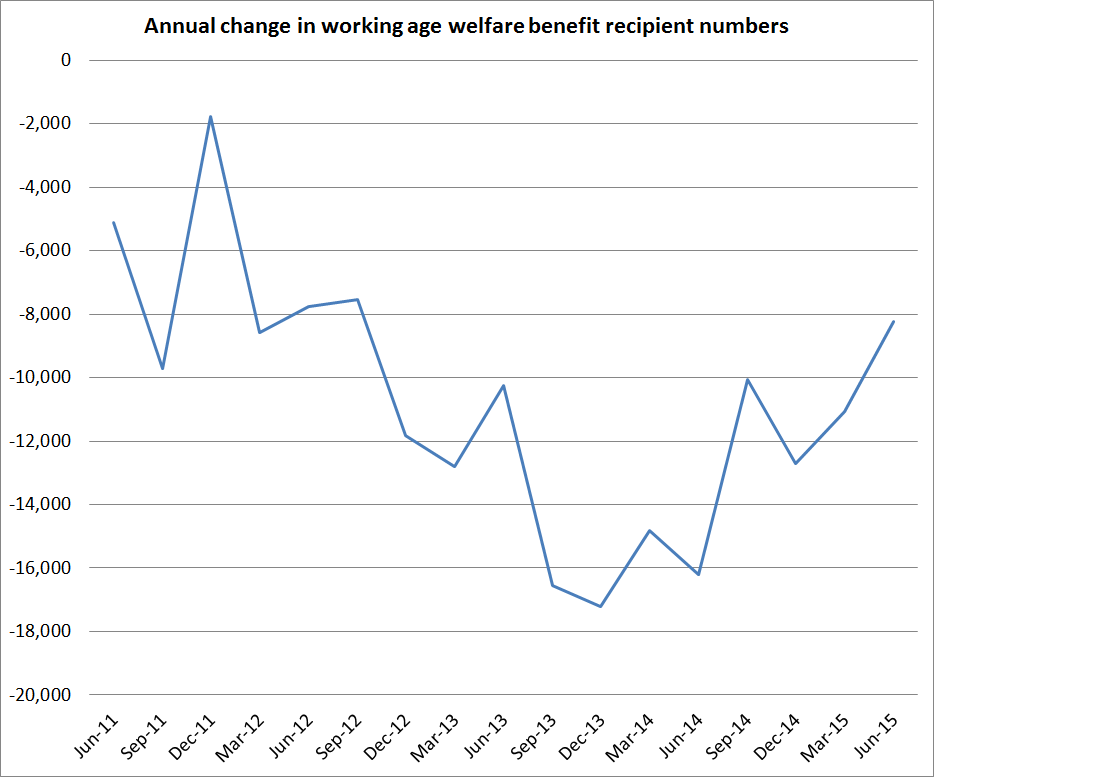
But even focusing on the annual data, these numbers suggest that the best is behind us. Here is a chart of the annual change in the number of working age people on main benefits. At best, a couple of years ago, numbers on benefits were not dropping quite as rapidly as they had been in 2007 (by which time, GDP growth rates were unspectacular). And for the last 18 months or so, the rate of decline in benefit numbers has itself been dropping away. That would be not inconsistent with signs that the unemployment rate has levelled out and, more recently, that the pace of economic growth is slowing.  A more robust recovery – not something the Minister of Social Development can do much about – could have made deeper inroads to the beneficiary numbers.

benefits

But standing further back, the MSD release notes that 10.3 per cent of the working age population is on one of these main benefits.  Repeat slowly: one in ten working age adults is primarily dependent on state welfare benefits for their income. And 74 per cent of those people have been on a main benefit for more than a year.

And how about the ethnicity of recipients. 120000 benefit recipients identified as NZ European and 99000 as Maori. 2013 Census numbers suggests there were just over 300000 people (ages 20-64) self-identifying as Maori.   How people self-identify in the Census might be different to how they identify themselves in MSD, but it looks as though almost one in three adult working age Maori are primarily dependent on state welfare benefits.  And that in an economy with an unemployment rate of under 6 per cent.  It is shameful.  I’m not suggesting it is primarily the current government’s fault. But it is not clear how seriously they, or previous governments, take it. Or whether they are really willing to ask hard questions about how this welfare dependence came to be.

Finally, while it is encouraging to see the numbers on working age benefits dropping, and the government has taken some steps that have assisted that process (which is generally dominated by the economic cycle), don’t forget that total welfare benefit numbers are rising each and every year. MSD don’t make it easy to find quarterly data on the numbers receiving New Zealand Superannuation, but they look to be rising by 20000 a year.  Working age benefit numbers are now dropping by 8000 a year.   That rise in NZS numbers is something that the government could have done something about, by gradually raising the age of eligibility, but has resolutely determined not to do so.

So, yes, there are some mildly encouraging points.  But there is, surely, so much more to do.  Can any of us be content, longer-term, with a society in which such large proportions of the population rely on state grants for their income?

Two comments on housing

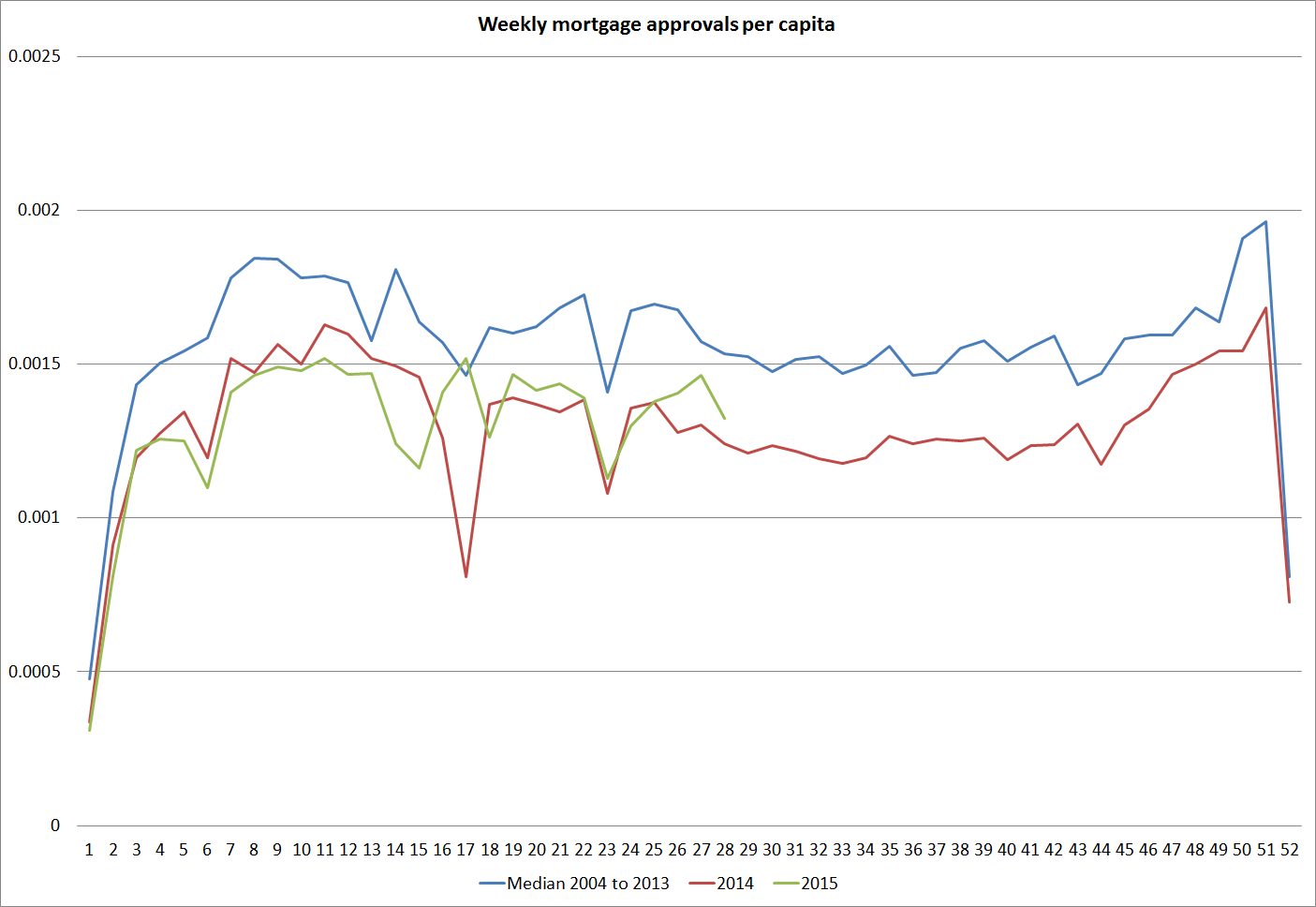
This morning I updated my chart of mortgage approvals per capita. I’ve shown it previously and I like it because it is very timely data.  As you can see, the number of mortgage approvals per capita is running just slightly ahead of last year’s level. But the number of approvals is running below the average, for the time of year, in the 12 year history of the series. In fact, in only three years (2010, 2011, and 2014) have approvals been lower than they are this year.

mortgage approvals 2

What do I take from this? First, it reiterates the point that across the country as a whole the housing markets are not particularly buoyant. House sales per capita are far below the peak in the previous boom. Most places have real house prices below previous (2007) peaks, and in most places nominal house prices are pretty flat.

Auckland is a (big) exception. If we had mortgage approvals data on a regional basis, perhaps we’d find that Auckland’s were nearer to or even above the historical median, while the rest of the country might be tracing the lows. But the non-resident demand for houses in Auckland may also be relevant here. We don’t know how large the contribution of that demand to rising house prices is, but much of those purchases (however large or small they are) are probably either cash purchases, or perhaps financed with credit from abroad (not captured in New Zealand data).

I think these data also tend – not conclusively, but suggestively – to confirm the line I ran in my submission last week on proposed investor finance controls. There is simply no evidence that rising house prices in Auckland are to any material extent the result a credit-driven process. If they were, not only should the Reserve Bank be able to point to concrete evidence of deteriorating lending standards, but we would also expect to see lots of mortgages being approved. In fact, only three years have been weaker.

Changing tack, I see that print edition of the NBR has an article about what is described as a “war of words” between Shamubeel Eaqub and me, about the contribution of immigration policy to the house prices pressures in Auckland over time.  I didn’t recognise the description (“war of words”)  and the print edition of NBR isn’t sold this far out in the suburbs so I haven’t yet seen the article, but I just wanted to explain again the difference in how Shamubeel and I are interpreting the same data. I set it out here a few weeks ago.

Shamubeel notes (correctly) that net migration has accounted for only 9 per cent of household formation in New Zealand over the last 50 years. My point is quite simply that net PLT migration (which is probably understated on average over time) is not a description of the contribution of immigration policy. Immigration policy affects the arrival (and duration of stay) of non-citizens. Using the net flow of non-citizens as a proxy for the policy-controlled bit, I concluded that immigration policy accounts for most of the household formation in New Zealand in the last couple of decades. Since 2006, on this proxy, it accounted for 106 per cent of household formation.

I think it would be entirely reasonable to say that, on the one hand, the large net migration outflow of New Zealand citizens over decades has greatly eased pressure on the housing market (taking as given land use restrictions), and, on the other hand, the large net inflow of non-NZ citizens, which is over time a policy-controlled variable, has (even more) greatly exacerbated those pressures. The net effect of the two independent forces might have been modest over 50 years, but one limb is the endogenous behaviour of private NZ citizens, and the other is the direct outcome of policy choices. I might comment further later when I’ve seen the NBR piece.

A severe commentary

Plenty of commentaries have remarked on the very low inflation numbers out this morning.

None (that I have seen) has highlighted what a severe commentary these numbers are on the Reserve Bank’s conduct of monetary policy over the last few years.

Reciting the history in numbers gets a little repetitive, but:
• December 2009 was the last time the sectoral factor model measure of core inflation was at or above the target midpoint (2 per cent)
• Annual non-tradables inflation has been lower than at present only briefly, in 2001, when the inflation target itself was 0.5 percentage points lower than it is now.
• Non-tradables inflation is only as high as it is because of the large contribution being made by tobacco tax increases (which aren’t “inflation” in any meaningful sense).
• Even with the rebound in petrol prices, CPI inflation ex tobacco was -0.1 over the last year – this at the peak of a building boom.
• CPI ex petrol inflation has never been lower (than the current 0.7 per cent) in the 15 years for which SNZ report the data.
• Both trimmed mean and weighted median measures of inflation have reached new lows, and appear to be as low as they’ve ever been.

This wasn’t the way the Bank told us it was going to be. And more importantly, it wasn’t the basis on which they held interest rates up through 2012 and 2013, and then raised them last year. As late as December last year, they were still talking of raising the OCR further. Real interest rates never needed to rise, and as a result of the misjudgement they rose even further than the Bank intended (inflation expectations fell away).

It has been a sequence of cumulatively severe misjudgements. The word “mistake” keeps springing to mind, although of course the Governor rejected that characterisation at the time of last month’s MPS. Perhaps he is rethinking now? As I’ve pointed out previously, inflation outcomes so far weren’t mostly the result of unforeseeable external economic shocks. And if core inflation measures are this weak now, we have to start worrying what will happen to them as economic growth slows further, construction pressures ease, and the deepening loss of income from the declining terms of trade bites. Wage inflation has been very low, and more recently wage inflation expectations have been falling.

The Reserve Bank has belatedly recognised the need to modestly change direction. The Governor cut the OCR by 25 basis points last month, and foreshadowed that at least one more cut was likely. But the problem is that they are still well behind the game. The data are weakening faster than they are cutting, and the OCR was already too high right through last year. Difficult as it might be to make a large move at an intra-quarter review next week, the substantive case for a 50 point move is certainly strong. If not next week, then at the latest it should happen at the September MPS. There also needs to be a recognition that there is nothing wrong or inappropriate even if the OCR goes to new lows. The OCR simply needs to be set consistent with a realistic appraisal of the inflation outlook (not the upwardly biased one that has guided too many central banks in recent years). An apology, and a heartfelt mea culpa, from the (single decision-maker) Governor would also be appropriate.

As inflation expectations measures are likely to keep falling, this mistake is also increasing the risk that the zero lower bound will end up being binding in New Zealand. But, if we take the Reserve Bank’s Statement of Intent seriously, this is not something they worry about. They should.

But questions also need to be asked about the role of the Bank’s Board as agent for the public and the Minister of Finance. Inflation outcomes now are reflecting policy choices made last year. But here is all the Reserve Bank Board has to say about monetary policy in their latest Annual Report, published only nine months or so ago. In introducing the document, they note that:

Our formal review of the Bank’s performance is included in the Bank’s Annual Report.

And when they get to monetary policy

In the last year, we have considered the Bank’s decisions to hold the OCR at a record low of 2.5 percent for an unprecedented three-year period, and to increase the OCR four times from March to July 2014.

The level of disclosure in monetary policy was very high. We considered that the Bank’s policy decisions were appropriate, initially taking into account the need to provide support for the economic recovery after the disruptions of recession and earthquakes, and lately the need to ensure that the recovery is sustainable, by restraining emerging inflationary pressure.

This was a “formal review”? I still find it astounding that, less than a year ago, the Bank’s Board – the independent agency responsible for scrutinising the Bank – made no mention at all of the continued undershooting of the inflation target. I’m not suggesting they should have read the data better than the Governor – they are paid as ex-post monitors, not as monetary policy decision makers – but there is little sign of any serious scrutiny at all. It reinforces my view that the governance model is inappropriate in a wide variety of dimensions, and that the Board in particular plays little useful or effective role as agent for either the Minister or the public. By construction, it is simply too close to the Bank, and thus is more prone to act as defensive cover for the Governor, than as a source of serious scrutiny and challenge in the public interest. At very least, we should expect something much more substantive from the Board in its next Annual Report.

The Minister of Finance has commented a couple of times recently about the Bank undershooting the inflation target midpoint (which was added explicitly to the PTA by him in 2012). Such “shots across the bow” seem both understandable, and quite appropriate. The Minister initiates the inflation target, but has no say in individual OCR decisions. But he is responsible to the public (and Parliament) for having the target met by the Governor. Whether with hindsight or foresight, monetary policy has been too tight for probably five years. Partly as a result, New Zealand’s economic recovery has been anaemic – much more muted than in a usual recovery, despite the huge boost to demand provided by the Canterbury repair and rebuild process. The unemployed pay a particularly severe price for that, but they aren’t the only ones.

The real question is whether the Minister is willing to do more than talk. My impression is that his instincts are often in the right direction, but there is often a reluctance to follow through (one could think of housing supply issues as a prime example).

I’ve touched previously on some of the options the Minister has to show that he takes these issues seriously. In May I noted:

The Minister could seek a report from The Treasury on their view of how well the Governor was doing consistent with the Policy Targets Agreement, could let it be known such work was underway, and could arrange for such a report to be published. The New Zealand Treasury offers independent professional advice to the Minister of Finance and would have to take seriously such an exercise. It might be expected to consult externally (but confidentially) to canvass opinion. At present, for example, most financial market economists – not the only relevant observers but not unimportant either – in New Zealand seem quite comfortable with the Governor’s handling of monetary policy.
The Minister could also seek formal advice from the Bank’s Board, and let it be known that he was doing so. This would be a totally orthodox approach – the Board exists as a monitoring agent for the Minister – and it was, for example, the approach taken in the mid-1990s when inflation first went outside the target range. The Board has a number of able people on it, but as an effective agent for accountability risks being too close to management. The Governor sits on the Board, the Board meets on Bank premises, it has no independent resources, and it has been chaired exclusively by former senior managers of the Reserve Bank. It was striking that last year’s Board Annual Report (which is just embedded in the Bank’s Annual Report document) had nothing substantive on the deviation of inflation from the policy target.

Those are both still serious options. I suspect that it might be timely to exercise both of them.

Longer-term, it is now only just over two years until the Governor’s term expires. There must be real questions as to whether Graeme Wheeler could credibly be reappointed (recommended by the Board or accepted by the Minister) after his succession of overconfident monetary policy misjudgements, and in light of the poor quality analysis he has used to support his over-reaching policy initiatives in the regulatory areas. Perhaps Graeme will make it easy and conclude that, at his age, one term is enough?

The mistakes of the last few years don’t result primarily from the governance model, but the governance model – with too few checks on the Governor, as decision-maker and chief executive responsible for all the supporting analysis – is likely to have contributed. The mistakes –  an exaggerated version of those made in various other countries – highlight the material weaknesses in our most unusual system. The start of a new gubernatorial term is a good opportunity for the Minister to take the lead in reforming the Reserve Bank Act to bring governance of this powerful agency more into line with international practice and with governance standards in the rest of the New Zealand public sector. Treasury recommended doing something in 2012, and the Minister refused. He should take the lead this time. If he did, I suspect he would find pretty widespread support – from other political parties and from market economists. Perhaps even from the Reserve Bank itself.

PS.  Following on from earlier commentary, SNZ has altered how it is doing seasonal adjustment of the non-tradables inflation series.  The cost of doing so, is quite a short series, but for what it is worth, seasonally adjusted quarterly non-tradables inflation last quarter (0.3 per cent) was about half what it had been each quarter for the last 2-3 years.

Considering the veracity of Chinese GDP – Christopher Balding

One of my favourite sites for making sense of what is, and isn’t, going on in China is Balding’s World, written by Christopher Balding, a professor of economics of Peking University.

He has had a succession of useful posts over the last few weeks, and here is the link to his piece on yesterday’s somewhat implausible GDP data.  The summary of Balding’s take is captured in his title.  As he notes, the problems with Chinese data have been deep-seated, extensive, and long-running.  In conclusion he tellingly observes:

Only last month, an initiative was announced to improve labor market data as the official unemployment rate has been nearly unchanged for more than a decade.  If Chinese leaders are telling the world how poor the statistical agencies in China are, imagine the reality.

Wouldn’t it be preferable if these issues were getting serious treatment in the media rather than the hyper-ventilation about the gyrations of the Chinese stock markets? When stock prices rise 100% in less than a year, in an economy that appears to have been slowing sharply, sharp falls are hardly a surprise. And they mean no more for economic performance than falls in stock prices in the US in 1929 did – while media continue to run a cheap, incorrect, line that a collapse in share prices somehow caused the great depression. Stock prices move for a reason, and it is much more useful to try and get behind what is going on in the underlying economies than to focus too much on share prices themselves. That was true in New Zealand around 1987, and is probably true of China today.