Occupations of residence approvals under the Skilled Migrant Category

I’ve started working my way slowly through the hundreds of pages of papers MBIE released to me last week about the economic impact of immigration and the permanent residence approvals programme.  I’ll write more on the substance of that material and advice later, but for now I thought I’d highlight one table from one of the 2013 papers.

Readers will recall that I highlighted a few weeks ago the rather less-than-highly-skilled nature of many of those given temporary work visas under the Essential Skills category.  I wasn’t aware of any similar data on those being granted residence visas and used a rough proxy, from the PLT data, in a post earlier this week.  Those data appeared to raise similar concerns.

But this table goes to the issue directly, and shows the top 20 occupations of the primary applicants who were granted residence visas under the Skilled Migrant category in 2011/12 and 2012/13.

SMC occupations

If New Zealand’s immigration really is “a critical economic enabler” (from the first line of the first of the MBIE papers I received), this should be where one expects to see the real quality and skills of the people who are let in permanently.  Presumably any spouses/partners of these people are less well-qualified on average (otherwise the spouse would, rationally, have been the primary applicant), there are dependent children, and of course all those other family, parental and humanitarian entrants.

As I said a while ago, I’m a bit of a naïve optimist at times.  So even having previously shown the work visa data, I was quite stunned by this table.  The top 4 occupations in both years were chef, aged care nurse, retail manager, and café or restaurant manager.  Those four occupations alone make up around 20 per cent of the total successful skilled migrant primary applicants –  the minority of those whom we allow in permanently who face any skills test at all.  Even MBIE laconically observe that, while “chef” and “café and restaurant manager” are classified in ANZCO as relatively highly skilled occupations, there are some signs/reports that many of those coming to New Zealand in such numbers under these headings may be towards the lower-skilled end of the spectrum.

Some snippets from the annual trade data, with a China tinge

Statistics New Zealand released yesterday the annual data on New Zealand’s overall foreign trade (goods and services) by country.  It is a nice summary set of tables for people who don’t spend lots of time looking at trade data, and the services data are only available annually.

Since the end of last year, these have also been the data the Reserve Bank now uses to calculate the weights in its trade-weighted index measure of the exchange rate.  Those weights are calculated on a total trade basis (imports and exports, goods and services) for 17 currencies, covering countries that currently account for a bit over 80 per cent of New Zealand’s foreign trade.  The weights are updated annually, and when they are updated in December there will be a few changes.  After much noise about China becoming our largest trading partner (which it has not yet been on a total trade, or even total exports, basis), China’s share in New Zealand’s foreign trade dropped back quite a bit over the last year.  By contrast, the United States’ share rose.  Whereas this year, the weight on the Australian dollar was only 2 percentage points more than that on the Chinese yuan, both well ahead of the US dollar, next year the weight on the yuan will be around halfway between those on the Australian and US dollars.

twi weights

There is no easy right answer as to how to weight an exchange rate index.  My own sense is that the current weighting structures overstates the importance of Australia, and understates the importance of the United States and the euro area (or the EU more broadly).  These latter two economies/regions are a huge share of total world production/consumption, and are major competitors in our largest (net) export products, particularly dairy.  Neither element is captured in the current weighting scheme.  And while Australia is our largest export market, those numbers are flattered by the fact that still more than 12 per cent of our exports to Australia are crude oil and precious metals (presumably mostly newly-mined gold), which have nothing to do with wider economic conditions in Australia, or movements in the Australian dollar.

It is interesting how much of our trade with Australia is now dominated by travel.  Excluding oil and precious metals, 28 per cent of our exports to Australia are travel and transport.  No other single category exceeded 7 per cent of our exports to Australia last year.   The picture is similar on the import side, where travel and transportation account for 27 per cent of our Australian imports.

And, finally, I was interested in the dairy export data.  The media has been full of discussions around dairy exports to China, which had surged in 2013/14.

Here are our milk powder, butter and cheese exports for the last five years to China on the one hand, and the ASEAN countries on the other.

dairy exports china and asean

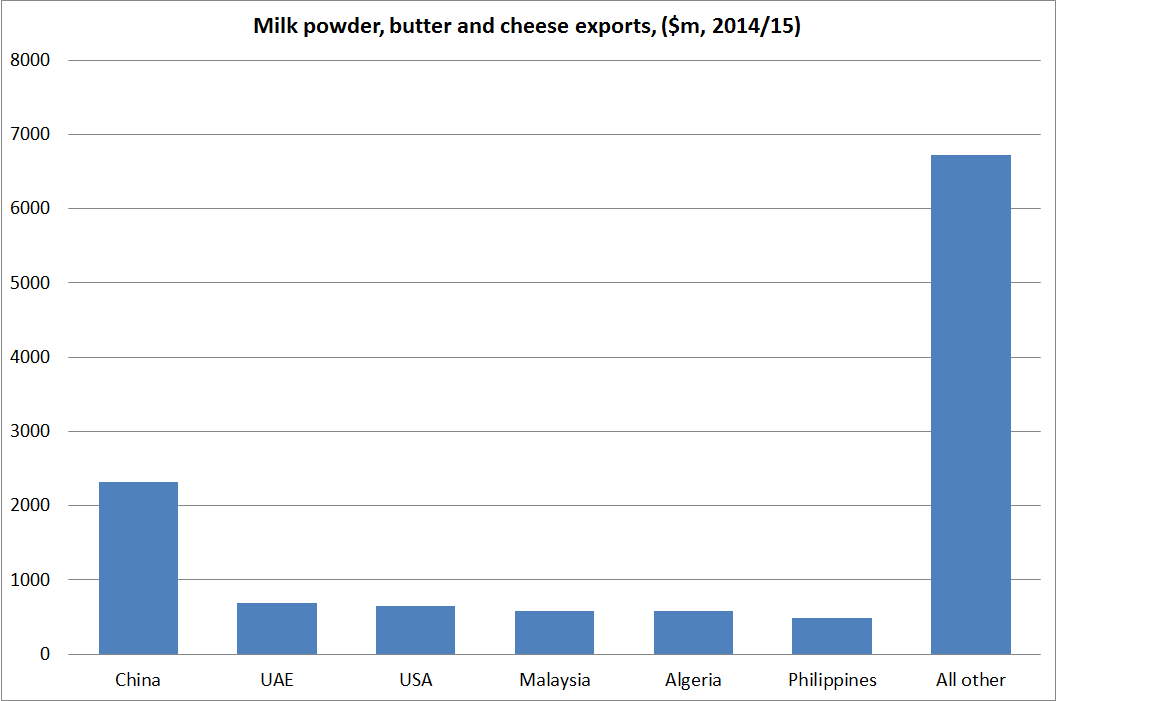
It highlights both how unusual last year was, but also how important those other countries are in New Zealand’s dairy trade.   In a typical year, New Zealand firms export as much milk powder, butter and cheese to these countries as to China, and yet these countries in total have annual GDP not much more than 20 per cent of China’s.  Actually, the data also illustrate just how diversified dairy exports are in a typical year.

dairy exports 2014 15

By contrast, in the 1950s almost all our dairy exports went to the United Kingdom, and there were few other export markets anywhere for dairy products.

None of this is to suggest that China is unimportant.  China is now the world’s second largest economy, with a very large foreign trade for a country of its size.  And is a badly-managed, highly non-transparent, economy, at the tail end of one of the bigger, least-disciplined, credit booms in history.  What happens in China matters a great deal to most countries, but there is no reason to think it matters abnormally more to New Zealand.

(As one perspective on the lack of transparency –  and, worse, outright misrepresentation –  that plagues the rest of world making sense of China, I’d recommend the latest from Christopher Balding, who takes on those who want to defend China’s data as providing a broadly accurate and representative picture of what has been going on).

“Financial literacy”, schools, and governments

According to a new poll out this week, 93 per cent of New Zealanders want “financial literacy” to be a compulsory subject taught in all schools.  The details of the poll don’t seem to be available, but we can probably assume that the questions were phrased in such a way as to encourage a positive answer.  No doubt even a more balanced question might have drawn a positive response.  To many it sounds like a “good thing”.  I’m sceptical.

I’m sceptical at a variety of levels.  First, and perhaps most practically, these surveys (and the reported views of advocates) never ask what people would prefer schools to stop teaching.  There are only so many hours in the day/year.  I’d face the same question as what should the schools stop teaching, but given a choice, personally I’d rather that schools were required to teach a sustained course in New Zealand and British/European history than that they teach so-called financial literacy.   Kids are exposed every day to their parents’ attitudes to, and practices with, money and things.  They aren’t directly exposed, to anything like the same extent, to maths, science, history, or foreign languages.

Second, as far as I can see, the evidence is pretty mixed as to whether teaching “financial literacy” makes any difference to anything that matters.  Are countries with higher “financial literacy” scores richer as a result, more stable, happier?  And a recent report (page 32) for our own government agency that deals with this stuff actually showed that, for what it is worth, the “financial literacy” of New Zealanders scored quite well in international comparisons.  What is the nature of the problem?
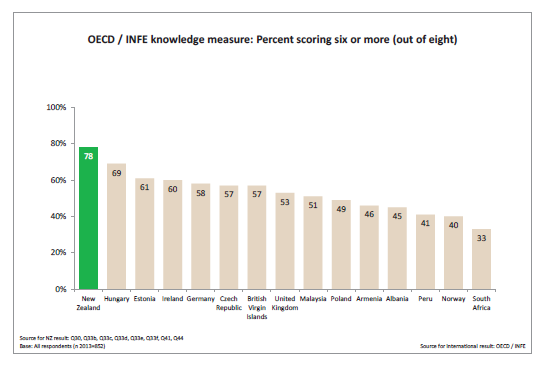
financial literacy

Third, why would we expect that the government, and its representatives, would be good people to teach children about money?  Perhaps we should judge people by their track record.  The current Retirement Commissioner, as captured in this profile, does not exactly inspire confidence on that front (unless perhaps “do as she doesn’t kids”).  And at a bigger picture level, in one way or another governments are the source of most financial crises –  Spain, Ireland, Argentina, the United States, China.   Governments are more prone than most to undertaking projects that they know provide low or negative economic rates of return.  Governments face fewer market disciplines than citizens. And governments don’t have to live with the consequences of their mistakes.  So perhaps I could support a civics programme that included a section on critically evaluating election promises and government policy announcements.

Fourth, much of the discussion in this area is quite strongly value-laden.  And no doubt it has always been so.  I recall the day when our 6th form economics class was visited by a banker, to try to promote savings etc.  He brought along a hundred dollar note –  this was 1978, and it was probably the first time any of us had seen one.  Trying to set up a discussion about the merits of bank deposits (probably with negative real interest rates at the time), he asked us all what we’d do with the $100 if we had it.  Various class mates rattled off their spending wishes, but the banker was totally flummoxed when one of my friends, a strong Christian, told him that what she’d do was to give it away.   .

And where, for example, in all the discussion of financial literacy is there any reference to the findings that one of the best routes to financial security is to get married and to stay married?  Finding the right spouse, and learning what is required to make a lifelong commitment work, is almost certainly a more (financially) valuable lesson that knowing that when interest rates fall bond prices rise.  But it is not one we are likely to hear from the powers that be.

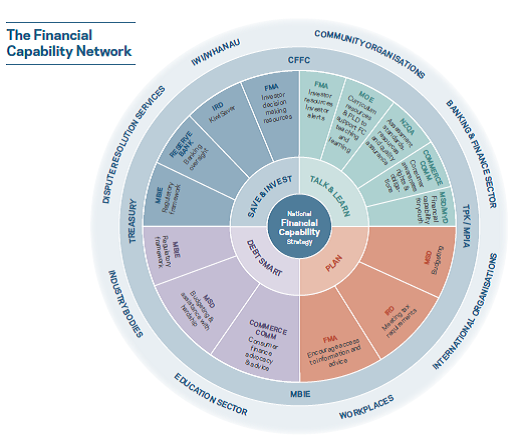
And fourth, this becomes an excuse for yet more bureaucratic/political bumf, reinforcing a sense that governments should have “strategies” about everything and anything.  I was somewhat surprised to learn that our government has a financial capability strategy.  Why?

Building the financial capability of New Zealanders is a priority for the Government.  It will help us improve the wellbeing of our families and communities, reduce hardship, increase investment, and  grow the economy.

The National Strategy for Financial Capability led by the Commission for Financial Capability provides a framework for building financial capability. It has five key streams:

  • Talk: a cultural shift where it’s easy to talk about money
  • Learn: effective financial learning throughout life
  • Plan: everyone has a current financial plan and is prepared for the unexpected
  • Debt-smart: people make smart use of debt
  • Save and invest: everyone saving and investing

On this measure, might we assume that “debt-smart” would mean taking as much interest-free student debt as possible and paying it off as slowly as possible?  Not an approach I will be encouraging in my children.

More generally, I’m not sure that any of these items represent areas where we should expect governments to bring much of value to the table.  One might marvel that human beings had got to our current state of material prosperity and security without the aid of government financial literacy/capability strategies. And since when has a traditional Anglo reticence about matters of money been something for governments to try to change?   Better perhaps might be a focus on improving the financial capability of governments.

The Commission’s own research (p 26) shows what one might expect, people develop more “financial literacy” as they need it.  So-called “literacy” is low among young people (18% of 18-24 year old males are “high knowledge”), who don’t need it much.  It rises strongly during the working (child-rearing, mortgage etc) years (53% of 55-64 males are “high knowledge”), and then looks to tail off a little in retirement.  All of which is unsurprising, and (to me) unconcerning.

I know the so-called Commission for Financial Capability doesn’t cost that much money, but as I’m sure they would point out, every little counts.  The money they fritter away on national strategies and capabilities is money that New Zealanders don’t have to spend, or save, for themselves.  In fact, this graphic, from the government’s policy statement, might suggest a few other government agencies that could be a trimmed back.  Governments need to do well what only governments can do.  So-called “financial literacy” isn’t obviously one of those things.
financial literacy 2

As an easy way into this, consider this US-government funded online quiz, a shop window for a US project on better understanding financial literacy.  I imagine that most readers of this blog will score 5/5, while the average American scores 2.9.  But then stand back and ask yourself why the average American (or New Zealander) needs to know the answers to these questions, phrased rather in the manner of a school economics exam.  People who read blogs like this take for granted a knowledge of the answers, but in what way has that knowledge made your life, or mine, better?

The Treasury on the government’s plans to reward migrants to the regions

The sadly inadequate quality of New Zealand’s immigration policy, and official advice around it, is on display again today.

In late July, as the headline announcement in the Prime Minister’s National Party conference address, the government announced a number of immigration policy changes.  One of those changes was to offer materially more points to people applying for entry as skilled migrants if they had a job offer outside Auckland.  The relevant Cabinet paper hasn’t been released, and nor has there been any regulatory impact assessment published.

But the Herald asked for a copy of Treasury’s advice on these changes.  The Treasury’s view on the proposal to grant permanent residence to certain low-skilled workers was withheld (we might reasonably assume the comments were quite sceptical), but the Herald reported what they got here.  My thanks to Kim Fulton at NZME who passed on a copy of what was released.

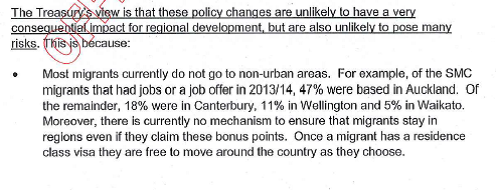
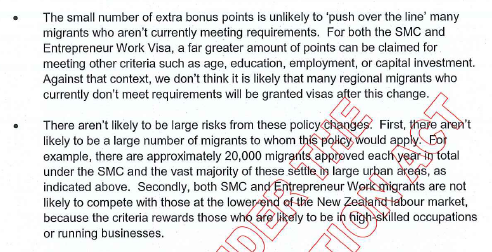
Here is what Treasury had to say about the proposed scheme.

tsy 1
tsy 2

Cabinet must have agreed with them to some extent, since the final announced version of the policy was twice as generous as the version of the proposal Treasury was commenting on.

I entirely agree with them that the proposed changes –  and even the amped-up approved version –  is unlikely to do anything useful for regional development.  It is just another “subsidy”, and subsidies are both costly and aren’t what the regions need.  A sustainably lower real exchange rate –  and perhaps some comprehensive reform of capital income taxation – is much closer to the heart of what would make a difference.

But what I found surprising and disappointing was how blasé Treasury seemed to be about the whole proposal: “won’t do much good, but not many risks either”, which is pretty much a message from the government’s chief economic adviser that Cabinet might as well go ahead.

What are the risks?  Well, first and foremost, as I noted here, any person who just gets across the points threshold and secures permanent residence will beat out some other potential migrant who was objectively better qualified (whether on age. education, employment or capital investment –  Treasury’s own list).  And contrary to what Treasury suggests, this proposal isn’t just affecting a small number of people. On Treasury’s own numbers around half of migrants go somewhere other than Auckland, so the potential for debasing the average (and marginal) quality of New Zealand’s migrants is quite real.  As I’ve been highlighting in the last few weeks, a large proportion of our migrants (and temporary workers) are already not that skilled at all.  As Treasury has struggled to produce any convincing evidence of the gains from the large scale immigration programme, we might have hoped that they would be rather harder-nosed in pushing back against changes that worsen the chances of real and tangible gains to New Zealanders ever showing up.

And then Treasury observes that there isn’t much risk of competition with people at the lower end of the New Zealand labour market because the skilled migrant category rewards high-skilled people.  Yes, and very high-skilled people will easily cross the threshold already, and won’t represent competition for people at the bottom end of the market.  But this change is about making things easier for people who just aren’t that highly-skilled –  they are the marginal cases, and they get in only because they manage to get the extra points that will come from securing a job offer outside Auckland.  At the margin, it is those people –  the ones who directly benefit from this policy –  who are most likely to be competing with people at the lower end of the New Zealand labour market. I’m not suggesting they’ll be competing with shelf-fillers and checkout operators, but there are plenty of immigrants who don’t appear to rank very high up the spectrum of skills. There will be more under this policy.

As I read the advice I wondered why Treasury was not rather harder-nosed in its advice.  As we saw in previously released papers, they seem much less sanguine about the economic benefits of immigration to New Zealanders than their chief executive has been.  Perhaps they just didn’t have much time to look at the proposal and the weaknesses in the proposal just slipped through?  Perhaps they just knew it was all about politics, and the headlines in the media after the Prime Minister’s speech?

The permanent residence approvals programme, and especially the skilled migrant category, is seen by the government as an “economic lever”.  It operates on a very large scale, and has significant effects across the country.  We should expect a rather more rigorous critique –  and some of that rare free and frank advice – when ministers want to debase the currency (points), in ways that must, if the policy works at all, debase the average quality of the new migrants.  Productivity growth isn’t so abundant in New Zealand that we can afford a cavalier Treasury when proposals turn up that will, if they do anything, worsen our productivity prospects.

What economic gains are New Zealanders getting from older immigrants?

The New Zealand government’s permanent residence approvals target is 45000 to 50000 per annum.  The target hasn’t changed for quite a long time, although actual approvals fluctuate from year to year.

As I’ve noted previously, even though the immigration programme is explicitly described as an “economic lever” only around half the permanent residence approvals have been under the skills (or business) stream, and even that total includes the immediate family of the primary applicant.

It is well-known that it takes many immigrants years to reach the earnings that a New Zealander with similar qualifications would achieve.   Here is how Julie Fry summarised the evidence in her 2014 Treasury working paper.

However, they also face language and adjustment barriers, at times including discrimination, which on average take 10-20 years to overcome. In common with overseas patterns, recent New Zealand immigrants have poorer outcomes than others in the labour market, although those outcomes improve over time.  Immigrants who are from culturally similar source countries (such as Australia and the United Kingdom) adjust more quickly. On average, migrants from Asia take longer to adjust, and migrants from the Pacific Islands never reach parity with the New Zealand-born, reflecting the fact that they enter mainly on family reunification grounds and non-skills-based quotas.  University-qualified migrants also adjust more quickly.

Ten to twenty years is a large chunk of a working life, and if the New Zealand immigration programme is really going to boost productivity and per capita incomes of New Zealanders that adjustment period is a significant hurdle to get over (as for much of their working lives here many of the migrants can’t even match the earnings New Zealanders reach).  That probably wasn’t the experience of migrants to New Zealand in the mid to late 19th century.

The issue is even more acute in respect of older immigrants, and is likely to be particular so for those from countries that are not (in Fry’s words), “culturally similar”.  A migrant arriving at age 55 has only perhaps 10-15 years left in the workforce, and that expected time in the workforce drops as the arrival age increases.

Unfortunately, although the permanent residence approvals target has not changed, the proportion of it being used up by older immigrants has been steadily increasing.  Unsurprisingly, not many people 55 and over come on work visas (around 275 in the latest year, not much changed over the previous decade). By contrast, 3279 people aged 55 and over arrived on residence visas in the year to June 2015, just over double the number who came in the year to June 2004 (the first year the data are reported).  The chances of many of these people making any material contribution to boosting productivity and incomes of New Zealanders seem small.  And yet they now make up 7 per cent of our total (skills-focused) permanent residence approvals target.

If there is little obvious economic reason to allow in most of these older arrivals –  and, in fairness, the arguments made for doing are not typically economics ones –  there are fiscal reasons to be quite uneasy about doing so.  As I’ve highlighted previously, someone who moves to New Zealand need only live here for 10 years before becoming eligible for full New Zealand Superannuation entitlements, and once granted residence they are eligible for our public health system (and time spent in Australia counts as time spent in New Zealand for NZS eligibility purposes).

The New Zealand Superannuation issue is less severe in respect of those coming from advanced economies.  Pensions earned in those countries are set off against NZS entitlements, so that New Zealand pays only a portion of the total retirement income cost.  But for people from poorer countries where there is no public pension entitlement, or nothing that can be claimed abroad, the full cost falls on New Zealand once the ten year residence period has passed.   Considered from a fiscal perspective, it is perhaps unfortunate that most of the increase in the number of older arrivals has been of people from India and China (numbers from the UK are significant, but have not increased materially).

plt arrivals 55+

Of course, there is a much larger fiscal risk in the possibility of large numbers of older New Zealanders returning from Australia (in particular) at around retirement age, having paid few New Zealand taxes and now claiming full NZS and health entitlements.  The number of older New Zealanders returning from Australia has been increasing (around 2700 of those 55 and over in the last year, about 800 of whom are 65 and over), but are still modest compared to the total number of New Zealanders living in Australia.

The average migrant to New Zealand probably makes a net positive fiscal contribution over the course of their time in New Zealand.  But that average is dragged materially downwards by these older arrivals. It tends to reinforce the argument that any real economic gains from the immigration programme could be obtained with a much lower permanent residence approvals target.

Without even touching the refugee component of the target (perhaps even increasing it), restricting permanent residence approvals to the sorts of high skilled positions illustrated in yesterday’s post, and prohibiting any permanent residence approvals for people aged over 55[1], would enable us to capture most of the putative gains with a permanent residence approvals target of perhaps 10000 to 15000 per annum.  Reducing the permanent residence approvals target by two-thirds would materially reduce the demand pressures associated with a fast-growing population.  Doing that would materially ease pressures on real interest and real exchange rates, which would allow New Zealanders and the remaining highly-skilled immigrants to take advantage of the new tradables sector business investment opportunities that would become much more attractive as a result.

As a comparative benchmark, the average annual net inflow of non-New Zealand citizens was 8500 in the 1980s.  If we are serious about lifting economic performance, and using a skills-focused immigration programme as part of that we need to get much more hard-headed about the sort of people we allow in (refugee issues aside).  In fact, over the last decade or more we’ve been going in the wrong direction, as the highly skilled have made up a decreasing share of migrants.  Many of our business migrants seem to be attracted more by the lifestyle than by the prospect of building high productivity businesses here. And the immigration programme was diluted against just recently with the decision to award more points to people moving to places other than Auckland, which will squeeze out other better-qualified applicants.

[1] With an exception perhaps for a small number of people who are entirely self-funded for their lifetime.