How many mortgages are being approved?

Some years ago the Reserve Bank started collecting weekly data on housing mortgage approvals by the main lenders.  It is a great resource, partly because it is so timely –  the data released yesterday were for approvals granted last week.

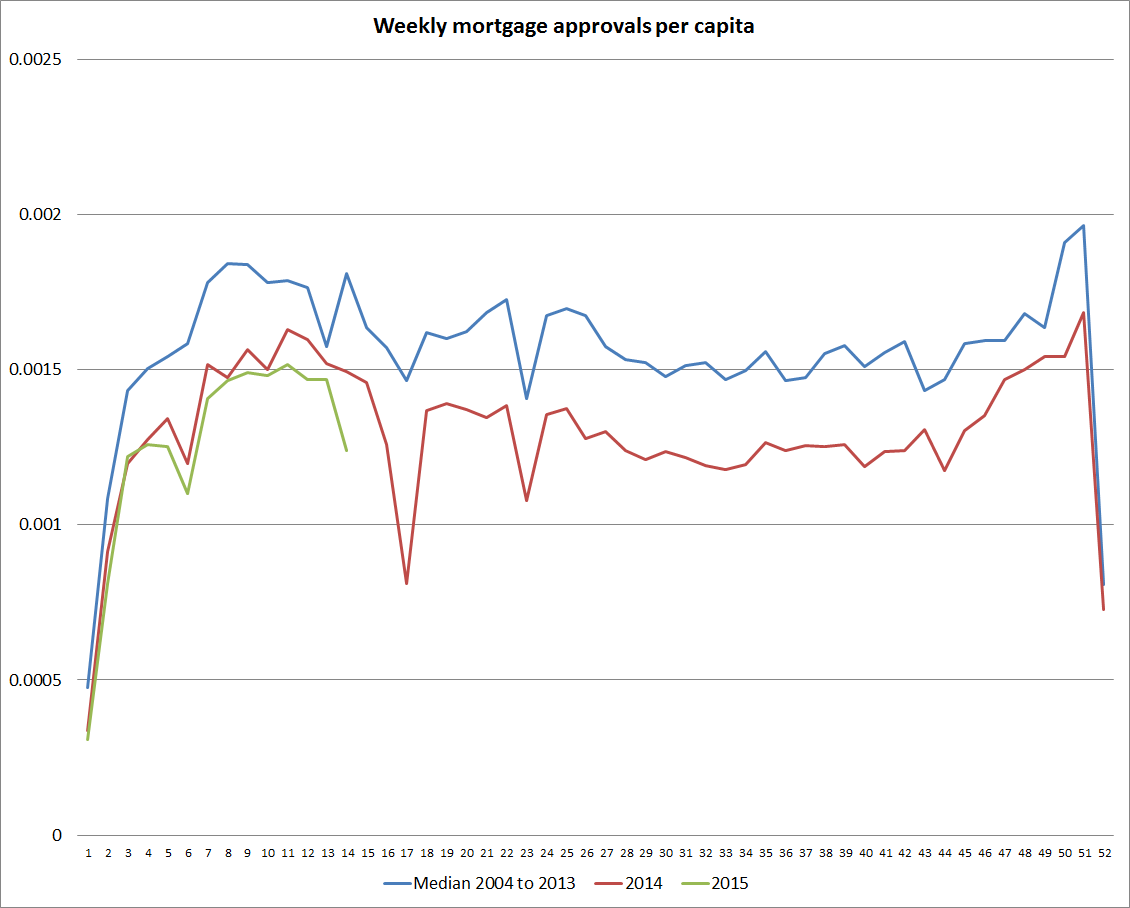
The data aren’t seasonally adjusted, and so for a while I’ve been keeping an eye on a version of this chart, tracking the number of mortgage approvals per capita in each of the 52 weeks of the year.  New Zealand’s population is steadily growing, and so I’ve used an annual population estimate to produce an approximate series of housing mortgage approvals per capita.  You can see the holiday periods clearly –  not just the great Christmas/New Year dip, but also those for other public holidays (Easter accounts for last week’s dip). It is easy to see how mortgage approvals are running relative to the same period in earlier years.

The chart shows three lines.  The first is the median for the first 10 years of the series, 2004 to 2013, which encompassed the last few years of the boom, and the very weak few years after 2007.    The second and third are the series for 2014 and 2015 to date.  The number of mortgage loan approvals last year ran consistently well below the median for the previous decade.  And this year, the number of approvals per capita has been tracking a little lower again.   So far only 2010 and 2011 have been lower than this year.

Consistent with that, the total stock of loans to households has been growing at a touch under 5 per cent per annum –  barely above a plausible trend rate of growth in nominal GDP (say 2 per cent inflation, and 2.5 per cent potential real GDP growth).

mortgage approvals

The value of mortgage approvals is quite close to an all-time high. That largely reflects the high level of house prices. But activity in the nationwide house finance market remains very subdued.

A final thought:  it is very rare indeed for serious financial stability risks to develop, in a system with nationwide lenders, when overall lending activity is subdued, and when there is such modest credit growth.  The burden of proof should be on any institution pondering (further) regulatory interventions in the housing finance market, given the inefficiencies such restrictions encourage, and distributional consequences of such measures.

Labour force participation rates

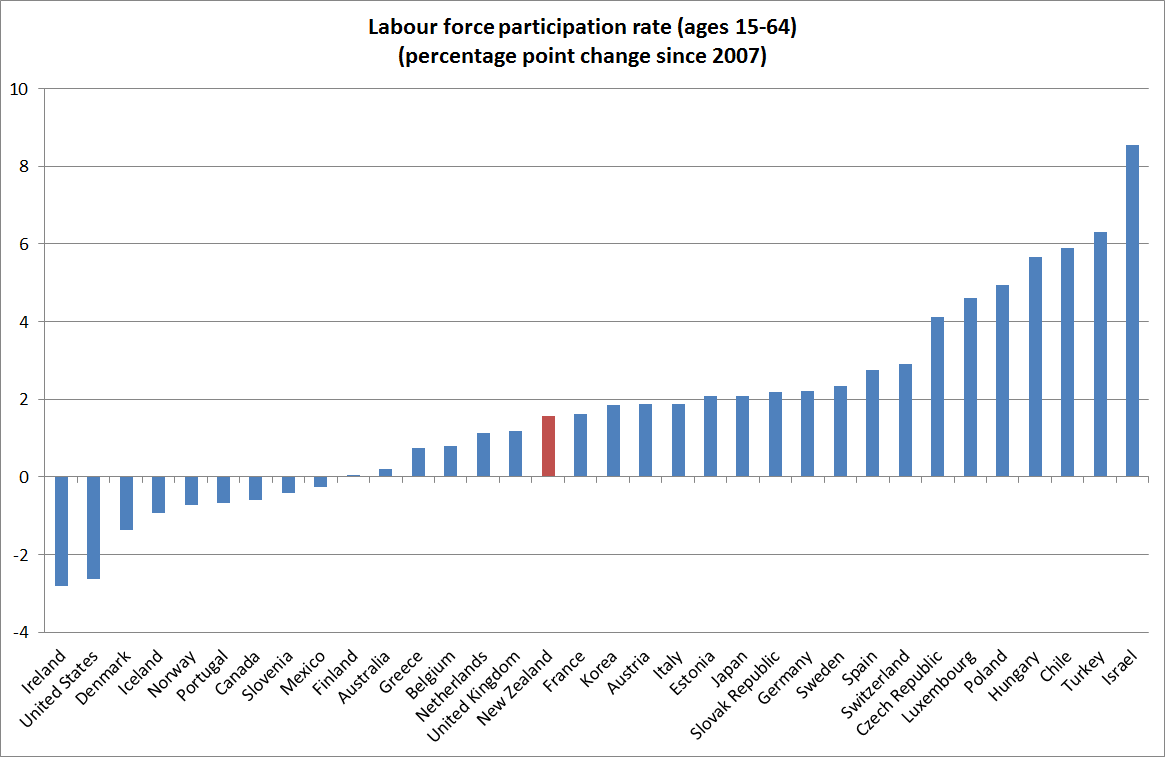
Thanks to Eric Crampton for his coverage. Eric suggested that my slightly gloomy take on New Zealand’s 5.7% unemployment rate needs to be tempered by recognising that the labour force participation rate is rising.

Participation rates have been rising here, and in most of the OECD. New Zealand doesn’t really stand out (from memory, the increase in our unemployment rate is also middle of the pack).  One caveat is that the chart shows the 15-64 participation rate.  I couldn’t quickly find the quarterly OECD data for the whole 15+ population, but when I looked at it a few weeks ago New Zealand was a little further up the rankings.

participation rate

Two other things struck about the data in this chart:

  • the continuing very weak US participation rate.  It is just one among many indicators that makes me sceptical of the Fed’s case for seriously contemplating near-term increases in the Fed funds rate.
  • the participation rates for Spain and Greece.  Participation rates are usually cyclically weak when unemployment is particularly high.  Spain and Greece have had huge increases in their unemployment rates, so my hypothesis is that families are finding times so tough that every possible is searching for any job, however short-term or short hours, possible.

On China’s disappointing economic performance

The latest New Yorker was in the mail yesterday.  An article by Evan Osnos on Xi Jinping, subtitled “How Xi Jinping, an unremarkable provincial administrator, became China’s most authoritarian leader since Mao”, is fascinating reading, and recommended for anyone with an interest in China.  It is unflattering picture of China’s new(ish) leader, who is widely seen as primarily focused on consolidating power for himself and for the Party – a Party regime that drove his own sister to suicide. That he is no Gorbachev would no doubt be seen by colleagues as perhaps the key point in his favour.

The article doesn’t deal much with economic developments.  Xi Jinping came to power at the end of one of the bigger credit booms in history.  Not all credit booms end disastrously, but few end well.  And China’s since 2008 was far more state-led, with fewer market disciplines, than most.  Credit booms often go hand in hand with a marked appreciation in the real exchange rate, and China has had that too.    Quite where China goes from here is hard to tell.  Macro policy is being eased, as in other countries last decade, but even very deep cuts in interest rates in other countries haven’t been enough to produce robust recoveries in most.  And in China real interest rates appear to be rising not falling, and the real exchange rate is still rising.  What happens in China matters a lot for the world economy, especially when most other countries have so little “policy space” left, and growth in other emerging economies is also slowing.

But the article got me thinking about China’s longer-term economic performance.  What has happened over the last 35 years has been remarkable, but mostly because of its global implications.  I’m struck, however, by how underwhelming China’s performance has been in some key respects.

My benchmark is the other Chinese countries/territories – Hong Kong, Singapore, Taiwan – with a quick glance as well at the two non-Chinese rich democracies of Asia, Japan and South Korea.  I’m drawing data from the Conference Board’s Total Economy Database, spliced where necessary with the (common origin) Angus Maddison data.

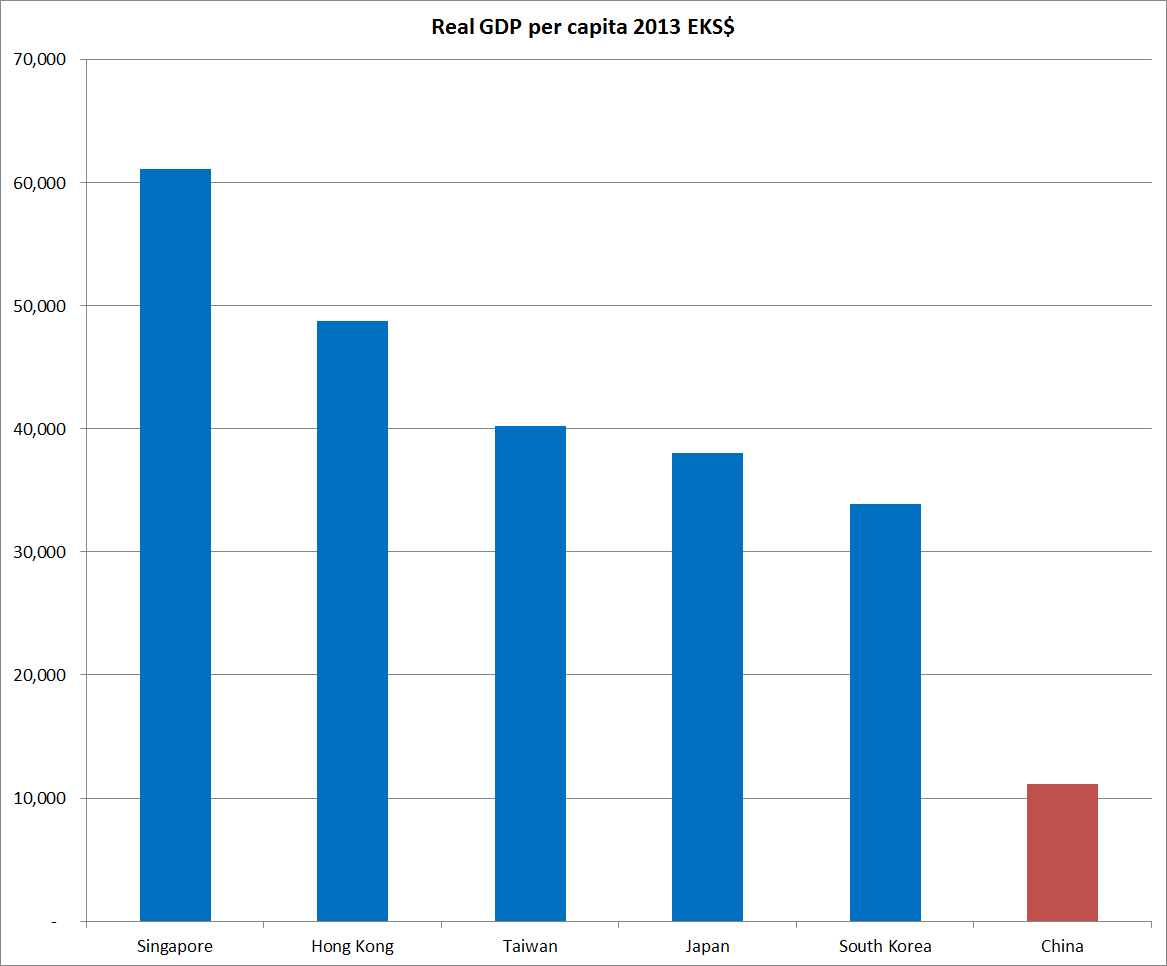
China is a middle-income country, with real GDP per capita in 2013 not that different from those in Jamaica, Brazil, and Iraq.  The other Chinese countries/territories aren’t.

chinalevels

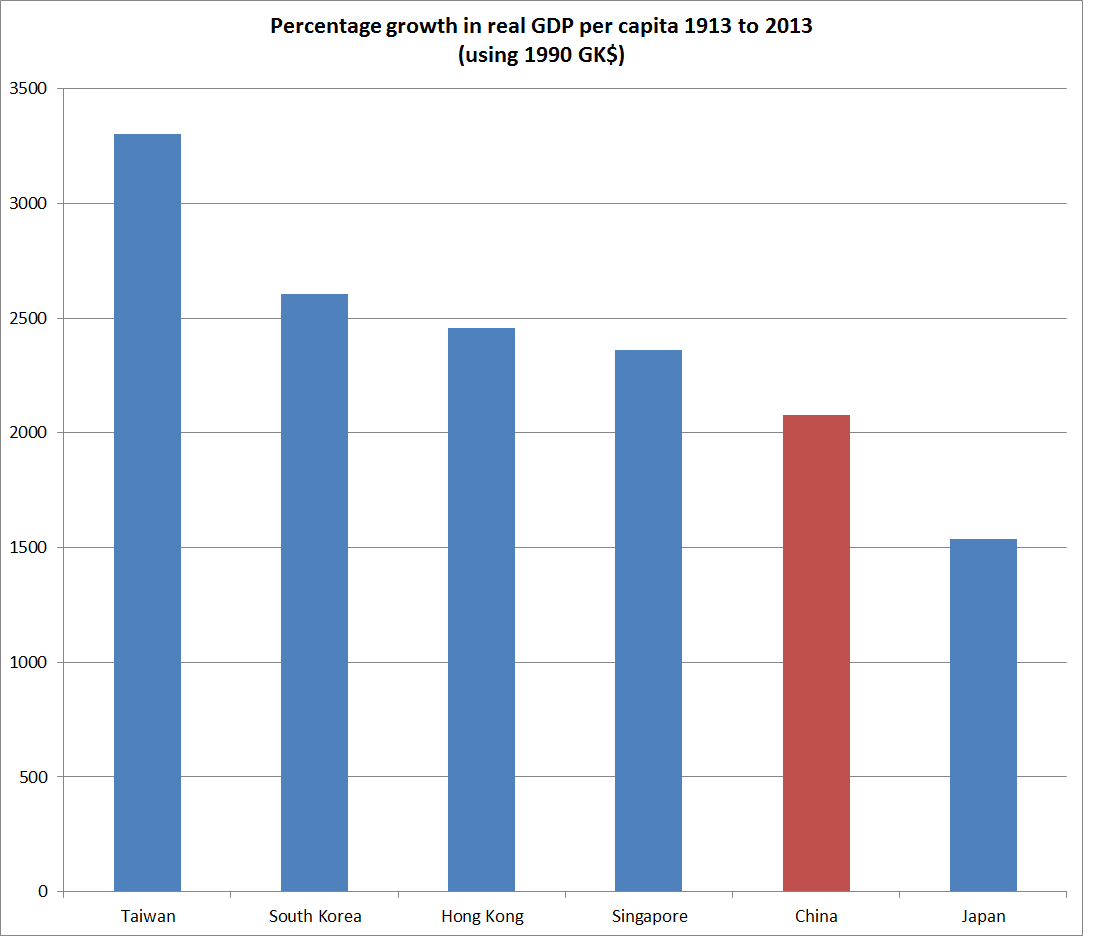
Things start getting a bit heroic with long-term growth rate comparisons, but China’s growth in per capita income over the last 100 years (1913 is one of Maddison’s benchmark dates) doesn’t look particularly impressive either.  China is estimated to have been the poorest of these countries/territories in 1913, and so had the most room for catch-up/convergence growth.

chinalevel

And if one other measure of success is how many people can share in the prosperity, China’s population has also grown much less rapidly than those of the other Chinese countries/territories over the last 100 years.

% increase in population 1913-2013

China                  211

Taiwan                 567

Hong Kong          1402

Singapore            1590

All these comparisons are somewhat fraught.  The historical data aren’t great, but they are what we have.  Americans often argue, when faced with success stories in small European countries, that these things may not be replicable on continental scale, but equally New Zealanders are familiar with arguments about the potential costs from small size.  And China has done it before –  they were at the forefront of innovation, with the highest living standards, perhaps 1000 years ago.

If there has been some catch-up in the last 35 years, over the last 100 years taken together growth in living standards in China appears not to have kept pace with growth in other places with populations of similar ethnic and cultural backgrounds –  but which have allowed a greater role for markets, and the rule of law.    And the people of China have had to put up with much greater political repression, much higher levels of corruption, persecution for religious beliefs, and the evils of the one-child policy, not to speak of the disaster of Mao’s Great Famine.  It seems a lot like a lose-lose for most of the Chinese –  but not perhaps for the Party bosses.

A favourite troubling chart

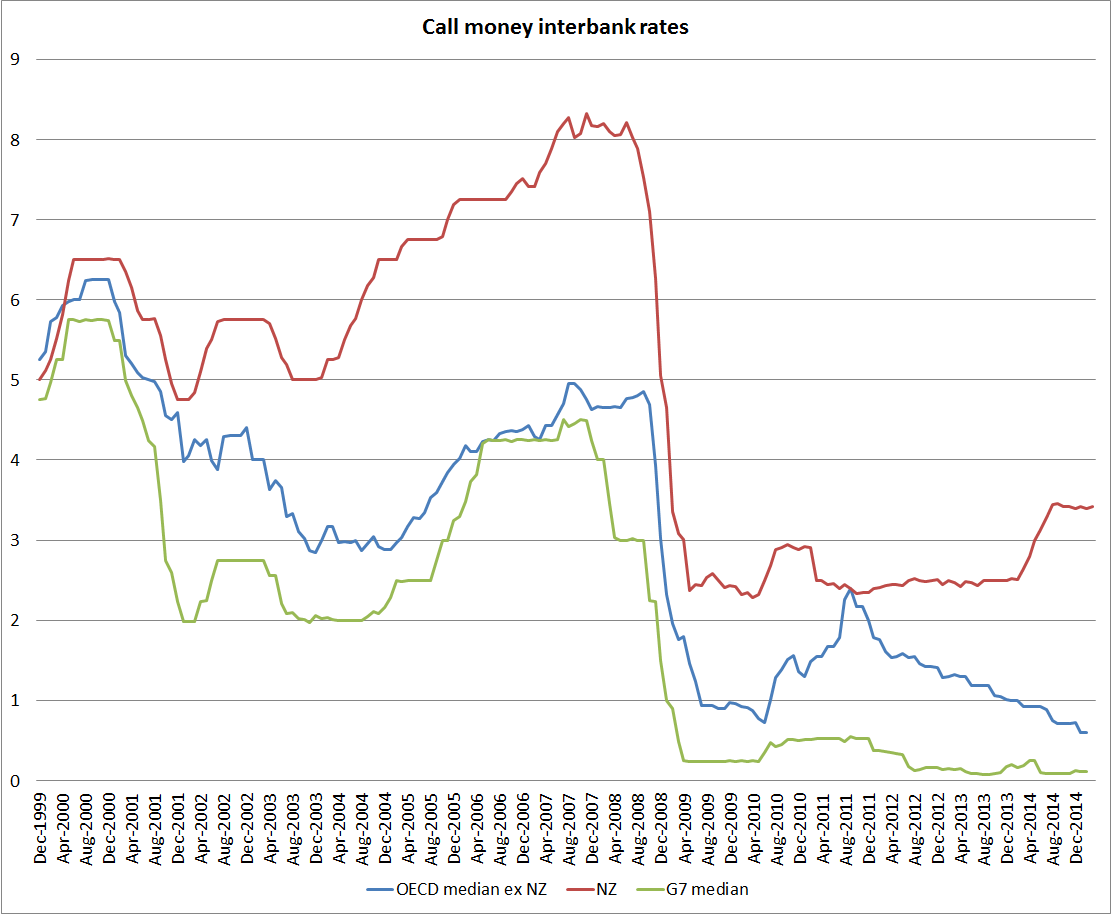
This is one of my favourite troubling charts of the last year or two.  It uses OECD data to proxy policy interest rates (they describe them as “call money interbank rates”.    I’ve shown three lines: New Zealand, a median for the G7 countries (in this case the US, the UK, the euro area (for Germany, Italy, and France), Japan, and Canada) and a median for all 20 countries/regions in the OECD with the ability to set their own policy rates.  I’ve gone back 15 years, to the end of 1999 –  a point where the gap between NZ and foreign rates was unusually low.

call rates

Two things have troubled me about the chart:

  • the growing divergence between New Zealand and foreign rates over the last couple of years.  New Zealand and foreign short-term interest rates won’t always move together, but when they diverge we should be able to identify specific developments in inflation (as almost all these countries are now inflation targeters) to warrant the divergence.  Forecasts of inflation may have diverged in ways that suggested higher New Zealand interest rates, but actual inflation (headline or core) has been at least as weak, relative to target, as we’ve seen in the typical advanced economy.
  • perhaps more important, is that near-flat line for the G7 countries (and one could add several others to that list of countries) for now six years or so.  It would be some sort of miracle if appropriate interest rates had been so stable for so long.  In fact, what we have seen is countries reacting to the perception of a lower bound on nominal interest rates at or very near zero.

The idea of the zero lower bound has been around for a long time,  When Japan got there most of us still treated it as an idiosyncratic curiosity.  And no country has yet taken policy interest rates as low as they can effectively go.  We know this because in no country has there been a large scale switch into physical cash holdings (the option that makes the near-zero bound troublesome).    But when policy rates have been at or very near the practical bound for so long, it suggests they would appropriately have gone materially lower had that been possible.  Combined with lingering high unemployment (or low participation in the US case) and weak inflation, they continue to point to a shortage of demand as a problem in most advanced countries.

As concerning is that, six years on, it appears that no central bank (of finance ministry) has taken a lead to reduce the risk that the zero bound will be an even more major problem in the next recession.  We don’t know when that will be, and hope it will be years away, but that can’t be guaranteed, especially as emerging market growth slows and recessionary risks rise in those countries.  And next time, most advanced countries might go into a recession from a cyclical high in policy rates of perhaps 0.25 per cent.  And New Zealand, which cut by 575 points last time, could well peak this cycle at a 3.5 per cent OCR.

One problem has been the constant belief –  in markets and central banks – that a sustained upturn is just around the corner, and with it the basis for higher policy rates.    Both markets and central banks have been repeatedly wrong.  But we should hope that in the backrooms of major central banks serious practical work is underway to alleviate the (actual or felt) constraint of the ZLB before the next significant downturn.

I have a few ideas, and will discuss some of them in a future post.

Government spending: a trans-Tasman comparison

I’ve noted a couple of times how the notion keeps popping up that somehow New Zealand, and the New Zealand government, has been doing better than Australia in recent years.

Real per capita GDP growth in New Zealand has lagged behind that in Australia since 2007, and productivity growth has also been weaker.  Our unemployment rate is now a bit lower than Australia’s, but that was normal prior to the recession – it is good, but hardly a reflection of post-crisis policy reforms.

But what about something that is more directly under the control of governments?   Good timely comparable data on total government spending is not easy to come by.  But in the quarterly national accounts both countries have data on public consumption spending.  Government consumption here is goods and services directly purchased by governments, whether the government itself “consumes” them –  eg core administration functions – or delivers them to households (eg public provision of health and education services)).

The chart below shows public consumption as a share of GDP for the two countries.   These are general government numbers, not central government, but in New Zealand local government spending is quite a small share of the total (less than 20 per cent).  The two series are slightly different – Australia reports seasonally adjusted data, and NZ doesn’t so the NZ numbers are rolling four-quarter totals – but that shouldn’t materially affect comparisons.

govt c nz au

The chart highlights again the huge increase in public consumption as a share of GDP that occurred in the last few years of the previous government.  Many of those initiatives continued to boost spending into the early years of the current government.    Government consumption spending as a share of GDP tends to rise in recessions, not generally because of discretionary fiscal stimulus but simply because GDP falls.  Both New Zealand and Australia had significant recessions in 1991, and it is easy to see how the government spending share of GDP rose then.  So some of the New Zealand increase to the peak in mid-2009 was simply the change in the denominator.  But then again, so must some of the fall in the ratio since then.  There has been a considerable squeeze on some bits of government spending, but the overall picture is hardly one of austerity.

The contrast with Australia is quite striking.  For all the talk about Australia’s fiscal deficits, government consumption spending now is barely higher (% of GDP) than it was in the 20 years pre 2008.  By contrast, New Zealand’s government consumption is still barely below the early 1990s peaks.

Don’t get me wrong.  Government spending as a share of GDP is quite low, by OECD standards anyway, in both Australia and New Zealand.  And reasonable people, and differing political ideologies, will have different perspectives on the role of government.  But two thoughts:

  • For anyone at all concerned about the exchange rate, the increase in the government spending share should be worrying.  Increased government consumption spending adds directly to pressure on the real exchange rate, bidding up the cost/price of non-tradables relative to (internationally set) tradables prices.
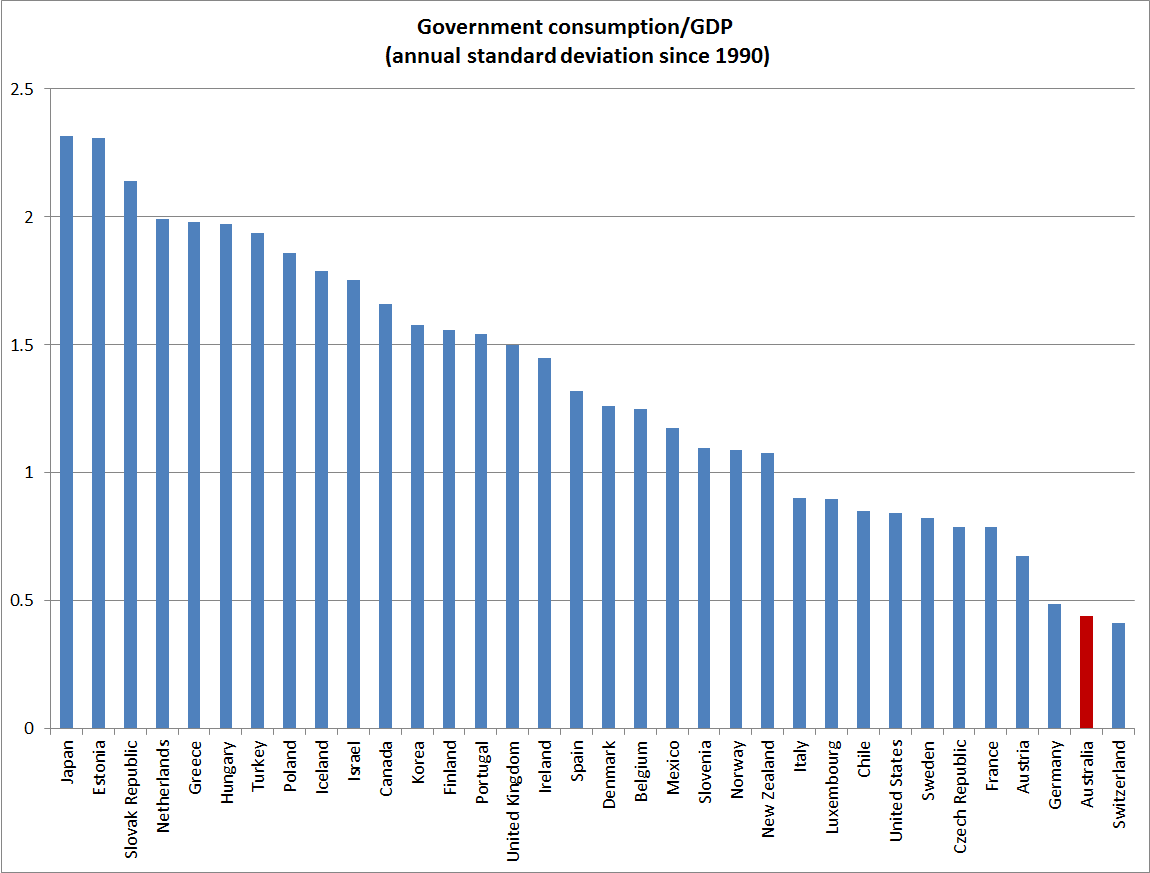
  • In the last 25 years Australia has been remarkably successful in limiting variability in government spending as a share of GDP (both on this measure, and on broader OECD measures of total government outlays).  That has been so through various changes of government.  Stable government spending shares provide a better basis for stable tax rates, and stable tax rates help provide a climate in which businesses and households can make best choices about investment and labour supply.  New Zealand has not done that badly by international standards, but is a long way from matching Australia.

govt c oecd

Add in the failure to achieve an operating surplus yet, despite the best terms of trade in 40 years, and the very low quality of a lot of the government capital expenditure (those unattractive benefit-cost ratios for Transmission Gully, Kiwirail, and ultra-fast broadband for example) , and once again we have a picture in which New Zealand has not helped itself.

Parity parties

The Prime Minister is reported as reckoning we should celebrate parity with the Australian dollar.  It hasn’t happened quite yet, there has been a bit of a pullback today, and market positioning means there are probably still a few obstacles to getting there.  But at current exchange rates one would be brave to bet much against parity happening sometime soon.

But is it something to celebrate?  I don’t think so.  A high (real) exchange rate lowers the relative price of consumption.  And since consumption is often thought of as the point of economic life, the cheaper consumption is, the more of it we can have.  But, over time, one can consume only from what one earns, and – all else equal – an exchange rate that skews things towards consumption tends to reduce the ability of firms and individuals to earn more in future.  That issue doesn’t arise if the exchange rate rises because (and to the extent that) the terms of trade rise, or because New Zealand firms have found new or better products, or smarter ways of organising themselves.  As Krugman put, it in the longer-term if productivity isn’t everything, it is almost everything.

So let’s stand back and consider near-parity against the AUD.   Our terms of trade have been falling more slowly than Australia’s, so relatively speaking that is a positive for us.  But this morning’s papers contain reports of record grain gluts.  The combination of very weak oil prices, abundant grain stocks, and falling grain prices doesn’t bode well for dairy prices (nor does China’s drive for self-sufficiency, or the removal of European quotas).  Exports are a larger share of the New Zealand economy than they are of the Australian economy.  And whereas the New Zealand export sector is largely locally owned, so that all the income losses are borne by New Zealanders, much of Australia’s export sector is foreign-owned, so funds managers around the world will be sharing the pain as iron ore prices keep falling.  I’ve shown before that there has been no sign in recent years that productivity growth in New Zealand is improving relative to that in Australia.

The exchange rate is not strong just against the Australian dollar.  At around 79 on the TWI  – an index that probably puts too much weight on the Australian dollar –  the exchange rate is less than 5 per cent below its post-float peak.

So what does support the NZD, against the AUD and more generally.   Over the last year, the Reserve Bank of New Zealand raised its policy interest rate by 100 basis points, while Australia (and most other advanced country central banks) were cutting policy rates and easing monetary policy.  (I’m deliberately posting this before 4:30: whether, as everyone assumes, the RBA cuts again today or leaves it another month or so isn’t really the point here.)

OCR increases would have made sense if inflation was picking up, but it has stayed low (headline has collapsed, but core measures have remained persistently weak despite the allegedly robust recovery).  The Reserve Bank Governor, who talked confidently a year ago about 200 basis points of OCR increases, has slowly had to walk back his rhetoric and then his actions, but we are still left with a policy rate quite out of line with those elsewhere in the advanced world, when core inflation is consistently below the target midpoint, wage inflation is weak, inflation expectations  are falling, credit growth is quiescent, and the unemployment rate  –  real people, losing real skills –  remains uncomfortably high.

If it comes, parity is nothing to celebrate – any more than the previous peaks were things to celebrate.  Rather, taking together all the information, those peaks have typically been markers of some unsustainable imbalances building up.  This time, that looks like the gap between our OCR and policy interest rates abroad.  And probably a misplaced confidence (in official circles and among private commentators) in the ability of the New Zealand economy to remain relatively resilient as the commodity slump goes on, the economies of our two largest trading partners weaken, and as Christchurch no longer represents much, if any, of a source of new growth in demand.

Is the IMF becoming obsolete?

Timothy Taylor has an interesting post Is the World Bank Becoming Obsolete?   My most telling memory of the World Bank is the year it, and its legion of visiting experts, won the prize for the biggest single customer of the Lusaka Hotel Intercontinental.

But the same question should be asked about the International Monetary Fund (IMF).  I’ve had a lot to do with the Fund, here and overseas, including two years as Alternate Executive Director on the Board of the Fund.  Indeed, participating in an IMF technical assistance and training mission to China paid for our honeymoon.

The IMF was founded in the wake of World War Two, to preside over the new global system of fixed exchange rates, and provide short-term credit to members with temporary balance of payments difficulties.  For various reasons, New Zealand was late to join the Fund – not until 1961.   By the time the membership became near-global (in the 1990s), the original mission was no more.

It is a curious institution.  The structure looks highly technocratic (and the organisation has many highly capable people), but in fact it is highly political.  That isn’t intended as criticism – relations between sovereign states are as political a matter as any, and decisions to commit large amounts of money to other countries quite probably should be as well.  Indeed, before the IMF existed, short-term loans were made to countries in need bilaterally, based on the potential lenders’ assessments of their own interests, the importance of relationships etc etc.   The recently approved loan to Ukraine might have looked much more defensible as a loan from major Western powers based on their own national interest considerations than it does as an allegedly technocratic assessment of Ukraine’s economic prospects and of the Fund Board’s own Exceptional Access Criteria (all occurring with a Russian Executive Director at the Board table).

The IMF now has a number of roles:

  • Article IV surveillance discussions and reports on each country’s macro-economy and financial system.  The most recent New Zealand Article IV report is here.
  • Research and statistics
  • Technical assistance
  • Lending

Statistics are good and useful.  Someone probably needs to collate and disseminate them internationally, and provide a central point for guidance on international standards of comparability.

But it is by no means obvious what other useful or important roles the IMF is now fulfilling.

The Fund provides technical assistance to many countries on technical aspects of monetary and fiscal policy, financial system infrastructure etc, mostly in the less developed parts of the world.  Much of it is worthy stuff.  But why do we need a multilateral government agency to do it?  There is a myriad of consulting companies, large and small, around the world, often staffed with former officials.  And if it is argued that poor countries often can’t afford such advice, there are at least two points in response.  The first is to note the tendency of international agencies to want to install gold-plated systems that go well beyond the actual needs of many of these countries.  Having to write the cheque oneself, should induce a more hard-headed assessment of what is really needed –  and can be maintained – when weighed against other domestic spending priorities. Second, if advanced countries do want to provide aid to help an emerging country acquire outside technical assistance there is nothing to stop them doing so.

Article IV surveillance reports used to be confidential to the member country and to the IMF Board.  These days, inevitably and perhaps appropriately, almost all Article IV reports are published, and are written with publication in mind.  Publication doesn’t mean that no confidential discussions occur between visiting Fund missions and senior officials and Ministers.  But the focus is on what goes to the Board, and then goes public – and often on the wording of the published concluding statement and press conference at the end of the mission.  Simple messages dominate, and important intractable issues get too little focus.

But is there a gap in the market for the reports of organisations like the IMF?  In 1945, with tight controls on private capital flows, perhaps there were big gaps.  But these days, local and international banks churn out frequent reports on a wide range of countries, and entities such as the Economist Intelligence Unit cover many more on a lower frequency basis.  Macroeconomic analysis on Kiribati is certainly limited, but so (apparently) is demand for such analysis.

Perhaps IMF reports are more incisive or enlightening than the other reports?  Unfortunately there is no evidence of that.  The IMF probably typically has more resources at its command, but they are not that well used –   I have repeatedly lamented to IMF staff how relatively poor the institution is at marshalling cross-country perspectives and experience to shed light on New Zealand’s challenges and issues.  And if the IMF has more resources, the incentives it faces often encourage blandness and inoffensiveness, and rehearsing an optimistic conventional wisdom.  Check out Fund advice in the early 2000s for many European countries, and the euro area as a whole.   Or think of the incentives on staff and management to pull their punches when writing about the Article IV report on a country whose finance minister is chair of the ministerial oversight committee, the IMFC (Gordon Brown comes to mind)

And what of lending?  The Fund has a mix of concessional and (allegedly) non-concessional lending facilities.  The concessional facilities are really just foreign aid, and are not my focus here, except to note that they are far from the Fund’s original mandate.  The idea of the non-concessional lending looks good in principle, but is too-often bad in practice.  For a country with a large (private) external debt, and the possibility of sudden stops, the option of being able to secure short-term credit as a backstop has some value.  In earlier decades – notably in the late 1960s – New Zealand borrowed from the Fund to ease adjustment to a nasty terms of trade shock.

But in more recent decades  Fund lending too often quickly looks a lot like “extend and pretend”,  with an emphasis on the “pretend”.  Fund lending to Argentina enabled the authorities to defer, and defer, and defer an inevitable adjustment.  Fund lending to Greece in 2010 was not remotely defensible in terms of the Fund’s own policies on large loans (although it served the short-term interests of many of the major Board members, and the then Managing Director).  And the recent loan to Ukraine looks harder to defend, from the start, on technocratic grounds then even loans to Greece and Argentina.  If the Fund didn’t exist, lending to troubled countries would still occur, but since the loans would be made directly by national authorities in lending countries, perhaps requiring direct votes in national Parliaments, the prospects for democratic scrutiny would be greater.  And the absence of the so-called “preferred creditor status”, which has mostly protected the Fund from financial loss, might mean more searching scrutiny upfront about the sustainability of a borrowing country’s debt.   There is a role for lenders of last resort, but to be valuable they need to know when to say “no”, and the IMF isn’t set up to do that job well.

International agencies don’t go away easily.  The Bretton Woods agreement, for example, provided for the dissolution of the BIS and yet the BIS is still with us.  I expect the IMF will reach its century –  perhaps by then, as per the Articles, headquartered in Beijing.
Australians flocking to New Zealand?

This morning’s Herald points readers to a Weekend Australian feature  suggesting that New Zealand has become the place to be (“What has happened is that somewhere, somehow, perhaps in the dead of night when no one was looking, Australia and New Zealand have swapped sides”) and that thousands of Australians are flocking to New Zealand, for its better-performing economy (and government).

A couple of weeks ago, I highlighted this curious tendency in Australian commentary (especially that from the centre-right), which seemed quite detached from anything in the data.  But, still, I wondered if I had missed something in the migration numbers.

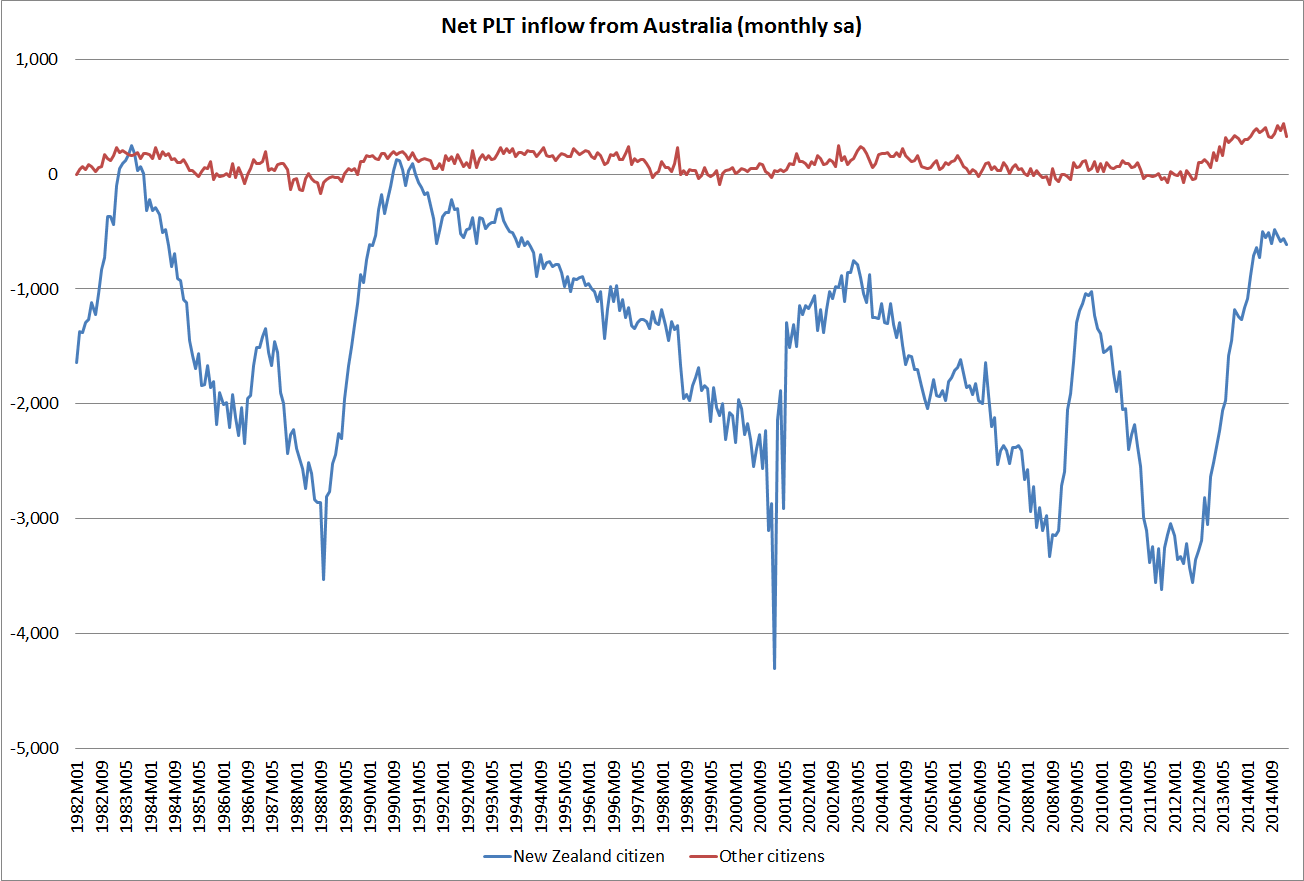
Here is the chart of the monthly seasonally adjusted net flow from/to Australia, broken down between New Zealand citizens and others (the latter mostly Australians).  And, sure enough, there has been a noticeable increase in the net inflow of Australians.  That tends to happen whenever economic cycles are out of sync and temporarily in our favour.

But, even now, the inflow of (mostly) Australians is running at around 5000 per annum.  And even in recent months, with the Australian labour market as tough as it has been for 25 years, that inflow is still outweighed by the net flow of New Zealand citizens to Australia.

Yes, the labour market is a bit easier in New Zealand at present than it is in Australia, although at 5.7% our unemployment rate is not something to be complacent about.  But nothing has happened to even begin to reverse the decades-long widening in the now very large gap between New Zealand and Australian incomes and productivity.  And favourable commentary from the other side of the Tasman will be a false friend if it distracts from the serious economic challenges that our own policymakers should be grappling with.

aus migration

How was the euro for Ireland?

Patrick Honohan, Governor of the Central Bank of Ireland, gave a fascinating presentation earlier this week on Currency Choices in Ireland Past and Present.  There was even something for geeky history buffs ( I didn’t realise, for example, that for the first 25 years after the Act of Union, Ireland and Britain had had separate currencies, with a variable exchange rate between them).  But the more immediate interest was in Honohan’s attempt to put Ireland’s choice of, and experience with, the euro in historical context.  From 1826 to 1979 Ireland had either used sterling, or had an exchange rate firmly pegged to sterling.    Effective monetary independence lasted for less than 20 years.

Honohan’s goal is to hose down a narrative that says the entering the euro was a mistake for Ireland.    As he notes “poor economic choices and bad luck are more reliable determinants of episodes of poor economic performance than choice of exchange rate regime”.

Serving Governors can’t exactly go round publically bagging their own country’s exchange rate regime.  But the claim that adopting the euro is just another currency choice, of second order importance, seems a step too far.   The Irish Famine aside, the recent  post-crisis shakeout has been the worst sustained period of (no) economic growth in Ireland’s modern economic history.  Ireland actually got through the Great Depression relatively well.  And while Angus Maddison’s estimates don’t cover the few years  leading up to independence and the civil war following it, even if that period was worse economically the benchmark for good modern exchange rate regime choices has to be set a little higher than “well, out-turns weren’t quite as bad as those in the civil war”.

In fairness to Honohan, he isn’t indifferent to the dislocations and huge cost of the last few years.  But he argues that the fault “lies not so much in the system’s design as in the inadequacy of national economic and financial policies to take account of the risks that were still associated with the euro”.  Oh, and he notes that in non-euro countries there were crises too.

In principle, so it is argued, very stringent fiscal policies and very conservative bank supervision and regulation – neither of which featured in Ireland – might have made all the difference.  But this looks like some sort of counsel of perfection – and perfection isn’t a standard we can expect from our politicians and policymakers.  Would a central bank that tried to impose consistently very tough prudential standards have been allowed to get away with it?  Would the Governor of such a robust institution have been reappointed?  And while Ireland no doubt should have run bigger fiscal surpluses, and (in particular) made its tax system less dependent on sources that would dry up when property turnover did, large surpluses invite electoral auctions.  We saw it here in 2005.  Institutional choices –  including exchange rate regimes –  need to take account of how democracies actually work.

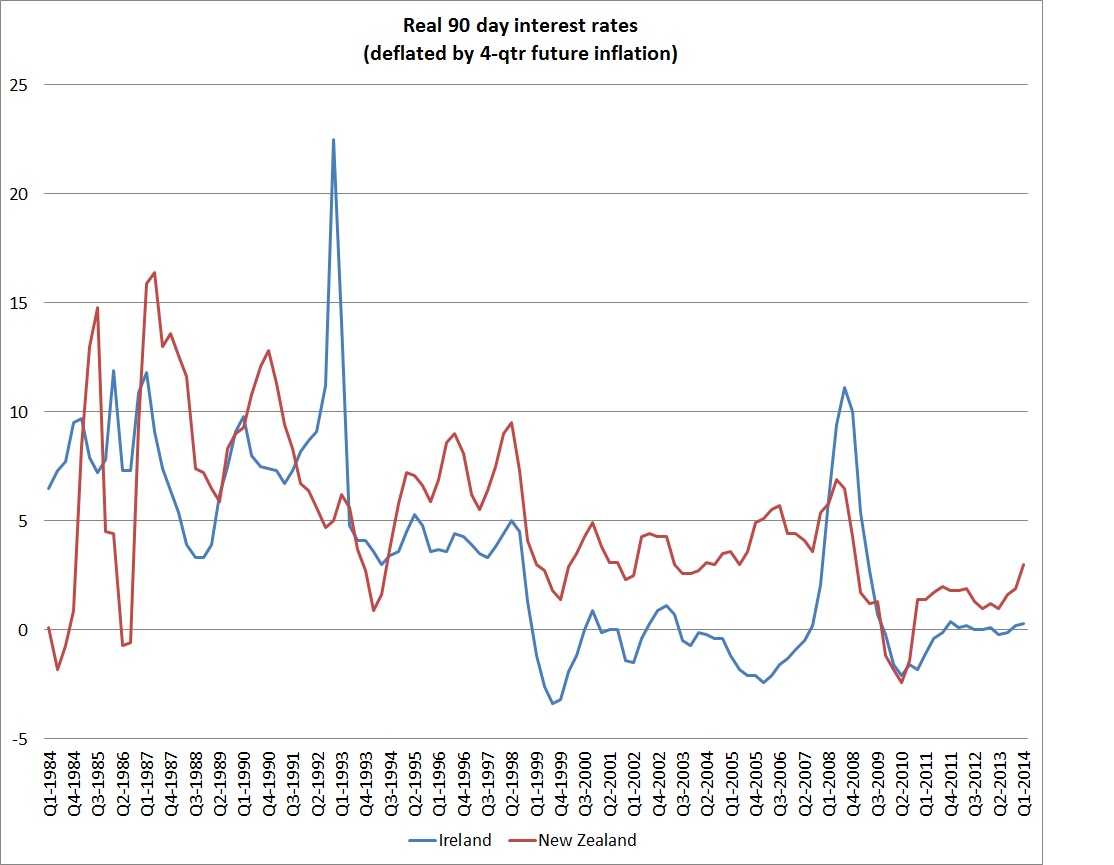
The Irish could, and no doubt should, have managed the boom years better.  But what they got  looks a lot like what one would expect if one takes an economy with a neutral interest rate that might have been similar to New Zealand’s and gives it an actual interest rate set mainly for Germany and France.   If New Zealand nominal interest rates had been set at German, or US, levels since the late 1990s we would have ended up with a pretty spectacular bust as well.    Honohan runs the Irish version of this chart in his speech.

ireland

Ireland will survive, and in time will prosper again.  Exchange rate regimes don’t shape long-term prosperity.  But with hindsight, it is difficult not to think that Ireland would have been a lot better off with a floating exchange rate, like New Zealand, with interest rates set for its own domestic economic conditions, than in the euro.  Floating exchange rates are no panacea –  and the last decade hasn’t seen great economic performance here either –  but it is hard to escape the point that the worst performing advanced countries since 2007 have almost all been members of the euro.

But read it yourself, and see how persuasive you find Honohan’s story.

On commenting on the Reserve Bank

While there are, typically, many more important aspects of public policy, in this blog I am going to talk quite a lot about matters that touch on the role and responsibilities of the Reserve Bank of New Zealand. It is a significant part of what I know, and have thought about over the decades.

Having been purged by Graeme Wheeler, I no longer work for the Reserve Bank.  That leaves me free to comment.  But I am conscious of the risk that any comments could be seen through a lens of “embittered ex-employee”, so this brief post is context and invitation.

Over several years I had voiced to many people a growing desire to spend a lot more time with our growing children.  I’d always been grateful that my mother was mostly around when I was growing up, and I wanted to do the same for my kids.  A wonderful long-term nanny just isn’t the same.  Making the change became financially feasible late last year and so my plan had been to leave the Bank anyway.  I’ve never been a person to carry grudges and, in any case, now feel only a sense of liberation and opportunity.  Emotion often clouds analysis, and impairs the ability to clearly identify what is going on.

Sometimes I’ll be critical of the Reserve Bank, and of choices governments (through Parliament) have made about the Reserve Bank.  (At other times, I expect I’ll stick up for them). And I will, for example, be using the provisions and presumptions of the Official Information Act to seek to improve (and argue for improving) the openness and transparency of the Bank.   But in almost all cases I can think of right now, I expect to be saying many of the same things I was saying within the Bank.  Free and frank internal debate and advice are critical to the successful long-term functioning of public (or private?) institutions   – indeed the Official Information Act explicitly recognises that.  External challenge and robust scrutiny of powerful public institutions is equally, or perhaps more, important.

My aim is to highlight issues, and provide alternative ways of thinking about some things.  It is about issues and institutions that matter to New Zealand, and about good quality detached analysis and argument.  If you think that I’m losing perspective at any point, do let me know –  either comment or email me (mhreddell at gmail.com).