A semi-official take on New Zealand and China

The New Zealand China Council was established by the government a few years ago.  It exists primarily as an advocacy body, using (mostly) taxpayer money

in support of deeper, stronger and more resilient links between New Zealand and China.

It has been very close to  the government.  The Secretary of Foreign Affairs and Trade, and the chief executive of New Zealand Trade and Enterprise are both ex officio members of the Executive Board.  The Council is chaired by one former Deputy Prime Minister (Don McKinnon), and another member –  with considerable ties to People’s Republic of China institutions – is former Prime Minister, Jenny Shipley.   The Advisory Board, another 20 people, includes as members several of those about whom questions have been raised in recent months (Jian Yang, Raymond Huo, and Naisi Chen)  –  as well as, somewhat surprisingly, a senior journalist.

The public face of the Council seems to involve relentless optimism about things that don’t obviously seem to require taxpayer-funded advocacy (eg the several tweets about the first New Zealand avocadoes into China) and rather gushy, one-eyed, takes on the PRC/New Zealand relationship, always extremely careful never to utter a critical or sceptical word about the PRC.  More recently, in response mostly to the issues raised by Anne-Marie Brady (and the Jian Yang story) they seem to have been pushed somewhat onto the defensive.

The Council employs a part-time Executive Director, Stephen Jacobi.  He spent considerable time at MFAT, but from his own account his focus was Europe and North America (including as our deputy high commissioner in Canada) and in trade negotiations.  Since leaving MFAT in 2005 he has run his own consulting firm, and been employed as the public face of various trade-related bodies, including serving as Executive Director of the NZ US Council from 2005 to 2014.  He is articulate and readily available to the media, but has no specialist expertise in China or (indeed) on the workings of New Zealand democracy.   That isn’t a criticism –  after all, neither do I –  just to note that his arguments, and evidence, need to be reflected on and carefully examined, perhaps having regard to the interests that are paying him, not as coming from an expert authority in the area.

I’ve written previously about one of Jacobi’s speeches, given late last year at a regime party to mark the PRC national day.  Those were pretty brief (and obsequious) remarks, albeit to a PRC audience.  And so it was interesting to see that last week he had delivered a much more substantial address, Dancing with the Dragon – Opportunity and Risk in the New Zealand China Relationship, to the Nelson branch of the New Zealand Institute for International Affairs.  There is also a much shorter op-ed by Jacobi in the Herald today, headlined on the China Council’s own website as “Anti-China narrative not the Kiwi way”.   I’m not going to comment specifically on that piece –  it covers mostly similar ground to the speech – except perhaps to suggest that deferring to vested interests (business and political) who want us to hurry along and simply accept that there is nothing to see here shouldn’t be “the Kiwi way” either.

What of the speech?

The first couple of pages (of eight) is reasonably unexceptionable.   There are lots of statistics about the growth in trade between New Zealand firms and Chinese ones –  curiously, only about exports, and barely a mention of (the benefits of) the imports.   There is some nonsense about New Zealand alleged heavy reliance on China in the ‘global financial crisis”, but on the other hand a welcome acknowledgement that the New Zealand – China trade agreement isn’t the only factor explaining the growth in two-way trade and investment.  Of course, there is no acknowledgement that the interest of the entities exporting to China –  many represented around his board table – might not always be the same as those of New Zealanders as a whole.

But then he turns towards addressing the (quite limited) New Zealand public debate on issues around the activities of the People’s Republic of China and the Communist Party which controls it.  Part of Jacobi’s rhetorical strategy  appears to be to imply that anyone raising concerns about the Chinese regime and the Party that controls it, is somehow anti-China/Chinese more generally.  It is never quite put that like  –  just insinuations –  but the impression is pretty clear. Mention the poll tax, for example, to play up the guilt, but never mention that we and China (pre-Communist) fought on the same side in World War Two.   And never, ever (that would be job-ending for Mr Jacobi no doubt), note that across the Taiwan Straits is a highly succesful, prosperous, free, and non-threatening ethnic Chinese democratic state.  Never, ever, mention the unease apparently felt among numerous New Zealand citizens of ethnic Chinese origins –  some of whom migrated here to escape the party-state and its evil –  about the effective control regime-associated groups have over most of the Chinese language media in New Zealand, and many community groups.

Around the world there has been growing unease –  including in such impeccably liberal circles as academics –  about the growing number of Confucius Institutes established as part of many Western universities.  With PRC funding comes PRC restrictions, on hiring and on the sort of issues lecturers are allowed to address.   There are several of these institutes in New Zealand universities – Canterbury, Victoria and Auckland  In various places overseas there has been a pushback and some major universities –  notably Chicago – have closed their Confucius Institutes.   I’m sure no one has a problem with the PRC government subsidising Chinese language learning in New Zealand –  any more than with Alliance Francaise or the Goethe Institute –  but not as part of New Zealand universities, subject to a foreign governments controls and constraints.

Why do I raise this?  Because Jacobi included this line

There has been pleasing progress in the number of primary schools teaching Mandarin, especially with the help of the 150 Chinese language assistants in New Zealand, but this has not followed through at secondary and tertiary level.

I presume this is a reference to things like the Confucius Classrooms programme (or here) .  By this means PRC-funded and chosen people are operating directly in our school classrooms.  One can only imagine the awkwardness if a student asks about Taiwan or Tibet, the rule of law, or freedom of speech.

Can anyone imagine us allowing Soviet funded teaching in our schools in the 1970s, or German-funded teaching in the 1930s?  But Mr Jacobi, and his government-funded council, simply avoid ever confronting the nature of the regime.  (I’m sure they are quite aware of it, but if the public ever got concerned it might threaten the Council’s easy life, and the business and personal opportunities of some of its members.)

And then Jacobi turns directly to the recent debate, such as it has been.

Public debate about the relationship is to be welcomed in a robust democracy like ours, although care needs to be taken to ensure that public debate remains civil and properly focused on the issues.

And who is going to disagree?  But then perhaps Mr Jacobi could point us to examples of where the debate has been less than civil and not “properly focused on the issues”?  I can think of the former Attorney-General at an election meeting attacking Anne-Marie Brady as somehow “anti-foreigner”, but then I’m pretty sure he and Mr Jacobi are on the same side.    I’ve heard various claims that people raising issues are being “racist” or anti all things Chinese, but I’m pretty sure that not once have those sorts of slurs –  the stuff Jacobi purports to dislike –  been backed up with arguments and evidence.  In this speech, Jacobi certainly makes no attempt to.  For a taxpayer-funded body it is a pretty poor show really.  But then, unfortunately, it is par for the course.    Neither politicians, nor outfits like China Council, have made any attempt to address seriously and directly the issues raised in Professor Brady’s Magic Weapons paper, or the issues around the background and ongoing associations of National MP Jian Yang.

Jacobi notes that occasionally the New Zealand government and the PRC disagree

While we do have occasional public disagreements, these have not detracted from the momentum in the relationship.

If so, presumably because when such “occasional public disagreements” matter, politicians and diplomats scurry round and assure Beijing it will never happen again.  It is hardly news that the New Zealand government has operated a policy of avoiding do anything that might upset Beijing.  Nor that the PRC is not some typical country which recognises that the possibility of robust differences of view characterises real mutual –  as distinct from subservient – relationships in this world.

Politically, even while we receive occasional Chinese naval ship visits, we continue to maintain close defence and intelligence relationships with our Western allies.

I’m pretty sure we never welcomed naval vessels from the Soviet Union or Nazi Germany.  But even setting that to one side, Mr Jacobi simply never addresses the  unease our traditional Western allies –  including through Five Eyes –  have reportedly come to feel about the New Zealand government’s relationship with the PRC.  And he does not even seek to address the PRC’s own strategic interests, which might include a fostering a more semi-detached relationship between New Zealand and the countries which share rather more of our “fundamental values” [Jacobi’s own term].

And then there is the attempt to play distraction, with the suggestion that all that is going on is “soft power”, and “everyone does that”.

New Zealand itself uses soft power with great effect when it seeks to portray a positive view of our country overseas, including by funding visits by journalists and other “influencers” to New Zealand.

Although Americans, Europeans and Japanese all use soft power, it is the Chinese use of soft power that is being questioned today.

If the PRC wants to subsidise artistic or cultural displays in New Zealand, to foster a positive view of the regime, probably not too many are going to object very loudly.

But that isn’t the sort of influence that Professor Brady was writing about, and Mr Jacobi is well aware of that.    We don’t have (for example) formerly-French members of the New Zealand Parliament, constantly liaising with the French Embassy, and in front of whom former diplomats are careful of what they say.  And even if we did, there is a much greater commonality of “fundamental values” between,  say, France and New Zealand than there is between the PRC and New Zealand.  The British government doesn’t attempt to control the English language media in New Zealand.    The US government (and government-controlled entities) doesn’t dangle post-politics opportunities in front of former senior politicians.  No other government I’m aware of attempts to exert tight control over the students’ associations of its overseas students, in the way that the PRC does with the Chinese Students and Scholars Associations (CSSA).

Jacobi goes on

Some prominent members of the Chinese community have faced intense criticism about their past and present connections with the Chinese Government and the Chinese Communist Party.

Chinese community networks have been described as being a conduit for Chinese representatives to promote a positive view of China and to subvert local decision-making.

The funding of New Zealand political parties has also been highlighted.

Some of this criticism appears to be linked to a similar debate in Australia, although I would argue that the situation in Australia is quite distinct – although we share many things, we have a different political culture, we are not a military ally of the United States and we see our role in the world differently.

In all that, there is just nothing specific at all.  Jacobi doesn’t, for example:

  • address why it is appropriate to have as member of Parliament in New Zealand a former Chinese intelligence official, former (at least on paper) member of the Communist Party, someone who now openly acknowledges misrepresenting his past on forms to gain entry to New Zealand (apparently because that is what the PRC regime told people to do),
  • address the PRC control of the local Chinese language media, and associated (and apparently heightened) restriction on content,
  • address how it can be appropriate for the Mayor of Auckland to receive anonymous donations (from China) of $150000 for his mayoral campaign.

He asserts that the situation in Australia is ‘quite distinct’, but makes no effort to back his claim.  If anything his three points reduce to little more than “we’ve decided to just ignore these things, and that’s the way we do things in New Zealand”.    There is an increasing volume of material on Chinese influence activities in a range of countries, and if the situation here is not that of, say, the Maldives, or Cambodia or even perhaps the Philippines, there is little to suggest that things are materially different here than in Australia, or Canada, or a variety of European countries.

Jacobi response is

Recent allegations here in New Zealand have sought to identify ‘smoking guns’ but mostly without the proof or evidence to demonstrate culpable wrong doing.

Everyone in New Zealand is innocent until proven guilty.

If there has indeed been misbehavior or unwarranted interference, a higher standard of evidence needs to be provided so that this can be investigated by the proper authorities.

Innocent until proven guilty is, rightly, the criminal standard.  If crimes have occurred, they will need to be proved to that standard to secure a conviction.  But as Mr Jacobi knows very well (a) someone in authority needs to take an interest for anything to be proved to that standard, and our leadership appears to have an active lack of interest in doing so, and (b) plenty can be inappropriate or threatening that need not be illegal.    I’m not aware, for example, that anyone has suggested that Jian Yang’s membership of the New Zealand Parliament is, or should be, illegal (unless concerns about his citizenship application come to something).    The argument is that it is highly inappropriate in the specific conjunction of circumstances (PLA and Party background, deliberate misrepresentation of his past, continued close association with regime representatives in New Zealand, failure ever to say anything critical about the PRC regime, and so on).   Perhaps Mr Jacobi has a compelling and specific alternative perspective?  If so, it would be very interesting to hear it, but that would require engagement, rather than lofty disregard (“someone else’s problem”).    Perhaps next time he talks to Jian Yang he might suggest that in an open and democratic society, making yourself available to the local media for a searching interview is the way things should be done.  As it is, Yang has not made himself available for a single English language interview since the story first broke in September.  And this is an elected MP, paid with public money.

Jacobi has a brief discussion of trade ties.

I was struck by a comment on Twitter this week which suggested that China could if it wanted to “paralyse New Zealand’s economy at will”.

I’m not sure why China would ever see it in its interest to attempt to do such a thing

As I’ve noted in various posts, China can’t paralyse our economy.  We make our own prosperity.  But they could make a great deal of difficulty for specific industries.

And they have form in this regard.  Specifics around experiences of Norway and Mongolia are here, and the PRC was active in using sanctions on specific sectors on firms in South Korea last year over the deployment of the THAAD missile defence system.  So for Mr Jacobi to say “I’m not sure why China would ever see it in its interests” to do such a thing in respect of New Zealand is either simply deliberately avoiding actual recent experiences with this particular regime, or saying “so long as we never upset Beijing” we have nothing to worry about.  (Of course, in Norway’s case, it wasn’t even the government that upset Beijing, but a (prominent) private entity, the Nobel Prize     committee).   Surely we deserve better than this from taxpayer-funded mouthpieces?

There is plenty more questionable material in the speech

Chinese economic policy is changing too – a move away from investment-led growth to consumer-led growth and the realisation that a significant and growing share of the economy is now in the hands of the private sector rather than state owned enterprises.

A new generation of Chinese leadership is in office – President Xi Jinping has consolidated his power at the recent Party Congress.

The leadership knows the old style of economic management cannot continue, but it looks at the ravages the global financial crisis caused the Western economies and is determined not to see the same thing happen in China.

Globally we see China’s economic weight continue to grow and the mantle of leadership pass from an increasingly inward-looking United States to a more confident China.

China has some way to go to “walk the talk” of openness and inclusion, particularly in terms of the way it regulates its economy, but the language from Beijing these days is more appealing to many than what we hear from Washington.

China too is grappling with the demands of a growing middle class becoming more impatient with the restrictions on human rights and personal freedoms.

All of which is clearly designed to suggest that things are improving in the PRC, when demonstrably they aren’t.

For example, the economy might largely (and formally) be in private hands, but Mr Jacobi –  and his MFAT funders –  know very well that the Party has been increasingly extending its tentacles directly into private sector entities, domestic and foreign, and that no business in China can be considered much apart from the regime.

And China “has some way to go to ‘walk the talk’ of openness and inclusion”?  Is there any evidence  –  even a shred –  of an intention to adopt a culture of”openness and inclusion”?  The environment for people less than enamoured of the regime just seems to be getting tougher as Xi Jinping’s power is further consolidated.   (Nonetheless, it doesn’t stop the presidents of the National and Labour parties gushing about Xi and the regime.)

And the “middle class becoming more impatient with restrictions on human rights and personal freedoms”.  Perhaps they are, perhaps they aren’t.  But really what matters is the regime, and its resolve.  At present, that doesn’t seem to involve more freedom.  The chilling new “social credit” control scheme is just another example.  But you hear nothing of any of this from Mr Jacobi, and his supporters, who just want to keep the deals flowing.

Some modest political/societal convergence might have been a plausible narrative 15 years ago.  It isn’t now.  And really I’m sure Jacobi knows it, as he’ll know the expansionism in the South China Sea, the military stand-off over the Senkaku Islands, the suborning of various regional governments, and so on.

Perhaps the most chilling sentence in the entire speech was this one.

A second consequence is that as China’s confidence grows they will become less willing to accept challenges to their political system and their own decision making processes. This will require careful handling on the part of New Zealand

Quite possibly, Jacobi is descriptively accurate, but it doesn’t lead him to suggest that we might be increasingly wary of the PRC regime, or uneasy about the power projection (including into New Zealand) that accompanies this greater confidence. It doesn’t lead him to point that true friends – and genuinely self-confident people  –  live happily, and embrace –  challenge, debate and scrutiny.  Nothing about self-respect.  Nothing about the shared interests of like-minded countries.  No, apparently for Jacobi we should simply double-down and “engage even more with China, not less”.

There was the, surely laughably deluded –  but perhaps just an attempt at distraction –  invocation of his former MFAT colleague’s argument.

Former New Zealand Ambassador to China Michael Powles has written recently about the need for New Zealand to “develop the already strong relationship with China to increase the prospects for New Zealand to have influence with China as it wields increasing regional and global power”.

Michael writes that New Zealand has a lot of experience in being a “small friend to a great power” ie with Britain and the United States – co-operating actively but also discussing differences frankly.

In what plausible world does any of this make sense?  Set aside the fact that to the extent that we were ever a “small friend” to great powers the US and UK, it was based on shared values, shared heritage, largely common interests etc.  Friends, even brothers, don’t always agree, but they share crucial commitments or interests.  There is simply no sign that the sort of values the PRC regime lives by  –  increasingly so at present –  are ones most New Zealanders any part of.  And nor is there any reason to suppose that China would be likely to heed New Zealand’s counsel around the exercise of its rising “regional and global power”.      New Zealand’s policy, after all, seems to be premised on not upsetting Beijing, and the PRC are better placed than we are to know what will upset them.

At the very end of his speech, Jacobi returns to one of his early themes

With this engagement invariably comes public debate – it is a debate worth having, but we are a better nation if we respect the people about whom we speak.

Frankly, I don’t respect Xi Jinping, or the PRC regime, or the Chinese Communist Party.  The Party has been a great force for evil in its own country –  depriving tens of millions of liberty, and even life, and presiding over a system that can’t even produce prosperity (unlike, say, Singapore or Taiwan, or South Korea or Japan).

I don’t have much respect for Jian Yang either.  He may be a perfectly pleasant person, may even have been a competent academic.  But that isn’t the issue.  He served –  voluntarily –  an evil regime, in its military intelligence system, he misrepresented that past to get into New Zealand and into Parliament.  And if he has ever had a Damascus Road experience –  now deploring the evil he once served –  the public has heard nothing of it.  Oh, and despite being an elected member of Parliament –  on the list, elected by all National voters –  he simply refuses to front the media.   You can avoid searching scrutiny in the PRC, but you shouldn’t seek to (and shouldn’t be able to) here.

I don’t have much respect for those who’ve, apparently successfully, managed to exert regime control over Chinese language media here.

And I have even less respect for the New Zealand politicians, and party leaders, from every single party (so it appears), who simply let this stuff go by, and try to pretend there isn’t an issue.

Oh, but those weren’t the people Jacobi was meaning?   I guess probably meant ethnic Chinese New Zealand citizens. But as a group, they simply aren’t the issue anyone (including Professor Brady) has been raising issues about in this debate.   If anything, part of the issue is about protecting the rights and freedoms of these people –  fellow New Zealanders –  from the PRC regime interventions, and attempt to exert influence and control.   But it suits those who want to avoid the real issues to pretend that the debate is about ethnic Chinese in New Zealand more generally, rather than about the activities –  some probably illegal, others just threatening or flat-out wrong – of a heinous regime.

I’ve been reading a lot about the interwar period recently.  As I’ve done so, the more apparent the similarities between the current situation vis-a-vis the PRC and that of the 1930s.  Parallels are never in the nature of exact mirror images.  And perhaps in the end the differences will prove greater than the similarities.     But the same expansionist tendencies, the same denials of personal liberties, the same making trouble among diasporas, the same border disputes, perhaps even (in the long term) the same economic weaknesses, and (on the other side) much the same –  India aside this time perhaps –  desperate desire to appease and pretend there is nothing much to worry about.  As I say, perhaps the parallels are overblown, but I suspect we’d get much more value from some serious engagement on those sorts of topics, rather than more taxpayer-funded efforts to pat the public on the head, suggest there is nothing to worry about, and bat away any critics –  expert ones like Professor Brady –  as somehow insufficiently civil or respectful.

On which note, where are the rest of the genuine China experts in New Zealand?  Presumably many of them will have perspectives on these issues?  I wonder if the media have approached these people –  mostly academics paid with public money, partly to advance knowledge, public debate etc.  If they won’t talk, one has to wonder why not, and what that would say about our self-respect as a society, and our willingness to nurture and cherish what made countries like New Zealand what they were at their best.

At very least we deserve rather better, and more substantial, engagement with the issues and concerns from our elected leaders, and from their paid voices (such as Mr Jacobi).
An employment objective for monetary policy: some survey results

Some link or other took me recently to the website of the University of Chicago’s Booth School of Business and, in particular, the IGM (economic) Experts Panel that they run.

Every few months, this outfit runs surveys of US-based academics on interesting economic questions.  Their panel is described this way

our panel was chosen to include distinguished experts with a keen interest in public policy from the major areas of economics, to be geographically diverse, and to include Democrats, Republicans and Independents as well as older and younger scholars. The panel members are all senior faculty at the most elite research universities in the United States. The panel includes Nobel Laureates, John Bates Clark Medalists, fellows of the Econometric society, past Presidents of both the American Economics Association and American Finance Association, past Democratic and Republican members of the President’s Council of Economics, and past and current editors of the leading journals in the profession.

You might not go to this group for “truth”. Academic economists have biases and blindspots, like everyone else (and tilt leftward politically), and sometimes the answers can look quite self-serving.  But a panel like this is likely to provide a fair representation of what US-based economics academics are thinking about issues.  They even provide two sets of answers: the raw responses, and a set in which respondents self-identify how confident they are of their views on the particular topic.

Flicking through the surveys from the last year or so, there were a couple of some relevance to the current review of the Policy Targets Agreement –  a new PTA is required in the next few weeks –  and of the Reserve Bank Act.

The new government has indicated its intention to add some sort of employment dimension to the Reserve Bank’s statutory objective for monetary policy, and they have often cited the (to me rather vague) wording in the US and Australian legislation.   In the US, the Federal Reserve is required by law to manage the money supply to grow in line with production, with the aim of thus contributing to

the goals of maximum employment, stable prices, and moderate long-term interest rates.

The Fed itself has reinterpreted this mandate –  without statutory authority although probably not unreasonably – as

The Congress has directed the Fed to conduct the nation’s monetary policy to support three specific goals: maximum sustainable employment, stable prices, and moderate long-term interest rates. These goals are sometimes referred to as the Fed’s “mandate.”

Maximum sustainable employment is the highest level of employment that the economy can sustain while maintaining a stable inflation rate.

One of the concerns some commentators here have expressed is whether any employment dimension added to our central banking legislation will have any real meaning or substance.  My own view, articulated here previously, is that it could do, but whether or not it does depends on how the provision is written, and what sort of reporting and accountability obligations are imposed on the Reserve Bank in respect of the employment dimension of the goal.   The Minister of Finance has not yet proposed any specific wording.

Against this background, it was interesting that the IGM Forum asked their panel members about the US wording.

employment IGM Weighted by the respondents’ individual levels of confidence, 55 per cent thought “maximum sustainable employment” was well enough defined to be used beneficially in policymaking.  22 per cent disagreed, and the remainder were uncertain.
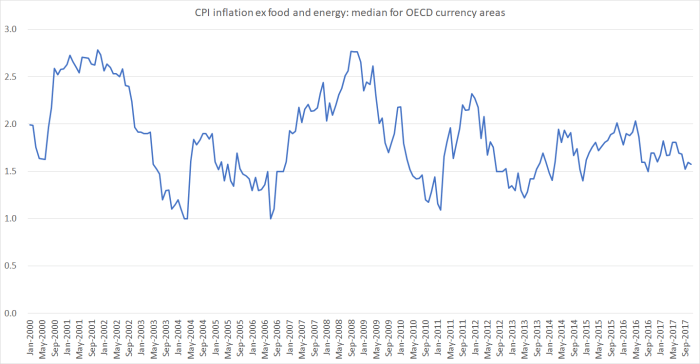
This survey was done only a couple of months ago.  In that light, it is also interesting –  although not directly relevant to New Zealand –  that more respondents thought the US was still operating below “maximum sustainable employment” than disagreed.

At very least, these sorts of survey responses suggest that the government can come up with a formulation that might pass muster, as useful, among academic economists.  As a practical matter – and most of these respondents haven’t spent much time around policy –  I’m sure they can.    As I’ve noted previously, Lars Svensson – the leading Swedish economist who did a review of New Zealand monetary policy for the previous Labour government –  certainly believes some such framing is desirable and practically useful.

It isn’t yet clear whether the government wants a formulation that is practically beneficial and makes some difference to the conduct of short-term monetary policy, or simply wants something that looks different.   With Treasury, and the Independent Expert Advisory Panel (of questionable independence if the report on the back page of Friday’s NBR is anything to go by), due to report very soon, we should have some stronger indications before too long.

There was another recent IGM survey question of some relevance to New Zealand and other countries.  Last July, panellists were asked their view of the following proposition

Raising the inflation target to 4% would make it possible for the Fed to lower rates by a greater amount in a future recession.

Weighted by the confidence of the individual respondents 86 per cent agreed.

The panel was also asked their view of this proposition

If the Fed changed its inflation target from 2% to 4%, the long-run costs of inflation for households would be essentially unchanged.

A majority (51 per cent vs 29 per cent) disagreed, presumably thinking the costs of inflation would rise.

I’d agree with the majorities in both cases, and would answer the same way if the questions were posed for New Zealand.    I’d prefer not to have the target raised to 4 per cent –  actually meeting (or perhaps slightly overshooting) the 2 per cent target would do for now –  because there are (modest) welfare costs from a higher inflation target in normal circumstances.   But limitations on macro policy in the next serious recession is a real challenge, and there is little sign that the Treasury or the Reserve Bank have really engaged with them (eg it never appeared in the work programmes in Reserve Bank statements of intent).      And if there isn’t a willingness to address the practical constraint on taking interest rates much below zero, the Minister needs to be taking much more seriously the option of a higher inflation target.   Better to address the problem at source, but there is no sign our government – or officials –  have been doing so.

For those of a technical bent, in a Brookings newsletter the other day I noted a description of an interesting looking new paper tackling this issue from another angle.

Decline in long-run interest rates increases optimal inflation, but not one-for-one
If the decline in long-run real interest rates in advanced economies persists, nominal interest rates may be constrained by the zero lower bound more frequently. To counteract this, some economists have supported increasing the inflation target. Using a new Keynesian DSGE model, Philippe Andrade of the Bank of France and co-authors find that a 1 percentage point decline in the long-run natural rate of interest should be accommodated by an increase in the optimal inflation rate of about 0.9 percentage point—an estimate that is robust to various specifications that allow for uncertainty about key parameters in the model.

Advocating for the CPTPP

A couple of days ago MFAT released its National Interest Analysis of the new CPTPP preferential trade, investment (and all manner of other stuff) agreement.  Unsurprisingly, given MFAT’s own heavy involvement in negotiating the agreement for the government of the day, MFAT concludes that New Zealand should sign the agreement.

They may well be correct that, taking all the aspects of the agreement together, and recognising that the other countries would probably have gone ahead even if New Zealand hadn’t signed, entering the now-concluded agreement would be in the best interests of New Zealanders as a whole.    But the National Interest Analysis (NIA) isn’t the resource an interested and informed citizen would turn to for a considered assessment of all the pros and cons.  The NIA is really best seen as an advocacy document, written to make the government’s case.    In particular, the document seems targeted to the government’s (generally) left-of-centre constituencies.  And there are some pretty questionable claims included, for example about the gains from past preferential agreements (notably, the implication that all the growth in trade with China in the last decade is the fruit of the trade agreement, a suggestion which is simply without credible foundation).

That doesn’t mean the document has no value at all.   There is some useful summary descriptive material in it, but it is not the sort of independent professional assessment that the public (indeed Parliament itself) deserves before reaching a final view on the deal.    It seems unlikely that there will such an assessment done.   There will be select committee hearings on the deal but, even if they had the inclination, parliamentary committees don’t have the resources to commission such research and advice, and successive governments have had no interest in doing so.  That’s a shame.  A well-regarded agency like the Productivity Commission, hiring in specific expertise, could have made a valuable contribution to the debate.

The agreement is so large, covering such diverse ground, that there is no easy single, or agreed, metric for reaching a final conclusion.  Some might put the highest weight on the likely, but modest, trade and GDP gains.  But others, equally rationally, might use a quite different set of weights: not denying the probable trade benefits, but putting greater weight in things like ISDS provisions, or the way in which these agreements reach behind the border to influence domestic policy, on matters historically seen as simply matters for national governments.  For others still, just the risks of “being out of the club” might weigh most heavily.   In that sense, no independent agency can reach some definitive bottom line number that the deal is or is not good for New Zealand.  But, done well, such an assessment could still canvass the full range of issues, advantages and disadvantages, static effects and dynamic ones, leaving voters (and MPs) to make their own final assessments.

Much of the attention inevitably focuses on the bits where MFAT has produced some numbers: estimates that, when all new liberalisation measures (tariff reductions and non-tariff measures) have come into force (15 or 20 years away) annual GDP might be anything from 0.3 to 1.0 per cent higher.   Those aren’t tiny numbers (in the scheme of the sorts of model results one gets for micro reforms) but they need to be discounted to some extent precisely because the full effects are quite a long way into the future (and we have the highest interest rates –  and discount rates –  in the advanced world).  Perhaps a little more concerningly, MFAT does not appear to have published the modelling work they commissioned (all we have is a couple of summary tables), and thus it isn’t easy to know what assumptions they’ve made.  For example, in MFAT publications a lot is made of the gross value of the reductions in tariffs New Zealand exporters will pay, but we aren’t told what assumptions are made about the incidence of those tariffs.  When New Zealand removed most of its import restrictions the biggest winners were, almost certainly, New Zealand consumers rather than other countries’ exporters.

I’m not uncomfortable with the idea of a small gain in GDP as a result of the deal.  Almost inevitably it will be quite small, because New Zealand already has other agreements with most of the other CPTPP countries, and of the remaining four only Japan is really a large export destination for New Zealand producers.

I’m rather more uncomfortable with the claim (made repeatedly in the document) that the agreement will increase employment in New Zealand.  Frankly, that seems unlikely and I’m not sure what they base their claim on.  Monetary policy tends to be run in a way designed to keep the economy not too far from “full employment” (the rate of unemployment consistent with stable inflation).  From that base, trade agreements –  or other reforms – might boost GDP, and wage rates, but they are unlikely to boost employment numbers.  People employed in one industry can’t be employed in another, so if the CPTPP agreement really does boost exports (and employment in export industries) it will have to do so by shaking some labour out of other sectors.  Over time, higher exports will be matched by higher imports (a good outcome).  It might seem a small point, but overclaiming in one area that I know something specific about makes me even more nervous about the rest of the document.

What of the assessment of some of the other aspects of the agreement?

The government has gone on record as opposing ISDS clauses on principle, but has nonetheless signed up to an agreement which still has extensive scope for the use of such dispute settlement arrangements.   MFAT attempts to downplay the disadvantages to New Zealand (and highlight some potential benefits to New Zealand foreign investors).   But they never once highlight one of the most fundamental arguments against: the importance of the rule of law and, within that, the principle of equal access to justice.  ISDS provisions allow foreign investors recourse to resolution procedures not open to domestic investors engaged in exactly the same business.   Particularly in a country with a robust, independent, judiciary that should be simply unacceptable.   But it doesn’t seem to be a perspective that had occurred to our MFAT officials in their enthusiasm to sell the deal.

MFAT officials also seem not to recognise that, under some models (ways of thinking about how to organise society) there might be downsides to the fairly extensive way in which this agreement reaches behind borders into matters that the principle of subsidiarity suggests should really be solely for national governments.     Perhaps most of the left-wing constituencies rather like the idea of having labour and environmental chapters in the agreement, tying the hands of others governments and our own.  On the pro-business side, agreed procedures around regulatory issues might appeal to some.  But a principle like that, once adopted, can be a double-edged sword: other governments will commit to other regulatory limits that the enthusiasts for this particular set of controls won’t like.

MFAT, of course, seems to buy into all this without question.   In describing the labour chapter, for example, they talk blithely of it being ‘inappropriate to encourage trade or investment by weakening or reducing labour laws”, and assert that the agreement “helps ensure that CPTPP Parties’ competitive advantage in trade is not undermined” by agreement to “level the playing field for New Zealand companies and employees by setting minimum labour obligations for all parties”.    So microeconomic reforms that liberalise the labour market –  perhaps reducing the ratio of the minimum wage to the median wage – can never in future be adopted, lest some other government (perhaps under pressure from its own unions or firms) invoke dispute settlement provisions?   And what do they think real exchange rate adjustments are, but competing on the basis of changed real relative unit labour costs?  Some defenders of these sorts of provisions will talk of how these sorts of provisions aren’t very binding or effectively very enforceable. Even if so –  and only time will tell –  that just makes them bad law.  And there is a reasonable argument (in economics, and in principles of responsive democratic government) that they just shouldn’t be in a trade agreement at all.  But that perspective (and the risks) doesn’t even seem to be recognised –  even to be discounted – by MFAT.

And then there are near-vacuous provisions, which MFAT suggests have no disadvantages.    What business is it of governments to be, for example, encouraging enterprises to adopt “corporate social responsibility” initiatives?  And even if there is a case, surely there are downsides (more bureaucrats if nothing else) to the proliferation of feel-good initiatives.  Or around the creation of fora in which countries (bureaucracies) might work together on topics like work-life balance or “innovative workplace practices”.

There are so many of these sorts of provisions with no serious evaluation, guided (presumably) by an officials’ view that more meetings, more international coordination can only be “a good thing” or at least harmless.  There is, for example, an entire Development chapter, which establishes a whole new Committee on Development, explicitly designed as a talkfest on such topics as “women and economic growth” and “broad-based economic growth”.  Even if these are flavour-of-the-day topics right now, this agreement is presumably planned to live for decades  For decades, officials will cross the world, adding carbon miles as they do, all at the expense (perhaps small) of domestic taxpayers.  And yet MFAT explicitly state that there are no disadvantages.

There are all sort of more substantive provisions that aren’t seriously evaluated.  For example, countries are free to impose some temporary exchange controls in the event of a serious economic crisis, but under this agreement they won’t be able to restrict flows associated with foreign direct investment. In effect, this amounts to preferencing foreign investors over domestic investors in a crisis: domestic owners can be forbidden from shifting proceeds abroad, but foreign owners can’t.  Perhaps there is a good case for it –  although when I was an official I argued against it – but there is simply no serious attempt at evaluation, either of this line item or of the overall approach to crisis exceptions.

I’m still ambivalent about the overall agreement.  Perhaps for foreign policy reasons we had to be part of the deal once it was done.  Probably there will be some modest overall real GDP gains.  But undermining equal access before the law – not carving out special jurisdictions for cross-border investors – isn’t a principle that is priced here, and it seems to me it is something we just shouldn’t be sacrificing.    Others will reach different overall conclusions, but the process of doing so –  in an informed way –  would have been much assisted by a more independent, and far-reaching, assessment of the many provisions of the agreement.

(For those interested in ISDS issues, there was an interesting new article in the latest issue of the American Affairs magazine by a Yale law professor.)


“We could be the next Albania” – Brady

To their credit, the Herald yesterday ran a substantial op-ed from Professor Anne-Marie Brady on the influence-seeking and interference by the People’s Republic of China (PRC), and the Communist Party that controls the state, in New Zealand.

Professor Brady has been in the headlines in recent days over a burglary at her Christchurch home in which several laptops, phones etc (but nothing else of value) were stolen, the burglary occurring after she had received a letter warning that she was being targeted by the PRC regime.   The media has –  rightly –  sprung to her defence, suggesting a need to get to the bottom of just what is going on.   Another article in yesterday’s Herald suggested that the Police weren’t doing much about the break-in until the Prime Minister herself expressed concern.  In general, it is a bad look (and bad practice) for ministers to be putting pressure on Police to investigate, or not investigate, particular cases.  But perhaps on this occasion the end might almost justify the means.

Professor Brady’s article ran under the heading ‘We could be the next Albania’,  a reference to the reported observation last year by a senior Chinese diplomat that (in Brady’s words) “favourably compared New Zealand-China relations to the closeness China had with Albania in the early 1960s”.    Having fallen out with the Soviet Union, Albania sought refuge in ties with the PRC (a relationship described by one Western scholar as “one of the oddest phenomena of modern times: here were two states of vastly differing size, thousands of miles apart, with almost no cultural ties or knowledge of each other’s society, drawn together by a common hostility to the Soviet Union.”) before later also falling out with them.

Brady reports, and presumably is in a position to know, that this “startling and telling analogy…disconcerted New Zealand diplomats”.   She perhaps over-eggs the Albania point, arguing that

In the late 1970s the relationship ruptured over China’s failure to deliver economic development assistance. By the end of the Cold War era, Albania had become one of the poorest, most politically divided, and most corrupt of the former Eastern Bloc states.

Perhaps, but if we look at Angus Maddison’s collection of historical estimates of GDP per capita, Albania had long (well before the Communist era) been one of the poorest of those countries and had not exactly been a byword for political stability either.  Their failings were their own.

But I guess the real point –  and probably the one the Chinese diplomat was getting at –  was that New Zealand was seen from Beijing (with perhaps just a bit of exaggeration for effect) as small, remote (clearly both true), somewhat detached from its former allies, and diplomatically and economically subservient.   True or not, the suggestion will have put MFAT noses out of joint.

Brady goes on

Xi Jinping has been emboldened to pursue an increasingly assertive foreign policy and insisting that its strategic partners such as New Zealand fall into line with its interests and policies.  Accompanying this more assertive foreign policy has been a massive increase in the CCP’s foreign influence activities. China did not have to pressure New Zealand to accept China’s soft power activities and political influence: Successive New Zealand governments actively courted it. Ever since PRC diplomatic relations were established in 1972, New Zealand governments have sought to attract Beijing’s attention and favour. New Zealand governments have also encouraged China to be active in our region.

And not a word of scepticism is ever uttered openly, whether by politicians or by the (mainly government-funded) entities like the China Council and the Asia New Zealand Foundation.   No doubt, in most cases they genuinely believe their stance (quiescence) to be in the interests of “New Zealand” –  however those interests are defined.  In all too many cases, it also appears to have been in the personal economic interests of those involved.

The real point of Brady’s article appears to be to encourage the new government to think seriously about doing things differently.   As she highlights, the Australian government is taking these issues much more seriously   (for those still sceptical of the significance of these issues, in addition to Anne-Marie Brady’s main Magic Weapons paper, various of the submissions on the new Australian legislation make sobering reading –  for example, no 20 (by an academic whose new book on the subject –  already the subject of PRC threats –  is due out next week), or no 33 (from a national security academic at ANU) or no 32 (from an ethnic Chinese group, the Foundation for a Democratic China).

Brady appears to think there is a realistic possibility of change

In order to deal with the issue it can’t just attack the policies of the previous government, it also has to clean its own house. Significantly, unlike the previous National government, Ardern’s government has not endorsed Xi Jinping’s flagship policy the Belt Road Initiative, bringing New Zealand back in line with its allies and nearest neighbours.

It will take strenuous efforts to adjust course on the direction the previous National government set New Zealand. New Zealand has to address the issue, but the Ardern government must find a way to do so that does not invite pressure it cannot bear from the CCP, which is watching closely.

But is there any sign that this government is any different?  I’d like to believe that not having yet endorsed the Belt and Road Initiative (a sprawling massive geopolitical play, designed to extend PRC reach and in some cases load up poor countries with additional debts in ways that further extend PRC political influence) is significant.    But the New Zealand China Council –  largely taxpayer-funded, and with the Secretary of Foreign Affairs sitting on its Council –  was promising late last year that early this year they would have a report out on how New Zealand can engage with the initiative.  And senior Labour backbencher –  chair of a major select committee –  Raymond Huo seemed right behind the initiative

Meanwhile, China-born legislator Raymond Huo believed the Belt and Road Initiative can help solve the problem of infrastructure development facing many developed nations.

“There is a dilemma. New Zealand, Australia and other developed countries including the US and Canada are all facing the same problem,” Huo told Xinhua.

“We haven’t done much upgrading, so we need money, we need capital, and we need the construction capacity. China has both,” he said.

Huo said he first realized the potential of Belt and Road Initiative when he attended two high-level conferences in China, and he believed New Zealand should seize the opportunities it offers.

Along with other experts on China and leading business people, he has established a think tank and foundation on the Initiative.

What other straws in the wind are there?

As recently as this week, interviewed on Radio NZ about the Brady break-in and other matters the Prime Minister refused to express concern at all about PRC influence-seeking and interference in New Zealand. At one level, it is fine to talk about being concerned about any foreign influence from any source (as we all should be), but there is a real and specific issue around the PRC, which needs serious political leadership to address.  But instead there is a void.

It isn’t just the Prime Minister of course. In a post late last year, I highlighted that her minister responsible for the intelligence agencies, Andrew Little, was specifically dismissive of concerns around the PRC activities.

Andrew Little, the Minister Responsible for the SIS, said he was not aware of any undue Chinese influence.
“I don’t see evidence of undue influence in New Zealand, whether it’s New Zealand politics, or New Zealand communities generally.

“We have a growing Chinese community. We have a strongly developing trade relationship and diplomatic relationship with China. I don’t think those things, on their own, connote undue influence.

“If there’s other things she says constitutes undue influence, we’d have to know what that is.”

It was documented in Brady’s substantive paper minister, a paper which has had substantial coverage around the world.

Then, of course, there was the Deputy Prime Minister and Minister of Foreign Affairs.  Out of office he had occasionally been heard to express concerns, including around National MP Jian Yang.   In office, at a New Zealand event marking 45 years of diplomatic relations with the PRC, he wouldn’t even address the issue, stressing how cordially he would raise (privately) any concerns he ever had, and went on to suggest that, after all, one had to break a few eggs to make a omelette, and really no should get too bothered about human rights issues in China either.

“Sometimes the West and commentators in the West should have a little more regard to that and the economic outcome for those people, rather than constantly harping on about the romance of ‘freedom’, or as famous singer Janis Joplin once sang in her song: ‘freedom is just another word for nothing else to lose’.

“In some ways the Chinese have a lot to teach us about uplifting everyone’s economic futures in their plans.”

And since the election, Labour president Nigel Haworth –  presumably with his leader’s knowledge and approval – hobnobbing with the Chinese Communist Part itself, has been effusive in his praise of Xi Jinping and the Chinese regime.

One could add to the mix the stony silence of the Labour Party leadership –  pre and post-election – on the succession of revelations around National MP, and former PRC intelligence officer, Jian Yang.  From anything they say (or don’t say) in public, the Labour Party, and their allies in the Greens and New Zealand First, seem quite unbothered about the presence in Parliament of someone who acknowledges misrepresenting his past in his residency/citizenship applications,  who is widely regarded (by experts in the field) as likely to still be a member of the Communist Party, who closely associates with the PRC embassy, and who has never once been heard to criticise the Party-state that is the PRC.  Recall, former diplomat Charles Finny’s line, that be was always very careful what he said around Yang (and Raymond Huo) since both were known to be close to the PRC embassy.    But is there any sign that any of this bothers our new government?

Professor Brady calls for the government to emulate its 1980s predecessor

the Fourth Labour government made a principled stand on a matter that affected our sovereignty and our values with the nuclear issue; then it passed legislation to back up these principles. Now is the time for the sixth Labour government to take another principled stand to defend our sovereignty and values and make legislative changes such as to the Electoral Finance Act.

In truth, and whether you supported the anti-nuclear stance of not (I didn’t and don’t, and certainly don’t see it as a matter affecting our sovereignty) this one is a great deal harder.  For a start there wasn’t really money at stake around the nuclear-free issue.

I presume one of the issues that will be exercising ministers, and their MFAT officials, will be the negotiations around the proposed upgrade to the preferential trade agreement with China.  It would be easy enough for the PRC to put those negotiations on a slow track, or simply halt them altogether.  Such agreements might not matter very much taken as a whole, but they might matter quite a lot to a small group of people (with good political connections).  In the Australian context, there already appear to be some signs that the PRC is reacting to tougher Australian stance (and new legislation) by damping down the flow of foreign students.  We’ve already seen here the apparent ability of the export education industry to see off for now Labour’s promised changes to student work visa arrangements.  Those would have mostly affected the lower-level PTEs.  But our more prestigious – and government owned/controlled – universities get a lot of PRC students, and several attract direct PRC funding for their Confucius Institutes.  Chancellors and vice-Chancellors will be very nervous that if the government actually looked like taking a stand, their flow of revenue might be disrupted.  And they will constantly be bending the ears of ministers and officials, if ever the government showed any sign of self-assertion, and a respect for New Zealand values (and the interests of New Zealand citizens of Chinese origins).  And then there will be Auckland airport and the tourism operators too.

I’ve noted previously that during the Cold War it was much easier to maintain a moral clarity.  Most Western countries –  including New Zealand –  didn’t do much trade with the Soviet Union, and so there wasn’t a major self-interested constituency in New Zealand (or the US, or the UK) for simply bending over and letting a hostile regime, practising a completely different set of political values, have its way.  I noticed yesterday a recent interview with former (Obama-era) US Defense Secretary Ash Carter making much the same point.

Last time we competed with or had a long difficult strategic relationship with a large communist country was during the Cold War, and our approach to that was simply not to trade with them. Now, one of our largest trading partners is in fact a communist country, and I don’t think that the economists have given us much of a playbook to protect our companies and our people.

I’m not sure that economists can necessarily help much, except perhaps to repeat the point I’ve made here before: the PRC does have the ability to severely adversely affect the fortunes of individual firms/sectors (ask the Norwegian salmon industry, or some of the South Korea firms last year), but the PRC did not make Australia and New Zealand rich and it cannot, whatever unsubtle economic sanctions it attempted, make us poor.  Our prosperity, as a whole country, is very largely in our own hands.   And the very fact that we can worry about the possibility of such sanctions is perhaps the best case for making a stand now, rather than continuing to roll over, keep quiet, and hope that Beijing is happy.

But perhaps the other piece of economists’ advice might be, in this as in other fields, “beware of rentseekers”, people/institutions who will seek to use governments to advance their own economic interests, at the expense of the values, the freedoms, the self-respect, of the nation as a whole.  Governments have a poor track record of doing so, and there is little sign at this point that the current government will be any different.  As I wrote earlier

One of things we need to remember is that the interests of businesses (and universities) who deal in countries ruled by evil regimes, are not necessarily remotely well-aligned to the interests and values of New Zealanders.   Selling to China, on government-controlled terms, isn’t much different than, say, selling to the Mafia.  There might be money to be made.  But in both causes, the sellers are enablers, and then make themselves dependents, quite severely morally compromised.

Professor Brady’s Herald column seemed to build on an earlier (and somewhat longer) paper she produced shortly after the new government took office on things the government could do if it were serious about addressing the PRC political influence activities.   I wrote about it here (and here is the updated link to the paper itself).  In that earlier piece she had quite a list of things that could, or should, be done.

What should be done?  At an overarching level she says

The Labour-New Zealand First-Greens government must now develop an internally-focused resilience strategy that will protect the integrity of our democratic processes and institutions. New Zealand should work with other like-minded democracies such as Australia and Canada to address the challenge posed by foreign influence activities—what some are now calling hybrid warfare. The new government should follow Australia’s example in speaking up publicly on the issue of China’s influence activities in New Zealand and make it clear that interference in New Zealand’s domestic politics will no longer be tolerated.

Getting specific she calls on the government to

The Labour-New Zealand First-Greens government must instruct their MPs to refuse any further involvement in China’s united front activities.

That would be Raymond Huo I presume.

The new government needs to establish a genuine and positive relationship with the New Zealand Chinese community, independent of the united front organizations authorized by the CCP that are aimed at controlling the Chinese population in New Zealand and controlling Chinese language discourse in New Zealand.

And there is a list of six other specifics

  • The new Minister of SIS must instruct the SIS to engage in an in-depth investigation of China’s subversion and espionage activities in New Zealand. NZ SIS can draw on the experience of the Australian agency ASIO, which conducted a similar investigation two years ago. 
  • The Prime Minister should instruct the Department of Prime Minister and Cabinet to follow Australia’s example and engage in an in-depth inquiry into China’s political influence activities in New Zealand. 
  • The Minister of Commerce and Consumer Affairs should instruct the Commerce Commission to investigate the CCP’s interference in our Chinese language media sector— which breaches our monopoly laws and our democratic requirement for a free and independent media. 
  • The Attorney General must draft new laws on political donations and foreign influence activities. 
  • The New Zealand Parliament must pass the long overdue Anti-Money Laundering and Countering Financing of Terrorism legislation.
  • The new government can take a leaf out of the previous National government’s book and appoint its own people in strategically important government-organized non-governmental organizations (GONGOs) which help shape and articulate our China policy, such as the NZ China Council and the Asia New Zealand Foundation.

Most of those suggestions look sensible (although I’m no fan on AML/CFT legislation, with all its inane consequences –  goodbye ipredict, hello ID cards for 94 year olds changing banks).  There has been no sign of activity on any of these fronts.  Quite probably – based on what we saw in their BIMs, and Professor Brady’s mention of a Five Eyes discussion (itself repeated in the New York Times article last year on these issues –  our intelligence agencies themselves are worried).  But intelligence agencies can only apply the (current) law.  It is the political leaders who can bring forward legislation (on matters amenable to legislation, which not all of these are) and can display the leadership and moral standing that say “enough”  –  whether about Jian Yang, political donations, control of the Chinese-language media, university funding, PRC activities in the South China Sea, or whatever.   They could display such leadership, but there is no sign –  from any political party –  of anyone doing so.

I noted the other day that perhaps some journalist could ask the five contenders for the National Party leadership about their attitude to these issues, including (but not limited to) matters around Jian Yang and political donations.  A reader reminded me yesterday of Chris Finlayson’s arrogant and dismissive attitude before the election, when he was both Attorney-General and minister responsible for the intelligence services.  Finlayson still sits on the National Party front bench, and is still shadow Attorney-General.  Perhaps, five months on, someone could ask him if still thinks there is just nothing there, that Professor Brady is jumping at shadows etc.  Or is it that he just doesn’t want to know?

(I linked the other day to a couple of reports on PRC influence activities in other advanced economies.  For anyone interested –  including those doubting the seriousness of the PRC agenda –  I suggest searching out the (easy to find) serious articles about PRC involvement in places like the Philippines, the Maldives, Sri Lanka, Cambodia, and Pakistan.  The issues aren’t primarily about the internal nature of the PRC –  domestic human rights etc –  but about external expansionism, power projection, and the attempt to have other countries including (in Professor Brady’s words) “New Zealand fall into line with its interests and policies”, policies that are generally hostile to open and free societies.)

UPDATE:  Interesting ABC article based on an advance copy of Clive Hamilton’s book on PRC influence activities in Australia (book to be published next week).


Hankering for normalisation

Really ever since the end of the immediate financial crisis in the first half of 2009 there has been a hankering –  often more than that –  among some central bankers, some former central bankers. and some agencies that associate with and support central bankers (ie the BIS –  Bank for International Settlements) for things to “get back to normal”.   What leaves these people particularly uncomfortable is the level of official interest rates, which in most of the major advanced economies (and quite a few smaller ones) have been very close to zero (sometimes modestly negative).    And it is now almost nine years since the end of that first intense crisis phase.   And, at least in nominal terms, there had been no precedent for such low official interest rates.

It was, perhaps, an understandable reaction in the immediate aftermath.  I certainly shared it then.  I was on secondment to The Treasury, and recall talking things over with a colleague who had previously been at the Reserve Bank.  We agreed that the Reserve Bank (Alan Bollard personally) appeared to have done a thoroughly excellent job in cutting the OCR aggressively during the crisis/recession, but that it seemed likely –  and appropriate – that many of those cuts should soon be reversed.  We welcomed early indications that that was exactly the Bank’s intention.  I also recall pointing out to colleagues that bond markets appeared to be pricing a reasonably prompt, and near-full, rebound in policy interest rates (not just in New Zealand but in range of advanced economies).

It all made sense at the time: very sharp cuts in policy rates had been appropriate in a sharp economic downturn accentuated by an extreme rise in uncertainty and liquidity preference, but once those fears eased (with time and various direct interventions) it didn’t seem obvious that anything very structural about economies had changed.  If so, it wasn’t obvious that future average interest rates would be much different from those of the previous decade or two.

That was then.  But now it is 2018.  And the median policy interest rate among OECD central banks (that have their own monetary policy) is about the same now as it was in the trough in 2009.   Some individual countries have lower rates now, and some higher (the US notably), some have tried to raise rates and had to reverse themselves (eg New Zealand twice, Sweden, and the ECB).   No OECD central bank has simply left its policy rate unchanged since 2009.

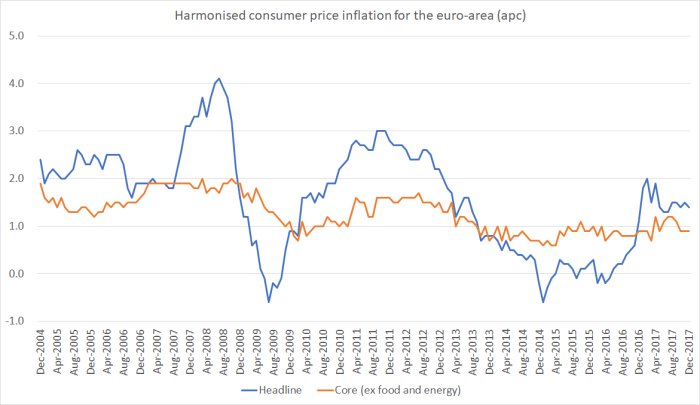
And throughout that period inflation (headline and core) has remained pretty quiescent. Here is an indicator of core inflation across OECD countries (well, monetary areas, so the euro-area is a single observation).

CPI ex OECD jan 18

Not all central bankers like to own up to paying any attention to (indicative) measures of excess capacity, but over the decade unemployment rates have typically dropped back quite slowly (as in New Zealand) and output gaps are still estimated to be around zero, often negative.  As a reminder, these outcomes have come about with interest rates very (historically) low.  They aren’t themselves an argument for much higher policy rates.

And yet the anguishing continues.    Some of it has become almost pro forma in nature.  The former Governor of the Reserve Bank used to regularly talk about how “extraordinarily stimulatory” he thought interest rates were and openly hankered for “normalisation” here and abroad.  His temporary successor (the “acting Governor”) throws in occasional references along similar lines.  I suspect it makes them more reluctant to lower the OCR than they otherwise would be but –  in fairness –  they do eventually seem to be led by the data rather than by their mental model of how the world should work.

Others seem to want to translate the model into action.  I noticed one example yesterday, in the form of a new column by former ECB board member (in effect he served as chief economist) and former Bundesbank Deputy Governor, Jurgen Stark.   Former BIS chief economist (and former Bank of Canada Deputy Governor) Bill White has had a succession of speeches and articles along similar lines, and his latest was published in the Financial Times a few days ago.

Stark opens his argument with the recent sharp dip in US share prices which, he asserts

revealed just how addicted to expansionary monetary policy financial markets and economic actors have become.

Possibly, but since the S&P this morning is still a touch higher than it was on 31 December 2017 –  a mere seven weeks ago – I’m not sure it is particularly compelling evidence.

He moves to a somewhat more macroeconomic argument

The fact is that ultra-loose monetary policy stopped being appropriate long ago. The global economy – especially the developed world – has been experiencing an increasingly strong recovery. According to the International Monetary Fund’s latest update of its World Economic Outlook, economic growth will continue in the next few quarters, especially in the United States and the eurozone.

I’m not sure we should be particularly encouraged that “economic growth will continue in the next few quarters”, but nor am I sure how it is relevant.  First, projections of continued growth –  even growth a bit faster than medium-term potential growth –  are, in part, reflections of –  and, at very least, consistent with –  the low interest rates.  And second, inflation –  or some other nominal variable – is supposed what central banks focus on first and foremost.

The US Federal Reserve has been raising interest rates, but it isn’t enough for Stark.

But the Fed’s policy is still far from normal. Considering the advanced stage of the economic cycle, forecasts for nominal growth of more than 4%, and low unemployment – not to mention the risk of overheating – the Fed is behind the curve.

It isn’t clear that “the advanced stage of the economic cycle” means much more than that it has been a few years now since the US had a recession.  Nominal GDP growth –  currently around 4 per cent –  shows no sign of racing away, and has averaged 3.8 per cent per annum since 2010.  And core PCE inflation –  the Fed’s target variable –  is currently 1.5 per cent, while the Fed’s self-chosen target is 2 per cent.  Yes, the unemployment rate is low, but as on the one hand some analysts suggest the headline number is underestimating residual labour market slack, and on the other the Fed is actually raising policy interest rates (and is expected to continue to do so), it is hard to find any backing for Stark’s claim that the Fed is “behind the curve”.    And even if, for example, the latest round of ill-judged fiscal stimulus does end up providing the boost that lifts inflation nearer target, it is hard to believe (and there is no obvious evidence for) that inflation expectations are so weakly anchored that a lift in inflation to target (after all these years) will destabilise expectations in a dangerous and damaging way.  This isn’t 1974.

But if the Fed is bad, on Stark’s reckoning, many other advanced economy central banks are “even worse”

The ECB, in particular, defends its low-interest-rate policy by citing perceived deflationary risks or below-target inflation. But the truth is that the risk of a “bad” deflation – that is, a self-reinforcing downward spiral in prices, wages, and economic performance – has never existed for the eurozone as a whole. It has been obvious since 2014 that the sharp reduction in inflation was linked to the decline in the prices of energy and raw materials.  In short, the ECB should not have regarded low inflation as a permanent or even long-term condition that demanded an aggressive monetary-policy response.

The ECB’s policy is also out of line with economic reality: the eurozone, like most of the rest of the global economy, is experiencing a strong recovery.

I think there is quite a bit to argue about over the way the ECB interjected itself into the euro crisis, and one can mount arguments –  as Stark did –  about the appropriateness of the quasi-fiscal policies the ECB ended up adopting.   But what about inflation –  the macro variable the ECB says it targets, under its treaty mandate to pursue price stability?

euro area CPI

The ECB targets something “below, but close to, 2%” (in practice something like 1.9 per cent).   Headline inflation certainly fluctuates –  there (as Stark notes) and other places fluctuations in oil prices make a big difference in the short-run.   But the last time euro-area wide core inflation was at 1.9 per cent was the end of 2008.   And there hasn’t been any obvious sign in the last 12 or 18 months that core inflation is picking up strongly again.  Now Stark is German, and activity and demand in Germany have done better than in the rest of the euro-area.  Inflation in Germany is also higher than in the euro-area as a whole but on neither headline nor core measures is it as high as 1.9 per cent –  and monetary policy is supposed to be set for the region as a whole, not just for the single largest national economy.

As for the “strong recovery”, things in the euro-area are certainly a great deal better than they were, but in its last published forecasts the IMF estimated that for the euro-area as a whole, there was still a negative output gap last year, and forecast one around zero this year.  And that with interest rates at (historically) very low levels.

The sort of argument that Stark uses might make a bit of sense if he wanted to argue that interest rates at these levels are having no effect (on demand/activity).  If they were having no effect, there might be no harm in having them higher again.  But that isn’t his argument.  Instead

One of those consequences is that the ECB’s policy interest rate has lost its steering and signaling functions. Another is that risks are no longer appropriately priced, leading to the misallocation of resources and zombification of banks and companies, which has delayed deleveraging. Yet another is that bond markets are completely distorted, and fiscal consolidation in highly indebted countries has been postponed.

This “misallocation of resources” line often pops up in commentaries like Stark’s (it is there is White’s FT article as well) although it is never clear quite what is meant.  It really only seems to make much sense if one can confidently assume that their model –  in which interest rates should be so much higher –  is correct, and thus relative to that benchmark choices are made differently than they would be in the alternative universe.  Perhaps it is right, but we have no very obvious means of knowing that it is –  after all these years.  If neutral rates are lower than they think, “misallocations” might just be “choices”.

And the claim seems to involve the suggestion that some real activity is now happening which wouldn’t happen if only interest rates were higher.   Stark actually states it more or less directly: in his view current policies have ‘delayed deleveraging”, and the “fiscal consolidation in highly-indebted countries has been postponed”.   But had a whole succession of governments actually been under more pressure to run lower deficits/larger surpluses, cutting their debt levels, where and how does he suppose the replacement demand might have come from?  It isn’t as if any monetary area in the advanced world has had consistent excess demand this decade.   There are, of course, standard responses about confidence effects, and private demand replacing public spending –  at times even the New Zealand experience in the early 1990s is cited –  but those offsetting adjustments typically take place in part through lower interest rates and a lower exchange rate (governments cut spending, central banks ease monetary policy, and additional private spending is crowded in ).  Stark’s model rules out that process almost by construction.  Much the same story is likely to hold for corporate or household deleveraging: the process by which it occurs usually involves (incipient) weaker overall short-term demand and activity.  Oh, and if Stark was right and the ECB raised policy interest rates in the current climate and it seems reasonable to expect that the euro exchange rate would be higher.  There is no guarantee about exchange rate effects, but (probabilistically) it is another channel that would weaken demand and activity further.

I’m not convinced there is a particularly good case at present for the ECB to still be buying large volumes of bonds.  But the case for higher interest rates –  across the whole euro-area, or even just for Germany –  seems threadbare in the extreme.

Stark ends his article this way, generalising beyond just the ECB.

Today, monetary policy has become subordinate to fiscal policy, with central banks facing intensifying political pressure to keep interest rates artificially low. As the recent stock-market turmoil shows, this is drastically increasing the risk of financial instability. When more – and more severe – market corrections take place, possibly affecting the real economy, what tools will central banks have left to deploy?

The evidence for these claims seems thin at best.  There has certainly been a huge increase in net government debt in some of the larger OECD countries in the last decade –  France, Italy the US, the UK, Japan, although not Germany –  but it isn’t obvious that monetary policy is playing out materially differently in those countries than in places like Switzerland, Sweden or Israel (where net debt has fallen as a share of GDP over the decade –  and where official interest rates are very low) or in places like New Zealand or Canada that have seen only modest increases, from low bases, in the levels of net public debt.

And what of the claim that “interest rates are artificially low”?  Well, that simply seems to impute far too much power to central banks.  Central banks set very short-term interest rates, and over those short-term horizons no one else can do much about it.  Central banks do not set long-term interest rates and typically have very little direct influence on extremely long-term interest rates.   The longest German inflation-indexed government bond matures in 2046: the current yield on that bond is negative.  Perhaps Stark would argue that the ECB bond-buying programme directly or indirectly influences those yields.  But in most countries, central banks aren’t engaged in bond buying programmes at all, and very long-term nominal and real interest rates are extremely low.   Swiss 10 year conventional bond yields, for example, are basically zero.  US 30 year inflation-indexed bonds (and the US currently has by far the highest interest rates among the larger economies) are currently around 1 per cent.  And even in little old New Zealand –  typically with the highest real interest rates in the advanced world –  our 22 year government indexed bond is yielding just slightly over 2 per cent (down from 5 per cent 20 years ago).  It is a global phenomenon, and it can’t just be down to the (misguided or otherwise) choices of central banks.   Rightly or wrongly, some mix of demographics, weak expected productivity or whatever, seem to be at work.  Central banks might not fully understand what is going on –  nor might anyone else –  but it would brave, nay foolhardy, for the central banks of the world to stake out a stance that relied on a completely different view (“interest rates should be much higher”).

Which, of course, brings us to that very last line in Stark’s article.  When things really go wrong, what tools will central banks have left to deploy?

That is, of course, a serious issue, and it is one that ever central bank, every finance ministry, every Minister of Finance should be worrying about.   After all, they’ve had years of notice of the issue now.    When the next serious recession happens –  and one will happen again –  it looks as if most central banks in advanced countries will have little or no room to cut interest rates, the typical counter-cyclical stabilising policy instrument.  Even countries like New Zealand and Australia will have far less room than typical (the Reserve Bank could probably cut the OCR by 2.5 percentage points, but had to cut by 6.5 percentage points after the last recession).     Markets know that constraint, which in turn risks exacerbating the severity of the downturn once it begins.    Most major advanced countries also have very little fiscal leeway left (whether as a matter of technical/market limits or political limits).

I’m all for growth-enhancing structural reforms.  They would benefit countries now, and in the future (both lifting demand and activity, and raising market assessments of neutral interest rates).  There are few signs of those sorts of reforms in most countries (indeed, often –  probably including New Zealand –  the reverse).  But what is the best path now, around macro policy, to provide greater leeway when the next serious recession comes?

On monetary policy, the standard prescription is pretty clear: higher inflation expectations are the only thing monetary policy can do to underpin higher medium-term nominal interest rates.  In other words, the best things central banks could have been doing in recent years was to aggressively pursue higher demand and inflation (there being no sign that weak inflation was a result, all else equal, of strengthening productivity growth).  Cut interest rates so as to later raise them by rather more (the opposite of the Reserve Bank strategy which turned out to be, in effect, “raise interest rates only to cut them more later”).    Few or no central banks have had the courage to adopt this course (or to openly consider higher inflation targets), partly (I suspect) transfixed by the desire for “normalisation”.   And what of fiscal policy?  In some of the countries with large deficits and high debt, it might well make sense to look to secure fiscal consolidation (giving, among things, more room for countercylical stimulus in the next recession).   For a country like the US, more or less back to a fully employed economy, that makes particular sense.   But it is far from obvious that the same logic follows in France or Italy  (still with negative output gaps): all else equal, fiscal consolidation will tend to worsen economic activity now, and yet euro-area monetary policy has all but reached its limits and can provide no offset.  Increasing the chances of a new recession now to slightly reduce the chances/severity of one five years hence is, to say the least, a difficult call (economically or politically).

At present, I’m reading one of the numerous books on my shelves about the politics and monetary policies of the inter-war period.  It is, I think, now widely accepted that monetary policy problems were at the heart of the seriousness of the Great Depression in many of the major economies (even New Zealand for that matter); in particular the way the Gold Standard had been run –  and patched back together (“normalisation”) during the 1920s after the extreme disruption of World War One.

Some of the abler observers in the late 1920s realised that problems were building up – including that perhaps two-thirds of the world’s monetary gold being held in France and the United States, without the natural stabilising mechanisms being allowed to work freely –  but there was never a sufficiently strong shared sense among policymakers that something needed to be done, and promptly.  In the US, for example, there was constant unease about the stock market boom, and thus a reluctance to allow the Gold Standard mechanisms to work as they should (when gold floods in interest rates fall, demand increases etc).   As I read through the book, I was reminded of the Governor of the Bank of England deliberately accentuating the risks to the UK peg to gold, to keep the pressure on British ministers to make large fiscal cuts (that were probably never substantively warranted).  And, even when the UK finally, reluctantly, went off the gold peg in September 1931, instead of embracing the opportunity, for some time all the great and the good (even Keynes) were focused on generating conditions that would warrant a return to gold.    Economic historians are now pretty clear that monetary expansionism –  made possible as countries slowly, and mostly reluctantly, broke the link to gold –  was a significant part of economic recovery in the 1930s.

Historical parallels are never exact but is hard not to see the constant hankering for “normalisation” –  and vigorous calls for it in some circles –   and even unease about asset prices, as akin to the well-intentioned policy mistakes of the late 20s and early 30s, leaving our world badly exposed when and if the next serious downturn occurs.

(And if –  as White and Stark claim –  financial stability is your real concern, use financial regulatory instruments and agencies to attempt to tackle those issues directly.  Sometimes monetary policy “mistakes”/shocks can be closely linked to subsequent financial stability problems.  Arguably that was the situation in Ireland and Spain in the 2000s – interest rates that suited German conditions but not Irish or Spanish ones –  but I doubt anyone can point to a single example today of an advanced economy dramatically overheating as those two did.)

The Reserve Bank’s McDermott again

Earlier in the week I wrote about Reserve Bank chief economist John McDermott’s rather strange attempt to distract attention from the Bank’s own GDP forecasts –  which some had suggested were a bit optimistic –  by suggesting that private bank economists didn’t understand the process the Reserve Bank used, and even using the word “nonsense” in an attempt to bat away what seemed like quite legitimate questions.   Somewhat to my (pleasant) surprise, Westpac  – one of the banks that had questioned the Reserve Bank’s forecasts – actually went public in response , although being an institution regulated by the Reserve Bank they still seemed to feel the need to express due deference to the powerful, ending their note this way, (emphasis added)

We are comfortable respectfully maintaining that difference of opinion.

After each Monetary Policy Statement the Reserve Bank’s senior staff fan out across the country to do a series of post-MPS presentations (I used to do some of them myself).   These events are all hosted, and paid for, by the commercial banks, and commercial clients of those banks are the invited guests.  It is an arrangement that is convenient for the Reserve Bank –  the banks rustle up an audience –  but which has always seemed a bit questionable to me: preferential access to senior public officials, on sensitive policy issues, for the invited clients of particular banks.  The tone and thrust of questioning might be a little different if some such occasions were hosted by the Salvation Army or unemployed worker advocacy groups.

These occasions are supposed to be off-the-record, whatever that means.  The Bank defends it on the basis that it is supposed to let them speak more freely.  But the reason people turn up is to garner information and perspectives from –  and ask questions of – senior public officials.  And no one supposes that financial markets people in the room don’t (a) use, and (b) pass on to clients anything interesting, any different angles, that are raised when the Governor (in particular) and his leading offsiders are talking.     As I’ve noted previously, the contrast with the Reserve Bank of Australia is striking: senior officials will give speeches to private audiences, but the standard practice is, wherever possible, to post the text of the address and a webcast or audio of the address and any question and answer sessions, to minimise the extent to which some have access to Reserve Bank information/views others don’t have.

After my post the other day, a reader who had been at the post-MPS presentation John McDermott had given last Friday got in touch to pass on some of what McDermott had said there.  My reader felt –  and based on his report I agree –  that they didn’t put this senior official, or the Reserve Bank, in a particularly good light.   The reports are secondhand (ie I wasn’t there), so I’m relying on my reader to have captured the thrust of what McDermott said reasonably accurately.  But having worked closely with McDermott in the past, what I read had a ring of authenticity to it.   My reader has given me explicit permission to quote from the email I was sent.

He spent the first five minutes of his short presentation defending their record by displaying a chart showing CPI, broken down into tradables and non-tradables components, over the last 50 years or so. Essentially he was highlighting how insignificant the recent deviations from target look when you compare it to the extreme volatility in prior, pre-OCR, decades. He also claimed the RBNZ can only influence the non-tradables component and was rather self-congratulatory in how well they had done there.

Something didn’t sound quite right about that (the tradables vs non-tradables breakdown doesn’t go back that far), so I asked the Bank for a copy of McDermott’s slides (which, legally required to respond as soon as reasonably practicable, they supplied within 24 hours).    In fact, this paragraph was summarising two slides.  The first is, from memory, one of McDermott’s favourites.

mcdermott 1

In the 70s and 80s inflation was very high and volatile, and for the last 25+ years it hasn’t been.  It is a worthwhile point to make from time to time, but doesn’t have much bearing on anything to do with how monetary policy should be run right now (a bit looser, a bit tighter or whatever).  Apart from anything else, almost every advanced country could show a similar, more or less dramatic, chart.    And in the earlier decades, inflation wasn’t being targeted –  until 1985 the ‘nominal anchor” was the (more or less) fixed exchange rate.

The second chart was this one

mcdermott 2

This is presumably what McDermott was talking about when, as my reader reported,

He also claimed the RBNZ can only influence the non-tradables component and was rather self-congratulatory in how well they had done there.

There is no doubt that, in the short-term, the Reserve Bank is a pretty minor influence on tradables inflation, which is thrown round quite a bit, and most obviously, by fluctuations in petrol prices (changes in which closely track international oil prices) and the influence of weather events of fresh food prices.   The Reserve Bank can’t do much about those, and is specifically instructed (in every PTA) not to focus on them.  Of course, in the very short-term the Reserve Bank can’t do much about non-tradables inflation either –  it is quite persistent (ie not very volatile), and inflation right now is a response to monetary policy choices from perhaps 18 months ago, and economic forces (often hard to forecast) from the last year or so.

But it would be nonsense to suggest (if in fact McDermott did) either that tradables inflation is outside the Bank’s influence, or that the track record on non-tradables inflation is just fine.   New Zealand can’t do anything much about the world price of tradables, but monetary policy is a direct influence on the exchange rate, and thus on the New Zealand dollar price of tradables.    That can’t sensibly produce a stable tradables inflation rate quarter to quarter, but it can (and does) have a material influence on the trend –  “core tradables inflation” if you like.     And McDermott’s chart seems deliberately designed to avoid focus on the fact that, over time, tradables tend to inflate less rapidly than non-tradables.  As I’ve noted previously, the rule of thumb around the Bank used to be that if one was targeting 2 per cent inflation, that might typically involve something nearer 1 per cent tradables inflation and something nearer 3 per cent non-tradables inflation.

As it happens, the Reserve Bank produces estimates (from its sectoral factor model) of core tradables and core non-tradables inflation.  I ran this chart of those data a few weeks ago

sec fac model jan 18

Not only is this estimate of core tradables inflation not terribly volatile, but the gap between the two series isn’t unusually large or small.  Overall (core) inflation has simply been too low to be consistent with the target set for the Reserve Bank.  There isn’t anything for current Reserve Bank management to be proud of.

One of the reforms the new government is promising is the addition of some sort of employment objective (non-numerical) to the Bank’s statutory monetary policy responsibilities.  We don’t know the details, and probably neither does the Bank –  The Treasury was accepting submissions on that point right up to today – but I presume we will get a hint when the Policy Targets Agreement with the new Governor (under existing legislation) is signed and released next month.   But it is an obvious area of interest and apparently McDermott was asked some questions about the new environment.   You may recall that in the MPS the Bank released, for the first time, an estimate of the NAIRU (the estimated rate of unemployment at which there is neither upward nor downward pressure on inflation from the labour market) – “released”, but in a footnote (repeated in the press conference), citing analysis in an as-yet-unpublished research paper.

My reader reports that McDermott was asked about this, including

whether their estimate of NAIRU came about as a result of the likely addition of an employment mandate to the PTA, and … how they went about coming up with that number. His initial reply was “I’ve got a lot of very smart people working for me” and then he went on to basically say that the analysis and maths involved are too complicated for us to understand. He also highlighted, to the point of seeming rather proud of, the fact his team had decided to come up with the estimate on their own accord without any suggestion from him. It didn’t seem to me that even he knew how they  came up with 4.7%, nor that he particularly cared much.

The final sentence is clearly editorial in nature, and may or may not represent McDermott’s actual view, although it was clearly how he came across to this particular member of his audience.     As for the rest, when you put out a number in a footnote, don’t simultaneously make available the workings and background research, fall back on “very smart” staff,  and won’t even attempt to explain the intuition of the work that has been done, it isn’t a particularly good look from a senior public servant.    (I’ve also heard that in fact the “acting Governor” had been all over staff, as a matter of urgency, to produce publishable estimates of the NAIRU.)

I’m still looking forward to seeing the research paper when they finally get round to publishing it.  Perhaps the 4.7 per cent estimate of the NAIRU (with confidence bands) will prove to be robust, although it seems implausibly high to me.  But it is worth remembering that the Bank has form when it comes to rushing out new labour market indicators in high profile documents endorsed by senior managers, that play down any notion of ongoing excess capacity, without having first adequately road-tested and socialised the background research.    Persevering readers may recall the saga of LUCI , touted a couple of years ago by a Deputy Governor as the latest great thing, allegedly demonstrating that the labour market was already at or beyond capacity (and at least in that case the associated Analytical Note had already been published), before the interpretation of the whole indicator was quietly changed, and then it disappeared from view.

The questioner of McDermott apparently continued and

….suggested NAIRU will presumably become a more important consideration for the Bank going forward if they are handed a ‘full-employment’ mandate but he didn’t really address that question and instead spent 5 minutes explaining why it would need to be the Bank, and not politicians, who define what full-employment means at any given time, a suggestion I wasn’t aware anyone had made otherwise. He pressed the point that he didn’t believe the change to the mandate would make any difference whatsoever and sarcastically pointed out that they already consider employment when making decisions.

Since neither we, nor McDermott, has seen the new mandate, and since the new Governor (not yet in office) will be the single legal decisionmaker for a time, and then the new statutory Monetary Policy Committee will take responsibility, it isn’t clear how or why McDermott thinks he can say with any confidence that a new mandate won’t make any difference to policy.  Perhaps he wishes it to be so, but then he has been one of key figures in the regime of the last six-plus years that has delivered core inflation consistently below target even while (even on their own estimates) the unemployment rate has been above the NAIRU for almost the whole of that time.     As reported, it didn’t seem a very politically shrewd answer either –  it is one thing to emphasise that (as everyone agrees) in the long-run monetary policy can only influence nominal things (price levels, inflation rates etc), and quite another to suggest that there aren’t legitimately different short-run reaction functions.

We deserve better from our operationally independent central bank. Lifting the quality, and authority, of the Bank’s work around monetary policy will be one of the challenges for the new Governor, and needs to be borne in mind too by those devising the details of the new Reserve Bank legislation.

Expecting more inflation?

The results of the Reserve Bank’s quarterly survey of expectations were released yesterday (in a curious change of timing, the Bank now collects the data before the Monetary Policy Statement, but doesn’t release it until a few days afterwards).

There wasn’t a great deal of interest in the headline numbers, except perhaps for a pretty large increase in the extent to which respondents (all 56 of them) think that monetary conditions are very easy at present: a net 64.3 per cent think conditions are more relaxed than neutral (45.7 per cent three months ago), more than at any point in the 30+ years the question has been asked.   There was also a pretty big change, in the looser direction, in expectations about future monetary conditions.   I’m not quite sure what led to that reassessment.    One obvious candidate might have been the surprise in the most recent CPI but, as it happens, there isn’t much change in the headline inflation expectation numbers.  Perhaps the answer doesn’t really matter that much, but it would still be interesting to know why a bunch of able people have change their assessment quite that much this quarter.

Once upon a time the Reserve Bank’s two-year ahead measure of average inflation expectations lined up pretty well with trends in core inflation.    In this chart, I’ve shown it plotted against the sectoral factor model measure of core inflation, the Reserve Bank’s preferred indicator.

expecs and core inflation feb 18

Notice that I used the term “lined up”.  In this chart I’ve simply shown expectations as surveyed in a particular quarter (but about outcomes two years ahead) and core inflation outcomes in that particular quarter.  If one does the chart with the expectations numbers shifted two years ahead (to tie up with the date the survey actually asks about) the relationship is a bit weaker.

The Reserve Bank used to use this two year ahead measure as a proxy for how wage and price setters – and, at least notionally, borrowers and lenders – took account of inflation: these numbers directly influenced the base inflation forecasts.  They’ve since moved away from that.  But my interest today isn’t so much the Bank’s own forecasts, but the answers to the expectations questions themselves.   Why, for example, have so many otherwise able people gone on predicting that (core) inflation would be around 2 per cent when it has actually kept on coming in at 1.3 to 1.5 per cent?   Perhaps part of the story is “laziness” –  if the Reserve Bank, with all its analytical resources, keeps telling the public core inflation will be getting back to 2 per cent perhaps respondents (mostly busy people) just take them at their word?  If so, perhaps there is a troubling possibility that we might be a little better off if the Bank didn’t publish (consistently wrong) projections.   Perhaps the answer is more ‘ideological’ –  the deep conviction, shared by so many, that current conditions are ‘abnormal’, must soon “normalise”, and therefore (almost by construction) inflation must soon get back to target?   Whatever the answer, at present the results of the survey seem to tell us more about the respondents than about the actual outlook for inflation.

The focus of analysis is on the mean (average) expectation, because that is the data the Reserve Bank makes readily available.  But there is a richer array of data behind the headline, some of which the Bank sends out in a quarterly report to the respondents to the survey (of whom I’ve been one for the last couple of years).   There is a median expectation –  in some ways, in principle, a more useful measure than the mean, although over the last few years there have not been any interesting differences.  But they also provide information on the highest single expectation, the lowest single expectation, and the upper and lower quartiles.  I only have the data for the period since I’ve been a respondent (but it would be good if the Bank would make the data, for this and other questions, more generally available on their website).

Typically, there has been a range of about 1.5 percentage points between the highest and lowest individual expectations.  If one looks at the actual variance in the core inflation series (chart above) that doesn’t unreasonable: economists (on average) never successfully forecast recessions, and probably don’t do that well on the surges or slumps in core inflation either.  For what it is worth, here is a chart showing the highest and lowest two-year ahead inflation expectations, and I’ve shown my own survey responses as well.

min and max

I was a little surprised at how much the minimum expectations had increased  (and perhaps at how low they got in 2016), but there has also been a visible step up in the maximum expectations.   As for my expectations, I was a bit surprised to find that my expectations were the lowest of all 50 respondents in two of the last three surveys.  It doesn’t greatly trouble me –  my forecast methodology at present is that after seven years of very low and stable core inflation it needs something out of the blue (eg the Reserve Bank finally getting the right model, and attitude) to make me think things will be very much different two years from now than they’ve been for the past seven –  but it is an interesting reflection of where crowd opinion (the semi-expert) version has moved to.   If we end up with core inflation still hovering around 1.3 to 1.5 per cent, almost every single respondent to this survey (which includes many of the prominent market economists) will have been surprised.  In fact, right now even the lower quartile response is 2.0 per cent –  a (core) inflation number the Reserve Bank hasn’t managed to achieve for eight years now.   Perhaps respondents will be proved right –  there is certainly a growing tide of sentiment globally picking a return of inflation (and really reckless fiscal stimulus in the US will help, for now, in the world’s largest economy) –  but it would be a turn up for the books if they were.

And I’m at least a little comforted in my own random walk (core inflation will be –  best guess –  what it has been) expectation, by the numbers thrown up by people actually putting money on these things.   I showed this chart a few weeks ago –  the gap between our 10 year conventional government bond and the two closest inflation-indexed bonds.

breakevens

Nothing in those implied expectations suggests we are about to see a material change from the sorts of outcomes over this decade to date.  Half-way between those two lines, and the latest breakeven inflation number is about 1.4 per cent –  coincidentally (or perhaps not entirely) the current sectoral core factor model inflation rate).

Here is the same chart for the United States, from the St Louis Fed’s FRED database.

breakeven fredgraph

The  short-term patterns are pretty similar –  as you might expect, since there clearly are some common global forces at work –  but the levels are now quite different.    The market seems to expect US CPI inflation (not the variable the Fed targets) to average around 2 per cent over the next decade.

But not here.

Robertson on productivity: not much basis for confidence

I’m not going to write much about the Productivity Hub (Productivity Commission, MBIE, Treasury, and Statistics New Zealand) conference yesterday on “Technological Change and Productivity”.   Not all of it was even about productivity, not all of it was even relevant to New Zealand (there was a genuinely fascinating presentation from a US academic on the economics of wind and solar power, which must matter a lot if half your power is generated from fossil fuels, but rather less so in a country where 90 per cent of power is hydro-generated).   And there was lots of focus on micro data on firm (or agency) level productivity, even though no work in that area has yet been shown to shed much light on the large gap between economywide average productivity in New Zealand and that in most other advanced OECD countries.   But the “Reddell hypothesis” did get a (positive) mention from the platform, when the Productivity Commission’s Director of Economics and Research, Paul Conway, reprised some of the thoughts from his 2016 “narrative”, highlighting the likely importance of the macroeconomic symptoms: persistently high real interest rates (relative to other countries) and a high real exchange rate.   Conway suggested that we should focus much more on bringing in highly-skilled migrants, and that if that led to a reduction in total numbers that might well be a good thing.     With 47 MBIE people among the 200 or so (mostly public service) registrations, I don’t suppose that proposition commanded universal assent, but there wasn’t any further open discussion.

I couldn’t stay for the final session, but fortunately that speech has been made widely available.  The Minister of Finance gave an address on “The Future of Work: Adaptability, Resilience, and Inclusion”.   At one level, I was pleasantly surprised: there was more about the productivity challenges New Zealand faces (our overall underperformance) than I’d expected.  And if I’m sceptical about the Treasury Living Standards Framework, and attempts to build policy around “well-being”, I couldn’t really disagree with the thrust of this line from early in the speech

Improving productivity is key to improving wellbeing. By producing more from every hour worked, businesses become more profitable, incomes rise, and workers’ wellbeing rises as time is freed up and purchasing power rises.

And it was good to have the new Minister of Finance remind us that productivity growth (lack of it) has been a longstanding problem in New Zealand.  Although even then he seemed inclined to underplay the problem: for example, basically no productivity growth at all for the last five years.   And he noted that GDP per hour worked is now around “20 per cent below the OECD average”.   But since the average includes places like Turkey and Mexico, and a group of countries (ex eastern bloc) which weren’t market economies at all 30 years ago, it might be better to highlight the point I made in yesterday’s post:   for New Zealand to catch up with the G7 economies as a whole, we’d require a 50 per cent lift from current levels (assuming those countries had no growth at all), and to match that group of highly productive northern European economies (France, Belgium, Netherlands, Germany, Switzerland and Denmark), we’d need more like a two-thirds increase.   Even to catch Australia –   which lags some way behind the OECD leaders –  would take a 40 per cent increase in economywide productivity.   That lost quarter-century won’t be regained easily.

But it is one thing to recite these numbers (early in one’s term as Minister of Finance).  As even Robertson put it

I am most certainly not the first New Zealand politician to both highlight the challenge of low productivity, nor to say that we will address it.  So the proof will be in what we actually do. 

And what is on that “to do” list?   And that is where it gets a bit disconcerting.

There are a couple of the reviews underway

Our Tax Working Group and the reforms we are making to the Reserve Bank Act are an important part of setting the path to a more productive economy.  That focus on improving productivity is at the heart of the terms of reference for both these reviews.

No serious observer believes that the sorts of changes foreshadowed for the Reserve Bank Act –  desirable as the general thrust might be –  will make any difference whatever to the trend level of productivity in New Zealand.  Monetary policy just isn’t that potent.  As for the Tax Working Group, a (limited) capital gains tax might, or might not, be a good idea but I’d be surprised if anyone believed it would make a very material difference to overall economic performance (and, after all, much of the TWG documentation has a prime focus on fairness).    For all the talk about “too much investment in housing” recall –  as the Minister doesn’t in his speech –  that a key element of government policy is building lots more houses.  Resources used for one thing can’t be used for other things.

What else is the government planning?

The government has committed itself to the goal of a net zero carbon economy by 2050.  This is an essential shift for New Zealand away from an economy that hastens climate change to one that is more sustainable and develops New Zealand’s strategic advantages.

We will need to ensure this is a just transition where affected industries and communities are given the support to find new sustainable growth opportunities.

Again, you might or might not think this is a worthwhile goal, but it isn’t going to lift economywide productivity relative to what would have happened without the net zero goal.   Even the Minister is here focused on smoothing transitions, minimising disruption.

Then there is skills.

The Future of Work was the catalyst for our three years’ free training and education policy. One of this Government’s key policies is to provide one year of free post-secondary education or training, gradually progressing to 3 years by 2025.

So in a country where the OECD data suggest that the skill levels of New Zealand workers are already among the very highest in the OECD, the government is going to spend rather a lot of money (all funded by taxes, with their deadweight costs), in the expectation that a marginal cohort of people who would not otherwise have invested in formal training/education will now do so.  Most of the immediate gains will go to people who would in any case have gone to university (or done other comparable training)  –  I’m expecting my kids to be in that category –  and most of the people who take up formal training who otherwise would not have done so, are likely to well below the leading edge in terms of productivity potential.    If there are gains at all economywide –  which seems unlikely, but I’m open to persausion –  they will almost certainly be pretty small.  It is mostly a middle class welfare policy, not a productivity policy.

Then there is regional development policy

A major example of this is the Provincial Growth Fund developed as part of our coalition agreement with New Zealand First.  This will see significant investments in the regions of New Zealand to grow sustainable and productive job opportunities.

The details of the Fund are to be released shortly and will provide some of the most significant development of our regions in decades.  These will be driven from the ground up, with the Government as an active partner.

If it ends up less bad than a boondoggle we should probably be grateful.  It isn’t the sort of policy that has a great track record, and it is hard to be optimistic that one new minister –  with a vote base to maintain –  is going to transform the sort of flabby thinking around regional development presented at Treasury late last year.   At very very best, it is all rather small beer.  Recall that we need a two-thirds lift in economywide average productivity to catch those northern Europeans.

It goes on

It is my strong belief that the most critical element to New Zealand succeeding in the Future of Work is a renewed social partnership between businesses, workers and the government. 

If we look at Germany as an example, union members often sit on company boards as part of the decision-making process, ensuring that employee wellbeing is considered alongside high-level corporate profit and financial targets.

One of my goals as Minister of Finance is to develop this new partnership at a system-wide level to promote a combined work stream on how we can apply these lessons to other industries and sectors. 

Maybe the Minister doesn’t see this sort of stuff mostly affecting productivity performance.  But if not, what will?

Perhaps R&D.

In the Coalition Agreement with New Zealand First we have set a target of hitting an R&D spend of 2% of GDP in ten years. That’s more than a 50% increase in R&D investment relative to GDP over that time and will make a significant contribution to improving our productivity.

Officials say that this is an ambitious goal. We believe this can be done, with the Government incentivising such vital work by the private sector.

Minister for Research, Science and Innovation, Megan Woods, has already begun work on overhauling New Zealand’s R&D regime, with Ministers set to discuss officials’ initial findings later this month. We are committed in the first instance to restoring R&D tax credits to give firms some certainty about their investments.

But, as with earlier comments the Minister made in his speech about relatively low rates of business investment, there is no suggestion that the government has thought about what it is in the economic environment that leaves private businesses –  pursuing profit opportunities where they find them –  unwilling to spend more, whether on R&D or investment.

It was interesting that the Minister of Finance chose to highlight comparisons with Germany in his speech.  As I’ve pointed out in an earlier post,  Germany doesn’t have an R&D tax credit (actually of those successful northern European countries I highlighted earlier, neither does Switzerland) –  although the senior OECD official whose seminar I attended the other day, who didn’t seem wildly enthused about the merits of such tax credits, did note that the German government is under business pressure to introduce such a scheme because, eg, France and the Netherlands have them.

There are stories galore about what gets claimed for under R&D tax credits, and one person at the seminar the other day indicated that the Australian government is currently looking to wind back its R&D tax credit, having realised that a significant amount of money is being rorted.  If free tertiary education is (largely) welfare for middle class parents and their children, R&D tax credits look like welfare for the owners (often foreign) of businesses.    The R&D spending already happening would, presumably, have taken place anyway, so if there is to be a tax credit in respect of that spending it is pure gift (on top of the advantage of being able to immediately expense anyway).   There will be significant incentives to reclassify some activities as R&D that weren’t previously (because there was no advantage to doing so).  Some of that will bring to light genuine R&D spending that wasn’t previously visible – slightly tongue in cheek, the OECD official noted this was one advantage of R&D credits.   Other spending won’t really be R&D at all, and IRD will be engaged in a constant battle to hold the line.  And perhaps there will be some additional R&D work undertaken that wouldn’t otherwise have occurred.  But surely –  a bit like the increased teritary participation that will flow from fee-free study –  most of that will be, almost by definition, the least valuable, most marginal, activities; the stuff not worth doing without a subsidy?

It is, frankly, a bit hard to believe that even the best R&D tax credit –  and I gather MBIE officials are working hard to limit any abuses and wasteful transfers in the forthcoming tax credit –  will be a transformative part of the story.

Let’s go back to those northern European countries, with a slide from the OECD official’s presentation:

pilat

France –  third bar from the left –  has some of most generous government support for business R&D of any country in the OECD database, including a generous tax credit.   That support has materially increased in the last decade, but it was still fourth highest in 2006 (the white diamond).   Germany (DEU) has low overall government support, and no R&D tax credit at all.     These are both advanced industrial economies, situated right next to each other, with lots of trade between them.   And here is OECD data on the respective levels of real GDP per hour worked.

fr and ger

Identical at the start, identical at the end, and never –  through the whole period (Mitterrand, absorbing East Germany or whatever) – any very material deviation between the two lines.  It is the sort of relationship –  univariate and all –  that makes it more than a little hard to take seriously suggestions that introducing an R&D tax credit here will make any material difference to our relative productivity performance.

And here is the OECD data (for 2015) on R&D spending in each of those six highly productive northern European countries, and New Zealand.  “BERD” is business expenditure on research and development.

R&D spend n europe.png

Remember that Germany and Switzerland are the two of the northern European group that don’t have R&D tax credits, and provide little direct government support to business R&D.   I’m not suggesting any sort of perverse relationship  –  a lot probably depends on the specific sectors businesses in particular countries concentrate on – but it should at least be a little sobering to reflect that the two countries in that grouping with no R&D tax credits have higher rates of business spending on R&D than any of the other countries in the group (even with all the incentives that such credits create to classify spending as “R&D”).  One might wonder if the big French incentives –  increased in the last decade –  might not have been sold on the basis on “we are lagging behind Germany in R&D spend” and need to “do something” to catch up.

Mostly, a reasonable hypothesis still looks to be that firms will invest (including spending on R&D) when it appears to be profitable for them to do so.  If so, it might be better to spend some more time understanding what holds firms back –  addressing issues at source if possible –  rather than just throwing more government money at a symptom.  There isn’t much sign the government has done anything more than highlight a few trendy symptoms, rather than really engaging in an integrated narrative of New Zealand’s economic performance.  The Minister of Finance concluded his speech yesterday

I want us to re-write our productivity story, so that New Zealand becomes a leading example of a sustainable and productive economy in which everyone gets a share of economic success.

It is a worthy aspiration –  shared, no doubt, by a long line of predecessors stretching back decades –  but there is little sign of the sort of serious thinking –  or even engagement with the full range of symptoms (eg weak export share, high real interest rates, high real exchange rate, physical remoteness and yet rapid population growth) – that would provide much reason for confidence that they might yet devise an effective strategy to respond to the specifics of New Zealand’s situation.

And since a common response whenever I write along these lines is “but what would you do differently?” here are links to a version of my story given to a business audience , a version given to the Fabian Society, a more recent version to a general audience.   In the margins of the conference yesterday, one person commented that he thought one problem was that few officials had read my original paper, prepared a few years ago for a Reserve Bank/Treasury-hosted conference, which puts the basics of the argument in a standard two-sector (tradables and non-tradables) analytical framework, here is the link to that paper too.


More than a quarter of a century behind the advanced world

I’m spending today in a conference organised by the Productivity Commission and various government departments on technological change and productivity.  Yesterday afternoon I went to a seminar at the Productivity Commission at which one of the conference speakers, a senior OECD official, was speaking on technology, “innovation policy” etc.  It had been billed as something that would address the huge gap between New Zealand average productivity levels and those in much of the rest of the OECD.  In fact, it hardly touched on that issue at all, and much of the discussion had the feel of analysis and advice for the OECD grouping as a whole, and particularly its more advanced members (the speaker himself was Dutch), rather than for a laggard country.

For New Zealand the biggest challenge, by far, is –  as it has been now for some decades –  catching-up again.  Decades ago we were at or near the frontier –  economic frontier that is, rather than physical remoteness –  with per capita incomes in the top 2 or 3 in the world.  These days, probably a few New Zealand firms are at or near the frontier, but the overall New Zealand economy lags quite badly behind.

My favourite base for comparison is real GDP per hour worked.  Levels comparisons are really only approximate, but using OECD data –  based on the 2010 purchasing power parity (PPP) exchange rates –  here is how New Zealand’s real GDP per hour worked compared to the OECD countries that have higher average productivity than we do.   You could discount Ireland to some extent –  there are some measurement/classification issues around their tax system, and in truth productivity in Ireland might be nearer German or Dutch levels. On the other hand, I don’t show Slovakia which, on this particular metric, went past us a couple of years ago.

GDP phw Feb 18

As it happens, of the 23 bars shown, the G7 countries’ total is the median observation.  Our real GDP per hour worked in 2016 was only 67.6 per cent of that for the G7 group of countries as a whole.  In other words, it would take a 50 per cent increase from here –  with no change in those countries – for us to catch up again.   If we take the subset of countries from Belgium to Germany, it would take about a two-thirds increase in our average productivity to catch up again.  When the OECD data series starts –  1970 –  average productivity here was about equal to that of the G7 countries as a whole.

Another way of looking at these same data is to look at when other countries reached the level of productivity New Zealand had in 2016 (37.5 USD per hour, expressed in real 2010 terms, converted at PPP exchange rates).

Some of the other OECD countries first get to that level in the early-mid 70s (Luxembourg, Switzerland, Netherlands, Norway).  Two only got to our current level in the mid 2000s (Iceland and Japan), but of course even that leaves us at least a decade behind.    The G7 countries as a group got to our current level of real GDP per hour worked in 1990, and the median country (as per the chart above) got to our current level of real GDP per hour worked in 1989 –   27 years, or just over a quarter of a century, ahead of us.  Jacinda Ardern would have been in primary school then.

One can’t too much weight on the precise numbers/data –  different conversion rates will produce somewhat different gaps –  but the gaps are huge, and we –  in aggregate – are a long way behind.  I’m hoping –  but am not optimistic –  that today’s conference might help shed some further light on the matter.  I’d settle for some hardheaded realism about how far behind we now are –  lagging the core of the advanced world (the countries we usually liked to compare ourselves too) by a quarter of a century now.

And, of course, the idle hope is that some political leaders might (a) care and (b) set about doing something about closing the gap.  Productivity is the foundation for prosperity, and many desirable social goals.  It isn’t everything of course –  even if, in economic terms, it is almost everything in the long run.   But in all the hoopla about the first 100 days of the government, or even its challenges for the next thousand, there wasn’t any sign of a determination to reverse these decades of underperformance.  Sadly, although there were a few references to the productivity failure during the campaign, the new government seems to have lost interest even faster than their predecessors did.

Reserve Bank attempts to play distraction

A slightly strange story –  but one that rings very true – leads the business section of this morning’s Dominion-Post.  In the story, Hamish Rutherford reports on an interview with the Reserve Bank’s long-serving chief economist John McDermott.   If the interview is at all accurately reported, McDermott appears to have got himself into one of his periodic grumps with the private market economists.

I worked closely with McDermott for six years –  he was my boss, and we sat directly opposite each other.  He is mostly a pretty amiable guy, and in an earlier phase of his career had published a lot of research (a few years ago he was still, apparently, one of the New Zealand economists most cited in formal economics literature).   But he doesn’t react that well to people disagreeing with him, especially openly (some of my other concerns were outlined in this earlier post on one of his 2017 speeches).   There is often a testiness about his reactions –  combined with a condescending tone of a “you just don’t understand” type.

And yet, of course, together with his colleagues he has been consistently wrong about the inflation outlook (and, thus, monetary policy) for at least the last five years.   (In fairness, of course, except during the Bank’s very grudging series of OCR cuts in 2015/16, the median market economist has generally been even more wrong.)

But what of the latest interview?

A top Reserve Bank official has dismissed criticism from bank economists about his forecasts as “nonsense” saying the bank is ready to cut interest rates if growth lags.

On Thursday both Westpac and ASB accused the Reserve Bank of being too optimistic in its forecasts for economic growth.

But Dr John McDermott, the Reserve Bank’s chief economist for the past decade said the bank economists appeared to misunderstand the process creating Reserve Bank’s forecasts.

“Nonsense” is strong language.   And both the Westpac and ASB chief economists previously worked in the forecasting part of the Reserve Bank, albeit a few years ago now.

Here is Westpac

However, we still think the RBNZ is expecting too much of the New Zealand economy. In our view, the recent plunge in business confidence portends a slowdown in business investment that the RBNZ has not allowed for. Furthermore, we expect the Government’s upcoming changes to the tax treatment of investment housing, the foreign buyer ban, gradually rising fixed mortgage rates and lower net migration will slow the housing market later this year. A slow housing market would, in turn, lead to slower consumer spending than the RBNZ anticipates. Finally, we doubt that construction activity will accelerate in 2019 to the extent that the RBNZ expects, even with the KiwiBuild scheme in operation. Capacity constraints in the construction industry are just too binding.

Agree or not, they sound like plausible points on which reasonable economists might disagree, without resorting to name-calling.

But –  as he has often done in the past when his forecasts have been called into question – McDermott falls back on a claim of being misunderstood.

Rather than predicting what the economy will do, the bank worked out what kind of growth was needed to generate sufficient inflation. The variable in the equation is interest rates, which the bank can change.

In an interview in the Reserve Bank’s headquarters in Wellington, McDermott, repeatedly said if the economy was not growing fast enough to generate inflation, the bank will cut the official cash rate.

“It’s not about being optimistic or hopeful, it’s actually, if we don’t get that growth rate, we are going to lower interest rates because otherwise we won’t get the inflation rate.”

McDermott just shouldn’t be allowed to get away with this sort of special pleading  (even setting aside the fact that he and his bosses have actually delivered core inflation well below the target midpoint for years now).   He makes a partially fair point that one can’t just look at the Bank’s GDP forecasts in isolation.   But that is true of anyone’s forecasts.  While it is inflation targeting, the Reserve Bank will always show inflation coming back –  more or less slowly – towards the target midpoint.      And so, at very least, one has to read the interest rate and GDP forecasts together.

But in Westpac’s case they think GDP growth will be lower than the Bank is projecting, and that interest rates will be a (very) little lower than the Bank is projecting.  Against that backdrop it seems quite reasonable for them to say that the Bank is being too optimistic about how much GDP growth is likely over the next couple of years with interest rates around where they are now, or even a bit lower.

McDermott goes on

“Our inflation forecasts are always 2 per cent, it’s always 2 per cent.  [eventually]

“It is because we plan to succeed, and then you go, ‘well, how do you do this’. And so, the monetary policy statement’s objective isn’t an unadulterated forecast about what we think will happen, it’s what do we need the plan to look like to make it happen.”


The problem with McDermott’s story is that his forecasts today influence policy today.  Thus it is fine to talk  –  as McDermott often does –  about revising forecasts in light of developments.  But better still, how about getting them (more) right first time round?    The Bank believes that it will, with current interest rates, generate more demand and economic activity –  and thus more inflation –  than some of the private economists (eg Westpac and ASB) think likely.     The Bank is in that sense more “optimistic” than these private economists.  If the Bank is wrong, we will eventually find out, and (slowly, grudgingly) policy will be adjusted, but in the meantime we’ll have missed out on some growth (they expected) and inflation will have fallen short of the target (again).  If they are indeed too “optimistic” now, it matters.

McDermott goes on

McDermott said many bank economists did not appear to understand the process.

“They sit outside, they don’t get to influence policy. We get to move [interest rates]. Inflation has to be 2 per cent, and engineer backwards, what do you need growth to be, to engineer 2 per cent [inflation].”

So if growth starts lagging, you’re going to cut the OCR?

“Yes. That’s the game,” McDermott said. “So the fact that they think we’re being optimistic is a nonsense, because if it doesn’t eventuate, we get to alter interest rates.”

It is exceedingly unlikely that bank economists did not “understand the process”.  The process has been operating in basically the same way for more than 20 years now, it is extensively documented by the Bank in published material, and three of four main banks now have chief economists who started their careers in the Reserve Bank Economics Department.  What is going on here is that the Reserve Bank chief economist is on the defensive, and rather than defend the substance of his forecasts he attempts to muddy the waters with suggestions that the private economists just don’t understand.

Thus, we are told, McDermott

 would “remind” several chief economists of the process used

Which won’t change the fact that there is a difference of forecasts –  of views.

In a way, he even concedes the point.   The final sentence of the hard copy version of the article isn’t in quotation marks but here is what McDermott is reported as saying

McDermott said it would be a different situation if the banks were saying that the forecasts were too optimistic based on the OCR remaining at the current level.

So what was all the name-calling about?   As McDermott knows, neither Westpac nor ASB is forecasting an OCR cut, and the Reserve Bank isn’t forecasting an interest rate increase for some time.  The private economists and the Reserve Bank all have the OCR at 1.75 per cent throughout this year and well into next year, and thus their GDP forecasts for the next year or two are apples-for-apples comparisons.   It is quite reasonable to say that Westpac and ASB think that Reserve Bank is too “optimistic” (and they don’t need to state all their ancillary –  but rather obvious –  assumptions every time they make the point).

The article also contains this observation and comment

While economists have slowly come around to the Reserve Bank’s view that the OCR will stay at its current low for at least a year, none give a significant chance that the Reserve Bank will cut.

McDermott suggested they were wrong to do so.

“The market thinks ‘you guys are never gonna [cut]. They’ve been through almost a whole year of ‘there’ll be no chance you guys are going to cut interest rates’. Well, that’s not true.”

But again, this looks like a deliberate attempt to skew interpretations.   The Bank – rightly in my view –  has talked of the possibility of cutting the OCR, but in all its comments last week –  including from the “acting Governor” –  it came across as very reluctant.  And its published OCR forecasts don’t have a flat track as far as eye can see –  in fact the track starts edging upwards from the middle of next year.  And what of the market economists?   A couple of the more prominent ones are included in the NZIER Shadow Board exercise.  Here were their latest probability distributions for where they think the OCR should be.

shadow board feb 18

The chief economist of Westpac a few days ago thought there was 25 per cent chance that the OCR should have been lowered.   Indeed, in their post OCR commentary, Westpac explicitly said

If anything, we would put the odds of an OCR reduction this year as slightly higher than the odds of a hike

(Perhaps if the Reserve Bank really wants people to stop focusing on possible OCR increases they should, at last, drop the endless rhetoric about a “normalisation” of interest rates?)

I’m also a bit sceptical of the Reserve Bank’s growth projections.  As I’ve been pointing out for some time, in each set of quarterly forecasts they project a return to productivity growth.  In the latest numbers, after four years of basically zero growth in their “trend labour productivity” measure, they forecast a steady pick-up in productivity growth such that by 2020/21 they expect 1.2 per cent annual productivity growth.  In a single year, they expect as much productivity growth as the total productivity growth they show for the six years to March 2019.   Without any material productivity-enhancing micro reforms, and without any substantial reduction in the exchange rate, if that isn’t “optimistic” I’m not sure what is.   I really hope they are right, but it looks too optimistic at present.

No doubt the private bank economists will just grumble quietly, and their view of McDermott will be adjusted another notch downwards.    After all, they’ve seen what happens to those of their number who too openly criticise the Reserve Bank –  recall that McDermott was one of those deployed by Graeme Wheeler last year in his heavyhanded attempts to silence BNZ chief economist Stephen Toplis.

But we –  the New Zealand public – deserve better.    We need a reformed Reserve Bank, a properly independent statutory monetary policy committee, not simply staffed with bureaucrats, and we need quality senior staff of the Reserve Bank who are capable of engaging openly, and authoritatively, on the sort of issues and uncertainties we face in making sense of the economy, without resort to name-calling or rather desperate attempts to suggest that people who disagree with the Bank just don’t understand, and that they need to be called in and “reminded” of the process.