Easy to do business, bad place for business

I noticed the other day a tweet from the chair of the Productivity Commission calling attention to the fact that New Zealand once again tops the World Bank’s ease of doing business index.  The top five this year were New Zealand, Singapore, Denmark, Hong Kong, and South Korea.

New Zealand has ranked at or near the top of this index for some time (in fact, ever since it was created about 15 years ago).  From their country note on New Zealand these charts show New Zealand’s data in more detail (the first showing our rank on individual components, and the second our absolute scores) .

ease of doigng business

No doubt there are people in MBIE who know all about why we score poorly on some of these sub-indices, and what could or should be done to improve (and even perhaps, on occasion, why what the World Bank is measuring isn’t necessarily what they think it is).

But New Zealand has consistently scored well on this measure.   That is noted regularly in analyses of our economic performance.  Generally, we want to have a good regulatory etc environment in which it isn’t difficult for someone with an idea, someone spotting an opportunity, to set up and run a business.   I haven’t dug more deeply into the index to understand why, but I was interested to see our one perfect score was on “getting credit” –  this being about business credit, not housing.

Scoring highly in this index is almost certainly better than scoring poorly.  Contrast the top five with the bottom five countries; Libya, Yemen, Venezuela, Eritrea, and Somalia.   But if there is some causation at work in the implied direction (improve your score on this index and your economy is likely to improve) there is probably also some (weaker) causation in the opposite direction: rich and well-governed countries are likely to score better on an index that often looks at sophisticated features of a regulatory system.

Whatever the aggregate story, there is no simplistic one-to-one mapping from a good score on this World Bank index and better economic performance.  New Zealand is the standout illustration of that point.

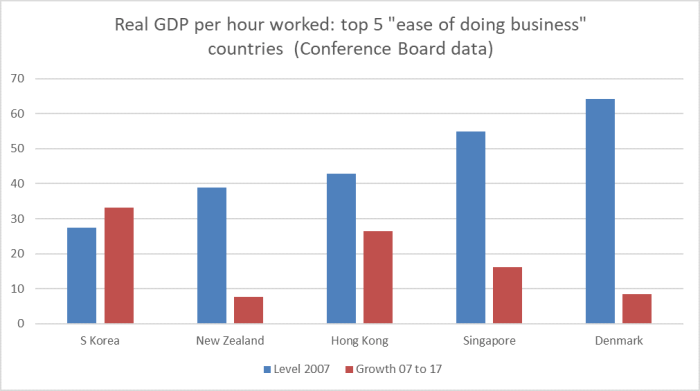
In this chart, I’ve shown labour productivity (real GDP per hour worked) levels and growth rates for the top 5 countries for the decade from 2007 to 2017, using the most recent version of the Conference Board’s database.  If the benefits of a high “ease of doing business” score show up anywhere in official data it should be here.
ease of doing bus productivity

South Korea wasn’t in the top five a decade ago (in fact, it was only ranked 21st).  Probably the various reforms they’ve done over the last decade, which have improved their score in the World Bank index, have contributed to productivity growth.  That is part of how they have been catching up and converging.

But what I found interesting about the chart is that –  for this small group of countries/territories – the productivity growth pattern has been about what you would expect.  The countries with the highest initial levels of labour productivity had slower growth rates than those with lower initial levels of productivity.  The exception, of course, is New Zealand.

Take a bigger sample and there will be other exceptions (the UK, for example, ranks number 9 and –  after a good couple of decades, but only middling levels of advanced country productivity –  has had a really poor productivity growth performance in the last decade.    But my focus is New Zealand.

We score quite well on all manner of such international surveys.  Take skills for example.  A year or two back, the OECD adult skills data suggested New Zealand workers  were among the most highly-skilled in the OECD.    And yesterday I noticed a report suggesting that New Zealand was in the top 3 countries in the world, behind Finland and Switzerland.

Again, it is presumably better to be near the top of such a list than at the bottom

The WEFFI report, by the Economist Intelligence Unit, looks at policy initiatives, teaching methodologies and the socio-economic environment of 50 countries. It found the five worst-ranked countries to be Egypt, Nigeria, Algeria, Iran and Pakistan.

But it doesn’t seem to bear any relationship to getting to the bottom of New Zealand’s specific economic underperformance –  not just over the last decade, but over most of the last 70 years.

One of the odder features of New Zealand public service life is the number of top-tier public servants who now seem to run Twitter accounts and disseminate material through those accounts.  I’m old-fashioned enough to think that senior public servants shouldn’t really be seen or heard except by Cabinet ministers (to whom they give their advice, and implement decisions taken by political masters).  More pointedly, public servants’ Twitter accounts are at grave risk of being, in effect, party political broadcasts for their masters since senior public servants can’t really be out openly disagreeing with the Minister so anything that is tweeted is not going to upset the Minister or his/her office, and yet it bears the imprimatur of a supposedly-neutral public servant.

On the other hand, these accounts can shine a little light on what top public servants are up to and what causes they are championing.

One of the tweeters is the (fortunately soon to have departed) Secretary to the Treasury, Gabs Makhlouf, who has spent the last eight years presiding over –  perhaps even inspiring –  the degradation in the capacity of what should be the government’s lead economic advisory agency.  In his most recent tweet a few days ago he linked to a piece by the (often stimulating) academic economist Dani Rodrik.    There is a lot to disagree with in Rodrik’s piece, but I just to quote his conclusion.

…economists are well positioned to develop institutional arrangements that go beyond what already exists, their habit of thinking at the margin and sticking close to the evidence at hand encourages an aversion to radical change. But, when presented with new challenges, economists must envision new solutions. Imagination is crucial. Not everything we try will succeed; but if we do not rediscover the value of FDR’s credo – “bold, persistent experimentation” – we will certainly fail.

One can only assume that Makhouf agrees.   But there is just no sign of The Treasury under his leadership having seriously re-thought the New Zealand productivity failure.   If there is any bold thinking (and here “thinking” would be a polite description) it is around avoiding confronting that failure at all, chasing off after the insubstantial living standards framework and the associated “wellbeing Budget”. Feel better, I suppose, even if we can’t do better.  It is perhaps great as a political distraction  –  politicians do that sort of thing –  but we should expect something much better from a premier economic agency than turning away from the most striking economic failure in our history, and playing distraction in the hope no one will notice.  In principle perhaps the two –  “wellbeing budgets” and some serious fresh thinking on productivity, specific to New Zealand –  could both be done, but (a) resources are limited and (b) nothing in any Makhouf speech has ever really suggested a desire, or an ability, to confront the specific productivity challenges here.   One can only wistfully hope –  with no reason for optimism, given who (SSC and Grant Robertson) does the selection –  that his successor will be different.

As for my own alternative story?  I don’t have any particular problem with the rankings people like the World Bank come up with –  from a regulatory perspective doing business in New Zealand probably is easier than in most places – but those indexes just don’t shed light on the salient issues for New Zealand.  Citing them, as anything more than a stepping off point  – “despite this high ranking…..” – is akin to looking for lost keys under the lamppost because that is where the light is, rather because there is reason to suppose it is where the keys are.   From a regulatory perspective, New Zealand probably isn’t a bad place to do business –  although there always many things that could be improved –  but from a more fundamental perspective New Zealand –  most remote significant inhabited land mass on the planet –  looks like a pretty awful place to do business from, in anything much other than utilising the limited natural resources.    Were it otherwise, we’d have seen more investment, more exports (and imports), more globally-oriented firms basing themselves here.

Against that backdrop, actively pursuing an ever-bigger population through a large-scale immigration policy that is championed across the bureaucracy –  including by Makhlouf’s Treasury –  is fundamentally damaging to the longer-term economic interests of New Zealanders as a whole. (And, as I’ve noted, many times before that is so whether the migrants  –  mostly decent and well-motivated people – come from Brisbane, Bangalore, Brahmanbaria, Buenos Aires or Birmingham.)  Unless and until our political leaders are willing to confront this – and at present all parties in Parliament are signed on to one of the largest (per capita) immigration programmes in the world, there is very little likelihood of those high rankings –  ease of business, teaching skills, or whatever –  translating into material living standards to match those in other countries at or near the top of these indices.

Australia faces many of the same issues New Zealand does in this regard, but the economic constraints are –  at least temporarily –  less binding because of the newly-developed abundant mineral resources they are able to bring to market.  It was interesting to read in The Australian this morning that the government there is planning to cut their permanent migration intake.   The reported number would still be high by international standards, but in per capita terms would be only about three-quarters of the target in place in New Zealand –  and that in a country with more opportunities and more wealth.   Of course, the current government is almost certain to lose this year’s election –  and some other aspects of the reported package are just daft (trying to compel immigrants and even students to the regions – so it may never happen.  But it suggests a more serious willingness to engage than has been evident from either main party in New Zealand.

Continuing to look under the lamp post, rather than look for actual diagnostic answers and policy solutions, is just a recipe for keeping on failing economically.


Modern monetary theory, old-school fiscal practice

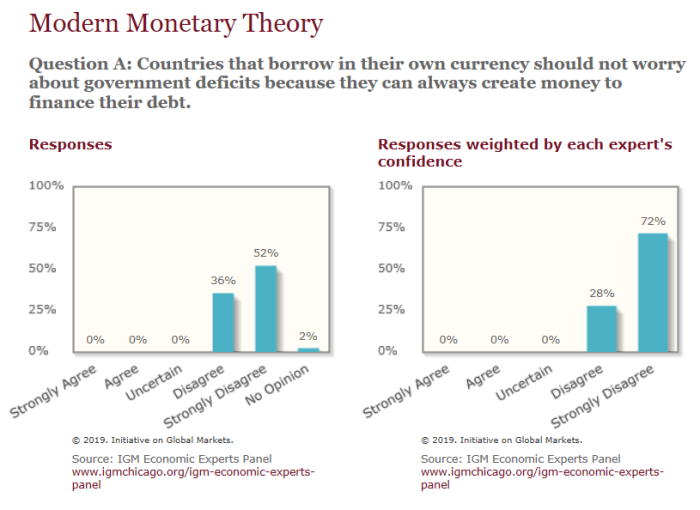
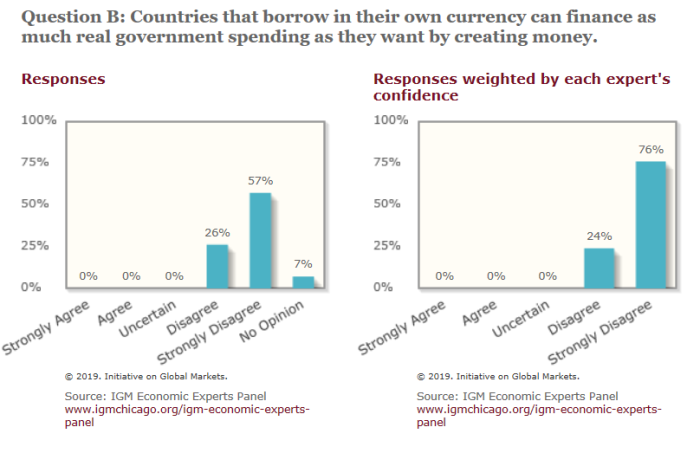
On various occasions previously, I’ve used here survey results from the IGM Economic Experts panel, run out of the University of Chicago Booth School.   They survey academic economists in the US and Europe and the results often shed some interesting light on consensus, and difference, within the academic economics discipline.  As ever of course, much depends on how the questions are framed.

Their latest effort was not one of their best.  There were two questions.

MMT1

MMT2

Glancing through the individual responses, if there are differences among these academic economists they seem to be mainly ones of temperament (some people are just very relucant to ever use either 1 or 5 on a five point scale).

But so what?  No serious observer has ever really argued otherwise.

So-called Modern Monetary Theory has been around for some time, but has had a fresh wave of attention in recent weeks in the context of the so-called “Green New Deal” that is being propounded by various more or less radical figures of the left of American politics.  Primary season is coming.  The brightest new star on that firmament, Alexandria Ocasio-Cortez, has associated herself with the MMT label.

One of the more substantial proponents of MMT thinking, Professor Bill Mitchell of the University of Newcastle, visited New Zealand a couple of years ago.  I wrote about his presentation and a subsequent roundtable discussion in a post here.    We had a bit of an email exchange after he stumbled on my post, and although we disagree on policy, I was encouraged that he thought my treatment had been “very fair and reasonable”.  I mention that only so that in the extracts that follow people realise that I’m not describing a straw man.   I don’t know how Professor Mitchell would have answered the IGM survey questions above, but what I heard that day in 2017 should logically have led him to join the consensus.  That’s a mark of how useless the survey questions were.

He seemed to regard his key insight as being that in an economy with a fiat currency, there is no technical limit to how much governments can spend.  They can simply print (or –  since he doesn’t like that word – create) the money, by spending funded from Reserve Bank credit.     But he isn’t as crazy as that might sound. He isn’t, for example, a Social Crediter.    First, he is obviously technically correct –  it is simply the flipside of the line you hear all the time from conventional economists, that a government with a fiat currency need never default on its domestic currency debt.     And he isn’t arguing for a world of no taxes and all money-creating spending.  In fact, with his political cards on the table, I’m pretty sure he’d be arguing for higher taxes than New Zealand or Australia currently have (but quite a lot more spending).  Taxes make space for the spending priorities (claims over real resources) of politicians.  And he isn ‘t even arguing for a much higher inflation rate –  although I doubt he ever have signed up for a 2 per cent inflation target in the first place.

In listening to him, and challenging him in the course of the roundtable discussion, it seemed that what his argument boiled down to was two things:

  • monetary policy isn’t a very effective tool, and fiscal policy should be favoured as a stabilisation policy lever,
  • that involuntary unemployment (or indeed underemployment) is a societal scandal, that can quite readily be fixed through some combination of the general (increased aggregate demand), and the specific (a government job guarantee programme).

Views about monetary policy come and go.   As he notes, in much academic thinking for much of the post-war period, a big role was seen for fiscal policy in cyclical stabilisation.  It was never anywhere near that dominant in practice –  check out the use of credit restrictions or (in New Zealand) playing around with exchange controls or import licenses –  but in the literature it was once very important, and then passed almost completely out of fashion.  For the last 30+ years, monetary policy has been seen as most appropriate, and effective, cyclical stabilisation tool.  And one could, and did, note that in the Great Depression it was monetary action –  devaluing or going off gold, often rather belatedly – that was critical to various countries’ economic revivals.

In many countries, the 2008/09 recession challenged the exclusive assignment of stabilisation responsibilities to monetary policy.  It did so for a simple reason –  conventional monetary policy largely ran out of room in most countries when policy interest rates got to around zero.   Some see a big role for quantitative easing in such a world.  Like Mitchell – although for different reasons –  I doubt that.    Standard theory allows for a possible, perhaps quite large, role for stimulatory fiscal policy when interest rates can’t be cut any further.

But, of course, in neither New Zealand nor Australia did interest rates get anywhere near zero in the 2008/09 period, and they haven’t done so since.    Monetary policy could have been  –  could be –  used more aggressively, but wasn’t.

As exhibit A in his argument for a much more aggresive use of fiscal policy was the Kevin Rudd stimulus packages put in place in Australia in 2008/09.   According to Mitchell, this was why New Zealand had a nasty damaging recession and Australia didn’t.  Perhaps he just didn’t have time to elaborate, but citing the Australian Treasury as evidence of the vital importance of fiscal policy –  when they were the key advocates of the policy –  isn’t very convincing.   And I’ve illustrated previously how, by chance more than anything else, New Zealand and Australian fiscal policies were remarkably similar during that period.   And although unemployment is one of his key concerns –  in many respects rightly I think –  he never mentioned that Australia’s unemployment rate rose quite considerably during the 2008/09 episode (in which Australian national income fell quite considerably, even if the volume of stuff produced –  GDP –  didn’t).

On the basis of what he presented on Friday, it is difficult to tell how different macro policy would look in either country if he was given charge.   He didn’t say so, but the logic of what he said would be to remove operational autonomy from the Reserve Bank, and have macroeconomic stabilisation policy conducted by the Minister of Finance, using whichever tools looked best at the time.  As a model it isn’t without precedent –  it is more or less how New Zealand, Australia, the UK (and various other countries) operated in the 1950s and 1960s.  It isn’t necessarily disastrous either.  But in many ways, it also isn’t terribly radical either.

Mitchell claimed to be committed to keeping inflation in check, and only wanting to use fiscal policy to boost demand where there are underemployed resources.    And he was quite explicit that the full employment he was talking about wasn’t necessarily a world of zero (private) unemployment  –  he said it might be 2 per cent unemployment, or even 4 per cent unemployment.     He sees a tight nexus between unemployment and inflation, at least under the current system  (at one point he argued that monetary policy had played little or no role in getting inflation down in the 1980s and 1990s, it was all down the unemployment.  I bit my tongue and forebore from asking “and who do you think it was that generated the unemployment?” –  sure some of it was about microeconomic resource reallocation and restructuring, but much it was about monetary policy).   But as I noted, in the both the 1990s growth phase and the 2000s growth phase, inflation had begun to pick up quite a bit, and by late in the 2000s boom, fiscal policy was being run in a quite expansionary way.

I came away from his presentation with a sense that he has a burning passion for people to have jobs when they want them, and a recognition that involuntary unemployment can be a searing and soul-destroying experience (as well as corroding human capital).  And, as he sees things, all too many of the political and elites don’t share  that view –  perhaps don’t even care much.

In that respect, I largely share his view.

Nonetheless, it was all a bit puzzling.  On the one hand, he stressed how important it was that people have the dignity of work, and that children grow up seeing parents getting up and going out to work.   But then, when he talked about New Zealand and Australia, he talked about labour underutilisation rates (unemployment rate plus people wanting more work, or people wanting a job but not quite meeting the narrow definition of actively seeking and available now to start work).   That rate for New Zealand at present is apparently 12.7 per cent –  Australia’s is higher again.     Those should be, constantly, sobering numbers: one in eight people.      But some of them are people who are already working –  part-time –  but would like more hours.  That isn’t a great situation, but it is very different from having no role, no job, at all.  And many of the unemployed haven’t been unemployed for very long.  As even Mitchell noted, in a market economy, some people will always be between jobs, and not too bothered by the fact.  Others will have been out of work for months, or even years.   But in New Zealand those numbers are relatively small: only around a quarter of the people captured as unemployed in the HLFS have been out of work for more than six months (that is around 1.5 per cent of the labour force).       We should never trivialise the difficulties of someone on a modest income being out of work for even a few months, but it is a very different thing from someone who has simply never had paid employment.  In our sort of country, if that was one’s worry one might look first to problems with the design of the welfare system.

Mitchell’s solution seemed to have two (related) strands:

  • more real purchases of good and services by government, increasing demand more generally.  He argues that fiscal policy offers a much more certain demand effect than monetary policy, and to the extent that is true it applies only when the government is purchasing directly (the effects of transfers or tax changes are no more certain than the effects of changing interest rates), and
  • a job guarantee.    Under the job guarantee, every working age adult would be entitled to full-time work, at a minimum wage (or sometimes, a living wage) doing “work of public benefit”.     I want to focus on this aspect of what he is talking about.

It might sound good, but the more one thinks about it the more deeply wrongheaded it seems.

One senior official present in the discussions attempted to argue that New Zealand was so close to full employment that there would be almost no takers for such an offer.   That seems simply seriously wrong.    Not only do we have 5 per cent of the labour force officially unemployed, but we have many others in the “underutilisation category”, all of whom would presumably welcome more money.     Perhaps there are a few malingerers among them, but the minimum wage –  let alone “the living wage” – is well above standard welfare benefit rates.   There would be plenty of takers.   (In fact, under some conceptions of the job guarantee, the guaranteed work would apparently replace income support from the current welfare system.)

But what was a bit puzzling was the nature of this work of public benefit.    It all risked sounding dangerously like the New Zealand approach to unemployment in the 1930s, in which support was available for people, but only if they would take up public works jobs.  Or the PEP schemes of the late 1970s.   Mitchell responded that it couldn’t just be “digging holes and filling them in again”.  But if it is to be “meaningful” work, it presumably also won’t all be able to involve picking up litter, or carving out roadways with nothing more advanced than shovels.  Modern jobs typically involve capital (machines, buildings, computers etc) –  it accompanies labour to enable us to earn reasonable incomes –  and putting in place the capital for all these workers will relatively quickly put pressure on real resources (ie boosting inflation).   If the work isn’t “meaningful”, where is the alleged “dignity of work”  –  people know artificial job creation schemes when they see them –  and if the work is meaningful, why would people want to come off these government jobs to take existing low wage jobs in the prviate market?

The motivation seems good, perhaps even noble.  I find quite deeply troubling the apparent indifference of policymakers to the inability of too many people to get work.   The idea of the dignity of work is real, and so too is the way in which people use starting jobs to establish a track record in the labour market, enabling them to move onto better jobs.

But do we really need all the infrastructure of a job guarantee scheme?  In countries where interest rates are still well above zero, give monetary policy more of a chance, and use it more aggressively.   For all his scepticism about monetary policy, it was noticeable that in Mitchell’s talks he gave very little (or no) weight to the expansionary possibilities of exchange rate.    But in a small open economy, a lower exchange rate is, over time, a significant source of boost to demand, activity, and employment.    And winding back high minimum wage rates for people starting out might also be a step in the right direction.

And curiously, when he was pushed Mitchell talked in terms of fiscal deficits averaging around 2 per cent of GDP.  I don’t see the case in New Zealand –  where monetary policy still has capacity –  but equally I couldn’t get too excited about average deficits at that level (in an economy with nominal GDP growth averaging perhaps 4 per cent).  Then again, it simply can’t be the answer either.    Most OECD countries –  including the UK, US and Australia –  have been running deficits at least that large for some time.

It is interesting to ponder why there has been such reluctance to use fiscal policy more aggressively in countries near the zero bound.   Some of it probably is the point Mitchell touches on –  a false belief that somehow countries were near to exhausting technical limits of what they could spend/borrow.      But much of it was probably also some mix of bad forecasts –  advisers who kept believing demand would rebound more strongly than it would –  and questionable assertions from central bankers about eg the potency of QE.

But I suspect it is rather more than that –  issues that Mitchell simply didn’t grapple with.  For example, even if there is a place for more government spending on goods and services in some severe recessions, how do we (citizens) rein in that enthusiasm once the tough times pass?  And perhaps I might support the government spending on my projects, but not on yours.  And perhaps confidence in Western governments has drifted so low that big fiscal programmes are just seen to open up avenues for corruption and incompetent execution, corporate welfare and more opportunities for politicians once they leave public life.  Perhaps too, publics just don’t believe the story, and would (a) vote to reverse such policies, and (b) would save themselves, in a way that might largely offset the effects of increased spending.      They are all real world considerations that reform advocates need to grapple with –  it isn’t enough to simply assert (correctly) that a government with its own currency can never run out of money.

I don’t have much doubt that in the right circumstances expansionary fiscal policy can make a real difference: see, for example, the experience of countries like ours during World War Two.    A shared enemy, a fight for survival, and a willingness to subsume differences for a time makes a great deal of difference –  even if, in many respects, it comes at longer term costs.

But unlike Mitchell, I still think monetary policy is, and should be, better placed to do the cyclical stabilisation role.    That makes it vital that policymakers finally take steps to deal with the near-zero lower bound soon, or we will be left in the next recession with (a) no real options but fiscal policy, and (b) lots of real world constraints on the use of fiscal policy.  Like Mitchell, I think involuntary unemployment (or underemployment for that matter) is something that gets too little attention –  commands too little empathy –  from those holding the commanding heights of our system.  But I suspect that some mix of a more aggressive use of monetary policy, and welfare and labour market reforms that make it easier for people to get into work in the private economy,  are the rather better way to start tackling the issue.   How we can, or why we would, be content with one in twenty of our fellow citizens being unable to get work, despite actively looking –  or why we are relaxed that so many more, not meeting those narrow definitions, can’t get the volume of work they’d like  –  is beyond me.   Work is the path to a whole bunch of better family and social outcomes –  one reason I’m so opposed to UBI schemes –  and against that backdrop the indifference to the plight of the unemployed (or underemployed), largely across the political spectrum, is pretty deeply troubling.

But, whatever the rightness of his passion, I’m pretty sure Mitchell’s prescription isn’t the answer.

I don’t think advocates of MMT really help their cause by using the label Modern Monetary Theory.   I understand the desire to make the point –  pushing back against those too ready to invoke “but the market will never buy it” argument –  that countries issuing their own currency never need to default.  As a technical matter they don’t.  Politically, some still choose to do so, and even if they never do there are very real (if not readily observable) limits well short of default, where the costs and risks no longer make any benefits worthwhile.  Only failed states actually lapse into hyperinflation.

But in substance, MMT isn’t primarily about monetary policy at all, and as I noted at the start of the earlier post.

He is a proponent of something calling itself Modern Monetary Theory, but which is perhaps better thought of as old-school fiscal practice, with rhetoric and work schemes thrown into the mix.

One can mount a case for a more active use of macro policy to counter unemployment running above inevitable frictional/structural minima (I’ve made itself for several years), one can also mount a case for a more joined-up approach to fiscal and monetary policy (I’m not persuaded by the case, but it was standard practice in much of the OECD for several decades), and any politicians who doesn’t have a burning passion about minimising involuntary unemployment isn’t really worthy of the office.  At present, in much of the world, that should be driving officials and politicians to (at very least) be better preparing to handle the next serious recession, in particular by doing something (there are various options) about the binding nature of the effective lower bound on nominal interest rates.  It might not be a cause that resonates in Democratic primary debates, but it could make a real difference to the prospects of many ordinary people caught up through no fault of their own when the next serious downturn happens.   Whatever one believes about the possibilities of fiscal policy –  and I tend towards the sceptical end in most circumstances –  you’d want to have as much help from monetary policy as one could get.

Perhaps next time, those who write the IGM questions could consider something a bit more nuanced, that might shed some light on the areas where there are real divergences of view around the light that economic theory and analysis can shed on such issues.

UPDATE: A post here, by a senior researcher at one of the regional Federal Reserve banks, also responds to this particular IGM survey.

NZ Police help the PRC repression [UPDATE]

[As noted below, despite checking several websites, including that of the PRC Embassy, the first part of this post was clearly in error. Accordingly I have updated the title of the post.   The second, and more substantive, point stands.]

Like everyone else I guess, I’ve been following pretty closely the coverage of the Christchurch attacks.    And in the course of all that I’d noticed various statements of condolence from various overseas governments.  Some perhaps perfunctory (it is the sort of thing decent governments do), others genuinely shocked and heartfelt.  I found it quite moving that the UK government was flying flags at half-mast on Friday.   But there were also statements from the French government, the German government, the Canadian government, various arms of the US government from the President down, the Norwegian government, the EU, the Australian government, the Dutch government, and that was before we even got to various Muslim-majority countries, some of whom had citizens killed in the attacks.

But, it appears, nothing at all from the government of the People’s Republic of China.  It is not as if they are unaware of the attacks –  when I checked there was a story in the Global Times and, searching for the Dutch response, the story I found was actually on Xinhua.   As we are often told, New Zealand firms do more business with firms from the People’s Republic of China than with firms in any other country.  There are lots of PRC nationals living here.  And barely two years ago, the then government (in the form of Simon Bridges) signed up to some aspirational goal of a “fusion of civilisations” with the PRC (in the Belt and Road MOU).  There is lots of talk from both sides  – and their champions – about wanting relationships of “mutual respect”.  It is has never been clear to me why we would want to respect such an evil regime, but I’m not the Prime Minister, Opposition leader, or the New Zealand China Council.  They do.  They claim to believe the rhetoric, even though the evidence (globally) is that the PRC has no respect for any other country; just that some are useful to them at times.  They seem pretty clear-sighted about that; it is our leaders who are deluded and/or attempt to delude us.

Perhaps I’ve missed some message, but you can check the (typically very useful) PRC Embassy website for yourself.    I’d count on the China Council to have tweeted a link to any statement of condolences, but there is nothing there either.   There is simply nothing visible.  Perhaps (or perhaps not) there was some quiet behind the scenes statement to MFAT, but friends don’t hide messages of condolence in circumstances like these.

(UPDATE:  It appears I had missed a statement of condolence. Thanks to the reader who drew this to my attention.)

Of course, the PRC is open to a “damned if you do, damned if you don’t” risk.  After all, as a matter of official government policy, the PRC authorities currently have interned, in concentration camp conditions, an estimated 1.5 million Muslim Uighurs in Xinjiang.    People have been physically abused in these camps, denied all rights, and some have even been killed.  There are credible reports of the PRC using imprisoned Uighurs as a source for the large-scale PRC organ transplant business.  But even with this record, it is still quite a lapse for the PRC to have offered no official condolences on the mass murder of 49 (Muslim) people in New Zealand.  One of those small things that helps bring home the sort of regime the PRC is, and they way view a country like New Zealand (hint: not at all as the Prime Minister or the Leader of the Opposition would like us to believe).

(In fact, given that in Tarrant’s manifesto he is reported to have indicated [words amended to minimise risk re the Ardern govt’s censorship regime] that the country he most admires is the PRC –  ethnonationalism and all that I guess – you might have thought the PRC authorities would have been going out of their way to offer condolences.  Except that…….they didn’t.)

As I noted the other day, our Police –  certainly with the acquiesence of MFAT, and probably with that of the government –  has made itself party to aiding and abetting the dreadful abuses in Xinjiang (and elsewhere): their Assistant Commissioner is a visiting professor at the

People’s Public Security University of China – the first foreigner to hold such a role.

The university is where China’s Ministry of Public Security (MPS) trains the elite of China’s police. …..

The Ministry of Public Security does this dreadful stuff, and our Police are signing on to help (not, of course, consciously re that particular aspect, but it is all one organisation, and Police and MFAT know very well what they do –  not just in Xinjiang, but as instruments of oppression right across the country).

Perhaps now, once they have a few spare minutes, it might be time for Mike Bush, the Police Commissioner, to reconsider and tell his Assistant Commissioner to pull out of his visiting professor appointment, and stop assisting in the oppression of (inter alia) Muslims in Xinjiang.    If he lacks the decency, the imagination, the moral compass to do even that, then it is about time that the Prime Minister and Minister of Foreign Affairs get the Minister of Police in a room and tell him to instruct the Commissioner to discontinue that relationship.

The New Zealand Police aiding and abetting the PRC (absence of) system of repression was appalling enough a few days ago.  With 49 dead Muslims in Christchurch –  and not a word from Beijing – it is well past time for our authorities to come to their senses, and completely dissociate ourselves, and our people, from the oppression in Xinjiang.

(Perhaps some belated PRC message will finally come, but it is now 2:15 on Saturday and there is still no sign of anything.  Times like these help confirm who your friends really are.)

Spending….just as we have for decades

There was a strange editorial in the Listener this week, lamenting what they see as New Zealanders’ mania for consumption spending.  The editorial starts from the fact that the proportion of New Zealanders reaching age 65 mortgage-free has been in decline, and goes off half-cocked from there.   There is no mention at all, for example, of the other important fact that New Zealand real house prices have risen very sharply and are now, relative to incomes, some of the most expensive in the world.  You would expect that would change the distribution of indebtedness and make it more likely that more old people would still have debt (as well as an artificially more valuable, not very liquid, asset).

But whoever wrote the editorial is convinced that the problem is consumption.

“We’ve felt freer to upgrade the car, have a holiday or renovate using debt rather than savings”

“Loans have seemed so affordable, and consumer goods so increasingly accessible, that the “on-the-house” habit has done further damage to the economy.  It has three highly undesirable featires: low to stalled productivity, very low income growth and consumptive spending bounding ahead.”

“…a more deep-seated problem than our failure to tax capital gains. It’s about how we’re spending –  and perhaps more importanyly, why we’re spending.  The internet has made every product imaginable deliverable to our doors –  amped up by such marketing constructs as Black Friday – and ambient anxiety-fuelling over “not missing out” at Easter, Christmas, Halloween and the like have stoked our spending to ever higher records.”

and so on.

But it is, pretty much, a fact-free zone.

It shouldn’t be surprising that (real) spending is higher than it used to be and that people are buying more stuff.   We have higher incomes than we used to have.  Yes, I bang on more than most about the failure of policy here and weak productivity growth, but real per capita GDP is now about 90 per cent higher than it was in 1970.   All else equal, one might expect the typical New Zealander to be consuming a lot more stuff (goods and services) –  they can afford to.

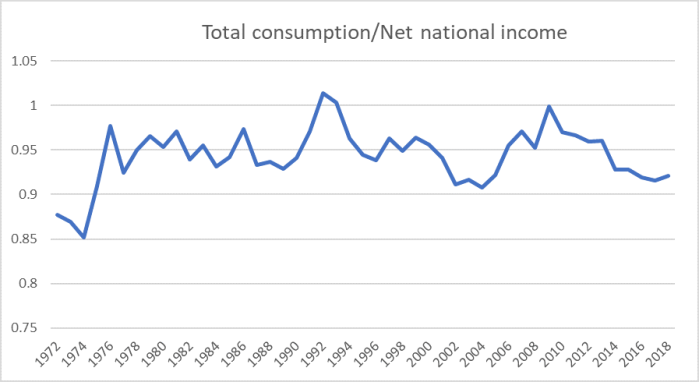
And how has consumption spending tracked relative to income?   This chart shows all consumption (public and private) as a share of net national income.  Net national income is the measure of how much income residents of New Zealand have available to spend: relative to GDP, it subtracts the bit of New Zealand production that actually accrues to foreigners (well, non-residents), and also subtracts an allowance for depreciation (some of gross earnings needs to be spent on just maintaining/replacing the capital stock that helps generate the income).  To believe the Listener story, the line should be trending upwards, perhaps especially since the financial system was liberalised in the mid 1980s.

consumption to NNI.png

It doesn’t of course.   The trend has been dead-flat for decades now.  There is some cyclical variability –  those last two peaks were the years of serious recessions (March years 1992 and 2009) – since consumption spending tends to be more stable than national income.      Fiscal policy makes a difference too: when governments are running big surpluses (as in the early 00s) the consumption share of income tends to be temporarily subdued.   On the other hand, there is no sign that, in aggregate, financial liberalisation made any material difference.  Markedly higher house prices haven’t either –  which shouldn’t really be surprising, as for every person who feels a bit wealthier, there is another for whom home purchase is that much further off.

And there just is no story, able to be defended from the data, about New Zealanders in aggregate on a consumption splurge.   Sure our savings rates are modest by international standards, but they’ve been so for a long long time.  And, to repeat, consumption is consistently less than income (see chart).  Mr Micawber would approve

“Annual income twenty pounds, annual expenditure nineteen [pounds] nineteen [shillings] and six [pence], result happiness. Annual income twenty pounds, annual expenditure twenty pounds ought and six, result misery.”

That long-term chart used total consumption (public and private).  For many purposes that is the right metric to use: there is a considerable degree of substitutability between government consumption and private consumption. (And if, for example, the government gave you a voucher to pay for your kids’ schooling redeemable only at the local state school, the resulting education services would probably be measured as private consumption rather than –  as at present –  government consumption.  Nothing of substance would have changed, just the labelling).

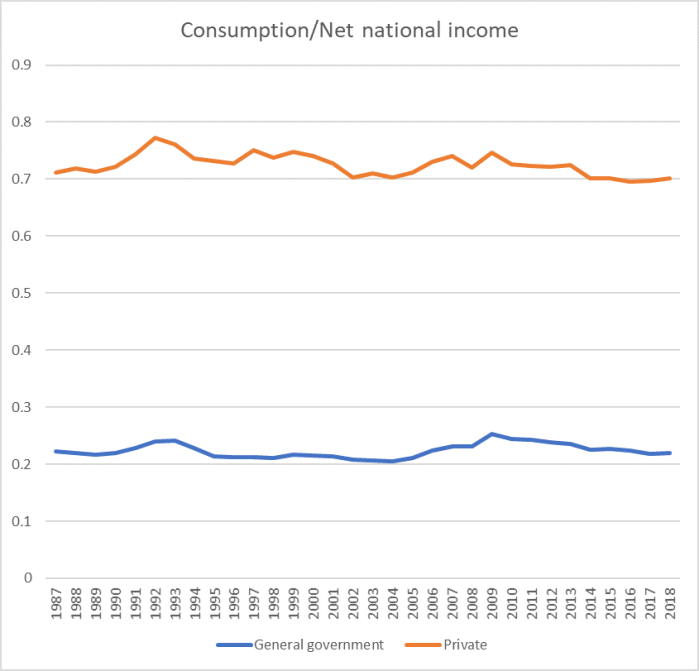
But there is a breakdown between public and private consumption going back as far as 1987.  Here is that chart, with the components again shown as shares of net national income (March year annual data).

consumption 2

No trend (beyond “almost dead flat”).  For what little it is worth, in the most recent year both public and private consumption spending were a touch below the respective 30 year averages.

The sad truth is that actual consumption in New Zealand is probably quite a bit lower than it should be.     Back in 1970, real GDP per capita in New Zealand was about the same as that in Germany.   These days, average GDP per capita in Germany is about 30 per cent higher than that in New Zealand (and hourly productivity is about 60 per cent higher).  The Germans not only get to consume more stuff but (in economist-speak) to consume more leisure (hours worked per capita are much higher in New Zealand than in Germany).    If we’d managed to match German economic performance, almost certainly the typical New Zealand household would be consuming more, not less.  Quite possibly our average savings rate might be a bit higher too.

I’m a Puritan by upbringing and inclination and so when I read lines like this from the Listener editorial

“Popular TV home-renovation contests and “property porn” create a chronic sense of FOMO, with faddy edicts: one must refit one’s kitchen and bathroom every five years; last year’s wallpaper is now dated.”

I can nod along (even while wondering just how many people actually behave that way).  Being Puritan by background, middle-aged, and male, the idea of “fast fashion” just seems weird. “Black Friday” is an alien import, and I buy books from (among other places) charity shops (rather than providing them –  as the editorial puts it  –  with “unsaleable dumpings from nouveau declutterers”).    But odd as some of these phenomena might be, they really don’t seem to add up to much in the aggregate consumption data.

There are big problems around the housing market, almost entirely the result of central and local government choices.   We should worry –  as the Listener does – about the growing share of people carrying debt into old-age, or never having been able to buy a house in the first place.  But the issues have very little to do with some wholly-mythical national consumption splurge.   And responsibility needs to be sheeted home to central and local governments, not to consumers trying to make the best of their, increasingly constrained, options.


Almost unbelievable

I was about to settle in for the rest of the afternoon writing a review article of an interesting (but obscure) book on aspects of US monetary policy, when a reader sent me a link to an astonishing article from the New Zealand Police website.   In it we read

As he prepares to bring down the curtain on eight years as our man in Beijing, Assistant Commissioner Hamish McCardle has received a rare honour from his hosts.

He has been appointed Visiting Professor at the People’s Public Security University of China – the first foreigner to hold such a role.

The university is where China’s Ministry of Public Security (MPS) trains the elite of China’s police. …..

The university and the Royal New Zealand Police College have had a bilateral training relationship since 2016. ……

He says the university appointment is an endorsement of the healthy state of the New Zealand-China bilateral relationship, and “underscores the idea that New Zealand has values and ideas worth considering in the Chinese context”.

It also aligns with the aims and values of the New Zealand-China Friendship Society and the pioneering work of New Zealander Rewi Alley who fostered a life-long friendship with China from the 1930s.

I don’t have any particular problem with Police having a person in our embassy in Beijing.  The day job had “a focus on disrupting the flow of drugs and precursors to New Zealand”.  That sounds fine.

But in accepting this “honour”, have the Police, MFAT, and their political masters lost sight completely any sort of moral compass?

The People’s Republic of China is a country where the Chief Justice himself proclaims that the rule of law is not something for China.  The Party rules.   It is a country where the Ministry for Public Security plays a key role in imprisioning a million or more people in Xinjiang.  I’m sure they do basic policing work as well –  Chinese have road accidents, and break-ins just as we do –  but this is the New Zealand government actively participating –  on a ongoing basis – in making the repressive apparatus of the PRC state better and more effective at doing its job.  A big part of that job is an instrument of systematic repression –  political, religious, or whatever.    Political loyalty –  to the CCP – is, not surprisingly, a key element in recruitment, and presumably even more so at those studying to be “the elite of China’s police”.

And what about that weird stuff in the final paragraph of the quoted excerpt?  The New Zealand-China Friendship Society has been around for decades and long-served as a Beijing front organisation in New Zealand, right through the horrors of the Great Leap Forward, the Cultural Revolution, and on to their total silence today about repression in Xinjiang.    And Rewi Alley?   Well, he lived a fairly comfortable life in Beijing after the CCP took over, navigating this way through the thickets of changing CCP politics, reaching new lows when he published a jointly-authored book near the end of the Cultural Revolution defending the regime at its worst.  What possesses our Police to think these are “aims and values” to champion?   Why not, for example, the aims and values of the Tiananmen protestors, the Falun Gong movement, or the (underground) Catholic church?  But that wouldn’t fit the narrative I guess, of prostrating the New Zealand system before Beijing.

Presumably Mr McCardle is a perfectly decent chap, and probably won’t think of trying to import PRC methods to New Zealand policing on his return?  But did he not in the seven years he has been lecturing at this university already,  or does he not now, feel any qualms of conscience at all about abetting evil?  Because that is a big part of what the Ministry of Public Security, elite and otherwise, actually does.

And what of our subservient and deferential politicians?   Does the Minister of Foreign Affairs really feel comfortable with this “honour”?  ( I assume his officials at MFAT think it is just wonderful).  What about the Minister of Police?  Or the Prime Minister?

Or Simon Bridges or Todd McClay?  Or do all our MPs just think it is totally fine –  quite an honour in fact –  for the New Zealand government to be helping the PRC better repress its citizens, better repress freedom, free expression, free worship, free assembly or whatever?

It is a small thing in a way.  But a succession of individually small things build up to a narrative of a government system –  from the top down –  more interested in getting along, and supporting, this evil regime doing its work –  mercenaries, in effect, for trade deals and political donations –  than in representing the interests, values, and traditions of New Zealanders.   For Mike Bush and the New Zealand Police it seems that the values of the China Friendship Society and Rewi Alley count for more.

That’s shameful.

Has monetary policy run its course?

In one of the world’s most prominent economics platforms, the economics columnist for the Financial Times, Martin Wolf uses this week’s column for a piece headed “Monetary policy has run its course”, with a subheading “It has made secular stagnation worse.  Fiscal alternatives look a safer bet.”.    That headline was guaranteed to get my attention, disagreeing as I do with all three limbs of the apparent argument.

Wolf draws on various other papers, but doesn’t really make his case in a compelling way.  Take secular stagnation first.  There are various definitions: Wolf uses one of “chronically weak demand relative to potential output”, while the FT’s own lexicon uses a materially diferent version

Secular stagnation is a condition of negligible or no economic growth in a market-based economy.

On the former definition, most of the OECD is estimated to be back somewhere near a zero output gap, and the unemployment rate now in several major economies (but not New Zealand) is lower than it was going into the last recession (and there is a striking fact that the worst performers are all in the euro common currency, a system Wolf tends to be keen on).  That has happened without big new surges in overall ratios of private debt to GDP.

On the latter definition, even in countries with high starting levels of productivity, productivity growth has slowed but not stopped.  Per capita GDP across the OECD is now about 10 per cent higher in real terms than it was in 2007.  Not stellar, but it means that 10 per cent of all the output growth managed in the last several hundred years (since the Industrial Revolution) has been in the last decade alone.

I think there are credible stories under which monetary policy wasn’t used sufficiently aggressively in, and following, the last recession –  partly because both markets and central banks misjudged things and expected a strong rebound, so were always looking towards the first (or subsequent) tightenings.  But is very difficult to construct a story, in which monetary policy has made any material (adverse) difference to population growth, productivity growth, actual innovation opportunities or the like.    And even if, for argument’s sake, there was some effect in the frontier economies, most OECD economies (including large ones like the UK, Japan, Italy, Spain, Canada, South Korea) are nowhere near the frontier.

Having said that, there is little doubt that neutral real interest rates have fallen away very substantially over the last 15 years or more.  They are now at levels that are pretty much without historical precedent.  This is the first chart in the article.

ft chart

That means there are issues.  There is an effective lower bound, at present, on short-term nominal interest rates.  No one knows precisely where that bound is, but there is a degree of consensus that taking your policy interest rate much below -0.75 per cent will lead to fairly large scale conversion of deposit balances into physical cash (not, primarily, transactions balances –  where the inconvenience would dominate – but large wholesale balances).  The limit now exists wholly and solely because (a) governments monopolise physical currency issue, and (b) pay zero interest on physical currency.  Zero might not be much, but for a multi-million dollar fund, it is a lot more than -3 per cent (for the same credit risk).

Quite a few countries (including the euro area) are at or very near that floor already.  Other countries, including New Zealand, Australia, and the United States are not.   But even in those countries, a severe recession in the next few years would be likely to exhaust conventional monetary policy capacity (our Reserve Bank could cut by perhaps 2.5 percentage points, but it has often needed to cut by more than 5 percentage points in previous downturns).

Wolf isn’t apparently keen on doing anything about that, observing that a need for materially negative nominal official interest rates

would, to put in mildly, create a wasps’ nest of technical, financial and political problems.

Not nearly as many problems as doing nothing, and allowing persistently high unemployment for multiple years might create.

There are two broad options for creating more monetary policy space.   The first is to raise the inflation target (and reading a central banking magazine yesterday I noticed that a Swedish Deputy Governor is calling for exactly that), and the second –  and more reliable –  is to remove, or markedly ease, that near-zero effective lower bound.   No government or central bank has done so (and there are not overly complex ways of doing so), and that passivity –  apparently endorsed by Wolf – is increasing the risk of problems when the next serious downturn gets underway.  If interest rates can’t, for now, be cut far, people will quickly recognise that, not expect it, and adjust their behaviour, and asset holdings, accordingly.

Is there reason for unease about some of these options?  Perhaps.  If we were to allow short-term interest rates to go materially negative, no one knows how far they might eventually go.  There are good theoretical reasons to think not too far (human innovation hasn’t died, there are naturally productive (positive returns) assets (land or fruit trees) but no one knows with certainty.  Would it matter if interest rates went, and stayed, materially negative?  I’m not convinced it would, allow it would certainly be a symptom of something odd.   But such philosophising shouldn’t get in the way of actively preparing to handle the next serious downturn.  Neither central banks nor governments seem to be doing what they could on that score (and although the issue is a bit less immediately pressing in New Zealand, it is true here too).

Which brings me to the third limb of Wolf’s argument: “Fiscal alternatives look a safer bet”.   “We need more policy instruments he argues”.  In many respects, the rest of the article is a teaser for a conclusion around more aggressive use of fiscal policy.   (“More aggressive? perhaps Antipodean readers wonder, but as a chart in the article illustrates OECD net government debt as a share of GDP has trended quite strongly upwards in the last fifty years as, generally, has government spending.).  He asserts boldly:

If the private sector does not wish to invest, the government should decide to do so.

And yet who is “the government”, except a collective representation of the voters, themselves “the private sector” in one form or another.  There is no sense of trying to understand why the private sector might not choose to invest more heavily and then, if those things are in the gift of governments (tax, regulation, policy uncertainty or whatever), fix them.

And nothing at all on the near-certain “political problems” and constraints around the large scale and persistent (for it is something structural he is championing, not just a short-term cyclical response) aggressive use of fiscal policy, whether for consumption or investment.  Monetary policy has its problems, but if central bankers and politicians got on and fixed some of the regulatory (lower bound) obstacles, it would be a much more reliable tool to deploy.   At worse, even left-wingers (such as Wolf, and the Democratic economists he cites –  Laurence Summers, Olivier Blanchard, and Jason Furman) should want to have monetary instruments to hand, rather than some all-or-nothing wager on fiscal policy, when there is no political consensus at all (anywhere) on using fiscal policy in the ambitious way they suggest.

Wolf is right that central banks can’t deal with structural secular stagnation –  although they can do the important job of leaning against serious cyclical downturns, as they did in 2008/09. But even on the most optimistic of readings, it seems unlikely that aggregate fiscal policy is going to be able to either, whether for technical or political reasons.  And so-called secular stagnation should simply not be regarded as an acceptable excuse for poor productivity growth and weak investment in countries that are far from the productivity frontier, New Zealand pre-eminent (for how far it has drifted behind) among them.

Kudos

I’ve been quite critical of the New Zealand China Council, which uses taxpayer money to champion an emollient, in effect subservient, relationship with the People’s Republic of China.  Doing so, of course, serves the business interests of the other corporate and academic members of the Council.   Whatever the intent, I’ve argued that their approach serves the interests of the PRC, one of the most awful regimes on the planet.

As part of that I’ve noted that it has been hard to find any examples of a case where the China Council has ever said anything critical of the PRC.  They will benignly note, in principle, that our systems differ, our interests differ, but will never articulate specific areas where they are critical of the PRC stance on anything, whether directly affecting New Zealand or otherwise.

And so it is only fair for me to draw attention to a welcome, if somewhat surprising, exception.

A couple of days ago a group of US foreign policy experts issued a joint statement calling for the immediate release by the PRC of Michael Kovrig.

You may recall that Kovrig is the Canadian former diplomat who was detained in China just before Christmas, apparently as “retaliation” over the detention and extradition proceeedings against the Huawei CFO in Canada.  No charges have been laid, and Kovrig is being held without access to a lawyer and with little consular access either.    It looks a lot like a state-sponsored abduction, presumably intended both to intimidate foreigners more generally, and perhaps as some sort of “bargaining chip”.

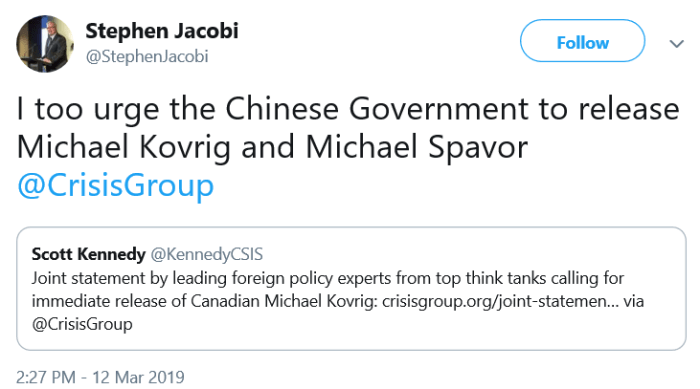
Late yesterday, I noticed that that tweet (above) had been retweeted by Stephen Jacobi, the Executive Director of the New Zealand China Council, with this comment added.

jacobi

Not only does he associate himself with the call by the US foreign policy experts, but he goes further, adding an unequivocal call also for the release of Michael Spavor, the second abducted Canadian.

Sure, this message isn’t being sent out on the China Council’s own Twitter account, but when you are the chief executive of a body, writing about areas closely related to your employer’s interests, no one is going perceive very much difference.   The Executive Director of the China Council, their high profile public spokesman, has made a public statement that can only be read as unequivocally critical of actions of the PRC.   There might be some price to pay –  perhaps a certain barely-detectible frostiness when next he encounters the PRC Consul-General? – but he did it anyway.

For a picture of what sort of detention Kovrig and Spavor are undergoing, you might want to read this article from someone who was subjected to the same treatment:

The law in China allows for these disappearances. Yes, as reported, Michael’s whereabouts are being kept secret. Yes, he will not be given access to a lawyer. But more so, even China’s prosecutor, who is supposed to monitor these secret detentions, will be denied the right to visit him. In a database that the NGO Safeguard Defenders keep, for which I’m the director, we have never come across a single case where the prosecutor has visited, even though it’s prescribed in law that they should.

Mr. Kovrig, and Mr. Spavor, and future American and European victims can, without any court order, be kept incommunicado, in solitary confinement, for six months. Actually, solitary confinement is only half true – he will have two guards sitting inside his cell 24/7, working in six-hour shifts. These guards, most of whom are civilian-dressed trainees for the Ministry of State Security, will not be allowed to speak to him, but will take notes on his every single movement. They will also stare him down as he uses the toilet, or when he is (rarely) allowed to shower.

Numerous foreign governments (including all our Five Eyes partners) have weighed in in support of Canada and the detained Canadians.  But not New Zealand.

I wrote about the contemptible silence of our government a couple of months ago

Jacinda Ardern and Winston Peters head the New Zealand roll of shame on this issue, since they are the most senior figures in the current government.   But the shame isn’t just theirs.  There is no sign of anything from Simon Bridges, Paula Bennett (perhaps both rather keen on those donations Yikun Zhang was arranging?), or Todd (“vocational training centres in Xinjiang) McClay.   Nothing from the Green Party or ACT leaders.   Nothing from the Minister of Justice (rule of law and all that). And of course nothing from our PRC-born and educated MPs.  In a decent society, they’d be at the forefront of condemning the abuses in the land of their birth.  In our society, it seems to be just fine that they keep very very quiet –  a silence that suits Beijing –  and help ensure that the donations keep flowing.  Perhaps a journalist might consider asking Raymond Huo his opinion on the abduction of the Canadians.  He was, after all, formerly a lawyer with a leading local law firm, and now he chairs the Justice select committee in Parliament.  You’d hope the rule of law meant a lot to him.  But, like his bosses, deferrring to Beijing, and never ever upsetting the murderous rogue state, appears to matter more than the rule of law, or standing by our friends and allies when they (almost inadvertently in Canada’s case) incur the wrath of a tyrant.

By their utter silence, on this as on so many other PRC issues, our MPs and ministers dishonour this country and its people.   Cowering in a corner, deferring to Beijing, is simply unbecoming people who purport to lead a free and independent country.

But credit where it is due.  Well done Stephen Jacobi.  On this, an example to others.

What is going on with residence approvals?

Late last year I did a post using some data from the near-final version of MBIE’s new immigration statistics dashboard.   The dashboard is now on general release (here) and I should take the opportunity to commend MBIE on the initiative (even while wishing SNZ would now take the key time series and include them in their Infoshare database).  It takes a while to really work out how to make the most of the dashboard, but it means that administrative data (all the information on visa approvals –  and declines) that used to be published in readily useable form only annually and with up to an 18 month lag, is now readily available within 10 days of the end of each month.  For anyone trying to keep track of what is going on around the impact of immigration policy settings –  and recall that the late lamented PLT data was never any use for that –  it is a huge step forward.

And so lets have a look at a few charts, using data to the end of February.   Here is the number of residence visa approvals (and declines), actual monthly data and with MBIE’s “seasonally adjusted trend” (more trend than seasonal) through the data.

Res 1

Recall that the “target” rate of approvals is around 45000 a year, an average of 3750 per month.   The trend in actual approvals has been running (increasingly) below that level for the last two years.   For the current financial year, approvals are running at an annualised rate of under 35000 –  lower than at any time in the last 10 years.   Interestingly, it isn’t that more applications are being declined – in percentage terms, the fall off in declined applications has been larger than the fall in approvals.

I’m at a bit of a loss to know quite what is going on.  There was a slight reduction in the approvals “target” (they like to call it a “planning range”) late in the term of the previous government, but that was the difference only between 47500 per annum and 45000 per annum, nowhere near enough to explain the fall in actual applications and approvals.

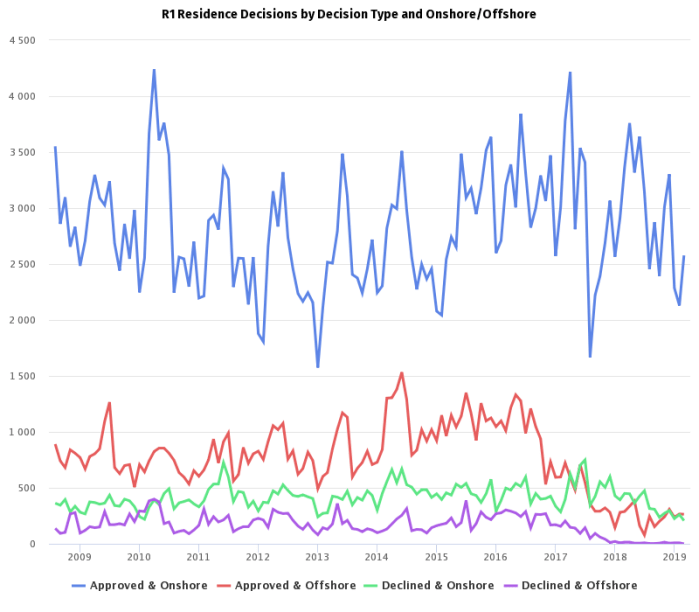
I’d heard in several places that a big part of what was going on was shifting more residence visa processing back onshore.   Here is some relevant data on that

res 2

Clearly something has gone on, but (a) for a long time the overwhelming bulk of approvals were granted onshore, to people already in New Zealand (on other short-term visas), and if (b) offshore approvals have dropped away sharply, offshore declined applications have dropped to almost zero.  So I’m no clearer now than I was previously.

The points system is supposed to serve as a rationing device –  a quasi or shadow price. If there are lots of good applicants then, in principle, with a bit of lag the points threshold should be raised, so that we winnow out the lower quality (in terms of how the scheme is set up) applicants.  And, on the other side, if applications are dropping away sharply then, all else equal, the points threshold should in time be lowered and we’d find ourselves taking less-good quality applicants, who would otherwise not have qualified for residence.  But applications and approvals have been well down for two years now, and nothing has happened to the points threshold.

I’m mostly pleased with that –  part of my argument over the years has been that too many of the people we are bringing in (even under the skilled migrant headings) aren’t that skilled at all, and while they are benefiting themselves (and good luck to them) it isn’t doing any good for New Zealand.  Changes made late in the previous government’s term –  tightening up a bit on the one hand, and additional points for regional jobs on the other –  won’t have changed that picture.  But……..keeping the target unchanged (which is government policy, what Labour campaigned on and New Zealand First accepted in the coalition deal, looks a bit empty if the target is going to be persistently undershot (more so than, say, undershoots of the inflation target, since immigration approvals are an adminstrative act, directly under official control).  I’m a bit curious why no journalist seems to have been grilling the government about quite what is going on.  Is this the immigration equivalent of “opportunistic disinflation” –  they’ll take the cuts in immigration approvals if they come, but won’t do anything active to bring them about (or reverse them).  One can imagine there might be some blowback –  except among the handful of open borders people –  if standards for getting residence visas were lowered further.

It is noteworthy too that the fall in residence visa approvals has been concentrated in the streams (business/skilled) that were supposed to be the focus of the immigration programme.   That is so even though, for example, parent visa approvals are still suspended altogether.

res 3

I’m left puzzled about quite what is going on.  The number of people here on shorter-term work visas has still been rising strongly (and most people who get residence were already working here), and if the number of students is now flat, the numbers aren’t falling and an increasing share of the students who are here are in better quality, university, courses.  Quite possibly, a smaller proportion of those doing university study are interested in staying long-term than of those who were doing the PTE courses (often mainly as a pathway to work and possible eventual residence).

res 4

And finally, for those interested, here is what has been happening to residence approvals for our two largest source nationalities.

res 5

The next two biggest source nationalites –  UK and Philippines –  have also fallen away a lot, the former part of a long-term trend decline.

Overall, there are more questions than answered, but it is great to be able to do these sorts of charts quickly and easily.  Many fewer people who meet our quite low immigration standards now seem to be applying, or getting, residence visas, and that despite the apparently quite tight labour market.

Given announced government policy –  a continued high target – that should be a concern to them.    Some questions should be posed to Mr Lees-Galloway (although I can imagine that he would much prefer not to have to face them).


An unserious organisation, with serious consequences

I wasn’t planning to write anything more today, but then I got an email from the Reserve Bank.

You’ll be aware that almost three months ago the Reserve Bank released a consultative document, in which the Governor proposed to massively increase the amount of equity capital banks have to have just to keep on doing the business they are doing now.

As this was, apparently, the culmination of a multi-year review (in fact, the final numbers seem to have been very much a last-minute affair) you might have supposed that a serious central bank would have all its arguments straight and evidence (or at least sustained reasoning, engaging alternative perspectives) at hand in accessible form to support all their claims.  They’d probably have anticipated all the plausible area of disagreement or challenge, and had good responses readily to hand.

Whether they supposed, for some reason, that everyone would embrace their schemes with open arms and uncritical spirit, or what, actual experience has been anything but that.  When they finally responded to OIAs and released the background papers, it turned out that one of them had only been written several weeks after the consultation paper was released.  And in his speech a couple of weeks ago, the Deputy Governor was promising that they would soon publish an Analytical Note explaining their estimates of the likely impact on interest rates (which still hasn’t seen the light of day).

At the Monetary Policy Statement in February, there was a considerable attention on the proposed capital changes.  In fact, the Bank even proactively included a box in the text (page 35).   There were various claims, some numerical and some not.  These were a couple of examples

The Bank expects that the spread of banks’ lending rates to the rates at which they borrow will settle in the range of around 20 to 40 basis points higher as a result of the proposed changes, although the exact effect is uncertain.

Higher bank capital requirements could also improve the government’s fiscal position. A higher share of bank equity funding would likely increase tax revenue from the banking sector since debt funding is tax-deductible while equity funding is not.

There were lots of questions at the Governor’s press conference as well, including his claim (not made in the text) that the Bank’s proposed new capital ratios would be “well within the range of norms” seen in other countries.

That was all very interesting, but I wanted to know a bit more, and assumed they would simply have material to hand to support their claims.  It would, you’d have thought, have been in their interests to do so –  after all, they obviously believe in what they are proposing, and would presumably want to carry us with them, supported by robust evidence and analysis.  Or so you’d have thought.

And so I lodged a fairly simple Official Information Act request, for the material supporting those claims.   That was on 13 February.  This afternoon –  the day before the last date by when a response was due – I got this letter.

OIA barclay

In which they take to themselves a whole another 20 working days.    Not because whatever they have needs to be collated or compiled, but allegedly because of “ongoing consultations”.  One can only assume that is a shorthand for “there wasn’t much, if anything, there, but give us time and we’ll see what we can drum up”.

It is both so ludicrous and so telling that I’m not going to waste the time of the Ombudsman’s office complaining.  I’ll just let it stand –  a powerful public figure makes claims in support of a far-reaching proposal on which he is prosecutor, judge, and jury –  and can’t, or won’t, produce any evidence or analysis to support his specific claims.   Sadly, it isn’t the first time.

If you want sceptical analysis and argument:

  • Ian Harrison’s substantive document, “The 30 billion dollar whim” is here, and
  • my succession of posts on unanswered questions and unconvincing analysis are here.

As for the Governor, he seems to have time to play tree gods, and for spending other people’s money on Maori cultural advice (recall, that this was going to improve the quality of monetary policy and financial regulatory policy decisions), just not for the serious stuff.

The Bank is at growing risk of becoming a profoundly unserious organisation, but one whose whims have serious consequences for the rest of us.

It isn’t good enough.  The Bank’s board is charged with protecting us from Governors not doing their job properly. It is about time they took some responsibility.

Powerful unelected public appointees

Some time in the next couple of weeks the Minister of Finance will be announcing the members of the new (statutory) Monetary Policy Committee which assumes responsibility for monetary policy on 1 April.  There will be seven of them, and only one serves ex officio (the Governor), so there will be six names to be announced.  Almost certainly, the Deputy Governor Geoff Bascand will be one of them, and the new Assistant Governor for economics and financial markets, Christian Hawkesby, will be another.   The fourth internal member is likely to be the new Chief Economist, but that position hasn’t been filled yet, so perhaps that is the source of the delay.  And then there will be the three mystery part-time external appointees.

When I said that the Minister will announce the appointments, that shouldn’t be read as suggesting the Minister will have had much say (at least if the legal process has been followed).   The appointments will all have been sorted out between the Governor and the Bank’s board –  most of whom were appointed by the previous government.  The Minister can reject nominations, but can’t impose his own candidate (although I have heard suggestions of him trying to inject names into the process).   Those were the same rules that applied when the Governor was appointed.

(In addition, of course, the outgoing Secretary to the Treasury has nominated himself to be the first Treasury observer on the Monetary Policy Committee.  It is a strange choice, both because the Secretary’s term expires very shortly (you’d have thought some continuity might be a good idea) and because any Secretary to the Treasury has perhaps 300 issues to keep on top of, and spending up to 50 days a year –  the advertised expectation for external members – as a non-voting observer at the Reserve Bank suggests an odd sense of priorities.   It looks like the sort of role one would normally expect a second or third tier person to take on.)

And thus monetary policy will be in the hands of a group of people not only themselves unelected, but appointed (in effect) by people who are not only unelected but are (a) typically faceless, known by hardly anyone, (b) lacking in much technical or policy capability and (c) largely unaccountable.   Monetary policy may not seem overly important right now – it is over two years since the OCR changed –  but it matters a great in serious downturns, and preparations for the next such downturn should be a significant issue for the Bank and the new MPC now.

And these people will take up their new statutory roles without a chance for us, or our elected representatives, to grill them, and to understand the thinking around monetary policy that they might bring to the role.  That is, of course, so even for the Governor, because although he has now been in that job for almost a year, he’s not yet given a substantive speech on monetary policy (more concerned, it appears, with tree gods and the like).

In principle, the members of Monetary Policy Committee can agree to do speeches and interviews (under quite tight constraints, but still better than the nothing the Minister first intended).  But you are very unlikely to hear any distinctive voice from the internal members of the committee (they after all, owe their pay, resources, and promotion prospects etc to the Governor).  And I’m still expecting that the external members will be chosen in part for their willingness to come quietly and not rock (as he sees it) the Governor’s boat.

How much better if, before you take up office as a policymaker –  and that is what the MPC are, exercising considerably discretion –  you had to front up at an open hearing of a parliamentary select committee and explain your qualifications for the job, your views on monetary policy and macroeconomic management, and any questions about your background, potential conflicts etc, that MPs might think relevant.    It is, of course, what happens in the United States.    There, members of the Federal Reserve Board of Governors have to win Senate confirmation.  That has some appeal, but I’m not proposing that –  the US has a quite different system of government.

But in the United Kingdom, where the statutory Monetary Policy Committee system is relatively new (about 20 years old) they have something very much like what I’m proposing.    Before taking up their appointments, new members of the MPC have to undergo a Treasury Select Committee hearing.   The Committee can’t veto the appointment, and the whole House of Commons doesn’t get a vote.  But an adverse report from the Committee can be a considerable embarrassment.  In one case in the last couple of years, someone appointed as Deputy Governor actually stepped down after the report by the select committee.  That she stepped down was probably better for the Bank of England and better for a sense of serious democratic scrutiny and accountability.  Ministers might, in the end, be able to appoint pretty much anyone, but there is another layer of open scrutiny which they –  and the nominee –  have to be prepared for.

Sceptics will cast doubt on what value our local version, the Finance and Expenditure Committee, might add in the process.  The UK Treasury Select Committee is regarded as one of the better scrutinising select committees around (in the economics and finance field), and isn’t just full of people champing at the bit to be the next Cabinet minister (our system is particularly bad at present, in that both the chair and deputy chair are already parliamentary undersecretaries, in effect part of the executive already).  Committee scrutiny of Reserve Bank MPSs and FSRs is already perfunctory and typically more focused on point-scoring and that evening’s news bulletin.  So my expectations of pre-appointment scrutiny hearings aren’t that high.  But just because MPs are often pretty useless doesn’t mean we just give up on democratic scrutiny and accountability.  Just possibly, given a new and responsible role some might see it as an opportunity to demonstrate their chops.

I hope that the Minister of Finance and his officials, in considering Phase 2 of the Reserve Bank Act review –  likely to deliver us another new policy committee –  will keep this possible innovation in mind.

It isn’t just a model for the Monetary Policy Committee though.  I reckon it should be much more seriously considered for a range of other key appointments, currently totally in the gift of ministers, where the appointee concerned will exercise huge discretionary power –  often reflecting a personal ideology, personal character – sometimes for decades.

For example, today (12 March) is Dame Sian Elias’s 70th birthday.  That means she finally has to retire as Chief Justice, after a couple of months short of twenty years in office.  The higher courts are now pretty transparent –  certainly by the standards of the Reserve Bank –  but she, and her colleagues of the Supreme Court, have exercised huge amounts of discretionary power, and there isn’t anything citizens can do about that.  (Parliament could, of course, legislate to reverse the effect of some egregious ruling.)  And for a term for which I’m not aware of any parallel in New Zealand (most other statutory appointments, from the Governor-General down, are for no more than five years).

Sian Elias is replaced as Chief Justice, on the Attorney-General’s sole choice, by Helen Winkelmann.  She is 53 and most probably will end up as Chief Justice for 17 years.   The government announced plans last year to extend the power of the Supreme Court, so as explicitly allow the courts to make declarations of inconsistency of individual peices of legislation with the New Zealand Bill of Rights Act, while mandating Parliament to reconsider and respond.  Sure, the declarations would not overturn existing legislation, but it is a further chipping away at the sovereignty of Parliament, entrusted to a committee of ex-lawyers, appointed by the Attorney-General (typically an active senior politician, usually holding other portfolios as well) and with no serious scrutiny of (say) the judicial philosophy, personal ideology, or background of the appointees (indeed, it is almost regarded as lese-majeste for anyone to raise such doubts).

And there is no point pretending that judges just “read the statute” (or the Bill of Rights) –  they interpret (shaped in part by their own background and predispositions) and thus themselves create the law.   And yet there is no prior scrutiny whatever –  rather the Attorney-General of the day sorts out his/her candidates, using whatever criteria they choose (Chris Finlayson got to appoint most of the current senior judges with no scrutiny or transparency at all).  And once appointed, neither the Chief Justice nor individual Supreme Court judges ever have to account for their approach, philosophy or whatever.   Politics (not specifically partisan politics) and ideology are almost inevitably at work in how higher court judges operate (anyone doubting this, refer to the US experience, and here we don’t even have the checked of a hallowed constitutional text.)

Attorneys-General and judges seem to like this approach (unsurprisingly).  As they put it on the courts website

From time to time it has been suggested that a more formal method for appointment of judges should be adopted but that course has not been followed. There is no suggestion that the present procedure has not served the country well.

Well, they would say that wouldn’t they.  For Supreme Courts judges (including the Chief Justice in particular) I think there is a pretty good case for (a) a fixed term appointment (say, 10 years without the right of renewal) and (b) for proper parliamentary hearings, at which nominees could be seriously grilled, before taking up any appointment.  Perhaps most of our top judges have been as good as we could get –  although one Supreme Court justice has already had to step down –  but no one should hold that much power for that long, and certainly not without serious and open scrutiny before taking up the position.

The position of Commissioner of Police is being advertised at present.  That appointment is in the gift of the Prime Minister of the day (with only as much scrutiny of the appointment as the Prime Minister chooses to give –  not much apparently in recent case of the Deputy Commissioner.  In some respects, it is less concerning that the situation of the Chief Justice – the appointment is only for three years at a time, and in the end the courts hold more power than the Commissioner.  On the other hand, when you hold a three year appointment, and want to be reappointed, there is quite an incentive not to rock the boat in ways that might make the Prime Minister look askance.  The Police have gained an, apparently well-earned, reputation for preferring to look the other way when complaints or issues involving politicians and political parties are involved.

And if you think the Commissioner of Police doesn’t really exercise much power, I’d remind you of the current incumbent’s claim last week that he alone –  not elected politicians –  had the power to decide whether or not the Police should routinely carry fire-arms.    If someone you love ends up dead at the hands of a police officer acting rashly, it won’t be much comfort if the IPCA eventually raps Police over the knuckles (and things carry on much as usual).  At a more mundane level, Police exercise discretionary power.  In effect, marijuana has been decriminalised, not by Act of Parliament, but by the choice of the Police Commissioner (you might or might not support decriminalisation, but everyone will recognise that it is a significant choice).  There are all manner of other areas where Police discretion is at work –  or could be revoked on an individualised basis.

And it isn’t as if the Commissioner has been without blemish, whether in office (think Haumaha) or prior to taking it up (that historic drink-driving conviction that only come up several years after he took office, or the eulogy at the funeral of a former police officer found to have planted evidence in a major case).  Perhaps he really is, or was, the best person for the job, but it might be more reassuring if, instead of just being appointed by John Key, he’d had to face some open hearings, including around his views on the sorts of areas where the Police might either just stop policing, or greatly step up policing.  Add in a non-renewable five or seven year term, and we’d be considerably closer to a system that balanced operational independence (in the narrow areas where that is appropriate) with democratic accountability, and a reminder that ultimately the Police are supposed to work for the people, not for the Prime Minister of the day.

I’m sure there are other positions where a similar degree of open parliamentary scrutiny would enhance confidence in the appointments made to powerful public positions, espcially roles in which the holders exercise significant discretion –  either policymaking, or in holding other officeholders to account.  I had a list of senior positions in this post, and quite a few of those (eg Human Rights Commissioners, and head of the IPCA) look like candidates for pre-appointment parliamentary hearings.   The Chief Justice and the Police Commissioner are much more fundamentally important roles than those at the Reserve Bank, but the sort of change I’m proposing would also be more unconventional for those roles.  The UK approach, for the Bank of England appointees, is already established and has proved its worth. I’d commend it to the government.