The PRC and the Prime Minister

National Public Radio (NPR) in the United States is a bit like Radio New Zealand National, and about as left-wing in the assumptions and orientations (sometimes probably unconscious) of most of its presenters and interviewers.  I listen regularly to their politics podcast, and it struck me recently that the people involved are probably almost as left-wing as our Prime Minister (who, while an MP, served as president of the International Union of Socialist Youth, complete with the speech in which she used the word “comrade” 15 times in eight minutes).

Which is by way of saying that when NPR reports on a story, it isn’t exactly Breitbart, or the fevered imagination of some vast right-wing conspiracy.    These are people with whom you’d think our Labour and Greens parties would normally be in sympathy with.

But earlier this week, NPR published a lengthy story about the influence activities of the People’s Republic of China in Australia and New Zealand.  It is missing a few nuances, but is an interesting treatment for an international audience.  In the Australian section there is a nice quote from a serious senior academic.

“China’s different in scale and it’s different also in that it can integrate the private sector, education, civil society — all arms, if you like — of the state and the community with the objectives of the Chinese Communist Party,” says Rory Medcalf, head of the National Security College at Australian National University. “We’re not really dealing with a normal country here. We’re dealing with an authoritarian party state, where in fact Chinese citizens owe a higher loyalty to the party than to the state itself. So what we’re dealing with here is the largest secret organization in human history.”

and

Medcalf says the problem is not China’s people, but its Communist Party. Some of the most vulnerable victims of the party, he says, are Chinese people who left their country to live in democracies like Australia and New Zealand.

Very similar themes to those in the work, on this side of the Tasman, of Anne-Marie Brady –  vilified in last year’s election campaign by the then Attorney-General and Minister of National Intelligence as some sort of nasty xenophobe.

NPR interviewed Chen Weijian who

….moved from China in 1991, escaping imprisonment for working on a pro-democracy newspaper. He restarted the newspaper in New Zealand, but even there, Beijing caught up with him, he says: A pro-Chinese Communist Party newspaper in Auckland sued him for defamation after he criticized it for being too pro-Beijing. Ongoing legal fees forced his paper into bankruptcy in 2012.

“Their paper was funded by businesses supported by China’s government,” Chen says. “So an overseas Communist Party’s propaganda wing crushed our democratic newspaper here in New Zealand.”

A reader who is closer to these things tells me

The Chinese newspaper which crushed Chen Weijian’s pro-democracy paper is the Chinese Herald, now NZME’s joint venture partner of the Chineseherald website.
The international news on this website are primarily sourced from the three major CCP’s state media and they apparently uphold the CCP’s stance.
And more US readers/listeners got to hear of the curious, not to say alarming, case of Jian Yang.

Last year, local media reported that a prominent, Chinese-born member of New Zealand’s Parliament, Jian Yang, had lied to authorities about his education background on his citizenship application for New Zealand.

Yang, a member of the National Party, which led the government from 2008 to 2017, had worked for 15 years in China’s military intelligence sector. He studied English at the People’s Liberation Army Air Force Engineering University, taught at the college for five years after graduating and then obtained a master’s degree at the People’s Liberation Army University of Foreign Languages in Luoyang, one of China’s best-known military intelligence schools.

Later, at the same institute, Yang taught English to students who were studying to intercept and decipher English-language communications on behalf of Chinese military intelligence.

Yang declined an interview request from NPR. He admitted to journalists last year that he was a member of China’s Communist Party, though he insisted he has not been an active member since he left China in 1994. He has steered clear of the media spotlight since the scandal hit.

NPR joining the honourable company of all English language media that Jian Yang –  an elected member of the New Zealand Parliament, elected (to their shame) by all National Party voters  – simply refuses to talk to.

Chen Weijian goes on, rather more speculatively in some places

“Jian Yang is not just connected to China’s Communist Party,” says Chen Weijian. “He was sent here by them to spy on New Zealand. But people in Yang’s party — the National Party — all think he’s good for New Zealand-China relations. A lot of his party’s donations come through him, and he often leads government trips to China to make lucrative deals there.”

Yang, who has served in Parliament since 2011 and remains in office, played a prominent role during official visits to China in 2013 and 2016, sitting alongside then-Prime Minister John Key opposite Chinese leader Xi Jinping and serving at times as interpreter during bilateral meetings.

As Yang’s political influence grew, so did New Zealand’s economic dependence on China. In 2008, New Zealand became the first developed country to sign a free trade agreement with China. As a result, trade between the two economies has tripled in the past decade, largely because of China’s thirst for imported New Zealand milk: A quarter of all imported milk in China comes from the tiny island nation.

The (so-called) FTA was signed three years before Jian Yang turned up in national politics, and as a the world’s largest exporter of milk powder it seems probable that exports to China would have increased considerably over the last decade whether or not an FTA had been signed, whether or not Jian Yang was in Parliament.

NPR talked to Charles Finny, former diplomat, trade negotiator, and now lobbyist who declared last year that he knew Jian Yang (and Raymond Huo) and was always very careful what he said in front of either of them.

Finny [talking of FTAs] believes the same to be true in politics. He says China has most likely been using New Zealand as a testing ground for diplomatic relations with other developed nations.

“We’re small, nonthreatening,” he explains. “We’re not as close to the United States. China, I think, wants to learn from us about how to deal with other, larger players. It’s very common for Chinese leaders when they’re just about to be appointed to a big position to come to New Zealand to learn about democracy, to learn about how to deal with the media, to learn there are going to be some protests — all these things that are going to be a much bigger factor in bigger relationships, they get to learn how to deal with it here.”

Perhaps, but you get a pretty easy ride here.  Universities lined up to have photos taken with Xi Jinping.  Our former Prime Minister Jenny Shipley went out of her way to ensure that the visiting Chinese leader in the 1990s didn’t have to see protestors.

NPR did talk to one senior New Zealand politician who made some interesting remarks (if typically cryptic and defensive) that seem to have had surprisingly little local media attention.

After New Zealand’s intelligence agency began looking into Yang’s background in 2016, he was removed from parliamentary select committees on foreign affairs, defense and trade. But he hung on to his seat in Parliament, leaving some wondering why.

“The answer to that is not something that can be given today, but it is an answer that will soon have to come from our country and our system as to what our response is,” Winston Peters, New Zealand’s deputy prime minister and foreign minister, tells NPR. “At that level of growing public interest — and I would think intelligence interest as well — plus the shared intelligence from our closer allies, one would be naive in thinking that our response would not be forthcoming.”

Does that mean anything at all?  And if so, what?    Surely it is pretty clear why Jian Yang hangs onto his seat, despite his past, and his misrepresentations to New Zealand authorities, being exposed and acknowledged?   And despite his ongoing close associations with the PRC and his refusal to ever utter a negative word about that totalitarian state.  On the one hand, the National Party wants the donor money and doesn’t want to risk the relationships with donors by acknowledging that there is something very wrong.  And, on the other hand, because all other parties –  including that of the Deputy Prime Minister, once in office – make it easy for National to do so.  Not a negative word is heard from any of them –  the Prime Minister, the minister responsible for the intelligence services and the electoral system, the Deputy Prime Minister, the Minister of Defence, the leaders of the Green Party (or their foreign affairs or intelligence spokespeople).

The interview with Winston Peters obviously got a little tetchy.

Analysts in the U.S. and Australia have suggested the Yang case is evidence that China is exploiting New Zealand as a weak link in what’s known as the “Five Eyes,” the intelligence alliance including the U.S., U.K., Canada, Australia and New Zealand. This angers Peters. He is the longest-serving parliamentarian in New Zealand’s history [which he isn’t] and has long been vocal about his country’s dependence on China, but he draws the line when his country is criticized for being used as a political tool for the Chinese.

“This country turned up to two world wars, two years before the United States on both occasions,” he points out. “So we don’t like that sort of talk down here.”

The journalist obviously missed the important context that Peters only ever says anything critical when he is in Opposition and unable to actually do anything.

One might point out in response to the Deputy Prime Minister that 80 years ago our then government was at the forefront of calls to pushback against aggression by Germany and Italy, recognising the nature of the evil.  So different today…..

The NPR journalist then turned to Stephen Jacobi

“To suggest that New Zealand may be naive, well, OK, fine,” says Stephen Jacobi, executive director of the New Zealand China Council, a group in Auckland promoting business ties. “We don’t have to see the world the same way Americans do, or even Australians do. We’re very proud of that.”

Jacobi says the evidence against Yang — who serves on the board of his organization — is largely hearsay and is not enough to prove that he is working for China’s government.

The NPR people obviously missed the rather important point that the China Council isn’t just a bunch of businesses wanting to sell out their own country for another deal, but a taxpayer funded organisation designed to play distraction and influence public opinion in favour of the (successive) government’s strategy of doing much the same.

New Zealanders might be proudly independent, but only foolish people are proud of having a different view from other countries simply for the sake of it.  Most New Zealanders aren’t that foolish.   Jacobi –  whose background was trade with the Americas –  seems to simply ignore issues around the integrity of our political system, the evils of the PRC regime, and its external aggression.    But who cares about those things when there are deals to be done by your members, visits to host etc.

But his comment about Jian Yang is interesting.  On the one hand, he now seems to concede that there is something to the concerns (it is only “largely” hearsay).  Perhaps things like the:

  • service in the PLA military intelligence system,
  • membership of the CCP,
  • expert assessments that (a) no one voluntarily leaves the Party, and (b) a person with his background would not have been allowed out of the PRC unless he was regarded as totally politically safe and reliable,
  • the acknowledged misrepresentations of his past on immigration/citizenship forms,
  • the photographic evidence of his close ongoing associations with the PRC Embassy,
  • the absence of any sign, in his time in Parliament, of ever being willing to criticise the PRC regime, for anything.

Does he actively “work for” the Chinese government?  One hopes not, but even if not –  and Charles Finny appeared to think otherwise, on national TV – the list of things we know, with a high degree of certainty should be enough to have any leaders of decency and integrity dissociate themselves from Jian Yang.   Perhaps it is a bit like the Kavanaugh case: the relevant standard, in putting people in influential leadership positions, shouldn’t be whether one could avoid a criminal conviction.  In Jian Yang’s case, it isn’t even clear that he could get over that hurdle in respect of the immigration/citizenship non-disclosures.

The willed reluctance of the New Zealand establishment to confront the issue was captured again in this week’s Newsroom column by Peter Dunne. Writing about who might leave Parliament at the next election, our longserving former minister writes

Likewise, Dr Jiang Yang may decide to stand aside if the vague but persistent whispers about his links to Chinese intelligence agencies persist and intensify


You mean pretty basic, now acknowledged, “links” like the fact that the man worked for them for a decade?   A bit more than a “whisper”.

The NPR story ends with some coverage of Anne-Marie Brady, both her papers (and associated testimonies) and the break-ins to her home and office, which are widely assumed to be the ultimate responsibility of the PRC authorities.  There isn’t anything new in that section of the story, although it is good for a wider range of overseas readers/listeners to be exposed to the material.

The Peters quote aside, in many ways there isn’t anything new in the NPR story; the news is as much that another major overseas media organisation, one whose people are probably not generally unsympathetic to the leftish slant of most New Zealand politics, ran it.

But I was struck by it partly for the contrast with the speeches the Prime Minister was giving last week on her progress through New York, making the most of her baby for publicity purposes (I checked, and Tony Blair and his wife had a child while he was Prime Minister, who wasn’t –  as far as I could tell –  paraded at the UN General Assembly).  I read all six of them, looking for substance and mostly coming up short.   It was the speech to the United Nations General Assembly that I focused on most.  After all, there might have been hardly anyone there is hear it, and only a few Guardian types to praise it, but it was an official statement of New Zealand Prime Minister to an international agency which New Zealand is a founding member of.

There were plenty of sly digs at the United States –  some even warranted –  but not a word, directly or indirectly, about the People’s Republic of China.  It might be the most populous country on the planet, with the largest (total) GDP, on an aggressively repressive path domestically (as just one particularly egregious example, those million or more people of Xinjiang in concentration camps, having done nothing but be) and a pretty aggressively expansionist path abroad, including the direct interference in the commercial and political affairs of other countries, including our own.  There was a whole section on “universal values”, which of course bears no relationship to how the People’s Republic operates.  There was a great deal on climate change, most just cheap rhetoric –  and perhaps not that different from what Xi Jinping might have said.  And then the speech ended this way

Perhaps then it is time to step back from the chaos and ask what we want. It is in that space that we’ll find simplicity. The simplicity of peace, of prosperity, of fairness. If I could distil it down into one concept that we are pursuing in New Zealand it is simple and it is this.  Kindness.

In the face of isolationism, protectionism, racism – the simple concept of looking outwardly and beyond ourselves, of kindness and collectivism, might just be as good a starting point as any. So let’s start here with the institutions that have served us well in times of need, and will do so again.

Kindness and collectivism.  There’s the answer, at least according to our Prime Minister.  Frankly I found it unnerving that we get this level of vapidity of someone charged with running the government.   “Kindness” is an admirable, perhaps under-rated, characteristic in interpersonal affairs, but it is hardly any sort of useful benchmark for making public policy.  In fact, it is incredibly naive and dangerous, and simply pays no heed to the realities of human nature.    As for “collectivism”, perhaps it is something the members of the Interational Union of Socialist Youth think fondly of, but many of the rest of us are inclined to think of manifest evils of the Soviet Union and Communist China (I could recommend a couple of good books I’ve read recently –  here and here).  I’m pretty sure neither the term nor the idea of “freedom” or “liberty” appeared in the Prime Minister’s speech at all.    Much of the active government talk was rather reminiscent of the sorts of speeches the Chinese Ambassador gives here every few weeks, with her talk of

“building of a community with a shared future for mankind”

Or rather like Simon Bridges signing the government up last year to an aspiration of a “fusion of civilisations” with a regime so evil.

Not, of course, that the PRC would be so vapid as to suggest that “kindness” is some sort of watchword for policy, whether domestic or international.

But then why would we be surprised.  The President of the Labour Party sings the praises of the regime, and of Xi Jinping.  And, so we learn from the Chinese Embassy website (although not from the Prime Minister), on the recent visit of a Politburo member there was talk of strengthened ties between (presumably) the Labour Party and Communist Party of China (emphasis added).

Li, secretary of the CPC Guangdong Provincial Committee and a member of the Political Bureau of the CPC Central Committee, met with New Zealand Prime Minister and Leader of the Labor Party Jacinda Ardern on Monday.

Li said China is ready to work with New Zealand to enhance political mutual trust, expand economic cooperation, keep closer party-to-party exchanges, and strengthen coordination and communication in international and regional affairs.

People say (I see it even in the ACT newsletters) that the Prime Minister is a nice kind person at an individual level, but she seems wilfully indifferent –  if not worse –  to the nature of the regime with which she and her party deal,  and about whose evils  –  and whose interferences here –  she will never once openly speak of, whether at home or in New York.

It was interesting to see the government joining yesterday in a multi-national effort to denounce various incidents of Russian government hacking.  I welcome them doing so, even if I couldn’t help wondering what marked out our own government’s signals intelligence efforts, Waihopai and all.  Isn’t such interception what governments do?  And isn’t complicity in actual and attempted murder on foreign soil –  about which the government was so slow to speak out, whether over the Malaysian airliner over Ukraine or the Skripal case – rather more substantively important.

But those were rather cheap words –  about episodes not actually involving New Zealand directly – signifying not much more than our ongoing relationship with the UK and Australia.   But China is a much bigger issue globally, and particularly in New Zealand, than Russia is.

And where is the Prime Minister on things like Xinjiang (or do “universal values” not apply there)?  Where is the Prime Minister on things like the episode in the South China Sea earlier in the week –  a Chinese warship within 45 metres of a US ship on innocent passage through international waters –  let alone the now fait accompli of the illegal militarisation of reefs etc in that sea?  Where will the Prime Minister be on the new in-depth Bloomberg story about the PRC using their place in supply chains for espionage purposes?

The Big Hack: How China Used a Tiny Chip to Infiltrate U.S. Companies

The attack by Chinese spies reached almost 30 U.S. companies, including Amazon and Apple, by compromising America’s technology supply chain, according to extensive interviews with government and corporate sources.

Or on the PRC attempts to use research cooperation agreements, including with NZ universities, to steal sensitive technology?

And, of course, where is the Prime Minister on situations like Jian Yang, or Raymond Huo –  apparently associated with various United Front bodies –  who sits in her own caucus.

Perhaps she and her colleagues think kindness is the answer?

“Kindness” is no substitute for a serious hardheaded analysis or for engaging with the New Zealand public on the nature of the PRC threat, here and abroad.   It seems more like an excuse for covering your ears and eyes and reciting repeatedly “hear no evil, see evil”.     But then there are none so blind as those who wilfully choose not to see.

(And critical as I am of the Prime Minister here, there is no sign that any party in New Zealand is any better, even if not all of them would use quite her particular vapid rhetoric to simply avoiding facing reality, or standing up for New Zealand and the values of her people, and her friends in other free and democratic countries.)

But what did Winston Peters mean in those quotes above? Perhaps some New Zealand journalist could ask him?

Tomorrow, I might tackle the latest public effort of a senior public servant to dine with the devil.

A bare pass mark for the Board

The Reserve Bank’s Annual Report was published yesterday.  I’m not overly interested in the Bank’s own Annual Report, although a couple of things (one an omission) caught my eye.

The first was the sharp increase in staff turnover last year

RB turnover

Staff turnover of almost 20 per cent is very high.  The Bank explains it this way

Staff turnover increased during the year to an unusually high level for the Bank, in part due to an increase in the number of retirements and staff going on external secondments for development.

But it (even the “in part” bit) isn’t a very compelling explanation –  although I suppose both the Governor and Deputy Governor retired –  and the Bank hasn’t had any material changes in responsibilities, reduced budgets etc in the last year.  It would be interesting to know what the results of their most recent staff engagement survey looked like –  probably not that good when turnover is that high.

And it was a touch surprising that the Bank’s (self-adopted) Maori name doesn’t appear in the text at all, and even more surprising that the Governor’s new enthusiasm for talking of the Bank as some mythological pagan tree god doesn’t appear at all.   The report was signed off only three weeks ago, and we know this nonsense was well underway by then.   Perhaps the Governor didn’t think it would play well with Parliament –  although I’d have thought it might be one of the few places where it might be well-received.

But my main interest was in the Annual Report of the Bank’s Board –  a separate statutory requirement.   I’ve written about these reports each year (2015, 2016, and 2017), mostly repeating the points that:

(a) the Board isn’t like a real board of a business, a Crown entity, or even a charity or sports club having few/no decisionmaking responsibilities, instead

(b) the main role of the “Board” is to monitor and hold to account (on behalf of the Minister and the public) the Governor, and yet

(c) the Board has consistently acted, and communicated, as if their primary role was to have the back of the Governor, serving his interests not those of the  public.

And so no discouraging or critical word was ever heard from the Board, even in (say) egregious instances of the Governor attacking individuals.   From reading Board annual reports over the years you’d have to suppose that the Bank was perfect –  the sort of entity unknown to humankind – or that the Board was supine, and useless to taxpayers.

Consistent with all this, the Board’s Annual Report has been buried inside the Bank’s report –  you can’t even find it separately on the Bank’s website.  There is no press release from the chair about the Board’s report, and no mention of the Board’s annual report in the Governor’s own press release.   It still has the feel of a tame appendage of the Bank, working mostly in the Governor’s interests  (even if this year, for some reason, the Board’s report this year features first in the combined document itself).

But there has been some improvement over recent years.  A few years ago, the Board’s report was a mere two pages, and now it is five pages (with some other relevant descriptive material –  eg around conflicts of interest and remuneration of directors –  included in the Bank’s report).     There is also still a (relatively minor perhaps) factual error.   But there are some signs in this year’s report suggesting that just occasionally the Board thinks for itself.  Perhaps this isn’t unrelated to the fact that the second stage of the review of the Reserve Bank Act is looking at, among other things, the role of the Board and whether it adds any real value in its current form.

What in this year’s report makes me just slightly encouraged?

It certainly isn’t the treatment of monetary policy.  Reading the report you wouldn’t know that core inflation had been below the midpoint of the inflation target for eight years, even after the midpoint was made the explicit focus of monetary policy (by agreement between the Governor and the Minister) in 2012.  Instead, there is simply heartwarming praise of the policy processes, and if there are any issues at all about inflation they are, apparently, all the fault of the “global environment”.  Then again, none of the Board has any particular expertise in monetary policy.

But there were several positives.

First, while backing the inquiry into banking conduct and culture in New Zealand being undertaken by the FMA and the Reserve Bank, they explicitly note that

“conduct concerns are formally within the remit of the FMA”

which is a point I’ve been making for months, but which the Governor has never been willing to acknowledge, preferring to be the most visible face of an issue that really isn’t his responsibility.    It is a small acknowledgement, but they didn’t need to say it, and yet they chose to do so.  That deserves credit.

Second, the Board’s report explicitly refers to the damning survey results on the Reserve Bank published earlier this year in the New Zealand Initiative’s report on regulatory governance.  This was the report which summarised the results thus

In the ratings, the RBNZ’s overall performance across the 23 KPIs was poor. On average, just 28.6% of respondents ‘agreed’ or ‘strongly agreed’ that the RBNZ met the KPIs and 36% ‘disagreed’ or ‘strongly disagreed’. These figures compare very unfavourably with the FMA’s average scores of 60.8% and 10.3%, respectively.  They also compare unfavourably (though less so) with the Commerce Commission’s averages of 39.9% and 25.8%, respectively.

The Board writes

The Bank’s own relationships with regulated entities came under scrutiny with the publication of an independent review of regulatory governance in New Zealand. The Board met with the Chairs of the Boards of the four large trading banks as a means of gauging whether the opinions expressed in the review are widely held. Both the Board and the Governors are looking for continuous improvement in how the Bank interfaces with the regulated entities, specifically how it assesses the soundness and efficiency of its own regulatory actions (including the risks of unintended and inefficient consequences); how it assesses any tradeoffs between these two objectives; and how it reports on efficiency as well as soundness.

Pretty tame stuff, but better than nothing, and at least a recognition that there has been a problem.    The Governor’s own statement, by contrast, explicitly mentions the IMF FSAP and questions about the handling of CBL, but doesn’t mention at all this heavy criticism from well-informed locals, and the body of the report appears to brush off the NZI report results as largely resulting from one particular disputed policy (which frankly seems unlikely –  well-regarded and trusted institutions don’t score that badly when there is simply one specific thing that happens to upset people).

On CBL, however, the Board seem mostly in the mode of covering for management.

Given the public comment that was associated with the Bank securing interim liquidation of CBL Insurance Limited,  the Board requested information on the legal advice obtained and the reasons why the Bank’s investigation was not disclosed prior to court action being sought. The obligation to make disclosures to the share market rests with company directors, and a statutory requirement for confidentiality applied to the Bank’s investigation.

It is good that the Board asked the questions, but the answers don’t seem very satisfactory.  It was, after all, as I understand it, the Reserve Bank that compelled CBL not to tell shareholders (or, indirectly, creditors) what was going on.

My third small positive related to how the Board tells the story of what it does.

In the past, the Board has talked about cocktail functions it holds (for local elites) around various Board meetings this way

With most Board meetings…the Board hosts a larger evening function to engage with representatives of many local businesses and organisations, and to enhance our understanding of local economic developments and issues……. This outreach is a longstanding practice of the Board to ensure visibility of its role among the wider community, and to facilitate directors’ understanding of local economic developments, and the wider public’s understanding of the Bank’s policies.

But here they are this year

The Board met with business representatives and other important stakeholders over lunch at many of its meetings, and also hosted functions for local stakeholders following its regular meetings in Auckland and Wellington. These functions provide an opportunity for stakeholders to discuss issues with the Board and Governors following a presentation by Governors. The Board pays particular attention to any feedback on the messaging, transparency and accountability of the Bank, and is looking to the new Governor to ensure that there are improvements in some key stakeholder relationships in the next year.

If they still seem to tie themselves too closely to the Governor, there is a clear shift of emphasis – at least in how they sell themselves in public –  recognising a little more that their job is not to promote the Bank’s policies, but to ensure that the Governor is doing his job.  The explicit final sentence is the sort of thing one should expect, from time to time, from the Board, but which has been notably absent over the previous fifteen years of reports.  It is a welcome step forward and thus –  credit where it is due – I’d give them a (bare) pass mark this year.

Under the amending bill currently before Parliament the Board’s powers are to be beefed-up further, as regards the new Monetary Policy Committee.  I regard that as quite inappropriate: the Board members have no relevant expertise, and no legitimacy in their role determining who will set macroeconomic policy for New Zealand.  But the bigger questions are still to be addressed in the second stage review of the Reserve Bank Act, and so no doubt the Board needs to be seen on its best behaviour, at least looking as if it is adding some small amount of value.

But the institutional incentives, and resourcing (lack of it) mean that any improvements are unlikely to be durable or amount to much, even if individual board members were well-intentioned.

Thus, welcome as the small improvements in this year’s report are, I remain of the view that the Board in its current form should be dis-established,  If, as I would favour, the Bank is eventually split in two, there should be proper decisionmaking boards for each of the monetary policy and financial regulatory agencies.  That is how most Crown entities –  large and small, visible and not –  are governed.   Scrutiny and review mostly always will –  and probably should be –  done by those outside the Bank: the Treasury, MPs, financial markets participants, academics, and independent commentators, supported by pro-active practices and statutory provisions around the release of relevant documents .  In support of those efforts, I will continue to argue that the proposed independent fiscal monitoring agency should be broadened to include responsibility for providing independent monitoring and commentary on monetary policy and the Bank’s financial stability responsibilities.   Board members, sitting with management every month and with the Governor as a Board member, resourced by the Bank itself, simply can’t hope to be able to provide the level of detached scrutiny the public deserves of such a powerful public agency.

The government keeps film subsidies on

Subsidies and special deals for favoured firms/industries seem to have been becoming increasingly common in New Zealand.  There is Tiwai Point, the Sky City convention centre, the forestry industry, the export education industry and probably others I’ve forgotten.   There are the R&D tax credits the Prime Minister touts at every turn –  the only substantive item in her (very short) list of things the government is doing to reverse the atrocious productivity performance.

And then there is the film industry, into which many hundreds of millions of dollars have been poured over the last couple of decades.  There is an industry there, but one which official advice to the government makes clear has no prospect of viability without heavy subsidies.  That should be a good test as to whether there is any robust case for the subsidy.  Barring something like national defence considerations, any industry that has no credible prospect of ever standing on its own feet without subsidies or protection should be allowed to left to itself, probably to wither and die, but just possibly to transform itself.  And given the skewed incentives facing ministers, officials, and those in the industry – when such interventions are launched and when they are later evaluated – the standard of proof even for transitional assistance should be very high indeed.  It rarely is, of course.

This is another of those areas where there seems to be no discernible difference between National-led and Labour-led governments (and going by his comments in the last few days it isn’t even clear that the ACT Party is much different).

The current government showed some initial interest in looking to pull back on these taxpayer subsidies.  But, so we learned over the weekend, having had a look, they’ve backed away, and the party of workers, of the low income and disadvantaged, is going to keep right on with the big production subsidies.

The government has abandoned plans to rein in ballooning subsides for Hollywood, citing film industry opposition and the threat of lawsuits from the producers of James Cameron’s Avatar films.

But yesterday Parker, speaking from Australia, said following consultations with industry around the viability of their business – and thousands of accompanying jobs – without subsidies, and legal advice over a 2013 deal signed with Avatar producers, said cuts or changes to the subsidy scheme were now off the table.

“We’re not proposing to introduce a cap. We accept that the subsides are necessary, and we accept there’s a benefit to the country,” he said.

and

Parker said he wasn’t entirely dismissing the criticism by officials but said international rivals for film work were also offering subsidies.

“There’s something in that, but it’s also true that you have to balance that with whether you want to have a major industry. It’s a binary decision here – you either have this subsidy, or you don’t have an industry.”

“You’d be a foolish government to allow the film industry to fail, you might never get it back,” he said.

Now quite possibly they were on the hook over the Avatar deal, but that isn’t an argument for keeping the whole scheme in place (even if it might require a specific carve-out that respects the terms of a specific deal the previous government signed with the Avatar people).

Various official papers are linked to in those articles (notably these), which make it pretty clear that even MBIE’s hired-gun economic consultants were reluctant to attempt to put a number on the alleged economic benefit of the film subsidies, and other consultants hired to peer review the estimates the first ones eventually came up with were less than convinced by the results.  The Treasury estimated that net economic benefits were negative –  which is pretty much what one would expect when such large subsidies are required to keep the industry in business, and those funds have to coercively raised from other taxpayers.

But, notwithstanding all this, the Minister is convinced there is a benefit.  It would be nice to see his analysis.  Something for example about why, in a sector in which other countries’ taxpayers are wasting their money on subsidies, we should even be participating in such bidding wars.  And about why and how subsidising/protecting the film industry is so very different from all the other protected/subsidied industries we once had in New Zealand, that were in time forced to either stand on their own feet, or die.  And which, while they lasted, detracted from New Zealand’s overall economic performance, part of the decades-long story of declining relative productivity.

There are attempts at more sophisticated analysis in various reports MBIE and other agencies have commissioned (including this piece from last year by NZIER).  But I just had a quick look at a few summary indicators I could find.  Here, for example, is a line from a detailed table of New Zealand services exports (June years, $m)

2014 2015 2016 2017
Audiovisual and related services 504 490 397 280

Not exactly the trend enthusiasts would have been looking for.

The NZIER report has a chart of the estimated contribution of the screen industry to GDP over this decade.  In 2010 the estimate was 0.46% of GDP and in 2015 (the most recent year) 0.41 per cent of GDP.

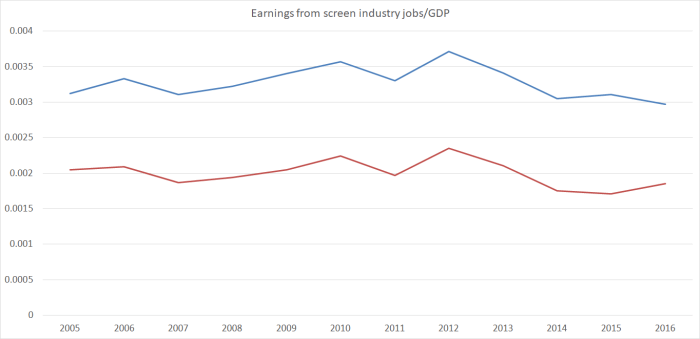
In the annual SNZ release of screen industry data there is a table of earnings from screen industry jobs.  Here are those earnings shown relative to GDP.

screen industry jobs

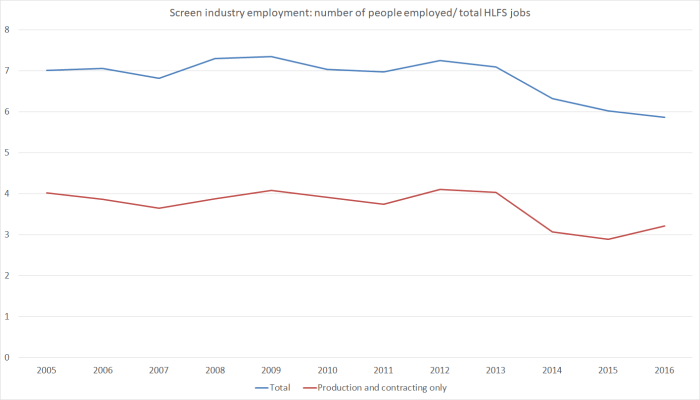
On this measure, the relative share of the industry is a bit smaller than it was in 2005, despite all those subsidies.

There is also a similar length series of (a) the number of people employed, and (b) the number of jobs, which I’ve shown relative to the HLFS data on total employment.

screen E

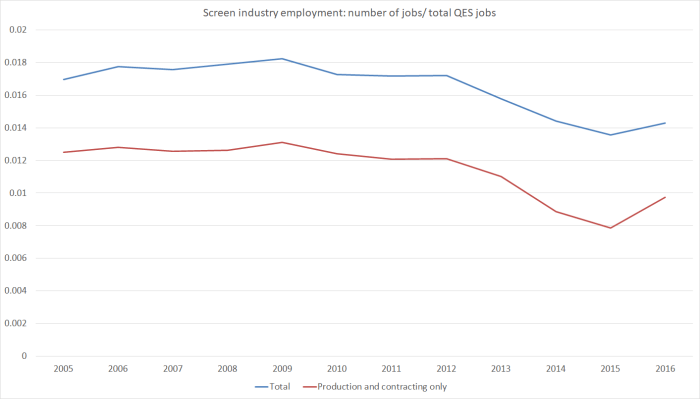
And here is the same breakdown in respect of the number of jobs shown relative to the QES jobs filled data.

screen e 2

Employment isn’t everything –  there just might be stellar productivity growth going on.  But what NZIER could find on that front wasn’t particularly impressive –  and as they note, the numbers are shaky at best.  And in a sector of this sort, where New Zealand is a small part of a global industry, if there were really stellar productivity gains being achieved one might expect them to show up in a growing market shares, including (for example) rapidly rising exports and a rising share of total employment.  There is simply no sign of any of that.

Advocates seem reduced to some pretty feeble arguments not much different from “it feels good”.  In their taxpayer-funded report, NZIER devoted several pages to trying to make the claim that film subsidies are an effective part of “soft diplomacy”, exemplified apparently by cases like these

The German-aired Emilie Richards series (case study 6 over the page) is not well known in New Zealand, but in Germany it played a role in cross-cultural understanding. In the case of 800 Words (case study 7 overleaf), our Trans-Tasman relationship plays out in a drama series featuring New Zealanders and Australians together in daily life.

But as the discussion of these two cases unfolds it all seemed to reduce to not much more than “if you subsidise something, you will get –  and may even grow –  some firms and jobs that depend wholly on those subsidies”.  That is no sort of robust test.

Film subsidies look like a classic case in which, once established, it is extremely difficult to overcome the concentrated vested interests that want the subsidy to continue, even if there is no sign that New Zealanders as a whole are benefiting.  Perhaps there is a better class of cafe in Miramar as a result, perhaps ministers like hobnobbing with film industry people (although given the revelations of the MeToo movement it is hard to know why), and there are (of course) individual employees who would be adversely affected by the discontinuation of the subsidies –  as there is in any economic change, including the cyclical ups and downs in places like the construction industry.  But it isn’t a good basis for taking your money and mine to provide subsidies to the likes of Richard Taylor and Peter Jackson, talented as they (and their staff) may individually be.   Economic policy should be premised on considerations like economic efficiency, with any interventions benchmarked against credible performance data.  On that score, film subsidies were flawed from inception, and they clearly fail now.

Fiscal councils and state-funding of parties

I’ve been engrossed in the Kavanaugh hearings, so just something short today.

A few weeks ago the government released a consultative document prepared by The Treasury on the possibility of establishing an independent fiscal institution.   There is quite a lot of useful background information in the document, although what is lacking at this stage is a clear specific proposal.

The creation of such an institution was part of the Labour-Greens budget responsibility pact announced before the election.  Broadly speaking, I thought it had the makings of a step in the right direction, but whether it would be so or not would depend greatly on the specifics of how the institution was set up, what it was made responsible for, and (to a considerable extent) the early key appointees.

I was generally in favour of a small institution that could provide some independent analysis and commentary on fiscal policy, fiscal rules, and so on.  Many OECD countries have such institutions.  I’d go a little further and suggest that in a New Zealand context such a body could be made more useful, and with a bit more critical mass, if the responsibilities were broadened to include independent analysis and commentary on other aspects of macroeconomic policy, notably monetary policy and financial system regulation.

My unease was the about the push, initiated by the Green Party, for the independent fiscal institution to take on a taxpayer-funded role of costing political parties’ proposed policies and promises.    That aspect appears quite prominently in the consultative document.  I remain unconvinced that there is a gap in the market.   I’m also unconvinced that a small body would be able to maintain a critical mass of the sort of detailed expertise required to credibly cost and evaluate policies proposed by political parties, across the entire spectrum of policy, on the off chance that one particular party might want some, perhaps quite detailed, policy evaluated.  And I’m also uneasy about the policy and political (not necessarily partisan ones) biases of the sort of bureaucrats who would inhabit such agencies (check out past Treasury advice around capital gains taxes for example), and the creation of any sort of expectation that these people should be charged with costing and evaluating party promises.

But there is also an issue of mindsets.  Technocrats put a great deal of focus on precise costings and details, but elections are rarely about those details, and it isn’t obvious that they should be.  Elections are contests of ideology, personality, competence or otherwise, and only at the margins are precise numbers likely to be particularly important.  That is even more so in an MMP environment, where campaign promises and policies are no more than opening bids, and governments typically have to be cobbled together –  and policy details haggled over –  after the votes are in.    Sometimes parties find it in their interests to hire expert advisers to evaluate or cost their policies, and the political and commentary process evaluates and challenges what they produce in response.  Other times parties don’t.  People make their choices, and it isn’t clear they put that much weight on specific costings, no matter who they are done by.  Politics is a competitive and adversarial process, and I’m not sure there is much role for taxpayer-funded technocrats.

The idea of a policy costings unit looks like some mix of (a) trying to intrude technocrats into the process, and more concerningly (b), a backdoor route to have the state fund political parties.   Resources that would be spent by the costings unit, at the request of an individual political party, would be resources that party would not have to find for itself.  if that isn’t backdoor partial state funding of political parties –  potentially on quite a large scale –  I’m not sure what is.

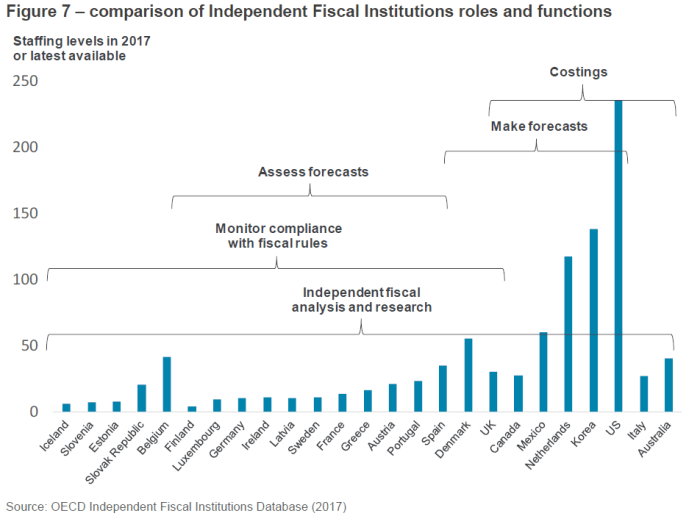
Among the interesting charts in the report is this one, drawing on OECD databases.

fisc council chart

It is a very useful chart, outlining what various independent fiscal agencies do. But what I found most interesting was the eight countries to the right of the chart where the fiscal institution does policy costings, and the countries that aren’t in that grouping.

Every one of the countries where the fiscal entity does policy costing of some sort (in the US case, not for political parties in the run-up to a campaign, but the US system is very different overall) is that all of them are large by our standards.  Even the Netherlands has more than three times our population and Australia has five times our population (and more than that multiple of our GDP).  Some of those countries have quite large staffs for their fiscal institutions –  and they can afford it.

By contrast, not one of the small OECD countries with an independent fiscal institution is described by The Treasury as doing policy costings for political parties.  That seems pretty telling, and is unlikely –  across a variety of different political systems –  to be just a matter of chance.

The consultative document doesn’t give us a sense of resource requirements, but there aren’t likely to be big economies of scale in this game.  A Council of, say, 3 and perhaps 10 staff could do the fiscal (and macro) monitoring.  That looks to be the sort of scale quite common in the rest of the OECD.  Making a serious job of policy costing looks as though it could take multiples of that level of resources.   For what?

I might come back to the document if/when I make a submission next month, but in the meantime I’d urge a rethink, and encourage opposition parties not to fall for the siren song of more resources potentially becoming available to them.

Shame on our MPs

There are some things I write about here that I really don’t care that much about.

But this isn’t one of them.

Yesterday at the start of Parliament’s sitting day, the prayer was read in Chinese by Labour MP, Raymond Huo.   This was apparently in recognition of the PRC-government sponsored Chinese language week.

There are three “official” languages in New Zealand: English, Maori, and sign language.  Chinese is not one of those languages, so why is it being used as an official part of parliamentary proceeedings in this country?

There are, of course, migrants from the PRC (and other Chinese-speaking countries/territories), as there are migrants from many other countries.  But when they come to New Zealand, and participate (as they should) in our political processes, they should do so speaking one of our languages.  As a migrant you might, to some extent hold on to your birth culture, but you made a choice to come to New Zealand, and part of that choice should be to adopt New Zealand ways and laws.   We are not some PRC colony.

I noted that Chinese language week is a PRC-government sponsored event.  The patron is Her Excellency, the PRC’s ambassador in New Zealand.   Among the trustees are Raymond Huo himself, the president of the New Zealand China Friendship Society, well-known for its close associations with the regime, the chair of the Victoria University (PRC-funded) Confucius Institute (and a senior consultant to the PRC government around Confucius Institutes) and the chief executive of the local branch of one of the Chinese banks.   (On this occasion, former PRC intelligence offical Jian Yang  – who misrepresented his past to get into New Zealand – is only an honorary adviser.)   And who do we find among the “sponsors” and “partners”?  Listed first in Hanban, the PRC government agency behind that network of Confucius Institutes around the world.   In the same top-tier is one of the Chinese banks (recalling that all Chinese corporates are seen, by the Chinese government, as arms of the PRC party/state).  Just behind, are the New Zealand government propaganda arms –  the China Council (from whom never a sceptical word is heard) and the Asia New Zealand Foundation –  the individual Confucius Institutes, the Wellington City Council (wasting my rates again) and various businesses and universities that want to keep on side with Beijing.

This is, overwhelmingly, a PRC promoted and sponsored body/event.  Any serious observer would recognise that, and the propaganda win involved in allowing the parliamentary prayer to be said by Huo, in Chinese.   No wonder Huo could talk of a record number of people watching Parliament TV from abroad (assuming there is any data to support such a claim).    Could one imagine a member being invited to open the day’s session of the PRC legislature with a prayer in English?   Silly me.  Legislature, in the PRC.  Ritual rubber-stamp more like.  Prayer?  Why, it is an avowedly atheistic regime, uneasy about anything or anyone that claims a higher allegiance than the Party.

Being a fairly open-minded place, where our leaders are largely heedless –  and careless –  of our heritage, it might have been one thing if Chinese language week had had as joint patrons (evil as her regime is) the PRC Ambassador and the Taiwanese government’s representative in New Zealand.    Or if the key figures were not political at all.  Or if the ethnic Chinese MP reading the prayer had a track record of standing up, and speaking out, against the evils of the totalitarian regime that brutally rules the land of his birth.  Or had originally from another Chinese-speaking country.

But, of course, none of these things held.    What do we know of Raymond Huo, senior Labour backbencher (presumably hoping for higher office before too long) who – remarkably (or perhaps not given the carelessness of our MPs) – chairs the Justice select committee in Parliament.  A man who has never once that I’m aware of, in his years in Parliament, uttered a single word critical of the PRC regime.  A man who openly defends the Chinese conquest of Tibet, and the brutal suppression of the people and their identity.   And here is what Anne-Marie Brady wrote about him in her Magic Weapons paper last year.

Even more so than Yang Jian, who until the recent controversy, was not often quoted in the New Zealand non-Chinese language media, the Labour Party’s ethnic Chinese MP, Raymond Huo霍建强 works very publicly with China’s united front organizations in New Zealand and promotes their policies in English and Chinese. Huo was a Member of of Parliament from 2008 to 2014, then returned to Parliament again in 2017 when a list position became vacant. In 2009, at a meeting organized by the Peaceful Reunification of China Association of New Zealand to celebrate Tibetan Serf Liberation Day, Huo said that as a “person from China” (中国人) he would promote China’s Tibet policies to the New Zealand Parliament.

Huo works very closely with the PRC representatives in New Zealand. In 2014, at a meeting to discuss promotion of New Zealand’s Chinese Language Week (led by Huo and Johanna Coughlan) Huo said that “Advisors from Chinese communities will be duly appointed with close consultation with the Chinese diplomats and community leaders.” Huo also has close contacts with the Zhi Gong Party 致公党 (one of the eight minor parties under the control of the United Front Work Department). The Zhi Gong Party is a united front link to liaise with overseas Chinese communities, as demonstrated in a meeting between Zhi Gong Party leaders and Huo to promote the New Zealand OBOR Foundation and Think Tank.

It was Huo who made the decision to translate Labour’s 2017 election campaign slogan “Let’s do it” into a quote from Xi Jinping (撸起袖子加油干, which literally means “roll up your sleeves and work hard”). Huo told journalists at the Labour campaign launch that the Chinese translation “auspiciously equates to a New Year’s message from President Xi Jinping encouraging China to ‘roll its sleeves up’.”   However, inauspiciously, in colloquial Chinese, Xi’s phrase can also be read as “roll up your sleeves and f..k hard” and the verb (撸) has connotations of masturbation.  Xi’s catchphrase has been widely satirized in Chinese social media.  Nonetheless, the phrase is now the politically correct slogan for promoting OBOR, both in China and abroad. The use of Xi’s political catchphrase in the Labour campaign, indicates how tone deaf Huo and those in the Chinese community he works with are to how the phrase would be received in the New Zealand political environment. In 2014, when asked about the issue of Chinese political influence in New Zealand, Huo told RNZ National, “Generally the Chinese community is excited about the prospect of China having more influence in New Zealand” and added, “many Chinese community members told him a powerful China meant a backer, either psychologically or in the real sense.”

and

During his successful campaign for the Auckland mayoralty, in 2016, former Labour leader and MP, Phil Goff received $366,115 from a charity auction and dinner for the Chinese community. The event was organized by Labour MP Raymond Huo. Tables sold for $1680 each. Because it was a charity auction Goff was not required to state who had given him donations, but one item hit the headlines. A signed copy of the Selected Works of Xi Jinping was sold to a bidder from China for $150,000.  A participant at the fundraiser said the reason why so many people attended and had bid strongly for items was because they believed Goff would be the next mayor.

and

In June 2017, at the Langley Hotel in Auckland, the State Council Overseas Chinese Affairs Office hosted an update meeting to discuss the integration of the overseas Chinese media with the domestic Chinese media. In attendance was Li Guohong, Vice Director of the Propaganda Department of the State Council Overseas Chinese Affairs Office, and other senior CCP media management officials, representatives of the ethnic Chinese media in New Zealand, representatives of ethnic Chinese community groups, and Labour MP Raymond Huo.  Update meetings (通气会) are one of the main ways the CCP relays instructions to the domestic Chinese media, in order to avoid a paper trail. Party directives are accorded a higher status than national law.

There is no sign at all of Huo putting any distance between himself and one of most repressive totalitarian regimes on the planet.  If anything, he only seems to want to hug the regime, and Xi Jinping, closer.  No wonder former diplomat and now lobbyist Charles Finny told a TVNZ Q&A interviewer last year that he was always very careful what he said in front of Huo.

And since this was a prayer being said, what about the religious dimensions?  Parliament’s prayer is an odd sort of beast, made odder by the current Speaker who rewrote the prayer to remove any distinctive Christian aspects, while keeping it distinctively monotheistic (references to Almighty God –  and not to localised tree gods or other minor deities).  As a Christian, I’d be happy enough (would probably prefer) Parliament dropped the prayer altogether: even if hypocrisy is the tribute vice pays to virtue, I’d rather MPs just recognised that the dominant “religion” of New Zealand (and every society has one, defined broadly) isn’t theistic at all.

But, for now, Parliament is opened each day with a monotheistic prayer, some vague nodding reference to our heritage, but vague enough that the small numbers of Muslims and Jews in New Zealand can probably nod along.

And what is the status of religion in the People’s Republic of China?   The Communist Party, which runs the state, is avowedly atheistic.  Religous believers, of whatever stripe, aren’t allowed to join the Party, as a matter of ideological commitment.    And both the Party and state are threatened by any sense of higher loyalties, not just theistic ones –  witness the extreme measures they’ve taken to suppress Falun Gong.   And what of theistic religions?    In the case of Islam, consider the extreme repression now in place in Xinjiang province, where some estimates suggest more than a million people may be in concentration and indoctrination “camps” (prisons), the surveillance state is taken to extremes, kids are taken from imprisoned parents, declared orphans, and then retrained to forget the identity, or even the existence, of their parents.   No New Zealand public figure –  no minister, no MP, and certainly not Raymond Huo (former countrymen of these victims) –  has spoken up, or spoken out, against that almost unbelievable persecution.     What you don’t speak up about –  when you in a position to be heard – is what you tolerate, what you really don’t care much about at all.  And yet Raymond Huo has the cheek to accept the offer to utter the prayer to this monotheistic Almighty God.

What of Christians?   They’ve had an uneasy relationship with the PRC over recent decades.   There are tame churches, in the Three-Self Patriotic Movement (Protestant) and a parallel with Catholics.  In many respects, they are orthodox, and yet they allow themselves to be placed under the thumb of the party-State (as for example, much of the Lutheran church in Germany did during the Nazi era).  But those churches who won’t bend the knee to the party-State are subject to increasing persecution in the Xi Jinping era, and attempts to suborn them and their leaders.  One large independent church in Beijing recently closed –  went to operating in small groups and by podcasts –  after the authorities insisted on the right place surveillance cameras in their buildings.  In response to growing repression and threats more than 100 pastors recently signed a declaration ending this way (emphasis added)

Christians are obligated to respect the authorities, to pray fervently for their benefit, and to pray earnestly for Chinese society. For the sake of the gospel, we are willing to suffer all external losses brought about by unfair law enforcement. Out of a love for our fellow citizens, we are willing to give up all of our earthly rights. 

For this reason, we believe and are obligated to teach all believers that all true churches in China that belong to Christ must hold to the principle of the separation of church and state and must proclaim Christ as the sole head of the church. We declare that in matters of external conduct, churches are willing to accept lawful oversight by civil administration or other government departments as other social organizations do. But under no circumstances will we lead our churches to join a religious organization controlled by the government, to register with the religious administration department, or to accept any kind of affiliation. We also will not accept any “ban” or “fine” imposed on our churches due to our faith. For the sake of the gospel, we are prepared to bear all losses—even the loss of our freedom and our lives. 

The situation has got consistently worse under Xi Jinping – who Raymond Huo holds close –  who is reported to regard churches as “severe national security threats”.

And yet Raymond Huo is invited by the Speaker of our Parliament –  presumably with the acquiescence of other party leaders, including the Prime Minister and the Leader of Opposition – to utter the daily prayer to the monotheistic Almighty God?   It is shameful.

But also telling.  After all, Simon Bridges last year signed up to the idea of a “fusion of civilisations” with this evil totalitarian regime.  Party presidents, Haworth and Goodfellow, head up to Beijing and sing the praises of the party/State and of Xi Jinping himself.

And just the other day, the chief executive of the Ministry of Foreign Affairs and Trade  –  about to become head of the PM’s department, and so we can presume was assuredly on-message –  gave a rare published speech.     In it he articulated New Zealand foreign policy, including among his ten basic principles this one

Second, be deliberate in supporting New Zealand’s values, speaking out in defence of them when required, even where that might put us at odds with others.

In fact, he quoted the Prime Minister from a speech earlier in the year

“In this uncertain world, where long accepted positions have been met with fresh challenge – our response lies in the approach that, with rare exceptions, we have always taken. Speaking up for what we believe in, standing up when our values are challenged and working tirelessly to refurbish rules and build architecture, and to draw in partners with shared views.

And noted

I can say with confidence that all of the Governments for which I have worked would hold these things to be true. 

In which case, I guess we must be able to deduce the real values of our leaders –  ministers past and present, and MPs –  but what they do and don’t say.    After all, they speak up for what they believe in, or so we are told?

When our Parliament invites a CCP-affiliated MP, who champions the interests of the atheistic PRC regime, and has his own party campaign under a Xi Jinping slogan, to open the day’s parliamentary sitting in prayer, in Chinese it seems unlikely that any of them care much about anything other than trade deals for big corporates and their donors, and none of them has the slightest regard for our own heritage, our own values, or for the freedom (including to worship, or not) of Christians, Muslims, and others in China.   There are, so we are told, Christian MPs in our Parliament.  But apparently not even a single one of them was willing to speak up, or speak out.

I don’t suppose New Zealand ranks very high among the issues that concern Beijing, but it must have been a good day in the relevant corners of Beijing officialdom yesterday –  bonuses for the Ambassador perhaps –  as they looked at the useful idiots masquerading as leaders in the New Zealand Parliament.

As a matter of urgency, we need someone –  some party –  to stand up for taking back our country, for asserting the values, traditions, and liberties of its people, the self-respect that (among other things) was presumably part of what attracted some ethnic Chinese to move here in the first place.  As for the present leadership, heedless, careless, and useless……selling out their country (mostly not for personal enrichment) whether by their indifference or their active involvement.

Yes, it will have been a good day in Beijing.  If the butchers ever take time to chuckle, yesterday might have been one of those days.


Not much business investment

Yesterday’s post was prompted by looking at the export and import data in last week’s GDP release.   Today’s is prompted by looking at the investment data.

The latest quarterly data wasn’t that interesting in itself –  business investment fell a bit, but from quarter to quarter there is quite a bit of noise, and not much can be read into a single quarter’s data.

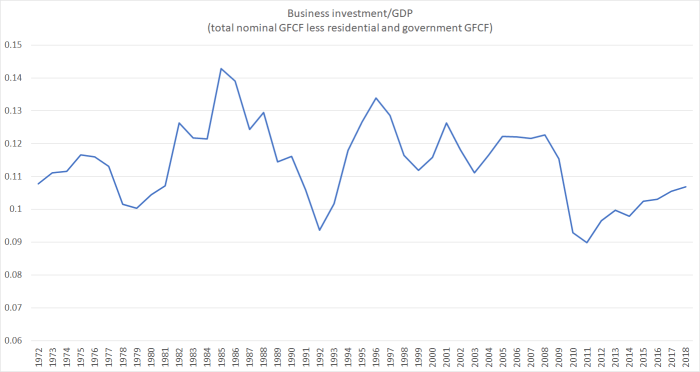
But here is a longer view on a proxy for business investment spending as a share of GDP (total gross fixed capital formation less residential investment less government investment spending), using the annual data back to the year to March 1972. The latest quarterly observation is almost exactly the same level as the final (annual) observation on the chart.

bus investment sept 18

Years into the recovery, after several years of very rapid population growth, business investment as a share of GDP has crept back up to levels that are only higher than seen in past recessions.  And by international (OECD) standards, business investment as a share of GDP has been low in New Zealand for decades.  It is consistent with the story numerous analysts have highlighted over the years: one of the proximate symptoms of our long-term economic underperformance is that firms haven’t found it worthwhile to invest more heavily here.   The last few years look as if they simply reinforce that story.

(And that isn’t, of course, because we have too many houses for our people.  If anything, we have too few, so when people –  like the Minister of Finance –  talk of shifting investment from housing to other things, while not changing anything about population growth, it is meaningless or worse.)

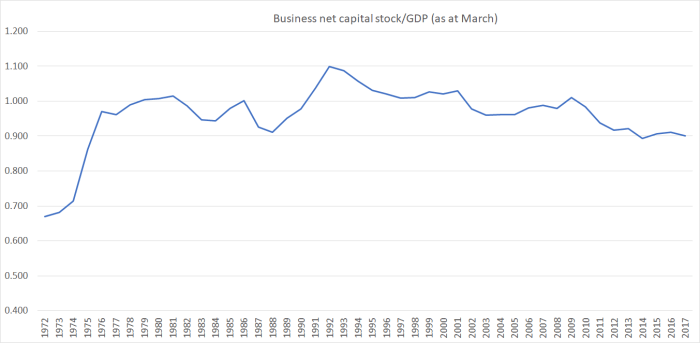
That first chart, which I’ve shown previously, is the flow –  each year’s new investment as a share of total GDP that year.  But this chart uses the stock figures: SNZ’s net capital stock (total less residential less government) relative to GDP.  That takes account of depreciation, and also of the changing growth rate of the population.

bus cap stock

The business capital stock (as estimated by SNZ) hasn’t been growing relative to GDP for over 40 years.  Over most of the last decade that ratio has been shrinking (and although these data are available only to March 2017, it seems unlikely anything in the last 18 months will materially alter the picture).  Businesses –  as a whole – simply haven’t found it attractive to invest and grow here.

The government is very keen on promoting R&D spending, rushing to put in place new and bigger subsidies without much evidence of having thought much about why it might not be attractive to profit-maximising firms to spend more here.

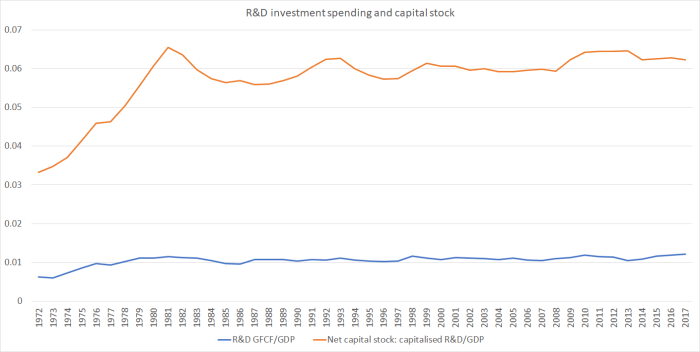
R&D is included in both the annual new investment spending shown in the first chart above and in the net capital stock data shown in the second chart.   SNZ don’t provide a breakdown between government and private components, but for what it is worth I found this chart interesting.

R&D capex

If anything, R&D spending seems to have been holding up quite a bit better than overall business investment and the business capital stock.  Which tends to reinforce my doubts about why more taxpayer money should be thrown at this type of spending.  Overall R&D spending might be quite low by advanced country standards, but so is business investment more generally, and so is foreign trade.  My hypothesis is that all three things are related, and that there is no obvious reason (and no analysis the government has advanced) suggesting that the root cause of the problem is insufficient subsidies for R&D spending.

On a completely different note, tomorrow I’ll take a lot at the latest from the Reserve Bank: Adrian Orr and the tree gods.


Once were traders

For small countries in particular, foreign trade is a key element in economic prosperity.  Firms in your country develop products and services that people abroad want, and that enables your citizens to consume from the wider range of products and services the rest of the world has to offer.  It isn’t just final products, but trade in intermediate goods and services (inputs to other production) also enables specialisation and the general gains from trade.

Foreign trade wasn’t always important in the islands of New Zealand.  For the centuries after first settlement there was none.  And (although not solely for that reason) the people –  Maori –  were poor.   In modern New Zealand, foreign trade has been critical: 100 years ago there was a widely cited claim that New Zealand did more foreign trade per capita than any other country.  Hand in hand with that, we were among the countries with the highest incomes per capita.

But no longer, on either count.

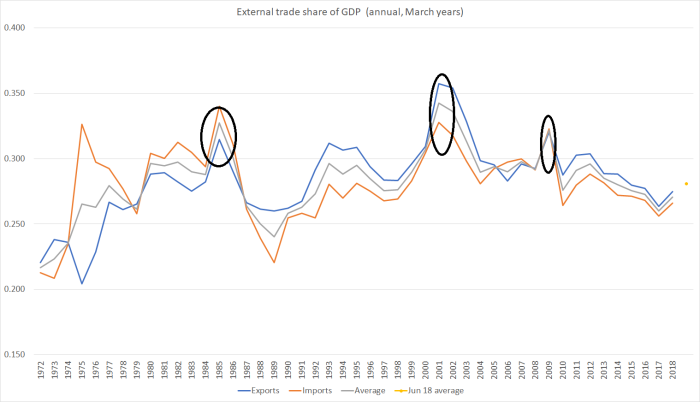
The latest quarterly numbers out last week did show an uptick in both exports and imports as a share of GDP.  But here is the chart back to 1972 –  annual data, plus the latest quarterly observation.

external trade share

The foreign trade share has been, at best, static for almost 40 years (in most countries they’ve been increasing).  The last few years have seen the trade share the weakest for almost 30 years (and the late 80s construction boom).  I’ve highlighted the only three occasions when exports and imports have averaged 30 per cent or more of GDP: the year to March 1985, the years to March 2000 to 2002, and the year to March 2009.   What was the common feature of those years?   It wasn’t the stellar success of outward-oriented businesses.  It was the (unexpected) severe weakness in the exchange rate: the devaluation of 1984, the period around the end of the dot-com boom when US interest rates were high, and New Zealand (and Australian) dollars were unattractive, and the international financial crisis (and extreme risk aversion) of 2008/09.   Based on the rest of the set of New Zealand policies, those low exchange rates weren’t sustainable, and there was a relatively quick rebound.

What of other advanced countries?

Big countries tend to do less foreign trade (share of GDP) than small countries.  That is no surprise, as there are many more markets and opportunities for specialisation (gains from trading) close to home.  Here are the OECD countries that in 2016 (last year with complete data) had exports and imports averaging less than 30 per cent of GDP.

Australia 21.0
Chile 27.8
Italy 29.0
Israel 28.2
Japan 15.6
Turkey 23.4
UK 29.1
USA 13.3

Of them, Italy, Japan, Turkey, the United Kingdom and the United States are big countries and big economies.    You’d expect to find them on this table, and if anything the anomaly is Germany, with a foreign trade share now in excess of 40 per cent of GDP.

Of the remaining countries, there are

  • Australia, with five times our population,
  • Chile, with more than three times our population, and with the second lowest labour productivity in the OECD (beating only Mexico), and
  • Israel, which isn’t much larger than New Zealand but which –  as I’ve highlighted here previously –  has a similarly lousy productivity growth record.

And all, in one form or another, with severe disadvantages of distance.

There has been a tendency in some circles to excuse New Zealand’s low foreign trade shares by citing distance, but simultaneously a reluctance to take seriously what is implied by that limitation.  If the opportunities for foreign trade from this remote location don’t look particularly good, isn’t there something deeply illogical (or worse) about continuing to use policy (as successive governments have done for last 25 years) to drive up our population –  more people in an unpropitious location?  All the more so when adopting that policy approach also involves driving the real exchange rate up, away from where it would likely settle otherwise.  Not all New Zealanders suffer in the process –  if you run a business geared, in effect, solely towards population growth you may well flourish –  but New Zealanders as a whole have.

For all the occasional talk about rebalancing the economy (from both main parties, at least when they first take office) none of it seems to take any serious account of this constraint.   Which is only set to become more seriously as –  relative to other countries –  the opportunities here shrink with the apparent determination to pursue net-zero emissions targets.  Planting (lots more) is unlikely to be a path to sustained prosperity or higher productivity.

These days, New Zealand’s per capita foreign trade will among the lowest in the advanced world.   Among the rich countries, only (very big) Japan and the United States will be materially lower than us.  It isn’t a mark of a successful economy.  But neither government nor opposition have any real strategy –  or interest? –  in turning things around.

Inflation and the tax system

When I went looking for the interim report of the Tax Working Group, I found that various other papers had been released.   These include background papers prepared by the Treasury and IRD secretariat looking at various possible options for reducing other taxes if, for example, new capital taxes were to provide more government revenue.

Among them was a short and rather unconvincing paper on productivity.   It was notable for highlighting how difficult it was to give any concrete meaning to the aspiration repeatedly expressed by the Minister of Finance, and included in the terms of reference, of “promoting the right balance between the productive and speculative economies”.  And it was also notable for the aversion of officials to lowering the company tax rate (or the effective tax rate shareholders pay on company income), even though they accept that our business income tax rates are now high by international standards, and that business investment (including FDI) is low by international standards. This chart is from the paper.  In general, what is taxed heavily you get less of.

corp income tax

But this time I was more interested in another of the background papers, this one on the possibility of inflation indexing the tax system.   Even with 2 per cent inflation, failing to take explicit account of inflation in the tax system introduces some material distortions and inefficiencies.  Many of the costs of inflation arise from the interaction with the tax system, and these distortions may be greater in New Zealand than in many other countries because of the way we tax retirement income savings (the TTE system introduced, as a great revenue grab at the time, in the late 1980s).

In the days of high inflation there was some momentum towards doing something about indexation. It had, for example, been a cause championed by former Reserve Bank Governor Ray White.  And in the late 1980s, the then government got as far as publishing a detailed consultative document.  But then inflation fell sharply (and maximum marginal tax rates were cut) and the issue died.  We don’t even have the income tax thresholds indexed for inflation, allowing Ministers of Finance ever few years to present as a tax cut an increase in revenue that should never have occurred in the first place.

In the early days of inflation targeting there might even have been a case for letting the issue die.  The inflation target was centred on 1 per cent annual CPI increases, and that target was premised on a view that the CPI had an annual upward bias of perhaps as much as 0.75 per cent per annum).  But since then, the extent of any biases in the CPI have been reduced, and the inflation target has twice been increased.   The inflation target now involves aiming for “true” inflation” of at least 1.5 per cent per annum.

The distortions are most obvious as regard interest receipts and payments.  Take a short-term term deposit rate of around 3 per cent at present.  Someone on the maximum marginal tax rate (33%) will be taxed so that the after-tax return is only 2 per cent. But if, as the Reserve Bank tells us, inflation expectations are 2 per cent, that means no real after-tax return.  Compensation for inflation isn’t income and it shouldn’t be taxed as such.  Only the real component of the interest rate (1 per cent) should be taxed.   The same distortion arises on the other side, for those able to deduct interest expenses in calculating taxable income: in the presence of inflation, this tax treatment subsidises business borrowing.  The amounts involved are not small.   As economist Andrew Coleman notes in his (as ever) stimulating TWG submission

Even at low inflation rates, these distortions are substantial. In 2017, for instance, residential landlords borrowed $70 billion. Even if the inflation rate is as low as 1 percent, this means residential landlords can deduct $700 million of real principal repayments from their taxable income, a subsidy worth over $200 million per year. New Zealand households lend in excess of $150 billion. When the inflation rate is 1 percent, lenders are expected to pay tax on $1.5 billion more than they ought. Many people who invest in interest-earning securities are elderly, risk averse, or unsophisticated investors. For some reason the New Zealand Government believes these investors should pay more tax than any other class of investors in New Zealand. It is a strange country that taxes the simplest, most easily understood, and the most easily purchased financial security at the highest rates. It suggests the Government has little interest in equity, its protestations notwithstanding.

There are other distortions too, notably around trading stock valuations and asset valuations on which true economic depreciation would be calculated.

As reflected in the paper released this week, officials are very wary about doing anything about fixing these distortions (and they fairly note that “no OECD country currently comprehensively inflation indexes their tax system”), and they devote many pages to outlining the practical challenges they believe would be involved, and the new distortions they believe would arise from partial approaches to indexation.

I have some sympathy with the stance taken by officials on the specific challenges to doing comprehensive indexation, especially in a way that does not bias transactions through favoured institutional vehicles.  But it is a particularly bloodless document that seems to reflect no sense of the injustice involved in taxing so heavily relatively unsophisticated savers (while subsidising business borrowers, especially those financing very long-lived assets).

This seems like a case where some joined-up whole-of-government policy advice would be desirable.  There would be no systematic distortions arising from the interaction between inflation and the tax system if there was no systematic or expected inflation.   Systematic inflation isn’t a natural or inevitable feature of an economic system –  in some ways it is about as odd as changing the length of a metre by 2 per cent a year, or the weight of a gram by 2 per cent a year.  In the UK, for example, (and with lots of annual variation) the price level in 1914 was about the same as it had been in 1860).  And the most compelling reason these days for targeting a positive inflation rate is the effective lower bound on nominal interest rates, itself created by policymakers and legislators.   Take some serious steps to remove that lower bound and (a) we’d be much better positioned whenever the next serious economic downturn happens, and (b) we could, almost at a stroke, eliminate the distortions –  and rank injustices –  that arise from the interaction between continuing, actively targeted, positive inflation, and a tax system that takes no account of this systematic targeted depreciation in the value of money.

It wouldn’t be hard, but our ministers, officials (Treasury and IRD), and central bankers currently seem utterly indifferent to the issue.

Debt default by the US government

There was a great deal of debt defaulted on during the Great Depression.   Businesses failed, farms went bust, and some mortgage borrowers defaulted too.    But a huge number of governments also defaulted on their obligations, not just in places like Greece or Argentina which had form in that regard, but including many of the governments of the richest countries in the world.  You could read about the New Zealand episode here.   Most countries in Europe (including the UK and France) defaulted on their (substantial) war debts to the United States –  in fact, only Finland paid in full.  But even the United States government defaulted.

There is an interesting and accessible new book out about that experience, American Default.   It is written by UCLA Chilean academic Sebastian Edwards (who has been used as an adviser and author here, including this paper at a Treasury/Reserve Bank conference a few years ago), who got onto the subject after acting as an adviser to law firms involved with sovereign defaults by Argentina after 2001.

Going into the Great Depression most countries were, directly or indirectly, on the Gold Standard (indirect in New Zealand’s case, where the banks managed the exchange rate to maintain parity with sterling which was fixed to gold).  But the US situation was a bit different than most.   After the experiences with inflation (and fiat money) during the Civil War, in the subsequent decades –  right up to the early 1930s –  US government bonds were issued with a provision (the “gold clause”) that entitled the borrower, at his/her own option, to be repaid in gold.  Many corporate bond contracts had similar provisions.  They were intended as a protection for the lender against unexpected inflation (arising when the fixed parity between dollars and gold was broken, or abandoned), and at least in the early decades must have allowed US borrowers to borrow more cheaply, and/or for longer-terms than they would have otherwise been able too.  In that respect, they were similar to the way in which many countries with a track record of high or variable inflation found it difficult to borrow in their local currency, and borrowed in foreign currencies instead.

By 1933, many countries (notably the UK) had already broken the link to gold.  But the US (and France and several other smaller European economies) hadn’t.  Breaking the link was part of what enabled those countries to begin recovering from the Depression (both by devaluing against gold-based currencies, and by allowing interest rates to be cut further).   By 1933, there was plenty of gold in the US, but no recovery –  indeed, Roosevelt took office in the midst of a banking panic.  As in many other countries, the price level had fallen significantly, such that the real value/burden of any debt contract outstanding was materially greater than had been expected only a few years earlier.

That said, the US government itself was not particularly heavily indebted.  Economic historian Peter Temin’s book on the Great Depression includes a table suggesting that gross debt of all level of US government in 1929 had only been about 35 per cent of GDP.  (By contrast, in New Zealand, Australia, and the UK general government public debt in 1929 had been in excess of 170 per cent of GDP.)   Corporate bonds outstanding seem to have been of a similar size.   Of course, in all cases these debt ratios rose as economies moved towards the depths of the Depression, as both real GDP and the level of prices fell.

It seems that Roosevelt didn’t have a clear strategy in mind when he took office (and the tie to gold hadn’t been a campaign issue).  The actual approach unfolded gradually over the year or two after he took office.  What did the US government do?

The first major step –  extraordinary in a free society –  was to simply outlaw private sector holdings of gold.   All but trivial amounts of gold had to be delivered to the government, with less than a month’s notice, for which holders were paid at the then still-current official price of gold (US$20.67 an ounce).   Private holdings of gold were forbidden for decades.  A few weeks later Congress passed a declaration explicitly prohibiting gold clauses in future securities issues, and abrograting (voiding) existing provisions.   The government then began buying up gold (in the international market) steadily raising the US dollar price of gold until in January 1934, with Congressional authorisation, the official price was reset at $35 an ounce (where it remained until 1971).  US citizens couldn’t get hold of gold, but the US remained willing to buy at the price from overseas sellers.

In effect, the US was off the Gold Standard and had devalued its exchange rate. Gold purchases were increasing the domestic monetary base. In combination, such measures should, and did, support a lift in US economic activity and in prices (commodity prices in particular, in USD terms, rose quite quickly and substantially as one might expect).

And, in the process, the US government managed a huge windfall gain for itself.  As another recent treatment of this episode (by Richard Timberlake, not referenced by Edwards) records, the book profits on the revalued gold was roughly equal to total Federal government revenues in 1934.  Compel citizens to sell you an asset at one price and then re-set the price, more in line with economic realities, and in the process transfer a great deal of wealth from citizens to the government.   It isn’t the sort of approach one would normally expect in a country with the rule of law.

But, of course, the interesting thing about the United States is the way the constitution sometimes intrudes in the freedom of governments to do just as they want.  Had a New Zealand, Australian, or British government adopted measures like those in the US, there would have been nothing much anyone could have done about it, once the parliamentary battle was lost.  But in the US many of these sorts of issues are only finally resolved at the Supreme Court, testing the validity of congressional or executive actions against the provisions and protections of the Constitution.

And that is what happened in this case, although only in respect of the abrogation of the gold clauses.  There were several cases taken, each with slightly different factual bases, covering both private and government obligations.    The claim wasn’t to be paid in physical gold –  private holdings of which were now illegal –  but to be paid the dollar value of the gold equivalent when the bond had been issued.  In dollar terms, that would be 69 per cent (35/20.67) more than otherwise.  There were substantial sums at stake.

As Edwards illustrates, the Supreme Court hearings were closely followed by markets and the press (and at the time the court was perceived to be roughly evenly divided between what might loosely be described as “conservatives” and those of a more moderate or “progressive” disposition).   Media coverage suggested that the government’s lawyers had not had the best of the hearings themselves.   The Court’s ruling was eagerly awaited, and with some trepidation by the government.  Contingency planning had been undertaken, and in Roosevelt’s papers is the draft text of an address he intended to deliver had the Court ruled comprehensively against the government, and papers outlining the actions he intended to initiate in response.    An adverse outcome wasn’t going to be acceptable.  Roosevelt seems to have regarded the abrogation of the gold clauses as an essential element in his overall strategy to lift economic activity and prices; indeed one of the key arguments made to the Supreme Court was around a justification of national emergency.

As it happens, the government won in practice.   The abrogation of the gold clauses, at least as applied to Federal government debt, was ruled unconstitutional (by an 8 to 1 margin).   But by a 5 to 4 margin, the Court ruled that the abrogation had not produced any damages to bond holders, and so those bondholders were prevented from taking further action (in something called the Court of Claims) against the government.  In other words, there were to be no practical consequences for having passed an unconstitutional law (I’m not entirely clear –  it isn’t discussed in the book – why having ruled it unconstitutional the Court didn’t overturn that provision, but clearly they didn’t).

Had the gold clauses in private and government bonds been allowed to stand, issuers would have been required to pay 69 per cent more (dollars) than otherwise (but, in effect, the same amount of gold).  In his book, Edwards seems to accept that this would have been a highly damaging, undesirable, and unacceptable outcome.  I’m less convinced.

For a start, they were the terms on which contracts had been entered into (at numerous different dates), and the cases before the Supreme Court all involved substantial and sophisticated issuers including the US government itself (although I understand that some residential mortgages at the time may also have contained the clause).  And it is not as if changes in gold parities and prices had never happened before (indeed, in other countries they had been frequent during World War One and the subsequent decade). No one, in contracting –  or purchasing – these bonds could credibly claim to have put no weight at all on the possibility of the US ever changing the gold price of dollars.  In fact, the US was still issuing bonds containing the gold clause into 1933, 18 months after the UK (for example) had gone off gold.

It is probably fair to suggest that no one really anticipated a deflationary event as severe and sustained as the Great Depression, but there is at least an arguable case that bankruptcy courts and limited liability exist to handle cases where things turn out unsustainably far from expectation.  But that is a case-by-case procedure, not a blanket transfer of wealth from lenders to borrowers.  In the US government case –  see the numbers earlier –  federal debt was not large and even Roosevelt acknowledged that losing the case would not have bankrupted the government.   Quite possibly the situation would have been different for some corporates.  But it is also worth remembering the whole point of the Roosevelt strategy (not so different in its end aims from those in many other countries), which was to markedly raise the economywide price level and reverse the sharp falls that had happened during the Depression.  To the extent that strategy was successful, the abrogration of the gold clauses would clearly leave lenders materially worse off than they would have been otherwise.  For borrowers in the tradables sector (admittedly probably a minority), the depreciation in the exchange rate itself markedly (and immediately) improved their capacity to service the debt, so it is even less obvious what the case was for the arbitrary use of government power to provide debt relief.

One of the government’s other arguments was that since the price level in the mid 1930s was materially lower than it had been a decade earlier, anyone who held the bonds throughout would be getting an unexpected windfall gain simply being paid out in dollars (since the purchasing power of those dollars was greater than it had been), let alone being paid out at the new higher gold price.  But even to the extent that argument was valid, it doesn’t take any account of secondary market trading in the affected securities.  A person who purchased a new issue bond in (say) 1926 might indeed be getting a windfall gain –  and windfall gains and losses happen all the time in economic life –  but a secondary market purchaser who’d purchased that bond in late 1932 would have lost out badly (and might well have put a high value on the gold clause as protection against just such an eventuality).

(To illustrate the windfall point, in the late 1980s and early 1990s New Zealand governments were determined to get inflation sustainably down. There wasn’t a great deal of confidence that would happen.  As late as November 1990, the 10 year bond yield averaged 12.96 per cent.  Actual CPI inflation in the subsequent 10 years averaged 1.8 per cent.  Similar windfall losses happened when inflation unexpectedly rose, and stayed up, in the 1970s.)

The sorts of revaluation effects the Roosevelt administration successfully tried to overturn happen not infrequently in systems where borrowers –  especially those not in the tradables sectors, without an export revenue hedge – have taken on considerable foreign currency debt, only for a substantial devaluation or depreciation in the exchange rate to occur.  It happened, for example, in New Zealand in 1984: much of the government’s debt was in foreign currency terms, and a 20 per cent devaluation immediately increased the servicing burden by 25 per cent.  Granted that New Zealand wasn’t in the depths of a depression in 1984 , but no one thought it would fair, reasonable (or even possible) to default on that additional servicing burden.

But in the early 1930s, both New Zealand and Australia were in the depths of really rather severe economic depressions –  perhaps not quite as bad as in the US, but certainly much worse than in, say, the UK.   Both countries had really large volumes of central, local (and state, in Australia) government debt issued abroad –  debt burdens far heavier than those facing the US government when Roosevelt took office.  The distinction between New Zealand or Australian pounds and pounds sterling wasn’t that clear in those days, but as the exchange rate diverged during the Depression, initially with government acquiescence and then at government direction (our own formal devaluation happened in early 1933) debts payable in London were suddenly costing the borrowers far far more than they had envisaged (in New Zealand pound terms).  And the price levels in New Zealand, Australia, and London were all quite a bit lower than initially envisaged.   New Zealand and Australian governments would have welcomed some debt relief on their overseas debts, but it never came: the powerful counterargument was “well, if we are going to successfully boost global price levels such relief won’t end up being necessary”.  And it wasn’t.

The big difference perhaps between the New Zealand and Australian cases and the US one in the 1930s is that the US debt was almost entirely held by domestic investors and was issued wholly under US domestic law.  The US didn’t need to tap international markets on a continuing basis, unlike both New Zealand and Australia.  And so New Zealand and Australia imposed defaults in respect of government  debt issued to domestic holders, but not to foreign ones, and the bulk of the (public) debt was foreign.  But rereading the account of the New Zealand (and Australian) experience in the 1930s, what is striking is the extent to which lenders were willing voluntarily to write down the value of their claims, voluntarily converting to less valuable (government) securities, apparently from some sense of “fairness” or the “national interest”.   One can wonder what sort of response Roosevelt would have achieved had he tried moral suasion rather than legislative coercion.   Perhaps it wouldn’t have worked for private sector issuers –  and for example, the New Zealand government used various legislative interventions in the 1930s to relieve farm debt –  but some case-by-case approach still seems preferable than the rather arbitrary use of legislative instruments to relieve all corporate borrowers from obligations they voluntarily entered into.  Especially, when the economy and the price level were just about to recover, improving (markedly) future servicing capacity.

Of course, had the US recovery subsequently been strikingly more robust and successful than those of other countries, there might be a stronger prima facie case for this (distinctive) debt relief component of Roosevelt’s strategy.  But it wasn’t.  As is well-recognised, it wasn’t until around 1940 that real GDP per capita in the US got back to 1929 levels (years behind, say, New Zealand, Australia, and the UK in that regard).  And the recovery in the price level also lagged.

Here is a chart of the price levels, indexed to 100 in 1929.

price levels

Prior to World War One, price level movements tended to be quite slow and gradual.  There was little sign anywhere of entrenched expectations of future trend changs (up or down).  After World War Two, inflation became an entrenched feature of the system.  In this period, things were in transition.   There were windfall gains and losses, falling heavily on different groups at different times.   But if deflation was the story of the Depression specifically, across all four countries the dominant theme of the period is a lift in the price level.  Even by 1939, in New Zealand and Australia and the UK price levels were more or less back to pre-Depression levels (it took a few years longer in the US).     There seems little obvious case for a borrower, not initially over-indebted, to use legislative powers to abrogate contracts freely entered into to remove significant value from lenders, at a time when the entire of macro policy was to drive up the price level.

A fair, and interesting, point Edwards makes (and which I also make in the treatment of the New Zealand default) is that there were few obvious adverse consequences from this US default.  There is little sign that borrowers became more reluctant to lend, or charged higher risk premia.  If so, that suggests that perhaps people in aggregate really did see it as a step not unjustifed in the extraordinary circumstances.

It is an interesting book about a now little-known episode in US history.  Edwards combines history, economics, and legal analysis, but presents in a way designed to appeal to the intelligent lay reader, not just to the geeky economic historian.  Debt default episodes –  here, there, and everywhere –  should be better understood.  We surely haven’t seen the last of sovereign defaults perhaps –  the way fiscal policy is going – even in the United States.

Automation, future of work, and other distractions

The Labour Party, led by the now Minister of Finance, has made great play in recent years of the looming “threat” of automation, and the claimed need to think hard about the Future of Work.  There was a taskforce in Opposition, repeated references in ministerial speeches, and now even a Future of Work Forum.  I’ve always been a little sceptical: the application of new technology has been a key part of how living standards have improved over the last few hundred years, and I’m sure most people are hoping for further improvements for themselves and their children/grandchildren.   And employment rates seemed to be about as high as they’ve been for decades.

And so I was interested this afternoon flicking through today’s online Financial Times to find an article citing some new OECD work suggestiong that New Zealand is among the advanced countries with some of the lower propotions of jobs at significant risk of automation.  Here is the key chart from the OECD paper.

automation2

New Zealand fourth lowest share of jobs at high risk of being automated, and lowest in the OECD for the combined high and significant risks.

For the geeks, here is some text from the paper on how OECD researchers have been revising down their estimates.

automation 4

Automation will, no doubt, continue to happen.  It should.  We’ll generally be better off for it (even if some individuals will face difficult adjustments, as they did in every phase of activity –  indeed every business cycle – since the Industrial Revolution).  But particularly if this methodology is even approximately right, it reinforces my sense that the Labour Party – and now the government –  (probably with good intentions) use the Future of Work issue, and automation risks/possibilities, as a distraction from, and substitute for, their lack of interest/ideas in addressing the real economic elephant in the room: decades of underperforming productivity growth that mean we would now need a two-thirds lift in productivity (all else equal) to once again match the leading countries, most of whom we used to consistently outstrip.

As Morning Report reminded us today on the anniversary of women’s suffrage, we should celebrate the automatic washing machine, for all the time it freed up, and opportunities it allowed people (then largely women) to pursue.  It is only one of a myriad of such innnovations, past, present and future.

But New Zealanders get fewer of the gains than most advanced country citizens, as successive governments have done nothing to reverse the productivity failure.