Russia

One of the great things about growing kids is the questions they ask.  Yesterday afternoon as we were talking about various countries’ economic performances my 15 year old, who is doing year 12 economics and is intensely interested in international affairs (and knows to distinguish between GDP and per capita GDP), asked me if I thought Russia could ever be the richest country in the world (per capita was what he meant).

I’d never thought about it before. On five seconds of thought, my answer was along the lines that I couldn’t see why not, in principle.  No single country or even region has had a monopoly, over the centuries, on the status of being richest and most advanced.  And, for what it is worth, Russia has abundant natural resources, had a strong tradition of maths and science, and as a cold country it is one of those where modelling suggests that global warming may well be economically beneficial.

But it prompted me to go and look at some data.  From the latest IMF World Economic Outlook tables.  Here is where Russia currently sits in terms of GDP per capita.

russia 1

Of all the countries and territories in the IMF database, Russia sits just outside the upper quartile.  But the group of countries it sits among is substantially made up of EU and/or OECD countries (Estonia, Portugal, Poland, Hungary, Greece, Latvia, Turkey, Croatia, Romania and Chile).   Economists often think of Chile as some sort of poster-child of good economic management, and I’ve been intrigued by Uruguay’s strong performance in the last couple of decades, but both are still materially poorer than Russia.   And Russia –  70 years of Communist rule, a deeply destructive war, rarely any stable sense of property rights or the rule of law, and a raft of sanctions in more recent years sits at about 75 per cent of the average per capita income of New Zealand.   100 years ago, on the eve of World War One, the end of the first great age of globalisation, (the Maddison database records that) Russia had GDP per capita not half that of Argentina, Chile, or Uruguay, and about 30 per cent of that of New Zealand, Australia, Canada, the US, and the UK.

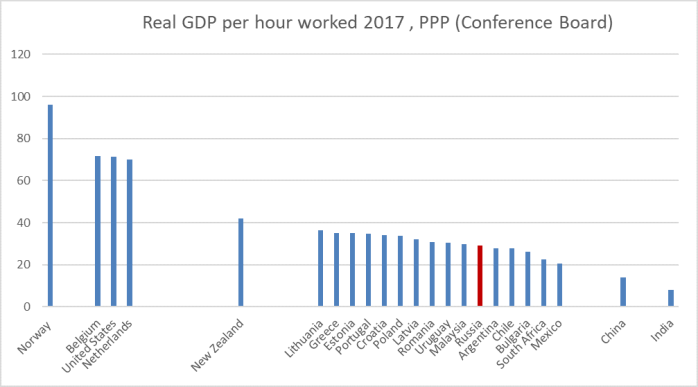
The Russian story is flattered to some extent by fairly long working hours (average annual working hours per worker are about 10 per cent higher than those in New Zealand) and by a shorter life expectancy (even than much poorer China).  But here is a similar chart for labour productivity (real GDP per hour worked) from the Conference Board database.

russia 2.png

Russia sits slightly further down the rankings, but (broadly speaking) among the same group of countries.

To the extent geography matters, Russia has more neighbouring countries than any country in the world and its economic outcomes look better than most of the neighbours (North Korea at one extreme and Norway at the other).  And if one compares Russia’s GDP per capita with that of either Western Europe (source and origin of the Industrial Revolution) or with the Anglo offshoot countries (US, Canada, Australia and New Zealand), which once led the world league tables, Russia’s relative performance now seems to be at least as good –  probably better –  than at any time in the last few hundred years.  It is hardly a stellar economic performer but –  against all the (mostly self-imposed) obstacles – the last century has been one of continued catch-up and convergence.

Of course, the bigger story is probably one of missed opportunities.  Look, by contrast, at what Singapore, Taiwan, and South Korea have managed –  even Malaysia, now appearing on both those charts above –  and it leaves open the possibility of what Russia might have been, perhaps (but probably not) might still be.

The Emperor’s clothes are threadbare

When you worked for an organisation for 30+ years you really do try to look for the best in it. Perhaps it is just me, but I tend towards optimism (notwithstanding Cassandra) and so have had trouble appropriately calibrating my expectations of the Reserve Bank.  They keep surprising me on the downside.  It isn’t so much the specific policy choices themselves (reasonable people might differ) as the too-often threadbare cases they mount in support of interventions which have taken the fancy of successive Governors, or causes Governors (especially the current one) have used their official bully-pulpit to champion.

I had another example yesterday when I opened a (very belated) response from the Bank to an Official Information Act request I’d lodged a couple of months ago.

You’ll recall that last December the Governor launched a consultative document in which he proposed to massively increase the amount of capital banks have to hold to conduct their current level of business. There had been no prior socialisation of this work, testing the analysis in expert fora etc.  Just a (very far-reaching) proposal.  A month or so later, in response to various OIA requests, they finally released some of the relevant background papers (one of which they had only written after the consultative document was released).  (In fact, four months into the consultation there was another big new supporting document released last week, although those who’ve looked at it closely say it doesn’t really shed any fresh light on the issues.)

By February, the Bank’s Monetary Policy Statement was due.  To their credit, the Bank devoted a box (Box E),  a couple of pages in length, to the proposal, under the heading “Monetary policy implications of higher bank capital requirements” (pages 35 and 36).

They make a number of claims in the box.  They correctly note the need to distinguish between the transition and the long-run (itself something of a concession, since there was no discussion of the transition at all in the consultative document itself).

Of interest rate effects they note

All other things unchanged, bank funding costs would rise as a result of their higher capital requirements, because the cost of equity (in terms of investors’ required rate of return) is usually higher than debt. This could lead banks to increase lending rates, lower deposit rates, and/or tighten credit standards in order to retain their expected return on equity.

However, in reality, the impact on the lending and deposit rates will be affected by a range of offsetting forces.

The extent that banks will be able to pass on their potentially higher funding costs – in the form of higher lending rates and lower deposit rates – will be constrained by:
• competition from both within the banking sector and alternative
sources of funding (for example, capital markets); and
• other interest rates in the economy being broadly unchanged, or
lower, as risk premia in New Zealand decline.

Hard to argue with most of that (I would make an exception for the second bullet).

They went on to elaborate that particular point (a little)

The increased stability of the banking system should reduce the risk premium associated with investing in New Zealand. This results in a reduction in the expected frequency and severity of economic disruption associated with systemic financial crises.

Summing up

In the long run, bank lending rates are likely to be slightly higher. How much higher depends on a range of factors, such as how much the cost of equity and debt for banks declines, the degree to which risk premia in New Zealand fall, and how competitive pressures affect banks’ ability to pass on costs to customers in the form of higher lending rates or lower deposit rates. The Bank expects that the spread of banks’ lending rates to the rates at which they borrow will settle in the range of around 20 to 40 basis points higher as a result of the proposed changes, although the exact effect is uncertain.

And then there is a further claim

Higher bank capital requirements could also improve the government’s fiscal position. A higher share of bank equity funding would likely increase tax revenue from the banking sector since debt funding is tax-deductible while equity funding is not. The value of any perceived implicit public guarantee of the banking system would also be reduced as the system becomes safer, improving the government’s credit profile.

And there was a final interesting observation

If implemented, changes to bank capital requirements are likely to affect economic conditions through a number of channels.

At his press conference that day, the Governor was also quizzed extensively about the capital proposals.  In the course of that press conference the Governor told the assembled media that the proposed capital requirements would be well within the range of norms” seen in other countries.

All of which was interesting, but supported (on the day) by no further analysis.  And so I lodged an official information act request

I am writing to request copies of any analysis undertaken by or for the Bank in support of Box E in today’s Monetary Policy Statement, including (but not limited to) the numerical estimate of the impact on the banks’ lending margins.

I am also requesting any material/analysis used to support the Governor’s claim (at the press conference) that the proposed capital requirements will be “well within the range of norms” seen in other countries.  I would note that there was no such supporting material in the Bank’s consultative document.

And finally on Monday, having had the request extended for a month to allow for, as they put it, “ongoing consultations” I had my answer.

I have tended all along to assume that the Bank would have done extensive and detailed analysis, and would have been keen to get that analysis out into the public domain to, as they would see it, strengthen the case for the proposals they clearly believe to be in the public interest.

But the evidence is increasingly against that presumption.  The response from the Bank is here.    There was only six pages of it.   There is, apparently, one (possibly substantive) paper

Paper 1.6: What might higher bank capital requirements mean for monetary policy?

But they simply refuse to release any of that, on principle.

The second document is a single page exercise in arithmetic, described as

Table: Stylised example of the pricing impact of different required returns on equity

I did not check every calculation but I have no reason to doubt the numbers are what they say they are. It is the sort of exercise a new graduate should have been able to churn out in a couple of hours.  It appears to be the source of the suggestion that bank lending margins might widen by 20 to 40 basis points.    But –  being a stylised example in a simple table –  there is no discussion or analysis about whether the scenarios are the correct ones, no engagement with estimates other analysts have come up with, no discussion of (for example) whether for the wholly-owned Australian banks (which dominate the market) group earnings variability etc might not be a relevant metric (shareholders in ANZ Banking Group probably do not great care whether the profits –  mean and variance –  come from the New Zealand operations, the Australian operations, or anywhere else in the world).  Just nothing.

There is no discussion or analysis of those (entirely reasonable) points in the MPS about the extent of competition from entities not subject to the capital requirements, possibilities of disintermediation and so on.  Nothing.

There was also, apparently, nothing to support the claim made by the Bank that overall New Zealand interest rates would fall if the capital proposals were adopted, and nothing to support (or quantify) the suggestion that the capital proposals might be fiscally positive (recall that in his speech a few weeks later, Geoff Bascand suggested that the proposals would permanently reduce the level of GDP by up to 0.3 per cent, which would surely also have some fiscal consequences).

And that was that on the material in the two page box: one page of arithmetic.  Breathtaking really.

The rest of the release was devoted to material to support the Governor’s claim that the Bank’s proposed capital requirements would be, in the words of the Governor, ‘”well within the range of norms” in other advanced countries.

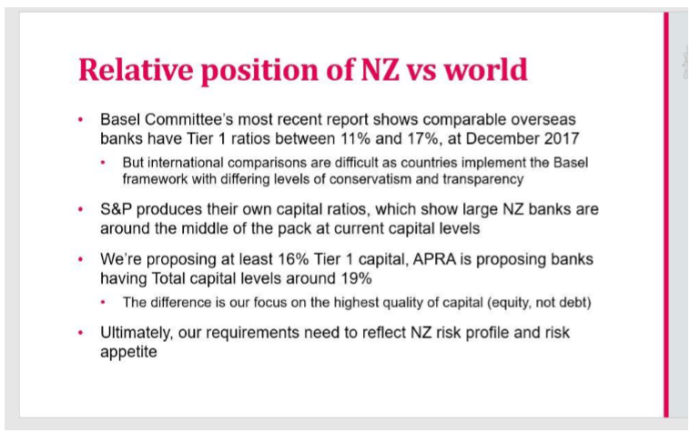
One piece they released was this slide they had used in a presentation to the Minister of Finance on the day the Governor made his public comments.
MOF slide.png

The comparisons with Australia –  surely the most relevant? –  are simply asserted, with no supporting evidence or analysis (nothing that, for example, recognises that the Reserve Bank is proposing to pull up the floor (on the weights used in calculating risk-weighted assets in the first place) much further than Australia has done).  Nor do they acknowledge to the Minister that the sorts of capital they propose to rule out not only does the job in the event of a bank failure (and bank failures of trans-Tasman banks are inevitably going to be handled in a trans-Tasman way), but is much less expensive than what they are proposing to require.

In any case, this slide is not analysis, and we do not gain any insight from being told that the Governor told the Minister the same as he told the journalists.  In reality, it seems to be enough for the Bank to say it is “hard to do” the comparisons, so do not expect us to do them.

You will have noticed a couple of other comparisons on the slide. They are covered a bit more extensively in a document described as

Media resource: international comparisons of bank capital ratios, 12 December 2018

That was the day before the consultative document was released.  Presumably some people have had this document for months, and yet the Bank took two months to release it under an OIA.

Among the shonkiest bits of the document is a comparison (using World Bank data) of the unweighted 2017 ratio of total capital to total assets.  Of the seven other countries they choose to cite, New Zealand conveniently would sit almost bang on the median  But so what?  First, these proposals are to markedly increase the amount of capital banks in New Zealand have to hold: in fact on the numbers the Bank uses in that stylised table (see above) total capital to total asset after these changes were implemented would be above those of any of the seven other countries the Bank sought to compare us with.  And second, and perhaps more importantly, the reason why capital frameworks focus on risk-weighted assets is that not all assets have similar risk characteristics: the balance sheets of New Zealand banks, for example, look very different to those of US banks.

But I suspect the Bank itself doesn’t really regard that data as relevant.  They seem to put most weight on the S&P framework, and some on the BIS comparisons.   I dealt with both of those at some length in my post on Geoff Bascand’s February speech.   Of the BIS comparisons I noted then

All else equal, a 16 per cent capital ratio calculated on Reserve Bank rules could easily be equivalent to something like 19 per cent in many other countries’ systems.   And not even the 95th percentile of G-SIB banks will –  according to the BCBS table –  have a Tier 1 capital ratio of 19 per cent.

But here is the rather plaintive tone of the Bank’s comments in the 12 December document, finally released now.

S&P RB

“We acknowledge that there is a genuine interest…..which cannot easily be met”.    Give us strength.  Well, give us a rigorous and robust official agency, because on this sort of evidence we certainly don’t have one at present.

Here is some of what I wrote about the S&P numbers in February

The rating agency S&P engages in its own attempt to calculate risk-weighted capital ratios for a large number of banks, using its own risk-weighting framework.   But a great deal depends on the “economic country risk score” the S&P analysts assign.    And they take a dim view of New Zealand, assigning us a score of 4 (on a 10 point scale).  Here is what that means for housing risk weights

S&P risk weights

And there are similarly large differences for the corporate risk weights.

As I said, S&P gives New Zealand a 4.   But Sweden, Norway, Belgium, Switzerland, and Canada all get a 2.    You might think there are such large systematic economic risk differences between New Zealand and those countries, but I doubt the Bank really does, and I certainly doubt. I wrote about this a few years ago where I noted

The S&P model appears to put quite a lot of weight on New Zealand’s relatively high negative NIIP position. But I think they are largely wrong on that score too. First, the NIIP/GDP ratio has been fluctuating around a stable average for 25 years now. That is very different from the explosive run-up in international debt in countries such as Spain and Greece prior to 2008/09. But also the debt is largely taken on by the government (issuing New Zealand dollar bonds) and the banks. No one seriously questions the strength of the government’s balance sheet, or servicing capacity, even after years of deficits. And the ability of banks to borrow abroad largely depends on the quality of their assets and the size of their capital buffers. If asset quality really is much poorer than most have recognised, rollover risk could become a real problem, but it isn’t really an independent source of vulnerability.

Score us as a 3 or even a 2 and suddenly the Deputy Governor’s chart will have the implied capital ratios for New Zealand banks a lot higher.

The Bank knows all this, but despite attempting to rely on these numbers they make no effort to highlight the limitations (and there are others with the S&P methodology).

As I noted in that earlier post

There aren’t easy right or wrong answers to some of these issues, but the uncertainties just highlight how much better it would have been if the Reserve Bank had engaged in an open consultative process at a working technical level, before pinning their colours to the mast with ambitious far-reaching proposals.

(Incidentally, I see that I also made this point in February.

As another marker of what is wrong with the process, the Deputy Governor told us yesterday that the Bank will be releasing an Analytical Note on the Bank’s estimates of the costs of their proposals: it will, we were told, be out in a “couple of weeks”, by when two-thirds of the (extended) consultative period will have passed.

That Analytical Note still hasn’t been published.)

In truth, despite the Governor airily declaiming that his proposals are nothing to worry about, and comfortably within the range of international requirements, so far they have produced no evidence or analysis that could lead reasonable observers to share his confidence.  That simply isn’t good enough.

There is no sign, for example, that the Bank has ever seriously engaged with APRA and in a mutual process sought to robustly assess how each regulator’s proposals would apply to the same portfolio of assets.    If the two agencies both agreed on the results, I’d probably be persuaded (not necessarily that we need such high ratios, but on the relative demandingness of the two sets of rules themselves).   Similarly, they have made no effort to sit down with the regulators in the countries with the (apparently) most demanding capital rules (Sweden?) and look at how their rules and those the Reserve Bank are proposing might work out (in terms of required capital) for the same portfolio of assets.  It might not be easy to do, but….that is what we fund the Reserve Bank and pay Reserve Bank staff for.  There are huge amounts of money involved here  (my former colleague Ian Harrison called it The 30 billion dollar whim and, on a quite different approach I suggested that the Bank’s own guesstimates of the real economic costs could easily capitalise to $15 billion).

With no sign that the New Zealand financial system is imperilled –  recall that the Bank itself tells us every six months that it is strong and stable –  there is no obvious a priori case for much higher capital requirements: any such case needs to be made rigorously, in detail, with lots of careful scrutiny.  In other words, in ways quite unlike how the current ambitious proposal has been done.   It may have been the outcome of a meandering multi-year process (on lots of things other than the minimum ratio), but in the end it looks a lot like the fruit of a gubernatorial whim, without even the decency of constructing a robust ex post rationalisation that would withstand serious scrutiny.

That simply isn’t how policy in a serious country should be made.   And the frightening thing about the New Zealand system is that if the initial proposal was one man’s whim, the same one man is the final decision maker: prosecutor, judge and jury in his own case, with no subsequent rights of appeal.  There is no decisionmaking board, no separation of management from final decisionmakers, no powers for the Minister of Finance to have any say.  Just one unelected man pursuing a whim.

(If you still happened to think that policy advice in New Zealand was that of a serious country –  actual whether you do or don’t –  don’t miss checking out Eric Crampton’s post yesterday on a new adventure and enthusiasm for The Treasury.   As a flavour

Imagine surprising Aotearoa with a strain of compassion so delightful that it re-wires our collective consciousness!

Don’t miss clicking through to the feelings game.  You too might want to spend $113.85 on a set of feelings cards, devised by a business set up by a former Treasury staffer who

She saw an opportunity for her and other people within the Ministries to more deeply, creatively and energetically serve New Zealanders by bringing more of their hearts to work and being able to more empathetically connect with colleagues, staff and service end users.

Spare us.   As one of New Zealand most eminent economists, now resident in Canada, put it “if I were dead, I’d be rolling in my grave”  )


Indicators galore

The Government Statistician can’t manage a census competently, and won’t tell us (let alone MPs) just how bad the situation is (about a census taken more than a year ago), but today – aiding and abetting the government’s Wellbeing Budget branding – she was out with the final list of indicators to be published in this brave new world.   It goes under the label “Indicators Aotearoa”, and in addition to not being able to run a census, she seems –  in common with many public servants –  to have forgotten the name of the country: New Zealand.

Among the list of indicators –  many of which are already published (and thus you wonder what value there is in one set of bureaucrats prioritising them and putting them in one place) –  was this snippet.

indicators

I don’t have too much problem with suicide rates.  They are reasonably hard and somewhat meaningful data (but comparisons across time and across countries are hard).

But the other three made almost no sense.

Take that “spiritual health” indicator –  well, there is no indicator yet, but an aspiration to have one.  Real resources are being wasted on this stuff.    Who knows what business it is of the government to be measuring “spiritual health”, whatever it means?  And, strangely, it appears that the Government Statistician believes that only the “spiritual health” of Maori people (or was that “Maori society”?) matters.  Are we back in taniwha territory again, or perhaps the Governor of the Reserve Bank is helping with his enthusiasm for the tree god (although I gather the Governor isn’t Maori so his affinity presumably doesn’t count).  As readers know, I’m a Christian, of a fairly orthodox variety.  The General Confession of the Church of England’s 1559 Book of Common Prayer –  Anglicanism having been the most prominent religious strand in New Zealand for most of its history –  reads (emphasis added)

ALMIGHTIE and most merciful father, we have erred and straied from thy waies, lyke lost shepee we have folowed to much the devises and desires of our owne hartes. We have offended against thy holy lawes: We have left undone those thinges whiche we ought to have done, and we have done those thinges which we ought not to have done, and there is no health in us,

It goes on to talk of restoration and penitence, but “there is no health in us” is pretty basic to orthodox Christian belief. Our hope is only in grace.

Now, perhaps, not being Maori, my lack of spiritual health won’t bother the Prime Minister and the Government Statistician, but what about the Maori Anglicans?

The whole thing is absurd, lacking content.  Simply pandering in a way that makes even more of a joke of the framework –  itself, in part a way of distracting attention from decades of economic failure.

Then there is the language development and retention one  –  again, no actual indicators only aspirations.   Apparently it is a problem for the Government Statistician and the Prime Minister if an ethnic Chinese New Zealander whose ancestors came 100 years ago doesn’t speak Chinese.  Or a descendent of a Dalmatian immigrant who doesn’t speak Croatian?  Isn’t that a matter of (a) probably, assimilation, and (b) choice?   What business is it of the governments?  Isn’t the ability to speak English much more important?

What is this nonsense?

And then we have the “sense of belonging” to New Zealand which –  according to the Government Statistician –  is an “important aspect of being a New Zealander”.  Except that….if you were born here and have lived here all your life, you are unquestionably a New Zealander, however you might answer an SNZ survey.    I haven’t lived here all my life, but I have no other citizenships (or rights to them) but how would I answer the question?  I don’t know.  “New Zealand” certainly isn’t my first loyalty, I feel a fairly strong affinity for the wider Anglo world, and I’m a minority in New Zealand but an adherent to a faith that transcends national, ethnic or whatever boundaries.  Globalists –  of whom I’m not one –  will probably (rationally) tell the interviewer they identify with “the world”.  And what of it?   Sure, a number emerges from the survey, but it will mean almost nothing, and its place in this suite of indicators will encourage officials and politicians to think it is something they should try to use policy to influence (all sort of daft interventions might “work”, but to what end?).

Couldn’t the Government Statistician just get on with doing the basics right?   And if the government were to take seriously doing something about reversing the longrunning decline in our relative productivity performance, it would open up options to improve all sorts of things that, individually or collectively, we care about.  Probably wouldn’t do much for (Maori) spiritual health, should they ever be able to “measure” it.


Economics, economic policy, public policy

Yesterday afternoon I attended a forum at Victoria University arranged to discuss ideas in a paper written by Gabs Makhlouf, the outgoing Secretary to the Treasury, and one of his staff, Udayan Mukherjee (currently doing masters study at Cambridge).  The paper is still described as “draft for discussion”, but that apparently includes wider discussion (I checked and the authors didn’t mind it being more widely quoted).

The paper is under the title “Economic Policy in the Public Square: A Perspective from New Zealand”, and is 30 pages of reflections on a variety of issues around economics, economic policy, and public policy more generally.  I’m not quite sure what motivated the paper, although The Treasury has faced some criticism –  mostly justified in my view – in recent years around such things as an apparent de-emphasis on economics skills, and various aspects of the Living Standards Frameworks (including caricatured representations suggesting that some previous generation of advisers or policymakers had once thought GDP was everything).   At very least, some of that criticism must have been context for the Secretary to the Treasury to have devoted his scarce time to such a project.

The paper itself didn’t end getting that much attention in yesterday’s forum: Mukherjee gave a fairly brief introduction, and then we had three panellists (one foreign PhD student, and two of the eminent figures of New Zealand economics, Arthur Grimes and Gary Hawke), each of whom had their own hobbyhorses to pursue, and the discussion constantly seemed to veer towards universities and what they should teach, or which courses a budding economist should pursue.

There were bits of the paper I quite enjoyed. I’m a history buff and any time someone addresses the history of economic policymaking in New Zealand I’m interested (Mukherjee is apparently doing work in this area for his masters).  I quite like playing devil’s advocate (mostly because I think it is actually a correct interpretation) around the contribution to economic policy of Sir Robert Muldoon (quite a lot of liberalisation happened on his watch, in very challenging times, even as some very costly choices – especially around Think Big – were made late in his term), and so it was good to see Jim McAloon’s book on post-war economic policymaking cited.   I’m less persuaded by their suggestion to de-emphasise debates about the post-1984 reforms (that suggestion seemed, consciously or not, more likely to reflect the fact that one author wasn’t here at the time, and the other hadn’t yet been born).   The biggest upheaval in New Zealand policy (economic or otherwise) for generations is inevitably a key point of reference, especially as policy subsequently has largely descended into somnolence.

But if there are interesting snippets, the paper overall seemed to be a bit of a muddle, especially for a piece carrying the imprimatur and co-authorship of one of our most senior public servants and policy advisers.  If the paper is ever revised and finalised (and Makhlouf will soon have time on his hands) I think it could do with quite a bit more work.

Thus, you’ll notice the title of the paper.  The suggestion is that the paper is about “economic policy”.  They don’t define that term, but I think it wouldn’t be unreasonable to take it as including macroeconomic policy (overall fiscal policy, monetary policy, perhaps financial system regulation) and things that are directly focused on overall economic performance (whether economywide or sectorally).   One could think of (most of) immigration policy, R&D policy, policy around trade agreements, tourism policy or whatever.  On such important issues, it seems pretty unquestionable that we should form our public service expert advice, primarily (although of course not exclusively) from an economics perspective.  On some of those sorts of issues, international perspectives and literature will provide most of what is needed. On others, there will be some distinctive New Zealand perspectives and angles.  We need advisers who are able to draw on (substantially economic) theory, evidence, and experience, debate and distill what is relevant and what (probably) isn’t, and so on.   That is particularly so when The Treasury is offering a perspective on proposed policy initiatives or expenditure (you might expect individual sectoral agencies to have a wider range of skills and expertise).

But to the extent there is a debate, I don’t think it is about those areas, or the centrality of economics expertise in shaping policy analysis and advice on them.  The Treasury hasn’t been very active in generating serious advice on productivity –  they might say they’ve been underfunded, or had masters who weren’t interested –  but I doubt they’d seriously suggest that if they were going to do much work in this field that economics/economic history wouldn’t be the primarily relevant set of skills.  The review of the Reserve Bank Act is being led by people with a pretty strong economics background, and appropriately so.

There is also some lack of clarity in the paper about whether they are talking about policymaking, or policy advice and the analysis that informs it.  Often they talk about policy makers, but mostly (I think) they means advisers (like themselves, although not necessarily limited to the public service).   Policymaking is mostly done by ministers (and, to their credit, Makhlouf and Mukherjee push back against suggestions that more policymaking should be done by independent agencies) and no one thinks that a formal economics training should be some sort of prerequisite for getting to sit in Parliament, let alone the Cabinet (even serving as Minister of Finance).  For what it is worth, Donald Trump’s degree majored in economics.  (Margaret Thatcher did chemistry, Roger Douglas accounting.)

But perhaps the more worrying conflation is around what sort of policy we are talking about.  Specifically, the authors do not draw any sort of distinction between things we might more normally think of as “economic policy” (see above, and the title of their paper) and “public policy” more generally.

If, as a Cabinet minister (or a voter) I wanted public service advice on the appropriate specification of an inflation target, or on positioning New Zealand to cope best with the next serious economic downturn, it is advice informed by economics that I should want, and would benefit from.     There may be some other useful perspectives, but they will be peripheral in nature.

But if, as a Cabinet minister (or a voter), I wanted advice on the appropriate freedom of information legislation to adopt, economics isn’t the set of skills I would sensibly be first looking to.   Same might go for abortion policy, or policy around freedom of speech, or defence policy, whether New Zealand should be a republic, or policy on scandalising the court.  It isn’t that there are no relevant insights that economists might offer on such issues, or questions they might pose –  including the always-relevant issue of resource constraints and opportunity costs – but it is unlikely to be the most useful paradigm (or even set of paradigms) for informing and framing decisions ministers and MPs have to make in such areas.

A senior Treasury official recently mentioned to me a conversation with another public servant, who had posed the question “if I’m doing public policy [perhaps “doing public policy well”], am I doing economics?”      To which the answer surely has to be, and should be “not necessarily”, and “it depends”.  Top-notch senior public servants need to be able to discern which skills and experiences, and formal frameworks, are relevant to which issues, and hire (and contract in, and consult) accordingly.

Many of these issues seem to resolve to the staffing and role/clout of The Treasury.   I happen to think that huge spending departments (eg Health, Education, and MSD) would benefit from having a stronger economics perspective in their policy advice and evaluation activities, but I doubt anyone thinks the policy and research functions of such agencies should be stocked only with economists.   But is it reasonable to expect that a small central agency such as The Treasury will be able to maintain anything like critical mass in the sorts of disciplines central to the advice and practice of these spending ministries? (One could say the same about climate scientists for example.)  I doubt it.   And thus, it still seems likely that when Treasury is challenging and reviewing ministries’ spending or regulatory proposals, the discipline they can most usefully and consistently bring to bear is economics (and, perhaps, some basic accounting).  It should be a matter for ministers, meeting as a Cabinet, to determine what weight to put on a Treasury perspective, as opposed to the perspectives of other expert advisers, and their own wider “political” considerations.  If there was a brief period when The Treasury (and its paradigm) was in some sense “too dominant” that was, in the end, a political choice.

In the end, there is a great deal of straw-manness about the Makhlouf/Mukherjee paper.  The authors quote the line from the former Secretary to the Treasury, Henry Lang, about “a fine mind” being more important than any specific formal academic qualification in a particular discipline.    They also note the importance of communications skills.  And they repeat a great quote from Keynes

“the master-economist must possess a rare combination of gifts. He must be mathematician, historian, statesman, philosopher – in some degree. He must understand symbols and speak in words. He must contemplate the particular in terms of the general and touch abstract and concrete in the same flight of thought. He must study the present in the light of the past for the purposes of the future. No part of man’s nature or his institutions must lie entirely outside his regard. He must be purposeful and disinterested in a simultaneous mood; as aloof and incorruptible as an artist, yet sometimes as near to earth as a politician”

Has anyone ever argued that a narrow economics training is the only useful or appropriate qualification to be a good Treasury official, or a top public servant more generally?  I don’t believe so.  Of course, narrow expertise (of all sorts) has its place, and perhaps in a small country we are more at risk than larger countries of not even having those deep reservoirs of specialist expertise.

But isn’t Keynes’s conception –  although articulated as applying to a “master-economist” –  actually true to a considerable extent of what we should be wanting from the top-tier of public service policy advisers, whatever academic discipline they have taken their first degree in?   It is things about character, breadth, and depth, ongoing intellectual curiosity and sound judgement that are likely to be the key considerations (as distinct, say, from keeping on side with the State Services Commissioner).    I happen to think we should be recruiting as Secretary to the Treasury someone with credibility among economists, but it wouldn’t be close to the only thing I was looking for, and I can think of many senior economists who would be quite unsuitable for the role.  And there are plenty of people who took a broad range of papers at university, who have more or less given up on intellectual drive or curiousity by the age of 40, and are content to repeat (perhaps with some energy) current mantras and conventional wisdom in their middle age.    Trained in economics or not, such people are dangerous (if only because they fill spots which should be occupied by someone nearer that Keynesian vision –  if perhaps with a bit more humility, and awareness of the crooked timber of even the greatest official, than perhaps Keynes tended to foster, in himself or others.)

This post has gotten rather long and discursive.  Perhaps I would just end with one final point. The focus of the paper tended to be on the public service.  And yet a strong public service and effective policymaking is more likely when there is a strong academic contribution.    Unfortunately, there are not many academic economists making a prominent contribution to debate on economic issues (or an economic perspective on other issues) in New Zealand.  The incentives for them to do so are not particularly strong, and if there is one thing economists tend to agree on it is that incentives matter.  Perhaps the Treasury, in its stated desire for economics to play a bigger part (the Secretary talked in his closing remarks of this as “a moment in time” when economists “can really make a difference”), might look to their advice around incentives in the academic context. I’ve told before the story about the conference the Reserve Bank and Treasury hosted in 2011.  We were offering substantial amounts of money (by academic standards) for papers that might shed light on issues around (New Zealand)macroeconomic imbalances, productivity underperformance etc.   We managed to sign up the Irish academic who is shortly taking up the job of chief economist of the ECB.  We couldn’t find a single New Zealand academic willing to take up our offer.


The Reserve Bank tries to explain wages…..or not

On Friday afternoon an email turned up from the Reserve Bank of Australia with this simple message

Draft copies of papers presented at the Reserve Bank of Australia 2019 Conference – Low Wage Growth – held from 4 to 5 April 2019 have been published on the Bank’s website.

That looked interesting, so I clicked on the link to the papers and found that the very first one was by a Reserve Bank of New Zealand author – not just a junior researcher, but someone who is now manager of their (economic) modelling team.   The paper had the title “New Zealand wage inflation post-crisis” which, of course, immediately grabbed my attention.   I’ve written quite a bit here about wages in New Zealand, including (in recent months) here and here.  My take has been that, if anything, wage growth in New Zealand has been surprisingly strong, given the weakness of productivity growth (most especially in the last five or six years).

There is some interesting material in the Reserve Bank paper, including the use of the highly-disaggregated data available from Statistics New Zealand’s IDI and LBD databases (my reservations of principle about them are here).  For example, the author looks at the possible contribution of industry concentration.  In the US context,

Recent commentary has highlighted the role that industry competition may play in suppressing wage inflation. The hypothesis is that firms in very concentrated industries can act as a monopsony buyer of labour, and therefore suppress wage inflation through their market power.

But

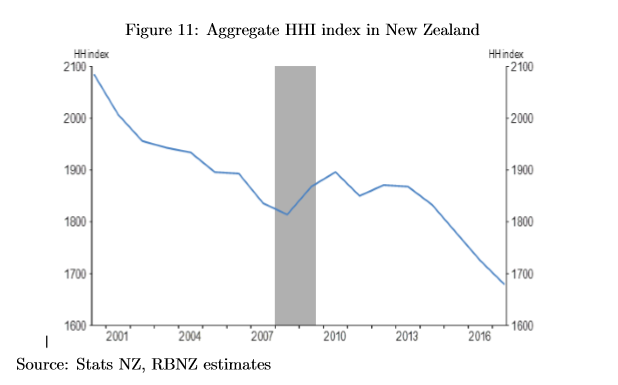
First of all, industry concentration has actually decreased in New Zealand over the past two decades (figure 11). This is in contrast to developments in the United States.

HH index

That apparent reduction in concentration surprised me a little, but it isn’t my area at all.  The author goes on to note

To account for the potential for different characteristics of workers in different industries, we have matched workers in high and low concentration industries across a range of other characteristics. Figure 12 presents the wage growth differential for matched individuals in the 2011 cohort. The figure shows that, when accounting for the different characteristics of employees across industries, those in concentrated industries tend to see slightly higher wage growth than those in more competitive industries.

Interesting, but (as they note) experimental.

But right through even that discussion, the author starts from the presumption that there is a puzzle to explain, in the form of low wage inflation.

As a reminder, this chart shows cumulative increases in New Zealand wage rates relative to cumulative growth in nominal GDP per hour worked.  A rising line suggests that, on this measure, wage rate increased faster than (loosely) the earnings capacity of the economy.

lci wages vs gdp

(Nominal) wages have been rising faster than (nominal) productivity, and there is no very obvious difference between the trend in the years running up to the 2008/09 recession and those since.

Not inconsistent with that is the labour share of total GDP, which has held up considerably more here (in the last 20 or 30 years) than in many other advanced countries.

labour share 2018

But not a shred of this appears in the Reserve Bank’s conference paper.   In fact, the thrust of the paper is such that it appears that they mostly see wage inflation and CPI inflation as the same thing, and so the paper falls back on the lines they’ve been trying to run for years as to why inflation has been so low (hint: because monetary policy was, on average, a bit tight).

This is from the Abstract

Nominal wage and consumer price inflation have been subdued in New Zealand post crisis, particularly since 2012. This paper discusses a number of candidate explanations for these muted nominal wage inflation outcomes. The most notable explanations include: a gradual absorption of spare capacity amongst New Zealand’s major trading partners; sharp declines in oil and export commodity prices in 2014/15; a significant rise in labour supply, and less inflationary pressure stemming from migration; and a change in price setting behaviour, with inflation expectations becoming more adaptive.

Basically, despite the title, it isn’t a paper about wage inflation –  which would surely focus substantially on what happened to wages given all else that had gone on in the economy – at all.

Consistent with this interpretation, I searched the document, and the word “productivity” did not appear at all, and yet in almost any possible story about longer-term wage growth, labour productivity should be one key consideration.     The author shows various charts of elements of the Bank’s forecasts they got wrong over the last decade, but again the productivity forecasts don’t appear.   Government agencies (Reserve Bank and Treasury) have done consistently badly on that score.

Carrying on with the search function, “terms of trade” didn’t appear in the paper, and nor did “investment”.

At the Governor’s speech a couple of weeks ago, a retired academic in the audience asked the Governor how the Bank was going to get away from what he (the academic) characterised as past Reserve Bank tendencies to treat wage inflation as basically the same thing as general inflation and, therefore, something to be jumped on.  The gist of the question seemed to be the (entirely reasonable) point that income shares can and do change over time, and that a changing income share (up or down) is not the same thing as inflation (or deflation).  I was a bit surprised at how the Governor answered –  he basically didn’t.  I’d thought it would be an opportunity for an expansive comment on the rich new research programme the Bank had underway, consistent with the revised mandate (and the rhetoric around it).

But this paper suggests the Bank hasn’t got far at all.  There is clearly some interesting exploratory micro-data work going on, but it appears to be of limited reach at best.  There are reasonable and interesting questions to ask about why inflation has been so low at surprisingly persistently low interest rates  (those are questions we really expect central banks to be answering).  There are important questions about why productivity growth in New Zealand has been so poor (for so long), and about why relative to that poor productivity growth wage rises in New Zealand have been quite strong (perhaps more so than in many other countries).

One can mount a reasonable case that those latter questions aren’t a prime concern of the Reserve Bank –  you can have price stability with high or low productivity growth, weak or strong labour income shares, and so on (inflation being primarily a monetary policy phenomenon).  But when you send one of your senior economists out to the public domain to speak on New Zealand wage inflation in the last decade or so, it is pretty astonishing that none of these considerations even get a mention, and instead you have a whole paper built around a misleading prior, that we should be surprised by how weak wage inflation has been.  To the extent there is a problem in New Zealand, it is more that overall economic performance has been poor, and within that underperformance, wage earners have at least held their own.

But I guess that –  whatever the facts –  isn’t a narrative the Governor would be keen on adopting.


Not happening (at least under this government)

I’ve had a couple of posts (here and here) this week prompted by Phil Twyford’s generally encouraging recent speech about fixing the market in urban land, in ways that might –  in his own words –  flood the market with development opportunities, and thus materially lower land prices in and around our cities.

My bottom line: I see no reason to believe that far-reaching reform –  in ways that might make a real difference, as distinct perhaps from just some rewritten laws – is actually likely to be implemented under this government.   We have a weak government, united on relatively little, and there is no sign that serious reform in this area is a prime ministerial priority.  A mere fifteeen months from now the election campaign will be in full swing.

More importantly, market prices suggest that people transacting in the urban land market don’t believe it either.

There was another excellent illustration in this morning Dominion-Post as to why one would be foolish to put a high probability on such reform happening.   It appeared in the form of two articles, one with the (hard copy) headline of “Where will Wellington grow?”  and the other with the hard copy headline “Tough Choices”.  I’ll set to on side for now the point that with a sensible immigration policy, the abolition of corporate welfare and longstanding New Zealand birth rates the city probably wouldn’t be growing at all –  as I pointed out recently, it is not as if stellar productivity growth is some irresistible lure.     Wellington City Council can’t be held responsible for New Zealand population growth, so lets grant for the sake of argument that the population probably will keep on rising.

There are Labour mayors in all three of our largest cities. But it is worth recalling that the Wellington City Council is one the most woke-lefty outfits in the country –  if any council is well-aligned with the government it must be them.  It has a Labour mayor who surely has national political ambitions, several Green councillors, and deputy mayor who if she had her way would strip out all reminders of the Anglo heritage and culture of the bulk of the population, and even the councillors who are not from Labour or the Greens are mostly only a softer shade of pinky-green.  The same issue of the newspaper reports council officers questioning the “appropriateness and relevance” of street names in my own suburb, mostly named for various British and European rivers.  As I’ve noted previously, it must stick in the craw of councillors and their staff to have their offices on (Edward Gibbon) Wakefield St and (Queen) Victoria St and their (well, our) city named for the Duke of Wellington.

This is the opening of the article

City councillors are bracing themselves for a “nimby” backlash as a major plan to find space for 80,000 more Wellingtonians to live goes out for public consultation.

Councillors voted unanimously this week for their spatial plan to go out for feedback.

and goes on to note

The council’s spatial plan posits four scenarios that people will be able to provide feedback on: one centred on high-rises in the CBD, another focused on building upward in suburban townships, a third creating a new suburb in Ohariu Valley and a fourth scenario extending developments at some existing greenfield sites.

No sense anywhere of letting the market work, in response to the revealed preferences of prospective purchasers. No sense of getting the pricing right (for infrastructure connections etc) and then letting things develop in an evolutionary way. No, it is all a matter for councillors to choose, for councillors to “make space”.   And, of course, all led by the Council’s (Australian) Chief Planner.

One councillor notes that

councils were required by law to have a plan for expected growth and Wellington had “no choice” but to come up with a plan to accommodate the extra 80,000 people expected in the city over the next 30 years.

Perhaps, but why couldn’t that plan be, we will get the pricing right, we will allow for appropriate differential rating, we will build (or allow to be built) connections pretty much as required, we will facilitate intensification where local property owners are agreeable, and then let people and the market take it from there?  An abundance of competitive development opportunities – a superfluity –  is what keeps prices down.

That sort of approach might look something like the fine words from Phil Twyford. But not a single comment, from councillors or council staff, in the article suggests anything like that sort of mindset.

If the government were really serious about thoroughgoing reform, wouldn’t it have been an ideal opportunity to have sought to work with their ideological allies on the Wellington City Council to make it happen here – to actually lead the way and bring land prices back to something more like the value in the best alternative use?

Instead, we have the right-on Labour mayor, emphasising not choice, not facilitation, but his own ideological preferences, all supported by the bizarre rhetoric of having to “squeeze people in”, when Wellington City (let alone the greater Wellington region has abundant land).

When mayor Justin Lester is asked for the scenario he wants he just points up

As I understand it, he himself lives in a low-rise family home in a quiet suburb.  But apparently he thinks it is up to him to determine that many fewer of the next generation would have that opportunity.  His Chief Planner is clearly right behind him –  his distaste for a physical expansion of the city seeps through in almost every comment in the article.

It is a democracy, and too much power in such matters rests with councillors and their staff.  My point here isn’t so much to champion an alternative model –  much as I would support one –  as to make the point that anyone who doubts the government is serious about thoroughgoing reforms and significantly reducing land prices in and around our cities, need only look to the lead being provided by the government’s close ideological allies at the Wellington City Council.

As the Dominion-Post articles suggest, there is likely to be lots of blowback against the options preferred by the council (intensification and more intensification) and so in the end whatever gets approved will be some sort of lowest common denominator.  There will be more houses built over time –  as there have been in fast-growing cities around the country in the last 30 years –  but never enough land-liberalisation to ever create a sustainable rational expectation that future land prices in and around our cities will be materially lower than they are today.

Perhaps one day reform will really happen, and prices really will sustainably adjust.  But, as yet, there is nothing in the wind –  whether from the Prime Minister, or Labour mayors or Labour/Greens councils – to suggest it will occur on this government’s watch.  And the young and the poor  (especially the young poor) will be the ones who pay the price, in lost opportunities.

Xinjiang: an opportunity for Ardern and Bridges

On my way home this afternoon I listened to an interview, in the Sinica podcast series (on all sorts of matters Chinese), with Nury Turkel, chairman and founder of the Uyghur Human Rights Project.  For anyone at all interested in the subject it is well worth listening to.

As the interviewer himself put it, he is someone who is not generally seen as anti-PRC, and indeed regards himself as still being listened to to some extent by some of the more strongly nationalistic/pro-PRC people.  But he is clearly appalled at what is going on in Xinjiang, initiated and executed by the regime in Beijing.

In the programme notes there is this summary

6:44: Nury calls for a larger international coalition to decry the horrors in Xinjiang, and highlight the shadow that Uyghur internment will cast on the longer history of China, stating, “In the end, we want two things. One, we want the camps to be shut down. It’s an embarrassment to the Chinese people, even in their history. It needs to be shut down. And, two, we want to be able to restore the Uyghur people’s basic dignity. Give them their dignity and respect back.”

In the course of the discussion it was noted that while Beijing is not generally that receptive to international criticism and pressure at all,  some people are more likely to be listened to –  or be awkward for the regime – than others. Hardline permanent anti-Beijing hawks are easily brushed off.

But people, institutions, and countries that have toadied to Beijing at every turn are a different matter.  Much as I am critical of Jacinda Ardern and Simon Bridges I don’t believe either of them is likely to be comfortable with the atrocity that is Xinjiang.    Fairly or rationally or not, the Prime Minister now seems to carry with her  –  perhaps internationally even more than at home – some sort of halo of kindness, decency etc.  That image etc surely carries some responsibility.

New Zealand doesn’t matter much in the scheme of things, but precisely because our main political parties and successive governments have been such toadies, it would not be nothing –  in Beijing or in the rest of the world – if Jacinda Ardern and Simon Bridges rediscovered some moral core, some courage, some decency, and were willing (together perhaps) to openly and publicly deplore what is going on in Xinjiang.   (They might add in the plight of Falun Gong, Christian believers, and so on too).  To call it as it is: a moral stain, and one that blights the reputation of any leaders who just walk past quietly, or make excuses  (Todd McClay) for the atrocity.

Fairly or not, it often isn’t the people who strongly opposed evil from the start whom history remembers most favourably, but those who once walked with the perpetrators of evil and then stepped away and spoke up early enough.   The evil in Xinjiang has gone on quite long enough, that no decent person should any longer be able to turn a blind eye.  That includes New Zealand’s sycophantic officeholders.

For anyone interested in learning more, Sinica has a monthly article on the situation in Xinjiang.


Fruit-pickers, wages, and immigration

I’m not one of those who thinks wage and salary earners as a whole have had some sort of raw deal.  From time to time I’ve run this chart

lci wages vs gdp

suggesting that over the last 15+ years, wage increases in New Zealand (it is different in some other countries)  have outstripped that rate of growth in what I (loosely) term the earnings capacity of the economy: nominal GDP per hour worked, a variable that incorporates productivity growth and gains in the terns of trade.

To the extent there is some sort of “raw deal”, it is one the public has put up with: voting for politicians who, in office, do nothing about removing th roadblocks in the way of fixing our poor rate of productivity growth.  Fix that and we’d be considerably better off.  But across the economy we can’t consistently pay ourselves what hasn’t been earned.

But if wages growth across the economy has been, if anything, surprisingly high given the lack of productivity growth (I say “surprisingly”, but there are decent explanations as to why it has happened), there are still some wages puzzles.

One of them perhaps only puzzles public sector economist types who’ve never themselves had to make a payroll or face a market test for their services.

The Reserve Bank has long run a regular programme of business visits.  I always enjoyed participating (especially in visits well away from Auckland and Wellington) and often came away from the visits with a heightened admiration for the people who have built and maintained businesses, through good and bad economic times.    But there was one question that I never really got a satisfactory answer to.  In periods when the economy was doing well (for example the early 2000s) we would regularly hear from firms we talked to that it was really hard to get decent staff.   We’d nod understandingly, jot that down in our notebooks, and then ask “so what is happening to wage inflation?’ and “so are you increasing the wages you are willing to offer to get people”.  And often there was a look of almost incomprehension (perhaps it was really disdain for Wellington economists), and only rarely would anyone suggest that, indeed, it was really hard to get the right staff, and that they were paying over the odds to get people.  For some reason, a conversation on this issue at a firm in Timaru, probably in 2002, sticks in my memory.

There are strands to a possible good story.  Increase wages materially for new arrivals and before long you’ll have to increase them for everyone.  It is easy to raise wages and hard to cut them (if labour market or business conditions reverse).    Simply bidding more might attract a class of worker more likely to move on quickly if someone else offered a little bit more.  And so on.  So I get that there are reasons why wages move somewhat sluggishly (relative to, say, prices for oil or other commodities).  But I was always surprised at how weak a link managers/owners of private businesses appeared to draw between difficulty hiring and (what an economist would think of as) putative changes in the market-clearing price for such labour.

Which is all by way of introduction to a Stuff story I noticed yesterday about an industry having difficulty getting staff.   I’ve written previously about bus companies and bus drivers, and the bizarre situation in Wellington where the contracted companies get away with endless cancellations (with apparently minimal penalties) because they choose not to pay what it would take to employ the necessary number of drivers.  One might grant that that is a difficult situation –  a government-controlled “market”, in which both fares, operators, and service frequency are all supposed to be simultaneously controlled.

But yesterday’s article was about jobs in a fully private sector industry, with lots of individual employers, and with a significant export orientation: fruit-picking, including “grapes, apples, and kiwifruit”.  The article is quite a substantial piece, including a couple of quotes talking of a “dire” situation finding staff, and repeatedly talk of severe labour shortages.  And, remarkably, not one mention of wage rates.   It must not have occurred to the journalist to ask, let alone to the various employers (and employers’ representatives) to mention it.    Even though, when there is a “shortage” of tomatoes, tomato prices rise –  so that actual quantitity demanded at the going price is roughly equal to the actual quantity supplied.  At present, there is a “shortage” of avocadoes –  it gets a line perhaps somewhere in a newspaper, but prices adjust and so do (potential) consumers.

But not, it seems, in the fruit-picking industry.

The industry seems to think this is a problem for the government (admittedly, this is an approach fostered by successive governments, who also seem to think it is a “problem”, rather than (say) an opportunity for individuals who could capture the premium prices growers might otherwise pay to ensure their fruit was picked).  The article includes a quote from the head of something called the “Central Otago Labour Market Governance Group”, a title that sounds as if it could have been derived from some centrally-planned eastern European economy in the 1950s.

Perhaps there really is some movement in market rates for fruitpicking and the journalist just forgot to tell us. But if so, you’d have thought the industry representatives would have been keen to get the message across –  apart from anything else, it would be free advertising to people in those districts with a bit of time on their hands that there was (unexpectedly good) money to be had.

But again I’m left with a bit of a puzzle –  and perhaps it is only one to city-based macroeconomists – as to why a competitive bidding process isn’t at play.  One can understand the Wellington bus companies not raising wages (temporarily or permanently): they don’t have to, the passengers (mostly) bear the consequences, and entry to the business (Wellington bus routes) is restricted.  But for an individual grower (apples, grapes, kiwifruit or whatever), the situation is surely a lot different.  If there is a incipient shortage of pickers for the whole industry, that doesn’t mean your orchard has to miss out.  Offer better wage rates and presumably people will choose your orchard over another one down the street (on the other hand, choose not to compete and you risk fruit rotting on the tree/vine).  Of course, that invites the other orchards to increase their rates too, but that is how markets work.  And yet, if this Stuff story is to be believed, it doesn’t seem to be happening.  And that is even though much of the picking workforce seems to be itinerant or with no established and committed long-term relationships.  It isn’t obvious why offering more to pickers this year –  if the harvest is particularly early, or particularly good, or labour “shortages” are particularly severe –  need entrench higher rates for all time.

In fact, of course, much of the article channels an ongoing industry push to avoid paying higher wages to New Zealanders to do the job (not just this year, but permanently) by using the immigration system.  You might think that the case for using immigrant labour at times might be stronger than otherwise if there was evidence that wage rates in this industry had been rising particularly stronly (employers putting their money where their mouth is).  But apparently the industry doesn’t see it that way –  and neither (one deduces from their silence) does our current left-wing government, despite its key support base including workers and trade unions.

We are told

Key visa reforms sought by the industry include removing the need for annual reviews once a three-year visa is granted, giving those on three-year visas a pathway to permanent residency if no New Zealand residents are available for the job, and reworking the labour market test to make it more aligned with the employment conditions faced by employers.

It is fruit-picking we are talking about here, not the most skilled of jobs.  And an immigration system that, we’ve been told for decades, is supposed to be skills-focused, contributing to a lift in overall productivity growth, in ways that would raise wage levels for everyone.

As a reminder, there will be few/no/inadequate numbers of New Zealanders offering to work in a particular sector when wages (and overall conditions) in that sector are no longer particular attractive.  In the 1970s presumably our fruit was picked, our old people’s homes were staffed, our supermarket checkouts were staffed, by New Zealanders (whether those of longstanding or more recent immigrants –  but you couldn’t hire people from abroad specifically to fill these modestly-skilled jobs, and in the process keep down wages in that specific sector).

I presume much of what is going on here is that many of these fruit-based industries just aren’t that internationally competitive at current exchange rates. It probably isn’t the case with, say, gold kiwifruit, but for some of the other industries it seems quite conceivable that the economics is pretty tight and it might not be worth being in business if they had to pay materially higher wage rates to pickers.   There are hints of that in the article

“The growers are starting to think whether they are going to invest money because they need to have assurances about labour. It is a bigger issue than probably it is given credit for.”

To which I guess I have two strands of response:

  • first, there are lots of industries that are no longer viable here based on old production technologies (try making a living milking 50 cows by hand) or running a suburban petrol station (in my suburb there were four forty years ago and there are none now).  There might be issues of scale to consider, and/or investment in technology-based solutions, and
  • second, the real exchange rate (averaging more than 20 per cent higher since about 2003 than it did in the previous two decades, despite feeble economywide productivity growth) is a real symptom of the severely unbalanced New Zealand economy.  As a result, our export/import shares of GDP have been shrinking, not rising.    But however attractive the immigration option genuinely looks (and locally is) to an individual employer, on a large scale it exacerbates the economywide problems, not eases them.   For outward-focused industries in particular, a much lower exchange rate –  which would follow directly from substantial permanent cuts in immigration –  would improve NZD returns, and would also make producers in those industries better placed to bid competitively for New Zealand workers to fill their vacancies (or to invest in technological solutions, or the sort that help lift average labour productivity).

Firms simply shouldn’t be able to use immigration to fill positions requiring only modest skills or training without at least being able to demonstrate that the wage rates they are paying for such skills have run well ahead of other wage rates for several years.  But to get bureaucrats and ministers out of the business of picking favoured sectors/firms –  at present, the rewards to lobbying seem quite high – I continue to commend to anyone interested my model for temporary work visa policy.   It is pretty simple

Institute work visa provisions that are:

a. Capped in length of time (a single maximum term of three years, with at least a year overseas before any return on a subsequent work visa).

b. Subject to a fee, of perhaps $20000 per annum or 20 per cent of the employee’s annual income (whichever is greater).

If apple-growers really can’t get workers locally, and are happy to pay a substantial fee to the Crown, on top of a decent wage, I guess I’d be okay with temporary overseas recruitment.  As it is, they seem to simply want to undercut potential returns to New Zealand labour.

Three totally unrelated items

Rather than clutter in-boxes with three separate shortish emails.

First, a follow-on from yesterday’s post about house prices. I noted that the absence of any real sign of falling land prices in and around our cities suggests that the (admirable) words around possible reform from the Minister of Housing are not being treated as credible. Asset markets typically incorporate expectations about future changes in factors that might affect prices in the relevant market.

I had a brief exchange in the comments to that post with Eric Crampton of the New Zealand Initiative, and I see that Eric has now set out comments along those lines in a post on his own blog.

Eric’s key point is that it is hard to short houses. That is quite true, but not (I reckon) determinative. There is no traded derivatives market (eg a futures contract on the QV index, whether nationally or regionally), and although someone who would naturally own one house can sell that house and rent for a few years, it isn’t easy or cheap to do so (actual transactions costs are non-trivial, it is often hard to get a secure long-term rentals, many people have ties to specific neighbourhoods etc). Of course, many holders in other markets are pretty passive too – you can short US equities (say) but a huge proportion of holders are either in passive index-following funds, or in funds that allow only small deviations from benchmark.

But, to get back to the land (and housing) market in New Zealand. If hardly any suburban owner-occupiers (like Eric or me) are going to sell and rent, even if we believed – as Eric seems to – that substantial reform really is coming, there are plenty of other market participants, and it is the marginal choice that will drive the price. Young people starting out can make a choice to hold off buying for a few more years (they are already renting, so have no new transactions costs). Older people looking at trading down can bring forward that move by a year or two. And probably more importantly still, marginal players often aren’t owner-occupiers (actual or potential at all).

If, as someone owning rental properties, you believe the government is really serious, and change is really coming (in fact, even if you only believe it with a 50 per cent probability), you face a high chance of a large fall in the price of your asset over the next few years. A rational response to that expectation would be to sell now – to get out while the going is still good. If you had a bought a few sections in the outer suburbs thinking you might develop them a few years from now, if you believe the government is serious and change is coming, you would want to offload your land exposure now. And – for the really serious players – if you hold pockets of land, large or small, on the periphery of major cities, and have seen the value of that land sky-rocket as population growth and regulatory scarcity rewarded you, any serious prospect of a change in regime, in which peripheral land might once again go for something like its best alternative (farming) use, would surely see you reassessing now.

None of these effects are as instantaneous as (say) the fx market’s response to a Reserve Bank OCR announcement, or even the stock market’s response to possible corporate tax cuts, but they are real and efficacious mechanisms which we should expect to see already at work if the Minister’s plans are likely to be the real deal. Sure, if his speech to the New Zealand Initiative two weeks ago changed expectations – and it certainly impressed some people, including me – we won’t yet see the results in the data (house price data is at best available monthly, and decent land price data is even harder to come by). But that won’t be a credible story as the months roll by.

Of course, in any such experiments with non-instantaneous effects, it is hard to untangle precisely what part of any price movement is due to the specific factor one is trying to isolate. But if these reforms are really the big event the Minister suggests (recall that the aim was to “flood” the urban land market), the effects should be pretty apparent pretty soon (especially with a slowing economy, easing migration, extended brightline tests, ringfencing, talk of CGTs, tighter credit conditions and so on). I remain pretty sceptical, less (as I noted yesterday) because I doubt Phil Twyford’s intentions, than because I doubt the commitment of the government as a whole (the PM in particular), or its interest in actually seeing land and house prices fall materially.

My second item related to the Reserve Bank.  Yesterday, there were two emails from the Bank.

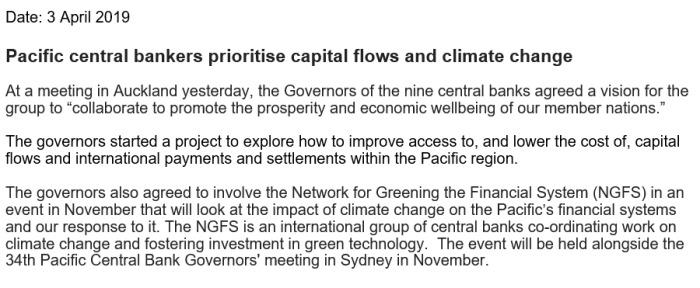
The first was this press release

pac c banksThis from an organisation that claims it is underfunded.  “Fostering investment in green technology” simply is no part of the Reserve Bank of New Zealand’s mandate.  Nor, to be blunt, does the Reserve Bank have any obvious expertise.

Perhaps I should be encouraged to learn that the Governor is going to focus on lowering the cost of capital in New Zealand (bearing in mind that our real risk-free interest rates have long averaged the highest in the advanced world), but I don’t suppose that is what he meant.

And the second email from the Reserve Bank was this

capital

I guess it is better than not publishing the material at all, but this new 65 page document is finally released more than 3.5 months since the consultation document, setting out the Governor’s plans, was published, and with only a month until submissions close.  I haven’t yet read it, but someone who has tells me that it still doesn’t deliver a proper cost-benefit analysis, and only promises that they will do one one day –  probably after the final decision has been taken, to provide support for whatever the Governor settles on.

This is no way to make policy on serious matters.  Meanwhile the Governor cavorts with his tree gods and dabbles in things –  green technology just the most recent example –  that are no responsibility of his.

Thirdly, and finally, why is the case of Shane Jones (Associate Minister of Transport), the Northland trucking company (owner by a donor and distant relative), the NZTA, and the prosecution, not leading all media outlets?  Why is the Prime Minister not fronting up and facing hard questions about acceptable conduct in her Cabinet?   Appearances of impropriety should not be tolerated, let alone substance.

Matthew Hooton’s tweet seemed apt

Reminding ourselves that Transparency International is itself largely government-funded.

Raymond Huo’s creative reimagining

In my post yesterday afternoon I mentioned that Labour MP Raymond Huo (he of various United Front affiliations and apparently regarded as close to the PRC Embassy) had an op-ed in yesterday’s Herald (strangely not apparently available on-line, although there is a photo of the article here). [UPDATE: Herald link working again.] As I noted, the article is welcome for Huo’s overdue indication that he will recuse himself from involvement in bits of the Justice Committee’s deliberations on the foreign interference aspects of the election inquiry “to avoid any perceived conflict of interest”.   Huo chairs that committee.

But the centrepiece of Huo’s article is a creative reimagining of history in which he tries to pretend that he (and his colleagues) had never opposed hearing from Professor Anne-Marie Brady.    There had never been any intention of blocking Brady, and they had just been waiting to consult the GCSB and the SIS before deciding whether to re-open submissions.  The whole thing was, he claims, a beat-up by National’s Nick Smith.

I doubt anyone really believes him, probably not even the other Labour MPs he persuaded to vote for blocking Brady (not then recusing himself), but in case there is any doubt, here is his own tweet from 6 March

The clear implication is that it was simply Professor Brady’s fault that she had not got on and submitted earlier (even though the deadline was before Andrew Little extended the scope of the inquiry).

Here is his quote from the article he himself links to:

Justice committee chairman Labour MP Raymond Huo said the decision to decline Brady’s late request was purely procedural.

The closing date for submissions was over five months ago on 23 September 2018 and the date was widely publicised by committee staff in the usual way, he said in a statement.

The Committee had asked the Security Intelligence Service, the Government Communications and Security Bureau and the National Assessments Bureau to appear.

“As committee chair, I am satisfied that the correct procedure has been followed and that the agencies will keep the committee well informed about any issues of foreign interference that may arise,” Huo said in a statement.

No hint there of someone who really wanted to hear all the evidence, all perspectives.

And, at the time, Huo was backed by the Prime Minister’s office

A spokesman for Ardern echoed Huo’s comments, saying: “Our position would be that this is a procedural matter for the committee and that the various agencies presenting are well placed to provide information on foreign interference and the threat of it.”

At the time, even some cheerleaders for the see–no-evil hear-no-evil approach to the PRC came out and stated that they thought Huo had overreached.  And, of course, a few hours later he was in full backdown mode, and is now trying to rewrite history to put himself in a less unfavourable light.  He doesn’t seem to have considered that actually fessing up and saying “yes, I made a mistake, I regret it” would be more likely to generate a favourable response.

Huo concluded his op-ed noting that “robust debate, not stereotyping or sweeping generalisations, will help examine the real issues”.  That is exactly what Professor Brady has been promoting, and what Raymond Huo (supported by his bosses and colleagues) seems, until now, to have been trying to avoid.   (To his credit, he actually wrote an op-ed.  National’s Jian Yang – he of the Communist Party membership, misrepresentations on official documents, and long service in the PLA military intelligence system –  just refuses to face English language media, protected in doing so by Simon Bridges.)

UPDATE: A reader writes to share the text of a letter of protest sent to Labour members of the committee after the initial blocking, and to the Prime Minister, and news of one Labour MP’s decent response.