Contemptible

I’m sure many, perhaps even most, of those who purport to be “leaders” in New Zealand are at some level decent people.  Mostly, they probably love their spouses, hope for the best for their kids, and at some private level many probably conduct themselves according to some sort of values and morality the rest of us might recognise.

But I’ve increasingly come to doubt that many (if any) in their public roles care for anything much at all beyond deals, donations, keeping their job, and perhaps the sugar-high of costlessly cheering on popular causes.  If the only true measure of the values of a (purported) leader is what they are willing to pay a price, or incur a cost, for, there aren’t many other values on display at all.

There is a myriad of issues which could be used to illustrate my point: in the economic sphere one could point to the utter failure to deal with the regulatory disaster that puts home-ownership out of the reach of so many (at a time when it should –  global low real and nominal interest rates –  be more readily achievable than ever), or the indifference and lets-pretend approach taken to the decades-long disaster that is the New Zealand productivity performance.  How does almost anyone who has been in elected government over the last 25 years not hang their head in shame?

But the issue that finally crystallised my own total disillusionment with “leaders” in New Zealand is the obsequious, deferential, cowardly, values-free approach taken to the People’s Republic of China, which continues to deepen even as the regime’s excesses, including attempts to exert influence in New Zealand, become more apparent and better known.    Perhaps  –  not really though, these were the butchers of Tiananmen –  there were excuses 15 years ago (all those somewhat-deluded dreams of the PRC evolving towards (semi-free) Singapore). But even if there were excuses then, there are none now.  It is hard to think of a single dimension on which the CCP-controlled PRC operates according to the sorts of values, practices and precepts which New Zealanders have typically sought to live by, and which New Zealand has been willing to fight for.  No rule of law, no freedom of speech, no political freedom, no religious freedom, mass incarceration of minorities who fall foul of the regime, kidnapping of law-abiding foreigners, sustained and intensifying threats to a free and democratic neighbour, claims to the loyalties of ethnic Chinese in other countries (regardless of citizenship), wholesale state-sponsored intellectual property theft, attempts to shutdown critics in other countries, and so on.   There is mounting evidence of the aggressive activities of the regime in New Zealand and countries like ours.

And yet our leaders –  political, business, religious or whatever – almost without exception say nothing, ever.  And do nothing either, other than continue to pander, to ask only “how high?” when the regime suggests that jumping might be a good idea.  Deals, donations, customers I guess.  Never mind any sort of morality, any sort of decency.  Any meaningful values.

We’ve seen it on display this week, in two cases that directly involve the activities of the PRC embassy and its consulates in New Zealand.   First, there was the AUT case, in which the Vice-Chancellor and his senior management rushed around madly trying to assuage the hurt feelings of the PRC, ensuring that a booking for a meeting to mark the 30th anniversary of the Tainanmen Square massacre (“incident” as the AUT senior managers descrived it) was cancelled.    They can play diversion all they want, talking of how the building wouldn’t have been open on a public holiday anyway, but everyone recognises how thin that excuse is, when we see the Vice-Chancellor of a New Zealand university writing to the consulate

“Happily, on this instance your concerns and ours coincided, and the event did not proceed at the university,”

“Happily”?   The man seems to have no decency at all when dollars might be at stake.  It reads and sounds a lot like the only value left in his university –  well, our university actually –  is the dollars.  Not truth, not freedom of expression, nothing of the sort  (those reminders occasionally of a statutory role of universities to be “critic and conscience of society” –  not something I’d look to overwhelmingly left-wing institutions for, but let that be for now), just dollars.

There has been some blowback against McCormack and his managers.  I was left wondering how different any other New Zealand university Vice-Chancellor would have been –  perhaps some would have phrased things a bit more neutrally, or even avoided writing things down (the OIA and all that), but they seem as bad as each other.   Have you heard a senior New Zealand academic figure ever criticise the PRC, including for the intensifying restrictions on the “freedoms” of academics in the PRC.  I haven’t.   None of them came out this week and distanced themselves from AUT.

But what was really striking was how feeble the political response was. Only David Seymour seemed to care enough to speak.  Not a single National Party MP was heard to comment.  And the Minister of Education was reduced to mouthing a few cliched points and then spluttering about how important the relationship with the PRC was.    We didn’t see the China Council –  who often tells us how important New Zealand values are to them (but never tell us which ones) –  saying that this sort of conduct –  from the Consulate, but particularly from the university –  stepped over the mark, or suggesting that –  in the face of the PRC refusal to acknowledge what went on in 1989, and to offer any contrition – in a free society we should encourage efforts to remember and draw attention to what Beijing did.    “Friends” and “partners” in Beijing seem more important to all of them: “friends” was what National called the CCP/PRC in their international affairs document just a few months ago, “partners” seems to be what successive governments call these tyrants (just last month the current government signed up to a defence cooperation agreement with them).

That episode was bad.  But the real low point of the week was the open effort by the PRC embassy/consulate to laud those students who sought to disrupt a peaceful protest at the University of Auckland –  a foreign embassy cheering on lawlessness in New Zealand.   As the Herald reported the initial events

The university launched a formal investigation after three Chinese men were filmed clashing on campus with protesters who were against a controversial extradition bill.
A woman was pushed to the ground by one of the men, and the police are now seeking the identities of those involved in the incident.

The PRC consulate statement is here.

The Consulate General expresses its appreciation to the students for their spontaneous patriotism, and opposes any form of secessionism. We strongly condemn those engaged in activities of demonizing the images of China and HKSAR government, inciting anti-China sentiment and confrontation between mainland and Hong Kong students, through distorting the factual situation in Hong Kong under the pretext of so-called freedom of expression.

As far as I can tell, of our entire Parliament and our entire “establishment” more generally, again only David Seymour was moved to comment.   About a flagrant intervention by a foreign embassy into the internal affairs of New Zealanders, encouraging and celebrating lawlessness.     Even for the China Council, or the National Party, or the budding National Party candidate currently running Air New Zealand, perhaps this might have been a step too far.  Or what about the group of university vice-chancellors collectively?  The best proof that you actually have limits –  values, self-respect etc –  is when you demonstrate it, by calling out an egregious breach of acceptable standards.  This was surely one of those, to anyone of any decency.   Does Don McKinnon –  chair of the China Council –  really regard this as acceptable conduct?  And if not –  and surely he doesn’t really –  why won’t he say so?   China Council Executive Director Stephen Jacobi seems to be a decent chap personally –  occasionally, he even gets let off the leash and has made the odd mildly critical comment on his personal Twitter account.  He objected strongly a couple of weeks ago when I suggested that the China Council functioned to provide cover for the CCP, writing to (cc’ed to one of his Advisory Board members) in a Twitter exchange

“Say what you like but associating the NZ China Council with the CPC is really rather silly.”

Wouldn’t this episode have been an ideal opportunity for him and the China Council to have demonstrated that there are limits, that there is such a thing as unacceptable activities by the PRC Embassy in New Zealand (who they mostly champion and celebrate).  But not a word.  I guess Beijing prefers it that way.

And, which is really the point, probably Wellington too.  I imagine that there was a collective intake of breath at MFAT when they saw the Consulate statement; an “oh not”, a “they really shouldn’t have said that”.    But what does that amount to. even if so?  Precisely nothing.   There has been not a word from the Prime Minister (and leader of the Labour Party), not a word from the Foreign Minister (and leader of New Zealand First), not a word from the Greens (for whom I once had a sneaking regard on some of these sorts of issues), not a word from a single government minister or backbencher.  None. Not a word.

One of my readers –  from the tone, someone who knows of what he speaks – left a comment here

Promoting violence and disorder in the receiving State is a transgression that would normally result in any diplomat’s expulsion as persona non grata. But the New Zealand government obviously has no self-respect so these people can get away with whatever they choose to do.

There haven’t been expulsions, but there haven’t even been public statements.  Not a word. I guess it is always possible that someone from MFAT had a word with the consulate, but when the PRC Embassy is openly cheering on lawlessness in New Zealand, there needs to be an open, public, response and rebuke.  At least if our government, our establishment, stand for anything other than deals and dollars.  And if they want us to believe they take these things at all seriously.

In a very similar situation last week in Australia, Marise Payne Australia’s Foreign Minister put out a pretty forceful statement making it clear that such behaviour from foreign diplomats in Australia was not acceptable.  It was still milder than it should have been –  no naming specific names, no calling in of the Ambassador –  but it was a great deal better than the shameful supine silence of our Prime Minister, Foreign Minister (and Leader of the Opposition).   It looks a lot as though, when it comes to the PRC, all our purported leaders care about is party donations and the sales prospects of a few export businesses (public –  universities –  and private).  And our backbench MPs –  just keeping their seats I supposed (both main party presidents have been cheerleaders for the PRC regime) – not a single one, on either side, broke ranks.  Values, decency, morality just didn’t seem to come into it. Neither it appears does any sense of prudence –  if we don’t draw the line somewhere, the PRC is likely to simply keep on pushing.  I don’t suppose they see themselves as pursuing Beijing’s interests, but in substance that is exactly what they are doing.

(These three –  Ardern, Peters, Bridges –  were also all notable for their silence, apparent utter indifference, to the attempts to intimidate Anne-Marie Brady, and have given no leadership to the meandering foreign interference select committee inquiry.)

It is sickening.   No doubt each individual compromise and choice to stay silent doesn’t amount to very much, but they add up to something shameful: “leaders” who have simply abandoned any sense of the things New Zealand once represented and stood for, seemingly just to keep the next dollar flowing and keep a quiet life.

Are there rare, and puzzling, exceptions?  There are, and the New Zealand government’s recent choice to join 21 other countries in signing a letter of protest at what the PRC is up to in Xinjiang, is one of those.   It was, of course, better that they signed than not but it is almost as if the New Zealand government was embarrassed to have done so, perhaps “coerced” into doing so from other free and democratic countries.   Little or nothing has been heard from the government on the letter, nothing (in support) from the Opposition.  There is no sign they represent any decent values at all.

In an exchange earlier this week, someone suggested that the tide was turning.  “Look how much progress has been made since 2017” I was told.  I wasn’t persuaded.  2017 was when the background of Jian Yang, the National Party MP who had been a Communist Party member and part of the PRC military intelligence system, and who was never ever heard to say a critical word about the PRC (not even about Tiananmen Square), was revealed to the public. It was when Anne-Marie Brady’s Magic Weapons paper was published.   There was a bit of debate, some controversy –  including when Jian Yang acknowledged that he has actively misrepresented his past, on Beijing’s instruction, when applying for citizenship/residency.

But where are we now, almost two years on?    Jian Yang still sits in Parliament, in the National Party caucus –  in fact, he got a promotion this week and now (almost incredibly, but this is New Zealand) chairs a parliamentary select committee.  No one else in politics makes a fuss, there are no media calls for him to be de-selected.   In the intervening period, he and Phil Goff got together to get a royal honour awarded to another person with close CCP ties, whom National had been soliciting for donations.  No electoral laws have changed.    Phil Goff is still free to fund his campaign with anonymous bids for the works of Xi Jinping.   The government is signing defence agreements with the (increasingly aggressive) PRC, and the Prime Minister rushed off to Beijing to placate the PRC.  And now, when the PRC consulate grossly oversteps and attempts to directly interfere in free expression (“so-called”) in New Zealand no one in authority says or does anything.

Optimists tell me there is a groundswell of discontent among the public.  Perhaps.  But people don’t much like high house prices, and nothing serious gets done about that either.    Selective elite interests, and a comtemptible fear of a distant foreign power, seem to drive our political “‘leaders”, who seem now to inhabit a values-free zone when it comes to attitudes to one of the worst regimes (that matter much) on the planet today.   Their predecessors – National and Labour, who resisted Nazism and Soviet Communism –  would be ashamed of them. We should too.  On this issue in particular they have become  contemptible.
Appointing an MPC: worse than Trump?

Interest.co.nz had a story yesterday picking up on the Official Information Act releases (from the Minister and from the Board) I wrote about the other day about the appointment of the members of the new Monetary Policy Committee.  The story focused on the weird decision to exclude from consideration “any individuals who are engaged, or who are likely to engage in future, in active research on monetary policy or macroeconomics”.     This wasn’t just a hypothetical: at least one person who could have been quite suitable for the MPC was actively turned away on these grounds.

The tweet promoting the story sums up reaction quite well

One measure of how crazy this is, is that Don Brash has been willing to comment on the record.  Whatever else he talks openly about, Don has generally been very careful not to comment much about Reserve Bank matters since leaving office as Governor, and he is the chair of a bank the Reserve Bank (prudentially) regulates.  And yet this time he has spoken out.

“One would’ve expected the members of the MPC to be experts in monetary policy, or at least macroeconomics more generally. It seems quite extraordinary to exclude people who would have that kind of expertise…

The claim has been that the issue here is about “conflicts of interest”.   Conflicts of interest were, and always will be, a real and important issue to consider in putting together an MPC.   We couldn’t, for example, have as an MPC member someone who was advising clients on monetary policy and macroeconomics, or who was actively trading financial markets themselves.  I hope all the MPC members have suitable stand-down periods written into their terms and conditions that mean that members can’t leave the MPC one day and turn up advising a bank or hedge fund on New Zealand monetary policy a very short time later.

But “conflict of interest” is one of those labels that is sometimes flung around loosely, as a weapon against people someone is trying to exclude, without sufficient calm deliberation as to the specific nature of any alleged conflict.    There is simply no conflict of interest involved in having someone on the Monetary Policy Committee who is doing, or is likely to do, active research in monetary policy or macroeconomics.  In fact, it would be highly desirable to have at least one such person on an MPC.  It isn’t a conflict so much as a natural complement.

There might, appropriately, be rules about such a person not being able to, say, sell their research findings to a hedge fund or an advisory firm.  There might, appropriately, be rules about them not trying to trade the research results (in the unlikely event that the research results were that good.  That would be no different than (see above) prohibitions on selling advice on related issues.  And any (external) member of the MPC should have no better access to –  or ability to use for research –  Reserve Bank data than any other researchers.    But actually having someone on the MPC who was thinking and writing about monetary policy and macroeconomics –  whether quantitatively or through other approaches – would normally be a plus rather than a minus.

In truth, there aren’t that many people in New Zealand who would fit the description (researching now, or likely to in the future, monetary policy or macroeconomics), but that isn’t really the point (and overseas people with such expertise should have been able to have been considered for at least one slot).  One of the old arguments against a committee was that it would be hard to fill it: harder still (with capable useful people) if you rule from the start people actively engaged in thinking and/or writing about the issues.

And it isn’t as if the management majority on the MPC is so stocked with monetary policy or macroeconomic expertise and experience that any more might simply be redundant (although diversity of view and perspective, and informed challenge, would be valuable even then).   Of the four internals, probably only the Governor has ever done anything that might reasonably be called research on monetary policy and macroeconomics, and that will have been the best part of 20 years ago.

In a comment on my earlier post someone (whom I deduce to have been a former Reserve Bank staffer) noted

A former colleague used to say that if Bernanke, Yellen, Williams, Orphanides, Bean, Forbes, Posen, Pagan or Gregory were Kiwis they would have stood no chance for a role at the RB. I started agreeing with him more.

That covers the Fed, the ECB (central bank of Cyprus), the Bank of England, and the RBA. And it isn’t even remotely an exhaustive list of the people serving on decision-making monetary policy committees in the last few decades (whether in executive or non-executive roles) who would have been excluded on the bizarre criteria the Minister and Board have cobbled together.

There is a list of all former UK MPC members here, and the sort of people Robertson, Quigley and Orr would have excluded would include (in addition to those in the quote above) (and still non-exhaustively) Charles Goodhart, Willem Buiter, Sushil Wadhwani, David Miles, Danny Blanchflower and, of course, Andy Haldane.    Lars Svensson (and a bunch of other who served at the Riksbank) would be excluded.    So too would Alan Blinder (former vice-chair of the Fed), Stan Fischer (another former vice-chair and former Governor in Israel) Ric Mishkin, Jeremy Stein and, just of the current FOMC and alternates, John Williams (president of the New York Fed) and several others.    It is simply an absurd stance.

One measure of the absurdity is that Donald Trump –  hardly a byword for trust in expertise –  hasn’t applied the same sort of standard.  One of his latest two nominees to the Board of Governors is Chris Waller, Director of Research at the St Louis Fed –  who had a new empirical article out on monetary policy just a couple of months ago.  Earlier Trump sought to nominate Professor Marvin Goodfriend, an active researcher on monetary policy issues (and often more “hardline” than the Fed).  It is the sort of standard people generally expect to be applied –  not all active researchers by any means, but nothing like the sort of Robertson-Quigley-Orr (RQO) blackball  – when it comes to the monetary policy decisionmaking body.

By the RQO logic, you wouldn’t anyway actively engaged in monetary policy research as one of the internal appointees either.  Which would be equally absurd.  Just as well, I suppose, as none of them are, but in most central banks –  with four internals on a committee –  you’d probably expect at least one would meet that standard.

What do the Minister and Bank have to say for themselves?

Here is the Minister’s take

Robertson admitted: “It was a difficult balance to strike and we certainly had conversations about where it should lie.

“The idea is that we want the person to be able to focus on the MPC work; that we’re not looking for a lot of public comment on that work.

“It’s where you draw the line between somebody’s professional working life and commenting on aspects of the economy or aspects of monetary policy that the Committee would be considering.”

Robertson didn’t accept the argument those with the skills to be on the MPC were the sorts of people highly likely to do “monetary policy” or “macroeconomic” research when their terms were up, and ruling them out would severely limit the talent pool.

Robertson said members having a good understanding of monetary policy was important, as was ensuring they have a range of backgrounds.

“Over time this will evolve. What I’m trying to say is that I actually have some sympathy with the view that we do want informed people on the committee. I think we’ve got that, but we do have to get a balance.”

(Note that there was no hint of those “conversations” was in the OIA releases from either the Minister or the Board.)

To be fair, it doesn’t sound as if this blackball was really his idea.  Perhaps he isn’t even really that keen.  But it still isn’t a very convincing response.  Being an external member of the MPC isn’t a full-time role –  it was advertised as being about 50 days a year –  so you might have supposed that someone (eg an academic) doing research in the broad area of monetary policy or macroeconomics (macro is a big field might offer a bonus –  the taxpayer gets the benefit of that work without having to pay them to do it.    And quite how doing academic (or similar) research on macro issues after they left the MPC should be disqualifying, well….tells you all you really need to know.  The aim was about excluding capable, energetic, knowledgeable people –  experts who might have made a valuable, if potentially awkward for management, contribution to a diverse committee.   And, to sheet home responsibility, I don’t suppose Robertson really cared that much but Bank management will have.

The Bank’s response was interesting.  Recommendations of MPC appointments were a matter for  the Board, chaired by Waikato University Vice-Chancellor Neil Quigley.   Quigley apparently wasn’t commenting –  rather makes my point about an unaccountable shadowy Board, in this one of their few areas of formal power –  but a Bank staffer provided this comment.

The RBNZ spokesperson likewise said: “The full seven-member monetary policy committee has a broad range of economic expertise that does include monetary policy, labour markets, macroeconomics, asset markets, financial markets, agricultural economics, international trade, fiscal issues, taxation, etc.”

(Without getting into the substance of those claims) that response simply doesn’t address the issue at all.  It is little more than stonewalling and distraction.   Part of the point about externals was to provide a counter-balance, an alternative perspective, on management.  What possible grounds could the Bank have had for such a blackball on specific research expertise and interest in monetary policy or macroeconomics?  An academic expert in wellbeing is fine apparently, but not one who is actually expert in monetary policy, macro or financial markets.   Almost beyond belief.

Almost, but not quite.  Because in all these debates over the last five or six years that presaged the move to a committee, management never ever wanted to materially dilute its influence, power and control (Wheeler wanted to set up a statutory committee that was only him and his senior staff, appointed by him).  In response to a question from Eric Crampton on my post the other day I noted

I don’t think it is really a conflict of interest issue, but more one about the “collegial” model that the Bank management largely persuaded Robertson to go along with. They don’t really want MPC members taking an independent stance, or presenting conference papers that might raise questions (no matter how indirectly). Bank management tended to have a very negative view of the role Lars Svensson played at the Riksbank, and were also influenced years ago by negative views from BOE management about the way some external MPC members played their (then) new roles. They don’t want “big beasts” – they want people who will go along or (charitably) who will quietly ask not-too-hard questions in the closed confines of the Board room.

Remember that even when the Bank favoured a move to a committee – Wheeler tried to get the legislation changed – they never wanted to diminish management influence (that was explicit in Wheeler’s proposal, but strongly suffused what they got Robertson to sign up to). There is no sign Robertson much cared, and altho Tsy was probably a positive influence at the margin, the Bank was more invested in the issues than Treasury.

That still seems about right to me.   Even though –  against the Minister’s initial stance, persuaded by the Bank  – Treasury eventually managed to get provision in the MPC rules for individual members to speak openly, it never seemed very likely those provisions would be used much if at all –  and thus we’ve heard nothing from any of the external MPC members since they were appointed.  After all, the Governor is the boss of the internals (a majority of the committee), not known for his tolerance for dissent (or competing egos), and he played a huge role in appointing the externals (one of a three man interview panel, and the one with time, resources, and knowledge at his disposal).  The prohibition from the start on anyone who knows too much, and might want to go on thinking and researching, was just one more element in the winnowing process to make sure that they secured a tame and safe team.   Buckle, Harris, and Saunders may even add a little value at times, but it will all be terribly safe, and not very demanding. Just the way management like it –  and of course, the Board has always acted as defensive cover for the Governor.  (This hypothesis may also explain how Buckle got on the MPC –  he is now retired, but has done research on macro, and even written a little about monetary policy: the OIA from the Board showed that his name was suggested by……management.)

It might be one thing –  although still pretty undesirable –  if the Bank had covered itself with glory in the conduct of monetary policy and associated economic analysis in the last decade. But that is so very far from being the case –  not only has inflation consistently undershot, but Bank speeches and research offer little that is interesting, insightful or challenging.  And there is little sign now that management is any nearer to having rebuilt an internal capability of excellence –  indeed, reports suggest the internal research capacity has been gutted.  Add in a closed and defensive culture, and the sort of challenge and contest that a couple of people actively working on monetary policy or macro could have brought to the table should have been exactly what the situation demanded.

But management won and mediocrity prevailed.  Robertson, Orr, and Quigley deserve to be the laughing stock of international central banking –  worse than Trump on this score, the only people responsible for advanced country central banking who wanted to ensure that no one with any real expertise –  who might add real value – got near monetary policy decisionmaking (even as the Bank’s own internal research capability has been gutted).¹  The Bank’s international reputation in the 1990s was always a bit overdone (better than deserved), but those who were involved then, and those who once sang the Bank’s praises then – could probably never have imagined things would quite come to this.  But bureaucrats guard their bureaucratic empires, and ministers often let them get away with that.  And so mediocrity triumphs and the opportunity to produce a good quality MPC has passed for now.  Fortunately, the prohibition on expertise isn’t in the Act, this Minister won’t last for ever, Quigley’s term ends soon, and the very future of the Board is up for grabs.  But if you don’t start off new institutions strongly, it is hard to pull them up to a better, more internationally comparable standard, at some later date.  Such a shame.  Such a lost opportunity.

  1.  Well, perhaps they and the Irish Minister of Finance.


Why does good government matter?

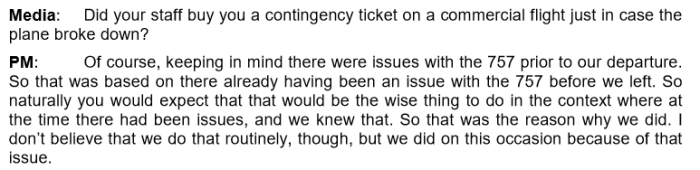
That was the title of a speech Jacinda Ardern gave in Melbourne a couple of weeks ago.   For the short trip to Melbourne, the Prime Minister had eschewed commercial flights and taken an RNZAF plane instead, only to have the plane break down.  It later emerged (page 11) that her office knew how badly this bit of New Zealand’s government was run

757.png

There must have been some wry chuckles in parts of the Australian government and public sector.

The “progressives” who turned out to hear Ardern (it was an ANZSOG event, so I presume lots were public servants and academics) appear to have loved her.  Stuff reported that

The event on Thursday night attracted more than 2000 people. Ardern appeared to rapturous applause, and was told that she had put fire in the belly and power in the hearts of Australians.

In The Guardian one particular left-wing Australian academic, a former adviser to Julia Gillard, lost all sense of reason and perspective, claiming Ardern as “one of the world’s great leaders”, and hankering for something different, for New Zealand type politics and reform.

In more recent times it seems that for every policy success achieved by New Zealand, Australia has suffered an equal and opposite failure.

Which is, no doubt, why so many hundreds of thousands of New Zealanders have migrated to Australia and so few Australians to New Zealand (even though we make it easier for them to come, than it is for us to settle in Australia) and why when our two countries were once more or less economically level-pegging, Australia is now so much richer and more productive than New Zealand is.  Don’t take it from me: as Australian Labor MP Andrew Leigh put it in his recent article, productivity makes a real difference, and creates real opportunities and choices.

For a time there was a strange phenomenon whereby people on the right in Australia tried to talk up John Key and Bill English as great leaders and economic managers (mostly, it seemed, in reaction to people they didn’t like in Australia –  whether Rudd, Gillard, Abbott or Turnbull).  Curiously, this particular left-wing academic manages to embrace that strange line as well –  Jacinda Ardern is great and so was John Key (“exceptional leadership”).  Going by results, could we perhaps trade these stellar figures for someone Australians think is less impressive, but who might actually address some of the serious New Zealand problems and failures?

But the real point of this post was about the Jacinda Ardern’s text.   When I first heard the title (“Why does good government matter?”) my immediate reaction was along the lines of “how would she know?”, but I guess it is possible to recognise what good government might be even if, as a serving Prime Minister, you aren’t presiding over such a beast.   A good start might be recognising that as Prime Minister you might perhaps be thought of as chief executive of the government but not –  contrary to the PM’s suggestion in her text –  of “the country”.

I’d have thought the question of why good government matters was pretty straightforward.  Governments exercise enormous power –  actual and potential (the latter especially in a country like New Zealand with few formal checks and balances) –  take an enormously large share of our incomes (equal to more than 30 per cent of GDP), and any agency that powerful needs to be kept in check, and we need assurances that those in charge of the goverment are operating efficiently, effectively, compassionately, honestly, openly, knowing their own limitations, and so on.    Good goverments can do some good.  Bad governments can be incredibly dangerous and damaging.  Look, after all, at the productivity or housing records in New Zealand –  or at the 10 per cent of working age adults living on welfare.

But there is little sense of any of this in Jacinda Ardern’s speech.  I guess she is a socialist –  former president of the International Union for Socialist Youth –  speaking to an audience of people with pretty similar beliefs about the desirability of a big and active government, with little emphasis on how –  time after time –  governments mess things up.

Ardern’s imperial mindset is on display early in the speech

Good government matters, because government affects everything.

Breathtaking.  The love of husband for a wife (and vice versa).  Of a parent for a child?  Our core beliefs –  those under the label of religion and others –  that shape what we value?   Friendships?  Whether or not the All Blacks win the World Cup?

I suppose you could mount a defence of the Prime Minister along the lines of bad governments can interfere even in these things, but there is not even a hint of that in her address – no sense at all of the appropriate limits of government or of the failures of even the most capable and well-intentioned governments.    In fact in the very next sentence she – I guess she is a Socialist –  goes on to suggest that this “government affects everything” line is something “we” (she and the smart active government types) “perhaps take for granted”.  She tells us, quite seriously, that she was “gutted” that an old school friend had no interest in politics: but then Ardern has never known anything but politics, and that simply isn’t (fortunately) the case for most people.   But she really wants to a better class of citizen to be worthy of people like her.

She goes on with unsupported stuff

Around the world, democratic values and institutions are under threat in a way that many of us never expected to see in our lifetimes.

It would perhaps be good if she were a bit more specific.   Perhaps she had the PRC in mind, and the way she and her colleagues repeatedly defer to PRC interests and pressures, allow PRC regime/Party-affiliated individuals to serve in our Parliament?  But I’m guessing not.

Perhaps she isn’t too keen to Vladimir Putin (neither am I) or Viktor Orban (not ideal either) but most adults are old enough (“our lifetimes”) to remember when these places were far far worse.   She surely can’t mean Brexit –  which was, after all, the choice of the British voters in a hotly-contested energised referendum?   And yet I fear she might, because in the next sentence we read

Nationalist sentiment that closes off the possibility of countries working together is surging.

Except that it doesn’t, does it.  Free and independent nations often choose to work together on specific items of mutual interest (eg no sign of the UK pulling out of NATO).  Aren’t Australia and New Zealand proudly independent countries –  doesn’t the PM tell us at every opportunity about her “independent” foreign policy? –  and yet we work closely together and are still able to disagree, and not subsume ourselves in one combined “New Australasia”.

Strangely, in her paean to good government, the Prime Minister talks of how

Norms that we in New Zealand and Australia take for granted – the rule of law, the peaceful transfer of power, freedom of expression – are being challenged in new and more explicit ways.

Must have been the PRC she was talking about again surely? But I guess not.

I’m old enough to remember when military coups in various African and Latin American countries were the regular fare on Morning Report, and when from the Fulda Gap eastwards few had the benefit of the rule of law, freedom of expression, and Party rule was something akin to the end of history.    Things are better now in so much of the world.  And 23 Democrats are lined up across the political spectrum to try to defeat Donald Trump in an open and contested election.

But she also mentioned “freedom of expression” –  the same Prime Minister whose government is beavering away on plans to restrict that freedom in New Zealand, whose government made mere possession of the manifesto of Brenton Tarrant an offence punishable by many years of imprisonment.

To this point she seemed to be merely warming up with some generic tropes for his left-wing audience.  And then it was into the red meat with a strong denunciation of the reforms of the 1980s and early 1990s –  all this from a Prime Minister of the same party that did many of the reforms.

In many countries, while the very wealthiest have grown consistently wealthier, the rest have seen little or no real rise in their incomes or their living standards – over decades.

Inequalities that deepened with the great deregulating reforms of the 1980s and 90s have become a permanent feature of these economies – not a brief moment of pain.

That is certainly the case in New Zealand.

Except that very little of that stacks up against the evidence.  In New Zealand wages have been rising faster than the capacity of the economy to pay (growth in nominal GDP per hour worked), income inequality hasn’t widened for decades, and to extent there have been issues in New Zealand they have to do largely with housing –  where successive governments have presided over grossly over-regulated urban land markets.

And look at her try to distance herself from and disown all sorts of reforms  (notice that “said to”)

Starting in 1984, through to the 1990s, we removed regulations that were said to hamper business, slashed subsidies, transformed the tax system, dramatically cut public spending and massively reduced welfare benefits paid to the sick, those caring for children and the unemployed.

Now we can argue whether those regulatory reforms were necessary, but regardless the numbers speak for themselves.

And yet she shows no sign of even understanding the numbers, repeating the same line she took into the 2017 election, claiming that in aggregate the economy did well, but the “right” distribution didn’t happen, as if oblivious –  or uninterested –  in the continued widening gap between the level of productivity in New Zealand and that in leading advanced OECD economies (and than in Australia).

She does go on to devote a paragraph to housing markets, but shows no sign of actually understanding the issues, suggesting that low interest rates are the cause of the problem.  Similarly she laments technological advance putting “people out of work” (it is called productivity –  doing more with less), seemingly oblivious to the incredibly high labour force participation (and employment) rates we actually have in New Zealand (higher, for example, than in Australia).

And in a line of (stunning) naivete, we read this

Stunningly, our most connected generation in New Zealand, has also been found to be our loneliest.

And in the next line (emphasis added),

what does good government look like, not for us but for the very people who are turning away from us?

The Prime Minister of the ANZSOG (public servant and academic) audiences, “people like us”.

And so she goes on

Domestically, some have chosen to reject the independent and expert public service and the possibility of a mutually respectful and diverse nation.

Could we perhaps have one of those “independent and expert public services”, instead of the degraded (for example) Treasury we currently have in New Zealand?

Abroad, they reject the international institutions that they paint as responsible for both economic and cultural problems when they aren’t necessarily at fault.

One of my old bosses used to jump up and down when we (unspecifically) tarred unnamed individuals.  She might be a fan of the EU, but there is no reason why the British public should be, or why them choosing the pull back from the push for a federal Europe should be any sort of marker of societal failure or decline.    And if the IMF, the World Bank, the UN etc do little harm, they don’t do much good either.  And if she wants to criticise the US over the WTO, perhaps she should say so directly –  or perhaps even live the view that free trade benefits most those who take off restrictions on their people, and take a lead and remove New Zealand’s remaining tariffs and import restrictions.

And then

So this is one answer that is available to people – and that some are signing up for. After all, fear and blame is an easy political out.

Except that some people –  parties and individuals, Labour included –  are to blame for our housing disaster, our dreadful productivity performance.  That blame should be sheeted home.

We get several mentions in the speech of high rates of GDP growth but (I think) not a mention of immigration –  which the PM and the ANZSOGers love –  and not a hint of per capita income growth, let alone the (lack of) productivity growth.  Productivity creates possibilities and options, eases hard choices etc.  But Ardern seems to prefer not to know.

And we get stories about “social and economic inequality” driving deprivation, poverty and crime, but nothing at all about cultural failures (a point Winston Peters was making this week), family breakdown, or choices and individual responsibility.   Free societies can’t flourish without strong and functioning families and cultures.

As she was talking to public servants, there is several pages of talk about public services reforms –  but nothing about transparency, nothing about accountability, nothing about excellence, nothing about (say) fixing a system in which the head of the State Services Commission largely exonerates his buddy the outgoing Secretary to the Treasury after a monumental stuff-up, revealing an inability to operate under pressure at the very top of our public sector.  Once upon a time Labour talked of being the “most open and transparent government ever”.  Now even people on the left just scoff and make fun of the claim.   And if the public service is in such good shape (as she claims) doesn’t it make it very clear that responsibility for the severe ongoing policy failures really lies with her (and her colleagues, and people elected before her from her party and others).

The speech ends with the claim that “Good government need not be an oxymoron”.  At one level that is obviously true, and yet at another it invites the reaction “and yet surely in New Zealand in recent decades it has proved to be so”.   And if it weren’t for the ideological blinkers of her audience (for whom her main appeal seems to be that she is the “not Scott Morrison” or the “not Donald Trump”, you’d have to marvel at the presumption of the Prime Minister offering lectures on good government to a country that is so much richer and materially more sucessful than New Zealand is, to which so many New Zealanders have moved in recent decades, and when her government has done so little.

For those –  as many do –  who praise Jacinda Ardern as a great communicator it was also striking to read the speech and not find a single fresh or interesting idea, not even a fresh or startling way of making an old point. It was as if some public servant or PMO staffer had simply turned the handle and churned out a set of cliched notes, empty of almost any substance, with nothing to leave people thinking.   Is there anything to this alleged communication skill, beyond the level of individual empathy –  not an un-useful quality in a Prime Minister, but hardly the foundation for any sort of transformative government.

In his Herald column last week, Matthew Hooton brought me up short with this summary

The Ardern Government is the emptiest and most incompetent in living memory,

But it is hard to disagree (despite some competition for the title) and the problem starts at the top.  So much of what the Prime Minister says is vacuous –  almost devoid of content –  and it has been matched by an absence of any serious steps to deal with pressing failures (or utter failure in, for example, an actual initiative: KiwiBuild), in turn presumably built on  no compelling narrative about what has been done wrong in the past, and what might make a material difference in the future.  Endless blather about wellbeing doesn’t change that failure.

For those who doubt the “vacuous” charge, consider finally this

Someone I debate these things with, perhaps inclined to making a few more allowances than I am, observed “even I have to agree that is pretty vacuous”.

We really need good  –  disciplined, rigorous, courageous, open, self-aware, limited – government.  We don’t have it.


Thoughtful analysis of productivity from the Opposition

The Opposition in the Australian Federal Parliament that is.

In my post yesterday, I noted  that Simon Bridges’s latest speech continued the pattern in which our Opposition pretends there is no real structural problem in the New Zealand economy: no decades of productivity underperformance, no near-complete absence of any productivity growth in the last several years (whether under National or Labour).

And so it was some mix of refreshing and depressing (would that it were so in our country) to yesterday read a new paper by the Australian Shadow Assistant Minister for Treaasury on “tackling Australia’s productivity crisis”.  No doubt it helps that the Shadow Assistant Minister was previously a professor of economics at the Australian National University (I wrote about a paper he gave in New Zealand last year here).   And perhaps the political context is different: it is now six years since the ALP was in (federal) office and it is three years until the next election.  And Leigh isn’t the highest profile ALP politician.  Nonetheless, a moderately senior figure in the main opposition party actually went to the effort of writing a serious paper on productivity failures in Australia (not even engaging mainly in gotcha politics –  all the fault of the other lot).   Would that it were so here.  If National doesn’t have any former professors of economics, I’m sure there must be some serious economists around who would be National supporters and might be happy to help, were the party to be seriously interested in addressing –  rather than avoiding –  the issue.

And I don’t say any of this because I agree with Andrew Leigh’s prescriptions.  Mostly I don’t –  in fact, to a first approximation I think he has the wrong mental model of the Australian economy –  but he is a politician showing every sign of trying to take the issue seriously.  Productivity growth is what underpins any long-term sustainable improvement in material living standards.  As he puts it (with his particular left-wing emphases)

Too often, Australians see productivity as a dirty word — synonymous with working harder, rather than working smarter. But productivity should lead to a better quality of life, in which people have more choices in the workplace and more opportunities to spend time with friends and family. The path towards higher productivity should also allow us to live in a cleaner environment, and to be more generous to the needy. Tackling major challenges, from gender equity to traffic congestion, is easier in a highly productive economy.

Here is how Leigh introduces his article

At the start of June, the Productivity Commission quietly dropped a bombshell. Australia’s productivity growth had basically stalled. Labour productivity — output per hour worked — was more or less flatlining. After a generation in which labour productivity had grown at almost 2 per cent a year, it had tumbled to just 0.2 per cent.

The commission called the results “mediocre” and “troubling,” but for some sectors they were downright appalling. In farming, mining, construction, transport and retail, labour productivity went backwards. In other words, workers in those sectors were producing less per hour than they had the year before. The latest numbers continued a trend of weakening productivity growth that the commission dates back to 2013.

To understand why Australia’s productivity crisis is so serious, it’s worth recognising why productivity matters. Through Australia’s history, our economy has become massively more productive. Australian workers today produce nearly four times as much output every hour than in the 1960s. This has been a central driver of rising living standards.

Productivity measures how efficiently the economy turns labour and capital into goods and services. When the Australian economy becomes more productive, we are producing more output from a given level of inputs. Higher productivity creates the potential for household incomes to rise faster than the rate of inflation. A more productive economy can be more generous to the disadvantaged, can reduce its impact on the natural environment, and can play a bigger role in international affairs.

Productivity doesn’t automatically bring fairness: in recent times, workers haven’t received their fair share of the modest productivity growth delivered by the economy. But without rising productivity, wages will eventually stagnate and living standards will stop increasing. Whether your priority is longer lifespans or lower taxes, raising Newstart or building motorways, you should be in favour of productivity growth. Productivity is the engine of the economy, and right now, that engine is making a nasty rattling noise.

Note that in the final paragraph of that extract is one difference between Australia and New Zealand.    In New Zealand wage growth has outstripped growth in nominal GDP per hour worked (ie the combination of terms of trade and productivity) for some time, but this is the Australian version of that chart

wages in aus

There is a variety of possible explanations, but the comparable New Zealand chart slopes upwards, not downwards.

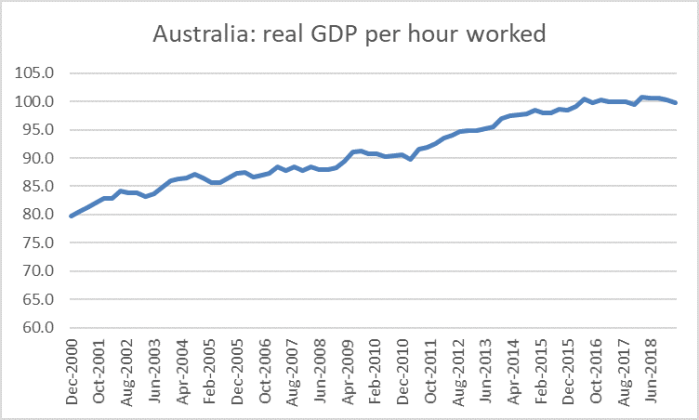
But how does the aggregate productivity picture look for Australia?  This is quarterly ABS series of real GDP per hour worked.

aus prod.png

In the last two or three years, the picture is quite as bad (no growth at all) as in New Zealand –  bearing in mind that the average level of productivity in Australia is far higher than in New Zealand.

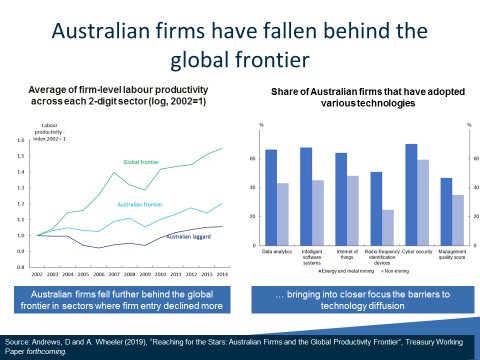
Leigh makes a lot of an asserted relative deterioration in Australia’s position this century.  In doing so he relies on a recent speech from a senior Australian Treasury official on productivity (another contrast to New Zealand), reporting some research work Treasury had done.

For Australia, the most hard-hitting presentation came from Treasury’s Meghan Quinn, who revealed that researchers in her department, led by Dan Andrews, had been investing in a new analysis that links together workers and firms, and delving deeply into fresh data about the dynamics of the Australian economy. Since 2002, Quinn showed, the most productive Australian firms (the top 5 per cent) had not kept pace with the most productive firms globally. In fact, Australia’s “productivity frontier” has slipped back by about one-third. The best of “Made in Australia” hasn’t kept pace with the best of “Made in Germany,” “Made in the Netherlands” or even “Made in America.”

Go to Quinn’s speech and you find this chart (unfortunately a bit fuzzy)

quinn

The left hand panel is the point Leigh is making.  It doesn’t look very good.

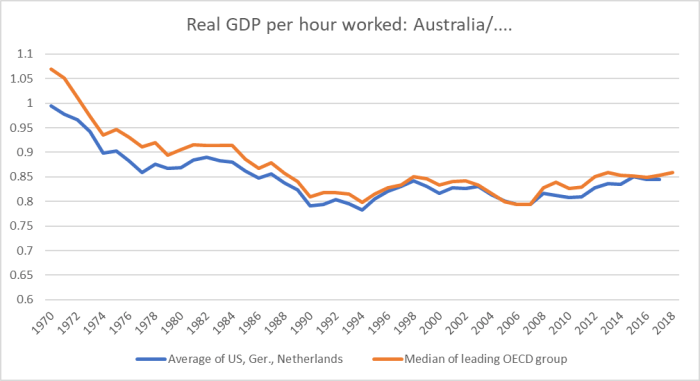
On the other hand, the economywide cross-country comparisons really don’t look so bad at all (and being annual data you don’t see the recent flattening in the way the quarterly chart above shows).

In this chart, I’ve shown Australia’s real GDP per capita compared to an average for Leigh’s three countries (Germany, Netherlands, US) and to the median for the leading OECD bunch (as I’ve used in previous charts and tables for NZ comparisons: US, France, Belgium, Netherlands, Germany, Austria, Denmark, Sweden).

AUs prod 2

On these economywide measures, the 1970s and 1980s were a pretty bad time for Australia, in relative productivity performance terms.   Since then, a pessimist might say Australia has more or less flat-lined relative to these leading OECD economies, while an optimist might suggest some modest beginnings of a catch-up process at work.   It isn’t a good performance at all –  the leaders are almost 20 per cent ahead of Australia and if the gaps are closing, it is an incredibly slow process –  but it is a rather different emphasis than in the Federal Treasury chart Leigh draws on.

That idea that it isn’t a good performance at all is reinforced once one realises the extent to which Australia has been able to draw anew on nature’s bounty in the last ten to fifteen years –  all those newly developed iron ore and LNG exports.  There has been nothing comparable in most of the other OECD countries I’ve used in the chart above (oil in the US might be closest thing, but much smaller relative to the size of the economy).   I haven’t looked in detail at the Australian Treasury research (which is still described as “forthcoming”) but perhaps what is going on is that existing Australia firms haven’t done that well (and as Leigh highlights the rate of business start-ups etc is low), but that the economy as a whole just has a whole lot of newly-exploited natural resources it has been able to use to hold up overall economic performance  (well done them: I had an email yesterday from some NZ public and private sector group oncerned to stop the depletion of New Zealand’s natural resources, a cause with which –  in this context –  I could not sympathise).

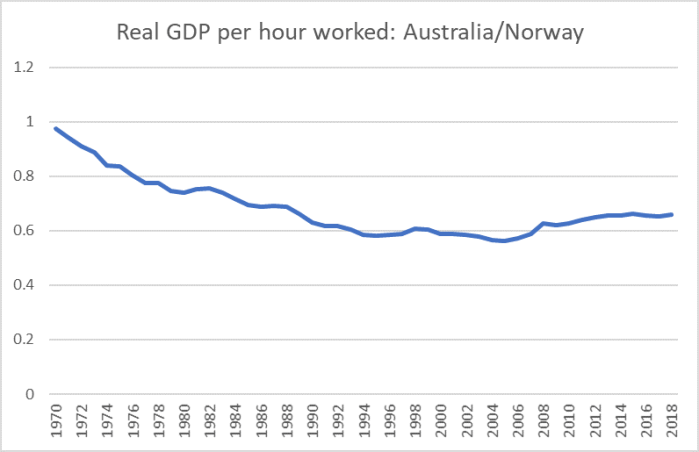
And yet, despite that, Australia has made very little progress in closing the gaps to the OECD leaders.  Here is another comparison I’ve long found interesting, looking at real GDP per capita in Australia relative to that in Norway, the other advanced OECD country able to exploit an abundance of natural resources in recent decades.

aus norway

Australia –  still building up its fresh wave of resource exports –  has regained a little ground relative to Norway in the last fifteen years (oil exports from Norway are falling, and gas looks to have peaked) but it isn’t dramatic, and has been barely a thing at all in the last few years.  And yet these two countries were more or less level pegging fifty years ago.

There wasn’t much (any?) mention of resource exports in Andrew Leigh’s article.  There also wasn’t much (anything?) on the other big change in Australian policy in the last fifteen years or so, the marked increase in policy-led immigration to Australia.  My own story of Australia’s underperformance is much like that for New Zealand.   Remoteness and distance are huge issues –  perhaps even increasingly important globally –  and the fortunes of both countries depend very very heavily on natural resources (and the ability of talented people and decent institutions to facilitate their extraction and utilisation).  It isn’t just a matter of simple division –  but it is close to it, bearing in mind what else we know about the Australian economy –  to suggest that had Australia’s population not been supercharged again by policy (like New Zealand bipartisan policy) that the bounty from the natural resources newly exploited would have translated into higher living standards for the average Australian, higher economywide productivity.

There are lots of detailed points in Leigh’s article, some of which seem more compelling than others (I’m not persuaded that getting more people into tertiary education is likely to make much economywide difference, when the people not going now are likely to be those who would benefit least from doing so –  it hasn’t been worth their while to do so). And I’m not convinced he has the right model to think about Australia –  where the bigger issues seem more macro in nature – but it is just refreshing to see a moderately senior active politician actively engaging in thinking about, writing about, talking about, how productivity performance might be markedly improved.  Because, as he says, it really matters to all of us.

Where there is no vision

Each year, as a disillusioned voter (pondering being a non-voter, for the absence of credible options) I go to the effort of tracking down the conference speeches of the main party leaders.  What party leaders choose to emphasise, in one of their most-covered speeches of the year, can be telling.  As, of course, can what they choose to omit.  When Labour was in Opposition I never took very seriously talk (eg from Phil Twyford) about  fixing land use regulation and thus materially lowering the cost of housing because the leader never mentioned the issue, including in conference speeches (Jacinda Ardern still doesn’t, in conference speeches or elsewhere).  Of course, there are other speeches and interviews in the course of a year, but the conference speech isn’t just for geeks (see, eg Q&A interviews) or specialist audiences.  Things leaders care about, highlight, and spend reputational capital on tend to be things that get done.  Others things, not so much.

What, then, did Simon Bridges have to say in his conference speech on Sunday?  There was lots of rather sickly shtick –  his wonderful wife, his lively children etc.   And there was a rather strained attempt to suggest that somehow he’d overcome deprivation and disadvantage himself

Because it is the National Party that has shown that a young Ngāti Maniapoto boy from West Auckland, who talks like a boy from West Auckland, the son of a Baptist preacher and a teacher, can grow up to become the first Māori leader of a mainstream party in New Zealand, and the first Māori Prime Minister of our great country.

(I struggle to take seriously that sort of line because “son of Baptist preacher and a teacher” exactly describes me –  our fathers were ministers in suburban Auckland at the same time –  and I’ve never once felt any disadvantage.)

Perhaps he has conveniently forgotten that one of his recent predecessors –  Don Brash –  was the son of a Presbyterian “preacher” and of a mother who left school before high school, or that the first National Party Prime Minister was the grandson of a Yorkshire farm labourer. Or, frankly, that as far as I can see not a single Labour or National Prime Minister has come from any economically-privileged background.  Perhaps there are people in politics born with the silver spoon in their mouth –  the National Party president most notably at present – but that hasn’t been the background of any modern Prime Minister (or major party leader).

There are even some things in the speech that did resonate with me, including many of his criticisms of the current government.  But the centrepiece was, of course, cancer care.  I don’t have a view on the substantive merits of the specific initiative National is proposing, which looks like smart tactical politics, but perhaps rather small beer.   I’m inclined to think health is underfunded (there is a chart and some thoughts in this pre-election post, and the Budget estimate of health spending of 6.1 per cent of GDP this year is pretty much in line with what Labour was envisaging then) even on the basis of our current economic performance) but that wasn’t really his case.

But, for all the almost ritualised mentions in Simon Bridges’s speech of the importance of a strong economy (even the Prime Minister mouths those sorts of line from time to time), there was nothing –  not a word –  to suggest that he recognises that the biggest obstacle to higher material living standards (whether in the form of cancer care or other public or private goods and services) is the woeful productivity record that successive governments –  led only by National and Labour –  have presided over.    There is plenty of talk about cyclical issues, but nothing about the structural failures, and nothing about what National might do that would conceivably make a real difference in reversing that performance.

Sure, it wasn’t primarily a speech about economics, but there has been nothing from Bridges or his colleagues elsewhere, and no hint of a recognition here, that much-improved productivity performance is the only sustainable path to much better material living standards.  And not a hint of a recognition that these failures were already well apparent in the government in which he served (latterly as Minister of Economic Development) –  and if you think politicians never make such acknowledgements then (and in fairness to Bridges) I should point out that in his brief speech at the start of the conference he did acknowledge that National hadn’t done that well on housing (“but we weren’t Phil Twyford”).

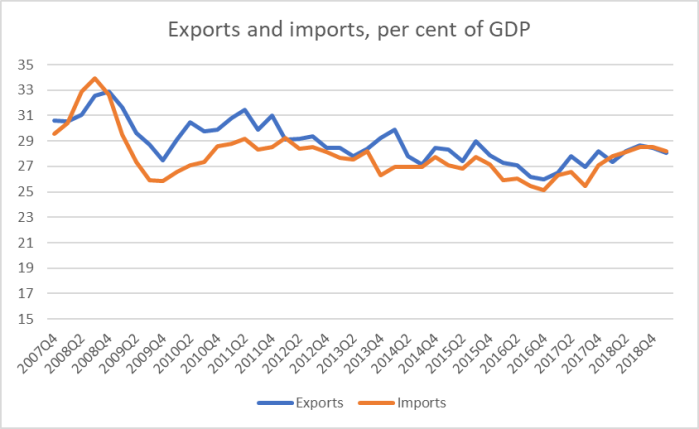
What do I have in mind.  Well, of course, there is the shrinking – sideways at best –  share of foreign trade (exports and imports) in GDP, even though successful economies –  ones catching up on the leaders – are almost always marked by a rising foreign trade share.

ex and im

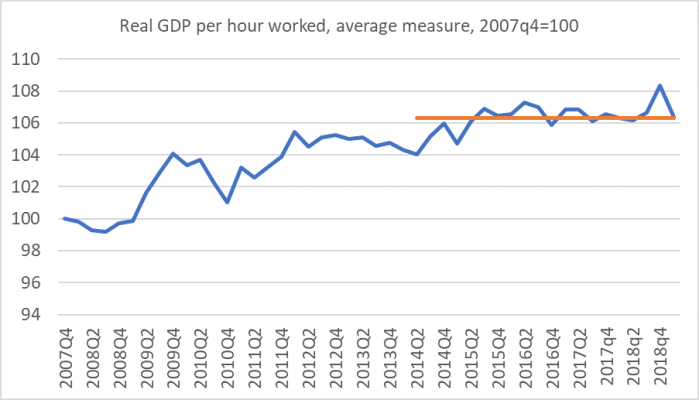
But the simplest starkest chart is the one showing labour productivity growth (or lack of it).

GDP phw mar 19

No labour productivity growth at all for four years now, and barely any for seven or eight (perhaps 1 per cent total growth since 2011/12).     Mediocre or worse as I think the current government is, these failures –  stark even in international comparison (and this isn’t a great decade for global productivity growth) didn’t start with Ardern and Robertson.   Now, sure, National people like to quote growth in per capita GDP but (a) even that was much lower over National’s term than in the previous nine years (lower again now) and (b) to the extent it was respectable for several years this decade, that mostly had to do with reabsorbing workers displaced in the last recession (the unemployment rate falling from about 6.5 per cent to about 4.7 per cent when National left office).  To repeat, as the chart illustrates, there has been barely any productivity growth, and although the unemployment rate probably should be pushed lower (see Reserve Bank underperformance), it is only productivity growth that will underpin sustained growth in material living standards.

National is promising a discussion document on economic policy later in the year.  I’ll look forward to that, and will study it carefully, but at present there is nothing in what they are saying –  and nothing in the Bridges speech –  suggesting that they really envisage anything different from what they did in the previous nine years, the period in which the structural economic indicators languished, even as a pretty muted cyclical recovery was playing itself out.     Some of the specifics Bridges mentions may even make some sense, but (individually or collectively) they aren’t the stuff of a transformational lift in economic performance, of the sort New Zealand –  including our ability to fund cancer treatments –  really needs.  It isn’t clear National has such a vision, let alone any real ideas about how to bring such a transformation about.

Sadly, of course, that does not mark them out from the current government, where we regularly hear about building a more “productive and sustainable” economy, but see nothing specific that might make a credible and useful substantial difference.

MPC appointments: prioritising sex over expertise

The lawlessness of the Board of the Reserve Bank of New Zealand never ceases to amaze me,  Just in recent years, there was clear evidence that the Board simply ignores the requirements of the Public Records Act.   There was their facilitation of what was almost certainly an unlawful appointment of an “acting Governor” in the run up to the election (decent outcome in the abstract, but unlawful nonetheless).   And, of course, they play fast and loose with the Official Information Act, apparently confident that the Ombudsman is largely toothless.  It is all the more extraordinary in that since 2013 the Bank’s Board has had a senior lawyer as a member.  I’d not paid much attention to him, not knowing anything about him, but when I finally met him last week –  where he told us he “trains judges” – it reignited my interest in just how a senior lawyer makes himself party to so much questionable –  borderline at least – conduct by a public agency.

We’ve seen a repeat of this sort of “the law doesn’t really apply to us” mentality around the release of papers relating to the appointment of the new statutory Monetary Policy Committee.  I wrote about that here.   I’d lodged requests with both the Minister of Finance and the Bank’s Board.  The Minister took a while to respond, but his responses were within timeframes allowed by law (a single extension of time, if that extension takes the deadline beyond the usual statutory 20 days).  The Board, on the other hand, extended, extended, and extended again –  quite unlawfully (Ombudsman advice makes that interpretation quite clear) –  before finally releasing some material a couple of weeks ago.      They did have a fairly junior person apologise for the delay, but that is pretty meaningless (no penalty on them –  even after I complained to the Ombudsman –  and no sense of any serious intention to amend their ways).   And yet these people – the Board –  are supposed to keep the Governor in check (and the government is now proposing to give them even more formal powers).

But this post is mostly about the substance of the MPC appointments.  There are two releases.  The Board’s response is here, and the Minister of Finance’s release is here.

Grant Robertson OIA release on MPC appointments

I know for a fact that neither release is comprehensive (including things I’ve been told privately, things alluded to in what has been released, and rather obvious omissions –  are we really supposed to believe that, eg, the Board chair did not brief the Board on his discussions with the Minister?) but what has been released does quite a lot to flesh out a picture of a process that doesn’t really seem to put anyone involved in a particularly good light.  There are even signs that the Board is taking the Public Records Act a bit more seriously than they did around the appointment of the Governor.   My earlier post on the new MPC is here: these releases answer some of the issues I raised there, mostly leaving me more concerned than I was previously.

One of my longstanding concerns about the new regime would be that it would largely replicate the dominance the Governor had in the old legislative model (where the Governor was, by law, the single decisionmaker).  Part of the reason for that concern was the statutory majority of internal members of the MPC.   All those internal members owe their day jobs to the Governor, who also decides on internal resource allocations, pay etc.  A really strong Governor might encourage diversity of perspective and challenge. There has never been any suggestion Adrian Orr is that sort of person, indeed rather the contrary.   And the external members are appointed on the Board’s recommendation, but…..the Governor himself is a member of the Board.  And instead of distancing himself from the process, and leaving recommendations to the non-executive directors, the Governor was one of the three man interview panel for the external MPC nominees.    Throw in the code of conduct the Board (Governor a member again) devised and clearly no one remotely awkward was going to get through the screening process.  (Consistent with that, in the four months since the MPC took office, not one of the externals has said a word – that might, in part, be because no media have asked them questions, but there is nothing to stop a more proactive approach.)

Consistent with all this, the Board released the set of questions they used for their interviews with potential MPC appointments.  There wasn’t much sign, from the questions, that the Board was looking for excellence (in anything), but there was certainly nothing in those questions to suggest they were looking for MPC members who robustly challenge, and offer markedly different perspectives over time to, the Governor and staff.

But it was much worse than that.  This is from a Treasury note to the Minister, released by the Minister (note that the Board itself kept this secret)

MPC 1

This is simply staggering, or should be in a country with good quality competent institutions.  And I know Treasury isn’t misinterpreting things, because I was told about this restriction some time ago by a person who was rejected on exactly these grounds –  that they might be interested and knowledgeable enough about monetary policy to be doing some research on it.   By this standard, I guess the Board and Minister (presumably aided and abetted by the Governor) would disqualify (a New Zealand) Ben Bernanke, Janet Yellen or (right now) John Williams, the head of the New York Fed and someone who –  while serving on the FOMC –  has continued to undertake research on monetary policy.   I realise that expertise is going out of the fashion at the ECB (Makhlouf, Lagarde) but their new Chief Economist –  former Irish Governor –  Philip Lane has been an active researcher and writer.  Or one could think of Andrew Haldane at the Bank of England, or….or….or.  Is it now considered a negative –  perhaps a disqualifying consideration  –  if the Reserve Bank’s chief economist was doing research on monetary policy, or does the disqualification only apply to externals, over whom the Governor has less control?  It almost beggars belief that the Minister and Board would get together and disqualify anyone with specific serious expertise in monetary policy from a new Monetary Policy Committee.   Sceptical as I was of the new committee in principle, even I was stunned when I learned of this prohibition.

(And, to be clear, I am not one of those who thinks an MPC should be stacked full of research macroeconomists –  I’d be happy to have a couple of people, of the sort who ask hard questions and have good judgement, with little or no formal economics background at all – just that such people shouldn’t be ruled out in advance.  As it is, the current MPC looks odd in that among its seven members there is not a single one who could really be considered to have a long record of depth of expertise in monetary policy and the New Zealand economy.)

So if the Board, the Governor, and the Minister weren’t looking for in-depth expertise, and weren’t looking for anyone to rock the boat, what were they looking for?   The short answer – suffusing both sets of releases – is women.     In none of the material released to me is there is any discussion about the sorts of expertise that might be sought, or how to build a committee with complementary sets of skills, but there is a great deal of unease –  particularly channelled from the Minister’s office –  about getting women selected (even to point, in some places, where there seemed to be attempts to strongly encourage the Governor to select a woman as his chief economist).  There are records of early approaches by the Board Secretary to get possible women (and Maori) candidates (and a Treasury response which points out that there really aren’t that many adequately qualified women –  not that surprising given how many women did (say) economics honours or masters programmes in New Zealand 30 years ago (in my own honours course at Victoria, the number was either one or zero out of about 15)).    As it is, despite all the huffing and puffing, they ended up with only one women on the shortlist.

There were a couple of other things that were striking.  The Board’s release records various email mentions of trying to identify candidates with legal backgrounds.  This is almost a complete mystery to me, as the MPC has no regulatory responsibilities and the legislation it operates under is pretty straightforward (and the Bank has internal and external legal advisers if things do require any clarification).  The MPC is about cyclical macroeconomics management, and communications thereon.  Someone of a particularly suspicious cast of mind might suggest that a legally-qualified MPC member would be one less knowledgeable person for the Governor to have to bother about.   I’m just genuinely puzzled.

The Board’s release also recorded various exchanges among senior Bank managers about what sort of person might be suitable as an external MPC appointee (they were looking for names to suggest to the Board).  What took me by surprise was the aversion to overseas appointees.  As regular readers know, I do not think we should have (say) a foreign Secretary to the Treasury (or a foreign Chief Justice, or a foreign Governor) but I was always among those at the Bank who saw one of the advantages of moving to a statutory MPC is that it could allow the appointment of one foreign person, bringing a slightly different expertise and perspective to New Zealand monetary policymaking.   It was never clear how feasible this would be –  distance, and relatively low New Zealand salaries being an obstacle –  but it has been tried, and appeared to work, in some other countries.

But that clearly wasn’t the view of the senior management last year.  The then Chief Economist, John McDermott (for example) is quoted as saying

“overseas members would be a logistical nightmare and what is their interest in looking after New Zealand welfare and monitoring the NZ business cycle on a continuous basis? So no from me.”

There is no sign of any of his colleagues or bosses dissenting and no reference to possible overseas appointees later in the any of the documents.  As it is, it isn’t clear how much “continuous monitoring” of the New Zealand economy the MPC members are actually doing (a recent conversation I was party to suggests not much in at least some cases).

Management also debated the issue of whether former RB staff or Board members should be considered (I suspect some might have liked to have Arthur Grimes appointed).  The consensus seems to be (reasonably enough) that there needs to enough distance for such a person to be genuinely external.  For groupies, one can try to guess which names are deleted in this paragraph

MPC 2

Disconcertingly, there are signs that management was open to have serving public servants appointed provided they didn’t currently work for agencies too close to things macro.  There should be an absolute prohibition on anyone working for a government department or Crown entity (other than as an academic) being considered for a part-time external MPC appointment in an (operationally independent) central bank.

The final point I wanted to touch on answered one of my questions from a few months ago.  Writing about the externals I noted

One area where I do have some concern is around the role of the Minister of Finance in these appointments.  In principle, I think the Minister should be relatively free to appoint his or her own preferred candidates, and should be fully accountable for those choices (including through the sort of non-binding “confirmation hearings” –  of the sort UK MPC members face – that I’ve proposed for New Zealand).  As it is, on paper the Minister has no say at all (can reject Board nominees, but nothing more).

But then I’m a bit troubled by the way in which the Board –  all but one appointed by the previous government – ended up delivering to the Minister for his rubber stamp a person who was formally a political adviser in Michael Cullen’s office when Cullen was Minister of Finance (Peter Harris) and another who appears to be right on with the government’s “wellbeing” programme.     They look a lot like the sort of people that a left-wing Minister of Finance –  one close to Michael Cullen –  might have ended up appointing directly.     I don’t think Peter Harris is grossly unqualifed for the role, but I am uneasy that one of the very first external appointees is a former political adviser to a former Minister of Finance of the same party as the one making the appointment.   …. (I don’t think former political advisers should be perpetually disqualified, but it might be more confidence-enhancing had they been appointed by the other party from the one for which they used to work –  thus Paul Dyer, former adviser in Bill English’s office, would probably be better qualified for the MPC roles than any of the recent external appointees.)

I’m left wondering what sort of behind-the-scenes dealings went on to secure these appointments.  I hope the answer is none.  I’d have no particular problem if, while the applications were open, the Minister had encouraged friends or allies to consider applying. I’d be much less comfortable if he had involvement beyond that, prior to actually receiving recommendations from the Board.  It isn’t that I disapprove of politicians making appointments, but by law these particular appointment are not ones the Minister is supposed to be able to influence.    So any backroom dealing is something it is then hard to hold him to account for.

The relevant provision of the Act says just this (buried in a schedule)

Appointment of internal and external members
The Minister must appoint the internal and external members on the recommendation of the Board.

It is very similar to the provision governing the appointment of the Governor.  That provision has been sold consistently as a model under which the Board puts forward a name, and the Minister can either accept or reject the person, but cannot interpose his own nominee.  If the Minister rejects the Board’s nominee, the Board has to go back and come up with another name.  The provision was explicitly intended to leave almost no discretion to the Minister.  (It isn’t a framework I approve of, but it is New Zealand law).

You will recall that in that earlier post I wondered quite how it was that the new MPC just happened to contained two obvious left-wing people, one a former political adviser in the office of a Labour Minister of Finance.  The material released to me answers that question pretty clearly.

I’d assumed that the Board had put up three names to the Minister and he had either accepted them all, or perhaps (though unlikely) had vetoed one name and the Board had then come up with another.   But that wasn’t what happened at all.  Instead, the documents disclose that the Board put up seven names to the Minister for the three external appointeee positions, not ranking or prioritising them at all, and giving the Minister complete leeway to choose any three of the seven.   Actually, they went further than that, in that the Board told the Minister that they had interviewed nine people, and listed the names of each of them, more or less inviting the Minister to suggest that if he didn’t like the seven names the Board recommended he could probably have one of the spare two (since it described all nine as “appointable”).

The documents also make clear that Caroline Saunders was the only woman on the shortlist (or certainly of the recommended seven).    Since Saunders has no background in macroeconomics or expertise in monetary policy, and given that strong focus in the documents on getting women nominees, it is unfortunately hard to avoid the suggestion that she was a “diversity hire” –  chosen for her sex rather than for the expertise she would bring to the MPC.  In the circumstances, how could the Minister not have chosen her?  One would hope it wasn’t so, but –  and this is problem with quasi-quotas –  it is impossible for us, or for her, to be confident that it wasn’t so.  Perhaps over time she will fully justify her selection on the substance, but at present there is no data either way.

Perhaps specialist lawyers will have a different interpretation, but I struggle to see how offering the Minister a list of seven – or even nine  – names and saying “choose any three” is the plain meaning and intention of the legislative text (would offering a list of 50 and saying “choose three” –  if so, the provision is gutted of any meaning and protection?).  The pool of potential MPC members really isn’t that deep in New Zealand and yet –  despite the fact that the law puts the onus on the Board –  we don’t even now know whether we have the best three external people on the MPC.  If this approach is lawful, it must be borderline at best.  (There was, for example, no sign of them adopting that approach to the internal MPC appointees –  there the Minister was given a list of two names for two vacancies, the approach envisaged in the law.)

My own preferrred model remains (the more internationally common) one in which the Minister of Finance is free to appoint whomever he or she prefers to the MPC.  I would complement that with non-binding confirmation hearings of the sort used in the UK.  Under that model, responsibility for the appointment rests clearly with the Minister of Finance, and there is scope for proper parliamentary scrutiny before people take up a powerful role.      Where this (brand new) legislation ended up is that the Minister can appoint his mates, within limits (but pretty broad limits) while pretending that the real choices were made by the Board.

In the end, after months –  not at all consistent with the spirit of the OIA let alone the letter – we did get a fair bit (by no means complete) of information offering insight on the MPC selection and appointment process.  Unfortunately that information tends to cast another shadow over the process, and suggests that the Board –  whose members have no real expertise in relevant areas –  continues to see its primary role as being to accommodate and humour the Governor and, now perhaps, to accommodate and humour the Minister, all behind closed doors.

And there is, of course, also the extraordinary secrecy as to how much these (possibly) second or third XI externals are being paid.  So much for openness and transparency.

Overselling past reforms

Today is, apparently, the 30th anniversary of the Public Finance Act.    There is a conference being held this weekend at Victoria University to mark the occasion, with all manner of speakers over three days, including various famous figures from the reform era including Roger Douglas, Ruth Richardson, Graham Scott, and David Caygill.

There is nothing particularly wrong with conferences of this sort –  although the ever-present question is how much taxpayers’ money gets spent, one way or another –  but much depends on the extent to which such conferences lean towards on the one hand the self-congratulatory and, on the other, the self-scrutinising and challenging.    There was a conference in Wellington a few years ago to mark the 25th anniversary of inflation targeting and the Reserve Bank Act, and although it leaned to the mutually self-congratulatory, a) it had speakers who seemed to offer greater rigour than this weekend’s conference programme suggests is likely, and (b) even partial sceptics occasionally got a word in.   Time will tell about this weekend’s conference, and I hope that at least the New Zealand academic and public sector speakers make their addresses available more widely.

I have no particular problem with the Public Finance Act, which now incorporates the provisions of the later Fiscal Responsibility Act.  But what consistently irks me is the way a handful of champions of the Act oversell it.   Most prominent among the oversellers in Professor Ian Ball of Victoria, who had a fairly senior role in financial management at The Treasury at the time the Public Finance Act and the Fiscal Responsibility Act were being passed.   And the real prompt for this post was an article he had in yesterday’s Dominion-Post.   Whatever else Professor Ball picked up, or contributed, in his time at The Treasury, he seems to have missed the pretty elementary line, drummed into students from an early age, that correlation is not the same as causation.   And that isn’t the worst of what was on display in the article.

He begins

When New Zealand’s Public Finance Act was passed in 1989, it represented a set of changes that was both radical and untested. Partway through its implementation, in 1992, the Economist published an article describing the changes in a generally positive way, but withholding judgment and concluding: “Time will tell.”

With the act’s 30th anniversary on July 26,  it seems the right moment to consider what time has to say, and whether New Zealanders should, at last, break open the bubbly.

To jump to the end, he thinks we should be breaking out the bubbly.  But why?

Much of his case seems to rest on this

[Government] Net worth now stands at over $134b, equivalent to about 45 per cent of gross domestic product (GDP).

But he makes no effort at all –  not even hinting at more-developed arguments in fuller papers –  to demonstrate why we should conclude that the improvement in New Zealand’s fiscal position stems in whole, or even in large part, from these process-focused pieces of legislation (Public Finance Act and Fiscal Responsibility Act).  He also offers no particular reason to suppose the government net worth of 45 per cent of GDP is somehow optimal, or better than (for example) a number near zero, or even negative  (given that by far the Crown’s largest asset, its sovereign power to increase taxes is not included in these balance sheet calculations, and that the actual taxes supporting the net worth Professor Ball celebrates have material –  large in some cases –  deadweight costs, in an economy that has continued to badly underperform).

And while no one is going to disagree that a decent fiscal position (whatever that means) can be a “source of security” (Ball’s words), the evidence he adduces in support of his claim is less than convincing.

The comparison with other countries is striking – the governments of Australia, Canada, the United States and the United Kingdom all have significantly negative net worth, and in the case of the UK and US the negative net worth is roughly the size of their respective GDPs.

The principles of fiscal responsibility imported into the Public Finance Act from the Fiscal Responsibility Act see positive net worth as a “buffer” to economic and other shocks. So it has turned out.

While net worth declined for only four years after the financial crisis, in the four countries cited above government net worth remains, a decade later, on a downward track. A strong balance sheet apparently allows a much quicker recovery.

But, but, but…..Our recovery wasn’t “much quicker”, let along stronger, than those in Australia (which on some measures didn’t have a recession in the first place), Canada, or the US.  And whether one approves of those choices or not, the fact remains that unlike those countries we didn’t use discretionary stimulatory fiscal policy to respond to the last recession (I argue we didn’t need to because we could still cut interest rates).

Ball continues with his straw men

But has the history of running surpluses resulted in slower economic growth than in the comparable countries that have been incurring consistent deficits?

I’m not sure anyone would think there was such a relationship, but set that to one side.  What does Ball have to say?

Apparently not. The latest World Bank numbers (for 2017) show that the five countries have growth rates between 1.8 and 3.0 per cent, with New Zealand second at 2.8 per cent.

Can he be serious?  A senior professor, former senior official, really thinks one year’s GDP growth data, not even correcting for differences in population growth (hint: New Zealand’s has recently been extremely rapid) is some sort of support for his case about legislation focused on the medium to long term?

Perhaps instead he might consider the productivity record over 30 years?  Of his group of countries, ours has been the worst (to be clear, I’m not suggesting that has anything to do with the PFA, simply that one can’t seriously advance New Zealand “economic success” as support for the PFA).

He moves on to matters social.

Perhaps, then, the impressive fiscal and economic results have been at the expense of the social fabric? By no means are things perfect in New Zealand.

To which he responds

The Wellbeing Budget in May focuses on problems of child poverty and mental health, among many other issues that require government attention and resources. Yet these issues are still able to be addressed while budgeting to maintain a surplus.

Few of the (few) cheerleaders for this year’s Budget would claim it was any more than a start, but since the PFA was never supposed to constrain the size of government (it is mostly about process and transparency), of course it doesn’t stop governments spending more –  wisely and otherwise –  if they choose.

Ah, but we are “happy”

New Zealand stacks up very well, scoring near the top in a number of international rankings of social progress, living standards and even happiness (where we are eighth, ahead of the other four countries).

And yet –  and not because of the PFA –  the net flow of New Zealanders is still from here to other countries.

We then get into the folksy analogies

But do New Zealanders benefit from their government having a strong balance sheet?

It is very like having a strong personal balance sheet. There is a greater ability to absorb shocks or surprises without being forced into taking drastic remedial steps – you can fix the car without having to cut the food budget. This was demonstrated in the way the government bounced back, financially, from the financial crisis and the earthquakes.

As part of managing a shock, a strong balance sheet also enables easier access to emergency debt financing. Coupled with this is the benefit of being able to borrow more easily and more cheaply in normal times, if it is necessary or desirable to do so. This might be useful, for example, if there is a need to invest in infrastructure.

I like a folksy analogy as much as the next person, but you always need to be careful using them to ensure that the key elements of comparison are valid.   Here they mostly aren’t.  Positive accounting net worth means nothing about a sovereign’s access to credit, none of the comparator countries whose fiscal performance he laments have had any problem raising debt, New Zealand bond yields (for other reasons) have been consistently among the highest in the advanced world……and, unlike someone whose car breaks down, governments have the power to tax.  And did I note that there was nothing impressive about New Zealand’s recovery from the 2008/09 recession, and New Zealand’s productivity record this decade is even more dire than usual.

And then, without even really noticing, he rather undercuts his own case.

At the time the Public Finance Bill was going through Parliament, the auditor-general said the reforms “will give effect to the most fundamental changes to financial management practices seen in New Zealand’s history. These reforms are enormous, ambitious, and, in large part, unprecedented anywhere in the world”.

Thirty years on, the act has been amended  several times, but the most ambitious elements remain firmly in place. Notwithstanding the apparent success of these reforms, a number of key elements have been attempted by few, if any, other countries.

Reforms that, 30 years on, have not been followed by many, if any, other countries surely should be deemed to have failed an important test.  Other smart people have looked at those “key elements” and concluded that actually they weren’t so valuable or generally appropriate after all.  It was a bit like that with the Reserve Bank Act and inflation targeting: various countries did take some practices and inspiration from our model, but not a single one followed for long our model of putting all the power in the hands of a single Governor and building an accountability framework primarily around the ability to sack the Governor.  Eventually, even New Zealand changed those bits of law, and moved back towards the international mainstream.

Professor Ball ends this way

In October 2018, the Economist weighed in again, saying: “Only in one country, New Zealand, is public-sector accounting up to scratch. It updates its public-sector balance-sheet every month, allowing for a timely assessment of public-sector net worth.”

Perhaps, ahead of any further changes, this might be an opportunity to raise a glass to celebrate an ambitious and successful act.

I don’t update my personal balance sheet every month.   Superannuation funds I’m a trustee of don’t look at their balance sheets every month.   For what conceivable practical purpose do we have monthly estimates of the government’s financial net worth?  At best, financial net worth is some sort of constraint on governments, not the reason for being –  as in, say, corporate accounts.  I’m not necessarily opposed to having the data, but it looks a lot like an example of giving prominent place to what is measurable (on all sorts of assumptions) and not necessarily to what actually matters.   We don’t even need monthly house price data (although we have it) or monthly productivity data (we don’t, and probably shouldn’t) to highlight these egregious failures of New Zealand governments.  And monthly government net worth data –  or the rest of the panoply of features of the PFA –  has done nothing discernible to improve the actual quality of New Zealand government spending (or taxation).

As I’ve argued repeatedly here over the years, I think fiscal policy outcomes are something that successive waves of New Zealand politicians can take considerable credit for.   We had a bad scare in the mid 80s and early 90s and that clearly played a pretty formative part, both in choices political parties made in successive elections/budgets, and in the legislation (eg PFA/FRA) they’ve been willing to pass –  but my hypothesis is that there is a common explanation for both, rather than causation running from the (facilitative, transparent) legislation to the fiscal outcomes.

I tend to be relatively sceptical of net worth numbers (for governments) and the data often aren’t available for lots of countries for long runs of time.  But I’ve run this chart in an earlier post, looking at net general government (ie all layers of government) financial liabilities.

net debt OECD

Here I’d concentrate on the comparison between the blue line (New Zealand) and the yellow line (the median of small OECD countries). New Zealand’s performance doesn’t particularly stand out relative to those other small countries (or to Australia, which has lower net general government financial liabilities than New Zealand), even though we – like them – even though there is a stark contrast to several of the largest OECD countries (notably US and Japan).

Any story about the successes of New Zealand fiscal policy that tries to put much weight on New Zealand specific legislative reforms needs to grapple more seriously with the experience of other well-governed small advanced countries, and make more effort to demonstrate how our legislation accounts for any (rather more marginal) differences.    It also has to ask how credible is a story that suggests that, say, US fiscal problems result largely from, say, insufficient transparency (and other bureaucratic type solutions).  In that respect, it is a bit like the Reserve Bank Act: it wasn’t responsible for the much lower inflation of the 1990s and 2000s (there were global phenomena at work, including widespread political choices to lower inflation), but was a broadly useful framework for managing a commitment to lower inflation and (at least in principle) being open and transparent about how policy would be conducted.

I guess it is good to be able to be proud of things one was involved in over the course of one’s working life.  But I hope this weekend’s conference is a bit more rigorous, and self-scrutinising, than what was on display to Dominion-Post readers yesterday.   Careful evaluation, careful analysis, should be key inputs to the design and updating of good policy.


Prime Ministerial whimsy

Whimsy more than anything else this morning.

I’m no great Boris Johnson fan –  except perhaps as newspaper columnist and (presumably) after-dinner speaker –  but I am a fan of Brexit, and really hope (against hope) that he is able to make it happen, in a way that really sets the UK free of the European Union.  Between his own inconstancy and the opposition of much of “elite” Britain, what actually happens is anyone’s guess.  One possibility –  not inconsistent with any of the possible Brexit outcomes –  is that Johnson isn’t Prime Minister for very long at all. A vote of no-confidence could be lost.  An election could happen (and at present UK polls have the vote split four relatively even ways, in an FPP system).

I was once a close student of interwar British politics (as a geeky teenager I knew the make-up of every interwar Cabinet) and knew that Johnson’s only predecessor as a foreign-born Prime Minister, Bonar Law, hadn’t lasted long –  only 211 days in 1922-23.    But although Law had the shortest tenure for a very long time (only one other British Prime Minister since 1900 has served less than a year), he didn’t have the shortest tenure.   In 1827, George Canning last only 119 days (and then died) and his successor Viscount Goderich lasted not much longer, only 130 days.

And it was here that the contrast with New Zealand struck me.   We’ve had Premiers and Prime Ministers since 1856, 40 of them in total.   Here is the list of shortest-serving Prime Ministers.

Henry Sewell 13 days
Francis Bell 20 days
William Hall-Jones 57 days
Mike Moore 59 days
Thomas McKenzie 104 days
George Waterhouse 143 days
Daniel Pollen 224 days

Some were in the very earliest days (Sewell was the first Premier), but four of them were in the 20th century, one as recent as 1990.  (There were other people who served very short terms who also served longer terms –  Keith Holyoake in 1957 is the most recent example – so these statistics are for total time as Premier/Prime Minister.)

Why the difference?   I’m not sure.  For most of our history, our political systems look pretty similar –  up to 1950 we even had two chambers –  although they’ve diverged more recently (MMP here, the Fixed Parliaments Act in the UK).   At least since 1890, as the party system crystallised, we haven’t changed governments particularly frequently.  Perhaps a three year term makes a difference –  Mike Moore and Keith Holyoake (and John Marshall and Bill English who served a bit longer, but less than a year) each took office on the brink of an election.  But I suspect most of the difference must be more idiosyncratic.   For example, Hall-Jones and Bell took office (effectively as acting Prime Ministers, but legally as PM) when Seddon and Massey died in office. But when Savage and Kirk died in office, there was simply an acting Prime Minister until the Labour Party confirmed a new permanent leader.

It turns out that deaths in office is one of the things that distinguishes the UK record from New Zealand’s.  Seven UK Prime Ministers have died in office –  one assassinated –  but the most recent of those was in 1865 (Palmerston).  Others  –  including Law –  died just a few days after leaving office.   But in New Zealand the following Prime Ministers have died in office, all after 1865 – Ballance, Seddon, Massey, Savage, and Kirk (and none of them particularly old).   Ward died fairly shortly after leaving office.   So much for the young and robust new country….

In a similar vein –  and I did say this post was whimsical – look at how long British and New Zealand Prime Ministers have lived for.   James Callaghan and Alec Douglas-Home lived to 92, Churchill to 90, Edward Heath to 89, and Margaret Thatcher to 87.    All of them lived longer than anyone who has ever served as Prime Minister of New Zealand.   George Grey remains our longest-lived Prime Minister, and he died (at 86) in the 19th century (1898).  He is closely followed by Walter Nash, also 86, who died more than 50 years ago.  The next three – Robert Stout and the short-serving Bell and Hall-Jones – were 85 and 84, but they were (at minimum) almost a century ago, and we (rightly) make a lot of improving life expectancies.   If Jim Bolger lives for another two years, he will overtake Grey, but even then the UK will still have had five second half of the 20th century Prime Ministers who will have lived longer than anyone who has held office as Prime Minister in New Zealand.

And finally, reflecting on increasing life expectancies, improved health care, and renewed expectations of people working later in life, I was struck by this mini-table (like almost everything in this post, thanks to Wikipedia)

PMs

Nash was the most recent of those and he left office almost 60 years ago now.  The Brits also beat us for the oldest person to leave office as PM (Gladstone).

Not much about US politics appeals to me, but it is interesting to note the contrast with the US where age doesn’t appear to be such a barrier to (much more demanding) office, be it Pelosi (79), Trump (73), Biden (76), Sanders (77), Reagan (69 when he became President), Warren (70) or whoever.

The US does look a bit idiosyncratic –  but should it, given life expectancy etc? Perhaps there is still time for Don Brash (78)?

PRC may never match other advanced countries

There was an article in the Wall St Journal last week, by their economics writer Grep Ip, that attracted a reasonable amount of attention.    Ip made the argument, that really should be uncontentious, that on current policies and institutions, the People’s Republic of China is unlikely ever to catch up –  in productivity or per capita income terms –  with the advanced countries, whether in Europe, east Asia, or North America.     The (worth reading) article is behind a paywall, but here is his key chart.

Ip 1

Despite having shot themselves in the foot so badly in the 1950s and 1960s –  such that there were absolutely huge convergence possibilities open to them by the late 1970s – the economic catch-up and convergence of the PRC has been distinctly underwhelming.     And since the economic and political model now being adopted is again increasingly Party/state dominated, the prospects for anything like the sort of productivity growth required to match the advanced economies appear slim.   Absence of the rule of law and of an efficient market-led allocation of resources –  with market disciplines working effectively to correct the inevitable bad calls firms will make –  will do that to your country.    The sheer size of the PRC also makes continued export-led growth harder to sustain, even if the PRC were playing by some genuine approach of free and open trade.

As the article notes, charts like the one above draw on official data, and there are real doubts about whether the official data are accurately representing average PRC incomes (for example, this paper, to which Ip makes reference, suggesting as much as a 25 per cent overstatement).   Credit booms also not infrequently see GDP per capita and productivity measures during the boom rather higher than actually proves to be sustainable.

Ip’s article is consistent with a line I’ve run in several posts over the last few years, noting –  as I put it most recently –  that by all reasonable standards the PRC remains an economic failure.  My most recent post along those lines was late last year.   Here is some of that post:

….the People’s Republic of China (and more specifically, the Chinese Communist Party, that our leaders are so keen to cosy up to) has overseen a really poor economic performance.  It is, more or less, what one might have expected knowing that the rule of law would be absent, markets wouldn’t be allowed to function effectively, state subsidies (of all sorts) would be rampant, and so on.  It could have been worse, of course –  there was the utter chaos, misery, and (for a time) mass starvation from the late 1950s to the mid 1970s.  The handful of other remaining Communist-ruled countries are worse.   But even having stopped doing so much active destruction, the PRC results are unimpressive.  Any other conclusion surely invites that American line about the soft bigotry of low expectations.

Of course, it isn’t the line the PRC would have one believe.  And it suits too many politicians in the West to talk up China as a stunning economic success story.  But it isn’t.  Development economists, left and right, will talk up the hundreds of millions of people who’ve moved above the poverty line.  And that is great, except that (a) it was the CCP that did its utmost (perhaps unintentionally) to put them back below the poverty line in the first place, and (b) getting above the poverty line is a pretty feeble standard against which to judge the economic performance of a country that for centuries matched or exceeded the best material living standards anywhere.

Angus Maddison’s great collection of historical GDP per capita estimates is a typical starting point for such comparisons.    He reports estimates for some countries every few hundred years from year 1 AD, and then more frequent (increasingly annual) estimates for more countries in more recent centuries.  In 1 AD the estimates he reports had Italy with the highest material living standards, followed by Greece.  China was about the level –  or a bit ahead –  of most other places in Europe.   In 1000 AD, China was top of the rankings –  not by much, but it was number 1.  That shouldn’t be any great surprise to anyone who recalls the various Chinese inventions ahead of the discoveries of such things (printing presses, paper money, even very big ships) in the West.   By 1500, China was a bit behind Italy and Belgium, but not much different to most of the rest of western Europe (all well ahead of what is now the United States).

Scholars spill a lot of ink debating why China went into such severe relative decline…..    Whatever the precise mix of explanatory factors that slippage happened.   In 1850, Maddison’s estimates have Chinese GDP per capita at about a quarter of that in the UK and the Netherlands, and less than 40 per cent of his “Western European 12 countries” average.  By 1900, estimated per capita GDP was only about 15 per cent of that in the highest income countries.

But perhaps as importantly, in 1900 China’s GDP per capita is estimated to have been about half that in Japan, and just a bit behind that in Taiwan (by then a Japanese possession).   As late as 1870, China had been not far from the GDP per capita in a range of Asian countries/territories for which Maddison now has estimates –  about on par with Korea, Taiwan, and Thailand, and a bit behind Japan, Hong Kong and Singapore.

And this is what they’d been further reduced to by 1976, the year Mao died.  I’m using the Conference Board’s PPP estimates, and have shown a mix of countries –  mostly east Asian and European, but with a few other interesting cases (eg Israel –  brand new in 1948) thrown in.

china 1

Such utter self-destruction and failure.  It wasn’t done by outsiders.  It wasn’t as if the PRC had faced uniquely bad external threats.  It was like economic suttee, with the depraved indifference of mass starvation thrown into the mix.

And how does the picture look today, with the Conference Board’s 2017 estimates.

china 2

The PRC has rocketed past the Philippines and Sri Lanka, and still trails the rest of this pack rather badly.   And this isn’t Tanzania or Rwanda, but a country that was once –  for centuries –  among the highest living standards anywhere in the world.  A country in a region where South Korea, Japan, Taiwan, and Singapore now manage advanced country living standards –  one of those a country that struggles to get international recognition and under constant threat from the PRC.

From the Maddison estimates, in 1980 the Soviet Union –  a region never at the forefront of material living standards –  had GDP per capita about the same ratio to that in the western European countries that China has today.  In fact, about where China was –  in relative terms –  in 1850 (see above).  It is a simply dismal economic failure in a country –  controlled by a Party –  that would have so much potential were its people ever to be free, to ever be properly governed with the rule of law rather than the rule of Xi.

For the same countries, here are the real GDP per hour worked estimates.

china 3

It really is an astonishingly poor performance.  Or at least it would be unless you’d been told in advance that Japan, Singapore, Taiwan, and South Korea would establish market economies with the rule of law, sound governance etc etc (and none of it perfect) and that the PRC would remain a land where the (Communist) Party actively rules.  Then, the outcomes are probably much as one might expect –  China lags very badly behind, to the disadvantage of its people, even if to the enrichment (power, money) of its rulers.

On the IMF’s full list of countries, the PRC now ranks 79th (out of 187) in the GDP per capita (PPP) stakes.  Average real GDP per capita is a touch behind that in Iraq (yes, I was surprised) and the Dominican Republic, and a little ahead of Brazil and Macedonia.  Perhaps China’s growth rates are faster than those places, at least if one (a) believes the official data for the Xi period, and (b) discounts the massive distortions and misallocations associated with one of the largest credit booms in history.      But there is no sign of Chinese per capita incomes catching those of the leading countries any decade soon (if things unwind nastily, the gaps would even widen a bit for some years).

Taiwan, Korea, Japan, and Singapore are genuine economic success stories –  catch-up and convergence more or less as the textbooks suggested was possible.  Cause for celebration in fact.   The PRC?  Anything but.  Being big doesn’t change that –  even if it gives geopolitical clout to a lagging middle income country –  it just means more people are failed by their rulers (and by those in countries such as ours who give the rulers aid and comfort, pander to them, or simply cower in a corner).

New material again.

As regular readers know, I am a trenchant critic of the failure of successive New Zealand governments to lift our own average productivity performance.  Decade after decade we slip further behind first the leading advanced country group and then, increasingly, most advanced countries.  But bad as our performance has been, on the Conference Board estimates –  which may overstate things quite materially for the PRC (see above) –  average labour productivity in the PRC is about 36 per cent of that in New Zealand (and about 20 per cent of the United States and other leading advanced economies).  In fact, average labour productivity is barely half –  on official figures –  that in Russia.

One other way of looking at these things is to look at where the PRC is now and see how far back one has to go to find when other advanced economies had the same level of productivity.   Compound growth can make quite a difference quite quickly, also a pointer to the economic possibilities for the people of China, were the CCP ever to abandon power and a proper market-led, law-governed, country were to emerge.

For example, on official numbers, the average level of labour productivity in the PRC is now (2018) US$15.3 per hour (converted at PPP exchange rate).    That is probably about where New Zealand –  productivity growth laggard among advanced countries –  was in the early 1950s.    The range of goods and services produced or consumed is, of course, very different from New Zealand in, say, 1952 –  despite its low productivity, PRC consumers still have access to the goods generated at the technological frontiers.

Here is summary table for some of today’s advanced economies, drawn from the Conference Board numbers, with two columns, one using official PRC numbers and one allowing for the possibility, per Ip’s article, that the PRC numbers might be materially overstated.

Ip 2

There is a certain consistency of message: the PRC –  a country heir to a civilisation that was for a long time the most technology-advanced in the world – is perhaps 70 or more years behind: achieving levels of econommywide productivity now that frontier countries were achieving around the time of World War Two.  None of the east Asian countries were doing particularly well at the start of the 20th century, but the PRC is also now 40 or 50 years behind the leading east Asian economies (in South Korea’s case – productivity lower than New Zealand –  “only” 25 years or so).   The PRC is where embattled Taiwan is estimated to have been in 1981.  That isn’t dirt poor, but it isn’t very good either.

But that is what PRC economic failure looks like.     Perhaps they’ll catch-up, but nothing in modern economic history suggests that a statist model like the PRC could make that sort of leap.  Just possibly, in another 20 years the PRC might catch up to where some of the laggard advanced countries are today –  “rich” in some absolute sense –  but by then of course the frontiers will have most likely have moved much further on.

Contemplating trade restrictions and industry protection

I’m just back from a family holiday in sunny south-east Queensland.  Being a New Zealander, I have a visceral fear of snakes, but as we saw them only in the zoo, one could concentrate on the upsides of Australia.   Seriously good newspapers for example.  Daily surf swims in the middle of July.  Plastic bags in plenty of shops (Queensland seems to have outlawed – the very useful –  thin supermarket bags but not others).   And, of course, one could look around, and read the papers, and contemplate what productivity and higher material living standards really mean.  It was a while since I’d been in Brisbane, and the central city certainly had a look and feel more prosperous than what one finds in Auckland (or Wellington).

At the turn of the century, GDP per hour worked (PPP terms) was about 31 per cent higher in Australia than in New Zealand, and on the latest OECD estimates than gap is now 41 per cent.    And it isn’t as if Australia itself is some stellar productivity performer.  (Those with longish memories may recall a time barely 10 years ago when there was serious political talk of closing the economic gaps with Australia, but –  as a result of policy choices of both National and Labour governments –  the gaps have just widened.)

I couldn’t see state-level GDP per hour worked data for Australia,  but there is GDP per capita data.  The gaps between New Zealand and Australia aren’t as large for per capita income as for labour productivity, simply reflecting the longer hours the typical New Zealanders engages in paid work over their lifetime.  For Australia as a whole, GDP per capita (PPP) terms is “only” 34 per cent higher than in New Zealand.  In Queensland –  with below average state GDP per capita –  that gap is “only” about 25 per cent.   Even a 25 per cent difference purchases a lot of (say) cancer drugs, new cars of whatever other public or private goods and services people aspire to.  I’m sure the Australian health system has its problems, but I was struck reading three papers a day over 10 days not to see stories about health underfunding.    And yet the (various levels of ) Australian governments spend a smaller share of GDP (35 per cent) than New Zealand governments do (38 per cent).

So there was sun, surf, papers, productivity in Queensland.  And there was another thing I always look out for abroad.

trout 2

I prefer fresh but the little supermarket near where we were staying “only” had smoked.  Not, in this case, the Australian product but (so I was surprised to notice when opening the packet) Norwegian.

trout 3.jpeg

The wonders of a global market and all that.   But just not in New Zealand.

There are, of course, plenty of trout in New Zealand –  all descendants of trout introduced in the 19th century (it isn’t exactly a native species).  In fact, some of the trout species in Australia was introduced from New Zealand.

But if there are lots of trout in New Zealand, the only way you can consume any is to go and catch one yourself, or make friends with someone who fishes for them and who will gift a trout to you.   It is as if I could only consume milk if I owned a cow or had someone close by who would give me milk.  Perhaps the first half of that sentence did describe much of the world prior to the 20th century, but even then the sale of milk wasn’t banned.  But the New Zealand government has for decades now banned the sale of wild trout.

When I went looking, I discovered that the sale of other trout isn’t outlawed in New Zealand, but as a recent regulatory impact statement prepared by the Department of Conservation put it.

The sale of trout (except for wild trout) is allowed in New Zealand. The reason it is not available for sale is because there is no way to obtain trout to sell – trout farming, selling wild trout, and importing trout are all prevented by legislation or the CIPO.

(that’s a customs import prohibition order).  The prohibition extends to smoked trout.  Here is the latest version of the restriction, just renewed a few months ago.

Read literally, clause 4(1)(b) appears to suggest that the imports for sale are only prohibited if they are for amounts of less than 10 kgs.

trout 4.png

That can’t have been what was intended, but it appears to be what the law says. [UPDATE: I misread it.]

There was a policy process undertaken last year that led up to the government’s decision to renew the import ban.  It was weird policy process, described thus

There has been no public consultation on the options covered by this paper. The views of the various interest groups are well known to officials, but there may be Treaty implications if a firm decision was taken without formal consultation with iwi. The nature of the issues mean that a decision has to be made as to which set of interests should be given precedence.

Officials –  of course –  consider they know all that needs to be known.  And quite Treaty issues arise in respect of foreign trade in a species itself introduced to New Zealand is beyond me –  but fortunately I’m no longer a public servant.

Of the official agencies that were consulted, MFAT actually favoured allowing the import restriction to lapse. I’m not usually a fan of MFAT –  and had Beijing objected for some reason, no doubt they’d have taken the other side –  but well done them on this one.  It isn’t a good look when New Zealand prattles on about open trade, rules-based orders, when it maintains in place a near-absolute prohibition of the importation of an innocuous, but tasty, food product.

I guess no one looks to the Department of Conservation for high quality and rigorous policy analysis, especially on economic issues.  Their RIS on the trout CIPO did nothing but reinforce those doubts.

The entire official case for the prohibition of imports of trout (and, by implication, for continuing restrictions on domestic trout farming –  although that isn’t the focus of this particular policy process) appears to rest on supporting the recreational trout fishing industry.

22. The import prohibition and the prohibition on the farming of trout are aimed at protecting the New Zealand wild trout fishery.

Like, for example, banning deer farming to protect hunting of deer in the bush?  Or pig farming?  Or salmon farming?

The officials even acknowledge that (for example) allowing the sale of salmon has not led to widespread salmon poaching, and that other countries successfully manage to have wild trout fishing and trout sales.  But, they plaintively suggest, New Zealand is somehow different.   For example

If imported trout could be sold, the illegal sale of wild trout would be much more difficult and costly to detect.

Which is, of course, not an argument for maintaining the existing restrictions but for removing both import and domestic sales (and farming) restrictions, not continuing to run industry assistance to a small tourism sector –  somewhat akin to the protection that used to be offered to the New Zealand car assembly industry or the New Zealand television assembly industry.  You get the impression reading the document that the DOC officials have simply got all too close to their mates in Taupo, and are subject to regulatory capture.

The documents contains this paragraph

42. The Government’s objectives in regard to the issues examined in this paper can be summarised as follows:
• Maximise recreational and tourism values of wild trout fishery
• Maximise employment and economic values of wild trout fishery
• Maximise economic growth and employment opportunities in the wider economy
• Provide for maximum consumer choice in purchasing decisions
• Minimise risk of friction in negotiations with trading partners.

These objectives are not referenced to any fuller document in which “the government” makes its case, and they have the feel of being made up on the fly with little or no supporting analysis.   They go on to state

43. The interactions between these issues mean that it is not always possible to progress all of these objectives simultaneously. Actions that could advance some of the objectives may restrict progress on other objectives. Decisions on which objectives should be given precedence therefore need to be made by elected Ministers.

In a way, of course, that is true.   If your goal is to maximise the size of the protected sub-industry, whether buttressed by direct subsidies (think film), import bans (trout), domestic production of a related product (trout farming ban) it will conflict with overarching goals about consumer choices and economic efficiency (as well as that lesser goal about living the words about a free and open economy with respect to trading partners).  But, as in so many industries in the past,  that tension should be resolved in favour of the consumer and of economic efficiency.  In this case, it isn’t even clear that there really is much of a tension.  DOC’s RIS offers not the slightest evidence that allowing imports of trout meat (smoked or otherwise), or even allowing domestic farming of trout, would make any difference whatever to the number of North American anglers who come to Taupo.  Perhaps on the domestic side there might be a smaller number of trout fisherman…….in the same way that a much smaller proportion of us milk house cows, collect our own eggs, or whatever than we once used to.   The only “value” really being protected here is that people who don’t go fishing shouldn’t be able to eat trout in New Zealand.  If that is a values-based policy framework, it is a pretty weird one.  Logically, one might apply the same daft policy to native fish too.

It is really quite shoddy advice, in support of shoddy policy.   As one gets to the end of the RIS one gets the impression a reasonable number of government departments are beginning to conclude that the policy around trout is a nonsense and should eventually be revisited.   But it isn’t clear that DoC is among them –  then again, they are probably brought up to dislike all introduced species (may not even be too keen on people, disturbing that natural environment), and they simply aren’t the agency that should be responsible for an issue of industry protection policy and interfering with the ability of New Zealanders to easily consume a safe and lawful product.

There was petition last year seeking to introduce trout farming in New Zealand.  Whether it gets anywhere, only time will tell, but it is hard to be optimistic when the current government extended the existing import ban again only last year.   Perhaps New Zealand consumers will have to hope that foreign governments will take up the issue more seriously, and put more sustained pressure on the New Zealand government to remove the barriers between consumers and trout (more cheaply and efficiently than holidaying abroad).