NZ in fiscal perspective: cross-country and across time

Yesterday’s post outlined some of the fiscal balance numbers that should get more focus in New Zealand but typically don’t (partly because The Treasury does not usually also make their numbers available in internationally comparable definitions and formats).

That post was partly background to today’s, in which I want to show first how the current New Zealand fiscal numbers – as at this year’s Budget, so near-certain to be less favourable next week at least in headline terms – compare with our own experience in recent decades, and then to put New Zealand’s numbers into international comparisons, both across countries (other advanced countries) and across recent decades. It will cover some ground similar to a post a couple of weeks ago, but whereas that week I was writing a series looking at countries which had their own monetary policies (with an inflation lens in view), and thus the euro-area was a single observation, in this post I’ll be looking at advanced countries (using IMF and OECD data) regardless of what monetary policy arrangements they have. The focus here is entirely fiscal.

I’m also not going to be paying any attention to anyone’s forecasts beyond 2024 (ideally 23/24). Fiscal numbers up to fiscal year 21/22 are hard, those for 22/23 are estimates (from the Budget), and those for 23/24 (also Budget) are based on (now) legislated taxes and appropriations. For anything beyond that one can look at cost pressures, one can look at political party promises, one can look at announced (frequently revisited “fiscal rules”) and so on, and do a different sort of analysis. But bottom-line fiscal forecasts several years ahead have little or no meaning.

The first chart shows the government’s (and, apparently, Treasury’s) preferred indicator: the operating balance (OBEGAL) as a per cent of GDP. As a reminder this is a theory-free and total Crown measure. The data go back only to 93/94.

On this measure we had 15 years of surpluses (under governments of both stripes). Then through some mix of poor Treasury advice and severe recession there were deficits, briefly but greatly exacerbated by the fiscal effects of the Canterbury earthquakes. This measure was back to surplus in 2014/15 and (rising) surpluses continued to be run by governments of both stripes for the following five years. Covid meant a loss of revenue and a choice (widely supported) to provide a lot of fiscal income support. A really big operating deficit in 19/20 understandably followed. Renewed lockdowns in late 2021 had a similar but smaller effect on the 21/22 numbers, but by then the economy was running strongly and inflation was rising sharply, and inflation is at least initially a windfall for the fiscal authorities. For the last two years (free of required Covid spending), the deficits are just under 2 per cent of GDP. The economy was more than fully employed in 22/23 and in the Budget forecasts was expected to be around fully employed on average over 23/24 (small negative output gap, unemployment rate averaging a bit below NAIRU).

As I noted yesterday, Treasury doesn’t publish a long-term time series of cyclically-adjusted balances, but this chart back to 2008/09 shows much the same picture

You might reasonably be a little sceptical about whether the cyclical adjustment effects are quite large enough (but New Zealand automatic stabilisers are not typically regarded as overly powerful), but these are the best estimates Treasury was giving us (and the government). There really isn’t much case for running cyclically-adjusted operating deficits (even OBEGAL deficits). It has the feel of borrowing to pay the grocery bill.

Governments (and Treasury) have chopped and changed the debt definitions they like to focus on. For the current (and better) favoured net debt measure, they have only backdated the series as for as 2004/05. But here is the chart, expressed as a per cent of GDP

Still not very high in absolute terms, but now the highest in at least 20 years (and in practice quite a bit longer than that).

And here is one last chart just using Treasury headline series; this one one which doesn’t get much attention but is measured a bit more like the IMF and OECD series we’ll come to later

It is a less rosy story after 2008, as the return to surplus lasted only two years (16/17 and 17/18) and the forecast deficit for the current year (23/24) is about as large as that in 2010/11 (earthquake year), and almost as large as the two peak Covid years. Treasury don’t do cyclical adjustment on this series but any adjustments would be fairly similarly small as those for the operating balance (above).

Those four charts just use series straight from The Treasury’s website. There are no adjustments, no approximations, no derivations, just reportage. And because they are idiosyncratic New Zealand series we can make comparisons only over time and not across countries.

As I noted in yesterday’s post, primary deficit measures (ie excluding interest) are a common feature in international agency perspectives (and databases) on fiscal stances. Treasury does not publish any such measures for New Zealand. We can, however, make an approximation. They are only approximations as the only long-term time series for finance costs that Treasury provides is core Crown while the OBEGAL operating balance is total Crown concept, and while residual cash is a core Crown measure it is cash-based while the core Crown numbers are accruals. In addition, in principle one should exclude interest receipts as well, but the time series data only breaks out only finance costs. It is less than ideal – Treasury, please start publishing some proper primary balance numbers – but I’m going to here adjust both the operating balance and residual cash for core Crown finance costs and keep my fingers crossed that if the levels aren’t quite right the comparisons over time will be more or less valid.

The primary operating balance is all but in balance this year (at least as at this year’s Budget), albeit a very long way below the primary surpluses we once more or less took for granted.

And if one wanted to tell a more favourable (and analytically valid) story one could note that in the last couple of years more than all the finance costs have just been compensation for inflation (eg 6 per cent inflation in the year to June while all government bond and OCR rates have been below that). If we did an inflation-adjusted operating balance series it really would have been probably around balance in 22/23. But that won’t be so in the current year, at least on current Reserve Bank inflation and OCR forecasts.

But at this point I’ve largely exhausted what can be done with official New Zealand data and have to turn instead to the OECD (mainly) and IMF databases, the two main compilations of (as far as possible) consistently-reported fiscal data and estimates/forecasts. These measures are all for the (national accounts) general government concept (which does not map directly to Treasury data for even central government New Zealand data), encompassing all levels of government. We don’t have provincial/state governments in New Zealand, and local government is small, but for valid cross country comparisons general governnment is the way to go. As to timing, the OECD numbers are from June (so probably incorporate budget numbers), but the IMF Fiscal Monitor numbers are from April (but we have a partial update from the IMF Article IV report released last week)

Neither the IMF nor the OECD report operating balances, whether headline or primary. However, if one digs down in the databases one can construct one’s own (as they provide data on current disbursements, current receipts and net finance costs as shares of GDP). Here is how we’ve compared against the 32 OECD countries (not including the Latin American ones) for which there is complete data.
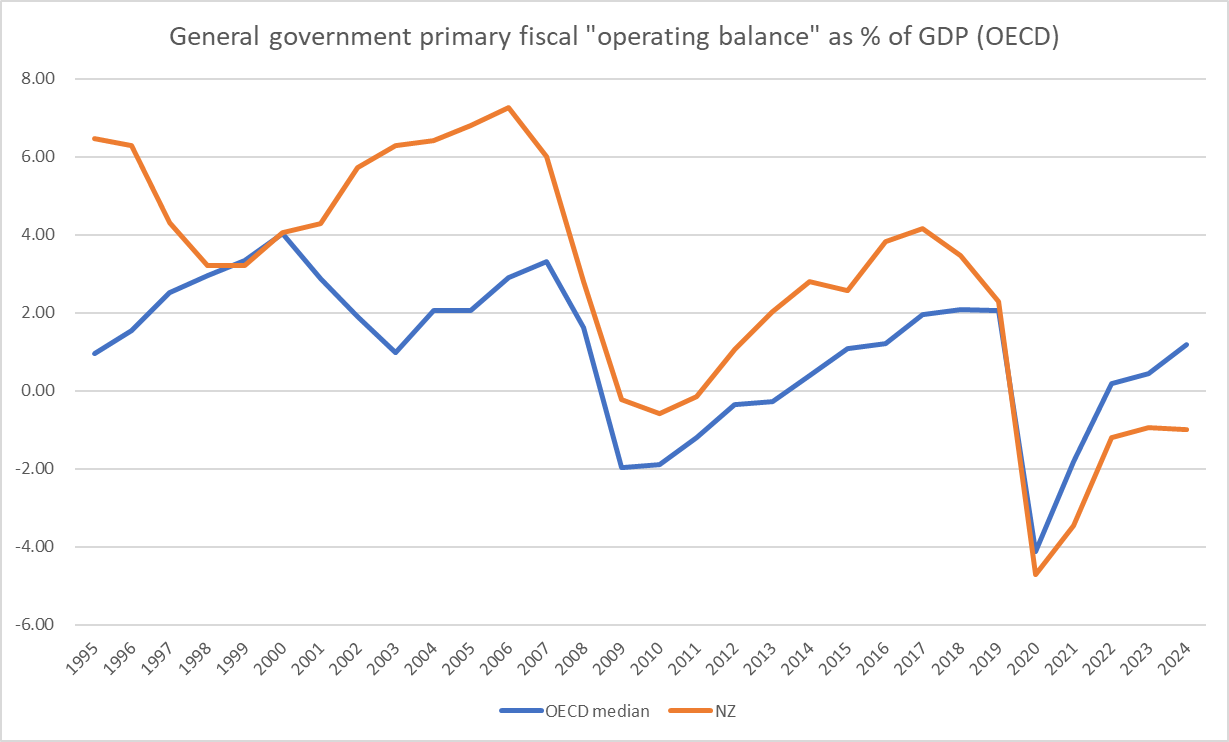
Prior to Covid there was only year in the 25 in which New Zealand’s primary operating balance was even marginally below the OECD median. Since then, we’ve been running larger deficits and if anything the adverse gap was thought earlier this year still to be widening.

For this year, they had New Zealand’s deficit 7th largest in the OECD, and next year 6th largest. That was months ago.

And here is one of the series that the OECD themselves headline, the primary overall balance (current and capital)
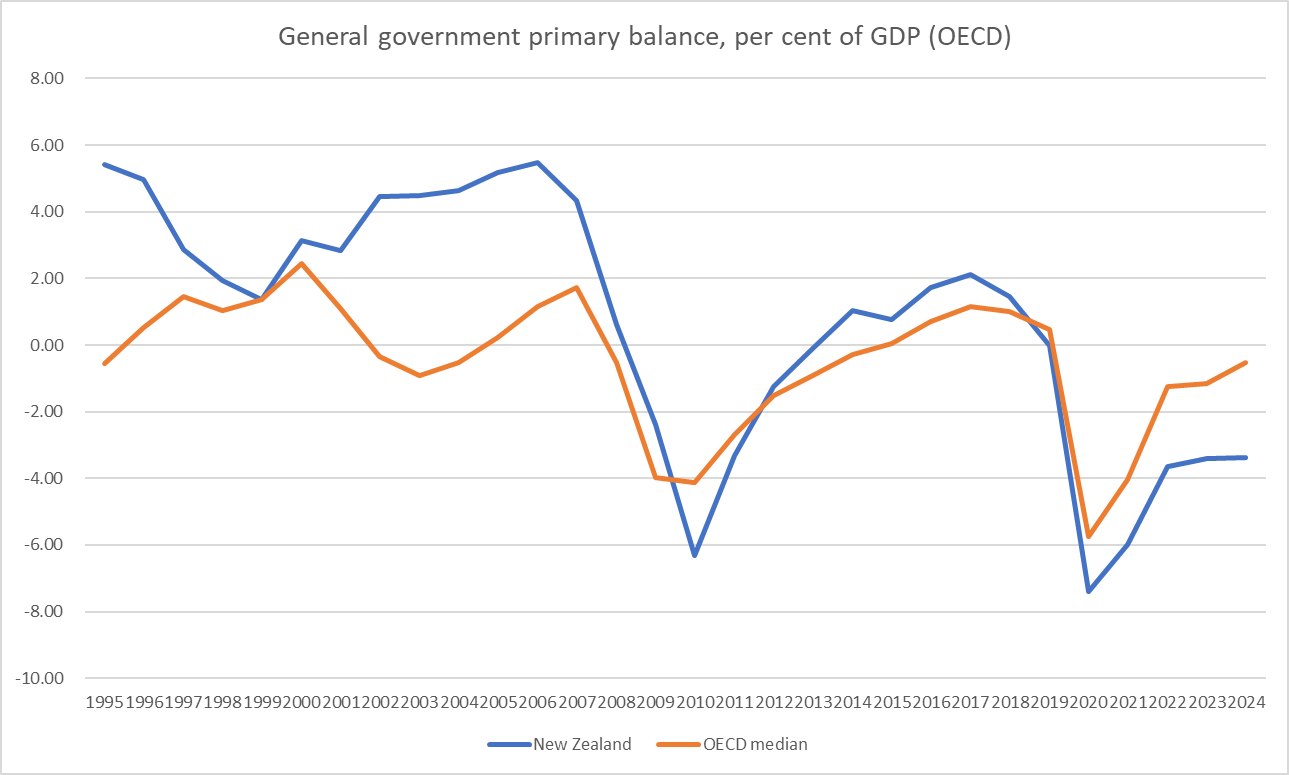
The picture is fairly similar to the (derived) “operating balance” one. Previously the only time we’d been worse than the OECD median was with the Canterbury earthquakes (which put a large liability on the Crown through EQC). We used to better. Now we are worse. (On these forecasts a few months ago, 5th worst this year, second worst next year).

I’ll spare you the cyclically-adjusted version of this chart, just noting that on OECD cyclical adjustment methodology (consistently applied across countries) as at a few months ago the median OECD country was expected to be running a (tiny) surplus next year and New Zealand a substantial (2.5 per cent of GDP) primary deficit. Only Japan was then expected to have a larger cyclically-adjusted primary deficit.

And one last fiscal balance chart. This one shows the national accounts net lending measure for the general government sector

We used to be consistently better. Now (since Covid began and on mid-2023 forecasts even this year and next) we are materially worse. The differences here are not small (a 2 percentage point difference now is roughly $8 billion per annum for New Zealand).

And here is a chart of general government net financial liabilities as a per cent of GDP.

The New Zealand line looks a lot like the (shorter run) of central government Treasury data shown earlier. But it is the international comparison that is interesting. We often here talk about how low New Zealand government debt is, but actually the median OECD country just isn’t that heavily indebted either (although places like the UK, US, Japan, and Italy really are). We are still lower than the median country, but on these projections from some months ago the gap is closing fast. And notice that the median OECD country experienced a one-year blip up for Covid costs (and revenue losses) but now has lower net debt as a share of GDP than in 2019. New Zealand not so much. We have had one of the largest increases in net debt, as a share of GDP, whether one looks at the entire period since 2019 or just the final three years (our need for heavy Covid spending, like that of other countries, largely ended in calendar 2021). It is worth remembering that today’s highly indebted countries were not always so (eg as recently as 2001 the UK had lower net general government financial liabilities as a per cent of GDP than we do now).

Finally we turn to the IMF. They have a smaller set of indicators, but the same headline and cyclically-adjusted primary, overall, and net lending balances, and a net debt measure. To avoid being repetitive, I won’t run all the charts. They don’t provide such a long run of historical data but the broad pictures seem pretty similar to those with the OECD numbers.

However, in their Article IV report on the New Zealand economy last week the IMF provided an updated forecast series for several fiscal variables. Although the numbers were published last week the report was finalised in July, based on a mission here in June. This was the report that suggested that “frontloaded fiscal consolidation” should be the focus, pointing out in the text that the Budget had been quite expansionary (NB: contrary to the assertions of the RB Governor) that they estimated a cyclically-adjusted primary deficit of 4.4 per cent of GDP for fiscal year 23/24).

Here is a comparative chart for the last decade. We used to better. Now we are (quite a bit) worse. On the IMF’s cyclical-adjustment methodology our primary deficit this year will be larger than in any of the heavy Covid expenditure years,
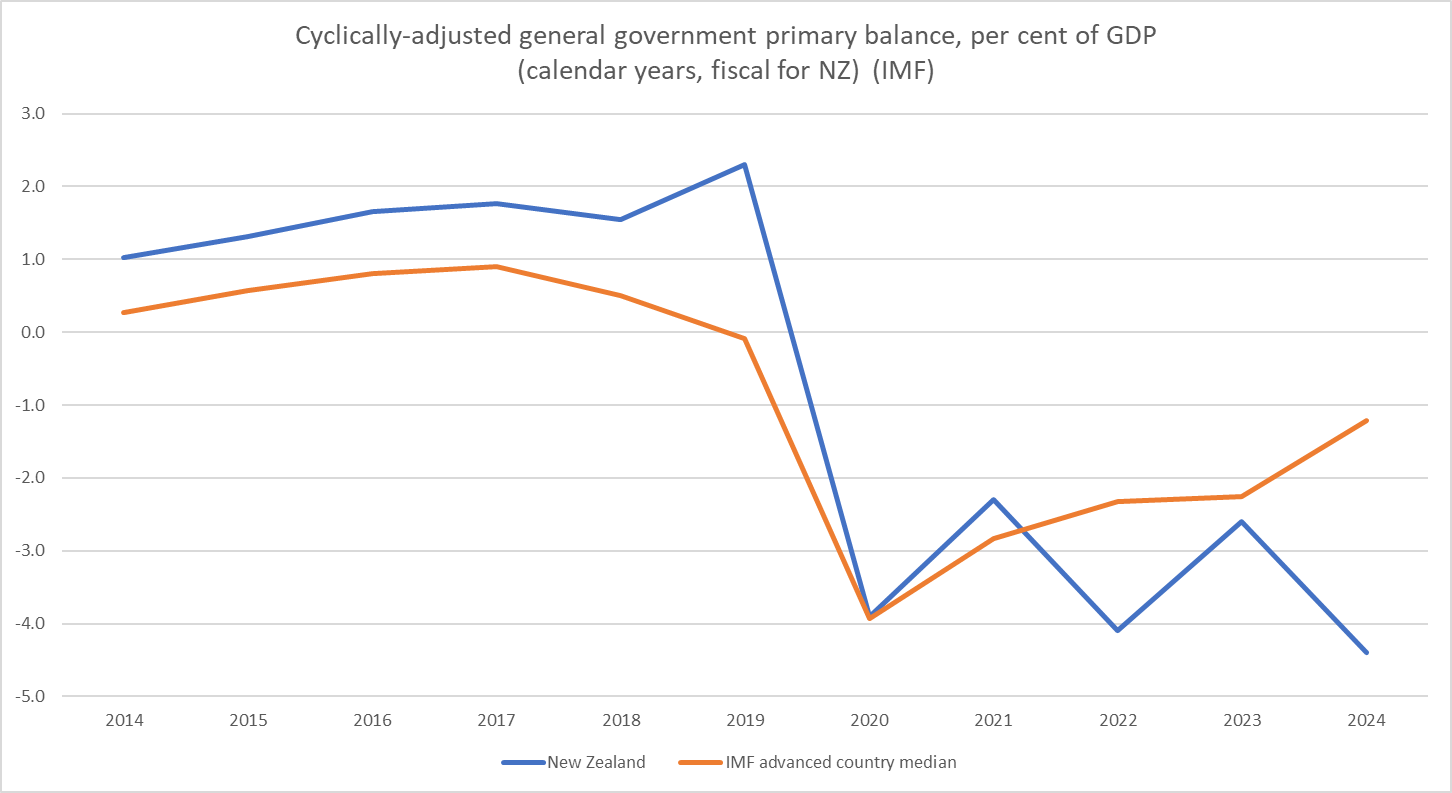
And for a straight cross-country comparison (using the IMF’s Article IV estimate for the New Zealand 23/24 fiscal year and the average of their calendar 23 and calendar 24 estimates for the other countries.

Looking at the change since 2019, New Zealand has had the worst deterioration in its cyclically-adjusted primary balance as a per cent of GDP of any of these countries. The deterioration in the net lending indicator looks to have been very similar.

And one final chart. The IMF has a different measure of net debt again (and there is a slightly different group of countries than the OECD) but the picture for the last decade is broadly what we’ve already seen from the OECD data.

Here I have shown the IMF’s 24/25 number, not because it is sure to happen (next year’s Budget will be a thing) but because this is the most recent set of official agency numbers, and presumably part of the backdrop to that “frontloaded consolidation” call that both parties seem determined to ignore prior to the election. For this group of advanced economies the median country’s net debt to GDP has increased hardly at all since 2019. Back then the median was far above New Zealand. All it would take is another year or two of New Zealand governments continuing as ours have done in the last few years and we’d have net debt above the advanced country median (whether you like at this IMF version or the OECD one above). I hope there wouldn’t be many takers for that option, in our underperforming low productivity growth economy.

Every single of one of these charts is based on data either up to date to Budget time, or in the IMF’s case perhaps a month later. It is clear that the revenue picture to be revealed in the PREFU will be worse. (Labour’s changes last week to forward operating allowances will limit the damage to forward deficit estimates both those and the departmental baseline adjustments should be treated at this point as little more than electoral vapourware. Lines on graphs do not amount to concrete decisions to cut this or that and keep it cut. And cyclically-adjusted deficits do not fix themselves.)

Thinking about fiscal policy

The numbers The Treasury will release in its PREFU next week will make it fairly easy to follow some bits of New Zealand fiscal policy over time, less so others, but do almost nothing to facilitate international comparisons, and discourage New Zealand users and analysts from looking at fiscal policy in the way most other economic analysts and the international agencies do. It is fairly transparent, but in an insular way.

New Zealand’s government accounting framework often wins plaudits. As a matter of accounting, no doubt the plaudits are largely fair (although I’m not an accountant, and have previously suggested that some accountants rather overrate the contribution of the New Zealand model). It just isn’t a framework used widely for economic analysis or as a good basis for holding governments to account for the conduct of fiscal policy.

The focus here tends to be on the operating balance (excluding gains and losses). Last year, for example, the current government articulated its primary fiscal goal as being to (eventually) deliver and maintain an average (OBEGAL) operating surplus of between 0 and 2 per cent of GDP. It is a fairly theory-free measure

attractive mainly for being relatively more controllable year to year than a simple operating balance would be. But it is the first of the handful of “Fiscal strategy indicators” in the tables Treasury publishes. It was the measure that was forecast to turn positive (surplus) in 2025/26 in this year’s Budget (before they realised they’d forgotten to allow for the near-certain loss of lots of tobacco excise revenue), but in 2024/25 in last year’s Budget (and perhaps in 2026/27 in next week’s PREFU). It is the measure that was still in material deficit in 2022/23 and 2023/24 even at Budget time, before the deterioration in the tax revenue this (calendar) year became apparent.

But an operating balance measure (OBEGAL or total) isn’t widely used for fiscal analysis purposes elsewhere. In fact, if you turn to the two main compilations of comparable cross-country fiscal data – the IMF Fiscal Monitor and OECD Outlook – you won’t find any operating balance data at all (although you can put together such numbers yourself from components in the OECD database).

There are a couple of good reasons why that isn’t the focus.

Operating balances sound good and commercial, somewhat akin to a profit and loss account for a business. Capital expenditure typically doesn’t appear in a profit and loss account, and nor should it (as with New Zealand government accounts depreciation appears in a profit and loss account, and in the government’s operating balance). But when a business does capital expenditure it does so with the goal of generating future income (or maybe reducing future costs) but that is rarely the case with government capital investment spending. New Zealand’s total Crown OBEGAL does take account of the Crown’s ownership interests in various profitable businesses (which is not the case with the standard general government concepts used in the national accounts and in most cross-country fiscal analysis, where commercial business interests are excluded by construction) but most total Crown capex is just another form of spending. It might – like operational spending – be done for good reasons, it might have expected benefits down the track, but any such benefits are rarely fiscal in nature. And today’s capex is tomorrow’s depreciation (with no new matching revenue). In principle, the worse the project the larger and sooner the economic depreciation.

The second reason is the role of interest (financing costs). It is very common in overseas and international agency fiscal analysis to focus on primary balances, which exclude financing costs. These series are prominent in IMF and OECD tables. In New Zealand the Treasury publishes no primary balance measures at all and never seems to discuss the concept (one can construct some yourself, although probably only as reasonable approximations)

There are two good reasons for a primary balance focus. The first is that interest payments mostly reflect past fiscal choices rather than today’s (if your country ran up a high debt a decade ago, you are most probably still servicing that debt now). It is a real fiscal burden now (and thus primary balances aren’t the only relevant metric) but what matters more for the future debt trajectory is what choices are being made now re non-interest spending, and revenue. Broadly speaking, if you are running a primary surplus debt (to GDP) is likely to be heading in broadly the right direction, and if you are running a material primary deficit, then debt probably isn’t going to be heading in the right direction (it depends on your respective interest rates and GDP growth rates).

The other reason for a primary balance focus hasn’t been very relevant in advanced countries for several decades but is now: inflation. When inflation is low nominal interest rates tend to be low. When inflation is high nominal interest rates tend to be high. If interest rates are 2 per cent and inflation 2 per cent, the substantive economic implications for government finances are no different than if inflation is 5 per cent and interest rates are 5 per cent (real rates are the same). But nominal interest is what is recorded in the government accounts (and in those New Zealand government operating deficit numbers I mentioned earlier). It makes a difference: at present government bond rates and the OCR (much of the Crown’s debt is currently those RB settlement account balances) have increased a lot, but are actually both still below the rate of inflation. In economic substance terms, the operating deficit numbers in the Budget (and those to be published next week) are materially overstated.

(Inflation adjustment issues are pretty pervasive – company accounts and individual debt burdens, not just the government’s – are just another reason why we shouldn’t be tolerating a central bank doing such a poor job on core inflation that we have start thinking again about how inflation distorts both behaviour and accounts.)
Now it is true that The Treasury doesn’t just publish (total Crown) operating balance (OBEGAL) numbers. Second on that table of Fiscal Strategy Indicators is a measure called “Core Crown residual cash”. Unlike the OBEGAL it is (a) measured on a cash basis (not accruals), b) is a core Crown measure (not total Crown), and c) it treats all cash (capex and opex) alike. It is, in other words, much more akin to the series that show up in those international databases (but note that neither core Crown nor total Crown is the same as “central government” for national accounts purposes, let alone “general government” – which is vital for cross-country comparisons with countries where state/provincial and local governments make up a much bigger share of overall government activity)

When I went to work for a while at The Treasury I vividly recall one of their more astute analysts encouraging me to focus on this measure. Few in New Zealand seem do (and I only inconsistently across time). Neither political party seems to. And in case you were wondering, in this year’s Budget – recall, before the fall off in tax revenue – the core Crown residual cash deficits were expected to be 5.7 per cent of GDP in 22/23 and 6.5 per cent in 23/24.

The ups and downs of the economic cycle affect fiscal balances. Expenditure is affected to a small extent (eg unemployment benefits) but the main impact is on the revenue side (tax receipts). Consistent with that it is common to look at, and the international agencies, publish estimates of cyclically-adjusted deficits (total and primary).

The New Zealand Treasury does typically publish estimates of the cyclically-adjusted operating balance, but not of even any other measures, and notably not of any primary balance measure. One could do one’s own rough and ready adjustments to the alternative series, but how much better if Treasury were doing the adjustments themselves, using disclosed the contestable methodologies. There is also no long-term consistent time series (eg published with the annual long-term fiscal data on The Treasury website). There is no one right answer to how much allowance should be made for cyclical factors in doing cyclically-adjusted numbers – it is the same contests around the output gap and the NAIRU as monetary policy makers repeatedly face (and estimates are likely to be revised, perhaps quite a bit, over the years) – but in big booms and deep recessions it is important to try (normally we would not want deep fiscal cuts if we could be reasonably confident a deficit was mostly a reflection of a deep cyclical downturn).

Until relatively recently, The Treasury used to publish (but buried very deep in an Additional Information document) the operating balance on a terms of trade adjusted basis (a higher/lower terms of trade – variable and largely outside New Zealand control – can flatter/punish fiscal outcomes independent of government fiscal policy choices. Here is an example, from the 2017 PREFU, of how much difference Treasury thought the rising terms of trade had made in improving fiscal outcomes over the previous decade.

As the terms of trade trended upwards fairly consistent over 15 years, the adjustment perhaps became somewhat moot. In the last few years, on the other hand, the terms of trade have been falling back.

Much of this post so far has been about how we might better analyse New Zealand numbers in isolation, but international comparisons also matter. Why? Because there are no single right and wrong answers about the appropriate deficits or surpluses or debt levels, but we can often make better sense of our own data if we can compare and contrast with developments in other advanced economies. But comparing and contrasting needs to involve data compiled as consistently as possible across countries (as, say, with cross-country comparisons of GDP growth and productivity, and where comparisons of inflation are often complicated by the absence of such consistently compiled measures). For those purposes, the fiscal databases and forecasts done by the IMF and the OECD are the standard. In those databases we can find raw and cyclically-adjusted primary and overall fiscal balances, gross and net debt measures, and measures of net lending (savings less investment), all on a general government basis.

Both the IMF and the OECD produce numbers for New Zealand, including forecasts for the coming years. These are typically done starting Treasury’s fiscal numbers and adjusting for (a) different views on the state of the economy, and b) the methodological differences between the New Zealand measures and these internationally conventional ones. At times – eg the IMF Article IV report last week – they will provide some updated estimates, but generally the IMF and OECD numbers are published only twice a year.

But in the Treasury numbers accompanying the EFUs there is no attempt made to present their updated numbers in an internationally comparable format (not even just as an appendix), whether flow or stock measures. On the face of it, doing so should be a relatively mechanical exercise that would require a one-off investment to set up but almost no marginal resource cost beyond that (especially when the non central government components of general government are small and slow moving in New Zealand). And yet they choose not to do it, and as a result serious international comparisons are harder than they need to be. There will be some new IMF WEO estimates for New Zealand in October, but they are likely to emerge just a couple of days before the end of our election and won’t be able to inform discussion/debate of the fiscal situation. But Treasury could have produced their numbers in IMF and OECD formats.

This has been something of a background post with little data and just one chart. Tomorrow I will do a post looking at some of these better measures (NZ specific and internationally comparable) across time and across countries (OECD and IMF advanced economies) to put some light on how things stand right now, and have evolved in recent years. PREFU will then give us some more – apparently gloomier (although how much of that will be judged cyclical?) – data next week.

Making the PREFU more useful

Anyone with even a vague interest in matters fiscal (or those with little real interest but some responsibility) is now awaiting next Tuesday’s pre-election fiscal update (PREFU).

PREFU is a good to have, and much better than nothing, but could be made quite a bit more useful and relevant for what must be presumed to be its ultimate purpose, informing the pre-election debate around matters fiscal. The current law governing PREFU is a single (full page) clause in the Public Finance Act.

For a start, it should probably be moved a week or two earlier. The law requires as follows

The Minister must, not earlier than 30 working days, nor later than 20 working days, before the day appointed as polling day in relation to any general election of members of the House of Representatives, arrange to be published a pre-election economic and fiscal update prepared by the Treasury.

which would be fine if we thought of polling day as 14 October. 12 September (next Tuesday) is more a month before that. But since that law was passed, advance voting has, for good or ill (I think mostly ill), come to make up a very large share of votes cast, and advance voting opens less than 3 weeks after the PREFU will be brought down. Changing the law to require the PREFU to be published 20-25 working days before polling opens would seem consistent with the spirit of the original legislation now that voting arrangements/patterns have changed so markedly.

Obviously there are trade-offs. There are significant lags involved in bringing the Treasury EFUs together, but the point of the exercise is to inform voters and enable scrutiny, debate, and challenge, including around political parties’ programmes in response to the PREFU numbers (this is mainly an issue for Opposition parties, as the governing party not only has the advance information from Treasury but can ensure some of its policy stance is included in the PREFU numbers themselves, when communicated to Treasury as government policy (eg stance of future operating allowances)). Note that the PREFU is not, and cannot realistically be counted on as, the “opening of the books” for an incoming government, because in unsettled times numbers can move about quite a bit even in the period between PREFU numbers being finalised and a new government taking office (this was an issue in 2008 for example).

PREFUs look a lot like the Budget and Half-Yearly economic and fiscal updates (BEFUs and HYEFUs) – here is the link to 2020’s and here is 2017’s (one prepared in more settled times) That is encouraged by law, since the things Treasury has to cover in each of these documents is the same. In respect of the economic forecasts, that is probably fine: after all, forecasts of the overall economy are just that: forecasts. A myriad of private choices, here and abroad, and the cyclical stabilisation activities of central banks, will influence outcomes, but mostly those outcomes are beyond the government’s (or Treasury’s) control. The economic outlook is a backdrop for fiscal numbers and, perhaps, fiscal policy.

I’m sure there will be some gotcha-type focus next week on some of the macro numbers. Will, or won’t, Q2 be shown as having experienced positive GDP growth. Given (a) the long lag on Treasury’s numbers, and b) that the actual official SNZ estimate is out the following week, much of that might be good fun but largely pointless. Same probably goes for their view on near-term inflation (if you could ask the Treasury forecasters next Tuesday their best guess of Q3 inflation it would almost certainly be different by then to what will be in the document they publish that day). That’s inevitable.

The real focus is, or should be, on the fiscal situation, which one or other party will be directly responsible for in a few weeks’ time (and one party is of course responsible now).

The operative bit is 26U(2) above. Hence, the government’s fiscal announcements last Monday, trimming future operating allowances etc, in ways quantifiable enough to be included by Treasury in the fiscal forecasts we will see next week. The Minister of Finance could, if s/he were sufficiently cynical, set the future operating allowances to zero and Treasury would have to include that “government policy” in its PREFU fiscal forecasts. The Secretary to the Treasury does not have any leeway to forecast how that policy might actually play out over several years. It is her legal responsibility simply to ensure that the forecasts accurately reflect the policy the Minister has communicated to her.

In the normal EFUs there is somewhat more restraint on Ministers of Finance. You could communicate to The Treasury low operating allowance numbers for this EFU but….you will still be minister in a year or two’s time and will be accountable for the eventual numbers. It isn’t perhaps much of a restraint – forward fiscal paths often have a “line on a graph” quality to them (with no specifics as to how these numbers will be delivered) – but it is something. In a pre-election EFU, no one is accountable for anything really (well, the Secretary is, but for faithfully representing government policy in the tables).

In the 2020 PREFU there was a bit of sensitivity analysis published – we were in the midst of pretty extreme Covid uncertainty at the time – but more normally there appears to be little or none (check again 2017’s and you will find none re the fiscal position itself, only (buried deep in supporting documents) on the cyclical adjustment estimates).

My focus here is not so much on the uncertainties of this year’s tax take. They are no doubt real, but economic cycles ebb and flow. Fiscal analysis really should focus mostly on cyclically-adjusted concepts and numbers.

But what we don’t get from Treasury in the PREFU documents – or anywhere else (other perhaps than in the periodic long-term fiscal report, which isn’t focused on the next 2-4 years) – is any sense of the state or implications of the cost pressures that will be difficult for any party in government to avoid. Political parties can and should debate what programmes should be provided and what not. Treasury can’t offer any particular insight on those debates. But it can, and should, be offering some sense of the spending implications of projected population growth, projected inflation, projected private sector real wage growth, and so on. If the past is any guide, next week’s PREFU will show us none of that. The revenue implications will be taken into account but, except where the law requires indexation (for example), not the expenditure implications. Unless conscious and deliberate other choices are made, those sources of pressure will increase government spending over time. But Ministers of Finance are simply free to give the Secretary to the Treasury a path for future operating allowances which need not bear any relationship to, or be based on any analysis of, largely inescapable cost pressures.

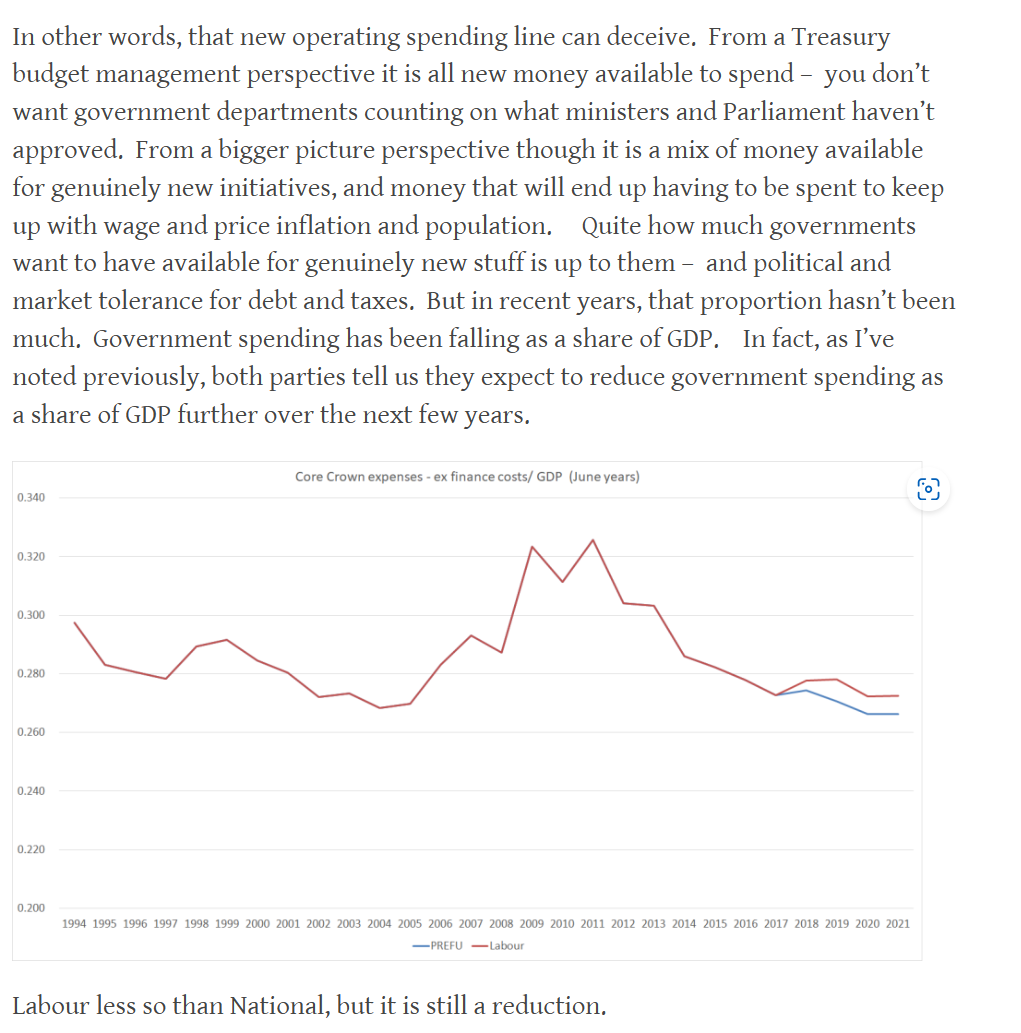
This might be seen primarily as a dig at the current government. It isn’t. In 2017 there was a huge political and analyst debate about alleged Labour “fiscal hole”. Many of the claims proved to be overblown but the “largely inescapable cost pressures” point was very real. At the time, and at the prompting of several former senior Treasury officials, I wrote a post on exactly that issue. By that time we had both the PREFU (reflecting incumbent government’s plans and operating allowances) and the then Opposition’s own fiscal plans (at present we have numbers from neither side). This text and chart was from that post

and after I’d worked through various detailed numbers around forecast influences that would boost costs

Neither side told us how they envisaged reducing government spending as a share of GDP. In a mechanical sense (PREFU and Labour’s parallel) they added up, but in substance they didn’t. Some related points were also in this post.

I expect that in next week’s PREFU there will be an operating surplus shown at some point in the relevant horizon (perhaps a year later than was suggested in the Budget). Quite probably – given that National seems to have no interest in an aggressive fiscal consolidation – that will suit both parties, but in both cases it will avoid the hard discussions around the choices that will bring about such surpluses. Countries don’t get from cyclically-adjusted deficits to surpluses by magic – or by simply drawing a line on a graph. Both sides are already guilty of “line on graphism” with what are no more than assumptions about savings that might be made without addressing programmes or choices that would make such savings sustainable.

It isn’t that medium-term fiscal projections are always useless. Sometimes legislation will already have been passed that will come into effect only gradually, and we want to be able to see the implications of those legislated commitments. But that really isn’t much of an issue at present. And absent such slowly unfolding adjustments it really means that almost no attention should be paid to any fiscal deficit numbers in PREFU beyond the current financial year: this year’s Budget has been passed and what is authorised isn’t vapourware. But what parties tell us vaguely they might do in future (and both are guilty) isn’t really worth much at all.

I ended that 2017 post with this suggestion

I stand by that call. I’m quite confident there has been a lot of very low quality spending in recent years, but I also suspect that the things governments need to spend money on are benefiting temporarily from the big surprise inflation. I’ve made the point here that teachers were more or less forced to accept a real wage cut, and a big cut relative to private sector wage developments. Recruitment and retention challenges are, shall we say, not unknown in the sector, and if we care at all about a high quality education sector then over time (and whatever else needs sorting out) we will need to pay accordingly. The senior doctors dispute seems to have similar characteristics. But how large and pervasive are these effects across the board? Treasury is best-placed to know, and to tell us. If the amounts are material then whatever savings can be made from genuine bloat might not reduce deficits at all but just end up having to be spent to be able to maintain or secure high quality core services. Treasury is obliged to publish a lot, but it could publish more and more useful standardised information along these lines.

Policy costings: a case study

I’ve written a few posts here over the years about the idea – which apparently Labour, National, and the Greens are now keen on – of a state established and funded policy costings unit. The most recent two were a month ago, here and here. I’m a longstanding sceptic of the case for such a unit, seeing it is just a way to get more state funding for political parties, and not dealing with any of the common arguments made for such units.

It is election season now and some of the arguments have, in effect, been put to the test. This week National released its tax and spending plan, producing numbers suggesting that what they planned to spend was fully funded by other cuts and new taxes. I wrote here about the macro issues and implications of/around the plan, largely taking as given the specific numbers the party supplied.

I’m not close enough to any of the line by line numbers to know whether each of them is solidly costed. Their economic consultants say they have been, and (assuming there were no silly mistakes made by accident) National does have a pretty strong incentive to ensure the numbers are each reasonably robust. So, for now, I’ll assume they are (with a few possible caveats about the foreign buyers tax, see below).

[and, later, on that tax]

…As for the revenue estimates ($750 million a year), they seem quite high, and the tax rate seems high by most international standards (Singapore is a lot higher). Only time will tell how many people not living here so want a New Zealand house they will pay a 15 per cent tax to do so.

Individual costings really weren’t and, as macroeconomic commentator, still aren’t my focus. In the grand scheme of things, the overall package involves adjustments of less than 1 per cent of GDP per annum, most costings don’t seem to have been contested, and in an age of MMP even a big party’s plans are likely to be implemented a bit differently than the pre-election promises. The foreign property buyers tax itself is expected to raise revenue equal to 0.2 per cent of annual GDP (and the gambling tax about 0.05 per cent of annual GDP).

But both as a potential voter and as someone interested in institutional proposals, notably that for policy costings offices, the subsequent debate has been interesting. I don’t really understand the issues around the online gambling costings (and the amounts involved are much smaller) so I’m going to focus on the foreign buyer tax. On that score there seem to be two quite separable concerns raised:

  • first, how consistent is the proposed tax with various tax and trade treaties New Zealand has signed? and
  • second, even if the tax were able to be put into effect as National tells us it envisages it (excluding buyers from Australia and Singapore, as with the current outright ban), just how much revenue would the tax be likely to raise year in year out?

Of course, the more there are issues under the first leg, the more questions could legitimately be raised about the revenue estimates.

Based on what they have told us, in the lead up to the announcement National did what one might have expected from a party seeking to win the right to lead the government after the election.  It hired a firm of advisers (Castalia) and asked them to review the draft numbers.   From what National has said (and I recall one media outlet being shown Castalia’s comments), National went with numbers that were generally at the conservative and cautious end of the spectrum.   Castalia apparently also cast a fresh eye over the numbers in light of the government’s fiscal announcements last Monday (although this is unlikely to have meant much since how much baseline spending can be saved – by either party –  isn’t really something a consultant can tell you, since it is mostly about the resolve of the politicians’ themselves once in office). 

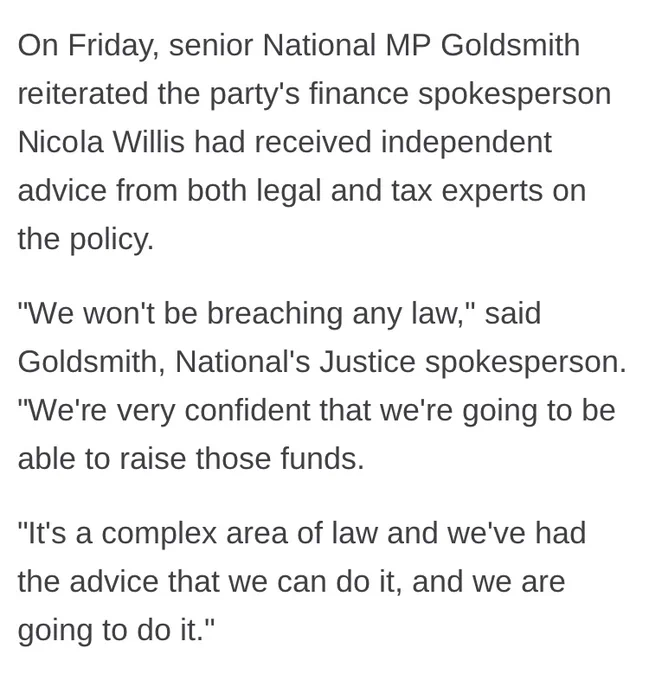
In addition to having consultants review modelling numbers, the National document told us they’d sought legal advice

National has sought legal advice on whether the replacement of the foreign buyer ban with a foreign buyer tax is consistent with New Zealand’s existing free trade agreements – that advice confirms such a replacement would be consistent with those agreements. However, this policy assumes Australian and Singaporean citizens will not be affected by the tax as they are not currently affected by the foreign buyer ban.

and a Newshub article yesterday reported that National had sought both legal and tax advice on these issues.

Image

So far and mostly so good.  We don’t just have National’s word for the numbers, but an established firm –  yes, paid for by National, but with an ongoing reputation to guard – is reported as telling us they thought the numbers overall had been cautious and conservative.

But then the questions arose. First, around the legality of imposing such a tax on various countries.  Some of the points were from Labour Party spokespeople (eg this press statement).   They are the political opposition so we might have no more particular reason to take their claims on trust than to take National’s on trust, but they do make some specific points, which to a lay voter seem like questions deserving an answer.  In fact, there might be both legal questions and questions about whether the proposed tax is within the spirit of agreements that New Zealand governments have voluntarily entered into (and which National is not on record as having opposed, or is now proposing to withdraw from).   (Non-specialists among us might also wonder why if absolute bans –  the ultimate in discrimination – mostly are legally okay (we now have one), a tax which would be less onerous would not.)   As National notes, some other jurisdictions have such taxes, but the issues here isn’t one of merits, but what specific New Zealand agreements do and don’t allow (and noting that New South Wales appears to have recently withdrawn its version of such a tax because of federal tax treaty issues).
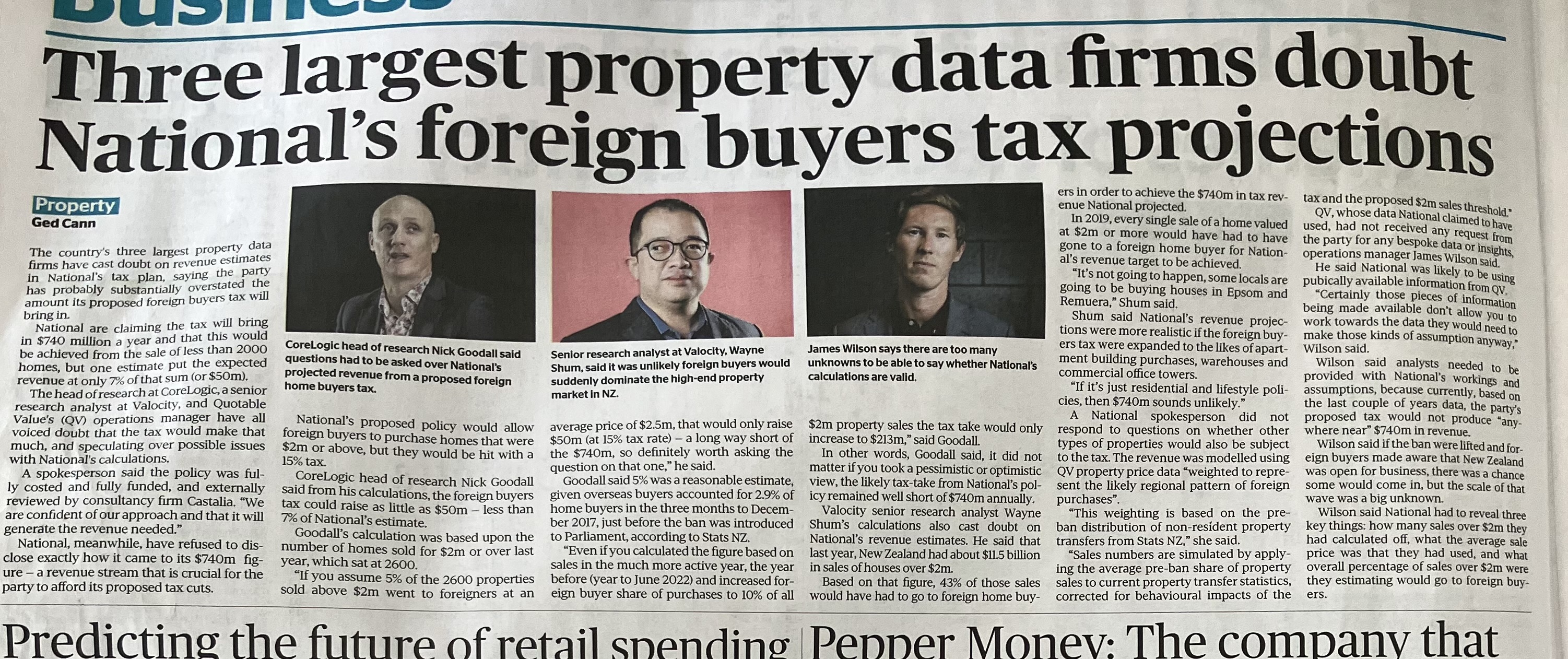
And then questions arose around the modelling (ie even if the law could be done as National had suggested whether it would raise $750 million or so year in year out).   Various economists and property analysts (people without apparent strong party loyalties that might make their perspectives suspect) raised doubts.  On the property experts side this article from today’s Post seems representative.

tax doubts

There are, of course, some enthusiastic real estate agents.  I read an article reporting one agent saying he’d had US billionaire clients on the phone within hours.  I don’t doubt there would be interest: the question is how much, and how much beyond the first wave (a quick Google suggests there only 2700 billionaires in the world).

Without seeing National’s modelling, it isn’t really possible to reach a confident view on their numbers.  But what makes me cautious is that I’ve seen no one –  neutral expert or even National surrogate arguing that the numbers are really on the cautious side and a more realistic assessment might be higher again.  It seems hard to find revenue estimates for other countries’ foreign buyer taxes –  often they are designed to deter purchases rather than to raise revenue – although I found a reference yesterday suggesting that a similar tax in Toronto (a metropolitan area with more people than New Zealand) was raising only about $200m per annum.

So wouldn’t this have been a clear case for a policy costings office?   I don’t think so.

National has used its (scarce) resources to pay for analysis and advice and has told as much as it seems to want to tell us.  Debate and scrutiny has ensued.   As a geeky analyst and undecided potential voter I’d really like them to release their modelling and any Castalia comments on it, and either the advice or a fairly full summary of the advice from the “legal and tax experts”.   It would be good even if they had some known National-sympathising experts who they could wheel out to make the case for (a) the legal problems not being what some suggest they might be, and b) the robustness of the numbers  (I don’t really expect Willis or their Revenue spokesperson to spending lots of time in public debate in the middle of a campaign).

But here’s the thing. It is their choice what to release (or not), and our choice as voters to draw our own conclusions.    Elections are most unlikely to turn on a specific like this, which is ultimately fairly small in the scheme of things (eg against the backdrop of some of the largest primary fiscal deficits of any advanced country at present, 0.2 per cent of revenue isn’t nothing but it is almost lost in the rounding – and is less than the non-specific proposed bureaucracy savings).  For some people and at the margin, it may shake confidence.    Go back to that quote from my post earlier in the week:   my starting point was to think that National had strong incentives to make sure that their numbers were robust, so as a starting point I took them as given.  Now that questions (apparently serious questions) having been raised, they have chosen not to release anything more or to address the specific concerns.    It is a legitimate choice (they are free to make it), but I (and the handful of interested analysts and potential voters) can draw my own conclusions. For me, I’m less confident now that the numbers add up, and also less confident than I might have hoped in their commitment towards being an open and transparent party in government.  It reinforces my wider doubts about their overall fiscal stance.

And that seems to be the political market working.  Parties will make choices about what they think a sufficient number of voters care about, or even about what sufficiently vocal commentators might shape public thinking over.  It is very unlikely that details of this tax score highly on either count.   Is that a bad thing?   I don’t really think so.    Voters are making judgements about values, about competence, about desires (or lack of them) for change.   And frankly, if fiscal issues were to become an issue, such concerns should probably centre on things individually more important than details of this tax.   The merits of unprincipled tax policies (this foreign buyers’ tax, Labour’s proposed GST exemptions, or the distortionary new depreciation provisions both parties have individually proposed to foist on the business sector) for example should probably count for more.  Or the sheer size of deficits  – without precedent in New Zealand now for many decades on the eve of an election.  But in the end, voters and parties will make their own choices, and nothing this week suggests to me that we’d have been better with some state-funded tax and trade lawyers and economist adding to the mix.  Precise numbers almost certainly do, and in my view probably should, matter less than what we learn about parties and their spokespeople in how they handle issues like this.

National’s tax and spending plan

National announced its tax and spending plans this morning. You can read the full 29 page document.

In the way of all parties and bureaucratic agencies these days, everything gets quoted as a four year figure: $14.7 billion sounds like a lot but it about $3.7 billion a year, which is about 0.8 per cent of annual GDP. Cost things over 10 years and you could if you wanted call it a $35 billion plan, with no more or less meaning (and, to be clear, all parties and agencies engage in this headline-inflating exercise).

Today’s plan is sold as being fully separable from National’s fiscal plan, which we will apparently get to see after they’ve had time to digest the PREFU numbers (coming on 12 September). It is a clever wheeze – it seemed to work – in allowing Willis and Luxon to deflect all and any questions this morning regarding the deficit and the possible/eventual/one day return to budget operating balance or surplus. They sold this line on the basis that today’s package was itself fully-funded from new initiatives of one form or another, so that in principle the net impact on what fiscal numbers The Treasury comes up with this package could just be slotted in with no net fiscal effect.

I’m not close enough to any of the line by line numbers to know whether each of them is solidly costed. Their economic consultants say they have been, and (assuming there were no silly mistakes made by accident) National does have a pretty strong incentive to ensure the numbers are each reasonably robust. So, for now, I’ll assume they are (with a few possible caveats about the foreign buyers tax, see below).

But the overall argument – “this isn’t our fiscal plan, come back next month for that” – doesn’t really wash. It might if the budget now was pretty near balance, or even in surplus. No one would, or perhaps should, be very worried about modest changes in a comfortable fiscal position.

But we don’t have a comfortable fiscal position.

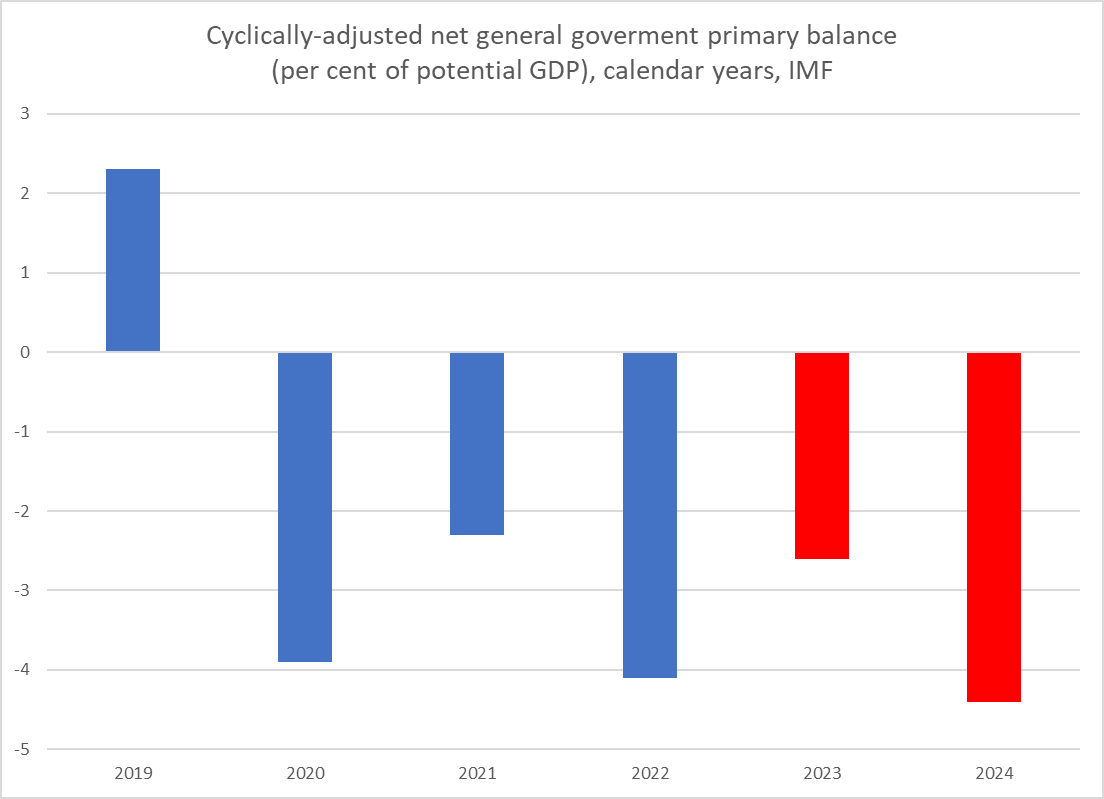
These were the fiscal numbers the International Monetary Fund put out yesterday in their annual New Zealand review

The blue numbers are more or less solid (actual fiscals are, but the cyclical adjustments could still change a bit), while the red numbers – calendar 2023 and 2024 – are going to be heavily influenced by choices and decisions the government has already made. The best advice from the IMF is that no progress has been made in reducing the deficits first run up in the Covid disruption years, even though actual Covid spending is no longer a thing. The Fund includes projections for the further-out years in which the operating balance goes back to respectable surplus for calendar 2027 and 2028, but those are really just assumptions, and don’t rely on specific identifiable tax or spending decisions that would bring about such an adjustment. I should stress that these are cyclically-adjusted numbers, so the ebbs and flows of the economic cycle don’t provide either the problem or the solution. These sorts of numbers led to the IMF recommending – in really quite pointed language for a diplomatic agency talking of a country that has been among the star fiscal performers for decades – “frontloaded fiscal consolidation” and steps to ease the fiscal pressure on monetary policy.

(The government’s control of the timing of the release of the IMF report, kicked to after Monday’s modest fiscal announcement, means these sorts of lines have had almost no media coverage. And of course no one seems to have gone and asked the Governor “what is this fiscal pressure on monetary policy/inflation the IMF talks about; you have claimed in the last two MPSs that there was none?”)

Last week I ran a post here using the OECD’s fiscal numbers. Those numbers will have been finalised a bit earlier than the IMF’s but are available on a consistent cross-country basis. Using that data you can see how large our (cyclically-adjusted) general government deficits now are relative to other OECD countries (and to our own past). The picture of recent years is a little different, but the final year deficit is also large.

Or here (not cyclically-adjusted)

We have a primary deficit that is large in absolute terms, and among the largest in the OECD.

These international comparisons aren’t done on the New Zealand operating balance definition. On that metric, the cyclically-adjusted operating deficit will be a smaller percentage of GDP, but there is little case for a cyclically-adjusted operating deficit (paying for the groceries etc) at all.

These structural deficits do not heal themselves. And while fiscal drag has been a bit of a help in limiting the deterioration in recent years, the forecast return to lower inflation means not even much of that support will be on offer.

Both Labour and National profess allegiance to the idea of an operating surplus…….but seem to have not the remotest interest in telling us what choices they are going to make to get us there. Discretionary choices/adjustments of perhaps 3 per cent of annual GDP might be required.

Today, however, is National’s day. This was their big tax and spending plan. Willis told reporters this morning that “your tax cuts are coming no matter how much Labour proves to have wrecked the joint”. So the tax cuts are iron-clad, and having bitten the bullet – after railing at Labour’s new taxes for years – and put several new tax increases on the table, it is hard to see they are suddenly going to pull a whole bunch more tax increases from their hat a couple of weeks hence to close the deficit.

It is always possible, they could announce some big new expenditure cut – killing off a few big wasteful specific programmes – but it doesn’t really seem in character, and would completely blunt the message from today that “tax cuts are coming”.

It is much more likely that – having announced their big tax and spending plan today – that is largely it. It may be fiscally neutral in its own right, which is better than the alternative of adding to the deficit, but they aren’t going to do anything much about the deficit at all. No doubt Labour won’t either – it will just handwave around whatever the PREFU shows, having cut (with no accountability whatever re eg likely cost pressures) future operating allowances on Monday. It will be a case of “trust us”, without even any credible evidence from either that ‘we know what we are doing” or really care one way or the other. We are at risk of sliding towards the normalisation of operating deficits, of borrowing to pay the grocery bill. The sort of really poor fiscal management you see in places like the United States federal government.

If asked, perhaps National will talk up cutting public sector bloat. I’m sure there is a fair amount to go round (and no one has mentioned the big increase in Reserve Bank spending that the government snuck out last week), but (a) in this morning’s announcement they ruled out a whole bunch of agencies, both because of Labour’s own vapourware announcements on Monday, and because they want any savings redirected to frontline services those agencies provide. That latter might be laudable but it doesn’t represent fiscal savings.

And, in any case, today’s package already relies on unspecific cuts in public sector bloat.

That is $4bn of the $14.6 billion cost of the overall package (30 per cent). I’m not disputing that there are (substantial) savings to be made, but savings made to finance tax cuts (as in this morning’s package) can’t then be used to also close the deficit. Both Labour and National talk of cutting consultant spend. That is cheap talk, unless (a) it amounts to a reduction in total spend, not just taking people onto the permanent staff (shifting the line item, but not changing the total, and b) identifying what work future governments don’t want done.

To the extent there is genuine bloat, the tax cuts package will have grabbed it. To cut further – cut the deficit – they would need to cut deeper and that would mean harder choices, which so far they’ve shown no inclination to be willing to make (nor Labour, but this is National’s day). And all this assumes that cost pressures are adequately captured in current baselines (which I doubt – citing for example the real wage cut forced on teachers despite apparently very real recruitment and retention challenges).

Finally a few thoughts on specific items. Childcare subsidies aren’t really my thing (better to collapse house prices), but both parties seem to like them. I like them cutting back the brightline test tax (less good than abolishing it, but…) and the restoration of interest deductibility for residential rental property owners (like any normal business). On the other hand, there is no commitment to inflation indexing income tax brackets even going forward (if they’d committed they’d have to have costed it).

But what got my goat were the first two of the new taxes.

Is it marginally better to have no ban on foreign buyers buying very expensive houses but having to pay a high tax to do so than to have an absolute ban? I might grudging acknowledge that, but any gain is marginal at best, and it is a policy that David Parker might have dreamed up in a moderate moment. It is an unprincipled revenue grab, which is wildly inconsistent with the party’s rhetoric (mostly good rhetoric) that freeing up the responsiveness of housing supply is what matters, and that we should be encouraging and facilitating more foreign investment generally. And from a party which claims to be – and historically has been – keen on immigration, it just seems weird (conflicting messages) again to not be allowing anyone who moves here, even on a work visa for several years, to buy a house. They are all over the place with barely a hint of philosophical consistency. It is all made more weird by this line from their document in which they seem to argue that their foreign buyer tax policy will itself somehow dampen property price growth.

As for the revenue estimates ($750 million a year), they seem quite high, and the tax rate seems high by most international standards (Singapore is a lot higher). Only time will tell how many people not living here so want a New Zealand house they will pay a 15 per cent tax to do so.

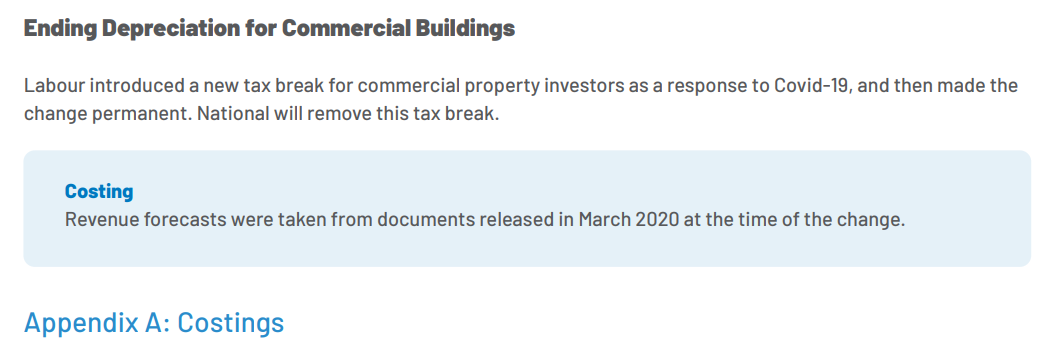
And then there was the other unprincipled revenue grab, the removal of tax depreciation for non-residential buildings. This measure – which increases the tax rate on businesses – was first introduced by National in 2010 to help fund that tax switch package, with no credible or rigorous underpinnings at all. Buildings depreciate (land doesn’t). In 2020 Labour restored this depreciation provision, and was supported in doing so by their own Tax Working Group. And now both Labour and National are campaigning on getting rid of it again, with no more rationale than that they need revenue (and no doubt tax depreciation provisions won’t show up in the focus groups). The intellectual bankruptcy behind this is evident in National’s document

No rationale at all beyond claiming it was a “tax break”. They rightly pushed back when Labour called interest-deductibility a tax break – it wasn’t, business operating expenses are generally deductible – and depreciation is no different. (Arguably, simply calling it a tax break is no worse than Labour pretending the 2020 change as a temporary Covid stimulus measure when they were quite clear at the time it was permanent, but…..it is a close call. Our political parties………)

Finally just a fairly small technical point. Willis claimed this morning that the National package would not add to inflation pressures. The justification for this claim is that the package is fiscally neutral. That isn’t necessarily sufficient for there to be no net demand impact. For example, the tax cuts etc are skewed towards people who probably have a very high marginal propensity to consume, and the revenue sources probably less so. Perhaps more important, and as someone pointed out over lunch, 20 per cent of the revenue is coming from the foreign buyers tax. Since the higher end, most lucrative, foreign buyers – some billionaire wanting a luxury mansion – mostly won’t be paying the tax out of New Zealand income that additional tax revenue may not represent any diminution of demand in New Zealand. These are small points – the whole (funded) package is less than 1 per cent of GDP – but all else equal I would expect it to be slightly stimulatory. Those compiling Treasury’s fiscal impulse measure might think the same.

The IMF probably wouldn’t think it was a step in the right direction. Perhaps the same will be able to be said for Labour’s plans as they unfold?

UPDATE: On the fiscal impulse issue, the removal of the regional petrol tax in Auckland has the potential to be net stimulatory, at least for a time, as the Auckland local authorities had to wind down projects or identify alternative revenue sources. Re the foreign buyers tax, there may be an incidence question (purchasers of mansions may be able to push the tax incidence back onto vendors, but probably not purchasers of $2.1 million houses in Roseneath or Epsom (where there would normally be more potential domestic purchasers)). In any case, I think most estimates of spending from capital gains – by fairly well-off vendors- probably assume a lower MPC than spending from income.

But we haven’t had a three year negative output gap

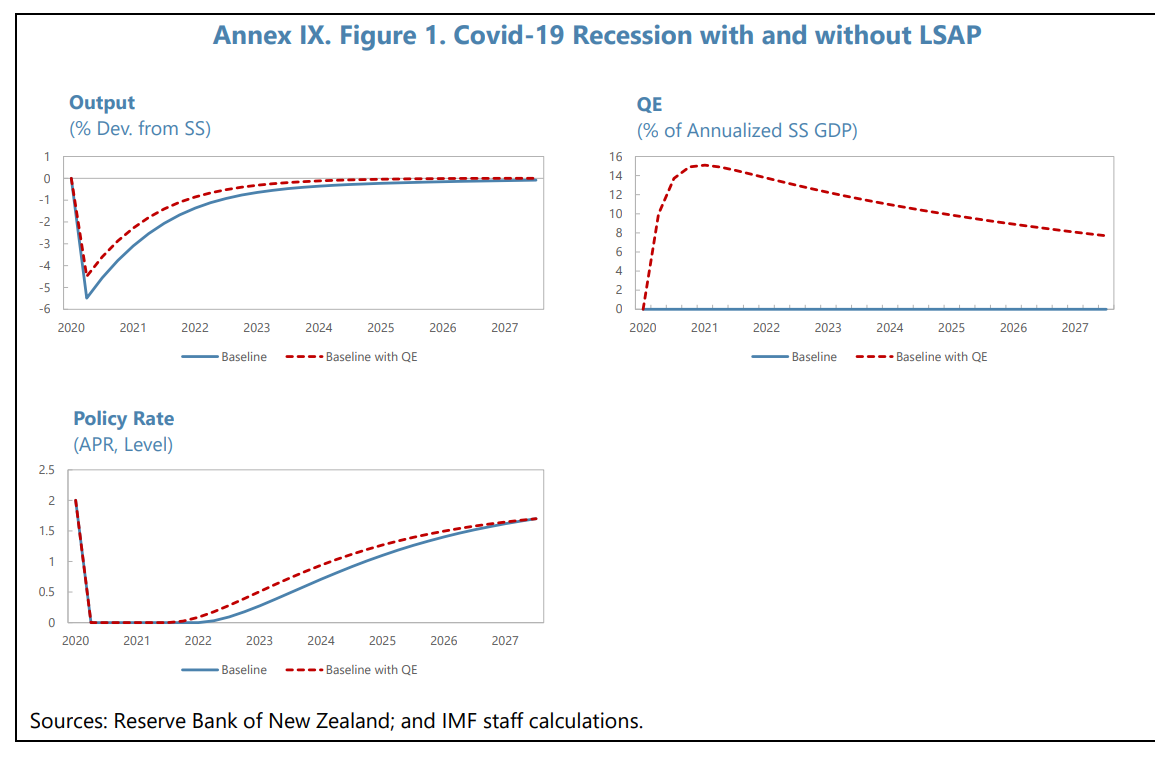
One of the great things about being a prominent organisation that releases complex material to select media under embargo is that you can get uncontested coverage in the first (and probably only) news cycle. Adrian Orr will have been glad of that when it came to the embargoed release yesterday (the public only got to see it at 5:43 this morning) of the IMF’s Article IV report, and in particular the short (600 words) annex on the fiscal implications of the Reserve Bank’s LSAP programme – the one on which the Reserve Bank has so far lost $11bn.

It was 10 days or so ago that we first heard that some such paper was coming. The Governor was being interviewed by the Herald‘s Madison Reidy after the Monetary Policy Statement. She asked Orr about the LSAP losses and noted in contrast the fiscal costs of the storms/cyclone this year. In his usual effusive style he responded that the LSAP itself had already more than paid for the cyclone recovery costs, moving on to suggest that only accountants could think otherwise “who know the cost of everything and the value of nothing”. He then went to say that the IMF had a paper, which he hoped would be published, showing that the LSAP had actually improved the government’s finances, and that it would offer the “proper story” not some “piecemeal accounting story”.

That caught my eye. Knowing that the IMF Article IV report was due before long, I wondered if they’d have a Selected Issues paper on the topic. These are supplementary research pieces, usually 15-20 pages or so, undertaken by Fund staff (often on topics requested by the authorities) as part of the Article IV review process. The latest two such papers are here.

But it proved not. Instead, we got only a little annex on the topic (600 words and two pictures) on pages 64-66 of the main report. The “proper story” it certainly isn’t – and in fairness to the Fund, as distinct from the Governor, it doesn’t really purport to be. What it is is a little exercise by a few researchers (not working specifically on New Zealand) using a model, as yet unpublished, that they have developed for work on central bank exit strategies, showing that on certain assumptions something like the LSAP could end up producing net fiscal benefits. Surprise, surprise. Of course. It could. The question really is about the realism of the assumptions etc.

Orr, and probably the Fund, will have been pretty happy with the Herald‘s coverage this morning, under the headline “Reserve Bank’s money-printing buoyed Govt books, says IMF” (well except that – rightly – the Governor and IMF would disavow the suggestion that the LSAP was “money-printing”: it was just an enormous asset swap). The results could be read as backing the Governor’s claim – a year ago in an interview with the same journalist – that the benefits to the economy had been “multiples” of the direct cost (although she seems not to have realised that because she contrasts these results with Orr’s 2022 claim).

The first of the two charts really captures the gist of why the little model analysis sheds no useful light at all (SS here simply means steady state).

I showed the top left chart to a 3rd year economics undergraduate, who immediately spotted the problem. It isn’t very hard.

You’ll note that in this example real GDP falls materially below the steady state, or potential, and stays there – converging ever so slowly – for years. By construction of the model, the LSAP intervention – about the scale of the actual LSAP programme – lifts real GDP, but again throughout the entire forecast period real output is at or below potential. There is, in other words, a negative output gap right through the period in the scenario. As the model is constructed, the LSAP intervention boosts real GDP, so that there is a smaller negative output gap. But it is always either negative or zero. Thus, the LSAP has unambiguously boosted real GDP, and thus tax revenues. Working back from the (few) numbers in the little note, and knowing the tax/GDP ratio in New Zealand is about 30 per cent, the total GDP difference must be of the order of 7-8 per cent of GDP. The current LSAP losses to the Reserve Bank are just over 2.5 per cent of GDP, so on those numbers the gains from the LSAP would be “multiples” of the Reserve Bank losses.

But have we had a negative output gap throughout the last 3+ years since the LSAP got underway at the end of March 2020?

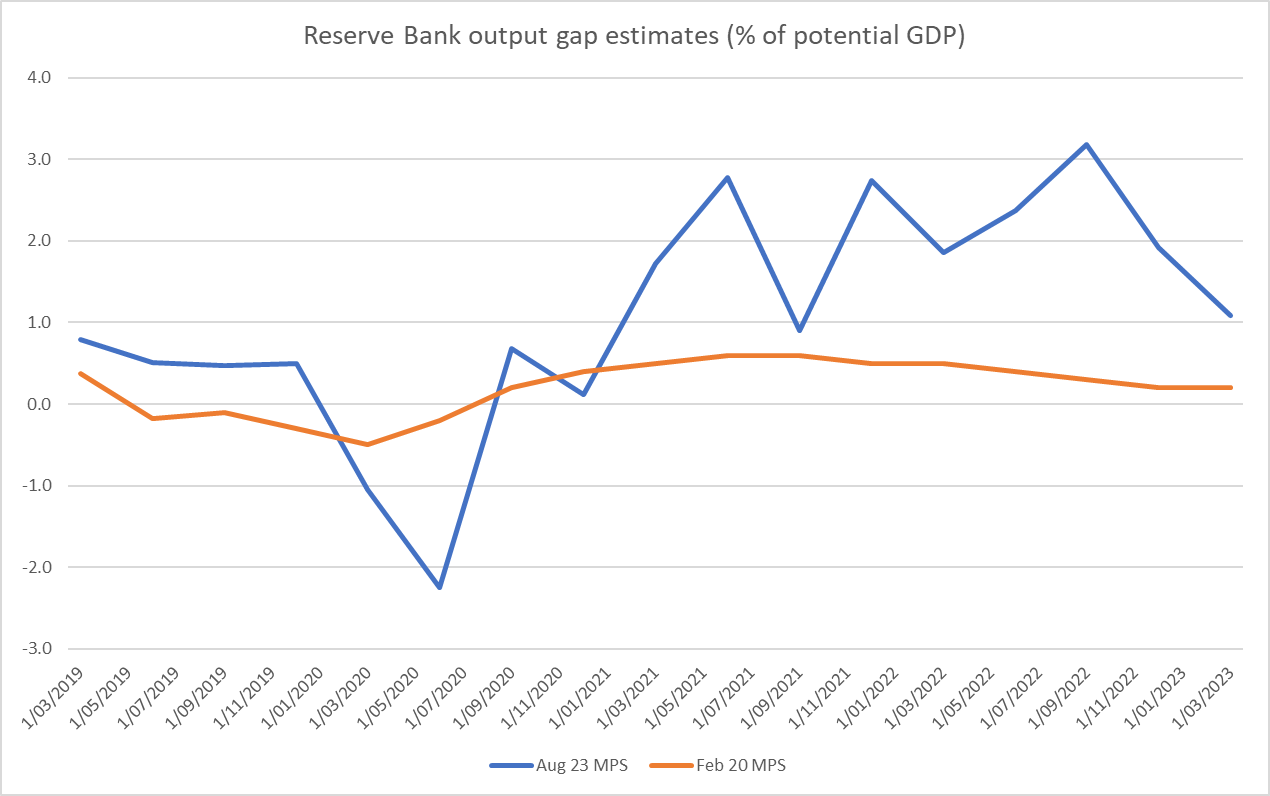
Not according to the Reserve Bank, or to any other serious macroeconomic analyst. But since it is the Reserve Bank making the bold claims, and because their numbers are easy to find, here is the Reserve Bank’s current view of the output gap over the period since the start of 2019. I’ve also shown their projections from the last (pre Covid, pre LSAP) MPS.

The output gap is now estimated – several years on – to have been negative for only two quarters, March and June 2020. Every quarter from September 2020 onwards has been positive.

Doesn’t that just mean even more tax revenue and more net benefit?

No, it doesn’t. What went with the persistently positive and large output gap? Why, that was the sharp and now sustained rise in inflation. And how do the Reserve Bank’s modelling and forecast efforts envisage that core inflation comes back to target again? Why, via (raising the OCR and engendering) a fairly protracted negative output gap

and when output is running below potential for several years (and on these projections it isn’t even back to potential by 2026), tax revenue will, all else equal, be running lower than it would otherwise have been. In fact, the way the forecasting models are set up, things are pretty much symmetrical – it will be take roughly as much excess capacity as there was excess demand. We simply haven’t been in the world the IMF’s little desk exercise assumed/portrayed. And thus the numbers are just pretty meaningless when it comes to making claims about the fiscal or other net costs/ benefits of the LSAP. In his day, the Governor would have recognised that once he read the short note and thought for a minute or two.

There are many other limitations to the analysis, even on its own terms. First, the subsequent inflation seems to be treated as quite unrelated to the (with hindsight excessive) stimulus that had gone before. Second, while they assert that the LSAP was a better (net cheaper) intervention than anything else they make no attempt to show this. Thus, had we wanted to throw another $11bn at the economy we could instead have simply given the money to households ($2000 or so per capita). That almost certainly would have engendered a significant demand response (and more than what most New Zealand economists outside Bank believe the LSAP actually did). And we know that actually the OCR hadn’t been lowered to any sort of effective floor, just to the 0.25 per cent the MPC had chosen to set it at. So at least some of any stimulus the LSAP provided could have been done simply by setting the OCR lower – at no risk to the Crown at all. The Funding for Lending programme, used long and late by the Bank, seemed to be an effective tool for stimulus…..and involved no financial risk to taxpayers at all. Had the Bank been doing its job in the run-up to Covid, the negative OCR tool would have been available from the start. You might not like that tool, but the Governor had told us before Covid that he did, and it could have been used at no financial risk to the Crown.

And all this simply assumes – no serious attempt has ever been made to show – that in the specific circumstances of New Zealand (where shorter-term rates are overwhelmingly what matter, and they were anchored by OCR expectations), the LSAP had any material (even inflationary) stimulus at all, to justify the huge financial risks that were taken with no serious advance scrutiny, and which ended up going very bad.

I could take the opportunity to run through all the arguments around LSAP effectiveness again, but I won’t. About a year ago Orr made a strong play to defend it, and the alleged benefits, and I spent a long post then unpicking his arguments. Sometimes – there are so many – one just forgets occasions when Orr has just made stuff up. He was at it again this week.

As for the IMF piece, it is what it is. If you ever find yourself in a deep economic hole, seemingly intractable, you want all the monetary policy stimulus you can get. Best of all, use the OCR and use it aggressively. Perhaps QE can add some value on occasion (probably not much in New Zealand, but perhaps anything might help then in such a scenario). But that – we now realise – just isn’t where the New Zealand economy – or most other economies – found themselves after March 2020. In fact, it is the Reserve Bank itself that now reckons the economy was already overheating – GDP above potential – by the second half of 2020.

Fiscals and elections

In his (paywalled) newsletter this morning Richard Harman compares the current fiscal situation, with yesterday’s last minute fiscal announcements, to the 1972 Budget and election campaign, when Robert Muldoon, then Minister of Finance, was reputed to have said that he’d spent it all and there wasn’t anything much left for the Opposition. Surpluses and deficits were measured differently in those days (cash-based and including capex but not depreciation) but the Treasury long-term fiscal tables tell us in 1972/73 the government accounts ended up with a (very) modest surplus, 0.1 per cent of GDP.

The outgoing Labour government’s fiscal policy around its 2008 Budget is also often heavily criticised. And there is plenty to criticise it for, but as I’ve documented here in several posts (here and here) at the time The Treasury was producing forecasts showing that the operating balance would remain in surplus over the entire forecast period (tiny surplus by the end of the period, but still). It wasn’t Treasury’s finest hour, but you can’t blame Cullen and Clark for Treasury’s forecasting problems. Now, by the time of the PREFU that year things had deteriorated quite a bit – the recession was recognised to be underway – and there were no longer surpluses in prospect. But even then for the fiscal year they were actually in – 2008/09 – the best Treasury projection was a balance of 0.0 per cent GDP. A couple of years beyond that date, a deficit of 1.5 per cent of GDP was projected.

In this year’s Budget the operating balance for 2023/24 – the year we are in, the one where the government makes actual specific tax and spending decisions – the operating deficit was forecast at 1.8 per cent of GDP. There is no good case for running operating deficits at all in an economy that is more or less fully employed (Treasury’s 2023 Budget forecasts for the unemployment rate were 3.7 per cent for June 2023 and 5 per cent for June 2024, suggesting an average roughly equal to many NAIRU estimates).

Fiscal numbers for years beyond the immediately current year are substantially vapourware, but never more so than just prior to an election. The Secretary to the Treasury is required to take as given what the Minister of Finance tells her is government policy. If the Minister of Finance decides to cut future operating allowances those new lower allowances will be what is used, regardless of how plausible the numbers are (it isn’t for Treasury to inquire into that in doing the PREFU numbers). But statements of future intentions don’t bind anyone – and this is true of any Minister of Finance, of any political stripe – and need have no regard to actual budgetary pressures. The vapourware character is perhaps especially so when the plausible political allies for the incumbent party, were it to form the next government, tend to be even less keen on fiscal/spending discipline. Something like the PREFU is a good idea in principle, but there are severe limitations to what it is useful for (a few years ago I posed some suggestions that might make it more useful and might come back to those another day).

It is also easy to forget that it was only 15 months ago – last year’s Budget – that the Minister of Finance was touting his new “fiscal rules“, that were to – he claimed – “ensure New Zealand continues to maintain a world-leading Government financial position”. Among them was this

Surpluses will be kept within a band of zero to two percent of GDP to ensure new day‑to‑day spending is not adding to debt

Just a shame there were, and are, no surpluses. St Augustine’s famous prayer (“Lord, give me chastity and continence, but not yet!”) has a certain resonance for current New Zealand fiscal discipline (or lack of it).

The focus of yesterday’s announcement – months after the expansionary Budget, weeks before the election- was on spending cuts. So I took a look at how this government’s spending plans for this year have evolved over the course of this electoral cycle.

Here is (nominal) core Crown expenses projections for 2023/24 for every EFU starting with the 2020 PREFU. The 2020 PREFU forecasts were done in August 2020, after the first and worst lockdown, but at a time when economic projections generally were pretty bleak (back then, for example, they thought the unemployment rate now would still be around 6 per cent).

The last observation takes account of yesterday’s announcement which may have knocked $1 billion or so off this year’s spending.

Even now the plan seems to be to spend $20 billion more this year than they said they intended at the end of 2020.

Now, no doubt the government would respond “ah, but inflation”. That is a pretty shaky argument, to say the least, when (a) you are the government and the central bank is one of your agencies, and (b) there has never been uttered, not once, by the PM or Minister of Finance, any sort of critical word about the central bank’s stewardship, and you went on to reappoint all the central bank decisionmakers when their terms expired, even (in the case of the Governor) when the main Opposition parties explicitly objected when (as the newly-passed law required) they were consulted. Inflation has been savage. (But of course, just the other day Robertson allowed the Bank a huge increase in its own spending with, as yet, no published rationale or justification.)

But set inflation to one side, and focus instead on projections as a share of GDP (again allowing for $1 billion off this year’s spending, per yesterday, but no reduction since this year’s Budget in expected nominal GDP)

In the first EFU of the majority Labour government (December 2020), they said that they planned to spend 30.1 per cent of GDP in 2023/24. In fact, their latest revised plans would involve spending about 32.75 per cent of GDP this year, and even with lots of fiscal drag to help them, still substantial operating deficits. Note that even after yesterday’s announcement, operational spending this year as a share of GDP is still likely to be a bit larger than they told us they’d planned even in the HYEFU late last year, a mere 9 months ago. (In HYEFU 2021 – less than two years ago now – they expected to spend just over 30 per cent of GDP this year and record a small operating surplus. Now, not so much.

It will be interesting to see the PREFU numbers (at least for this year) on 12 September, but it seems almost certain whereas in 1972 Muldoon actually delivered a tiny surplus in his final year, and whereas in 2008 Clark/Cullen went into PREFU thinking that at least the operating balance for their final year (2008/09) would be literally in balance, this year – and notwithstanding yesterday’s announcement – we will again see forecasts of a material operating deficit for 2023/24. That is all on Hipkins and Robertson.

(It will, of course, also be interesting to see National’s plan and numbers. I’m pretty sceptical based on what we’ve heard so far, but we’ll see. But when the operating balance is in material deficit, it is quite depressing to see both major parties competing on who has the best giveaways – be it GST carveouts, extra subsidies for this or that, and whatever tax plans National has – rather than on restoring promptly a record of fiscal balance. There is no good economic reason for running operating deficits this year – it is like a family overspending its income on consumption items in a year when it has been fully employed – but politics seems to say otherwise. Similarly, there isn’t a really good reason for cutting spending because of a cyclical slowdown – there are Keynesian bones in me – when the real point is that a substantial operating deficit shouldn’t have been budgeted this year in the first place.)

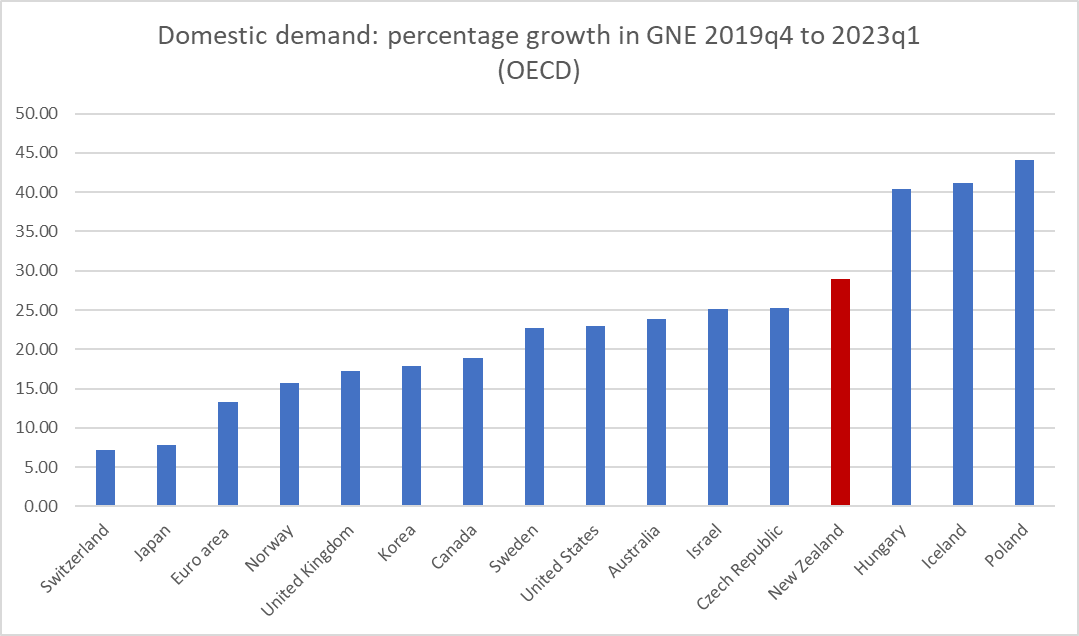
Finally, I remind you of last week’s post, in which the OECD numbers revealed that New Zealand has recently had one of the stimulatory of fiscal policies and now has among the largest general government (primary) deficits of any advanced country.

Prescriptions

It is the time of the cycle when plenty of groups are keen to have their policy ideas and prescriptions be heard. After all, parties may still be finalising policies and there seems to be a reasonable chance of a new government and different set of ministers before long.

Many are just self-interested (no doubt the authors mostly believe there might be wider benefits, but the fact remains that they are championing policies to help their firm/industry/sector). As an example I found a link in my email this morning to one called a “Blueprint for Growth”. It was this from the covering press release that made me rashly open the handful of slides:

“Today’s announcement is just the beginning, as we know that good, evidence-based, bipartisan policy leads to better outcomes for all New Zealanders. This is part of the key to unlocking the future prosperity and productivity in New Zealand. 

Instead it was a bunch of suggestions from the Financial Services Council, some probably worthy, others purely self-interested, that were primarily going to be good for member firms of the Financial Services Council and which, whatever their merits, were going to do nothing at all for productivity,

Yesterday the New Zealand Initiative released a rather more substantive effort, an 86 page collection of proposals and recommendations across a wide range of areas of government policy (nothing on foreign policy for example, and no references to China at all, except perhaps by allusion when discussing the proposed foreign investment regulatory regime, and no mention at all of company tax). (I wrote about their Manifesto 2017 here.)

In some parts of the left, the New Zealand Initiative is looked on as some sort of lobby group for big business, and anything they say is, accordingly, to be dismissed without further examination. The Initiative would sometimes have you believe that it was the opposite: simply public-spirited disinterested people, focused only the well-being of all New Zealanders, who put up their money (in some cases, although mostly their shareholders’ money) only to produce research and analysis without fear, favour, or predisposition. The truth is probably in the middle, but it really shouldn’t matter because the Initiative is transparent about (a) who their members are, (b) their staff and the views of those staff, and (c) their analysis and research. Their stuff should be taken on its merits, and critically scrutinised in the same way as any other contributions to debates. Topics chosen will presumably reflect, to some extent, members’ interests (in both senses of that word) but that is a different matter than what is said on those topics.

I probably agreed with half the proposals in the latest Prescription. I often find myself agreeing with them on second order issues, while profoundly disagreeing with them on the diagnosis and prescription for New Zealand’s long-running productivity failure. But it is a fairly serious collection of ideas and I was a bit surprised not to have seen any media coverage.

In this post I wanted to comment only on their fiscal and monetary policy recommendations, summarised here (and discussed in a bit more depth on page 20-22 of the PDF.

Take fiscal first.

While I generally agree with the first recommendation (no new or higher taxes) – since there is plenty of room to close the (large) deficit by cutting out low-value spending over several years – some of the arguments adduced in support don’t stand much scrutiny. Take, for example, this paragraph

It is certainly true that Singapore and Taiwan have markedly lower rates of tax to GDP than New Zealand (or other advanced countries). On the other hand, OECD data for taxes and social security contributions as a share of GDP show that these days both Japan and Korea have about the same or higher tax shares than New Zealand does. Switzerland, Australia and the US are certainly lower than New Zealand, but then Canada is higher. And “Europe aside” does tend to rather overlook the fact that most of the world’s advanced economies are in Europe. (The Ireland line was fairly disreputable, it being well-understood that Ireland’s GDP numbers are seriously distorted by international tax factors. Using as a denominator the one the Irish authorities recommend (modified GNI), Ireland’s tax share is much the same as New Zealand’s).

I largely agree with their proposals around retirement income, and was surprised to realise that Kiwisaver subsidies now cost about $1 billion per annum. The text suggests that they envisage a pretty slow increase in the age of NZS eligibility, which does fit with what National is promising but should not be necessary in a first-best set of recommendations. Lift the age of eligibility by one quarter a year and it would be at 67 in eight years’ time.

There is quite a difference between suspending contributions to the New Zealand Superannuation Fund (the headline recommendation) and the alternative they moot in the fuller text of simply winding up the Fund. Do the former and Labour is likely to simply resume contributions again. There is no natural place for the government taking your money and mine (or, worse, borrowing it) to punt in international markets at our risk. The NZSF was initially designed for two things: to keep Michael Cullen’s colleagues’ spending sticky fingers off his early large surpluses, and to help buttress an NZS age of 65. We’ve not now had regular surpluses for a long time, and there is no good reason – with improvements in life expectancy – why the eligibility age for the universal state pension should be the same now as it was set at, for the then means-tested age pension, in 1898. NZSF should be wound up and the government’s gross debt substantially reduced.

The third bullet – comprehensive expenditure review – is fine, even admirable. But specifics, and willingness to actually cut, will matter. I like the idea of getting rid of interest-free student loans (my kids look at me reproachfully) but…..what hope?

I have long favoured a (small) Fiscal Council, or perhaps a slightly wider Macroeconomic Policy Council. This is a quite different thing than the policy costings office National, Labour and the Greens are all keen on (as a public subsidy to political parties). That said, if one were serious about austerity in the next term of government – and for my money the NZI doesn’t give sufficient weight to the scale of the fiscal challenge – I’m not sure I’d be treating new nice-to-have agencies (even very small ones) as any sort of priority. I’d rather focus on replacing the Secretary to the Treasury (whose term is up next year) and revitalising the analytical and advisory capabilities of The Treasury.

What of the monetary policy and Reserve Bank proposals. In several places, they overlap with ideas I’ve pushed here over the years.

I was in favour of something like the change to the statutory monetary policy mandate to the Reserve Bank, and am actually on record (in my submission to FEC in 2018) as having favoured going further. The change to the way the mandate was expressed was never envisaged as materially altering how monetary policy was run (from Robertson’s perspective it mostly seemed to be political product differentiation), and I don’t think there is any evidence it has actually done so. The Reserve Bank has made big mistakes in recent years but they have been analytical and forecasting mistakes, not things that can be sheeted home to the change in the way the mandate was expressed (here I imagine the Governor and I would be at one, although of course he’d be reluctant to get anywhere near the world “mistake”). All that said, since making the change made no substantive difference and was mostly about product differentiation, so would undoing it. We need real change at the Bank (and in how it is held to account) so I won’t argue strongly about symbolic change, a least if it markets/headlines real underlying change.

On the other hand, I have long favoured splitting up the Bank, and leaving a monetary policy and broader macro stability focused central bank, and then a New Zealand Prudential Regulatory Agency (probably comprising the regulatory functions of the Bank and much of the FMA’s responsibilities). That such a model would parallel the Australian system is not a conclusive argument on its own, but it is a real benefit when the biggest banking and insurance players in New Zealand are Australian-based. The Initiative argues that

Separating the functions into two organisations would improve governance and reduce the risk of political interference in the RBNZ’s core mission of price stability.

I agree (strongly) with the former. The current (reformed) Reserve Bank has a dogs’-breakfast of a governance model. I’m (much) less persuaded by the latter argument. I have seen no sign – in my time at the Bank or in recent years – of political interference in the operation of monetary policy. The mistakes have been Orr’s, and if there are valid criticisms of Robertson they are that he has showed little interest in doing anything about holding the Bank (and its key personnel) to account. Monetary policy and financial institution regulation are just two quite different functions, and need different skill-sets in CEOs. It isn’t impossible to make the current combined model work – though it would need big changes, including some legislative overhaul – but it simply isn’t the best model for New Zealand. (Such a reform would, done the right way, also render the Governor’s position redundant, with two new chief executive positions to fill.)

Should the Bank’s budget be cut? Yes, of course (and that comprehensive spending review shouldn’t overlook opportunities there), and since the NZI document was finalised we’ve seen an egregious increase in approved Bank spending without even the courtesy (or statutory obligation) to provide any documentation in support. But the budget is only one lever. As important will be finding expert people to lead the institution and monetary policy function who are really only interested, in their day job, in thinking about macroeconomics and doing and communicating monetary policy excellently, without fear, favour, or suspicion of either partisan allegiance or using a public role for private ideological purposes.

I have written here previously that I favour returning the inflation target to 0 to 2 per cent. That said, I don’t find the Initiative’s reasoning very persuasive

A lower target range would encourage the RBNZ to pursue more prudent monetary policies,
minimising the risk of excessive inflation and promoting sustainable economic growth.

But there is no evidence for these claims. Adrian Orr and his minions would have made more or less exactly the same forecasting mistakes in recent years with a target centred on 1 per cent as with the actual target centred on 2 per cent.

Perhaps more importantly, I don’t think the New Zealand Initiative team has ever taken sufficiently seriously the current (regulatorily-induced) effective lower bound on nominal interest rates. That constraint can and should be fixed but unless it is fixed it would be irresponsible to recommend lowering the inflation target.

On deposit insurance, I have long favoured deposit insurance, as a second-best way of reducing the scale and risk of government bailouts of banks (if no one is protected a failing big bank will almost certainly be bailed out, whereas with (retail) deposit insurance it is more credible to think that wholesale funders might be allowed to lose their money in a failure. That said, my argument was primarily about the big banks, and the deposit insurance regime will not cover only them. I do worry about heightened moral hazard risks around the small institutions. One could, I suppose, argue that capital ratios are now high enough there is very little risk of a large bank failing, to a point where it is credible that depositors could face material losses, but that argument cuts both ways in that with high capital ratios moral hazard risks are much smaller even in the present of deposit insurance.

The second to last item on the monetary policy list is a curious one. The Reserve Bank has run up losses of about $11 billion dollars through an LSAP conducted almost entirely in government bonds. So while I agree with limiting what NZ assets the Bank can buy, I don’t think it gets near the heart of the issue. New Zealand legislation is generally for too lax in allowing huge risks to be assumed with no parliamentary approval (whether the Minister of Finance issuing guarantees, for which there is no limit, or the Reserve Bank – which cannot default on its debts – buying risky assets. While there is a need for some crisis flexibility, the scale of the intervention undertaken (over more than a year) should not again be possible without parliamentary approval. That, incidentally, does not impair monetary policy operational autonomy both because the LSAP is a very weak (just risky) instrument and because (see above) the effective lower bound on the nominal OCR itself can and should be fixed.

I have no particular problem with something like the final item on the list, but as regards the LSAP expansion it would seem to be already there. The Bank’s holdings of government bonds are being slowly but steadily sold back to The Treasury (and others are maturing in RB hands). One can argue that the mix of sales might have been different or that the pace should have been (much) faster, but the domestic monetary policy bit of the balance sheet will shrink a lot. There are debates to be had about how much of an “abundant reserves” approach is taken in future – I’d probably favour not – and there are issues that should have had more scrutiny around increases in foreign reserves that the Minister has approved this year, but they are probably second order in nature.

With only 86 pages and lots of policy areas to get through, the NZI document was never going to cover all the significant issues in any subject area. I have quite a list of others, both as regards fiscal policy and around monetary and financial regulatory policy, but this post was about engaging the debate on the ideas NZI has proposed, not tackling all the ones they didn’t or didn’t have space for. Overall, I’m mostly sympathetic to the direction they suggest, but any incoming government actually interested in change should subject the specifics to some serious critical scrutiny.

What did the RB have to deal with?

I’ve used this chart before to illustrate how diverse the (core) inflation experiences of advanced economies have been in this episode. It isn’t as if they’ve all ended up with similarly bad inflation rates, and the point of focusing on those countries with their own monetary policy and a floating exchange rate is that core inflation outcomes are a result of domestic (central bank) choices (passive or active) in each country.

Yesterday’s post focused on the rapid growth in domestic demand that the Reserve Bank had facilitated and overseen. But, it might have occurred to you to ask, what about foreign demand? It all adds up.

And if you look more broadly you might reasonably have thought New Zealand would be a good candidate for being towards the left-hand end of this chart.

The central banks in Australia, Canada, and Norway have faced big increases in the respective national terms of trade (export prices relative to import prices) over the last 3+ years. All else equal, a rising terms of trade – especially when, as in each of these cases, led by rising export prices – tends to increase domestic incomes and domestic consumption and investment spending and inflation. It isn’t mechanical or one for one (in Norway, for example, they have the oil fund into which state oil and gas revenues are sterilised) but the direction is clear: a rising terms of trade is a “good thing” and more spending, and pressure on real resources, will typically follow in its wake.

Here is the contrast between New Zealand and Australia over recent years.

In Australia a 25 per cent lift in the terms of trade is roughly equal to a 5 per cent lift in real purchasing power (over and above what is captured in real GDP). A 10 per cent fall here would be a roughly equivalent to a 2.5 per cent drop in real purchasing power. As it happens, over the last couple of years (since the tightening phases began) the terms of trade have been weaker than the Reserve Bank expected, all else equal a moderate deflationary surprise.

But the other big deflationary influence was the closed borders. I’m not here getting into debates about the merits of otherwise of such policies. Central banks simply have to take whatever else governments (and the private sector) do as given and adjust monetary policy accordingly to keep (core) inflation near target. The fact was that our borders were largely closed to human traffic for a long time, New Zealand has more exports of such services (tourism and export education) than imports, and exports of services are far from having fully recovered pre-Covid levels.

We don’t have easily comparable tourism and export education data across countries, but we can look at how exports of services changed as a share of GDP. From just prior to Covid to the trough, New Zealand exports of services fell by 5.7 percentage points of GDP, a shock exceeded only by Iceland (-12.7 percentage points) – the fall for Australia was just under half New Zealand’s, and for most advanced economies (of the sample in the chart above) the fall was 1-2 percentage points of GDP. In most countries, that trough was in mid 2020, while in New Zealand it was not until early 2022.

Some ground has been recovered (most starkly in Iceland) but New Zealand (and to a lesser extent Australia) are still living with a material deflationary shock from this side of the economy. Real services exports in 2023Q1 were 26 per cent (seasonally adjusted) lower than in 2019Q4, just prior to Covid.

Now, again you will note that this isn’t the entire story. After all, New Zealanders couldn’t travel abroad easily for much of the time either, and money they would have spent abroad seemed to be substantially diverted to spending at home (probably more so than was initially expected). That reduction of imports of services was large (3 percentage points of GDP, with Australia 4th largest of this advanced country grouping) but early – the trough for New Zealand as for most of these advanced countries was as early as 2020Q3.

But that was then. This chart shows the change in imports of services as a share of GDP from just pre-Covid to our most recent data (2023Q1). That share has fully recovered here, with an increase very similar to that of the median country.

So, relative to pre-Covid (and pre-inflation surge), imports of services as a share of GDP are about where they were, and exports of services were still materially lower as at the last official data.

With a deflationary shock like this you might have reasonably thought that the Reserve Bank, if it was to keep inflation near target, would need to induce or ensure faster growth in domestic demand (than some other countries). Yesterday I showed this chart (remember, GNE is national accounts speak for domestic demand). New Zealand was at the far right side of the chart (strongest growth in domestic demand as a share of GDP).

But what if we treated the change in the services exports share of GDP as an exogenous shock that, all else equal, the central bank legitimately had to respond to? In this version of the chart I’ve subtracted the reduction in services exports as a share of GDP.

It makes a material difference to the New Zealand numbers, but even so we are still left with an increase in the share of GDP that is third highest on the chart, about the same as the UK which (as is well known) is really struggling with inflation. (In case you are wondering Korea has relatively modest core inflation now – so first chart – but still about 3.5 percentage points higher than it was just prior to Covid; for us the increase has been about 4 percentage points.)

There are lots of numbers and concepts in this post and it isn’t always easy to keep them straight. But the key points are probably:

  • echoing yesterday’s post, don’t be distracted by the Governor’s spin about Russia or the weather or whatever (they just don’t explain core inflation to any material extent) or spin (probably more from the Minister) that every advanced country is in the same boat (they aren’t, see first chart),
  • more than other advanced countries, we should have been predisposed to being able to have kept inflation in check a bit more easily, having had both a fall in the terms of trade (very much unlike Australia and Canada) and a sustained fall in exports of services that as a share of GDP is materially larger than any other advanced economy has seen.  To be clear, those are bad things, making us poorer, but all else equal they were disinflationary forces,
  • and yet, core inflation here is in the upper half of the group of advanced economies and (as the MPS acknowledged) is not yet really showing signs of having fallen (unlike some other advanced countries, notably Australia, the US, and Canada),
  • the difference is about Reserve Bank choices and forecasting errors.  The Reserve Bank can’t control the terms of trade or exports of services, but its tool – the OCR – is primarily about influencing domestic demand.    They ended up producing some of the strongest growth in domestic demand (absolutely or relative to nominal GDP) anywhere in the advanced world.  It wasn’t intentional, but it was their job, and their mistake resulted in high core inflation.

The Reserve Bank doesn’t publish forecasts of nominal GNE – and note that my charts have shown a big increase in GNE relative to GDP – but even their nominal GDP forecasts, even just starting from two years ago when they first thought it was time to start tightening, have materially understated domestic demand growth

and over this period they have actually over forecast real GDP growth.

Again, I’m going to end on a slightly emollient note. Macroeconomic forecasting is hard, and especially in times as unsettled as these. I heard an RB senior person the other day noting (fairly) that they couldn’t tell when the borders would fully reopen, or how quickly people flows would respond when they did. Personally, I’m less inclined to criticise them for getting their forecasts wrong (“let him who is without sin cast the first stone”) than for the sheer lack of honesty and straightforwardness, and the absence of either contrition (in respect of failures in a job they individually chose to accept – no one is compelled to be an MPC member) or hard critical comparative analysis. But…..relative to other countries they had advantages which should have given us a better chance of keeping inflation near target, and things ended up as bad or worse as in the median advanced country.

If forced to confront these arguments the Governor would no doubt burble on about “least regrets”. But the least regrets rhetoric a couple of years ago was really about – and they know this – the risk that inflation might, if things went a bit haywire, end up at 2.5 per cent or so for a year or two, rather than settling immediately around the target midpoint of 2 per cent. It wasn’t – was never even suggested as being – about the risk of two or three years of 6 per cent core inflation, and a wrenching adjustment to get it back under control.

They may still claim to have no regrets. They should have many. We certainly should. They took the job, did it poorly, and now won’t even openly accept (what they know internally) that it wasn’t the evil Russian or a cyclone or….or….or…it was them, Orr and the MPC. They made mistakes (they happen in life), with no apparent consequences for them, and not even the decency to front up, acknowledge the errors, and say sorry.

Excess demand

Particularly when he is let loose from the constraints of a published text, the Reserve Bank Governor (never openly countered by any of the other six MPC members, each of whom has personal responsibilities as a statutory appointee) likes to make up stuff suggesting that high inflation isn’t really the Reserve Bank’s fault, or responsibility, at all. It may be that Parliament’s Finance and Expenditure Committee is where he is particularly prone to this vice – deliberately misleading Parliament in the process, itself once regarded by MPs as a serious issue – or, more probably, it is just that those are the occasions we are given a glimpse of the Governor let loose.

I’ve written here about just a couple of the more egregious examples I happened to catch. Late last year there was the line he tried to run to FEC that for inflation to have been in the target range then (Nov 2022) the Bank would have to have been able to have forecast the Russian invasion of Ukraine in 2020. It took about five minutes to dig out the data (illustrated in the post at that link) to illustrate that core inflation was already at about 6 per cent BEFORE the invasion began on 24 February last year, or that the unemployment rate had already reached its decades-long low just prior to the invasion too. It was just made up, but of course there were no real consequences for the Governor.

And then there was last week’s effort in which Orr, apparently backed by his Chief Economist (who in addition to working for the Governor is a statutory officeholder with personal responsibilities), attempted to brush off the inflation as just one supply shock after the other, things the Bank couldn’t do much about, culminating in the outrageous attempt to mislead the Committee to believe that this year’s cyclone explained the big recent inflation forecasting error (only to have one of his staff pipe up and clarify that actually that effect was really rather small). See posts here and here. Consistent with this, in his interview late last week with the Herald‘s Madison Reidy, Orr again repeated his standard line that he has no regrets at all about the conduct of monetary policy in recent years. It is consistent I suppose: why regret what you could not control?

It is, of course, all nonsense.

But there is, you see, the good Orr and the bad Orr. The bad – really really bad, because so shamelessly dishonest – is on the display in the sorts of episodes I’ve mentioned in the previous two paragraphs.

The good Orr – some of you will doubt you are reading correctly, but you are – is a perfectly orthodox central banker informed by an entirely orthodox approach to inflation targeting. You see it, even at FEC, when for example he is asked about the role the “maximum sustainable employment” bit of the Remit plays. He has repeated, over and over again and quite correctly as far I can see, that there has not been any conflict between it and the inflation target in recent years. That is how demand shocks and pressures work. And whereas in 2020 the Bank thought inflation would undershoot target and unemployment be well above sustainable levels, in the last couple of years the picture has reversed. He told FEC again last week that when inflation was above target and the labour market was tighter than sustainable both pointed in the same direction for monetary policy: it needed to be restrictive. There was, for example, this very nice line in the MPS, which I put big ticks next to in my hard copy.

The Bank doesn’t do many speeches on monetary policy, and those few they do aren’t very insightful but this from the Chief Economist a few months ago captured the real story nicely

and this from the Governor, describing the Bank’s functions, was him at his entirely orthodox

We aim to slow (or accelerate) domestic spending and investment if it is outpacing (or falling
behind) the supply capacity of the economy

Demand management, to keep (core) inflation at or near target is the heart of the Reserve Bank’s monetary policy job, assigned to it by Parliament and made specific in the Remit given to them by the Minister of Finance.

Domestic demand is known, in national accounts parlance, as Gross National Expenditure (or GNE). It is the total of consumption (public and private), investment (public and private) and changes in inventories.

I’ve been pottering around in that data over the last few days, and put this chart (nominal GNE as a percentage of nominal GDP) in my post last Thursday.

This ratio has tended to be low in significant recessions and high around the peaks of booms – investment is highly cyclical -but for 30+ years it had fluctuated in a fairly tight range. The move in the last couple of years has been quite unprecedented, in the speed and size. There was huge surge in domestic demand relative to (nominal) GDP.

One of the points I’ve made a few times recently is that country experiences with (core) inflation have been quite divergent over the last couple of years. The Minister of Finance in particular is prone to handwaving about “everyone faces the same issue” around inflation, and the Bank isn’t a lot better (doing little serious cross-country comparative analysis). But the differences are large.

And so I wondered about how those domestic demand pressures had compared across countries.

One place to look is to the change in current account deficits as a share of GDP. This chart, using annual data from the IMF WEO database, shows the change in countries’ current account balance from 2019 to 2022 (Norway is off this scale; what happens when you have oil and gas and another major supplier is being shunned)

There has been a fair amount of coverage of the absolute size of New Zealand’s current account deficit, and even a few mentions of the deficit being one of the largest in any advanced country. But for these purposes (thinking about monetary policy and demand management) it is the change in the deficit that matters more. Over this period, New Zealand’s experience has not just been normal or representative, instead we’ve had the third largest widening in the current account deficit of any of these advanced countries (those with their own monetary policy, and thus the euro-area is treated as one). Both Iceland and Hungary have slightly higher inflation targets than we do, but they have a lot higher core inflation (see chart one up).

The current account deficit is analytically equal to the difference between savings and investment. Over that 2019 to 2022 period investment as a share of (nominal) GDP increased in all but two of the advanced countries shown. Of the four countries where it increased more than in New Zealand, three are those with core inflation higher than New Zealand.

National savings rates (encompassing private and government saving) paint a starker picture. Somewhat to my surprise, of these advanced countries the median country experienced a slight increase in national savings over the Covid/inflation period.

Norway is off the scale again, because I really want to illustrate the other end of the picture. That is New Zealand with the third largest fall in its national savings rate of any advanced country.

What about that chart of nominal GNE as a share of nominal GDP? How have other countries gone with that ratio? There is a diverse range of experiences, but that sharp rise in the New Zealand share really is quite unusual, equal largest of any of these advanced countries.

(If you are a bit puzzled about Hungary – I am – all the action seems to have been in the last (March 2023) quarter’s data).

But lets get simpler again. Here is a chart showing the percentage change in nominal GNE (growth in domestic demand, the thing monetary poliy influences) from just prior to the start of Covid to our most recent data, March 2023.

It looks a lot like that earlier chart comparing core inflation rates across countries. In this case, New Zealand had the fourth fastest growth in domestic demand of any of these countries over this period (and those with higher growth are not countries with outcomes we’d like to emulate). And in case you are wondering, no this wasn’t just a reflection of super-strong GDP growth: over this period New Zealand’s nominal GDP growth was actually a little below the growth in the median of these advanced economies. The economy simply didn’t have the capacity to meet the nominal demand growth the Reserve Bank accommodated and the imbalance spilled into a sharp widening of the current account deficit and high core inflation. It wasn’t Putin’s fault, or that of nature (the storms), it was just bad management by the agency charged with managing domestic demand to keep core inflation in check.

I’ve also done all these chart etc using real variables. The deviations are often less marked, but no less substantive for that. Real GNE (real domestic demand) growth from 2019Q4 to the present in New Zealand was third highest among this group of advanced economies, and only Iceland (see inflation and BOP blowouts above) had a larger gap between growth in real domestic demand and real GDP.

I don’t really want to divert this post into an argument about fiscal policy over recent years (monetary policy has to, as the Governor often notes, just take fiscal policy as it is, as just another demand/inflation pressure) but for those interested the government share of GDP has been high (which usually happens in recessions since government activity isn’t very cyclical) but private demand is what really stands out).

Bottom line: all those stories trying to distract people, including MPs, with tales of the evil Russian or the foul weather or whatever other supply shock he prefers to mention, really are just distractions (and intentionally misleading ones by the Bank). The Bank almost certainly knows they aren’t true, but they have served as convenient cover for the fact that the Bank simply failed to recognise the scale of the domestic demand (right here in New Zealand, firms, households, and government) and to act accordingly. We are now still living with the 6 per cent core inflation consequence. It is common – including in the rare Bank charts – in New Zealand to want to compare New Zealand with the other Anglo countries. But what the Bank has never acknowledged – and just possibly may not have recognised – is much larger the boost to domestic demand happened in New Zealand than in the US, UK, Canada or Australia. And domestic demand doesn’t just happen: it is facilitated by settings of monetary policy that were very badly wrong, perhaps more so here than in many of those countries.

Perhaps one could end on a slightly emollient note. Getting it right in the last few years has been very challenging, and it wouldn’t entirely surprise me if when all the post-mortems are done some of relative success and failure proves to have been down to luck (good or bad). But as in life, central banks help make their own luck, but digging deeper, posing and publishing analysis even when they don’t know all the answers, and by taking a coldly realistic view, not attempting to hide behind spin, misrepresentations, and what must come close to outright lies. Even by acknowledging errors, the basis for learning better, and being able to feel and display those most human of qualities, regret and contrition. We need a Governor and MPC members doing all this a lot more than has been on display here in the last year or two. Our lot show little sign of trying, or of even being interested in feigning seriousness.