Regional GDP revisited: has Auckland really been that weak?

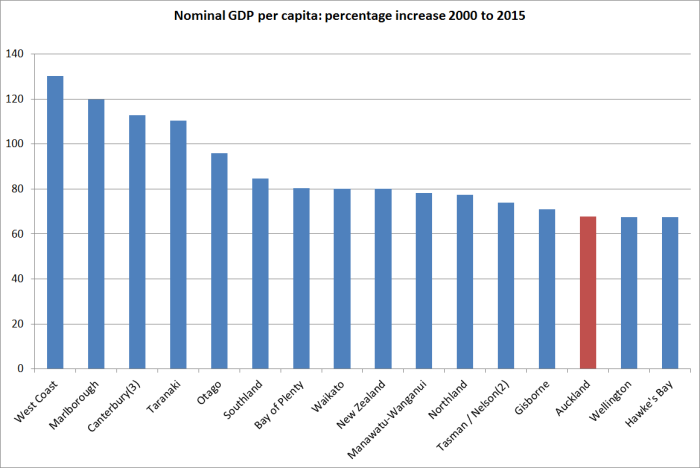
In a couple of posts earlier last week, I used the regional (nominal) GDP data, showing how weak Auckland’s per capita GDP growth appears to have been over the last 15 years (the period for which the data exist).   And it didn’t appear that terms of trade changes could explain the regional patterns, since most of the gains in New Zealand’s terms of trade has reached our shores in the form of lower import prices, the effects of which should have been quite pervasive across the economy.

But as I got to the end of the second of those posts, I started to get a bit uneasy about the data.  I had noted that over the 15 years, Auckland’s population had increased by 30 per cent, and that of the rest of the country by only 13 per cent.  And yet, over the years (to 2013, for which we have detailed industry breakdowns), construction had been a smaller segment of Auckland’s GDP than in most other regions in the country. This was the chart:

construction share of gdp

I started digging into the data a bit further, and also got in touch with Statistics New Zealand (who provided me with some prompt, very helpful, assistance, including suggesting that some readers might be interested in how they put the numbers together).  My digging didn’t resolve any puzzles, but it didn’t highlight any very obvious errors either.

In a city with a rapidly growing population one would normally see a larger share of GDP devoted to construction (than at other times, or other places).  Construction isn’t just about houses, but the whole panoply of structures that a growing population needs over time.

Over the 15 years to 2015, Auckland accounted for 50 per cent of all the population growth in New Zealand.  And yet here is the Auckland share of the value of all building consents, and the Auckland share of the construction component of GDP (for which we only have regional data to 2013).

akld consents

One wouldn’t expect an exact mapping, since the two series are measuring quite different things (quite a bit of construction won’t need a building consent), but both are a long way below Auckland’s share of population growth  (and Auckland’s share of population growth was highest in 2001 and 2002).

The regional GDP data also have two components that should normally have a strong relationship with housing, and also with population growth.  These are:

Rental, hiring, and real estate services
Owner-occupied property operation

The latter series is straightforward –  in effect, the rental value of living in an owner-occupied house, which is proxied using market rental data.

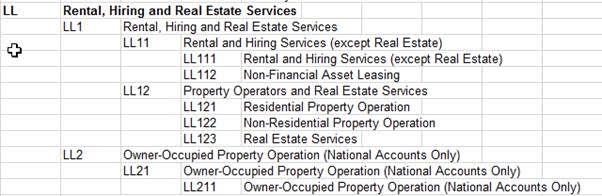
The “rental, hiring, and real estate services” is more complex.  It includes various sub-categories, for which the data are not provided separately.  Here is what is included, from a table SNZ sent me:

reg gdp categories

Ideally, I would like to look at only the LL12 and LL2 components, and thus exclude the non real estate leasing services (eg cars, machinery etc), but the data aren’t publicly available.

Surely, I thought, if Auckland’s population has been growing so much faster than the population in the rest of the country, this should be reflected in faster growth in these components of GDP.  I didn’t really expect it in respect of owner-occupied dwellings, because although Auckland rents have risen a bit faster than those in the rest of the country, rates of owner-occupation have been falling faster.  But everyone needs to live somewhere, renting if not owning, so I thought the effect should still show up if I combined the two components.  After all, the rental component also includes non-residential property, and more people generally implies more offices and shops too.

But this scatter plot is what I came up with (population growth on the x axis and growth in the sum of the two GDP components on the y axis):

housing scatter plot

I’d expected to see an upward-sloping relationship (recall, these aren’t GDP per capita components, but total GDP).  As I put it to SNZ, isn’t it a bit puzzling that growth in these two nominal GDP components over 13 years was greater in Southland than in Auckland?  Given where all the other regions sit, in a well-functioning housing market surely one might have expected the growth in these GDP components for Auckland to be up in the 140 to 160 range?

SNZ were able to tell me that there was a large growth, from a low base, in non-financial non real estate asset leasing in Southland.  That might help explain why these GDP components together grew surprisingly fast in Southland.  But it doesn’t explain why Auckland has been so weak relative to almost all the other regions (given the extent of its population growth).

Here is a chart showing Auckland’s share of total nominal GDP for each of these two components.

akld shares

And yet over this period Auckland’s share of the total population increased from 31 per cent to 33.5 per cent.

I guess that, overall, this is not wholly inconsistent with the divergence that has opened up in the population per dwelling numbers: trending down in the rest of the country but not in Auckland as house prices become increasingly unaffordable.

Out of curiosity, I redid the per capita regional GDP numbers excluding these two real estate related components.  In my original chart, Auckland had the third slowest growth in nominal per capita GDP from 200 to 2015.   In this alternative chart, we have the data only to 2013.    Over that period, Auckland had the slowest per capita total nominal GDP growth of any region.

What about on this adjusted, non-real estate, measure?

adjusted regional GDP growth

It doesn’t improve the picture.

I’m still not quite sure what to make of all this.  Ideally, we would have regional real GDP  data, but unfortunately that does not appear likely any time soon.  But on the basis of what we have, Auckland seems to have done particularly poorly over the last 15 years, despite (or partly because?) all the policy-induced population growth.  Some of that seems to relate to the poorly functioning housing supply market.  But even abstracting from the direct effects of that, it has to be seen as a pretty disappointing outcome, leaving many questions on the table.

(It also leaves me with some new questions, which I have not yet attempted to work through in my own mind, about my explanation for New Zealand’s persistently high (relative to other countries) real interest rates.  A topic for another day.)


China and New Zealand

The Prime Minister, a large flock of New Zealand business people, and various media representatives are in China.  It is not a particularly attractive sight, perhaps one of many reminders of why bilateral or regional preferential trade agreements are such an unfortunate policy option (as leading trade experts, and entities like the Australia Productivity Commission often remind us).  Allow for some trade diversion risks, and the ever-more-entangled rules of origin, and such deals are often bad enough.  And then there is the matter of making repeated obeisance before the leaders of a tyrannical regime, begging for their favour; the crumbs off their table.   Perhaps worst of all, our elected leaders don’t even seem to find it distasteful.

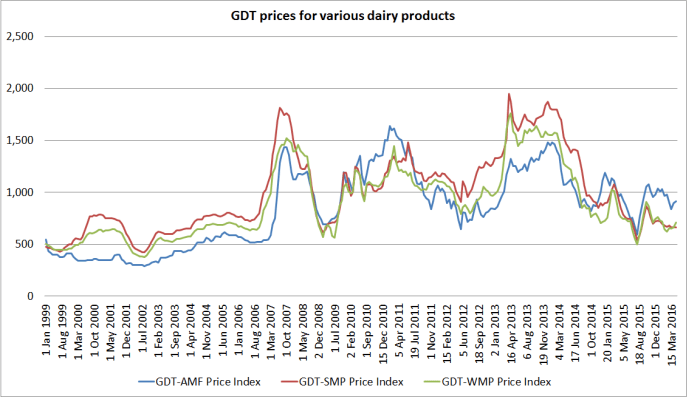
New Zealand firms do a fair amount of trade with Chinese firms, and that trade has increased considerably in the last decade. Despite some breathless commentary, China was never our largest “trading partner”,  but New Zealand firms do more trade with the Chinese than with firms and individuals in any other country than Australia.  But then our trade is quite widely spread across many countries, and much of it is in products which are pretty homogeneous (it isn’t clear that it much matters whether New Zealand firms export dairy products to Venezuela, Saudi Arabia, or China: New Zealand producers sell somewhere whatever is produced, and what matters most is the global prices for dairy products).  There is a great deal of talk about the benefits (or risks) of being concentrated on whole milk powder (WMP), but the prices of the various different dairy products all seem to cycle together, and idiosyncratic patterns for individual products don’t seem to last for long.   (GDT only has a long run of data for these three, but over the last five years one can also see it in a chart from a wider range of dairy products).

dairy prices components

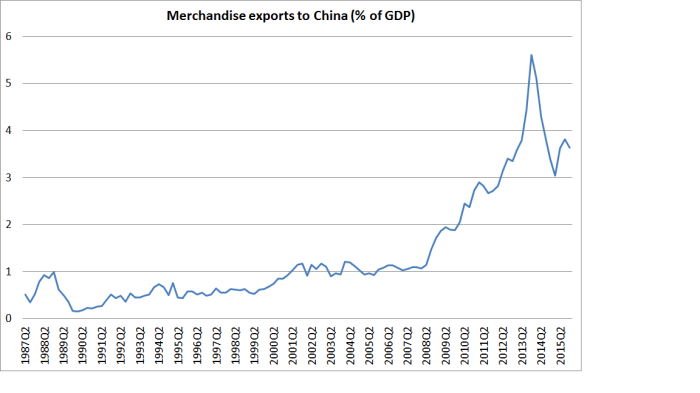
Here are our merchandise (goods) exports to China as a share of GDP.

exports to china % of GDP

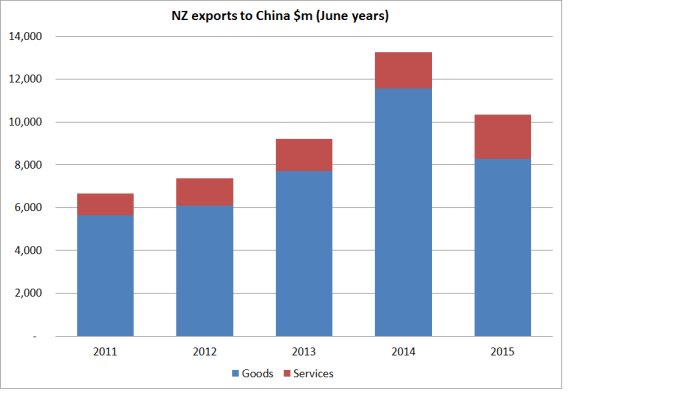
Services exports data by country is only available annually.  Here are total New Zealand exports to China for the last four (June) years.

total exports to china

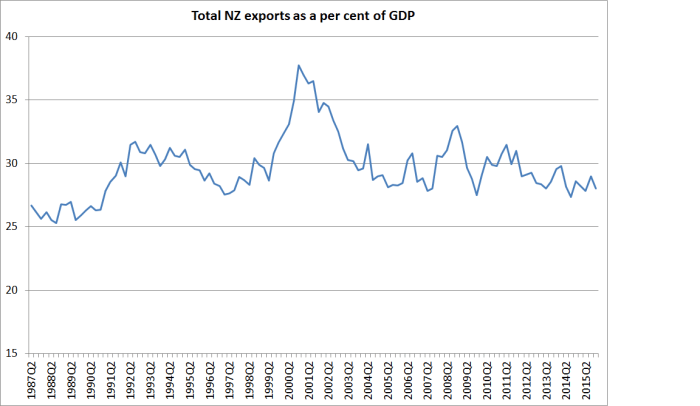
But how much difference has it all made?  The government has made much of trying to lift the export share of GDP, but here is a chart of that series.

total exports as % of GDP

Which has, as I’ve noted previously, been going nowhere for 25 years now.

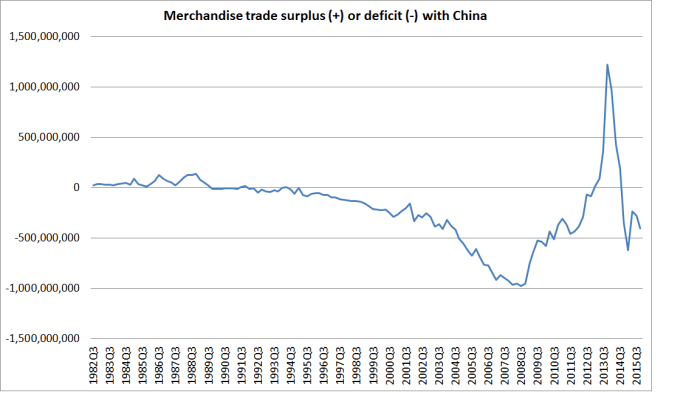
Of course, New Zealand firms import a lot from China as well.  Here is the merchandise trade balance between New Zealand and China since 1981.

merch trade balance with china

But once services trade is included, for the last three years New Zealand has run a goods and services surplus with China.

It was a little surprising to hear the Prime Minister in pursuit of investment from China

“But we in New Zealand will take that view from a Government perspective, that we’re a fast-growing economy, we want to to develop great international relationship and we also want to have a higher standard of living. We fundamentally don’t have enough private-sector capital of our own to fund that growth.”

Set aside the “fast-growing” economy claim for now – I guess the total economy has been growing quite a bit by OECD standards, even as per capita growth has been pretty dismal –  but what really struck me was the observation that “we fundamentally don’t have enough private-sector capital of our own to fund that growth”.  If the Prime Minister simply means that we run current account deficits (in which total domestic investment exceeds total national savings) that is, of course, true.    But it is not as if we have any trouble financing that current account deficit on world markets –  apart from any other indicators, that is evident in the persistently high level of the exchange rate.  Countries that have trouble financing themselves tend to have persistently weak real exchange rates.  We don’t.

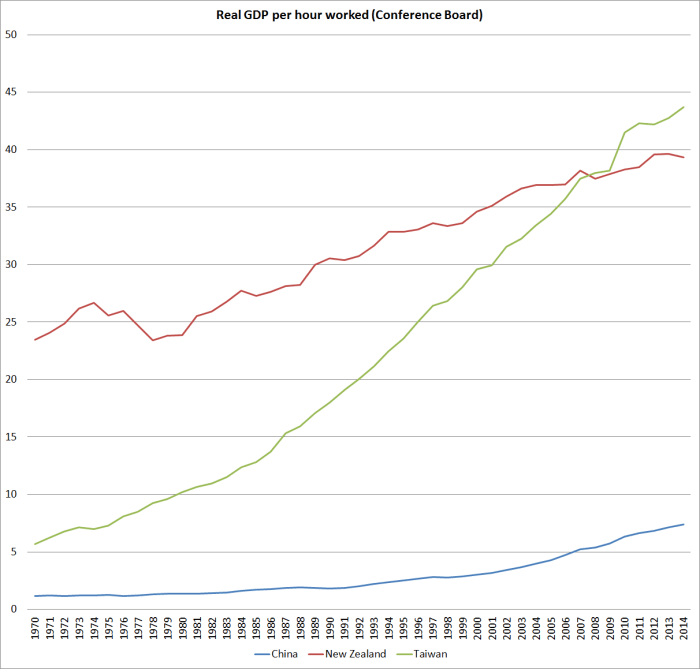
To be clear, I have no particular problem with foreign direct investment, and in general I think we should have fewer restrictions on it.   China is a slightly different issue, but mostly because all major businesses are ultimately state-controlled. I’m not suggesting any specific restrictions on Chinese FDI (except perhaps where national security considerations warrant it) but we need to remember just how badly distorted and underperforming China’s economy is.  It isn’t exactly one of the success stories of market capitalism, unlike say Taiwan.  New Zealand hasn’t done well in recent decades, but for all its fast growth (much real, some probably illusory), China’s overall levels of productivity are still astonishingly poor.

gdp phw nz china taiwan

The better of China’s firms may be very good at managing the twisted eddys of Chinese politics.  That is very different from thriving in a proper market economy, where the rule of law prevails, and connections to the powerful don’t (or are not meant to) matter much.  If FDI from China happens, so be it and some it may add wider value, but it isn’t the most obvious place to be pursuing FDI from (if politicians should be doing such marketing at all).  The real gains from FDI aren’t dollars of foreign capital but rather the ideas, technologies etc that really successful global firms can bring with them, with spillovers into the New Zealand business sector and the wider New Zealand economy.

And all this is without devoting space to our apparent studied indifference on the South China Sea issue (“we aren’t taking sides, we just want a resolution”, as if there is no difference between tyrannies and democracies –  Philippines and Japan for example), or talk of extradition treaties with China.  If people can be shown to have lied on their immigration applications, no doubt we should revoke their approval to be here, but are we seriously comparing the so-called “justice” system of China to that of countries like our own?   For all the talk of “fugitives” in New Zealand, we need to remember that much of the so-called anti-corruption programme of the last few years has been about purging those who got offside with the winners in the latest Party realignments.  Some of those now abroad might well be “bad guys”, but it isn’t clear that any people who matter in China’s government are, in any sense, “good guys”.

Finally, in all our enthusiasm for trade with emerging China, I amused myself yesterday by downloading the 1939 New Zealand Official Yearbook to see what trade we were doing with Germany and Japan in the 1930s.  Not much with Germany, but I’m imagining there must have been some breathless enthusiasm, at least in some circles, about our rising trade with large and emerging Japan, by then our third largest export market.

japan exports

,


Housing: what can be done

In the seemingly-endless housing supply debate, there is often a divide between those favouring greater intensification, and those favouring a larger physical footprint for growing cities.  My own policy view is squarely in the “it should be a matter of individual choice, provided the infrastructure etc costs of development are appropriately internalized, and the rights of existing property owners are protected” camp (and yes, I recognize that the definition of almost every word in that statement could be extensively debated). My practical prediction is that New Zealand is a society where most people –  people in their child-raising years –  will prefer to have a decent backyard (those living in Hastings or Timaru don’t flock to high rise apartment buildings or town houses with tiny sections), so long as regulatory restrictions don’t make that infeasible.  It was quite possible 50 years ago, when New Zealand incomes were much lower.  There is simply no reason, in a country with this much land, why it shouldn’t be now.

Apologists for the current disgraceful situation constantly cite Sydney, or Vancouver, or San Francisco or London, as if absurd regulatory restrictions in other places make it okay for us to mess up our housing/land supply market this badly.  Others look to the experience across the huge range of US cities.

Someone drew my attention to the chart below, drawn from the Wall Street Journal’s economics blog, and on a day when the house is over-run with builders (and holidaying children), it seemed worth reproducing.

scale of cities and house prices

Cities with rapidly growing populations (those big blue circles in the bottom right) have seen little or no increase in real house prices over the period 1980 to 2010.  They made it possible to build, relatively easily, and in turn made themselves attractive places for people to live.

I don’t know how large the increase in Auckland’s “developed residential area” has been over 1980 to 2010, or even how to go about trying to measure it, but I’d be astonished if it was anything close to even 100 per cent.

It is quite possible to accommodate rapid population growth without anything like the scandalous increases in real house prices we’ve seen in Auckland (or even, to a much lesser extent in many other urban areas in New Zealand).   Political leaders, of both main parties, who have failed to make it possible, posing a near-impossible burden on younger people in Auckland who don’t come from advantaged backgrounds, should really be held to account.  High house prices aren’t something to celebrate (NB Prime Minister)  –  and not even most existing home owners are better off, as they aren’t going anywhere –  but should really be a source of shame to those who rigged the market (or let the market stay rigged) and made it happen.

The OCR leak – some more thoughts

I was re-reading the documents released on the OCR leak.  There are three of them: the Deloitte report, the Reserve Bank’s press release, and the MediaWorks press release.  The latter document doesn’t seem to be on the web (and certainly not with the company’s 2016 press releases), but someone did send me a copy.  This is the text

Mark Weldon, Group CEO, MediaWorks said:

“MediaWorks unreservedly apologises to the Reserve Bank for this incident. Once MediaWorks was aware a leak had taken place, it conducted its own investigation to determine whether the leak had come from within MediaWorks and self-reported that to the Reserve Bank.”

Regarding the specifics of the matter, Richard Sutherland, Acting Chief News Officer, said:

“The leak was caused by a failure within News to follow proper process and changes have already been made as a result. We are addressing the breach with those concerned and new policies and training will be implemented moving forward.”

I also compared the Deloitte report with what the Bank’s legal counsel, Nick McBride, told me about the scope of the enquiry – which they had already commissioned by then – when they asked for my assistance.  I included the whole email in yesterday’s post, but this was the bit I had in mind today

The Bank has appointed investigators from Deloitte to try and find out whether there was a breach in security and, if so, how it occurred. They will also review the process for transmitting the Governor’s OCR decision to see if any improvements are needed.

A number of things struck me:

  • We have not seen the terms of reference for the Deloitte inquiry.  They are referred to in passing in the report, but are not attached.  That seems strange.
  • The substance of the report is less than three pages of text.  A full page of that is devoted to me.  I don’t have too many problems with it, but I understood it was normal public sector practice when inquiries are done to give those affected by the inquiry an opportunity to see, and comment on, the report in draft before it was published.  That didn’t happen for me (but there must have been coordination with MediaWorks –  did they see the report before it was released?).  Had the draft report been shown to me, I would have requested some wording changes.
  • Despite the comment in McBride’s email that the investigation would “review the process for transmitting the Governor’s OCR decision to see if any improvements are needed”, there is nothing at all on that topic in the published report.  I had offered some comments, in passing, on that matter when I met with the investigation team.  Were the terms of reference changed at a later date?  If so, why?
  • The MediaWorks statement says that “once MediaWorks was aware a leak had taken place, it conducted its own investigation to determine whether the leak had come from within MediaWorks and self-reported that to the Reserve Bank”.  But that seems inconsistent with the Deloitte report, which says that the source was identified only after “communication that we initiated with the journalists”.  The inquiry report says it only focused on the media after my meeting with the inquiry on 18 March, and I wrote about the leak possibility for the second time that day (and I know various MediaWorks employees read my blog), and the mainstream media gave a lot of coverage to the story on 21 March.  So news of the possible leak was widespread by then at the latest.  And yet MediaWorks only self-reported the information about the leaker “to RBNZ and to us [Deloittes] on 5 April 2016”, more than two weeks later.  It doesn’t take two weeks for an organization to track something like this down internally – MediaWorks knew which of its employees had been in the lockup.   It seems more probable that MediaWorks acted only after the inquiry team requested a meeting with the staff who had been in the lockup.
  • It is striking that the Deloitte report makes no attempt to assess whether what the MediaWorks person in the lock-up did on 10 March (file a draft story back to their office well before the embargo lifted) had been done before.  And the MediaWorks statement also does not address that issue.  There are various stories on the media grapevine that it was, in fact, established practice.  And while I have no way of knowing whether that is so, it is not inconsistent with the fact that the person who sent me the information presumably didn’t see anything extraordinary about doing so.   There is no suggestion in the report or statement(s) that the transmission from the lock-up was somehow accidental (inadvertently hit the wrong button, or somesuch), and if it wasn’t accidental perhaps it was customary.    It is unfortunate that the Reserve Bank’s inquiry does not appear to have attempted to assess whether that was the case, or even just note the possibility.
  • The Reserve Bank’s own statement seems very supportive of the MediaWorks hierarchy, even though (a) people in that organization knew what had happened from the start, (b) must have known it was against the rules, even before I started to draw attention to the issue, and (c) the timing suggests that the management action (and formal internal investigation) was all rather belated, occurring when their people realise they would be interviewed by the inquiry and would have to provide an accurate factual account of what happened.

There seem to be quite a few more questions that should be asked of both the Reserve Bank and the MediaWorks management.

In passing, I would note that I have read and heard many dismissive comments in the last few days from other media people about MediaWorks, and their coverage of economics and monetary policy issues.  I don’t watch their TV channel, and am not a commercial radio listener.  Nonetheless, I had actually been quite impressed that Radio Live had been keen to run interviews with some one like me on such diverse topics as the OCR, US monetary policy, Kiwibank, the real exchange rate and economic performance, immigration policy and so on.  As I say, I don’t listen to commercial radio (my wife kept saying “but no one I know listens to Radio Live”), so I’m not sure how representative those sorts of interviews are. But my experience had been a wholly positive one –  intelligent interviewers, aiming at popular market no doubt, asking sensible well-researched questions, and not obviously pursuing “gotcha” moments (but then why would they with a middle-aged rather serious economist, talking mostly about rather geeky issues?).

Someone has, however, drawn to my attention an NBR story in which Rob Hosking reports  that

“Mr Reddell did not at the time ask how they knew of the decision an hour before it was announced-  an omission which has apparently caused some resentment within Mediaworks who feel he should have warned them about this”.

Yeah right.  The MediaWorks people knew very well that the information was not supposed to be outside the lock-up.  What was I supposed to do –  assuming I had believed it was the fruit of a real leak which, as I noted yesterday, I had no particular basis for doing (25 years of MPSs having gone by without one) ? I genuinely didn’t know what to make of it.   I suppose I could have said “you do know you aren’t supposed to have that information, assuming it is true, don’t you?”  But the sender, and the people that person apparently overheard, already knew that. The 9am release time is no secret.  It was no worse sending it on to me than it was for them to have had the information, in breach of their express commitments to the Reserve Bank, in the first place.  I had no ongoing or formal relationship with MediaWorks (I generally talk to any media –  or anyone else –  who asks), and I reported the matter to the Reserve Bank because if there had in fact been a leak, it was their information and systems that had been compromised.  The guilty people were hardly likely to own-up unprompted.

The OCR leak: again/still

I’m heartily sick of the Reserve Bank leak story and hope that this is the last occasion I write about it.  But there were a few further points I wanted to make, partly in response to the coverage in the last 24 hours.

I would also add that despite several commenters on various stories having correctly noted that the longstanding system vulnerabilities mean that there may have been previous leaks over the years from people in the Reserve Bank’s media or analyst lock-ups, I’m not sure it would a wise use of time or resources now (or perhaps even possible) to attempt to prove it one way or the other.  But that is a matter for the Reserve Bank.

Much of the media commentary has been about the abolition of the Reserve Bank’s lock-ups.  The many good trustworthy people pay the price of one peripheral player cheating.  Worse, it will apparently be harder to get good reporting and consumers of news will suffer.  And, from some of the economists, a concern that financial markets might be more volatile for the “first few minutes” after the release while economists and traders try to digest what the Bank is saying.   I plead for some perspective.

All of this commentary loses sight of the simple point which I have made previously, and which the Reserve Bank statement yesterday also makes.  Other countries don’t do it the way we were.  No country that I’m aware of had provided advance lock-ups for economists and analysts for official interest rate announcements.  And the handful that do provide some tightly-controlled advance notice for a select group of journalists give them only a few minutes advance notification, not two hours.  Other countries’ central banks don’t provide their staff to provide private briefings to media or analysts in advance of release, in doing so providing different information to those inside those lock-ups than is available to those outside.     What the Reserve Bank wants to say  in its releases should be carefully drafted and refined, and then put in the official documents, and left to speak for itself.  Sometimes press conferences can be useful, but they should be viewable (as the Reserve Bank’s are) by everyone, not only by the select few.  If anything, under the new arrangements, the press conferences may even allow better scrutiny and more searching questioning of the Governor, since future press conferences will occur an hour after the release (rather than a few minutes after as has been the case until now).  That will allow journalists to talk to economists, politicians, sector group leaders etc before they pose their questions to the Governor.

It is worth remembering, again as I’ve pointed out previously, that half of each year’s OCR announcements have always taken place without benefit of lengthy explanatory lock-ups (or press conference).  The full scale lock-ups have been used for Monetary Policy Statements, but not for the other intervening OCR reviews.  I’m not sure there is any evidence that the market reaction to those one page statements has been any more difficult or volatile than for the MPS releases.

Nonetheless, I think there are still some aspects of the new regime that will require some bedding down, and perhaps later refinement.    I’ve long thought it was a mistake to release OCR announcements at exactly the same time as MPSs. A better model, in my view, would be to release the OCR decision as soon as it is made (further reducing another aspect of risk in the system) and then to release an MPS a few days later, as background analysis (looking forward, and providing ex post assessments).  In such a model, the MPS would be much less market sensitive (the main market-moving news is in the OCR announcement itself). For such a background document, there might be less harm (but less interest) in a lock-up to explore the technical detail of the forecasts.

More immediately, the Reserve Bank should consider adopting the idea proposed by former Czech central bank head of communications Marek Petrus (discussed on his Lombard Rates blog, and here on mine) that the Bank should host an analysts briefing later in the day of the MPS release.  In such a briefing,  analysts could ask questions of the Bank (in person or by phone –  akin to conference calls investment banks run), and the Bank  might also be able to use the occasion to resolve  openly any misinterpretations that had arisen over the day.  But the critical aspect of the arrangement is that the briefing would be webcast (as the press conferences are) so that everyone has the same information, whether in Wellington, Auckland, Singapore, or New York, whether economist or not.  A concern about the new system the Bank announced yesterday is that it will resolve one problem and open another.  The analysts lock-up (and the later economists’ lunch) has always had problems in that they sometimes provided information to attendees that wasn’t available to everyone else.  In the new world there is a risk that there will be high rewards for those – especially the Wellington-based – who, searching for nuance, secure coffee discussions with the Chief Economist or the Manager, Forecasting.

Somewhat surprisingly, even the Prime Minister has weighed in, calling for the Reserve Bank to reconsider, noting that Budget lock-ups had worked well.  I’m not sure whether The Treasury uses more robust systems to reduce the risk of leaks (perhaps they will be reviewing them in light of the Bank’s experience?), but even if they aren’t the case for a lock-up for Budget material is much stronger than for MPS.  First, there is typically a wide range of material across huge number of portfolio areas.  Second, often new initiatives are being announced, with technically complex details.  And third, not much about the Budget is typically very market-sensitive, especially as the Beehive typically provides strong hints (or more) on the juicy stuff in advance of Budget day.  By contrast, OCR announcements and MPS releases are really just the same old stuff over again (new data, new rate, but the same basic framework), but the bottom line is highly market sensitive, and there is no pre-briefing of selected journalists.

Changing tack, I have been a little surprised at how little of the media coverage has focused on the Reserve Bank’s weak systems.  Perhaps that is understandable: the media has the strongest interest in the story as it affects them (changes in lock-up arrangements), and the Reserve Bank is a powerful institution and most of them want to remain on good terms with the Bank (even while complaining quietly).  But what happened in this episode involved two things:

  • A MediaWorks staffer who breached his own express or implied commitments to the Reserve Bank (not to communicate the information before the embargo lifted)
  • A central bank that ran lock-ups that, it turns out, used no technological protections, and relied totally on trust to protect extremely sensitive information.

I was trying to explain the story to my children last night.  I told them that I had no reason to distrust the people who live on my street, but that nonetheless I would irresponsible if we went out and left the doors wide open, simply relying on trust that nothing bad would happen.   Most of the time, nothing bad would happen.  But if and when it did, people (including the insurance company) might reasonably talk of contributory negligence.

Managing highly sensitive information is not incidental to what the Reserve Bank does, but integral.  And yet they unnecessarily sit on the OCR decisions for six days, running risks of (inadvertent) release by someone inside the institution.  And they tell the Minister of Finance –  when he and his advisers will have their own agendas –  more than hour before the announcement.  And –  the focus of this episode –  they have dozens of people from the financial media and financial institution economists in lock-ups which were secured by no more than trust.    I don’t think I had realized until last night quite how bad the situation was.  On entering the lock-ups participants have to hand in their phones, but all continue to have access to their laptops with active internet connections throughout the lock-ups.  There was, apparently, no effort ever made to secure either individual laptops or the rooms where the lock-ups were held (to physically prevent transmission until the embargo is lifted).    In an earlier post, I touched on hypothetical risks –  the analysts lock-up used to be held in a room easily overseen from neighbouring apartments – but all the time anyone in the lock-ups could simply have emailed the news to anyone they chose.  It is staggeringly lax.  Mike Hannah, Head of Communications was quoted in yesterday’s press release on the new arrangements, but these previous lock-ups were his responsibility.  What were he, and his boss Deputy Governor, Geoff Bascand, doing in allowing such incredibly lax security?  They left the door wide open, and eventually (at least) one person walked through it.

As I noted yesterday, it is surprising that the Governor’s press release took no responsibility for any of this, and offered no apology for it.   I hope the Bank’s Board (and its audit or risk committee) is asking some hard questions.

Finally, I remain irked at being accused by the Governor of being “irresponsible”, for not passing on to the Bank the email I received (from someone not in the lock up) as soon as I received it.   As I have already noted, I had no relationship of trust with the Bank, owed them nothing, and in passing on the information at all –  acting with a sense of public responsibility, and a concern for the best interests of an organization I had worked for for decades –  I have probably jeopardised my future relationship with MediaWorks.  I am also irked that yesterday was the first time I had heard the Bank suggest that I was somehow to blame.  It has the feel of a line made up after the event, to distract attention from the real story: the Bank’s weak systems, and a security breach by a journalist who the Bank had allowed to participate in its lock-up.


Let me explain.  And if the detail is painstaking, feel free to stop here. This is for the record as much as anything.


As I have said previously, I received an email from a MediaWorks employee at 8:04am on the morning of 10 March.  It is reproduced in the Deloitte report.  It read.

We have just heard that the Reserve Bank is cutting by 25 basis points
I didn’t see the email straightaway  –  it is the sort of time my kids are getting ready to leave for school.  I saw it about 10 minutes after it arrived, and emailed back to the sender at 8:14
if true, that is very encouraging –  at last.  I  have thought it a bit more likely than the market pricing, but…one never quite knows
As I have noted all along, I had no way of knowing (until yesterday) if this was real information, or just the sender talking things up.     The tone of this email is not one suggesting I instantly believed there had been a genuine leak.
Various people have asked why the person sent the email to me in particular.  It had already been arranged that I was going to provide some on-air commentary on Radio Live later that morning on the OCR announcement.
I’ve gone through this stuff before, but in the following minutes various things went through my head.  I flicked onto the ANZ and Westpac exchange rate chart pages, half expecting, half fearing, to see a sudden movement in the exchange rate.  If there had been a genuine leak it seemed unlikely that I was going to be the only one to know, and in all my years at the Reserve Bank –  including running the Financial Markets Department –  our greatest fear had been market participants being able to profit from early access to such information.
At some point I thought about contacting the Reserve Bank.  That wouldn’t have been as easy as it sounds.  I’m not exactly persona grata at the Reserve Bank, I knew that key people would most likely actually be in the lockups, and I didn’t have their cellphone numbers.  Graeme Wheeler wasn’t in lock-ups, but he was hardly going to take my call.   I could have sent an email, but who was likely to be rushing to open emails from me in that dead half hour when their attentions were on the media and market lock-ups.   And, as I have noted previously, I didn’t know if the information was the result of a real leak.  If I’d passed it on to the Bank before 9am, and it turned out they weren’t cutting, what I could expect from them was not a “hey, thanks Michael, even though there clearly wasn’t a leak on this occasion, but we really appreciate you pro-actively coming forward” but more like “there he goes again, always willing to believe the worst, constantly undermining us”.   And so, since the market hadn’t moved, I kept the email myself for the remaining few minutes and as soon as I’d read and digested the key bits of the statement (my own priority), I sent this email through to John McDermott (Assistant Governor, and my former boss) and Mike Hannah, Head of Communications at 9:08am
Mike, John
For what it is worth, I received an email an hour ago from someone telling me that they had just heard that the Bank was going to cut by 25bps this morning.  I have no idea whether it was a well-sourced “leak” or just speculation, but I have no reason to doubt the person who told me, who in turn (as far as I’m aware) has no reason to pass on simple speculation.
Regards
Michael
As I’ve noted previously, there are no allegations in this email, simply information  –  information which I didn’t know what to make of, but which now at least seemed to warrant investigation.
I didn’t hear from them for a while (both were at the press conference).  Reflecting on it a bit further, at 9:47 I sent this follow-up
Just for the avoidance of doubt, the email did not come from anyone inside the Bank (or inside govt).
At 10:03 am I had this email from John McDermott, cc’ed to Mike Hannah

Hmm. Serious but this is very little information to go on. What time exactly did you get the email?

John

A couple of minutes later I responded

8:04am

And at 10:08 I sent this to Mike and John

and i’d be checking the media lock-up
At 10:29am I had this response from  McDermott

Thank you for letting me know. I am disappointed that somebody knew and thought it a good idea to spread the leak. Somebody with a decent character would have instead informed the Bank. You should let them know that for them to tell you puts you in a difficult place.

I had not noticed until now that McDermott even then apparently assumed there was a leak (“I am disappointed that somebody knew”).

And I responded at 10:37

No difficulty for me –  not as if I trade fx markets (or would ever use such information if I did). I did check the exch rate charts at the time, and had I seen any sudden move would have passed on the information before 9am.   I may mention the issue in my post on the MPS later in the day.
Regards
Michael
I did make mention of the issue some hours later in the my post on the MPS.   I noted, somewhat agnostically
And finally, as I have noted to them, the Reserve Bank might want look to the security of its systems.  I had an email out of the blue at around 8 this morning-  most definitely not from someone in the Bank –  telling me that the sender had just heard that the OCR was to be cut by 25 basis points.  I have no way of knowing if it was the fruit of a leak, or just inspired speculation, and was relieved to see the foreign exchange markets weren’t moving, but it wasn’t a good look.
And left it at that.
The next I heard was an email from Nick McBride, the Bank’s in-house lawyer, on 15 March

Michael

I think I saw you in Thorndon New World today when I was buying my lunch. Anyway, I am emailing you following your email to John McDermott and Mike Hannah at 9:08am Thursday 10 March alerting them to the possibility of a leak of the OCR decision. The Bank has appointed investigators from Deloitte to try and find out whether there was a breach in security and, if so, how it occurred. They will also review the process for transmitting the Governor’s OCR decision to see if any improvements are needed. I’m sure we both agree that it is the public interest to ensure the integrity of the process and tighten it as necessary.

As you are the person who has information that may indicate vulnerability in the process we would be grateful if the Deloitte investigators could talk to you about your email to John and Mike. We would suggest the meeting to discuss this take place at a convenient time for you at the Deloittes office here in Wellington (Level 16, 10 Brandon Street), ideally this week. If you could let me know the days and times you are available that would be appreciated. Deloitte should be able to fit in with you.

The lead from Deloitte is Ian Tuke and I have copied him on this email.

Thank you very much in advance for your cooperation. Feel free to contact me if you have any queries.

Nick

I thought this was a thoroughly professional approach, was relieved to hear about the inquiry, and we set up a time to meet.  There was no suggestion in Nick’s email, or in any of the earlier comments from McDermott, that I had done anything inappropriate.

A couple of days later I had a meeting with the Deloittes people conducting the inquiry.  I don’t have word for word what the senior guy said, but it was along the lines that the Bank had been very appreciative of me coming forward.  We had a good discussion, I gave them the original MediaWorks email (sender redacted) and I came away pretty content with how the Bank seemed to be handling the issue.

On 21 March, the following Monday, the media appeared to finally take some interest in the possibility of the leak.  Hamish Rutherford wrote a story on Stuff, in which he had sought comment from the Reserve Bank.   This is where I started to get a little annoyed with the Bank

The Reserve Bank has confirmed that following an allegation, it had launched an investigation.

“We are aware of an allegation that information may have been leaked ahead of the OCR announcement on 10 March,” a spokesman of the bank said.

While we have no evidence at this stage that any information was leaked, we take the integrity and security of market-sensitive information very seriously and have initiated an external investigation into the allegation.”

Note the repeated use of the word “allegation” –  a word, or idea, which had not appeared at all in Nick McBride’s email above (which simply talked of investigating the “possibility of a leak”).  As I have said repeatedly, I made no allegation: I passed on information, which appeared to raise some questions, and left it to the Reserve Bank to make what, if anything, it could of that information.

And then I heard nothing more of the matter until yesterday afternoon’s release.

The Bank has also taken to running the line that if only I had told them earlier, they would have avoided risks by bringing forward the release of the MPS (perhaps from 9am to 8:45am).  I’ve already touched yesterday on the implausibility of the idea that this would have solved their problems.  Graeme Wheeler should engage it a bit of introspection and ask himself just what his reaction would have been if somehow I had got hold of him or his advisers by 8:30 and told them what I in fact told them just after 9am.   After all, what I was passing was only hearsay (a solid report of what someone else had heard) at that point –  I didn’t know there had been a real leak, and so the Bank couldn’t be sure either.  And, frankly, the messenger would have mattered –  and I daresay Graeme would have been less inclined to react positively to hearing it from me, than from one of his admirers.  In reality, they would have debated the matter among themselves –  after it had taken perhaps five minutes to get the key people in the same room –  been not sure what to make of it, especially after checking the exchange rate screens.  Probably they would have waited it out til 9am.  Partly because if they hadn’t, and had released at 8:45, it would have created mayhem –  the markets moving suddenly with people still away from desks and screens, and the Bank could only have said something like “we received information, from a source we aren’t sure we trust, which suggested that there might have been a leak”.  I’m not sure how that would have made their position, then or now, any better.   Those who lost money would have been even more vociferous than usual (and understandably so).

In  conclusion to what has been a long post, I am sufficiently riled by the gratuitous attack that I am considering raising the matter with the Reserve Bank Board.  Are such ad hominem attacks on someone public-spiritedly providing (possibly at some cost to myself) information that enabled the Reserve Bank to (a) identify an actual leak, and (b) identify serious weaknesses in their systems, the sort of behaviour they expect or tolerate from their employee the Governor? I sincerely hope not.


The OCR leak

The Reserve Bank has this afternoon released the Deloitte report into the possible leak of the OCR on 10 March, and a press statement from the Governor.

I have given comments to various media outlets, but thought I should set down my assessment for the record.

It is extremely disappointing that it has now been confirmed that there was a leak.  One MediaWorks employee in the media lock-up apparently emailed several of his colleagues outside the lock-up.  My involvement in this unfortunate episode arose because a MediaWorks employee sent me the email that is reproduced in the Deloitte report.

It is unfortunate that the Deloitte report does not (and probably was not asked to) look into how it was that the Reserve Bank’s systems for managing lock-ups for incredibly sensitive information were as insecure as they proved to be.  From the Deloitte report it seems that no underhand technology or secret signaling was involved; simply someone emailing from their laptop.  I’m no technology expert, but I’m staggered that such an easy breach could have occurred.  When systems are weak, sooner or later they will result in a breach, by accident or deliberately.   It is also unfortunate that the Governor’s press release does not address this issue.

The Reserve Bank’s overall response to the confirmation of the leak is the right one.  Ending media and analyst lock-ups is a step I recommended in a post several weeks ago, reflecting the vulnerability of such events (especially as technology has advanced), the fact that few or no other central banks provide any advance information in lock-ups, and the fact that such lock-ups have at times meant people inside the lock-ups have better information on the Bank’s interpretation of the documents than people who do not attend such events.    The new model will bring the Reserve Bank into line with standard international practice.  It is a model that would, I hope, have been adopted even if it had been confirmed that on this particular occasion no leak had occurred.

There are further steps that should still be adopted to minimize the risks of inadvertent early releases of the OCR.  For example, the lengthy lag between taking the OCR decision and releasing it should be shortened.  I was also surprised to learn from the Deloitte report that the Minister of Finance had been aware of the decision before 8:04am on the morning of the release.  When the OCR system was established in 1999, the practice was to advise the Minister only 10 minutes or so before the announcement.  If the Minister needs to know at all (and it isn’t clear why), 10 minutes notice should be an ample courtesy.

The Governor’s press release was disappointing on several counts.

First, it took no responsibility at all for the Bank having run systems and procedures that allowed this leak to have happened.  Of course, the leaker should not have leaked, but the Reserve Bank should have managed its procedures in a much more robust way to ensure that the leak could simply not have happened (especially in the easy way it appears to have).

Second, I was struck by the grudging gracelessness of the statement.  This inquiry, the associated discovery, and the subsequent change of procedures, would not have happened if I had not, at my own voluntary initiative, informed the Bank of the information I received.  It is as simple as that.  Unlike those in the lock-up and their employers, I am in no relationship of trust with the Bank, owe nothing in particular to them, and had actually valued the outlet that MediaWorks from time to time had provided for my commentaries and views.  And yet the statement offers not a word of appreciation or thanks to me; instead it criticizes me for not telling them about the information earlier.

“The fact that several people outside the Bank, who had access to the information improperly, failed to alert the Bank immediately, was irresponsible and left open a significant risk that the Bank could have closed down quickly with an immediate official release.”

As I have been clear all along, I never knew (until today) whether there had been a leak, or whether someone was just engaging in some big talk.   And the fact that there had been no market movement made me reluctant to believe there was a real leak –  as did the fact that I had worked at senior levels at the Bank for many years, and been under the impression that security at the lock-ups was fairly water-tight.

Moreover, as readers know, the Bank’s attitude towards me over the last year has not exactly been positive and cooperative.  Perhaps I could have gone to them at 8:20 and said “someone just told me you are cutting this morning”.  In fact, the thought didn’t cross my mind initially.  But when it did, my reaction was “what if they aren’t cutting.  They will simply scoff, and say “there goes Michael again””.  And so I kept the email to myself –  still not sure whether it was real news or not –  until I knew the Bank had cut, whereupon I passed the information on to the Assistant Governor and the Head of Communications.

I gather this “Michael was at fault” line is now part of their stock response (someone this afternoon told me that John McDermott had run that line to him previously).

MediaWorks people were at fault, and the Bank had weak systems that allowed a serious leak to occur.  Had I been less professional and more opportunistic, I could have put the text of the email on my blog as soon as I found it. After all, I was in no relationship of trust with the Reserve Bank.  Unsure whether it was for real or not, I reckon I still have enough credibility that doing so would have created a lot of damage.  But I didn’t do that: I kept it to myself and instead I told the Bank about it as soon as I was sure I was not going to look stupid.  I was simply caught in the middle of this – and have spent several weeks with people suggesting or implying that I had made it all up, was making allegations etc

The Governor is also misleading to suggest that even if I had alerted them earlier they could have avoided problems by immediately releasing the information themselves.  That might have been their reaction –  although they would surely have had to ask how seriously to take my information –  but it wouldn’t saved chaos, and might only have made things worse.  The hour before the OCR is released is a dead zone in New Zealand markets.  Many people abroad focus on New Zealand again just a few minutes before the scheduled time of the release.  To have released at 8:35. generating huge market movements, when they couldn’t even be sure that a leak had occurred (a week later they were still just talking of me making “allegations”) would have made life a lot harder for them, with plenty of aggrieved and vocal offshore people.

I guess I wouldn’t really have expected gratitude, but the graceless (and blame-shifting)  tone of the Governor’s statement is really something that should have been beneath the dignity of someone so senior.


Tourism & services exports: more underperformance

Somewhere the other day I noticed a job advert (no, I wasn’t looking) for a role in tourism policy at MBIE.  I guess one has to do a bit of a hard sell to get good policy analysts to work in such a minor area of government, but the rather over the top claims (‘high profile portfolio’, ‘make a difference to New Zealand’s economy’)  irked me a bit, so I dug out a bit of data.

The World Bank has collated data on international tourist arrivals for a huge range of countries and territories.   For these purposes, “tourist” includes most business visitors (anyone not visiting for a purpose directly remunerated from within the country visited).  The World Bank data comes with quite a few health warnings –  countries collect data in different ways, some only capture those staying in hotels for example, and I presume in the Schengen area there is no real way of capturing day trippers.   Being an island, and with our good international arrivals cards, New Zealand’s data are pretty comprehensive, with little risk of undercounting.  On the other hand, no one comes to New Zealand for an afternoon’s shopping.

In 2014, France had around 83 million visitors.  New Zealand was the 66th most visited country in the world with 2.8 million visitors, wedged between Qatar and Uruguay (I’ve noted previously that the beaches looked nice in Uruguay).  Remarkably, although I know almost nothing about the country, the Kyrgyz Republic comes in just ahead of Qatar.

What about the number of visitors per capita?  I only bothered looking at the places with at least one million visitors a year.  Even so, some tiny places top the list – Andorra, reportedly has 32 visitors per capita each year, and Macao (less surprisingly with all those casinos) 25.    Here is a chart (lopping off the tiny places at the top).

international visitor arrivals

We do considerably better than Australia, of course, but we are still a long way down the chart.    And that isn’t really that surprising.  After all, we are long way from almost anywhere, which means it is really expensive (time and money) to get here.    The upside is that the median visitor here probably spends more than they do in most of the other places –  having spent so much to get here, you tend to stay a bit longer –  but it doesn’t have the feel of an industry with massive growth potential (and that is setting aside the point various other commentators make, that tourism is neither a high productivity sector, nor one with huge apparent productivity growth opportunities.  Which is not to decry tourism.  Most of us like holidays.

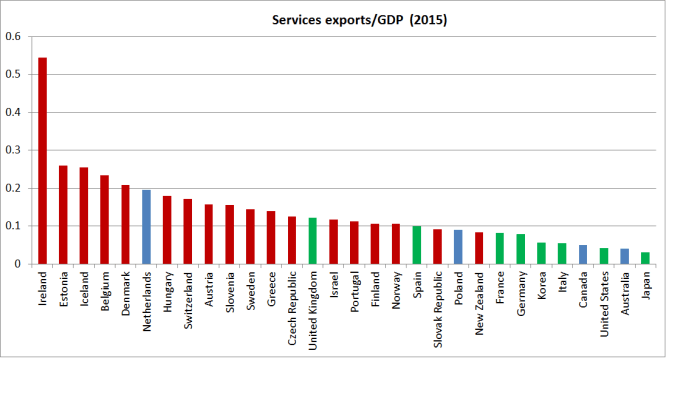
I also dug out the data for OECD countries on exports of services.  International tourism is classified as a services export, and for New Zealand it is a very large component of our services exports.  But that isn’t so everywhere.

Here is the share of services exports in GDP last year.

services exports oecdLarge countries don’t tend to do as much international trade as small countries –  they don’t need to, there are plenty of opportunities and markets at home.  I’ve highlighted the large countries (more than 40m people) in green, and the small countries (under 11m, where there is a natural break) in red.  New Zealand has the lowest services export share of any of the small countries (and, by the look of it, the lowest real dollar value of services exports as well) .  Of course, we are much more remote than the other small countries, but it just highlights the difficulty of generating really high incomes for lots of people in a place so distant.
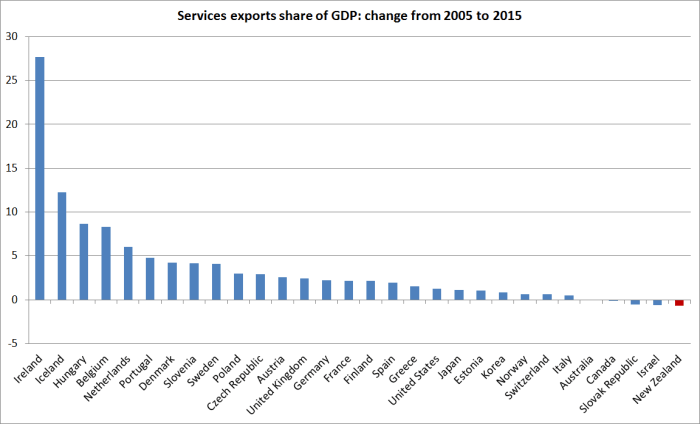
(I don’t purport to understand the Irish numbers, although I assume much of it has to do with tax.)

And it isn’t as if the picture has been getting better.  Here is the change in the services exports share of GDP (in percentage points) over the last decade.

services X change since 2005

If one looks at a 20 year history rather than just 10 years there are fewer countries to compare with, and New Zealand’s relative performance isn’t quite so bad.  Over that period we were only 4th worst.


Can the terms of trade explain Auckland’s apparent underperformance?

My post follow-up post yesterday on Auckland’s surprising weak performance in the regional nominal GDP data over the last 15 years prompted a reader to get in touch suggesting that changes in the terms of trade over the period were sufficient to explain why the provincial areas generally seemed to have done well, and Auckland and Wellington had not.

I had been conscious of the possible role for terms of trade changes in explaining the patterns –  these, after all, were nominal GDP data, and ideally we would have liked real series – but hadn’t gone much beyond that.

To see the issue, I’ve set up a very simple stylized version of New Zealand.  This New Zealand has just two, highly stylized, regions.  One produces all the foreign exports of the country (Region A), and the other (Region B) generates lots of domestic services, many of which are supplied to Region A.  You could think of these services as being banking, electricity generation, advertising or whatever.  And each region produces lots of stuff that is consumed within its own region, and each also assumes the same amount of foreign imports.  Both regions have GDP of 500, and Consumption of 500.  (For this little illustrative exercise, I’m just assuming away investment, and any current account deficits/surpluses.)

Region A Region B NZ
Consumption 500 500 1000
Exports 200 0 200
Services trade within country -100 100 0
Imports -100 -100 -200
Nominal GDP 500 500 1000

Now what happens if the terms of trade double?

It depends greatly on whether import or export prices change.

Export prices double:  Region A  Region B  NZ
Nominal GDP 700 500 1200

If foreign export prices double, then the value of region A’s exports will jump from 200 to 400, and the value of nominal GDP in region A will increase to 700.   Region B’s nominal GDP is unaffected (it doesn’t export anything internationally).  Over time, if the higher prices are sustained, it is likely that there will be other consequential changes: consumption in A will tend to rise, and with it both foreign imports and purchases from region B.  But the shock has clearly favoured region A, raising its nominal GDP relative to that of region B.

But what if the terms of trade double through a halving of import prices?

Import prices halve  Region A  Region B  NZ
GDP –  zero pass-through 550 550 1100
GDP – full pass-through 500 500 1200

The immediate impact depends in part on what happens to domestic prices.  If import prices halve, and none of that is passed through to consumers, nominal GDP in both regions will rise by 50 (the size of the reduction in the import spend).  If the lower import prices are fully passed through to consumers, nominal GDP won’t change at all  in either region (lower consumption prices will offset the lower import spend).  Again, over time the gain in the terms of trade will affect behavior (presumably there would be more consumption, and perhaps a higher volume of imports), but for these purposes all that matters is that the shock has hit the two regions equally.

This is all deliberately highly stylized, and says nothing about actual New Zealand (although you might be thinking that somewhere like Auckland might resemble region B and Southland or Taranaki might resemble region A: in the most recent year for which we have detailed industry breakdowns, 13 per cent of Auckland’s GDP was from primary sectors and manufacturing, while 56 per cent of Taranaki’s was).

The terms of trade increased very substantially in New Zealand from 2000 to 2015 (March years), the period covered by the regional GDP data.  The increase over that period was 31.7 per cent.

But most of the gain has been realised in the form of lower import prices.  Export prices have increased, in New Zealand dollar terms (and the nominal GDP series are NZD series), by only about as much as the consumption and investment deflators.  What stands out is that import prices have fallen by 4 per cent over 15 years.  What has been going on?

national acs deflators

First, the real international prices of a lot of imports have been falling –  a beneficial effect of the rise of China and other emerging manufacturing centres.   And, second, the exchange rate has risen very substantially over that period (up 33 per cent on the Reserve Bank’s TWI measure).  Global prices of many of New Zealand’s exports certainly rose over that period, and New Zealand as a whole was better off as a result, but the higher exchange rate meant that, on average, export-focused regions didn’t get the gains of the higher terms of trade (nominal GDP in those regions wouldn’t have risen systematically faster than that in less export-oriented regions).  If we take the six components of the ANZ Commodity Price Index over the 2000 to 2015 period, meat and dairy prices rose modestly in real NZD terms, while the other components (horticulture, seafood, aluminium and forestry) saw falls in their real NZD prices over the full 2000 to 2015 period.    Much of this process is discussed at greater length in an Analytical Note published by the Reserve Bank a couple of years ago.

Instead, the terms of trade gains came mostly in the form of cheaper real import prices, benefiting people in all regions (including Auckland).

Ideally, we would still like to have region-specific GDP deflators.  In some regions with a heavy weight on dairy exports, the rise in the terms of trade may help explain with that particular region’s nominal GDP per capita has done quite so well relative to Auckland’s over this particular 15 year period but (a) the rises in real NZD dairy prices over the full period weren’t that large (around 15 per cent, if deflating with the private consumption deflator), and (b) even in the Waikato total agriculture is only around 10 per cent of GDP).  The differences in GDP per capita growth rates across regions (illustrated in yesterday’s post) swamp anything that can be explained largely by terms of trade effects.

Wellington-boosters (such as the dreadful Wellington City Council, its “economic development” agency, and the myriad of “booster” mayoral candidates) probably take some consolation from the fact that, according to the regional GDP data, if Wellington hasn’t been doing overly well, at least it hasn’t done much worse than Auckland.  I’m not sure they should take such comfort.  Over this 15 year period, the private consumption deflator has increased by 31 per cent, but the government consumption deflator has increased by 51 per cent.  The production of government consumption goods makes up a great deal of economic activity in Wellington  (“public administration, defence and safety”  is around 11 per cent of Wellington’s GDP and 3 per cent of Auckland’s).  If we had real per capita GDP data for the regions, Wellington might be lagging even more  –  and specifically further behind Auckland –  than the nominal data suggest.

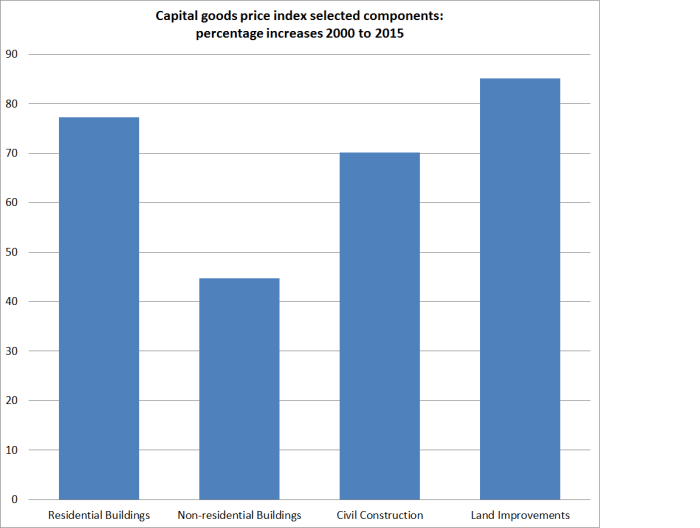
On the other hand, I wondered if there was at least one factor overstating Auckland’s performance.  In the national accounts deflators, the deflator for residential investment increased by 85 per cent over the 15 year period, while the private consumption deflator had increased by only 31 per cent.  And it isn’t just residential construction activity that has seen large price increases: here are the construction-related components from the Capital Goods Price Index for the same period.

cgpi

Surely, I thought, Auckland’s rapid population growth over this period (see earlier posts) would have meant a larger share of Auckland’s GDP was in construction-related activities.  If so, the higher inflation rates for these sectors would tend to boost nominal GDP.

We only have detailed industry breakdowns by region to 2013, but I was a little surprised that when I calculated the average share of construction in each region’s GDP over 2000 to 2013 this is what I came up with.

construction share of gdp

Auckland has certainly had a lot more construction activity (share of GDP) than Wellington, but beyond that I have no idea what to make of the results.  They don’t seem very plausible numbers,  but then SNZ collects the data.

There is no point putting too much weight on regional nominal GDP data.  But they do throw up some results that were unexpected (at least by me), and the apparent underperformance of Auckland over this particular 15 year period doesn’t seem easily able to be explained away simply by the effects of terms of trade changes. (Even if it could, it might be troubling that so many people were gravitating to a region that  – the market was signalling –  relative price changes were not favouring.)

And, to repeat a point I made yesterday, there is no necessary reason why simply putting more people in Auckland would raise the productivity of the city.  To those who assure me that agglomeration economies are real, I respond, well, yes, of course.  The question is not, and has never been, whether many (although not all –  see natural resource extraction) high value functions/industries/activities function most productively in big cities.  The economics of agglomeration helps describe why big cities exist.  But the question –  an analytical one, but one New Zealand practical policymakers need to think seriously about –  is whether Auckland is one of the places where firms undertaking many increasingly high value activities will increasingly choose to cluster.    There is no necessary reason why it should be.  Most places aren’t.  There are reasons why there aren’t half a million people in Invercargill or Launceston –  or Helena, Montana or Kearney, Nebraska .  Wishing it were otherwise does not make it so.

There seems to be a strong element of wishful thinking (or “build it and they will come”) about the policymakers’ (and their advisers’) Auckland story.  One could mount an argument –  not necessarily a fully compelling one, but one with substantial elements of truth to it –  that Auckland’s current relative size is largely a function of two big policy interventions.  The first was the high level of manufacturing protectionism that prevailed from the 1930s to the 1980s. Manufacturing firms all over the country benefited, but if one was producing things just for the local market, being in the biggest city made a lot of sense.  The South Auckland manufacturing base grew up during that period.  And the large scale immigration programmes ended up with the same effect, boosting Auckland’s population dramatically (particularly as immigration became increasingly non-Anglo), and generating a deal of economic activity in non-tradables sectors simply to support the infrastructural needs (broadly defined) of a rising population.  But there has never been any sign that Auckland is a location that has the economic opportunities that encourage the growth of new high –productivity industries successfully taking on world markets.  New Zealand’s export base remains overwhelmingly natural resource based –  dairy, wool, meat, fish, oil and gas, gold, wine, forestry, and tourism (most of the appeal is the landscape not the great art or glorious cathedrals).

I’d really like to be wrong, but where is the evidence that incredibly strong population growth in our major city, fuelled largely by immigration policy (New Zealanders, net, have tended to be leaving Auckland, not drawn to its great opportunities), is generating the national benefits the advocates would claim for it?  At present, it looks as though this Think Big strategy is perhaps even more flawed than the 1980s energy version (fortunately called to a halt quite quickly) was.


Big agglomeration gains in a growing Auckland? Or not.

A few weeks ago, when the annual regional GDP data were released, I used them as the basis for a post casting some doubt on whether we were seeing the widely-touted economic gains from the large and rapidly growing population in Auckland.

The data aren’t ideal by any means.  Among the other issues, they are only nominal, they only go back to 2000, and there are no regional hours worked data.  But they are what we have.  Since 2000, Auckland’s population –  already far and away the largest in New Zealand –  had grown rapidly, up 30 per cent, while the population in the rest of the country had increased by 13 per cent.

And yet, allowing for all the limitations of the data, GDP growth per capita in Auckland over that period had been among the lowest in any of the regional council areas in New Zealand.  Average GDP per capita in Auckland was still higher than in much of the rest of the country, but the gap had been narrowing.

nom gdp pc by region

On the face of it, it wasn’t a great advert for the success of immigration and other domestic policies centred on the belief that the growth of Auckland was the foundation of our future prosperity.

In the last few days, Peter Nunns, an Auckland transport economist, writing on the widely-read, and often stimulating, centre-left Transportblog, also used the regional GDP data, but in a post, “The contribution of agglomeration to economic growth in Auckland”, that drew quite the opposite conclusion.  His focus is on job density which, on the measure he uses, had also increased by 30 per cent since 2000.  Applying some estimates developed previously by Dave Mare and Daniel Graham (references in the Nunns post), he estimates that just over a tenth of all the (real) productivity growth in Auckland since 2000 is down to increased job density.

Nunns derives that share by estimating a real GDP per employee series for Auckland.  As he notes, the precise numbers are purely illustrative, since we don’t have regional GDP deflators.  And we also don’t regional hours worked data, and GDP per hour worked is typically a better measure of productivity.

Nunns doesn’t give any attention to how Auckland has done relative to the rest of the country of the period since 2000.  The chart above shows that nominal GDP per capita has grown less rapidly in Auckland than in most places.  Nunns focuses on GDP per employee.  Unfortunately, the HLFS employment data groupings are slightly different from those used for the regional GDP data, leaving us a smaller number of regions to compare with.

nominal gdp per employee growth

The hard to read label is Nelson/Tasman/Marlborough/West Coast combined.

Once again, Auckland has been among the more poorly-performing regions.  There may have been real and material gains from greater job density in Auckland –  as Nunns suggests –  but, if so, they must have had to offset really really weak other influences on economic performance in Auckland.

One of the commenters on Nunns’s article asked him how he responded to my earlier post, including the chart above.  This was his response (omitting the gratuitous slur on my motives etc)

Reddell’s confusing the signal with the noise. The signal is that agglomeration economies do enhance productivity. That’s an empirical fact, backed by lots of research from many places.

However, the “noise” is everything else that’s going on in the economy. That can make it hard to read the signal by looking at statistical aggregates like regional GDP. As I point out in the post, agglomeration economies account for perhaps 11-12% of Auckland’s recent economic growth – roughly one-tenth of a percentage point a year. While small gains compounded over long time periods add up to large numbers, they are often difficult to observe in the short term.

Finally, Reddell knows very well that productivity gains happen at the margin. Enabling agglomeration economies is one such “margin”, but there are a myriad of other “margins” that we should pursue. For example, New Zealand’s poor management practices inhibit productivity, as do its weak international connections and low investment in knowledge-based capital and R&D.

I don’t find that remotely persuasive.    This isn’t a single year’s data we are both looking at, but 15 years of data.  It would be great if we had a longer run of data but we don’t.  The more recent years data will no doubt be revised, but again for now this is what we have.  Over that period, in some years Auckland has done better than other places in New Zealand, and in others worse, but over 15 years there has been a non-trivial worsening in Auckland’s relative position (whether GDP per capita or per employee), despite that rapid growth in population and job density.    Frankly, his response seems (perhaps unfairly?) to amount to “agglomeration effects are real and important,  so it doesn’t really matter what the bottom line is, or how the top-down data look, I believe my model”.

And, of course, I agree with him that wealthier places tend to be denser  (but equally, as cities get wealthier they have tended to become less dense).  The issue isn’t whether the phenomenon of agglomeration economies is real, but whether those economic gains have existed in the specific instance of Auckland over the last 15 years.  There is simply no necessary reason why they should.  Density is typically an outcome of market processes (people finding it worthwhile to bunch together), but that doesn’t mean that simply pulling more people into an area by policy (which is effectively what our immigration policy does) , and then regulatorily constraining its physical footprint, will make the people in that area more productive.  If the longer-term economic opportunities in Auckland aren’t particularly good –  if, say, New Zealand impaired by distance can really only hope to compete strongly on natural resource based exports –  simply attracting more people into the confined space of Auckland could quite easily result in underperformance.  A couple of observations over 15 years isn’t remotely enough to prove the case one way or the other, but given Auckland’s underperformance over that period I think there is some responsibility on the champions of actively pursuing fast population growth and higher job density (central governments, MBIE officials, local councils, economists) to offer a good explanation for Auckland’s underperformance, not simply assert that “my model says the agglomeration effects matter in general, and hence they must have mattered here specifically”.  Perhaps there is such a good alternative story.  I would be very interested to look at it.

And, of course, there is no dispute that lots of good policies (or, typically, avoiding lots of bad policies) go into making a successful prosperous economy.  I wouldn’t agree with the Nunns list, but that is a debate for another day.

NB:  The rise in the terms of trade over the previous 15 years will explain part of the regional GDP differences, with more heavily export-oriented regions having benefited at the expense of the other regions, although much of the trend improvement in the terms of trade has been a result of falling world import prices, the effects of which should have been fairly evenly spread across the country.  Whether differential terms of trade effects are enough to reverse the rankings is another question.


Advisory “votes” on OCR decisions

Four weeks ago, commenting on his March OCR decision, the Governor of the Reserve Bank, Graeme Wheeler, was quoted telling the Herald

“I don’t think it’s a mystery that the Reserve Bank cut interest rates. In fact, we have 13 people who give advice to the governing committee who make these decisions and the advice from the 13 was unanimous.”

It was striking disclosure.  Not the fact that his advisers had been unanimous –  historically that isn’t uncommon – but the fact that the balance of advice, in numerical terms, was revealed at all, and only days after the OCR decision to which that advice related.  Neither Graeme Wheeler nor Alan Bollard or Don Brash prior to him had ever released that sort of specific information previously.  In fact, in the past the Bank has been almost obsessive about keeping secret almost anything to do with the OCR decision or the associated Monetary Policy Statement (there is a case being looked at by the Ombudsman now on just one recent example of that).  The Bank’s attitude tends to be that it is highly open and transparent about what it wants us to know –  eg the finished product, the Monetary Policy Statement –  and for the rest (“internal stuff”) it is really none of our business.  Fortunately that isn’t the law.

Following the Governor’s disclosure, I lodged this request with the Bank on 14 March

As the Governor has disclosed in the Herald this morning (page B3) the summary results of the OCR advice from members of the MPC for the most recent OCR decisions, I am requesting the same information (no names, just aggregate numbers favouring each rate option) for each OCR decision since mid 2013.

The statutory deadline for responding to that request is tomorrow (20 working days from the day they received the request).

I think it is safe to assume that the Bank is most reluctant to release this information.  It would have taken no more than a couple of hours to compile and check the information I asked for, and the Act requires (not suggests, requires) that agencies respond “as soon as reasonably practicable”.  Had the Governor’s remark to the Herald foreshadowed a new era of openness, I would have had the requested information weeks ago.  By law, I should have anyway.

We’ll see shortly whether they have decided to release some or all of the information, or to withhold it completely.  Regardless, I suspect there is some gnashing of teeth going on, and muttering beneath the breath that the Governor should never have told the Herald the voting numbers, leaving himself open to a request of the sort I have lodged.

But it is worth being clear what I am, and am not, asking for.  The request is simply for the numbers favouring each OCR option on each occasion in the previous 2.5 years.  Most of these advisory “votes” relate to decisions that occurred more than a year ago, and even the most recent request relates to the January 2016 OCR review, itself superseded by the March MPS, the results of which (and the advisory vote numbers) we already know.  All those participating are fairly senior people –  second and third tier managers, and external advisers.

I am not asking for:

  • the names of participants in the advisory group,
  • the “vote” of each participant to be identified by name,
  • copies of the one page analysis and advice each participant provides in support of his or her OCR recommendation.

All of that is official information, and could be subject to separate requests, but it isn’t what I asked for on this occasion.

Why might the Bank want to keep the information secret?  We can distinguish between their preferences and the law.

As I noted earlier, the Bank has long taken the view that the finished product is all that should be disclosed.  Anything else will only be “noise” to markets, confusing the messages, and so on.  And as it is a single decision maker model, only the Governor’s vote really counts anyway.  From within I repeatedly argued for more openness, and these were the standard lines used in response.  There is also likely to be some worry that disclosing even just the numbers favouring each OCR option, even with a lag (and recall that some of the dates I asked about are almost three years ago),  might undermine the willingness of some of the Governor’s advisors to offer advice different to the Governor’s own preference. A Governor who really didn’t want it known that a significant minority of his senior staff disagreed with him has plenty of leverage to discourage people from putting that disagreement on paper (including, but not limited to, simply tossing the person concerned off the advisory committee).

I don’t think these arguments have much merit.

First, it is now pretty common in countries with voting committees making monetary p0licy decisions for dissents/votes to be recorded, and to be disclosed pretty promptly (always with the names identified and sometimes with the reasons disclosed).  The Bank of England, the Federal Reserve, and the Swedish Riksbank are just three prominent examples.  It isn’t a universal practice by any means, but given the statutory presumption in favour of release of official information, it certainly isn’t obvious that great damage has been done to the effectiveness of policy (of policy formation/debate) in those countries where there is much fuller disclosure.

Second, it is not as if, in the nature of human affairs and especially those involving forecasts, there are many occasions when anyone is 100 per cent confident of the right thing to do.  An agency can try to present a monolithic front if it chooses, but everyone knows that behind any decision there is a weighing of pros and cons and the likelihood that some advisors will be more strongly convinced of the merits of a particular action than others.  Citizens –  and markets –  aren’t children.

Thirdly, all this information and more is already disclosed to the Reserve Bank Board, typically within days of it being offered. The Board receives all the background papers for each MPS, copies (without names) of the one page OCR advice provided by each member of the advisory group.  Board members, I’m told, can at times, and with experience, work out who provided which advice.    The Board gets copies of that material partly to assure themselves that the Governor really is being exposed to (a) good quality advice/analysis and (b) a range of views and perspectives.  If a Governor were really uneasy about it being known that some of his advisers at times disagreed with him (a) he is the wrong person for the job (in general we should be much more worried if no one ever openly disagreed with a Governor), but (b) he and his predecessors have long faced that incentive (since the Board is, after all, the group paid to monitor his performance, and able to recommend his dismissal or non-reappointment).

Monetary policy decisions have an important influence on the short to medium term path of the economy.  And they are decisions made under conditions of considerable uncertainty.  Parliament has given the power to make those decisions to a single individual, but part (a small part perhaps) of how we satisfy ourselves that he is exercising that power prudently is to be able to see, after the event, the balance of the internal advice he is receiving from his highly paid expert staff (and external advisers ).

Of course, nothing in law requires the Governor to seek formal or written advice from identified staff on where to set the OCR.  It is possible that the Bank could argue that if it is forced to reveal the advisory votes, even with a lag, the Governor would simply discontinue the practice of seeking such advisory “votes”.     But (a) the Governor has already revealed the votes on one particular occasion, with next to no lag, and (b) to do so would presumably not impress the Board, who would also lose one of their windows into the processes the Governor uses in making his OCR decisions.

But what about the law?  My request has to be decided not according to the Reserve Bank’s preferences, but under the provisions of the Official Information Act.

What are some of the relevant provisions?

First, the purpose of the Act

The purposes of this Act are, consistently with the principle of the Executive Government’s responsibility to Parliament,—

(a) to increase progressively the availability of official information to the people of New Zealand in order—

(i) to enable their more effective participation in the making and administration of laws and policies; and

(ii) to promote the accountability of Ministers of the Crown and officials, –

and thereby to enhance respect for the law and to promote the good government of New Zealand

And the statutory principle of availability.

The question whether any official information is to be made available, where that question arises under this Act, shall be determined, except where this Act otherwise expressly requires, in accordance with the purposes of this Act and the principle that the information shall be made available unless there is good reason for withholding it.

Are there any such good reasons?

The Act provides for both “conclusive reasons” for withholding information, and “other reasons”.

Take the conclusive reasons first.  Here they are

Good reason for withholding official information exists, for the purpose of section 5, if the making available of that information would be likely—

(a) to prejudice the security or defence of New Zealand or the international relations of the Government of New Zealand; or
(b) to prejudice the entrusting of information to the Government of New Zealand on a basis of confidence by—
  • (i) the Government of any other country or any agency of such a Government; or
  • (ii) any international organisation; or
(c) to prejudice the maintenance of the law, including the prevention, investigation, and detection of offences, and the right to a fair trial; or
(d) to endanger the safety of any person; or
e) to damage seriously the economy of New Zealand by disclosing prematurely decisions to change or continue government economic or financial policies relating to—
  • (i) exchange rates or the control of overseas exchange transactions:
  • (ii) the regulation of banking or credit:
  • (iii) taxation:
  • (iv) the stability, control, and adjustment of prices of goods and services, rents, and other costs, and rates of wages, salaries, and other incomes:
  • (v) the borrowing of money by the Government of New Zealand:
  • (vi) the entering into of overseas trade agreements.

I doubt the Bank would seek to invoke most of these.  Items (a) to (d) are clearly not relevant.

The Bank might seek to argue for the items under (e), since monetary policy decisions affect the exchange rate.  However, they would be on very weak ground to attempt to do so, because (e) refers to damage arising from prematurely disclosing decisions to change policy.  In other words, if I had asked for the Governor’s OCR decision after it was made but before it was released, he would have conclusive (and quite reasonable) grounds to refuse on these grounds – the decision would be disclosed prematurely.    But my request is not for information on a decision (only advice from non decision making advisers), and the request relates to advice on decisions which have already been released (in some case, several years ago).    One line of argument they might try is that the pattern of advisory “votes” might contain information about the future path of the OCR, but (a) they would have show that, not just assert it, and (b) since the decision is always the Governor’s, it doesn’t seem terribly persuasive, especially as the Bank already releases information about its own (the Governor’s) expected future path.

The Official Information Act also has a long list of other reasons for withholding, many of which I’ve repeated here.  In these cases, even if there is an argument made for withholding, that case has to be balanced against the wider public interest in disclosure.

(1) Where this section applies, good reason for withholding official information exists, for the purpose of section 5, unless, in the circumstances of the particular case, the withholding of that information is outweighed by other considerations which render it desirable, in the public interest, to make that information available.

(2) Subject to sections 6, 7, 10, and 18, this section applies if, and only if, the withholding of the information is necessary to—

………

  • (ii) would be likely otherwise to damage the public interest;

(d) avoid prejudice to the substantial economic interests of New Zealand; or

(f) maintain the constitutional conventions for the time being which protect—

  • (i) the confidentiality of communications by or with the Sovereign or her representative:
  • (ii) collective and individual ministerial responsibility:
  • (iii) the political neutrality of officials:
  • (iv) the confidentiality of advice tendered by Ministers of the Crown and officials; or

(g) maintain the effective conduct of public affairs through—

  • (i) the free and frank expression of opinions by or between or to Ministers of the Crown or members of an organisation or officers and employees of any department or organisation in the course of their duty; or
  • (ii) the protection of such Ministers, members of organisations, officers, and employees from improper pressure or harassment; or

(h) maintain legal professional privilege; or

(i) enable a Minister of the Crown or any department or organisation holding the information to carry out, without prejudice or disadvantage, commercial activities; or

(j) enable a Minister of the Crown or any department or organisation holding the information to carry on, without prejudice or disadvantage, negotiations (including commercial and industrial negotiations); or

(k) prevent the disclosure or use of official information for improper gain or improper advantage.

 Would disclosing the advisory “votes” on the OCR, with some lag, after release of the relevant OCR decision prejudice the “substantial economic interests of New Zealand”?  Hard to envisage, especially when there is already much greater disclosure in a variety of other advanced democratic countries.

The only argument I can see them trying to rely on is 2(g)(i), that to release the information I’m seeking would jeopardise  the “effective conduct of public affairs” by threatening the “free and frank expression of opinions” by staff of the Reserve Bank.   But, as the Bank’s own legal adviser used to tell us, officials (and especially senior ones) are expected to offer free and frank advice, and the mere fact that free and frank advice is offered is not in itself a reason to withhold the information requested.    More specifically, if I was asking for the advice of, say, Dean Ford, or Roger Perry, Willy Chetwin or Geoff Bascand individually it might be a different matter, but this request is simply for the number of votes on each side of an OCR decision.  Officials who would be feel constrained from offering free and frank advice on the appropriate level of OCR by the fact that the numbers favouring each option (jno names) would be published are in the wrong job.  Senior officials are paid to offer expert advice, and that advice is official information.  Aggregate information on the numbers in favour of each option should not be able to be kept secret, after the event, with the protection of the law.

We’ll see shortly if the Bank realizes that this is simply not the sort of information the Act is designed to protect, and makes a virtue of necessity, setting up a new protocol for the regular release of this information with a modest lag.  In fact I suspect they will decide to fight the issue anyway, relying on the delay (apparently shortening) in the Ombudsman’s processes to try to fend off disclosure for a while longer.  If so, it will reinforce a line I’ve used previously: we have a central bank quite happy to be open and transparent about stuff they know almost nothing about (what the OCR might be a couple of years hence) and not at all happy about being open (despite the law) about things they do know about, such as the policy processes they use in coming to decisions.

I will  write about the response when I receive it.  You might wonder about why I devoted so much space to the issue today.  The answer, at least in part, is to try to look at the issue in a relatively detached way, against both the statutory provisions and a former insider’s sense of what might, or might not, be strong arguments.  Sometimes the Bank’s responses to OIA requests simply annoy me, and my initial comments might be flavoured by a tinge of emotion/irritation.  In this post, I’ve tried to look for the arguments they might use, all the time half hoping that, albeit somewhat belatedly, they might finally choose to (follow up on the Governor’s one-off openness) and take some structural steps towards greater transparency.

And why does it matter?  The request was partly a matter of principle. I believe that this information should be a matter of public record, once the relevant OCR decision has been released.  But I also chose my dates carefully.  From the middle of 2013 (a time when I was still part of the advisory group) the Bank was preparing the ground for its ill-fated 2014 tightening cycle, which was only belatedly reversed over the period since June 2015.  I think we have a right to understand whether the Governor was acting alone, whether he has unanimous support from his advisers, and when any material divergences of view began to open up.  The last few years have been a somewhat inglorious episode in New Zealand’s monetary policy (and for the Reserve Bank), and the Board has done little to provide effective transparent accountability.  Fortunately, the Official Information Act is there to allow citizens to pose their own questions, with a presumptive right to access to official information to enable them to evaluate the performance of powerful officials and their agencies.