Housing, land tax, and associated things

The Prime Minister attracted considerable coverage last week for his suggestion that a tax might be applied non-resident (however defined) holdings of land.  The Prime Minister wasn’t very specific about the options he had in mind, but it probably didn’t matter – it got some mostly favourable coverage on an issue (house prices, in Auckland in particular) where the government probably senses that it might be politically vulnerable.

Quite how house prices play politically has never really been clear to me.  I’ve noted before that I’m not aware of a single example of a city or country that, having once put in place restrictive land use regulation, has ever substantially unwound those controls.  I can well understand existing users’ unease about greater intensification, and in particular the coordination challenges that can arise. Existing owners as a whole in suburb near the central city might be (considerably) better off financially from allowing their land to be used more intensively, but that won’t necessarily be so for each of them if such development occurs piecemeal, or if benefits are captured by those first in the queue.   The market seems to deal with these issues through private ex ante contracts, the covenants that are now used in most new subdivisions (and which the Productivity Commission was quite disapproving in its report last year).

And I can also understand that no one really wants the value of their property to fall much.  Of course, for many it actually doesn’t matter very much.  If you haven’t got a mortgage and plan to live in the same city for the rest of your life, the market price of houses in your area just isn’t (or shouldn’t be) that important to you.  For those with very large recent mortgages it is another matter.  For them, and especially those who aren’t owner-occupiers, falling house prices look like a visceral threat.

But then the mortgage-free are in many cases those with children, already adult or approaching adulthood, who face the huge –  increasingly insurmountable – hurdles to entering the owner-occupation market.  That should be quite some motivation to be concerned about policies which keep house prices very high, or keep driving them up further.  Increasing the physical footprint of cities, and allowing that process to happen in ways and in places that offer the best opportunities (rather than where Council officials and politicians dictate) looks as though it should be the answer.  But bureaucrats and politicians obstruct those processes, and seem to get away with it because the issues are complex, and because they cover their tracks, blaming high house (and urban land) prices on banks, the tax system, the building industry, “speculators”, “land bankers”, becoming a “global city”, or whatever.

Other bureaucrats and politicians peddle the line that high levels of non-citizen permanent immigration are somehow good for us.  High house prices are just one of those things –  a price of progress, indeed of success, so the Prime Minister would often have us believe.

Once in place, distortionary policies, even very costly ones, often last for a long time.  We saw that in New Zealand with the import licensing regime first put in place in the 1930s, which wasn’t finally abolished until 1992.  It was an enormously inefficient system, driving up costs on many items (and restricting choice) for most people, it was contested politically (largely unwound in the early 1950s, and then re-imposed by the next government).   But the entrenched interests of those who benefited from the system (or thought they did) combined with ideologies of “national development” to make it very difficult to undo.  Licence-holders themselves obviously benefited, but many of the employees of firms producing products protected by the licensing regime thought they did too.    And transitions are/were costly – we saw a lot of that in the 1980s, when big steps were finally made in dismantling the regime.  A larger proportion of the population is employed now than was then, but that didn’t mean the transition wasn’t difficult, and even traumatic, for many individuals, and even for whole towns.

One might have hoped that the rigged housing market was different, but it doesn’t seem to be.  The distributional effects (winners and losers) are far larger than any aggregate adverse effects (I’m skeptical that GDP is much smaller than otherwise because the housing market is so badly distorted).  And unfortunately, those most adversely affected tend to be the poorer, younger, less sophisticated elements in society –  those on the peripheries.  One might have hoped that one or other main party would have made grappling with these issues a real priority, consistent with the underlying values they claim to represent:  National perhaps on some ‘property-owning democracy’ line, in which communities will be stronger etc when property ownership is more broadly based, providing a “fair go” to the hardworking and aspiring classes.  Or Labour, built on a fight for the rights and interests of ordinary workers, campaigning for the full inclusion and equal opportunities for peripheral groups.

But it simply doesn’t happen.  Instead, the Prime Minister keeps talking of high house prices as “a good thing”, and a sign of success.  And for all the somewhat encouraging talk from Labour’s Phil Twyford, less than 18 months out from an election, there is little public sense of a party making fixing the housing market a defining issue.  Time will tell.  Rigged markets are hard to unscramble –  politically hard, not technically so.    Doing something far-reaching could be very costly for groups who would quickly become quite vocal, and loss aversion is a powerful force.

Where do land taxes fit within all this?  I outlined some of my skepticism about a general land tax in a post late last year.    But the Prime Minister’s latest comments relate only to non-resident purchasers.  The theoretical arguments for a general land tax don’t apply to one explicitly targeted at a specific subgroup.  Instead a land tax appears to be one of the few possible tools (specific to foreign purchasers) left to the government –  having signed up to a succession of preferential trade (and other) agreements – if, as the Prime Minister put it, it could be shown that non-resident purchasers were a big influence on the housing market.  Of course, we haven’t yet seen the data the government has started collecting, but even when we do there will no doubt be lots of debate about what it means.    Say that it shows that 1 per cent of purchases in the last six months have been from non-resident foreigners.  One per cent doesn’t sound much.  But the significance depends on a various things, including a variety of elasticities.  If the supply of houses and urban land was totally fixed (it isn’t, but this is just an illustrative example), a one per cent boost to demand could have a considerable impact on the price of houses.  If New Zealand residents were deterred from buying by even the slightest increase in price, then an increase in non-resident foreign demand might have very little impact on price even if supply was largely fixed.    Various quantitative researchers will have various estimates of these different elasticities.   But some past work has suggested that a 1 per cent increase in population, say, can have a material impact on house prices.

I had a couple of posts on the non-resident purchases issues last year.  Despite my general stance strongly favouring a pretty liberal regime for foreign investment, the housing supply market is so badly messed up that I don’t think we should rule out restrictions targeting non-resident foreign purchasers, as a second or third best option (perhaps especially if there was evidence that a large proportion of such purchases were being left empty).  The capital outflows from China –  which is where the main issue is –  are historically unprecedented.  They aren’t a normal phenomenon of an emerging economy, but a reflection of a whole variety of things that are badly wrong with the governance and rule of law in China.

But is a land tax the answer?  If it is, it is a pretty unappealing one.   It would seem to be a tax planners’ dream.  One of the appeals of a general land tax is that the land is fixed, and some identifiable entity (person, company, trust, government) one owns each piece of land.  It doesn’t really matter who owns it, but someone will have to pay the tax.  A land  tax focused only on some definition of non-resident purchasers means it makes a huge difference who owns the land.  If I own it, there is no tax liability.  If a family in Shanghai owns it there is.  Which looks like a pretty clear incentive to have the land owned by New Zealanders, and (to the extent there is demand) the things on the land owned by the foreigners.  No doubt lots of clever intrusive anti-avoidance provisions could be added to any land tax legislation but to quite what end?  Are we better off if, say, the non-residents purchasers bought apartments (which typically have a smaller land component) rather than, say, standalone houses?  Perhaps if it stimulated a supply of new apartments –  for which there would be an enduring demand –  but not if it largely just reallocated who owned what within an existing housing stock.

And there is, of course, the question of what might be a reasonable rate of land tax.  Long-term New Zealand government bond yields in New Zealand are among the highest in the world.  At present, those real bond yields are just over 2 per cent per annum.  Imposing a tax of 1 per cent per annum on value of land (including farm land?)  would be a very heavy burden in such a low yield environment.  Perhaps it might not matter too much to those seeking to safeguard their capital (return of capital rather than return on capital), but if so it might not make that much difference to offshore demand either.   I’ve seen talk of higher rates –  Rodney Hide’s Herald column yesterday talked of a 3 per cent annual rate –  but in such a low yield environment such tax rates could quickly starting looking like expropriation, confiscatory in intent.  I suspect our preferential trade agreement partners might start looking askance at that.

For what it is worth, I think a serious response to the house and urban land price affordability issue would have several dimensions, including:

  • limiting the assessability and deductibility of interest to the real (inflation-adjusted) interest only.  The ability to offset losses in one activity against profits in others is a good feature of the tax system not a flaw, but there is no good economic case for taxing the inflation component of nominal interest, or allowing borrowers to deduct the inflation component.  This is a small issue, especially at present when inflation is so low, but it would be good tax policy and work towards slightly better housing market outcomes.
  • creating a presumptive right for owners to build, say, two storey dwellings on any land, with associated provisions to developers/purchasers to cover the costs of associated infrastructure (whether through private provision, or differential rates).
  • sharply cutting the target level of residence approvals under the New Zealand immigration programme, from the current 45000 to 50000 per annum to perhaps 10000 to 15000 per annum.  Since there is no evidence that New Zealanders, as a whole, have been gaining from the high trend levels of immigration –  and indications that Auckland, prime recipient of the inflows, has been persistently underperforming, this would represent immigration policy reform in any case.  But it would also have material implications for trend housing market pressures as well.

The third element would be the one that would be easiest to implement.  But, of course, like the policies around housing supply –  or import licensing (see above) –  the distributional implications of the current arrangements (positive and negative) are probably larger than the overall economic effects.  Those who see themselves as “winners” from the current arrangements –  a funny mix , including those who genuinely benefit, and those with a “feel good” preference for diversity  –  are likely to be more vocal, and more easily heard, than those who pay the price of an misguided approach to economic management: a “critical economic lever” (MBIE’s words) that has done little or nothing positive for New Zealanders as a whole.  The parallels with Think Big in the 1980s, or with the protective regime of the 1930s to 1980s, each well-intentioned and with their own internal logic, are sobering.


Diversity dividends? Maybe not

The belief that “diversity is good”, and probably “and more diversity is better” pervades our public debate.  Sometimes people just mean intellectual diversity, sometimes diversity of managerial style, sometime gender diversity, sometimes ethnic diversity, sometimes diversity of nationalities.  But too often is all lumped together in some amorphous mass.  Who, after all, would argue that diversity might not always be good?

Enthusiasm for diversity pops up all over the place.  The Secretary to the Treasury  –  often, it seems, something of a bellwether of elite sentiment –  has celebrated diversity and called for more of it (but Eric Crampton has cast significant doubt on Makhlouf’s use of the literature on gender diversity).

Even amid the general elite celebration of “diversity”, I was a bit surprised to note a letter in last week’s Listener from a representative of top-tier law firm Russell McVeagh declaring that at that firm “we have made diversity our No. 1 priority in the past couple of years”.  If I were a client, I’d probably have hoped that delivering top-notch legal advice had been the top priority.  It may well have been, but it is telling that it sounded better to claim that diversity was their “No. 1 priority”.

Of course, a range of perspectives on many issues that face firms or public agencies or even individuals is likely to be helpful.  For hard issues there is rarely only one useful way of looking at a problem, and all of us are prone to our own biases and blind spots.  Then again, all cultures (national, organizational, local, or even family) rely on not too much diversity, and on shared assumptions (usually tacit) about how things are done,  how differences are dealt with, debate encouraged (or suppressed), and about what sorts of behaviours are acceptable and which ones are not.  And so on.  It is simply how societies work, and that doesn’t change because a particular tide of liberal opinion wishes it were otherwise.

The alleged benefits of “diversity” are part of the case often made by the champions of our large-scale non-citizen immigration policy.  Late last year, supported by taxpayer funding, lawyer Mai Chen published a 400 page Superdiversity Stocktake , championing the benefits of the diversity of ethnicities and nationalities that now make up modern New Zealand.  She champions in particular the alleged economic benefits

Most of the benefits from superdiversity, such as greater innovation, productivity and investment, increase New Zealand’s financial capital, whereas most of its challenges adversely impact New Zealand’s social capital

Ian Harrison has done a nice piece reviewing how flimsy the economic case, and the evidence cited for it, in the Superdiversity Stocktake really is.  But “diversity is good” seems to remain one of those mantras that business and political leaders repeat to each other.

Professor Bart Frijns of AUT (himself an immigrant) has been doing some interesting empirical work on one particular aspect of the impact of diversity.  His co-authored paper is The Impact of Cultural Diversity in Corporate Boards on Firm Performance , and a couple of weeks ago I went along to hear him present it at a Victoria University seminar.

Frijn and his co-authors look specifically at the impact on the performance over 13 years (2002 to 2014) of 243 listed UK firms (excluding financial sector ones), making up 95 per cent of British stock market capitalization, of having directors who were not British citizens.  Performance is here measured by the change in the market value of the firm (share price) relative to the book value (Tobin’s Q) and return on assets.  The proportion of firms with at least one foreign director has been increasing, reaching 72 per cent by the end of the sample.  Previous studies along these general lines have, so they report, produced mixed results, but those results included negative effects from the presence of foreign independent directors.

Here is the abstract to the paper

We examine the impact of cultural diversity in boards of directors on firm performance. We construct a measure of cultural diversity by calculating the average of cultural distances between each board member using Hofstede’s culture framework. Our findings indicate that cultural diversity in boards negatively affects firm performance measured with Tobin’s Q and ROA. These results hold after controlling for potential endogeneity using firm fixed effects and instrumental variables. The results are also robust to a wide range of board and firm characteristics, including various measures of ‘foreignness’ of the firm, and alternative culture frameworks and other measures of culture. The negative impact of cultural diversity on performance is mitigated by the complexity of the firm and the size of foreign sales and operations. In addition, we find that the negative effects of cultural diversity are concentrated among the independent directors. Finally, we find that not all aspects of cultural differences are equally important and that it is mainly the diversity in individualism and masculinity that affect the effectiveness of boards of directors.

As someone who hadn’t looked into this literature in any detail previously, those results surprised me.  As a sceptic of the value of such “diversity”, I might have expected them to fail to find any statistically significant economic benefits (to the owners of the firms), but in fact they found statistically significant negative effects.    Try as they might, they couldn’t consistently get rid of the negative effects.  They test for all sorts of things.  Does being based in a metropolitan area as opposed to a smaller town matter?  Does the complexity of the business matter?  Does it matter whether the foreign directors are independents or executive directors?  Does it matter if the firm is also listed in the US?   The negative effects aren’t there in every possible alternative specification –  they disappear for executive directors, for very complex firms,  and for those with large proportions of foreign sales for example  – but there were no alternative specifications that generated statistically significant positive results.

The authors look at the nationalities of the foreign directors, using a (now quite old) cultural values framework developed by Hofstede for classifying each country.  People from different countries (loosely “cultures”) differ on things like individualism, uncertainty avoidance, attitudes to the relationship between superiors and juniors (“power distance”), and “masculinity” (assertiveness, outspokenness, driven-ness, rather than gender per se).  They also use some more recently developed “cultural scores” capturing dimensions like religion, language, or even genetic differences.    As they note in the abstract above, not all cultural characteristics seem to matter much, but “individualism” and “masculinity” did in the results of this study.

Why might these effects exist?  Boards need a variety of perspectives on the sorts of issues they face.   But one element of a common culture is about trust, and cultural diversity seems to have the potential to undermine some of that trust (if one doesn’t understand quite how someone operates one is less likely to trust them, and perhaps less likely to take seriously their perspectives – even if you were part of appointing the person to the group).  Thus cultural diversity looks as though it can be disruptive to group problem solving.  There are benefits, but there are also costs, and –  at least in this study –  the costs generally seem to have outweighed the benefits.

However good this particular paper is, it is only one study.  And, importantly, it is only one dimension of diversity, or even cultural diversity.    In fact, it is only measuring nationality diversity –  anyone who is a naturalized British citizen, no matter how recently, is British for the purposes of this study, even though their cultural similarity with most natural-born British directors might be considerably less than that of, say, an Australian citizen director who might have resided in the UK for thirty years.  (As it happens, around half of all the foreign directors were from Anglo countries).   And it doesn’t deal with cultural diversity within countries at all –  the differences between a black and white South African director (in this period, only a decade after apartheid), and between most white and black British directors (given the socioeconomic disadvantages in the background of most of the latter) may be as important as those between “South Africans” and “British” directors.

Knowledge advances one paper – and one database –  at a time.  Other authors will be able to refine, or perhaps even refute, some of these results, and perhaps extend the analysis further.  But it is the sort of paper that should be taken seriously by those enthusiastically championing the possibility (near- certainty many would have us believe) of diversity economic dividends here in New Zealand.

I was interested to see yesterday an article from the Financial Times economics columnist Martin Wolf on immigration and the Brexit debate.  Wolf is a pretty reliably voice for elite informed UK opinion.  He regards himself as a classical liberal,  but seems to me pretty representative of a David Cameron/Tony Blair view of the world.

Economists tend to think it evident that immigration is beneficial to all parties. I am not convinced. High net immigration imposes significant negative externalities: greater congestion, more stress on social services, higher land prices and a need for significant investment in infrastructure and housing. If necessary investments are made, people suffer significant costs. If they are not, the costs will be higher still.

All this cannot be entirely ignored. Moreover, while I fully accept the arguments for the benefits of diversity, I understand why many differ, even feeling that they are “losing” their country. Some would argue that this idea of having inherited property rights in a country is illegitimate. I feel it is politically fundamental.

There are issues, and questions, which need to be addressed, perhaps even more so in New Zealand –  where immigration has been on a much larger scale, and for longer – than in the UK.


Food, culture, regulation….and a walk with the kids

Spurred by a Herald article yesterday, my kids and I went for a walk (well, we do most days but this one had a specific purpose).  The newspaper was reporting  new Auckland university research showing –  shock, horror – that.

“Sixty-nine per cent of urban schools have a convenience store within 800m and 62 per cent have a fast-food or takeaway shop in that distance”

Frankly, I was surprised the number was that low, but then in Wellington one finds small schools in all sorts of odd nooks and crannies.  My three kids now go to three different schools, and each of the schools has shops nearby.  But, as it was nearest, we walked around the area that encircles my youngest child’s decile 10 primary school.  And what did we find?

On the first corner:

  • a dairy
  • a specialist pie shop

On the next corner:

  • two dairies
  • a Chinese takeaway
  • the Empire Cinema, with its neighbourhood café and gelato outlet

And then in the main shopping area

  • the supermarket, (as the kids pointed out, it was chock full of all sorts of stuff, “good” and perhaps “not so good”)
  • a Hell Pizza outlet
  • two fairly casual daytime cafes with plenty of take-out options
  • a combination fish and chip shop/Chinese takeaway
  • the video (and Post) shop, with lots of sweet and savoury nibbles
  • an Indian takeaway
  • another dairy
  • a lunch-bar/bakery
  • the butcher –  bacon and cheerios don’t score well on the “disapproval” lists, and that is before getting onto the question of red meat.

And that was without including the:

  • bottle store and bar, and
  • three other evening-focused restaurants, two offering take-out
  • and a couple of arty galleries/shops selling quite good chocolate.

But so what?  If 70 per cent of urban schools are close to at least one convenience or takeaway outlet, isn’t that simply telling us that our schools are typically in the heart of our neighbourhoods.  Which is probably where they should be.   And I’d be surprised if the number of dairies and takeaway places has changed much in the almost 40 years since I was getting off the school bus at one of these corners (although there was no gelato back then, even in this Italian-influenced suburb).

Buried in the Herald article, well past the calls for governments to “do something”, was this comment from the lead researcher

But she acknowledged that no link between obesity and access to unhealthy food shops had been clearly established by research.

‘The evidence is quite mixed…You don’t have to wait for the evidence to take action.  It’s the same with the sugar tax –  there’s no definite evidence. It’s hard to get definite evidence in science.  The fact is, unhealthy food is so available, accessible, affordable, we should protect children from potentially harmful products. ‘

At one level one can sympathise.  Definitive evidence is certainly hard to come by in lots of areas (including the ones I’ve been closer to, in macroeconomics).  But it is also a good reason for governments to be particularly wary of optional regulatory interventions, that directly impinge on ordinary citizens’ choices and options.

And that is even if one granted that obesity was somehow the government’s problem.  The common argument is that the public health system makes it so, because the government bears the medical costs of the choices people make.  There is something to that of course –  although we all die of something, and the longer-lived cost more in New Zealand Superannuation, rest-home subsidies etc)   – but as an argument it has chilling implications: we should give the government the right to coercively regulate all manner of behavior, simply because the government bears one lot of the costs if things go wrong?  I support a public health system, but taken very far this argument will eventually risk undermining support for such a system, and that would be unfortunate.

In fact, most of the costs of obesity fall on the individuals concerned, and perhaps their families.  A shortened life expectancy, or more sick days, has a cost to the person concerned.  The benefits from the food consumption, or choice to do things other than exercise, also accrue to the individual.

Do people always make wise choices?  Of course not.  Do children and young people always do so?  Even more so, of course not.  Part of growing up is taking risks, and pushing the boundaries.  But a big part of good parenting is to constrain the choices, and to educate kids in a way that means they are less likely to push the boundaries too far.  It is about the ability to say no. It is about the ability to offer treats, in sensible sizes and sensible frequencies. And to balance that with a good basic balanced diet, with all sorts of foods mostly in moderation. And for adults to model eating sensibly –  both within the family, and within whatever other groups the family might be part of (church, marae, sports club, or whatever).  That is a big part of what culture is –  memorizing, practising and reinforcing a sense of the way we do things, ways that support getting through life reasonably successfully.

Do governments have a role in all this?  I don’t see one (and was unnerved  to read that the Health Minister is apparently proud of the fact that the government has “22 initiatives targeting child obesity”).  Which Ministers  (or their Opposition peers) would I regard as good role models, or qualified to provide guidance on shaping the next generation?  A few perhaps, but not many.   Speaking personally, I’ve never found the presence of dairies, takeaway, or even the layout of supermarket shelves, makes my parenting more difficult.  Perhaps others have a different experience  but –  to loop back to the Auckland University researcher’s acknowledgement –  some robust evidence would be nice before governments rush in, trying to tell people where they can locate their businesses, who they can sell to, and so on.

But my inclinations are more austere Puritan than New Zealand Initiative libertarian, and so although I don’t see a role for government controls in this area, I was quite shocked last night when my elder daughter told me that her intermediate school sells potato chips and a variety of other foods of dubious nutritional value at the morning break.  I’m running for the Board of Trustees –  just to make some points in my campaign statement, rather than expecting the Green voters of South Wellington to prefer someone like me – and if elected would want to encourage the school to look again at quite what products it was offering for sale.

Speaking of the New Zealand Initiative, Geoff Simmons of the Morgan Foundation had an op-ed in this morning’s Dominion-Post attacking the Initiative for its new report The Health of the State and its skeptical take on specific taxes on disapproved classes of food (and alcohol and tobacco).  Simmons leads with the point that the Initiative is “corporate-funded”, as if somehow that matters  It is not as if there is any secret as to where the Initiative gets its money from – its members are listed in the Annual Report, and if anything I was rather disconcerted to learn that the Wellington City Council (always happy to intervene in anything) was a member (and Auckland University in fact).  There are lots of things I disagree with the Initiative on, but the issue should surely be the quality of the argumentation, analysis, and evidence. That goes for the Morgan Foundation surely just as much as for the New Zealand Initiative –  both privately-funded research and advocacy bodies, whose presence lifts the generally weak level of public debate in New Zealand.

Simmons suggests that it is really all about “ideology”.  I don’t think that is right –  there is plenty of debate, or should be, about evidence (partial as it inevitably often is).   But he ends his column this way:

“Instead of a facile debate over whether a sugar tax would work or not, we should be discussing which we value more –  living in a free society where you can eat what you like and burden the state, or whether we value having a healthy productive society”

Surely there is room for both?  A serious ongoing debate about the impact and efficacy of proposed interventions, using insights from overseas experience, from other similar interventions, and so on.  But also a debate about what sort of society we want.  Personally, I like the idea of a free society, in which people can eat whatever they like –  but typically choose to restrain themselves, in food as in all other areas of life.  We don’t exist as servants of the state – if anything, it is the other way round.  Civilisation and prosperity have always required restraint and self-discipline in a whole variety of areas of life.  But the track record of governments in creating such cultures doesn’t look good:  governments more often corrode cultures than foster successful ones.


The Treasury on lock-ups

I just received from The Treasury the response to my OIA request about Budget (and similar) lock-ups.  Not quite as fast a response as that from Statistics New Zealand, which I commented on last week, but well within the 20 working days, and thus most welcome.

No doubt they will put the response on their website in due course, but here is the document.

Treasury OIA response on lock-ups

As I’ve noted from the start, I’m less bothered about pre-release lock-ups for Budgets than for OCR announcements or the release of key macroeconomic data.  Most of the time, most of what is in the Budget is not that market-sensitive –  and what is headline-grabbing has often been well-foreshadowed by Ministers and their staff.  And Budgets often have a large range of complex material, straddling numerous portfolios areas.  When new initiatives are announced often the details can be tricky, and important. But I don’t think Treasury can be complacent about these lock-ups –  there is sometimes material there that is market-sensitive.  Advance news about the bond programme would, at times, be very valuable.  There is a difficult balancing act, since Budgets are a mix of political management and  other, perhaps market sensitive, material.

Like the Reserve Bank in the past, and SNZ still, the Treasury seems to rely mostly on trust for the security of the lock-ups.   Attendees are not even required to surrender phones or mobile devices, just required not to transmit with them.  Apparently “compliance is monitored throughout”, but presumably by wandering around. I imagine the Reserve Bank staff did that in their lock-ups.

I had asked about any reviews undertaken in light of the Reserve Bank’s experience.  As is already known, after “discussions” the Secretary to the Treasury has decided to go ahead with this year’s lock-up.  There is no suggestion that those discussions included any effort to identify whether leaks had occurred in the past, along the lines of what happened at the Reserve Bank.  The Deloitte report gave no suggestion that the MediaWorks breach was accidental, and there are even suggestions afoot that the journalist involved may have been under management instructions to send draft stories from the lock-up (see John Drinnan’s comment at the end of this post).   If a story was deliberately sent from the OCR lock-ups, might the same practice have occurred, with the same people, at previous Budget/HYEFU lock-ups?  I don’t know, but then neither –  it would appear – does The Treasury.

Treasury is probably quite safe this year, since everyone (no doubt including MediaWorks) will be hyper-sensitive to the Reserve Bank experience.   But weak systems create a high risk that there will eventually be breaches.


A wrong decision, but perhaps not too surprising

Graeme Wheeler’s OCR decision this morning –  perhaps he will tell us how many of his advisers backed this one? – was the wrong decision.  Core inflation measures remain well below the midpoint of the inflation target, and there are few or no pressures taking inflation sustainably back to the midpoint, even though it is now almost 11 months since the Reserve Bank began unwinding the ill-fated 2014 tightening cycle.

Keeping medium-term inflation near 2 per cent is the monetary policy job that has been given to the Governor.    Nothing else matters very much in the Policy Targets Agreement.  There has been talk in some quarters that the inflation target should be lowered.  The Minister of Finance says he hasn’t found that case persuasive, and he sets the target.

But if it was the wrong decision, it perhaps wasn’t too surprising a decision.  Graeme Wheeler has been reluctant to cut the OCR all along.  He continues to talk of how “accommodative” monetary policy is, but that appears to be referenced against a view that the “neutral” interest rate is 4.5 per cent (their last published estimates, although one hears that they tell investors in private meetings that that estimate is now around 4 per cent –  perhaps reflecting the fall in inflation expectations?).  He thought he was getting things “finally” back to normal when he launched the 2014 tightening cycle, talking confidently then of the prospects of 200 basis points of tightening.   It would be better, frankly, if the concept of a neutral interest rate was largely excised from central bankers’ vocabulary for the time being, because neither they nor we have any good sense of what “neutral” actually is.  Any such estimates have too often been a dragging anchor, helping hold back central bankers from the sorts of policy adjustments that meeting their respective inflation targets would have warranted.

So the Governor has been consistently reluctant to cut the OCR –  and even more reluctant to admit his past mistakes – and has only done so when the weight of evidence has overwhelmed his preferences.  Last year it seemed to be some mix of further falls in dairy prices, the failure of inflation to recover,  and/or high unemployment.  As recently as the start of February, in his forthright speech, the Governor was again holding out against the prospect of further cuts –  never ruling them out, but making pretty clear where his inclinations lay.  But then the data overwhelmed him again.   The new inflation expectations data shook the Bank, and the deteriorating global economic outlook and rising financial market unease (including widening credit spreads) prompted a move in March, with the prospect (projection) of one more cut to come before too long.

But in the past six weeks, there hasn’t been that much news, and little to change anyone’s baseline story.  There hasn’t been any new labour market data, the CPI had something for everyone, there was no material new inflation expectations data, and if the global economic outlook still looks unpromising, financial markets have recovered somewhat (including credit spreads banks face) and oil and various hard commodity prices have been rising.  If your reference point is that the OCR “really should” be something more like 4 per cent, why would you take the “risk” of cutting the OCR now?  It might be different if your reference point was that core inflation measures have been persistently below target for years, and that that gap shows little or no signs of closing.

What of the housing market?  I explicitly commended the Governor’s approach to house prices at the time of the March MPS:  asked about the risks that a lower OCR could provide a big further impetus to house prices, he  had simply observed “well, that’s just something we’ll have to keep an eye on”.   It helped that, at the time, the Bank  noted that house price pressures in Auckland had been “moderating”.  Recall that house prices are explicitly not something the Reserve Bank has a mandate to use monetary policy to target.

Six weeks on and house price issues are all over the headlines again, given added impetus by the Prime Minister’s talk of land taxes for non-residents etc.   The Bank’s tone has changed, although it is still somewhat cautious: “there are some indicators that house price inflation in Auckland may be picking up”.  Frankly, it would be surprising if it were not –  new distortionary policies introduced by the Bank and the government late last year should only ever have been expected to have had short-term effects.  Nothing fundamental about the market has changed.  It still isn’t the Bank’s responsibility at all, and certainly not something that should be driving monetary policy.  But when all his inclinations seem to be against cutting, unless “forced” to by new data, and with a potentially awkward Financial Stability Report only a couple of weeks off, it would have been another reason to hold back.

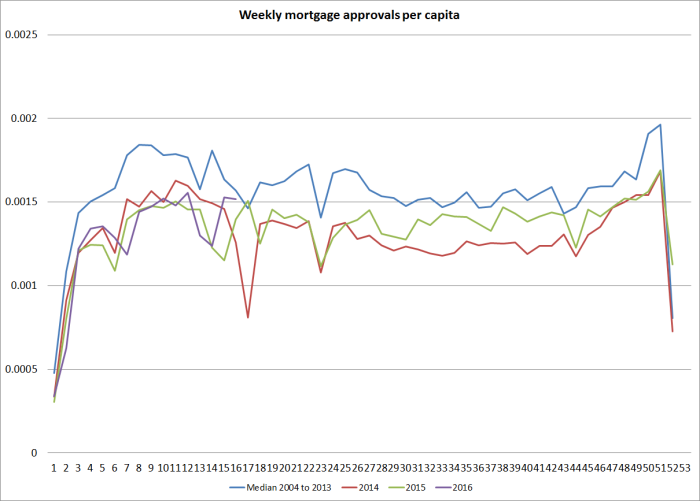
Are house prices really taking off?  The Dominion-Post would have one think so, highlighting this morning a sharp rise in the price of a house in the sunny but unprepossessing suburb of Berhampore, perhaps a kilometre from where I sit.  In terms of activity levels, I run this chart of the number of (per capita) mortgage approvals from time to time.  There doesn’t seem anything extraordinary about current volumes of mortgage approvals (again, the x axis is weeks of the year, numbering 1 to 52/53).

weekly mortgage approvals

Various people who talk to the Reserve Bank have been telling me since March that the Bank has finally “got it” and recognized that the overall domestic and economic climate is such that materially lower interest rates were needed.  I wish it were so, but I think today’s statement confirms my “model”, in which the Bank will cut only reluctantly, and only if  –  in effect – “forced” to.  The Governor just doesn’t seem worried about having the economy is a position where  the best guess of next year’s inflation rate would in fact be 2 per cent.  He seems content so long as (a) he can mount a semi-credible story that headline inflation gets back above 1 per cent before too long, and (b) so long as the measures of core inflation don’t consistently drop below 1 per cent.  Otherwise, house prices seem to play too large a role in his “reaction function” –  he can play them down and suggest they aren’t a consideration when they look a bit quiescent, but they act as quite a drag on good monetary policy at any other time.

I’m not overly keen on central banks reacting much to exchange rate movements in most circumstances.  Often enough, the exchange rate changes reflect something “real” or fundamental going on.   The Bank’s own research has suggested that falls in the exchange rate haven’t materially boosted overall inflation –  probably for exactly that reason.  But it is the Governor who keeps going on about the exchange rate and how uncomfortable or inappropriate or undesirable it is.  And yet the one thing he can do that make a difference to the exchange rate is the stance of monetary policy.  A lower OCR, all else equal, will tend to lower the exchange rate.  As it, the Governor must have gone into this morning’s announcement knowing that it was almost certain that there would be quite a bounce in the exchange rate.   Despite the absence of media lock-ups, there didn’t seem to be much uncertainty about the market reaction this morning.

Trade-weighted index measure of the exchange rate:

twi

And so we are delivered an exchange rate a full per cent higher than the level the Governor considered inappropriately high at 8:59am. That seems unnecessary and unfortunate.

The disastrous New Zealand (especially Auckland) housing market is primarily the responsibility of elected central and local government politicians.  It is not something to be controlled or moderated, except incidentally, by good monetary policy (to be aimed at stability in the general level of prices) or regulatory imposts on banks (supposed to be used only to promote the soundness and efficiency of the financial system.    If the Reserve Bank thinks banks need more capital, let it make such a proposal, advance the evidence, and consult on it.   If it thinks  banks are making reckless lending choices, again let them lay out the evidence in the forthcoming FSR, and tell us about the conversations it is having with bankers, and any regulatory measures it is thinking about.  But it simply is not a matter for monetary policy.

Looking ahead, there is not much key New Zealand macro data due before decisions are made on the June MPS.  The quarterly labour market data are out shortly, but after the noise in  the unemployment rate recently, it may be difficult to get much very new from that data yet.  Perhaps as important might be the next Survey of Expectations, and particularly the inflation expectations results in it.  Today’s statement is quite relaxed about inflation, and adamant that “long-term inflation expectations are well-anchored at 2 per cent” (not “seem to be”, not “close to”, but “are”  and “at”).

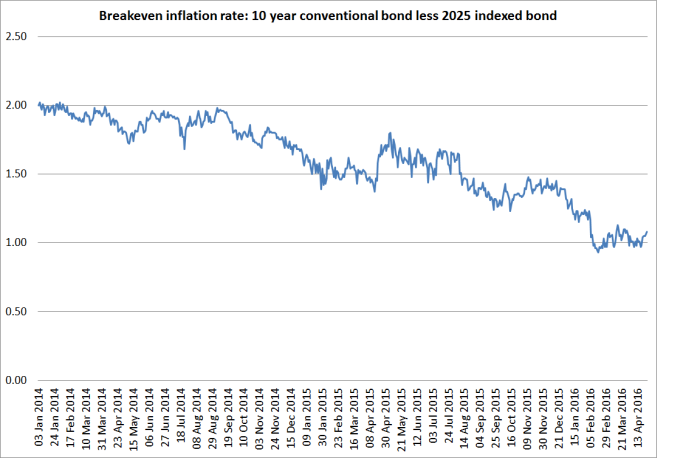
That certainly isn’t the message from financial markets.  Yes, I know that the implied inflation expectations from indexed bonds aren’t a perfect indicator –  then again, neither are the other measures of expectations or core inflation –  but the current level, just above 1 per cent, seems pretty close to the average of the various core inflation measures the Reserve Bank highlighted in the last MPS.  The central view just doesn’t seem to be that we can count on 2 per cent average inflation any time soon.  That should be a mark against the Reserve Bank.

iib breakevens

In closing, I should note a couple of small aspects of the Bank’s press release that I welcome.  I (and no doubt others) had lamented the Governor’s recent high profile focus on a single, complex, prone to end-point issues, measure of core inflation.  In this statement, that is replaced with a  simple “core inflation remains within the target range”.  Only just within, I would argue, but it is better than putting so much official weight on a single measure.

And in the final paragraph, I have noted for some time an unease at how much weight the Bank has been putting on recent and near-term headline inflation in these statements  –   in the near-term, headline inflation is thrown around by all sorts of things.  This time, they have gravitated towards something more (PTA consistent) medium-term in focus: “we expect inflation to strengthen as the effects of low oil prices drop out and as capacity pressures gradually build”.  One could reasonably question whether there is any sign that capacity pressures really are building, or are likely to over the next year or two –  after all, they have been relying on this “gradual build” for some years now – but at least it puts the emphasis in the right place: the factors that shape the medium-term outlook for inflation.


Financial capability: what New Zealanders could do with from their governments

I’ve written previously, and skeptically, about the financial capability strategy the government released last year. It is something of a wonder that civilisations have reached their current prosperity and sophistication without the aid of governments and their officials strategizing and pontificating about what we, citizens, “need” to know about money.  “Building the financial capability of New Zealanders is”, we are told, “a priority for the government”.  But what business is it of theirs?   And each time I read that line, I can’t help thinking that it would be better, and much more legitimate, if it were reversed: building financial capability of governments (and its agencies and officials) should be a priority for New Zealanders.

Last week, the bureaucrats were at it again.  The Financial Markets Authority published a so-called White Paper, with a Foreword written by the Chief Executive (so this is no mere background research paper, simply reporting the views of the authors), headed Using behavioural insights to improve financial capability.   The paper seems to be laying down markers for future regulatory initiatives.  It is probably better that the paper is out for scrutiny, rather than being held closely among the various government agencies.  But as I read it, the words of Jesus kept coming to mind

You hypocrite, first take the plank out of your own eye, and then you will see clearly to remove the speck from your brother’s eye.

The report is full of enthusiasm for understanding better the way in which consumers make decisions –  as if marketers and advertising agencies have not been doing that for decades.   It does so by drawing on a variety of insights from the behavioural financial literature, but in a fairly highly simplified (and one-sided) manner –  the entire report has 12 pages of text, with plenty of white space.   The behavioural financial literature does offer some fascinating perspectives on how people make decisions, but not often on why they have evolved to make those decisions that way.   And it does offer useful insights for marketers, and even for government officials trying to improve compliance rates (getting taxes, fines or fees paid on time).  Framing clearly matters.

But the leap from better understanding how consumers and citizens makes decisions to recommendations for policy interventions is not typically based on very much at all.  Assertions such as the claim by FMA CEO Rob Everett that “it is no one’s interest….for any investment decision to be made on the basis of bias or behavioural idiosyncrasy” seems to be based on nothing at all.  Or to be charitable, perhaps it is based on some benchmark of conforming human behaviour to some simple, particularly sterile but tractable, economic model, rather than recognizing that our biases and idiosyncracies (as he calls them) are often intrinsic to our humanity.  The authors seem to have a particular distaste for any involvement of emotion in decision-making.

It is a short paper, and so in a sense it is all too easy to pick holes.  But these bureaucrats appear to want to shape policy thinking, and they made the choice about what to put out for discussion.  So when they say “we overspend on credit cards and pay down debt less than we should”, we might reasonably ask not whether they can cite a single paper that shows that under certain experimental conditions this result might be able to be produced, but rather “where is the systematic evidence of a problem?”    Advances outstanding on credit cards at present are less than 3 per cent of GDP –  any credit card debt ever is too much for me personally, but across the economy  it is hard to find evidence of a problem spiraling out of control.

And, of course, much of the discussion of these issues has a subtext of unease about the choices people make for retirement provision. But again, where is the evidence of a problem justifying policy intervention?  The FMA paper asserts that “most people struggle to plan for future needs”,  But, as is widely recognized, New Zealand has one of the very lowest rates of poverty among elderly people of any advanced country, and older people seem to score their own life-satisfaction quite highly.  Is there any public policy interest at all in particular consumption outcomes for middle and upper income people in their later years?  Subject to the basics being met –  which they clearly have been in New Zealand –  I can’t see one.

Thus, when the paper cites interesting experiments which can lead to people saving more, it never stops to ask “by what measure, against what benchmark, is higher savings a desirable outcome for these population groups as a whole”.  There is simply no evidence of a “savings problem” in New Zealand, either at a micro level or a macro one.  Kiwisaver’s auto-enrolment (with opt-out) feature is described as “demonstrating the success of this approach”, but against what benchmark? To what end?

And when they report that research “shows people who have a plan are more likely to feel prepared for their retirement. The effect was consistent across all income levels”, are they telling us anything more than that some people like to have all the i’s dotted and t’s crossed, and they feel better if they have a “plan”.  It tells us nothing whatever about the ability of people to get through life.

In devising regulatory interventions, when they are well-warranted, it is important for regulators to understand how humans are likely to behave and respond.  And if those insights help get fines or taxes paid more promptly, then I’m right behind the use of them.  But when governments and their officials think they can do better than people, and market institutions, somehow correcting for the “flaw” in human nature, which have evolved over tens of thousands of years, we should be much much more skeptical.

Among the many reasons for such skepticism is the unspoken point that government officials and ministers, even those in the FMA, are human beings too, subject to all the same characteristics of human nature.  There is no class of detached super beings able to wisely choreograph the rest of us (directly or indirectly). And frankly it would be frightening, not reassuring, if there were,

But none of the weaknesses of regulators or governments appear in this White Paper at all.  There is a passing acknowledgement on the final page that “not every intervention is good” (really????) but no sense at all of the weaknesess, or biases to which regulators and officials and politicians are prone.    A good first question for every official or politician proposing new controls is something along the lines of “and what biases etc are you subject to, and how do the institutions protect citizens from (unwitting) bad outcomes from that actions of people like you –  including if the regime was run by your politicial opponents or the officials from the agency you have least time (and respect) for.”

As I noted earlier, a much stronger case could be made that citizens need a stronger financial capability among our governments and government agencies, and protections from all the “biases” or behavioural inclinations to which governments are prone.  Governments get countries into expensive wars.  Government choices are most often at the root of financial crises.  Governments mess up countries’ growth (and future consumption) prospects.  Governments badly distort housing markets.  Governments build expensive white elephants (whether sports stadiums, Think Big projects, or airport runway extensions).  Governments regulate on the whims of key individuals, with little or no regard for the consequences.  Governments put in place new programmes with little ability to assess longer-term consequences for individuals or society (eg welfare systems). Governments repeatedly eschew rigorous cost-benefit analysis.  And so on.   Not all governments, not everywhere –  and almost always with good intentions – but all too often.

This isn’t an anti-government tirade.  Societies need governments.  And they need governments to do well what only governments can effectively do (police, defence, administration of justice and so on). But the fact that we need governments does not mean that we safely can, or should, trust governments and their agents and agencies. Before they try to sort out human nature, we might more aptly aim to put in place much stronger checks and balances to restrain the flaws and biases to which governments seem intrinsically prone.

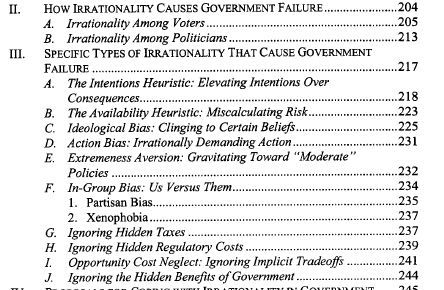
Last week, US economist Bryan Caplan on Econlog drew attention to a fascinating looking (quite long) new paper from Texas A&M University School of Law, “Behavioral Public Choice and the Law”.  I haven’t read it all yet, but I intend to.  The table of contents alone looks promising.

public choice

When we’ve seen the FMA –  and perhaps more importantly policy agencies like Treasury and MBIE –  seriously grapple with this sort of literature, I might be more interested in listening to their proposals for how they think government interventions might help improve citizens’ own decision-making.

This looked as though it should be a good topic for the New Zealand Initiative to pick up, following on from their new report on other paternalistic interventions (sugar taxes and the like). But then I noticed that the chairman of the FMA is also on the Board of the New Zealand Initiative.


Some perspectives on reform and the RB in the 1980s

A new book came in the post the other day.  It is a scholarly look at the long-term relative economic performance of New Zealand and Uruguay, something I wrote about quite recently and a subject I may come back to when I’ve read the book.

But there is an old line, especially applied to newspaper and magazine articles, that when the coverage of something you know about doesn’t ring true, be wary of the rest of the article.  And flicking through this new book my eye lit on a strange reference to the Reserve Bank.

In a paragraph on the reform period from the mid-1980s to the early 1990s (“which showed characteristics of a coup”), the author writes

Douglas as well as further members of the Cabinet, the Business Roundtable, and other strategically located institutions represented the exclusive inner circle of the new right. Until at least 1988, they used their large human capacities at the Treasury and the Reserve Bank to suppress alternative views and to limit the choices for MPs to a laissez-faire policy agenda.  Just as under Muldoon before, opponents were driven out to other departments and the private sector through informal pressure or became subject to petty harassment [ a footnote at this point adds “even university staff were affected, as controversial articles were less likely to be published in 1990 than in 1930”].

Very little of this rings true to me.

I’m not going to speak much of the Treasury, except to note that (a) Roger Kerr always spoke of how Muldoon respected the traditional boundaries of the public service, allowing Treasury (and people like Kerr) to develop their more market-oriented approach to analysis and advice (even if the Minister himself was not receptive to much of that advice), and (b) that I do know a few very able (and later successful) people who were either turned down from jobs with Treasury in the late 80s, or chose not to apply, because they were not-entirely-sympathetic to the reform process.  Plenty of people from the “right” in Treasury left for the private sector during those post-liberalization years –  opportunities abounded.

What of the Reserve Bank?  I was a manager in the Bank’s Economics Department (then, its main economics and policy wing) from 1987 to 1993.  At any one time, there were around six of us in the management group (led by Grant Spencer, and then Arthur Grimes), and above the department were the Governor and two or three Deputy/Assistant Governors.  There were a handful of other key people leading other departments (Financial Markets, International, Financial Institutions).  I suppose we should be flattered to be described as “large human capacities”, but to read the extract above one might suppose this was some phalanx of right-wing zealotry, demolishing all in our path.

There was a fair amount of turnover at the Bank during these years.  It wasn’t mostly people fleeing to the rich rewards of the financial markets –  mostly that was the next tier down –  but people coming and going from positions with international agencies such as the IMF and World Bank and advisory positions in developing country central banks.  I jotted down a list of 24 people who held the various key economic roles in the Reserve Bank over those years, and went looking for the right wing zealots.  No doubt some would class Roderick Deane in that category, but he had left the Reserve Bank in 1986.  What was left was a very short list.  I recall one very able colleague who wrote a nice think piece on free banking, and another who (in the abstract) was keen on open borders.  We liked to believe we were keen on rigorous economic analysis –  others can judge how well we did.  Most probably believed in fewer controls rather than more, and lower inflation rather than the New Zealand track record of the 70s and 80s.  Probably all wanted to be part of turning around New Zealand’s disappointing economic performance.  But a haven of ideological zealots it was not –  and what research we were publishing was mostly quite technocratic (at the time, most of the Bank’s research resource was devoted to building a new macro model, which proved largely useless amid the transitions and data discontinuities) and not much oriented to the overall policy framework at all.   Assistant Governor, Peter Nicholl, was said –  I never knew if it was true –  to have been involved in the Labour Party in his younger days before Labour became market-oriented, and at least two of us canvassed for National in the 1984 election (I blame my colleague..).  Largely, we were not-very-ideological technocrats.  I wasn’t much involved with recruitment at that time, but I don’t recall any suggestion of ideological tests

Even when it came to the new goal of price stability, launched on  the public somewhat surprisingly one April Fool’s Day, and us a day earlier, by Roger Douglas, the Bank was hardly champing at the bit to get going and eliminate inflation.   Grant Spencer – then chief economist –  and Peter Nicholl, his boss –  were both pretty wary, very uneasy about the (unemployment) costs of getting there.  For some, enthusiasm waxed and waned as economic fortunes changed.

In fact, that was somewhat so for the institution as a whole.  Don Brash is other name associated with an ideological perspective.  Don only joined the Bank in late 1988, but was hardly pursuing very low inflation aggressively –  at least from the perspective of the in-house hawks (it did, after all, take more than seven years to get inflation down). Don was also the one who signed up to Mike Moore’s Growth Agreement with the trade union movement during the 1990 election campaign.  Don recommended extending the target date from 1992 to 1993, explicitly to help allow room for a fall in the real exchange rate, to assist with rebalancing the economy.  And during 1991 Don and his, by then deputy, Peter Nicholl shocked some of younger enthusiasts by easing policy on the argument that “preserving the framework [RB Act] was more important [in the near term] than price stability”.  (Some of this material I dealt with here.)

I’m not suggesting that we were without fault, but equally –  and contrary to the impression given in the quote above –  we were operating in a climate in which everything was contested, and no one was confident that the reforms would endure.  It is fine to say that both main parties supported the reforms, but the big divisions were within the two parties not  between the leadership of the two (Labour had large left-wing factions which had Jim Anderton as their most prominent figure, and National had Sir Robert Muldoon, Winston Peters –  and Bill Birch, then still mostly thought of as the former minister of Think Big).  It is no secret, for example, that National’s support for the Reserve Bank Act was the result of an extremely close caucus vote, which Muldoon missed on account of illness.  Even when National won the 1990 election, we in the Reserve Bank were not remotely confident that the Richardson wing would be in the ascendant (or for long).  For the first year of that government, we (and Treasury) were constantly uneasy that political fortunes would change quickly, and many of the reforms could go as quickly.

I was also a bit surprised by the comment about the universities. I know various academics felt quite embattled, and ignored (and there was some grievance about cuts of government funding for the NZIER eg), but from our perspective in the Reserve Bank we also felt embattled, and were the subject of frequent academic attacks  (those were the days, unlike now, when university economics academics were very engaged with policy issues).  There had been the several rounds of exchanges between Victoria academics and the Bank and Treasury in 1985, on the analysis in the respective post-election briefings.  And when the Reserve Bank legislation was going through Parliament in 1989, the New Zealand academic economics community was pretty united in opposition (there may have been the odd supporter, but they kept very quiet).  This was the occasion of one of the more embarrassing lines I wrote in my decades in the public sector: we published an official response I had written to one prominent submission that had noted the absence of local academic support for the legislation: that said, we asserted, more about the quality of New Zealand academic economics than about the merits of the proposal.  We felt pretty embattled –  even if it didn’t always look that way to outsiders.

There was a lot about the reform period that isn’t particularly attractive, and of course –  although I continue to think that most of what was substantively done was in the right direction –  it doesn’t help that our relative economic decline continues, albeit at a slower pace.  New Zealand political institutions in those days  (single chamber, FPP) allowed small groups of politicians to do a lot quickly with few formal checks and balances. Publishing manifestos the week after an election, or simply abandoning high profile campaign promises really shouldn’t be the done thing.

But this simply wasn’t a period of a monolithic reforming class dominating everything.  Battles within parties were often vociferous, and opponents often had to be bought off with one concession or other.   And Roger Douglas was ousted after only four years, and Ruth Richardson was to last only three years as Minister of Finance.  As it happens, most things that were done haven’t been reversed, but that was never inevitable.  Things were contested and challenged –  perhaps not as well as they could have been (the quality of public debate has long seemed to lack something, on all sides) –  and probably nobody emerged unscathed, or totally satisfied.

Perhaps one small marker of the times was a snippet I stumbled on in a scholarly biography of Ken Douglas, picked up at a charity sale over the weekend.   Douglas was then the head of the trade union movement, and was not exactly from modernizing centre-left: he was prominent in the Moscow-aligned Socialist Unity Party (openly defending, only a few years previously, the Soviet invasion of Afghanistan and the suppression of the Polish Solidarity movement). The book records that in 1988/89 there was a political furore over the possibility of Douglas being appointed to the Board of the Reserve Bank.  It didn’t proceed – the government at the time would not confirm or deny the possible appointment, suggesting there was something to it (and Douglas has subsequently confirmed that he was approached.)  Would it have been an inappropriate appointment? Not necessarily, but that the idea was even raised goes against any sense of Roger Douglas, and his Treasury and Reserve Bank “large human capacities” simply ramming through anything they liked.

I really hope the rest of the Uruguay/New Zealand book is better. If so, I’ll let you know.


Questions about the OCR leak, the inquiry etc

Questions about the handling of the OCR leak issue aren’t going away.  Last Saturday, I posted some thoughts on some issues that the Reserve Bank and MediaWorks should be asked about, flowing from a careful rereading of the relevant documents.

Since then there has been a variety of articles –  especially focused on MediaWorks – in the mainstream media.   Jenny Ruth had a piece on the NBR website “Were there other MediaWorks leaks from Reserve Bank lockups”.  Hamish Rutherford has a substantial and useful piece in the Dominion-Post this morning “MediaWorks Owes an Explanation” (although I have considerably more readers than he reports) and John Drinnan’s media column in the Herald today is largely devoted to media aspects of the leak and its aftermath.

It is perhaps understandable that the mainstream media has focused mainly on the media dimensions –  many of them are grumpy at losing the opportunities previously afforded by the lockups (although others quietly acknowledge that the lockups were really products of a different technological age and probably had to go).  I don’t have much sympathy on that count, having called a month ago for the lockups to be scrapped.  But I do share the surprise that there has been no evident specific  sanctions meted out to MediaWorks, the chief culprits in the whole affair.  Various people have suggested that MediaWorks should have been banned from lock-ups, rather than ending the practice altogether.  Ending lock-ups was the right thing to do, but it is still surprising that there appear to be no other concrete consequences for MediaWorks’ flagrant breach of the rules (not reported to the Bank for weeks).   Then again, what other sanctions were available?  One might have been to deprive MediaWorks of, say, opportunities for any interviews with the Governor. But since he doesn’t give interviews, I guess that option wasn’t available.

There are questions for MediaWorks, but in the end they are a private company and have to make their own judgements about what to tell us.  It is disappointing that they have not been more open.  I’m not so much bothered about them not naming the person who sent the email from the lock-up, but about things like:

  • had these sorts of leaks happened before by MediaWorks staff?
  • why did it take more than three weeks for MediaWorks to acknowledge that its employees were responsible (including more than two weeks after the issue had extensive media coverage).

But, as I say, MediaWorks is a private organization.  The Reserve Bank, by contrast, is a powerful public body.  We should expect an open and transparent approach by public institutions when bad stuff happens, and the Bank is subject not just to the Official Information Act, but also to parliamentary scrutiny.  I think there is a range of questions to which the public deserves answers from the Bank:

  • Did the Bank, or Deloitte, ask MediaWorks whether these sorts of breaches had occurred before.  If not, why not.  If so, what was the response?
  • Why does the inquiry report not address issues around “the process for transmitting the Governor’s OCR decision to see if any improvements are needed”, even though the Bank had told me the Deloitte inquiry would cover such matters?
  • Was MediaWorks given a chance to comment on the draft inquiry report, or the draft of the Reserve Bank news release of 14 April?
  • Why does the Reserve Bank press release go out of its way to stress the cooperation of MediaWorks, when MediaWorks did not report the breach until more than three weeks after it occurred?
  • Why does the news release not accept any responsibility for the Bank having run lock-ups with such lax security procedures that a breach of this sort could happen so easily?
  • Have any Reserve Bank officials been disciplined or reprimanded for failing to update security procedures to reflect the advances of technology?

In support of seeking answers to these, and other, questions, I have lodged an Official Information Act request with the Reserve Bank.  It requests the following information:

Terms of reference

  • Copies of the terms of reference for the Deloitte inquiry, including the TOR as at 15 March 2015 (the date of Nick McBride’s approach to me), and any subsequent variants, (formal or informal).
  • Copies of any advice to or from the Board regarding the terms of reference

MediaWorks’ 5 April advice

  • Copies of the initial MediaWorks advice to the Reserve Bank and Deloitte on 5 April (date as per the inquiry report).  In the event that the advice was oral, please provide copies of any filenotes or other records of conversations with MediaWorks.
  • Copies of any follow-up requests for further information made to MediaWorks or its representatives by the Reserve Bank or the Deloitte inquiry team.

The Deloitte inquiry report

  • Names of any person or organisation, beyond the Reserve Bank’s staff or Deloitte, invited to comment on the draft report.
  • Copies of any advice provided to the Reserve Bank by non-executive members of the Reserve Bank Board on the draft report.

The Reserve Bank’s 14 April news release

  • Copies of all drafts of the 14 April news release
  • Names of any persons or organisation beyond the Reserve Bank’s staff or Deloitte, invited to comment on the draft news release.
  • The time at which MediaWorks was given a copy of (a) the draft, and (b) the final news release.
  • Copies of any comments made to the Bank by (a) MediaWorks and/or (b) non-executive Board members on the draft news release.

Internal Reserve Bank committees

  • Copies of the relevant sections of the minutes of any meetings of (a) the Governing Committee, and (b) the Senior Management Group at which the (possible/actual) OCR leak, and/or the Reserve Bank’s response to it, were discussed.

I remain more than a little aggrieved, having brought the issue to light in the first place, at having my conduct described by the Governor as “irresponsible”, but I have addressed those issues in a separate letter to Governor.


Ambivalence about expectations of the Board

(For those interested in the ongoing lock-up issues, my thanks to an offshore reader for drawing my attention to newly-released Audit Report by the Federal Reserve’s Office of Inspector General on the Fed’s lock-up procedures and processes.  The Fed procedures appear to have left open significant risks of leaks and breaches of embargoes –  and there was one actual breach last year.  In effect, again the system relied largely on trust.  The report contains a variety of recommendations to tighten security. A Reuters article on the OIG is here.)

Since reading yesterday morning (eg here ) about the OIA release by the Minister of Finance of a near-final draft of a new (November 2015) “letter of expectation” to Rod Carr, chair of the Reserve Bank’s Board, I’ve been trying to work out what to make of it. (The letter itself is near the back of the document released here.)   On the whole, I think it is probably a step forward, at least in the specific current circumstances.  But it has some dangers too, and risks undermining some of the good features of the statutory governance model for the Reserve Bank.

I’ve written previously about the Minister of Finance’s letter of expectation to the Governor , and in due course will be interested in this year’s letter.  Last year’s was surprisingly light on (ie there was no reference at all to) any concerns about the persistent deviation of inflation from the target.  The Minister and the Governor have a clear and direct legal relationship across a variety of strands: the Minister appoints (and can dismiss) the Governor, the Minister and the Governor sign a PTA that governs  the Bank’s conduct of monetary policy, and the Minister has a wide range of powers in a variety of matters (mostly regulatory, but including also fx intervention) dealt with in the various pieces of legislation the Reserve Bank is responsible for.

The relationship between the Minister and Board members is designed to be much weaker than that.   Board members are appointed by the Minister, and can be dismissed by the Minister (for cause),  but (unusually) the Minister does not even get to decide which of the Board members will be the Chair.  That is decided by Board members themselves.    The Board has quite a limited ongoing legal relationship with the Minister of Finance.  They are responsible for making a recommendation to the Minister as to who to appoint as Governor, and they are required to provide advice to the Minister on the Bank’s annual dividend.   But that is about it.  The Board must prepare a (published) Annual Report, which must be physically delivered to the Minister, but is not specifically described in the Act as a report to the Minister.

It is when things go seriously wrong that the Board is supposed to start talking to the Minister.   Section 53(3) of the Act provides that

If the Board is satisfied—

(a) that the Bank is not adequately carrying out its functions; or
(b) that the Governor has not adequately discharged the responsibilities of that office; or
(c) that the performance of the Governor in ensuring that the Bank achieves the policy targets fixed under section 9 or section 12(7)(b) has been inadequate; or
(d) that a policy statement made pursuant to section 15 is inconsistent in a material respect with the Bank’s primary function or any policy target fixed under section 9 or section 12(7)(b); or
(e) that the resources of the Bank have not been properly or effectively managed; or
(f) that the Governor, except as provided in his or her conditions of employment has, while holding office as Governor,—
  • (i) held any other office of profit; or
  • (ii) engaged in any other occupation for reward; or
  • (iv) had an interest in a bank carrying on business outside New Zealand; or
(g) that the Governor is unable to carry out the responsibilities of office, or has been guilty of serious neglect of duty, or has been guilty of misconduct,—

the Board shall advise the Minister in writing and may recommend to the Minister that the Governor be removed from office.

That is (rightly) quite a high threshold to cross before the Board must make such reports to the Minister.  The Act never envisaged a close or regular reporting relationship between the Board and the Minister.

I have sometimes written of the Board as being essentially the Minister’s monitoring agent (and I see the new letter uses the same language).  But if it was a pardonable shorthand, on further reflection I don’t think it is a fully accurate description either.  What the Act seems to envisage is a model in which the Board is charged with reporting publicly on how well, or otherwise, the Governor has been doing his job, but is supposed to stay at quite an arms-length from the Minister: paid to keep an eye on the Governor certainly, but expected to stay quite clear of the Minister unless things are so bad that the possibility of dismissal is coming into focus.

And I think that is the way it should be, at least if we want to maintain an operationally autonomous central bank.   Why?  Because the whole logic of making the central bank operationally independent, especially on monetary policy, is based on the (not totally uncontentious) view that we will typically get worse outcomes if elected politicians are too close to the decision-making process.  Instead, we set up an open and transparent medium-term PTA, in which the Minister takes the lead in setting the target, and the Governor is responsible for implementing policy consistent with that agreement .  PTAs are deliberately written for terms of five years, and the Governor is left to get on with the job (with all the reporting requirements, public and market scrutiny etc).

And so I am a little uneasy about this new letter of expectation, even if it supposedly flowed from a conversation initiated by the Board (I take that with a pinch of salt, as the Board may well have been responding to the Minister’s public expression of unease with the Bank last year).

The letter seems to have three broad areas of substance.  The first is a list of Minister’s specific interests for the Board in its monitoring role.

  • Monitoring the performance of monetary policy with respect to the Policy Targets Agreement (PTA).  I expect the Board to provide me with a clear sense of its judgements and the basis for them in assessing performance in meeting the PTA, recognising that the policy targets have evolved to be flexible and forward looking.

  • Assessing the performance of the Bank in promoting the maintenance of a sound and efficient financial system.  I expect the Board to articulate how it judges performance with respect to this statutory objective. I am particularly interested in how the objectives of soundness and efficiency are promoted and balanced.

  • Monitoring the Bank’s regulatory policy processes. The Bank has important regulatory responsibilities.  I expect the Board to take a close interest in the robustness of regulatory policy development and to articulate how it judges performance with respect to this function.   In particular, the Board should:

    • – Keep under review how the Bank’s regulatory policy is developed in light of the Government’s response to the Productivity Commission’s report on regulatory institutions and practices, and how these changes improve regulatory practice.
    • – Test the Bank’s thinking on regulatory policy developments and be satisfied that the Bank has reasonably addressed any alternative perspectives from other relevant parties (eg, the Government, the Treasury, the Council of Financial Regulators, Australian stakeholders, the financial sector and the wider public through consultation).
  • Monitoring the Bank’s relationships.  The Bank has a number of important stakeholder relationships – with me, with the Treasury, with regulated entities and with other agencies.  I would expect the Board to keep under review how these relationships are operating in practice.

  • Monitoring of operational functions.  The Bank has a range of operational functions, including those related to payment systems and currency.  I expect the Board to monitor the Bank’s operational performance and risk, particularly with regard to the use of the Crown’s resources and wider economic efficiency.  •

  • Organisational strategy and financial management.  The Bank is a complex organisation with a large balance sheet. I expect the Board to take a strong interest in the Bank’s strategy and financial management.  The Board should closely monitor the Bank’s performance against the Statement of Intent (SOI)

It is an interesting list, and in some cases quite pointed.  For example, the explicit recognition of the possible tensions between regulatory measures to promote system soundness, and the statutory provisions around the efficiency of the financial system.  Or “the Board should test the Bank’s thinking on regulatory policy developments and be satisfied that the Bank has reasonably addressed any alternative perspectives…. [including from] the wider public through consultation”.  That would certainly be welcome.

The letter of expectation also deals with the Annual Report

The annual Board report, as required under the Act, is the formal document that sets out the Board’s assessment of performance.  I expect this to provide enough detail to enable me and the wider public to understand how the Board has undertaken its review role.

I have written previously about the severe shortcomings in past Board annual reports.  Last year’s said almost nothing of any substance, and tended to reflect the prevailing practice in which the Board has seen itself as “having the Governor’s back”, and being part of the Bank’s efforts to spread its messages.

If this provision in the letter of expectation is a shot across the bows, suggesting that better and fuller Annual Reports should be produced, it is most welcome.  The Minister outlined a variety of specific areas he is interested in (above), and we should hope that there would be substantive material on each in the next Annual Report –  not just about the processes the Board used, but about its substantive assessments and residual uncertainties. I remain somewhat skeptical, but time will tell.

Towards the end of the letter, the Minister includes these paragraphs

The duties of the Board include keeping under review the performance of the Governor.  I would expect to discuss your assessment of the Governor’s performance from time to time.  I would not expect you to limit your communications on the performance of the Governor or the Bank to the narrow criteria set out in section 53(3), as I hope those circumstances would apply rarely if ever.

Greater visibility of the Board’s activities throughout the year would also be welcome and I would be interested in any suggestions you have to facilitate that.  In addition, I will ask my office to establish six-monthly meetings with me.  In advance of those meetings, I invite you to share any other documents regarding the Bank’s performance which would support the discussion.

Here I am just not sure.  It is no secret that I don’t think the current Governor has done a particularly good job, so in one sense the more questions asked about his performance the better.  But the institutions are not designed around any particular individual, and probably nor should the practical implementation arrangements be.  Non-transparent regular discussions between the Board and the Minister about the Governor’s performance create risks of inappropriate pressures being placed on the Governor (not just on monetary policy, perhaps more especially in regulatory matters).  Since the Minister has deliberately been given the power to dismiss the Governor only in fairly extreme circumstances, it isn’t clear what is gained by the Minister and the Board holding such conversations, unless those potential-dismissal thresholds are coming into view (and, as the Minister notes, he hopes that is “rarely if ever”).  Indeed, is there even a legitimate ministerial interest, given the choices Parliament has made about the structure of the Bank and the role of the Governor?  I think there are material flaws in the allocation of responsibilities under the Reserve Bank Act.  One of those is that the Governor has too much control of financial regulatory policy (as distinct from the application of that policy).  The Minister might share some of those concerns, but the right way to deal with the issue is to amend the Act, not use the Board as back-channel leverage.

When I first read that final paragraph in the letter, I wondered if “greater visibility” meant public visibility.  If it did, that would be quite inappropriate –  a good published Annual Report is the appropriate model and at other times the Board should have a low profile, not detracting from that of the Governor.  In fact, I think the Minister is only talking about the Board being ‘visible’ to him.  But, as discussed above, I remain uneasy about the idea of regular formal meetings with the Minister –  as distinct perhaps from the odd informal discussion over lunch –  especially if it involves additional “documents” being provided to the Minister.  It runs the risk of the Minister and Board second-guessing individual decisions by the Governor, and that simply isn’t the statutory model.

But there is another risk.  I’ve noted previously that the Reserve Bank Board has tended to act as if its role is to provide cover for the Governor.  In principle, they should be able to have free and frank exchanges with the Governor in private –  including on the issues the Minister touched on in his letter.  But if the Board is getting into a regular/routine reporting relationship with the Minister, I fear that the “have the Governor’s back” tendency will just be reinforced.  The Minister might appoint Board members, but they meet at the Bank, the Governor is a Board member, the Board has no resources of its own (only what the Bank provides), and a senior Bank manager is Secretary of the Board.  So far, they have only chosen former staff (Arthur Grimes and now Rod Carr) as chair.  They have become quasi-insiders.   None of this is intended as criticism of any of the individuals concerned; the incentives simply work together to make it a model that is never likely to generate regular hard-nosed rigorous scrutiny of the Governor’s performance.  It is a model that few, if any, other countries have adopted.

And so I’m left ambivalent about the letter of expectation to the Board.  On the one hand, it seems likely that this initiative has flowed, at least in part, from the tensions around the current Governor’s performance –  and so in that short-term sense, I’m pleased to see more questions being asked, and challenges posed.  And anything that produces better quality Board Annual Reports would be welcome.

But the model of governance Parliament established for the Reserve Bank 27 years ago does not envisage routine close ties between the Board and the Minister.   Indeed, I’m aware of no advanced country with an operationally independent central bank where there are such close ties.  If we want a central bank with operational independence, the Minister of Finance should be at a considerable arms-length.  In one sense, the Board is the Minister’s monitoring agent, but only with qualifications –  the role the Act envisages for the Board, as it related to the Minister, is for quite extreme circumstances.  The Board are not, say, the Minister’s employees who just happen to be representing him on some committee or other.

Of course, my overarching view is that the Bank’s governance model is flawed, and if there as ever a sound argument for it, it is no longer well-suited to range of functions the Bank undertakes, and is out of step both with international practice and with how New Zealand governs other public sector agencies. The model should be changed, and it remains something of a mystery why the Minister is so resistant to change.  My alternative, which uses the able people on the Board more actively in a decisionmaking role, was outlined here.


A bouquet for Statistics New Zealand

(and some questions as well).

I got home at lunchtime after a couple of hours out with the kids to find a very pleasant surprise.

Following the kerfuffle last week about the Reserve Bank’s leak inquiry, and the discontinuation of the Bank’s lock-ups for media and analysts, someone reminded me that not just Treasury but also Statistics New Zealand holds regular lock-ups involving market-sensitive macroeconomic information.   Statistics New Zealand runs lock-ups

for media and market commentators for Gross Domestic Product, Balance of Payments and International Investment Position, Consumers Price Index, and Labour Market Statistics releases.

I wondered (a) what procedures Treasury and Statistics New Zealand used,  and (b) whether either organisation had changed their procedures in light of the Reserve Bank’s leak inquiry and subsequent decision to discontinue lock-ups.

So last weekend I logged OIA requests with each organization, and assumed I’d hear something in a few weeks time.

But Statistics New Zealand responded this morning (in due course, their full response will be here).  Often enough, blanket refusals take 20 working days or more, but here was a department offering a prompt, clear and helpful reply, and offering to answer any follow-up questions.

Here are the SNZ procedures

Prior to the commencement of a media conference, Statistics NZ requires attendees to sign in and surrender their cell phones. In addition, Statistics NZ displays the following media conference rules for attendees to abide by:

  • the media conference is held as a ‘lock-up’
  • once you have entered the room, you must not leave until 10:45am when the embargo is lifted
  • please sign in, turn off your mobile phones, including smartphones, and put them in the compartment at the conference room entrance
  • laptop external wireless communication devices must be placed beside the laptop on the media room table for the duration of the media conference, and cannot be connected to the computer until the embargo is lifted
  • laptops or other devices that have internal wireless network capability must not connect or transmit until the embargo has been lifted
  • we reserve the right to inspect devices to ensure that internal wireless capability is turned off.

Statistics NZ staff are happy to assist you with any questions about these guidelines.

 Note: Before the media conference starts, attendees are permitted to call their office, from Statistics NZ provided phones, to set up redial capability for use at 10:45am.

And here is the response as to whether they have made any changes or reviewed their procedures

Statistics NZ has not undertaken any reviews or made any changes to the department’s policy for media conferences following the Official Cash Rate leak at the Reserve Bank of New Zealand and the subsequent Deloitte report into that leak released last week.

Unfortunately, Statistics New Zealand seems still to be relying, in effect, on trust  (in much the same way the Reserve Bank was doing).   But the headline statistics that they hold lock-ups for are highly market-sensitive, and will not infrequently move markets more than an OCR announcement will (as one would expect; it is the same data the Reserve Bank uses).  There is no sign of, say, any jamming technology (or other technical means) being used, to buttress the role of trust.

Statistics New Zealand notes that

While Statistics NZ has never had a breach, if that trust is abused and an embargo is broken, offenders and their organisation would be barred from attending future media conferences.

Unfortunately, that was probably the sort of discipline/incentive the Reserve Bank was implicitly relying on as well.

As I’ve argued previously, the case for pre-release lock-ups for monetary policy announcements is weak (with the possible exception of a highly secure 10 minute lock-up for core financial journalists, with no additional briefings –  something like the model the US Federal Reserve apparently uses).  Is Statistics New Zealand that different?  There is, obviously, no policy message SNZ is trying to put across with its releases, and so no risks of different messages getting to different people.  But the security risks are the same.  Perhaps it is simply more efficient to have everyone in the same room, to clarify key technical points, but couldn’t the same end be achieved –  on a more competitively neutral basis (to analysts based abroad, say) –  by a dial-in (even webcast) conference call held a bit later on the day of the release?

Anyway, the point of this post was to praise Statistics New Zealand for its timely (“as soon as reasonably practicable”) response to an OIA request.    Quite what approach Statistics New Zealand should take in future is a matter for them, but I would encourage them to think again about the risks, and about alternative –  perhaps preferable –  models for helping to ensure that users can get whatever technical insight SNZ can offer into the numbers it releases.    Breaches may never have happened, but when one does happen –  and (by accident or intent) with current systems  it must be a matter of time – it can suddenly get extremely uncomfortable.

UPDATE: For those with a taste for obscure historical episodes, chapter 1 of this document –  linked to by a commenter – is well worth a read on the great data leak of 1905.