Reserve Bank attempts to play distraction

A slightly strange story –  but one that rings very true – leads the business section of this morning’s Dominion-Post.  In the story, Hamish Rutherford reports on an interview with the Reserve Bank’s long-serving chief economist John McDermott.   If the interview is at all accurately reported, McDermott appears to have got himself into one of his periodic grumps with the private market economists.

I worked closely with McDermott for six years –  he was my boss, and we sat directly opposite each other.  He is mostly a pretty amiable guy, and in an earlier phase of his career had published a lot of research (a few years ago he was still, apparently, one of the New Zealand economists most cited in formal economics literature).   But he doesn’t react that well to people disagreeing with him, especially openly (some of my other concerns were outlined in this earlier post on one of his 2017 speeches).   There is often a testiness about his reactions –  combined with a condescending tone of a “you just don’t understand” type.

And yet, of course, together with his colleagues he has been consistently wrong about the inflation outlook (and, thus, monetary policy) for at least the last five years.   (In fairness, of course, except during the Bank’s very grudging series of OCR cuts in 2015/16, the median market economist has generally been even more wrong.)

But what of the latest interview?

A top Reserve Bank official has dismissed criticism from bank economists about his forecasts as “nonsense” saying the bank is ready to cut interest rates if growth lags.

On Thursday both Westpac and ASB accused the Reserve Bank of being too optimistic in its forecasts for economic growth.

But Dr John McDermott, the Reserve Bank’s chief economist for the past decade said the bank economists appeared to misunderstand the process creating Reserve Bank’s forecasts.

“Nonsense” is strong language.   And both the Westpac and ASB chief economists previously worked in the forecasting part of the Reserve Bank, albeit a few years ago now.

Here is Westpac

However, we still think the RBNZ is expecting too much of the New Zealand economy. In our view, the recent plunge in business confidence portends a slowdown in business investment that the RBNZ has not allowed for. Furthermore, we expect the Government’s upcoming changes to the tax treatment of investment housing, the foreign buyer ban, gradually rising fixed mortgage rates and lower net migration will slow the housing market later this year. A slow housing market would, in turn, lead to slower consumer spending than the RBNZ anticipates. Finally, we doubt that construction activity will accelerate in 2019 to the extent that the RBNZ expects, even with the KiwiBuild scheme in operation. Capacity constraints in the construction industry are just too binding.

Agree or not, they sound like plausible points on which reasonable economists might disagree, without resorting to name-calling.

But –  as he has often done in the past when his forecasts have been called into question – McDermott falls back on a claim of being misunderstood.

Rather than predicting what the economy will do, the bank worked out what kind of growth was needed to generate sufficient inflation. The variable in the equation is interest rates, which the bank can change.

In an interview in the Reserve Bank’s headquarters in Wellington, McDermott, repeatedly said if the economy was not growing fast enough to generate inflation, the bank will cut the official cash rate.

“It’s not about being optimistic or hopeful, it’s actually, if we don’t get that growth rate, we are going to lower interest rates because otherwise we won’t get the inflation rate.”

McDermott just shouldn’t be allowed to get away with this sort of special pleading  (even setting aside the fact that he and his bosses have actually delivered core inflation well below the target midpoint for years now).   He makes a partially fair point that one can’t just look at the Bank’s GDP forecasts in isolation.   But that is true of anyone’s forecasts.  While it is inflation targeting, the Reserve Bank will always show inflation coming back –  more or less slowly – towards the target midpoint.      And so, at very least, one has to read the interest rate and GDP forecasts together.

But in Westpac’s case they think GDP growth will be lower than the Bank is projecting, and that interest rates will be a (very) little lower than the Bank is projecting.  Against that backdrop it seems quite reasonable for them to say that the Bank is being too optimistic about how much GDP growth is likely over the next couple of years with interest rates around where they are now, or even a bit lower.

McDermott goes on

“Our inflation forecasts are always 2 per cent, it’s always 2 per cent.  [eventually]

“It is because we plan to succeed, and then you go, ‘well, how do you do this’. And so, the monetary policy statement’s objective isn’t an unadulterated forecast about what we think will happen, it’s what do we need the plan to look like to make it happen.”


The problem with McDermott’s story is that his forecasts today influence policy today.  Thus it is fine to talk  –  as McDermott often does –  about revising forecasts in light of developments.  But better still, how about getting them (more) right first time round?    The Bank believes that it will, with current interest rates, generate more demand and economic activity –  and thus more inflation –  than some of the private economists (eg Westpac and ASB) think likely.     The Bank is in that sense more “optimistic” than these private economists.  If the Bank is wrong, we will eventually find out, and (slowly, grudgingly) policy will be adjusted, but in the meantime we’ll have missed out on some growth (they expected) and inflation will have fallen short of the target (again).  If they are indeed too “optimistic” now, it matters.

McDermott goes on

McDermott said many bank economists did not appear to understand the process.

“They sit outside, they don’t get to influence policy. We get to move [interest rates]. Inflation has to be 2 per cent, and engineer backwards, what do you need growth to be, to engineer 2 per cent [inflation].”

So if growth starts lagging, you’re going to cut the OCR?

“Yes. That’s the game,” McDermott said. “So the fact that they think we’re being optimistic is a nonsense, because if it doesn’t eventuate, we get to alter interest rates.”

It is exceedingly unlikely that bank economists did not “understand the process”.  The process has been operating in basically the same way for more than 20 years now, it is extensively documented by the Bank in published material, and three of four main banks now have chief economists who started their careers in the Reserve Bank Economics Department.  What is going on here is that the Reserve Bank chief economist is on the defensive, and rather than defend the substance of his forecasts he attempts to muddy the waters with suggestions that the private economists just don’t understand.

Thus, we are told, McDermott

 would “remind” several chief economists of the process used

Which won’t change the fact that there is a difference of forecasts –  of views.

In a way, he even concedes the point.   The final sentence of the hard copy version of the article isn’t in quotation marks but here is what McDermott is reported as saying

McDermott said it would be a different situation if the banks were saying that the forecasts were too optimistic based on the OCR remaining at the current level.

So what was all the name-calling about?   As McDermott knows, neither Westpac nor ASB is forecasting an OCR cut, and the Reserve Bank isn’t forecasting an interest rate increase for some time.  The private economists and the Reserve Bank all have the OCR at 1.75 per cent throughout this year and well into next year, and thus their GDP forecasts for the next year or two are apples-for-apples comparisons.   It is quite reasonable to say that Westpac and ASB think that Reserve Bank is too “optimistic” (and they don’t need to state all their ancillary –  but rather obvious –  assumptions every time they make the point).

The article also contains this observation and comment

While economists have slowly come around to the Reserve Bank’s view that the OCR will stay at its current low for at least a year, none give a significant chance that the Reserve Bank will cut.

McDermott suggested they were wrong to do so.

“The market thinks ‘you guys are never gonna [cut]. They’ve been through almost a whole year of ‘there’ll be no chance you guys are going to cut interest rates’. Well, that’s not true.”

But again, this looks like a deliberate attempt to skew interpretations.   The Bank – rightly in my view –  has talked of the possibility of cutting the OCR, but in all its comments last week –  including from the “acting Governor” –  it came across as very reluctant.  And its published OCR forecasts don’t have a flat track as far as eye can see –  in fact the track starts edging upwards from the middle of next year.  And what of the market economists?   A couple of the more prominent ones are included in the NZIER Shadow Board exercise.  Here were their latest probability distributions for where they think the OCR should be.
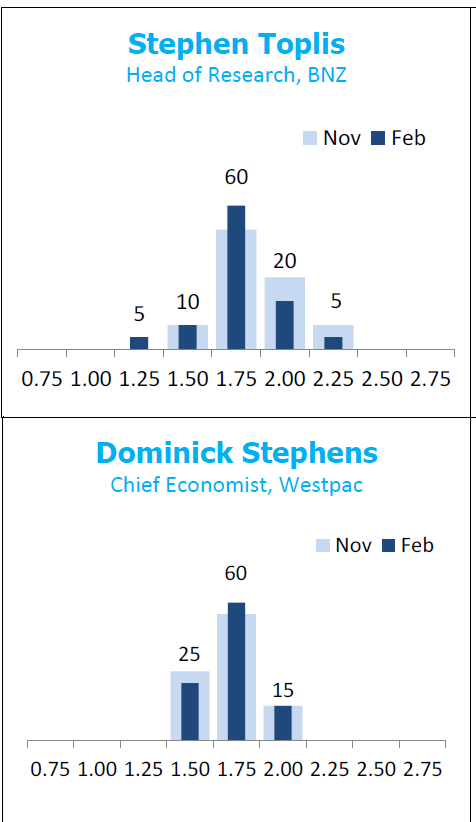
shadow board feb 18

The chief economist of Westpac a few days ago thought there was 25 per cent chance that the OCR should have been lowered.   Indeed, in their post OCR commentary, Westpac explicitly said

If anything, we would put the odds of an OCR reduction this year as slightly higher than the odds of a hike

(Perhaps if the Reserve Bank really wants people to stop focusing on possible OCR increases they should, at last, drop the endless rhetoric about a “normalisation” of interest rates?)

I’m also a bit sceptical of the Reserve Bank’s growth projections.  As I’ve been pointing out for some time, in each set of quarterly forecasts they project a return to productivity growth.  In the latest numbers, after four years of basically zero growth in their “trend labour productivity” measure, they forecast a steady pick-up in productivity growth such that by 2020/21 they expect 1.2 per cent annual productivity growth.  In a single year, they expect as much productivity growth as the total productivity growth they show for the six years to March 2019.   Without any material productivity-enhancing micro reforms, and without any substantial reduction in the exchange rate, if that isn’t “optimistic” I’m not sure what is.   I really hope they are right, but it looks too optimistic at present.

No doubt the private bank economists will just grumble quietly, and their view of McDermott will be adjusted another notch downwards.    After all, they’ve seen what happens to those of their number who too openly criticise the Reserve Bank –  recall that McDermott was one of those deployed by Graeme Wheeler last year in his heavyhanded attempts to silence BNZ chief economist Stephen Toplis.

But we –  the New Zealand public – deserve better.    We need a reformed Reserve Bank, a properly independent statutory monetary policy committee, not simply staffed with bureaucrats, and we need quality senior staff of the Reserve Bank who are capable of engaging openly, and authoritatively, on the sort of issues and uncertainties we face in making sense of the economy, without resort to name-calling or rather desperate attempts to suggest that people who disagree with the Bank just don’t understand, and that they need to be called in and “reminded” of the process.



Parliament should fund the Reserve Bank annually

Readers may well be getting a little tired of the run of posts this year on issues relating to the review of the Reserve Bank Act.  In truth, so am I.    However, The Treasury is inviting comments, with a deadline of later this month.

There are two stages to the review.  The first, led by Treasury, is around implementing reforms Labour campaigned on (a statutory monetary policy committee, and adding some sort of employment goal).  The second –  as yet ill-defined – is to be led jointly by the Reserve Bank and Treasury and is to look at any other issues that the Minister agrees warrant review.  For now, The Treasury is inviting views on what issues should be looked at in Stage 2.

My broad response to them on that question has been “anything and everything”.  The Reserve Bank Act –  and the other Acts the Bank operates under –  has grown like topsy over 30 years.  Roles and functions have changed.  Expectations around transparency have changed. And models that might have seemed sensible in 1989 – eg the role of the Board –  no longer do so today.   Probably the Act should be rewritten from scratch, but even if that doesn’t happen, no part of the current Act should be outside the scope of the review.   My post the other day proposed structural separation –  spinning out of the Bank a new Prudential Regulatory Agency.

Today I want to focus on funding the Reserve Bank’s operations, an aspect of the Act that could be easily overlooked as part of the review, but where current legislation falls far short of best practice.

Historically, there were typically no checks on the spending of a central bank.  Central banks “printed money” –  physically or electronically – and didn’t need to rely on tax revenue appropriated by Parliament.   They typically earned a lot of income by issuing (zero interest) bank notes, and investing the proceeds (often in government bonds).  I regaled my kids recently with the tale of the night –  the RBNZ 50th anniversary –  when the Bank took over the Michael Fowler Centre and hosted a banquet and dance (free) for staff and spouses, includng a McPhail and Gadsby floor show.  The kids asked who paid for it, and struggled to get their minds around the notion that “we just printed the money”, but that was the way things were.  These days –  rightly –  the Taxpayers’ Union would be all over such extravagance –  or the chauffeur for the Governor (and, if I recall rightly, even the Deputy Governor).  There was an Annual Report, of course, but little detail and no effective spending control or accountability.  It wasn’t that the Bank was always extravagant –  it wasn’t – but there were few or no external constraints.

The reformers of the late 1980s recognised the need for things to change.   But expenditure control took a distinctly secondary place to promoting and preserving the operational independence of the Bank in the conduct of monetary policy (recall that at the time the Bank was conceived of largely as a monetary policy agency).    There was much less concern about controlling spending than about closing off backdoor ways for a Minister of Finance to exert pressure on the Bank’s monetary policy.  The ability to threaten an annual parliamentary appropriation –  “go easy on monetary policy or I’ll cut your funding”  –  was seen as an important risk

And thus we ended up with the Funding Agreement model.  Under this model, the Governor and the Minister of Finance may reach a five-yearly agreement, which has to be ratified by Parliament,  on how much of the Bank’s income can be used for operating expenses in each of the subsequent five years.   I wrote about the model when the current funding agreement was ratified in 2015.

There had even been talk –  probably not welcomed at The Treasury –  of using the Permanent Legislative Authority route (a model used for judges’ salaries and Crown debt servicing), a model under which no parliamentary authority would ever have been required for the Bank’s spending.  Even at the time, that seemed a little self-important.

The Funding Agreement model certainly means that for most of any five year period, the Reserve Bank does not need to worry about ministerial pressure exerted via its budget.  And, as it happens, there has always been a Funding Agreement in place, and those funding agreements did help to lower substantially the level of spending at the Bank.  In that sense, they were a step forward relative to what had gone before.   But they are very far from best practice.

Treasury has a nice document on its website outlining the principle and process of parliamentary authorisation of public spending.  It begins this way

A long-standing principle under the Westminster style of government is that no expenditure of public money can take place without the prior approval of Parliament. In New Zealand, both the Constitution Act 1986 and the Public Finance Act 1989 continue this historical requirement.

Appropriation ensures that Parliament, on behalf of the taxpayer, has adequate scrutiny of how public resources are to be used and that the Government is held accountable for how it has used the public resources entrusted. The Estimates specify for each appropriation:
• a maximum amount of resources that can be consumed
• the purpose for which the appropriation can be used.

As they go on to note, most appropriations are for only a year at a time.

The Reserve Bank model falls short in a whole variety of ways:

  • there is no legislative requirement for there to be a funding agreement at all, and no (formal) consequences if the Governor and Minister do not (or cannot) agree on one,
  • there is no breakdown of the agreed level of spending between the Bank’s (quite different) stautory functions, and thus no restriction on the ability of the Bank to spend the money  in one area rather than another as it chooses,
  • there are no penalties or formal adverse consequences if the Bank spends beyond the limits set out in the funding agreement,
  • while the Minister and the Governor can agree to a variation in the level of the funding agreement during its term there is no ability for the Minister (say, a new government) to override the agreement, even temporarily (as, say, there is in respect of monetary policy itself),
  • in (almost?) all areas of public spending, the Minister asks Parliament for approval, and Parliament approves (or rejects) the proposed level of spending.  Officials make bids and try to persuade ministers of a need for more money for their department or agency, but they have no ability to block or formally constrain choices of the Minister and Parliament.  But the Reserve Bank Governor –  himself, in effect, appointed by unelected people (the Board) –  has that degree of control (no agreement needed, any agreement needs the Governor’s assent, and no consequences from failure to agree).

And it isn’t even that workable a model.  No corporate sets operating expenditure budgets five years in advance –  circumstances change, the price level changes, and so on.

And this is not some trivial government entity doing some unimportant function.  It isn’t primarily a trading entity spending money to make money.  The Reserve Bank is the key entity responsible for short to medium-term macroeconomic management, and has a huge range of discretionary power in areas of financial sector regulation.   And it has several billion dollars of Crown capital. The financial expenditure provisions are a glaring anomaly, out of step with one of the fundamental principle of our system of government.

The system hasn’t been grossly abused: mostly the Reserve Bank seems to spend fairly responsibly, and the Minister is advised by Treasury at the point of renegotiation.   But, equally, it is not as if the Minister and the Bank have gone above and beyond the formal statutory provisions: they could, for example, lay out detailed annual estimates, by functions, at the time the Funding Agreement was released, and report actuals against those estimates over the following five years.  But they don’t even do that: it is the sort of lack of transparency that led me to suggest earlier that there is no more transparency around the Bank’s spending plans –  one line item per year –  than there is around that of, say, the SIS.  And unlike the Bank, the SIS needs an annual parliamentary appropriation or it can’t spend anything at all.

A common argument –  at least among central bankers –  is that somehow central banks are different.  There is only one important respect in which they are: they earn far more than they spend.  But even that isn’t very important here.  Central banks make money largely through the statutory monopoly on currency issue, which is just (in effect) another form of taxation.  And spending and revenue are two quite different bits of government finance: IRD might collect lots of money, but it can only spend what Parliament appropriates.

And what of those arguments about avoiding back-door pressure?  Even they don’t mark out central banks.  After all, we don’t want ministers interfering in Police decisions either (a rather more important issue than a central bank), but Police are funded by parliamentary appropriation.  So is the Independent Police Complaints Authority.   There are plenty of regulatory agencies where policy might be set by politicians, but the implementation of that policy is set by an independent Board, and where backdoor pressure could –  in principle be applied.  Other bodies publish awkward reports that make life difficult for politicians.  But those bodies too are typically funded each year by parliamentary appropriation.  It is just how our system of government works.

When I wrote about this issue in 2015 (having only recently emerged from the Bank), I was hesitant about calling for radical change.   The funding agreement system itself could be tightened up in various ways, which might represent an improvement on what we have now.   But there isn’t any very obvious reason not to start with a clean sheet of paper, and build a new system –  aligned with how we manage public spending in the rest of government –  starting from the principle of annual appropriations, with a clear delineation by functions (monetary policy, financial system regulation, physical currency etc), and standard restrictions on the ability of ministers to reallocate funds across votes).

I’m not aware of any country that funds it central bank by annual appropriation.  But historically, central bank spending all round the world was subject to weak parliamentary control.  This is one of those areas where the international models aren’t attractive, and the standard should instead be the way in which we authorise spending across the rest of government.   This is a policy and regulatory agency –  not, say, primarily a trading entity (like, eg, the New Zealand Superannuation Fund) –  and should be funded, and held to account, accordingly.

Inflation is – still – expected to rise

Inflation is expected to rise gradually towards the two percent midpoint of the target range.

That was what the then Reserve Bank Governor said in the press release for the March quarter Monetary Policy Statement five years ago.

And today Grant Spencer (the unlawful “acting Governor”) said

Overall, CPI inflation is forecast to trend upwards towards the midpoint of the target range

So much time has passed, and so little has changed.  I could probably compile a complete set of those sorts of quotes, drawing from every OCR review for at least the last five years.

And this is how the Reserve Bank’s preferred core inflation measure has actually been performing.

core inflation feb 17

December 2009 was the last time core inflation was at 2 per cent.  And there is little or no sign that –  despite all the Reserve Bank forecasts –  that the gap has been closing.

The Reserve Bank doesn’t publish core inflation forecasts, but since they also don’t typically forecast price shocks (the sorts of one-offs that get sifted out in the core measures), their actual medium-term inflation forecasts are a reasonable proxy.   On the numbers published this morning, it will be September 2020 before we could expect to see core inflation back to 2 per cent –   if so, core inflation would have been below the (explicitly highlighted) target midpoint for more than a decade.  Even though over that whole period our Reserve Bank has not once come close to exhausting the limits of conventional monetary policy.

And the worst of it is that neither in the published statement this morning, nor in the press conference could the Bank’s second XI (holding the fort until the new Governor takes office next month) offer any explanation for why they are more likely to be right this time than in those previous five years of statements affirming that inflation was heading back to the target midpoint.   In fact, there was no sign of them even attempting such an explanation.

Over the years core inflation has been below target we’ve had the big boost to demand from the Christchurch repair process, a material further step up in the terms of trade (albeit with a fair amount of volaility), a significant reduction in unemployment, and the demand effects of an unexpectedly strong and persistent rate of population growth.  We’ve seen the end of the fiscal consolidation phase too.  And there has been no sign of core inflation picking up much, if at all.    What, we should expect to be told, is likely to make things different over the next few years?   And why have they got things wrong – again – over the last couple of years?

The Bank claims the output gap is now near-zero, but on their own (inevitably imprecise) estimates those resource pressures are a bit less than they were, and haven’t changed much for several years now.

In the press conference, there were several questions about the case for an OCR cut, which the Bank sought to bat away (not remotely convincingly in my view).  The “acting Governor” acknowledged that there is a risk that the next OCR adjustment could be a cut –  if the downside inflation surprises continue –  but repeatedly sought to play down the significance of the 2 per cent target midpoint, which –  as a focal point – was explicitly added to the Policy Targets Agreeement in 2012.  Asked –  channelling lines run in this blog –  whether it might not be time to take some risks, after eight years of (core) inflation below target, Spencer could only fall back on observing that inflation had been inside the range, and that what mattered was to be patient and confident that inflation would be back to the target midpoint before long.  In other words, trust us, even though that trust has been misplaced for years now.

Asked then whether there was not also a case for acting now to push up inflation to create more policy leeway (in nominal interest rates) when the next recession comes, Spencer could offer nothing more than the limp observation that “we have to have a good reason to change policy”, and that they wouldn’t want to change rates until they could be confident the policy could be sustained (even though the whole point of this particular proposal is to use lower policy rates in the short-term to generate higher policy rates in the medium-term).

I suspect that much of what is going on is the same old line was used to hear repeatedly from Graeme Wheeler – the “normalisation” of interest rates which are currently –  in the Deputy Governor’s words –  “very stimulatory”.   A common way of judging whether policy is “very stimulatory” or not might be to look at inflation developments, which suggest –  for now at least –  that the neutral interest rate has fallen.   The siren call of “policy normalisation” has tantalised central banks for much of the last decade –  none more so than the Reserve Bank of New Zealand, with two unwarranted and reversed sets of OCR increases –  and isn’t helping the cause of good policy.  Perhaps –  perhaps even probably –  at some point interest rates will move up quite a lot and stay higher, but that hasn’t a helpful guide to practical policy at any time in the last decade.   Actual (core) inflation, by contrast, has been.   The Reserve Bank now seems tantalised by the official rate increases in the US and Canada, but there is little sign of that becoming a generalised pattern across advanced country central banks –  partly because there is little sign of generalised increases in core inflation.

There was one new interesting development in the Monetary Policy Statement.  Buried in a footnote was the report of a new point estimate for the NAIRU of 4.7 per cent (in the press conference, they added a range of 4.0 to 5.5 per cent), based on some as yet unpublished research work.  I welcome the publication of the estimate –  a step forward –  but I’m a bit sceptical about their number (which is actually higher than the NAIRU estimate the Bank had in its models a decade ago, and there are good reasons to think NAIRUs –  here and abroad –  have been falling over time).  But if they really believe the story that the output gap is zero and the unemployment gap is zero, and their own data show (see chart here) that there is nothing unusual about the current relationship between core tradables and core non-tradables inflation, then it raises some questions they don’t seem to have attempted to answer.  Given that actual core inflation has been persistently low, it would suggest that inflation expectations are also well below the target midpoint.  As I’ve illustrated again recently, that is certainly the case in bond market indicators (unlike say the case in the US), but the Bank continues to assert that there is no issue and that inflation expectations are securely anchored at 2 per cent.  Something in their story doesn’t seem to add up.

In a way, today’s Monetary Policy Statement doesn’t matter much:

  • Spencer himself retires in six weeks or so, just after the next OCR review,
  • a new single-decisionmaker Governor will take office, and we have heard as yet nothing from him about his approach to the role,
  • there will be a new PTA, which the government has not yet given us any details (although there have been some suggestions that the 2 per cent midpoint reference might be removed),
  • the statutory goal of monetary policy is to be amended later this year (presumably also requiring a new PTA), but with no details yet, and
  • a statutory Monetary Policy Committee is to be put in place shortly, including with outside members.

In other words, what Grant Spencer thinks today about future policy isn’t that important and obviously isn’t binding.  But there is no reason why the analytical part of the document could not have been a lot more persuasive –  if in fact the existing senior management team has a compelling story to tell.  As it is, they don’t seem to.

At the end of the press conference, Bernard Hickey invited Grant Spencer to reflect on his involvement with many Monetary Policy Statements over the years (going back to the very first one in April 1990 –  which I drafted most of, and Grant was my boss).    He offered only two brief thoughts: flexible inflation targeting had proved to be a good framework, and the (slightly cryptic) patience is a virtue.   I wasn’t sure if that latter observation was as close as we were going to get –  from a thoroughly decent senior public servant –  to an acknowledgement that the 2014 tightening cycle, driven by a combination of conviction that inflation was about to take off (above 2 per cent) and repeated talk of “policy normalisation”  –  had been a mistake.

If so, we should be grateful, but it is still important that the Bank shouldn’t be so paralysed by its previous mistake –  an inevitable human tendency –  that it fails to do its job.  It is increasingly difficult to see why we should confidently expect core inflation to get back to 2 per cent on current policy, or what harm might be done from signalling more strongly the possibility of a lower OCR.  After all, as both the “acting Governor” and the chief economist said, the aim isn’t to be exactly at 2 per cent each and every quarter, and if anything a period of inflation a bit above 2 per cent –  not sought, but if it happened –  might actually help to rebuild confidence that the target really was centred on 2 per cent, not operating as a ceiling of 2 per cent.

Should the Reserve Bank be broken in two?

I’ve come to think so.

The Reserve Bank has two main functions:

  • conduct of monetary policy (and supporting activities –  currency issues, foreign reserves management, interbank settlement accounts), and
  • prudential regulation of banks, non-bank deposit-takers, insurance companies (and roles around payments system and AML thrown in for good measure.

These quite different functions are conducted in one institution, but they needn’t be.  In fact, in most advanced countries they aren’t.

Historically, there wasn’t much prudential regulation in New Zealand at all.  There was lots of direct regulation of various types of financial intermediaries (banks, building societies, savings banks and so on) but most of the regulation (reserve ratios, interest rate controls etc) was macro policy focused, not about financial system stability or depositor protection per se.   That regulation –  often administered by the Reserve Bank, but individually approved by the Minister of Finance –  was a substitute for the sort of market-based monetary policy all advanced countries now rely on.   As interest and exchange rates were freed up, the panoply of direct controls was stripped away.   Our great bonfire of such controls took place in 1984 and 85.

By the time what became the Reserve Bank of New Zealand Act 1989 was going through Parliament, the primary conception of the Reserve Bank was as a monetary policy agency.   Sure, there were some regulatory provisions –  and in particular provisions around the handling of bank failures –  but it was seen as pretty peripheral activity.  If anything, it became more peripheral as the 1990s unfolded: the framework covered only banks (increasingly a foreign-owned group), there was a shift to a largely disclosure-based regime, and the function took very few staff  (from memory, only around 10 or 12 staff).  For practical purposes it probably wasn’t too much of an issue that the two functions were in one institution.

But as the 21st century unfolded so too did a dramatic change in the supervisory and regulatory activities the Reserve Bank was involved in.    There were new classes of entities to regulate or supervise, new functions (payments system and AML) to regulate or supervise, new statutory reporting obligations, a reduced reliance on disclosure (even for banks), and new powers and new appetite for more direct and discretionary regulatory interventions (culminating, for example, in the numerous iterations of LVR controls in recent years).  The Reserve Bank now is at least as much of a financial regulatory and supervisory agency as it is a monetary policy one.  A large share of the staff, a large share of the budget, and a large share of the Govenor’s time is now devoted to these functions.

I’m not here offering a view on the merits, or otherwise, of these new activities.  The point is simply that Parliament has either specifically mandated the Bank to do these new things, or written legislation that has allowed the Bank to do them.    And those functions don’t look like going away any time soon.  After all, if many details are a bit different from models used in other countries, the broad direction –  more comprehensive, more intensive, controls –  isn’t exactly some idiosyncratic New Zealand thing.  It is the way of the world, for good or ill.

At times, the Reserve Bank has tried to make a virtue of this “all in one” model.  In the wake of the 2008/09 recession, the former Governor Alan Bollard made much of the idea of a “full-service central bank”, very well-positioned to carry out the variety of different functions because they were all located in a single institution.    More often, the Bank has pointed out that there is a range of ways of organising these activities, suggesting that no one model is clearly superior.

There is certainly a range of models used in other countries, but once one looks a bit more closely there are also some pretty clear patterns which emerge.  Specifically, New Zealand’s current model is out of step with the main stream of advanced countries.

People here often, and naturally, look to Australia.  Once upon a time their Reserve Bank and ours had a lot in common in what the institutions were responsible for, and both had evolved through a phase where direct controls had been mostly about monetary policy.  But about 20 years ago, the emerging regulatory functions were spun out of the Reserve Bank and a separate Australian Prudential Regulatory Authority (APRA) was established.     There has been no sign that the Australian authorities are unhappy with that model, which seems to work well, allowing both the RBA and APRA to concentrate on their own primary areas of responsibility.

There are plenty of advanced country central banks which are responsible for bank supervision.  But in most cases now those national central banks are part of the euro-area: they don’t themselves set monetary policy (although each Governor has a vote at the ECB), and would struggle to justify existing as independent entities were it not for the supervisory roles.

But if we look at advanced countries that do have their own monetary policies, I could find only three others –  Czech Republic, Israel, and the United Kingdom –  in which the same agency is responsible for monetary policy as for prudential supervision.   The US is –  in this area as so many –  a curious hybrid system, in which the Federal Reserve has some –  but not remotely all – responsibility for prudential supervision.  But as far as I could tell, the following OECD countries have monetary policy and prudential supervision conducted by separate agencies:

Canada, Australia, Norway, Sweden, Korea, Japan, Poland, Chile, Turkey, Mexico, Switzerland, and Iceland

I’m not sure that Turkey or Mexico offer models of governance for New Zealand, but the presence on that list of small well-governed countries like Norway, Sweden and Switzerland –  as well as tiny Iceland –   gave me pause for thought.

And the more I reflected on the issue, the harder it was to identify good reasons why New Zealand should now stay with the all-in-one model:

  • probably the most common argument made is about the possible “synergies” between financial regulatory and monetary policy functions.  But there are snyergies, connections, and potentially valuable information overlaps all over the place.  Between fiscal and monetary policy for example, and yet we –  and every other advanced country –  keeps fiscal policy advice and governance quite separate from monetary policy.   And I could mount arguments of possible synergies between the Reserve Bank’s financial market activities and the role of the Financial Markets Authority, and yet no one seriously argues for putting the FMA into a mega Reserve Bank.     Specialisation, and specialist agencies, has tended to be the way in which advanced country governments have organised themselves (often backed by information-sharing protocols, and effective working relationships across agencies –  eg a typical Cabinet paper will reflect perspectives or comments from a range of agencies with relevant perspectives on the topic),
  • as it is, the synergies between the monetary policy related functions and the prudential regulatory ones are generally pretty slight –  almost vanishingly so in normal times (and there are some conflicts).   The timeframes are different, the instruments are different (indirect influence vs direct controls), the required mindsets are different, the Bank’s own financial market operations are typically quite mundane, and its research capability (developed mostly for monetary policy purposes) has rarely been used to produce research around the regulatory or supervisory functions.     One of my former colleagues likes to argue that one should conceptualise the Bank’s regulatory role as akin to that of a banker knowing his or her customers, and (eg) maintaining covenants on the credit facilities of those customers.  But mostly monetary policy isn’t about lending to banks –  and certainly not to insurers or credit unions –  and when there is lending involved in monetary policy, the Bank typically seeks to expose itself to minimum credit risk.   Crises can be, and are, different –  lender of last resort, and provision of emergency liquidity is a core part of a central bank role –  but it doesn’t seem to have been an obstacle to other small well-governed countries separating out the monetary policy and regulatory functions into different institutions.
  • organisational cohesion and culture are likely to be better-fostered in institutions that have a single main purpose,
  • the same goes for the senior leadership of the organisation.  20 years ago it would have been inconceivable that the Governor would be focused primarily on anything other than monetary policy –  that was overwhelmingly the Bank’s role –  but now it is not so at all, and yet the sort of skills, expertise, and even relationships that might be needed to be responsible for monetary policy –  with considerable macroeconomic discretion, and associated accountability, may be quite different from what best suits a regulatory agency.   We might well benefit from having both a highly capable macro and markets focused Governor of the (monetary policy) central bank, and the head of a specialised financial regulatory agency.
  • governance structures and accountability models would be likely to develop more naturally if the two main functions were structurally separated into different institutions.   (And it is more difficult than it should be to hold the Governor effectively to account when he is responsible for two, quite different. big areas of policy).
  • Specifically, the Bank’s regulatory activities would quite naturally fit with something much closer to a standard Crown entity sort of model (as with the FMA) –  in which key big picture policy matters were decided by the Minister of Finance (with advice from Treasury and the agency), while the Board of the agency was responsible (with operational autonomy) for the implementation of the framework.  The monetary policy (and related) functions don’t fit that sort of model, partly because of the inevitable quite substantial degree of policy discretion –  and hence need for ongoing transparency and accountability –  that are (largely rightly) seen to need to go with monetary policy.

I’ve argued previously that it seems mistake to push ahead with the proposed Stage 1 reforms flowing from the review of the Reserve Bank Act, without first completing an overall review of how the functions the Bank currently undertakes should best be organised, governed and held to account.

And so here is my model:

  • the Reserve Bank becomes responsible for the conduct of monetary policy (and directly associated functions –  interbank settlement, notes and coins, foreign reserves management.   In my post on Monday I outlined how I would establish a statutory Monetary Policy Committee.   The same people, appointed the same way, would comprise the Board of the Reserve Bank, and would be responsible for all the functions of the Reserve Bank.  Specific statutory provisions –  of the sort outlined in Monday’s post –  would cover them when meeting as the Monetary Policy Committee.  Note that this model would also increase the chances that the executive members of the Monetary Policy Committee would be genuine experts in the area, devoting of their time and energy to monetary policy,
  • a New Zealand Prudential Regulatory Agency –  parallel to APRA –  would be established to take responsibility for the regulatory and supervisory functions the Bank currently has  (but with a revision and streamlining of powers, so that  major policy framework decisions are once again matters for the Minister of Finance).    There is a variety of possible structures.  A typical Crown entity would have a non-executive Board responsbile for the institution, employing a chief executive to run the day to say organisation, generate advice, and implement the policies of the Board.   But a small executive Board (akin to APRA) is an alternative approach.
  • perhaps the (formal) establishment of a Financial System Council, with representation from the Reserve Bank, the NZPRA, and the FMA, to offer advice –   perhaps especially systemic advice –  to relevant ministers.

There is no role in this model for anything like the current Reserve Bank Board.    That Board is almost totally useless, and I’m not aware of anyone who thinks it adds value.  In many ways that isn’t surprising.   The Board was designed as agent for the Minister and the public holding the Governor to account, in particular for his conduct of monetary policy (but also for his more general stewardship).   It isn’t a model found anywhere else in the New Zealand public sector, and for good reason.  The Reserve Bank Board has no independent resources, it meets at the Reserve Bank, its Secretary is a senior Reserve Bank manager, and the Governor himself sits on a Board whose prime purpose is to hold the Governor to account.   It is a highly successful recipe for “duchessing”:  the Board comes to see itself more as part of the Reserve Bank, acting to defend the Bank and the Governor, lulled by all the smart people who present to it (and with few/no formal powers), rather than as some sort of independent source of scrutiny or critical analysis.

Part of the failure is structural –  the system was set up in a way that meant it would almost inevitably fail (at least once monetary policy was conceived of as anything other than mechanical, and once the functions broadened out) –  but that doesn’t remove responsibility from the people (often otherwise quite able) who have served on the Board over the years.   In the 15 years the Board has been required to publish Annual Reports –  which, bad sign, they choose to publish buried in the midst of the Governor’s Annual Report –  they have never once made even a slightly critical or sceptical comment about the performance of the Governor or Bank, on policy or other areas of performance.  Disgracefully, they stood by silently while Graeme Wheeler and his senior management tried to silence Stephen Toplis’s criticism –  and, of course, they cheered on Wheeler’s public attack on me when I drew the Bank’s attention to an apparent leak of an OCR decision.    They serve no useful function, and should be disbanded as part of the current review, and amended legislation.

Of course, that doesn’t mean there is a reduced need for scrutiny and accountability.  My point about the Board is that, in effect, over almost 30 years they simply haven’t served that role –  they just function as a department of the Bank, protectors of the insiders.  Effective accountability doesn’t really involve the power to fire –  or to recommend dismissal –  the main formal accountability power the Board has: no Governor (or MPC member) will ever be fired for policy-incompetence related cause during their term (and nor should they be), and the same goes (and should) for independent financial regulators.  But reappointment is another matter altogether.  And much about accountability is the quality of the questions, the bringing to bear of alternative perspectives etc.    The new government has proposed –  in fact promised before the election, although nothing has been heard of it since –  to establish a Fiscal Council, to help provide genuinely independent scrutiny of fiscal policy and associated analysis.  I’ve argued previously –  and repeat the call today –  that this new entity should actually be set up as a Macroeconomic Review Council, responsible for independent scrutiny (published reports etc) on fiscal policy, monetary policy, and systemic financial regulatory policy.  Operating at arms-length from all the agencies –  Treasury, Reserve Bank, NZPRA, and FMA –  and not resourced by them, it would have a better chance of making a material contribution than the Reserve Bank Board has done, and could help promote scrutiny and associated debate.

A little anecdote of how the Reserve Bank’s Board seems to allow itself to be subsumed into the Bank

A month or so ago I lodged an Official Information Act request with the Reserve Bank’s Board –  explicitly asking for it to be delivered to the Board chair – asking them

  • how many OIA requests the Board had received in 2016 and 2017, and
  • for copies of the Board’s policies and procedures for handling OIA requests.

It seemed to be a pretty straightforward request.   The Board is, after all, statutorily distinct from the Bank, is required to publish its own Annual Report, and (in my experience) had good, well-filed, sets of Board papers.   With a new emphasis from SSC on agencies reporting on performance with OIA requests, I felt sure it would be an easy request to answer.  At most, surely, counting the number of OIA requests might require a quick flick through, say, 10 sets of minutes for each year.  I guess I also –  naively –  assumed that, with the current review underway, the Board would be keen to demonstrate the independent way in which it operated.

More fool me.

A couple of weeks ago, I had a response from one Roger Marwick in the Reserve Bank’s Communications Department telling me that under the Reserve Bank’s charging policy –  note nothing about the Board –  they would want to charge for this information, but noting that I might be able to reduce the charges by narrowing the scope of my request.

So I asked them what the cost would be if I simply restricted the request to the number of OIA requests.     And Mr Marwick responded that it would make no difference because all the costs were associated with that limb of the request.

So I then went back to him –  this was 12 days ago now –  suggesting that if that was the case, I presumed he could now provide me with the Board’s policies and procedures (since he’d just told me that all the costs were associated with the other limb of the original request.

I’ve heard nothing more since.  Last Friday, I went back to Mr Marwick and specifically asked for clarification as to whether the Board was refusing to release the policies and procedures, or were still considering the matter (as fast as reasonably practicable –  the statutory standard).  And again, I’ve heard nothing more.  My suspicion is that there are no Board policies and procedures for handling OIA requests, and that even though the Board’s whole role is to operate at arms-length from the Bank, holding it to account, they’ve just made themselves part of the institution, and left the same management they are paid to hold to account to handle such things.  And, clearly, have no interest themselves in the number or nature of requests being made of them.

In short, they are useless and ineffectual, at least for anything other than giving cover to the Governor.   But perhaps it shouldn’t really be surprising: this was the same Board that, on the basis of their own disclosed papers, doesn’t even comply with such basic requirements of good public sector governance as the Public Records Act.

UPDATE: A day after posting this, I had an email from the Reserve Bank backing down.  I have now been provided with the number of OIA requests made to the Board, and a copy of the Bank’s policies for handling OIA requests, with this observation

requests addressed to the Board are processed in the same way as those addressed to any other part of the Bank. The policy for handling OIA requests addressed to the Board is the same as the Reserve Bank’s policy. In the case of OIA requests made of the Board, the Bank informs and consults the Chair on the requests, and the Chair informs the Bank of the preferred response.

But since the decision to waive charges –  and thus avoid an appeal to the Ombudsman –  is described as having been made by the Bank, not the Board, I think it largely serves to illustrate my point, that the Board works hand in glove with management rather than serving as an sort of independent check on them.


Towards a statutory monetary policy committee

As part of the review of (parts of) the Reserve Bank Act, The Treasury is inviting comments and suggestions, on how the changes in stage 1 of the review (statutory goal of monetary policy, establishment of a statutory monetary policy committee) should be implemented, and on what else should be reviewed in the forthcoming stage 2 of the review.

Last Thursday I went along to a Stakeholder Engagement Roundtable, in which Treasury had invited various private economists in to offer our perspectives on those issues.  My post on Thursday –  on the statutory goal of monetary policy –  was, in effect, part of my notes in preparation for that meeting.   In the discussion, opinion was fairly mixed on the merits of making a change, but it was generally recognised that the government had committed to change and so the main issue was how best to give it legislative form.

The second chunk of the discussion was about the establishment of a statutory monetary policy committee.  Here there seemed to be greater unanimity that reform was desirable, and that part of any reform should be a greater emphasis on transparency, including individual accountability.

I’ve covered my own views on various of these points in earlier posts, but for ease of future reference, I thought I’d bring them together in a single post.  My model would not replicate that in any single other country, but is probably closest to the monetary policy committees in the United Kingdom and Sweden.

Who should appoint the members of the committee?

All of the members should be appointed by the Minister of Finance.   People who exercise significant statutory power –  and the conduct of monetary policy is certainly that –  sholu.d either be elected themselves or appointed by those who are themselves elected.  That is the general approach we take to governing New Zealand:  whether it is Cabinet, the courts, the boards of Crown entities, the Commissioner of Police, or the Auditor-General.  There is no particularly good reason why members of a Monetary Policy Committee should be different.    There are probably unique aspects to all governance appointments, but nothing around monetary policy marks it out as warranting putting another layer between the elected and the decisionmakers.

This is, of course, in contrast both to the current model (single decisionmaker –  the Governor –  in effect appointed by the Bank’s Board), and to the model Labour campaigned on (where external members would be appointed by the Governor –  putting them at a further removes from someone who has to actually face the voters).  Allowing the Governor to appoint the external members would risk substantially undermining the reasons for the reforms.

In the United States nominees for the Federal Reserve Board of Governors are required to win Senate confirmation.  That isn’t our constitutional model.  In the United Kingdom, appointees are required to face a parliamentary select committee hearing before taking up the role.  The committee can’t block the appointment, but can report on the suitability of otherwise of the nominee.   This might be a useful feature to add here.  It isn’t an approach we take generally, but monetary policy makers exercise wide powers of discretion (much more, say, than a typical Crown entity Board member) and, with ex post accountability difficult to maintain, it seems reasonable that those taking up such roles should face some open scrutiny at the start.

There is a counter-argument that the Governor should be free to appoint his or her own Deputy (as might be normal in a commercial context).  To which my response would be that if the deputy was not serving on a statutory committee, exercising statutory powers, that model would be fine.  But if the Deputy Governor is to exercise statutory powers, they should be appointed by someone who was elected, and who is accountable to voters: as far as I can tell, that is the typical model (including, for example, in Australia and the United Kingdom).

How many members should there be?

I’d favour either five or seven.  Any larger number would make it unduly difficult to fill the roles with good people consistently through time.

Either way, I’d favour having two internals (executives) – the Governor and a Deputy Governor –  with the remaining members being part-time non-executives.  It is highly desirable to have a majority of members who are outside the managerial hierarchy of the Bank.  Put the structure the other way round and there is a high risk that, over time, the non-executive members will be neutered (with management coming to block vote), and that  then good people will be unwilling to put themselves forward to serve on the committee.  Non-executives will always be at some disadvantage –  re access to analysis, and ability to influence the research agenda etc – and only be holding the majority of votes on the committee will they be able, if they choose, to consistently push back against that pressure.

The counter-argument often made is often about technical expertise: the choice between internals and externals is often presented as a choice between experts and non-experts.  To which there are several responses to be made.  First, as the Reserve Bank is currently structured, the internals will often not be “experts” on monetary policy at all –  none of the Governors since 1989 could really be classed as “experts” on monetary policy, although of course over time they acquired considerable experience, and even among Deputy Governors there have been considerable differences of expertise and background.  And the skills of being a good chief executive –  running the organisation, generating the analysis, managing the operations –  also aren’t necessarily those of a leading monetary policy expert.

But perhaps as importantly, while I think it is vital to have expert advice and analysis, as inputs to decisionmaking, it isn’t clear that we want technical experts making policy decisions, and exercising the (inevitable) degree of discretion that monetary policy makers do.  Some people with technical expertise may be able to serve effectively as decisionmakers (and communicators) but the skills aren’t the same at all.  And if the internal members of a Monetary Policy Committee, with all the technical resources of the Bank staff at their command, cannot convince one or two non-executive members of the merits of their case, it seems unlikely that they will be able to convince the wider public.

What sort of non-executive members should be appointed?

I’m wary of making much of an internal vs external distinction, and instead focus on that between executives and non-executives.  After all, there has been no internal candidate appointed as Governor since 1982.

But in considering non-executive appointments (three or five in my model) there are a few relevant considerations:

  • no one should be appointed to represent a particular interest group.  Of course, everyone has a background, but once one takes up a position on an MPC your commitment has to be to implementing the Act and serving the interests of the country as a whole,
  • there should be no prohibition on non-resident or non-citizen members (although I would favour no more than one at a time).   We are a small country, and there can at times be valuable perspectives that people employed abroad can offer (and it is a model the UK has used), as one vote among five or seven,
  • it would be desirable to have one member with some reasonable academic exposure to monetary policy, but undesirable to think of a Monetary Policy Committee as, say, a research conference or an academic seminar,
  • people with sound general Board-level skills can make a valuable contribution to an MPC, regardless of their formal academic background.  One doesn’t typical want an telecoms company Board stuffed full of tech people, and there isn’t any obvious reason why a Reserve Bank MPC should be different.  The ability, and willingness, to ask hard questions, and even just to say “tell me that again, in ways I can understand” is a valuable part of the mix.

How long should MPC members’ terms be?

I would favour five year terms, perhaps with a limit of one reappointment each.  With five or seven members, one appointment would come up every year or so, enabling a government is the course of a three year term to replace gradually around half the members of the committee, but not to launch a purge on newly taking office.   Terms of this length seem reasonably conventional (and are the same as those of the Governor, and Board members, at present).

Individualistic or collegial?

I’ve outlined here previously why I strongly favour the sort of individualistic model adopted in the UK, the USA and in Sweden, in which individual members of the MPC are individually accountable for their votes.  The current management of the Reserve Bank really dislikes the model, but they have never been willing, or able, to articulate –  from the experience of other countries –  what the nature of their concerns is, and how they balance any such concerns against the interests of democratic accountability, in a model in which decisionmakers exercise considerable discretion.

As I’ve documented here over the years, formal effective accountability for monetary policy decisions is hard –  much harder than those who devised the current law thought at the time it was drafted.  In practice, accountability can be exercised only through public scrutiny and challenge, and at the point where a member of the MPC is up for reappointment.  Against that backdrop –  and in a game where there is so much uncertainty – it is highly desirable that individual MPC members’ votes should be recorded and published, and that members should have the opportunity to have their views recorded in minutes that are published in a fairly timely fashion.  The Reserve Bank’s management has at times expressed concerns about this approach –  used elsewhere –  “muddying the message”, but in fact there is so much uncertainty about the way ahead (what is going on with the economy and inflation) that over time it will usually be preferable to have in public the sorts of issues and concerns that were bothering decisionmakers, rather than just some sort of somewhat-artificial consensus about an immediate OCR decision.

In a similar vein, MPC members should all be free to make speeches, give interviews etc articulating their own views on the issues the MPC is facing.  I’m not suggesting some sort of chaotic free for all: it would no doubt be desirable for members to develop protocols in which members ensured that other members were aware of forthcoming speeches and interviews, agreed to circulate draft texts to each other in advance, and perhaps agreed to avoid comment altogether in the week or so (say) prior to an OCR announcement.  Commonsense and common courtesy can resolve many potential issues.

Who should chair the MPC?

The Governor.  I hadn’t particularly thought of this issue, but it came up at the Treasury meeting the other day. There is an argument for a non-executive chair –  the approach in most Crown entities – but provided there is a majority of non-executive members I’m not sure I see the case for departing from the universal international practice, in which the Governor chairs the MPC.    (It is also perhaps worth noting here that in other countries –  including the UK – it has not been a problem if the Governor has at times voted with the minority.  Smart people will often view the same data quite differently.)

Transparency

The amended Act should require the publication of minutes, and the record of individual votes, within a reasonable time –  perhaps to be determined by the Minister –  of the particular OCR decision.  As I’ve noted previously, I do not favour either keeping, or eventually publishing (even with very long lags), transcripts of MPC meetings.

I would also favour moving to a system where the background papers for MPC meetings are routinely and pro-actively published (perhaps six weeks after the OCR decisions to which they relate).  Ideally, I would not consider this something that should be legislated, but given the obstructiveness of the Bank, and the willingness of successive Ombudsmen to aid and abet the Bank in keeping such papers secret even well after the relevant decision, the legislative option may need to be considered.

As I’ve noted repeatedly before, the Reserve Bank is quite transparent about stuff it knows little abour –  eg where the OCR might be a couple of years hence –  but isn’t very transparent at all about what it does know about.  Transparency is valuable in itself –  an essential part of democracy –  but in a small country with limited pools of expertise, the ability of greater transparency to facilitate more informed and debate and scrutiny of the issues is almost instrumentally useful.

Should there be a Treasury representative on the MPC (in a non-voting capacity)?

I don’t have a strong view on this issue, but it is a model that is used in a number of countries, and could help to formalise a recognition of the relationship between various bits of economic policy.    The model appears to have worked, without undue problems, in the UK.     But if it is to be done, it needs to be recognised that it would involvement a non-trivial time commitment by someone reasonably senior in Treasury –  and time/resources are scarce.

The Policy Targets Agreement

At present, Policy Targets Agreements are (a) signed with the Governor personally, consistent with the single decisionmaker model, and (b) have to be agreed with an incoming Governor before that person is formally appointed or takes office.  It is a poor model, and not one that is much imitated abroad.

Under my reform model, the MPC as a whole would be responsible for monetary policy and the onus of a PTA should also rest on them.  To do that probably requires rethinking the PTA model, and might suggest moving to the system adopted in some countries –  eg the UK –  where the goal (PTA) is specified by the Minister of Finance, and the MPC is simply responsible for conducting policy consistent with that goal.  The UK model isn’t ideal – the target can be changed at the Chancellor’s whim in the annual Budget –  but a system in which the target is specified every few years, after  advance consultation with the MPC of the day (and ideally with the wider public, and with FEC), would seem to have some attractions.  To get the right balance between responsibility for setting overall goals –  resting with the elected government –  and a degree of stability, perhaps the appropriate review period might be six months after a change of government (with provisions for other changes to the PTA only in exceptional circumstances –  say with the agreement of the majority of the MPC.)

The final issue Treasury asked us about under this heading was about the role of the Bank’s Board.  There seemed to be pretty universal agreement among attendeees that the Board adds little or no value.  But, as I’ve noted here previously, you can’t really answer the question about the appropriate role of the Board without thinking harder about the overall organisation of the institution (rather than simply one function –  monetary policy).  I’ll come back to that on Wednesday.

And on a completely different topic

Regular readers will know that I live in Island Bay.  Some will have seen the story in yesterday’s Sunday Star-Times suggesting that our local primary school was “New Zealand’s richest primary school”, based on reported donations in 2016 of $490000.    This qualifies as pretty poor journalism.  Island Bay School is a decile 10 school (although I suspect in the poorest 10 per cent of the top 10 per cent of neighbourhoods).  It was reported that

“Island Bay school’s 460 students contributed $490000 donations in 2016 –  an average of $1065.46 per student for the year’s schooling”

In fact, those parents who paid the scheduled annual donation paid around $250 per child, in other words only around a quarter of the total.   But one, very wealthy, old boy made one very generous donation.  Here is the Principal’s newsletter from 10 March 2016

I awoke to the best news ever this morning: Sir Ron Brierley, an old boy of the school, has generously agreed to donate a sizeable sum to the Rimu Block modernisation project. This gift, combined with Ministry of Education funding, gives us sufficient funding to realise our full vision for the modernisation of Rimu. This would not have been achieved without the generosity of Sir Ron, who has been a wonderful friend and supporter of Island Bay School over the years. In 2011 he kindly contributed towards the Learning Hub and now he has made this contribution towards Rimu Block.

As a parent, it always amused me that such a left-leaning school (and successive Principals) were taking such large amounts of money from a generous capitalist.  It is a real gain to the school, but it is almost totally irrelevant to the debate around the “donations” that parents are asked for each year.


Handling failed insurers

Last week I wrote a post prompted by the New Zealand Initiative’s passing suggestion that something like an OBR scheme might be established to handle failed (large?) insurance companies.  The New Zealand Initiative didn’t like the AMI bailout (neither did I) and the suggestion that an OBR option might be considered seemed to be mainly a way of helping ensure that losses lay where they fell, not with taxpayers generally.

I didn’t think that the OBR type of scheme –  focused on keeping the failed institution open –  made a lot of sense for insurers, but recognised the probable political imperative to limit the losses of at least some of those caught in a failure.   Deposit insurance is the typical, and sensible, response to that imperative in the case of bank failure, and some sort of limited policyholder compensation scheme could make sense for insurer failures.

I ended that post this way

In sum, I probably would favour a limited policyholder compensation scheme, funded by policyholders, at least for residential insurance policies. It isn’t a first-best policy, but in a second or third best world it seems better, and fairer, than generalised bailouts such as the AMI one.  But an OBR-type arrangement doesn’t seem appropriate for the general insurance industry –  it wouldn’t speed final resolution of claims, wouldn’t focus protections where the greatest public sympathies are likely to be.     If it didn’t involve the sort of panoply of new controls and provisions the bank OBR system does, it just doesn’t seem well-tailored as a general response.

I wouldn’t have come back to the topic except that I just noticed a column on the idea of an insurance OBR from a columnist –  Fairfax’s Rob Stock –  who I usually have quite a bit of time for.   And there were a couple of aspects of that column that seemed quite misleading.   Here were some of the concluding sentences.

Taxpayer will end up spending about $1.5 billion rebuilding AMI policyholders’ houses.

That’s a lot of money, and economics think tank The New Zealand Initiative thinks we should consider an OBR for insurers.

In the case of AMI, which had around half a million customers with 1.2 million policies, that’d be around $1230 per policy.

Less OBR than OMG to people already in a financial hole as a result of their homes and belongings being damaged by the earthquakes.

It’s one thing giving bank depositors a haircut. It’s quite another putting families in dire financial straits into deeper holes.


Big general insurers fail after natural disasters, which really isn’t the time Kiwis will feel comfortable asking victims to stump up more money.

It also fails the fairness test.

How was any ordinary householder supposed to recognise AMI’s lack of reinsurance if expert regulators didn’t?

But…..losses don’t fall in all policyholders (and certainly not evenly –  someone with a $10000 contents policy, and another person with a $5 million house policy) but on the people who had claims outstanding at the point the insurer fails.   That is the parallel to the bank situation –  in a bank failure, all depositors have a claim on the bank, but in an insurance failure most policyholders have only contingent claims –  if something had gone wrong which could be claimed for under the terms of their own policy.  For some it had gone wrong at the point of failure –  eg a house severely damaged in an earthquake.  Other policyholders –  having paid their premium – will simply walk away from their worthless policies and look for alternative cover elsewhere.

I’m not sure quite how many claims AMI had outstanding at the point of failure, but I assume that the reported Southern Response numbers are a close approximation.    Their website suggests around 30000 claims.     If the bailout cost really does come to $1.5 billion, that would be an average loss –  for those with outstanding claims –  of around $50000 (the median losses would presumably be a bit lower).   That –  not Stock’s $1230 –  is the nature of the political problem: relatively heavy losses on a middling number of people.

Revealed preference –  the AMI experience –  suggests that governments are likely to jump in when a failure of this particular sort occurs (a lot of claims outstanding at point of failure, and the association with a natural disaster).  It might be better, even fairer in some respects, if they didn’t, but they almost certainly will.   (Why might it be fairer not to intervene?   Because there are all sorts of ways in which people experience unexpected, and not really foreseeable, shocks to their wealth and expected lifetime income.    There is serious illness for example, a cheating spouse and the end of a marriage, unemployment, or structural decline for a region of the country one had spent one’s life in.  In many cases, those losses will amount to materially more than the typical loss in, say, the AMI case, and generally we run a welfare system as a safety net against extreme poverty, rather than attempting to compensate people for the unexpected, perhaps uninsurable, losses.)

But if, dwelling in the world of the second-best, governments are likely to respond sympathetically to another failure like that of AMI –  which might well be 100 years away, or never happen –  we should be trying to devise schemes that channel, and limit the cost of, that political sympathy.    That is the point of suggestions like deposit insurance or –  in this case –  policyholder compensation schemes: the protection can be pre-funded, paid for by policyholders receiving the cover, and it can be limited (capped, to provide full or near-full cover to people at the bottom, and little to people insuring multi-million dollar houses or commercial buildings).    General bailouts –  like that of AMI, which Stock seems to have favoured –  are indiscriminate and unfunded.    Even without a pre-established scheme, a general bailout wasn’t the only option in the AMI case.

Stock’s final line also caught my eye

How was any ordinary householder supposed to recognise AMI’s lack of reinsurance if expert regulators didn’t?

Which might be a reasonable argument, except that………in February 2011 there were no “expert regulators”, or even inexpert ones, assessing AMI’s solvency, reinsurance etc.    The Insurance (Prudential Supervision) Act received the Royal Assent just a few days after the first Canterbury earthquakes in September 2010, and the Act came into effect in stages over the following three years.   There had never been prudential supervision of insurers in New Zealand –  and actually, there hadn’t been many failures either (as I understand it, one significant insurance company failure –  and that unrelated to a natural disaster –  in the previous 100 years).

Does that absolve policyholders of all responsibility?  No, I don’t think so.  I gather AMI was one of the cheaper options in the market, and everyone knows that that in itself can be a warning signal.  It was also a NZ-only firm, without any sort of parental support.  And markets develop mechanisms to monitor the strength of firms operating in all sorts of markets.  I’m not unsympathetic to people near the bottom of the heap who might have been caught up in the AMI failure, but the mere fact of the failure doesn’t make a compelling case for a general bailout.

What perhaps concerns me a little more is that (unlike 2010/11) policyholders do now have reason to think that “expert regulators” are monitoring and limiting risks on their behalf.  But I recall a discussion at the Reserve Bank’s Financial System Oversight Committee when the solvency standards for insurers were being put in place.  I asked the experts whether the proposed new standards would have been demanding enough to have prevented the AMI failure, and I was told that they were not.   After all, I was told, the ground acceleration experienced in Christchurch had been the sort of thing that might be expected every few thousand years, and no prudential regime was designed to prevent all failures.    I wasn’t entirely convinced, but I’m no seismologist.  And so it was sobering to read a few months ago that the November 2016 Kaikoura earthquake had recorded maximum ground acceleration substantially larger than that experienced in Christchurch only a few years earlier.   Fortunately, it didn’t occur close to a major residential or commercial area.

There still seem to be real limits to our understanding of the geology of this country.  Perhaps it raises some real questions about just how insurable earthquake (and associated tsunami) risk really is –  at least at prices that are generally affordable.  The idea of an insurance OBR seems to be ill-targeted, and really just a distraction from the real issues.  But a limited, funded, policyholder compensation scheme in respect of failures associated with residential earthquake (and perhaps volcano/tsunami) losses looks like something the government should be looking into.  Better that than rushed indiscriminate bail-outs when –  very rarely –  failures happen.

Of course, if – or when –  the very worst happens and there is another mega Lake Taupo eruption, what remains of the New Zealand government will have bigger concerns to worry about than the fate of specific insurance policyholders.

The statutory goal for monetary policy

The government has a review of the Reserve Bank Act underway at present.    It is an odd beast.    There is a rushed process going on to review and amend the monetary policy bits of the Act, led by Treasury and assisted to some modest extent by an Independent Expert Advisory Panel –  itself chaired by someone with no experience in monetary policy.   And then there might be a second stage review, to be jointly run by the Treasury and the Reserve Bank, which might –  or might not –  have the same Independent Expert Advisory Panel.  If well-intentioned, it is pretty unsatisfactory: lightly-resourced, potentially giving too much influence to the Reserve Bank itself, and not working from a coherent overview of the Bank as an institution (thus, part of the first stage review is looking at the role of the Bank’s Board as regards monetary policy, without having engaged properly with how the whole organisation should be structured, managed, and held to account, or even looking at the interactions between the Bank’s various functions).  How much better it would have been to have had a proper independent review, looking at all the roles/functions of the Bank at the same time, with a view to legislating next year.    That was, for example, what was done in Norway recently with central banking legislation of similar vintage to our own.    It would also reduce the chances that, with a patch-protecting new Governor, the second stage of the review will just peter out and come to nothing.

There are two main bits to the first stage of the review:

  • amending the statutory goal of monetary policy to add a focus on maximising employment (or minimising unemployment), and
  • introducing a statutory committee, including non-executive members, to make monetary policy decisions.

For the time being, much of what the government says they want to achieve around the first bullet  (the objective for monetary policy) could be done through a new Policy Targets Agreement  –  one needs to be signed before Adrian Orr can formally be appointed as Governor (and thus will be necessary even before Stage 1 reforms can be legislated.  I outlined some suggested wording in a post last year.   Sadly, with the rushed review focused on the Act, there is no sign of any public process looking at the content of the Policy Targets Agreement, even though it is the main policy instrument for short-term macroeconomic management.

But how should the statutory goal be restated?  Since 1989 the key clause of the Reserve Bank Act (section 8) has read as follows

The primary function of the Bank is to formulate and implement monetary policy directed to the economic objective of achieving and maintaining stability in the general level of prices.

And 10 years ago, a revised purpose clause was added to the Act, and around monetary policy this is what it said

The purpose of this Act is to provide for the Reserve Bank of New Zealand, as the central bank, to be responsible for—formulating and implementing monetary policy designed to promote stability in the general level of prices, while recognising the Crown’s right to determine economic policy;

Policy Targets Agreements have to be consistent with section 8 –  ie “achieve and maintain” price stability, not just “promote” it.

The Labour Party, in Opposition and now in government, have offered various takes on what they want to do with the statutory goal without (sensibly enough at this stage) specifying a precise set of words.  Presumably they are serious about taking advice.

When the policy was launched last April the suggestion was to broaden “the objective of the Bank from just price stability to also include a commitment to full employment”.

In the terms of reference for the current review, agreed by Cabinet, the phraseology is as follows

recommend changes to the Act to provide for requiring monetary policy decisionmakers to give due consideration to maximising employment alongside the price stability framework;

The Minister of Finance has also talked about looking to the wording used in the central bank laws of Australia and the United States.

As I’ve outlined here previously, I favour changing the wording of section 8, as much as anything because the current wording does not adequately capture why we have a central bank running discretionary monetary policy.   One doesn’t need such an active central bank to maintain a broadly stable general level of prices; indeed, the introduction of fiat money systems over the last hundred years or so has led to less stability in the general level of prices than prevailed previously.

The existing wording of section 8 was an understandable –  and generally helpful –  reaction to the very poor inflation track record New Zealand (and many other countries) had run from the 1960s onwards.  Inflation has been lower and more stable than it was previously –  although not just because of the change in the Act.  But it still didn’t capture what we really wanted the central bank to do.    Active discretionary monetary policy is really about attempting to manage the business cycle –  and especially to be able to respond aggressively to extreme circumstances –  subject to the constraint of not letting inflation get away on us.    To word it that way doesn’t diminish the significance of keeping inflation in check –  any more than saying that fiscal policy should be managed to meet various government goals, subject to the constraint of not letting debt blow-out.

This way of thinking about active monetary policy is quite consistent with what we learned from the Great Depression –  countries that acted earliest to break the golden fetters rebounded earliest and saw resources (including unemployed people) back in work most quickly.  But, more mundanely, it is also consistent with the way in which inflation targeting central banks have (a) run things, and (b) specified their practical mandates.     Thus, from the earliest days of inflation targeting, there have been numerous events –  notably oil price shocks or indirect tax changes –  where the Bank has been expected to let inflation rise (fall) temporarily away from target, to minimise the output and employment consequences of such shocks  (trying to keep inflation on target in face of a big oil price increase would typically be expected to require inducing a recession).  Policymakers recognised that, actually, avoiding unnecessary surges in unemployment –  or recessions –  was locally more important than keeping inflation at, say, 2 per cent all the time.  But that calculus changes if it looked as though inflation was going to drift permanently higher.     The wording of the current legislation is unhelpful if –  and to the extent – it leaves voters fearing otherwise – that policymakers don’t care about unemployment/employment in its own right.

The other thing worth bearing in mind is that no central bank act –  not even something more specific like a Policy Targets Agreement –  can specify everything about how we want a central bank to run monetary policy.  Circumstances change, and the unexpected combinations of shocks happen.    There was a degree of naivete around that in the early days of the current Act, encapsulated in Don Brash’s unconditional answer to a radio interviewer indicating that he would lose his job if inflation went above 2 per cent (the then top of the target range).   But everyone recognises the limits now.

Thus, it is not possible to sensibly write down –  whether in the Act or the PTA – a numerical objective for “full employment”, “maximum employment” or the like (and the government has repeatedly stated that it has no intention of doing so).  But that doesn’t make it less worthwhile writing such considerations into legislation, requiring the Bank to report against them, and expecting those holding the Bank to account to take serious account of them.   And if even that was thought to be impossible, it might sensibly lead to some reconsideration as to whether having an independent central bank set policy –  rather than just advice on it –  was really the best way to organise things.

But how best to word things?  There have been suggestions from the Minister of looking at the specific wording in the Australian and US legislation.  I don’t think that will –  or should –  get people far.   Here is what I had to say on those options from an earlier post.

The Reserve Bank of Australia was set up in 1959, and the section of its legislation relating to monetary policy goals and objectives was in the original.

It is the duty of the Reserve Bank Board, within the limits of its powers, to ensure that the monetary and banking policy of the Bank is directed to the greatest advantage of the people of Australia and that the powers of the Bank … are exercised in such a manner as, in the opinion of the Reserve Bank Board, will best contribute to:

a.  the stability of the currency of Australia;

b.  the maintenance of full employment in Australia; and

c.  the economic prosperity and welfare of the people of Australia.

In 1959, Australia –  like most countries –  had a fixed exchange rate, so that “the stability of the currency of Australia” meant the external value of the currency.  The provision has since been re-interpreted, and as is now taken as meaning the domestic value of the currency (ie domestic price stability), but no one would write the provision that way today.

This wording is also legitimately subject to the criticism made by those who disagree with what Labour is proposing.  It makes no attempt to distinguish between the short and long run, and thus does not recognise that monetary policy cannot affect the longer-term rate of unemployment at all.    The Australian legislation also has nothing like a Policy Targets Agreement (the document that resembles a PTA is informal and non-binding) and provides far too much discretion to the Reserve Bank.  That discretion has not been blatantly misused in recent decades –  a period when the actual conduct of monetary policy in New Zealand and Australia have mostly been quite similar –  but the legislation should not provide any sort of model for New Zealand as to how best to specify the goals of monetary policy.

What of the United States?   Much is made of the “dual mandate” that has guided the Federal Reserve over the decades.   But even that, mostly quite sensible, conduct of policy rests on a rather slender and unreliable legislative footing.    The statutory objectives in the Federal Reserve Act were set out in 1977, around the high tide of monetarism, and read as follows:

Section 2A. Monetary policy objectives

The Board of Governors of the Federal Reserve System and the Federal Open Market Committee shall maintain long run growth of the monetary and credit aggregates commensurate with the economy’s long run potential to increase production, so as to promote effectively the goals of maximum employment, stable prices, and moderate long-term interest rates.

In other words, the Fed is actually mandated to pursue long-term money and credit growth targets, in the belief that doing so will promote (a) maximum employment, (b) stable prices, and (c) moderate long-term interest rates.  Again, no one would write the statutory objectives that way today, and the formulation should offer little or no guide to anyone looking to overhaul the objectives of our own central bank.  In practice, of course, the Federal Reserve works around the statutory formulation, rarely citing it directly.  I think they way they run monetary policy in practice is quite sensible –  and typically not that different to the way the Reserve Bank here has often run policy –  but I bet they wish Congress had written the goal a bit differently in 1977.

In an ideal world, both the Australian and US statutory provisions would be updated and amended.  It isn’t desirable to have powerful autonomous agencies working under the mandates that don’t reflect today’s understandings of policy, leading those agencies to creatively reinvent their own mandates.  Those reinventions probably lead to better policy in the short-run, but the process of doing so undermines confidence in the role of legislatures in mandating, and holding to account, such agencies.

So we need some fresh wording, and as far as I can tell there are no excellent models abroad to look to.

My strong preference would be to focus any new wording on minimising unemployment (or concepts like “full employment” –  a traditional Labour Party focus) rather than on maximising employment.       The concept of unemployment is about avoiding a situation where people who want to work, and are available for work, are unable to find work.   A simple focus on employment suggests that the more employment there is the better, whether people want (or need) to work or not.     I’ve seen political leaders boast that New Zealand has one of the highest employment rates in the advanced world, but to my mind at least that isn’t a sensible or legitimate boast –  or even a matter of public policy interest (speaking as someone who is, entirely voluntarily, not in the paid workforce).  It has Stakhanovite connotations.  By contrast, situations where people who want work, need work, can’t find work should be a matter of real public policy concern, and it is also something that  – in some but not all circumstances –  monetary policy can do something about, since most of the fluctuations in unemployment are a response to demand shocks.

So I’d suggest wording along these lines

“the goal of monetary policy shall be to promote the lowest rate of unemployment consistent with maintaining a low and stable rate of inflation on average over time”

But that might be too stark for some, too radical for others.   Another way of saying much the same thing, while keeping low inflation first in sequence, might be this sort of wording

“the goal of monetary policy is to maintain a low and stable rate of inflation on average over time. In pursuing this goal. the Bank shall do all that can be achieved by monetary policy to avoid unnecessary deviations of the unemployment rate from the rate that would resulting from those regulatory, structural, and demographic factors beyond the influence of monetary policy”

(You will note that I’ve suggested deleting altogether both the suggestion that monetary policy is the “primary function” of the Bank –  these days it is one of two prime functions –  and the references to a “stable general level of prices”.  The Bank has never targeted the price level, and the price level is not stable.    Some argue for a price level focus rather than an inflation rate focus, but there is no easy way for the statute to encompass both options without using even vaguer language.    Arguably, a “low and stable inflation” rate encompasses options for price level targeting, while “a stable general level of prices” does not really encompass a price level growing on average at up to 3 per cent per annum. )

Of course, the new wording for section 8 –  whichever formulation is chosen –  does not (or should not) stand alone.  Appropriate wording for a Policy Targets Agreement would still need to be found.  I’d have no problem with a continuing focus on a 2 per cent target midpoint –  as some sort of medium-term reference point for people to use in their planning.  But there should be a stronger emphasis in the Policy Targets Agreement on the cyclical management responsibilities –  including, in particular, preparation for the next big downturn (when, at present, monetary policy looks to be quite severely constrained in limiting the output and unemployment consequences).

And, as I’ve suggested previously, in both the Policy Targets Agreement, and in section 15 of the Act (governing Monetary Policy Statements) it would be appropriate to add some explicit wording requiring the Bank to report periodically on its estimates of the long-run sustainable rate of unemployment (and/or the NAIRU), on to report regularly on the relationship between actual unemployment rates and those estimates, and one what the Bank is, and is not, able to do about the gap.  These reports would serve several functions:

  • they would help focus the Bank’s attention (policy and research/analysis) on its raison d’etre  –  doing what it can to avoid unnecessary excess capacity, and
  • they would provide a formal and routine vehicle for articulating the limits of monetary policy.  It won’t, for example, be sensible to focus heavily on the unemployment rate for the time being if inflation really looks to be moving permanently much higher, but even in those circumstances, it is useful to require policymakers to contribute to the conversation about the appropriate balance of short-term focus –  what risks can and should be run (or not) and at what cost, even when everyone recognises the constraint that medium-term inflation needs to be kept in check.

One might even provide for the Bank to offer periodic advice to the Minister of Finance on what measures could contribute to lowering the structural rate of unemployment.    There are risks in such a provision –  many of those sorts of choices are almoat inherently political –  but again they help ensure a recognition that if monetary policy can, and should, do a lot about cyclical unemployment, it is unable to do anything much to alter the baseline structural rates of unemployment, which are mostly about political and social choices.

Those opposing change will emphasise the risks aroud these sorts of statutory changes.  And those risks need to be taken seriously.     But it is hardly as if the status quo is without risks or problems –  after all, we’ve spent the entire decade so far with the unemployment rate above domestic estimates of a NAIRU, and if that is no cost to most economists and policymakers, it has been for many ordinary New Zealanders.

Precisely because one can’t write down all that one wants a discretionary central bank to do with monetary policy in all conceivable circumstances, any particularly specification of the goal will be less than ideal.     So whatever the precise specification the government chooses, it is at least as important that an intelligent conversation be maintained about what monetary policy can and can’t do – not just in general, but in particular circumstances –  and that the Reserve Bank be encouraged (and compelled by law where appropropriate) to maintain an open and transparent approach, not just to the final fruit of its deliberations, but to its research, analysis, and the genuine uncertainty everyone faces in making sense of economic developments and the outlook for resource utilisation and inflation.


Brian Easton and trade agreements

When the original TPP agreement was signed, various New Zealand economists weighed in.   There wasn’t a great deal of enthusiasm for the deal.  Here was Eric Crampton’s summary of a few contributions.

I think it’s fair to say that Brian Easton sits to the left of the NZ economist punditsphere, and that Mike Reddell sits to the right of the same.

In the past couple days, they’ve both put out their views on the TPPA. Reddell winds up arguing generally against it, though without saying it shouldn’t be signed, and Easton in favour, though not that enthusiastically. Both make nuanced arguments. Easton talks about the flow-on consequences of rejecting the deal at this point. Reddell talks about how the layers of bureaucracy to which we may well be signing up will do nothing to improve New Zealand’s declining productivity, though he falls short of saying NZ should reject the thing from where we’re at. He notes by email that he’d agree with Easton: from where we are, it should be signed. But he’s not all that enthusiastic.

I’ll remain a fence-sitter as it would take just too much work to come to a strong view on it. My confidence interval on whether the thing’s worth signing spans low/mid positive and low negative figures, and it wouldn’t be easy to tighten that up.

On the left, economists like Tim Hazeldine and Geoff Bertram had been sceptical, and from the right Jim Rose argued that the “correct” economists’ reaction to such agreements was generally “lukewarm opposition” –  the opening stance of as eminent a trade economist as Paul Krugman – but that there probably wasn’t much harm, and perhaps some modest gains, in signing up to TPP.

And so when I wrote a brief post last week, after the news that the modestly-revised deal had been agreed minus the US, reprising some of my arguments from a couple of years ago, I didn’t think much of it.   There looked to be some worthwhile aspects to the deal, some quite troubling ones, and just some puzzling ones as well.  And since such an eminent beacon of economic orthodoxy as the Australian Productivity Commission has long been sceptical of such regional preferential deals, mine was as much as anything an argument for some proper robust independent assessment of the costs and benefits of the agreement.    When international deals are done behind closed doors, it seems like a reasonable part of open domestic government that a proper independent assessment of the resulting product be done.  The actual National Interests Assessment of TPP, done by the same body that negotiated the deal, hardly counted.

And so I was a bit surprised when I saw that Brian Easton had responded to my post (which had been reproduced on Newsroom).  Apparently Brian thought he had come to a quite different conclusion.  But the differences seem quite small, except on the China FTA (which my post hadn’t even touched on).

For example, we agree when he notes that

Should not a pro-free trader support a free trade deal? The correct answer is ‘not always’.

We also seem to agree that domestic regulation, eg of labour markets, should be a matter for domestic governments, not for international trade/investment agreements.

they are increasingly going behind the borders – in effect moving towards the unification of market regulation between countries. There may sometimes be gains in doing this but 35 years of CER with its incremental steps in regulatory unification shows how difficult it is to do properly. Personally, I favour subsidiarity (that decisions should be left to the lowest level) over global unification.

I am sceptical of –  opposed to in fact –  ISDS provisions, and Brian seems more relaxed

(For an alternative view of the investor-state dispute settlement provisions, see here. It is not the ISDS which undermines our sovereignty but that we encourage overseas investment.)

But he seems to misunderstand my concern.  I largely avoid references to “sovereignty”, because as Brian notes whenever any of us deal with anyone else –  overseas trade, employment or whatever, it often constrains our freedom of action to some extent, trading off against the gains from doing the transactions.   What bothers me is the fundamental principle of equality before the law –  some people shouldn’t have access to remedies not open to other people –  as well as a reluctance to make things that seem inherently political subject to the jurisdiction of courts, domestic or foreign.  As I’ve noted in earlier posts, ISDS provisions are not necessary to foreign investment –  they’ve only been around for 60 years or so, and only became common in the last couple of decades.  And there was nothing comparable in the first great age of globalisation prior to World War One.

Perhaps there is a difference around unilateral moves to free trade. I had noted that if the government was serious about its free trade bona fides, it could at a stroke remove the remaining (mostly quite low) tariffs New Zealand has in place.  Standard international trade theory tells us that New Zealanders as a whole would benefit from doing so –  since our tariffs are on things where we are a price-taker in international markets.  Mostly, tariffs are costly to the citizens of the country imposing them.  Brian appears to disagree

For example, were we to announce we would drop all our tariffs to zero to the US in exchange for nothing we would be unlikely to benefit, although the US would.

but I’m not sure why.  He doesn’t say.   But mine had been a (longrunning) rhetorical flourish –  repeating a policy recommendation that the 2025 Taskforce had made almost a decade ago –  and didn’t really have any direct bearing on an assessment of the costs and benefits of the TPP-1 deal.

Is improved access to foreign markets for our agricultural exporters likely to be beneficial?  Indeed.  And on this Brian and I seem to be at one.   Brian notes that

More subtly, the pastoral terms of trade have been rising since the Tokyo Round of multinational trade liberalisation in the 1970s. It would be foolish to say that the rise was entirely the result of the trade rounds, but it would be as unwise to say that trade liberalisation has had no effect. TPP11 involves a small improvement in pastoral exports access; there will be another (small) boost to export prices and a small boost to effective GDP (real spending power) if we respond sensibly.

There probably isn’t much dispute that the improved access for pastoral exports will be a boost to New Zealand, but that is only one part of the deal, and to be able to point to gains in some areas isn’t to demonstrate net gains for the citizenry from the deal as a whole.      And, without claiming any great expertise in the area, I would be a little wary of ascribing too much of the gains in the pastoral terms of trade in recent decades to trade liberalisation.  But as I’ve pointed out repeatedly, this isn’t primarily an argument about free trade –  which I think is almost always mutually beneficial –  but about preferential regional trade, investment and regulatory agreements, where there is no strong theoretical prior suggesting mutual gains.

I suspect that what motivated Brian Easton to write his column wasn’t really differences over the TPP-1 deal (it being neither “comprehensive” nor self-evidently “progressive” I’ll hold off using the new official label) at all.  After all, go back and read his take on the earlier deal and if, on balance, he was supportive, it wasn’t very enthusiastic in tone, except perhaps in the sense (which I accept) that if everyone else is in the club we probably should be too.   Instead, there appears to be a large difference between us on the China FTA.  After noting that I had expressed some scepticism about the evidence base for claims that our various preferential agreements had done much for New Zealanders as a whole, Easton responded.

it is not controversial to say that without the Chinese FTA the New Zealand economy and all those in it, would have suffered greatly from the Global Financial Crisis in a way that others did. (Even so we blew some of the potential benefits by allowing a speculative farmland boom; our trade negotiators were hardly to blame for this.) 

Frankly, it was this paragraph that prompted me to respond to his column.      If Easton’s claim here isn’t controversial, it certainly should be.  I’ve never before seen a serious economist make the claim, only politicians (one of whom I’ll come back to in a moment).

For a start, the timing doesn’t work (at all).  The China FTA was signed in April 2008, and came into effect in October 2008.  It provided for a 12 year period of phasing down (or out) restrictions previously in place.   The dairy land boom (and associated credit boom) had been running for years by then, and global dairy prices had risen sharply from late 2006 (some combination of rising oil prices, rising grain prices, and reduced EU stockpiles), prompting the last wave of OCR increases in the first half of 2007.     The New Zealand recession dated from the March quarter of 2008, and in that recession global dairy prices fell savagely: there were real concerns in the first half of 2009 around a possible threat to financial stability from dairy loan losses (and indeed about potential threats to Fonterra’s own finances).

Now quite possibly China’s general demand stimulus helped prompt a recovery in global economic activity in the years following the recession.  Quite possibly, the FTA also boosted total New Zealand dairy returns over the following few years –  but Chinese babies wanted formula, consumers wanted milk powder products, and the melamine scandal would have happened anyway, whether or not there was a China-New Zealand FTA.    The terms of trade have been helpful, but how much that specific deal boosted the terms of trade –  and for how long –  needs a lot more detailed study than either Easton or I have done.

But Easton’s story also doesn’t make a lot of sense because, actually, our experience in the  great recession of 2008/09 was quite bad.    I’ve covered this argument before, in a post after a speech outgoing Foreign Minister Murray McCully gave last year

Had it not been for the dramatic expansion of trade and economic relations with China in the early years of the Key Government, New Zealand would have suffered a long and sustained recession, and all of the associated social challenges that we have seen in some European nations.

But there is almost no evidence to support such a view?  Actually, over the first two or three years of the recession and aftermath, the path of New Zealand’s real GDP per capita wasn’t much different than that of the US –  the epicentre of the financial crisis, and a country that conventionally exhausted the limits of conventional monetary policy.  Our initial recession was a bit shallower, but our initial recovery was even weaker.   And as I illustrated in the earlier post, over the decade our trade share of GDP has shrunk, while that of the US stayed relatively steady.

What really marked out the crisis countries of Europe from New Zealand (or Australia –  no China FTA then, Canada –  no China FTA eve now, or the United States, or Norway or Sweden) from the more crisis-hit countries of Europe, wasn’t an FTA with China, but a floating exchange rate and discretionary monetary policy.  And even then, don’t forget our increasingly poor productivity performance –  almost no productivity growth in the last five years, even as (say) the fast-emerging countries of eastern and central Europe have managed substantial productivity gains.

As I noted in the earlier post responding to Murray McCully’s claims

Perhaps this fawning “China our saviour” line went over well when the Premier of China was visiting recently, but it really doesn’t amount to much at all.  The country composition of our exports has changed –  and for a couple of years perhaps high prices out of China for milk powder lifted farmer incomes –  but as a share of the overall income, exports have been shrinking.  We produce stuff (mostly bulk commodities), and someone buys it.  In recent years, China has been a more important buyer –  although Australia remains our largest export market –  and the free trade agreement with China is likely to have been helpful, but it has hardly transformed our economic fortunes.

But, as with the new agreement, hard-headed independent assessments of deals that are always as much about politics, and political signalling, as about economics, would be welcome.

UPDATE: A reader much closer to these things than I am emails to suggest that the biggest gains from the China FTA aren’t to do with reduced tariffs but with improved trade facilitation.  Paper work happens more smoothly than it otherwise would, in ways that make a real difference.  Sounds plausible.

Some Anglo labour markets

Having suggested yesterday that it might be time to think about cutting the OCR, or at least firmly committing to not raising it unless or until core inflation has already risen close to 2 per cent,  I was reflecting a bit on the handful of countries in which the central bank has raised policy interest rates, in particular Canada, the UK, and the United States.

In the UK case, one could almost discount the single increase, which really only reversed the cut put in place in the climate of heightened uncertainty after the Brexit referendum.   But in Canada and the United States there have been several increases –  in Canada, the policy rate is now 1.25 per cent, up from a low of 0.5 per cent, and in the United States, the Federal funds rate target is 1.25 percentage points off the lows.    In Canada’s case, there has even been signs of a sustained increase in core inflation, although in neither country is core inflation yet at target.

One material difference, if one contrasts New Zealand and Australia on the one hand, and the UK, Canada, and the United States on the other, is spare capacity in the labour market.  Since institutional features (labour regulations, welfare entitlements etc) vary from country to country –  affecting the “natural” rate of unemployment – one can’t take much from simple cross-country comparisons of unemployment rates.   But I’d noticed a headline suggesting Canada’s unemployment rate –  at 5.7 per cent –  was the lowest it had been in decades, and wondered how that comparison looked for the other countries.

Current unemployment rate Minimum since 1986
Australia 5.5 4.1
Canada 5.7 5.7
New Zealand 4.6 3.3
United Kingdom 4.2 4.2
United States 4.1 3.9

Like Canada, the UK also now has an unemployment rate that is the lowest in decades (I started the comparison from 1986 when the New Zealand HLFS started).   The United States unemployment rate is getting close to to the multi-decade low.   But in both Australia and New Zealand, the unemployment rates are well above the 30+ years lows.  Perhaps not very surprisingly, core inflation is weak in both countries  – the December quarter data for Australia are out tomorrow, but in September, the trimmed mean inflation rate was 1.8 per cent, against a target midpoint of 2.5 per cent.

Why these five countries?   Mostly, because all five have (a) data going back thirty years or more, and (b) have had floating exchange rates pretty consistently (the UK had three years in the European Monetary System).   Countries that had fixed exchange rates in the past often had bigger fluctuations in their unemployment rates.

Of course, even this comparison could be overly simplistic.  After all, labour market regulation etc can, and does, change over time, as do things like welfare benefit/work test regimes.  But over 30 years, both the New Zealand and Australian labour markets are generally regarded as having had more policy liberalisation than many other advanced countries.  Our minimum wage policy may be a partial exception, although even there we aren’t alone –  the UK, for example, has moved from having no national minimum wage to an increasingly binding (high) one.

And one area suggesting that our “natural” rate of unemployment (or NAIRU) might have been trending down more than in other countries, is the increased participation in the labour force of people 65 and over.  The OECD data only start in 2000, but here is how things have changed.

Labour force participation rate, age 65+
2000 2016
Australia 6.0 12.6
Canada 6.0 13.7
New Zealand 7.7 23.4
United Kingdom 5.3 10.7
United States 12.9 19.3

New Zealand’s participation rate for old people has increased far more than those of these other Anglo countries. And since the unemployment rate for this age group in New Zealand is a mere 1.2 per cent, almost arithmetically a rising share of the labour force made up of an age group with a very low unemployment rate will tend to lower the average unemployment rate, and the NAIRU.    Our NZS system is structured to provide a near-universal modest welfare benefit, but impose no penalty on those who continue to work.   If an old person loses their job, they face less immediate pressure to find a new one (than, say, a 21 year old), and it isn’t surprising then that the unemployment rate for that age group –  a rising share of the labour force –  is so low.

I wouldn’t want to base any strong conclusions on these simple comparisons, but when you hear talk of some other central banks modestly raising interest rates, remember that conditions aren’t the same from the country to country, and that in New Zealand (and Australia) not only is core inflation persistently low, but there is little sign of any intense pressure on capacity in the labour market.

Inflation is the Reserve Bank’s responsibility

Late last week Statistics New Zealand released the latest quarterly inflation numbers.  For years, the Reserve Bank –  explicitly charged with the job –  has told us inflation is heading back to settle around two per cent.  If anything, most market economists have been even more of that view –  typically their forecasts of inflation and/or interest rates have been higher than those of the central bank. Indeed, on the very morning the CPI numbers were to be released one prominent market economist was reported in the Herald as picking that the Reserve Bank would be –  indeed, should be – raising the OCR as early as July.

But for years, the Reserve Bank has been consistently wrong.  The year to December 2009 was the last time their preferred measure of core inflation was at 2 per cent, the midpoint of the target range (a goal explicitly highlighted in the 2012 to 2017 Policy Targets Agreement).  And for six full years now that sectoral factor model measure of annual inflation has been between 1.3 and 1.5 per cent.  There is almost nothing in any New Zealand data suggesting any sort of sustained lift in New Zealand’s inflation rate.

There isn’t much in the rest of the advanced world taken as a whole either.  Here is the median rate of CPI (ex food and energy) inflation for the OECD countries/regions with their own currencies.

CPI ex OECD jan 18

There is plenty of wishful thinking –  among some central bankers, and some market economists –  but not much sign of more inflation, even in the handful of countries where central banks have raised interest rates a bit.

Led by the Reserve Bank, a lot of the commentary in New Zealand would have you believe that if there is an issue with low inflation in New Zealand, it is all about tradables inflation –  ie inflation in things we import, or produce in competition with the rest of the world.    The implication often is that if we just focus on domestically-generated inflation, there isn’t an issue.   But mostly that looks like an attempt to muddy the water and avoid responsibility.

Here is one way of looking at that issue.   In calculating the sectoral factor model of core inflation, the Reserve Bank actually calculates (and now publishes) separate estimates of tradables and non-tradables core inflation (that’s why it is called the “sectoral” model).   In this chart, I’ve shown both those measures and –  the bars –  the gap between the two of them (non-tradables less tradables).

sec fac model jan 18

The gap between the two series –  the extent to which core non-tradables inflation exceeds core tradables inflation –  is actually a bit less than average at present.

In looking at the chart, there are perhaps two other things worth bearing in mind.

  • the core tradables measure is influenced by developments in the exchange rate (as one would expect) –  see the surges in 2001 and 2009 after the sharp falls in the exchange rate, and the dip in 2004 after the sharp rise.  It is a reminder that although we can’t control world prices for the stuff we import, New Zealand dollar tradables inflation is directly influenced by New Zealand monetary policy choices (as they affect the exchange rate), and
  • the gap between core non-tradables and core tradables is somewhat cyclical.  The peaks in the gap coincide with the periods of sustained pressure on domestic resources (as measured, eg, by the Reserve Bank’s output gap estimates).    Perhaps unsurprisingly when, as at present, output gap estimates are around zero, and the unemployment rate has still been above NAIRU estimates, the gap between the two sectors’ core inflation rates is pretty subdued.

And, of course, there is little or no sign in the chart of any sustained pick-up in core non-tradables inflation, the bit most directly responsive to New Zealand economic circumstances.  And don’t be fooled by the fact that core non-tradables is itself above 2 per cent:  non-tradables typically inflate faster than tradables, and if overall core inflation is to be kept near 2 per cent, core non-tradables inflation would typically have to be around 3 per cent.   It isn’t, and hasn’t been for years.

This chart has another of my favourite series: SNZ’s measure of non-tradables excluding government charges and cigarettes and tobacco (now heavily affected by rising taxes).

dom inflation

I’ve also shown the “purchase of housing” component of non-tradables inflation –  largely construction costs.    Non-tradables inflation, ex taxes and government charges, did pick up a bit (as one might expect) when construction cost inflation was surging (back in 2013, and in 2015/16), but (a) the peaks seem to have passed, and (b) this particularly proxy for core non-tradables inflation is now rising at less than 2 per cent per annum.

Finally, there isn’t much sign that people are really expecting inflation will soon settle back to, and stay around, 2 per cent.   The Reserve Bank’s Survey of Expectations will be out next week, and it will be interesting to see what respondents write down for their expectations five to ten years ahead (with a new government and a new Governor, but an uncertain mandate and unknown committee still to come).    When I filled in the form the other day, I wrote down something like 1.75 per cent.  But perhaps I was too optimistic?    There are, after all, market transactions going on where people take a view –  actual or implicit –  on what average future inflation will be, as people buy and sell government bonds (conventional and inflation indexed).

The gap between indexed and conventional bonds isn’t a perfectly clean read on inflation expectations –  but then neither is any other measure.   But here is what the data shows, using the Reserve Bank’s data for 10 year conventional government bonds (a rolling horizon) and the indexed bonds maturing in 2025 and 2030.

iib breakevens jan 18

At the start of the period, the 2025 bond was nearer to a 10 year maturity, while these days the 2030 bond is nearer 10 years.  And whereas implied expectations of average future inflation were close to 2 per cent four years ago (the start of the chart), now they seem to be only around 1.35 per cent.    As a reminder, the Reserve Bank’s sectoral core factor model measure of inflation is currently 1.4 per cent, and has been in a range of 1.3 to 1.5 per cent for years.     As expectations, the implied market numbers don’t seem irrational at all.

Why does it all matter?  After all, 1.5 per cent isn’t really that far from 2 per cent.  I think there are three reasons:

  • first, the Reserve Bank undertook to keep (core) inflation near 2 per cent, and not only hasn’t done so, but doesn’t have a compelling explanation for their failure, in the area they are supposed to be most expert in,
  • second, the lost opportunities.   Economic growth over the period since the last recession hasn’t been particularly strong, and the unemployment rate has been consistently above credible estimates of a “natural” non-inflationary level.   Monetary policy that had been run a little looser not only would have delivered inflation nearer target, but would have allowed some (modest) real economic gains as well,  In particularly, some of those unemployed –  who most monetary policy commentators seem not to care much about –  would have been back in jobs sooner, and even now the unemployment rate could have been lower, and
  • third, when the next recession comes many countries are going to be in considerable difficulty because they can’t cut interest rates very much at all.    Our problem isn’t as severe as that in some countries, but it is hardly a trivial issue either (given that the Reserve Bank cut the OCR by 575 basis points in the last recession).  The best contribution the Reserve Bank can make to miminising that threat is to get inflation back up to –  perhaps even a bit above –  target, and keep it there.  By doing so, expectations of higher inflation will underpin higher average nominal interest rates.

Much of the problem in recent years has been that the Reserve Bank has been operating with the wrong model.    In particular, we’ve heard repeated claims from the (previous) Governor that monetary policy was extraordinarily stimulatory, and repeated talk about “normalising” interest rates.  How much better if our Reserve Bank –  with more policy flexibility than many of their northern hemisphere peers –  had been willing to declare themselves genuinely agnostic about what was going on with neutral or “natural” interest rates, and been willing to focus –  with real intent –  on doing whatever it takes to get and keep core inflation back to, or perhaps a little above, 2 per cent.     Caution might have been excusable in the immediate aftermath of the last recession, but after years of persistently low domestic inflation, it looks like indifference –  which really should be inexcusable.

I saw the other day an article which seemed to suggest that the new Governor’s job (and that of his forthcoming statutory committee) just got harder.  To the contrary, it is even clearer now than it was a few quarters ago that if it is time for anything, it is time at last to take a few risks on getting, and keeping, core inflation back to target.