Ever-extending regulation

In the rush to regulate –  that seems to characterise all our governments these days – it was announced yesterday that government plans to legislate to give the force of statute law (complete with penalties) to “do not knock” signs on someone’s front door.       What next?  Statutory penalties for, say, people who dawdle down Lambton Quay at lunchtime trying to text as they walk, or any of the many other minor social irritants?

But the initiative that particularly caught my eye was a proposal to legislate to fix the maximum cost of “high cost” credit at no more than 100 per cent of the value of the loan.  Borrow $500 and the total interest and fees you will ever pay will be capped at $500.   Apparently (judging from the high level material the minister published) regardless of how long the term of the loan is.  That seems more than a little incoherent, even granted the inevitable good intentions of the minister and his officials.

When I first bought a house, floating first mortgage interest rates were (according to the RB website) 15.5 per cent.   Admittedly, there was still a fair amount of inflation in the system at that stage.  But when I bought my current house in 1995, the inflation target was 1 per cent and the average floating first mortgage interest rate was 10.64 per cent.   On a 25 year table mortgage (from memory what was typical term back then), at that interest rate a mortgage calculator tells me that I’d have paid $373000 in interest alone on a $200000 mortgage over the life of the loan.    Mortgage rates of 10.64 per cent probably seem quite foreign and implausible today, but if it happened before –  with an inflation target lower than today’s –  it can happen again.  In fact, ANZ’s Visa interest rate –  over which they have full security of your home if you happen to have a mortgage with the same bank –  is currently 20.95 per cent.   If it took you eight years to steadily pay off a debt at that interest rate you’d also have paid more than 100 per cent of the initial loan in interest.

As I understand it, the government’s proposal won’t apply to mortgages –  even though the lender has much better security than is typical for one of the target loans.  Perhaps it won’t even apply to credit cards, although if so the logic of any such distinction escapes me.

I’m not unsympathetic to the concerns that probably motivate these reforms. I come from a tradition that for centuries (even millennia) looked askance –  as I still do –  on charging any interest rate to those in need.

Exodus 22:25       “If you lend money to My people, to the poor among you, you are not to act as a creditor to him; you shall not charge him interest.

I hugely admire the work of people like the Kingdom Resources Trust (among its services are some interest-free loans).

But it is hard to see how the government’s proposed cap, imposed quite without regard to how long the loan is outstanding for, is either just or efficient.

There looks to be quite a bit of discussion in the Regulatory Impact Statement of the possibility that some restrictions would severely reduce the availability of credit (they cite one particular UK intervention which it is estimated to have reduced the number of people using “high cost” credit by 40 per cent over 18 months).  And yet, absent any robust analysis suggesting that lenders in these sectors are making consistent excess risk-adjusted profits, it is hard to see how the effect of any binding restrictions is not going to be to restrict access to credit.   And restricting by total interest cost –  regardless of the term of the loan –  seems to have little going for it.  The impact on a two-day payday loan (which the document seems concerned to protect) will be less severe than that on someone who might –  rationally – need a loan for a year to cover a new fridge or a new set of tires for the car, or even the expenses of some culturally significant festival.

The government’s proposals (summarised here) aren’t just about capping the total interest expense, but about adding numerous layers of other regulation, including yet further extension of “fit and proper person” tests in which bureaucrats get to decide, subjectively, who is a suitable person to run a business.

To repeat, I’m not suggesting there are no issues here, or that some individuals don’t find themselves in exploited situations.   And yet, for example, we know that housing costs are one of the major contributors to financial pressure on lower income households, and after a year in office the government has done absolutely nothing substantive to fix the rort that governments themselves impose/facilitate, that render urban land so outrageously unaffordable to large portions of our people.  And there is no strategy to lift productivity growth, the only sustainable basis for higher incomes.    Imposing ever more regulations –  that will bear heavily on small entities and probably won’t much bother the large operators – is a headline-grabbing response, but it does little about the underlying problem.

It is also hard not to conclude that the ever more pervasive net of regulation is partly a reaction to the decline of the numerous intermediate institutions of society –  trade unions, extended families, friendly societies, churches, lodges etc –  which once helped people get through tough times, and helped vulnerable people cope with life generally, without the ever-expanding panoply of intrusive, inflexible, and costly government regulation.

The IDI and government data linking

Browsing on The Treasury’s website the other day, it was the title that caught my eye: “Talkin’ about a revolution”.   I’m rather wary of revolutions.  Even when –  not always, or perhaps even often –  good and noble ideas help inspire them, the outcomes all too often leave a great deal to be desired.   There are various, quite different, reasons for that, but one is about the failure to think through, or care about, things –  themselves initially small or seemingly unimportant – that the revolution opens the way to.

This particular “revolution” – billed as “a quiet and sedate revolution, but a revolution nonetheless” – was sparked by Statistics New Zealand’s Integrated Data Infrastructure (IDI).   Here is the Treasury author

The creation of Stats NZ’s IDI (or Integrated Data Infrastructure), a treasure trove of linked data, sparked the revolution, and its ongoing development drives it along. The IDI doesn’t collect anything new. Instead it gathers together data that is already collected, links it together at a person level, anonymises it, and makes it available to researchers in government, academia, and beyond.

The author goes on

Since 2013, its growth has been far more rapid. From a handful of users in its early years, there are now hundreds of people using IDI data to help answer thorny questions across the full range of social and economic research domains. The IDI is incredibly powerful for research, and has a number of important strengths.

  • Longitudinal – Providing a picture of people’s lives over time, crucial for understanding the effect of policies and services.
  • A full enumeration – Incorporating administrative data for almost all New Zealanders, enabling a focus on minority groups and small geographic areas.
  • Accessible – By making data available to researchers at relatively low cost, agencies are no longer gatekeepers of the data they collect, and a culture of sharing in the research community is encouraged.
  • Cross-sectoral – Allowing researchers to explore the relationships between different aspects of people’s lives that may be invisible to individual agencies.

There is a breathless enthusiasm about it all.

Stats NZ’s new online research database highlights the huge breadth of research underway for the benefit of all.

It is never made clear quite how the Treasury author gets to his conclusion that all this research benefits us all.

And here is the SNZ graphic illustrating the range of data they have put together (and linked)

IDI

I’m a bit torn about the IDI (and its business companion, the LBD).   As an economist and policy geek, I’m fascinated by some of results researchers have been able to come up with using this new database.  A few months ago I wrote (positively) here about how Treasury staff had been able to derive new estimates on internal migration.   Here is a chart I showed then on the various databases linked together that enabled those estimates.

tsy popn
And here is a more-detailed SNZ graphic on what data are in the IDI at present (and more series are still being added).

IDI 2

More details are here.

Note that it is not even all government data –  for example, the Auckland City Mission is providing data on people it assists.  Specifically

Auckland City Mission data

Source: Auckland City Mission
Time: From 1996
What the data is about:  Income, expenses, housing status, and household composition of Auckland City Mission clients, and the services these clients use. Auckland City Mission is a social service provider in Auckland CBD, that helps Aucklanders in need by providing effective integrated services and advocacy. Note: data dictionary available on the IDI Wiki in the Data Lab.
Application code: ACM

Even if in 1996 those individuals gave their consent for their (anonymised) data to be used, few people in 1996 would have had any idea of the practical linking possibilities in 2018.   (And at a point of vulnerability how much ability did they have to decline consent anyway?)

It is researcher heaven.  But it is also planner’s heaven.

Statistics New Zealand sings the praises of the IDI (as does Treasury –  and any other agency that uses the database).  I gather it is regarded as world-leading, offering more linked data than is available in most (or all) other advanced democracies –  and that that is regarded as a plus.   SNZ (and Treasury) make much of the anonymised nature of the data, and here I take them at their word.  A Treasury researcher (say) cannot use the database to piece together the life of some named individual (and nor would I imagine Treasury would want to).   The system protections seem to be quite robust –  some argue too much so – and if I don’t have much confidence in Statistics New Zealand generally (people who can’t even conduct the latest Census competently), this isn’t one of the areas I have concerns about at present.

But who really wants government agencies to have all this data about them, and for them to be able link it all up?   Perhaps privacy doesn’t count as a value in the Treasury/government Living Standards Framework, but while I don’t mind providing a limited amount of data to the local school when I enrol my child (although even they seem to collect more than they need) but I don’t see why anyone should be free to connect that up to my use of the Auckland City Mission (nil), my parking ticket from the Dunedin City Council (one), or (say) my tiny handful of lifetime claims on ACC.  And I have those objections even if no individual bureaucrat can get to the full details of the Michael Reddell story.

The IDI would not be feasible, at least on anything like its current scale, if the role of central government in our lives were smaller.   Thus, the database doesn’t have life insurance data (private), but it does have ACC data.  It has data on schooling, and medical conditions, but not on (say) food purchases, since supermarkets aren’t a government agency.   I’m not opposed to ACC, or even to state schools (although I would favour full effective choice), but just because in some sense there is a common ultimate “owner”, the state, is no reason to allow this sort of extensive data-sharing and data-linking (even when, for research purposes, the resulting data are anonymised).   There is a mentality being created in which our lives (and the information about our lives) is not our own, and can’t even be stored in carefully segregated silos, but is the joined-up property of the state (and enthusiastic, often idealistic, researchers working for it).   We see it even in things like the Census where we are now required by law to tell the state if we have trouble “washing all over or dressing” or, in the General Social Survey, whether we take reusable bags with us when we go shopping.    And the whole point of the IDI is that it allows all this information to be joined up and used by governments –  they would argue “for us”, but governments view of what is in our good and our own are not necessarily or inevitably well-aligned.

In truth my unease is less about where the project has got to so far, but as to the future possibilities it opens up.  What can be done is likely, eventually, to be done.   As I noted, Auckland City Mission is providing detailed data for the IDI.  We had a controversy a couple of years ago in which the then government was putting pressure on NGOs (receiving government funding) to provide detailed personal data on those they were helping –  data which, in time, would presumably have found its way into the IDI.   There was a strong pushback then, but it is not hard to imagine the bureaucrats getting their way in a few years’ time.  After all, evaluation is (in many respects rightly) an important element in what governments are looking for when public money is being spent.

Precisely because the data are anonymised at present, to the extent that policy is based on IDI research results it reflects analysis of population groups (rather than specific individuals).  But that analysis can get quite fine-grained, in ways that represent a double-edged sword: opening the way to more effective targeting, and yet opening the way to more effective targeting.  The repetition is deliberate: governments won’t (and don’t) always target for the good.  It can be a tool for facilitation, and a tool for control, and there doesn’t seem to be much serious discussion about the risks, amid the breathless enunciation of the opportunities.

Where, after all, will it end?   If NGO data can be acquired, semi-voluntarily or by standover tactics (your data orno contract), perhaps it is only a matter of time before the pressure mounts to use statutory powers to compel the inclusion of private sector data? Surely the public health zealots would love to be able to get individualised data on supermarket purchases (eg New World Club Card data), others might want Kiwisaver data, Netflix (or similar) viewing data, library borrowing (and overdue) data, or domestic air travel data, (or road travel data, if and when automated tolling systems are implemented), CCTV camera footage, or even banking data.  All with (initial) promises of anonymisation –  and public benefit – of course.  And all, no doubt, with individually plausible cases about the real “public” benefits that might flow from having such data.  And supported by a “those who’ve done nothing wrong, have nothing to fear” mantra.

After all, here the Treasury author’s concluding vision

Innovative use of a combination of survey and administrative data in the IDI will be a critical contributor to realising the current Government’s wellbeing vision, and to successfully applying the Treasury’s Living Standards Framework to practical investment decisions. Vive la révolution!

Count me rather more nervous and sceptical.  Our lives aren’t, or shouldn’t be, data for government researchers, instruments on which officials –  often with the best of intentions –  can play.

And all this is before one starts to worry about the potential for convergence with the sort of “social credit” monitoring and control system being rolled out in the People’s Republic of China.    Defenders of the PRC system sometimes argue –  probably sometimes even with a straight face –  that the broad direction of their system isn’t so different from where the West is heading (credit scores, travel watchlists and so).   That is still, mostly, rubbish, but the bigger question is whether our societies will be able to (or will even choose to) resist the same trends.  The technological challenge was about collecting and linking all this data,  and in principle that isn’t a great deal different whether at SNZ or party-central in Beijing.   The difference –  and it is a really important difference –  is what is done with the data, but there is a relentless logic that will push erstwhile free societies in a similar direction  –  if perhaps less overtly – to China.  When something can be done, it will be hard to resist eventually being done.    And how will people compellingly object when it is shown –  by robust research –  that those households who feed their kids Cocopops and let them watch two hours of daytime TV, while never ever recycling do all sort of (government defined –  perhaps even real – hard), and thus specialist targeted compulsory state interventions are made, for their sake, for the sake of the kids, and the sake of the nation?

Not everything that can be done ends up being done.  But it is hard to maintain those boundaries, and doing so requires hard conversation, solid shared values etc, not just breathless enthusiasm for the merits of more and more linked data.

As I said earlier in the post, I’m torn.  There is some genuinely useful research emerging, which probably poses no threat to anyone individually, or freedom more generally.   And those of you who are Facebook users might tell me you have already given away all this data (for joining up) anyway –  which, even if true, should be little comfort if we think about the potential uses and abuses down the track.   Others might reasonably note that in old traditional societies (peasant villages) there was little effective privacy anyway –  which might be true, but at least those to whom your life was pretty much an open book were those who shared your experience and destiny (those who lived in the same village).   But when powerful and distant governments get hold of so much data, and can link it up so readily, I’m more uneasy than many researchers (government or private, whose interests are well-aligned with citizens) about the possibilities and risks it opens up.

So while Treasury is cheering the “revolution” on, I hope somewhere people are thinking harder about where all this risks taking us and our societies.

Should Grant Robertson be able to bankrupt New Zealand?

Of course not.  And nor should have Michael Cullen, Bill English or Steven Joyce, the other people who have held the office of Minister of Finance this century.

And yet, by law, he can.  Anyone who holds the office of Minister of Finance can.   Without any further involvement in the matter by Parliament.

A basic principle of our form of government has long been that public spending can only occur if there is an appropriation voted by Parliament to authorise such spending.  Without that basic protection, Parliament loses much of its protection over the executive –  and protecting citizens against the executive was a significant part of the rise of democratic systems over government over hundreds of years.

There are some exceptions to that rule (eg  –  and at the sensible end – permanent legislative authorities for judicial salaries), some of which should be a little worrying, but the one I want to focus on here is section 65ZD of the Public Finance Act.

65ZD Minister may give guarantee or indemnity if in public interest

(1) The Minister, on behalf of the Crown, may give, in writing, a guarantee or indemnity to a person, organisation, or government if it appears to the Minister to be necessary or expedient in the public interest to do so.

(2)  The Minister may—

(a) give the guarantee or indemnity on any terms and conditions that the Minister thinks fit; and

(b) in the case of a guarantee, give the guarantee in respect of the performance or non-performance of any duties or obligations by a person, organisation, or government.

(3) If the contingent liability of the Crown under a guarantee or an indemnity given by the Minister under subsection (1) exceeds $10 million, the Minister must, as soon as practicable after giving the guarantee or indemnity, present a statement to the House of Representatives that the guarantee or indemnity has been given.

(4) The statement may contain any details about the guarantee or indemnity that the Minister considers appropriate.

Under this provision, a Minister of Finance can guarantee anything.   He doesn’t need the approval of Cabinet to do so, he doesn’t need the approval of Parliament, there are no specific criteria he is required to take account of (only his own assessment of “the public interest”), there are no limits on how large the guarantee can be, and even the reporting requirements –  added in recent years –  are weak in the extreme (the Minister must tell Parliament, after the event, that a guarantee has been given, but there is no mandated disclosure of the terms of any guarantee, the case for the guarantee, or documents related to the giving of the guarantee).

It is a shockingly broad power.  It isn’t clear that –  to take a deliberately overstated extreme example –  there is anything to stop a New Zealand Minister of Finance guaranteeing, say, the entire public debt of the United States –  or all the liabilities of Lehmans – provided the Minister concluded that, in his sole view, doing so was in the public interest of New Zealand (“I was worried the world financial system might fail, and New Zealanders would have suffered in the backwash”).   There are no effective ex ante checks and balances.  The Prime Minister might be able to sack the Minister of Finance, or the public might toss the governing party out at the next election, but that would small comfort if trillions of dollars of guarantees had been given out in respect of shonky activities.   A corrupt minister – and fortunately we haven’t had much of a problem with them so far –  could vastly enrich favoured people and entities in the process.  We supposedly build institutions around the realities of human fallibility, not an assumption that humans are angels.

As for settling the obligations taken on under a ministerial guarantee –  committing the full faith and credit of the New Zealand government –  there is an explicit statutory provision governing that too

65ZG Payments in respect of guarantees or indemnities
Any money paid by the Crown under a guarantee or indemnity given under section 65ZD and any expenses incurred by the Crown in relation to the guarantee or indemnity may be incurred without further appropriation, and must be paid without further authority, than this section.

Parliament gets no say at this point either (which makes sense –  a guarantee is worthless, and non-credible, if the person giving it doesn’t have the ability to ensure the obligation is honoured.

Perhaps a government could choose to default on its guarantee obligations, and so long as the guarantees were not given as part of any contract under some foreign jurisdiction there might be nothing anyone could do about it.  Defaults do happen, even in advanced countries, and perhaps markets would excuse default on the guarantee given by a corrupt minister for a huge and shonky deal, but it isn’t a situation we should ever risk finding our country in.

I’m not sure how other countries handle this issue, or constrain the ability of the executive to issue guarantees (I looked and couldn’t readily find a suitable reference source or comparative study).  But whatever they do –  and I’d be astonished if, for example, there was such flexibility in US legislation (where they have statutory debt ceilings, and all the perceived constraints around TARP or bailing out Lehmans) –  these provisions of New Zealand legislation seem far too broad, and should be reined in.

I don’t have a particular problem with some guarantee powers, but if they exist they should be tightly constrained.  The amounts the Minister can authorise himself should be capped (perhaps $100 million –  anything more requiring the approval of Cabinet (up to perhaps $10 billion) or of Parliament itself.  And the terms of such guarantees should be disclosed, as should the supporting documentation.

The counter-argument is probably about the ability to act swiftly.  And yet we know from bitter experience that governments can, when necessary (or when it simply suits them) ram legislation through Parliament in a day.   That doesn’t provide much scrutiny, but it is much more than we have at present, and Parliament is ultimately protection, and source of legitimisation of executive actions and commitments.

I’m pretty sure the guarantee sections  of the Public Finance Act aren’t the only way in which unconstrained individuals –  sometimes even unelected ones –  could gut the public finances, with little effective comeback, and no protections for citizens.  The hypothetical one that used to bother me –  and not because of any distrust of particular individuals, but because I had run the financial markets side of the Bank and was conscious of our powers –  was the Reserve Bank, which has almost totally unconstrained powers to enter into financial contracts, and which will be regarded by counterparties as highly creditworthy precisely because it is the central bank (too central to fail).  It trades on the underlying fiscal position of the Crown, and yet the Crown and Parliament have very little effective control over transactions initiated by the Bank.  In principle, a corrupt or seriously incompetent Reserve Bank Governor –  one unelected individual –  could enter highly leveraged large scale derivatives contracts and, if things went wrong leave the New Zealand taxpayer on the hook of tens of billions of dollars of losses.

Why am I writing about this issue now?  Because it is 10 years this week since I first really became conscious of section 65ZD of the Public Finance Act –  10 years since we were working on preparations for the Deposit Guarantee Scheme, in which  –  with Parliament dissolved for the election –  the Minister of Finance, on his sole authority, offered to guarantee hundreds of billions of dollar of financial institution liabilities.    I’ll write more about that specific intervention later in the week, but for now I wanted to shine a light on these statutory powers –  and their frightening extent in the wrong hands.    We need better protections, with less discretion for a single minister.  We can’t simply rely on the integrity and good judgement of those who hold office, in this or any other area.

In (reluctant) support of teachers

I’m no great fan of school teachers (at least as found in contemporary New Zealand –  a re-read last week of Goodbye Mr Chips was another matter altogether).  Over ten years now we’ve encountered a handful of very good teachers, quite a few duds, and lots who seemed no better than mediocre.  There was the Principal who, when my oldest child started school, told a gathering of parents of new entrants that it was really quite inappropriate to teach content as almost all of it would be out of date before long.   And when this particular Principal (together with the NZEI) was using the pages of the Dominion-Post to promote my daughter’s teacher –  apparently genuinely excellent –  as an illustration of the case for more pay, I made myself unpopular by noting that in the same school there were less than outstanding teachers, and that most people knew who they were.   Then there was the science teacher at the local intermediate school teaching conspiracy theories around 9/11.      Teachers who want to tell students off for discussing the previous day’s playground incident in which a deeply troubled student was on the loose with a knife and the school was in lockdown.   And then there is the endless “indoctrination”, mostly probably by teachers not quite smart enough to realise there really is an alternative view to their particular right-on views on colonialism, capitalism, homosexuality or whatever, and not apparently trained to the view (common in my youth) that a teacher’s personal political views (let alone sexual preferences) weren’t something to obtrude into the classroom.   If there are any teachers in Wellington sympathetic to a market economy, they must keep rather quiet about it.

So I’m not normally overly sympathetic to teachers.  And mostly we are stuck with them –  the teachers’ unions being among those most strongly opposed to effective school choice.   That said, as a stay-at-home parent, their stopwork meetings and strikes don’t inconvenience, or greatly bother, me.  It can be nice to have a bonus day at home together.

Of course, like any occupation there can at times be difficulty filling particular teaching positions.  When I was young we moved from Christchurch to Kawerau, and either on the day we arrived, or possibly the next day, the Principal of the local high school was on the door step.  He’d heard that the new Baptist minister’s wife had science qualifications and teaching experience (10 years previously) and he was desperate for staff.

Perhaps not all such specific vacancy stories tell anything meaningful about salaries and/or working conditions.  But when the stories multiply, and there is evidence of a material gap between demand and supply (demand exceeding supply) at the current price is usually a sign that the price should be rising, perhaps quite a bit.

How confident can we be that there is a shortage of teachers at current salaries?  Principals tell us so, but they –  members of same unions –  aren’t entirely disinterested observers (it was only a few weeks ago that a newsletter came home from one local school in which the Principal urged us parents to get along and support the teacher protest).    And almost every day, at least in the schools I have exposure to (three at present), there is a warm body in front of each class.

But then in this morning’s newspaper we read that the government itself –  the ultimate employer/funder of most school teachers –  recognises the problem.  The Minister of Education “is pledging to find at least 400 overseas teachers for the 2019 academic year”.

Which is rather convenient for the government surely?  As the near-monopsonist purchaser of school teaching services, it deals with shortages by using its power as  controller of the immigration and work visa regime to attempt to meet its staffing problems.

As I’ve written previously, there can be a place for work visas where, for example, there is a sudden and unexpected increase in a demand for a particular skill, or even where a particular skill is very rare (the market for some speciality skills can be very thin indeed).   But there are no real surprises as to how many teachers are needed nationwide –  at bare minimum for people born here there is a five year lead time, and that for new entrant teachers.  And decent teaching skills aren’t, or shouldn’t be, that hard to come by –  the PPTA apparently claims 17000 members.    These should be jobs that can be perfectly adequately filled by local residents –  who will have the added bonus of understanding the local culture –  at least if the labour market was allowed to work.

A few months ago I wrote here (and here) about how the work visa system appeared to be enabling local authorities to keep down bus driver wages and (thus) fares and ratepayer funding by substituting foreign workers in place of locals.    The bus driver case looked particularly egregious –  it being a quite modestly-skilled role into which someone could be trained in 6-8 weeks.   But it isn’t clear to me that the school teacher case is really so different, even granting that the skill levels are higher, and thus the inevitable local training and recruitment lags would be a bit longer.

Of course, like all work visa applications the case for importing teachers will be supported by evidence that locals couldn’t be recruited. But if you keep the wage level down it isn’t overly surprising that New Zealanders with other options will pursue them, and you will be left with an apparent shortage.

And the market in teachers is a pretty dysfunctional one.  We have national pay scales even though it must be a great deal harder to get teachers in Auckland than in Timaru (and that private sector jobs typically pay a bit more, for the same job, in Auckland than in Timaru), the pay scales for secondary teachers don’t differentiate by subject (even though the alternative options for a good science teacher and a good history teacher may be quite different, and we still have something like pay parity between kindergarten teachers and secondary school teachers.   For that we can blame both the teacher unions and successive governments (National-led and Labour-led).

Nonetheless,  there does seem to be a shortage of (good) teachers, and it isn’t obvious that the government should be able to use the immigration system to avoid meeting the market (while no doubt claiming in other fora that heavy use of work visas in particular sectors doesn’t hold down wages in those sectors).

When writing about bus drivers, I suggested adopting this sort of policy

To that end, I’ve argued previously for a system in which Essential Skills visas are granted on these terms:

a. Capped in length of time (a single maximum term of three years, with at least a year overseas before any return on a subsequent work visa, with this provision to apply regardless of skill level).

b. Subject to a fee, of perhaps $20000 per annum.

If an employer really can’t find a local hire for a modestly-skilled (or unskilled) position, they’d be able to get someone from overseas, but only by paying (to the Crown) a minimum annual fee of $20000.  It is pretty powerful incentive then to train someone local, or increase the salary on offer to attract someone local who can already do the job. If you can’t get a local to do a job for $40000 per annum, there might well be plenty of people to do it for $50000 (and still cheaper than paying the ongoing annual fee for a work visa employee).

Even in the context of teacher salaries –  where starting salaries are well above $40000 –  per annum – this looks like the starting basis for a workable model.

More generally, I have argued that

If we are going to have government officials administering something like a mass market Essential Skills visa scheme, and deciding who does and doesn’t get approval, surely a key aspect of any labour market test should be something along these lines?

“has the effective wage or salary rate for this occupation risen materially faster than wages and salaries more generally in New Zealand over the past couple of years?”

If not, how can you seriously use the term “skill shortage”?    Even if wages in a particular occupation have risen faster than the norm, it takes time for locals to respond and shift occupations, so one wouldn’t necessarily want to jump at the first sign of a bit of real wage inflation in a particular occupation, but if after a couple of years the pressures were persistent then some sort of Approval in Principle for temporary migrant labour –  at wages at or above those now prevailing in the domestic market – might make some sense as a shock absorber.  But MBIE seems perennially averse to markets adjusting in ways the generate higher real wages, even though that outcome is one core part of what we look for from a successful economy.

I’m not a fan of the teachers’ union propaganda arguing that some decades ago senior teachers earned as much as MPs, and that they should be again –  MPs seem to have been quite badly underpaid in that earlier period.  But I’d be surprised if the government could show that teacher salaries (and overall working condition-adjusted remuneration) have increased more rapidly than the market generally in recent years.  If not, surely higher salaries –  perhaps regionally differentiated – should be the first part of any adjustment, and if there is any resort permitted to offshore labour markets it should be explicitly temporary, backed by financial incentives/penalties of the sort I outlined above.

It sticks in the craw to stick up for teachers and their unions, but the market indications would appear to be on their side in this particular dispute.   Of course, the fact that there is a shortage doesn’t –  in an administered market like this –  tell one how much salaries should be adjusted (or the onerous paperwork burden eased), or the appropriate balance (starting salaries vs later progresssion) but the direction looks pretty clear.  And the proposal to resort to substantial offshore recruitment looks as if the government has indirectly conceded the case –  even as, again, it continues to preference the interests of offshore people over those of New Zealand workers.  Teachers might be less sympathetic than bus drivers, rest home workers, or shop assistants, but they are New Zealanders too.  Even, as it happens, substantial funders of the Labour Party.

Against values tests

New Zealand First’s conference over the weekend apparently supported some form of values test for immigrants.  It has been ACT Party policy too –  perhaps one of the few things the two parties (one strongly pro-immigration, one ostensibly a bit sceptical) actually agree on.

Such provisions aren’t unknown: Australia has its Australian Values Statement , a pretty watered-down thing that newcomers have to subscribe to. It isn’t clear that doing so makes any useful difference at all.    As I noted in an earlier post

My concerns are about two, perhaps opposing, risks.  The first is that any values statement becomes a lowest common denominator statement as to be totally meaningless.  The second is that the wording of any values statement –  if taken seriously –  would be hotly and continuously contested, as culture wars ebbed and flowed. 

Here, any serious suggestion of a values test just seems to offer another avenue for fighting the culture wars, in ways that would – among other things – end up delegitimising the deeply held views of many New Zealanders (native and non).   According to Newsroom’s account of the New Zealand First proposal

The bill would legally mandate new migrants and refugees to respect sexual equality, “all legal sexual preferences”, religious rights, and that alcohol was a legal substance that could not be campaigned against.

I certainly don’t respect “all legal sexual preferences”, let alone the acting out of those “preferences”.   And, on the other hand, the public health academics at Otago seem to lament that alcohol is legal.  More generally, for 100 years or so –  ending only 30 years ago –  we used to have a referendum every three years at which one of the options was Prohibition.   Kate Sheppard and the WCTU campaigned for women’s suffrage partly as a means to the desired end of Prohibition.     It is a long time ago now, but I suspect I probably voted for prohibition myself, and my (New Zealand born) father was a leading figure in the Temperance Alliance, which campaigned for it.    And what of “sexual equality”?  Who knows precisely what it is meant to mean here –  or in the Australian Values Statement –  but perhaps it means faithful Catholics would be banned from migrating to New Zealand because they don’t believe a woman can (from the nature of things) serve as a priest?    I don’t suppose that is what NZ First will mean, but some Green MPs might think that sort of restriction was rather appealing.

And does anyone suppose that if such a values test was established in New Zealand it wouldn’t include something about the Treaty of Waitangi, and something rather heavily loaded towards an interpretation that would have been unrecognisable 50 years ago.  Perhaps migrants would be required to undertake to “respect” the Treaty, whatever that means, or something that went even beyond that.   Or that if a values test was imposed by the current government it wouldn’t be full of rhetoric about the environment, climate change, and other left-wing priorities.

I dealt with this in an earlier post when, a couple of years ago, ACT was championing its proposed values test.

And where would it stop?  I had a quick look this morning at statements I could find in which each of the three largest political parties describe their values.  There was some overlap (and the particular Labour Party document I found had three of four pages of text, while the Greens and National Party had quite short lists), but there were quite a few substantial differences.  Which is what one might expect: a significant part of political debate is the contest of ideas and values, particularly in an era of cultural transition (eg secularization, in which culture and religion are no longer intrinsically interwoven).

I might find the references to loyalty to the sovereign, and limited government, in the National Party’s list appealing.    Many other New Zealanders wouldn’t.   “Respect the planet” might be something central to a Green view on things, but to me the concept of respecting an inanimate object just seems weird.  And even though there was serious uncertainty about the consequences of doing so, I’m glad our ancestors took decisive action to confront Hitler, rather than “take the path of caution”.

As far as I can see, none of the values statement (yet) talk of the rights of the unborn, or transgender rights to bathrooms –  to take just a couple of issues that have convulsed American debate.

Perhaps we might get agreement on process issues –  parliamentary sovereignty, a universal franchise, the rule of law etc –  but even on process it might be thin pickings.  There are probably plenty of supporters here of moving to a written constitution, and others who still hanker for a return to FPP.  In the end, is there genuine common ground on very much at all, other perhaps than that change should occur non-violently?  We can all agree that individuals do and should have rights, and probably all agree that in some circumstances the needs/interests of the “community” override those individual rights.  But where that boundary is, and how it should shift, is the intrinsic stuff of politics.  We can’t agree among ourselves, so what is there for immigrants to sign up to, other than today’s (temporary) shifting majority.  I was amused, for example, to read the Prime Minister’s [John Key] rewriting of history, in answering the values question, noting that for him it included “understanding that New Zealand’s always been a tolerant society”.   Really?  To name just one low-key example, our treatment of conscientious objectors during the two World Wars meets no reasonable definition of “tolerant”.

And yet the people who call for migrants to sign values statements do capture a fair point.  When large numbers of people are allowed by our governments to come and live in New Zealand they have the potential to change our society.  People are not just bloodless economic units –  dessicated calculating machines.  They bring their own attitudes and values, and while the new arrivals are likely to be changed by living here so –  if the numbers are large enough – is our society.  One need only think of European migration to New Zealand over the last 200 years –  we their descendants may be changed by living here rather than in, say, the United Kingdom, but the similarities with modern Britain are probably greater than those with pre-1840 Maori society.  The point is not that modern New Zealand is better or worse for those migrants (and their values/attitudes/technologies), but that the fact of change is inescapable and largely irreversible.  Seeking that sort of change is itself a political act.

Which is one of a number of reasons why I’m skeptical that –  even if there were material economic benefits to residents of the recipient countries – large scale immigration programmes are normally a legitimate role of government at all.  We’ll always have some immigration.  New Zealanders travel, and some will meet and marry foreigners.  Often enough the new couple will want to settle here.  And our humanitarian impulses will, rightly, drive us to take some refugees.  But in neither case –  both on generally quite a small scale – do we grant permission to reside here with a goal of changing our society.

But once we get into large scale immigration programme, governments are in the culture change business, actively or passively, often without even realizing it. In terms of the domestic culture wars, and ongoing debates, the ability to attract more people like one side or another skews the playing field.  Instead of working out our differences, and debating change, within the existing community of New Zealanders, we tilt the playing field one way or the other. I might be comfortable with a large influx of mid-western evangelicals, while most Wellingtonians might prefer liberal Swedes.  I might be happy with strongly Anglican Ugandans or Kenyans, while many would prefer secular French.   In the specific New Zealand context, few migrants have any strong reason to feel a commitment to the Treaty of Waitangi, and for those New Zealanders for whom that is an important issue, any large scale immigration skews the game against (that representation) of Maori interests

It is far easier to resolve disputes, and find an ongoing place for each other, among communities with shared memories, experiences and commitments.  Families do it better than countries.  Countries do it better than the world.  Globalists might not like to acknowledge that, but it doesn’t change the reality.  Families don’t usually resolve their differences –  sometimes painful lasting differences –   by injecting new members into the family.

It is one of the reasons why I’m opposed to large scale immigration programmes at all.  They allow governments to attempt to skew the playing field one way or other, rather than letting the inevitable cultural/values conflict play out, and be sorted out,  by New Zealanders themselves, as New Zealanders.  Perhaps it is a little different when the immigration largely involves people with similar backgrounds (culture/religion) to those of people already in the recipient country.   One might argue that was the case in New Zealand for a long time, although even then one could only do so by ignoring the position of Maori in New Zealand.

I also dealt with some of this stuff in a post on the culture/identity aspects of last year’s New Zealand Initiative report on immigration.

So long as we vote our culture out of existence the Initiative apparently has no problem.  Process appears to trump substance.  For me, I wouldn’t have wanted a million Afrikaners in the 1980s, even if they were only going to vote for an apartheid system, not breaking the law to do so.  I wouldn’t have wanted a million white US Southerners in the 1960s, even if they were only going to vote for an apartheid system, and not break the law to do so.  And there are plenty of other obvious examples elsewhere –  not necessarily about people bringing an agenda, but bringing a culture and a set of cultural preferences that are different than those that have prevailed here (not even necessarily antithetical, but perhaps orthogonal, or just not that well-aligned).

When governments facilitate the inward migration of large numbers of people –  as ours is every year –  they are changing the local culture in the process.  Now, cultures and sense of national identity are not fixed and immutable things, but cultures also embed the things that the people of that country have come to value and which have produced value.  Those people (“natives”) typically aren’t seeking change for its own sake: the culture is in some sense the code “how we do things here”, that built what people value about the society in which they live.  Whether it is comfortable or not to say so, in the last few centuries, Anglo cultures have tended to be among the most stable, prosperous and free.  So it is far from obvious why should embrace change so enthusiastically, or why we would want to adopt the Initiative’s stance, and only want to exclude those whose views and actions are “antithetical” to our own, or who might want to topple our society illegally.

Perhaps if there were really substantial economic gains to New Zealanders from bringing the huge numbers of non-citizens to live in New Zealand it might be different. At very least, we might face the choice –  give up on some of our culture and sense of national identity in exchange for the economic gains.  In some respects, that was the choice Maori faced when the Europeans came –  a clearly more economically productive set of institutions etc, but on the other hand the progressive marginalisation of their own culture. ….

There is also a degree of naivete about the Initiative’s take on culture and/or religion (and the two overlap to a considerable extent).  Back in one of the earlier quotes, the Initiative argued that it was fine with people of whatever belief coming, and

Within New Zealand, people are free to pursue their beliefs, be they spiritual or corporeal, provided these do not impose on other people’s pursuit of the same.

They don’t seem to recognise that most people hold to beliefs that they think should influence how society is organised.  Even libertarians do. This is particularly obvious in Islam, which has never had a very strong distinction between ‘state’ and “church’, but it is no less true of Christianity.  Both are evangelistic religions, proclaiming what they believe to be true – and seeing truth as an absolute concept.  Both can, and have, survived at times and in places as minority faiths, but neither has ever been content to believe that its truths are just for its people, and not for export. I’m not so sure it is really much different either for today’s “social justice warriors”, or for libertarians –  whose proposed rule is, essentially, that we should all just leave each other alone (even though this has never been, and never seems likely to be, how human beings have chosen to organise themselves).

I’m not convinced that stable democratic societies can survive that long without a common culture and/or common religion (the two aren’t the same, but they overlap considerably, and necessarily).  It is hard to know.  We don’t have a long track record of democratic states –  a few hundred years at most (even if one doesn’t use universal suffrage as the standard), and then only for a handful of countries.

…..

Democracy involves agreeing to live by a set of common rules, agreed by some sort of majoritarian process.  In almost any state, those rules include procedures for handling those least able to support themselves (whether it was Old Testament gleaning rules, the Poor Law, or the modern welfare system).  In a democracy, the willingness to help and support others is likely to be limited, to a considerable extent, to those with whom one feels a sense of shared identity.  The boundaries aren’t absolute, but revealed preference –  and introspection –  suggests that almost all of us are willing to do much more for our own families, and then perhaps for friends or members of other close communities of interest (neighbourhoods, church groups etc), and then for others in one’s own country, and only then for citizens of the world.  Is it a desirable model? I’m not sure. But it is human one, one that seems fairly ineradicable at a practical level.   Speaking personally, I don’t feel a strong sense of obligation to support someone down on their luck just because they became a New Zealander yesterday.  And I don’t feel a strong sense of obligation to support someone who won’t work to support themselves.  But I’m much more willing to vote my taxes to support those people than I am to support those down on their luck in Birmingham or Bangalore.  It is partly in that sense that “being a New Zealander” matters.  Mostly, humans will sacrifice for those with whom they sense a shared identity –  and generally that isn’t just the Initiative’s line about a shared belief in equality before the law, free speech etc etc (important to me as those things are).

Of course, what unites and divides a “country” or community changes over time.  In the wake of the Reformation, divisions between Protestants and Catholics were sufficiently important to each to make it practically impossible for both groups to co-exist for long in any numbers in the same territory/polity.  And, sure, multi-national multi-faith empires have existed for prolonged periods –  the Ottomans and Habsburgs were two examples – but not as democracies. Prudent repression can maintain stability for a long time.  But it isn’t the sort of regime that Anglo countries (and many others) have wanted to live under.

But the New Zealand Initiative report doesn’t seem to take seriously any of these issues, not even to rebut them.  They take too lightly what it means to maintain a stable democratic society, or even to preserve the interests and values of those who had already formed a commuity here.    I don’t want stoning for adultery, even if it was adopted by democratic preference.  And I don’t want a political system as flawed as Italy’s, even if evolved by law and practice.   We have something very good in New Zealand, and we should nurture and cherish it.  It mightn’t be –  it isn’t –  perfect, but it is ours, and has evolved through our own choices and beliefs.  For me, as a Christian, I’m not even sure how hospitable the country/community any longer is to my sorts of beliefs – the prevalent “religion” here is now secularism, with all its beliefs and priorities and taboos – but we should deal with those challenges as New Zealanders – not having politicians and bureaucrats imposing their preferences on future population composition/structure.

Values tests simply aren’t any sort of sensible answer, and particularly not in western societies  whose “values” and “religion” are not remotely stable or settled.   Perhaps it would work in Saudi Arabia.  Perhaps it even could have worked in many places in the 19th century.   And if such tests were seriously adopted in a society like New Zealand they would probably end up being used most against the sorts of people who now call for them.  Our culture’s heritage once included Test Acts, and I hope we resist the growing pressure to establish some modern form of them.  We can’t avoid the cultural conflicts within our own society, but we can give ourselves space to work them through as New Zealanders, people with some sort of shared commitment to this place and its people, that few newcomers –  wherever they are from, whatever their values, whatever their religion – are likely to share.


What is the Reserve Bank’s monetary policy?

I’ve been banging on a bit about how the new(ish) Reserve Bank Governor has been enthusiastically talking about everything under the sun (mostly modish left-wing causes) in speeches and interviews, but six months into his term of office we still haven’t had a considered speech from him on any of the things he is, by law, exclusively responsible for, notably monetary policy and banking and insurance prudential regulation.  It is quite an extraordinary omission.  It is almost as if he isn’t overly interested in monetary policy and financial stability, which can be pretty dry but need to be done well and accounted for rigorously, preferring to use the pulpit his office provides to pursue personal political and policy agendas.   The appearance of that is bad enough, let alone the reality.  And then, of course, there are his meanders after the forest gods.

I stumbled yesterday on an example of what is lacking around monetary policy when a reader in the financial markets pointed out this line in a Bloomberg interview done by one of Orr’s senior managers, chief economist John McDermott, just after the last Monetary Policy Statement in August.

In current circumstances, the bank would need to see core inflation above 2 percent before it considered raising rates, he said.

I’d seen the interview when it was first published, but somehow overlooked this line.  As far as I’m aware, it didn’t get much –  or any –  attention anywhere else either, although who knows whether in the private briefings the Bank provides to select market economists they may have explained themselves.

As it stands, it looks like –  but perhaps isn’t – quite a change in the way the Bank thinks about monetary policy, but with no explanation and no elaboration.

Under the previous Governor –  on whose watch, and in agreement with the Minister, the 2 per cent target midpoint was explicitly made the focus of monetary policy –  the Bank’s approach would have been described as something like the following: adjust the OCR so that, allowing for the lags, a couple of years ahead (core) inflation would be around 2 per cent.

It was a forecast-based approach, and of course forecasts are often wrong.  Over the last decades, forecast errors were mostly one-sided, so that core inflation ended up consistently undershooting the target midpoint. The approach recognised that the midpoint could never be achieved with 100 per cent certainty, but envisaged departures from it arising only by (less or more) inevitable accident.

The approach the chief economist is reported as articulating in that interview seems quite different on two counts:

  • it isn’t forecast-based (they would need to actually see core inflation above 2 per cent before moving –  bearing in mind that the lags from policy to core inflation outcomes are probably 18-24 months), and
  • they would be relaxed about seeing inflation settle above the target midpoint, and not just by accident.

If that is the Bank’s new approach to policy, I would have considerable sympathy with it  (although many probably wouldn’t).   I’ve argued for some time that, given the limited scope to cut the OCR in the next recession, it would have been desirable to get inflation up, perhaps even a bit beyond 2 per cent, and with it inflation expectations.  That, in turn, would have supported higher nominal interest rates, and provided more room to move in the next serious downturn.   Given the evident difficulties of forecasting, I’ve also argued that for the time being the Bank should put relatively greater weight on what they can see now –  actual core inflation outcomes –  not on quite distant forecasts.  Doing so would seem a rational response to the evident uncertainty about the model (how the economy and inflation process are working).

(I’d have “considerable sympathy” if this were the new policy reaction function, but would have even more sympathy if such an approach had been reflected in the Policy Targets Agreement, ie with explicit ministerial support.)

But is this really the Bank’s policy approach?  We don’t know.  McDermott seems set to become a member of the new statutory Monetary Policy Committee next year, but for now he is just an adviser to the Governor, and only the Governor’s view finally matters.   There was no hint of such a policy approach in the last Monetary Policy Statement, or in the OCR announcement this week.  And, of course, the Governor talks about everything under the sun, but has provided no sustained analysis of how he thinks about the monetary policy process.

We don’t know, and that knowledge gap matters to anyone trying to make sense of how the Reserve Bank might respond to incoming information.    If core inflation now is at, say, 1.7 per cent rising gradually on current policy to 2 per cent over the next 18 to 24 months,  any upside economic surprise should be expected to take the Bank close to tightening, on the old forecast-based approach focused on the 2 per cent midpoint.   But if it takes actual core inflation to be above 2 per cent before they think about moving, near-term surprises would have to be very large –  with direct and immediate core inflation implications –  to make much difference at all to policy judgements.

If the new Governor has made such a change of approach, he’d have my full support – for the little that matters.   But whatever his actual approach, we are well overdue receiving a proper explanation from him as to how he –  in whom so much power is vested by law –  is thinking about monetary policy and the appropriate reaction function.

As part of that, we are overdue a good sustained explanation about how he is thinking about handling, and preparing for, the next serious downturn (beyond rather complacent, even glib, answers about there being lots of tools at his disposal).

It might all interest the Governor less than climate change, the (alleged) failures of capitalism, or idly lecturing people on the insufficiently long-term perspective they take to this, that or the other issues.   But it is the job he has taken on, and the Bank has liked to boast (not very credibly or convincingly) about how transparent it is.  A clear statement about how he thinks about monetary policy, not just as this or that particular OCR review, but in general, and in the context of the longer-term risks around the next downturn, would actually rather nicely fit with his emphasis on more long-term thinking.  Or is that lecture just for other people?

More on Orr

It is six months today since Adrian Orr took office as Governor of the Reserve Bank, the latest (and last, given forthcoming legislative reforms) in a line of people who over the last 30 years have held office as the single most powerful unelected person in New Zealand (more powerful individually than most elected people).

When it comes to monetary policy, I’ve had no particular problem with the Governor’s bottom-lines.  In fact, if he’d stuck to those, the contents of this blog in recent months would have been quite different.

Here was the bottom line in May (the Governor’s first OCR decision)

The Official Cash Rate (OCR) will remain at 1.75 percent for some time to come. The direction of our next move is equally balanced, up or down. Only time and events will tell.

in June

The Official Cash Rate (OCR) will remain at 1.75 percent for now. However, we are well positioned to manage change in either direction – up or down – as necessary.

in August

The Official Cash Rate (OCR) remains at 1.75 percent. We expect to keep the OCR at this level through 2019 and into 2020, longer than we projected in our May Statement. The direction of our next OCR move could be up or down.

and here is the Governor today

The Official Cash Rate (OCR) remains at 1.75 percent. We expect to keep the OCR at this level through 2019 and into 2020. The direction of our next OCR move could be up or down.

As one of the only (perhaps the only) commentators who has been consistently on record in thinking a lower OCR would have been a good idea, and who has argued that if there is a move in the next 12 months it will be a cut, I’ve welcomed the fact that –  unlike most market economists –  the Bank’s focus doesn’t appear to have been on when the next OCR increase happens.  Too much focus in that direction misled both the Bank and the market economists for much of the last decade.

Thus far, well done Governor.

The bit in those “bottom line” statements that has left me a little uneasy is the apparently confident statements about the future: in March, the OCR would stay at 1.75 per cent “for some time to come”, and in the last two releases it has been even more specific about dates if less dogmatic in tone (“we expect to keep the OCR at this level through 2019 and into 2020”).       But none of us knows the future.  Macro forecasting is pretty futile more than perhaps a quarter or two ahead, and yet the Governor spends resources and puts his reputation somewhat on the line as if he were some sort of oracle, granted insight into the far –  by monetary policy standards –  far future.    It is bizarre and unnecessary.

But perhaps equally surprising is the way the market economists play the game.  Their commentaries are full of discussions around whether the next adjustment is more likely (say) 12 months out or 15 months out, as if they too are oracles, blessed with some particular insight.  I suppose they have clients who want this sort of stuff, but you might think that at least some of the better clients would appreciate being told the truth: there is almost no chance of the OCR changing in the next three months, and beyond it is really anyone’s guess, almost inherently unknowable.  Words like those in the Governor’s first statement: only time and events will tell.  Crisp and honest.

And yet I’m conscious that much of my experience was in periods when interest rates moved round a great deal.  And these days they seem not to.

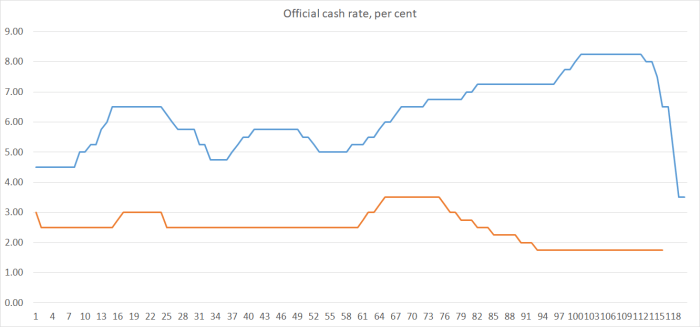
The OCR system itself is almost 20 years old.   The first OCR was set in March 1999.  In this chart, I’ve shown the first 10 years of data (to February 2009) and the subsequent 9.5 years to now.

OCR 10 years

In the first 10 years, the range from low to high was almost 500 basis points.  In the rest of the 1990s, the amplitude of fluctuations in the 90 day bank bill rate was similarly large.

And the last 9.5 years?   The total range within which the OCR has fluctuated is only 175 basis points, and it was only even that wide because of the msisguided enthusiasm for tightening in 2014.

That is quite a difference.

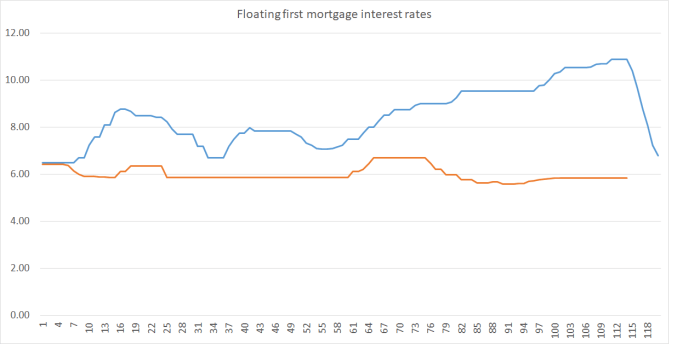
But the difference is even more stark if we look at retail interest rates.   Here is the Reserve Bank’s floating first mortgage rate series for the same two periods.

floating 10 yr

Over the last 9.5 years, this mortgage interest rate has moved within a total range of only about 110 basis points.

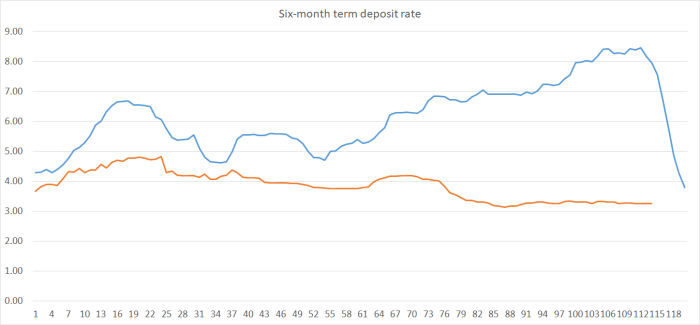
And here is the same chart for the Bank’s six-month term deposit rate series.

TD rate 10 years

The range from high to low is about 170 basis points (similar to that for the OCR), but the peaks were a very long time ago now (back in 2010/11).  For years now, term deposit rates (on this indicator) have fluctuated little, between just over 4 per cent and just over 3 per cent.

I don’t have a good hypothesis for why we have seen such a dramatic change in the variability of interest rates.  It doesn’t surprise when one sees such patterns in countries that hit the effective lower bound on nominal interest rates –  unable to cut further, inflation lingers low and there is little reason then to raise rates. But that isn’t the New Zealand story at all  –  the lowest the OCR has got is the current 1.75 per cent and everyone recognises it could be cut further if necessary.

Has the economy really got so much more stable than it was in the previous couple of decades?  It seems unlikely, perhaps especially in New Zealand (with, for example, record swings in population, big earthquakes, and big terms of trade changes).  Perhaps, to some extent, the Reserve Bank has simulated the sort of behaviour seen in the lower bound countries: always reluctant to cut (even though they always could have), inflation has stayed too low, and the economic upswings have, partly as a result, been pretty muted by historical standards and not very inflationary.  I’m genuinely puzzled.  Who knows, perhaps the Governor could offer the benefits of Bank research and analysis on this point whenever he finally gets round to deigning to give a substantive speech on his primary (according to the Act) responsibility, monetary policy?

Changing tack, in yesterday’s post I had a bit of fun taking the Governor to task over his attempt to articulate the story of the Reserve Bank as if it were some obscure mythical tree god, Tane Mahuta.   Late in that post, I noted that they had adopted some imagery of an island, as what the Bank was working towards.  In their own words

“We have visualised ‘our island’ that we are moving towards on the horizon, one that all New Zealanders can be proud of and that Tane Mahuta –  our Bank – can stand tall on.”

And this was the page with the picture I showed.

our island.png

I noted yesterday

It appears to be the island where the imaginary tree god dwells.  But, here’s the thing, it doesn’t look a bit like anywhere in New Zealand.  And the Reserve Bank of New Zealand is supposed to be primarily about New Zealand and New Zealanders.   Has the tree god flown the coop (so to speak) and fled to some poor Pacific Island where –  perhaps –  well paid senior central bankers take their winter holidays and commune with the deity?   I’d prefer a central bank –  even one deluded that it is a tree god –  to think New Zealand, New Zealand people, New Zealand places.

A diligent reader took the photo and did a little digging with the help of Mr Google.  Turns out that the Governor’s island is Bora Bora, a very expensive resort location in French Polynesia.  I guess it is the sort of place the Governor and his chums flit off too –  although I’d been under the impression the Governor’s destination of preference was the Cook Islands –  but the weird thing is that it is in a quite different country.  Even more oddly, given his distaste for the colonial experience –  suffusing his official document –  it is a territory of an old European empire.   Don’t we have any islands in New Zealand?

But we do, of course.  The Governor can probably see Somes Island out his office window. I live in a suburb named for its island.  And all of us live on these islands, the myriad of them that make up New Zealand.

I guess it was just a silly slip –  though you wonder how no one picked it up –  but it does seem all too consistent with the Governor’s style: once over lightly, and  more focused on the issues he isn’t responsible for (recall not long ago he told us we were lucky as a country not to export fossil fuels) than on the narrow range of things he is responsible for.  Perhaps he could put aside the tree god stuff and get back to (what a commenter this morning urged me to) the “dry old world of money”.   There is more interesting and important stuff in the world, but “money” is the Governor’s job, and it needs to be done well, and in a way that commands respect.

And, finally, regular readers might recall a post from a month or so ago, in which a reader had passed on a report of the Governor’s address (off the record –  and thus only the favoured few had access) to an INFINZ financial markets function in Wellington in late August.    It was reported that the Governor has been typically loquacious, but offering up potentially quite highly market-sensitive information to his favoured audience.

Typically loquacious but, so the report suggests, perhaps going rather beyond the Bank’s public lines on monetary policy as articulated in the August Monetary Policy Statement, in a very dovish direction.     And weighing in on what sort of person he wanted (and did not want –  economists apparently not wanted) on the new Monetary Policy Committee –  the one where the Minister supposedly makes the appointment, the one where the legislation has not yet been dealt with by the relevant select committee.

It seemed rather undisciplined and inappropriate, and I reminded readers again of the contrast with the Reserve Bank of Australia where speeches by the Governor and senior staff are typically on-the-record, usually with a published record of the subsequent Q&A session as well.  The difference doesn’t matter much when off the record speeches are totally anodyne, and people answer questions in a similar unrevealing way, but that certainly isn’t Orr’s style.

On this occasion, so the report I received suggested, it wasn’t just monetary policy things the Governor was free and frank about.    There was, for example, reportedly stuff about how if banks didn’t change their ways he’d change them for them, by setting up a Royal Commission here  [something the government would surely not be keen on given their difficult relationship with the business community, and plethora of reviews/inquiries], and a totally dismissive approach to the recent failure –  on the Bank’s watch – of CBL Insurance.

I put in an Official Information Act request to the Bank about this speech.  I didn’t expect much –  it seemed unlikely the Governor was working from a text, but (given his style) it was at least possible (it would be prudent more generally) there might have been a recording.  There wasn’t apparently.

But I also asked for copies for briefing notes or emails related to the content of the speech.  And there was some material there in the response I got back this morning.   The full response will apparently be put on their website before long (now here).   What was interesting was a request sent out on behalf of the Governor to several Bank staff who had been at the function inviting any feedback  (the request was for anything, good or bad, but perhaps not surprisingly none of the staff offered anything sceptical or critical, to a Governor not known for welcoming challenge).   In those comments we learn from one

My impression from the crowd was that they also enjoyed the speech and are really starting appreciate that having a longer-term vision and focus is important. I like that you gave the audience practical examples such as the United Nations Sustainable Development Goals, Carbon Disclosure Project, and Principles of Responsible Investing that they can start using/working toward now – they have no excuses for inaction!

The SDGs have nothing whatever to do with the Reserve Bank or its responsibilities.

And from another

For example, Adrian discussed climate change and short-term vs. long-term thinking.

Nor, of course, has climate change.  Short-term vs long-term thinking is one of his hobbyhorses, but as I’ve noted previously the Bank has done nothing substantive on this claim.

It sounds as if the speech was all over the show, and mostly (as we’ve come to expect) not on the things he is paid to be responsible for. It is undisciplined and unfortunate, and won’t help wider confidence in him or the tree god (though those who like his leftist political analysis may, shortsightedly, welcome it).  And none of it is transparent and open, more like a locker-room chat to his buddies in the financial sector.  He tells us the economy sat in darkness before the advent of the Reserve Bank.  Maybe, maybe not, but assuredly we all too often sit in darkness when it comes to the activities of the Bank itself.  That simply shouldn’t be acceptable.  Openness, and equal information for all, should be the watchwords of a modern accountable central bank and its Governor.

Orr among the forest gods

Almost 1300 years ago, the English missionary priest and bishop Saint Boniface confronted the belief of some pagan German villagers in Thor, god of (among other things) oak trees. Tree gods (or beliefs in them) were vanquished, and Boniface became known as the apostle to the Germans..

Pre-evangelisation, Maori had their own tree god, Tane Mahuta.    As far as I can tell, not many believe any longer in this local tree god: when I looked up the 2013 Census data, there were lots of Maori recording no religion, and there were plenty of Catholics and Anglicans.  But there wasn’t a category shown for tree gods, or any of the other deities (Wikipedia has a list of at least 35 of them).

But the Governor of the Reserve Bank seems intent on bringing them back.

Tomorrow will mark six months since Adrian Orr became the most powerful unelected person in New Zealand, as Governor of the Reserve Bank.  Six months on we’ve had not a single serious and substantive speech on the policy areas he is responsible for, and where he exercises a huge amount of barely-trammelled power.  No speech on monetary policy, no speech on banking regulation, and nothing either on the less prominent things the Governor is responsible for –  such as, for example, insurance prudential supervision, a New Zealand insurer having failed, regulated by the Reserve Bank just before the Governor took office.  He hasn’t substantively and openly engaged with, or responded to, the damning survey results on the Bank’s performance as a financial system regulator.

Instead, we’ve heard the Governor on almost everything else.  There was infrastructure, climate change (repeatedly), the failings of capitalism, geopolitics, women in economics, and of course bank “conduct” (playing distraction from his institution’s own failings, by trying to butt into a field for which the Bank has no statutory responsibility).    There have been lots of words, but not much sign of in-depth reflection or distinctive insights, and even less sign of doing him well, and being open about, the jobs Parliament has actually given the Bank.   Throw in some considerable complacency about monetary policy and it should be a pretty disquieting picture.

Some of it is probably just the Governor’s well-known propensity to talk.  Some of it might even be an understandable (if misguided in application) desire to lift the esprit-de-corps at the Reserve Bank after the demoralising Wheeler years.  And a lot seems to be about winning the turf battles, ensuring that in the reviews of the Reserve Bank Act that the government has underway as much as possible of the Bank’s powers are kept, in effect, under the Governor’s control, and that the existing powers and functions of the Reserve Bank are all kept in the Reserve Bank.  Part of that seems to be about openly subscribing what should be a non-partisan agency to every trendy left-wing cause that is going (and which, presumably, the Governor believes in personally.) A power play in other words –  and, with a weak government that probably doesn’t care much, quite likely to succeed,  somewhat to the detriment of New Zealand.

The latest example was the release on Monday of a rather curious 36 page document called The Journey of Te Putea Matua: our Tane Mahuta.   Te Putea Matua is the Maori name the Reserve Bank of New Zealand has taken upon itself (such being the way these days with public sector agencies).  It isn’t clear who “our” is in this context, although it seems the Governor  – himself with no apparent Maori ancestry – wants us New Zealanders to identify with some Maori tree god that –  data suggest –  no one believes in, and to think of the Reserve Bank as akin to a localised tree god.  Frankly, it seems weird.  These days, most New Zealanders don’t claim allegiance to any deity, but of those of us who do most –  Christian, Muslim, or Jewish, of European, Maori or any other ancestry – choose to worship a God with rather more all-encompassing claims.

But the Governor seems dead keen on championing Maori belief systems from centuries past.    In an official document of our central bank we read

A core pillar of the evolving Māori belief system is a tale of the earth mother (Papatūānuku) and the sky father (Ranginui) who needed separating to allow the
sun to shine in. Tāne Mahuta – the god of the forest and birds – managed this task after some false starts and help from his family. The sunlight allowed life to flourish in Tāne Mahuta’s garden.

This quote appears twice in the document.

All very interesting perhaps in some cultural studies course, but what does it have to do with macroeconomic management or financial stability?  Well, according to the Governor (in a radio interview on this yesterday) before there was a Reserve Bank “darkness was on our economy”.  The Reserve Bank was the god of the forest, and let the sun shine in.  Perhaps it is just my own culture, but the imagery that sprang to mind was that of people who walked in darkness having seen a great light.   But imagine the uproar if a Governor had been using Judeo-Christian imagery in an official publication.

On the same page we read

Many of these birds feature on the NZ dollar money including the kereru, kaka, and kiwi – core to our belief system and survival.

I’m a bit lost again as to who “our” is here.  I’m pretty sure I’m like most New Zealanders; I never saw a bird as “core” to my “belief system”.  Perhaps the Governor does, although if so we might worry about the quality of his judgements in other areas.

As I say, it is an odd document.  There are pages and pages that have nothing whatever to do with monetary policy or the financial system.  Some of it is even quite interesting, but why are we spending scarce taxpayers’ money recounting stories of New Zealand general history?  There is a page about the Maori navigators and, somewhat out of order, an earlier one about what early Maori ate and what the tribes traded among themselves.   And there is a whole page about Kate Sheppard who, admirable as she was, has nothing whatever to do with New Zealand economic or financial history and policy.  There is questionable history:  simple matters of fact (eg Apirana Ngata wasn’t the first Maori Cabinet minister and didn’t first hold office in the 1920s – James Carroll, who held high office for a long period (twice as acting Prime Minister), preceded him), highly questionable and tendentious economic history, and overall a tone (perhaps comforting to today’s liberal political elite) that seems embarrassed by the European settlement of New Zealand.     There is lots on the difficulties and injustices that some Maori faced, and little or nothing on the advantages that western institutions and society brought.  Reasonable people might debate that balance, but it isn’t clear what the central bank –  paid to do monetary policy and financial stability –  is doing weighing in on the matter.

As I noted earlier, in a radio interview yesterday the Governor claimed that prior to the creation of the Reserve Bank ‘darkness was on our economy’, that the Reserve Bank had let the sunshine in, and that Australia and the UK had somehow turned their backs on us at the point the Bank was created.   In fact, here it is – Reserve Bank as tree god –  in the document itself.

The Reserve Bank became the Tāne Mahuta of New Zealand’s financial system, allowing the sun to shine in on the economy.

I think there was a plausible case for the creation of a central bank here, but to listen to or read the Governor you’d have no idea that New Zealand without a Reserve Bank had been among the handful of most prosperous countries in the world.  Here from the publication, writing about the period before the Reserve Bank was created

The infrastructure funding was further hindered by the banks being foreign-owned (British and Australian) and issuing private currency. Credit growth in New Zealand was driven by the economic performance of these foreign economies, unrelated
to the demands of New Zealand. Subsequent recessions in Britain and Australia slowed lending in New Zealand when it was most needed.

Very little of this stands much scrutiny.  You’d have no idea from reading that material that the New Zealand government had made heavy and persistent use of international capital markets, such that by 1929 it –  like its Australian peers –  had among the very highest public debt to GDP ratios (and NIIP ratios) ever recorded in an advanced country.  You’d have no idea that New Zealand was among the most prosperous countries around (like Australia and the United States, neither of which had had central banks in the decades prior to World War One).   You’d have no idea that the economic fortunes of New Zealand, trading heavily with the UK, might reasonably be expected to be affected by the economic fortunes of the UK –  terms of trade and all that.   Or that economic cycles in New Zealand and Australia were naturally quite highly correlated (common shocks and all that).  And of course –  with all the Governor’s talk about how we could “print our own money” – within five years of the creation of the Reserve Bank, itself after recovery from the Great Depression was well underway, that we’d not unrelatedly run into a foreign exchange crisis that led to the imposition of highly inefficient controls that plagued us (administered by the evil twin of the tree god?) for decades.  Or even that persistent inflation dates from the creation of the Reserve Bank

One can’t cover everything in a glossy pamphlet, even one that seems to purport to be aimed at adults (including Reserve Bank staff according to the Governor), but there isn’t much excuse for this sort of misleading and one-dimensional argumentation, aka propaganda.

The propaganda face of the document becomes clearer in the second half.   Among the issues the government’s review of the Reserve Bank Act is looking at is whether the prudential and regulatory functions of the Bank should be split out into a new standalone agency, a New Zealand Prudential Regulatory Authority.  I think that, on balance, that would be a preferable model.  It also happens to be the model adopted in much of the advanced world, including many/most small advanced economies.  There are arguments to be made on both sides of the issue, but you wouldn’t know it from reading about the Governor’s vision of the Bank as a Maori tree god, where one and indivisible seems to be the watchword.      Everything is about “synergies”, and nothing about weaknesses or risks, nothing about how other countries do things, nothing about the full range of criteria one might want to consider in devising, and holding to account,  regulatory institutions for New Zealand.

I don’t have any problem with officials, including from affected agencies, offering careful balanced and rigorous advice on the pros and cons of structural separation. But that is a choice ultimately for ministers and for Parliament.  And among the relevant considerations are issues of accountability and governance.  Neither word appears in Governor’s propaganda piece.   But then tree gods probably aren’t known for accountability.  New Zealand government regulatory institutions should be.   If ministers and Parliament decide to opt for structural separation, I wonder how the Governor will revise his document –  his tree god having been split in two.

Among the tree god’s claims about financial regulation and what the Bank brings to bear was this breathtaking assertion, prominently displayed at the head of a page (p27).

The Reserve Bank is highly incentivised to ‘get it right’ when it comes to prudential regulation. We have a lot at risk

It is an extraordinary claim, that could be made only be someone wilfully blind –  or choosing to ignore –  decades of serious analysis of government failure, and the institutional incentives that face regulators, regulatory agencies, and their masters.

There is nothing on the rest of that page to back the tree god’s claim.   On any reasonable and hardheaded analysis, the Reserve Bank has very weak incentives to “get it right”, or even to know –  and be able to tell us –  what “get it right” might mean.   When banks fail, neither the Reserve Bank Governor nor any of the tree god’s staff have any money at stake (at least in their professional capacity, and as I recall things, Reserve Bank staff – rightly –  aren’t allowed to own shares in banks).  It is all but impossible to get rid of a Reserve Bank Governor, and it is even harder to get rid of staff (for bad policy or bad supervision).  Most senior figures in central bank and regulatory agencies of countries that ran into financial crises 10 years ago, stayed on or in time moved on to comfortable, honoured (a peerage in Mervyn King’s case) retirements, or better-remunerated positions in the private sector.

And when the Reserve Bank uses its powers in ways that reduce the efficiency of the financial system, or stopping willing borrowers and willing lenders writing mortgage contracts, where are incentives on the Reserve Bank to “get things right”.  There are no personal consequences –  the Governor and his senior staff either won’t have, or would have no problem getting, mortgages.  The previous Governor got to exercise the bee in his bonnet about housing crises, and to play politics, with no supporting analysis and no effective accountability.    The current head of the tree god opines that lenders and borrowers can’t be trusted –  but tree gods apparently can –  but when challenged produced no analysis to support his claim.  That sort of system creates incentives for sure, but they aren’t to “get it right”.  Officials have incentives to keep things secret, and we saw that on full display with the Bank’s supervision of CBL Insurance last year –  they might argue it was in the public interest, but even if so, it was clearly in their private interests, and against the interests of many members of the public.

Another word that hardly appears at all in the document is “transparency”.  If you wanted to call yourself a tree god who sheds light upon the dark world that was pre-1933 New Zealand (or, presumably, a modern New Zealand without our current Reserve Bank) you might think there would be at least some self-awareness of the other side of letting the light in: letting in the light on the Bank’s own operation.   As I’ve documented here over the years, the Bank is quite open about what it wants to be open about.  But what credit to them is that, everyone releases what they want to release: the essence of transparency is readily and willingly releasing material that they might, in some senses, prefer to keep to themselves, to make for an easier life for the tree god.  Our Reserve Bank –  the Governor’s pagan tree god –  is notoriously secretive and obstructive, consistently pushing to and beyond the limits of the Official Information Act.  Only a few weeks ago the Ombudsman’s office had to intervene to remind them that simply invoking “Chatham House rules” doesn’t enable you to keep things secret.  And with even the Cabinet having promised pro-active release of Cabinet papers, and pro-active release of Budget background papers and advice, the Reserve Bank looks not like a tree god shedding light in dark places, but like some more malevolent self-interested dark deity.

The Governor also tells us he has adopted an ever more ambitious goal than the previous Governor’s one.  Graeme Wheeler articulated a vision of the Reserve Bank as “best small central bank” in the world.  It was pretty empty.    There was no sign that citizens or other stakeholders had asked him to be the “best small central bank”  –  richer countries than us will often choose to spend a lot more (and with less accountability) on their central bank.  In any case, when challenged a few years later, it turned out that there was nothing going on to benchmark themselves against that ostensible aspiration.   But Orr’s aspiration for his tree god is an unqualified “best central bank”.     The institution is a very long way from that at present –  and getting further away if Orr uses the Bank as a platform for pushing for his personal political agendas, well beyond the Bank’s statutory responsibility.  It isn’t open, it isn’t excellent, it is accountable.  It should do much better (although I’m still not convinced that a small poor advanced country should be expecting, ir aiming, ot have best central bank there is.)

And finally, among the oddities of Orr’s apparent aspirations is something about an island.  There is a full page under the heading “Our island and Tane Mahuta”, complete with lots of (mostly) worthy (if sometimes threatening, for staff ) aspirations, and this picture.

RB island

It appears to be the island where the imaginary tree god dwells.  But, here’s the thing, it doesn’t look a bit like anywhere in New Zealand.  And the Reserve Bank of New Zealand is supposed to be primarily about New Zealand and New Zealanders.   Has the tree god flown the coop (so to speak) and fled to some poor Pacific Island where –  perhaps –  well paid senior central bankers take their winter holidays and commune with the deity?   I’d prefer a central bank –  even one deluded that it is a tree god –  to think New Zealand, New Zealand people, New Zealand places.

Better still, ditch the pagan religion –  not (according to the Census) taken seriously by Maori, and never part of the heritage or beliefs of most New Zealand –  leave it to the cultural studies textbooks, and get on with doing your job, openly, accountably, excellently.

And, as part of that, abandon the complacency about monetary policy, expressed again  by the Governor is his Radio NZ interview yesterday.   The next serious recession  is, according to him, nothing to worry about.  Monetary policy faces no serious constraints.  Which, presumably, is why all those other countries who did find themselves at the effective lower bound last time round were able to rebound so quickly and effectively, and deliver inflation consistently near target.  Or perhaps that is only in a false tree god’s imaginary world?

UPDATE: I meant to include, but accidentally left out, reference to the fact that the Bank of New Zealand had been majority New Zealand government owned from 1894, forty years before the Reserve Bank was formed.   Surely the Governor was aware of that?

A stuff-up by Statistics New Zealand

Many readers will recall the fiasco of the leak of an OCR announcement back in March 2016.  It turned out that the Reserve Bank’s systems were had been so lax for years that people in the lock-ups they then held could simply email back to their offices (or to anyone else) news of the announcement that was supposed to be being tightly held.  This weakness only came to light because someone in Mediaworks emailed the news of this particular OCR announcement to their office, and someone in that office emailed me (from memory I was supposed to go on one of their radio shows later that morning).  I drew the matter to the Bank’s attention.

In the wake of that episode, the Bank (rightly in my view) cancelled the pre-release lock-ups for journalists and analysts.  But other government agencies went right on, relying on trust more than anything else.   One notable example was Statistics New Zealand, which produces and publishes many of the most market-moving pieces of economic data.    When asked about any possible changes to their procedures (outlined here) following the Reserve Bank leak in 2016, they responded

Statistics NZ has not undertaken any reviews or made any changes to the department’s policy for media conferences following the Official Cash Rate leak at the Reserve Bank of New Zealand and the subsequent Deloitte report into that leak released last week.

and

While Statistics NZ has never had a breach, if that trust is abused and an embargo is broken, offenders and their organisation would be barred from attending future media conferences.

As I noted back then

Unfortunately, that was probably the sort of discipline/incentive the Reserve Bank was implicitly relying on as well.

Unfortunately, after the confusion the Prime Minister gave rise to earlier in the week, confusing the crown accounts and GDP (which had some people abroad worried that the Prime Minister actually had had an advanced briefing), there was apparently more trouble this morning.  But this time, the fault was entirely with Statistics New Zealand, and not with those in the lock-up.

The embargo for the lock-up on gross domestic product (GDP) for the June 2018 quarter, held today, 20 September 2018, was lifted about one minute earlier than the planned time of 10.45am.

The lock-up is held in Stats NZ’s Wellington offices from 10am to 10.45am, to allow key financial media, bank economists, and other government agencies to understand the information and ask questions about GDP, before the embargo is lifted. It is held under strict embargo conditions.

Stats NZ staff in the lock-up check official New Zealand time on the Measurement Standards Laboratory of New Zealand (MSL) website.

However, a computer script (JavaScript) bug meant that the official time clock website that appeared on the staff member’s phone picked up the phone’s own time setting, which was slightly fast.*

In other words, those in the embargoed lock-up had the data –  and could communicate it to their dealing rooms – a minute earlier than anyone not in the lock-up got the data.     And it seems to have mattered.  GDP was higher than expected and the exchange rate jumped.   People who were in the lock-up got the jump on that.  I’ve heard that the exchange rate moved before 10:45 (the official release time), which isn’t surprising if people in the lock-up had been told the embargo had been lifted.

What is striking about the statement SNZ put out –  and it wasn’t exactly distributed widely (say, to all the people who got the GDP release itself) –  is that there is no mention at all of these possible early trades, which (in effect) distributed money/profits from one group of people (those not in the know) to another (those in the know).  Unlike the 2016 Reserve Bank leak, there seem to have been real financial consequences to this mistake.  And it isn’t clear that Statistics New Zealand is taking it that seriously.   When I asked about any investigation being undertaken, the implication of their reply was that there would be no further investigation or review beyond the narrow technical statement I linked to earlier. I hope that is not correct (and I hope, for example, the Reserve Bank is insisting on something more).

Writing about these data lock-ups in 2016 I noted of the SNZ situation

Is Statistics New Zealand that different?  There is, obviously, no policy message SNZ is trying to put across with its releases, and so no risks of different messages getting to different people.  But the security risks are the same.  Perhaps it is simply more efficient to have everyone in the same room, to clarify key technical points, but couldn’t the same end be achieved –  on a more competitively neutral basis (to analysts based abroad, say) –  by a dial-in (even webcast) conference call held a bit later on the day of the release?

That still seems right to me. I cannot see the case for a pre-release lock-up (and I can see a case for a technical conference call later in the day).   Mistakes will happen while they keep on with lock-ups.   The reliance on trust seems to be as strong as ever, and (as far as we know) that has been honoured.  This time, the stuff-up was by Statistics New Zealand themselves.   It was unnecessary, and it will at the margin (and especially in conjunction with the political contretemps earlier in the week) damage confidence in our statistics agency and the integrity of our data.

A picture in continuity

Here is a summary chart of the real GDP outcomes for the June quarter (expenditure and production), the hours outcomes (QES and HLFS), and the implied change in labour productivity (real GDP per hour worked), taking the average change in hours worked from the average growth in real GDP.

GDP q2 1

There was quite a bit more activity all round, but it took a larger percentage increase in labour inputs (hours) to get the published percentage increase in output (GDP).  In other words, labour productivity fell: not just the growth rate, but the level.

Here is the same chart for the previous quarter.

GDP q2 2

It was worse: less GDP growth, but also an even larger fall in GDP per hour worked.   Productivity growth for the first half of the year was -0.65 per cent.  That isn’t an annualised number, but an absolute change; a significant fall.

Perhaps you think this just shows how dreadful the new government is.  Here is the same chart showing the cumulative growth rates for the last six months of last year (in blue) and the first half of this year (in orange).

GDP q2 3

To me, the similarities are (much) more striking than the differences.    Importantly, the level of labour productivity fell in both halves.

Looked at from a productivity perspective –  and that really is where one should focus, especially when the unemployment rate is not too far from the NAIRU – it is a pretty dreadful performance.    Of course, simply looking at two six month periods on their own doesn’t tell one much, but nothing in these data is inconsistent with the poor productivity record for some years now.

And neither the last government nor this one appears to have any serious ideas for, or any serious interest in, fixing this failure.