Updating the Governor’s OCR view

In the wake of the Reserve Bank’s Monetary Policy Statement in February I wrote

As for the overall tone of the monetary policy conclusions to the statement, count me sceptical.  …for the Governor to suggest that the risks now are really even balanced, even at some relatively near-term horizon, seems to suggest he is falling into the same trap that beguiled the Bank for much of the last decade; the belief that somewhere, just around the corner, inflation pressures are finally going to build sufficiently that they will need to raise the OCR. We’ve come through a cyclical recovery, the reconstruction after a series of highly-destructive earthquakes, strong terms of trade, and a huge unexpected population surge, and none of it has been enough to really support higher interest rates. The OCR now is lower than it was at the end of the last recession, and still core inflation struggles to get anywhere 2 per cent. There is no lift in imported inflation, no significant new surges in domestic demand in view, and as the Bank notes business investment is pretty subdued. Instead actual GDP growth has been easing, population growth is easing, employment growth is easing, confidence is pretty subdued, the heat in the housing market (for now at least) is easing. Oh, and several of the major components of the world economy – China and the euro-area – are weakening, and the Australian economy (important to New Zealand through a host of channels) also appears to be easing, centred in one of the most cyclically-variable parts of the economy, construction. …

From a starting point with inflation still below target midpoint after all these years, it would seem much more reasonable to suppose that if there is an OCR adjustment in the next year or so, it is (much) more likely to be a cut than an increase.

The Governor appears now to have come round to that view.   If his re-think is overdue, it is welcome nonetheless.

I don’t take issue with much about his statement. but two lines did catch my eye.  The first was this one (emphasis added)

This weaker [global] outlook has prompted central banks to ease their expected monetary policy stances, placing upward pressure on the New Zealand dollar.

Perhaps that is correct –  although in the data the effect looks small –  but it is quite a dangerous line to walk down.  Either an easier stance of policy was warranted here on the New Zealand fundamemtals (including our exposure to the world economy) or it wasn’t (it was).   The exchange rate should be largely irrelevant to that choice, and reintroducing it like this risks some sort of MCI mentality taking hold.  He’ll remember those bad old days.

And the second, of course, was this claim

As capacity pressures build, consumer price inflation is expected to rise to around the mid-point of our target range at 2 percent.

To which one can really only say two things, a) yeah right, and b) isn’t this the same story the Bank has been telling for almost the entire decade?  Of course, as the former chief economist used to point out, in one sense they had to believe it –  if it wasn’t something they could say hand on heart then they should have adjusted policy already.  But if they really believe capacity pressures are going to intensify from here, they must now be in a pretty small minority.

Even though the data suggest that the Bank should have an easing bias in place (and perhaps should already have had a lower OCR in place), I was a little surprised that having walked past the opportunity in February, the Governor chose to act now.  After all, this is the last OCR decision that he will take as the Bank’s sole decisionmaker on monetary policy.  On Monday, the new statutory Monetary Policy Committee will take over responsibility.  Even though I’ve been consistently running the line that the Governor will, in effect, control all the appointments to the MPC and will effectively control the overall votes, I’d assumed he’d want to observe the proprieties and at least pretend that the new voters might make a difference –  might see things differently from him.

On paper, the Governor’s statement that

the more likely direction of our next OCR move is down.

doesn’t mean much. I’m sure he made this decision with two of the likely new MPC members (Deputy Governor Bascand and the very new Assistant Governor Hawkesby), but the new MPC will have four other members, most probably the new (as yet unannounced) chief economist, and three externals.  Most likely the externals (in particular) won’t want to rock the boat –  they’ll have been selected partly for that quality – but they might quite reasonably see the data differently than the Governor.  That could get a little awkward.   Perhaps the Governor ran risks whichever tack he took, but he could easily have explicitly noted the regime change and could then have eschewed any sort of bias statement (leaving the rest of the statement pretty much as it was).

(Presumably the Minister of Finance will finally announce the MPC members today or Friday.  When he does, I would be delighted to revise my view that they’ll have been selected for their inoffensiveness, if such a revision is warranted.  But I’m not holding my breath.)

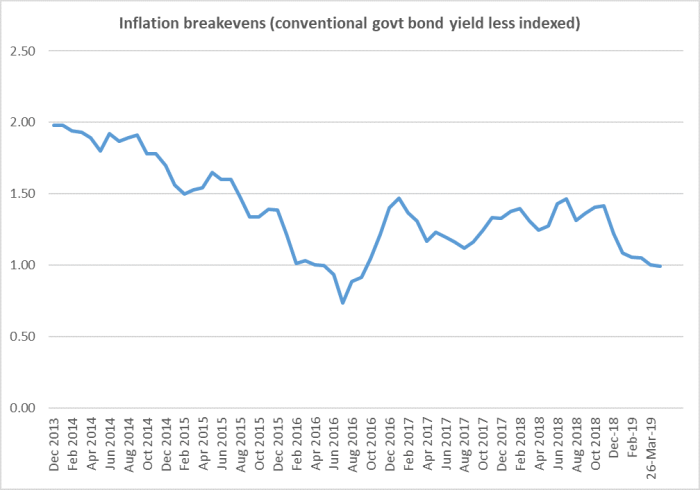
And what of inflation?   As readers will know I have been tantalised by the implied inflation expectations derived from the indexed and nominal government bond markets.  Here is the latest update of that chart, the last observation being yesterday’s.
breakevens mar 19

Implied inflation expectations (for the average over the next 10 years) –  implied by people with money at stake, or the opportunity to stake it to clear out anomalies – have been nowhere near target for almost five years now.  In the last few months they have been dropping away again and now are barely 1 per cent.   The Reserve Bank never references this series, but they really should, even if only to make the case for why they think there is no meaningful information in it.

Perhaps you are thinking this is just a global phenomenon.  After all, nominal bond yields have been falling pretty much everywhere.  But here are the 10 year inflation breakevens for the US

us breakevens mar 19

Not only have the breakevens rebounded (risen) in recent weeks, but they remain near the Fed’s target inflation rate (also 2 per cent).

With core inflation still below target after all these years, market-based expectations measures low and weakening, with increasing unease about the world economy (including the economies of our two largest trading partners), with most of forces that impelled the (productivity-less) growth in recent years having exhausted themselves, and with weak business survey measures, the case for a lower OCR already looks pretty strong.

What, realistically, would be the worst that could happen if the Bank had cut and the cut turned out to be unnecessary?  Unemployment would be a bit lower, even if temporarily, and core inflation might rise to the height of, say,  2,2 or even 2.4 per cent.  Perhaps not desirable outcomes in their own right –  the focus is supposed to be 2 per cent — but after all these years undershooting the target hardly likely to destabilise public or market confidence in the Bank’s conduct of monetary policy and delivery of medium-term price stability.

UPDATE:  The Minister of Finance has announced the appointments to the MPC this morning.  My initial reaction is that there is no need to revise my judgement about the structure and likely dynamics of the MPC.  It is quite disconcerting that one (internal) member has been appointed for only a one year term, which will place that person even more than usually under the heavy influence of the Governor.  The Minister would have been better to have started the committee with 3 internals and 2 externals and made the final external appointment when the new permanent Chief Economist is finally appointed.
Destroying the economy in one fell swoop

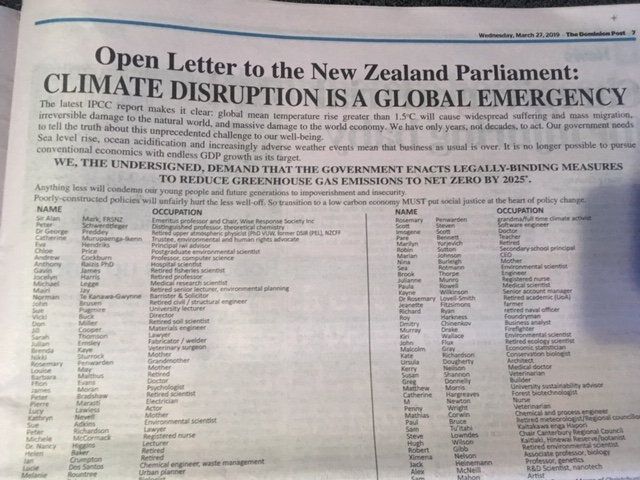
When I got to page 7 in this morning’s Dominion-Post I wasn’t sure at first that my eyes weren’t deceiving me.    I read it again, and even then wondered if what I was reading was a typo.  But these people seemed to be deadly serious.

open letter

Their demand is there in bold: that the government take steps to reduce (net) greenhouse gas emissions to zero by 2025.  Their demand doesn’t appear to be conditional on other countries doing anything.  It is simply flagellation –  but not self-flagellation (in which these individuals themselves commit to reducing all direct and indirect emissions associated with their own consumption and production to zero by 2025)  but a brutal whipping delivered to everyone.   Not even our government, evincing no concern for productivity or for lifting the performance of the underperforming New Zealand economy, would be that stupid or (electorally) suicidal.  (In fact, that left me half-wondering if this was really intended as a piece of political theatre –  get together a group advocating something so recklessly stupid and costly that the government’s own proposed net-zero by 2050 target will seem moderate and reasonable.   But many of the names of the petition –  a couple of hundred visible in the advert, and another 2000 or so who’ve signed –  appear to be “true believer” types.  And all their rhetoric suggests they are in deadly earnest.)

It all comes complete with the typical zealot’s demand –  “this is no time for party politics” (further down the advert) –  as if their propositions (and time frames) were so self-evidently (or by revelation) true, that no further debate should be countenanced.  End of story.   And yet, perhaps not surprisingly, of the key figures in this organisation one is the former leader of the Green Party and another is a former Greens Regional Councillor (I didn’t recognise the other names, but it wouldn’t surprise me if a quick search revealed other strong Green Party ties).  Green Party politics is just fine it seems, but not anyone else’s?

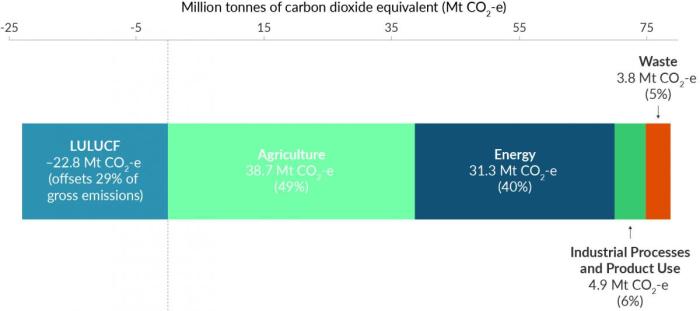
It is now March 2019.  That means these crusaders claim to seriously believe that in just six (and a bit) years we should reduce all (net) emissions to zero.  Sure, the trees that are already growing will offset a bit, and a few more trees will be planted in the coming years (but any tree planted today is still going to be rather small in 2025).    The offsets (the LULUCF bit) just don’t make that much difference (as this MFE chart illustrates).

emissions

They seem to be calling for probably a 70-75 per cent reduction in gross emissions (animal, energy or whatever) in a mere six years.  Being true believers I presume they will also be wanting international air (and sea) travel emissions –  which aren’t included  in the official framework but are just as polluting  –  radically slashed in six years.

I noticed in their advert a comment that “Solutions DO exist”, so out of curiosity I looked up their website.    Here is the Deeper Thinking section.  From the introduction

We will not accept action on climate change that further increases inequality, takes away democracy [but it was “no time for party politics”?], destroys our natural ecosystems, or compromises human rights. Some scientists think they can geo-engineer the planet by blocking the sun or changing the chemistry of the oceans. That is not our vision. In fact, this kind of change will make it even more difficult to reduce emissions.

We need a change of values that puts the everyday rights and needs of people before the profits of corporations. A change that values Nature, and respects its limits. A change that truly honours Te Tiriti o Waitangi, by which we mean recognizing the holistic world views of tangata whenua, their perspective of being intrinsically connected to the earth, the role of mana whenua in discussions and decision making, and the importance of environmental integrity to the health and wellbeing of communities who sustain themselves from it.

Make of that what you will.

There was a promise that one day (before 2025?) their website will have some more concrete material on “better alternatives”, but it isn’t there yet.  In fairness, they do finally mention economics.

Climate change is about economics. That is why it is hard. It is not possible to address climate change without changing our economic system. Resources and the ability to absorb pollution are limited. We cannot keep growing the economy without growing environmental damage. Much has been written over the last 40 years about the economics of ‘enough’ rather than ‘more’ which can give us a better way of life with less damage to the climate, the water, and each other. Aiming at human wellbeing rather than industrial growth, accepting the limits of nature and natural resources and valuing things other than just money is the basis.

Take that third sentence.  It would probably be better, and more honestly, reframed as “it is not possible to cut gross emissions by 70 per cent in six years, especially when half your emissions are from animals, without destroying New Zealand’s economy, severely undermining material living standards and [see the first block of their text], and (most likely) materially increasing inequality”.  But, perhaps, the signatories would feel better.

So what would this involve?  Well, first it would almost destroy our tourism industry (and our export education industry), which relies on air travel, and where there are as yet no commercially viable replacements for emitting fuels.   Then it would destroy our pastoral industries –  animals emit and, whatever the technological innovations, will still substantially be doing so six years from now.

I presume the signatories have dreamy visions about electric cars, trucks, and trains.  But, as of now, almost the entire stock is powered by petrol or diesel.  What do they propose?  Confiscation of all existing vehicles, with or without compensation?   And while it is fine to talk up the possibilities of wind (and the dreadful visual pollution it entails) or solar, we’ve yet to see anywhere the sort of (economic) large-scale battery storage deployed in ways that suggest a quick replacement of the full fleet is in any way sensible, or economic.   Many of us –  old fogies like me, but more importantly poor people – don’t want to buy new vehicles, which are very expensive (petrol or electric).

Presumably much of the building and construction industry is also a gonna –  a lot of emissions involved in producing cement.   That will be a bit of an issue in a country with one of the fastest population growth rates in the advanced world.   Perhaps raupo cottages are an alternative?

One is rather left wondering how New Zealanders earn their way in the world –  literally, profitable activities competing on world markets –  in this vision.  It wouldn’t “just” be a matter of sustaining growth –  a concept that seems distasteful (at best) to these people –  but of sustaining even the material living standards we have now, which lag well behind those in leading advanced economies (and thus constraining all sorts of personal and government choices).  Run through a list of New Zealand exports, and there won’t be that much left (a bit of wine, some fruit, a few services (ones that don’t rely on consultants jetting in to other countries, and……?).  I guess the exchange rate would plummet, but –  given the constraint of zero net emissions –  it is hard to see what viable new outward-oriented business would be likely to spring up here, so far from the rest of the world (and distance means, among other things, emissions).

The current government has talked of a commitment to a net-zero by 2050 target (although after their consultation process we have yet to see the final form of that commtment).  I wrote last year about the potential economic consequences of adopting such a goal, drawing mainly on the NZIER work commissioned for the consultation process by the Ministry for the Environment themselves.

The Minister for Climate Change has made the public claim that his net-zero target (by 2050 –  which would give us six times as long to adjust) would be a “massive economic boost“.    But that isn’t what the NZIER modelling showed.  This quote is from the government’s own consultative document

The analysis by NZIER suggests that GDP will continue to grow but will be in the range of 10 per cent to 22 per cent less in 2050, compared with taking no further action on climate change.

As I noted at the time

Those are breathtakingly large numbers (future GDP gains) for a government to simply propose walking away from. 

The hair-shirt the government proposed to compel all to wear was going to be astonishingly costly.

And then there were the (in)equality implications.  Recall that this was for a net-zero target by 2025 (still 31 years away, not six).

In my previous post, I quoted the MfE text

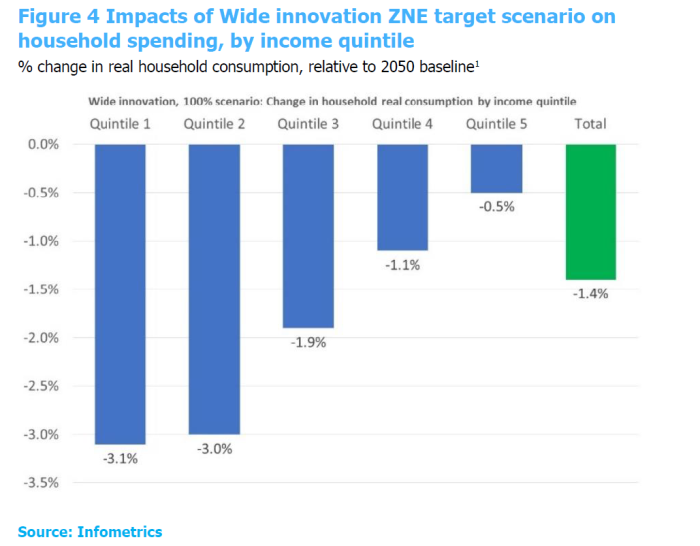
Our modelling suggests the households that are in the lowest 20 per cent bracket for income may be more than twice as affected, on a relative basis, than those households with an average income.

Which is quite bad enough. But it is all the more stark when you see the chart in the NZIER report, drawn from some work done for them by Infometrics  (in this chart they are looking only at the additional estimated losses from moving from the 50 per cent target to a net-zero target).

emissions distribution

Specifically, people in the bottom two income quintiles will be hit six times as hard as people in the top quintile.    Like MfE in the consultation document, NZIER rush to the client’s defence and suggest that redistribution policies could alleviate this.   You wouldn’t thought that sort of advocacy was their role –  having been commissioned to do modelling –  but more importantly, they should know as well as anyone that when governments adopt policies to materially shrink the economy, it is even harder than usual to persuade voters in the upper quintiles to agree to give up even more to mitigate the losses the worst off are exposed to.   Redistribution tends to win more favour when everyone is getting better off.

But, never mind, I guess, the signatories will feel better, and it is –  so they tell us –  no time for party politics.  Just destroy material living standards with one fell swoop, no doubt hoping –  with the best of intentions no doubt – that something will turn up.

(Of course, if they were at all serious about doing all this, in a way that hurt New Zealanders least, among their policy prescriptions would be a sharp and permanent cut in immigration numbers.  I made that case to the Productivity Commisson inquiry.   But since the Green Party also likes to position itself as the equal-top most pro-immigration political party, one can only assume –  again –  that the point of the exercise, in practice (whatever their best intentions) is to maximise the pain of the sort of adjustment they propose.  Flagellation in other words.)

Reading our censorship act

I’ve been reading the Films, Videos, and Publications Classification Act 1993.  Fortunately, it isn’t a long act (by the standards of our Parliament), having a mere 177 clauses.

I dipped into it initially wanting to better understand what David Shanks, the unelected bureaucrat operating under the title “Chief Censor”, had been up to in deeming the Brenton Tarrant “manifesto” “objectionable”, and banning the rest of us from ever (re)reading it.   Regular readers will know my longstanding concerns about unelected unaccountable bureaucrats exercising substantial policy power.    At least in this legislation there is provision for substantive appeals to a review board, and for appeals to the courts on matters of law.   That is more accountability/potential for restraint than exists around the choices of, notably, the Governor of the Reserve Bank.

I’ll come back to the Tarrant case shortly. But as I read the Act –  and here I should stress that my personal stance would not favour the abolition of all censorship – it became increasingly apparent what an odd act it is.   There doesn’t seem to be a proper purpose statement, of the sort common in more recent legislation.  But perhaps the key point is found early on when Parliament attempts to define “objectionable”.

OFLC 1

Which might look like a solid start, except that I turned to the Interpretation section of the Act (section 2), and between “public display” and “public place” (both of which were defined) there was no definition of “public good”.     So the basic and overarching standard against which publications etc are to be assessed, and may be banned, simply isn’t defined, and appears to be solely matter for one unelected bureaucrat and – by dint of rights of appeal –  the Film and Literature Board of Review, and perhaps eventually some judges (aka, committtees of ex-lawyers) to decide.  On a whim and some personal preference?

Being a conservative Christian, I happen to believe that the availability of publications promoting pre-marital sex, homosexual sex, adulterous sex and so on is “likely to be injurious to the public good”.  I quite get that most of modern New Zealand society disagrees and I don’t attempt to push the point.  But it seems just weird that the standard is so (un)defined by Parliament, just deferring the decision ultimately to some unaccountable people and their particular whims and preferences.   It is not even like the US, where the Supreme Court has to at least make up some grounding for its more controversial rulings in the specific provisions of the constitution.

And it just got odder as I moved on to section 4

OFLC 2

According to Parliament, the “public good”, and what might risk being injurious to it, is a matter for “expert judgment”.    What was Parliament thinking, other than passing the buck and abdicating its own responsibility?

And what expertise then is required to be appointed as Chief Censor?  Well, none really.  Section 80 of the Act deals with that appointment, and all you really need is a Minister of Internal Affairs to nominate you, and the concurrence of the Minister of Women’s Affairs (why?) and the Minister of Justice.   The relevant sub-section notes that

In considering whether or not to recommend to the Governor-General the appointment, under subsection (1), of any person, the Minister shall have regard not only to the person’s personal attributes but also to the person’s knowledge of or experience in the different aspects of matters likely to come before the Classification Office.

Nothing about political philosophy, nothing about the theology of the body, nothing about the family, not about history, nothing about the political or judicial traditions that have underpinned our society for centuries.  Nothing really that gives an appointee any real expertise in determining “the public good” –  and in fact, given that Chief Censors have tended to come from the Wellington bubble, probably less well-equipped to assess “the public good” (as citizens might define it) than the first 100 names in the phone book.

What of Mr Shanks specifically, the incumbent (and relatively new) Chief Censor?  His background is almost entirely as a lawyer for government departments, and then as HR and corporate manager for one in particular (MSD).  There is nothing there that suggests any particular ‘knowledge or expertise’ in the substantive matters his office deals with (sex, violence, horror….or terrorism), let alone any background or expertise that gives us any reason to suppose he could “expertly” (or otherwise adequately) define “the public good” for the rest of us.  Almost his entire career has been built around enabling ministers to do their thing.  Nothing in his background suggests any interest in, or passionate commitment to, an open and accountable free society.

And, in fairness, perhaps much of what the office does, doesn’t really require that set of big picture set of skills.  But something like the Tarrant “manifesto” clearly does.   Nonetheless, Mr Shanks –  the public service lawyer – has decided it is “objectionable”, in terms of the Act, and “likely to be injurious to be the public good”.

Having made his determination a whole series of offence provisions (Part 8 of the Act) cut in.  There seem to be two broad categories.  The first relate to “distribution”  where distribution is defined thus

OFLC 3

Then we get the key bit of section 123 –  complete with the odious concept of “strict liability offences”

OFLC 4

Breach that and the penalties are draconian.

oflc 5

(Another case where fines have got out of whack with imprisonment: for most people 14 years of your life is worth a lot more than $200000).

What about possession?  On that point, there does seem to be a distinction based on knowledge or intent.   Inadvertently or unknowingly having an objectionable publication doesn’t carry stiff penalties

OFLC 6

But knowing possession does

oflc 7.png

Since “the public good” isn’t defined by statute law, and we’d had no similar “manifestos” relating to events in New Zealand history, if Mr Shanks and his inspectors start coming after people who had the document before Saturday, everyone could reasonably argue they had no “reasonable cause to believe” the document was “objectionable”, in terms of the statute.  None of us can read the mind of the government lawyer, Mr Shanks.

But to get back to the Shanks decision, what is remarkable about his statement on Saturday is that it contains no reference to, or discussion of, the “public good” statutory test at all. In most of it, he simply runs his personal views of the document, perhaps views he was encouraged to by Police (and perhaps ministers?). Perhaps befitting his (lack of) background in such things, there is no discussion at all as to how the public good might well be served by people being able to read, understand (and disagree, rubbish, or even agree with some or all of the text – some of which is reported to have been substantially factual) and then debate – in an informed way – a document that appears to reflect the thinking behind one of the most heinous crimes in New Zealand history, an event that is near-certain to be grist to the mill of all sorts of political debates for decades to come.

I can (at a pinch) see how one might reflect on that point and still reach the conclusion Shanks did, but there is no sign in his statement that he has even considered the issue.  Let alone of “expert judgment” at work –  after all, what expertise does he have?   Where is the evidence that any “expert” judgement was involved, let alone any “experts” other than those on the staff of government agencies?

Now it is true that, buried further down in section 3, there is specific reference to terrorism.  The Act notes that “particular weight” should be given to “the extent and degree to which, and the manner in which” the publication “promotes or encourages criminal acts or acts of terrorism”.   I’m sceptical that is what the document did, but even if to some extent it does, “the public good” appears to be the overarching test.  It just cannot make sense –  after an event of such defining horror as the Christchurch attacks –  for the substantial document the (alleged) shooter wrote to explain himself to be kept from public view forever.   Not even made available with specific deletions, but the whole document is simply banned.

But, of course, there is an ability to apply for exemptions (although you have to pay even to apply), but the release seemed to suggest that Mr Shanks might allow exemptions for some in the media (at least the bits he counts as “safe”) and parts of academe (and MPs might well be able to argue they needed it for their official duties), while forbidding it to the general public; the people who actually vote and set the ultimate direction for the country, including how we respond to these attacks.   Would you trust the Police and intelligence agencies to tell you what to take from the attack and attacker?  I wouldn’t (in general and in principle, let alone in these specific circumstances).  Would you trust a government that does nothing to damp down the inflammatory rhetoric of senior MPs from its support partners?  I wouldn’t.  Let alone a government 10 years hence that might want to use the event for its own purposes (viz Simon Bridges this morning calling for more personal privacy to sacrificed to the state).

And in many respect Mr Shanks’s ban is pretty futile anyway, as he more or less acknowledges in his statement

Those engaged in further reporting on the Christchurch attack may be tempted to consider the use of quotes from the publication that have already been used in other media reports.

“That use of excerpts in media reports may not in itself amount to a breach of the FVPCA, but ethical considerations will certainly apply,” said Shanks.

If I read that rightly, it isn’t illegal to quote from the document, just to possess it. Overseas people can and will possess it. They will, and should, debate, argue about it, agree and disagree with it, and (presumably) mostly deplore the actions associated with it.  But that in turn leads to the bizarre conclusion, that the people whose polity is most directly affected can only count being able to debate the document to the extent that (a) they can copy bits of it (or analyses of it) from overseas sources/publications, or (b) presumably, to the extent that having once read it they have a retentive memory.   That latter might be one thing now, it is quite another 10 or 20 years hence, as generations grow up who barely remember the events of the last ten days themselves.

It is simply a bad decision, made by someone who looks ill-equipped to have made it, probably under considerable influence from the Police (perhaps of the government), with no opportunity for a wider range of perspectives to have been heard.  It doesn’t seem to have been a decision Mr Shanks was compelled by law to have made; rather he exercised his huge personal discretion in ways that will damage our democracy and confidence in it if it is not quickly reversed.    What is perhaps chilling is that there has been not a word from the government ministers or MPs –  let alone the Prime Minister –  or the political Opposition (who seem mostly focused at present on keeping in lock step with the government, when they do well and when they are falling down).    Sure, Shanks is independent, but there would have been nothing improper in MPs, ministers, or senior Opposition figures making clear that they thought a wrong and counterproductive decision had been made.  Instead, it looks as though they are simply ready to go along.  It will look a lot as if the “establishment” is keen on having debate, if at all, only on its terms.   That is never a good basis for anything, and particularly not for confidence in the workings of a free and open society.

As many people have pointed out, by Shanks’s logic all manner of historical documents –  that are freely available –  would in fact be banned.   It serves the public good to be able to better understand Hitler or Mao or the Unabomber or the IRA, the PLO, or the Irgun Gang.  It won’t serve public confidence, or the public good more generally, to attempt to maintain some half-cocked ban on the Tarrant “manifesto”, in a world in which writings about it –  and quotes from it –  will be readily available in mainstream publications, serious and otherwise, internationally.  In addition to more serious risks, it will also bring Mr Shanks and his office into disrepute.

I’ve lodged an OIA request for the relevant documents.

OIA OFLC

In the meantime, I hope someone is able to seek a formal review of the decision. Weirdly, under the law, it appears that only Tarrant (‘owner, maker, publisher”) is free to seek a review.  Anyone else requires the explicit permission of the Secretary of Internal Affairs and there is no presumption that such leave would be granted, by someone who works for the government.

Ministers in Turkey

A couple of days ago I wrote about the trip to Turkey Winston Peters was planning, presumably undertaken with the explicit approval of the Prime Minister (and he was accompanied by a Labour Party Cabinet minister).

There were conflicting narratives from the Foreign Minister and his boss about this trip.  From the Foreign Minister’s own press release we learned

“Our current intention is then to travel onwards to Turkey, at the request of the Turkish Government, to attend a special ministerial meeting of the Organisation of Islamic Cooperation being held in Istanbul.

“This important event will allow New Zealand to join with our partners in standing against terrorism and speaking up for values such as understanding and religious tolerance.

The Prime Minister meanwhile suggested that Mr Peters would be “setting the record straight” with the odious Turkish president.  There was Erdogan’s use of video of the Christchurch shootings in his election rally, his false claims about Gallipoli (the claim the landings were all about being anti-Muslim) and his inflammatory rhetoric around New Zealanders and Australians.    She herself had been reluctant to say anything, unlike the Australian Prime Minister.

We learned this morning about the Foreign Minister’s effort.   First, there was Mr Erdogan

Peters said, however, that he didn’t discuss Erdogan’s use of the footage with Turkey’s foreign minister or president though it was widely expected that he’d raise the issue.

Erdogan later on Friday again showed an excerpt of the video at an election rally in the central city of Konya.

“I did not see any sound, peaceful purposes in raising it,” Peters said, adding that they had received “very assuring information” from the Turkish presidency.

Very assuring……..not.    It looks a lot as though he was played –  again –  by Erdogan, who seems to be using the whole affair to help his election campaign.     But I guess MFAT trains Foreign Ministers to abandon all sense of national self-respect etc.

And then there was the meeting of the foreign ministers of the Organisation for Islamic Cooperation (OIC).    You can read the statement made by Mr Peters to that meeting.  I guess views will differ on the specific content, but the overall tone struck me as strangely obsequious.  Which frankly seems weird just on its own merits (what does the New Zealand government owe to other countries in this matter?).   And doubly inappropriate at a meeting summoned by the odious autocrat who governs Turkey

There wasn’t much reference in the Peters statement to that “religious tolerance” he talked about earlier in the week in his press release.   But then it isn’t New Zealand that has a problem with religious tolerance: in this country, you can join or leave any religion you like, theistic or otherwise.  Leading secularists could abandon their faith and embrace Islam –  or Christianity or Judaism or whatever –  and few would pay much attention for long.  Or vice versa.

Not so for most of the countries represented at the OIC meeting, a meeting which Winston Peters seemed to go out of his way to thank them for attending –  almost as if they were doing the New Zealand government a favour by holding it.

The Peters press release earlier in the week talked of how he would “join our partners”  to speak up for “values such as….religious tolerance”.    So what did the communique have to say?  There is lots of pretty tendentious rhetoric, some boring listing of various official visits to New Zealand, and then we get to the substance. On religious tolerance

Calls upon all States to respect the freedom of religion of all Muslims; not restrict the fundamental human rights and freedoms of Muslims

This is an organisation of countries, not clerics, and not a few of these countries have substantial minorities of people of other religions.   And yet, the call is only for freedom of religion for Muslims.

After ploughing through lots more clauses, we also find this near the end

Requests the OIC Contact Group on Peace and Dialogue to engage, as a matter of priority, to focus its efforts and take action to combat religious discrimination, Islamophobia, intolerance and hatred towards Muslims,

Even with two New Zealand Cabinet ministers invited to attend their meeting, they still couldn’t bring themselves to even a passing reference to religious freedom for anyone else, even in their own countries, let alone New Zealand.

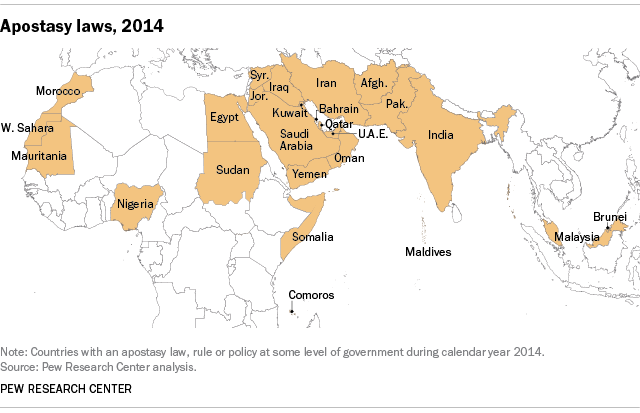
Of course, for most of them it would have been deeply hypocritical for them to have done so.  Here was the Pew Research graphic I used in the post the other day.

apostasy

These countries –  most or all of them members of the OIC –  have apostasy laws in place, making it an offence to leave Islam, let alone to embrace another faith.

Of them, this article from the (UK) Independent reports that

Thirteen countries, all of a Muslim majority, punish apostasy (the renunciation of a particular religion), or blasphemy with death.

The annual Freedom of Thought report by the International Humanist and Ethical Union, found that 13 countries impose capital punishment upon people simply for their beliefs, or lack of them.

Afghanistan, Iran, Malaysia, Maldives, Mauritania, Nigeria, Pakistan, Qatar, Saudi Arabia, Somalia, Sudan, United Arab Emirates and Yemen are the relevant countries.

Not that often enforced these days perhaps, but the law nonetheless.    All countries that will have been represented in this Organisation for Islamic Cooperation meeting, attended by Winston Peters and Jenny Salesa.

My concern here isn’t primarily with the OIC countries themselves.  Their governments –  very few democratic, few even allowing genuinely open political debate and scrutiny –  make their choices and New Zealand can’t change those.

My concern is with our own government.  I could suggest that they’ve been played by Erdogan and OIC, except that that might suggest they didn’t know what they were doing. I suspect they knew exactly what they were doing, and went ahead nonetheless.

We can be proud of our religious freedom and tolerance – hard-won –  and our government (Prime Minister, Foreign Minister on down) shouldn’t sully that good name by associating on such issues with a group of regimes that (mostly) have little or no regard for genuine religious freedom, and show no intention of granting it to their own people, or even to non-citizens living in their countries.

It is shameful, (presumably in some warped conception) opportunistic, and disrespectful of the values and practices of almost everyone who lives in this country.

People have been queuing up to laud the Prime Minister this week.  Some of it is probably due, much of it probably not, but on this significant foreign policy aspect of her government’s response she has allowed a pretty awful standard to prevail.


UPDATE: Not on the specific point of this post, but a chilling action by a government official nonetheless.  As people were pointing out, Mein Kampf is legal, the writings of Mao are legal (as they should be), but New Zealanders are now not supposed to see –  or cite – a document backgrounding perhaps the worst crime in New Zealand history.


Kudos to the Governor

I have been critical of the Reserve Bank Governor for not yet having given an on-the-record speech about either of his main functions, monetary policy or financial regulation/supervision.  Next week marks a year since he took up the job, and 1 April is the day he loses exclusive control of monetary policy to the new MPC, which he will nonetheless chair (and effectively control).

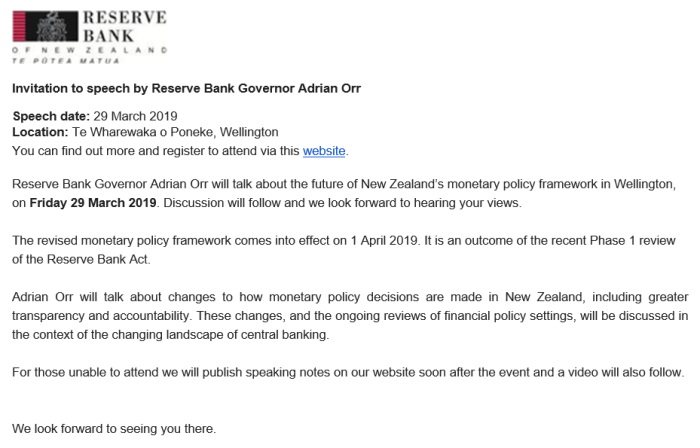
But this invitation just turned up.  It seems to be an open invitation, so anyone interested should feel free to sign up.  I’ll certainly be there and will no doubt write about what he has to say.

orr speech

It is also commendable that the invitation indicates that the Bank will be releasing video of the Governor’s speech (and any Q&A?)  This is a well overdue step forward –  especially as this Governor is quite open about freely departing substantially from his written texts –  and, if adopted consistently, will bring the Bank into line with how things have long been done at the Reserve Bank of Australia.

Presumably, by next Friday the Minister of Finance will finally have announced the other members of the new Monetary Policy Committee.

An unserious organisation, with serious consequences

I wasn’t planning to write anything more today, but then I got an email from the Reserve Bank.

You’ll be aware that almost three months ago the Reserve Bank released a consultative document, in which the Governor proposed to massively increase the amount of equity capital banks have to have just to keep on doing the business they are doing now.

As this was, apparently, the culmination of a multi-year review (in fact, the final numbers seem to have been very much a last-minute affair) you might have supposed that a serious central bank would have all its arguments straight and evidence (or at least sustained reasoning, engaging alternative perspectives) at hand in accessible form to support all their claims.  They’d probably have anticipated all the plausible area of disagreement or challenge, and had good responses readily to hand.

Whether they supposed, for some reason, that everyone would embrace their schemes with open arms and uncritical spirit, or what, actual experience has been anything but that.  When they finally responded to OIAs and released the background papers, it turned out that one of them had only been written several weeks after the consultation paper was released.  And in his speech a couple of weeks ago, the Deputy Governor was promising that they would soon publish an Analytical Note explaining their estimates of the likely impact on interest rates (which still hasn’t seen the light of day).

At the Monetary Policy Statement in February, there was a considerable attention on the proposed capital changes.  In fact, the Bank even proactively included a box in the text (page 35).   There were various claims, some numerical and some not.  These were a couple of examples

The Bank expects that the spread of banks’ lending rates to the rates at which they borrow will settle in the range of around 20 to 40 basis points higher as a result of the proposed changes, although the exact effect is uncertain.

Higher bank capital requirements could also improve the government’s fiscal position. A higher share of bank equity funding would likely increase tax revenue from the banking sector since debt funding is tax-deductible while equity funding is not.

There were lots of questions at the Governor’s press conference as well, including his claim (not made in the text) that the Bank’s proposed new capital ratios would be “well within the range of norms” seen in other countries.

That was all very interesting, but I wanted to know a bit more, and assumed they would simply have material to hand to support their claims.  It would, you’d have thought, have been in their interests to do so –  after all, they obviously believe in what they are proposing, and would presumably want to carry us with them, supported by robust evidence and analysis.  Or so you’d have thought.

And so I lodged a fairly simple Official Information Act request, for the material supporting those claims.   That was on 13 February.  This afternoon –  the day before the last date by when a response was due – I got this letter.

OIA barclay

In which they take to themselves a whole another 20 working days.    Not because whatever they have needs to be collated or compiled, but allegedly because of “ongoing consultations”.  One can only assume that is a shorthand for “there wasn’t much, if anything, there, but give us time and we’ll see what we can drum up”.

It is both so ludicrous and so telling that I’m not going to waste the time of the Ombudsman’s office complaining.  I’ll just let it stand –  a powerful public figure makes claims in support of a far-reaching proposal on which he is prosecutor, judge, and jury –  and can’t, or won’t, produce any evidence or analysis to support his specific claims.   Sadly, it isn’t the first time.

If you want sceptical analysis and argument:

  • Ian Harrison’s substantive document, “The 30 billion dollar whim” is here, and
  • my succession of posts on unanswered questions and unconvincing analysis are here.

As for the Governor, he seems to have time to play tree gods, and for spending other people’s money on Maori cultural advice (recall, that this was going to improve the quality of monetary policy and financial regulatory policy decisions), just not for the serious stuff.

The Bank is at growing risk of becoming a profoundly unserious organisation, but one whose whims have serious consequences for the rest of us.

It isn’t good enough.  The Bank’s board is charged with protecting us from Governors not doing their job properly. It is about time they took some responsibility.

Pondering localism

I’m spending much of the day at Local Government New Zealand’s Localism Symposium

When it comes to centralisation, New Zealand is an outlier amongst developed countries, with decision making heavily concentrated in central government politicians and officials. For every tax dollar spent by local authorities, Wellington spends $7.30.

This is not a record to be proud of. Comparisons with OECD countries show that productivity per capita and decentralised decision making are correlated, and on both measures New Zealand ranks back of the developed world pack. More practically, New Zealand’s diverse communities have long outgrown one-size-fits-all policy making, and there is a growing acceptance that we need to devolve and decentralise decision making to celebrate and leverage our differences.

The challenge is how do we do it?

Local Government New Zealand and The New Zealand Initiative have joined up to develop a policy roadmap on just how to devolve and deconcentrate power through our Localism Project.

On 28 February 2019, LGNZ and the Initiative will present the first cut of this work at the Localism Symposium. We invite interested parties to come and critique our work in a workshop session in Wellington to help develop a robust framework through which communities can have their decision making powers restored, and share insights into public perceptions of localism and local government.

Count me sceptical.  I’m unpersuaded the local authorities should get more power.  Given the choice between the New Zealand government –  of whatever stripe –  and Wellington City Council, I’ll take the former any day.  Not only are they generally more competent (and regular readers will know I’m no fan of any recent government) but it is a great deal easier to monitor them and hold them to account.   Then again, perhaps I’m just a died-in-the-wool central government bureaucrat (“you can take the boy out of the bureaucracy, but not the bureaucracy out of the boy”).   But what could one reasonably expect of the council of one of my old haunts, Kawerau (population <7000)?

And I’m more than a little sceptical about whether there is any meaning in that reported correlation: after all, the United States has plenty of fiscal decentralisation, but New Zealand is about the same size (population) as the median US state.

The New Zealand Initiative has been championing varieties of decentralisation models for some time.    I wrote, sceptically, here about one of their earlier reports.   As I noted, among various other points

I’m a South Islander by birth and inclination, and if someone proposed a genuine federal model for New Zealand –  South Island, lower North Island, and Upper North Island –  I’d probably be emotionally sympathetic to it.  But even then I’d refer supporters to the Australian experience, and wonder just how much genuine decentralisation would occur and for how long. 

Australia struggles to maintain effective federalism.

In the material they’ve sent out for the workshop today, there are some interesting ideas I could probably support and even champion.  For the rest, I guess I’ll be a voice of critique…..and open to being persuaded that more of the case is persuasive than I think now.  I suspect a really compelling case for decentralisation relies either on geography, strong and settled regional identity, or history.  We are a small country, fairly recently settled, and there will be few people for whom (say) the sense of being a Taranaki-ite is at least as important as being a New Zealander (unlike, say, the situation in Scotland or Texas).    To that point, US state boundaries haven’t changed in a very very long time, while two of the four local government areas I lived in while growing up simply don’t exist any more – abolished at the stroke of a ministerial pen.

Had we kept the provincial government system  –  avoided the Vogel money grab –  perhaps we’d now have a similarly long tradition of decentralised government. In days of easy travel and easier technology it is hard to create a stable and enduring constituency –  other than local government politicians and officials –  for trying to create it de novo.   And –  although we can’t run the experiment –  I’d bet against it having made much difference to things that ail us, like house prices or productivity.

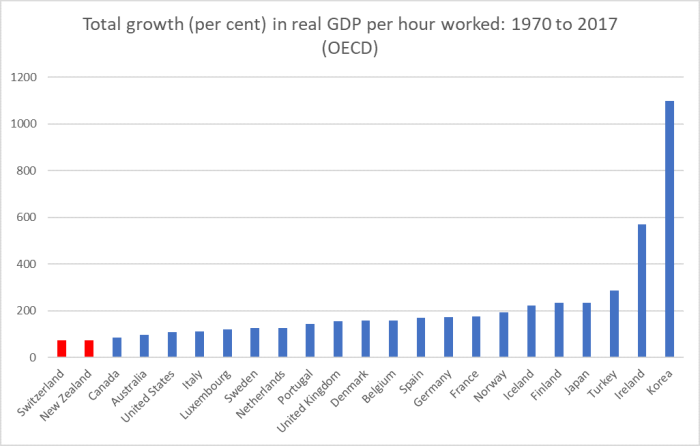
I did notice however that the New Zealand Initiative’s enthusiasm for Switzerland –  which really does have lots of decentralisation –  carries over into the material.  The Initiative has long been keen on singing the praises of Switzerland, which is much richer than we are.  But, as a reminder to people, here are the productivity growth performances of the OECD countries since 1970 (when the OECD databases start).  This is total growth in real GDP per hour worked from 1970 to 2017.

Switz

Bad as New Zealand’s productivity growth performance has been over this period, Switzerland is still the only OECD country to have had (slightly) less productivity growth.    And it isn’t just the early part of the period: for the period since 2000 you need to go to two decimal places to separate the (lower quartile) productivity growth rates of the two countries.

Switzerland is rich, and pleasant in many respects.  But relative to the rest of the OECD it used to be much richer.  Appealing as the Swiss decentralisation seems in some ways –  and much of that reflects deeply rooted histories of separate distinct communities, including linguistic and religious differences –  it isn’t obvious why it offers some path to better productivity growth in New Zealand.

Fixing the housing mess is also claimed as one of the possibilities of the sort of reforms LGNZ and the New Zealand Initiative are suggesting.  Did I ever mention –  why, yes I think I did – that Switzerland not only has very high house prices, very high levels of household debt, and very low levels of home ownership?    Not outcomes to envy.   They aren’t (I presume) because of decentralisation, but they’ve happened despite it.


The apostle of the tree god

There wasn’t going to be a post today but then someone sent me the link to a super-soft interview the Herald’s Liam Dann had done with Reserve Bank Governor Adrian Orr.   Had the Bank’s own PR consultants been scripting the interview it would scarcely have been softer (in fact, they might have advised a couple of serious questions to give the resulting interview a bit of credibility).

Orr will by next week have been in office for 11 months, wielding vast amounts of policymaking power singlehandedly, and yet we’ve still not had a single speech on either of his main areas of responsibility; monetary policy, and the regulation of much of the financial system.  But there is still time to play the tree god line (that’s the Herald headline: “Orr embraces the forest god”).

I’ve written about this silliness before.  Extracts

The latest example was the release on Monday of a rather curious 36 page document called The Journey of Te Putea Matua: our Tane Mahuta.   Te Putea Matua is the Maori name the Reserve Bank of New Zealand has taken upon itself (such being the way these days with public sector agencies).  It isn’t clear who “our” is in this context, although it seems the Governor  – himself with no apparent Maori ancestry – wants us New Zealanders to identify with some Maori tree god that –  data suggest –  no one believes in, and to think of the Reserve Bank as akin to a localised tree god.  Frankly, it seems weird.  These days, most New Zealanders don’t claim allegiance to any deity, but of those of us who do most –  Christian, Muslim, or Jewish, of European, Maori or any other ancestry – choose to worship a God with rather more all-encompassing claims.

But the Governor seems dead keen on championing Maori belief systems from centuries past.    In an official document of our central bank we read

A core pillar of the evolving Māori belief system is a tale of the earth mother (Papatūānuku) and the sky father (Ranginui) who needed separating to allow the
sun to shine in. Tāne Mahuta – the god of the forest and birds – managed this task after some false starts and help from his family. The sunlight allowed life to flourish in Tāne Mahuta’s garden.

This quote appears twice in the document.

All very interesting perhaps in some cultural studies course, but what does it have to do with macroeconomic management or financial stability?  Well, according to the Governor (in a radio interview on this yesterday) before there was a Reserve Bank “darkness was on our economy”.  The Reserve Bank was the god of the forest, and let the sun shine in.  Perhaps it is just my own culture, but the imagery that sprang to mind was that of people who walked in darkness having seen a great light.   But imagine the uproar if a Governor had been using Judeo-Christian imagery in an official publication.

On the same page we read

Many of these birds feature on the NZ dollar money including the kereru, kaka, and kiwi – core to our belief system and survival.

I’m a bit lost again as to who “our” is here.  I’m pretty sure I’m like most New Zealanders; I never saw a bird as “core” to my “belief system”.  Perhaps the Governor does, although if so we might worry about the quality of his judgements in other areas.

As I say, it is an odd document.  There are pages and pages that have nothing whatever to do with monetary policy or the financial system.  Some of it is even quite interesting, but why are we spending scarce taxpayers’ money recounting stories of New Zealand general history?  …. There is questionable history,….highly questionable and tendentious economic history, and overall a tone (perhaps comforting to today’s liberal political elite) that seems embarrassed by the European settlement of New Zealand.     There is lots on the difficulties and injustices that some Maori faced, and little or nothing on the advantages that western institutions and society brought.  Reasonable people might debate that balance, but it isn’t clear what the central bank –  paid to do monetary policy and financial stability –  is doing weighing in on the matter.

As I noted earlier, in a radio interview yesterday the Governor claimed that prior to the creation of the Reserve Bank ‘darkness was on our economy’, that the Reserve Bank had let the sunshine in, and that Australia and the UK had somehow turned their backs on us at the point the Bank was created.   In fact, here it is – Reserve Bank as tree god –  in the document itself.

The Reserve Bank became the Tāne Mahuta of New Zealand’s financial system, allowing the sun to shine in on the economy.

I think there was a plausible case for the creation of a central bank here, but to listen to or read the Governor you’d have no idea that New Zealand without a Reserve Bank had been among the handful of most prosperous countries in the world.  Here from the publication, writing about the period before the Reserve Bank was created

The infrastructure funding was further hindered by the banks being foreign-owned (British and Australian) and issuing private currency. Credit growth in New Zealand was driven by the economic performance of these foreign economies, unrelated
to the demands of New Zealand. Subsequent recessions in Britain and Australia slowed lending in New Zealand when it was most needed.

Very little of this stands much scrutiny.  You’d have no idea from reading that material that the New Zealand government had made heavy and persistent use of international capital markets, such that by 1929 it –  like its Australian peers –  had among the very highest public debt to GDP ratios (and NIIP ratios) ever recorded in an advanced country.  You’d have no idea that New Zealand was among the most prosperous countries around (like Australia and the United States, neither of which had had central banks in the decades prior to World War One).   You’d have no idea that the economic fortunes of New Zealand, trading heavily with the UK, might reasonably be expected to be affected by the economic fortunes of the UK –  terms of trade and all that.   Or that economic cycles in New Zealand and Australia were naturally quite highly correlated (common shocks and all that).  And of course –  with all the Governor’s talk about how we could “print our own money” – within five years of the creation of the Reserve Bank, itself after recovery from the Great Depression was well underway, that we’d not unrelatedly run into a foreign exchange crisis that led to the imposition of highly inefficient controls that plagued us (administered by the evil twin of the tree god?) for decades.  Or even that persistent inflation dates from the creation of the Reserve Bank

One can’t cover everything in a glossy pamphlet, even one that seems to purport to be aimed at adults (including Reserve Bank staff according to the Governor), but there isn’t much excuse for this sort of misleading and one-dimensional argumentation, aka propaganda.

The propaganda face of the document becomes clearer in the second half.   Among the issues the government’s review of the Reserve Bank Act is looking at is whether the prudential and regulatory functions of the Bank should be split out into a new standalone agency, a New Zealand Prudential Regulatory Authority.  …. There are arguments to be made on both sides of the issue, but you wouldn’t know it from reading about the Governor’s vision of the Bank as a Maori tree god, where one and indivisible seems to be the watchword.      Everything is about “synergies”, and nothing about weaknesses or risks, nothing about how other countries do things, nothing about the full range of criteria one might want to consider in devising, and holding to account,  regulatory institutions for New Zealand.

I don’t have any problem with officials, including from affected agencies, offering careful balanced and rigorous advice on the pros and cons of structural separation. But that is a choice ultimately for ministers and for Parliament.  And among the relevant considerations are issues of accountability and governance.  Neither word appears in Governor’s propaganda piece.   But then tree gods probably aren’t known for accountability.  New Zealand government regulatory institutions should be.   If ministers and Parliament decide to opt for structural separation, I wonder how the Governor will revise his document –  his tree god having been split in two.

Among the tree god’s claims about financial regulation and what the Bank brings to bear was this breathtaking assertion, prominently displayed at the head of a page (p27).

The Reserve Bank is highly incentivised to ‘get it right’ when it comes to prudential regulation. We have a lot at risk

It is an extraordinary claim, that could be made only be someone wilfully blind –  or choosing to ignore –  decades of serious analysis of government failure, and the institutional incentives that face regulators, regulatory agencies, and their masters.

There is nothing on the rest of that page to back the tree god’s claim.   On any reasonable and hardheaded analysis, the Reserve Bank has very weak incentives to “get it right”, or even to know –  and be able to tell us –  what “get it right” might mean.   When banks fail, neither the Reserve Bank Governor nor any of the tree god’s staff have any money at stake (at least in their professional capacity, and as I recall things, Reserve Bank staff – rightly –  aren’t allowed to own shares in banks).  It is all but impossible to get rid of a Reserve Bank Governor, and it is even harder to get rid of staff (for bad policy or bad supervision).  Most senior figures in central bank and regulatory agencies of countries that ran into financial crises 10 years ago, stayed on or in time moved on to comfortable, honoured (a peerage in Mervyn King’s case) retirements, or better-remunerated positions in the private sector.

And when the Reserve Bank uses its powers in ways that reduce the efficiency of the financial system, or stopping willing borrowers and willing lenders writing mortgage contracts, where are incentives on the Reserve Bank to “get things right”.  There are no personal consequences –  the Governor and his senior staff either won’t have, or would have no problem getting, mortgages.  The previous Governor got to exercise the bee in his bonnet about housing crises, and to play politics, with no supporting analysis and no effective accountability.    The current head of the tree god opines that lenders and borrowers can’t be trusted –  but tree gods apparently can –  but when challenged produced no analysis to support his claim.  That sort of system creates incentives for sure, but they aren’t to “get it right”.

End of extracts.  2019 here again.

The Governor was at it again in the interview, including running his bizarre version of economic history in which “sunshine” was let in upon the New Zealand economy in 1934  (there was also the surprising claim that the banks had chosen to graft themselves into the Reserve Bank, apparently oblivious to the fact that the main banks have been around New Zealand a lot longer than the Reserve Bank).

The Governor claims his metaphor is wildly popular –  except among “two bloggers” apparently (although I could give him a rather longer list of sceptics) –  and I’m sure it is in some quarters. It probably sounds cool, accessible, relevant and so on. But metaphors can be used for good and for ill, and the Governor attempting to have us all think of the Bank as akin to a tree god doesn’t serve the public interest well at all, even if it happens to suit his personal campaigns.

There were plenty more questionable claims made by the Governor is the course of the interview.  Some of them literally invite questions –  they might be true, or they might not, we just don’t know.  For example, the Governor claims that his proposed new capital requirements will be “in the pack” by international standards, but they’ve not yet shown any evidence to support this claim (especially once one takes account of their irrational distaste for cheaper Tier 2 capital, and for the high minimum overall risk weights they are planning to impose).  It should be a simple matter to put the evidence and analysis out there for scrutiny, but instead apparently we are simply supposed to trust this apostle of the tree god.

Then there was the claim –  made in the consulative document but not supported with one shred of serious analysis or evidence –  that the Bank’s proposed capital requirements will make the economy not only safer but also more efficient.  I’ve shown this chart previously

something for all

In today’s interview he explicitly asserted that New Zealand –  and all other advanced economies –  are to the “south-west” of that green dot.     Perhaps he’s right, but you’d think there would be some support offered for these “free lunch” claims.  It isn’t in the consultative document, it wasn’t in the Governor’s interview.  Perhaps  (at last) it will be in the Deputy Governor’s speech next week?

The interview ended with a super-soft invitation to the Governor to campaign for more taxpayer’s money, more staff, and more financial resources.   Perhaps there is a case for more  (actually I suspect there is).   But the idea that we should put more of our scarce money in his hands isn’t as persuasive as it should be when we get repeated doses of this tree god silliness, attempts at playing politics, repeated bold claims that just aren’t supported (complete with assertions that people who disagree him haven’t read his documents –  the problem is, they have), diversions onto all manner of things that just aren’t his responsibility, and a lack of serious –  as opposed to superficial –  transparency and accountability.

UPDATE: The interview and accompanying article might have been incredibly soft, but in many respects the sub-editors of the hard-copy Herald say it all with their headline on the front page of Saturday’s business section: “How Maori myth is guiding the Reserve Bank”.    Were it so –  and even I don’t think it really is –  it would explain a lot about the policy and comms mis-steps……

And as a commenter overnight observed

It shows how bad things have gotten in New Zealand – not so much that he makes these examples but because no one else even thinks to challenge it. Imagine the reaction if the Bundesbank president started discussing policy in terms of Odin and Thor…. he’d get locked up…


Unfit to govern

I’m probably the sort of person the National Party used to count on voting for them.   National was the only party I was ever a member of, the only party I ever canvassed for. There were family connections, and there were the founding principles, every one of which I identified with (and do still).   Even in Wellington, middle-aged conservatives might reasonably have been assumed to support National, even if (at times) through gritted teeth.  One of those founding principles talked, perhaps slightly quaintly, of “countering Communism”, and it seemed to be something taken fairly seriously throughout the post-war decades.  There was a suggestion of some values; a suggestion of things that mattered beyond just the next business deal.  Friends and allies, people and countries with whom we shared those values, seemed to count too.

But over the last couple of decades, New Zealand political figures, and the National Party ones in particular, seem to have binned any sense of decency, integrity, or values when it comes to Chinese Communist Party ruled China. I don’t suppose that individually most of them have much sympathy for PRC policies and practices, but they just show no sign of caring any longer.  Deals, donations, and indifference seem to be the order of the day.

Over the last couple of years the depths the party, its leaders and MPs, have been plumbing have become more visible.  In 2017, in government, they signed up to a Memorandum of Understanding with the PRC on the Belt and Road Initiative.  In that document they –  Simon Bridges as signatory –  committed to “promote” the “fusion of civilisations”.      Plenty of people will probably dismiss such statements as “meaningless”, the stuff of official communiques.  But decent people –  under no duress whatever –  don’t sign up to things suggesting that today’s equivalent of Nazi-ruled Germany is a normal and decent regime.  Of course, they would probably dispute the parallel, but that’s just willed deliberate blindness.

Later that same year we learned that the National Party had had a former PLA intelligence officer, Communist Party member, sitting in their parliamentary caucus.  It seems to be generally accepted that Jian Yang, of such a questionable background, is one of the party’s largest fundraisers.   Presumably the leaders (Key and Goodfellow) were aware of his past, but lets be generous and assume that most of the caucus was as unaware as the public.    But for the past 18 months, everyone has known.    They also know –  because Jian Yang acknowledged as much –  that he deliberately misrepresented his past to get into New Zealand, telling us that Beijing had told him (and others in his position) to do so.   Breathtakingly, there is no sign that official agencies in New Zealand have done anything about those admissions, but National is now out of office so I guess one can’t blame them for that.

But what the National Party –  leader, president, MPs, and all those holding office in the party –  is responsible for is the fact that Jian Yang still sits in Parliament, still sits in the National caucus, is still a National spokesman (on a couple of minor portfolios), with the express support of successive leaders, and (apparently) in ongoing business relationships with the party president (he who trots of to Beijing to praise the regime and its leader).   And not one MP, not one national councillor, no other officeholder –  not one –  has broken ranks, and been willing to openly question (or deplore) just what has gone on.  Doing so might, I suppose, jeopardise their individual futures.  But values are the things you are willing to risk for, to pay some price for.    Rumour hath it that some people within the party aren’t entirely comfortable, but so what, if you aren’t willing to do, or say, anything?

A few months ago we had the egregious former Minister of Trade, and foreign affairs spokesperson, Todd McClay plumbing new depths.    In an interview with Stuff, he championed the PRC regime interpretation of the mass internment of Uighurs in Xinjiang, noting that

“the existence and purpose of vocational training centres is a domestic matter for the Chinese Government.”

If he’d just kept quiet at least there might have been some doubt about his decency, but he opened his mouth and left no doubt.  He was spinning for the CCP regime in Beijing.

Since then even the regime in Beijing has more or less admitted that, of course, that line isn’t true.  But we’ve heard nothing more –  and certainly no apology –  from Mr McClay or his leaders.

And, of course, every so often the National Party leader Simon Bridges pops up if there is ever the slightest sign that anyone in the current government is expressing even the mildest reservations about the regime in Beijing.  Never mind that the Defence strategy document stated no more (considerably less) than was obvious to blind Freddy, it was too much for Mr Bridges.  Never mind that reservations about Huawei seem to be increasingly widely shared by governments and intelligence agencies across the western world, it might lead to furrowed brows and discontent in Beijing, and we couldn’t have that could we?   Never mind too that, in government and in practice it is hard to conceive that things would have been any different on that particular score under National –  I don’t suppose even National is quite so far gone in Beijing’s thrall that they would simply walk away from Australia, the United States, a growing number of other western countries, and what appears to be assessments of our own intelligence services.    No sense at all in anything Bridges –  or any other National Party figure – says that the PRC itself has changed: bad as the regime always was, it has now become worse.

But it was comments the other day from National’s third-ranked member and finance spokesperson, Amy Adams, that really left me open-mouthed in astonishment.  Both at what she said –  even if it wasn’t far from what had seemed to be the National stance in practice –  but also at the lack of any other coverage of, or follow-up to, those remarks.    In an interview with NBR, (behind a paywall but here) we are told

National’s finance spokeswoman Amy Adams has accused the government of putting the economy at risk by offending China.

“The first thing is you don’t p[…] off your major trading partner and, let’s be really clear about this, China is our single biggest trading partner.”

Quite extraordinary.

One could clear the small things out the way first. For example, governments don’t trade with China, firms in New Zealand trade with firms in the PRC.  Sure, governments set some of the terms on which that trade occurs, but government isn’t a business.

One might also note that if the PRC is the largest “trading partner” for New Zealand firms, it is very similar in size to Australia in terms of total New Zealand trade.  Until about five years ago, the EU in total accounted for more of New Zealand’s trade than the PRC.  Australia remains by far the largest source of foreign investment in New Zealand.     And these days exports to each of our largest “trading partners” –  in an economy (New Zealand) that doesn’t trade much with the rest of world by international standards – account for about 5 per cent of  GDP, in total.  For many decades, a much larger proportion of our GDP was accounted for by trade with the UK.

Oh, and a large proportion of New Zealand exports (not all of course) are commodities, and if not sold in one market they will be sold in some other part of the global market.   PRC babies seem unlikely to stop drinking infant formula.

But what really staggered me was the bald sense in which National’s finance spokesperson appears to think that the interests and priorities of foreign governments are what should matter most to our government. Not our values, not our people.  On her telling, we’d never annoy Australia about anything (apple import cases to the WTO, illegal migrants/asylum-seekers on Nauru, New Zealand citizens being deported from Australia).    We’d never have taken on France over nuclear-testing (at a time when the UK was entering the EU, and trade access to our largest market was substantially in danger).  We’d never have fought for Imperial Preference for our exports to the UK in the 1930s.  We’d never have banned nuclear ships (the US wasn’t our largest trading partner, but the US and EU together were hugely important markets, and we relied on the UK government (Thatcher) to fight our corner for EU market access).  The then Australia government wasn’t best-pleased with that New Zealand policy choice either.   And more generally –  and much more dominant – Canada would never ever stand for itself on anything that involved the United States, or Ireland vis-a-vis the UK.  I suspect Denmark and the Netherlands had had significant trade ties to Germany pre-1940, but they didn’t exactly put out the welcome mat to Hitler.  Southern African countries chose to limit trade with Rhodesia, and confront South Africa, because they considered they had a just cause.  And so on.    (Note that I’m not endorsing all these causes, just noting the willingness of governments to upset their closest “trading partner”.)

Of course, this almost certainly isn’t what Ms Adams believes at all.   Presumably as a senior minister she had no problem at all with the fact that at times we had, and have, open differences with Australia.  In any relationship, no matter how important, there are going to be differences from time to time, and in international relations governments (at least democratic ones) aren’t supposed to act for themselves, or even for small favoured groups, but for the citizenry as a whole.

Instead, the Adams approach –  presumably endorsed by her leader –  is about a particular thuggish regime. It seems to be that we should defer entirely to Beijing’s prickly style and never ever do or say anything that might upset them, never display any self-respect, and simply engage in either anticipatory compliance or abject penitent submission.  Worse, apparently we should even make excuses for them –  or retail their propaganda lines, as per Todd McClay.  It is classic domestic abuse situation, and yet championed by someone who aspires to be a senior minister of a free country, perhaps even aspires to be the Prime Minister.   In fact, someone who was the Minister of Justice, who led legislative attempts to respond to the family violence problems.  I’m quite sure it wasn’t her advice to victims –  “oh, don’t upset him…ever”.    So why does she propose that our foreign policy towards the international abuser par excellence be essentially just that?  Act that way and all you do is encourage the abuser, and lock yourself further into the cycle of abuse, humiliation and loss of any sort of self-respect.

Of course, the difference here is that Adams ask us (citizens) to bear the abuse and humiliation –  leaders who remain silent in the face of evil, leaders who won’t stand up for the integrity of the system, and even spend our money to run PR-front organisations to champion the pro-Beijing perspective –  all to benefit a few specific businesses that have (consciously and knowingly) over-exposed themselves to a thuggish regime, and the substantial flow of donations to their own political parties.    Politicians like Adams simply encourage the over-exposure, and encourage the false subservience of victimhood.   If our businesses were dealing with organised crime, or with shonky people who didn’t pay their bills, we’d either insist or encourage them to cut their exposures.  If you deal with the Mafia you are on your own –  in fact, society will shun you, not tolerate you asking for us to pander to the leaders.  But when it is the PRC –  organised coercive threat if ever there was such –  our leaders simply want us to defer, and complain when their opponents show any sign of not being quite deferential enough to the bully.  And they simply let evil pass by, and in so doing make themselves complicit with –  and thus partly responsible themselves –  for the evil.

In his Beijing-deferential interview on the Herald website the other day, David Mahon tried to frame the current PRC upset with New Zealand as “the Chinese see it as akin to infidelity”.    What a sickening image, but perhaps one that brings us right around to the abused-spouse parallel.  New Zealanders made no vows to Beijing – although perhaps our craven political leaders did –  but when the merest squeaks are heard, the abuser – freshly drunk on newfound power – seems to feel free to attempt to squash and silence, while politicians, lobby groups and business interests cheer on not the abused “spouse” but the abuser.   New Zealand “leaders ” have been among the most sycophantic and compliant anywhere in the western world, so perhaps there is a sense that they can’t afford to let us get away with some renewed self-respect.  That, after all, might encourage others to think and act for themselves, for the values of their peoples.   Better to foster the illusion –  assisted by local politicians and academics –  that the PRC holds our prosperity in its hand.

It simply doesn’t. It never did.

But that’s New Zealand politics, that seems to be today’s National Party. It is sickening.


“This country has prospered over the past decade, while other economies have suffered”

Or not.

The title to this post was taken from the latest column from veteran political journalist Barry Soper.  Apparently he had had some readers get in touch, not entirely convinced by his PRC-related articles earlier in the week.

They all ignore the fact that this country has prospered over the past decade, while other economies have suffered.

The Key Government’s management of the global financial crisis has been lauded but without the free trade agreement, signed in the Chinese capital as the final act of the Clark Government, this country wouldn’t be where it is today.

The puerile keyboard warriors’ bile is too vile to repeat but it seems to be based on envy, that the Chinese, after generations of deprivation, have shown the world they can compete and are a force to be reckoned with.

I’m not sure quite what he bases these assertions on (although it is the sort of line that less well-grounded champions of Beijing, including former Foreign Minister, Murray McCully, have repeatedly tried to run).  “Be grateful, peasants” seems to be the tone, for the CCP in Beijing has graciously bestowed its bounty upon you.

I don’t want to waste much time on the alleged PRC success story.    When you do so much damage to yourself, and then stop the self-destruction, of course you’ve got plenty of ground to make-up, and with half-decent policies you can do some of that quite quickly.   Here are the latest Conference Board productivity estimates.

China GDP phw feb 19

The PRC……not even half the levels of Korea or (decades of underperformance) New Zealand, not a third of Taiwan or a quarter of Singapore.     Who could possibly envy that sort of performance?  There was no obvious reason why China could not have matched the performance of Korea, Japan, or Taiwan.  Except that they chose to adopt, and continue to run, a system that consistently produces poor economic results.

But what I was really interested in was the assertion that New Zealand has had a really good economic performance over the last decade “while other economies have suffered”.  I guess if Greece, or even Italy, is your benchmark it isn’t too far wrong.  But then almost everyone does better than those troubled euro-crippled economies.

One comparison I like, and which I’ve run before, is between New Zealand and the United States.   Were there anything to the “we owe such a debt to Beijing, and have done so well ourselves” story, an obvious place to look might be a comparison with the United States.  After all, the US was the epicentre of the financial crisis itself, their central bank got to the limits of what it could do, and no one thinks Beijing someone “saved” the US.   And yet here is how real GDP per capita compares across the two countries since late 2007, when the last recession began.

US and NZ comparison GDP

We’ve mostly done very slightly better than the US over the decade or so, but there really isn’t much in it.   Certainly not a case of the US suffering and us “prospering”, whether thanks to Beijing or any other cause.

And to the extent we’ve done a touch better, it certainly isn’t reflecting stronger productivity growth.  The data are indexed to 100 in 2007.

US nz productivity

It isn’t just an us versus the US comparison either.  Over that decade, real GDP per hour worked rose by 4.4 per cent, but in the median OECD country productivity growth was 8.9 per cent.

And if Beijing and the (so-called) free trade agreement were the source of any special New Zealand prosperity, exports might be an obvious place to look.  Except that over the previous decade New Zealand exports actually fell a little as a share of GDP.  In the United States, and in all but a handful of other OECD countries, exports became a larger share of the economy.

Even on more purely cyclical measures, New Zealand still doesn’t stand out (at least on the good side).  The unemployment, for example, has come down a long way, but it is still quite a bit above the lows reached before the recession (at a time when demographics will be tending to lower the “natural” rate of unemployment).    In the United States, by contrast, the unemployment rate is below pre-recession levels. That is also true across the G7 as a whole, the EU as a whole, and the OECD as a whole (individual bad euro-area countries notwithstanding).

And if you don’t like the idea of comparing against the US –  even though it was the centre of crisis, and doesn’t owe anything in particular to Beijing –  here is how we’ve done against another group of countries, each now with productivity levels similar to those in New Zealand (and few doing much trade with the PRC).   Since all these countries started (in 2007) with productivity well behind global frontiers, all should have been able to do okay even if productivity growth at the frontier (eg US and northwest Europe) slowed.

small countries

Many did pretty well.  As for us – Beijing (alleged) beneficence notwithstanding –  either worst or second worst depending on your preferred measure.

As I noted earlier on, there are countries that have done a great deal worse than us.   But the suggestion that we have “prospered” over the last decade –  in some way materially outstripping the rest of the advanced world –  isn’t just a myth. It is worse than that.   And the people who run the story, whether as senior journalists or senior politicians should know better.

Countries mostly make their own prosperity.  We once did –  those decades when we really did lead the world.    We could again, although that might involve facing facts.  But these days politicians and their acolytes in the media seem more interested in playing distraction; in this case continuing to corrupt our system, supported by motivated fantasy stories about our (alleged) success and our (alleged) debt to Beijing.