Unfit to govern

I’m probably the sort of person the National Party used to count on voting for them.   National was the only party I was ever a member of, the only party I ever canvassed for. There were family connections, and there were the founding principles, every one of which I identified with (and do still).   Even in Wellington, middle-aged conservatives might reasonably have been assumed to support National, even if (at times) through gritted teeth.  One of those founding principles talked, perhaps slightly quaintly, of “countering Communism”, and it seemed to be something taken fairly seriously throughout the post-war decades.  There was a suggestion of some values; a suggestion of things that mattered beyond just the next business deal.  Friends and allies, people and countries with whom we shared those values, seemed to count too.

But over the last couple of decades, New Zealand political figures, and the National Party ones in particular, seem to have binned any sense of decency, integrity, or values when it comes to Chinese Communist Party ruled China. I don’t suppose that individually most of them have much sympathy for PRC policies and practices, but they just show no sign of caring any longer.  Deals, donations, and indifference seem to be the order of the day.

Over the last couple of years the depths the party, its leaders and MPs, have been plumbing have become more visible.  In 2017, in government, they signed up to a Memorandum of Understanding with the PRC on the Belt and Road Initiative.  In that document they –  Simon Bridges as signatory –  committed to “promote” the “fusion of civilisations”.      Plenty of people will probably dismiss such statements as “meaningless”, the stuff of official communiques.  But decent people –  under no duress whatever –  don’t sign up to things suggesting that today’s equivalent of Nazi-ruled Germany is a normal and decent regime.  Of course, they would probably dispute the parallel, but that’s just willed deliberate blindness.

Later that same year we learned that the National Party had had a former PLA intelligence officer, Communist Party member, sitting in their parliamentary caucus.  It seems to be generally accepted that Jian Yang, of such a questionable background, is one of the party’s largest fundraisers.   Presumably the leaders (Key and Goodfellow) were aware of his past, but lets be generous and assume that most of the caucus was as unaware as the public.    But for the past 18 months, everyone has known.    They also know –  because Jian Yang acknowledged as much –  that he deliberately misrepresented his past to get into New Zealand, telling us that Beijing had told him (and others in his position) to do so.   Breathtakingly, there is no sign that official agencies in New Zealand have done anything about those admissions, but National is now out of office so I guess one can’t blame them for that.

But what the National Party –  leader, president, MPs, and all those holding office in the party –  is responsible for is the fact that Jian Yang still sits in Parliament, still sits in the National caucus, is still a National spokesman (on a couple of minor portfolios), with the express support of successive leaders, and (apparently) in ongoing business relationships with the party president (he who trots of to Beijing to praise the regime and its leader).   And not one MP, not one national councillor, no other officeholder –  not one –  has broken ranks, and been willing to openly question (or deplore) just what has gone on.  Doing so might, I suppose, jeopardise their individual futures.  But values are the things you are willing to risk for, to pay some price for.    Rumour hath it that some people within the party aren’t entirely comfortable, but so what, if you aren’t willing to do, or say, anything?

A few months ago we had the egregious former Minister of Trade, and foreign affairs spokesperson, Todd McClay plumbing new depths.    In an interview with Stuff, he championed the PRC regime interpretation of the mass internment of Uighurs in Xinjiang, noting that

“the existence and purpose of vocational training centres is a domestic matter for the Chinese Government.”

If he’d just kept quiet at least there might have been some doubt about his decency, but he opened his mouth and left no doubt.  He was spinning for the CCP regime in Beijing.

Since then even the regime in Beijing has more or less admitted that, of course, that line isn’t true.  But we’ve heard nothing more –  and certainly no apology –  from Mr McClay or his leaders.

And, of course, every so often the National Party leader Simon Bridges pops up if there is ever the slightest sign that anyone in the current government is expressing even the mildest reservations about the regime in Beijing.  Never mind that the Defence strategy document stated no more (considerably less) than was obvious to blind Freddy, it was too much for Mr Bridges.  Never mind that reservations about Huawei seem to be increasingly widely shared by governments and intelligence agencies across the western world, it might lead to furrowed brows and discontent in Beijing, and we couldn’t have that could we?   Never mind too that, in government and in practice it is hard to conceive that things would have been any different on that particular score under National –  I don’t suppose even National is quite so far gone in Beijing’s thrall that they would simply walk away from Australia, the United States, a growing number of other western countries, and what appears to be assessments of our own intelligence services.    No sense at all in anything Bridges –  or any other National Party figure – says that the PRC itself has changed: bad as the regime always was, it has now become worse.

But it was comments the other day from National’s third-ranked member and finance spokesperson, Amy Adams, that really left me open-mouthed in astonishment.  Both at what she said –  even if it wasn’t far from what had seemed to be the National stance in practice –  but also at the lack of any other coverage of, or follow-up to, those remarks.    In an interview with NBR, (behind a paywall but here) we are told

National’s finance spokeswoman Amy Adams has accused the government of putting the economy at risk by offending China.

“The first thing is you don’t p[…] off your major trading partner and, let’s be really clear about this, China is our single biggest trading partner.”

Quite extraordinary.

One could clear the small things out the way first. For example, governments don’t trade with China, firms in New Zealand trade with firms in the PRC.  Sure, governments set some of the terms on which that trade occurs, but government isn’t a business.

One might also note that if the PRC is the largest “trading partner” for New Zealand firms, it is very similar in size to Australia in terms of total New Zealand trade.  Until about five years ago, the EU in total accounted for more of New Zealand’s trade than the PRC.  Australia remains by far the largest source of foreign investment in New Zealand.     And these days exports to each of our largest “trading partners” –  in an economy (New Zealand) that doesn’t trade much with the rest of world by international standards – account for about 5 per cent of  GDP, in total.  For many decades, a much larger proportion of our GDP was accounted for by trade with the UK.

Oh, and a large proportion of New Zealand exports (not all of course) are commodities, and if not sold in one market they will be sold in some other part of the global market.   PRC babies seem unlikely to stop drinking infant formula.

But what really staggered me was the bald sense in which National’s finance spokesperson appears to think that the interests and priorities of foreign governments are what should matter most to our government. Not our values, not our people.  On her telling, we’d never annoy Australia about anything (apple import cases to the WTO, illegal migrants/asylum-seekers on Nauru, New Zealand citizens being deported from Australia).    We’d never have taken on France over nuclear-testing (at a time when the UK was entering the EU, and trade access to our largest market was substantially in danger).  We’d never have fought for Imperial Preference for our exports to the UK in the 1930s.  We’d never have banned nuclear ships (the US wasn’t our largest trading partner, but the US and EU together were hugely important markets, and we relied on the UK government (Thatcher) to fight our corner for EU market access).  The then Australia government wasn’t best-pleased with that New Zealand policy choice either.   And more generally –  and much more dominant – Canada would never ever stand for itself on anything that involved the United States, or Ireland vis-a-vis the UK.  I suspect Denmark and the Netherlands had had significant trade ties to Germany pre-1940, but they didn’t exactly put out the welcome mat to Hitler.  Southern African countries chose to limit trade with Rhodesia, and confront South Africa, because they considered they had a just cause.  And so on.    (Note that I’m not endorsing all these causes, just noting the willingness of governments to upset their closest “trading partner”.)

Of course, this almost certainly isn’t what Ms Adams believes at all.   Presumably as a senior minister she had no problem at all with the fact that at times we had, and have, open differences with Australia.  In any relationship, no matter how important, there are going to be differences from time to time, and in international relations governments (at least democratic ones) aren’t supposed to act for themselves, or even for small favoured groups, but for the citizenry as a whole.

Instead, the Adams approach –  presumably endorsed by her leader –  is about a particular thuggish regime. It seems to be that we should defer entirely to Beijing’s prickly style and never ever do or say anything that might upset them, never display any self-respect, and simply engage in either anticipatory compliance or abject penitent submission.  Worse, apparently we should even make excuses for them –  or retail their propaganda lines, as per Todd McClay.  It is classic domestic abuse situation, and yet championed by someone who aspires to be a senior minister of a free country, perhaps even aspires to be the Prime Minister.   In fact, someone who was the Minister of Justice, who led legislative attempts to respond to the family violence problems.  I’m quite sure it wasn’t her advice to victims –  “oh, don’t upset him…ever”.    So why does she propose that our foreign policy towards the international abuser par excellence be essentially just that?  Act that way and all you do is encourage the abuser, and lock yourself further into the cycle of abuse, humiliation and loss of any sort of self-respect.

Of course, the difference here is that Adams ask us (citizens) to bear the abuse and humiliation –  leaders who remain silent in the face of evil, leaders who won’t stand up for the integrity of the system, and even spend our money to run PR-front organisations to champion the pro-Beijing perspective –  all to benefit a few specific businesses that have (consciously and knowingly) over-exposed themselves to a thuggish regime, and the substantial flow of donations to their own political parties.    Politicians like Adams simply encourage the over-exposure, and encourage the false subservience of victimhood.   If our businesses were dealing with organised crime, or with shonky people who didn’t pay their bills, we’d either insist or encourage them to cut their exposures.  If you deal with the Mafia you are on your own –  in fact, society will shun you, not tolerate you asking for us to pander to the leaders.  But when it is the PRC –  organised coercive threat if ever there was such –  our leaders simply want us to defer, and complain when their opponents show any sign of not being quite deferential enough to the bully.  And they simply let evil pass by, and in so doing make themselves complicit with –  and thus partly responsible themselves –  for the evil.

In his Beijing-deferential interview on the Herald website the other day, David Mahon tried to frame the current PRC upset with New Zealand as “the Chinese see it as akin to infidelity”.    What a sickening image, but perhaps one that brings us right around to the abused-spouse parallel.  New Zealanders made no vows to Beijing – although perhaps our craven political leaders did –  but when the merest squeaks are heard, the abuser – freshly drunk on newfound power – seems to feel free to attempt to squash and silence, while politicians, lobby groups and business interests cheer on not the abused “spouse” but the abuser.   New Zealand “leaders ” have been among the most sycophantic and compliant anywhere in the western world, so perhaps there is a sense that they can’t afford to let us get away with some renewed self-respect.  That, after all, might encourage others to think and act for themselves, for the values of their peoples.   Better to foster the illusion –  assisted by local politicians and academics –  that the PRC holds our prosperity in its hand.

It simply doesn’t. It never did.

But that’s New Zealand politics, that seems to be today’s National Party. It is sickening.


“This country has prospered over the past decade, while other economies have suffered”

Or not.

The title to this post was taken from the latest column from veteran political journalist Barry Soper.  Apparently he had had some readers get in touch, not entirely convinced by his PRC-related articles earlier in the week.

They all ignore the fact that this country has prospered over the past decade, while other economies have suffered.

The Key Government’s management of the global financial crisis has been lauded but without the free trade agreement, signed in the Chinese capital as the final act of the Clark Government, this country wouldn’t be where it is today.

The puerile keyboard warriors’ bile is too vile to repeat but it seems to be based on envy, that the Chinese, after generations of deprivation, have shown the world they can compete and are a force to be reckoned with.

I’m not sure quite what he bases these assertions on (although it is the sort of line that less well-grounded champions of Beijing, including former Foreign Minister, Murray McCully, have repeatedly tried to run).  “Be grateful, peasants” seems to be the tone, for the CCP in Beijing has graciously bestowed its bounty upon you.

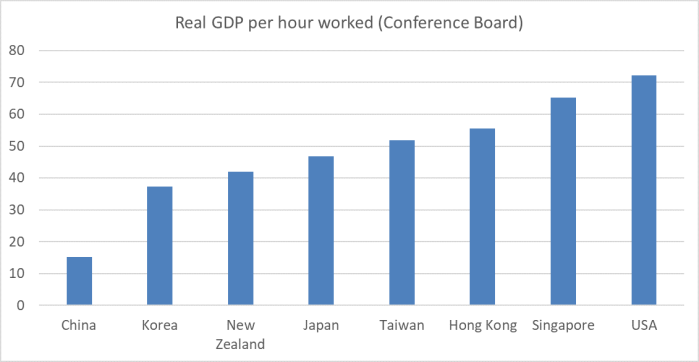
I don’t want to waste much time on the alleged PRC success story.    When you do so much damage to yourself, and then stop the self-destruction, of course you’ve got plenty of ground to make-up, and with half-decent policies you can do some of that quite quickly.   Here are the latest Conference Board productivity estimates.

China GDP phw feb 19

The PRC……not even half the levels of Korea or (decades of underperformance) New Zealand, not a third of Taiwan or a quarter of Singapore.     Who could possibly envy that sort of performance?  There was no obvious reason why China could not have matched the performance of Korea, Japan, or Taiwan.  Except that they chose to adopt, and continue to run, a system that consistently produces poor economic results.

But what I was really interested in was the assertion that New Zealand has had a really good economic performance over the last decade “while other economies have suffered”.  I guess if Greece, or even Italy, is your benchmark it isn’t too far wrong.  But then almost everyone does better than those troubled euro-crippled economies.

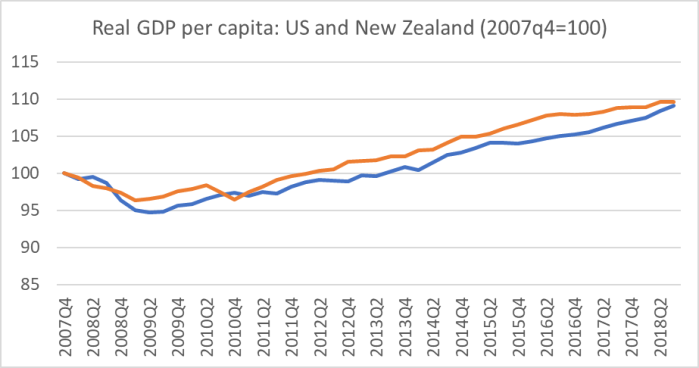
One comparison I like, and which I’ve run before, is between New Zealand and the United States.   Were there anything to the “we owe such a debt to Beijing, and have done so well ourselves” story, an obvious place to look might be a comparison with the United States.  After all, the US was the epicentre of the financial crisis itself, their central bank got to the limits of what it could do, and no one thinks Beijing someone “saved” the US.   And yet here is how real GDP per capita compares across the two countries since late 2007, when the last recession began.

US and NZ comparison GDP

We’ve mostly done very slightly better than the US over the decade or so, but there really isn’t much in it.   Certainly not a case of the US suffering and us “prospering”, whether thanks to Beijing or any other cause.

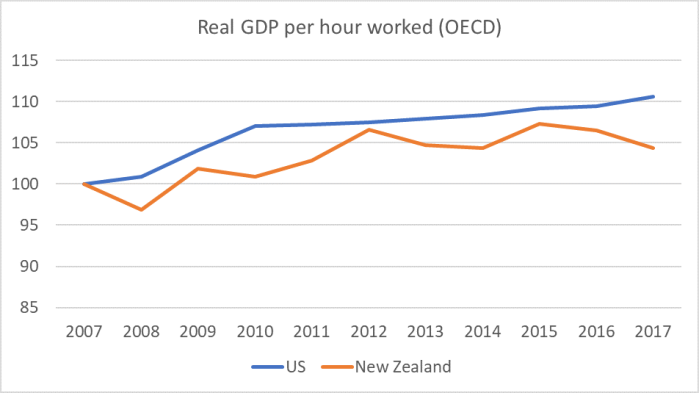
And to the extent we’ve done a touch better, it certainly isn’t reflecting stronger productivity growth.  The data are indexed to 100 in 2007.

US nz productivity

It isn’t just an us versus the US comparison either.  Over that decade, real GDP per hour worked rose by 4.4 per cent, but in the median OECD country productivity growth was 8.9 per cent.

And if Beijing and the (so-called) free trade agreement were the source of any special New Zealand prosperity, exports might be an obvious place to look.  Except that over the previous decade New Zealand exports actually fell a little as a share of GDP.  In the United States, and in all but a handful of other OECD countries, exports became a larger share of the economy.

Even on more purely cyclical measures, New Zealand still doesn’t stand out (at least on the good side).  The unemployment, for example, has come down a long way, but it is still quite a bit above the lows reached before the recession (at a time when demographics will be tending to lower the “natural” rate of unemployment).    In the United States, by contrast, the unemployment rate is below pre-recession levels. That is also true across the G7 as a whole, the EU as a whole, and the OECD as a whole (individual bad euro-area countries notwithstanding).

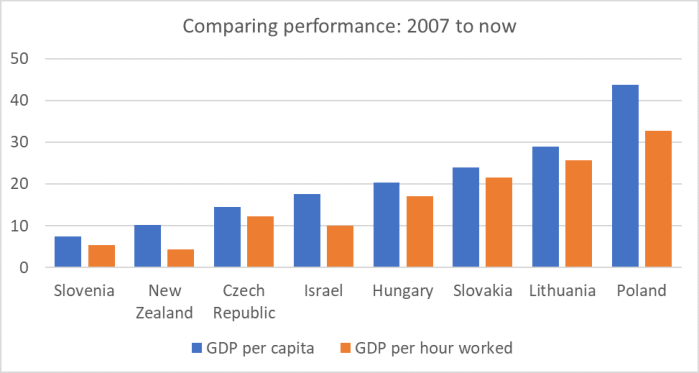
And if you don’t like the idea of comparing against the US –  even though it was the centre of crisis, and doesn’t owe anything in particular to Beijing –  here is how we’ve done against another group of countries, each now with productivity levels similar to those in New Zealand (and few doing much trade with the PRC).   Since all these countries started (in 2007) with productivity well behind global frontiers, all should have been able to do okay even if productivity growth at the frontier (eg US and northwest Europe) slowed.

small countries

Many did pretty well.  As for us – Beijing (alleged) beneficence notwithstanding –  either worst or second worst depending on your preferred measure.

As I noted earlier on, there are countries that have done a great deal worse than us.   But the suggestion that we have “prospered” over the last decade –  in some way materially outstripping the rest of the advanced world –  isn’t just a myth. It is worse than that.   And the people who run the story, whether as senior journalists or senior politicians should know better.

Countries mostly make their own prosperity.  We once did –  those decades when we really did lead the world.    We could again, although that might involve facing facts.  But these days politicians and their acolytes in the media seem more interested in playing distraction; in this case continuing to corrupt our system, supported by motivated fantasy stories about our (alleged) success and our (alleged) debt to Beijing.


MPC remit and charter

The Minister of Finance and the Governor of the Reserve Bank today released the Remit and Charter for the new statutory Monetary Policy Committee, that takes effect from 1 April.  The Remit largely replaces the Policy Targets Agreement structure in place since 1990, and future remits will be set directly by the Minister of Finance, after advice from the Reserve Bank (among others) and associated public consultation.  The Charter is mostly new, governing how the MPC is supposed to operate in some key, outward-facing, dimensions. It complements various detailed statutory provisions.   Even though both documents are this time agreed between the Governor and the Minister, it is clear that the Minister has taken the lead: the press release is issued by the Minister alone, and although it is now reproduced on the Bank’s website, contains various bits of political spin.

The contents of the new Remit are in many respects pretty similar in substance to the current PTA, but there are a couple of changes worth noting.

One looks like an error.  In the Context section the Remit states that

“(the Act) requires that monetary policy promote the prosperity and wellbeing of New Zealanders”

That line took me by surprise so I went back and checked the new legislation.    The relevant provision actually states

The purpose of this Act is to promote the prosperity and well-being of New Zealanders,

Those are two different things.  The Remit –  which the Governor has voluntarily signed on to – can reasonably be read as suggesting that monetary policy should be conducted with “wellbeing” in mind.  The Act sets out statutory objectives for monetary policy (the things the MPC is supposed to pursue and take into account), simply stating that Parliament has put the legislation in place believing that the monetary policy goals (and other powers the Bank has, including regulation and supervision) will conduce to the wellbeing of New Zealanders.  The Remit shouldn’t have been worded that way.

My second observation about the Remit is more positive (and would be more positive still if the document hadn’t been released in a format in which one can’t copy and paste extracts).    It is stated that “monetary policy contributes to public welfare by reducing cyclical variations in employment and economic activity whilst maintaining price stability over the medium-term”.  I like that formulation, which is much closer to what I recommended should be the statutory goal for monetary policy.  Price stability is the constraint, economic stabilisation is the primary purpose.   Whether or not the wording is quite consistent with the actual new legislative goal is something for the MPC, and those paid to hold them to account, to work out.

What of the Charter?

My overarching unease about the MPC is that it will be dominated the Governor.  That is partly through the channel of the inbuilt management majority (and the Governor hires the other managers), and partly because of the heavy say the Governor will have in who gets appointed to the (minority) external positions.

But it is reinforced by the relentless, and explicit, drive for “consensus”.   This is from the Charter

consensus

“Consensus” isn’t a recipe for getting the best answers, but for lowest common denominator answers that everyone can live with.  It isn’t really a recipe for a robust examination of competing arguments and analyses either –  at least unless one has exceptional people (which is always unlikely, almost by definition) –  and especially when management has (a) an inbuilt majority, and (b) control of all the research and analysis resources (and of the pen in drafting MPSs etc).   The risk remain that outsiders, knowing they are inevitably outnumbered, and having ‘consensus’ waved in their faces will simply go along, free-riding.

The formal transparency model chosen is likely, at the margin, to reinforce this risk.  We are told that the record of the meeting will be published at the same time as the OCR announcement (2pm on Wednesday, following an MPC meeting that morning).  Even allowing for various preliminay meetings, the “record” of the meeting will inevitably be heavily pre-drafted by staff who work to the Governor, and the ability of outside MPC members to get any alternative perspectives included is going to be an uphill struggle.  Most central bank MPCs release minutes with something of a lag.   All that said, time will tell how it works out.

One interesting provision in the Charter was this

charter 1

charter 2

It was interesting for two reasons.  First, this provision appears to accept that significant operational decisions around monetary policy are the responsibility of the MPC.  That was not (is not, in my view) clear from the legislation.   If so, it is welcome, especially if it involves an expectation by the Minister that, for example, any future quantitative easing and similar decisions would also be a matter for MPC.  We’ll have to see.

Presumably this provision is supposed to cover the longstanding arrangements for possible foreign exchange intervention.  When I was at the Bank, the OCR Advisory Group (internal forerunner to the MPC) was the forum in which the Governor made in principle decisions on intervention, and specific timing choices etc were then dealt directly between the Governor and the Financial Markets Department.

If so, the specific provisions go much too far.   Perhaps there is a case at times for not announcing foreign exchange intervention immediately in some circumstances.  But there are no grounds for leaving the MPC to decide for itself when, if ever, specific information on intervention will be released (the implied movements in the Bank’s fx position come out more than a month later, and even then without comment of explanation).    At present, there probably is not much practical importance attaching to this point, but the system should be started as we mean to go on.  Much better to have insisted that all market intervention (size and nature, although not counterparties) should be disclosed within 10 days of such intervention.  Apart from anything else, these are big financial risks the taxpayer is (given no choice in) assuming.

My final observation on the charter offers kudos to the Minister.  There has been a great deal of talk about the need to seek consensus (which is still in the charter) and the claim had been made that this meant all MPC members should speak, if at all, with a single voice.  Bank management championed this (self-interestedly no doubt), despite the successful examples of countries like the UK, the US, and Sweden, and a year ago it seemed that they had persuaded the Minister of their view.  It was one reason why good people would probably have been deterred from applying for the external positions –  facing a built-in internal majority, and with no ability to articulate in public alternative perspectives, it wasn’t obvious that the positions offered more than sightseeing (looking at the innards of how the Bank works).  I’ve banged on about the issue for months, and I know others have also raised concerns.

And so imagine the pleasant surprise I got when I  got towards the end of the charter.

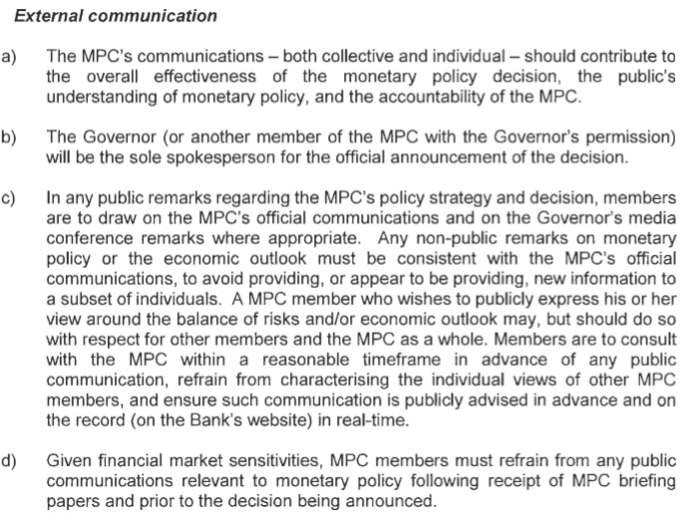
charter 3

I don’t have any particular problems with (a) or (b), although I can imagine some future disputes about what does and doesn’t contribute to the “overall effectiveness” of the monetary policy decision etc, since things that might muddy the water a bit in the short-term could easily strengthen the institution, and its accountability, in the medium term.  I also had no problem with (d) which is pretty much how Reserve Bank staff have operated for many years.

What caught my eye was (c), under which it appears that members of the MPC –  internal and external –  will be free to comment in public, expressing their own views on the economic situation, risks, and monetary policy.   On monetary policy itself, they are required to draw on official communications “as appropriate” –  and I’m sure they will, as appropriate.  But it doesn’t bind MPC members to agree with committee decision, or to endorse all the arguments the Governor himself might offer in support of the decision.  On the economy etc, they can say what they like (in substance) provided they do so politely  (as people typically do in transparent foreign central banks) and let their colleagues know in advance what they’ll be saying.  It is a material step forward relative to what we’ve been promised (although time will tell whether anyone, internal or external (and thus vetted for tameness by the Governor) ever utilises these provisions).

What is also interesting is some of the detail.  There is now an explicit written requirement that any off-the-record private remarks about monetary policy or the economic outlook have to be consistent with official MPC communications.  Presumably this also applies to the Governor (there is no suggestion it doesn’t) so if there are off-the-record expletive-laden rants at private commercial functions in future, at least they won’t be offering any insights on the economy and monetary policy.  Perhaps that Rotary Club advertising the Governor as offering candid perspectives on the New Zealand economy –  if you pay – will have to revise its plans?  More probably, the Governor probably won’t regard himself as bound by the rules.

And then there was the final sentence.  Any on-the-record remarks (occasions at which they will be made) will have to (a) notified to the public in advance, and (b) with full text on the Bank’s website in real-time.   In principle, this looks fine and sensible (although it is far from what has been practised by management up til now).  In practice, it will prevent MPC members giving interviews, and appears designed to ensure that the only communications are speeeches with written texts to which MPC members adhere closely.  But, again, there is no suggestion that these rules don’t apply to the Governor –  and his views are inevitably most market-moving.   So can we look forward to an end to off-the-record speeches from the Governor on matters of substance, and to wild departures from the prepared and published text.   After all, as the document says, MPC members shouldn’t provide, or look as though they are providing, new information to private subsets of people.     (Personally, I suspect the document goes a little too far.  It would probably be unfortunate if, say, the Governor cannot (as the document appears to suggest) give an interview to, say, Morning Report or one of the main current affairs programmes, so long as there is adequate public notification as to when and where he will be speaking.)

As I’ve said on various previous occasions, I’m pretty ambivalent about the monetary policy legislative amendments, and particularly about the MPC, which looks set to be a Governor-dominated creature, not too different in effect from what we’ve had for the last 29 years.  But credit where it is due.  There are some welcome aspects in the details of today’s announcement and I, quite honestly, hope the new system works better than I expect it to.    Who knows, the less closed nature of the rule may even help attract a better class of candidate to consider the MPC position.

For now, of course, we are still left guessing who four of the seven MPC members will be.

See, not so hard after all

Back in November 2017, just after the government took office, the Reserve Bank in its Monetary Policy Statement identified various assumptions they had made about the impact of various of the new government’s policies.  Some of these assumptions made quite a difference to the outlook, but no analysis or reasoning was presented to give us any confidence in the assumptions they were (reasonably or unreasonably) making. One of those new policies was KiwiBuild.

Seeing as the Bank is a powerful public agency, it seemed only reasonable to request copies of any analysis undertaken as part of arriving at the assumptions policymakers were using.   The Bank refused and many many months later the Ombudsman backed them up (if ever there was a case for an overhaul of the Official Information Act, this was a good example).  The Ombudsman did point out that he had to rule as at the date the request had been made.  So, a year having passed, I again requested this material.  The Bank again refused (and I haven’t yet gotten round to appealing to the Ombudsman).     Quarter after quarter the Monetary Policy Statements talk about KiwiBuild, but we’ve never seen any supporting analysis.   A state secret apparently.

Until yesterday that is.  In the latest Monetary Policy Statement there was the usual discussion of KiwiBuild –  potentially a big influence on one of the most highly-cylical parts of the whole economy –  but there was also a footnote pointing readers to an obscure corner of the Bank’s website, and a special background note on KiwiBuild, and the assumptions the Bank is making.  All released simultaneous with the statement itself.   See, it just wasn’t that hard.  And has the sky fallen?

(As it happens I remain rather sceptical of the assumption that KiwiBuild is going to be a significant net addition to total residential investment over the next decade.  Why would it, when the main issues in the housing market are land prices and, to a lesser extent, construction costs, and it isn’t obvious how KiwiBuild deals with either of them?  If it proves to be a net addition, it will probably be because it is a subsidy scheme for the favoured –  lucky – few.)

As for the overall tone of the monetary policy conclusions to the statement, count me sceptical.  At one level it is almost always true that the next OCR move could be up or down –  and in that sense most forecasting (especially that a couple of years ahead) is futile: useless and pointless.   But for the Governor to suggest that the risks now are really even balanced, even at some relatively near-term horizon, seems to suggest he is  falling into the same trap that beguiled the Bank for much of the last decade; the belief that somewhere, just around the corner, inflation pressures are finally going to build sufficiently that they will need to raise the OCR.   We’ve come through a cyclical recovery, the reconstruction after a series of highly-destructive earthquakes, strong terms of trade, and a huge unexpected population surge, and none of it has been enough to really support higher interest rates. The OCR now is lower than it was at the end of the last recession, and still core inflation struggles to get anywhere 2 per cent.    There is no lift in imported inflation, no significant new surges in domestic demand in view, and as the Bank notes business investment is pretty subdued.  Instead actual GDP growth has been easing, population growth is easing, employment growth is easing, confidence is pretty subdued, the heat in the housing market (for now at least) is easing.  Oh, and several of the major components of the world economy –  China and the euro-area  –  are weakening, and the Australian economy (important to New Zealand through a host of channels) also appears to be easing, centred in one of the most cyclically-variable parts of the economy, construction.   It was surprising to see no richness or depth to any of the international discussion –  and to see the Bank buying into the highly dubious line that any slowing in China is mostly about the “trade war”.   Few other observers seem to see it that way.

From a starting point with inflation still below target midpoint after all these years, it would seem much more reasonable to suppose that if there is an OCR adjustment in the next year or so, it is (much) more likely to be a cut than an increase.      Time will tell, including about how long the 1.5 per cent lift in the exchange rate will last.

Commendably, the Bank is now talking openly about many other economies have limited capacity to respond to a future serious downturn.  That is welcome acknowledgement, but it would count for more if the Bank were taking seriously the real (if slightly less binding) constraints New Zealand will also face in the next future serious downturn.

A couple of other things in the document caught my eye.  One was this chart

NAIRU 2019

The Bank seems to be trying to tell us that it really has no idea whether the unemployment was above or below the NAIRU at any time in the last 17 years.  I don’t suppose in practice they operate that way, but when they present a chart like this it is a bit hard to take seriously the other bits of their economic analysis.

The other specific was some rather upbeat comments on productivity performance in recent years, which has led the Bank to the view that they now to expect no acceleration in productivity growth in the years ahead.  The Governor always seems to err on the (politically convenient) upbeat side.  I’m not sure quite how the Bank derives their productivity measure –  I’m guessing as some sort of per person employed measure –  but as a reminder to readers here is the chart of real GDP per hour worked, the standard measure of labour productivity.  To deal, to some extent, with the noise in the individual series, I use both measures of quarterly GDP and both (HLFS and QES) measures of hours.

real GDP phw dec 18

There has been no labour productivity growth for the last three or four years, and little for the last six or seven.  I wouldn’t be surprised if the Bank is right to expect no acceleration (on current policies), but if we keep on with near-zero labour productivity growth it is a rather bleak prospect for New Zealanders.

A great deal of the press conference was taken up with questions –  generally not very sympathetic –  about the Governor’s proposals to increase substantially capital requirements for banks.   In the course of the press conference he and Geoff Bascand made some reasonable points –  including about the merits of putting the big 4 banks and the smaller banks on a more equal footing in calculating requirements – and at least fronted up on the other questions.  It is just a shame this was being done reactively now, rather than pro-actively when the proposals were first released in December.

I remain rather sceptical of the Bank’s case –  in which everything is a win-win, in which the economy is safer, more prosperous, and even with lower interest rates.  If you doubt that I’m characterising their bold claims correctly, this is the stylised diagram that leads the consultative document.

something for allIt is a free lunch they are claiming to offer.  I suspect few will be convinced.

In the course of the press conference, the Governor asserted that the Bank’s proposals will, if implemented, mean that future capital ratio requirements would be “well within the range of norms” seen in other countries.  I found that a surprising claim, and there is nothing –  not a word – in the consultative document to back it up.  If true, it would be material in thinking about the appropriateness of the Bank’s proposals.  But where is the evidence (granting that this is something that can’t be answered in a ten second Google search)?  I’ve lodged an Official Information Act request for the analysis the Governor is using to support his claim.  It would, surely, be in his interests to have such analysis out there.

Also at the press conference, there was the hardy perennial claim that inflation expectations are “well-anchored” at 2 per cent, and everyone believes that monetary policy is just fine.  As my hardy perennial response, here are inflation breakevens from the government bond (indexed and conventional) market.  The last observation is today’s data.

IIB breakevens feb 19

People with money at stake don’t seem to believe you Governor.  Last time things got this low a series of OCR cuts only helped, at least partially, rectify the position.

And, finally, who does the Bank suppose gets any value at all from the cartoon version of the statement?  For example

cartoon

Is the Monetary Policy Statement now a set text in intermediate school?  If the kids are especially naughty do they have to read it twice?   Even your average MP, sitting on the Finance and Expenditure Committee and supposedly holding the Bank to account, has to be able to cope with a little more than that.  I’m not expecting much of the new statutory MPC, but perhaps they could prevail on the Governor to drop the cartoons and simply write in reasonably accessible English?

Later this morning we get the Remit (PTA replacement) and Charter for the new Monetary Policy Committee.  I’m sure I’ll have some thoughts about them tomorrow.

Two charts and a speech

A post of two unrelated graphs this morning.

Just before Christmas I wrote a post prompted by an FT story about new OECD work that attempted to standardise estimates of hours worked to improve cross-country comparative productivity (GDP per hour worked) estimates.   Before writing the post, I’d confirmed with Statistics New Zealand that they had been consulted and that there were no material implications re New Zealand data.    Reading numbers, rather roughly, off a chart I’d attempted to illustrate the implied new OECD rankings.

But the OECD has now included the new hours worked estimated in their own official published data, and (thanks to a tweet from the chair of the Productivity Commission) I noticed this chart yesterday.

OECD labour productivity 2017

As I noted in the earlier post, this revision lifts several countries (Austria, Switzerland, and Sweden) into the upper bracket of OECD countries.  It also improves the position of the UK (in yesterday’s post I noted that they were now about 30 per cent of us, but on these revised and improved data the lead is just over 40 per cent).

But it is our position relative to the emerging OECD economies that really interests me.    Not only are Slovakia and Slovenia ahead of us –  they’ve been there or thereabouts on the old measures since about 2014 –  but now so are Lithuania and Turkey.  Go back 20 years and both  – on the old measures, but presumably on the new ones too –  were miles behind us.  Based on their productivity growth performance this decade, the Czech Republic and –  a few years later –  Poland will be beating us before long.

In a way “beating us” isn’t the right word.    It isn’t a competition in the sense that their gains mean we are worse off.  We should celebrate their economic gains.

But it is the right word if we use the experience of other countries to benchmark our own performance.    In modern New Zealand history, not one of those countries in the previous paragraph has ever been richer or productive than New Zealand.  Until now.  30 years ago all but Turkey were just beginning to throw off decades of Communist rule –  with all the misallocations of resources and skewed incentives and degraded institutions that went with that dreadful system.    Lithuania wasn’t just part of the Soviet sphere of influence, it was –  by conquest –  part of the Soviet Union itself.

And 30 years ago we were a stable democratic country, with the rule of law, long-established market institutions (even if they’d been a bit attenuated in the protectionist decades) just about –  although we didn’t know it then – to enjoy decades of a significant trend improvement in our terms of trade.     And yet these are the outcomes we’ve managed, that our policy frameworks applied to available resources have produced.

And for those who’ve liked to believe that large-scale non-citizen immigration, and a larger population, were a material part of what might improve New Zealand’s productivity prospects, here is the percentage change in the population of the former eastern-bloc OECD countries and (at the other end of the spectrum) of the high immigration OECD countries.

Population growth (%) 1990 to 2017
Latvia -27
Lithuania -23.4
Estonia -18
Hungary -5.5
Poland 1
Czech Republic 2.5
Slovakia 2.6
Slovenia 3.5
Canada 32.7
New Zealand 39.3
Australia 44.3
Israel 86.1

I wouldn’t recommend the experience of the Baltics (low birth rates and high emigration).  I don’t envy them a geographic position right now to Russia either.    But the absence of much immigration, and little or no population growth doesn’t seem to have held any of those former eastern-bloc countries back from a pretty impressive resurgence.  They all have a long way to go to match the best-of-class among the OECD countries, but so does New Zealand…..and we’ve been making no progress at all towards that sort of goal.

The Reserve Bank’s Monetary Policy Statement is due out this afternoon.  Yesterday the Bank released its latest Survey of Expectations.  There wasn’t a great deal of interest in the data, but this was the series that caught my eye.

mon cond year ahead 19

The Bank has been running this question for almost 20 years now, asking respondents (on a seven point scale) their expectation of “monetary conditions” a year from now.  They also ask about perceptions of current conditions.  Perceptions of current conditions are quite loose in the latest survey, but what is striking is that almost always when respondents think current conditions are loose they expect a substantial tightening in the next year or so.   That was what the data showed in 1999, 2001, 2003, 2010, and 2013.  It wasn’t what showed up in 2015/16: then relatively easy conditions (probably then mainly a proxy for relatively low interest rates) were expected to be followed by even easier conditions.   A succession of OCR cuts followed.  As of the latest survey, a net 69 per cent of respondents think conditions are easier than neutral (not quite a record), but by the end of the year a record (see chart) 73 per cent of respondents expect things to be easier than neutral.

This result doesn’t yet show up in the OCR expectations themselves –  which are edging downwards but a year out the mean expectation is still above 1.75 per cent (the median is bang on) –  but the expected easing in “monetary conditions” looks a bit more consistent with market pricing, in suggesting the OCR cuts are becoming more likely.

(At the margin, the OCR expectations in the survey would have been a touch lower if I had actually submitted mine.  I filled in the form, printed out a copy for my records, and then must have failed to push the button to submit it.    The lowest official OCR expectation for December 2019 is 1.5 per cent, but the table in front of me says I wrote down 1.25 per cent.  We’ll see.)

And a final suggestion for journalists at the Reserve Bank’s press conference this afternoon.  The other day a reader sent me an invitation they’d received for a function you could pay to attend at which the Governor was going to be speaking next month.

This year it is Dr Adrian Orr, the Governor of the Reserve Bank who will also speak about the bank’s views of the economy in an candid off the record way.

Perhaps the organisers mis-spoke, but I’d have expected the Bank to review carefully how the Governor’s involvement in any such event was described.    When market-sensitive matters are involved –  and Governor’s/Bank’s view on the economy clearly qualifies –  it is highly inappropriate for any Bank officials (even the Governor) to be speaking “candidly” in an off-the-record environment.  Anything other than the most anodyne comment should be done in the Monetary Policy Statement (or associated press conference or testimony to Parliament) or in on-the-record speeches, to which everyone has access at the same time and the same way.   It is even worse when access to the Governor, for potentially market-sensitive material, is sold-off, even if there is a decent charity cause behind it.

I’ve written about this sort of thing previously

I notice that NBR’s Shoeshine column this week also touched on that earlier INFINZ event, describing it as an “expletive-laden speech” on all manner of topics, and observing “unfortunately, this speech was never put on the web (very strange for a Reserve Bank governor’s speech)”.    Not so strange if it were genuinely just rehearsing old ground, but the various accounts suggest it wasn’t.

Asking the Governor about the approach he thinks appropriate to his speeches  – about his commitment to openness and transparency – would aid the cause of accountability.

Challenges and complexities

Interviewed on Radio New Zealand this morning, the Prime Minister conceded that there were “challenges and complexities” in the government’s relationship with the People’s Republic of China.    Fearful, and seemingly out of her depth, she wouldn’t or couldn’t identify any of those “challenges and complexities”.   And yet she is criticised for not doing enough to keep in Beijing’s good graces by the person in New Zealand politics with an even worse record on PRC issues –  Simon Bridges, leader of the National Party.

I don’t have anything much to say about the Air New Zealand story, or any particular reason to doubt the slowly-emerging explanation (which itself seems to have a PRC-coercion dimension, dating back to last year’s PRC insistence that airlines not suggest that Taiwan –  an independent democratic country –  was in fact or in any way not part of the PRC).  It is just that were the true story to have been more worrying, it isn’t clear that Air New Zealand would have much incentive to be straight with customers or the public: they have an ongoing business to run and Beijing relations to keep smooth (and, of course, the chief executive is the chair of the PM’s Business Advisory Council).    But perhaps leaks from within Air New Zealand would mean the truth still got out?

What of the two Barry Soper stories (this one from the front page of the Herald, and this opinion piece)?   The first is introduced this way

Diplomatic links with China appear to have plummeted to a new low as Prime Minister Jacinda Ardern is given the cold shoulder by Beijing and a major tourism promotion is postponed by the superpower.

Of the visit to Beijing, we learned this yesterday

Ardern confirmed she had an invitation from the Chinese administration to meet President Xi Jinping, but the problem was finding a suitable date. She was meant to meet with the President at the end of last year.

She wouldn’t say whether or not she was confident the meeting would take place this year.

In other words, she isn’t confident it will happen at all.   What is hard to understand is why any self-respecting person would put themselves through this rigmarole?   Abasement before the emperor, and all for the sake of a few New Zealand businesses (often taxpayer subsidised ones) that have got themselves too exposed to a country with a noxious regime.   She keeps telling us we are an independent sovereign state, not some tributary regime.  Why can’t she just politely walk away (and get some aide to make her a note of how constructive and useful  –  enhancing to their reputations –  foreign leaders meetings with Adolf Hitler were).    Perhaps late last year the “scheduling” excuse –  “we all have busy calendars” –  might have washed with some.  It clearly doesn’t now.  And that shouldn’t worry New Zealanders.  It shouldn’t be a cause for reproach from an Opposition leader who (a) has never distanced himself from his foreign affairs spokesperson’s defence of the PRC concentration camps in Xinjiang, and (b) who retains in his caucus, and expresses support for, a Chinese Communist Party member and former PLA intelligence official, and who (c) is understood to rely on that member as one of his largest party fundraisers.  That is where the focus should be, not on selling our souls for a meeting with Xi Jinping.

And then there is the year of the Chinese tourist,

The 2019 China-New Zealand Year of Tourism was meant to be launched with great fanfare at Wellington’s Te Papa museum next week, but that has been postponed by China.

Industry people and regime-sycophants had been very keen on this exercise.  The Contemporary China Research Centre –  funded partly MFAT, chaired by a New Zealander with a significant role in the global Confucius Institute movement – was even hosting a conference on it late last year.   But this isn’t some sort of normal country.  What Beijing giveth, Beijing can also take away.  We are told

Richard Davies, manager of tourism policy at the Ministry of Business, Innovation and Employment, said: “China has advised that this event has had to be postponed due to changes of schedule on the Chinese side.”

Officials are now working with China to reschedule the opening.

Believe all that and you’ll believe anything.  But the Prime Minister claimed to believe it, telling her RNZ interviewer that she could only go on what she’d been told, and she’d been told there was a scheduling problem.  I’m sure she doesn’t really believe it, but why can’t she come straight with the New Zealand public?   She is supposed to serve us, not a small group of business interests.    Better to take explicit credit for a slightly more distant relationship with one of the most appalling regimes on the planet.  Especially if all that talk about kindness and empathy means anything at all.  But she won’t do that –  won’t square with the public about the nature of the regime she (and his predecessors) have been pandering too, all no doubt on official advice.

You got a sense of the sort of business sector pressure she seems to be under in how she responded to the interviewer’s questions about Huawei.  Much as the China-oriented bits of the business community – and the China Council –  must hate it, almost everything that has emerged on Huawei in the last couple of months only confirms how unwise any decent and self-respecting country would be to allow Hauwei equipment to play a key role in 5G networks.   And yet the Prime Minister seemed to interpret the question as a suggestion that we should back down and just let Hauwei –  and the PRC state –  do its thing.  ‘If we did that could we really say we had an independent foreign policy?” was the gist of her response.

Barry Soper seems to be championing some of that sort of “never mind national security, never mind self-respect, never mind the advice of longstanding friends and allies, lets never ever upset Beijing” line.  It was clear in his selection of people to quote from in his article.  There was this, apparently on Huawei

Asset management and corporate adviser David Mahon, based in Beijing, said governments needed to get over thwarting Chinese economic aims in a way reminiscent of the Cold War struggle between capitalism and communism. “It’s unhelpful for politicians and a few anti-Chinese professors to feed uncorroborated McCarthyite conspiracies about Chinese spy networks in their countries and targeting anyone who doesn’t share their view,” Mahon said.

Just lie back and let Beijing have its way seems to be Mahon’s perspective.  That isn’t how self-respecting people, or nations, act.  But perhaps if you are just desperate for the next deal none of that stuff matters?

And then there was more melodramatic stuff from Philip Burdon, until recently chair of the taxpayer-funded PR outfit the Asia New Zealand Foundation, and of course a longserving senior National Party figure.

Philip Burdon,….said New Zealand couldn’t afford to take sides.

“We clearly need to commit ourselves to the cause of trade liberalisation and the integration of the global economy while respectfully and realistically acknowledging China’s entitlement to a comprehensive and responsible strategic and economic engagement in the region,” he said.

Sources in Beijing say China plans trade retaliation…..

Two-way trade with China trebled over the past decade to $27 billion. “The implications for New Zealand are dangerous at every level,” Burdon said.

Wouldn’t it be nice if the PRC seriously committed itself to the practice of liberalisation?  Doesn’t seem likely.  And “respectfully acknowledge their entitlement”?  Like true vassals?

But what’s with this “can’t afford to take sides” business?  It has been a convenient framing for some time, as if we are asked to choose between the US and the PRC.  Even if that were the choice, the United States (for all its faults) remains much more in tune with the values and attitudes of New Zealanders than the lawless regime in Beijing does.  But, of course, the choice isn’t really between the US and the PRC, but between the PRC and New Zealand, or even (charitably) the interests of a small number of New Zealand businesses (and parties reliant on donations) and New Zealand as a whole.   Given that choice, we can’t afford our governments not to take sides, not to back New Zealand and its values and long-term interests.   That includes defending the integrity of our political system, defending the freedoms of ethnic Chinese New Zealanders (whose media and community associations seem to have been largely taken over by Beijing-affiliated groups), and being the sort of nation that stands up internationally for the sort of behaviour –  treatment of other people –  we expect.

There is more from Philip Burdon in Barry Soper’s op-ed

We can’t afford to let this diplomatic tightrope slacken and that’s most certainly the view of a Peters confidante, former Trade Minister in the Bolger Government and recently the chair of Asia 2000 Phillip Burdon.

The mushroom magnate says China has constructively sought to engage with New Zealand for which we should be grateful.

It’s utterly ridiculous, Burdon contends, that China has sinister plans to subvert and interfere in our society or in our democratic institutions.

Ah, it is a debt of gratitude –  perhaps serviced with periodic offerings of tribute –  that we owe to Beijing, at least according to Burdon, for all that “constructive engagement”.     What exactly was that?

As for Burdon’s final sentence, one presumes he is so far down the track of abandoning all sense of self-respect that the presence of a former PLA intelligence official, who hob-nobs with the embassy and never ever says anything critical of Beijing just doesn’t bother Philip Burdon.  There are deals I guess, and never mind the integrity of our system.  Perhaps it doesn’t bother him that Parliament’s justice committee is chaired by someone with close ties to various United Front institutions?  It should.       It isn’t necessarily that Beijing “has” sinister plans –  as if this is something in the future. The very fact that Jian Yang in particular still sits in Parliament, challenged by no one in the entire political spectrum tells you that, by accident or design, those visions have already been coming to pass.  Or when neither the Prime Minister nor the Opposition leader will make a clear stand in defence of Anne-Marie Brady and her work.

I’m sure Beijing has no interest in toppling our formal institutions.  Why would they when those institutions have rotted from the inside.  I guess he too wants us to believe that only a “few anti-Chinese professors” are at all bothered.

All of which brings us back to the opening line of Barry Soper’s op-ed

New Zealand is feeling the heat of the Chinese dragon’s breath and if we’re not careful it could incinerate us.

Which is simply nonsense.    As an economy, we have much more to worry about from a sharp Chinese economic slowdown –  which may be underway already –  than from any sorts of specific attempts at economic coercion of New Zealand.  The PRC is a big country, and in a world with few buffers a recession there could matter a lot everywhere.   As for New Zealand, the PRC certainly has some capacity to harm some specific sectors, perhaps even quite severely.  I wouldn’t want to be a university vice-chancellor if the PRC decides to attempt to bring the government to heel. Then again, I don’t have any sympathy with those people, who have put themselves at the mercy of a known thug, all backed by dodgy immigration provisions, rather than looking to manage their exposures (as prudent businesses, unable to twist governments to their purposes, would).  I have some more sympathy for tourism operators –  who mostly are operating in an open market.  As for commodity exporters, well they are selling commodities and (to a first approximation) what isn’t sold in the PRC will be sold somewhere else.   Sometimes values and interests cost – in many ways, the only true measure of what is valuable is the price one is willing to pay to defend it.  Too many of these Beijing defenders don’t seem to have any particular interest in defending our system, our people –  let alone standing against the sheer awfulness of the PRC regime at home and abroad.

We can’t fix the PRC gross human rights abuses.  I’m not even suggesting we should be at the forefront of moves on those issues. But when other countries speak and our governments don’t, they shame us.   Neither our Prime Minister nor our Opposition leader will utter a word about (for example) Xinjiang, or about the abducted Canadians, even when other countries have –  otherwise reprehensible Turkey only this week in a strong statement on Xinjiang. Life – politics –  has to be more than just deals and donations if it is to have any meaning, command any respect.   Frankly, it is hard to tell at present which side of politics is worse on this issue, but on balance I’d have to give it to National –  whose only interest in all of this, in anything they say in public, seems to be placating Beijing.  In office there are hard choices and calls to make –  even if that is still no excuse for not openly engaging on the “challenges and complexities”.  In Opposition one might have hoped, just occasionally, for a slightly more principled position. But I guess their actions, their people, their words reveal what their “principles” really are in this area.


Looking towards the new MPC

Next week will bring the first Reserve Bank Monetary Policy Statement of the year. It will be the last –  after 29 years – prepared solely on the responsibility of a single individual, the Governor.     He gets to make one more OCR decision on his own and then on 1 April the new statutory Monetary Policy Committee –  established under legislation passed just before Christmas – takes over.   It is an apt date given that the new regime is designed to have the appearance of being a significant reform but is in fact likely to do little to reduce the undue dominance of a single unelected official, the Governor.   In this case, a Governor who after almost 11 months in office hasn’t managed to make a single on-the-record speech about what is still (for a few more weeks) his primary function, monetary policy (and the associated cyclical economic position).

The first OCR decision to be made by the new Monetary Policy Committee is not scheduled until May, but we can expect some important announcements in the next couple of weeks.

Under the amended legislation, there is a raft of new formal documents required.

The most important of them is the “remit”.   This replaces the Policy Targets Agreement framework, and is the mechanism that tells the Monetary Policy Committee what specific targets to pursue.

On an ongoing basis, the remit will be set directly by the Minister of Finance –  it won’t need to be agreed by the Governor or the MPC.   The Bank will have to provide advice about the possible content of the remit, and in providing that advice the Governor is required to (a) consult with the MPC, and (b) seek input from members of the public.

But those provisions don’t apply at all to the first remit.  Under the legislation, the remit is required to be agreed by the Governor and the Minister, with no input from either the public or the MPC members.  It is also supposed to be published within two months of the royal assent having been given to the legislation, which means it will almost certainly be published by 20 February.  (There is provision for the Minister to issue a remit directly if the Governor and Minister can’t reach agreement in that time, but that seems very unlikely –  it would be in neither side’s interest to allow it to happen, even if there were some differences between them.)  As there have been no hints suggesting, or preparing the ground for, anything else, I expect the first remit will have substantive content very similar to the existing Policy Targets Agreement signed when the Governor was appointed last year.

The second new document is the “charter”.  The charter is supposed to cover issues around transparency, accountability, and decisionmaking procedures for the MPC, and is required to include provisions around recording and publishing minutes of meetings.  On an ongoing basis, the charter is agreed between the Minister and the MPC as a whole. But the first charter –  which will set the terms for how the MPC first operates, and as the default operating model will be hard to deviate from  –  is to be implemented simply by agreement between the Governor and the Minister.  It is also supposed to be published by 20 February.  There is no public consultation, and no consultation with MPC members either –  who haven’t been appointed yet. They will, presumably, just be offered a “take it or leave it”.   We know the Minister’s predilections in this area –  highly summarised minutes only –  and the Bank’s previous biases against any sense of individual accountability or responsibility –  but it will be interesting to see how restrictively the document is worded. I’m not optimistic.

The third document is the “code of conduct” for the MPC (particularly as it will affect the external part-time members).  This is approved by the Bank’s Board, rather than the Minister.  It also has to be published by 20 February.   In fact, the Bank (the Governor) –  the only people allowed input here –  was required to prepare the code and submit it to the Board by 20 January.   I presume that what emerges will be reasonably sensible, but there was considerable work needing to be done on the draft code of conduct that was around at the time the Board was advertising for MPC candidates last year (when, as I recall it, activities like writing a blog or newsletter on matters macroeconomic would not have been a problem).

So within the next two weeks, we can expect to see that suite of documents published.  Even if they aren’t released before the Monetary Policy Statement next week, it would be reasonable to expect the Governor to be asked about them at his press conference.  After all next week MPS (whatever the talk about future monetary policy) isn’t at all binding about the future: the decisionmakers will ( in principle) be different, and so will the rules under which they will be working.   In principle, the transition to a new regime ushers in a period of some greater uncertainty about monetary policy decisions and (in particular) around monetary policy communications.

The biggest uncertainty, however, is about the membership of the Monetary Policy Committee.  You will recall that under the new legislation there is required to be a majority of internal (executive) members.  Indications have been that there will be four executive members, and three part-time non-executive members, plus the Treasury observer.   These appointments are formally made by the Minister of Finance, but he can only appoint people nominated by the Bank’s Board, and they in turn are likely to be heavily influenced by the Governor (who is a member of the Board, and the only Board member who knows anything much about monetary policy).

Even on the executive side, there is some uncertainty.  The Governor will be a member, and chair, as we can safely presume will the Deputy Governor, Geoff Bascand.   The newly appointed Assistant Governor for monetary policy and financial markets, Christian Hawkesby, seems certain to get one of the appointments (he’d hardly have taken the job without that sort of assurance), and the fourth slot is likely to be reserved for the chief economist.  The Bank is advertising that position at present, and unless there is an internal appointment it might be a stretch to even have someone in place by  1 April.   Under the new legislation, there is also a non-voting Treasury observer.  Since Gabs Makhlouf leaves office in a few months, that is additional (minor) source of uncertainty around how the MPC will function.  We wouldn’t expect the Secretary to have enough time to spare (or regard it as a priority) to take the role themselves (although in the transition Makhlouf has), but we also don’t know who will be nominated and quite what role they will play.

And what of the non-executives?  As I’ve noted before, these are positions that involve a significant commitment of time (they advertised for 50 days a year), and yet there will inevitably be quite significant constraints on what other activities such appointees can take on, and 50 days out at the Reserve Bank doesn’t fit easily with most other full-time jobs.  New Zealand government boards and committees don’t typically pay that well either.  But the biggest obstacle to getting decent people, who will be able to make an effective contribution, is the neutered nature of the role.     The non-executives will always be a minority of the committee.  They won’t, we are told, be able to give speeches or interviews about the economy or monetary policy (unlike, say, peers in the UK, US, or Sweden). They won’t, so far as we know, have any dedicated research or analysis resources –  and at one stage last year the Governor was talking about how he didn’t want economists anyway.  And if they disagree with the majority view, they won’t even able to make their case openly, and have that identified dissent (and the reasons for it) on record.      And they’ll be appointed by the Board, with key input from the Governor, and we know that the Board has long operated to protect the Governor.  There is little likelihood that anyone remotely awkward will be appointed.  The sort of people who might actually add value are unlikely to be seriously interested, given the way the system has been set up.

And they face the executive members.   They work closely together all the time.  And each of them work for and to the Governor (who also controls salaries and internal resource allocation).  In fact, both Hawkesby and the new chief economist will have been directly and personally chosen by the Governor, a Governor not known for welcoming challenge or dissent.  It would be a surprise if the internal members don’t maintain a pretty solid bloc vote almost all the time.  If they were a group of people with compelling skills in economic analysis and policy that might usually work okay (if being less than ideal), but by the standards of many overseas central banks the executive team itself looks under strength.

It is still anyone’s guess who they will find for these positions. But I did have a response the other day to an OIA request I had lodged last year about people being considered for MPC positions.  I had the first part of the response last year, about the applicants, but this latest response was about the second part of my request, about people who the Board had taken more seriously.  This is what I got from them

Your 23 October request under section 12 of the Official Information Act (the OIA) stated a willingness to split the response into two parts if timing of the process made this necessary. The Reserve Bank provided a response to the first part of your request on 20 November. In the final part of your request you sought:

. . . information on the applicants for the external MPC roles, (as advertised, applications having closed on 7 Sept 2018):

  • the number of applications taken further (not just immediately set aside as clearly unsuitable/unacceptable by the Board or its agents;
  • the proportion of those applications taken further from (a) women (as best you can tell), (b) people currently resident in New Zealand, and (c) people currently employed at a university.

In response to the information requested in the bullet points above: nine applicants have been taken to the stage of final consideration. Of the nine, two are women, all are New Zealand resident, and one is currently employed at a university.

I was interested to learn that all those at the final stage of consideration for appointment are New Zealand residents.   There has long been a reasonable argument that the Reserve Bank could benefit from having someone from overseas on the committee, especially in view of the limited pool of potential high quality, available, candidates here.  It wasn’t obvious that the role would be particularly attractive, given the institutional design (see above) and New Zealand remuneration rates.  And so it seems to have proved.

Even with the weak statutory framework, the new MPC could have been a materially useful step forward, with a Governor and Minister who were seriously committed to greater openness and accountability, and a serious contest of ideas.  But, of course, if that were Grant Robertson and Adrian Orr, we wouldn’t have the law written as it is.  My working hypothesis has long been that the Minister and Governor want to have things look a bit different without actually being materially different at all.  Perhaps they will get one good external (at least first time round), but that person will either find it frustrating, or will just settle in to being a bit player, an honorary members of the Bank’s Economics Department.  Most likely, it will end up a lot like the system in place now for almost 20 years, when there have been a couple of part-time external advisers to the (internal) Monetary Policy Committee.  Most were business people – although a couple were trained economists –  who sat through all the meetings, provided business anecdotes and perspectives (some genuinely useful) but who had little real impact, and often found it all rather frustrating.   For them, at best it was probably an interesting experience, a diversion from the day job.  Even allowing for the statutory nature of the new positions, I don’t really expect things to be much different in future.  After all, like the current advisers, these new people will be selected at the Governor’s choosing, with a strong emphasis on “all working together”, while the Governor –  a Governor known for sounding off on all manner of things – is the only public face.

There are also some other unsatisfactory aspects of the new law.  The MPC is responsible for the content of future Monetary Policy Statements, but not for the new five-yearly reviews of monetary policy –  those are the Governor’s responsibility (surely any worthwhile review would primarily be done by outsiders, commissioned by Treasury or the Minister?).  And as I’ve noted before what the Act makes the MPC responsible for is drawn very narrowly.  It will work okay while monetary policy involves OCR adjustments, but it is much less clear that the MPC will have an effective (statutorily-based) say in the deployment of any unconventional instruments that may become necessary if the OCR hits the practical lower bound.  Parliament should have given the MPC responsibility for all matters relating to monetary policy, with the MPC able to then delegate to the Governor some operational matters.    They’d have done so if this legislation were much other than a cover for something little different than the status quo, where the Governor runs the show –  somthing like prosecutor, judge, jury, and appeal court in his own case.  In an open democratic society, no one individual should have that much untrammelled power, and certainly not an unelected person.

Perhaps some of you will be thinking that none of this much matters, as the Reserve Bank has done an adequate job.  Personally, I would dispute that –  and “adequate” –  shouldn’t be the standard we look for – but more importantly, I’d argue that key government institutions should be designed to promote substantive accountability, high levels of transparency, minimising single person exposures, and promoting the contest of ideas and evidence (in areas characterised by huge uncertainty).  These reforms look like just papering over the cracks.

This is one of those issues on which I’d like to be proved wrong. Perhaps I’ll be pleasantly surprised and a succession of high quality appointments will hope make these reforms one that make a real difference. But I’m not holding my breath.

(On another matter, scrolling for various websites yesterday I found someone linking to a post I’d written back in 2017.  I wasn’t quite sure why, but then I noticed that they were actually retweeting something from a Twitter handle called croakingcassandraredux.  Someone, unknown to me, has started a Twitter account describing itself as “Michael Reddell’s alter ego”, a “public service venture” intending to give a wider audience to my material by tweeting links to various posts.   I guess readers here have already found me, and anyone who wants can sign up to get the posts by email, but if the account is any use here is the link. )


Marijuana and monetary policy

You might not think the two have much in common –  and the silliest, most damaging, monetary policy decisions (think of the MCI) were all our own reasoned doing.  But one of New Zealand’s most stimulating left-wing writers, Daryl McLauchlan thinks that monetary policy offers a model for how decisions about marijuana should be made.

When I saw his article the other day, under the heading “Why a public vote is the wrong way to determine drug policy”,  I assumed it was going to be something about the (de)merits of referenda, reminding readers that we are primarily a representative parliamentary democracy, not one where most decisions are made by plebiscite.  There are some merits to that particular argument –  and some counter-arguments.  But that turned out not be McLauchlan’s argument at all.

Instead, it was a bid to get not just the public out of any decisionmaking around drugs, but MPs as well.   McLauchlan doesn’t want elected people, or those who elect them, making the decisions, but “experts”.

Advanced liberal societies often solve problems of this class, not by politicising them further but by removing them from the political system and building independent, technocratic institutions. Elected MPs used to make decisions about what the official cash rate should be and which pharmaceutical drugs should be funded in the public health system, and they were so obviously terrible at this they devolved that power to the Reserve Bank and Pharmac.   I think we need to do that with drugs.

I’m rather sceptical of the cult of the expert, at least as any sort of decisionmaker.  There are plenty of decisions –  personal and societal –  where we benefit from expert technical advice, whether it is on treatment options for sickness or injury, house renovations, or how best to conduct a war.  But advice and decisions are two quite different things: we don’t, for example, want our generals deciding which wars to fight.   I wrote a post on these general issues –  arguing that experts should be harnessed for their advice, not allowed to set policy courses –  a couple of years ago.

I don’t know a great deal about Pharmac and pharmaceutical drugs –  although I do note that the ultimate decision (how much taxpayers’ money to spend on such drugs) is very much one for MPs and ministers (those we elect, and those we can toss out again).  But I do know quite a bit about monetary policy and decisionmaking frameworks for it.  And we have the added bonus of a recent book, by a former Deputy Governor of the Bank of England, reflecting on appropriate decisionmaking structures in a democratic society, working outwards from his experiences with monetary policy and banking regulation to offer a more generic framework for assessing whether or not decisions should be handed over to independent agencies.  I wrote various posts about it last year, and reviewed the book for the international central banking publication Central Banking.

Tucker sets a list of “delegation criteria” as follows:

A public policy regime should be entrusted to an independent agency insulated from day-to-day politics of both elected branches of government only after wide public debate and only if

  1. The goal can be specified.
  2. Society’s preferences are reasonably stable and concern a major social cost.
  3. There is a problem of credibly committing to a settled policy regime.
  4. The policy instruments are confidently expected to work and there exists a relevant community of expertise outside the independent agency.
  5. The independent agency will not have to make big choices on distributional trade-offs or society’s values or that materially shift the distribution of political power.
  6. The legislature has the capacity, through its committee system, properly to overseee each independent agency’s stewardship and, separately, whether the regime is working adequately.
  7. The society is capable of bestowing the esteem or prestige that can help bind the independent agency’s policy makers to the mast of the regime’s goal.

One can mount a reasonable argument that routine monetary policy decisions meet this standard.  After all, the overarching goal of monetary policy is set by Parliament, and the specific goals (under the legislation passed late last year) are directly set by the Minister of Finance.  And that legislation is backed up by a fairly widely-accepted literature that there are no long-term adverse trade-offs between inflation and output.   The Reserve Bank still has some important discretionary choices –  those short-term trade-offs can matter – but they aren’t choices about what sort of society we want to be, or who –  which sectors/classes –  will benefit at the expense of others.

Even then, the case for an operationally independent Reserve Bank conducting monetary policy is less strong than it once seemed –  those short-term tradeoffs are more important than the designers of the 1989 Act (which bestowed operational independence) really appreciated, and whereas the long-running argument was that inflation couldn’t be kept low enough without independence, we’ve now had a decade when central bankers haven’t delivered inflation as high as society (represented by its elected politicians) asked them to.  Throw in serious doubts about the effectiveness of parliamentary monitoring and scrutiny, and it is hardly an open and shut case any longer.

I’m not arguing to remove operational independence from the Reserve Bank –  although our system in particular still leaves far too much power in the hands of a single unelected official, who isn’t even appointed by people who were elected.  But if day-to-day monetary policy decisions possibly pass the Tucker test, I can’t see how decisions about the legal status of marijuana (or other drugs) could possibly do so.

After all, to set up such a regime –  in which some independent board (presumably appointed by ministers) would make decisions around which drugs should be legalised, for whom, and under what terms and conditions –  authorising legislation would need to be passed by Parliament.  And that legislation would –  under decent principles of legal drafting and institutional design –  need to outline criteria that the independent agency would have to use to make their decisions.   Of course, those principles could be waffly, non-specific, with no clear sense of which tradeoffs matter or which considerations should get the greatest weight.  Some might perhaps even be mutually inconsistent.

But that is no decent basis for delegating power in a democratic society.   And to get to a serious list of goals and constraints, one would have to go through much the same sort of contentious political process involved in either legislating directly or using a referendum to make decisions about legalising (or not) marijuana.   A goal might be able to be specified –  although I doubt it –  but there is no way that, at this point in society’s evolution, social preferences around these issues could reasonably be described as stable.  We can’t even agree on what the relevant criteria, or relevant sets of expertise, might be.  There are libertarians at one hand, people opposed to allowing any intoxicating substances at the other, and all manner of intermediate positions, shaped by all sorts of different considerations (be it about health, crime, freedom, responsibility, nature of society etc).   That is the stuff of politics.  Competing visions, competing philosophies, competing values, competing intepretations of evidence (or even of what evidence is even relevant).   It is what politics is about, and only political processes have the legitimacy to make such decisions (messy as they often will be).

And even if legislation were able to be passed, handing these big decisions over to unelected unaccountable people sitting on a committee, what is gained?   There is no stable agreed body of expertise relevant to making these decisions –  some will emphasis criminal aspects, some health and mental health aspects, some political philosophy, and some…..  By contrast, given a specific inflation target there is a reasonably specific set of expertise relevant to monetary policy decisions. And boards and committees don’t just appear out of thin air: the members are appointed, by elected politicians.  And so, most likely, you policy set depending on the preferences of the politicians who happen to be doing the appointment at the time, and yet without any direct accountability.  Or appointees purusing their own interests, ideologies or preferences – again with no direct accountability.

And, as I’ve mentioned previously around monetary policy, the willingness and/or ability of our parliamentary select committees to provide serious scrutiny and accountability for indepedent agencies is…..to put it politely…..limited at best.   Limited time and limited resources matter, but so do does careerism –  making life awkward in a select committee might be just what the public interest demands, but it isn’t a reliable path to the next promotion into the ministry.

I’m not wedded to referenda in preference to Parliament itself making final decisions (although in general I quite like the model in which referenda are used to give a final yes or no to specific legislation, so that we know exactly what we are –  and aren’t – voting on) but I can’t see how appropriate policy around drugs is, by almost any test, something that should be decided by people we haven’t elected –  whether judges (the unelected committees that have too much policy say in the US in particular) or statutory boards and committees.  Why preference the preferences and biases of those people over our own, especially as we have ample opportunity to hear –  and follow or discount –  their advice anyway?

I ended my previous post, responding to Sebastian Mallaby’s call for more powers to be handed to “experts”, this way

Like most cults, the “cult of the expert” is more dangerous than Mallaby – or most of the expert class – acknowledges.[ partly because “experts” have a track record of badly misjudging all sort of key issues] And hotly contested political debate, messy as it often, wrong directions that it sometimes takes, are how we make the hard choices, the trade-offs, amid the inevitable uncertainty. Abandoning that model is akin to gutting our democracy of much of its substance. So I still want an expert operating on my child, but I want parliaments making laws and setting taxes (not officials) and parliaments taking us to war (not generals).

And I want MPs –  who we can toss out –  or the voters making to key decisions around whether or not to liberalise drugs.  As slowly as is necessarily to thrash through all the details and alternative perspectives relevant to such decisions.

The road to ruin

Venezuela has, of course, been much in the news in the last few days.   Fascinating as the politics and geopolitics seems, there is also an economic story – about one of the greatest economic catastrophes of modern times, perhaps of almost any time.  And all the more sad for being entirely manmade.

Go back 100 years and Venezuela didn’t stand out from the countries around it.  Angus Maddison’s collection of historical GDP estimates suggests that in 1913 real GDP per capita in Venezuela was just a bit higher than that in Brazil and just a bit lower than that in Colombia.   The southern cone countries of Latin America –  Chile, Uruguay, and Argentina-  were much more prosperous.

The presence of oil in Venezuela had been known for centuries.  According to one paper I found

The presence of oil was known in Venezuela even before the Discovery of the Americas in 1492; back then, Indians were aware of the existence of hydrocarbons that appear on the surface of their lands. They used them for medicinal and illumination purposes. Also, they collected oil from small creeks near seepages by impregnating blankets and then wringing them out. They also found asphalt, and they used it for caulking their canoes and impregnating the sails of their boats.

In 1499 Spanish conquerors were impressed with the natural occurrences of hydrocarbons in Venezuela. They learned from Indians to use them for medicinal purposes. They also used it for caulking their ships, illumination and lubricating their weapons.

But the modern history of the Venezuelan oil industry appears to date to the granting of a concession in 1913 to Shell, and after 1919 oil exports became a major element in the economy.     And here is a picture, using Maddison’s data showing GDP per capita for the period 1900 to 1960 for Venezuela and for New Zealand, the United States, and Uruguay (as a representative Latin American country, that happens to fascinate me) and Australia (another resource-rich country).

venezuela 1

You can see how relatively poor Venezuela was early on, and then the really rapid growth in the 1920s –  catching Uruguay – and in the 1940s.    By the end of World War Two, on this measure real GDP per capita in Venezuela was matching that in Australia and New Zealand.  Another decade on and it was heading towards matching the United States.  It was –  according to a fascinating article in Foreign Affairs – about the time democracy and economic liberalisation came to Venezuela (so the authors claim, a very rare example of a resoure-rich autocracy, in which the state owns the resources, making a transition to democracy).

The period from the early 1950s onwards wasn’t particularly good for New Zealand.  None of the traditional advanced countries has done worse than us over that full period.  But consider Venezuela.

venezuela 2

This chart is from the Conference Board’s Total Economy Database, which only goes back to 1950, for the same group of countries.  The earlier chart was expressed in 1990 prices (and relative prices), while this chart uses 2017 international dollars.  Levels comparisons at any point in time are affected by which set of prices is used to convert data from national currency measures.   The period around 1957 still shows up as being Venezuela’s best relative performance, but on this set of relative prices Venezuela then was even more prosperous than the United States.  The key point is that in the late 1950s, Venezuela was right up there, in or around the very top tier of countries on a GDP per capita basis.

But whereas since 1957 even New Zealand’s real GDP per capita has more than doubled (and Australia and the US have done better again), in Venezuela there were only a couple of years when GDP per capita even matched 1957 levels.  At the most recent peaks a decade or so ago, the average Venezuelan was barely richer than their parents/grandparents had been 50 years earlier.   And all that was before things began to fall apart almost completely over the last decade.  No one can have much confidence in the most recent estimates, but if today’s Venezuela isn’t Somalia, it is no Uruguay either.

If one knew nothing more someone might suggest that perhaps Venezuela had had limited natural resources that had now been depleted and its former prosperity was never sustainable.   In fact, Venezuela today has more proven oil reserves than Saudi Arabia and substantial natural gas reserves as well.   This is a manmade catastrophe.   The optimistic take, of course, would be that when the manmade destruction ends, Venezuela can have a bright economic future ahead of it.  Perhaps –  and no doubt the decline of the last decade could be relatively easily reversed – but the allure of those state-controlled oil and gas resources will still be there, and the risks and temptations that took Venezuela down the self-destructive path of the last 50 years.

On a final note, here is the chart showing population growth in each of the five countries.

venezuela 3

From 1950 to about 1990, Australia’s population roughly doubled, but Venezuela’s population quadrupled.    Rapid population growth certainly isn’t a major element in the story of Venezuela’s relative economic decline, but when your economy rests almost wholly on fixed natural resources, exceeedingly rapid population growth tends to constrain the rate of growth in income per head (in ways not paralleled in economies –  such as most of western Europe –  little reliant on natural resources).   Things get rapidly worse when the population keeps on growing fairly rapidly, even as the production and sale of the natural resource goes sideways or backwards.   Despite all those reserves, Venezuela produces less oil now than it did in 1980, despite supporting more than twice as many people (those who haven’t fled across the borders to other Latin American countries).


Critics of the PM, left and right

I was going to write something short but serious, but then I noticed that Wellington economist (and economics blogger) Keith Johnson had been having another go at me.

I’ve never met Johnson but did rather admire his independent run for mayor of Wellington in 2016, campaigning (as much as anything) against the wildly uneconomic proposal for the ratepayers of Wellington to fund an extension to the runway at Wellington Airport.   From memory, in the STV system used in Wellington, I voted for him (well) ahead of the winner, Justin Lester –  who commits public money as if it is confetti (and whose council is apparently still trying to sort out a traffic management plan to fix leaking pipes in a dead-end street, now leaking for a whole month).   Quite possibly the only thing we have in common is living in the same suburb –  from the occasional photo posted on his blog I reckon I can see his house from where I’m typing.

Anyway, Johnson is clearly not a fan of yours truly.  There was a whole post a couple of years ago rather more sympathetic to Graeme Wheeler in the matter of the OCR leak (which I had alerted the Bank to, only to have Wheeler attack me in a press release).

There has never been any doubt that he comes from the left.   I don’t.     That said, I was very glad to see National ousted in 2017.  They’d done almost nothing in their nine years and, at very least it was time for a change.  No one would have been more pleased than I had the new government actually followed through on the campaign talk about lifting productivity growth and fixing the systematic dysfunction that is the housing market.   I even wrote a post at the time Jacinda Ardern became leader offering some specific suggestions.

Sadly, there has been so sign of anything serious.  Instead, there is a great deal of Prime Ministerial blather, interviews with foreign media, walking and talking with celebrities. But not much sign of real governing, in ways that might make a real difference to (at least) economic and housing outcomes.  And then there is the shameful silence on matters PRC –  I wonder if any of the media will ask her what she made of George Soros’s Davos speech –  he these days a doyen of the global centre-left –  calling on the West to take much more serious Xi Jinping’s threat to free societies.

So, yes, I don’t have much time for Jacinda Ardern.  As I suggested in a previous post, she might be well qualified to be Governor-General.  It is less clear that she is equipped to be Prime Minister.   They were her own words –  published in one of most esteemed serious newspapers in the world –  that I had a go at in my post the other day: lightweight, grossly misrepresenting history, and –  for all the rhetoric –  not offering anything of much substance that appears much different from what has gone before.

Which prompted Johnson’s first post.  He started with some (favourable) comments that economic historian Gary Hawke had apparently made about this blog.

Not that I am totally in awe of either Reddell or Hawke, both of whom are typical of the NZ Establishment – in my view at least being among the Tall Poppy Scything denizens that a young consultant colleague of mine once called a ‘bunch of arrogant bastards’.

I’ll take engagement with ideas and arguments over “awe” any day.

Apparently, I can’t really criticise the PM on productivity or housing

The first and most obvious objection to Reddell’s castigation of Ardern for perpetuating House Price Inflation and Failing to Address our Low Productivity is that He is Part of the System.

One might well ask then ‘What the hell did he do during his career to tackle the problems he identifies?’

That’s easy.  The Reserve Bank doesn’t do productivity or land use regulation.

He goes on

The second major objection of Reddell’s ‘analysis’ is that it is just plain rude.

You can reach your own view on that, but fortunately this is New Zealand not Thailand (lese-majeste and all that), and when you take the job of Prime Minister you should (she probably does) expect all manner of scrutiny.

And getting fully into his game we get this

Purporting to be an erudite independent-minded economic commentator, he nevertheless let slip his disdain of the so-called ‘left-liberal elites’ thereby placing himself firmly in the Alt-Right / Neo-Liberal camp.

Essentially he is arguing in favour of the plutocratic nationalism – in the form of the NZ National Party, the UK Conservative Party and the US Republican Party and Big Businesses Lobbies – and against the possibility of young people rediscovering hope in politics.

This Cassandra sounds to me like a jealous, covetous, exclusive bitch whose ears have been caressed by the Vipers of Malice.

Not sure how much overlap there is between the so-called Alt-Right and the so-called Neo-Liberal camps.  I don’t identify with either.   And, as I noted yesterday, I’m sure the National Party has never mistaken anything I’ve written here for support for them. (Republicans chose as their candidate a man totally unsuited by character and temperament to be President, and if they are more or less sound on abortion, have debuached the public finances and promoted interventionist foreign policies with which I have no truck.

And yet

Not that I disagree with everything that his says about the NZ Economy and its management. He is a smart fellow with whom it would be challenging to engage in a structured discussion on NZ economic policy.

And he is right to warn that rhetoric is no substitute for substance and that pretending to reinvent the wheel of Welfare Economics – while battening down Public Sector borrowing – simply raises expectations that cannot be reconciled or delivered.

I’ll take that.  It was a big part of my point.  There is – so far –  no “there” there amid all the talk of “kindness” and “wellbeing”.

But having, it appeared, largely conceded my substantive point, he presumably thought it necessary to finish with abuse

What I thoroughly disagree with him over is his misunderstanding of the difference between Policy Advocacy by a politician who openly declares her preferences and allegiances, and Policy Assassination by a biased, back-biting pseudo-academic with axes to grind and panties to bunch.

In this regard Mr Reddell should remember that the exercise of power without responsibility is the prerogative of the whore – not of the critic – panties bunched or off.

Never having had an ambition to be an academic, pseudo or otherwise, I’m not quite sure what he’s on about.  Where there is an important difference is between politicians who talk a good talk, and citizens who might reasonably ask for evidence of substance.

As for the weird conception that I wield “power” –  with or without responsibility……..

I came back to Johnson’s blog today to find two more posts.    One runs under the title “Croaking Cassandra: Making NZ A Country for Angry Old White Men” –  which is a bit odd really as, as far as I know, Johnson is white, and quite a bit older than me.   Personally, I’m keen on improving the country for young New Zealanders –  people like my kids who will soon face the prospect of unaffordable housing costs, in an economy heading towards upper middle income status.

The entire post consists of extracts from readers’ comments on my post on Ardern’s op-ed run together.    I’m not sure what the point is, although I have left a comment on the post to ask.  I’m bemused, but I thought some of you might be interested to find bits of your comments popping up somewhere else.

And then there was a third post headed “Jacinda Ardern: When Kindness May Not Be Enough”.   That sounded like music to my ears.

But before he got to his own substantive points, there was another go at me.

Apropos of my defence yesterday of our NZ Prime Minister Jacinda Ardern against the harridan drag artist blogger Croaking Cassandra,

“Harridan drag artist blogger”: well, that’s a new one.  Surely it must offend the sensitivities of some oppressed minority?   (But not me –  it just seems weird.)

But that was just a lead-in to an important observation from someone on the left

“I nevertheless feel the need to sound a note of caution on the gushing approbation that our girl is receiving in the world’s media from those of leftward tendencies.”

Hard to disagree, although personally I try to avoid describing adult women holding responsible accountable offices as “girls”.

He goes on to include lengthy extracts from an article on a local left-wing website, and cautions against paying too much attention to Helen Clark’s gushy promo for the Prime Minister  in Foreign Policy.   And then offers his editorial

“Of course, I massively endorse the sentiments behind Kinder Government –  as well as being more than ready to support Women Warriors against the Baddies who are often authoritarian. reactionary, and male.

But much of what is being said is Not New….

In fact, it may all be perceived by many as yet another illustration of what I have termed The Big Lie.

So Jacinda –  Go for It – But retain some humility.

Don’t get caught in your rhetoric and over-promise.

And kindly take account of the realities [including] you lead a front bench that is very short on real talent.

Hard to disagree really, although personally I don’t much care whether Prime Ministers are male or female. Performance is what should matter.  And we aren’t getting it.

But apparently never content to end with a rational mildly-sceptical take on his own sainted leader, Johnson feels the need to hit out again.  This is the final paragraph of that post:

Quite apart from that, you need to spend a bit more time covering your derriere. You can’t expect those accustomed to power who are authoritarian, reactionary, and male [i.e people like Croaking Cassandra Michael Reddell] to let you do your thing unmolested.  Believe me –  they are coming for your girl.

So  –  on his own terms –  his leader has a front bench without much talent, appears to be over-promising and underdelivering, and what she has to watch for is people like me.     It would be the voters I’d be more worried about if I were her.  New Zealanders seem to rather like their Prime Ministers being feted by overseas media and celebrities (whether Ardern or Key) but there will come a time when they are impatient for results.  Better results need better policy.  Johnson himself more or less makes that point.

And then I noticed a more-eminent commentator from the left, Chris Trotter, also had some new comments on the Prime Minister under the heading “The Jacinda Problem”.

It would seem that we misunderstood the Labour leader when she promised us a transformational government. Our naïve assumption was that she intended to transform New Zealand society when, clearly, it was herself she was determined to transform.

There will, of course, be a great many Kiwis who cannot get enough of their PM’s global celebrity status. Seated on the same stage as Sir David Attenborough. Discussing mental health with Prince William. What’s not to like? Jacinda is only going where Bono has so boldly gone before.

He goes on to make various policy points –  serious stuff not being done – where I might differ on specifics while endorsing general thrust, but this is his conclusion.

Jacinda is the most accomplished ambassador for New Zealand to have graced the global stage since David Lange bowled-over the Oxford Union. That is not, however, enough. Jacinda is not New Zealand’s MC, she’s our PM.

It’s time for her to start acting like one.

There is lots of rhetoric, lots of moving among the echo chamber of the like-minded overseas elites, but not much substance, all underpinned by even less robust analysis.

Keith Johnson can call me all the names he likes –  perhaps “harridan drag artist blogger” should now appear on the banner for the blog?  – but it doesn’t change the unease that thinking people from both left and right are beginning to feel.  Where’s the beef?