Comparing Treasury and Reserve Bank forecasts

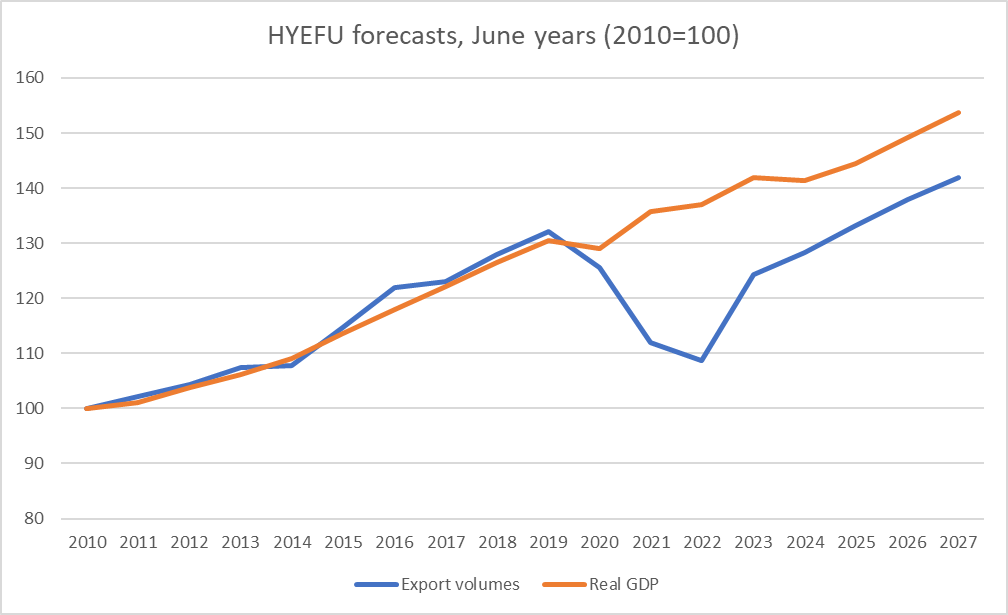
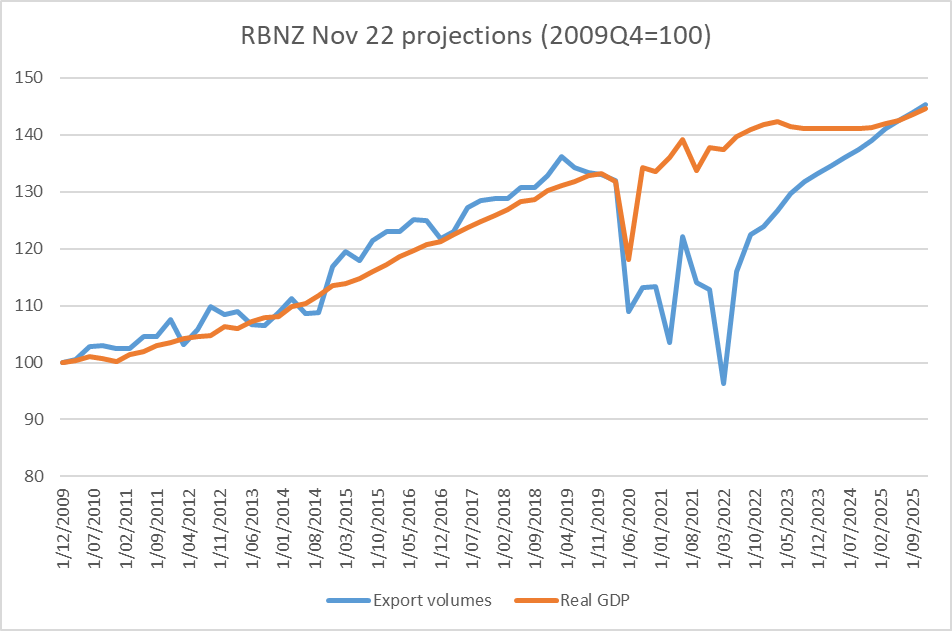
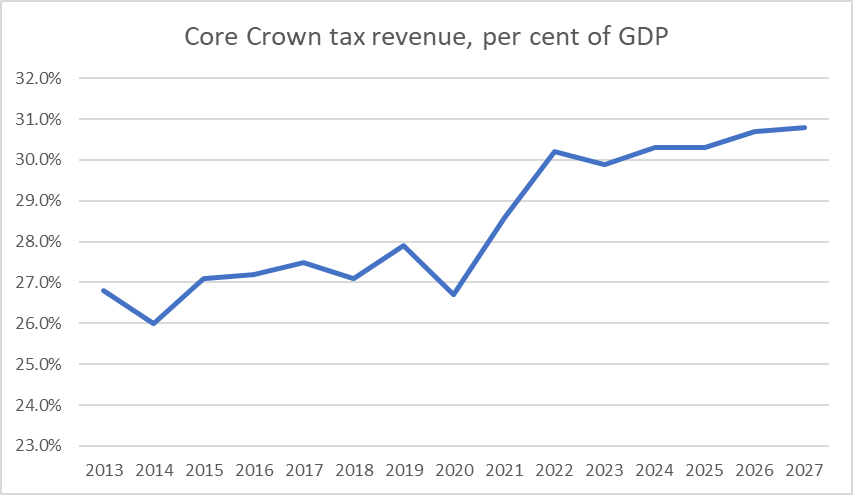
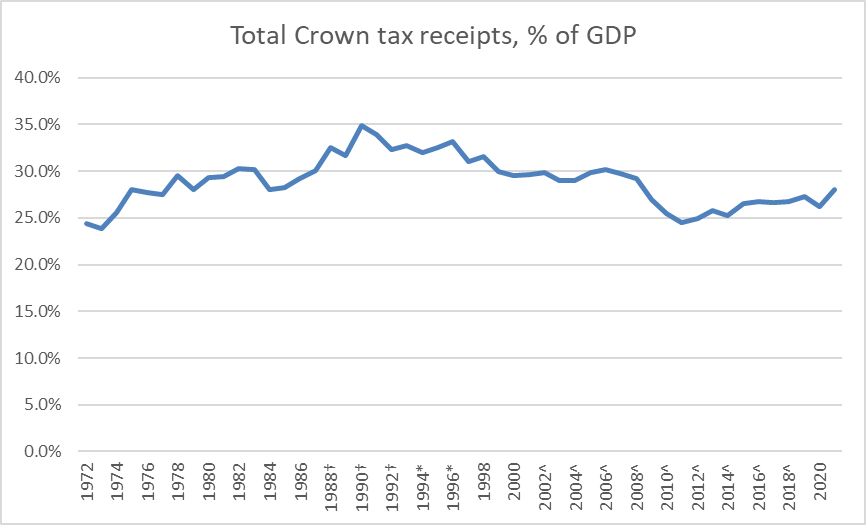
I put a range of charts on Twitter late last week illustrating why, from a macroeconomic perspective, I found the government’s Budget deeply underwhelming. I won’t repeat them but will just show two here.

The first is the Treasury’s estimate of how the bit of the operating deficit not explained just by swings in the economic cycle change from 2023/24 (which was largely determined by last year’s Labour Budget) to 2024/25 (influenced by this year’s Budget choices)

On both these Treasury metrics, things are expected to be a bit worse in 2024/25 than in 2023/24. Not a lot necessarily, but things are heading in the wrong direction: a larger share of the groceries are being paid for by borrowing. And, sure, the projections have the deficits eventually tailing off and returning to surplus eventually – as they have for each of the last few years – but those numbers rely on more fiscal drag and rather arbitrary indications of what future Budget operating allowances might be. Perhaps they will deliver, or perhaps not. We don’t know and neither really do they. At this stage, anything beyond 24/25 is little than aspirational vapourware.

And consistent with that, the Treasury’s fiscal impulse measure – designed to measure the overall of fiscal activity on aggregate demand (with the central bank in mind) – is just slightly positive. Fiscal choices for the coming year aren’t estimated to ease pressure on demand and interest rates at all.

When the starting point is quite a large structural deficit, that seems, shall we say, less than ideal. Perhaps the more so when history (and common logic) suggests that the first year of a new government is usually by far the best time for a government to make tough fiscal choices and adjustments. (I dug out some old Reserve Bank estimates the other day and way back in 1976, the first Budget of that new government had a fiscal impulse of around -6 per cent of GDP. Muldoon had inherited a bigger mess than Luxon/Willis did, but…..a deficit is a deficit, and inflation and interest rates have been a problem.) If the 24/25 Budget wasn’t the year for hard choices, which one will be?

But for this post, I was more interested in comparing some of the Treasury macroeconomic forecasts in the Budget documents with those published by the Reserve Bank the previous week. Here I should stress an important difference: the Treasury economic forecasts were finished on 5 April and the Bank’s weren’t finished until a few days prior to the MPS. But my impression is that there wasn’t much in the way of crucial or very surprising domestic economic data in that period.

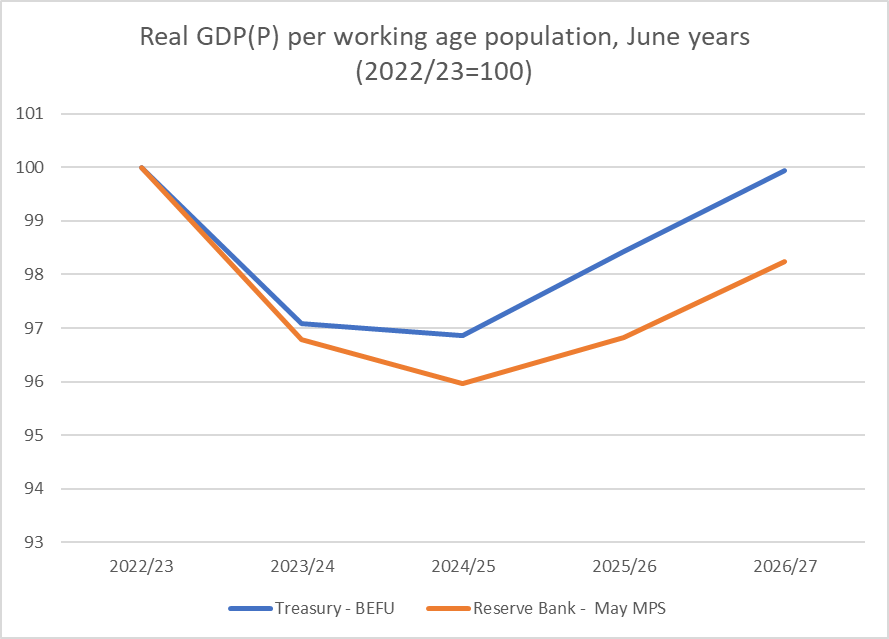
First, compare the outlooks for real GDP per person of working age (the RB doesn’t publish per capita projections, so this is the basis on which we can do a comparison).

Neither line represents a particularly rosy outlook. Even Treasury has us just barely back to the 22/23 level of GDP per working age population by 2026/27, but over that full period the difference between the two sets of forecasts builds to something quite substantial (a gap of 1.7 percentage points by 2026/27).

After the MPS I wrote here about how there seemed to be nothing robust behind the recovery the Reserve Bank was forecasting for next year (given that interest rates stayed high, lags were long, net immigration was declining etc), but I think one important difference between the two sets of forecasts is nearer in time.

There are really striking differences in how The Treasury and the Reserve Bank see excess demand having evolved over the last couple of years. Output gaps aren’t directly observable, but the most recent hard GDP data is still for December last year, but whether for that quarter or the estimate for the March quarter the difference in the two estimates is almost 1 per cent of GDP. On the Treasury numbers there was a significant negative output gap – posing a powerful drag on inflation all else equal – while the Reserve Bank reckons that output gap was only around zero.

Perhaps Treasury would have revised their thinking after the CPI if they’d had been able to incorporate those numbers in their forecasts, but there is nothing in the BEFU document that seems to suggest so.

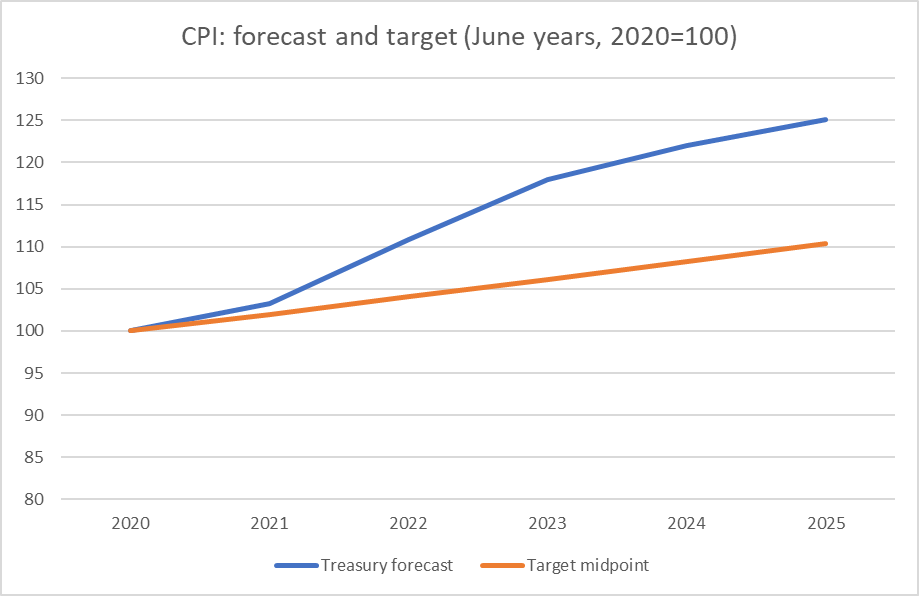
If inflation has been a problem and you think that the economy has recently been only at around capacity then it isn’t too surprising that you have rather weak real GDP forecasts for the period ahead (especially the coming year). Both agencies build their forecasts around inflation eventually getting back to target midpoint; the difference is about what doing that will take.

The Reserve Bank reckons the OCR next June quarter will no lower than it is now, and may have gone higher in the interim. The Treasury forecasts the 90 day bank bill rate, and they reckon that will already be a lot lower (4.5 per cent) by next June. Quite who is closer to right (or least wrong) will matter.

As I say, perhaps the difference mostly come down to timing – the Reserve Bank had the CPI and Treasury did not – but frankly it seems too large a difference to be explained by a single inflation number.

One uncertainty is quite how fiscal policy affects the Bank’s picture. As they noted, their numbers didn’t include the Budget numbers themselves, but Westpac has noted – presumably from something the Bank has said – that the MPC had been briefed on the broad direction of fiscal policy (as you would hope, since it is one of the reasons for having the Secretary to the Treasury as a non-voting ex officio member of the MPC), and speculated that perhaps the Bank’s hawkish tone might have been explained in some sense by that understanding of the fiscals. I’m not sure what to make of that, and after all, the Bank’s chief economist was then at pains to play down the apparent hawkishness in the days following the MPS, with his weird line that somehow it was all just “model output”. More generally, the Bank has been taking a weird approach to fiscal policy over the last year, since that awkward 2023 expansionary Budget, ignoring conventional conceptions of the fiscal impulse and trying to focus attention on real government consumption and investment (in turn very different from either total government spending or a deficit/surplus measure). But for what it is worth, as the chart above shows the fiscal impulse for 2024/25 is estimated to be very slightly positive, and at the time of the HYEFU it had been estimated to be about -2.5 percentage points negative.

At very least, whatever was in the Budget simply wasn’t any help in easing pressure on demand and interest rates. Quite where too from here is going to depend a lot on just how much disinflationary pressure was already building up in the system from a now fairly prolonged period of contractionary interest rates. Given how weak last year was, and how weak things like business surveys still are, my sense would be quite a lot. But time will tell.

The Treasury and productivity

Late last week The Treasury released a new 40 page report on “The productivity slowdown: implications for the Treasury’s forecasts and projections” (productivity forecasts and projections that is, rather than any possible fiscal implications – the latter will, I guess, be articulated in the Budget documents). In short, if (as it has) productivity growth has slowed down a lot then it makes sense not to rely on optimistic assumptions about rebounds in productivity growth based on not much more than hopeful thinking. Fortunately, “wouldn’t it be nice if productivity were to grow faster” does not seem to be The Treasury’s style.

It was a slightly puzzling document though. The global (frontier) productivity growth slowdown has been around for a couple of decades now, and so is hardly news. There isn’t much (if anything) new in what The Treasury writes about that. But there also isn’t much new on New Zealand, and although there are a few interesting charts in the paper, there is very little attempt to get behind them and think about the fundamental economic factors that might be influencing those trends in the data. As an example, we are told “increasing business R&D raises the prospect of productivity benefits”, but there is little sign of any analysis of what it is that leads firms to choose (or not) to undertaken R&D spending (or spending now classified as R&D) in New Zealand. Much the same goes for business investment more generally. The decline in foreign trade as a share of GDP is noted, but it seems to be treated as some sort of exogenous event that just happened, with no attempt to offer an economic (or economic policy) interpretation. More generally, it was striking that neither the nominal nor real exchange rate gets even a single mention in the entire document.

Treasury seems to have been at pains to point out that this 40 page paper wasn’t intended as a policy document, or to address at all the much bigger issue of the huge and decades-long gap between New Zealand’s average labour productivity and that leading and highly productive economies. But they are, as they like to boast, the government’s premier economic advisers. And although they refer readers to their recent Briefing for Incoming Ministers, suggesting that “The Treasury’s Briefing to the Incoming Finance Minister outlines the Treasury’s strategic advice on the opportunities to lift productivity”, it is thin pickings there too. I hadn’t previously read the BIM (low expectations of such documents these days) but when I checked it, the main substantive document amounted to fewer than 30 pages (including lots of charts and full page headers) covering all areas of policy. There was, I think, two pages on productivity. Perhaps they tailored their product to the perceived interest of the customer (few recent governments have shown any serious interest in addressing the productivity failure) or perhaps the premier economic advisory agency just had little of substance to say.

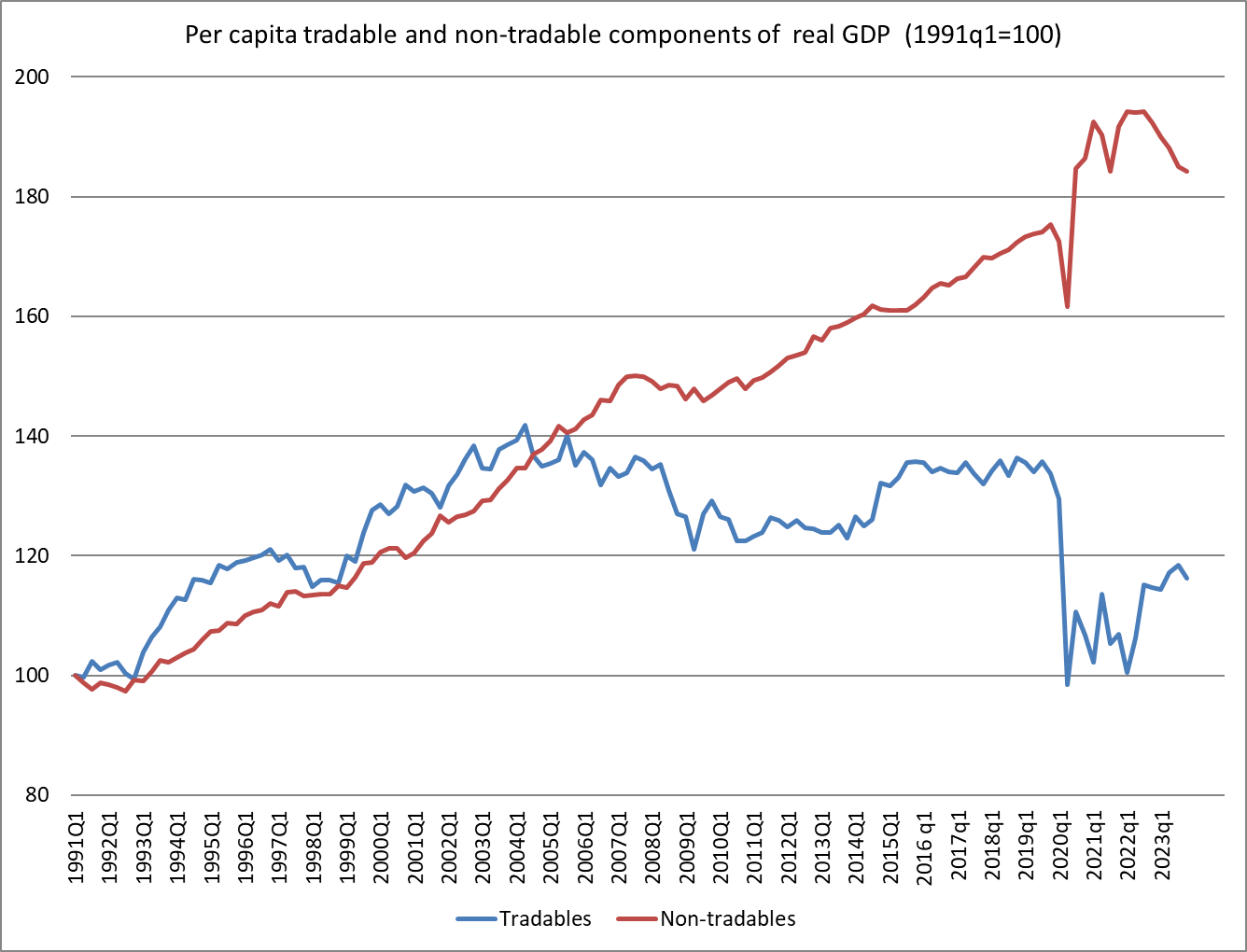
One of my favourite (if depressing) charts over the years has been this one (where tradables here is primary and manufacturing components of GDP plus exports of services). It is doubly depressing because when I first saw it – devised by a visiting IMF mission – was in about 2005, when per capita tradables output had only just started going sideways.

This increased inward-looking nature of the New Zealand economy – across successive governments – gets very little attention in The Treasury’s document.

But perhaps what struck me most – and prompted me to write this post – was the near-complete absence of any discussion about productivity performance in those advanced economies that weren’t at the frontier (there is plenty of international discussion about the frontier, since the countries concerned are the US and a bunch of EU countries) but were or are about New Zealand’s level of average productivity. In fact, I suspect the impression a casual reader would get from Treasury’s document is that everyone has experienced slower productivity growth together.

And that is really, at best, only part of the story.

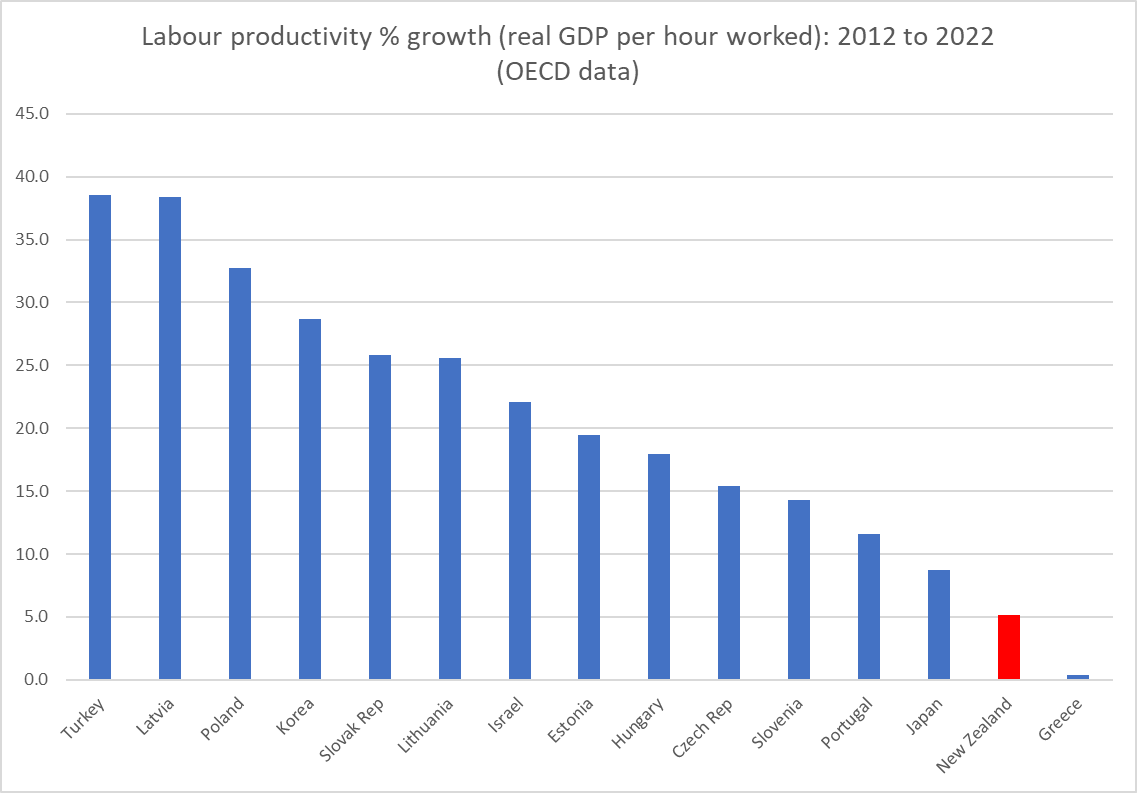
I put this chart on Twitter a couple of weeks ago

These were the group of OECD countries that had moderately close average levels of labour productivity to that of New Zealand at either the start or the end of the period. The period itself was simply a round number: the most recent decade for which there is complete OECD data.

And New Zealand has done really badly over that decade, so badly in fact that of these far-from-frontier economies, only Greece did worse than New Zealand. And these were all countries that, being far from the frontier, had – in principle – significant catch-up or convergence opportunities. More than a few of them realised those opportunities. New Zealand languished.

(Nor is there any mention/discussion of how the experience of Australia and Canada – both richer than us, but otherwise with some similarities around policy experiments and economic structures – have also had woefully bad productivity performance in the last five or so years. Perhaps there are lessons to be learned, insights to be gained?)

I’m not really sure what The Treasury’s purpose was in writing and publishing the productivity document was. But we – and I include ministers here – deserve better from the government’s premier economic advisory agency. The government having – sensibly in the circumstances – scrapped the Productivity Commission, we really need more than ever a high-performing Treasury. It isn’t obvious that we have one, or that it is being led by someone with the interest in or capacity to deliver excellence. Her term expires shortly

Thinking about fiscal policy

The numbers The Treasury will release in its PREFU next week will make it fairly easy to follow some bits of New Zealand fiscal policy over time, less so others, but do almost nothing to facilitate international comparisons, and discourage New Zealand users and analysts from looking at fiscal policy in the way most other economic analysts and the international agencies do. It is fairly transparent, but in an insular way.

New Zealand’s government accounting framework often wins plaudits. As a matter of accounting, no doubt the plaudits are largely fair (although I’m not an accountant, and have previously suggested that some accountants rather overrate the contribution of the New Zealand model). It just isn’t a framework used widely for economic analysis or as a good basis for holding governments to account for the conduct of fiscal policy.

The focus here tends to be on the operating balance (excluding gains and losses). Last year, for example, the current government articulated its primary fiscal goal as being to (eventually) deliver and maintain an average (OBEGAL) operating surplus of between 0 and 2 per cent of GDP. It is a fairly theory-free measure

attractive mainly for being relatively more controllable year to year than a simple operating balance would be. But it is the first of the handful of “Fiscal strategy indicators” in the tables Treasury publishes. It was the measure that was forecast to turn positive (surplus) in 2025/26 in this year’s Budget (before they realised they’d forgotten to allow for the near-certain loss of lots of tobacco excise revenue), but in 2024/25 in last year’s Budget (and perhaps in 2026/27 in next week’s PREFU). It is the measure that was still in material deficit in 2022/23 and 2023/24 even at Budget time, before the deterioration in the tax revenue this (calendar) year became apparent.

But an operating balance measure (OBEGAL or total) isn’t widely used for fiscal analysis purposes elsewhere. In fact, if you turn to the two main compilations of comparable cross-country fiscal data – the IMF Fiscal Monitor and OECD Outlook – you won’t find any operating balance data at all (although you can put together such numbers yourself from components in the OECD database).

There are a couple of good reasons why that isn’t the focus.

Operating balances sound good and commercial, somewhat akin to a profit and loss account for a business. Capital expenditure typically doesn’t appear in a profit and loss account, and nor should it (as with New Zealand government accounts depreciation appears in a profit and loss account, and in the government’s operating balance). But when a business does capital expenditure it does so with the goal of generating future income (or maybe reducing future costs) but that is rarely the case with government capital investment spending. New Zealand’s total Crown OBEGAL does take account of the Crown’s ownership interests in various profitable businesses (which is not the case with the standard general government concepts used in the national accounts and in most cross-country fiscal analysis, where commercial business interests are excluded by construction) but most total Crown capex is just another form of spending. It might – like operational spending – be done for good reasons, it might have expected benefits down the track, but any such benefits are rarely fiscal in nature. And today’s capex is tomorrow’s depreciation (with no new matching revenue). In principle, the worse the project the larger and sooner the economic depreciation.

The second reason is the role of interest (financing costs). It is very common in overseas and international agency fiscal analysis to focus on primary balances, which exclude financing costs. These series are prominent in IMF and OECD tables. In New Zealand the Treasury publishes no primary balance measures at all and never seems to discuss the concept (one can construct some yourself, although probably only as reasonable approximations)

There are two good reasons for a primary balance focus. The first is that interest payments mostly reflect past fiscal choices rather than today’s (if your country ran up a high debt a decade ago, you are most probably still servicing that debt now). It is a real fiscal burden now (and thus primary balances aren’t the only relevant metric) but what matters more for the future debt trajectory is what choices are being made now re non-interest spending, and revenue. Broadly speaking, if you are running a primary surplus debt (to GDP) is likely to be heading in broadly the right direction, and if you are running a material primary deficit, then debt probably isn’t going to be heading in the right direction (it depends on your respective interest rates and GDP growth rates).

The other reason for a primary balance focus hasn’t been very relevant in advanced countries for several decades but is now: inflation. When inflation is low nominal interest rates tend to be low. When inflation is high nominal interest rates tend to be high. If interest rates are 2 per cent and inflation 2 per cent, the substantive economic implications for government finances are no different than if inflation is 5 per cent and interest rates are 5 per cent (real rates are the same). But nominal interest is what is recorded in the government accounts (and in those New Zealand government operating deficit numbers I mentioned earlier). It makes a difference: at present government bond rates and the OCR (much of the Crown’s debt is currently those RB settlement account balances) have increased a lot, but are actually both still below the rate of inflation. In economic substance terms, the operating deficit numbers in the Budget (and those to be published next week) are materially overstated.

(Inflation adjustment issues are pretty pervasive – company accounts and individual debt burdens, not just the government’s – are just another reason why we shouldn’t be tolerating a central bank doing such a poor job on core inflation that we have start thinking again about how inflation distorts both behaviour and accounts.)

Now it is true that The Treasury doesn’t just publish (total Crown) operating balance (OBEGAL) numbers. Second on that table of Fiscal Strategy Indicators is a measure called “Core Crown residual cash”. Unlike the OBEGAL it is (a) measured on a cash basis (not accruals), b) is a core Crown measure (not total Crown), and c) it treats all cash (capex and opex) alike. It is, in other words, much more akin to the series that show up in those international databases (but note that neither core Crown nor total Crown is the same as “central government” for national accounts purposes, let alone “general government” – which is vital for cross-country comparisons with countries where state/provincial and local governments make up a much bigger share of overall government activity)

When I went to work for a while at The Treasury I vividly recall one of their more astute analysts encouraging me to focus on this measure. Few in New Zealand seem do (and I only inconsistently across time). Neither political party seems to. And in case you were wondering, in this year’s Budget – recall, before the fall off in tax revenue – the core Crown residual cash deficits were expected to be 5.7 per cent of GDP in 22/23 and 6.5 per cent in 23/24.

The ups and downs of the economic cycle affect fiscal balances. Expenditure is affected to a small extent (eg unemployment benefits) but the main impact is on the revenue side (tax receipts). Consistent with that it is common to look at, and the international agencies, publish estimates of cyclically-adjusted deficits (total and primary).

The New Zealand Treasury does typically publish estimates of the cyclically-adjusted operating balance, but not of even any other measures, and notably not of any primary balance measure. One could do one’s own rough and ready adjustments to the alternative series, but how much better if Treasury were doing the adjustments themselves, using disclosed the contestable methodologies. There is also no long-term consistent time series (eg published with the annual long-term fiscal data on The Treasury website). There is no one right answer to how much allowance should be made for cyclical factors in doing cyclically-adjusted numbers – it is the same contests around the output gap and the NAIRU as monetary policy makers repeatedly face (and estimates are likely to be revised, perhaps quite a bit, over the years) – but in big booms and deep recessions it is important to try (normally we would not want deep fiscal cuts if we could be reasonably confident a deficit was mostly a reflection of a deep cyclical downturn).

Until relatively recently, The Treasury used to publish (but buried very deep in an Additional Information document) the operating balance on a terms of trade adjusted basis (a higher/lower terms of trade – variable and largely outside New Zealand control – can flatter/punish fiscal outcomes independent of government fiscal policy choices. Here is an example, from the 2017 PREFU, of how much difference Treasury thought the rising terms of trade had made in improving fiscal outcomes over the previous decade.

As the terms of trade trended upwards fairly consistent over 15 years, the adjustment perhaps became somewhat moot. In the last few years, on the other hand, the terms of trade have been falling back.

Much of this post so far has been about how we might better analyse New Zealand numbers in isolation, but international comparisons also matter. Why? Because there are no single right and wrong answers about the appropriate deficits or surpluses or debt levels, but we can often make better sense of our own data if we can compare and contrast with developments in other advanced economies. But comparing and contrasting needs to involve data compiled as consistently as possible across countries (as, say, with cross-country comparisons of GDP growth and productivity, and where comparisons of inflation are often complicated by the absence of such consistently compiled measures). For those purposes, the fiscal databases and forecasts done by the IMF and the OECD are the standard. In those databases we can find raw and cyclically-adjusted primary and overall fiscal balances, gross and net debt measures, and measures of net lending (savings less investment), all on a general government basis.

Both the IMF and the OECD produce numbers for New Zealand, including forecasts for the coming years. These are typically done starting Treasury’s fiscal numbers and adjusting for (a) different views on the state of the economy, and b) the methodological differences between the New Zealand measures and these internationally conventional ones. At times – eg the IMF Article IV report last week – they will provide some updated estimates, but generally the IMF and OECD numbers are published only twice a year.

But in the Treasury numbers accompanying the EFUs there is no attempt made to present their updated numbers in an internationally comparable format (not even just as an appendix), whether flow or stock measures. On the face of it, doing so should be a relatively mechanical exercise that would require a one-off investment to set up but almost no marginal resource cost beyond that (especially when the non central government components of general government are small and slow moving in New Zealand). And yet they choose not to do it, and as a result serious international comparisons are harder than they need to be. There will be some new IMF WEO estimates for New Zealand in October, but they are likely to emerge just a couple of days before the end of our election and won’t be able to inform discussion/debate of the fiscal situation. But Treasury could have produced their numbers in IMF and OECD formats.

This has been something of a background post with little data and just one chart. Tomorrow I will do a post looking at some of these better measures (NZ specific and internationally comparable) across time and across countries (OECD and IMF advanced economies) to put some light on how things stand right now, and have evolved in recent years. PREFU will then give us some more – apparently gloomier (although how much of that will be judged cyclical?) – data next week.

Making the PREFU more useful

Anyone with even a vague interest in matters fiscal (or those with little real interest but some responsibility) is now awaiting next Tuesday’s pre-election fiscal update (PREFU).

PREFU is a good to have, and much better than nothing, but could be made quite a bit more useful and relevant for what must be presumed to be its ultimate purpose, informing the pre-election debate around matters fiscal. The current law governing PREFU is a single (full page) clause in the Public Finance Act.

For a start, it should probably be moved a week or two earlier. The law requires as follows

The Minister must, not earlier than 30 working days, nor later than 20 working days, before the day appointed as polling day in relation to any general election of members of the House of Representatives, arrange to be published a pre-election economic and fiscal update prepared by the Treasury.

which would be fine if we thought of polling day as 14 October. 12 September (next Tuesday) is more a month before that. But since that law was passed, advance voting has, for good or ill (I think mostly ill), come to make up a very large share of votes cast, and advance voting opens less than 3 weeks after the PREFU will be brought down. Changing the law to require the PREFU to be published 20-25 working days before polling opens would seem consistent with the spirit of the original legislation now that voting arrangements/patterns have changed so markedly.

Obviously there are trade-offs. There are significant lags involved in bringing the Treasury EFUs together, but the point of the exercise is to inform voters and enable scrutiny, debate, and challenge, including around political parties’ programmes in response to the PREFU numbers (this is mainly an issue for Opposition parties, as the governing party not only has the advance information from Treasury but can ensure some of its policy stance is included in the PREFU numbers themselves, when communicated to Treasury as government policy (eg stance of future operating allowances)). Note that the PREFU is not, and cannot realistically be counted on as, the “opening of the books” for an incoming government, because in unsettled times numbers can move about quite a bit even in the period between PREFU numbers being finalised and a new government taking office (this was an issue in 2008 for example).

PREFUs look a lot like the Budget and Half-Yearly economic and fiscal updates (BEFUs and HYEFUs) – here is the link to 2020’s and here is 2017’s (one prepared in more settled times) That is encouraged by law, since the things Treasury has to cover in each of these documents is the same. In respect of the economic forecasts, that is probably fine: after all, forecasts of the overall economy are just that: forecasts. A myriad of private choices, here and abroad, and the cyclical stabilisation activities of central banks, will influence outcomes, but mostly those outcomes are beyond the government’s (or Treasury’s) control. The economic outlook is a backdrop for fiscal numbers and, perhaps, fiscal policy.

I’m sure there will be some gotcha-type focus next week on some of the macro numbers. Will, or won’t, Q2 be shown as having experienced positive GDP growth. Given (a) the long lag on Treasury’s numbers, and b) that the actual official SNZ estimate is out the following week, much of that might be good fun but largely pointless. Same probably goes for their view on near-term inflation (if you could ask the Treasury forecasters next Tuesday their best guess of Q3 inflation it would almost certainly be different by then to what will be in the document they publish that day). That’s inevitable.

The real focus is, or should be, on the fiscal situation, which one or other party will be directly responsible for in a few weeks’ time (and one party is of course responsible now).

The operative bit is 26U(2) above. Hence, the government’s fiscal announcements last Monday, trimming future operating allowances etc, in ways quantifiable enough to be included by Treasury in the fiscal forecasts we will see next week. The Minister of Finance could, if s/he were sufficiently cynical, set the future operating allowances to zero and Treasury would have to include that “government policy” in its PREFU fiscal forecasts. The Secretary to the Treasury does not have any leeway to forecast how that policy might actually play out over several years. It is her legal responsibility simply to ensure that the forecasts accurately reflect the policy the Minister has communicated to her.

In the normal EFUs there is somewhat more restraint on Ministers of Finance. You could communicate to The Treasury low operating allowance numbers for this EFU but….you will still be minister in a year or two’s time and will be accountable for the eventual numbers. It isn’t perhaps much of a restraint – forward fiscal paths often have a “line on a graph” quality to them (with no specifics as to how these numbers will be delivered) – but it is something. In a pre-election EFU, no one is accountable for anything really (well, the Secretary is, but for faithfully representing government policy in the tables).

In the 2020 PREFU there was a bit of sensitivity analysis published – we were in the midst of pretty extreme Covid uncertainty at the time – but more normally there appears to be little or none (check again 2017’s and you will find none re the fiscal position itself, only (buried deep in supporting documents) on the cyclical adjustment estimates).

My focus here is not so much on the uncertainties of this year’s tax take. They are no doubt real, but economic cycles ebb and flow. Fiscal analysis really should focus mostly on cyclically-adjusted concepts and numbers.

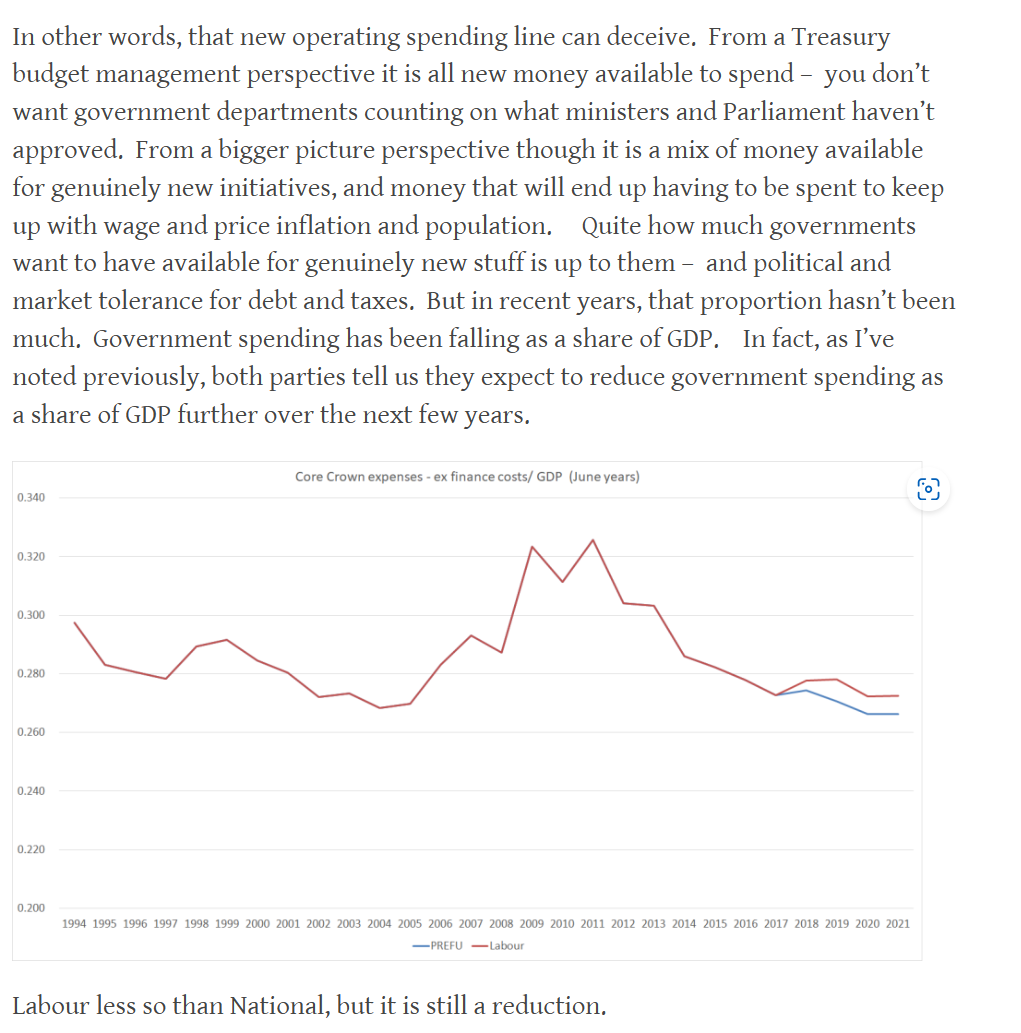
But what we don’t get from Treasury in the PREFU documents – or anywhere else (other perhaps than in the periodic long-term fiscal report, which isn’t focused on the next 2-4 years) – is any sense of the state or implications of the cost pressures that will be difficult for any party in government to avoid. Political parties can and should debate what programmes should be provided and what not. Treasury can’t offer any particular insight on those debates. But it can, and should, be offering some sense of the spending implications of projected population growth, projected inflation, projected private sector real wage growth, and so on. If the past is any guide, next week’s PREFU will show us none of that. The revenue implications will be taken into account but, except where the law requires indexation (for example), not the expenditure implications. Unless conscious and deliberate other choices are made, those sources of pressure will increase government spending over time. But Ministers of Finance are simply free to give the Secretary to the Treasury a path for future operating allowances which need not bear any relationship to, or be based on any analysis of, largely inescapable cost pressures.

This might be seen primarily as a dig at the current government. It isn’t. In 2017 there was a huge political and analyst debate about alleged Labour “fiscal hole”. Many of the claims proved to be overblown but the “largely inescapable cost pressures” point was very real. At the time, and at the prompting of several former senior Treasury officials, I wrote a post on exactly that issue. By that time we had both the PREFU (reflecting incumbent government’s plans and operating allowances) and the then Opposition’s own fiscal plans (at present we have numbers from neither side). This text and chart was from that post

and after I’d worked through various detailed numbers around forecast influences that would boost costs

Neither side told us how they envisaged reducing government spending as a share of GDP. In a mechanical sense (PREFU and Labour’s parallel) they added up, but in substance they didn’t. Some related points were also in this post.

I expect that in next week’s PREFU there will be an operating surplus shown at some point in the relevant horizon (perhaps a year later than was suggested in the Budget). Quite probably – given that National seems to have no interest in an aggressive fiscal consolidation – that will suit both parties, but in both cases it will avoid the hard discussions around the choices that will bring about such surpluses. Countries don’t get from cyclically-adjusted deficits to surpluses by magic – or by simply drawing a line on a graph. Both sides are already guilty of “line on graphism” with what are no more than assumptions about savings that might be made without addressing programmes or choices that would make such savings sustainable.

It isn’t that medium-term fiscal projections are always useless. Sometimes legislation will already have been passed that will come into effect only gradually, and we want to be able to see the implications of those legislated commitments. But that really isn’t much of an issue at present. And absent such slowly unfolding adjustments it really means that almost no attention should be paid to any fiscal deficit numbers in PREFU beyond the current financial year: this year’s Budget has been passed and what is authorised isn’t vapourware. But what parties tell us vaguely they might do in future (and both are guilty) isn’t really worth much at all.

I ended that 2017 post with this suggestion

I stand by that call. I’m quite confident there has been a lot of very low quality spending in recent years, but I also suspect that the things governments need to spend money on are benefiting temporarily from the big surprise inflation. I’ve made the point here that teachers were more or less forced to accept a real wage cut, and a big cut relative to private sector wage developments. Recruitment and retention challenges are, shall we say, not unknown in the sector, and if we care at all about a high quality education sector then over time (and whatever else needs sorting out) we will need to pay accordingly. The senior doctors dispute seems to have similar characteristics. But how large and pervasive are these effects across the board? Treasury is best-placed to know, and to tell us. If the amounts are material then whatever savings can be made from genuine bloat might not reduce deficits at all but just end up having to be spent to be able to maintain or secure high quality core services. Treasury is obliged to publish a lot, but it could publish more and more useful standardised information along these lines.

There was a blackball on expertise

(This is a long post. The Executive Summary is that there was a bar on any active or future researcher on macro or monetary issues serving on the Reserve Bank MPC when it was established. Everyone accepted that this was so, and both the Minister and the Bank had defended the bar. Recently, the Reserve Bank Board chair Neil Quigley persuaded Treasury to state publicly that it had all been a misunderstanding and there had never been such a ban. None of the extensive documentation supports Quigley’s belated claims or explains Treasury’s willingness to champion his rewrite of history.)

About six weeks ago the ban that had been placed on anyone with current or likely future research expertise or interest in macroeconomics and monetary policy serving as external members on the Monetary Policy Committee was once again in the headlines. The Reserve Bank Board had just advertised to fill the two vacancies that will arise next year (yes, you might wonder why they were advertising now when it isn’t clear who will form the next government or what their expectations for the Reserve Bank might be, but leave that for another day). In the advertisement it was pretty clear that the former ban had now been lifted. If so, that was a really welcome step forward. The proof would still be in the sort of appointments eventually made, and the strong suspicion is that the more important (but unwritten) blackball is still in place – no one seriously likely to challenge the Governor or known for thinking independently was likely to be appointed. But it was a start. And would at least mean the Board and Minister were no longer open to the charge of having the only central bank in the advanced world (or most of the rest) where relevant expertise was a formal disqualifying factor from membership of a monetary policy decision making body. The list of former leading central bank figures internationally who would have been disqualified under such a rule is very long indeed.

I idly wondered what had led to the change.

The Herald’s Jenée Tibshraeny has done sterling work in giving this issue some of the coverage it deserved (where, one often wondered, were the Opposition parties), initially at interest.co.nz and now at the Herald. She asked what had gone on and got a surprising answer from The Treasury and the Minister of Finance. It had all, we were asked to believe, been a misunderstanding, and there never was such a restriction. Tibshraeny’s 21 June story is here. I wrote about the story, documenting how improbable these revisionist claims were, here. And then I lodged an OIA request with The Treasury.

To step back for a moment, the existence of this restriction was first confirmed in a response to an OIA I lodged with the Minister of Finance after the first MPC appointments were made in March 2019. The Minister’s response is here. A short Treasury report to the Minister, dated 29 January 2019 and signed out by the Manager, Governance and Appointments contained the following paragraph on the first (of two) pages (it was a covering memo relating to getting the Minister to send a paper to Cabinet’s Appointments and Honours Committee to make the MPC appointments)

It didn’t leave much room for doubt, and came as no surprise to me because what was written there was what I had been told some months earlier by a well-qualified academic who’d expressed interest in the possibility of an MPC role. Here is how I described in a post when the papers were first released by Robertson

I couldn’t use that information when the person first told me – and had to wonder if somehow they’d got the wrong end of the stick- but it informed the framing of my OIA. The person concerned was told of this bar as it applied to people like him by both the recruitment consultants the Board was using and by the Board chair himself.

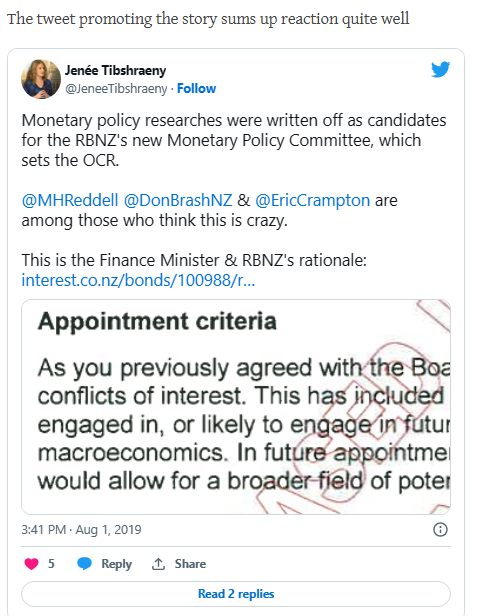
Tibshraeny gave the issue coverage. Here was her 1 August 2019 story. There were scathing comments from former Reserve Bank Governor Don Brash, critical comments from Eric Crampton (and some of my post’s critical lines), as well as some comments from former Reserve Bank Governor Alan Bollard suggesting that perhaps all that had really been meant was not having people with “market interests”. But what really mattered were comments from the Minister of Finance himself and an official “Reserve Bank spokesperson”.

Here was Robertson

which sounds defensive and unenthusiastic, but certainly not suggesting that there was not a restriction, let alone suggesting that a Treasury official had simply made a mistake in that January 2019 report.

And from the Bank’s side

To the first paragraph one goes “of course” (as in, we don’t want MPC members also selling their wares to hedge funds etc at the same time), the second para is beside the point (the issue with the blackball was about research), and as for the third……..doesn’t that first phrase (“looser criteria…..”) read almost exactly like the words of the initial Treasury report. There was no suggestion at all that some Treasury official had just got the wrong end of the stick. Rather, as was their right (and job), they defended the stance that had apparently been adopted by the Board and the Minister. And while it was an anonymous spokesperson, there is absolutely no way those lines would not have been cleared with the Governor, and probably cleared with – but certainly advised to – the chair of the Board, Neil Quigley. Had Quigley then thought the Treasury report had misrepresented him or his Board, it would have been easy to have issued a clarifying statement.

And there the issue lay for a couple of years – there were no external MPC vacancies, and Covid overran everything. But in early 2022 the first terms of two MPC members were coming to an end. And in the margins questions were getting raised as to whether the blackball restriction was still going to be in place. Tibshraeny – who had talked to at least a couple of us – was on the ball again and went and asked both the Minister and the Bank about the specific restriction. Her story appeared on 19 February 2022.

There are no quotes from either Robertson or the Bank (presumably she just got responses along the lines of “no, there has been no change” rather than anything more enlightening).

Tibshraeny went further, seeking comment from others. This time she sought comment first from John McDermott former Chief Economist and Assistant Governor at the Reserve Bank.

And he wasn’t just speculating about the nature of restrictions. He had still been Chief Economist and Assistant Governor in the second half of 2018 when these policies and restrictions were being formulated, and is an active participant in email exchanges among RB senior managers on the sort of people who might be appointed (that were contained in the Reserve Bank’s OIA release to me in 2019 around MPC appointments). He disagrees with the blackball restrictions, but doesn’t suggest anyone misunderstood, because he will have known that it did represent the agreed stance of the Board and the Minister.

She also got comment from Craig Renney

Renney also knew the restriction was for real, and never suggests – even though it might have suited his former boss if it really had been so – that it had all just been an unfortunate misunderstanding by a Treasury official.

(As it happens, in that Reserve Bank OIA there is a copy of the questions for the interviews the Board sub-committee (Quigley, Orr, and Chris Eichbaum) conducted for short-listed candidates for the MPC. It is interesting, although not conclusive on its own, that none of them invite candidates to offer any serious thoughts on monetary policy, frameworks etc. Note also that Chris Eichbaum – a VUW academic with Labour connections – used to be quite active on Twitter, and was not shy of disagreeing with comments I made about the Board or monetary policy, and never once suggested that the blackball didn’t exist, that it was all just a mistake by a Treasury official. Nor, of course, has Orr – not usually a shrinking violet when he thinks other people have the wrong end of the stick.)

Anyway, all that was the public record until 21 June when the new Tibshraeny article appeared. These were the key lines

From Robertson

and from The Treasury

I’d lodged an OIA with Treasury (maybe should have lodged one with the Minister too, but didn’t so) seeking to understand why they had said what they were quoted as saying. I got the entire 111 pages back on Friday afternoon.

Treasury OIA reply Aug 2023 re the MPC research blackball

Perhaps it amused Treasury to let me know they read my blog since the very first document released (but probably out of scope) was this advice from the manager of the macro team to colleagues in the media and governance bits of Treasury.

The Treasury comments were prompted by this request from Tibshraeny

Note that her request was cc’ed to media people in the Minister’s office and at the Reserve Bank.

I’m not entirely sure where she got the idea from that the 2019 line had been an error, although she illustrates her point by reference to Bob Buckle. I dealt with that point in my June post

Since then Buckle has finally delivered a conference paper (which I wrote about here) but that is 2023 and there seems to be no doubt that the blackball, if it once existed, does no more.

And this was the official Treasury reply

And this was not something just cooked up at a working level by junior staff. Two Treasury DCEs appear on the relevant email chains, as does the comment that the draft would be cleared by the Secretary’s office and sent to the Minister’s office before it was finally released to the Herald.

All the claims here about the 2018/19 process are simply false. Senior Treasury officials seem to have allowed themselves to be gulled into taking at face value an attempt by Neil Quigley, chair of the Reserve Bank’s Board (and Vice-Chancellor of Waikato University) to rewrite history, all the easier for them to do as it seemed to involve simply tossing under a bus the former Treasury manager (who signed out that 2019 paper) who no longer works there.

There is bit more context in the first draft response prepared by the current Manager, Governance and Appointments and the Treasury manager who was responsible for macro policy in 2019 (Renee Philip)

Later in the release we learn that in March this year Philip had had a meeting with Neil Quigley

This is a strikingly uncurious email (from an experienced manager to the Secretary to the Treasury and to the Deputy Secretary, Macro), in which it appears not to have occurred to her that the Bank and the Minister had defended the restriction in public (more than once), or that people who had been in a position to know – McDermott and Renney – while disagreeing with the policy had never once suggested it was all a misunderstanding. Or that the Bank’s defence of the restriction had used very much the same words – re future appointments – as were in the now-contested 2019 Treasury report. (And although she had apparently read my posts on the subject had not internalised the report of a qualified person who had explicitly been debarred from consideration.)

Quigley also cleared the Treasury June 2023 statement. Here is what he had to say then

(Nick McBride is the Bank’s in-house lawyer)

So we are supposed to believe that a fairly hands-on Board chair (there are lots of emails from him in various OIAs) simply wasn’t aware until this year of lines Bank spokespeople had explicitly addressed in 2019 (and again apparently in 2022) about a process he had been one of the key players in. The Tui ad springs to mind.

But none of it rings true. Perhaps no one at the Bank saw the initial Treasury report when it was written in January 2019 (although it seems not very likely given that the paper trail shows active engagement with the Bank and Quigley re MPC appointments issues in late January 2019) but it is beyond belief that Renee Philip hadn’t seen it (even though her comments suggest the macro team only really became aware of the issue after the OIA release in July 2019) as not only does the paper trail show that the request from the Minister’s office for the paper came first to the macro team but there is an extensive trail of emails from that time (Jan/Feb 2019) on MPC appointment issues which typically have both the manager, macro and the manager, governance and appointments on them. It seems very unlikely the macro team did not see the final (short) report. And there is also no sign – in the paper trail or his later comments – that the Minister or his senior staff read the Jan 2019 report and said “no, no, you’ve misunderstood, I never agreed to any bar like that”.

But, as it happens, we have contemporary lines from Quigley from the OIA the Bank released to me in 2019.

Mike Hannah was at the time the Board Secretary. He records the Board’s discussion the previous day, in a summary to be sent on to the recruitment consultants, in which the observations from the Board included “an academic researcher active in the Bank’s areas would likely be conflicted”. And Quigley welcomes the summary with no cavils or suggested amendments. It isn’t exactly the same words as turn up months later in the Treasury report but it is strikingly similar to those words (which Bank spokespeople later defended). It also aligns with the report from such an academic who had engaged with the recruitment consultants and with Quigley himself at the time.

The snippet is also interesting because it illustrates that at this stage of the process neither Buckle nor Harris were in frame, and casts further doubt on Quigley’s 2023 claim that in 2018 the Board had actively considered active macro researchers. Buckle comes into the frame a little later in this email from Hannah to Board members suggesting names proposed by Bank senior management. Note that Buckle is treated as a “former academic with an interest in policy”, not as an active (macro) researcher.

Now, 2023 Treasury officials cannot necessarily be expected to have had all this at their fingertips (although the relevant OIA was sitting on the Bank’s website, and Treasury does have a heightened monitoring role re the Bank), but what staggers me is the lack of critical assessment of the Quigley story.

Now, as it happens that is not universally true. In the latest Treasury OIA we find

Leilani Frew is the DCE responsible now for the governance and appointments function (and Stella Kotrotsos’s senior manager). Her instincts look to have been quite right…..but there is nothing else in the pack suggesting she did anything with them.

There was also this

James Beard is the Deputy Secretary, Macro. His instincts, while more limited, also seem to have been right, but again there is no sign his unease went anywhere either.

If either Frew or Beard were junior figures perhaps you might not be surprised they were ignored, but these are two of the most senior figures in the Treasury. It doesn’t reflect very well on them or on the Secretary or her office (whoever finally signed the statement out). Or, for that matter, on the managers past and present involved in responding to Tibshraeny’s request. You hope the standards they bring to their economic and financial policy advice are rather higher.

But if senior Treasury figures showed themselves gullible and too willing to go along, they weren’t the ones who perpetrated this exercise in mendacity.

I’d really prefer there to be a charitable explanation of Quigley’s comments. Perhaps if it was the June ones alone one might put it down to being caught on the hop on a busy day – he has a fulltime job and universities seem to be in some strife – but those comments are substantially similar to ones he is reported as making to a Treasury official in a scheduled meeting months earlier. It is hard to see any credible explanation other than an embarrassed attempt to rewrite history (would you want to be remembered as the academic economist who was responsible for banning active or future researchers from your country’s MPC?). In Orwell’s 1984 the bureaucrats literally rewrote the old papers. Thankfully – and for all their limitations – we have the private media and the Official Information Act.

If I was Treasury I would be fairly deeply unimpressed (as well as somewhat embarrassed myself), and if I were Tibshraeny the idea that I had simply been lied to by senior officials (directly and indirectly) wouldn’t have gone over terribly well either.

Mendacity

On Monday the Reserve Bank Board put out a release indicating that it was opening applications to fill two external MPC vacancies (which will arise next year when the second and final terms of Peter Harris and Caroline Saunders expire). By law, the Minister of Finance can appoint to the MPC only people the Board has recommended (the Minister can reject nominees, but cannot simply impose his/her own people). There are all sorts of problems with this process and with the people involved in it, but that is for another day and another post.

When I opened Monday’s emailed release, my eye lit immediately on this

This appeared to be quite a change from the stance adopted by the Board (which includes the Governor) and the Minister of Finance since the MPC was set up under which (to quote from a January 2019 Treasury report to the Minister released to me by the Minister of Finance (page 14) in June 2019 in a response to an OIA request which had asked, inter alia, about policies designed to exclude persons or types of persons)

Anyway, it seemed like good news. I exchanged notes with a few people idly speculating on what might have changed their mind. Perhaps they (Bank, Minister) had just got sick of being mocked for being the only central bank in the world where expertise was an active disqualifying factor? Perhaps The Treasury, with a newly-strengthened oversight role in respect of the Bank, had played a part? Perhaps the new Board, deeply underqualified bunch of government mates as it was, had as fresh faces thought the old ban looked odd. Perhaps Orr and Quigley were conscious that the government might well change later in the year and that the Opposition parties already seem to look askance at various of their choices, structures, and individuals? Getting rid of the absurd ban might neutralise one more obvious irritation. We don’t know (although I have lodged an OIA request, which might – months down the track – shed a little light). It is fair to note that the very next sentence in that extract above read as follows

On Twitter, the Herald’s Jenée Tibshraeny mentioned that she was approaching Grant Robertson’s office to ask about the apparent change of stance.

Late yesterday, her story appeared. The key bits relevant to this post were a direct quote from the Minister

and a direct quote from The Treasury

(to be clear, the Bank’s sticky fingers do not appear in this story at all).

There are all manner of problems with these lines given – by powerful people and institutions – to the journalist.

For a start, why did news of the blackball emerge at all? Well, that was because an academic – who could have been well-suited to the MPC role – got in touch with me in late 2018 or early 2019 and told me that he had reached out (possibly to the Board chair himself, but I can’t now be sure of that) and been explicitly told that there was no point in applying because the Board would not be considering anyone who was an active, or likely future, researcher on macro or monetary policy matters. Since the person concerned (understandably) did not want me directly quoting him, I lodged OIA requests with the Board and the Minister of Finance to see what I could smoke out (responses written up in a post here). The Minister’s response, linked to above, revealed the policy which had apparently been agreed between the Minister and the Board. The description tallied more or less exactly with what the academic had independently told me.

The revelation of that policy agreement didn’t just die in a blog post here. Jenée Tibshraeny, then at interest.co.nz, picked it up, talked to various central bank watchers etc and wrote a story. She even talked to the Minister of Finance and to the Bank.

Her story is here. My post following it is here. Here were the lines from the Minister and the Bank

There is not the slightest suggestion there that Treasury had used ‘over-zealous language” or that the critics had got the wrong end of the stick. Rather, they are defending their stance. In fairness, you would have to say that the Minister seemed fairly half-hearted (and I have heard suggestions over the years that Quigley, the Board chair, had been the driving force behind the blackball, and that Robertson had just gone along), but he doesn’t disavow the policy or Treasury’s description of the policy.

And there, the odd jeer aside, the matter rested for a while. The new MPC was what it was, there were going to be no external vacancies for a while, and of course there was Covid.

But by late 2021 I was focused on the fact that the end of the first terms for two MPC members was approaching and started highlighting the question as to whether the blackball on expertise was still in place. Others were talking about it too, including to Tibshraeny. She had the access the rest of us didn’t and asked the Minister or his office about the policy.

As it happens, documents show they were always just planning to reappoint Buckle and Harris, so there was never a fresh search programme (or even a serious evaluation process). So they could have avoided Tibshraeny’s questioning, but instead they seem to have been quite clear (her story is here) with these two extracts

Most central bank commentators and watchers lamented (even former MoF adviser Craig Renney, quoted in the article, seemed less than convinced by the policy) but it all seemed pretty clear. The policy was what it was (recorded by Treasury) and the authors were standing by it. Had there even been any lack of clarity or misunderstanding, either the Bank or the Minister could have had their comms people make that clear. But of course, there was no misunderstanding, just a pretty clear (bad) policy.

All of which brings us back to those lines, from the Minister himself and from The Treasury, in yesterday’s Herald article. They seem utterly detached from reality, oblivious to the past paper trail. It is hard to avoid concluding that they are, and are intended as, mendacious spin. One might now have low expectations of a member of the current Cabinet, but what explains lines from The Treasury – a government department, not a political agency? I’ve lodged an OIA with Treasury to see if any useful light can be shed.

In the Herald article Robertson is also reported playing distraction with the observation that “the MPC’s three existing external members had done research”. Caroline Saunders publishes a lot of research, but she isn’t (and doesn’t pretend to be) a macroeconomist, so what she does or doesn’t publish is simply irrelevant to the blackball Robertson and the Bank had put in place. I’m not aware Peter Harris has ever published any research, and certainly not in his term on MPC, which isn’t surprising as he has never really been a research economist. Bob Buckle, a former Treasury official and retired VUW academic macroeconomist, has published papers in recent years (and perhaps MoF hoped the journalist would look up his VUW page). Papers on non-macro topics (of which there are several) are no more relevant to the blackball than they are for Saunders. There are two (largely descriptive) papers on macro topics that have been published while Buckle was on the MPC, but both were written before he took up the MPC role (one is a chapter in a book in which I also had a chapter, so I know well the painstakingly slow publication process). All of which made sense: for Buckle, the MPC role was largely a retirement job, and the quid pro quo seems to have been that he got the role and had to agree not to do future macro research, which probably wasn’t an inconvenience for him as he was retiring anyway. And in his MPC role, Buckle has not once given a speech, a paper, even an interview on New Zealand macro or monetary policy matters.

I can understand why Grant Robertson might now be embarrassed about having adopted a restriction (on expertise in central bank decisionmaking) that made him, on that score, worse than Donald Trump.

But what is staggering is Robertson descending to Trumpian standards of utter disregard for truth or the public record. And that The Treasury seems to have been aiding and abetting that descent.

Sources of inflation

I was on Newstalk ZB this morning to talk about the ASB recession forecasts and this article on the Herald reporting some recent statistical analysis from Treasury staff that attempted to provide another perspective on what has caused New Zealand’s high inflation rate.

I don’t want to add anything on the ASB forecasts other than to say that (a) their story and numbers seem quite plausible, but (b) macroeconomic forecasting is a mug’s game with huge margins of uncertainty and error, so not much weight should be put on anyone’s specific forecast ever (with the possible exception of a central bank’s forecast, which may be no more accurate than anyone else’s but on which they may nonetheless act, with consequences for the rest of us).

The Treasury staff analysis was published a couple of weeks ago as a 2.5 pages Special Topic in their latest Fortnightly Economic Update. You can tell from the Herald headline why one of their political journalists might have latched onto this really rather geeky piece

But there is less to the analysis than the headline suggests. The term “government spending” doesn’t appear in the Treasury note at all (I think “fiscal policy” gets one mention). The focus of the paper is an attempt to better understand the relative contributions of demand and supply factors to explaining inflation, and while fiscal policy is one (at times significant) source of demand shocks and pressures, there is no effort in the paper to distinguish the relative roles of fiscal and monetary policy (or indeed, to distinguish either of those policy influences from other sources of demand pressures). That isn’t a criticism of the paper. The technique staff used, introduced for those purposes a few months ago by a Fed researcher (his paper is here), isn’t designed for that purpose.

Loosely speaking, the technique uses time series modelling techniques to look at both prices and volumes for (most of) the items included in the CPI. When there are surprises with the same sign for both a price and the corresponding volume that is (in their words) suggestive of a demand shock (increased demand tends to lift prices and volumes) and when the surprises have opposite signs this is taken as suggesting a supply shocks (disruptions in supply tend to see lower volumes and higher prices go together). It is a neat argument in principle.

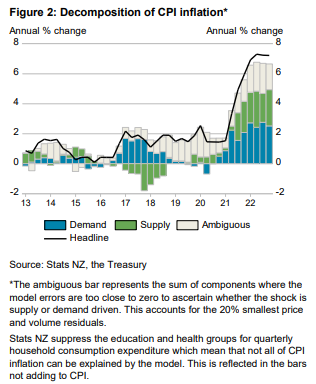
But it doesn’t look to be a very good model in practice. Here is The Treasury’s summary chart. the source of the line that (on this analysis) demand and supply shocks may have contributed roughly equal amounts to inflation over the last year, and that demand shocks were more important back in the early stages of the surge).

Not only is a large chunk of recent inflation not able to be ascribed to either demand or supply shocks, but there have been periods even in the quite short span shown here when the identified demand and supply shocks don’t explain any of the then-current inflation at all (eg 2019).

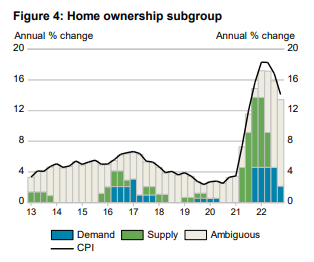
This is even more evident with some of the sub-groups they show results for. Thus, home ownership (which in the CPI is mostly construction costs)

For most of the decade, neither (identified) demand or supply shocks explain the inflation, and that is so again in the most recent data. And if the model suggests that sharp rises in construction cost inflation in recent times have little to do with demand at a time when house-building has been running at the highest share of GDP in decades, so much the worse for the model.

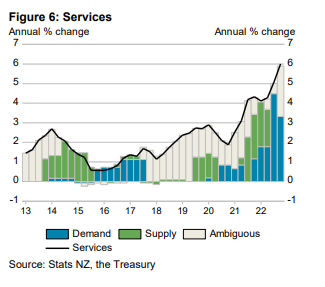
Services make up a large chunk of the economy, and a fair chunk of the CPI too. Here is the chart for that group

Not only are there periods when neither demand or supply shocks (as identified by the model) explain any of services inflation, but how much common-sense intuition is there is the idea (which the chart suggests) that for most of the period what services inflation can be explained is all either supply shocks or demand shocks and not some combination.

The Treasury paper notes some overseas comparisons, in particular that for the US

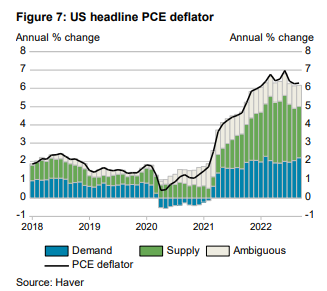
The results for New Zealand show lower supply-side contributions to inflation than estimates for the US and Australia. In the US, supply-side drivers account for about 60% of the annual change of the PCE deflator that the model can explain (Figure 7).4

(the footnote is to the original Fed paper)

and they show this US chart which I assume comes from the same model

Note, first, that the PCE deflator has a materially different treatment of home ownership – using imputed rents – than either the NZ or US CPIs.

But perhaps more importantly, in the original Fed paper there is this line

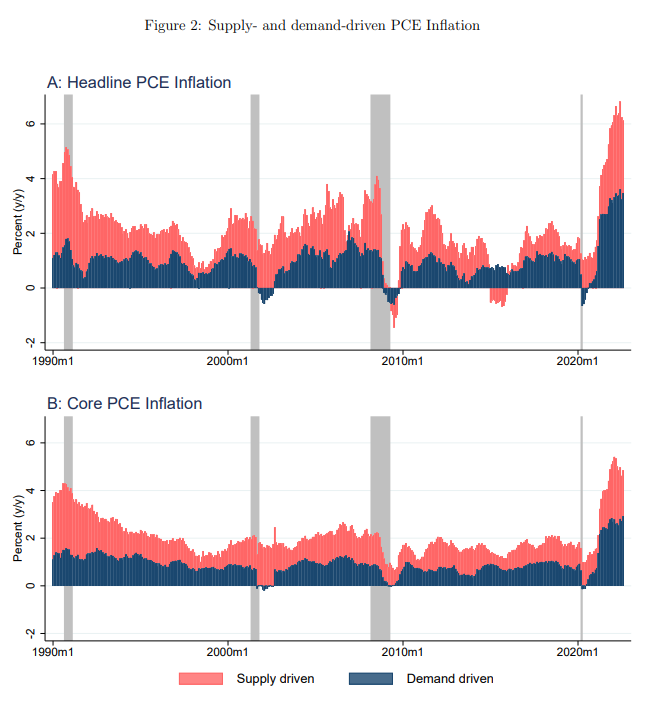
And here is a relevant chart from the same paper (grey-ed periods are NBER recessions)

Not only does it show the entire period since 1990 (one of my uneases about the New Zealand work by Treasury is showing only the last 10 years), but it also illustrates that, as defined for the purposes of these models, both supply and demand factors are large influences, almost always positive, over the entire 30+ years. In other words, if there is anything unusual about the current situation it is not the relative contributions of supply and demand influences but simply that inflation is high (both demand and supply influence). It simply doesn’t seem to add much value in making sense of why things unfolded as they did over the last couple of years. (Although it is interesting how different the last 10 years of the chart look for the US, as opposed to New Zealand in the first chart above.)

What these US charts also illustrate is that supply and demand shocks/drivers here don’t mean the same as they typically do when thinking about monetary policy. Monetary policymakers will (rightly) talk in terms of generally wanting to “look through” supply shocks – the classic example being spikes in world oil prices, which not only flow through to the CPI almost instantly (faster than monetary policy could react) but also make us poorer. The focus instead is on whether these headline effects flow through into generalised inflation expectations and price-setting more broadly. Climate-induced temporary food price shocks (from storms or droughts) are seen in the same vein.

Those sorts of shocks are generally thought of as being as likely to be negative influences on headline inflation as positive ones. Oil prices go all over the place, up and down. Much the same goes for fruit and vegetable prices. These are the two main things excluded in that simplest of core inflation measures, ex food and energy. Some of the Covid-related disruptions are probably more one-sided: there aren’t really obvious favourable counterpoints to severe supply disruptions (even if such disruptions themselves generally unwind over time). But even taken altogether they aren’t the sorts of things that will produce positive influence on core inflation over single year for over 30 years (as in the US core inflation chart immediately above).

When macroeconomists think of inflation they often do so with a mental model in their heads in which this period’s inflation is a function of inflation expectations, some influence from the output/employment gap, and then any residual (supply shock) types of items. Those supply shocks can run in one direction for a couple of years in succession (and probably did in the last couple) but the expected value over long periods of time is generally thought to be pretty close to zero. Monetary policy determines core inflation – monetary policy shapes expectations and influences and responds to developments in the output (or employment) gap. Of course, monetary policy takes account of trend supply developments – adverse shocks may not only raise headline inflation, and risk raising inflation expectations, but can lower both actual and potential output (many positive supply shocks work in the opposite manner).

I don’t want to be particularly critical of The Treasury. We should welcome the fact that their analysts are trying out interesting different approaches and keeping an eye on emerging literature, and even that they are making available some of that work in generally low-profile publications. That said, Treasury is not some political babe in the woods, and I’d have thought there should have been some onus on them to have provided a bit more context and interpretation in their write-up. For example, whereas the US is often treated as a closed economy, New Zealand clearly isn’t. I don’t have a good sense as to how general imported inflation – or that reflecting exchange rate changes – is going to affect this sort of decomposition. If, as I believe, a wide range of central banks made very similar policy mistakes, we’ll be seeing more inflation from abroad (if our Reserve Bank takes no steps to counter it) not tied to demand pressures in particular domestic sectors. I’m also not really clear how the lift in inflation expectations that we observe in multiple surveys fits into this sort of decomposition exercise.

Oh, and it was perhaps convenient that of the CPI groups Treasury showed, motor fuels was not one of them. Headline inflation currently is held down quite a bit by the NZ Cabinet shock – holding down petrol excise taxes etc.

My own approach to the question of where the responsibility lies for core inflation (and note that Treasury focuses on headline not core) tends to be simpler. When this century the unemployment rate has dropped below about 4 per cent core inflation has tended to become quite a serious problem (mid-late 00s and now). The Reserve Bank itself has been quite clear in its view that employment is running above the “maximum sustainable employment” (itself determined by other government policies), and thus, by implication, the unemployment rate – at near-record lows is below sustainable levels. That is a function of excess demand relative to the ability of the economy to supply. Core inflation – the bits we should most worry about, because we could usefully do something about them – is an excess demand story, risking spilling over into embedded higher inflation expectations.

And when ZB’s interviewer asked me this morning whether Mr Robertson or Mr Orr was to blame (fiscal or monetary policy), I was quite clear that the answer was monetary policy (Orr and the MPC). That isn’t because monetary policy loosenings in 2020 were necessarily the biggest source of stimulus to demand, but because the model is one in which (a) fiscal policy is transparent, and (b) monetary policy moves last, with the responsibility to keep core inflation at/near target. You might think (I certainly do) that less should have been done with fiscal policy, but it isn’t up to the MPC to take a view on that, it is their job simply to have a good understanding of how the whole economy, and the inflation process in particular, works, and to adjust monetary policy accordingly. In extremis, fiscal policy can overwhelm the best efforts of central banks, but that wasn’t an issue or a risk here, or most other countries, in recent years. Central banks simply got things wrong. (They had company in their mistake, but they were/are paid to get these things right.)

Interesting that the Minister of Finance asked for advice

In September last year, former Bank of England Deputy Governor Sir Paul Tucker published a substantial discussion paper suggesting paying a sub-market, or zero, interest rate on some portion of the huge increase in bank deposits at the central bank that had resulted (primarily) for the large-scale asset purchase programmes central banks had been running (in the Bank of England’s case since the 2008/09 recession, but in some countries – including New Zealand and Australia – just since 2020).

In late October, I wrote about Tucker’s paper, and you will get the gist of my view from the title of that post, “A Bad Idea”. The Herald’s Jenee Tibshraeny picked up on that post and the following day ran an article on the Tucker tiering proposal, with sceptical quotes from several people including me. There was a difference of view in those quotes. As in my post, I argued that such an approach could be adopted without impeding the fight against inflation but should not be adopted, while others (as eminent as the former Deputy Governor, Grant Spencer) suggested that not only that it should not be done, but could not (ie would tend to undermine the drive to lower inflation).

The essence of my “it could be done” line was the same as Tucker’s: monetary policy operates at the margin, and so what matters for anti-inflationary purposes is that the marginal settlement cash balances receive the market rate, not that all of them do. There was precedent, in reverse, in several (but not all) countries that ran negative policy rates, where the central bank applied the negative rate only to marginal balances, while continuing to pay a higher rate on the bulk of balances (thus supporting bank profits, although the argument made at the time was that doing so would help support the monetary transmission mechanism).

So far, so geeky. But it turns out that after Tibshraeny’s first article, the Minister of Finance sought advice on the Tucker proposal, not just once but twice (first from The Treasury and then later from the Reserve Bank). In yesterday’s Herald, she reports on the two documents she got back from an Official Information Act request to the Minister. She was kind enough to provide me with a copy of the material she obtained.

The Treasury advice, dated 6 December 2022, does not explicitly say that it was in response to a request from the Minister, but it seems almost certain that it was. Treasury is unlikely to have put up advice off its own bat on a matter that is squarely a Reserve Bank operational responsibility without formally consulting with the Reserve Bank and including some report of the Reserve Bank’s views in its advice. We can assume the Minister asked Treasury for some thoughts, and Treasury responded a few weeks later with four substantive pages.

I don’t have too much problem with The Treasury’s advice on a line-by-line basis. Their “tentative” view was that some sort of tiering arrangement could be introduced without undermining the effectiveness of monetary policy.

There were a couple of interesting things in the note nonetheless. For example, it was good to have this in writing

and it was also interesting to read that “in previous discussions with the Bank they have indicated that they would consider introducing a zero-interest tier if the OCR were negative”.

Treasury highlighted that a zero-interest tier in the current environment (large settlement cash balances, fairly high OCR) would be in effect a tax on banks with settlement accounts.

but strangely never engage with the question as to whether it would be appropriate for the Reserve Bank to impose such a tax (or whether they had in mind special legislation to override the Reserve Bank on this point).

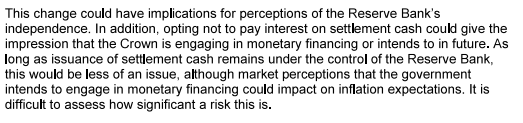
They also note some potential reputational issues

but could have added that these might be particularly an issue if New Zealand was to adopt such an approach in isolation (they neither mention, and nor have I seen, any indication any other authorities have seriously considered this option).

The Treasury note ends recommending not that the issue be closed down and taken no further, but that if the Minister wanted to “pursue this option” he should seek advice from the Reserve Bank and they offered to help draft a request for advice.

And so the Minister turned to the Reserve Bank for further advice, and on 2 February 2023 they provided him four pages of analysis (plus a full page Executive Summary which is more black and white than the substantive paper itself). The Bank seems pretty staunchly opposed to the tiering idea, but on occasions seems to overstate its case. And, remarkably, they never even attempt to engage on the question as to whether the market-rate remuneration of the large settlement cash balances created by their LSAP (and Funding for Lending) programmes are any sort of windfall gain to the banks (a key element of Tucker’s argument).

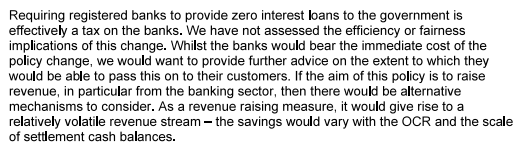
But much of what they say is reasonable. From the full paper

There is no real doubt that it can be done, and they draw comparisons between regimes in some other countries, more common in the past, where some (legally) required reserves were not remunerated at all.

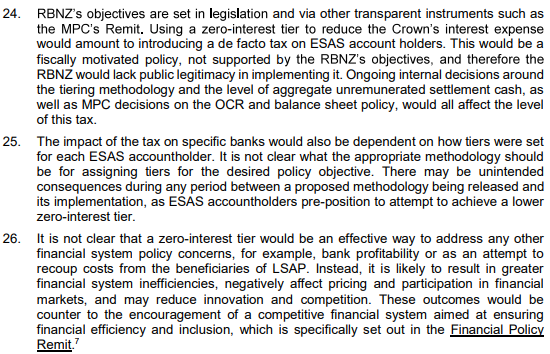
I largely agree with them on this

departing from them on that final sentence of paragraph 25 (any tier could, and sensibly would, be set on the basis on typical balances held prior to any announcement or consultation document), and in the first sentence of paragraph 26 (since, from the Bank’s perspective, benefits from the LSAP are supposed to be a good thing – the Governor repeatedly champions them – not bad).

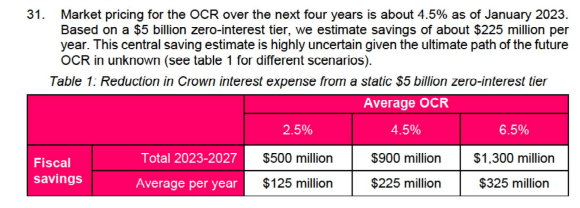
The Bank attempts to play down the amounts at stake, suggesting any potential gains to the Crown (and thus, presumably, costs to those subject to the “tax) would be modest. But they include this

I guess when your MPC has thrown away $10bn of taxpayers’ money, $900m over four years doesn’t seem very much (and these calculations are materially biased to the low end of what could be raised without adversely affecting monetary policy) but…..$900m over four years buys a lot of operations, or teacher aids, or whatever things governments like spending money on.

It is also a bit surprising that although the Bank notes that such a tiering tax would be likely to be passed through to customers, they provide no substantive analysis as to how or to what extent, and thus what the likely incidence of such a tax would be. It isn’t that I disagree with the Bank, but the analysis isn’t likely to be very convincing to readers not already having the same view as them (tiering is a bad idea).

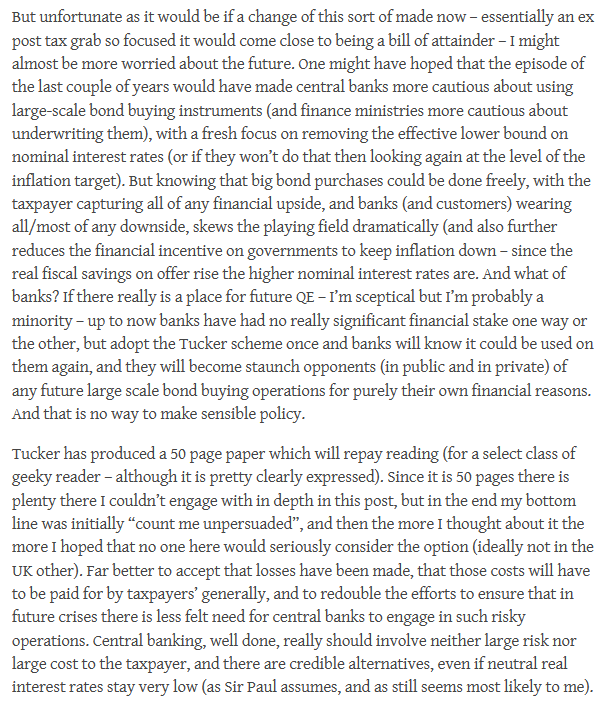
They make some other fair and important points, notably that hold a settlement account with the Reserve Bank would be likely to be less attractive if doing so was taxed, in turning providing an advantage to non-settlement account financial institutions (broader settlement account membership is generally a good thing, conducive to competition and efficiency). But then they over-egg the pudding. This line is from the Executive Summary – and draws on nothing in the body, so has the feel of something a senior person inserted at the last minute

One of the points commentators on central banks often have to make to less-specialist observers is that banks themselves have no control over the aggregate level of settlement cash balances. Individual bank choices – to lend or borrow more/less aggressively – affect an individual bank’s holdings but not the aggregate balances in the system. And thus banks cannot materially impede future LSAP-type operations since there is no reason why the Reserve Bank’s purchases need to be constrained only to entities that already hold settlement accounts at the Bank. If the Reserve Bank buys a billion dollars of NZ government bonds at premium prices from overseas investors/holders, the proceeeds will end up in NZ bank settlement accounts whether the local banks like it or not. Same goes for, say, large fiscal operations like the wage subsidy. What might be more accurate – and I made this point in my original post – is that a tiering model carried into the future might motivate local banks to lobby harder against renewed LSAPs. From a taxpayers’ perspective that would probably be a net benefit, but one can see why the Reserve Bank might have a different view.

While I don’t really disagree with the thrust of either the Reserve Bank or Treasury advice neither could really be considered incisive or decisive pieces. Perhaps the Bank’s piece was enough to persuade the Minister (although there is no indication in the OIA material or in Tibshraeny’s article that the Minister has abandoned interest). A tiering regime of the sort discussed in the RB/Tsy advice would be an opportunistic revenue grab, representing either an abuse of Reserve Bank power or a legislative override of monetary policy operational independence, with truly terrible signalling and precedent angles. It could be done – so could many many bad things – but it shouldn’t.

(If you want a typically-passionate opposing view, try Bernard Hickey’s column yesterday, from which I gather he has removed the paywall.)

Big mistakes were made. The LSAP was unnecessary, ill-considered, risky, and (as it turns out) very expensive. The Funding for Lending programme continued all the way through last year was almost incomprehensible (if cheaper and less risky). Mistakes have consequences and they need to be recognised and borne, not pave the way for still-worse compensatory fresh interventions.

I’m going to end repeating the last couple of paragraphs from my original post

It is, perhaps, a little surprising that neither set of official advice shows any sign of engaging with Tucker’s paper itself, or with the author, a very well-regarded and experienced figure.

Dipping into the HYEFU

Just a few things caught my eye flicking through yesterday’s HYEFU summary tables – if you don’t count points like the fact that The Treasury projects we will have had five successive years of operating deficits (in a period of a high terms of trade and an overheated economy), and that net debt as a per cent of GDP (even excluding NZSF) is still increasing, notwithstanding the big inflation surprise the government has benefited (materially) from.

This chart captures one of the things that surprised me. It shows export volumes and real GDP, actual and Treasury projections. Exports dipped sharply over the Covid period (closed borders and all that), but even by the year to June 2027 Treasury does not expect export volumes to have returned either to the pre-Covid trend, or to the relationship with real GDP growth that had prevailed over the pre-Covid decade.

The Reserve Bank does not forecast as far ahead as the Treasury but has quarterly projections for these two variables out to the end of 2025. Here is a chart of their most recent projections

It is a quite dramatically different story.

The issue is here is not so much who is right – given the vagaries of medium-term macro forecasting there is a fair chance that none of those four lines will end up closely resembling reality – as that the government’s principal macroeconomic advisers (The Treasury) have such a gloomy view on the outward orientation of the New Zealand economy. One of the hallmarks of successful economies, and especially small ones, tends to be a growing number of firms footing it successfully in the world market. Earnings from abroad, after all, underpin over time our ability to consume what the rest of the world has to offer. Quite why The Treasury is that pessimistic isn’t clear from their documents – one could guess at various possibilities in aspects of government economic policy – but it does tend to stand rather at odds with the puffery and empty rhetoric the PM and Minister of Trade are given to.

Then there was this

On Treasury forecasts the CPI in 2025 will have been 13.3 per cent higher than if the Reserve Bank had simply done its core job and delivered inflation on average at 2 per cent per annum (the Reserve Bank’s own projections are very similar). It is a staggering policy failure – especially when you recall that the Governor used to insist that public inflation expectations were securely anchored at around 2 per cent. It is an entirely arbitrary redistribution of wealth that no one voted one, few seem to comment on, and no one seems to be held to account for, even though avoiding such arbitrary redistributions (benefiting the indebted at the expense of depositors and bondholders) was a core element of the Reserve Bank’s job. We don’t – and probably shouldn’t – run price level targets, but let’s not lose sight of what policy failures of this order actually mean to individuals.

And the third line that caught my eye was this

A good question for the National Party might be to ask how much of this 3.5 percentage point increase in tax/GDP they intend to reverse, and how, or would any new National government simply be content to leave little changed what Labour has bequeathed them?

As longer-term context (slightly different measure to get back to the 70s) the only similarly large increases in tax/GDP seem to have been under the 1972-75 and 1984-90 Labour governments.

Rodger Finlay

If you have long since lost interest in my series of posts as to how Christchurch company director Rodger Finlay came to be appointed by the government as a director of the Reserve Bank (in its new governance model where the powers, including bank regulatory ones, rest with the Board) while, it was envisaged, he would keep on as chair of NZ Post, the majority owner of a bank (Kiwibank) the Reserve Bank prudentially regulates and supervises, and the spin around it, feel free to stop here. The title of the post was due warning. But sometimes you have to see things through to the end.

A couple of weeks ago, I wrote here about (and excerpted) The Treasury’s incident report about the Finlay affair, and specifically the events that led to the Secretary to the Treasury providing a written apology to the Minister of Finance for the failure of her staff and organisation to explicitly draw to the attention of ministers the conflict of interest issues around Finlay’s appointments, either when he was being appointed to the Reserve Bank Board a year ago, or when Cabinet was agreeing to his reappointment as chair of NZ Post in June this year.

Yesterday I had two more OIA responses. Appointments to SOE boards are on the joint recommendation of the Minister of Finance and the Minister of State-owned Enterprises, and I had asked both ministers for material relevant to Finlay’s NZ Post reappointment (and withdrawal from that post) in June. Megan Woods had been the SOE minister responsible, but she apparently declared a potential conflict of interest, around her personal and professional relationships with Finlay, and so formal responsibility was shifted to Kris Faafoi (as it turned out, by the end of this he was in his last few days in office). Faafoi having left office, his papers on the issue are coming only slowly (early next year I’m told) but The Treasury did yesterday release the papers they had relevant to the appointment process Faafoi was involved in.

Treasury OIA response re acting Minister of SOEs and reappointment of Rodger Finlay as NZ Post chair Oct 2022

and Grant Robertson also provided his response to a similar request, but which also covered contacts with journalists on the Finlay appointments.

MoF OIA response re Rodger Finlay and the NZ Post board Oct 2022

In total there is about 50 pages of material

Taking the Treasury response first, there isn’t a great deal that is new.  The relevant paper to the Cabinet Appointment and Honours (APH) Committee is included in full.  It doesn’t note any conflict of interest issues (but we knew that from the Secretary to the Treasury’s apology and their report) but their description of NZ Post itself is a little surprising.

with no mention that NZ Post is also the majority owner of the 5th largest bank in the country.

I was slightly amused by what was, and wasn’t, kept secret about Finlay’s personal details

and the fussing around in the paper about whether the board was going to be suitably “representative”

But perhaps the point of substance was an email to Treasury officials from Faafoi’s private secretary on 8 June after the APH meeting noting that “Finlay’s reappointment went through APH today with no issues”.

While The Treasury had clearly been remiss in not including the conflict of interest issue in the papers, quite where were ministers (whether those proposing to make the appointment – and especially Robertson – or those deliberating on it)? Did it not occur to any of these people – either then, or when the RB Board appointment was made – to question whether it was really quite right to have someone responsible for bank regulation also chairing the majority owner of a bank. It is hardly as if Kiwibank’s ownership was a secret, and the APH paper does note that Finlay had been appointed as a Reserve Bank Board member (and from the Robertson bundle of documents we find talking points The Treasury had prepared for Faafoi, one (of a handful) of which explicitly states that he has been appointed to the Reserve Bank Board)? Or do conflicts of interest, real or apparent, just not matter to this government?

Most of the interest in the Robertson bundle is in the exchanges by members of his staff with various journalists about the Finlay issue.

But there is also an email exchange on 10 June, the day my first post on the Finlay issue appeared. We know from The Treasury’s incident report that prior to 8 June (the day of the APH meeting) Finlay had approached Treasury suggesting that he could take leave of absence from the NZ Post role until the (then not known to the public) reshuffle of Kiwibank ownership went through – it had initially been planned, so the documents show, to have had this reshuffle wrapped up by 30 June).

Anyway, on 10 June my post went out at about 8:30am (it is in my email inbox at 8:32) and at 9.34am Finlay himself sent a link to the post, without further comment, to four Treasury and NZ Post addressees. At 3:21pm, Treasury is emailing people in the relevant ministers’ offices, cc’ing the NZ Post people
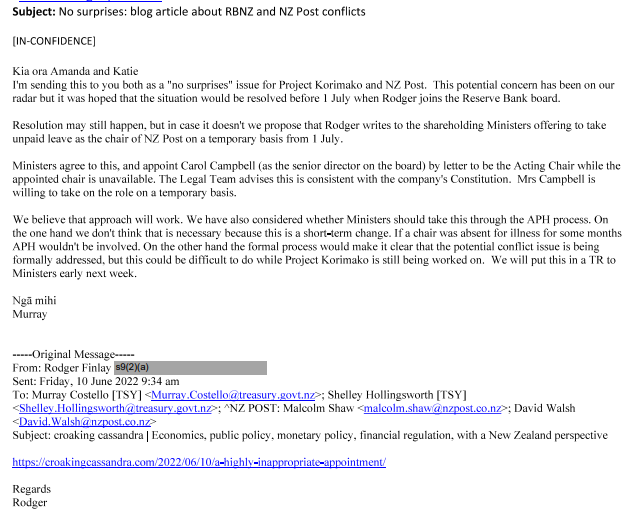
I found it interesting that the official states “This potential concern has been on our radar” – what, just waiting for someone (whether me or another observer) to notice the egregious conflict involved in having the chair of the majority owner of a bank sitting on the governance board of the bank regulator? And so they suggest rolling out what Finlay himself had proposed – that he temporarily step aside from the NZ Post role – and had gone far enough to get the agreement of another director to act in Finlay’s place if ministers were to go with this option.

But that didn’t happen. The Treasury report says Finlay himself called the Minister of Finance, and the Minister took the view that as the potential conflict had been considered when the initial (RB) appointment was made and nothing had changed, there was no reason for Finlay to stand aside. Except, of course, that we know that the advice to Ministers and Cabinet in late 2021 had not mentioned the conflict, and neither had the advice to other political parties when, as the RB Act requires, they were consulted on Finlay’s RB appointment.

It is also pretty extraordinary – and this isn’t picked up in Treasury’s report – that there was no sign that these Treasury officials (or perhaps Finlay) really recognised the character of the Finlay conflict. He could have temporarily stepped aside as NZ Post chair and would still be responsible for bank regulation and supervision around Kiwibank during that period, and almost all regulatory decisions have effects longer than a few months standdown might imply. To address the conflict by means of temporary stand-down it would have to have been the Reserve Bank Board he stood down from, but the Reserve Bank role isn’t even mentioned here, and nor were Reserve Bank officials copied on the emails from either Finlay or Treasury.

And so Cabinet went ahead and on 13 June reappointed Finlay for three years. And on 14 June Finlay wrote declining the appointment.
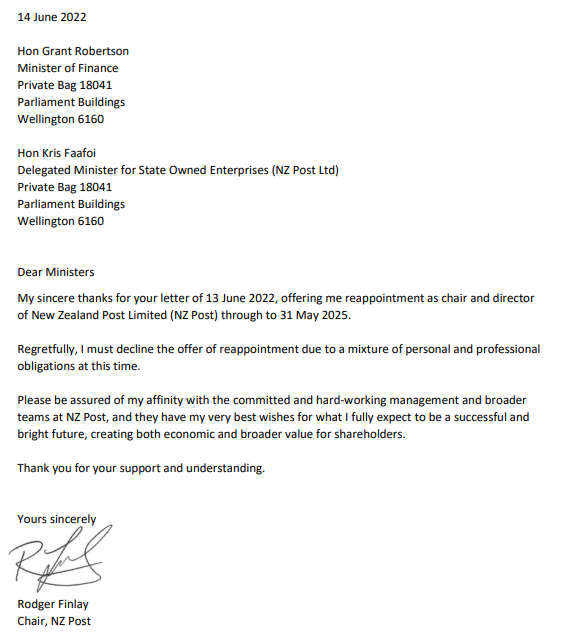
The first journalist to have asked Robertson anything about the Finlay issue was the Herald’s Jenee Tibshraeny.
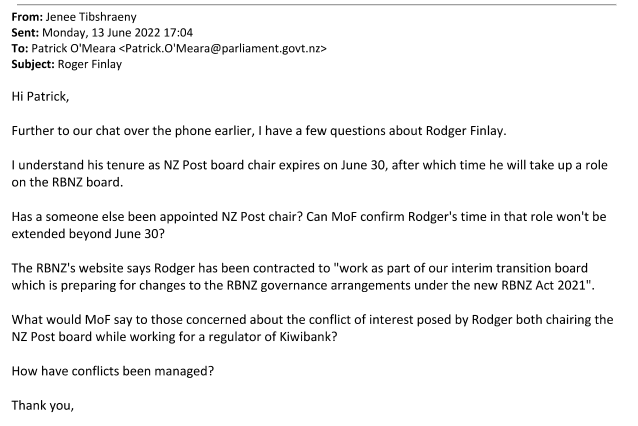
At the time of this phone call and email, it was full steam ahead. Cabinet had approved Finlay’s reappointment and the letter of offer was going out.

It took the best part of two days, and multiple reminders, to get an answer out of Robertson.
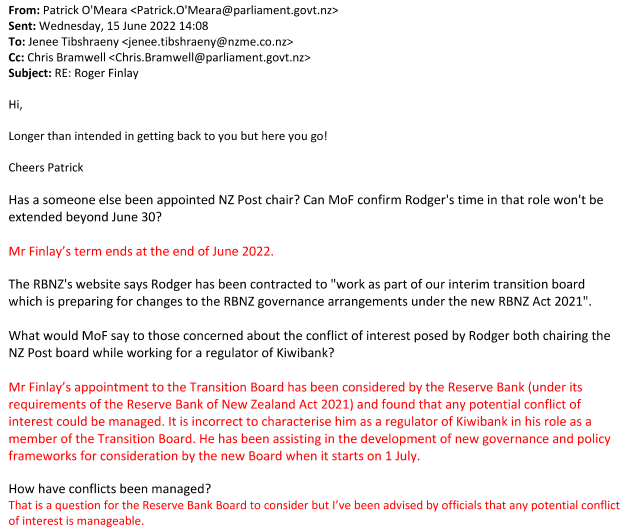
The delay was convenient as by this time – and against the wishes of the Minister – Finlay had stepped aside, and finally personally resolved the conflict issue. Against that backdrop, the Minister’s answer to the Herald was pretty much active and deliberate disinformation.

The next lot of media inquiries worth mentioning was on 1 July (the day after the rest of the new Reserve Bank Board was announced, including reference to Finlay as “previously” chairing NZ Post. Stuff’s Rob Stock asks Robertson’s senior press secretary
Who, in a series of email exchanges also engages in an active attempt to put the journalist off the trail (pretty sure the government would call this “disinformation” if anyone else was doing it).

First, the Minister was sick and couldn’t comment, but there was no news because Finlay’s term was due to end on 30 June. Stock responds that he didn’t recall either the RB, the Minister or Finlay “mentioning this was the plan for managing the conflict”, to which Bramwell responds disingenuously “I’m not sure if it was the ‘plan’…..you’d have to talk to Mr Finlay about that – or perhaps the RBNZ?”. Stock immediately responds (presumably of attempts to get others to comments) “No comment, not available, talk to Minister”. Whereupon Bramwell (for the Minister) again avoids answering the actual question with this response
Stock must have given up at that point. But if Bramwell’s last response was a non answer, it was nonetheless interesting since (a) it points us to Reserve Bank involvement in the political spin, and b) tells us that the Bank concedes that there may well have been “material conflicts of interest” from 1 July had the government gone ahead with its plans and Finlay not, at the end, done the decent thing.

There is a final rounds of exchanges between Tibshraeny and Robertson’s office at the end of August. These requests came after some earlier OIAs had begun to shed more light. You can read the exchange for yourself. On Finlay, the key question is “How was it ever ok for Rodger to be NZ Post chair and on the new RBNZ Board at the same time? [as the government deisred and intended]. Even [if] this would’ve been within the law [which it was] it surely would not have been within the spirit of the law”. There is never a straight answer from the Minister, just a deflection to the Reserve Bank who, she was told, concluded that “any conflict of interest…could be managed”.

Tibshraeny’s final question is about an issue I was not aware of until she identified it: that Finlay is a director of Ngai Tahu which now owns a 24.94% stake in Fidelity Life Assurance, an insurance company regulated by the Reserve Bank. That deal was not settled until early 2022 but had been agreed on before Finlay was appointed to the Board (and “transitional board”) late last year. That appears not to have been disclosed or discussed when his appointment was made. In Tibshraeny’s final email she notes “So, not great…..”

There have been so many issues to keep track of – including the other new director who when appointed was also on the board of an insurance company that for some reason was not regulated by the Reserve Bank (before there was a belated rethink and he resigned from the insurance company board) – and the Fidelity stake isn’t controlling so that on its own I can’t get too excited about it. But it does tend to speak to a pattern – running across all those involved here – that all that matters is the letter of the law, and nothing at all about the appearances, and the potential for actual or apparent conflicts. Finlay should, right upfront, have identified both the Kiwibank and Fidelity stakes as potential conflicts – and should never have put himself forward if he intended to stay on at NZ Post. In combination, they should have been disqualifying – to The Treasury and to Ministers.

As far as I can see no one emerges very well from this whole saga, with some slight brownie points to Finlay who did after all finally step aside. The Treasury did poorly, perhaps so too did their recruitment consultants, the Brian Roche interview panel (for the RB roles) did really poorly (and that includes the head of APRA who sat on the panel), ministers did poorly (Grant Robertson most of all). No one called stop at any point, and all seemed to be focused (if at all) on the letter of the law rather than the substantive issues that mean it would not be acceptable anywhere to have as director of the bank regulator the chair of a majority owner of a bank.

But if any of these people or groups of people should have stood up and called a halt (before Finlay finally did), so too (and perhaps above all) so should the Governor of the Reserve Bank. the chair of the Reserve Bank Board, and all their attendant senior managers and Board colleagues. Every one of them should have known the conflict was untenable and unacceptable (it was the immediate reaction of a whole bunch of former central bankers after my first post appeared), and quite damaging to the credibility of the institution.

But if you have been following this story since June, you may have noticed that there have been OIA responses, fairly timely ones, from the Minister and from The Treasury, and nothing at all from the Bank (just references to them and their involvement in some of the other documents). It isn’t for want of trying.

On 1 July, the day after the full Board was appointed, I lodged with the Reserve Bank a request for

…copies of all material relating to appointments to the new Reserve Bank Board, including all material relating to appointments to the “transition board”. 

Without limitation, this request includes all papers and other material generated within the Bank (other than of a purely administrative nature), any advice to/from or discussions with The Treasury, and any advice to and interaction with the Minister of Finance or his office on these issues.

It was directly parallel to similar requests lodged with the Minister and with The Treasury (both of whom responded substantively).

On 13 July, one of the many communications staffers got in touch to tell me

We have transferred your request to the Treasury as the information is believed to be more closely connected with the functions of the Treasury. In these circumstances, we are required by section 14 of the OIA to transfer your request.

You will hear further from the Treasury concerning your request.

I rolled my eyes – it was evidently a ploy (note I explicitly asked about material generated within the Bank, which other agencies would not necessarily be expected to have) and no doubt the Bank knew by then of my other requests – but did nothing more while I waited for responses from the Minister and The Treasury.

Having received those responses, on 3 September I went back to the Bank to renew my request (all on the same email chain, so there was no ambiguity about what the request was)

I am writing to renew my request.  You transferred the request to The Treasury, but (as I’m sure you know) their release provided nothing on anything the Bank, its staff or management, Board or “transitional board” members said, wrote or did.  I now know from the responses to similar OIAs to The Treasury and to the Minister of Finance, that the Board chair was involved in the selection of new board and transitional board members, Rodger Finlay (then a “transitional board” member) served on the interview panel for the second round of Board appointees, that RB legal staff had discussed issues around potential conflicts of interest for Rodger Findlay.    Against that backdrop (and the media coverage of the Findlay situation in late June), it is inconceivable that there were no papers, emails or the like on any matters relating to the selection and appointment of Board members, whether or not such material was conveyed to The Treasury or to Minister.

That was almost two months ago. It was only yesterday I thought to check up on it and have sent them a note pointing out that I did not yet appear to have had a response. It increasingly appears as though the request will have to be referred to the Ombudsman.

But no doubt the Governor and his colleagues will keep on with the spin about being a highly transparent central bank. At this point, you really wonder what they can have left to hide, but perhaps the secrecy and obstructiveness is just some point of unprincipled principle?

UPDATE: About 40 minutes after this post went out I had an email from the Reserve Bank offering what appears to be a fairly abject apology for allowing this request to have fallen through the cracks, promising process improvements etc. Accidents happen, system aren’t foolproof (even with 20 comms staff), so I am inclined to take them at their word, but I guess it means I might finally get a response by Christmas.