Thinking about the MPC

I wrote earlier in the week about the as-yet unfilled vacancy in the office of Governor of the Reserve Bank. But there is also another significant vacancy that needs to be filled in the coming weeks, as the oft-extended MPC term of Bob Buckle finally comes to an end.

Buckle appears to be older than Donald Trump and has been on the MPC since it began 6.5 years ago. That means he’s been fully part of all the very costly bad calls ($11 billion of taxpayers losses when the MPC authorised the Bank to punt big in the bond market, and the worst outbreak of inflation in many decades, the consequences of which – notably in the labour market – we are still living with). And in his 6.5 years on the committee we’ve learned nothing at all of any distinctive contribution he may have made, we’ve heard nothing of his views (was he cheerleader, did he ever express any doubts etc?), there have been no speeches or interviews, he’s never apologised for or even acknowledged the bad calls (and their consequences) he’s been fully part of. And yet he has twice had his term extended (first reappointed by Robertson and was then extended again by Willis). He isn’t uniquely bad, and of the three externals first appointed back in 2019, when active expertise was deliberately excluded by Quigley and Orr, he was the least unqualified. But he is representative of all that is unsatisfactory with the Reserve Bank monetary policy governance reforms put in place in 2019. There is no accountability whatever, despite exercising huge amounts of delegated power.

Thinking about the vacancy, and the fact that it is now just over a year since Willis appointed two new, and apparently more capable, external MPC members prompted me to dig out the paper (“The Governance of Monetary Policy – Process, Structure, and International Experience”) that one of those new MPC members, (Prasanna Gai an academic at the University of Auckland but who’d spent a lot of time earlier in his career at the Bank of England), wrote in January 2023 as a consultant to the external panel reviewing the Reserve Bank of Australia. That review process that led to amended legislation and the creation this year of a distinct RBA Monetary Policy Board. It is a useful paper, easy to read and not long (28 pages), surveying experiences in a number of countries (including a quite sceptical treatment of the New Zealand MPC experience) and concluding with a couple of pages headed “Towards an ideal set-up” with six specific recommendations for the design of an MPC.

These were the recommendations

Recommendation 1: External members should be appointed through a merit based competitive process run at “double arms-length”, by a bi-partisan hiring committee appointed by the Treasurer that is diverse, experienced, and representative of society. Treasury Officials should be excluded from the MPC.

Recommendation 2: The threshold for economic expertise and policy acumen should be high. Members should be professional economists, with backgrounds in macroeconomics and financial economics, or offer broader experiences relevant to monetary policy. Gender, ethnicity, and industry diversity should be
important considerations in deciding the MPC make-up. Membership should be part-time with a commitment of around 3 days per week on average. Overseas members should be considered, subject to this time commitment.

Recommendation 3: The MPC should be relatively small (six). There should be two internal members and four externals. The role of Chair of the committee should rotate periodically and external members should be chosen for their capacity to serve in this regard. Pre-deliberation opinions should be sought, recorded (e.g. “dot plots”), and released to the public at an appropriate time. The chair should speak last and members invited to speak randomly. MPC members should be encouraged to interact with RBA staff between meetings.

Recommendation 4: The term of office be a single, non-renewable term of no more than five years.

Recommendation 5: To optimise information production and processing and to ensure democratic accountability, each member of the committee should “own” their decision and regularly explain their thinking to stakeholders at parliament and other fora. Members should have the freedom to dissent and MPC processes should be designed to diminish cacophony. Transcripts of the deliberation meeting should be released after a suitable lag so that stakeholders have a complete picture of the reasoning and debate behind the policy decision.

Recommendation 6: The MPC should be exposed to a regular schedule of external review by experts in monetary policy at 5-7 year intervals. These experts should be independently commissioned by the Treasury without consultation from the RBA, to avoid claims of partiality. The Treasury should take the lead in ensuring that review recommendations and insights are taken on board by the RBA and MPC.

Interesting food for thought, but anyone with any familiarity with the New Zealand system will recognise that list bears almost no relationship to what we have here (in law or in practice), except perhaps that odd “gender diversity” priority, which is pretty clearly what led Grant Robertson to appoint Caroline Saunders to the initial MPC (OIAed papers support that conclusion) and is probably why Orr appointed the otherwise utterly unqualified Karen Silk as the deputy chief executive responsible for macroeconomics and monetary policy, complete with a voting seat on the MPC. And, to be fair, there are some elements of Gai’s recommendations that I don’t agree with (including rotating the chair, bipartisan selection, and non-renewable terms).

One of the reasons I don’t like the idea of non-renewable terms is that serious accountability (ie with real and personal consequences at stake) is hard enough generally, but that the possibility of non-renewal is the most plausible point at which a monetary policy decisionmaker might face paying a price if they’d done poorly. Under the 1989 Act, the Bank’s Board was transformed into a body designed almost solely to hold the Governor to account, and they could recommend dismissal at any point if they concluded he was doing monetary policy poorly. The Board ended up so close to management (and for long periods was chaired by former senior managers), and had no resources of its own and limited economic expertise, that challenge was difficult. But, in principle, reappointment offered a chance, without too much awkwardness, to suggest that it was time for an incumbent to move on. The current Board still has some such role in respect of non-executive MPC members.

(The system was finally discredited in 2022 when, with all of Orr’s personal and policy failings already on display, the outgoing old board still recommended to their successors that Orr be reappointed, one of the worst public appointment decisions in New Zealand in quite some time, culminating in the engineered exit this year, barely two years into his second term.)

In formulating his recommendations, Prasanna Gai explicitly drew on a 2018 conference paper, (“Robust Design Principles for Monetary Policy Committees”) prepared for an RBA Conference, and written by David Archer (then a senior manager at the BIS) and Andrew Levin, a US academic but former Fed staffer. Archer, of course, had previously been chief economist and head of financial markets at the Reserve Bank until about 2004. It is another fairly accessible not-overly-long (16 pages) piece and they conclude with eleven principles, grouped as seven “governance principles” and four “transparency principles” (although I’m not sure I really buy the distinction). But like the Gai paper, it is very technocratic and rather weak on the place of a powerful central bank in a democratic society.

Reading the two documents together the thing I found most striking was that there was lots of talk (and they seemed to mean it seriously) about the importance of “accountability” (most explicitly in Gai’s recommendation 5 but strongly implicit in 3 and 6 as well). Archer and Levin are very much in the same vein (“Principle 6: Each MPC member should be individually accountable to elected officials and the public”). And yet, none of it seemed to involve any consequences whatever for the individuals. Both favour non-renewable terms so there is no potential discipline there, and Gai never ever seems to mention the possibility of removing an MPC member who had done monetary policy poorly. Archer and Levin are only slightly better, suggesting – in just a very brief reference not elaborated – that there should be “removal only in cases of malfeasance or grossly inadequate performance”.

I was a bit puzzled. One might expect serving central bankers to recite empty mantras about accountability that boil down in substance to not much more than having to publish a few documents and the Governor fronting up every so often to rather soft questioning at a parliamentary committee (in essence, the New Zealand model). But although each of these three authors had been central bankers none were at the time of writing.

It was, perhaps, particularly surprising in Gai’s case. After all, he was writing in January 2023 when central bankers in a wide range of countries were revealed as having stuffed up badly (no doubt with the best will in the world) and Phil Lowe was under fire in Australia. I wondered if perhaps one factor for Archer and Levin had been that were writing in 2018 when we were several decades into inflation targeting and in most countries if there had been monetary policy errors in the grand scheme of things they were relatively small.

And so I asked David Archer (now retired) why their paper had not dealt in any detail with options for serious personal accountability. He gave me permission to quote from his response (prefaced by a “joint papers are a compromise”)

On making accountability real, I favour the ability to remove for policy failure reasons
(a) where it is possible to define the objective with some clarity, and 
(b) where the procedure and protocols for assessing the bank’s/individual’s contributions to failure are fairly robust and shielded from political intervention.
 
I think (a) is possible, since maintaining medium term price stability — a single objective, able to be stated numerically — is clear enough.
 
I think (b) is more difficult. A previous NZ construction, involving a monitoring group that comprises outsiders who owe their duty to the public but that is able to peer inside the operation — that is, a board with independent chair and no management responsibilities — was a pretty good, though not perfect design. The imperfections were less in the construction than the execution, but the construction could still have been better — eg a requirement for an annual assessment report that requires a ministerial response and FEC examination.
 
It is noteworthy that the ability to remove for policy failures is almost vanishingly rare internationally. 

I agree with the spirit although not entirely with the details. In the end, I think that – in a democracy – decisions to appoint or to remove MPC members (executive or not) should be made by people who are elected (ie politicians) and thus themselves directly accountable. But it might be a reasonable balance to say that people could only be removed (for policy failure causes) on the recommendation of an independent assessment panel.

Unlike David, I think the old Reserve Bank Board model (while well-intentioned) was never likely to be an adequate approach. Operating within the Bank, with the Governor as a member, with a senior Bank manager as secretary, with no analytical or consulting resource of their own (to which one could add that they were required to review each MPS and see if it did the statutory job, which made it hard to stand back later and hold the Governor to serious account) it was never likely to succeed. Things got too cosy, the Board was more interested in having the Governor’s back, they held cocktail functions to help spread the Bank’s story, and to the extent there was challenge or questioning it was often on rather technical points rather than seriously attempting accountability. It might have been different if something like the Macroeconomic Advisory Council I used to champion had been set up, fully independent of the Bank and Treasury, and with serious analytical grunt itself.

Central bank monetary policymakers wield a great deal of power. There is no review or appeal process embedded. Being human, the best central bankers will make mistakes (just like the best corporate managers or corporate boards) and there needs to be a personal price to failure, otherwise we have given great power with little or no responsibility. If really big mistakes are not going to lead to those responsible being fired – or not even lead to them being not reappointed – we should rethink whether operational autonomy over monetary policy is appropriate at all. We still need expertise on these issues – as in so many other areas of public life – but there is no necessary reason why the decisionmaking power should be delegated. When politicians wield power we have the satisfaction of being able to toss them out when they do poorly. (And for those who worry about possible pro-inflation biases among politicians, a) for the decade pre-Covid we had the opposite problem (inflation a bit too low relative to target) from central bankers, and b) it is salutary to see how much “cost of living” now features among public concerns, here and elsewhere, even a couple of years after the worst of the inflation.)

To be clear, I am not suggesting that independent MPCs should be able to be second-guessed when they make their initial decisions (even if there had been a consensus in March/April 2020 that the MPC was going astray, Orr and company shouldn’t have been able to be tossed out then). But when outcomes go so badly off track, people should be removable and should not be reappointed. It can’t be a mechanical or formulaic thing – outcomes are always a mixture of specific policy judgements and unforeseeable shocks – but there is nothing particular unique about monetary policy in that (see the ousting of corporate chieftains when things go badly astray; sometimes it is just because there needs to be a scapegoat, somone seen to take the fall). But it does heighten the importance of making people individually responsible – speeches, interviews, proper minutes, attributed votes, FEC hearings and so on. It is hard to dismiss an entire committee – one of the 1989 government’s reasons then for choosing a single decisionmaker – but if a committee is doing its job at all well, some members will inevitably emerge looking better (or worse) than others. (Unlike our experts – above – I think there is a particular responsibility on the Governor, who controls staff analysis etc and is full time, but that isn’t an excuse for free-riding externals).

There is one area where we deliberately make it all but impossible to remove someone for bad substantive decisions: the judiciary. And that is probably as it has to be. But in the case of lower courts there are (layers of) appeal processes, and in higher courts finality is often the point (there may not be objectively right or wrong legal interpretations, but what the courts provide – subject to parliamentary override – is finality. And unlike most central banks, courts are unshamed about having majority and dissenting opinions, the latter often lengthy and thoughtful. There is no good reason for putting our central bankers on such a protected pedestal – mess up badly and face no personal consequences, no matter how much damage those bad choices have done to the country.

But to come back to the mundane, you have to wonder what Prasanna Gai makes of being an MPC member, operating in a model so much at odds with the analysis and recommendations he gave to the RBA review panel not much more than a couple of years ago:

  • He was selected last year by a panel, appointed entirely by the previous Labour government, led by Orr and Quigley, who would have spurned his expertise when the MPC was first set up in 2019,
  • The Secretary to the Treasury (or his nominee) is a non-voting member of the committee,
  • The MPC is numerically dominated by internals, one of whom has no economics background at all,
  • Not only is the chair not rotated, but it was held by a domineering personality, long observed to be intolerant of challenge and dissent, whose governorship finally flamed out when he completely lost his cool in meetings with, first, Treasury and then the Minister,
  • MPC members have renewable terms (although I guess Gai could decline to seek a second term)
  • There is no disclosure of individual member views, either in minutes or subsequently in speeches, interviews, or hearings (and in his paper Gai makes much of the free-rider problem/risk), and
  • Despite having been in place for 6.5 years now, through some of the most turbulent times for decades, the only “review process” was run by the Bank itself.

To which, we might add, that Gai himself made a little history recently by actually doing a speech on matters relevant to New Zealand monetary policy to an outside audience. Which was good. Except that no text of that speech was made available, no recording of the question time was made available, and only those who happened to be in Auckland on the day could get one of the limited number of tickets. He and the Bank appear to have allowed the event to be advertised as offering exclusive access. Gai refused to entertain media questions either. Since the MPC Charter actually does allow members to make speeches, which are supposed to be readily available, he cannot even blame those choices on “the rules”. It doesn’t really seem like walking the talk.

It is a shame in someone who appeared to have a lot to offer that he seems to have adapted to the cage Orr. Quigley, and Robertson built, and which so far Willis has done nothing to overhaul. I strongly suspect he adds more value than Peter Harris or Caroline Saunders – and I valued my engagement with him in those pre MPC years – but for the time being they are observationally equivalent. For those who initially talked him up as a potential Governor – and noting slim pickings – it isn’t a great display of leadership in action.

Meanwhile it will be interesting to see what sort of person Quigley and Willis find for the Buckle vacancy. Recall that, like the Governor’s position, the Board proposes, but the Minister of Finance is quite free to knock back a nomination and insist that the Board comes back with someone better.
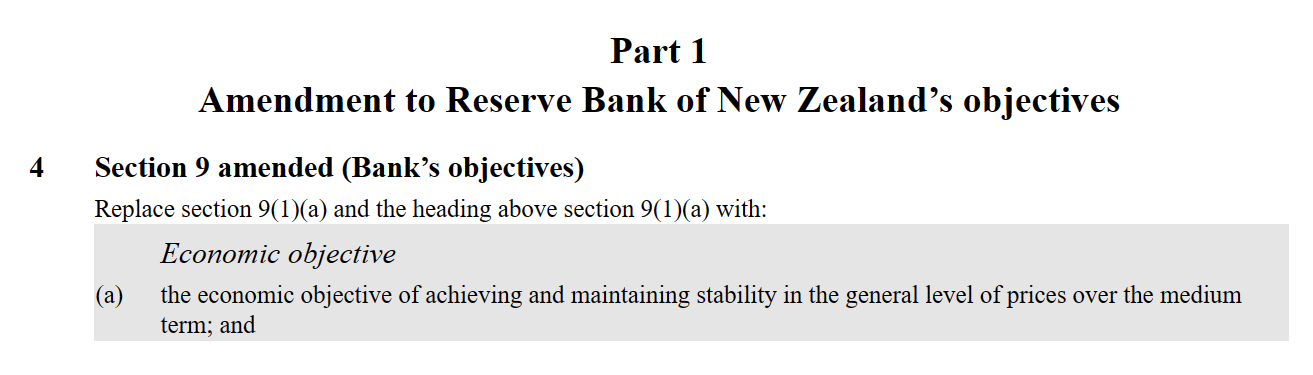
Reserve Bank of New Zealand (Economic Objective) Amendment Bill

I guess it will be an Act by the end of the day, but for now the short bill giving effect to a return to a single statutory objective for monetary policy is here. Yesterday’s parliamentary debate (first and second reading) is here, here, and here.

The heart of the bill is this clause

Note that this does not return things to as they were in 2018, keeping Labour’s addition of “over the medium term”. My own view is that references to time horizons are better kept for the Remit, which can be written in a more context-dependent way (sometimes it might be really important to get back to “price stability” – which isn’t 1-3% annual inflation anyway – really rather quickly. For example, after three years of inflation well above target?) With a bit more time, it might have been a good opportunity to simplify the 1989 bit of the wording as well. Simply “maintaining stability in the general level of prices” would be an improvement. But those are second and third order issues about this symbolic legislative change.

My bigger concern is that the legislation is not a complement to substance but a substitute for it. There is nothing wrong at all with symbolic steps, but if done in isolation they quickly come to seem like cosmetic distractions.

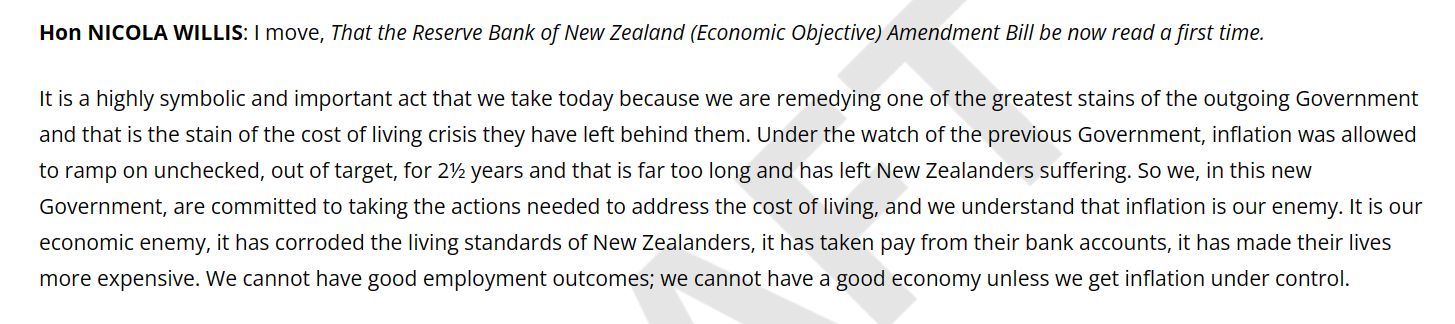
Take for example the Minister’s first reading speech

The bill is certainly a symbolic statement, but on its own it is nothing more than that. What is more, the Minister really should know that. There is nothing in the amendment that will, on its own, be “remedying one of the greatest stains of the outgoing Government and that is the stain of the cost of living crisis”. And there is nothing else even hinted at in the speeches from either the Minister or her associate (Seymour).

There has been a massive monetary policy failure in New Zealand in the last four years by the Reserve Bank of New Zealand (similar mistakes were made in many other advanced countries, but each operationally-independent central bank is responsible for its own country’s inflation rates). But, in part because there is a wide range of statutory legislative goals across countries and most of them ended up making much the same (really serious and costly) mistakes, it simply is not plausible to believe that things would have been materially different had that new “economic objective” been in place rather than the one that was actually on the statute books. There is no evidence at all to suggest that the monetary policy easing in 2020, the huge highly-risk LSAP punt, or the sluggish tightening in 2021 and early 2022 would have been any different at all, since the Reserve Bank’s own forecasts at the time (2020 and 2021) suggested to them that if anything what they were doing wasn’t really quite enough to keep inflation UP to the target midpoint.

This is all familiar ground but it is inconvenient ground (it appears) to the Minister who seems more interested in the rollicking political theatre of blaming her predecessor for his symbolic statutory amendment than in fixing our decayed and failing central bank. I read her speeches yesterday in both the first and second reading debates and there is no hint there that this statutory amendment is a first step in a process to fix the Bank or even to insist on some effective accountability for those whose decisions visited highly costly inflation and $12 billion of losses to the taxpayer on us. They used to talk of launching an independent review of Covid-era monetary policy. I was never entirely convinced of the case for such a review, and as I noted here recently if it is done the choice of reviewer will probably pre-determine the character of the final report, but it was a fairly consistent line from National. But there is no mention of it in yesterday’s speeches (the speech from the Associate Minister seemed more focused on the inflation of the Roman Empire than in actually fixing New Zealand’s central bank now).

The Minister (and her predecessor as Opposition finance spokesperson) has on several occasions been lied to by the Governor at FEC. The chair of the Board appears to have gotten away with lying to The Treasury, and getting Treasury to run spin for he and his Board have banned experts from serving as external members of the MPC. No external members have made even a single speech on monetary policy and inflation in their almost five years in office. The Board is stacked with underqualified mates of the previous government – a couple appointed despite, at the time, clear conflicts of interest, suggesting that not only the previous Minister but also the Governor and the board chair have at best a hazy sense of high standards in public life. Hardly anything is ever heard from the Governor on inflation – speeches from him on climate change are more common than those on the conduct of monetary policy. The Reserve Bank publishes little research, and is a bloated top-heavy regulation-fond expensive bureaucracy.

Not all of those failings could be fixed overnight even if the new government were so minded. The problem is that there is no sign at all that they are seriously interested in fixing any of them. This from a Minister and Associate Minister who did not support the reappointment of the Governor – a serious step for them to have taken then, but apparently meaning little now. There is no hint also that the Minister is going to reopen the selection process for the two external MPC roles falling vacant early next year. If she simply takes nominees who got through the Orr/Quigley/Board and Board recruitment agency process undertaken earlier this year, under the broad aegis of the previous government’s priorities/views, it is a recipe for things being no better in future. Either the nominees she is presented with will be amiable non-entities happy to be guided by the Governor, or (at best perhaps) people who were willing to keep their heads down and say not a discouraging word through the last four years of central bank failure.

Perhaps I’m being too critical too early? But if the Minister is at all serious about things being done differently in and by the Bank, yesterday’s speeches would have been a great (and easy) opportunity to have signalled something. It also hasn’t been too early for some other ministers to have written letters of expectation to agencies for which they are responsible, making clear the new government’s priorities around those agencies. But there seems to have been nothing from Willis.

Instead we get examples like this of her economic thinking

As economic thinking, the final sentence is a little embarrassing. There is little or no reason to suppose that there is any medium to long relationship (positive or negative) between the inflation rate and the unemployment rate (or “maximum sustainable employment”). One can have highish inflation and (sustainably) low unemployment or one can have low inflation – even price stability – and (sustainably) low unemployment. The record – across countries and across time – is pretty clear. But inflation – and especially unexpected bursts of inflation – is something the public dislikes, and for good reason. Getting and keeping sustainably low average rates of unemployment should be an important concern for governments, but Reserve Bank monetary policy has little or nothing to do with such outcomes.

Unfortunately there is quite a lot of muddled thinking around monetary policy and the expression of objectives. I could only agree with this line in the Minister’s first reading speech

Flexible inflation targeting, whereby the MPC has regard to the impact of monetary policy on the broader economy when determining how quickly to return inflation to target has been central to New Zealand’s successful inflation targeting regime for many years, and was the case prior to Robertson’s dual mandate hitting the books, regardless of whether there is a single or dual mandate, that remains the case.

and in fact giving expression to that generally shared understanding was one of the motivations for Labour’s legislative change in 2018. But, of course, the issue was never primarily about demand shocks and forecasting errors – like those of the last few years – that delivered us high inflation and unsustainably low inflation at the same time. Failures on the scale we’ve seen recently were simply never envisaged (and should never have happened). By contrast, supply shocks – that tend to drive headline inflation one way and unemployment the other way – aren’t infrequent at all and were always actively envisaged in the design and modification of Policy Targets Agreements over they years. In the face of such shocks it has always been the shared, usually expressed, understanding – and this dates all the way back to the oil shock in 1990 just a few months into the life of the 1990 Act – that faced with such shocks it would generally not be sensible or prudent to attempt to counter the direct price effects immediately, and that to do so would involve unnecessary and undesirable employment and output costs. There isn’t much of a sense of this in the Minister’s speeches – perhaps understandably as it veers to the geeky – but it is important nonetheless.

Finally, approaching the end of this post I wanted to offer a few thoughts on the Treasury’s Regulatory Impact Statement on the removal of the “dual mandate” from the Reserve Bank Act. At five pages long it is perhaps the best advert for the government’s decision not to require RISs for early pieces of legislation that are simply repeals. It leaves readers no better informed on the issues, offers no serious analysis, and actually muddies the ground in places. On the latter, for example, it correctly notes that Reserve Bank and Treasury view that the different mandate made no difference to policymaking over 2019 to 2023 (when the dominant shocks were understood to be demand shocks, likely to affect core inflation and unemployment in the same direction) but simply never engages on supply shocks (see previous paragraphs) or the flexibility long built into both central banking practice and the succession of Policy Targets Agreements. Since the political debate has further muddied this water – reinforced by half-baked media lines (of the sort I heard on RNZ this morning – it might be desirable for the new MPC Remit to make some of this stuff explicitly clear. There are short-term tradeoffs, but no long-term ones.

The RIS also repeats and endorses – and perhaps fed the Minister – the line that price stability is a “prerequisite” for achieving other objectives. It simply isn’t, and Treasury really should know better than to indulge what is not much more than misleading political rhetoric.

In RIS it is customary – perhaps even required – to look at three different ways of responding to the identified “policy problem”. The artificiality of this was never better displayed than in the Treasury RIS, in which they treat as a serious option using the reserve powers in the Act allowing the Minister of Finance to override temporarily the existing statutory economic objective, rather than amending the Act. Unsurprisingly, they recommend against using these never-used (dusted off for refreshing the memory every decade or so), which should never have been considered as an option in the first place – as not only would the market signalling have been terrible, but it would have gone quite against the direction the government was seeking (a permanent change).

Treasury ended up opposing the government’s legislative change, preferring to change just the MPC Remit (which the Minister can do pretty much any time he or she likes). Their only argument for this – eg they don’t seem to invoke any argument about reminding readers of statute of the wider context, or even that it is the Remit not the Act that is supposed to guide the MPC – seem to be a preference not to amend the Act (as if not amending the Act was a good in and of itself). They say “Treasury puts significant weight on the value of a stable and enduring legislative regime for the Reserve Bank” which (a) is weird coming immediately on the back of several years of extensive legislative overhaul around the Reserve Bank, (b) could be as easily seen as an argument for the government’s legislative amendment, which is closer to the “stable and enduring” legislative model that prevailed for almost 30 years, and (c) assumes recent reforms generally got things right, when there are clearly significant problems with the way the Reserve Bank Act reforms were done (including but not limited to making the underqualified board, which has no expertise in monetary policy, primarily responsible for holding the MPC to account and in appointing MPC members and the Governor).

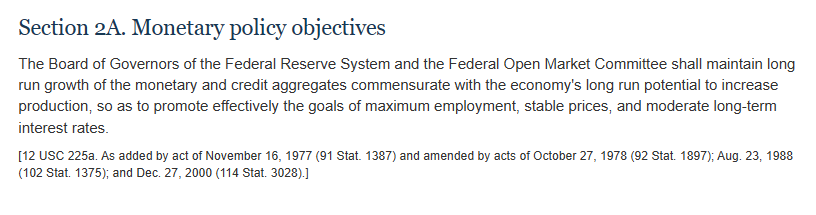
Finally, Treasury seeks to invoke “international best practice” in defence of retaining Labour’s wording. In respect of legislative (or similar wording) they are simply misleading. All four of the most important advanced country central banks – Fed, ECB, Bank of Japan, and Bank of England – have a single statutory objective, even if often accompanied by wording designed to articulate something of why price stability matters. It is certainly true that some central banks have more explicit “dual mandate” wording and others talk openly about the interactions between inflation and employment, sometimes in “dual mandate” terms, but there is nothing out of step with the legislative amendment the government is putting through today. The Treasury explicitly tries to cite the US in its support, but while the Fed likes to talk “dual mandate” rhetoric, its actual statutory objective for monetary policy is (a) a single objective, and (b) one with very outdated – legacy of the 1970s wording.

“So as to” are the envisaged benefits of pursuing and achieving the specified single objective.

It was simply far from being Treasury at its finest, and if time was short there was no obstacle to writing a much better short paper.

As for the government it is early days, but the early signs are not great around the Reserve Bank. I’m quite prepared to believe the new government won’t accommodate more institutional bloat, and that their appointments will be no worse than those of their predecessors, but for now there are no signs leading a reasonable independent observer to expect anything much better about fixing the Reserve Bank (or our diminished Treasury for that matter).

UPDATE:

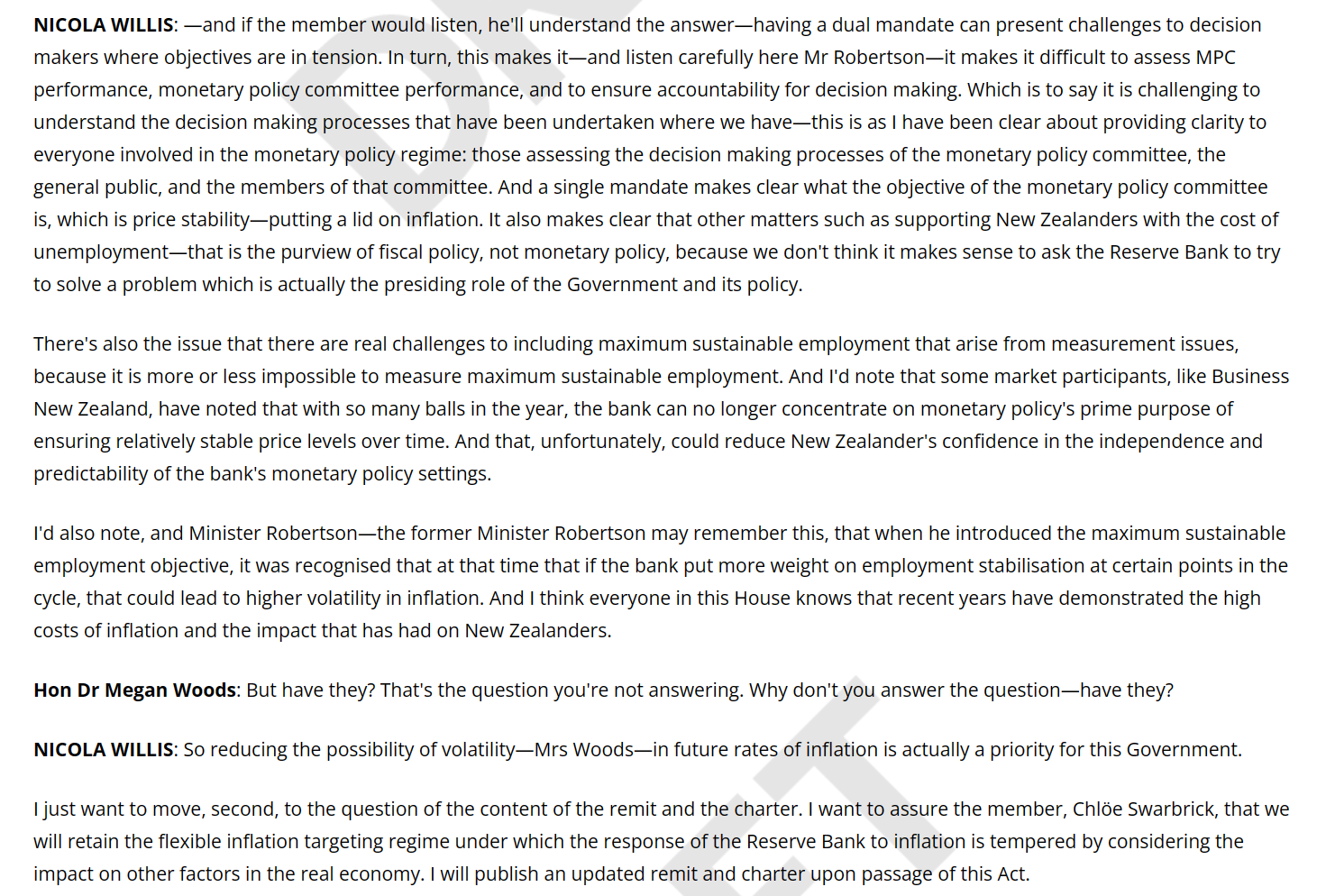
This is from a speech by the minister at the committee stage

The problem is that she contradicts herself. There are forms of inflation targeting where accountability might be really easy – any time CPI inflation is outside the target range, sack the Governor – but everyone has been agreed for 30+ years that that would not make sense and would generally produce inferior economic outcomes. In fact, the Minister herself agree because she is at pains to point out that the flexible form of inflation targeting (operated for the first 30 years) will be retained. In such a system it is not easy or mechanical to be able to exact accountability. These things -as so often in life – require judgement, and a willingness of ministers to exercise such judgement and, on rare occasions, act accordingly. Grant Robertson failure to do anything – and his decision to reappoint Orr and the 3 externals – is what made him party to their (central bank) failure.

What should be done about the Reserve Bank?

Monday’s post was on the important place effective accountability must have when government agencies are given great discretionary power which – as is in the nature of any human institutions – they will at times exercise poorly. My particular focus is on the Reserve Bank, both because it is what I know best, because it exercises a great deal of discretionary power affecting us all, and because in recent times it has done very poorly in multiple dimensions (be it bloated staffing, demonstrated loss of focus, massive financial losses, barefaced lies, or – most obvious to the public – core inflation persistently well above target).

What has happened under the current (outgoing) government is now an unfortunate series of bygones. What has happened, happened, and some combination of Orr, Robertson, Quigley (and lesser lights including MPC members and the Secretary to the Treasury) bear responsibility. Not one of them emerges with any credit as regards their Reserve Bank roles and responsibilities.

But in a couple of weeks we will have a new government, and almost certainly Nicola Willis will be Minister of Finance. The focus of this post is on what I think she and the new government should do, if they are at all serious about a much better, and better governed and run, institution in future. It builds on a post I wrote in mid 2022 after someone had sought some advice on a couple of specific points.

Thus far, we have heard very little from National on what plans they might have for the Reserve Bank. When they were consulted, as the law now requires, they opposed Orr’s reappointment (although on process grounds – wanting to make a permanent appointment after the election, something the legislation precluded – rather than explicitly substantive ones). And anyone who has watched FEC hearings over the past 18 months will have seen the somewhat testy relationship between Orr and Willis (responsibility for which clearly rests with Orr, the public servant, who in addition to his tone – dismissive and clearly uninterested in scrutiny – has at least once just lied or actively and deliberately misled in answer to one of Willis’s perfectly reasonable questions). In the Stuff finance debate last week I noticed that when invited to do so Willis avoided stating that she had confidence in Orr, but she has on a couple of occasions said that she will not seek to sack him, stating that she and he are both “professionals” (a description that, given Orr’s record, seems generous to say the least).

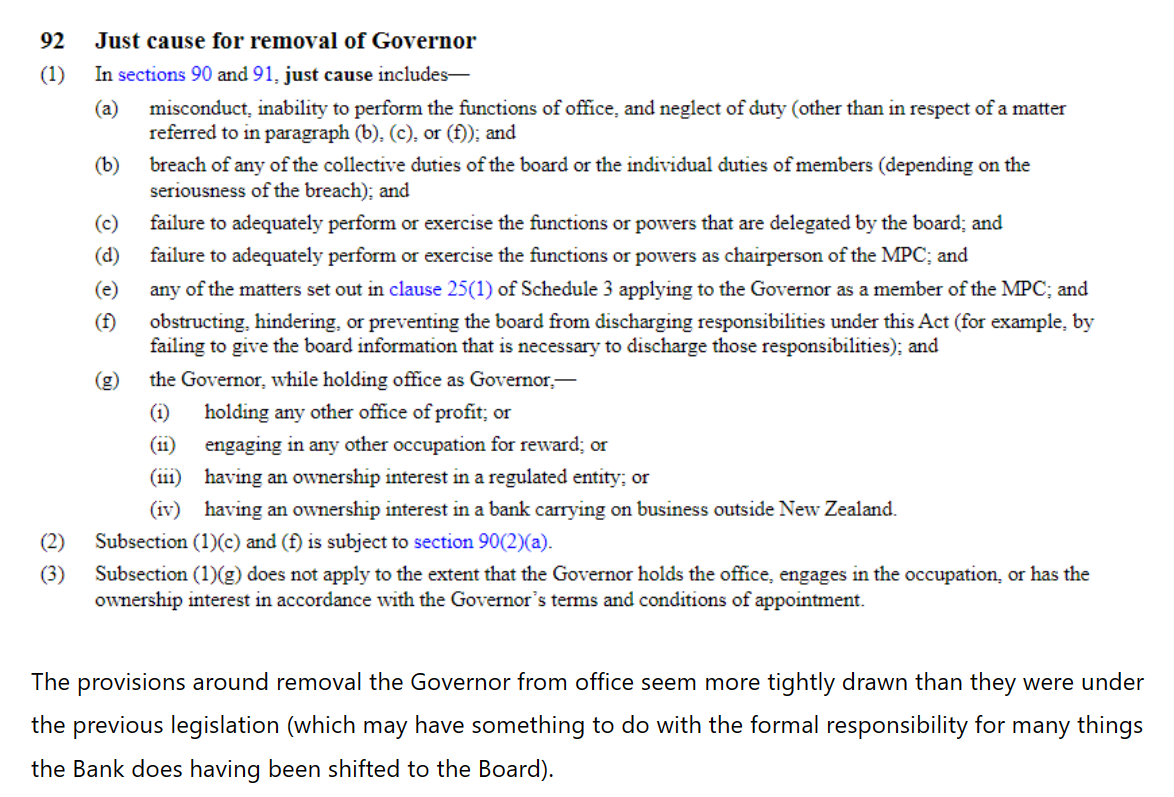
Even if she had wanted to, it would not be easy to sack Orr.

From last year’s post, these are the statutory grounds for removal

Note too that his current term in office started only in March this year, and the more egregious policy failures occurred in the previous term (and thus probably not grounds for removal now). I have my own list of clear failures even since March – no serious speeches, no serious scrutiny, no serious research, actively misleading Parliament, and so on – such that it would be much better if Orr were gone but seeking to remove him using these provisions would not be seriously viable, including because any attempt to remove him could result in judicial review proceedings, leaving huge market uncertainty for weeks or months.

Were the Governor an honourable figure he would now give six months notice, recognising that the incoming parties do not have confidence in him and that – whatever his own view of his own merits – it actually matters that the head of an agency wielding so much discretionary power should have cross-party confidence and respect (which does NOT mean agreeing with absolutely everything someone does in office).

Historically (and even when I wrote that post 18 months ago) I would have defended fairly staunchly the idea that incoming governments should not simply be able to replace the central bank Governor. The basic idea behind long terms for central bank Governors was so that governments couldn’t put their hand on the scales and influence monetary policy by threat of dismissal. But many of those conceptions date from the days before the modern conception of the government itself setting an inflation target and the central bank being primarily an agency implementing policy in pursuit of that objective. Even when the Reserve Bank of New Zealand legislation was first overhauled in 1989 the conception was that Policy Targets Agreements should be set and unchanged for five year terms, beyond any single electoral term. That (legislated) conception never survived the first election after the Act was passed, but these days the legislation is quite clear that the Minister of Finance can reset the inflation target any time s/he chooses (there are some consultation requirements). If the government can reset the target any time they choose, then it isn’t obvious that they shouldn’t be able to replace the key decision-makers easily (when the key decisionmakers – specifically the Governor – have influence, for good and ill, much more broadly than just around pursuit of the inflation target).

(There is a parallel issue around the question of whether we should move to the Australian system where heads of government departments can be replaced more easily, but here I’m focused only on the Reserve Bank, which exercises a great deal of discretionary policy power, and isn’t just an advice or implementation entity.)

By law they can’t make such changes at present. They could, of course, amend the law, but to do so in a way narrowly focused on Orr (ie an amendment deeming the appointment of the current Governor as at the passage of this amendment to be terminated with effect six months from the date of the Royal Assent) would smack rather of a bill of attainder. Governors have been ousted this way in other countries, but I don’t think it is a path we should go down.

Some will also argue that Orr should simply be bought out. If the government was seriously willing to do that – and pay the headline price of having written a multi-million-dollar cheque to (as it would be put) “reward failure” – I wouldn’t object, but it isn’t an option I’d champion either. (Apart from anything else, a stubborn incumbent could always refuse an offer, and once this option was opened up there really is no going back.)

So the starting point – which Willis has probably recognised – is that unless Orr offers to go they are stuck with him for the time being.

The same probably goes for the MPC members and the members of the Bank’s Board. The incoming Minister of Finance could, however, remove the chair of the Board from his chairmanship (this is not subject to a “just cause” test). The current chair’s Board term expires on 30 June next year, and it might not be thought worth doing anything about him now, except that he is on record as having actively misled Treasury (and through them the public) about the Board’s previous ban on experts being appointed to the MPC, and he has been responsible for (not) holding the Governor to account for the Bank’s failures in recent years. Removing Quigley would be one possible mark of seriousness by a new government, and a clear signal to management and Board that a new government wanted things to be different in future.

The current Reserve Bank Board was appointed entirely by Grant Robertson when the new legislation came into effect last year. It was clearly appointed more with diversity considerations in mind than with a focus on central banking excellence, and several members were caught up in conflict of interest issues. The appointments were for staggered terms but – Quigley aside – the first set of vacancies don’t arise until mid 2025. It would seem not unreasonable for a new Minister to invite at least some of the hacks and token appointees to resign.

There are three external appointees to the Monetary Policy Committee. None has covered themselves in any glory or represented an adornment to the Committee or monetary policymaking in New Zealand. All three have (final) terms that expire in the next 18 months, two (Harris and Saunders) in the first half of next year. This is perhaps the easiest opportunity open to a new Minister to begin to reshape the institution, at least on the monetary policy side, because appointments simply have to be made in the next few months. As I noted in a post a couple of weeks ago, OIAed documents show that the current Board’s process for recommending replacements is already largely completed, with the intention that once a new government is sworn in they will wheel up a list of recommendations. If the new government is at all serious about change, this should be treated as unacceptable, and the new Minister should tell the Board to rip up the work done so far and start from scratch, having outlined her priorities for the sort of people she would want on the MPC (eg expert, open, willing and able to challenge Orr etc). It would also be an opportunity for her to revisit the MPC charter, ideally to make it clear that individual MPC members are expected to be accountable for, and to explain, their individual views and analysis. Were she interested in change, it is likely that the pool of potentially suitable applicants might be rather different than those who might have applied – perhaps to be rejected as uncomfortable for Orr at the pre-screening – under the previous regime.

The Reserve Bank operates under a (flawed) statutory model where a Funding Agreement with the Minister governs their spending for, in principle, five years at a time. The current Agreement – recently amended (generously) with no serious scrutiny, including none at all by Parliament – runs to June 2025. The incoming government parties have been strong on the need to cut public spending by public agencies on things that do not face the public. They need to be signalling to the Reserve Bank that they are not exempt from that approach, and if the current Funding Agreement cannot be changed it should be made clear to the Board and management that there will be much lower levels of funding from July 2025. Indulging the Governor’s personal ideological whims or inclinations to corporate bloat are not legitimate uses of public money.

If she is serious about change, the incoming Minister also shouldn’t lose the opportunity to deploy weaker but symbolic tools at her disposal. Letters of expectation to the Governor/MPC and the Board can make clear the direction a new government is looking for, as can the Minister’s comments on the Bank’s proposed Statement of Intent. Treasury now has a more-formal role in monitoring the Bank’s performance, and the Minister should make clear to Treasury that she expects serious, vigorous and rigorous, review.

All this assumes the incoming Minister is serious about a leaner, better, more-excellent and focused Reserve Bank. If she is, and is willing to use the tools and appointments at her disposal, she can put a lot of pressure on Orr. If that were to lead to him concluding that it wasn’t really worth sticking around for another 4.5 years that would be a good outcome. But at worst, he would be somewhat more tightly constrained.

I haven’t so far touched on the two specific promises National have made. The first is to revise the legislation (and Remit) to revert to a single statutory focus for monetary policy on price stability. I don’t really support this change – the reason we have discretionary monetary policy is for macro stabilisation subject to keeping inflation in check – but I’m not going to strongly oppose it either. The 2019 change made no material difference to policy – mistakes were ones of forecasting (and perhaps limited interest and inattention thrown in) – and neither would reversing it. Both are matters of product differentiation in the political market rather than a point of policy substance. The proposed change back risks being a substitute for focusing on the things that might make for an excellent central bank – as it was with Robertson. I hope not.

The other specific promise has been of an independent expert review of the Bank’s Covid-era policymaking. It isn’t that I’m opposed to it – and there is no doubt the Bank’s own self-review last year was pretty once-over-lightly and self-exonerating – but I’m also not quite sure what the point is, other than being seen to have done it. Action, and a reorientation of the institution and people, needs to start now, not months down the track when some independent reviewer might have reported (and everyone recognises that who is chosen to do the review will largely pre-determine the thrust of the resulting report). It isn’t impossible that some useful suggestions might come out of such a report, but it doesn’t seem as though it should be a top priority, unless appearance of action/interest is more important than actual change. I hope that isn’t so either.

What of the longer term, including things that might require more-complex legislative change?

I think there are number worth considering, including:

  • how the MPC itself is configured.   I strongly favour a model –  as in the UK, the US, and Sweden –  in which all MPC members are expected to be individually accountable for their views, and should be expected routinely to record votes (and from time to time make speeches, give interviews, appear before FEC).  I’m less convinced now than I once was that the part-time externals model can work excellently in the long haul, even with a different – much more open, much more analytically-leading – Governor.  One problem is the time commitment, which falls betwixt and between. External MPC members have been being paid for about 50 days a year, which works just fine for people who are retired or semi-retired, but doesn’t really encourage excellent people in the prime of life to put themselves forward (I’m not sure how even university academics – with a fulltime job –  can devote 50 days to the role).  In the US and Sweden all MPC members are fulltime appointments, and in the UK while the appointments are half-time they seem to be paid at a rate that would enable, say, an academic to live on the appointment, perhaps supplemented with some other part-time (non-conflicted roles).    I also used to put more weight on the idea of a majority of externals, which I now think is a less tenable option than I once did.  External members can and should act as something of a check on and challenge to management, but it will always be even more important to have the core institution functioning excellently (at senior and junior levels).  We should not have a central bank deputy chief executive responsible for matters macroeconomic who simply has no expertise and experience, and is unsuited to be on any professional MPC.
  • I would also favour (and long have favoured) moving away from the current model in which the Board controls which names go to the Minister of Finance for MPC and Governor appointments.  It is a fundamentally anti-democratic system (in a way with no redeeming merits), and out of step with the way things are done in most countries.  We don’t want partisan hacks appointed to these roles, but the Board – itself appointed by (past) ministers –  is little or no protection, and Board members in our system have mostly had little or no relevant expertise.  Appointments should be made by the Minister –  in the case of the Governor, perhaps with Opposition consultation – and public/political scrutiny should be the protection we look to.  I would also favour all appointees to key central bank roles have FEC scrutiny – NOT confirmation- hearings before taking up their roles (as is done in the UK).
  • I would also favour (as I argued here a few years ago [UPDATE eg in this post]) looking again at splitting the Reserve Bank, along Australian lines, such that we would have a central bank with responsibility for monetary policy and macro matters and a prudential regulatory agency responsible for the (now extensive) supervisory functions.  They are two very different roles, requiring different sets of skills from key senior managers and governance and decision-making bodies.  Accountability would also be a little clearer if each institution was responsible for exercising discretion in a narrower range of area.  Quite obviously, the two institutions would need to work closely together in some (limited) areas, but that is no different than (say) the expectation that the Reserve Bank and Treasury work effectively together in some areas.  (Reform in this area might also have the incidental advantage of disestabishing the current Governor’s job).  Reform along these lines would leave two institutions with two boards each responsible for policymaking (and everything else) the institutions had statutory responsibility for.  The current vogue globally has been for something like having a Board and an MPC in a single institution, the former monitoring the latter.  But the New Zealand experience in recent years is illustrative of just how flawed such a model is in practice: not only is the Board still within the same institution (thus all the incentives are against tough challenge and scrutiny) but typically Reserve Bank Board members have no relevant expertise to evaluate macro policy performance or key appointments in that area).  Monitoring and review matter but if they are to be done well they will rarely be done within the same institution with (as here) the chair of the MPC (Orr) sitting on the monitoring board.  The new Board’s first Annual Report last week illustrates just how lacking the current system is in practice, and although a new minister might appoint better people, we should be looking to a more resilient structure.

As I said at the start of this post we – public, voters, RB watchers – really don’t have much sense of what National or Willis might be thinking as regards the Reserve Bank. I tend to be a bit sceptical that they care much, but would really like to be proved wrong. There are significant opportunities for change, which could give us a leaner, better, much more respected, central bank. It is unfortunate that these matters need to be revisited so soon after the legislative reforms put in place by the previous government, but they do – we need better people soon, but also need some further legislative change.

UPDATE: A conversation this afternoon reminded me of the other possible option for getting Orr out of the Reserve Bank role: finding him another job. There might not be many suitable jobs the new government would want someone like Orr in, but I have previously suggested that something like High Commissioner to the Cook Islands might be one (having regard to his part Cooks ancestry, and apparent active involvement in some Pacific causes). More creative people than me may have other (practical) suggestions.

Spending (lots) more….with no parliamentary authorisation

Late yesterday afternoon someone sent me the link to this

Almost two months into the Reserve Bank’s financial year it authorises a 41.7 per cent increase in spending for the current financial year and a 26.3 per cent increase the following year, both relative to the amounts approved in the current five-year Funding Agreement signed in June 2020.

The variation had, apparently, been slipped onto the Reserve Bank’s website the previous day (22nd).

I’m signed up to the Bank’s email notifications. These were the ones from the last week

There was no press release from the Bank, and none from the Minister of Finance either. For huge increases in the spending of an institution whose performance has been under a great deal of scrutiny in the last year or two, the institution actually charged with keeping domestic demand in check to keep inflation at/near target.

The Funding Agreement model, which governs how much of its income the Bank can spend, itself is very unusual. I wrote about it, and the background to it, in a post a few years ago, before Orr took office, when the Reserve Bank Act review was being kicked off. The Funding Agreement model was better than what had gone before – not hard, since previously there were no formal constraints at all on Reserve Bank spending – but not very good at all. The model was set up when the Bank was (overwhelmingly) conceived of as a monetary policy agency, with a few other peripheral functions. The five-year horizon, with nominal allocations fixed in advance, was seen as having the (modest) advantage of providing a bit of financial incentive for the Bank to meet its inflation target: if it didn’t its real spending constraint would be tighter than otherwise. These days, the bulk of the Bank’s staff are devoted to policy and regulatory functions. Most such government agencies are funded by annual appropriations, approved (and scrutinised) by Parliament through the annual Budget process. In that earlier post, I’d come round to thinking that model should be applied to the Reserve Bank too.

The variation slipped onto the website a couple of days ago exemplifies what is wrong with the current system (perhaps especially under the current players – Orr/Quigley and Robertson – but they are only egregious abusers of a poor system).

This is public spending on public functions. We have a Budget for that. There is no obvious reason why, if there really was a compelling case for more money for the Reserve Bank, it could not have been announced at the same time as the Budget. After all, governments have to prioritise, and voters have to make judgements about what they do and don’t choose to spend money on. Taxpayers are the poorer whether or not the spending is through some agency subject to parliamentary appropriation or the Reserve Bank. As it is, the Bank’s financial year began on 1 July, so why the delay in agreeing/announcing this big increase in approved spending?

But then note the specific timing. The Minister of Finance signed the variation on 31 July. Orr and Quigley only signed it, and then had it slipped onto the website, on 22 August. It doesn’t take more than five minutes to get a document across the road to the Reserve Bank, and even if they wanted Quigley’s signature on it (it just needs any two Board members), and they wanted a physical rather than electronic signature, a return courier to Hamilton could no doubt have been done in 24 hours. Most probably, they didn’t want the variation to be known any earlier because……last week was the Monetary Policy Statement, when the Bank was having to acknowledge it hadn’t yet made much progress in getting core inflation down and that interest rates might be higher for longer, when the Bank would face a press conference and an FEC hearing, and when they’d do the quarterly round of making some internal MPC members available for interviews. It came on the back of those stories a couple of weeks ago [UPDATE: the week MoF signed the variation] about the Minister and the Public Service Commissioner having meetings with government department chief executives urging upon them fiscal restraint. The last of those Bank media interviews appeared a couple of days ago. It was bureaucratic gamesmanship, presumably abetted/approved by the Minister, to minimise budgetary scrutiny and accountability on what is a huge increase in allowed spending.

By law, they had to publish the Funding Agreement variation on the Bank website as soon as possible after it was signed. They did that, even if you had to be eagle-eyed or lucky to spot it. The Minister must present a copy to Parliament within 12 sitting days. Had the agreement been signed on 31 July (when Robertson signed it, but not the others) that would have been this month. As it is, perhaps he’ll do it in the next few days, but it could be November/December, after the election.

Under the old Reserve Bank Act, Funding Agreements were subject to parliamentary ratification. In a way, it was a bit of a charade, as there were no consequences if it was voted down (it isn’t mandatory for there even to be a Funding Agreement) but it did establish a principle, and did allow a parliamentary debate and a spotlight on proposed Bank spending). In one of the very worst parts of the Reserve Bank Act reforms – that genuinely took things backwards, rather than just made botched or inadequate improvements – the government removed the provision from the Act requiring parliamentary ratification, and thus the platform for parliamentary debate (about a level of spending which in absolute terms is no longer small).

We also, at this point, have no real idea what the Minister has approved this spending increase, in straitened times, for, or why he approved it. There is, of course, no ministerial press statement, and there is no hint of a huge spending increase in the Minister’s latest letter of expectation (although this must have been underway for months, and I had a clearly well-informed email months ago encouraging me to ask questions and lodge OIAs then, which I didn’t get round to doing).

All we have at present is this

which is clearly designed to emphasise the new functions, but there is just no way they can be costing any significant part of the extra $48m. And in any case, we simply can’t take as trustworthy anything Orr and Quigley say any longer, abetted by Robertson, without explicit verification.

(One problem with the Funding Agreement model is that it includes capex so we don’t even know yet the split between ongoing operational spending and capex items).

There should, eventually, be some transparency. One positive aspects of the recent legislative reforms was a requirement that the Bank must publish a budget (previously I had pointed out the Bank’s funding was an untransparent as that of the SIS)

By law, the variation to the Funding Agreement slipped onto the website on Tuesday had to accompanied by an updated budget. But, so far, there is no sign of one. There are budget numbers in the 2023/24 Statement of Performance Expectations released a while ago, but they bear no relationship to the numbers in this variation (and there is no substantive mention of the Funding Agreement, or any variations to it, in that document). I’ve searched their website and can find nothing else.

We have no details, Parliament has no say, and the Minister and Governor and Board chair arranged to ensure the really big increase in funding was (a) kept just as low profile as possible, and (b) wasn’t disclosed at all until the quarterly round of scrutiny for the Bank had conveniently passed.

It is a travesty on multiple counts. The system is bad enough – spending should be occurring only with parliamentary approval, but the law doesn’t require that – and the application seems, if anything, to have been worse.

Since I assume that they will, after their fashion, eventually obey the law no doubt a “budget” will eventually appear. Even then it is unlikely to be very revealing, although might give a hint of a sense of the breakdown between bloat and actual increased statutory responsibilities. I’ve lodged Official Information Act requests with the Bank, The Treasury, and the Minister of Finance to understand better just what is going on, including how much (if any) pressure there was on the Bank to cut back on non-priority spending. One day, in a month or two, we should have some answers to that.

UPDATE (Friday)

This appeared in the comments last night

If I’m looking at the right page this detail now appears to have been removed. It was interesting that Quigley’s signature was affixed electronically, so that (of course) the long delay was not a matter of waiting for him to come to Wellington. Re the final point, there may well have been a Board meeting recently, but since the variation document itself reflected an agreement between the Bank and the Minister it would be (very) surprising indeed if the Board had not already approved the variation before MoF signed it on 31 July.

Reappointing Orr

Yesterday’s announcement from the Minister of Finance that he was reappointing Adrian Orr as Governor of the Reserve Bank was not unexpected but was most unfortunate. I was inclined to think another commentator (can’t remember who, so as to link to) who reckoned that it may have been Robertson’s worst decision in his five years in office was pretty much on the mark.

When Orr was first appointed, emerging out of a selection process kicked off by the Reserve Bank’s Board while National had still been in office, it seemed to me it was the sort of appointment that could have gone either way. I captured some of that in the post I wrote the day after that first appointment was announced, and rereading that post last night it seemed to at least hint at many of the issues that might arise and come to render the appointment problematic at best. Some things – a good example is $9.5 billion of losses to the taxpayer – weren’t so easy to foresee.

The timing of the reappointment announcement itself was something of a kick in the face for (a) critics, and (b) any sense that the better features of the new Reserve Bank legislation were ever intended as anything more than cosmetic. The Reserve Bank is tomorrow publishing its own review (with comments from a couple of carefully selected overseas people) of monetary policy over the past five years. Adding the statutory requirement for such a review made a certain amount of sense, but if there is value in a review conducted by the agency itself of its own performance, it was only going to be in the subsequent scrutiny and dialogue, as outsiders tested the analysis and conclusions the Bank itself has reached. But never mind that says Robertson, I’ll just reappoint Adrian anyway. Perhaps the Bank has a really compelling case around its stewardship of monetary policy – and just the right mix of contrition and context etc – but we don’t know (and frankly neither does Robertson – who has no expertise in these matters, and who appointed a Reserve Bank Board -the people who formally recommend the reappointment – full of people with almost no subject expertise).

But, as I say, the reappointment was hardly a surprise.

It could have been different. I’ve seen a few people say it would have been hard to sack Orr, but I don’t think that is so at all. No one has a right to reappointment (not even a presumptive right) and Robertson could quite easily have taken Orr aside a few months ago and told him that he (Orr) would not be reappointed, allowing Orr in turn the dignity of announcing that he wouldn’t be seeking a second term and would be pursuing fresh opportunities (perhaps Mark Carney would like an offsider for his climate change crusades?) Often enough – last week’s FEC appearance was just the latest example – Orr’s heart doesn’t really seem to be in the core bits of the job.

There are many reasons why Orr should not have been reappointed. The recent inflation record is not foremost among them, although it certainly doesn’t act as any sort of mitigant (in a way that an unexpectedly superlative inflation record in a troubled and uncertain world might – hypothetically – have).

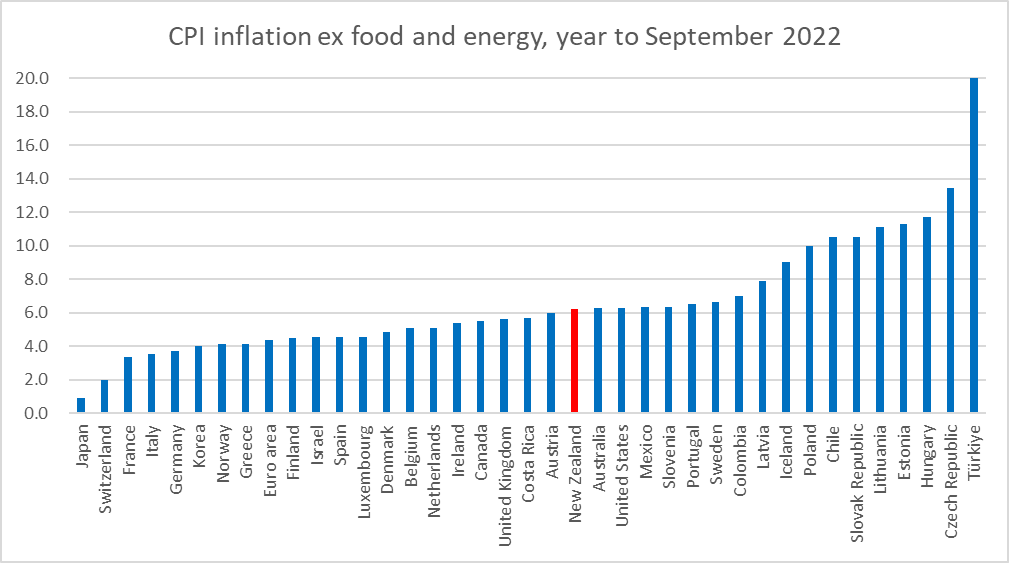
There is nothing good, admirable, or even “less bad than most” about the inflation record. This chart is from my post last week

A whole bunch of central banks made pretty similar mistakes (and the nature of floating exchange rates is that each central bank is responsible for its country’s own inflation rate). Among the Anglo countries, we are a bit worse than the UK and Canada and slightly less bad than the US and Australia. Among the small advanced inflation targeters – a group the RB sometimes identified with – we have done worse than Switzerland, Norway, and Israel, and better than Sweden and Iceland. In a couple of years (2021 and 2022) in which the world’s central bankers have – in the jargon – stuffed up badly, Orr and his MPC have been about as bad on inflation as their typical peers.

You could mount an argument – akin to Voltaire on the execution of Admiral Byng – that all the world’s monetary policymakers (at least those without a clear record of dissent – for the right reasons – on key policy calls) should be dismissed, or not reappointed when their terms end, to establish that accountability is something serious and to encourage future policymakers to do better. You take (voluntarily) responsibility for inflation outcomes, and when you fail you pay the price, or something of the sort. Inflation failures – including the massive unexpected wealth redistributions – matter.

Maybe, but it was never likely to happen, and it isn’t really clear it should. As I’ve noted here in earlier posts until well into 2021 the Reserve Bank’s forecasts weren’t very different from those of other forecasters, and I’m pretty sure that was also the case in other countries. Inflation outcomes now (year to September 2022) are the result of policy choices 12-18 months earlier. With hindsight it is clear that monetary policy should have been tightened a lot earlier and more aggressively last year, but last February or even May there was hardly anyone calling for that. Absent big policy tightenings then, it is now clear it was inevitable that core inflation would move well outside the target range. There are plenty of things to criticise the Bank for – including Orr’s repeated “I have no regrets” line – but if one wants to make a serious case for dismissing Orr for his conduct of monetary policy it is probably going to have to centre on (in)actions from say August 2021 to February 2022 (whereafter they finally stepped up the pace) but on its own – it was only six months – it would just not be enough to have got rid of the Governor (even just by non-reappointment). The limitations of knowledge and understanding are very real (and perhaps undersold by central bankers in the past), and even if Orr and the MPC chose entirely voluntarily to take the job (and all its perks and pay) those limitations simply have to be grappled with. Were New Zealand an outlier it might be different. Had the Bank run views very much at odds with private forecasters etc it might be different. But it wasn’t.

I am, however, 100 per cent convinced that Orr should not have been reappointed. I jotted down a list of 20 reasons last night, and at that I’m sure I’ve forgotten some things.

I’m not going to bore you with a comprehensive elaboration of each of them, most of which have been discussed in other posts. but here is a summary list in no particular order:

  • the extremely rapid of turnover of senior managers (in several case, first promoted by Orr and then ousted) and associated loss of experience and institutional knowledge
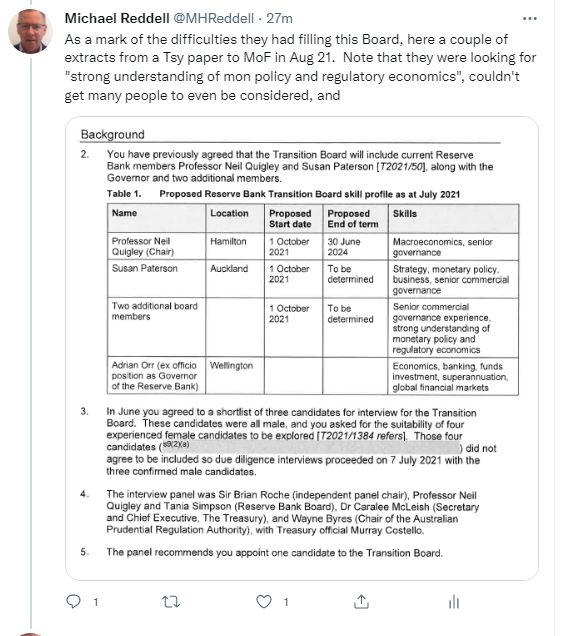
  • the block placed –  almost certainly at Orr’s behest –  on anyone with current and ongoing expertise in monetary policy nad macroeconomic analysis from serving as an external member of the MPC
  • the appointment as deputy chief executive responsible for macroeconomics and monetary policy (with a place on the MPC) of someone with no subject expertise or relevant background
  • $9.5 billion of losses on the LSAP – warranting a lifetime achievement award for reckless use of public resources – with almost nothing positive to show for the risk/loss  
  • the failure to ensure that the Bank was positioned for possible negative OCRs (having had a decade’s advance warning of the issue), in turn prompting the ill-considered rush to the LSAP
  • the failure to do any serious advance risk analysis on the LSAP instrument, as being applied to NZ in 2020
  • the sharp decline in the volume of research being published by the Reserve Bank, and the associated decline in research capabilities
  • the way the Funding for Lending programme, a crisis measure, has been kept functioning, pumping attractively-priced loans out to banks two years after the crisis itself had passed (and negative OCR capability had been established)
  • lack of any serious and robust cost-benefit analysis for the new capital requirements Orr imposed on banks (even as he repeatedly tells us how robust the system is at current capital levels)
  • repeatedly misleading Parliament’s Finance and Expenditure Committee (most recently, his claim last week that the war was to blame for inflation being outside the target range), in ways that cast severe doubts on his commitment to integrity and transparency
  • his refusal to ever admit a mistake about anything (notwithstanding eg the biggest inflation failure in decades) 
  • the fact that four and a half years in there has never been a serious and thoughtful speech on monetary policy and economic developments from the Governor (through one of the most turbulent times in many decades)
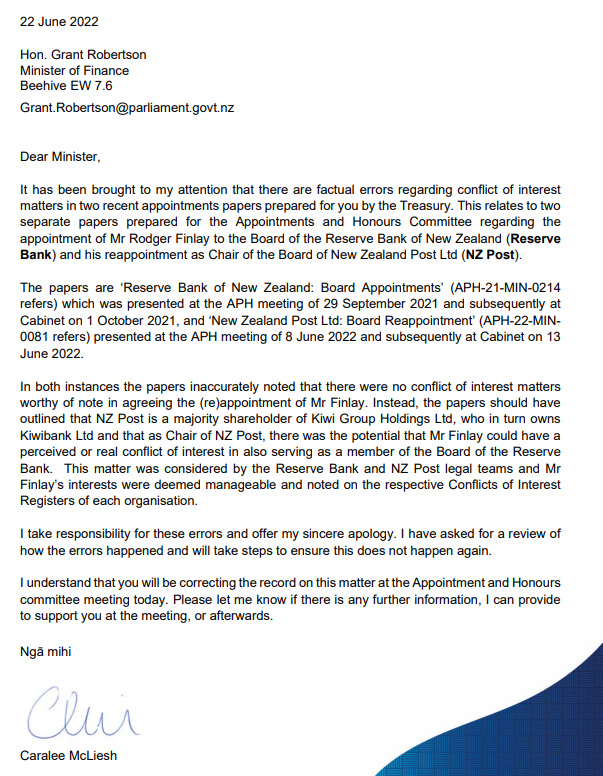
  • Orr’s active involvement in supporting and facilitating the appointment of Board members with clear conflicts of interest (Rodger Finlay especially, but also Byron Pepper)
  • his testiness and intolerance of disagreement/dissent/alternative views
  • his often disdainful approach to MPs
  • his polarising style, internally and externally
  • all indications are that he is much more interested in, and intellectually engaged by, things he isn’t responsible for than for the things Parliament has charged him with
  • organisational bloat (think of the 17-20 people in the Communications team or the large number of senior managers now earning more than $400000 pa)
  • the distraction of his focus on climate change, but much more so the rank dishonesty of so much of it – claims to have done modelling that doesn’t exist, attempts to suppress release of information on what little had been done, and sheer spin like last week’s flood stress test. It might be one thing for a bloated overfunded bureaucracy to do work on things it isn’t really responsible for if it were first-rate in-depth work. It hasn’t been under Orr.
  • much the same could be said of Orr’s evident passion for all things Maori –  in an organisation with a wholesale macroeconomic focus, where the same instruments apply to people of all ethnicities, religions, handedness, political affiliation or whatever.  What “analysis” they have attempted or offered has been threadbare, at times verging on the dishonest.
  • the failure to use the opportunity of an overhaul of the RB Act to establish a highly credible open and transparent MPC (instead we have a committee where Orr dominates selection, expertise is barred, and nothing at all is heard from most members)

And, no doubt, so on.  He is simply unfit to hold the office, and all indications are that he would have been so (if less visibly in some ways) had Covid, and all that followed (including inflation), never happened.   

But the crowning reason why Orr should not have been reappointed is that doing so has further politicised the position, in a most unfortunate way.

In the course of the overhaul of the Reserve Bank Act, Grant Robertson introduced a legislative requirement that before appointing someone as Governor the Minister of Finance needed to consult with other parties in Parliament (parallel provision for RB Board members).  It was a curious provision, that no one was particularly pushing for (in most countries the Minister of Finance or President can simply appoint the Governor, without even the formal interposition of something like the RB Board), but Robertson himself chose to put it in.  The clear message it looked to be sending was that these were not only very important positions but ones where there should be a certain measure of cross-party acceptance of whoever was appointed, recogising (especially in the Governor’s case) just how much power the appointee would wield.  That provision never meant that governments could not appoint someone who happened to share their general view of the world and economy, but there was a clear expectation that whoever was appointed would be sufficient to command cross-party respect for the person’s technical expertise, non-partisan nature, dispassionate judgement and so on.  Robertson simply ignored Opposition dissents on a couple of the Board appointees.  That was of second order significance, but it is really significant in the case of the Governor.  It isn’t easy to dismiss a Governor (and rightly so) so for a Minister of Finance to simply ignore the explicit unease and opposition of the two main Opposition parties in Parliament is to make a mockery of the legislation Robertson himself had put in place so recently.   The Opposition parties are being criticised in some places (eg RNZ this morning) for “politicising the position/appointment” but they seem to have been simply doing their job –  it was Parliament/Robertson who established the consultation provision –  and the consultation provisions, if they meant anything, never meant giving a blank slate for whomever the Minister wanted to offer up, no matter the widely-recognised concerns about such a nominee.   No one has a right to reappointment and when it was clear that the main Opposition parties would not support reappointment, Robertson should have taken a step back, called Adrian in and told him the reappointment could not go ahead, in the longer-term interests of the institution and the system.  If you were an Orr sympathiser, you might think that was tough, but….no one has right to reappointment, and the institution matters.

And, of course, now the position of the Governor has inevitably been put into play, with huge uncertainty as to what might happen if/when National/ACT form a government after the election next year.    (And here is where I depart from National’s stance –  I never liked the idea of a one year appointment, made well before the traditional pre-election bar on new permanent appointments.  We want able non-partisan respected figures appointed for long terms (it is the way these things work in most places), not for each incoming PM to be able to appoint his or her own Governor.)

A few months ago, anticipating that Orr would probably be reappointed, I wrote a post on what an incoming government next year could do about the Bank.    The key point to emphasise is that a new government cannot simply dismiss a Governor they don’t like (or nor should they be able to).  I saw a comment on a key political commentary site this morning noting that the process for dismissal isn’t technically challenging, which is true, but the substantive standards are quite demanding (the Governor can be dismissed only for specific statutory causes, and for (in)actions that occurred in his new term (which doesn’t start until March)).  Generally, we do not want Governors to be able to be easily dismissed (in most countries it is even harder than in New Zealand).   More to the realpolitik point, any dismissal could be challenged in the courts, and no one would (or should) want the prolonged uncertainty (political and market) such actions might entail.   Moreover, senior public figures cannot just be bought out of contracts.   

We still don’t know –  and perhaps they don’t either –  how exercised National and ACT would be about any of this were they to form a government next year, but unless Orr was himself minded to resign (as the Herald’s columnist suggests might happen) things would have to be handled carefully and indirectly (perhaps along lines in that earlier post of mine) to change the environment and the incentives around the institution.   Most of those changes should be pursued anyway, to begin to fix what has been done over the last few years    And if Orr were to be inclined not to stick around for long, perhaps an offer of appointment as High Commissioner to the Cooks Islands might smooth his way? 

Finlay, the RB Board, and related matters

The Herald’s Jenée Tibshraeny had a follow-up piece this morning on the Reserve Bank Board, with some interesting new information and (what appears to be) some ministerial spin and simply avoiding straight answers.

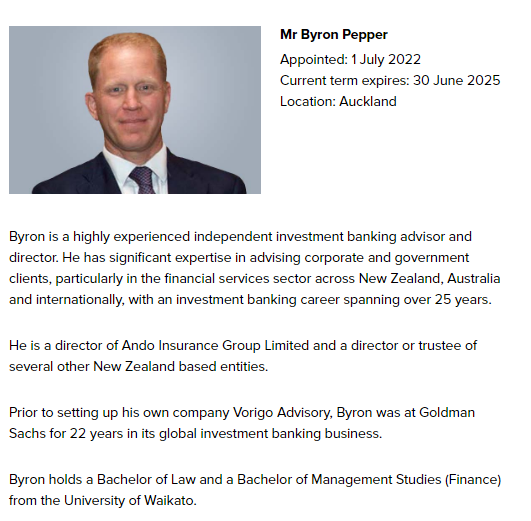
First we learn that Byron Pepper, appointed to the Board in late June, has now stepped down from his position as a director of an insurance company (Ando) that – by the vagaries of the details of the insurance legislation – is not an institution regulated by the Reserve Bank but is nonetheless substantially owned by another insurance company which is regulated, and which provides insurance on behalf of that regulated company. Again, it wasn’t illegal for Pepper to have held those two roles simultaneously, but it was quite improper, and it reflects poorly on him, on The Treasury (which made the appointment recommendations), on the Bank (Governor and key Board members), and on the Minister of Finance that it was ever allowed to happen. Reading again through the OIA papers I got back from Robertson the other day, it appears that Rodger FInlay was on the interview panel……so perhaps we should be less surprised. It is as if they have no sense of ethics, or of conflicts of interest in any sense other than the narrowly legal.

We don’t know whether Pepper jumped (volunteered himself to step down from Ando having thought again and realised it was a very bad look for an honourable person) or was belatedly pushed (by the Minister of Finance, Orr/Quigley, or The Treasury). My money would probably be on the Minister and the Beehive but if the conflict should never have been allowed to have arisen, at least it has been sorted out.

The sheer spin comes regarding Finlay.

Here is the timeline we know:

  • back in May 2021, Finlay put himself forward for appointment to the Reserve Bank Board (that is when positions for the Transition Board and the real thing were advertised).  He was chair of NZ Post then, it owned a majority of Kiwibank then.   From the documents Robertson released, we know he then signed a conflict of interest declaration stating “I can confirm that at the time of any Reserve Bank appointment I would not have any relevant conflicts of interest”.
  • In October 2021 Cabinet agreed to appoint him to the full Reserve Bank Board from 1 July 2022, and noted that the Minister had appointed him to the “Transition Board” (formally, as a consultant to the Reserve Bank during the establishment period prior to 1 July 2022).
  • No political parties raised any objections when they were consulted, as the new law required for Board appointments.
  • During the period of the Transition Board, Finlay was participating regularly in meetings of the then Reserve Bank Board.
  • On 8 June 2022, Cabinet’s Appointments and Honours Committee considered a paper recommending Finlay’s reappointment from 1 July 2022 as chair of NZ Post
  • On 10 June I wrote a post describing as “highly inappropriate” Finlay being both a board member of the prudential regulatory authority and the chair of the majority owner of Kiwibank, 5th largest bank in the country.
  • On 13 June, Cabinet approved the reappointment of Finlay as chair of NZ Post from 1 July 2022.
  • On 13 June, according to her piece, this morning, Tibshraeny asked Robertson’s office whether Finlay’s NZ Post terms would end on 30 June 2022 (which the existing term did). Her earlier reporting suggested she had been told – either by Robertson’s office or NZ Post – that FInlay’s term was ending on 30 June.  (Those messages, highly misleading as it turns out, somewhat allayed her concerns at the time, and mine.)  
  • On 21 June, Tibshraeny’s first article on the issue appeared.
  • On the same day there is a substantive email (reproduced in my previous post) from a ministerial adviser noting media concerns,and noting what were (at very least) process weaknesses, while also noting (it seems) that it had been hoped that the Kiwibank ownership restructuring would have been sorted out and that any conflict would have gone away.
  • On 22 June, there is a letter (again reproduced in my previous post) from the Secretary to the Treasury to the Minister of Finance apologising that nothing about the actual/potential conflict of interest had been drawn to the attention of ministers either when Finlay was appointed to the Bank role (last year) or when reappointed to the NZ Post role (a week earlier).  There is no hint in that letter that the Finlay NZ Post appointment was not proceeding, McLiesh simply noting that she understood the Minister would provide the relevant information at APH that same day.
  • By 1 July, Finlay was no longer showing as Board chair on the NZ Post website.

In Tibshraeny’s article she reports these comments from Grant Robertson

finlay

No thinking person should take this as a serious response.

We don’t know quite how many days RB Board members are expected to spend (my guess perhaps 25-30 a year) but it is hard to believe he had suddenly discovered it was going to be an unusually large commitment, especially as he had already spent 9 months actively engaged in the establishment phase and had served on various other public and private boards (and he was just an ordinary Board member, not holding the more time-consuming role of chair).   And had he had any doubts any serious figure would have resolved them in his own mind before allowing his name to go forward for reappointment to the NZ Post chair role.  As late as 22 June, he had been appointed by Cabinet (presumably his NZ Post Board and management colleagues had been told), and people from the Secretary to the Treasury down were still working on the basis the Post reappointment was going ahead.   But by 1 July it wasn’t a thing.

I suppose it is always possible that (say) a serious family health emergency arose in those few days that meant he had to consider all his business and professional commitments……but (a) it appears that the NZ Post role (the one involving a serious conflict) appears to have been the only one given up, and (b) it would be quite straightforward to let something like that be known (and we’d all sympathise).  But the article goes on “Finlay hasn’t responded to the Herald’s requests for comment”.  That’s telling.

Most likely the Beehive jettisoned him at the last minute, realising that with media coverage and serious concerns being expressed by various senior figures, it was just a dreadful look heading into the new RB Board regime – when the new the rest of the Board they’d soon be announcing were in any case likely to be attacked as underqualified – and not worth going ahead with the Post reappointment.  I’ve lodged fresh OIAs with the Ministers of Finance and State-owned Enterprises to see if we can learn more.

(One might wonder, if the Beehive story is correct, why they jettisoned him from the NZ Post role rather than the Reserve Bank one.  Perhaps they reckoned it would be easier to find just another professional director for NZ Post – although none yet seems to have been appointed – plus his current term was actually expiring on 30 June.  They probably hoped to get away without people realising they’d reappointed him just a few days previously.   But don’t overlook also that if Finlay seems like a no-better-than-adequate appointee for the Board of the central bank and regulatory authority, the OIA papers make it clear how much difficulty Robertson and The Treasury had had in finding anyone half-qualified to serve, and Finlay is described on several occasions as the best on offer.)

A few other points caught my eye reading through again the OIA I received.

Treasury used two quite separate interview panels for appointing RB Board members.  For the second wave, it was mostly Treasury and Reserve Bank people doing the interviews (including Finlay himself).  But for the first round (where Finlay was chosen), they used a fairly high-powered panel, chaired by government favourite Brian Roche.

Among the interview panel was the Secretary to the Treasury. I was astonished to find that (so Treasury reported) she was on the panel because the Governor had asked for her to “reflect the seniority of the positions” (shame about that looking at what we ended up with), and “to provide gender representation”.  Poor her, picked for purely tokenistic reasons.

But what really caught my eye was the presence of the head of the Australian Prudential Regulatory Authority, Wayne Byres, on the interview panel.   Frankly, that seemed a little odd, for several reasons.  First, one of the main relationships the Reserve Bank has to manage is that with APRA, and there will often – particularly at times of stress – be conflicting national interests.  Second, APRA doesn’t operate with a part-time non-executive board (the sorts of role this interview process was selecting).   But more generally, APRA is a pretty well-regarded organisation, and one might have hoped that having him on the panel would ensure at least one “adult in the room”, who really knew his stuff on the prudential side of what the Bank Board would be responsible for.      And yet there is no sign that Wayne Byres, chair of a well-regarded prudential regulatory agency, had any qualms about appointing to the board of the prudential regulator, the chair of the majority owner of the 5th largest bank in the country.     If he knew, did he really not care (there is no hint in any report to the Minister of any concerns being raised), and if he didn’t, how can it be that Treasury (providing the Secretariat to the process) or the Bank did not tell him?   I suppose the head of APRA doesn’t need to know much about NZ-only banks, but it seems like a failure all round (including on his part, as the most prudential governance attuned person in the room) not to have found out, not to have raised concerns.

And finally, the saddest thing about reading through the OIA papers was the gradual diminution in ambition as (presumably) it became clear that (a) it was getting really hard to find any capable people even willing to put their names forward, and (b) that the government/Minister just didn’t really care about the substance at all.

In what comes of not tidying one’s desk very often, I noticed a weathered copy of the newspaper advert from April/May 2021 for directors (transitional and permanent) sitting by my computer.  Among the things they were looking for were these

board advert

Good stuff you might say. 

But by February, from a report to the Minister they were reduced to this

Feb Board

and by April, as they were closing in on the final list of those who were actually appointed, we get this summary

april board

Perhaps a bit overqualified for a high-decile school board of trustees, and touching all sorts of political bases, but with no sign that any of them meet those ambitious “domain experience” goals once so prominent in their advertising. Oh, and no sign of any who are “visionary and influential with an international perspective and an awareness of global trends relative to the Bank’s operating environment and mandate”. The least underqualified would be the chair, but he was appointed only for a transitional two-year term. Here I might briefly disagree with Tibshraeny, who describes Finlay and Pepper as the two Board members with “the most experience when it comes to financial policy”: in fact, although both have worked in financial institutions, neither has any apparent background in prudential or related policymaking, financial stability etc, at all

As for “strong ethics” and “experienced in managing conflicts of interest” we ended up with two directors appointed who had clear and evident ongoing conflicts of interest, one of whom was involved in selecting the other. Are these really fit and proper people to be regulating and holding to account financial institutions (and those who run them), let alone the Governor? (And as a reminder, the Board is responsible for appointing and holding to account the Governor and the Monetary Policy Committee: they appear woefully underpowered when it comes to either aspect of their role.)

Then again, neither the Governor, the chair of the Board, the Minister of Finance, the Secretary to the Treasury, nor the Treasury staff charged with doing the donkey-work and actually managing these processes, seems to have seen any problem. Those asked don’t seem interested in straight answers or accountability either. And that should be even more concerning, as a reflection of what public life and governance in New Zealand seems to be becoming like.
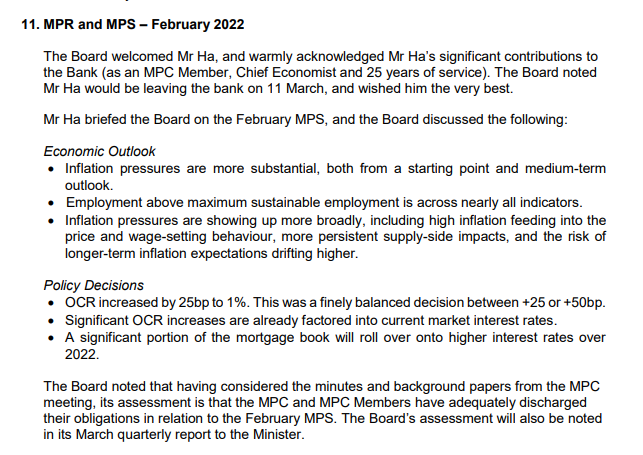
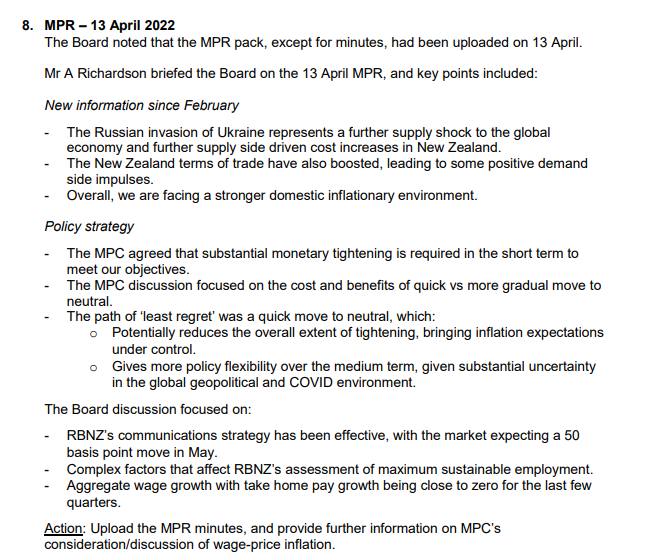
Rodger Finlay revisited (2)

Further to my post this morning, I’ve read a few more of the papers a bit more carefully.

It is still clear that when Rodger Finlay was appointed last October to the “transitional board” of the Reserve Bank and (from 1 July 2022) to the full Reserve Bank Board that no one (Treasury, Reserve Bank, Minister of Finance) seems to have been bothered by the stark conflict of interest between his twin roles as NZ Post chair (majority owner of 5th biggest bank in New Zealand) and the proposed role on the Board of the prudential regulatory authority. Any conflict was sufficiently unimportant (in the eyes of officials) that discussions were not documented, and ministers were not even advised of the issue in the relevant Cabinet and Cabinet committee papers.

To be fair, at that point it appears that Finlay’s term as NZ Post chair expired in the first half of 2022. But there seems to have been no discussion as to whether he would be reappointed, presumably because no one was bothered about the conflict. That reflects poorly on all involved – Treasury and Reserve Bank officials (junior and very senior), the chair of the Reserve Bank Board, Grant Robertson, and of course Finlay himself. A fit and proper person for the Reserve Bank Board role – the standard regulators apply to private sector appointees – would have immediately recognised the conflict (real and apparent) himself and made it clear that he could do one or other role but not both. Oh, and as I noted this morning, none of the other parties in Parliament raised any objections, or asked any questions, when Robertson consulted them about the RB Board appointment (as his new legislation required him to do).

I wrote my first post on the Finlay issue on 10 June 2022. It was the first piece drawing attention to the issue.

But it turns out that on 8 June 2022, Finlay’s reappointment as chair of the NZ Post board had been considered at the Cabinet’s Appointments and Honours Committee. His reappointment was confirmed at the full Cabinet on Monday 13 June 2022. In other words, just three weeks before the new Reserve Bank Board took office (and legal responsibility for bank supervision and prudential regulatory policy). And again, (other) ministers were not advised of the conflict (not even to note that a potential one had been recognised and arrangements were in place to manage it).

By this time, I’d had numerous emails from former senior central bankers astonished that the government was putting the chair of Kiwibank’s majority owner on the Reserve Bank Board. But apparently no ministers were at all bothered, as the reappointment to the NZ Post Board from 1 July 2022 was confirmed.

We know all this because a week or later there is a letter of apology from the Secretary to the Treasury to the Minister of Finance.

We know the reappointment was done on 13 June from this extract from a Cabinet paper from the acting Minister of State-Owned Enterprises

Poor Cabinet members. (Perhaps some should read my blog).

It does get worse. A journalist at the Herald had got interested in the story, and her story on Finlay ran on 21 June. For that story, she had asked around and had been told that Finlay’s term as chair of NZ Post was ending on 30 June 2022. As her story noted (and as I and other accepted) if so that made the situation less bad than it had first appeared, since although Finlay would have been on the transition board (and attending real RB Board meetings) while also chair of NZ Post he would not in fact be in both substantive roles at the same time.

That looks a lot like an active attempt by someone to mislead, since Finlay’s reappointment as NZ Post chair had been signed off by Cabinet on the 13th.

In the end it may be that what happened was more slipshod than a total abandonment of standards. That is suggested by this email dated 21 June (the day the Herald story appeared).

It seems likely, after last week’s announcement, that the redacted passages refer to the restructuring of the ownership of Kiwibank. After that restructuring is completed, and the Crown becomes the Kiwibank owner directly, there would be no conflict of interest between positions on the NZ Post and Reserve Bank Board. But that restructuring was only finally announced in mid August.

Slip-ups happen, but we should not skate over this one too quickly: Finlay’s reappointment to the Post position had occurred just a few days previously when presumably all involved at Treasury (and in the relevant ministers’ offices) knew that the ownership restructuring was not anywhere near announced, let alone done. That they failed to discuss the issue among themselves, that key figures failed to alert ministers and ministers to alert Cabinet, seems just consistent with the slack approach that had been taken on Finlay’s conflicts right back to October 2021. We don’t know whether the Governor knew of the Kiwibank ownership reshuffle plans, but either way there was still an onus on any Governor at all serious about avoiding actual or perceived conflicts, in the shiny new governance model, to have stamped his feet and insisted that Finlay’s situation be resolved. And, of course, there was Finlay himself – who, as far as we know, neither expressed nor felt any concerns.

The evidence suggests that sometime between 22 June and the end of the month Roger Finlay’s reappointment as chair of NZ Post was reversed. Perhaps ministers came to their senses and insisted on a rethink. Just possibly Finlay chose to stand down (the former seems more likely, since it is likely that the Herald story was the first time other ministers (including the PM) and their political advisers became conscious of the conflict issue, while Finlay had known of it for many months). In any case, by 1 July 2022, Finlay was no longer showing on the NZ Post website as board chair.

It all ends less badly than it might have, but it really should not be an acceptable standard of conduct from the Secretary to the Treasury, the Governor of the Reserve Bank, the Minister of Finance, or (now making regulatory policy including on fit and proper people in regulated institutions) Rodger Finlay. The twin appointments were never illegal (but should have been) but simply not being illegal does not make behaviours or appointments not improper. It is hard to think of any serious central bank anywhere where the possible twin government appointments (chairing the owner of a bank and serving on the regulatory authoritiy board) would be treated in such a slack and cavalier way.

Rodger Finlay revisited

This short post is mainly for those readers who don’t follow me on Twitter.

You may recall that a couple of months ago I highlighted as being highly inappropriate the appointment to the new board of the Reserve Bank (and the establishment “transitional board”) of Rodger Finlay, who was also chair of the state-owned enterprise New Zealand Post, which in turn was the majority owner of Kiwibank, the 5th largest bank in New Zealand.

The appointment was not illegal – itself a serious weakness in the new Act – but was clearly highly inappropriate in that the new Board was picking up responsibility for prudential supervision, most notably of banks.

When a couple of journalists got interested in the story, we were given to understand that Finlay’s term as chair of NZ Post would expire on 30 June 2022, and as the new Board only took legal responsibility for the Reserve Bank from 1 July 2022, that seemed to allay at least some concerns (about the situation looking ahead), even though it was clear that Finlay had been fully and extensively engaged with the activities of the Bank and the old Board during his “transition board” term, while serving as chair of Kiwibank’s majority owner,

Later that month, the rest of the appointees of the new Board were finally announced. It was a seriously underwhelming group of people, few of whom came anywhere near the sort of standard one should expect on the board charged with such considerable powers, including around the appointment and review of the Monetary Policy Committee. I lodged various Official Information Act requests for background material on the Board appointments, and this morning got back a (long) response from the Minister of Finance.

There might be a fuller post at a later date, but skimming through the documents, this succession of tweets (typos and all) captured the initial concerning aspects I spotted.

The key concern, at least to my mind, is that the papers make it clear that it was always intended that Finlay would continue serving as NZ Post chair (owner of Kiwibank) even once the new RB Board, on which he was serving making regulatory policy, took formal office, and that those who asked about this appear to have been actively misled.

It is concerning that this conflict was never drawn to the attention of Cabinet members considering the appointment, but that process failure itself appears to be primarily a reflection of the deeper problem that neither The Treasury nor the Reserve Bank appear to have considered the conflict to have mattered, either substantively or in appearance terms. There is text in the OIA release suggesting that Treasury and RB staff had discussed the matter at an early stage, but it doesn’t appear to have been treated very seriously in that there was no file note or record of those discussions kept, and no evidence of any discussion of the issues or risks with the Minister. The papers suggest they were having a great deal of difficulty getting able people to even consider appointment, and perhaps that meant standards slipped. They shouldn’t have.

Finally, one of the things that has interested me about the new RB legislation was the addition of the requirement that other parties in Parliament be “consulted” before Board appointments (including of the Governor) are made. In the release, there is a record of letters of consultation being sent to the other parties in Parliament. Sadly, there is no sign that any party raised any concerns about the Finlay appointment even though his chairmanship of NZ Post was explicitly mentioned in each of the consultation letters. I’ve been sceptical that the consultation requirement would mean anything much in practice, but it is sobering that no other party even appears to have raised the conflict of interest issue re Finlay, even when the letter was right in front of them. (For the record, National and ACT did send brief responses back to the Minister raising concerns about the later block of appointees announced in June.)

UPDATE: A further post on the same issues.

The new Reserve Bank Board

The Minister of Finance yesterday afternoon finally announced the rest of the members of the new Reserve Bank Board that takes office, under its new authorising legislation, today. In my post earlier this week, I highlighted a number of weaknesses in the legislation around the (dis) qualifications of the Governor and other Board members. None of the appointments to the Board appear to be in breach of the Act, but several are questionable on various counts, and taken together (and one should think about the composition of the Board as a whole) the new Board represents a poor, and grossly inadequate, start to the new regime. It could have been a great opportunity for a really impressive fresh start for the governance of the Bank. Instead, the Orr-Robertson degrading of the Bank continues.

As one gets older, rose-tinted glasses about aspects of the past are a risk. I do recall a time when the Reserve Bank Board had some really impressive people on it (mostly credit to Roger Douglas). But the dominant story over the almost 90 years the Bank has existed hasn’t been of impressive people being appointed to non-executive roles on the Board. In making appointments, at least since the government took full ownership of the Bank in 1936, political debts have always been paid or political loyalties rewarded – at times, past, present, and future overtly political figures have been appointed (and I even found one member who’d been a Communist Party donor), and the general quality has ebbed and flowed. One member I’m aware of – whom I gather turned out to make a reasonable contribution – was appointed mostly to spite a then Governor who vehemently objected to an economist the Minister wanted to appoint. There have been a handful of people with relevant subject expertise, some people good at asking (awkward) questions, and the time-servers and middling sorts who populate the myriad of boards and committees governments have to fill.

But – and it is an important but – none of them ever mattered very much. From the late 30s to 1990 it was clear that if the Board was the governing authority of the Bank as an entity (“the Board was the Bank” was used to say), most everything that really mattered about what the Bank did was decided – quite properly under the then-legislation – by the Minister of Finance and/or the Cabinet. That included policy, implementation, and key personnel (Governor and Deputy Governor). No doubt there were plenty of things for the board to do in that era – administration, buildings, staff etc – but it wasn’t the stuff we set up the central bank for. And from 1990 to yesterday, the Board had little say over anything much (not even the pay and rations stuff) but established as an monitoring and accountability body almost exclusively. It wasn’t quite that narrow, in that a person could only be appointed or reappointed as Governor if recommended by the Board.

As the overhaul of the legislation got underway, more recently people could only be appointed to the MPC on the recommendation of the Board, but OIA documents show that when the MPC was established they did not recommend names to the Minister but presented a list and said to Robertson “you pick”. This was the same Board that had got together with the Governor and Minister and put in place a blackball on the appointment to non-executive positions of anyone with actual hard expertise in monetary policy.

What of the new legislation. There have already been attempts at spin.

Thus, we have this from the Minister of Finance

The Board’s remit does not cover monetary policy, which remains solely the role of the Monetary Policy Committee.

And it is certainly true that the Board members do not get to set the OCR or publish projections. But as the Bank now points out on its website. “collective duties of the Board” now include

  • reviewing the performance of the Monetary Policy Committee and its members.

And it is the Board that has to recommend a person to be appointed (or reappointed) as Governor, and has to recommend appointees for the Monetary Policy Committee. It also has the responsibility to recommend removal of these people if they are not adequately doing their jobs.

In the Bank’s Annual Report (sec 240) they are specifically required to include

(m) a statement as to whether, in the board’s opinion, the MPC and the members of the MPC have adequately discharged their respective responsibilities during the financial year (see section 99); and
(n) a description of how the board has assessed the matter under paragraph (m)

And that is just monetary policy. The Board also now has all the powers the Governor previously had on prudential regulatory matters (mostly banks, but including non-bank deposit-takers, insurers, payment system infrastructures), New Zealand’s physical currency, a large balance sheet. And there are a number of grey areas in the Act of matters which in my view really should be matters for the MPC, but seem to be matters for the Board. You will recall the big disputes a few years ago about the Governor’s ambitions to dramatically increase capital ratios: such things are now the responsibility of the Board. And recall that the whole point of the new Board model was to reduce the single-person risks inherent in the previous legislation (so don’t anyone think about running a “oh, none of this matters as the Governor runs things” response).

So lets look at the make-up of the Board.

Take the Governor first (and note the oddity of the new legislation where on paper the Governor is a totally dominant figure on monetary policy, but just another board member on the Bank’s other major policy/regulatory functions). With the best will in the world, no one would argue that Adrian Orr is a leading figure in either monetary policy or financial stability functions. With a really really impressive chief executive, the rest of the Board can matter a little less – but the best people need hard and informed questioning. All the signs suggest an undisciplined and petulant figure who just isn’t overly interested in the core responsibilities of the Bank – and that would be consistent with his record of speeches over his four years in office.

Then we have the chair, Neil Quigley, who was an economics academic and is now Vice-Chancellor of Waikato University. Quigley has been on the Board for more than a decade, has been chair since 2016 (and thus presumably bears the greatest responsibility for Orr, and what followed). But as I discussed yesterday in all those years on the Board there has been little sign of serious and hard challenge and scrutiny, and despite Quigley’s academic background there isn’t much sign these days of someone devoting a lot of time to keeping abreast of the literature on financial stability and regulation. How could he? Most would have thought a university vice-chancellor role in these difficult times would itself be at least a fulltime job. Quigley’s appointment appears to be a transitional one (to 30 June 2024), and his replacement would be a key opportunity for any new government taking office after next year’s election that was serious about restoring the authority, reputation etc of the Bank.

It is downhill from there with the rest of the Board. Taking them in alphabetical order

All laudable no doubt, but not a shred of a sign of suitability to be a board member of New Zealand’s prudential regulator or to be choosing appointees to the MPC and evaluating the performance of the MPC.

I’ve discussed Finlay previously. We can be relieved that his terms as NZ Post chair (owning Kiwibank and Kiwi Wealth) ended yesterday. He should never have been actively involved in Reserve Bank affairs while chairing the owner of a major bank. But that is now over, and we are left with someone who looks like a pretty generic professional director and accountant. Perhaps, and despite his past (what ethics does he display in having accepted the RB/NZ Post conflict), he could be a perfectly adequate director of yet another government body. But it isn’t evident there is any expertise or experience in monetary policy, prudential regulation, financial stability etc.

Higgins appears to be wholly and solely a diversity hire. Her background is all very interesting, perhaps even laudable, but…..this is the central bank and prudential regulatory agency, and there is not a shred of relevant background or qualifications – any more than a professor of Latin and university bureaucrat would typically have.

Paterson is another carryover from the old board. Perhaps she is just excellent (but remember all those questions we didn’t find in the Board minutes to now) but she is a pharmacist turned generic company director. There is a place for such people, perhaps even a couple on a central bank board, but subject matter expertise and energy on such matters seems less than evident.

Pepper seems to be the only appointee with recent practical exposure to financial markets. On paper he looks like he could be quite a reasonable appointment to the FMA Board (perhaps a swap with Professor Prasanna Gai who is on the FMA but has expertise and experience that would be very valuable on the Bank’s Board or MPC). But the Bank’s Board is more about financial institutions than about wholesale markets and it isn’t evident he has much knowledge about institutions, the sort of risks that threaten them, or about financial regulatory policy – let alone being particularly fit for evaluating MPC members.

And then there is that insurance company he recently became a director of. According to the Minister

Mr Pepper is a director at Ando Insurance Group Ltd, but that role is not expected to create a conflict of interest as Ando is a non-regulated company.

The problem is that when you look up that company it is described as almost 40 per cent owned by a foreign insurer which is regulated by the Reserve Bank, and Ando describes itself as writing its insurance business for that regulated company. I don’t know either the business or the law enough to know why Ando itself is not regulated by the Reserve Bank, but on what we do know the appointment, while lawful, seems pretty questionable, and not (especially after Finlay) a great way to start a shiny new Board and governance model. One wonders what Treasury made of it when they provided advice to the Minister on appointees. (Or, indeed, the other political parties when, as the law now requires, they were consulted.)

Raumati-Tu’ua (who seems to be a qualified accountant) is another of those generic professional directors. As I said earlier, there is a place for a couple of them on the Board, but there is no relevant subject matter expertise at all.

For the most part I am not suggesting that as individuals these people are unsuited to being on a mixed Board (although Higgins appears utterly unqualified, and Pepper questionable on ethical grounds), but what you end up with is a Board that is deeply unimpressive and really unfit for anything like the role the legislation envisages for the Board of the Reserve Bank. There is no one with any real expertise or authority in banking, no one with any real expertise on financial regulatory matters, no one who really seems fit (or ready) to be holding the MPC to account or making good choices about who should go on the MPC in future. And, perhaps a little surprisingly given the limited pool of expertise locally and the risks of too inward loking an approach, there is no one from abroad. As a group – however nice, and perhaps able they each are in their own fields – they simply aren’t up to what the job should entail, and that against the background on an inexperienced and underqualified senior management team. One can only imagine the Australian Prudential Regulatory Authority people reading of these appointments with some mix of despair and bewilderment while – condescendingly, but as they are prone to – suggesting that fortunately it doesn’t matter too much as APRA does the prudential supervision that really counts for New Zealand. That model – wind up and turn things over to APRA – was rejected (and rightly) by Michael Cullen almost 20 years ago, but his successor seems to be going for the worst of all worlds -a a bloated and expensive central bank of our own, led by people who do not warrant any great level of confidence in their individual or collective capabilities in the role they have taken up.

If there is a National/ACT government after the election it will have to make it a matter of priority to begin a far-reaching overhaul of the Reserve Bank (management and governance) to reverse the increasingly embarrassing spectacle of sustained institutional decline.

Meanwhile, of course, under the new law, the Minister of Finance was required to consult with other political parties on proposed appointees. It is a relatively unusual provision which Labour chose to put in the law, presumably intended to single their seriousness about a high quality Board that was broadly not too unacceptable across party lines (consistent with that, these appointees do not serve at will and can be removed only for cause – not including being ill-qualified in the first place). One wonders what National and ACT (in particular) said when the Minister consulted? Perhaps there were worse names on an original list. Perhaps the parties never bothered objecting, or perhaps they did object and Robertson just pushed on through anyway. Perhaps the relevant spokespeople could tell us?

I have lodged a series of OIA requests with the Minister, The Treasury, and the Reserve Bank to get a better insight on the process leading to those appointments, including the consultation with other parties.

End of an era

Today marks the end of an era at the Reserve Bank, as the last of the “Governor as single decisionmaker” model is dismantled, and tomorrow the new Board takes over the primary responsibility for the Bank’s affairs. The single decisionmaker model was an experiment, but with time it was increasingly apparent that it was a poor one, increasingly unfit for purpose. No other country reforming its central banking and bank etc regulatory arrangements followed us. It is to the government’s credit that they have moved the governance model for the Reserve Bank back towards the international mainstream (even if the specifics of the 2018 and 2021 are less than ideal, and in some respect a dog’s breakfast).

(NB note that most of the new Board, to take up office tomorrow, has not yet been appointed – or at least announced. With the new Board reportedly supposed to be meeting tomorrow, perhaps there is some launch announcement planned, but it is all a bit strange and not really that satisfactory.)

In this post I wanted to focus, perhaps for the last time (although they still apparently have an Annual Report to come), on the old Board. This should be the last day we see this graphic topping the Bank’s “Our Board of Directors” page

For 32+ years, taxpayers have paid a Board to (come for lunch and the cocktail do and) monitor and hold to account the Governor (and more latterly the MPC). They controlled who could be appointed as Governor and to the MPC, and – consistent with those accountability responsibilities – could recommend dismissal. The rules and responsibilities have changed a bit over time. For the first decade or more, the Governor chaired the Board, and even though there was a non-executive directors committee that was supposed to do the holding to account, the messaging implied by the structure wasn’t exactly crystal clear. And it wasn’t until about 20 years ago that the Board was required to make its own (public) Annual Report, but even then not very much changed – and consistent with that general observation, the Board’s report was buried in the midst of the (Governor-controlled) Bank Annual Report and was given no publicity when the Bank released its Annual Report.

There have been some able people on the Board at various times over the years. And some awkward people (the two may even have overlapped), but the institutional incentives very quickly developed into a model that meant few hard questions really got asked, little serious scrutiny happened, and the public never got any serious insight from the Board’s activities on their behalf (the Board, after all, had access to papers the Bank jealously guards for years and years after they were relevant, and can engage and challenge the Governor and other decisionmakers). I say “very quickly developed” because in the earliest years of the regime there was a view – shared by the Governor – that the inflation targeting governance regime was relatively mechanical and that a Governor might reasonably expect to lose his/her job if inflation overshot the target range. The first (apparent) breaches in about 1995 prompted some hard questions, some letters to the Minister, but eventually a recognition that the whole thing involved a lot more judgement and discretion if sensible policy was to ensue. There was a recognition that the target was something to be “constantly aiming at”.

Unfortunately for the Board, had they ever aspired to do the job really well they didn’t have the resources to do so. It became customary to have one professional economist on the Board (first Viv Hall, then Arthur Grimes, more recently Neil Quigley), but Board members didn’t get paid much themselves, had no direct access to staff resources, had no budget to commission independent professional advice, and their own Secretary was for the most of time a senior staffer of the Governor. Board meetings occurred on Bank premises, and one entered the Board room past the row of oil paintings of former Governors. And once the Board got its own chair – chosen by them, not the Minister – for 13 years they opted to have as their chair former RB staffers, first Arthur Grimes, and second Rod Carr. Most of the Board members knew about being on corporate boards – where they had decision-making powers – and so there seemed to be a tendency to default towards the sorts of issues they might have dealt with as corporate board members. Monetary policy and financial stability/regulation were not high among them. Arms-length challenge and scrutiny also weren’t really among those functions – on a corporate board, the board has far more ownership of the firm’s strategy (something the Act never envisaged for the RB – the Board had no say, for example, in Policy Targets Agreements or the conduct of monetary policy).

And so acting as cover for management seems to have become the default mode – most especially externally but, as far as we can tell, often internally as well. Some Board members had their own agendas – some more laudable than others – but there was never much sign of a sustained effort to hold the Governor and Bank to account, to act as if they represented the government and people of New Zealand rather than the Bank management (notably whoever was the Governor at the time). At times, their Annual Reports even talked about helping with the Bank’s external relations (for example, at the functions held around Board meetings outside Wellington).

I could develop some anecdotes at length, including for example, the board member who used to ring me up (while I was still on staff) for inside angles on monetary policy and the Governor, at a time when that member was attempting to mark out an independent position (oops, he is now the Board chair). But I’ll largely leave it at that. I don’t think anyone – perhaps with the exception of some individual Board members – thinks the Board ever really did the job it was designed for. You could be attacked in public by the Governor – for exposing an OCR leak, resulting from weak management systems – and an approach to the Board still resulted only in them gathering in behind the Governor. Are we to suppose it was any different when Orr was attacking his critics around the bank capital plans in ways that few regarded as represented expected conduct from a Governor?

But what interested me was how they had handled the events of the last year or so. The Bank has run up massive losses on the LSAP. Inflation – headline and core – has shot through the top of the target range. All in all it is has been one of most interesting – and surely questionworthy – periods in the 30 years the Board had the monitoring and accountability responsibility. You might think the outgoing Board would want to end well.

A while ago I lodged an OIA requesting the Board minutes for the period November 2021 to April 2022. About the time those results came back I found on the Bank’s website the results of someone else’s OIA for the minutes for September to November 2021. So we have a run of several months of minutes, over a period when things moved a lot on monetary policy (actual inflation, the OCR, forecast inflation – oh, and those LSAP losses). We might have hoped for a lot of evidence of hard questioning, challenge, and serious scrutiny.

Well, might have if we had known nothing of the previous 30 years.

The Bank – or Board – is relatively open in what they release, so we get a good sense of the complete minutes. There are some questions about what they write down, but even there they seem to have improved (relative to earlier concerns that in some areas they were in flagrant breach of the Public Records Act).

What do we learn?

The first meeting was in early September, not long after the August MPS (which itself came the day after the lockdown was announced). The minutes are seven pages long, and we learn a fair bit about the People and Culture report, the Enterprise Risk Management report, the Governor’s activities, and even the RB superannuation scheme (which the Board had some particular non-statutory responsibilities for). Monetary policy gets half a page

Only one Board member is reported as saying anything (“noted” not exactly being a strong form of questioning) and none seems to have challenged the (soon to be restructured out) Chief Economist’s view that the Bank had plenty of time and didn’t need to act (much/) until it had a seen a full 12 months of data. The Governor – the most influential MPC member – is not reported as having said anything.

The late-October meeting minutes took eight pages. We learned quite a lot of various administrative and/or extraneous matters, including the Bank’s climate change strategy. There was quite a discussion on the forthcoming FInancial Stability Report, but no sign of any serious challenge or scrutiny from Board members, on requests for follow-up papers etc. And then we got to monetary policy, the OCR having just been raised for the first time.

I’m sure it was all very pleasant, but there is no sign of any hard questioning about immediately relevant issues (or perhaps the Public Records Act is being ignored again). No one seems to have challenged them as to whether, just possibly, if inflation was already above the midpoint and employment at or above midpoint, and forecasters had been taken considerably by surprise, whether a more aggressive stance might be warranted. No one seems to have challenged Ha on his complacent comment the previous month, despite (presumably) just having confirmed those minutes.

At the November meeting there appears to have been no discussion of monetary policy at all (although the Board was at pains to stress the importance of the outgoing Board having time to prepare their final Annual Report). Not a word. And, of course, still no mention at all of those mounting LSAP losses – and the Board is supposed to have been agents of the minister and the public, not of the Governor.

For the December meeting this is what the minutes record

All of which may have made for quite an interesting discussion, but as the Governor is recorded pointing out, monetary policy has to act given what is happening to fiscal policy (fiscal policy is not something the Governor or Board are responsible for). But there is no sign of any unease, of even a single Board member challenging the Bank to show that it was on the right track or that inflation would come out something like forecast. There is just no sense of holding powerful decisionmakers to account in particularly troubling times. Just a chat, with one’s friends and colleagues.

At the February meeting, this is all there was about monetary policy

Again interesting (if brief) but with not the slightest sense of unease or challenge, no pressure on the Governor or his colleagues.

In March

Were some future historian to stumble across these minutes, but not the relevant parts of the Act, they might have assumed that the Board had just a right to be briefed, but no responsibility for ensuring the Governor and the MPC are held to account.

And finally in this sequence, the April meeting

It is, I’m sure, interesting enough, but it scarcely counts as evidence of accountability.

Now, it is always possible that there are secret unrecorded discussions (in breach of the Public Records Act). The other OIA requester asked for a copy of one of the Board’s reports to the Minister, which the Board/Bank adamantly refused to release

That should be unacceptable: the Governor and MPC are statutorily accountable via the Board, and the idea that management might refuse to supply information to the Board because the Board’s report – even with some redactions – to the Minister might be released (with some lag) should have been unacceptable. But we needn’t worry that there might be anything very revealing in such a report: take a look at the March Board extract above, and you’ll see they record there that they were going to tell the Minister all was fine.

At one level, knowing what we do as to how the Board has operated over 30 years, none of this should be too surprising. But it doesn’t reflect well on them (any of them). We have a chair presumably focused mostly on working with the Governor to see in the new act (questionable appointments and all), and so hardly likely to make himself awkward on current monetary policy, and other Board members with neither the expertise, inclination, nor institutional culture to ask hard questions. But still….across all those months

  • no record of a single hard question,
  • no sign of any sustained engagement at all with the external MPC members (whom they are supposed to individually hold to account)
  • no requests for supplementary papers,
  • no suggestions of commissioning independent analysis,
  • not a single mention  of the huge (and mounting over this period) LSAP losses,
  • no suggestion of any regrets about anything.

It is easy to be inured to flawed frameworks and the weaknesses they generate, but this really isn’t good enough.  These people took the taxpayers’ money (no much admittedly, but they each took the deal) and seem barely to have been focused at all on their monetary policy accountability duties, through one of the biggest monetary policy disruptions for decades.   Perhaps I should ask for the minutes of meetings of the previous 20 months, but it would be a real surprise if anything had been different then.

The Bank itself appears little better, since there is no evidence in any of these minutes of robust or independent analyses and reviews of what had gone well, and what badly, why for examples forecasts had been so wrong, and what lessons staff and management had taken.  And so we are in the weird position  that the Bank has a consultation paper out at present on the future Monetary Policy Remit, and yet tells us that the review they are finally doing of the last couple of years stewardship may not even be released before the second round of consultation closes.

The Board has proved useless. It was always likely given the incentives and flawed structures, but that is no excuse for any of the members.  The job was there to be done, and they have not been doing it (most notably over the dramatic times of the last 12 months).

The end of the era will be no loss.  We can only wait and watch and see how the new Board does –  when the Minister finally manages to dredge up enough people willing to do the job to get a full complement on board.