Still avoiding scrutiny and accountability

I’m not one of those inclined to join the new Leader of the Opposition in describing the government’s handling of the coronavirus situation as “impressive”, but sometimes other people are just determined the make the Cabinet and core government departments (notably Health, Treasury, DPMC) look not bad at all.

Transparency is one of those issues.  I was critical –  and still am –  about how slowly the government released key official documents relevant to the crucial decisions taken at various stages in March and April.    Difficult decisions made, inevitably, with partial information, and with consequences (either way) that are huge by the standards of any typical government decision should have been accompanied by the near-immediate release of all the significant relevant analysis and advice.

Nonetheless, and to their credit, the government is slowly getting there.  There was a big proactive release a couple of weeks ago of all sorts of central government documents (mostly advice to ministers and Cabinet papers) – individually important or not – on the coronavirus situation from the start of the year until mid-April, and there is a promise of another batch presumbly sometime next month.   What is done is now done, but the release of those papers –  many of them written to very short deadlines and in the fog of war – helps us, as citizens and voters, assess the quality of the central government advice and decisionmaking process.  And since Covid hasn’t gone away, it may even help clarify where improvements might be made –  even demanded –  in government contingency planning against the risks of further problems.

But, of course, there are other public sector agencies operating at arms-length from ministers, exercising a great deal of discretionary power (including through the Covid crisis), and not covered by the government’s own pro-active release.   I’m thinking most notably of the Reserve Bank and, these day, the Monetary Policy Committee, a statutory body –  members each appointed by the Minister of Finance –  charged with the conduct of monetary policy.

Without any great optimism about a positive response, and fully expecting the request would simply be the first step on the path to an appeal to the Ombudsman I lodged an Official Information Act request on 20 April.

I am writing to request copies all papers prepared by or for staff or
management of the Reserve Bank for the Monetary Policy Committee in
2020.

I am, of course, well aware of the Bank’s typically obstructive
approach to releasing such official information in normal times.
However, given the scale of the events the Committee has been
grappling with this year, the magnitude and unusual/unprecedented
nature of many of the interventions (and decisions on occasion not to
act), the scale of the economic and financial risks the wider public
and the taxpayers are being exposed to, there is a clear and strong
public interest in the release of these particular papers, without
necessarily creating a precedent for more-general release of MPC
papers.  In addition, I would note that the succession of meetings
this year, and the fast-moving nature of events, means that papers
written even a month ago are already likely to have aged beyond the
point of immediate market sensitivity much more quickly than would
normally be the case.

Public accountability demands much greater transparency.

“Typically obstructive approach” refers to the Bank’s adamant refusal to release any papers relating to monetary policy decisions, at least unless they are perhaps 10 years old (they did once release a set of those, and I haven’t tested whether the effective threshold is 3, 5, 7 or 10 years past).

“Public interest” is in reference to the provision of the Official Information Act which states that for many of the possible withholding grounds

Where this section applies, good reason for withholding official information exists, for the purpose of section 5, unless, in the circumstances of the particular case, the withholding of that information is outweighed by other considerations which render it desirable, in the public interest, to make that information available.

I had a reply on Thursday. In fairness, at least it was only a day or two beyond the 20 working day deadline, although I doubt it took the Bank any time at all to decide its response.  The substance didn’t really surprise me at all, even if it was a disappointing reflection on the continued refusal of the Reserve Bank to accept that the principles of open government, the principles of the Official Information Act, apply to them and to the Monetary Policy Committee as well.

They pointed to the various press releases and Monetary Policy Statements (which, personally, I wouldn’t have thought were in scope, although that is beside the point) and went on

We are withholding all remaining information within scope of your request under the following grounds:
 section 9 (2)(d) – in order to “avoid prejudice to the substantial economic interests of New Zealand.”
 section 9 (2)(g)(i) – to “maintain the effective conduct of public affairs through the free and frank expression of opinions by…members of an organisation or officers and employees of [an] organisation in the course of their duty.”

We have considered your views regarding the need for the information to be released including, the scale of the events the Monetary Policy Committee has been grappling with this year and potentially, strong public interest in the release of these particular papers.

The Reserve Bank is currently conducting monetary policy in an environment of great uncertainty and market volatility. In these circumstances it is especially important that the MPC has the space to assess all the available information, select monetary policy tools, convey clear messaging through its Monetary Policy Statements, and evaluate its actions as it proceeds. The release of such recent MPC papers would be likely to interfere with the effective implementation of monetary policy.

As you are aware the Reserve Bank has a statutory duty to make official information
available unless there is good reason for withholding it. In this instance the Reserve Bank believes that there is good reason for withholding the requested information and that the public interest in releasing it does not outweigh the reasons for withholding we have listed above.

Note that the request was not for every casual email staff and management might have loosely exchanged over the months, it was for the papers prepared for the Monetary Policy Committee, a statutory body that the Governor (who also sits on the Committee) and staff advise and service.

There is a close parallel to the way (a) government departments advise individual ministers, and (b) the way an individual Minister’s Cabinet paper seeks the approval of his/her colleagues.  Advice and recommendations and analysis flow to decisionmakers, and decisionmakers decide.  Sometimes that advice is poor, sometimes good, sometimes necessarily rushed, sometimes not.  But to their credit, the government has released the significant bits of advice/recommendations –  whether or not each of those pieces of advice make advisers or decisionmakers look good, whether or not decisionmakers accepted that advice or not, whether or not the advisers might now wish they’d advised something different?

What make the Reserve Bank –  the Governor as chief executive, or the statutory MPC he chairs –  think it should be exempt from that sort of scrutiny and transparency, through one of the most dramatic periods of modern times (including as regards monetary policy)?

One of the excuses the Bank has sometimes advanced for withholding monetary policy materials is that releasing them might give away information about future strategy.  Even if that were true, it is really grounds for selective redaction, not broadbrush refusal, but at present it is a particularly absurd argument.  For example, my request encompassed papers relevant to the February MPS –  you’ll recall that that was the one in which they played down coronavirus and were rather optimistic about the rest of the year, adopting a very slight tightening bias.  Whether or not those were reasonable views at the time, they were long since overtaken by events. Nothing in the advice and analysis provided to the MPC for that MPS has any possible bearing on actions the Bank or market is taking now.

But take more recent events.  The MPC issued, and has since reaffirmed, their pledge to not cut the OCR for a year.  They provided no supporting argumentation or analysis for that stance, but presumably there must have been some analysis and advice, perhaps around these mysteroius “operational obstacles” that the Governor, as the MPC’s spokesman, keeps referring to.

Or the LSAP programme?  Surely there must be staff analysis and advice, provided to MPC under the imprimatur of the Governor, on the likely effects of such a programme?  What possible grounds can there be for simply refusing to release any of it (as distinct perhaps from withholding specific paragraphs touching on the implementation plans for example)?

All the excuses about

In these circumstances it is especially important that the MPC has the space to assess all the available information, select monetary policy tools, convey clear messaging through its Monetary Policy Statements, and evaluate its actions as it proceeds. The release of such recent MPC papers would be likely to interfere with the effective implementation of monetary policy.

could no doubt equally be argued by officials in Health and Treasury etc, or by Ministers.  But to their credit, ministers have recognised the importance of openness and put the advice out there – rushed and perhaps inadequate, rapidly overtaken by events, as sometimes it inevitably was.   And at least Ministers have to face the electorate in September, but the only effective accountability for the Governor and his MPC (many of whom refuse even to be interviewed) is the sort of openness and transparency that the OIA has long envisaged.

The Bank likes to claim that it is very transparent, but solely on its own terms and its own definitions. Transparency does not mean telling people what you want them to hear when you want them to hear it –  everyone does that, in their own self-interest.  Transparency is about the stuff you sometimes find uncomfortable, even embarrassing, or just very detailed, but which you put out anyway.   Had she wanted to the Prime Minister could have run the sorts of excuses the Bank did –  claiming that she held a press conference every day and ran full page adverts in newspapers every day telling people what she thought they needed to know then –  but to her credit she is better than that, and recognised the very strong public interest in much greater transparency –  some of which might put her or her officials in a good light, some not.  It is what open government is about.

I’ll be referring this to the Ombudsman, and perhaps seeking from the Bank all material relevant to their consideration of this particular request, but if the government is serious about its commitment to openness and transparency, it is past time for the Minister of FInance to have a word with the Governor and with the others he himself appointed to the MPC, and with the chair of the Bank’s Board –  whom he appointed –  and strongly urge, come as close to insisting as he can, that extraordinary times, extraordinary monetary experiments, call for a much greater degree of openness that the Bank has, hitherto, been willing to display.

If The Treasury’s advice to the Minster of Finance on these matters is open to scrutiny in these exceptional fast-moving circumstances, why not the Reserve Bank’s advice to their decisionmaking body?  As it happens, the Secretary to the Treasury is now a non-voting member of the MPC, so perhaps she might have a word with her colleagues and draw attention to what transparency and accountability are supposed to mean in New Zealand.


Losing $128 billion

I don’t usually pay much attention to forecasts of nominal GDP.  Not many people in New Zealand really seem to.  But The Treasury takes nominal GDP forecasts more seriously than most, since nominal GDP (in aggregate) is, more or less, the tax base.

Out of little more than idle curiosity I dug out the numbers from last December’s HYEFU forecasts –  the last before the coronavirus –  and compared them to the numbers published in last week’s BEFU, accompanying the Budget.  And this was what I found.

Nominal GDP ($bn)
HYEFU BEFU Difference
2019/20 319.8 294.2 -25.6
2020/21 336.4 294.2 -42.2
2021/22 354.1 328.3 -25.8
2022/23 371.5 352.3 -19.2
2023/24 389.2 374.3 -14.9
Total 1771 1643.3 -127.7

Over the full five years, New Zealand’s nominal GDP is projected to be $128 billion less than The Treasury thought only a few months ago.

Recall that changes in nominal GDP can be broken down into three broad components:

  • the change in real GDP  (the volume of stuff produced here),
  • the change in the general price level (inflation), and
  • the terms of trade

On this occasion, changes in the terms of trade make only a tiny difference over the five years taken together.

General (CPI) inflation is expected to be lower than previously thought.    On average over the five years, the price level in the BEFU forecasts is about 1.8 per cent lower than in the HYEFU forecasts.  That accounts for about $33 billion in lost nominal GDP.

The balance –  the overwhelming bulk of the loss –  is real GDP.

I haven’t written anything much about The Treasury’s forecasts, which were done quite a while ago, and could not fully incorporate the final fiscal decisions the government made.  But for what it is worth, I reckon Treasury’s numbers were on the optimistic side –  quite possibly on all three components of nominal GDP.  On inflation, for example, they are more optimistic than the Reserve Bank (which finished its forecasts later), even as they assume tighter monetary conditions than the Bank does.

But the point I really wanted to make was that these forecast GDP losses will never be made back (in the sense that some future year will be higher to compensate –  resources not used this year mostly represents a permanent loss of wealth).  And that these losses occur despite all the fiscal support (and rather limited monetary support).   And fiscal here includes both the effects of the automatic stabilisers (mainly lower tax revenue as the economy shrinks) and the discretionary policy initiatives (temporary and permanent).

How large are those fiscal numbers?  Well, here is core Crown revenue (more than 90 per cent of which is tax)

Core Crown revenue ($bn)
HYEFU BEFU Difference
2019/20 95.8 89.5 -6.3
2020/21 101.6 87 -14.6
2021/22 106.5 94.6 -11.9
2022/23 112.7 104 -8.7
2023/24 117.7 109.9 -7.8
534.3 485 -49.3

Almost $50 billion the Crown was expecting but which it won’t now receive.  Some of that will be the result of discretionary initiatives –  the corporate tax clawback scheme, much of which will result in permanent losses, and the business tax changes announced in the 17 March package –  but the bulk of the loss will be the automatic stabilisers at work.

And on the expenditure side?

Core Crown expenses ($bn)
HYEFU BEFU Difference
2019/20 93.8 114 20.2
2020/21 98.8 113.5 14.7
2021/22 102 119.8 17.8
2022/23 106.3 118.6 12.3
2023/24 109.2 113 3.8
Total 510.1 578.9 68.8

Almost $70 billion of current spending the Crown didn’t expect to make only a few months ago.  A small amount of this will be the automatic stabilisers at work (the unemployment benefit), but The Treasury is pretty optimistic about unemployment.  Most of the change is discretionary policy initiatives (announced or provided for).

And here is the change in net debt

Net core Crown debt (incl NZSF) as at year end  ($bn)
HYEFU BEFU
2018/19 14.1 14.1
2019/20 14.6 47.6
2020/21 17.6 82.8
2021/22 17.1 111.7
2022/23 12.3 131.7
2023/24 3.9 138.2 134.3

That will be almost $135 billion higher than expected.

As I’ve noted in earlier posts, I don’t have too much problem with the extent of overall fiscal support (although I would have structured it differently and made it more frontloaded –  consistent with the “pandemic insurance” model).

But even on this scale, fiscal policy is nowhere near enough to stop the losses.  Some of those losses are now unavoidable.  It is only five weeks until the end of 2019/2020, so we can treat $26 billion of nominal GDP losses (see first table) as water under the bridge now.   As it happens, fiscal policy looks to have more than fully “replaced” the income loss in aggregate (whether $27 billion from operating revenue and expenses in combination, or the $33 billion increase in net debt) –  not as windfall, but as borrowing (narrowing future choices).   (UPDATE: Even in quote marks “replaced” isn’t really quite right there, as without the fiscal initiatives it is near-certain that actual nominal GDP would have been at least a bit lower than The Treasury now forecasts, even for 19/20.)

But there is a great deal of lost income/output ahead of us, even on these (relatively optimistic) Treasury numbers.

Which is really where monetary policy should be coming in.   The Treasury assumes that monetary policy does almost nothing: there is no further fall in the 90 day rate (the variable they forecast), and as they will recognise as well as anyone inflation expectations have fallen, so real rates are little changed from where they were at the start of the year.  And although the exchange rate is lower throughout than they assumed in the HYEFU, the difference is less than 5 per cent –  better than nothing of course, but tiny by comparison with exchange rate adjustments that have been part of previous recoveries.  It isn’t entirely clear how The Treasury has allowed for the LSAP bond purchase programme, but whatever effect they are assuming…….there is still a great deal of lost output.

The Governor has often been heard calling for banks –  private businesses – to be “courageous”.  It is never quite clear what he means, but he apparently wants to risk other peoples’ money.  But the central bank is ours –  a public institution.   A courageous central bank, that had really grasped the likely severity of this slump, could have begun to make a real difference.  If they’d cut the OCR back in February, and taken steps to ensure that large amounts of deposits couldn’t be converted to physical cash, and then cut the OCR to deeply negative levels (perhaps – 5 per cent) as the full horror dawned, we’d be in a much better position now looking ahead.     Wholesale lending and deposit rates would be substantially negative at the short end, and even real rates on longer-term assets might be as low as they now, without much need for bond purchases.   Retail rates might also in many case be modestly negative –  perhaps for small depositors achieved through fees.   And, almost certainly, the exchange rate would have fallen a long way, assisting in the stabilisation and recovery goal.  There are winners and losers from such steps –  as there are from any interventions, or from choices just to sit to the sidelines –  but it is really just conventional macroeconomics: in a time of serious excess capacity and falling inflation expectations, act to seek to bring domestic demand forward, and net demand towards New Zealand producers.    Working hand in hand with the substantial fiscal support (see above), we’d be hugely better positioned to minimise those large future nominal GDP losses –  losses that at present, we risk never making back.

But neither the Governor nor, apparently, the Minister of Finance seem bothered.

Finally, if nominal GDP appears to be a slightly abstract thing, it is worth recalling that almost all debt is nominal and it is nominal incomes that support outstanding debt.  There is about $500 billion of (intermediated) Private Sector Credit at present (and some other private credit on top of that).  Most likely that stock won’t grow much over the next few years. But government debt will –  on Treasury’s numbers net debt rises by $134 billion.   Against those stocks, a cumulative loss of nominal GDP of $128 billion over five years is no small loss.  As noted earlier, amid all the uncertainties, the precise numbers are only illustrative, but the broad magnitude of the likely losses (on current policies) are what –  and that magnitude is large, if anything perhaps understated on The Treasury’s numbers.


A practical suggestion for the Governor

A commenter on a recent post left the reasonable question

if the RBNZ is flooding banks with deposits/reserves to pay for its QE, why are the banks still paying 2.5% to raise term deposits from the public ? Surely the banks have more cash than they know what to do with ?

Well might she ask.  And her question prompted me to think a bit harder about useful steps that could be taken in response to what looks like quite a glaring anomaly.    At present, the Reserve Bank pays 0.25 per cent on settlement balances banks hold at the Reserve Bank, banks are paying much the same rate on (wholesale) 90 day bank bills, but when I checked this morning the average retail rate on offer for a six month term from our five largest banks was about 2.15 per cent.

It wasn’t always so.  Here is a chart showing the 90 day bank bill rate and the 6 month term deposit rate (the one the Reserve Bank provides a long time series for) back almost 30 years.

retail and wholesale

Short-term wholesale rates used to be a bit higher than comparable maturity retail rates.  That made sense.   The marketing and admin costs associated with one $20 million bank bill are going to be a lot lower than those associated with 400 retail deposits of $50000 each.  The margin ebbed and flowed a bit, but it was rare for retail rates to be below wholesale.  All that changed at the time of the 2008/09 recession and financial crisis, and the old relationships have never resumed.

In this chart I’ve taken a shorter period –  since the start of 2007 –  and have also shown the rate on a 1 year interest rate swap (for which the Bank has only published data since mid 2010).

retail and wholesale 2

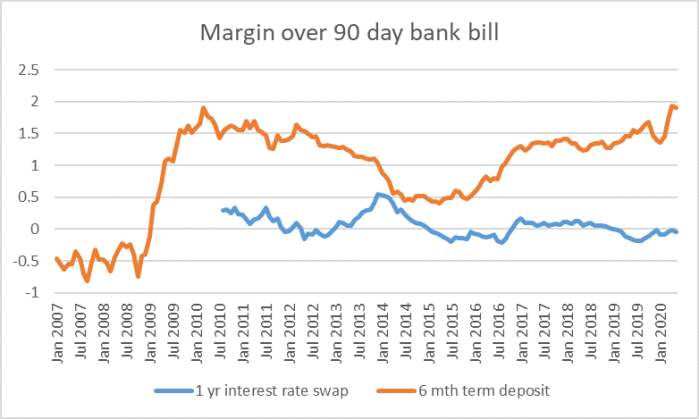
The maturities differ a bit, but despite that you can see how similar the two wholesale rates have mostly been and how different they’ve been to retail rates.    And here, for the same period, are the margins between the 6 month retail rate and the 1 year swap rate respectively and the 90 day bank bill rate (itself usually moving very similarly to the OCR).

retail and wholesale margins

The gaps that sometimes open up for a while between the swap and bill rate just reflect the maturity differences – eg in 2013 and 2014 the Bank was strongly expected to raise the OCR so swaps yields rose in anticipation.  Over time, the differences have been small and non-persistent.    By contrast, the margin between retail and wholesale rates has typically been large and somewhat variable.

What accounts for this weird situation in which Michael Reddell private saver can get, pretty consistently, 150 basis points more for my smaller deposit than Michael Reddell trustee of the Reserve Bank staff pension scheme can get for the much larger amounts of money he (and other trustees) formally own (on behalf of the members)?

(Totally parenthetically, hasn’t policy been pushing people into collective savings vehicles –  where they can only get the lower rates – ever since Kiwisaver was set up?)

It has a great deal to do with the 2008/09 crisis conditions, and perceptions and regulatory responses thereto.    In New Zealand in the run-up to 2008/09 banks had had a very large share of their funding in the form of very short-term foreign wholesale instruments.  That funding was cheap and easy to raise –  times were good, money was easy, the mood was exuberant – and banks simply did not believe those markets could ever seize up  (I’ve told the story previously of one very senior risk manager of one of the big banks who when we were doing pandemic planning in about 2006 asserted that very strongly).  They did.  More generally, wholesale runs were the catalyst for the failure of various major institutions abroad.

And so, perhaps understandably, there was a quite a reaction, by banks themselves (scares change behaviour, for a time at least), rating agencies, investors in bank debt, and regulators.  In this post I will be focusing on the New Zealand regulatory intervention, but I don’t want to be read as suggesting it was the whole story (in fact, some readers may have memories long enough to recall my arguing 10 years ago that the regulatory effect then was probably small, relative to the private market response in those early post-crisis days).

Prior to 2008/09, the Reserve Bank had never had minimum liquidity requirements for banks.  It was talked about from time to time –  we used to worry, some more than others, about the macro risks associated with very high levels of short-term foreign debt –  but in a small organisation it had never been a top priority, and there was Basle II to implement.

The Reserve Bank, The Treasury, and the banks got a fright in late 2008.  It generally wasn’t totally impossible for our banks to borrow abroad but for a time it was very difficult to borrow (including on terms that didn’t send an atrocious signal) for much longer than overnight.  Even with their prior fondness for fairly short-term debt, that was troubling for banks.  (None of this, of course, was about the health of our banks or their parents; it was all about global markets seizing up.)

There were immediate policy responses to get through that episode –  Reserve Bank liquidity provision, Crown guarantees for new wholesale borrowing – but also a fairly quick Reserve Bank policy response to try to reduce or substantiallly eliminate the risk of finding ourselves in that situation again.   For a bank with a sound asset base, it is almost a given that a central bank will eventually lend if necessary, but the idea was to put buffers in place that meant we weren’t the port of first resort if things got tough, and (since banks’ board never like relying on central bank funding) to reduce the extent of pro-cyclical shocks to credit availability.

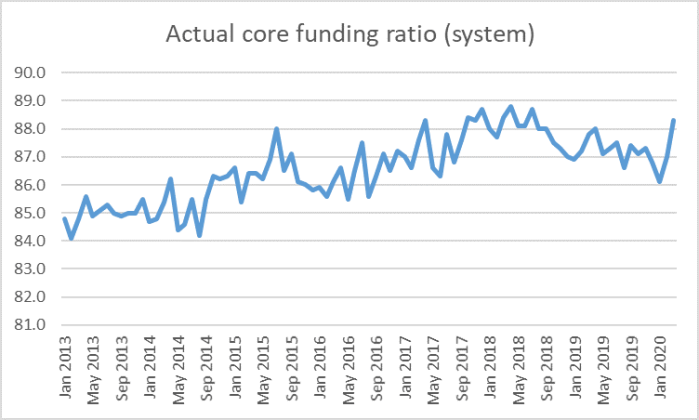
There are a number of strands to Reserve Bank liquidity policy but the bit I want to focus on is the one-year Core Funding Ratio (CFR) requirement: now that “core funding” must equal at least 75 per cent of each bank’s total loans and advances.  In practice, as banks do with capital buffers, they typically hold a considerable margin above the regulatory minimum.     Here are systemwide numbers since 2013, when the minimum ratio was raised to 75 per cent.

CFR data

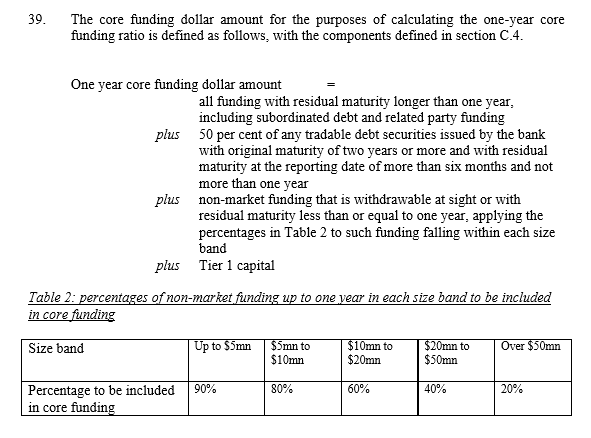
And what counts as “core funding”?

Well, here is the summary from the policy document

CFR defn

Simplifying a bit, core (Tier 1) capital counts, as does all funding with a residual maturity in excess of one year, half of any long-term securities in the period between six months and one year to maturity, and (per the table) “short-term non-market funding”.

There is quite a lot of other detail defining “market funding”, but suffice to say that long-term wholesale (market) funding is attractive for these purposes (sell a 7 year bond, and the bank can count it as core funding fully for six year, and half for six months), but so is money from the little person –  you and me.  Anything we hold, so long as it less in total than $5 million per bank, counts at 90 per cent as term funding, even if the relevant account is fully liquid and the deposit are withdrawable on demand without question.  It isn’t just individuals; corporate cash holdings are treated the same (not on an instrument by instrument basis but based on the total holdings of that firms and all its related parties).  And other financial institutions – even small and passive ones (like the Reserve Bank superannuation one) – are explicitly excluded.

It is just great if you are an individual depositor.  But it is really rather anomalous, and not based on any terribly-robust analysis.

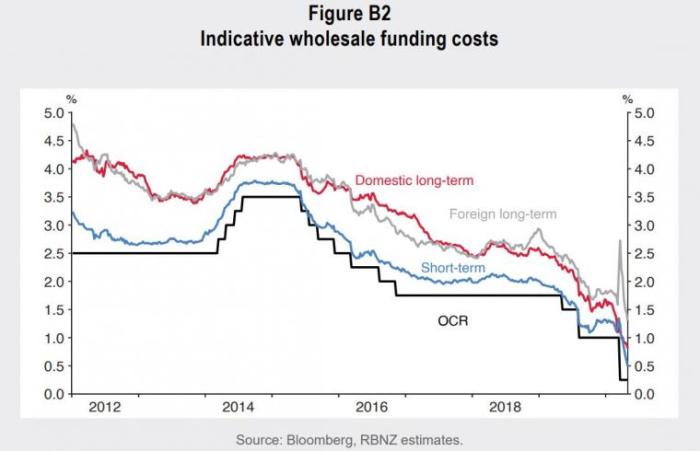
Now the missing bit in all this is the cost of that long-term wholesale funding, which is more or less as valuable as a retail term deposit for CFR purposes.  It is hard for outsiders to get a reliable fix over time on those costs, but from time to time the Reserve Bank includes a chart like this in the MPS, as it did last week.

fundingcosts

Quite how they put it together isn’t that clear (and the underlying data aren’t disclosed), but the line to focus on is really the grey one –  the estimated all-in cost of long-term foreign funding (issuing the debt in foreign currency and hedging it back into NZD for the term of the loan).  The margin between the grey line and the OCR is both large and variable.  Much of that typically has to do with the hedging costs –  again not something easy for outsiders to track routinely, but which have typically been more adverse, and more variable, over the last decade or so than was typically the case in the years prior to 2007.     If the hedging costs were consistently low, the grey line would be a lot closer to the OCR and the cost of domestic wholesale short-term funding, which in turn would mean banks would price term deposits much closer to the OCR/bank bill or to those domestic interest rate swaps.

Perhaps the other relevant consideration here is that the New Zealand economy as a whole is still quite heavily dependent on foreign capital, and in particular on foreign debt intermediated through the banking system.    If our net international investment position was different, there would be a larger stock of domestic retail/corporate deposits, and the relevance of the offshore funding costs (including hedging) might be a lot less.

But as it is, the banks are compelled to have –  in total – a lot of funding from retail and long-term wholesale sources.  A rational bank will price term deposits so that the cost of that form of core funding is typically and roughly equivalent to the cost of equivalently-useful long-term wholesale funding (the latter mostly from abroad).

When the CFR was put in place there was a recognition that core funding would be a bit more expensive that other funding, and that was a price judged worth paying. By the time of the increase in the minimum ratio to 75 per cent, this huge margin between the cost of “core funding” and the cost of other liabilities seems –  from the relevant RIS –  to have come to be accepted as some sort of new-normal, perhaps even desirable.  At the time, the Bank even toyed with the idea of the CFR as a so-called macroprudential tool (it appears in the MOU on such things agreed in 2013), and there was a view afoot that a higher CFR might enable us to tighten overall conditions without pushing up the exchange rate.

But, frankly, it all looks a bit daft at present.    The policy is premised on the notion not only that Michael Reddell as personal depositor is less likely to run on his bank than Michael Reddell the super fund trustee and that – even if granted that that was true –  that stickiness (possibly not even rational, since I might just be slacker about my finances than about my fiduciary responsibilities) was so valuable from a financial stability perspective to be worth driving such a massive wedge between the rates available on two products with absolutely the same credit risk.    More generally, if you were around in 2007/08 you may recall (a) the retail runs on domestic finance companies,  and (b) Northern Rock and the queues down the streets in the UK.     There probably is some value in encouraging banks to have a reasonable volume of longer-term funding, that can’t be encashed on demand by the holder, but there is little obvious basis for distinguishing deposits of the same maturity held by individuals, by companies, by other small financial institutions and so on.    A cost-benefit analysis simply could not support the sorts of –  inefficient –  wedges we have come to see.   I emphasis the “inefficient” because (a) the Governor likes now to refer to efficiency, and (b) more importantly, because the provisions of the Reserve Bank Act governing the exercise of prudential powers still do, as an important constraint on what the Bank does.

From a macroeconomic perspective, none of this much mattered when the Bank was freely able and willing to adjust the OCR as required, to more or less keep inflation towards target.  If term deposit rates were going to be a little high, the OCR would be lowered, and although there would still be much the same wedge between retail and wholesale rates, the level of retail lending and borrowing rates could be more or less managed to what the Bank regarded as consistent with the inflation target.

These days, however, the Bank seems to regard itself as bound to an exceptionally rash commitment it made in a hurry on 16 March, not to reduce the OCR further.  And the Governor and Deputy Governor are reduced to asking really really nicely (or not so) for the banks to lower lending rates, even as they say they can ‘rationalise’ –  in terms of those funding costs –  why they don’t.  To me the answer is straightforward: if as a central bank you think retail rates need to be lower, consistent with your inflation target, then cut the OCR until retail rates get there.  Simple as that.

But if the Governor really does regard himself as honour-bound –  like some teenager’s promise to a dying parent that he’d never ever partake of the demon drink – there are still options, and ones that might make a real difference where it matters to depositors/borrowers.   Specifically, the CFR.

For example, the Governor –  and this is his decision, not the MPC’s –  could lower the minimum CFR to, say, 65 per cent (and commit to keep it no higher than that for, say, the next five years).  Do that and the pressure would come off term deposit rates very quickly and the relevance of those marginal foreign term funding costs would abate.  He could do more complicated things as well – options we looked at a decade ago –  of imposing a minimum requirement only on the share of foreign funding that is long-term (recognising that we don’t have largely repo-funded investment banks as they had in the US). I wouldn’t recommend the more complex changes in the short-term –  action is what is called for, and not things that take lots of careful drafting and consultation.

You might  –  perhaps especially if you were a bank supervisor –  think it strange to propose such a relaxation in the middle of a very troubled period.     But bear in mind several points:

  • we aren’t in the exuberant phase of the cycle (unlike, say, 2005 to 2007), where banks are just pursuing whatever is cheapest regardless of rollover risk,
  • we’ve already got to the point where the Bank is happy to provide almost limitless funding to the banks.  They are running term loan liquidity auctions, and for now getting no takers.  And although the wholesale deposits that arise through the bond purchase are technically pretty short-term, I heard the Governor on the radio yesterday stating that he thought the Bank would be holding the bonds to maturity (in which case the funding will also be there for years).  None of this funding counts as ‘core funding” for CFR purposes,
  • there was no robust cost-benefit analysis of just what was being gained from the CFR, let alone the specific parameter settings (nothing even to match what was done for capital last year). In other words, the current 75 per cent is no less or more ad hoc than a 65 per cent ratio for a few years would be.
  • the Bank has already wound back its capital requirements (delayed the start of the increase in required capital), so there would be no particular inconsistency in doing the same for liquidity, given the anomalous pricing the Bank’s rules are producing.

The Reserve Bank was a fairly early adopter of a core funding requirement after the last recession.  Many other countries now have something called a net stable funding requirement as part of their bank supervision arrangements.   The rules are a bit different, and no doubt each country has its own specific calibrations (and I’m not that familiar with the details of any of them).  This post is not an argument for getting rid of a funding requirement rule –  although in the end it is the quality of bank assets that matters mostly –  but for recognising how large a wedge our specific rules have driven, and the way that now (with the self-imposed OCR floor) contributes to holding our retail lending rates up.

I’ve noted in a couple of posts, including yesterday’s, that even though the New Zealand and Australian policy rates are essentially the same, retail term deposit rates in Australia are much lower than those –  offered by the same banking groups –  in New Zealand (and by much more than any slight differences in credit quality might explain).  As I noted earlier, it isn’t just regulatory provisions that explain the wedge between core and non-core funding of the same term and credit, but it seems likely that the specification of the NZ rules explains the bulk of the difference between New Zealand and Australian term deposit rates.

If the Governor is determined to stick to his crazy OCR promise for now, action on the CFR offers the fastest surest mechanism to materially lower domestic retail interest rates.  The Governor says that is a priority for him.  This decision is entirely his.

It is fair here to point out that the Governor’s prudential regulatory powers have to be used for prudential regulatory purposes –  soundness and efficiency of the financial system –  and can’t just be used as a monetary policy tool (any more than LVRs could).    But on this occasion that should not act as a constraint: after all, that large wedge between returns on instruments of the same maturity and credit, dependent solely on who holds the instrument, doesn’t look good on any sort of efficiency test, and I’m sure I’ve heard in recent weeks the Governor suggest –  quite credibly –  that lower retail lending rates were likely to be, at the margin, a positive contribution to financial stability.   When efficiency and soundness ends are both served it really should be an easy call.  There is a Bank Financial Stability Report due next week, which would be a good opportunity to announce such a change –  or for MPs and journalists to grill the Governor on why he would continue to oversee a policy that drives such a wedge into the interest rate structure.

UPDATE:   Shows how many initiatives there have been that one can lose track of.  A reader draws my attention to the fact that the Reserve Bank had already cut the CFR in late March.   I must have read that at the time and then forgotten it.  Will have to reflect further then on why term deposit rates are still so high relative to wholesale rates.  One possibility might be uncertainty about how long the relief will last.


Monetary policy again

One way of looking at developments in New Zealand’s monetary policy is to compare what has been done, and how that has affected market prices, in the country that is in many respects most similar to New Zealand, Australia.

There are no perfect comparators –  and in many ways everyone is flying a bit blind at present – but the two economies do have many of the same banks, similar institutions (variable or short-term fixed mortgages) and a fairly similar experience of the virus.   Sceptic that I am of the Reserve Bank of New Zealand, I am not starting from a view that the Reserve Bank of Australia’s monetary management is some sort of standard to which we should aspire.  Coming into this crisis, for example, both central banks have presided over core inflation undershooting the midpoint of their respective inflation targets, the RBA by more than the RBNZ.      And for reasons that are not very clear (at least to me), the Reserve Bank of Australia is more resolved not to adopt a negative policy rate than our own central bank.

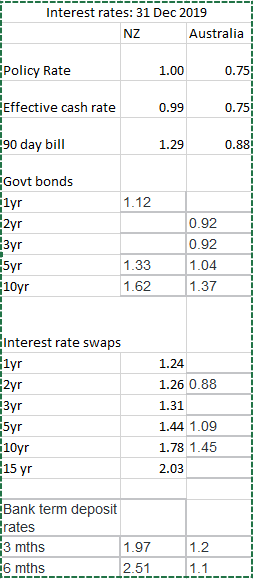
What was the starting point at the end of last year (a time when no one in either country had the coronavirus in focus)?  Recall that Australia’s inflation target (centred on 2.5 per cent) is a bit higher than ours (centred on 2 per cent).  Here are the interest rates I could find, all from the respective central bank websites, except the Australian interest rate swaps yields.

31 dec 2019 int rates

Every single one of the New Zealand rates was higher than the comparable Australian rates –  the smallest gap of all being in the two policy rates, and by far the largest being in term deposit rates.   Note that at the end of last year, markets were looking to the prospect of a cut in the RBA cash rate later this year, while in New Zealand attention was beginning to turn to the possibility of an OCR increase at some point.

So what has happened since then?

  • the RBA cuts its cash rate by 50 basis points to 0.25 per cent, while the RBA cuts its OCR by 75 basis points to 0.25 per cent,
  • both central banks have massively increased the volume of settlement cash in the respective systems.  At the RBNZ, all those balances (currently around $28bn) are remunerated at 0.25 per cent, while at the RBA balances are remunerated at 0.10 per cent (both central banks changed their rules for remunerating large balances),
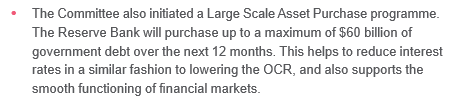
  • the RBNZ announced its large-scale asset purchase programme, concentrated on government bonds, currently with a limit of $60 billion,
  • the RBA announced a target rate of 0.25 per cent for the yield on three year government bonds, indicating that they would operate in the market (primarily that for government securities) to maintain market rates at or near that target.

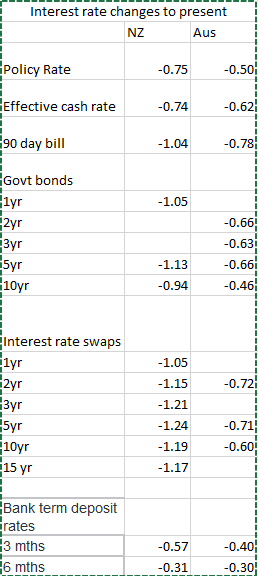
And here is how much those rates have changed to now (latest available data)

int rate changes

Tracking down old mortgage rates for Australia is beyond me, but note that both variable and fixed mortgage rates in New Zealand are well above those in Australia.    But so are term deposit rates: averaging across the big four banks, in Australia for AUD six month term deposits the banks are paying about 0.8 per cent, and in New Zealand for NZD six month term deposits the banks are paying about 2.2 per cent.

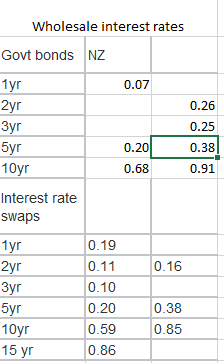
As you can see from the table, wholesale rates (bills, bonds, swaps) have fallen by more in New Zealand than in Australia.  That is not inconsistent with the fact that the Reserve Bank of New Zealand cut its effective policy rate by more than the RBA cut its effective rate.  Here are the current wholesale rates (Australia in the second column)

wholesale 3

It is notable that longer-term rates are now lower in New Zealand than in Australia –  quite a contrast to the situation at the end of last year.

Consistent with all that, incidentially, the NZD/AUD exchange rate fell by about 4 per cent over this period.

What might explain these developments?

On the one hand, quite possibly people trading the markets in the two countries may reckon the New Zealand recession will be more severe and/or longer-lasting than Australia’s.    It is certainly true that forecasts of the decline in June quarter GDP are much steeper for New Zealand than for Australia, although beyond that –  looking ahead a year or two –  it isn’t obvious at this stage why things might be so very different at the sort of horizon more relevant to longer-term rates.  So for now I’ll just note that possibility and pass on.

What about central bank words and choices?

The Reserve Bank of Australia has apparently been pretty clear that it will not lower than cash rate from here.   The market seems to more or less believe them (the OIS rates on the RBA website are consistent with the current effective cash rate).  By contrast, the Reserve Bank of New Zealand has opened the door to the possibility of a negative OCR next year. I don’t have access to New Zealand OIS data, but I did notice this chart in a Westpac market report, dated yesterday, that someone sent me.

NZ OIS

Markets here are pricing a negative OCR throughout next year.  In other words, our longer-term interest rates price in even more conventional monetary policy easing.  Consistent with that, a reasonable chunk of the fall in the exchange rate has occurred since the Reserve Bank’s MPS last week.

All of which then leaves the question of quite what difference the Reserve Bank’s vaunted long-term asset purchase (LSAP) programme is making.  The Reserve Bank repeatedly tries to suggest the answer is “a lot”.  But there is reason to be more than a little sceptical that it is making much difference where it matters.

As I noted above, both central banks launched novel asset purchase programmes.  The RBA’s approach involved purchasing whatever it took to keep the three year government bond rate around 0.25 per cent.   In the early days –  amid the global bond market liquidation –  achieving that goal took a lot of purchases.  But here are the RBA’s total bond purchases

A$mn
Total 51348
March 27000
1st half Apr 17500
2nd half Apr 5748
May 1100

You’ll recall that the Australian economy is quite a lot bigger than New Zealand’s.  A$51 billion in bond purchases there might be akin to perhaps NZ$7-8 billion purchases here.

But note what has happened: after heavy purchases in late March and early April, the RBA’s bond purchases have almost completely dried up.  Despite the heavy expected federal government bond issuance, expectations about short-term rates are now sufficiently subdued that the three year government bond rate is holding at the target rate with no material bond purchases at all.  And the purchases the RBA has been doing have been heavily concentrated in relatively short-dated government bonds, consistent with reinforcing monetary policy signalling and with the fact that, as in New Zealand, most private sector borrowing tends to be on variable or short-term fixed terms.

What about the Reserve Bank of New Zealand?    Here is the same table for them (government bonds only –  there is a small amount of LGFA purchases also).

NZ$m
Total 11,228
March (from 26th) 950
1st half April 3,833
2nd half April 2,845
May 3,600

Relative to the size of the economy, total purchases here have been somewhat larger, but the real difference is that the Bank is buying just as heavily as ever.  And as I noted in my post on Monday more than two-thirds of all their purchases have been for maturity dates from 2027 and beyond –  and virtually no one I’m aware of, other than the government itself, takes funding exposed to rates that long.

In other words, it seems plausible that the LSAP programme might be knocking 20-30 basis points off long-term government bond yields and swaps rates, while making almost no difference at the short-end (where the RBA would seem now to provide a reasonable benchmark).  And yet it is the short-end that influences borrowing costs for most households and corporates.  At the long end……well, there is the government.    It all looks quite a lot like a programme designed to do two things:

  • by waving around very big numbers to suggest that monetary policy is doing a lot when it actually isn’t really doing that much at all, and
  • to lower the marginal borrowing costs of the Crown, at a time when the Crown has a very big borrowing programme.  At very least, that is a questionable use of monetary policy – not at all consistent with the MPC’s Remit (since fiscal policy will be what it will be whether or not bond yields are 20 points higher or lower) –  and all while exposing the Crown to a really high degree of unnecessary degree of interest rate risk (if the authorities really believe interest rates are extraordinarily low they should be markedly lengthening the duration of the Crown’s debt to the private sector, not skewing it dramatically shorter by buying in government bonds and issuing variable rate settlement cash in exchange).

And, on the other hand, if the Bank were really serious about getting retail interest rates down –  rather than anguishing in public and suggesting that commercial banks aren’t doing their job –  it would just get on and cut the OCR quite a lot further.  As it is, go back briefly to the changes table (the second one from top): nominal rates have fallen to a moderate extent this year, but survey and market measures of inflation expectations suggest that expectations of future inflation have fallen by probably 0.7 percentage points.  Real rates generally haven’t fallen much at all, while retail deposit rates –  held up by the combination of the Bank’s core funding requirement regulation (their choice) and the continuing relatively high cost of offshore terms finance (illustrated in the MPS last week) –  have actually risen in real terms.

Quite a claim to fame that: to be the central bank, in a country with a highly safe banking system (as the Governor now repeatedly avers), that presided over a rise in real deposit rates in the face of the biggest economic slump in decades.  Extraordinary.

Meanwhile, in the last 24 hours we’ve had the Deputy Governor offering interviews to both Stuff and the Herald reaffirming the MPC’s commitment to stick to its bizarre promise on 16 March not to cut the OCR further before next March, come what may.   Apart from anything else, it has the objective effect of tightening monetary conditions relative to where they were –  in effect, urging markets to price out those early negative OIS prices and, all else equal, push up the exchange rate.

There is, of course, something to be said for sticking to one’s word.  But rash promises generally should not be followed through on.  I suppose we should be thankful that the MPC in February –  recall, they were upbeat about the rest of the year then –  had not offered “forward guidance” committing not to cut the OCR this year, come what may.  Perhaps they’d have felt obliged to stick to that rash pledge as well?  As it is, this was a pledge made on 16 March, at a time when the Governor was reluctant to even concede that a recession was happening, at a time when the Secretary to the Treasury (observer on the MPC) was telling the PM that things might be not much worse than the 2008/09 recession.   Perhaps (or not) those were pardonable calls at the time, but they were clearly mistakes, and not small ones.   Sticking to a rash pledge made in some highly uncertain and fast-moving circumstances is almost akin to the suicidal person talked down from the edge, but still averring that “I promised I’d jump, I even left a note, I need to stick to my word”.  Among the sick, such misperceptions might be pardonable.  From highly-paid public figures charged with conducting a nation’s monetary policy, it is simply stubborn, verging on the crazy –  the more so if the MPC thinks that sticking to that pledge in any way enhances the sort of credility that matters.  After all, it was the MPC last week that published projections showing inflation below the bottom of the target range for two years, and unemployment unacceptably high.  Those were supposed to be the considerations people judged the Bank on.

Finally, I see that Stuff’s Thomas Coughlan in his column this morning has picked up my call that if the MPC won’t move –  won’t do the job that is really needed, to provide a lot more stimulus, to get us on the path back to full employment and price stability –  that the Minister of Finance should use the override powers Parliament has long provided him with.  They aren’t powers that should be exercised lightly, but these are exceptional times, and the Bank seems to be content to do little of substance, while pretending otherwise.  Of course, the Act was initially written primarily to protect us from inflation-happy politicians, but also has to protect us from central bankers just not doing their job –  in this case, on either the employment or inflation dimensions.  If he fails to act –  as surely, risk averse as he is, the Minister of Finance will fully share responsibility for the unncessarily slow recovery that he and his MPC seem set to risk.   To what end?

LSAP scepticism

The Governor of the Reserve Bank is always keen to tell us what an important contribution the Reserve Bank is making through its large-scale asset purchase programme (LSAP).  Recall that the Bank cut the OCR by 75 basis points and then gave up on using conventional monetary policy –  promising (in one of the weirdest pledges in the history of modern monetary policy) to do no more for 12 months, come what may – in favour of buying lots of (mostly) government bonds.  At present, the MPC has authorised the Bank to buy up to $60 billion of bonds, and there is speculation from some banks that that total may even be raised further at the next  Monetary Policy Statement in August.   The Bank claims –  as it did in the MPS last week and at its appearance at FEC the next day –  to be making a big difference, but it is mostly a smoke and mirrors show.  There are big numbers involved, but the differences being made to things that might matter economically are really rather small.

Sadly, it seems to suit our very conservative and risk-averse Minister of Finance to believe –  or acts as if he believes –  the Bank’s story, even if by doing so he aids and abets an insuffficient macro policy response to the savage recession that is upon us.  The macro consequences of his indifference probably won’t show up before the election, but even beyond that horizon in his entire term in office he has been remarkably deferential towards the Bank. It is if he is scared of doing what the economy needs.

It is fair to say that there has been an active debate over quite what these asset purchase programmes have achieved ever since they were launched.   While I was still at the Reserve Bank I recall a couple of visits from Dan Thornton, then a senior researcher from the St Louis Fed, who presented versions of papers arguing that the Fed’s various asset purchase programmes really hadn’t made much sustained difference to anything.    I was never fully convinced but if you’d asked me a year ago I’d have said that my summary impression was that earliest Fed programme –  in the midst of the financial crisis –  probably added some value, but that the later ones didn’t achieve much at all, perhaps beyond some announcement signalling.  (The issues in Europe were a bit different, since breakup risk was in play).  Long-term interest rates in the US, for example, hadn’t seemed to have fallen more, relative to the change in the policy rate, than we’d seen in New Zealand or Australia (which, to then, had not resorted to asset purchase programmes).

In truth that didn’t seem very different to the approach being taken by the Reserve Bank’s chief economist only two months ago.  This was reported in the Herald on 13 March

yuong ha

That sounded –  sounds in fact –  about right to me.   It isn’t, of course, the line that either Ha or his boss are running now.  Instead, we get repeated suggestions – never quite pinned down with hard estimates or illustrations –  that what the Bank is doing with the LSAP is some sort of fully adequate substitute for the sort of scale of OCR adjustment we’ve had in past serious recession (recessions which, it might be added, it has often taken years for the unenemployment rate to drop back acceptably).

Strangely, the Governor has found some supporters among the local bank economists.  I presume they really believe what they are saying, but I still don’t find it very persuasive at all.

Much has been made of the claimed impact of the bond purchase programme on wholesale interest rates.  But even there, the story isn’t particularly persuasive.

Typically, the biggest influence on longer-term interest rates is the expected future path of short-term interest rates.  Why?   Because, in principle at least, someone holding a 10 year bond has as an alternative investing in a series of 40 day 90 day bills.  If the market thinks the short-term rates wil rise or fall materially over the life of the bond, that will influence bond yields themselves.

Sometimes, there is a serious recession, involving significant cuts in the OCR, but where the effect is expected to be quite shortlived; before long it is expected that the Reserve Bank will be raising the OCR again.   If so, bond yields might not fall much, and in particular the implied forward interest rates (eg the second five years of a 10 year bond, backed out using yields for five and ten year maturities).   That was more or less exactly how markets reacted in 2008/09.

5 yr forward rate

It took a couple of years for markets to really begin to appreciate that future policy rates were likely to be low for some considerable time.  This New Zealand experience wasn’t that unusual.  In fact, it took a while for the Reserve Bank to learn –  they’d actually started tightening in mid 2010.

But what about this recession?  I’ve not seen a single serious commentator here or abroad –  I’ll set aside the columnists who reckon we are now on an inexorable path towards Venezuela –  who think there is any material chance of policy rates being raised any time in the foreseeable future (several years at least).  By contrast, just a few months ago people were beginning about the possibility of OCR increases perhaps later this year or next year.

And yet even with all that Reserve Bank bond buying –  actual and promised –  the implied five year forward government bond rate hasn’t really fallen that much at all.  It is down 80-90 since the middle of last year and 60 points since January.  It just isn’t very much –  look at the size of some of the past movements even just in the period of this chart –  and all this against a backdrop of a 70-80 basis point fall in medium-term inflation expectations (whether one uses survey measures or market prices).  Unfortunately, long-term historical swaps data isn’t readily available, but for the more recent period the picture is much the same: implied forward rates haven’t fallen very much relative to history, relative to the scale of the economic shock, or relative to the fall in inflation expectations.  And yet it was this fall in swaps rates on which the Bank seems to pin its claims.

Ah, but what about the counterfactual?  What would have happened if the Reserve Bank had not launched and then expanded the Large Scale Asset Purchase programme?    The only fully honest answer of course is that we do not know.

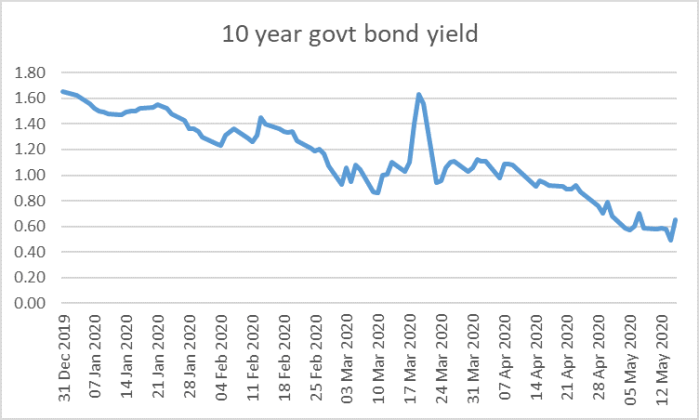
The Bank likes to run the charts showing how bond yields surged upwards in late March, and then fell after it intervened with the LSAP.

10 yr yield may 2020

The global rush to cash and liquidation panic was well-recognised.  Quite probably, central bank interventions helped to stabilise things.  But that is a different proposition from a claim –  which is the one the Bank and its supporters are making –  that the current level of yields, six weeks on, is being very materially influenced by central bank purchases.  One could mount a counterargument that where yields are now isn’t much different than where they might have been anyway given (a) the OCR being stuck at 0.25 per cent for now, and (b) the economic situation having got a whole lot worse than it was, say, on 16 March, and (c) medium-term inflation expectations having fallen quite a bit further.

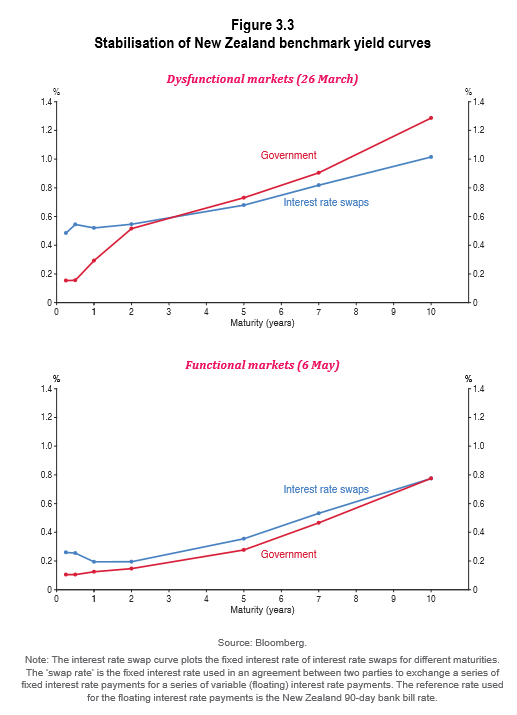
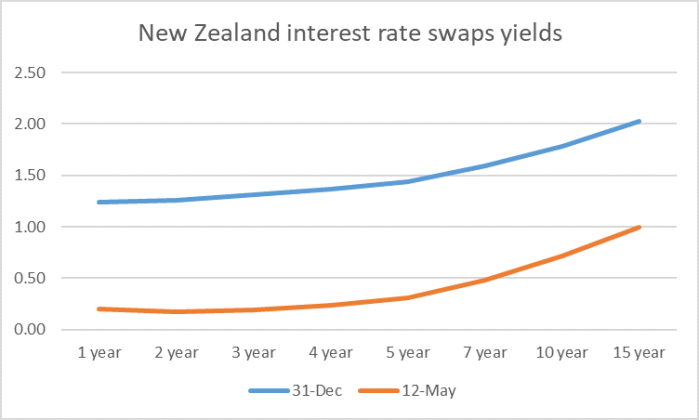
One might say the same looking at this chart of the swaps yield curve on various dates.

swaps curves

The grey line was the peak in rates amid that flight to cash that most severely affected te bond market.  But again, compare the 16 March line (the day the Bank cut the OCR) with the latest observation last Thursday.  It has the feel of the sort of fall –  concentrated over the front five years –  you might have expected if you’d been told that in the interim the economic situation had got so much worse and inflation expectations had fallen materially.

But, again, the counter-argument will come: what about all those fiscal deficit and the big volume of debt issuance coming down the track?  To a first approximation, my response is “what of it?”.

First, recall what else is going on.  Investment demand has slumped and is likely to remain lower than it was for several years.  And private savings preferences also appear to have risen. So if we are thinking about what might be expected to happen to interest rates  – even if the Reserve Bank were buying nothing –  we have to think not just about what the government is doing but about the private sector.  Money is, after all, fungible.  Absorption, frankly, seems unlikely to have been an issue, in a very lightly-indebted sovereign –  even if the Reserve Bank had not done any LSAP.

Gross public debt as a share of GDP is now projected to rise by 30 percentage points between last year and 2023/24.  But it isn’t as if big increases in public debt have never been seen before.  In fact, the last time was only a decade or so ago, when gross public debt as a share of GDP rose by 20 percentage points between 2008 and 2012.   There was no asset purchase programme then and –  as illustrated above –  once markets became convinced that the OCR would have to stay down for a while, it wasn’t enough to stop implied forward rates falling a long way.

And how much would we expect changes in government debt to affect interest rates, absent central bank intervention?   Views will differ on that, but the Governor did write about exactly that issue in his relative youth, publishing empirical estimates drawing on work he’d previously been part of at the OECD.  Perhaps the Governor has changed his view since 2002, but then he estimated that 30 percentage points on net debt might have been worth perhaps 15 basis points on bond yields, all else equal (which it decidedly isn’t right now, with very high levels of excess capacity).

Another point worth bearing in mind is that even the Reserve Bank will, I think, concede, that very long-term interest rates just don’t make that much difference to many people in New Zealand, other than just lowering the government’s own financing costs.  The marginal activity in the residential mortgage market, for example, is typically around one and two year fixed rates.  And yet the data on the Bank’s LSAP shows that more than two-thirds of all the Bank’s government bond purchases have been for maturities of 2027 and later.   So even if those purchases are having a material impact on those very long-term rates, so what?  To what end?  As it is, we know that shorter-term fixed rates have hardly fallen at all in real terms –  what one might have expected with a small, badly lagging, OCR response, not with all the power the Bank asserts its balance sheet purchases can have.

Perhaps also the Bank is right that there has been some helpful exchange rate effect, and we do not know the counterfactual. But we do know how much the TWI has often fallen in past serious recessions, and it is much more than anything we’ve seen to date this time.  The LSAP might be a little better than nothing, but it is no substitute for the OCR the Bank is now so reluctant to use.

Are there other possible channels where there might have been an impact?    A commenter last week noted that perhaps equity markets were higher as a result?  Perhaps, although the effect must surely be small, but equity markets have always been seen as much less important a part of the transmission process here than in, notably, the US.  The Bank and its supporters have also been talking up portfolio balance effects –  in other words, the people selling bonds to the Bank have to do something with the money that is freed up.  Again, perhaps there is some small effect, but it is difficult to see where such material tangible effects might be.    For example, I’ve seen this chart a couple of times in ANZ publications

corp bonds

It is a useful chart (altho perhaps with a line missing?), with data on corporate bond yields that those of without a Bloomberg terminal can’t otherwise easily track.  The Reserve Bank doesn’t buy the corporate bonds, but purchasing government bonds may displace some holders into corporate debt.  But, again, count me fairly sceptical that the ongoing LSAP programme is explaining much about the current level of these yields, given (a) weakening OCR expectations, and (b) the weakening economic environment.  It is hard to be sure, but it is hard to believe that any effect is very large.

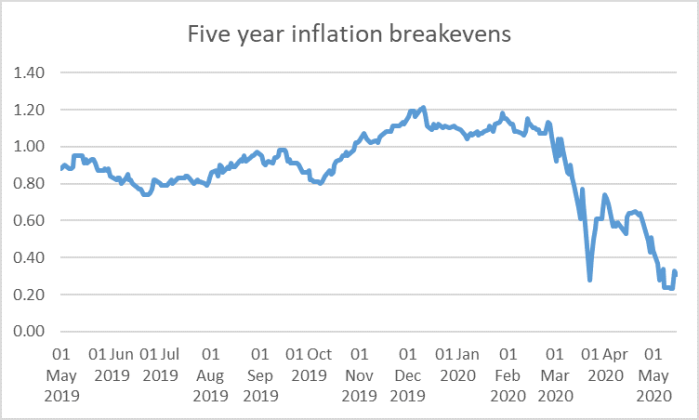
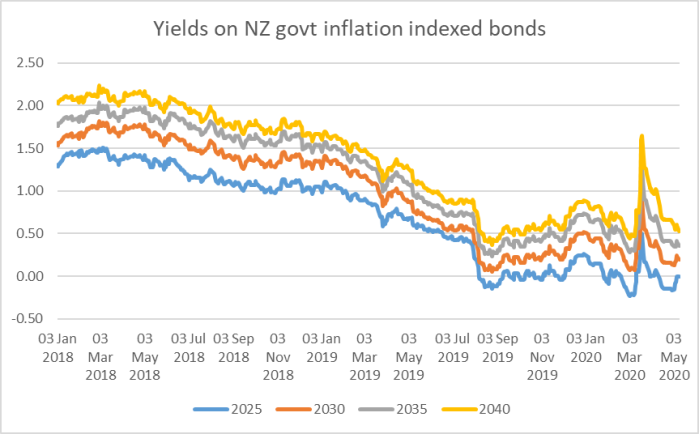
We don’t have real-time inflation data, but we do have near real-time proxies for inflation expectations –  and especially changes in them –  from the inflation-indexed government debt market.   When implied inflation expectations for the next five years on average have fallen by about 80 basis points (measured imprecisely, so call it anything from 70 to 90 points) in just a couple of months

IIBs mAY 20

it is not a sign of a central bank that is doing its job well, of a central bank whose instrument is doing what needs to be done, even allowing for all the fiscal support as well.   If we had a Minister of Finance who really cared about macroeconomic stabilisation he’d insist on change.

A deeply negative OCR, generating retail rates near-zero (consistent with what the governments is lending to SMEs at) is more like the sort of monetary policy stance we need, one that might make a real and sustantive difference to inflation, inflation expectations, output and (un)employment.    What we have at present is theatre –  arguably doing little harm and perhaps a modicum of good, but successfully (it appears) from the Bank’s perspective distracting from where the real gains might be had.


RB at the Finance and Expenditure Committee

After each Monetary Policy Statement (and Financial Stability Report – there is another of those along very shortly), Parliament’s Finance and Expenditure Committee invites the Governor and his colleagues along.   They tend not to be particularly searching appearances – when times are more or less okay, MPs seem more interested in securing soundbites for media coverage than in serious scrutiny.  In principle, the Committee takes the process seriously –  they even hire a local economist as a part-time adviser to brief them and suggest questions –  but any real scrutiny is pretty rare.  I haven’t been along to one of the hearings in the time I’ve been writing this blog, and although I had become vaguely aware that the hearings were being livestreamed, I hadn’t even bothered to track down those.

But some members of the Epidemic Response Committee had been willing to ask the Bank some fairly specific questions a few weeks ago (my write-up on the Bank’s responses is here).  And many of the issues around the Bank’s handling of the current situation haven’t gone away, so I found the link to the footage of the Bank’s appearance on Thursday morning,  As far as I could see, there was almost no subsequent coverage (the Budget and all that), which was a shame as some significant issues surfaced.

In this post, I want to focus on the questions/comments by three MPs, and the responses of Bank officials to them.

The first was a question from Labour MP Duncan Webb, who took a longer-term perspective and asked the Bank about the exit strategy from the Large Scale Asset Purchase programme.  It was a good question, because it is easy to get into these things, and not always easy to get out again.  The Governor’s response was also straight, and really the only one he could give.  He noted that he would love to be in the position, a few years hence, where the economy was running strongly, inflation pressures beginning to build, when the Bank could sell its bond holdings gradually back into the market (“tapering”).  That is clearly a first-best situation from here.  On the other hand, the Governor noted that in other countries it has more usually been the case that the bulk of bonds purchased have been held by the central bank until maturity (the longest current New Zealand government bond matures in 2040).  There is a variety of reasons for that observed behaviour, some defensible, others not.  My point here is not to disagree with either the Governor or Mr Webb, but to welcome the fact that an MP raised the longer-term issues, and to hope that the Committee and the Bank continue to engage on the issue.  It would not be ideal if the Bank ends up holding half of all the government bonds on issue for the next decade, and to support that has to maintain unusual liquidity management arrangements on the other side of its balance sheet.

The most serious questions about the immediate situation were asked by National’s Finance spokesman Paul Goldsmith.  He seems, reasonably enough, to have become a little troubled at (a) the lack of much sign of an easing in monetary conditions as they affect real people, and (b) the apparently rather relaxed approach the Bank has taken, and appear to continue to take, to the option of a negative OCR.

This time he succeeded in getting a slightly more specific response from the Bank.  You’ll recall that Orr has claimed that some banks are ‘not ready’, without ever being specific as to which banks, what the specific issues are, or even why some banks allegedly not “being ready” should hold back the entire economy.  (On this note, I happen to have had credible reports of two bank chairs this week each stating that they don’t understand the issue either, and that of course their banks are quite ready.)

As I’ve noted in previous posts,  this “not ready” claim has always been a bit fishy.  We never heard it a decade ago in other countries that dipped their toes into negative policy rate territory.  And most of the banks operating here are part of overseas banking groups, at least parts of which will be operating in countries with negative policy rates.  And if the issue was really about retail rates and retail systems, most of our retail rates are still so positive that any “readiness” issues wouldn’t arise even for OCR levels much lower than those at present.

Anyway, Orr finally clarified his claim, which is now that “some banks” (“some” presumably being less than “most” or “a large number”) still had systems problems that meant they could not cope with “a negative OCR or negative wholesale rates”.   He went on to add that banks were quite busy at present, but that only last week the Reserve Bank had written to banks, indicating that banks needed to show that they would be “ready to go” should negative rates prove to be needed, by “towards the end of the year”.

It still somewhat defies belief.   When much of the government bond markets in the rest of the world have been trading with negative yields for some time, when our first (indexed) bond yields went negative last year, surely every bank with any sort of wholesale operation must be capable of coping with negative wholesale rates –  be it small (here) Chinese banks or big (here) Australian banks, or Citi, HSBC, JP Morgan or whatever.   Is all this somehow about SBS and Heartland Bank (or even tinier NBDTs)?  If so, isn’t that their problem, not something appropriate macro stimulus should be held back for?

Anyway, I have now lodged a request for a copy of the letter sent to banks last week, and for the letter the Bank sent out in late January and responses (without names, or tabulated again anonymously) to it.  In the meantime, here is the list of NZ-registered banks: perhaps some enterprising journalist could ring them each and ask if they have any systems obstacles to a negative OCR and if they do, what those obstacles are?

Goldsmith also asked the Bank about the rather limited extent of the fall in retail interest rates (especially lending rates, whether for business and households), asking why the Bank had chosen to emphasise the large-scale asset purchase programme (LSAP) as its tool.  In response, in addition to the alleged “operational problems” Orr ran through a litany of considerations: they looked, he claimed, at what would be most efficient, most effective. most easily operated, and with fewest distortions to markets and the LSAP had won ‘hands down’.    He claimed –  as he had on Wednesday at the release of the MPS –  to be very pleased with the effectiveness of the LSAP so far.

I went through some of the problems with that argument in my post on Thursday.  But Goldsmith himself also persisted.  The gist of his response was to say ‘well, yes, it is all very well to say you’ve lowered government bond rates –  no one disputes that –  but retail rates haven’t come down much at all have they?”.

And at this point the Bank started floundering. The Governor turned for an answer to his chief economist Yuong Ha – who had been quoted in the Herald as recently as the 13 March observing that programmes like these don’t really achieve that much, buying just a little space, a little time etc.  The gist of Ha’s response was “well, that isn’t really our issue is it?  We don’t control the margins over wholesale rates banks set.”  He went on to accept that wholesale rates had come down around 100 basis points – presumably here he meant the swaps yields I illustrated on Thursday –  but that retail (deposit?) rates had only fallen by 20-30 points.  He noted that the Bank “understood” the lack of passthrough so far”, but they would expect to see a lot more “as the economy recovers”.  That didn’t seem to be much consolation, in an economy that needs monetary policy support now not in six or twelve months time?  And, of course, Ha made no mention of the fact that –  whether it is surveys or market prices one looks at –  inflation expectations have come down a long way so that even real wholesale rates haven’t changed that much at all.

Then Orr weighed in again suggesting that he was “very pleased” with the wholesale rate impact, but “less pleased” about the retail rate response.  He too ran the line about ‘we can rationalise why that is”  –  as they did in the MPS, noting that effective marginal funding costs remain high.  But neither he nor Ha seemed willing to entertain the otherwise-obvious conclusion that if wholesale rates had fallen but retail rates hadn’t much, and you can understand why that is, the usual – wholly conventional –  response is some more easing in wholesale rates.  That is exactly what happened in the 2008/09 recession, when funding costs also remained under heightened pressure.  But not now: instead, there is just handwringing and hope.

Goldsmith also challenged the Governor on his call to the banks to be “courageous”, suggesting that “courageous” lending might easily be rather risky or dangerous lending.  The Governor had not much more than bluster in response, but it isn’t my focus.

Then Goldsmith asked the Governor about those comments a few weeks ago that the Bank could consider buying government bonds directly from the Crown, rather than (as at present) in the secondary market.  He seemed to just be wanting to close off the issue, but the Governor opened it up all over again, in a way that seems to have attracted no attention.

The expected answer would probably have been along the lines that there were no plans at present, the secondary market was working well, but if there ever were dysfunction there was really no macro difference in the Bank buying direct, so long as the decision rested with the Bank, consistent with the inflation target.   In backing the Governor on this point previously, that is what I have said.

Instead, the Governor launched into a discussion noting that while the Bank did not rule out lending direct to the Crown, that was really fiscal policy not monetary policy, that the central bank can always lend as much as fiscal policy requires, but that that would be a matter for the government to decide, not the Bank.

Goldsmith then challenged him on that, asking whether he was really saying that the Minister could decide whether the Bank would lend direct.  Orr reiterated the possibility of market dysfunction, while noting that at present markets were functioning well, but then repeated that what he called “pure monetary financing” would be a matter for the Minister of Finance to decide.

At this point, the Governor invited the Deputy Governor Geoff Bascand –  usually the safe pair of hands in that senior management cohort –  to comment.  He indicated that it would be a matter of ministerial direction, but which would involve a substantial process including looking at whether what the minister might be directing would still be consistent with the existing price stability etc target.  And then he tried to close things down by suggesting that this was all just an “esoteric discussion”.

Reasonably enough ACT’s David Seymour reacted to that, suggesting that if the Bank was seriously saying the Minister of Finance could direct them to lend to the government, in any amount he chose, it was “anything but esoteric”.

The thing is, I am not at all sure what the Bank is talking about.  As I’ve noted here previously, in the 1989 Reserve Bank Act there were no prohibitions on the Bank lending to the government, directly or indirectly, but it was entirely a matter for the Governor to agree, or not.  His constraint was the inflation target he was required to pursue, and he had the ability to adjust other instruments to offset any inflationary impact of lending to the government.   Such lending has happened at the past, including through a priced overdraft facility at the Bank (although the Crown tends to prefer now to operate with credit balances).  But there was no explicit power for the Minister of Finance to direct the Bank to lend to the Crown.  I’m less familiar with the fine details of the 2018 amendments, but I cannot see any change to that position in the current legislation either.  It is as it should be.  I’m pretty sure that no modern advanced country central bank’s enabling legislation empowers the Minister of Finance to direct the central bank to lend to the government.  The government can of course choose to spend (run deficits) as much as it likes, and as a technical matter the Bank can finance any amount, but if the initiative for fiscal deficits rest wholly with the government, the ability of the Bank to say no to funding those deficits is pretty foundational to modern central banking.

There are two sets of directive powers in the (monetary policy bits of the ) Reserve Bank Act, one or other of which are I presume what the Governor and his Deputy were talking about.  The Minister can direct the Bank to deal in the foreign exchange market and can even direct them to set a fixed exchange rate (sections 17 and 18) and if the MPC considers that giving effect to such directions would be inconsistent with the existing mandate (the Remit), it can (sec 19) require the Minister to either issue a new mandate consistent with the direction, or it does not give effect to the foreign exchange market directive.    That sounds quite a lot like what the Deputy Governor was talking about –  and every so often Bank officials refresh their understanding of these provisions (I recall writing at least one such paper myself) but………a direction under these sections of the Act has nothing at all to do with compelling the Bank to lend to the government.

The other, better-known, directive/override power is section 12 of the Act.    Under that provision –  a directly parallel provision was in the 1989 Act as well –  the Minister of Finance can, for up to 12 months at a time (and transparently), override and replace the existing Remit (the 1-3 per cent inflation target and requirement to support maximum sustainable employment) with one or more other “economic objectives” and the MPC is then required to conduct policy in accord with that new mandate.   I’ve long held that this power could be used to directly compel the MPC to, say

  • target short-term interest rates of -0.5 per cent (or even -5 per cent), or
  • to target the nominal exchange rate at, say, 20 per cent below current levels, or
  • to use monetary policy with the goal of getting the unemployment rate below, say, 5 per cent in two years’ time,

or a variety of other alternatives.

The Bank, the Governor and the MPC have no choice in the matter.  They are required to run monetary policy consistent with devoting their best efforts to achieving the target the Minister has set.  If they tried to avoid taking the new target sufficiently seriously, it would be clear grounds for the Governor and Deputy Govenor to be dismissed, and other members of the MPC to be removed from those statutory offices.

But……there is no hint in this provision, or anywhere else in the Act, suggesting that the Minister of Finance can direct the Bank to lend to the government.  Perhaps the Bank and its lawyers think/worry that “lend to the government at zero interest up to $…billion” is an alternative “economic objective” within the meaning of section 12 of the Act.   But, at very least, it would be a stretch –  it isn’t an “economic objective”, but an instrument,  and favouring one specific party in the economy.    And note that if a government did attempt to impose such an “economic objective” there would still be nothing to stop the Bank setting interest rates for the rest of the economy at a sufficiently high level to counter the inflationary effects of this coerced lending.

I’m at a loss to know what the Governor and Deputy Governor mean.   I’m tempted to lodge an OIA request, but am not sure I’ll bother, as they would find myriad ways to refuse to release anything.  But journalists could directly ask the Bank what the Governor/Deputy Governor were on about?   MPs could use parliamentary questions to ask the Minister of Finance whether (a) he has received any advice as regard his direction powers over the Reserve Bank, and (b) whether he or Treasury believe he has the statutory power to compel the Bank to lend to the Crown.  Most everyone I’m aware of has always assumed they can’t –  and took great reassurance in that –  so if the powers that be now believe differently we deserve to know?    (Of course, if the government just wants more inflation, it can always raise the inflation target, but that is a rather different issue).

This post has gone on quite long enough, so I won’t devote the space I was going to to David Seymour’s extraordinary attempt to out-New Zealand First in defending old people.  Weirdly, Seymour –  who is usually quite wary of loose use of fiscal policy –  declared himself all in favour of bigger government, aggressive use of fiscal policy –  while expressing great concern about the way savers were being “penalised” by interest rate cuts, and currency being debased, all while accusing the Bank of deviating from its mandate. I thought the Governor showed commendable –  admirable –  restraint in his response, stepping through how monetary policy works (“one interest rate for all” etc) and even came close to (but couldn’t quite do so explicitly) pointing out to Seymour that real deposit rates are now HIGHER than they were a few months ago.   That’s perverse, of course….but then the Governor and MPC could do something about that –  this tool called the OCR.

And there was the extraordinary claim late in the session from the Deputy Governor (with responsibility for bank regulation and financial stability) that there was “no reason for banks to tighten up credit” amid a really deep recession and huge uncertainty about the future, whether for individual sectors, firms or individuals, or for the economy as a whole.    But perhaps I’ll come back to that breathtaking claim another day.  Perhaps the banks could reply to Bascand with that old maxim Keynes invoked; “when the facts change, sir, I change my mind.  What do you do?”.

To repeat, if the Bank/Governor/MPC will not do their job, and act aggressively in ways that credibly keep forecast inflation, and expectations of future inflation, on target, the Minister’s extraordinary (but clearly specified, there for a purpose) powers should be used.  But there should be no question of compelling the Bank to lend to the Crown.

Insufficient macro policy action

Before getting into the substance of this post, let me note that for a Budget allegedly ‘all about jobs’ our official data are so grossly inadequate that our next official employment/participation/unemployment data won’t be available until early August and then it will be only quarterly.  By contrast, the US and Canada released their April (monthly) data last week.  Here, Statistics New Zealand has shown no sign of being willing to release on an experimental basis –  for the duration of the crisis – the results of each monthly set of interviews they do (of which there are thousands) and sent out a note a couple of weeks ago suggesting that even the full quarterly labour market data may be less than ideal.  It is at times like these that the gaps in New Zealand’s official macroeconomic data are most glaring –  and yet there was no sign (I heard/saw) of anything in yesterday’s Budget to remedy these failings, the combined outcome of neglect by successive governments (mainly) and by SNZ itself.   Analysts are left looking to the data for other countries, and attempting to interpret them in light of the (typically smaller) falls in GDP expected in those countries.   Looking at those Canadian and US numbers suggests pretty severe labour market excess capacity here (no matter how many people are twiddling their thumbs but not technically unemployed or out of the workforce, under the cover of the wage subsidy scheme).

What of the Budget itself?

I’m really not bothered by the fiscal bottom lines.    If one takes the government/Treasury numbers at their word then in the year to June 2024, core Crown expenses will be about the same (share of GDP) as they were in the year to June 2014, while core Crown tax revenue will be about the same share as in the year to June 2015.    I’m not entirely convinced nominal GDP by then will be as high as Treasury supposes, but the critical point here is that most what the government is spending as a response to the crisis isn’t a permanent worsening in the structural primary balance.  If so, then as the economy recovers –  and future governments restrain themselves – we get back to balance, and then debt/GDP ratios drop away steadily, even if future potential nominal GDP growth were to be as low as 2-3 per cent.   When I saw those tax/spending comparisons, it reminded me of the fairly far-left commentator I saw yesterday suggesting that the Budget might have been the sort of thing Bill English might have brought down in the circumstances (not, of course, intended as a compliment to anyone, Labour or National).   In the detail, that probably isn’t quite right, but National threw money at Kiwirail too, and did all sorts of other spending people on the right didn’t much approve of.

What of the debt itself?  I try never to pay any attention to the government’s preferred net debt measure, and to at least focus on the measure that includes all the money in the New Zealand Superannuation Fund.  For some reason, not known to me, the government is going to put lots more money in the NZSF over the next few years –  beyond what the statutory formula provides for –  as if having a flutter on the world markets, at your risk and mine, was an important part of a recovery programme.  On that measure, net debt as per cent of GDP peaks in the year to March 2023 at 37.4 per cent (up from 4.6 per cent in June 2019).  On the then Crown net debt measure, the recent peak was about 48 per cent in 1990 –  at a time when real interest rates (servicing costs) were almost breathtakingly high.   And although there is a lot of folk memory about the pressures then, they were political more than economic, and it is worth remembering that in 1990, our overall net (negative) international investment position was quite a bit larger than it is now.   As I noted in a post a couple of weeks ago, a hundred years ago we had much more government debt again (per cent of GDP).

And international context isn’t irrelevant.   For international comparisons, I reckon the best measure is the OECD’s measure of net general government financial liabilities as a share of GDP.  In 2019 the OECD estimate that New Zealand (all layers of government) had net financial assets of 3 per cent of GDP.   Add, say 36 percentage points of GDP to that – the 32.8 from core Crown and a bit more from local authorities and other total Crown entities – and we’d have net financial liabilities of 33 per cent of GDP at peak.     Round it up to 35 per cent and if we’d have that much debt last year we’d still –  then – have had about the 14th lowest net debt ratio among the OECD countries.

Do I have instinctive bias toward net government debt being close to zero?  Yes, I do, but (a) disasters and good times will alternate, and (b) even though I often make the point that interest rates are low for a reason (and can’t just be assumed to be a windfall) the drop in real interest rates is larger than the slowdown in the underlying rate of growth in the economy.  It is quite rational to be more relaxed about higher debt ratios now than we might have been 30 years ago.

None of which is to say the a cavalier approach should be taken to the spending/tax choices that get us to the higher debt level.  All such choices have opportunity costs –  the possibility that the money could, perhaps should, have been used for better initiatives, perhaps with long-term payoffs for the economy or wider society.

I’m not entirely persuaded by the particular ways the government has gone about distributing money.   The wage subsidy scheme was initially conceived in a climate in which it might, almost reasonably, have been assumed that the old pattern of the economy would be back again very soon –  as soon as the PRC got on top of the virus.  As it is, the largest of those initally-affected sector (tourism) may well be the very last to get back to anything like pre-crisis normal –  and, for now, as matter of policy we don’t even want it to (given we have travel bans in place). In a sense, yesterday’s extension of the policy only reinforces that bias –  the people who can claim 50 per cent reductions in monthly revenue (from the same period last year) by next month are likely to be mostly firms in the tourism and associated sector.  But it may be many years –  who knows how the virus will progress globally, let alone here –  before anything like the pre-crisis capacity is required from those firms, if (as individual firms) they have a place at all.    And so we will be in the weird position where firms that face reality soonest and close in the next few weeks will see their workers miss on the extended wage subsidy, while those who cling on – whether from over-optimism or just supporting their workers short-term –  will get the money.

There are other oddities.  The company tax clawback scheme –  allow companies making losses now to offset those against past income and get a refund of past tax paid now –  will act as a gift for the firms that fail (since there will never be profits again) but only a loan to those that succeed.   Given that many of the firms that do fail will be in the sectors that are likely to come back only slowly, there seems no compelling public policy interest for that approach.

Or, as I’ve pointed out previously this week, the weirdness that see the new “bank of the IRD” lending to smallish businesses at a zero interest rate, even as retail lending rates for businesses that can’t get debt funding elsewhere, while existing borrowers are stuck with real interest rates that may have made sense last year but which aren’t fit for this year.

It isn’t that I’m opposed to a pretty liberal approach.   Earlier in the crisis I argued for thinking of assistance in terms of a national pandemic insurance policy –  under which, perhaps, we might guarantee 80 per cent of last year’s income for this year (or, as some commenters suggested, even just for six months).  Part of the attraction of that model was that it wasn’t tied to trying to keep existing firms in place –  it provided a buffer, and time, but left it up to individual firms’ owners to decide about what was best for the future, and treated equally those who had no work –  whether or not they still had a formal tie to a previous firm.   People suggested that the likely cost was too high, but actually I reckon total debt would have been no higher than what the government is now proposing, and the framework for the distribution of upfront assistance would have made more coherence.

But even though the pandemic insurance approach might have helped, at the margin, in securing a recovery, recovery itself was never the prime focus –  it was always primarily about income support, and buying time.  Recovery was always going to rest more on (a) the passage of time, (b) a recovery globally, and (c) domestic monetary policy.

I suspect that, even on the government’s fiscal plans yesterday, that is still the case, but unfortunately with almost nothing from monetary policy.

The one chart that caught my eye in the BEFU document was this one of the fiscal impulse measure.

impulse measure

I’ve written previously about the impulse measure, which was first developed perhaps 20 years ago by The Treasury to help give the Reserve Bank a better sense of how much discretionary fiscal policy was adding to demand.  In my experience, it wasn’t always that good for the most recent few years –  there is quite a lot of unpicking goes on working out what is potential output etc –  but that for forecast periods it was a good indicator, and for periods well enough in the past generally quite useful too.

In this chart, there are two periods of a substantial positive fiscal impulse –  around the time of the last recession, and now.  For the previous episode the positive fiscal impulse over the two years is equal to just over 4 per cent of GDP.    OECD estimates, done independently, suggest something of that magnitude or perhaps a bit higher.  There was a lot of fiscal support in the works –  not from crisis-response measures, but from the big easing in the fiscal policy the government had put in place before it realised a serious recession was upon us.

And what does Treasury think is happening now?    The total fiscal impulse across the two June years (2020 and 2021) is around 8 per cent of GDP, most of which is happening in the year just about to end.  Beyond that –  as really must happen if the fiscal situation is to be kept in check – the fiscal impulse, on current government policy, is really quite materially negative (perhaps almost implausibly so later in the period).

The fiscal impulse is reasonably materially larger –  optimistically, perhaps double –  than it was at the time of the last recession.  Then again, the adverse economic shock is much larger –  even if one were able to look through this quarter and next.

And, to be boring and repeating a point (that nonetheless seems to keep being made):

  • there was huge amounts of effective monetary support in the last recession (substantially lower real retail and wholesale interest rates, and a sharply lower exchange rate), for which there is no parallel at all this time (notwithstanding the big and expanded bond purchase programme), even if the Bank is inching ever so reluctantly towards a possible negative OCR next year, and
  • even though the unemployment rate rose only by just over 3 percentage points at peak, it still took 10 years after 2007 to get unemployment back to a level that some –  notably the Reserve Bank –  plausibly might consider a normal (NAIRU) sustainably level.

And in the years after 2008/09 we had the fruits of a strong terms of trade and a big boost to effective demand from the Christchurch repair and rebuild process.

It simply doesn’t seem credible that there is anything like enough policy stimulus in the works now, and (perhaps especially) looking just a few months ahead (the more so when we bear in mind that there is no certainty all the big fiscal numbers will be carried through, including because the election is close).   In a sense, as I noted in yesterday’s post, the Reserve Bank’s (more recent) forecasts tell that story, with inflation forecast to be below the bottom of the target range for the next two years, while the Bank sits on its hands.

It is also worth bearing in mind just how much of that fiscal assistance is heavily frontloaded.   Partly because of very restrictive government measures, economic activity in the last couple of months has been savaged.  Plausibly, nominal GDP in the first half the year will be $25 billion less than might normally have been expected.    That means an equivalent loss of national income.

Direct payouts from the government –  mainly the wage subsidy scheme but also the corporate tax clawback scheme –  has compensated many of the losers to a considerable extent.   Wage subsidy payments have already exceeded $10 billion and there is more to come in the next month or two.  If I recall the tables right, the tax clawback scheme has refunded something like $3 billion.

But there won’t be repeat of anything on that sort of scale.  Of course, the income/output losses in future quarters are unlikely to be as large either.    But my point really is that the output gap by later this year will still, almost certainly, be materially larger than anything we say in 2008/09, and already the biggest fiscal impulse will be in the past.

With no support from monetary policy – real retail rates are barely changed, and the exchange rate isn’t down much – everything rests on either domestic fiscal policy or some surprisingly strong global economic rebound.  Neither seems like a safe bet for getting us back to full employment any time soon.

This isn’t a plea for fiscal policy to do more, but for the government to wake up to the outlook and insist –  using formal statutory directive or appointment powers if necessary – that monetary policy start making a real difference.   I don’t suppose it will happen, especially not this side of the election: the government will prefer an “everything in hand, heroic saviours” narrative, even if the outlook is far from in hand.  I take them at their word when they say they care about full employment, invoking Peter Fraser and all that.  But the current set of policies simply is not likely to be consistent with achieving those sorts of outcomes in any reasonable timeframe.

(My other worry on front is that there are people who will criticise the government for doing too much on the fiscal side, but not many of them have credible alternative approaches to getting back to full employment rapidly – few, for example, embrace calls for more aggressive monetary policy.  It sometimes looks as if they don’t care.  There is that old maxim “it is better to have tried and failed than never to have tried at all”.  It isn’t an excuse for poor policy, but history would judge poorly any figures who were, in effect, indifferent to lingeringly high unemployment.)

Meanwhile, of course, there is also nothing that is at all likely to lift our longer-term economic performance – despite various bows in the direction of productivity in the Minister’s speech –  but sadly that doesn’t mark this Budget out from any of its predecessors this century.


Still falling short

Your main focus today, as mine, may well be this afternoon’s Budget, but I’m not letting the Monetary Policy Committee’s statement yesterday go by without comment.

Back in February, the Committee was really rather upbeat.  There was this temporary disruption to some exports to China, but it really wasn’t much to worry about.  Once we got beyond that things were looking good this year.  In fact, a couple of weeks later they were still singing from that upbeat songbook, tweeting out their upbeat message.  It wasn’t just management, but also the silenced ciphers who sit as external members of the Committee, collecting generous fees –  no word of any 20 per cent cuts there? – while never being available for questioning or any serious accountability.

Since then, of course, they’ve been mugged by events, but always with the sense that they were never quite taking things seriously enough, never willing to do what might make a real and material difference.  So they cut interest rates once, and then firmly pledged not even to think about doing any more of that for another year.  They claim to have (very belatedly, given that they had 10 years notice) discovered that some banks weren’t “technically ready” for a negative OCR –  a very fishy story, given we heard it nowhere else in the world in the last decade –  but even having “discovered” that there appears to be not the slightest urgency to resolving the matter.  The government can get in place wage subsidy schemes or company tax clawback schemes paying out within days, but the Reserve Bank is still just asking nicely that could the banks please, please, think about having systems ready by the end of the year –  still the best part of eight months away.

I saw one funds manager quoted in the media suggesting that the Bank really wanted to cut the OCR yesterday but just couldn’t.  With respect –  and I like and generally respect the person concerned – that has to be nonsense.   Even if there really really are technical obstacles in one or two banks –  and why do no journalists go round and ask them individually? –  nothing stopped the Bank cutting the OCR to zero.  Nothing would have stopped them letting it be known they’d insisted that any technical obstacles be resolved before the end of June.  But there was nothing of the sort.

Instead, there was the repeated pretence that a gigantic asset swap –  buying government bonds and issuing government deposits instead (which is what Reserve Bank settlement cash is) –  was somehow a fully effective substitute.   This little clip is from the cartoon version the Bank does for the general reader (never clear how many of them there are).

snapshot

So, yesterday’s substantive policy announcement was an 80 per cent increase in the (maximum) amount of government and local body bonds the Bank may buy over the year.

This was my initial reaction

Now as it happens, the exchange rate appears to have fallen by about 1 per cent on yesterday’s statement, and interest rates are down as well.  But much of that appears to be not because of the bond purchase programme – which was widely expected –  but because of the explicit references to the possibilities of a negative OCR next year.  It wasn’t really new, but apparently some must have focused on it afresh, and as a contrast perhaps to the outlook in the US and Australia.  Apparently, the OIS market is now pricing negative rates for much of next year.  The Governor may get his reported wish and retail interest rates may fall a little.

The bond purchase programme itself, however, remains largely theatre.  What isn’t clear is whether the Governor knows it and doesn’t care, or is a true believer.  There are hints in the text of the document that the staff know there is less to the programme than the Governor likes to make out.

As I noted in that tweet, there would be a credible case that big bond purchase programmes would make a real macroeconomic difference –  what we look for from monetary policy, as a key countercyclical actor – if:

  • insufficient settlement cash were an important constraint on banks’ activities, willingness to lend etc.  There is no evidence of that at all (and the Bank does not emphasise this channel either),
  • a lot of New Zealand borrowing was taking place at long-term fixed interest rates, and the interest rates on those products were significantly linked to interest rates on long-term government bonds.

But that isn’t so either.  Most New Zealand borrowing is done either at variable rates –  where the OCR is a key influence – or short-term fixed rates (lots of action in the mortgage market tends to centre on 1 or 2 year fixed rates).  Even when corporates go out and issue long-term bonds, they typically enter into swaps to shift back to floating rate terms (but with secure long-term funding).    The key entity that borrows long-term and is directly exposed to long-term rates is…..the ultimate non-market actor, the government.  In fact, it was telling that the MPS specifically claims one of the benefits of the asset purchase programme as being lowering the borrowing costs of the Crown –  but monetary policy is generally supposed in a neutral way across all sort of savers/borrowers.

There were a couple of interesting graphs in the MPS which seemed make my point.

bond mkts

In late March, there was a huge sell-off in all sort of asset markets, including global government bond markets.  The Bank has another chart nicely illustrating the blow-out in bid-ask spreads (which flowed through to investors more generally).  The bond market was not functioning very well, and you can see in the top chart how far long-term government bond rates rose relative to rates on interest rate swaps.  But it is the swaps that matter for general credit pricing in the economy, not the bonds themselves.  In the second chart, from a few days ago, government bond yields had come right back down again relative to swaps, but the swaps curve itself was only down about 20 basis points.

To repeat, I am not opposed to the Reserve Bank doing a bond purchase programme –  although I think they would be more sensible to follow the RBA and focus on targeting a short-term bond rate (say, the three year rate, as per the RBA).   Their activities helped stabilise markets –  which would probably have settled down eventually anyway –  and have lowered bond yields, but the scale of the effect on rates that really matter to the wider economy is small –  and not really consistent with the scale of the Bank’s claims.

Did I mention real interest rates?  Curiously, as far as I could tell in the entire document yesterday there was not a single mention (and certainly not in the upfront material the MPC itself more clearly owned).  Here is the interest rate swaps curve for 31 Dec last year and the close of business on Tuesday (with the market then fully expecting a big expansion in the bond purchase programme).

NZ swaps

The whole curve is down about 100 basis point since the end of last year.  Unfortunately, inflation expectations have fallen about 70 basis points, so that even real wholesale rates have not fallen very much at all. In face of the biggest sharpest slump on record.

As even the Bank acknowledges –  a point I’ve made here repeatedly –  there has not been that much action on retail rates, and in particular retail deposit rates have not fallen much at all.  In fact –  the Bank doesn’t point this out –  they’ve risen in real terms.  The Bank is reduced to plaintive appeals to banks to lower retail lending rates, even as they acknowledge that wholesale term funding costs also remain relatively expensive, in turn influencing what banks are willing to pay for term deposits.

The Bank’s final argument is to claim that the large scale asset purchase programme (LSAP) has reduced the exchange rate.  The Governor made that bold claim, while the staff are (rightly) more nuanced.

In addition to lowering interest rates, LSAPs put downward pressure on the New Zealand dollar exchange rate. The New Zealand dollar has depreciated in response to the COVID-19 outbreak (see chapter 4). It is difficult to disentangle the precise impacts of the Reserve Bank’s actions from a range of other factors that influence the exchange rate, in particular the volatile swings in risk sentiment over recent months and the actions of overseas central banks.

In principle, if the Reserve Bank has bought $10 billion of so of bonds, some of the sellers will have been foreign holders.  Some of them will have been unhedged holders of NZD, and they may now have closed out those positions.   But when the Governor and Bank were making these claims, the TWI was about 5 per cent below where it had been late last year, in total, from all influences.  Perhaps the LSAP had an effect at the margin, but if so it must have been relatively small, since the overall movement in the TWI was small relative to past, less severe recessions, and our overall yield curve is still not extremely low by international standards.

To repeat, I’m not suggesting the LSAP has had no effect, just that relative to the scale of the challenge –  the collapse in economic activity, employment and prospects for inflation – what has been done is just not remotely comparable to the scale of monetary easing that a serious central bank would normally have done previously.

And, actually, once you dig just a little into their numbers, even they tell you as much.  I reckon the Bank’s baseline scenario is rather too optimistic about the extent of the economic recovery, on current policies, over the next few years.  Their view on the unemployment rate in particular seems almost incomprehensibly optimistic on announced policy as at yesterday (which is what they said they were basing things on)  But even if one takes them at their word, this is their inflation outlook.

baseline inflation

Under the Remit given to them, the MPC is required to focus on the 2 per cent midpoint of the target range.  The bottom of the target range is 1 per cent.   They now expect annual inflation to be below 1 per cent for the next two years, on current policy.  At the end of 2022, on these projections inflation is still only 1.3 per cent, about as low –  core inflation terms –  as it ever got in the last 10 years.  I’m almost certain that the Bank has never published inflation projections that have annual inflation outside the target range for so long.  And it is not as if somehow there is overfull employment during this forecast horizon –  even on the (optimistic) Reserve Bank numbers, the unemployment rate is still 5.5 per cent three years from now.

It is really pretty inexcusable.  The MPC is keen to shift responsibility onto the government, claiming that fiscal policy has to carry the load.  But MPC has been given a task by Parliament and the Minister and are just abdicating responsibility for it.

The related thing I find troubling is that while the MPC acknowledges that the risks are to the downside, there is no sustained discussion of inflation expectations at all.  Neither the word nor the notion appear in the minutes of the committee’s deliberations.  I was talking to someone yesterday who told me he’d searched the document and the word “deflation” didn’t appear at all, and there is no hint of the Committee being alert to the risks, or even highlighting the powerfully deflationary nature of this shock.  If inflation expectations have already fallen so much, and yet the Committee is now content to deliver inflation below target for several years, isn’t it likely that expectations will fall even further?  Given the self-imposed limits on nominal interest rates, doesn’t that create a risk of further retarding the recovery, by driving up real interest rates?  Whether it does or not, you’d expect a serious MPC to at least engage with these sorts of issues and risks?

The unseriousness of it all was perhaps highlighted by this new chart, showing some sense of where the OCR might go if there were no (self-imposed) constraints.

unconstrained OCR

Something like -2 per cent would certainly be a great better than we have now (0.25 per cent, with a bit of help from the LSAP), but that would still amount to only 300 basis points of monetary policy easing –  small compared to 2008/09 or to 1990/91, even though the adverse shock this time is almost certainly much larger.  As I’ve noted before there were standard Taylor rule estimates for the US in 2008/09 suggesting that even then -5 per cent interest rates would have been helpful (although clearly not critical as the economy eventually recovered without them).  And I noticed yesterday one of investment banks estimating that for Australia –  with a less severe economic shock than New Zealand –  something like -5 per cent might be a Taylor rule recommendation now.   As it is, we have a tiny –  quite inadequate –  easing in real monetary conditions.

The MPC and the Governor are simply not taking things anything like sufficiently seriously.  They’ve deferred to fiscal policy, claiming (not very credibly) no inside knowledge of today’s Budget, but (a) it is four months from an election and who knows what fiscal policy will actually be delivered over time, and (b) as noted above, even with all that support, inflation still materially undershoots the target they have been formally given.

Finally, of course, there is no suggestion that the MPC is interested in doing anything at all to ease the rules –  imposed the Bank –  that create something like an effective lower bound (modestly negative) on nominal interest rates.  That is just irresponsible.   If the MPC won’t act, the Board should insist.  If they can’t make any headway –  or, more likely, won’t even try – the Minister needs to act.  At present, the MPC appears to be frustrating the clear intentions of Parliament and the Minister –  price stability with monetary policy doing all it can to support maximum sustainable employment.  Laws are written to provide remedies for these exceptional circumstances.  If the Minister refuses to use them, he shares the blame.

For his Zoom press conference yesterday, the Governor was flanked –  excuse the grainy photo – by his billboard boasting of/aspiring to being “Best Central Bank”

orr photo

You be the judge.    But however well the people down the organisations are doing, the statutory appointees –  those we are supposed to be able to hold to account –  are again/still falling well short, led by the Governor.

My remarks to the Epidemic Response Committee

For anyone interested, here are my introductory remarks to the Epidemic Response Committee this morning.

Economic Policy and the Novel Coronavirus Epidemic Response Ctte introductory remarks

From it, I’m going to extract just my final paragraph

Finally, in 2008/09 we threw a lot at the economy, responding to a recession that also wasn’t homegrown. The OCR was cut by 575 basis points and a lot of fiscal stimulus was in the works. But it still took until 2017 – ten years – for the unemployment rate to fall back even to 4.5 per cent. This is a much much bigger economic disruption.   We must do what it takes to prevent any repetition, and all the scarring of individual lives that such persistent unemployment would entail. Doing so will have to involve both fiscal and monetary policy. But there isn’t limitless fiscal capacity, and at present monetary policy is largely spinning its wheels, doing little that makes much difference where it counts. That can’t be allowed to continue.

The wider forward-looking context is in the SSANSE Policy Brief “Rebuilding New Zealand’s Shattered Economy in a Post-Covid World” released last week.


Scattered monetary bits and pieces

I wasn’t quite sure how the economic recovery was going when this morning I walked past five outlets offering coffee and food, within the current “Level 3” rules, and counted three customers between them.   Time will tell.

I’ve accumulated a few monetary bits and pieces over recent days that haven’t naturally fitted into any other post, so thought I’d use today’s post to cover them, although without any specific connecting thread. But it is, after all, the Reserve Bank’s Monetary Policy Statement tomorrow.

First, if the determination of the Reserve Bank to avoid any substantive transparency weren’t so serious –  monetary policy being, after all, the key cyclical stabilisation tool and New Zealand now being in a savage recession –  it can sometimes be so absurd as to be almost funny.   In early April I lodged an OIA request for material the Bank had generated or received in March around issues relating to negative interest rates.  March, you’ll recall, was when the MPC suddenly told us negative interest rates were off the agenda for the next year, and management told us it was because “the banks weren’t ready”.  This has always been a fishy excuse, particularly as it never seems to have been advanced by central banks anywhere else in the world.

I finally got their response last Friday, in the last hour of the last day it was due.   They’d decided to interpret “generated” as meaning (only) “already published”, and so refused to release anything, other than the slightly-enlightening but not very specific paper they’d given to the Epidemic Response Committee, and which Parliament had published, during April.  Quite where you find a dictionary that equates “generated” with “published” is anyone’s guess, but for the Bank’s purposes it doesn’t really matter –  they either close down the request or see it kicked to the Ombudsman and the latter is unlikely to deal with it inside a year.  And yet they like to boast about how transparent they are.  Oh, and they also claimed that finding and collating what they’d received on these narrow specific points –  in March, just a few prior to my request –  would take so much time and work, and they were so busy, they just could not answer, not even with an extension of the deadline.  But they’re a transparent central bank……they claim.

(It was a bit like the Bloomberg article I saw this morning in which the Reserve Bank is reported as saying that after a year of operation they had been just about to make external MPC members available to the media, when unfortunately the coronavirus intervened.  Perhaps they really were just about to open up, but it was reminiscent of the “the dog at my homework” or “the cheque’s in the mail” sorts of line that few take very seriously.)

On a more analytical note, I saw a nice piece from Willem Buiter – former Bank of England MPC member, former Citibank chief economist. former monetary academic –  on “The Problem with MMT” in the current context.  I know some readers have an interest in so-called Modern Monetary Theory, and I regularly refer people to a post I did on it a few years ago when the chief academic champion visited New Zealand.

In the current context. some are advocating that governments –  in countries with their own currencies – can spend just as much as they like, financed –  directly or indirectly –  by central banks.

As a technical matter, of course they can.   As Buiter notes

To be sure, some parts of MMT make sense. The theory views the treasury (or finance ministry) and the central bank as components of a single unit called the state. The treasury is the beneficial owner of the central bank (or, put another way, the central bank is the treasury’s liquidity window)…

MMT holds, correctly, that because the state can print currency or create commercial bank deposits with the central bank, it can issue base money at will.

And in current circumstances, doing so is unlikely to be troublingly inflationary – and, if anything, given the falls in inflation expectations were are observing, a bit more support for inflation near target would not be unhelpful.   Banks are currently voluntarily holding $29 billion of settlement cash, up from the $7 billion of so they willingly hold in normal circumstances.

But even in the current climate, the demand for base money at (or very near) zero interest is not without limit.  More importantly, things can’t sensibly be assumed to remain like this forever.    As and when interest rates need to start rising, either the Reserve Bank will have to pay much more interest on those settlement cash deposits or do some other market operations (eg sell government bonds back to the market) that have the same effect.

This is the relevance of my comment yesterday, which happens to overlap with Buiter’s above, that what happens between the government and the Reserve Bank is really of second-order importance at most –  inter-divisional transfers.  I’ve had people ask about the potential for the Reserve Bank to simply write-off all the government bonds it is buying.  It could probably do so, but it would make no substantive difference to anything.  The branch of government we call “the Reserve Bank” would have huge negative equity, but as a technical matter central bank capital really doesn’t matter that much at all (I once worked for a central bank where not only was the capital deeply negative but the accounting/computer systems were so bad we couldn’t even produce a proper balance sheet….and yet we got inflation properly under control.)  What matters is how much the government (as a whole) is borrowing from the private sector as a whole –  and what changes that is fiscal deficits/surpluses –  and whether the government (as a whole, including the Reserve Bank) is willing to do what it takes to keep inflation around target.

As it happens, we already have an indication of how much very long-term non-repriceable zero interest lending people are willing to do each year to the New Zealand government (as a whole).

banknotes

And although bank notes don’t have a maturity date they are –  at present – redeemable at par, anytime the buyer chooses to sell them back.  It took the fear of a pandemic and lockdown to get net new demand up to $1 billion a year –  and in all probability next year’s number will be a lot lower again.

Somewhat related to this, there is a great enthusiasm at present –  particularly it seems among bank economists –  for the Reserve Bank’s large scale bond purchase programme, widely expected to be substantially increased tomorrow.  It isn’t clear to me quite why market economists are so keen on this activity which –  in a New Zealand context in particular, where there is little long-term fixed interest rate private borrowing –  seems largely irrelevant from a macroeconomic perspective.     Expect the Reserve Bank tomorrow to wave around fancy estimates suggesting some equivalence to really large OCR cuts, but judge for yourself: is the exchange rate down much, are retail or wholesale real interest rates down much, is voluntary credit growth up much, were banks constrained by inadequate stocks of settlement cash?  If not, you can safely conclude that whatever value the bond purchase programme might have in helping secondary market liquidity, it isn’t do much to stabilise or improve the economy.  If asset purchase programmes are still doing something useful for bond market liquidity –  and there is some public interest in supporting this –  actually cutting the OCR and doing bond purchases simply don’t need to be alternatives (as the Bank and many private economists keep doing).

One of the incidential curiosities of the bond purchase programme is that at times like this you hear a great deal of talk about how it is a wonderful time to borrow and the government can lock in very cheap long-term funding.  And yet what do really large scale central bank bond purchase programmes do?  They transform the liabilities of the Crown from quite long-dated to increasingly quite short-dated, exposing the Crown (us as taxpayers) to really substantial interest rate risk.      Perhaps at the end of all this the Reserve Bank will have $50 billion of government bonds, with a representative range of maturities.  On the other side of its balance sheet, it will have a lot of very short-dated (repricing) liabilities –  all that settlement cash (see above).   Whether the Bank eventually sells the bonds back into the market –  which hasn’t happened a lot in other countries –  or holds them to maturity, the interest rate risk doesn’t go away.     It isn’t obvious what public interest is being served by skewing the Crown’s (net) debt so short term.  Perhaps interest rates will never rise again……but that won’t be the view many people will be taking,

And then, of course, there is the small matter of how much interest rates have fallen at all.

We know that floating first mortgage interest rates came down by 75 basis points back in March when the Reserve Bank belatedly cut the OCR.  That isn’t much consolation as surveyed inflation expectations –  medium-term measures –  are down by about 70 basis points.

Some people don’t like me constantly focusing on floating rates (which I do for several reasons, including (a) a long time series, (b) the more-direct link to the OCR, and (c) the fact that even if most new borrowers initially take a fixed rate, much of the stock of debt ends up on floating rate terms.

But I try to be at least a little open-minded, and the Reserve Bank does publish data on fixed rate offerings.  I had a look at their table of new special residential mortgage rates for various initial fixed terms, and updated it to now from the tables  on interest.co.nz.   Unfortunately, since the end of last year the typical offerings –  fixed rate specials –  has only fallen by about 25 basis points.  At best, the one year rate is down by about 35 basis points.  And did I mention that inflation expectations are down about 70 basis points.

What about term deposit rates?  Again, I mainly focus on the six month rate because there is a very long-term time series. But the Reserve Bank does now publish data for a wider range of maturities.  Again, I updated the numbers to today.  Very short-term rates (1-3 months) seem to have come down perhaps 50 basis points since the end of last year, but for any longer terms the fall is only around 30 basis points.  Perhaps I’ve mentioned that inflation expectations have fallen about 70 basis points?

We don’t have anything like that transparency around business lending rates but I suspect we are pretty safe in concluding that those real interest rates won’t have fallen either.

And all this amid the biggest economic slump on record…..and with all that (alleged) support from the bond purchase programme.

As it happens, of course, we can get a direct read on real interest rates from the inflation-indexed government bond market.  There are the yields for the four bonds on issue, with maturity dates from 2025 (now about five years) to 2040.

IIBs longterm

You can see the huge spike in yields in March, at the time of the global asset liquidation. But once one looks through that what one notices is that current real interest rates are not as low now as they got in August/September last year and barely different that they were in December.  The Reserve Bank’s bond-buying programme is not at present buying inflation-indexed bonds, but those yields will have been affected anyway.

In isolation perhaps that wouldn’t be so interesting –  after all, perhaps the market was just banking on a really quick rebound in economic activity.  But this chart is much the same one but for the United States.

TIPs

In the US, even the longest-term indexed bond yield is a lot lower now (50-60 basis points on a 30 year bond) than it was in the second half of last year.  And recall that the US government debt is a lot higher –  share of GDP –  than ours is, or is likely to become.

What explains the difference?  Well, one factor –  probably not the only one –  is that the US Federal Reserve has cut short-term interest rates this year a lot more –  150 basis points – than most other countries, including New Zealand.    Lower short-term rates often influence long-term rates.  When our Reserve Bank refuses to cut the OCR more – in fact not at all in real terms –  perhaps it isn’t that surprising our real longer-term yields haven’t come down.

Incidentally, there was some excitement last year when, for a time, New Zealand nominal government bond yields fell below those in the United States.    But do note that end-point levels on those two charts: New Zealand real 20 year bond rates are just over 50 basis points, while comparable US rates –  as a much more heavily indebted borrower –  are about -25 basis points.   We can even compare implied market rates for the second 10 years of a 20 year indexed bond: in the US -10 basis points, and in New Zealand around +90 basis points.

So for those who are keen on the really low interest rate narrative and the suggestion that governments should be borrowing-up large, just recall (a) interest rates are low for a reason, (b) New Zealand long-term interest rates remain well over those in the United States (itself a relatively high interest rate advanced country soveriegn borrower, and (c) for what its worth, our long-term productivity performance has been lousy (productivity is relevant here because a country with really rapid productivity growth on a sustained basis might tend to support sustainably higher real yields).

For now, we all await the Monetary Policy Statement tomorrow. If there was jusr one question I’d like to see journalists ask the Governor (or MPs if FEC is having a hearing) is “quite what is there to lose from doing what it takes to drive the OCR deeply negative, as former IMF chief economist Ken Rogoff advocates?”    Is the recession not deep enough, unemployment not high enough, or are perhaps upside inflation risks troubling you?  We deserve to know.  On the face of it, the MPC simply isn’t doing its job.

In the meantime, if anyone is interested in tuning in I’m appeared at the Epidemic Response Committee at about 11 tomorrow, to talk about economic policy responses to the impact of the coronavirus –  both what’s been done to date and what might need doing (the Committee proceedings are livestreamed and are also on Parliament TV).  Appearing straight after me is Ian Harrison of Tailrisk Economics whose work I’ve linked to here on various occasions.  From talking to Ian, his session should be particularly stimulating.