The economic plan that wasn’t

I’m not much into the notion of “economic plans” –  all too redolent of Communist states, known mostly for their consistently underwhelming economic performance.  But at least most of those old “plans” purported only to be five-year plans.  By contrast, earlier this week the current New Zealand government  –  with one year left of its three year term –  released a 30-year “Economic Plan”.    It was released under the signatures of Grant Robertson, Minister of Finance, who has shown no sign of understanding or caring much about New Zealand’s economic challenges, and Phil Twyford, now Minister for Economic Development, but best known for Kiwibuild.

I guess the government must have known there wasn’t much there.  It was, after all, released –  to little fanfare –  while the media were all concentrating on the Prime Minister’s progess in New York.

It is sold this way

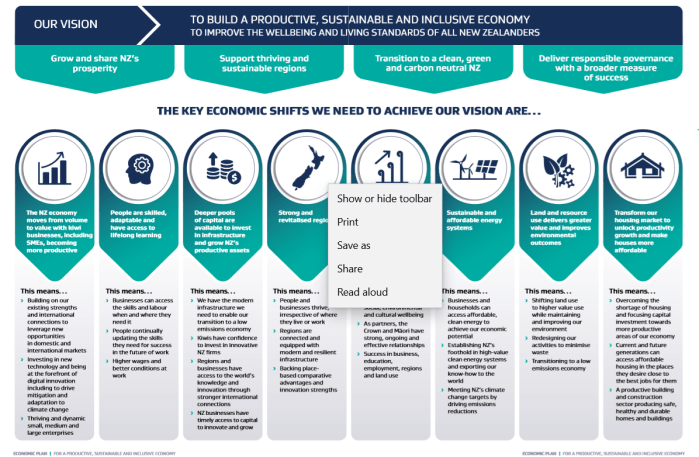
The Government’s Economic Plan is set in the context  of our wellbeing agenda and is designed to build a  more productive, sustainable and inclusive economy  to improve the wellbeing and living standards of  all New Zealanders.

All lines and words we’ve heard endlessly now for two years.   The introduction goes on

The Plan identifies eight key shifts and policy action related to each shift that will tackle the long-term challenges the New Zealand economy is facing. They signal our goal to balance outcomes across financial, human, natural and social capital, and will act as an overarching guide for government departments designing economic policy  [er…don’t elected government’s set economic policy, not government departments?]

These shifts and initiatives will deliver on the four economic priorities in Our Plan: to grow and share  New Zealand’s prosperity, support thriving and sustainable regions, transition to a clean, green and carbon neutral New Zealand and deliver responsible governance with a broader measure of success.

New Zealand has a unique opportunity to build on our strengths, and use these to lead the world on standing up to the economic challenges of the next 30 years, turning issues like climate change and the technological revolution into economic opportunities.

You might have thought that a good place to start would be recognising that we’ve trailed the advanced world for 70 years now, lagging behind on the productivity growth that underpins material standards of living and many other choices, rather than making idle and empty claims about “leading the world” in the next thirty.

Instead, there is the same complacency with which Labour went into the last election

New Zealand is recognised as being one of the best places in the world to live. Wellbeing is high for New Zealanders overall, but the benefits of economic growth have been unevenly distributed.

Nothing wrong with the growth performance really; just a matter of sharing the cake differently.

In fact, they sort of know that isn’t true. Get 10 pages into a glossy 30 page document and you do finally find this

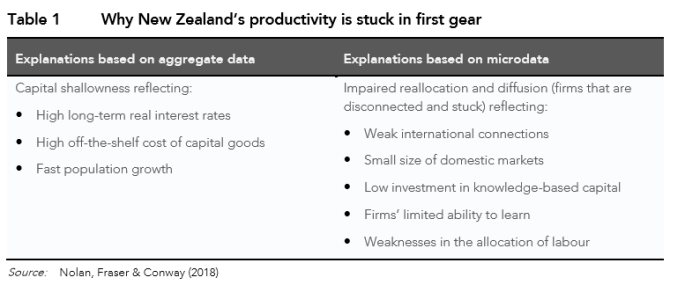
Our productivity challenge is complex and long-standing.

But with no sign that they have any narrative explaining how we found ourselves in this position, or how the grab-bag of initiatives (there were 76 on one table –  including Kiwibuild) they list might make a sustained and significant difference.  (All governments for decades having had long lists – the previous government’s Business Growth Agenda as only the most recent, ineffectual, example.)
economic plan.png

In fact, top of the list of their proposed ways to see economywide productivity lift are yet more plans

Industry Transformation Plans – adding value to  key sectors of our economy and leveraging new opportunities.

Substance-lite.

The standard cliches are trotted out among the glossy photos

New Zealand is a trading nation and we want all  New Zealanders to benefit from trade. We are building stronger international connections so that Kiwi businesses get greater access to markets around the world – not just for goods, services and investments, but also for people and ideas. At the same time, we are supporting businesses to get the most from trade and grow the value and reach of our exports.

And yet, foreign trade (exports and imports) as a share of GDP is less now than it was at the start of the century, but there is no hint that the government (or its advisers) understand why.  No mention of the real exchange rate in the entire document.

And it sort of goes downhill from there.  Predictably, corporate welfare –  aka the Provincial Growth Fund –  tops the list of things that are going to make a favourable long-term difference to regional economies.    The top two initiatives that are supposed to “enable a step change for Maori and Pacific economies” (whatever they are) are

Te Arawhiti – Office for Māori Crown Relations – fostering strong, ongoing and effective relationships with Māori across Government.

Government procurement – working to provide opportunities for Māori and Pacific New Zealand businesses to access contracts from the $41 billion we spend each year in Government procurement.

Both might be sensible steps in their own rights, but they simply aren’t commensurate with the challenge.

And there are old, and still silly, lines

We know that New Zealand’s high house prices have diverted capital into the housing market and away from more productive uses. We need to redirect this capital to help businesses to innovate, invest in new technology and pursue growth opportunities.

I’m not sure how many times one needs to point it out but, given the the population, isn’t the conventional understanding that too few houses have been built, not too many?  More real resources –  on the government’s own original plans (Kiwibuild anyone?) – were supposed to be encouraged towards house-building.  And not a mention of actually getting house prices down again.

In fairness, one might acknowledge that the first item on their housing/productivity page sounds okay

Urban Growth Agenda and RMA reform – working to get our urban markets working so they can respond to growth, improve urban land affordability, and support thriving communities.

The problem is that it sounded good two or three years ago, buried deep in the Labour Party manifesto, and it still does.  But there has been almost no action so far, and no indication in market prices (eg of urban land) to suggest anyone much believes the government will act in ways that make a meaningful difference.

And it all ends with three pages of alternative “wellbeing indicators”, continuing to distract attention away from the decades-long failure on productivity.

There just isn’t much there. And nothing at all, for example, about the inevitable tensions (between, say, zero carbon goals and vague aspirations –  and that is all they are – to higher sustained productivity growth).  But, as ever, MBIE does well with the glossy heartwarming photos (from the family playing cricket on the beach at Sumner onwards).

But the Prime Minister must have wanted to suggest there was something there.   The Herald managed to secure an op-ed from her about the plan, as part of their “Mood of the Boardroom” publication.  Perhaps she didn’t choose the title but it (“My hope: a rising tide that will lift all boats”) didn’t suggest much agency, or hence much responsibility and accountability.

It was pretty vacuous piece, but as ever with her you get the sense that (a) she is more interested in sharing the pie that creating a climate conducive to rapid growth in the size of the (per capita) pie, and (b) that she has only a very limited understanding of the economic issues.  That mightn’t matter much if she had a strong team of senior ministers who did. But there is little or no evidence of that.

A good chunk of the article was devoted to make-believe stuff about just how well the economy is doing at present. Perhaps, knowing no better, she takes lessons from the creativity around the facts on display from the Governor of the Reserve Bank?  She seems unaware that growth has been slowing (from never particularly fast rates), that leading indicators are poor, that productivity growth is almost non-existent, and she continues to parrot lines about how good our growth rates by international standards in ways that simply take no account of the rapid population growth rates here (just this week revealed by SNZ to have been even faster than they previously estimated).  For someone focused on “wellbeing”, you might suppose that recognising that per capita GDP growth counts a lot more than the headline number would be a good first step.  But I guess not.

The underwhelming text continues

We need to invest in infrastructure, because it’s the springboard for future growth. This Government is investing record amounts in hospital and school building programmes, alongside large investments in transport safety, regional roads and public transport

Perhaps you will agree with her on the first sentence (although it is striking how few of the touted projects seem to pass robust cost-benefit assessments), but whatever the merits of building more hospitals and schools those aren’t the sorts of infrastructures likely to make much difference to our woeful productivity performance (there might be other good reasons for such spending).  Same goes for spending on “transport safety” –  it isn’t exactly decongesting bottlenecks is it?  And if you went for congestion pricing, existing infrastructures could be used much more efficiently.

And so it goes on.  What about housing?

We’ll also keep tackling the long-term challenge in housing. Our economy works for everyone only when everyone has a warm, dry home, and a decent standard of living.

Well, no.  A strongly-performing economy helps ensure/enable widely-spread decent standards of living.    And her policy solutions are all about symptoms not causes

That’s why we’ve stopped the state house sell-off, stopped offshore speculators from driving up house prices, and built over 2000 state houses in the last year.

and

Business leaders agree that growth in New Zealand has been predicated too much on capital returns, and not enough on productive investment. To build an economy that works for all of us, we need to focus on productivity and innovation, especially through small businesses.

“Capital returns” sound like good things –  good business make money for their owners –  but I’m guessing she was trying to suggest something about capital gains on property. Except that no serious economic analysis really supports that sort of story –  consumption as a share of GDP, for example, not having changed much for decades.  And where she gets the bit about small businesses being particularly important, goodness only knows. I suppose it sounded good.

The vacuity goes on, limited only by the length of the column.  She talks about how “we’ve always been an exporting economy” and having an “ambitious trade policy” but seems to have no idea that exports/imports as a share of GDP are (a) shrinking, and (b) small for a country our size, and somehow thinks that reforming the polytech sector is going to revitalise our services exports.  Well, maybe…..

I don’t suppose Prime Ministers write this sort of nonsense themselves, but capable governments, really interested in reversing the decades of underperformance, would have a lot more substance to put in the mouths of their leaders.  And capable leaders, with a serious understanding of the issues and imperatives, would simply demand much better.

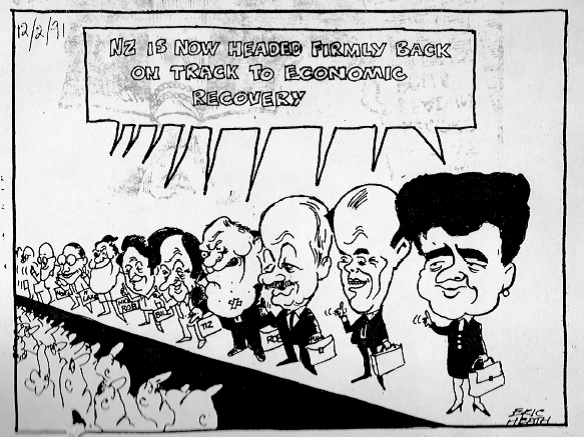
I’ve shown this old cartoon before.
richardson

It ran a generation ago now.

For some years, I had it pinned to the wall in my office –  the sad procession of successive Ministers of Finance who for decades (this cartoon implies back to the 1950s) had promised that New Zealand’s decline would be reversed (made worse in this case in that Ruth Richardson must have said something along these lines in February 1991, just as the severe recession of that year was taking hold).      Since then, we’ve had Bill Birch, Winston Peters, Bill English, Michael Cullen, and Bill English again, and although we’ve had plenty of cyclical ups and downs, never at any time have we looked like successfully or sustainably reversing our relative economic decline.   It saddens me every time I look at this cartoon –  so many decades, so much failure.

And nothing about Jacinda Ardern or Grant Robertson suggests we’ll manage any better if their policies were adopted than we have for the last 30 or 60 years.


Some IMF modelling on NZ

Earlier in the week I wrote about the IMF’s less-than-impressive Article IV report on New Zealand’s economy and economic policy.   As part of the bundle of documents released last Saturday there was the Selected Issues paper – a collection of some supporting research/analysis undertaken by Fund staff to help underpin the Article IV report and Fund surveillance of New Zealand more generally.

On this occasion, there are three such papers.  The one that caught my eye was the first: a modelling exercise under the title

TRADE, NET MIGRATION AND AGRICULTURE: INTERACTIONS BETWEEN EXTERNAL RISKS AND THE NEW ZEALAND ECONOMY

In this paper staff took a Fund model carefully calibrated to capture key features of the New Zealand economy and used it in conjunction with their global model to look at several possible shocks New Zealand might face over the coming years.    There is a piece on possible agricultural shocks (pp19-21) which may interest some readers, but my focus was mostly on the other shocks they studied:

  • a significant growth slowdown in the People’s Republic of China,
  • a significant growth slowdown in Australia, and
  • and a significant (exogenous to New Zealand) change in net migration from (a) the PRC, and (b) separately, from Australia.

They illustrate the estimated transitional effects and report the model estimates for the long-term steady state effects.

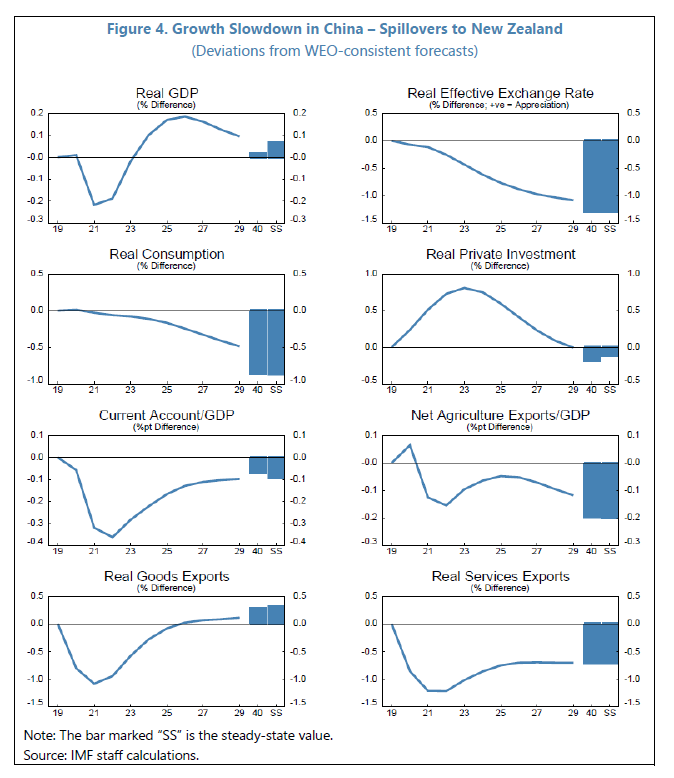
The PRC growth shock involves (mainly) materially slower productivity in China, such that 10 years hence PRC GDP is 11.9 per cent lower than the (WEO forecast) baseline.  You’ll have heard New Zealand politicians and other lackeys parrot lines about how New Zealand depends heavily on the PRC for its prosperity etc.  The IMF modellers are having none of it.  Here are the New Zealand economy responses (quarters along the horizontal axis).

sel issues 1.png

On this model, a 12 per cent lower level of GDP in China –  largest trading partner, first or second largest economy in the world –  leaves New Zealand…….every so slightly better off in the long run (but treat that as basically zero).  Oh well, never mind…..I don’t suppose it will stop the lackeys doing their thing, but it is a helpful reminder that, to a first approximation, countries make their own prosperity.

The scenario of an adverse growth shock in Australia is of similar magnitude (Australia’s GDP is 9.3 per cent lower than otherwise in the long-term.  I won’t clutter up the post with the same set of charts for the Australia shock, but suffice to say that the bottom-line results aren’t that different.  This time, a 9.3 per cent sustained fall in GDP in the economy that is our second largest trading partner and largest (stock) source of foreign investment is estimated to reduce New Zealand long-run GDP, but by only 0.03 per cent.  I’d treat that as zero as well.  In both cases, a lower real exchange rate is part of the way the New Zealand economy adjusts, so consumption here is a touch lower (it is relatively more expensive) but overall real incomes generated in New Zealand (GDP) are all but unchanged.

That was interesting, but not really that surprising (in truth, even I might have expected a slightly larger adverse effect).   It was the migration shocks, and the Fund’s modelling of those, which should really garner more interest and scrutiny.  Note that these results have already had bureaucratic scrutiny: the paper notes that

The chapter benefited from valuable comments by the Treasury of New Zealand and participants at a joint Treasury and Reserve Bank of New Zealand seminar.

Both institutions have some smart and critical people.

Here is the shock re PRC immigration

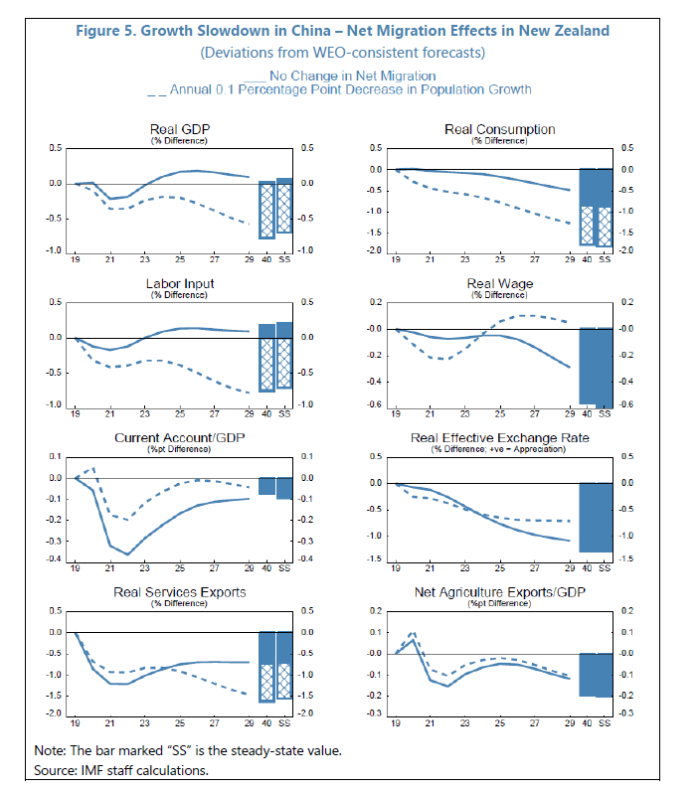
Additional Net Migration Effect in New Zealand. There are permanently fewer migrants to New Zealand from China. There is a 0.1 percent reduction in labor force growth for 10 years in New Zealand, so that the New Zealand population is permanently 1.0 percent lower.

This shock is added to the PRC growth slowdown shock illustrated earlier.  As the Fund’s model is calibrated, these are the results.  The additional effect of the migration shock is the difference between the two lines in each panel.

sel issues 2

The Fund writes these results up as “a bad thing”

The fall in net migration would exacerbate the negative spillovers to New Zealand
from China. Real GDP would now be 0.7 percent lower than baseline in the long term.

Which is true, of course, on their model.  But, strangely, not once in the entire paper do they mention per capita GDP.  The population in the long-run is 1 per cent lower, but GDP is only 0.7 per cent lower, implying that GDP per capita is 0.3 per cent higher in this “Chinese migration shock” scenario than in the baseline scenario.  That sounds like a good thing, for New Zealanders, not a bad thing, at least in the longer-term.  (Since labour input and GDP both fall by the same amount, it doesn’t look as if this model can deal with endogeous changes in productivity).  For what it is worth, real wages in New Zealand are also higher in this scenario.)

What about the Australian net migration shock?

Additional Net Migration Effect in New Zealand. There are permanently more migrants to New Zealand from Australia. There is a 0.26 percent increase in labor force growth for 10 years in New Zealand, so that the New Zealand population is permanently 2.6 percent higher.

Again, this shock is on top of the sustained slowdown in Australian growth modelled earlier (and thus is probably best thought of as a reduction in the net outflow of New Zealanders to Australia, the income gap having changed a bit in our favour).   Here is the chart of those results.

sel issues 3.png

In sum, the population is 2.6 per cent higher in the long-run and GDP is 2 per cent higher.   The Fund again spins this as a positive story (it appears under the heading “How Net Migration Could Improve Outcomes for New Zealand”) but again completely overlook the per capita story.  In this scenario, real GDP per capita is 0.6 per cent lower than in the baseline.  New Zealanders are poorer (and in the long-run real wages in New Zealand are lower).  It isn’t even as if there is much of a short-term vs long-term story (the GDP effects just build pretty steadily over the 10 year horizon).

These effects become large if you apply them to the scale of the non-citizen migration we’ve had in New Zealand in recent decades.  Cumulatively, they would not be out of line with the observed slippage in New Zealand productivity relative to other advanced countries over that period.

So the headline out of this particular paper should really be “additional migration makes New Zealanders poorer in the long-run, at least according to IMF modelling”, not stuff about how helpful immigration is.  A focus on GDP might make sense if you are building an army (raw numbers matter) or to silly comparisons politicians make.  Other people know that per capita GDP is much the more important variable, relevant to material living standards etc.  On its better days I’m sure the IMF knows that too.

In a way, even in their report on New Zealand the IMF shows glimpses of recognising that high rates of immigration might not be so good for New Zealand (whatever the possible benefits in some other places).  Both in the main Article IV document and in the Selected Issues paper “a remote location” comes first in the list of factors the Fund identifies as constraining New Zealand productivity.  Combine that glimmer of recognition (and I could also recommend to them this piece) with their own published model results suggesting that, at the margin, immigration makes New Zealanders poorer –  recall that this model is calibrated by the Fund to capture what they see as key features of the New Zealand economy) –  and it might have pointed disinterested observers towards suggesting to New Zealand governments that they consider rethinking their enthusiasm for such high (globally unusual) rates of immigration to a relatively unpropitious location.   Instead of which, the Fund (like the OECD) tends to act as cheerleaders for New Zealand immigration policy.

The IMF, of course, is not a disinterested observer.   It knows little distinctive about New Zealand – and New Zealand’s productivity performance has long been an awkwardness, even a bit of an embarrassment, for the international economic agencies.  And it is a global champion of the idea that immigration is good and more immigration is better.  If you think that an unfair characterisation, check out this post (and this more NZ focused) where I unpicked parts of an official IMF paper which purported to show that

If this model was truly well-specified and catching something structural it seems to be saying that if 20 per cent of France’s population moved to Britain and 20 per cent of Britain’s population moved to France (which would give both countries migrant population shares similar to Australia’s), real GDP per capita in both countries would rise by around 40 per cent in the long term.  Denmark and Finland could close most of the GDP per capita gap to oil-rich Norway simply by making the same sort of swap.    It simply doesn’t ring true –  and these for hypothetical migrations involving populations that are more educated, and more attuned to market economies and their institutions, than the typical migrant to advanced countries.

What do I actually make of the latest IMF paper?  Not that much to be honest.  I’m sure the authors could probably play around with their model – it is calibrated rather than estimated –  to produce results more suitable to the causes of their masters in Washington.  And since productivity isn’t affected, one way or another, by immigration in this model, I’m certainly not attempting to suggest that these results are somehow reflective of the sorts of channels and models I’ve been championing as central to the New Zealand story.

But when even the champions of high immigration to New Zealand acknowledge that there is not much (any?) New Zealand specific research showing that high rates of immigration to New Zealand, in New Zealand’s specific circumstances (eg remoteness, resource endowments, institutions etc) has been beneficial to New Zealanders over recent decades, it should be a little uncomfortable for the officials and politicians who champion the status quo that one of the leading internation economic agencies, pretty sympathetic to their approach, nevertheless (and without really trying) manage to produce research once again casting doubt on whether on this central tool of economic policy –  probably the biggest structural intervention our governments have done over the last 25 years –  is really working for New Zealanders.

Perhaps someone might ask the Prime Minister or the Leader of the Opposition why they act as if they are so convinced that on this count the IMF is wrong.  (Oh, and they might stop parroting the “our prosperity depends on China” line too.  IMF modelling confirms (common sense) that it simply doesn’t.)


Productivity growth across countries across time

This tweet caught my eye this morning.

The chart is from the latest weekly column from Martin Wolf, the economics columnist for the Financial Times.   It is a sobering reminder of what has been happening among economies rather nearer the frontier: productivity growth recently isn’t what it once was (even if the 50s and 60s are hardly representative historical decades).

But, of course, my main interest is in New Zealand.  And for OECD countries I prefer to use OECD data (which go back only to 1970).    Here is what a similar version of the chart above looks like using OECD data and adding Australia, Canada and New Zealand.   As with the chart above, I’ve ordered the countries from high to low based on average productivity growth in the most recent period (in this case, the last five years).

Real GDP phw OECD

In that most recent period (and, actually, for this decade as a whole) France has had the fastest productivity growth –  not something I’d have guessed –  and New Zealand brings up last place.  It isn’t that the green bar is missing for New Zealand, just that the average annual growth rate on this measure was 0.0 per cent. (Using my preferred measure of labour productivity growth, updated to include this morning’s release we do a little better for the last five years –  we come second to last (ahead of Italy) instead.)

And, of course, the pattern for New Zealand is a little different because we had that truly dreadful decade in the 1970s, when our productivity growth was clearly the worst in the entire OECD.

But here is how we’ve done simply relative to the G7 group as a whole.

NZ and G7 gdp phw

In not a single period has our productivity growth rate matched that of the G7 grouping as a whole.  We came close in the 1980s, but couldn’t match those leading industrial countries even then.  (And for the most recent period that conclusion holds even if use my preferred measure of New Zealand labour productivity.)   And whereas back in 1970, the level of labour productivity in New Zealand was very similar to that for the OECD as a whole, those growth differences cumulate, and now the G7 group has labour productivity just over 50 per cent higher than that in New Zealand.

Is something better possible?   Well, there is a loose relationship suggesting (as one might expect) that countries that had a lower starting level of labour productivity were also those with relatively faster productivity growth in recent years.  Catch-up can and does occur.   There were 10 OECD countries –  more than a quarter of the membership –  which had faster productivity growth than France over the last five years, often materially faster.    All of them were small.

That could have been New Zealand too –  after all, we now start so far behind the leading bunch –  but policy choices by successive governments (much the same regardless of which party occupies the 9th floor of the Beehive) meant it wasn’t so, and left us vying with places like Italy, Portugal and Greece (even the UK) for the unwanted poor performer award.


National on the economy

On Monday the National Party released their “The Economy” discussion document, the latest in a series of such documents they’ve published in recent months as they move towards setting policy for next year’s election.    The documents actively invite feedback, and if one should be sceptical of crowd-sourcing policy programmes mostly it seems like a worthwhile initiative.

A few weeks ago I was quite critical after Simon Bridges’s conference speech about the apparent lack of recognition of the structural failings of the New Zealand economy, let alone of any hint of a serious strategy that might reverse the decades of underperformance.

But, for all the almost ritualised mentions in Simon Bridges’s speech of the importance of a strong economy (even the Prime Minister mouths those sorts of line from time to time), there was nothing –  not a word –  to suggest that he recognises that the biggest obstacle to higher material living standards (whether in the form of cancer care or other public or private goods and services) is the woeful productivity record that successive governments –  led only by National and Labour –  have presided over.    There is plenty of talk about cyclical issues, but nothing about the structural failures, and nothing about what National might do that would conceivably make a real difference in reversing that performance.

Sure, it wasn’t primarily a speech about economics, but there has been nothing from Bridges or his colleagues elsewhere, and no hint of a recognition here, that much-improved productivity performance is the only sustainable path to much better material living standards.  And not a hint of a recognition that these failures were already well apparent in the government in which he served (latterly as Minister of Economic Development)

I went on to note that National appeared to be glossing over the fairly woeful overseas trade performance: exports and imports have been shrinking as a share of GDP.

I’m much less critical of the discussion document.   This line appeared on the first page, the leader’s own statement

New Zealanders’ productivity and income levels have fallen behind countries we once had similar income levels to, like Australia, the United States and leading European economies.

And from Paul Goldsmith’s opening

Improving productivity remains New Zealand’s most important economic challenge and the ideas discussed in this paper provide ways to meet that challenge, with the goal of raising incomes for all New Zealanders.

National understands that significantly lifting productivity is the only way to materially improve New Zealanders’ living standards. Increasing productivity means we can produce and sell more of what the world wants, at better prices, using fewer resources.

Good stuff.  And he goes on

New Zealanders’ living standards will not improve by simply redistributing what we
already have. Instead, we need to be absolutely focused on lifting New Zealand’s relatively weak productivity levels.

and

New Zealand’s core economic challenge is to lift our relatively weak productivity. To do that, our economy needs to become more internationally competitive. The world does not owe us a living. We are a small, isolated country far from global markets, which creates both opportunities and challenges.

and

The only way to materially improve the living standards of New Zealanders over time is to become more productive. Higher productivity means more in the back pockets of New Zealand families. New Zealand’s productivity is a more productive and competitive economy that lifts household incomes approximately 30 per cent below the top half of the OECD and 25 per cent below Australia.  New Zealanders also work more hours a year than any countries in the top half of the OECD. In 2017, for example, workers in Denmark, Germany, the Netherlands and Norway worked 300 hours less than New Zealanders.

Since the late 1990s, New Zealand’s productivity growth rates have been similar to that of the top half of the OECD. We need to be doing better to catch up and close the gap. That’s hard. It requires a relentless focus on productivity growth.

National is ambitious for New Zealanders and believes we should target higher rates of productivity in order to close the income gap with countries like Australia, the United States, Canada and leading European economies.

There was even talk of adopting a productivity growth target.

On foreign trade, we read this

New Zealand is a small country with a domestic market of only about five million people – so we depend on trade for generating greater prosperity. Trade supports over 600,000 jobs across our country, and is responsible for a higher standard of living and better quality of life for New Zealanders.

However, New Zealand has a relatively low exports-to-GDP ratio compared with other small, advanced economies. Lifting our exports will take further improvement but create new jobs and raise incomes.

So the rhetoric and some of the framing isn’t bad at all.    They could have made the same points even more brutally:

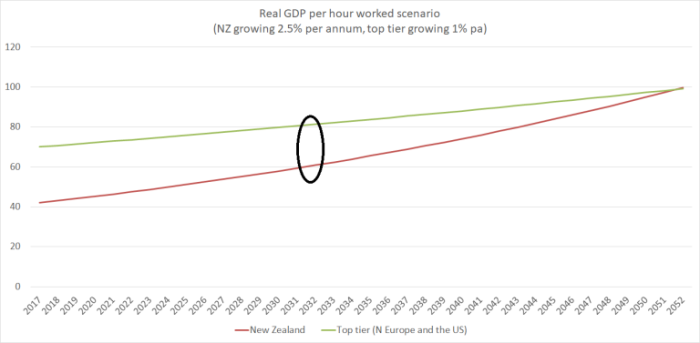
  • relative to the top tier of OECD countries (US, and leading half-dozen north European economies), productivity (real GDP per hour worked) has kept on slipping (in the last 25 years, productivity here has fallen from around 65 per cent to 60 per cent of those in the top-tier OECD countries while in, for example, Poland it has risen from around 30 per cent to around 55 per cent),
  • New Zealand has managed hardly any productivity growth at all over the last five years, and
  • not only are foreign trade shares (exports and imports) low for a country our size, but they’ve been shrinking.

But even if Simon Bridges in his introduction did note of the previous government “we didn’t everything right”, to have done so might have prompted too many hard questions about National’s own record.

What of the policy proposals and ideas?

I found a reasonable amount to like:

  • they haven’t fixed on a public debt target yet, but I liked the articulation of the flow fiscal goal (“Governments should aim for balanced budgets over time, so that surpluses in the good times offset the bad times”).  With little evidence of an overheating economy at present, that should have them arguing for a balanced budget now, not for surpluses,
  • I was pleasantly surprised that they remain committed to lifting the NZS eligibility age, and to introducing a somewhat more demanding residence requirement.    They should have gone further on both fronts (my thoughts on NZS here) –  said from the perspective of a household where my wife is 10 years younger than I am and still won’t be affected by National’s proposed change.  But we should be thankful for small mercies: on this issue, National has moved decisively on from the Key irresponsibility.
  • I like the idea they are toying with of adjusting for inflation the interest earnings and interest payments that are tax assessable/deductible.   Various people, including at times the Reserve Bank, have argued for this for years.  It is just and right to do so, but……there isn’t that much in the issue.
  • I like the mention of possibly using congestion pricing on some parts of the roading system.
  • I am encouraged that they are willing to think seriously about the possibility of lowering the company tax rate (although disquieted by talk of favouring small businesses through the tax system).  That said, given our imputation system, a lower company tax rate benefits foreign investors (we would generally benefit from more of such investment), and if they are serious about addressing this issue –  and productivity growth –  substantively then they need to think about options for lowering the taxation of capital income earned by New Zealanders as well.  Whether they have the political skills to manage the narrative around that sort of proposal is, at very least, an open question.
  • The talk –  not specific in this document –  of a proper overhaul of the RMA and serious liberalisation of the urban land market is encouraging.  The ability of the next generation to afford decent houses (and gardens etc –  the sort of place most New Zealanders seem to want) depends on it.
  • And I like the idea of a much tougher approach to new regulation, and some sort of commitment to reducing the overall volume of economic regulation.  On that count, I like the (adopted first in parts of Canada) idea of eliminating two old regulations for each new regulation (ie a shrinking cap on the volume of regulation itself).   There are risks around such an approach once it in turn becomes bureaucratised –  ministers and bureaucrats will game the system skilfully, so it would need serious leadership from the top, and sustained follow-through –  but for now the value is in the signal it sends.

And there is other stuff I like, often undoing bad calls by the current government (eg the ban on new oil and gas exploration and the planned labour reforms  – I found this note valuable on the latter).  There was even talk of possibly unilaterally lifting all remaining New Zealand tariffs, recognising that tariffs tax New Zealanders.

They were even surprisingly muted on immigration.  I thought this line from early in the document was quite cleverly drafted, with the focus on creating a climate in which New Zealanders no longer want to leave permanently.

New Zealand is also competing with the rest of the world for skills. If we aren’t internationally competitive our best and brightest leave for overseas and our living standards worsen relative to the rest of the world.

And if I disagree, quite firmly, with their paragraph on immigration itself  – after all, we have one of the highest levels of workforce skills among natives of any OECD country

Immigration can help to deliver a more skilled and willing workforce. National understands the benefits of sound immigration policy from an economic, social and cultural perspective. The skilled migrant levels should match industry needs and the administration of visas needs to be prompt and predictable. New Zealanders must be at the front of the queue for the jobs created by our growing and changing economy, but immigration will remain an important complement to that growth.

at least the “critical economic enabler” gung-ho rhetoric is gone, and this paragraph is a long way down the document.

Of course, there is other stuff I didn’t like.    Their section on regional development is about as devoid of a serious framework –  real exchange rate anyone? –  as anything from Shane Jones.  They still seem enamoured of big taxpayer subsidies to “glamour” industries (screen grants), and when they talk of privatisation it is never about efficiency or competition or accountability or things like that, but rather silly arguments about freeing up cash to spend on other things (when, as they know, the Budget is in surplus and the debt is low).   And they seem tantalised by the idea of more infrastructure spending without offering much assurance that the sort of schemes they might proceed with would be any better –  in economic return terms – than those of the previous National government.   Perhaps I’ve mentioned that there was next to no productivity growth economywide over the last five years or so?

But when I got to the end of the document, I guess my overriding reaction was a bit similar to my reflections on the reports of the 2025 Taskforce (the body set up by the previous National government to provide analysis and recommendations on closing the income and productivity growth gaps to Australia  –  by 2025, a date that mocks us now).  I had quite a lot of involvement in that process, and largely wrote the first report.  I also largely agreed with most of the recommendations the Taskforce themselves made –  very few of which were ever adopted.   And yet, as I reflected on the report in the months after it was released, I became increasingly convinced that, sensible as many/most of the recommendations were, they weren’t enough to make a decisive break in New Zealand’s economic and productivity performance.  Some important things were missing (although at the time I wasn’t really clear, even in my own mind, what they were).

Quite a few of things National is proposing look sensible. The general direction looks sensible.   The rhetoric is better than it was –  although, by itself, such rhetoric is cheap, and is the sort of thing most Oppositions for 25 years have eventually come round to saying.  But the scale of the policy response they are talking about is simply incommensurate to the scale of the problem (much of the policy mix they are suggesting is carrying on a broad approach they adopted in government, and productivity growth was very disappointing then).  For New Zealand average labour productivity to match that in top-tier OECD countries would require a 60 per cent lift from where we are.    That is simply huge.  Huge problems are rarely successfully answered with small changes (even a succession of them).

And so my challenge to National is along the lines of that the rhetoric is great, and I hope it reflects a shared sense that New Zealand’s long-term economic performance really is deeply disappointing, and has not sustainably improved –  relative to other advanced countries –  for any prolonged period for many decades now.  As they say, that has real implications for us, our children and our grandchildren, for the material living standards –  and public and private services –  we can achieve for the population as a whole.

But if you are serious, and you really mean what you say – all those good quotes I posted earlier –  you need to keep thinking harder, digging deeply, consulting broadly and testing and evaluating the proposals and analysis put to you.   Great ambitions need to be matched by excellent analysis, courageous policy, and skilful management of the political challenges.   Perhaps for many in the National caucus, winning the next election is all that matter, but I’d urge the party, and its members, not to focus on the small ambitions, but on the really big challenge that, successfully confronted, would so much transform New Zealand for the better, for almost all New Zealanders.

A good time to invest?

A day or two ago I started reading a new book on, among other things, the decline in trust in “experts” that is said to increasingly pervade Western societies.  I’ve written previously about my scepticism that supposed experts are people we should repose much trust in, on things other than the most narrowly technical matters.  I want an expert carrying any surgery I or my family need and when, for example, it comes to house renovations

A good architect, and capable expert builders and other tradespeople, can together enable an outcome that I couldn’t deliver myself. Most of us need, and value, expert advice, and expert execution, but the decision to renovate the house, and how far to go, is the customer’s. It is about choices and preferences on the one hand, and advice from experts who actually usually know what they are doing on the other.

It isn’t clear to me that there are very many areas of public policy where arrangements should be much different.

And I often wonder just how much real expertise –  on matters beyond the most narrowly techical – can be found in most of the public sector agencies in which some encourage us to place our trust.   The Governor of the Reserve Bank is one of those figures in whom the law places a great deal of power.   Doubts about whether that is a wise choice, at least about the incumbent, were given further fuel by his performance on TVNZ’s Q&A last night.

I don’t have the time today to unpick it all, including his continued claim that fiscal policy is adding to demand/activity, when The Treasury’s fiscal impulse measure suggests it isn’t (all that has happend in the Budget update numbers is that fiscal policy is now estimated to have roughly a zero effect on demand over the next few years, rather than the slight drag previously projected).  Orr seems to be champing at the bit to have the government spend more –  especially capital spending – but he was careful and never quite said so last night.

Where he is much less careful is around investment more generally.    Last night he followed up from his claim at last week’s press conference that the country was in a great condition, with the renewed suggestion that now was a wonderful time to invest, that businesses need to “keep going” on investing, and that it was hard to be nervous about investing with such low risk-free interest rates and (so he asserted) such low hurdle rates of return.  (Doesn’t he follow the world news?)    This wasn’t just so in New Zealand apparently: there were global “infrastructure deficits” and generational opportunities.  Closer to home his extraordinary assertion was the New Zealand had only “quality problems” –  the bizarre line John Key used to use about Auckland’s housing and transport problems.

You really have to wonder what insight the Governor thinks he is blessed with that eludes people in the private sector and in government, here and abroad.   It isn’t as if he offers us a detailed piece of argumentation and analysis in support of his story.  It seems to be mostly just handwaving and wishful thinking.   Not exactly a sound basis for policy, or for encouraging us to put any trust in him.

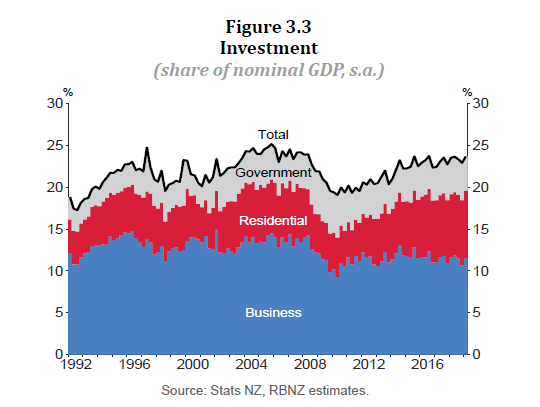
In writing about the MPS last week, I reproduced one of the Bank’s own charts about investment.

bus investment RB

Business investment –  in blue –  has been fairly weak and (if anything) weakening further.  It is not just some sort for post-election blues, businesses not liking having Labour and the Greens in office.  The picture is pretty consistent for years now.   Which suggests it might be reasonable to suppose that people who own,  or are considering starting, businesses have been making rational choices, with the information available to them, about the prospects for investment in New Zealand.  In sum, not particularly good –  and this despite the considerable boost to demand (and need for domestic buildings etc) that a big unexpected shock to the population will have given rise to.

Consistent with that, the Governor may not be aware that productivity growth in New Zealand has also been lousy for years now –  almost non-existent in the last few.  Profitability and productivity are not, at all, the same thing, but they often go hand in hand –  great opportunities, offering high returns to shareholders, are often ones that will tend to lift the overall productivity of the economy.  New productivity opportunities are often only realised through a new wave of investment (which firms will only undertake if they expect those projects to be profitable).

And we could add to the list of symptoms –  perhaps the Governor also counts them as “quality problems” –  things like a tradables sector that has been going sideways, exports as a share of GDP not rebounding at all, the failure of the government to do anything material to fix the housing market, high corporate tax rates, and a range of actual or looming regulatory restrictions on investment opportunities in New Zealand.   Not the sort of things most people would call “quality problems”.

Of course, the Governor is particularly keen on more public capital spending –  infrastructure.   But, here again, if the opportunities were so great, the numbers would be likely to speak for themselves –  really high benefit/cost ratios showing up when projects are evaluated.  Perhaps the Governor is privy to such estimates, but the rest of us are not so favoured.  Too many of the projects that do go ahead seem like borderline cases at best.

Much of any reasoning the lies behind the Governor’s claims seems to rest on little more than the fact that interest rates are low. But in and of itself, that tells us almost nothing.  After all, interest rates are (very) low for a reason, and as I noted in my post yesterday no one –  including the Reserve Bank, at least based on anything they’ve shown or told us –  has a compelling story about just what is going on and why.   But the revealed behaviour of firms doesn’t suggest they’ve seen it as some windfall that means it is a great time to invest –  with perhaps the only challenge being which of the abundance of riches of possible high-yielding projects one might tackle first.

Out of interest I had a look at other advanced countries.  After all, these extraordinarily low interest rates prevail across almost all of the advanced world (and, as I’ve noted previously, implied forward rates are still higher here than in most countries).  The IMF has data on total investment as a share of GDP for a group of 30+ advanced economies.  In all of them, real and nominal interest rates are (of course) far lower than they were in, say, the 2000s prior to the 2008/09 recession.   Notwithstanding that, for the median of these 35 advanced countries, investment as a share of GDP last year was 2.7 percentage points of GDP lower than it just prior to the crisis/recession.   That is a significant reduction, despite the wonderful investment climate the Governor blithely talks of, in which it would be hard for anyone to be nervous about investing.   Only four of the 35 countries had investment now higher than it was then (Sweden, Norway, Germany, and Austria –  only Sweden more than 1 percentage point of GDP higher).

Now, these IMF numbers are total investment not business investment, and I don’t have the time today to recalculate the business investment numbers (for OECD countries), but it isn’t a picture that suggests that most people actually making investment choices share the blithe optimism of the Governor.   It isn’t particularly confidence-inspiring, or suggestive that he knows much on this topic on which he opines so often.

He could, of course, be right.  Perhaps there really are opportunities just left on the table, even though they offer high returns and/or modest risk.  If so, the market is open.  There is nothing to stop the Governor handing over the reins at the Reserve Bank and seeking an appointment as a private sector CEO, or indeed attracting capital from new investors to start his own enterprise.

I imagine most people will be content to respect the wisdom of crowds –  without necessarily fully understanding it –  and to conclude that when investment has been sluggish for years, even as aggregate demand is ok, labour is fairly fully-employed, and credit conditions haven’t been overly constraining that, despite the very low interest rates, there are huge numbers of attractive propositions going begging because people with their own money at stake aren’t persuaded by the Governor’s rhetoric.

We have very serious economic problems in New Zealand.  They aren’t being addressed by our politicians or our officials, and the Governor seems more interesting in playing distraction, whistling to keep spirits up, than getting to the bottom of those really serious and longrunning economic failures.    Fortunately, in his current role the Governor has almost no say over investment –  other than to opine –  but the lightweight rhetoric does nothing to instill confidence about his handling of those areas where he has great (and excessive) power: bank capital for example.

On other matters, an unexpected family death means I’ll be in Christchurch for the next few days and there won’t be any more posts until Monday.


Wages have risen faster than output per hour

I have a few other things on my plate today, but I thought I’d just share this update to a chart I’ve run before, showing wage growth (using the LCI analytical unadjusted measure for the private sector) relative to growth in nominal GDP per hour worked.

GDP and wages aug 19.png

When the line is moving upwards, private sector wage rates have been rising faster than nominal GDP per hour worked.  Growth in nominal GDP per hour work can be loosely conceptualised as some measure of the economy’s capacity to pay (average overall domestic production is rising that rapidly, leaving to be resolved the extent to which those gains –  whether from the terms of trade, productivity, or just general inflation –  end up going to labour or capital).

The reason the chart has tantalised me since I first stumbled across the idea of constructing it a couple of years ago, is (of course) that private sector wages in New Zealand do seem to have been rising faster than “the capacity of the economy to pay”.  It has happened in fits and starts, and there is a fair bit of noise in the data, but the trend since about 2001 has been pretty clearly upwards.   (The wages data released this morning give us June quarter numbers for the numerator, and hours worked data, and here I’ve assumed nominal GDP rose 1 per cent in the June quarter.)   The cumulative difference over time –  around 15 per cent now –  is not small.

As a reminder, here is the comparable chart for Australia, which I included in a post last week.

wages in aus

The New Zealand numbers do not, repeat not, suggest that people are in some sense overpaid in New Zealand.  Mostly, wage rates are a market outcome (firms and employees, and the respective opportunities etc), and although policy initiatives like pay equity settlements and large minimum wage increases have boosted the New Zealand line in the last few years, those specific measures don’t explain the longer-term trend to anything like the full extent.

The New Zealand numbers also don’t suggest that New Zealand workers are doing particularly well in an absolute sense.  They aren’t.   New Zealand incomes lag well behind those in leading advanced countries.  But although wages can and do wander away from aggregate economywide productivity for a time, in the longer-term only productivity growth can really underpin a closing of those wage/income gaps.  As I’ve highlighted here before, it would take productivity increases of about 60 per cent here to match the leading OECD bunch.  And we’ve had virtually no productivity growth at all in recent years.   All the data is saying is that workers haven’t done too badly given a badly-performing economy: little or no productivity growth and fairly stable terms of trade.

But most people would still have been better off had we actually managed decent productivity growth, and if the economy were not so badly skewed as to have a substantially overvalued exchange rate and, in association with that, non-tradables sectors doing well, but tradables sectors as a whole typically doing poorly.   Reasonably strong domestic demand can result in high demand for labour, and higher wage rates.  But the associated overvalued real exchange rate deters (crowds out) the sort of investment in internationally competitive industries that might have allowed real productivity gains to have been achieved.

On which note, I’ll end with the OECD’s real exchange rate measure for New Zealand, calculated using relative unit labour costs (ie wages adjusted for productivity).

rel ULcs.png

The orange line is the average for the last 15 years:  far higher than for any sustained period in the history of the series, even as our productivity performance has remained pretty woeful.  And, of course, at the end of the period the series is above even that fifteen-year average.

Emissions and immigration policy

Just listened to an RNZ interview with National’s climate change spokesman Todd Muller, around the silly question of whether or not a “climate emergency” should be declared.  Muller called it symbolism, but symbols have a place –  it is much worse than that, just empty feel-good virtue signalling  (whether or not you think our governments should be more aggressive in doing something to lower New Zealand emissions).

But Muller introduced his comments referring back to a sense as early as 1990 that something needed to be done.  And it reminded me of the single worst policy National and Labour have presided over for the last 30 years, in terms of boosting emissions from New Zealand: immigration policy.

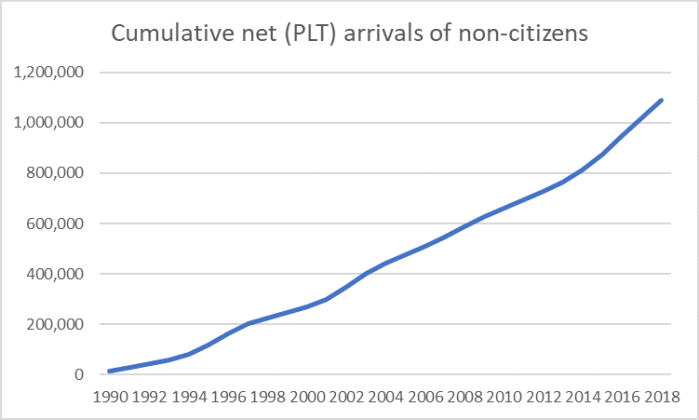
New Zealand’s population in 1990 was about 3.3 million.  Today it is almost five million.  And here is a chart, using official data (which has some weaknesses, but the broad picture is reliable) of the cumulative inflow of non-New Zealand citizens since 1990.

PLT 2019

That data series was dumped last year, but you can add another 60000 or so people in the year since then.    Almost all of them needed explicit prior approval from New Zealand governments –  more than 1.1 million of them.

Over such a long period, the cumulative inflow becomes a little misleading.   It understates the impact.  Of course, over 30 years some of the migrants will have died, but many more will have had children (or even grandchildren).  Those children will (mostly) be New Zealand citizens, but that doesn’t change the fact that their presence –  and their emissions (resulting from their life and economic activity) – results from explicit immigration policy choices.

Those who are made uncomfortable by all this but simply wish to dismiss it will say “oh, but emissions and climate change are a global problem, and it doesn’t really matter where the people are”.  Strangely, this is not usually an argument the same people invoke when they favour (say) New Zealand oil and gas exploration bans, or other New Zealand specific actions that will have either no impact on global emissions, or only a trivial impact.

As you will no doubt recall, it is not as if New Zealand is already some low-emissions nirvana.  Per unit of GDP (average) emissions in New Zealand are among the very highest, and per capita (average) emissions are also in the top handful of OECD countries.    The typical migrant to New Zealand is not coming from a country that has higher emissions than we do.    Rather the reverse.  Of course, it isn’t easy to distinguish (empirically) the marginal and average emissions, but it is simply silly to suggest that the policy-driven rapid population growth has not had a material impact in boosting total New Zealand emissions –  migrants drive cars and fly, migrants live and work in buildings (that often use concrete), migrants have even helped maintain the economics of the dairy industry.  On a cross-country basis, I showed in an earlier post the largely unsurprising relationship betwen population growth and change in emissions over decades.  New Zealand’s experience was not an outlier (except perhaps in the sense of much faster –  policy-driven –  population growth, reflected in the emissions growth numbers.  If anything, and at the margin, New Zealand’s immigration policy has probably increased global emissions.

Of course, there would be a reasonable counter-argument to all this if it could be confidently shown that the high rates of immigration –  highest in the OECD for planned immigration of non-citizens over the period since, say, 1990 – had substantially boosted average productivity in New Zealand.  Then the additional emissions, and associated abatement costs (not small), would simply have to be weighed against the permanent gains in material living standards from the immigration itself.  But even the staunchest defenders of high –  or higher still – rates of immigration can’t show those sorts of productivity gains and (since demonstrating it would be a tall order) can’t even come up with a compelling narrative in which large productivity gains from immigration go hand in hand with the continued decline in our productivity performance relative to other advanced economies.

If the government (or the National Party) were serious about “doing our bit” (or just “being seen to do our bit”) about emissions and climate change, and if –  at the same time –  they really cared much about living standards of New Zealanders (‘wellbeing’ if you must), they would be taking immediate steps to cut permanent immigration approvals very substantially.  Not only would that lower population growth and emissions growth relatively directly, but it would result in a materially lower real exchange rate, which would greatly ease the burden on competitiveness that other anti-emissions measures are likely to impose over the next few years, would ease pressures on the domestic environment (and might even, thinking of my post earlier this week, ease the economic pressures on the dairy industry, while providing margins to deal directly with the environmental issues around that industry).

For the country as a whole –  New Zealanders –  it would be a win-win.   That isn’t to pretend there would not be some individual losers –  we’d need fewer houses, potentially developable land would be less valuable, and some industries (particularly non-tradables ones) that have come to rely on migrant labour would face some adjustments.  But, and lets face it, there is no sign the existing model –  in place in some form or another for several decades –  has worked well for the average New Zealander –  the productivity performance has been lamentable, and we’ve created a large rod for our own back on the emissions front.

But our political parties – every single one in Parliament, based on words and on their records in government –  would prefer to pretend otherwise, and keep on with the failed, corrosive, immigration policy, which hasn’t worked for us, is unlikely to ever do so (given our remoteness etc) and is so far out of step with what the bulk of advanced countries do.


40 years on

The almost-always-upbeat Herald “Business Editor at Large” Liam Dann had a column yesterday reflecting on the changes in the New Zealand economy  in the 30 years since he was studying 7th form economics in 1989.  “Studying” may be an overly generous term here: in Dann’s words

Let’s ignore the fact that I was a distracted surfer with a bad blonde haircut, prone to sitting with the most disruptive kids in the room.

As it happens, it is 40 years since I was studying 7th form economics (I was the nerdy kid).

In the 30 years since Dann’s 7th form economics teacher was bemoaning all that was wrong with the New Zealand economy then, inflation has come down, the unemployment rate is lower, and governments normally aim to run operating surpluses. We were in the middle of an extensive economic restructuring back then, and the full aftermath of the massive credit and asset price boom of the previous handful of years was just about to be felt (DFC, for example, failed in late 1989, while the second BNZ crisis was still another year away).    Net public debt in 1989 was about 40 per cent of GDP  –  not disastrous, but far from good either –  but (little recognised at the time or later) the government was already running primary surpluses (ie deficits were mostly financing costs, the real consequences of which were, in turn, overstated by the effects of inflation).

But I wondered how the comparisons looked with 1979, my 7th form year.   Inflation in 1979 had been even worse than it was by 1989 (when we were already well on the way to getting back to something like price stability), but on the other hand the unemployment rate in 1979 is estimated to have been (backdated HLFS estimates) only  about 1.4 per cent.  Quite a difference from today.     And, somewhat to my surprise when I checked the Treasury’s numbers, net public debt as a share of GDP in 1979 was much the same as it is now.  And if the financial sector in 1979 was still more regulated than it is today – I was regaling my kids yesterday with stories about how the last restrictions on current account foreign exchange transactions didn’t come off until 1982 –  at least at the time the policy changes were in the right direction (liberalising), not the wrong direction as we’ve now been for the past six years.

Some things are clearly better than in either 1979 or 1989 –  New Zealand’s terms of trade reached the end of a longrunning decline in about 1988 and (equally outside our control) have been quite a lot stronger since then.  For such small mercies we should be grateful (a 20 per cent lift in the terms of trade is roughly equivalent to a 6 per cent lift in average national incomes).

And I’m not here disputing that in material terms the average New Zealander is materially better off than our parents were in 1979 or 1989 (be it life expectancy, smartphones, cheaper cars, overseas holidays etc).  That is true of almost every country in the world (think Venezuela for the sorts of places that are exceptions.    And those also aren’t the arguments Liam Dann seems to be making when he says of the present –  the headline to his column  –   “The economic numbers that would have blown us away in the 1980s”.

Instead he talked about how hard it was (in prospect) to get a job as a young person in 1989.  Maybe, but as it happens the employment rates for 15-19 and 20-24 year olds are pretty similar now to what they were in 1989 (and, sure, more people go on to tertiary education now, but it will be a rare tertiary student now who doesn’t have a part-time job.

Now, in a way I have been a little unfair to Dann so far.  Despite the headline, I don’t think his intention was to be that upbeat.  Later in his column he notes high levels of private debt, and the incidence of homelessness (although weirdly he presents the latter as being in some sense the “price of economic stability” –  which is simply wrong.    But he avoids actually identifying the policy changes –  land use restrictions etc –  that have meant that whereas in 1979 (in particular, near the trough of a multi-year real house price slump) or in 1989, houses were relatively affordable, they simply are not today.  I’ve noted previously, that I bought my first house in 1989.  In today’s dollar terms, that house cost just under $300000, just down the road from where I live now.  The same house today would probably cost $850000+ (the median price now for this suburb is just over $900000).    It leaves me very glad I was 26 then, not 26 now.

Perhaps the worst of it is diminished ambitions.

Back in the late 1970s, people talked in terms of how we’d crippled out export prospects, recognising that a small country’s prosperity depended on lot on the ability to create a climate in which locally-based firms were taking on the world and winning.  People talked in terms of the tax on actual and potential exporters that tariffs and quotas represented, and looked forward to a day  when we’d stop tying two arms behind our back.  By 1989 many of these restrictions etc were well on the way to being removed, but everyone knew it took time for the gains to flow –  indeed, we had expert overseas advisers highlightin the significance of the real exchange rate (then temporarily boosted by the drive to get inflation down).

And yet 30 or 40 years on, the foreign trade shares of GDP (exports and imports) are much the same now as they were then.   There is still lots of talk about export-led growth etc, but no remotely credible story from our politicians or officials as to how this might –  at last – come to be.

And then, of course, there is the small matter of productivity. It isn’t everything, but (in words not original to me) when it comes to long-term average material living standards it is almost everything.

The 1970s were a disastrous decade for New Zealand productivity.  We slipped a long way down the OECD rankings in a single decade.

And here is an adaptation of a table I’ve shown here previously (I’ve just added a 1980 column), comparing average labour productivity in New Zealand and in the leading bunch of OECD countries.

Table 1: Labour productivity: New Zealand and a leading OECD group
GDP per hour worked
USD, constant prices, 2010 PPPs
1970 1980 1990 2017
New Zealand 21.4 22.7 28.5 37.3
Netherlands 27.5 40.2 47.7 62.6
Belgium 25 37.9 46.6 64.8
Denmark 25.1 34.8 44.7 64.9
France 21.6 32.0 43 59.8
Germany 22.3 32.2 40.6 60.5
Sweden 27.2 34.5 38.8 61.7
United States 30.9 35.9 41.8 64.2
Median of seven 25.1 34.8 43 62.6
NZ as per cent of median 85.3 65.2 66.3 59.6

We’ve lost quite a lot more ground since 1979/80 or 1989/90.  In fact, the period of worst relative performance on this metric has been in the last few years, when we’ve managed no productivity growth at all.  No individual year is disastrous, but cumulatively it represents as astonishing slippage, that should be alarming – and once seemed so to our elites.

(This table compares New Zealand with the OECD leading bunch now.  I also did the comparison against the seven countries in the leading bunch in 1989 (Italy was one of those countries).  We also kept on losing ground against them, although –  logically –  a bit less so.)

Relative to what might have been our potential –  the global advanced country productivity frontiers, in a countries none of which have anything like ideal policies –  we’ve done poorly on the economic fronts that really count.  Sure, we have achieved a much higher degree of macro stability –  and that is no trivial achievement, although most countries like us (small advanced) have done something similar.    But we’ve fallen further behind on productivity, and rendered the housing and urban land market seriously dysfunctional.  Firms don’t find it more attractive to trade globally from here.   And there isn’t much sign our “leaders”  –  political or bureaucratic –  care much, are interested in finding the answers or acting to bring about better tomorrows.

Liam Dann writes

It has struck me that were I to time-travel back and share New Zealand’s current economic statistics with Mr Shaw, he would be gobsmacked by the nation’s success.

To be honest, reflecting on what I’ve written here, if I could time travel back to 1989 and share New Zealand’s economic situation now with my 1989 self –  a young policy manager and economist at the Reserve Bank – the young me would have been gobsmacked by the extent of the failure and (more so) by the apparent indifference to it, the refusal to grapple with what it would take to make things better.  (Although I would have been pleasantly surprised by the inflation track record –  I recall in the early 90s casually offering a bet to one bank chief economist that inflation wouldn’t average below 3 per cent for the following 15 years.)

What is really depressing – with a son doing Year 12 economics this year (a year that focuses on macro) – is the thought that in thirty years time he might look back astonished at how poorly New Zealand has continued to do relative to countries that were once its peers.

More data on our feeble economic performance

The media coverage of the outgoing Air New Zealand CEO Christopher Luxon’s political ambitions prompted me to dig out a post I wrote a year or so ago, inspired jointly by the Prime Minister and her Business Advisory Council (which Luxon chairs) and by an old article by Paul Krugman, “A country is not a company”.    As he ponders what to do next, I hope Luxon takes the time to read Krugman’s piece.  Of course, it is fair to note that the current crop of politicians –  across all parties – is generally so unimpressive, accomplishing so little for New Zealanders, that I wouldn’t want to be thought of as suggesting that retired CEOs would be any worse than (say) crown prosecutors, political advisers or whatever.

Also yesterday, the latest quarterly national accounts data were released.  The headline numbers seemed to be a touch higher than those who forecast these things in detail had expected, but not in a way that really changes the underlying picture: it has been a weak recovery (now eight or nine years into it) and whatever supported moderate growth appears to have been fading.

In that post from last year, I quoted a speech by the Prime Minister on the economy, including launching the Business Advisory Council.  I wasn’t that impressed, but did quote some of her aspirations.

Yesterday morning the Prime Minister gave her promised speech on the economy.  It was, frankly, astonishing how little there was there.   There was some mention of the problems

Our overall objective is to build a productive, sustainable and inclusive economy.

On each score we have some way to go. When it comes to productivity, the OECD has said we are “well below leading OECD countries, restraining living standards and well-being”

and

We need to transition from growth dominated by population increase and housing speculation, to build an economy, that as I said, is genuinely productive, sustainable and inclusive.

and

First we want to grow and share more fairly New Zealand’s prosperity.

That means the gap between the highest and lowest income and wealth deciles reduces, real per capita income increases; the value and diversity of our exports grows and home ownership increases.

In particular we want to build our exports and have export led growth.

Which is all well and good, but there is nothing –   nothing –  in the speech about what the government proposes to do

Another year on, how are we doing?

On productivity, shockingly poorly.  Recall that we start with labour productivity levels barely 60 per cent of those of the leading OECD countries (US and various northern European countries).

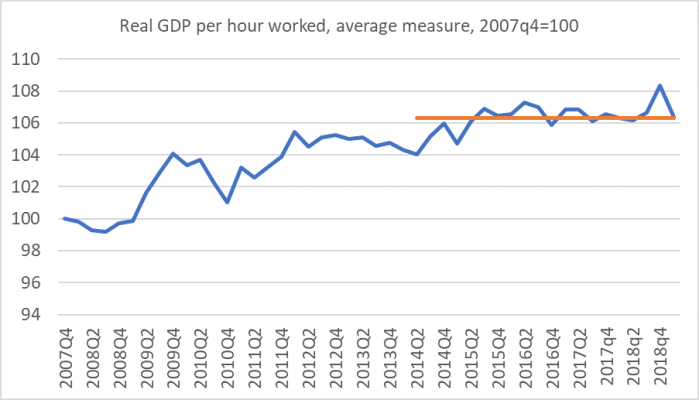
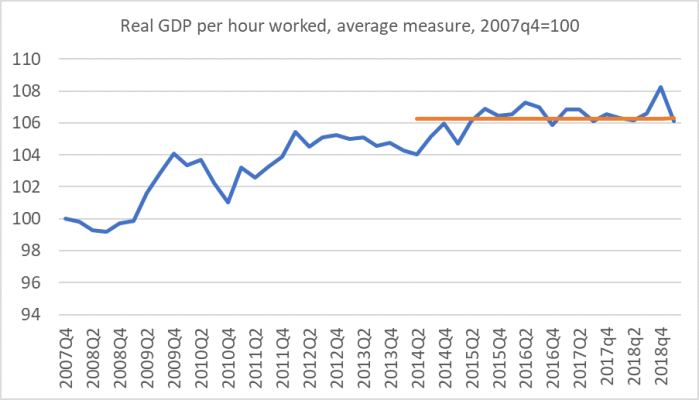
Here is a chart of labour productivity growth since just prior to the last recession. (As ever, I here average the two GDP measures and the two hours measures.)

GDP phw mar 19

The orange line is the average for the last five years.

Since the current government took office, total growth in labour productivity has been 0.2 per cent.  But there is quarter to quarter noise, and as the chart illustrates whatever is going on was in place well before the current government took office.   There is no sign this lot are doing anything that is producing new and better results, but since the start of  2012 total productivity growth has been not much more than 1 per cent.  That is over seven years.  It is a shockingly poor record.

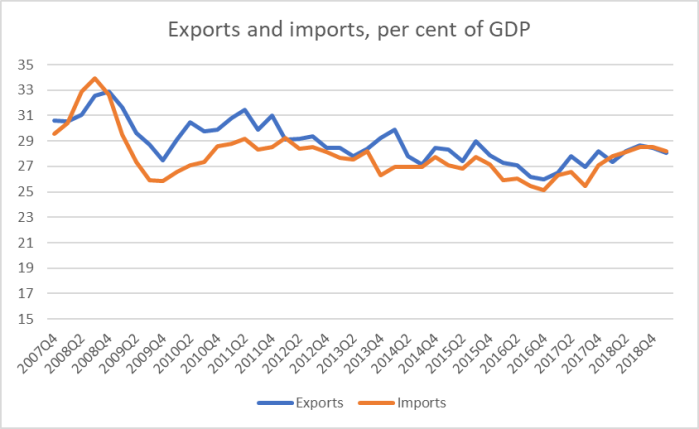
What about that talk of “building exports and export-led growth”?  No doubt the PM and her ministers are repeatedly fed lines about how successful New Zealand’s strategy of signing up preferential trade agreeements with all manner of countries has been. There are certainly lots of documents, but here is a chart showing exports and imports as a share of GDP, starting from the same point as the previous chart, just prior to the last recession.

ex and im

The numbers bounce around a bit with fluctuations in commodity prices and in the exchange rate, but broadly speaking the share of our economy accounted for by foreign trade has been shrinking, not expanding.    That isn’t a good sign (those with longer memories will recall that the previous government once had a specific goal of raising the export share to 40 per cent).   There are much more important issues –  than busy, busy trade agreements –  that simply aren’t even being addressed, or (it seems) even recognised.

I don’t have a chart for it, but everyone recognises that nothing has yet been done that would make any material difference to the housing price disaster that successive waves of central and local governments have inflicted on us.

It isn’t clear that, on matters economic (which have real implications across numerous dimensions of “wellbeing”) this government is really any worse than its predecessor.    But what a low bar that would be.  Neither main party –  or, as far as one can tell, any of the minor parties –  seems interested in getting to grips with creating a climate that generates materially better economic outcomes.    Easier, I suppose, to just pretend.   That way, among other things, you don’t need top-notch economic advisers and institutions.  But what a betrayal of New Zealanders.


Productivity by the numbers

That is the title of a new paper, intended (it appears) to inaugurate an annual series, from the Productivity Commission.   It is full of interesting tables and charts, and usefully drives home the point –  made repeatedly on this blog, and elsewhere –  that (a) longer-term productivity growth in New Zealand has been poor, and (b) that productivity growth matters for all sorts of other things New Zealanders individually or collectively care about.

Productivity growth in New Zealand has lagged since at least the 1950s.  On the data we have, the worst decade (falling further behind) was the 1970s, but the Productivity Commission usefully highlights that we have on slipping even in the last couple of decades.  This is one of their charts, showing the level of labour productivity in 1996 (about when the full OECD data series starts) and growth in productivity since then.

NZPC prod

Broadly speaking, the cross-country story has been one convergence: countries with lower initial productivity catching up (top left quadrant) and those with higher initial productivity growing more slowly (bottom right quadrant).   There is only one country in the top right quadrant (Ireland), but that is substantially a measurement issue stemming from the corporate tax rules.

But, as the Commission highlights, New Zealand is in the bottom left quadrant: countries that had only modest productivity levels in 1996, and still managed to grow slowly in the subsequent decades.  The real basket-case is, of course, Mexico, but we find ourselves grouped with Portugal and Greece, and Israel and Japan  (as I’ve noted here previously, it is well past time people in New Zealand stopped talking of Israel as some sort of high-growth exemplar).

I like the chart, and I’ve highlighted here previously the contrast between the productivity growth performance of the central and eastern European OECD member countries (top left) and New Zealand, including noting that several of them now have productivity levels very similar to those in New Zealand and are still growing fast.   I dug out the data for a similar chart going back to 1970 (when the OECD database begins, but for a smaller sample of countries).   Over that full period, we stand out as the underperformer.

But the Productivity Commission does rather tend to pull its punches (they are a government-funded agency, and depend wholly on (a) the resources the government allocates to them, (b) the quality of the Commissioners governments appoint, and (c) the character of the issues governments invite them to investigate).  (On (b) it seems somewhat overdue for the government to announced a replacement for now-departed former Secretary to the Treasury, and highly-regarded economist, Graham Scott, who has served as a Commissioner since the Productivity Commission was founded).

Pull its punches?  Reading “Productivity by the Numbers” you would have no idea how absolutely poor our labour productivity performance had been over the last few years.

Tsy productivity GDP phw

And there is, therefore, no sense of what light this experience might shed on possible explanations for our continued long-term underperformance.

They are also a bit self-promoting, suggesting that reversing the productivity underperformance “has been a central theme of the Productivity Commission’s work since 2011”.  If anything, the opposite has been true.  The Commission research team (when led by the now-departed Paul Conway) has at times produced some interesting papers on the issue, but the Commission’s core work is the inquiries successive governments have asked them to undertake, and not one of those inquiries has had as its focus economywide productivity failures and challenges.  Some of the inquiries have led the Commission down pathways which can, at best, be described as limiting the (economic) damage –  eg the low emissions inquiry.  On the other hand, the Commission has done a (mostly) positive job in helping to develop a more widely shared recognition that land use regulatory restrictions (and associated infrastructure financing perhaps) are at the heart of the housing disaster successive central and local governments have presided over for the best part of three decades.

“Productivity by the numbers” is mostly descriptive – tables, charts, and comments thereon – but the authors do weigh in a little on possible explanations.  They include this table, taken from another recent article

NZPC prod 2

A couple of the items in the left-hand column are clearly intended as a nod in the direction of my ideas (referenced in the article the table is drawn from), and I welcome that.  But it isn’t clear that the Commission –  let alone the government’s official departmental advisers – is even close to a current integrated and persuasive narrative of what has gone wrong and how, if at all, things might be fixed.    As is perhaps inevitable in a summary table, many of the items are at best stylised facts (some probably not even facts).

The report goes on

This work has highlighted that New Zealand’s poor productivity performance has been a persistent problem over decades and turning this around will require consistent and focussed effort over many fronts and for many years. There is no simple quick fix.

It is a convenient line –  especially as there is no political appetite for change anyway –  but I don’t believe it is true.  Sure, we aren’t going to close the productivity gaps overnight, and sure there are (always) lots of useful reforms that could make a difference in a small way.  But here we aren’t dealing with the small differences between, say, productivity in the Netherlands and that in Belgium.  For an underperformance as large and as sustained as New Zealand’s – in what is substantially a market economy with passable institutions (rule of law etc) – it is highly likely that there are (at most) a handful of really important policy failures (things done or not done) where most of the mileage from reform would be likely to arise.  And there the Commission just does not engage.   Instead it tries to move on to a more upbeat story, and to shift the “blame” onto the private sector.

Indeed, work is already taking place in many areas, including in competition policy, infrastructure, science and innovation, and education and the labour market. There is growing interest in the need to improve Kiwi firms’ management practices and ability to learn (absorptive capacity), which shape their ability to innovate and improve their productivity (Harris & Le, 2018).

To me, much of this seems like dreamland stuff, deliberately choosing to avoid hard questions, while flattering the egos of ministers and officials in Treasury or MBIE.   Whatever the Productivity Commission thinks is good among those topics in the first sentence (and I struggle to think of anything much), it isn’t credible to suppose that the things they like about current policy even begin to make the sort of difference required to reverse the productivity failures.  And much as officials and academics like to suggest there is something wrong with New Zealand businesses (convenient that), there is no evidence that New Zealand firms and employees (managers and others) would be any less able to identify and respond to opportunities if government roadblocks and obstacles, including distorted relative prices, were fixed.

In the report, the Productivity Commission highlights how much we will miss out on if productivity growth continues to underperform the (somewhat arbitrary) 1.5 per cent per annum growth assumption in Treasury’s medium-term fiscal model.  The point is that small differences compound in ways that make for big differences in material living standards and opportunities.  And on that count I totally agree with them.    I made a similar point the other way round in a post on productivity last year.

I’ve banged on here about how dismal productivity growth in New Zealand has been in the last five years in particular. The best-performing OECD countries over the most recent five years were averaging more than 2 per cent productivity growth per annum – and all of them were countries catching up with the most productive economies, just as we once aspired to do. If we’d managed 2 per cent productivity growth per annum in the last five years, per capita GDP would be around $5000 per head higher (per man, woman, and child) today.

Catching up to the top tier will, in a phrase from Nietzche, take a “long obedience in the same direction” – setting a course and sticking to it. But here is a scenario in which the top tier countries achieve 1 per cent average annual productivity growth, and we manage 2.5 per cent average annual productivity growth. Here’s what that scenario looks like:

nzpc prod 3

I’ve marked the point, 15 years or so hence, where the gap would have closed by half.

I don’t usually quote Nietzsche, but here is the full quote

“The essential thing ‘in heaven and earth’ is… that there should be a long obedience in the same direction; there thereby results, and has always resulted in the long run, something which has made life worth living.”

What matters in an economy like New Zealand now isn’t finding 100 or 300 things to reform – sensible as many of them might be –  but finding the one (or two or three) things that might make a real difference, adjusting policy accordingly, and then persevering long enough to start seeing real and substantial results.     There is no reason why New Zealand should not again manage something close to top tier OECD average labour productivity, but –  on the demonstrated –  there is no reason to suppose that (a) anything like the current policy mix will deliver it, or (b) that tiny changes at the margin will deliver very substantially different results.    Welcome as the Productivity Commission’s statistical compilation is, those are the messages that need to be heard more loudly.

Sadly, of course, not a single political party seems to have any appetite for reversing our decades of economic decline.  But, just possibly, a compelling narrative from an authoritative body like the Productivity Commission might one day begin to change that.  At present, instead, the Commission seems in some unsatisfactory place where they don’t have the answers, and to the extent they sense some elements of an answer, they don’t want to upset anyone.