The real exchange rate mattered in 1985, and it still does

In Christchurch tomorrow evening, Anne Krueger is giving the 2018 Condliffe Lecture.

Krueger is an eminent figure in economics, now in her 80s.  She had a distinguished academic career, specialising mostly in trade and development issues, and she also spent time as first Chief Economist at the World Bank, and then later (until 2006) as first deputy managing director of the International Monetary Fund.   (My lasting impression of her, as an international bureaucrat, was the day she declaimed at a Board retreat about the challenges the IMF faced as a small organisation –  at the time staff numbers totalled about 3000.)

According to Canterbury University

In the University of Canterbury’s 2018 Condliffe Lecture, Anne Krueger will explore the topic: “Is it harder or easier to develop rapidly than it was a half century ago?” in her talk on development and economic growth.

She will argue, we are told

“In this lecture, I shall argue that while the future is never entirely foreseeable, there are a number of considerations that point to greater ease of development now than in the past. These include: the diminishing rate of increase in populations in most low income countries; the fact that much more is understood now (albeit still imperfectly) about development (and especially how not to achieve it); that global markets are much larger; and obtaining information of all kinds is much easier.”

There are also some technological advances that make development easier: mobile phones; continuing discoveries of improved technology in agriculture; advances in materials sciences; and so on.

I hope a copy of her text is made available.

I’m not sure how often Professor Krueger has been to New Zealand, but there is a record of a visit in 1985, when she was at the World Bank.  She delivered a lecture under Treasury’s Public Information Programme, under the heading Economic Liberalization Experiences – The Costs and Benefits (if anyone wants a copy, it appears to be held in the University of Auckland library, but isn’t online anywhere).

As she noted

As a newcomer to the New Zealand scene, it would be foolhardy of me to attempt any assessment of the policies implemented in support of the New Zealand quest for economic liberalization.  It may be useful, however, to discuss what liberalization more generally is usually about, and to attempt to draw on the experience of other countries for lessons and insights that may potentially be applicable –  by those of you more knowledgeable about the situation here than I – in evaluating the progress of liberalization in New Zealand.

It is a very substantial lecture (18 pages of text), drawing on the experiences in previous decades of a wide range of other countries grappling with twin challenges of stabilisation (inflation, fiscal etc) and liberalisation..   The small bit I wanted to highlight –  which saddened me when I first read it a few years ago, and still does, from a “what might have been” perspective –  was about the exchange rate.

Two important lessons emerge from the Southern Cone [of Latin America] experience: failure to maintain the real exchange rate during and after liberalisation is an almost sure-fire formula for major difficulties and the defeat of the effort.  The reason for this is that a liberalization effort aimed at opening up the economy must induce more international trade; it is not enough that there be more imports, there must be more exports.  Since the exchange rate is the most powerful policy instrument with which to provide incentives for exporters, its maintenance at realistic levels which provide an incentive to producers to export is crucial to success.

and a few pages later she returns to the theme

“In particular, the exchange rate regime must provide an adequate return to producers of tradable goods, particularly to exporters”

At the time, this would have resonated strongly with senior New Zealand officials.  One of the starkest memories of my first year at the Reserve Bank, fresh out of university, was being minute secretary to a meeting in late 1984 attended by the top tiers of the Reserve Bank and The Treasury.  It was a just a few months after the big devaluation that ushered in the reform programme: senior officials were explicitly united in emphasising how vital it was to “bed-in” the lower exchange rate, and ensure that the real exchange rate stayed low.

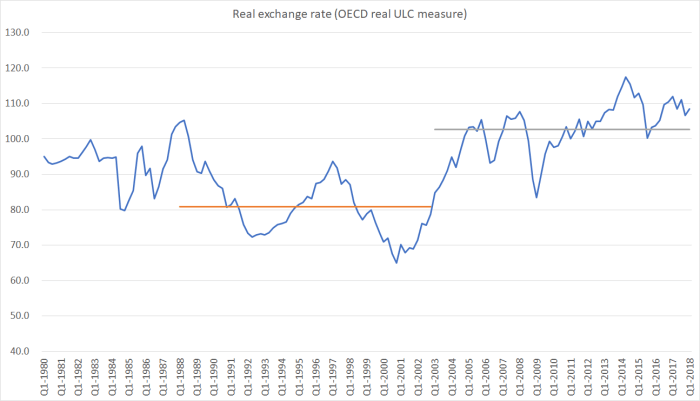
You can see that 1984 devaluation in this chart of the real exchange rate I ran a few weeks ago.

ULC jun 18

In fact, the gains from the devaluation were swallowed up very quickly by inflation.    When we finally got on top of inflation, the real exchange rate did average lower for some time –  and during those years the tradables sector of the economy (and export and import shares) were growing relatively strongly.  But for the last 15 years, the real exchange rate has averaged even higher than it was prior to the start of the liberalisation programme.  It hasn’t been taken higher by a stellar productivity performance.

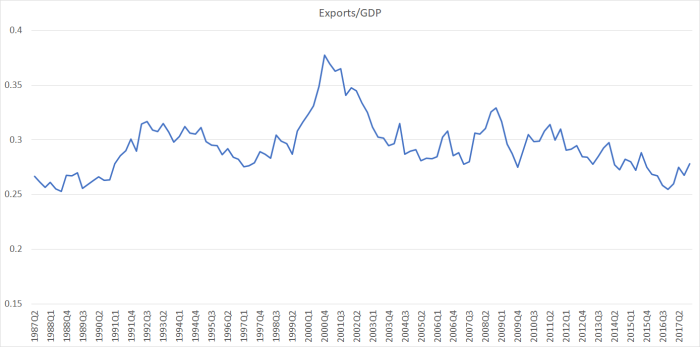
It shouldn’t be any surprise that the export and import shares of GDP have fallen back, and that there has been no growth at all in per capita tradables sector GDP this century.    Successful sustained catch-up growth –  of the sort New Zealand desperately needs – doesn’t come about that way.

Perhaps some attendee might ask Professor Krueger for any reflections on her 1985 comments about the importance of the real exchange rate in light of New Zealand’s disappointing economic experience since then.  And linking back to the topic of her 2018 lecture, can we now catch-up fast, having failed so badly to do for the last 30+ years?  Fixing the badly misaligned real exchange rate, a symptom of imbalances but which is skewing incentives all over the economy, seems likely to be imperative.  New Zealand just isn’t that different: wasn’t then, isn’t now.


Productivity: still doing poorly

I had been planning to write today about some of the recent Reserve Bank material on electronic currency.  I even took the papers away with me yesterday to read on some flights, but in the course of that reading  –  coincidentally, en route to another funeral – I discovered that a former Reserve Bank colleague, only a year or two older than me, had died a couple of months ago.    We hadn’t been close, but I’d known him off and on for 35 years beginning with an honours course at VUW in 1983, and when I’d last seen him six months or so ago he’d been confident the cancer was beaten.   What left me a bit sick at heart was that I had commented here last month, moderately critically, on a recent Reserve Bank Bulletin article of which he had been a co-author.   None of the comments were, as I reread them, personal.  But I’d have written differently had I known.  So I’m going to put aside issues around the Reserve Bank for a few weeks (and the blog is taking a holiday next week anyway).

So instead, having listened to a few upbeat stories in the last few days, including the IMF mission chief for New Zealand on Radio New Zealand this morning, talking about the “sweet spot” the New Zealand economy was in etc, I thought it was time to update some productivity charts.

Here is real GDP per hour worked for New Zealand.

real GDP phw jul 18

I’ve marked the average for the last year, and for the 12 months five years’ previously.  If anything, things have been going backwards a bit for the last three years, and for the last five or sx years taken together, productivity growth has averaged no better than 0.3 per cent per annum.  Some “sweet spot”, especially when our starting position relative to other advanced economies was already so far behind.

And here is the comparison with Australia –  in many respects the OECD economy with most in common with New Zealand (distance, resource dependence, Anglo institutions), and also the exit option for New Zealanders.

real GDP nz and aus jul 18

In 1989, when this chart starts, New Zealand was already behind Australia.   Since then, we’ve lost another 15 percentage points of ground, about 0.5 per cent per annum.  A decade ago perhaps one could have mounted an argument that the decline had come to an end: looked at in the right light, perhaps we were even showing signs of some modest closing of the gap.  But then we took another step down, and the rate of decline in the last decade as a whole has been about the same as that for the full period since 1989.

For almost a decade now, I’ve been sobered by the performance of the former eastern-bloc countries that are now part of the OECD.  Thirty years ago, when we –  already a market economy –  were in the throes of reform, they were just beginning the journey to freedom (Estonia and Latvia were still actually, involuntarily, part of the Soviet Union).   Their starting point was, of course, a great deal worse than ours –  for all the early 80s talk of New Zealand having an economy akin to a Polish shipyyard –  but the common economic goal was catching-up, reversing decades of relative decline.

In the decades since, New Zealand has lost ground relative to the richer countries of the OECD (and, as per the chart above, has lost a lot of ground relative to Australia, even more recently).  The former eastern-bloc countries have done a great deal of catching up.  They still have a long way to go to catch that group of highly productive northern European economies (Belgium, Netherlands, France, Germany, Denmark), but New Zealand is on track to be overtaken: on OECD numbers Slovakia now has real GDP per hour worked higher than that in NEw Zealand.

There are seven former eastern-bloc countries in the OECD.  The OECD is filling in 2017 data only slowly, and so in this chart I’ve shown real GDP per hour worked for New Zealand relative to the median of the six former eastern-bloc countries for which there is 2017 data (the country for which they don’t yet have 2017 data is Poland, which managed 7 per cent productivity growth in the four years to 2016, a period when New Zealand –  on the measure the OECD uses –  had none).

eastern bloc

Some of these former eastern-bloc countries had a very rocky ride (notably Estonia and Latvia, which ran currency board arrangements in the 00s, and had massive credit booms, and then busts), but the trend is still one way.  They are catching up with us, and we aren’t catching up with the sort of countries we aspire to match.

The pace of decline (New Zealand relative to these former eastern-bloc countries) has slowed, as you would expect (in 1995 it was still quite early days for post-communist adjustment) but the scale of the chart shouldn’t lead us to minimise the recent underperformance.   In 2007, we had an economy that was 20 per cent more productive than the median former eastern bloc OECD member, and last year that margin was only 12 per cent.

The measure of success in this economy shouldn’t be whether we stay richer and more productive than Slovenia or the Czech Republic.  All of us are a long way off the pace, far from the overall productivity frontier (best outcomes).    But what these former eastern bloc countries help highlight is that convergence can and does happen, if you have the right policies and institutions for your country (in all its relevant particulars).  Policymakers here used to genuinely believe that. It is no longer clear that they – or their Treasury advisers –  any longer do.

On which note, Paul Conway of the Productivity Commission recently published an interesting article in an international productivity journal on New Zealand’s productivity situation and policy options.  Commission staff were kind enough to send me a link.  Paul Conway has a slightly more optimistic take on the last decade or so than I do, but common ground is in recognising the total failure to achieve any catch-up or convergence.  There is a lot in Paul’s article –  which, not surprisingly, is not inconsistent with his earlier “narrative” on such issues that he wrote for the Commission itself, and which I wrote about here.   I will come back later and write about Paul’s analysis and prescription –  there is a lot there, some of which I agree with strongly, and some of which I’m much more sceptical of.  For my money, he materially underweights the importance of a misaligned real exchange rate as a key symptom, which has skewed incentives all across the economy.     But it is good to see public service analysts contributing substantively to the (rather limited) debate on these issues.


Falls in business confidence: 2000 and 2018

There have been numerous articles in recent days about the fall in business confidence, as reflected in various survey measures.  What, if anything, is it telling us?  Why is it happening?  What might turn the situation around, and so on?  Both sides of politics have a strong interest in their own particular interpretation.   On the one hand, general business confidence has tended to be weaker relative to actual outcomes under Labour than under National-led governments (if so, the falls might tell us nothing that we don’t already know –  that we have a Labour-led government).  And, on the other hand, (so the argument goes) the government is doing and saying quite a few things that many in the business community genuinely regard as inimical to growth, and thus it should be no surprise that sentiment is weaker now, and with it future growth prospects –  for those who particularly want to gild the lily, especially relative to the stellar performance allegedly achieved in the later years of the previous government.   As regular readers know, I treat that latter bit as laughable: productivity growth being almost non-existent, the relative size of the tradables sector having shrunk, business investment having been weak, and so on.  Oh, and the housing situation got even worse.

(The IMF Board –  whose assessment of New Zealand just dropped into my inbox – must be firmly of the “business just don’t like Labour” school, but then their assessment of the past, present, and future seems laughably detached from reality.  Believe that assessment, and you’ll believe that – at least in per capita terms –  things get even better from here, building on the “economic expansion with notable momentum” of the last half-dozen years.)

I’m not going to try to put myself in the minds of those answering these surveys but there seem plenty of reason to be rather pessimistic on the outlook from here.   Some –  perhaps many –  are the responsibility of our government, but others are not.     The global environment looks shakier than it has at least since the height of the euro crisis in 2012, with significant fragilities evident all over the place: in the euro-area itself, the ever-increasing uncertainty around Brexit, pressures in various large emerging market economies, rising US-driven trade tensions, the legacy of a debt-fuelled boom in China, and so on.   And against that backdrop, few countries have much fiscal or monetary space to respond vigorously when the next downturn comes.   Recognition of that is beginning to seep into general consciousness.

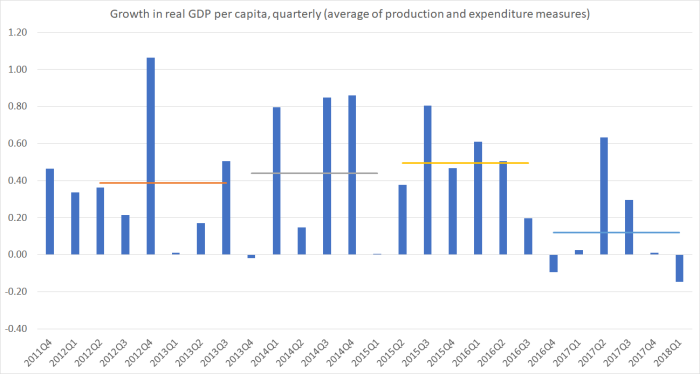
And it isn’t as if things have been going particularly well over the last couple of years.  This chart shows GDP per capita growth, with the horizontal bars marking successive 18 months periods.

gdp pc to mar 18

Perhaps the most recent weakness will end up getting revised away, but at the moment there doesn’t seem to be any particular reason to expect that.   There has been little or no productivity growth, and very weak per capita income growth.  It can take time for awareness of that sort of thing to take hold, especially in an election campaign session when National (party garnering the most business votes) was trying to tell a very upbeat story.

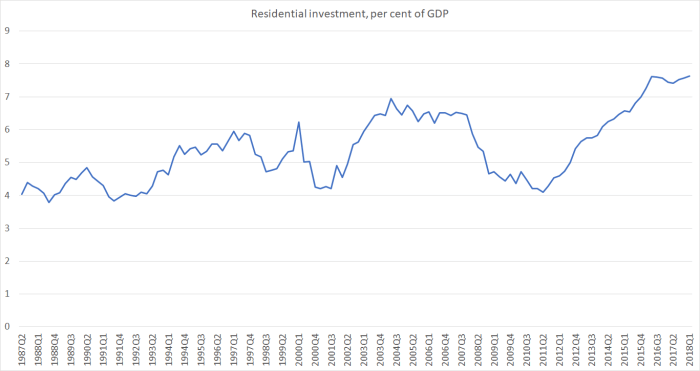
Perhaps not unrelatedly, the biggest proximate boost to growth in recent years has been house-building activity (related to earthquakes and the unexpected surge in the population).

res i to june 18

How plausible is it to expect any sort of repeat of the last few years?  Not very, I’d have said, both because the population pressure is beginning to ease, existing house price inflation seems to be stabilising (for now anyway) and the government has, despite fine words buried deep in the manifesto, done nothing to fix up the urban land market.  If anything, housebuilding activity is likely to fall back somewhat in the next few years, and housebuilding typically plays a key proximate role in explaining short-term economic fluctuations.

Perhaps business investment could take its place.  But consider:

  • investment spending, other than on housing, is now 2 percentage points of GDP lower than it was at the previous peak (mid 2000s),
  • the exchange rate, while have weakened a bit, is still in the range it has fluctuated within for the last 7 or 8 years,
  • plenty of policy initiatives don’t look terribly conducive to encouraging more business investment:
    • sustained and large increases in minimum wages (even if there is some spending to replace labour)
    • concerns, fair or not, about other labour relations law changes,
    • scrapping new oil and gas exploration licences,
    • the uncertainty engendered by the shocking policy process used to make that decision, and  (not mentioned in any other article I’ve seen)
    • the government’s net-zero carbon emissions target, which their own consultative document (and their own independent consultants’ numbers) suggest will act as a material drag on the economy for several decades to come, if pursued with the sort of zeal key ministers at times suggest. (Of course, the previous government’s target would also have acted as a drag, but (a) many thought they weren’t entirely serious about it, and (b) the marginal costs of pushing further into this territory can be expected to increase quite substantially).
    • the considerable uncertainties engendered by these targets (since few policy parameters, including expected carbon prices are remotely clear).
  • if one wanted to focus on individuals, one might also feel uneasy that none of the top 4 ministers in the government command any confidence that they instinctively understand –  or care greatly –  what makes for a high-performing economy.   Several of that top tier simply seem out of their depth, and few of the rest command much respect either.  (I was no fan of the previous government but –  rightly or not –  business took a different view of Steven Joyce, Bill English, and John Key.)

I have also been interested in the comparisons with the “winter of discontent” that followed the election of the Labour-Alliance in late 1999.  Some of that experience is quite nicely covered in this piece although I think the author is rather too optimistic about the current situation.  As he notes, the level and tone of commentary on this new government is nothing like as vociferous as what greeted the incoming 1999 government (complete with plans to raise taxes, repeal and reform the Employment Contracts Act, repealing ACC privatisation, and installing Jim Anderton –  opponent of most of the 80s reforms –  as deputy Prime Minister).  It hadn’t been that long since the polarising reform phase had ended.  And while Michael Cullen was much more able than Grant Robertson, his acerbic tone –  and all too obvious revelling in his own intelligence –  only enhanced the tensions.

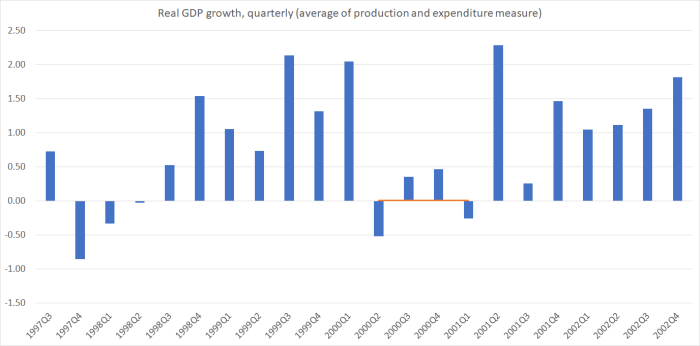
It was a tough period.  Here is the chart of quarterly GDP growth (not per capita –  annual population growth then was around 0.6 per cent).

real gdp 00

GDP growth averaged zero for a year –  before rebounding quite strongly.   Some of that slowdown –  which I don’t think we ever fully understood at the Reserve Bank –  may have been a direct response to the change of government and proposed new policies.   But it was far from being the only factor.  It was still relatively early days in the recovery after the 1998 recession –  so there was still lots of unutilised capacity –  but there had been a big surge in investment during 1999 (even though a change of government was widely expected).  At the time, two factors that seemed to play a part were the Y2K effect –  every firm and its dog was devoting lots of resources to ensuring systems were robust –  and building associated with the defence of the America’s Cup in Auckland in early 2000.  Both were time-limited, and the relevant dates were very close to each other.    Whatever the reason –  and, as I say, I don’t think I’ve ever seen a particularly compelling analysis of that specific period –  there was a (quite unexpected) slowdown in activity, and in particular in investment spending.   Perhaps  –  well, quite probably –  higher interest rates played a role –  we raised the OCR by 200 basis points in six months from November 1999, none of it because of the change of government.  It was our first go at actually adjusting official interest rates –  the OCR was only introduced in early 1999 –  and with hindsight, they do seem like rather aggressive moves.

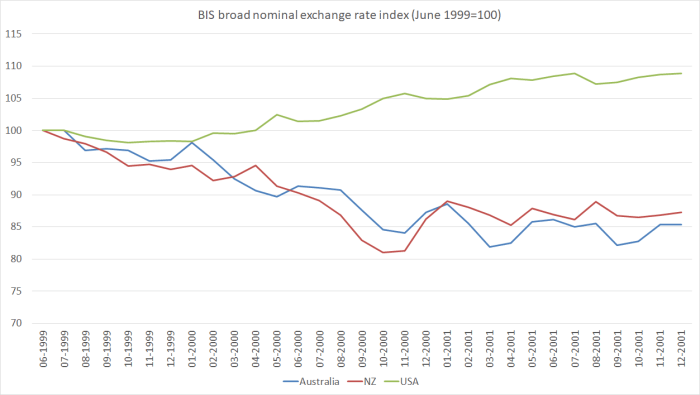
One factor that did play quite a large role then was the exchange rate, which fell very sharply in 1999 and 2000.    Some vocal critics wanted to pin the blame on the change of government (expected and actual) –  I recall one particularly strident Reserve Bank Board member bending my ear about the point at the time.  But that story was simply wrong.  Here is a chart of the BIS measures of the exchange rate for New Zealand, Australia, and the US.

bis exch rates 00

The New Zealand and Australian exchange rates were basically tracking each other, with no obvious role for a “new left-wing government” effect.   What was going on?  Well, two things.  First, and probably most importantly, although New Zealand was raising interest rates, so was the US, and indeed until now this was the only period since deregulation when our interest rates had matched those of the US.  And, secondly, this was the era of “new economy” vs “old economy” –  the NASDAQ peak in the dotcom boom peaked in March 2000, and capital was flowing towards these perceived new opportunities and away from “old economies” like Australia and New Zealand.   That period proved quite shortlived, and by the start of 2001 the Fed was cutting interest rates and the US itself had entered a mild recession (not mirrored in either New Zealand or Australia).

Which brings me back to the observation earlier that –  politics aside, and the pressure from one news cycle to the next –  the current situation should be more concerning.  There was a pause in growth then, of the sort we haven’t seen yet this time, but:

  • the previous episode came early in a recovery phase not late,
  • it came at a time when population pressures were quite weak, and there was a reasonable chance of an acceleration (as happened a year or two later),
  • the global environment looks less promising (despite the dotcom bust in the US, much of Asia was recovering strongly after the crisis/recession of 1998),
  • productivity growth over the previous few years had been reasonably good in th late 1990s,
  • there were some specific, time-limited, factors that can be pointed to, contributing to the pause back then,
  • whatever you think of the policies Labour brought in the 1999/2000, in terms of creating additional uncertainty and an additional drag of prospective growth well into the future, they were as nothing as compared to the implication of a net-zero emissions target,

and perhaps the biggest difference of them all is the real exchange rate.  The current level is about 30 per cent higher than it was in 2000, and it had fallen a long way to get to those 2000 levels (and not on heightened risk concerns etc).  Those falls created a credible prospect of new business investment in the tradables sectors.  There is nothing comparable now, and we’ve probably exhausted the limits of domestic demand (especially residential investment) as a support for headline GDP growth.

One could add to the mix that if anything goes wrong, sourced here or abroad, there isn’t much capacity for macrostablisation policy to respond.  Yes, the OCR could be cut –  and probably already should have been, given the persistent undershoot of the target (another difference to 2000) –  but the Bank is likely to be increasingly uneasy the further it cuts from here, and on its own estimates can’t cut more than about 250 basis points in total.   And whatever the merits (or otherwise) of the 20 per cent debt target, it will come under new pressure in any downturn, and the (market and business) pressures to stick to it will only intensify in that climate –  “show us your mettle, minister” will be the watchword.


Exports of services: a dismal picture

In my post yesterday, I highlighted the pretty stark divergence in the performance of the tradables and non-tradables parts of the economy.  As the key chart in yesterday’s post illustrated, in the 1990s and into the early 2000s both the tradables and non-tradables sectors were growing strongly, even in per capita terms.   Since then, the non-tradables sector has continued to grow pretty strongly, but there has been no growth at all in per capita tradables sector GDP –  in fact, the current level is almost 10 per cent below the 2004 peak.

One element of the tradables sector that is commonly supposed to be doing well is exports of services: tourism, export education, and the rest.   The government has indicated that it hoped the ICT component would surge ahead and, on some definition or other, be the “second largest contributor to our economy by 2025”.

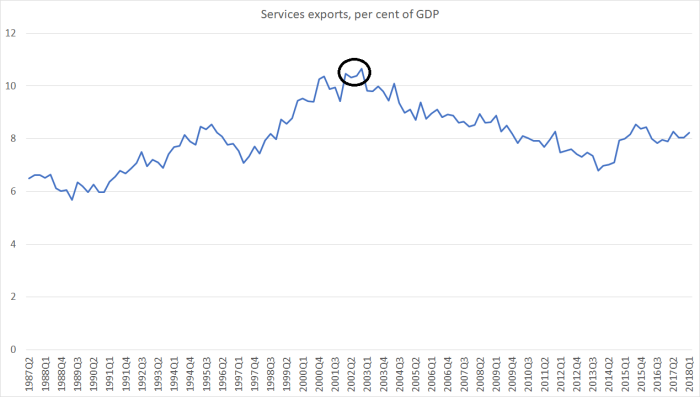
But how have services exports  actually being doing, as a share of the economy?  Here is the New Zealand chart.

services X june 18

There was really strong growth over the 15 years or so to the peak (marked) in around 2002.  Services exports lifted from less than 7 per cent of GDP to in excess of 10 per cent.  Since then, the trend has been back downwards again –  the current level only a touch above 8 per cent.  And, at that, one of the largest components –  export education – is, in effect, quite subsidised, by being bundled together with the ability to get work rights and residency points.

How have other advanced countries done?

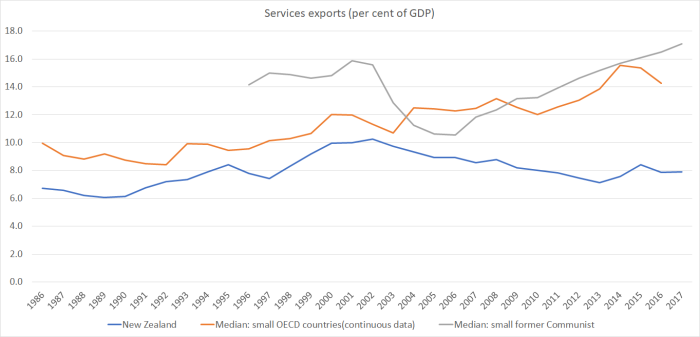
Here is a chart, using annual OECD data, showing (a) New Zealand, (b) the median for those small OECD countries with complete data since 1986, and (c) the median for six small former Communist eastern and central European OECD countries, countries engaged in the sort of catch-up that New Zealand was supposed to experience.

services X 2 june 18

I don’t fully understand what was going in the former Communist countries in the first few years of the century, although since in many there was a big boom in domestic demand and credit, the export sectors (especially the bits not involving FDI) were probably under pressure.   Whatever the story for those countries then, both lots of small advanced countries have seen rising shares of their economies accounted for by services exports over the past decade.  We haven’t.

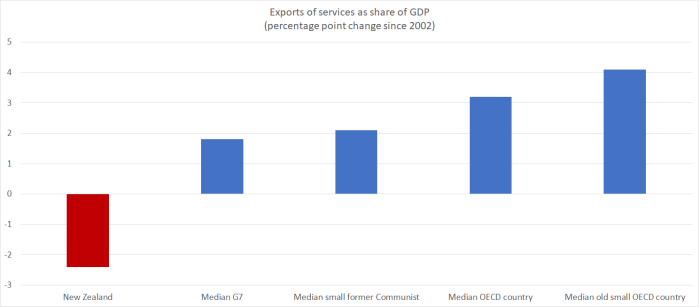
Here is another way of looking at our experience, looking at the percentage point change in the services exports share of GDP since our peak in 2002.

services x 3 june 18

There were two –  of 34 – OECD countries that saw a slightly larger fall in the GDP share of services exports.  In one case, the growth in goods exports more than offset the fall.  In the other –  Chile –  both goods and services exports shrank as a share of GDP, as happened in New Zealand.

As ever, foreign trade isn’t everything.  But when your per capita incomes and productivity are so far behind the leading countries in the OECD, the typical way in which a country would undergo a sustainable lift would involve a larger share of the economy accounted for by both exports and imports  That just hasn’t happened in New Zealand –  and, of course, neither has there been any catch-up.   Which isn’t surprising when, on the measure I illustrated yesterday, the real exchange rate over the last 15 years has averaged 27 per cent higher than the average level in the previous 15 years.

That higher real exchange rate didn’t get there by chance.  It was the consequence –  mostly unwitting – of deliberate government choices.

On which note, it is nine months today since the election.  In other words, a quarter of the government’s term has gone.  And, as far as I can see, there is nothing in policy announced, or foreshadowed, likely to do anything to close the productivity gaps,  materially alter the real exchange rate, narrow the large average interest differentials, or sustainably increase the export share of our economy so that in turn we can support a larger import share.  Oh, and market prices suggest no confidence that the manifest evil that is the housing market is on the way to being fixed either.

An old familiar, still depressing, chart

I’m tied up in a meeting all day, so just a quick post to update one of my standard charts, following the release yesterday of the quarterly GDP numbers.

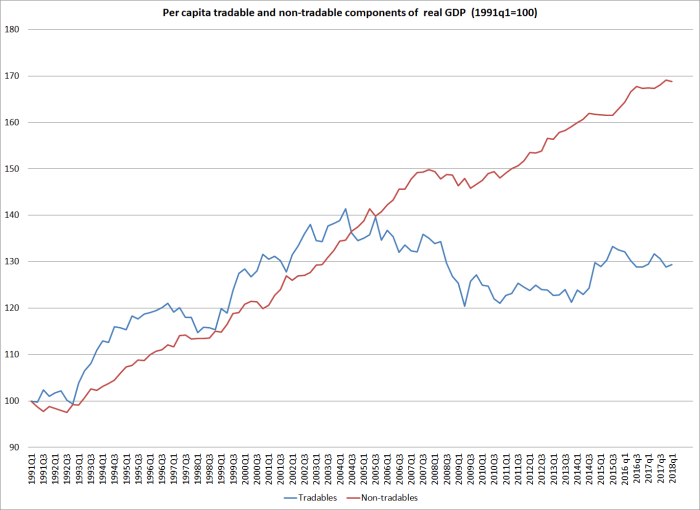
In this chart, initially developed by an IMF mission to New Zealand 14 or so years ago, GDP is fairly crudely allocated between tradables and non-tradables sector.  Tradables consist of primary industries and manufacturing, with exports of services added in.  Non-tradables is the rest of GDP.  Flourishing economies tend to have a strong tradables sector: local firms doing well taking on the world (whether as exports or import-substitutes).  It isn’t that one type of activity is inherently superior to the other, but when your tradables sector lags behind it usually isn’t a promising sign.

Here is the chart, expressed in per capita terms with both series indexed to 1991q1 when the official quarterly population series starts.

GDP T and NT june 18

Tradables sector activity performed quite strongly in the 1990s, and even up to 2004.  But the current level of real per capita activity was first reached in 2000, 18 years ago.  The current level of real per capita tradables sector GDP (on this measure) is almost 10 per cent lower than it was at peak in 2004.

There are plenty of sceptics of this chart, and it isn’t entirely kosher to add together bits of production GDP and bits and expenditure GDP.  So here are the individual components of the tradables GDP indicator.

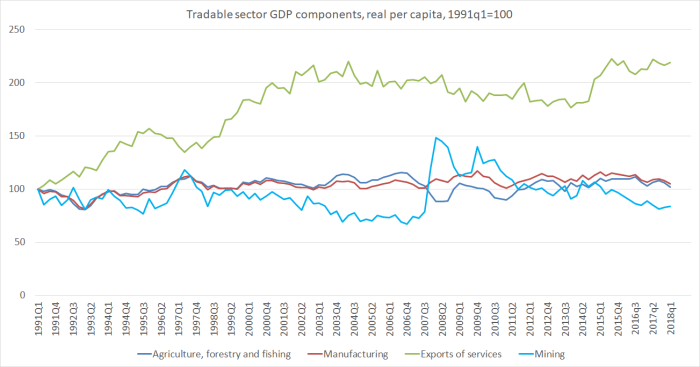
tradables jun 18

Over 27 years, there has been no growth at in real per capita GDP in agriculture, forestry and fishing, in mining (includes oil and gas –  see the spike up in 2007), or in manufacturing.    There has been growth in real per capita exports of services, but almost all that growth was in the 1990s and early 2000s –  really strong growth back then, and very little, overall, since.

What changed 15 or so years ago?  The (real) exchange rate did.

ULC jun 18

27 per cent higher, on average, over the last 15 years than in the previous 15 years.   And it isn’t as if the increase has resulted from the superb performance of the tradables sector of the economy.

Real exchange rates aren’t exogenous instruments that governments (or central banks) can change at will.  But if the authorities care at all about getting to the bottom of our economic underperformance, they really need to get to the bottom of what pressures have resulted in such a marked increase in the real exchange rate, sustained now for so long (hint: the terms of trade is at best a small part of such a story).   15 years ago it was almost possible to believe that the New Zealand economy had been turning a corner, becoming more productive and more outward oriented, that it might even begin to close the gaps with the OECD peers.  But no longer….and that is before the oil and gas exploration sector was summarily given notice, before net zero carbon emissions targets looked like becoming a real factor.

A successful economy will, almost inevitably be a more outward-oriented one, in which more and more firms operating here are successfully taking on the world.  At present, nothing in government policy suggests any improvement, any reversal of the 15 years of sliding backwards, reliant ever more on “taking in each other’s washing” –  the (population-driven) domestic non-tradables sector.  It is simply not a robust foundation for a more prosperous future.


Sir William and the rockstar economy

I don’t really want to revisit the questions of whether retired politicians and senior public servants should be given honours largely for just turning up and doing a (fairly reasonably remunerated) job, or even whether there are really 15 people per annum in this country deserving of knighthoods.  I touched on those issues in a post in January.

But two awards in yesterday’s list caught my eye.  The first was the knighthood to former Prime Minister and Minister of Finance Bill English, and in particular the descriptions of Bill English’s contribution.

There was the official citation, the words put out under the name of the Governor-General, but presumably supplied by the current Prime Minister and her department

As Finance Minister from 2008 until 2016, Mr English oversaw one of the fastest-growing economies in the developed world, steering New Zealand through the Global Financial Crisis and the Christchurch earthquakes and ensuring the Crown accounts were in a strong financial position.

And, even more incredibly, a story by Stuff political reporter Stacey Kirk in which she noted that the official citation had been expressed “rather dryly”, as if it didn’t do full justice to the man’s contribution, and going on to observe, without a trace of critical scepticism or irony,

More colourful commentary at the time would globally brand him the man responsible for New Zealand’s “Rockstar Economy” – the envy of government’s worldwide and a textbook example of how to pull a country out of recession.

From a sudden jump yesterday in the number of readers for an old post of mine from 2015 on the emptiness –  or worse –  of the “rockstar economy” claims, it seemed that at least a few others might have been a bit sceptical of Kirk’s column.

I’m not going to quibble about everything.  The Crown accounts were in a strong position when National took office in 2008, and were in a fairly strong position when they left office.  Net debt was higher when they left office than when they took office, but the deficits which were emerging in 2008 as the recession took hold –  recall that only a few months earlier in the 2008 Budget, Treasury’s best estimate was that the budget was still in (modest) surplus – were gone and the budget was back in surplus when National left office.

The terms of trade make a big difference to the government’s finances.  Here is Treasury’s chart from this year’s Budget, illustrating how much help our unusually high terms of trade have been in recent years.

cab with tot adj

It is a real gain, but it is an exogenous windfall, not something any government or politician could simply conjure up.

What about the official claim that Bill English was responsible for “steering New Zealand through the Global Financial Crisis”.   It has become part of established rhetoric, but it has never been clear to me –  and I was working at The Treasury at the time –  that there was anything of substance to it.    As ever, the biggest single contributors to getting New Zealand through this particular recession were (a) time, and (b) monetary policy.    The crisis phase in other countries had been brought to an end by about March 2009 –  initially as a result of extensive interventions in those countries (bailouts, fiscal stimulus, lower interest rates, and so on).  That took the pressure off the rest of us.  And our own, operationally independent, central bank had cut the OCR by 575 basis points by April 2009 (having begun to cut well before National took office in mid-November 2008), and some mix of the sharply lower interest rates, global risk aversion, and lower commodity prices had also lowered the exchange rate a lot.  The Reserve Bank also put in place various liquidity assistance measures, at its own initiative.

What role then did New Zealand politicians play in “steering us through”?  The previous Minister of Finance had put in place the deposit guarantee scheme, designed to minimise any risk of panicky runs on New Zealand institutions. I happened to think (having been closely involved) that was a good and necessary intervention, even if on important details the Minister departed from official advice, in turn increasing the later fiscal cost.  On taking office, the new Minister of Finance, Bill English, made no material changes to the scheme, and took no material steps to rectify its weaknesses.   Mr English did approve the (better-designed) wholesale guarantee scheme, designed to assist banks tap international wholesale funding markets in a period when those markets had largely seized up.  It didn’t end up being extensively used, but was also the right thing to have done at the time.

What else was there?  In the 2009 Budget –  delivered after the crisis phase abroad had passed –  a couple of rounds of tax cuts, promised in the 2008 election campaign (itself occurring in the midst of the crisis) were cancelled.  That was prudent –  given other fiscal choices the government had made –  but there wasn’t anything extraordinary or particularly courageous about it.   There was no discretionary fiscal stimulus undertaken in response to the crisis by either government –  or nor was it needed, given the scope monetary policy here had.

The truth of the international financial crisis of 2008/09 is that the New Zealand was largely an innocent bystander, caught in the backwash.  There wasn’t much governments could, or did, do about it, and – to a first approximation –  what they (Labour and then National) could do, they did.   Both supported an operationally independent Reserve Bank and it, largely, also did what it could do (if, arguably, a bit slow to get off the mark).  And then the storm passed and we started to recover, in a pretty faltering sort of way.

What about the other bit of that official citation, the claim that “as Finance Minister from 2008 until 2016, Mr English oversaw one of the fastest-growing economies in the developed world”?    Why does the current Prime Minister continue to buy into this sort of nonsense –  the myth  (no, sheer falsehood) of the “rockstar economy”?    To the extent the claim has any meaning at all, it simply reflects the much faster rate of population growth New Zealand experienced, especially in the last five years or so.   Over that five year period (2012 to 2017), New Zealand’s real GDP per capita increased at almost exactly the rate of the median OECD country.   Which is okay, I suppose, but nothing to write home about, especially once one remembers that we are poorer than most of these countries, and are supposed to have been trying to catch-up again.

But, one more time, let’s dig a little deeper.

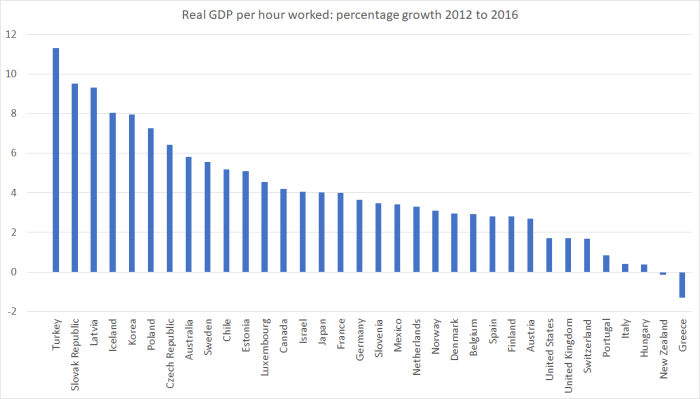
Productivity growth is the only sure foundation for sustained improvements in material living standards.  Over the full period 2007 (just prior to the recession) to 2016 (the last year for which there is data for all OECD countries), New Zealand experienced labour productivity growth basically equal to that of the median OECD country.  Again, perhaps not too bad, but no sign of any catching up.     What about the last four years, the period to which most of the “rockstar economy” claims related?
real gdp phw english

Spot New Zealand –  if you can –  down next to Greece.  And adding in 2017 –  for which we have data, but some other countries don’t yet –  would not improve the picture.  Our recent productivity record –   through the period presided over by Bill English (and John Key and Steven Joyce) –  has been really bad.

What that means is that, to the extent that real GDP per capita growth has been middling, it has all been achieved by more inputs (mostly –  since business investment is weak –  more hours worked), not smarter better ways of doing things, old and new.  Perhaps it really is a rockstar economy: a John Rowles or Cliff Richard one, belting out the same 1960s favourites over and over again?   Recall that, being a poor OECD country, New Zealanders work more hours per capita than most other advanced countries do.

And despite more hours worked, it isn’t even as if we were particularly good at keeping the economy fully-employed during the English tenure.  In this chart, I’ve standardised the unemployment rates of the G7 group of big advanced countries and of New Zealand so that both are equal to 100 in 2007q4, just prior to the recession.

U rates g7 and NZ

Our unemployment rate went up about as much as the G7 countries (as a group) did, but just haven’t come back down anywhere near as much.  For the G7 as a whole –  which includes such troubled places as Italy and France, and is mostly made of countries that exhausted conventional monetary policy capacity –  the unemployment rate is now lower than it was before the recession. But not in New Zealand.

Politicians don’t directly control the unemployment rate (or most of the other measures in this post), but it is pretty amenable to micro reforms, and (within limits) to monetary policy action.  Under Bill English’s oversight, minimum wages kept on being raised, and nothing was done about a Reserve Bank that consistently kept monetary policy too tight (evidenced by the persistent undershoot of the inflation target set by the same Minister of Finance).

And what about foreign trade as a share of GDP?  Successful economies tend, over time, to have a rising share of GDP accounted for by foreign trade (exports and imports).  Small countries that succeed tend to have much larger foreign trade shares (since abroad is where the potential markets –  and products –  mostly are).

Foreign trade as per cent of GDP
2007 2016
Exports New Zealand 29.3 25.8
OECD median 40.5 42.3
Imports New Zealand 29.1 25.5
OECD median 39.2 39

But from just prior to the recession to 2016 (again the last year for which there is a full set of comparable data), New Zealand’s foreign trade shares shrank, even as those of the median OECD country held steady (imports) or increased (exports).  Relative to our advanced country peers, our economy became more inward-focused.

And that is despite the fact that we’ve had the second-largest increase in our terms of trade of any OECD country –  very different from the other commodity exporters (Norway, Mexico, Chile, Canada, and even Australia).
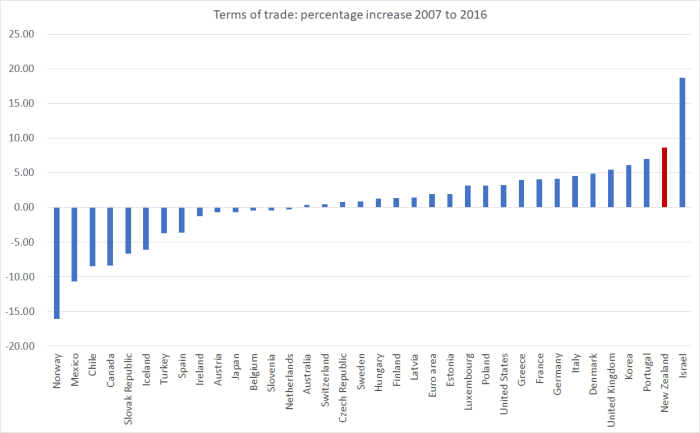
OECD TOT

Fortune favoured us, and we –  our political leaders, the long serving Minister of Finance foremost among them –  accomplished little with that good fortune.

Of course, not everything has been in New Zealand’s favour.  We didn’t have a material domestic financial crisis, we weren’t locked into a dysfunctional single currency, we went into the lean years with a healthy fiscal position, we had more space to adjust conventional monetary policy than almost any other advanced country, and we’ve enjoyed a strong terms of trade.  For enthusiasts for immigration, we’ve continued to draw in large numbers of permanent migrants, and have accelerated the inflow of temporary migrants.

But there were the earthquakes.  I’m not about to deny that they have held back economic performance, compelling resources to shift into domestically-oriented sectors, rebuilding (and inevitably/rightly so) rather than doing other things.  But even the earthquakes need to be kept in perspective: they were seven years ago now, and in wealth terms were more than paid for by the combination of offshore reinsurance and the lift in the terms of trade. There is still no sign of things turning round now –  of higher business investment, or a greater export orientation, of a recovery in productivity growth.  It is just, at best, a mediocre story.

And did I mention house prices?

real house prices OECD

There are, of course, some other black marks against Bill English.  There were the questions of integrity around the Todd Barclay affair.  There was the willingness to lead his party into an election with a candidate who’d been part of the PRC military intelligence operation, and a member of the Chinese Communist Party, all things hidden from the electorate, and then to go on defending the indefensible as it became clear that important elements of this past had also been withheld from the immigration authorities.

But, even on his own ground – the economy –  the record just doesn’t add up to much at all.

Oh, and as for the other top award that caught my eye yesterday, that was this astonishing one.  I’ll probably write about that elsewhere. [UPDATE: Here for anyone interested in this non-economics issue.]
 

Lifting productivity (and fixing housing, etc): what I’d do

When, a week or so ago, I wrote about how our political (and bureaucratic) leaders appeared to have given up hope, and to have lost any serious interest in turning around New Zealand’s dismal long-term productivity performance (and even worse short-term performance), and linked to my recent speech on such themes, a few commenters asked what policies I would implement, given the option.  One was specific enough to invite a “top 10 policies” list.

In what follows, I’m not suggesting that all these proposals are equally important.  It is also worth recogising that some are designed to directly improve economic performance, at least one is primarily about compensating some potential losers who might otherwise be a roadblock in the way of overdue reform, and some at improving confidence in our political system and associated institutions.   Part of what needs to accompany any significant reform package is a strong accepted sense that the politicians making the changes are working first and foremost in the interests of New Zealanders and their families, people of all ages, stages, and levels on the socioeconomic scale.  Change is, almost inevitably, costly and disruptive to some –  one reason why it doesn’t happen –  but people can be ready to accept disruptive change if they recognise it as something we do together, rather than something being done to them.

Some of these policies were included in a call to embrace radical reform I outlined (and elaborated on more than I can do in this longer list) shortly after Jacinda Ardern became Labour Party leader.

  1. Cut the residence approvals target from the current 45000 per annum to a range of 10000 to 15000 per annum (in per capita terms, something similar to policy in the United States
    • within the residence policy, eliminate the preferential Pacific and Samoan quotas, to focus solely on skills, refugees (and foreign spouses of NZers)
    • make temporary work visas (maximum three years) generally available, subject to the employer paying an annual fee to the Crown of $20000 per annum per worker, or 10 per cent of salary whichever is larger,
    • eliminate most work rights for foreign students (other than Master/Phd)
    • remove the substantial subsidy for foreign PhD students
  2. Move to a Nordic system of taxing income, in which income from capital (profits, interest etc) is taxed at a considerably lower rate than income from labour (and considerably lower than at present –  say 15 per cent).
    • a progressive consumption tax would also have considerable appeal but (a) hasn’t been tried anywhere, and (b) a shift to such a system has major distributional implications.
    • eliminate R&D grants and/or tax credits.
  3. Legislate to allow two-storey houses to be built, at the owner’s discretion, on any land (subject only to narrow exclusions around, say, flood plains or serious land instability).
  4. (To the extent not inconsistent with 3 above) legislate to entrench existing planning restrictions at a neighbourhood level, while allowing neighbourhoods to vary such restrictions on a 75 per cent favourable vote of affected land owners.  (As a reminder, such provisions would parallel to a considerable extent the covenants that are voluntarily established on-market for many private residential developments.)
  5. Because I would expect 1 and 3 above together to result in a sharp sustained reduction in house and urban land prices, establish a compensation scheme under which, say, owner-occupiers selling within 10 years of purchase at less than, say, 75 per cent of what they paid for a house, could claim half of any additional losses back from the government (up to a maximum of say $100000).  It would be expensive but (a) the costs would spread over multiple years, and (b) who wants to pretend that the current disastrous housing market isn’t costly in all sorts of fiscal (accommodation supplements) and non-fiscal ways.
  6. Establish a Commerce Commission inquiry (or a Royal Commission if necessary) to get to the bottom of why building product prices appear so high in New Zealand, not ruling out direct government intervention in the market if the issue is found to be primarily one of lack of sufficient competition.
  7. Lift the age of eligibility for NZS to 68 (increasing by, say, four months a year, so that it would take nine years to get to that age) and beyond that index the age to future improvements in life expectancy.
    • tighten the residency requirements, so that receipt of full NZS would require 30 years of residence in New Zealand itself (and not treating, as at present, residence in Australia as counting as residence in New Zealand for these purposes).
  8. Institute a congestion-pricing regime for Auckland and Wellington.
  9. Reinstitute interest on student loans, perhaps at a government bond rate (still in effect concessional), while lifting amounts that can be borrowed
    • replace fee-free policy, with a somewhat more generous robustly means-tested student allowance for high-achieving students.
  10. Consider instituting a universal child allowance (radical as this may sound, it was an option covered in the 2025 Taskforce report)
  11. Replace the Secretary to the Treasury, appointing someone with a mandate to build an excellent institution, providing robust advice on lifting economic performance.  The Prime Minister or Minister of Finance can’t do it alone, and the current Treasury doesn’t appear to be up to, or that interested in, the job.
  12. Wind-up the New Zealand Superannuation Fund, using the proceeds to repay public debt
    • consider shifting ACC to a pay-as-you-go basis (public money-pots are corrosive of good government and a wise allocation of resources)
  13. End industry assistance (such as film subsidies), except when the government is purely a vehicle for collecting and enforcing industry levies to fund themselves).
  14. Since this package would be likely to be net fiscal negative (at least in the short-term), adopt as a medium-term target an operating deficit of 1 per cent of GDP, and be willing to allow net debt (currently around 7 per cent of GDP) to rise to 25 per cent of GDP.  (A modest deficit of that size will be consistent with stable debt to GDP ratios over time.)
  15. Prioritise a substantial improvement in water quality in streams and rivers.
  16. Require postal ballots of residents for all major new items of local authority spending (some size threshold to be determined, perhaps relative to annual rates revenue), and establish provision for recall petitions for members of local authorities.
    • prohibit local councils from undertaking investments in individual commercial operations.
  17. Overhaul the Official Information Act, to provide for pro-active release of major documents (notably Cabinet papers) as the default standard, and to amend existing provisions frequently used to delay or prevent release of official information (with parallel changes to the LGOIMA for local government).
  18. Mandate the (all but real-time) disclosure of all political donations in excess of $200, and ensure that the political donations law is written in such a way that it encompasses (for example) donations through charity auctions.
  19. Prohibit former politicians and senior government officials taking paid roles in organisations controlled, directly or indirectly, by foreign governments, and impose a three-year stand-down period on any former minister taking a position in an enterprise s/he was involved in regulating (directly or indirectly) as a minister.

There are all sorts of other policy changes I’d no doubt be happy with, and whole areas I haven’t even touched on.  One is infrastructure finance. I have no particular problem with the interesting ideas that are around on innovative vehicles (used in the United States) allowing infrastructure debt to be tied to the specific landowners where the development is occurring, rather than as a general charge on local councils).  But on my set of policies, expected population growth for the country as a whole would drop to something less than half a per cent a year, reaching zero before too long (as the total fertility rate is now well below replacement) so that action on that issue is much less pressing than if we continue with the deeply flawed “big New Zealand” policy of successive governments.

I haven’t mentioned emissions targets either, but such targets would be hugely easier, and less costly and disruptive, to meet under this set of policies, than under the set we are actually operating.  I haven’t mentioned capital gains taxes: I don’t really believe the case for them has been made, but equally a well-designed CGT probably won’t do much harm.  But with the land market fixed, there wouldn’t be much revenue, at least from the housing side (which attracts so much attention).  Having fixed the land market, one could even follow the US example and include owner-occupied houses in a CGT net (with rollover relief): again it would raise very little revenue, but it might better meet some people’s sense of fairness.

The macroeconomic bottom line of this set of policies I would expect would include:

  • affordable houses,
  • materially lower real interest rates (relative to the rest of the world),
  • a substantially lower real exchange rate,
  • materially more business investment (including foreign investment), especially in the tradables sector, and in time
  • higher exports and imports as a share of GDP,
  • higher productivity, and
  • higher wages.

And a New Zealand that was really working for New Zealanders.

Thoughts/comments/reactions welcome.


A wager for the Minister of Finance to consider

In the speech I linked to in yesterday’s post, I noted that

…from all appearances, our leaders (political especially, but also bureaucratic) have largely given up, perhaps idly hoping that something will turn up. And occasionally inserting “higher productivity” into a speech isn’t evidence of serious intent – if anything, it seems more like a substitute.

and

Judging by the inaction of our leaders in tackling the persistent productivity failure it seems that when it comes to crunch ours (regardless of party) care much less about the kids – of this generation and the next – than the cheap rhetoric of election campaigns might suggest. Giving up on productivity – in practice, and whatever the rhetoric – is a betrayal of our kids (and their kids). And most especially it betrays the children towards the bottom of the socioeconomic scales, those who typically end up paying the most severe price of economic and social failure.

I’d written that a few days ago, but if anything events of the last few days just confirm my concern.

I gave the speech the first time over breakfast on Thursday morning.  I’d just read Amy Adams’ pre-Budget op-ed on Stuff.    There was nothing in that at all about productivity (word or idea), only self-satisfied comments about the allegedly wonderful economy National had bequeathed labour.  That, you’ll recall, was the one with 1.5 per cent productivity growth in total over the past five years.

I didn’t listen to her boss’s speech in Parliament, but I get Simon Bridges’ emails and this was his post-Budget line

This Government was gifted an incredible legacy by hard working New Zealanders and by National. They inherited a strong, growing economy improving the lives of New Zealand families. They inherited a much more prosperous and outward looking country.   

Yet today they’ve delivered a Budget that is strewn with broken promises. No universal cheaper doctor’s visits, 1800 extra cops that aren’t coming anytime soon, no money to build Dunedin Hospital, not to mention a raft of new taxes from a Government that promised ‘no new taxes’ in its first term.

Again, nothing at all about productivity, or the possibilities that it can offer all of us.  This was, after all, the man of whose first economics speech as leader, I noted

500 initiatives [something he’d boasted of in the speech] and we still had barely any productivity growth in the last five years.  And, as I recall, one of the BGA goals was a big increase in the export (and, presumably, import) share of GDP: those shares have actually been shrinking.  Productivity levels languish miles behind the better advanced economies, and the gaps showed no sign of closing.

But what of the current government?

Sure enough, there were quite a few references to productivity, and lifting it, in the Minister’s material.    Eight (to “productive” or “productivity”) in the speech alone.  In the Minister’s Fiscal Strategy Report (with the subheading “Foundations for the future”) there were 17 references to productivity (quite a few of them mentions of the Productivity Commission) and another fifteeen uses of “productive” (often prefaced by the aspiration “more”).

Which is fine and good as far as it goes.  But what backed it up?  Not much.

On the very first page of the Fiscal Strategy Report, the government’s priorities are described

The Government’s priorities were set out in the Budget Policy Statement in December 2017. They are:

• Building quality public services for all New Zealanders and improving access to core services, such as health and education.
• Taking action on child poverty and homelessness.
• Supporting families to get ahead and sharing the wealth generated by our economy with a wide range of New Zealanders.
• Sustainable economic development and supporting the regions.
• Managing our natural resources and taking action against environmental challenges, such as climate change.

That document outlined the Government’s ambitious plan to reduce child poverty, protect the environment, create decent jobs, and build more affordable houses.

And not a word, not even an allusion, to beginning to close those productivity gaps.  The Budget material as a whole looks as if referring quite often to lifting productivity was a substitute for actually doing anything serious about it creating a better climate for it.

If I recall correctly, there were a couple of references to things that might help.  For example, there was mention of tax reform flowing out of the Tax Working Group’s recommendation.  We all assume a limited capital gains tax will emerge at the end of the process, and not much more (land taxes, for example, became infeasible once the land under the family home was ruled out).  There might be a decent case for a limited capital gains tax, at least on grounds of (apparent) equity, but no one thinks a CGT is going to make any material difference to New Zealand’s productivity performance.  If the Minister really did, he’d be making the case, documenting the evidence etc.

There was also mention of the new R&D tax credit.  I guess reasonable people can differ on how much impact that will have –  my doubts are here and here – but I don’t know anyone who thinks it is a big part of changing the overall picture of productivity performance in New Zealand.

And then, of course, there is the Provincial Growth Fund. I guess the Minister’s party is in a coalition with New Zealand First, so he has to talk up the benefits of spending all that money.  Everyone else recognises that it is no part of a serious growth (in productivity) strategy.

And, on the other hand, there is not a mention of the (real) exchange rate, one of the more pressing imbalances in the New Zealand economy.

But don’t just take it from me.  The Treasury does the  economic forecasts.   They do expect a bit more productivity growth in the next few years than in the last few years, but (a) mostly that looks like an assumption that things just get back to less-bad “normal”, and (b) the assumed rates of productivity growth aren’t going to make any inroads at all on the huge gaps to the rest of the advanced world.   And although an increasingly open economy –  trading more with the rest of the world –  is usually part of any successful catch-up strategy, as I showed yesterday the Treasury forecasts suggest no reversal in the decline in the export/GDP share that took place over the last few years.

Treasury does its forecasts on the basis on government policy, but that doesn’t take account of things that are still just political promises (even if quite likely to be), like the capital gains tax.

So perhaps the Minister of Finance –  like his colleague the Minister of Housing – thinks The Treasury has it all wrong, and is far too pessimistic.  Perhaps he’s really convinced that his government will successfully turn round our productivity performance, and get us on the track for catching the OECD top-tier.   As I noted in my speech, with the sorts of productivity growth rates various catch-up OECD economies have managed over the last 15 years (crisis, recession, and all) we could halve that gap in fifteen years, and close it altogether by 2050.

US economist Bryan Caplan encourages people who really believe an argument to express it in the form of a wager (typically for reasonably modest amounts, of around $100).  Doing so forces the parties to identify clearly what they do and don’t believe, and think carefully about the probabilities.  In that spirit, I’d be happy to offer a wager to the Minister of Finance (and/or his colleagues, the Prime Minister, or the Minister for Trade and Export Growth).

Conditional on them remaining in government, I’d expect that, if they are really serious about productivity –  lifting the possibilities for our kids –  and believe they have the strategy to do it (even if not all the bits are yet on the statute books), they would be willing to wager that New Zealand will average annual labour productivity growth over the next six years of at least 2 per cent.  I’d be only too happy to take the other side of such a bet, because I see no sign in government policy of anything that will substantially turn around our productivity performance.  No doubt, there will be the odd good year –  some of which might just be measurement –  but I’d be very surprised if we manage total labour productivity growth of anything close to even 5 per cent in the next five years.  Of itself, that wouldn’t be disastrous –  it would be quite a bit better than the last five years –  but, once again, it would mean no progress in closing those gaps.      (Of course, if I were to lose such a bet, I’d mostly be delighted –  better prospects for all of us and our kids.)

In fact, I’m sure the Minister of Finance knows his strategy won’t make any material difference to New Zealand’s dismal productivity performance.  If so, the words are just a substitute for action, and the betrayal of our kids stretches on through yet another government.


Breathtaking indifference

On TVNZ’s Q&A programme yesterday, the Minister for Workplace Relations, Iain Lees-Galloway was interviewed.

The Minister and his government are keen to increase union membership and are putting in place further significant increases in the minimum wage.

From his interview yesterday, here is part of the Minister’s story

….all the evidence from around the world shows us that when you have more people covered by collective agreements, that helps to drive wages up. It also helps to drive productivity, and yes, we’re a government that’s focused on transforming our economy into one that’s productive, more sustainable.

It almost invites one of those Tui ads.  We’ll come back to wages in a moment, but just consider for moment that claim that there is causal relationship between steps to increase union membership (and collective bargaining) and higher (economywide) productivity.  It is a shame the interviewer didn’t push the Minister on the point, but his comments suggest that he really has little idea what productivity is.   It is about businesses, old and new, finding new products, new markets, new ways of doing things, new ways of combining capital and labour in ways that successfully take on the world.   I’m not suggesting that unions can never play a constructive role –  although they can also play a destructive one.  But the Minister offers no credible story for how a greater role for unions in New Zealand will make any material positive difference to the ability of firms operating in New Zealand to take on the world from here.

That is especially so because he is quite open that his goal to shift the balance in the labour market, so that a larger share of GDP flows to labour.

CORIN So the purpose of these changes is to boost union power.

IAIN Well, it’s to get a better share of the economy. We’ve talked about having an economy that’s more inclusive, where working people can actually bargain for a fair share of a prosperous economy. That’s what we’re trying to achieve.

I’m not going to debate what is “fair” here, but as a matter of arithmetic, more for one side means less for the other, unless somehow the size of the cake itself increases faster.  And since firms are the ones making the investment and location decisions, it isn’t self-evidently obvious that increased union power would lead to faster rate of real GDP growth.

In support of his claims, the Minister attempted to use the example of Australia.

If you look at the wage gap between us and Australia, that has broadened over the last 30 years. Australia didn’t dismantle their collective bargaining framework in the same way that New Zealand did. That’s part of the story, but absolutely, we’re strongly of the view that people not being in a strong bargaining position has meant they haven’t been able to make the demands on the employers.

Reading that, I had hazy memories of some posts last year (eg here) drawing attention to an increase in the labour share of GDP in the last 15 years.    But what about the comparison with Australia?

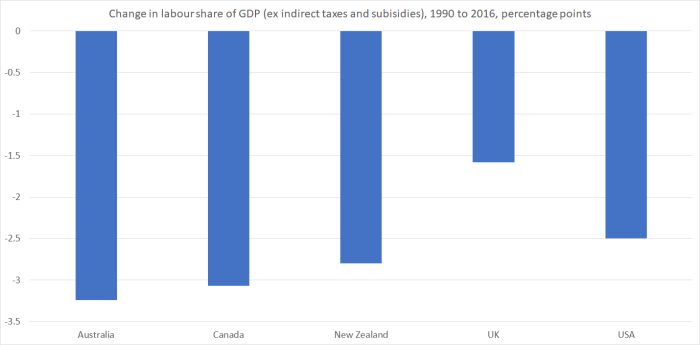
Here is the change in the labour share of GDP (less net production taxes and subsidies) since 1990.  Why 1990?  Well, the Minister talked about the last 30 years, but also explicitly highlighted the labour market reforms most of which date to 1991.   I’ve shown the numbers not just for New Zealand and Australia, but also for the other three Anglo countries.

lab share may 18

New Zealand is the median country.  The labour share of income fell a bit less here than in Australia.   If one takes the comparison just over the terms of the last two governments, so starting from 1999, the labour share of income here has increased – and in each of these other Anglo countries, it either fell or increased less than the increase in New Zealand.

I don’t want to make very much of pretty small differences.  But the numbers just don’t seem to support the Minister’s case.  And to revert to productivity, Australia has had one of the faster rate of productivity growth (real GDP per hour worked) among the older OECD countries since 1990.  I’m not aware of any evidence suggesting that collective bargaining and the role of unions has been a material (positive) part of that story.   A rather more common story is to emphasise the role of the rapid increase in Australia’s mineral exports.

The interviewer moved onto minimum wages

CORIN You talk about balance. How fair is it for a business, let’s say a business making a product that’s sold globally, with 25 staff, to now face the higher minimum wage; they lose their fire-at-will rights; they’re going to face much stronger unions, more compliance costs; they are operating in a global marketplace; they’ve lost their flexibility; how fair is it for that business?

IAIN I don’t think they’ve lost any flexibility at all. And operating in a global market means that businesses need to be resilient. They need to be able to work with the different market forces. Now, if a small change to the minimum wage is going to be that detrimental to them, they don’t sound resilient, and so what we actually need is to signal to businesses, as we have done, what our plans are for the minimum wage and for our other industrial law changes, give them an opportunity, if they don’t feel like their business model can operate in those in that environment–

CORIN So tough luck if they can’t make that work?

IAIN To give the opportunity to transition. Because we need businesses to transition into an environment where in a high-skill, high-wage economy, they are able to operate.

CORIN I think there’ll be plenty of people watching this morning who run small businesses, very frustrated and will be yelling at the TV, saying their margins are small; they’re battling away; they’re trying to employ Kiwis. They will see these changes, and certainly Business NZ is arguing that this week, as being unfair and unreasonable.

IAIN Look a lot of businesses come and go, regardless of any changes the government makes. So, yeah, most start-ups, for instance, don’t actually last beyond a couple of years. That’s the nature of doing business. What we as a government have to do is make sure there is an environment in which new businesses can develop; new jobs can be created; and as thing change for people, new opportunities become available for them. That, I think is the most important thing – that we have a strong economy where if businesses do come and go over time, which they do, that there are new opportunities for people to take up.

Now, no one is going to dispute that firms come and go, that is the nature –  the desirable nature –  of a market economy.  But the indifference of the Minister here is all but breathtaking.   His attitude appears to be that somehow we don’t want firms that can’t manage to turn a profit paying what has already been one of the highest minimum wages (relative to median wages, or to the overall productivity of the economy) anywhere.

He mightn’t, but the people who hold those jobs at present might have a rather different attitude.  Sure, they’d prefer a higher wage, all else equal.  Who wouldn’t?  But that isn’t the scenario the Minister paints.  It isn’t even the usual line the advocates of higher minimum wages run, that somehow hardly any jobs will be lost.  The Minister seems to recognise that some firms will be forced out of business, and he just doesn’t care.  Because amid all the blather about “new opportunities” and the earlier rhetoric about “transforming our economy into one that’s productive”, there is nothing in what the Minister is saying –  or what his leaders and colleagues have been saying –  to give anyone any confidence that government policy is about to transform our underwhelming productivity performance.

It is true, of course, that there might be some small measurement effects from big increases in the minimum wage.  If some people are priced out of work altogether they will tend, on average, to be the least productive workers.  Average productivity of those who remain may be a little higher as a result. But that is no comfort to anyone, and doesn’t earn New Zealand as a whole better opportunities in the wider world.   In some cases, firms may even respond to higher minimum wages by mechanising more, but again that isn’t a gain for New Zealanders as a whole –  but rather a second-best response (not the production process they’d have preferred, and which market opportunities would have warranted) to a direct government intervention.    Pricing some people out of the labour market is no way to improve opportunities (and incomes) for all.

It is also not as if the increases in minimum wages are small.  The minimum wage was set at $15.75 last April, and under coalition agreement it is to reach $20 per hour in April 2021.  That is a 27 per cent increase in four years.  There will be some inflation over that period.  But on the Reserve Bank’s forecasts the other day, that will total only 6.7 per cent over four years.  In real terms, minimum wages are rising by 19 per cent in only four years.

All of which might be fine if there was productivity growth to match.    Over the last five years there has been only about 1.5 per cent productivity growth in total.

real GDP phw may 18

Perhaps the next few years will be different?  But there is nothing in the Minister’s remarks offering any sort of credible explanation as to how, or why we should expect something better?  Most likely, some firms –  not very resilient, in the Minister’s terms –  will be forced to close, to downsize, or to adopt production patterns that are less efficient than market opportunities and market prices would lead them to prefer.

Those losses are more likely to be concentrated in the outward-facing tradables sectors of the economy.   Domestically-oriented firms don’t have unlimited pricing power, but they often have some –  especially when across the board regulatory changes like this are put in place.  Most outward-oriented firms –  whether in tourism, export education, farming or wherever –  have very little, if any.

And it is not as if the economy has been successfully becoming more outward-oriented over recent years either, even before this latest scheduled lift in the real (unit labour cost) exchange rate.

export share may 18

One mark of a successful economy tends to be an increasing share of the economy accounted for by exports and imports –  local products and services successfully taking on the world, enabling locals to consume the best the world has to offer.

Perhaps the Minister wishes for a world of abundant home-grown high-performing, high margin businesses.  It might even be a worthy aspiration, but wishing doesn’t make it so, and there is no sign that government has any credible story as to what might make it so.

Changing tack, as I noted in my post on Saturday, I did an interview with Wallace Chapman for yesterday’s Sunday Morning  programme on Radio New Zealand.   Later in the same programme, Chapman had an interview on population issues with Massey university sociologist Paul Spoonley (he runs the government-funded immigration advocacy research programme CADDANZ) and with environmental economist Suzi Kerr, of Motu and Victoria University.

It was a slightly unnerving discussion, at least to anyone who counts children as a blessing.  Kerr seemed set on encouraging people to have fewer children for the “sake of planet” (observing that she and all the people she worked with had chosen to have two or fewer), observing that adjustment to climate change would be easier with fewer people.  In the course of the discussion, she was careful to disavow any particular expertise in immigration –  and didn’t come across as a particular immigration booster (countering Spoonley’s arguments in a couple of placs) – but never once did she suggest that if we were concerned about reducing the number of people here that immigration policy –  affecting non-New Zealanders –  would be an obvious place to start.  Non-citizen immigration is, after all, an increasingly large share of New Zealand’s population increase, and the total fertility rate here is already below replacement, reaching a record low last year.    I suspect she isn’t much interested in New Zealand specifically and is more interested in “saving the planet”, including talking of redistributing people round the world.  It was a little disconcerting given that she has just been appointed as a member of the government’s new Climate Change Commission (a fact Radio New Zealand failed to point out in introducing her).  One hopes that in her new official role she will think rather harder about the easier options –  if not ones necessary welcome to the political masters to whom the owes her appointment –  open to New Zealand to ease the cost of adjustment to the government’s carbon targets.

As for Spoonley, he asserted –  of my comments on immigration (lack of NZ specific evidence of benefits) in the earlier interview –  that I was partly right and partly wrong.    If he remains convinced of the economic benefits of immigration to New Zealanders as a whole, perhaps he could engage with some of the indicators I’ve referred to in various recent posts (eg here and here) –  the underperforming Auckland labour market, the outflow from Auckland of New Zealanders, the way in which the margin by which real GDP per capita in Auckland exceeds that in the rest of the country is small and shrinking, all in an economy with an underwhelming overall productivity performance, and a shrinking share of the outward-oriented sectors.  Spoonley’s apparent preference –  to encourage/incentivise immigrants to move to places other than Auckland – is no (economic) solution either, just transferring the problems to even less productive places.


Is vapid rhetoric all our leaders can offer?

The Prime Minister gave what she billed as a “pre-Budget” speech yesterday to the leading business lobby group, Businss New Zealand.  It was, I’m pretty sure, her first prime ministerial speech mainly on economic matters.  In introducing her speech  she indicated that she would

outline our plans for the economy and how we want to partner with New Zealand businesses to bring about transformative change for the good of all New Zealanders.

and a few sentences later she added

We are committed to enabling a strong economy, to being fiscally responsible and to providing certainty. We have a clear focus on sustainable economic development, supporting regional economies, increasing exports, lifting wages and delivering greater fairness in our society.

But in the rest of the speech there was almost nothing there.   There were slogans, and feel-good phrases.  But there was no plans for the economy.  No plans to lift productivity –  a point she touched on not infrequently during the election campaign –  and barely even an acknowledgement of the problem, no plans to reverse the decline in the export/import shares of GDP in New Zealand, and no sign that she –  or her advisers or her Minister of Finance –  have a serious well thought-through story of how New Zealand ended up underperforming as badly as it has done, let alone how we might reverse the underperformance.

Governments of both political parties deserve credit for keeping the government’s finances more or less in order.  As I noted yesterday, that is more than most large OECD countries have managed in recent decades.  But it isn’t a substitute for policies that might finally offer a credible path out of the 70 years of relative economic decline –  drifting a bit further behind even as every country is richer than it was – that New Zealand has experienced.

Instead, we get attempts to shift the goalposts, aided and abetted by The Treasury.

On that score how we measure our success is important. In the past we have used economic growth as a sign of success. And yet a generation of New Zealanders can no longer afford a home. Some of our kids are growing up living in cars. Our levels of child poverty and homelessness in this country are much too high.

We all want a strong economy. But why do we want it? What is it for? It is vital that we remember the true purpose of having a strong economy is for us all to have better lives.

Well, sure.  GDP isn’t an end in itself, but it (and cognate measures) are a pretty important means to those ends, and a reflection of how well a society is providing for itself.    And how does the Prime Minister suppose that the crushing specifics of (New Zealand) poverty 100 years ago –  when New Zealand was the richest country on earth – became largely non-existent today?  By achieving sustained productivity growth.   And if we now score badly on some of the poverty indicator measures, it isn’t entirely surprising when productivity (real GDP per hour worked) isn’t even two-thirds of that in countries like France, Germany, the United States, and the Netherlands.  When it now also lags well behind Australia too.

In her speech, she claims that her plans are already clear

We have already spelled out our ambitious agenda to improve the wellbeing and living standards of New Zealanders through sustainable, productive and inclusive growth.  Now we want to work with business and investors to get on with it and to deliver shared prosperity for all.

and

We will encourage the economy to flourish, but not at the expense of damaging our sovereignty, our natural resources or people’s well-being. Our plans have been spelled out from the beginning, in the Speech from the Throne, in the first 100-days plan, and very soon you will see more detail in our first Budget.   ……

You will see a clear plan to build a robust, more resilient economy. You will see a strong focus on delivering economic growth, on running sustainable surpluses and reducing net debt as a proportion of GDP.


There was little of substance on this score in the Speech from the Throne.  And much as I wish it were otherwise, I won’t be holding my breath waiting for the “clear plan” for stronger sustained real economic (and productivity) growth in the Budget.  There is nothing in anything the government has said so far that suggests they or their advisers really grasp the issues.     Quite why simply wishing businesses would “get on with it” would now be expected to produce better outcomes than we’ve seen in recent decades is a bit beyond me.

Of course, there are nods in the direction of things Labour (or their partners believe in)

My Government is keen to future-proof our economy, to have both budget sustainability and environmental sustainability, to prepare people for climate change and the fact that 40 percent of today’s jobs will not exist in a few decades.

I’d love to see some data on what proportion of jobs that existed 40 years ago don’t exist today (the majority of the jobs that existed in the Reserve Bank I joined in 1983 don’t exist any more).  But while the government worries about work –  setting up a new tripartite forum involving the CTU and Business New Zealand – actual employment rates don’t seem to be the problem.

E rates by age

(Lack of) productivity is.   It is productivity growth that underpins any long-term growth in real incomes and living standards.

There is talk of skills, when OECD data have shown that New Zealander workers have some of the highest levels of skills anywhere in the OECD (indeed, the chair of the Productivity Commission was retweeting an OECD chart to that effect just a few days ago).

There is talk that “no-one has the same job for life any more”.  Perhaps, but there is data overseas suggesting that average length of time with a single employer is little different now than it was 30 years ago.

There is talk of “lifting R&D spending”, and the government has out for consultation at present its plan for new R&D subsidies, but no sense that the Prime Minister or her advisers have thought at all hard about why firms might not have found it worthwhile to do more R&D spending (or why, by contrast, firms in some rich countries with no R&D subsidies do a great deal).

There was lot of rhetoric

Business can be assured that this Government will support those who produce goods and services, export and provide decent jobs for New Zealanders.

But little substance, and nothing that shows signs of pulling it all together into a coherent narrative.

And, for all the mentions of climate change and related issues, nothing at all about how faster overall productivity growth –  and a stronger export/import orientation –  might be achieved in the face her government’s commitments to sharply reducing net emissions in a country with high marginal abatement costs.  “High marginal abatement costs” has meaning: it costs to do this stuff, and the cost is likely to be reflected in lower levels of economic activity (and productivity) than otherwise.  Perhaps the government disagrees –  and perhaps her audience were too polite to challenge her –  but there is nothing in the speech suggesting she has thought hard about squaring that circle.  There seems to be lots of wishful thinking, and not much substance.

And then there were “the regions”

And the regions need not fear they will be neglected. We have committed $1 billion per annum towards the new Provincial Growth Fund and over coming months there will be more detail about how this spending will be targeted. After all, nearly half of us live outside our main cities and our provinces also need to thrive if New Zealand is to do well.

The Provincial Growth Fund aims to enhance economic development opportunities, create sustainable jobs, contribute to community well-being, lift the productivity potential of regions, and help meet New Zealand’s climate change targets.

There might be a bit of a lolly scramble, redistributing the current cake.  But there is nothing from the government, or from the architects of the PGF –  and nothing in the announcements to data (eg here and here) suggesting that the government has any concept of how overall productivity growth rates, nationwide or in the regions, might be lifted.  (And not once was the real exchange rate mentioned.)

Perhaps defenders of the government would push back on one or another point.  But there is no sign of any sort of integrated narrative –  a rich understanding of how we got to our current sustained underperformance or, reflecting that, how might hope to reverse the decline.  No doubt in an attempt to woo her business audience, there weren’t even any references to tax system changes (CGT and all that) in this economic speech.

Perhaps that isn’t entirely the government’s fault.  The Treasury seems at sea as well.  But we don’t elect bureaucrats, and we do elect governments.

Of course, I wouldn’t want to be misinterpreted as suggesting that the Opposition was any less bad.  The new Leader of the Opposition also gave his first economic speech this week.   There were a few bits where I was nodding my head as I read

Labour and NZ First are more focused on government intervention. They believe they know how to run your businesses better than you do.

Shane Jones’ $1 billion Provincial Growth Fund is a good example. It’s terrible policy.

Now I’m sure there are some worthy projects that will get funded. But it will shift businesses from focusing on becoming more productive to chasing a subsidy from Matua Shane.

That’s not how to drive long-term productivity improvements.

Couldn’t disagree, but what did Bridges have to offer

When I was Economic Development Minister, our plan for the economy was set out in the Business Growth Agenda.

The BGA comprised over 500 different initiatives all designed to make it easier to do business by investing in infrastructure, removing red tape, and helping Kiwis develop the skills needed in a modern economy.

Some of those were big, some were small. I’ll admit some weren’t as exciting spending a billion dollars every year.

But together they were effective.

New Zealand has one of the best performing economies in the developed world.

500 initiatives and we still had barely any productivity growth in the last five years.  And, as I recall, one of the BGA goals was a big increase in the export (and, presumably, import) share of GDP: those shares have actually been shrinking.  Productivity levels languish miles behind the better advanced economis, and the gaps showed no sign of closing.

He ends

New Zealand is a great country. And if we maintain our direction and momentum of recent years we can make it even better for our kids.

Moving into opposition is a chance for National to look at our position on certain issues, and understand the things that New Zealanders want us to focus on.

Although the one thing I hope you’ll take from my speech is we won’t be changing our focus on the economy.

If we don’t start seeing a lot more hard-headed thinking –  and a quite material change of direction – from our political leaders and their advisers, a country that really was once the best place in the world to bring up kids, will increasingly be a country where wise parents can only counsel their kids that if they want first world living standards, the best option is to leave.     In my lifetime, 970000 (net) have already done so.  The Prime Minister and the Leader of the Opposition –  representing two sides of the same coin when it comes to our economic failure – are younger than me, but in just the 37 years the Prime Minister has lived, a net 780000 of our fellow New Zealanders have left.   Outflows of that scale – which, of course, ebb and flow with short-term developments in Australia and here –  just don’t happen in normal, successful, countries.