Inflation and monetary policy: looking across countries

Time moves on. This post was going to be run late last week once the last OECD inflation data for the June quarter (that for Australia) came out, but a bad cold ran through the house and not much got done. Last night, July inflation numbers were released for the euro-area (remember that NZ only recently got mid-May’s numbers), but this post is going to focus just on the numbers to June.

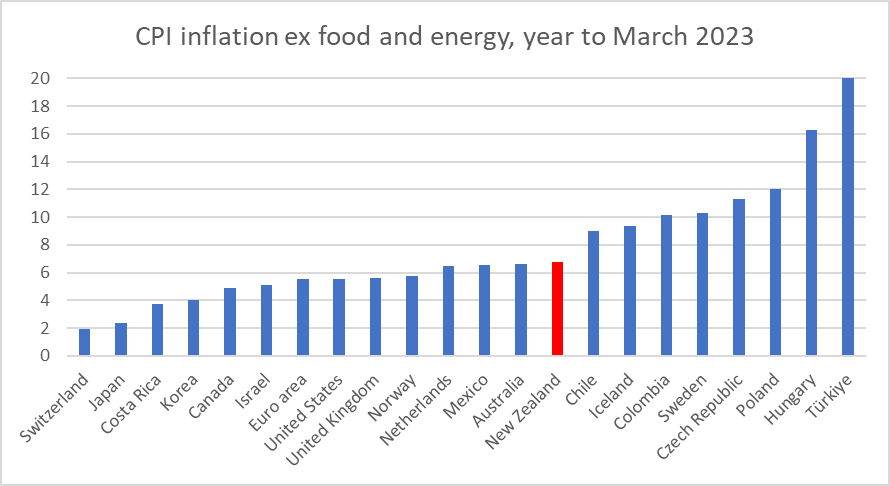
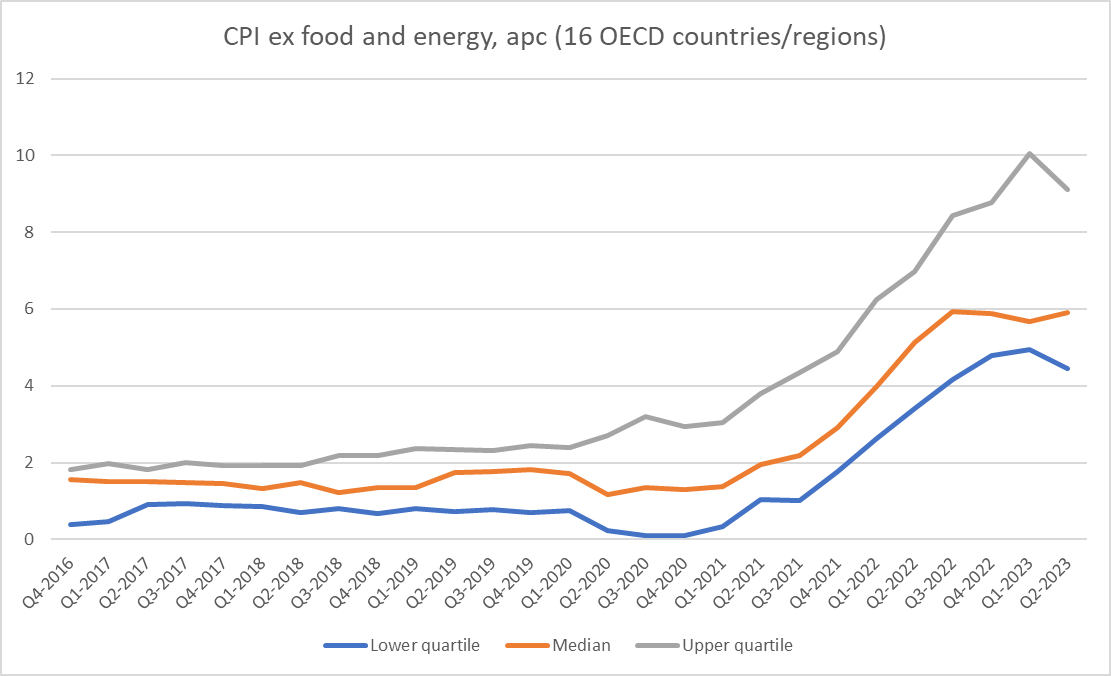
This is annual CPI inflation ex food and energy (the only core measure available for a wide range of countries) as at the end of June. The sample of countries is the OECD countries/regions with their own monetary policies, excluding Turkey (with off the charts crazy monetary policy and inflation) and the OECD’s poorer Latin American diversity hire countries (but note that two of those latter countries’ central banks have already started cutting policy rates). Of two other advanced countries not in the OECD, Singapore’s (headline) inflation peaked at 7.5 per cent, and Taiwan’s at 3.6 per cent.
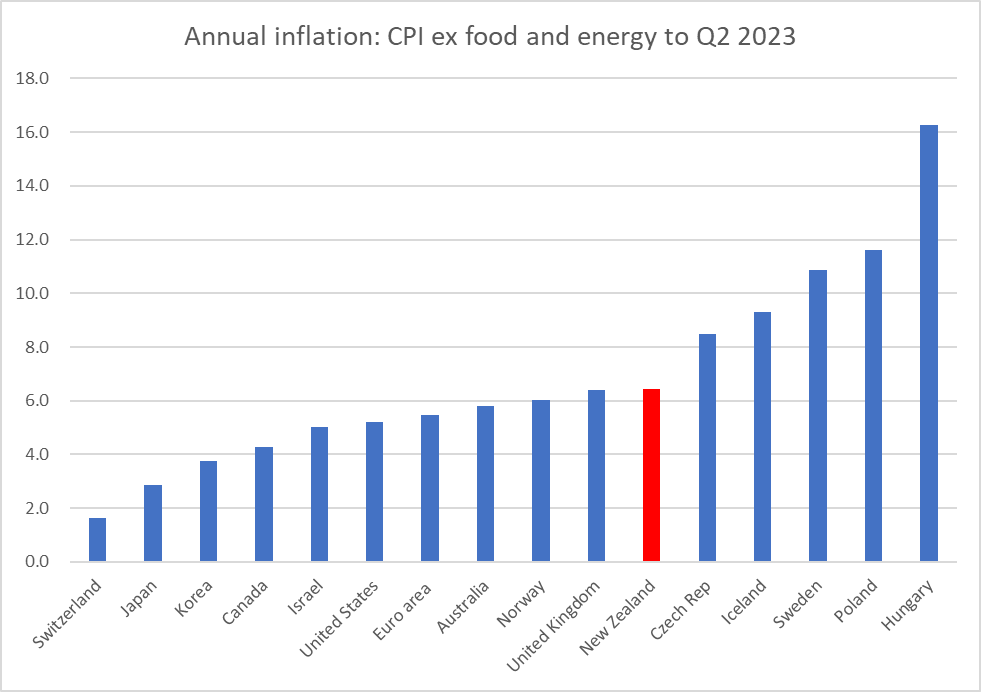
The diversity in outcomes across countries isn’t often recognised. Politicians and central bankers have both tended to go along with lines about “everyone is experiencing much the same thing” (which is a convenient line for avoiding specific and localised accountability). But they aren’t.

Pre-Covid, inflation rates across countries were very tightly bunched (in 2016q4 for example, the lowest core inflation rate for these countries was -0.4 and the highest was 2.9 per cent, at present the range is from 1.6 per cent to 16.2 per cent)
And here is how New Zealand has gone on this metric over the same period relative to the median of these 16 countries/regions.
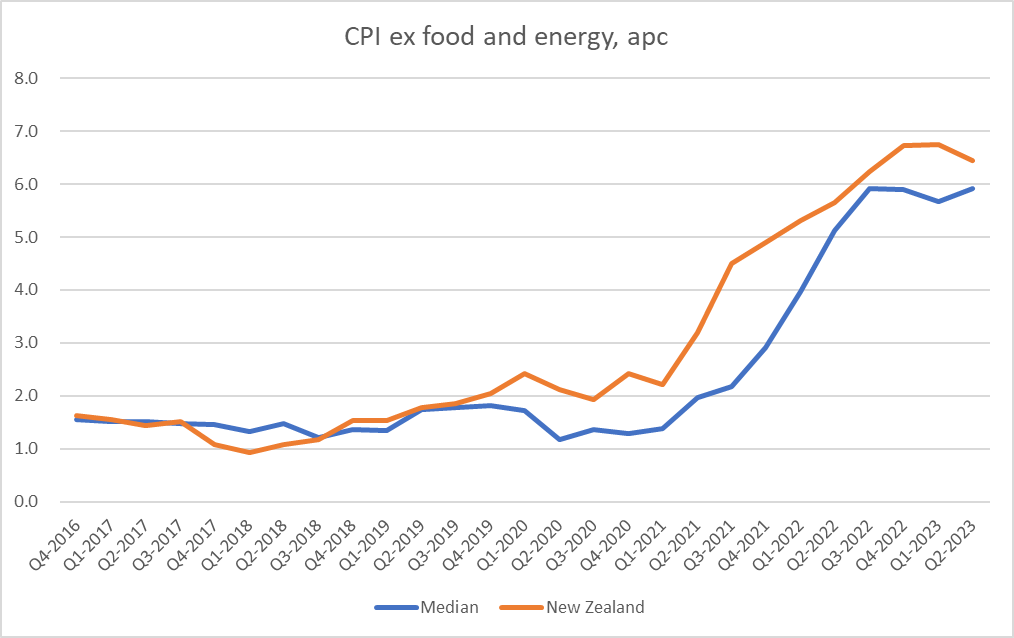
Pre-Covid our core inflation rate was around the median (altho perhaps showing signs of beginning to pull away) but over recent years core inflation in New Zealand has been consistently higher than in other OECD countries (and of course now miles above target). That is on the Monetary Policy Committee. Note that at least on this measure there is no sign yet that the median country’s core inflation rate is yet falling.

There are other core inflation measures, and each country or central bank often has favoured or specific ones, sometimes ones best suited to particular idiosyncrasies at the time. But a fair number of countries or central banks have and publish either trimmed mean or weighted median measures (others have and use them – seen at times in speeches etc – but don’t seem to make the data series routinely available). It would be great if there was a consistent collection of these (generally superior to crude exclusion) measures across advanced countries, but there isn’t.

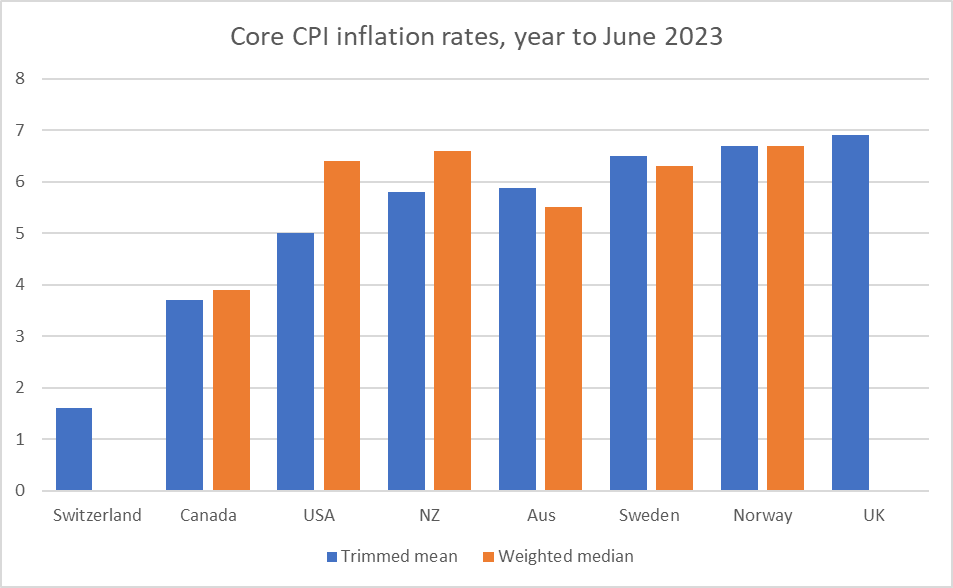
I did what I could and found trimmed mean and/or weighted median data for eight of the countries above (NZ, Australia, US, UK, Canada, Switzerland, Sweden, Norway). Even then it is complicated by things like having only a chart for one country, and inconsistencies in whether there is monthly/quarterly or just annual data available, and in whether or not seasonally adjusted data is used (NZ doesn’t). Oh, and the US has fuller data for PCE inflation – the Fed’s focus – than for CPI inflation.

Here is where the annual rates of core inflation stood for these countries at the end of June (there are no weighted medians for Switzerland and the UK)
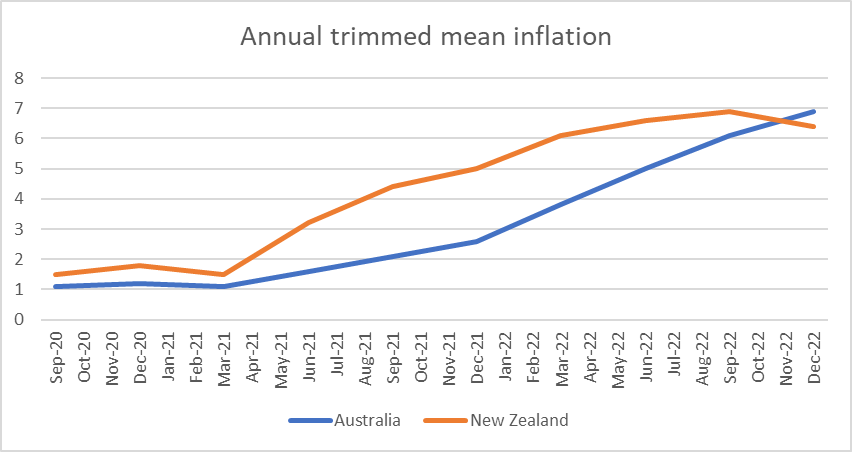
And here is the time series for the five countries with both weighted median and trimmed mean annual rates
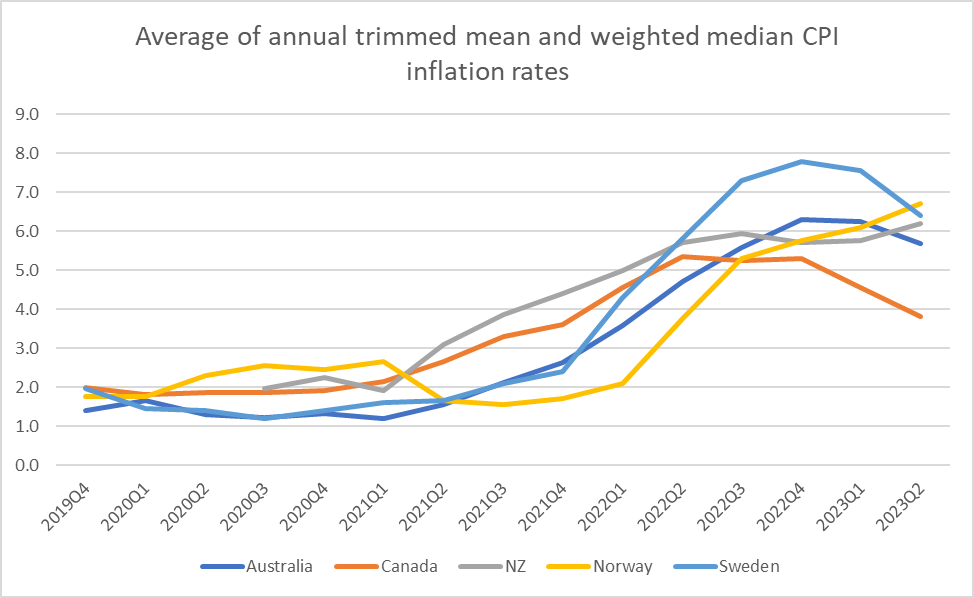
It is a mixed picture. Core inflation in Sweden and Canada has clearly fallen, and Australia seems to have as well, although to a lesser extent. Things are still getting worse in Norway, and in New Zealand things are probably best seen as going sideways. Of the other countries, the chart of trimmed mean inflation in the UK suggests they are still very near a very recent peak, and Swiss trimmed mean inflation is now down a little from peak.

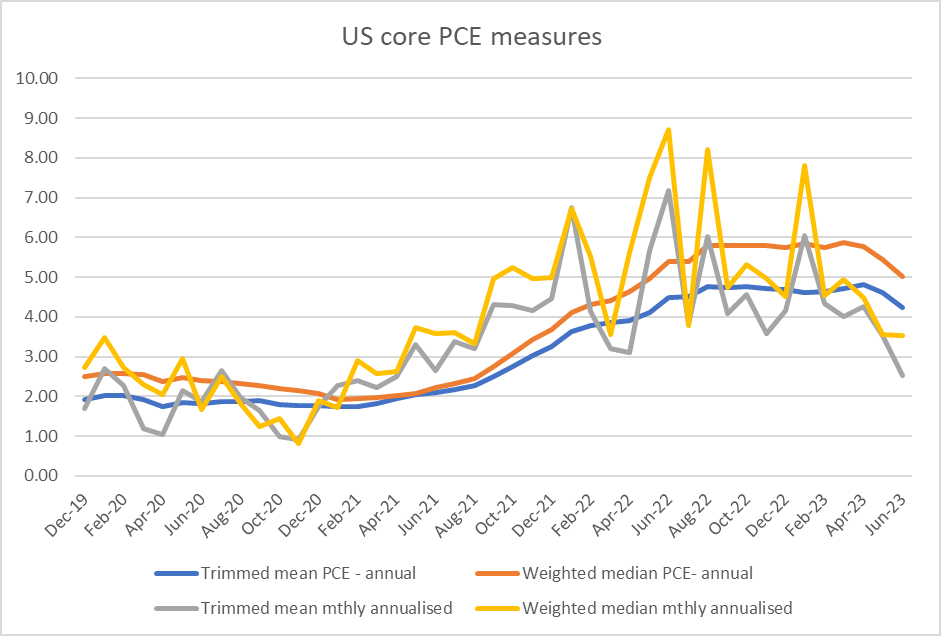
What of the US, which gets most coverage? Focusing on the PCE measures, core inflation is clearly falling
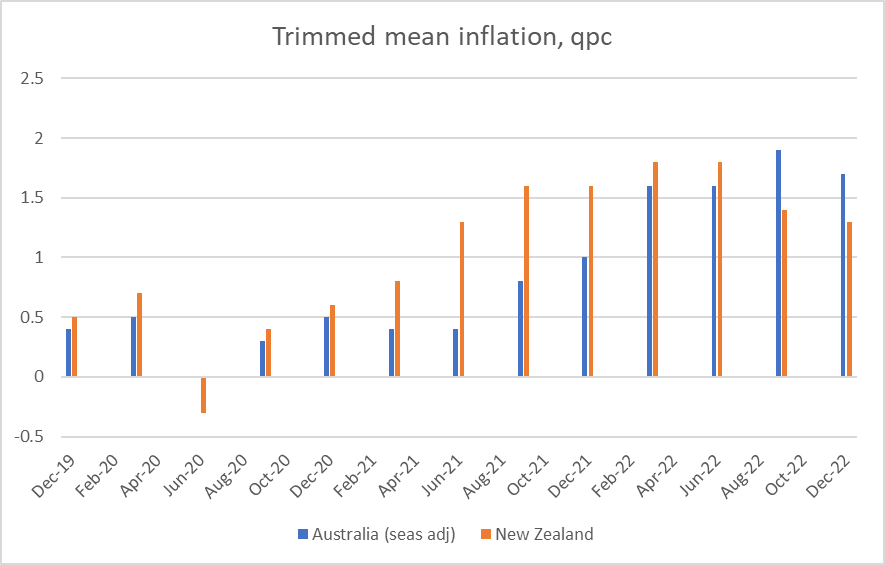
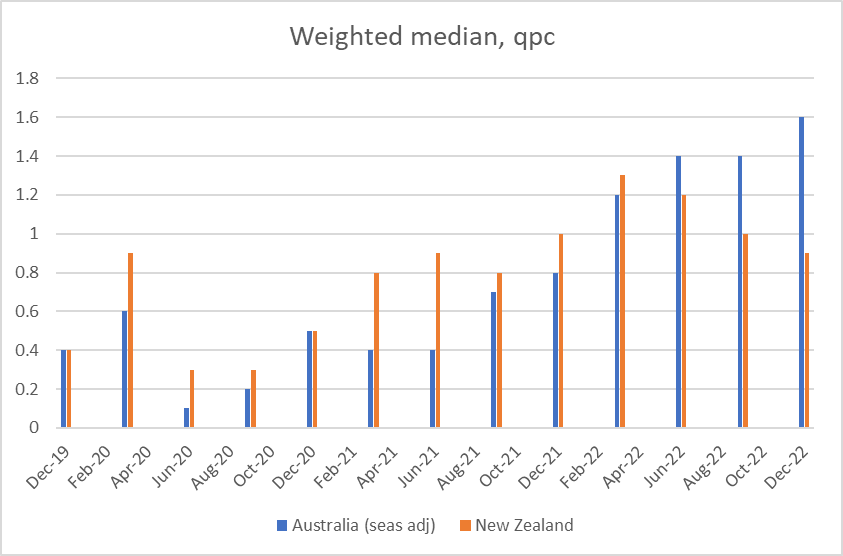
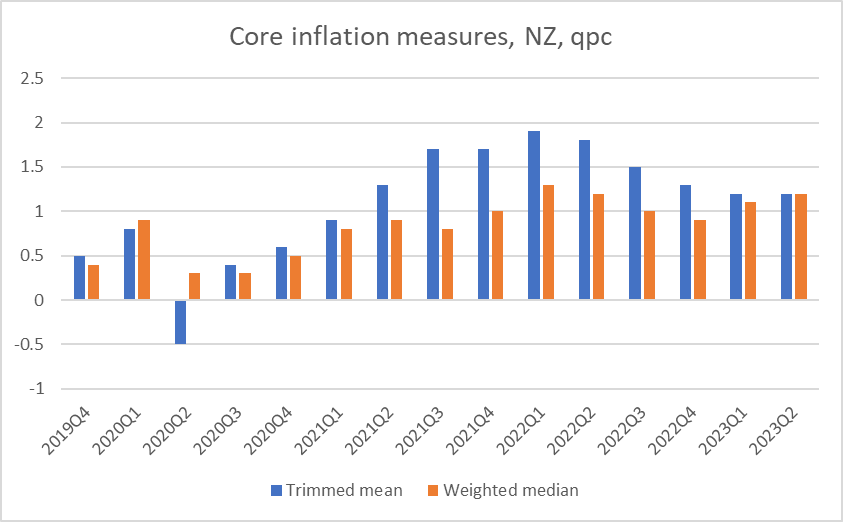
Most countries don’t provide quarterly or monthly percentages changes, but we do have that data for New Zealand and Australia (in New Zealand’s case complicated because SNZ does not – for some inexplicable reason – use seasonally adjusted data to do the calculations. There isn’t much seasonality in the resulting series, but using raw data tends to skew downwards the quarterly changes – when, eg, there are things that reprice once a year.) Here is the NZ chart
and the Australian one
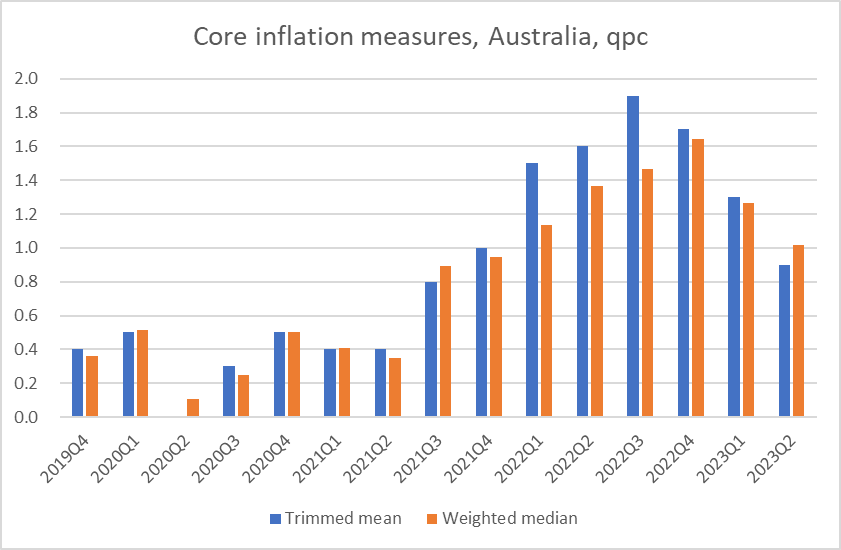
For Australia, the falling rate of quarterly core inflation is now pretty clear. Both measures now paint much the same picture. But for New Zealand while the trimmed mean suggests quarterly inflation has peaked (quite some time ago), a) there is no hint of that in the weighted median, and b) in the last couple of quarters there is no sign the trimmed mean is falling further. The fact that the two series have re-converged suggests not much grounds for comfort about New Zealand core inflation (especially when put together with the simple ex food and energy measure). On balance, perhaps we could say that the worst may have passed, but none of the series are yet suggesting anything like a quick convergence back to target (recall, the MPC is required to focus on the 2 per cent annual target midpoint).

Which brings us to monetary policy.

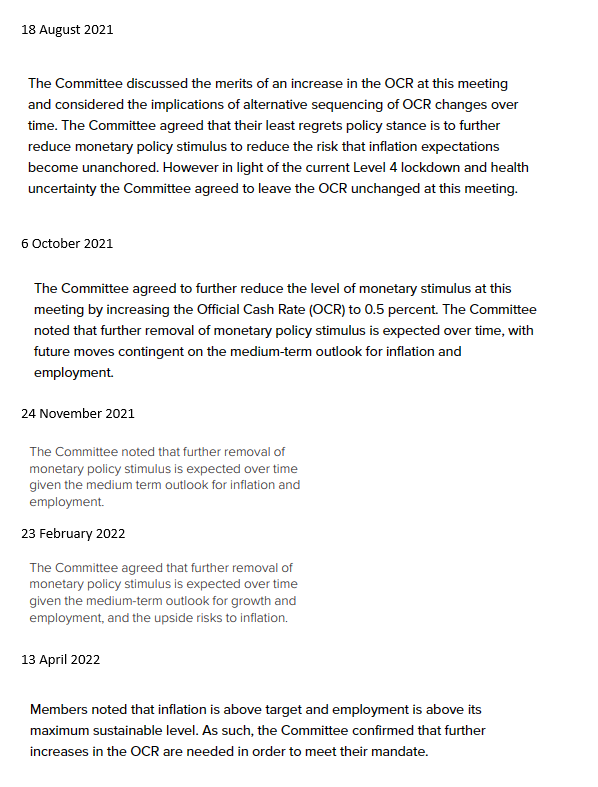
At their last review – incredibly, scheduled deliberately a week BEFORE New Zealand’s rare and infrequent CPI data came out – the MPC declared itself thus.

It isn’t clear to me how (a) any central bank can credibly claim to be legitimately “confident” about anything much at present (if your models got inflation so wrong over 2020-2022, why would you be confident things were working just fine now, and b) how the RBNZ MPC any particular had found any reason in the data (let alone the CPI data they chose not to avail themselves of) for their particular breed of “confidence”.

I checked the RBA and Bank of Canada statements last month: they didn’t seem confident (much more, as you might expect, data-driven). Nor did the Bank of England or the FOMC. And there was no apparent confidence that they had done what needed doing in the SNB, Norges Bank or Riksbank statements either. In fact, the Swedish Riksbank’s latest statement captured nicely what might have been expected here, on the data as it stands
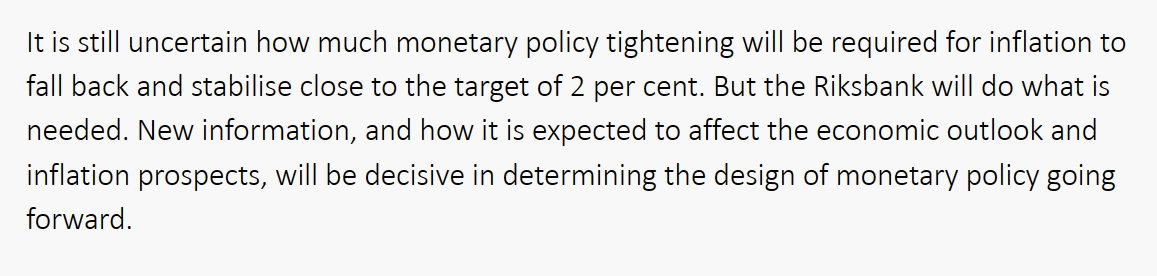
This from a central bank with the same target as the RBNZ, similar current core inflation, but clearer evidence core inflation has already been falling.

It leaves a distinct sense that, as so often, the RB MPC was engaged in spin, lacking in substantive analysis.

There will some important further data out before the MPC again sets the OCR later this month (notably tomorrow’s labour market suite, and also the Bank’s Survey of Expectations – the one that so far this cycle has done a less bad job than the MPC of picking future inflation), so what they should do in August is still to some extent a question for another day (although they should, if they are at all intellectually honest, take that “confident” statement off the table). But how about where things stand now? And all bearing in mind that monetary policy works with a lag (although quite how long and variable those lags really are does seem to be up for debate).

There are central banks where you really have to wonder what is going on. For example, policy rates haven’t been raised in Hungary and Poland since September last year and both now have double-digit core inflation (still rising in Hungary). Less extreme, the Norwegian central bank has core inflation still rising, and although the central bank has raised the policy rate by 100 basis points this year, it is still only 3.75 per cent (and Norway’s latest monthly unemployment rate is still very low). Iceland also has core inflation steady at around 9 per cent.

On the other hand, when one looks at the Bank of Canada’s increase in the policy rate last month (to the highest level in more than 20 years), in conjunction with the already-falling and fairly moderate core inflation you get the sense that, if they are still too sensible to say it, that they might have good grounds for being increasingly confident of being back to target before long.

It would all be a lot easier if we had robust estimates of the neutral real and nominal rates for each country. But we don’t (neither the real rates nor the implicit inflation expectations that are actually shaping behaviour of firms and households).

And there is lots of differences across countries. For the period since 1999 (when the euro started, and the NZ OCR began) here is the median policy rate in each country (differences would be a bit smaller done in real terms, but still substantial).
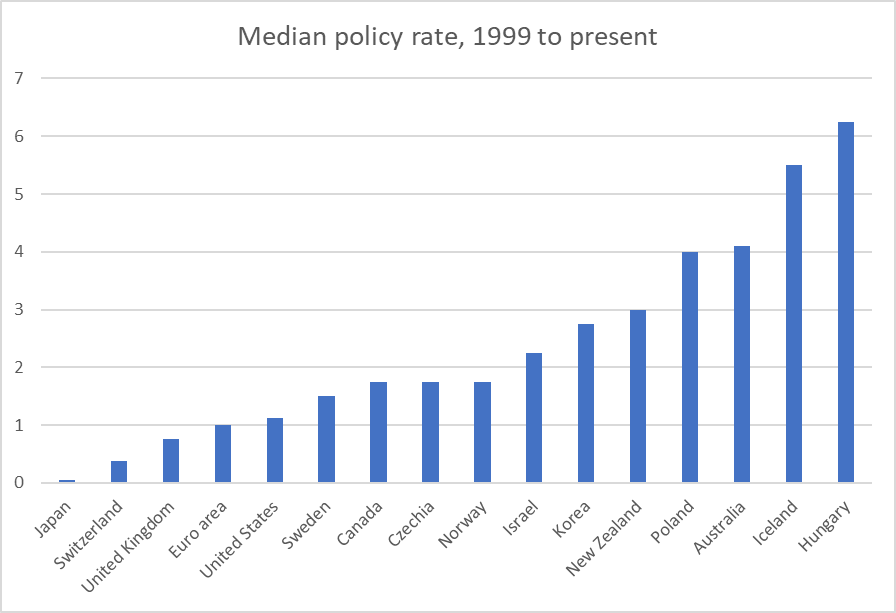
All countries, except Australia, now have policy rates above those medians.

I took a look at how current policy rates compare to the peaks in each country in and around 2008. The median difference across those 16 countries is under half a percentage point (eg both the US and the euro-area now have policy rates almost exactly the same as that pre-crisis peak).

But four countries stand out, with policy rates now well below that previous cycle peak. There is Iceland. Now, the pre-2008 peak was in the context of one of the most staggering and destructive credit booms in modern times. Still core inflation is 9 per cent, and the policy rate even now is only 8.75 per cent. There is Norway: as above, core inflation is high and rising and (from a distance) it is hard to be confident things are in hand.

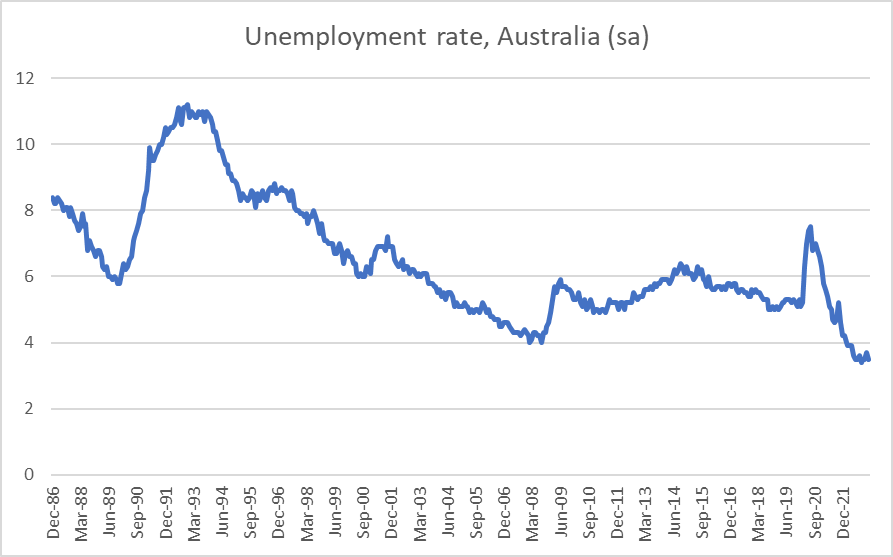
And then there are New Zealand and Australia, both with policy rates around 3 percentage points less than the 2007/08 peaks (and there is a pretty common view about 2008 that the RBA got lucky, not having had policy rates tight enough – in the face of a mining investment and terms of trade boom – but being “saved” by the international recession. The Australian story puzzles me: rates are well below previous cyclical peaks, the unemployment is still extremely low (including far lower than just pre Covid), but……the data (see above) show that core inflation has turned down (and while there is still a way to go, Australia’s target is a bit higher than some other countries’, including New Zealand). If I wanted to be “confident” I’d done enough, one can see a good case for higher rates (perhaps later today), but there are plausible counterarguments.

Much less so for New Zealand. We don’t have core inflation falling, we don’t have unemployment rising much (and last week’s employment indicators still looked quite strong), unlike most previous policy rate cycles there is no disinflationary support from a rising exchange rate, and the OCR is miles below the 2008 peak. (One could no doubt add in points Westpac in particular has been making about a bit of rebound in confidence, but I’m not trying to review all the data.)

Were I in the Fed’s shoes or those of the Bank of Canada I might by now be feeling somewhat more secure. Were I at the Norges Bank (as far I can see) I’d be very uncomfortable. The Australian data are perplexing but there seems nothing in the New Zealand data – considered a cross country or across time – to give any central bank decisionmakers any particular reason for comfort (let alone “confidence” at all). Macro forecasting is something of a mug’s game, and it is always possible the RB MPC may have done enough, such is the uncertainty, but it is very hard to see at this point (and the Committee has provided no analysis in support of their stated “confidence”, continuing a fundamental dereliction (no speeches, no serious research, no serious analysis) that dates back at least to the creation of the MPC). Things may be just about to break, and there are a great many uncertainties here and abroad, about how this cycle is unfolding, but the sort of “confidence” the MPC is asserting risks seeming more political (eg life seems like to be easier for Orr if Labour is re-elected) than grounded in secure economic analysis.

Tweaky tools

For the first 20 years or so of inflation targeting in New Zealand, there was a near-constant hankering for other instruments to “help out” monetary policy. In the early days of getting inflation under control, it was little more than ritual incantations (the team I ran included them every month in our papers to the Minister) that it would help, adjustment would be easier, if only there was labour market deregulation, reduced trade protection, and tougher fiscal policy. In the Brash years, his colleagues became very familiar with the Governor’s hankering for what we (or he) called “tweaky tools”, things that at the margin might make a difference, particularly perhaps in easing the exchange rate pressures that used to be such a feature of New Zealand monetary policy tightening cycles. There was even the pesky visiting US academic in the mid-90s who used his public lecture to suggest that discretionary fiscal policy should be handed over to the Reserve Bank (we winced). It wasn’t so different in the pre-2008/09 Bollard years. At the then Minister’s urging we and Treasury ran an entire Supplementary Stabilisation Instruments projects in 2005/06, culminating a year later in a scheme for a discretionary Mortgage Interest Levy, a scheme the then Minister was tantalised by, sufficient to consult the Opposition, but eventually shut down work on only when National walked away. At about the same time, yet another invited visiting academic was openly proposing a variable GST as a supplementary stabilisation instrument. In the same vein a few years later, Labour in 2014 campaigned on giving the Reserve Bank power to vary Kiwisaver contribution rates, to assist monetary policy in the cyclical (inflation) stabilisation role Parliament has assigned it.

Of course, between mid 2007 and mid 2021, there were hardly any OCR increases, and those there were were quite small and short-lived (unnecessary in the first place as it happens). And since around 2010 New Zealand real exchange rate fluctuations have been much more muted than we had become accustomed to (over the decades from 1985, they were not only highly salient in political debate but also inside the Reserve Bank).

And if big cyclical swings in the real exchange rate still haven’t resumed, big OCR increases have.

And with it talk of spreading burdens, easing loads, and finding supplementary tools seems to be back. There was an article in the Herald a couple of weeks ago sympathising with indebted households who, it was claimed, are bearing the brunt of the belated anti-inflation fight.

(I wouldn’t usually be very sympathetic with people who took big mortgages when house prices were rocketing on the back of pandemic-policy low interest rates and didn’t lock in, say, five or seven year fixed rates, except that……..the Reserve Bank itself by buying up $50+ bn on longish-term government debt at the same time did rather tend to suggest to the borrowing public that rates weren’t likely to go up much – after all, which responsible government agency would expose its stakeholders (taxpayers) to a meaningful risk of $10+bn of financial losses.)

And that prompted Don Brash to enter the conversation, reviving a call he had first made in 2008 and suggesting that the Reserve Bank be given the power to vary the petrol excise tax as an additional counter-cyclical tool to assist monetary policy and spread the burden. This is reported and discussed in this Herald piece today, which in turn draws from one of Don’s own blog posts. Don ends his post with this claim

But it would have the huge advantage of spreading the social effects of controlling the inflation rate.

I disagree, quite strongly, with Don’s proposal, for a variety of practical and principled reasons, and would do even on a best-case model (say, legislation limited the extent of the Bank’s discretion and revenues were properly and formally ring-fenced).

(In the Herald article, ANZ chief economist Sharon Zollner is also quite sceptical, adding this tantalisingly radical observation – topic for another post another day:

She said the more salient questions we should be asking were not what tools should we use to try to steer the economy, but rather, should we try to do it at all, given the limitations of economic forecasting? Might the costs outweigh the benefits?

Don is quite right that (as we saw last year), petrol excise taxes can be adjusted very quickly and the effects are also typically seen in retail prices very quickly. He suggests that as the price elasticity of demand for petrol is quite limited, any increase in petrol taxes will quite quickly dampen households’ other spending, in turn dampening inflation pressures. There are certainly plenty of households who are quite cash-flow constrained, but whether the effect exists to a material extent in aggregate would need rather more careful and formal review (reflecting on my own behaviour, I’m also a bit sceptical).

But even if we grant that the effect is real and, whatever the effect actually is, perhaps fast-working, there are lots of other problems. These include:

  • the temporary petrol excise tax cut of 2022/23 was 25 cents a litre.  As far I can see, the direct fiscal costs of that were about $1 billion over 15 months.  Even if it was $1 billion for a year, that is about 0.25 per cent of GDP.   And although many economists, including me, pointed out that the income effect of this cut (and the associated road user charge and public transport subsidies) was inflationary, I’ve not seen anyone suggest it was a decisive factor in explaining core inflation outcomes over the last year or so.  Quadruple the effect and one might be talking more serious macroeconomic impacts, but that would require giving the Reserve Bank discretion to make much larger changes in excise taxes than any Minister or Parliament has ever made before.   Sold as an explicitly temporary effect, a cyclical stabilisation adjustment of this sort would probably result in less demand effects than, say, an excise tax increase known to be permanent.
  • Don Brash argues that petrol excise taxes are easy to change. Much less so (as we saw last year in the rushed package) are road user changes for diesel-fuelled vehicles).  The Brash scheme doesn’t seem to envisage adjusting road user charges, but to do one and not the other –  as part of a new permanent stabilisation model –  would seem simply politically untenable.  He also recognises that electric vehicles are becoming more of an issue than they were when he first dreamed up the scheme, but says “Admittedly, with the growing use of electric vehicles there may come a time when varying the excise tax on petrol would have little effect on aggregate demand. But that time is still some way away.”  It seems likely that EVs will soon, as they should, face road user charges, but again the politically tone-deaf nature of the suggestion that the unelected central bank should be able to whack on huge tax imposts on one lot of drivers but not others (the “others” often stylised as being upper income anyway) is staggering.  And if you are tantalised by a thought “oh, but we can encourage people towards EVs”, remember that any such scheme would almost certainly have to be symmetrical…….
  • As Brash acknowledges, one downside of his scheme is that increasing fuel excise taxes to fight inflation will itself, at least initially, boost CPI inflation.   From a central bank accountability perspective this itself isn’t fatal (the target could be re-expressed as one for CPI inflation ex indirect taxes, and the fuel excise effect won’t show up directly in the better analytical core inflation measures), but…….one of the things we know about survey measures of inflation expectations is that they seem to be quite heavily influenced by headline CPI developments (and you can be sure media will keep highlighting headline effects).  We don’t have a very good sense of how those expectations are then reflected in behaviour (spending, borrowing, price and wage setting) but it is unlikely to be helpful –  and especially if we were talking of $1 a litre excise tax changes)
  • It is certainly true that there are plenty of cash-flow constrained households.  For better or worse, however, many of the most cash-flow constrained households also benefit from formal inflation adjustments (welfare benefit indexation), which directly undercut the cash-flow argument Brash is relying on.   The tendency of governments to at least inflation-index the minimum wage works in the same direction (and if neither adjustment is immediate, the central bank should be focused on medium-term inflation prospects, not one quarter possible effects).
  • People are rational.  The MPC meets seven times a year.   Given the prospect that seven times a year, on pre-announced dates, the fuel excise would be up for grabs, behaviour will change, with people either queuing for petrol the morning of the MPC meeting, or holding off as much as possible until just after.     Especially if the prospective excise adjustments are large enough to be economically meaningful (and the road user side is even more challenging if it were to be included).
  • It is a long-established principle of our system of government, dating back centuries, that taxes should only be imposed and adjusted by elected Parliaments (or at very least by formulae fixed by Parliament, as with indexation).   Back when the Mortgage Interest Levy (see above) was being devised (I was the key RB deviser), I recall telling Alan Bollard that I would join the marches in the streets against any notion of taxation without representation.   Same should go for petrol excise tax levies.  It is all rather redolent of Muldoon’s proposal from the 1970s (which was firmly rejected) for the minister to be able to do modest adjustments to tax rates for cyclical stabilisation purposes.  It is the sort of argument that has technocratic appeal, but no democratic appeal.  And before anyone suggests parallels, the rate at which a central bank pays interest to a bank that chooses to deposit with it is not a tax.
  • The Brash proposal seems to have no framework within which the MPC should decide whether to use a fuel excise tool, and to what extent it should use one tool rather than another.  Perhaps overall accountability for inflation – weak as that now seems to be –  would be unchanged, but we’d be opening the door to the whims of 7 unelected people, several with very little technical expertise either, to decide whether to whack up the fuel excise tax or whack up the OCR.   There are huge distributional implications from such choices, and no framework. opening the way (among other things) to extensive lobbying from vested interests preferring one rather than the other.   That seems, to put it politely, unappealing.
  • One of the elements of the Mortgage Interest Levy proposal that exercised our minds a lot was how to ring-fence the revenue.   There wasn’t much point in an additional tax, which might dampen some forms of demand, if the prospect of that money meant governments felt free to spend more.   One can devise all sorts of clever-clogs institutional arrangements, but in the end public revenue is public revenue, net public debt is net public debt, and cost of living pressures and elections are very real.   This might not be an insuperable obstacle, but money pots will tempt politicians (government and Opposition).
  • Brash justifies his proposal on the grounds of mitigating the “social effects” of controlling inflation.  That may well be a laudable goal, but it is one for governments.  This year, however, the government has chosen to run a much bigger fiscal stimulus than it had planned even at the end of last year, on a scale swamping the plausible extent of any fuel excise tax tool, at a time when inflation is still a severe issue.    Had they been at all concerned, there were options, within current legislative and governance frameworks.  The government chose not to take them (and to a detached observer there is little concrete sign National would really have done much different).

Some of the points above matter more than others, and some will matter more to some than to others. But overall, it seems an unappealing proposal. Actually, I’d be rather surprised if the Reserve Bank itself were at all keen, at least after half an hour’s thought.

In the original Herald article a couple of weeks ago, the author ended this way

Quite.

Inflation outlooks

I was filling in the latest Reserve Bank Survey of Expectations form the other day. If one ever needed to be reminded that macroeconomic forecasting is a mug’s game, or wanted a lesson in humility, all one needs do is keep a file of one’s successive entries to that survey. Coming on the back of the latest annual inflation rate of 6 per cent, it was sobering to look back at the two-year ahead expectations I’d written down in 2021 (as I happened, I missed the July 2021 survey so can’t give you my exact number, but suffice to say it would have borne no relation to 6 per cent).

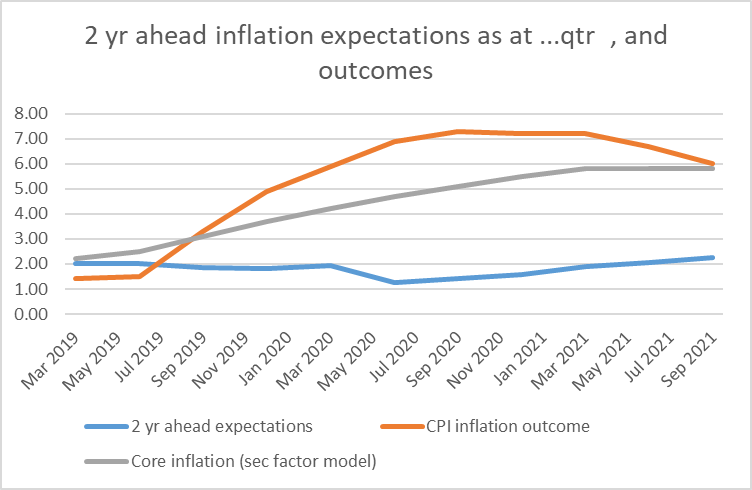
I wasn’t alone. This is what two-year ahead expectations were each quarter from March 2019 (done around the end of January) to September 2021 (done around the end of July). With something of a scare in the June quarter of 2020, the average respondent generally saw medium-term inflation sticking pretty comfortably in the target range the government had set for the Reserve Bank MPC.

As the Reserve Bank often likes to point out, these expectations measures haven’t historically had a great record as forecasts. In fact, here are the outcomes for the dates at which these two year ahead expectations were sought (so the Sept 2021 quarter survey asked about inflation for the year to June 2023). I’ve shown both the headline CPI and the Bank’s sectoral factor model measure of core inflation. Although the question asks about CPI inflation, in some ways core outcomes are a better comparator since no one is going to forecast out-of-the-blue changes in government charges or taxes, or oil prices, two years hence.

The average private commentator/forecaster who completed the surveys has been pretty hopeless.

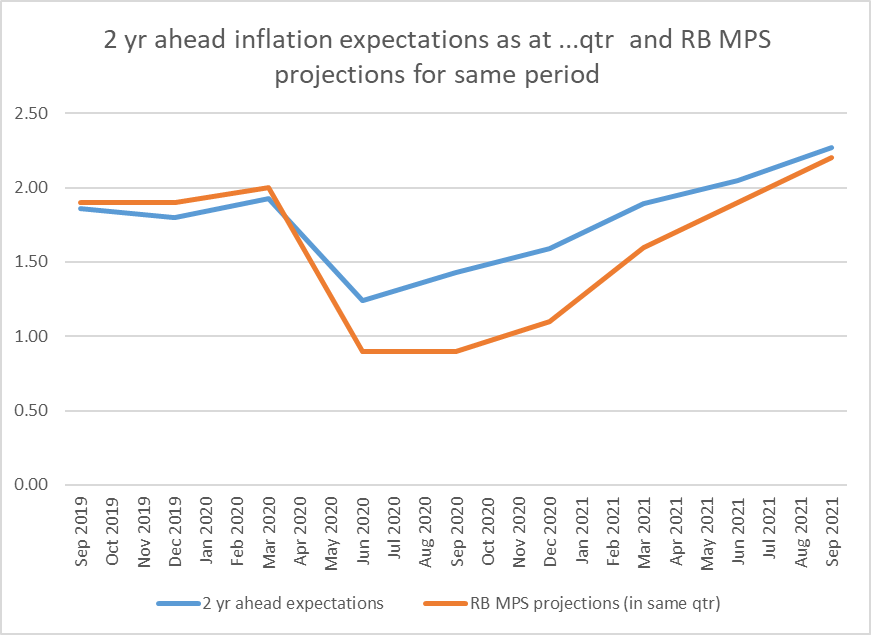
Unfortunately for us, since it is the Reserve Bank MPC that not only makes monetary policy but is, notionally at least, accountable for stewardship and outcomes, the Reserve Bank was a little worse still

The Reserve Bank’s projections were consistently lower than those of the average surveyed respondents over the period relevant to the inflation outcomes of the last couple of years, and by margins that (by the standards of surveys like this) are really quite large. But the underlying story is even worse, because the Reserve Bank runs the Survey of Expectations so as to have the data available when making their own projections. Thus, the Survey of Expectations is open to respondents from late last week until Wednesday, but the August MPS is not until 17 August, with forecasts finalised perhaps on the 12th. The Reserve Bank has consistently more information than the survey respondents, including both the survey responses themselves and the full quarterly suite of labour market data (and other bits and pieces of extra data from here and abroad). All else equal, the Reserve Bank projections should be at least a bit closer to outcomes than the average respondents’ expectations, even if both lots of people were making the same misjudgements about the underlying story. Time has value.

The picture would be more stark again if I could effectively illustrate respective OCR expectations over the period. Both the Bank and survey respondents are, in principle, providing endogenous policy forecasts (ie both allow the OCR, and any other policy levers at the MPC’s disposal, to change), but the survey respondents are only asked about the OCR out to a year ahead (and, more recently, 10 years ahead, but that is less relevant here). And during the worst of the Covid period, the Bank wasn’t publishing OCR projections, but rather an “unconstrained OCR” path, which went quite deeply negative, even though the actual OCR couldn’t go that low. But it looks as though not only were the Bank’s inflation outlooks more wrong than the private survey respondents (answering several weeks earlier), but they were probably based on looser monetary conditions than private respondents were assuming.

We don’t know where annual inflation is going from here, or when and how quickly it will get back to around the 2 per cent the MPC is supposed to have been focused on. But if we add a couple more surveys and sets of MPS projections to the chart (bringing us up to numbers done in early 2022) it seems pretty likely that the Reserve Bank MPC projections will still have been more wrong than the private survey respondents were (after all two of the four quarterly numbers that will make up December 2023’s annual inflation have already been published). All this in the period of the biggest inflation outbreak, and monetary policy error, in decades.

I was on record last year as opposing the reappointment of the Governor (and, for what it is worth, the external MPC members). In a post back in November I included a list of 20+ reasons why Orr should not have been reappointed. None of them were the actual inflation outcomes.

I’ve tended to emphasise that both central banks (here and abroad), and markets and private forecasters, to a greater or lesser extent really badly misjudged inflation. And that is true. But central banks, and specifically their monetary policy committees, were charged with the job of keeping inflation near target, and given a lot of resource to do the supporting analysis and research. If they had done only as badly as the average private sector person over that critical period, perhaps there might be reason to make allowance (but these people voluntarily put themselves forward as best placed to do the price stability job, and are amply rewarded for it (financially and in terms of prestige). And in New Zealand at least, they did worse.

What is more, and this gets me closer to my list of reasons why none of the decisionmakers should have been reappointed, not once have we had from them (individually or collectively) an apology – for the massive economic dislocations and redistributions their mistakes led to (unwittingly no doubt, but they purport to be experts) – or even a serious attempt at robust self-examination and review, with signs that they now understand why they got things so wrong. Not a serious speech, not a serious research paper (or whole series), really not much at all (yes, there was their five-year self review late last year, but as I noted at the time there really wasn’t much openness there either). Not even an acknowledgement that they – the experts who took on the job – did worse than the respondents to their own surveys through an utterly critical period.

Two sets of fiscal deficits

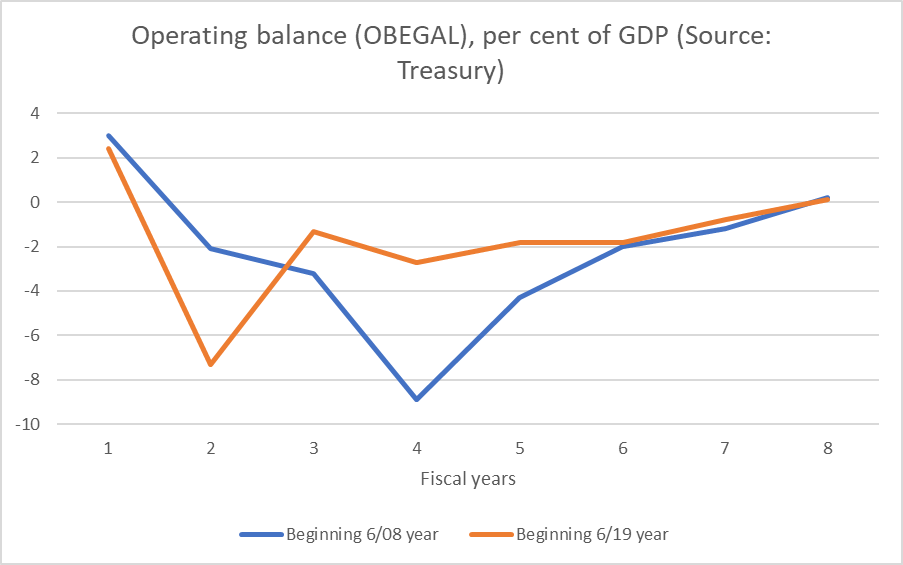
In the government’s Budget, the Treasury projects that on current policies the government will be running an operating deficit for six straight years (while in the 7th the surplus is so tiny that even if it were not for Eric Crampton’s point about tobacco excise revenue we might as well just call it a coin toss as to whether, if the economy played out as Treasury projects we’d see a surplus or a deficit that year).

People have from time to time pointed out that under the previous National government there was also a spell of six straight years of deficits. In fact, here is a chart. The blue lines shows actual fiscal balances from the last surplus (year to June 2008) to the first surplus again (year to June 2015), while the orange line shows actual and Treasury forecasts from the year to June 2019 (last surplus) to the first (tiny) projected surplus (year to June 2026)

In each period, there was one really really large deficit year. In the earlier period that was the year to June 2011, which captured much of the cost to the Crown resulting from the Canterbury earthquakes. In the more recent period, the peak deficit was the year to June 2020, the period encompassing the first and longest Covid lockdown (huge wage subsidy outlays and all).

If these forecasts come to pass we”ll have had an operating surplus (or balance) in five of the last seventeen years.

What about context? In both periods there was a very big exogenous event: earthquakes in the one period and Covid (lockdowns) in the other. Both were, almost necessarily, very expensive for the government. Few people have much problem with meeting many of the direct costs as fiscal obligations.

But….there was a really important difference between the two periods. In the first, the economy headed straight into a fairly deep recession (partly domestically-sourced – our inflation rate had got above the top of the target band – and partly the global downturn associated with the 2008 financial crisis. It was all aggravated by the fact that the 2008 Budget was very expansionary – and yes, that was extravagant and it was election year, but the Treasury advised them that such an approach would not push the budget into deficit over the forecast horizon. It wasn’t one of Treasury’s better calls.
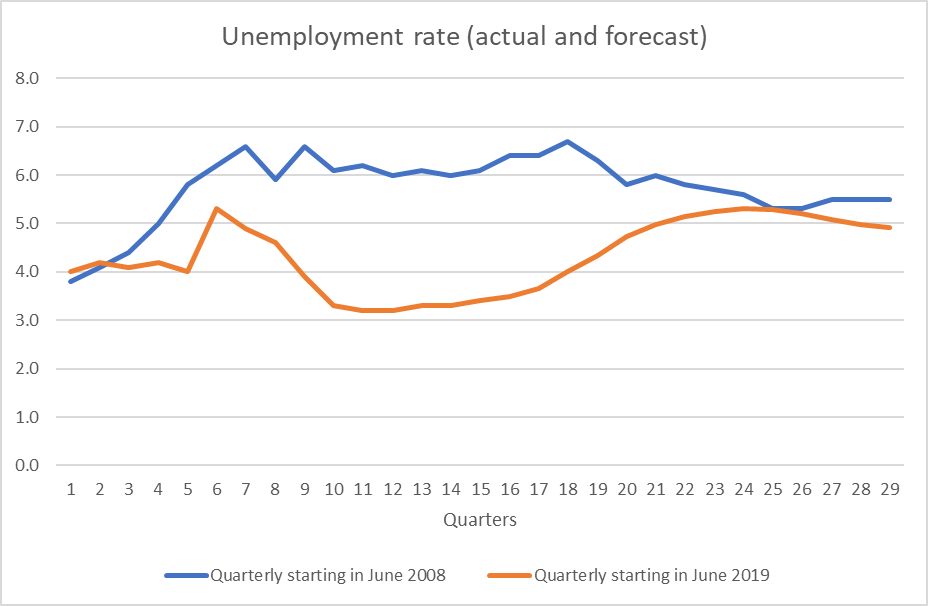
By contrast, at the end of 2019, the unemployment rate was low and, notwithstanding the brief but severe interruption to output around the lockdowns, has mostly remained very low since. When there isn’t excess capacity in the economy, tax revenue tends to come flooding in.

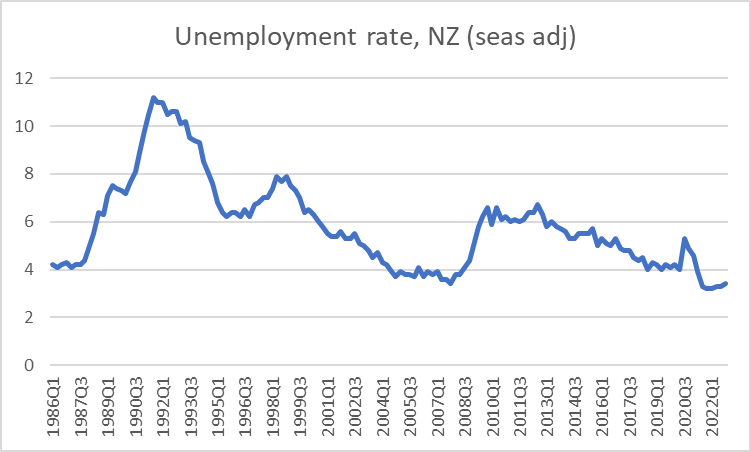
Here is a comparative chart of the unemployment rates in the two periods.

That difference in the unemployment rates makes quite a big difference to the fiscal outcomes, for any set of spending choices. You might criticise the previous government for doing nothing about a Reserve Bank that let unemployment linger well above the NAIRU for so long, as you might criticise the current government for doing nothing about a Reserve Bank that had the economy so overheated for so long. But the economic backdrops to those paths of fiscal deficits were simply very different: with an overheated economy and lots (and lots) of fiscal drag, the revenue was flooding into Treasury over recent years. There was simply no good macroeconomic reason for having operating fiscal deficits at all in an overheated economy, especially once the big direct Covid spending had come to an end (which it had a year ago). By contrast, the earlier government presided over a very sluggish recovery – and so weak, relative to target, was inflation that there was barely any fiscal drag. Even if the Budget was structurally balanced, cyclical factors would have left a small deficit (on Treasury and Reserve Bank numbers there was a negative output gap every year through to 2016).

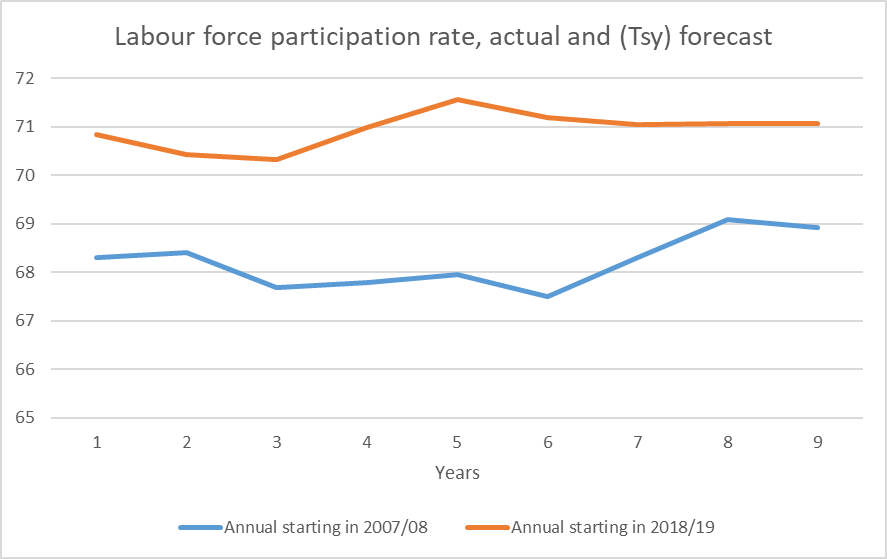
If the unemployment rates and output gaps give a sense of the cyclical slack (or overheating), labour force participation rates are also valuable context

A materially larger share of the population is now in the labour force now than in the period of that previous run of deficits (and given that unemployment rates have been lower this time, the difference in employment rates is even larger. Revenue has been abundant.

I’m not really convinced there was an overly strong case for the previous government having continued to run operating deficits in the last couple of years of their stretch of six. Had the Reserve Bank been doing its job better, perhaps they wouldn’t have (the economy would have been more fully employed and inflation would have been nearer the target).

But I’m quite convinced there has been no good economic case at all for operating deficits in 22/23. 23/24, or 24/25. Take 22/23 (the year just ending) as an example: on Treasury estimates there has been a positive output gap, and the unemployment will have averaged about 3.5 per cent (well below anyone’s estimate of NAIRU). And with 6-7% inflation, fiscal drag has been a big revenue raiser. And if there has been any residual direct Covid spending (a few vaccinations?), the amounts involved must have been vestigial indeed. So cyclically the revenue was flooding in, but they still ran a deficit: it was pure choice to undertake routine operational spending without the honesty to go to the electorate and raise the taxes to pay for that spending.

The cyclical position is less favourable over the next couple of years – the recesssion (as indicated by the 2 percentage point rise in the unemployment rate) required to get inflation back down again – but the government has chosen to adopt discretionary new giveaways with borrowed money.

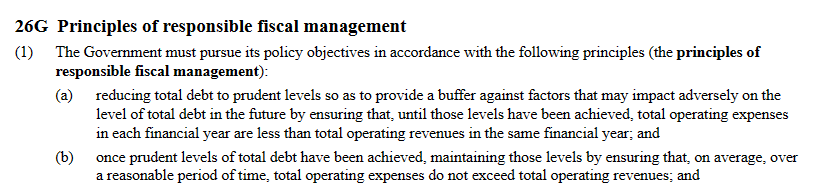
It isn’t just some idiosyncratic Reddell view that operating budgets should be balanced (none of this is about capital spending or arguments about infrastructure). It is there in the Public Finance Act

Now, if I was writing the Public Finance Act, I wouldn’t word things quite that way. But……the Public Finance Act is something both main parties have signed up to. It may make sense to borrow to fund useful longer-term investment, but it makes no sense to be borrowing to pay the groceries, especially in times when income has been more abundant than usual.

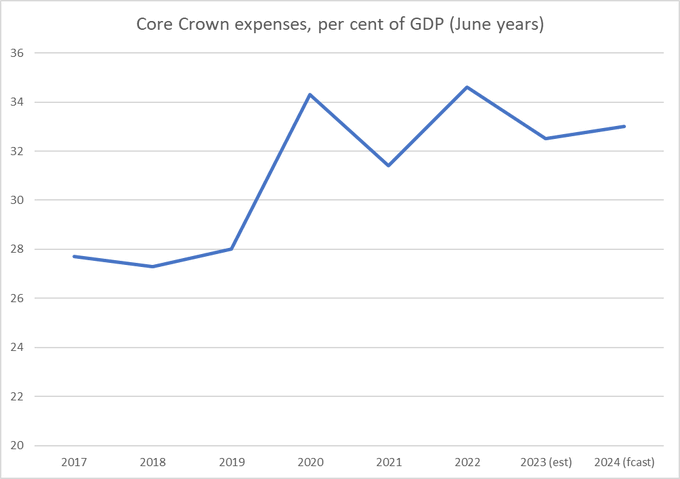
Just two more Budget charts. The first is one I showed on Twitter yesterday

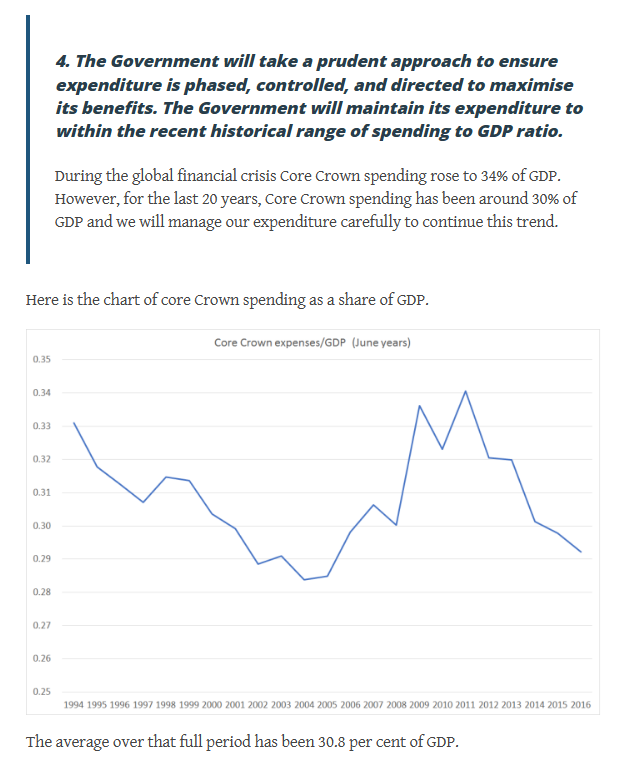
Now, there is plenty of scope for political argument about the appropriate size of government spending, and left-wing parties will typically be keener on higher numbers than right-wing parties. My own interest here is more about fiscal balances, but it is worth being conscious of just how much larger a share of the economy is now represented by Crown operating spending than was the case even five or six years ago. Those were the days of the pre-election Labour/Greens budget responsibility rules

Next year’s spending at 33 per cent of GDP is not quite at the previous peaks (Covid and the earthquake years) but nor might one really have expected it to be. But there is an election to win I guess.

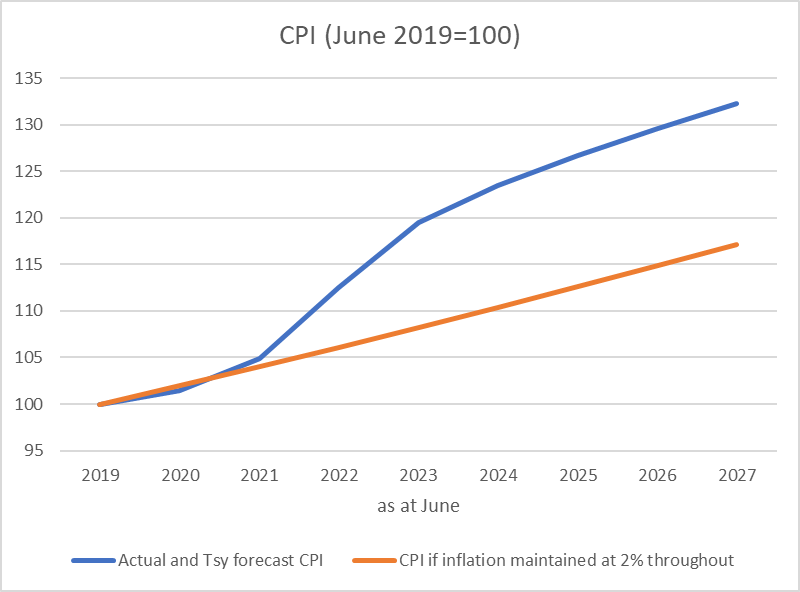
And finally, inflation. Treasury doesn’t run monetary policy but (a) the Secretary sits as a non-voting MPC member, and (b) Treasury are the Minister’s advisers on the Bank’s performance, so they aren’t just any forecaster. On the Treasury numbers, it isn’t until the year to June 2027 that CPI inflation gets back to the middle of the target range (the 2 per cent midpoint the MPC is supposed to focus on).

This chart uses Treasury’s annual numbers to illustrate what a difference the monetary policy mistake has made, and is making, to the price level

The blue line is the actual (annual) data and the Treasury forecasts. The orange line is what the price level would have looked like in a stylised scenario in which the MPC had delivered 2 per cent inflation each year over this period. The difference is substantial: the price level in the blue line is almost 13 per cent higher than in the orange line by the end of the period. The Minister of Finance appears to be quite happy for the current gap (about 10 per cent) to keep widening for the next five years. He shouldn’t be.

We do not run a price level targeting regime. That means bygones are treated as bygones and we don’t attempt to pull the actual inflation rate back down to the orange line having once made the policy mistake that pushed it so far above. It does not – or should not – mean indifference to the arbitrary redistributions that big unexpected changes in the price level impose, strongly favouring borrowers (especially those with nominal debt and long-term fixed interest rates) and heavily penalising financial savers (holders of real assets can be largely indifferent over time). Inflation – and especially unexpected inflation – is deeply damaging, and there were good reasons for reorienting monetary policy to deliver medium-term price stability. But now the powers that be appear unbothered by 7 years in succession of inflation above the target midpoint. It seems about on a par with being happy to set out to deliver six successive years of operating deficits. Poor fiscal policy, poor monetary policy, poor performance from both the Governor and MPC and the Minister of Finance (the latter not only having direct responsibility for fiscal policy, but overall responsibility for monetary policy and the people he appoints to conduct it). It will be interesting to compare the Reserve Bank (considerably more up to date) forecasts next week.

I’m going to be away for the next couple of weeks so there won’t be any new posts here until after King’s Birthday.

MPC appointments

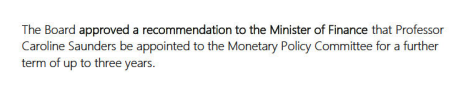
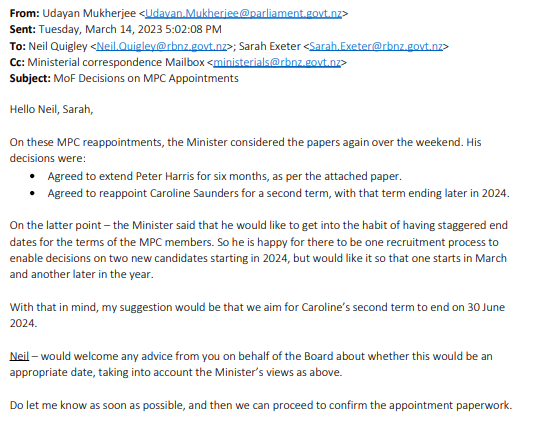
There have been a few posts here recently about Professor Caroline Saunders, whose initial term on the Reserve Bank MPC expired at the end of March and who was eventually, belatedly, and with no announcement at all, appointed by the Minister of Finance to a short second (and final) term on the MPC. The most recent of those posts was here.

When there was no announcement before the Saunders term expired, I had lodged OIA requests with both the Reserve Bank and the Minister of Finance for material relating to her reappointment (or otherwise). Responses to both emails have now come back.

If it is now clear that the bottom line reason why Saunders was not reappointed before her term was expired was administrative slackness (between the Minister’s office and Treasury mainly), the documents that were released don’t put any of those involved in a particularly good light.

My request to the Bank was fairly broadly phrased

I am writing to request all and any material (including any advice to the Minister) relating to the expiry of the MPC term of Caroline Saunders and any discussions or decisions to reappoint her (or not) or to extend her term

and since the Bank says it has not withheld any documents, it seems fair to assume that what I have is all there is.
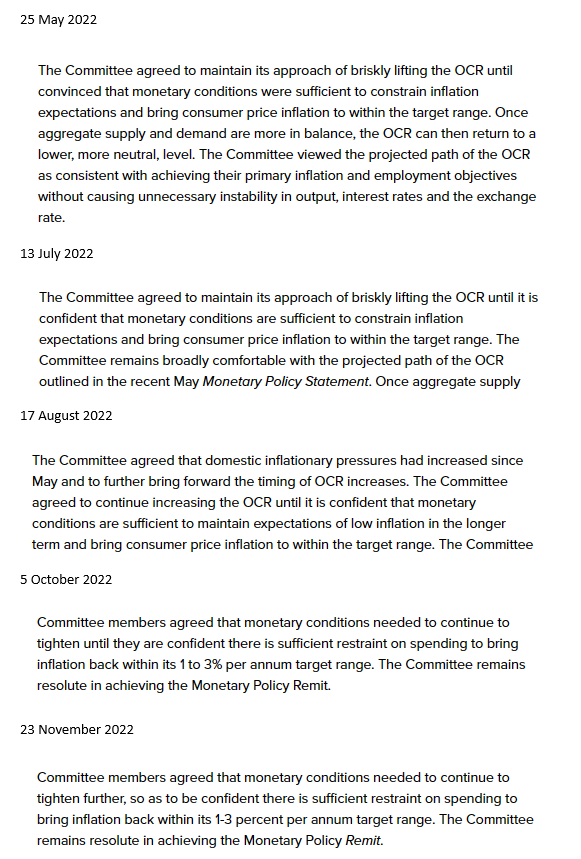
This was the first document they released, from the minutes of the Reserve Bank’s 7 December 2022 Board meeting/

In other words, there was no paper analysing the record of the MPC or the personal contribution to the MPC made by Saunders, even though the decision to recommend reappointment was being made in the midst of the worst monetary policy failure in the decades since the Reserve Bank was given operational independence around monetary policy. There was also apparently no paper discussing the best balance of the MPC in the period ahead, or the appropriate length of time for a reappointment (not even, apparently, a discussion as to why the recommendation is for an extension of “up to three years” when the law would allow up to a four year second term. There is also no sign in those minutes of any substantive discussion or hard questions being posed by Board members (unsurprisingly perhaps given the lack of relevant background of all but the chair, who presumably had any conversations with the Governor in private, unminuted).

It was, it should be noted, no better when the other two external MPC members were reappointed (for terms from 1 April 2022), but the inadequacy of the process is all the more glaring by late 2022 when the extent of the monetary policy failure, for which MPC members are responsible, was much clearer than perhaps it was to the previous Board in late 2021.

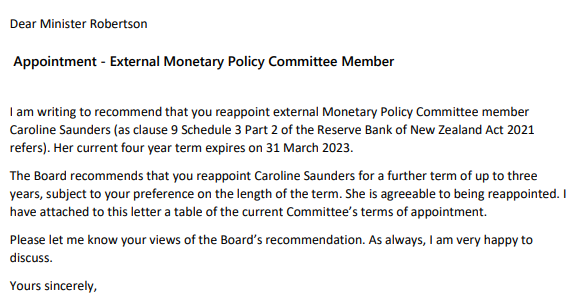
The Board chair then seems to have moved fairly expeditiously, sending a letter of recommendation to the Minister dated 16 December 2022.

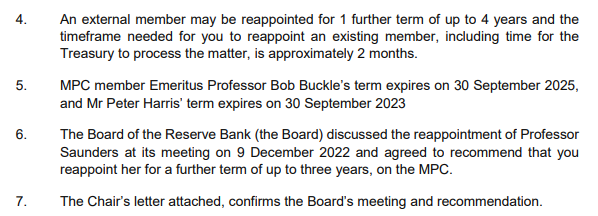
although it is not entirely clear whether this was sent directly (it is signed and dated) or only as an attachment to a memorandum to the minister from Quigley dated 9 January 2023. This is the entire substance of that memo

Note several things

  • (trivially) there is actually a mistake in the letter (Buckle’s second term expires in March 2025 not September 2025
  • there is no advice (not a word) to Minister about the contribution Saunders had made over her (by then) 3.75 years on the MPC, a period in which (a) the regime was new, and (b) monetary policy was sorely tested.
  • despite explicitly noting to the Minister that Saunders could be reappointed for four years, the Board chair offers the Minister no information as to why the Board thinks the extension should be only “up to” three years.
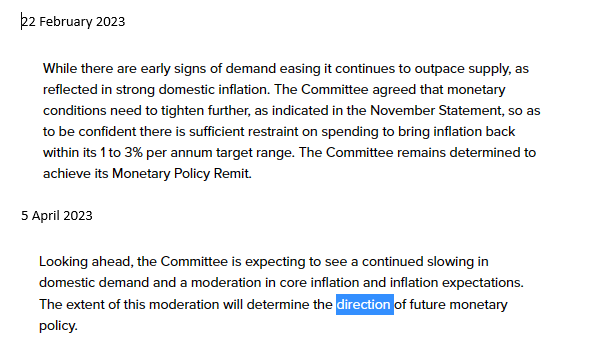
  • presumably after discussions with Treasury, the Minister is told that the process for reappointment should take about two months (this in a document submitted on 9 January).  Elsewhere in the formal recommendations the Minister is asked for a decision by 23 January.
And then there are no other documents (and the Minister has also not indicated that he has withheld whole documents) for more than two months.   The next document is dated 8 March, only three weeks before the Saunders term expires.

In any country with serious scrutiny of the MPC –  and a belief that external MPC members made any difference whatever – serious questions would have been being asked by now, by market participants and by journalists.  After all, on paper MPC members wield a great deal of power, and things hadn’t been going that well with monetary policy.  But there weren’t.

In an internal Reserve Bank email (to the Governor) we learn that on 2 February “the MoF’s office asked for a clarification to be made to the letters/report which we provided (that CS be reappointed ‘up to 3 years’ subject to the preference of the MoF”.

And again nothing until 4 March when the timeline in this same email records that “MoF’s office call Neil Quigley to seek clarification on Caroline Saunders’ reappointment.   On 6 March, the Reserve Bank learns “from MoF’s office that the recommendation will go in the weekend bag….and we should get an outcome early next week”.

And they did

which is strange again, because while the Minister is reported as favouring staggered terms for MPC members (and very sensibly so) he deliberately, and with no officials’ recommendation plumped for a term for Saunders which will mean that the terms of all three external members expire between 31 March 2024 and 31 March 2025. It would have been easy to have given Saunders a three year term or even a four year term and really stretched things out. But he did not, and there is no indication why in any of the papers.

Quigley reverts to the Minister accepting the general idea and a very short extension to 30 June 2024 is agreed. Quigley observes that “Caroline’s term ending at that time is entirely workable from my point of view. As you say, the search for a replacement can still be part of the same search that we undertake to fill the other vacancy from 1 April 2024”. Since it is already May, one might suppose that a new search process – since both Saunders and Harris cannot be reappointed again – will be getting underway fairly shortly.

At this point it is realised that they are too late to get the Saunders reappointment confirmed before her term expires (it needed to go through the Cabinet Appointment and Honours Committee and to be confirmed by the full Cabinet) but nobody seems very bothered by this. As the documents note, and as I initially missed, the (dubious) statutory provisions for MPC appointments allow an MPC to stay in place after their term ends unless advised otherwise by the Minister. But there is no sense of urgency, no sense (perhaps accurately) of any likely media or market interests (despite the on-paper power these positions wield), at least until I wrote a post on 3 April, which prompted the Reserve Bank comms staff to (a) prepare a draft statement if at that late point there were to be any media questions (which there weren’t) and (b) quickly update their website to make clear that members could remain in office after the expiry of their term,

There is no hint in any of the papers released as to why the Minister of Finance chose not to announce formally the reappointment of Saunders (or the extension of Harris, to get around election timing) and rather leave the fact to be discovered either by chance or by assiduous readers of the Gazette.

In the grand scheme of things, perhaps none of this matters a great deal, but the promise was, in reforming the Reserve Bank Act, that MPC members really would matter, and would make a difference. Over four years, there has not been the slightest evidence for it.

But it still seems to be a very bad look, given that the government chose to keep on with the curious appointment model in which the Minister can only appoint people his hand-picked (and not for relevant expertise) Board recommends, that there is no evidence the Board itself engaged in (or received) any serious analysis or review of Saunders’ contribution to the MPC through such a challenging period, and that there is no evidence that any serious substantive advice was being provided to the Minster on her contributions, strengths and weaknesses. It doesn’t reflect much better that there is no sign that the Minister cared, or sought such advice (despite how far outside the target range core inflation has been). The Minister’s office processes seem to have been slack, to say the least. No doubt he is a busy man, but he has a fully staffed office, and there is much justification for sitting doing nothing for two months on a recommendation for an appointment that really should be somewhat market sensitive.

As for Saunders, were she really making a stellar contribution to the MPC (a) the Board might have been expected to have highlighted that and recommended a full four year term extension, and (b) the Minister might have been expected to have enthusiastically agreed (she was after all his preference four years ago). Instead, nothing, and about the shortest credible extension it was possible to have given her.

Finally, there are some issues for any incoming government later this year. As I often point out, a new government that was unhappy with how the Reserve Bank and MPC have been operating cannot simply get rid of the Governor. They can however make appointments around him (including Board and MPC members). Any different government has been given quite a gift by Robertson, in that all the external MPC member positions will expire by 31 March 2025 and all have to be replaced. The Board chair’s own term expires on 30 June 2024 (he was given only a two year (presumably final, transitional) term on the new Board. Given the mediocre appointments to date, and lack of evidence of serious scrutiny and review, if an incoming government really cares about making things better at the Reserve Bank, they will need to take the issue in hand early and make it clear to the Board – themselves quite unqualifed to judge – just what sort of people the Minister will consider appointing (removing, for example, and one would hope, the current blackball on anyone actually engaged now or in future in any serious macroeconomic analysis and research). It is most unlikely that better outcomes (people, process, policy) if Orr and Quigley are simply left to do things as they’ve been done for the last four years.

The question of course is whether the Opposition parties really do care. It is easy to run lines now about “cost of living crises” and high inflation, but (core) inflation is a Reserve Bank outcome and the Minister of Finance is ultimately responsible for, and wields more than a few levers over, the Reserve Bank (people, processes, budgets, and policy goals).

In the meantime, what this little episode reveals again is the empty charade the new MPC is, and always was. We have a minister who was interested in the appearance of change rather than the substance of change, and who has shown no interest at all in holding policymakers to account for signal policy failures. And a Governor who could live with (perhaps even embrace the rhetoric of ) the appearance of change so long as his actual dominance of the process and institution was left substantively unchallenged. A double coincidence of wants, just not one well aligned with the wider public interest.

Reviewing and reforming the RBA

The incoming Australian Labor government last year established an independent review of the Reserve Bank of Australia’s monetary policy functions, structures and performance. The review panel (chaired by a former Bank of Canada Deputy Governor) reported a few weeks ago and their full report is here. Periodic reviews of this sort aren’t uncommon, and are often triggered by episodes of discontent around the performance of the respective central bank (in New Zealand, the 2001 review conducted by Lars Svensson was an example).

There is no clear-cut single preferred way to organise policy functions that society (as represented by government and parliament) wishes to delegate decision-making responsibility to. That is true whether one thinks globally, or just of the subset of advanced economies that countries like New Zealand and Australia usually use as benchmarks or experiences/structures that might offer insight.

If this proposition is true generally, it is no less true of monetary policy specifically. And that shouldn’t really be surprising, including because monetary policy is really quite a recent thing. In New Zealand and Australia the transition to a market-based financial system and a floating exchange rate is not quite yet 40 years old, and even among larger economies floating exchange rates more generally date back only 50 years or so. Modern monetary policy is a cyclical management function (leaning against cyclical macroeconomic fluctuations subject to a constraint of keeping the inflation rate in check), and yet our data sets are really quite limited (since 1984/85 New Zealand has had 4 or 5 business cycles, and the creation of the euro means there are really only perhaps 15 or so advanced-country monetary policy agencies). We simply do not know with any degree of confidence that one form of monetary policy governance etc structure will produce better results over time than another. Instead we (all, including the RBA review panel) argue from small select samples, from specific historical incidents (where multiple influences are always likely to have been at work), and from the mental models we carry round (some likely to have achieved a professional consensus, others not).

None of which is to suggest that such reviews should not take place. Of course they should, and with good people and a government that is interested in good future structures (as distinct, say, from just being seen to having had the review – there were dimensions of the latter around the review then then New Zealand government commissioned from Lars Svensson) useful insights, outcomes, and reforms can often emerge. There will always be aspects of current practice or legislation than benefit from someone standing back and concluding that it is really time for an update, even if in practice the old arrangements were working tolerably adequately.

But one should also be cautious about expecting too much from any particular review or any particular set of reforms.

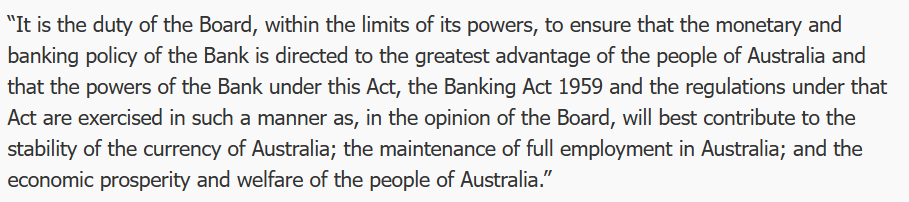
The current RBA model is not one anyone would prescribe today if they were setting up a central bank from scratch. A fair bit of the legislation dates back to the founding in 1959, including this

It has been interpreted, stretching language and concepts to a considerable extent, as encompassing the way monetary policy has been run for the last few decades, but really it was written for an age of (among other things) fixed exchange rates. No one would write it that way now.

And the governance? The Reserve Bank of Australia Board makes the monetary policy decisions (back in the day in practice the Treasurer did) and is much as constituted decades ago. The Governor, Deputy Governor, and the Secretary to the Treasury are ex officio members and there are six non-executive directors appointed by the Treasurer. The non-executive members have typically been (often quite prominent) business figures, but over recent decades it has been normal for one of the six to be a professional economist. It is a very unusual model these days for the conduct of monetary policy, although note that the sort of people appointed as non-executive directors is a matter of political choice (successive Treasurers) and I can’t see anything in the legislation that would have prevented six technical experts being appointed.

If the relevant bits of the legislation haven’t changed a lot over the decades, practice has. Monetary policy decisions are clearly made independently by the RBA, in pursuit of a target that is in practice agreed in advance with the Treasurer, they are announced transparently, there are minutes of a sort published, as well as the quarterly Statements on Monetary Policy. Senior managers appears before parliamentary committees and have fairly extensive and serious speech programmes. The RBA is a modern inflation targeting advanced country central bank, but operating on quite old legislative foundations. As an organisation, over the decades it has had considerable strengths, including typically a strong bench of very capable senior managers, and people coming up behind them. Successful organisations in many fields tend to promote mainly from within: that has been the RBA approach (and is very much in contrast, say, to the RBNZ). Note here that promoting from within is not itself a basis for a successful organisation, simply one feature that already successful organisations, continually refreshing themselves, often display.

I was an admirer of the RBA for a long time, and 20+ years ago when the Svensson review was underway (when I was both part of the small secretariat and a senior manager at the RB) thought that New Zealand should look to adopt elements of the structure and culture of the Reserve Bank of Australia. They tended to produce more stable outcomes, produce better research, communicate more effectively, and have a stronger sense of legitimacy than our “Governor as sole decisionmaker” system had achieved (or than Svensson’s preference, of a small internal decision-making committee (of which the position I then held would have been a member) was likely to be able to achieve. The RBA on the other hand saw us as somewhat strange, not always entirely fairly. I recall a time when Glenn Stevens as Assistant Governor and he came over to observe our monetary policy and forecasting week leading up to an MPS (shortly after we had started publishing forward interest rate projections), and he emerged from the week genuinely surprised that our approach was far less mechanical, nay mechanistic, than he had been led to expect. Or a visit from David Gruen, then head of research at the RBA, suggesting that the fact that our interest rates averaged higher than those in Australia suggested we had monetary policy consistently too tight (in fact prior to 2009 New Zealand inflation typically averaged in the top part of the target range).

Over recent decades, Australia has enjoyed a reasonable degree of macroeconomic stability (the review report includes a table showing the standard deviation of real GDP growth less than for any other country shown), this in any economy exposed to very big swings in the terms of trade. As noted above, the samples are small but there is nothing obvious to suggest that overall the Australian approach to monetary policy has delivered worse than other advanced country central banks. But there have been troubling episodes, notably including the one in the years running to Covid when Australian core inflation ran consistently well below target (much more so than anything seen at the time in other countries, including New Zealand where core inflation by then was getting close to the target midpoint). There are also more recent episodes of concern – about specifics of the RBA Covid response and latterly about the sharp rise in core inflation – but through that period it is perhaps hard to differentiate the RBA’s failure (underperformance) from that of a wide range of other advanced country central banks (themselves with a wide range of governance models).

This was one of the things that troubled me about the review report. The first substantive chapter is focused specifically on these recent episodes. It is easy to highlight areas where things could have been done better in (almost any) specific episode – and some of the material cited is pretty disconcerting – but that is almost certainly true of every central bank, and there is no attempt I saw in the report to illustrate that anything would have been very much different with a different governance/committee structure. We might hope it would have been, but the panel offers little reason (and realistically they couldn’t offer more) that it would have been. New Zealand, after all, has introduced a committee, and the panel notes favourably (too favourably) the expertise of its members relative to RBA external board members, but many or most of the same mistakes or weaknesses the panel highlight in Australia over the last three years were also evident in New Zealand – as far as we can tell, as less material has been released here than there, us not having had a recent external review and the Reserve Bank’s own review was largely defensive and unenlightening in nature). Should there have been a proper cost-benefit analysis, and serious questioning from the Board, before the RBA bond-buying programme was launched? No doubt (and the review report is properly critical about the absence, and the likely weak case) but there is no evidence of anything even slightly better in New Zealand. Or, as far as I’m aware, in any or many other advanced countries. Perhaps the RBA case was less excusable, since they started bond buying a lot later, rather than in the heat of the crisis, but the practical difference ends up being slight.

The review panel proposes a new model with these important features

  • monetary policy decisions would in future be made by a Monetary Policy Board (with a separate RBA governance board, and the existing Payment Systems Board),
  • the MPB would have nine members, the Governor, the Deputy Governor, the Secretary to the Treasury, and six expert non-executives appointed for non-renewable terms of five years, extendable for up to one year)
  • non-executive members would be expected to devote about one day a week to the role (around eight monetary policy decisions a year)
  • there would be a press conference for each decision,
  • votes would be disclosed but not attributable (ie a decision might be made 7:2, but the two would not be identified by name)
  • non-executive members would be expected to do at least one public engagement or speech a year,
  • non-executive vacancies would be advertised, but recommendations to the Treasurer (who would make the final appointments) would be by the Governor, the Deputy Governor and a third person (presumably to be chosen –  altho by whom, Treasurer or the officials? –  from time to time).

If you were starting from scratch, one could think of worse systems. But this proposal seems to have a number of weaknesses and reason to suspect that unless a strong political consensus developed early around making things work really differently (rather than differently in appearance) it is far less good a system than could have been devised. Even then, I would not be overly optimistic. More generally, my impression is that the report tends to underweight the relative importance of the Governor and very senior management to how central banks operate.

Starting with the small stuff, as the report notes it is highly unusual for the Secretary to the Treasury to be a full voting member of a central bank monetary policy decision-making body. It was one thing in 1959 – at that time New Zealand also had the Secretary to the Treasury as a full member of the (largely toothless) central bank board – but it is 2023. Other countries – including the UK and New Zealand – have preferred the model of a non-voting Treasury observer, which seems bit suited to (a) the desire to ensure at the highest levels that information flows freely between monetary and fiscal agencies) and (b) the Secretary’s own primary responsibilities and loyalties. The report proposes amending the legislation to make clear that the Secretary is voting his/her own judgement, but if so that tends to defeat the purpose of their place on the Board (being there solely ex officio), and in times of tension – and one should build system for resilience in tough times, not for when everyone is getting on fine and everything is going swimmingly – will likely complicate the Secretary’s own position (including as adviser to the Treasurer in holding MPB members to account for performance).

In general I am in favour of a model in which external members outnumber executives, but 6:3 in a nine person board doesn’t feel right (even if it parallels current numbers). 4:3, with the third executive being the Assistant Governor responsible for economic policy, seems a better size overall, and also more realistic about the ability of the system to continue to generate a steady stream of able people to fill (only) five year non-executive terms. And a 7 person committee is more likely to limit the risk of free-riding by individual non-executives.

It is difficult to see how a “day a week” model is likely to work IF the goal really were one having a powerful role, including as expert counterweight to staff, if non-executives were devoting only one day a week to the role. I am not aware of any precedents for such a small contribution, which seems to sit closer to the current RBA Board model (might such board members devote 2 days a month to the role, one to the meeting, one to the papers?) than to other advanced country MPCs. At the Bank of England MPC, probably still the best model, non-executives are paid for 3 days a week work, and at a rate that (least by academic standards would be a reasonable fulltime income). On a day a week model, not only is the actual amount of time any member can devote to RBA matters limited, but the remuneration would that for any non-retired person it would have to be just one part of the member’s employment/income. Most plausibly, they would be current academics, who might otherwise not spend a vast amount of time keeping track of data or of the literature in the specific fields relevant to central banking. We might assume that people will not be disbarred (as is NZ) for doing ongoing research in relevant fields, but even in Australia the numbers of such people are not limitless. One day a week looks like a recipe for an ongoing dominance of management and staff. Consistent with this, while the report suggests that externals should have direct access to staff, if they do not have dedicated analytical support staff of their own their ability to make a difference and shape what is in front of the MPB is likely to be limited. This is, incidentally, one argument for a quite different system – as in Sweden or the US – in which outsiders become full insiders while they are MPC members.

The appointment process is also a concern. One of the weaknesses of the New Zealand MPC system is that the Governor exercises considerable effective control on who serves on the MPC. A really good Governor would have a strong interest in promoting genuine diversity of view and real ongoing intellectual and policy challenge. Real world bureaucrats, running their own bureau, perhaps less so. No doubt there will be arguments about “fit” etc, but the value of outsiders is often in the extent to which they are willing to bring fresh thinking and not be easily deterred by management flannel and weight of paper. With a strong “third person”, perhaps it would work out okay, especially if a Treasurer was clearly committed to viewpoint diversity, challenge etc, but many potential “third persons” might be inclined just to defer to the perceived expertise of the Governor and Secretary.

Accountability does not appear to be a key element in the RBA reform proposal. That seems unfortunate – perhaps especially coming hard on the heels of the massive financial losses central bankers have run up and the scale of their inflation forecasting and policy mistake. If as a society we delegate great discretionary power to unelected officials – and that is what we do in MPCs – accountability is a key counterbalance, including in maintaining the long-term legitimacy of the model. At very least, MPB members should be required to have their named votes recorded and disclosed. Ideally – but it is probably only an ideal – people should be able to be removed from office for non-performance. In fact, one of the other weaknesses of the proposed single term model for externals is the complete absence of accountability. Their views don’t have to be disclosed, their votes don’t have to be disclosed, and since they can’t be reappointed, there is really no accountability at all. Lack of accountability doesn’t exactly encourage members to devote intense energies to getting things right. Some no doubt will, but it will be all too easy to defer to management and treat membership of the MPB as a prestige appointment (like being on the RBA Board now), this time narrowed down to being for economists, rather than a role in which one will make a difference and expect to be held to account.

As I said earlier, there is no one ideal structure. In the end, one is trying to combine technical expertise, experience, judgement, ability to communicate, and something around accountability to produce good policy outcomes taken in ways consistent with our open and democratic societies and under structures that are resilient to bad times and to bad people All in a field where uncertainty is pervasive.

Many of these requirements might well be met with no outsiders at all. You won’t see it highlighted in the review report but the Bank of Canada is one in which, formally and legally, the Governor himself wields the monetary policy powers (akin in that feature to the RBNZ system pre-2019). But in practice the BoC has built a strong internal culture and an effective system where a Governing Council of senior internal managers makes monetary policy decisions by consensus. I don’t think it is ideal – there is no individual accountability except (presumably) to the Governor – but the BoC has built partially compensating mechanisms with extensive research programmes, self-review programmes, and extensive engagement with academic and other wider communities. Indeed, the Bank of Canada model – which I do not champion – highlights just how important the quality of staff and internal processes are. It isn’t necessarily a problem if decisionmakers typically defer to staff and management expertise – in fact it is what you would expect in a normal corporate board – so long as those decisionmakers can continually assure themselves that staff and management have robust and resilient processes in place, including those that encourage, generate and accommodate, genuine diversity of view and openness to alternative perspectives. In that sort of context, some expert external MPC members can be very helpful (especially if they are familiar with, engaging with, perhaps contributing to) emerging literature, but they aren’t the only type of member who could add value. The willingness to actually ask the idiot question, and never to be content with management bluster, is valuable in any governance context. Thus, in an RBA context, one might wonder whether it is really worth having a whole new Board (especially when the RBA is not a “full service central bank” (doing prudential supervision)), when one could have left the RBA Board responsible for monetary policy but with a requirement say that several members should have directly relevant professional expertise. One could argue that being a board member, responsible for all the RBA functions and governance, might make for a person better able to contribute effectively as a monetary policy decisionmaker (and note that there is plenty of role for outside expert advisers anyway, and the report does suggest a more active macro research programme for Australia generally). And of course, in all our systems Ministers of Finance – rarely very expert at all – make major contentious economic policy decisions in climates of extreme uncertainty, drawing on expert advisers but rarely handing decision-making power to such experts.

Overall, I can’t help feeling that if the Australian government goes ahead and legislates all these changes, none of them (not all taken together) will matter quite as much as who gets appointed as Governor, and the sort of internal culture and people, the Governor (and his/her successors) build. That is a critical choice – in Australia, in New Zealand, probably anywhere – and is likely to far outweigh any potential difference that a few day-a-week academics, cycled through the decisionmaking system on five year terms, might make. A great Governor (and we can’t build systems that assume one) will build and maintain a culture that delivers most of what the review panel (often rightly) seems to be looking for.

This post has gone on long enough. It is about someone else’s country so why my interest? Two reasons I think. First, it is a significant report on a central bank in the midst of troubled times, and there are few of those yet. And second because the choices Australia makes are always likely to be an important backdrop to any future reforms in New Zealand. We have had extensive reforms, clearly designed to look different rather than be different, and any new government needs to look to do over quite a few of the aspects of the New Zealand model.

I was going to engage specifically with the AFR article last Friday by Ian Macfarlane, former RBA Governor, criticising the review (and I thank the two readers who sent me copies). Time and space is limited, so I won’t. It is worth reading, and he makes some fair points (some less so), but it is perhaps worth remembering that Macfarlane was Governor at the peak of the RBA’s past standing. The starting point now is less favourable.

Finally, one of the background papers for the review was commissioned from Professor Prasanna Gai at Auckland University (and ex BOE). Gai currently serves on the FMA board, but probably should be one of those considered for our MPC, but……he would be disqualified by our Governor and Board on the grounds of an ongoing active interest in areas the MPC would actually be responsible for. Anyway, his paper is quite a good read on international models around the governance of monetary policy, and he pulls few punches about the weaknesses of the New Zealand model.

Inflation, monetary policy, and accountability

Over the last few days I’ve been reading a few pieces on UK monetary policy and high inflation. The first was a speech from the Deputy Governor responsible for economics and monetary policy, Ben Broadbent (over there senior central bankers actually give serious and thoughtful speeches on things the Bank has responsibility for), and the second was a new paper by long-term adviser, analyst and researcher Tim Congdon. There is a lot of overlap because Congdon’s paper is broader (“Why has inflation come back”) but his analytical approach has tended to emphasise the monetary aggregates, while Broadbent’s speech which is narrower in focus is specifically on the question of what information value for monetary policymakers there is (or isn’t) in the monetary aggregates over the longer term and in the specific context of the inflation of the last couple of years. Both are worth reading.

My own view on the monetary (and credit) aggregates is, I think, pretty much the same as that of most central bankers these days, that the indicator value of these aggregates is typically fairly limited in the world we inhabit (low or – at present – moderate inflation), that any really serious breakout of inflation (think, eg, Argentina) is likely to be accompanied, in some sense or other, by rapid growth in the quantities of money, and that for now while one should never ignore any indicator there isn’t much about inflation developments of the last couple of years that is best explained through the lens of monetary aggregates. Specifically, if bond-buying programmes like the LSAP did anything much to boost inflation, it was not primarily (or at all) through a monetary quantities channel.

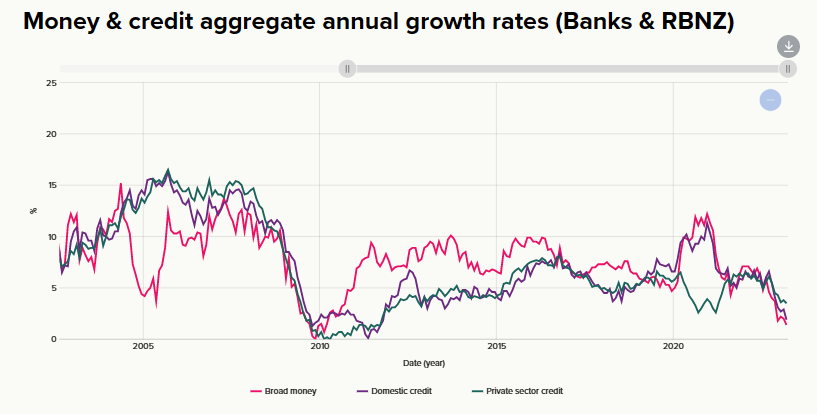
Here is some New Zealand data (and an RB chart) on the growth rates of the monetary and credit aggregates over the period since September 2002 when the current inflation target was adopted.

At the Reserve Bank we always used to put more weight on credit developments than on money measures, and credit growth dipped quite materially in the early months of the pandemic, but no model using either monetary or credit aggregates is isolation would have given policymakers (or other forecasters) reason for serious concern about an outbreak of core inflation to rates unprecedented for decades, Indeed – and since we don’t run a price levels targeting system, and thus bygones are treated as bygones – an analyst looking solely or mainly at these indicators would have noticed by mid 2021 that all the annual growth rates were back to around 5 per cent. No one was going to be sounding inflation alarms if their analysis was based largely on those growth rates. Even in the short period when annual money growth exceeded 10 per cent, the growth rates were not very much higher than had been seen not infrequently over 2011-2016 when core inflation was materially undershooting the target.

Each country’s data and experiences are a bit different but as a general proposition I’d be surprised if many central bankers have become any more positive on the short-term indicator value of the monetary aggregates in the last couple of years.

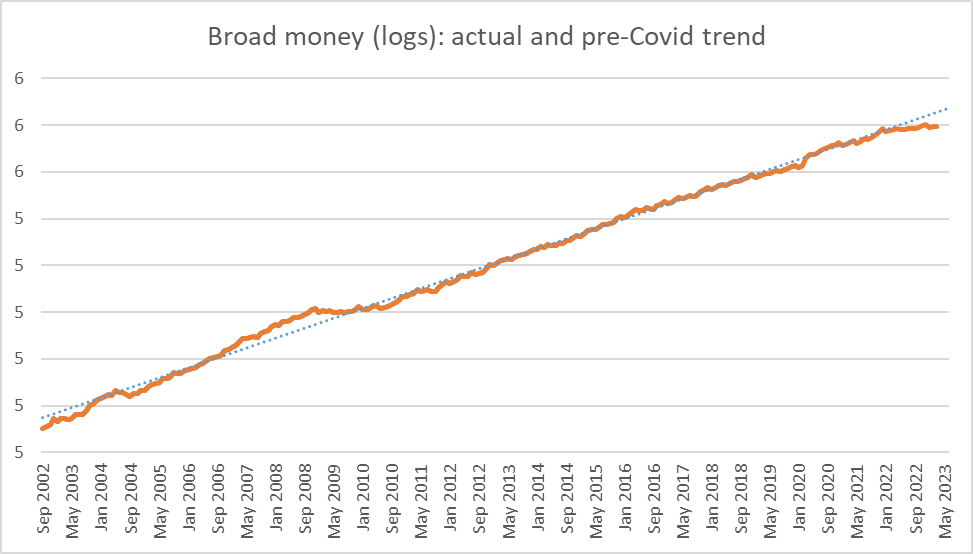
As one final money aggregate chart, here is the level of the New Zealand broad money series relative to the trend over the pre-Covid period since the 2 per cent inflation target was set. Over that almost 18 year period, core inflation averaged 2.2 per cent. At present, broad money is sitting below the trend, and although views currently differ on how much disinflationary pressure is now in the system I’m not aware of anyone who thinks we are about to have a 8-10 per cent drop in the price level, to get back to price levels consistent with long-term average inflation of around 2 per cent.

The UK has become a bit of a poster boy for bad inflation outcomes. Some of the headline numbers have been very bad (up around 10 per cent), but some of that is what happens when a gas price shock hits you (and no monetary policy framework tells a central bank it should try to offset the direct price effects of such a shock). But if we use a common measure of core inflation (CPI ex food and energy), the UK is far from the worst of the advanced economies and has a bit less-bad core inflation outcomes at present than New Zealand (or Australia).

If their central bank hasn’t done a great job, ours has done a bit worse. And the diverse outcomes in this chart remind us – as Congdon explicitly does in his paper – that inflation outcomes are ultimately national in nature, choices by central banks and (by default usually) their political masters. That we have similar core inflation to several countries on the chart – but quite different outcomes to sound and responsible countries towards either ends (Switzerland, Korea, Sweden, Czech Republic eg) – speaks more to similar mistakes made by respective central banks than to anything that was out of the control of the Bank of England or the Reserve Bank of New Zealand.

Two charts in Broadbent’s speech caught my eye. The second (which I’ll come to in a minute) was directly relevant to the inflation mistake. But this was the first on the interest rate effects of central bank bond purchase programmes. The Bank of England, like the RBNZ, believes that QE has macroeconomic effects primarily through interest rate effects (rather than the quantities of fully-remunerated settlement cash balances that are created in the process).

Broadbent reckons that bond purchase programmes have a material announcement effect (what is measured here) when markets are very illiquid. That is no surprise, and probably everyone would agree. But what caught my eye was those “Other QE announcements”. The average of the interest rate effects of those nine announcements is close to (and not significantly different from) zero. Perhaps this particular estimation is wrong, but wouldn’t it be nice if our central bank was producing such charts, and the research supporting them, rather than just handwaving estimates of large number effects, that often conflate March 2020 (and the effects of what the Fed was doing at the same time) with the rest of their highly risky and costly programme?

The other Broadbent chart that caught my eye was this one

Broadbent is using it primarily to make the point that the BOE actually forecast growth in real private consumption stronger than would have been implied by a model incorporating data from the monetary aggregates. But what interested – surprised – me was that they had ended up materially over-forecasting real consumption growth (from the point where the UK’s last lockdown ended). Normally, over-forecasting a key component of domestic demand would probably have been associated with over-forecasting inflation. But not this time (and the biggest error was before, not after, the severe adverse terms of trade shock associated with the Ukraine war)

That got me wondering about the Reserve Bank of New Zealand’s forecasting.

Here are their successive MPS forecasts for real private consumption, starting from the August 2020 MPS which was done after the first and worst national lockdown was over.

The errors in the forecasts for 2022 being made in late 2020 are really huge (for consumption, which is not a particularly volatile component). By mid-2021 (when those BoE forecasts above were done) there were still quite big errors, but not so much about the medium term forecasts but about what the level of consumption spending was at the time the forecasts were being done.

What about real residential investment?

Their forecasts for late 2020 and 2021 undertaken in late 2020 were miles off the mark, substantially understating the level of activity happening already and in the following few quarters. More recently, actuals have undershoot the forecasts done in the second half of the period, probably because of the much higher interest rates that proved to be needed relative to what the Bank had expected a couple of years ago.

And here is real business investment

The Bank was badly misjudging the recent and contemporaneous situation in their August 2020 forecasts. That gap had closed substantially by the November 2020 MPS (a key date because the Bank then had such extremely low medium term inflation forecasts), but as with the private consumption chart shown earlier the forecasts for 2022 were still miles too low. Those errors probably go together, since high consumption demand and activity is typically likely to support high business investment spending. What is interesting is that business investment continued to surprise the Bank on the upside right through to the forecasts being made early last year.

I won’t clutter the post with a comparable GDP chart, but will quote just one illustrative number. In May 2021 I found myself in the curious position: for the first time in a decade, I had become more hawkish than the Bank. With hindsight it is abundantly clear that they should have been raising the OCR by then (and earlier). But their GDP forecasts made in May 2021 for December 2022 proved to be off (under-forecasting) by almost 3.5 per cent. Those are big mistakes.

If there is some mitigation for the BoE in having actually over-forecast the private consumption bounceback (one would want to know more about other components on demand) there is nothing like that in the New Zealand numbers. The Reserve Bank simply misjudged (badly) the strength of key components of domestic demand (and you’d see something similar in for example the unemployment rate forecasts and outcomes), and with it core inflation. One could fairly point out (and I have in previous posts) that many (perhaps almost all) private forecasters made similar mistake. But we – taxpayers and citizens – don’t employ private forecasters to keep core inflation near target; we employ and mandate the Reserve Bank (Governor and MPC) to do so, and they failed.

Which brings me back to those UK papers that started this post. One of the best bits of the Congdon piece was the call for some serious accountability for central bankers.

No one forced top central bankers to take their jobs (most would probably have had little problem getting other roles), and if they thought the mandates they had been given (in both the UK and NZ the finance minister sets the goal) were unachievable or unrealistic they were free to have said so and, if they felt strongly enough, to have resigned. Nobody was compelled to take on a task they believed was simply unachievable. And yet we’ve ended up with (core) inflation well outside target ranges in quite a wide range of countries, including both the UK and New Zealand, with no apparent consequences for any individual central bankers

Congdon proposes (in the UK context) that when inflation is sufficiently far outside the target range, both the Governor and the Deputy Governor should be required to offer their resignation. He doesn’t say so explicitly, but I presume he must mean this as more than the sort of pro forma charade one could imagine it descending to (“of course, I have to offer my resignation but we all know you Chancellor have no intention of accepting it”), involving actual departure from office. And one could, and probably should, broaden the expectation of real sanctions to include all the MPC members. There is (a lot) more scope already in the UK model for individual MPC members to express and record their disagreement with the majority view, but there is room for more, and the serious threat of sanction helps to sharpen incentives to think differently and not simply to (as is an easy incentive in any committee context) to hide behind the committee, and the (in recent cases) badly wrong consensus or majority view. In New Zealand, we have no idea whether any MPC member ever seriously questioned where the Bank’s forecasting and policy were going in 2020 and 2021. We should.

Perhaps what grates most about central bankers (and their masters, who go along with this behaviour) is the utter refusal of almost all of them to ever accept any serious personal responsibility. Here, Orr has repeatedly run his “no regrets” line and when he occasionally departs from it it is just to say that he is sorry New Zealand faced a pandemic and the Ukraine war (ie nothing about anything he or his colleagues are responsible for). He and his chief economist have also tried the line that they couldn’t have done much different – of course raising the OCR one meeting earlier wouldn’t have made much difference, but that isn’t the appropriate test – and there is quite a hint of that sort of defence in Broadbent’s recent speech (where he uses a straw man alternative of looking at what it would have taken to keep headline inflation at target, when the policy focus has never been primarily on headline).

The other day someone sent me a column from a UK newspaper in the wake of various recent BoE comments. The column ended thus

In the spirit of openness that an independent Bank of England is supposed to represent, it should offer a full and frank apology for letting down the British people.

Well, quite. And exactly the same could be said for our Governor and MPC. They made a really big and costly series of mistakes, which cost us (but not them particularly) a great deal of disruption and real economic loss. They failed in a mandate they had voluntarily chosen to accept (and been well-remunerated for). I’m a Christian and so contrition and repentance are pretty central to my world view, and whatever mistakes have been made in the past contrition and repentance go a long way. In public life – and nowhere more than among central bankers – it now seems alien and inconceivable that people could simply front up and acknowledge their mistakes, acknowledge the costs and consequences of those mistakes, and ask for forgiveness.

Instead, we pay the price – massive redistributions, big fluctuations in real purchasing power, overfull employment and then a probable recession, (oh, and don’t forget the $10bn of LSAP losses – an amount that would otherwise have more than covered the Crown’s recent cyclone costs) – and the central bankers just sail onwards enjoying their position, status, salary and so on, not even offering a serious accounting, let alone serious engagement, or any personal loss . Great power (which is what central banks wield) misued with no personal consequences whatever is a very long way from the model of delegated responsibility and accountability that shaped the design of both the UK and New Zealand central banking reforms in recent decades. In New Zealand, that isn’t just the responsibility/failure of Orr and the MPC, but of the Bank’s Board (appointed by the Minister supposedly to serve the public’s interest), the Minister of Finance, and ultimately – as with everything important in a system of government like ours – the Prime Minister.

Sources of inflation

I was on Newstalk ZB this morning to talk about the ASB recession forecasts and this article on the Herald reporting some recent statistical analysis from Treasury staff that attempted to provide another perspective on what has caused New Zealand’s high inflation rate.

I don’t want to add anything on the ASB forecasts other than to say that (a) their story and numbers seem quite plausible, but (b) macroeconomic forecasting is a mug’s game with huge margins of uncertainty and error, so not much weight should be put on anyone’s specific forecast ever (with the possible exception of a central bank’s forecast, which may be no more accurate than anyone else’s but on which they may nonetheless act, with consequences for the rest of us).

The Treasury staff analysis was published a couple of weeks ago as a 2.5 pages Special Topic in their latest Fortnightly Economic Update. You can tell from the Herald headline why one of their political journalists might have latched onto this really rather geeky piece

But there is less to the analysis than the headline suggests. The term “government spending” doesn’t appear in the Treasury note at all (I think “fiscal policy” gets one mention). The focus of the paper is an attempt to better understand the relative contributions of demand and supply factors to explaining inflation, and while fiscal policy is one (at times significant) source of demand shocks and pressures, there is no effort in the paper to distinguish the relative roles of fiscal and monetary policy (or indeed, to distinguish either of those policy influences from other sources of demand pressures). That isn’t a criticism of the paper. The technique staff used, introduced for those purposes a few months ago by a Fed researcher (his paper is here), isn’t designed for that purpose.

Loosely speaking, the technique uses time series modelling techniques to look at both prices and volumes for (most of) the items included in the CPI. When there are surprises with the same sign for both a price and the corresponding volume that is (in their words) suggestive of a demand shock (increased demand tends to lift prices and volumes) and when the surprises have opposite signs this is taken as suggesting a supply shocks (disruptions in supply tend to see lower volumes and higher prices go together). It is a neat argument in principle.

But it doesn’t look to be a very good model in practice. Here is The Treasury’s summary chart. the source of the line that (on this analysis) demand and supply shocks may have contributed roughly equal amounts to inflation over the last year, and that demand shocks were more important back in the early stages of the surge).

Not only is a large chunk of recent inflation not able to be ascribed to either demand or supply shocks, but there have been periods even in the quite short span shown here when the identified demand and supply shocks don’t explain any of the then-current inflation at all (eg 2019).

This is even more evident with some of the sub-groups they show results for. Thus, home ownership (which in the CPI is mostly construction costs)

For most of the decade, neither (identified) demand or supply shocks explain the inflation, and that is so again in the most recent data. And if the model suggests that sharp rises in construction cost inflation in recent times have little to do with demand at a time when house-building has been running at the highest share of GDP in decades, so much the worse for the model.

Services make up a large chunk of the economy, and a fair chunk of the CPI too. Here is the chart for that group

Not only are there periods when neither demand or supply shocks (as identified by the model) explain any of services inflation, but how much common-sense intuition is there is the idea (which the chart suggests) that for most of the period what services inflation can be explained is all either supply shocks or demand shocks and not some combination.

The Treasury paper notes some overseas comparisons, in particular that for the US

The results for New Zealand show lower supply-side contributions to inflation than estimates for the US and Australia. In the US, supply-side drivers account for about 60% of the annual change of the PCE deflator that the model can explain (Figure 7).4

(the footnote is to the original Fed paper)

and they show this US chart which I assume comes from the same model

Note, first, that the PCE deflator has a materially different treatment of home ownership – using imputed rents – than either the NZ or US CPIs.

But perhaps more importantly, in the original Fed paper there is this line

And here is a relevant chart from the same paper (grey-ed periods are NBER recessions)

Not only does it show the entire period since 1990 (one of my uneases about the New Zealand work by Treasury is showing only the last 10 years), but it also illustrates that, as defined for the purposes of these models, both supply and demand factors are large influences, almost always positive, over the entire 30+ years. In other words, if there is anything unusual about the current situation it is not the relative contributions of supply and demand influences but simply that inflation is high (both demand and supply influence). It simply doesn’t seem to add much value in making sense of why things unfolded as they did over the last couple of years. (Although it is interesting how different the last 10 years of the chart look for the US, as opposed to New Zealand in the first chart above.)

What these US charts also illustrate is that supply and demand shocks/drivers here don’t mean the same as they typically do when thinking about monetary policy. Monetary policymakers will (rightly) talk in terms of generally wanting to “look through” supply shocks – the classic example being spikes in world oil prices, which not only flow through to the CPI almost instantly (faster than monetary policy could react) but also make us poorer. The focus instead is on whether these headline effects flow through into generalised inflation expectations and price-setting more broadly. Climate-induced temporary food price shocks (from storms or droughts) are seen in the same vein.

Those sorts of shocks are generally thought of as being as likely to be negative influences on headline inflation as positive ones. Oil prices go all over the place, up and down. Much the same goes for fruit and vegetable prices. These are the two main things excluded in that simplest of core inflation measures, ex food and energy. Some of the Covid-related disruptions are probably more one-sided: there aren’t really obvious favourable counterpoints to severe supply disruptions (even if such disruptions themselves generally unwind over time). But even taken altogether they aren’t the sorts of things that will produce positive influence on core inflation over single year for over 30 years (as in the US core inflation chart immediately above).

When macroeconomists think of inflation they often do so with a mental model in their heads in which this period’s inflation is a function of inflation expectations, some influence from the output/employment gap, and then any residual (supply shock) types of items. Those supply shocks can run in one direction for a couple of years in succession (and probably did in the last couple) but the expected value over long periods of time is generally thought to be pretty close to zero. Monetary policy determines core inflation – monetary policy shapes expectations and influences and responds to developments in the output (or employment) gap. Of course, monetary policy takes account of trend supply developments – adverse shocks may not only raise headline inflation, and risk raising inflation expectations, but can lower both actual and potential output (many positive supply shocks work in the opposite manner).

I don’t want to be particularly critical of The Treasury. We should welcome the fact that their analysts are trying out interesting different approaches and keeping an eye on emerging literature, and even that they are making available some of that work in generally low-profile publications. That said, Treasury is not some political babe in the woods, and I’d have thought there should have been some onus on them to have provided a bit more context and interpretation in their write-up. For example, whereas the US is often treated as a closed economy, New Zealand clearly isn’t. I don’t have a good sense as to how general imported inflation – or that reflecting exchange rate changes – is going to affect this sort of decomposition. If, as I believe, a wide range of central banks made very similar policy mistakes, we’ll be seeing more inflation from abroad (if our Reserve Bank takes no steps to counter it) not tied to demand pressures in particular domestic sectors. I’m also not really clear how the lift in inflation expectations that we observe in multiple surveys fits into this sort of decomposition exercise.

Oh, and it was perhaps convenient that of the CPI groups Treasury showed, motor fuels was not one of them. Headline inflation currently is held down quite a bit by the NZ Cabinet shock – holding down petrol excise taxes etc.

My own approach to the question of where the responsibility lies for core inflation (and note that Treasury focuses on headline not core) tends to be simpler. When this century the unemployment rate has dropped below about 4 per cent core inflation has tended to become quite a serious problem (mid-late 00s and now). The Reserve Bank itself has been quite clear in its view that employment is running above the “maximum sustainable employment” (itself determined by other government policies), and thus, by implication, the unemployment rate – at near-record lows is below sustainable levels. That is a function of excess demand relative to the ability of the economy to supply. Core inflation – the bits we should most worry about, because we could usefully do something about them – is an excess demand story, risking spilling over into embedded higher inflation expectations.

And when ZB’s interviewer asked me this morning whether Mr Robertson or Mr Orr was to blame (fiscal or monetary policy), I was quite clear that the answer was monetary policy (Orr and the MPC). That isn’t because monetary policy loosenings in 2020 were necessarily the biggest source of stimulus to demand, but because the model is one in which (a) fiscal policy is transparent, and (b) monetary policy moves last, with the responsibility to keep core inflation at/near target. You might think (I certainly do) that less should have been done with fiscal policy, but it isn’t up to the MPC to take a view on that, it is their job simply to have a good understanding of how the whole economy, and the inflation process in particular, works, and to adjust monetary policy accordingly. In extremis, fiscal policy can overwhelm the best efforts of central banks, but that wasn’t an issue or a risk here, or most other countries, in recent years. Central banks simply got things wrong. (They had company in their mistake, but they were/are paid to get these things right.)

How much attention was paid to this?

I obviously haven’t seen, or read, the best advice expert commentators have been providing to their wholesale market clients over the last 24 hours but in what I have heard and read I’ve been struck by how little attention seems to have been paid in the more popular/accessible part of the market to this from the MPC’s statement (emphasis added). Looking at some of the changes in market prices, it isn’t clear how much weight markets have put on it.

Below, by contrast, are the “bias statements” (comments about what might happen next) from the OCR decisions back to August 2021. Yesterday’s statement – for all the gung-ho 50 basis point move – ends on a very different note. They seem genuinely open minded on whether the next move might be up or down, and whether any such move might be soon or far away. The MPC are no better at forecasting than anyone much else, but since they get to set rates what they think might happen next, and what they do next (whether with hindsight those are the right views or calls) matters. It is a curious change of direction, without a full set of forecasts, and with no real idea what has happened to inflation or unemployment more recently than as at mid-November. But a change of direction it appears to be.

Two countries

The Reserve Bank of Australia yesterday left its policy rate unchanged at 3.6 per cent. The Reserve Bank of New Zealand’s MPC is generally expected to today raise its OCR by another 25 basis points to 5 per cent.

In the broad sweep of decades it isn’t an unusually large gap. Most of the time, New Zealand short-term nominal interest rates are at least a bit higher than those in Australia (Australia’s inflation target is a little lower than New Zealand so the real interest differential tends to be a bit larger).

Sometimes economic circumstances in the two countries are very different. Thus, that period a decade or so ago when the RBA cash rate was higher than the RBNZ OCR coincided with the later stages of the Australian mining investment boom, for which there was nothing comparable in New Zealand.

But over the last two or three years, the similarities have seemed more evident. Both countries of course went through Covid, with overall quite similar virus/restrictions experiences. Prolonged closed borders affected both countries, notably the important tourism and export education sectors. Both had very expansionary macro policies. In the scheme of thing, both opened up at about the same time. Both have been characterised by labour shortages and very low rates of unemployment. And both have seen inflation sky-rocket, whether on headline or core measures.

There are differences of course. Take commodity prices as an example. If world prices have recently been falling for both countries, relative to levels just a couple of years back Australian incomes are still being supported much more by the high level of commodity prices.

What of the respective unemployment rates? Both are very low, but if anything Australia’s seems lower relative to (a) history and (b) likely NAIRU. Australia’s current unemployment rate is a half percentage point lower than the previous cyclical low, and has not yet shown any sign of lifting.

New Zealand’s unemployment rate (quarterly only) seems already to be off its trough and is now about the same as the unsustainably low level reached late in the 00s boom.

One can’t make much of that difference – and the unemployment rate isn’t the only relevant labour market indicator – but the comparison doesn’t obviously point to the RBA needing to do less than the RBNZ. As far as I can see, business survey measures suggest that difficulty of finding labour may have been easing a bit more in New Zealand than is yet apparent in Australia.

What about (core) inflation measures themselves? Bear in mind that the Australian inflation target is centred on 2.5 per cent and the New Zealand one is centred on 2 per cent.

Here is the annual trimmed mean measure of core CPI inflation for the two countries

And here are the annual weighted median measures

Core inflation started higher in New Zealand than in Australia (the RBA had been badly undershooting the target in the late 10s) but on both annual measures (a) New Zealand annual core inflation appears to have levelled out and (b) Australian core CPI annual inflation now appears to be higher than that in New Zealand. The differences between the two countries core inflation rates in the most recent quarter are more or less in line with the differences in the respective inflation target.

What about the quarterly measures? Here there is some difficulty because the ABS produces seasonally adjusted measures and SNZ does not. Eyeballing the New Zealand series there appears to be some seasonality, although not terribly strong.

Here are the quarterly trimmed mean inflation rates

and here are the weighted medians

The latest observations for the two series for Australia are quite similar (1.6 and 1.7) but there is quite a divergence in the two NZ series (0.9 and 1.3). But in both series there are signs the NZ peak has passed (if you worry about seasonality, even the latest quarterly observations are lower than those a year earlier), while there is no such sign in the Australian quarterly data. And while one can’t meaningfully annualise these data, the differences in the quarterly inflation rates look like more than is really consistent with the differences in the respective inflation data.

I’m not here running a strong view on whether one of these two central banks is right and the other wrong. But it remains a challenge to see how both can be right at present. The two central banks tend to articulate somewhat different models (I’m always surprised at the weight the RBA appears to continue to place on wage inflation, in rhetoric that sometimes seems misplaced from the 1980s), central banks are shaped by their past (the RBA was badly undershooting the inflation target pre-Covid), the political climates are now different (the RBA Governor’s term expires shortly, and governance reforms are in the wind) and there are other material differences in the demand pressures in the two economies that I’ve not touched on here (eg New Zealand has had a bigger housebuilding boom and may be exposed to a deeper bust).

Neither central bank has handled the last three years particularly well – or we wouldn’t have that unacceptably high core inflation – and I am far from being the RBNZ’s biggest fan, but for now my sense is that they are probably closer to right than the RBA is. That may, of course, mean that the near-inevitable recession is nearer at hand here than in Australia.