Norway and the kitchen sink

In their weekly commentary yesterday, the ANZ economics team offered some thoughts on monetary policy and inflation targeting as conducted in New Zealand.   Among their comments was a reaction to my post the other day about Norway’s success in keeping inflation (and inflation expectations) up.

We noted some comparing the inflation performance of New Zealand and Norway last week, with the latter managing to achieve its inflation target. The argument was that other central banks had achieved it through looser monetary policy so the RBNZ could too. It certainly may be possible to get inflation up by throwing the kitchen sink at it. But household debt in Norway has risen to nearly 230% of disposable income (and is one of the highest in the OECD); that’s an accident waiting to happen. Is the economic cost of CPI inflation being 0.4% versus an arbitrary magical 2% that dire an outcome when one considers the possible side effects of this ‘kitchen sink’ style approach?

As a reminder, here are the policy rates for Norway and New Zealand.

policy int rates nz and norway

I don’t want to put too much weight on Norway, but:

Norway’s approach doesn’t look like ‘the kitchen sink” to me.  It looks like what many/most other central banks have done.   As inflation pressures around the world proved much weaker than most had expected, Norway had more leeway than most (their policy interest rate still hasn’t got to zero, let alone the extreme lows of Switzerland (-0.75 per cent) or Sweden (-0.5 per cent).  They used that leeway, and it seems to have delivered results (inflation fluctuating around target).   By contrast, our Reserve Bank has been constantly reluctant to cut –  having only realized quite late in the piece that they really shouldn’t have been tightening.  As I noted the other day, had the Reserve Bank done nothing more than hold the OCR at 2.5 per cent for the whole time since Graeme Wheeler took office, it is likely that today New Zealand’s inflation rate would be nearer target, and there would be less reason to worry about inflation expectations.  Had they set the OCR at its current level –  2 per cent –  even a year ago, things would look less problematic on the inflation front than they are now.  I don’t accept the characterization that even cutting the OCR to 1 per cent now would be an over the top reaction.  After all, even at that level our nominal policy interest rate would still be materially higher than those in most of the rest of the advanced world (with the important exception of Australia, but then Australia has a higher inflation target than most countries do and so –  all else equal –  should really have slightly higher nominal interest rates).  And many of the advanced economies would have been grateful to have had any additional policy leeway they could have found.  They didn’t have it.  We do.

Am I wholly comfortable with the idea of policy rates at 1 per cent or less, here or in other countries?  No, I’m not.  There is a variety of factors that help explain why policy rates, and long bond rates, are so low –  notably changing demographics and deteriorating productivity growth, both of which weaken the demand for investment –  but I don’t think anyone fully has the answer.  And if you ask whether, over the next 30 years I expect real interest rates to be higher than they are now, I’d answer yes to that.  But that just isn’t (or shouldn’t be) the basis for setting policy rates now –  apart from anything else, we just don’t know much of this stuff with any confidence/certainty.

When central banks set policy rates they should be, more or less, responding to market forces (savings supply, investment demand) –  attempting to mimic what the market would do if governments had not given central banks the right to issue our money.  In the immediate wake of the 2008/09 recession, it was plausible to argue that central banks were holding short-term interest rates down.  Implied future long-term interest rates (freely traded in the market) didn’t come down much at all.  These days that argument no longer holds. In fact, yesterday 10 year government bond rates in New Zealand were actually below 90 day bank bill rates.

yield gap

If anything, on this measure, monetary policy has been tightening not loosening (not inconsistent with my earlier chart showing that the real OCR remains above where it was for most of the post-recession period, even as inflation continues to undershoot).  The last time this measure got above zero was in early 2015, just before the succession of OCR cuts began.

But ANZ appears to believe that the best argument against following Norway in doing what it takes to get inflation back to around target is that Norway’s household debt is among the very highest in the OECD.  In both my posts on Norway, I have pointed out that Norway has had very large house price increases and high household debt.  The Norwegian government has responded to any associated financial stability concerns, by accepting the central bank’s recommendation to impose a “countercyclical capital buffer” on banks –  a relatively non-distortionary measure that requires banks to temporarily hold a larger margin of capital, just in case.

But the Norwegian story is much less alarming than ANZ makes out.   First, while house prices in Norway are very high, here is house price inflation in Norway for the last decade or so.

norway house price inflation

Not great, but much lower than what we’ve been experiencing recently in New Zealand.

And what about household debt?  I presume the ANZ economics team have read Chris Hunt’s Reserve Bank Bulletin article explaining some of the many pitfalls in comparing household debt to disposable income ratios (this piece looking across Nordic countries is also useful)?

That partly reflects challenges in comparing the level of debt across countries.  There are several types of issues.  For example, many countries include the debt associated with unincorporated business activities (small business owners, owner operated farms and some lending associated with rental property) in household sector accounts, since getting good breakdowns can be difficult.  In New Zealand, farm lending and non–mortgage lending to small businesses is not part of household debt, while mortgage lending that finances small business should also be excluded. However, much of New Zealand’s rental property is held by small investors, and lending that finances (the business) of renting out residential property generally is included in the New Zealand measure of household debt.

The other important difference is the way that institutional differences, such as those in the tax system can affect the gross assets and liabilities on a household’s balance sheet across countries, even if the net wealth is the same for two households.  In the Netherlands, for example, interest deductibility for mortgages on owner occupied houses encourages borrowers to have interest only mortgages on the liability side of their balance sheet and, for example, tax-preferred insurance policies on the other side.  At some point, the asset is used to extinguish the liability, but for households with the same amount of wealth and income, both financial assets and financial liabilities will be higher in the Dutch system than they would in the New Zealand system.

In Norway, for example, interest on mortgages is tax-deductible, which is not the case (for owner-occupied houses) in New Zealand.  A country with a stronger tradition of occupation pension schemes, for example, will –  all else equal –  tend to see higher outstanding levels of household debt, and higher levels of pension assets on the other side of a household’s balance sheet.  And a country in which the government levies high rates of tax on individuals and returns the proceeds in high levels of public services (consumed by households) will, all else equal, have a much higher ratio of household debt to disposable income –  for no greater threat to financial stability –  than a country with a lower average tax rate and a lower flow of public services to households.  Last year, on OECD numbers, Norway’s government receipts were 55 per cent of GDP, while New Zealand’s were 42 per cent.    It makes a real difference: if we look instead at the ratio of household debt to GDP, Norway (currently 95 per cent) is actually slightly below New Zealand (currently 99 per cent).

In short, comparisons across time in individual countries are generally meaningful (since the institutional and tax features typically change only slowly), but comparisons across countries at any one period in time are fraught.  The Reserve Bank article rightly focuses on the former.

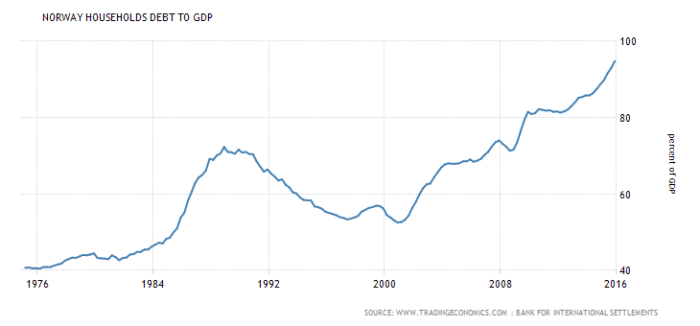
The Reserve Bank publishes household debt data back to 1990.  In 1990, household debt in New Zealand was 28 per cent of GDP.  That ratio is now 99 per cent of GDP.    Here is a long-term time series chart I found for Norway
norway-households-debt-to-gdp

Household debt to GDP in Norway was already around 70 per cent in 1990, and hasn’t been as low as 28 per cent any time in the 40 year history of this series.  If one looks just at, say, the years since 2007, Norway has had more of an increase than New Zealand has, but over a longer-run of time household debt here has increased by (materially) more than what they’ve experienced in Norway.

Of course, perhaps ANZ would like to now reverse the argument and suggest that we need to be even more cautious since we’ve run up much more debt (in change terms) than Norway.  But then they’d have to confront the stress tests (in New Zealand) and the judgements of the respective supervisors that both countries’ banking systems are sound.  Recall those New Zealand stress test results –  and the ANZ is the largest bank in New Zealand –  in which a 55 per cent fall in Auckland house prices and an increase in unemployment to 13 per cent wasn’t enough to severely impair the position of New Zealand banks.  If ANZ thinks that conclusion misrepresented their risks, a phone call to the Reserve Bank’s supervisors might be in order.

Arguing against doing what it takes to get inflation back to fluctuating around 2 per cent on the basis of household debt numbers just isn’t very compelling. And as I’ve noted before, most of the increase in household debt is in any case a reluctant endogenous response to higher house prices, themselves the outcome of land use restrictions colliding with immigration-driven population pressures.

And that is before considering the other side effects of the current (“reluctant cutter”) policy approach the ANZ seems to be endorsing.  We’ll get another read on the unemployment rate tomorrow, but for now the unemployment rate of 5.2 per cent is well above any estimate of the NAIRU (including Treasury’s of around 4 per cent).  The unemployment rate has been above the NAIRU for seven years now, and almost by definition that gap is one that monetary policy could have done something about had the Reserve Bank chosen to.  There are well-documented long-term adverse implications for the individuals concerned if they are out of employment for long.  That is a rather more concrete cost –  seven years –  than the sort of ill-defined, but quite well protected against, risk around the level of household debt that ANZ worries about.  The Swedes ran policy for several years worrying about household debt risks, before they finally realized that Lars Svensson was right after all and began to cut rates aggressively.

There are distributional implications too. The “reluctant cutter” approach has left our (real and nominal) exchange rate higher than it needed to be –  consistent with meeting the inflation target. In the longer-term countries get and stay rich by finding products they can sell successfully to the rest of the world –  that is, after all, where most of the potential consumers are.  As a reminder, here is our export performance.

exports to gdp by govt

Another 100 basis points off the OCR wouldn’t transform this picture –  the long-term challenges are more about structural policy –  but in the last few years the trend has been in the wrong direction, and a misjudged stance of monetary policy has reinforced that.

There are some other things in the ANZ commentary that I agree with. I strongly endorse their call for a monthly CPI (a properly done one), and I was pleased to see their skepticism as to whether the large scale immigration programme is producing per capita income gains for New Zealanders. I might return to some of the questions about the best design of the monetary policy regime another day.

In the meantime,  for all of the ANZ’s economics team unease about the risks of housing debt, there is no sign of ANZ having published its submission on the Reserve Bank’s proposed new LVR controls.  So we still have no way of knowing whether their CEO was serious is his call for the LVR limits to be set even tighter than what the Reserve Bank is proposing.

The Reserve Bank wants most property investors around the country to have 40 percent deposits in future. We think they should go harder and ask for 60 percent.

I don’t suppose he was, but it would be interesting to see the economic arguments and evidence for such a proposal.
It is quite possible to get inflation back up: Norway did

Six months or so ago I was getting a little frustrated by talk suggesting that low inflation was just one of those things. No one else, it was implied, was succeeding in meeting their inflation targets, and so we shouldn’t really be expecting the Reserve Bank of New Zealand to meet the target the Minister of Finance had set for them.

And so I wrote a short post about Norway.  It was a small advanced economy, which has had substantial issues around rising house prices and high household debt, and which had been hit by an even nastier terms of trade shock (falling oil prices) than New Zealand had faced.  Oh, and Norway has typically had lower policy interest rates than New Zealand (so perhaps less room for manoeuvre), and has a higher inflation target (2.5 per cent rather than 2 per cent).     Like New Zealand, they started raising policy rates again quite soon after the 2008/09 recession (and crisis conditions) ended, but they realized that wasn’t necessary and reversed themselves.  Unlike our Reserve Bank, they didn’t make same mistake twice.

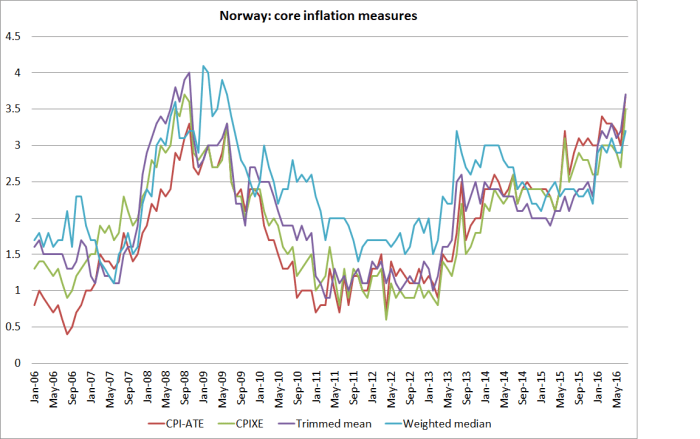
Norway also saw its inflation rate fall away quite sharply in the aftermath of the recession.  Here is the suite of core inflation measures that the Norges Bank itself highlights –  recall that the target is 2.5 per cent inflation.

norway core inflation

Inflation –  even core inflation – seems to be more variable in Norway than in New Zealand.  It was very low in 2011 and 2012, but has been trending back upwards for several years now.  When I wrote about Norway last in February, these core measures averaged 2.5 per cent.  Core inflation has increased further since then, now averaging 3.5 per cent (although the Norges Bank observes that they expect it to settle back nearer 2.5 per cent).

It isn’t as if Norway’s economy has been booming.  Indeed, Norway’s unemployment rate –  while still below New Zealand’s –  has risen quite markedly in the last few years.

No doubt there are lots of other detailed differences between the two countries’ experiences, but it seems to me that the biggest of them has been the New Zealand policy mistake –  promising to raise the OCR aggressively, then doing so, and only reluctantly reversing that mistake.   Here are two countries’ policy interest rates.

policy int rates nz and norway

Here are the BIS index measures of the two countries’ exchange rates.

nz and norway exch rates

In Norway, the central bank doesn’t anguish about tradables inflation being negative for years and outside their control.  Here is the chart from a recent Norges Bank MPS that I reproduced in February.
norway inflationAnd here are two-year ahead inflation expectations in the two countries –  the Reserve Bank survey for New Zealand, and a survey measure for Norway that I’ve taken from their MPS.
infl expecs nz and norway

It looks a lot like a story in which

(a) the Reserve Bank of New Zealand badly misread (actual and prospective) inflation pressures,

(b) leading them to raise the OCR when they should have been holding or cutting it,

(c) which drove the exchange rate up (the juicy prospects of high and rising NZ yields)

(d) and drove tradables inflation more persistently negative than it should have been

(e) all while the Reserve Bank only very slowly realized its error, never explicitly acknowledged it, and only very reluctant reversed the rate hike cycle,

(f) all of which understandably dampened expectations of future inflation  quite a long way, while still suggesting to people looking at NZD assets that if there was ever yield to be found anywhere in the OECD the RB woiuld do its utmost to make sure that place was New Zealand.

As a result, the exchange rate (while quite variable) stays high, inflation stays low, and inflation expectations are at constant risk of falling further.  All because the Governor (and his advisers) got things wrong, and refuse to convincingly change tack.  As I noted yesterday –  and as several others have now pointed out –  the Governor was given an easy opportunity to affirm that he’d do whatever it takes to get inflation back to target.  For whatever reason, he simply passed up the opportunity. People, probably quite rationally, think he will in fact be very reluctant to do what is needed.

Frankly, if Norway can get inflation back to (and even beyond) target, so can we. It is mostly a matter of (a) reading inflation pressures roughly correctly, and (b) really wanting to.  The Governor –  and his advisers –  have failed on both counts.

It isn’t always true, but sadly over the last few years it wouldn’t be wildly wrong to suggest that New Zealand outcomes would have been better over the Wheeler years if the Governor and his senior team had simply taken a holiday, and done nothing at all to the OCR for four years.  We’d have avoided the badly misjudged tightening cycle, and although the OCR would still be a bit higher now –  it was 2.5 per cent when Wheeler took office –  inflation expectations would almost certainly be higher, and so real interest rates would, most likely, be no higher at all.  That would have had the incidental benefit of leaving New Zealand more headroom against the risk of hitting the near-zero lower bound at some point.

Perhaps spurred on by criticism in various quarters that the Governor doesn’t make himself available for searching interviews, he seems to have established a pattern of talking to the Herald after the release of the MPS.  The latest sets of questions and answers is here.  It is all pretty soft-soap stuff, with no follow-ups or challenges, allowing the Governor to get away without even answering the question (as here, where he –  in customary style – injects a variety of interesting but not very relevant detail, while not dealing with central issue.)

Rate cuts are supposed to bring the currency down, this didn’t. What’s happened?

Since the June statement we’ve seen the Bank of Japan ease, Bank of England ease, we’ve seen the Reserve Bank of Australia ease. If you combine that with quantitative easing that is larger than at any other time – and it was pretty large in 2009 – and with negative interest rates in countries that account for a quarter of world output, you’re just in a phenomenal situation.

There is no doubt the world is in a puzzling situation, but the Bank –  and the Governor –  are paid to do a competent job, not to end up sounding as if it is all too hard and is someone else’s fault.  I’m sure his markets staff had advised him that the probability of the exchange rate rising yesterday was quite high –  if they didn’t, they certainly weren’t doing their job.  The Governor simply made a choice –  he is a reluctant cutter, and that became clear once again yesterday.

It is a shame that the Herald, given the privileged access, didn’t ask a few more questions such as:

  • Why didn’t you cut by 50 basis points, given that your own forecasts suggests further OCR cuts will be needed, and that on those forecasts it is still another two years until inflation gets back to target?
  • Why are you so apparently indifferent to an unemployment rate that has now been above any NAIRU estimate for seven years?
  • What plans and preparations are you putting in place to cope with the possibility that New Zealand finds itself exhausting the limits of conventional monetary policy?
  • Inflation was below 2 per cent when you took office, has not been near 2 per cent since then, and on your own forecasts won’t be back to 2 per cent until a year after your term ends.  You and the Minister put the 2 per cent midpoint explicitly in the PTA.  How would you assess your performance in respect of the Bank’s primary responsibility, monetary policy?

Still reluctant to do what it takes

I’ve been laid aside (medically) this week so won’t be writing much about today’s MPS.  But I had a few observations nonetheless

The OCR cut itself was really the least the Governor could do, especially having laid the groundwork with his interim statement a few weeks ago.  It was interesting that for the first time since the easing cycle (better described as “reversal of the ill-judged tightening cycle”) got underway, the Bank now says not just that further easing “may” or “seems likely” to be required, but “will be required”.   Of course, that is still conditional on their forecasts panning out, but it is pretty strong language for a central bank.  It does rather prompt the question of why, if they are that confident they didn’t just cut the OCR by 50 basis points now.  On their current forecasts, inflation wouldn’t have overshot the target –  perhaps they’d have got back to the target midpoint at the start of 2018, rather than the September 2018 (still two years away, and well beyond the expiry of the Governor’s term) they currently project.   Perhaps they’d even have got the exchange rate down somewhat –  instead of another OCR review in which the exchange rate rises, at least on the day.  And yet the Governor said they hadn’t had any serious discussion of the option of a 50 basis point cut.  If so, that seems somewhat remiss –  if nothing else, seriously thinking about alternative policy approaches can help clarify arguments, even if that alternative is never adopted.

As I watched the press conference, I thought the Governor was looking rather tired and beaten-down.  In one sense that shouldn’t be too surprising.  The whole story upon which he based monetary policy for the first half of his term simply turned to dust.  There was no upsurge in inflation to get on top of, and instead he has been managing a staged withdrawal for more than a year now, still reluctant ever to acknowledge a mistake.

Perhaps more importantly, there is a reluctance to take responsibility: New Zealand’s inflation rate is largely something that New Zealand’s central bank controls.  There are all sorts of influences on prices, but we –  citizens –  pay the Bank to recognize those influences and respond sufficiently vigorously to keep inflation near the target we’ve set for them. Low world inflation is, for us, just one of those things.  We don’t control it, but we can adjust domestic monetary policy to take advantage of it.  And I say “take advantage” deliberately: low world inflation would have given us the opportunity to have had lower real domestic interest rates over the last few years, and with it stronger domestic activity, lower unemployment, a lower exchange rate, and inflation closer to target.  But even now, the Governor is clearly reluctant.  He keeps emphasizing the “unprecedented” global stimulus –  even though the best evidence of “stimulus” is something being stimulated, and there is little sign of global inflation being stimulated much –  and, domestically, “accommodative” monetary policy.  But again, where is there much sign of the “accommodation”?  Inflation is consistently well below target, and the unemployment rate has been above any estimate of a NAIRU for 7 years now.  No doubt some will respond “look at house prices”, to which my response is to refer people to the structural pressures: the interaction of rapid population growth and land use restrictions.

The Bank remains optimistic that GDP growth is going to accelerate, expecting 3.5 per cent per annum over the next couple of years.  Perhaps they will be right, but I still don’t see what is likely to bring about such stronger growth. If anything, waning population pressures should lower headline growth, even if per capita growth were to strengthen a little.  Between the high exchange rate, subdued commodity prices, subdued world activity, and a waning (and then reversing) impulse from net migration, I’d have thought New Zealand will struggle to grow as fast over the next year as it has done this year.

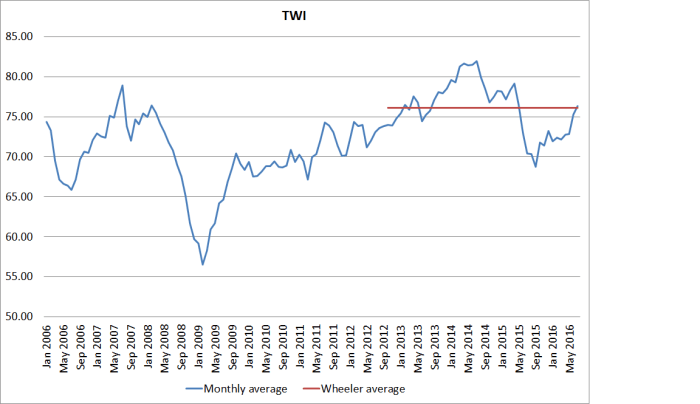
I’ve noted previously that the Governor would be well-advised to stop making open calls that the “exchange rate needs to come down”.  This morning, the TWI was sitting just above the average level that has prevailed over his entire term.  It was higher when markets thought we’d go on tightening for some time, and lower when it looked like the rest of the world might start tightening. But over four years it hasn’t really gone anywhere.

wheeler exch rate.png

And in many ways that isn’t very surprising.  After all, real interest rates in New Zealand haven’t gone far for years either.

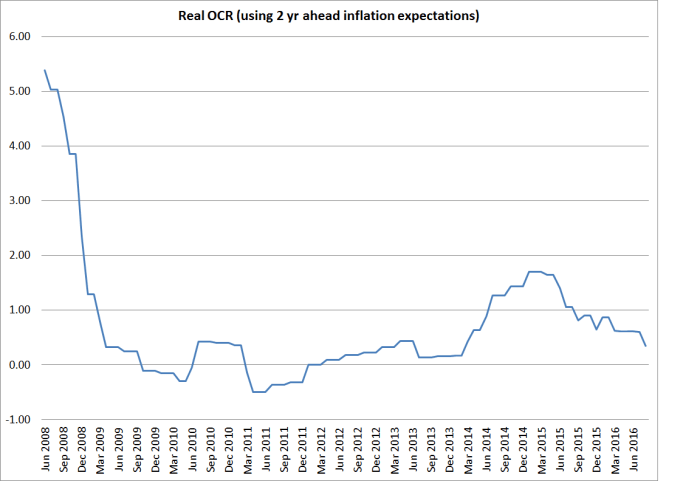
real ocr to aug 16.png

Even after this morning’s cut, the real OCR on this measure is still only about where it was just before the February 2011 earthquakes hit.  Back then, we were in middle of coping with the increase in the rate of GST and no one really recognized just how weak New Zealand or global inflation pressures were turning out to be.  There is no easy rule of thumb to say where the OCR should be now, but I think there is a pretty strong case –  in the context of the inflation targeting regime, which the Governor strongly (and rightly) recommitted to this morning –  that it should be lower than it is now.  Given how much we’ve been surprised over the last few years –  about things at home and abroad –  one could pretty easily make a case for a negative real OCR right now.

A few years ago, Mario Draghi the head of ECB galvanized and totally changed market sentiment about the euro-area with his off-the-cuff pledge to “do whatever it takes” to hold the euro together.  We haven’t seen that sort of commitment in respect of New Zealand monetary policy.  When asked this morning whether he’d be willing to take the OCR to zero if necessary, the Governor fended off the question.  Instead, it would have been a great opportunity to say “yes, of course.  We’ll look at the data every six weeks, but we are concerned about persistently low inflation –  and about expectations drifting down, and about unemployment lingering high.  We’ll do what it takes”.  Instead, we heard unease that if the Bank did too much it might create “more damage” to the economy.  Than what, I was prompted to wonder.  As it is, New Zealand continues to look like the last bastion offering some –  no longer much – yield to investors.  Interest rates of 2 per cent aren’t much, but they are much higher than you can get in most places. If so, no wonder the exchange rate remains relatively high.   And, relative to the Bank’s target, there is simply no need for interest rates to be that high –  not even on the Bank’s own forecasts, let alone a more realistic assessment of capacity pressures.

The Bank attempts to make quite a lot in the MPS of the idea that capacity pressures are becoming real in New Zealand, while they are largely absent in the rest of the advanced world.  They attempt to support that using various international output gap estimates, and their own estimates for New Zealand.  As they, and we, know output gap estimates are very imprecise, and prone to considerable revisions over time (especially for estimates of where the economy is right now).  For the last five years, the Bank has repeatedly tried to run the line that spare capacity has been used up in New Zealand, only to have to revise those estimates back again.  Another way to look at these things is through the lens of unemployment rates,  They aren’t a perfect measure, but are often more useful than output gap estimates, and relate back to some specific human concerns –  people who are actually out looking for work.  Here are the unemployment rates since 2005 for New Zealand, the OECD as a whole, and the G7 as a whole.

U rates to aug 16

New Zealand’s unemployment rate has been consistently below the other lines –  not surprising, as we have a more deregulated labour market than most.  But all three lines went up a long way during the 2008/09 recession, and there is no sign that New Zealand’s has fallen faster since.  If anything, it is rather the reverse.  The gap between New Zealand’s unemployment rate and those of the rest of the advanced world is smaller than at any other time in this sample.

The answers to our inflation challenges –  getting it up to and keeping it around target – really are in our own hands, or more specifically in the Governor’s hands.  We could have had lower interest rates, a lower exchange rate, more demand, lower unemployment, and higher inflation.   (And if the powers that be couldn’t fix up housing supply or immigration policy, the Governor could have required banks to hold larger capital buffers in case the domestic housing market caused future loan loss problems).


Are we just pulling consumption forward?

I was having a discussion with someone the other day about interest rates, the OCR, and how we should think about what has been going on in recent years.  The person I was talking to was worried that, whatever short-term support lower interest rates might be providing to demand, activity and employment, it was at the expense of simply pulling forward consumption.  And (lifetime) income which is spent today can’t be spent again tomorrow.

My usual starting point in such discussions is to draw attention to the little-recognized fact that consumption as a share of GDP has been largely flat in New Zealand for decades.  There is some cyclical variability –  consumption is a bit more stable than income, so the ratio tends to rise in recessions, and falls back as the economy recovers –  but the trend has been almost dead flat.  Actually, GDP isn’t the best denominator, because GDP measures what is produced here, not what accrues to New Zealanders (the difference is mostly the income earned by foreigners on the relatively large negative NIIP position New Zealand has). GNI is a measure of the aggregate incomes of New Zealanders, and here I’ve shown the various components of consumption relative to GNI since 1987, when quarterly national accounts data are available from (but using four-quarter running totals)

First, private consumption (including non-profits)

pte consumption to gni

And then general government consumption

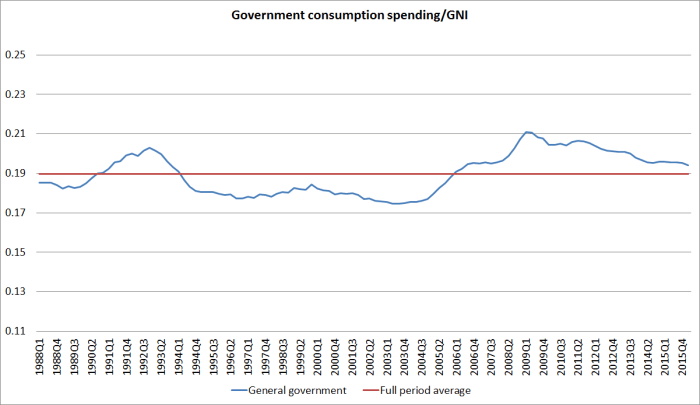
govt consumption to gni

And then total consumption

total consumption to GNI

I’ve shown full period averages for each.  The only component of consumption where the share of GNI is a bit above the long-term average is general government consumption, the bit that is least likely to be sensitive to changes in interest rates.

Of course, if interest rates had been kept arbitrarily higher then consumption as a share of GNI might well be weaker now than it actually is, but there is really isn’t any sign of a great consumption splurge –  a society desperately (over)spending now and thus increasingly likely to come a cropper later.    (And as I’ve noted previously there is also nothing in any of these charts to suggest some large average wealth effect from the sharp rise in real house prices in recent decades –  not surprisingly, since wealth is being transferred among New Zealanders, but no additional real wealth –  future purchasing power –  has been created in aggregate).

As we continued our discussion, the person I was talking to reminded me that the US picture has been somewhat different.

Here I draw on the OECD database, which has annual data for most of its members back to 1970. Here is total consumption (public + private) as a share of GDP for the United States, United Kingdom and New Zealand.

consumption us uk and nz

Even over the full 45 year period there is no upward trend in the consumption share in New Zealand.

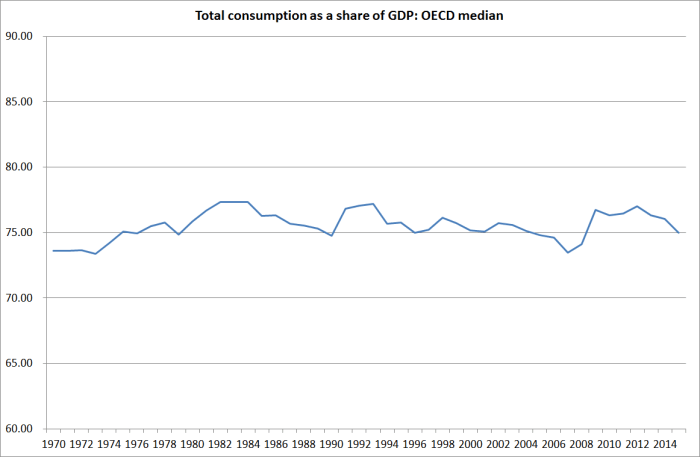
And here, on the same scale, is the consumption share of GDP for the median OECD country.

oecd median consumption

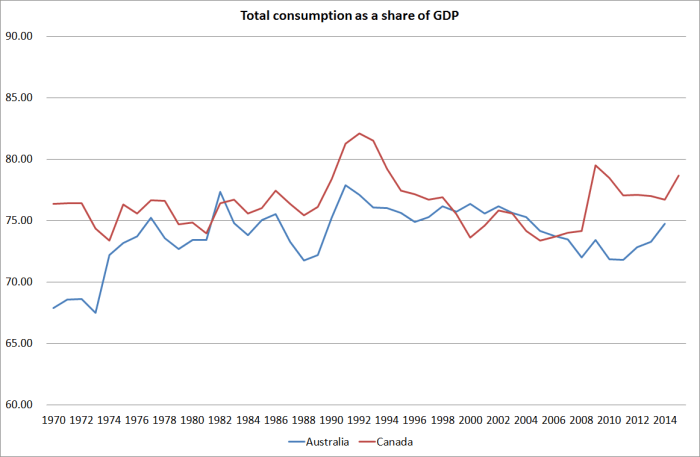
And here are Australia and Canada

consumption aus and canada

Like New Zealand, no trend in either country, at least (see Australia) since the mid 1970s.

And here is Actual Individual Consumption (private consumption plus the stuff the government purchases but individuals consume directly eg healthcare and education) as a per cent of GDP for New Zealand, Australia and Canada.

aic consumption

I’m not quite sure what was happening to this data in New Zealand around 1985, but again for the last thirty years there has been no upward trend in consumption as a share of income.

What does all this mean?  To be honest, I’m not quite sure.  After all, if population growth rates have been slowing, less of GDP needs to be devoted to investment and that might mean more is available for consumption.  But in the UK in particular, population growth rates have been somewhat faster in the last couple of decades than they had been previously.    And things like defence spending trends can also complicate the picture –  weapons system purchases are now part of investment, and we know in the US (and the UK) defence spending as a share of GDP is much lower than it was some decades ago.

I guess all I take from it is my original point. At least in New Zealand –  and in most of the OECD –  there is no sign that lower interest rates are resulting in a large scale bringing forward of consumption, for which at some point there must be payback.  But that shouldn’t be too surprising.  After all, interest rates are as low as they are for a good –  if ill-understood by anyone –  reason: in summary, because if they weren’t this low, consumption and investment spending would be even weaker.  That, in a market economy, is really all interest rates do: they balance desired savings and investment patterns.  Central banks that are too slow to adjust to changes in desired savings or investment patterns –  at any given interest rate –  can slow the adjustment, but in that respect a good central bank shouldn’t be trying to stand in the way of the sorts of real adjustments the private sector has underway,  A century or more ago Wicksell introduced the concept of a neutral or natural interest rate.  Those rates change over time, for reasons that aren’t always easy to recognize.  Markets don’t need a fully convincing analytical reason –  they just reflect the changing balance of demand and supply.  Central banks shouldn’t let the difficulty of finding a good explanation stand in the way of allowing what would be the market processes to work

But quite why consumption shares in the US and UK have risen so much is an interesting question –  to which I don’t have any good answers right now.


Monetary policy and the exchange rate

The Herald‘s Claire Trevett was perhaps being just a trifle unfair yesterday in commenting on the Reserve Bank’s “consultative” document on the latest iteration of the increasingly unpredictable LVR restrictions

The Reserve Bank’s definition of “consulting” appears to be akin to North Korean President Kim Jong Un’s

The Governor on the exchange rate tends to bring to mind parallels with the (misremembered) story of King Canute.   Canute was trying to deliberately demonstrate to his courtiers how little command he actually had –  none over the tide and the seas.  But the Governor loftily –  or perhaps plaintively – decrees that “a decline in the exchange rate is needed”, and the market really doesn’t pay that much attention.  The exchange rate did fall a bit yesterday, and has pulled back some way over the last 10 days or so, but the exchange rate today is perhaps only a couple of per cent lower than the average over his whole term to date.  For almost his entire term, he has been lamenting the strength of the exchange rate.

I’ve noted previously that I entirely agree with the Governor that a successful transformation of the New Zealand economy’s growth prospects is likely to require a sustained and substantial fall in New Zealand’s real exchange rate –  a substantial fall in the prices of non-tradables relative to the prices of tradables.  But nothing the Reserve Bank does, or could do, has anything much to do with bringing about that sort of change.  It isn’t some fault or failing of financial markets either.  Rather, responsibility for the persistent pressures on domestic resources that have given us a real exchange rate persistently out of line with our deteriorating relative productivity performance rests squarely in the Beehive.  The choices successive governments make –  and both major parties still defend – explain the bulk of our underperformance.   Here is a chart I ran a few weeks ago.  If anything, I suspect – but of course can’t prove formally –  that we need the exchange rate to fluctuate below that 1984 to 2003 average for a decade or two, not the 20 per cent above that average we’ve had for the last decade and more.

real exch rate

But in the shorter-term (perhaps even periods of several years) monetary policy choices make a difference.  Sometimes quite a large difference indeed.  Notice the big fall in the exchange rate following the 1990s boom.  The TWI briefly fell almost as low, in real terms, as it reached following the 1984 devaluation –  and for the economic elite in 1984/85, one of the big challenges then was felt to be “cementing in” that lower level of the real exchange rate.

During this period around the turn of the century, the NZD/USD exchange rate was below .5000 for almost three years.  At the trough in late 2000 it was around .3900.   What else was going on?

In New Zealand, it was the first year of the new Labour-Alliance government, and the business community did not like the policies, or attitudes, of that government one little bit.  I was head of the Reserve Bank’s Financial Markets Department at the time, and used to go along to Board meetings each month.  One particularly prominent and vocal member constantly wanted to get me to say that the weak exchange rate was all a market judgement on the new government.  I usually pushed back quite strongly.

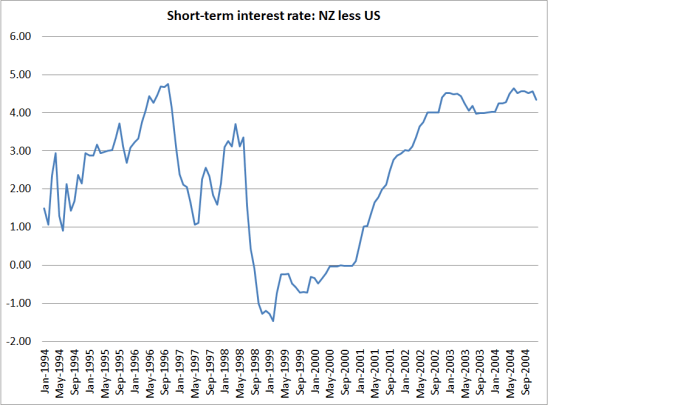
And here is why.

int rates us and nz

This chart uses OECD short-term interest rate data for 1994 to 2004.  During that period from mid-late 1998 to the start of 2001, New Zealand short-term interest rates were at or below the level in the United States.  It is the only time in the whole post-liberalization period when that has been so.  The respective central banks judged that that was where their own interest rates needed to be to keep inflation at or near target (a formal target in the New Zealand case, and an informal target back then in the US).

It isn’t a mechanical relationship by any means.  Apart from anything else, expected interest rates tend to matter at least as much as actual short-term rates –  ie the expected future path of policy.  And other expected returns mattered too.  Even after the NASDAQ had peaked in early 2000, there was still an important theme around markets of “new economies” (with the tech boom) and old economies.  The NZD and AUD –  not seen as currecies of high tech “new economies” – were very weak in response.

The Governor can’t change the structural fundamentals that influence savings and investment preferences in New Zealand.  But he has our OCR in his personal control.  If he were to cut the OCR to 1.5 per cent, there would still be quite a large margin over US interest rates –  unlike the situation in 1999 and 2000 –  but that gap would be quite materially narrower than it is now.  Perhaps the OCR might even be able to go below 1.5 per cent –  after all, it is not as if the resulting margins to world interest rates would be unprecedented –  but we’d have to see how the data unfolded.

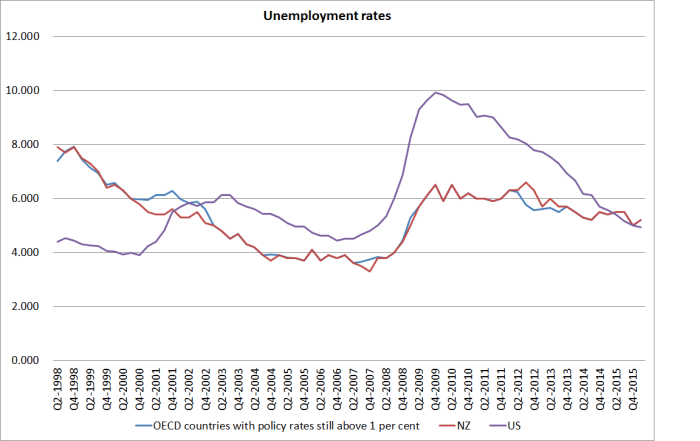
The Governor can’t just set the OCR on a whim.  Instead he is required to deliver on an inflation target.  But we know that New Zealand’s inflation rate has been persistently very low relative to the target the government set for the Bank.   Among the OECD countries where the central bank still has some material monetary policy discretion –  say, a policy interest rate still above 1 per cent –  our inflation rate has also been falling away relative to the median in those other advanced economies (a sample which includes Australia).  Inflation just isn’t a constraint at present –  if anything, it is the absence of enough inflation that is the problem.  And is the economy under mounting pressure?  Well, by contrast with the United States where the unemployment rate is almost right back  to where it was prior to the recession, in New Zealand –  even on the latest SNZ revisions –  (and in the median of those other higher interest rate OECD countries) the unemployment rate is almost 2 percentage points higher than it was prior to the recession.

U rates us and nz

There is simply no sign that the real economy could not cope with materially lower policy interest rates – if anything, the evidence is pretty clear that it could do with the boost (or rather with the inappropriately restraining hand of the Reserve Bank being eased up).

The gap between New Zealand and US long-term interest rates has “collapsed” in recent months –  the gap between 10 year nominal bond rates is now only around 65 basis points.  That suggests that markets actually think quite a bit of policy rate convergence is coming. But they can’t be sure when, as the Governor remains so reluctant to cut the OCR and has been prone to inconsistent communications.  The economic case for a 50 basis point OCR cut next month, foreshadowing further cuts to come, is reasonably strong. I don’t expect the Governor to adopt that policy, but if he is serious about getting monetary policy out of the way of the exchange rate  adjustment he seeks, it is exactly the policy he should adopt.

No doubt, some at the Reserve Bank will continue to cite their estimates of neutral interest rates being around 4 per cent –  as the Assistant Governor apparently recently told FEC.  If you asked me where I though global real interest rates would converge back to over the next 20 years, I too might talk in terms of a 2 per cent real interest rate (so with inflation targets centred on 2 per cent, perhaps something around 4 per cent).  But that is simply not a meaningful basis for making monetary policy today.  We don’t know where “neutral” interest rates are now, but most of the external evidence suggests monetary policy isn’t particularly accommodative at all – rather it has sluggishly adjusted towards whatever has changed in the real economy.  In New Zealand’s case, that failure to adopt a practically accommodative policy is holding the exchange rate higher than it needs to be –  higher than the Governor himself would like.  To that extent, the solution is in his hands.


The Reserve Bank’s update

I don’t have a great deal to say about the Reserve Bank’s statement this morning, which seemed to conform to my interpretation of the Governor’s “reaction function” over the last 12-18 months.  He really doesn’t want to cut interest rates at all –  after all, he keeps stressing just how “accommodative” monetary policy already is –  but he cares enough about the inflation target that if there is a heightened risk that inflation might stay below 1 per cent for too long then he will, reluctantly, act.

On process, I think the fact of today’s statement helps illustrate why the recent change in the Bank’s OCR announcements timetable is not particularly helpful.  On the old timetable, there would have been an OCR announcement itself this week or next.  Even though it is only now three weeks until the next MPS the Governor clearly felt things were important enough that he needed to make a signal now, rather than waiting until they had gone through the full forecasting process.

There has been a two month gap between the June and August MPSs.  But look ahead to the release calendar, and there is a three month gap between the November MPS and the February 2017 MPS, with no OCR reviews scheduled over that period.  Yes, we all know that New Zealand shuts down for a few weeks from late December to mid January, but a great deal can happen in three months at any time of the year.  Data keep on being published locally, commodity prices and exchange rate change daily, and the economies of the rest of the world keep on as normal.  Two months is often going to be too long between OCR reviews, but three months will usually be too long –  whether the Bank is in a tightening or an easing cycle.  It risks jerky OCR adjustments and miscommunications and misunderstandings (of which there have been more than enough recently anyway).

It was also a shame that the Bank chose to release its update this particular morning.  The Bank’s survey of expectations is an important input into the monetary policy process,  and especially the measures of medium-term inflation expectations.  But that survey was being taken yesterday and today, meaning that some respondents will have answered before the Governor’s statement and some after it.  That will, to some extent at least, muddy the waters when the expectations survey data are released on 2 August.

In terms of substance, I guess we should be thankful for small mercies.  The Bank is explicitly recognizing that it is getting harder to meet its inflation objective –  a target it has failed to achieve for years now.  But I remain rather uneasy about the heavy focus on the  exchange rate, and on tradables inflation.  Perhaps there is a little more reason than usual to focus on headline inflation –  and the impact of short-term fluctuations in tradables prices –  given that inflation has been so far below target for so long.  There is a real danger that people are coming to think of something around 1 per cent as a normal rate of inflation, not the 2 per cent the Bank has been mandated to focus on.  But in general, central banks are better advised to focus on core pressures on domestic non-tradables inflation –  something the Bank itself has often highlighted in the past.  Nothing of those sorts of ideas is apparent in today’s statement at all.  If anything, the Bank continues to assert that capacity pressures are ‘rising’ –  on what measures, or supported by what indicators, they don’t say.  And for all their apparently growing unease about the rest of the world they seem reasonably upbeat on domestic economic activity – even though there has been very little per capita GDP growth at all in the last year.

With trends in the underlying measures of inflation so low, I think OCR cuts are clearly warranted –  and have argued since mid last year that something nearer 1.5 per cent was warranted –  but the Bank’s continued reliance on headline inflation arguments suggests that they still “don’t really get it”.    The core trend in inflation remains too low to be consistent with the Bank’s target (and, not incidentally, the unemployment rate suggests ongoing excess capacity).  There has been some sign of stabilization in core inflation measures, and perhaps even a very slight increase, since the Bank finally realised it needed to be cutting rates not raising them, but there is a long way still to go.  And that would be so even if the TWI was at 72.     As a reminder, despite the persistently weak inflation rate –  surprising the Bank more than anyone –  the real level of the OCR is still no lower (and most likely actually higher) than it was two or three years ago before the Bank started its ill-judged and unnecessary tightening cycle.  New Zealand interest rates are typically well above those in the United States, but there is nothing in the relative cyclical performance of the two economies suggesting we need an OCR even 175 points above the US policy rate.

Of course, there is an alternative perspective.  In the Dominion-Post this morning, Pattrick Smellie asserts that “it’s not the Reserve Bank’s fault that monetary policy as we knew it is broken”.  He argues “how realistic is it to think that cutting rates further will revive domestic inflation when we’re importing the absence of inflation from the rest of the world?”  There are certainly some common global factors at work, but we need to recall that (a) most advanced countries have exhausted conventional monetary policy capacity, while we haven’t, and (b) New Zealand has had an inflation rate that has been undershooting the target by more than in the case in many –  not all –  other advanced economies (eg Australia, the US, or Norway).  It isn’t a case that the monetary policy model is broken in New Zealand, so much as that the Reserve Bank Governor has been reluctant to give it a try –  reluctant, that is, to do his job.  Put the OCR quickly to, say, 1.5 per cent and –  absent a big new adverse global shock –  I think we can be reasonably confident that future inflation would be tracking much closer to 2 per cent than seems likely (even to the Reserve Bank) on current policy.

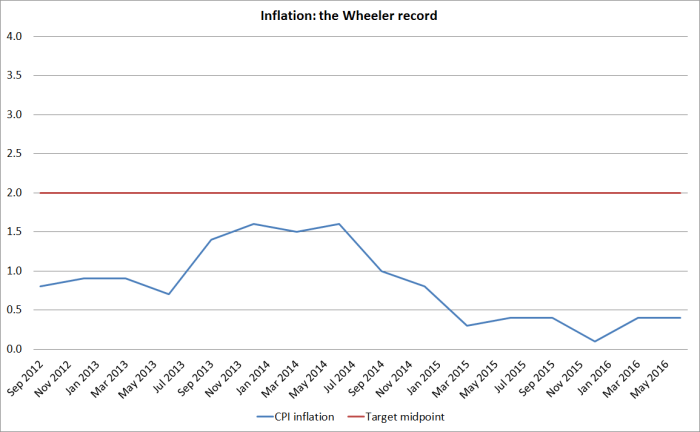
As a reminder, here is the New Zealand (headline) inflation outcomes over the current Governor’s term.

wheeler inflation

On current reckonings there is little chance of headline inflation even getting briefly to the target midpoint at any time in the Governor’s five year term.  Not a record to be proud of, especially as the Governor himself championed the case for a focus on the midpoint.


Still unconvincing

We expect inflation to strengthen reflecting the accommodative stance of monetary policy, increases in fuel and other commodity prices, an expected depreciation in the New Zealand dollar and some increase in capacity pressures.

So said Graeme Wheeler in his MPS press release this morning.  I thought it sounded like a familiar line, so I went back and had a look.  This seems to have been the Governor’s 30th OCR decision.  Back in his very first OCR announcement in October 2012 he said this

While annual CPI inflation has fallen to 0.8 percent, the Bank continues to expect inflation to head back towards the middle of the target range.

And in all those 29 statements since then –  with perhaps just one exception –  he has been saying much the same thing: inflation will increase.  And actual inflation –  headline, and the range of core measures – just keeps on being below target.

At the Bank’s press conference, Bernard Hickey asked if the Bank could be regarded as having done its job, given that even on its own forecasts (persistently too optimistic) there would have been six years of inflation below the target midpoint by the end of 2017, when the Bank again expects headline inflation to be back to 2 per cent (the Bank doesn’t publish forecasts of the core inflation measures, but I doubt the picture would be any different if they did –  it has also been four or five years since the various core measures were clustered around 2 per cent).  There were a range of possible plausible answers to that question, but I wasn’t prepared for the one Assistant Governor John McDermott actually gave: he said “your timeframe is very short”.  Six years……when monetary policy generally works over perhaps a two year horizon, and when the Governor’s term –  in a system built on personal accountability –  is only five years.

Yes, it wasn’t a very good day at the Reserve Bank today.    Inflation is apparently expected to increase partly because the exchange rate is expected to fall.  At 8:59am, the exchange rate was already above what the Bank was assuming in the MPS projections,  and a few minutes later it was another per cent higher, and it rose a bit more in the course of the press conference.  I’m not sure why the Governor expects the exchange rate to fall back if his rosy domestic economic story is correct.  Perhaps he expects a lot more tightening in the US.  But, again, he has been expecting that almost since he took office in 2012.

Some of the other bits in that statement as to why he expects inflation to rise were a bit puzzling too.  The Governor apparently thinks “accommodative monetary policy” will do the trick, but in real terms the OCR is probably a bit higher than it has been for much of his term (certainly than in the year or so before the unwarranted tightenings), and the TWI this afternoon is only slightly lower than the average level for the Governor’s term to date.  Set aside for now the question of whether conditions are actually “stimulatory” or “accommodative” in absolute terms, but if they are more accommodative now than over the last four years, the difference isn’t large.  Core inflation didn’t pick up over those four years, and it isn’t obvious why it is going to do so now.

The Governor also apparently expects “some increase in capacity pressures”.  One would hope so, given that on the Bank’s own estimates we have had eight consecutive years of a negative output gap.  But it isn’t clear why the Bank expects capacity pressures to increase from here.  They are forecasting quite an increase in residential building, but we’ve already had four or five years of increasing residential investment activity, through two very large shocks to demand for residential investment –  the Canterbury earthquakes, and the large unexpected surge in immigration.  All of that, on top of buoyant commodity prices earlier in the period, wasn’t enough to turn the output gap positive or get the unemployment rate back to more normal levels, or lift inflation back to target.  It isn’t obvious why things should change now –  especially as, like other forecasters, the Bank expects the net migration inflow to fall away quite sharply.

The Governor could be right.  Macroeconomic forecasting is, in many ways, a mug’s game.  But he has been wrong for several years now, as his predecessor was in his last couple of years.  It isn’t obvious that he has a compelling story to tell as to why inflation pressures are finally about to pick up. But if he has such a story it isn’t in the Monetary Policy Statement.

Meanwhile, there is a great deal of complacency. I heard the Governor talk of significant real wage increases, strong tourism, strong immigration, significant building activity, and so on.  All without any sense that per capita income growth has remained disappointingly weak.  Neither the Governor in his comments nor the text of the MPS itself even mention an unemployment rate that lingers at 5.7 per cent, years after the end of the recession.  If anything, the Bank appears to believe that excess capacity in the labour market is already exhausted (see Figure 4.8).

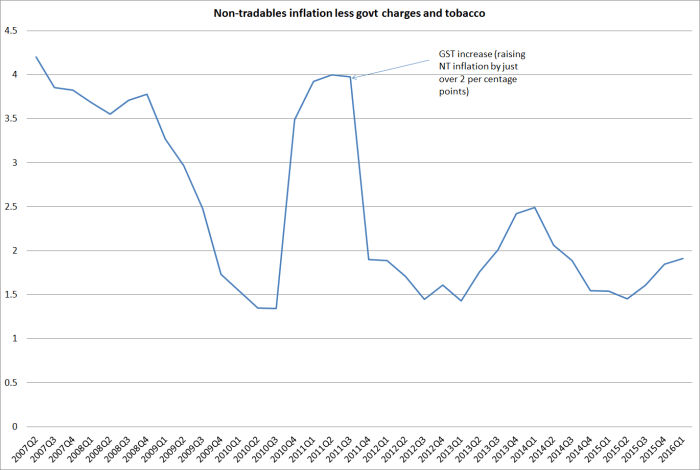
The Governor also made great play of non-tradables inflation.  He is quite right that, over time, non-tradables inflation (or at least the core of it, excluding government taxes and charges) is what monetary policy can really influence.  Even exchange rate effects –  which the Governor weirdly tried to play down –  over the medium-term work by influencing overall pressure on domestic resources and thus non-tradables inflation.  But non-tradables inflation typically runs quite a bit higher than tradables inflation, even in a stable exchange rate environment.  That is partly about the labour intensive nature of many of the services included in non-tradables inflation (hair cuts are the classic example, where there is limited scope for productivity gains).  With an inflation target centred on 2 per cent, the common view among economists inside the Bank used to be that one might expect non-tradables inflation to average perhaps a bit above 2.5 per cent, while tradables inflation might average a bit below 1.5 per cent per annum.  Together, they would be consistent with medium-term CPI inflation (ex taxes etc) of around 2 per cent.

But here is what non-tradables inflation looks like in recent years.  This series excludes government charges (eg the cut in ACC motor vehicles levies) and tobacco taxes (which have been increasing sharply each year).  It doesn’t take out the effect of the 2010 GST effect, but it is easy enough to visually correct for that – it accounts for about 2 percentage points of the inflation rate over 2010/11.

nt ex govt charges and tobacco

There is a bit of variability in the series, but it has been years since this measure of core non-tradables inflation got even briefly as high as 2.5 per cent, let alone fluctuating at or above that level.  And this is the series that should have borne the brunt of the Christchurch rebuild pressures –  which probably explained the increase in this measure of inflation in 2013/14.  Non-tradables inflation is what the Bank can influence. It really needs to be quite a bit higher to be consistent with the target specified in the PTA –  and on current Bank policy, there is no particular reason to think it is going to happen.

I outlined again yesterday my take on how the Governor operates: he is really bothered about the housing market, and really doesn’t want to cut the OCR.  But he can’t afford to see core inflation drift much lower –  he can get away with it holding around current levels (somewhere, in the MPS words, in a 0.9 to 1.6 per cent range) –  so will cut if data surprises really force him to, but not otherwise.  Today was a classic example of that model in action.  In the run-up to the March MPS it was, he said, the expectations survey data that really rattled him.  There has been nothing comparable since and so, mediocre economic performance and weak inflation notwithstanding, there was no OCR adjustment.

Instead, today was all about housing, and financial stability.  Perhaps we were supposed to have forgotten that the FSR was released only a few weeks ago and in his press release on that occasion the Governor began by extolling the resilience of the New Zealand financial system.  Often enough the Governor has been reluctant to comment on financial stability issues in monetary policy press conferences, and it is only three months since I praised him for his response on house prices at the March MPS press conference

And when asked about the impact of a lower OCR on house prices, he succinctly observed “well, that’s just something we’ll have to watch”.  By conscious choice, house prices are not part of the inflation target, either in New Zealand or in most (if not all) inflation targeting countries.  It is one, important, relative price, influenced heavily by a range of other policy considerations.  And if bank supervisors should pay a lot of attention to house prices, and associated credit risks, it is a different matter for monetary policymakers.

All that was long gone today.  It was, in effect, all about house prices and the possible threat to financial stability.  I don’t recall hearing, or reading, anything about stress tests (they’ve been pretty positive), or capital requirements (they seem to have been quite – rightly –  onerous by international standards), or even about the Bank’s benchmarking exercise to better understand how individual banks are modelling similar risks.  High house prices can be a source of risk if they are financed with poor quality lending, backed with inadequate capital.  But there was none of that analysis today.  Instead, there was a regulator champing at the bit to impose even more controls, touting the LVR restrictions to date as “very successful”.  Apparently more LVR controls could be only weeks away –  although of course they will have to consult on any new controls, with a mind open to considering alternative perspectives and evidence –  while loan to income restrictions seem to be a bit further down the track (they are doing analytical work on them, rather than detailed instrument design, or so it seemed from the Governor’s comments).  The Governor really seems to have it in for people buying residential properties for rental purposes, and yet can never quite tell us why.  He reminded us again today that some 40 per cent of property turnover involves such purchasers, but never ever addresses the simple point that in a badly-distorted system where the home ownership rate is dropping towards 60 per cent, the remaining homes have to be owned by someone.

The Governor and Assistant Governor were at great pains to emphasise that monetary policy is required to have regard to “financial stability”.  The relevant phrase isn’t new –  it has been in the Act since 1989 –  but it isn’t quite what the Governor said it is either.  Section 10 of the Act requires that

“In formulating and implementing monetary policy the Bank shall have regard to the efficiency and soundness of the financial system”.

Efficiency is listed first, both there and in the Policy Targets Agreement.  And yet, puzzlingly, I didn’t hear anything today –  or in the FSR press conference a few weeks ago –  about the efficiency of the financial system.  New controls, ever more detailed controls, overlapping LVR and DTI controls, all imposed on some classes of lenders and not on others, some classes of borrowers and not others, are usually considered ways of seriously undermining the efficiency of the financial system.  But the Governor seems not to care.

Perhaps more importantly, in a discussion about monetary policy, neither financial soundness nor financial system efficiency –  nor the avoidance of “unnecessary instability in output, interest rates and the exchange rate” –  are equal objectives with the inflation target.  Price stability is the Bank’s primary statutory objective, and the inflation target centred on 2 per cent in the practical expression of that.  It doesn’t mean headline CPI inflation is, or should be, bang on 2 per cent each and every quarter.  But six years –  with no assurance that even six years will be an end of it –  below target really is too much.  It was, after all, the Governor who added explicit mention of the midpoint to the PTA.

The Governor also found himself on the backfoot over communications, coming on the back of the recent BNZ analysis and yesterday’s Dominion-Post article.  In some obviously-prepared lines, the Governor went to great lengths to argue that there was simply no problem.  For a start, he and his colleagues agreed, people simply hadn’t read his February speech carefully enough  (set aside for a moment that point that if people misread your carefully prepared communication, it probably says something about that communication itself).  Oh, and we shouldn’t be surprised that there had been quite a few surprises in monetary policy lately, because the OCR was actually changing.  He seemed to ignore the fact that, as I noted yesterday, in 2014 the OCR had moved quite a lot and there were no major communications problems.  It got worse when he then argued that if one looked at 2006 to 2010 there were similar surprises –  as if he thought we’d forget that 2008/09 saw one of the biggest global financial crises ever, and huge  –  unprecedented  – OCR changes.  It simply wasn’t a very convincing performance.  The Governor’s communications haven’t been good enough recently.

A journalist asked him about the sharp reduction in the number of on-the-record speeches. I hadn’t really noticed this, but when I checked it was certainly true.  In his early years, the Governor made much of how the Bank was going to do more on-the-record speeches. In 2013 there were 17 and in 2014 there were 18.  Last year there were only eight –  a fairly normal sort of level in pre-Wheeler years – and this year so far there have been only four, only one of which was given by the Governor himself.  The Governor could offer no particular reason for this, but then fell back on a rather petulant anecdote, citing one business journalist who the Bank had asked for comment on the Governor’s speeches.  This journalist had apparently described them as “too complicated and with too many ideas”.  The Governor’s plaintive response was “I hope they get read”.  It was a slightly sad performance.  Unfortunately, it is true that neither the Governor’s speeches nor those of his colleagues really match the standards of those of their peers at the RBA, the Bank of England, the Bank of Canada, or the Fed.  We should expect better –  considered reflections, expressed clearly.  Part of accountability often involves such speeches, especially when –  as with this Governor –  he is apparently so reluctant to give interviews.  Embattled, the Governor appears to have withdrawn to his fortress.

Oddly, John McDermott offered the thought that while the number of speeches had dropped, there had been a “massive increase” in the number of other publications: “we don’t just communicate through speeches”.  I was a bit taken aback by this claim  and went to the website to check.  There does seem to have been a small increase in the number of Analytical Notes (author’s own research, including the standard disclaimer that it doesn’t speak for the Bank) and Bulletin articles (although there the increase seems to relate mostly to financial markets and the regulatory functions).  But there has been a big increase –  perhaps “massive” is not too strong a word –  in the number of Discussion Papers.  This year, so far (five months in), there have been eight published, compared to a typical annual total of six each year in recent years.  But…again, Discussion Papers are authors’ own research, complete with the standard disclaimer. In most cases, DPs are intended as the basis for submissions to academic journals by the Bank’s research staff.  Sometimes they have interesting material, but often –  abstract and introduction aside – they are fairly incomprehensible to someone who is not a specialist in the particular area.  They don’t attract much attention outside academe, and have never –  to my knowledge –  been used as part of official policy communications.   If senior policymaker speeches have a role, publications like DPs aren’t a substitute for them.

All in all, neither the MPS itself nor the press conference were the Reserve Bank anywhere near its best.  They will probably get away with it because the domestic banks seem mostly unbothered about the persistent undershoot of the inflation target.  But they really shouldn’t.  The Board, the Minister and Treasury should be asking hard questions –  both about the substance of policy and its presentation.

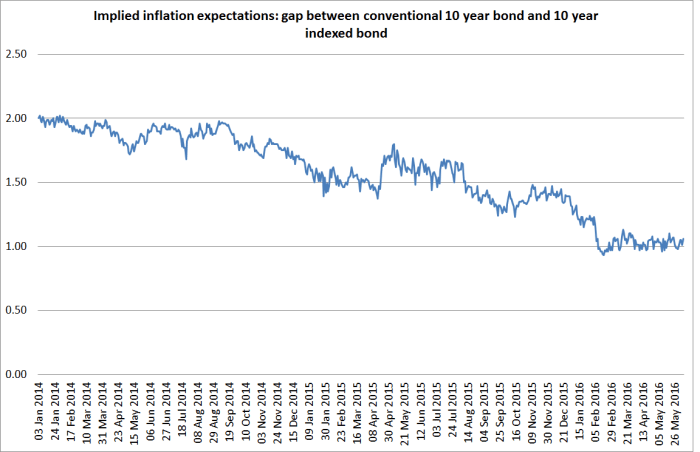
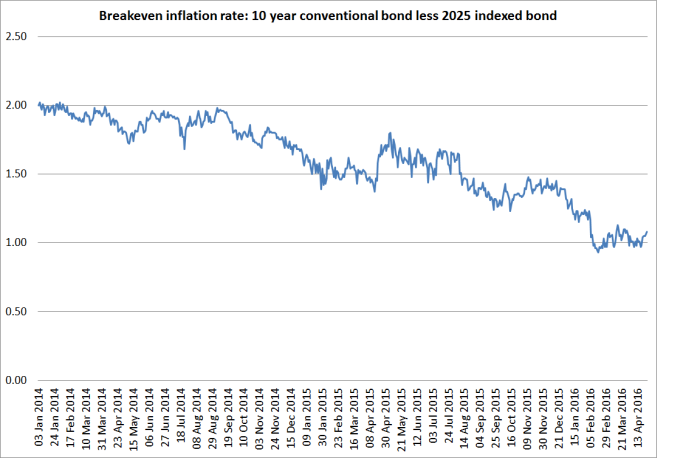
Finally, the Reserve Bank’s “modelling” of long-term inflation expectations got elevated as far as the press release today.  We are assured that these expectations are “well-anchored at 2 per cent” (not even “around” or “near” but “at”).  For these purposes, the Bank uses a couple of surveys of a handful of economists.  It isn’t clear what useful information the results have for current policy, since respondents will reasonably assume that some other Governor, and some other chief economist, will be setting monetary policy before too long.  But it also gives no weight at all to the market-based measure of implicit inflation expectations we do have.

iib breakevens to june 16

125 points of OCR cuts has still not been enough to convince people actually buying and selling government bonds to raise their implied 10 year expectations above 1 per cent.

People just don’t believe –  whether on this measure or in the other surveys – that inflation is going to settle back at 2 per cent any time soon.  They’ve been right to be skeptical.   That should trouble the Bank, and those paid to monitor it.    Expectations surveys aren’t an independent influence on inflation –  often they are a reflection of past actual outcomes –  but the way the Governor was talking today it sounded as though it might take another inflation expectations shock, or perhaps a GDP surprise, to bring about another cut.  The next expectations survey data won’t be available until after the next MPS.


Some matters the Monetary Policy Statement could address

Tomorrow sees the release of the latest Reserve Bank Monetary Policy Statement.  My “rule” for making sense of the Governor’s monetary policy choices at present is that he really doesn’t want to cut the OCR –  and hasn’t for the last year –  as much because of the housing market as anything, and cuts only if reality mugs him, in the form of some key data that he just can’t escape the implications of.   I haven’t seen that sort of data in the last month or two.  Given the terms of the Policy Targets Agreement, it should have been an easy call to cut the OCR again, but it probably hasn’t been.

There is a nice, fairly trenchant, column from Hamish Rutherford in the Dominion-Post this morning on the Governor’s communications “challenges”.  I’m very sympathetic to the line of argument Rutherford is running (including his use of some BNZ analysis of monetary policy surprises).  My only caveat is that, in my view, getting policy roughly right is better than being predictable and wrong.  There were no major monetary policy surprises or communications problems in 2014.  But the repeated increases in the OCR were simply bad policy.  Grudging as it may have been, and badly communicated as it undoubtedly was, the OCR has at least been moved in the right direction for the last year.

In this post, I wanted to highlight some issues that it would be good to see the Reserve Bank change its stance on in its statement tomorrow.   If I really expected they would do so, I probably wouldn’t bother with the post, but perhaps there will be a surprise in store.  Many of them have to do with countering that persistent sense, pervading Bank documents, that the economy is doing just fine.  The Reserve Bank has an inflation target, not an economic performance one, but the argument that all is fine in the economic garden has been used repeatedly to justify keeping the OCR as high as it has been.  As a reminder, even today, in real terms the OCR now is still higher than it was when the ill-judged 2014 tightenings began.

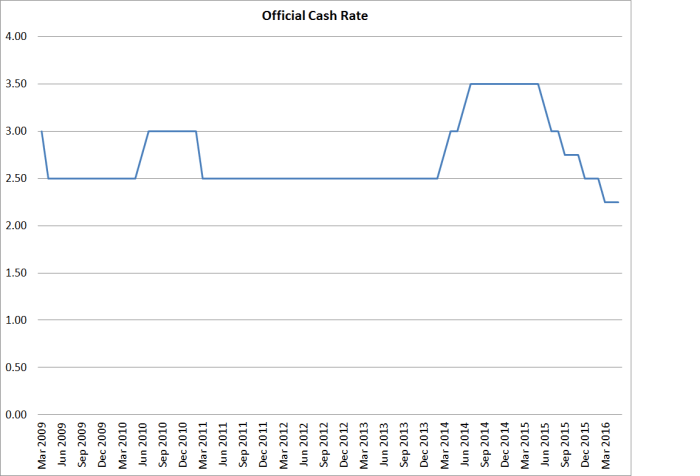
The first is the constantly repeated claim that monetary policy in New Zealand and in other countries is highly “stimulatory”.  It appears in almost every Reserve Bank policy statement or speech, and appears to be based on nothing more than the undoubted fact that interest rates (real and nominal) are currently low by longer-term historical standards.  That doesn’t make them stimulatory.  It has now been more than seven years since the rate cuts during the 2008/09 recession came to an end.  For most of the time since then the OCR has been at 2.5 per cent.  Today it is at 2.25 per cent.

ocr

Adjust for the fall in inflation expectations (around 60 basis points over 7 years on the Bank’s two-year ahead measure), and if anything real interest rates are a bit higher than they’ve typically been since 2009.

The Reserve Bank appears to still believe that a normal (or ‘neutral’) short-term interest rate might be around 4.5 per cent.  But there is nothing substantial to back that view.  The fact that inflation has been persistently below target for several years, in a weak recovery with persistently high unemployment, argues against there being anything meaningful to a claim that 4.5 per cent is a “neutral” interest rate –  a benchmark against which to measure whether monetary policy is “highly stimulatory” or not.  Better, perhaps, to look out the window, and check the current data.  That isn’t always a safe strategy, but it is better than clinging to old estimates of unobservable structural features of the economy.  Having moved to a flat track in its interest rate projections, the Bank appears to be backing away from putting much practical weight on the high estimates of a neutral –  or normal –  interest rate.  But the rhetoric still seems to matter to the Governor, and his reluctance to cut the OCR seems, in part, influenced by his sense that interest rates are already “too low”.  He has –  or at least has produced –  nothing to support that sense –  whether for New Zealand, or for most other advanced other countries.  Better to put to one side for now any estimates of neutral interest rates, lose the rhetoric, and respond to the observable data as they are.

The second point I would like to see signs of the Reserve Bank taking seriously is the persistently high unemployment rate.  At 5.7 per cent it has barely changed in the last year.  I noticed that the OECD in its new forecasts seems to treat 5.8 per cent as the natural rate of unemployment (or NAIRU) for New Zealand.  Few others do, and both the Treasury and the Reserve Bank have tended to work on the basis that our regulatory provisions (welfare system, labor market restrictions etc) are such that the unemployment rate should typically be able to settle nearer 4.5 per cent without creating any inflation problems.    Someone forwarded me the other day a market economist’s preview of this MPS, noting  with some surprise that the unemployment rate wasn’t mentioned at all.  I sympathized with the person who sent it, but pointed out that it was the Reserve Bank the market economists were trying to make sense of, and the Reserve Bank gives hardly any attention to this key indicator of excess capacity in the labour market.   Reluctance to cut the OCR might make more sense if the unemployment rate were already at or below the NAIRU.  As things stand for the last few years, there is an inefficiently large number of people already unemployed, and the Governor’s reluctance to cut just condemns many of them to stay unemployed longer than necessary.  The Governor should at least recognize that trade-off, and explain the basis for his judgements.

The third point it would be good to see the Reserve Bank explicitly addressing is the mistakes it has made in monetary policy over the last few years.  Depending on the precise measure one uses, inflation has been below the target midpoint –  a reference point explicitly added to the PTA in 2012 – for many years now.  Some of that might not have been easily foreseeable.  Some of it might even have been desirable in terms of the PTA (if the one-off price shocks were all one-sided, which they weren’t).  Humans  –  and human institutions –  make mistakes, and one test of a person or institution is their willingness to recognize, respond to, and learn from their mistakes.  Since the Governor is unwilling even to acknowledge that there were any mistakes, it is difficult to be confident that he or the institution has learned the appropriate lessons and adapted their behavior.

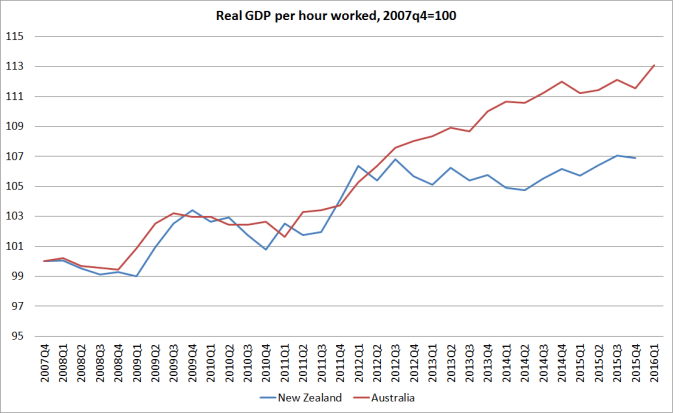
The fourth point it would be good to see the Reserve Bank acknowledge is how poor New Zealand’s productivity and per capita real GDP performance has been.  For example, here is real GDP per hour worked for New Zealand and Australia since the end of last boom.

real gdp phw june 16

Maybe data revisions will eventually close the gap, but that is the data as it stands now.

And here is per capita real GDP growth rates.

real gdp pc aapc

A pretty dismal recovery phase, by comparison with past cycles.

My point is not that monetary policy can or should target medium-term productivity growth or real GDP growth, but simply to illustrate the climate in which the Governor has been making his monetary policy calls, holding the OCR consistently higher than the inflation target required.  He likes to convey a sense –  akin to the tone of the government’s own “glee club” –  that everything is fine here but actually it is pretty disappointing.  Perhaps holding interest rates higher than was really necessary might make a little sense if the per capita GDP growth or productivity growth had been really strong –  leaning a little against the wind –  but they’ve been persistently weak.  Again, the Governor should explain the basis for his trade-offs, not pretend they don’t exist.  We’d have had a better cyclical performance if the OCR had not been kept so high.

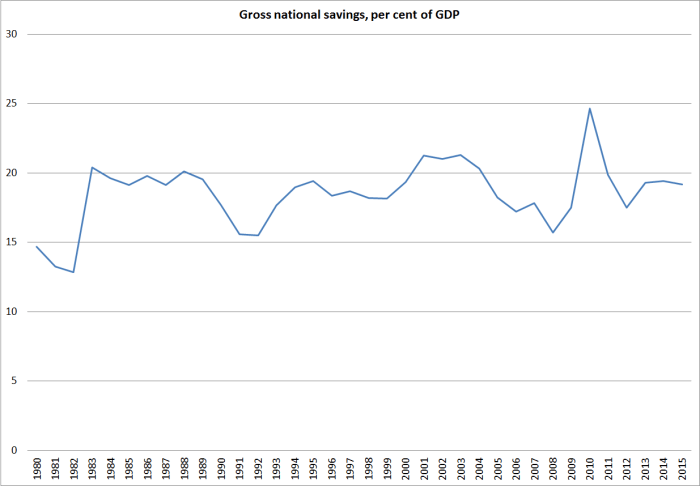
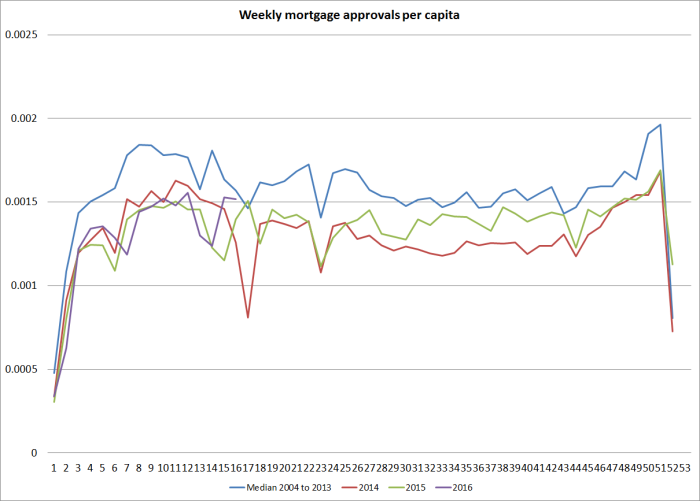
I could go on.  The Governor could usefully highlight that, although he is uncomfortable –  as everyone should be –  with current house prices, there is nothing in the turnover or mortgage approvals data (per capita) to suggest an excessively active market (high turnover is often associated with excessive optimism, and unjustifiably loose credit conditions).    And there is nothing in the consumption or savings data to suggest that high or rising house prices have spilled over into unwarranted additional consumption, putting upward pressure on inflation more generally.  I showed the chart of private consumption to GDP in a post yesterday –  stable over almoat 30 years, despite really large increases in house prices and credit.  This chart shows the national savings rate, since 1980.  There is a little year to year variability, but again no trend over 35 years now.

national savings

House prices are a national scandal, but there is no reason to think they should be treated as a monetary policy problem.

I do think the OCR should be lower –  perhaps 50 or 75 basis points lower than it is now.  In time, the Reserve Bank is likely to recognize that.  But my point here is really that when he makes his choices –  and they are personal choices, not those of a Committee –  the Governor should, and should be seen to, engage with world as it is, not as he might wish that it would be.  In that world, the unemployment rate lingers high, productivity and income growth have been persistently weak, inflation has been persistently below target, wage inflation is weak, house price inflation isn’t splling into generalized inflation pressures, and historical reference points around normal or neutral interest rates seem increasingly unhelpful.  Perhaps there is a good case for keeping the OCR at current levels, but a good case can’t simply pretend everything is rosy in the garden or that –  finally –  everything is just about to come right.

(And all that without even mentioning the exchange rate which is not only high by historical standards –  again raising doubts about those “stimulatory” claims for monetary policy –  but this morning is at almost exactly the same level it was at a year ago.  The fall in the exchange rate from the 2014 highs was supposed to help get inflation back to target.  It was a half-plausible story when the fall first happened.  It is less even than that now.)


A wrong decision, but perhaps not too surprising

Graeme Wheeler’s OCR decision this morning –  perhaps he will tell us how many of his advisers backed this one? – was the wrong decision.  Core inflation measures remain well below the midpoint of the inflation target, and there are few or no pressures taking inflation sustainably back to the midpoint, even though it is now almost 11 months since the Reserve Bank began unwinding the ill-fated 2014 tightening cycle.

Keeping medium-term inflation near 2 per cent is the monetary policy job that has been given to the Governor.    Nothing else matters very much in the Policy Targets Agreement.  There has been talk in some quarters that the inflation target should be lowered.  The Minister of Finance says he hasn’t found that case persuasive, and he sets the target.

But if it was the wrong decision, it perhaps wasn’t too surprising a decision.  Graeme Wheeler has been reluctant to cut the OCR all along.  He continues to talk of how “accommodative” monetary policy is, but that appears to be referenced against a view that the “neutral” interest rate is 4.5 per cent (their last published estimates, although one hears that they tell investors in private meetings that that estimate is now around 4 per cent –  perhaps reflecting the fall in inflation expectations?).  He thought he was getting things “finally” back to normal when he launched the 2014 tightening cycle, talking confidently then of the prospects of 200 basis points of tightening.   It would be better, frankly, if the concept of a neutral interest rate was largely excised from central bankers’ vocabulary for the time being, because neither they nor we have any good sense of what “neutral” actually is.  Any such estimates have too often been a dragging anchor, helping hold back central bankers from the sorts of policy adjustments that meeting their respective inflation targets would have warranted.

So the Governor has been consistently reluctant to cut the OCR –  and even more reluctant to admit his past mistakes – and has only done so when the weight of evidence has overwhelmed his preferences.  Last year it seemed to be some mix of further falls in dairy prices, the failure of inflation to recover,  and/or high unemployment.  As recently as the start of February, in his forthright speech, the Governor was again holding out against the prospect of further cuts –  never ruling them out, but making pretty clear where his inclinations lay.  But then the data overwhelmed him again.   The new inflation expectations data shook the Bank, and the deteriorating global economic outlook and rising financial market unease (including widening credit spreads) prompted a move in March, with the prospect (projection) of one more cut to come before too long.

But in the past six weeks, there hasn’t been that much news, and little to change anyone’s baseline story.  There hasn’t been any new labour market data, the CPI had something for everyone, there was no material new inflation expectations data, and if the global economic outlook still looks unpromising, financial markets have recovered somewhat (including credit spreads banks face) and oil and various hard commodity prices have been rising.  If your reference point is that the OCR “really should” be something more like 4 per cent, why would you take the “risk” of cutting the OCR now?  It might be different if your reference point was that core inflation measures have been persistently below target for years, and that that gap shows little or no signs of closing.

What of the housing market?  I explicitly commended the Governor’s approach to house prices at the time of the March MPS:  asked about the risks that a lower OCR could provide a big further impetus to house prices, he  had simply observed “well, that’s just something we’ll have to keep an eye on”.   It helped that, at the time, the Bank  noted that house price pressures in Auckland had been “moderating”.  Recall that house prices are explicitly not something the Reserve Bank has a mandate to use monetary policy to target.

Six weeks on and house price issues are all over the headlines again, given added impetus by the Prime Minister’s talk of land taxes for non-residents etc.   The Bank’s tone has changed, although it is still somewhat cautious: “there are some indicators that house price inflation in Auckland may be picking up”.  Frankly, it would be surprising if it were not –  new distortionary policies introduced by the Bank and the government late last year should only ever have been expected to have had short-term effects.  Nothing fundamental about the market has changed.  It still isn’t the Bank’s responsibility at all, and certainly not something that should be driving monetary policy.  But when all his inclinations seem to be against cutting, unless “forced” to by new data, and with a potentially awkward Financial Stability Report only a couple of weeks off, it would have been another reason to hold back.

Are house prices really taking off?  The Dominion-Post would have one think so, highlighting this morning a sharp rise in the price of a house in the sunny but unprepossessing suburb of Berhampore, perhaps a kilometre from where I sit.  In terms of activity levels, I run this chart of the number of (per capita) mortgage approvals from time to time.  There doesn’t seem anything extraordinary about current volumes of mortgage approvals (again, the x axis is weeks of the year, numbering 1 to 52/53).

weekly mortgage approvals

Various people who talk to the Reserve Bank have been telling me since March that the Bank has finally “got it” and recognized that the overall domestic and economic climate is such that materially lower interest rates were needed.  I wish it were so, but I think today’s statement confirms my “model”, in which the Bank will cut only reluctantly, and only if  –  in effect – “forced” to.  The Governor just doesn’t seem worried about having the economy is a position where  the best guess of next year’s inflation rate would in fact be 2 per cent.  He seems content so long as (a) he can mount a semi-credible story that headline inflation gets back above 1 per cent before too long, and (b) so long as the measures of core inflation don’t consistently drop below 1 per cent.  Otherwise, house prices seem to play too large a role in his “reaction function” –  he can play them down and suggest they aren’t a consideration when they look a bit quiescent, but they act as quite a drag on good monetary policy at any other time.

I’m not overly keen on central banks reacting much to exchange rate movements in most circumstances.  Often enough, the exchange rate changes reflect something “real” or fundamental going on.   The Bank’s own research has suggested that falls in the exchange rate haven’t materially boosted overall inflation –  probably for exactly that reason.  But it is the Governor who keeps going on about the exchange rate and how uncomfortable or inappropriate or undesirable it is.  And yet the one thing he can do that make a difference to the exchange rate is the stance of monetary policy.  A lower OCR, all else equal, will tend to lower the exchange rate.  As it, the Governor must have gone into this morning’s announcement knowing that it was almost certain that there would be quite a bounce in the exchange rate.   Despite the absence of media lock-ups, there didn’t seem to be much uncertainty about the market reaction this morning.

Trade-weighted index measure of the exchange rate:

twi

And so we are delivered an exchange rate a full per cent higher than the level the Governor considered inappropriately high at 8:59am. That seems unnecessary and unfortunate.

The disastrous New Zealand (especially Auckland) housing market is primarily the responsibility of elected central and local government politicians.  It is not something to be controlled or moderated, except incidentally, by good monetary policy (to be aimed at stability in the general level of prices) or regulatory imposts on banks (supposed to be used only to promote the soundness and efficiency of the financial system.    If the Reserve Bank thinks banks need more capital, let it make such a proposal, advance the evidence, and consult on it.   If it thinks  banks are making reckless lending choices, again let them lay out the evidence in the forthcoming FSR, and tell us about the conversations it is having with bankers, and any regulatory measures it is thinking about.  But it simply is not a matter for monetary policy.

Looking ahead, there is not much key New Zealand macro data due before decisions are made on the June MPS.  The quarterly labour market data are out shortly, but after the noise in  the unemployment rate recently, it may be difficult to get much very new from that data yet.  Perhaps as important might be the next Survey of Expectations, and particularly the inflation expectations results in it.  Today’s statement is quite relaxed about inflation, and adamant that “long-term inflation expectations are well-anchored at 2 per cent” (not “seem to be”, not “close to”, but “are”  and “at”).

That certainly isn’t the message from financial markets.  Yes, I know that the implied inflation expectations from indexed bonds aren’t a perfect indicator –  then again, neither are the other measures of expectations or core inflation –  but the current level, just above 1 per cent, seems pretty close to the average of the various core inflation measures the Reserve Bank highlighted in the last MPS.  The central view just doesn’t seem to be that we can count on 2 per cent average inflation any time soon.  That should be a mark against the Reserve Bank.

iib breakevens

In closing, I should note a couple of small aspects of the Bank’s press release that I welcome.  I (and no doubt others) had lamented the Governor’s recent high profile focus on a single, complex, prone to end-point issues, measure of core inflation.  In this statement, that is replaced with a  simple “core inflation remains within the target range”.  Only just within, I would argue, but it is better than putting so much official weight on a single measure.

And in the final paragraph, I have noted for some time an unease at how much weight the Bank has been putting on recent and near-term headline inflation in these statements  –   in the near-term, headline inflation is thrown around by all sorts of things.  This time, they have gravitated towards something more (PTA consistent) medium-term in focus: “we expect inflation to strengthen as the effects of low oil prices drop out and as capacity pressures gradually build”.  One could reasonably question whether there is any sign that capacity pressures really are building, or are likely to over the next year or two –  after all, they have been relying on this “gradual build” for some years now – but at least it puts the emphasis in the right place: the factors that shape the medium-term outlook for inflation.


Charles I?

Charles I was a good man, but (was generally reckoned) a bad king.  His reign ended. following the Civil War, with his beheading on 30 January 1649.

In their amusing take on English history 1066 And All That, Sellar and Yeatman offer this caricature of Charles’s views:

Charles explained that there was a doctrine called the Divine Right of Kings, which said that:

(a) He was King, and that was right.

(b) Kings were divine, and that was right.

(c) Kings were right, and that was right.

(d) Everything was all right.

Sometimes I wonder if Graeme Wheeler sees himself, and the Reserve Bank, in much the same light.

I wrote the other day about my request to the Reserve Bank to provide summary information on the OCR recommendations made by the Governor’s designated advisers for each of the OCR reviews since mid 2013.  The Governor himself had disclosed that information for the March Monetary Policy Statement review in an interview conducted only a day or two after the release of that particular OCR decision.

As I noted the other day, I didn’t expect them to respond positively to my request.

I finally got the response late yesterday afternoon, just before the end of the maximum allowed time of 20 working days.  I wasn’t surprised by the decision to withhold all the information, but was more than a little surprised at the argument they sought to rely on.  Here is what they had to say:

Decision

The Reserve Bank is withholding the information under the grounds provided by section 9(2)(d) of the OIA, to protect the substantial economic interests of New Zealand.

Reasons

Official Cash Rate (OCR) decisions clearly relate to the substantial economic interests of New Zealand and it is clearly in the public interest that the Governor is able to decide the OCR as the Reserve Bank of New Zealand Act intends and requires.

The Governor has a statutory position as the sole decision-maker on the OCR. While the Governor chooses to take advice from the Monetary Policy Committee (MPC) and others prior to making decisions, the advice does not bind or compel the Governor to any particular decision. MPC policy recommendations are simply advice that the Governor is free to accept or not. What matters under the law is the Governor’s decision.

Given the Governor’s sole responsibility for determining monetary policy settings and the limited objective value of the information, the Bank considers the public interest in knowing this selective aspect of the advice of the MPC is not strong.

Moreover, there are serious risks that mis-informed commentary on this partial aspect of advice could detract from the Governor’s ability to implement monetary policy.  This could adversely impact on the effectiveness of monetary policy, likely damaging the substantial economic interests of New Zealand.

As noted in responses to two previous OIAs requests from you (24 and 25 September 2015), the underlying analysis and advice for OCR decisions are published in summary form in a programme of carefully drafted media statements, Monetary Policy Statements, news media press conferences and media interviews.  The Bank considers that the public interest in understanding OCR decisions made by the Governor is sufficiently met by these existing information disclosures.

The Governor may choose, on occasion, to publicly state that his decision on monetary policy settings accords with the views of the MPC or anyone else that he receives advice from or wants to refer to.

For those not familiar with the details of the Official Information Act, the relevant provision allows for information to be withheld if to do so is

necessary [emphasis added] to avoid prejudice to the substantial economic interests of New Zealand”

“unless in the circumstances of the particular case, the withholding of that information is outweighed by other considerations which render it desirable, in the public interest, to make that information available”

The operative word there is “necessary”.  There being some remote possibility that some harm could be done is not sufficient.   Nor is a higher likelihood that some minimal inconvenience or discomfort to officials might ensue.  No, it must be ‘necessary” to withhold that specific information to avoid prejudicing the substantial economic interests of New Zealand.  And even then the wider public interest needs to be considered, in the context of an Act designed to make information available to public, to assist public understanding and to strengthen the accountability of ministers, officials, and official agencies.

The Governor’s case is already severely undermined by the fact that he chose to disclose this information, about the most recent OCR decision.  Could he be sure that that information would not be misinterpreted, and lead to commentary that might make his life difficult?    But he took the (surely very modest) risk anyway, and made the information available, presumably concluding that there was no material risk of prejudice to the substantial economic interests of New Zealand.

But then how can he seriously argue that the release of the same information for, say, the July 2013 OCR review has such serious risks that it is “necessary” to withhold it to avoid prejudicing those “substantial economic interests of New Zealand”?  Or the July 2014 review? Or the July 2015 review –  now eight months in the past.  There is no sign in the Bank’s response that they have considered each piece of information separately, and evaluated the risks (which might well be different for information six weeks old than for information almost three years old).  That sort of blanket refusal is inconsistent with the Act.

The substance of the Governor’s claim is that there are

serious risks that mis-informed commentary on this partial aspect of advice could detract from the Governor’s ability to implement monetary policy.  This could adversely impact on the effectiveness of monetary policy, likely damaging the substantial economic interests of New Zealand.

Quite how  a summary of the non-binding opinions of his own chosen advisers, relating to events already some time in the past, could detract from the Governor’s ability to implement monetary policy is really beyond me.  Ultimately, the Governor makes the OCR decisions, and communicates his final stance by both the announced OCR itself and his press statement around it.  It is entirely lawful, and reasonable, for the Governor to adopt an OCR that a minority or even, on rare occasion, a majority of his advisers disagree with.  He is appointed Governor, and he signed the PTA, not them.

Of course, markets and commentators might be interested in which way the balance of advice went but this is lagged information (the most recent event I requested information for was the January OCR review, and my request was lodged after the next OCR decision was already known).    If I had asked for named views of each individual adviser it might perhaps have been a little different –  people could have fun with evidence that, say, the Deputy Governors disagreed with the Governor. But (a) that isn’t the information I asked for, and (b) in other countries, evidence of such a range of views within a central bank doesn’t seem to impair the ability of the central bank concerned to conduct monetary policy effectively.  On several occasions, the former Governor of the Bank of England chose to be in a minority in the vote of the binding MPC, again without impairing either confidence in the individual or the effectiveness of UK monetary policy.

Frankly, the suggestion that the effectiveness of monetary policy could be thus impaired, particularly to extent that could “prejudice the substantial economic interests of New Zealand”, is preposterous.

I’ve highlighted previously the contrast between the pro-active approach adopted by the Minister of Finance and Treasury to the release of advice and papers relating to each year’s government Budget. The Minister of Finance is, in this context, the sole decision-maker, and the Treasury are the advisers to the Minister.  The Treasury provides analysis, and advice, and recommendations.  Sometimes those views are accepted by Ministers, sometimes regretfully not accepted, and sometimes just dismissed out of hand.  That is the nature of good advice, in a world characterized by uncertainty and a range of perspectives on any one issue.

And yet most of that advice is routinely published.  Occasionally perhaps it embarrasses either Treasury or the Minister (but embarrassment isn’t grounds for withholding) but no one questions the ability of the Minister to make fiscal policy decisions effectively. It isn’t impaired by knowing that at times the advisers – and that is all they are –  disagree with the decisionmaker.  What makes monetary policy different?

At times, commentary on official agencies and officials will be annoying, uncomfortable, perhaps lightweight, and perhaps even (the Bank’s concern) “misinformed”.  Democracy is messy. We leave the alternative approach to places like Singapore.  (And, of course, the usual remedy when there is “misinformation” or misinterpretation abroad, is to make more information available.)

In the end much of this comes down to what I wrote about the other day.  The Bank has long considered that the final products that it chooses to publish should be enough –  whether for financial markets, the public, or members of Parliament.  The only people they are comfortable with providing more information to, apparently, are the members of the Reserve Bank Board.  It was the mindset that used to prevail across the whole public sector, here and abroad.

But that isn’t law in New Zealand.  Of course it would be tidier for official agencies and Ministers if only the approved “carefully drafted” final documents were ever made public –  press releases, Budget speeches, Monetary Policy Statements and so on.  But the Official Information Act was not passed in the interests of tidiness, or the convenience of powerful institutions and individuals. It was –  and is –  about allowing greater light to be shed on government processes, and the background analysis and advice that underpins decisions. That is what an open society is about.  It is a big part of how we hold the powerful to account.  As the Reserve Bank well knows, much though it may not like, it, the Official Information Act covers drafts as well as final documents –  it might be interesting for someone, say, to ask for the various drafts of a particular OCR press release (perhaps one from a few quarters ago, the disclosure of which could not possibly impair current monetary policy).

I experienced this line of argument repeatedly in my time in the Bank.  The Bank tends to operate as if it is a world apart.  Many of its people think of the Bank –  subconsciously I’m sure –  more as one of international circle of likeminded central banks, interacting mostly with banks and financial markets, rather than as agency of executive government in New Zealand, accountable to the public (including through the Official Information Act) just as other agencies are.

And I’ve experienced this line repeatedly in responses to OIA requests over the last year or so.  Of those relevant to monetary policy:

  • after some months’ delay, the Bank grudgingly agreed to release the background papers to a Monetary Policy Statement from 10 years previously.  On that occasion I did not ask for either copies of the individual OCR advice, or the summary of the recommendations.
  • they subsequently refused to release  any of the papers provided to the Bank’s Board regarding the September 2015 MPS
  • the Bank refused to release any material background information relevant to the most recent Policy Targets Agreement.
  • the Bank refused to release any minutes of meetings of its Governing Committtee (the forum in which the Governor takes the final OCR decision)
  • the Bank refused for months to release any material information about the work they had been doing on governance reform, belatedly releasing a small amount only recently, claiming as warrant for doing so an Associate Minister’s answer to an Opposition MP’s supplementary question six months earlier.
  • the Bank has refused to release any of the background information on its analysis of the economic impact of immigration that led into its material change of view at the December MPS.  (this is a good illustration of all that is wrong with the Bank’s argument that the MPS is really quite enough for us mere mortals –  since they included no supporting analysis in that MPS to justify their change of view).

Sadly, this latest response is all too typical, even if the particular excuse they must have spent a month crafting has a degree of novelty. It speaks of an organization –  and the key individuals –  who believe that they are, or should be, above the messiness of the sort of real world scrutiny that we expect in a democracy, and for which the Official Information Act provides.  Hence, the Charles I references.

It is a shame, because I really can’t imagine what they have to hide.  It shouldn’t be surprise if from time to time advisers disagree with the Governor –  it should worry us much more if they never do.  From time to time a Governor has gone against the majority view of his advisers –  hindsight suggests that sometimes he was right to do so, and on other occasions probably not.   But we should be able to see the balance of that advice, perhaps with a modest lag.  Sometimes it will suit the Governor (as presumably in March, when he unilaterally released the information) and sometimes not.  But what suits the Governor on particular occasions is not a relevant consideration under the Act.

The Reserve Bank of New Zealand was once at the forefront of greater openness and transparency among central banks.  Sadly, that is no longer true.

I have appealed this decision to the Ombudsman, on two grounds:

  • first, taking 20 working days to issue a blanket refusal (on material that involvement no substantial compilation or review effort) is simply inconsistent with the statutory responsibility to respond “as soon as reasonably practicable”, and
  • second, that it is simply not credible that withholding all this information (including that about decisions in 2013) is “necessary” to avoid prejudice to the substantial economic interests of New Zealand.

Hamish Rutherford has covered the story here.