The Reserve Bank Governor has given an interview to TVNZ’s Katie Bradford, apparently done under the aegis of the Q&A show but too late in the year to actually be broadcast on Q&A itself or to be done by Jack Tame, Q&A’s regular and most demanding interviewer.
There is a TVNZ article reporting the interview here, and you can find the full thing (only about 13 minutes) somewhere on TVNZ+ (my son found it for me). [UPDATE: Apparently that was only half the interview and the full 26 minutes is on the Q&A Youtube account.]
What is reported in the article is pretty breathtaking, with Orr reported as standing by his (or, presumably, the MPC’s) decisions during and since Covid with no apparent regrets, and then moving on to attack the public and the media for being focused on housing and house prices. We – and he – might regret the fact that we do not have a well-functioning land supply/use policy regime, but we don’t, and haven’t done so for decades, so it should hardly be a surprise (or a cause for attack/lament) that when interest rates are cut in what proves to be an overheating economy house prices go up.
But it got a whole lot worse when I listened to the full interview itself, where Orr seemed to just play on the fact that his interviewer wasn’t a specialist (with all the facts at her finger tips) to simply run claims that he knows not to be true. It was a reprise of his form earlier in this cycle when he repeatedly and deliberately misled Parliament’s FEC (but so supine are our democratic institutions that there were no consequences for what Parliament’s website solemnly assures us is a serious offence).
Orr was asked whether the Bank had been too slow to raise rates (of course it was, as the Bank has even grudgingly acknowledged in the past). His response was to claim that the Reserve Bank of New Zealand was the 2nd or 3rd central bank to raise rates in 2021. It simply wasn’t so. Even among OECD economies – and there are only about 20 separate monetary policy areas in it (much of the OECD having just the euro) – the Reserve Bank was the 8th (equal) to move (those moving ahead of us were Iceland, Norway, South Korea, Mexico, Chile, Czech Republic, Hungary). Perhaps as importantly, the issue should never be about who went first or second, but whether a particular national authority moved sufficiently early and aggressively for the circumstances their own economy faced. On IMF estimates, New Zealand had the most overheated economy of any of the advanced country monetary areas it does the numbers for (a group which doesn’t include all those in the list above, but does include the US, UK, Canada, Australia, Japan).
Orr then went to the claim that the Bank had been “lauded internationally – although not domestically” for being one of the most responsive central banks. It is certainly true that some market commentators have run such a line, but almost all of them seem to have had in mind the big countries and the Anglo countries, not the wider group of OECD economies. The Reserve Bank certainly wasn’t the slowest to move, but then it was dealing with a really badly overheated economy and should have moved a lot earlier. Their mistakes weren’t unique – misreading economies and pandemic macroeconomics was a common mistake, among central banks and private commentators – but they voluntarily took on the power and responsibility in New Zealand, and they actually made the bad policy calls, including increasing rates too late and initially far too sluggishly. Other people can hold their central banks to account.
(And, of course, the MPC also lost $11 billion or so or taxpayers’ money punting in the bond market. TVNZ didn’t ask about that particular bad call so we were spared a repeat of Orr’s blustering attempts to defend that. Puts the cost of running an RNZN vessel straight onto a reef not realising the autopilot was still on in some perspective….)
And then Orr claimed that the Reserve Bank was one of the few central banks confidently reducing policy rates. Which was a bit odd when most advanced country central banks have been reducing policy rates in recent months (obvious exceptions being Australia and Japan). But don’t let the facts get in the way of the Governor’s spin.
He had the gall to round off that section of the interview by suggesting, rather patronisingly, to Bradford that “your potted history is kind of incorrect”. Dear, oh dear. This from a very senior and powerful public official. Is this the sort of thing the Minister of Finance expects/tolerates? (Well, on the evidence so far anything goes.)
Bradford moved on. As was accepted, had it not been for the Covid outbreak in Auckland, the Bank would have started tightening at the August 2021 MPS (they actually started at the next review). So Bradford took a look at the projections in that Monetary Policy Statement. She pointed out (correctly) that in those projections, annual inflation was expected to be back down to 2.2 per cent by the year to September 2022 (with, as it happens, very little monetary policy help at all: as everyone agrees, there are long lags, and by the end of 2021 the OCR was expected to be only 0.75 per cent). I guess her point (obviously correct) is that the Bank was still badly misreading things by that point (and of course even now annual core inflation is still somewhere between 2.5 and 3 per cent, having required an OCR at 5.5 per cent to bring that about).
But Orr wasn’t going to be bothered engaging with facts. Instead, we got the same old outrageous claims he used to try to fob Parliament off with. “Do you know what happened after that [August 2021]”, he asked. “We had the Ukraine invasion, rising food prices”, going on to add in cyclone effects and so on. He even had the gall to suggest that we had among the lowest inflation rate peaks in the OECD and that European countries had been dealing with 20 per cent inflation. It is an outrageous attempt to mislead and distract, simply breathtakingly dishonest, and especially so when set against any discussion of core inflation or the economic overheating. Take the New Zealand labour market for example: the unemployment reached its lowest level (extremely overheated) in the December quarter of 2021 (ie before the invasion), oil price pressures from the invasion never lasted long, and…..as importantly….both food and energy prices are typically “looked through” by central bank policymakers focusing on core inflation. On CPI ex food and energy measures, New Zealand’s peak was about middle of the pack among OECD countries (and the extreme headline numbers in a few countries were largely the result of the gas price shock to which New Zealand – no pipeline or LNG trade – was not exposed).
Orr then moved on to an interesting claim (that I have not heard him make before, and which has not been documented in any published papers or material in MPSs) claiming a) that to have kept core inflation in the 1-3 per cent range the OCR would have to have been raised to 7 per cent on the first day of the pandemic, and b) that even if that had been done we’d still have had 6 per cent headline inflation. Neither result seems very likely, and given Orr’s record of just making stuff up should be heavily discounted unless/until they produce some robust formal estimates. On Orr’s telling it would have taken more monetary restraint to stop inflation getting away than it actually took to bring it down again once it had gotten away. That doesn’t seem very likely, and perhaps a useful counterpoint is the experience of Japan and Switzerland which didn’t cut policy rates into the pandemic, and didn’t see a particularly severe later inflation experience. As for the 6 per cent claim, that seems simply preposterous, since there has been no time in the last few years when the gap between headline and core inflation has been anything like as large as 3 percentage points.
Later in the interview, questioning moved on to fiscal policy. Here I will give Orr credit on one point: he explicitly corrected the journalist to note that the current goverment had certainly cut spending, but that it had also cut taxes, and that the two effects were roughly even. This is exactly consistent with the estimates in Treasury’s cyclically-adjusted balance series (chart in Monday’s post), in which this year’s deficit is just a touch larger than last year’s. Of course, it would have been nice had the Bank made this point in its MPSs, instead of spending the last 18 months – both governments – avoiding the issue and focusing on largely irrelevant series of government consumption and investment spending (rather than the cylically-relevant) fiscal balance and fiscal impulse measures.
For the rest of it, Orr was back in his preferred space, playing politician and advancing personal political and ideological agendas that are simply out his bailiwick. It was, we were told, critical for governments around the world to close infrastructure deficits and New Zealand’s was “one of the worst”. He appeared to attack a focus on reducing deficits and keep government debt in check, suggesting that the government needed to spend “a lot more” on infrastructure, suggesting that New Zealand had been failing in this area since World War Two (a claim that of course went unexamined – in fairness no time – but presumably includes overbuilt hydro power capacity, sealed roads in the middle of nowhere etc). Now, in fairness, he did also talk about enabling private capital – this the same Governor who only a few months ago was bagging foreign investment – but the overwhelming tone was to welcome more public debt. Waxing eloquent he launched into Labour Party and left wing themes about how great it would be if governments were investing and delivering more “social cohesion” (around whose values Governor?), an “inclusive economy” and so on.
In any sane environment it would have been to have significantly overstepped the mark, but Orr has done that so often – and worse, with all the misrepresentations and denials – with no consequences (no rebuke from the Board or minister(s), reappointment for a final term comfortably secured, tame board chair reappointed etc) that no doubt it will again pass with little notice.
It really was a pretty disgraceful, if again revealing, performance. But then the fact that Orr still holds office, and the incoming government – that used to rail against him and his style and the corporate bloat – has been content to see things just run on as usual, is just another sad reflection of the debased state of New Zealand public life and standards. One of many to be sure, but no less acceptable for that.
I had in mind another post for today, but this morning we had something rare: a speech about monetary policy from the Governor of the Reserve Bank, delivered in Washington at a think-tank which appears to have been hosting many speakers this week (in town for the IMF World Bank Annual Meetings). On their schedule, the Deputy Governor of the Banque de France was speaking earlier in the afternoon (some very interesting material in her presentation) and the Prime Minister of Liechtenstein a bit later.
The Governor’s wife writes fiction (several books published) and teaches creative writing. Entirely laudable and there are often powerful insights in great works of fiction. But when – as her husband does – fiction and sheer spin are dressed up as serious accounts of policy stewardship etc, the only possible insight is into the character of the chancer who tries it on. And perhaps those who enable him (one could think of Neil Quigley and Grant Robertson, but also now (sadly) of Nicola Willis).
But first a point to his credit. Climate change, for example, didn’t get mentioned even once in the speech. Or the treaty of Waitangi. It had the appearance of a straight up and down speech about monetary policy stewardship, as advertised (“Navigating monetary policy through the unknown”). And, if you recall how he used to tell people (well, Parliament actually) that the Russian invasion of Ukraine was to blame for the worst New Zealand inflation in decades that line has now been quietly minimised too.
Consistent with his revealed preference for fictional embellishments, Orr builds his speech around the navigational challenges faced by ancient mariners, in his case primarily Kupe. Orr claims to know that Kupe had a clear goal in mind, and whether he did or not, (I guess he could have used Captain Cook too) but – technology having moved on – he wasn’t reliant on the sea birds etc. It still seemed a rather strange analogy to use, in 2024, in an age of GPS. Then again, I guess it is only a couple of weeks since the HMNZS Manawanui ran onto the reef, so perhaps it isn’t such a bad analogy for New Zealand monetary policy after all. Perhaps the salvage will be done well, at considerable costs (perhaps lingering costs for the people of Samoa) but the ship never should have ended up on the reef in the first place. Those responsible for the loss of a ship face courts of inquiry, perhaps even a Court Martial.
But in Orr’s fictional world central bankers – New Zealand central bankers, since his speech does actually concentrate on New Zealand – are heroes, having delivered us to the least-bad possible outcomes through the storms, vicissitudes and other uncertainties of the last few years, where anything bad was no one’s responsibility, and anything good was to the credit of the wise and respected navigators, led by Orr himself. It was pretty breathtaking stuff really – although questionably persuasive even as fiction – as there is no longer even a hint that anything could have been done better, by our courageous central bank navigator, than it was. When the Bank reviewed its own performance a couple of years ago, they then thought it prudent to acknowledge the odd small error, even while claiming that none of it mattered much. But no longer apparently.
In his celebratory self-congratulatory mood – he claims to have saved us from two deep recessions – his overseas listeners would have had absolutely no idea that on the IMF forecasts that came out yesterday, New Zealand’s real per capita GDP growth in both 2024 and 2025 is estimated to be among the worst in the world, down there with places like Yemen and Haiti. Or that on those same IMF estimates, New Zealand will have been one of the very worst performers over the entire 2019 to 2025 period.
Now, to be fair to the Governor, one can’t blame underlying long-term productivity problems on the Reserve Bank, but equally no one really doubts that those 2024 and 2025 outcomes are mostly on monetary policy: the consequences of the Bank belatedly waking up to its past mistakes, and doing what it took to get inflation back down again. And, frankly (although the Governor won’t tell you this) anyone can get inflation back down: the trick (the reason we delegated the job to supposed experts) was never letting it get away on you (well, on us, the public) in the first place.
The spin, and utter avoidance of any responsibility, begins earlier, in fact with the Bank’s covering press release, which presumably captures the key lines Orr would like to see reported here.
First, there is this framing
Followed up in the speech with this extraordinary admission from someone charged with keeping inflation near 2 per cent.
Now, I don’t doubt that briefly in early 2020 perhaps the MPC really believed that the alternative to them acting as they did was economic disaster, but it was very quickly evident that that simply wasn’t the case. Economic indicators here rebounded quickly and early. And the MPC did nothing to start to pull back on the excessively loose monetary policy until late 2021 (it wasn’t until into 2022 that the nominal OCR was even lifted back to the immediate pre-Covid level by when inflation and inflation pressures were already running away on them): they now estimate the positive output gap was in excess of 3 per cent by late 2021. If we want to play with nautical analogies, Ulysses steered his way between Scylla and Charybdis. Orr and his team ran us onto the rocks (full blown inflation, fixed only at great cost). And he claims to have been now quite relaxed about those hugely and disruptive inflationary consequences, with all the attendant arbitrary redistributions.
And then, still with the press release, there is this
Inflation simply was not “caused by COVID-19”. With all their comms staff, this is very unlikely to be a slip of the pen, rather it is yet another in the endless series of attempts to avoid actual responsibility for doing the highly-paid job they took on so badly. No one doubts that Covid provided a context where many policymakers had to make difficult calls in conditions of great uncertainty. But it was the Reserve Bank MPC’s calls, faced with all that uncertainty and the decisions of others (since monetary policy moves last, by construction), that delivered the worst inflation in decades and the attendant cost and disruption to getting it down again. But Orr can’t or won’t admit that.
As the work fiction continues, there is no mention of the LSAP – just a couple of passing lines about how quantitative easing tools hadn’t been used in New Zealand before – or the $11 billion of losses the MPC’s choices imposed on the New Zealand taxpayer (as someone pointed out a couple of weeks ago, one could build three Dunedin hospitals for that price), and of course none of the way in which the Bank went on provided concessional lending to banks to the very end of 2022. No doubt, if challenged, Orr would bluster and repeat his utterly unsubstantiated claims that the LSAP made a big positive difference to New Zealanders, but on this occasion his fictional treatment just airbrushes it away.
I spluttered when I came to this paragraph
He chooses not to mention to his overseas audience (or to remind local readers) that his own reappointment was formally opposed by the two Opposition parties in Parliament at the time or that – as in many other countries – public discontent and inflation and the cost of living registered extremely high in opinion polls throughout, arguably playing a role in defeating the government here last year. It is hard to find anyone with any subject expertise who has any confidence in Orr (I’d mention Orr’s board, who seem to, but hardly any of them have any subject expertise).
(In case you are wondering quite what he meant, Orr’s idea of “mutiny” appears only to involve troublesome inflation expectations).
The creative writing continues as we move towards the end of the speech.
Has anyone ever associated Orr and his public communications with the word “humility”? Perhaps we might all take this as less like make-believe if it weren’t so well-documented just how many times Orr has actively misled Parliament’s Finance and Expenditure Committee (charged in part with holding him to account), or if he didn’t send out his chief economist to say “oh no, we didn’t really mean what the numbers say, and anyway it isn’t our fault but that of the tools”. Nothing, you see, is ever the fault of Orr and the MPC…..at least in this fairy tale.
It goes on.
I’m wondering how Martien Lubberink, Roger Partridge, Jenny Ruth or Nicola Willis (in her Opposition days) feel about their experiences of Orr as empathetic communicator? Disdainful bullying is probably a fairer characterisation of his style. And as for the rest of the MPC, all these supposedly-expert external members sat on the MPC right through this extreme period, and none of them ever said a word….no speeches, no serious interviews, no scrutiny by Parliament. Nothing.
Orr has the gall to then claim that it is really all in the minutes (the “Record of Meeting”) and that is only a shame that so few people, even “economic experts refer to or query” it. Which is, of course, nonsense on stilts, and just more active make believe. People read the Record of Meeting but they just don’t find much there. Despite all the uncertainties that Orr makes much of, there is never a serious sense of that in the Record of Meeting. Oh, they talk a good game, but when there is real uncertainty about important things, really able smart and engaged people will – with all goodwill – reach quite differing conclusions about where to next, and what the latest data probably mean. There is just none of that. The grapevine reports claim that there is in fact vigorous debate in the MPC, but there is not the slightest evidence of it shown to those us press-ganged into enduring the consequences of their bad calls. If the MPC really was unanimous on all but one call in the last five years, that is a very poor reflection indeed on the MPC members (some of whom are simply unfit for office, but from a couple one might have hoped for a bit more) and their chair. If not, the Record of Meeting is just comms spin.
I could go on, but will draw this to a close here. Somewhat remarkably – well, perhaps not in the fictional world Orr would prefer to draw for us – there is no mention of accountability. It was always supposed to be the price, the quid pro quo, for delegating a great deal of constrained power to central banks. Accountability was supposed to involve real consequences. And yet, through the biggest and most costly monetary policy misjudgements in decades, Orr would just prefer no one mentioned anything about accountability (or in fact about mistakes at all). I guess it is the New Zealand public sector way (as we seeing again now in the wake of revelations of obstruction and cover-ups in the context of decades of abuse of people in state care).
When captains of naval vessels made mistakes and ran their ship onto the rocks it was often considered fitting, and not inappropriate, for the captain to go down with his ship. But barefaced creative fiction, with not even a hint of contrition or regret to add nuance to the manuscript, seems to be Orr way.
Over the last few years, The Treasury seems to have been toying with bidding for a more significant role for fiscal policy as a countercyclical stabilisation tool It seemed to start when Covid hubris still held sway – didn’t we do well? – and the first we saw of it in public was at a Treasury/Reserve Bank conference in mid 2021, at which both the Secretary and some of her staff were advancing thoughts of that sort (I wrote about it here). More recently, this mentality has shown up in the commissioned report from US economist Claudia Sahm (post here) and in the consultation for The Treasury’s forthcoming long-term insights briefing (post here).
Last week they issued three papers in this vein (all carrying standard disclaimers that the views presented are not necessarily those of The Treasury itself, let alone the government).
The first one (long, and I haven’t read it yet) appears to be a fuller and final version of something presented at the 2021 conference. The second, quite short, is Sahm’s report (how much did the taxpayer pay for it?). The focus of this post is the third paper.
In the interests of full disclosure, the author is a former colleague and was my first substantive boss decades ago at the Reserve Bank. We have ongoing connections through the troubled Reserve Bank superannuation scheme, where Bruce has been a dogged campaigner for the trustees (appointments of most controlled by Orr/Quigley) to do the right thing, fixing some pretty egregious historical errors, and he was for a time a trustee himself. We have spent many many hours over the decades debating issues around macro stabilisation, in the 20+ years our Reserve Bank careers overlapped and since.
It is a 40 page paper covering multiple decades and so I’m not going to try to review the entire document, but rather to pick out a few themes that struck me, including revisiting my ongoing scepticism about Treasury (or Treasury staff/consultants) bids for a new and bigger role. Doing core fiscal policy, and associated analysis, seems quite challenging enough – and if ever that was in doubt the last couple of years should have brought it back into focus. Sticking to your knitting (and doing your own core job excellently) is typically good advice for government agencies.
Particularly if you are young, or haven’t followed New Zealand macro policy developments closely, there is useful background material in Bruce’s paper. It is easy for detail and institutional context to be lost as time passes, memories fade, (and embarrassing episodes – think the Monetary Conditions Index – are quietly swept under the carpet, the place the Reserve Bank would probably now like the LSAP losses to disappear to).
But I’m inclined to think that the paper is mis-titled. On my reading of things – and I was reasonably close to macro policy from the inside for much of the period – there was very little of what could properly be described as “fiscal – monetary coordination” over the last 35 years. That was mostly by design, and in my view was (and is) mostly a good thing. There have at times been tensions, but that isn’t necessarily a bad thing, but not usually much coordination. It generally hasn’t been needed. The approach was, and is, pretty standard among countries of our sort. So the paper is more of a retrospective on the parallel developments in each of fiscal and monetary policy, with some added thoughts on whether, and if so how, there might be room for more in future.
Contrary to one claim in White’s paper, active monetary policy isn’t new. But for a long time, in those countries that had central banks (we didn’t until 1934), interest rate (and related instrument) policy adjustments were mostly about defending exchange rate pegs (Gold Standard or simply fixed exchange rate choices). In the post-war decades fiscal policy sometimes played a part in that (think of prominent episodes like the 1958 “Black Budget” or adjustments following the wool price collapse in 1966), and through those decades in New Zealand both fiscal and monetary instruments were directly in the hands of the Minister of Finance.
Floating the exchange rate (in 1985) and making the Reserve Bank operationally independent in conducting monetary policy (formalised in law from 1 February 1990) opened the way for what we call the “consensus assignment” of tasks. The Reserve Bank would focus on delivering inflation at or around target, and in the process – and particularly in the presence of demand shocks – would do something towards leaning against big swings in real economic activity. And the Bank would be accountable for its stewardship. Fiscal policy would be made as transparent as reasonably possible (so that the Reserve Bank could properly take fiscal developments into account), but that fiscal policymakers (ministers) could concentrate on doing stuff voters expect with the public purse (schools, hospitals, Police, Defence, roads or whatever) while keeping debt to tolerable and sensible levels. There were, of course, the “automatic stabilisers” (mostly, the fact that taxes are proportional or progressive, and so government revenue shares some of the gains/losses when times are particularly buoyant or subdued) but they operated in the background, not overly strongly. Any macro stabilisation dimension was an incidental nice-to-have (eg we don’t pay unemployment benefits to try to keep GDP up, but because we don’t think people should simply be left to their own devices and whatever private charity can offer when times get (perhaps very) tough).
The separation was pragmatic and practical in the world New Zealand has chosen. People will rightly point out that fiscal choices can, in the extreme, end up dominating monetary policy (hyperinflations are always political – and fiscal – phenomena), but not when government debt as a share of GDP is in the sort of ranges it has been for (say) the last 80 years in New Zealand.
And so it has largely proceeded, really since the late 1980s (ie before the changes to the Reserve Bank Act or to the Public Finance Act (or what was initially a standalone Fiscal Responsibility Act). Sometimes the stance of fiscal policy has been working in the same direction (affecting demand) as monetary policy, and sometimes in opposite directions. Sometimes those similarities or differences have been helpful, sometimes not. But there really hasn’t been much co-ordination, in the sense of the Governor and the Minister of Finance getting together and agreeing which party (which policy) would do what when.
In his paper, White often conflates “working in the same direction” and “co-ordination”. He recognises that it is his definition, but I genuinely don’t find it helpful and, if anything, I think that usage muddies the water.
For example, if there is a really big earthquake at a time when the economy is badly overheated, you’d expect the aggregate effect of the resulting fiscal choices and pressures to be adding more to demand/activity but at the same time would expect that monetary policy would be acting to dampen overall demand (in practice, squeezing out some private sector spending/activity to make room for the post-earthquake repair and rebuild spending). That is a good example of both sets of policies doing what they do best, within a policy framework recognised by both the Minister (and her Treasury advisers) and the Governor (and his MPC colleagues). There is no particular for any further coordination because both parties know how things work. You might – as always – expect that Reserve Bank and Treasury officials would be exchanging notes (understanding respective models and analytical frameworks, and ensuring the RB is well aware of the fiscal plans, including timing) but the ground rules are clear.
And if the huge earthquake happened to come when there was a great deal of slack in the economy then we might have a very stimulatory fiscal policy (all that rebuild spend) but monetary policy might still need to be expansionary (just less so than otherwise). Policies now look like they are both working in the same direction, but in fact it is exactly the same framework – no more or less coordination – with the only difference being the (macro) starting point. I was bit surprised that in his account of how fiscal and monetary policy have operated over recent decades, including following shocks, there was little no reference to output gaps (or, less technically, to the starting point, whether of excess demand or excess capacity). It really matters: in 2007/08 for example the Bank’s best estimate was that economy had been badly overheated and thus contractionary monetary was required, whatever fiscal policy was doing, while by 2010/11 (earthquakes) economywide excess capacity was again a thing. But neither earthquakes nor pandemics (or foreign financial crises/downturns for that matter) can be counted on to conveniently time themselves to the state of the NZ business cycle.
White covers what is probably the closest example of fiscal-monetary coordination over the 30+ years he looks at.
It is good for governments to be conscious of where their fiscal choices might put pressure on monetary conditions but…..as both Brash and White note…..it often isn’t a particularly robust basis for making fiscal choices. Macro forecasting is notoriously challenging.
I don’t think the exercise has been repeated in quite that way. And perhaps, for various reasons, it is better not to. One could think of this year’s tax cuts for example. The government knew that, all else equal, tax cuts would put a bit pressure on demand and inflation but actually neither they, nor their Treasury advisers, nor the Reserve Bank knew whether by the time any cuts came that would be particularly problematic or not. And to, in effect, invite the Reserve Bank to exercise a yea/nay call on whether the political promise of tax cut proceeds seems to risk undesirably politicising the Bank.
White structures his discussion of history around four sets of shocks: the Asian crisis in 1997/98, the “global financial crisis” of 2008/09, the Christchurch earthquake(s), and the Covid pandemic.
I wasn’t fully sure how helpful this was. Discretionary countercyclical fiscal policy really didn’t play a material role in either of the first two episodes. In the late 00s, fiscal policy had moved into a quite expansionary mode but that had more to do with politics (Labour’s position was slipping, and large surpluses over many years had become an appetising opportunity for the Minister of Finance’s colleagues) and a rather belated – and, it turned out, erroneous change of heart by Treasury, which advised governments that revenue had moved sustainably high – than anything designed to be deliberately countercyclical. As it happened, fiscal policy was expansionary into the recession, but that was more by chance and poor forecasting than by design. Beyond the 2008 Budget, the Crown offered guarantees (for retail deposits and new wholesale bank funding), and that was an area in which the RB and Treasury worked closely together, but the overwhelming bulk of the macro policy discretionary adjustment was monetary policy. We ended up with one of the very largest cuts in our Tpolicy rate of any advanced economy (partly because our economy had been more overheated, and inflation more troublesome, than many other advanced economies).
Treasury officials (and advisers/consultants) seem more enamoured with the earthquake and pandemic stories. I don’t think either has much to offer in favour of more coordination. The series of earthquakes from September 2010 created fiscal obligations (legal and political), for spending that needed to happen over a succession of years. At the Reserve Bank, we knew that the earthquakes (especially from February 2011 on) represented a substantial positive shock (positive in a “pressure on resources” sense; serious earthquakes are themselves not positive events) over several years. It wouldn’t have made sense for the government to have tried to hold back the repair and reconstruction effort because there was going to be pressure on whole-economy resources; rather they got on and got things done, and the Reserve Bank was left to manage economywide pressures (and all the uncertainty around them) to keep overall inflation more or less in check. As per the earlier discussion, as it happened, the output gap was negative and the unemployment rate was high at the time, so the OCR stayed pretty low. But bad earthquakes can happen in badly overheated economies too.
What of the pandemic? Officials are – probably rightly – proud of the fact that they could roll out the wage subsidy scheme so quickly. They needed to. Their political masters had decreed that we all had to stay home for weeks on end – likely time initially unknown – and thus that many people would have no way of earning an income. The wage subsidy scheme was (largely) an income replacement scheme, with a leavening of “keep existing firms together as far as possible”. The point was not to maintain GDP, or to avoid people being (in economic substance) temporarily under or unemployed (not actually working) – the sort of traditional countercyclical stabilisation goals. If anything, the goal was to shut down a lot of the economy for a while, but to ensure not too much damage (including to individual ability to feed their kids and pay their mortgage) was done in the meantime. It was probably a worthy goal (certainly a politically necessary one) but it really does not have implications for countercyclical stabilisation policy. After all, if the pandemic had struck when the economy was grossly overheated (eg the 4.5% positive output gap the Bank now estimates for late 2022) no serious person would have said “oh never mind about a wage subsidy, it is a good chance to get inflation down”. Any more than we cut off unemployment benefits at the peaks of booms. They are instruments and tools for particular purposes (eg some sense of fairness), but those purposes just aren’t primarily countercyclical macro stabilisation. We have monetary policy to do that.
The pandemic is also a good example where the “both pulling in the same direction” approach to coordination is flawed. With hindsight it is pretty clear that the best policy mix in March/April 2020 would have been a stimulatory fiscal policy (the macro effects of the measures governments needed to take to assist the populace – notably the wage subsidy) and a contractionary monetary policy (a higher OCR). Again, that wouldn’t have been a case of policy being at odds, but of the framework working – governments being free to do what the circumstances demanded (and having the balance sheet capacity to do it), while not having to worry about what if anything it might mean for inflation because the Reserve Bank had that covered. (As it is, both the Reserve Bank and The Treasury misread the macro situation and what was really warranted from monetary policy, but that doesn’t change the conclusion. But just think if the Reserve Bank had done its job better – and been raising the OCR in mid 2020 – how much pressure they might have come under from the fiscal – political – authorities, had their been a more-formally coordinated model.)
You could imagine a half-respectable case being made back in 2019. Back then, the public finances were in reasonable shape and (after far too long) inflation was also back to around target. If someone had been doing a scenario exercise around a pandemic it would have been easy to talk about fiscal policy: yes, we can do something quickly (timely), temporary and targeted. And, as noted earlier, on the narrow issue of the wage subsidy they did. But what happened to fiscal policy subsequently? It was thrown badly of course, and we now sit here in 2024 – having come thru post-Covid booms and busts still with not the slightest idea as to when the operating balance might be returned to surplus. There was a decent case for some big fiscal outlays in 2020 and 2021, but…..we are years on now, and nothing of the fiscal predicament is directly caused by Covid. But the legacy is still problematic, and the record suggests that Treasury advice was (to put it mildly) not always helpful in that regard. Officials don’t seem to have been focused on the basics – getting back to balance. As a matter of realpolitik it is simply much more difficult to change track on fiscal policy than it is on monetary policy. The Reserve Bank did badly over recent years, but by late 2022 monetary policy was on a contractionary footing and inflation has now largely been beaten. As for fiscal policy, this year’s Budget was still expansionary and no one knows when we might next see a surplus. How much riskier if we were to empower ministers and officials to use fiscal policy more routinely for countercyclical purposes (in reality, almost inevitably, much more enthusiastically to boost demand than to restrain it)? The temptation should be resisted by officials, not encouraged.
If there hasn’t been much fiscal and monetary policy coordination over the years, that doesn’t mean there haven’t been tensions between them, and between ministers and the Bank. It also doesn’t mean there haven’t been times when reasonable people have argued that a different fiscal policy might help ease some of the burden on monetary policy and monetary conditions. Decades ago, before the RB become legally operationallly independent, I ran a small policy team that wrote a monthly memo to the Minister of Finance on monetary policy and conditions: every single one of them ended with what became almost a ritual incantation that faster progress in reducing the fiscal deficit would ease pressure on monetary policy. I doubt our view ever made much difference – it was hard enough to get the deficit down just focused on fiscal issues and associated political constraints.
White notes that one of the big presenting issues over the years was the exchange rate. Intense upward pressure on the exchange rate would reawaken these issues: all else equal, a tighter fiscal stance would mean slightly lower interest rates and less pressure on the real exchange rate. It was an issue for decades, until it wasn’t. One of the little appreciated aspects of the last decade or more is how much less volatile our real exchange rate has been than it was in the period from 1985 to about 2010 (for reasons that I don’t think are that well understood by anyone).
The last such period of angst was in about 2010. After the recession the exchange rate rebounded very strongly, and there was quite a sense of “oh no, here we go again”, including among senior ministers. At about that time, then private citizen Graeme Wheeler encouraged the government to move faster on fiscal consolidation, to take pressure off the exchange rate, citing experiences from 1990/91. It came to nothing much, but did prompt me to write a paper for my colleagues on that earlier experience. After I left the Bank I OIAed that document and wrote about it here.
Over the years, there was angst on both sides of the street. Don Brash was well known (to his colleagues and others) for his hankering for “tweaky tools” – things that might ease the exchange rate pressures. After his departure, Michael Cullen became increasingly exercised about the exchange rate implication of our tightenings in the mid 00s, to the point where we and Treasury were commissioned to provide a joint report on Supplementary Stabilisation Instruments, and then a follow-up report on a scheme for a Mortgage Interest Levy (taxing mortgages to keep down the extent of OCR adjustment). I wrote about that episode in a post on Cullen’s autobiography. Very late in his term, Cullen became quite vocal – even talking of overriding the RB – and in particular was exercised by our public view that expansionary fiscal policy was exacerbating pressures on interest and exchange rates (his claim was that this could not be so since the budget was still in surplus, but it is changes in balances not the levels of them that matter for these purposes). An open clash of view culminated in a two page box in the December 2007 MPS, articulating our approach to these issues.
The established framework does rest partly on the willingness of the Reserve Bank to identify honestly fiscal pressures as they arise. A couple of decades ago The Treasury developed the fiscal impulse measure specifically for the Reserve Bank, to help provide a common framework. Over the last 18 months there have been signs of considerable slippage. I wrote last year about how the Bank had suddenly stopped referring to overall fiscal balance measures and fiscal impulse type indicators, and had switched to focusing on just one part of the overall fiscal mix, the level of real government consumption and investment spending. OIAs revealed, unsurprisingly, no serious analytical basis for such a switch, and the most likely story seemed routed in opportunism: government spending was projected to fall as a share of GDP (including from Covid peaks), which distracted attention from the fact that last year’s Budget was really quite expansionary (as the IMF pointed out in public even as the Reserve Bank refused to) and this year’s was also modestly expansionary. Those are political choices open to the politicians, and we shouldn’t expect the Reserve Bank to make a song and dance about them (whether the budget is in surplus or deficit) but we should expect some honest, balanced, and calm analysis of fiscal pressures on demand (as for any source of pressure). We aren’t getting it at present.
This has ended up being a long post and only partly focused on the White paper. My view remains pretty strongly that both the Reserve Bank and the Minister/Treasury should continue to specialise; that countercyclical macro stabilisation is best assigned to the Reserve Bank (for various reasons, notably around reversibility, but illuminated by the dubious record of the last 2-3 years), and with the Reserve Bank held to account for its performance in that role. One of the developments of the last half dozen years was the addition of a Treasury observer (formally the Secretary but usually a deputy) on the MPC, as a non- voting member. I championed such a move and welcomed the change that Grant Robertson introduced. That said, I have been struck over the years by the lack of any evidence in the record of MPC meetings that the Treasury observer or the Treasury presence has made any difference (positive or negative) whatever. Perhaps that is just about how the record is written, but perhaps not either. And yet the presence of senior Treasury officials in the MPC meetings must, at the margin, fix them with some sense of ownership for the resulting policy, and in turn impede their willingness and ability to ask hard questions of the Bank – when things turn out poorly, as they have in recent years – and to be part of supporting the Minister of Finance in holding the Bank to account.
Tantalising as it might be to Treasury officials to be more active in the countercyclical space, it isn’t a good idea. They have quite enough to do in just sticking to their knitting and doing that excellently.
There is a lot one could write about the Reserve Bank’s Monetary Policy Statement and the Governor’s (sadly all-too-typical) thin-skinned and defensive responses to questions since, whether from journalists or a lone MP at the Finance and Expenditure Committee this morning. He never ever acknowledges a mistake and seems utterly unable to cope with criticism or disagreement whether (as reports suggests) inside the Bank or (as we can all see) outside it. In a field where there is inevitably huge uncertainty, it renders him simply unfit for office. It remains appalling that Grant Robertson reappointed the Governor and that Nicola Willis just reappointed the chair of the board responsible for holding Orr to account and for having recommended – presumably captive to management – his reappointment. How much more honest – and frankly reassuring – had Orr simply stood up yesterday and noted ruefully that “perhaps our May MPS wasn’t one of our better efforts”. At least in my book, a bit of contrition and humility goes a long way.
While I want to focus on yesterday’s statement, the contrast with May, and the outlook from here, it is worth remembering that simply unacceptable as the huge flip-flop from May to July/August should be – the sort of episode that further undermines whatever respect the Reserve Bank, the MPC, and Orr himself, might command – in macroeconomic terms it matters much less than the really big mistakes from a few years back that still get far too little scrutiny, and for which there has been no accountability. Losing $11 billion of taxpayers’ money on an ill-considered huge punt in the bond market remains simply staggering. How much difference would $11bn make in, eg, our hard-pressed health sector? And then there was the small matter of the worst outbreak of core inflation in many decades, the most overheated economy in the advanced world, and the massive dislocations and redistributions that that glaring policy failure brought about. And if many other central banks made mistakes in similar directions (a) we can only hold our central bank to account (other central banks are the problem for their citizens/governments) and b) our central bank did a worse job than most (see “most overheated economy in the advanced world”). If you take the pay, prestige, and the power, there should be some serious accountability. There has been none. But to get back to the MPS.
Sometimes small things make you proud of your kids. My son is an honours student in economics, with a keen interest in monetary policy and macro. Within minutes of the release yesterday he’d spotted this and pointed it out to me
Does it matter? Not in substance of course (and if you check now, they have fixed it), but it seemed revealing of an institution that struggles to even get the basics consistently right. Excellent it is not.
That there was a huge shift from May to August isn’t really in doubt. Here are the two OCR tracks
There has been no nasty external shock in that time (global financial crisis, pandemic, collapse in commodity prices etc) but we’ve gone from a “hawkish hold” (best guess, no easing until this time next year, and possibly some tightening late this year) to not only an OCR cut now, but a really large (at peak 130 basis points) change in the projected forward track for the OCR. I can’t recall another change that large that quickly, in the absence of a major external shock, in the 27 years since the Bank started publishing these forward tracks. It was simply because Orr and the MPC badly misread how the economy was unfolding now (Orr himself made this point yesterday, when he noted that the change of stance wasn’t about the medium-term outlook, but about partial data etc about where the economy is right now.) Other commentators have used the label “U-turn”. I prefer flip-flop myself (and in reality that change wasn’t even from May to August, but was largely between May and the July OCR review just six weeks later). Getting the medium-term right is a challenge for everyone, but an MPC – delegated so much power, allegedly as technical experts – simply should not get the near-term so wrong. And its communications should be a lot of more assured and authoritative than they are (eg recall the chief economist in May attempting to blame his tools). Instead we have a central bank and MPC that no one has any confidence in or respect for – be it local observers or international markets. They wield the power of course (they still set the rates) but no one serious looks to them as an authoritative guide or interpreter, despite all the budget and analytical resource at their disposal.
What about some of the numbers? I’ve been banging on for a while about how IMF estimates suggested that New Zealand’s economy was the most overheated of any of the advanced economies in 2022. The Reserve Bank has largely avoided until now any such comparisons, so it was interesting to see this chart
accompanied by the explicit comment that “New Zealand’s output gap reached a higher level than other countries in our sample [wider than those shown in the chart] during the COIVD-19 pandemic, indicating higher capacity pressures relative to our sample countries.” As it happens, in this set of forecasts they revised further upwards the extent of that peak excess demand (“output gap”) – a really damning commentary on MPC’s stewardship a few years back.
Right now (September quarter) the Reserve Bank estimates that the output gap is about -1.8 per cent of GDP. That number will inevitably be revised, but it represents the MPC’s best guess of where we are now. There is a lot of slack in the economy (or so they think). And it is unusual for the easing phase to start when the MPC believe that so much excess capacity has already built up. The Bank hasn’t always published real-time quarterly output gap estimates, but I cannot think of a time when the first easing would have come so late (eg the first easing in 2008, in July, appears to have been when we thought the output gap was about zero, the easings in 2015 were against the backdrop of a zero output gap, and there was no negative output gap when the easing came in 2019).
The fact that the first easing is late, relative to real-time output gap estimates, is not itself a criticism. There had been a huge inflation shock, that wasn’t overly well understood, and anyone in the Reserve Bank’s shoes might understandably have been a little cautious. My concern is less on how we got here (there isn’t much point quibbling now as to whether – as I thought – the OCR should have been cut in July rather than August) but on where to from here.
In my commentary after the May MPS I included this chart and comment
Quite how was growth expected to rebound was a complete mystery then.
And although the Bank has pulled down its estimates of growth for the rest of this year, in their dramatic change in OCR track, the same puzzle remains.
Here is growth in real GDP per working age population from yesterday’s MPS (red, SNZ data, green remaining 2024 quarters, and blue beyond that)
After two years of really lousy GDP growth (sadly, needed to get inflation securely down), the Reserve Bank expects that everything on the growth front will be back to normal from the March quarter of next year. Those projected growth rates are above the Bank’s own estimates of potential GDP growth, and so the output gap is projected to close gradually.
But how? On their assumptions, the world economy remains pretty subdued, net immigration settles to a fairly low level not doing anything much to growth, reflecting the government’s numbers fiscal policy (after being slightly expansionary this year) is expected to be quite contractionary for the couple of years beyond that. Whatever useful micro reforms the government is doing don’t look large enough to make a material difference, and aren’t something cited by the Bank.
Ah, but perhaps you are thinking, monetary policy must be the answer. After all, the OCR has been cut and is projected to be cut quite a bit more over the next couple of years.
But that can’t be the answer either, because the Governor was quite explicit in his press conference yesterday that the OCR remains at or above their estimate of neutral throughout the entire forecast period (several years ahead). Easing the OCR might reduce the extent of downward pressure – and recall that the lags mean that economic activity well into next year will already be being dragged down by policy as it stood until yesterday – but it isn’t going to generate anything like above-potential growth rates. Absent other shocks (which the Bank doesn’t forecast) and by construction (the Bank’s own articulated model) you get that sort of stimulus only when the OCR is taken somewhat below neutral. (Note that as inflation expectations are likely to carry on falling as headline inflation gets back to near 2 per cent, real interest rates may still be flat or rising even when the nominal OCR is being cut).
Look back at the output gap estimates since 2000 (the period the Bank publishes for) – or even back to the 1990s – and you simply do not find a time when a negative output had emerged when it has been closed again without the OCR being taken below best estimates of neutral. It was so in the early 1990s, it was so around 2001, it was so (for far too long) after 2008, a period which encompassed the 2015/16 easings. There is simply no reason to think the economy is operating any differently now (and again the Bank has often recent years repeatedly reaffirmed that it thinks transmission mechanisms are operating normally). The economy has been taken into a hole – to get inflation down again – and to get out of the hole anything other than very very slowly needs some external intervention. That is what active discretionary monetary policy does.
And that is why, as I’ve said a few times over the last 24 hours, I wouldn’t be surprised if a year from now the OCR was 2.5 per cent, or perhaps even lower. In fact, I will be a bit bolder and say that I will surprised if it is not that low. People have looked/sounded puzzled when I’ve said it, but the logic – of the Bank’s own frameworks and projections – seems pretty clear. I don’t think it is a big call at all. On the Reserve Bank’s own numbers, the best guess of the longer-term term neutral OCR is 2.8 per cent. No one knows what the neutral OCR is with any precision whatever – it really only be revealed over time, after the event – but I don’t see any reason why, give or take say 0.5 percentage points, the Bank’s estimate should be so very wrong. My own guess is probably a bit lower, but stick with theirs for now: if neutral is 2.8 per cent then even an OCR of 2.5 per cent by this time next year is (a) barely stimulatory, and b) will have to be dealing with more disinflationary pressure that will have built up between now and then as in the meantime the OCR has been above neutral.
Frankly, it shouldn’t be a terribly controversial view (and market pricing is already well below the Bank’s projected path). Of course, there are risks to both sides, and almost inevitably some shocks (positive or negative) will change the outlook between now and then, but the simple point remains that if you run monetary policy in a highly contractionary way to get a nasty bout of inflation back down again, and in the process generate a big negative output gap, a period of stimulatory policy is likely to be required to settle back on a more normal path. On RB numbers that would mean 2.5 per cent or below, and before too long.
I’m not a big fan of central banks publishing medium-term macro forecasts – about the largely unknowable future – but when they choose to, they really should follow through on the logic of their own mental models. A significant rebound in economic growth from the start of next year simply doesn’t seem consistent – with all their other assumptions – with continued materially contractionary monetary policy settings. Stick with those settings and the recession is only even more likely to deepen.
(And finally, but fairly briefly as this post has gone long enough, could the Reserve Bank please stop playing games around fiscal policy. As I highlighted last year, they had then shifted to focusing on government consumption and investment spending, rather than deficit measures, seemingly to avoid putting any heat on the then government. They aren’t much better now. Most macroeconomic analysis around fiscal policy, here and abroad, uses measures like the cyclically-adjusted or structural balance estimates that The Treasury and the IMF/OECD produce. Those measures exist precisely to aid assessments of the impact of discretionary fiscal choices on demand, activity, and inflation pressures. On the Treasury Budget estimates, this year’s Budget means the cyclically-adjusted deficit in 24/25 is slightly larger than the estimated deficit for 23/24. It isn’t the Reserve Bank’s place normally to weigh in on what should or shouldn’t be done with fiscal policy, but they should be consistently straightforward and honest about the impact of the fiscal choices any government makes. That simply hasn’t been happening last year or this. It may be convenient for MPC members, but serving their convenience is not either our concern or their job.)
UPDATE: Finally, finally…..monetary policy (OCR) cycles, whether in New Zealand or the US, have tended to involve swings in policy rates of 500 basis points (on average, albeit with variance). We had a 525 basis point rise to deal with the inflation outbreak. We shouldn’t be at all surprised if most of that proves not something that needs to be sustained. Big lifts in policy rates are almost always followed by big cuts, and when those cuts come they usually come much more quickly than forecasters – public or private – had allowed for.
Since taking office, the new government has replaced quite a number of chairs of government entities. I’m sure there are many others but NZTA, Health NZ, Pharmac, and the FMA are just the examples that spring to mind. It isn’t uncommon for such changes to be made, and in many government entities board members can be replaced at will by the government of the day.
It isn’t so for the Reserve Bank. Mostly, board members (including the chair) can only be replaced at the end of their terms. This is consistent with notions of the operational independence of the Reserve Bank, and much the same provisions apply to MPC members.
Two years ago the overhauled Reserve Bank Act came fully into effect and with it came a new Board. If the previous government appointed people who mostly simply weren’t fit for the responsibilities they were taking on (I compared them in an earlier post to a slightly overqualified board of trustees for a high decile high school), and in several cases had question marks around them, at least the terms of the appointees were staggered so that if there was a change of government there would in reasonable time be an opportunity for change. In fact, they left one possible position unfilled (the Board can have between 5 and 9 members). Perhaps most importantly, the previous chair Neil Quigley was given only a two year term (ending on 30 June 2024), much shorter than would normally be desirable but in what was clearly intended as a transitional appointment, smoothing the way with (a) a new Act, and (b) a large and simultaneous crop of new Board members.
As a reminder, the Reserve Bank’s Board is a very powerful body. They hold all the powers of the Reserve Bank other than those statutorily assigned to the Monetary Policy Committee. That means not just the corporate aspects (that the published Board minutes suggest they relish most), but all the prudential regulatory policy and supervisory powers, and most of the issues around the Reserve Bank’s large balance sheet. It also means that the Board has the primary responsibility for recommending the appointment of the Governor and of the external MPC members, and the responsibility for holding to account and overseeing the Monetary Policy Committee. These are very substantial powers, and in some cases at least seem to be taken very seriously (for example I noticed in a recent set of published Board minutes that a Board member had actually been presenting to the Board the paper on a set of proposed regulatory policy changes – which seems, frankly, quite unusual, but their choice I guess).
It is no secret that things have not gone well at the Reserve Bank in recent years.
And yet late last week this announcement appeared from the Minister of Finance
Even among those with low expectations of the current Minister of Finance, it was pretty astonishing news. It isn’t really possible to get rid of the Governor – unless he had been inclined to do the honourable thing, including accepting responsibility for the macro mess, and resign – but the Board chair’s term expired just six months after the new government took office. Of the three parties in the government, the two who had been in Parliament last term – ACT and National – had both objected to Orr’s reappointment when, as his new law required, Grant Robertson had consulted them. And it was the Board, led by Quigley, that was responsible for choosing to recommend Orr. The Finance spokesman for one of the parties (ACT) had been out in public, on ACT’s official accounts, just a few weeks ago attacking Orr
And who is responsible for the Governor’s performance monitoring and accountability? Why, that would be the board, with typically a leading role played by the Board chair.
But never mind says Nicola Willis (presumably with the endorsement of the entire Cabinet), let’s give Neil yet another two years. Either the government thinks things at the Reserve Bank are going swimmingly or (much more likely) they just don’t care. That would be consistent with there being no sign of any change to how the MPC is supposed to work (eg requiring more openness and accountability), no sign yet of any Letter of Expectation from the new minister to the Bank signalling any sort of difference of direction/emphasis, and no sign at all of pressure on the Bank to voluntarily join in cutting its (bloated) expenditure authorised by the previous government, in an agreement that has another year to run.
It isn’t obvious that there would have been any political price at all if they had chosen to replace Quigley. It was widely expected. It was the end of his term. And so on.
And there are numerous reasons why this reappointment is bad.
One of them is that, no matter how good a person is, sixteen years on a single board is just too long (Quigley was first appointed in 2010). He has already been chair for eight years (the typical limit, for example, on government department chief executives in a single role). Even the Reserve Bank Act recognises this sort of issue: the Governor, for example, simply can’t be reappointed when his current term expires in 2028, and the same went for the external Monetary Policy Committee members who are turning over this year and next. And what of Board members?
Presumably Quigley’s time on the Board prior to 2022 doesn’t count formally against this constraint, but…..sixteen years (even as the Board’s role has changed over time) is simply too long (as is 10 years as chair, again almost no matter how good you are).
Then there is the Reserve Bank that he has presided over for the past eight years, as the power and responsibility of the Board was substantially increased. That is the Bank that has delivered as follows:
the worst outbreak in inflation in modern times, including first the most overheated economy among OECD central banks, and now a wrenching dislocation – including deep falls in per capita GDP – to get inflation back under control,
losses of around $11.5 billion dollars on the utterly unnecessary Large Scale Asset Purchase (LSAP) programme, with no material offsets or benefits to show for this rather reckless gamble,
the sharp decline in the volume and quality of published Reserve Bank research and analysis (Treasury is hardly a research powerhouse but is now clearly better than the RB),
the near-complete absence of any sort of serious speech programme from powerful senior decisionmakers,
the blackball placed by the Board/Bank on the appointment to the MPC in its first five years of anyone with actual or future research expertise/activity in macroeconomics or monetary policy (a policy so beyond comprehension that the documents show that not even Treasury officials in the macro area understood it)
the absence of robust cost-benefit analysis for the increasingly intrusive range of prudential controls the Bank has put in place,
the evident loss of focus on core functions, in favour of the personal ideological preferences of management (and perhaps the Board),
the appointment of a deputy chief executive with specific responsibility for monetary policy and macroeconomics with no background in the subjects and no evident expertise (pretty much unprecedented these days),
a Governor who has repeatedly lied to or actively misled Parliament (eg here, here, here, and here),
and so on.
Many of these things were the direct responsibility of the Governor and/or the Monetary Policy Committee, and it is pretty appalling that Orr himself was reappointed but (a) the Board is responsible for overseeing and holding to account the holders of these offices, and b) the Board recommended the appointment or reappointment of each of these people (the Governor himself, external MPC members to the limits the law allowed, and the utterly ill-qualified DCE who could not have been appointed to an MPC role without the Board’s imprimatur). There is also no sign that the Governor is any more willing or able to engage in a constructive manner or tolerate dissent, disagreement, or criticism than ever. He plays distraction, he plays the man. He simply isn’t a figure of gravitas commanding general respect. And he is Quigley’s responsibility.
“Public sector accountability” has increasingly become a sick joke, but Orr and Quigley are perhaps the New Zealand epitome of that. Accountability – serious practical accountability, with consequences – was supposed to be price of power and independence. Mess up really really badly and under this government (and the last) you don’t even get politely sent on your way when your term is up. This government couldn’t do much about Orr now, but they could have replaced Quigley and simply chose not to do so.
As to why, who knows? Well, the Minister presumably does but she isn’t saying (and apparently no journalists are asking). Her statement talks of two things. The first is “retaining his leadership and experience in central banking and monetary policy”, which can’t really be said with a straight face when one looks at the Reserve Bank’s recent record as a central bank (and Quigley has no direct involvement in monetary policy). The second is that his reappointment ensures the Board “is well positioned to take om new members”. Which might have been a half-plausible line in 2022, with five new members in a single day (and a new Act and responsibilities) but is a rather desperate claim now…..especially when the Minister – in office for six months already – has made no effort to fill the two possible vacancies that are there (one of long standing, the other arising 2-3 months ago when an existing director left for another government appointment), and there is an established cohort of existing directors carrying on.
The best explanation is that she simply didn’t care.
(The more hardbitten cynics might recall Quigley’s cosy relationship with the National Party over his university’s bid for a medical school (“a present for the start of your second term”), but Quigley is more of an opportunist, working whatever angles or sides benefit him, rather than some National hack – he was, after all, confirmed as chair previously by the Labour government.)
I have wondered if one possibility is that the government has someone in mind who might be suitable as chair but is either not yet ready or not yet available. Looking at the Board page I spotted this
“Future directors” are quite the thing in the public sector these days, and as this text says Grant Robertson encouraged the Board to appoint one. But they only got round to doing so on 1 June. Vermeulen, who seems to be Belgian, was a researcher at the ECB for a long time, switching to academe and relocating to New Zealand just a few years ago. He looks as though he could be a credible contender for some role in or around the Bank (possibly an MPC position, when another vacancy arises next year), perhaps even an effective Board member or even, one day, chair. It seems like a fairly unambiguously good appointment on the face of it. But then with actual Board vacancies outstanding, if this was anything like the backstory why wasn’t he just appointed straight onto the Board? If he doesn’t seem to have any much governance background, he looks no worse qualified overall than several existing Board members, and at least (unlike most of them) has some subject knowledge and expertise. So the more I think about it, the less likely my charitable explanation seems.
It is true, as the minister said, that a couple of other (underqualified) board members’ terms expire next June, but that shouldn’t have impeded replacing Quigley now – if anything it should have helped impel change at the top starting now. If Willis and her colleagues cared.
Finally, a reminder that Quigley hardly exemplifies the qualities one should be looking for in a chair of a powerful and prominent government agency, that needs to command widespread respect – not just as non-partisan, but as highly capable, honourable, and marked by the utmost standards of integrity – in return for the huge degree of influence (for good, but often for ill) that the public and Parliament grants to the Bank. The Board’s role in such an entity is to act as agent for the public, upholding all the standards citizens might reasonably expect, not to simply have the back of management and the bureaucratic institution.
Quigley can on occasion talk a good talk. But there is little evidence that he walks the talk or insists on it from the Governor or management.
On institutional capability for example, he was clearly primarily responsible for the extraordinary blackball put in place, preventing active experts from being appointed as external MPC members (a call all the more extraordinary when none of the internals were really expert either). Astonishingly, OIAed documents (finally obtained recently, when they should have been released in response to a 2019 request – now subject to an appeal to the Ombudsman) show that Quigley himself had been keen on stocking the MPC with, all things, lawyers – for a function that had almost no regulatory dimensions.
As to integrity, a series of OIAed documents last year (eg here ) show that Quigley actively asserted to The Treasury that there had never been such a blackball – this the person who himself in 2018 told an academic of my acquaintance that that person would not be considered for exactly that reason (research active in the broad subject area). And then last year – when MPC positions were being advertised again and question about the blackball were being asked – together with The Treasury he tried to suggest it was all a misunderstanding, the responsibility of some midlevel Treasury manager who had somehow misunderstood everything (and by 2023 was no longer at Treasury so was no longer in a position to push back), prompting Treasury and the then Minister to repeat his simple falsehood in public statements to the media. It was pretty despicable behaviour – against a backdrop of public comment from the then Minister, the Minister’s then economic adviser, and the Bank itself (in 2019 and 2022) defending exactly the blackball Quigley now denies ever existing. Just possibly by last year, Quigley – a busy man – had ended up confusing a couple of different things (real conflicts of interest were a genuine concern for the Board in selecting MPC members), but he made no effort to clarify the situation or acknowledge any mistake. Note that one of the other Board members from 2018/19, actively involved in the selection proceess, went on record to the Herald to (a) disagree with Quigley, b) wonder why Quigley didn’t just act to clarify things, and also, as I understand, to indicate to the Herald that they had accurately reported him.
These simply aren’t the actions of an honourable man, with any sort of commitment to the openness and transparency the Bank prefers to prattle on about rather than to practice.
On integrity, I found this line from Quigley himself in an email from 2018 (around the MPC selection process): “the Reserve Bank can never be in the situation that the integrity of its senior decision-makers could be called into question by other roles”.
Again, fine words and no one is going to disagree. But Quigley simply doesn’t walk the talk. He was active in the selection of Rodger Finlay for, first, the “transitional Board” and then the full new Board of the Reserve Bank in 2021/22 at a time when Finlay was the chair of the board of the majority shareholder in the fifth largest bank in the country. It was simply extraordinary that it happened, but nothing in the documentary record suggests that Quigley – the Board chair – ever raised much concern. It all finally got sorted out about the time the new Board finally took office, but (a) Finlay had been receiving Board papers and attending Board meetings for months while still having his Kiwibank ownership role, and b) now serves as the Board’s deputy chair, with perhaps no current conflict but still tainting the Board’s standing (and any sort of commitment to strong and honest governance in the financial system) by his prominent presence.
Then there was the case of the current Board member Byron Pepper, who was appointed to the Reserve Bank Board – with no sign of any objection by Quigley as chair – despite being then a director of an insurance company part-owned by another insurance company that was regulated by the Reserve Bank (Board) itself. It wasn’t illegal, but it was simply a poor appointment (particularly in the first up round of appointments to a new institution) and dreadful look. But not to Quigley apparently, who simply seems to have no moral sense of what is right and wrong, what is an appropriately high standard of governance, just of what can be gotten away with. Eventually, several months later, Pepper resigned from that insurance role under pressure. OIAed documents show that Quigley still didn’t think there was anything wrong but that awkward public questions might be asked and they had to worry about the pesky OIA, which (apparently inconveniently) they had to provide “good faith responses to”.
And what of Quigley own other roles? Specifically, (what always seemed like it should be a fulltime job) as Vice-Chancellor of Waikato University. Well, there Quigley and his university were recently openly reprimanded by the Auditor General for inappropriately weak procurement practices in respect of the expenditure of large amounts of public money hiring a former Cabinet minister as a lobbyist. And this was the same Quigley, the same institution, that hit the headlines a few months ago with the oh-so-cosy, but spectacularly badly phrased (particularly from someone who was at the same chair of the Board of the Reserve Bank) fawning email to National’s then health spokesperson Shane Reti, as Quigley lobbied for a new medical school.
All the evidence is that, under pressure, he lacks integrity and judgement, including any fundamental sense of what is right and wrong, and what is fit and proper in the chair of a prominent and powerful public institution. He is unfit for office (an office he seems not to have exercised for any good – and if the Orr we’ve seen, blustering, repeatedly actively misleading Parliament, unwilling and unable to engage constructively, pursuing personal political agendas in public office (most recently his weird FDI remarks) is the one that has benefited from any guidance, counsel, or restraint from Quigley as Board chair heaven help us). And yet…. Nicola Willis and the Cabinet just went ahead and appointed him again.
They seem not to care at all about the decline of New Zealand public institutions (as, for example, their extraordiinary failure to appoint a Public Service Commissioner). Cynics suggested their only real interest was in holding office themselves. Sadly, evidence is mounting in support of that claim.
(But I have this morning lodged an OIA request with Willis’s office for all material relating to the Board appointments and vacancies. Perhaps some more favourable material will emerge. Time will tell, but I won’t be holding my breath.)
Note that under the amended law passed by the previous government, Willis will have been required to consult with other parties in Parliament on Quigley’s fresh appointment. Here, of course, only opposition parties matter. It will be interesting to see if any of them had comments to make – but between two mired in severe reputational (and worse) issues around their own members, and one that reappointed Orr (and the rest) in the first place, it is perhaps too much to hope for anything to have been said.
ADDENDUM
Since I hope this will be my final post about the selection of those MPC members in 2018/19 (the blackball now having been removed and some better appointments made this year), the latest set of papers the Bank eventually released again confirm how the Board under Quigley has been gaming the system to give the Minister of Finance what he (at the time) wanted. The Act is written with the clear intention that the Board selects individuals to be appointed to the MPC and recommends those specific names to the Minister. The Minister can reject such nominations, in a process that should be documented and disclosable, but (and this was a point the Bank often made in publicly championing this unusual double veto system) cannot impose his own candidates. Papers around the first selection process show that nothing of the sort happened. Even when the final recommendations went up to the Minister the Board presented him with a menu of options and invited him to choose his favourites, This was after they had already consulted him and his office, who had made it clear that they wanted at least one female appointee (even though the one chosen had no subject expertise or relevant background and may have been quite astonished at her own selection). The latest papers also reveal that late in the process a list of names was canvassed with the Minister who still wasn’t satisfied and at that point seems to have proposed that former union economist and Michael Cullen ministerial adviser Peter Harris – also with no relevant subject expertise – be added to the list. Of course, he was and was then appointed by the Minister.
To be clear, I am not a big fan of the legislated system. I would rather, as typically in other countries, the Minister was free to choose his or her own appointees to the Board and MPC and as Governor (I have previously proposed adding non-binding “confirmation hearings” (as in the UK) as some check on inappropriate appointments). But that is not the law as it stands (and was reaffirmed in the latest amendments). What we actually have is performance theatre on the public – pretending one system, practising another – all made possible by a compliant Board chair, Neil Quigley. For all his poor judgement and weak leadership, he does seem to make himself useful to ministers. But that isn’t what the chair of the Reserve Bank is supposed to be or do.
Richard Prebble, once upon a time an Associate Minister of Finance, has a column in the Herald this morning which he devotes to the twin causes of bashing the Reserve Bank and singing the praises of an interesting nowcasting data project run by a Massey academic, GDP Live. I’m quite partial to a fairly critical approach to today’s Reserve Bank of New Zealand (even had a post in mind on the very subject for today), but I don’t find Prebble’s stick to beat them with – GDP Live – particularly persuasive on this occasion.
This was the abstract from the authors’ 2018 paper (on the website at the link above) on what they are doing
It is great to see people doing this sort of stuff and making the results available routinely and accessibly. It is particularly good to see economics academics in New Zealand doing some policy-relevant New Zealand focused stuff. They publish daily updates of quarterly estimates of several macro variables
Prebble’s focus was on the quarterly change in (production) GDP numbers. Here is the GDP-Live chart for that variable
If you just give it a quick glance it doesn’t look too bad – those “previous predictions” don’t look too consistently different from the grey dots, the latest vintage of SNZ actual data (note that “latest vintage” is not innocuous, since recently published outcomes are often revised for several years as more data come available to SNZ. And while “true” GDP growth is probably what should be being aimed for, it is less use than “first release” GDP data unless users can be confident that GDP-Live is producing really quite reliable estimates of the final number that won’t settle for several years).
Here is how the “previous predictions” (red dots) are described
But scale is a bit of a problem in just eyeballing the chart. There were those two very very dramatic quarters around the first Covid lockdown, which push the scale out so far that it is very difficult to meaningfully eyeball any of the other data.
So I laboriously transcribed the red dot numbers into a spreadsheet and compared them against the latest vintage SNZ data. How accurate were the red-dot average predictions?
Well, not very at all (so far). Over the almost six years of observations the median gap between the red dot and the current SNZ estimate for each quarter has been 0.54 per cent (specifically, in a typical quarter the model has overestimated quarterly GDP growth by 0.54 per cent).
That isn’t great, but it also isn’t as if the errors have been predictably all on one side. For the first half of the sample – even through those really volatile Covid quarters – there wasn’t much of a bias at all. But in the last couple of years, the bias has been large and (it appears) quite persistent.
I did that chart using six-quarter rolling windows (slightly arbitrarily chosen horizon, but to capture some variation in a quite limited total sample), but perhaps as concerning is that in every single one of the last six quarters GDP-Live has materially overpredicted (the current vintage of) quarterly real production GDP growth. You can see this on the GDP-Live chart itself above, but the Covid scale issue makes those gaps look quite small. They aren’t. In fact, the smallest gap (smallest overstatement) is for the most recent (March quarter) numbers, but (a) at 0.32 per cent it is still far from small, and (b) who knows where the final SNZ number for that quarter will end up. (Not to ignore the fact that GDP(P) is itself only one proxy of “true” GDP, and GDP-Live doesn’t attempt to model GDP(E)).
The point of this post is NOT to bag the GDP-Live efforts. I’m only too keen on seeing more and better analysis and tools that make for better commentary and macro policy in New Zealand.
It also isn’t impossible that the GDP-Live estimates are less bad than RBNZ ones. I’m not going back and opening up 23 past MPS to get all the RB projections, but I did have look at those last six quarters that GDP-Live had done badly on. Straight comparisons aren’t easy.
As I understand GDP-Live they do forecasts every day during the quarter and the red dot is the average of 90 of them. It doesn’t update its estimates in the 10-11 weeks we have to wait before SNZ finally publishes their numbers. The Reserve Bank, by contrast, publishes forecasts only each quarter. The first quarter they are forecasting is actually the previous calendar quarter (so in the May MPS their first forecast/estimate was for the March quarter). By then, they might reasonably be thought to have some more data to hand than the GDP-Live model uses. On the other hand, they also publish in the May MPS a forecast for GDP growth in the June quarter. The Bank’s projections are finalised only about 7 weeks into the quarter so at that they have materially less data than GDP-Live has when its June quarter red dot is finalised in a day or two from now. The simplest comparison might then be to average the Bank’s Feb MPS and May MPS forecasts for the March quarter (the most recent hard SNZ estimates we have).
Over that period, the Reserve Bank also tended to overpredict (in five of the six quarters), but the median error (0.19 per cent per quarter) was materially less than GDP-Live’s error.
Should we put very much weight on any of this? I wouldn’t. The tool is fairly new, the sample is short (and the last six quarters just one – not immaterial – episode). Moreover, I am quite sure that the Reserve Bank is using a range of statistical models to do their (as we used to call them) “monitoring quarter” GDP growth estimates. It would be surprising if they hadn’t taken a look at what GDP-Live might offer, and particularly at such questions as to when and in what circumstances it might have done less badly than their other models or techniques. So the point of this post isn’t to bag GDP-Live or to praise the Reserve Bank, but more to caution readers, and potential readers, of Richard Prebble’s column.
GDP-Live also does real-time inflation forecasts (and here we don’t have to worry about ongoing data revisions). Unfortunately, the model doesn’t seem to have done very well when we would have valued it most, in the worst outbreak of inflation in decades (and now the abatement of inflation). In both cases, it has lagged actual CPI data (rising and falling a quarter or so later, and reaching a peak that was higher than the actual).
They also do a Taylor-rule based guide to what the OCR should be (over a longer period). Since one of the key uncertainties of the last 15 years has been what is, and what is happening to, the neutral real interest rate I’m sceptical of Taylor rule approaches adding much marginal value. At present, I see little external basis for thinking that the OCR should have been set at 8 per cent last June (rather than the 5.5 per cent actual), and although I was an OCRAG hawk in late 2007 – so quite like the red line being above the grey line then – I’m also sceptical that an OCR of 10 per cent then, or even 9.4 per cent by July 2008, was really what the situation called for.
But people should keep an eye on these tools, as just one piece of data to add to the analytical mill.
I put a range of charts on Twitter late last week illustrating why, from a macroeconomic perspective, I found the government’s Budget deeply underwhelming. I won’t repeat them but will just show two here.
The first is the Treasury’s estimate of how the bit of the operating deficit not explained just by swings in the economic cycle change from 2023/24 (which was largely determined by last year’s Labour Budget) to 2024/25 (influenced by this year’s Budget choices)
On both these Treasury metrics, things are expected to be a bit worse in 2024/25 than in 2023/24. Not a lot necessarily, but things are heading in the wrong direction: a larger share of the groceries are being paid for by borrowing. And, sure, the projections have the deficits eventually tailing off and returning to surplus eventually – as they have for each of the last few years – but those numbers rely on more fiscal drag and rather arbitrary indications of what future Budget operating allowances might be. Perhaps they will deliver, or perhaps not. We don’t know and neither really do they. At this stage, anything beyond 24/25 is little than aspirational vapourware.
And consistent with that, the Treasury’s fiscal impulse measure – designed to measure the overall of fiscal activity on aggregate demand (with the central bank in mind) – is just slightly positive. Fiscal choices for the coming year aren’t estimated to ease pressure on demand and interest rates at all.
When the starting point is quite a large structural deficit, that seems, shall we say, less than ideal. Perhaps the more so when history (and common logic) suggests that the first year of a new government is usually by far the best time for a government to make tough fiscal choices and adjustments. (I dug out some old Reserve Bank estimates the other day and way back in 1976, the first Budget of that new government had a fiscal impulse of around -6 per cent of GDP. Muldoon had inherited a bigger mess than Luxon/Willis did, but…..a deficit is a deficit, and inflation and interest rates have been a problem.) If the 24/25 Budget wasn’t the year for hard choices, which one will be?
But for this post, I was more interested in comparing some of the Treasury macroeconomic forecasts in the Budget documents with those published by the Reserve Bank the previous week. Here I should stress an important difference: the Treasury economic forecasts were finished on 5 April and the Bank’s weren’t finished until a few days prior to the MPS. But my impression is that there wasn’t much in the way of crucial or very surprising domestic economic data in that period.
First, compare the outlooks for real GDP per person of working age (the RB doesn’t publish per capita projections, so this is the basis on which we can do a comparison).
Neither line represents a particularly rosy outlook. Even Treasury has us just barely back to the 22/23 level of GDP per working age population by 2026/27, but over that full period the difference between the two sets of forecasts builds to something quite substantial (a gap of 1.7 percentage points by 2026/27).
After the MPS I wrote here about how there seemed to be nothing robust behind the recovery the Reserve Bank was forecasting for next year (given that interest rates stayed high, lags were long, net immigration was declining etc), but I think one important difference between the two sets of forecasts is nearer in time.
There are really striking differences in how The Treasury and the Reserve Bank see excess demand having evolved over the last couple of years. Output gaps aren’t directly observable, but the most recent hard GDP data is still for December last year, but whether for that quarter or the estimate for the March quarter the difference in the two estimates is almost 1 per cent of GDP. On the Treasury numbers there was a significant negative output gap – posing a powerful drag on inflation all else equal – while the Reserve Bank reckons that output gap was only around zero.
Perhaps Treasury would have revised their thinking after the CPI if they’d had been able to incorporate those numbers in their forecasts, but there is nothing in the BEFU document that seems to suggest so.
If inflation has been a problem and you think that the economy has recently been only at around capacity then it isn’t too surprising that you have rather weak real GDP forecasts for the period ahead (especially the coming year). Both agencies build their forecasts around inflation eventually getting back to target midpoint; the difference is about what doing that will take.
The Reserve Bank reckons the OCR next June quarter will no lower than it is now, and may have gone higher in the interim. The Treasury forecasts the 90 day bank bill rate, and they reckon that will already be a lot lower (4.5 per cent) by next June. Quite who is closer to right (or least wrong) will matter.
As I say, perhaps the difference mostly come down to timing – the Reserve Bank had the CPI and Treasury did not – but frankly it seems too large a difference to be explained by a single inflation number.
One uncertainty is quite how fiscal policy affects the Bank’s picture. As they noted, their numbers didn’t include the Budget numbers themselves, but Westpac has noted – presumably from something the Bank has said – that the MPC had been briefed on the broad direction of fiscal policy (as you would hope, since it is one of the reasons for having the Secretary to the Treasury as a non-voting ex officio member of the MPC), and speculated that perhaps the Bank’s hawkish tone might have been explained in some sense by that understanding of the fiscals. I’m not sure what to make of that, and after all, the Bank’s chief economist was then at pains to play down the apparent hawkishness in the days following the MPS, with his weird line that somehow it was all just “model output”. More generally, the Bank has been taking a weird approach to fiscal policy over the last year, since that awkward 2023 expansionary Budget, ignoring conventional conceptions of the fiscal impulse and trying to focus attention on real government consumption and investment (in turn very different from either total government spending or a deficit/surplus measure). But for what it is worth, as the chart above shows the fiscal impulse for 2024/25 is estimated to be very slightly positive, and at the time of the HYEFU it had been estimated to be about -2.5 percentage points negative.
At very least, whatever was in the Budget simply wasn’t any help in easing pressure on demand and interest rates. Quite where too from here is going to depend a lot on just how much disinflationary pressure was already building up in the system from a now fairly prolonged period of contractionary interest rates. Given how weak last year was, and how weak things like business surveys still are, my sense would be quite a lot. But time will tell.
although it was followed with more comments trying to reframe what the Bank had published in the MPSonly a couple of days ago.
The Bank has been publishing a so-called endogenous track for short-term interest rates, as a central indication of what it believes to be required to deliver inflation at or near target 1 to 2 years ahead, for more than 25 years now. If the current crop of MPC members doesn’t yet understand how their numbers will be interpreted, that is more of a reflection on the MPC, and their chief economics adviser, than on the tool. (I’m not a big fan of publishing medium-term interest rate projections – never have been – but it is hardly a new or unfamiliar tool).
So when you published an OCR track that is revised up and out
you know the likely reaction, likely questions etc. And when you complement that numerical track by explicitly stating that the MPC actively considered raising the OCR at this very meeting, you shouldn’t be surprised you are going to be challenged. On a central track, where the OCR is averaging 5.65 per cent in the December quarter, that is consistent with a high probability of an OCR increase later this year.
If the Bank didn’t want people to take that interpretation (and both Conway’s comments in this article, and his and Orr’s comments at the press conference suggest they didn’t), they should have published different numbers. The comments from Conway in the Post article suggest that somehow the OCR projection track was outside their control – product of “its modelling tool” – when it has always been clear that the projections are the MPC’s, not some staff model (which itself has considerable human interventions pretty routinely). Perhaps it is different now, but in the many many years when I sat on the equivalent of the MPC, we used to spending huge amounts of time (arguably at times inordinate) on those last tweaks to the interest rate track, bearing in mind how any numbers would be read by outsiders. There was never a time when any published forecasts – and particularly for the interest rate track – were just some sort of machine-generated product.
Listening to the press conference for the first time in a while just confirmed a sense of how inadequate the MPC, and its chair, are for the job they’ve been charged with. They didn’t have a straight story to tell, and they were trying to back away from the clear implication of numbers they’d chosen to publish. To which one could add yet another appearance saying nothing of substance from the deputy chief executive responsible for macroeconomics and monetary policy at the Bank, or a Governor who chose to opine on productivity growth or the lack of it, suggesting that things were different (better) in Australia, even though recent productivity growth there has been just as weak as in New Zealand. Why are these people – having delivered us the inflationary mess in the first place – still in office? New Zealanders deserve better from officials – supposedly expert ones – delegated so much power. Apart from anything else they deserve real expertise and real accountability.
But then there was also a sense of how weak the media scrutiny was. Was it really the case that no journalist had wondered quite how economic growth was supposed to rebound, on these projections, with real interest rates already restrictive and set to rise further, fiscal policy restrictive, no help from the world economy, and with an expected further downturn in the net immigration impulse? In any case, none asked. None asked why if the OCR had helped lower the output gap by almost 5 percentage points so far, a continuing high OCR, rising further in real terms (as inflation and expectations fall but the OCR doesn’t), was only going to lower the output gap by a little more than 1 percentage point.
And remarkably no journalist asked, and no central banker mentioned, the very real lags in monetary policy. If the real OCR keeps rising to at least the middle of next year, won’t that be acting as a material drag on economic activity and inflation for a couple of years after that? And yet, on the Bank’s projections – the ones the Governor was presenting and journalists were supposedly questioning – quarterly inflation is back at target midpoint by the middle of next year, and – on the Bank’s telling – goes no lower from there.
After my post yesterday I had a few people get in touch, spanning the positions from what one might call extremely dovish to extremely hawkish. My key chart in that post was this one.
Pretty much any way one looked at real interest rates they (a) had been rising, and (b) on the Bank’s forecasts were set to continue to rise for another year or more, and yet – on those same forecasts – growth was set to return. It might not look like spectacular per capita growth next year, but on these numbers we are set to get back to slightly above average (for the pre-Covid decade) per capita growth before there have been any OCR cuts at all (in a period when fiscal policy is likely to be contractionary and the migration boost to demand and activity is expected to shrink). It was, and is, a puzzle.
One person objected to the use of per capita measures of GDP. As it happens, the pattern looks much the same, just a bit less marked, if one uses headline changes in real GDP. We go from an average quarterly contraction over the last five published quarters of -0.15% to quarterly growth of about 0.7% even as real interest rates rise and before the first OCR cut occurs in August next year.
The objection to using per capita numbers reflected a view – that some international agencies seem to like (the then chief economist of the OECD tried it out here a few years ago) – that it was almost inevitable that immigration surges would initially dampen GDP per capita, which would then recover over time as the migrants were absorbed. Perhaps there is something to this sort of model where many migrants are irregular or refugees, but this is New Zealand, where most migrants arrive on pre-approved work visas. Refugee numbers here are small, and illegal arrivals (as distinct from people overstaying visas) smaller still.
The New Zealand experience, over many decades, has tended to be that immigration shocks add more to demand (including derived demand for labour) than to supply in the short-run. And the experience of the last couple of years doesn’t seem inconsistent with that. There was a big unexpected influx, and yet there was no temporary dip in the ratio of employment to working age population: as it happened the absolute peak in the employment rate was in the same quarter as the estimated net migration peak (note that the Reserve Bank’s output gap estimate in fact peaked a few quarters earlier).
So I’m sticking with there being a puzzle. Where is this growth rebound supposed to be coming from, as monetary conditions tighten, fiscal policy tightens, net migration falls (further) and the world economy is assumed to jog along much as it has been?
But the real prompt for another post was looking at the output gap estimates themselves. In this week’s MPS there has been quite a big revision to the Bank’s estimates of the output gap (for the most recent estimated quarter, March 2024) and through all last year. On these numbers, only in the March quarter does the Reserve Bank think the economy crossed over to having (very slightly) excess capacity.
One could argue that it is consistent with their (prior) view that inflation has become more problematic than they realised, and harder to get down. One might also argue that perhaps the latest estimate lines up with the latest unemployment rate which, at 4.3 per cent, is probably around economists’ estimates of the NAIRU. Correct or not, a few more deeply negative GDP per capita quarters would quickly take the output gap deeply negative (monetary policy – and any other influences – has already taken the output gap down by 3 full percentage points of GDP in just 18 months.
But my interest is more in what the Reserve Bank’s revisions are now saying about just how overheated the New Zealand economy actually got in 2022. Here is a chart of the Bank’s output gap estimates over time.
As late as (say) August 2022 they thought the excess demand had peaked in late 2021 at under 3 per cent of GDP (large enough by any historical standards). Now, after successive revisions, not only is the (estimated) peak much later (September quarter of 2022) but it is much larger (4.3 per cent of GDP). All the quarters either side of that peak have also been revised up quite materially.
So big revisions upwards. But how do those estimates now compare with history? This is a chart of the Bank’s current output gap estimates this century
The economy was overheating in the mid 00s, and core inflation got a bit above 3 per cent. But it was nothing like as serious as the (now) estimated overheating in 2021 and 2022. And this was what the Bank simply totally failed to recognise for far too long (recall it was not until February 2022 that the OCR had even been raised back to the level it was just prior to Covid). Even now it is revising up its view of the extent of its own misjudgement and resulting policy mistakes. It was by far the biggest monetary policy mistake in the 34 years of Reserve Bank operational autonomy…..and no one seems to have paid any price at all (Governor and MPC members were all reappointed).
18 months or so ago the Bank came out with a review of its own performance, which unsurprisingly wasn’t very critical at all. Yes, we were told, it was clear with the benefit of hindsight they should have started tightening earlier, but it might only have been by a quarter and wouldn’t really have made much difference to outcomes. It was implausible even at the time – failing to grapple with the severity of the misread of the economy and associated capacity pressures. It has become literally incredible as time has gone on. Did others make similar misjudgements? Of course. But others weren’t delegated the power to run monetary policy, and the responsibility to get it right. No one forced them to take the job, purportedly delegated to people of real expertise.
A common response is some mix of claims that (a) other central banks were just as bad, and b) the Reserve Bank of New Zealand was relatively early in starting tightening. Even if the first claim were correct, it is no excuse: central bankers abroad also voluntarily accepted a mandate and failed to deliver. But it also isn’t really true. It is hard to get consistent output gap estimates across time and across countries, but the IMF is one source
On their current estimates – presumably different techniques to the RBNZ’s estimates – in both 2021 and 2022 New Zealand had the largest positive output gap of any of the advanced economies for which the IMF produces numbers. Imbalances of that extent occur because our Reserve Bank got it (rather badly) wrong, acting late and (for too long) sluggishly relative to the inflation pressures in our own economy (and even among this group of countries, the RBNZ was only the 3rd to start tightening; among OECD central banks it was 7th).
But accountability doesn’t appear to be something that mattered either to the previous government (concerned perhaps that suggesting the Bank had done poorly would reflect poorly on them who appointed the MPC) or to the current one (which tends to play down any role for the Bank, presumably to tar Labour with the blame for the high inflation, while claiming the credit for themselves when inflation settles down again).
And just one final (puzzling) chart. I noticed a few quarters ago (last August) that the Bank’s then output gap projections had about as much space above the zero line as below (probably a bit more below as it still hadn’t got back to zero by the end of the projection period). But this time – and it has been transitioning towards this over the last couple of MPSs – and focusing on the orange line (this week’s estimates), there is far more space above the zero line than there is below. In other words, on these numbers, we got to enjoy the excess output but don’t pay any sort of equivalent or commensurate price in lost output.
It doesn’t make a lot of sense (and would be something very different than we saw in the previous cycle, after 2008). Perhaps there really wasn’t quite as much excess demand at peak as they now think? Perhaps more pain (lost output relative to potential) will be required than they are saying (which might well come about quite easily if the implausible growth rebound they are projecting just doesn’t occur over the next few quarters).
I’m really not sure what is going on. But it doesn’t leave one with any more confidence that the Bank knows what it is doing than we can have now about how they handled the period from mid 2020 to mid 2022, which delivered us this persistently high inflation – and attendant arbitrary wealth redistributions – in the first place.
The Reserve Bank’s Monetary Policy Statement yesterday seems to have caught the market on the hop. Such things would be less likely if (a) we had a better MPC, and (b) they actually communicated (speeches and the like). A steady flow of supporting empirical research might help as well. But immediate market surprises aren’t really my prime focus or interest.
My interest is more in things like this, showing (all using RB forecast data)
the real OCR (OCR less annual CPI inflation to that particular quarter)
real GDP growth per working age population person (the RB doesn’t provide total population forecasts, so this is a proxy for per capita GDP growth). I’ve shown the actual data in red and the forecast data in blue
On the Reserve Bank’s projections, the OCR itself does not begin to be cut until the September quarter of next year (these forecasts once again push out any easing by another quarter or so). So even in nominal terms there is no monetary policy relief for another 15 months (and the exchange rate isn’t forecast to change either). Getting a good sense of real rates isn’t so easy. Inflation expectations never got as high as headline inflation, so those really deeply negative numbers on the left of my chart might be a little misleading. But….for the last year or so both inflation and measures of inflation expectations have been falling while the OCR has not: unquestionably, the real OCR has been rising further. On the Reserve Bank’s own numbers real interest rates seem set to increase further over the next 12-15 months (after all, most inflation expectations measures are influenced somewhat by recent experiences of inflation data).
So, real interest rates keep rising, and yet on the Reserve Bank’s telling the economy starts recovering, and by next September quarter is already back to generating real growth per WAP person of 0.3 per cent per quarter (annualised rate of about 1.2 per cent, which is hardly stellar but in an economy with basically no productivity growth in recent years certainly isn’t to be sniffed at – after all in the most recent year this measure of real GDP per capita has fallen by about 3.5 per cent)¹.
Where, you might wonder, is all this recovery in growth, to not-unrespectable levels, coming from? It is a good question. It isn’t from a stronger world economy (the assumptions the Bank is using there don’t show much change in growth rates), it isn’t going to be from looser fiscal policy (and certainly not on the dated numbers the Bank has to use, pending next week’s Budget), and as I noted it isn’t going to be from monetary policy (on the Bank’s numbers: rising real interest rates and an unchanged exchange rate). Fans of the government might mention its reform agenda etc etc, but…..there doesn’t seem to be much of one, and (more importantly here) the Bank doesn’t mention one as any sort of explanation. If anything, business confidence etc is weakening, with no sign of some contagious outbreak of animal spirits and associated entrepreneurship and investment. Oh, and the impulse to demand from the unexpected and very large surge in immigration isn’t going to be repeated (again on RB forecasts). The Bank’s forecasts have net migration halving from the rate experienced in the second half of last year.
The story just doesn’t ring true. I don’t think anyone doubts that the big increase in interest rates over the period to May last year (when the OCR got to the current 5.5 per cent) has played a significant part in the very weak economic performance of the New Zealand economy over the last 18 months (see chart). And we know – and the Reserve Bank often tells people – that there are non-trivial lags: monetary policy does not have its full effect on real economic activity anything like instantly, and a lag of perhaps 18 months is often cited. And although there is an argument that unexpected changes in interest rates might matter, no one really doubts that a persistent period of interest rates at any particular level (away from some conception of neutral, and these rates are above neutral on the Bank’s own telling) is going to have material economic impacts. So what is it that leads the Reserve Bank to think that we are now through the worst (of the GDP per capita contractions) and are on our way back to growth? I read the (very short) Economic Projections chapter in the Monetary Policy Statement and there was no hint of an explanation there either.
And then when the OCR does finally come down (in their projections) there isn’t much sign of a robust economic response to that either – unless the Bank thinks the lags are so long those effects won’t be seen until after mid-2027. But in that case, we’d be right back to the question: why do they think the economy is now about to pick itself up quite a lot from the deeply negative per capita GDP growth experience?
The story simply doesn’t seem to make a lot of sense. I’ve seen a few comments suggesting that the MPC is simply trying to bluff the markets – they don’t want to cut the OCR, and just needed some vaguely plausible headline numbers to back that preference. I’d be rather surprised if that was the real story, but when we have this immaculate recovery – even as monetary policy remains hostile, forecast immigration trends remain hostile, and fiscal policy is hardly supportive either – it is really hard to know quite what is going on.
As for the inflation outlook itself, I’m not really persuaded it is quite as worrying as the Reserve Bank suggests. As a couple of straws in the wind recall that construction costs are among the most cyclical (and labour intensive) parts of the CPI, and residential construction activity is probably the most cyclically variable part of the economy. With inflation in those sectors now running below historical averages, it probably bodes well for inflation in other service sectors.
Perhaps the Bank is right to worry, but it would be more persuasive in doing so if (a) they had a more compelling economic story (see above), and b) they offered more analysis and forecasting of inflation in core or underlying terms. A fair bit of the discussion in New Zealand proceeds around a tradables vs non-tradables split (and in my time, decades ago, as forecasting manager at the RB I actually introduced the first such breakdown) but…it is very uncommon internationally, has had some use when (as in times past) the New Zealand exchange rate was very volatile, but may not shed much light especially when – as at present – the adverse idiosyncratic shocks (that monetary policy might reasonably look through) are very much concentrated in the so-called non-tradables sector. Here, I’m not thinking of relatively strong rent increases, which are clearly a function of domestic demand and supply pressures, but of local authority rates increases (which have many of the characteristics of any indirect tax shock) and of insurance increases, which seem to have only a limited amount to do with anything domestic at all (and not to domestic pressure on real resources) and much more to do with adverse shocks to global risk-bearing capacity etc. They are real hits to consumer purchasing power, but would almost certainly be filtered out in any forecast of, say, trimmed mean inflation. It is quite a curious gap in the Bank’s projections that they make no attempt to do such forecasts (by contrast, and for example, the RBA does).
¹ Over the last full economic cycle (2007Q4 to 2019Q4) real GDP per working age person increased at a median annual rate of 1.1 per cent.


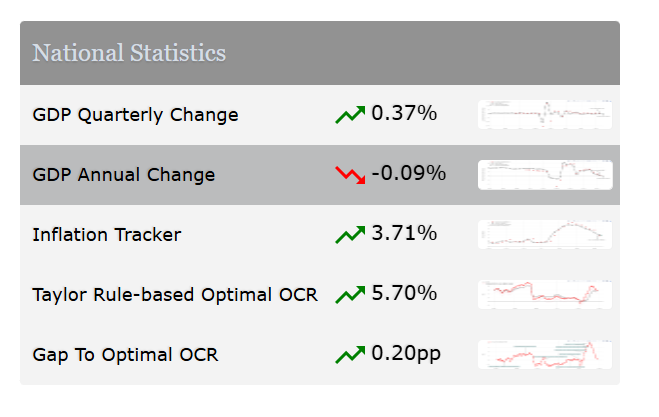
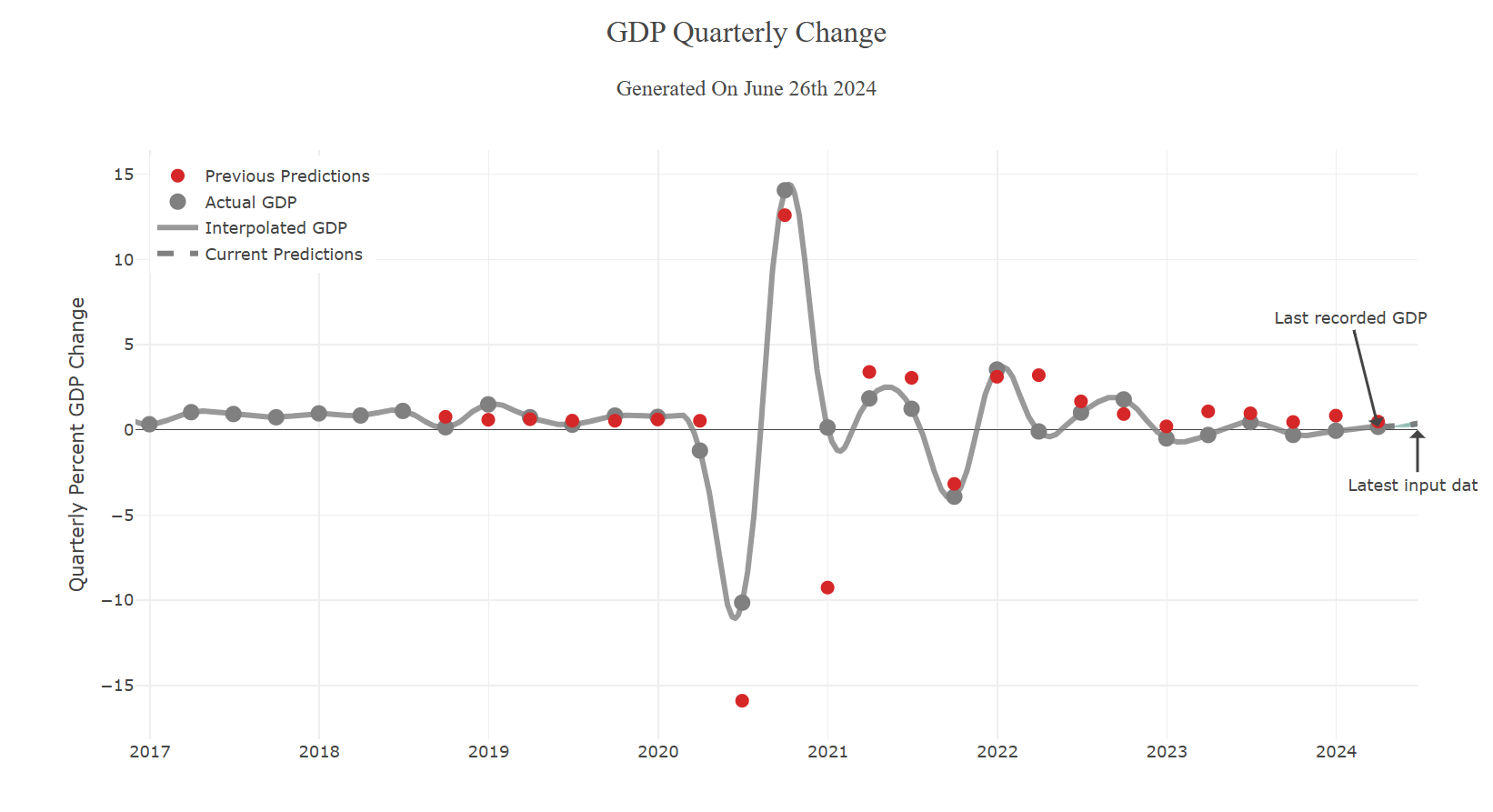

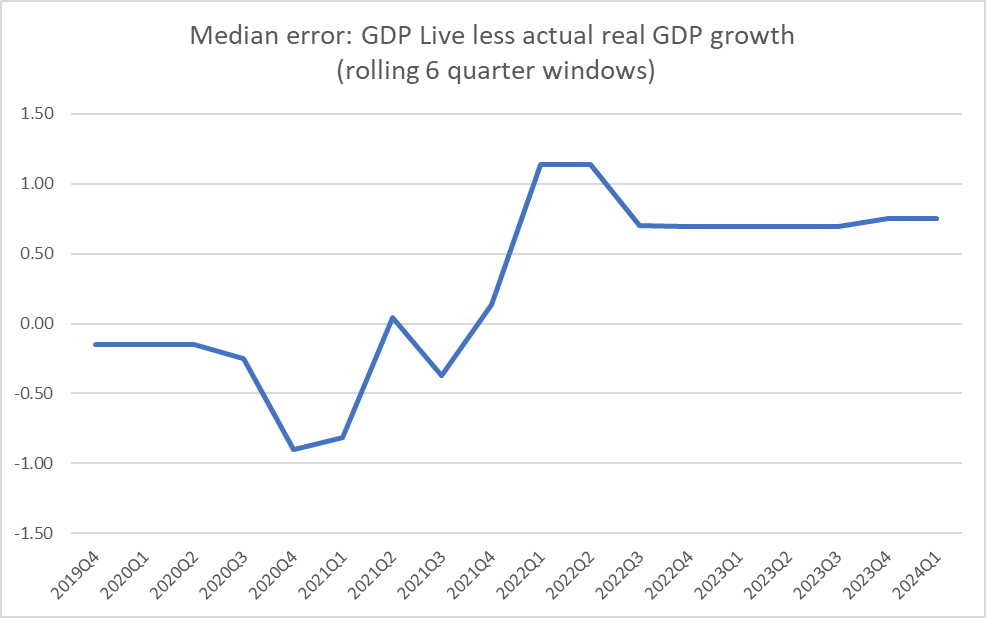
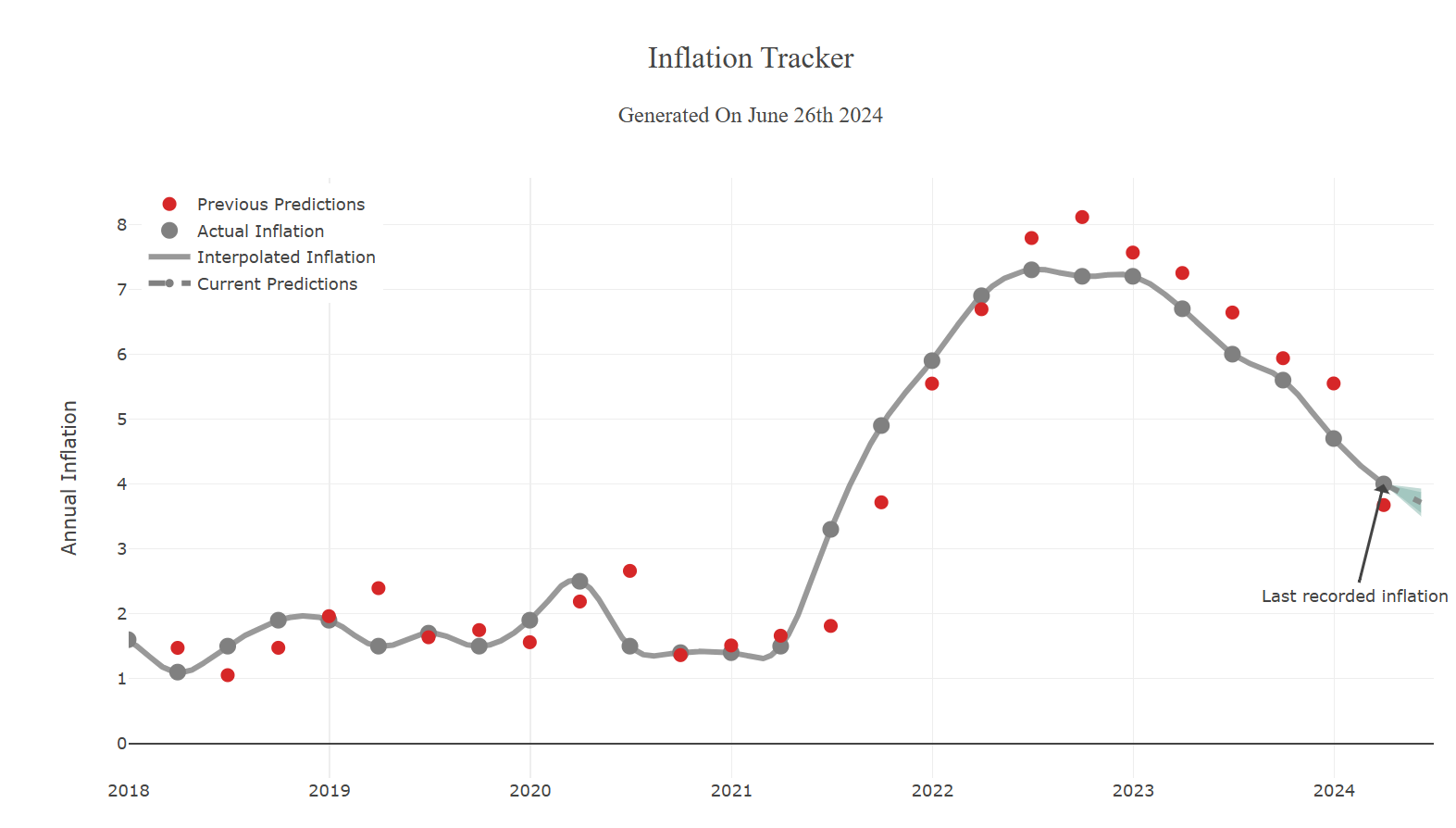
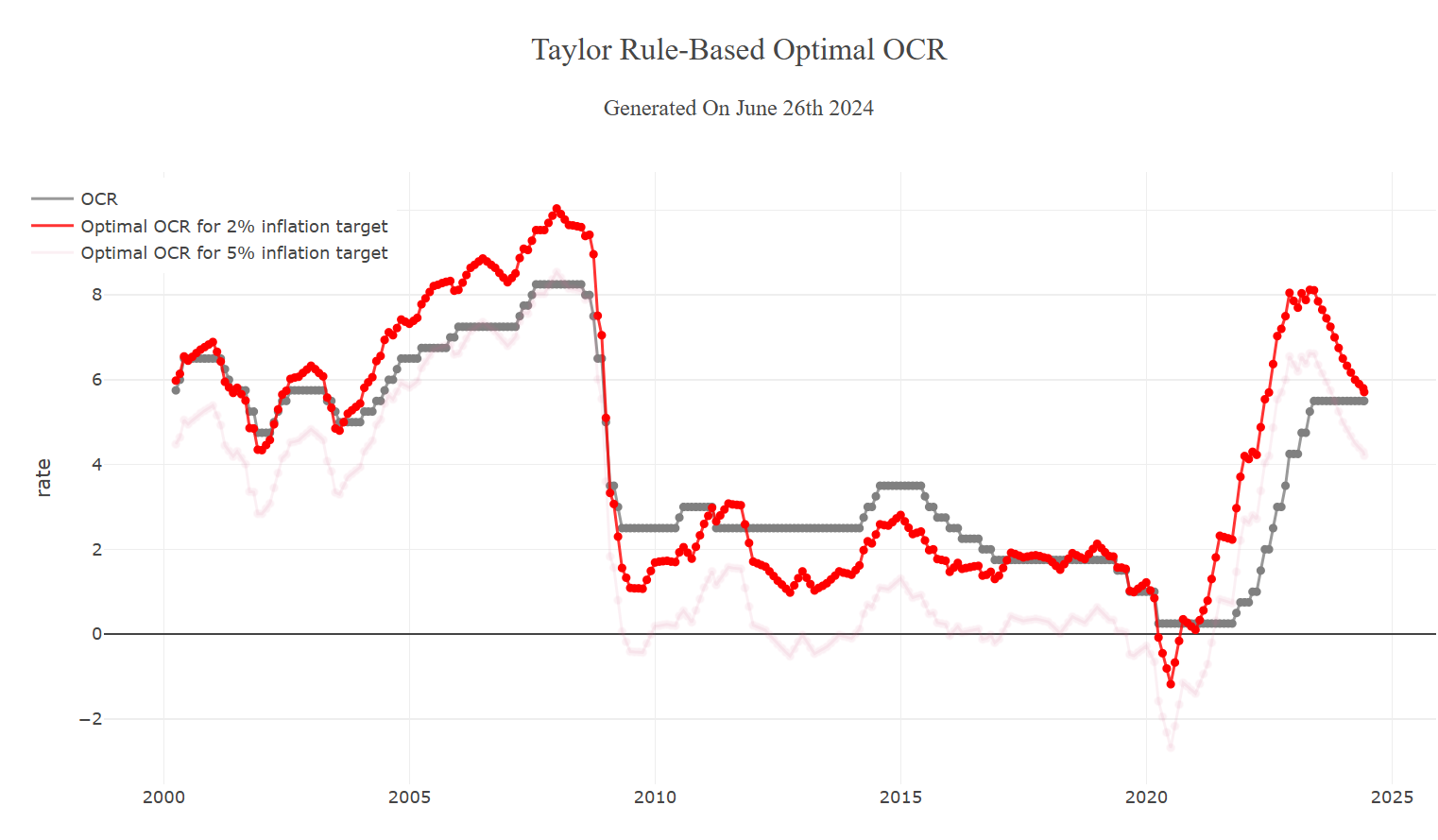


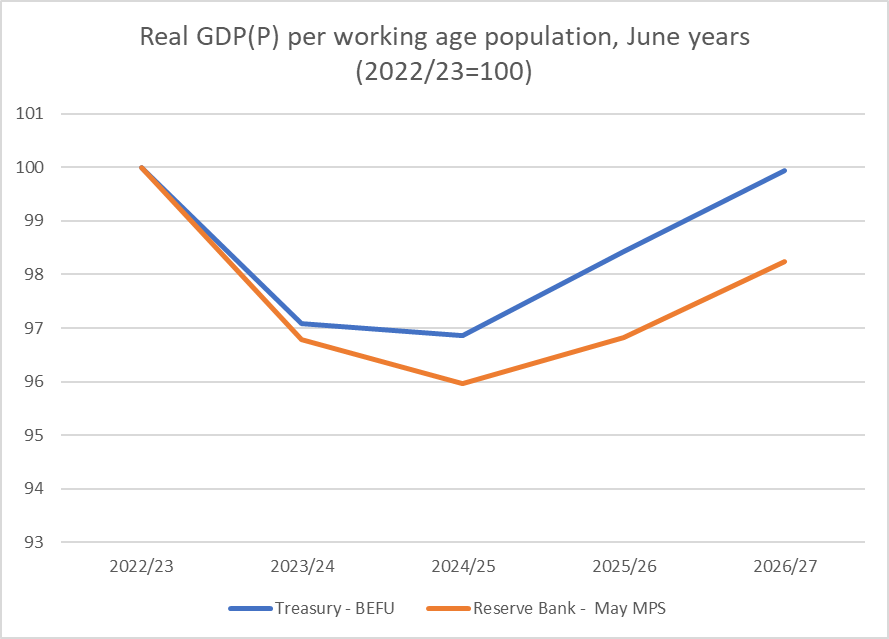


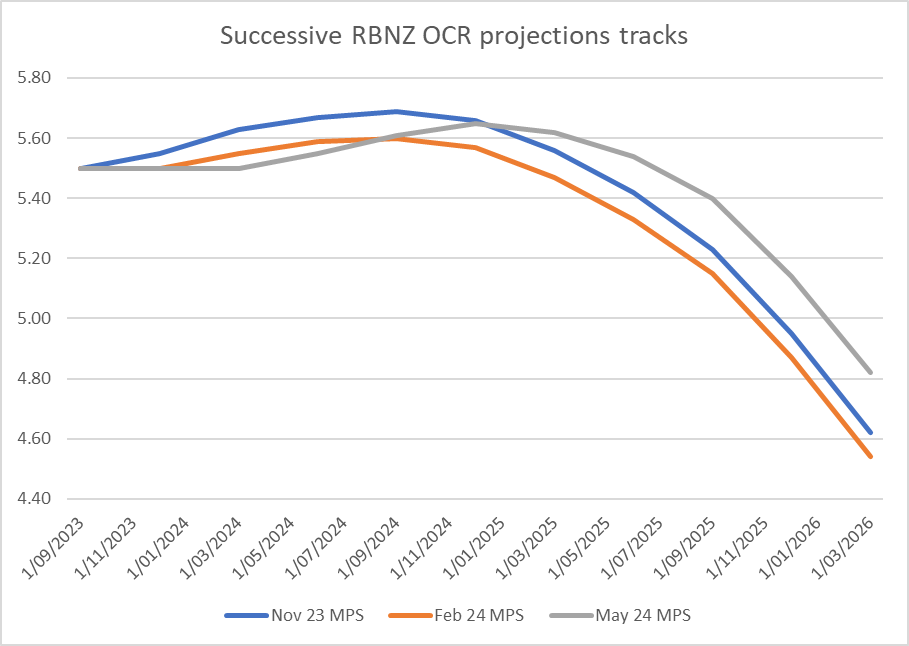
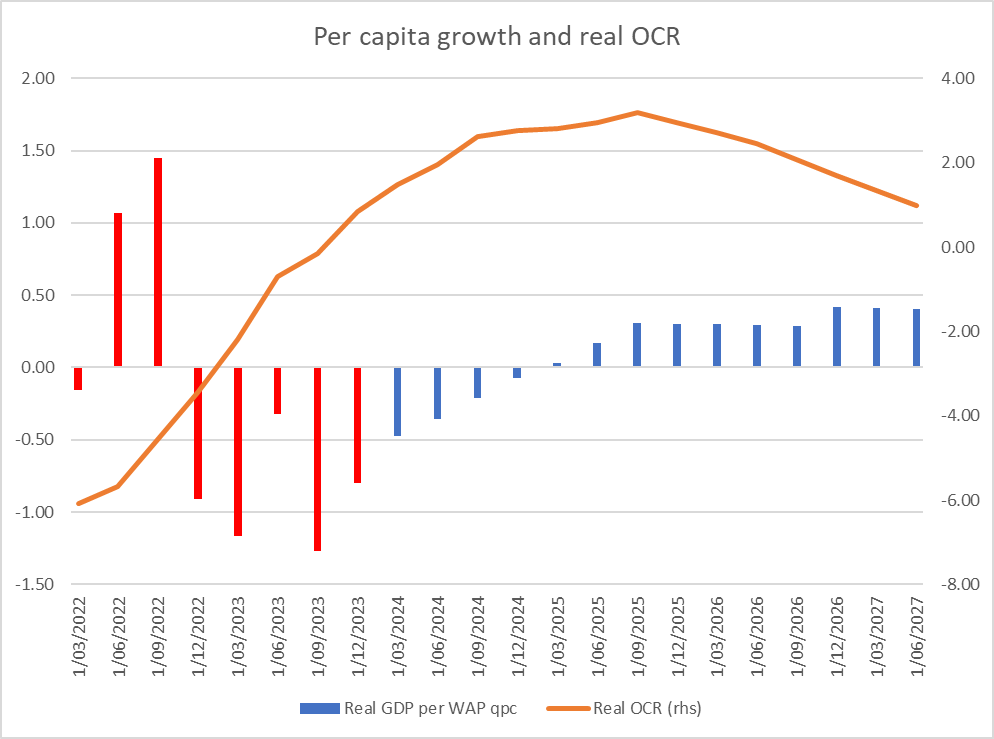
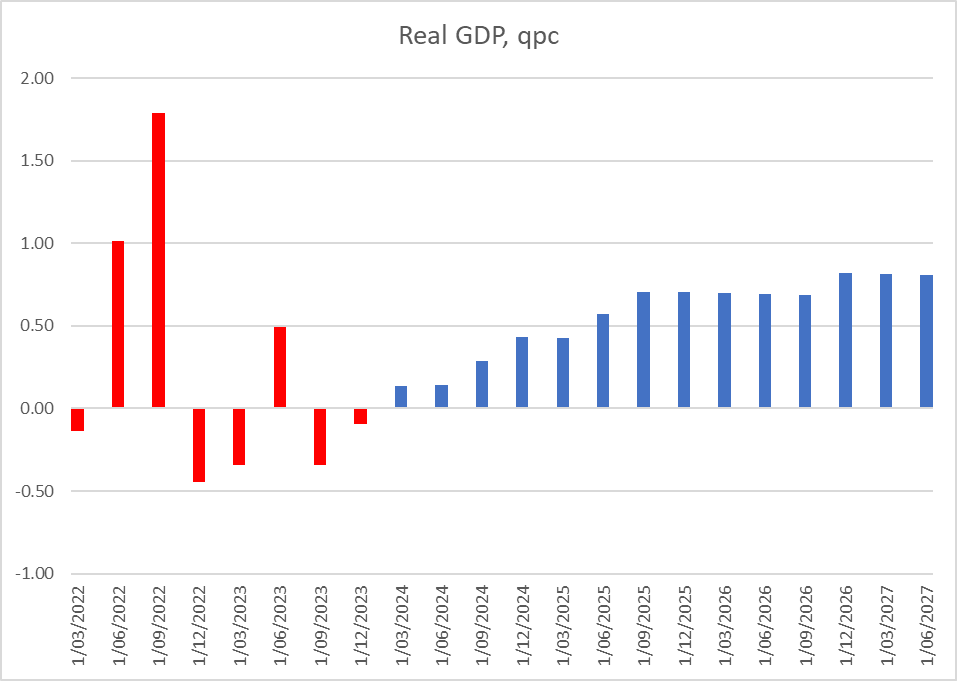

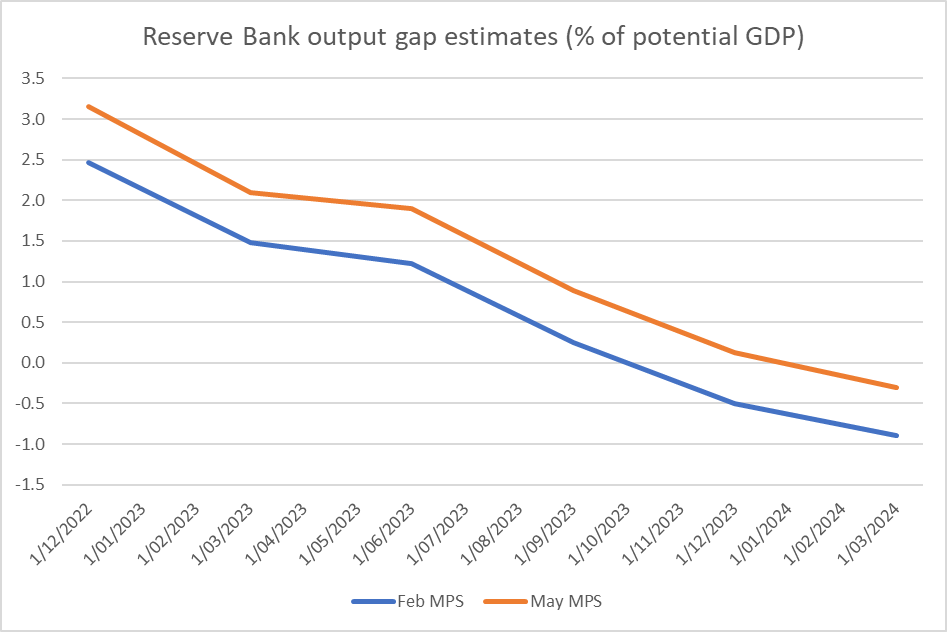
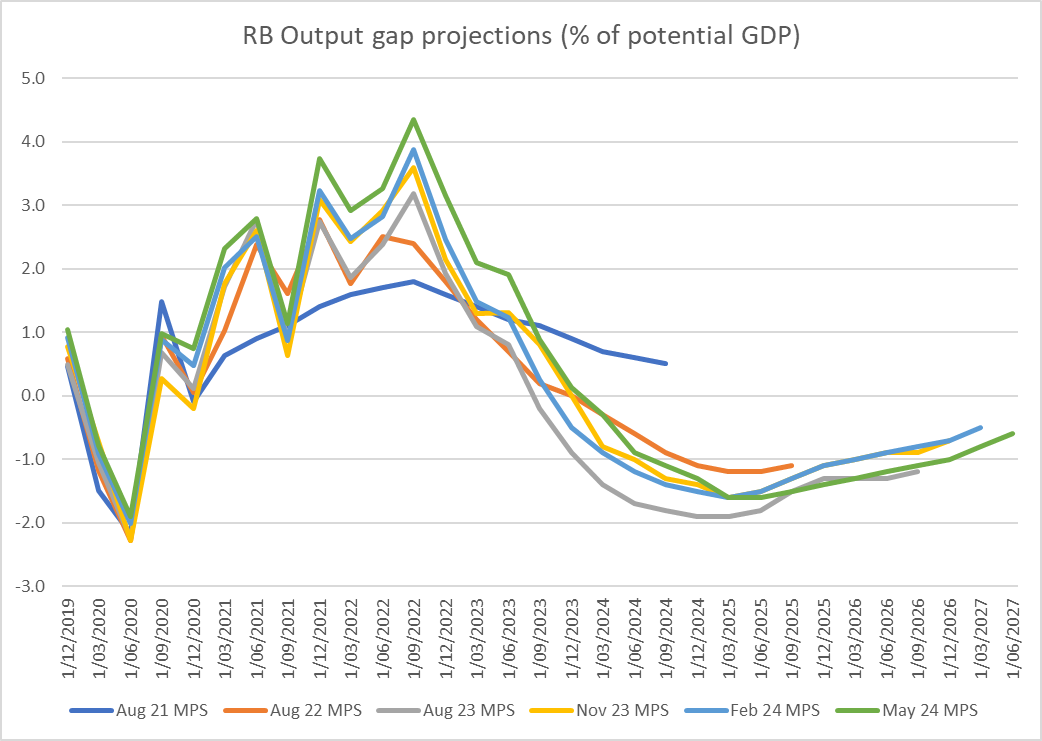

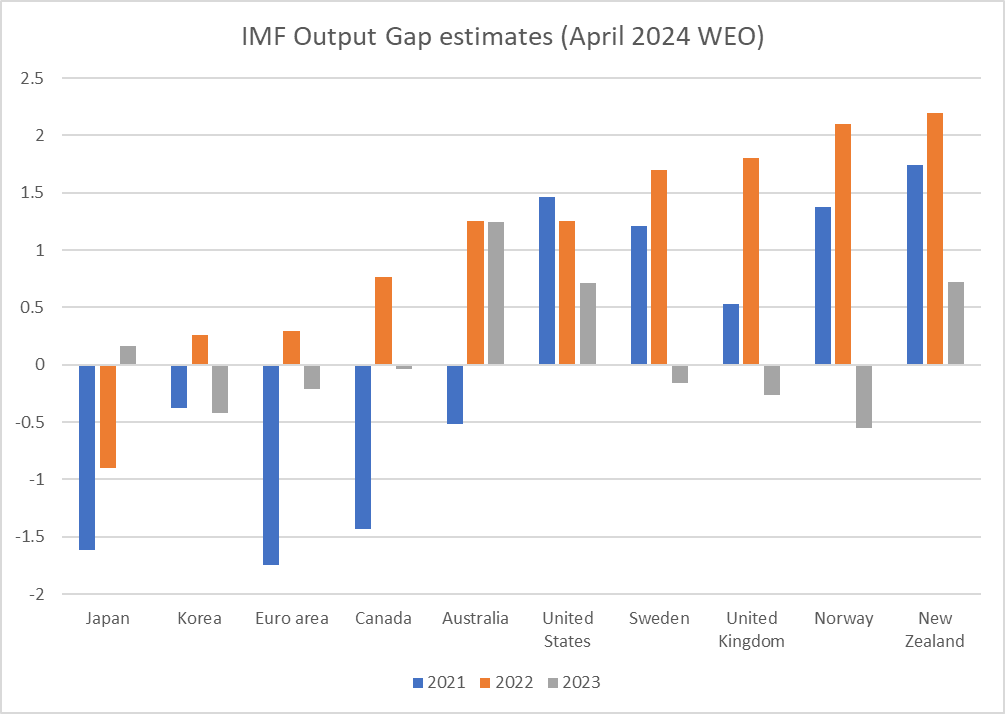
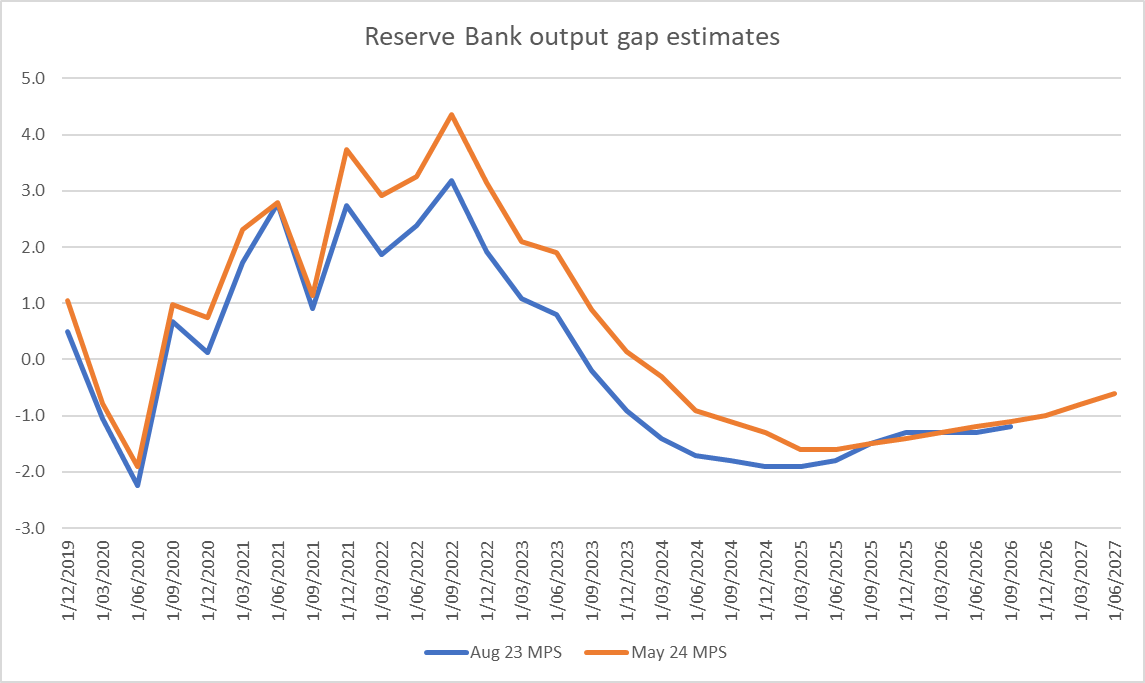
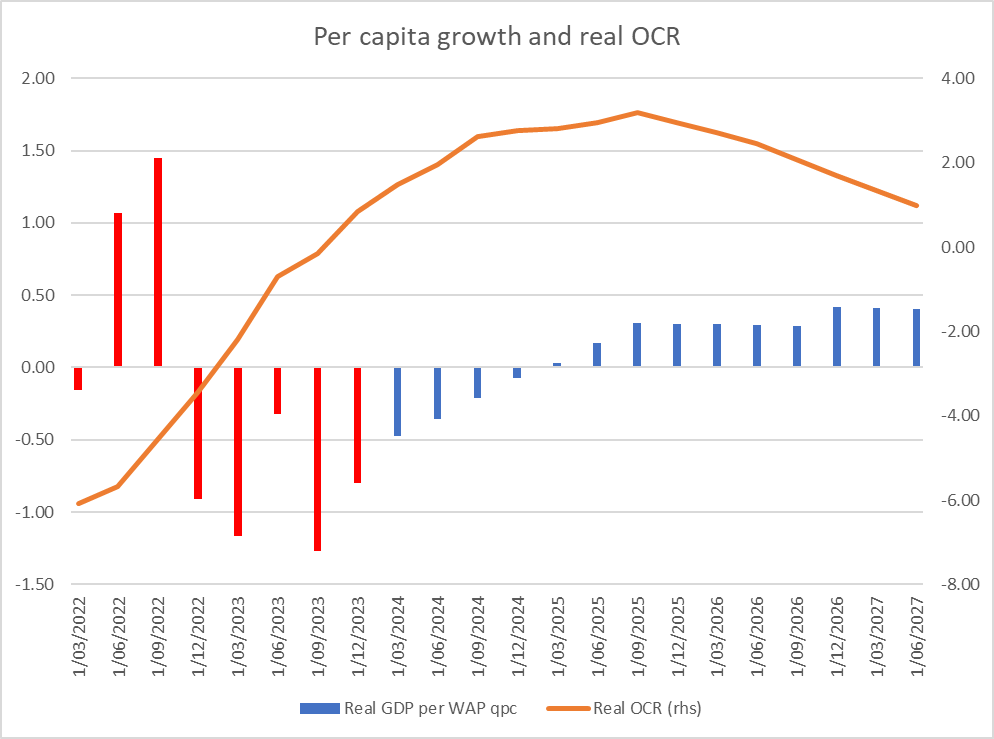
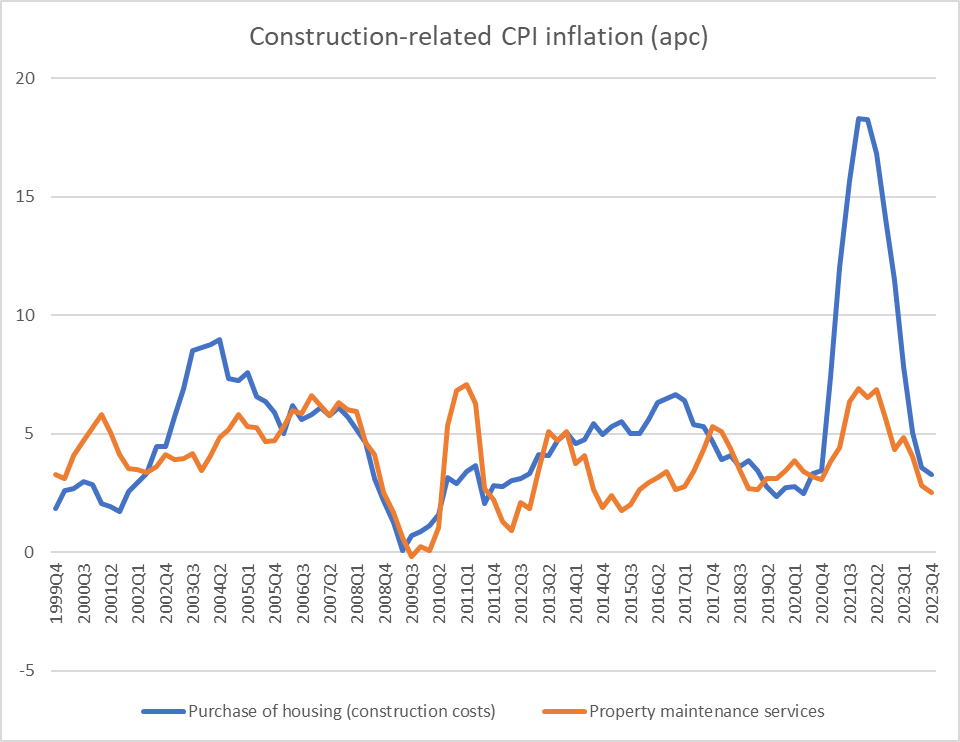
 croaking cassandra