Critics of the Governor

There have been a couple of media stories this week that were less than flattering about the Governor of the Reserve Bank, Adrian Orr.  I was going to say “new Governor”, but checking the calendar I see that in another month or so he will be a quarter of the way through his first term.

The first story was by Stuff’s Hamish Rutherford, and centred on the Governor’s plan to require banks to greatly increase the share of their assets funded by equity rather than debt.   In the on-line version of the story, Orr is labelled “Mr Congeniality”.  The story begins this way

Since Adrian Orr became Governor of the Reserve Bank of New Zealand he has built a reputation of being someone who likes to be liked.

Charming and jocular, but possibly sensitive to criticism.

But Orr is now in a battle with the bulk of New Zealand’s banking sector in a way which could see him demonised, probably with the focus on lending to farmers.

He knows it. Recent days have seen Orr on a campaign to explain itself.

I’m not sure he seems any different as Governor than he ever was before –  his well-known strengths and weaknesses have continued to be on display.

I’ve written quite a lot here about the substance and process around the Bank’s capital proposals – starting with the apparent lack of consultation and coordination with APRA, through to the weaknesses of many of the arguments the Bank advances, the lack of apparent understanding of how financial crises come to occur, the grudging and gradual release of further supporting material, and (presumably partly as a result) two extensions to the deadline for submissions.

In the article Orr is quoted thus, in perhaps the understatement of the week

The consultation process, in Orr’s words “could have been tidier”.

Done properly there would have been extensive workshopping of the technical material over months before the Governor ever put his name to a specific proposal.   As it is, we have a half-baked proposals, not benefiting from any prior scrutiny, and yet the same Governor who put the proposal forward is now judge and jury in his own case, with no effective rights of appeal for anyone.    And there is big money involved –  not just the additional capital that might need to be raised, but probable losses in economic output that will affect us all to a greater or lesser extent.

Presumably no one in the industry would go on record for Rutherford’s article.  Not upsetting prickly Governors is an art the banks have sought to master (even when it involved pandering to an earlier Governor who wanted a senior bank economist censored), although presumably the banks’ submissions will be fairly forthright.  (But will the public ever see those submissions?)

But some of the tone of the off-the-record concern is there in the article

Sources across several of the major banks are warning that if the bank pushes ahead with its plan it could act as a significant constraint on lending to farmers and small businesses,  sectors which are as economically important as they are politically sensitive

Both sectors are considered risky and when capital requirements go up the impact will be magnified.

Why those sectors?  Well, the “big end of town” (Fonterra, Air New Zealand or whoever) will have no difficulty raising debt either directly (bond market) or from banks that aren’t subject to the Reserve Bank’s capital requirements (which means every other bank in the world not operating here, as well as the parents of the locally-incorporated banks operating here).  And the residential mortgage market is both pretty competitive (including from some local institutional players that are less badly hit by the Governor’s proposals than the big banks), and more open to the possibilities of securitisation (which would then avoid the capital requirements too).   Idiosyncratic small and medium loans (including farm loans) aren’t, and farm loans in particular require a level of industry knowledge that newcomers won’t acquire easily (and offshore parents often won’t have).

Perhaps these effects will be large, perhaps they will be quite moderate in the end. But the point Rutherford didn’t make, but could have, is that none of this was analysed in the Bank’s consultative document.   When a really major change is proposed we should surely expect a serious analysis of transitional paths (not just for the banks, but for customers and the economy) as well as the long run.  But there was almost nothing, and nothing in any more depth has emerged in subsequent material that has seeped out.

It simply isn’t a good policy process, and that should concern both the Minister of Finance (and his advisers at The Treasury) and the Bank’s board.   The Governor simply isn’t doing a good job on this front.  If there is a compelling case for what he proposes, he hasn’t made it.  And that is almost as bad –  in a serious independent regulator –  as not having a good case in the first place.

The second article was by the news agency Reuters.   The focus in that article is Orr’s conduct of monetary policy, and particular his policy communications (which many had expected to be one of his strengths).

There are at least two strands to the article.  There are criticisms of Orr for not yet having given a single substantive on-the-record speech on either of his main areas of policy responsibility (monetary policy and financial regulation).  I’m among those quoted

Michael Reddell, an ex-RBNZ official who served with Orr on its monetary policy committee in the 1990s and 2000s, is critical of Orr for not giving a “substantive” speech on monetary policy in the past year.

“It would be unthinkable in Australia or the United States or even under previous governors here.”

I’ve been more and more surprised at the omission as time went on.  And in respect of monetary policy it is not as if there has been much from his offsiders either.  Sure, we get the rather formulaic paint-by-numbers Monetary Policy Statement every few months, but it simply isn’t the same as a thoughtful carefully-developed speech –  which shows more of how the individual/institution is thinking, and the omission has been particularly significant given that we had a new Governor and a refined mandate.

Orr’s response to this criticism is reportedly that it is “thin”.   Whatever that means, the fact remains that in other countries top central bankers talk, quite frequently, about their thinking in on-the-record speeches.  I’ve suggested, speculatively, that perhaps he doesn’t do serious speeches on core areas of responsibility because he just isn’t that interested (saving his passion for infrastructure, climate change, diversity, and all manner of other stuff he has little or no responsibility for).  I’d  like to be wrong on that, but nothing in this article provides any countervailing evidence.

But the bigger criticism in the Reuters article appears to come from financial market participants, concerned that they aren’t able to read the Governor’s policy intentions well.

Many traders who spoke to Reuters in the past two weeks blame Orr for confusing the message, and some have even been critical of frequent references to legends of the indigenous Maori people in his speeches, saying they served little purpose for financial markets eager for more policy clues.
“I am extremely frustrated at the lack of communications for global market participants,” said Annette Beacher, Singapore-based macro-strategist for TD Securities.
“Since Adrian Orr has assumed the role, he’s managed to surprise the market every six weeks. We don’t hear anything from him in between policy decisions,” Beacher said, echoing similar complaints from others.
“So what do I recommend to my trading desk? I’m saying trade the data but we’re not quite sure what is going to happen at the next meeting. It’s not meant to be this way.”

Here, to be honest, I’m not sure quite what to make of the criticism (I mostly don’t hang out with international markets people).   I’m sure there is a great deal of eye-rolling at the tree god nonsense that Orr continues to champion, but perhaps here the longstanding central banker in me comes out and I wonder if the offshore market people aren’t being a little precious.    Markets should not need their hands held to anything like the extent some of the comments in the article suggest, and if there is a little noise in market prices as a result that isn’t necessarily a bad thing.

It seems that quite a few people the journalists talked to were grumpy about the move to an explicit easing bias at the last OCR review, I couldn’t help wondering how much of that was a disagreement with the Governor’s stance (market economists on average have been more hawkish than the Bank for years, and have been more wrong) and how much a sense that a forthcoming change hadn’t been signalled.  I was bit (pleasantly) surprised myself by the move to an easing bias, but mostly because I thought the Governor wouldn’t want to launch a change of direction days before the new MPC took over.  Perhaps that is one of the circumstances in which advance signalling  might have been appropriate?    And perhaps the two strands of concern come together here: we shouldn’t have the Governor or senior staff giving private previews to select contacts about their evolving thinking.  So it has to be serious interviews or serious speeches –  and, as Annette Beacher notes, we haven’t really had either.

The Bank has probably also suffered somewhat from being in transition. At the start of last year, they lost the ultimate safe pair of hands, longserving Deputy Governor Grant Spencer.  A new top-team took over, and within a few months Orr was restructuring, which included demoting longserving chief economist John McDermott.  He lingered for a few months before leaving entirely, but can’t have been entirely engaged.  The head of financial markets was also ousted, and it was only in late March that the new recruits started to take office.  As I’ve noted previously, on the monetary policy side of the Bank it is very much a case now of a Second XI at play (internals and externals) and there is now quite a challenge in getting communications onto a steady, sustainable, and functional path.   The goal shouldn’t be keeping overseas economists happy, but it is perhaps telling that Reuters couldn’t find a domestic one willing to go on the record defending the Orr approach.

What of the Governor’s response to all this?  I’ve already recorded his response to the concern about speeches.  Here is some of the rest of what he told Reuters

In an interview with Reuters earlier on Tuesday, Orr said he wants to reach out to a wider audience than just currency traders, analysts and bloggers.

“The broad audience for this bank is the public of New Zealand. We are seen as a trusted institution but they don’t know what we do. So that is my communication challenge,” he said.

Orr also defended the Maori references in his speeches as part of the bank’s efforts to reach out to wider groups.

“Metaphors have their limits and metaphors can be over used. I get all that, but metaphors need to be introduced and created sometimes.”

I quite get that he wants to communicate to people beyond just the likes of Annette Beacher or me.    But it is not much short of populism to pretend that the audience of people who do pay close attention to the Bank, and know something about it and other central banks (and can even think through the aptness or otherwise of his metaphors), don’t matter.  He can try to appeal over the head of the relatively knowledgable all he likes, but I suspect he won’t find many listening.  Most people have better –  more interesting and important to them –  things to do with their lives.  As it happens, the Governor released a while ago a record of which audiences he delivered speeches to last year, and despite all the rhetoric –  tree god and all –   I was a bit surprised by how relatively few and conventional the audiences were.  The only novelty seemed to be a lot of mention of the tree god – cue to eyes rolling from many of the audiences no doubt.   How many more readers, I wonder, have the cartoon versions of the MPS and FSRs won?  How many have tried twice?

There is a “retail communication” dimension to the Reserve Bank’s role –  when you are driving interest rate up (or down) and affecting people’s employment prospects, business profitability etc, you have to explain yourself.  Over 30 years of an independent Reserve Bank, successive Governors have done a great deal of it –  Don Brash almost to the point of exhaustion, in his nationwide roadshows.  But the core of the job is actually rather more “wholesale” in nature.  And the Governor doesn’t seem to have been getting that right –  at all re bank capital, and in some dimensions re monetary policy (I’m probably closer to his bottom line on the OCR than many other commentators).  All this should be a concern for the Minister of Finance, and for the Bank’s Board.

There is still time for the Governor to right the ship –  and perhaps the new MPC will end up helping –  but the signs aren’t good. Only this morning, a press release emerged from the Bank championing the cause of climate change.  Action may well be really important, but it just isn’t the core business –  or really any business at all in a New Zealand context, with the sort of loan book New Zealand banks have –  of the Reserve Bank.  It is what we have an elected government for.

Sadly, we can expect to hear more from the Governor on climate change and his tree god (flawed) metaphor, and there is no sign of any contrition around the lack of serious communication from him on monetary policy or (where he is still sole decisionmaker) financial sector regulation.
 

The Second XI takes charge

The current government –  like its predecessor –  hasn’t done much that’s good.  Neither has done anything to even begin to deal with New Zealand’s longstanding productivity growth underperformance (for the current government, better – apparently – to pretend it doesn’t matter and talk a lot about “wellbeing” instead).

But they have made some modest reforms to the Reserve Bank, which take effect today.   After almost 30 years, the Governor is no longer the sole legal decisionmaker around monetary policy (he remains in sole charge of all the rest of what the Bank does), and a newly-created statutory Monetary Policy Committee has taken over (with surprisingly little media coverage, including no profiles of these new statutory policymakers, who will heavily shape how New Zealand handles the next recession).

Moving to a legislated committee-based system for making monetary policy decisions has been a cause of mine for almost 20 years now. It is the way almost all other major decisions in public life (and much of business and non-profit life) are made, from Cabinet on down to the local school’s board of trustees.  Earlier this decade, I greatly upset the then-Governor by even writing a limited-circulation internal discussion paper proposing such a reform, and first media coverage I had after leaving the Bank was for a revised and updated paper along similar lines.   To their considerable credit –  and I don’t credit them for much –  the Green Party had also been championing reform in this area for some time.  Labour was late to the issue –  and showed little sign of really caring much – but as the largest component of the government, reform wouldn’t have happened without them.

The new model MPC will be an improvement on what went before it. It is good to have it now clear in law that the government of the day sets the target (taking advice, consulting etc, but in the end the Minister sets the target and is accountable for it). And the final form of the new system is a little better than what the Minister of Finance was first promising (MPC members were initially to be prevented from airing their views in open at all), or than the Governor appeared to be championing (when he was reported as suggesting he didn’t want economists as external members of the MPC).

But, to a considerable extent, the reforms represent a lost opportunity.  We’ve ended up with a system designed to be dominated by the Governor, and with not much more openness and accountability than we’ve had before. In practice, it looks likely to be a system little different than the Bank operated since about 2002, when “external advisers” were first appointed to the (then) Official Cash Rate Advisory Committee.   There is little reason to suppose that the policy mistakes of the last decade (recall the enthusiastic rate hikes in 2014 and the reluctant unwinds, and nearly a decade of undershooting the inflation target) would have been avoided if this particular system had been put in place in 2009.

It looks, mostly, like cosmetic change –  cosmetics which suit both Reserve Bank management and the government, neither of whom was interested in the sort of open and accountable, disputatious at times, central banks of the sort they have in Sweden, the UK, or the United States.  It is there in the official documents –  the relentless drive for “consensus”, of which I noted recently

“Consensus” isn’t a recipe for getting the best answers, but for lowest common denominator answers that everyone can live with.  It isn’t really a recipe for a robust examination of competing arguments and analyses either –  at least unless one has exceptional people (which is always unlikely, almost by definition) –  and especially when management has (a) an inbuilt majority, and (b) control of all the research and analysis resources (and of the pen in drafting MPSs etc).

As always, there is the law and there is practice.  It will take some time for the new system to bed down.  Perhaps the published minutes will prove more revealing than currently seems likely. Perhaps MPC members –  internal and external –  will be willing to give periodic speeches and interviews outlining views different from those of the Governor.  Time will tell.  I hope it works better than I expect. But I’m not holding my breath.

The members of the new MPC was finally announced late last week.    Recall that the committee has four internal members and three external members, and hence a built-in management majority.  There is no necessity for the internal members to all vote together (if things ever come to a vote –  recall all that talk of “consensus”), but the internals (in their day jobs) all work for the Governor.   In future, the Deputy Governor will be appointed by the Minister, but only on the recommendation of the Board, who in  turn must consult the Governor (in practice, the Deputy Governor will be the Governor’s appointee).  The other internals will just be senior staff appointed to their positions in the Bank by the Governor, and hoping for pay rises, promotion, resource allocations to their areas, all in the sole gift of the Governor.  A good Governor will, of course, encourage challenge, debate, active disagreement etc etc.  Rather more average Governors –  and the typical Governor is likely to be rather more average – won’t, especially not in public fora.  So although on paper the internal members of the MPC are statutory appointees (in respect of that specific role), they are just part of the Bank’s management structure, and under the old and new law work wholly to the Governor.

And what of the three external members, who were appointed last week?   Notionally, they were appointed by the Minister of Finance –  it is his press release at the link – but in law the Minister (elected by the voters) has little or no say in who serves on the committee that, at least on paper, has the biggest say in cyclical macro management.  The Minister can only appoint people recommended by the Bank’s Board (most of whom were appointed under the previous government).  And the Board –  despite being charged in law with holding the Governor to account – works very closely with the Governor, mostly providing cover and support for the Governor. In fact, the Governor is a member of the Board.    And all the resources of the Board are provided by…..the Governor.   So we can be pretty safe in assuming that no one with whom the Governor is uncomfortable with is ever going to find their way onto the Monetary Policy Committee.        Since this is new legislation, and this feature has been pointed out repeatedly, one can only assume that is deliberate intent.

And if the Board has no independent resources, neither do the external members of the MPC.  This could become a matter of some contention over the next few years.  It did at the Bank of England after their reforms 20 years ago, although since the appointees in the UK system had more independent status (directly appointed by the Chancellor) and were “bigger beasts” with more forthright tendencies, perhaps here the externals will just go along.  They will have no independent research or analysis resources, and no ability to require specific pieces of work to be done by staff.  They will be largely dependent on their own resources, and perhaps any public commentary, while almost always being outnumbered.  It could drive really able people silly, but then actual appointees will have been selected for (probable) docility.

Which brings me to the members of the committee themselves, who haven’t yet had much/any media scrutiny.    In the title of this post, I characterised them as the Second XI.  That is a deliberate and careful phrasing.  A big school might, say, have six or even ten cricket teams, some comprised of people with no talent but a bit of enthusiasm and a desire for some exercise with their mates on a Saturday afternoon.   But on my reading this is a Second XI; people who aren’t bad, or grossly unqualified for the role, and yet who  –  individually and collectively – don’t represent a committee of the sort of stature for which we might have hoped.  That is true of both of the internal and external members.  Lee Germon captained the New Zealand Cricket team for a while, but was widely regarded as not quite up to it, not really justifying his own selection.  The new MPC, at least taken as a whole, seems a bit like that.  Other advanced countries mostly seem to do better.

I’m not someone who thinks the MPC should necessarily be dominated by economists (although the expert advice to the committee should be), but when the Governor was talking of not wanting economists at all as external members I thought he had gone too far.  Clearly others agreed, and as it happens all seven members were economists by training and education.

But of the internals, none stands out on that score. It isn’t helped by the fact that the Bank is currently without a Chief Economist, and one of the internal appointees –  Yuong Ha –  has been appointed as not much more than a placeholder (a one year term) until they manage to fill the position (it isn’t a great look that in an organisation like the Bank, where economics skills have historically been central, there wasn’t a natural successor to the former (demoted and then resigned) Chief Economist).  Perhaps in time the fulltime successor will add some real intellectual stature and gravitas to the MPC.  In the meantime, the Minister should have rejected a one-year appointment of a mid-level internal appointee: independence is partly about security of tenure, and any mid-career person appointed for one year only is going to have the boss’s views and interests in mind.

Of the other internals, for my money to Deputy Governor Geoff Bascand is probably, at this stage, the best of them.   I have plenty of disagreements with Geoff, and I wonder if there is any track record of him disagreeing robustly with his boss (whether Wheeler or Orr) on policy.  He was also one of the internal champions of the OCR tightening cycle in 2014, but he does have a track record of thoughtful speeches on some macroeconomic topics (if not really monetary policy itself).  Arguably, he is better equipped for the MPC than for his day job (Head of Financial Stability).

As for the Governor, the fact that he went for a year as sole decisionmaker on monetary policy and didn’t see fit to give us even a single on-the-record speech on monetary policy, the cylical state of the economy etc, should be telling.  His interests seem to lie elsewhere.  That might matter less if the other management appointees were real stars (after all, the Governor has a wide range of responsibilities) but they aren’t.

What of the externals?  Three economists have been appointed: Caroline Saunders, Bob Buckle, and Peter Harris.  Again, it is surprising that no media outlet (I’ve seen) has done interviews with or profiles of them.

Both Buckle and Harris are older –  Buckle is retired (and Professor Emeritus) from Victoria University, and Harris while billed as an “economic consultant” must be at least in his late 60s.   That was partly inevitable as a result of the decision to make the MPC jobs substantial (50 working days a year was the expectation), but not large enough to be even half-time, let alone fulltime.  Actual or potential conflicts or interest would rule many others who might have been interested or suitable.

The third appointee, Caroline Saunders, is also an academic (with a couple of other ministerial appointments) –  and the only one of the seven MPC members I’ve never met.  Quite how one squeezes in a 50 day part-time role with a fulltime job at Lincoln is an interesting question, but that is her problem and that of her employers.  Although she is an economist, her interests and experience don’t appear to encompass monetary policy or macroeconomics at all (her publications are here).  But I thought it might be telling that her most recent publication was as a co-author (with a couple of colleagues) of a new book on “wellbeing economics”.  As it happens, after I made some negative comments here recently about the government’s focus on wellbeing – suggesting it was a distraction from dealing with the productivity issues –  a PR firm working with the authors sent me a copy of the book. I haven’t yet read it, but as I’ve dipped in one is left with impression that Prof Saunders may be more useful to the Governor (and government?) in championing his interest in all sorts of (loosely) left-wing issues, rather than in advancing the cause of good monetary policy decisionmaking and communication.

One of the skills asked for in the advertisement last year for external MPC members was “exceptional communication skills”.    Time will tell, but my impression would be that neither Buckle nor Harris (of whom Google shows up very little in the last 15 years) would qualify on that score.  Perhaps the Board changed its mind about the skill sets?

One area where I do have some concern is around the role of the Minister of Finance in these appointments.  In principle, I think the Minister should be relatively free to appoint his or her own preferred candidates, and should be fully accountable for those choices (including through the sort of non-binding “confirmation hearings” –  of the sort UK MPC members face – that I’ve proposed for New Zealand).  As it is, on paper the Minister has no say at all (can reject Board nominees, but nothing more).

But then I’m a bit troubled by the way in which the Board –  all but one appointed by the previous government – ended up delivering to the Minister for his rubber stamp a person who was formally a political adviser in Michael Cullen’s office when Cullen was Minister of Finance (Peter Harris) and another who appears to be right on with the government’s “wellbeing” programme.     They look a lot like the sort of people that a left-wing Minister of Finance –  one close to Michael Cullen –  might have ended up appointing directly.     I don’t think Peter Harris is grossly unqualifed for the role, but I am uneasy that one of the very first external appointees is a former political adviser to a former Minister of Finance of the same party as the one making the appointment.   Note too that the only appointee Labour has so far made to the Reserve Bank’s Board was another former political adviser in the office of a former senior Labour minister.    He too (Chris Eichbaum) is not manifestly unqualified for the role, but I’m not sure it is entirely a good look first up. (I don’t think former political advisers should be perpetually disqualified, but it might be more confidence-enhancing had they been appointed by the other party from the one for which they used to work –  thus Paul Dyer, former adviser in Bill English’s office, would probably be better qualified for the MPC roles than any of the recent external appointees.)

I’m left wondering what sort of behind-the-scenes dealings went on to secure these appointments.  I hope the answer is none.  I’d have no particular problem if, while the applications were open, the Minister had encouraged friends or allies to consider applying. I’d be much less comfortable if he had involvement beyond that, prior to actually receiving recommendations from the Board.  It isn’t that I disapprove of politicians making appointments, but by law these particular appointment are not ones the Minister is supposed to be able to influence.    So any backroom dealing is something it is then hard to hold him to account for.    Perhaps nothing went on, but I have lodged a series of Official Information Act requests with the Minister, Treasury, and the Board of the Bank about any contacts (written or oral) between them on this issue.

In the meantime, given the role these appointees are supposed, by law, to be playing, it might be appropriate for the media to start asking them some hard questions, including around preparedness for the next serious recession, given the very real limits on how much further the Reserve Bank could cut the OCR.

(On a related matter, I saw a suggestion this morning that personnel changes at the Reserve Bank explain the Bank’s now more-dovish stance, notably the departure of longserving former chief economist John McDermott who, as this story put it, was responsible for the forecasts etc that led to bad policy calls in 2014.  But, for all their faults, the Reserve Bank’s inflation forecasts at that time were typically lower than the published forecasts of New Zealand economic forecasters, and those forecasts were embraced enthusiastically by senior management.   Among those deliberating on monetary policy at the time, Geoff Bascand – now a member of the statutory committee -seemed quite as hawkish as anyone.    There weren’t many local dissenters at all at the time –  of those with views in the public domain, this was the only one I found.  And, perhaps entirely coincidentally, the small handful of internal sceptics were dumped off the key advisory committee just as a rate-hiking cycle got underway in 2014.)


Updating the Governor’s OCR view

In the wake of the Reserve Bank’s Monetary Policy Statement in February I wrote

As for the overall tone of the monetary policy conclusions to the statement, count me sceptical.  …for the Governor to suggest that the risks now are really even balanced, even at some relatively near-term horizon, seems to suggest he is falling into the same trap that beguiled the Bank for much of the last decade; the belief that somewhere, just around the corner, inflation pressures are finally going to build sufficiently that they will need to raise the OCR. We’ve come through a cyclical recovery, the reconstruction after a series of highly-destructive earthquakes, strong terms of trade, and a huge unexpected population surge, and none of it has been enough to really support higher interest rates. The OCR now is lower than it was at the end of the last recession, and still core inflation struggles to get anywhere 2 per cent. There is no lift in imported inflation, no significant new surges in domestic demand in view, and as the Bank notes business investment is pretty subdued. Instead actual GDP growth has been easing, population growth is easing, employment growth is easing, confidence is pretty subdued, the heat in the housing market (for now at least) is easing. Oh, and several of the major components of the world economy – China and the euro-area – are weakening, and the Australian economy (important to New Zealand through a host of channels) also appears to be easing, centred in one of the most cyclically-variable parts of the economy, construction. …

From a starting point with inflation still below target midpoint after all these years, it would seem much more reasonable to suppose that if there is an OCR adjustment in the next year or so, it is (much) more likely to be a cut than an increase.

The Governor appears now to have come round to that view.   If his re-think is overdue, it is welcome nonetheless.

I don’t take issue with much about his statement. but two lines did catch my eye.  The first was this one (emphasis added)

This weaker [global] outlook has prompted central banks to ease their expected monetary policy stances, placing upward pressure on the New Zealand dollar.

Perhaps that is correct –  although in the data the effect looks small –  but it is quite a dangerous line to walk down.  Either an easier stance of policy was warranted here on the New Zealand fundamemtals (including our exposure to the world economy) or it wasn’t (it was).   The exchange rate should be largely irrelevant to that choice, and reintroducing it like this risks some sort of MCI mentality taking hold.  He’ll remember those bad old days.

And the second, of course, was this claim

As capacity pressures build, consumer price inflation is expected to rise to around the mid-point of our target range at 2 percent.

To which one can really only say two things, a) yeah right, and b) isn’t this the same story the Bank has been telling for almost the entire decade?  Of course, as the former chief economist used to point out, in one sense they had to believe it –  if it wasn’t something they could say hand on heart then they should have adjusted policy already.  But if they really believe capacity pressures are going to intensify from here, they must now be in a pretty small minority.

Even though the data suggest that the Bank should have an easing bias in place (and perhaps should already have had a lower OCR in place), I was a little surprised that having walked past the opportunity in February, the Governor chose to act now.  After all, this is the last OCR decision that he will take as the Bank’s sole decisionmaker on monetary policy.  On Monday, the new statutory Monetary Policy Committee will take over responsibility.  Even though I’ve been consistently running the line that the Governor will, in effect, control all the appointments to the MPC and will effectively control the overall votes, I’d assumed he’d want to observe the proprieties and at least pretend that the new voters might make a difference –  might see things differently from him.

On paper, the Governor’s statement that

the more likely direction of our next OCR move is down.

doesn’t mean much. I’m sure he made this decision with two of the likely new MPC members (Deputy Governor Bascand and the very new Assistant Governor Hawkesby), but the new MPC will have four other members, most probably the new (as yet unannounced) chief economist, and three externals.  Most likely the externals (in particular) won’t want to rock the boat –  they’ll have been selected partly for that quality – but they might quite reasonably see the data differently than the Governor.  That could get a little awkward.   Perhaps the Governor ran risks whichever tack he took, but he could easily have explicitly noted the regime change and could then have eschewed any sort of bias statement (leaving the rest of the statement pretty much as it was).

(Presumably the Minister of Finance will finally announce the MPC members today or Friday.  When he does, I would be delighted to revise my view that they’ll have been selected for their inoffensiveness, if such a revision is warranted.  But I’m not holding my breath.)

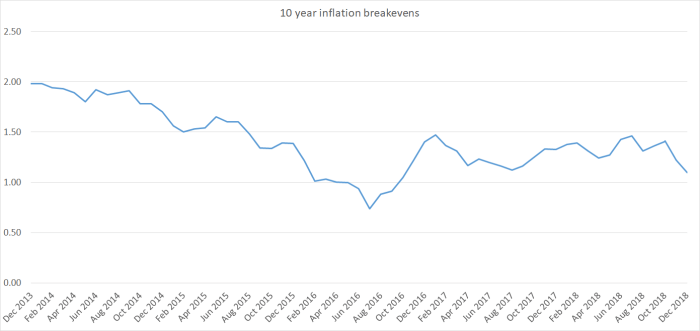
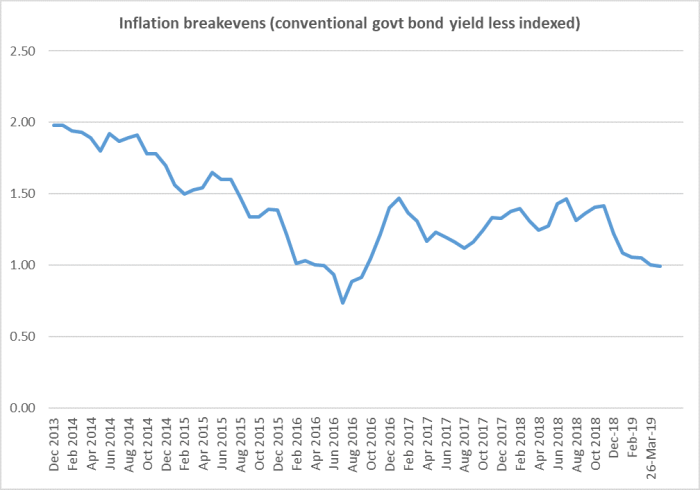
And what of inflation?   As readers will know I have been tantalised by the implied inflation expectations derived from the indexed and nominal government bond markets.  Here is the latest update of that chart, the last observation being yesterday’s.

breakevens mar 19

Implied inflation expectations (for the average over the next 10 years) –  implied by people with money at stake, or the opportunity to stake it to clear out anomalies – have been nowhere near target for almost five years now.  In the last few months they have been dropping away again and now are barely 1 per cent.   The Reserve Bank never references this series, but they really should, even if only to make the case for why they think there is no meaningful information in it.

Perhaps you are thinking this is just a global phenomenon.  After all, nominal bond yields have been falling pretty much everywhere.  But here are the 10 year inflation breakevens for the US

us breakevens mar 19

Not only have the breakevens rebounded (risen) in recent weeks, but they remain near the Fed’s target inflation rate (also 2 per cent).

With core inflation still below target after all these years, market-based expectations measures low and weakening, with increasing unease about the world economy (including the economies of our two largest trading partners), with most of forces that impelled the (productivity-less) growth in recent years having exhausted themselves, and with weak business survey measures, the case for a lower OCR already looks pretty strong.

What, realistically, would be the worst that could happen if the Bank had cut and the cut turned out to be unnecessary?  Unemployment would be a bit lower, even if temporarily, and core inflation might rise to the height of, say,  2,2 or even 2.4 per cent.  Perhaps not desirable outcomes in their own right –  the focus is supposed to be 2 per cent — but after all these years undershooting the target hardly likely to destabilise public or market confidence in the Bank’s conduct of monetary policy and delivery of medium-term price stability.

UPDATE:  The Minister of Finance has announced the appointments to the MPC this morning.  My initial reaction is that there is no need to revise my judgement about the structure and likely dynamics of the MPC.  It is quite disconcerting that one (internal) member has been appointed for only a one year term, which will place that person even more than usually under the heavy influence of the Governor.  The Minister would have been better to have started the committee with 3 internals and 2 externals and made the final external appointment when the new permanent Chief Economist is finally appointed.

Did an experiment “deepen and prolong” the Great Recession?

(Long and fairly geeky)

That’s the claim emblazoned on the cover of US academic George Selgin’s 2018 book Floored.   It is a big claim by a smart author, who has written many years (often quite sceptically, to say the least) about aspects of central banking.  And, for once, I won’t bury my conclusion: I wasn’t convinced.

The “experiment” Selgin is writing about is the decision, implemented at the start of October 2008, to pay (effectively a full market) interest rate on excess reserves (over and above the regulatory minimum the Fed persists in requiring) held by banks in their accounts at the Federal Reserve.    The Fed was late to the business of paying interest on these deposit balances (other countries, including New Zealand, had done so earlier).  It required Congressional authorisation –  itself a somewhat unusual feature –  and even having obtained that approval the new regime wasn’t supposed to be implemented until 2011.   And when the legislation was passed the focus had been on required reserve balances (not paying interest on those just represented a federal tax).   But with Fed liquidity operations during the 2008 financial crisis adding lots of excess reserves, the new interest on reserves policy was rushed into effect from 1 October 2008, with the aim of supporting demand for those reserves, and stopping market interest rates falling further than the Fed wanted.

That might seem a bit odd.  But remember that although the Federal Reserve was pretty responsive to liquidity stresses and frozen financial markets, they were slow to grasp the severity of the economic downturn.  This is from an earlier post

For example, the FOMC met two days after the Lehmans failure [in mid-Sept].  Had the Fed thought the Lehmans failure would prove “catastrophic”, or even just aggravating the severity of the recession, a cut to the Fed funds rate would surely have been in order.  There wasn’t one.  And the published records of the meeting show no sign of any heightened concern or anxiety about the financial system or spillover effects to the economy. 

It wasn’t until mid-December 2008 that the Fed funds target range was lowered to 0 to 0.25 per cent (with excess reserves now being remunerated at 0.25 per cent).

Congress had actually specified that any interest paid on reserves was to be at a rate that did not “exceed the general level of short-term interest rates”.   And yet, as various charts in the book demonstrate, the rate paid on excess reserves was to consistently exceed other short-term rates (including LIBOR, GC repo rates, and Treasury bill rates).   Notwithstanding the Congressional mandate, this wasn’t an accidental outcome, but a matter of deliberate design, since the Fed’s explicit aim –  outlined in various policy documents Selgin cites –  was to make excess reserves “attractive relative to alternative short-term assets”.    For that to happen, the interest rate had to be attractive.

Selgin’s argument is that this choice was at the root of much evil.    Specifically, by making excess reserves attractive –  so that banks didn’t want to get rid of them –  the historical link between excess reserves and broader monetary aggregate measures was broken.   Had banks been encouraged/incentivised to use, and (individually) try to get rid of, excess reserves, access to credit would have freed up much more quickly, demand would have expanded, and the economic downturn would have been (a) less deep, and (b) less prolonged.   As far as I can tell, the main channel seems to be a demand one, but he also argues that the productivity growth slowdown would also have been less severe.

Here’s why I’m not convinced.

First, take the counterfactual in which interest had not been introduced on excess reserves.  By 8 October 2008, the Fed funds target rate was still 1.5 per cent.  Without any remuneration on excess reserves, short-term market rates –  at least those that didn’t involve pricing any bank credit risk – would have been heading towards zero pretty quickly.    But by 16 December, the Fed funds target (now a range) was reduced to 0 to 0.25 per cent.   With no interest on reserves, the increasing volume of excess reserves would have reduced more market rates to zero.  But that is a difference of (a) two months and then (b) 25 basis points.    25 basis points rarely makes that much difference.

The argument is that credit conditions would have eased up more quickly.  Well, maybe, but in late 2008 and early 2009, not only was there extreme uncertainty about the creditworthiness of many marginal borrowers, but there was a great deal of reluctance among borrowers to take on new credit (who knew when demand and activity would recover?).  For entirely understandable reasons, most people were in batten-down-the-hatches mode.

I’m quite prepared to concede that lower interest rates could/would have made some difference – by then not so much in altering the depth of the trough, but in supporting the recovery that got underway from about mid-2009.  But (a) the near-zero effective lower bound on nominal interest rates prevented short-term falling to anything like the extent (to say -5 or -6 per cent) that analysts estimated (using Taylor rule frameworks) might, in the abstract have been desirable, and (b) the Fed didn’t want to lower interest rates further.  How do we know that?  Because they made no effort to utilise all the leeway they did have (various other central banks later cut their policy rates as low as -0.75 per cent), or to take emergency steps to ease the effective lower bound.   (In fact, had they been able to take their policy target rate materially negative, introducing interest on effective reserves would have been a prerequisite –  if you could earn zero on funds in the Fed accounts, while all around you rates were negative, the option of just leaving your money at the Fed would have been exceedingly attractive.)

And, of course, it wasn’t just the Fed that didn’t want (or believe it necessary for) short-term interest rates to be lower.    Bond yields for a long time were pricing a pretty quick rebound in short-term interest rates, and it wasn’t until 2012 –  well after the trough of the recession –  that US 10 year Treasury yields got down to around 1.5 per cent.   The Fed and markets were mostly, and repeatedly, focused on the first tightening (which didn’t actually take place until 2015).   That was a mistake, of course, but presumably involved the best expert judgement of the FOMC about where short-term rates neeeded to be.  If they’d read the economy correctly, official short-term rates would have been set lower, regardless of the interest on reserves policies.

The other main reason I’m sceptical is that all of this is a US-specific story, and yet the US experience of the recession and recovery wasn’t unusually bad, even though the US was itself the epicentre of the crisis.    If Selgin’s story was correct, the combination of being the crisis epicentre and adopting the IOR policy in the middle of it all, should have left the US economic performance looking pretty poor relative to, say, (a) other big countries (G7) with their own currencies, and (b) non-crisis advanced countries.  That should be so whether we focus on either real GDP per capita or real GDP per hour worked.

There are three other G7 floating exchange rate countries.  Two –  Japan and Canada –  didn’t have a homegrown financial crisis at all, while the UK was caught up in the US crisis.  Of those countries, all three had slower higher productivity growth than the US over the decade after 2007, and the US also had higher growth in real GDP per capita (although the differences with Japan and Canada are small).    Comparing the US with the smaller floaters who didn’t have a crisis (Australia, Norway, Israel, New Zealand) the US looks to have been pretty much in the middle of the pack.  Precise comparisons depend on which periods and which variables you focus on, but the US experience really doesn’t stand out in the way the Selgin hypothesis appears to require.  Of course, one never knows the (economic) counterfactual, but much as he criticises the IOR policy, Selgin doesn’t (that I noticed) set out one either.

In his book Selgin cites another short piece he wrote last year specifically about New Zealand’s experience with interest on reserves.  He claims our experience supports his case.   I’m also not convinced about that.

Some history.  When the OCR system was introduced in 1999, we designed it as (what is known as) a channel system.  The OCR itself was set half-way between the interest rate paid of deposits (25 basis points below OCR) and the rate at which banks could borrow (collateralised) from the Reserve Bank (25 points above OCR).  Actual settlement cash balances were tiny (of the order of $20 million in total).   Banks were required to keep their accounts in credit at the end of each day, but otherwise they had no real demand for positive balances. $1 each was, in principle, sufficient.    Banks lent and borrowed among themselves to manage the impact of net customer flows between them.

That system worked only because of a strange bifurcation we had (consciously and deliberately) introduced a few years earlier.  Until the late 1990s, interbank settlements were done only once at day (leaving lots of intraday credit exposures which could have led to havoc etc if ever there was a bank failure).  Like most other countries, we replaced that with a real-time gross settlement (RTGS) system, under which large wholesale transactions (mostly fx, but also fixed interest securities) were settled individually during the course of the day.  In a system with perhaps $30-40 billion of daily transactions, $20 million of total reserves wasn’t going to be enough.

To meet these liquidity needs, we set up a system of collateralised intra-day credit (“autorepo”), in which we lent banks billions of dollars during the day and took their securities as (in economic terms) collateral. At the end of the day, all those intraday transactions were unwound, and the system ended each day still with only $20 million or so of aggregate sewttlement balances.  By the mid 2000s, however, there was impetus for change from several sources.  Maintaining the separate software (the “autorepo module” in Austraclear) seemed cumbersome, probably expensive, and unnecessary.  And the stock of government bonds was steadily diminishing (lots of fiscal surpluses, and high offshore demand for NZ government bonds) and the Bank’s appetite for lending on paper issued by banks themselves (mostly bank bills) –  which had never been high – was diminishing.

And so we adopted a radically simpler system.  Instead of lots of lots of intraday repos, and the $20m balances at the end of the day, we just combined the two.  The Reserve Bank injected additional liquidity (billions of dollars of it) and bought various financial assets with the proceeds.  Bank wanted –  or needed – substantial balances to cope with the ups and downs of intra-day settlement flows.    They held more settlement cash balances and fewer securities, and we issued more settlement cash balances and held more securities.  This chart from Selgin’s New Zealand paper illustrates the magnitude of the change.

RBNZ-Settlement-Cash

Since the change was not intended to have any macroeconomic consequences, unsurprisingly there was a considerable change in the ratio of (say) broad money to settlement cash balances.  But for big picture purposes, that change itself was inconsequential.

However, one consequence –  the one that is the focus of Selgin’s note –  was that we no longer had a channel system. If we were paying an interest rate on $8 billion of settlement cash balances, that was going to be the operative Reserve Bank rate (hardly anyone borrowed from us again through the standing facility, except to test that it still worked) and the OCR was redefined as the deposit rate.  We’d moved –  consciously and deliberately –  to a floor system.   Selgin makes quite a lot of the idea that a mere a 25 basis point change had materially altered demand for reserves (hence the parallel he seeks to draw with the US), but in fact what really created the new demand was the Reserve Bank’s decision to end autorepo (and special intraday credit).   Banks could simply not have settled their payments –  sometimes well over $1 billion each  –  without holding a lot more settlement balances.

The simple system was initially introduced didn’t last long, in part because the early stages of the financial crises (abroad) broke upon us relatively soon.   Initially, we’d been willing to pay the OCR rate on any balances banks had in their accounts at the end of each day.   But for a variety of reasons, many people at the Bank were not happy about the consequences of this, including the fact that if a bank wanted to hold more settlement cash balances and couldn’t find any other bank keen to lend to them, we had to respond by increasing settlement cash balances, or see market interest rates potentially move out of line with our target.    I took the view that if there was a higher demand for settlement cash balances –  and macro conditions were where we wanted them – we should simply supply them.  The taxpayer typically profited from us doing so.

From memory I was the lone dissenter on the relevant committee when it was decided to introduce “tiering”. Under these arrangements, we would tell each bank how much they were allowed to hold at a full OCR interest rate, and anything else in their accounts at the end of each day would earn a rate a lot lower.  There were earnest bureaucratic efforts to devise formulae to determine how much banks should be allowed to hold, and through my remaining years in the Bank these were updated very so often.  I could never quite reconcile myself to this sort of (perhaps largely harmless) “central planning” or rationing.

Selgin –  who has written a lot in the course of his career about free banking, and the (not free) pre-Federal Reserve regime –  seems to think that tiering (which made excess reserves quite unattractive to banks) made a material difference, including to our economic performance.  Tiering was actually introduced as part of a package and (at least in my observation) the other component – lending secured on bank bills –  was at least as important, if not more so.  Selgin argues that, in consequence, credit spreads in New Zealand never blew out to the extent in the US and Europe, while somewhat grudgingly conceding what looks to me quite an important difference:

though the difference also reflected the fact that New Zealand’s banks were not so encumbered with toxic assets as some U.S. and European banks.

As in, not at all exposed to the sort of assets creating problems then in the Northerm Hemisphere.

It is certainly true that –  as compared to the US system –  tiering did lead to some new overnight interbank lending. Selgin puts a lot of store on this (and on the death of the overnight market in Fed funds in US), but I think it is a mistaken emphasis.   First, had our banks had anything like the degree of concern about each other that US banks did, there’d have been no interbank lending during the crisis.  And second, and more important, banks have plenty of other interactions in which to monitor the creditworthiness of each other.  Overnight loans have always seemed pretty minor relative to those other exposures (eg collateralisation on net positions in derivatives markets etc).

Selgin’s bottom line about New Zealand is this

The RBNZ’s success in keeping credit flowing may have in turn contributed, if only to a modest extent, to New Zealand’s Great Recession being  both one of the first to end and one of the shallowest.

And yet, with barely any domestic financial crisis ourselves and –  on Selgin’s telling –  with superior monetary management, here is the chart of per capita GDP.

crisis costs 2019

Yes, our recession was a little shallower than that of the United States –  you’d surely expect that when we didn’t have big banks toppling over, or new ones being bailed out almost every week.  A year or so later, we actually had a relapse, and across the whole decade there was rarely more than 1 per cent difference between the total cumulative growth rate.   And this is the chart on which New Zealand looks relatively good.

Here, by contrast, from the OECD data, is real GDP per hour worked for the two countries.

us nz prod

Our underperformance isn’t necessarily much worse than it was pre-crisis, but (a) the US did have the crisis and Selgin asserts it was very costly, and (b) we have the monetary management system that he regards as superior to that in the US.  There just doesn’t seem to be anything in the data to support a story that interest on reserves really made any material difference to macro outcomes.

The bigger issue always was the over-optimism about the outlook that meant that Fed wasn’t as aggressive as it could have been (actually neither was the Reserve Bank).  That remains a concern now when the authorities in neither country have done anything to “fix” the near-zero lower bound constraint.  And, by definition, the next serious downturn is getting closer every day.

For those (geeks) interested in such things, it is an interesting and stimulating book.   And he raises some points which I found more persuasive about the reluctance of the Fed to more actively reduce the size of its balance sheet, even years after the crisis.  That has the effect of leaving the central bank nearer the centre of the credit allocation process than it really should be. In turn, that risks inviting Congressional (or industry) pressure in the next downturn for the central bank to do more of that credit allocation: if there is a role for government in such matters, it is surely one for fiscal policy and Congress itself, not for the central bank.

Those readers with institutional subscriptions can read my, considerably shorter, review of Floored on the Central Banking journal website.

Modern monetary theory, old-school fiscal practice

On various occasions previously, I’ve used here survey results from the IGM Economic Experts panel, run out of the University of Chicago Booth School.   They survey academic economists in the US and Europe and the results often shed some interesting light on consensus, and difference, within the academic economics discipline.  As ever of course, much depends on how the questions are framed.

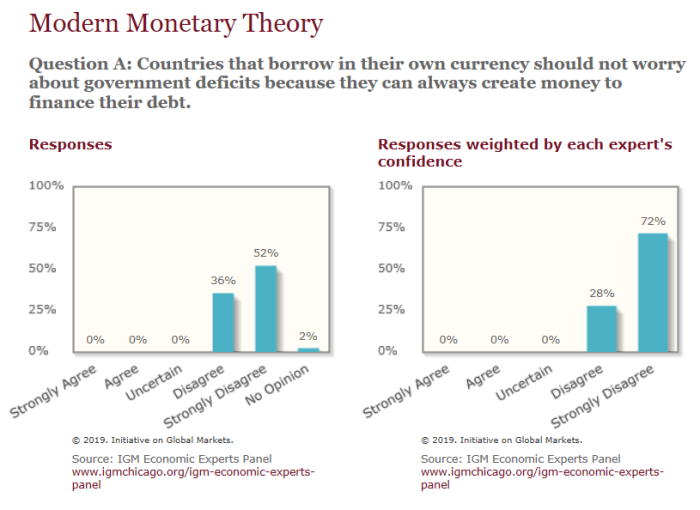
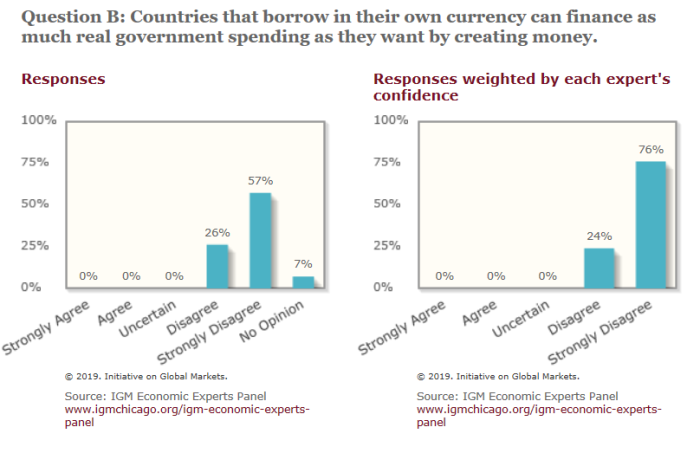
Their latest effort was not one of their best.  There were two questions.

MMT1

MMT2

Glancing through the individual responses, if there are differences among these academic economists they seem to be mainly ones of temperament (some people are just very relucant to ever use either 1 or 5 on a five point scale).

But so what?  No serious observer has ever really argued otherwise.

So-called Modern Monetary Theory has been around for some time, but has had a fresh wave of attention in recent weeks in the context of the so-called “Green New Deal” that is being propounded by various more or less radical figures of the left of American politics.  Primary season is coming.  The brightest new star on that firmament, Alexandria Ocasio-Cortez, has associated herself with the MMT label.

One of the more substantial proponents of MMT thinking, Professor Bill Mitchell of the University of Newcastle, visited New Zealand a couple of years ago.  I wrote about his presentation and a subsequent roundtable discussion in a post here.    We had a bit of an email exchange after he stumbled on my post, and although we disagree on policy, I was encouraged that he thought my treatment had been “very fair and reasonable”.  I mention that only so that in the extracts that follow people realise that I’m not describing a straw man.   I don’t know how Professor Mitchell would have answered the IGM survey questions above, but what I heard that day in 2017 should logically have led him to join the consensus.  That’s a mark of how useless the survey questions were.

He seemed to regard his key insight as being that in an economy with a fiat currency, there is no technical limit to how much governments can spend.  They can simply print (or –  since he doesn’t like that word – create) the money, by spending funded from Reserve Bank credit.     But he isn’t as crazy as that might sound. He isn’t, for example, a Social Crediter.    First, he is obviously technically correct –  it is simply the flipside of the line you hear all the time from conventional economists, that a government with a fiat currency need never default on its domestic currency debt.     And he isn’t arguing for a world of no taxes and all money-creating spending.  In fact, with his political cards on the table, I’m pretty sure he’d be arguing for higher taxes than New Zealand or Australia currently have (but quite a lot more spending).  Taxes make space for the spending priorities (claims over real resources) of politicians.  And he isn ‘t even arguing for a much higher inflation rate –  although I doubt he ever have signed up for a 2 per cent inflation target in the first place.

In listening to him, and challenging him in the course of the roundtable discussion, it seemed that what his argument boiled down to was two things:

  • monetary policy isn’t a very effective tool, and fiscal policy should be favoured as a stabilisation policy lever,
  • that involuntary unemployment (or indeed underemployment) is a societal scandal, that can quite readily be fixed through some combination of the general (increased aggregate demand), and the specific (a government job guarantee programme).

Views about monetary policy come and go.   As he notes, in much academic thinking for much of the post-war period, a big role was seen for fiscal policy in cyclical stabilisation.  It was never anywhere near that dominant in practice –  check out the use of credit restrictions or (in New Zealand) playing around with exchange controls or import licenses –  but in the literature it was once very important, and then passed almost completely out of fashion.  For the last 30+ years, monetary policy has been seen as most appropriate, and effective, cyclical stabilisation tool.  And one could, and did, note that in the Great Depression it was monetary action –  devaluing or going off gold, often rather belatedly – that was critical to various countries’ economic revivals.

In many countries, the 2008/09 recession challenged the exclusive assignment of stabilisation responsibilities to monetary policy.  It did so for a simple reason –  conventional monetary policy largely ran out of room in most countries when policy interest rates got to around zero.   Some see a big role for quantitative easing in such a world.  Like Mitchell – although for different reasons –  I doubt that.    Standard theory allows for a possible, perhaps quite large, role for stimulatory fiscal policy when interest rates can’t be cut any further.

But, of course, in neither New Zealand nor Australia did interest rates get anywhere near zero in the 2008/09 period, and they haven’t done so since.    Monetary policy could have been  –  could be –  used more aggressively, but wasn’t.

As exhibit A in his argument for a much more aggresive use of fiscal policy was the Kevin Rudd stimulus packages put in place in Australia in 2008/09.   According to Mitchell, this was why New Zealand had a nasty damaging recession and Australia didn’t.  Perhaps he just didn’t have time to elaborate, but citing the Australian Treasury as evidence of the vital importance of fiscal policy –  when they were the key advocates of the policy –  isn’t very convincing.   And I’ve illustrated previously how, by chance more than anything else, New Zealand and Australian fiscal policies were remarkably similar during that period.   And although unemployment is one of his key concerns –  in many respects rightly I think –  he never mentioned that Australia’s unemployment rate rose quite considerably during the 2008/09 episode (in which Australian national income fell quite considerably, even if the volume of stuff produced –  GDP –  didn’t).

On the basis of what he presented on Friday, it is difficult to tell how different macro policy would look in either country if he was given charge.   He didn’t say so, but the logic of what he said would be to remove operational autonomy from the Reserve Bank, and have macroeconomic stabilisation policy conducted by the Minister of Finance, using whichever tools looked best at the time.  As a model it isn’t without precedent –  it is more or less how New Zealand, Australia, the UK (and various other countries) operated in the 1950s and 1960s.  It isn’t necessarily disastrous either.  But in many ways, it also isn’t terribly radical either.

Mitchell claimed to be committed to keeping inflation in check, and only wanting to use fiscal policy to boost demand where there are underemployed resources.    And he was quite explicit that the full employment he was talking about wasn’t necessarily a world of zero (private) unemployment  –  he said it might be 2 per cent unemployment, or even 4 per cent unemployment.     He sees a tight nexus between unemployment and inflation, at least under the current system  (at one point he argued that monetary policy had played little or no role in getting inflation down in the 1980s and 1990s, it was all down the unemployment.  I bit my tongue and forebore from asking “and who do you think it was that generated the unemployment?” –  sure some of it was about microeconomic resource reallocation and restructuring, but much it was about monetary policy).   But as I noted, in the both the 1990s growth phase and the 2000s growth phase, inflation had begun to pick up quite a bit, and by late in the 2000s boom, fiscal policy was being run in a quite expansionary way.

I came away from his presentation with a sense that he has a burning passion for people to have jobs when they want them, and a recognition that involuntary unemployment can be a searing and soul-destroying experience (as well as corroding human capital).  And, as he sees things, all too many of the political and elites don’t share  that view –  perhaps don’t even care much.

In that respect, I largely share his view.

Nonetheless, it was all a bit puzzling.  On the one hand, he stressed how important it was that people have the dignity of work, and that children grow up seeing parents getting up and going out to work.   But then, when he talked about New Zealand and Australia, he talked about labour underutilisation rates (unemployment rate plus people wanting more work, or people wanting a job but not quite meeting the narrow definition of actively seeking and available now to start work).   That rate for New Zealand at present is apparently 12.7 per cent –  Australia’s is higher again.     Those should be, constantly, sobering numbers: one in eight people.      But some of them are people who are already working –  part-time –  but would like more hours.  That isn’t a great situation, but it is very different from having no role, no job, at all.  And many of the unemployed haven’t been unemployed for very long.  As even Mitchell noted, in a market economy, some people will always be between jobs, and not too bothered by the fact.  Others will have been out of work for months, or even years.   But in New Zealand those numbers are relatively small: only around a quarter of the people captured as unemployed in the HLFS have been out of work for more than six months (that is around 1.5 per cent of the labour force).       We should never trivialise the difficulties of someone on a modest income being out of work for even a few months, but it is a very different thing from someone who has simply never had paid employment.  In our sort of country, if that was one’s worry one might look first to problems with the design of the welfare system.

Mitchell’s solution seemed to have two (related) strands:

  • more real purchases of good and services by government, increasing demand more generally.  He argues that fiscal policy offers a much more certain demand effect than monetary policy, and to the extent that is true it applies only when the government is purchasing directly (the effects of transfers or tax changes are no more certain than the effects of changing interest rates), and
  • a job guarantee.    Under the job guarantee, every working age adult would be entitled to full-time work, at a minimum wage (or sometimes, a living wage) doing “work of public benefit”.     I want to focus on this aspect of what he is talking about.

It might sound good, but the more one thinks about it the more deeply wrongheaded it seems.

One senior official present in the discussions attempted to argue that New Zealand was so close to full employment that there would be almost no takers for such an offer.   That seems simply seriously wrong.    Not only do we have 5 per cent of the labour force officially unemployed, but we have many others in the “underutilisation category”, all of whom would presumably welcome more money.     Perhaps there are a few malingerers among them, but the minimum wage –  let alone “the living wage” – is well above standard welfare benefit rates.   There would be plenty of takers.   (In fact, under some conceptions of the job guarantee, the guaranteed work would apparently replace income support from the current welfare system.)

But what was a bit puzzling was the nature of this work of public benefit.    It all risked sounding dangerously like the New Zealand approach to unemployment in the 1930s, in which support was available for people, but only if they would take up public works jobs.  Or the PEP schemes of the late 1970s.   Mitchell responded that it couldn’t just be “digging holes and filling them in again”.  But if it is to be “meaningful” work, it presumably also won’t all be able to involve picking up litter, or carving out roadways with nothing more advanced than shovels.  Modern jobs typically involve capital (machines, buildings, computers etc) –  it accompanies labour to enable us to earn reasonable incomes –  and putting in place the capital for all these workers will relatively quickly put pressure on real resources (ie boosting inflation).   If the work isn’t “meaningful”, where is the alleged “dignity of work”  –  people know artificial job creation schemes when they see them –  and if the work is meaningful, why would people want to come off these government jobs to take existing low wage jobs in the prviate market?

The motivation seems good, perhaps even noble.  I find quite deeply troubling the apparent indifference of policymakers to the inability of too many people to get work.   The idea of the dignity of work is real, and so too is the way in which people use starting jobs to establish a track record in the labour market, enabling them to move onto better jobs.

But do we really need all the infrastructure of a job guarantee scheme?  In countries where interest rates are still well above zero, give monetary policy more of a chance, and use it more aggressively.   For all his scepticism about monetary policy, it was noticeable that in Mitchell’s talks he gave very little (or no) weight to the expansionary possibilities of exchange rate.    But in a small open economy, a lower exchange rate is, over time, a significant source of boost to demand, activity, and employment.    And winding back high minimum wage rates for people starting out might also be a step in the right direction.

And curiously, when he was pushed Mitchell talked in terms of fiscal deficits averaging around 2 per cent of GDP.  I don’t see the case in New Zealand –  where monetary policy still has capacity –  but equally I couldn’t get too excited about average deficits at that level (in an economy with nominal GDP growth averaging perhaps 4 per cent).  Then again, it simply can’t be the answer either.    Most OECD countries –  including the UK, US and Australia –  have been running deficits at least that large for some time.

It is interesting to ponder why there has been such reluctance to use fiscal policy more aggressively in countries near the zero bound.   Some of it probably is the point Mitchell touches on –  a false belief that somehow countries were near to exhausting technical limits of what they could spend/borrow.      But much of it was probably also some mix of bad forecasts –  advisers who kept believing demand would rebound more strongly than it would –  and questionable assertions from central bankers about eg the potency of QE.

But I suspect it is rather more than that –  issues that Mitchell simply didn’t grapple with.  For example, even if there is a place for more government spending on goods and services in some severe recessions, how do we (citizens) rein in that enthusiasm once the tough times pass?  And perhaps I might support the government spending on my projects, but not on yours.  And perhaps confidence in Western governments has drifted so low that big fiscal programmes are just seen to open up avenues for corruption and incompetent execution, corporate welfare and more opportunities for politicians once they leave public life.  Perhaps too, publics just don’t believe the story, and would (a) vote to reverse such policies, and (b) would save themselves, in a way that might largely offset the effects of increased spending.      They are all real world considerations that reform advocates need to grapple with –  it isn’t enough to simply assert (correctly) that a government with its own currency can never run out of money.

I don’t have much doubt that in the right circumstances expansionary fiscal policy can make a real difference: see, for example, the experience of countries like ours during World War Two.    A shared enemy, a fight for survival, and a willingness to subsume differences for a time makes a great deal of difference –  even if, in many respects, it comes at longer term costs.

But unlike Mitchell, I still think monetary policy is, and should be, better placed to do the cyclical stabilisation role.    That makes it vital that policymakers finally take steps to deal with the near-zero lower bound soon, or we will be left in the next recession with (a) no real options but fiscal policy, and (b) lots of real world constraints on the use of fiscal policy.  Like Mitchell, I think involuntary unemployment (or underemployment for that matter) is something that gets too little attention –  commands too little empathy –  from those holding the commanding heights of our system.  But I suspect that some mix of a more aggressive use of monetary policy, and welfare and labour market reforms that make it easier for people to get into work in the private economy,  are the rather better way to start tackling the issue.   How we can, or why we would, be content with one in twenty of our fellow citizens being unable to get work, despite actively looking –  or why we are relaxed that so many more, not meeting those narrow definitions, can’t get the volume of work they’d like  –  is beyond me.   Work is the path to a whole bunch of better family and social outcomes –  one reason I’m so opposed to UBI schemes –  and against that backdrop the indifference to the plight of the unemployed (or underemployed), largely across the political spectrum, is pretty deeply troubling.

But, whatever the rightness of his passion, I’m pretty sure Mitchell’s prescription isn’t the answer.

I don’t think advocates of MMT really help their cause by using the label Modern Monetary Theory.   I understand the desire to make the point –  pushing back against those too ready to invoke “but the market will never buy it” argument –  that countries issuing their own currency never need to default.  As a technical matter they don’t.  Politically, some still choose to do so, and even if they never do there are very real (if not readily observable) limits well short of default, where the costs and risks no longer make any benefits worthwhile.  Only failed states actually lapse into hyperinflation.

But in substance, MMT isn’t primarily about monetary policy at all, and as I noted at the start of the earlier post.

He is a proponent of something calling itself Modern Monetary Theory, but which is perhaps better thought of as old-school fiscal practice, with rhetoric and work schemes thrown into the mix.

One can mount a case for a more active use of macro policy to counter unemployment running above inevitable frictional/structural minima (I’ve made itself for several years), one can also mount a case for a more joined-up approach to fiscal and monetary policy (I’m not persuaded by the case, but it was standard practice in much of the OECD for several decades), and any politicians who doesn’t have a burning passion about minimising involuntary unemployment isn’t really worthy of the office.  At present, in much of the world, that should be driving officials and politicians to (at very least) be better preparing to handle the next serious recession, in particular by doing something (there are various options) about the binding nature of the effective lower bound on nominal interest rates.  It might not be a cause that resonates in Democratic primary debates, but it could make a real difference to the prospects of many ordinary people caught up through no fault of their own when the next serious downturn happens.   Whatever one believes about the possibilities of fiscal policy –  and I tend towards the sceptical end in most circumstances –  you’d want to have as much help from monetary policy as one could get.

Perhaps next time, those who write the IGM questions could consider something a bit more nuanced, that might shed some light on the areas where there are real divergences of view around the light that economic theory and analysis can shed on such issues.

UPDATE: A post here, by a senior researcher at one of the regional Federal Reserve banks, also responds to this particular IGM survey.

Has monetary policy run its course?

In one of the world’s most prominent economics platforms, the economics columnist for the Financial Times, Martin Wolf uses this week’s column for a piece headed “Monetary policy has run its course”, with a subheading “It has made secular stagnation worse.  Fiscal alternatives look a safer bet.”.    That headline was guaranteed to get my attention, disagreeing as I do with all three limbs of the apparent argument.

Wolf draws on various other papers, but doesn’t really make his case in a compelling way.  Take secular stagnation first.  There are various definitions: Wolf uses one of “chronically weak demand relative to potential output”, while the FT’s own lexicon uses a materially diferent version

Secular stagnation is a condition of negligible or no economic growth in a market-based economy.

On the former definition, most of the OECD is estimated to be back somewhere near a zero output gap, and the unemployment rate now in several major economies (but not New Zealand) is lower than it was going into the last recession (and there is a striking fact that the worst performers are all in the euro common currency, a system Wolf tends to be keen on).  That has happened without big new surges in overall ratios of private debt to GDP.

On the latter definition, even in countries with high starting levels of productivity, productivity growth has slowed but not stopped.  Per capita GDP across the OECD is now about 10 per cent higher in real terms than it was in 2007.  Not stellar, but it means that 10 per cent of all the output growth managed in the last several hundred years (since the Industrial Revolution) has been in the last decade alone.

I think there are credible stories under which monetary policy wasn’t used sufficiently aggressively in, and following, the last recession –  partly because both markets and central banks misjudged things and expected a strong rebound, so were always looking towards the first (or subsequent) tightenings.  But is very difficult to construct a story, in which monetary policy has made any material (adverse) difference to population growth, productivity growth, actual innovation opportunities or the like.    And even if, for argument’s sake, there was some effect in the frontier economies, most OECD economies (including large ones like the UK, Japan, Italy, Spain, Canada, South Korea) are nowhere near the frontier.

Having said that, there is little doubt that neutral real interest rates have fallen away very substantially over the last 15 years or more.  They are now at levels that are pretty much without historical precedent.  This is the first chart in the article.

ft chart

That means there are issues.  There is an effective lower bound, at present, on short-term nominal interest rates.  No one knows precisely where that bound is, but there is a degree of consensus that taking your policy interest rate much below -0.75 per cent will lead to fairly large scale conversion of deposit balances into physical cash (not, primarily, transactions balances –  where the inconvenience would dominate – but large wholesale balances).  The limit now exists wholly and solely because (a) governments monopolise physical currency issue, and (b) pay zero interest on physical currency.  Zero might not be much, but for a multi-million dollar fund, it is a lot more than -3 per cent (for the same credit risk).

Quite a few countries (including the euro area) are at or very near that floor already.  Other countries, including New Zealand, Australia, and the United States are not.   But even in those countries, a severe recession in the next few years would be likely to exhaust conventional monetary policy capacity (our Reserve Bank could cut by perhaps 2.5 percentage points, but it has often needed to cut by more than 5 percentage points in previous downturns).

Wolf isn’t apparently keen on doing anything about that, observing that a need for materially negative nominal official interest rates

would, to put in mildly, create a wasps’ nest of technical, financial and political problems.

Not nearly as many problems as doing nothing, and allowing persistently high unemployment for multiple years might create.

There are two broad options for creating more monetary policy space.   The first is to raise the inflation target (and reading a central banking magazine yesterday I noticed that a Swedish Deputy Governor is calling for exactly that), and the second –  and more reliable –  is to remove, or markedly ease, that near-zero effective lower bound.   No government or central bank has done so (and there are not overly complex ways of doing so), and that passivity –  apparently endorsed by Wolf – is increasing the risk of problems when the next serious downturn gets underway.  If interest rates can’t, for now, be cut far, people will quickly recognise that, not expect it, and adjust their behaviour, and asset holdings, accordingly.

Is there reason for unease about some of these options?  Perhaps.  If we were to allow short-term interest rates to go materially negative, no one knows how far they might eventually go.  There are good theoretical reasons to think not too far (human innovation hasn’t died, there are naturally productive (positive returns) assets (land or fruit trees) but no one knows with certainty.  Would it matter if interest rates went, and stayed, materially negative?  I’m not convinced it would, allow it would certainly be a symptom of something odd.   But such philosophising shouldn’t get in the way of actively preparing to handle the next serious downturn.  Neither central banks nor governments seem to be doing what they could on that score (and although the issue is a bit less immediately pressing in New Zealand, it is true here too).

Which brings me to the third limb of Wolf’s argument: “Fiscal alternatives look a safer bet”.   “We need more policy instruments he argues”.  In many respects, the rest of the article is a teaser for a conclusion around more aggressive use of fiscal policy.   (“More aggressive? perhaps Antipodean readers wonder, but as a chart in the article illustrates OECD net government debt as a share of GDP has trended quite strongly upwards in the last fifty years as, generally, has government spending.).  He asserts boldly:

If the private sector does not wish to invest, the government should decide to do so.

And yet who is “the government”, except a collective representation of the voters, themselves “the private sector” in one form or another.  There is no sense of trying to understand why the private sector might not choose to invest more heavily and then, if those things are in the gift of governments (tax, regulation, policy uncertainty or whatever), fix them.

And nothing at all on the near-certain “political problems” and constraints around the large scale and persistent (for it is something structural he is championing, not just a short-term cyclical response) aggressive use of fiscal policy, whether for consumption or investment.  Monetary policy has its problems, but if central bankers and politicians got on and fixed some of the regulatory (lower bound) obstacles, it would be a much more reliable tool to deploy.   At worse, even left-wingers (such as Wolf, and the Democratic economists he cites –  Laurence Summers, Olivier Blanchard, and Jason Furman) should want to have monetary instruments to hand, rather than some all-or-nothing wager on fiscal policy, when there is no political consensus at all (anywhere) on using fiscal policy in the ambitious way they suggest.

Wolf is right that central banks can’t deal with structural secular stagnation –  although they can do the important job of leaning against serious cyclical downturns, as they did in 2008/09. But even on the most optimistic of readings, it seems unlikely that aggregate fiscal policy is going to be able to either, whether for technical or political reasons.  And so-called secular stagnation should simply not be regarded as an acceptable excuse for poor productivity growth and weak investment in countries that are far from the productivity frontier, New Zealand pre-eminent (for how far it has drifted behind) among them.

MPC remit and charter

The Minister of Finance and the Governor of the Reserve Bank today released the Remit and Charter for the new statutory Monetary Policy Committee, that takes effect from 1 April.  The Remit largely replaces the Policy Targets Agreement structure in place since 1990, and future remits will be set directly by the Minister of Finance, after advice from the Reserve Bank (among others) and associated public consultation.  The Charter is mostly new, governing how the MPC is supposed to operate in some key, outward-facing, dimensions. It complements various detailed statutory provisions.   Even though both documents are this time agreed between the Governor and the Minister, it is clear that the Minister has taken the lead: the press release is issued by the Minister alone, and although it is now reproduced on the Bank’s website, contains various bits of political spin.

The contents of the new Remit are in many respects pretty similar in substance to the current PTA, but there are a couple of changes worth noting.

One looks like an error.  In the Context section the Remit states that

“(the Act) requires that monetary policy promote the prosperity and wellbeing of New Zealanders”

That line took me by surprise so I went back and checked the new legislation.    The relevant provision actually states

The purpose of this Act is to promote the prosperity and well-being of New Zealanders,

Those are two different things.  The Remit –  which the Governor has voluntarily signed on to – can reasonably be read as suggesting that monetary policy should be conducted with “wellbeing” in mind.  The Act sets out statutory objectives for monetary policy (the things the MPC is supposed to pursue and take into account), simply stating that Parliament has put the legislation in place believing that the monetary policy goals (and other powers the Bank has, including regulation and supervision) will conduce to the wellbeing of New Zealanders.  The Remit shouldn’t have been worded that way.

My second observation about the Remit is more positive (and would be more positive still if the document hadn’t been released in a format in which one can’t copy and paste extracts).    It is stated that “monetary policy contributes to public welfare by reducing cyclical variations in employment and economic activity whilst maintaining price stability over the medium-term”.  I like that formulation, which is much closer to what I recommended should be the statutory goal for monetary policy.  Price stability is the constraint, economic stabilisation is the primary purpose.   Whether or not the wording is quite consistent with the actual new legislative goal is something for the MPC, and those paid to hold them to account, to work out.

What of the Charter?

My overarching unease about the MPC is that it will be dominated the Governor.  That is partly through the channel of the inbuilt management majority (and the Governor hires the other managers), and partly because of the heavy say the Governor will have in who gets appointed to the (minority) external positions.

But it is reinforced by the relentless, and explicit, drive for “consensus”.   This is from the Charter

consensus

“Consensus” isn’t a recipe for getting the best answers, but for lowest common denominator answers that everyone can live with.  It isn’t really a recipe for a robust examination of competing arguments and analyses either –  at least unless one has exceptional people (which is always unlikely, almost by definition) –  and especially when management has (a) an inbuilt majority, and (b) control of all the research and analysis resources (and of the pen in drafting MPSs etc).   The risk remain that outsiders, knowing they are inevitably outnumbered, and having ‘consensus’ waved in their faces will simply go along, free-riding.

The formal transparency model chosen is likely, at the margin, to reinforce this risk.  We are told that the record of the meeting will be published at the same time as the OCR announcement (2pm on Wednesday, following an MPC meeting that morning).  Even allowing for various preliminay meetings, the “record” of the meeting will inevitably be heavily pre-drafted by staff who work to the Governor, and the ability of outside MPC members to get any alternative perspectives included is going to be an uphill struggle.  Most central bank MPCs release minutes with something of a lag.   All that said, time will tell how it works out.

One interesting provision in the Charter was this

charter 1

charter 2

It was interesting for two reasons.  First, this provision appears to accept that significant operational decisions around monetary policy are the responsibility of the MPC.  That was not (is not, in my view) clear from the legislation.   If so, it is welcome, especially if it involves an expectation by the Minister that, for example, any future quantitative easing and similar decisions would also be a matter for MPC.  We’ll have to see.

Presumably this provision is supposed to cover the longstanding arrangements for possible foreign exchange intervention.  When I was at the Bank, the OCR Advisory Group (internal forerunner to the MPC) was the forum in which the Governor made in principle decisions on intervention, and specific timing choices etc were then dealt directly between the Governor and the Financial Markets Department.

If so, the specific provisions go much too far.   Perhaps there is a case at times for not announcing foreign exchange intervention immediately in some circumstances.  But there are no grounds for leaving the MPC to decide for itself when, if ever, specific information on intervention will be released (the implied movements in the Bank’s fx position come out more than a month later, and even then without comment of explanation).    At present, there probably is not much practical importance attaching to this point, but the system should be started as we mean to go on.  Much better to have insisted that all market intervention (size and nature, although not counterparties) should be disclosed within 10 days of such intervention.  Apart from anything else, these are big financial risks the taxpayer is (given no choice in) assuming.

My final observation on the charter offers kudos to the Minister.  There has been a great deal of talk about the need to seek consensus (which is still in the charter) and the claim had been made that this meant all MPC members should speak, if at all, with a single voice.  Bank management championed this (self-interestedly no doubt), despite the successful examples of countries like the UK, the US, and Sweden, and a year ago it seemed that they had persuaded the Minister of their view.  It was one reason why good people would probably have been deterred from applying for the external positions –  facing a built-in internal majority, and with no ability to articulate in public alternative perspectives, it wasn’t obvious that the positions offered more than sightseeing (looking at the innards of how the Bank works).  I’ve banged on about the issue for months, and I know others have also raised concerns.

And so imagine the pleasant surprise I got when I  got towards the end of the charter.

charter 3

I don’t have any particular problems with (a) or (b), although I can imagine some future disputes about what does and doesn’t contribute to the “overall effectiveness” of the monetary policy decision etc, since things that might muddy the water a bit in the short-term could easily strengthen the institution, and its accountability, in the medium term.  I also had no problem with (d) which is pretty much how Reserve Bank staff have operated for many years.

What caught my eye was (c), under which it appears that members of the MPC –  internal and external –  will be free to comment in public, expressing their own views on the economic situation, risks, and monetary policy.   On monetary policy itself, they are required to draw on official communications “as appropriate” –  and I’m sure they will, as appropriate.  But it doesn’t bind MPC members to agree with committee decision, or to endorse all the arguments the Governor himself might offer in support of the decision.  On the economy etc, they can say what they like (in substance) provided they do so politely  (as people typically do in transparent foreign central banks) and let their colleagues know in advance what they’ll be saying.  It is a material step forward relative to what we’ve been promised (although time will tell whether anyone, internal or external (and thus vetted for tameness by the Governor) ever utilises these provisions).

What is also interesting is some of the detail.  There is now an explicit written requirement that any off-the-record private remarks about monetary policy or the economic outlook have to be consistent with official MPC communications.  Presumably this also applies to the Governor (there is no suggestion it doesn’t) so if there are off-the-record expletive-laden rants at private commercial functions in future, at least they won’t be offering any insights on the economy and monetary policy.  Perhaps that Rotary Club advertising the Governor as offering candid perspectives on the New Zealand economy –  if you pay – will have to revise its plans?  More probably, the Governor probably won’t regard himself as bound by the rules.

And then there was the final sentence.  Any on-the-record remarks (occasions at which they will be made) will have to (a) notified to the public in advance, and (b) with full text on the Bank’s website in real-time.   In principle, this looks fine and sensible (although it is far from what has been practised by management up til now).  In practice, it will prevent MPC members giving interviews, and appears designed to ensure that the only communications are speeeches with written texts to which MPC members adhere closely.  But, again, there is no suggestion that these rules don’t apply to the Governor –  and his views are inevitably most market-moving.   So can we look forward to an end to off-the-record speeches from the Governor on matters of substance, and to wild departures from the prepared and published text.   After all, as the document says, MPC members shouldn’t provide, or look as though they are providing, new information to private subsets of people.     (Personally, I suspect the document goes a little too far.  It would probably be unfortunate if, say, the Governor cannot (as the document appears to suggest) give an interview to, say, Morning Report or one of the main current affairs programmes, so long as there is adequate public notification as to when and where he will be speaking.)

As I’ve said on various previous occasions, I’m pretty ambivalent about the monetary policy legislative amendments, and particularly about the MPC, which looks set to be a Governor-dominated creature, not too different in effect from what we’ve had for the last 29 years.  But credit where it is due.  There are some welcome aspects in the details of today’s announcement and I, quite honestly, hope the new system works better than I expect it to.    Who knows, the less closed nature of the rule may even help attract a better class of candidate to consider the MPC position.

For now, of course, we are still left guessing who four of the seven MPC members will be.

See, not so hard after all

Back in November 2017, just after the government took office, the Reserve Bank in its Monetary Policy Statement identified various assumptions they had made about the impact of various of the new government’s policies.  Some of these assumptions made quite a difference to the outlook, but no analysis or reasoning was presented to give us any confidence in the assumptions they were (reasonably or unreasonably) making. One of those new policies was KiwiBuild.

Seeing as the Bank is a powerful public agency, it seemed only reasonable to request copies of any analysis undertaken as part of arriving at the assumptions policymakers were using.   The Bank refused and many many months later the Ombudsman backed them up (if ever there was a case for an overhaul of the Official Information Act, this was a good example).  The Ombudsman did point out that he had to rule as at the date the request had been made.  So, a year having passed, I again requested this material.  The Bank again refused (and I haven’t yet gotten round to appealing to the Ombudsman).     Quarter after quarter the Monetary Policy Statements talk about KiwiBuild, but we’ve never seen any supporting analysis.   A state secret apparently.

Until yesterday that is.  In the latest Monetary Policy Statement there was the usual discussion of KiwiBuild –  potentially a big influence on one of the most highly-cylical parts of the whole economy –  but there was also a footnote pointing readers to an obscure corner of the Bank’s website, and a special background note on KiwiBuild, and the assumptions the Bank is making.  All released simultaneous with the statement itself.   See, it just wasn’t that hard.  And has the sky fallen?

(As it happens I remain rather sceptical of the assumption that KiwiBuild is going to be a significant net addition to total residential investment over the next decade.  Why would it, when the main issues in the housing market are land prices and, to a lesser extent, construction costs, and it isn’t obvious how KiwiBuild deals with either of them?  If it proves to be a net addition, it will probably be because it is a subsidy scheme for the favoured –  lucky – few.)

As for the overall tone of the monetary policy conclusions to the statement, count me sceptical.  At one level it is almost always true that the next OCR move could be up or down –  and in that sense most forecasting (especially that a couple of years ahead) is futile: useless and pointless.   But for the Governor to suggest that the risks now are really even balanced, even at some relatively near-term horizon, seems to suggest he is  falling into the same trap that beguiled the Bank for much of the last decade; the belief that somewhere, just around the corner, inflation pressures are finally going to build sufficiently that they will need to raise the OCR.   We’ve come through a cyclical recovery, the reconstruction after a series of highly-destructive earthquakes, strong terms of trade, and a huge unexpected population surge, and none of it has been enough to really support higher interest rates. The OCR now is lower than it was at the end of the last recession, and still core inflation struggles to get anywhere 2 per cent.    There is no lift in imported inflation, no significant new surges in domestic demand in view, and as the Bank notes business investment is pretty subdued.  Instead actual GDP growth has been easing, population growth is easing, employment growth is easing, confidence is pretty subdued, the heat in the housing market (for now at least) is easing.  Oh, and several of the major components of the world economy –  China and the euro-area  –  are weakening, and the Australian economy (important to New Zealand through a host of channels) also appears to be easing, centred in one of the most cyclically-variable parts of the economy, construction.   It was surprising to see no richness or depth to any of the international discussion –  and to see the Bank buying into the highly dubious line that any slowing in China is mostly about the “trade war”.   Few other observers seem to see it that way.

From a starting point with inflation still below target midpoint after all these years, it would seem much more reasonable to suppose that if there is an OCR adjustment in the next year or so, it is (much) more likely to be a cut than an increase.      Time will tell, including about how long the 1.5 per cent lift in the exchange rate will last.

Commendably, the Bank is now talking openly about many other economies have limited capacity to respond to a future serious downturn.  That is welcome acknowledgement, but it would count for more if the Bank were taking seriously the real (if slightly less binding) constraints New Zealand will also face in the next future serious downturn.

A couple of other things in the document caught my eye.  One was this chart

NAIRU 2019

The Bank seems to be trying to tell us that it really has no idea whether the unemployment was above or below the NAIRU at any time in the last 17 years.  I don’t suppose in practice they operate that way, but when they present a chart like this it is a bit hard to take seriously the other bits of their economic analysis.

The other specific was some rather upbeat comments on productivity performance in recent years, which has led the Bank to the view that they now to expect no acceleration in productivity growth in the years ahead.  The Governor always seems to err on the (politically convenient) upbeat side.  I’m not sure quite how the Bank derives their productivity measure –  I’m guessing as some sort of per person employed measure –  but as a reminder to readers here is the chart of real GDP per hour worked, the standard measure of labour productivity.  To deal, to some extent, with the noise in the individual series, I use both measures of quarterly GDP and both (HLFS and QES) measures of hours.

real GDP phw dec 18

There has been no labour productivity growth for the last three or four years, and little for the last six or seven.  I wouldn’t be surprised if the Bank is right to expect no acceleration (on current policies), but if we keep on with near-zero labour productivity growth it is a rather bleak prospect for New Zealanders.

A great deal of the press conference was taken up with questions –  generally not very sympathetic –  about the Governor’s proposals to increase substantially capital requirements for banks.   In the course of the press conference he and Geoff Bascand made some reasonable points –  including about the merits of putting the big 4 banks and the smaller banks on a more equal footing in calculating requirements – and at least fronted up on the other questions.  It is just a shame this was being done reactively now, rather than pro-actively when the proposals were first released in December.

I remain rather sceptical of the Bank’s case –  in which everything is a win-win, in which the economy is safer, more prosperous, and even with lower interest rates.  If you doubt that I’m characterising their bold claims correctly, this is the stylised diagram that leads the consultative document.

something for allIt is a free lunch they are claiming to offer.  I suspect few will be convinced.

In the course of the press conference, the Governor asserted that the Bank’s proposals will, if implemented, mean that future capital ratio requirements would be “well within the range of norms” seen in other countries.  I found that a surprising claim, and there is nothing –  not a word – in the consultative document to back it up.  If true, it would be material in thinking about the appropriateness of the Bank’s proposals.  But where is the evidence (granting that this is something that can’t be answered in a ten second Google search)?  I’ve lodged an Official Information Act request for the analysis the Governor is using to support his claim.  It would, surely, be in his interests to have such analysis out there.

Also at the press conference, there was the hardy perennial claim that inflation expectations are “well-anchored” at 2 per cent, and everyone believes that monetary policy is just fine.  As my hardy perennial response, here are inflation breakevens from the government bond (indexed and conventional) market.  The last observation is today’s data.

IIB breakevens feb 19

People with money at stake don’t seem to believe you Governor.  Last time things got this low a series of OCR cuts only helped, at least partially, rectify the position.

And, finally, who does the Bank suppose gets any value at all from the cartoon version of the statement?  For example

cartoon

Is the Monetary Policy Statement now a set text in intermediate school?  If the kids are especially naughty do they have to read it twice?   Even your average MP, sitting on the Finance and Expenditure Committee and supposedly holding the Bank to account, has to be able to cope with a little more than that.  I’m not expecting much of the new statutory MPC, but perhaps they could prevail on the Governor to drop the cartoons and simply write in reasonably accessible English?

Later this morning we get the Remit (PTA replacement) and Charter for the new Monetary Policy Committee.  I’m sure I’ll have some thoughts about them tomorrow.

What to make of the inflation data?

There seemed to be a little in this week’s CPI numbers for everyone.   The Reserve Bank’s favoured core inflation measure was unchanged at 1.7 per cent (and the model slightly revised downwards the estimate for a couple of quarters back), bringing up now a full nine years in which this core measure has been below 2 per cent.   The CPI ex food and energy series –  a standard international core inflation indicator –  doesn’t get much attention in New Zealand, but annual inflation in that measure was (up a bit) 1.6 per cent.  The last time that inflation measure was above 2 per cent –  excluding the GST change –  was late 2007.  That was so long ago, there will be voters in next year’s election who don’t even remember 2007.

New Zealand inflation measures –  even the sectoral core measure –  are biased upwards these days by the repeated large increases in tobacco taxes.  The price indexes rise as a result, but these tax increases aren’t what economists typically think of when they use the term “inflation”.     Neither Statistics New Zealand nor the Reserve Bank publish a decent core measure that also excludes government charges and tobacco taxes, so I’ve come to quite like the series SNZ does publish for non-tradables inflation excluding government charges and cigarettes and tobacco.  Here is the annual inflation rate in that series.

nt ex jan 19

The annual inflation rate in this measure did pick up a little, but (a) is no higher than the last couple of local peaks, and (b) even 2.5 per cent core non-tradables inflation just isn’t consistent with core overall inflation being back to 2 per cent.   The Reserve Bank was still cutting the OCR in late 2016 when this particular inflation rate series was around current levels.

What about the wider world environment?  Here is CPI ex food and energy inflation for the G7 group of countries.

g7 cpi ex

The picture for China also doesn’t suggest global inflation is rising.

And all this is against a backdrop in which both the world economy and New Zealand’s economy seem to be losing steam.      The pick-up in the sectoral core factor model measure of inflation to 1.7 per cent in the last couple of quarters might be “encouraging” in some sense, if one could readily point to factors that were likely to intensify resource pressures from here, or drive up perceptions of a “normal” or natural inflation rate.  But….the Christchurch rebuild is winding down, immigration seems to edging down, and the terms of trade show no sign of moving to a new higher plateau. There is no fresh wave of productivity growth, inducing firms to invest heavily, and encouraging consumers to spend in anticipation of future higher living standards.  If you believe in housing wealth effects (I don’t see any evidence in aggregate for them), even house price inflation has faded.   There is some fiscal stimulus in the pipeline, but it is nothing like some of the positive demand shocks we’ve gone through in the last 10 or 15 years.  This has the feel of being about as “good as it gets” (thoroughly lousy when contemplating productivity, but here I’m just thinking of capacity pressures, and things which might boost core inflation).

And it isn’t too different abroad.   Global growth projections are getting revised down a little: in the US fiscal stimulus is fading and monetary tightening is beginning to bite, in the euro-area activity indicators are weakening (and add in some Brexit uncertainty on both sides of the Channel), and in China things don’t seem to be developing well.  Commodity prices were a big worry at the end of the last boom, in 2007 into 2008 –  concern about spillover into inflation expectations and wage demands – but not so much now.  And it isn’t as if global monetary policy has suddenly got a lot looser either.  There just isn’t much reason to think core inflation –  here or abroad –  is likely to rise further, and neither here nor in most countries abroad is inflation at target.   When the next recession comes, core inflation is likely to fall from here.

The market doesn’t seem convinced that there is higher inflation in prospect either.  Breakevens from the indexed and conventional government bond market have been falling in other countries.  And here is the New Zealand picture, updated so that the last observation in this monthly chart is yesterday’s data.

breakevens jan 19

In the US, at peak, markets were pricing future inflation averaging a touch above 2 per cent.  Here we never quite got even to 1.5 per cent, and in the last couple of months the breakeven inflation rate (implied expectation) has dropped away again.  People putting real money on these things are implicitly pricing the average inflation rate over the next 10 years in New Zealand at 1.1 per cent.   That seems too low to me, even allowing for an excessively cautious central bank over the last decade (and hardly a vote of confidence in the amended Reserve Bank legislation passed last month), but even if you are sceptical of the level, the direction should be troubling the Governor (and his associates just about to be appointed to the new Monetary Policy Committee).   There doesn’t seem to be any sense any longer that a normal inflation rate in New Zealand is 2 per cent. (My thoughts on making sense of the indexed bond numbers are here.)

It is clear that, with the benefit of hindsight, the OCR should have been a bit lower over the last couple of years.    That is simply the same as observing that core inflation has again undershot the target (and implied expectations suggest that outcome isn’t simply an anomaly).    That isn’t the same as recommending now that the Governor should cut the OCR at next month’s review – and I’m quite he won’t anyway.   There is a reasonable case to be made for a cut now – low inflation, growth pretty insipid etc, tempered by the fact that the unemployment rate (a lagging indicator) is probably around the NAIRU –  but the cautious bureaucrat still lurking in me probably wouldn’t yet go that far.  But the case for a more explicit easing bias does seem increasingly clear.

(It is always good to have diversity of views. My post the other day on the Prime Minister’s FT article seems to have excited another local economics blogger.  Apparently I am a member of the “New Zealand establishment” –  surely a thought that would appal them as much as it appals me –  and some sort of lackey of the National Party (and, worse, the US Republican Party).  I almost fell off my chair a few months ago when someone told me that Simon Bridges had made some positive remarks about this blog, but I doubt any regular readers would ever have taken me as sympathetic to a party that failed to do anything about productivity, failed to do anything about housing, and which seems more interested in pandering to the PRC –  and keeping the funding going –  than in the wellbeing of New Zealanders and the integrity of our society.)


Planning for the next recession

In a post earlier this week, I made passing reference to a new opinion piece on Newsroom headed “Why we need a recession plan”.  The article is written by another former Reserve Banker, Kirdan Lees, who these days divides his time between the University of Canterbury and economic consulting.  His article is organised around a list of five reasons, although it combines his arguments about the form any such plan should take.

I strongly agree that we need some serious, credible and open planning for the next recession (whenever it comes, but it is now eight or nine years since the last one and neither the foreign nor domestic outlooks are looking particularly rosy).  Indeed, in respect of monetary policy, it is a case I’ve been making for about as long as this blog has been running.    The case might have seemed a bit abstract four years ago –  especially to anyone who paid much attention to the Reserve Bank’s pronouncements (that interest rates were rising, and inflation would soon be getting back to target).  It should be much more pressing now, as the growth phase has got old and yet (New Zealand) interest rates are at record lows and inflation still isn’t back to target.  But, unfortunately, there has been nothing serious from the Bank –  under Wheeler, (unlawful) Spencer, or Orr.  They claim to believe there just isn’t a problem; that monetary policy can do as much as ever.

This is, more or less, Kirdan’s first reason.

Reason 1: The outlook now points to recession risk with little room for interest rates to do much

But interest rates have never been so low, leaving little headroom for monetary policy to kick in. Mortgage and lending rates can’t fall by much if the big banks are to retain margins. 

As a reminder, the real obstacle is around wholesale deposit interest rates. By common consensus, official interest rates could be lowered to perhaps -0.75 per cent, but any lower and the strong incentives are for people (including particularly wholesale investors) to convert their assets into physical cash and use safe-deposit boxes and strongrooms.  Conventional monetary policy no longer works then.     That means our Reserve Bank could cut the OCR by up to around 250 basis points –  more than many advanced country central banks could –  but in typical recessions they’ve needed to cut interest rates by 500 basis points (575 basis points last time, and the recovery then was very muted).

There are ways around this lower bound constraint, but the Reserve Bank and the government have shown no signs of any action (or even any serious analysis).  In principle, things could be done in a rush in the middle of the next recession, but that is almost always a bad way to make good policy, and by failing to clearly signal in advance that the authorities have credible responses in hand they are likely to worsen the problem (see below).

Kirdan doesn’t seem to see much scope for doing anything to increase the flexibility of monetary policy.  His focus is on fiscal alternatives.

Reason 2: By the time Treasury calls a recession it’s too late to trigger a fiscal stimulus plan

Not just Treasury of course.  Economic forecasters and analysts are hopeless at recognising recessions until they are well upon us (among the reasons why no one at all should take any comfort from the latest IMF update –  international agencies are among the worst in recognising things before they break).

It would always be better to have good forecasts, even so-called nowcasting (where is the economy right now –  given that our most recent national accounts data relates to the July to September period last year, and even that is subject to revision).      Kirdan is an optimist and believes we can do (materially) better than just waiting for the GDP data.

Today, a myriad of timely data exists: across transport movements, customs data, privately held data on small businesses (such as Xero) and consumption (such as Paymark). A small panel of experts could use that data to gauge recession risk and tell us when to pull the trigger.

In principle, of course, all these data are available to Statistics New Zealand (which could require them to be provided under the Statistics Act), and if the data could be available to “a small panel of experts” it could presumably be available to the Treasury and the Reserve Bank.

But even if these data can provide a few weeks advance notice of negative GDP quarters, there are bigger questions which more-timely data can’t answer.   The first is how long any downturn will last.  That matters quite a lot.   A couple of weak quarters might sensibly lead the Reserve Bank to consider a cut to the OCR, and probably the exchange rate would be weakening anyway.   But that is very different from a couple of weak quarters foreshadowing a deep and prolonged recession.   Telling the difference isn’t easy.  And who seriously supposes that –  in a democracy –  we are going to hand over to a panel of experts (self-appointed or otherwise) decisions about when to trigger big fiscal stimulus programmes which –  whatever their composition –  have huge distributional consequences.  These are inherently political choices, which will benefit from technical input, but the accountability needs to rest with those we elect (and can eject).

On which note

Reason 3: Economic theory can help: a fiscal plan needs to follow three principles
When it comes to fiscal stimulus principles, macroeconomists have their own triple-T: stimulus needs to be timely, targeted and temporary.

Which looks fine on paper, but is much less help in practice.  If you want “timely”. monetary policy can typically be adjusted faster than fiscal policy –  exchange rates, for example, adjust almost instantly to monetary policy surprises, and often in anticipation of monetary policy actions.   And monetary policy moves are designed to be temporary, but without tying anyone’s hands: you raise the OCR again when you are pretty sure inflation is going to back to target.

In the UK they tried what looked like a clever fiscal wheeze in the last recession: cutting the rate of VAT for a year, and only a year.  It looked like a fairly sensible move at the time it was announced –  encouraging people to bring forward consumption.  And it probably would have been if the downturn had been short and sharp, but it wasn’t.  More generally, people like the IMF championed fiscal stimulus in 2008/09, but again implicitly on the view that economies could rebound quickly.  When they didn’t, the mix of economic and political arguments about “austerity” took hold and only complicated the handling of the economy.

Of course, if you get can get your legislation through Parliament you can write cheques (electronic equivalent) quite quickly –  Kirdan is keen on focusing temporary additional spending on “poorer families” –  but you can’t do the same for the sort of infrastructure spending that those keen on fiscal stimulus often champion.

Kirdan’s reason 4 had me puzzled.

Reason 4: Trotting out the same tired approach will provide the same tired results 

One of the enduring traits of fiscal policy is tacking on extra spending in good times and taking away spending just when it is needed.

Hard to disagree too much with that second sentence –  pro-cyclical fiscal policy is a problem.

But even if you think there is a role for some active counter-cyclical fiscal policy, I wasn’t clear on the connection to what came next

Governments seeking a labour boost need a better targeted fiscal stimulus. That means targeting labour-intensive industries such as such as health and education, construction, horticulture, accommodation and retail industries. ….

But identifying labour-intensive industries is not enough. Maximum effectiveness comes from targeting the labour-intensity of the entire supply chain: labour-intensive industries that in turn use labour intensive inputs from other industries are the best bets for fiscal stimulus.

It seems to be an argument for, in effect, targeting reductions in average labour productivity –  by focusing on boosting industries that are (directly or indirectly) more labour-intensive.  Perhaps –  just possibly –  there is a case for something of the sort, as a pure short-term palliative, in a very deep economic depression, but in an economy where lack of productivity growth has been a decades-long problem (and particularly evident in the most recent growth phase) targeting low productivity industries doesn’t seem a particularly sensible medium-term approach.

Which brings us to the last point in Kirdan’s article

Reason 5: Articulating a trigger for the fiscal plan shapes the expectations of Kiwi businesses

I don’t think ministers can articulate a highly-specific trigger for action –  so much will depend on context (what is going on here and abroad) –  and attempting to do so is only likely to create a rod for the government’s back.  But where I do agree is that there needs to be a clear and credible commitment from both the government and the Reserve Bank that prompt and firm action will be taken if the economy turns down substantially, and particularly if that is in the context of a serious global event.

Kirdan’s focus is fiscal, and I have no problem with his points that (for example) debt to GDP should be expected to rise in a severe downturn, without threatening the medium-term commitment to moderate debt levels.  In fact, we would probably agree that there should be some public debate now about how the next downturn should be handled, as there is a risk that we get a serious downturn and the government is still fixated on its medium-term debt target (and avoiding leaving a target for National to attack them), even if that isn’t what is needed in the short-term.

But in my view, the argument generalises.  One of the problems we face going into the next severe downturn –  whenever it occurs –  is that (a) every serious observers knows that monetary policy has limited capacity, even in New Zealand and much more so in many other places (in the euro-area for example, the policy rate is still negative), and (b) that there are real political/social constraints on the flexibility of fiscal policy in many places (partly because debt levels are often high, partly because of distributional considerations, partly memories of post-stimulus austerity).  I’m not necessarily defending these constraints, just attempting to identify and describe them.

Faced with these limitations, the quite-rational response to a downturn will be to assume that there isn’t that much authorities will be able to do about it.  That, in turn, will deepen any downturn, and be likely (for example) to lower inflation expectations, making the recovery job even harder (it is going to be even harder to generate inflation in the next recession than it was in the last one).   Perhaps the general public don’t yet recognise these constraints, but many more-expert observers already do, and the news will rapidly spreads if and when a serious downturn gets underway.  What, people in Europe would reasonably ask, can the ECB do?  How much, Americans will reasonably ask, will the Fed be able to do?  And what appetite will there be for much large scale on the fiscal front.   These things matter to us, even if our government has more fiscal leeway than most, precisely because recoveries from serious recessions often result from the combined efforts of many authorities at home and abroad.  Many engines are likely to be missing in (in)action next time round.

I’m critical of our own government and Reserve Bank on these issues.  It isn’t clear that other countries’ authorities are doing anything much more –  there seems too much of simply hoping the situation will never arise and interest rates will get back to “normal” first.   But we can’t do anything about other countries, and we can get ready –  and have the open conversations – ourselves, taking account of the probable constraints other countries will face.     There may well be a place for some fiscal action in the next serious domestic recession, but monetary policy is better-designed for stabilisation purposes and we could be taking action now that would give people and markets much greater confidence that the lower bound won’t bind.      To the extent there is a role for fiscal policy, it is more likely to be used well if there is open debate and contingency planning now –  although my expectation is that, however much advance discussion there is, political constraints (community tolerance) will bite quite quickly.  We shouldn’t need discretionary fiscal policy in a short sharp recession, and it is unlikely to be there long enough in a deep and prolonged recession.

Finally, to anticipate comments about quantitative easing programmes.  Reasonable people can interpret the evidence about those programmes differently (I tend towards the sceptical, once we got out of the midst of the immediate crisis) but I’m not aware of anyone who regards even large scale QE programmes as more than pallid supplements to what conventional monetary policy could usually be able to do.

A serious Reserve Bank would be engaging –  indeed leading, given its role in stabilisation policy –  this sort of discussion and debate.  At our Reserve Bank the Governor has now been in office for 10 months and we’ve had not a single speech on monetary policy issues.  Quite extraordinary really.

(UPDATE: In my post last Friday about stress tests and the Reserve Bank’s plans to increase bank capital requirements, I referred to a letter the Governor had sent to a journalist who had written a critical article.  I noted then that I had lodged an OIA request for the letter, and that the Bank is legally required to respond as soon as reasonably possible.  Given that the letter was already in the public domain (the recipient being a private citizen) there were no obvious grounds for any deletions, except perhaps the name of the recipient.  The letter had been written only a couple of weeks ago, so there were no search problems, and no good “holiday period” grounds for delay.  That request was lodged nine days ago and I’ve still not had a response (and we also still haven’t seen the background papers the Governor promised in the letter that he was just about to release).     As it happens, the recipient of the letter –  Business Desk’s Jenny Ruth –  has now sent me a copy, which I appreciate, but that doesn’t justify this small scale Reserve Bank obstructionism around a major public initiative –  capital requirements –  in which the Governor will act as a one-man prosecutor, judge and jury in his own case –  at potentially large cost to the rest of us.)