Land prices on the developable fringe of Auckland

It is now pretty well-recognised that local authority zoning decisions can materially affect land values, creating an artificial scarcity in developable land and driving up the price of such land relative to the price land would otherwise command for alternative uses.    The best-known empirical study on this effect around Auckland (and the metropolitan urban limit in particular) was by Grimes and Aitken, summarised as follows:

We capture the impact of the MUL boundary on land prices by separately allowing for land which is: (i) well inside the MUL boundary,(ii) just within the boundary, (iii) sitting astride the boundary, (iv) sitting just outside the boundary, (v) sitting just a little further beyond the boundary, and (vi) sitting well beyond the boundary. We find a boundary land value ratio of between 7.9 and 13.2 (i.e. land just inside the MUL is worth around ten times more per hectare than land just outside it)

In a well-functioning liberal market, one might normally suppose that developable land on the periphery of an urban area would trade for around the value of that land in its best alternative use – typically agriculture.   If it went for much more than the agricultural use value, most farmers would be well-advised to sell, and they would do so until the prices in the alternative uses were more or less equalised.   The median sale price of dairy land is around $50000 per hectare.

Everyone knows that that is not remotely how things are in our highly distorted market.  But sometimes concrete examples bring home the point more starkly.

The other day a reader who knows something about property sent me a copy of a real estate agent’s newsletter on recent land sales in Dairy Flat, an –  as yet –  largely undeveloped area between Albany and Whangaparoa/Orewa, which is apparently classified as a “future urban zone”.    As my reader noted, the area does not yet have wastewater connections, so in his words “it is ages from development”.     Here were the sales in  July.

Total price ($) Parcel size (hectares)
1950000 1.557
1478000 1
2450000 2.493
2976000 3.189
1250000 0.303
1950000 0.9809

The average price of this land was $1.266m per hectare.

In our subsequent exchange, my reader noted that the value of this land for agricultural purposes might not be much more than $30000 per hectare.  He went on to point out that not that long ago 3800 hectares of forest land –  a little further inland than Dairy Flat, but similar terrain and a similar distance from central Auckland – had sold for $1700 per hectare.    In other words, the preferentially-zoned Dairy Flat land was selling as 750 times the price of the forest land.

Perhaps $1.266m per hectare doesn’t sound too bad.   But this is the unimproved value of the land –  none of any relevant earthworks have been done, no suburban streeets been formed, no development levies incorporated.  Even the holding costs for the few years until development actually occurs won’t be trivial (at, say, a low end estimate of a 10 per cent per annum cost of capital).  By the time tiny suburban sections are being sold to potential residents, they will have to be very expensive to cover the costs of someone now paying $1.266m per hectare.

And most of this “value” is simply added by politicians and bureaucrats drawing lines on a map.  It is obscene, and unnecessary.  It continues to skew the game against the young and those on relatively low incomes and/or limited access to credit, in favour of those who already have, or who can lobby councils to draw the lines in suitably limited places.

And, although I don’t have a time series of this sort of data, it doesn’t speak of any confidence among those actually buying and selling land right now that the next government –  of whatever political stripe – will make much difference in sorting out the shameful disgrace that is the New Zealand housing and urban land market.    I’ve long been sceptical, but these people are putting real money on such a call.  Perhaps they’ll be wrong and lose the lot.   But what reason is there to believe that is likely, when not one of our major political figures will even suggest that much lower house and land prices would be a desirable outcome towards which their party would be working?

Capital gains tax: quite a few reasons for scepticism

Going through some old papers to refresh my memory on capital gains tax (CGT) debates, I found reference to a note I’d written back in 2011 headed “A Capital Gains Tax for New Zealand: Ten reasons to be sceptical”.  Unfortunately, I couldn’t find the note itself, so you won’t get all 10 reasons today.    But here are some of the reasons why I’m sceptical of the sort of real world CGTs that could follow from this year’s election.  Mostly, repeated calls for CGTs – whether from political parties, or from bodies like the IMF and OECD –  seem to be about some misplaced rhetorical sense of “fairness” or are cover for a failure to confront and deal directly with the real problems in the regulation of the housing and urban land markets.

Anyway, here are some of the points I make:

  • in a well-functioning efficient market, there are typically no real (ie inflation adjusted) expected capital gains.    An individual participant might expect an asset price to rise for some reason, but that participant will be balanced by others expecting it to fall.  If it were not so then, typically, the price would already have adjusted.  In well-functioning markets, there aren’t free lunches.    It also means that, on average, capital losses will be pretty common too, and thus a tax system that treated capital gains and losses symmetrically wouldn’t raise much money on average over time.   A CGT is no magic money tree.   And there is no strong efficiency argument for taxing windfalls.
  • if you thought, for some reason, that people were inefficiently reluctant to take risk, there might be some argument for a properly symmetrical CGT.  In such a system, the government would take, say, a third of your gains, but would also remit a third of your losses (the overall risks being pooled by the state).    The variance of an individual’s private after-tax returns would be reduced, and they might be more willing to take risk.   But, in fact, no CGT system I’m aware of is properly symmetrical –  there are typically tough restrictions on claiming refunds in respect of capital losses (one might only be able to do so by offsetting them against future gains).  There are some reasonable base-protection arguments for these restrictions, but they undermine the case for a CGT itself.
  • All real world CGTs are based on realised gains (and losses to an extent).   That makes it not a pure CGT, but in significant part a turnover tax –  if you never trade, you never pay (“never” isn’t literal, but tax deferred for decades discounts to a very small present value).    And that creates lock-in problems, where people are very reluctant to sell, even if their circumstances change or if a new potential owner could make much more of the asset, for fear of crystallising a CGT liability.  In other words, introducing a CGT introduces a new inefficiency to asset markets, making it less likely that over time assets will be owned by the parties best able to utilise them.
  • Basing a CGT on realised gains will also, over time, bias the ownership of assets subject to CGT to those most able to avoid realising the gains.  A long-lived pension fund, or even a very wealthy family, will typically be better able to  count on not having to sell than, say, an individual starting out with one or two rental properties, or some other small business, where changed circumstances (eg a recesssion or a divorce) might compel early liquidation.  Large funds are also typically better able to take advantage of loss-offsetting provisions.  The democratisation of finance and asset holding it certainly isn’t.
  • CGTs in many countries exclude “the family home” altogether.  In other countries, they provide “rollover relief”, enabling any tax liability to be deferred.  Most advocates of a CGT here seem to favour the exclusion of the family home, even though unleveraged owners of family homes already have the most favourable tax treatment in our system.  Again, a CGT applied to investment properties but not owner-occupied ones would simply trade one (possible) distortion for another.
  • In practice, most of the arguments made for a CGT in New Zealand have to do with the housing market.   But, on the one hand, all major (and minor?) parties claim that they have the fix for the housing market (various combinations of RMA reform, infrastructure reforms, changes to immigration, restrictions on foreign ownership, state building programmes or whatever).  If they are right, there is no reason to expect significant systematic real capital gains in houses.  If anything, real house prices should be falling –  a long way, for a long time.    Of course, prices in some localities might still rise at some point, if unexpected new opportunities appear.  But “unexpected” is the operative word.   Enthusiasm for a CGT, at least at a political level, seems to involve a concession that the parties don’t believe, or aren’t really serious about their housing reform policies.
  • Oh, and no one I’m aware of anywhere argues that a realisation-based CGT applied to (a minority of) housing has made any very material difference to the level of house prices, or indeed to cycles in house prices.
  • In general, capital gains taxes amount to double-taxation.    Think of a business or a farm.  If the owner makes a success of the business, or product selling prices improve, expected profits will increase.  If and when those profits are achieved, they would, in the normal course of affairs, be subject to income tax.  The value of the business is the discounted value of the expected future profits.  It will rise when the expected profits rise.  Tax that gain and you will be taxing twice the same increase in profits –  only with a CGT you tax it before it has even happened.   Of course, at least in principle, there is a double deduction for losses, but as noted above utilising losses (whether of income, or capital) is a lot more difficult.    If you think that New Zealand has had less business investment than might, in some sense, have been desirable,  you might want to be cautious about applauding a new tax that would fall heavily on those who took business risks and succeeded.
  • Perhaps double taxation of expected business profits doesn’t bother you.  But trying reasoning by analogy with wages.   If the market value of your particular skills has gone up, your wages would be expected to rise.  When they do you will pay taxes on those higher wages.  But by the logic of a CGT, we should capitalise the value of your expected future labour income and tax your on both that “capital gain” and on the later actual earnings.  Fortunately, we abolished slavery long ago, but in principle the two cases aren’t much different: if there is a case for a CGT on the value of a business, it isn’t obvious why one shouldn’t have one on the value of a person’s human capital.
  • (I should note here, for the purists, that there are other concepts of double-taxation often referred to in tax literature, none of which invalidate the point I’m making here.)
  • Real world CGTs also tend to complicate fiscal management?  Why?   Because CGT revenue tends to peak when asset markets and the economy are doing well, and when other government revenue sources are performing well.  CGT revenue doesn’t increase a little as the economy improves and asset markets increase, it increases multiplicatively.  And then dries up almost completely.  Think of a simple example in which real asset prices had been increasing at 1 per cent per annum, and then some shock boost asset prices by 10 per cent.  CGT revenue might easily rise by 100 per cent in that year (setting aside issues around the timing of realisations).  And then in a period of falling asset prices there will be almost no CGT revenue at all.   Strongly pro-cyclical revenue sources create serious fiscal management problems, because in the good times they create a pot of money that invites politicians to (compete to) spend it.  If asset booms run for several years, politicians start to treat the revenue gains as permanent, and increase spending accordingly. And if/when asset markets correct –  often associated with recession and downturns in other revenue sources-  the drying up of CGT revenue increases the pressure on the budget in already tough times.     It is easy to talk about ringfencing such revenue (mentally, if not legally) but such devices rarely seem to work.

None of this means that I think there is no case for changes in elements of our tax system as they affect housing.  The ability for business borrowers to deduct the full amount of nominal interest, even though a significant portion of that interest is simply compensation for inflation (rather than a real cost), is a systematic bias.  It doesn’t really benefit new buyers of investment properties (the benefit is, in principle, already priced into the market) but it is a systematic distortion for which there is no good economic justification   Inflation-indexing key elements of our tax system is highly desirable –  at least if we can’t prudently lower the medium-term inflation target –  and might be a good topic for a tax working group.  In the process, it would also ease the tax burden on people reliant on fixed interest earnings (much of which is also just inflation compensation, not a real income).

Of course, at the same time it would be desirable to look again at a couple of systematic distortions that work against owners of investment properties.  Houses are normal goods and (physically) depreciate.  And yet depreciation is no longer deductible.  Perhaps there was a half-defensible case for that when prices were rising seemingly inexorably –  but even then most of the increase was in land value, not in value of the structures on the land –  but there is no justification if land reform and (eg) new state building is going to fix the housing market.    Similarly, when the PIE system was introduced a decade or so ago, it gave systematic tax advantages to entities with 20 or more unrelated investors.  Most New Zealand rental properties historically haven’t been held in such entities.  There is no good economic justification for this distinction, which in practice both puts residential investment at a relative tax disadvantage as a saving option, and creates a bias towards institutional vehicles for holding such assets.  Institutional vehicles have their own fundamental advantages –  greater opportunities for diversification and liquidity –  but it isn’t obvious why the tax system should be skewing people towards such vehicles rather than self–managed options.  As noted above, any CGT will only reinforce that bias.  Funds managers, and associated lawyers and accountants, would welcome that. It isn’t obvious why New Zealand savers should do so.

I see that there are more than 10 bullet points in the list above.  I’m not sure it covers all the issues I raised in my paper a few years ago, but it is enough to be going on with.

And in all this in a country where we systematically over-tax capital income already.  I commend to readers a comment on yesterday’s tax post by Andrew Coleman, of Otago University (and formerly Treasury).  As Andrew noted:

Somehow, New Zealand’s policy advising community decided it would restrict most of its attention to the ways income tax could be perfected rather than question whether income taxes (which are particularly distortionary when applied to capital incomes) should be replaced by other taxes. It is almost as if we have the Stockholm Tax Syndrome – fallen in love with a system that abuses us.

A broad-based capital gains tax would just reinforce that problem.


Debating housing

The centrepieces of the two weekend TV current affairs shows were political debates: The Nation had Phil Twyford and Amy Adams on housing, and Q&A had Grant Robertson and Steven Joyce on the economy more generally (but with a large chunk on housing).   I only saw the Q&A debate, but I have glanced through the transcript of Twyford/Adams.

In the course of his debate, Phil Twyford was asked how much house prices should be relative to income.    His response was excellent

Twyford: Ideally, they should be three times. If we had a housing market that was working properly, your housing would be— the median price would be about three to four times the median household income.

Grant Robertson repeated those sorts of numbers in his exchange with Steven Joyce.  It was good, clear, encouraging stuff.    A reminder of just how totally out of whack things are in the New Zealand house and urban land market.   And a suggestion that the main opposition party wants things to be materially different and better.

But I can’t help wondering in which decade they expect things to be more or less okay again.   In time for, say, my children –  perhaps 10 to 15 years from now –  or will it only be the grandchildren?

Don’t get me wrong.   Watching the Robertson/Joyce debate, as someone who has no idea who he will vote for, I thought Robertson had much the better of the housing side of the debate.   The current government seems reduced to some mix of lamenting that it is “a global problem”, reluctantly conceding that Auckland prices are a bit too high, and claiming that just over the horizon there is a wave of supply that will substantially address the problems.   So if I’m critical of Labour here, take for granted that almost all the criticisms apply with more force to National.

Here is Phil Twyford avoiding suggesting that Labour wants house prices to come down

So is it Labour’s goal to get it down to that – about four times?
Twyford: We want to stabilise the housing market and stop these ridiculous, year on year, capital gains that have made housing unaffordable for a whole generation of young Kiwis.
But in essence, you’re going to drop the value of houses, if you want them to be four times the price of the average income.
Twyford: Well, we’re going to build through KiwiBuild. We’re going to 100,000 affordable homes.
I want to come to KiwiBuild in a moment. I just want to talk to you about the price.
Twyford: That will make housing affordable for young Kiwi families. That’s our policy.

Stabilising the housing market, and ending rapid house price appreciation, isn’t a recipe for fixing up the housing market for the current generation of young people.

Grant Robertson was much the same –  reiterating the goal of house prices of 3 to 4 times income, but he couldn’t or wouldn’t say how long it would take.  There was plenty of talk about building “affordable houses” (around $600000?) and “cracking down on speculators” and beyond that it all seemed to be down to growing incomes.   But there wasn’t even a mention of freeing up land supply –  a topic where formal Labour policy looks better than anything else on offer from major parties.  Even though, the largest single component in the increase in New Zealand (especially Auckland) house prices has been the land component.

On the other side of the exchange Steven Joyce was taunting Robertson with the suggestion that “Labour wants to crash house prices with a punitive capital gains tax” –  as if, whatever the (de)merits of a CGT, much lower house prices would be the worst thing in the world.

Lifting growth in productivity and real incomes is highly desirable.   All else equal, flat nominal house prices and faster income growth is a recipe for improved housing affordability.  But how long might it take on reasonable assumptions?

I’ve shown similar charts on this point previously.  Here I assume a starting point of a price to income ratio of 10 (around current Auckland levels) and that (a) nominal house prices hold at current levels for the indefinite future, and (b) incomes grow at a rate equal to 2 per cent (midpoint inflation target) plus the rate of economywide productivity growth.  I’m just going to assume that the 2 per cent average inflation could be achieved quite easily if the government wanted to. Productivity is the harder issue.  Here I’m showing four lines using:

  • actual productivity growth (GDP per hour worked) over the last decade (just under 0.6 per cent per annum),
  • actual productivity growth over the last thirty years (for which we have quarterly real GDP and hours data), of just under 1.2 per cent per annum,
  • productivity growth of 1.5 per cent per annum, and
  • productivity growth of 2 per cent per annum.

The straight line on the chart is at a price to income ratio of 3.5 (ie the midpoint of the 3 to 4 times income Labour is talking of).

house price to income ratio with flat nominal house prices

On the best of these scenarios, price to income ratios get to 3.5 in about 27 years time.   If we manage productivity growth equal to that for the last 30 years –  which itself would be quite an achievement at present – we’d be waiting almost 35 years.

Affordable housing, and a functional housing market, for the current generation simply requires a fall in nominal house prices.   And yet no major party politicians seems to have the courage, or the self-belief (in their ability to communicate and take people with them), to make that simple point.

For most existing home-owners, the market value of their house does not matter a great deal.  A large proportion of home-owners have a modest mortgage or none at all, so negative equity isn’t a risk.  And since most people retire in the same city they’ve spent their working lives in, their house price doesn’t even affect very materially their own expected future purchasing power.

Fear of falling house prices seems to reduce to two particular dimensions:

  • people who, having bought in perhaps the last five years, would find themselves with negative equity if house prices fell markedly (in turn divisible between new owner-occupiers and purchasers of additional rental properties), and
  • some generalised fear that a fall in house prices goes hand in hand with economic disaster, serious recessions and the sort of experience the US or Ireland had.

The latter is mostly a category error.  In both the US and Ireland, there was material overbuilding (excess stocks of actual houses).  There is no prospect of that situation in New Zealand on any of the policies of the major parties.  In Ireland, the situation had been compounded by joining the euro, which gave Ireland interest rates set in Frankfurt that bore no relationship to the needs of the Irish economy.  In the US, there had been persistent official efforts –  from Congress, the Fed, and successive Administrations –  to encourage, or compel, the financial system to take on housing lending risk that the private sector would be unlikely to have assumed willingly.   None of that resembles New Zealand.  Not only do we set our own interest rates, but to the extent there is state involvement in the housing finance market it is reducing the supply of credit.

A severe recession could, at least for a time, lower New Zealand house prices.  Recessions –  severe or otherwise –  aren’t things to welcome.  But the sort of land market liberalisation (with associated infrastructure rules) that might, as a matter of policy, set out to materially lower New Zealand house and land prices would be most unlikely to materially dampen demand or economic activity.  If anything, it could represent a material boost to demand, as building became more affordable.   (And if some people would find themselves with negative equity, whole swathes of younger generations would suddenly face new opportunities and less of a desperate need to save.)

What about the people facing negative equity?  I don’t have any particular sympathy with those who’ve purchased investment properties in recent years and might face being wiped out.   They’d have taken a business and investment risk –  in this case on the regulatory distortions never being fixed –  and lost.  That happens in all sorts of market –  think of the people with exposures to shares after 1987, or in finance companies 10 years ago.  Or those with businesses based in import licenses in earlier decades.  It is tough for them individually, and almost all of them have votes.  But it was a business risk, and a conscious voluntary choice.

I’m much more sympathetic to those who bought a first house and could face a large chunk of negative equity.    I touched on this in a post a few weeks ago

No one will much care about rental property owners who might lose in this transition –  they bought a business, took a risk, and it didn’t pay off.  That is what happens when regulated industries are reformed and freed up.    It isn’t credible –  and arguably isn’t fair –  that existing owner-occupiers (especially those who just happened to buy in the last five years) should bear all the losses.   Compensation isn’t ideal but even the libertarians at the New Zealand Initiative recognise that sometimes it can be the path to enabling vital reforms to occur.  So promise a scheme in which, say, owner-occupiers selling within 10 years of purchase at less than, say, 75 per cent of what they paid for a house, could claim half of any additional losses back from the government (up to a maximum of say $100000).  It would be expensive but (a) the costs would spread over multiple years, and (b) who wants to pretend that the current disastrous housing market isn’t costly in all sorts of fiscal (accommodation supplements) and non-fiscal ways.

Those numbers were made up on the the fly, but even on later reflection they look like a reasonable basis for something that might not be unreasonable, and also might not be unbearably expensive.  It would recognise that people need to bear some material risk themselves (a 25 per cent fall in nominal house prices is not small).  But it is also designed in recognition of the fact that since 2013, it has been hard for first home buyers to get a mortgage above an initial LVR of 80 per cent, so that not many would be in negative equity now even if house prices fell by 25 per cent from here.

Since many people will stay in their existing house for a long time if they have to, and the scheme only compensates if the house is sold, that also limits the potential fiscal cost.  In fact, the biggest pool of owner-occupiers who would sell at a material loss would be those forced in the event of new severe recession (unemployment is typically the biggest threat to the ability to service mortgage debt) and (a) those people would naturally command a degree of public sympathy and (b) land liberalisation would be a stimulatory policy, reducing the chances of a near-term future recession.  There would be some voluntary sellers, to capture the compensation, but the cost of selling and buying a house, and of moving house, is not trivial.   If 100000 households were to claim the maximum compensation of $100000 that would be total additional government expenditure of around $1 billion, spread over a considerable period of time.   And to claim $100000, you’d have to have bought say a $1 million first house and seen house prices fall 45 per cent from your entry price.

It isn’t a perfect scheme by any means, and lots of details would need to be fleshed out.   One could relatively easily restrict it to apply only to those in a first owner-occupied house, again the people who will naturally command the most sympathy anyway.    But if something of this sort could be done for, say $1 billion, and it helped the pave the way for a genuine structural fix in the housing market –  a willingness to actively embrace lower house prices –  it would seem likely to offer more value than, say, the least valuable of the proposed 10 new “roads of national significance”, which are estimated to cost on  average just over $1 billion each.  How much congestion is there on the existing road from Levin to Sanson?

And three final points on housing:

  • it was depressing to read the housing section of Jacinda Ardern’s campaign opening speech.  It wasn’t the focus of her speech, but –  just like Andrew Little at his conference speech earlier in the year –  there was reference to dealing to “speculators”, barring foreign purchasers, and to the state building more houses, but not a word –  not even hint –  about freeing up the land market in a way that might make those price to income aspirations achievable,
  • it was slightly strange listening to Robertson and Joyce debating the possibilities of a capital gains tax, focused on housing.  Weirdly Robertson didn’t take the opportunity to rule out applying a CGT to unrealised gains –  even though he surely really realises that, whatever the theoretical appeal, there is no way anyone is going apply a CGT to anything other than realisations.  But it was even more strange to hear this debate going on after both sides were insisting they “had a plan” to fix housing.  If they really did then surely there would be few/no systematic capital gains in the housing market for decades to come?
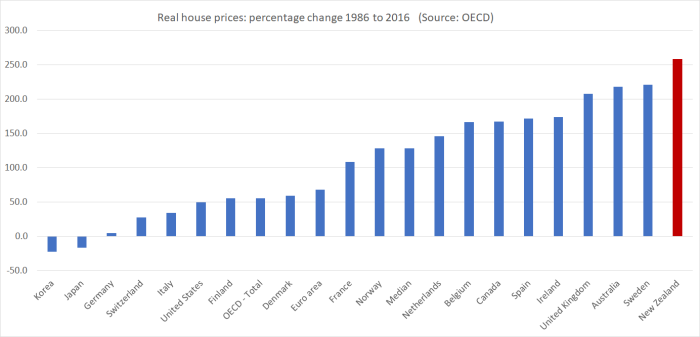
  • and finally, Steven Joyce ran his line that house prices are a global problem.  This seemed to be a variant of the sort of “problems of success” line John Key often ran.  Out of curiosity, I dug out the OECD’s real house prices series this morning.   They don’t have data for quite every country, but here is the change in real house prices from 2007 to 2016 (annual data) for the countries they have the data for.    There are a few countries that have done worse, but not many.  In the median OECD country, real house prices have fallen over the last decade.

house prices last decade

Mostly, the countries that have been about as bad as us have also had quite rapid population growth (Israel, Australia and Luxembourg in the lead on that count) –  not, of course, that either Finance spokesperson suggested doing anything about that.

What about a longer-term comparison.  There are lots of gaps in the OECD data for earlier decades, but here are real house prices increases for the countries they have data for over the three decades to 2016.

house prices since 86

Worst of them all, without even the income growth to match.

We need to face up to the importance of lowering house prices, of adopting policies likely to sustainably make that happen, and – if necessary –  consider compensation packages for some to help make that transition possible.

Submission on the DTI proposals

Submissions close today on the Reserve Bank’s consultation on its proposal to add a debt to income limit tool to the approved list of possible direct controls on bank housing lending.

Despite the Prime Minister’s comments the other day, I don’t regard this as a “dead duck” at all.  The Reserve Bank won’t be coming back to the Minister of Finance with its recommendation, in light of the consultation, until after the election, and who knows what the political or housing market climate will be like by then.  Graeme Wheeler will be gone by then, and so the Reserve Bank’s decision will be in the hands of the (illegally appointed) acting Governor, Grant Spencer, and new Head of Financial Stability (and presumed Governor-aspirant) Geoff Bascand.  Perhaps they will have less appetite for controls than Wheeler has had –  both come from backgrounds that were not particularly keen on direct interventions –  but for now we have to assume that the proposal will continue to move ahead.

As I noted earlier in the week, there is a lot of useful and detailed material in Ian Harrison’s paper on the DTIs, which I gather he is putting in as a submission.

I ummed and aahed about whether to make a submission.  In one sense, it is a pure waste of time, since the Bank is unlikely to grapple very seriously with any points I make.  But, on other hand, it is good to have alternative perspectives, and questions, on the issue out there, and just possibly it might provide some angles for people with a bit more influence than I have.

So I did write a fairly brief submission.  My overview and summary is here

Overview

I am firmly against adding any sort of serviceability restriction (henceforward “DTI”) to the list of possible controls.  The Reserve Bank has failed to mount a convincing case, and has not demonstrated that it (or anyone) has the level of knowledge required for such restrictions to operate in a way likely to make New Zealanders as a whole better off.  Such restrictions would appear to go well beyond the Reserve Bank’s statutory mandate (contributing little or nothing to soundness and eroding the efficiency of the financial system), and a better cost-benefit analysis would in any case suggest that such controls would probably be welfare-detracting.   Other instruments (such as capital requirements and associated risk weights) that do not impinge directly on the borrowing and lending options open to individuals and firms remain a superior way to manage any future risks to the soundness of the financial system.  Serious microeconomic reform remains the best route to fix the serious housing affordability/land price problems.

As a reminder, the Reserve Bank has no statutory mandate to target house prices or the level (or growth rates) of credit in the New Zealand economy.   It also has no “house purchaser or borrower protection” mandate.  Restrictions of the sort proposed in the consultative document would represent serious regulatory over-reach.

The fact that a handful of advanced economies have deployed somewhat similar tools is little comfort or basis for support for the Reserve Bank’s own proposals.  Bad policy elsewhere isn’t a good reason to adopt bad policy here.  But more specifically, the interests of regulators themselves and of citizens are not necessarily, or naturally, well-aligned, a point that Reserve Bank material rarely if ever addresses.  For example, the Reserve Bank makes much of the British and Irish DTI limits (which do not apply to investment properties, where the consultative document says the Reserve Bank would want to focus), but never addresses the institutional incentives facing regulators in those countries following the financial crises each experienced in 2008/09 (the typical regulator incentive in the wake of a crisis to overdo caution –  and “to be seen to be doing something”, in the regulator’s own bureau-protection interests).     On the flip side, neither in the current consultative document nor in past Reserve Bank material has the Bank seriously engaged with the experience of housing loan portfolios in floating exchange rate countries during the 2008/09 crisis.  In countries like ours –  including Australia, Canada, the UK, Norway, Sweden, as well as New Zealand –  residential loan books emerged largely unscathed, despite big credit and housing booms in the prior years, and the subsequent nasty recession and, in most of these countries, a sustained period of surprisingly low income growth.

There has also been no evidence presented that banks have been systematically poor at making and managing portfolios of loans secured by residential mortgage, let alone that citizens should have any confidence in the ability of (and incentives on) regulators to do the job better.    Anyone can suppress overall credit creation with tough enough controls, but to what end, at what cost, to whom?     Controls of the sort now proposed, and the sorts of LVR restrictions already extensively used, seem to represent ill-targeted measures, based on an inadequate model of house and land prices.  They temporarily paper over symptoms –  house prices driven high by the failures of regulation elsewhere require high levels of credit – rather than address the structural causes of the housing market problems.     And because they seem to be premised on a model that wrongly treats credit as a leading factor in the housing market problems, they also do little to address any (limited) financial stability risks.  And in the process, they systematically favour some groups in society over others –  the sorts of distributional choices that, if made at all, should be made only by elected politicians, not by an unelected official.

A reasonable starting proposition would be that in the 25 years prior to the imposition of LVR restrictions the New Zealand housing finance market had been efficient and well-functioning.  Lenders lost little money, more borrowers could get better access to credit than in the earlier regulated decades, borrowers had no need to concern themselves with the changing details of Reserve Bank regulatory restrictions, there were no rewards to special interest group lobbying and rent-seeking, and competitive neutrality among different classes of lending institutions prevailed.  Perhaps the Reserve Bank would disagree with that characterisation of the market, but if so then, in proposing still further extensions of its regulatory intervention powers, surely the onus should be on you to make your case, not simply to ignore the past, apparently successful, experience?

Anyone interested can read the whole document here

Submission to RBNZ consultation on DTI proposal Aug 2017

The DTI proposal is a tool to address, inefficiently, a problem that isn’t there (threats to the soundness of the financial system), while appearing to try to do something about an actual serious problem (house and urban land prices), of successive governments’ making, about which the DTI tool can do little or nothing useful.  It won’t help, and if anything it distracts attention from the real issues, and from those really responsible, for the disaster that is the New Zealand housing “market”.

LVR restrictions

The successive waves of LVR controls that the Reserve Bank Governor has imposed on banks’ housing lending in recent years are back in the headlines, with comments from both the Prime Minister and the Leader of the Opposition (here and here).

As readers know, I’m no defender of LVR restrictions.  The other day I summarised my position this way

I never favoured putting the successive waves of LVR restrictions on in the first place.  They are discrimatory –  across classes of borrowers, classes of borrowing, and classes of lending institutions –  they aren’t based on any robust analysis, as a tool to protect the financial system they are inferior to higher capital requirements, they penalise the marginal in favour of the established (or lucky), and generally undermine an efficient and well-functioning housing finance market, for little evident end.  Oh, and among types of housing lending, they deliberately carve-out an unrestricted space for the most risky class of housing lending –  that on new builds.

You’d never know, from listening to the Governor or reading the Bank’s material, that New Zealand banks – like those in most other floating exchange rate countries –  appear to have done quite a good job over the decades in providing housing finance and managing the associated credit risks.   We had a huge credit boom last decade, followed by a nasty recession, and our banks’ housing loan book –  and those in other similar countries –  came through just fine.

The Bank’s statutory mandate is to promote the soundness and efficiency of the financial system.  On soundness, successive (very demanding) stress tests suggest that there is no credible threat to soundness, while the efficiency of the system is compromised at almost every turn by these controls.

At a more micro level, this comment (from my post yesterday) about the Bank’s debt to income limit proposals is just as relevant to the actual LVR controls they’ve put on in successive waves.

Much of the case the Reserve Bank seeks to make for having the ability to use a debt to income limit rests on the assumption that banks don’t do risk management and credit assessment well and that, inevitably crude, central bank interventions will do better.  The Bank’s consultation paper makes little or no effort to engage on that point at all.  It provides no evidence, for example, that the Reserve Bank has looked carefully at banks’ loan origination and management standards, and identified specific –  empirically validated –  failings in those standards.  Neither has it attempted to demonstrate that over time it and its staff have an –  empirically validated –  superior ability to identify and manage risks appropriately.

For all that, in partial defence of the LVR controls right now, many of those who are calling for the controls to be lifted or eased seem to be giving all the credit (or blame) for the current pause in housing market activity to the LVR controls.   That seems unlikely.  Other factors that are probably relevant include rising interest rates, self-chosen tightening in banks’ credit standards, pressure from Australian regulators on the Australian banking groups’ housing lending, a marked slowdown in Chinese capital outflows, and perhaps some election uncertainty (Labour is proposing various tax changes affecting housing).  I don’t know how much of the current slowdown is explained by each factor, but then neither do those focusing on the LVR controls.   Neither does the Reserve Bank.

And the backdrop remains one in which house price problems haven’t been caused mostly by credit conditions, but by the toxic brew of continuing tight land use restrictions (and associated infrastructure issues) and continuing rapid population growth.     Those two factors haven’t changed, so neither has the medium-term outlook for house and land prices.  Political parties talk about improving affordability, but neither main party leader will openly commit to a goal of falling house prices, and neither main party’s policies will make much sustained difference to the population pressures.   A brave person might bet on  some combination of (a) a recovering Australian economy easing population pressure, and (b) talk of abolishing limits around Auckland actually translating into action and much more readily useable land.  It’s a possibility, but so is the alternative –  continued cyclical swings around a persistently uptrend in the price of an artificially scarce asset.

And thus, in a sense, the Reserve Bank has a tiger by the tail.  House prices are primarily a reflection of serious structural and regulatory failures, and the problem won’t just be fixed by cutting off access to credit for some, or even by just buying a few months breathing space until a few more houses are built (before even more people need even more houses).   This isn’t a “bubble”, it is a regulatorily-induced severely distorted market.

So I strongly agree with the Prime Minister that, having repeatedly sold the LVR controls as temporary, the Reserve Bank Governor really needs to lay down clear and explicit markers that would see the controls be wound back and, eventually, removed completely.     And yet how can the Governor do that in any sensible way?   After all, the underlying problem wasn’t credit standards, or even overall credit growth.  It appeared to be simply that the Governor thought that he should “do something” to try and have some influence on house prices, even though he (a) had no good model of house prices in the first place, and (b) his tool didn’t address causes at all, and bore no relationship to those causes –  it was simply a rather arbitrary symptom-suppression tool.  And the Reserve Bank knew that all along –  they never claimed LVR controls would do much to house prices for long.

Because the interventions weren’t well-designed, any easing or removal of the controls will inevitably be rather arbitrary, with a considerable element of luck around how the removal would go.   What sort of criteria might they lay out?

  • a pause in house prices for a couple of years?  Well, perhaps, but as everyone knows no one is good at forecasting cyclical fluctuations in immigration.  Take off the LVR controls and, for unrelated reasons, house price pressures could still return very quickly,
  • housing credit growth down to, say, the rate of growth of nominal GDP for a couple of years.  But there isn’t much information in such a measure, as the stock of housing credit is mostly endogenous to house prices (high house prices require a higher stock of credit).

The latest set of restrictions seemed to be motivated as much by a distaste for investor buyers as by any sort of credit or systemic risk analysis, so it isn’t clear what indicators they could use to provide markers for winding back the investor-lending controls.  And since the Bank has never documented the specific concerns about banks’ lending standards that might have motivated the controls in the first place, it isn’t obvious that they could easily lay out markers in that area either.  Since the controls were never well-aligned with the underlying issues or risks, it seems likely that any easing won’t be able to be much better grounded –  almost inevitably it will be as much about “whim” and “taste” as anything robust.  Unless, that is, the incoming Governor simply decides they are the wrong tool for the job, and decides to (gradually) lift them as a matter of policy.   Doing so would put the responsibility for the house price debacle where it belongs: with politicians and bureaucrats who keep land artificially scarce, and at the same time keep driving up the population.

Some have also taken the Prime Minister’s comments as ruling out any chance of the Reserve Bank’s debt to income tool getting approval from the government.  I didn’t read it that way at all.

But he [English] explicitly ruled out giving the bank the added tool of DTIs, which it had requested earlier in the year.

“We don’t see the need for the further tools, Those are being examined. If there was a need for it then we’re open to it, but we don’t see the need at the moment. We won’t be looking at it before the election.”

As even the Governor isn’t seeking to use a DTI limit at present (only add it to the approved tool kit), and as submissions on the Bank’s proposal haven’t yet closed, of course the government won’t be looking at it before the election (little more than a month away).  It will take at least that long for the Reserve Bank to review submissions and go through its own internal processes.  In fact, at his press conference last week Graeme Wheeler was explicitly asked about the DTI proposal, and responded that it would be a matter for his (acting) successor and the new Minister of Finance to look at after the election.    Perhaps the Prime Minister isn’t keen, but his actual comments yesterday were much less clear cut on the DTI proposal than they might have looked.

In many ways, the thing that interested me most in yesterday’s comments was the way both the Prime Minister and the Leader of the Opposition seemed to treat decisions on direct interventions like LVR or DTI controls as naturally a matter for the Reserve Bank to decide.

The Prime Minister’s stance was described by interest.co.nz as

However, he again reiterated that relaxing LVR restrictions was a matter for the Reserve Bank. “I’m not here to tell them what to do.” English said government was not going to make the decision for them and that he did not want to give the public the impression that politicians could decide to remove them. “The Reserve Bank decides that.”

The Leader of Opposition similarly

“But we’ve not proposed removing their ability to set those…use those tools,” Ardern said. “We’re not taking away their discretion and independence.”

Both of them accurately describe the law as it stands.  The Reserve Bank –  well, the Governor personally –  has the power to impose such controls.    But there isn’t any particularly good reason why the Reserve Bank Act should be written that way.

The case for central bank independence mostly relates to monetary policy.  In monetary policy, there is a pretty clearly specified objective set by the politicians, for which (at least in principle) the Governor can be held to account.  In our legislation, the Governor can only use indirect instruments (eg the OCR) to influence things –  he has not direct regulatory powers that he is able to use.

Banking regulation and supervision are quite different matters.  I think there is a clear-cut argument for keeping politicians out of banking supervision as it relates to any individual bank –  we don’t want politicians favouring one bank over another, and we want whatever rules are in place applied without fear and favour.  In the same way, we don’t want politicians making decisions that person x gets a welfare benefit and person y doesn’t.  But the rules of the welfare system itself are rightly a matter for Parliamant and for ministers.

There isn’t compelling reason why things should be different for banking controls (and, in fact, things aren’t different for non-bank controls, where the Governor does not have the same freedom).  As my former colleague Kirdan Lees pointed out on Morning Report this morning, when it comes to financial stability and efficiency, there are no well-articulated specific statutory goals the Reserve Bank Governor is charged with pursuing.  That gives the holder of that office a huge amount of policy discretion –  a lot more so than is typical for public sector agencies and their chief executives – and very little effective accountability.    So when Ms Ardern says that she doesn’t propose to take away the Bank’s discretion or independence, the appropriate response really should be “why not?”.

We need expert advisers in these areas, and we need expert people implementing the controls and ensuring that different banks are treated equitably, but policy is (or should be) a matter for politicians.  It is why we have elections.  We get to choose, and toss out, those who make the rules.  It is how the system is supposed to work –  just not, apparently, when it comes to the housing finance market.

I’ve welcomed the broad direction of the Labour Party’s proposal to shift to a committee-based decisionmaking model for monetary policy.   But, as I noted at the time of the release, their proposals were too timid, involved too much deference to the Governor (whoever he or she may be), and simply didn’t even address this financial stability and regulatory aspects of the Bank’s powers.      There is a useful place for experts but –  especially where the goals are vague, and the associated controls bear heavily on ordinary citizens –  it should be in advising and implementing, not in making policy.   Decisions to impose, or lift, LVR controls or DTI controls should –  if we must have them at all – be made by politicians whom we’ve elected, not by a single official who faces almost no effective accountability.


Misconceived and deeply flawed

Later this week submissions close on the Reserve Bank Governor’s attempt to get the some sort of debt to income restriction added to the list of possible direct controls on banks upon which the government has bestowed its favour.  (I write it in that slightly awkward way because, by law, the Governor does not need the Minister’s permission at all –  Parliament, somewhat recklessly, appears to have given all those powers to the Governor personally, but a few years ago the Governor committed to only using restrictive tools that the government had approved of.)

This would be the latest in the series of direct interventions by which the Reserve Bank has been undermining the effectiveness and efficiency of the housing finance market.  For now, the (outgoing) Governor says he wouldn’t apply a debt to income restriction even if he had the Minister’s imprimatur.  But all it will need will be another rebound in the property market and Wheeler would no doubt be keen.  Whether his permanent successor next year shares that enthusiasm is, I would hope, something the Board and the (next) Minister turn their minds to in considering possible candidates for Governor.

I probably will put in a submission, but if so it will overlap in many areas with the paper just published by my former colleague (now Tailrisk Economics) Ian Harrison.    Ian spent many years in the prudential supervisory wing of the Reserve Bank and led the work on risk modelling that has underpinned the Bank’s positions on capital, risk weights etc.  He has previously written and published his critical analysis on the Reserve Bank’s decision to treat residential mortgage loans owed by investors as riskier than the same loan on the same security when owed by owner-occupiers.  It was published under the somewhat provocative title House of Cards – and I wrote about it here.

His new paper on the proposal to have a debt to income instrument available doesn’t have a provocative title.   But it is no less forceful in its conclusions.  Here is the bulk of Ian’s press release

A report by Tailrisk Economics on the Reserve Bank’s justifications for possibly imposing debt to income (DTI) limits on housing lending, shows that that they are deeply flawed.

The main problem is that the DTI is a crude tool that does not adequately assess borrowers’ debt servicing capacities, and which will perversely target better quality loans.

“The Reserve Bank has presented no substantive evidence that higher DTI loans are ‘excessively’ risky, or that a DTI ratio of 5 is a sensible cut-off,” said Ian Harrison, Principal of Tailrisk Economics, “but there is significant evidence that DTIs do not predict loan defaults, or reduce the likelihood or severity of crises”. The European Systemic Risk Board found, in a recent assessment of GFC performance, that DTI levels did not have any “relevant effect either on the prediction of the crisis or on the depth of the crisis” .

The application of the DTI limit to investor loans, which are the primary focus of the policy, is particularly misconceived, because DTI limits are only intended to apply to owner occupier borrowers. The DTI measure assumes that when investor purchases a new property their living expenses increase. “This simply does not make sense”, Harrison commented.

The effect of the policy could be to impose an effective LVR limit as low as 30 percent on professional investors.  No other country has imposed DTI restrictions on investor loans.

“Higher future interest rates do not pose a material systemic risk, providing the conduct of monetary policy is competent”  Harrison added. “Further, the Bank’s assessment that the restrictions would have a net welfare benefit, is very optimistic. Our assessment is that they will have  a welfare cost, like most misconceived quantitative interventions.”

Much of the case the Reserve Bank seeks to make for having the ability to use a debt to income limit rests on the assumption that banks don’t do risk management and credit assessment well and that, inevitably crude, central bank interventions will do better.  The Bank’s consultation paper makes little or no effort to engage on that point at all.  It provides no evidence, for example, that the Reserve Bank has looked carefully at banks’ loan origination and management standards, and identified specific –  empirically validated –  failings in those standards.  Neither has it attempted to demonstrate that over time it and its staff have an –  empirically validated –  superior ability to identify and manage risks appropriately.

One of the Reserve Bank’s bugbears is that while the current lending practices may look broadly okay at current interest rates, those same loans will look rather less sound if interest rates rise considerably.  Of course, banks already take into account the resilience of each borrower, including their ability to cope with unexpected changes in servicing costs.    I wrote about this in my post on the most recent FSR.

… there was something a little odd in the box the Bank included on “Vulnerability of owner-occupiers to higher mortgage rates“, clearly softening us up for the consultation paper on debt to income ratios.  They argue that

New Zealand is particularly vulnerable to a sharp rise in mortgage rates as the banking system funds a large proportion of its mortgage credit from offshore wholesale markets. The cost of this funding can increase sharply if there is an unexpected increase in global interest rates or a change in investor risk appetite, and banks are likely to pass on the higher funding costs to customers through higher mortgage rates.

But mostly this is just untrue.  The Reserve Bank sets the OCR in New Zealand based on overall inflation pressures in New Zealand.  If funding spreads rise –  as they did in 2008/09 –  and domestic inflation pressures don’t the Reserve Bank can easily offset most or all of the potential impact on retail interest rates by lowering the OCR.    That is what happened in 2008/09.

Of course, retail interest rates can rise, quite materially.  As the Bank points out, new floating mortgages rose from “around 7 per cent to over 10 per cent between early 2004 and 2007”.  Of course, as we used to stress at the time, fixed mortgage rates rose nowhere near that much.  But, more importantly, interest rates here didn’t rise because foreign rates were rising, but because the economy was cyclically strong, unemployment was low and falling, and wage and price inflation were increasing.  Wages rose roughly 20 per cent in that period.

It is fine and good for the Reserve Bank to do these sorts of stress-testing exercises, looking at what happens if interest rates rise to 7 per cent, or 9 per cent.  But in any realistic assessment, those sorts of substantial increases are only remotely likely if the economy is doing really cyclically well.  If jobs are readily available and wages are rising, not many people will be under that much stress even if interest rates rise quite a lot.  And those that are should quite readily be able to sell their house and move on.  It might be painful for them, but it simply isn’t a financial stability event.

Ian makes many of the same points, including

Financial  stability  will  only  be  threatened  if  there  is  a  large  number  of  borrowers   who  can  not  service  their  loans,  and  if  there  is  a  material  fall  in  house  prices.      If   house  prices  hold  up  through  the  interest  rate  cycle  then  borrowers  who  come   under  servicing  pressure  will  generally  be  able  to  resolve  their  problem  by  selling  the   house.  A  systemic  problem  only  starts  to  arises  if  the  interest  rate  increases  cause  a   large  fall  in  house  prices.    However,  if  this  did  occur  then  RBNZ  could  readily  respond   by  reducing  the  OCR.  It  is  almost  inconceivable  that  a  large  house  price  shock  would   not  feed  through  into  broader  economic  activity,  and  into  the  inflation  rate,  which   would  naturally  require  a  monetary  policy  response.    Mortgage  interest  rate  would   fall  and  the  pressure  on  borrowers’  servicing  capacity  would  be  relieved.

He also rightly highlights how unusual it is to propose including investor loans in a debt to income limit.  The Reserve Bank likes to highlight the debt to income limits adopted by the United Kingdom and Ireland, but simply hasn’t engaged with the fact that neither country includes investor loans in its limits.   Of the Bank of England Ian notes

The  Bank  of   England  has  the  legal  capacity  to  apply  DTI  limits  to  investor  lending,  but  has  not  done  so,   because  the  retail  DTI  limits  do  not  readily  translate  to  investor  lending.  Instead  the  Bank   requires  banks  to  meet  minimum  qualitative  standards  in  their  affordability  assessments.  In   addition,  banks  are  required  to  apply  a  2  percentage  point  stress  test  to  the  interest  cost   assessment,  and  the  test  rate  must  be  at  least  5.5  percent.  Where  buy-­‐to-­‐let  borrowers  rely   on  other  income  to  support  the  loan,  account  must  be  taken  of  taxation  and  living  costs.  This   is  basically  the  methodology  that  New  Zealand  banks  apply  to  retail  investment  lending.   There  are  no  further  quantitative  restrictions  such  as  times  interest  cover.  This  is  left  to   individual  bank’s  assessments.

In its assessment of submissions, the Reserve Bank should really be expected to provide rather more justification for the inclusion of investment loans than it has done to date.

Ian concludes his press release this way

“There are simpler, and less distortionary, ways of targeting ‘excessive’ house price rises, which appears to be the Bank’s primary motivation for DTI restrictions,” Harrison said. “Banks could be required to apply a prescribed higher test interest rate to affordibilty assessments.  This would provide the Reserve Bank with an interest rate policy tool that can be directed to imbalances in the housing market.”

His is a pragmatic response.   Mine is perhaps more hardnosed –  and perhaps less “realistic”.  It is no business of the Reserve Bank to be targeting house prices, targeting whether investors or owner-occupiers are buying, or even targeting levels of household debt.  Apart from anything else, they have no robust model of the housing market, or of the incidence of financial crises, and without those all they appear to have is gubernatorial whim, or the shifting winds of political preferences.  That is no basis for sound public policy.     The Bank –  and its political masters –  needs to be reminded of its mandate in this area: to promote the soundness and the efficiency of the financial system.  Direct controls that apply to one set of lenders and not others, to one set of loans and not others, to one class of borrowers but not others, are quite simply inferior on both limbs of that mandate to reliance on indirect instrument, such as capital standards, stress tests, and a deeply informed understanding of how banks are measuring, monitoring and managing risk.   To their credit, banks in countries like ours appear to have done a good job in recent decades of managing housing loan books.  It is a shame that the same cannot be said of the central and local government politicians and officials who have regulated urban land markets to the point where a house purchase is an increasingly impossible dream for too many of our fellow citizens.    How did we allow such disastrous outcomes?

Anyway, for anyone interested in the DTI proposal I’d commend Ian’s paper.  I don’t agree with everything in it, but is a detailed review of many of the relevant issues, and of the “evidence” the Reserve Bank seeks to rely on.  I hope that, for example, the Treasury will pay careful attention when they formulate their advice on the Reserve Bank inevitable (regardless of this “consultative process”) bid for approval to add debt to income limits to their toolkit of direct controls.


LVRs, interest rates and so on

I was recording an interview earlier this afternoon, in which the focus of the questioning was the Real Estate Institute’s call for some easing in the Reserve Bank’s LVR restrictions.

Of course, I never favoured putting the successive waves of LVR restrictions on in the first place.  They are discrimatory –  across classes of borrowers, classes of borrowing, and classes of lending institutions –  they aren’t based on any robust analysis, as a tool to protect the financial system they are inferior to higher capital requirements, they penalise the marginal in favour of the established (or lucky), and generally undermine an efficient and well-functioning housing finance market, for little evident end.  Oh, and among types of housing lending, they deliberately carve-out an unrestricted space for the most risky class of housing lending –  that on new builds.

That doesn’t mean I think it is remotely likely that the Reserve Bank will be easing the restrictions any time soon –  apart from anything else, it would leave their consultation paper on debt to income ratio restrictions looking a little silly.   Of course, it would be good if the Reserve Bank did lay out some specific criteria for lifting these ostensibly temporary restrictions, but with the toxic brew of rapid population growth and continuing land use restrictions in place, if I saw the world as they seem to, I wouldn’t be in a hurry to lift the restrictions either.

In any case, it isn’t that clear quite how large a role the LVR restrictions are playing in the reduction in sales volumes.   They must be playing a part, but so too will higher interest rates, and the apparent increase in banks’ own lending standards, and pressure through the parents from APRA (on the lending standards across the whole of Australian banking groups).  Which, of course, is also why it isn’t clear quite how much difference any easing back in the New Zealand LVR controls might make.  Some presumably, but even the Reserve Bank has never claimed that LVR controls would have a very large impact on house prices, or housing market activity, for very long.   And while I noticed an article this morning about negative equity, it is worth bearing in mind that, on the REINZ index (not using median prices), house prices have risen 65 per cent in the last five years, and are currently 0.6 per cent off their peak.

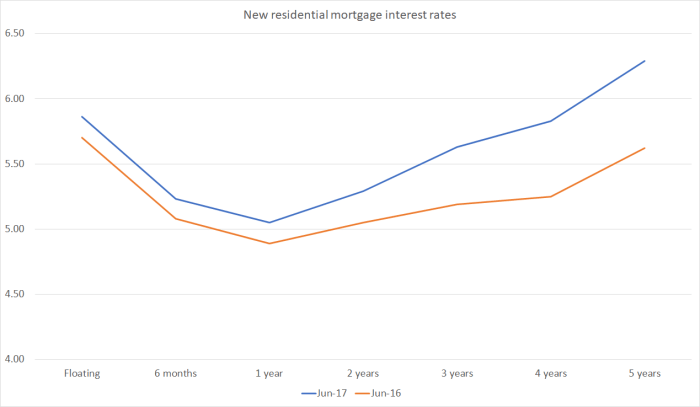
But what of interest rates?  A year ago, the OCR was 2.25 per cent, and today it is 1.75 per cent.  Thus, the Reserve Bank talks of having eased monetary policy.   Here are mortgage rates though.

mortgage ratesI don’t suppose anyone is taking out four or five year fixed rate mortgages, but across the entire curve, interest rates are higher not lower.   Or we could go back another year or so, to just prior to when the Reserve Bank began cutting the OCR.   The OCR has been cut by 175 basis points since then.   Even at the shortish end of the mortgage curve, rates are down only 50-70 basis points.
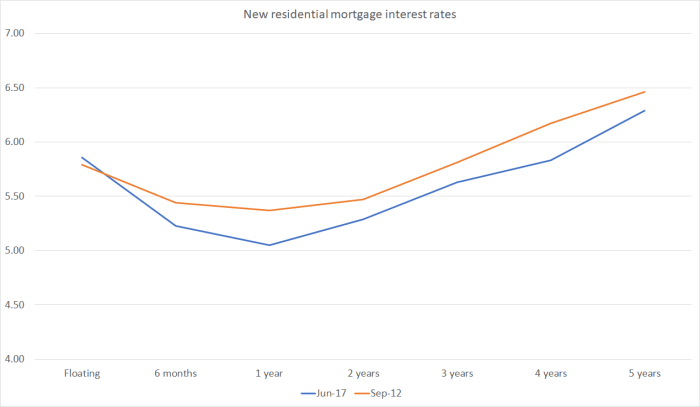
Having been reflecting this morning on Graeme Wheeler’s performance over his term, I had a look back at where interest rates were when Wheeler took office in September 2012.

mortgage rates sept 12Barely lower, even though core inflation –  on their own favoured measure – is as low today as it was then (and has been consistently low throughout his term).

I wondered if there were offsetting factors but:

  • Two year ahead inflation expectations are about 25 basis points lower than they were then (largely offsetting any reductions in nominal mortgage rates, to leave real rates little changed)
  • the TWI measure of the exchange rate is a bit higher than it was then,
  • the ANZ commodity price index, in inflation-adjusted world price terms, is hardly changed from what it was then.

Of course, the unemployment rate has fallen since September 2012, but there hasn’t been any sign of a pick-up in the best indicator of labour scarcity –  real wage inflation.

So, overall, it is a bit of a puzzle how the Governor expected to get core inflation back to fluctuating around the target midpoint without actually easing monetary conditions.  I don’t happen to agree with him on this one, but he keeps talking about how the huge migration inflows have reduced net inflation pressures (supply effects outweighing the demand effects).  If he really believes that it is even more puzzling that monetary conditions haven’t been eased.

I’m not sure how he’d respond.  But perhaps he could explain that too in the forthcoming speech.


WCC approach to housing problems: hot-bedding

I think the imported chief executive of the Wellington City Council, Kevin Lavery –  he of non-transparent subsidies to Singapore Airlines, and the like – must have pushed “send” on an email to staff without checking just who he was sending it to.   My household just received two copies, on two different email addresses, of what looks a lot like a staff email.  Since we used those two email addresses to make our separate submissions last night on the Island Bay cycleway –  and the Council otherwise wouldn’t have one of the addresses –  it looks as though he sent his staff email to online responders to the cycleway proposals

Most of it looks harmless enough, although it was wryly amusing to note the self-congratulation about the Council’s Annual Report

Congratulations to everyone involved with our 2015/16 Annual Report, which received a silver medal at the Australasian Reporting Awards. The award is a reminder that the public documents we produce are not just about our performance as an organisation – they are also an opportunity to communicate effectively with our stakeholders.

When this is the same Council that simply refuses to comply with the Official Information Act, in its local government manifestation.   Self-promotion, rather than transparency, is rather more like the hallmark of the council.

But included in the email was a “Good Reads” section, with links to various articles on housing and cities related issues.    Perhaps next time he could make room for Brendon Harre’s interesting new piece on “Successful cities understand spatial economics”. Out of interest, I did click on one of the links, described this way

Some interesting ideas from outside of New Zealand at possible solutions to housing affordability issues. I like this because it looks, with a different lens, at the challenge of providing adequate, secure and affordable housing and suggestions for tackling them.

Sounded promising.

But I was somewhat taken aback by what I found, in an article championed by the chief executive of a Council that is keen on promoting Wellington as a cool, successful, and prosperous city.

The author –  a freelance writer in the US –  is writing about a report from something called the World Resources Institute, on housing options.  Not mind, housing policy options for advanced countries, but for

the global south (India, Africa, Asia, Latin America) where the lack of affordable, adequate and secure housing in cities is projected to grow the fastest.

We are told that

The paper spotlights three key challenge areas “to providing adequate, secure and affordable housing in the Global South,” as well as suggestions for tackling them. They include the growth of informal or substandard settlements (i.e., slums), policies and laws that push poorer residents out of the city, or to its fringes, and, interestingly, an overemphasis on home ownership.

The authors apparently favour skewing the tax system to “incentivise renting”.

It gets worse

Beyond the policy-side, however, it also looks at a number of creative rental models, from land leases and co-ops to lump-sum rentals, which are popular in a number of Asian countries, including Thailand, China and India. …… The paper also makes a case for a practice known as “hot bedding,” in which “a bed space in a shared room is rented for a specific number of hours to sleep, typically 7 to 10 hours.”

Hot-bedding………

In conclusion,

“Promoting a range of rental housing options expands opportunities for more renters while testing which types of rentals best meet local demand,” the authors conclude.

I’m all for flexibility, but does the chief executive of the Wellington City Council really think that “hot bedding” is an appropriate or desirable solution for the increasingly unaffordable Wellington housing market?   Is his vision of the city he temporarily serves now so diminished he regards the growth of slums as the sort of pragmatic idea his staff should be interested in, to fix the mess the Council itself has created?

To be clear, I’m sure Mr Lavery believes none of those things.  And perhaps they are reasonable and practical partial solutions in very poor but rapidly urbanising countries.  But what does it tell us about his mindset – and that of his political masters –  that this is the sort of stuff he is encouraging his staff to read?    Most New Zealanders –  most Wellingtonians –  want to own their place.  They don’t have much tolerance for imported bureuacrats who think that home ownership

in many economies just takes up too much mental bandwidth

They are just excuses for the decades-long failure by New Zealand central and local governments.

Free up the land use rules instead. There is plenty of land in greater Wellington, but owners simply aren’t encouraged, or even allowed, to use it.  And look for creative ways of allowing greater density where people would prefer that, but in ways that respect the interests of current owners.  Above all, look and sound as if you think Wellington might have a future as a first world city, in which residents –  present and future –  might be able to buy good quality housing at genuinely affordable prices.

But “hot-bedding”………I still can’t quite believe it.  But it was good of Mr Lavery to send his email to (presumably) the wrong list of recipients, and thus shed further light on the sort of mindset that prevails at council headquarters.

UPDATE: While I was typing that another email arrived

For those of you who’ve unexpectedly received an email from Wellington City Council – we apologise profusely! The message from our Chief Executive was meant to be a routine communication to Council staff but we’ve hit the wrong button and so it’s received a considerably wider audience. Hopefully it provides a positive, albeit unintended, glimpse inside the engine-room of the Council.

“Positive” –  I think not.


A fresher approach for ordinary New Zealanders

I’m as fascinated by the rise of Jacinda Ardern as any other political junkie.  I’ve always been a bit puzzled, struggling to see what issue she has led or what blows she had managed to land on the government.    Then again, she seems to have something different –  perhaps even more electorally important.   I’ve been dipping into accounts of Bob Hawke’s rise –  the last case I’m aware of that where major opposition party changed leaders close to an election (in that case only four weeks out) and won.     It isn’t clear that Bob Hawke was a better Prime Minister than Bill Hayden might have been, or that David Lange was a better Prime Minister than Bill Rowling would have been, but in both cases the new leaders had something –  a degree of connection, engagement etc –  that the deposed leaders didn’t.     Reading the accounts of the last weeks of Bill Hayden’s leadership of the ALP, the party had become as disheartened and lacking belief in its own ability to win (despite still leading in the polls), as some suggest the New Zealand Labour Party had become.    Quite what the Ardern phenomenon amounts to I guess we’ll see over the next few weeks.  From her comments so far, I could imagine her campaigning as Hawke did –  both the upbeat theme of “reconciliation”, and the more cynical description in (sympathetic) leading Australian journalist Paul Kelly’s book “no avenue of vote-buying or economic expansion was left untouched”.

For now, we are told that the “Fresh Approach” slogan is apparently out, and a new slogan and some new policies are soon to be launched.  Since no party really seemed to be campaigning on policies that might make a real and decisive for ordinary New Zealanders’ prospects, in many respect a fresher approach should be welcome.  Of course, it rather depends what is in that policy mix.

My interests here are primarily economic.  In an interview with the Dominion-Post this morning, the journalist put it to Ardern that “National will campaign on its economic record. Is that where Labour is weak?”.     Perhaps it is Labour’s weak point.  But what sort of “record” is the government to campaign on?  An unemployment rate that, while inching down, has been above the level it was when they took office –  already almost a year into a recession –  every single quarter of their entire term?  An economy that has had no productivity growth for almost five years?     House prices that, in our largest city, have gone through the roof?  Exports that are shrinking as a share of GDP?    And, at best, anaemic per capita real GDP growth?   If it is a weakness for Labour, it must be in large part because (a) their messaging has been terrible, and (b) nothing they offer seems likely to make any very decisive difference to the mass of ordinary New Zealanders.

What might?   Here’s my list of three main sets of proposals.    An effective confident radical Labour Party could offer the public these sorts of measures –  in fact, on some points arguably only a left-wing party could effectively do so (Nixon to China, and all that).

  1. A serious commitment to cheap urban land and much lower construction costs.
    • In a country with abundant land, urban land prices are simply scandalous.   The system is rigged, intentionally or not, against the young and the poor, those just starting out.  Too many of Jacinda Ardern’s own generation simply cannot afford to buy a house.
    • To the extent that there are poverty and inequality issues in New Zealand, many of them increasingly trace back to the shocking unaffordability of decent housing.   With interest rates at record lows, housing should never have been cheaper or easier to put in place.
    • And yet instead of committing to get land and house prices down again, the Labour Party has been reluctant to go beyond talk of stabilising at current levels.  Talk about entrenching disadvantage……(and advantage).
    • It is fine to talk about the government building lots of houses, but the bigger –  and more fundamental –  issue is land prices.  It is outrageous, and should be shameful, for people to be talking of “affordable” houses of $500000, $600000 or even more, in a country of such modest incomes.  International experience shows one can have, sustainably, quite different –  much better –  outcomes, but only if the land market is substantially deregulated.
    • I don’t have any problem if people want to live in denser cities –  I suspect mostly they don’t –  but it is much easier and quicker to remove the boundaries on physical expansion of cities (while putting in place measure for the associated infrastructure).   Labour’s policy documents have talked of moves in this direction –  as National’s used to do –  but it is never a line that has been heard from the party leader.     If –  as I propose –  population growth is cut right back, there won’t be much more rapid expansion of cities, but make the legislative and regulatory changes, and choice and competition will quickly collapse the price of much urban, and potentially developable, land.
    • It is clear that there is also something deeply amiss with our construction products market –  no one seriously disputes that basic building products are much more expensive here than in Australia or the US.  Make a firm commitment to fix this.  Perhaps it involves Commerce Commission interventions (supported by new legislation?)?  Perhaps it might even involve –  somewhat heretically –  a government entity entering the market directly.     But commit to change, to producing something far better for New Zealanders.
    • The vision should be one in which house+land prices are quickly –  not over 20 years –  headed back to something around three times income.  A much better prospect for the next generation.
    • No one will much care about rental property owners who might lose in this transition –  they bought a business, took a risk, and it didn’t pay off.  That is what happens when regulated industries are reformed and freed up.    It isn’t credible –  and arguably isn’t fair –  that existing owner-occupiers (especially those who just happened to buy in the last five years) should bear all the losses.   Compensation isn’t ideal but even the libertarians at the New Zealand Initiative recognise that sometimes it can be the path to enabling vital reforms to occur.  So promise a scheme in which, say, owner-occupiers selling within 10 years of purchase at less than, say, 75 per cent of what they paid for a house, could claim half of any additional losses back from the government (up to a maximum of say $100000).  It would be expensive but (a) the costs would spread over multiple years, and (b) who wants to pretend that the current disastrous housing market isn’t costly in all sorts of fiscal (accommodation supplements) and non-fiscal ways.
  2. Deep cuts in taxes on business and capital income
    • the political tide is running the other way on this one –  calls for increased taxes on foreign multi-nationals and so on –   but it remains straightforwardly true that taxes on business activity are borne primarily not by “the rich”, but by workers, in the form of lower incomes than otherwise.  So if you really care about New Zealand workers’ prospects, cut those taxes, deeply.
    • and one of the bigger presenting symptoms of New Zealand’s economic problems is relatively low levels of business investment.   Taxes aren’t the only thing businesses  –  and owners of capital  –  think about, but they are almost pure cost.   Tax a discretionary activity and you’ll get a lot less of it.   That is especially true as regard foreign investment –  those owners of foreign capital have no need to be here if the after-tax returns aren’t great.  For all the (mostly misplaced) concerns about sovereignty, foreign investment benefits New Zealanders –  ordinary working New Zealanders.     Cut the tax rates on such activity  –  they are already higher than in most advanced countries –  and you’ll see more of it taking place.    More investment, and higher labour productivity, translates into meaningful prospects of much higher on-market wages –  the sorts of wages they have in the advanced countries we were once richer than.
    • simply cutting the company tax rate will make a material difference to potential foreign investors.   It won’t make much difference for New Zealanders’ looking to build or expand businesses here, because of our imputation system    That’s why I’ve argued previously for adopting a Nordic system of income taxation  –  in which capital income is taxed at a lower rate than labour income.  Note the description –  it is a system not run in some non-existent libertarian “paradise” but in those bastions of social democracy, the Nordic countries.  Not because they want to advantage owners of capital over providers of labour, but because the recognise the well-established economic proposition that taxes on capital are mostly borne in the former of lower returns to labour.
    • some argue against cuts to business taxes on the grounds that it will provide a windfall to firms (especially foreign firms) already operating here.  Mostly, that is false.  It might be true if foreign firms dominated our tradables sector –  where product selling prices are set internationally.  But in New Zealand, foreign investment is much more important in the non-tradables sectors.  Cut taxes on, say, the banks, and you’ll find the gains being competed away, flowing back to New Zealand firms and households in lower fees and interest margins.  If for some reason it doesn’t happen, feel free to invoke the Commerce Commission (and/or expand its powers).
    • much lower business taxes should be a no-brainer for an intellectually self-confident centre-left party serious about doing something about long-term economic underperformance and lifting medium-term returns to labour.     I’m not really a fan of capital gains taxes, but if you need political cover promise a well-designed CGT –  it probably won’t do much harm, especially if you take seriously the goal of delivering much cheaper houses and urban land (see above –  there won’t be many housing capital gains for a long time).
  3. Deep cuts to target levels of non-citizen immigration
    • This item might be entirely predictable from me, but it is no less important for that.    Labour started out with some rhetoric along these lines, but as I’ve noted previously what they actually came out with was a damp squib, that would change very little beyond a year or so.   So
      • Cut the number of annual residence approvals to 10000 to 15000 per annum –  the same rate, per capita, as in Barack Obama’s (or George Bush’s) United States,
      • Remove the existing rights of foreign students to work in New Zealand while studying here.
      • Institute work visa provisions that are  (a) capped in length of time (a single maximum term of three years, with at least a year overseas before any return on a subsequent work visa) and (b) subject to a fee, of perhaps $20000 per annum or 20 per cent of the employee’s annual income (whichever is greater).
    • In substance, you will be putting the interests of New Zealanders first, but you will also strongly give that impression –  a good feature if you are serious about lifting sustained economic performance, while being relentlessly positive about it, and about your aspirations for New Zealanders.
    • Change in this area would immediately take a fair degree of pressure off house prices, working together with the structural housing/land market reforms (see above) to quickly produce much much more affordable houses and land.  Markets trade on expectations –  land markets too.
    • You’ll also very quickly alter the trajectory of urban congestion –  those big numbers NZIER produced in a report earlier this week.
    • But much more importantly in the longer-term, you’ll be markedly reducing the pressures that give us persistently the highest real interest rates in the advanced world, and
    • In doing so you’ll remove a lot of pressure from the exchange rate.  Lets say the OCR was able to be reduced to around typical advanced country levels (say 0.25 per cent at present).  In that world, the NZD offers no great attraction to foreign (or NZ institutional) holders – it is just one of many reasonably well-governed countries, offering rather low interest rates.  In that world, why won’t the exchange rate be averaging 20 per cent (or more) lower than it is now?
    • And that should be an adjustment to be embraced.  Sure, it will make overseas holidays and Amazon books etc more expensive, but in sense that is part of the point.  We need a rebalanced economy, better-positioned for firms to take on the world from here.  Combine a lower exchange rate, lower interest rates, and lower business tax rates, and you’ll see a lot more investment occurring –  and firms successfully selling more stuff internationally.  And with more investment will come the opportunities for sustainably higher wages –  and all the good stuff the centre-left parties like to do with the fiscal fruits of growth.

I don’t suppose anything like this will actually be part of the fresher approach.  But if it were……we could really look forward to a better, more prosperous, and a fairer New Zealand.

Intervening without understanding: the RB and the housing market

I spoke last night to the Nelson Property Investors’ Association.  They’d asked me to talk about the Reserve Bank and the waves of new direct controls on housing finance that the Bank has put in place (or is positioning itself to put in place).  Those controls have upended a liberalised and decentralised market that had been in place and functioning well, providing good access to credit without drama, for almost 30 years.  Instead, we have now superimposed one man’s judgement.

It was a topic I was happy to talk about.  It is certainly timely.  In part that is because the current Governor’s term ends next month, and the person who gets the job next year as his permament replacement will materially influence the future direction of housing finance controls (although ideally governance reforms will materially reduce one person’s influence).  But also because the Reserve Bank currently has a consultation document out, as part of a process to get the imprimatur of the Minister of Finance for possible use of debt-to-income regulatory limits.    Submissions on the debt to income ratios proposal close next week and although I will be making a submission, last night’s address didn’t specifically focus on that proposal.

Much of my address was material I’ve covered before here.  Nonetheless, in pulling it all together into a single (more or less) coherent story, I realised afresh just how poor the processes, background analysis, and the policies themselves have been.    As it happens, at the meeting last night a representative of the NZ Property Investors’ Federation also spoke briefly, and his remarks were a reminder that poor quality policy certainly isn’t unique to the Reserve Bank.   The difference perhaps is that we choose the politicians, and when governments do daft or dangerous things, we get to vote on tossing them out again.  No such luck with the Reserve Bank.   And, from my perspective, I write about things I know something about, and I’m pretty sure that the Reserve Bank was once considerably better than this.  And could be again.

I began by looking back

When I was young and exploring job opportunities, I spent a day at the Reserve Bank. The then deputy chief economist was explaining the attractions of working at the Bank – things other than just the heavily-subsidised house mortgages. But the one line I remember was when he stressed the involvement the Reserve Bank had in the housing market, and issues around mortgage financing.

That wasn’t too surprising when one thinks about it. It was December 1982. We were coming towards the end of 40 years of pretty pervasive regulatory controls over so many aspects of the financial sector, including housing finance. The Reserve Bank was then a strong advocate in official circles for financial system deregulation, and allowing the market to take over the allocation of credit. It was – I thought then, and think now – on the side of the angels.

But in my first 20 or so years at the Reserve Bank housing was, at best, a very minor point of what we did. Within months, almost all the direct controls were stripped away. Institutions lent for housing if (a) they could fund themselves, and (b) if they could find (hopefully) creditworthy customers. It was their issue, not ours. Credit, generally, became more readily available. Interest rates trended back down, and banks typically became more willing to lend for longer terms. For an ordinary working person looking to buy a house, a very long repayment period will often make a lot of sense – just as a high initial LVR loan had always done.

And Parliament was careful to provide that whatever prudential powers the Reserve Bank did have were to be used not just to secure the soundness of the financial system, but also to promote the efficiency of that system.

But the bulk of the address focused on the weaknesses in what the Reserve Bank has been doing, in how it has made its case, and in the subsequent accounting for the impact of those controls:

  • how they’ve never adequately engaged with the range of international experiences in 2008/09, fixating on the US and Irish experience when (a) Ireland was in the euro, so lost a lot of policy flexibility, and (b) the US has a long history of heavy government involvement in the housing finance market.  Plenty of other advanced countries, including New Zealand and Australia, had big increases in house prices and housing credit, and no housing-driven financial crisis,
  • how they continue to ignore the implications of their own successive waves of stress tests, which continue to show that even with very severe shocks the banking system appears to be resilient,
  • they hardly ever engage on, and have produced no research on, the efficiency implications of direct controls, including on how they controls apply to banks and not non-banks, how they apply to housing lending but not other sorts of credit (even when past research suggests housing loans are rarely a key factor in systemic crises), and how the controls end up favouring riskier housing lending (new builds) over safer lending (on existing properties).  Similarly, they’ve never engaged on the extent to which controls will impede the information discovery process implicit in different banks managing risks in different ways,
  • there has been no evidence produced to explain why, in the Governor’s judgement, banks can be “trusted” to run their own credit policies in all other areas of their balance sheets, but just not in housing finance,
  • they’ve produced nothing on the distributional implications of their policies –  which tend to favour established low-leverage participants, at the expense of those looking to get into the market.  These concerns only increase now that policies once sold as temporary are becoming increasingly longlived.
  • despite assertions that the controls have reduced system risks, they’ve produced no analysis or research to make that case.    Simply arguing that the volume of high LVR housing loans is lower (no doubt true), simply isn’t a satisfactory basis for such claims.

But, in a way, what concerns me at least as much as all this is that the Reserve Bank simply does not have a remotely adequate model of house prices.   If they produced such a model (in words, or equations) we could carefully scrutinise it.  If it was robust, we might even be inclined to defer to policy proposals based on that model.    As it is, there is almost nothing –  in public (and if they had such a model, they’d have every incentive to publicise it).

Consistent with this, the Bank’s house price, and implicit house price to income ratio, forecasts have been consistently and repeatedly wrong.     They seem to put far too much weight on interest rates –  while rarely acknowledging that interest rates are high (or low) for a reason, usually one to do with the expected growth potential of the economy.   In much of New Zealand, reall house prices how are no higher, or even lower, than they were a decade ago when the OCR was at 8.25 per cent.

The Bank also seems to have an implicit model in which what has gone wrong is that building has lagged behind short-term unexpected changes in demand.  No doubt it has to some extent, but the much the bigger issue –  as most experts (and, I think, both main political parties) would now agree is land prices, themselves a product of land use regulatory restrictions (and associated infrastructure problems).   These are no multi-decade phenomena, and show no sign of being resolved any time soon.    When land is made artificially scarce by regulatory interventions in place for decades, which have not successfully been reversed anywhere else, what basis does the Bank have for (a) thinking that the house price issue is to any considerably extent an “overly liberal finance” problem, and (b) for supposing that a deep sustained correction  –  a halving of house prices –  is a serious possibility?   On their published material, none at all.

Instead of a good rich model, and a nuanced understanding of the housing market, all we are given is the extreme reduced-form, of “what goes up, must come down again”.  Well, perhaps one day, but regulated prices can stay well out of line with unregulated fundamentals for a very long time –  see second hand cars in NZ in the 1950s onwards, or New York taxi medallions. 

The absence of a richer basis of research and analysis to back these multi-year interventions should be deeply troubling.  It simply isn’t how public policy should be made.  It risks looking as though policy is based on one man’s whims.

I wrapped up this way

So we’ve ended up with highly invasive direct controls which mean that, for the first time in decades, ordinary borrowers need to worry about what the government might regulate next, instead of being free simply to deal with their bank on the intrinsic merits of their own project, or their own servicing capacity. Years on, there are no published criteria indicating when these temporary measures might be lifted – if anything, we seemed to be headed deeper into a morass of financing controls. And all this has been done based on no good evidence whatever – whether about crises, about housing, or about the housing finance market, which had seemed to most involved to be working just fine. It is bad enough when they don’t publish analysis. What is scarier is that the really don’t seem to know. It is so far from being an acceptable standard that probably no one could have envisaged this happening even 10 years ago.

How did this sad state of affairs come to be?

Good systems of governance avoid putting very much power in one person’s hands. But by law, the Governor could do all this on a whim. We don’t run other state agencies or our court system that way.

We had a Board of the Reserve Bank that did nothing when the Governor they appointed started running off the rails.

We have banks that are scared to speak out, or take on the regulator.

We have a Parliament that isn’t willing to do its job – holding to account the man, and institution, to whom they gave so much power.

Events matter too. Those crisis-ridden months of 2008/09 rightly prompted a “never let it happen here” mentality. But it was a knee-jerk reaction, with no analysis looking carefully at why it hadn’t happened here. It seemed to provide an open field for enterprising interveners.

And then there were the NZ specific events: the huge and unexpected population surge, all amid governments (and oppositions) willing to do almost nothing to fix the underlying dysfunction in the housing and urban land supply market. “Someone needs to do something” was the mood. Well, the Reserve Bank was “someone” and LVR controls were “something”. Never mind that they might have nothing to do with the underlying housing problem, and respond to financial stability problems that RB numbers suggest just don’t exist.

Sadly, we’ve upped the returns to lobbying, and to keeping sweet with the regulator – incentives only accentuated by episodes like the Toplis affair. Evidence is that the Bank doesn’t welcome debate, or challenge, or scrutiny, and could well try to take it out of your hide. That means even less serious scrutiny of the Bank than we might once have hoped for.

And so one thing piled on top of another, and a single person at the head of a once well-regarded body gets let loose to pursue his (questionably legal) whims, and mess up our well-functioning housing finance market, all while pontificating idly (without thoughtful background research or analysis) on a steadily worsening housing crisis. I’m sure he has good intentions – about saving us all from ourselves – but no mandate, no analysis or evidence, no accountability. Just whim.

Shortly, the one man will be off. And we – citizens, savers, actual and potential borrowers – will be left to live with the consequences. We can only hope that whoever takes up the role of Governor next year, does so with a quiet determination to begin unpicking the mess, allowing the market in finance to work properly – as it had been doing in recent decades – and building an institution known for the excellence of its analysis, operations and policy. Perhaps the new improved Bank may even be able to offer some compelling insights on the regulatory disaster that our housing market – in common with those in many other similar countries – has become.

But I’m not hopeful about any of this. Politicians seem not to care. And powerful officials typically rather like the degree of power they enjoy. Why take the risk, they might well say, of removing controls. Why not just trust us, we know what we are doing.

There were a couple of questions that helped shed light on my story.

One asked how different things would look if we’d simply stuck with the deregulated finance market and not put on any of the LVR controls.

My response was “not much”, at least on the house price front.  As the Reserve Bank itself will openly state, they don’t think LVR restrictions make much sustained difference to house prices.  You might get six months “relief”, perhaps even twelve months, but before long the structural fundamentals  –  population pressures on the land-supply constrained market –  reassert themselves.   Perhaps in total house prices are still a couple of per cent lower than they might otherwise have been, but no one can tell with any confidence.  What we can be reasonably confident of is that different people own the houses: fewer new entrants, and more owned by establishment players. So much for the democratisation of finance that the 1980s reforms made possible.

Of course, there would probably be a larger stock of higher LVR loans –  and banks would be holding more capital against those loans.    But since we don’t adequately understand what banks have chosen to do instead of the high LVR loans they are barred from, we don’t even know have different the risk profile of their balance sheets would look, let alone whether they were more at risk of some future crisis.   (I would also note that had the Reserve Bank done nothing, the less direct guidance to the Australian banks from APRA would no doubt have influenced lending patterns here).

And the second was along the lines of what I might have done in Graeme Wheeler’s place.  My short answer was “nothing”.   There is no evidence that the housing “crisis” is, to any material extent, a phenomenon of inappropriately loose finance, and there is no evidence that banks here have systematically been making poor judgements about the allocation of (housing) credit.  I’d have been reassured by the stress tests –  in fact, I still recall going to an internal seminar, perhaps in 2014, when the results of the stress tests were first presented.  I, among others, didn’t want to believe them, but despite all the pushback and probing, the results appear to have been robust.  Keep doing the stress tests, and when those results look worrying that is the time to consider further action.

None of that is a story of indifference to the problems of a dysfunctional housing supply and urban land market.  But problems need to be correctly diagnosed, and appropriate remedies applied.  Appropriate remedies to the housing market failures rest squarely with central and local government, not with the Reserve Bank.    Research resources are scarce, but there might even have been a case for the Reserve Bank to have invested in becoming something of a centre of excellence in housing, housing finance, and the economics of land use.  In some respects, it isn’t core Reserve Bank business, but it is hard to argue that it would be inappropriate for the central bank to develop and maintain structured expertise in a market that represents that main form of collateral for the banking system.    We don’t want our Reserve Bank, or the Governor, politicised, but a high-performing central bank, with an established reputation for objective excellence, could nonetheless have made a valued contribution to a better debate, and better policy responses, to the lamentable situation that is New Zealand housing.    Perhaps, with a different Governor, they still could.

Anyway, the full text of my address is here.    We are entitled to expect better from such a powerful public agency.