A trans-Tasman banking union isn’t likely

What will happens if –  perhaps “when” if we take a long enough horizon – a major Australian bank fails isn’t at all clear.

We went through a phase of failures and near-failures a generation ago, after the post-liberalisation boom and (spectacular) bust.  On the Australian side, there were the failures (in effect, bailed out by governments) of the state banks of Victoria and South Australia –  the latter bank had operations in New Zealand.  Westpac –  operating as a single entity on both sides of the Tasman –  came under some pretty severe pressures.  And on this side of the Tasman, we had the failure of the DFC and the two episodes in the failure (again bailed out by the government, the primary owner) of the BNZ.  (In both countries, some new entrant foreign banks also lost a lot of money, but they weren’t really the problem of governments and regulatory authorities in Australasia).

In that episode (or succession of episodes), handling the failures (or threat of failure) was almost entirely a matter for the home authorities –  those where the bank concerned was based.  That was so even when there were substantial losses on the other side of the Tasman (eg many of BNZ’s losses were on the loan book it had built up trying to buy its way into the Australian market).

Things were easier and clearer in that episode.  In particular, the banks that actually failed were all government-owned (wholly or primarily) to start with.  And in Australia, the failures were of second-tier institutions:  we (fortunately) never got to see how a Westpac failure would have been handled.   And at the time, the New Zealand and Australian banking systems were also much less intertwined.   Westpac and ANZ had substantial New Zealand operations, but NAB and Commonwealth Bank were hardly here at all, and we had fairly large banks that weren’t active in Australia (the Lloyds-owned National Bank, Trustbank, Countrywide).  BNZ was the largest bank in New Zealand, but although the BNZ’s operations in Australia were important to them, they were not very important to Australia.   BNZ was clearly our problem.

These days, by contrast, our banking system consists of the operations of the four big Australian banks, state-owned Kiwibank, and the rest don’t matter much at all (whether retail or wholesale).  And for the Australian banks, New Zealand exposures are typically the largest chunk of the non-Australian assets of the respective banks.  In ANZ’s case, almost 20 per cent of the group’s assets are in New Zealand.  Our problems are their problems, and their problems are our problems.

But the interdependence isn’t symmetric: not only is Australia much bigger than New Zealand, but all the banks are (ultimately) Australian-owned and based.     Things would look rather different if, say, one of the four big Australasian banks was owned and based here.   And our legislative approaches are different too: Australian had explicit statutory preference for the claims of Australian depositors (and, more recently, deposit insurance, but that is a different issue), while under our legislation all creditors are treated equally.   That longstanding depositor preference rule was one of the main reasons why some years ago (it must be getting on for 20 years now) we insisted that the local operations of Australian banks taking material amounts of retail deposits had to be locally incorporated (ie operate through a New Zealand subsidiary).  The proceeds of the New Zealand subsidiary’s assets were to be available to meet its own explicit liabilities, not just be part of a wider trans-Tasman pool.

On paper, the New Zealand subsidiary is pretty fully separable from the parent.  Should the whole banking group fail, New Zealand authorities can decide how to handle the New Zealand subsidiary independent of what the Australian authorities decide (although in both countries, legislation commits each country to take account of the financial stability interests on the other).   If the subsidiary also failed we could choose to bail it out, or not.  And if the subsidiary was strong, even though the parent was in trouble (say there had been a particularly severe shock specific to Australia), the subsidiary would be capable of keeping on operating here.   That separability comes at a cost, but it might well be technically workable.  In principle, we could apply the OBR mechanism to the (failed) New Zealand sub of an Australian bank (the stated preference of the Reserve Bank and the previous government) even if the Australian government bailed out the parent (the generally expected approach under successive Australian governments).

In practice, it isn’t very likely.   And everyone in the relevant government agencies on both sides of the Tasman knows it.    Should the whole of a banking group be in trouble, it is much more likely that the Australian government will push (very strongly) for a bail-out of the entire group, and will put a great deal of pressure on the New Zealand government to contribute to such a bailout.     What is their leverage?  Well, on the one hand, there are always large numbers of issues on the boil between the two countries at any one time –  don’t play ball on something that really matters to Australia, and we’d find ourselves exposed to bad outcomes in some other areas, and damaged relationships over time.  And on the other hand, there would be straightforward domestic political pressure here: how likely is a New Zealand government to let the depositors of ANZ New Zealand lose money, while the news headlines tell of the Australian government bailing out in full those of ANZ Australia?    And from the Australian perspective they won’t want a major subsidiary, carrying the same name, failing, even if the Australian operations themselves are ringfenced –  the headlines won’t look good with the investor base in New York, London, or Tokyo.

In sum, it is much more likely that if one of the major Australian banks fails, (a) it will be bailed out at a group level, and (b) there will be a great deal of pressure for New Zealand to participate in a bail-out in some form or other.  The details will be haggled over at the time, under intense pressure, and with active high-level political engagement.   Australia, for example, would probably prefer we put in money to help recapitalise at a group level (while the parent then recapitalises the NZ sub).  Our authorities might prefer a clean break in which we took, and recapitalised the sub, and had control over what happened down the track.  What actually happens would depend on, inter alia, the key individuals at the time, the wider state of political relations between NZ and Australia,  perhaps where the source of the failure primarily lay (NZ-centred losses or not), on the global environment, and on whether this particular failure was perceived to be idiosyncratic, or potentially the first of a sequence.

One of the issues the Europeans (in particular) have been grappling with since the 2008/09 crisis has been the ability –  fiscal capacity –  of single countries to stand behind (“bail out”) large international banks that are based in their countries.   It isn’t really an issue in the United States (for example) where the banks are not that large (as a share of GDP) and the country itself is big.  It is potentially a different issue in, say, Switzerland or the Netherlands –  and since the crisis, the Swiss authorities have been taking steps to lower the relative size of the international banks based in their country.

One of the academics who has done a great deal of work in this field is Dirk Schoenmaker, of the Rotterdam School of Management, who has been in New Zealand for the last couple of weeks as the Reserve Bank/Victoria University professorial fellow.  When the Reserve Bank has these visiting fellows, Treasury tends to “free ride” and use the opportunity to host a public guest lecture by the visitor (which used to annoy me a little when I was at the Bank –  it was our money funding the visit –  but for which I’m now grateful).

Last Friday, Schoenmaker gave just such a lecture at The Treasury on exactly this issue: can small countries cope with international banks based in their country, and the risk of them failing.  His published paper on the issue is available here.   This is from his abstract.

While large countries can still afford to resolve large global banks on their own, small and medium-sized countries face a policy choice. This paper investigates the impact of resolution on banking structure. The financial trilemma model suggests that smaller countries can either conduct joint supervision and resolution of their global banks(based on single point of entry resolution) or reduce the size of their global banks and move to separate resolution of these banks’ national subsidiaries (based on multiple point of entry resolution). Euro-area countries are heading for joint resolution based on burden sharing, while the United Kingdom and Switzerland have implemented policies to downsize their banks.

This is his trilemma
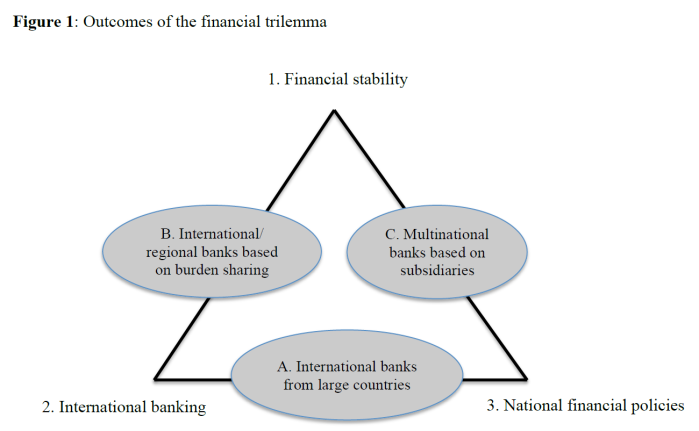
trilemma

You can, he argues, have any two of these dimensions but not all three if you are a small/medium country.   That reasoning seems sound.  I’m less sure about what follows from it.

First, what can individual countries afford to do (as bailouts) if they want to?  Schoenmaker does quite a bit of analysis of the last series of crisis (2008 and after) and concludes that the most any country can really spend on a bailout is 8 per cent of GDP.    This is his chart
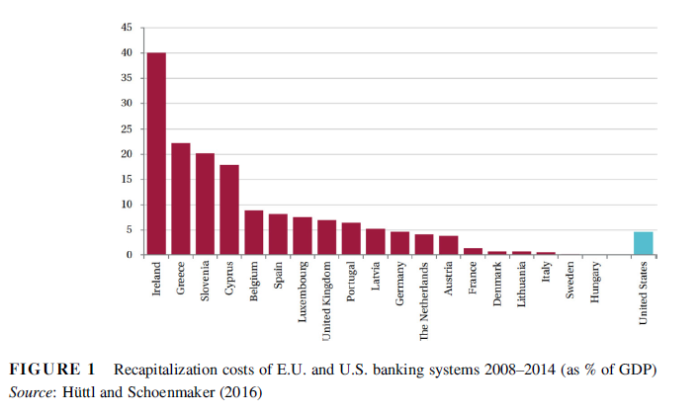
schoenmaker.pngAs he notes, the first four countries on the left of the chart couldn’t cope themselves and needed either IMF or EU support, and Spain also needed external assistance.  But all these countries were in the euro-area, and thus not only lost the capacity to adjust domestic interest rates for themselves, but also couldn’t do anything to adjust the nominal exchange rate.  By contrast, the UK’s bailout costs –  not that much lower than Spain’s –  never ever raised any serious questions about the UK’s fiscal capacity.  And that was with a far higher starting level of public debt (as a share of GDP) than, say, Ireland had.

So his analysis looks to be quite useful in an intra euro-area context.   Belonging to the euro –  whatever advantages it may bring –  involves a substantial sacrifice of national flexibility in a crisis.  And so the logic of the direction Schoenmaker is calling for –  and which the Europeans are moving gradually towards –  involving (at least for big international banks) unified supervision and loss-sharing  (across national boundaries) in the event of failure and bailout, seems to make quite a lot of sense.  If I were Dutch, I’d probably be rather keen on the idea.

But Schoenmaker also argues that the model is directly relevant to this part of the world.  In particular, he shows a table in which the cost of recapitalising (ie replacing existing capital) of the three largest Australian banks (he uses the top-3 banks in each area he looks at) would be around 7.6 per cent of GDP.  That is close to his 8 per cent “fiscal space” threshold, and thus he argues that Australia may be only barely able to cope with a systemic financial crisis in this part of the world.  Part of that recapitalisation burden would, on these numbers, include the overseas operations, the largest of which are typically in New Zealand.

Schoenmaker has written a new paper specifically on the idea of a possible trans-Tasman banking union.  It is still in draft, and isn’t yet available on his website, but he has given me permission to make it available here.  Schoenmaker on Trans-Tasman Banking Union

It is worth reading, both for the coverage of the ideas, and because the current draft already incorporates comments from Wayne Byres, the head of the Australian Prudential Regulatory Authority (APRA).

I don’t really buy the potential fiscal incapacity argument in either Australia or New Zealand.  Both countries have very low levels of public debt (Australia’s even lower than our 9 per cent net government debt, properly defined), and plenty of capacity for the exchange rate to adjust in a crisis (not just against each other if necessary, but against the wider world).  Neither country is hemmed in as (say) the Irish were –  “prohibited” by various EU agencies from allowing any private sector bail-in, even of wholesale creditors, in the midst of the crisis.

But set that to one side for the moment, how might his proposed trans-Tasman banking union work?  And why is not likely at all to be established?

Schoenmaker doesn’t set out precise details in his paper, but from his various papers and presentations it is clear that he draws an important (and correct) distinction between non-binding memoranda of understanding and the sorts of binding pre-committed burden-sharing arrangements he is talking about.  As he notes, there is a lot of contact between New Zealand and Australian officials in this area, culminating in the Trans-Tasman Banking Council (TTBC).  There is probably a fair amount of goodwill, statutory provisions to encourage looking out for each other, and the various agencies even “war-game” crises from time to time.  But none of this commits anyone (or their political masters, who change) to anything in a crisis.  In crises –  as in 2008/09 –  it is largely every country for itself.

And so what he seems to envisages is a binding treaty entered into by the New Zealand and Australian governments, under which a common set of supervisory standards would be applied (at least to the big banks operating in both countries), and the two countries would agree in advance on a (binding) formula for the allocation of losses in the event of failure (and bailout).  As he notes, roughly 87 per cent of the big-4 assets are in Australia and other places, and 13 per cent are in New Zealand.  In this model, New Zealand would commit to 13 per cent of any bailout costs, enabling resolution issues to be handled jointly (by a single agency accountable to both governments/Parliaments).  On the European model (ESM), this single agency could even be given the ability to borrow to meet recapitalisation costs.  Under this sort of model, Australia would (presumably) get rid of depositor preference, and we would get rid of local incorporation requirements for Australian banks.

One can, sort of, see why something along these lines might, on the right terms, appeal in Australia.   There was long been a strand of thinking in Australia that we are (a) free-riders, and (b) more than a little crazy.  In other words, so the argument goes, the soundness of our banks mostly depends on robust APRA supervision at the group level (“after all, the RBNZ doesn’t do any ‘real’ supervision at all”).  And, as for OBR, well “you can’t really be serious, can you……..?  We hope not…………”  So from an Australian perspective, arrangements that tied us into a pre-commitment to share the cost of bailouts would be a win –  a (pretty modest) fiscal saving, but removing the uncertainty that perhaps the crazy New Zealanders might actually use OBR and thus (in some thinking) further damage the wider banking group.

But on what terms would it be attractive to Australia?  Presumably terms on which the Australian authorities got to determine, finally, what banking regulatory standards were applied, and what action would be taken at the point of (actual or impending) failure.  New Zealand might be represented on a regulatory agency board, but with 13 per cent of the financial contribution, it might perhaps get 13 per cent of the vote.  13 per cent of the vote on a two-country entity is no power at all.

When I asked him, Schoenmaker suggested that perhaps the arrangement would have to be one in which New Zealand had a veto.  If so, it would rather dramatically change the nature of the arrangement –  more attractive to New Zealand, but (almost surely) totally unacceptable to Australia.  Is it even possible to conceive of an arrangement under which an Australian government would commit, by treaty, to giving New Zealand a veto on (a) bank supervisory policies, and (b) crisis resolution?  I wouldn’t if I was them.

And even if, somehow, such an arrangement were put in place in a mutual fit of bonhomie and trans-Tasman togetherness, there is no certainty that it would be honoured in a crisis (perhaps by then under different –  more mutually distrustful politicians).     This was the big point on which Schoenmaker and I differed at his seminar.  I argued that if, say, New Zealand wanted to let the bank fail and Australian wanted to bail them out then whatever the treaty said, Australia could –  and probably would –  just do so anyway.  Sure, there might be a binding treaty with dispute resolution provisions, but they would take years to get to a determination (think of the WTO disputes) and the crisis needs dealing with tonight.   Schoenmaker argues that it just doesn’t happen, but (a) we don’t have examples in banking crisis resolution, and (b) his mental model is one of the EU where there are (i) lots more countries, not just one big one and one small one, and (ii) a shared elite commitment to working towards political union.  There is nothing similar here.

Perhaps the Australians wouldn’t renege, but we’d have to take account of the possibility.  And with all the banks based there, not here, the issues and risks aren’t remotely symmetrical.  If, one day, New Zealand and Australia are working towards a political union, something along the lines of what Schoenmaker suggests might well be one part of that progress.  For now, it isn’t an idea that is likely to go anywhere, and nor should it go much beyond the seminar room (and any associated public debate).

If it doesn’t happen, Schoenmaker warns that we may well find ourselves on a path that will eventually make the Australian parents reconsider the benefits of operating in New Zealand at all.  As he notes, in eastern Europe many countries are putting up higher and higher barriers (eg very high capital requirements) to assure themselves of an ability to manage foreign-owned subsidiaries of western banks in a crisis.   If it were to come to that point in New Zealand, I personally think it would be unfortunate (we gain from having at least modestly-diversified banks), but it isn’t clear that New Zealand voters would necessarily see it the same way.  And if the two countries really wanted to deal with the potential costs of high New Zealand local capital requirements, they (Australia) could at last do something about mutual recognition of trans-Tasman imputation credits.  The inability/unwillingness to resolve that issue after 30 years is a salutary reminder of why we should not count on being able to easily pre-specify rules for handling a major economic and financial crisis hitting the two countries.  Crises, and loss allocations in particular,  are almost inherently nationa, and –  for now anyway –  these two nations aren’t merging.

(And, of course, the politics of banking in the two countries remains quite different.  We weren’t the country that almost nationalised the banks in the 1940s, and –  whatever the unease in some quarters now about Australian domination of the banking system –  we aren’t the country where the possibility of a Royal Commision into banking –  to what possible substantive end –  is in the headlines day after day.)

(There was an attempt by the Australians to take over all supervision back when Michael Cullen was Minister of Finance.  Alan Bollard –  rightly in my view –  fought back strongly and eventually persuaded the government not to accede to the Australian government bid.  Much of the reason for resistance comes down to the ability to manage crises in the interests of New Zealanders.)
Wishful Australian thinking

I’ve been fascinated for some time by the way elements of the right wing of the Australian business and political community have sought to lionise John Key and Bill English.      On the day of his successful party room coup, Malcolm Turnbull was at it

“John Key has been able to achieve very significant economic reforms in New Zealand by doing just that, by taking on and explaining complex issues and then making the case for them. And I, that is certainly something that I believe we should do and Julie and I are very keen to do that again.”

As I noted at the time, I couldn’t think of any such “very significant economic reforms”, although there were various useful modest reforms, offsetting other backward steps.

The “look at New Zealand, why can’t we do it like them” theme has endured to the end.  There was a column along those lines in The Australian the other day headed “Bill English, John Key leave NZ a far stronger economy”, by Nick Cater, Executive Director of the Menzies Research Centre, a think tank affiliated to the Liberal Party (his column is reproduced here).

The column was so full of questionable claims and overstatement that it was almost hard to believe it was written by a serious commentator.  Near the start Cater notes

Key and English were described more than once as the quiet achievers. The governments they led as the bore-cons introduced reforms in tax and welfare while balancing the budget without fanfare or fuss. Seldom has the demise of a New Zealand government caused such political shockwaves on this side of the Tasman. In a period of near-universal political volatility, it raises the dispiriting possibility that simply governing well may no longer be enough. The Key and English legacy compares starkly with Australia’s record over the same period.

The first item is his list of achievements is this

In 2008, when the National Party came to power, New Zealand was 24th on the World Economic Forum’s Global Competitiveness Index, six places behind Australia. Since then the positions have been ­reversed. Today New Zealand is in 13th place on the index, eight positions ahead of Australia.

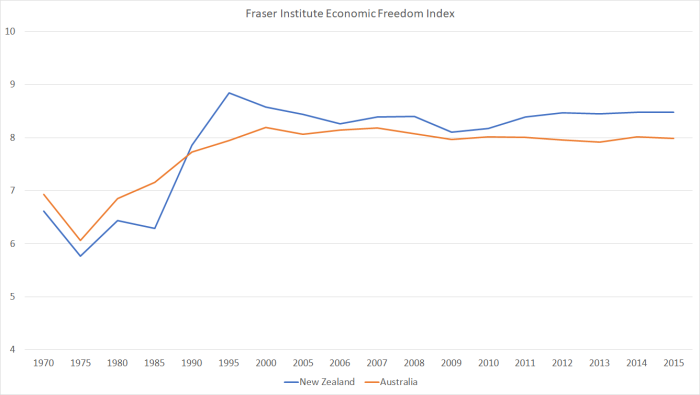
I’m not so familiar with that particular index, and tend myself to use the Fraser Institute’s economic freedom index, partly because there is a long time series of data.

econ freedom

The big story, for both countries, is surely that of a lot of reform and liberalisation in the 1980s and 1990s, and almost nothing material since then.   On this measure, of course, New Zealand does better than Australia, and has at every reading for more than 20 years now.   Perhaps New Zealand policymakers have done slightly better than their Australian counterparts in the last nine years or so but any differences are pretty small.

Cater then turns to GDP outcomes

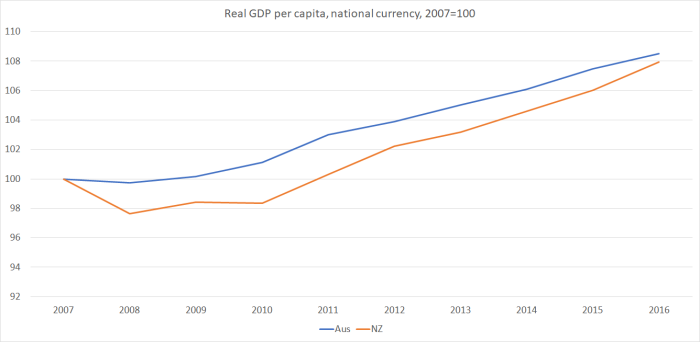
New Zealanders are still poorer than Australians on average but they are catching up fast. Nine years ago GDP per capita in New Zealand was 30 per cent lower than in Australia, now the gap has narrowed to 19 per cent.

Would that it were true, but it isn’t.    Here is real GDP per capita for the two countries, both indexed to 100 for calendar 2007, just prior to the global recession..

real GDP nz vs aus

Over that time, we’ve done just slightly worse than Australia has.  Cater might argue for starting the comparison from 2008. but I doubt even he is going to credit John Key and Bill English with ending the global recession.

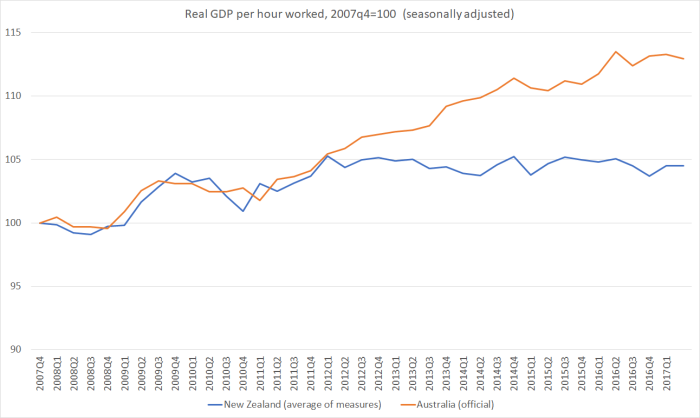
The productivity growth comparisons, of course, are particularly unfavourable to New Zealand, esepcially over the last five years.

aus vs nz ral gdp phw 2

Productivity is something closer to what government policy can usefully and materially influence (although other stuff matters too).

If we assume that governments have the power to control the economy — which incidentally 33 per cent of Australians no longer believe, according to the most recent Australian Electoral Study — then Key and English governed exceedingly well by ­almost any measure.

On the bits governments have a fair influence over we’ve done particularly badly relative to Australia (less badly relative to some other countries).  But there are bits of the economy that national governments have almost no control over whatever.  Commodity prices are perhaps foremost among them.  Our government can’t do anything much about the dairy price and the Australian government can’t do much about, say, iron ore prices.    Fluctuations in the terms of trade affect real per capita income measures even when the volume of production doesn’t change.

TOT aus and NZ

Australia had a huge terms of trade boom up to 2011, and even now if we take the last 15 years as a whole Australia’s terms of trade have increased more than ours have.   But since 2007/08, our terms of trade have done a bit better than Australia’s.  Hard to see how governments on either side of Tasman deserve credit or blame for those developments.

But as a result of these terms of trade swings, on a measure that adjusts for the effects of the terms of trade (real GDI per capita), New Zealand has grown three percentage points faster than Australia since 2007.  A nice-to-have windfall to be sure, but (a) even that gap makes only tiny inroads into the accumulated levels differences between New Zealand and Auatralian incomes, (b) the terms of trade are volatile, and who knows what they’ll do to the income gaps in the next decades, and (c) in the long-run, productivity growth is almost everything, when growth in living standards is in question.

As Cater notes, there has been a big change in trans-Tasman immigration (although even those flows have been quite –  typically –  variable over the last nine years).

The relative change in economic fortunes has changed the migration flow across the Tasman. Inward ­migration from ­Australia exceeded outward ­migration last year for the first time in a quarter of a century.

Of course, that last time –  quarter of a century ago –  was when the Australian labour market was also doing very badly.   New Zealand’s was as well, but when you are looking at moving to another country, conditions in the destination market matter a lot.   Australia has struggled in the last few years, but actually both countries are still among the diminishing number of advanced countries where the unemployment rate is still well above pre-2008 downturns levels.   That reflects no great credit on governments, or central banks, on either side of the Tasman.

Then, of course, there is a fiscal policy.  Personally, I think the outgoing government has done a pretty reasonable job on that score –  as, in fact, its predecessors for the previous 20 years had done.

But even here Cater gets some things quite badly wrong

While treasurer Wayne Swan was doling out cash and spending billions on poorly conceived make-work projects to help Australia survive the 2008-09 ­financial crisis, English gave personal and business tax cuts.

I’m no fan of the Rudd/Swan fiscal stimulus programme, but….. the appropriate comparison here is that we had no active discretionary fiscal stimulus to attempt to counter the recessionary forces.  None.  And the almost accidental stimulus that happened to be in place resulted from the Budget choices of the outgoing Labour government which had put in place tax cuts and spending increases at a time when Treasury was advising them that the government accounts would remain in surplus even after those initiatives.

Of course, there were some tax reforms here  –  in 2010 –  and conventional wisdom tends to count them “a good thing” (I’m less convinced, because the package of measure increased the effective taxation levied on capital income, against the prescriptions of standard economic analysis).   But I’m not aware of any analyst who thinks those changes made a material difference to New Zealand’s economic performance in the last few years.

Cater quotes some debt numbers that I don’t recognise

Today the New Zealand budget is in surplus while Australia is still running deficits. Ten years ago the New Zealand government’s gross debt stood at 25 per cent of GDP while Australia’s sat on 20 per cent. Today the positions are reversed. Australia’s net public debt is at 47 per cent; New Zealand’s hit a peak of 41 per cent in 2012 and has steadily declined to 38.2 per cent.

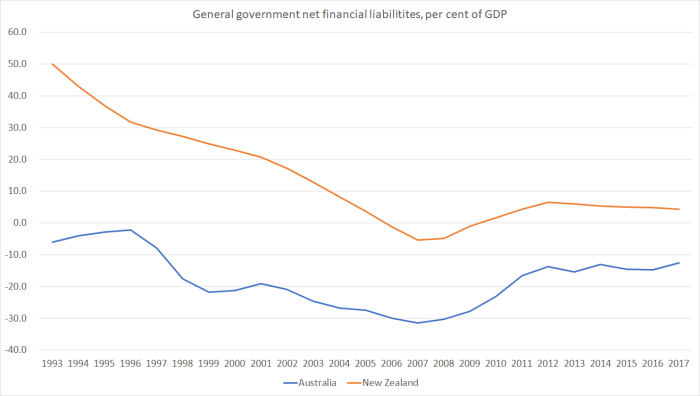
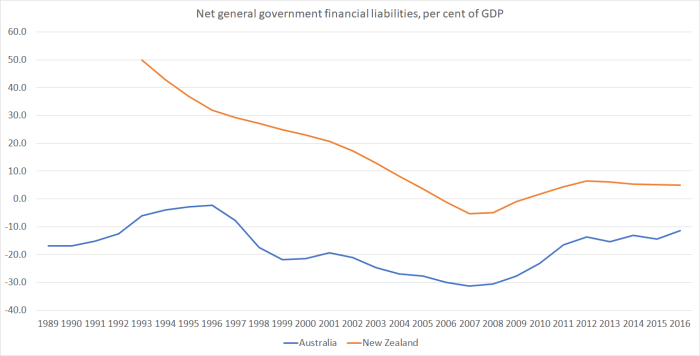
Here are the OECD’s number for general government net financial liabilities as a share of GDP.

gen govt net liabs nz and aus

Every year for the last 25, Australia’s overall government net debt has been less than ours, and if the gaps between the two countries has closed a bit in the last few years, the change is pretty small and the similarities, in the respective paths, are more striking than the differences.     Of course, we’ve had one nasty shock they haven’t had –  earthquakes.  Then again, they’ve been coping with a really big correction in the terms of trade.

On both the tax and spending sides of the government accounts, we have a slightly bigger government (share of GDP) than Australia –  and more variable one.  None of that has looked like changing over the last nine years.

Perhaps you thought this was just an economic case.  But, no.  Cater is just getting into his stride.

The achievements of Key and English are by no means limited to the economy, however.

Cater appears to be a big fan of the “investment approach” to welfare and related government spending.    I’m still more ambivalent –  the use of data appeals, of course, but big-government joined-up data makes me very nervous (hints of, eg, Chinese social credit scores).   For now, I’m happy to look for evidence of results.  Cater is convinced.

From this thinking flowed a new approach to welfare that has since been adopted by the Abbott and Turnbull governments to great effect.

and

In its second of two [three?] terms the ­National government first halted the long-term trend of rising welfare dependency and then ­reversed it. The number of New Zealanders claiming sole parent benefit has fallen by a quarter as 20,000 single parents found work. Long-term welfare dependency has fallen substantially. In 2012 78,000 New Zealanders had been collecting benefits for 12 months or longer. By June this year the number had fallen to 55,000.

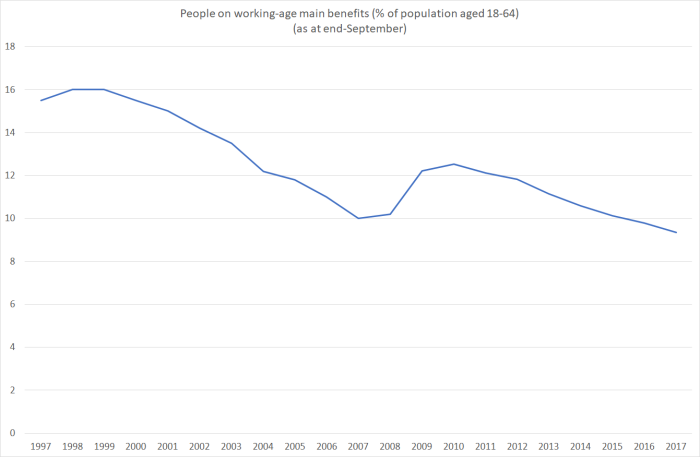
The first sentence is simply wrong.   Here is the MSD data on the number of working-age main benefit recipients as a percentage of the population aged 18 to 64.

benefits 2017

There was a recession in the first term –  welfare benefit numbers rise in recessions –  and then the downward trend that had been in place for the previous decade resumed.   But as of last month, the share of the working age population on these main welfare benefits was only very slightly below where it had been in September 2007.

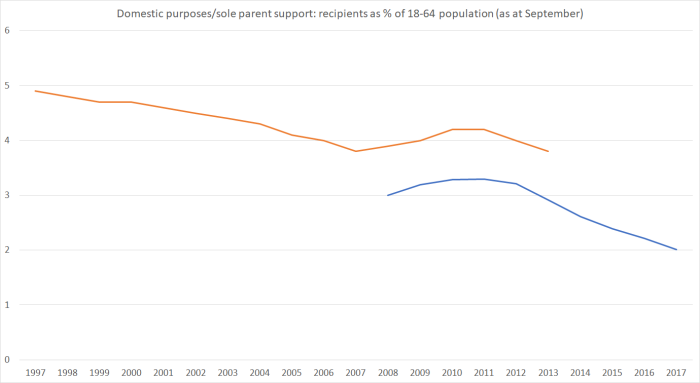
In a way, that isn’t surprising.  Unemployment is still well above pre-recession levels.   But it should be somewhat troubling, both on that count, and because one component of benefit numbers has dropped away quite sharply.     As Cater notes, the number of sole parents on the benefit has fallen away a lot.  Here is the chart – there is a discontinuity in the series associated with the welfare changes (including labelling changes) in 2013.

DPB

The trend was underway during the decade prior to the recession.  The pace of decline has certainly accelerated since then (at least since 2013), but since the overall number of benefit recipients as a share of the working age population hasn’t changed since 2007, other categories must have increased.

It would also be interesting to see a serious study of just what role policy changes have played even in the decline in sole parent beneficiaries.   After all, teen pregnancy rates have been dropping globally –  for reasons not, I think, that well-understood – and in New Zealand the teen birth rate halved between 2008 and 2016 (but, even so, was still higher than the comparable rate in Australia).  Welcome as that trend is, it seems unlikely that New Zealand government policies will have been a large part of the explanation.

And, of course, over the outgoing government’s term there has been a huge increase in the number of elderly age-benefit recipients (2011 saw the first baby-boomers turning 65).   In the last months of the outgoing government, there was finally talk of lifting the age of eligibility –  something Australia began years ago –  but it was going to happen 20 years hence.  And now –  for now –  it isn’t going to happen at all.

At this point, Cater leaves the numbers behind.

The government’s strategy of taking the public with them on reforms, ­explaining the logic well in advance in language people could follow, adjusting ­expectations and then implementing the promised changes, was remarkably successful until the end.

On what measures I wondered?

And he concludes

For 11 years he and Key had written a counter-narrative to that prevalent in Australia that reform was all but impossible in the era of Facebook and Twitter. While Australia appeared stuck in a policy drought, New Zealand was breaking new ground, discovering new ways to measure government programs by their results and finetuning them accordingly. Feel-good policy, sentimentalism and identity politics were anathema to them.

English and Key proved that centre-right parties were not condemned to be nasty parties, ­focused on numbers rather than people, as they doggedly cleared up their predecessors’ fiscal mess. Devoid of ideology, fiercely pragmatic, self-aware and inspired, the pair stands as inspiration to the rest of the developed world in these anxious and volatile times.

So horrendous house prices, no productivity growth, an export sector shrinking as a share of GDP are the sorts of things that provide an inspiration to the world?  I’m flabbergasted.    The terms of trade have certainly been favourable, and yet even the outgoing Minister for Primary Industries has been heard to talk of the possibilities of “peak cow”.   Where exporters haven’t done badly, it has too often –  export education and dairy being prime examples –  been partly a result of unpriced subsidies and environmental externalities.

Relative to Australia, the story of the last nine years isn’t all bad.  Neither country has been managed that well.    There are some good stories.  Broadly speaking, New Zealand’s fiscal policy is one of them, but too much can be made even of that.  A much lower balance of payments current account deficit is often counted as another good story, except that much of the contraction reflects (a) the slump in global interest rates, reducing the cost of our external indebtedness, and (b) the weakness of investment even years into the recovery phase.   Perhaps we’ve had tidy stewardship, but going nowhere.  A safe pair of hands at the bridge perhaps, but with the ship meandering without clear direction, or any compelling sense of how better outcomes might be achieved.

All of which should not be taken as any sort of enthusiasm for the new government.  No doubt –  like their predecessors –  they’ll do a few sensible things.  But, like their predecessors, at present they (or the constituent parties) show little sign of either understanding the nature of New Zealand’s dismal long-term economic performance, or of adopting the sorts of policies that could at last begin to reverse that decline.  A pessimist might incline to the view that things may even get gradually worse –  and here I’m not thinking of the cyclical pessimism Winston Peters was enunciating on Thursday night.

There have been very few periods in the last 150 years when policy has been much better managed in New Zealand than in Australia.   The last nine do-little-or-nothing years (following on from a similar nine years) hasn’t been one of those periods.   That is to the credit of neither New Zealand or Australian politicians, but of course Australia’s starting point is so much less bad than ours.


Australia does better than us

I’m old-fashioned.  Key bureaucrats should mostly be seen and not heard.  Officials advise, ministers decide.  And ministers are the ones we get to hold to account, weakly or otherwise, through the political and electoral process.

The chief executive of New Zealand’s Ministry of Foreign Affairs and Trade doesn’t appear to give many speeches, at least not on-the-record.  That is, mostly, as it should be.  But the Secretary of the Australian Department of Foreign Affairs and Trade, Frances Adamson, gave a very interesting address in Adelaide the other day on Australia and China.  It was sufficiently clear and forthright that one can only assume she had the full endorsement of the Australian government.

The speech was given in a slightly odd context.  It was the annual lecture of the Confucius Institute at the University of Adelaide.    There are hundreds of these Confucius Institutes in universities around the world (several in New Zealand),  funded by the government of the People’s Republic of China to promote the interests of China. A couple of years back

The American Association of University Professors (AAUP) called for agreements between Confucius Institutes and nearly 100 universities to be either cancelled or renegotiated so that they properly reflected Western values of free speech.

“Confucius Institutes function as an arm of the Chinese state and are allowed to ignore academic freedom,” the AAUP said in a statement, urging US universities to “cease their involvement” with the institutes unless major reforms are instituted.

China’s network of 300 Confucius Institutes – including 11 branches in on British university campuses – can be a lucrative source of funds for universities but are exempt from many of the basic rules governing academic discourse.

They are designed to project a favourable image of China’s ruling Communist Party around the world through language and cultural programmes, but are allowed to restrict discussions of topics unpalatable to China’s ruling Communist Party such as the occupation of Tibet.

The University of Chicago has shut their Confucius Institute over related concerns.

But if Frances Adamson didn’t tackle that specific issue head-on (and had some polite remarks to her hosts), what she did say was pretty blunt, even if none of it should have been controversial in a free, open and democratic society reflecting on its relationship with an expansionist repressive authoritarian state that is moving further away from, not nearer to, the sort of values that have shaped the West.

While we are complementary economies, there is no getting around the fact that Australia and China are very different places, with different political and legal systems, values and world views.

A pretty simple statement, but I’m not sure I’ve seen its like from our own leading ministers and officials.

Partly this is because the closer we get, and the more we interact, the more we need to account for and manage the differences between us – differences that cannot be wished away but that should not prevent the further development of relations between us.
This emphasises the need for a healthy dose of tolerance, for mutual respect and for openness to the patterns of give and take that underpin any successful relationship.
We understand the hesitation in China to ‘air the laundry’ so to speak.

Australians are happy – perhaps too happy sometimes – to tell each other exactly what we think.

This of course reflects different cultural attitudes:

In China, the thinking is that proper friends will not say things that offend;

Whereas in Australia, a willingness to be frank is proof of a genuine friendship.

These characteristics apply as well to our government-level interactions, something that both sides have come to recognise (though not necessarily always accept!).

Each of our approaches has utility, and we will need large measures of both respect and candour as we conduct the far-sighted diplomacy necessary to bridge our differences and progress our common interests.

Both approaches, the saving of face and the preference for frankness, also have shortcomings.

For our part, Australians should, and I am sure will, be authentic and true to our own selves, while respecting the practice of others.

Australia is a pluralistic society: a place where open debate, individual rights and freedoms are the foundation upon which we have built our political and economic systems. We are a society that thrives on the competition of ideas.

The health and vibrancy of Australia’s democracy is fundamental to our national success – it helps explain why migrants come to our shores and why they can succeed based on their talents and hard work.

And to students, in the context of various recent reports in Australia of a minority of PRC students, and PRC-dominated Chinese students associations, trying to suppress discussion

And here I want to address my remarks to those of you who are international students:
We want you to experience our contest of ideas and participate fully in it, as it is part of what constitutes an authentic Australian education.

You have paid your money; you are surely entitled to the full experience.

No doubt there will be times when you encounter things which to you are unusual, unsettling, or perhaps seem plain wrong. And can I tell you, as someone who has studied overseas in three different continents, if you aren’t encountering strange and challenging things you aren’t getting out enough! So when you do, let me encourage you not to silently withdraw, or blindly condemn, but to respectfully engage.

The silencing of anyone in our society – from students to lecturers to politicians – is an affront to our values.

Enforced silence runs counter to academic freedom. It is only by discussion, and of course discussion which is courteous, that falsehoods can be corrected.

Respectful and patient discourse with those with whom you disagree is a fundamental skill for our ever-more-connected contemporary world.

and to a wider audience

There has been much attention in recent months to the quality and reliability of news and information available to us.

We have seen accusations of ‘fake news’ and we have seen attempts at untoward influence and interference.

This is worrying and is being taken seriously in a number of countries. In our case, the Prime Minister has said: “The sovereignty of Australia, the sovereignty of our democratic processes, free from foreign interference is a matter of the highest concern.”

The Australian Government takes seriously its responsibility to ensure a robust legal framework within which free and open debate is protected and can flourish. That work is proceeding.

As well, Governments themselves must expect, and invite, scrutiny of their actions and their policy positions.

As China becomes more important to Australia’s future and to that of the world, it follows that there will be more scrutiny of China, including the ways in which it seeks to exercise influence internationally.

All of us here, as participants in a free society, have responsibilities as well.

It is our responsibility to challenge and question ‘fake news’. We can readily reduce the risk of being manipulated by seeking out collateral and confirmatory information, by testing through a second opinion.

And when confronted with awkward choices, it is up to us to choose our response, whether to make an uncomfortable compromise or decide instead to remain true to our values, “immune from intolerance or external influence” as Adelaide University’s founders envisaged.

The prospect of public scrutiny is an excellent discipline, and a vital corrective for our political culture and our institutions, including our universities.

We want to ensure these institutions remain secure and resilient.

Our success depends in part on the legal framework, but also on the attitudes and responses of all of us when exposed to unexpected pressure.

And in contrast, what do we have in New Zealand?   Almost none of our political party leaders has been willing to comment in any substantive way on the concerns raised in the recent paper by Professor Anne-Marie Brady.    The leaders of the National Party, the Labour Party, and the Green Party seem totally unbothered about –  and unwilling to substantively discuss – having as a member of Parliament a (now) acknowledged member of the Chinese Communist Party and former member of the Chinese intelligence services, who is now widely credited as one of the National Party’s chief fundraisers.  Speeches on China topics by our own Ministers of Foreign Affairs seem mostly to take on a fawning and deferential tone, as if they are afraid of asserting, or embarrassed by, our own values.  And the Attorney-General was just reduced to making stuff up (lies) and personal attacks on institutions raising concerns.

The speech by the Australian Secretary of the Department of Foreign Affairs and Trade has been widely reported in the Australian media – and she’s just a (very senior) bureaucrat.   And what of New Zealand?

It remains striking, puzzling, and more than a little disturbing, just how little media attention either the general or the specific issues have received in the New Zealand media.    There is a column in this morning’s Herald by Bryan Gould, former Vice-Chancellor of Waikato University and former UK Labour MP prompted by the Brady paper (I’m told the column is on line but I couldn’t find it UPDATE:  here).   In it Gould opens thus:

The Herald’s readiness to report the important conclusions of University of Canterbury research into links between China and past and present New Zealand politicians and their family members is to be commended.

Surely in a serious country with media doing the job of providing searching scrutiny, it wouldn’t be cause for self-congratulation, but something just taken for granted?  A leading academic raises serious concerns about the extent of a powerful country’s influence in New Zealand and he seriously suggests that it might not be reported by the country’s largest newspaper?

It would be interesting to know whether the issues have been reported in the Chinese Herald (I gather not), but even if we stick to the English language media, just how much reporting has there in fact been?  I found a total of two stories in the Herald, one (on a quite specific element) on Stuff, nothing on Radio New Zealand (a non-commercial broadcaster with an extensive news and current affairs operation), a single story of Newsroom, nothing on TVNZ and nothing on Newshub.  Perhaps I missed the odd story, but what is striking is not the New Zealand coverage of the issues and concerns, but the lack of coverage and lack (apparently, thus far) of any sustained follow-up.    (And has the New Zealand media ever looked searchingly at those Confucius Institutes?)

The contrast with Australia is striking, worrying, and sad.  I don’t really buy the stories of extreme economic vulnerability to China, but if anything Australia’s direct economic exposure is a bit larger than ours.  And yet officials, ministers, and media in Australia are willing to speak up, and have an open and vigorous debate on the issues.  Reasonable people might differ on appropriate policy responses, but who is seriously going to defend the deafening silence as the way in which a free and open society should handle such issues?


Some Australian perspectives on PRC influence-seeking

For those interested in the activities of the People’s Republic of China and the Chinese Communist Party in this part of the world, Professor Anne-Marie Brady’s paper remains essential reading.   The material Professor Brady lays out on the New Zealand is deeply troubling, as is the near-complete subsequent silence from most of our political leaders.

But if New Zealand remains somewhat unique in having a Communist Party member and former member of the Chinese intelligence services –  who has never disavowed his past and remains very close to the People’s Republic of China embassy –  as a serving member of Parliament, the issues around PRC influence-seeking, pressure on the Chinese diaspora, and direct meddling in the domestic affairs of other countries aren’t unique to New Zealand. In yesterday’s post, I highlighted several links to contribution to the open and active debate on these issues in Australia.

But today a new collection of 22 articles, speeches etc on the issue of PRC activities in Australia (“The Giant Awakens” ) has been released by Vision Times, one of the relatively small number of remaining independent Chinese media in Australia (as in New Zealand, most of the Chinese media in Australia are now apparently under the effective control of the PRC).  More than half the authors are themselves ethnic Chinese, including a former PRC diplomat to Australia who defected a decade or so ago.

I haven’t read the entire collection, but of those I have read almost every piece struck a chord in one way or another, with so much of what is written about raising similar issues and concerns to those Professor Brady alerts us to in New Zealand.   I’d commend it to anyone interested in the subject, both because Australia (a) matters to us, and (b) seems to have very similar issues to us, and because…..well….sadly there is nothing similar in New Zealand.   The near-complete cone of silence still appears to hold.

I’d particularly commend the first paper in the collection by Professor Rory Medcalf, who is currently the Head of National Security College at the Australian National University.   It is an easy read –  only three pages – but an uncomfortable one.

A few extracts

Here in Australia we have seen the Chinese Communist Party involved in what appears to be multi-faceted campaign to influence our politics and independent policymaking. This includes propaganda and censorship in much of this nation’s Chinese-language media as well as channels of interference through intimidation of dissident voices and the establishment and mobilisation of pro-Beijing organisations on Australian soil. There is also the troubling question of political donations and their motives.

On political donations –  recall the magnitude of some of the disclosed donations here

It has also been reported recently that Australia’s main political parties have received close to $6 million in donations over the last few years from individuals associated with the Australian Council for the Promotion of the Peaceful Reunification of China. The Council, in turn, is reported to have connections to the United Front Work Department, an organisation which reports to the Central Committee of the Communist Party of China.

But whatever the mix of motives, one thing is clear. The donations were enough for the Director-General of the Australian Security Intelligence Organisation (ASIO) to take the highly unusual step of directly warning the major parties that they and Australia’s national security could be compromised by such donations. For the head of ASIO to take such a step suggests he was genuinely worried, from a national security and national interest point of view. Security agencies cannot take effective action on any of this because it has been entirely legal – all they can do is raise the alarm. It is now up to the political class to decide whether there is, within Australian democracy, enough self-respect to function without money linked to the Chinese Communist Party. This, after all, is a massive, secretive, self-interested and foreign organisation, with interests that can sometimes clash directly with Australia’s.

These issues are at least as much about the interests of ethnic Chinese New Zealanders and Australians

Indeed, much of the worry about such influence is within this country’s diverse Chinese communities. If, as a nation, we chose to ignore such concerns, we would be effectively treating such dissenting voices among our Chinese-Australian population as second-class Australians, whose freedom of thought and freedom of expression do not warrant protection.

So the issue of foreign interference needs to be addressed in a context of respect for the rights of Chinese Australians. That means this needs to be an issue that is seized and owned by the moderate, bipartisan centre of Australian politics. This way, the issue cannot be captured by extreme voices or be distorted, misconstrued or falsely portrayed as one of xenophobia.

One of the points I’ve been making in a New Zealand context is that our economic dependence on China is (often) much-exaggerated.

The risk is that we will buy the story that our economy is so comprehensively dependent on China that Australia cannot afford to cause China much difficulty on security and political issues, even when our interests diverge. Indeed, perceptions of Australia’s vulnerability to Chinese economic pressure are exaggerated. Economic pressure from China that would have the biggest impact on Australia – most notably through iron ore trade – would also impose restrictive costs on Beijing. Privately or publicly, Beijing criticises or complains to Canberra frequently over multiple issues. But the accompanying threats tend to be implicit or general – that the bilateral relationship will suffer some unspecified deterioration if Australia does not heed China’s wishes.

…..If Beijing felt it needed to send an economic signal to reinforce its displeasure, its initial response would likely involve non-tariff barriers over quarantine and safety standards, or making life difficult for businesses operating in China, with limited long-term economic impact on itself or Australia.

Beijing has adopted this approach towards South Korean business interests, yet has not succeeded in its goal of changing Seoul’s stance on missile defence cooperation with the United States. Economic vulnerability is often as much about perception as reality – and it is in China’s interests for Australia to imagine itself highly vulnerable. Already, some voices in business, academia and the media focus on the possible economic impacts of annoying China. The perception of economic harm can have an outsized effect on domestic interests, creating pressure for rapid political compromise. If we overreact to any Chinese economic threats and self-censor on issues perceived to be problematic for Beijing, it will not protect Australia from further pressure – it will signal that such pressure works.

And finally

Foreign interference in Australia is not solely a national security issue. It is a fundamental test of Australian social inclusiveness, cohesion, equity and democracy that we ensure all in this country have freedom of expression, freedom from fear and protection from untoward intervention by a foreign power.

It is a paper, part of a collection, that should be widely read in New Zealand.

In my post yesterday afternoon, I linked to an article published in the AFR by Peter Drysdale and John Denton, attempting to play down the issue of Chinese influence and suggesting that critics are “demonising” the People’s Republic, or indeed Chinese-Australians.   There is a nice, accessible, response to that article by John Fitzgerald, another Australian academic.

…for Australia, the issue at stake is not whether Leninism and liberal democracy can work happily and co-operatively in their separate jurisdictions but whether it is possible for a democracy to maintain jurisdictional separation in a dependent relationship with a Leninist state without adjusting its everyday modes of operation. Whatever we may think of authoritarian Leninist states, of which contemporary China is clearly one, they are founded on an ‘enemy mentality,’ and they have immense difficulty recognising the territorial and jurisdictional limits of their overweening hierarchical authority. How is a liberal Australia to deal with a Leninist China as that country becomes more assertive beyond its borders?

A bold free press is one of the few instruments a democracy has at its disposal to check the encroachment of a Leninist state into its jurisdiction. An open, respectful, and evidence-based conversation on this encroachment in the media is essential to getting Australia’s relationship with China right.

It is not demonising China to report what the Chinese government says about itself: that it is a wealthy and powerful Communist Party state that has no time for democratic accountable government, no independent courts, security, or media, that denies universal adult political participation, that offers no protection for the exercise of fundamental rights of freedom of speech, religion or assembly. In China this is called guoqing. There are no plans to change anytime soon. Similarly, querying the behaviour of a few named and alleged influence peddlers from China no more tarnishes the reputation of all Chinese Australians than querying the conduct of Putin’s agents in Washington impugns the loyalty of all Russian Americans.

Meanwhile, here in New Zealand the final election results will be declared tomorrow.  A self-confessed member of the Chinese Communist Party, former member of the Chinese intelligence services –  both facts hidden fron voters for years, and partially hidden from the New Zealand immigration and citizenship authorities “because that is what the Chinese authorities told us to do” – will once again be confirmed as a member of Parliament.  That alone –  the tip of the iceberg in the issues Professor Brady raises –  should be deeply troubling.  But our establishment elites seem unbothered.  Nothing is heard from the Prime Minister. Nothing is heard from the Leader of the Opposition.  Nothing is heard from the Green Party.  Nothing is heard from the Minister of Foreign Affairs.  And when last heard from, the Attorney-General and minister responsible for several of the intelligence services resorted to simply making stuff up.

“That was a Newsroom article, timed to damage the man politically.  I’m not going to respond to any of the allegations that have been made about/against him. I think it is disgraceful that a whole class of people have been singled out for racial abuse.  As for Professor Brady, I don’t think she likes any foreigners at all.”

The best response to erroneous claims is the facts. As far as I’m aware, nothing in the original Financial Times/Newsroom articles, nothing in Professor Brady’s paper, and nothing in yesterday New York Times article has been refuted.  I’ve not even seen anyone try.  Some mix of embarrassed silence, and brazening through, in the hope that the issue will just go away seems to be what our “leaders” now count as responsible leadership.

Some productivity snippets

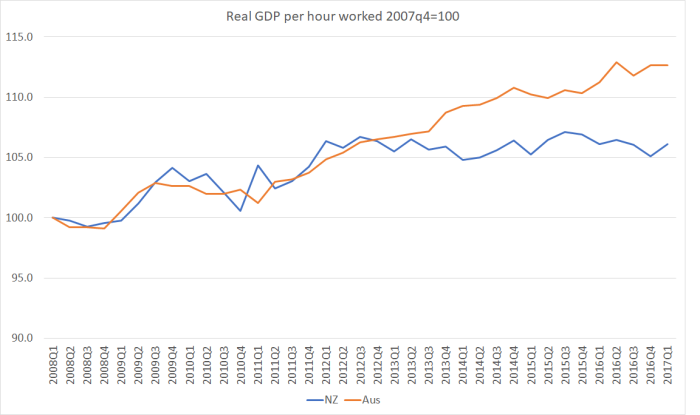
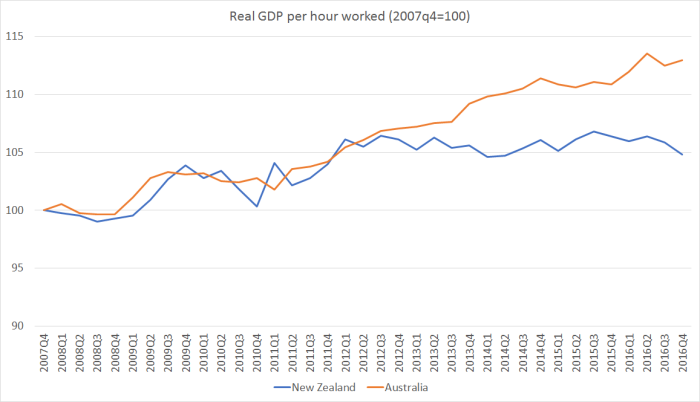
I’ve shown previously various iterations of this chart, real GDP per hour worked for New Zealand and Australia.

real GDP phw july 17

It isn’t exactly an encouraging picture for New Zealand.   Then again, it is also a bit surprising.  For all of New Zealand’s underperformance over the decades, we haven’t usually diverged that badly from Australia over such a short period (the last four years or so).

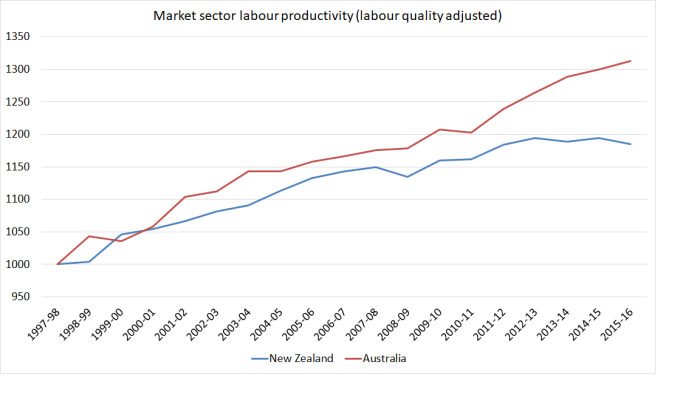
That chart is for the whole of each economy, and just uses a crude measure of total hours worked.  The ABS and SNZ also produce annual data –  with quite a lag – in which they look only at the more readily measureable market sector of the economy (from memory around 85 per cent of the economy) and also attempt to adjust for changing labour quality over time (eg improvements in education and thus, in principle, human capital).

Here is that chart for labour productivity, indexed to 1000 in 1997/98, the first year for which the data are available for both countries.

market sector LP

The picture is much the same –  a new large gap has opened, in Australia’s favour, in the last few years.

Presumably part of those measured productivity gains in Australia reflects the massive private sector investment boom in the minerals and energy sectors that peaked back in 2011/12.

But out of curiosity I wondered how Australia had done recently relative to other advanced economies.    Using annual data from the OECD, percentage total growth in real GDP per hour worked over the five years 2011 to 2016 had been as follows:

Australia                                  5.3%

OECD Total                              6.3%   (and OECD median country, 5.7%)

G7                                              5.5%

EU                                              4.3%

Even the euro-area as a whole (2.5 per cent) just beat out New Zealand (2.3 per cent).     In that light, Australia’s relatively strong productivity performance didn’t look so anomalous at all.

Over that five year period, these are the OECD countries that managed more than 10 per cent productivity growth:   Estonia, Hungary, Korea, Latvia, Poland, Slovakia, and Turkey.    In fact every single one of the emerging OECD countries (the former eastern bloc countries and Korea) –  all with lower initial levels of productivity than New Zealand – managed stronger productivity growth than New Zealand did.   All but Slovenia had faster productivity growth than Australia.    That is what convergence –  supposedly the goal for New Zealand –  is supposed to look like.

Of course, several of these emerging countries had had a much worse experience –  even on productivity, which often isn’t very cyclical –  than New Zealand over the crisis/recession period around 2008/09.   But even if one looks at, say, the last decade as a whole, they are mostly catching up (often quite rapidly) and we are not.  In fact, relative to Australia –  typical closest comparator, and the place where so much of the New Zealand diaspora dwells –  we are getting further behind.

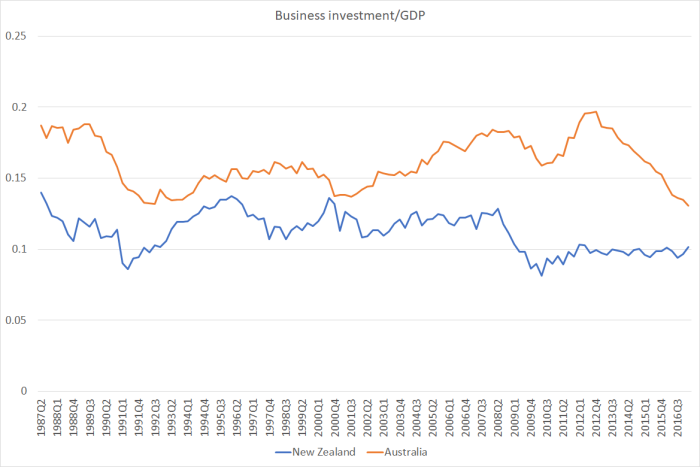
I ran a chart a few weeks ago about how low investment has been in New Zealand.  As I noted of business investment it “is now smaller as a share of GDP than in every single quarter from 1992 to 2008.   And this even though our population growth rate has accelerated strongly, to the fastest rate experienced since the early 1970s.”

Of course, an important story out of Australia is how business investment has fallen back since the peak of the mining investment boom.   Here is the business investment proxy (total investment less general government investment less residential investment) for the two countries.

bus investment aus and NZ

Business investment in Australia, as a share of GDP, has fallen very dramatically over the last few years.   But it was a very big boom –  we had nothing of the sort in New Zealand.  And even at current levels, Australia’s busines investment still materially exceeds the share of GDP devoted to business investment in New Zealand.  In fact, the gap between the two lines isn’t that dissimilar to the typical gaps that prevailed before the mining investment boom got underway in the mid 2000s.

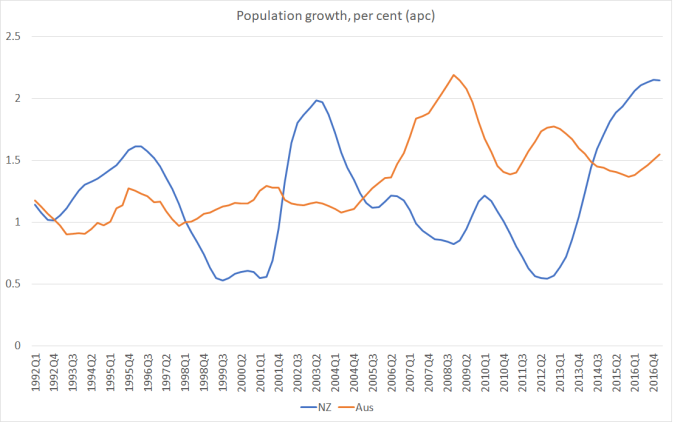
Then again, over the last 25 years Australia’s population growth has averaged a little faster than New Zealand’s.   All else equal, faster population would generally require a larger share of current GDP to be devoted to business investment just to maintain the average quantity of capital per worker.

But here is the chart of the two countries’ population growth rates

popn growth aus and nz

Australia’s current population growth rate (1.5 per cent) isn’t much above the 25 year average (1.3 per cent). In New Zealand, the average population growth rate over the last 25 years has been 1.2 per cent, but in the last 12 months the population has increased by 2.1 per cent.     We have lots (and lots) more people, but firms presumably have not been finding it profitable to increase investment (on average across the whole economy), in ways that might suggest some possibility of the sort of productivity growth that might finally allow New Zealand to join the club of fast-growing countries, catching up to the wealthier countries in the OECD.

Not that our politicians give any sense of being worried.  An ill-governed place like Turkey –  not richer or more productive than New Zealand in our entire modern history –  might shortly go past us.   Countries that labour under communist regimes thirty years ago might go past us.  But none of our leaders seems to care. None of our parties has a platform that suggests they care, let alone offering a programme that might make a real difference.

New Zealand and Australian public finances

It is the time of year when both New Zealand and Australian governments hand down their budgets.  And these days it seems it is an opportunity for an annual comparison, in which New Zealanders feel rather virtuous about fiscal management here, and many Australians –  perhaps especially people on the right – take a turn breast-beating, regretting that they are not, in this regard, as well-governed as New Zealand.    Particularly florid Australian commentators are prone to invoking comparisons with Greece and other fiscal disasters.

I don’t find the story particularly persuasive.  Both countries had their fiscal blowouts late last decade –  in Australia, much of it was initially intended as active counter-cyclical use of fiscal policy under Kevin Rudd, while here it was discretionary choices to increase spending in the late years of the last boom.  In different ways, both the Australian Federal Treasury and the New Zealand Treasury were culpable to some extent; the former for enthusiastically embracing fiscal stimulus, when there was still plenty of monetary policy capacity left, and the latter for getting the forecasts wrong (they had told the government that big increases in spending would still leave the budget roughly balanced).    In some ways, New Zealand had a rougher time of it: the Canterbury earthquakes were a much bigger adverse hit to New Zealand government finances (a few years back) than anything in Australia.  Then again, Australia had to deal with much bigger volatility in –  and uncertainty about –  the terms of trade.

But what do the numbers show?  For history, I turned to the OECD’s database, where they have lots of fiscal series going back typically to around 1989.   While much of the attention focuses on the Australian federal government finances, it is important for New Zealanders to recognise that state governments are a large part of the overall government mix in Australia.  The OECD numbers are for “general government”, encompassing federal, state, and local government (or, specifically, national and local government in New Zealand).

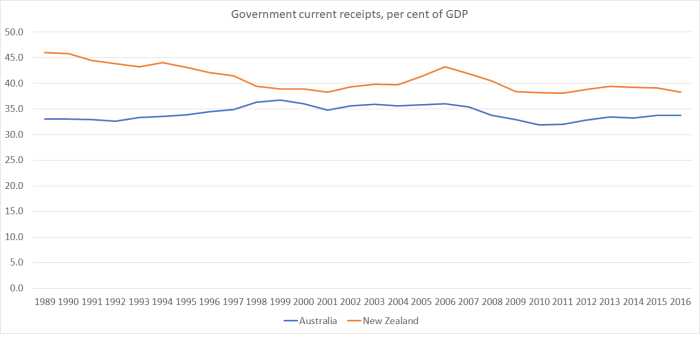
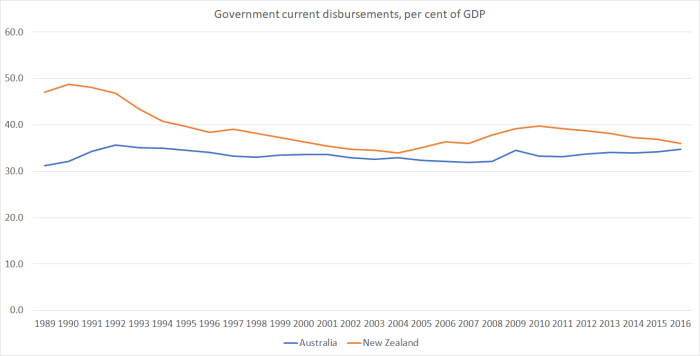
It is also worth remembering that the size of government is smaller in Australia than it is in New Zealand.  That is so whether we look at revenue.

aus nz receipts

Or expenditure

aus nz disbursements

And government spending as a share of GDP has also been more stable in Australian than in New Zealand.  In fact, last time I checked government spending as a share of GDP had been more stable in Australia, over decades, than in almost any other OECD country.

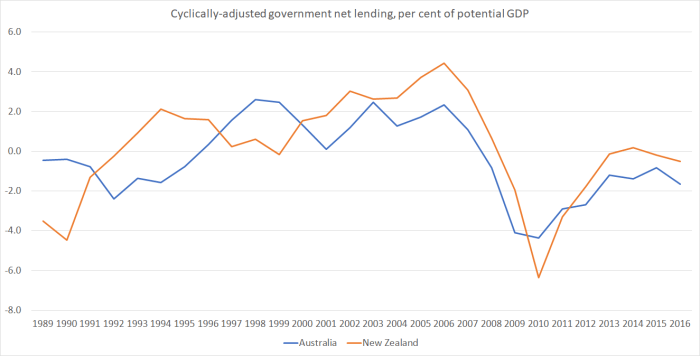
What about fiscal balances, adjusted for the state of the respective economic cycles.  Here is the OECD’s measure.

aus nz deficits

A remarkably similar pattern really.    Our surpluses have averaged a little larger (and our deficits a little smaller) than those of Australia in the last 15 years, but there really isn’t much in it.  And do note that on this cyclically-adjusted measure, New Zealand is estimated to have been in slight deficit in 2016.

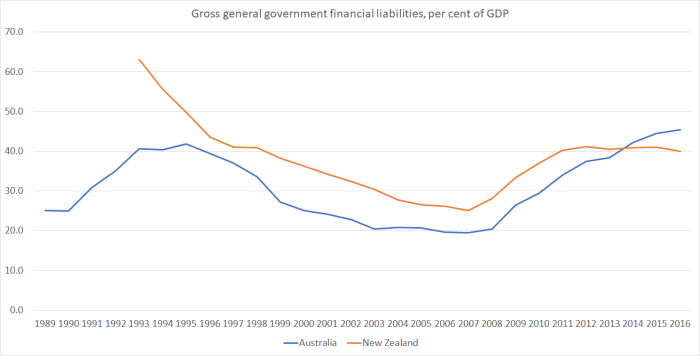
And what of debt?  This chart shows gross general government financial liabilities as a per cent of GDP.

aus nz gross debt

That is certainly a less favourable picture for Australia –  gross debt as a per cent of GDP higher than at any time for decades.   But here is the  –  superior for most purposes –  net debt picture.

aus nz net debt

Australian governments have had less debt than New Zealand through the whole period, and if the gap has closed just a little in the last decade, the change is pretty slight.    From a public debt perspective, Australia doesn’t seem to have much to worry about, with net financial assets (across all tiers of government) of around 10 per cent of GDP.

We won’t see the New Zealand government’s projections for the next few years until the Budget is released tomorrow.  But plenty of commentary focuses on the prospect of rising surpluses for years to come in New Zealand (as if this is somehow a good thing, when debt is already low), in contrast to the projections of deficits in the federal government books in Australia.

But one problem with those comparisons is that they aren’t apples for apples comparisons.  Thus, our government accounts for a long time have focused on the operating balance.  Relative to more traditional fiscal measures –  of the sort typically given prominence in Australia –  our deficit/surplus measure excludes capital expenditure but includes depreciation.  In a country with (a) a positive inflation rate, and (b) a rising population and rising living standards, government capital expenditure will typically exceed depreciation.   That isn’t a problem in itself, but it can make cross-country comparisons harder (the OECD historical numbers in the earlier charts are done consistently).

But here –  taken from the Australian official documents – are the federal government deficit measures done the Australian way (“underlying cash balance”) and something very like the New Zealand way (“net operating balance”).

Underlying cash balance Net operating balance
Per cent of GDP
2015/16      -2.4 -2.0
2016/17      -2.1 -2.2
2017/18      -1.6 -1.1
2018/19      -1.1 -0.6
2019/20      -0.1 0.4
2020/21       0.4 0.8

As they note in the Australian Budget documents

The net operating balance has been adopted for some time by the States and Territories (the States) and some key international counterparts as the principal focus for budget reporting. All the States report against the net operating balance as the primary fiscal aggregate. New Zealand and Canada also focus on similar measures.

One might feel slightly queasy about how the Australian government is raising additional revenue –  that populist bank tax seems to have more to do with utu (the Australian Bankers’ Association appointed a former Labor premier as their Executive Director, much to the annoyance of the Treasurer), and undermining Opposition calls for a Royal Commission into banking, as with principles of sound taxation –  but operating deficits of 1 per cent of GDP simply shouldn’t be a matter of concern, in a growing economy with low levels of public debt and relatively modest (by international standards) overall tax burdens.

But wait, as they say in the TV ads, there’s more.     The Australian Federal Treasury’s background Budget papers point out that

the Commonwealth provides grants to others (primarily the States) for capital purposes (that is, to acquire their own assets). This spending appears as a grant and detracts from the underlying cash balance and the net operating balance.

In 2017/18, the amounts involved are around 3.5 per cent of federal government spending.

Make that adjustment, and this is what the federal government’s operating balance would look like.

Underlying cash balance Net operating balance Adjusted net operating balance
                           Per cent of GDP
2015/16 -2.4 -2.0 -1.5
2016/17 -2.1 -2.2 -1.5
2017/18 -1.6 -1.1 -0.4
2018/19 -1.1 -0.6 0.0
2019/20 -0.1 0.4 0.8
2020/21 0.4 0.4 1.2

The adjustment doesn’t change anything about overall public sector finance in Australia.  The states will, presumably, in future have to account for the depreciation on these federally-funded capital projects.   But if one is looking just at the federal level, it seems like a reasonable adjustment.  On that adjusted measure, the federal operating budget in 2017/18 is projected to be very close to balance.  Of course, unlike the situation in New Zealand, Australian governments can’t count on getting all their budget measures through Parliament, but on the face of it, the endless angst in some quarters about Australian government finances does seem rather overdone.

The other thing that muddies the water in short-term comparisons is differences in rates of population growth.  A few years ago, Australia’s population was growing faster than New Zealand’s –  helped by all the New Zealanders going to Australia.  For now, New Zealand’s population is growing quite a lot faster than Australia’s –  not so many New Zealanders are going to Australia (and we have slightly larger controlled immigration programme per capita than Australia does).   In the short-term, unexpected population growth tends to boost demand more than supply, and specifically tends to flatter the government operating balance measures.   Consumption tax and income tax revenue both rise quite quickly, and operating expenditure tends to lag behind.   Even government capital expenditure tends to lag –  notice the recent announcement of more infrastructure spending here, much of which is to catch up with the unexpectedly fast population growth –  and you don’t have to maintain, and can’t depreciate (depreciation is in the operating balance), an asset that doesn’t yet exist.  That spending pressure will come.

This post isn’t intended as a criticism of New Zealand governments (there are plenty of other grounds for that), or as praise for Australian governments.  It is mostly just about making the point that, when considering overall fiscal management, if one stands back a little the similarities are much more apparent than the differences.  And that is to the credit of a succession of governments on both sides of the Tasman.

Standing back, here is how the OECD countries ranked last year on net general government liabilities as a per cent of GDP.

NZ and Aus net debt

O to be Norway one might reasonably conclude.  But given the choice, I’d take New Zealand or Australia’s cumulative (and current) fiscal management over those of almost every other country in the OECD.  And unlike many of these countries, neither country has huge off-balance sheet (ie not in these numbers) public pension liabilities either.

Productivity (or lack of it) is another story of course.


The backdoor to Australia – again

After my post last week on the apparent Australian concern that somehow New Zealand was providing a back door entry to Australia, for migrants who could not get into Australia directly, a commenter included a link to the text of a fascinating National Library lecture (itself drawn from a journal article) by Victoria University researcher Paul Hamer.   That made it clear both how longstanding these concerns have been  – going back 100 years or so –  and how focused they are on Pacific Island immigration to New Zealand.    Some of it looks like out-and-out racial biases.  But these days it is a bit different.

In their report on New Zealand out today, the IMF described our immigration policy as “fully merit-based”.   In fact, while that is more or less, and mostly, true, it isn’t fully so.  Within the annual target (“planning range”) of around 45000 residence approvals, we have Pacific quotas, for Samoa and for a group of other fairly small Pacific countries.    People from those countries can get in, to a certain extent, even though they do not have the skills, qualifications or whatever to get in through the standard nationality-blind policy.  In the year to March 2017, just over 1600 people were granted residence under these quotas.  In time, presumably, most will become New Zealand citizens.  They, like other New Zealand citizens, would then be free to move to Australia if they chose.   Australia, I gather, has no such nationality-specific immigration quotas.

In the past Australia’s concerns apparently extended to people from the Cook Island and Niue.  They are New Zealand citizens as of right, and don’t have to move here to be able to move to Australia.

What do the data show about this?    We do have PLT data on the departures of New Zealand citizens to Australia, broken down by birth country.  In my post the other day I just looked at the aggregate of the non-NZ (and non-Australian) born.  But one can dig deeper, using data that cover each year back to 2002.

Taking the Cook Islands born people first (since they aren’t covered by our immigration policy), there were total PLT departures to Australia from New Zealand of 3776 such people in the 16 years for which we have data.   That isn’t perhaps large  by Australian population standards, but it is equivalent to quite a large chunk of the small Cooks-born population.  Presumably, some other Cooks-born people might have gone directly to Australia (if there are direct flights).   The Cooks-born population of New Zealand in the 2013 Census was just under 13000.      However, a lot of those Cooks-born people came back again.  Over the same 16 years, the net outflow to Australia of Cooks-born people was a relatively modest 1248.

What about NZ citizens born in other countries, who mostly gain entry only through our immigration policy?

Here are the top half dozen or so birth countries of NZ citizens who left (net) for Australia

Net outflow to Australia of NZ citizens born in these countries  (Total, March years 2002 to 2017)
UK -8878
Samoa -8523
South Africa -7930
India -7086
Philippines -3983
Fiji -3552
China -3197

The UK tops the list.     Then again, there are many more British-born people in New Zealand than there are people born in any other country  (about 256000 at the 2013 Census).

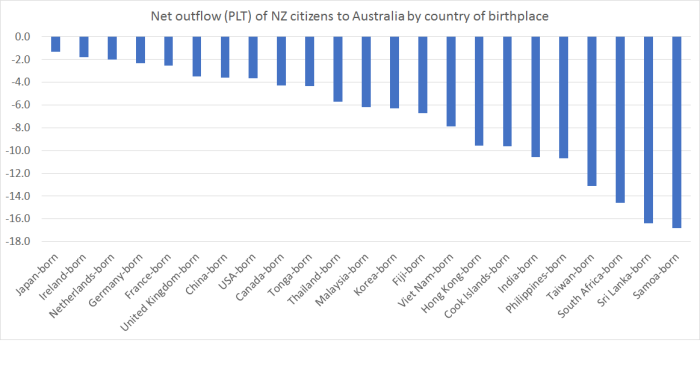
So here are the net outflows over the sixteen March years (2002 to 2017) to Australia of foreign-born New Zealand citizens, as a percentage of the 2013 NZ resident population of people born in that country.

net outflow to Aus by birthplace

If the Australian government really is concerned about those Pacific Island inflows, the Samoa figures might appear to give them some support.   Then again, the South African and Sri Lankan born outflows, as a share of the respective populations, are almost as large –  and presumably those people got into New Zealand by meeting our nationality-blind tests.    For some of those birthplaces, the proportions seem quite remarkably high.

As it happens, the Cook Islands numbers are quite a way down the list, and Tonga further still.  SNZ don’t publish the data at a sufficiently disaggregated level to know what the proportions look like for New Zealand citizens born in Niue, Tokelau or Kiribati.

I don’t have  any great or specific interest in this apparent concern of Australia’s –  and frankly the absolute numbers seem pretty small relative to the size of Australia’s population (and overall migration inflows).  But, the subject having come up again, I was interested in what light the published data could shed on the issue.

Backdoor entry to Australia?

In the various articles in the last few days on Australia’s decision to increase university fees for, among others, New Zealanders studying at Australian universities, there have been a few references to the fear sometimes expressed by Australian officials and politicians that New Zealand’s relatively liberal immigration policy might be being used by some material number of our migrants as a backdoor entry to Australia. Come to New Zealand, stay a few years and get citizenship, and then move on to Australia and the better-paid jobs that a more productive economy can offer.

It had some plausibility as an argument 20 years or so ago, when New Zealand’s immigration policy was much more open than Australia’s.  Any difference between the two countries’ immigration policies is much less marked now (they liberalised late in the Howard years).

It also hasn’t been an issue that I’ve paid much attention to –  it is, after all, mostly a matter for Australian policymakers.   But I thought I would take a quick look at the data SNZ has available on Infoshare.

Using the PLT data (with all its limitations) one can find numbers on the gross and net flows of New Zealand citizens between New Zealand and Australia, and also on the birthplaces (by country) of those making the move.  So one can easily work out what share of the New Zealand citizens moving to Australia (and coming back) were born in Australia and New Zealand, and what share were born elsewhere.  The data seem to be available only for the last 15 years.

Note that birthplaces don’t necessarily tie up closely with migration status.   I suspect that the bulk of Australian-born New Zealand citizens in these charts are the kids of New Zealanders who went to Australia for a few years, had a family there, and then came home.   And some portion of those born outside Australia and New Zealand will also be the children of New Zealanders, with citizenship by descent.   But the bulk of the movement of New Zealand citizens who were born outside Australia and New Zealand is likely to be people who were first given entry to New Zealand under our immigration policy.   Of course, some of the New Zealand born might be children born shortly after their parents arrived as immigrants, and thus in some sense also a phenomenon of the immigration policy.

Here is the chart for the net flow.

net flow to Aus

The Australia-born flow is small, and pretty stable, but has increased a bit in the last few years.   But the bulk of the action is in the New Zealand born line.

What of the non-Australasian born (our proxy for people who were policy-permitted immigrants to New Zealand?   That line looks like a very muted version of the NZ-born line –  many of the same fluctuations but on a much less pronounced scale.  Curiously, right at the moment more non-Australasian born New Zealanders are (net) leaving for Australia than NZ born NZ citizens.    Perhaps that might suggest there was something to the reported Australian concern.  But these are small net numbers of two quite large sets of gross flows.   So lets go directly to the gross flows.

This chart show PLT arrivals of NZ citizens from Australia (the much-vaunted people “coming home”).

arrivals from Aus

All three lines have increased in the last few years, with the largest percentage increase in the (small number) of Australian-born NZ citizens.   Non-Australasian NZ citizens coming back from Australia make up around 11 per cent of the total, and have done throughout the period we have data for.

non aus share

Of course, 11 per cent is a lot less than the foreign-born share of the population (around 25 per cent),  but that foreign-born population share has been increasing quite a lot in the last 15 years or so.

There is probably a lot more interest in the outflows to Australia.  Here is the same breakdown of NZ citizens by birthplace for departures.

departures to Aus

The numbers of Australian-born NZ citizens leaving for Australia has increased, but the numbers are very small.   And by far the largest absolute change has been in the NZ-born series –  outflows in the latest year to March are the lowest for any year in the data set.  But what of the non-Australasian born (the people who mostly initially came to New Zealand as immigrants?)

non aus share of departures

Somewhat to my surprise,  there has been quite a step up in the share of that group in the total outflows to Australia of NZ citizens.  In the most recent year, that share was 24 per cent, up from the around 17 per cent it had fluctuated around for some time.

Of course, as I noted foreign-born people make up around 25 per cent of the total population (that share may be higher again by next year’s Census).  So it shouldn’t surprise us that in the normal course of life, quite a few non-New Zealand born citizens will move to the better opportunities in Australia.  Some will be, for example, people who came as 2 year olds 40 years ago, and whose behaviour and motives are likely to be very similar to those of the NZ born.  The cold truth is that, typically, economic opportunities are better in Australia than they are in New Zealand.

And on the other hand, it is also likely that anyone who was sufficiently motivated to leave some foreign home and come to the ends of the earth (New Zealand) might, on average, be less settled, and more ready to move again,  than someone who had spent their whole life here.  That is an almost inescapable feature (not bug) of immigration, and doesn’t suggest any deliberate gaming of the system.

It is also worth pointing out that even if there is some gaming going on, the lags aren’t short.  The outflow of non-NZ born citizens in the last few years has nothing to do with NZ immigration policy in the last few years, because you have to have been here for five years to become a New Zealand citizen in the first place.  And, as I understand, when you apply for citizenship you have to sign a declaration stating that you intend to stay.  So, if there is the sort of issue Australians apparently worry about, it is quite a slow-burning story.

I don’t want to reach any strong conclusions (and I keep reminding people of the limitations of the self-reported intentions PLT data), but the twin facts:

(a) the foreign-born share of NZ citizens coming back from Australia is so much less than the share going to Australia, and

(b) the significant increase in the foreign-born share of NZ citizen departures in recent years

might suggest there is a little more of that sort of “backdoor entry” going on than I might previously have supposed.

If so, of course, it is totally rational behaviour on the part of the immigrants.  As I’ve repeatedly noted, and as I’ve even heard pro-immigration academics acknowledge, New Zealand isn’t a first choice for lots of migrants.  If they could get into Australia most would probably choose it over New Zealand (a bigger, higher income, country/market).  And they’d probably prefer the US, the UK, Ireland, and probably even Canada over New Zealand.   You take what you can get, and make the most of the opportunities that arise.  For those who become New Zealand citizens, access to the Australian labour market is one of those opportunities.

If we were genuinely attracting really highly-skilled migrants, that would be our loss and Australia’s gain, when they do move on.  But of course MBIE’s own data confirms that all too many aren’t that highly-skilled at all.  We don’t know what the skill mix looks like for those who later move on to Australia, but since the overall NZ outflow to Australia is often described as “looking like NZ” (in terms of skills/qualifications), perhaps it isn’t very different for once-immigrants who also move on.

I was planning to go on and write about how we should think about the option to move to Australia, and gradual changes that have made things tougher for New Zealanders doing so, but perhaps I’ll save that for another day.

And I won’t devote a post to the latest PR on Stuff from the MBIE-funded Professor Paul Spoonley.  Suffice to say that, relative to his piece in the Herald earlier in the week, he appears to have doubled down.    In that piece, even he thought some reforms were needed. But now…

Record immigration levels are not a bad thing for New Zealand, provided the current high standards for entry remain, an immigration expert says.

It was MBIE’s own data that showed that more than half of skilled migrant applicants couldn’t command more than $49000 per annum in the New Zealand labour market.

And while this time he avoids direct use of  the “xenophobia” slur, his case still seems to rest mostly on slurs and assertions.

But heading into elections, Spoonley said, it is important to call out prejudice in our leaders to avoid anti-immigration policies similar to the US.

“Let’s continue to debate immigration,” he said. “But let’s not stereotype or see one group or another as a problem.”

Instead of “xenophobia” now it is “prejudice” he claims to worry about.  Of course, he adduces no evidence, or examples, of such “prejudices”, or of how they are somehow driving the debate.  And as for US immigration policy, the immigration policy run under Barack Obama’s administration had its pros and cons (it wasn’t very skills focused), but the overall number of green cards issued per capita was around one third of the number of residence approvals we currently grant.

And, of course, the issue is hardly ever the migrants.  They are just people trying to make the best for themselves and their families.  The issue is, and should be, immigration policy choices made by our politicians, and by us as a society.


When Australia’s unemployment drops, more people will go there again

I had things more interesting (at least to me) to write about today, but I heard the Minister of Finance on Morning Report talking up the alleged strength of the New Zealand economy, noting that we were now – in some way or another –  doing what south-east Queensland had done previously, becoming all that we always wanted to be, and so New Zealanders weren’t fleeing the country any more.  He was careful not to suggest that the diaspora is coming home –  they simply aren’t, and haven’t at any time in the 40 years since the large trend net outflow began.    As if it is somehow relevant to current New Zealand immigration policy debates – and recall that immigration policy is about non-citizens – he and others keep telling us “but they could”.    It can happen.  It did to some extent in Ireland, but it happened there after they structurally transformed their economy and successfully lifted their productivity performance.  There is no sign of such a successful transformation here, whether under this government or the long run of its predecessors.

I’ve run this cartoon before
richardson

As I noted, since this was first run in early 1991

…. we’ve had Bill Birch, Winston Peters, Bill English, Michael Cullen, and Bill English again, and although we’ve had plenty of cyclical ups and downs, never at any time have we looked like successfully or sustainably reversing our relative economic decline.

And now we can add Steven Joyce to the list.

But what about those net migration flows to Australia that the Minister was talking about?

net PLT to Aus

Going back 1978/79, I’ve shown three different measures of net outflow here:

  • New Zealand citizens only
  • New Zealand and Australian citizens (the group not requiring specific approval to move trans-Tasman)
  • all citizenships

Mostly the patterns are all but identical, and dominated by fluctuations in the movement of New Zealand citizens.  That makes sense: New Zealanders are free to move, and New Zealand has been materially poorer than  Australia throughout this almost 40 year period.     And over that period, there is no very obvious change in the trend –  just large average outflows, but very large cyclical fluctuations in those net outflows.

It is interesting that right at the end of the chart there is some divergence.  Over the last year, for the first time in 40 years, there has been a net inflow of around 2000 non New Zealand/non-Australian citizens from Australia.  I’m not quite sure why that is, but it is broadly consistent with the theme of this post.  Given a choice between going to Australia or staying in New Zealand, not many people tend to go when the Australian labour market is weak.     Over the last 12 months, a net 4206 New Zealanders left for Australia, but that is a lot lower than the average of around 25000 in a typical year.

In that chart above there have been five episodes when the net flow to Australia (on any of the measures shrunk a lot for a period).  The peaks were around:

  • 1982/83
  • 1991
  • 2002/03
  • 2009/10
  • the present.

And here is a chart of Australia’s unemployment rate.

Aus U

It  shouldn’t be any great surprise that all those temporary reductions in the net outflow to Australia coincided with periods of increased unemployment in Australia.  If anything, the Australian unemployment rate looks more important as an explanatory factor than, say, the difference between the New Zealand and Australian unemployment rates.   In 1991, for example, both countries had very high unemployment  –  and at present both countries have unemployment rates well above pre-recession levels.

The greater importance of the Australian unemployment rate shouldn’t be a surprise.  New Zealanders don’t need to have a firm job offer, or advance approval, to move to Australia.  They can do so “on spec”, looking for work once they arrive.   But a typical person will be much less likely to take that risk if the search process in Australia is going to be long and arduous and might fail altogether.  And the risks have increased over the years, as Australian first tightened access to welfare for New Zealanders living in Australia, and then as people become more aware of the rather limited entitlements New Zealanders have there, even if they have been in Australia for some years.

It isn’t a mechanical relationship of course.  And the Australian unemployment rate now –  at around 6 per cent –  is a lot lower than it was in those 1983 and 1991 peaks.  But since the wage gaps between New Zealand and Australia haven’t narrowed at all, and the productivity gaps have continued to widen,  it seems only prudent to assume that as and when the Australian labour market improves, the net outflow to Australia will resume in something like full historical numbers.

In the repeated burble from the government about the alleged strength of the New Zealand economy, it is often overlooked that while our unemployment rate is not high in absolute terms it is still well above what we experienced pre-recession, and more so than is the case for most other advanced countries that have control of their own monetary policy.   And Australia is in much the same position,

U rates in floaters

And even most of these countries largely ran out of conventional monetary policy room.  Neither New Zealand or Australia did.   Neither labour market is that strong.  Against that backdrop it shouldn’t really be surprising that the outflow to Australia has temporarily slowed.   It doesn’t reflect any credit (or discredit for that matter) on our government.  It looks like mostly a cyclical issue in Australia.  An easier stance of policy by the Reserve Bank of Australia  –  which would have been warranted with inflation persistently below target – would probably have seen rather stronger outflows even over the last couple of years.

UPDATE:  Just to reinforce the point about Australian unemployment, here is an ABS chart from a few months ago highlighting how their underemployment measure has not fallen even as the official unemployment rate has.

Graph 1, Unemployment and Underemployment rate, November 1980 to November 2016
Graph: Graph 1, Unemployment and Underemployment rate, November 1980 to November 2016


Tradables sectors in New Zealand and Australia

I have to spend the morning on the gruesome business of trying to make progress in unpicking 20 years of mismanagement of the Reserve Bank pension fund, dating back in some cases almost 30 years.  So this morning’s post will be short.

First, the latest update of my quarterly chart of real per capita tradables and non-tradables GDP.  Regular readers will recall that this is a rather rough proxy –  first developed by the IMF when they were highlighting New Zealand imbalances more than a decade ago.   For these purposes, the tradables sector is the primary and manufacturing components of production GDP, plus the exports of services from expenditure GDP.   The rest of GDP is treated as non-tradables.  Both series are indexed to 100 in the first quarter of 1991, which is when the official quarterly population series begins.

T and NT components NZ to Dec qtr 16

It isn’t a pretty picture.  There has been no growth in real per capita tradables sector GDP (on this proxy) for 17 years.   The peak in the series was in 2004, and if anything it has been trending down since then.  A year or two ago, it looked as though some sort of rebound was underway –  all those tourists and foreign students –  but even some of that growth has been reversed in the last few quarters.  Successful economies –  ones that catch up with the leaders, which record strong productivity growth –  tend to be those with relatively fast-growing exports, and strongly-performing tradables sectors.   A reasonable interpretation of what has gone on is that whatever factors led to the exchange rate being so persistently high –  since around 2003/04 –  will have accounted for the weak tradables sector performance.

Once upon a time, while I was at Treasury, we had someone do similar charts for a wide range of OECD countries.  I’ve only done one for Australia.  Here is what it looks like –  same definition,  based to the same date as the New Zealand one, and on the same scale.

Aus T and NT to Dec 16

Australia didn’t see much growth in real per capita tradables sector output over the 2000s.   In a way, that wasn’t surprising.  They had a huge terms of trade boom, which gave them more income to spend, without needing to produce any more tradables to sell abroad.  And they also had a massive business investment boom –  increasing future production capacity in the minerals sector –  which will have squeezed out tradables sector production during the investment phase.   But over the last five years, growth in real per capita tradables GDP has resumed again – even growing a bit faster than the non-tradables sector.   Perhaps (but only perhaps) there is some connection with the divergent labour productivity performance in the two economies in recent years.

real gdp phw dec 16 release

And for anyone wondering if the performance in the 1990s, when tradables and non-tradables production more or less kept pace, was unusual, in Australia (but not in New Zealand) there is the data to do the tradables/non-tradables GDP chart all the way back to the mid 1970s.  Here it is.

aus t and nt to 74

The sort of pattern we’ve seen –  17 years of no per capita growth in the tradables sector –  doesn’t look like the sort of feature one expects in a successful economy, poised to catch up with the rest of world, reversing decades of relative decline.  Sadly, of course, New Zealand hasn’t been such an economy.  On current policies, there is little reason to expect anything very different in the foreseeable future.