As we await the Governor’s final decision

At midday the Governor of the Reserve Bank will descend from the mountain-top, having communed with himself for some months, and tell us how much more capital locally-incorporated banks will have to hold for each dollar of (risk-weighted) assets.

It is one of the more stark of the democratic deficits in the current Reserve Bank law –  which grew like topsy over the years –  that a single unelected official, largely appointed by more unelected part-timers,  has the unchallengeable power to make such far-reaching decisions, when there is no shared agreement about the appropriate goal policy should be set to meet, no shared agreement on the relevant models of the economy and financial system, and no ongoing accountability for whether this single individual’s choices end up effectively serving the public interest.  Instead, we are left with one individual’s whims – in this case, an individual without even much in-depth expertise or long well-regarded professional experience – and one individual’s personal views of “the public interest”.    Usually, that is the sort of thing we hire/elect politicians for, including because we have recourse –  we can toss them, and their party, out again.

With a better Governor and a better institution beneath/behind him, the legislative framework would still be deeply flawed in principle.  In practice, it might matter rather less.    But instead we have a relatively inexperienced Governor, a similarly inexperienced (in banking, financial stability and associated regulation) Deputy Governor and a fairly weak bench as well.  Search the Reserve Bank’s publications and you will find precisely no serious research or analysis on issues relevant to financial stability or bank regulation.  That isn’t the fault of individual staff, but of choices of successive waves of senior management.  Key management figures are widely known for their aggressive, but insular, approach, and it is only a couple of years since the independent stakeholder survey of the Reserve Bank as regulator produced damning results.   Regulatory capture is often a big concern the public should have about regulatory agencies, and that seems unlikely to be the Reserve Bank’s particular problem.   But analytical excellence, an open and consultative approach, willingness to engage, listen, and reflect, willingness to work effectively with others, are the sorts of areas where the Reserve Bank falls well short.  A system where the Governor is prosecutor, judge and jury in his own case, with no feasible rights of appeal, doesn’t conduce to things being better than they are.

And thus we come back to the Governor’s proposals for markedly increasing bank capital.   These were launched a few days short of a year ago.  There had been no working level technical consultation or wider socialisation of analysis and research on any dimension of the issues.  There was no cost-benefit analysis –  in fact, there still isn’t, we only finally get to see one today and can be sure that will have been artfully constructed to support the Governor’s decision.  As the background papers finally came out it emerged that the 1 in 200 year framework had been chosen at the very last minute.  There was no evidence of close engagement with APRA, despite (a) most of the major banks being subsidiaries of Australian banks, (b) economic and financial risks being similar, and (c) APRA having greater depth and expertise.   To this day we’ve had no serious analysis comparing and contrasting effective capital requirements here and in Australia.

And so it has gone on.  The Bank did publish a few more papers designed to support their case.  They very belatedly hired some hand-picked chosen overseas experts to give the Governor’s plans a tick –  people with no expertise specific to New Zealand.  And even then the ticks weren’t exactly ringing endorsements –  recall David Miles noting that one could grosly over-specify a bridge, or employ engineeers to do regular inspections and assessments.   We’ve had the odd speech –  although never once a serious effort from the Governor, the sole decisionmaker –  including, most recently, the half-hearted ill-supported attempt by the Deputy Governor to claim that New Zealand was much riskier than Australia.  But no indications of any serious engagement with people who had lodged submissions raising technical points of one sort or another on the proposal.

And then, of course, there was the Governor’s style.    There were the attempts –  open and public –  by the Governor to suggest that anyone who disagreed with him was “bought and paid for”, in league with the banks.   Even if it were true –  which it demonstrably wasn’t –  isn’t the onus on a decent policymaker, particular such a powerful one, to engage on the substance and to show where and why someone with an alternative perspective might be wrong.

And then you might recall the succession of Stuff articles on other aspects of how the Governor has been operating this year.

The video of the conference remains on the Reserve Bank’s website. Some reporters said they were stunned Orr would air his anger so publicly and called it bullying.

But other observers were not surprised. Details of Lubberink’s experience were already circulating in Wellington and industry sources say they match a pattern of hectoring by Orr of those who question the Reserve Bank’s plan.

“There is a pattern of [Orr] publicly belittling and berating people who disagree with him, at conferences, on the sidelines of financial industry events,” said one source who’s been involved in making submissions to the Reserve Bank on the capital proposal.

There have also been angry weekend phone calls made by Orr to submitters he doesn’t agree with.

“I’m worried about what he’s doing.”

The source said some companies have “withheld submissions,” for fear of being targeted by Orr.

“They’re absolutely scared of repercussions. It’s genuinely disturbing,” he said.

and

In the cut and thrust of the debate, Orr’s jokey style and everyman charisma fell away. In recent months he’s dogmatically insisted the cost of his plan would be minimal and has picked personally at critics in the media, academia, and the financial services industry.

He’s been variously described as defensive, bullying, and perilously close to abusing his power.

“He’s in danger of bringing scorn on his office,” said long-time industry watcher David Tripe, professor of banking at Massey University. “I used to know him well. I no longer feel so confident.”

Or the strange statement the Governor corralled his entire senior management to sign, rejecting attacks on Bank staff –  and thus attempting to play distraction, since most of the concerns were about the Governor himself and his (now) handpicked senior management.

(As I’ve noted previously, I don’t have a personal dog in this fight.  If he has been abusing me –  which wouldn’t surprise me – I don’t know of it, and fortunately wasn’t one of the submitters subject to one of those “angry weekend phone calls”.   But New Zealand deserves a lot better from such a powerful public figure.)

The Reserve Bank’s Board and the Minister of Finance are jointly and individually responsible for the Governor.  I wrote to both a couple of months ago expressing my concern, partly because the chair of the Board tried to bat away the issues by suggesting that he had had “no formal complaints” (as if that was the appropriate threshold for concern, in an industry where the Governor has great power to make things difficult for at least soe troublemakers).  My letter to the Board was here.   I also knew that I wasn’t the only person writing to the Board.

I lodged a request under the Privacy Act for (basically) any Reserve Bank senior management mentions of me during October (the time of the Stuff articles and the letters to the Board).  I was mostly after the flavour of the period.

For anyone interested the response (not particularly long) is here

Reddell Personal Information 281119 (1)

It includes the letter, Geof Mortlock, former Reserve Bank (and APRA) official, wrote to the Board chair Neil Quigley (because he referenced something I’d written), quite critical of both the Governor and the Board.

Here was how one of Orr’s deputy chief executives responds when Neil Quigley forwarded the letter on.

robbers 1.png

I thought that “Sigh” was pretty telling.  The SLT statement to which she refers was that extraordinary to suggest that it wasn’t fair that people were beating up on their staff when…..no one was.  Play distraction rather than addresss any issues about policy or the Governor.

I sent my letter later the same day.  This was the Robbers unguarded response
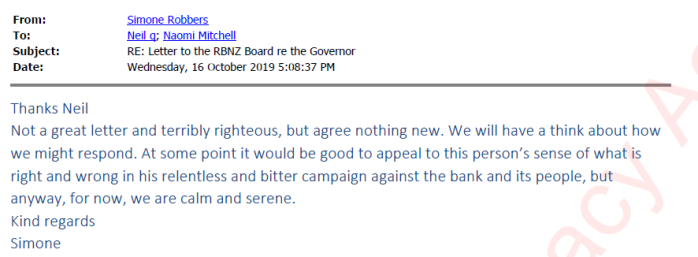
robbers 2

(I have never met her, but I can assure her (and her bosses) that I’m not “bitter” –  I’m not sure what I’m supposed to be “bitter” about, but it is clearly a theme that makes Bank management feel better –  and if they looked at all carefully they would find I typically express my concerns more moderately than some others commmentators on the Bank –  see eg some of the Mortlock articles and, indeed, letter to the Board.  Never mind though, she is “calm and serene”).

Having received my letter, Quigley contacted Orr.  An excerpt

quigley 1

Actually, I didn’t ask for it to be discussed at the Board (although I appreciate the fact that it was so discussed – see below).  More importantly, perhaps, I had not talked to Kate MacNamara for the articles, and have never had any contact with her.

Orr responds a few minutes later, not at this stage having seen the letter

orr letter

One has to chuckle at the lack of any apparent self-awareness in that second paragraph, written just days after the Governor had had his SLT put out that unsolicited statement attempting to distract from real concerns.  I guess it wasn’t the Governor who was making those “angry phone calls”, or engaging as he did with Jenny Ruth, and so on.

A few minutes later Quigley responds, rather characteristically it would seem (one of the consistent criticisms of the Board is that they repeatedly acts as if their role is to cover for the Governor, not –  as the law provides –  to hold the Governor to account on behalf of the public and the Minister.

quigley 3

This is, presumably, a reference to the episode in which Graeme Wheeler used public resources and his official position to attack me as “irresponsible” for bringing to light what proved to have been a leak of the OCR and associated systemic failures, and when I expressed concerns to the Board –  on which Quigley was then a member (generally one rather sceptical of Wheeler) –  they all circled the wagons to defend the Governor.

The Board met a few days later.  A few days later Quigley confirmed to me that the non-executive directors (Orr is also a director) had discussed my letter.  The Board’s minutes confirm this.
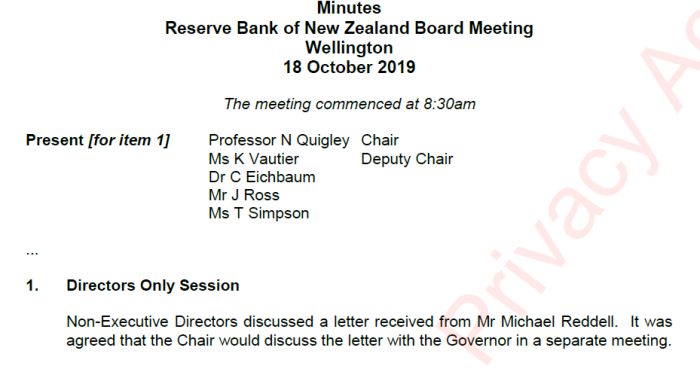
board

We don’t know what was said (and even if it were recorded, it would –  rightly –  not have been disclosed), although there are rumours –  heard from several sources –  that the subsequent meeting between Quigley and Orr was a fiery one, suggesting that the Board may actually have taken seriously some of the concerns raised.   There were signs in the Governor’s demeanour at the last two press conference that he may have been counselled to rein himself in and act with a bit more gravitas and dignity.

As it happened, I had lodged a parallel Official Information Act request in which I asked for

·         all communications received from outside the Bank by Board members (including the Governor) during October 2019 regarding the Governor’s performance or conduct, including (but not limited to) issues raised in recent articles by Stuff’s Kate MacNamara

·         any comments on those communications made by the Governor

·         details of any external speaking engagements, or contributions to written publications, where the Bank had initially indicated that the Governor would speak but which, during October 2019, were either rescheduled, cancelled, or assigned to some other Bank staffer.

The response was due last Friday.  It wasn’t an onerous request.  There can’t have been many such communications to Board members, nor (presumably) many written comments by the Governor.  The third strand was to attempt to find out whether the reported story was correct, that the Governor had chosen or being prevailed on to pull out of some engagements after the criticism.

Anyway, the Bank has extended the deadline for this request by another 2.5 weeks, claiming the need for “consultations”.   But I guess it also conveniently pushes any release beyond today and close to the Christmas break.   Perhaps there is more there than I assumed.  More probably they are just being deliberately obstructive.

As I noted, I also wrote to the Minister of Finance about these issues, mostly to reinforce the point that the Governor was his responsibility, and he couldn’t just fob things off to the Board.  The Minister’s stance right through this year has been to distance himself from the proposed major new regulatory initiative, claiming it is just up to the Governor, and refusing to exercise any of the powers he does have.    Here is that letter.

Letter to MOF re Orr Oct 2019

I didn’t really expect to get more than a one sentence reply, but a fuller response turned up in the post the other day.  Here is the heart of it
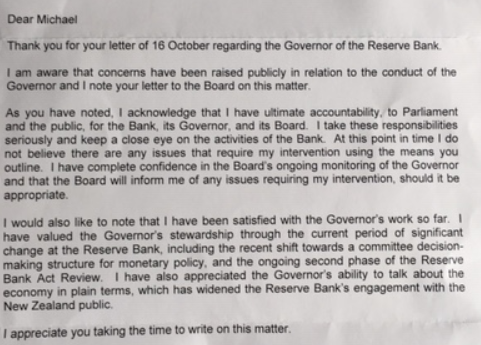
robertson.png

I thought there were two interesting statements in this letter, neither of which he was compelled to make:

  •  first, the statement of “complete confidence” in the Board, even though almost non one shares that view, and his own consultative documents as part of the Phase 2 Reserve Bank Act review recognised the serious weaknesses of the current model and proposed scrapping it, and
  • second, the line that “I have been satisfied with the Governor’s work so far”.  I guess “satisfied” isn’t a terribly strong endorsement, and arguably “work” might not include style, but it clearly sees the Minister of Finance line up behind the Governor including around the Bank capital proposals and decisions (almost certainly the Minister would have been informed of the final decision by last week when the letter was dated).  That is a brave choice, given the serious pitfalls in the Bank’s work in this area that I and various others have highlighted.

Before long we will have the Governor’s final decision.  Perhaps after a year and more of weak performance, his presentation (there is apparently a press conference) will be marked by grace, insight, rigour, and gravitas, and the documents will be penetrating, complete and convincing, addressing comprehensively, whether directly or by implications, many of major concerns that have been raised.  Perhaps, but it seems unlikely.   If it so, I hope I will one of those saying tomorrow how pleasantly surprised I was.

We need a high-performing Governor, a robust and rigorous Bank, and the sort of openness that really should characterise a strongly-performing powerful institution in a free society.  On each count, they’ve been a long way short this year, covered for by both the Bank’s Board (in pretty predictable fashion) and now by a Minister of Finance who refused to take any responsibility –  including when questioned on the issue in Parliament –  and now seems happy to line up behind the flawed Governor he is responsible for –  but, no doubt, a Governor whose personal politics and championing of issues well outside his lane warms the hearts of MPs on the government benches.

New Zealanders deserve better –  behaviour and substance – than we’ve had this year.  As I noted just last week, even at this late date the groundwork the Governor was laying for this decision was shaky and incomplete at best.


Compass gone wonky

Having delivered his Monetary Policy Statement, done his press conference, fronted up to the Finance and Expenditure Committee –  oh, and roiled the markets –  Reserve Bank Governor appears to have jumped on a plane for a quieter couple of days at conference in San Francisco.  I don’t begrudge him that –  the conference in question is usually pretty good (I got to go once) and this year’s programme looked as interesting as ever.  The topic was “Monetary Policy Under Global Uncertainty”.

The Governor was on a “Policymaker’s Panel” –  along with a Deputy Governor from Korea and a former Deputy Governor from Brazil.    It can’t have been a very in-depth panel (the programme allowed only 50 minutes in total), but we don’t hear much systematic from the Governor on monetary policy and so it was welcome that he chose to release his short (four pages or so of text) remarks.  I don’t think I’ve seen them covered in the local media at all.    That is perhaps a little surprising as, having greatly surprised commentators and markets in two MPSs in succession, his remarks to this FRBSF panel were under the heading Monetary Policy: A Compass Point in Uncertain Times.   Sounds like a worthy aspiration.  Shame about the execution.

But what did Orr have to say in his brief remarks?

First, he attempts to suggest that policy (etc) uncertainty isn’t really much of an issue in New Zealand.  Yes, he really does claim that, drawing on a measure – of the dispersion of GDP forecasts –  which isn’t an indicator of policy uncertainty at all.    Now, no one is going to claim that we have anything like the degree of policy uncertainty they face in the UK (or, thus, its major trading partners including Ireland). We don’t even have a “trade war”.   Then again, we had months of uncertainty around capital gains taxes, ongoing uncertainty about the future labour market regulatory regime, and now about the future water pollution regime. Oh, and bank capital requirements…..to name just a few.

Then we come to paragraph that I agree with, quite strongly, and yet it seems he no longer does.   In the light of the uncertainty (globally) he tells us

it is vital that monetary policy acts as a compass point for decision making

going on to note

For New Zealand, this means setting policy to achieve our price stability target and support maximum sustainable employment. It means acting decisively to prevent an unnecessary worsening in economic conditions and the un-anchoring of long-term inflation expectations. And it means recognising the limits of monetary policy.

I’m not going to disagree, but quite how he justifies his MPC’s decisions, and communications, in and around both the August and November MPSs is less clear.  As I noted the other day, in August –  when they did act “decisively” there was little attempt to invoke arguments about inflation expectations in support, then we had a couple of months of wheeling out such arguments, only for them largely to be abandoned last week when he chose to err on the side of caution, “unnecessarily” so, at least in my view, against a backdrop of inflation and inflation expectations below targets with (in their own words) downside risks.   Not much of guiding light there.

Then we get the sort of paragraph beloved of self-important central bankers

In discussing these topics, I will touch on how, since the Great Financial Crisis, central banks have been tasked with a widened set of objectives. On one hand, we appreciate the constraints faced by other institutes, and the peril that may have resulted from the crisis had central banks not stepped up to the task. On the other hand, central banks are sometimes expected to solve phenomena that are structural in nature, and that do not sit easily within the conventional realm of monetary policy. At the Reserve Bank, we are always exploring new policy options to meet our broadened mandate.

Except that, typically, central banks don’t have a wider mandate how than they did before.  That is certainly true of New Zealand –  where nothing at all (in legislation) has changed around regulation/supervision, and where the change to the formal goal of monetary policy was, in the Bank’s own telling, more cosmetic than substantive, designed to capture something about the way the Bank had long sought to operate, while altering some rhetoric.  The big change in New Zealand has been central bankers looking to extend their own reach, both within and beyond the mandate Parliament has given them –  whether LVR limits (arguably within the letter of the law), focus on “culture and conduct” (clearly not),  the Maori strategy (not), the green agenda (largely not) and so on.    Perhaps in a few corners of the world there has been a belief, by a few people, that central banks can markedly change structural growth outcomes.   If so, such a mantra has rarely, if ever, been heard here in the last decade. But it makes central bankers feel important and valued to pretend otherwise.

Keeping on through the speech, we do actually get some recognition that “policy uncertainty” –  and “regulatory requirements” –  were acting as a barrier to business investment in New Zealand.  As he notes, most of this doesn’t have much to do with monetary policy, except that monetary policy needs to take account of whatever is influncing overall demand and supply pressures/balances.

From a central bank perspective, uncertainty has one clear impact: it makes our job harder. Good monetary policy depends on reasonable forecasts. High uncertainty makes forecasting harder. There is more noise in the data and forecasts are more subject to revision. A consequence of this is that the Official Cash Rate (OCR) may be less predictable simply because the world in which we are making our decisions is less predictable.

Except that earlier he showed that chart (mentioned above) in which the dispersion of GDP forecasts has been quite a bit lower than usual in the last couple of years.  So it might be a fair point in principle, but in practice –  in recent months –  the real source of short-term uncertainty about the OCR has been……the Reserve Bank itself.    Not a point that Governor chose to address.

He then moves on to a section headed “Monetary policy response to uncertainty”.

First up is a straw man

Firstly, maintaining low and stable inflation enables organisations and individuals to carry out meaningful financial planning, by reducing overall uncertainty. This is something that is nearly impossible when prices are high and volatile or falling uncontrollably.

Neither is a world any advanced country has been dealing with in recent decades (I’m assuming he meant “inflation” was high and volatile), and in the case of “falling uncontrollably” never.

Then we do get to recent New Zealand policy

In particular, it is now more suitable for us to take a risk-management approach. In short, this means we look to minimise our regrets. We would rather act quickly and decisively, with a risk that we are too effective, than do too little, too late, and see conditions worsen. This approach was visible in our August OCR decision when we cut the rate by 50 basis points. It was clear that providing more stimulus sooner held little risk of overshooting our objectives—whereas holding the OCR flat ran the risk of needing to provide significantly more stimulus later.

And yet, wasn’t that title something about a reliable “compasss point”.   None of his August approach was flagged in advance, arguments for it unfolded only slowly even after the event, and then –  when there was still (on his own numbers) “little risk of overshooting our objectives” they abandoned that particular “least regrets” line, without explanation in advance, in the release, or subsequently.  He goes on

We can also address uncertainty through our communication and forward guidance, which are broad-ranging. We reveal our assessment of the economy—good or bad—to the public, so they can make decisions based on the best possible information amid the prevailing uncertainty. We voice the types of policies we believe may be needed to sustain long and prosperous growth—be they monetary, fiscal, or financial policies.

But that is almost exactly the opposite of what the Governor and MPC are doing.  We have still not had a single substantive speech from the Governor on monetary policy and the economy.  We haven’t at all from three of the statutory members of the MPC.  It is harder to make good decisions when central banks spring –  quite unnessary – surprises.  Oh, and actually it is no part of the Bank’s mandate to be opining on what policies are best for “long and prosperous growth” (although it is remarkable that structural policies appear not to be relevant to the Governor’s view of growth, productivity etc).

There is a final page on “Beyond conventional monetary policy” which I don’t have particular problem with.  It is good that the Governor again repeats his intention to publish their analysis. It is only a shame that (a) this process has been so long delayed, including under his predecessor, and (b) that the work done so far has not proceeded in a more open and consultative way, rather than being something akin to the “wisdom” delivered to the masses from the wise experts on the mountain top.

Orr ends in a typically upbeat tone.   I just want to highlight the last few sentences in which (as so often) he overreaches, partly in the process of distracting attentions from the failings in areas he is directly responsible for.

Yes, there is uncertainty. Yes, it is affecting us. No, monetary policy cannot directly resolve this issue. But we can offset its effects and empower others to fuel economic activity that will benefit us in both the short and long-term. There has never been a greater time to make use of accommodative monetary policy for investing in productive assets.

Yes, monetary policy has a (vitally) important stabilisation role.  It was why countries set up discretionary monetary policy many decades ago.   But it can do nothing to offset the blow to potential output created by policy uncertainty and other regulatory burdens.  It does nothing to boost our longer-term prosperity.  And as for the final sentence…….he falls into the trap again of trying to convince us that low interest rates are some exogenous gift, empowering whole new opportunities, when in fact interest rates –  long-term market-set ones and official OCRs –  are low for reasons that seem to have to do with diminished opportunities, diminished prospects for profitable investments.  Don’t get me wrong – given all that, the OCR should be lower (mimicking what real market forces would be doing if short-term interest rates were a market phenomenon), but when interest rates are falling in response to deteriorating fundamentals it is a stretch –  at very least –  to expect the sort of pick-up in business investment the Bank often forecasts but rarely gets to see.

It wasn’t a persuasive or particularly insightful set of comments.  Perhaps his San Francisco audience –  knowing little of New Zealand –  weren’t bothered, but we should be.  We should expect a lot more from such a powerful, not very accountable, public figure.

(And if you want a speech from a much more serious figure, try this one –  given at the same conference –  by Stephen Poloz, Governor of the Bank of Canada.  There is a depth and seriousness to it that is simply now not seen from senior figures in our own economic policy agencies.)

Effective communications and consistent messaging (not)

One can debate whether or not the Reserve Bank should have cut or not.  Reasonable people can differ on that.  But their communications quite clearly needs (a lot of) work.   This post is just one illustrative example of the sort of problem there is: the role of inflation expectations in their thinking and public commentary.

Back in the August Monetary Policy Statement – the one where they announced the rather panicked 50 basis point cut, not really consistent with either the rest of the document or their own numbers – there wasn’t much mention of inflation expectations.  To be specific:

  • they are not mentioned at all in chapter 1, the main policy assessment/OCR announcement,
  • they are mentioned more or less in passing in the minutes, viz

Some members noted that survey measures of short-term inflation expectations in New Zealand had declined recently. Others were encouraged that longer-term expectations remained anchored at close to 2 percent.

with no suggestion that it was a significant part of the story

  • of the seven other references in the document, five are simply labels of charts, and one was in the standard descriptive framework section (“how we do monetary policy”).  The only other substantive reference was pretty unbothered.

Although survey measures suggest inflation expectations remain anchored at around 2 percent, firms and households continue to reflect past low inflation in
their pricing decisions.

If that had been all, a reasonable reader might have assumed expectations measures were something they were keeping an eye on, but weren’t much of a concern, or playing much of a role in the OCR decision.

But in his press conference, we got the first hint of a quite different line.  Perhaps the Governor genuinely felt differently than the majority of the MPC –  which frankly seems unlikely, given that he chairs the committee and he and has staff have a majority on it –  or perhaps he was simply casting around, more or less on the spur of the moment, for reasons to justify cutting by 50 basis points rather than the 25 points everyone had expected (50 point moves not having been used since the height of the 08/09 recession).

But whatever the reason, in answer to a question (just after the 10 minute mark here) he made the following points:

  • they’d tossed and turned between going 50 points then, or 25 points then and 25 later and,
  • over recent days they had become increasingly convinced that doing more sooner was a safer strategy to achieve their targets than a strategy of going more slowly over a longer period. He went on to note that
  • it was all about the least regrets analysis and stated that in a year’s time he would much prefer to have the quality problem of inflation expectations getting away on us, and possibly having to think about “other activity” [ tightening?]
  • that was preferable (better/nicer) than finding a year hence that they had done too little too late.

I was quite taken with those comments at the time, and commented positively on them in my own review of that MPS.  It seemed exactly the right way to think about things, especially as in the same press conference he was highlighting the risks of the OCR having to go negative (the more that could be done now to boost expectations, the less likely the exhaustion of conventional monetary policy capacity).

But do note that none of that “least regrets” perspective was reflected in the MPC minutes.

The Governor obviously took something of a fancy to this line.  In a interview with Bernard Hickey a few days later, of which we have the full transcript, he is quoted thus

“Doing the 50 points cut was interesting: whilst you get closer to zero, you also shift the probability of going below zero further away,” Orr said.

and

We’ve spent a lot of time around, I suppose, regret analysis, and I spoke about – you know, in a year’s time looking back, thinking ‘well, I wish I had done what?’ And I thought it’s – I would far prefer – and the committee agreed – far prefer to have the quality problem of inflation expectations starting to rise and us having to start thinking about re-normalizing interest rates back to, you know, something far more positive than where they are now. And that would be, you know, it would be a wonderful place to have regret relative to the alternative: which would be where inflation expectations keep grinding down.

and a few days later, in a speech given in Japan, the Assistant Governor was also now running this message (emphasis added)

A key part of the final consensus decision to cut the OCR by 50 basis points to 1.0 percent was that the larger initial monetary stimulus would best ensure the Committee continues to meet its inflation and employment objectives. In particular, it would demonstrate our ongoing commitment to ensure inflation increases to the mid-point of the target. This commitment would support a lift in inflation expectations and thus an eventual impact on actual inflation.

On balance, we judged that it would be better to do too much too early, than do too little too late. The alternative approach risked inflation remaining stubbornly below target, with little room to lift inflation expectations later with conventional tools in the face of a downside shock. By contrast, a more decisive action now gave inflation the best chance to lift earlier, reducing the probability that unconventional tools would be needed in the response to any future adverse shock.

I commented positively on that too.  It was good orthodox stuff.

And it kept coming.  In an interview with the Australian Financial Review, at Jackson Hole, a few days later, here was Orr

Q Was this [falling world rates][ front of mind when you did your recent interest rate cut?

A. It was front of mind. Without doubt the single biggest….one [factor] was domestic.  We saw our inflation expectations starting to decline and we didn’t want to be behind the curve.  We want to keep inflation expectations positive-  near the centre of the band.

And it was also referred to in passing in the folksy piece the Governor put out back here that week, noting “lower inflation expectations” as second in the list of influences on the OCR decision.

And here it was again in the Governor’s 26 September speech

We also judged that it would be better to move early and large, rather than risk doing too little too late. A more tentative easing of monetary policy risked inflation expectations remaining stubbornly below our inflation target, making our work that much more difficult in the future.

By this point – less than two months ago – any reasonable observer would have been taking note.

So what had actually happened to inflation expectations by this point?  At the time of the August MPS the Bank already knew that the 2 year ahead expectations had fallen quite a bit  –  from 2.01 per cent to 1.86 per cent in a single quarter.  That’s not huge, but it is not nothing either, and with core inflation still below 2 per cent it wasn’t something the Bank should have been that comfortable with.  The year ahead measure (noisier) had dropped by more.

As it happens, the other main inflation expectations survey –  the ANZ’s year ahead measure –  hadn’t dropped at all by the time the Bank acted in August: from May to July year ahead expectations were in a 1.8 to 1.9 per cent range.   In August – but not published until 29 August –  they fell to 1.7 per cent, and over the last couple of months they’ve fallen a bit further, the latest observation being 1.62 per cent.

As for the RB survey, there was also a slight further drop in mean expectations in the latest survey that was released on Tuesday (but which the Bank had in hand throughout its November MPS deliberations).

Both the latest ANZ and latest RB surveys were completed exclusively in the period well after the Bank’s surprise 50 point cut in August.  If the Governor (and Hawkesby) were serious about that rhetoric they’d surely have hoped to have seen at least some bounce in the latest survey –  after all, that was the logic of preferring a big cut early.   Instead, those survey measures fell a bit further (not to perilous levels of course –  in fact, current levels are just consistent with where core inflation has been for some time, a bit below the target midpoint).

During the Wheeler/McDermott years the Reserve Bank rarely if ever mentioned the market implied inflation expectations, calculated as the breakeven rate between indexed and nominal government bond yields. I used to bore readers pointing out this curious omission –  they never even explained why they felt safe totally discarding this indicator.

Inflation breakevens have been below 1.5 per cent now consistently for four years now and fell further this year.  In recent months, those implied expectations –  average inflation expectations for the coming 10 years –  were just on 1 per cent.  In monthly average terms, the low point wasn’t even July/August (ie just prior to the MPC’s bold action) but October.

Here is the chart, monthly averages but with the last observation being today’s.

breakevens nov 19

As the Governor was very keen to point out yesterday, there has been a small lift in this measure……but he was less keen to mention the level; the small lift only takes the breakeven rate back to aroud 1.13 per cent.  This time last year it was 1.41 per cent, still miles below the target midpoint.  Perhaps the recent lift will be sustained –  we should hope so –  but on any reasonable balancing of survey and market measures you could really only say things hadn’t got worse over the period since August.  On the clear words of the Governor and Assistant Governor, it was quite reasonable for analysts/markets to look at the inflation expectations data and expect it to feature prominently in this week’s MPS – after all the merits of the Governor’s August/September arguments (agree with them or not) hadn’t changed, expectations hadn’t lifted, and the Bank had given no hint they’d changed their way of thinking, yet again.

But what did the MPC have to say about inflation expectations on Wednesday?  Again there was nothing at all in the chapter 1 policy assessment/announcement, and there was just this in the minutes

The Committee also noted the slight decline in one- and two-year ahead survey measures of inflation expectations. Nevertheless, long-term inflation expectations remain anchored at close to the 2 percent target mid-point and market measures of inflation expectations have increased from their recent lows.

They were pretty half-hearted, even about those market breakevens.  No mention at all of the arguments the Governor and Assistant Governor were running only a couple of months ago, and although the minutes do now mention the idea of least regrets this was all they said

In terms of least regrets, the Committee discussed the relative benefits of inflation ending up in the upper half of the target range relative to being persistently below 2 percent.

The Governor’s comments in August certainly suggested he’d have thought it better then to run the risk of being a bit above 2 per cent (after a decade below).  But this time, the Bank as a whole has reverted back to the cautious approach the Governor was looking unfavourably on, in public, only three months ago.   We are back to “oh well, never mind”, or so it seems, and all that pre-emptive talk,  doing what they can to minimise the risk of needing to go below zero, is supposed to disappear down the memory hole?

It seems all too symptomatic of what is wrong with the way the Bank is conducting monetary policy at present.    There are few/no substantive speeches, the minutes capture little of the flavour of thinking, half the MPC members are simply never heard from (and no one knows if they have any clout or not), there is no personalised accountability (as a market commenter here noted, it is incredible that no one on the Committee was willing to record a dissent yesterday, all hiding behind the Governor)….and then we get the Governor just making up policy rationales (quite sensible ones in this case) on the fly, only to then jettison them, without explanation or a chain of articulated thought, when for some reason (still unknown) they no longer support his instincts.

Was it ever an approved MPC line?  If not, why was the Governor just making up stuff  –  and then repeating it several times in open fora?  Under the rules he is supposed to be the spokesman for the whole committee.   And if it was an approved line why (a) did it never make it into the MPS, and (b) why has the MPC now changed its thinking when there is no sign of significant rebound in expectations, the effective lower bound is still in view, and the domestic measures have actually been drifting lower?

There is little basis for observers and markets to make any reliable sense of the MPC.  We know little, that is in any way consistent, about their reaction functions, their loss functions, their models, or even their stories about what is going on locally and internationally.  Big surprises, of the sort we’ve had in New Zealand at the last two MPSs, have become quite uncommon internationally, and that is generally a good thing.  Where are we now –  18 months into the Orr governorship, 7 months into the new MPC –  simply isn’t good enough  The reforms the government initiated last year could have been the opportunity for something genuinely much better.  Instead all we seem to get is a bit more expense –  all those high fees for the silent, invisible, and unaccountable externals.

Monetary policy isn’t being handled well, and neither is bank supervision (bank capital and all that).   Together, these twin failings in the Bank’s two main functions paint the Bank and the Governor –  and those responsibe for holding them to account in a pretty poor light.    There are hints that, under pressure, the Governor may have recently toned down his act and started to operate a bit more professionally.  If so, it would not be before time, but if this week was anything to go by the tone may be a bit better but the substance of the messaging and communications still leaves a lot to be desired.  At present, the best guess (sadly) would be on another lurch, in an unpredictable direction, relying on new arguments plucked fresh from the air, with no one certain quite who they represent or how long they will last.

Dear Board members

You’ll recall that in Sunday’s newspaper Reserve Bank Board chair Neil Quigley declared, when asked by a journalist, that

Orr’s chequered behaviour is not something on which the Reserve Bank chairman, Neil Quigley, is prepared to act.

“I have not received a formal complaint from any party about the governor’s interaction with them,” he said. “The Board has full confidence in Adrian Orr’s leadership.”

Such an underwhelming attempt to avoid any pro-active responsibility to look into concerns in plain sight, let alone those under rocks.  He hadn’t had a “formal complaint” (but had presumably heard quite a few informal expression of concern) “from any party about the governor’s interaction with them” (suggesting that if someone had expressed concern to Quigley about how the Governor had treated other people, let alone other issues or processes, it wasn’t covered by his denial.  And all that without acknowledging the difficulty many people would have in formally complaining –  even if they had any confidence in the Board itself – given the Governor’s power over numerous financial sector businesses.  But it was all too much par for the course from the Board, which consistently seems to act as if it is more interested in covering for the Governor (whichever one) than in acting on behalf of the Minister and the public.

But as I noted the other day, Quigley’s narrow comment could be seen as a bit of an invitation for people to lodge expressions of concern.   I heard that someone had written to the chair of the Board expressing various concerns and calling on them to exert greater leadership in holding the Governor to account, and that in response Quigley had indicated the issue would be discussed at the Board’s regular meeting on Friday (Orr himself is a Board member, so one hopes at least some of the discussion occurs in his absence).  I decided to add my tuppenceworth to the mix and wrote to the Board last night.  As I’ve noted here, I’ve not had any bad interactions with the Governor myself, but what I’ve seen and heard of other episodes, and the succession of issues around poor process, poor policy substance, and poor communications were, to me, ample to think that the Board really needs to start taking these issues seriously.    It is hard to think of an advanced economy where so many people have had such broad-ranging concerns about an incumbent Governor –  and our one has more power than most.

The full text of my letter is here

Letter to RB Board re Orr October 2019 FINAL

Here is some of the text

You will, no doubt, be aware of the recent series of articles by the Stuff journalist Kate MacNamara. One does not have to be persuaded by all her arguments, or those of the individuals she quotes, to be seriously disconcerted by the perspectives on the Governor’s conduct that she reports. Some of the questionable conduct – the Governor’s treatment of Jenny Ruth at a recent press conference – was visible to all. Others weren’t. Perhaps all those other stories are false, perhaps all are grossly exaggerated. You would surely want to know whether or not that was so – MacNamara clearly having talked to people who are at least somewhat well-informed and the claims having been run prominently in a major mainstream media outlet – but you cannot have that assurance yourselves, or offer it to the public or Minister, without a serious review of the allegations, and of the wider “culture and conduct” that are claimed to have characterise the Governor increasingly in recent months. And yet your chair, when approached for comment, simply fell back on the line of “we haven’t received a formal complaint” (clearly suggesting you’d heard the informal unease many are feeling) as if that meant there was thus no need to do anything more. Frankly you owe it to the Governor, almost as much as to the public, to treat these issues seriously. If there is nothing to the stories – bullying, intimidation, bad-mouthing critics in public fora etc – surely the Governor’s name deserves to be cleared? If there is much to the stories, you need to act, and – having let things drift to this point – to be known to have acted.

And towards the end

Most recently, there was the statement released late last week by the Bank’s senior management – but clearly under the Governor’s aegis and in the Governor’s personal style. Anyone I know who has read it – and fortunately perhaps it hasn’t had much coverage – has been incredulous. How could the Governor of the central bank – the most powerful unelected person in New Zealand – be reduced to so much bluster, and attempts at distraction, trying to suggest that critics were raising unfair issues about Bank staff, when almost all concerns I’ve seen or heard have been about the Governor himself and, to a lesser extent, his senior management? The fact that his handpicked senior management went along with that statement, and were fully party to it, should itself raise further concerns for the Board (including because you also have statutory responsibility for keeping under constant review the performance of the Deputy Governor).

I could go on, but won’t. But there are ample prima facie reasons why the Board should be concerned about how the Governor is conducting himself and how he is conducting public affairs, and why that concern needs now to result in some open-minded but searching investigation and some serious accountability.

We should have a right to expect a Governor who is temperate, who displays gravitas, who demonstrates rigour, who recognises that every one of us has blindspots and is prone to making mistakes, who is open to genuine debate and challenge, who exercises a judicious authority, and models this sort of behaviour to the staff in the organisation he leads. You were responsible for Adrian Orr’s appointment. You need to act to ensure he operates in a manner consistent with those reasonable expectations. If you don’t, the Bank will be diminished – substantively, and in the eyes of domestic and foreign observers – the conduct of policy will be impaired, whatever potential Adrian has to be good Governor will never be realised, and your own standing as guardians of the public interests in the Bank will rightly -and perhaps irretrievably – be stained.

I gather from Neil Quigley that my letter will also be discussed by the Board on Friday.

I also wrote this morning to the Minister of Finance, partly to send him a copy of the letter to the Board, but also to highlight to him his responsibility for the Bank and for the Governor.

In many areas of the Bank’s operations the Governor operates independently of the Minister of Finance, and the Reserve Bank has day-to-day responsibilities for monitoring the Governor’s stewardship and conduct. But none of that diminishes your responsibilities as Minister of Finance. You appoint the Governor (on the Board’s recommendation) and the Deputy Governor, you appoint Board members (and now, specifically, the chair) and it is only on your recommendation that, if things got particularly bad, that either Board members or the Governor (or the Deputy Governor) can be removed from office. Moreover, you are the only person referenced in the Reserve Bank Act who is directly accountable to Parliament and to the public. If serious issues or concerns arise it is not satisfactory for a Minister of Finance to fall back on lines about operational independence or about leaving the Board to do its thing. You are responsible to ensure that all these appointees are doing their jobs to the high standards the public should expect from public officeholders.

and

These are serious matters and need to be addressed as such by both you and the Board. To the extent that concerns raised are either ungrounded or exaggerated, it is important that the Governor’s name be cleared. But to the extent that those concerns are warranted, it is important that they are addressed and issued remedied, for the sake of the Bank itself (including its staff), for the sake of good quality policymaking, in the interests of good governance in New Zealand more generally, and (frankly) for the Governor’s own sake. It isn’t good enough for the chair of the Bank’s Board – who is directly responsible to you – to suggest that not having received a “formal complaint” there is no need for the Board to do anything. Anyone charged with a monitoring responsibility needs to be much more pro-active than that.

One of criticisms of the Governor has been the lack of any serious or substantive speeches from him on topics he is responsible and accountable for.  As I noted to the Board, apart from anything else, such speeches can be one way of benchmarking the Governor’s performance.    As it happens, late this morning the Bank issued a speech by the Deputy Governor. I haven’t yet read it –  so reserve the right to disagree and criticise specifics (good serious speeches create the basis for intelligent discussion and debate) – but flicking through it it simply looks like a serious speech, of the sort a thoughtful central banker would give anywhere in the advanced world.  Of the sort unseen from Adrian Orr.  Bascand has his weaknesses (I’ve written about some of them here, including his apparent reluctance to make a stand) but back in 2017 he told media that he had applied to be Governor (which I wrote about here).  He missed out.  But whatever his other weaknesses, it is impossible to imagine that anyone would be raising the range of concerns –  process, substance, conduct –  had the Board and Minister appointed Geoff Bascand as Governor.


Culture and conduct in question

Stuff’s new, apparently Canadian, journalist Kate MacNamara is doing a pretty good job of keeping up the pressure on the Governor of the Reserve Bank, Adrian Orr.  It is hard to believe a New Zealand journalist would have done so –  one column perhaps, but not three in a week.  Then again, I’m pretty sure we’ve never had a Reserve Bank Governor behaving in quite such an egregious and unacceptably poor way –  not as a single lapse of judgement either, but as a sustained pattern of behaviour.  Sadly, the conduct of the Board (and the Minister?) in such matters, of which more below, is all too typical of the New Zealand establishment.

MacNamara’s latest (“Orr’s culture and conduct in question”) was in the Sunday Star-Times yesterday.   She frames the issue as one of whether the desired end (a stronger banking system) justifies the means (Orr’s conduct).  I’m not sure that is the best way to frame the issue, but here is her take

In December, the Reserve Bank released its boosted capital reserves proposal and asked all interested parties to make submissions.

It would be an open process, the bank said, welcoming all views. But that characterisation was soon at odds with the governor’s behaviour.

Numerous parties involved in the submission process described a pattern of behaviour by Orr of belittling and berating those who disagreed with him.

Orr has penned his critics letters and threatened to broadcast them. He has confronted submitters on the sidelines of industry conferences. Sometimes he called them up at odd hours to tear a strip off them for their views.

And that is before starting on the not-particularly-robust analysis in support of the Governor’s proposal  –  for a huge increase in bank capital ratios, after years when the Bank assured us the system was sound and robust – that the Bank has, only slowly, been rolling out.  Cost-benefit analysis anyone?  Only after he has made his final decision –  for which there are no rights of appeal –  the Governor tells us.

As MacNamara notes, Orr wields an extraordinary level of power in this area –  unparalleled, as far as I know, anywhere in the advanced world.  He can wheel up a proposal, working to no very well defined parliamentary mandate, has only to jump through process hoops around consultation, and then makes the final decision all by himself.  There are no substantive appeals allowed, and the Minister of Finance cannot overrule him (though could, if he chose, bring other pressures to bear).

One of my criticisms of the Governor is that he doesn’t stay in his lane, and sounds off on all manner of highly political issues in pursuit of his personal ideological agendas (in ways we’d find quite unacceptable if other senior independent figures –  the Police Commissioner, the Chief Justice eg – were to do it).  Sadly, that has become quite common –  especially around climate change – among central bankers globally, and Mark Carney (Governor of the Bank of England) has made pretty clear his personal views on Brexit.  As MacNamara notes, apparently

To provide a little context, Orr was recently compared in his outspokenness to Bank of Engand governor Mark Carney.

Paul Waldie covers Carney in London as the European correspondent for Canada’s Globe and Mail newspaper. Carney was previously governor of the Bank of Canada.

Carney has been criticised for playing politics in his estimations of the cost of Brexit in the United Kingdom.

But Waldie is emphatic. “He’s never rude. He’s never personal. He doesn’t hit back at his critics. He’s cool-headed.”

Carney provides no precedent for phoning adversaries after hours, neither blasting them from the lectern or on the sidelines of industry meetings and events.

He gives serious thoughtful speeches as well.

MacNamara concludes

On the contrary, Orr appears to be unrivalled among central bankers in the developed world for the tempestuous and personally directed venting of his views.

I’ve watched, and participated in, central banking for a long time, and that would be my view too.  MacNamara introduces another overseas expert on such matters.

Annelise Riles of Northwestern University’s Buffett Institute for Global Affairs, who’s studied the behaviour of central bankers and has even written a book about them, couldn’t think of a single comparator in contemporary times.

Central banks certainly use many channels to communicate with banks, she said. And it’s not uncommon for central bankers to let banks know how they feel.

“But berating them publicly is just not seen very much,” she said. And though private exchanges are less visible, she couldn’t think of any examples of bald incivility or hostility.

Central bank heads often aren’t even close to saints  (just think back a few years to the way Graeme Wheeler and his top team –  including the current Dep Governor – were used in a not-at-all subtle attempt to shut down criticism from the BNZ’s Stephen Toplis), but nonetheless Orr’s sustained pattern of conduct seems to stand out.  Perhaps the only “defence” one might make of it is that what you see is what you get –  he has always been known for these sorts of tendencies.  He can behave fine when he is on top in an unquestioned way, but put him under any sort of pressure and he isn’t someone to conduct himself with dignity, civility, and respect.

I haven’t had particularly bad experiences of Orr’s personal conduct myself. I had quite a bit to do with him in his two earlier stints in the Reserve Bank, but when he was Chief Economist I was in the Financial Markets Department and when he was head of financial markets and bank supervision I was in the Economics Department.  I saw shonky analysis in support of questionable policies, and didn’t have much time for his divisive style (which, remarkably, he owned up to in a farewell speech when he left the Bank the first time).  But I was left some mix of underwhelmed and bemused  –  at this extremely ambitious, outgoing, sometimes amusing, opportunistic, but not fundamentally serious person –  rather than having any particular sense of personal grievance.  When he was appointed Governor I wrote a couple of posts (one here) that I still think read as a pretty balanced treatment, if generous with the benefit of hindsight.

Others have had a much stronger view.  This comment was left on my Saturday post by Geof Mortlock, who worked directly under Adrian during both of Orr’s previous Reserve Bank stints.

None of what we are seeing with Adrian Orr surprises me in the least. It is precisely what I had expected when he was appointed as governor. The problems so clearly revealed now for all to see were very much evident to me and many others when Orr was deputy governor and head of financial stability in the period 2003 to 2007.  He created a sense of panic when there was no need for it. He engaged aggressively with Australian banks when mature, adult dialogue would have been far more effective and appropriate. He facilitated and abetted an aggressive and petulant fight with APRA, RBA and Aussie Treasury over trans-Tasman regulatory issues rather than seeking to resolve them in a considered, intelligent manner. He engaged aggressively with staff and routinely bullied them. He created a deep level of stress in the RBNZ among staff that contributed to the departure of some key people. I can attest to what it was like working with him. I and others departed the RBNZ because of the severe impact he had on morale and because of concerns over mismanagement of issues and because of the appalling culture that he and others created in the RBNZ. Bollard presided over much of this, either unaware or unconcerned, and did nothing to address the matter from what I could see.

Now that Orr is governor, his unsuitability for the job is evident for any impartial observer to see. The lack of judgement, unsuitable temperament, lack of maturity, inadequate knowledge of the issues and a serious failure to intelligently addressthe policy issues are all obvious to anyone who cares to look at his performance.

Sadly, the RBNZ Board seems to lack the competence or mettle to do anything about it. Its recent annual report was a pathetic effort at exercising meaningful scrutiny over Orr. Even more sadly we seem to have a minister of finance who is asleep at the wheel and either turning a blind eye to Orr’s appalling incompetence in handling the tasks entrusted to him or who is happy to see Orr playing an overtly political role that is totally inappropriate for someone holding office as governor.

It is time that the people with authority over Orr did something about his conduct, statements and handling of policy issues. The RBNZ’s credibility is at stake. And serious policy outcomes are under threat. Robertson and the Board need to take action to address the Orr problem.

Ah, the Board.  They got us into this mess.   Assuming they followed the provisions of the Act (and didn’t just take guidance from Grant Robertson) they are the one’s responsible for his appointment as Governor.  They don’t have many other specific powers, but they have an overarching responsibility to keep under “constant review” the performance of (a) the Bank, and (b) specifically, the Governor in whom most of the powers of the Bank are still personally vested.    If the Board isn’t satisfied they must advise the Minister in writing, and may go so far as to recommend the dismissal of the Governor.  (Regardless of the views of the Board, the Minister may also recommend dismissal of the Governor is satisfied that the Governor has not “adequately discharged” the responsibilities of his office.)

Last week I suggested that one omission from the first MacNamara article was any sign of having approached the Board.  I didn’t expect she’d get much if she asked, but what the chair said was likely to be telling, even if he simply stonewalled.   Anyway, for this week’s article MacNamara went to the chair, the economist academic (and Vice-Chancellor of Waikato) Neil Quigley and sought comment.  This is what she got.

Orr’s chequered behaviour is not something on which the Reserve Bank chairman, Neil Quigley, is prepared to act.

“I have not received a formal complaint from any party about the governor’s interaction with them,” he said. “The Board has full confidence in Adrian Orr’s leadership.”

Some people will argue that Quigley had little choice but to express full confidence (for a corporate board you back the incumbent until you sack him or her).  I don’t agree with that take, given that the Reserve Bank’s Board is explicitly set up as a monitoring and accountability body, with its own public reporting responsibilities etc separate from those of the Bank.     It isn’t an executive body.

But what startled me wasn’t the formulaic “full confidence” line  so much as the rest of the comment.  Here is how Eric Crampton phrased his response to Quigley’s comments

eric orr.png

Quite.   Of course, Orr doesn’t have much power over some people who have been badly treated by him –  for example, the academic Martien Lubberink –  but the general point, that one is dealing a very powerful man here, is well made.  How did the Board so diminish its own sense of its role that the only thing they’d be interested in is a “formal complaint”?  And why would they suppose anyone would bother them when the Board –  under Quigley and his predecessors (think of the Toplis business or the OCR leak) –  has a long record of really only acting as fronts for successive Governors (even on rare occasions when something approaching a “formal complaint” has been made).    It is almost like a climate in which everyone knows there has been, say, a culture of sexual harrassment in an organisation, perhaps starting from the top, but no one quite has the courage to lodge a formal complaint –  the fact that “everyone knows” something should still put a Board on notice that there is something to get to the bottom of, something that needs addressing.   Quigley and his colleagues surely are reading the newspapers and other commentary and they should be keeping an ear open on the cocktail party circuits etc they no doubt frequent. It is their job –  “constant review”, not simply responding to a “formal complaint”, whatever one of those might be in this context.

That is what serious people doing the Reserve Bank Board job would be doing.  But, of course, no one –  with the possible exception of the Governor –  has any confidence in the Board to do its job.  It is why the government has made an in-principle decision to remove that role from them, but in the meantime perhaps they do a public service in demonstrating just what a pointless useless entity there are.  I gather the Board has its monthly meeting on Friday,  It is time for a rethink, and for beginning to finally take seriously the growing concerns about the Governor, not waiting for “formal complaints” Perhaps Quigley’s comment could even perhaps spur a few people to consider lodging ‘formal complaints” –  not necessarily because as individuals they can’t cope with a rude bully, but because we should expect much better standards of behaviour from powerful public figures.

The whole episode –  the bank capital review –  has been characterised by poor process, poor substance, and astonishingly poor conduct, all of which are the Governor’s personal responsibility.  He needs to be called to account –  and not just by a journalist and a few specialist commentators –  by those formally charged with doing the job (Board and Minister), but also by his own senior managers (eg he has a deputy governor with a secure statutory position and earning $600000 per annum), decent people who must be getting increasingly uncomfortable with the boss’s style.   Apart from anything else, it is simply a shocking model for up and coming central bankers and financial system regulators.  People are shaped, for good and ill, by those who lead the organisations they are part of.   Rigour, detachment, courtesy, openness, gravitas, judiciousness and so on are the sorts of qualities we should expect to find in a Reserve Bank Governor.  Not one of them seems to characterise the incumbent.  It isn’t a single lapse of judgement, but a systematic pattern of  the sort of culture and conduct that should alarm anyone who cares about good governance and high-quality policymaking in New Zealand.

Unfit to govern?

I’m presuming Stuff’s Kate MacNamara won’t be very welcome at the Reserve Bank for quite some time.

She was the author of the double-page spread in last week’s Sunday Star-Times about the Governor (“Portrait of the Governor as a strongman” – note that is one word, not two, and the difference is quite important).  I wrote about that earlier in the week.  As a reminder of some of that article, it included this

The video of the conference remains on the Reserve Bank’s website. Some reporters said they were stunned Orr would air his anger so publicly and called it bullying.

But other observers were not surprised. Details of Lubberink’s experience were already circulating in Wellington and industry sources say they match a pattern of hectoring by Orr of those who question the Reserve Bank’s plan.

“There is a pattern of [Orr] publicly belittling and berating people who disagree with him, at conferences, on the sidelines of financial industry events,” said one source who’s been involved in making submissions to the Reserve Bank on the capital proposal.

There have also been angry weekend phone calls made by Orr to submitters he doesn’t agree with.

“I’m worried about what he’s doing.”

The source said some companies have “withheld submissions,” for fear of being targeted by Orr.

“They’re absolutely scared of repercussions. It’s genuinely disturbing,” he said.

and this, re the Governor’s approach around the bank capital debate

In the cut and thrust of the debate, Orr’s jokey style and everyman charisma fell away. In recent months he’s dogmatically insisted the cost of his plan would be minimal and has picked personally at critics in the media, academia, and the financial services industry.

He’s been variously described as defensive, bullying, and perilously close to abusing his power.

“He’s in danger of bringing scorn on his office,” said long-time industry watcher David Tripe, professor of banking at Massey University. “I used to know him well. I no longer feel so confident.”

The Governor was reported to have refused any comment when approached for that story.

MacNamara followed her story up with a detailed piece on the Bank’s staffing and the loss of a succession of highly-qualified and experienced researchers over this year.  Names were named –  people who probably hoped never to see their  names in the general media –  and specific information was clearly provided to the journalist from insiders and people still very well-connected to the Bank’s Economics Department.  The story listed the departure of seven capable researchers who had left in the last year or so (and, at that, missed another name).  Those are large numbers.   In my time at the Bank it would have been rare to have had more than perhaps 10 researchers across the (then) Research and Modelling teams.

MacNamara’s sources were clearly keen on promoting a narrative of a hugely important and influential research function.  One might perhaps say, if only.  I have a high regard for several of the people in the list of the departed.     But the Bank’s key policy initiatives in recent years, whether in monetary policy or financial regulation, didn’t stem from, and were rarely directly supported by, good quality research generated by Bank researchers (there was some good work done, but often fairly tangential to the Bank’s immediate interests/needs).   The sources were also apparently keen on recently departed, having been effectively demoted, former chief economist John McDermott.  I have been on record as believing that Orr’s decision re McDermott was one of the better he has made, and as senior manager in charge of the research function McDermott has to take responsibility for the limited relevance of the research function over the last decade.    Even the Bank’s macroeconomic analysis was pretty underwhelming over much of that period.  All that was under previous Governors.   I’m critical of Adrian Orr for many things, but he can’t be blamed for that (whatever mix of factors played a part in the individual choices of the researchers to leave – and several of those who left were foreigners who had probably never seen their long-term future being in New Zealand).

The Bank must have been taken aback by MacNamara’s forthcoming story

A Reserve Bank spokeswoman said she could not answer quickly questions about staff departures and replacements.

She was unable to say how many staff with graduate degrees in economics or finance have departed in the last 18 months.

Neither could she tally immediately how many staff have joined in that time with similar academic credentials.

Pretty bad staff work, given that they must have known this issue was a point of vulnerability –  even the Annual Report had included a table showing high total staff turnover –  for which they should have been prepared.    Since the Bank publishes a page with details of their Economics Department research and analysis staff, it only took me a few minutes to run down the list and find several new PhD staff the Bank had hired relatively recently (albeit, by the look of it, only one with any knowledge of New Zealand).   It shouldn’t have been hard for the Bank to have got that information to the journalist.

(The article is mostly focused on the Economics Department, and although the journalist attempts to draw connections to the Bank’s poor performance around the bank capital proposals that is a bit unfair to the Governor – only rarely have Economics Department research staff had anything much to do with financial regulatory issues. Maybe it would be better if they did –  I used to argue for a broader focus (ie some actual research around the regulatory functions –  but the choice not to also long pre-dates Orr.  The absence of these particular researchers will have made little or no effective difference to how the bank capital proposals were made and marketed –  those choices were the Governor’s.

The sources who spoke to MacNamara were clearly also keen on PhD qualified staff.  The story highlights that there is no PhD held by anyone in the top-tier of the Bank (first time since 1988 I think), and repeats the contrast between the qualifications of McDermott and his replacements (new chief economist, new Assistant Governor).    Personally, I think this issue in considerably overdone.   Qualifications are not without value, of course, but research qualifications only take you so far in managing and leading a public sector policy organisation.  As I’ve pointed out, over the last 40 years the Bank has had 10 chief economists, only four of whom had PhDs, and at least on my reckoning both the best and worst of them had PhDs.   During the period when the Reserve Bank of Australia was widely-regarded as one of the best central banks in the world, it was led by people with much the same sort of academic qualifications as, say, Adrian Orr.  The presence or absence of a PhD at the top table is not what gave us a rushed, over-reaching, capital proposal with no ex ante cost-benefit analysis.  That is much more about the temperament and character of the Governor (and his right hand people who clearly weren’t willing or able to insist on something better).  In fact, the chair of the Bank’s Board not only has a PhD but is a university vice-chancellor no less, and he claims (in the recent Annual Report) that all is just fine at the Bank.

In many respects I don’t disagree with Eric Crampton’s concluding comment in the article

Eric Crampton, chief economist at the public policy think tank The New Zealand Initiative, said it mattered more in a small country like New Zealand that the Reserve Bank has internal research depth.

“There are very few academic macroeconomists and monetary theorists who pay much attention at all to New Zealand policy. There are, at most, a small handful who do.

“That means that having some of that serious firepower in the Bank matters more,” Crampton said.

Except that, in reality and in other countries, research depth inside and outside the central bank tend to be complements rather than substitutes.  And there is little point in having much of a research capability if it isn’t used to support robust policymaking and analysis. It hasn’t been for some time at the Bank, and that is mostly a reflection on a succession of senior managers and Governors (now including Orr), not on the staff involved.

The real prompt for this post was when, by chance, I noticed a statement from the Bank on its website, apparently released with no fanfare yesterday.  Here is the whole thing.

integrity.png

Get the sense Orr is feeling a bit embattled?

But instead of fronting up to, say, Kate MacNamara we get bluster and distraction (and this common confusion –  often found among senior public servants these days –  about the name of the country).

No one criticised their individual staff.  If there are criticisms to make they are of the leadership itself, mostly that of the Governor –  both because he is chief executive, and because he has a long track record of surrounding himself with people who will do his bidding and not challenge him.

See how the Governor suggests that the Bank somehow has a higher capacity for identifying what is good for New Zealand (yesterday, today and forever) than others, or even that they have a mandate to do so (they don’t).

See his claim that he holds “informed and mature conversations”, and contrast that with, for example, the rushed way they put out the bank capital proposals, the backfilling they had to do as the year went on, the refusal to engage on the substance of any concerns/challenges, the attempts to slur critics and regulated institutions alike, and those descriptions above of Orr’s “angry weekend phone calls” and the like.  This is the same Governor who has not given a single substantive speech on either of his core areas of policy responsibility in over 18 months in office.  It would be unheard of in any other other advanced democracy.

It is past time the Minister of Finance took the situation in hand. He is the one actually accountable to the public for the Reserve Bank.  He needs to be asking the Board chair and the Governor just what is going on, and why they are content for bluster to substitute for serious analysis and considered engagement –  not from staff, but from the Governor himself.   The problems at the Bank are at the top –  Board, Governor, and a weak senior management team –  not among the staff.   The Governor’s statement is an attempt at distraction, trying to suggest he is sticking up for staff (who don’t need it) when the problems start with him (and those paid to hold him to account).

Bluster shouldn’t be able to substitute for serious accountability.


Portrait of a strongman

It didn’t seem like the best weekend for Reserve Bank Governor Adrian Orr.

First, there was Radio New Zealand’s Insight documentary on the Governor’s bank capital plans, and other possible new regulatory burdens.  I was impressed with the huge amount of time and energy that was put into the programme, although inevitably there are limitations in what a programme designed for a mainstream Sunday morning audience can deal with.     In some ways, the best public service now would be if Radio New Zealand and/or the Reserve Bank agreed to release the full interview Guyon Espiner did with the Governor –  we were told it was an hour long, but no more than five minutes would have been used in the programme (I presume this was par for the course on Espiner’s background work, as I did an interview with him that went for perhaps 40+ minutes).

In commenting on the substance of the programme one then has to be a bit careful.  The selection of quotes and the framing is Espiner’s (and I did notice a couple of small errors) and although he is a responsible senior journalist, the way he presented material isn’t necessarily the way the Governor himself might have chosen to.  Then again, the Governor has plenty of communications media open to him and after 18 months in the job still hasn’t given a speech about financial regulation topics, for which he personally has huge personal policy freedom.

But as RNZ presented the Governor’s arguments, they were less than impressive.  They seemed to be playing distraction more than engaging with what should be the core issues.  Not once, at least according to my notes, did he engage on the possible costs and distortions his proposals would introduce (whatever the possible benefits). Not once, for example, did he engage with how comparable his proposals are to the regime that will apply in Australia to the respective banking groups (hint, Orr’s are much more onerous).

Instead, we got irrelevancies.  The Governor decreed that banks were earning too much money in New Zealand.  Not only that, in his tree god and garden imagery, the (Australian) banks were “darkening the garden”, such that the market was not as competitive as it should be.  Perhaps there is something to those arguments, but they are simply not the Governor’s job and should be irrelevant considerations in proposing to exercise regulatory powers under the Reserve Bank Act (directed to promoting the soundness and efficiency of the financial system).  We have a Commerce Act, there are powers now for the Minister of Commerce or the Commerce Commission to initiate a market study.  But that has nothing at all to do with the Reserve Bank, the prudential regulator, not the competition authority.

Orr came a little closer to his own ground, and to respectable arguments, when he suggested that existing capital (and leverage) ratios were just too low, and thus that banks were “too risky”.  That might have been a touch more persuasive if, for example, he’d engaged with the standalone credit ratings of the banks operating here, or talked about the differences between a strongly-diversified big bank and an individual borrower (instead he tried to imply that the risks, and hence appropriate capital, were much the same).  There was the rather weak claim that “at times” housing crises have led to banking crises, but no attempt to unpack that claim, or to engage with the repeated stress tests his own institutions has done this decade.  Let alone, to consider the experiences of banking system like our own (or Australia’s or Canada’s or Norway’s) that with floating exchange rates and governments out of the housing finance market have proved resilient over many decades.

Instead we got another attempt at distraction, suggesting that the New Zealand experience in 2008/09 was really rather a close-run thing.  He knows it wasn’t so. He knows that the issues the New Zealand banks (and their parents) faced in 2008/09 were about liquidity, not about credit quality or loan losses.  There had been a degree of complacency among the banks about liquidity in the 00s –  I recall one discussion with the head of risk at a major bank in about 2006 who simply could not conceive of a world in which funding liquidity markets would dry up almost completely.   But liquidity is a different issue than loan losses –  which were modest in a fairly deep recession after a period of very rapid credit growth – and even the liquidity/funding issues New Zealand banks faced never threatened to bring any of them down.  And the Bank addressed the funding/liquidity issues almost a decade ago, with much more stringent policy requirements.    And risk-weighted capital ratios are already higher than they were going into the last recession  –  partly under regulatory pressure, partly market pressure  –  a recession when (to repeat) the loan losses were pretty modest and not at all threatening.

Then we had more rhetoric about how the Bank was not going to “keep falsely subsidising bank businesses”, although the nature of any such “subsidy” was never clear given (a) the resilience of banks to the Reserve Bank’s own stress tests, and (b) the central place the Bank has long argued OBR should have in handling any bank failures in New Zealand.   But it probably sounded good.  And then he fell back on attempts to exaggerate the costs of financial crises, with talk of “generations of lost employment opportunities”, mental health failures, and vague allusions to various “challenges” of the world right now –  the Brexit, Trump duo again I suppose – being down to insufficient bank capital.    Evidence and sustained argumentation would help –  if not on a short radio programme then, for example, in speeches and robust consultative documents and –  perish the thought –  upfront cost/benefit analyses (as distinct from the ex post one they might eventually show us).

There was some discussion of dairy lending.  As the Governor fairly noted there had been some fairly aggressive and unwise lending to that sector over the last 15 years (in the early part of that period the impression was that the offshore parents had little real idea of what the subsidiaries were doing in that sector).  Dairy farm economics doesn’t look as it once did, for various market and (actual/proposed) regulatory reasons, so no doubt there isn’t the same bank risk appetite there once was.  But it is quite unconvincing for the Governor to try to pretend his capital proposals won’t exacerbate pressures in that sector, or in other sectors where specific hard-to-extract and manage  knowledge/experience is key to good lending.  Big corporates, for example, who can simply turn to banks not affected by the Governor’s proposal (overseas-based banks, and even the parents of the NZ locally-incorporated banks).  I doubt credit supply will be too adversely affected for residential mortgage finance either.  But for other sectors, including dairy, who does the Governor expect to step into the gap?  Wasn’t he talking (see above) about insufficient competition?  Won’t these proposals weaken that competition, especially as all the locally-owned banks are themselves capital constrained?

The Governor also tried to claim that the Bank’s existing capital rules had somehow “caused” the banks to run into problems on dairy lending, citing differences in risk weights used by various banks for apparently similar lending.   Even to the extent there is an issue there, it is worth remembering that (a) by far the biggest increases in dairy lending occurred (last decade) before the advanced models approach came into effect, and (b) good banks get things wrong from time to time, and none of the actual or stress-tested dairy losses pose any threat to systemic stability.  The Governor’s numbers tell him so.   We want banks to lose money from time to time –  were they not doing so the Governor (on another day, another trope) would probably be complaining about them taking insufficient risk, holding back opportunities etc.

And then, of course, there was the cavalier line I wrote about on Friday: the Governor in essence telling the banks that if they don’t like his rules (and him as prosecutor, judge and jury in his own case) they can just take their money and go.  I wrote about this  irresponsible line on Friday.

Perhaps we should see his talk –  all it appears to be at present – about banning people from serving on both the boards of parent and New Zealand subsidiary at the same time, as all part of that same mentality of suspicion of Australian banks.  The Governor shows little or no sign of appreciating the value New Zealand, and New Zealanders, get from having banks that are part of much larger banking groups, from a country with a track record of a stable and well-managed banking system.  He talks a lot about the standalone capacity of New Zealand subsidiaries in a crisis, but very little about the benefits of integrated banking operations in more normal circumstances (ie at least 99 per cent of the time).  He seems to be hankering for the Australian banks to sell down their shareholding in the New Zealand subsidiaries –  acting as, in effect, an agent for NZX and the New Zealand funds management industry – while showing no sign of recognising that a more arms-length New Zealand operation might also be one less well-placed to receive parental support if something ever does go wrong.

All in all, I just wasn’t persuaded that Orr was even trying to make a serious sustained analytical case for the specific policy he is pursuing.  Playing distraction seemed to be more the style.  (Perhaps I’m wrong and the tape of the full interview would no doubt tell us more.)  That, after all, is the problem with the regime: at least formally, under the law, having dreamed up this proposal all by himself, the only person he actually has to convince of its merits is….himself (final decisionmaker).

Oh, and I almost forgot to mention Auckland University economics professor Robert MacCulloch’s comments.  He highlighted the “sheer lack of raw intellectual firepower” at the Bank, and claimed that neither the Board nor the senior management were really up to the job.  I probably wouldn’t have put it quite that strongly –  there are still able people but in the Board’s case they seem to have no interest in doing anything other than covering for the Governor, and in the staff’s case, personal self-protection –  with a Governor who does not welcome challenge –  is a deterrent to people speaking up even if they have (a) stayed on, and (b) disagreed.      The Bank has lost a lot of good people this year, for various reasons, but few would have had much involvement in the bank capital issues.  MacCulloch’s other comments resonated more strongly with me: there is no history of extreme fragility in the New Zealand banking system (“rather the opposite in 2008”) and that the Governor’s style is undermining confidende in the Reserve Bank, at home and abroad.

Of course, only a few geeks would try to unpick the Insight programme.

But the Sunday Star Times did us a public service with a big double-page article on the Governor that was distinctly less than flattering.  The online version ran under the title “Portrait of the Governor as a strongman”.  I’d encourage you to read the article. Several critics were actually willing to go on the record –  not, of course, ones from among the banks (the “strongman” has a lot of power over them).

Here is an extract, starting with reference to the heavyhanded stance Orr took with veteran and highly capable journalist Jenny Ruth at a recent press conference

The video of the conference remains on the Reserve Bank’s website. Some reporters said they were stunned Orr would air his anger so publicly and called it bullying.

But other observers were not surprised. Details of Lubberink’s experience were already circulating in Wellington and industry sources say they match a pattern of hectoring by Orr of those who question the Reserve Bank’s plan.

“There is a pattern of [Orr] publicly belittling and berating people who disagree with him, at conferences, on the sidelines of financial industry events,” said one source who’s been involved in making submissions to the Reserve Bank on the capital proposal.

There have also been angry weekend phone calls made by Orr to submitters he doesn’t agree with.

“I’m worried about what he’s doing.”

The source said some companies have “withheld submissions,” for fear of being targeted by Orr.

“They’re absolutely scared of repercussions. It’s genuinely disturbing,” he said.

(Orr told someone recently he didn’t read what I write –  his perfect liberty of course –  so I guess I’m safe from the “angry weekend phone calls”.)

Sadly, one can’t really say it is shocking.  It is, more or less, what one might have come to expect.  But it is appalling, and a far cry from the sort of standard the public has a right to expect from such a powerful public servant.  Wielding so much power singlehandedly, with few checks and balances, we need someone with a judicious and calm temperament, happy to engage openly and non-defensively, and so on. Instead we have Adrian Orr.

The article reports that Orr refused to be interviewed.  But perhaps the bigger question is why the journalist responsible –  for a very useful and courageous article –  showed no sign of having sought comment from Neil Quigley, the chair of the Bank’s Board who is paid to hold the Governor to account.  And there was no sign either of having sought comment from Grant Robertson, the person who actually has the power to dismiss the Governor and whom –  as voters –  we might expect to be visible when concerns like these are raised.  (And if the Minister of Finance isn’t visible, why isn’t the Prime Minister insisting that her Minister do his job?)  The behaviour as reported should be unacceptable in a democratic society governed by the rule of law and conventions of acceptable conduct.

Another quote from the article

In the cut and thrust of the debate, Orr’s jokey style and everyman charisma fell away. In recent months he’s dogmatically insisted the cost of his plan would be minimal and has picked personally at critics in the media, academia, and the financial services industry.

He’s been variously described as defensive, bullying, and perilously close to abusing his power.

“He’s in danger of bringing scorn on his office,” said long-time industry watcher David Tripe, professor of banking at Massey University. “I used to know him well. I no longer feel so confident.”

I was exchanging notes last week with someone about comparisons between Graeme Wheeler and Adrian Orr.   The SST article reports insiders claiming that Wheeler had not been keen on the idea of big increases in capital requirements for locally-incorporated banks.  If so, that is to his credit.

Not much else was. I’m not going to repeat his failings, but recall just how unpopular he had become with key stakeholders by late in his term (the survey the New Zealand Initiative undertook). By the end, his departure was almost universally welcomed, and must almost have been a relief to him too, as someone never at all comfortable in the public spotlight.

Orr is more a polarising figure, in that he does still have some supporters, but they must be getting quite uncomfortable with his style, even if they are sympathetic on substance.  But a rerun of that NZI survey would be unlikely to show up the Bank in a good light.  The more time goes on the more unsuited Orr appears to be for the office to which the Bank’s Board and the Minister of Finance appointed him.     He degrades the standing of the Bank here and abroad, as well as eroding its internal analytical capability and whatever spirit of robust internal debate was left after Wheeler, and undermines confidence in the institution’s ability to manage real threats.  It is rather sad to watch, but perhaps only a slightly more extreme example of the sustained degradation of policy capability and leadership in New Zealand public life and public sector this century.

 I hear on RNZ this morning the Governor was quoted as pushing back – I think mainly against MacCulloch – suggesting that criticisms were “narrow nitpicking”.  But there is a long list of sceptics, and of reasoned critical submissions on what is proposing, and how he is doing it. For anyone interested, here was my formal submission

A rather well-paid Governor

When Adrian Orr was appointed Governor – in late 2017, taking up the job in March last year –  we were given to understand that

Orr’s salary at the central bank would be “in the range of the current governor” [that was reported as a quote from the Minister] “, whose most recent salary has been reported to be around $660,000 a year”.

At the time there was an (unlawfully appointed) “acting Governor” holding office, but it had been announced that he was being paid the same as the previous (lawful) Governor.   The most recent substantive Governor, Graeme Wheeler, had left office a couple of months earlier.

Wheeler’s last full financial year as Governor was the year to June 2017.  In that year, the highest paid person at the Bank is reported (Annual Report) to have received between $850-$860K that year, with a note disclosing that

The highest remuneration band includes a payment of $101,000 for accrued annual leave, which was paid in cash rather than taking annual leave.

In other words, his final year salary looks to have been around $750-$760K per annum.   As I pointed out in this post, it looks as though Wheeler had had perhaps a $90000 payrise that year (the case for which was distinctly questionable, but that is another post).

What of Orr?  The Reserve Bank’s Annual Report was released today.  Orr was in office for the full year, and there are no footnotes suggesting extraordinary payments (eg see above), and the relevant table suggests that the highest paid person at the Bank received $820-$830K last year.

Perhaps among the elites where Grant Robertson moves an additional $70000 a year is a mere bagatelle and pardonably covered by “within the range” of the previous Governor. One suspects ordinary voters might be more sceptical.   (And even if the Minister and the Board thought the Governor’s first year performance was superlative, the overwhelming bulk of the annual payment disclosed today has to relate to the rate at which Orr was first appointed –  and it is hard to believe the Minister would be giving the Governor a big rise when he is telling listed companies he is a shareholder in not to raise directors’ fees at all.)

In truth, high as the Governor’s pay is relative to other government agency CEOs, I would have no real objection to paying that amount for a really top-notch person. It is, after all, a job of great (barely trammelled) power and responsibility.   I strongly object to paying that amount of money for someone who just makes stuff up, tramples across the boundaries of his role, and who shows little no in-depth command of the issues and material he is responsible for.   You might have thought my comments on his speech last week were fairly critical, but my assessment was pretty moderate by the standards of comments I’ve had on it from other knowledgeable people (“woeful”) was the latest one I heard this morning –  and that is before getting started on his really rather appallingly-bad (but well off reservation) second speech last week.

But, as ever, not a murmur of concern is heard from the Bank’s Board or the Minister.  For the latter, it must be convenient that the Governor spins so often, perhaps to keep spirits up.    That might be a job for the Minister and the Prime Minister.  It most certainly isn’t the role of the Governor, and his stewardship to date is diminishing his own standing and that of the institution he leads.  With a Secretary to the Treasury who knows nothing about New Zealand (but at least has an excuse for not doing so) and a Governor of the Reserve Bank who, whatever he really knows, just makes stuff up, the public are very poorly served by our key economic institutions.   Responsibility for that rests with the Minister of Finance.

A strikingly poor speech from the Governor

On Wednesday afternoon the Reserve Bank Monetary Policy Committee released their latest OCR decision.  It was, as predicted, no change in the OCR.  I don’t think it was the right decision on the substance (some background to that here) but at least it was in line with the Governor’s public comments following the previous surprise decision.

I didn’t have that much to say about the two pages (statement plus “minutes”) they released.  So just a few quick points:

  • in the statement the Bank continues to overstate the contribution of the “trade war” to the slowdown in global trade and global growth.  It is a convenient “newspaper headlines” story, but the way they use it suggests they haven’t thought much more deeply about the issues,
  • they talk up the prospects of economic recovery, based on the reduction in interest rates, but never seem to recognise that interest rates had been cut for a reason.  Unless the OCR is cut by more than any fall-away in economic fundamentals, you wouldn’t expect to see a rebound.  As I pointed out last week, actual cuts in variable retail rates lag well behind the fall in market-determined long-term rates,
  • there is something inappropriate about the Bank talking up the idea of fiscal stimulus three times in two pages (not that fiscal stimulus might be out of place in some circumstances, but it is entirely a matter for the elected government).  On the other hand, I guess we should be grateful that the Governor has stepped away from his August comment that “of course the government has to be spending more”.
  • it is interesting that, at least as written, the MPC appears not to have any bias on the direction of the next move in the OCR.   They are very widely expected to cut in November and cut again next year but there is nothing in this statement to lead one to think the MPC shares that view –  if anything, in the minutes we read that “some members”, with a cost-plus model of inflation apparently, believe there is “potential for rising labour and import costs to pass through to inflation more substantially over the medium-term”.   Their predecessors were hawking similar lines in 2015/16.

It is 18 months today since Adrian Orr took office at Governor of the Reserve Bank.  I’ve not infrequently bemoaned the fact that in that time Orr has not given a single substantive on-the-record speech on monetary policy or banking regulation/financial stability (the Bank’s two main areas of responsibility).  Yesterday Orr gave short speech to a corporate audience in Auckland, which dealt with both monetary policy and (in more abbreviated form) banking regulation.  I guess we should be thankful for small mercies.

Sadly, the contents of the speech suggest we have a Governor who simply makes stuff up whenever it suits him.  It is extraordinary in such a powerful public figure, one supposedly operating as an independent and judicious technical expert.  Much of it comes across as almost delusional –  perhaps welcome to his mates in the Beehive, but even they must sometimes wonder whether independent public institutions aren’t meant to be more than cheerleaders.

To take just a few examples of what I have in mind, start here

The good news for New Zealand, unlike many other OECD economies, is that our government’s books are in good shape and there is already a strong fiscal impulse underway from public spending and investment. 

There is no disputing the first half of the sentence.  It is to the credit of successive governments of both parties that government debt has been kept pretty low and stable over recent decades.  But what about that second claim, about the “strong fiscal impulse”?  Well, it simply isn’t supported by the facts at all.    This is from my post on last month’s Monetary Policy Statement when the Governor tried to run the same sort of line.

In fact, it prompted the perfectly reasonable question from Bernard Hickey about whether fiscal policy was actually very stimulatory at all.   The standard reference here is The Treasury’s fiscal impulse measure.  This is the chart from the Budget documents

fisc impulse.png

It isn’t a perfect measure by any means, and in particular one can argue about some of the historical numbers. In my experience, it is a pretty useful encapsulation of the fiscal impulse (boost to demand) for the forecast period. In fact, the measure was originally developed for the Reserve Bank –  which wanted to know how best to translate published forecast plans into estimated effects on domestic demand/activity.

And what do we see.  There was a moderately significant fiscal impulse in the year to June 2019.  That year ended six weeks ago.  For current and next June years, the net fiscal impulse is about zero, and beyond that –  which doesn’t mean much at this stage –  the impulse is moderately negative.    All using the government’s own budget numbers.  And consistent with this, operating revenue in 2023 is projected to be higher as a share of GDP than it is now, and operating expenses are projected to be lower (share of GDP) than they are now.    The Budget is projected to be in (fairly modest) surplus throughout.

And yet challenged on this, the Governor seemed to be just making things up when he claimed that we had a “very pro-active fiscal authority” and that “the foot is on the fiscal accelerator”.    It just isn’t.  Orr must know that (after all, he had Treasury’s Deputy Secretary for macro sitting as an observer in this MPS round).  One even felt a little sorry for the Bank’s chief economist spluttering to try to square the circle, but basically acknowledging that Hickey’s story was right, not the Governor’s.   Perhaps, you might wonder, the Bank thinks the fiscal impulse measure is materially misleading and has its own alternative analysis of the government’s announced fiscal plans. But that can’t be so either: there is no discussion of the issue in the Monetary Policy Statement.

(Incidentally, on Morning Report this morning Grant Robertson tried the same sort of line, only for the presenter to point out to him the fiscal impulse measure, reducing the Minister to spluttering “but we are spending more than the last lot”.  That is true, but the material overall fiscal boost was last year –  and growth and activity were insipid even then, inflation still undershooting the target.)

Was he being deliberately dishonest or simply making stuff up as he went protraying things as he’d like them to be?  You can be the judge, but neither alternative puts our central bank Governor in a good light.

Given that he has since had another 7 weeks to get his lines straight and yet repeats the same line, it looks even worse for him now.  As I said last month, if the Bank has an alternative take on the demand implications of fiscal policy it surely behooves them to lay it out for scrutiny, not just make idle claims inconsistent with their longstanding standard reference source the Treasury estimates).

Just as preposterous was this claim from the Governor

The low level of interest rates globally over recent years primarily reflects low and stable inflation rates – a deliberate and desired outcome of monetary policy.

Here the Governor was repeating much the same nonsense it is reported that he ran to Parliament last month

Over the weekend, I came across an account of the Governor’s appearance on Thursday before Parliament’s Finance and Expenditure Committee to talk about the Monetary Policy Statement and the interest rate decision. …. The Governor was reported as suggesting although neutral interest rates had dropped to a very low level, that MPs should be not too concerned as we are now simply back to the levels seen prior to the decades of high inflation in the 1970s and 1980s.

I’m not going to repeat the entire post I devoted to illustrating just how unusual global (and New Zealand) interest rates now are, both in nominal terms and (even more so in the long sweep of history) on real terms.  In centuries past there was little or no rational expectation of sustained inflation, while these days everyone agrees that medium to long-term inflation expectations are somewhere between 1 and 2 per cent.  The Governor may also have forgotten, in a New Zealand context, that the inflation target here is now materially higher than it was, say, 25 years ago.   Interest rates are, of course, far lower.  Here is just one chart from the earlier post, showing how unusual global interest rates were even five years ago (things are still more anomalous now, especially here).

As a final chart for now, here is another one from the old Goldman Sachs research note

GS short rates

In this chart, the authors aggregated data on 20 countries.  Through all the ups and downs of the 19th century and the first half of the 20th century –  when expected inflation mostly wasn’t a thing –  nominal interest rates across this wide range of countries averaged well above what we experience in almost every advanced country now.

Why does the Governor say this stuff?  Does he have no advisers left who are willing to tell him that what he says just isn’t so?

There are claims that the domestic economy still has “ongoing momentum” and that there is “strong demand for goods and services”.  These claims appear to be based the Governor’s interpretation of comments from the small group of firms the Bank went and visited recently.  Never mind the economywide measures, whether the range of business confidence and activity measures, or…..well, the national accounts.

pc GDP growth.png

He goes on repeatedly about how interest rates make it a great time to invest, as if he’d not given a thought to possible reasons why interest rates might be low (NB, it isn’t just because inflation came down again, see above).  He claims we have a “great environment to invest”, talks of “low hurdle rates for investing”, but seems not to recognise that in a climate of uncertainty, whether around policy (here or abroad) or the economic outlook, the option of simply waiting has considerable value, or thus that there is little reason to suppose that hurdle rates for investing have dropped much, if at all, in more recent times.

As a bureaucrat Orr is apparently convinced it is a great opportunity to invest and that profitable investment opportunities abound.  Experience suggests that people with a bottom line to meet disagree with him.  Here is the Bank’s own chart from the most recent MPS showing business investment as a share of GDP, with a few observations from me.

bus investment RB.png

As I’ve noted here repeatedly, business investment never recovered strongly from the last recession, and if anything (as share of GDP) has been falling back again in the last few years, even as population growth remained strong.

But despite the feeble business investment performance, the Bank expects business investment to recover from here.  There is no hint as to why they believe that is likely…. If there is any basis for their beliefs it seems to be little more than the repeated claim by the Governor and the Minister that it is “a great time to invest” in New Zealand.  But firms didn’t think so over the last five years –  even with unexpected population shocks –  and surely the reason the Bank is cutting the OCR has quite a bit to do with deteriorating conditions and investment prospects here and abroad?

But what do firms know?

Orr seems to more or less acknowledge the uncertainty issue, in these strange sentences, tinged with corporatist sentiments

However, there remains a loud call from all quarters of the country for leaders to better signal investment intent, and ensure we have the policy and goodwill to facilitate access to capital and resources to execute.

This call for investment-intent is to all collectively-owned (e.g., Iwi), Crown-owned (i.e., central and local government), and co-operatively owned (e.g., traditional primary sector) sectors. It is not just to traditional businesses, or any one party.

Easily said, harder to do without a clear desire to work together over an agreed horizon.

Or he could just have mentioned the major policy uncertainties.    Whatever your view on the merits of any of these issues (and I’m steering clear of expressing such views) mightn’t you think that uncertainty around the ETS, water quality policy, highly productive lands policy, the future of the RMA itself, whether any more significant roads will be built by a government apparently averse to them, bank capital regimes, the future of extractive industries might all be among the sorts of factors that might leave businesses and potential investors just a little wary, and pricing that uncertainty into their decisions around investment?

It all comes to a climax in this extraordinary claim in the Governor’s final paragraph (emphasis added).

In summary, we are not alone in the low interest rate environment, this is a global phenomenon. However, what we do have is more policy and business opportunities than most OECD economies and this is something that we need to take advantage of.

If by that he means that New Zealand productivity and per capita income rank far behind most of the OECD countries we used to like to compare ourselves to and that, at least in principle, those gaps could be closed, then I’m right with him.  But absolutely nothing about how policy has been run by successive governments for at least 25 years now has (so it appears from the evidence of hindsight) been consistent with closing those gaps: the productivity gaps in particular have just kept on widening and (though you would never know it from the Governor’s speech) we’ve had little or no productivity growth at all for the last five or more years.  Nothing about current policy suggests that record will improve in the next five years, and if anything one could mount a plausible argument that the measures adopted by the current government are heightening the risk of even worse (relative performance outcomes) in the next five.   Not only is this stuff well outside the Governor’s area of responsibility –  which is about macro and financial stabilisation –  but he either just doesn’t know what he is talking up or knowing better he just mouths such platitudes anyway.

Finally, there are several paragraphs in the speech about the Governor’s proposals to hugely increase the amount of capital locally-incorporated banks will need to have to back current balance sheets.    Notionally, there is process of consultation and deliberation going on at present. But when you read from the sole decisionmaker words like these,

Our proposals would see significant increases in shareholder capital in banks. With banks having more of their own ‘skin in the game’, the owners will sharpen their long-term customer focus, and it will reduce the chance of a bank failure and the cost on society as a whole should a bank fail. These outcomes are highly desirable for the long-term economic health of New Zealand, and should promote deeper and more liquid local equity and debt markets.

We finalise our decisions in early-December this year. Whatever our final decisions, we will be insisting on transition to higher capital at a sensible pace.

with all those “will”s, you get a pretty strong sense of pre-judgement.  That is, of course, what you’d expect when those proposals were based on very weak analysis –  numbers plucked out of the air at the last minute –  and when the Governor is prosecutor, judge, and jury in his own case, and where he knows that there are no effective appeal rights against his verdict as unelected unaccountable decisionmaker.

It really isn’t good enough.  Citizens should expect better.  The Bank’s Board is paid to hold the Governor to account, but they are almost worse than useless (they provide shadow without substance, suggesting there is scrutiny and accountability when there isn’t).  If the Minister of Finance were doing his job, or Parliament’s Finance and Expenditure Committee was doing its job, some pretty hard questions would be being asked about just what is going wrong at the Bank, and how such shallow –  and frankly embarrassing –  material is emerging from the mouth of such a powerful public figure.

Instead, no doubt, things will continue to drift, and the slow decline of New Zealand’s economic institutions –  hand in hand with the continuing decline in New Zealand’s relative economic performance – will continue.

But, you businesses out there really should be investing. This Governor tells you so.


A good time to invest?

A day or two ago I started reading a new book on, among other things, the decline in trust in “experts” that is said to increasingly pervade Western societies.  I’ve written previously about my scepticism that supposed experts are people we should repose much trust in, on things other than the most narrowly technical matters.  I want an expert carrying any surgery I or my family need and when, for example, it comes to house renovations

A good architect, and capable expert builders and other tradespeople, can together enable an outcome that I couldn’t deliver myself. Most of us need, and value, expert advice, and expert execution, but the decision to renovate the house, and how far to go, is the customer’s. It is about choices and preferences on the one hand, and advice from experts who actually usually know what they are doing on the other.

It isn’t clear to me that there are very many areas of public policy where arrangements should be much different.

And I often wonder just how much real expertise –  on matters beyond the most narrowly techical – can be found in most of the public sector agencies in which some encourage us to place our trust.   The Governor of the Reserve Bank is one of those figures in whom the law places a great deal of power.   Doubts about whether that is a wise choice, at least about the incumbent, were given further fuel by his performance on TVNZ’s Q&A last night.

I don’t have the time today to unpick it all, including his continued claim that fiscal policy is adding to demand/activity, when The Treasury’s fiscal impulse measure suggests it isn’t (all that has happend in the Budget update numbers is that fiscal policy is now estimated to have roughly a zero effect on demand over the next few years, rather than the slight drag previously projected).  Orr seems to be champing at the bit to have the government spend more –  especially capital spending – but he was careful and never quite said so last night.

Where he is much less careful is around investment more generally.    Last night he followed up from his claim at last week’s press conference that the country was in a great condition, with the renewed suggestion that now was a wonderful time to invest, that businesses need to “keep going” on investing, and that it was hard to be nervous about investing with such low risk-free interest rates and (so he asserted) such low hurdle rates of return.  (Doesn’t he follow the world news?)    This wasn’t just so in New Zealand apparently: there were global “infrastructure deficits” and generational opportunities.  Closer to home his extraordinary assertion was the New Zealand had only “quality problems” –  the bizarre line John Key used to use about Auckland’s housing and transport problems.

You really have to wonder what insight the Governor thinks he is blessed with that eludes people in the private sector and in government, here and abroad.   It isn’t as if he offers us a detailed piece of argumentation and analysis in support of his story.  It seems to be mostly just handwaving and wishful thinking.   Not exactly a sound basis for policy, or for encouraging us to put any trust in him.

In writing about the MPS last week, I reproduced one of the Bank’s own charts about investment.

bus investment RB

Business investment –  in blue –  has been fairly weak and (if anything) weakening further.  It is not just some sort for post-election blues, businesses not liking having Labour and the Greens in office.  The picture is pretty consistent for years now.   Which suggests it might be reasonable to suppose that people who own,  or are considering starting, businesses have been making rational choices, with the information available to them, about the prospects for investment in New Zealand.  In sum, not particularly good –  and this despite the considerable boost to demand (and need for domestic buildings etc) that a big unexpected shock to the population will have given rise to.

Consistent with that, the Governor may not be aware that productivity growth in New Zealand has also been lousy for years now –  almost non-existent in the last few.  Profitability and productivity are not, at all, the same thing, but they often go hand in hand –  great opportunities, offering high returns to shareholders, are often ones that will tend to lift the overall productivity of the economy.  New productivity opportunities are often only realised through a new wave of investment (which firms will only undertake if they expect those projects to be profitable).

And we could add to the list of symptoms –  perhaps the Governor also counts them as “quality problems” –  things like a tradables sector that has been going sideways, exports as a share of GDP not rebounding at all, the failure of the government to do anything material to fix the housing market, high corporate tax rates, and a range of actual or looming regulatory restrictions on investment opportunities in New Zealand.   Not the sort of things most people would call “quality problems”.

Of course, the Governor is particularly keen on more public capital spending –  infrastructure.   But, here again, if the opportunities were so great, the numbers would be likely to speak for themselves –  really high benefit/cost ratios showing up when projects are evaluated.  Perhaps the Governor is privy to such estimates, but the rest of us are not so favoured.  Too many of the projects that do go ahead seem like borderline cases at best.

Much of any reasoning the lies behind the Governor’s claims seems to rest on little more than the fact that interest rates are low. But in and of itself, that tells us almost nothing.  After all, interest rates are (very) low for a reason, and as I noted in my post yesterday no one –  including the Reserve Bank, at least based on anything they’ve shown or told us –  has a compelling story about just what is going on and why.   But the revealed behaviour of firms doesn’t suggest they’ve seen it as some windfall that means it is a great time to invest –  with perhaps the only challenge being which of the abundance of riches of possible high-yielding projects one might tackle first.

Out of interest I had a look at other advanced countries.  After all, these extraordinarily low interest rates prevail across almost all of the advanced world (and, as I’ve noted previously, implied forward rates are still higher here than in most countries).  The IMF has data on total investment as a share of GDP for a group of 30+ advanced economies.  In all of them, real and nominal interest rates are (of course) far lower than they were in, say, the 2000s prior to the 2008/09 recession.   Notwithstanding that, for the median of these 35 advanced countries, investment as a share of GDP last year was 2.7 percentage points of GDP lower than it just prior to the crisis/recession.   That is a significant reduction, despite the wonderful investment climate the Governor blithely talks of, in which it would be hard for anyone to be nervous about investing.   Only four of the 35 countries had investment now higher than it was then (Sweden, Norway, Germany, and Austria –  only Sweden more than 1 percentage point of GDP higher).

Now, these IMF numbers are total investment not business investment, and I don’t have the time today to recalculate the business investment numbers (for OECD countries), but it isn’t a picture that suggests that most people actually making investment choices share the blithe optimism of the Governor.   It isn’t particularly confidence-inspiring, or suggestive that he knows much on this topic on which he opines so often.

He could, of course, be right.  Perhaps there really are opportunities just left on the table, even though they offer high returns and/or modest risk.  If so, the market is open.  There is nothing to stop the Governor handing over the reins at the Reserve Bank and seeking an appointment as a private sector CEO, or indeed attracting capital from new investors to start his own enterprise.

I imagine most people will be content to respect the wisdom of crowds –  without necessarily fully understanding it –  and to conclude that when investment has been sluggish for years, even as aggregate demand is ok, labour is fairly fully-employed, and credit conditions haven’t been overly constraining that, despite the very low interest rates, there are huge numbers of attractive propositions going begging because people with their own money at stake aren’t persuaded by the Governor’s rhetoric.

We have very serious economic problems in New Zealand.  They aren’t being addressed by our politicians or our officials, and the Governor seems more interesting in playing distraction, whistling to keep spirits up, than getting to the bottom of those really serious and longrunning economic failures.    Fortunately, in his current role the Governor has almost no say over investment –  other than to opine –  but the lightweight rhetoric does nothing to instill confidence about his handling of those areas where he has great (and excessive) power: bank capital for example.

On other matters, an unexpected family death means I’ll be in Christchurch for the next few days and there won’t be any more posts until Monday.