Championing high immigration

The strongly pro-immigration political and business establishment must have been very grateful to the proprietors of the Herald for making so much space available for lengthy unpaid advertorials for high –  perhaps even higher – rates of immigration to New Zealand.  They even provided a journalist to write these paeans.

First, there was a double-page spread in Friday’s newspaper and then yesterday there was a further gung-ho column (under the heading “New Zealand leading the way on immigration debate”), both by Liam Dann.  When I saw yesterday’s column my first reaction was “yes, and the Pied Piper of Hamelin also found followers –  much good it did them”.

The double-page spread on Friday purported to be journalism: Dann had gone out and talked to various people, but every single one of them seemed to be either keen on high rates of immigration to New Zealand or wanting even more (wanting rules changed to be even more employer-friendly).  He even gave an uncritical platform for Statistics New Zealand, the agency which –  unable to conduct a competent Census – has now delivered us permanent and long-term net migration data that is so bad (in the short-term) that even the Reserve Bank the other day indicated that they were now reduced to forecasting flows starting nine months prior to the publication date of their forecasts (whereas previously they had good indicative data available on a timely basis).

Much of the initial story seemed to be built around a premise that the parties in government had not delivered on promises to lower net migration.     But then whenever he has been in government Winston Peters has never done anything material to make a difference to immigration numbers.   There is no sign he has ever regarded the issue as particularly important.  And, if you check out their 2017 manifesto they didn’t make such promises then either –  there was, for example, no suggestion of cutting residence approvals numbers.  Sure there was some loose talk of net migration numbers falling, but then official forecasts (eg those by the Treasury or the Reserve Bank) also had large cyclical falls projected back then.

What about Labour?   Despite attempts to suggest otherwise, they did not promise to reduce the net migration inflow by 25000 to 30000 per annum.   I wrote about their immigration policy proposals here, prior to the election.   What Labour promised was a series of changes around study and temporary work visas which, if implemented, might have had the effect of reducing the net inflow by those sort of numbers, for one year only.   Nothing Labour proposed would have affected residence approvals numbers at all, and thus nothing would have affected the projected net inflow over, say, a 5 to 10 year period.

Of course, none of this is to deny that both Labour (at least under Andrew Little) and New Zealand First might have been happy to try to create the impression that things would be materially different under them.  But nothing they promised would ever have done so, and (unsurprisingly) nothing they have delivered has.

And yet, amid all the breathless gung-ho stuff in the article, there is no mention at all of the substantial decline in the number of residence approvals granted over the last couple of years, no mention of the recent cut in the target rate of residence approvals, and nothing about the plans the government is now working on to managed residence approvals streams differently in future.  For anyone interested, I wrote about them here last week.

There are lots of small points I could pick up on.  There was the weird statement that “policy plans and population outlooks continue to assume that New Zealand’s net migration will fall back into negative territory”, which simply isn’t true: neither SNZ population projections, nor (say) Reserve Bank or Treasury forecasts assume the net flow turns negative, just that it slows.   Or the odd comparison that noted that our peak population growth rate (in 2017) “was more in line with sub-Saharan African countries like Sierra Leone” than with other advanced countries –  which might have made for some interesting comparisons (eg around economic performance) but was just left hanging.

But I was more interested in two lines in Friday’s article.  First, we had the prominent and doughty academic champion of high rates of immigration, Massey’s Paul Spoonley. who ran this line

More recently we’ve seen issues such as Auckland property prices and the Crafar farms sale. “There are distinct issues that trigger highly negative responses,” says Spoonley.

“What equalises that is the positive economic story and a relatively strong understanding of the role migration plays in that.

“We came through the GFC quite well and have done relatively well since … and what is important in that is the contribution that migration makes.”

I guess if you repeat nonsense often enough some people will believe you.  As a reminder:

  • New Zealand’s economic performance is among the very worst in the OECD, whether one looks back 70 years (about what the post-war immigration surge got going), 50 years, or 30 years,
  • There was nothing particularly attractive about New Zealand’s record in the (so-called) GFC, at least if one compares us to other countries with similar sorts of economic management (floating exchange rate, own monetary policy etc),
  • And, as even the economists who will champion New Zealand immigration policy will concede, there is no evidence specific to New Zealand that our immigration policy –  the most aggressive in the OECD over the last two decades –  has contributed to (an imaginery) economic success, or even mitigated our relative failure.

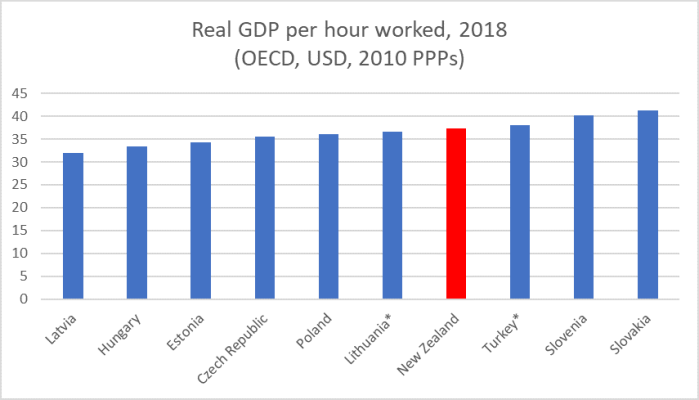
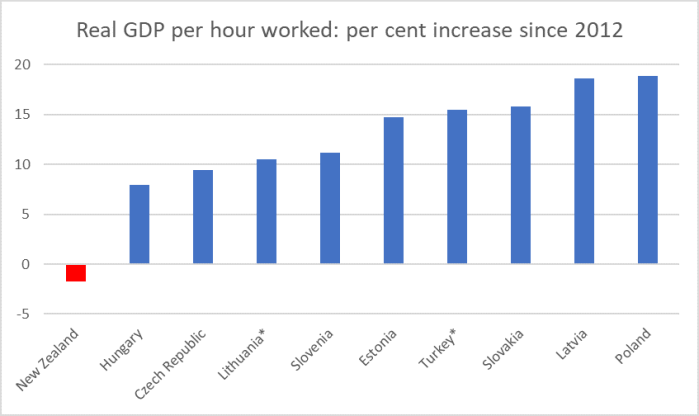
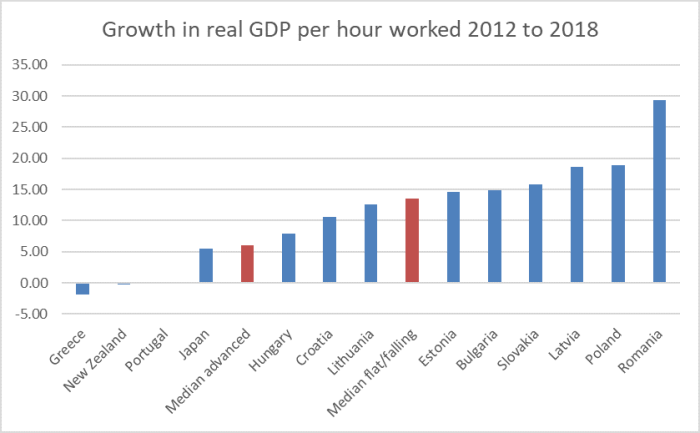
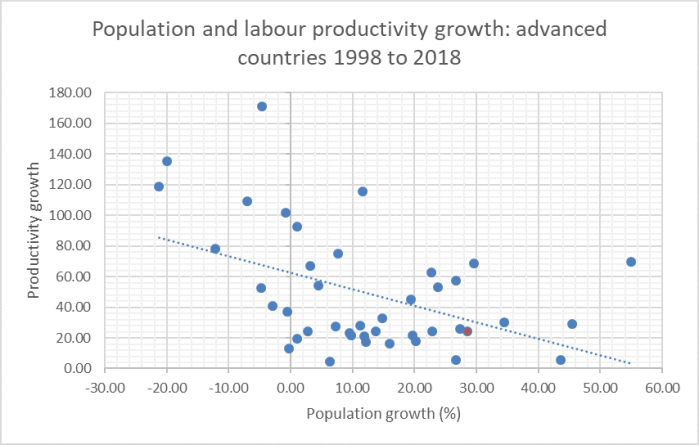
As for the most recent wave of immigration –  which Spoonley himself (rather exaggeratedly in my view) describes as unprecedented –  here is the chart showing New Zealand labour productivity growth (or near complete lack of it) from Friday’s post.

GDP phw may 19

On matters economic (and he is sociologist not an economist) Spoonley is making stuff up, which Lian Dann happily channels for him.

And then there was the population issue. On Dann’s telling

One thing is for sure: if New Zealand wants to maintain a growing population it needs positive net migration.

and he even gets Statistics New Zealand’s chief demographer in to try to buttress his case

There are other places such as Korea, China and western Europe where the natural rates of fertility are much lower than New Zealand’s.

“In some ways they’re a harbinger of where we’ll be in future decades,” he says.

New Zealand’s total fertility rate has been below replacement for decades now (since about 1980) but with no trend apparent for further drops (the rate is pretty stable at about 1.8 children per woman) –  nothing to suggest that our birth rate future is that of Korea or Italy.

But even if our fertility rate were dropping, what of it?  Such a drop would presumably be the result of voluntary choices by New Zealand couples.    What is it that leads Liam Dann to be so sure that we need, or want, continued population growth?  He doesn’t say.

(And doesn’t, for example, mention that –  all else equal – more people mean more emissions, not just in New Zealand but (since our emissions per capita are quite high) probably at global level as well.)

And what of Dann’s rather shorter (and thus probably more widely read) column yesterday?

He begins with the tired rhetorical trope

New Zealand has always been a nation of immigrants.The good news is that most of us understand that.

I’m not sure about his background, but I certainly don’t count myself as an immigrant.  But even if in some sense his factual statement was true, what of it?  It tells us nothing about appropriate immigration policy now (any more than, say, it might have in 1840, had Captain Hobson suggested to the Maori chiefs “you know, this land has always been a nation of immigrants”).

But then he tries to get into substance

However even if numbers ease it seems unlikely that we’ll see a return to the migration outflows we regularly experienced through the past 100 years.

The New Zealand story in the 21st century is very different to the 20th.

For starters our economy is more robust. The peaks and troughs have mellowed.

There are concerns about the fairness of the economic changes made in the 1980s and 1990s but they created a more flexible economy that is less vulnerable to external shocks.

There is so much wrong with this it is hard to know where to start.   First, these “significant outflows” were not common at all in our history: net outflows to Australia happened towards the end of the great Australian boom (shortly to be followed by a very nasty bust) in the 1880s, and there were small net outflows in the 1930s (the UK’s experience of the Great Depression was much worse than our own).   Significant outflows have only become a feature in New Zealand since our economic performance started lagging so far behind Australia’s.  Once we and they had similarly high incomes: these days we are very much the poor relation, and if net outflows to Australia are now not what they once were, it isn’t because those productivity or income gaps have narrowed, but because Australia is much less substantively welcoming to New Zealanders (who can still go any time they like) than they once were.  That is probably a wise choice by Australia, but it has further reduced options for New Zealanders.

Second, what about that spin about our economic cycles. Certainly, any boom this last decade has been very (very) subdued –  basically not a thing –  but perhaps Dann has forgotten that rather severe recession that occurred only 10 years ago.  And there is a certain incoherence in the suggestion that the 1980s reforms reduced the likelihood of migration outflows, when many of the large outflows of New Zealanders have occurred in the decades since the reforms.

Ah, but it is not just the economics. We are now such a with-it place that who (decent human beings anyway) wouldn’t want to live in New Zealand.

Then there is New Zealand’s cultural rise on the world stage.

We’re still a minnow but we are visible and our international media stereotype is of a cool, progressive sort of place – rather than a backwater.

The internet and cheap air travel have removed the tyranny of distance. The immigration boom has turned our largest cities into more cosmopolitan places.

New Zealand has become a place that young people are in less of a hurry to leave, a place that those who do leave are more inclined to return to.

It is also a place that potential immigrants are more likely to be aware of.

It is a place those wanting to escape the madness of the wider world aspire to – whether they are Middle Eastern people fleeing war zones, or Brits and Americans seeking more progressive political landscapes.

And yet, as even the Minister of Immigration’s Cabinet paper –  discussed last week – noted, we have struggled to attract many really high-quality immigrants.  There will always be many poor people happy to move to a relatively prosperous country, if that country will let them in, but not many really able people would have a really remote country, with a poor record on incomes and productivity, as their first choice.   Not inconsistent with that, the number of residence approvals has been dropping not rising.

And then Dann returns to the big-New Zealand rhetoric

That’s just as well. New Zealand’s population growth in the 21st century will be tied to immigration.

Our natural birth rate is falling and our population is ageing, following trends in Western Europe and demand.

Without a steady flow of migrants our economy faces stagnation.

With unemployment at historic lows, an international labour pool prepared to drive trucks, pick fruit and work tough, low-paid shifts in factories, rest homes and hospitals is now crucial to New Zealand’s economic and social wellbeing.

As a factual statement, of course immigration policy will have a huge bearing on New Zealand’s population future.  It has almost throughout modern New Zealand history (when immigration was less expansive –  between the wars, and from the mid 70s to the late 80s –  as well as when the doors are fairly wide open).

But the idea that with a flat, or even modestly falling, population we face economic stagnation, or an inability to manage “economic or social wellbeing”, is –  quite simply –  unsubstantiated rhetoric that (for example) pays no heed at all to the experience of other advanced countries with fairly flat, or even falling populations.    One could add in that unemployment isn’t at historic lows, and that countries with little or no immigration still manage to get the jobs done.    It isn’t clear why we should aspire to having more “low-paid shifts in factories” in the first place, but even setting that to one side,  economies have ways of adjusting to differing patterns of population growth: some activities just don’t need to be done as much if the population is flat (housebuilding is a good example), and changing relative prices (wages) will draw people into service roles. Unless, of course, immigration policy – as it seems to around, for example, the rest home sector – acts to stymie such adjustment.

I wonder if Liam Dann has any idea how the dozen OECD or EU countries that experienced falling populations in the last decade maanaged?

Central planner to the end, Dann ends his column this way

There’s room for more people in this country. We just need to invest realistically for population growth.

As a matter of geography, there is room for more people. There is physical room in almost country.  So perhaps “investment” is the operative word here, and yet we know that rates of business investment in New Zealand (share of GDP) have been towards the bottom of the OECD range for decades even though our population growth rate has been at the upper end of the OECD range.  Sure, there are issues about government infrastructure keeping pace with population growth, but the rather bigger issue is that private businesses have not seen the remunerative opportunities to invest here in ways that might have generated the sorts of incomes and material living standards our peers in leading advanced economies –  most of them with rather modest rates of population growth –  have come to take for granted.   That failure –  not just this year or last year (although very obviously through this particular immigration surge) –  is the market test that the boosters just never grapple with.    And before any comes back with a “but housing….New Zealanders invest too much in housing”, recall that (a) conventional wisdom is that there is a shortage, not a surplus, of houses, and (b) that without rapid population growth a much smaller proportion of scarce resources would have to be devoted to building houses.

Recall that the government’s new immigration policy objectives were about improving the wellbeing living standards of New Zealanders.  Current immigration policy is failing on that count.   In Friday’s article, the Minister of Immigration was running the party line

What we’re interested in is having an immigration system that supports the economic transition to an economy that is more inclusive and more productive.”

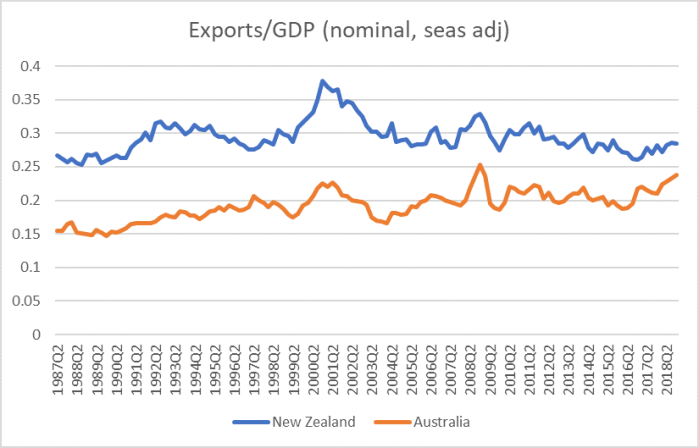
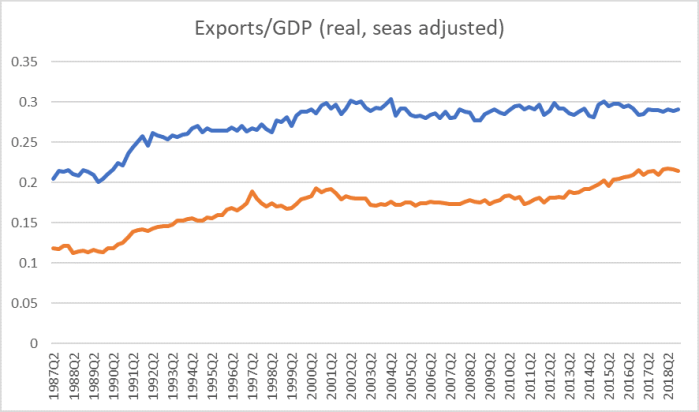
Sounds like a worthy goal. Just a shame that productivity growth has been so poor, and exports and imports have been shrinking as share of GDP.    Current policy –  and whatever tweaks the Minister has in the works –  seem unlikely to change that for the better.  The policy, in much the current form, has been tried for decades now and has failed.

Big New Zealand –  a sentiment championed by too many all the way back to Vogel at least –  is a costly delusion.  It is past time it was abandoned, and we concentrated on doing much better for the New Zealanders we already have in our remote and unpropitious corner of the world, far from markets, networks, supply chains, and (most)opportunities.
Central bankers not giving speeches

I’ve been among those who’ve drawn attention, disapprovingly, to the fact that the Governor of the Reserve Bank, now in office for more than a year, has made no on-the-record speeches about either of his main areas of policy responsibility: monetary policy and financial stability/regulation.   The enabling legislation meant that until very recently he was the sole decisionmaker in both areas, and in both areas there have been significant new initiatives in the last year – a new objective, and new governance structure, for monetary policy, and far-reaching contentious proposals around bank capital.

The Governor has recently become merely primus inter pares on most aspects of monetary policy, joined by six others to form the new Monetary Policy Committee.  The first OCR decision of that new committee was released on Wednesday.

On Thursday morning, the Governor appeared at Parliament’s Finance and Expenditure Committee for his regular post-MPS questioning.  I was going to use the word “grilling” there, but the questioning is often pretty soft, and used to seem more attuned to soundbites for the evening news bulletins than to serious scrutiny and accountability. But this week, apparently, the Governor was asked about the criticism that he had not been delivering substantive speeches.   His response apparently was to “dismiss the criticism” on the grounds that the Bank publishes Monetary Policy Statements, OCR reviews, and some descriptive material on the new governance structure.

But here’s the thing.  Other countries’ central banks also publish official interest rate announcements, and the equivalents of Monetary Policy Statements (and these days, those documents are typically more in-depth and insightful than New Zealand Monetary Policy Statements). 

But since the Governor took office in March 2017 there has been not a single substantive public speech from the Governor on monetary policy.  There was one conference paper written by the now-departed chief economist, which must have been commissioned and substantially written before Orr took office.  That was more than a year ago.

In Australia this calendar year alone the Governor has given two public speeches on economic matters firmly within the monetary policy remit of the Reserve Bank of Australia.   And other senior managers have given another four such speeches.

In Canada, the Governor and senior managers have given eight to ten such speeches (depending how on classifies particular speeches).

In the UK, there appear to have been about six such speeches this year –  again, on things pretty closely related to monetary policy and the state of the economy.

And in the US, just at the Board of Governors (there were numerous other speeches by regional Fed people), I counted 10 such on-the-record speeches this year.

I deliberately mention speeches both by the Governor (or US equivalent) and by senior staff or committee members, because apparently Orr went on to ask, presumably rhetorically, if all public communications needed to come from the Governor, noting that in the past there had been criticism (when?) of a Governor having too high a profile (recall that Graeme Wheeler avoided all substantive searching interviews for five years).   Indeed, it doesn’t, but (a) we’ve had no speeches from any of them for more than a year now, and (b) until a few weeks ago the Governor was solely and personally accountable for monetary policy, and is still formally (ministerial determination) the spokesman for the MPC.

Playing distraction, Orr apparently went to suggest that a lot of discussion focuses on issues around things like climate change and social inclusion, asserting that the same people who criticise him for not doing speeches would criticise him for talking about such issues, and that he just couldn’t seem to win.

Of course, he knows very well that there are two quite separate lines of criticism.   Many (including me) think it is inappropriate and unwise for the Governor to be talking about such topics which go well beyond his remit (as it would be, say, for the Chief Justice to be giving speeches on economic policy).   But even if you were to grant that it was appropriate for the Governor to be discussing such peripheral (to the Bank) issues, you would then surely think it should be all the more reasonable to expect the Governor –  and other MPC members – to be giving serious, on-the-record, speeches about the state of the economy, monetary policy and so on (not to mention financial regulation, but this post –  and the FEC appearance – were about monetary policy).   Things they are actually responsible for, and where they wield a great deal of power, subject to no appeal or review.  It should be all the more reasonable to expect that at a time when (a) a new regime is being put in place, and (b) when the Bank has had to materially alter its policy view.

And when all their peers in other similar countries seem to give serious speeches as a matter of course.  It isn’t clear why our Reserve Bank has stopped doing so.


Two charts

Reading the papers yesterday for a forthcoming meeting, and as “reward” for getting to page 200 (or thereabouts), my eye lit upon (a version of) this chart.  Here I’m showing quarterly data.

bond yields nz and jap.png

It was a salutary reminder of the days –  must have been around 1998 –  when JGB yields first fell materially below 2 per cent.  I was responsible for the Reserve Bank’s markets monitoring unit at the time, so we paid a fair amount of attention to this stuff.  One of my young staff and I spent hours discussing the possible opportunities for shorting JGBs.  After all, everyone “knew” that long-term bond yields couldn’t stay that low for very wrong.    Fortunately we never put the trade on, but in the intervening 20 years I’m sure many people have at various times.  The 10 year Japanese government bond yield today is -0.05 per cent.

It was a New Zealand based outfit –  Melville Jessup Weaver – that did the chart I saw, but here is a version with Australia added.

bond yields aus

And, as a reminder, Australia and (even more so) New Zealand have long had the highest real interest rates in the advanced world.

The point of the chart in the article I was reading was to make the point that further, perhaps quite material, falls in New Zealand bond yields are not impossible.  It isn’t even as if Japanese bond yields are that much of an outlier: German 10 year bond yields are also slightly negative (and Germany has had one of the strongest performing advanced economies in the last decade or so).

What could take New Zealand bond yields much lower?   Well, I’ve argued for years now that the biggest single factor explaining why New Zealand real interest rates are so much than those in other advanced countries is our policy-driven rapid rate of population growth: savings rates are modest, and resource demands for a rising population are large, and high real interest rates (and a persistently high real exchange rate) reconcile those two ex ante pressures.  Cut the non-citizen immigration target as I’ve recommended and I would expect to see considerable convergence.  That would be good for our productivity and business investment prospects.

And, of course, the other (much less favourable) scenario is the next serious economic recession.   Simply cutting the OCR to (say) -0.75 per cent (about as low as people think it could feasibly go) wouldn’t of itself immediately result in near-zero bond yields –  indeed, as was the case in 2008/09 globally, aggressive policy rate cuts help create an expectation that rates won’t be low for long. It was a couple of years after the 08/09 recession before markets really started pricing the idea that low short-term rates might hang around.  But whereas in 2008/09 most central banks could cut policy rates by 500 basis points, if the next recession happens in the next couple of years most advanced country central banks won’t have even 200 basis points of conventional policy space (the Fed a little more, and most in Europe much much less).  And markets will recognise that limitation quite quickly, and begin to price conventional government bonds accordingly.   Even in New Zealand (or Australia) conventional nominal bond yields could quite easily go to 50 basis points or less.

As I noted yesterday, the Governor keeps on with his cavalier tone that there is nothing to worry about and the Bank has lots of potential tools –  the sort of exceptional stuff all sorts of other countries did after the last recession when they reached their effective lower bounds on nominal interest rates.   Sentiment at the BIS in Basle might be a bit different –  they aren’t responsible to any voters, or for any excess capacity/unemployment –  but I doubt there would be any policymaker in any advanced country who could look back on the last decade with equanimity, and not wish they’d had the tools available to lower the unemployment rate faster.  After all, almost nowhere was rising inflation an inevitable constraint.  New Zealand is better placed than some countries, in having a floating exchange rate, but (for example) the UK had one of those too.

The second chart I noticed in the last day or so was this one from the Reserve Bank’s Monetary Policy Statement.

job finding

I’m not entirely sure how they derive this measure –  there must be a research paper online somewhere, which I will try to track down –  but it is cited as evidence that “employment is near its maximum sustainable level”.    The text focuses on the rising trend last year, but in making that comment the authors of the Monetary Policy Statement (for which the whole MPC is presumably responsible), the authors appear to have ignored the rest of the chart.   After all, on this measure less than half the ground lost during the last recession has been recovered (and that incredibly slowly) and –  even allowing for the fact that the peak of the last boom was unsustainable –  the current value of the indicator is still not back to where it was in 2002 or 2003, when nobody (at least as I recall it) would have thought of labour as fully employed.

There does seem to be something of a tension in the Bank’s analysis and official rhetoric.  If labour is really fully-employed (in that weird statutory formulation “maximum sustainable employment”) as they have been saying for the last year –  through upside and downside OCR biases –  why are they cutting the OCR?  More plausibly, a lower OCR would allow the economy to run a bit more strongly, unemployment a bit lower (and, per the chart, people who lose jobs finding a new one more quickly), with the not inconsiderable bonus (given the statutory mandate) of a higher inflation rate.

On which note, one hears that the Reserve Bank’s research function has been  substantially gutted, with several recent resignations in recent months from among their best-regarded and most productive researchers (and the manager of the team left this week and is reportedly not being replaced).    The Bank’s research function once played a very influential part in policy and related thinking, but that is going back decades now.   Even with a Chief Economist who himself had a strong research background, the research team never quite found a sustained and valuable niche in recent years, even as some individual researchers have generated some interesting papers, often on topics of little direct relevance to New Zealand.  One of the most notable gaps is that the Bank has become increasingly focused on financial stability and financial regulation, and yet little or no serious research has been published in those areas of responsibility (a senior management choice).  That weakness has been evident in the recent consultation document(s) on bank capital.

One can always question the marginal value of any individual research paper, but we should be seriously concerned if the Reserve Bank under the new wave of management is further degrading the emphasis on high quality and rigorous analysis.  Apart from anything else, a good grounding in research has often been the path through which major long-term contributors to the Bank have emerged, including former chief economists (and roles more eminent still) Arthur Grimes and Grant Spencer.   I see that the Governor is delivering an (off the record) talk at the New Zealand Initiative today: perhaps someone there might like to ask just what is going on, and what place the Governor sees for a research function in a strongly-performing advanced country central bank.  Not even he, surely, can count on Tane Mahuta for all the answers.


The new Monetary Policy Committee’s MPS

I agreed with the bottom line policy decision yesterday of the new Monetary Policy Committee (it was “unanimous” the Governor twice told us yesterday, even though their charter tells them to aim for consensus not for a vote).  Cutting the OCR looks, with the information to hand now, to have been the right thing to have done (although, as always, only time will give us a better sense as to whether it was in fact the best choice).

But, as a rather portentous (but also somewhat empty) recent Bulletin article reminded readers, there is more to the responsibilities of the Monetary Policy Committee than the succession of OCR decisions.    And on their first outing yesterday I don’t think they were performing that well.  It is early days of course –  three new externals (one of whom wasn’t even there for this round), and two internals who’ve both been in their new roles for less than two months. But there is a (very) long way to go if they are serious about the aspiration the Governor sometimes runs about being the best central bank.

Getting some basic facts right would be a helpful start.  For example, I heard the Governor on Radio New Zealand this morning talking about business investment, and suggesting that it was high but not rising.   Here is a chart showing non-housing investment, and the best proxy for business investment (total less housing less government) as a share of GDP (and recall that GDP growth itself has been slowing).

bus I may 19

Doesn’t look very high to me.

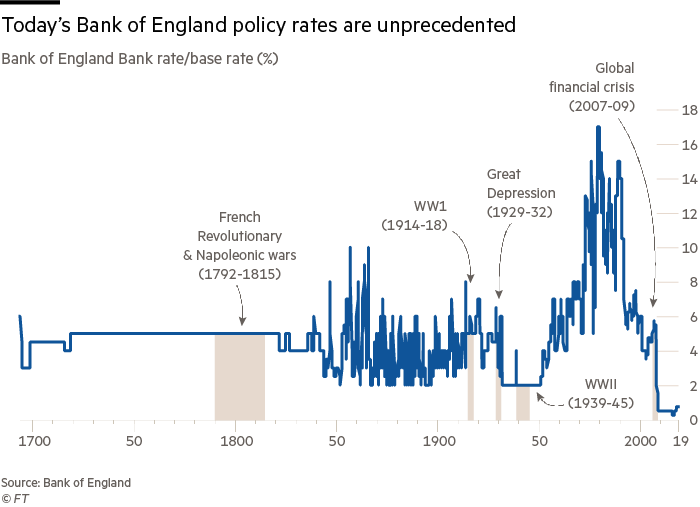
Or there was the exchange in the Governor’s press conference when he was asked about the persistence of low nominal interest rates and whether this was some sort of “new normal”.   There are all sorts of possible, reasonable, answers to that one, but the Governor’s answer wasn’t one of those.  He suggested that what we have now is a return to some sort of “old normal”.   To be sure, real interest rates were at times materially negative in the periods (70s mostly) when inflation was very high, but the Governor explicitly claimed to be referring to an earlier period.  Here is a chart from yesterday’s Martin Wolf column in the Financial Times.

long-term rates UK

The Governor also seemed rather cavalier (again/still) when asked about the limits of conventional monetary policy.  He waves his hands, talks expansively of all sorts of other tools, and yet never once mentions that the countries that reached the limits of conventional monetary policy in the last downturn mostly had very subdued recoveries –  and there is a reasonable argument that with more monetary capacity fewer people would have been unemployed for as long as they were.

In the document itself there were also various odd or questionable bits.  The downside risks to the world economy seem to have played a large (surprisingly large) role in yesterday’s decision, but I was left wondering about the supporting analysis when I read this in the document.

New Zealand has become more exposed to international shocks over time as our global economic links have strengthened. Structural changes since the 1980s, such as the liberalisation of trade and capital movements, have increased our exposure to international economic conditions.

What can they have in mind?   Foreign trade as a share of GDP has been shrinking this century, foreign investment has been subdued, immigration has almost always been important in modern New Zealand history, and external indebtedness as a share of GDP hasn’t risen for decades (even if the composition has shifted from public to private) and is materially lower than it was 100 years ago.  And, on the other hand, we’ve had a floating exchange rate since 1985 which acts as a semi-automatic buffer to many global shocks.

Then there was what looked a lot like a (questionable) bid for the government to increase its own spending.  In the press conference, the Governor disavowed any suggestion of wanting more government spending as a cyclical stabiliser, but in the minutes (the new element of the document) we read this (emphasis added))

The members acknowledged the importance of additional spending from households, businesses, and the government, to meet their inflation and employment targets.

(Rather weird framing to suggest we all need to spend more.)

And

A potential source of additional demand discussed by the Committee included government spending being higher than currently projected, in view of the current strength of the Crown balance sheet.

Since there has been no suggestion from the government that it might depart from its Budget Responsibility Rules  (so the MPC isn’t responding to something in the wind) it looks strange for them to have chosen to include these lines (it is quite simply a choice).

The Governor’s own (apparent) left-wing pro-government biases also seemed to be on display in discussing existing government policy.  There was a whole paragraph about how government fiscal policy would be boosting GDP, and that paragraph ends with the observation that

announced minimum wage rises are expected to support household consumption over the projection period

No analysis was presented in support of this claim, and there is no discussion at all of the possibility that much higher minimum wages might have adverse employment effects.  Readers are just left to suppose it is all good.

The Bank is relatively upbeat in its GDP forecasts (quarterly growth rates averaging 0.8 per cent for the next couple of years) and one explanation appears to be their view of KiwiBuild.   The document notes that KiwiBuild is “assumed to contribute to residential investment from the second half of 2019”, and even though population growth is slowing, credit constraints appear to be tightening, and nothing new has been done to free up land-use regulation, the Bank expects to seeing residential investment rising as a share of GDP.

Readers may recall that at the time of the last MPS the Bank released a background note on its KiwiBuild assumptions.  I took them to task then over the unrealism of assuming that KiwiBuild would represent a material net addition to building activity (and that was before the growing questions about the KiwiBuild programme itself).  As I noted then

On my story, there could be as many builders and associated tradesmen and labourers as you like –  resources flowing easily, with high elasticities, into building as required, with barely any change in prices –  and over any reasonable horizon (say, five to ten years) a credible government announcement that it will build 100000 more houses will, to a first approximation, reduce the construction of other houses by 100000 over that period.    It almost has to be that way because:

  • announcing that as a government you are going to build lots of houses doesn’t change land use law or land availability.  It is what it is –  whether in Auckland or elsewhere.  Everyone recognises that (artificially regulated) land scarcity is a huge component in the high cost of New Zealand houses.   Other government policy measures may yet act on the land use issues, but this is a debate about KiwiBuild, in the existing regulatory system,
  • announcing that you are going to build lots of houses isn’t likely to materially alter the price of building materials in New Zealand, and
  • it isn’t going to materially alter regulatory approval timeframes and related things that (for example) affect financing costs.

In other words the marginal supply price of a new residential property –  like for like in its features –  doesn’t change.    Fix those things and there will be more effective demand for houses from the existing (and projected) population: building activity could really step for quite a while (and some of those capacity constraint and resource pricing issues could be relevant for a few years).    But if you don’t change any of those things –  and KiwiBuild doesn’t materially change any of them –  you’ll end up with no more houses, unless (and only to the extent) that the government-sponsored construction doesn’t cover true costs, and effectively offers a subsidised entry to the market for the favoured few.  Even then, the effect will mostly be to drive out more private construction, but there might still – at least for a time –  be a net increase in the housing stock.

I stand by those propositions, but the Bank appears to continue to assert/assume that KiwiBuild will be lifting economic activity.  Perhaps they are right, but they need to offer more analysis that a single sentence assertion.

Productivity isn’t one of the things the Reserve Bank can do anything much about (on that note, I really welcomed an interview yesterday in which I was being asked about the economy and the Bank, and when I mentioned the underwhelming productivity record the non-specialist interviewer responded “And the Reserve Bank can’t do anything about productivity, is that right?”).   But the Bank’s view on productivity growth affects its forecasts of headline GDP growth, which in turn are grist to the political mill.

Like Treasury, the Bank’s forecasts have been repeatedly upbeat and repeatedly wrong about productivity growth.  They always assume it is just about to pick up again.

In the Bank’s case the story is muddied because the variable they publish forecasts for is “trend labour productivity”.  On this measure – definition unclear –  we have had labour productivity growth averaging 0.8 per cent per annum for the last six years, and over the forecast horizon (to 2022) that is expected to increase to 1.1-1.2 per cent per annum.  There is never any discussion as to how or why this increase is expected to occur.

But lets look at a hard, easily replicable, measure of economywide labour productivity growth.  In this chart I’ve used the average of the two measures of GDP (production and expenditure) and the average of the two measures of hours (HLFS and QES) to derive an estimate of growth in real GDP per hour worked.  We have hours data up to and including the March 2019 quarter, and I’ve used the Bank’s forecast for GDP growth in that quarter (0.4 per cent).

GDP phw may 19

The orange line is the average for the last five years.  There has been almost no productivity growth at all.  Nothing in the data, or in government policy such as it is, suggests that is about to improve materially any time soon.  With little or no productivity growth it would be surprising indeed if annual GDP growth is anything like 3 per cent.

(And yet none of this stops the Governor burbling on about global inflation being low because of positive global productivity shocks.  The rest of the world’s story isn’t as bad as New Zealand’s, but it is hardly a story of strong and robust productivity growth.)

I was puzzling a bit over the MPC’s apparent interest in increased government spending.  Looking through the detailed spreadsheet of forecasts the Bank publishes I found they had forecasts for a variable they call “government spending (including non-market investment)”.  Out of curiosity I averaged the quarterly growth rates over the period from when the current government came to office (their first full quarters was q1 2018) to the end of the forecast period in 2022.  Recall that the Bank uses the government’s announced plans for their fiscal numbers.  Real government spending over the 4.5 years to mid-2022 is forecast to increase by an average 0.5 per cent per quarter.  Still curious, I calculated the average for the previous 4.5 years, under the previous government, and it was 0.7 per cent per quarter.  I don’t have a strong personal view on the appropriate level or rate of growth of public expenditure, but as a detached observer I’ve always been a bit puzzled as to whether left-wing voters really wanted to elect a government that would have government spending (share of GDP) so similar to that of the previous government, and growing more slowly.

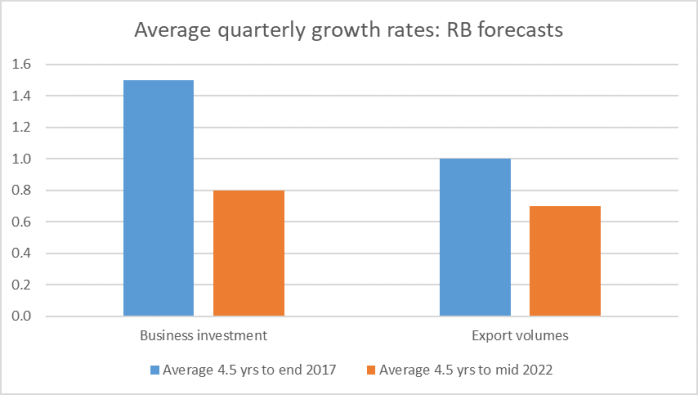
As I mentioned the Governor has tended to talk up the New Zealand economic story, including around business investment.  But here, from the same forecast tables, are the Bank’s projections for average quarterly growth in the volume of business investment and the volume of exports.

lab govt

Not, among other things, the sort of picture one might expect to see if productivity growth were really about to accelerate.

My overall summary?  The OCR call was correct, but little about the analysis or communications the Bank has presented gives one much confidence in our central bank having a good understanding of the economy and its challenges, or the willingness/ability to communicate in a well-grounded dispassionate ways that genuinely sheds light on the issues.  The new MPC is still finding its feet –  one reason why I put little weight on yesterday’s projections as a guide to how things will unfold over the next few quarters –  but there is a big challenge ahead of them.

Economic expectations

The macroeconomic news of the day will be around the Reserve Bank’s Monetary Policy Statement this afternoon.   But yesterday afternoon the Bank published the results of its quarterly survey of (somewhat expert) expectations.

There wasn’t much newsworthy in the survey results.  Across this group of respondents, the median expectations for the inflation rate two years ahead, five years ahead, and ten years were 2.00, 2.00, and 2.00 per cent. The Bank will be pleased.   Unfortunately for the Bank, market prices (from the market in indexed and conventional government bonds) suggest something close to 1.0 per cent (my own responses to the survey were not that low, but were in the lower quartile of responses).

The questions that caught my eye were those around monetary conditions.  Respondents are asked (on a 7 point scale) how they perceive monetary conditions at present, in three months time, and in nine months time.  It is entirely up to each respondent how they interpret “monetary conditions” –  what weight they put on each of, say, interest rates (short or long), exchange rates, credit conditions, share prices, or whatever.  Here are the summary results

mon con

A huge majority of respondents think current monetary conditions are looser than neutral (“neutral” is the Bank’s own term) and expect them to stay that way.

But the surprise was the shift, expected over the coming quarter, from neutral to tighter than neutral.  Sure, the survey was taken almost two weeks ago, but even then market prices were clearly centred on the prospect of an OCR cut –  whether today or in August – with no commentator I’m aware of expecting an OCR increase.   (And in the same survey three months ago, there was an expectation of a slight shift towards less-tight conditions.)

Who knows what respondents had in mind.  It can’t have been the exchange rate –  the survey asks for exchange rate expectations and they aren’t rising –  so perhaps it was something about credit conditions.  Then again, it is a fairly small sample (33 respondents) so perhaps a couple of people just read the options the wrong way round.

What about OCR expectations themselves?  The survey asks about expectations for the OCR as at the end of June and at the end of March next year.   The median response for June was still 1.75 per cent – no change now or at the OCR review at the end of June –  in a survey taken only 10 days ago.   The median expectation is for only one OCR cut by then , but the lower quartile response is 1.25 per cent, and at least one person (wasn’t me) is picking 1.0 per cent by then.  (On the other hand, at least one respondent thinks the OCR will have been increased to 2 per cent by March.)

And the last result that caught my eye was this one.  Respondents are asked for their expectations of GDP growth for the year ahead and then for the year beyond that.  This chart shows the average of those two expectations.

GDP expecs

The latest results are lower again, and are now at the lowest level since December 2009.   Expectations of this sort aren’t particularly useful as forecasts (lots else will change), and often largely reflect what has already been seen.  And the latest decline isn’t severe in the long-run history of the serious. But it isn’t exactly a rosy picture either.  Respondents don’t see anything on the horizon likely to accelerate growth rates.   All else equal, there isn’t much suggesting core inflation will rise.

There is a pretty good case for the OCR to be lower.  Then again, there was a good case (probably stronger) for a cut to official interest rates in Australia yesterday, and it didn’t happen –  the statement read like a central bank desperate not to cut, despite an agreed inflation target they’ve been badly undershooting.   I doubt our Governor will be desperate not to cut, but whether he and his new colleagues actually do so today we won’t know for a few hours yet.


What are Police up to?

A reader sent me the link, and this is what Google Translate generates:

Guangzhou Municipal Public Security Bureau and New Zealand Oakland Police Department signed a friendly cooperation arrangement
Source: Guangzhou Municipal People’s Government Foreign Affairs Office published:2019-05-05 17:51

guang 1.png

guang 3.png

To celebrate the 30th anniversary of the conclusion of the international friendship city relationship between Guangzhou and Auckland, and to strengthen the police cooperation between the two cities, Yang Jianghua, deputy mayor of Guangzhou and director of the Municipal Public Security Bureau, and the assistant police chief of the Auckland City Police Department of New Zealand on April 29 Lena Hassan ( Naila Hassan ) signed a “friendship and cooperation with the Guangzhou Public Security Bureau Auckland, New Zealand Police to arrange the book” in the Guangzhou Municipal Public Security Bureau. It is reported that this is the first time that the Guangzhou police and foreign police have signed a cooperation intention, which indicates that the law enforcement agencies of the two places will formally cooperate in police exchanges and police training.

“Police exchanges” with the Guangzhou branch of the Ministry of Public Security………..  Surely this cannot mean that MPS officers will be let loose with law enforcement powers in New Zealand?  Surely…..

I looked on the Auckland police website, I looked at the Minister of Police’s website, and I looked at the main Police news releases page, and there was nothing about this deal.

I wonder if Police, or their Minister, were ever planning on telling New Zealand citizens and voters about their deal with the PRC domestic repression apparatus?

Yesterday, I mentioned the Gestapo, but one doesn’t need to invoke (quite valid) Nazi comparisons with the People’s Republic of China.   Would Police – or elected governments – have thought such friendship and exchange deals were appropriate with the domestic security forces of the Soviet Union, or Pinochet’s Chile, with Galtieri’s Argentina, with apartheid South Africa, or……or…..or……

It just should not be.  And it clearly isn’t the case that this is just normal stuff (“everyone does it”) –  it is the PRC side that stresses that this is the first such arrangement for Guangzhou.

I’m not fond of the phrase “social licence”, but if it must be used this is an example of how government agencies –  allegedly working for our interests –  risk forfeiting theirs.

I will be lodging an OIA requesting details of this agreement.


Big business

I’ve been following the views of Tyler Cowen for almost 30 years now, since he spent some time in New Zealand doing a review for the Business Roundtable of the (then) new Reserve Bank of New Zealand Act.    These days he is a prolific and prominent writer –  columnist and blogger –  and a professor of economics at George Mason University, all supported by (apparently) voracious reading.   There is almost always something stimulating and fresh in what he has to say.

But he doesn’t always get it right.  Back in the very early days of the Trump presidency, he ran a column on parallels between Donald Trump and our own Sir Robert Muldoon. I begged to differ, and mostly I reckon my argument looks stronger now than it did in early 2017.

A few days ago he had a column in the Washington Post (extracts here) drawn from his recent book “Big Business: A love Letter to an American Anti-Hero”.  In his column he argues that (so-called) progressives in the United States should embrace big business and see it as an ally in the causes they champion.   On some of the specific issues he lists, there is probably something to what he says (and I’m with him in pushing back against the Elizabeth Warren approach to capitalism and business), but as a general proposition (which is what he makes it out to be) what he claims –  that companies are a source of social and political good, going beyond merely the production they facilitate – is at very least arguable.

Thus, we are told that various large US companies “offered health care and other legal benefits for same-sex partners well before the Supreme Court legalized gap marriage”, and that these moves “put a mainstream stamp of approval on the notion of same-sex marriage itself”.   Some will have regarded all that as a good thing – certainly (which is Cowen’s specific point) the so-called progressives will have.   And in that case, one person’s additional remuneration doesn’t directly impinge on anyone else’s.

One could take the argument further.  There are papers around illustrating the way in which companies operating buses or street cars in the segregated American South championed the cause of bus desegregation.  That wasn’t because the owners were necessarily any more “enlightened” than the rest of the white populace, but because having segregated facilities cost them money.  Desegregation was cheaper and more profitable.

More generally, one of the arguments against the idea that there is some sort of meaningful gender pay gap, arising out of discriminatory practices, is that economic incentives are pretty powerful and should contribute to eliminating any such substantial differences –  if equally productive female workers can be had more cheaply than male ones, there are expected returns on offer to firms that focus on recruiting those women.  In the process, wages for women are bid up and, over time, any excess returns are eliminated.   In apartheid South Africa, it was the white unions not the mining companies that had a compelling interest in preventing the employment of blacks in skilled or supervisory positions.

So a competitive market economy probably is quite good at taking out any differences in remuneration based on employee characteristics that are irrelevant to the production process itself (the relentless tendency towards wage=marginal product), and it is also good at chipping away at regulatory and other barriers that impede the ability of shareholders to maximise risk-adjusted returns.    Street-car segregation might be a positive example of the latter, but it isn’t hard to think of less-positive examples (and as someone who favours low taxes on business and light-handed regulation of the financial system I’m not even going to those “progressive” favourites).  One could think of all manner of corporate welfare programmes that many firms fall over themselves to champion and defend (and which anyone who rejects using them can find themselves pushed beyond the margins of profitability), or incentives around environmental regulation, or financial system bailouts, firms that attempt to portray their corporate interest as the same as the national interest (eg those championing tariffs), or whatever.

And we could revert to Tyler Cowen’s example around attitudes to homosexuality.  He argues

The larger the business, the more tolerant the institution is likely to be of employee and customer personal preferences. A local baker might refuse to make a wedding cake for a gay couple [celebration of a their “wedding”]  for religious reasons, but Sara Lee, which tries to build very broadly based national markets for its products, is keen on selling cakes to everyone. The bigger companies need to protect their broader reputations and recruit large numbers of talented workers, including from minority groups. They can’t survive and grow just by cultivating a few narrow networks as either their workers or customers.

And yet it is Rugby Australia, pressured by large corporate sponsors, which is attempting to sack Israel Folau for quoting the Bible on his own social media accounts on matters quite unrelated to the production of rugby services.  The idea that large firms are generally tolerant of employee preferences and views seems hard to credit these days –  perhaps, on average, they are individually more tolerant of some differences than individual small firms, but individual small firms have much less market power (more places for employees to choose to work).

What is probably true is that big corporates don’t care who they sell to (there is a dollar in it) but are –  and perhaps always were, but on different issues –  quite intolerant of employees with a mind, or conscience, of their own.  The Colorado baker managed to get the backing of the Supreme Court for not being willing to bake a cake explicitly for the celebration of a gay “wedding”, but if an employee of a major chain had attempted to exercise the same freedom of conscience, most likely they’d have been out of a job.   Again in the US context, Brendan Eich was forced out as CEO of Mozilla for having made a modest donation to a campaign against legalising same-sex “marriage”.    In the last few weeks, a major tech company sent out a message to all staff, apparently cautioning that if staff weren’t totally onside with the corporation’s “diversity and inclusion” programme, it could affect their pay or even their future employment.

Now, in many respects those examples go to Cowen’s point: much of US big business is very much of the same ideological hue as the political “progressives”, at least when it comes to social issues.

But here again there is another side to the issue.   When Wilberforce was leading the fight to abolish the slave trade in the British Empire in the early 19th century, it wasn’t big business interests that were right behind him –  indeed, when slavery itself was finally abolished, it was only possible with large compensation payouts to those who had enriched themselves on maintaining in slavery their fellow human beings.

Or nearer to our time, take attitudes to the People’s Republic of China and the way that evil regime represses its own people (generally) and systematically persecutes various minorities (Muslims in Xinjiang, Falun Gong, Christians, human rights lawyers and so on).  It is business interests that quake at the very thoughts that political “leaders” in countries like our own might even speak up and speak out against such evil, business interests that sully themselves (but presumably don’t see it that way) by continuing to trade with the regime.  Fund managers continue to buy shares in Hikvision and similar companies.  And none of this is new –  foreign companies operating in apartheid South Africa might have wanted to be able to use labour more efficiently, but they had no interest in upsetting the regime; various US companies remained actively involved in Nazi Germany right up to December 1941, and few German companies displayed any great moral courage or leadership either.

This isn’t intended as an anti-corporate or anti-business post.  Private businesses are the form through which much or most of the staggering material wealth we enjoy today is realised.   But businesses are owned, staffed, and run by human beings, and are unlikely to be consistently any better than those human beings.   If anything, and around the limits and taboos that societies might seek to establish and maintain, they will often be worse –  even as they remain very narrowly efficient in marshalling inputs and generating outputs.  Why?  Because of the impersonality of the (widely-held) corporate form and the impersonality of the pressures on them. Widely-held firms are prone to pressure from the mob – on issues that mob has focused on in that particular moment – and, on the other hand, people near the top of a firm can detach from any strong personal ethical sense –  having perhaps a lot to lose individually –  under the guise of excuses like “everyone else is doing it”, or “fiduciary responsibilities”, or a focus on the share price.  Widely-held firms have no particular interest in any values or interests that don’t work to lift the firm’s own bottom line (thus no particular commitment to democracy, or transparency, or whatever, or about the character of those with whom they trade, so long as they honour contracts).   That can have positive elements to it –  the firm just gets on and uses resources efficiently – but stops doing so when firms themselves become political players.  We don’t let firms vote, but we do allow them to donate to political parties, and (more importantly) we give their bosses and boards access and influence in the corridors of power, in ways that aren’t always aligned that well at all with the values and interests of citizens.

So count me sceptical of paeans to big business.  We probably need to be almost as sceptical of them in many circumstances as we should be of big government.


A certificate of shame

A week or so ago I wrote a post about our Police and their apparent indifference to the requirements of the law –  in this case the Official Information Act.  I’d asked about the appointment of their Assistant Commissioner Hamish McCardle to a visiting professorship at the PRC’s People’s Public Security University (the university of the Ministry of Public Security).  It was already well past the 20 working days limit specified in the Act and nothing had been heard from Police.

This morning I finally had a reply from Police’s (acting) International Services Manager,   There was not much to it, and (so they say) nothing was withheld.  First, I received a photo of a certificate of Mr McCardle’s appointment.

McCardle certificate

The appointment was made almost a year ago.

It probably should be a warning sign when the university of the Ministry of Public Security in a regime like that of the PRC recognises your “outstanding achievements”, but apparently it wasn’t to either Mr McCardle or his bosses.   In fact, in the photo included with the article on the Police website, Mr McCardle looks downright pleased.  Never mind the loss of liberty –  pretty much across the board –  that the Ministry for Public Security helps give effect to, the mass incarceration of Uighurs, and the persecution of all manner of other groups, it was apparently a great honour to be welcomed as (visiting) faculty at their training school.

The only other information related to my request that Police claimed to have was an email from the former International Services manager to three of his superiors, including the Deputy Commissioner and the Commissioner of Police.

From: “KANE, Brett” < >
To: “PANNETT, Michael (Mike)” < >, “CLEMENT, Michael” < >, “BUSH, Michael (Mik·e)” < >
Subject: Hamish Mccardle -Appointed Visiting Professor at the Chinese Ministry of Public Security University

Assistant Commissioner Hamish Mccardle has recently been appointed as a Visiting Professor at the Chinese Ministry of Public Security University.
This is a very rare honour, in fact Hamish is the first ever foreigner to have this honour bestowed. A bit like Massey University presenting President Xi’s wife an Honours Doctorate during the State visit a few years back.
This honour presents the chance to return each year to teach an advanced class of Masters students, about a one to two week teaching block. This role will have some great advantages in the overall relationship development with MPS and
New Zealand over the long term.

Brett Kane
National Manager I International Services Group (ISG)
Detective Superintendent I New Zealand Police

And that was it.  A “very rare honour”, “first ever foreigner”.  All with the utter moral blindness that sees no apparent difference between Massey University and the advanced training establishment of one wing of the domestic repression apparatus of a state like the PRC.  In fact, this ‘honour” is regarded as highly beneficial (“great advantages”) in improving relations between the New Zealand Police –   police force of a free and democratic, bound by the rule of law –  and the PRC Ministry of Public Security, in a country whose own Chief Justice eschews any notion of the rule of law or an independent judiciary.

Assuming that Police are telling the truth and this is really all there is, I find it pretty surprising.  There is no sign of Mr McCardle consultating with his superiors on whether to accept such an “honour” (indeed, my letter from Police says the appointment was done “independently of New Zealand Police”), even though this appointment was to involve a significant ongoing commitment of time.  There is also no suggestion of consulting with MFAT on whether it is a good idea for a senior New Zealand police officer to be accepting such an “honour” from a state like the PRC (and MFAT’s response to my OIA to them confirmed that they had no other material on this appointment), and there is also no record of Police notifying the Minister of Police or his office (“no surprises” and all that), or of the Minister of Foreign Affairs being informed.  Perhaps worst of all there is no sign that the Commissioner expressed any concern about being informed only after the event, or asked for any advice over whether such an “honour” was really appropriate, or whose interests it was serving.

As it happens, the Police covering letter also says that, a year on, “details of any engagement are yet to be agreed” (do note that “any”) suggesting that the symbolism here is more important than the substance –  a key ministry in the PRC, active agent in the suppression of liberties of Chinese citizens, managed to get a senior western police officer to accept an honour from them.   Probably the Gestapo had training establishments that in the late 1930s would happily have dished out visiting professorships or the like to gullible foreigners happy to associate themselves with an institution responsible for such evils.

When it comes to making sense of Police it is always hard to be sure whether malevolence or sheer stupidity/tin-earedness explains any oddities.    This is, after all, the Police Commissioner who had to apologise for giving the eulogy at the funeral of a former police officer found by a Royal Commission to have planted evidence.

Who knows quite what the story is with this episode.  But it probably shouldn’t really surprise us, given the way official Wellington falls over itself to accommodate – and more –  the PRC.    Almost as much as sections of the business community.  Between them, they seem to simply put all concepts of right and wrong, of concern for the oppressed, of recognition of the evil character of the regime they defer to, to one side.

Of course, it is all led from the top.   I listened to a recording of the Prime Minister’s addresss this morning to the China Business Summit (also addressed by the Chinese Ambassador and the local CEO of Huawei) on the Herald website. It seemed strangely apposite that her address –  on this recording –  was bracketed by adverts for the latest in Hauwei technology.   It was, in different ways, a speech both extraordinary and banal.  Banal because it was probably as empty, and as cravenly deferential, as you’d have heard from any New Zealand Prime Minister for the last decade (in fact, it seemed very like her address to the same forum last year).

And yet extraordinary too for the utter emptiness of it all, in the face of a regime that poses such substantial challenges to the world, including its intrusion in our own political system.   Listen to the Prime Minister address the China business vested interests and you’d not know that issues around Huawei remain alive and serious (just the other day Vietnam banned Hauwei), you’d not know there were serious issues with state-sponsored intellectual property theft, with threats to Taiwan, the increasing loss of liberty in Hong Kong, expansionist activity in the South and East China Seas.  Nor, of course, issues like Xinjiang, the sustained persecution of Christians who won’t bend the knee to state-sponsored “churches”, or the forthcoming anniversary of the massacre of Tiananmen Square (no doubt airbrushed completely from PRC media, but I wonder if any of our political leaders will be moved to comment at all).  And as reminder that it seemed to be all about dollars, the Prime Minister reminded the assembled business figures that the government had nine agencies represented in being “there to serve your interests” –  it was that “your” that sparked me interest, no sense of “our”.

Of course, there was the obligatory brief and embarrassed note that we don’t always agree with the PRC, but that “differences of perspective don’t define our relationship”.  But they really should shouldn’t they, with a regime of such evil, with values so alien to those of most New Zealanders?  Of course, we have differences with every other country at some time or another, but with some we share fundamental values, and with others we just don’t.  The PRC is one of the latter, and yet the PM was again on her mission to treat the PRC as just another country, its leaders just another group of decent blokes (in their case, they are all male).  You can’t escape the impression that she is happier photographed with Xi Jinping than with, say, Donald Trump (and I don’t blame her at all for not wanting to be photographed with Trump, but the government he leads is not the PRC).  And yet, for all its faults, the US Adminstration is actually willing to speak up and speak out about the mass incarceration in Xinjiang

Perhaps it is no wonder Police not only accept this “honour” but celebrate it in their magazine.   When it comes to the PRC, they seem to take a lead from the Beehive, where successive waves of ministers seem devoid of any moral grounding.

When they ponder those deals and donations, and all the squalid compromises involved, perhaps our politicians, officials and business figures might ponder that old Scriptural line

For what shall it profit a man, if he shall gain the whole world, and lose his own soul?


Changing immigration policy with as little publicity as possible

For a government that has proclaimed itself the most open and transparent ever, sometimes it just doesn’t score that well on either count.    Take, as an example, the centrepiece of New Zealand immigration policy –  itself one of the key discretionary tools of economic/social policy –  the New Zealand Residence Programme.

On Friday someone overseas sent me a copy of the latest Immigration New Zealand Policy Amendment Circular, issued on 30 April.  As INZ describes it

We regularly review and update the Operational Manual. We publish these as Amendment Circulars. We publish the circulars when the changes have been approved and incorporate them into the Operational Manual on the day they come into force.

Second on the list of changes in the 30 April circular was this

New Zealand Residence Programme (NZRP) planning range

R6.1 New Zealand Residence Programme
R6.5 Allocation of places within the New Zealand Residence Programme
The NZRP planning range, which sets the upper and lower number for resident visa approvals, has been updated to 50,000 to 60,000 from 1 July 2018 to 31 December 2019.

That was both interesting and a little puzzling.  Puzzling because the new circular was issued on 30 April, already more than halfway through the period from 1 July 2018 to 31 December 2019.  And substantively interesting because the new target (“planning range”) was substantially lower than the previous target.  In annualised terms the previous target had been 42500 to 47500 approvals per annum and this new target was the equivalent of 33333 to 40000 per annum.    It was (is) by far the largest change in the planning range this century (until 2016 the planning range had been unchanged at 45000 to 50000 per annum for a long time).

Here is a chart of annual residence approvals going back 20 years

ann res approvals

As I’ve highlighted in a couple of posts in recent months, it is striking how substantially the number of residence approvals has fallen (a fall well underway before the change of government).   MBIE only publish monthly data for the last decade or so, and so here is a similar graph for that period but this time showing twelve month running totals of residence approvals, the last observation being the year to March 2019.

res approvals 2

Annual approvals in the last 12 months have been lower than at any time since 1999/00.

Broadly speaking, operational policy is supposed to adjust to keep overall total approvals within the planning range (most obviously by varying the points threshold applicants have to meet).  In this case, however, it appears that the target has been adjusted into line with the actual reduced number of approvals.  That, surely, was somewhat newsworthy, especially given the debate at election time on what the various parties (Labour and New Zealand First) were and weren’t promising around immigration.

The open and transparent government was true to its word to some extent.  When I went looking I stumbled on the Cabinet paper that was the basis for the decision.  That Cabinet paper had been released onto the MBIE website on 19 February.   Here is a copy of the paper itself cabinet-paper-new-zealand-residence-programme 2019

The Minister of Immigration appears to have intended that openness and transparency would prevail.  Among the recommendations in the paper were these

Publicity
58 Subject to Cabinet’s agreement to these changes, I intend to issue a press release announcing the details of the proposals in this paper.
Proactive Release
59 I intend to proactively release a copy of this Cabinet paper under the Official Information Act 1982, with appropriate redactions, at the same time that I issue a press release announcing the details of these changes.

But I had a look at Iain Lees-Galloway’s page on the Beehive website.   There was nothing there.

So I went to the MBIE website (always something of a dog’s breakfast) and looked for any releases in February.  There was nothing there (or for March or April).

I checked Immigration New Zealand’s news releases page.  There was nothing there either.

But, as I kept digging, I did at last find something.  INZ has an email newsletter, called Korero, aimed specifically at immigration advisers

Kōrero is the Immigration New Zealand adviser-specific newsletter sent out as an email. Available every two months, Kōrero brings to you the latest news and information that affects you in your dealings with Immigration New Zealand.

And the February issue of this newsletter did contain the news about the residence programme.

It looks a lot as though Cabinet really didn’t like the idea of letting the general public know that they had been changing immigration policy.

But what of the substance of the policy?

In some respects, what the Cabinet paper is proposing –  and was apparently adopted –  is quite sensible.   The residence approvals programme planning range has always been an odd beast, because it encompasses all sorts of streams under which approvals can be made, each set up for a variety of different motivations.    And whereas when the residence programme was set up most approvals were granted to people offshore (and thus approvals regulated the number of non-citizens entering New Zealand to live), these days most approvals are granted to people already here (eg on temporary work visas, so that the overall planning range, at least on an annual or biennial basis, doesn’t even serve as much of a check on (for example) short-term pressures on housing or infrastructure.

Recognising all this, the government has apparently agreed that from 1 January 2020 each of the streams will be managed (or not) individually, rather than within an overarching planning range.    The residence programme includes, for example, non-citizen spouses (in particular) and children of New Zealanders.  We are never going to cap those flows, and management will mostly just consist of the tests to ensure that the relevant relationships are genuine.  And, on the other hand, if we think that (say) granting 15000 skilled migrants a year residence is sensible that is a decision that probably shouldn’t be materially influenced by how many New Zealanders bring back foreign spouses in any particular year.

On paper all that sounds sensible enough.  But, as so often, details can matter, and at present there are none.  There is nothing in the Cabinet paper giving a hint as to how many residence approvals in total (or by stream) Cabinet expects to be agreeing to for the coming years.   There is also nothing in the Cabinet paper evaluating, or reporting other evaluations, of the economic and social impact (benefits and costs) of the immigration programme to now –  it seems to be a typical MBIE document in which the benefits are more or less taken for granted.  The exception perhaps is this line (emphasis added)

In response to an overall trend of decreasing skill levels and remuneration amongst skilled migrant residence approvals, the previous Government tightened the requirements for the Skilled Migrant Category (ie the points system) and lifted the points level at which applications could be selected.

But even then there is no attempt to assess, or describe, the impact of those changes (or other changes which went in the opposite direction –  more points for regional jobs), and thus no attempt to assess why residence approvals have dropped off so sharply, despite reasonably good labour market conditions at present.

The other substantive part of the paper was a recommendation to change the objectives of the Residence Programme.  The paper reports that

The current objectives for the NZRP were agreed by Cabinet in 2001 and reflect an immigration context that was different from today. The existing objectives are:
24.1 Regulating the flow of foreign nationals wanting to come to New Zealand;
24.2 Prioritising among would-be migrants and avoiding the free flow from demand-driven immigration;
24.3 Trying to produce benefits to New Zealanders; and
24.4 Consistency and stability (market signalling around the number of residence places available in any particular year).

I was struck by the rather weak third objective (“trying to” produce benefits to New Zealanders –  very different from the upbeat MBIE rhetoric of a few years ago in which immigration was a “critical economic enabler” for New Zealand).  That list of objectives is very process-focused, and perhaps not unreasonable on its own term, but it provides no guide at all to ministers in actually setting the residence approvals planning range numbers.

The paper goes on to report that

The Government’s vision for immigration has changed and become broader. We intend to improve the wellbeing and living standards of New Zealanders, including through productive, sustainable and inclusive economic growth, by:
25.1 improving New Zealand’s labour market outcomes, including by filling skills and labour shortages and raising overall skill levels;
25.2 encouraging investment and supporting innovation and exports;
25.3 supporting foreign relations objectives and New Zealand’s international and humanitarian commitments;
25.4 supporting social inclusion, including through family reunification; and
25.5 protecting the security of New Zealanders and the border.

and thus

To better align the NZRP to this vision and focus on how to achieve it, I propose the following, equally weighted new objectives for the NZRP:
26.1 To maximise the contribution of the NZRP to the economic and social wellbeing of New Zealand and New Zealanders by:
 – attracting skilled workers and business migrants;
 – reunifying the families of New Zealand residents and citizens; and
 – meeting international and humanitarian commitments.
26.2 To manage overall residence numbers through controlling each of the individual components of the programme.

I’m pleased to see that the focus is clearly on benefits to New Zealand and New Zealanders, but there is still no sign that they have any idea at all how “attracting skilled workers and business migrants” is going to benefit New Zealanders in future when it hasn’t in the last 20 years (on their own metrics, immigrant skills levels are on average lower than those of natives, exports have been falling as a share of GDP, and business investment has remained weak).

Which brings us back to the target numbers, and the reduced “planning range” for the current period.  There is simply no explanation for why the government has chosen such a substantial reduction in the planning range, except –  and they more or less say this –  that it brings the target into line with forecast actuals.  But “forecast actuals” are a response to things including the rules of the scheme (eg the points granted and points thresholds).  It doesn’t have the ring of a particularly coherent policy.

Moreover, it is worth noting –  the Cabinet paper does –  that when the planning range was last approved around 60 per cent of visas were supposed to be for people in the business/skilled stream (principal applicants and their dependents).  60 per cent of 45000 would be 27000 annual approvals under the skilled/business streams (those which, as the paper itself claims, offer the greatest economic benefit).   But on the revised policy now in place only 51 per cent of the approvals are allocated to the business/skilled stream: 18700  per annum.  In other words, a 30 per cent cut in the number of skilled/business approvals.

Here are actual (12 month running totals) approvals under that stream.

res approvals skilled

In that sense, the new (temporary) policy simply adjusts the target to reflect the very substantial reduction in the number of actual approvals (again, to the lowest level seen since 1999/00).

My overall take?

  • I support, conditional on seeing details, a move to managing individual streams individually (so long as it isn’t a mechanism to obscure overall actual immigration policy),
  • I favour a substantial and permanent cut in the overall number of residence approvals granted, focused first on the (non-refugee) categories where there is no skill requirement, but also on the skilled/business side where (as MBIE themselves note) skill levels just haven’t been that high.  Doing so would be likely to enhance New Zealand’s medium-term economic performance.  The reduced target the government has adopted, if persisted with, looks to be a step in the right direction, but there is no indication as to whether they will persist with it,
  • but I also strongly support open government, and don’t like the idea of substantial reductions in the residence approvals targets being done on the sly, with no consultation and an (apparent) attempt to minimise the visibility of the change,
  • on which note, I hope that the government is planning some proper public consultation (not just, say, with business lobby groups) about the details of the new scheme, including the guidelines they will be adopting to manage the inflows of each of the individual streams and the overall number of residence approvals granted.  Lack of transparency can hardly ever be defended when it comes to the design of major instruments of economic and social policy.


Long-term default rates for investment grade issuers

Ages ago I signed up to get the weekly market outlook publication from the Moody’s rating agency.  I very rarely look at, but my eye was drawn to the title of this week’s edition, “Not Even the Great Depression Could Push the Baa Default Rate Above 2%”.  I’m a sucker for almost anything about the Great Depression, especially when combined with very long-run charts.

The report highlighted that there is an increasing number of credit rating downgrades for (US) high-yield (“speculative”, “risky”) corporate issuers, and that at present high-yield spreads haven’t widened to reflect that in the way one might typically expect.  But they also took the opportunity to note that there is nothing similar going on for safer corporate credits: if anything there are more upgrades than downgrades at present for Baa rated industrial companies.

A Baa rating is the Moody’s equivalent of S&P’s BBB.  Both are the lowest of the “investment grade” ratings  (all the ratings from A- to AAA are the higher investment grade ratings).  A Baa rating isn’t for a borrower that would be regarded as rock-solid, but is still a pretty good-quality credit.  A reasonable and prudent investor probably wouldn’t look askance at having some of such a credit as part of their portfolio.

And this was the chart that that Great Depression headline related to.

Baa ratings

The two recessions of the 1930s were savage (the second savage but fairly short) –  about as bad, on many metrics, as the Greek experience in the last decade.   And yet, even then, not (quite) 1 in 50 Baa-rated issuers (recall that these weren’t the most rock-solid issuers) failed (defaulted).   And over 99 years of data the average annual default rate for Baa-rated issuers was 0.3 per cent (and over the second half of that period –  including the severe 2008/09 recession – the average default rate was lower than in the first half of the period, when active counter-cyclical macro management was still a contentious novelty.)

Loosely speaking, a 0.3 per cent annual default probability could be seen as roughly equivalent to a probability that a particular Baa-rate issuer will default once in every 333 years.

Readers will recall that the Governor of the Reserve Bank plucked, pretty much from thin air (at least going by the documents they’ve released), a benchmark of requiring banks to have sufficient equity capital to cope with a 1 in 200 year event.

But how safe do the rating agencies regard our big banks at present, on the current capital ratios?    For that, you can’t just look at the headline rating, which incorporates the prospect of government bailouts, and/or interventions such as recapitalisation by a parent (both factors that affect the ratings for our big banks), but want to look at an assessment simply of the balance sheet of the rated entity itself (“standalone ratings”).

I couldn’t see a nice summary of the Moody’s standalone ratings for the big banks in New Zealand, but I did find this summary of the S&P ratings, in an article on the Reserve Bank capital proposals.

S&P says the stand-alone credit profile of one or more of ANZ NZ, ASB, BNZ and Westpac NZ  could be increased to ‘a-‘ from ‘bbb+’ if the Reserve Bank proposals are implemented. And if their Aussie parents choose to inject capital to meet the Reserve Bank proposals, this could lift their stand-alone credit profiles to ‘a’ from ‘a-‘.

A stand-alone credit profile is S&P’s opinion of a debt issuer’s creditworthiness, in the absence of extraordinary intervention from its parent or affiliate or related government, and is one component of a credit rating.

The current standalone ratings are already at the upper end of the Baa/BBB rating.  I also couldn’t find a similar long-term default rates chart for S&P (like the Moody’s one above) but an S&P table of defaults since 1980 suggests a very similar default rate over that period for S&P BBB issuers (like the big New Zealand banks) than for Moody’s Baa issuers.

It is easy for people to have a go at rating agencies –  the Governor of the Reserve Bank has done so –  but actually what the chart at the start of the post highlights is that for conventional issues of securities, Moody’s seems to have done just fine (were they now rating issuers consistently too generously you would see an upsurge of defaults, but there has been no sign of that in recent decades).

This isn’t a new point: Ian Harrison has made much the same point, in a more developed way, in his critique of the Reserve Bank’s proposals.   But sometimes a picture helps.

According to the rating agencies – and recall that the Reserve Bank echoes the assessment in the tone of its comments in each FSR –  New Zealand banks already have a mix of asset books and funding structures (debt/equity mix) consistent with an extremely low probability of failure, even absent parent support.  Perhaps not inconsistent with that, no major retail New Zealand bank (or Australia or Canadian bank) has failed in a very very long time.

The case for much higher minimum capital requirements just hasn’t been made.