In sort of, kind of, half-hearted partial defence of Wellington City Council

That isn’t a stance that comes naturally.   Wellington City Council wastes money with the best of them (convention centres, possible runway extension, bike stands outside our church, and so on –  they even use ratepayers’ money to help fund the New Zealand Initiative) and presides over land-use restrictions that deliver increasingly high house prices.  And then there are more localised gripes – but which have managed to get quite a bit of national coverage –  like the Island Bay cycleway.

It was built without adequate consultation, and after it was built an overwhelming majority of participants in a well-run survey of residents conducted by the Residents Association told the Council they didn’t like it and wanted it gone.  There was never an obvious reason for it in the first place –  The Parade was one of the wider flatter safer streets in Wellington –  but the then Mayor lived in Island Bay and liked to cycle to work.   (It remains part of a grand vision of a cycleway all the way into the city –  key bits of rest of the route currently serviced by roads that are barely wide enough anyway).   And the only bit of the street I’d be a bit hesitant about cycling –  through the shopping centre, with reversing angle parkers etc –  is the only bit where there is no cycleway.  It has been a fiasco all round.  It is still relatively early days, but as someone who is mostly a pedestrian or a motorist, I suspect the overall environment is now more dangerous than it was (not very).  As a pedestrian, one suddenly finds the cycleway merging with the footpath (to get round bus stops).  As a motorist turning out of side streets it is materially harder to see oncoming traffic than it used to be.  And I’m not at all sure how people who live on The Parade, backing out of their driveways, cope.  It would probably matter even more if there were many cyclists, but on a nice autumn morning I just walked the length of the cycleway and didn’t see a cyclist.

The story is back in the news because a local dairy owner has decided to close his business, and blames the loss of short-term parking for a downturn in business (more than a few parks were removed to facilitate the cycleway).  Perhaps so, but I’m just a little sceptical.  Perhaps that is partly because it isn’t clear to me who uses dairies, even when parking is no problem, apart perhaps from school kids buying lollies.   I’m in the neighbourhood all day, and I might have used a dairy twice in a year.  But along the length of the cycleway –  a distance I just walked in 14 minutes –  there are six dairies (including the one planning to close soon) and a full-service supermarket (open from 7am to 10pm every day), for a population of around 7000.  There were only one or two more when I first moved here 40 years ago.  On one corner, two dairies face each other across the street –  and somehow seem to survive.  And actually, the dairy that is to close is the furthest from all the others, and the only one everyone has to pass coming into Island Bay from the city.  It is a little hard to believe that the ill-considered cycleway is the only, or even dominant, factor.  The Wellington City Council is guilty of many things, and a prima facie assumpton that they will be guilty of whatever they are charged with is often safe (don’t get me started on the walkway they currently have indefinitely closed to protect “heritage interests”), but perhaps not this time.

None of which excuses the inaction on the cycleway.  It was kicked beyond the election last year, even after the survey results had been released, and now we are told to expect a decision in six months time.  Meanwhile, of our two local councillors, one is off to become a member of Parliament –  unless perhaps the Greens find a more dynamic candidate, in this one of their strongest party vote seats –  and the other sees his future in Christchurch –  he’s running for Parliament for the Greens in Ilam.   The fear remains that the other councillors, the bureaucrats, and the cycling lobby  –  all keen on a whole network of cycleways –  will just wait things out and the monstrosity will be with us forever.

Agreeing with the Governor

If I go on finding myself agreeing with Graeme Wheeler, there won’t be much point writing about OCR announcements.  But, as it happens, he has only three more to deliver.

I could quibble about a few details in this morning’s announcement, but the only one I wanted to highlight briefly was this proposition

Monetary policy will remain accommodative for a considerable period.

In six months and a few days, the Governor will have moved on.  We’ll then have an acting Governor, with no Policy Targets Agreement, for six months.  And not until this time next year will we have in place a monetary policy decisionmaker, with an agreed target, who can make moderately credible statements about possible monetary policy decisions over the medium-term.    So to be strictly accurate,  that sentence should probably have read something like

“If the forecasts underpinning today’s decision are roughly right, and if my successors have (a) the same target I do, and (b) the same interpretation of that target, and the same reaction function, then monetary policy will remain accommodative for a considerable period.”

But in this post, I’m backing the Governor, and one line I was particularly pleased to see was this one (emphasis added)

Global headline inflation has increased, partly due to a rise in commodity prices, although oil prices have fallen more recently. Core inflation has been low and stable.

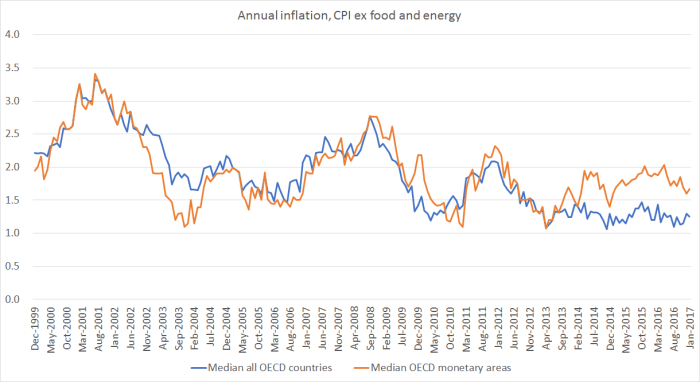
I made that point here a while ago, so I was pleased to see the Reserve Bank also highlight the  point.    Here is what I mean, using the OECD’s data on CPI inflation ex food and energy –  the one readily available and consistently compiled core inflation measure.

OECD inflation ex food and energy

I’m using monthly data, to be as up-to-date as possible, and New Zealand and Australia don’t have monthly CPI data.  But the comparable quarterly chart doesn’t look materially different.

I’ve shown two lines.  The first is the median core inflation rate for all individual OECD countries (with monthly data).  But that includes 19 euro countries (plus Denmark) that have only one monetary policy.  So the second line is the median core inflation rate for the distinct monetary policy countries/areas –  ie delete the individual euro area countries, and replace them with an inflation rate for the euro area as a whole.  I’d probably tend to emphasise that measure.

But on neither measure is there any sign that core inflation has been picking up at all.  And although the US has been raising its policy interest rate to some extent, there have been more cuts in policy interest rates in the last 18 months or so (the sort of time it takes policy to work) than increases.

Of course, that is only actual inflation outcomes.  Perhaps there is more inflation just ahead of us –  a story markets seem to have taken a fancy to.

For what it is worth, international agencies still thought there was a negative output gap across the advanced world last time they looked (the OECD thought it was -1.4 per cent last time they updated their published forecasts).

The unemployment picture –  another read on excess capacity and resource pressures -is a bit different.    For the G7 countries as a whole, the unemployment rate is now a touch below the troughs reached at the peak of the last boom.    For the OECD group as whole – even including places like Greece –  it is only around 0.7 percentage points higher than at the peak of the last boom.  For the median OECD country, the unemployment rate now only about half a percentage points above the average for the last boom year (2007).

Here are the unemployment rates for the largest OECD economies

U rates big countries

The unemployment rates have been falling for some considerable time, and there has been no pick up in inflation yet.  For each fall, of course, the respective NAIRUs must be getting closer, but it is probably safer to wait and see that core inflation has actually begun to rise –  especially in view of the low starting level –  than to simply assume that it must happen soon.

Of course, when one looks at unemployment rates what does tend to stand out is how little the unemployment rates in New Zealand and Australia have come down.

U rates NZ and AusIn both countries the current unemployment rate is around 1.5 to 1.7 percentage points higher than it was in the year or so prior to the global downturn.  And neither country was troubled by a domestic financial crisis, nor did they run out of room to use conventional monetary policy.  The monetary policy authorities should have been able to do better.   If I look across the monetary areas in the OECD (again replacing individual euro area countries with the region as a whole), the only places with a worse record on this score –  unemployment rates now compared to the pre-recession levels – are:

  • the euro area as a whole (visible in the first chart above) where they did run out of conventional monetary policy options,
  • Norway, and
  • Turkey, not a paragon of economic management or political stability.

Core inflation measures have been picking up a little here, as they should have after the sharp cuts in the OCR the Reserve Bank had to implement.    But our unemployment record –  at a time when much of the rest of the advanced world has been able to run unemployment rates back near pre-recessionary levels without (yet) seeing signs of core inflation rising –  is one reason why I think the Governor is quite right not to express any bias about the direction of the next change in interest rates, however far away (and delivered by a person yet unknown) that might be.

Superior measures, but still no productivity growth

Statistics New Zealand this morning released their best estimates of New Zealand productivity growth.  They are annual only –  so the new data is for the year to March 2016 –  and cover only the “measured sector”, so excluding parts of the public sector in particular where productivity is just very hard to measure (there are few market prices for the services for a start).  They also make an adjustment for the changes in the composition of the labour force –  there is, in principle at least, a lot more human capital associated with an average worker now than decades ago when few people had a tertiary education.

Last week I ran this chart, showing an estimate of quarterly labour productivity growth (real GDP per hour worked)

real gdp phw dec 16 release

It isn’t an encouraging picture.  In fact, the last five years have been so bad, I’ve been hesitant about believing reality was quite that bad.

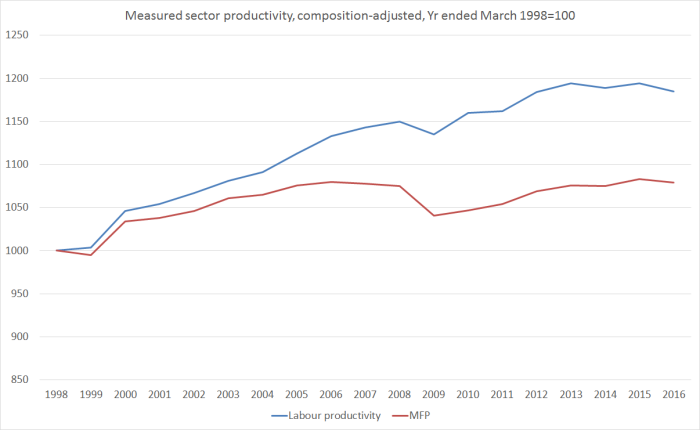
But here is new annual data, showing labour productivity and multi-factor productivity, both indexed to 1998 when the data in this format start.

measured sector productivity mar 2017

The summary?

  • No multi-factor productivity growth, in aggregate, for a decade –  the latest data point is very slightly  below that for the year to March 2006.
  • And no labour productivity growth for the last four years –  a picture very similar to the (differently measured, and more recent) real GDP per hour worked chart above.   In the last 10 years, there has been only around 4.5 per cent labour productivity growth in total.

Different models, and different measurement bases, will produce different results.  None of them suggest there has been much productivity growth in New Zealand for some considerable time.  And to repeat Paul Krugman’s succinct summary

“Productivity isn’t everything, but in the long run it is almost everything.”

New Zealand Initiative on immigration: Part 10 Recommendations and Conclusion

At last we get to the end of the New Zealand Initiative’s report on New Zealand’s immigration policy.

I don’t want to spend much time on the Conclusion page or so.  Even in a short section, there is lots I could challenge or disagree with, but much of it is ground already covered.  But I did want to highlight briefly the tone they adopt.  It is not one that, say, respects the very wide differences in immigration polices found across time and across the countries of the world (even just among the relatively advanced countries).    Or one that recognises that in some area men and women of goodwill and decency might have different preferences as to how best to organise or govern societies.  It isn’t even one open to the possibility that not all state-facilitated immigration –  to any place, at any time –  will necessarily benefit the natives of the place.  Rather, the only things that can possibly lead to different conclusions than the Initiative are fear, confusion, racism and so on.

This is what I mean.

Such is the intensity of the fear and confusion among the public that many opposition parties have seized on this narrative, some naively and some opportunistically. The pro-immigration Key government too has tightened policy settings to appease the public.

No one, presumably, has engaged in a thoughtful or considered reassessment?

Radical changes to policy settings simply to appease populist fears is misguided and even harmful.

The only reason anyone might apparently consider change is “to appease populist fears”.

Which is all a bit odd because a couple of paragraphs on they come to the economic aspects of immigration –  economics being the core expertise of Initiative people.  And there, writing about New Zealand, they say (emphases added)

Economic worries about immigration are overblown. There is no compelling reason to believe migrants are causing major detrimental impacts to the labour market. Although the empirical evidence is less than conclusive, there are good reasons to believe, as most economists do, immigration can make a positive contribution to economic growth.

Note how weak the actual claims are.  It isn’t exactly a ringing endorsement of the contribution of New Zealand’s immigration policy to the economic wellbeing of New Zealanders.  After all, I’m happy to sign up to the proposition that immigration “can” make a positive contribution to per capita economic growth, productivity, NNI per capita or whatever. Pretty clearly it did in New Zealand in the 19th century.   It is just that the Initiative, at the end of a major report, can point to no evidence that it actually has done so in recent decades, or is doing so now, in New Zealand.

But what of their specific policy recommendations?  For practical purposes, they endorse roughly the current scale and structure of our immigration policy (with no attempt to assess whether New Zealanders would be better off if, say, the programme were 50 per cent larger, or smaller, than it is).  There are, broadly, four areas of reform they suggest.  As they argue –  noting again the loaded language

Most of the low-hanging fruit have been picked, but policy can still be improved. And there are less harmful ways to placate those who demand an exclusionist policy.

The first is “giving business more of a say”.  In some areas, I agree with them.  For example

Rather than let government decide what types of skills the market needs, let the market reveal it through the price system. A market-driven approach could be to adjust the points system to assign points to the salary ranges of job offers rather than the specific industries migrants are qualified in.

I would favour something similar for our short-term work visa rules.  Set age-related salary thresholds, and set them quite high, and use that as the main tool to decide whether or not to approve a work visa.  I’d have no real problem in offering work visas fairly freely for any position (genuinely) paying, say, $100,000 per annum or more, subject to a limit of, say, three years.   After all, in the Initiative’s words –  and ones I could have written myself

Skills ‘shortages’ can be rectified through higher pay rather than lobbying
government to add the skill requirement to the list.

Where I depart from the Initiative is when they fall back on comparing people with pineapples.

The free market is a much better decision-maker on how many imported pineapples or cars New Zealand needs. Likewise, the number and types of skilled workers New
Zealand requires is for businesses to decide without the strong hand of government.

What is being decided, in our medium-term immigration programme, is how many people, of what sort, will be able to come and join the polity that is New Zealand.  Pineapples don’t vote, pineapples don’t come with cultures.  People do.    The Initiative seems largely indifferent to any notion of the state as agent of the collective preferences of its citizens, but most voters probably see it differently.   I’d put their sentence the other way round:

“It is for the government, on behalf of the public, to make choices as to how many, and what type of, people to invite from abroad to become New Zealanders.    Firms and employers will choose optimal production structures, remuneration patterns etc, in light of all the resources and constraints they face.”

The Initiative also explores the option of imposing a levy, “to limit the effects of migration on infrastructure costs”.    One of the authors, Rachel Hodder, followed up this idea in an article on interest.co.nz.    As she puts it

Our recommendation then also stands as a challenge to political parties that have been using infrastructure burden as justification for cutting immigration. If that is the genuine reason you believe immigration policy needs to be adjusted, then why not explore this option first?

It is an interesting idea, and I don’t think I’d have any objection in principle.  It would increase the chances –  although certainly not ensure – that large scale immigration would actually be benefiting New Zealanders in aggregate, although on its own it would do nothing to allay the distributional concerns (that relatively unskilled New Zealanders are losing out).

The Initiative proposes the idea of a levy without, as far as I can see, giving any sense of the possible size.    One angle might be to look at the public sector capital stock, which presumably needs to be augmented, in much the same per capita amounts, for each addition to the population.   As at last March, Statistics New Zealand estimated that the current value of the general government sector’s capital stock was around $41500 per person.  But that is a depreciated value.  Assume that all the capital was halfway through its life, and one could easily be looking at a per capita cost of putting in place the new public sector capital that new migrants require of $80000.    Some of the public sector capital is already financed by user-fees, but most of it isn’t.   I wonder if anyone is seriously willing to propose an $80000 levy for successful applicants for a residence visa in New Zealand  – even if, say, it could be paid as an income tax surcharge over the following 10 years?  In principle, it should raise the average skill level of the successful applicants to some extent.  It would certainly deter migrants with children.

I don’t have a huge problem in principle with such a scheme but, rightly or wrongly, I suspect most people would judge that it was almost a “repugnant transaction” –  they would prefer not to sell the right to become one of us.  Is it different in character from inviting migrants in on the hypothesis that doing so will enrich us all (the current philosophy)?  Perhaps not –  and definitely not to the economist in me –  but I can’t see it finding a great deal of public favour, among supporters or sceptics of the immigration programme.

The Initiative also seems to endorse proposals for New Zealand to sign reciprocal free movement agreements with any willing coountries, citing favourably ACT leader David Seymour’s suggestion to promote such agreements with Canada and the United Kingdom, complementing the arrangements we currently have with Australia.

Doing so with the UK in particular would, of course, restore the system that operated for more than a century after New Zealand was first settled.  It was only in the 1960s and 70s that free movement between the UK and New Zealand was no longer legally permitted.  At a political level, I find the idea quite appealing (but politicians in the two countries are unlikely to).  At an economic one, I don’t.  This simply harks back to my longstanding argument that the most important issue for New Zealand is the sheer number of immigrants we’ve been taking, not primarily what shills they’ve had or where they’ve come from.  Most of our migrants in the early post-war decades came from the United Kingdom.  At the time, material living standards here were better than those in the UK.  But even now, decades on, no one has been able to produce studies –  whether econometric ones or analytical narratives – demonstrating the productivity gains to New Zealanders from that large scale immigration.  Economists at the time was pretty sceptical.  Those now just seem uninterested in New Zealand economic and economic policy history, and the possible lessons it should offer.

These days, of course, New Zealand is poorer than the UK, but the UK is so much the larger country that even a small outflow from the UK to NZ  (as a share of the UK population) would be materially disruptive to New Zealand, and would further set back the chances of lifting productivity and living standards here back to those in, say, the top half of the OECD.  There is, additionally, the adverse selection problem, that the people most willing to migrate from a rich hub to a poorer, but perhaps more relaxed and spacious, country are hardly likely, on average, to be those with the greatest desire to succeed, and the strongest likelihood of offering the vaunted productivity spillovers.

The Initiative’s final suggestion for policy improvement is in the area of sponsorship for migrants.

A separate visa category could allow committed people to sponsor and support migrants in adverse circumstances, provided adequate checks and balances are in place. Canada allows community groups to sponsor refugees above the quota if they agree to be responsible for the basic care and support of the refugees, and New Zealand is laudably trialling this system for refugees here.

In principle, I’d have no particular problem with this suggestion.   As they note

Requiring bonds from sponsors could ensure the sponsors are held to their commitment.

But I think it is an approach mostly best operated on a relatively small scale.  Immigration policy is a collective decision about the number, and sort, of people we welcome to become future New Zealanders. I’m not sure we want motivated minorities  –  whether libertarians, evangelical Christians, Wahhabi Muslims or whatever –  trying to skew the population balance over time by fundraising to bring in lots more of their own.  Each group is, of course, welcome to evangelise and persuade, and perhaps if the libertarians ever persuaded enough of us we’d have open borders after all.  But make it a contest of ideas, not of the power to buy more imported supporters.

In the end, it is a pretty modest list of suggested reforms.  Much as they seem driven by a vision of open borders, in the end the Initiative is worried that New Zealanders might be getting uncomfortable with the grand Think Big experiment of New Zealand existing immigration policy over the last 25 or so years.  It has delivered us a large increase in the population, and a lot more ethnic restaurants and higher house prices (to take the most obvious gains and downsides), but with little or no evidence that it has done anything to lift our overall economic performance.  As the OECD noted again only the other day, for the last quarter century our productivity –  already low –  has just drifted a little further behind other advanced countries.  Perhaps it is past time to rethink this key dimension of economic policy.

My own preferrred model would probably have these elements:

  1.  Reducing the residence approvals target from around the current 45000 per annum to, say, 10000 to 15000 per annum.  In per capita terms, that would be about the rate of legal immigration the US has, and would be similar to the rate we had in the 1980s.  Not exactly closing the door, but certainly pulling it over to some extent.
  2. Within that reduced target I would look to focus much more strongly on demonstrably highly skilled people (who offer the best chance of fiscal and productivity gains) and thus would
    • revisit, reduce and potentially eliminate the current Pacific access categories,
    • permanently eliminate parent visas, except (and even then capped) where there is an enforceable, insured, commitment to full financial support from the parent, or their New Zealand citizen child.
    • leave the refugee quota as it is
    • eliminate the additional points provided for job offers in regional areas (a measure that is tending to lower the average quality of the accepted migrants)
    • eliminate additional points for New Zealand specific qualifications,
    • eliminate additional points for jobs in areas of “future growth” or “absolute skill shortage”
    • more strongly differentiate points in favour of higher level qualifications,
    • perhaps establish a category akin to the US visa for those with extraordinary ability
  3. Eliminate the provision allowing foreign students studying here to work 20 hours a week.  If New Zealand tertiary institutions really have a product worth buying –  and some probably do –  they should stand on their own feet, as other exporters are required to.
  4. Reshape the work visa system with a view to (a) reduce the scope for lobbying and influence peddling, (b) reducing the total number of people here on work visas at any one time, and (c) provide much greater flexibility for employers to utilise work visa people for short specific periods in highly-skilled and well-remunerated roles.    Since there would be many fewer residence approvals place open (see above) this path would in any case be much less popular with prospective migrants.   Specific features might include:
    • no one could have a work visa for more than two three year stints
    • use an age-based matrix in which in normal circumstances no work visas might be issued to anyone under 30 for a role paying less than, say, (an inflation-indexed) $75000 per annum, increasing by (say) $25000 in each five year age window up to a cap so that for a person over 50 to get a work visas they would need to be in a role paying $200000 per annum or more.
    • no doubt there would need to be some exceptions to this, and it would not apply to say approvals for roles of less than perhaps three months, but the point is to get the focus not on official judgements of “skill shortages” but on attracting people, if we do, who are capable of commanding high salaries (loose proxy for skill) on market.

Is it a perfect scheme?  No, of course not.  That isn’t a meaningful test for any human institution.  Is it a scheme for other countries.  No.  Some might find it useful, but for others –  where there might be clear evidence of gains to natives from large scale immigration –  it might be quite inappropriate.   But for the specifics of where New Zealand finds itself now, it would be a huge step in the right direction.   For a very remote place, in an age when personal connections seem to matter more than ever, it would give us a much better chance of finally beginning to close the income and productivity gaps, and offer New Zealanders –  the inevitably fewer number of future New Zealanders than under current policy – the chance of achieving world class productivity and living standard here in their own place.


Labour on financing new housing infrastructure

The parliamentary Labour Party has been showing signs of being serious about proposing steps that would, as they see it, unwind the structural impediments that keep urban land prices high and slow down the construction of new housing. Their housing spokesman (and campaign chairman) Phil Twyford has indicated that Labour wants to get rid of the artificial urban limits around cities, especially Auckland, and even managed a joint op-ed with the New Zealand Initiative on that.

Welcome –  and no doubt genuine –  as it all is, I’m still somewhat sceptical about what it will mean in practice.  Any Labour government is near-certain to require the support of the Greens, not known for their support for such flexibility.   And Labour or Labour-associated mayors lead our three largest cities, but there has been little sign of those Councils or mayors leading the way in freeing up urban land supply.  There is a great deal councils could do if they wanted to.  And even if they ran into legal challenges under current legislation, they could still be laying down markers as to the likely direction of reform when Labour returns to national office.

Last week Phil Twyford was out with another interesting idea in the same broad area –  very long-term infrastructure bonds paid back by targeted rates – which again garnered public support from the New Zealand Initiative.  Twyford sketched out his idea in an op-ed in the Herald, and also gave a substantive interview on it to interest.co.nz, who covered it in an article here.  A reader with ties to the Labour Party suggested that I might like to write about it.  My interest in the details of local authority finance is, sadly, quite limited, but I’ve been mulling over what to make of the proposal for the last few days.  Is it really a proposal that, if adopted, might make a useful difference?

One difficulty in reaching a strong view is that the idea is no more than sketched out at the moment, and many of the details could matter quite a lot.

Some have argued that New Zealand should introduce, or allow, the sort of model used in many parts of Texas –  Municipal Utility Districts –  where developers of new residential areas outside existing city limits can form an incorporation, with its own governance structure, which in turn borrows to finance infrastructure developments and the provision of utilities such as water, sewerage and even parks.  The bonds are then serviced by user charges and property taxes on the properties within the specific district.    The New Zealand Initiative has written favourably about them (reported here), and I found an interesting recent Texan newspaper article that captured some of the colour/flavour of these sorts of vehicles.    Whatever the merits of these schemes –  and there seem to be some downsides too –  they aren’t what Twyford and the Labour Party are proposing.

There are some real issues they are trying to address.  As Twyford notes

The council is up against its debt ceiling and last week put the brakes on large-scale housing projects in Kumeu, Huapai and Riverhead until more progress is made on roads, stormwater and the like.

When the population of a city is growing as rapidly as Auckland’s, the existing debt ceilings are almost certainly flawed.  There is a huge difference in the amount of debt, relative to (say) current revenue, that should prudently be taken on in a local authority region  with no population growth than in a region that is seeing 2 or 3 per cent population growth per annum.  We saw this at a national level when New Zealand and Australia were rapidly developing prior to World War One.  Overall government spending as a share of GDP was much lower than it is today, but debt levels (again as a share of GDP) were much higher –  in excess of 100 per cent.  It wasn’t a problem, and markets didn’t see it as a problem.

Some of the current problem then seems to arise from a reluctance to use targeted rates, to ensure that purchasers of the new properties bear the cost of the infrastructure involved in developing those properties.  Development contribution levies presumably go only part of the way.  If owners – present or future –  of the newly-developed sections bore the full cost of the infrastructure it isn’t clear what (economic) reason the Council could have for standing in the way of future residential developments. Planners’, bureaucrats’, and politicians’ visions as to what the city “should” look like are quite another problem –  and not one that Twyford’s proposal seems to address at all.

Twyford describes the problem this way

Developers under current rules have to finance infrastructure within a subdivision and are levied by the council for a share of the cost of connecting to the wider roading and water systems as well as parks.

Many developers struggle with the sums of money involved and it adds cost and delay to projects.

But it isn’t clear that the issue here is really infrastructure finance.  Developers need to finance all the costs of bringing properties to market, including covering both the delays that are perhaps inevitable in complex projects, and those brought on by the regulatory approvals processes.  The largest chunk of those costs typically wouldn’t be the infrastructure (I’d have thought) but the unimproved value of the land  (recall that urban and peripheral urban land prices are really what are sky-high).  And property development is risky –  even though the Reserve Bank’s LVR restrictions weirdly exclude new construction, new developments are where far and away the greatest risks lie.  Lend on an existing house in Mt Eden and the risks are far lower than lending on a new development in Huapai.  Sections might sit unsold, or undeveloped for years.  New houses might do so too –  there was plenty of that in Dublin after the boom ended.

There has been talk recently of banks becoming more cautious about lending for new construction –  perhaps partly from their own reassessments of risks, and partly at the prompting of parents, in response to APRA’s nudges.  Broadly speaking, that seems to me quite welcome.  Banks make their own credit judgements and sometimes they will be less willing to lend than the authorities might like.  It is, of course, the money of their shareholders they are putting at risk.

But Labour talks of central government becoming a fairly large scale provider of finance.

Labour’s plan is for infrastructure within a development, as well as the connections to the wider networks, to be financed by 50-year bonds.

Instead of the developer picking up these costs and loading them on to the price tag of a new home, the bonds could be issued by a government agency – perhaps a specialist infrastructure unit within the Treasury.

Bonds issued in this way would be the cheapest finance available, taking advantage of the Government’s ability to borrow more cheaply than anyone else.

The plan seems to be for the government to issue long-term bonds, with the government standing behind the bonds, and then to on-lend the proceeds to developers, tied to specific projects.  The bonds, in turn, would be serviced by targeted rates levied by local councils on properties within that development.

It all sounds fine when everything goes well (most things do), but here are a few of my problems/concerns:

  • should we be comfortable with Treasury officials making loans to individual developers, with all the risks of political cronyism in the allocation of credit over time?  At very least, lending would need to be done at much more of an arms-length from elected politicians (as, say, when the government provided loans through the Housing Corporation or the Rural Bank),
  • on what basis would we think that Treasury officials –  or even those of a more independent agency –  are better placed to evaluate and monitor residential property development projects than banks and other private providers of development finance?  Who has the stronger incentive to get it right?
  • isn’t there a high risk that the weakest projects will tend to gravitate towards the government provider of finance (strong projects, strong developers, will typically be able to get on-market finance?).  Isn’t that incentive greatest towards the peak of housing booms, when more conservative private lenders might start to pull back from the funding market?
  • how is cost-control ensured?  If developers can simply shift any cost blow-outs into mandatory targeted rates over the next 50 years, doesn’t that materially weaken incentives to bring projects in on time on budget?
  • what is the proposed legal structure?  Only Councils can levy and collect rates, targeted or otherwise.   Are they, or the developer, legally liable for the borrowing from the government?  Developers can and do go out of business quite quickly.  Councils don’t –  but then don’t the debt ceiling concerns cut in again? And can councils credibly (or legally) commit to maintaining a whole series of specific targeted rate for the next 50 years?    (And what are the protections for the property owners against arbitrary changes in these localised targeted rates?)
  • and what happens if the project fails?  If, for example, population growth slows up and a half-completed development lies idle for the next couple of decades.  Will the owners of the land have to pay the targeted rate anyway and, if so, how resilient is this likely to prove politically?

It seems to me that the proposal is meant to have two main attractions:

  • part of the development cost –  infrastructure costs –  are financed at a lower (government) interest rate, and
  • the headline cost of a new house would probably be reduced.

But in substantive terms, neither is really that much of a gain.   The cheaper government financing cost is only available –  in Twyford’s own words –  because the government’s credit risk is protected by the use of targeted rates.  But money that the government has first claim on isn’t available to service other obligations. The infrastructure bonds might well be rock solid, but the rest of any borrowing people had taken out to finance a new property would be just that much riskier.  Incomes don’t rise, and servicing the infrastructure bonds would have first call on what income there was.  Banks would presumably take that into account (including in deciding how much, and at what margin, they will be willing to lend).

And if the headline cost of a new house is reduced, so what?  If I have a choice between paying $700000 for a new house, or paying $600000 for the house and then having to service $100000 of infrastructure bonds issued by the government to cover the development costs of the house, it doesn’t make much difference to me.  If the infrastructure bonds really were 50 year ones, the annual servicing burden might be a little lower than otherwise.  Then again, New Zealand already has the highest real interest rates in the advanced world, so the notion of paying those high rates for that long might not be overly attractive.

And thus I suspect Twyford is wrong about a possible third benefit.  He argues

Reduce the infrastructure component of the price of a new home, and you’ll reduce not only new house prices but eventually prices across the whole market.

That’s unlikely.  If I’m looking at a $700000 house (with no targeted rates), and comparing it to that new house in the previous  paragraph, changing the financing pattern for the new house isn’t likely to change much about what I’d be willing to pay for the existing house.   Of course, if the policy really did increase the flow of new supply of houses and developed land, there would be benefit in lowering the prices of existing properties.  But simply lowering the headline cost of a new house (while loading an equivalent amount into infrastructure bonds) won’t change that.

In many respects, I’m sorry to reach a negative conclusion.  It is great that the Labour Party is looking for ways to make a difference to the housing market, not just for a few months but permanently  (and it is a disgrace that we’ve had 15 years of increasingly unaffordable house prices under both Labour and National-led governments).  And, of course, this isn’t the only (or probably even the main) component of their housing plan

Fixing the housing crisis and managing Auckland’s growth needs sustained reform on many fronts. Labour will build 100,000 affordable homes, tax speculators, and set minimum standards to make rentals warm and dry. We will free up the planning rules by relaxing height and density rules around town centres and on transport routes, as well as replacing the urban growth boundary with more intensive spatial planning.

But I’m sceptical that the infrastructure bond proposal is a suitable response to a serious constraint or that, even if the governance and monitoring concerns could be overcome, that it would make much difference to house and urban land prices.

If they wanted to consider a bold initiative, how about promising that any private land within 100 kms of Queen St could be built on to, say, two storeys without further resource consents?  With a similar policy –  perhaps 50 kms circles  –  for Hamilton and Tauranga, it would seem much more likely to make a real difference in lowering land prices –  the biggest financing issues not just for developers, but for ultimate purchasers.    There are other pieces of the jigsaw, but changing the rules that underpin expectations of future potential land values is probably the biggest component of the problem.

Throw in a sharp cut in the immigration residence approvals target –  not mostly to solve the housing problem, but because there is no evidence New Zealanders are gaining from the large scale non-citizen immigration  – and properties in or near Auckland would be much more affordable really rather quickly.


New Zealand Initiative on immigration: Part 9 The case for open arms

I’m getting a little tired of writing about the New Zealand Initiative’s immigration report, and readers may be getting a little tired of reading about it.   But when the best-funded pro-immigration advocacy group in New Zealand –  Treasury and MBIE aside –  produces a major report on the subject, then as a sceptic of New Zealand’s modern immigration programmes I feel a certain obligation to keep on to the end.  But I’m now down to the last five pages of the report.

Chapter 5 is headed “The Case for Open Arms”, which sounded a lot as if it was going to be making the case for open borders –  that libertarian idyll, not adopted anywhere, in which anyone who wants to can come, in any numbers.   Because the Initiative seems torn between the practical  (simply defending current policy –  which, liberal as it is, is not remotely “open borders”), and the idealistic  (let them come, let them come, in whatever numbers they choose, a policy that they know will never be adopted), the rhetoric and arguments often also aren’t that consistent in tone.

They start by making a fair point

To the original tribes that inhabited New Zealand, European settlers would have seemed more foreign than today’s migrants are to modern New Zealanders.

Different religion, different technologies, different governing institutions, and immensely richer and more productive.    As the Maori did, apparently, so should we, for in the next sentence we are asked

Can New Zealand keep on accepting people who want to make this country their home?

Which seems to have rather lost sight of the hugely expensive wars, and mass (subsidised) migration, that were required to secure the European position in New Zealand.  It was a power grab.   I’m not sure it is a precedent I’d be wanting to invoke.   And, as I keep pointing out, it isn’t as if there are cultures that are (a) immensely more economically productive than the existing New Zealand culture/institutions, and (b) people from those (largely non-existent) countries/cultures clamouring to come to New Zealand.  Recall that paper I mentioned last week suggesting that if there are economic gains from increased diversity, they mostly arise when people come to your country from richer countries.

I’d be inclined to simply dismiss much of this as content-free rhetoric, but so much of the case for large scale non-citizen immigration policy seems to be made at that level.  It certainly doesn’t seem to engage with the actual specifics of New Zealand’s economic underperformance, despite our fairly good institutions and talented skilled people.

The next piece of rhetoric is that “we are all immigrants anyway” line, as if it offers any insights on the current policy choices.

No matter how you slice it, few New Zealanders can trace their lineage to many generations before counting someone foreign-born. We are part of the New World. And we are a nation of migrants.

I presume the aggregate numbers are right, but my ancestors came in the 1850s and 1860s.  It might be a different relationship with “New Zealand” than some Maori may have, but it is also very different than that of people who have come in the last five or ten years.  This is “our place”, and it is a matter for the voters of New Zealand to decide whether, and to what extent, we continue to take lots more immigrants.  And there is nothing historically inevitable about it.  Thus  the observation that “we are part of the New World” is true enough, but meaningless for these purposes.  Australia and Canada also have pretty liberal immigration policies – although even Canada is bit less open than we are.  But the United States takes only about as third as many legal migrants (per capita) as we do.   And the countries of colonial settlement in Latin America are not now known for their extensive immigration inflows.  Perhaps the less said about South Africa – once often grouped with New Zealand, Australia, and Canada –  the better.    Newfoundland, once independent, was one of the first British colonies of settlement: these days, something less than 2 per cent of the population is foreign-born.  It is a choice.

The rhetoric then gets stranger still –  indeed, they invoke the Golden Rule (“do unto others as you would have them do unto you”).

It doesn’t often get brought up in debate but the golden rule applies well to immigration.  Treating immigrants the same way we would like New Zealand emigrants to be treated overseas is fair and sensible. Many New Zealanders benefit from travelling overseas to live and work. Some end up staying but many return, and there is value to New Zealand from both.

Which is a really strange argument to run when New Zealand has among the more open approaches to immigration of any country in the world.  We all know how difficult it can be for New Zealanders to get migration access to, say, the United Kingdom.   The number of permanent resident foreigners in China –  now a middle income country –  is staggeringly small.  And even relative to Australia –  where we have loosely reciprocal arrangements involving the ability of citizens of each country to live and work in the other –  we treat Auatralians moving here far more generously than they treat the (many more) New Zealanders moving there.    And OECD data cited by people like the Productivity Commission tell us that we have more short-term foreign workers living here than any other OECD country.

More generally, it has never occurrred to me that I should have pretty free immigration access to any country I choose.  There are plenty of fine countries out there, but I’ve never assumed I should have a right to live in them.  So how is this argument remotely relevant to discussions of immigration policy in New Zealand?   We could choose to be even more liberal than we are, or we can wind back immigration access quite a bit, and we would still be no less open than most other advanced countries –  and much more open than most middle income and poorer countries.

The Initiative then devotes half a page to what we might call non-GDP benefits from “diversity”.  I’ve made the point before that we don’t need lots of immigration to enjoy Danish butter, French wine, Iranian dates, British books, American i-phones or movies, or Bangladesh or Vietnam-made clothes.  We just don’t.  There are some products that are probably sold here only because immigrant communities are here, but if the rest of us had a taste for those products, New Zealanders could import and distribute them too.   I’m not going to quibble with the taste for ethnic food New Zealanders have developed –  especially as even the Initiative concedes that chefs (one of the more common skilled migrants categories) aren’t exactly “critical economic enablers” (MBIE’s description of our immigration programme).  And perhaps the number of foreign-born players in the All Blacks is a gain to New Zealand, at least for some.  Of their other sports stories, I don’t begrudge Lydia Ko her success, but in what way is it a gain to (native) New Zealanders?  And at least one of the other star cases they cite –  Scott Dixon – was born overseas to New Zealand parents who returned to New Zealand when Dixon was very young.  Two of my kids were also born abroad and came back very young –  but whatever they might one day achieve, I won’t be ascribing that to our immigration programme.

But about this point, they change tack again, with a sub-section headed “A Radical Idea”.

And what is their “radical idea”?

Often forgotten in the immigration debate is a consideration of the migrant as a human being. To borrow a phrase from the feminist movement, the strongest case for a liberal immigration regime is the radical notion that migrants are people.

I’m not sure who ever doubted it.  The Initiative don’t tell us. Rather there is the implied superior tone “only we care about the people”.

No one ever doubted (or at least not that I’m aware of) that immigration usually benefits the immigrant.  After all, they make a voluntary choice to move, and presumably do so because they think doing so will benefit themselves and their descendants.  The hundreds of thousands of New Zealanders who have moved to Australia made that sort of assessment.  (Of course, it doesn’t always work out as planned  –  100 years ago or more Latin America used to offer much higher living standards than Spain or Italy, and migrants flocked to South America.  They might, with hindsight, have been better to have stayed.   For that matter, GDP per capita in New Zealand is now less than that in the UK.)

And I’m also quite comfortable with the proposition that immigration is more effective than foreign aid as a way of raising living standards of people in poor countries.  Since, foreign aid is almost totally useless in that regard, it isn’t much of a comparison.  Immigration can help people in poor countries in two main ways.  The first is transplanting people into richer countries in which their skills can earn more than they would at home.  And the second is remittances –  migrants sending money back to families at home.    The Initiative seems quite keen on remittance flows (a big issue in some small countries).  I’m not.  They help individual families in the short-run, but they also tend to overvalue real exchange rates in recipient countries, and make it harder for those countries to develop themselves, including developing internationally competitive industries.

The Initiative quote one libertarian economist as saying

“Immigration is the greatest anti-poverty programme ever devised”.

I think that is a distinctly questionable claim.   In the short-term, and for relatively small numbers of people, it is probably the quickest such way.

In fact, that greatest anti-poverty programme ever devised is (a) for governments to stop doing stupid and evil stuff (one could think of the self-destruction of Chinese living standards for much of the 20th century), or the current Yemen war, and (b) developing market-friendly institutions and cultures that enable prosperity to take hold for the many, not just the lucky few.  It isn’t easy, it isn’t quick.  But it works.  If the pro-immigration advocates want to argue that these countries/cultures can’t do it for themselves, it is like some sort of 19th century case for enlightened imperialism/colonalism.  I lived and worked in two such countries for a while.  There is little real doubt that British control and administration did raise living standards, and improve prospects for future economic development, in Zambia.    It wasn’t a perfect regime by any means, but the story was often told that in the early 1960s GDP per capita in Zambia was around (or ahead) of that in South Korea or Taiwan.  But most Zambians chose independence, and never showed any signs of regretting that choice, even through 20 pretty disastrous years from the 1970s to the 1990s.    Very little about the prosperity of a society as a whole is down to luck, most of it is down to choices (conscious and unconscious) about how to organise society, what to value, what is taboo and so on.

Decades ago, while he was at the Reserve Bank, Don Brash used to get frustrated at various church leaders’ comments on economics, many of which seemed to reduce to (sometimes quite explicitly) “the rich are rich because the poor are poor”.  We ended up setting up a dialogue with a group from some of the churches to at least better understand where each other were coming from.   I’m not sure it ever achieved much, but it came to mind recently in thinking about immigration.  From pro-immigration people we often hear the suggestion that the relative wealth of our society and the relative poverty of, say, India is down to good luck.  It was a line run in The Economist just the other day

Americans and Europeans are not more deserving of high incomes than Ethiopians or Haitians.

But no one “deserves” a high income.  Rather societies develop in ways which enable many of their citizens/residents to generate high incomes.   European societies have achieved that to a remarkable extent over the last few hundred years, joined so far by a relatively small number of countries from other cultures.  It is a precious achievement, that needs to be nurtured and safeguarded (and no doubt evangelised too).   There is no suggestion that it is somehow genetic –  other cultures held the technological (and material living standards) lead in earlier millenia.  Does nature play a role?  Well, no doubt.  It seems unlikely that Saudi Arabia, Kuwait and Oman would have their current living standards without the good fortune of abundant oil.  Navigable rivers, animals that can be domesticated, and so on all helped in the past.  But Haiti’s problems aren’t rooted in natural resources, but in Haitian society.  The comparisons are particularly obvious in those pairs of countries that started not long ago with very similar backgrounds: China (no better than middle income) and Taiwan, or North and South Korea.  Again, a common line is that individuals are “lucky” to be born in New Zealand rather than (say) China.  But luck doesn’t come into it.  People are born into a culture and society, and fostered and nurtured in the values, institutions of that society.  That is how successful societies maintain themselves.  Sadly, it is how unsuccessful societies (at least judged in material terms) replicate themselves.   There is little random, or “lucky”, about it.

As they come to the conclusion of the chapter, the Initiative observes

If one accepts the notion that birth circumstance should not impose limitations on where people are  allowed to live, then the burden of proof should fall on those arguing against immigration to show a detrimental effect.

That is a very big “if”.  Very few people ever have.  Very few do today.  Humans are born within societies –  small, but vital, ones like families, but also neighbourhoods, religious communities, cities, nations and so on.  Often people can leave, but in view few cases is there any automatic right to join.   Some of the boundaries are quintessentially natural and others somewhat arbitrary.  My kids aren’t your kids and vice versa.  Each face advantages and disadvantages in their particular birth and upbringing.  But except in rare circumstances your kids can’t become mine, or mine yours.  In older or more primitive communities much the same limitations applied to tribal or village groupings.  No one thought that outsiders had an automatic right to make themselves part of that established grouping.  Boundaries of countries are perhaps somewhat arbitrary, but even if at times they are drawn in somewhat arbitrary places –  which isn’t the case for New Zealand –  groups of people within those borders tend to develop (or have had for centuries) a sense of a common identity, shared interests, and a willingness to undertake mutual support and protection.  We might choose to invite people in, but it is a choice.  We recognise that, for the most part, being born in New Zealand gives you the right to be here and move about here, and being born somewhere else does not give you that right.

In that world –  the real world –  where people do think that birth circumstances can, and should, influence where one can choose to live, when governments are thinking of running large scale immigration programmes, the burden of proof should really be on our governments (and those who advocate) such programmes to show that natives will be better off if the outsiders come in.  “Better off” doesn’t just have to mean in “economic” terms. It might be something as simple as responding to the compassion of natives, in the face of a natural or political disaster elsewhere.     But for an economics-focused programme, as the New Zealand immigration programme has been for decades, the case made is that natives are made better off by large-scale non-citizen immigration.   Sadly, in their report, the Initiative made little effort to show that, asa  group, we are indeed made better off or even that, if there are such gains, they are maximised at around the sort of current scale and composition of inflows.  If they really believe the story –  as distinct from just the ideology of something like “open borders” – applies to New Zealand here and now surely that is a missed opportunity?


Thinking about senior central bank appointments

The Bank of England lost a Deputy Governor the other day.  The Hon. Charlotte Hogg had been chief operating officer of the Bank of England for the last few years, and was recently appointed by the Chancellor of the Exchequer as Deputy Governor (with responsibility for banking and markets).    She was apparently quite highly-regarded, as well as being a scion of the British establishment (both her father and mother are peers in their own right, her mother was head of John Major’s Downing St policy unit, and her father, grandfather, and great-grandfather were all viscounts and Cabinet ministers).

Senior appointees to Bank of England roles (both top executive positions and the non-executive appointees to the decisionmaking committees on monetary policy and regulatory matters) are subject to confirmation hearings before a parliamentary select committee.     The select committee doesn’t get to decide whether the appointees get the job –  so it isn’t like the US system –  but they can ask hard questions, and can write and publish reports on the suitability of a candidate.  The House of Commons is large enough that there are plenty of MPs who either never will be ministers, or have already had a term as a minister,  That seems to make them  –  even those from the governing party – more willing to ask hard questions than one might expect.

In the course of her confirmation hearings, it became apparent that Hogg had not declared and disclosed to the Bank of England that her brother was head of group strategy for Barclays –  holding a senior position (including involvement in regulatory matters) in one of the largest UK banks, and one for which the Bank of England has supervisory responsibility.    Worse still, earlier in the hearings she suggested to MPs that she had in fact done so.

It is a strange story.  At one point in this episode, Hogg had declared that she was totally confident she had complied with all the Bank’s codes of conduct because “I wrote them”.   Even if so, how it never occurred to her to ensure she disclosed her brother’s position –  erring on the safe side if nothing else –  is a bit of a puzzle.  I’m also quite surprised that it wasn’t known and recognised within the Bank anyway –  they are hands-on supervisors, Barclays is a big and important bank, and the brother’s name would be familiar to anyone with a modicum of knowledge of modern British political history.

The Treasury select committee published a fairly forthrightly critical report, and shortly before it was published Hogg announced that she will resign.  The Guardian has is a nice summary of the story.

There is no suggestion of any substantive inappropriate conduct (whether information being passed, or behaviour influenced) beyond the non-disclosure itself.  But the resignation is the sort of standard we should expect from holders of high, and powerful, public offices.  As Hogg herself put it

“We as public servants should not merely meet but exceed the standards we expect of others.”

Regulatory agencies require punctilious adherence to the rules by those they regulate.  They weaken their own moral position if their own people aren’t held to at least those sorts of standards.

But as I read and thought about the Hogg story, it got me thinking again about our own Reserve Bank, and holders of senior positions there.

The Governor of the Reserve Bank exercises an enormous amount of power –  far more, personally, albeit in a smaller economy and financial system –  than the Governor of the Bank of England.  In that institution, most of the policymaking powers are spread across committees in which the Governor has only a single vote, and where most of the members are either executives not appointed by him or are non-executives.  And yet there is nothing like the confirmation hearings process here.  Most of the appointment power doesn’t even rest with the Minister of Finance –  who can be grilled in Parliament – but with the barely-visible Board members, who themselves face no parliamentary scrutiny.  Like the Bank of England, our Reserve Bank has a couple of deputy governors –  statutory positions.   Holders of those roles don’t have formal voting power –  unlike at the Bank of England –  but there is also no parliamentary scrutiny.  (There were suggestions that a former Deputy Governor was allowed to keep share options in an institution whose New Zealand subsidiary he was responsible for regulating.  If so,  external scrutiny at the time of appointment might have challenged that.)

Compared to the British system, in particular, our system is riddled with democratic deficits:  too much power in one person’s hands, the appointment of that person largely in the hands of non-elected appointees, and no parliamentary scrutiny on appointment of any of these statutory positions (Governor, Board, deputy governors).

In the aftermath of the Charlotte Hogg affair there were curious suggestions of unequal treatment.  Former Chancellor of the Exchequer, George Osborne, is quoted as saying

“Would she have gone if she had been an older man whose sister worked at a bank? I wonder,”

One can only respond “well, I certainly hope so”.

But again, contrast the position at the Bank of England with that at the Reserve Bank of New Zealand.  Hogg was the third female Deputy Governor of the Bank of England.    On the Bank’s statutory decision-making committees, two of the nine members of the Monetary Policy Committee are women, as are two of the members of the Prudential Regulatory Committe, and one member of the Financial Stability Committee. (Hogg serves on all three.)

The Reserve Bank of New Zealand has never had a female Governor or Deputy Governor.  Looking at the current organisation chart, two senior management roles are held by women, but they are both third tier internal corporate positions.    There has never been a more senior woman in the Bank, and thus none of the core statutory policy areas (monetary policy, financial regulation and stability, financial markets) has ever been headed by a woman.  There is no woman on the Governing Committee, and unless things have changed markedly in the last two years, there aren’t (m)any women managers in those core areas either. In fact, it is only about five or six years since the most senior woman in the core policy areas was made redundant.  There are plenty of able women further down the organisation, and I still recall –  35 years on –  the fearsome grilling I got from one smart woman in an interview when I applied to join the Bank, but none in the core senior positions.    (There are women on the Bank’s Board, but it of course has no role in policymaking.)

Quite why this is so is a bit of a mystery.  I doubt it is a result of direct or conscious discrimination –  although decades ago, women had to retire from the career staff if they got married.   And while macroeconomics and markets tend to be areas more men gravitate to than women, Janet Yellen chairs the Fed, and the Bank of England has managed three female deputy governors in the last 15 years.   And even across the Tasman, two of three Assistant Governors in the core policy areas  of the Reserve Bank of Australia are female.

But, whatever explains the patterns up till now, it must surely become a bit of an issue sometimes soon; perhaps one for the Minister and the Board in considering future appointments, and perhaps too for MPs and lobby groups wondering quite how the Reserve Bank appears to have remained so male-dominated for so long.

If one runs through the standard sorts of list of people who might be possibilities to become Governor next March, there are no female names  (Bascand, Orr, Carr, Sherwin, Archer and so on).  And if one restricts the field to that sort of background, I don’t think it is just because people have inadvertently overlooked the female names.   There are no women I’m aware of in New Zealand who hold, or have held, senior-level macro or banking regulatory roles –  eg one could look around the Reserve Bank or the Treasury, or the more prominent of the market economists and commentators and find none.

But perhaps it is time to cast the net wider?  That might be sensible anyway.  It seems likely that the next Governor will lead and preside over some potentially quite significant governance changes, and in many ways the organisation needs revitalising and opening up.  One could make a pretty compelling case for the appointment of a person with strong change management capabilities, rather than a more traditional economist.  Character and judgement would still always be vitally important, but they might be less important than the specific technical expertise.  In this case, after all, we know that there will be not just a new Governor but also at least one, and possibly two, new deputy governors –  and in any top team, there is a need for a complementary set of skills, not just clones of each other.    I’m not that familiar with many senior business figures but, for example, one of our major commercial banks is already, apparently very ably, led by a woman.

I could add that, to the extent that this surprising under-representation of women does concern those in power, my proposal to reform Reserve Bank governance to establish a couple of statutory decisionmaking committees (a Monetary Policy Committee and a Prudential Policy Committee) would also more quickly up more roles to which the Minister of Finance could appoint able women.  There shouldn’t be any real shortage of suitable candidates to be considered.

On the topic of gubernatorial appointments, readers might recall that when the Minister of Finance last month deferred the appointment of a new Governor until well after the election, giving deputy governor, Grant Spencer, a six month term as acting Governor, I raised questions as to whether this appointment was strictly lawfully permissible.  As I stressed then, I had no particular concerns about Grant himself, and had actually been suggesting for some time a variant of the same solution –  giving Graeme Wheeler a short extension, if he had been willing to accept it.  But the Act doesn’t seem to be written in a way that allows a new person to be appointed, with no Policy Targets Agreement, for such a short period.

Because there were no clear answers from the government, and no pro-active release of the relevant papers, I asked for copies of the relevant papers from (a) the Minister, (b) the Treasury, and (c) the Reserve Bank Board.  I didn’t really envisage it as a burdensome request, and although I was sure they would withhold any formal legal advice they had, I was interested in the advice the various agencies had provided to the Minister and Cabinet on the point.

So far, it looks a lot like typical bureaucratic delay and obstruction.  The Minister of Finance didn’t respond until well after the 20 working days (and was thus in breach of the Act).  When he finally did respond it was to say that he was giving himself another month to respond

“the extension is required because your request necessitates a search through a large quantity of information and consultations are needed before a decision can be made on your request”

Frankly, it would be surprising if the Minister of Finance held very many documents at all on this issue, but time will tell.   A week earlier I had had the same postponement, and same justification, from the Treasury – and again it would be a little surprising (especially as when they asked, I made clear that I wasn’t after working level email exchanges on the issue).  Curiously, the Reserve Bank Board itself –  the people primarily responsible for appointing a Governor –  didn’t claim to have lots of documents they needed to search, only that delay was needed

because consultations necessary to make a decision on the request are such that a proper response to the request cannot reasonably be made within the original time limit.

It isn’t an urgent issue, and in substance I don’t really have much of a problem with the Spencer appointment, but it is hardly the sort of open government, or commitment to the spirit of the Official Information  Act one might wistfully, foolishly, hope for.

Still no better than middling

The Minister of Finance greeted yesterday’s GDP numbers with the claim that

“While growth has softened in this latest quarter, the continuing trend is [with] consistent ongoing growth ahead of most other developed countries.

In the case of total GDP, that is no doubt true.  It is what happens when your country has had population growth of 2.1  per cent in the previous year.

But where do we sit in terms of growth in real GDP per capita?

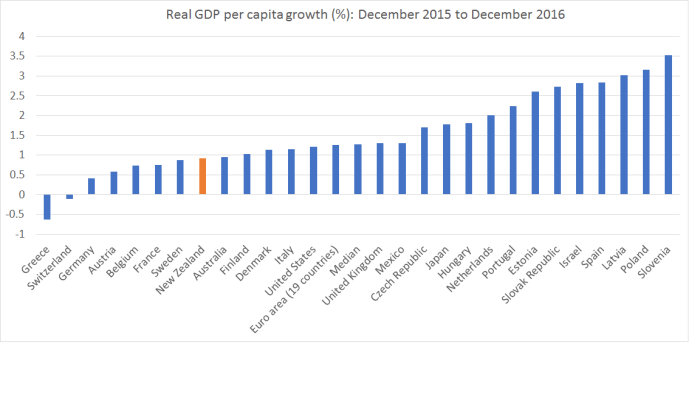
The OECD doesn’t have data yet for all member countries, but here is how our GDP per capita growth compares, focusing on the December 2016 quarter over the December 2015 quarter, for the countries there are data for.

real GDP pc 12 mths to dec 16

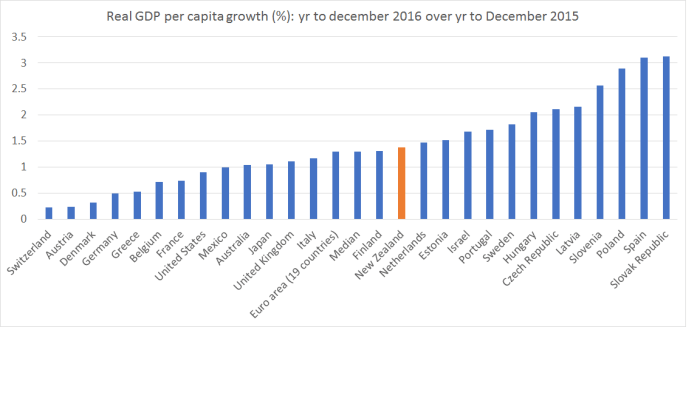
And here is the same data for the full year to December 2016 over the full year to December 2015.

real gdp pc ann ave to Dec 16

Neither comparison is intrinsically better than the other.  Between them, really the best one can say is that New Zealand has been no better than the median country over the last year or so.  That’s nothing to write home about…….especially as our data suggest we’ve had negative productivity growth over the last year (whether one uses the point to point or annual average measure).   That means all our pretty modest per capita GDP growth over the last year has resulted from throwing more labour and more capital at the economy, and (less than) none at all by using resources smarter and better.

But according to the Minister

“This week’s statistics on economic growth and our external accounts show the benefit of the Government’s sensible, consistent economic management,” Mr Joyce says.

Productivity growth: still missing in action

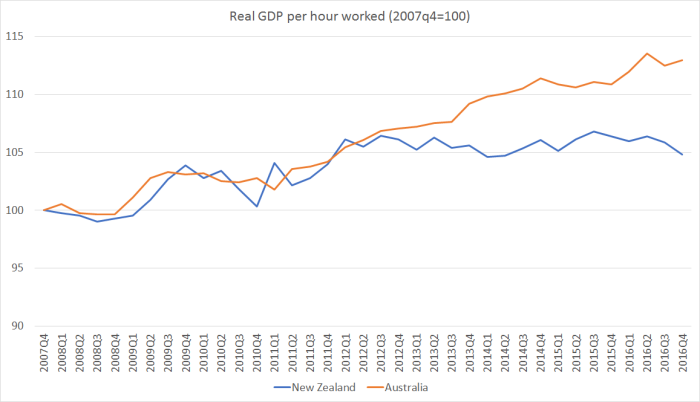
We get some annual multi-factor productivity data from Statistics New Zealand next week, but for more a more timely read on productivity what we have is data on real GDP per hour worked.   This chart compares New Zealand and Australian real GDP per hour worked since just prior to the recession of 2008/09.   As previously, for New Zealand, I’ve average the two GDP series, and used the HLFS hours worked series.  There is a break in the series in June last year, on account of changes in the HLFS methodology.  That lifted hours worked (as measured) by about 2 per cent, and in this chart I’ve silently adjusted for that (while still hankering for an offical SNZ series that corrected for the break).

real gdp phw dec 16 release

Still going nowhere – perhaps even backwards – after five years.     Diverging ever further below Australia over that five years.  And for the full nine years, less than 5 per cent productivity growth in total.

You’d like to think this sort of gross underperformance would be getting some attention in the run-up to the election.  But there isn’t much sign of that.

Perhaps we are just supposed to think of it as some sort of “quality problem”, or a “problem of success”?  Mark me down as unconvinced.


Defenders of the NZSF

After the flurry of coverage a couple of weeks ago over the remuneration of Adrian Orr, chief executive of the New Zealand Superannuation Fund, debate seems to have turned towards the more substantive issues around the role of the Fund.   The chief executive has been out, in his usual feisty and rather opportunistic style, defending the Fund, advocating for it to be given more money to invest and so on.   One could reasonably question whether the latter in particular is the role of a public servant.  His job, surely, is to invest the money the government has chosen, under the terms of the legislation, to place with NZSF.    Wisely, in my view, no more money has been placed with Fund since 2009 (although even then I thought it was shame the government didn’t simply wind up the Fund).  But this is now an election campaign issue, with the Labour Party vocally calling for an immediate restart of contributions.   That is perhaps understandable from a party which now, once again, favours keeping the NZS age at 65 indefinitely –  which was pretty much their position back when the Fund was first set up.   But it is a debate senior public servants shouldn’t be participating in in public.  Whatever one’s view of the NZSF itself, there are simply fewer grounds for it if one thinks the age of NZS eligibility should be increased over time, as life expectancy improves.

What has also interested me is the vocal support Orr has had from various journalists. In the Orr interview I listened to, on Radio New Zealand’s Nine to Noon on Monday, Kathryn Ryan seemed to see her role as being to help Orr get “the truth” across, cheering him on as he went, rather than asking any searching or challenging questions.  And this morning, in the Dominion-Post, Vernon Small is channelling the Orr lines, but in even more strident tones.  He concludes that we’d be “barking mad” not to be putting more money into the NZSF each and every year.

Well, perhaps. But Orr in particular was guilty of downplaying quite a lot of important considerations.

First, for all the breathless excitement about the NZSF’s investment returns (around 10 per cent per annum, pre-tax, over the life of the Fund), there has been no hint from chief executive, or his media supporters, of the rather more disciplined approach official NZSF documents, presumably adopted by the Board, take:

It is our expectation, given our long-term mandate and risk appetite, that we will return at least the Treasury Bill return + 2.7% p.a. over any 20-year moving average period.

By design, it is a highly risky Fund (“high octane” was Orr’s description) and performance can only seriously evaluated over quite long periods of time –  20 year periods in the organisation’s own telling.  But Orr (or Ryan or Small) didn’t make that point.

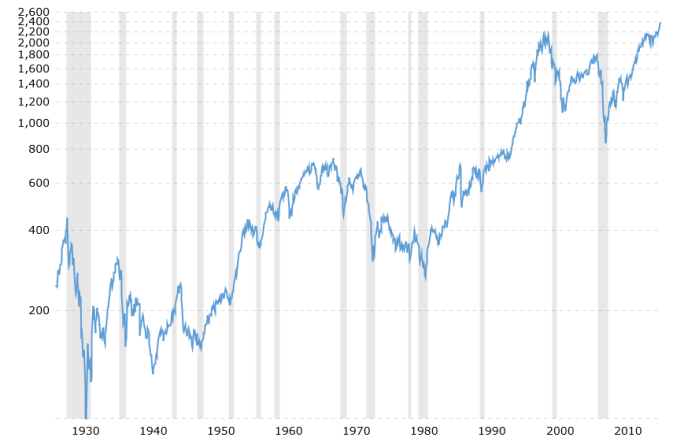
Kathryn Ryan’s breathless praise of the investment performance included, a couple of times, “even over the global financial crisis”.     That period was certainly pretty dramatic, but for equity markets it just doesn’t look that unusual in the longer sweep of history.  Here is a chart of the S&P500, in real terms and on a log scale.

sp-500-historical-chart-data-2017-03-15-macrotrends (1)

The fall in equity prices over 2008/09 looks like the sort of fall one might expect every 15 or 20 years –  and that one was shorter-lived than most.  If you take lots of risk in equity and bond markets, the last 15 years haven’t been a hard time to make money.  As far as I can see, the NZSF has more or less been compensated for those risks (it has forced us citizens to bear) but no more than that.  (I was however amused by the shameless attempt of the Fund’s head of asset allocation, in response to a recent OIA request, to suggest that returns from January 2009 –  near the trough of global markets –  was a meaningful number to use in evaluating the Fund’s performance.)

So the problem with the Fund isn’t that its investment management choices (both those they would loosely classify as “passive” and those equally loosely classified as “active” –  the distinction is pretty arbitrary) have been particularly bad, or good.  They’ve probably been about what one might reasonably expect over that period.  And if we closed the Fund now, or shifted all the money back to low-risk assets, we could crystallise the gains and be thankful that, despite all the risk run, we made money rather than lost money.     But nothing in the Fund’s investment strategy will protect taxpayers if, and when, markets turn bad again.

Orr continues to misrepresents the NZSF as a “sovereign wealth fund”.  It simply isn’t.  We aren’t Norway or Abu Dhabi, managing for an intergenerational perspective, oil wealth that has been turned into cash.   All the money put into the NZSF has either been raised from taxes or borrowed.     There isn’t a pool of money that naturally needs investing.  Rather, the government has established a high-risk investment management subsidiary to punt on world markets.     That simply isn’t –  and never has been –  a natural business of government.

The Fund itself doesn’t have to worry where its money comes from.  But citizens do.   Who knows what governments would have done with the money if the NZSF had never been established.  I suspect much of it would have been wasted on increased government spending.  But it would have been possible to have cut the most distortionary taxes –  those on business income –  quite heavily, which would probably have given risen to a lot more business investment in New Zealand.  None of the analyses of the returns of the Fund ever seem to take into account, for example, the deadweight costs of taxes.  On mightn’t expect NZSF to do so –  they are just investment managers –  but if they don’t they aren’t really in a legitimate position to be calling for more public money to be steered their way.

Orr cites a number of other advantages for the Fund.   He argues that it has contributed to developing New Zealand capital markets.  I’d be interested to see the evidence for that claim.  Most of the Fund’s assets are invested abroad, by intentional design.   What would New Zealanders have done with money if they’d had it as individuals?   And I don’t quite see how sweetheart inside deals, whereby ACC and NZSF  – neither with any particular expertise in retail banking –  take chunks of Kiwibank from NZ Post, enhance New Zealand capital markets.  No doubt having a hulking behemoth (by New Zealand standards) like NZSF generates more activity –  NZDMO got to issue more bonds than otherwise, and then NZSF buys more (mostly overseas) assets –  but are the capital markets really better –  and by what standards – for the presence of the Fund?

I also heard him argue that the NZSF somehow reduces risk and improves certainty. I wasn’t quite sure what he was referring to, but it seemed to be about the future of NZS itself.    But again, he is really talking beyond his pay grade.  The future of NZS is a political issue that really has little or nothing to do with the NZSF size/performance.   It isn’t like a contractural funded defined benefit pension scheme.  Presumably the overall state of government finances, overall tax burdens, and a community consensus on what is fair and reasonable are more likely to shape the future of NZS than the presence (and investment returns) of NZSF.    And in thinking about the overall government balance sheet –  something Orr doesn’t seem to, and isn’t paid to, think much about –  NZSF is currently only about 10 per cent of total assets.

He is on similarly shaky ground when he talks about save as you go approaches beating out pay as you go approaches.  I’m sure we can all agree that saving for the future typically makes sense –  the power of compound interest and all that  –  but that insight doesn’t help at all in deciding what, if any, role NZSF should have.   After all, we could wind NZSF up today, use the proceeds to repay government debt, and nothing would change about accumulated public sector savings.  Higher public sector savings is mostly a choice between taxing more and spending less.   As it is, I’d probably be happier if overall government net debt (including NZSF assets) was quite a bit lower than it is (ie build up government savings a bit more), but at least until all the gross government debt is repaid the government simply doesn’t have to be in the financial investment management business –  it is a pure discretionary choice.    We haven’t been there so far in the 14 year life of the Fund, and it doesn’t look likely that we will be in the next few decades either.  And Orr gives no weight at all to the failures of government, which often see additional Crown revenues wasted rather than saved.

Orr, and his defenders, have also been keen to scoff at any analogies with how a household might approach decisions.  I heard him say something along the lines of “if governments could act like households, we wouldn’t need governments”, which is true, but irrelevant in this context.  One role governments play, on behalf of households collectively, is to absorb collectively some of residual risks that individuals aren’t well-placed to handle.  That might tell you that often governments can’t, or won’t or shouldn’t cut spending in severe downturns, because some of their obligations increase then (and they are willing to let automatic stabilisers work).  For that reason, governments should be wary of revenue sources, or investment returns, that are very highly positively correlated with the economic cycle.  For example, one reason to be wary of capital gains taxes is that they tend to flatter government finances in good times, only for the revenue to dry up just when governments need it most (see Ireland last decade for a classic case study).    The same might well be said of highly risky asset portfolios –  even if they do quite well over the very long haul, they will look particularly poorly at just the times when government finances are under most pressure for other reasons.  In fact, if the pressures get serious enough, governments might come under pressure to liquidate those risky holdings right at the bottom of the cycle.  Those aren’t issues Orr has worry about –  he is simply paid to maximise returns on his little chunk of government resources, subject to acceptable risk –  but citizens, and people worry about overall government finances through time should do.

After all, it is not as if governments don’t already have other income and investment returns that are quite tied to the economic cycle.  Even on the investment front, for good or ill the government has quite large commercial holdings (those SOE stakes), and on the revenue front the tax system effectively makes the government an equity stakeholder in every business in New Zealand.

Orr and his defenders also scoff at household comparisons because, so they note, the government can borrow more cheaply than households.  More flamboyantly, here is Vernon Small’s take

As a comparison it may be politically effective but it is about as useful as a chocolate teapot.

Show me the household that can tax, has a central bank to set interest rates and biff around the exchange rate paid at the corner dairy, can borrow more cheaply than any business at rates below any mortgage offered by banks – and can live on for decades past the final days of its family members – and I’ll show you the household that has much to learn from a central government or vice versa.

Actually, the typical government (as distinct from the idealised one no one has ever seen) has operated with a horizon considerably shorter than that of most households.  And that is understandable:  I care about my kids and potential future grandchildren, who will still be there in decades to come.  Politicians –  who run governments –  face elections quite frequently, and in the course of a single lifetime successions of them run policy all over the show.

And quite how do people think that governments borrow so cheaply?  Because they have the power to tax, and that power is mostly exercised not over random stateless aliens, but over New Zealand households.  Every debt the New Zealand government takes on involves risks for New Zealand households – risks that at times of stress, governments will disrupt household and business plans by unexpectedly making a grab for a larger share of our incomes/wealth.  That risk limits the other risks households can afford to take, and is why I keep stressing that an accountable government can’t think of the cost of funds as simply the government bond rate; it has to price the implicit equity, bearing in mind that the coercion involved in the power to tax is more costly and distortionary than (say) a large company having to issue new debt if times get tough.    People like to say that governments can’t (usually) go bust, and so are subject to fewer “bankruptcy constraints” in thinking about undertaking possible long-term activities –  but that is typically true only to the extent that they ignore the perspectives and finances or their citizens, who ultimately bear the risks.  Ignoring citizens isn’t what governments are supposed to do.

My bottom line remains that NZSF hasn’t done badly what it has been asked to do (if you want a high risk fund that is).  Equally, it hasn’t really been put to the test.  They probably made some quite good calls at times, but the risks they assume for the taxpayer are very considerable.  In that OIA response I referred to earlier, they attempt to rebut some of my arguments, by suggesting that the appropriate hurdle rate of return should depend on the riskiness of the project.  I read that and thought: “yes, and that is really to concede my point”.    Over the life of the Fund, the standard deviation of annual returns has been almost 13 per cent.  Those are really large fluctuations –  by design –  and in considering establishing (or retaining) a government leveraged investment fund –  effectively a business subsidiary of the government – taxpayers need a lot of compensation for that risk.    Especially as that risk –  in the extremes, which are what matter –  is pretty correlated with other risks to government finances directly, and those of household sector finances indirectly, so there isn’t much –  if any –  overall risk reduction taking place.   When typical Australian companies uses hurdle rates in excess of 10 per cent, we shouldn’t be that comfortable  in our government running such a risky investment management operation for returns that, over a good 14 years, have only just matched 10 per cent.  I’m not suggesting anyone could have done much better than NZSF managers have, just that it wasn’t worth doing at all, evaluated by the sort of standards firms and households apply to their own finances.     And all that on a Fund that at present is only around 13 per cent of GDP.   The risk dimensions of the Fund become even more important if contributions are resumed and we envisage a Fund that could become a much larger component in the overall Crown balance sheet.

There is a political debate that should be had about NZSF.  There is a debate to be had about the future parameters of NZS.  But the two aren’t really very logically connected –  despite the words in the legislation.  If speculative investment management is a natural function of government, it is so regardless of baby boomers ageing, life expectancy or the parameters of any element of the welfare system.  Short of New Zealand discovering Norwegian quantities of oil and gas, I suspect it is no appropriate business of government.