Big business

I’ve been following the views of Tyler Cowen for almost 30 years now, since he spent some time in New Zealand doing a review for the Business Roundtable of the (then) new Reserve Bank of New Zealand Act.    These days he is a prolific and prominent writer –  columnist and blogger –  and a professor of economics at George Mason University, all supported by (apparently) voracious reading.   There is almost always something stimulating and fresh in what he has to say.

But he doesn’t always get it right.  Back in the very early days of the Trump presidency, he ran a column on parallels between Donald Trump and our own Sir Robert Muldoon. I begged to differ, and mostly I reckon my argument looks stronger now than it did in early 2017.

A few days ago he had a column in the Washington Post (extracts here) drawn from his recent book “Big Business: A love Letter to an American Anti-Hero”.  In his column he argues that (so-called) progressives in the United States should embrace big business and see it as an ally in the causes they champion.   On some of the specific issues he lists, there is probably something to what he says (and I’m with him in pushing back against the Elizabeth Warren approach to capitalism and business), but as a general proposition (which is what he makes it out to be) what he claims –  that companies are a source of social and political good, going beyond merely the production they facilitate – is at very least arguable.

Thus, we are told that various large US companies “offered health care and other legal benefits for same-sex partners well before the Supreme Court legalized gap marriage”, and that these moves “put a mainstream stamp of approval on the notion of same-sex marriage itself”.   Some will have regarded all that as a good thing – certainly (which is Cowen’s specific point) the so-called progressives will have.   And in that case, one person’s additional remuneration doesn’t directly impinge on anyone else’s.

One could take the argument further.  There are papers around illustrating the way in which companies operating buses or street cars in the segregated American South championed the cause of bus desegregation.  That wasn’t because the owners were necessarily any more “enlightened” than the rest of the white populace, but because having segregated facilities cost them money.  Desegregation was cheaper and more profitable.

More generally, one of the arguments against the idea that there is some sort of meaningful gender pay gap, arising out of discriminatory practices, is that economic incentives are pretty powerful and should contribute to eliminating any such substantial differences –  if equally productive female workers can be had more cheaply than male ones, there are expected returns on offer to firms that focus on recruiting those women.  In the process, wages for women are bid up and, over time, any excess returns are eliminated.   In apartheid South Africa, it was the white unions not the mining companies that had a compelling interest in preventing the employment of blacks in skilled or supervisory positions.

So a competitive market economy probably is quite good at taking out any differences in remuneration based on employee characteristics that are irrelevant to the production process itself (the relentless tendency towards wage=marginal product), and it is also good at chipping away at regulatory and other barriers that impede the ability of shareholders to maximise risk-adjusted returns.    Street-car segregation might be a positive example of the latter, but it isn’t hard to think of less-positive examples (and as someone who favours low taxes on business and light-handed regulation of the financial system I’m not even going to those “progressive” favourites).  One could think of all manner of corporate welfare programmes that many firms fall over themselves to champion and defend (and which anyone who rejects using them can find themselves pushed beyond the margins of profitability), or incentives around environmental regulation, or financial system bailouts, firms that attempt to portray their corporate interest as the same as the national interest (eg those championing tariffs), or whatever.

And we could revert to Tyler Cowen’s example around attitudes to homosexuality.  He argues

The larger the business, the more tolerant the institution is likely to be of employee and customer personal preferences. A local baker might refuse to make a wedding cake for a gay couple [celebration of a their “wedding”]  for religious reasons, but Sara Lee, which tries to build very broadly based national markets for its products, is keen on selling cakes to everyone. The bigger companies need to protect their broader reputations and recruit large numbers of talented workers, including from minority groups. They can’t survive and grow just by cultivating a few narrow networks as either their workers or customers.

And yet it is Rugby Australia, pressured by large corporate sponsors, which is attempting to sack Israel Folau for quoting the Bible on his own social media accounts on matters quite unrelated to the production of rugby services.  The idea that large firms are generally tolerant of employee preferences and views seems hard to credit these days –  perhaps, on average, they are individually more tolerant of some differences than individual small firms, but individual small firms have much less market power (more places for employees to choose to work).

What is probably true is that big corporates don’t care who they sell to (there is a dollar in it) but are –  and perhaps always were, but on different issues –  quite intolerant of employees with a mind, or conscience, of their own.  The Colorado baker managed to get the backing of the Supreme Court for not being willing to bake a cake explicitly for the celebration of a gay “wedding”, but if an employee of a major chain had attempted to exercise the same freedom of conscience, most likely they’d have been out of a job.   Again in the US context, Brendan Eich was forced out as CEO of Mozilla for having made a modest donation to a campaign against legalising same-sex “marriage”.    In the last few weeks, a major tech company sent out a message to all staff, apparently cautioning that if staff weren’t totally onside with the corporation’s “diversity and inclusion” programme, it could affect their pay or even their future employment.

Now, in many respects those examples go to Cowen’s point: much of US big business is very much of the same ideological hue as the political “progressives”, at least when it comes to social issues.

But here again there is another side to the issue.   When Wilberforce was leading the fight to abolish the slave trade in the British Empire in the early 19th century, it wasn’t big business interests that were right behind him –  indeed, when slavery itself was finally abolished, it was only possible with large compensation payouts to those who had enriched themselves on maintaining in slavery their fellow human beings.

Or nearer to our time, take attitudes to the People’s Republic of China and the way that evil regime represses its own people (generally) and systematically persecutes various minorities (Muslims in Xinjiang, Falun Gong, Christians, human rights lawyers and so on).  It is business interests that quake at the very thoughts that political “leaders” in countries like our own might even speak up and speak out against such evil, business interests that sully themselves (but presumably don’t see it that way) by continuing to trade with the regime.  Fund managers continue to buy shares in Hikvision and similar companies.  And none of this is new –  foreign companies operating in apartheid South Africa might have wanted to be able to use labour more efficiently, but they had no interest in upsetting the regime; various US companies remained actively involved in Nazi Germany right up to December 1941, and few German companies displayed any great moral courage or leadership either.

This isn’t intended as an anti-corporate or anti-business post.  Private businesses are the form through which much or most of the staggering material wealth we enjoy today is realised.   But businesses are owned, staffed, and run by human beings, and are unlikely to be consistently any better than those human beings.   If anything, and around the limits and taboos that societies might seek to establish and maintain, they will often be worse –  even as they remain very narrowly efficient in marshalling inputs and generating outputs.  Why?  Because of the impersonality of the (widely-held) corporate form and the impersonality of the pressures on them. Widely-held firms are prone to pressure from the mob – on issues that mob has focused on in that particular moment – and, on the other hand, people near the top of a firm can detach from any strong personal ethical sense –  having perhaps a lot to lose individually –  under the guise of excuses like “everyone else is doing it”, or “fiduciary responsibilities”, or a focus on the share price.  Widely-held firms have no particular interest in any values or interests that don’t work to lift the firm’s own bottom line (thus no particular commitment to democracy, or transparency, or whatever, or about the character of those with whom they trade, so long as they honour contracts).   That can have positive elements to it –  the firm just gets on and uses resources efficiently – but stops doing so when firms themselves become political players.  We don’t let firms vote, but we do allow them to donate to political parties, and (more importantly) we give their bosses and boards access and influence in the corridors of power, in ways that aren’t always aligned that well at all with the values and interests of citizens.

So count me sceptical of paeans to big business.  We probably need to be almost as sceptical of them in many circumstances as we should be of big government.



A certificate of shame

A week or so ago I wrote a post about our Police and their apparent indifference to the requirements of the law –  in this case the Official Information Act.  I’d asked about the appointment of their Assistant Commissioner Hamish McCardle to a visiting professorship at the PRC’s People’s Public Security University (the university of the Ministry of Public Security).  It was already well past the 20 working days limit specified in the Act and nothing had been heard from Police.

This morning I finally had a reply from Police’s (acting) International Services Manager,   There was not much to it, and (so they say) nothing was withheld.  First, I received a photo of a certificate of Mr McCardle’s appointment.

McCardle certificate

The appointment was made almost a year ago.

It probably should be a warning sign when the university of the Ministry of Public Security in a regime like that of the PRC recognises your “outstanding achievements”, but apparently it wasn’t to either Mr McCardle or his bosses.   In fact, in the photo included with the article on the Police website, Mr McCardle looks downright pleased.  Never mind the loss of liberty –  pretty much across the board –  that the Ministry for Public Security helps give effect to, the mass incarceration of Uighurs, and the persecution of all manner of other groups, it was apparently a great honour to be welcomed as (visiting) faculty at their training school.

The only other information related to my request that Police claimed to have was an email from the former International Services manager to three of his superiors, including the Deputy Commissioner and the Commissioner of Police.

From: “KANE, Brett” < >
To: “PANNETT, Michael (Mike)” < >, “CLEMENT, Michael” < >, “BUSH, Michael (Mik·e)” < >
Subject: Hamish Mccardle -Appointed Visiting Professor at the Chinese Ministry of Public Security University

Assistant Commissioner Hamish Mccardle has recently been appointed as a Visiting Professor at the Chinese Ministry of Public Security University.
This is a very rare honour, in fact Hamish is the first ever foreigner to have this honour bestowed. A bit like Massey University presenting President Xi’s wife an Honours Doctorate during the State visit a few years back.
This honour presents the chance to return each year to teach an advanced class of Masters students, about a one to two week teaching block. This role will have some great advantages in the overall relationship development with MPS and
New Zealand over the long term.

Brett Kane
National Manager I International Services Group (ISG)
Detective Superintendent I New Zealand Police

And that was it.  A “very rare honour”, “first ever foreigner”.  All with the utter moral blindness that sees no apparent difference between Massey University and the advanced training establishment of one wing of the domestic repression apparatus of a state like the PRC.  In fact, this ‘honour” is regarded as highly beneficial (“great advantages”) in improving relations between the New Zealand Police –   police force of a free and democratic, bound by the rule of law –  and the PRC Ministry of Public Security, in a country whose own Chief Justice eschews any notion of the rule of law or an independent judiciary.

Assuming that Police are telling the truth and this is really all there is, I find it pretty surprising.  There is no sign of Mr McCardle consultating with his superiors on whether to accept such an “honour” (indeed, my letter from Police says the appointment was done “independently of New Zealand Police”), even though this appointment was to involve a significant ongoing commitment of time.  There is also no suggestion of consulting with MFAT on whether it is a good idea for a senior New Zealand police officer to be accepting such an “honour” from a state like the PRC (and MFAT’s response to my OIA to them confirmed that they had no other material on this appointment), and there is also no record of Police notifying the Minister of Police or his office (“no surprises” and all that), or of the Minister of Foreign Affairs being informed.  Perhaps worst of all there is no sign that the Commissioner expressed any concern about being informed only after the event, or asked for any advice over whether such an “honour” was really appropriate, or whose interests it was serving.

As it happens, the Police covering letter also says that, a year on, “details of any engagement are yet to be agreed” (do note that “any”) suggesting that the symbolism here is more important than the substance –  a key ministry in the PRC, active agent in the suppression of liberties of Chinese citizens, managed to get a senior western police officer to accept an honour from them.   Probably the Gestapo had training establishments that in the late 1930s would happily have dished out visiting professorships or the like to gullible foreigners happy to associate themselves with an institution responsible for such evils.

When it comes to making sense of Police it is always hard to be sure whether malevolence or sheer stupidity/tin-earedness explains any oddities.    This is, after all, the Police Commissioner who had to apologise for giving the eulogy at the funeral of a former police officer found by a Royal Commission to have planted evidence.

Who knows quite what the story is with this episode.  But it probably shouldn’t really surprise us, given the way official Wellington falls over itself to accommodate – and more –  the PRC.    Almost as much as sections of the business community.  Between them, they seem to simply put all concepts of right and wrong, of concern for the oppressed, of recognition of the evil character of the regime they defer to, to one side.

Of course, it is all led from the top.   I listened to a recording of the Prime Minister’s addresss this morning to the China Business Summit (also addressed by the Chinese Ambassador and the local CEO of Huawei) on the Herald website. It seemed strangely apposite that her address –  on this recording –  was bracketed by adverts for the latest in Hauwei technology.   It was, in different ways, a speech both extraordinary and banal.  Banal because it was probably as empty, and as cravenly deferential, as you’d have heard from any New Zealand Prime Minister for the last decade (in fact, it seemed very like her address to the same forum last year).

And yet extraordinary too for the utter emptiness of it all, in the face of a regime that poses such substantial challenges to the world, including its intrusion in our own political system.   Listen to the Prime Minister address the China business vested interests and you’d not know that issues around Huawei remain alive and serious (just the other day Vietnam banned Hauwei), you’d not know there were serious issues with state-sponsored intellectual property theft, with threats to Taiwan, the increasing loss of liberty in Hong Kong, expansionist activity in the South and East China Seas.  Nor, of course, issues like Xinjiang, the sustained persecution of Christians who won’t bend the knee to state-sponsored “churches”, or the forthcoming anniversary of the massacre of Tiananmen Square (no doubt airbrushed completely from PRC media, but I wonder if any of our political leaders will be moved to comment at all).  And as reminder that it seemed to be all about dollars, the Prime Minister reminded the assembled business figures that the government had nine agencies represented in being “there to serve your interests” –  it was that “your” that sparked me interest, no sense of “our”.

Of course, there was the obligatory brief and embarrassed note that we don’t always agree with the PRC, but that “differences of perspective don’t define our relationship”.  But they really should shouldn’t they, with a regime of such evil, with values so alien to those of most New Zealanders?  Of course, we have differences with every other country at some time or another, but with some we share fundamental values, and with others we just don’t.  The PRC is one of the latter, and yet the PM was again on her mission to treat the PRC as just another country, its leaders just another group of decent blokes (in their case, they are all male).  You can’t escape the impression that she is happier photographed with Xi Jinping than with, say, Donald Trump (and I don’t blame her at all for not wanting to be photographed with Trump, but the government he leads is not the PRC).  And yet, for all its faults, the US Adminstration is actually willing to speak up and speak out about the mass incarceration in Xinjiang

Perhaps it is no wonder Police not only accept this “honour” but celebrate it in their magazine.   When it comes to the PRC, they seem to take a lead from the Beehive, where successive waves of ministers seem devoid of any moral grounding.

When they ponder those deals and donations, and all the squalid compromises involved, perhaps our politicians, officials and business figures might ponder that old Scriptural line

For what shall it profit a man, if he shall gain the whole world, and lose his own soul?


Changing immigration policy with as little publicity as possible

For a government that has proclaimed itself the most open and transparent ever, sometimes it just doesn’t score that well on either count.    Take, as an example, the centrepiece of New Zealand immigration policy –  itself one of the key discretionary tools of economic/social policy –  the New Zealand Residence Programme.

On Friday someone overseas sent me a copy of the latest Immigration New Zealand Policy Amendment Circular, issued on 30 April.  As INZ describes it

We regularly review and update the Operational Manual. We publish these as Amendment Circulars. We publish the circulars when the changes have been approved and incorporate them into the Operational Manual on the day they come into force.

Second on the list of changes in the 30 April circular was this

New Zealand Residence Programme (NZRP) planning range

R6.1 New Zealand Residence Programme
R6.5 Allocation of places within the New Zealand Residence Programme
The NZRP planning range, which sets the upper and lower number for resident visa approvals, has been updated to 50,000 to 60,000 from 1 July 2018 to 31 December 2019.

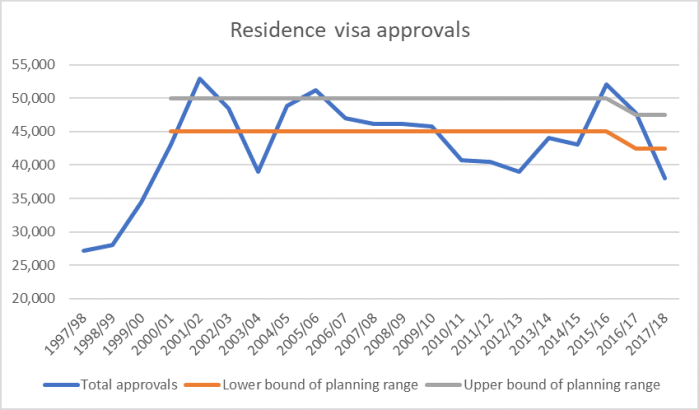
That was both interesting and a little puzzling.  Puzzling because the new circular was issued on 30 April, already more than halfway through the period from 1 July 2018 to 31 December 2019.  And substantively interesting because the new target (“planning range”) was substantially lower than the previous target.  In annualised terms the previous target had been 42500 to 47500 approvals per annum and this new target was the equivalent of 33333 to 40000 per annum.    It was (is) by far the largest change in the planning range this century (until 2016 the planning range had been unchanged at 45000 to 50000 per annum for a long time).

Here is a chart of annual residence approvals going back 20 years

ann res approvals

As I’ve highlighted in a couple of posts in recent months, it is striking how substantially the number of residence approvals has fallen (a fall well underway before the change of government).   MBIE only publish monthly data for the last decade or so, and so here is a similar graph for that period but this time showing twelve month running totals of residence approvals, the last observation being the year to March 2019.

res approvals 2

Annual approvals in the last 12 months have been lower than at any time since 1999/00.

Broadly speaking, operational policy is supposed to adjust to keep overall total approvals within the planning range (most obviously by varying the points threshold applicants have to meet).  In this case, however, it appears that the target has been adjusted into line with the actual reduced number of approvals.  That, surely, was somewhat newsworthy, especially given the debate at election time on what the various parties (Labour and New Zealand First) were and weren’t promising around immigration.

The open and transparent government was true to its word to some extent.  When I went looking I stumbled on the Cabinet paper that was the basis for the decision.  That Cabinet paper had been released onto the MBIE website on 19 February.   Here is a copy of the paper itself cabinet-paper-new-zealand-residence-programme 2019

The Minister of Immigration appears to have intended that openness and transparency would prevail.  Among the recommendations in the paper were these

Publicity
58 Subject to Cabinet’s agreement to these changes, I intend to issue a press release announcing the details of the proposals in this paper.
Proactive Release
59 I intend to proactively release a copy of this Cabinet paper under the Official Information Act 1982, with appropriate redactions, at the same time that I issue a press release announcing the details of these changes.

But I had a look at Iain Lees-Galloway’s page on the Beehive website.   There was nothing there.

So I went to the MBIE website (always something of a dog’s breakfast) and looked for any releases in February.  There was nothing there (or for March or April).

I checked Immigration New Zealand’s news releases page.  There was nothing there either.

But, as I kept digging, I did at last find something.  INZ has an email newsletter, called Korero, aimed specifically at immigration advisers

Kōrero is the Immigration New Zealand adviser-specific newsletter sent out as an email. Available every two months, Kōrero brings to you the latest news and information that affects you in your dealings with Immigration New Zealand.

And the February issue of this newsletter did contain the news about the residence programme.

It looks a lot as though Cabinet really didn’t like the idea of letting the general public know that they had been changing immigration policy.

But what of the substance of the policy?

In some respects, what the Cabinet paper is proposing –  and was apparently adopted –  is quite sensible.   The residence approvals programme planning range has always been an odd beast, because it encompasses all sorts of streams under which approvals can be made, each set up for a variety of different motivations.    And whereas when the residence programme was set up most approvals were granted to people offshore (and thus approvals regulated the number of non-citizens entering New Zealand to live), these days most approvals are granted to people already here (eg on temporary work visas, so that the overall planning range, at least on an annual or biennial basis, doesn’t even serve as much of a check on (for example) short-term pressures on housing or infrastructure.

Recognising all this, the government has apparently agreed that from 1 January 2020 each of the streams will be managed (or not) individually, rather than within an overarching planning range.    The residence programme includes, for example, non-citizen spouses (in particular) and children of New Zealanders.  We are never going to cap those flows, and management will mostly just consist of the tests to ensure that the relevant relationships are genuine.  And, on the other hand, if we think that (say) granting 15000 skilled migrants a year residence is sensible that is a decision that probably shouldn’t be materially influenced by how many New Zealanders bring back foreign spouses in any particular year.

On paper all that sounds sensible enough.  But, as so often, details can matter, and at present there are none.  There is nothing in the Cabinet paper giving a hint as to how many residence approvals in total (or by stream) Cabinet expects to be agreeing to for the coming years.   There is also nothing in the Cabinet paper evaluating, or reporting other evaluations, of the economic and social impact (benefits and costs) of the immigration programme to now –  it seems to be a typical MBIE document in which the benefits are more or less taken for granted.  The exception perhaps is this line (emphasis added)

In response to an overall trend of decreasing skill levels and remuneration amongst skilled migrant residence approvals, the previous Government tightened the requirements for the Skilled Migrant Category (ie the points system) and lifted the points level at which applications could be selected.

But even then there is no attempt to assess, or describe, the impact of those changes (or other changes which went in the opposite direction –  more points for regional jobs), and thus no attempt to assess why residence approvals have dropped off so sharply, despite reasonably good labour market conditions at present.

The other substantive part of the paper was a recommendation to change the objectives of the Residence Programme.  The paper reports that

The current objectives for the NZRP were agreed by Cabinet in 2001 and reflect an immigration context that was different from today. The existing objectives are:
24.1 Regulating the flow of foreign nationals wanting to come to New Zealand;
24.2 Prioritising among would-be migrants and avoiding the free flow from demand-driven immigration;
24.3 Trying to produce benefits to New Zealanders; and
24.4 Consistency and stability (market signalling around the number of residence places available in any particular year).

I was struck by the rather weak third objective (“trying to” produce benefits to New Zealanders –  very different from the upbeat MBIE rhetoric of a few years ago in which immigration was a “critical economic enabler” for New Zealand).  That list of objectives is very process-focused, and perhaps not unreasonable on its own term, but it provides no guide at all to ministers in actually setting the residence approvals planning range numbers.

The paper goes on to report that

The Government’s vision for immigration has changed and become broader. We intend to improve the wellbeing and living standards of New Zealanders, including through productive, sustainable and inclusive economic growth, by:
25.1 improving New Zealand’s labour market outcomes, including by filling skills and labour shortages and raising overall skill levels;
25.2 encouraging investment and supporting innovation and exports;
25.3 supporting foreign relations objectives and New Zealand’s international and humanitarian commitments;
25.4 supporting social inclusion, including through family reunification; and
25.5 protecting the security of New Zealanders and the border.

and thus

To better align the NZRP to this vision and focus on how to achieve it, I propose the following, equally weighted new objectives for the NZRP:
26.1 To maximise the contribution of the NZRP to the economic and social wellbeing of New Zealand and New Zealanders by:
 – attracting skilled workers and business migrants;
 – reunifying the families of New Zealand residents and citizens; and
 – meeting international and humanitarian commitments.
26.2 To manage overall residence numbers through controlling each of the individual components of the programme.

I’m pleased to see that the focus is clearly on benefits to New Zealand and New Zealanders, but there is still no sign that they have any idea at all how “attracting skilled workers and business migrants” is going to benefit New Zealanders in future when it hasn’t in the last 20 years (on their own metrics, immigrant skills levels are on average lower than those of natives, exports have been falling as a share of GDP, and business investment has remained weak).

Which brings us back to the target numbers, and the reduced “planning range” for the current period.  There is simply no explanation for why the government has chosen such a substantial reduction in the planning range, except –  and they more or less say this –  that it brings the target into line with forecast actuals.  But “forecast actuals” are a response to things including the rules of the scheme (eg the points granted and points thresholds).  It doesn’t have the ring of a particularly coherent policy.

Moreover, it is worth noting –  the Cabinet paper does –  that when the planning range was last approved around 60 per cent of visas were supposed to be for people in the business/skilled stream (principal applicants and their dependents).  60 per cent of 45000 would be 27000 annual approvals under the skilled/business streams (those which, as the paper itself claims, offer the greatest economic benefit).   But on the revised policy now in place only 51 per cent of the approvals are allocated to the business/skilled stream: 18700  per annum.  In other words, a 30 per cent cut in the number of skilled/business approvals.

Here are actual (12 month running totals) approvals under that stream.

res approvals skilled

In that sense, the new (temporary) policy simply adjusts the target to reflect the very substantial reduction in the number of actual approvals (again, to the lowest level seen since 1999/00).

My overall take?

  • I support, conditional on seeing details, a move to managing individual streams individually (so long as it isn’t a mechanism to obscure overall actual immigration policy),
  • I favour a substantial and permanent cut in the overall number of residence approvals granted, focused first on the (non-refugee) categories where there is no skill requirement, but also on the skilled/business side where (as MBIE themselves note) skill levels just haven’t been that high.  Doing so would be likely to enhance New Zealand’s medium-term economic performance.  The reduced target the government has adopted, if persisted with, looks to be a step in the right direction, but there is no indication as to whether they will persist with it,
  • but I also strongly support open government, and don’t like the idea of substantial reductions in the residence approvals targets being done on the sly, with no consultation and an (apparent) attempt to minimise the visibility of the change,
  • on which note, I hope that the government is planning some proper public consultation (not just, say, with business lobby groups) about the details of the new scheme, including the guidelines they will be adopting to manage the inflows of each of the individual streams and the overall number of residence approvals granted.  Lack of transparency can hardly ever be defended when it comes to the design of major instruments of economic and social policy.


Long-term default rates for investment grade issuers

Ages ago I signed up to get the weekly market outlook publication from the Moody’s rating agency.  I very rarely look at, but my eye was drawn to the title of this week’s edition, “Not Even the Great Depression Could Push the Baa Default Rate Above 2%”.  I’m a sucker for almost anything about the Great Depression, especially when combined with very long-run charts.

The report highlighted that there is an increasing number of credit rating downgrades for (US) high-yield (“speculative”, “risky”) corporate issuers, and that at present high-yield spreads haven’t widened to reflect that in the way one might typically expect.  But they also took the opportunity to note that there is nothing similar going on for safer corporate credits: if anything there are more upgrades than downgrades at present for Baa rated industrial companies.

A Baa rating is the Moody’s equivalent of S&P’s BBB.  Both are the lowest of the “investment grade” ratings  (all the ratings from A- to AAA are the higher investment grade ratings).  A Baa rating isn’t for a borrower that would be regarded as rock-solid, but is still a pretty good-quality credit.  A reasonable and prudent investor probably wouldn’t look askance at having some of such a credit as part of their portfolio.

And this was the chart that that Great Depression headline related to.

Baa ratings

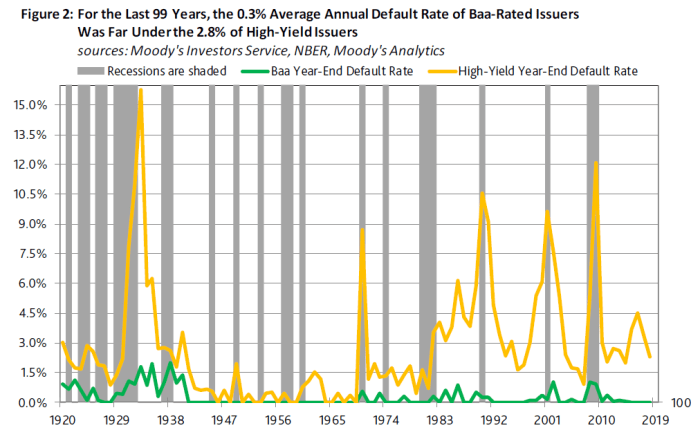
The two recessions of the 1930s were savage (the second savage but fairly short) –  about as bad, on many metrics, as the Greek experience in the last decade.   And yet, even then, not (quite) 1 in 50 Baa-rated issuers (recall that these weren’t the most rock-solid issuers) failed (defaulted).   And over 99 years of data the average annual default rate for Baa-rated issuers was 0.3 per cent (and over the second half of that period –  including the severe 2008/09 recession – the average default rate was lower than in the first half of the period, when active counter-cyclical macro management was still a contentious novelty.)

Loosely speaking, a 0.3 per cent annual default probability could be seen as roughly equivalent to a probability that a particular Baa-rate issuer will default once in every 333 years.

Readers will recall that the Governor of the Reserve Bank plucked, pretty much from thin air (at least going by the documents they’ve released), a benchmark of requiring banks to have sufficient equity capital to cope with a 1 in 200 year event.

But how safe do the rating agencies regard our big banks at present, on the current capital ratios?    For that, you can’t just look at the headline rating, which incorporates the prospect of government bailouts, and/or interventions such as recapitalisation by a parent (both factors that affect the ratings for our big banks), but want to look at an assessment simply of the balance sheet of the rated entity itself (“standalone ratings”).

I couldn’t see a nice summary of the Moody’s standalone ratings for the big banks in New Zealand, but I did find this summary of the S&P ratings, in an article on the Reserve Bank capital proposals.

S&P says the stand-alone credit profile of one or more of ANZ NZ, ASB, BNZ and Westpac NZ  could be increased to ‘a-‘ from ‘bbb+’ if the Reserve Bank proposals are implemented. And if their Aussie parents choose to inject capital to meet the Reserve Bank proposals, this could lift their stand-alone credit profiles to ‘a’ from ‘a-‘.

A stand-alone credit profile is S&P’s opinion of a debt issuer’s creditworthiness, in the absence of extraordinary intervention from its parent or affiliate or related government, and is one component of a credit rating.

The current standalone ratings are already at the upper end of the Baa/BBB rating.  I also couldn’t find a similar long-term default rates chart for S&P (like the Moody’s one above) but an S&P table of defaults since 1980 suggests a very similar default rate over that period for S&P BBB issuers (like the big New Zealand banks) than for Moody’s Baa issuers.

It is easy for people to have a go at rating agencies –  the Governor of the Reserve Bank has done so –  but actually what the chart at the start of the post highlights is that for conventional issues of securities, Moody’s seems to have done just fine (were they now rating issuers consistently too generously you would see an upsurge of defaults, but there has been no sign of that in recent decades).

This isn’t a new point: Ian Harrison has made much the same point, in a more developed way, in his critique of the Reserve Bank’s proposals.   But sometimes a picture helps.

According to the rating agencies – and recall that the Reserve Bank echoes the assessment in the tone of its comments in each FSR –  New Zealand banks already have a mix of asset books and funding structures (debt/equity mix) consistent with an extremely low probability of failure, even absent parent support.  Perhaps not inconsistent with that, no major retail New Zealand bank (or Australia or Canadian bank) has failed in a very very long time.

The case for much higher minimum capital requirements just hasn’t been made.


Looking to the MPS

I was tempted to write a post about the new head of the Irish central bank, perhaps offering some pointers to my (handful of) Irish readers about the propensity of their new British Governor to speak openly, and typically not in a very robust or convincing manner, about all manner of things, all while the foundations of New Zealand’s economic prosperity –  our dismal productivity record –  were neglected.  No doubt he will be a solid administrator and is a nice guy, but it seems like quite a step down from Governors such as Philip Lane and Patrick Honohan.   That said – and unlike the New Zealand situation – at least the appointment  of the Governor was made by someone (an elected minister) with a democratic mandate.  As for the vacancy in the position of New Zealand Secretary to the Treasury, one can only hope that between the Minister and the State Services Commissioner they come up with a better appointment this time round.  But as I noted earlier in the year after the advert appeared, it is hard to be optimistic.      After all, it isn’t obvious that either the Minister or SSC sees a problem.

But to revert to more-mundane central banking, next Wednesday will see the release of Reserve Bank’s Monetary Policy Statement, the first (and first OCR decision) for which the new statutory Monetary Policy Committee is responsible (rather than the Governor personally).  There will be more interest than usual in this MPS.  In part that is because for the first time in a couple of years or more there is some genuine uncertainty as to what the OCR decision itself (as distinct from the language around it) will be.  But it will also be because of the new Committee and the uncertainty over how it will communicate (we know the minutes will be published at the same time, but don’t know what they will look like, we don’t know whether the MPS itself will look any different (probably not), and we don’t know whether some or all of the external members might start to avail themselves of the opportunity to speak openly (eg that thing called accountability)).

I’m pretty clear that the OCR should be a bit lower.  My reasons for that are straightforward:

  • core inflation is still below the focus of the target (the 2 per cent midpoint) –  has been for years, and any progress back towards 2 per cent seems to have petered out again,
  • market-based measures of medium to longer term inflation expectations are very low (close to 1 per cent),
  • that forces that added to demand growth this decade have more or less exhausted themselves and so there is little reason to expect (as a central view) higher inflation over the next year or two on current monetary policy settings,
  • confidence indicators are weak, output and employment growth have been slowing, and there is little sign of over-full employment, and
  • the global situation offers much the same set of messages (weak inflation, subdued output growth etc, albeit –  at least in some major economies –  with a better unemployment position than we have in New Zealand).

(And all this, even though New Zealand wage inflation –  often characterised as weak –  continues to outstrip growth in productivity and the terms of trade.)

But the focus here is on what the new Monetary Policy Committee might choose to do.

In his final statement as sole monetary policy decisionmaker, the Governor shifted his stance, expressing it this way

The balance of risks to this outlook has shifted to the downside. The risk of a more pronounced global downturn has increased and low business sentiment continues to weigh on domestic spending. On the upside, inflation could rise faster if firms pass on cost increases to prices to a greater extent.

The shift to an explicit statement of a (net) downside risk –  and thus more likelihood of an OCR cut than an increase in the period ahead – took quite a few by surprise in late March.

My reading of the data is that not much has changed since then. In other words, we have had another month or more of pretty subdued data and no fresh signs that (core) inflation is likely to get back to target.  Against that sort of backdrop, it would be quite easily justifiable to cut the OCR next week –  not necessarily foreshadowing a succession of future cuts, but just to provide a bit more of an underpinning for demand, and a bit more support for getting core inflation back to 2 per cent.

But, equally, it would be mechancially easy enough for the Bank –  having come only lately to recognise the need for a downside risk at all – to simply stand pat.   And, if anything, the Governor was sounding quite unbothered about the “recent slowdown in growth” in an interview with NBR last week.

What the Committee finally chooses to do has to be, more than might usually be the case, anyone’s guess.

For a start, the economic forecasts (that influence and are shaped by) the Committee’s policy preferences must be more of a wild card.  The forecasts will, presumably, be owned by the MPC itself –  not just treated as staff forecasts –  but four of the seven MPC members weren’t involved in the previous MPS and associated full forecast round.  One of the other members will have been, but he is now in a quite different (and vitally important) role as the Bank’s Chief Economist.

And we know almost nothing about the policy preferences, or mental models, of any of the new external members (or some of the internals).  How do they interpret the mandate?  How do they think about the relevance of overseas risks?  How much confidence do they have in the value of economic forecasting at all?   We don’t even know much about the Governor’s own views on such matters because (endlessly repeated point) he has not given a single public speech on monetary policy in his time in office.  Glib one-liners aren’t the same thing at all.

One thing I think we can count on is that there will be no vote, and thus no disclosure in the minutes of any difference of view among the MPC members.  Even if some members aren’t fully happy with where the majority is heading, the Governor is likely to put pressure on the externals not to explicitly dissent –  after all, he and the Minister have championed the “consensus” model, one which strengthens the relative hand of the Governor.  If there was a dissent first time up, that might establish a pattern or precedent that management really wouldn’t want.  As it is, it is hard to believe that any of the externals –  none with a significant background in monetary policy or forecasting –  would be wanting to buck the internal majority anyway, lest of all first time up.

The Governor has spent some time pushing back against suggests that his monetary policy communications has not been good.  In that NBR interview, he claimed again that it it isn’t his job not to surprise markets, and went on to suggest that picking the next OCR call was “barely necessary” and that energy devoted to it might be better devoted to lifting productivity, improving the health system or whatever.  I don’t suppose those comments –  typically glib –  will have endeared him to his critics in the market (eg those reported in the recent Reuters story).     For all his bluster, however, it would be a bit surprising if he wasn’t being advised to avoid further unnecessary controversy over his communications (especially now that, at least in principle, he represents the MPC not just himself).   That doesn’t necessarily determine which way the Bank will go, but perhaps there might be fewer comms risks from cutting now, than risking some sort of whipsaw reaction if they get the messaging wrong around holding fire for now?

One other consideration that may be relevant is the RBA interest rate decision next week.   Markets had swung to the view that the cash rate would be cut when the RBA Board meets on Tuesday –  core inflation is now badly undershooting the midpoint of the RBA target –  and I gather market opinion is now fairly evenly balanced.   (Ten days out from a general election is always an awkward time for monetary policymakers.)  The Reserve Bank of New Zealand MPC will almost certainly make their decision (more or less finally) before the RBA decision is known, but given that the Governor noted in March an unease that other countries easing while we didn’t could put upward pressure on the exchange rate, it might be appealing to him to move now.     If the RBA cuts and he doesn’t, there will be press conference questioning about “why wait?”, and if he cuts and the RBA hasn’t done so, the Governor could look pro-active and responsive.

I mostly don’t do MPS preview posts, and did so this time mainly because I’m interested in the legislative change and the impact/implications of the new system, and the uncertainty the transition generates.  In a poll earlier this week, I predicted a cut but, asked about the strength of my view, described it as a 51/49 call.  I see one of the big banks has just put out a note taking a similar view (55/45). It is easy to say that individual OCR decisions don’t matter that much –  and there is some truth in that, but they set the scene for the next one.  Probably no one can really claim they will be too surprised which way the OCR call goes on Wednesday, and the bigger challenge –  opportunity for getting things wrong –  is probably around the rest of communications (both the wording of the policy statement itself and the credibility of the forecasts, all shaped by new leadership).

There are now seven holders of statutory MPC positions. Not one of whom has made any serious speeches or paper on monetary policy (we know nothing of the views of most them), the Bank needs to be looking to improve its medium-term monetary policy communications quite materially.  It would be an inconceivable situation for most other advanced country central banks –  and those monitoring them –  to find themselves in.


Thoughts prompted by a government debt chart

I’ve just started reading an interesting new book on sovereign debt defaults (including the question of why there aren’t more of them).    When I’ve finished the book and done the review I’m supposed to be writing, I might even do a post on that intriguing issue.  But on page 3 of the book, this scene-setting chart appeared.

world public debt

It is a pretty strong upward trend, and the trend isn’t obviously different after 2008.

It is important to remember how dramatically the composition of world GDP has changed since 1980 (think of China in particular, where public debt is much higher than it was).

It is quite a remarkable contrast to New Zealand’s record.  This chart uses data from The Treasury’s website, for the longest gross-debt time series they show.

GSID

Gross (central) government debt, as a share of GDP, is lower than it was at any time in the 1970s and 1980s.

New Zealand readers are probably mostly aware that our choices have been different from those of many other countries.  But I was a bit surprised by quite how unusual.

Consistent historical data are not easy to come by.  The OECD has gross government debt data back to 1980 for only 13 of the 35 member countries (not including New Zealand).   All thirteen recorded increases in the ratio of general government gross debt to GDP over the period 1980 to 2018.    The OECD has data for even fewer countries back to 1972 (when my New Zealand chart starts), and none of those countries have  seen a fall in the ratio of government debt to GDP over that full period.

For many, but not all, purposes net government debt is a more useful measure.   Long-term historical data are even more patchy for net debt than gross debt, but what there is of it suggests New Zealand’s public debt record doesn’t stand out quite as much: Denmark, Finland, Norway (in particular), and Sweden all recorded falls over 1980 to 2018, as would New Zealand properly measured (the series Treasury reports excludes the assets of the New Zealand Superannuation Fund).

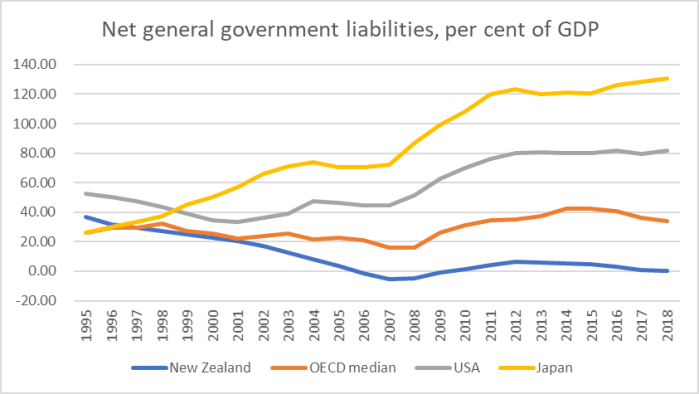
What of the more recent period?  The OECD has reasonably complete data for the net liabilities of the general government since around 1995.   Here is how New Zealand compares to the OECD total.

net debt nz and OECD.png

Unlike the world series I started this post with, in this chart the OECD total line really does look different after the 2008/09 recession than before it.

But this picture tends to flatter New Zealand.  Here is another chart, this time showing the line for the median OECD country, and for the two largest OECD economies (US and Japan).

net debt median

Net debt in New Zealand has fallen while that for the median OECD country is little changed (if anything, there are some reasons why you might think “optimal” public debt would be higher than in the median OECD country) but what really stands out is the deterioration in the net debt ratios of both the US and Japan.

China isn’t a member of the OECD and the IMF doesn’t have net debt data for China, but Chinese gross government debt (share of GDP) has increased substantially –  more than for the US –  over this period.

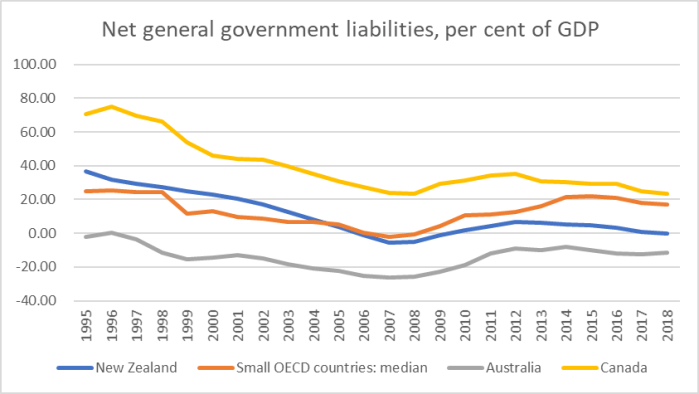
And here is one more chart

net debt 3

Here the orange line is the median for the small (population 10m or less) OECD countries, including everyone from Norway to Greece).  Our net debt as a share of GDP has fallen a bit more than that small country median,  but a median of under 20 per cent of GDP scarcely seems troubling or inappropriate.  I’ve also shown Canada and Australia –  not small but two other Anglo countries.  Australia has had consistently lower net debt than New Zealand –  despite all the political huffing and puffing there over the last decade –  and while Canada is more indebted the fall since 1995 has been larger.

Overall, our ratio of net government debt to GDP is just inside the lower quartile among OECD countries (seven countries have lower numbers).   Rising public debt may be a real issue for some countries –  and perhaps even for the world, given the possibilities of spillovers if/when things go wrong – but it is hardly a ubiquitous experience.

I don’t have any strong policy point to make with this post.  Personally I think fiscal policy in New Zealand has been managed fairly well by successive governments over most of the last 30+ years.  On the OECD net debt metric, we show as having an estimated 0.00 per cent net general government debt in 2018.

I’m not a strong supporter of the current government’s budget responsibility rules –  although I’m more puzzled at their commitments around spending (very similar to the previous government’s plans) than around debt.   But while there are plenty of people out there championing the idea that the government should take on a higher level of debt (especially given that interest rates are low),  I remain sceptical of those claims.  That is partly because I see little sign that governments spend wisely within current limits (and possible new projects must, almost by definition be less-valuable, lower ranked, proposals), partly because interest rates are low for a reason (not necessarily a fully-understood reason) about expected demand for, or expected returns on, investment, and partly because much about what government do tends to reduce the need for private individuals to save, and in that context a benchmark of something like net zero public debt (which we might fluctuate below in good times, and above in bad times) seems a not-inappropriate counterbalance.


Some benefit from RB capital proposals…but probably not New Zealand

I might have written about something in this morning’s Herald but, despite being one of that diminishing number of hard copy subscribers, they still haven’t sent out the promised email on how to activate online access to the Premium material.   How hard can it be?

And so it is back to the Reserve Bank’s proposals to substantially increase the amount of capital banks have to have to fund their current level of business.

There was a column on interest.co.nz yesterday, by Gareth Vaughan, that will have warmed hearts at the Reserve Bank.     It begins this way

The Reserve Bank of New Zealand’s proposals to significantly increase the amount of capital New Zealand banks must hold should be a good thing for both banking competition and NZ taxpayers.

I’ll come back to the competition argument in a moment, but do note that the “good thing for NZ taxpayers” argument is not overly plausible.   The chances of a large bank failing are already very very small (see successive Reserve Bank stress tests) and –  on the Reserve Bank’s own telling (recall the Deputy Governor says that GDP will be perhaps 0.25 per cent lower each and every year) – the insurance premium is high.   (And that is before mentioning OBR –  supposed to help handle bank failures – or the fact that higher minimum capital ratios would also increase the gross amounts required in any crisis government recapitalisation.)

Vaughan presents the issue as a contest between the Australian banks and our doughty heroes the small New Zealand banks.  Of the former we read

Get set for opposition from the big four banks and their allies, including business lobby groups and professional services firms, to ramp up in coming weeks.

Make no mistake. The big four banks are very grumpy about these RBNZ proposals. This much is clear even though little has been heard from them publicly to date.

But the small New Zealand banks, so we are told, are much more sympathetic.   Why?  Because what the Reserve Bank is consulting on is actually a bundle of two, quite logically separate, proposals.

  • the first is to increase the minimum core capital (CET1) ratios for everyone (to 16 per cent of risk-weighted assets for the big 4 banks, and 15 per cent for all the other locally-incorporated banks.  I’m predicting that not a single directly-affected bank actually favours that increasse.   After all, if they thought it was such a good idea there is nothing to stop them running with a larger share of equity funding now.
  • the second is to treat the big 4 banks (which are allowed to use internal risk models, under Reserve Bank oversight, to assign risk weights) more similarly to the other locally incorporated banks, which have to use the “standardised” Basle weights, which are generally (although not always) higher.    At present, the Reserve Bank estimates that the big banks’ calculation of risk-weighted assets is only about 75 per cent of what it would be if they had to use the standardised weights.  The Bank proposes to put in a floor that would prevent the big banks have risk-weights (across the whole portfolio) less than about 90 per cent of what the standardised weights would produce.    (This floor is much higher than what is being applied elsewhere: APRA, for example, is planning to use a 72.5 per cent floor.)

The smaller locally incorporated banks are very keen on the second strand of the package.   And why wouldn’t they be?   They will be quite keen on larger banks having to hold higher headline capital ratios than they do too.  Again, why wouldn’t they.

I’m generally sympathetic to what the Reserve Bank is trying to do in reducing the possible gaps between the sorts of risk weights banks using internal models can use and those other banks have to use (and was sympathetic to that cause when I sat on the relevant policy committee at the Reserve Bank).   That is particularly so as the Reserve Bank has been very reluctant to allow other banks (notably Kiwibank) to use the internal models approach.   One could even mount an argument that, in the New Zealand context with simple balance sheets, little or nothing is gained by retaining the IRB class of banks (and risk-weighting at all).

But, at least in principle, the IRB system wasn’t designed to provide a competitive edge to big banks. In principle, it was designed to recognise that bigger banks had more sophisticated risk systems and (again in principle) that it would possible to show that in some areas the actual risk on a particular class of credits was lower than the –  inevitably somewhat arbitrary –  standardised weights would capture.   Separately, one could also argue that big banks would typically have more diversified portfolios than small banks   (think of how the old Taranaki Savings Bank might have fared had Mount Egmont had one of its larger eruptions).

In practice, the incentives are all wrong.  For regulatory capital purposes (for their own risk management it might be different) IRB banks had every incentive to try to game this system –  not even necessarily consciously –  and the regulator would always struggle to keep up.  It might be a rather crude response, but the floor at around 90 per cent seems like a reasonable approach (especially if it is transparent, and it is thus relatively easy to translate capital ratios calculated that way to compare with ratios in other countries with lower floors).  Perhaps there are compelling arguments against, but if so the big banks have not yet advanced them in public.

Here, from the Reserve Bank’s website, is a chart of the current CET1 ratios

CET1

The first thing to note is that the smaller banks generally have higher (headline) CET1 (core equity capital and retained earnings) than the larger banks.  The smaller New Zealand banks had an average ratio of 13.4 per cent of risk-weighted assets, and the large Australian banks had an average ratio of 11.4 per cent.     Apply the 90 per cent floor to the calculation of risk-weighted assets and that big bank average would drop by up to 2 percentage points.   In short, calculated the same way (the way the Reserve Bank proposes in the future), the big banks might now have an average CET1 ratio of perhaps 9.5 per cent, and the small banks are averaging 13.4 per cent.     And the Reserve Bank’s consultative document proposes that the 90 per cent floor would come into effect straightaway, pretty much as soon as the final decision is announced –  no five year transition period there.

It makes considerable sense that the big Australian banks have lower capital ratios than these New Zealand banks.  The former are  diversified parts of big Australasian market-listed banking groups.  In other words, not only is there a parent to provide support (if needed), but a mechanism for raising additional capital if things go wrong.    By contrast, not only are the New Zealand banks smaller, but only one is listed.  And only one has a parent (Kiwibank, owned by three separate arms of the New Zealand government).  Note that it is not the regulator who has required these differences –  9.5 per cent vs 13.5 per cent, measured similarly –  but rather “the market” (shareholders, directors, and management have together made choices that those small banks require higher capital ratios in New Zealand to compete effectively).

And, as it happens, in at least two of those cases (TSB and Co-op) current capital ratios are so high that the Reserve Bank’s proposals to increase minimum capital ratios won’t be very binding at all (the minimum for these banks will be 15 per cent).  Recall too that domestic owners of banks benefit from dividend imputation, such that any additional cost of additional capital is less than is the case for other banks.

Without very much market discipline (in most cases), it is hardly surprising that the small local banks will regard the Reserve Bank’s proposals as a win for them.  They won’t need to raise much more capital (in most cases), and the big banks will have to raise a lot.  If the proposals succeed, whereas the big banks have been able to have considerably lower core capital ratios than these small banks, in future the big banks are likely to end up with higher ratios.    One might question “to what end?” (in a policy/economics sense), but for the small banks it looks like a clear win.

Who else might think of these proposals as a clear win (and consider offering the Reserve Bank support)?   Why, surely the people who aren’t directly affected by them at all?  And that would include?   Well, for example, any foreign bank with operations here that aren’t locally-incorporated.  Impose a heavier regulatory burden on the locally-incorporated local competition, and what is not to like.   People whose business would be helped by more local bond issuance (corporate bonds or securitised assets) might also look benignly on what the Governor is proposing.

I don’t suppose any big foreign banks will actually be submitting in support.  After all, if the Reserve Bank proceeds with its proposals it will represent probably the most demanding capital regime in the world, and other regulators in other countries –  with their eyes on more capital – might in future point to New Zealand as some sort of model.   My point is just that one shouldn’t be surprised if there are some people who are quite keen on the changes, and only some of those making that case will be not self-interested.

The thrust of Gareth Vaughan’s argument (and there is no reason to suppose his argument is self-interested, any more than mine is on the other side), is that greater competition will follow from the proposed changes, and that that can only be good for the consumer of banking services (lender, borrower, or whatever).  But it is hard not to read what he is writing as mostly just anti Australian banks, regardless of the consequences for New Zealanders (household or businesses).  This is the final paragraph of his column

The owners of NZ’s big four banks have been the cats that got the cream over the past decade. The RBNZ’s capital proposals threaten to end, or at least disrupt, their halcyon days. Should the RBNZ proposals go ahead unchanged there could be some short-term pain for borrowers and savers. Given the market power of the big four banks it’s difficult to rule this out. But a level capital playing field ought to boost competition in NZ banking, and longer-term, should we face a banking crisis, taxpayers ought to be less on the hook than they would be under the current bank capital regime.

Perhaps he could show us a plausible scenario in which a large New Zealand bank –  with capital ratios already well higher than they were – fails?  Reserve Bank stress tests (and anything else they’ve published) has so far failed to do so.

But what about this  prospective greater competition?   Surely for the New Zealand consumer as a whole to be better off, we would need to see more capital, not less, voluntarily committed to the New Zealand banking market.  And how likely is that?

Sure the competitive position of the small banks is going to be improved, relative to what it is now, but –  as noted earlier –  only one of those smaller banks is a listed vehicle, and neither TSB, SBS, or Coop have means of raising lots more core capital without dramatically changing their ethos or ownership structure.    Perhaps Kiwibank might manage to wrangle lots more capital out of NZ Post, NZSF, and ACC….or perhaps not.  And how confident could we be that New Zealand would be better off with a very fast-growing government-owned bank, subject to few effective market disciplines.  That sort of entity has often been on a fast road to something very nasty.

And what of the Australian banks?  Perhaps they won’t look to divest some or all of their New Zealand operations, but it is hard to believe that in the wake of these proposed changes they will be keen on growing their New Zealand books (except perhaps putting big corporate loans on the balance sheet of the parent?).

All in all, it sounds like a recipe for wider intermediation margins all round, and less banking sector capacity in New Zealand.  Relatively speaking the small banks might win at the expense of the larger banks, but (a) that just has the feel of corporate welfare without needing to involve the Provincial Growth Fund, (b) most of them look capital-constrained (if contemplating seriously taking on the big banks and replacing capacity) and (c) more importantly, it isn’t clear how those wider intermediation margins and reduced capacity would enhance the efficiency and competitiveness of the New Zealand economy.   Rates of return on investment in the Australian bank subsidiaries probably will fall to some extent, but people like Vaughan –  and the Governor –  should be careful what they wish for.

(And, as a final reminder, levelling the playing field around the floor on the calculation of risk-weighed assets is a totally separable issue from what the minimum CET1 ratio should be.  If current levels of capital are consistent with systemic stability –  as the Reserve Bank repeatedly assures us in its FSRs is so – raising the floor in the calculation of risk-weighted assets could have been accompanied by a reduction in the minimum ratio of capital to risk-weighted assets without affecting by one iota the riskiness of the banks concerned.  I’ve made the case elsewhere for why the argument for higher minimum capital looks threadbare.)