More kids means more education spending

I’m tied up with other commitments today, but I happened to notice this chart from the OECD.

education spending

Since today is also the day the primary/intermediate teachers’ strike hits Wellington, it seemed timely.

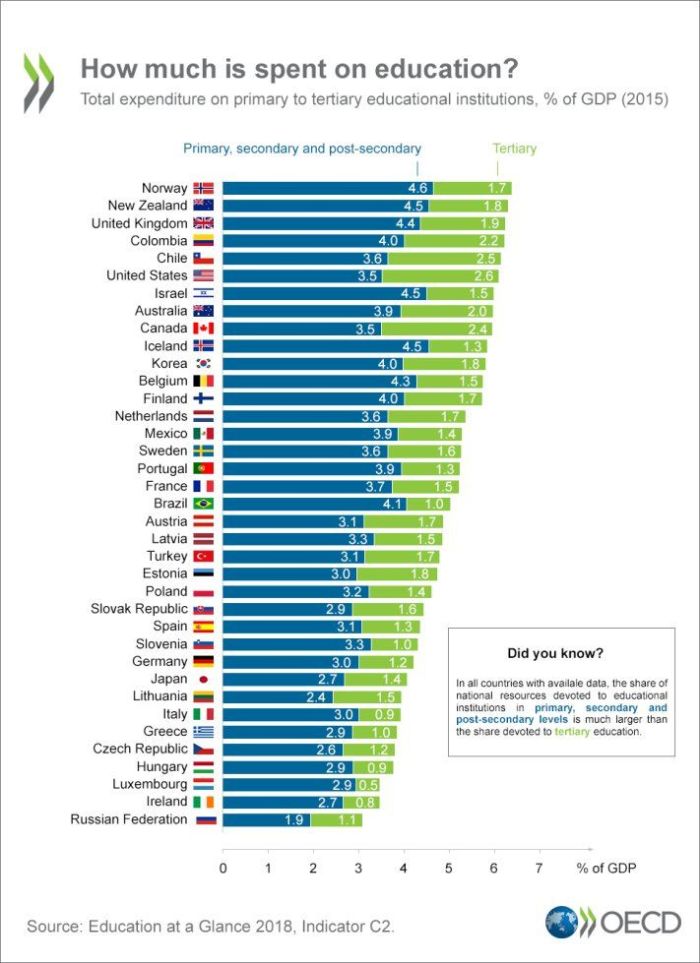
In some ways, it is quite a striking chart.  New Zealand devotes the second largest share of GDP to education of any OECD country, exceeded only by super-rich Norway (as far as I can see this is an estimate of total public and private spending).

And yet, once one looks even a bit more closer it is less interesting than it might have seen.  For example, at the other end of the chart both Ireland and Luxembourg have GDPs that are flattered by unusual effects –  in Ireland’s case, the impact of their corporate tax system (which ends up exaggerating the true economic value occurring in Ireland, and does not reflect value accruing to the Irish), and in Luxembourg’s case, the fact that a lot of the GDP arises from people who work in tiny (financial centre) Luxembourg but live across the border in various neighbouring countries (their kids won’t be using Luxembourg’s schools).

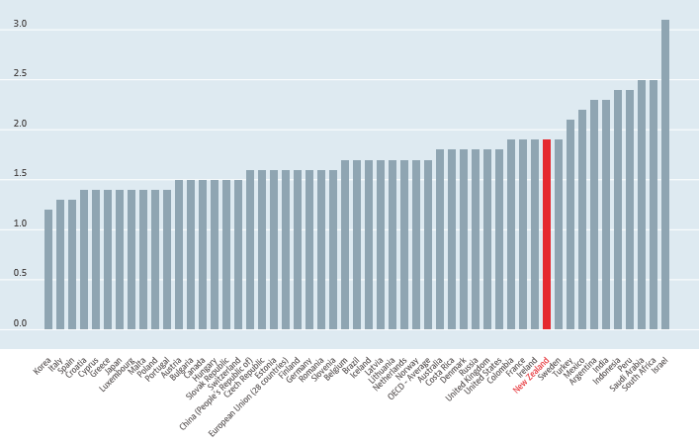
And in our case, who uses schools and universities?  Mostly children and young people, and if you don’t have many children you’ll need to spend less (as a share of GDP) on education.   As this chart shows, of the OECD countries only Turkey, Mexico and Israel have a higher total fertility rate at present than New Zealand does.   Our TFR this particular year was 1.9 (births per woman) while that for, say, Japan was about 1.4.  That makes a big difference to how much needs to be spent on schools (all else equal about a third more).  Iceland spends as much on schools as we do, but with quite a bit smaller a birth rate.

Total fertility rate (2016)
fertility-rates

And the other thing that marks us out relative to most OECD countries, although not all, is a high rate of immigration.  Not all migrants, by any means, have children with them when they move here (temporarily or permanently) but some do.  It all adds to the amount (share of GDP) needing to be spent on education.

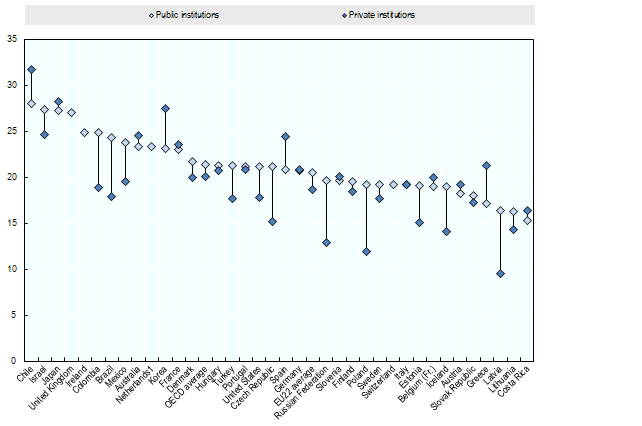
Both birth rates and migration rates are just one of those things that people doing education budgets just have to take as given.    The other thing that you’d expect to influence education spending quite substantially is class sizes –  even at tertiary level the old Oxford/Cambridge tutorial system is a lot more resource intensive than, say, stage 1 lectures with 350 young people with largish tutorials run by honours students. But there tends to be more of a focus on school class sizes.  Unfortunately, the charts in the OECD Education at a Glance publications don’t have New Zealand data for pupil/teacher ratios, but here is the chart.

Average class size in primary education, by type of institutions (2016)

ratios

What I found striking is how wide the range of practices is.  It isn’t just that richer countries have smaller class sizes –  Chile is at one end and Costa Ricas at the other –  even though my understanding of the educational research is that smaller class sizes is mostly just a luxury item, with little or no impact on educational outcomes.   Shifting from one end to the other is likely to have significant implications for the cost of primary school education.  I have no idea where New Zealand would sit on the chart: I’m always a bit surprised how small my children’s class sizes have been, but that probably just marks me out as an old fogey, recalling classes in the mid-high 30s back in the early 1970s.

I don’t have any particular conclusion to this post, other than the caution that a high share of GDP devoted to schooling sheds –  on its own – precisely no light on the reasonableness, or otherwise, of the teachers’ claims, and their strike.  Having said that, I’d have preferred my daughter’s Principal not to have been using public resources to email us all urging parents to support the industrial action, join the protest rally etc.

Making the Trump administration look less bad

I’m no fan of Donald Trump.  He is unworthy of the office he holds, and almost every week there is new data to reinforce that view.   And if his character is unworthy, there is no offset in the way in which he attempts to govern or in the clarity and excellence of his thought or vision.

And yet, when it comes to the People’s Republic of China, our Prime Minister –  probably with the full support of the Leader of the Opposition –  manages, somehow, to leave the US Administration looking as though –  for the moment at least – it is on the side of the angels.   And as if it is our governments that are simply all about “the deal” –  be it an “FTA” upgrade, party political donations. or just students flowing to our public universities that have made themselves so dependent on not upsetting the thugs in Beijing.

Then there is Scott Morrison.  I guess he probably won’t be Australia’s Prime Minister for long, but a couple of weeks ago he gave a pretty good speech under the heading “The Beliefs That Guide Us”.  Sadly, I didn’t see it reported here at all (from the Australian media there is a good commentary on it here) but it comes in stark contrast to the way in which our governments (present and past) behave and talk (or simply refuse to talk).  Rhetoric is, of course, easier than action, but at least the words were good (emphasis added).

Our foreign policy defines what we believe about the world and our place in it.

It must speak of our character, our values.  What we stand for. What we believe in and, if need be, what we’ll defend. This is what guides our national interest.

I fear foreign policy these days is too often being assessed through a narrow transactional lens.   Taking an overly transactional approach to foreign policy and how we define our national interests sells us short.

If we allow such an approach to compromise our beliefs, we let ourselves down, and we stop speaking with an Australian voice.

We are more than the sum of our deals. We are better than that.

And what does Morrison regard as the “beliefs that guide our interests”?

We believe that the path to peace and liberty demands the pursuit of prosperity through private capital, rights to own property, entrepreneurialism and free and open markets. That is what lifts people out of poverty.

We believe that acceptance should not be determined by race or religion. Rather, we accept people by their words and judge them by their actions.

We believe in freedom of speech, thought, association and religion.

We believe in peaceful liberal democracy; the rule of law; separation of powers; racial and gender equality where every citizen has choice and opportunity to follow their own paths and dreams.

A fair go for those who have a go – that is what fairness means in Australia.

We believe in the limits of government – because free peoples are the best foundation to show mutual respect to all.

We believe in standing by our mates, side by side with nations that believe the same things we do.

Few or none of those things would be embraced by the People’s Republic of China, or the Party that controls it.  As he goes on to point out, by omission in listing the sorts of nations which do.

From the United Kingdom and the democracies of Europe to the United States and Canada. From the state of Israel to the city state of Singapore. From Japan and South Korea in North Asia to New Zealand, across the ditch.

He goes on later to observe, of Australia’s participation in various conflicts

We have done this because we believe it is right. Being true to our values and principles [will] always be in our interest.

Whereas, so it seems, in our Prime Minister’s mind (and that of her Opposition counterpart) not only are the two in constant tension, but the values and principles of this nation are constantly sacrificed to some short-sighted, limited, and mercenary conception of “interest”.    It is shameful to watch.

What of the US Administration?  You might think, as I do, that the focus on the US-China bilateral trade deficit is wrongheaded and economically illiterate.  Which isn’t to say that there are no real economic issues that it is right for the US Administration to take the lead in addressing –  with, so it appears, pretty widespread endorsement across the political spectrum in the US.  Even if you think –  as I generally do –  that intellectual property protections generally reach too far, and even if you recall that most rising powers have attempted to gain an edge by purloining the technology or insights of firms/countries nearer the technological frontier, China’s approach is particularly systematic, aggressive, and unacceptable.  It needs to be called out.  China doesn’t offer anything like an open market in many areas (services and investment notably), and if  –  in the longer-run –  those choices will mostly harm the Chinese, I don’t have any problem with a big and powerful country attempting to encourage change.  They are the sort of changes most in the West probably looked towards when China was allowed into the WTO.  It was clearly a sick (if opportunistic) joke when New Zealand agreed to deem China a “market economy”, when it remains far from that –  and, in many respects, getting further from it.

But it isn’t just about trade and investment.  Last month, the Vice-President gave a pretty forceful speech on the Administration’s approach to the People’s Republic of China.    There was a trade dimension

Over the past 17 years, China’s GDP has grown 9-fold; it has become the second-largest economy in the world. Much of this success was driven by American investment in China. And the Chinese Communist Party has also used an arsenal of policies inconsistent with free and fair trade, including tariffs, quotas, currency manipulation, forced technology transfer, intellectual property theft, and industrial subsidies doled out like candy, to name a few.

But there was so much more. The military position for example

And using that stolen technology, the Chinese Communist Party is turning plowshares into swords on a massive scale…

China now spends as much on its military as the rest of Asia combined, and Beijing has prioritized capabilities to erode America’s military advantages – on land, at sea, in the air, and in space. China wants nothing less than to push the United States of America from the Western Pacific and attempt to prevent us from coming to the aid of our allies.

Beijing is also using its power like never before. Chinese ships routinely patrol around the Senkaku Islands, which are administered by Japan. And while China’s leader stood in the Rose Garden of the White House in 2015 and said that his country had “no intention to militarize the South China Sea,” today, Beijing has deployed advanced anti-ship and anti-air missiles atop an archipelago of military bases constructed on artificial islands.

and systematic issues with a more individual impact

Nor, as we hoped, has Beijing moved toward greater freedom for its people. For a time, Beijing inched toward greater liberty and respect for human rights, but in recent years, it has taken a sharp U-turn toward control and oppression.

Today, China has built an unparalleled surveillance state, and it’s growing more expansive and intrusive – often with the help of U.S. technology. The “Great Firewall of China” likewise grows higher, drastically restricting the free flow of information to the Chinese people. And by 2020, China’s rulers aim to implement an Orwellian system premised on controlling virtually every facet of human life – the so-called “social credit score.” In the words of that program’s official blueprint, it will “allow the trustworthy to roam everywhere under heaven, while making it hard for the discredited to take a single step.”

And when it comes to religious freedom, a new wave of persecution is crashing down on Chinese Christians, Buddhists, and Muslims…

Last month, Beijing shut down one of China’s largest underground churches. Across the country, authorities are tearing down crosses, burning bibles, and imprisoning believers. And Beijing has now reached a deal with the Vatican that gives the avowedly atheist Communist Party a direct role in appointing Catholic bishops. For China’s Christians, these are desperate times.

Beijing is also cracking down on Buddhism. Over the past decade, more than 150 Tibetan Buddhist monks have lit themselves on fire to protest China’s repression of their beliefs and culture. And in Xinjiang, the Communist Party has imprisoned as many as one million Muslim Uyghurs in government camps where they endure around-the-clock brainwashing. Survivors of the camps have described their experiences as a deliberate attempt by Beijing to strangle Uyghur culture and stamp out the Muslim faith.

And the sort of influence activities that Anne-Marie Brady has written about here

I want to tell you today what we know about China’s actions – some of which we’ve gleaned from intelligence assessments, some of which are publicly available. But all of which is fact.

As I said before, Beijing is employing a whole-of-government approach to advance its influence and benefit its interests. It’s employing this power in more proactive and coercive ways to interfere in the domestic policies and politics of the United States.

The Chinese Communist Party is rewarding or coercing American businesses, movie studios, universities, think tanks, scholars, journalists, and local, state, and federal officials.

He explicitly championed Taiwan as an example of a better way –  a country, actively threatened by China, and which is not only free and democratic, but more prosperous than China.

As far as I can see a few people in the US quibbled at the margins, but there was no great dissent from the broad thrust of the speech. It characterises the regime, and its threat, in a way that many or most experts seem to regard as pretty descriptively accurate.  The PRC is a threat to its own people of course, but abroad –  to countries in the region who espouse the sorts of values Scott Morrison talked of, and in the internal political processes of countries like our own, Australia, or the US (and many others).

It wasn’t just a one-shot effort from Pence, who is representing the President at this week’s summit meetings.  In the Washington Post yesterday there was a report of new interview with Pence.  With political theatre in mind, the interview took place as Pence’s plane flew across the contested South China Sea.  The report included

The vice president said this is China’s best (if not last) chance to avoid a cold-war scenario with the United States.

In addition to trade, Pence said China must offer concessions on several issues, including but not limited to its rampant intellectual property theft, forced technology transfer, restricted access to Chinese markets, respect for international rules and norms, efforts to limit freedom of navigation in international waters and Chinese Communist Party interference in the politics of Western countries.

and ended thus

I asked him what would happen if Beijing doesn’t agree to act in Asia in a way that can avoid a cold war with the United States.

“Then so be it,” Pence said. “We are here to stay.”

Who knows whether his boss really means it – or will still mean it in six months time –  but at least it was being said.   And there is an interesting article in today’s Financial Times, highlighting the apparent bipartisan support (including among business leaders) for a more robust stance.  There was also an interesting Bloomberg column which observed

Trump usually gets the blame (or credit, depending on where you stand) for souring relations. He’s not the real culprit, though. The man truly responsible is China’s president. Xi has altered the course of Chinese policy in ways that made a showdown with the U.S. almost inevitable, whoever sat in the White House.

Even that interview wasn’t all that can be set to the credit of Mike Pence in this sort of area: speaking out about manifest evil, actions that don’t align with the sorts of values countries like the US, Australia, and (once upon a time at least) New Zealand sought to espouse and –  rather imperfectly to be sure – operate by.  There was Pence’s meeting with Aung San Suu Kyi, where he talked plenty bluntly and openly.

“The violence and persecution by military and vigilantes that resulted in driving 700,000 Rohingya to Bangladesh is without excuse,” Pence said.

And then there is the Rt Hon Jacinda Ardern, our Prime Minister.

On the day the Chinese deputy foreign minister warned other countries not to “obstruct” China’s growing activity in the Pacific, it was as if our Prime Minister was just falling into line when, in an interview yesterday, she refused to even address the issue of China’s activities in the Pacific.

When she met Aung San Suu Kyi –  who, as far as I can see has no New Zealand economic “interests” to threaten –  her language seemed to be much more muted than Pence’s

“We, of course, share the concern of the international community around what has happened in Rakhine State, and the ongoing displacement of the Rohingya,” Ardern said following the meeting.

As the Newsroom report puts it

[Aung San Suu Kyi] has also been stripped of the US Holocaust Museum’s Elie Weisel award and Freedom of the City awards, which were revoked by Edinburgh, Oxford, Glasgow and Newcastle.

While in Singapore, Malaysia Prime Minister Mahathir Mohamad said Suu Kyi was “trying to defend the indefensible”.

But Ardern said she did not detect any defence from Suu Kyi during their meeting.

And US Vice President Mike Pence also had firm words for Suu Kyi during the pair’s meeting in Singapore.

“This is a tragedy that has touched the hearts of millions of Americans. The violence and persecution by military and vigilantes that resulted in driving 700,000 Rohingya to Bangladesh is without excuse.”

Suu Kyi was brief in her remarks, saying each country knew their own situation best. “So we are in a better position to explain to you what is happening and how we see things panning out.”

Sounds pretty defensive to me.   When the Trump Administration and Mahathir Mohamad are more willing to speak out on human rights abuses than a New Zealand Prime Minister, something is very wrong.    “Kindness” and “empathy” might be her watchwords, but I didn’t suppose she meant them for tyrants and those who abet gross and systematic abuses.

And what of the PRC regime.  Here was how the Herald reported her

Ardern said before her meeting with Premier Li that she would be raising human rights issues with him but they were kept to the closed door session.

In her opening remarks she said: “New Zealand’s relationship with China is incredibly important to us. We see that relationship being incredibly important not just from an economic perspective but from a regional perspective.”

Only sweetness and light in public –  this, after all, from someone who only a few months ago pledged stronger ties between Labour and the Chinese Communist Party –  and if she politely indicated in private the odd area of possible difference, who really cares?  I’m sure the Chinese won’t.  After all, her party president is on record –  not behind closed doors – lauding the regime and its leader.

Has she ever said tried to lead ther discussion and debate at home about the character of the regime?   Has she ever said anything openly critical about one of the most dreadful regimes on the planet –  about its activities at home (a couple of weeks ago she said she “might” raise Xinjiang privately) –  and –  more importantly –  about its activities abroad, let alone its activities in New Zealand?  Even “small” things like, for example, the presence in our Parliament of a former PLA intelligence official, close to the PRC Embassy, who acknowledges misrepresenting his past to get into the country, and who has never once said anything critical of the regime.  Decent people shake their heads in disbelief (as I do each I write this), but not the Prime Minister.   Or arranging –  with the National Party –  to award a Queen’s Birthday honour to a non-English speaking Chinese-born businessman, who associates closely with MPs (and mayors) from all sides of politics, seems to arrange party donations (partly with a view to getting additional MPs into Parliament) and who the record shows is very closely associated with the Chinese Communist Party and the regime –  back in China, and here.

The local media seemed taken with the fact that Mike Pence was reported to have asked to be seated next to our Prime Minister at one of the summit dinners.  But strangely, while the local media talked up how the PM might raise such issues as steel and aluminium tariffs, or even speculated on the (manifold) political and personal differences between the two of them,  I didn’t notice anyone speculate on the possibility that China, and New Zealand’s rather shameful and supine attitude to the PRC, might have been among Pence’s list of talking points, amid the pleasantries and fine food.  I’m sure our allies welcomed the P8 purchases, and even the additional money New Zealand and Australia are (for how long?) throwing at the Pacific, but someone who won’t utter an open word of disapproval of such a regime, who won’t even speak out about the disgrace of Opposition MP, Jian Yang, who does nothing –  and refuses to openly take seriously –  the domestic interference issues is hardly someone showing any sign of living by those sorts of values that Scott Morrison enunciated in his speech.  And yet I suspect they represent rather well the values of most individual New Zealanders –  just not our political classes, who seem to act as if “values” are just some nice-to-have for other people, not something integral to how they live and act and speak.

It is pretty shameful when the Trump adminstration –  for now at least –  puts our country in such a poor light, on such a significant (and potentially a defining) issue. I remain sceptical about Trump’s willingness to follow through (on almost anything) or indeed about US administration’s willingness to pay much of a price to, say, defend Taiwan (and, if perchance, the trade strategy puts real pressure on, the temptation to action  – and distraction – there may only increase –  the Falklands weren’t invaded when Argentina was prospering).  The South China Sea is already, in effect, lost.  And no outsider can do much about China’s awful internal record.  But words still matter.  They express what we care about, what we value (more than just a deal).

And on these issues, the Trump administration at least has the words.  Jacinda Ardern –  and Simon Bridges –  sit cravenly silent.  It is as if, to upend Scott Morrison’s words, they think New Zealand is defined solely as the sum of our deals. It is shameful.
More thoughts on financial crises and economic performance

In my post yesterday, focused specifically on Geoff Bascand’s speech on financial stabilty, financial crises etc, I used this chart

crisis costs

to, again, raise questions about just how much of the poor economic performance over the last decade or so can really be ascribed specifically to the financial crisis (bank failures, large loan losses etc).  After all, the US was the epicentre of the crisis, and my other group of countries (long-established advanced countries, also with floating exchange rates –  Australia, Canada, New Zealand, Norway, Israel, and Japan)  didn’t have domestic financial crises.

I’d been playing around with that data with a view to writing a post about an article in the latest issue of Foreign Affairs, The Crisis Next Time: What We Should Have Learned from 2008″, by Carmen and Vincent Reinhart (she an academic researcher, and he a senior market economist and formerly a senior Fed official).    The Foreign Affairs website is having open access this month, so the link should work for anyone wanting to read the (accessible and not overly long) article itself.

I thought the article was a bit of a mixed bag (and this post ends up only partly being about the article).  Carmen Reinhart, in particular, has been at the forefront of efforts to remind that recessions associated with financial crises are often more severe than other recessions.  That is a useful reminder, but hardly surprising.  Mild recessions tend not to generate many loan losses, and even if the banking system wasn’t rock solid in the first place, nothing too serious is likely to follow.  But if resources have been severely misallocated in the first place, supported by ample new credit, then when the correction occurs –  and views about what is profitable have to be revised –  it isn’t surprising that the associated recession can be deep and the financial system can come under stress.  In New Zealand, for example, it wasn’t the financial system crisis (failure of DFC, repeated near-failures of the BNZ) that made the 1991 recession so serious; rather than pressures on the financial system were part of the same aftermath of excess –  over-inflated expectations – that the entire economy was caught up in, combined with some serious efforts to break the back of high trend rates of inflation.

As the Reinharts point out, the problems can then be particularly severe in a country that has few or no macro policy levers left open too it –  a fixed exchange rate or a common currency, tied to the fortunes of a group that may not share the particular problems you did (thus, for example, Ireland in a euro-area in which Germany is the largest economy).  Adjustment can be a lot slower without the ability to adjust the nominal interest and exchange rates.  Perhaps more than the authors, I’m a sceptic on the euro.

For my purposes, there is a convenient couple of sentences in the Reinhart article

Financial crises do so much economic damage for a simple reason: they destroy a lot of wealth very fast. Typically, crises start when the value of one kind of asset begins to fall and pulls others down with it. The original asset can be almost anything, as long as it plays a large role in the wider economy: tulips in seventeenth-century Holland, stocks in New York in 1929, land in Tokyo in 1989, houses in the United States in 2007. 

It usefully highlights a key difference between, say, the US (or Ireland or Iceland) late last decade, and the experiences of the group of non-crisis floating exchange rate countries whose experience is reflected in that first chart above.   Stock markets in those latter countries took a short-term hit, of course, but there was no sustained loss of (perceived) wealth akin to what happened in the crisis countries.

It isn’t entirely clear from the article how much the authors want to focus mostly on the depth of the initial recession and how much on the disappointing economic outcomes in many countries over the last decade.  But both are mentioned, and there seems to be a tone that conflates the two in a way that I’m not surely is overly helpful (given the goal of learning lessons that can help better prepare us for future severe adverse events).  There also seems to be a very strong focus on the demand side, and none at all on the supply side (no mention at all of productivity growth).

And yet, if we look across the OECD as a whole, the unemployment rate was right back down to where it had been in 2007.  If (and there is) a disappointment about the last decade as a whole, it can’t be now about excess labour supply (unemployed workers) –  slow as the unemployment rate was to come down, it did eventually.  As it happens, the unemployment rate in the US (epicentre of the crisis) is now lower than in the median of my non-crisis floating exchange rate group –  which wasn’t the case in the years running up to 2008.

I have plenty of criticisms for the way many central banks (including our own) handled the years after the 2008/09 crisis and recession.  In some cases, actually tightening when it wasn’t necessary or appropriate, and often a hankering for some sort of return to “normal” interest rates (that may have prevailed in the previous couple of decades) when as has become increasingly apparent something about what is “normal” has changed.  Throw in the lack of any pro-activity in addressing the existence of the near-zero lower bound on nominal interest rates (itself arising from regulatory and legislative choices), and it is clear that more could –  and should –  have been done in many countries.

But even if such changes (in macro policy) had been made, the differences in economic outcomes would probably have been at the margin:  helpful (eg in a New Zealand context, getting core inflation back to 2 per cent, and getting unemployment down to the NAIRU perhaps two or three years earlier), but it is unlikely that it would have made much difference to productivity growth, or indeed to levels of real GDP per capita today.

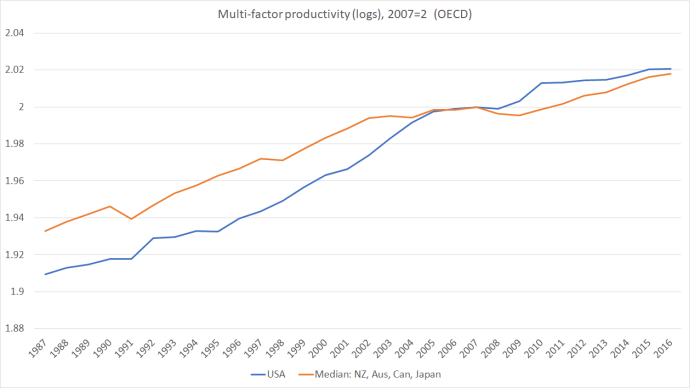
In yesterday’s post, I showed a chart comparing labour productivity growth trends in the US (epicentre of the financial crisis) and in the group of non-crisis floating exchange rate advanced economies.  But what about multi-factor productivity?

The OECD only has MFP data for a subset of member countries.  Of my sample of non-crisis advanced countries, they don’t have data for Norway and Israel.  But here is the comparison for the US and the group of four non-crisis advanced countries, all normalised to 2007.

MFP crisis.png

In both cases –  although perhaps more starkly so for the non-crisis countries –  it is clear that the slowdown in productivity growth was underway well before the recession (and crisis).  The financial crisis (centred in the US) cannot be to blame for something that is (a) apparent across crisis and non-crisis countries (especially when the non-crisis countries are less productive than the US to start with), and (b) when the phenomenon got underway before the crisis or recession did.

(The Conference Board Total Economy database does have MFP estimates for my full group of non-crisis countries.   They use a different model to estimate MFP, but the same two key observations hold in their data: the slowdown was apparent in both lots of countries well before the crisis/recession, and (if anything) the US has done better than the non-crisis group both before and since its crisis.)

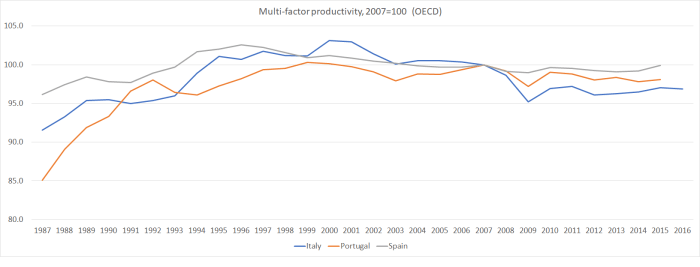
But what about some of the euro-area countries you ask?  And the Reinharts themselves rightly point out how poor the economic performance of Italy (and Greece) has been.  The OECD doesn’t have MFP estimates for Greece, but here are the estimates for three other embattled euro-area countries: Portugal, Spain, and Italy.

MFP crisis 2

All three countries have been in deep trouble for a long time now –  the estimated level of MFP peaking around 2000.   On this score, the trends don’t look materially different over the last decade than over the years leading up to 2007.    Whatever the cause of their problems with productivity, it can’t have been the financial crises these countries went through.

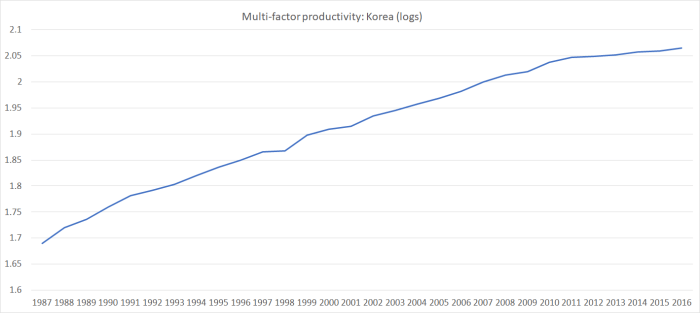
And perhaps nor would you expect it.  Readers might recall a wrenching financial crisis that Korea went through in 1998.   And here is the OECD estimate of multi-factor productivity for Korea.

mfp crisis 3

You can see the 1998 crisis/recession in the data, but as a short-term blip.  In the decade after the crisis, Korea productivity growth kept on at much the same rate experienced in the decade prior to that crisis –  before (presumably) joining in the global slowdown this decade.  (That had also been the experience of the United States in earlier crisis episodes –  estimates suggest that the 1930s, for all its problems (around demand shortfalls) was a period of strong MFP growth.)

There is lots to learn from the searing experience of crisis, recession, and slow growth in the advanced world over the last decade or more.   But I still reckon there needs to be a much more careful unpicking of the different strands of the story than central bankers –  who tend to see the world through money and finance lenses, and who are often keen to champion their future role –  are prone to.  To me, the cross-country evidence just doesn’t square with a hypothesis in which the financial crisis itself plays any large part in the sustained disappointing performance of so many countries over what is now such a long time.

Central bankers meanwhile might be better off rethinking the merits of arrangements like the euro, or of the continued passivity around the near-zero lower bound, both of which look as though they have the potential for causing very major problems the next time there is a serious economic downturn.

We need better foundations for financial stability policy

Adrian Orr is now 7.5 months into his term as Governor and we still haven’t had an on-the-record speech from him about either main strand of his responsibilities: monetary policy or financial supervision and regulation.  Is he just not engaged on these issues?

But yesterday, his deputy Geoff Bascand delivered  –  in Australia –  a substantive speech on financial stability issues.  There were a few good elements in the speech.  For example, I was pleased to see this in the conclusion

The capital review gives us all an opportunity to think again about our risk tolerance – how safe we want our banking system to be; how we balance soundness and efficiency; what gains we can make, both in terms of financial stability and output; and how we allocate private and social costs.

It may be that the legislation underpinning our mandate can be enhanced, for example, by formal guidance from government or another governance body, on the level of risk of a financial crisis that society is willing to tolerate.

At present, the legislation is drafted so broadly and loosely that a single unelected and unaccountable official gets to make any such choices.  He (as it typically is) gets to make choices in a pretty much unconstrained way and we (including our elected political leaders) just have to live with the consequences.    Whether the sort of formal guidance Geoff refers to in that second paragraph is (meaningfully) feasible is open to question, but we need to improve on the current situation.  If such guidance isn’t feasible –  if society can’t write down its preference and give them as a mandate for the technocrats –  the big decisions around banking supervision policy frameworks (as distinct from the application of them to individual institutions) should be made by elected politicians (the Minister of Finance).

But, sadly, most of the speech just wasn’t that good.  It had plenty of politicially popular lines, and there was even the obligatory reference to the Reserve Bank as a tree god.  On climate change we had this

Climate change presents significant financial stability risks both through the direct implications of physical events for insurers, farmers and households, the indirect effects on insurance availability and property values, and through the potential social and economic disruption it promises.

We are working on developing a climate change strategy, which will be informed by discussions with banks and insurers in due course. Our role as a regulator is to try to ensure that financial institutions are adequately managing these risks, even though the horizon for their realisation could be decades away.

Given that the best evidence for New Zealand is that projected increases in global temperature are probably neutral and at best slightly positive for New Zealand in economic terms, and that all sorts of relative price changes occur every year changing the economics of all manner of businesses banks might have lent on, all this should amount to nothing.  But we know the Governor is a zealot –  why, he bets billions of dollars of your money on particular views of the economics of climate change, while so obscuring the choice there is no effective accountability –  so no doubt there will be pages and pages of bureaucratic bumpf from an agency with no expertise in the issue (or mandate), simply adding to compliance costs (especially for small institutions).

There was a rather lame attempt to defend the Bank’s involvement in the bank conduct review.  I noticed that the Governor had a bit of spat with ACT MP David Seymour at FEC last week on just this issue, which ended with the Governor (to whom any concept of deference or politeness seems unknown) responding as follows

When Seymour persisted, Orr simply said: “I am right, you are wrong”.

My own take is that they are probably both right.  Seymour is right on the fundamental point –  the bank conduct review was about politics and perhaps about Orr advancing his standing, not about financial soundness and efficiency (the Bank’s statutory mandate).  And if Orr is correct –  about the law giving him scope to do this –  it is only because the legislation was written –  guided by Bank officials – far too broadly in the first place.

But what bothers me rather more is the Bank’s weak understanding of the nature of financial crises, systemic risks, and so on.  These are concerns I’ve raised over several years in various contexts, including the cases the Bank has made for LVR restrictions and the (longed-for) debt to income restrictions.

For example, they continue to claim that

Household sector indebtedness represents the New Zealand financial system’s single largest vulnerability.

Yes, household debt is the largest component of financial system assets, but that is a quite different proposition.  As their stress tests have repeatedly shown, banks’ housing portfolios are constructed in a sufficiently cautious way that even very large adverse shocks (rising unemployment and falling house prices) wouldn’t threaten the soundness of the banks.   They run this cross-country chart of credit to households as a share of GDP.

novspeech-figure2

Yes, there is a lot more household credit than there was. That is the inevitable consequence of things like land-use restrictions than make urban land artificially scarce (and highly-priced).  And in New Zealand’s case, household debt to GDP is still a touch lower than it was going into the last recession (and at that time the servicing burden was also much heavier).  Despite all the angst, bank housing portfolios came through that severe recession unscathed –  as they did in Australia, Canada, and the UK.

But perhaps my biggest problem with the speech is a combination of three things:

  • the attempt to suggest that the system is very fragile –  at least without wise bureaucrats –  and that crises are always just around the corner, coming for us,
  • the continued failure to pay attention to the experiences of countries that had significant asset and credit booms and didn’t have a domestic financial crises, and
  • the inexcusable failure – in a central bank –  to distinguish between countries with floating exchange rates (which greatly assist adjustment in the face of shocks) and those without.

In combination, the Reserve Bank leads us towards quite misleading conclusions about the economic costs of financial crisis.  By overstating those costs –  hugely overstating –  they seek to strengthen their own position (and our respect of them) as regulators; the people who will do everything to keep us safe. (As commonly, one never sees mentioned in the speech that in all the financial crises they like to cite, there were in fact banking regulators who no doubt thought they were doing their job well.)

Of my first bullet, they say

First, why does financial stability matter? The answer is that bank crises are frequent and bank crises hurt.

Since the mid-1970s there have been over 140 banking crises around the world.

and (without any backing for this claim)

Serious incidents (that could have led to a crisis) are more common than people realise.

Yes, there have been lots of crisis, although since (depending on your definition) there are getting on for 200 countries in the world, even the number the Bank cites is less than one crisis per country over 45 years.

But there haven’t been many at all in stable, well-managed, floating exchange rate countries.  And in countries like ours –  for example, New Zealand, Australia, Canada, Norway –  the only financial crises in 100 years have related to the period just after liberalisation when everyone was just getting grips with what a market financial system meant (and when, for that matter, regulators also didn’t cover themselves with glory).    Of course, well-run banking systems can run into trouble, but since it is New Zealand that our Reserve Bank is supposedly focused on one might expect some grounding in the Australasian experience.   That experience just doesn’t suggest danger (massive credit losses) lurks continually.

The Reserve Bank has long been keen on citing the experience of Ireland as somehow relevant to New Zealand.  It pops up again in this speech

The consequences in terms of employment are also severe. After the GFC, Ireland’s unemployment rate rose from 4.6 percent in 2006 to 15 per cent in 2012

And yet –  prosperity and geography aside –  what is the biggest relevant difference between New Zealand and Ireland?   We get to set our own interest rates, and our exchange rate can adjust freely, while Irish monetary policy is set in Frankfurt for the entire euro-area, and they have no nominal exchange rate to adjust.  The Reserve Bank knows very well that floating exchange rate exist in large part because they provide greater leeway to cope with severe adverse economic or financial shocks.  Thus it was from the beginning –  at the time of the Great Depression –  and is now too.    I did post a few years ago –  which I can’t now see –  documenting that no floating exchange rate advanced country has ever experienced an increase in its unemployment rate of the magnitude Ireland put itself through.  I could commend to the Reserve Bank the experience of Iceland (which went through a financial crisis which, in many respects, was even nastier than Ireland’s, and yet had only a fairly moderate increase in its unemployment rate).

And then there is the hoary old chestnut about just how expensive financial crises supposedly are.  Here is Bascand

Since the mid-1970s there have been over 140 banking crises around the world. And they have had large costs for the affected economies and societies.

On average a bank crisis costs a country 23% of its GDP, while public debt increases by around 12 percent.3 The amounts are higher for advanced economies.

That footnote records that the numbers are calculated as deviations of actual GDP from its (pre-crisis) trend.

They sound like scary numbers, and if true (in some meaningful sense) they might even be so  (although even if a crisis happens every 20 years, a loss of 23 per cent of one year’s GDP is roughly a loss of 1 per cent of the total GDP over that full period).  But they aren’t meaningful, on a number of accounts.

First, the calculations (implicitly) assume that any deviation from the pre-crisis trend is a result of the crisis itself –  and not, for example, the misallocation of real resources that might well have occurred even if the financial system had stayed sound.  At best, these numbers conflate the two effects.

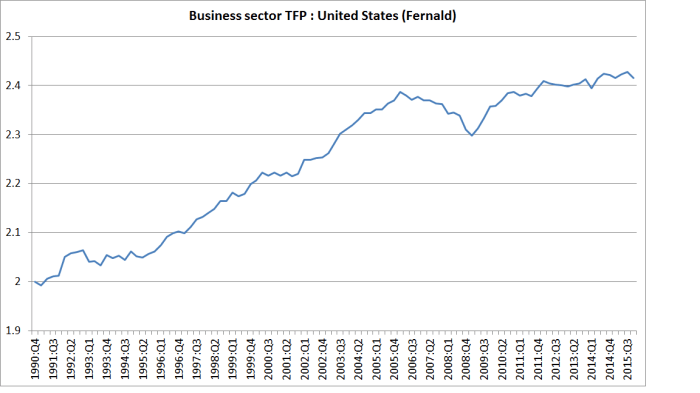
Relatedly, the estimate ignore things that might have getting underway in the year or two prior to the crisis.  Thus, as I’ve shown before, productivity growth in the United States had already begun to slow very markedly a couple of years before the crisis hit.

fernald

A small amount of that might make its way into the pre-crisis trend measures, but most of it won’t.

And thirdly, the Bank –  and many of their peers among other keen regulators –  makes no attempt to compare the experiences of countries that went through serious financial crisis and those that did not.   US economic performance over the last decade has been underwhelming to say the least.  The US was at the epicentre of the 2008/09 financial crises.  But it is simply a step far too far to conclude that the extent to which the US has done less well than in the previous decade is the measure of the cost of the financial crisis, especially if other countries that didn’t have a crisis also did less well than they had done the previous decade or so.

I’ve touched on this issue before, including in this post last year.   Of course, finding good comparators isn’t just a matter of a random into the OECD bag of countries.  For a start, as I’ve already noted (and as the Reserve Bank knows), a fixed exchange rate tends to exacerbate the severity of any shock.  The United States –  epicentre of the financial crisis –  is a floating exchange rate country.   Some floating exchange rate countries –  notably the UK and Switzerland –  were caught up in the 2008/09 crisis primarily because of the exposure of their internationalised banking sector to the US and its housing debt instrument (rather than because of domestic credit exposures).  But there are six well-established floating exchange rate advanced countries that didn’t have a serious domestic financial crisis at all in 2008/09:  New Zealand, Australia, Canada, Norway, Israel, and Japan.

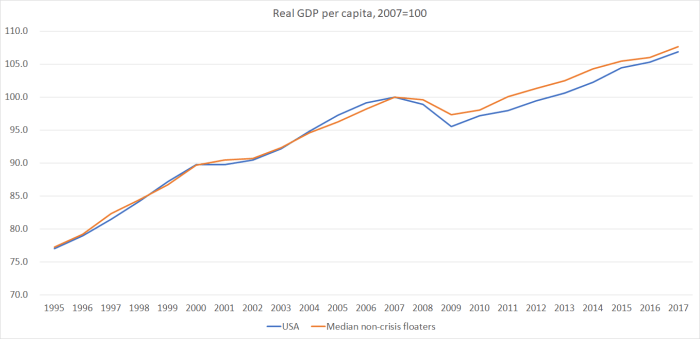
Here is how the US experience, on real GDP per capita, compares with the median of those non-crisis floating exchange rate advanced economies

crisis costs

The US experience was a little worse than that of the median of this group of countries, but the differences are small, and there is a lot of variability in the experience of the non-crisis countries (since 2007 Israel has done much better than the US, while Norway has done much worse).   And as I noted in the earlier post, the comparison still tends to exaggerate any contribution of financial crises themselves, as the US had less fiscal leeway than all the other floaters except Japan, and the US had less monetary policy leeway (running into the lower bound) than New Zealand, Australia, and Norway.

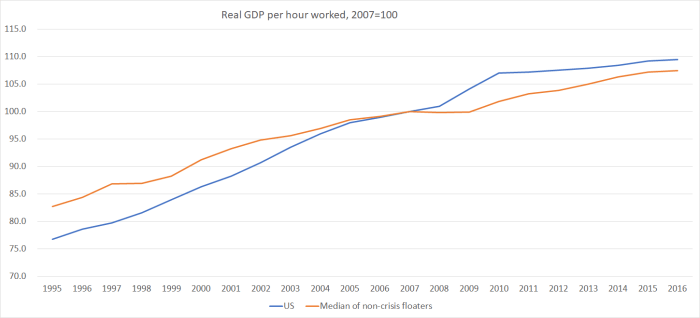
That’s GDP per capita.  But what productivity?  Quite a lot of the arguments about the cost of financial crises attempt to build a story about persistent dampening effects on innovation, risk-taking etc, reflected in the productivity numbers.  Here is the chart, showing the same comparison countries, for real GDP per hour worked (OECD data).

crisis costs 2

Perhaps this chart is a bit more favourable to the story, depending on how you read it. Over the whole period –  pre and post crisis –  the US managed faster labour productivity than the median of the six non-crisis countries.  But perhaps the slowdown in productivity growth is a bit more in the US than the others (even if, as the earlier chart showed more clearly) the slowdown pre-dated the crisis?  Then again, the level of labour productivity in the US is higher than in all but one (Norway) of my non-crisis collection of countries, so if there was a global productivity growth slowdown (for whatever reason) you might be expect the US to be hit more visibly than the other countries (that sitll had catch-up and convergence opportunities).   Even among the non-crisis countries, there is considerably divergence –  since 2007 Australia has had the strongest productivity growth and Norway the weakest.  (Remarkably, Iceland –  savage financial crisis and all –  has had faster labour productivity growth than all these countries.)

I’m not wanting to suggest that recessions and financial crises don’t have costs.  At an individual level almost inevitably they do, and at a national level recessions are rarely pleasant or welcome (that’s why we have active monetary policy).  But we deserve much more searching analysis from our central banks and financial regulators (and those holding them to account, including national Treasurys) when they bidding to persuade us to entrust them with so much power, and  the deference due to people who make so much difference (so they claim).

A good starting point remains this very long-term chart (due originally to Nobel laureate Robert Lucas)

maddisonUS

As I noted in a long-ago post

It is a quite simple chart of real per capita GDP for the United States, back as far as 1870.  These are Angus Maddison’s estimates, the most widely used set of (estimated) historical data, and as Maddison died a few years ago they only come as far forward as 2008.  The simple observation is that a linear trend drawn through this series captures almost all of what is going on.  More than perhaps any other country for which there are reasonable estimates, the United States has managed pretty steady long-term average growth rates over almost 140 years.  And yet, this was a country that experienced numerous financial crises in the first half the period.  Lists differ a little, but a reasonable list for the US would show crises in 1873, 1884, 1893, 1896, 1901, 1907, perhaps 1914, and 1929-33.  There were far more crises than any other advanced countries experienced.

And yet, there is no sign that they permanently impaired growth, or income.

If we are to have good financial stability policy, and confidence in it, it needs to be based on good searching robust and honest analysis, that recognises the puzzles and the ambiguities in the data, not the sort that rushes to support the conclusions policymakers have already settled on.

Reserve Bank whimsy

I was meeting someone in town this morning. I was a bit early and the person I was meeting was a bit late so I found myself standing for some 20 minutes across the road from the Reserve Bank.   As I did, I became a bit curious about these four guys.

orr1

In the entire time I watched them, this is all the activity there was (the chap with his hand on the cone).

Most of the Bank’s building is apparently still closed as a result of the asbestos scare, although the ground floor museum has now reopened.  But it isn’t at all clear what these guys were doing.  Access to the turning circle is now controlled (remotely) by those metal bollards, and although there will probably be billions of dollars of notes in the vaults, electronic security systems –  and big thick steel doors and walls – will be guarding that.  They weren’t acting as a guide to members of the public –  various people walked up the main steps into the museum while I watched and none interacted with the security men.  They seemed to be just standing there.  And when I walked past again 45 minutes later, they were still there….just standing.  Is the Bank a bit overfunded, or is it just the average productivity in New Zealand is so low that labour intensive operations (accomplishing what?) are still affordable?

I’ve commented here on the new Governor’s enthusiasm for all manner of green causes.  But he seems to be doing his bit personally, or maybe just saving a few dollars for the staff cafeteria.  Someone pointed out to me that the Bank now has a dinky little vegetable garden right on the corner of Bowen St and The Terrace.  I guess the space is too small for a tree?

orr2

On a slightly more serious note, readers will recall that a few weeks ago the Governor was billed as giving a speech on transparency, to the annual meeting of the (largely) taxpayer-funded lobby group Transparency International, to be introduced by the State Services Commissioner (who has responsibilities for open government)……..and yet the speech was to be totally non-transparent (no text published).    Potential attendees were told that the Governor was to be thanked by the head of the Department of Prime Minister and Cabinet, Andrew Kibblewhite, who is shortly to take up the job of Secretary for Justice, with responsibilities for the Official Information Act.

As it happens, the newsletter of Transparency International dropped into my inbox the other day.  It featured a report of the Orr address.

Guest Speaker: Adrian Orr

Guest speaker, Governor of the Reserve Bank of New Zealand (RBNZ), Adrian Orr, was introduced by Adrienne Meikle, CEO of the Commerce Commission. Noting that people referred to her as “the other Adrienne” she augmented her introduction with comments about the key priorities of the Commission.

The RBNZ Governor provided a most insightful, off-the-record address with ideas to stimulate thinking about the relevance of transparency, accountability and integrity for more-effective governance.

The vote of thanks was delivered by Lyn McMorran, Executive Director of the Financial Services Federation, who has contributed an account of Adrian’s presentation below.

Perhaps Peter Hughes and Andrew Kibblewhite were just too busy in the end, or did they get cold feet about being associated with such a travesty –  the secret speech on transparency by a public official, to a (publically funded) transparency and governance lobby group?

Senior officials, in roles that are closely followed by markets etc, really shouldn’t be doing “most insightful” off-the record addresses.  If the speaker can’t be bothered writing a full text he or she can do as the Reserve Bank of Australia does and make an audio or video record available.

As it happens, Ms McMorran has given us a summary of this “off-the-record” address.  Here is an extract (emphasis in the original)

He said, however, that often constructs within society work against us doing the right thing. In terms of transparency he said that what gets measured gets managed. Too often what is measured are things that are short term and that managers are often being incentivised for the start line not the finish line.

It is, therefore, crucial to get the horizon right – determine what outcomes we want over time – horizons that matter.

Another excellent point Governor Orr made was about the principal/agent phenomenon where a manager owns the capital but is highly divorced from the managers and the managers of managers to whom they outsource this capital and it is hard for the person at the top to know how ethical all the layers are within their organisation.

Same old themes –  especially the bit about time horizons, where the Governor seems still to be convinced that he knows better than citizens and markets what timeframes are relevant for what sorts of institutions/issues.

Under the Official Information Act I also asked the Bank for the speech or –  if no full record existed –  a summary of what was said (memories are official information too).  For completeness, here is the summary I received.

Governor Orr did not use any notes for his speech but drew upon:

An outline of the speech from Governor Orr’s recollection, is as follows:

  1. Thanks for the invite.
  2. Congratulations on your work to raise transparency as a means of ensuring integrity in peoples/firms/governments behaviour.
  3. Property rights sit at the basis of a sound functioning economy.
  4. Macro stability is also very useful (monetary and fiscal policy).
  5. Microeconomic incentives to invest productively are also necessary (human and physical capital investment).
  6. 3-5 (above) are endogenous inputs to economic growth (see Conway and Orr, RBNZ Bulletin 2000).
  7. Transparency assists 3-5 occur – as it reduces the likelihood of some forms of ‘market failure’ – myopia, asymmetric information, time inconsistency in policy, and principal-agent issues.
  8. Even if people don’t aim to create bad outcomes, market failure can lead to sub-optimal outcomes.  Likewise, market intervention can suffer the same issues.  Hence, commitment and transparency can reduce these risks.
  9. Applause and thanks.

There were no questions as there wasn’t time.

I remain less interested in the specific substance of the speech than in the principle of openness.  Private fee-paying audiences shouldn’t have better access to the Governor’s views or insights than the wider market or public audience.


The Prime Minister: kindness, policy, and specific abuse

In the Canvas magazine supplement to Saturday’s Herald there was a brief interview with the Prime Minister that encapsulated well for me why she might be well-suited to being, say, Governor-General or some other empathetic public role, but also why she is unsuited to be Prime Minister.   The interview was reproduced from a new edition of a book called 200 Women. 

Asked what really matters to her, the Prime Minister responds “empathy and kindness”, and going on to note “because that’s what drives social change”.   I don’t want to downplay the value of either admirable quality, in an individual.  But they are manifestly insufficient in someone who puts themselves forward as a leader – of a local community, let alone of a nation.

The Prime Minister attempts to illustrate her point

“if you break some of the social challenges we face down to individual people, New Zealanders have a huge amount of empathy at that level. I’ve always viewed the world this way –  rather than seeing political problems as these large-scale statistical issues and as differences between peoples”.

We don’t want political leaders who can’t identify with individual need, opportunity and so on.  And yet, when one is dealing with five million people –  and government policy choices affecting many or all of them  –  you need to be able to stand back and think about things differently, to analyse issues systematically, to recognise (for good and ill) the force or incentives, to think about the longer-term as well as the short term, and so on.   And even to recognise that values and interests can, and often will, be in conflict –  in many areas hers aren’t Family First’s or the oil and gas industry’s  (or mine for that matter).  Politics is partly about navigating those differences, seeking reconciliation where possible, but also about making hard choices and trade-offs.

She goes on, apparently pretending none of this is real.

There are so many issues we end up divided on, which, if you distilled them down to a simple concept, you will find we are in fact united on.   Take the issue of child poverty; sometimes you’ll hear arguments like, “Well, this is an issue of parental responsibility, is it our role to be involved?”.  There’s a perception that, at some point, someone has neglected their duty of care.  But, actually, at the heart of the discussion is a child who –  whatever perception you might have of them –  is blameless, who is just a subject of their circumstances,

So while I might argue back that you can’t talk about parental blame as long as we have a low-wage economy in which people are working yet not earning enough to survive –  at its heart we’re talking about the same child.  If you take a view of kindness towards that child, then this starts to change the way you might think about solving the problem. You strip away some of the blame and get back to the simple values that every child should have a good start in life and that every child should have what they need to thrive.

But this is just vapid stuff, which doesn’t help make any serious or hard policy choices at all.  It suggests a near-total absence of any sort of analytical framework for thinking about the economy or society, about the limits of the state (or the family), as well as some sort of bizarre ahistorical perspective on things –  at the time when real incomes are higher than they have ever been in New Zealand’s history (and global real incomes are higher than in all of human history) apparently no parent can be expected to take responsibility for anything because people don’t earn enough to “survive”.   What an insult to our ancestors.

She goes on.  Asked about what she would change if she could she responds

If I could distill it down, there are things among this enormous programme of work that I’d like to walk away from politics feeling we had changed.  These are finally having agreement that child poverty is something which shouldn’t exist in a country like ours and that we all benefit if we rid ourselves of it.  And climate change.

Not even actually eliminating child poverty –  whatever that means (in absolute terms we are long past that point, in relative terms almost by construction we can’t get there) –  just getting head-nodding agreement that “child poverty shouldn’t exist”.  Nor, in some ideal world, would many many other bad outcomes –  sickness, disease and so on.  And note that last phrase, which just hangs.  Nothing of substance follows it, nothing about the hard choices, conflicting values, economic costs and benefits.   This isn’t leadership, it is feelgood-ism.  It brings to mind the Disney lyrics

When you wish upon a star
Makes no difference who you are
Anything your heart desires will come to you
If your heart is in your dream
No request is too extreme
When you wish upon a star
As dreamers do
Fate is kind
She brings to those who love
The sweet fulfillment of their secret longing

But it isn’t the way government, and policymaking, works…..or should work if the desirable change has any prospect of being achieved.  That involves hard and disciplined work, tough choices, looking beyond the superficial, and so on.   It involves leadership in more dimensions – probably more important dimensions – than just “kindness”,   including courage, responsibility, persuasion and so on.

So just to take the child poverty issue for a moment, whatever you might want to do about income redistribution right now, it might mean recognising that much bigger medium-term differences can be made –  and opportunities created –  by doing something serious about New Zealand’s lamentable productivity record (by contrast, reports of the Prime Minister’s first meeting with her Business Advisory Council suggests neither she nor they have any concept of what the issues might be, or even how to think about them).

And whatever might be done about immediate social housing issues (“for the kids”), much bigger and enduring differences –  for this generation and the next – can be made by fixing the land use restrictions that have given us some of the worst house price to income ratios in the world.  You might even think –  as I do –  that children are almost always better off growing up with two biological parents who are committed to each other for life, and think about whether well-intentioned (“kind”) policy choices in decades past might have contributed to some of the problems we see today.

In a sense that “well-intentioned” comment applies in all these areas, and many more.  Many policy choices made by successive governments were made by people who thought they were being “kind” (eg working in the best interests of others) –  no doubt there were a few that were just self-interested by design from the start, but they will be few –  but as a decisionmaking criterion it just doesn’t get you very far.   Bad (policy) choices can be just as readily made by “kind” people.  The Prime Minister may well be a “kind” person –  I’ve never heard anyone say a bad word about her personally, which is admirable –  but it won’t help much to be the sort of effective leader New Zealand needs.

But if “kindness” is the criterion the Prime Minister wants to inject into all decisionmaking  – I’m still puzzling over how it is going to help her deal, say, with Chinese expansionism and interference in New Zealand (though perhaps it could help spark the odd genuine and open expression of concern about human rights abuses) –  there was an odd juxtaposition in Saturday’s Herald that left me wondering about just how seriously I should take even her talk of the priority of “kindness”.

The interview I’ve quoted from above was no doubt given some time ago, and presumably the Prime Minister didn’t control when it appeared in the Herald. But in that issue of the Herald was a truly awful, in-depth, story about a young man whose life may well have been destroyed by the organs of the state, for which if anyone is responsible (and accountable) it is the Prime Minister of the day.   It was this detailed account by Jared Savage, introduced this way.

EXCLUSIVE: A teenage boy wrongly accused of rape went to prison protesting his innocence. A year later, the so-called victim recanted the allegations. But the confession didn’t come to light for another 10 years. Jared Savage investigates.

But that intro barely even begins to capture the full horror of what seems to have gone on.

His constant claims of innocence counted against his rehabilitation and undermined his chances of parole. So he served every day of his 4 ½ year sentence.

But his prison time was far from over. He spent most of the next seven years bouncing in and out of prison for tripping up on the strict release conditions accompanying his status as a sex offender.

Simply saying hello to a child was enough for him to be locked up again.

“Release conditions” for something he didn’t do in the first place.    And which it was known years ago that he didn’t do.  And yet it was little more than good fortune that his conviction was finally overturned by the Court of Appeal.

I found it an incredibly harrowing read.  No doubt the young man concerned is no angel –  few of those to whom miscarriages of justice occur are –  and, as a victim of earlier abuse himself, his ability to function fully effectively in society might have been pretty compromised anyway.  But that isn’t the point.  When the state acts to take away someone’s liberty, when it imposes restrictions even beyond the end of a sentence, when it tars someone with the label “sex offender”, it needs to make utterly sure that it gets things right.  And since that level of confidence is impossible this side of eternity, when mistakes are made –  sometimes, as in this case, utterly egregious mistakes –  the agents of the state (the government) needs to be at the forefront of a generous pro-active approach to making atonement.  Nothing can restore than 10 years that young man has lost, perhaps there is slim chance now that his life can successfully be put on a high-functioning path, but that only reinforces how fundamental it should be for those in charge – our Prime Minister for example –  to take the lead in the apology, atonement, compensation and reconciliation processes.  Government agencies failed this man, but they failed us too.  These aren’t our values as New Zealanders –  locking up a young man for 10 year for a crime he didn’t commit, holding against him his refusal to give up and confess to a crime he simply didn’t commit, and so on.

At the end of the article we read

Phil Hamlin [the lawyer who took up the case] is now looking into whether Patrick is eligible for compensation for wrongful conviction, and, ironically, a separate claim against the state for abuse in CYF care.

Because of his youth and the relatively minor nature of the indecent assault Patrick admitted to, Hamlin said his client would not have gone to prison.

So most of his youth was spent in prison because of Mark’s now discredited rape allegations.

“I think it’s extraordinary it’s taken so long to be sorted out,” said Hamlin.

“The consequences have been huge. It’s wrecked his life.”

As for Patrick, he doesn’t really care about any compensation money.

“All I just want is for people to believe me. Then I can move on.”

Which is fine in its way, but where is the pro-activity of the state, the leadership of the Prime Minister and the Minister of Justice?  Someone who has been put through a dreadful ordeal of the sort this young man experienced shouldn’t have to go on bended knee now to the Crown.  If anything, senior government ministers should be going on bended knee to him (and his representatives), asking what they can do to make atonement for the specific and longrunning abuses of this young man by the New Zealand government and its agents.

And yet what have we heard from the Prime Minister or the Minister of Justice?  Nothing.

(For that matter, what have we heard from the opposition party leaders –  National’s leader and deputy having previously been Associate Minister of Justice and Minister of Courts, and Minister of Social Development and Minister of Police.  Nothing.)

Does no one say anything because the victim of this injustice is not some safe, blameless individual (as conventional politics would describe it)?  I don’t know, but the silence –  several days on now (and I’m not sure when that Court of Appeal ruling came down) –  is shameful.

This is one of those very specific episodes where “kindness” –  above and beyond the minimalist provisions of the law –  might begin to make a real difference in one person’s life, and in demonstrating to citizens (and public servants and government agencies) the sorts of egregious abuses we simply won’t stand for, no matter who they committed on.  Story always beats no-story.  Here she can really make a difference, and be seen to walk the talk.

I was interested to see Herald journalist Matt Nippert tweet about this story

I really hope he is right.

Show your workings: KiwiBuild, the Reserve Bank, and the Ombudsman

The Reserve Bank is a powerful public agency, whose views receive a lot of coverage, and some respect in some quarters. The views taken by the Bank affect where interest rates are set, and thus the short-medium term path of the economy itself.  They aren’t just commentators –  they are players too –  but they aren’t less than commentators.  They use a lot of public money to undertake analysis that is supposed to underpin their commentary and decisions.   It should be pretty much Open Government 101 that citizens –  who pay for the analysis and are directly affected by how the Bank uses it –  should be able to see that analysis.     The Reserve Bank has never seen it that way.  Over decades –  when I was closely involved, and still now –  they’ve taken the view that the Bank is different, and special, and that all we should be entitled to see is what they choose to tell us.   Even Xi Jinping reaches that low bar.

Sadly, the Bank has had the Ombudsman –  supposedly the watchdog for citizens to ensure, specifically, that the Official Information Act is complied with (in letter, but ideally also in spirit) –  wrapped around its little finger for decades now.  Through successive Chief Ombudsmen and successive Governors, the Ombudsman’s office has provided cover for one of the most powerful agencies of government, one still (for a few more months) run as one man’s fiefdom (single decisionmaker regime).

KiwiBuild is a case in point.  As I noted, the Reserve Bank is a powerful public agency.  KiwiBuild is a major element in the current government’s policy, and one very relevant to the Reserve Bank given the role fluctuations in residential investment often play in business cycles.   What the Reserve Bank thinks about the impact of KiwiBuild matters for monetary policy.  It can matter also to the government, especially now that its flagship programme appears to have run into political difficulties.

The Reserve Bank first opined on KiwiBuild in its November Monetary Policy Statement last year.  That document was finalised shortly after the new government took office, and in it the Bank reported –  in highly summary form –  the assumptions it had made about four strands of the new government’s programme minimum wages, fiscal policy, immigration, and Kiwibuild).   Here is what they had to say about KiwiBuild (emphasis added).

The Government has announced an intention to build 100,000 houses in the next decade. Our working assumption is that the programme gradually scales up over time to a pace of 10,000 houses per year by the end of the projection horizon. Given existing pressure on resources in the construction sector, the aggregate boost to construction activity from this policy will depend on how resources are allocated across public and private sector activities. The Government intends to introduce a ‘KiwiBuild visa’ to support the supply of labour to high-need constructionrelated trades. While accompanying policy initiatives may alleviate capacity constraints to some extent, our working assumption is that around half of the proposed increase will be offset by a reduction in private sector activity.

It wasn’t necessarily an unreasonable working assumption, but it was very early days for the new government.  Presumably the Bank had had the benefit of perspectives from, say, MBIE and Treasury that the public were not privy to, and they must have applied their own (considerable) analytical resources to thinking hard about how, at any economywide level, crowding out would work.  It didn’t seem unreasonable that if the central bank was going to weigh in like this, and make policy on the basis of such assumptions, we should be able to see a little more of their supporting analysis.  After all, if the correct number wasn’t a 50 per cent crowding out, but (say) 25 per cent, 75 per cent or even 100 per cent, it could have material implications for monetary policy.

And so, a few days after the Monetary Policy Statement was released, I lodged a request for

copies of any analysis or other background papers prepared by Bank staff that were used in the formulation of the assumptions about the impact of four specific policies of the new government minimum wages, fiscal policy, immigration, and Kiwibuild), as published in the November 2017 Monetary Policy Statement.

Somewhat predictably, the Bank refused and I appealed the matter to the Ombudsman.

The Bank justified its refusal on two conventional grounds, and one on which the Ombudsman has never provided substantive guidance.

The Reserve Bank is withholding the information for the following reasons, and under the following provisions, of the Official Information Act (the OIA):

  • section 9(2)(d) – to avoid prejudice to the substantial economic interests of New Zealand;
  • section 9(2)(g)(i) – to maintain the effective conduct of public affairs through the free and frank expression of opinions by or between officers and employees of the Reserve Bank in the course of their duty; and
  • section 9(2)(f)(iv) –  to maintain the constitutional convention for the time being which protects the confidentiality of advice provided by officials.

Anyone with a modicum of interest in open government, and even the slightest familiarity with the Reserve Bank, financial markets etc, would recognise that the claim that releasing such background supporting analysis would prejudice the “substantial economic interests of New Zealand” is laughable.

The Reserve Bank continues to comment on KiwiBuild, and the implications of that programme for the overall outlook for residential investment and for economic activity.   The views taken by the Bank still matter, both substantively (monetary policy) and in terms of the growing political controversy over the programme.     And they continue to provide almost no substantive analytical underpinnings for their views.  Here is the relevant extract from last week’s MPS. 

The Government’s KiwiBuild programme is expected to contribute to residential investment over the second half of the projection.

and

The KiwiBuild programme is assumed to add to the rate of house building from the second half of 2019.

And that’s it. No description of any analysis they (presumably) must have undertaken.

The issue came out in the press conference, where it was even enough to win the government a favourable news story, Reserve Bank backs KiwiBuild targets… mostly.  Here is some of that story

But the Reserve Bank’s quarterly Monetary Policy Statement noted that the “KiwiBuild programme is assumed to add to the rate of house building from the second half of 2019”.

That’s big news. The Bank puts extensive resourcing into coming up with its economic forecasts, and it’s essential that it does so. The Bank’s forecasts guide it’s setting of the official cash rate which is one of the main levers that sets the pace of the economy. Get it wrong, and the consequences can be severe.

That’s why it’s worth noting that the RBNZ now appears to back the view that most of the KiwiBuild homes built will be in addition to the current housing supply, which is roughly 30,000 houses delivered on the private market.

Critics have assumed that all or most of the 12,000 houses KiwiBuild will deliver each year, once fully deployed, will come by sucking resources from the 30,000 builds currently taking place. New Zealand will still build 30,000 houses a year, but 12,000 of them will be KiwiBuild, they say.

But the Bank disagrees, saying its forecasts have “assumed some minor set off”, but that KiwiBuild is overall likely to increase housing supply.

This is a change from the Bank’s MPS from last November. At the time, RNZ reported the Bank’s preliminary calculation was that as many as half of KiwiBuild’s projected 100,000 homes would have been built anyway.

Housing Minister Phil Twyford responded then that “there may be some offset but I doubt it will amount to very much”.

It now seems the Reserve Bank largely agrees, although as an independent entity it is duty bound to stay out of politics.

It doesn’t totally back the Government’s aspiration to deliver all the KiwiBuild homes in addition to existing supply.

Reserve Bank Chief Economist John McDermott said there would still likely be some “crowding out” as KiwiBuild sapped workers and resources from the private sector.

“You can imagine when one part of the economy starts to increase demand it will crowd out some other parts but overall we will start to see quite a lot of activity over the next few years in residential construction,” he said.

This stuff matters, Orr and McDermott are opining on it, Orr is making monetary policy on it, but they can’t or won’t supply any supporting analysis.  Not a year ago, and not now.     Perhaps they are right, but what confidence should we have in their views when they won’t show us, so to speak, their workings.  Old exam question used to specify that if you wanted credit for your answer (to, say, some maths problem) you needed to show your workings.  It isn’t obvious why the bar should be so much lower for a powerful public agency like the Reserve Bank.

Sadly, they have persuaded the Ombudsman to agree with them.  In my post on Thursday, I included some text from a submission I had made a few months ago to the Ombudsman on his provisional determination on this issue.  On Friday I received a letter from Peter Boshier, the chief ombudsman, conveying his final decision.  In it, he fully backed the Reserve Bank’s stance of refusing to release any of the background papers.

In my submission I had attempted to draw a parallel between background papers provided to the Governor on matters relating to MPSs and OCR decisions, and material provided to the Minister of Finance in respect of, notably, the Budget.  Each year a huge amount of that latter material is pro-actively released.  I noted

Thus, Cabinet papers underpinning key government announcements are frequently released, sometimes in response to OIA requests and at other times pro-actively.  But so too is advice to a Cabinet minister from his or her department.  That is so even when, as is often the case, officials have a different view on some or all of the matters for decision from the stance taken by the minister.   A classic example, of course, is the pro-active release of a great deal of background material, memos, aide-memoires etc compiled and submitted as part of the Budget formulation process.  Many of the working papers in that case may never even have been seen the Secretary to the Treasury but will have been signed out to the office or minister at the level of perhaps a relatively junior manager.  Many will have been done in a rush, and be at least as provisional as analysis the Governor receives in preparing for his OCR decision.  I’ve been personally involved in both processes.

Is it sometimes awkward for the Minister of Finance that his own officials disagreed with some choice the minister made?  No doubt.  Do ministers sometimes feel called upon to justify their decisions, relative to that official alternative advice? No doubt.  But it doesn’t stop either the provision of such dissenting (often quite provisional) analysis and advice, or the release of those background documents.

The sorts of arguments the Reserve Bank makes, and which Mr Boshier appears to have accepted, could well be advanced by Cabinet ministers (eg clear messaging about this or that aspect of budgetary or tax policy –  all of which are substantial economic interests of the NZ government).  If they have advanced such arguments, they have generally not succeeded.  And nor should they.  Doing so would undermine effective accountability or scrutiny, even though the Minister’s formal accountability might be to Parliament (he has to get his Budget passed).

The relationship between the Minister and his or her department officials is closely parallel to that between the Governor of the Reserve Bank –  the sole legal decisionmaker (who doesn’t even have to get parliamentary approval of his decisions) –  and the staff of (in this case) the Economics and Financial Markets departments of the Bank.  One group are advisers, and the other individual is the decisionmaker.  The fact that they happen to both part of the same organisation, doesn’t affect the substantive nature of that relationship.   Managers and senior managers in the relevant departments are responsible for the quality of the advice given to the Governor, in much the same way that the Secretary is responsible for Treasury’s advice to minister (and at his discretion can allow lower level staff to provide analysis/advice directly to the Minister or his office)   I would urge you to substantively reflect on the parallel before reaching your final decision, including reflecting on how (if at all) official advice on input to the OCR is different than official advice (including supporting analysis) on any other aspect of economic policy.

Remarkably, in his determination to protect the Reserve Bank,  Boshier simply ignores the parallel to Treasury budget advice altogether.  Perhaps it isn’t altogether the appropriate parallel (although I think the situations are extremely analagous), but instead of engaging and identifying relevant similarities and differences, the Chief Ombudsman simply ignores the argumentation.  He seems to think it is okay for powerful public agencies to make policy based on critical assumptions, and opine on matters of political sensitivity, and yet to be under no obligation to show any of their workings, even when (as in this case) such material clearly exists (the responses make that clear).

If that weren’t bad enough, the Ombudsman plumbs new depths with this paragraph from his letter

You contend that the formal accountability of the Governor is relatively weak and that public scrutiny and challenge is the most effective form of accountability. However, that view would seem conflict with your previous stated view that it was the Reserve Bank Board, rather than market commentators, who was best placed to hold the Governor to account.2 Your paper makes a very strong case for the merits of the formal accountability mechanism, the disadvantages of market commentators, and the legitimate variance of views that can arise.

I was initially a bit puzzled about what he was going on about, until I looked at footnote 2.  It was a link to this paper on monetary policy accountability and monitoring, which I had written for the Bank, as a Bank employee, in about 2005 or 2006, making a defensive descriptive case for the Bank, including highlighting how open and accountable it was.  The article has actually been amended slightly in recent years, but even at the time it wasn’t my own view –  it was the official Bank line.  That is what public servants are paid to write.  (Heck, I’ve given presentations making the case for OCR decisions I strongly disagreed with –  it is what public servants do.)     As I recall it, the article had been intended for publication in the Reserve Bank Bulletin, and my own bosses had been reasonably comfortable, but the Bank’s Board was most definitely not comfortable, and insisted both that it not appear in the Bulletin and that before it appeared anywhere it be amended to play up the importance of the Board’s monitoring and accountability (relative to the way things were presented in the draft).

I couldn’t believe that a serious person –  and Peter Boshier used to be a senior judge, and as Ombudsman is entrusted by Parliament with protecting citizen’s interests –  was actually going to run so feeble an argument.   Perhaps it seemed like a “gotcha” argument to some junior person in his office, but review processes are supposed to winnow out such lines. I’m still sitting here shaking my head in disbelief.  The Ombudsman seriously wants us to believe that because a Bank official, writing for the Bank –  a decade or more ago –  says it is highly accountable via the Board, it is in fact so.  Only someone determined to provide cover for the Bank could even think to take such a line seriously.  But that seems to be a description of the Ombudsman.

As tiny sliver of hope, the Ombudsman did point out that his decision had to be made as at the time I initially lodged the request,  ie was it reasonable for the Bank to have withheld the information last November/December, a few weeks after the relevant MPS. As a year has now passed, I have submitted a new request to the Bank, for exactly the same information from last November. I fully expect the Bank to decline that request, and then the Ombudsman can determine whether even after a year citizens should be entitled to see the working analysis powerful public agencies use when they opine on, for example, controversial government policies.  The Official Information Act is well overdue for an overhaul, but decisions like these simply reinforce the case, with more evidence of how ineffective the administration of the Act (including by the Ombudsman) often is in delivering on the purpose statement in the Act itself.

Meanwhile, Orr and McDermott opine on KiwiBuild and (apparently) make policy on their opinions, but refuse to provide anything of the analysis that underpins their views.  That simply isn’t good enough.

ADDENDUM

For anyone interested in another small example of how the Reserve Bank has the Ombudsman wrapped around their little finger,  consider the release last Thursday in the Monetary Policy Statement of this chart.

OCR advice

When I’d first seen it I offered a little bit of praise to the Governor for publishing it.  It happened to be quite similar to information I had requested more than 2.5 years ago, and which the Bank had refused to release.

As I noted in the post on Thursday, I learned a few minutes after publishing that praise of the Governor that, in fact, they had published the material only because –  after a mere 2.5 years –  the Ombudsman had got round to asking them to reconsider.   But it got worse when I got the formal letter from the Ombudsman on Friday.  They did actually apologise for taking 2.5 years and noted

As you may appreciate, this investigation has involved several meetings and much correspondence with the Reserve Bank concerning the use of a rarely-used withholding ground.

(From memory this is the “substantial economic interests” ground, which the Ombudsman thus again avoids formally ruling on.)

But this was the bit that really caught my eye

To preserve market neutrality, the Reserve Bank asked me not to inform you of its decision to release this information until after the November MPS.

This simply confirms that the Ombudsman and his staff have no concept of what might, or might not, be market sensitive.   Anyone with the slightest familiarity with the issue will recognise what actually happened.  The Bank decided to put the information in the MPS so that it might perhaps attract a little praise (for new interesting information) –  and it even managed to get some from me – while avoiding a situation where, having released the information to me –  me having requested it 2.5 years ago – I could have put it out first here, with some digs about the process, the obstruction, and the interests of transparency.

As it happens, I have no problem at all with the Bank putting the material in the MPS. It gave the material more visibility than it would get here –  and there was even a question at the press conference –  but no one, but no one (other than presumably the Ombudsman’s office, which appear not to know what it doesn’t know) would have bought the line about this old information being in any way market sensitive, or hence the alleged need for “market neutrality” about its release.  The Ombudsman’s office, again, allowed itself to be used by the Bank.  Relevant Bank staff will no doubt have been quite pleased with themselves.  But if anyone from the Ombudsman’s office is reading this –  and perhaps I’ll send them a copy –  they might use it as a prompt to begin to rethink the extreme deference they’ve displayed towards the Bank over the years.


Armistice Day

Sunday is Armistice Day –  Remembrance Day if you like – the 100th anniversary of the end of that four year conflict now known as World War One; the one some had hoped really would be the war to end all wars.  It isn’t a day for relitigating the politics, or even for analysing the economics, but for calling to mind and remembering those who died and the sacrifice they made.  In most cases, at least from this part of the world, they were volunteers.

I don’t have direct ancestors who died in World War One, or even siblings of my ancestors.  But when I reflect on the sacrifices of New Zealand servicemen, I think of my grandmother’s cousin, (temporary) Captain Robert K Nicol of whom I’ve learned a little  in the last few years.   As it happens (we generally not being a Wellington family), he attended the same primary school as my children, and the same Baptist church congregation that my family is part of today.     After all the analysis people like me are prone to, connections like that bring it all closer.

Here is the war memorial bell, still there, at Island Bay school

island-bay-school-war-memorial

Robert Nicol probably left school quite young and by the time the war broke out he was a painter –  nothing out of the ordinary, and from what accounts there are no particularly special skills.

He served in Gallipoli and then in France (by then a second lieutenant) where in late 1917 he was awarded the Military Cross.   The citation for that award read

For conspicuous gallantry and devotion to duty. When in charge of Stokes mortars in defence of a captured village one of his two gunds was destroyed, so he handed the other on to his Corporal and joined the company, which was in the village. Here he displayed magnificent gallantry and the utmost fearlessness in assisting the company commander, personally leading a bombing party against an enemy counter-attack, and accounting for six of the enemy himself in the desperate hand-to-hand fighting which ensued. His prompt action and fine leadership saved the situation.

The medal was awarded at Buckingham Palace by George V himself.

Nicol was then recruited to serve in a special British Army unit, which came to be known as Dunsterforce (commanded by a Major-General Dunsterville).  As a Herald article a few years ago recorded it.

Nicol, assigned the rank of temporary captain, had a solid reputation as a capable officer, handy with the Lewis gun and Stokes mortar and a skilled bomb instructor. It made him a perfect candidate, with 23 other New Zealanders, for special service with the British Army.

With volunteers from Australia, Canada and South Africa, the small band of brothers – the War Office had in mind a secret force of 100 officers and 200 NCOs – had a mission to block the Bolsheviks from the Caucasus.

It was a perilous and risky initiative – the NZ Rifle Brigade History notes the men were told when they assembled that few could hope to come through alive.

After Russia’s exit from the war, Dunsterforce’s role was

After crossing Europe as far as Italy, the soldiers boarded a ship for the Suez Canal and round to Basra before heading up the River Tigris to Baghdad in what was then Mesopotamia. The task set for Dunsterforce was ambitious: to blunt Turkish and German expansion reaching the rich Baku oil fields on the Caspian Sea.

The strategy involved the small Allied unit persuading Georgian, Armenian and Assyrian forces to hold the line against the rampant Turkish armies.

You can read a fair amount about the adventures of Dunsterforce, including the attack on Baku, in various on-line documents, including Appendix V of the official history of the New Zealand Rifle Brigade.    Another branch of Dunsterforce, including Captain Nicol, was in Iran (then Persia)

Hemmed in along the western shores of Lake Urumiah were some 80,000 survivors of the Nestorians, or Christian Assyrians, a thriving people that at the beginning of the war had occupied the fertile lands between the two lakes. Though reduced by repeated massacres they had succeeded in holding their own here against the Turks; but now their ammunition was running short, and utter annihilation stared them in the face. On learning of their predicament the British authorities made arrangements to send up supplies under cover of a sortie by the Assyrians, and, on July 19th, six officers and fifteen non-commissioned officers of Major Starnes’s detachment set off from Bijar with the ammunition, an escort of Hussars from Hamadan accompanying them. They were to be met half-way by a small column of mounted Assyrians, but after waiting at the rendezvous for some days without news of any movement they were unexpectedly joined by the bulk of the Assyrian army, numbering some 10,000, who had inflicted a somewhat severe blow upon the Turks. The engagement, however, had taken longer than was anticipated, and, in the absence of the fighting men, the remainder of the Nestorians became panic-stricken and began to rush southwards along the road on the heels of the army. Now the latter in their turn became infected, and there ensued a frightful and disastrous rout. Presently wounded women and children began to straggle in. This sight was too much for the Dunsters, and three officers and three sergeants, taking Lewis guns and a liberal supply of ammunition packed on baggage-mules, moved back along the human stream until they encountered the Turko-Kurdish brigands at their foul work of slaughter. Fighting, withdrawing, and fighting again, in a series of rearguard actions lasting all through a day and a night, these six brave fellows kept at bay a force of over 200 strong, until the arrival of a detachment of Hussars finally relieved the pressure. In this gallant action Captain R. K. Nicol, M.C., of the Wellington Regiment, lost his life.

A record from a publication of the Western Front Assocation records

Robert Nicol exposed himself to enemy fire whilst gallantly attempting to save the mules which enemy snipers were picking off.  His body could not be retrieved from the battlefield.

It was 5 August 1918.

Ours isn’t primarily to judge the right or wrong of the actions, and causes, of those who went before us, but there is something very 21st century about a combat death while trying to get to safety a large party of civilian (religious minority) refugees.  Perhaps that is why there have been various articles (including this one) about Nicol –  just one soldier among so many – over recent years.

Captain Nicol died in Persia and there was no marked grave.  But –  strange to realise in this era when relations between Iran and the West have been less than warm –  there is Commonwealth War Graves Commission memorial in Teheran (I gather in the grounds of the –  large –  British Embassy compound). Captain R. K. Nicol is remembered there.

teheran memorial.png

And the Commonwealth War Graves Commission record

NICOL_ROBERT_KENNETH CWGC

And here is how he was remembered back home at church.

berhampore honours board

At this distance it is easy to focus on the geopolitics, the economics, the peace process, and the next war that came too soon afterwards. But, to me, anyway, this weekend is a time to remember those who served, those who – when circumstances were thrust upon them –  exercised such courage, and those who died.

From Binyon

They shall grow not old, as we that are left grow old:
Age shall not weary them, nor the years contemn.
At the going down of the sun and in the morning
We will remember them.

UPDATE (26/11)

An article about a new memorial, at Makara cemetery, to the involvement of New Zealanders –  including Nicol –  in defending the Assyrians, and another recent article about this events.

Some reading for Todd McClay

Perhaps naively, I’m still in shock at those comments the other day on the situation in the Chinese province of Xinjiang from National Party foreign affairs spokesman, former senior minister, Todd McClay.

“Abuses of human rights are a concern wherever they occur,” says National’s Foreign Affairs spokesperson Todd McClay, “however, the existence and purpose of vocational training centres is a domestic matter for the Chinese Government.”

Perhaps the million of so spies forced into Uighur households should, in Mr McClay’s reading, best be described as intensive case management of needy families?

I’d come to take for granted that our members of Parliament – all sides –  pretty much knew the evil the regime was up to at home and abroad, but preferred to look the other way, keep quiet, and get along (careers to advance, Beijing to buddy up to).  I didn’t suppose that senior politicians  –  on the public payroll, not that of Beijing-affiliated entities (that’s for too many retired politicians, here and abroad) – would be so shameless as to literally run PRC regime propaganda for them.

But who knows. Perhaps Todd McClay really does believe the regime narrative?  In which case, there was a useful little exercise by a Dutch academic popped into my inbox yesterday morning, courtesy of the US think-tank the Jamestown Foundation, using fiscal transparency, PRC version, to illustrate what is going on.   I had no idea there was such transparency in China.

He begins

In August 2018, the U.N. Committee on the Elimination of Racial Discrimination expressed its concern at reports the PRC had detained as many as a million members of Muslim ethnic minorities in extrajudicial re-education camps in the Xinjiang Uyghur Autonomous Region (XUAR). At the same meeting, the PRC flatly denied the existence of “re-education camps”, with United Front Work Department official Hu Lianhe arguing that “criminals involved only in minor offenses” are assigned to “vocational education and employment training centers to acquire employment skills and legal knowledge” (China Daily, August 14).

Perhaps that was what Todd McClay had been reading?

But the PRC government’s own budgets appear to contradict these assertions. Xinjiang’s budget figures do not reflect increased spending on vocational education in the XUAR as the region ramped up camp construction; nor do they reflect an increase in criminal cases handled by courts and prosecutors. Rather, they reflect patterns of spending consistent with the construction and operation of highly secure political re-education camps designed to imprison hundreds of thousands of Uyghurs with minimal due process.

It is tempting to reproduce some of his tables – I like tables but they might be detail too far.  But here are his summary observations from the Xinjiang government budget data

This article supports this conclusion through examination of official PRC budgetary figures, analyzing spending breakdowns at the regional, prefectural, and county levels to produce findings of unprecedented granularity. Among its most striking conclusions:

  • Spending on budget items that explain nearly all security-related facility construction rose by nearly RMB 20 billion (or 213 percent) in 2017
  • Vocational spending in Xinjiang actually decreased from 2016 to 2017, as widespread camp construction began.
  • Instead, camp construction has largely been funded by the same authorities that oversaw the recently-abolished system for re-education through labor.
  • Spending on prisons doubled between 2016 and 2017, while spending on the formal prosecution of criminal suspects stagnated.
  • Expenditures on detention centers in counties with large concentrations of ethnic minorities quadrupled, indicating that re-education is not the only form of mass detainment in the XUAR.

There’s more

The region’s so-called “vocational training” is arguably not substantially different from the former re-education through labor system, which was abolished because the PRC government deemed it inappropriate for a modern society governed by the rule of law (Zenz, September 6).

Moreover, Xinjiang’s so-called “vocational training” campaign has not actually improved employment outcomes among the campaign’s target population. Official reports note that in 2017, 58,500 “poor persons” found employment, 17 percent more than planned, but not a large increase from the 57,800 in 2016 or the 57,900 in 2015. The same figure for the first three quarters of 2018 was 38,800, equivalent to only 51,730 per year [6]. This data provides a powerful official counternarrative to what Xinjiang’s governor is claiming. Neither the 2017 nor the 2018 XUAR employment reports refer to the purportedly successful “vocational training centers”.

Before he concludes

These facts do not support the notion of a large campaign to improve vocational skills. Rather, the mass disappearances of Muslim minorities in Xinjiang, beginning in early 2017, almost certainly resulted in their imprisonment in de facto political re-education institutions administered by public security or justice system authorities. It is safe to assume that in 2017, billions of renminbi were spent on these highly secure facilities, where individuals undergoing “training” are involuntarily detained for indeterminate time periods. Furthermore, budget figures indicate that it is unlikely that many of the so-called “criminals involved only in minor offenses” underwent formal trials. It is therefore entirely inaccurate to label them “criminals”. Often, their only “offense” is being Muslim.

Whatever “employment training” these facilities provide is, evidently, not administered or paid for by the vocational education system. This would explain why teacher recruitment notices for the newly constructed re-education system do not require tertiary degrees or relevant skills, in stark contrast to genuine vocational education (Zenz, September 6).

The actual employment benefit of the camps’ re-education “training” is questionable. Quite the contrary: the real goal of Xinjiang’s “skills training” campaign appears to be political indoctrination and intimidation.

In a way it is sickening to even have to write this bloodless stuff.  Every honest and decent person with the slightest interest knows what this campaign is about –  and it isn’t better job opportunities.  But careful work like that of Adrian Zenz helps remove any sort of fig leaf that people like Todd McClay might try to use for cover.

And what of those million spies forced on Uighur households? I’d urge you to read the full story, which ends with this chilling reflection

The tyranny that is being realized in Northwest China pits groups of Chinese citizens against each other in a totalitarian process that seeks to dominate every aspect of life. It calls Han “relatives” into coercive relations with their Uighur and Kazakh hosts, producing an epidemic of individualized isolation and loneliness as families, friends, and communities are pulled apart. As new levels of unfreedom are introduced, the project produces new standards of what counts as normal and banal. The “relatives” I spoke to, who did the state’s work of tearing families apart and sending them into the camp system, saw themselves as simply “doing their jobs.”

I believed them. For the most part, they simply did not seem to have thought about the horror they were enacting. No free press was available to them. The majority of the people I interviewed simply did not know or believe that the reeducation camps function as a Chinese-specific form of concentration camps where beatings and psychological torture are common, or that Uighurs and other minorities tended to view being sent to the camps as a form of punishment. Only one of the 10 Han people from Xinjiang I interviewed believed that the camps were functioning as prisons for people who were guilty of simply being in the wrong religious and ethnic categories. It is also important to remember when writing about Han civilian participation in the mass detention of Muslim minorities, as David Brophy and others have noted, that Han civilians who resist state policies toward Uighurs put themselves in serious danger. As one of my Han friends from Xinjiang told me, in this part of the world the phrase “where there is oppression” is met not with the phrase “there will be resistance,” but rather, “there will be submission.” Given the totalitarian politics of the Xinjiang police state, Han civilians in Xinjiang often appear to feel as though they have no choice but to participate in the state-directed oppression of Muslim minorities.

Citizens of totalitarian states are nearly always compelled to act in ways that deny their ethical obligations. In order for a grass-roots politics of Han civilian refusal of Chinese state oppression of Muslims to even be imaginable, what is taking place in Northwest China needs first to be accurately described. As Hannah Arendt observed decades ago, systems like this one work in part because those who participate in them are not permitted to think about what they are doing. Because they are not permitted to think about it, they are not able to fully imagine what life is like from the position of those whose lives they are destroying.

Perhaps Todd McClay thinks this is all made up too?  If so, I can only do that rare thing and urge him to read the strident ultra-nationalist spinoff of the People’s Daily, the Global Times, where the story a couple of days ago was.

1.1 million civil servants in Xinjiang pair up with ethnic minority residents to improve unity

Northwest China’s Xinjiang Uyghur Autonomous Region has implemented the pairing and assistance program between officials and the ethnic minority citizens to promote communication and interaction among different ethnic groups in Xinjiang.

Until September 2018, some 1.1 million civil servants have paired up with more than 1.69 million ethnic minority citizens, especially village residents, People’s Daily reported on Wednesday.

The report said that various administrative departments, enterprises from the central government and military departments, including the Xinjiang Production and Construction Corps and Xinjiang Armed Police Corps, have made over 49 million visits to local residents. The number of activities themed “ethnics unite as a family,” held by these departments, reached more than 11 million.

“The pairing and assistance program has been implemented for two years, which is a successful practice for Xinjiang,” Zhu Weiqun, former head of the Ethnic and Religious Affairs Committee of the National Committee of the Chinese People’s Political Consultative Conference in Beijing, told the Global Times on Wednesday.

Besides promoting the unity of different ethnics in Xinjiang, Zhu noted that the program is beneficial to both the masses and civil servants in Xinjiang, as it helps officials get close to the grassroots level of Xinjiang society, bringing advanced technology and views to rural districts, which can solve their life difficulties and develop the productivity.

“It can also help officials of Xinjiang to improve their serving conscious and capabilities,” he added.

Zhu pointed out that the program should be insisted for a long time in accordance with the practical need.

The program began from October 16 in 2016, encouraging civil servants to interact actively with the masses in Xinjiang through various methods like pairing and regarding as relatives.

It is a sickening level of repression, intimidation, destruction of families, of faith, or cultures, and so on.  And that is before one gets onto the bird-like spy drones (which initially sounded a bit fanciful, but the story is fron a regime-sympathising Hong Kong newspaper) the movement restrictions, the forced organ transplants and so on.

That’s unambiguously sickening.  But so is senior elected politicians in a free Western state –  who know better – trying to minimise evil, spin the regime propaganda, and provide cover for one of the worst regimes on the planet.  Without any legitimate excuse whatsoever.


Some thoughts on the Monetary Policy Statement

First, some more kudos (albeit slightly ambivalent) to the Governor.  As of this Monetary Policy Statement they have started publishing a spreadsheet with detailed quarterly forecasts for about 30 variables.  I remain unconvinced of the value of such forecasting (especially up to 3.5 years ahead) –  which has a non-trivial opportunity cost – but if they are going to do such forecasts it is only right that we should have access to them.  The forecasts won’t be right but they will shed a little more light on how the Bank is thinking about how the economy is (or might) work, and the usefulness of the table will increase as a time series of such forecasts is built up.     And one day perhaps they’ll develop sufficient confidence to release, with a lag, the staff background papers that contributed to the forecasts.

Watching the webcast press conference, it was curious to see the Governor introduce his chief economist with the description “the wisest man in the Reserve Bank”, just a few days after the Governor had stripped the same individual of his Assistant Governor title and demoted him –  by putting another senior manager between McDermott and the Governor.   Perhaps wisdom isn’t greatly valued at the the top of the Reserve Bank?  More probably, it was just another cheap Orr line.

As I’ve noted previously, McDermott often isn’t that convincing in speeches and press conferences.  We had another example yesterday.   The Bank seemed to be a bit on the defensive over recent very short-term forecast errors, and this time I was mostly inclined to sympathise with them: there are significant uncertainty margins in how things are even measured, and you get the sense reading the SNZ commentary that (for example) even they don’t really believe the size of this week’s reported fall in the unemployment rate.  But McDermott went on to over-egg things claiming, as if his name was really Pangloss, that “the outcomes for monetary policy are as good as it gets”, asserting that things were turning out just as planned.  They had cut the OCR in 2016, we were told, and what we see is what you’d expect having done that.

I doubt the Governor was particularly taken with that line of argument.  He –  rightly –  pointed out several times that inflation is still below the target midpoint, and their job is still to get it back up.  They need considerable capacity pressures to achieve that.

Of course, there is a modicum of truth in what McDermott had to say.  Having stuffed things up in 2014, raising the OCR when it wasn’t needed (with the full support of McDermott, as yesterday’s chart on the advice to the Governor confirms), they had to cut the OCR, by quite a lot in the end.  Do that and of course you should expect inflation to pick up gradually –  take your foot off someone’s throat and they start breathing more freely again too.

But, of course, the Bank has been telling us for years that they are aiming to get inflation back to 2 per cent, and it was the year to December 2009 that their (often preferred) sectoral core factor model measure of inflation was at 2 per cent.

The Bank doesn’t publish forecasts of core inflation, but the medium-term inflation forecasts they do publish are good proxies (since two years out one doesn’t usually know about petrol price or tax shocks that throw headline inflation around).  Two years ago, at the end of the Bank’s OCR-cutting phase, they forecast that (core) inflation would be back up to 1.9 per cent by now.  In fact, it was only 1.7 per cent in the year to September.   A year ago, in the November 2017 MPS, they were forecasting inflation would be either 1.9 or 2.0 per cent in all their medium-term horizons.   But in the latest projections they don’t seem to see (core) inflation back to 2 per cent until mid-2020, long enough that they will have been below the target midpoint for more than a decade.

Perhaps one shouldn’t cavil too much about current outcomes, but it has been an awfully long time coming, and the wait needn’t have been anywhere as long if the Reserve Bank’s senior managers had been doing their job better.  Oddly, I also heard the Governor twice suggest that “only six months ago people were suggesting we weren’t doing our job [and should have cut]”.  I’m not sure who he is referrring to here –  I don’t recall a groundswell of calls for rate cuts six months ago –  but if I’m among those he is responding to, I hold to my view: we would have had better inflation outcomes (the primary job of the Bank) had the OCR been lower in 2016 and 2017. (That isn’t the same as saying I’d cut right now.)

And eight or nine years into this economic expansion, it isn’t as if the Bank is well-positioned should another serious recession come along soon.  The Governor was asked again about this yesterday, and gave his (now customary) complacent response.   There was, we were told, nothing to worry about.  The OCR didn’t really matter that much, because it was not much more than happenstance that that was the instrument currently being used.  There was lots of handwaving, and (still) not a lot of convincing argumentation.  And never an acknowledgement that if other countries are even somewhat constrained (or feel they are) that will markedly worsen the environment we face.   Perhaps one day the Governor could devote a speech to the subject, or is he not ever going to do a speech on what is, still, his primary statutory responsibility?

There was reference again to a Bulletin article the Bank published a few months ago, which I wrote about here.   I stand by my conclusion

In summary, I welcome the fact that the Reserve Bank has begun to talk more openly about the potential limitations in its response to the next recession, but it is disconcerting that they still seem to be trying to minimise the potential severity of the issue.   In that, they aren’t alone.  I’m not aware of any central bank that has yet laid out credible plans to minimise the damage (although senior officials of the Federal Reserve have been more willing to talk about the issues openly).  In that, they are doing the public a serious dis-service, and risking worse outcomes than we need to face –  repeating the sort of reluctance to address issues that saw the world drift into crisis in the early 1930s.  Fortunately for the central bankers perhaps, it won’t be central bankers personally who pay the price.  That won’t be much consolation for the many ordinary people who do.

Since politicians, and not central bankers, are accountable to the voters, the Minister of Finance should be taking the lead in requiring a more pro-active (and open) set of preparations to be undertaken by the Reserve Bank and The Treasury.

(There was also a brief exchange –  not entirely audible on the webcast – about a peculiar episode in the last recession when it appeared that the Bank had convinced itself the OCR couldn’t safely be cut below 2 or 2.5 per cent.  I was at The Treasury at the time and when we heard of this stance, it struck us as distinctly odd.  The argumentation  –  repeated yesterday –  apparently was that if they cut further the exchange rate could fall very sharply.  And yet in an open economy, with well-hedged foreign debt, a fall in the exchange rate is a natural and normal part of the stabilising transmission mechanism.  I mention it here mostly as an example of the sort of central bank caution –  here and abroad –  that has contributed to such weak inflation over the last decade and (at the margin) at muted recovery.  Even if the specific floor has changed, it isn’t clear how much the mindset has.)

Perhaps one of the most interesting aspects of the projections yesterday was the inflation numbers. Usually –  for decades now – the published projections for inflation have involved a gradual return towards the midpoint of whatever the inflation target range is at the time.   Sometimes that return path looked rather slow –  in the Bollard years when core inflation was around 3 per cent, Alan was happy enough to publish projections showing inflation only back to 2.5 per cent at the end of the forecast horizon – but it was, almost without exception, a convergent process.  If you were starting from 3 per cent with a target midpoint of 2 per cent, the end-point forecasts were 2 or a bit above, not (say) 1.8.  And the same when, as in recent years, the starting point has been below the midpoint.

But not now.    Here are the medium-term inflation projections (those two and more years ahead), which monetary policy can do a lot about if it chooses.

med term projections

Mostly –  and the more so the further out –  above 2 per cent.    Looking back a couple of years I did find an MPS where the final projections were at 2.1 per cent, but it was clearly a case where the then-Governor had chosen to portray a dead-flat OCR track.  By contrast, in these latest projections the OCR has risen by 66 basis points by the end of the forecast horizon.

The Bank doesn’t seem to have explained quite why it (well, the Governor) is making this choice, which is clearly a conscious and deliberate one.  There seem to me to be two possibilities:

  • the first is that, given the new employment dimension to the mandate, and that they had expected unemployment to stay around 4.3 or 4.4 per cent for the next 18 months (prior to this week’s HLFS numbers), the Governor was deliberately choosing to prioritise further reductions in unemployment over meeting the midpoint inflation target, or
  • alternatively, given the risks going into the next recession he is deliberately aiming for inflation in the upper half of the inflation target range to pull inflation expectations up more securely, and provide more leeway in the next recession.

There were hints of something along these lines in the reports of the off-the-record speech Orr gave on such matters a few months ago, but we’ve had nothing open and official.  That isn’t good enough.

(I’m quite comfortable with leaving the OCR unchanged at present –  relative to the alternative of signalling an early tightening –  as I’d still be surprised if, between domestic pressures and external threats, we saw anything like the growth the Bank is forecasting over the next year or two.  But the actual policymaker owes us a more considered explanation for the choices and tradeoff he personally is making with our economy.)

And whatever the explanation, the Governor clearly has some way to go to convince people putting their money on the medium-term inflation outlook.  Here is the chart of the breakeven inflation rate from the government bond market for the second half of this year.

breakeven 2018

The data are up to yesterday, so include both the unemployment and MPS news.  Expectations of medium-term inflation, as reflected in market prices, remain stubbornly low.

As I said at the start of this post, the new table of forecast data the Bank is releasing enables to illustrate a little more clearly how the Bank thinks things are working.   For example, this chart shows their projections for quarterly growth in potential output and for annual net immigration (working age population) –  the latter being a series we won’t even have on any sort of timely basis in another month or so.

productivity

Population growth (of working age) is one of the biggest single contributors to any sense of what potential output growth might be. But the Bank expects the net migration inflow to more than halve, while potential output growth is barely changed. (And for anyone who responds “but isn’t that what you say we should expect”, the Bank’s forecasts have no further reduction in the exchange rate and has, in time, increases in real interest rates.)   Using their GDP and employment forecasts, productivity growth (GDP per person employed) averaged 0.6 per cent per annum over the last decade, has been non-existent over the last couple of years, but is expectedly to rebound strongly to around 1.5-1.6 per cent per annum in 2020 and 2021.    Without any real sense of the channels at work that might bring about this startling rebound, it feels like little more than wishful thinking.  That isn’t new –  I’ve highlighted in repeatedly, under both Wheeler and Orr.  It might even be convenient for the government, but only until  –  most probably – the outcomes again disappoint.