A case for more MPs?

One of my kids is quite sympathetic to ACT.  So when the news emerged yesterday that ACT was adopting NZ First policy, and calling for a reduction in the size of Parliament to 120 MPs, we had a bit of a chat and I offered a few alternative perspectives.

One of those alternative perspectives is captured in this nice chart from a Czech mathematican and blogger.

parliament-per-capita

New Zealand has 120 MPs and a population of 4.9 million.  In other words, 24.5 members of Parliament per million people (a number that is dropping quite steadily given our relatively rapid population increase –  in 1993 when MMP was voted in, 120 MPs was equivalent to about 33 MPs per million people).

Look at that Europe chart, which helpfully includes numbers for some of the very small countries.

Of the large democratic countries (Spain, France, UK,  Italy Germany, Poland), the average number of members of Parliament (upper and lower house) is about 15 (and even that number is skewed up by the part-timers in the House of Lords),  Ukraine, Russia and Turkey –  big countries, if not always terribly democratic –  also have a small number of MPs per capita.

And what of the very small countries?   Iceland, Luxembourg, Andorra, Malta, Montenegro, Cyprus.  Among those countries, the median number of members of Parliament per million people is over 100.

And what of countries very close to New Zealand in size?  There are six EU countries with between four and six million people.  Here are the number of members of Parliament per million people in each of them, as per the chart above

Denmark                            32

Finland                               37

Slovakia                             28

Norway                              33

Ireland                               49

Croatia                               36

I could go on, but I’m sure you get the point.   Big countries have lots fewer members of parliament per capita than very small countries, and of the advanced European countries around our size all have more MPs per capita than we do.   There are outliers and exceptions of course  –  among advanced countries Israel (also with 120 MPs and more people than we have) is one.   But I suspect ACT and NZ First would struggle to find a useful cross-country metric that suggested we had too many MPs.    And unlike most of the larger countries, we don’t have federal system, so there are no state-level MPs.  And there is no second (reviewing) chamber.

It seems perfectly sensible to expect that the number of MPs per capita will be diminishing quite a bit with population.  There are economies of scale to many of the more critical functions we expect from our members of Parliament.  In fact, the same goes for many central government functions (central banks, diplomatic services, supreme court and so on).

You might think that there are too many minister and under-secretaries –  something I do agree with ACT on  –  but even Mr Seymour’s proposal of 20 would give us a ministry about the same size as the Cabinet in the United States or the United Kingdom.   There are certain number of jobs that need doing even if you are a small state.  Just as local councils in towns of 20000 people still have many of the same functions as the Auckland council.

But staffing the executive ministerial roles probably isn’t the most important role of Parliament.   At least as important is the challenge and critical scrutiny that MPs can and should provide on legislation, on the performance of ministers, and on the performance of government agencies  (there are, inevitably –  and even in Mr Seymour’s small government world –  many of them, through which all-too extensive powers are exercised).

In particular there is the work of select committees.   Select committees in New Zealand are poorly resourced, but even members of select committees are typically spread very thinly.  Scrutiny – whether of proposed legislation or of ministerial/agency performance –  doesn’t happen with anything like the regular depth or intensity it should.  And that isn’t because individual MPs are slackers –  most appear to work excruciatingly long hours.

Add in issues around competence and incentives and it reinforces the case that we have barely enough MPs.   Of 120 MPs, inevitably some will be duds –  people who got on the list, or won local selection, for reasons that have nothing to do with their ability to be effective legislators, or those holding the executive to account.  Likeability, or to keep someone else out.  Fundraising or ticking diversity quotas, for example.  Others linger beyond their use-by date.  (None of this makes Parliament necessarily much different from many other workplaces.)

On the government side, senior roles on important select committees are typically filled by people who are (a) well-regarded by their seniors, and (b) on the fast-track into the ministry itself.  Not a recipe for consistent critical scrutiny.   The chair of the Finance and Expenditure Committe used to be such a role –  now made worse in that both the chair and deputy chair this term are already under-secretaries, and even less likely to want to make life awkward for their colleagues.   Things are different on the Opposition side (making life difficult for the government is a big part of your reason for being), but parties typically get into Opposition after losing an election –  at which point, from both the individual and the party, there is pressure for turnover, and so a lot of experience is lost.   We don’t have much of a hinterland of people who either were ministers and are so no longer, and have been content to find a niche as, say, a select committee chair, bringing experience and a not-much-to-lose perspective to bear including in holding their own senior colleagues to account (as seems to happen in, for example, the UK).   We seem to have a Parliament of people for most of whom being a minister is the focus of ambition.   And with 120 MPs, that is realistic ambition for many/most.    I’d argue that what we need is more able people who want to be very good select committee operators, and perhaps even compelling speakers in the House itself.

Perhaps there are other papers, but in a quick look I found a piece from 2007 looking at the cross-country relationship between population and number of MPs.   The authors find a power law –  number of MPs per capita diminishing with population –  holds, and end up classifying countries into five groups, one of which includes New Zealand

The nations with abnormally sub-optimal representations: Israel, New Zealand, the Netherlands and above all, the USA. Nations in the last group are all close to a ratio of 65% of their optimal representation level.

As I noted, when MMP was voted for it involved 33 MPs per million people.  In 1951, after getting rid of the Legislative Council, we had 80 MPs ( 42 MPs per million people).  Even allowing for some economies of scale, it is far from clear that there is a credible case for reducing the number of MPs, even if (and here I sympathise with Mr Seymour) one did favour less regulation, less legislation, and a smaller role for government.

None of which is to defend our MPs from the generally appalling job they have done for decades, presiding over our steady relative economic decline (and the many other failures people could list according to taste).  But demolishing one wing of the house –  chopping out 20 MPs –  isn’t going to fix that problem.

Regional differences and economic underperformance

I noticed Bernard Hickey drawing attention to the chart in this tweet, observing “New Zealand third worst on the list”.

I think that (the Hickey take) is almost totally the wrong way to look at things.

Here is a chart of GDP per capita by regional council area (the only subnational data there is here) for New Zealand in the year to March 2015 (ie basically the same period as the OECD chart).  GVA per worker is a different measure than GDP per capita, but they are related and the difference doesn’t particularly matter for the point I wanted to make.

regional GDP

Average GDP per capita in Taranaki is a great deal higher than the national average.   But only 115000 people lived in Taranaki in 2014/15, about 2.5 per cent of the population.   GDP per capita in Taranaki is so high, relative to the rest of the country, because of the oil/gas production (much of the benefit of which accrues to the providers of capital to develop/maintain those fields, rather than to the citizens/workers of Taranaki).

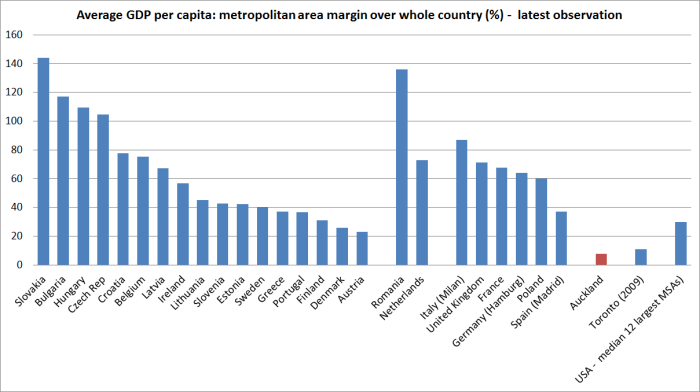
By contrast, in most of the countries in the OECD chart, the city with the highest GVA per worker (or GDP per capita) is the biggest city.   That is true of Britain, France and Poland (to take countries at the left of the chart) and of (say) Finland, Denmark, and Austria (at the right of the chart).    I’ve shown a chart making a similar point in an earlier post.

gdp pc cross EU city margins

Particularly in the smaller countries, the largest city/region makes up a large share of the total national population, which (mechanically) reduces the difference between the richest/most productive city and the average for the country as a whole.  But even in the relatively larger countries like Britain and France, the biggest city accounts for a much much larger share of the workforce than is the situation in Taranaki.

So the issue here isn’t why there is such a big gap between Taranaki and the country as a whole (or even between Taranaki and the laggards) –  oil and gas and a small population will do that – but why Auckland (far and away our biggest city/region) does so badly, and what the implications of that might be.  (And, of course, why the whole country does so poorly.)

I’ve argued that it is because, given constraints of distance etc (at least as real as ever) the global income-earning opportunities in New Zealand are mostly about natural resources (and getting better at getting more from a fixed resource).  That makes it a very different economy to those of the UK or the Netherlands (although quite similar in that respect to Australia.)   And yet policymakers –  National and Labour, Greens and New Zealand First –  just insist on pulling more and more people into Auckland (primarily) every year, where there aren’t many really high-yielding opportunities.  The natural resources aren’t there, even if they were we aren’t getting any more of them, and the process of keeping on driving up the population (in a modest savings economy) continues to skew the real exchange rate, making it harder for the more outward-oriented regions to succeed.

Meanwhile policymakers –  and National and Labour, Greens and New Zealand First are all about equally guilty –  keep on trying to do patches and quick-fixes, subsidies and similar intervention, trying to steer people to the regions (we saw another example just this week with the post-study work rights policy) without really understanding (or deliberately avoiding the implication of realising) that the problem lies with the insane (not fit for New Zealand purpose) economically damaging immigration policy they insist on pursuing.  Revise that policy along the lines I’ve advocated and (a) the regions would probably make up a larger share of the population, and (b) both the regions and Auckland would probably be materially better off economically.

(None of which means I have any sympathy with the Prime Minister welcoming the latest fall in the exchange rate –  and despite the headlines it is a fairly modest fall (and was about this level three years ago).  It is beyond nonsensical to claim (emphasis added) that

The lower New Zealand dollar is good for exporters and a sign the economy is heading in a more productive direction, says Prime Minister Jacinda Ardern.

when the exchange is falling because markets increasingly think the economy isn’t doing that well, and the prospects for OCR cuts are rising.    The delusion that cyclical falls in the exchange rate are the start of something structural and permanent has afflicted politicians and central bankers for decades –  actually I recall Adrian Orr and I trying to persuade Don Brash to the contrary in 1999/2000.  You need to change structural fundamentals to change (helpfully) the structural level of the real exchange rate.  So far, this government –  like its predecessor –  has consciously chosen to avoid doing so.)

I’ve just been shopping

There was a British visitor in town yesterday, apparently hosted by the New Zealand Initiative (I might write about his public lecture tomorrow or Monday).  I got the impression he was probably a Blairite – very keen on free trade, free investment flows, and open borders for people too, but also keen on lots of government intervention to deal with what he saw as domestic problems.

The visitor seemed to be a fan of New Zealand (or perhaps particularly of the 4th Labour government –  in his 20s, he’d worked for Mike Moore at the WTO).  We were, he claimed, in some respect the “birthplace of globalisation” –  which would have been news to anyone involved in policymaking at the time.   He told his audience this curious story, bearing some – but not that much – resemblance to reality about how dreadful New Zealand had been in the early 1980s (and we can all agree that assembling TV sets here was insane) and how New Zealand had “flourished” since then.  I don’t suppose he had ever actually had a look at any data, and seen for example that foreign trade (share of GDP) is barely higher than it was back then, that the income and productivity gaps to the rest of the world are larger now than they were then, or contemplated the affordability of a first home.

But one thing you could do in the bad old days – whether Kirk/Rowling or Muldoon –  was go to a shop and expect that your groceries – for example –  would be packed in a bag provided by the shop.  Not just groceries: bookshops, clothes shops, knick-knack shops or whatever.  Those who didn’t want a bag –  perhaps for a single item –  didn’t need to take one.     Perhaps back then the bags were more often paper bags, but we now know that paper bags are not only typically more expensive but more energy-intensive than a simple plastic shopping bag.  And often harder to re-use  (things often don’t store so well in paper bags, and they aren’t very tolerant of liquids).

But, assuming the Prime Minister and her Green Party associates have their way, that simple freedom is soon for the chop.   I’ve just come back from the supermarket, having done perhaps two-thirds of the weekly shopping for a family of five.    There were 15 bags of groceries, and 16 bags with various different lots of fresh produce.  Presumably these all count as the dreaded “single-use” plastic bags, although many will be re-used.   And, of course, when I got all the groceries home and arrayed them on the bench in the kitchen, I noticed that all the “single-use” plastic bags (actually often re-usable) would squash down to a rather smaller pile than the plastic in a single three litre bottle of milk (there were several of them).  I have no use at all for empty plastic milk bottles, or containers of shampoo, or dishwasher powder.  And yet our government proposes to outlaw the simple lightweight useful little plastic bags.

But perhaps the most important thing about the plastic bags I brought home is that when I’ve finished with them (used or re-used) they will all go in the rubbish.  None will go drifting down the street, blowing across the beach or whatever. Like most responsible people, I put my rubbish in the bin, whether at home or out.   Perhaps the Prime Minister doesn’t?  Perhaps James Shaw and Marama Davidson don’t.  Perhaps they can’t trust themselves to bring up their kids not to litter?  But what right do you think you have Prime Minister – in an ostensibly free society – to tell shops what sorts of bags they can and can’t provide (give or charge for) customers?

I can quite see the case for litter laws.   And this is, from the listening to the rhetoric,  a littering issue –  at least when it isn’t just about virtue-signalling, feeling-good and virtuous, and enjoying taking away some freedom to show we hold power.

So why not tighten the litter laws?  Fines tend to lag well behind growth in incomes and prices.  Surely it is an obvious response, that deals with the free-rider issues and associated externalities (unsightliness and visual pollution).  I’m loathe to suggest more worthiness for schools to teach, but perhaps if Labour and Greens voting parents really can’t be trusted to raise their kids not to litter, schools could add that to the daily indoctrination?

There is a consultation document available on the Ministry for the Environment website.  I haven’t read it yet, so I’m not sure quite what the limits to this authoritarianism are: is the Prime Minister also proposing to ban (for example) single-use rubbish bags, or selling salads or rolls or supermarket cooked chickens in plastic wrap/bags?   But I did electronically search the document on the off-chance that it contained any serious economic analysis, let alone a decent cost-benefit analysis.  There was no sign of either.   Which probably shouldn’t be surprising –  par for the course with, for example, the climate change consultation, let alone the (unconsulted) oil and gas exploration decision. I guess it doesn’t matter.  If it feels good they’ll do it.

It is strange to think that Jacinda Ardern and James Shaw could soon have one hankering for some simple freedoms of the Kirk/Muldoon years.

As a mark of how sold-out the public service apparently now is to the wishes and feelings of the government of the day, there is also on the MfE website a cutesy little questionnaire –  of the sort I’ve seen a few times now on various agency websites. Here was MfE’s

plastic

Totally loaded one way, and no room at all for my answer: I’d change shops at present to avoid those which don’t provide packaging.  The local supermarket tried out a plastic-bag free Friday last year.  It didn’t last that long, but while it did I actively avoided the place on Fridays.

And all because the PM and her followers can’t pick up their rubbish, and won’t punish more heavily the transgressors who litter.  Or because they simply have no respect for the simple freedoms of buyers and sellers, whose choices hurt no one else.


Summers on macro policy

At the end of yesterday’s post, I included a reader’s comment highlighting a recent lecture by prominent US economist (and former Treasury Secretary) Larry Summers in which, among other things, he posed the question of how it was that so much of the advanced world has had pretty underwhelming economic growth rates even with real interest rates so much lower than we had been used to (for several hundred years) and –  at least in the US case –  with such large fiscal deficits.  Linked to this, he raised some of the sorts of concerns I’ve repeatedly raised here about the preparedness of authorities to cope with the next recession –  as he notes, the recipe for dealing with recessions in the US has been 500 basis points of cuts in the Fed funds rate, and no one –  including market prices – thinks that the US (or Japan or the ECB) is going to have that sort of capacity when the next recession comes.

At the time, I hadn’t gotten round to listening to that talk –  to the New York Economic Club in May – or to another talk Summers had done about the same time to an ECB conference.  But I did get round to doing so this morning.   For those who, like me, prefer to read texts of addresses (a lot quicker), there aren’t transcripts unfortunately, but both talks are only about 20 minutes long (there is a long Q&A session in the first).

Both talks are worth listening to.  I don’t find everything in them persuasive at all –  he is, for example, a big fan of increased tax and government spending, and of much-increased government infrastructure spending (even as he recounts the extreme inefficiency of the way much US infrastructure spending is actually done).  But he is a smart speaker, and the talks are not riddled with excessive amounts of jargon.   And, even if our neutral interest rates are still higher than in most other places, we face some of the similar challenges.  In particular, about coping with the next serious recession, whenever it comes.

And Summers reminded his listeners of stylised results that the probability of a recession in any one year (conditional on not already being in a recession or just emerged from it) seems to be about 20 per cent.   Recessions are almost never recognised until far too late –  again he reminded listeners of an Economist magazine exercise in looking at IMF forecasts: not once, in some 180 case of countries experiencing a year of negative GDP growth had the IMF forecast such an outcome 12-18 months in advance.  Closer to home, in writing the other day about the Reserve Bank’s survey of expectations, I noticed that in the August 2008 survey, respondents (including many of the main forecasters) on average still didn’t see any sign of a recession.

Summers takes the view –  hard for any serious person to contest –  that the eventual recovery in the US after 2009 was very slow, unsatisfactorily so.  On OECD estimates, only this year has the output gap closed, and last year the unemployment gap closed.  Many other countries had at least as bad as experience:  our own wasn’t much better.   He argues more should have been done with fiscal policy, but perhaps the key point is that more needed to be done (on top of 500 basis points of interest rate cuts, several rounds of QE, other specific liquidity measures, and a significant fiscal stimulus).   Next time round, there isn’t 500 basis points of conventional capacity.

We had 575 basis points of OCR cuts, a bigger swing in the structural fiscal position than in the US, bank guarantees, special liquidity provisions, and a big fall in the exchange rate.  Despite that, we had years and years of excess capacity (whether on RB, Treasury, or OECD numbers) and core inflation still isn’t back to target.   Next time, there isn’t 500 basis points of conventional capacity.

I’m less convinced that Summers has a solution to the problem.   Structural reforms to lift potential growth would be good, but even if they happen they don’t deal with the natural cyclicality of the economy, take years to produce their full effect –  and don’t seem remotely likely in today’s dysfunctional US political system.

On monetary policy, if I heard him correctly, he toys with the possibility of moving from an inflation target to something like a price level target or a nominal GDP target: both might have some merit, although both would be hard to make credible, especially for policymakers who have erred on the side of caution for the last decade.  Perhaps his closest-to-specific advice was that if the inflation target is supposed to be symmetric (as both the US and NZ ones are), surely 9 years into a recovery, with unemployment at 4 per cent or just below (and pretty subdued productivity growth) if ever inflation should be a bit above 2 per cent it is probably now.    The same could, almost certainly, be said for New Zealand (or, perhaps to a lesser extent, Australia).  Such higher inflation outcomes would help hold up inflation expectations, and help induce a little more resilience (gains at the margin) in coping with the next serious recession.

Perhaps it isn’t his specific domain, but I was a bit surprised that Summers made no mention of actually addressing the fundamental administrative barrier that limits the ability of central banks to lower official short-term interest rates below about 0.75 per cent.  If, as Summers does, you take seriously the view that low neutral rates will be with us for some time –  he seems to see little in prospect (from savings behaviour or investment demand) to change that situation – then it should be untenable to keep in place the adminstrative restriction that allows people to move limitless amouts from interest-bearing accounts (potentially negative interest) at no substantial cost.  One doesn’t have to call for the abolition of cash to believe this constraint can be very substantially alleviated (whether by capping the overall note issue, and auctioning new increments) or putting a conversion fee in place for significant transfers.   If authorities –  politicians and central banks –  aren’t willing to address that issue, and soon, they really need to be thinking again about raising inflation (or price level or NGDP) targets, to allow more leeway in recessions.  These issues have to be addressed now: to do so only in the middle of the next recession will undermine the effectiveness (including in stabilising expectations) of any change.

What staggers me is the apparent indifference of policymakers and politicians to these issues and risks.    The experience of the last decade really should be fresh enough in everyone’s mind –  and the awareness of the limitations of conventional policy at present –  to create a sense of urgency about getting prepared. But there doesn’t seem to be such urgencty….in the euro-area, in the US, in the UK, in Japan, or in New Zealand.  I touched yesterday on the rather glib complacent responses the Reserve Bank senior management gave at the press conference

I see that rather shortsighted attitude was carried over to the Bank’s FEC appearance (from Newsroom’s account).

Orr said that should this scenario [sustained weak growth] eventuate, the bank had a set of “unconventional tools” that it had been developing.

Assistant governor John McDermott spoke in May about five unconventional tools the bank had been working on that could be used during a financial crisis. One of these is quantitative easing, essentially the practice of printing money to buy bonds to stimulate the economy.

The bank would buy Government and commercial bonds as well as foreign government bonds, with the intention of weakening the Kiwi dollar.

Other approaches the bank could take include negative interest rates of as low as -0.75 percent, and guaranteeing bank liquidity by offering term lending facilities for banks.

But this scenario remains unlikely – it would effectively be a crisis occurring on top of an existing crisis.

Orr and McDermott know that even with all the quantitative easing and associated liquidity measures in other countries –  that eventually reached the limits of conventional policy –  the recoveries were very slow and painful almost everywhere.  And if that final sentence is really to be read as them suggesting we can’t have a significant downturn now because somehow we are still in an “existing crisis”, they really aren’t fit to be doing their job.   Nominal interest rates in New Zealand at present might be low at present by historical standards, but there is no credible sense in which the New Zealand economy has been in “crisis” in recent years.

In passing, one aspects of Summers’ talk I found unconvincing was his suggestion that despite the big apparent fall in neutral interest rates, the underlying fall is likely to have been much larger, masked –  he claimed – by the effect of fiscal policy across much of the advanced world.  He refers to both stock and flow measures.  On stocks, government debt is certainly higher than it was in many/most advanced countries, but as this IMF chart highlights total debt in the advanced world as a whole total debt (public plus non-financial private) as a share of GDP is barely changed over 25 years, and is lower than it was going into the last recession.

IMF debt chart

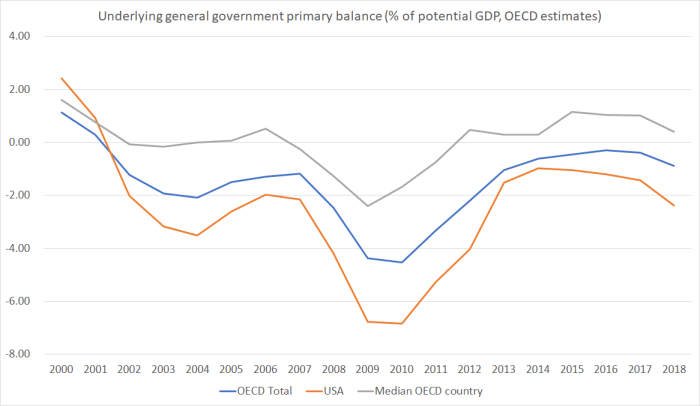
As for flow measures, here is a chart showing OECD estimates of the structural primary fiscal deficit (general government) for the OECD as a whole, median OECD country, and for the United States specifically (where deficits are widening again now).

structural bals aug 18

Actually, the latest observations for all three series are no worse than they were in 2006 or 2007, just prior to the last recession.  The median OECD country has been running a small primary surplus, and the average for the last five years is little different than for the five years prior to the recession.        It is hard to see much compelling basis for the suggestion that fiscal policy is masking an ever deeper decline in the underlying neutral interest rates than what we (appear to) observe.

Anyway, for those interested in such issues, Summers is worth listening to and thinking about.


Central bank complacency

There are plenty of things I could comment on around the Reserve Bank Monetary Policy Statement released this morning:

  • there was the questionable view that GDP growth is about to snap back (this very quarter) to above-potential rates,
  • there was the welcome acknowledgement (departing from the Wheeler view) that changes in net migration tend to have larger (short-term) demand effects than supply effects,
  • there was the Governor’s rather glib claim that they had looked back, reviewed their own past performance, and concluded that nothing should have been done differently.  The Governor claimed they’d been at the lowest end of expectations etc, which while no doubt true about the major banks, certainly isn’t true if he’d checked out (say) the lower quartile responses to the bank’s own expectations survey.  More starkly, the Bank –  unlike anyone else –  is paid to deliver core inflation near 2 per cent, and it has consistently failed for years now to do that.  Some things should have been done differently.  But I guess contrition is too much to hope for from public sector agencies.

But what disconcerted me most was the rather glib complacency that continues to flow from the mouths of senior Bank management about readiness for the next serious economic downturn, whenever it happens.

Brian Fallow asked them how well-placed they were to cope with such a downturn, given that the OCR is now at 1.75 per cent, whereas going into the previous recession it was at 8.25 per cent.  The Governor claimed we were well-placed because we have a floating exchange rate, and suggested it had always been the key shock absorber in New Zealand. There is some truth in that observation, but it isn’t that relevant here: we’ve had a floating exchange rate for decades now, and in each downturn during that period cuts in short-term interest rates (the OCR since 1999) have been a significant part of responding to, and mitigating the severity of, any downturn.  In fact, the exchange rate falls so sharply partly because of the size of the cuts in short-term interest rates.  But in the next downturn it seems likely that the Reserve Bank won’t be able to cut the OCR by the 500 basis points or more that have been typical.  On their own telling, they can only usefully cut it by about 250 basis points.   That might enough in a mild downturn, but the focus of the question was (rightly) on the next serious downturn.

Then the Bank’s chief economist John McDermott chipped in.  He reminded Fallow, and other listeners, of the Bulletin article the Bank had published a couple of months ago looking, in particular, at alternative monetary tools (eg QE) used in other countries.   He went on to add that New Zealand also had “lots of fiscal headroom”.

I wrote about the Bulletin article in a post here.  There was some good and useful material in the article, but as I noted then it was inadequate

they know how poorly the world economy coped with, and recovered from, the last downturn, even deploying all sorts of unconventional policies  (fiscal and monetary) on top of the considerable conventional monetary policy leeway that existed going into that recession.  Even here –  where we never reached the limits of conventional policy –  the output gap remained negative, and the unemployment rate above official estimates of the NAIRU for eight or nine years.   Eight or nine years……..  That is just a huge amount of lost capacity, and of lives that are permanently blighted (prolonged involuntary spells of unemployment do that to people).

I’m at a loss to know how any serious people, who actually care about the consequences –  for people’s lives among other things –  can be so complacent.   After all, as surely even the Bank senior management recognises (a) every OECD country (bar Japan) went into the last recession with more conventional monetary policy capacity than the Reserve Bank has now, and (b) the performance (even cyclical performance) of almost every OECD country in the last decade has been pretty deeply underwhelming, even with the combination of conventional monetary policy, unconventional monetary policy, and considerable fiscal stimulus in many cases.

Here, for example, are the OECD estimates of output and unemployment gaps for the OECD as a whole.

OECD gaps

These are massive gaps, losses that will never be made up (in the sense that people only have one life –  years unemployed aren’t usually made up for by more working years later in life).  There is nice column in today’s Financial Times that reflects –  with some anger – on this failing and the responsibility of central bankers, well-intentioned as they all, no doubt, were.

And yet Orr and McDermott seem unbothered about our situation if we were to be faced with a new serious recession.

Lets take the fiscal headroom strand of their argument.  We certainly do have fairly low levels of government debt –  not yet as they were in 2008, but towards the low end of OECD countries.   Australia had low public debt in 2008 too, and is famed for its aggressive use of fiscal policy in the 2008/09 downturn.  Between 2007 and 2009, the OECD’s estimate of the change in the structural primary fiscal balance (the bit, in principle, under discretionary government control) was equal about 5 percentage points of GDP (from a 1 per cent surplus to about a 4 per cent deficit).

But it isn’t as if Australia just used fiscal policy.  The RBA cash rate was also cut by 425 basis points. Oh, and the exchange rate fell very sharply indeed –  as one would have expected.    Even with all that policy support –  and some considerable Chinese fiscal/credit stimulus thrown in – Australia’s unemployment rate still rose by almost 2 per cent (and in the subsequent decade has never got close to the 2007 levels again).

I looked through the complete set of OECD countries for the period around the 2008/09 recession.  Quite a number of them sought to use fiscal policy in a counter-cylical fashion in the last recession, but none did more (on this metric) than Australia.  In fact, New Zealand –  which didn’t do discretionary fiscal easing to counter the recession, but had had big fiscal loosenings in train anyway (which Treasury thought were quite sustainable), saw our structural primary balance widen almost as much as Australia’s did.

What I take from that experience is that it is very unlikely  – no matter how much headroom New Zealand might appear to have –  that a change in the structural fiscal position larger than Australia implemented in 2008/09 would prove politically tenable.  Otherwise, surely, somewhere in the OECD –  eg among those countries without a floating exchange rate, without Chinese stimulus –  we’d have seen it happen.   And even in Australia the peak fiscal stimulus didn’t last long, and debates about trying to get back to surplus consumed a fair degree of political oxygen over the following few years.

And, recall, we had that sort of fiscal stimulus in play ourselves over the 2008/09 period and even then, with big OCR cuts –  more than any other country –  and a falling exchange rate, we still ended up with a serious recession, and a very slow re-absorption of excess capacity.  So the Reserve Bank’s complacency now is pretty alarming. We pay them to worry about contingencies and tail risks, not to blithely suggest everything is fine.

The other aspect of all this that the Reserve Bank has never openly engaged with is that, all else equal, the next downturn will be more troublesome for policymakers precisely because people increasingly recognise that conventional monetary policy is reaching its limits, and unconventional policy as others have applied it just isn’t that powerful.  Going into the last recession, most people worked on the assumption that central banks would cut rates deeply and then the economy would rebound, and that there was no reason to think of medium-term inflation deviating far from target.  Thus, while short-term interest rates fell sharply, implied longer-term nominal interest rates (eg implied 5 year rates five years forward).  But when the next serious recession happens, there will inevitably be a great deal of questioning of just how much monetary policy can do.  Inflation expectations –  whether embedded in bond yields, or just in how firms and households behave –  will be likely to fall away quite quickly.  Central banks will need to cut nominal interest rates more aggressively just to avoid real interest rates rising.   And most central banks don’t have much nominal interest rate space left.     Rational fears of looming deflation are likely to be even more to the fore –  and better-grounded –  than they were in the years after 2008/09.   It seems reckless not to be addressing these issues now.

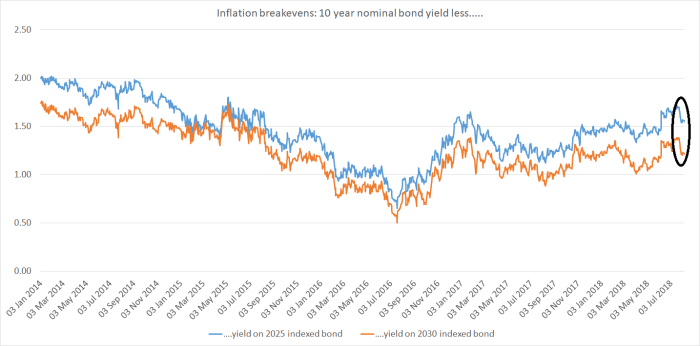
And for all that the Reserve Bank continues to repeat the line that current inflation expectations are just fine, the bond markets still don’t agree.  If anything, inflation breakevens (a proxy for inflation expectations in reasonably settled times) have fallen back a bit in recent weeks.

IIBs aug 18

The current average observation of the two series is about 1.4 per cent.  It has now been 18 months since there was any sign of consistent progress in getting back to 2 per cent.  But again, you never see the Reserve Bank engage with this indicator either.  The narrative, after all, always seems to be that there is really nothing to worry about.

And it is ordinary working people, not senior central bankers, who will bear the brunt if things do go badly in the next recession, and central bank failure to act now contributes to those bad outcomes.    Since politicians also tend to pay the price, one might hope the Minister of Finance would be taking the lead in requiring the Reserve Bank and Treasury to fully, and openly, address these issues.  Ours, unfortunately, also seems too invested in a “nothing to worry about” narrative.

As I was typing this post, a reader sent me an email prompted by watching the Bank’s press conference

Larry Summers [former US Treasury Secretary, former President of Harvard etc] earlier this year gave a talk on ‘secular stagnation’ – how it is remarkable that so much monetary and fiscal support is now needed to keep economies afloat.  What’s going on in NZ such that, at time when the terms of trade are so good, monetary policy you say is very stimulatory 1.75 ocr compared with 3.5 for neutral?) , and fiscal policy is stimulatory, and to become more stimulatory, yet the outlook for the economy and inflation, by any historical standard, is very subdued.  What do you think the NZ economy would look like in a 2-3 year’s time if monetary and fiscal policy now were both returned to ‘neutral’?  What’s going on?

It is a good question (although not sure I’d phrase the final main sentence that way).  After all, for all that the Bank talks in the MPS of other countries starting to tighten monetary policy, outside the US –  itself recipient of a big late-cycle fiscal stimulus – the changes are pretty patchy and small.  And yet global inflation is pretty subdued, and (as the chart above shows) after all these years, output and unemployment gaps are only closing just now.  I suspect part of the answer is that neutral nominal interest rates are lower than most people think, but that only pushes the question back one more step to ask why that would be.  In part –  but only a part –  it will have reflected the failure to use monetary policy more aggressively soon enough.   That’s clearly true here as well (and with less excuse here as those conventional limits –  to cutting the OCR –  simply weren’t reached here.

A sharp fall in expected GDP growth

The Reserve Bank’s expectations survey results were released this afternoon.  The Bank itself will have had the results last week, and will have been able to take them into account in finalising tomorrow’s Monetary Policy Statement.

Mostly, only the inflation expectations numbers get reported.  They didn’t change materially, whether at a 1, 2, 5 or 10 year ahead horizon.   Perhaps that isn’t too surprising, but it is encouraging given the lift in the sectoral core inflation measure evident in the most recent CPI.

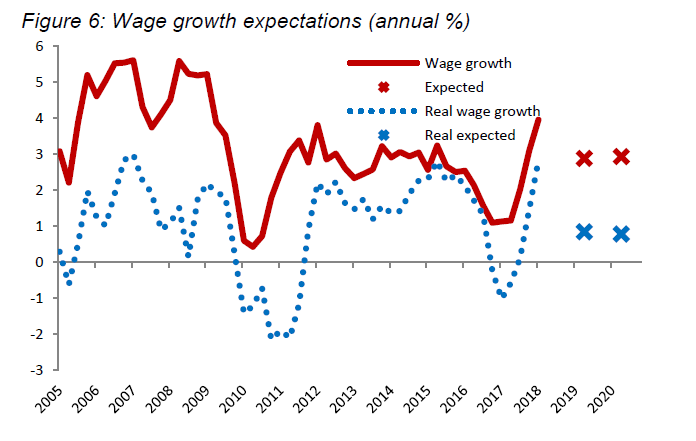
There was also hardly any change in wage inflation expectations –  a slight lift in one year ahead expectations and no change at all in two year ahead expectations.  On these measures, real wage inflation is expected to no higher than 1 per cent per annum –  not high in absolute terms, but rather faster than recent productivity growth (itself next to non-existent).   The Bank themselves produced a graph of the results suggesting real wage inflation is actually expected to slow from here.

wage expecs

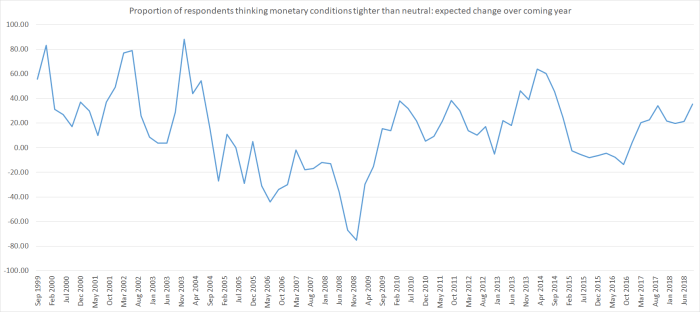
I was more interested in two other series.  In the first, the Bank asks respondents to indicate how tight they think monetary conditions are now, and how tight they expect them to be a year ahead.  Ever since 2011, the mean respondent has judged conditions to be easier than neutral –  despite which inflation has consistently undershot the target –  but what is somewhat interesting is how respondents expect things to change.

In this survey, there has been a bit of an increase in the proportion of respondents who expect monetary conditions to tighten over the coming year.

mon cond year ahead 18

Those expectations still aren’t as strong as they were at the peak of the (misplaced) tightening fervour in 2014, but they aren’t far away now.    Quite why, or what has changed, is a bit of a mystery (noting the unchanged inflation expectations).  “Monetary conditions” isn’t further defined in the survey, so includes (implicitly) not just official interest rates, but the exchange rate, credit conditions or whatever the respondent has in mind.  Perhaps respondents are expecting credit conditions to tighten (further)?

Whatever the explanation, it does seem a little surprising set against the backdrop of respondents’ expectations for GDP growth.  The survey asks about expectations for GDP growth one year ahead and two years ahead.  The one year ahead numbers can be thrown around by all sorts of short-term noise, but the two year expectations should be a better reflection of the underlying sense of what is going on (as with the two year ahead inflation expectations).  Three months ago respondents expected real GDP growth two years ahead of 2.7 per cent.  This time, the two year ahead expectation is 2.2 per cent.

Is that difference material?  Well, I had a look back over the history of the series.  If we go all the way back to 1996, there have only been three quarters when two year ahead growth expectations have been revised down by more than the fall this quarter.

When were they?

The first was in the September 1997 quarter, just prior to the 1997/98 recession (a fall of 0.8 percentage points).

The second set were the December 2008 (a fall of 0.8 percentage points) and March 2009 quarters (a fall of 1.6 percentage points), in the midst of the last recession, and the financial crises abroad.

(The quarters with large increases in expectations also come, as one might expect, just after these recessions.)

The fall in two-year ahead expectations this time is still a bit smaller than the falls in 1997 and 2008/09, but it doesn’t look like a result that should be lightly dismissed.  In one sense, people can say “oh, just consistent with the fall in business confidence measures”, but this survey isn’t just a sentiment indicator, but asks about specific macroeconomic aggregates.   And the fall isn’t just concentrated in one year ahead expectations (which actually fell less than the two year ahead expectation), suggesting that whatever is influencing respondents isn’t something they expect to dissipate quickly.

I’d be a bit rattled if I was the Reserve Bank.  It just adds to the sense that growth has probably slowed further already (beyond what is reported –  last official data was the March quarter and it is now August) and may have further to fall.  And respondents –  who include most of the economic forecasters –  don’t see much reason to think a significant rebound is likely any time soon.

Such expectations aren’t accurate predictions of what will happen two years hence –  partly because if things get bad, policy (including monetary policy) responds –  but large falls in the past have coincided with the two periods of worst economic outcomes in the last couple of decades.

(And readers of the Minister of Finance’s speech today won’t have found anything in it to instill much confidence in the sort of rebalancing  –  or stronger productivity growth in the medium term –  the Minister claims to be pursuing.  Strangely, the Minister continues to repeat the election campaign lines about how well the economy has done in recent years –  the economy that saw weakening per capita GDP growth, little or no productivity growth, weak business investment and a declining relative size of the tradables sector.)

Don Brash and Massey revisited

I wanted to touch on three largely-unrelated points, two on the controversy, and one of what Don Brash was apparently going to say in his speech:

First, very briefly, much of the story has been written in terms of Massey’s Vice-Chancellor denying Don Brash the right to speak on campus.   As far as I can see, Don Brash doesn’t have any particular “right” to speak on campus, any more than you (assuming “you” aren’t a Massey student) or I do.  In that sense, the issue shouldn’t be about Don Brash –  although that is what Professor Thomas tried to make it about –  but about a Massey student society’s own freedom; the freedom to invite anyone they wish (operating within the law) to speak on campus.  That should probably be where the focus is, including  adding the question of whether Professor Thomas thinks she should also have the right to ban altogether student groups that might happen to hold views she strongly disagrees with. After all, such groups might be fora for such dangerous ideas to be uttered, not just once (probabilistically –  see the VC’s “fear” that Don Brash would utter such views) but day after day, week after week.   Both would be chilling, and especially so in a public (state-established, largely state-funded,  and with several members of the council appointed by the government) university.   Has she stopped, even momentarily, to reflect on the implications of her stance?  She’d have had no problem with anti-Vietnam War speakers –  even eminent sceptics – being banned in the 1960s?  Or perhaps speakers favouring legalisation of homosexuality in the 1970s?  And so on.  It always pays to try to look at these things the other way round, unless of course Professor Thomas’s view is “who care’s about inconsistency, I hold the commanding heights now”.    A fine standard for a university that would be.    As it is, neither Professor Thomas –  nor her Council –  will explain themselves.

Second, someone asked me last night why I made so much in my post of the fact that Professor Thomas had only been in New Zealand for 18 months or so.   Her general stance –  banning the Brash speech at the merest whisper of the threat of a few protestors, and banning it because she regarded Dr Brash’s view on some live public issues as unacceptable –  would be reprehensible from any Vice-Chancellor.

And, sadly, this stuff happens elsewhere.  La Trobe University in Melbourne last week initially tried to ban a speaker –  social commentator Bettina Arndt –  they didn’t like, then partially backed away trying to charge the organisers hefty security costs, only now to finally back down completely and adopt the only stance consistent with the values of a free and open society

But university administrators yesterday told The Australian they had decided the university would cover the cost of security, out of a desire to preserve free speech and discussion on campus. “We welcome free speech and the event will go ahead,” a spokesman said.

But if Professor Thomas banning the student society from having Dr Brash to speak would have been reprehensible at the best of times, whatever the issue, I found it more than usually unacceptable when the views Professor Thomas disapproves of so strongly are those relating to the Treaty of Waitangi, Maori wards, etc etc.    These are very specific New Zealand issues, and despite her repeated attempts to wrap herself in the Treaty of Waitangi (all that talk of being a Treaty-led organisation, whatever that means) and it ill behoves newly arrived foreigners to attempt to decree what aspects of these issues should be able to be freely discussed (hint: in a free society, any of them).  It all has the feel of a social justice warrior, rather out of her depth in a new country, having allowed herself to be captured by a particular minority.  It would be unacceptable in any public university Vice-Chancellor, but should be doubly so in one with little familiarity with the underlying issues –  and, frankly, no obvious personal interest or commitment to the future of New Zealand democracy or society.

My third point was really totally unrelated to yesterday controversy itself.  But the Herald has on its website the speaking notes Dr Brash was planning to use for his talk to Massey students about his life in politics etc.  I was struck by his final comments, particularly those on a couple of economic issues and how they have been treated under the previous government, and how things might unfold under this government.

Of the previous National government

A hugely disappointing Government:

I. They pledged to reduce the gap between NZ incomes and those in Australia, and utterly failed;

II. They pledged to make housing more affordable, and utterly failed

Hard to disagree with him on either of those.  Productivity gaps between New Zealand and Australia widened over the last 9 years, and as for housing, it became ever more unaffordable in large chunks of the country.

And here is what Dr Brash –  former leader of both National and ACT – has to say about prospects under the current Labour-led government

In my own view, the present Government is likely to do a better job in making housing more affordable, but probably a worse job in closing the income gap with Australia

I’m pretty sure he will prove right about the income and productivity gaps with Australia –  it is the sort of story I’ve been telling myself –  although bear in mind the likelihood of a change of government in Australia next year.

But what of housing?  It would be great if Dr Brash’s positive story were true, and would be quite an indictment on the previous National government.  But is he right?

I’ve been sceptical for some time, for two main reasons:

  • first, any Labour-led government was going to be dependent on the Greens, who had never shown any signs of fixing the urban land market in ways that would open competition and lower land prices. “Sprawl” is, after all, one of the things they seem to detest, and
  • second, whether in the year or two before the election or subsequently, there has been no mention of freeing up the land market from party leaders (Little or Ardern in Opposition, Ardern as Prime Minister –  although it was there if you went looking in the details of the housing policy), and lots of talk of policy responses since which, at best, only tackle symptoms.  There is lots of talk of Kiwibuild –  which, at its best, would do nothing about the land market.  There was –  and is –  no sign that the Labour leadership really believed what most serious analysts will be telling them is the only long-term fix.  If you don’t really believe it strongly, are never heard to openly make the case for it, it seems unlikely that you will be willing to push such reform through your own caucus, let alone get in through the Greens caucus.

In the last week or so I’ve seen a couple of bits of data which still leave me unclear about whether Labour will, finally, make much of difference in fixing the decades of dysfunction.

Whatever doubts many have about the Housing minister, Phil Twyford, it has always seemed as though he genuinely got the sort of reforms that might be needed.  The free-market people at the New Zealand Initiative certainly thought so a year or two back when they teamed up for a joint op-ed.

Consistent with that interpretation were some reported comments Phil Twyford had made recently in a vigorous debate with Environmental Defence Society CEO Gary Taylor.  I saw a copy of these yesterday, I gather taken from a longer article at politik.co.nz (for those with access)

Twyford replied that it was a question of values. 

“This is for us, for Labour, for our coalition government, this is fundamentally a social justice issue. 

“Our objective is not to build a Copenhagen of the South Pacific. 

“We could build a beautiful city with a whole lot of the policies we have talked about. 

“We could build a Vancouver of the South Pacific; beautiful but utterly unaffordable. 

“I’m interested in us fixing this totally dysfunctional urban land economy.

 “If we don’t deal with affordability we will have completely wasted the opportunity that has been given to our generation.”  

Twyford said the only way to deal with the affordability issue was to deal with the land price issue and that meant dealing with the artificial scarcity of land caused by the planning system and the availability of finance for infrastructure.

My spirits lifted when I read that. I imagine it was the sort of thing Dr Brash has in mind when he talks about a degree of optimism that Labour might change things for the better.

But then there was the Cabinet paper pro-actively released last week on the government’s “Urban Growth Agenda”.   It was really only a progress report, with full papers to come back to Cabinet next year.  And there was some good –  if highly politically contentious –  stuff around congestion charging.  Near the top of the list of recommendations (all only noting ones) were these positives

note that the high cost and shortage of housing is partly due to deep seated problems with the operation of our urban land markets and how infrastructure is planned, funded, and financed.

note the Urban Growth Agenda will deliver medium to long-term changes to create the conditions for the market to respond to growth, bring down the high cost of urban land to improve housing affordability and support thriving communities.

But then, towards the end of the paper there were paragraphs 32 to 35, which some experts (in email chains I’ve been on) have seen as undermining any hope of a seriously different and better vision of how land markets might work.

How we could see growth occurring in practice
32. Growth enabled through the UGA would likely take a phased and sequenced approach targeting growth within existing urban centres before greenfield development.

33. For example, in Auckland we will firstly emphasise urban intensification and regeneration projects in existing areas, particularly along transport corridors and urban centres. Development in already planned greenfield areas would take place alongside this.

34. Our attention will then focus on new transit-oriented development occurring within existing nodes [a few words redacted at this point] . Development opportunities will be identified collaboratively with local government and other stakeholders.

35. Finally, new leap-frog greenfield development would be enabled beyond the current Future Urban Zone with a priority towards the South of Auckland. This step would be subject to new spatial planning and cost allocation tools to mitigate risks and ensure an efficient urban growth pattern occurs. The majority of this growth would be within Auckland’s existing administrative boundary.

All of which sounds a great deal like central and local government planners trying to keep control, determine where growth does and doesn’t happen, with little real sense of the possibilities that genuine competition (among potential developers and landowners) would open up.  In the entire Cabinet paper, there is no suggestion that we might move to a model in which landowners had a presumptive right to build.

I’m left still fondly hoping that Don Brash’s favourable judgement on the new government, in this particular area, will prove well-warranted, but also still more than a little sceptical.  Nothing like a crunch decision seems to have been faced yet, nothing that would really tell us whether the government will radically transform the market  –  and it really is a social justice issue, as Phil Twyford described it.   But there is one other test: the market test.  If landowners, actual and prospective, really believed that the government was serious, that it was going to implement the sort of vision Phil Twyford talked about so eloquently, land prices on the peripheries of our cities would be falling, and falling rather substantially (just as taxi badge prices in regulated cities abroad as competition finally opened up that previously-overregulated market). I’m not aware of any evidence of such falls, but if readers are please get in touch and I’d be happy to report such an encouraging development.


Massey Vice-Chancellor bans Don Brash

In many ways, it isn’t surprising that Massey University’s Vice-Chancellor has barred Don Brash from speaking on campus at an event organised by Massey students.   So-called “no-platforming”, in response to pressure of mobs –  often threatening disorder if a speaking engagement were to proceed – has become rather too common in the United States and in the UK.  It was only a matter of time until this practice arrived here, and perhaps almost a matter of chance which speaker/group would be the first victim.  As it happened the lot falls to a 77 year old former corporate chief executive, former Governor of the Reserve Bank, former MP and leader of the National Party invited, by a student politics group, to talk about his time as leader of the National Party (the party that has led governments in the country for 47 of the last 70 years).

And what offence has this lifelong New Zealander given to Massey’s Vice-Chancellor, an Australian who has lived in New Zealand for all of 18 months?  She tells us that her concern is

Mr Brash’s leadership of Hobson’s Pledge and views he and its supporters espoused in relation to Māori wards on councils

This is the group whose website outlines a vision

Our vision for New Zealand is a society in which all citizens have the same rights, irrespective of when we or our ancestors arrived. 

It might not be your vision, I’m somewhat ambivalent about it myself, but it clearly isn’t Professor Thomas’s view of the country.  Which probably shouldn’t really matter greatly because (a) she isn’t a citizen herself, and (b) because the nature of politics in a democratic country is about conflicting views, not just about means but also about ends.

But Professor Thomas appears to regard such views –  and opposition to Maori wards on local councils (which have been defeated in most/all places where a referendum has been held on them) –  as simply illegitimate, and having no place in New Zealand, let alone on the campus of Massey University, an organisation founded and substantially funded by the New Zealand government and taxpayers.  She was terrified that Dr Brash might make some negative comment about Maori wards on campus

Whether those views would have been repeated to students in the context of a discussion about the National Party may seem unlikely, but I have no way of knowing.

And presumably no one at the university she manages could cope with knowing that somewhere on campus, an elderly former politician was expressing a view they might disagree with –  a view which, on this particular occasion, appears to be held by a fairly large chunk of the population.

In a startling display of casual inaccuracy (one hopes not deliberate) Professor Thomas is also upset that Dr Brash was part of the Free Speech Coalition, that supported the right to be heard (in public premises), of two controversial recent Canadian visitors.  She claims

Dr Brash was also a supporter of right-wing Canadian speakers Lauren Southern and Stefan Molyneux, who were due to address a public meeting in Auckland.

Had she done any research at all, she would know that Dr Brash had indicated publicly that he had little or no knowledge of the views Southern and Molyneux had espoused but –  like left-wing activist Chris Trotter for example –  did not approve of public facilities being denied to people who wanted to use them to hear from visiting speakers, however much their views might be controversial or provocative. (Disclosure: I am part of the Free Speech Coalition myself, and as I noted in my earlier post on this issue, had never heard of either Southern or Molyneux until the Auckland Council banned use of its facilities, the mayor boasting –  inaccurately – that he had done so.)

For a private university to have banned such a meeting, and a speaker such as Dr Brash, would have been unwise and generally inconsistent with the sort of ethos universities generally sought to represent (contest of ideas etc).  But, being private institutions, they’d be quite free to make that choice.

But Massey is different: it is a public institution (establishment, funding, appointments to the council).  And if the (foreign) Vice-Chancellor of a public university thinks Dr Brash  –  who has given decades of public service to this country – shouldn’t be allowed to speak on campus, when invited by students (what, one wonders, would she do if one of the professors invited him to speak to a class?), you have to wonder who –  and which views –  are next in the line for a ban.  Dr Brash is prominent enough –  even if not always liked –  that there will be an outcry against his ban, while this sort of insidious censorship can be applied more broadly to less prominent people.

Professor Thomas really should be called into line, by her own Council (her employers), by the Minister of Education (funding agency), the Prime Minister (if she is at all serious about her claims to support free speech –  to her credit, I see she has come out a little critical of Professor Thomas).  But where, one might wonder, is the Leader of Opposition on this?  It is a pretty sorry picture if the leader of the National Party won’t forthrightly defend the right of students at Massey to hear from one of his predecessors about his own time as National Party leader.   Does he believe in free and open debate, notably at our universities, or doesn’t he?

As it happens, Professor Thomas had conveniently laid out her perspective on free speech a few weeks ago when the Southern/Molyneux debate was raging (and no one was talking about university facilities). In a lengthy Herald op-ed she sought to build her argument around the concept of “hate speech” –  a concept that, fortunately, still has no place in New Zealand law.  Even Professor Thomas can sound reasonable at times

Beyond the reach of the law, however, the battle against hate speech is fought most effectively through education and courageous leadership, rather than through suppression or legal censure.

And this is where universities can take positive action by providing a venue for reasoned discussion and cogent argument.

Which you might have thought could include a lecture to a student politics society by the former Leader of the Opposition, former Governor of the Reserve Bank?  But apparently not.

Perhaps she justifies her stance this way

Given the current dominance of wall-to-wall social media and the echo chambers of fake news, universities are in many ways obliged to make positive societal interventions.

But one can’t help suspecting that in this case she means “we need to put a stop to the expression of any views we disagree with”.   That certainly seems to be the practical import in the current case, and rather at odds with her very next sentence.

Universities support our staff and students to push boundaries, test the evidence that is put to them and challenge societal norms, including examining controversial and unpopular ideas.

Ah, perhaps it is only societal norms that (recent arrival) Professor Thomas disapproves of that should be challenged?  Certainly, from her op-ed and her statement today, she seems to think no space at all should be given to any debate around how, or how best, to think about the Treaty of Waitangi and its place in modern New Zealand.  Which would be outrageous coming from any university CEO, but perhaps all the more so from one fresh off the plane.

In her statement on the Brash case, Professor Thomas made passing reference to security concerns –  even though it is equally apparent from her statement that she was just looking for an excuse to ban the meeting (having put her prejudice against Don Brash on display in that earlier op-ed.    Her approach isn’t that of the courageous leader defending freedom and debate, but rather of aligning herself with the mob to veto the ability of student groups to invite speakers (ones uttering controversial views) to campus.  That sort of mobocracy, if allowed sway, would be the very antithesis of democracy as we’ve come to practice it in countries like ours (even Professor Thomas’s Australia) in the last couple of centuries.  Thugs and bullies rule, at the expense of those who respect the ability of decent people to disagree.   Thugs and bullies can come from either side of the political spectrum.  These days, in New Zealand (and other Anglo countries) they are almost all from the far-left.

(Much as I support what should be the freedom of the Massey student group to invite whoever they wish to have to speak to them (supported if necessary by the Police to keep law and order, and allow law-abiding citizens to go about their business), I increasingly wonder at the prospects for such a world.  Process liberalism –  you do your thing, I do mine, and we leave each other alone –  is very slender reed around which to organise any society, and I rather doubt it can hold: perhaps it will prove to have been just a very brief historical interlude as society moved from one set of largely shared beliefs to another.   Human societies seem to need more than just process rules to hold them together, and that process tends to involve the marginalisation or exclusion or forced suppression of minority views.  Since most of my own more important views these days are distinctly minority ones in modern New Zealand, I hope it isn’t true, but I suspect it is.  If so, of course, in New Zealand issues around the Treaty and Maori/non-Maori perspectives could prove a very nasty and dangerous fault line.)

NB  As I imagine all regular readers will know, Dr Brash was my boss in years past, and these days I count him as a friend.

UPDATE: So the most Chris Hipkins can say is that it isn’t the decision he would have made and the most the Prime Minister can do is call it an “over-reaction”.  In context, they are little more than weasel words, washing their own hands of owning responsibility, without full-throatedly condemning Professor Thomas and calling on her to reverse her decision.  Simon Bridges has described the ban as a disgrace.


Disconnected thoughts on the economy

I wrote a post a month or so go about some comparisons between the drop in business confidence after the previous Labour government took office at the end of 1999 and the current fall.   At the end of that post, I concluded that the current situation should probably be more concerning than the earlier episode which, intense as it was at the time, blew over fairly quickly.  Perhaps the biggest difference, I suggested, was around the exchange rate:

The current level is about 30 per cent higher than it was in 2000, and it had fallen a long way to get to those 2000 levels (and not on heightened risk concerns etc).  Those falls created a credible prospect of new business investment in the tradables sectors.  There is nothing comparable now, and we’ve probably exhausted the limits of domestic demand (especially residential investment) as a support for headline GDP growth.

The Reserve Bank’s TWI measure of the exchange rate has averaged about 74.4 this decade to date, with a standard deviation of about 3.7.   Thus, although the current TWI is now a bit lower (72.6) than it was at the time of last year’s election, in both cases the numbers were within one standard deviation of the mean.  Those sorts of fluctuations are often little more than noise.   There is nothing yet visible in the current government’s plans and policies that is likely to reverse the longer-term structural overvaluation of the exchange rate.

Another comparison I’ve seen in recent days is with early 2008.  Some of the business confidence measures are back to the sort of levels we saw in early 2008.  I saw one prominent journalist opining that “current conditions are nothing like 2008”.   No doubt true if one has in mind the final (global crisis) quarter of 2008, but in April/May 2008 –  when business confidence had weakened to similar levels to the present –  New Zealand was already in recession (so the published data tell us) but few people realised it.   Here, for example, was the Reserve Bank in June 2008, still asserting that GDP growth that year would be positive (and they weren’t alone in that view).

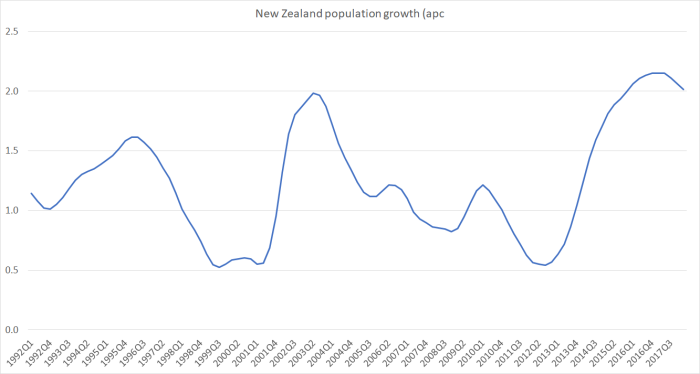
Another comparison relevant to making sense of business surveys (and the like) is population growth.    For better or worse (mostly worse, on my telling), the current population growth rate is still much higher –  at least twice as high – than it was in either 2000 or 2008.

popn growth aug 18

When the population is growing that rapidly, business surveys don’t mean the same thing as they would if (say) the population was flat.    A typical business survey will ask whether things are rising, falling, or much the same, and report the net of those saying higher and those saying lower.  With 2 per cent population growth, one should expect net positive responses even if per capita activity was going backwards a bit.   At present, 2 per cent annual GDP growth would be a really bad outcome.

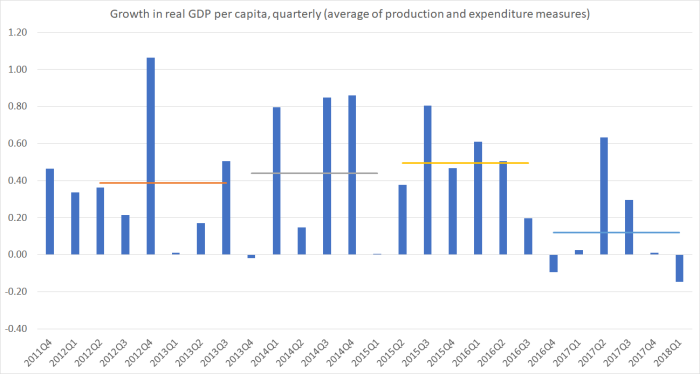
At her post-Cabinet press conference yesterday, the Prime Minister seemed to be flailing.  She preferred, we were told, to look at real data to judge how things were going. Here is one such chart from my earlier post

gdp pc to mar 18

How have things been going on real GDP per capita? Not well, and that included late in the term of the previous government.  Perhaps there is some element of businesses slowly realising just how mediocre our economic performance has been.  Perhaps the Prime Minister –  who during the election campaign was too ready to grant that things were going well economically –  should wake up to the underperformance.

What about other real indicators?

The Prime Minister talks of our “low” unemployment rate, and yet seem conveniently oblivous to the fact that among the G7 leading advanced economies, the UK (Brexit and all), the US (Trump and all), Germany, and Japan all have unemployment rates lower than New Zealand’s.  Ours is better than it was, but it is nothing much to be proud of –  roughly one in 20 New Zealanders keen to get a job, ready to start work next week, can’t find one (and that is narrowest definition of excess labour capacity).    Labour would once, rightly, have regarded that as pretty shameful.

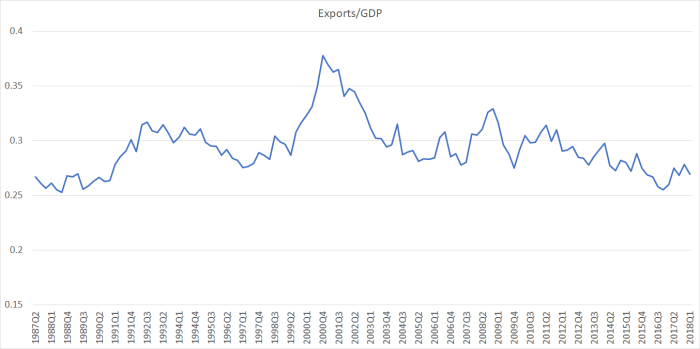
There has been very little growth in productivity at all for five or six years now, and last week’s labour market data (showing quite reasonable employment/hours growth, even as no one expects stellar GDP growth this quarter) suggests the trend has continued.   And for all that we are suppposed to be impressed by yet another board, this time to consult on trade agreements (chaired by a competent former diplomat who now works for the propaganda arm of MFAT/NZTE, the New Zealand China Council), the reality remains one in which exports (and imports) as a share of GDP have been shrinking not rising.  That isn’t how things go in successful economies.

exports aug 18

Business investment has been weak too, especially once one takes account of the needs of a rapidly rising population.

The Prime Minister tell us that in a speech later this week the Minister of Finance will outline how the government expects things to be turned around, with our economy becoming more productive, more outward-oriented etc.  I will, I’m sure, read the speech with interest, but there is little sign that anyone near the top of government really has a sense of what might make a useful and substantial difference to the medium-term performance of the New Zealand economy.  You will, for example, never hear them talk of a real exchange rate out of line with the relative productivity performance of the New Zealand economy, or show any understanding of how that might come about.  In practice, they seem wedded to much the same failed economic strategy as the previous government –  notably the “big New Zealand” rapid inward migration strand –  made worse, at least in prospect, by things ranging from large increases in minimum wages to aggressive headlong pursuit of net-zero emissions targets with not a decent cost-benefit analysis in sight.   Whatever the merits of, say, capital gains taxes or R&D tax credits (and I’m not persuaded of either), they simply aren’t game-changing stuff.

One of the uncertainties about New Zealand economic data is what happens to the outflow of New Zealanders (mostly to Australia).   Because the wage differentials are so large, the normal state of affairs is for the outflow to be quite large.   Those income and productivity gaps haven’t closed in recent years –  if anything they’ve widened –  and as the Australian labour market has recovered, the outflow of New Zealanders has been picking up again.  If things remain more positive across the Tasman we can expect that trend (growing outflow) to continue.  If so, it might dampen activity here a bit further, offset by the increased sales New Zealand firms can make in a better-performing Australian economy.  Then again, business confidence measures in Australia don’t seem stellar at present either (the latest manufacturing PMI number is very similar to that in New Zealand).

I try to largely avoid economic forecasting.  Mostly, it is a mug’s game (the future, beyond perhaps a couple of quarters ahead, is basically unknowable), and it is a very rare forecaster who will prove right for the right reasons (and more than randomly so).  Perhaps the economy will weaken from here –  there is a lot running against it, and not much for it – but perhaps not.    But what really disconcerts me is that lack of much sign of serious thinking of how the next serious downturn –  which will happen, it is only a matter of when – should be handled.   That sort of complacency, especially in officialdom, was never really excusable even when things seemed a bit more buoyant – after all, we pay these people (so they tell us) to take a rather longer-term view.  But it is even more worrying now.   The official view that interest rates would soon move higher again has been falsified by experience, year after year.

As a reminder, the OCR now is 1.75 per cent.  That is lower than official interest rates were in every country in the world, bar Japan, going into the last recession (our own OCR was 8.25 per cent then).  The Reserve Bank tells us that they agree the OCR probably can’t usefully be cut below about -0.75 per cent, which just isn’t that far away –  even if people have been lulled by almost a decade in which the OCR has been in a range of 1.75 per cent to 3.5 per cent.

We’ve had a new Governor now for 4.5 months, and have not had a single substantive speech from him on monetary policy (his only on-the-record speech notes have been about climate change, for which he has no responsibility at all).  And, of course, we’ve heard nothing on these issues (and threats) from the Minister of Finance or the Secretary to the Treasury.    And while there is lots of talk of how much fiscal room New Zealand supposedly has, remember that revenues will drop away quite quickly in the next recession, the NZSF will be booking big losses, and the political process will almost inevitably balk at really large, repeated, fiscal stimulus.  For those doubting that, look at the political limits to fiscal stimulus in the last US recession, or the UK, or….well, almost anywhere.

But if our officials and politicians are letting us down, the contribution of the leading market economists doesn’t seem to be any better.  I’ve read the MPS previews (for this week’s RB announcement) of three of the four main banks, and not one seems to devote any space to the “what if” questions.   They all seem to believe that we’ll get through the current confidence dip in reasonable shape, and so the real question is when the OCR will be raised.  Perhaps they will be right about that.   Perhaps too they are mainly interested in foreshadowing what the Governor might say or do this week (and he and his institution have been pretty complacent for a long time).  But what if things don’t work out fine?  What if we do find ourselves in a recession in the next 12 or 18 months?  And how best should we think about the probabilities, and about the best possible policy responses, given the uncertainties and the very real limits of the OCR instrument much beyond the current level?  It doesn’t seem to be something our leading market economists even want to address.

(My own view isn’t an unconditional forecast, but a conditional statement: if there is an OCR change in the next 12 months it will be a cut.)

There is a serious need for some hard thinking, and sober realisation, about the disappointing performance of the New Zealand economy.  It would be a shame if the current downturn in business confidence (whatever specific mix of factors, political  and otherwise, is driving it) were just used for another round of patting people on the head, and reassuring them “don’t worry, after all, we are one of the best-performing economies in the world”.  In truth, we are anything but, and nothing either of our main political parties has to offer gives any reason to expect change for the better.


Net-zero carbon emissions: a “massive economic boost”?

James Shaw, co-leader of the Green Party and Minister for Climate Change (surely Minister against it?), tells us he is working his way through 15000 submissions on the recent climate change consultation document.  I’ve done a couple of posts here on the document, and on the NZIER modelling used extensively in it, and I’ve chided both the Minister and his department, NZIER, and the Productivity Commission for simply ignoring the fact that our large-scale non-citizen immigration policy is a discretionary policy measure that drives up New Zealand’s carbon emissions, further increasing the economic cost of any variant of a “net-zero” target the government might choose to adopt.   But I didn’t make a submission: there are only so many hours in the week, and it seems pretty clear from some recent broadcast remarks from the Minister that he thinks his own Ministry (for the Environment) is altogether too pessimistic.   A net-zero target is, he claims, a huge economic opportunity for New Zealand.   Never mind that there is precisely no analysis to support such a claim.

In any good policy development process, one wants to see evidence of a proper cost-benefit analysis having been undertaken.    What is the value of the benefits of any actions it is proposed to take, what are the costs of those actions themselves, how uncertain are each of those sets of numbers, and (not unimportantly) how might those costs and benefits change if we were simply to wait a while, or respond gradually (in ways that might, for example, give us more data).     That sort of analysis –  with inevitable imprecisions –  is perhaps all the more important when crusaders are champing at the bit to launch a really major, far-reaching, change in our economy and society, and one with –  on the government’s own numbers –  really big, adverse (ie falling most heavily on the poorest) distributional effects.

The government consultation document, drawing on the NZIER modelling (with all its limitations), did attempt to outline the costs of adopting a net-zero by 2050 emissions target.  The Ministry, in particular, was keen to play down the numbers, but they did report them: best estimates from NZIER were for a loss of GDP of 10 to 22 per cent (ie lower than otherwise).   As I noted in my earlier post, I doubt any democratic government has ever consulted on a proposal to reduce the wealth and incomes of its citizens by quite so much.

But the consultation document made no attempt to assess the economic costs (if any) to New Zealand, and New Zealanders, from the sort of climate change that is likely to occur in the absence of (global) policy responses.   There doesn’t seem to be any such analysis that has been done anywhere in, or for, the New Zealand public sector.   Former Treasury and MBIE official (and now a consultant) Jim Rose highlighted this in a recent Dominion-Post op-ed.

Estimates of the cost of global warming as a percentage of GDP to New Zealand are elusive. I drew a nil response when I asked for that information from James Shaw, the Minister for Climate Change, and from the Ministry for the Environment. Both said such an estimate was too hard to calculate.

As he notes

Fortunately, the OECD rose to the challenge in its 2015 report on The Economic Consequences of Climate Change.

Rose included this chart, drawing on the OECD’s modelling work
climate change 2

Very cold countries are expected to see an economic gain from climate change over the next few decades, and for temperate climate countries it looks like roughly a wash.  New Zealand is modelled with Australia, but Australia is a much hotter country, and it seems quite quite reasonable to suppose that the New Zealand numbers is isolation would be basically zero.  Given the importance of agriculture in our economy, and that warmer temperatures would improve crop yields etc in many areas, some overall economic gain seems not implausible.

Now, it is quite reasonable to point out that, in some respects, 2060 isn’t that far away, and climate effects seem to be slow to unfold.  So the OECD –  hardly a bunch of climate change sceptics – also did some modelling on the effects out to 2100.  This is from their Executive Summary

climate exec summary

Presumably the adverse effects still differ quite markedly by geographic region.  But notice two things.  First, this OECD modelling suggests that some of these modelled costs are now sunk costs anyway (would happen even if emissions fall to zero as soon as 2060).  And second, and more importantly, recall the range of economic costs to New Zealand of adopting a net-zero (by 2050) target: 10 to 22 per cent of GDP.  In other words, even if New Zealand were exposed to economic costs of climate change at the upper end of the OECD estimates (10 per cent of GDP by 2100), it still wouldn’t be economically worthwhile to pay a price of 10 to 22 per cent of GDP 50 years earlier to prevent such outcomes.  That is basically what the government’s own numbers say.

And it is all even worse than that.   After all, on these OECD estimates, getting to net-zero (globally) by 2060 would only prevent half the losses.   And since much of modelled adjustment in New Zealand relies on sequestration (planting lots and lots of new forests, almost exclusively on land not currently used for economic purposes) –  and that can really only be done once –  it isn’t implausible to suppose that the economic costs of maintaining net zero emissions beyond 2050 would only increase further.

But somehow none of this –  material from his own ministry, from their consultants, or from the OECD –  seems to have any impact on the Minister.   He tries to draw strange parallels with the internet

“I think the New Zealand of 2050 will look as similar and as different as the New Zealand of today does to the New Zealand that we had 30 years ago. You’ve got to remember 30 years ago, the same period of time that we’re talking about, the internet did not exist. Didn’t exist, right? But you try and run your school or your home or your community group or your business without the internet today, it’s unimaginable.

“The internet has had a profound impact on our economy, on our lives. Whole new industries have been built off the back of it… but the New Zealand of today still feels in many ways a bit like the New Zealand of 1988.”

All of which is largely true (and the further into middle-age you are, the more 1988 seems like yesterday anyway), but irrelevant.   The internet (and associated applications) has been a series of new technologies that have materially changed elements of peoples’ lives.  But that is (largely) private sector innovation, and consumer adoption (or not) of the opportunities and technologies.    Perhaps a more important comparison the Minister might like to reflect on are areas of demonstrable underperformance since 1988? Our economy (per capita) is better off than in 1988. But, for example, we’ve had among the very worst rates of productivity growth of an advanced country in that 30 year period.  Productivity is what opens up options to deal with poverty and all those social issues the Greens say they care about.   Or house prices – which have moved from more or less affordable to highly unaffordable in large chunks of the country (largely as a result of well-intentioned policy choices by people with noble aspirations).

Just like James Shaw and the government of which he is now a part.  This is what he says about the economics of his proposed net-zero target

He says investing in meeting our climate change goals will be a massive economic boost, rather than a burden.

“What we’re talking about here is a more productive economy, with higher-tech, higher-valued, higher-paid jobs. It’s clearly a cleaner economy where you’ve got lower health care costs, people living in warmer homes, congestion-free streets in Auckland.

“It’s an upgrade to our economy. It’s an investment, you’ve got to put something in, in order to generate that return. If we don’t, the clean-up costs from the impacts of climate change will well exceed the costs of the investment we’ve got to make to avoid the problem in the first place.”

But where is his analysis?  Where are his numbers in support of this?   There is nothing of the sort in the consultation document, or in the NZIER modelling.   Without something of that sort –  tracing through the mechanisms he expcts to see these effects –  this is all dreamtime stuff, arguably either delusional or worse.   There is nothing to demonstrate why we should take seriously the Minister’s claim that markedly shifting pricing (or using regulation to the same end) against key sources of energy, and skewing pricing against our handful of large internationally competitive industries (even, unlikely at this stage, if our competitors were going to do the same thing) would mean we’d all end richer (“massively” so apparently) than if the government hadn’t adopted such policies.  It simply doesn’t ring true.

Perhaps the Minister is (deliberately?) confusing two things.   The centuries-long era of technological innovation shows no sign of having ended.  There will be technologies 50 years from now that few of us can even dream of today.  In some cases, they may leave our grandchildren considerably wealthier than we are.  In some cases, they are likely to markedly ease the costs of adjusting away from an economic structure that involves large-scale carbon emissions. But that is a quite different thing from supposing/assuming that heavy government intervention, of the sort the government is proposing, will itself make us all a lot richer.  And, as I’ve noted previously, even the NZIER modelling numbers already assume into existence big improvements in technology, in turn assuming away what would otherwise be very large economic costs of adjustment.

Perhaps those technology assumptions will themselves prove to conservative.  But wouldn’t we be a lot better off waiting to see how the technological opportunities unfold, rather than racing ahead, wishing upon a star, when –  on the OECD’s own numbers, the economic costs to New Zealanders of waiting appear likely to be modest (at worst).   And lets no forget –  and in any circumstances the Green Party rightly wouldn’t let us do so –  the distributional impact the government’s own commissioned modelling revealed.
emissions distribution

Six times as heavy a burden on the bottom 20 per cent as on the highest-income 20 per cent.  Six times.

In his enthusiasm for rushing ahead, beyond any sort of current international commitment, James Shaw cites public opinion

“New Zealanders do want us to lead on climate change. They think our response so far has been inadequate. They think that New Zealand should act even if other countries don’t,” he told Newshub Nation on Saturday, citing a recent survey by IAG.

That survey showed while three-quarters of Kiwis think New Zealand should take action even if other countries don’t, only one in 10 percent think the rest of the world will.

More details of that survey (or not the exact wording of the questions, probably rather leading given the commercial virtue-signalling purposes it appears to have been  commissioned for) are here.

Public opinion matters, a lot.  The public elect, and oust, governments.  But what proportion of the public does the Minister honestly suppose has any sense –  even the vaguest sense – of the sort of cost-benefit calculus implicit in combining the OECD estimates (economic costs of climate change) with his government’s own published estimates of the costs of fast New Zealand moves to zero emissions?   And the fact that the answer is likely to be well under 5 per cent isn’t really an adverse reflection on the public –  ignorant voters and all that –  but a reflection on our political parties and official/bureaucratic classes, which have fallen over themselves to avoid sharing such perspectives more widely.  The feel-good response to the end-of-the-world-is-nigh rhetoric is hard to stand against; easier to go with the flow, and if anything cheer it on.  But pointing out this pretty basic considerations –  and they aren’t hard arguments to explain –  should perhaps be something political leaders (if the word “leader” means more than just holding office) should do.

My former colleage Ian Harrison, now at Tailrisk Economics, makes a bit of a speciality of digging more deeply into some of the dubious claims that government ministries, and the like, often make (a collection of his papers is here).    He has been digging into some of the claims, and the modelling, regarding possible New Zealand emissions targets, and sent me the other day a draft of a paper he is working on, with permission to share a few excerpts.

Ian’s draft paper draws attention (more than I have, and more than the report itself does) to the pretty significant reductions in exports in the NZIER modelling.   It seems unlikely that a small economy doing less trade with the rest of the world is going be achieving a “massive boost” to prosperity.    Ian also draws attention to a point I’ve also made in earlier posts, about where the new forests are likely to go.  NZIER assumes that the new forests are on land that currently has little or no economic use.  But if agriculture is brought into an ETS (even partially and gradually) and there are substantial carbon credits from forestry sequestration, we could see a large amount of existing farmland converted to forestry.  Whatever the possible merits of such a conversion, it would further reduce exports over the decades in which the trees were growing, which in turn would be likely to have implications for the exchange rate (something not dealt with in the NZIER modelling at all).

Ian also draws attention to the way in which both the IPCC’s most recent report on Australasia (a summary of the New Zealand bits is here) does not support the notion that the economic impacts of global warming itself “would be strongly negative, or at least negative at all” this century.  He draws attention to a 2012 Ministry of Primary Industries report on the impact of climate change on land-based sectors.

The main purpose of the report was to look at adaptation and resilience issues rather than make an overall assessment of the economic costs and benefits, but two major themes suggest that the overall impact would be positive. The first is that C02 fertilisation will have a major positive impact. The second is that New Zealand farmers are very good at adapting both tactically and more strategically to climate events, which would help mitigate some of the adverse impacts, which are in any event, less quantitatively significant.

Recall that the assumed warming over the 21st is less than the temperature difference between Invercargill and Auckland (and, even setting aside growing conditions, most people would count such a shift as an improvement in the amenity value of their location –  certainly true of Wellington).

Much of the thrust of Ian’s paper is scepticism about the case –  touted by the government, with public opinion support for the time being –  for acting early and aggressively.   One argument made in official papers is that acting early reduces the risk of later sudden drastic shocks, but the basic logic of this argument seems flawed, given the absence of technology to deal with some of the major sources of New Zealand emissions.

Logic would suggest that in New Zealand more time would reduce those risks. In particular, reducing animal methane emissions per animal is challenging and will take time. The NZIER report shows that if we pursue a zero emissions target without a technical solution the impact on the pastoral sector would be devastating with output falling by 70 percent, from baseline projections, by 2050.

Another argument is that by acting early by will get economic advantages from being early into emerging technologies.

This argument is overblown and reflects wishful thinking rather than hard analysis. The reduction in emissions will not involve (much) marketable technological innovation. We will mainly grow more trees. The rest of the world already knows how to do that. We will import electric cars leveraging off innovation elsewhere.  Norway has been an earlier adopter of electric cars but no one has suggested that Norway has innovated to produce better electric cars.  We may close down some carbon intensive industries such as iron and steel and cement manufacturing. Painful, but doesn’t require much innovation that we can sell to the rest of the world.

And then, of course, there is the incredible “moral leadership” argument, recently also advanced –  stepping well out of his field –  by the Reserve Bank Governor.

Again this is wishful thinking. Does anyone seriously expect the countries that matter: the US, China and India, to be influenced by what New Zealand does.

And if, in some sense, rich countries probably should take some sort of lead in dealing with global problems

It is generally accepted that the rich countries should take the lead in reducing greenhouse emissions. However, New Zealand is not really a rich country, sitting on the margin of being an upper middle-income country. This weakens the case for New Zealand bearing a disproportionate share of the mitigation burden, particularly if the result is to push us more firmly into middle-income territory.

And there is a reminder of the elephant in the room that not even the Greens seem yet to be willing to address. Emissions from international travel and shipping aren’t in the international emissions numbers, but it doesn’t change the facts.   There are no good alternative technologies are present, and yet international shipping and aviation are probably more important to New Zealand (given distance, and being an island) than for most advanced countries.

Setting out to, in some sense, “lead the world” in this area is a recipe for severely impairing the future living standards of our own people.   Perhaps the warm inner glow of the “feel good” –  which would no doubt linger long among Greens supporters, well after most New Zealanders were living with the economic consequences –  should be added to Treasury wellbeing dashboard?  But it is likely to take an awfully large amount of “feel good” to compensate for the lost opportunities –  for rich and poor alike –  of wilfully giving up 10 to 22 per cent of future GDP (on the government’s own numbers).