Still plumbing new depths

I know they shouldn’t, but the Reserve Bank still seems to have endless capacity to surprise, and not in a good way.  Another example turned up yesterday, when someone sent me a link to a Bloomberg story about a speech the chair of the board of the Reserve Bank, Neil Quigley, is giving today.

This is how the Waikato Institute of Directors bills the speech

Governance and decision-making at the Reserve Bank of New Zealand

The government has announced a review of the Reserve Bank Act focussing on governance and decision-making issues.  Key decisions in Phase 1 of the review have been announced, and Phase 2 is about to begin.  The key issues in the review relate to the move from the current “single decision-maker” model to a committee structure, and to changes in the role of the board of directors resulting from this.  The presentation will outline the unique role of the Reserve Bank Board under the current Act, the challenges of operating in this framework, and the ways in which the board’s role and powers are likely to change following the review of the Act.

Significant reforms are coming, which we haven’t seen the text of yet, and nor do we know anything about how those holding statutory positions expect to operate in the new world.

If you stump up $65 you could attend and find out more, unless that is you were part of the media.

Quigley declined a request for media to attend, an institute spokeswoman said.

There is also no sign that the Bank or the Board plans to release the text of Quigley’s speech.   And this time I largely agree with comments quoted in the article from Shamubeel Eaqub.

“There’s this great promise from Adrian Orr that things will change, and certainly he has been more engaged and more open, but in terms of the culture of the board and the organization it seems like very slow progress,” said Shamubeel Eaqub… “When it’s an issue as important as this, we would expect at least a speech to be available to the media.”

But he is probably going a bit easy on the Governor. The Governor can’t actually tell the Board chair what to do, but there can be little doubt that this particular speaking engagement and the (non)communications strategy around it will have been agreed jointly by the Governor and the Board chair.   After all, it is par for the course; pretty standard practice in all but one respect.

That one respect is that it is highly unusual for the chair of the Reserve Bank Board to be giving a speech in his capacity as chair at all.  Perhaps it has happened before, but I’m not aware of such occasions. In fact, it was concern that chairs would want to speak publicly that led to the misguided decision in 1989 to legislate to make the Governor chair of the Board, even though the Board’s primary role was to hold the Governor to account.  It took almost 15 years to fix that mistake.

The Board chair generally doesn’t speak at all –  and successive ones have repeatedly refused media comment on all sorts of issues – except through the bland Governor-covering Board Annual Reports.  In the 15 years these reports have been published, there has never been a single critical word about the Bank or the Governor: either they walk on water and simply never ever make mistakes, or the Board itself is essentially useless.  As I’ve argued previously, my interpretation is the latter one.  This same Board couldn’t bring itself even to criticise Graeme Wheeler for his wildly inappropriate attempts to silence the BNZ’s chief economist, and Quigley’s predecessor was positively egging Wheeler on in his public denunciation of a person who drew attention to what was shown to be a leak of an OCR announcement.

In this case, it appears that Quigely would not even front up himself and explain why he won’t (a) allow media to attend and report his speech, and (b) release his text or any relevant slides.  Instead, the acting head of communications at the Reserve Bank was wheeled out to defend the Board chair.  He didn’t do a particularly compelling job.

“Members of the Institute of Directors and their paying guests will not be privy to information from Professor Quigley that is not already in the public sphere,” said Angus Barclay, acting head of communications at the RBNZ. The bank gives presentations to private audiences because “the presence of news media at an event alters the nature of the discussion” and may dissuade guests from participating “in a two-way experience,” he said, speaking on Quigley’s behalf.

It seems highly unlikely that Quigley will say nothing that is not already public.  He is billed as talking about

the challenges of operating in this framework, and the ways in which the board’s role and powers are likely to change following the review of the Act.

Well, we’ve never heard anything from the Board or the chair about the challenges in the existing framework (as it affects the Board and its role), there is very little in the material released so far on how the Board expects things might change in future, and anything that is in the public domain isn’t from the horse’s mouth –  the people actually paid to do the monitoring, accountability, and reporting role.

And Barclay (for Quigley) undermines his own argument in the second part of that extract.  If selected members of a favoured audience are able to ask questions of a public official, and get answers from them, about pending reforms it seems almost certain that they will receive angles or emphases that aren’t available to the rest of us.   Even the argument that the presence of the media changes the character of the forum seems flawed.  The event could, for example, have been run on Chatham House rules grounds –  common enough in many fora, dealing with many, often sensitive, issues –  allowing the reporting of Quigley’s comments, and the reporting of questions from the floor, but not the identification of the questioner. (It was, for example, how the consultation session I attended at Treasury a few months ago on Reserve Bank reform issues operated –  one at which, as I’ve reported before, none of the attendees had any time for the Bank’s Board). It is hard to see how the nature of the function would be changed –  certainly not for the worse –  by adopting that sort of model.  Perhaps as importantly, despite the talk of a “two-way experience”, this isn’t billed as some sort of consultative session, but as an address from a public official holding a statutory office.     But even if it was such a “consultation”, (a) this is a powerful public agency we are dealing with, and (b) it is still no excuse for not releasing the text (it isn’t as if this is material the speaker has covered in similar addresses 100 times previously).

Barclay/Quigley then proceed to dig an even deeper hole for themselves.

Asked how banning media from tomorrow’s event squares with the bank’s stated communication aims, Barclay said: “Professor Quigley will communicate directly with a group of people who will be better informed after the event than they were at the start. That fits very well with our strategy to communicate more widely.”

The word ‘smart aleck” springs to mind.    Even more people would be better informed if Neil Quigley’s text was released, and if media representatives could attend and report his speech.   As it is, I’ve now lodged an Official Information Act request for the text, any slides, and in event that he is speaking without text or slides a summary of his presentation.  Since the material is being provided to some members of the public, there can be no credible grounds for withholding it from others.

One announced change coming in the new legislation is that in future the Board chair will be appointed directly by the Minister, to help make clearer that the Board works for the Minister and the public, not for the Governor, the Bank, or a quiet life for themselves.  Changing the chair would be a good and salutary step for the Minister of Finance to take, if that is he is at all serious about a more open and accountable central bank.  Better still would be to rethink, and dump the Board from its current role completely.

I guess shouldn’t really be surprised at this attitude from the Reserve Bank Board.  This is an entity that doesn’t even do the basics of its job tolerably well.  There is no serious scrutiny of the Governor –  certainly none that ever sees the light of day – there was complicitly in what was almost certainly an unlawful appointment of an “acting Governor” last year, there are no conflict of interest provisions in the Board’s code of conduct,  and –  as I’ve documented previously –  the Board has been in flagrant breach of the requirements of the Public Records Act.  Oh, and they aid and abet some pretty egregious financial sector misconduct (of which this particular case is only one example) –  appointing (and being able to remove at will) half the trustees of the Bank’s troubled superannuation scheme, and being required to approve any rule changes.  The Board members are probably all individually decent people (and I used to have a good relationship with Quigley) but they have taken far too many wrong turnings, and no longer serve a useful public purpose (protecting and promoting the Governor isn’t such a purpose).

Finally, as a reminder of how better, more open, central banks do things, here is a screenshot from the Reserve Bank of Australia’s 2018 speeches page.
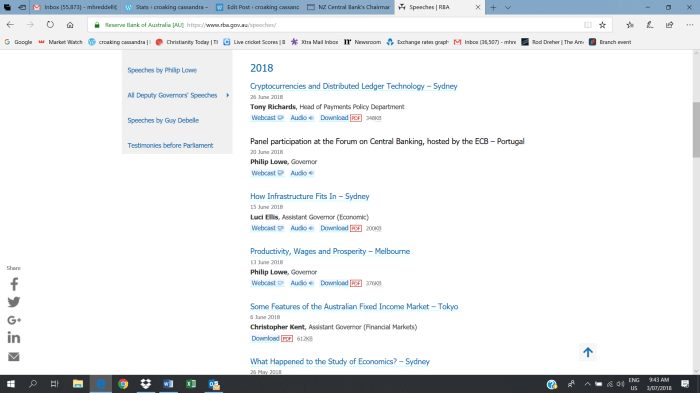
rba speeches

A range of speakers, and where possible provision not just of the text but of a webcast, so that audiences can see where the speaker may have departed from the text, but can also see and hear questions and answers –  new material which, in New Zealand terms, is official information.   It just seems to be a standard condition of having an RBA speaker.  There is no reason why a similar approach could not be adopted here, both for the Bank itself (eg the potentially market sensitive post-MPS addresses, to which only favoured invitees among bank customers have access) and by the Board.    When senior officials speak, the default standard expectations should be public access, and open reporting.

If they are vaguely serious about being a government known for “open government” –  and there is little real sign of it so far – it must about time the Minister of Finance and the Minister responsible for open government to have a word with the Governor and the Board chair about what it means.  One can debate the merits of (say) pro-active release of Cabinet papers (something I generally favour) but there should be no debate about speeches by officials being made routinely available.  The Bank, and the Board, are falling well short of any sort of open government standard.  Perhaps some journalist could ask one or other Minister about this case, if only to get them on record washing their hands of any responsibility.


Eaqub on nationalism

I guess one views, and experiences, a country differently when one is an immigrant, even one who came involuntarily as a child.   And since all of us are either immigrants or –  mostly –  not (with perhaps a few shades of grey for people who think they have come somewhere temporarily, but year succeeds year and they never actually go/come home) it can be hard for any of us to see the perspective of the other person.

That was my initial reaction when I read Shamubeel Eaqub’s latest column, headed (online, although not in the hard copy version),  Forces of nationalism a spoke in the wheels of trade.   It was, probably, a slightly unfair reaction, as there are staunch globalists (from strands of both the left and the right), almost embarrassed by the particularities and heritage of our own culture, among those whose ancestors have been here for generations.  But it is probably an easier stance to adopt when you have few or no roots in a particular country.   And many of the staunchest opponents of anything resembling nationalism seem to be immigrants themselves.  For them it seems to mean no more to move from one country to another than to move from, say, Hamilton to Tauranga.    Most people, across most pairs of countries, simply don’t see it that way.   Many, perhaps, feel an attachment even more specific: to a town or region where they may have spent all, or most, of their lives.   It is how most people live.  And the pride they often take in place, and the people of that place, is often what helps build strong functioning communities.   There is a sense of identity, shared destiny, and shared assumptions about how things are done.   It isn’t that, at least in any serious sense, one’s own community is in some objective sense “better” than the others, but it is mine, and a bit different (for good and ill) from other places.

Eaqub begins his column lamenting the rise of “nationalistic fervour”.  It isn’t abundantly clear what he means by that phrase, but in his book whatever it is counts as a bad thing.   It isn’t, he says, “just” Donald Trump or Brexit –  as if the two phenomena (two narrow victories) really have much in common.   But it isn’t clear what it is.  And he seems to have no sense that people tend to become more vocal, and intense, in defence of what they value when they perceive that someone is threatening to take it away.   There is nothing in the column that suggests he sees any value in communities (town, regions, countries –  perhaps even families) nurturing their own heritage, and what it is that makes them what they are.  Perhaps he hasn’t noticed the trend, over perhaps 100 years now, for a greater number of independent states to emerge.   It seems unlikely that that trend has exhausted itself.  And the world seems a better place for the Czechs and Slovaks to be able to have their own countries, or the Slovenes and the Croats, or the Poles – unhappily suppressed for 120 years –  or the Dutch, the Finns, the Estonians, Lithuanians or Latvians. Or at least the inhabitants of those countries seem to think so.

Instead, we get this sort of empty stuff.

Nationalism by definition prizes nationhood and pits nations against each other. It makes cooperation between countries harder, and tensions more likely. Nationalists have much in common, but even they cannot get on with each other.

Of the first half of that paragraph, he seems to have things almost completely the wrong way round.  It is no more true than to claim that because I prioritise my own house and family over those in the rest of the street that I either think badly of, or wish ill to, the rest of residents.  I don’t, I imagine Eaqub doesn’t, and I suppose only a very few people do.   At a national level, England/Britain and France both have strong national traditions, and it has been more than 200 years since those two countries were at war with each other.  Do New Zealanders resent Australians because they are a different country/nation?  It seems unlikely.

And “makes cooperation harder”?   Well, again I doubt it, except perhaps in some trivial sense that were there a single world government, its regulatory reach would cover the entire world, and none of us would have any choice, any exit options.  It doesn’t sound remotely appealing to me (and in my culture, has resonances of the Tower of Babel, which didn’t end well).   We managed to fight World War Two, beating such aggressive determined powers as Germany and Japan, without losing sight of the fact that the United Kingdom, the United States, the Soviet Union, South Africa, the Netherlands, New Zealand, Australia, and Canada were all independent states, with a shared commitment to a common goal, as well as individual national interests.

And what of “nationalists have much in common, but even they cannot get on with each other”, well since the phrase is used so broadly, in such an ill-defined sense, no doubt is true –  I doubt Michael Gove and Vladimir Zhirinovsky have almost anything in common, but one could define another side almost as broadly, and meaninglessly, and make almost exactly the same observation.  Close to home, for example, and within a single professional discipline, I doubt Eric Cramption and Shamubeel Eaqub – who would probably both accept a non-pejorative descriptions of “globalist” – have a great deal in common.

Eaqub goes on

The nationalist agenda seems to converge across three main areas: anti-immigration; protectionist economic policies; and a distrust of global institutions.   Anti-immigration and nationalism go hand in hand. At the core of nationalism is the nation state and the right to belong to it.

I’m not sure that this is necessarily true, but it is particularly unhelpful because Eaqub makes no effort to distinguish between legal and illegal migration.  Most of the debate in the United States, for example, seems to stem from the substantial stock of illegal migrants, and the renewed salience of the issue in much of Europe also seems to substantially reflect the wave of illegal migration.   That –  not the high legal numbers –  was also what has given the issue salience at times in Australia as well.

But then we are straight back to casting nonsensical aspersions, with little or no historical foundation

Being a citizen is the critical element, and easily leads to demands for tougher controls on who can come in.

It is then a small step to conflate citizens’ culture and racial makeup as different and better than those looking to come in. Language we have seen previously in precursors to discrimination, war and genocide become easier: like pests, lock-em-up and exterminate.

He simply seems to have no concept that in the same way that I don’t think badly about my neighbour, but I don’t wanting them occupying my house, people might simply value what they have, and the culture – in all its dimensions (about trust, and the way things are done, as well as arts, cuisine, religion, literature, language and so on) –  they and their ancestors have built and fostered, and be uneasy about things which threaten it. I suspect many citizens of Invercargill would be uneasy if 100000 Aucklanders moved south, and they are citizens of one country.   Arguably, it is those mass movements of people –  especially those of quite different cultures –  which sow the seeds of future tensions, and perhaps worse.    Whatever economic gains there may have been to Maori from large scale immigration since 1840, it sowed seeds of tensions that are likely to be with us for generations.  It wouldn’t have been unreasonable –  although it might have been infeasible, given the technological imbalances –  for Maori in 1840 to have said, “no, we prefer to kept these islands predominantly Maori –  we don’t think poorly of you English, and indeed we are happy to trade with you –  but we think we’ll be better, our heritage will better sustained, if we stay here and you stay there (or just in Australia)”.   By what criteria does Eaqub say they would have been wrong to have done so?

I’m not sure if I really qualify as a “nationalist”.  Even though my ancestors have been here since 1850, I feel a strong affinity for the UK and for Australia –  in many respects shared cultures, and common histories – and I count myself fortunate that the interests of those three countries haven’t collided very much, very materially, in my lifetime (let alone the century prior to that).   There are things we do differently and distinctively here,  and memories/experiences/reference points that are specific to individual countries (or regions, or cities) but I suspect I share considerably more in common with middle-aged co-religionists in Australia and the UK (perhaps even the US to some extent) than with my own mayor or Prime Minister.  My views about New Zealand immigration policy –  too many migrants, but it doesn’t much matter for those purposes whether they come from Birmingham, Banglalore, Brisbane, Beijing, or Buenos Aires –  are about the economic interests of a group called New Zealanders, and thus “nationalistic” to that extent.  If that is “nationalism”, then I’d happily sign up.

And that should be uncontroversial (even if views differs as to how best to advance the economic interests of New Zealanders).   In raising my kids, I look primarily to their interest  –  not exclusively so, not seeking harm or wishing ill on anyone else’s kids, and even feeling some attentuated responsibility (through the political system among other avenues) for those of others.  I’d lay my life on the line for my kids. I can’t automatically say the same for others, and probably no one can.   And those rare people who perhaps profess an equal interest in everyone, often in practice end up neglecting those for whom they have a particular responsibility.  Dickens treated such people in the form of Mrs Jellyby.

So I do think policy should be made at as low a level as it feasibly can, primarily with the end in view of benefiting the group those governing are responsible for.   Had I been British I’d almost certainly have voted for Brexit, and been among the many who did so (so the exit polls tell us) simply on the grounds of wanting to make our own laws.  In that vein, I think it was right that New Zealand should have its own government –  not still be part of an empire administered from London (as it was for a very short period).

And I am “suspicious” (well, more like generally disapproving, and favouring the winding of many of them) of global institutions, regarding many of them as primarily serving the interests of those who staff them (I sat on the board of one of them for a couple of years).  And if some of the more prominent ones are ever effective, it is often in constraining the future (legitimate) choices of individual countries’ citizens, in ways we simply wouldn’t accept within a single country.  So probably in Eaqub’s terms I count as a nationalist.  If so, I’ll wear the badge happily –  I even found a Guardian columnist a few weeks ago noting, perhaps reluctantly, the possibilities of a good nationalism, based around the things –  in many cases the very considerable achievements –  we’ve built together.

And, if I count as a “nationalist”, I’m a free trade and open markets one. Nationalism isn’t and never was, at least in our Anglo tradition, primarily mercantilist  The bit I liked best –  perhaps the only bit –  in Eaqub’s column was his praise of trade (his focus is external but I presume he means internal as well) –  not exports, but trade, exchange, specialisation and so on.  But for all his attempts to write about some very broad-brush “nationalism”, it isn’t obvious that he is even generally right about economic protectionism.  Perhaps I’ve missed something, but last time I looked Michael Gove was pretty keen on something approaching free trade, and whatever the concerns of governments or prominent parties in the Netherlands, Germany, Austria, Poland or Slovakia, there doesn’t seem to be much of those parties wanting to take a protectionist path.  No doubt, the gains from international trade are too little appreciated –  and thus New Zealand still has tariffs in place, disadvantaging New Zealanders –  but the push for increased use of tariffs seems to be a distinctly Trumpian theme, rather than one appearing more generally.  What, perhaps, there will be –  and rightly so in my view –  is resistance to preferential trade deals (often at best orthogonal to free trade) attempting to tie the hands of future national governments on domestic regulatory issues.  Our own government –  and its predecessor –  seem too keen on such deals (even if now, no longer on removing disputes from the jurisdiction of domestic courts).

Eaqub, by contrast, seems rather keen on such deals, and rules, and structures, and institutions.

This is why global rules on trade, travel, finance and standards have developed over time. To make it easier to connect with each other and to also use a rules-based system to deal with bad behaviour by countries.  As nationalists pull away from these global institutions, there seems little realisation that these greased the wheels of global trade, which helped their exporters and domestic producers too.

To the extent, he is specifically referring to the Trump administration approach to the WTO, I share his view.     But mostly trade has grown because of the opportunities it offered (both parties), and those opportunities aren’t going away.

Eaqub has long been a fan of immigration in New Zealand, and he returns to that theme in his columm

The global environment for migration is becoming more hostile. New Zealand can follow on a similar path, or be more organised in nabbing the best and brightest.

Being open in a closed world can be a boon. We need to actively consider our inward migration policy.

New Zealanders who have long been used to leaving for other countries, mainly for economic opportunities, will find their choices becoming more limited.

We should think about what to do with the many bright and hard working locals who will no longer leave.

It could delay the provincial decay of recent decades, which has been hastened by young people leaving.

Which seems wrong on every count.  There is no –  repeat, no –  evidence that our large scale immigration policy has been of economic benefit to New Zealanders as a whole.  There is little reason to believe that we could attract many of the “best and brightest” even if we set out to –  short of the early days of some Neville Shute On the Beach scenario, we are remote and not that wealthy, and it isn’t obvious why anyone (well, many of them) with the sort of drive, creativity and determination that might really make a difference somewhere would choose this “where”.   And as for New Zealanders leaving, perhaps the Australians will make it even harder for New Zealanders (and Australia is overwhelmingly the destination of New Zealanders that leave), but if they can’t go to Australia, I doubt it makes them much more likely to stay in Taihape.   People will flow to where the best opportunities are, whether elsewhere in New Zealand or abroad (and contra Eaqub, I’m not that worried about individual towns rising or –  in most cases –  modestly falling).

Eaqub ends with a call for New Zealand to join some group of countries with liberal views.

As nationalistic tendencies rise in many countries, we can expect a grouping of countries with liberal political and economic views.

New Zealand has an opportunity to be a strong player in this grouping. We have a strong track record in leading multilateral trade negotiations and championing liberal ideals.

We should get our house in order on migration and imports, then lead a charm offensive to place ourselves firmly in the liberal team in a divided world.

I’m not quite sure where he expects to find these countries, given how broadly he cast his “nationalistic” aspersions.  Nor is it likely to be, consistently, in the interests of New Zealanders to do align with them if they are found.  People will, perhaps annoyingly, insist on governing themselves, and form and maintain distinctive communities, and those who attempt to trade away that freedom risk creating in time backlashes, which are typically more unsavoury than a realistic regard for human nature, and the sense of place, or community, and culture that most people value in some form or other.

You’ll have noticed the sly attempt in Eaqub’s article to suggest that any scepticism about immigration is “racist”.  Perhaps because I’m still annoyed at the way Eaqub attacked me as “racist” several years ago for my arguments around immigration and New Zealand economic performance (remember, doesn’t matter: Birmingham, Bangalore or Buenos Aires) I thought I’d draw attention to a chart I saw over the weekend that perhaps captured quite starkly the differences on such issues, at least in the US context.   It was from a New York Times article, in turn reporting some work done a year or so ago by a leading UK-based political scientist Eric Kaufmann

Kaufman chart

I was stunned by the differences.  I’d not have been a Trump or a Clinton voter, and my views on New Zealand immigration (as economic instrument) apply as much to British immigrants as any others, but it reinforced a sense that the word is one that should be retired, as all but useless for any purpose other than abuse.  Debate the substance of the policy by all means –  in a New Zealand context, for Maori to oppose all further immigration to safeguard their position in New Zealand seems a reasonable option (not necessarily one I –  non-Maori –  would welcome) and not in any meaningful, ie pejorative, sense “racist” –  but drop the descriptor.