Donald Trump & lessons from NZ’s economic boom of 1996-2001

Late last week I was scrolling through a story about the IMF’s latest comments on the US economic outlook, short-term and more medium-term.   As the story reminded readers

The Trump administration says its economic platform — including cutting corporate and ­income taxes, boosting infrastructure spending and reducing regulations — will push growth up to a sustained rate of 3-4 per cent a year and cut unhealthy government debt levels.

At present, the Federal Reserve’s FOMC members collectively think potential GDP growth rates in the US are a touch under 2 per cent per annum.

The IMF has just finished its Article IV “mission” to the US (the US Treasury and the Fed being each a few blocks’ walk from the IMF), and released the team’s Concluding Remarks.   The Fund is, understandably, (more than) a bit sceptical about prospects for such an acceleration in the rate of growth of potential output.  But they are international public servants, and the US has a lot of clout on the Fund’s Board –  and, what is more, the Administration is currently looking to cut back US funding of various international organisations.

So the IMF can’t just come out and talk about the unlikelihood of any sort of large-scale acceleration of potential economic growth because of (a) a fundamentally unserious President, with little interest in policy and no apparent ability to deliver on an agenda anyway, or (b) a US Congress which has, if anything, (and on a bipartisan basis) lower approval ratings than the President, or (c) the corrupting influence of vested interests.  Instead, the Fund has to fall back on fairly bloodless technocratic arguments and illustrations.   But one thing they should be able to bring to the table is authoritative use of perspectives from other countries –  the Fund, after all, undertakes monitoring and surveillance of virtually every country’s economy, other than North Korea.

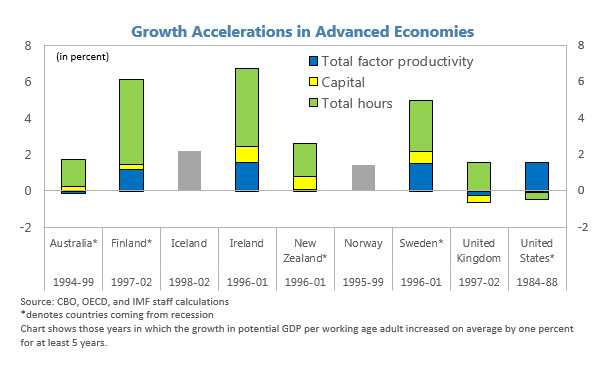
And whereas I’ve never seen a chart in the IMF’s Concluding Remarks for New Zealand, there were five in last week’s US document, four of which looked quite useful.  A couple even found their way into the Wall St Journal, and given how little attention the IMF’s view on the US usually get in the US, that probably counts as success.

Little old New Zealand was even singled out in one of the charts.
IMF growth accelerations

Looking at advanced countries since 1980, the IMF found this smallish sample of cases where countries had achieved at least a one percentage point lift in potential output growth (per working age adult) that lasted at least five years.    On this chart, New Zealand’s experience over 1996 to 2001 looked pretty impressive –  fourth best seen among IMF advanced countries in the last 35 years.

But it was a bit puzzling.   I sat around the Reserve Bank’s Monetary Policy Committee table right through that period, and “startingly impressive economic performance” wasn’t one of the descriptions that came easily to mind.     Even though the Fund’s asterisk describes us as “coming from recession” during that period, it was actually one that began at the end of a (pretty strong) four or five year recovery, encompassed another mild recession, as well as some chaotic monetary policy, an odd mix of fiscal policy, and towards the end of the period, increased marginal tax rates and a considerable slump in business confidence.    Through quite a bit of volatility, interest rates and the exchange rate fell a long way.

But perhaps I’d missed something, through getting too close to the short-term ups and downs.  So I dug out the data and had a look.

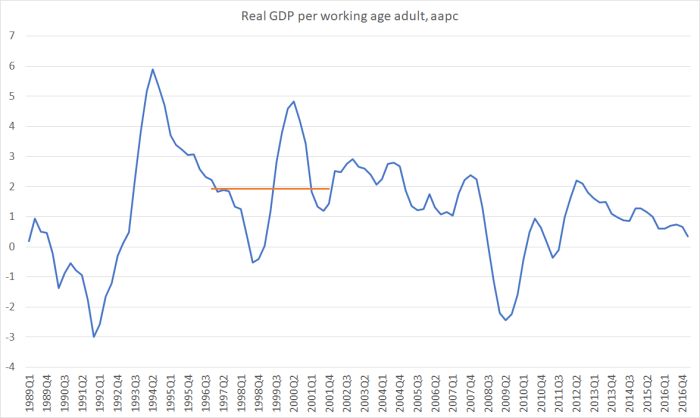
Perhaps if the IMF had had a quick look at this chart first, they’d just have left New Zealand off the chart (I’ve used the average of our two GDP measures, and the official HLFS working age population data).
Real GDP per WAP

Nothing stands out about that 1996-2001 period (average growth for which is highlighted in orange).  By our standards. it wasn’t a bad period, but it wasn’t obviously one I’d be wanting to send other countries’ officials and ministers to learn from.  There was no acceleration in real growth, let alone a sustained one.

But I had read carefully the labels on the IMF chart, and they were using “potential output growth” (per working age adult).  The problem with “potential output” growth is that it isn’t directly observable, and even years later it often hard to get a reliable handle on.

The OECD publishes estimates of potential output growth for its member countries including New Zealand.  And one can back out IMF estimates of potential output growth because they publish output gap estimates (actual growth adjusted for the change in the output gap is potential output growth).   Adjusting both for growth in the working age population produced this chart.

potential growthThere isn’t anything startling about 1996 itself, but at least on these measures potential output growth in the late 1990s was estimated to have been stronger than before or since.

So over the period the IMF highlights, actual real GDP growth (per working age person)wasn’t anything out of the ordinary, but the international agencies think that potential growth (per working age adult)  was pretty impressive  –  more of an acceleration than seen almost anywhere in the advanced world in modern times.

One possible reconciliation could be that New Zealand went into a severe recession during this period, leaving lots of excess capacity (but lots of underlying potential growth, as trend productivity grows rapidly).  It does happen –  it was part of the story of the US in the 1930s for example.

But that certainly doesn’t look to have been the story here.

Labour util

The unemployment rate was a bit lower in 2001 than it had been in 2006, and the labour force participation rate was a bit higher.

Another way to try to make sense of what was going on is to look at:

  • growth in the capital stock (per working age person)
  • growth in multi-factor productivity,
  • growth in hours worked per working age person, and
  • growth in labour productivity (real GDP per hour worked).

Here is the growth of the real capital stock per working age person, shown in two different ways –  the total capital stock, and the capital stock excluding residential dwellings.

cap stock

The period from 1996 to 2001 certainly saw stronger growth in the capital stock (per person) than in the previous period, and thus there is something to the IMF point about growth in potential during this period being somewhat influenced by the previous recession.    But even on this measure, nothing really stood out about the period.  Growth in the capital stock was no faster than it had been at the end of the previous boom, and was lower than we experienced in the last few years prior to the 2008/09 recession.

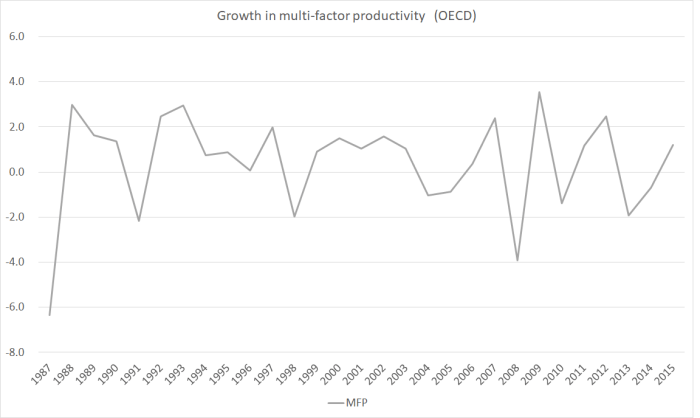
What about multi-factor productivity growth?   Measured properly, this is stuff everyone is after –  more outputs for the same inputs.    This is annual growth in the OECD’s measure of MFP.
MFP growth

Nothing stands out about the 1996 to 2001 period (consistent with the IMF chart itself, in which the contribution of MFP growth is all but invisible).

Here is (HLFS) hours worked per working age person.

hours worked

Again, nothing stands out about the 1996 to 2001 period.  There had been a big contribution in the previous few years, as demand recovered, drawing more labour back into employment, but by the period the IMF is focusing on there is nothing notable.

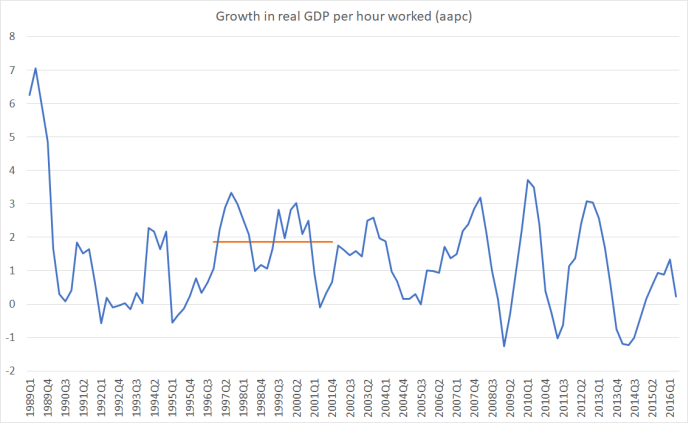
And, finally, what about labour productivity (growth in real GDP per hour worked)?    Here, at last, perhaps there is something to the IMF story.
IMF GDP phw

Using the average of the two real GDP measures, labour productivity growth actually was a bit faster in this period than in, say, the five year windows either side.     Even by New Zealand standards (among the weakest productivity growth in the OECD over 45 years) it is not that strong a performance, but the recovery in investment growth (see capital stock chart above) must have made a helpful difference for a time.

I got to the end of all this reassured that I hadn’t in fact missed any great lift in New Zealand’s economic performance over 1996 to 2001.  People are simply better to look at our actual experience, rather than the IMF or OECD estimates of unobserved “potential”.  Perhaps the other country examples the IMF cited work better?

I don’t suppose Donald Trump will be taking any notice of the IMF’s analysis or advice,  but if any minions do pay some attention to the IMF piece, the Fund’s use of the New Zealand case won’t do anything to lift anyone’s confidence that the IMF really has anything very compelling to offer.   Sadly, they didn’t have much useful to offer us either (here and here).
 

Who did Iain Rennie consult?

I’ve written a couple of times about the review former State Services Commissioner Iain Rennie has been conducting, at the request of the Minister of Finance, into two aspects of the governance of the Reserve Bank:

  • whether something like the existing internal committee in which the Governor makes his OCR decisions should be formalised in legislation, and
  • whether the Reserve Bank should remain the “owner” of the various pieces of legislation (RB Act, as well as the insurance and non-bank legislation) it operates under.

An earlier OIA request from a journalist saw The Treasury refuse to release the terms of reference for the report, but they did release the terms of engagement.  I wrote about that here.    We learned from that release that the report had been delivered to Treasury in mid-April.    We also learned that

In completing the work, the author will engage with an agreed set of domestic and international experts.

and

The key deliverable is a report, which will be peer reviewed by a panel of international experts.

I was interested to know who these experts were, and lodged an OIA request with Treasury.  No doubt, they could readily have responded in a day or so, but after four weeks they did finally respond yesterday.

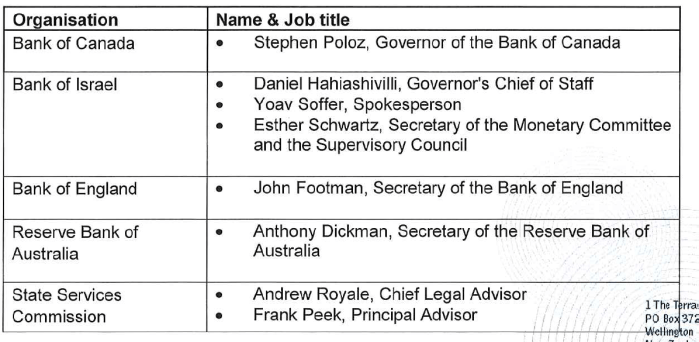
Anyway, this was the list of “agreed domestic and international experts”.

experts

and this was the list of reviewers

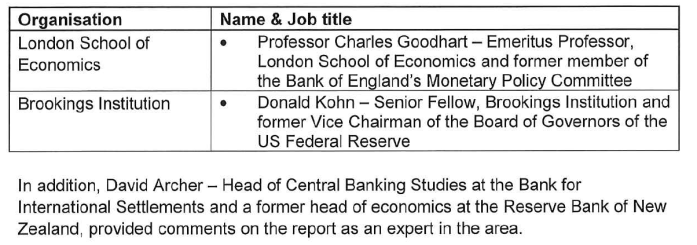
reviewers

It is a curious list in many ways.    Setting aside the SSC people, of whom I know nothing but who are presumably knowledgeable on issues of governance of New Zealand public sector institutions, not a single one of the central bank experts (first list) has any experience of, or exposure to New Zealand (let alone actually being a New Zealander).

And Rennie, with Treasury’s agreement, appears to have consulted only current serving central bankers.   No doubt several will have had useful perspectives to offer on their own central banks’ experiences.  But the world of central bankers is a fairly clubby (or collegial) one, and you would have to think it unlikely that Rennie would have heard anything from these people that would cast doubt on how the arrangements their New Zealand peers operated under were working.   And among those current central bankers only one (Poloz, the Canadian Governor) has any stature in his own right; the others appear to be “corporate bureaucrats”, able no doubt to pass on information about how things work in their own central banks, but not self-evidently qualifying as “international experts” on central bank governance etc.

One might have supposed that any number of other people (even from abroad) could have provided valuable perspectives and insights.  For example, retired Governors and former members of decisionmaking committees, who are freer to speak their mind.   Lars Svensson, the leading academic and former monetary policy board member, wrote a review of our Reserve Bank in 2001 for our then-government.   Having had extensive experience as an insider since then, and retaining an interest in New Zealand, he would have seemed like a natural person for Rennie to have consulted.    In fact, there is not one academic on the list.   Not, for example, Alan Blinder, former vice-chair of the Fed and author of academic work on decisionmaking by committee.   There are no private economists on the list.  Not, for example, Willem Buiter now chief economist of Citibank and a former academic and member of the Bank of England’s Monetary Policy Committee.  And no one from abroad with, say, a Treasury perspective, or the perspective of a Minister.  Bernie Fraser, for example, had been both Governor of the Reserve Bank of Australia, and Secretary to the (Australian) Treasury.

And not a single person from New Zealand made the expert list?  Not Arthur Grimes, who was heavily involved in the design of the current system and later chair of the Reserve Bank Board.  Not Don Brash, who was Governor under the current system for 12 years.  Not thoughtful former Board members such as (for example) Hugh Fletcher.  Not people who had been involved from a Treasury perspective (especially in the years since Rennie himself left Treasury).  And, of course, no one who has written on the issues domestically.

You might, incidentally, be wondering why people from the Bank of Canada and the Bank of Israel top the list of experts.  That is likely to be because Canada is the only other advanced country central bank with the Governor as (formally) single decisionmaker (Canada has quite old central banking legislation, and the Bank of Canada has much narrower responsibilities than our Reserve Bank).  And until relatively recently, Israel also had the Governor as a single decisionmaker, before the legislation was overhauled and a mixed committee (internals and externals) took over the monetary policy decisionmaking role.  The Israeli experience should be interesting, but again you have to wonder why Rennie didn’t consult Stan Fischer, former Governor of the Bank of Israel, and now vice-chair of the Federal Reserve.

What of the international peer reviewers?  There were three, and each will have been likely to have added something in commenting on Rennie’s draft.    But, again, there is a distinctly “let’s keep this inside the club” feel to it all.   Goodhart, for example, is a respected academic economist, and former staff member and Monetary Policy Committee member at the Bank of England.    But he is now rather elderly, and has had a very strong relationship with the Reserve Bank of New Zealand over the years –   including as guest speaker at the (rather extravagant) 50th anniversary celebrations of the Bank, and then someone used as an expert witness  by the Bank at the parliamentary select committee when the current Reserve Bank Act –  governance and all – was being legislated (rather controversially) in 1989.

Donald Kohn is pretty highly-respected in international central banking circles.  So much so that Treasury omit to note in their description that, having retired from a career at the Federal Reserve, he is now a member of the Bank of England Financial Policy Committee, so still entirely within the central banking club.  He has visited the Reserve Bank and, from memory, wrote up his experiences pretty positively.

The final reviewer is David Archer, former Assistant Governor and Head of Economics at the Reserve Bank (and sometimes mentioned on lists of potential future Governors). He now holds a senior position at the Bank for International Settlements, a body owned by central banks (including ours) which describes itself thus

The mission of the BIS is to serve central banks in their pursuit of monetary and financial stability, to foster international cooperation in those areas and to act as a bank for central banks.

I worked with David closely over a long period, and he was usually pretty willing to speak his mind.  He certainly knew the Reserve Bank well –  at least in the days before financial regulation became so important, and before the Reserve Bank moved more back into the mainstream of central government as a major regulatory institution –  but you have to wonder quite how free he will have felt to offer views the Reserve Bank might be uncomfortable with – the Governor visits the BIS pretty frequently –  especially as those views will themselves presumably be discoverable in time.

So the offshore people consulted, or used as reviewers, seem as though they will have been a rather partial perspective on the issues at hand. No doubt, all provided some useful information and perspectives, but you can’t help thinking there could have been a lot more there if Rennie had sought it.  Then again, as State Services Commissioner his reputation was hardly that of someone keen on open government.  What is perhaps more troubling is that The Treasury was okay with all this.

Despite this published list, you have to wonder who else Rennie in fact consulted.  Why I do suppose there was anyone else?  Because, somewhat by chance, I also yesterday got a response from the Reserve Bank to an Official Information Act request for minutes of the Reserve Bank Board.

In the minutes of the Board meeting held on 30 March this appears

Rennie board

There follows almost three pages recording the details of the Board’s discussion with Rennie (and his supporting Treasury staff). every single word withheld (on somewhat questionable grounds).    Nothing else ever gets three pages of text in the Board minutes –  in fact, the process for appointing a new Governor is still not being minuted at all, even in this latest set of releases.

I don’t have any particular problem with Rennie consulting with the Bank’s Board.  They are likely to have some useful experiential perspectives to offer, but if the discussion covered almost three pages of minutes and –  according to Treasury –  no one else in New Zealand with any familiarity with central banking issues was consulted, it does all have the feel of an insiders’ job.  Perhaps that is what Steven Joyce wanted.  It isn’t what the situation requires.    Meanwhile, one can only hope that the report itself, along with the terms of reference, will be released before too long.

New Zealand isn’t the only country looking at these issues.  The Norwegian government just this week released an independent report they had commissioned looking at the future governance and mandate of their own central bank.  The summary report is very easy to read, and includes specific draft amendments to the law to give effect to the report’s recommendations.  Among those recommendations is a streamlined system of governance, with proposals for a monetary policy committee (40 per cent of whose members would be externals appointed by the government), and for a separate Board to which the Governor would be responsible in his role as chief executive of the Bank.    We can only hope that the completed Rennie report will be as clear and crisp.