Another disheartening Makhlouf speech

I’ve written previously, and quite critically, about various speeches given by Gabs Maklouf, Secretary to the Treasury (including here, here, here, and here) .  I continue to be surprised that we have someone that poor as head of the government’s premier economic advisory body –  for that I guess we should blame Iain Rennie and the State Services Commission.  It was perhaps even more disappointing that Makhlouf was reappointed for a further term earlier this year –  for that both SSC and the Minister of Finance must surely be held responsible.  And, since I assume he does have some strengths even if economic and policy analysis is not among them, I remain surprised that he does (is allowed to do?) so many on-the-record speeches.    This year, for example, he has done many more public speeches than the Governor of the Reserve Bank, even though the Treasury’s prime role is to advise the government, while the Reserve Bank Governor has extensively discretionary policymaking powers affecting directly or indirectly a large proportion of New Zealanders.  In some other countries – Makhlouf’s native United Kingdom for example –  the Secretary to the Treasury is generally not seen or heard by the public.

There was another Makhlouf speech a couple of weeks ago, headed Growing our Economic Capital: Investing in Sustainable Improvement in our Wellbeing.

There is a lot in the speech I could comment on.  There is the notion that “we are in a new era of policy frameworks and I’m proud to say the Treasury’s Living Standards Framework is at the forefront of economic thinking” –  which would be laughable, if it were not that Makhlouf, head of the government’s principal economic advisory agency, appears to take this claim seriously.  Bryce Wilkinson of the New Zealand Initiative wrote an excellent critique of the Living Standards Framework here (pages 6 and 7) , and I’m not going to try to improve on that piece.

And there is the rank cheerleading – that probably went over okay in the Beehive – in Makhlouf’s opening description of the economy

The New Zealand economy has been performing well over the past 4 years, relative to both the potential growth rate of the economy (of around 2.7%), and to most advanced economies.  Over this period, our economic growth rate has averaged 2.8% while the average growth rate of OECD economies has been around 1.7%.

in which he goes on to suggest that the results are commendable, to be celebrated, and something to “feel good” about.   And yet there is not even a hint of the fact that:

And all this on the back of 15 years of no growth at all in per capita real output of the tradables sector.

Sure, things could have been worse, but there isn’t much to celebrate.  Makhouf included the unemployment rate is that list of good things, and yet his own department estimates that the NAIRU is now around 4 per cent, and the unemployment rate hasn’t been that low this decade.

Of course, I largely agree with Makhlouf that

We need to look as much to lifting the economy’s long-run average growth rate, one of the main sources of a sustainable increase in our collective wellbeing, as we do on worrying about whether the economy is operating at or close to its short term potential growth rate.

Indeed, one might think that the Treasury should put a lot more emphasis on how to lift long-term productivity growth.  The short-term stuff is mostly the Reserve Bank’s job.  And yet there is nothing at all in the speech, and nothing in anything else the Treasury has published, to suggest that the organisation has any real idea what it might take to reverse the staggering decades of relative economic decline in New Zealand.  Instead, the Living Standards Framework seems to function in part to distract attention from that failure: providing robust advice to governments on how to reverse long-term relative economic decline has become all too hard, so we’ll burble on instead about bureaucrats’ personal agendas for how society and government should be organised.   Hiding under that broad heading of “economic capital” that Makhlouf wants to build, for example, is “social capital (including culture)”.  It is far from clear that the Treasury has anything useful to say on building culture, or that the views of its staff have any greater merit than those of the first 1000 voters in the Auckland telephone directory.    That is what we have political processes for:  Midwest evangelicals and New York liberals (and their New Zealand counterparts) have quite different and conflicting visions of culture and society.

There is also the staggering hubris and faith in governments (officials I suspect more than the elected ones) that pervades the speech. And, on the other hand, signs of an agency that (at least at its head) has totally lost sight of how prosperous stable societies develop and maintain themselves.  I searched through the speech and the word “markets”, for example, appears only in reference to financial markets –  nothing at all about competitive processes, private sector innovations (products and institutions) and so on.   And, on the other hand, almost nothing on the limitations of knowledge that all of us face –  perhaps governments most of all.  Surely only a bureaucrat  –  and a not very introspective one at that – could say this

Government strives to take a system view.  A system approach underpins the direction the public service has been moving in following the Better Public Services report in 2011.  It reflects the fact that central government is well-positioned to observe and monitor the system dimensions that influence our collective wellbeing.  It also has system-level instruments that can help make a difference, some of which are about devolving power and using the energy of communities.

At the centre, technology enables us to collect and share information on what various communities are doing to improve their lives.  We also have the analytical capabilities to assess what works and does not, but we need to do the hard work of converting that potential into practical initiatives through appropriate investments in economic, environmental and social infrastructures.

The frightening thing is that he doesn’t seem chastened at all by the repeated failures, here and abroad, of well-intentioned government interventions in so many areas.  In a week when attention focuses on the inability of central government to effectively operate something as relatively basic (and close to a public good) as a tsunami warning system, it is a reminder that we are really owed much more humility from our senior public servants. Rather than imperial visions of reshaping society, or even just championing yet more “smart active” interventions that all too often prove to be anything but, in part because too rarely do the advisers take into account that humans design and run these systems, not angels, we’d be better with a Treasury constantly focused on what governments can’t do well.  Plenty of people criticise the 1980s and 1990s Treasury, but one thing the institution certainly knew then was that government failure was as pervasive as market failure, and that institutions had to be built on and around the limitations of flawed human beings.  At least at the top of the organisation, that conception now seems long lost.

I could go on –  I quite enjoy the occasional rant – but I wanted to focus specifically on some of Makhlouf’s comments about macroeconomic policy and financial regulation.  Bear in mind that he has no known background in either subject.

He starts with the 2008/09 international financial crisis.

For example, one of the main events of the last ten years has been the global financial crisis.  This was system failure par excellence.  It showed us that a combination of placing too much weight on the wrong indicators, guided by mis-specified models, could lead to disastrous policy decisions being made in many countries and outcomes affecting millions of lives.  These models ignored the critical role of financial markets and networks.  The policy prescriptions they led to misjudged how complex systems work.  They resulted in coordination and communication failures, among other things.

Which might sound impressive, but in fact there is much less there than meets the eye.  No one seriously thinks that the limitations of formal macroeconomic models –  typical models didn’t have an explicit financial sector –  explain the crisis that hit several countries in 2008/09.  Among other things, government agencies in countries that didn’t have domestic crises –  New Zealand, Australia, and Canada among them –  used exactly the same sorts of models.      Having said that, you might have thought this paragraph would give Makhlouf pause for thought –  if really smart people in governments around the world could get things so wrong (the British bureaucracy included, where Makhlouf held quite senior positions) what gives him confidence that things will turn out better next time?  Limitations of knowledge are frustrating, but profound.

Makhlouf looks to the future

People are still trying to understand the lessons from the GFC. One area of learning which has had international attention is the critical role of better coordination of fiscal, monetary, financial and broader macroeconomic policies in order for those policies – whether fiscal, monetary, financial and broader macroeconomic – to be implemented effectively when one of them faces constraints. It can be the difference between a well-conducted orchestra playing a symphony and ninety disorganised musicians creating a cacophony. This area has been a focus of the G20 and IMF since 2008.

Maybe, but it is difficult to spot much visible change in how macroeconomic policy is conducted, or in how macroeconomic policy institutions are designed and organised.

What of New Zealand?

I should emphasise that New Zealand was one of the countries that coordinated fiscal and monetary policy effectively over the course of the GFC.  Fiscal policy supported monetary policy through the crisis by being stimulatory when needed and then contractionary once the economy was recovering.  But that doesn’t give us an excuse to cut class when experience delivers useful lessons and poses questions, including on policy coordination. And we should also make sure we learn the lessons of putting too much weight on simplified economic models.

Makhlouf wasn’t in New Zealand during that 2008/09 period.  Perhaps that explains what is simply a mistaken description of how things worked here.  In fact, New Zealand was one of the few advanced economies where there was no discretionary fiscal stimulus undertaken during the recession.  On the assumption that the good times would last, and on explicit Treasury advice to that effect, the previous Labour government had been putting in place quite expansionary fiscal policies anyway, and by chance some of those measures were still taking effect when the recession hit, but there was no coordination on those matters across The Terrace.  In my observation, the two agencies (the Reserve Bank on the one hand, and Treasury/Minister) got on well enough –  and worked closely together on specific interventions like the guarantee schemes –  but there was no fiscal/monetary policy coordination.  Rather fiscal policy had set its medium-term course, and monetary policy took that into account in setting and adjusting the OCR with the aim of meeting thre inflation target.  The system worked as it should –  and it helped that New Zealand interest rates didn’t get to zero  –  but that isn’t the sort of thing people have in mind when they talk about policy coordination.

And –  minor cosmetic changes aside – the legislation fiscal and monetary policy operate under today is the same as it was in 2008/09. If Makhlouf thinks something different is needed, he should tell us –  and advise the Minister accordingly.

Makhlouf seems to favour change or –  perhaps –  just wants to sound as though things are different now.

Building on what I said earlier, my first example relates to the coordination of monetary, financial (including prudential) and fiscal policies towards not only keeping the economy operating close to its current growth potential, but doing so in a way that does not cause harm to the growth potential of the economy. Indeed it can enhance it.

International experience over the past 10 years and maybe more casts increasing doubts about the effectiveness and efficiency of monetary policy alone in managing the economy’s performance relative to its current growth potential when it is adjusting to a large structural shock.  In fact, relying on monetary policy alone to do that job risks the longer term growth potential of the economy as well, by leading to the misallocation of resources towards investments such as residential investment that are comparatively less productive in terms of generating wealth and well-paid jobs.

It is certainly true that to the extent that some hubristic economists came to believe (consciously or otherwise) that serious recessions were now a thing of the past, they were simply wrong.  And, of course, plenty of people are asking questions about whether there are better ways of running policy in relevant areas –  although doing that well surely depends on a clear and compelling explanation for the 2008/09 recession and aftermath (without it, policy change risks being as unrelated to the causes of the problem as many of the post-Depression policy changes in the 1930s, here and abroad, were).

But if people are asking questions, what is surely striking is how little institutional change there has been in the years since that severe recession.  As the Governor of the Reserve Bank often, and rightly, points out, no country has even switched from inflation targeting to some other nominal anchor.  No country I’m aware of has made any material changes to institutionalise the coordination of fiscal and monetary policy.  And although various countries –  including New Zealand –  have been making a bit more use of direct controls of bits of the financial system, it is hardly some integrated coordinated approach to policy –  if anything, it looks a lot more like assigning a new tool to a new target.  Some argue at present for tighter monetary policy in various countries even though inflation is low, in the belief that doing so would assist longer-term financial stability and growth prospects.  But it doesn’t seem to be an approach that governments (or central banks) are signing on to.  Of course people are dissastisfied with the economic outcomes globally over the last decade, but there isn’t any sign yet that greater macro policy coordination within countries is a material part of the answer.

I’m not sure what Makhlouf really thinks about inflation targeting.  He has been on record suggesting that he doesn’t think major change in the PTA is warranted next year.  But then it seems strange for the Secretary to the Treasury to be undermining a macroeconomic policy framework that has worked quite well for New Zealand –  macro policy can’t solve long-term productivity problems, but we’ve avoided serious economic and financial crises for the 25 years of the current fiscal and monetary regime.  That is something to appreciate.

And before I leave that section of Makhlouf’s speech, he talks about the risk that inflation targeting (in isolation?) can  lead to “the misallocation of resources towards investments such as residential investment that are comparatively less productive in terms of generating wealth and well-paid jobs”.  Just two points in response: the first is that houses are to live in, not to generate “wealth and well-paid jobs”, and second, surely everyone now accepts that one of the biggest issues –  policy failures, but not macro policy –  in New Zealand (and Australia, the UK, Canada, and large chunks of the US) is that far too few houses were built, on land made artificially scarce by regulation.  We simply do not have a problem of over-investment in housing, however that concept is defined.    Surely the Secretary to the Treasury knows this?

I could go on but won’t –  tempting as his central planners’ approach to tourism is, for example.  The overall quality is just depressingly poor.  Lots of virtue-signalling, and little sign of really hard-headed analysis and engagement with the specifics of New Zealand, or the limitations of government.

In conclusion, Makhlouf observed

It’s about being prepared for the unknown unknowns. And I should add that part of this preparation is making sure our institutions are fit for at least the next 25, 30 or 40 years.

That sort of timeframe is probably unrealistic –  elections come by every three years after all –  and the deeper-seated institutions of our society and culture shouldn’t be lightly tampered with anyway.  But it is hard not to be concerned that our Treasury is not now fit for even the next decade. Even a centre-left government –  to whom things like the Living Standards Framework might be appealing –  should expect (and will probably need) something more rigorous than seems to be on offer at present.  Perhaps even more unsettling is that the weakness at the top of the Treasury don’t seem counterbalanced by strengths in any of the main economic policy or advisory agencies.
 

New Zealand and the Great Depression

It is a trifle unsettling to check out the Geonet pages, notice the large cluster of continuing aftershocks around “25kms east of Seddon”, and then to realise that looking out my window I can more or less see that spot.  It surprises me quite how much damage and disruption Wellington has already had despite being several hundred kilometres from Culverden and the site of Sunday night’s major quake.

US politics and a good book make worthwhile distractions.

I’ve just been reading The Broken Decade: Prosperity, Depression and Recovery in New Zealand 1928-39, by the local historian Malcolm McKinnon.  It is, as far as I’m aware, the first substantial scholarly history of the depression years in New Zealand.

The Great Depression was a tough time for many people in many countries, New Zealand not excluded.

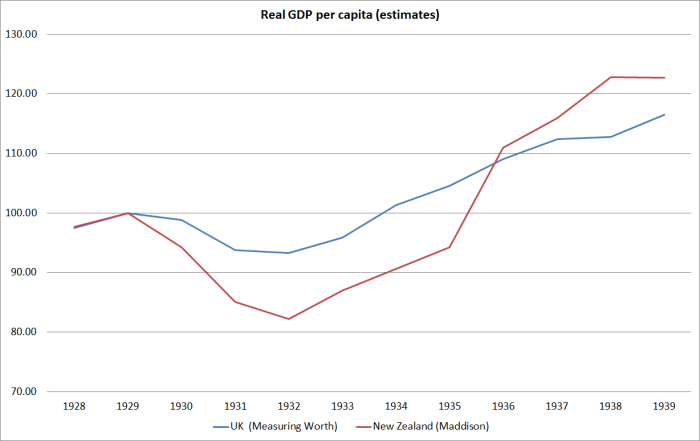
Whereas for the UK, the fall in real per capita GDP wasn’t much larger than the experience in the 2008/09 recession (and the 1930s recovery was faster), in New Zealand real GDP per capita is estimated to have fallen by almost 20 per cent.

nz-great-depressionNo wonder there was a net migration outflow during the Depression –  small, by the standards of some we’ve seen since, but then the travel costs back to the UK were much greater than today’s three hour flight to Sydney, Brisbane or Melbourne.

What made it so tough for New Zealand?  We went into the Depression with staggeringly high levels of debt – high government debt (perhaps around 170 per cent of GDP just before the Depression), and a highly negative net international investment position.  Most of the external debt was owed by the government (central and local), and most government debt was external.  And within New Zealand there was a huge level of farm debt –  mostly not owed to banks (which didn’t do that sort of long-term finance) but to government agencies, non-banks, relatives, and to other individual private sector entities.  Many farmers bought their farm, and the seller (whether family or other) left mortgage funding in the farm to be paid off over the subsequent decades.

When export prices, and consumer prices, fell very sharply, the debt overhangs became much more pronounced.  In respect of the farm debt, wealth was reallocated among New Zealanders (lenders better off, borrowers worse off, at least if debt servicing was maintained).  In respect of the public debt, the servicing burden became much more difficult, and a larger proportion of New Zealand’s nominal GDP has to be devoted to servicing that debt.  Nominal GDP is estimated to have fallen by a third between 1929 and 1932 –  and export receipts fell 40 per cent.  The additional servicing burden was particularly severe on the foreign debt which still had to be serviced in sterling, as New Zealand’s own newly-emerging currency gradually depreciated against sterling.

The extent of the fall in activity in some cyclically-sensitive sectors was pretty stark: building permits issued for new houses and flats fell by almost 80 per cent.

But, no doubt as ever, it wasn’t all contraction and decline.  Electrical appliances were becoming ever more widely adopted, and with it electricity generation continued to expand right through the Depression years.

electricity

Perhaps even more striking was dairy sector production and exports.  Sheep numbers in 1935 were almost unchanged from the level in 1929, but the number of dairy cows in milk was 42 per cent higher than in 1929.  And here is total dairy production.

depression-dairy

I’m not sure I understand quite what was going on in that sector: presumably some combination of new technology, the desperation that came from the high levels of debt hanging over these farmers, and low  direct marginal production costs (family labour) made it worthwhile to markedly increase cow numbers and overall milk production despite the low international prices for dairy products.

And substantial as the overall drop in real per capita income was, the fall was spread very unevenly across the population (as is no doubt the case in every recession).  Unemployment was high –  estimates vary, but even among adult males the unemployment rate probably peaked near 15 per cent (I’d give you 1991 comparisons if only the Statistics New Zealand website were not down in the earthquake aftermath). And there was a lot of resistance to wage cuts during the Depression, but for many of those who kept their jobs –  and especially those in salaried jobs, not affected by cuts in overtime hours – real purchasing power actually increased during the Depression.  My own grandfathers were in their mid-late 20s when the Depression began –  both were in work throughout, and both bought new houses in the early 1930s.  As McKinnon highlights, as much through his large selection of photos as from the text, “life went on”: society ladies graced race meetings, the All Blacks still played, and so on.

McKinnon’s book advertises itself as focused on the politics of the period, rather than the economics, and although there is a lot of economic-related material in the book, New Zealand is still lacking its first book-length economic history of the era (although of course it is treated to some extent in the few economic histories of New Zealand). Putting New Zealand’s experience systematically in cross-country comparative perspective (eg New Zealand, Australia, Canada, Ireland –  and perhaps Uruguay and Argentina –  and, say, the United States and the United Kingdom) would be fascinating.

It is a richly documented book, but with some gaps.  For a book avowedly focused on the political side, it was surprising that the author had made use of New Zealand official archives, but not those of the UK –  key export market, key source of finance in a stressed period, and of course key international relationship more generally.   And even locally, although the book covers the whole period 1928 to 1939, there is very little attention to developments on the right of politics after 1935, including the formation of the National Party.

In terms of policy responses to the Great Depression, my own sense is that the politicians did about the best they could.  With hindsight it was clear that a substantial currency deprecation would have been a helpful remedy –  perhaps the single most potent response New Zealand could have deployed in the face of a severe global downturn.  But in 1929 there still wasn’t a strong sense of New Zealand even having its own currency, let alone it being something that our government could control the value of.  As time went on, the option of a more structured devaluation became a centrepiece of the policy debate –  advocated by many economists –  but even then the dividing lines weren’t clear cut.  Export industries generally welcomed the idea, but workers and unions –  focused on the expected rise in the cost of imports – didn’t.  And for a government with a massive foreign debt, the additional servicing burden from a currency depreciation was a certainty, while the expected increase in tax revenue over time was no more than a hypothesis.  When the government finally acted in early 1933 to formally depreciate the exchange rate, it prompted the then Minister of Finance, William Downie Stewart, one of ablest figures then in politics, to resign in protest.  For several years afterwards, the devaluation remained a point of political contention (and even scholarly contention –  at the time the US academic Kindleberger, later famous, argued that our devaluation had largely just pushed down the international price of dairy products).

Of course, the standard Keynesian line is that countries should have used fiscal policy more aggressively to attempt to maintain demand through the Depression years.  Sadly, New Zealand was already debt constrained, and external debt markets were fragile at best.  Additional public spending (even if totally domestically financed) might have boosted demand, but it would also have put more pressure on the balance of payments (in a non floating exchange rate world).    A few years ago, in Paul Goldsmith’s book on the history of the New Zealand tax system, I stumbled on what should surely be the last word on the possibility of New Zealand borrowing and spending more back then, from Keynes himself.

Visiting London in late 1932 (after the worst of the disruption to the UK external capital markets was over), Minister of Finance Downie Stewart met Keynes.  Stewart recorded in his diary:

“I asked him if he would borrow if he was in New Zealand in order to get through the crisis.  He said, “Yes, certainly if I were you I would borrow if I could, but if you asked me as a lender I doubt whether I would lend to you.”

By that time, the fall in the price level had taken the level of government debt to well over 200 per cent of GDP.

The servicing burden of high levels of public debt was a major issue in many countries during the Depression.  In some cases, it led to direct defaults: Germany, for example, simply ceased paying reparations (and New Zealand, as a small recipient, was a loser from that).   The UK, and various other European countries, ended up defaulting on their war debts to the United States (the UK also suspended some of our war debts to them).  In other cases –  not just involving government to government debt – the approaches were more subtle, but they involved effective defaults nonetheless.  In the United States, for example, government bonds had typically been payable in gold.   The Roosevelt administration had those clauses revoked, and at much the same time went off gold, effectively depriving holders of a large proportion of their contracted returns.

In New Zealand (and Australia) there was a different approach again.  In respect of domestic government bonds, holders were simply forced to accept a lower interest rate on existing debt than they had contracted for  –  as part of the legislation, if they didn’t accept the exchange, they would face a punitive tax to achieve the same effect.  I wrote about that interesting episode in a Reserve Bank Bulletin article a few years ago.

What was interesting, in both countries, was the reluctance to do anything about the foreign debt (much the largest component of both countries’ public debts).  The unexpected fall in the price level, and in nominal incomes, had massively increased the burden of the debt.  But both countries still needed access to those funding markets, to rollover maturities at very least.  Neither country defaulted on central government external debt, focusing instead on the goal (about which they could do nothing much directly) of raising the world price level, so as to lower the effective servicing burden.  That finally happened, although in New Zealand’s case market unease about New Zealand’s external debt remained a serious concern –  much more so than anything in the last 30 years –  right down to the outbreak of the war.  Had it not been for the war, external default might well have happened in 1939/40.

This has been a fairly discursive post.  There are a lot of other aspect of the Depression in New Zealand I could write about –  especially the handling of distressed farm debt –  but I’ll save those for another day.  For anyone interested in New Zealand’s experience of the Depression, I’d recommend McKinnon’s book.  It is a sobering remind of an event that still shapes perceptions, and where –  among the now very old –  memories are still often seared by the experience.  Never again, people hoped for decades.  And then there was 21st century Greece.

Still reluctant to lower interest rates

I was a little late to the Monetary Policy Statement. The actual OCR cut yesterday was very well foreshadowed, and I wasn’t expecting much else.  And in fact there weren’t many surprises in the document.  But that is shame, because the Reserve Bank still seems trapped in much the same mindset that has delivered inflation below the midpoint of the target range (the explicit required focus of policy since 2012) for the last five years or so.  And it isn’t just headline inflation –  thrown around by petrol prices, tobacco taxes, ACC levies etc –  but whichever one or more core inflation measures one cares to focus on.  At present, the median of half a dozen core inflation measures is around 1.2 per cent.

And despite the rather self-congratulatory tone of the document, and particularly of yesterday’s press conference with the Governor and Assistant Governor, even on the Bank’s latest projections it is still another two years until inflation is expected to be back around 2 per cent.  And, of course, we’ve heard that line before, repeatedly.  As everyone knows, a lot can happen in two years, and it is most unlikely that things will unfold as the Bank (or any other forecaster expects) but there is nothing –  not a word, sentence, or paragraph –  in the latest MPS to explain why it is more likely today that inflation will now track back to settle around 2 per cent than it has been for the last five years.   Why should we be comfortable that the Bank has it right this time?

The Governor continues to repeat the line favoured by the government, emphasising recent annual GDP growth of around 3.5 per cent.  He does so in a way that suggests that all is pretty rosy, and my goodness if we were to do anything more there would be real risks of nasty overheating and intense volatility.  But like the government, the Governor rarely bothers to mention per capita growth.  Here is the chart of annual average growth in real per capita GDP (using the average of expenditure and production GDP).

real-gdp-pc-nov-16

At its brief best, several years ago, real per capita GDP growth never got anywhere near the rates of previous recoveries.  At something around 1 per cent now (1.5 per cent of an apc basis) it not anything to be encouraged by.  Sure, some of the weaker growth reflects the deteriorating productivity growth trend –  which the Governor can’t do much about –  but not all of it by any means.  With 2 per cent population growth, we probably should be getting a bit uneasy if over GDP growth were at 6 per cent –  and the unemployment rate was falling quickly below the NAIRU –  but that just isn’t the way things have been in New Zealand in the Wheeler years.  And the disconcerting thing is the Graeme seems to think that is a good thing.  Monetary policy could have done more, but consistently and consciously chooses not to do so.

Instead he repeats, over and over again, the point that tradables inflation has been negative for several years, making his life oh so hard (hard to get overall inflation back to 2 per cent).  From a New Zealand consumer’s perspective, low tradables is a good thing.  And from a New Zealand producers’ perspective it is typically should be quite a good thing as well.  Persistently weak tradables inflation creates room for the Reserve Bank to cut New Zealand interest rates further, in turn lowering the exchange rate (relative to the counterfactual).  A lower exchange rate would raise tradables inflation a bit, but also increase domestic economic activity and raise returns to our own tradables sector producers.    The headline inflation rate would rise as, over time, would core measures.

It is one of aspects of Graeme Wheeler’s stewardship that I don’t purport to adequately understand.  In almost every statement he repeats the plaintive line “a decline in the exchange rate is needed” but isn’t willing to do much about the one thing in his control that really makes some difference: lowering interest rates.

You might think that is a little unfair.  After all, the OCR has been cut by 175 basis points in the last 16 months.  But then it was unnecessarily raised  by 100 basis points over 2014.  Overall, the nominal policy interest rate has fallen over the last three years, but once one takes account of the fall in inflation expectations, there has been hardly any fall in the real OCR at all.  And that despite three more years of inflation persistently undershooting the target (and three more years of an unemployment rate above the NAIRU).

And they aren’t even providing much to boost domestic demand and activity.  The Bank ran this chart in yesterday’s MPS

funding-costs-nov-16-mps

It isn’t that easy to read, but just focus on the top and bottom lines. The top line is an estimate of the weighted average cost of new bank funding (retail, wholesale, onshore, offshore).  The bottom line is the OCR.  That marginal funding costs measure hasn’t fallen much at all this year, despite the continuing falls in the OCR.  Over the last three years taken together, the fall in marginal funding costs has not even quite kept up with the fall in inflation expectations.  Is it any wonder that core inflation has stayed low, and if there is any sign of some lift in inflation, it is at a very sluggish rate?

The Governor devoted a paragraph in  his main policy chapter to a discussion of the helpful things (in terms of lifting resource pressure and inflation) lower interest rates are doing.  There was a striking omission: frustrated as he no doubt is with the level of the TWI, it is almost certainly lower today than if the Bank had not cut the OCR.  But no mention of the exchange rate connection at all, even though it is probably one of the most important monetary policy transmission mechanisms in New Zealand.

But I was also struck by one of the observations the Governor did make.  He noted that low interest rates “are encouraging businesses to undertake investment they may not have done otherwise”.  So far, so conventional, and I wouldn’t disagree at all.  But here is a chart of investment (excluding residential investment) going back almost 30 years.

investment

Investment in things other than building new houses is certainly off the recessionary lows, but it is still a considerable way below the typical share of GDP seen in the mid-late 1990s and the pre-recessionary 2000s.  And that is (a) with some considerable activity related simply to rebuilding in Christchurch following the earthquakes, and (b) the most rapid population growth rate we’ve had for decades.  Many more people should mean a lot more investment (simply to maintain the capital stock per person).  With current rates of population growth, and the Christchurch effects, perhaps we might be a little uneasy, concerned about overshooting, if the investment share (ex housing) was much above say 18 per cent (around the pre-recession peak). But it isn’t, and there is a little sign of business investment accelerating.

Monetary policy doesn’t make that much difference to an economy in the long run.  But in the short to medium term it can make quite a difference.   If a central bank is reluctant to cut policy rates further when

  • core inflation is well below the target focus (and has been for years),
  • when the unemployment rate is falling only slowly and is still well above the NAIRU,
  • when per capita GDP growth remains modest at best,
  • when the exchange rate is well above appropriate long-run levels, despite a languishing exports/GDP picture,
  • and when business investment itself is pretty modest, especially given the unexpectedly rapid population growth

it is leaving New Zealanders poorer, and more of them unemployed, than is necessary, or desirable.

Perhaps the bit of yesterday’s press conference that frustrated me most was the response by John McDermott, the Bank’s chief economist and Assistant Governor to a question.  The questioner asked about whether the Bank had given any thought to the idea Janet Yellen had openly toyed with, of deliberately aiming for a period of above-target inflation –  whether to in some sense “make up” for the period of below-target inflation and cement in slightly higher inflation expectations, or just to “give growth a chance”, including the chance that additional demand growth might stimulate new supply and productivity growth.   As the next recession –  and the next need to cut rates –  can’t be that many years away –  whether by accident, exhaustion or unintended trade war – the “overshoot” approach might just be prudent risk management in the current circumstances.

There are a number of problems with the idea.  In a US context, I don’t find that argument that weak demand has held back productivity growth that convincing –  and they managed very rapid productivity growth during the Great Depression –  and there are questions as to whether a central bank could credibly commit to overshoot its target for a time (aren’t the incentives to renege as soon as inflation actually starts getting near the target?).  And in the US, the unemployment rate is already back to around pre-recession lows.

But the Bank’s chief economist simply didn’t address the question.  Perhaps he didn’t hear it clearly, or misinterpreted what was being asked, but he simply gave the rather self-satisfied response that if one looked at the Bank’s projections, inflation was heading back towards target, and that “sounds like the plan being implemented”.

It is nothing of the sort.  What the Bank is doing is pretty mainstream inflation targeting, on the assumption that their forecasting models and understanding of the economy is roughly correct.  And it is surely exactly the same approach they’d take if the target was, say, centred on 5 per cent, and core inflation measures were around 4.2 per cent.

It is also exactly the approach they’ve taken throughout the Wheeler term, when they have proved to be consistently wrong.  Inflation has simply kept on undershooting.

The approach that was asked about, at least as I heard it, was whether the Bank should not cut more aggressively now, actively aiming to get (core) inflation up to perhaps around 2.5 per cent for a time.  If the Bank’s forecasting models are still wrong –  and they’ve given us no basis to believe something has changed and they now have it right –  perhaps actual core inflation would turn out around 2 per cent.    But if the models are right, we’d have a few years where inflation was a bit above target.  There would be few obvious downsides to that.  The next recession –  whenever it is –  would be likely to see inflation fall again.  But we’d see inflation expectations pick up –  from the current 1.6 to 1.7 per cent – to something more like 2 per cent, and we’d see a phase of stronger real GDP growth (per capita), stronger business investment, and the unemployment rate might finally –  eight years on from the recession –  get back to something like the NAIRU.  Indeed, perhaps it might undershoot the NAIRU for a year or two, likely a welcome outcome for the people concerned.

And then there is the looming issue of the near-zero lower bound on nominal interest rates. The Bank has just cut the OCR to a new record low of 1.75 per cent, and projects that it will remain at that level for the next three years.  They think the economy already has a small positive output gap.  So if the next recession comes in the next few years, there will be only around 250 basis points of leeway to cut the OCR if required.  In past cycles, the Bank has often needed twice that capacity.  And yet the Bank has shown no sign of having any preparations in train to make the lower bound less binding.

Far better to take a more aggressive path now.  Actually push real interest rates well below where they were in the years when inflation has consistently undershoot.  Get inflation up sooner, and perhaps even overshoot for a time.  Get growth in real GDP per capita up, and drive unemployment down.  And in the process, get inflation expectations –  what people treat as normal –  up again. The best way to preserve capacity for the next recession is to get inflation expectations up –  at or above target midpoint –  now, while there is still discretionary capacity.

There are counter-arguments to this sort of approach –  no doubt, many would mention house prices –  but the Bank simply ignored the quite reasonable question.  It is as if they really just don’t care.  Not, I’d have thought, ever an appropriate response from a body given such great delegated power, but perhaps less so than ever in a week when voter rebellion against the elites, perceived not to have the interests of ordinary people at hear, hog the headlines.

As a final thought, while I welcomed the move to publish the interest rate projections in terms of the OCR (rather than the 90 day bill rate), given that the Bank adjusts the OCR in increments that are multiples of 25 basis points, it is rather odd to give the interest rate projection to only one decimal place.   Over the next few months, the OCR will either be 1.5 per cent, 1.75 per cent (as presumably the Bank thinks), or 2 per cent.  It won’t be 1.8 per cent or 1.7 per cent.  The Governor seemed to suggest yesterday that 1.7 per cent was implying a 20 per cent chance of a further OCR cut.  But, even if so, how do we know whether 1.8 per cent is simply 1.75 per cent rounded, or is intended as a 20 per cent chance of an OCR increase?  The move to using the OCR was designed to improve clarity.  They could do a little more in that direction (and in ways that might reduce the temptation to micro manage market expectations).


Still here

I had a post half-completed the other day when my computer failed –  a failure that proved terminal.  Add in an egregious decision by the Reserve Bank to leave trustees of its pension scheme potentially personally liable for some really bad past calls by the Bank (a decision that has already contributed to the resignation of our most eminent trustee) and a worsening cold, and my energies were elsewhere.  And, of course, for the last 24 hours, the US election has been much much more interesting than anything New Zealand-related that I might have written about.  Even my 10 year old came home from school yesterday telling me that her class had been following the early results intensely, even if (she reported that) some of the offspring of liberal Island Bay had apparently somehow become convinced that Donald Trump would soon be bombing New Zealand.

I wasn’t a Trump or Clinton supporter going into the election, and am pretty sure that if I’d been American I’d have voted for neither of them (although one of the interesting things in the last few weeks had been the collapse of the third party candidates’ vote share).  I laid out some of my reasons on my other blog.  So unconfident was I in either candidate that I thought a least bad outcome might be one in which one party controlled Congress and the other had the presidency, and (as I noted somewhere else a few days ago) the numbers suggested that if that was going to happen, that probably meant Clinton in the presidency.

But, of course, we now know that hasn’t happened.   Donald Trump will become President on 20 January 2017.  None of my reservations has gone away.  Character matters, temperament matters.  And Trump doesn’t have either of those in any sort of form that makes me think him fit to be President.  I suspect he will be a poor President.  Then again, with what we know now John F Kennedy and Lyndon Johnson wouldn’t pass the character test.  Nor Bill Clinton, nor Hillary Clinton.

For all the media vapours in the last 24 hours, the polls were always relatively close –  as late as yesterday morning I noticed that two new polls on the RCP presidential polls site had a slight lead for Trump –  and the popular vote (not, of course, the basis of the election) looks set to end quite close.  Towards the end of the campaign detached analysts had been saying that Trump had perhaps a 30 per cent chance of victory.  This outcome was always a serious possibility –  the more so perhaps as no one had adequately understood Trump’s surprising success since he first declared his candidacy in the middle of last year.  Perhaps in the end it was a bit like Brexit.  The polls were always close but (a) most of the media and political elites were appalled at the idea of Brexit, and (b) even supporters ( I was one) couldn’t quite believe, despite the polls, that a Brexit victory could actually happen.

Of course, as regards the US election, those sorts of sentiments were accentuated among elite observers outside the US.  According to polls New Zealanders (and Australians) overwhelmingly favoured Obama (in 2008 and 2012) and then Clinton, and that predilection will have been even more marked among our media and political and opinion leaders.  And so the subsequent coverage has been marked more by incomprehension and abuse than anything else –  although in a breath of commonsense the Prime Minister did note that New Zealand is unlikely to be one of the new President’s concerns.  Between the Dominion-Post and Morning Report (and a quick glance through the Herald),  the coverage has been so one-sided that it can only have appealed to the emotional uncomprehending side of liberal readers/listeners, offering little in the way of analysis.

I’m a free market-oriented, small government, social conservative.  There aren’t many of us in New Zealand.  Even if it weren’t for the character and temperament issues, much of Trump’s policy/rhetoric makes me deeply uneasy.  I believe in free trade –  although not preferential trade agreements of the sort of TPP –  and I’m very sceptical of the sort of infrastructure spending programmes that Trump and Clinton were falling over themselves to champion.    And if China has a hugely distorted economy, that mostly disadvantages China –  the idea of officially deeming China a “currency manipulator” isn’t appealing at all (and to extent it is an accurate description, it was truer 15 years ago than it is now).

Then again, there are some things I’m unambigiously happy about in last night’s result:

  • seeing the back, surely finally, of the Clintons (all of them).  Failings of character, a strong sense of entitlement, a strong whiff of corruption, and so on.   As someone noted, probably not many foreign governments will be donating to the Clinton Foundation today.
  • the probable death of TPP.  That agreement had very little in common with “free trade”.  ISDS provisions, which provide foreign investors access to different dispute resolution procedures than domestic investors or ordinary citizens have access to, should have no place in a democracy governed by the rule of law.  And the intrusion of international agreements into trying to set parameters for eg domestic labour market regulation should be firmly resisted.  Domestic laws should be argued over in domestic political debate.
  • the likelihood that new Supreme Court justices will be people inclined to read the Constitution as it was written, rather than as individual judges might wish it to be written.  There is an established procedure for amending the Constitution, and further politicising the Court isn’t that procedure.
  • a halt in the relentless push towards normalising abortion (the Democrats campaigned on restoring federal funding for abortions).
  • a pause –  though probably only a pause –  in the relentless push by federal authorities to compel private people and entities to accept/endorse policies that are anathema to their traditions and religious beliefs (eg same-sex marriage and transgender issues).
  • less risk of a hawkish interventionist foreign policy, and especially the serious risks that would have surrounded Clinton’s preference for a Syrian no-fly zone.

And others where there is some –  perhaps small –  hope of better policy:

  • smart people on both sides of US politics recognise there are serious flaws in the US corporate tax system. This means it is one possible area of serious reform, especially with the Republicans in control of the House and the Senate.  Lower capital income taxation, and a more conventional tax treatment of the offshore earnings of US companies, would be material steps forward, lifting the prospect of stronger private business investment,
  • steps towards a rather better healthcare policy, perhaps including much greater scope for innovation in the healthcare and drugs sectors, and perhaps a step towards comprehensive catastrophic risk cover (the latter a stance favoured by many Republicans pre 2008).
  • perhaps even Trump and a Republican Congress could be the vehicle towards a viable long-term solution for the huge number of illegal immigrants in the US.  In parallels with Nixon to China, perhaps only someone like Trump has the political positioning to be able to resolve the issue. I don’t have strong view on what the “right” outcome should be, but the existing legal limbo can’t be good for the illegals, or for confidence in the US system of government.

And in the last 15 years or so –  perhaps especially under Obama –  there has been a huge increase in the discretionary use of the powers of the administrative state, rather than relying on Congress.  No doubt each side of politics dislikes many of the uses the opposite side’s presidents have made of such powers –  and there are some serious challenges around the legality of some of those interventions (including, for example, Obama’s on immigration), but  in general, the heavy use of such power isn’t really consistent with visions of a democracy in which legislatures make laws and the executive carries them out. No doubt, Trump and the Congressional Republicans will have differences –  often large ones –  on many things, and it still takes 60 votes to get major things through the Senate –  but there must be more scope for relying on legislation rather than executive orders than there was in years when the presidency and Congress were controlled by different parties.  To me, whatever the specific policies, that is an unambigously good thing –  superior process.  And as the Republicans aren’t defending many Senate seats in 2018, if anything the Senate majority could actually increase a little for the last two years of the presidential term.

Am I very optimistic? No, not really.  It was always extraordinary that a great country was reduced to such a bad set of presidential options.  And no doubt the political environment for the next few years will be at least as toxic as the last few have been.  But from a small government social conservative perspective, even a deeply flawed vessel might still end up being agent for some modest gains (even amid the substantive and rhetorical dross).

Weak productivity growth: can composition effects explain it?

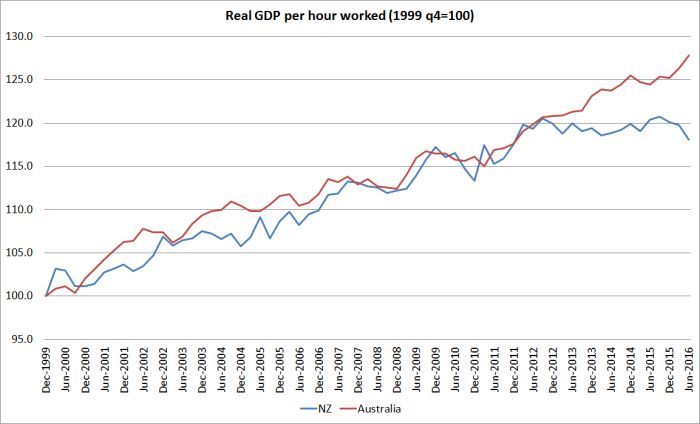
One of the charts I’ve run a few times in the last few months has had a bit of extra coverage in the last few days.

real-gdp-phw-to-q2-2016

It is a pretty straightforward chart (although it would be a little easier if SNZ followed the practice of the ABS and reported the series routinely, rather than leaving it for people to calculate).  I simply averaged the expenditure and production measures of real GDP, and divided the results by the total number of hours worked (from the HLFS).  And real GDP per hour worked itself is a pretty standard measure of labour productivity.

The interest, of course, has been in the now four years or so of no growth in labour productivity.  On the face of it, it is a pretty poor performance and tends to act as something of a counterpoint to a focus by the government (and its business and media cheerleaders) on headline GDP numbers –  which are high largely because the population has been growing so rapidly, rather than because resources are being used more productively.  Productivity is, in the long run, almost everything when it comes to improving material living standards.

I would add a few caveats around the chart, some of which I’ve made here before.  The first is that the very final observation should be heavily discounted or ignored.  SNZ introduced a revised HLFS methodology in June, which has resulted in a step up in the number of hours recorded (perhaps by around 1 to 1.5 percentage points).  At some point that might be reflected in a slightly higher level of GDP, but for the moment there is just an inconsistency.  (And, of course, there is always some quarter to quarter volatility in the data too.)

The second caveat is the old warning that when a number looks particularly interesting it might well be wrong.  Four years of no productivity growth at all is not unprecedented here or abroad (on current data, for example, GDP per hour worked in the UK now is only around 2007 levels) but….these series are prone to revision, and while they could be revised either up or down, it shouldn’t greatly surprise us if the picture for 2012 to 2016 looks a bit different when we review the data a few years hence.

The big revisions tend to happen as a result of the annual national accounts.  Statistics New Zealand gets a lot more detailed data, produces full annual data once a year (including revisions to earlier years), and then updates the quarterly series that have already been published.  The annual data for the year to March 2016 are out later this month, and the revised quarterlies will presumably be available with the September quarter GDP release next month.  Expect changes (including in the chart above).

But for now, the data is as it is.  Bernard Hickey gave the chart some prominence, with the editorial comment “We’re just pumping more low wage workers in the economy and working more hours”, and observing “Jobs soaked up by net migration & more >65 yrs working”

That prompted Eric Crampton of the New Zealand Initiative, writing on his Offsetting Behaviour blog,  to produce a post asking whether compositional changes in the labour force might account for some or all of the weak productivity growth in recent years.  As he quite rightly notes, if a lot of very unskilled people started working lots more hours (in total), while higher skilled people worked the same number of hours, at the same real output, average real GDP per hour worked would fall even though no one individually was less productive.

First, Eric noted that the number of people on welfare benefits has fallen quite a bit over the last few years.  If –  as seems reasonable –  those people had been of below average productivity, that might tend to lower overall productivity somewhat.

But here is my problem with that story.

working-age-benefits

Working age beneficiary numbers have certainly fallen over the last few years, but they rose a lot during the recession.  There is seasonality in the data so I’ve only shown one observation per annum (June), but in June this year the share of the population of working age on welfare benefits was almost exactly equal to the share as the recession was getting underway in 2008.  People moving on and off benefits might affect average labour productivity to some extent, but absent any sign of an upward surge in productivity over, say, 2008 to 2010 it is difficult to believe this effect explains much of the recent absence of productivity growth.  (And, of course, the decline in beneficiary numbers doesn’t appear to have been in the faster than in the five years leading up to 2008).

Eric also includes a graph showing changing employment rates for different age cohorts, observing

The youngest workers are least productive. They hugely dropped out of the labour market with the changes to the youth minimum wage, but that decline’s since reversed a bit. There’s been a long trend growth in hours worked among older workers, but typical wage patterns over the lifecycle have wages flattening out from the early 50s or thereabouts. Big increases in employment rates among cohorts with lower than average productivity, or at points in the life cycle where wage profiles (and presumably productivity) flatten out, will both flatten or worsen GDP per hour worked.

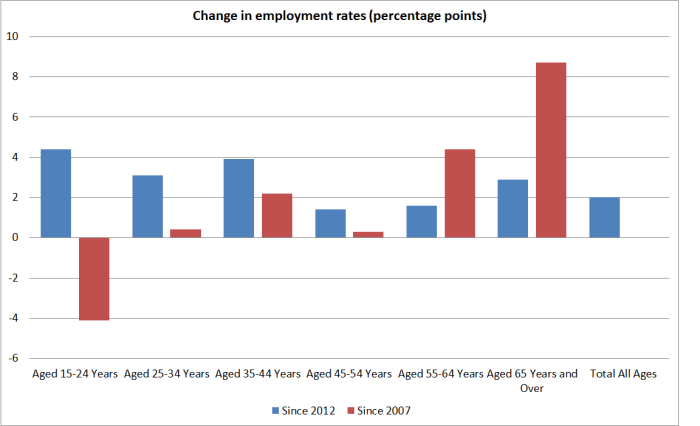
What to make of that?  Here is a chart of the changes in employment rates for each age group, both since 2012 (when productivity seems to have gone sideways) and since 2007, just before the last recession –  and it isn’t a misprint/error; we’ve had no change in the employment rate over the full period from 2007 to 2016.

employment-rates-by-age

Over the last four years, the least productive age group (15 to 24) had the largest increase in employment rates,  and the 65+ employment rate has kept on growing quite a bit.  But….employment rates for 25 to 44 years olds increased quite a lot too (more than the over 65s).    And if we take the full period (Sept 07 to Sept 16), we’ve had a big drop in the employment rate for the lowest productivity age group.  That fall was, of course, concentrated in the first half of the period, but there was no obvious corresponding surge in average productivity at that time (granting that one never knows the c0unterfactual).

And by New Zealand standards, there is nothing very obviously unusual going in the 65+ employment rates.  Between 2007 and 2016 the 65+ employment rate rose by 8.7 percentage points. In the previous nine years, it has risen by 8.1 percentage points.

Perhaps one could dig deeper (if the data existed) and the impression might change, but it isn’t obvious that the changing age composition of the workforce can explain four years of no labour productivity growth.

Sometimes people suggest that perhaps our labour market is performing so much better than those of other advanced countries which might in turn explain the poor productivity growth.   But here is a chart showing employment rates for New Zealand, Australia, and the median OECD country.

oecd-empl-rates

There might be something in the story relative to Australia over the last few years.  But comparing New Zealand with the OECD median, our employment rate fell about as much as that median did during the recession, and has rebounded only slightly more since.  Compare New Zealand and the typical employment rate just prior to the recession and almost half of OECD countries have had more of an increase than (the slight rise) New Zealand has had.

Eric also suggests that we need to think about the role of immigration

And, obviously, net migration’s increased over the last few years. New workers getting settled in New Zealand might take a bit to find their feet as well, while still being better off than they were before.

Just two thoughts.  First, around half the huge swing upwards in net inward migration has been the result of the sharp decline in the number of New Zealanders leaving.  They won’t have taken “a bit of time to find their feet”.    Second, for the other migrants, there might be something to the story (although there hasn’t been much variability in the number of actual residence approvals) through, for example, the increased number of foreign students working and people on working holiday visas.  But….the New Zealand Initiative and other business lobby groups can’t really have it both ways. They often tell us it is imperative that we have the sort of immigration policy we have now, because (for example) New Zealanders just can’t, or won’t, do the work (at a price firms can afford). There is a strong hint in that sort of argumentation that immigrants are on average actually quite highly productive relative to natives (even though the data show that for most immigrant groups it can take decades for the earnings to reach those of similarly qualified, similarly experienced New Zealanders).

I wouldn’t rule out the possibility that the compositional effects resulting from immigration are part of the explanation for the latest productivity slowdown (although we didn’t see something similar when Australia had its huge surge) but….if the Initiative is right about the general economic payoff to high immigration, we should be expecting a pretty big lift in average labour productivity (the more so to make up for four years of no growth) really quite soon.

One other lens on the composition issue is offered by our own official annual productivity data (for the “measured sector” rather than for the whole economy).   SNZ produces both labour productivity and multi-factor productivity estimates, and they also produce both series using both total hours worked and an estimate that attempts to adjust for the changing composition of the labour force.   The latter isn’t precise by any means, and won’t pick up all the sorts of issues that have been touched on in this post, or Eric’s, but they are just another angle on the question.  The MFP numbers are valuable because they help get round the question of whether, say, labour productivity is just poor because firms have substituted away from capital towards abundant labour.  Any such substitution would be less troubling if the result was showing strong MFP growth.

Unfortunately, the most recent data are for the year to March 2015.  In the labour productivity data, SNZ weren’t detecting any sign that a worsening average quality of the labour force was explaining the productivity slowdown – they reported much the same improvement in the average quality of the labour force as in earlier years.  And here is the MFP chart.

mfp-measured-sector

On this measure, of labour-quality adjusted MFP, there has been no productivity growth at all since around 2006.    There is some modest growth over 2012 to 2015 (a bit over 1 per cent over three years).

Where does all this leave us?

I remain a bit uneasy about the prospects the data could be revised, but then data revisions are always a risk.  But if the average real GDP per hour worked data are roughly right – and there really has been no average labour productivity growth for perhaps four years now –  I think we should be more inclined to believe that it is telling us something about overall economic underperformance, than that it is simply, or even largely, reflecting compositional changes in the labour force. To repeat:

  • the share of working age welfare benefit recipients has fallen gradually over the last few years, but then it rose in the previous few years, and there was no obvious associated productivity surge,
  • over the last few years the employment rates of the low productivity young age groups have risen, but not noticeably faster than those for, say, the rather large 25 to 44 age group.  Over 65s employment rates are rising more than those for other age groups, but that change has been underway for many years.  There was no obvious associated productivity surge (at least in the reported data) when youth employment rates dropped sharply.
  • there is nothing in cross-country comparative data suggesting employment rate changes here have been unusual, in ways that might help account for unusually weak productivity growth here.
  • compositional effects resulting from increased immigration of non-citizens (especially  working students and working holidaymakers) could be part of the story (averaging down real GDP per hour worked, even if no one individually is less productive), although it would be worth testing that story against other episodes in other countries.  If higher immigration is playing a role in dampening productivity growth, I suspect it isn’t mostly a compositional story, but one about overall pressures on domestic resources, which have contributed to holding up real interest rates (relative to those in other countries) and the real exchange rate.
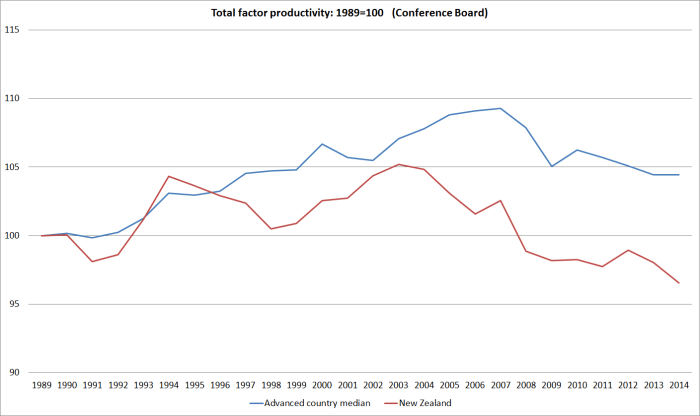
  • and overall MFP growth –  whether SNZ estimated for the measured sector, with some labour composition effects accounted for, or the Conference Board’s estimates that I showed the other day – also seems to have been weak to non-existent.


Interest rates, supply restrictions, and house prices

There was an interesting post from Peter Nunns on Transportblog the other day, attempting a bit of a back-of-the-envelope decomposition of how various factors, including land use restrictions, might have contributed to the rise in real Auckland house prices over the 15 years since the end of 2001.

Nunns starts his decomposition with the suggestion that:

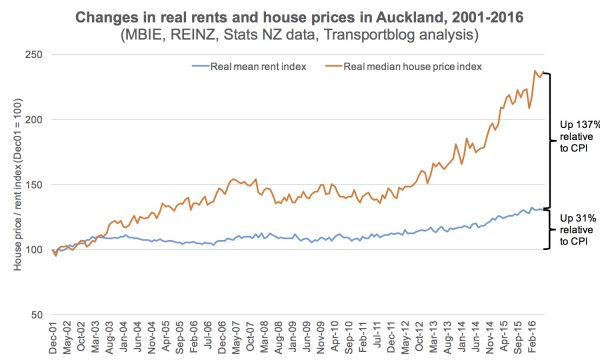
One simple way to disentangle these factors is to look at the relationship between consumer prices, rents, and house prices:

  • When rents rise faster than general consumer prices, it indicates that housing supply is not keeping up with demand
  • When house prices rise faster than rents, it indicates that financial factors – eg mortgage interest rates and tax preferences for owning residential properties – are driving up prices.

and with this chart

nunns-1-auckland-real-house-prices-and-rents-2001-2016-chart-600x360

Disentangling the contribution of various factors isn’t easy.  A lot depends on what else one can reasonably hold constant.  Nunns seems to assume that holding real rents constant is a reasonable benchmark, and that we can then think about the change in net excess demand for accommodation by looking at deviations from that benchmark.   Thus, roughly, he suggests that a 31 per cent increase in house prices can be accounted for by supply shortfalls.

Over this period, I’m not at all convinced that is right.  Why?

Largely because of the big changes in long-term interest rates, which –  all else equal –  should have affected supply conditions in the rental market.  Specifically, when interest rates fall a long way it is a lot cheaper than previously to provide rental accommodation (the available returns on alternative assets having fallen so much).

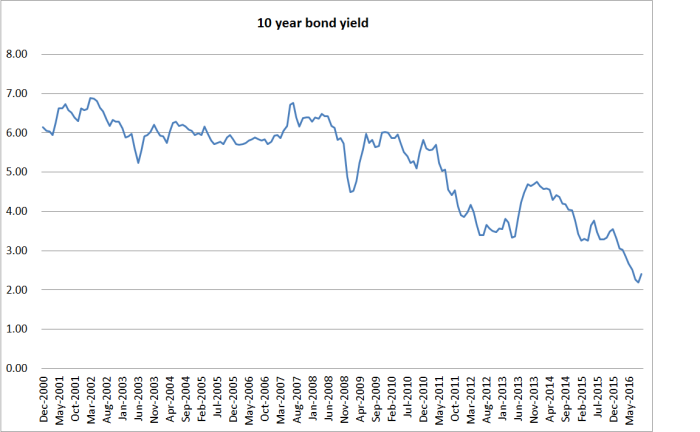
And what has happened to interest rates over this period?  Well, here is a chart of the 10 year bond rate since the end of 2000.

10-year-rate

There is always a bit of noise in the series, but long-term nominal government bond yields are now about 350-400 basis points lower than they were in 2001.  A little bit of that is falling inflation expectations (around 50 basis points according to the Reserve Bank survey).  But fortunately in 2001 we also had a 14 year government inflation-indexed bond outstanding, and we do so now as well.  In late 2001, that indexed bond yielded about 4.6 per cent, and the current yield is around 1.6 per cent.  Real long-term bond yields look to fallen by at least 300 basis points (and around two-thirds of that fall has taken place in just the last five years or so).

Short-term real interest rate haven’t fallen that much.  Short-term rates are more volatile, so here I use a two year moving average.

1st mortgage rate 6mth term deposit rate
   Dec 2001 7.99 5.86
  Sept 2016 6.14 3.59

Even on these measures, real interest rates have fallen by perhaps 1.5 percentage points.

In a well-functioning housing supply market, those sorts of falls in real interest rates might reasonably have been expected to be reflected in lower real rents.

Quite how much a fall one might have expected in such a market will depend on a variety of assumptions one makes.  But if landlords had been looking for an 8 per cent annual real return on rental properties back in 2001, then even a 2 percentage point fall in real interest rates, might readily have been consistent with a 25 per cent fall in real rents –  in a well-functioning housing market.  If real risk-free rates have fallen by more like 300 basis points –  as the indexed bond market suggests –  that would be consistent with more like a 40 per cent fall in the rental cost of long-term assets.

These are all illustrative hypotheticals. They assume that new assets can readily be generated.  But in a well-functioning housing markets, new houses can be readily generated.  New unimproved land can’t be (there is a given stock, only what it is used for can be changed).  But in well-functioning housing markets, the unimproved land component of a typical new house+land package will be quite low.  Think of dairy land prices at perhaps $50000 a hectare and you start to get the drift.  All else equal, in well-functioning housing supply markets, when interest rates fall unimproved land values should be expected to increase, but the value of land improvements and houses shouldn’t be much affected at all.

But even that story is a cautious one (biased to the upside).  After all, interest rates typically fall for a reason –  big trend falls don’t occur in isolation.  One such factor is low expected future returns (eg lower expected rates of productivity growth).   And interest rates are not a trivial factor in the cost of land improvements, associated infrastructure, and house building itself.  Again, all else equal, lower interest rates should lower the real cost of bringing new houses onto the market –  reinforcing the expected fall in real rentals.

Of course, this is so detached from the reality of Auckland (or New Zealand more generally) housing markets that it is difficult to even envisage such a scenario.  We have land use restrictions  –  which tend to produce high land prices and high rents –  and when those restrictions run head on into severe population pressures (especially unanticipated ones), it is hardly surprising that house and land and rental prices rise.  But when that clash (between land use rules and rising population) occurs at time when real interest rates have been falling a lot, looking at trends in rents can badly confuse the issue.

I’m not wedded to a story in which all the increase in real house prices in recent years is down to supply restrictions interacting with rapid population growth.  In his piece Nunns notes a couple of other possibilities

some other ‘financial’ explanations could include:

  • New Zealand’s tax treatment of residential property, and in particular investment properties – unlike many of the countries we ‘trade’ capital with, we don’t have any form of capital gains tax on property. All else equal, this means that we should expect structural inflows of cash into our housing market, driving up prices
  • The impact of ‘cashed-up’ buyers coming in without the need to borrow money to invest in properties – including, but not limited to, foreign buyers.

But….our tax treatment of investment properties has become less favourable not more favourable over the last few years  (reduced and then abolished depreciation provisions, the introduction of the PIE regime, lower maximum marginal tax rates.  If these arguments have force at all –  and they typically don’t when supply is responsive –  they should have worked in the direction of (modestly) lowering house prices over the last decade or so.

And while I suspect there is something to the “cashed-up foreign buyer” story, again any such demand only raises house prices when supply is unresponsive.  If supply is responsive –  which it would be without all the land use restrictions –  such demand would be just another export industry.

Of course, the common story is that lower interest rates have raised house prices.  And perhaps they have to some extent, but (a) recall that interest rates are lower for a reason, and real incomes now (ie the expected basis for servicing debt) are much lower than would probably have been expected a decade ago, and (b) lower real interest rates do not raise the equilibrium price of even a long-lived asset if that asset can be readily reproduced.  In well-functioning housing markets, houses can be, and unimproved land is a small part of the total cost.  If lower interest rates raise house prices, it is only to the extent that land use and building restrictions make it hard to bring new supply to market.  (As it happens, of course, in much of New Zealand real house prices are no higher than they were a decade ago when interest rates were near their peaks.)

To a first approximation, trend rises in real house prices are almost entirely due to supply constraints.  There can be all sorts of demand influences –  some government-driven, some not –  and it can be useful to identify them, but in well-functioning housing supply markets they don’t generate rising real house prices.

atlanta-2

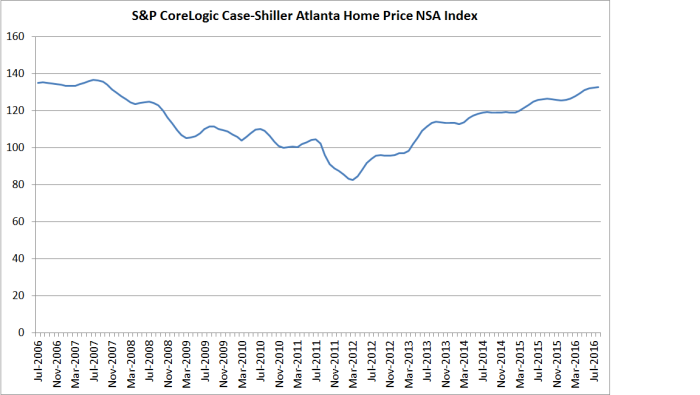
As just one illustration, here is a chart of nominal house prices for Atlanta over the last decade. Atlanta has had rapid population growth, has experienced significant falls in real interest rates (like the rest of the US), is in a country with mortgage interest deductibility for owner occupiers, and is not obviously a worse safe-haven for Chinese money fleeing the weak property rights of China, and yet nominal house prices are no higher than they were in 2006.


What’s good for Australia is good for New Zealand

But that is not what the FTAlphaville blog would have its international readers believe.

It is always interesting when serious foreign media write about New Zealand.  Sometimes there are useful perspectives we just don’t see.  Then again, when they get things wrong about things you know about, it leaves me wondering about the coverage of things I don’t know so much about.

Yesterday, the Financial Times’s Alphaville blog ran a piece by Matthew Klein headed “What’s bad for Australia is good for New Zealand”.   Klein seems interested in New Zealand and has written a few other posts in recent months.  In this one he draws on a recent speech by Reserve Bank Assistant Governor, John McDermott, but what is wrong with this post is almost entirely the author’s own work.

He begins with this Reserve Bank chart of the Bank’s estimate of the rate of potential output growth for the last 15 years or so.

NZ-potential-output.png

Potential output estimates have changed quite a bit as we have moved through time (and actual past estimates have been revised to some extent).  The Bank published a useful paper on estimating potential output and the “output gap” a couple of years ago.   The biggest single factor explaining fluctuations in potential output growth over time has been swings in population growth –  very strong around 2003, very strong over the last year or two, and much more subdued in between.  Changes in trend productivity growth also matter, but they are harder to detect.   But that slowdown has been real –  population growth in the last year or two has been at least as fast as it was in the early 2000s and the Bank’s estimate of potential output growth is much lower than it was then.  And as Paul Krugman helpfully reminds if, if productivity isn’t everything, in the long run it is almost everything.

But Matthew Klein seems impressed by those 2.6 per cent potential output growth rates –  much stronger than they were a few years ago –  and seems unbothered whether that is the result of more people, or of more productive use of people (and other resources). The difference matters.

Klein’s story is that the Chinese (demand-driven) hard commodity boom was a terrible thing for New Zealand, and we are now reaping a windfall from the end of that boom.

China’s changing investment strategy has produced a windfall for New Zealand — through the unexpected channel of clobbering the Australian mining sector.

Now I suppose there could be some channels through which the end of that commodity boom might have helped New Zealand and New Zealanders.  We import some of those hard commodities too (although of course, we do export some and look what became of Solid Energy).  To the extent that slowing Chinese growth might have contributed to lower oil prices, we benefit from that.  But these aren’t at all the channels Klein has in mind.  On his telling, we have done well because Australia has done badly.  And that seems inherently unlikely given that Australia is the largest trading partner for New Zealand businesses, and the largest source of foreign investment in New Zealand.

But Klein’s story is one in which New Zealanders fled for greener pastures in Australia when commodity prices boomed, and stopped doing so when commodity prices fell.  He runs this chart.

nz-emigration-to-aus-vs-aus-usd-commod-prices

Note that (a) it shows only the flow of New Zealanders to Australia, not the net trans-Tasman flow, and (b) it shows only Australian commodity prices, not the relative Australia/New Zealand prices.

Here is a longer-term chart showing the relationship between the net trans-Tasman migration flow (NZ and Australian citizens) and the relative terms of trade (Australia’s divided by New Zealand’s).

transtasman-tot-and-migration

Over decades there have been big cyclical fluctuations in the net migration flow across the Tasman.    Allowing for the fact that our population is much larger now than it was, say, 25 years ago, the peaks and troughs don’t seem to have become larger than they were.   And most of the time, there haven’t been big changes in relative commodity prices to explain the migration fluctuations.

Generally, a better story explaining the trans-Tasman flows over recent decades would seem to be:

  • in typical years there is a fairly large net outflow from New Zealand to Australia (material living standards are simply higher there),
  • when unemployment rates in Australia are very low, the outflow is higher than usual, even if unemployment is low here (job search across the Tasman is easier than usual, and those wages are higher).  In 2007/08, for example, the unemployment rate in Australia was the lowest in decades, as it was in New Zealand, and New Zealanders still seized their opportunities,
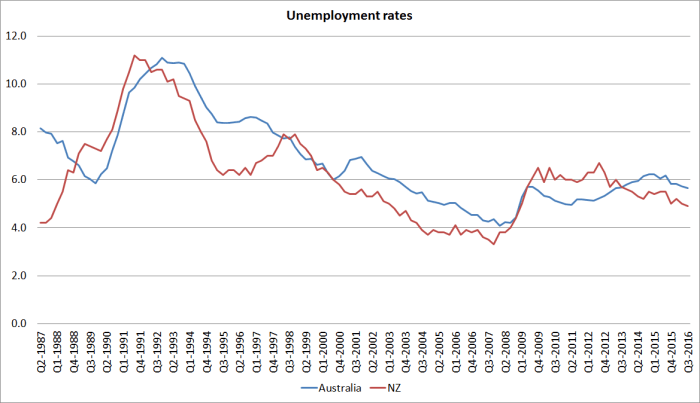
  • when unemployment rates in Australia is very high that net flow dries up –  people are reluctant to leave existing jobs when the job search across the Tasman is likely to be longer and costlier (as we saw in 1991),
  • and when Australia’s unemployment rate is lower than New Zealand’s –  which doesn’t happen often – it again makes it very attractive for New Zealanders to go, especially if New Zealand’s unemployment rate is still on the high side.  The largest such gap in the last couple of decades was 2010 to 2012, which saw large scale outflows of New Zealanders resume.

Since then, of course, the unemployment rate in Australia has risen, and that in New Zealand has fallen. In both countries, unemployment is uncomfortably high, and above the respective estimated NAIRUs.  Perhaps it is a little surprising that the net outflow of New Zealanders has, for now, come back to around zero, but there has also been a lot more publicity in recent years about the relatively insecure position New Zealanders can find themselves in in Australia if things don’t go well.  But it would still be surprising if when both countries have unemployment rates are back at the respective NAIRUs there wasn’t typically a large net outflow of New Zealanders resuming.  After all, there has been no progress at all in closing the productivity gaps.

relative-u-rates


No doubt the hard commodity boom, and associated domestic investment boom, did contribute to the relatively low unemployment rate in Australia over 2010 to 2012.  But macro policy (especially monetary policy) also plays a big part in deviations of the unemployment rate from the level the underlying regulatory settings might deliver (the NAIRU).  In New Zealand, for example, the inflation outcomes quite clearly illustrate the monetary policy was tighter than it needed to be over that period.  Some of that was only clear in hindsight, and the earthquakes also muddied the water, but we didn’t simply have to live with such a high unemployment rate for so many years (which reinforced the incentive for New Zealanders to leave).

But, to stand back, perhaps the more important question to ask is why Klein thinks New Zealand is better off simply because the net outflow to Australia has temporarily ended.

After all, New Zealanders going to Australia presumably do so because they think the opportunities are better there (and most objective measures of material living standards suggest they are right).  If opportunities deteriorate in Australia –  cyclically or structurally –  that isn’t a gain for New Zealanders, but a loss.  Fewer of them are, for now, able to take advantage of the opportunities across the Tasman.  It would be different if there were New Zealand specific positive productivity or terms of trade shocks  that meant that prospects here were improving faster than they had been previously.  But there is just no sign of that: as just one indicator, there has been no growth at all in real GDP per hour worked in New Zealand for around four years.

Of course, it might count as a gain if there was some sort of community goal to simply increase New Zealand’s population as fast as possible.  One sees those sorts of arguments in various countries from time to time –  there was a particularly daft Canadian example the other day  – but unless New Zealand is gearing up to defend itself from a military invasion from Antartica, the only good case for pursuing a larger population is if doing so makes us economically better off (higher productivity and all that).  And there is simply no evidence it has, or does –  whether in past decades, or in the latest population surge.

And all this is before reverting to the point that New Zealand firms trade more with Australian firms and households than they do with those in any other country. Australia is New Zealand’s biggest export market.  And so when Australian income growth tails off rapidly, as it has in the last few years, it isn’t very propitious for New Zealand firms hoping to increase their sales in Australia.  Weaker income growth in target markets is generally thought to be bad for the sellers (and their country) not good.

Here is a chart showing the net migration outflows for a longer period.

net-migration-charts

I’ve shown a variety of measures of trans-Tasman flows, and one of all NZ citizen flows everywhere.  They are all highly-correlated, as trans-Tasman flows almost always dominate the overall movements of New Zealand citizens.  There have been three times in the nearly 40 years for which the citizenship data have been available when the net outflow of New Zealanders has temporarily abated:

  • around 1983, when Australia was in recession and its unemployment rate was over 10 per cent,
  • in 1991, when both countries had a severe recession and both countries’ unemployment rates peaked around 11 per cent,
  • and in the last couple of years.  It is unusual in that neither country has been in recession, but both countries have had unemployment rates above the respective NAIRUs, in both countries income growth is much weaker than it was (particularly so in Australia) and in both countries (as in much of the advanced world) productivity growth has disappointed (most especially in New Zealand).

Not one of those occasions could be considered good news stories for New Zealand or New Zealanders.  Over the last 40 years, net outflows of New Zealanders to Australia have been something of a release valve –  Australia gave them opportunities New Zealand could no longer provide.  Unless and until New Zealand really begins to turn itself around structurally, anything that disrupts that outflow is more likely to be bad for New Zealanders than good.

Klein concludes his piece thus

As long as New Zealand is capable of boosting domestic spending without relying too much on household borrowing, admittedly a nontrivial challenge, this puts the country in an enviable position compared to much of the rest of the rich world. Policymakers should enjoy it while they can.

Given that household credit has been growing at almost 9 per cent in the last year, mostly reflecting very rapid increases in already high house prices, and that there has been no productivity growth for years, all while the unemployment rate has lingered above the NAIRU, I’m not at all sure what Klein thinks policymakers should be enjoying.  Perhaps write-ups like his – while they last –  but there doesn’t seem to have been much in the story for New Zealanders in recent years.

Here is the productivity growth comparison with Australia.  If anything, the latest relative deterioration seems to coincide with the end of the Australian commodities boom. I doubt that relationship is really causal, but it certainly doesn’t seem to help Klein’s story.

gdp-phw-nz-vs-aus

In general, what is good for the economy of our largest trade and investment partner will, almost always, be good for New Zealanders too.  That is how trade, and open markets, work.

NZ interest rates: why are they persistently higher than those abroad?

In my post yesterday, I noted (with illustrations) that looking back over at least the last 20 to 25 years:

…our interest rates (a) are and have been higher than those abroad, (b) this is so for short and long term interest rates, (c) is true even if we look just at small countries, and (d) is true in nominal or real interest rate terms.  And the gap(s) shows no sign of closing.

Not much about that is really controversial at all.  But quite why these gaps have been large and persistent is more contested.  It isn’t the sort of stuff the mainstream media focuses on –  they tend to be more interested in the historically low level of (New Zealand and foreign) interest rates –  but getting to the correct answer matters, not just analytically but in thinking about policy responses to New Zealand’s long-term economic underperformance.

In thinking about the issue, it is important to bear in mind a few things:

  • short and long term interest rates are related, and there can be information in the relationship between them,
  • short-term interest rates are set by the central bank in response to (perceived) domestic inflation pressures, and
  • interest rates in different countries are related at least in part, by expectations (implicit or explicit) about movements in the exchange rates between those two countries’ currencies.

Broadly speaking, I think there are three hypotheses that are canvassed when these issues are discussed in New Zealand (and there is a fourth, suggested by some recent literature, that a few commenters here have raised).

But first, lets clear away some of other possible answers.

The explanation isn’t domestic monetary policy.  Sometimes people have argued that (a) our target was more demanding than those in other countries, or (b) that our Reserve Bank was excessively “hawkish”, inclined to see inflation under every stone, and so holding short-term interest rates persistently higher than they need to be.  In fact, our inflation target is very similar to those in most other advanced countries.  The Reserve Bank makes mistakes – sometimes they even persist for a couple of years –  and sometimes gaps between our interest rates and those abroad are affected by those mistakes. But other central banks make mistakes too (all of them are human, with much same limitations).  And taking a longer-term perspective, on average over time our Reserve Bank actually delivered inflation outcomes a bit higher than the target they’d been given.  Given the target, monetary policy (pre-2008/09 was typically a little loose  (since then it has probably been a little tight).   All in all, differences in monetary policy conduct or targets just can’t explain those persistent differences in real interest rates.

There is another possibility that be cleared away even more quickly.  If a country had very strong persistent productivity growth it would tend to have higher interest rates than would be seen in other countries.  There would be lots of profitable investment opportunities in that high productivity growth country, lots of (expected) income growth to consume in anticipation of, and so on.  And over time, that high-productivity growth country could expect to see its real exchange rate rise.  Unfortunately, high productivity growth isn’t the story of New Zealand in the last few decades.  Indeed, more often rather the reverse.

Here is a chart I haven’t shown for a while: total factor productivity for New Zealand and for a median of the large group of advanced countries for which the Conference Board has estimates back to 1989.

tfp-oct-16

Rapid productivity growth isn’t even close to a relevant story explaining New Zealand’s persistently high real interest rates.

There is another possible story which hasn’t really entered the mainstream of the New Zealand debate, but should be covered off for completeness.  It notes that New Zealand is a small country, with quite a volatile terms of trade, and that the currencies of such countries offer less good diversification opportunities, suggesting that anyone investing here would require a higher return than elsewhere.  It sounds initially plausible, but it has a number of problems.  The first is that our interest rates have been persistently higher than those in other not-large countries with their own currencies (I showed the chart against the median on Australia, Canada, Sweden, and Norway in the previous post).  And the second is that if this were an important channel, it would suggest that small countries face a higher cost of capital than large ones, which would limit the growth prospects of small countries.  But (badly as New Zealand specifically has done) there is no real sign that small countries typically grow (per capita, or per hour worked) more slowly than large ones.  At present, I don’t think it is a particularly strong candidate to explain New Zealand’s persistently high interest rates.  Apart from anything else, if this were the story, why would New Zealand have accumulated –  and maintained – such a large negative net international investment position (NIIP) (still among the largest of the OECD countries)?

Perhaps somewhat related, but from an older set of models, is the idea that New Zealand has some combination of persistently good investment opportunities, and modest national savings rates, and requiring foreign funding for such opportunities needs to pay a premium rate of return. It is nothing to do with specific New Zealand risks (small, volatile etc) simply that capital needs a premium to attract it away from home, no matter where home is.  Again, it sounds plausible, but runs into some problems.  Perhaps the most important is that this story cannot explain why the real exchange rate should also have been persistently high  (on a pure time series basis for at least the last decade, but relative to the growing productivity differentials for rather longer than that).   Typically, part of the way New Zealand might attract the foreign capital it needs is through some mix of a lower (than usual, or easily explainable) exchange rate, and higher interest rates: from a foreign investor’s perspective it is the total return that should matter, not just the interest rate.  Senior Reserve Bank people have, at times, sought to invoke this explanation as at least part of the story.

A more prominent explanation for New Zealand’s persistently high interest rates points to the large negative NIIP position and asserts that the explanation for high interest rates is pretty straightforward: lots of debt means lots of risk, and hence the need for a substantial risk premium on New Zealand interest rates.  Taken in isolation –  if someone told you only that a country had a large negative NIIP position this year –  it might sound plausible.  Once you think a bit more richly about the New Zealand experience it no longer works as a story.

First, our NIIP has been large (and negative) for a very long time now –  for at least the last 25 years, and over that time there has been no persistent tendency for the NIIP position to get better or worse.  By contrast, 20 years earlier than that New Zealand had almost no net foreign debt.  The heavy government borrowing of the 70s and 80s had markedly worsened the position.  It is quite plausible that foreign lenders might then have got very nervous and wanted a premium ex ante return to cover the risk. In fact, we know some (agents of) foreign investors got very nervous –  there was the threat of a double credit rating downgrade in early 1991.  But when lenders get very nervous, borrowers tend to change their behavior, voluntarily or otherwise, working off the debt and restoring their creditworthiness.   And in New Zealand, the government did exactly that –  running more than a decade of surpluses and restoring a pretty respectable government balance sheet.  But the large interest rate differential has persisted –  in a way that it did in no other advanced country (including those that went through much worse crises and threats or crises than anything New Zealand has seen in the last 25 years).

We also know that short-term interest rates are set by the Reserve Bank, in response to domestic inflation pressures. But long-term interest rates are set in the markets.  If investors had really been persistently uneasy about New Zealand’s NIIP position, we might not have seen it much in short-term interest rates, but should certainly have expected to see it in the longer-term interest rates. (That, after all, is what we see in various euro countries that have lapsed in and out of near-crisis conditions).   But one of the other features of the New Zealand experience is that over the last 25 years is that New Zealand’s long-term interest rates have been a bit lower relative to New Zealand’s short-term interest rates, than is typically seen in other countries.   In one obvious place one might look for direct evidence of such a risk premium, it just isn’t there.

yield-gap-2016In fact, on this measure we look a lot more like Norway –  which has a huge positive NIIP position (net foreign assets) and very little government debt.

And remember, too, the point I made earlier about the exchange rate.  When risk concerns about a country/currency rise, one of the first things one typically sees –  at least in a floating exchange rate country –  is a fall in the exchange rate.  It is a bit like how things work in equity markets.  When investors get uneasy about a company, or indeed a whole market, they only rarely succeed in getting higher dividends out of the company(ies) concerned.  If the companies were sufficiently profitable to support higher dividends the concerns probably wouldn’t have arisen in the first place.  Instead, what tends to happen is that share prices fall –  and they fall to the point where expected dividends, and the expected future price appreciations of the share(s) concerned, in combination leaves investors happy to hold those shares. In that process, an increased equity risk premium is built into the pricing.

At an economywide level,  if investors had had such concerns about the New Zealand economy and the accumulated net debt position, the most natural places to have seen it would have been in (a) higher long-term bond yields, and (b) a fall in the exchange rate (and perhaps a persistence of a surprisingly weak exchange rate). But we’ve seen neither in New Zealand.  Had we done so, presumably domestic demand would have weakened, and net exports would have increased.  The combined effects of those two shifts would have been to have reduced the negative NIIP position, and reduced whatever basis there had been for investors’ concerns.  Nothing in the New Zealand experience over the last 20 years or more squares with that sort of story.

And that is the really the problem with the most common stories used to explain New Zealand’s persistently high interest rates. They simply cannot explain the co-existence of high interest rates and a high exchange rate over long periods.

My alternative approach seeks to do so.

It involves looking at the stylized facts and suggesting that perhaps they point in the direction of an abundant supply of credit from abroad (perhaps something almost like the horizontal supply curve of the textbooks), combined with some factors that give rise to persistently strong demand for scarce domestic resources.  That in itself shouldn’t really be terribly controversial.  There are pleasing stories which, if true for New Zealand, would produce that sort of combination.  If New Zealand individuals and firms were generating a world-beating stream of new ideas and business opportunities, business investment would be strong, productivity growth would be strong, and a “strong demand meets ready supply” story would have everyone nodding approvingly.    But….we know that productivity growth has been persistently weak (there are good years and bad ones, but the trend story is pretty disappointing) and business investment has also been weak (in long-term cross-country comparisons).  And with that disappointing productivity growth, households also wouldn’t have been rationally consuming in expectation of even stronger future income growth than we see in most countries.

So I’ve suggested looking at “demand shocks” instead, and particularly those that might arise from outside the system (the private economy), focusing on activities/choices/initiatives of government.   Governments are not as responsive to market prices as the rest of us.

Again, there is nothing overly controversial about this idea in principle.  A big increase in domestic government spending on goods and services, for example, will tend to push up the real exchange rate, and quite possibly push up domestic interest rates as well. My favourite example is prisons.  Relative to a no-crime hypothetical, a government that finds itself needing to build more prisons, needs to get command of the resources to build those prisons, and then staff them.  Doing so will tend to bid up the price of domestic goods and services (including labour) –  and raising the price of non-tradables relative to tradables is one of the definitions of the real exchange rate.  Resources used for building and staffing prisons (and actually, the people imprisoned and no longer in the labour market) can no longer be available for generating tradable products.  The higher real exchange rate squeezes some of that production out.

But my specific version of the demand story looks at our immigration policy.  Government decisions on how many non-New Zealanders too admit each year –  themselves largely reached independently of the state of the New Zealand business cycle – can be presented, quite reasonably as a “demand shock”.   The net impact of additions to the population from outside the system –  births are conceptually a little different –  tends to boost demand more than it does supply in the first couple of years after the migrant arrives.  And if there was simply one wave of migrants –  as in some of the events studied in the literature –  the effects would wash through fairly quickly.  But in fact, we have a new large wave each year, and have had really ever year since around 1990 (immigration was being liberalized over several years around that time).    Each new migrant needs –  just as they did at time Belshaw was writing – quite a lot of new physical capital (houses, roads, schools, offices, factories etc) and they bring almost none of it with them.  Additional demand for those real resources has to be met by squeezing out other forms of demand –  and that is what persistently higher real interest rates and exchange rate tend to do.  The fuller version of my story was in a paper I wrote a few years ago for a Reserve Bank and Treasury forum on exchange rate issues.

Some people worry that I must be assuming some irrationality or market failure (crutches which, quite rightly, economists are wary of relying on).  But I’m not.  Recall that the active agent here is mostly a body outside the market: the government, which for whatever reason decided that it wanted to bring in 45000 to 50000 non-citizens per annum.  The people who come are presumably being quite rational.  The people whose firms respond to new fixed capital demands (and other requirements of a growing population) are being quite rational.  There is quite real new demand in front of them.  The central bank which raises interest rates, and the markets which push up longer-term interest rates, are also presumably being quite rational.  There is more demand pressure in the New Zealand economy. Perhaps the one area in the story that is a bit of a surprise is that long-term interest rates haven’t stayed up as high, relative to short-term interest rates, as we might expect.  I’m not sure why that is –  but it is a hard observable fact, present in the data without any need to torture it first.

My own hypothesis –  and it is pretty tentative –  is that few people in international markets really realise the importance of persistently high immigration in boosting demand.  And most of them –  quite rightly – operate with a mental model that envisages convergence with world real interest rates in the long haul.  If immigration policy were overhauled and drastically cut back, exactly that sort of long-term interest rate convergence would occur.  In a way, it might be just as well that many investors haven’t quite realized –  over many years –  how persistently large the gap between New Zealand and world interest rates would remain.  If they had (or even did today), the rational response would have been to bid the exchange rate quite a lot higher than it has actually been.  Investors  –  and international agency experts –  have often expected New Zealand’s exchange rate to come down, partly because they kept, mistakenly, expecting the interest rate convergence that never happened (yet).  Expectations drive pricing, and if people think the interest rate gap will remain larger for longer, relative expected returns on different assets are only roughly equalized if the exchange rate goes still higher now, so that it can fall further some time in the future.

Is my story the correct one?  I don’t know, but I’ve been running it now for six or seven years, and as the ideas have had more exposure I’ve not been presented with any counter-arguments or evidence that would undermine my sense that “repeated demand shocks” (largely resulting from our immigration policy) are a material part of the story for why our interest rates have remained so persistently high relative to those in the rest of the world.  It is a difficult story to test in a formal empirical way –  something that probably frustrates me as much as it does some of the sceptics –  partly because it isn’t some generalized global story about all immigration everywhere, but about how events and policy interventions have unfolded in his specific economy, with its own specific set of other stylized facts (including, for example, the modest national savings rate).

Like all hypotheses, mine is put out in part to prompt reactions, to identify holes in other stories, and to help prompt alternative, perhaps richer, stories. For now, however, I’m pretty confident that mine is the only one of the stories on offer that can reasonably account for the combination of:

  • persistently high (relative to other countries) real interest rates,
  • a persistently high real exchange rate,
  • long-term interest rates lower relative to short-term rates than is typically seen,
  • a high (almost entirely private) negative NIIP position,
  • all over a period where productivity growth has continued to lag behind that seen in most other advanced countries.

It might not be the whole story, but it feels a lot like a significant step towards such a story.

New Zealand interest rates: persistently higher than those abroad (Part One)

New Zealand’s interest rates have been higher than those in the rest of the advanced world for decades.  Making sense of why is one element –  I argue an important one –  in getting to the bottom of why New Zealand’s relative economic performance has been so poor, and in particular why we’ve made up no ground relative to most other advanced countries in the last 25 years or so.  Our productivity growth has been slower than that of most other advanced countries, and after a disastrous few decades we entered the 1990s already less well off than the typical advanced country.

If we had good comparable data for the earlier decades (say 1950s to 1970s), and market prices had been free to reflect underlying pressures, our interest rates would have been higher than those in the rest of the advanced world then too.  Instead, we made much greater use of direct controls (on imports, credit, foreign exchange flows) than most advanced countries did.  We don’t really get comparable interest data again until the mid 1980s.

When I say that our interest rates have been higher than those in other advanced countries, I really mean “real” interest rates.  Differences in inflation rates really complicate the picture at times in the past –  in the 1970s and 1980s for example, New Zealand had some of the highest inflation rates in the advanced world.   But over the last couple of decades, inflation rates have been much lower and much more stable, across time and across countries. I could spend a great deal of time constructing estimates of “real” interest rates, but none of them would be ideal (eg there are no consistent cross-country measures of inflation expectations) .   And so the charts I’m showing in this post, will use nominal interest rates.  Where relevant, I will mention changes in inflation targets, actual or implicit.

And when I say that our interest rates have been higher than those in other advanced countries, I don’t necessarily mean “in every single quarter, against every single country”, but on average over time (actually, in the overwhelming majority of quarters, against the overwhelming majority of countries).   New Zealand’s OCR actually got as low as the US federal funds rate target in 2000 (both were 6.5 per cent), but it didn’t last more than a few months.  Changes in inflation targets do make a bit of a difference: in the early 1990s for example, we were targeting 1 per cent inflation.  Australia didn’t have an explicit target at all for a while, and when they adopted one it was centred on 2.5 per cent.  So our nominal short-term rates were somewhat relative to theirs in the early 1990s.   Adjusting for (say) differences in inflation target, our policy rates have been higher than theirs throughout the last 20 years, with the exception of the peak of mining investment boom.

The point of this series of posts isn’t really to establish that our interest rates are, and have been, higher than those in other advanced countries.  No one seriously contests that.  But just to illustrate the point briefly, here are a couple of view ofs the long-term bond yield gap.

long-term-bond-yields-0ct-16

One line shows the gap between New Zealand and the median of the all the OECD countries for which there is data since 1990 (ie mostly excluding the eastern European countries), and the other is the gap between New Zealand and the median of Australia, Canada, Sweden and Norway, four not-large countries that control their own monetary policy.

The gap is larger than it was in the early 1990s –  when we had an unusually low inflation target –  and even if you take just the last 20 years (or even the last 10) there is no sign of the gap narrowing.  There are cyclical fluctuations, of course, but our long-term interest rates are well above those in other advanced countries (with mostly quite similar inflation targets).

And here is the same chart for short-term interest rates (again, OECD data).

short-term-int-rates-oct-16

Again, no sign of any convergence occurring.  Even the latest observations (on which almost no weight should be put –  rates fluctuate) aren’t much different from the averages for the last 20 years.

And since commenters sometimes highlight small countries, here is the short-term interest rate gap between New Zealand and the median of the seven smallest OECD countries that have their own monetary policy for the last 20 years (a period for which the OECD has data for all of them).

short-term-rates-small-oecd-oct-16

So our interest rates (a) are and have been higher than those abroad, (b) this is so for short and long term interest rates, (c) is true even if we look just at small countries, and (d) is true in nominal or real interest rate terms.  And the gap(s) shows no sign of closing.

But the really interesting question isn’t whether our interest rates are higher, but why.  That will be the focus of the next post.


Housing reform, the Corn Laws and possibilities for New Zealand

Brendon Harre, who writes interesting and thought-provoking pieces on housing (including contributing from time to time to the new Making New Zealand housing blog), had another stimulating article out this week, titled Housing affordability: Reform or Revolution .  Harre is strongly of the view that supply-side reform of the urban land market is critical to making home ownership affordable again, but is particularly interesting because he comes at the issues from a left wing perspective: the sheer injustice of the sorts of house price outcomes we (and so many other similar countries) have experienced in recent decades.  He fears that if reform doesn’t happen, extreme populist movements –  the modern “revolution”  – could.

In his latest article, Harre picks up on a point I’ve made several times previously.  I’ve argued that it is difficult to be optimistic about the supply-side reforms happening in New Zealand any time soon, partly because there are few or no known precedents of countries or regions/cities (and certainly not from among the Anglo countries) undoing restrictive land use regulations once they have been put in place.  He links to a post I did a few months ago suggesting that perhaps Tokyo might have been something of a counter-example, but essentially accepts the point that, thus far, there few modern examples of successful supply-side land use/housing reform.  In pondering why this might be, and how it might be changed, Harre suggests thinking about other cases from history in which policy reforms have finally overcome longstanding resistance, to free-up markets and bring prices down.

In a New Zealand context, he could have thought about the eventual removal of the sort of heavy import protection which for decades meant that New Zealand was a rare country where cars were not only very expensive, but often held their value over time.  Or of the removal of most agricultural industry support in the 1980s.

But on this occasion he looked at the movement that led, over decades, to the repeal of Corn Laws (which tended to hold up the price of wheat, benefiting landowners but at the cost of urban workers and industrialist) in the United Kingdom in 1846.    You can read the story for yourself, and I’m not an expert in the area (although the few books I pulled off my shelf suggested a different emphasis in a few areas), but the lessons Harre draws are

What are the lessons from the campaign for affordable food?

  • Achieving a strategic alignment of a broad cross-section of social groups is important
  • Acknowledging that moderate incremental reform can prevent future radical revolutions.
  • If traditional media does not report on your campaign create new media. The Economist newspaper was founded by the British businessman and banker James Wilson in 1843, to advance the repeal of the Corn Law.
  • Simple clear statements/images with a strong moral message are effective.

Harre ends on an optimistic note.

For New Zealand to become a fairer society, we should learn the lessons from earlier struggles for economic, social and political justice. If these lessons were applied to New Zealand’s housing crisis, in my opinion affordable housing could be easily solved.

I remain rather more skeptical.  As a technical matter, housing price scandals (here and abroad) are easily resolved.  But the challenges aren’t technical, they are political.

Harre draws hope from the recent Obama administration initiatives to encourage states, cities, counties etc to rethink their zoning rules

President Obama has chosen to address supply restrictions by releasing a Housing Development Toolkit, advising States and local jurisdictions on how to best manage urban planning to achieve affordable housing. Some US cities are very restrictive, so these reforms may cause a measurable downward price correction, but it is too early to tell. There are both supporters and detractors for the President’s approach, which if followed to its logical conclusion by going from advice to a command would remove some aspects of planning autonomy from local government control.

But…the US federal government has no responsibility for zoning and other local land use laws, the Obama administration is weeks from ending, and there seems little appetite in the places that matter in the US to make the sorts of land use liberalisations that many economists favour.  Of course, it is good to see the Administration (even an outgoing one) pick up the issue, but substantively it might matter not much more than, say in a New Zealand context, the ACT Party favouring such reform.  And housing affordability isn’t such an issue in the US, no doubt partly because if New York or San Francisco are “unaffordable” there are other big fast-growing cities people can move to without such regulatory burdens.

I’m not sure that reform is inevitable, even with a decades-long perspective.  After all, awful as the current system is, it could maintain an uneasy equilibrium in which more people involuntarily rent than used to, people buy homes much later in life than they used to with more debt, and then –  on average –  they reap a transfer back from their parents late in life.   I don’t favour such an outcome, but after several decades already of progressively more unaffordable home ownership for the relatively young, there is still no sign of this becoming some sort of moral crusade for justice, let alone efficiency.

Reverting to the Corn Law process briefly, my British economic history textbook records that

By 1846 the Anti-Corn Law League was the most powerful pressure group  England had known, and upon their techniques of mass meetings, travelling orators, hymns and catechisms a good deal of later Victorian  revivalist and temperance –  even trade union –  oratory was based.

Translated into the language and style of a different age, I don’t detect anything like that at present around land use regulation (outright homeless is a little different).

As Harre, and the economic historians note, the rising “ideology” of free trade played a part – though not necessarily a decisive part –  in getting the Corn Laws repealed.  There was an alignment between that belief system and the cause of “cheaper food for urban workers”.  But in New Zealand –  or Canada, or Australia, or the UK, or most of coastal USA –  is there any sign of that sort of ideological movement around housing, cities etc?  I don’t detect it.  There is no sign of the rhetoric of choice, freedom, flexibility etc assuming a dominant role –  among the public let alone among the elites.  The talk is still endlessly of smarter planning, and top down visions for what cities and other urban areas should be like –  our own Productivity Commission put its imprimatur recently on local authority desires to plan cities.  If there is ever talk of reform, it is of targeted specific interventions, not of getting planners out of the way, and allowing markets to work.  In my own suburb, there is currently a process underway –  hours and hours of meetings between “community representatives” and the Wellington City Council –  on a 10 year plan for the suburb –  and no one seems to find this strange, not 25 years on from the fall of European communism.

This isn’t intended to be a counsel of despair.  Things can change, but there doesn’t at present seem to be a pressing demand for change –  and particularly not for the sort of regulatory changes that would really make a major sustainable difference.  That means if change is really going to happen any time soon, someone –  some party –  is going to have to be willing to spend a lot of political or reputational capital on making initially unpopular change.  And that cost is only rising with each passing month in which more households – in Auckland and increasingly elsewhere –  take on debt at the new higher house prices.  Falling house prices don’t actually threaten most of those people –  servicing is the real issue –  but that doesn’t stop the prospect sounding pretty frightening.

One obstacles to getting comprehensive land use reform is fear in some circles –  particularly on the environmental left –  about what post-reform cities might look like.  Many talk disdainfully of “sprawl” –  as if there is something profoundly wrong about people in a small, lightly populated, country wanting a decent backyard for their kids to play in etc.  But even when the attitude isn’t disdainful, it is often fearful –  how far will Auckland stretch, and all those questions about roads and other infrastructure.  If Auckland really is going to grow by another million people those issues become a lot more pressing than otherwise.  People can, and do, come up with all sorts of smart solutions –  differential rates, MUDs etc-  and I’m quite sympathetic to all those arguments.  But they don’t really resonate with the wider public, and some visceral unease about “sprawl” (and even the loss of “prime agricultural land”) seems to.  It isn’t only the public: the Green Party is likely to be part of the next non-National government.

Which is partly why I think any successful sustainable package of land use reforms, particularly in New Zealand, should be accompanied by a commitment to much lower rates of non-citizen immigration for the foreseeable future.  As readers know, my main arguments about immigration policy aren’t about house prices –  which can be “fixed’ with proper supply side reforms –  but if one of the real barriers to land use liberalization is unease about population-driven “sprawl”, why not just take the policy-driven component of population growth out of the mix for a few decades?  It is not as if the proponents of immigration can show the real economic gains to New Zealanders from our immigration policy, and we know that GDP per capita in Auckland has been falling relative to that in the rest of the country, not rising.    There is no hard trade-off, only the scope for mutually reinforcing packages of reforms that might finally make a more liberal approach to urban land use possible in New Zealand, if some political leader (or coalition of parties) is really willing to take the risk.

Individual political leaders can make a real difference.  It would be great if one would stake a lot on urban land use reform, but anyone considering it needs to recognize the lack of precedents, the potential losers, and the worries and beliefs that underpin the durability of the current model here and abroad. And they probably need to find not only the right language to help frame repeal choices and options, but find a package of measures which helps allay – even if only in part, and for a time –  the sorts of concerns some have.  Plenty of the elites don’t really believe in choice and freedom  –  especially for other people –  but perhaps they might be a little more relaxed if they weren’t (reasonably or otherwise) worrying about the idea of an Auckland that stretched from Wellsford to Hamilton.