Cry Freedom…but count the possible cost

As I noted in my post on Saturday, were I British I would be voting for Brexit, and so I’m pleased to see the polls moving that way.  Should that cause succeed, there is likely to be considerable disruption, both to Britain, the other EU countries, and to the wider world economy and financial system.  Perhaps it will be the episode which illustrates the point I and others have been making for several years: when interest rates are already at or very near the effective floor, and there is little fiscal room left, any new serious adverse shock will expose countries as having few tools left to respond.  Central banks and governments that have done nothing about removing the near-zero lower bound would then have something to answer for.

In the Telegraph a day or two ago, Ambrose Evans-Pritchard had a powerful column articulating his own reasons for voting to leave the EU.  It was all the more powerful because it recognized and gave full weight to the transitional disruptions that are all but certain, and to the possibility that even in the medium term there might be some economic costs.  The cause of freedom –  the ability to set one’s own laws, appoint one’s own judges, and toss out elected leaders  –  might have a price, and he thinks it is a possible price worth paying.

In my post the other day, I noted that there were other examples of people being willing to pay such a price.  By the end of the 19th century Ireland was an integral part of the United Kingdom, with full representation at Westminister and unrestricted markets in goods, services, people, and capital.  And yet the cause of Irish independence gained strength rather than abated, and the south eventually gained independence, as the Irish Free State, in 1922.   Ireland kept on using sterling, and kept close economic ties to the UK –  as one would expect, given the proximity of the two countries and the previously highly-integrated economies.  But no one thinks Irish independence was good for Irish material living standards in the subsequent decades.

Here are the data in the Maddison database for GDP per capita.  The first observation is for 1913, before the disruptions of World War One, and the subsequent unrest leading up to independence.

ireland real gdpI’ve also shown the data for 1929 (the eve of the Great Depression) and 1939 (the eve of World War Two, which Ireland stayed out of).  There is always a lot else going on, so the whole story of Irish relative economic decline isn’t (the policy choices/constraints that followed) independence.  But much of it was.   Today, of course, Irish real GDP per capita is higher than that of the United Kingdom.

Was independence a mistake?  Well, it had a cost, but most things people count worthwhile do.

I got curious about some other post-colonial episodes, each involved economies much less integrated with the UK than Ireland’s had been.

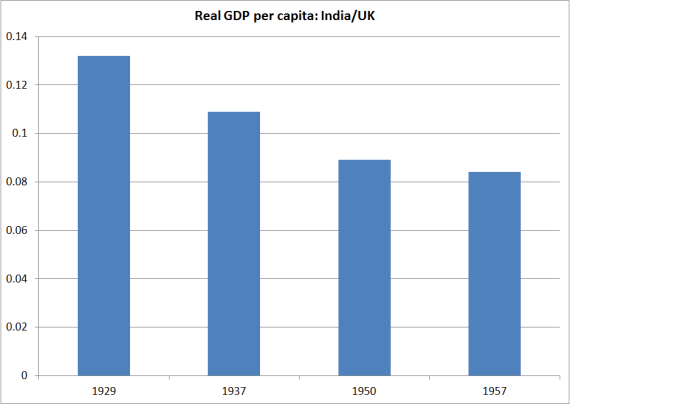
India, for example, became independent in 1947.  In the late 1920s, full independence probably appeared to be many decades away, and probably wasn’t influencing investment choices or other economic decision-making.

india

Independence came at a cost –  wars in addition to any economic cost – but with hindsight would the Indians have chosen continued colonial rule?  Almost certainly not.

I spent a couple of years working as an economic adviser in Zambia.  At independence in 1964, Zambia had had GDP per capita as high as those of South Korea and Taiwan.  By the early 1990s it was something of a byword for basket cases (Zimbabwe’s true awfulness was still to come).  But here are the comparisons with the UK –  not, itself, a great economic success story over these years.

zambia

There were a few people who regretted independence – my colleague, the (local) chief economist lamented to me one day that the British had left when they did.  But it wasn’t a very common sentiment (or one that was politically acceptable to voice).

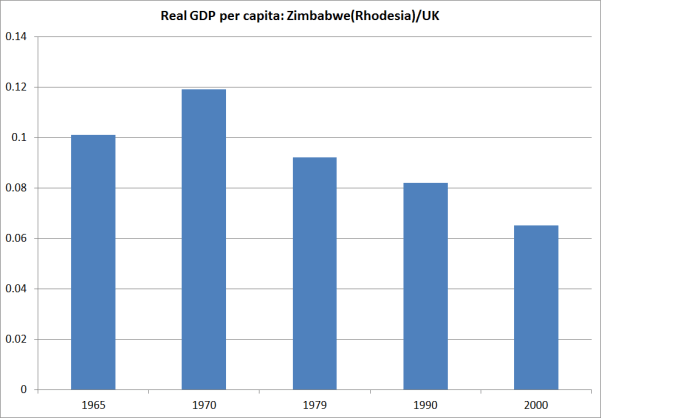
How about Rhodesia/Zimbabwe?  There was a two-stage process.  The white-minority government declaring unilateral independence in 1965, and then full legal independence with a universal franchise came in 1980.

rhodesia

In the first few years after the UDI there doesn’t seem to have been a material economic cost.  Those who supported UDI probably thought of it as some sort of win-win.  It didn’t last  –  the country soon descended into an insurgent war –  and of course the economic consequences after independence in 1980 are all too apparent.  I can imagine that quite a few Zimbabweans might really regret the course of the last 35 years –  though not, I imagine, too many members of ZANU-PF.

My final example is Bangladesh.  At Indian independence in 1947, what is now Bangladesh became East Pakistan.    But in 1971, after brief but awful war Bangladesh became independent.

bangladesh

Pakistan has scarcely been an Asian tiger –  model of economic transformation.  Bangladesh has done worse.

Inevitably this has been a rather limited exercise, focusing on countries in which I had an interest (NZ Baptist churches have had missionaries in what is now Bangladesh for 130 years), and where there is accessible –  if probably no better than indicative-  data.

I didn’t include New Zealand, Australia, and Canada because in all three cases there was no clear point at which the countries broke away from Britain.  It was an evolutionary process.  Perhaps in an ideal (economic) world, if Britain were going to pull back from the EU it would do so in a similarly evolutionary way.  But that option doesn’t seem to have been available.

And there may well be other examples of countries which flourished with independence –  Singapore is perhaps the striking example (although productivity growth in Singapore over say 1960 to 2000 was very similar to that in Hong Kong, which was British-ruled for almost all that period).  My point is not to argue that independence, or taking back parliamentary sovereignty, is inevitably or even generally costly.  I’m sure it isn’t.  But it can be.  And that may well be a price that citizens, even with hindsight, think is worth paying.

The relationship of Britain to the EU today isn’t that between, say, colonial Zambia and the UK, or even East Pakistan to West Pakistan.  But, equally,  Britain has strong established institutions and, if Brexit happens, every motivation, and plenty of opportunity, to secure pretty good economic outcomes.  If Brexit happens, I suspect that in 30 years time  –  perhaps 100 years time – scholars will still be debating what the long-term economic consequences of exit were (as indeed, they are still debating the economic consequences for Britain of entering the EU 43 years ago).  If so, perhaps the economic issues are not of first-order significance.


Stress tests really should reassure us…for now

Last year, in the course of the Reserve Bank’s faux consultations on its proposed investor finance LVR restrictions, I devoted several posts to the results of the Reserve Bank’s stress-testing exercise.  Those tests –  2014 ones –  appeared to show that, even if faced with a very severe adverse shock to (in particular) house prices and unemployment, the New Zealand banking and financial system would come through substantially unscathed.  “Substantially unscathed” here meant some significant loan losses, not typically enough to wipe out even a full year’s profit, and a decline in capital ratios –  the latter simply because in the models as house prices fell the assigned risk weight on each still-performing loan would rise (eg a loan that might have had a 60 per cent LVR at origination becomes a 90 per cent  LVR loan if house prices fall by a third).   But there was nothing that suggested a threat to the soundness of any of the banks, or the banking system as a whole.   That result should not have been too surprising.  Bank shareholders have considerable amounts of  their own money at stake and credit allocation in New Zealand is not distorted by large scale government interventions (unlike pre-crisis US, or Ireland).  Housing loan books typically don’t see huge losses even in really severe crises –  and there hasn’t been a mad rush of highly risky corporate or property development lending in recent years.  But if the  banks came through such tough stress tests in relatively good shape, what possible basis could there be for yet more rounds of direct regulatory controls, which inevitably impair to some extent the efficiency of the financial system?

The Reserve Bank was never really satisfactorily able to respond to this point, even when some media and MPs started asking the questions.  The Governor went ahead and regulated anyway.

And now he seems to want to do so again.

This year, the Reserve Bank has been back with some more stress test results.  I wrote about their 2014 dairy stress test results here.  That scenario, and the results, didn’t look sufficiently severe, and there are already signs of worse outcomes than those indicated by the stress tests.

And then in last month’s FSR, we had the results of another set of stress tests on banks’ entire loan portfolios.

In late 2015, the four largest banks in New Zealand participated in a common scenario ICAAP test. This test was a hybrid between an internal test (conducted regularly with each institution choosing their own scenarios) and a regulator-led stress test (occurring every 2-3 years with common scenarios and assumptions). Due to the use of a common scenario across banks, the results of the test provided insights for the financial system as a whole. However, the test featured less standardisation of methodology than a full regulator-led exercise. For example, there was no ‘phase 2’ where loss rates were standardised.

Like the 2014 regulator-led stress tests, the scenario used in this exercise was severe

As with previous regulator-led tests, the stress scenario was a severe macroeconomic downturn. Over a three-year period, real GDP fell by 6 percent, unemployment rose to 13 percent, and dairy incomes remained at low levels. Residential property prices fell by 40 percent (with a more severe fall of 55 percent assumed for Auckland); and both commercial and rural property values fell by 40 percent. Finally, the 90-day interest rate fell by about 3 percentage points due to monetary policy easing,

These are very demanding scenarios.  In particular, for the unemployment rate to rise to 13 per cent, it would have to increase by more than 7 percentage points from the current quite-elevated level.  Even in the severe recession in the early 1990s, associated both with a financial crisis, disinflation and considerable fiscal consolidation, and a period of substantial structural change, New Zealand’s unemployment rate did not get above about 11 per cent.  No other floating exchange rate country has experienced an increase in its unemployment rate of that magnitude in modern times –  not even, for example, the US following 2007.

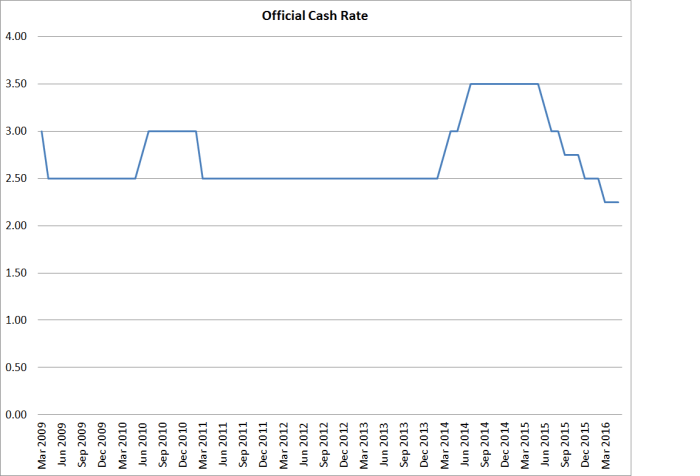
To be clear, I’m not objecting to the scenario.  Stress tests are really only useful if they use quite severe scenarios –  anyone can pass easy tests –  but this scenario looks to have quite a few buffers built in.  Similarly, a 55 per cent fall in Auckland house prices would be one of the larger falls ever seen anywhere –  again, not totally implausible, especially as New Zealand is prone to population shocks –  but about as large as the biggest falls ever experienced in an advanced country major city.   On the other hand, the last sentence of that scenario is worth noting: the ability to cut policy interest rates provides a substantial buffer (to economies and banking systems) in difficult times.  But with the OCR at 2.25 per cent, it would now be quite a stretch –  to the outer limits of conventional monetary policy –  for the 90 day bill rate to fall by three percentage points.  The Bank may need to take explicit account of that limitation in future stress tests.

In this stress test, the overall losses were quite substantial

The cumulative hit to profits averaged around 4 percent of initial assets (figure C1), which is a similar outcome to phase 2 of the full regulator-led exercise conducted in late 2014

Nonetheless, underlying operating margins were largely maintained, so that

underlying earnings during the scenario were of a similar magnitude to reported credit losses, so that return on assets averaged around zero.

In a very severe adverse scenario, banks did not make losses.  They simply did not make any profits.

But risk-weighted capital ratios still fell.

Although projected credit losses were largely absorbed with underlying profitability, capital ratios were expected to decline throughout the scenario. This reflected an increase in the average risk weight from around 50 to 70 percent, due to negative ratings migrations (rising probability of borrower defaults) and falling collateral values (rising losses given default).

In fact, although risk-weighted capital ratios fell during the scenario, simple leverage ratios, of total capital to total assets, (while not reported) are likely to have increased.  The dollar value of capital did not fall (no overall losses) while in estimating how the Reserve Bank’s severe shock would affect them and their businesses, banks generated results which implied a decline in credit exposures by 11 per cent. The Reserve Bank does not like leverage ratios, but most other regulators and analysts see a useful place for them –  the OECD, for example, used to regularly urge New Zealand to adopt them.

And here, for completeness, is that Reserve Bank’s chart of how the capital ratios behaved.

C2: Capital ratios relative to respective minimum requirements (% of risk-weighted assets)

Figure C2 Capital ratios relative to respective minimum requirements (% of riskweighted assets)

The regulatory minimum is zero on this chart, so banks were well away from that, even after this severe adverse shock –  and, of course, regulatory minima have been increased since before the 2008/09 downturn.  The grey area is the so-called “conservation buffer” and as the Reserve Bank notes

the average bank reported falling into the upper end of the capital conservation buffer in the final year of the test, which would trigger restrictions on dividend payments to shareholders (figure C2).

Since none of the big banks in New Zealand is listed, the temporary limitation on the ability to pay a dividend is unlikely to be too troubling.    Banks don’t want to be in the conservation buffer, and will seek to get out of it again.  But carry the scenario forward a year or two and on the basis of normal earnings they would probably get back there fairly quickly.  What each bank might actually do might, of course, depend on the health of its parent –  if the parents were experiencing a similar adverse scenario in Australia, the market and management pressures on the New Zealand subsidiary to quickly restore capital buffers would be materially greater.

Despite all this essentially “good news” story –  savage recession, huge unemployment, severe falls in leveraged asset prices, and yet the banking system is still in pretty good shape –  the Reserve Bank has never really been happy with the story.   That is implicit in the FSR and, from what I hear, also the story they tell people who come to visit them.

I think there is a variety of reasons for that, including innate regulator/central banker caution.  Some of that attitude is a good thing, provided it is conditioned by a good understanding of how systemic banking crises in other places/times have actually developed.  Here it doesn’t seem to be.

They also seem uneasy because their scenarios do not consciously take account of any second-round effects of the reduction in credit exposures the banks would effect as part of the response to the extreme adverse scenario.   As noted above, banks estimated that their credit exposures would fall by 11 per cent.  The Reserve Bank has long worried that such a reduction in the stock of credit would act as an additional factor amplifying the economic downturn and the fall in asset prices, such that the initial macro scenario they set out for the banks was no longer sufficiently demanding.

In principle, it is a fair point.  In practice, I think it is misplaced for two main reasons.

The first is that in developing their severe economic scenario they will have benchmarked it against other really nasty downturns in other times/places.  But any additional impact of forced bank deleveraging –  over and above the initial shock that triggered the downturn –  will already be included in the GDP/unemployment and asset price numbers we see.  The 1991 downturn in New Zealand included any additional impact from the BNZ and DFC failures, the post 2007 US recession included any deleveraging impacts from all the financial institution failure and additional lender caution, and so on.  It would be double-counting to take as extreme a scenario as the Reserve Bank is using, and then add a whole new downturn on top of that, as banks pulled in their lending horns.

The second reason is that it doesn’t look as though the Reserve Bank has given anything like adequate weight to the way in which the size of a mortgage book is driven primarily by house prices and housing turnover.    In the FSR discussion, they do note that the reduction in credit exposures “could reflect a reduction in customer demand” –  there is less investment etc in recessions for example – this seems a very weak statement of what would be likely to occur with bank mortgage books in particular.

A while ago, I ran a chart illustrating the way in which a simple initial shock to house prices goes on raising household debt to income ratios for years afterwards, even if there is no subsequent further increase in house prices.  That occurs just because the housing stock turns over relatively slowly, and so after prices move to a new high level it takes years for all purchases to have taken place at the new higher price (and associated higher need for credit).

This was that chart.  Price double in year 1, are unchanged thereafter, and borrower LVRs are the same after the initial shock as they were before.

scenario debt to income

In fact, in housing booms typically involve borrowers and lenders becoming less risk-averse and housing turnover increasing.

scenarios 2

You can see the difference higher initial LVRs and slower repayments make –  it still takes years for debt to income ratios to reach a new steady-state level, and the process will happen more or less automatically, unless banks actively stand in the way. Turnover and prices drive mortgage books.  When both increase, banks’ credit exposure will increase without them really trying.

But the same process can happen in reverse.

Recall that in the Reserve Bank’s scenario house prices fall by 40 per cent (and 55 per cent in Auckland.)  I’m assuming that the 40 per cent applies to the rest of the country, so lets say nationwide house prices fall by 45 per cent.  Each new house being purchased, even if the initial LVRs stay the same, now takes 45 per cent smaller mortgages than was required before house prices fell.

But in downturns, it isn’t only prices that fall.  In fact, turnover often falls first.  Sellers are reluctant to sell below purchase price, and many people are just genuinely uncertain. Economic downturns leave potential buyers more cautious too.  The drops in turnover can be very substantial.   Even in New Zealand, house sales per capita over 2008 to 2011 were only around half the rate seen at the peak of the boom in 2003.  Housing mortgage  approvals data only start at the end of 2003, but the same sort of fall is evident in approvals –  and this is a recession much less severe than the one in the Reserve Bank’s stress test scenario, and in which house prices fell by only around 10 to 15 per cent.

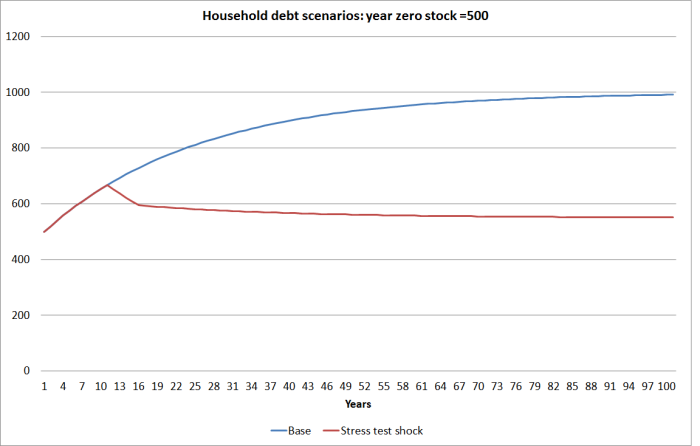
So what happens to the volume of housing credit outstanding if we assume:

  • house prices nationwide fall by 45 per cent, and stay at that low level thereafter
  • housing turnover (and new mortgages) fall by 50 per cent and stay at that low level for five years, before reverting to normal.

In the base scenario (the first chart above), we assumed prices double in year 1.    That produced a stock of debt which rose substantially in the first few years, and then kept rising slowly thereafter for many years.  Lets assume the severe adverse shock happens in year 10.  This is what happens to the stock of housing mortgage debt in the two scenarios.
scenarios 3

The differences are really large, without the banks even trying.   The housing market does it for them.  Within five years of the severe adverse shock, the stock of household mortgage debt is 10 per cent lower than it was just before the shock hit, and 20 per cent lower than it would be in the base scenario (where continuing turnover at the higher initial house prices carried household debt continually higher).  Even when turnover returns to normal, the stock of credit keeps dropping, just because new purchases are at the new much lower prices.

These scenarios are only illustrative, but they illustrate a key point: turnover and house prices drive the size of mortgage books, independently of any active choices banks make.  It seems quite plausible that bank balance sheets would shrink quite materially in the years following a shock like the stress test scenario, without the banks having to do very much active at all. Between lower turnover and low prices on both the housing and dairy books on the one hand and lower investment demand on account of the weaker economy on the other, there would be big savings in required capital simply from these customer choices.

Of course, in severe downturns, borrowers tend to be more cautious about how much they are willing to borrow –  and so it is quite plausible that borrower LVRs would shrink in the course of a shakeout like this, even without action by the banks.  That would further reduce the stock of debt.

And, of course, in a savage downturn of this sort one would have to expect banks to alter their lending standards –  pull in their horns.  This is something the Reserve Bank has never seemed comfortable with.   Way back in April 2008, just as the 2008/09 recession was beginning to become apparent, the then Governor was saying openly

Banks should avoid overreacting to the economic downturn, Reserve Bank Governor Alan Bollard told the Marlborough Chamber of Commerce today. “The New Zealand economy remains fundamentally sound and creditworthy,” he said.

“Banks, businesses and households alike need to recognise the new external environment and adopt a cautious approach – but don’t go into hibernation, the underlying economy remains robust,” he said.

In fact, the only sensible reaction of both banks and businesses, going into what proved to be a severe recession, from which in some respects the economy has still not fully recovered, was to pull in their horns.  That was especially so as the economy had quite severely overheated during the previous boom, and in some areas –  property development and dairy in particular –  credit standards had deterioriated very sharply during the boom.  The recession would prove that some of the critical assumptions –  by borrowers and lenders –  made during the boom were misplaced.  In the middle of the downturn no one knows what the correct “new normal” actually is, and considerably greater caution –  by lenders and borrowers –  was quite appropriate.  The only prudent step was to stop and reassess.

So it would be in a downturn –  a savage downturn –  of the sort in the stress test scenario.  Central bankers might win political brownie points by urging banks to keep lending.  But it isn’t obvious that it would be good business –  no Governor knows the future, any more than bankers and borrowers do.  Things no doubt do return to some sort of normal eventually, but as we’ve seen –  even in non-crisis in New Zealand –  quite when and how is a very open question.   And as I noted earlier, all those severe downturns that the Reserve Bank used to benchmark its stress test scenarios already included any pulling in of horns by banks (and borrowers).

This has become rather too long a post, so I will stop here.  Bank supervisors should never on their laurels.  Bank, and borrower, behavior can change quite quickly and the quality of loan books can deteriorate quite alarmingly quickly  –  and often does in the few years just before crises.  But on the stress tests the Reserve Bank has presented, and the supporting analysis the Bank has provided, there is little sign of anything other than a reasonably cautious prudent banking system, with robust capital buffers to cope with even seriously adverse shocks.  If the Reserve Bank wants to keep on imposing more and more controls, the onus really should be on it to show us what is wrong with its own published analysis and stress test results.


Household debt, house prices….and Sky


Stories about household debt and house prices are everywhere at present.  For anyone interested, Radio NZ’s Sunday morning show yesterday had a 20 minute (pre-recorded) discussion with Chris Green, of First NZ Capital, and me on some of the issues. I think we agreed on more than we disagreed, both emphasizing that large falls in real house prices have happened before and will, no doubt, happen again.  And the domestic economy is currently less robust than either Treasury or the Reserve Bank would have us believe.

The Radio NZ interviewer was, it seemed, keen to run with a narrative of mass collective irresponsibility, but as I’ve noted here before there is no sign that higher house prices are leading to a huge surge in consumption (any more than has happened with previous house price booms), and good reason to think that many people are very uneasy about the size of the debts they are having to assume to get into a first house.  I could have added that house sales per capita, and mortgage approvals per capita are not particularly high by historical standards.  Scandalous as the house price situation is, if there is a mania –  contagious exuberant optimism –  it must be very localized.

Tomorrow, I want to focus again on the Reserve Bank’s stress tests and how we should think about those results.  But before getting into that, it is worth briefly repeating a few other relevant points.

First, there is the constantly repeated claim, especially from some commentators on the left, that the system of banking regulation incentivizes banks to lend on housing security, skewing their whole portfolios towards housing lending, beyond the natural levels justified by the underlying riskiness of different classes of loans.     That is simply false.    The essence of the argument is that in calculating capital requirements, loans secured on housing generally carry a lower “risk weight” than most other forms of bank credit.   They do, and that is because such loans are generally less risky.  Compare a loan secured on an existing house in an established suburb, supported by the wage or salary income of the occupants, with a loan to a property developer for a new project on the fringe of a fast-growing town and you start to get a sense of the difference in risk.   If anything, the initial risk-weighted capital regime (Basle I) probably overstated the riskiness of a typical housing loan and understated the riskiness of many corporate loans (and sovereign exposures for that matter).  In the shift to Basle II, many countries appear to allow banks to reduce risk weights for housing exposures too far.  New Zealand (the Reserve Bank) was much more cautious (even than, say, APRA in Australia).  As I’ve noted previously, the IMF has accepted that New Zealand’s housing risk weights are among the highest used anywhere –  other countries have been coming towards us.   There are reasonable arguments as to whether risk weights can ever be assigned in a fully satisfactory way –  hence the support in many circles for simple leverage ratios, as a buttress to the capital regime –  but there is no reason to think that all types of credit exposures should be treated identically.  Bankers wouldn’t –  with their own shareholders’ money at stake.

Second, there have been plenty of systemic banking crises around the world over the decades.  But as the Norwegian central bank, the Norges Bank, pointed out in a nice survey a few years back, which has been cited by our own Reserve Bank,

Normally, banking losses during crises appear to be driven by losses on commercial loans. Loans for building and construction projects and (particularly) commercial property loans have historically been vulnerable. Losses on household loans appear to be a less significant factor,

This was true, for example, in the Scandinavian crises of the early 1990s –  savage recessions in which (in Finland) house prices fell by 50 per cent and banking systems around the region got into severe difficulties –  and in Ireland in the most recent recession.  And each of those crises occurred in fixed exchange rate countries, in which the authorities had (in effect) abandoned the ability to use monetary policy to buffer severe adverse events.

Are there exceptions?  Well, the US in the most recent crisis certainly looks like one on the face of it.  Housing loans were at the epicenter of the crisis, and the US has a floating exchange rate.  But as I’ve pointed out previously, drawing on excellent book Hidden in Plain Sight, much of what went on in the United States was the direct result of the heavy direct government involvement in the US housing finance market, and the legislative and regulatory pressure placed on private and quasi-government lenders to lower their lending standards on housing exposures. Government-directed credit is often a recipe for some pretty bad outcomes.  Advanced countries where the government did not have a substantial role in the allocation of credit (especially housing credit) and where domestic monetary policy was set to domestic economic conditions –  rather than, say, pegged to German conditions –  did not have banking systems which experienced large losses on their domestic loan books, and especially not their domestic housing loan books.  I’m not aware of any exceptions in recent decades.   I looked at the post=2007 crises here.

Individuals who have taken out large amounts of debt just before housing (or other asset) markets turn can find themselves in a very difficult financial position.  If the borrower has a good income, it might just be an overhang of debt that limits mobility.  In principle, banks can foreclose on mortgages with negative equity, but they very rarely do so as long as the loan is being serviced.  And nasty housing market shakeouts often take place in the context of severe recessions –  in part because building activity is one of the most cyclical aspects of the economy and building activity tends to dry up when house prices fall sharply.  But the case just has not been convincingly made that the New Zealand economy and financial system are seriously exposed as a result of current house prices per se, or of the current level of household debt.  As a reminder (a) that level of debt (relative to disposable income or GDP) is little changed over the last eight years, after a sharp increase in the previous fifteen years, and (b) that level of debt did not cause evident problems when New Zealand last experienced a pretty serious recession in 2008/09.   And relative to the situation on the eve of the 2008/09, New Zealand households now have a much higher level of financial assets (again relative to income or GDP) than they had then.     The risks now may be more localized and concentrated in Auckland than they were in 2007, but there is little to suggest that they pose more of an independent threat to the whole economy or the financial system.  On all published metrics –  whether or capital or liquidity – the banking system is in better health today than it was in 2007 –  and the same goes for the Australian parent banks.  When you dig into the details of the Reserve Bank’s FSR, that is what the data say, but it isn’t what you hear from the Governor.

I’ve been concerned for some time that the Governor has an inappropriate focus on the US experience.  He lived in the United States for more than a decade, including during the 2008/09 crisis, and although his role at the World Bank was focused on emerging markets, he got to participate in some of the international meetings that were epiphenomena around the crisis –  ie lots of headlines, but of little actual relevance to dealing with the various national crises.  Inevitably, that sort of experience influences a person’s perspectives.   But the Governor has never given us any reason to believe that the New Zealand situation now is remotely comparable to the US situation in the run-up to the financial crisis.

Despite all the research resource at its disposal, the Reserve Bank has never published any analysis or research looking at the countries which did, and did not, have domestic financial crises (and especially ones sourced in the housing mortgage books).    What marked out the US and Ireland, for example, from New Zealand, Australia, Canada, the United Kingdom, Norway or Sweden?  Each had very high house prices going into the global recession of 2008/09, each had had very rapid credit growth, most were seriously affected by the recession itself, and yet some had serious domestic loan losses and domestic financial crises, and most didn’t.    Almost certainly, the difference was not simply that the US and Ireland were selected for crises by some celestial random number generator, which indifferently spared the other countries and their banking systems.    As he rushes from one ill-considered distortionary intervention to another, overlapping one control upon another, exempting some borrowers and some institutions but not others, and impairing the efficiency of the financial system, surely the Governor owes us at least this modicum of explanation and analysis?  And that is even before we start asking questions about why the Governor (and his staff) should be thought better able to decide on the appropriate allocation of credit than private institutions whose managers have built careers on making lending decisions, and whose shareholders have considerable amounts of their own money at stake.  Last I looked, the Reserve Bank –  and the Governor –  has nothing at stake in the matter, and they have demonstrated no track record of expertise in making credit allocation decisions. In that respect, of course, they are little different than their peers in other countries. The level of hubris on the one hand, and lack of deep thinking, research and analysis on the other, is quite breathtaking.

And yet our politicians let them get away with it.  They leave so much power vested in a single unelected individual –  selected by another pool of unelected individuals  – whose term is rapidly running out, and who won’t be around to be accountable for the consequences of his intervention.   Then again, perhaps he will.  A typically well-sourced Wellington political newsletter last week claimed that the Governor is well-regarded in the Beehive and might well be reappointed.  It seems unlikely –  and I’d be surprised if our scrutiny-averse Governor even sought another term – but the line must have come from someone, presumably someone reasonably senior.

But, on a quite different topic, now I’m going to stick up for the Reserve Bank.  Bashing government agency spending on all sorts of things makes good headlines.  Bad policies deserve lots of critical scrutiny, and bad polices typically cost taxpayers a lot of money, whether directly or indirectly.  But frankly I was unpersuaded by the Taxpayers’ Union’s latest effort, highlighted in the Sunday Star-Times yesterday, around government agencies’ spending on Sky subscriptions.  Among core government agencies, the Reserve Bank was one of the larger spenders, with a total outlay of around $12000 in the last year.  The Taxpayers’ Union specifically called attention to the Bank.

But why?   The Reserve Bank has a variety of functions, some of which (notably the financial markets crisis management functions) which might warrant a Sky subscription even for professional purposes.  But even if the rest of them are scattered around lunch and breakout rooms in the rest of the building, so what?  Any organization seeks to create a climate that encourages high levels of staff engagement, and the recruitment and retention of good staff.  Some people are just motivated by cash salary –  always the overwhelming bulk of costs for central government policy and operational agencies –  but many are motivated by a richer complex of considerations, including on-site staff facilities –  which might include the quality of the cafeteria, fruit bowls, coffee machines, the Christmas Party, Friday night drinks, medical benefit schemes, access to newspapers, or even access to Sky.  In the private corporate sector there is a range of different approaches –  some no doubt work best for some types of workers, and some for others.  Sometimes these things are actually cheap at the price –  there is more motivational benefit than there is cost to the organization, which suggests everyone is better off.   Access to Sky was never one of the things the Bank offered that particularly appealed to me –  then again, the bonds built over a morning coffee, or gathered round a TV late on a rare afternoon when New Zealand was on edge of winning a cricket test in Australia, were probably good for the Bank, and for staff attitudes to the Bank.

I’m all for serious scrutiny of government agencies.  But focus on the big picture. Look at the quality of the policy advice and research being offered up. Look at the overall costs of organisations and functions, including overall average remuneration levels –  and perhaps even focus on the details when it comes to what senior managers spend on themselves.   But leave managers some flexibility to  attract, manage, and reward good staff  –  within those overall constraints –  in ways that don’t leave them constantly fearing “will this be a Stuff headline”.    We’ll all be a little less well off –  citizens who need a good quality public sector, with a limited number of able staff –  if we don’t.


Brexit thoughts from the Antipodes

My wife suggested a post on the contrast between British entry to the EU (or EEC as it was then) and the looming possibility of British exit.  She is young enough that British entry was a featured topic in New Zealand history when she did School Certificate history in the 1980s (for me, it was closer to being current affairs).  By contrast New Zealand media coverage of the British referendum is largely devoid of any particular New Zealand dimensions.  On a day when the British papers are highlighting a new poll suggesting that the Brexit cause could win, it seems like a good day for a few thoughts.

A lot has changed in the years since the early 1960s when New Zealand first faced the possibility of Britain entering the EEC, and the threat that posed to New Zealand’s major markets for dairy and lamb exports.  So important was the issue that, apparently, at New Zealand economists’ conferences in the 1960s a toast was often drunk to Charles de Gaulle, for his two vetoes of UK entry.

The make-up of our population has changed over that time, but in some ways less than one might think. In the 1961 Census, 9 per cent of the population had been born in the United Kingdom, and in the 2013 Census, 6 per cent had been.  And in most years, the United Kingdom is still the source country for the largest group of those given residence permits to live in New Zealand.  The UK still seems to be the favoured destination for New Zealanders looking for an OE, at least one beyond Australia.  Sporting ties, and rivalries, seem as strong as ever.   But if state high schools still sing “Jerusalem” and cathedral choirs still sing Stanford and Parry, the emotional ties are much less strong than they were.   In the early 1960s, it was less than 20 years since the end of World War Two, and less than that since the conflicts in Korea and Malaya where New Zealand and British troops had fought side by side.

But it is probably the economic ties that have changed most.  One of the after-effects of the war  –  and the huge overhang of debt the UK had taken on – was the Sterling Area, of which New Zealand was a part.  With a fixed exchange rate to sterling –  unchanged for almost 20 years – and our foreign exchange rate reserves held in sterling, overall sterling area access to US dollars affected each country in the area. Private international debt markets were much less developed than they had been in the past, or are now.  And New Zealand government offshore borrowing had been undertaken in the UK for more than 100 years –  it wasn’t until the very end of the 1950s that the first, expensive, New Zealand government loan was raised in the US.  Britain had been keen on New Zealand joining the IMF and World Bank –  we didn’t until 1961 –  partly because it would facilitate access to dollars for New Zealand’s capital needs.

And, most of all, the United Kingdom was a major export market –  as late as 1967, 44 per cent total exports went to the United Kingdom.  In the 1960s, almost all our dairy and lamb/mutton exports went to the United Kingdom.  As the New Zealand Ambassador to the US put it, in a prominent lecture he gave in New York in 1963, “the problem which we faced….was the threatened removal of the one remaining important free market for primary produce at a time when the highly industrialised countries of Europe are intensifying the trend to self-sufficiency in these products”.   There were, at the time, no credible alternative markets for some of the largest chunks of our exports.  And if Continental leaders were willing to consider UK entry to the EEC, they certainly didn’t see continuing New Zealand easy access to UK markets as part of the deal,  Indeed, one of the attractions of UK entry to them was detaching Britain from the Commonwealth and traditional suppliers of agricultural products (Australia as well).

Possible British entry was a huge issue for politicians and economic advisers in New Zealand in the 1960s and early 1970s, but it wasn’t a trivial issue in the British debate either.  Some of that was about past ties of blood, shared military sacrifice, shared family bonds and so on.  But some of it was economic too: New Zealand lamb and butter –  known as coming from New Zealand – had an established and significant place in the British retail market.  It would have been difficult –  perhaps impossible –  for Britain to have joined the EEC –  for British public opinion to have allowed it –  without “acceptable” arrangements for New Zealand and Australia.

At the time, material living standards in New Zealand were still higher than those in the United Kingdom –  ours were still among the best in the world.  The prospect of UK entry, with all that risked implying for markets for New Zealand produce, was a very dark cloud over those living standards.  (In that same lecture, our Ambassador to US, presumably citing received official opinion saw import substitution by building up local manufacturing, combined with rapid population growth –  natural increase and immigration –  as part of the solution).

The situation is nothing like symmetrical today.  The United Kingdom is still our sixth largest trading partner, but lagging a long way behind Australia, China, the United States and the euro-area.  If London remains one of the most important financial centres in the world, open capital accounts mean that the UK is not a particularly important source of financial capital at the margin –  and, of course, our government doesn’t borrow abroad, and our exchange rate floats.    There might be opportunities for New Zealand individuals and firms if the UK actually leaves the EU  –  our lamb exports to Europe (including the UK) are still restricted, and there are some hopes that revised immigration policies might treat New Zealanders the same as, say, other Europeans.  But these are probably second or third order issues for the New Zealand economy as a whole.   Some of those strongly campaigning for Brexit would favour a much more market-oriented approach to trade and regulatory policy, and anything that lifted medium-term productivity prospects would be good for the world (including us).   Whether there would be much improvement in the quality of policy is perhaps debatable –  other Anglo countries, not caught up in the web of Brussels, have not exactly been at the forefront of market-oriented liberalization in the last decade or so.

If Brexit isn’t a great economic opportunity for New Zealand, what about the risks on the other side?  The great and good of the economic establishment –  in Britain and internationally –  have been weighing into the debate to urge British voters to vote “Remain”.   Even President Obama has been recruited to the Prime Minister’s cause –  as if the views of a foreign leader should influence British voters views about the future of their own country.  Hundreds of economists have been writing to the papers urging the voters to vote to stay in the EU.  It is a curious spectacle.  One might have supposed that agencies such as the IMF and the OECD would have little credibility with anyone these days, and nor is it clear that they have (or even should have) British voters’ best interests at heart when they offer their advice.

The economic debate seems to turn on two, separate, issues.  The first is about the transition, and the second about the medium-term.  Actually, the two quickly converge.

We’ve already seen markets rattled each time polls suggest a heightened probability of Brexit.  It will, almost certainly, get much worse in the next few weeks if the latest polls are picking up something real.  And if Britain votes to leave, the days after that result is declared could be very very messy indeed.  Apart from anything else, the path ahead –  even for Britain –  is quite unclear, starting with who will be leading the British government to negotiate the exit terms.

The world economy and financial system are hardly in fine robust health.  And the policy buffers if things go wrong are few and very limited –  in monetary policy alone, almost everyone is already starting with interest rates around zero.  Britain itself just isn’t that important –  nukes, a Security Council seats, and London as a financial centre notwithstanding. Then again, it is only a year or so since the Scottish referendum was unnerving markets, and Greek crises have repeatedly wrought havoc for the last few years.  Why?  Because what starts in one place probably won’t stop there.   No one was really comfortable that the wounds to the euro could be cauterized if Greece left. What of the EU itself?

It isn’t as if euro-skepticism is a uniquely British phenomenon.  I thought this Pew Research chart from a few days ago was fairly telling

eu favourability

Public opinion in France is less favourable to the EU than that in the UK, and the UK numbers are little different than those in Spain, Germany and the Netherlands.

Which is why a lot of the economists’ contributions to the UK debate seem rather moot.  They come up with estimates –  really not much better than back of the envelope ones, despite all the apparent sophistication  –  suggesting a potential loss of income to the average Briton if the UK leaves.  But that all assumes that the rest of the EU holds together largely as it is.  And that doesn’t seem very likely at all.  In fact, as with the cause of Scottish independence, a defeat in a single referendum seems unlikely to make the exit issue go away even in the UK.  As with the euro itself: break-up fears wax and wane, but it will be a very very long-term (most likely never) until that risk disappears altogether.

So really the economic establishment –  in the UK and globally –  is urging British voters to vote “Remain” to hold the whole EU project together.  They can’t actually say that –  that would suggest a fragility they just can’t publicly acknowledge –  so they have to pretend that it is all about the British voters’ own best interests.  This week it reached ludicrous extremes with David Cameron suggested that people who voted “Exit” weren’t being patriotic and didn’t believe in their country.

But very few British voters really want any part of an “ever-closer union”.  Actually, few voters in most of the rest of Europe do either.  And yet everyone recognizes that  the euro in particular can’t credibly hold together without further progress in that direction.  Probably most voters are quite keen on free trade in goods –  and to a lesser extent in services – among European countries, but they don’t want their laws made by unelected officials in Brussels, or even by majorities of ministers from other countries.  And they don’t want their laws interpreted, and application decided, by foreign judges.  It is quite a bit about what being a nation state is.  Many aren’t too keen on a lot of immigration either –  no matter how often the elites assert that benefits flow from it.  That seems like the sort of choice citizens of each country should get to make.  And to be able to toss out the people who make laws and regulations they disagree with.

I’m not a Brit –  all my ancestors were, but they left in 1850 and shortly thereafter –  but of all the countries in the world other than New Zealand, Britain is  probably the one I care most about.  Were I a British voter, I’d vote for Exit.  Not because Britons would necessarily be better off economically –  they could be, with the right policies, but one doesn’t decide the future of one’s country based solely on narrow economic considerations.   Had it been otherwise, perhaps New Zealand in the 1960s could have done a Newfoundland, and given up our independence to become part of the UK (in case anyone is wondering, I’ve not found any who suggested doing that).

Voting to leave the EU would be, to some extent, a step into the unknown.  But big important choices often are – whether to go to war, to marry or to break-up a marriage, to split a country, or an empire.  People in Ireland were probably worse off (economically) for decades from leaving the United Kingdom, but who is to say their choice was wrong or illegitimate. One must be prepared to count the cost of those choices.   But if British voters want their country to be as independent –  but still, inevitably interdependent –  as New Zealand, or Australia, or Canada, or the United States, then Exit seems like the way to vote.  It might be a rocky ride, even for the rest of us –  perhaps it might even be the unwelcome way in which Graeme Wheeler gets the TWI down –  but it is a perfectly reasonable choice.  And one voters in other countries are likely also to make before long.   The EU as we see it today looks a lot like a project that has badly over-reached.


A question for The Treasury

One thing I like about the Reserve Bank is that it has largely stayed clear of Twitter.  They use it –  you can find them here – but there was a deliberate decision made a few years ago to use it only to highlight new Reserve Bank releases; links to articles, research papers, press releases etc.  I’ve always been sceptical of a medium for expressing ideas in 140 characters or fewer.

The Treasury is a bit more adventurous in their use of Twitter (here), offering editorial perspectives at times, and enthusiastically retweeting things from other people and organisations  (here and abroad) who either endorse something Treasury has done or said, or that Treasury agrees with or endorses.

This Treasury retweet of something from a British academic caught my eye the other day.


Jun 1

Distance matters (still): Trade volume with UK vs distance of trading partner from the UK.  

It is quite a nice chart from The Economist that illustrates a now fairly well-known point.  Firms and people do much more trade, all else equal, with firms and people in countries close to them that with those in countries far away. I don’t think this particular version of the chart is wholly compelling: it uses the total value of trade between countries, but population numbers matter as well, and it might have been better to illustrate the point using per capita trade values instead.  Doing so in this chart would move both Ireland and New Zealand a long way up relative to the other –  mostly much larger –  countries that are highlighted.  But the key point holds: distance matters, a lot.  Not just in terms of who one trades with, but in terms of how much total foreign trade is done at all.  For small countries even more than for large countries, the ability to successfully sell more and better stuff to the rest of the world is a vital part of improving a country’s long-term economic fortunes.

In retweeting it, presumably official Treasury was keen to remind us that distance matters to New Zealand too.    There is no way Australia, for example, would be the largest trading partner for New Zealand firms if, for example, these islands were set in the Bay of Biscay.

Treasury has made a useful contribution over the years in reminding us of this point.  They developed the useful line 15 of so years ago that drawing a circle with a 1000 km radius around Wellington would encompass 4.5 million people and lots and lots of seagulls. while a comparable circle around Vienna or Seoul would encompass hundreds of millions of people.  Sadly, seagulls aren’t a terribly promising market.

Treasury also included this chart in their Holding On and Letting Go document, which formed part of their 2014 Post-election Briefing to the Minister of Finance

Figure 8: New Zealand’s geographic challenge
Selected countries distance from world markets and populationFigure 8: New Zealand's geographic challenge   . Note: The x axis is scaled so that each marker is ten times the magnitude of the previous one.
Source:  World Bank: World Development Indicators, ITC: Trade Map, CEPII

Among OECD and major emerging economies, New Zealand is more distant from markets than any other country.  Chile and Australia are almost as distant.  Chile is a much poorer country, and Australia –  while wealthier –  is very fortunate in the scale of its usable natural resources, but when one looks at the productivity data it is no longer in the top tier of countries.

Treasury also produced an interesting piece of formal empirical research a couple of years ago  using cross-country data to look at the various barriers to foreign trade that New Zealand faces.  In the modelling they report, distance shows up as a highly statistically significant factor influencing (negatively) the volume of foreign trade a country does.

Distance  –  and trade – isn’t mostly about land, it is about people.  Our islands are really remote, but much of what counts is the people living here, who have to find ways of making and selling stuff abroad, especially if we are to have any chance of offering top tier incomes and material living standards to those people.

And so it puzzles me that Treasury never seems to consider population size –  and especially the role of immigration policy in changing population size over time – when they discuss the implications of distance.  4.5 million or so of us face the (quite substantial) penalty of distance.  What leads Treasury to think that exposing ever more people to that “tax” –  not as a result of New Zealanders’ private fertility choices, but as a direct result of government policy –  makes sense.  As I’ve pointed before, in none of Treasury’s writing on immigration policy in recent years has there been any sense of evidence that a large scale (notionally skills -focused) immigration policy has been doing anything useful to lift the overall productivity performance of New Zealand, and the income prospects of New Zealanders.  If anything, we’ve continued to lose ground relative to other advanced countries.

For some time it has surprised me that Holding On and Letting Go had scarcely any mention of immigration policy, and most of the (few) references to immigration were simply to the cyclical pressures, rather than the medium-term issues, even though (for better or worse) it is one of the larger government policy interventions in the New Zealand economy.

Treasury argues that “geography isn’t destiny”, and there is clearly an element of truth in that.  But I don’t think they have yet taken seriously enough the nature of the geographic constraint.  Yes, New Zealand did have top tier incomes for decades, but it did so by exporting natural resource based products deploying/supporting a very small population.  There are no more natural resources here than there were 100 years ago,  the overwhelming bulk of our exports are still natural resource based (not just the obvious farm products, but fish, wine, gold, oil, the electricity that produces aluminium, and tourism) and yet we now have four times as many people as we had in 1916.  Some countries make the transition from natural resources.  When Captain Cook got to New Zealand, Britain’s exports were about 95 per cent based on Britain’s own natural resources.  These days, very little of her exports are.  We have shown very little sign of being able to make that transition.

That isn’t because we don’t have smart, able, innovative people, or good institutions, it seems to be largely because places this remote don’t successfully support many non-natural resource based businesses.  There aren’t any other examples of places that successfully do –  the other even more remote islands are too insignificant to even get on Treasury’s chart.   Internationally-oriented non natural resource based businesses might start here, but mostly the business will be worth more if, in time, it comes to be based somewhere a lot nearer markets.  In some cases, proprietors will like to live here, and will sacrifice growth to keep the business here –  but it is a sacrifice, and in that sacrifice is a measure of the limitations of this place  as a (remunerative) home for too many people.  As one person who runs a small global business here recently put it to me, face to face contact still matters a lot, and if air travel is a bit cheaper than it was 50 years ago, it is no less physically draining or time-consuming.

So my question for Treasury is something along the lines of, why not take seriously (a) the lack of hard evidence that New Zealanders have had economic benefits from immigration, combined with (b) your own recognition that distance matters a lot, and (c) the fact that New Zealand remains a heavily natural resource based economy, with few signs that that is really changing, with no more natural resources being made (and increasing environmental concerns/constraints),  and then think harder about whether a government policy to drive up New Zealand’s population –  even as New Zealanders have kept on leaving –  really makes much economic sense at all.  Treasury has recently asked some good questions about the skill mix of our actual migrants, but they need to think harder about whether there are really top tier income-earning opportunities here for very many people, even if we could somewhat improve the average skills level of those who come.

Distance and location really do seem to matter, a lot.  Policymaking hasn’t really taken that seriously.

Still unconvincing

We expect inflation to strengthen reflecting the accommodative stance of monetary policy, increases in fuel and other commodity prices, an expected depreciation in the New Zealand dollar and some increase in capacity pressures.

So said Graeme Wheeler in his MPS press release this morning.  I thought it sounded like a familiar line, so I went back and had a look.  This seems to have been the Governor’s 30th OCR decision.  Back in his very first OCR announcement in October 2012 he said this

While annual CPI inflation has fallen to 0.8 percent, the Bank continues to expect inflation to head back towards the middle of the target range.

And in all those 29 statements since then –  with perhaps just one exception –  he has been saying much the same thing: inflation will increase.  And actual inflation –  headline, and the range of core measures – just keeps on being below target.

At the Bank’s press conference, Bernard Hickey asked if the Bank could be regarded as having done its job, given that even on its own forecasts (persistently too optimistic) there would have been six years of inflation below the target midpoint by the end of 2017, when the Bank again expects headline inflation to be back to 2 per cent (the Bank doesn’t publish forecasts of the core inflation measures, but I doubt the picture would be any different if they did –  it has also been four or five years since the various core measures were clustered around 2 per cent).  There were a range of possible plausible answers to that question, but I wasn’t prepared for the one Assistant Governor John McDermott actually gave: he said “your timeframe is very short”.  Six years……when monetary policy generally works over perhaps a two year horizon, and when the Governor’s term –  in a system built on personal accountability –  is only five years.

Yes, it wasn’t a very good day at the Reserve Bank today.    Inflation is apparently expected to increase partly because the exchange rate is expected to fall.  At 8:59am, the exchange rate was already above what the Bank was assuming in the MPS projections,  and a few minutes later it was another per cent higher, and it rose a bit more in the course of the press conference.  I’m not sure why the Governor expects the exchange rate to fall back if his rosy domestic economic story is correct.  Perhaps he expects a lot more tightening in the US.  But, again, he has been expecting that almost since he took office in 2012.

Some of the other bits in that statement as to why he expects inflation to rise were a bit puzzling too.  The Governor apparently thinks “accommodative monetary policy” will do the trick, but in real terms the OCR is probably a bit higher than it has been for much of his term (certainly than in the year or so before the unwarranted tightenings), and the TWI this afternoon is only slightly lower than the average level for the Governor’s term to date.  Set aside for now the question of whether conditions are actually “stimulatory” or “accommodative” in absolute terms, but if they are more accommodative now than over the last four years, the difference isn’t large.  Core inflation didn’t pick up over those four years, and it isn’t obvious why it is going to do so now.

The Governor also apparently expects “some increase in capacity pressures”.  One would hope so, given that on the Bank’s own estimates we have had eight consecutive years of a negative output gap.  But it isn’t clear why the Bank expects capacity pressures to increase from here.  They are forecasting quite an increase in residential building, but we’ve already had four or five years of increasing residential investment activity, through two very large shocks to demand for residential investment –  the Canterbury earthquakes, and the large unexpected surge in immigration.  All of that, on top of buoyant commodity prices earlier in the period, wasn’t enough to turn the output gap positive or get the unemployment rate back to more normal levels, or lift inflation back to target.  It isn’t obvious why things should change now –  especially as, like other forecasters, the Bank expects the net migration inflow to fall away quite sharply.

The Governor could be right.  Macroeconomic forecasting is, in many ways, a mug’s game.  But he has been wrong for several years now, as his predecessor was in his last couple of years.  It isn’t obvious that he has a compelling story to tell as to why inflation pressures are finally about to pick up. But if he has such a story it isn’t in the Monetary Policy Statement.

Meanwhile, there is a great deal of complacency. I heard the Governor talk of significant real wage increases, strong tourism, strong immigration, significant building activity, and so on.  All without any sense that per capita income growth has remained disappointingly weak.  Neither the Governor in his comments nor the text of the MPS itself even mention an unemployment rate that lingers at 5.7 per cent, years after the end of the recession.  If anything, the Bank appears to believe that excess capacity in the labour market is already exhausted (see Figure 4.8).

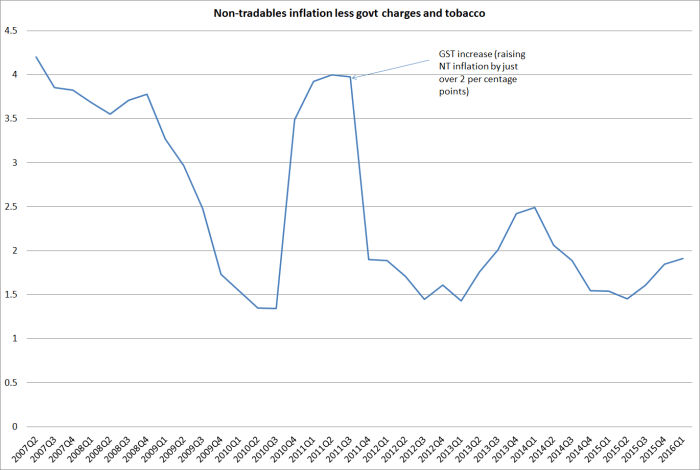
The Governor also made great play of non-tradables inflation.  He is quite right that, over time, non-tradables inflation (or at least the core of it, excluding government taxes and charges) is what monetary policy can really influence.  Even exchange rate effects –  which the Governor weirdly tried to play down –  over the medium-term work by influencing overall pressure on domestic resources and thus non-tradables inflation.  But non-tradables inflation typically runs quite a bit higher than tradables inflation, even in a stable exchange rate environment.  That is partly about the labour intensive nature of many of the services included in non-tradables inflation (hair cuts are the classic example, where there is limited scope for productivity gains).  With an inflation target centred on 2 per cent, the common view among economists inside the Bank used to be that one might expect non-tradables inflation to average perhaps a bit above 2.5 per cent, while tradables inflation might average a bit below 1.5 per cent per annum.  Together, they would be consistent with medium-term CPI inflation (ex taxes etc) of around 2 per cent.

But here is what non-tradables inflation looks like in recent years.  This series excludes government charges (eg the cut in ACC motor vehicles levies) and tobacco taxes (which have been increasing sharply each year).  It doesn’t take out the effect of the 2010 GST effect, but it is easy enough to visually correct for that – it accounts for about 2 percentage points of the inflation rate over 2010/11.

nt ex govt charges and tobacco

There is a bit of variability in the series, but it has been years since this measure of core non-tradables inflation got even briefly as high as 2.5 per cent, let alone fluctuating at or above that level.  And this is the series that should have borne the brunt of the Christchurch rebuild pressures –  which probably explained the increase in this measure of inflation in 2013/14.  Non-tradables inflation is what the Bank can influence. It really needs to be quite a bit higher to be consistent with the target specified in the PTA –  and on current Bank policy, there is no particular reason to think it is going to happen.

I outlined again yesterday my take on how the Governor operates: he is really bothered about the housing market, and really doesn’t want to cut the OCR.  But he can’t afford to see core inflation drift much lower –  he can get away with it holding around current levels (somewhere, in the MPS words, in a 0.9 to 1.6 per cent range) –  so will cut if data surprises really force him to, but not otherwise.  Today was a classic example of that model in action.  In the run-up to the March MPS it was, he said, the expectations survey data that really rattled him.  There has been nothing comparable since and so, mediocre economic performance and weak inflation notwithstanding, there was no OCR adjustment.

Instead, today was all about housing, and financial stability.  Perhaps we were supposed to have forgotten that the FSR was released only a few weeks ago and in his press release on that occasion the Governor began by extolling the resilience of the New Zealand financial system.  Often enough the Governor has been reluctant to comment on financial stability issues in monetary policy press conferences, and it is only three months since I praised him for his response on house prices at the March MPS press conference

And when asked about the impact of a lower OCR on house prices, he succinctly observed “well, that’s just something we’ll have to watch”.  By conscious choice, house prices are not part of the inflation target, either in New Zealand or in most (if not all) inflation targeting countries.  It is one, important, relative price, influenced heavily by a range of other policy considerations.  And if bank supervisors should pay a lot of attention to house prices, and associated credit risks, it is a different matter for monetary policymakers.

All that was long gone today.  It was, in effect, all about house prices and the possible threat to financial stability.  I don’t recall hearing, or reading, anything about stress tests (they’ve been pretty positive), or capital requirements (they seem to have been quite – rightly –  onerous by international standards), or even about the Bank’s benchmarking exercise to better understand how individual banks are modelling similar risks.  High house prices can be a source of risk if they are financed with poor quality lending, backed with inadequate capital.  But there was none of that analysis today.  Instead, there was a regulator champing at the bit to impose even more controls, touting the LVR restrictions to date as “very successful”.  Apparently more LVR controls could be only weeks away –  although of course they will have to consult on any new controls, with a mind open to considering alternative perspectives and evidence –  while loan to income restrictions seem to be a bit further down the track (they are doing analytical work on them, rather than detailed instrument design, or so it seemed from the Governor’s comments).  The Governor really seems to have it in for people buying residential properties for rental purposes, and yet can never quite tell us why.  He reminded us again today that some 40 per cent of property turnover involves such purchasers, but never ever addresses the simple point that in a badly-distorted system where the home ownership rate is dropping towards 60 per cent, the remaining homes have to be owned by someone.

The Governor and Assistant Governor were at great pains to emphasise that monetary policy is required to have regard to “financial stability”.  The relevant phrase isn’t new –  it has been in the Act since 1989 –  but it isn’t quite what the Governor said it is either.  Section 10 of the Act requires that

“In formulating and implementing monetary policy the Bank shall have regard to the efficiency and soundness of the financial system”.

Efficiency is listed first, both there and in the Policy Targets Agreement.  And yet, puzzlingly, I didn’t hear anything today –  or in the FSR press conference a few weeks ago –  about the efficiency of the financial system.  New controls, ever more detailed controls, overlapping LVR and DTI controls, all imposed on some classes of lenders and not on others, some classes of borrowers and not others, are usually considered ways of seriously undermining the efficiency of the financial system.  But the Governor seems not to care.

Perhaps more importantly, in a discussion about monetary policy, neither financial soundness nor financial system efficiency –  nor the avoidance of “unnecessary instability in output, interest rates and the exchange rate” –  are equal objectives with the inflation target.  Price stability is the Bank’s primary statutory objective, and the inflation target centred on 2 per cent in the practical expression of that.  It doesn’t mean headline CPI inflation is, or should be, bang on 2 per cent each and every quarter.  But six years –  with no assurance that even six years will be an end of it –  below target really is too much.  It was, after all, the Governor who added explicit mention of the midpoint to the PTA.

The Governor also found himself on the backfoot over communications, coming on the back of the recent BNZ analysis and yesterday’s Dominion-Post article.  In some obviously-prepared lines, the Governor went to great lengths to argue that there was simply no problem.  For a start, he and his colleagues agreed, people simply hadn’t read his February speech carefully enough  (set aside for a moment that point that if people misread your carefully prepared communication, it probably says something about that communication itself).  Oh, and we shouldn’t be surprised that there had been quite a few surprises in monetary policy lately, because the OCR was actually changing.  He seemed to ignore the fact that, as I noted yesterday, in 2014 the OCR had moved quite a lot and there were no major communications problems.  It got worse when he then argued that if one looked at 2006 to 2010 there were similar surprises –  as if he thought we’d forget that 2008/09 saw one of the biggest global financial crises ever, and huge  –  unprecedented  – OCR changes.  It simply wasn’t a very convincing performance.  The Governor’s communications haven’t been good enough recently.

A journalist asked him about the sharp reduction in the number of on-the-record speeches. I hadn’t really noticed this, but when I checked it was certainly true.  In his early years, the Governor made much of how the Bank was going to do more on-the-record speeches. In 2013 there were 17 and in 2014 there were 18.  Last year there were only eight –  a fairly normal sort of level in pre-Wheeler years – and this year so far there have been only four, only one of which was given by the Governor himself.  The Governor could offer no particular reason for this, but then fell back on a rather petulant anecdote, citing one business journalist who the Bank had asked for comment on the Governor’s speeches.  This journalist had apparently described them as “too complicated and with too many ideas”.  The Governor’s plaintive response was “I hope they get read”.  It was a slightly sad performance.  Unfortunately, it is true that neither the Governor’s speeches nor those of his colleagues really match the standards of those of their peers at the RBA, the Bank of England, the Bank of Canada, or the Fed.  We should expect better –  considered reflections, expressed clearly.  Part of accountability often involves such speeches, especially when –  as with this Governor –  he is apparently so reluctant to give interviews.  Embattled, the Governor appears to have withdrawn to his fortress.

Oddly, John McDermott offered the thought that while the number of speeches had dropped, there had been a “massive increase” in the number of other publications: “we don’t just communicate through speeches”.  I was a bit taken aback by this claim  and went to the website to check.  There does seem to have been a small increase in the number of Analytical Notes (author’s own research, including the standard disclaimer that it doesn’t speak for the Bank) and Bulletin articles (although there the increase seems to relate mostly to financial markets and the regulatory functions).  But there has been a big increase –  perhaps “massive” is not too strong a word –  in the number of Discussion Papers.  This year, so far (five months in), there have been eight published, compared to a typical annual total of six each year in recent years.  But…again, Discussion Papers are authors’ own research, complete with the standard disclaimer. In most cases, DPs are intended as the basis for submissions to academic journals by the Bank’s research staff.  Sometimes they have interesting material, but often –  abstract and introduction aside – they are fairly incomprehensible to someone who is not a specialist in the particular area.  They don’t attract much attention outside academe, and have never –  to my knowledge –  been used as part of official policy communications.   If senior policymaker speeches have a role, publications like DPs aren’t a substitute for them.

All in all, neither the MPS itself nor the press conference were the Reserve Bank anywhere near its best.  They will probably get away with it because the domestic banks seem mostly unbothered about the persistent undershoot of the inflation target.  But they really shouldn’t.  The Board, the Minister and Treasury should be asking hard questions –  both about the substance of policy and its presentation.

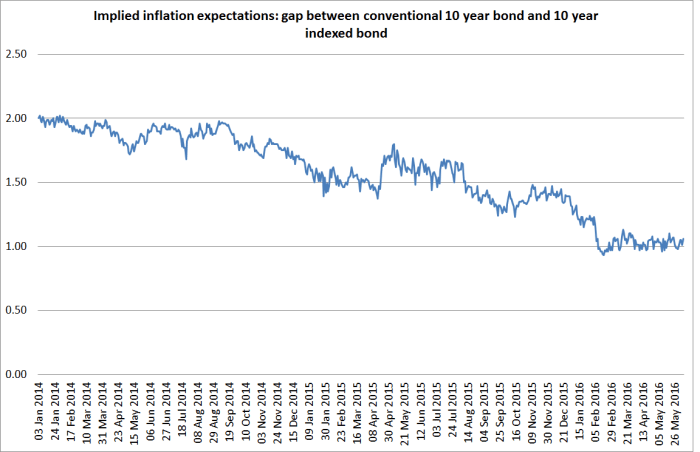
Finally, the Reserve Bank’s “modelling” of long-term inflation expectations got elevated as far as the press release today.  We are assured that these expectations are “well-anchored at 2 per cent” (not even “around” or “near” but “at”).  For these purposes, the Bank uses a couple of surveys of a handful of economists.  It isn’t clear what useful information the results have for current policy, since respondents will reasonably assume that some other Governor, and some other chief economist, will be setting monetary policy before too long.  But it also gives no weight at all to the market-based measure of implicit inflation expectations we do have.

iib breakevens to june 16

125 points of OCR cuts has still not been enough to convince people actually buying and selling government bonds to raise their implied 10 year expectations above 1 per cent.

People just don’t believe –  whether on this measure or in the other surveys – that inflation is going to settle back at 2 per cent any time soon.  They’ve been right to be skeptical.   That should trouble the Bank, and those paid to monitor it.    Expectations surveys aren’t an independent influence on inflation –  often they are a reflection of past actual outcomes –  but the way the Governor was talking today it sounded as though it might take another inflation expectations shock, or perhaps a GDP surprise, to bring about another cut.  The next expectations survey data won’t be available until after the next MPS.


Three months on…

It is three months since, on the morning of the release of the last Monetary Policy Statement, a fortuitous set of circumstances brought to light a leak of the Reserve Bank’s OCR decision.  It hadn’t required any particular devious methods or technologies, and the suggestion –  including from the Reserve Bank’s own lawyer –  has been that it wasn’t the first time it had happened.  Whether that was so or not, the Reserve Bank’s systems were loose enough that it was only a matter of time before, accidentally or deliberately, a leak happened.  And ethics were loose enough at MediaWorks that the leak was apparently seen as acceptable conduct, despite the rules of the lock-up.  It took weeks for MediaWorks to own up, and even now there has been no proper accounting from them as to just what went on.

In an email yesterday about today’s Monetary Policy Statement, someone in the markets noted to me

Still waiting to read your full apology from RBNZ, I live in hope!!

It might be nice, but the words and (in)actions of Graeme Wheeler, and his associates Geoff Bascand, Mike Hannah, and Rod Carr, really speak for themselves.  How did we end up in a situation where these sorts of people govern our central bank?

But I’m still more disturbed about the secrecy with which the Reserve Bank has sought to cloak the whole affair –  telling us just as much as they want us to know.  Answers to a series of fairly straightforward OIA requests, about events that happened two to three months ago, have been kicked out to 1 July –  and such is the Reserve Bank’s track record on the OIA that I’m not optimistic we will get much even then.  Whatever the case for secrecy on some policy matters, a leak inquiry  –  especially one that confirmed an actual leak and prompted major system changes – seems like one of those things where the public should be able to expect a full and open accounting from a taxpayer funded public agency.

Instead, we have them stalling, seemingly averse to transparency and scrutiny.  Among the outstanding matters:

  • We haven’t seen the terms of reference for the leak inquiry
  • We haven’t seen the full Deloitte leak inquiry report, only a short-form public version.
  • We haven’t heard why no penalty was initially imposed on MediaWorks, only for the Governor to later change his mind and indefinitely ban them from Reserve Bank press conferences.
  • We haven’t heard why the Governor chose in his press statement to emphasise the cooperation of MediaWorks when even the short-form report makes clear that it took weeks for that company to own up, and then only when it had been approached by the inquiry team.
  • We have seen no acceptance from the Reserve Bank that its own systems had failed to keep pace with technological change, which left them open to a leak (the consequences of which could have been much more serious than they were).
  • We don’t know whether the Bank has made any serious efforts to find out whether MediaWorks staff had leaked previously, and if they did make the effort to seriously pursue the matter, what the answers were.
  • We don’t know how much involvement the Bank’s Board –  supposed to operate at arms-length from management to hold the Governor to account – had in the handling of the leak, and 14 April press statement.  The documents that have been released suggest, which shed a partial light on the matter, suggest that the answer was “too much”.
  • We haven’t seen the papers the Reserve Bank considered in reviewing the options regarding the future of lock-ups, press conferences etc.

I’m not sure what the Bank has to hide.  The answer may well be “not that much at all”.  If so, the obstructiveness and resistance to an open accounting for their handling of a serious breach is perhaps more just a reflection of an ingrained resistance to see themselves as a public body with all that means.  In particular, that they are subject to the Official Information Act as much as to any other law, and are a body from whom the public should reasonably expect a full and open accounting.  Mistakes happen, errors are made, system flaws come to light.  That is what happens with human beings and human institutions.  Embarrassing as they sometimes are, accidents  and errors will happen.  But how an institution – and a powerful individual – recognizes, accepts responsibility for, and responds to such mis-steps can tell us a lot.

As journalists and MPs gather today to scrutinize the Governor, perhaps they might like to reflect on some of this.


Some matters the Monetary Policy Statement could address

Tomorrow sees the release of the latest Reserve Bank Monetary Policy Statement.  My “rule” for making sense of the Governor’s monetary policy choices at present is that he really doesn’t want to cut the OCR –  and hasn’t for the last year –  as much because of the housing market as anything, and cuts only if reality mugs him, in the form of some key data that he just can’t escape the implications of.   I haven’t seen that sort of data in the last month or two.  Given the terms of the Policy Targets Agreement, it should have been an easy call to cut the OCR again, but it probably hasn’t been.

There is a nice, fairly trenchant, column from Hamish Rutherford in the Dominion-Post this morning on the Governor’s communications “challenges”.  I’m very sympathetic to the line of argument Rutherford is running (including his use of some BNZ analysis of monetary policy surprises).  My only caveat is that, in my view, getting policy roughly right is better than being predictable and wrong.  There were no major monetary policy surprises or communications problems in 2014.  But the repeated increases in the OCR were simply bad policy.  Grudging as it may have been, and badly communicated as it undoubtedly was, the OCR has at least been moved in the right direction for the last year.

In this post, I wanted to highlight some issues that it would be good to see the Reserve Bank change its stance on in its statement tomorrow.   If I really expected they would do so, I probably wouldn’t bother with the post, but perhaps there will be a surprise in store.  Many of them have to do with countering that persistent sense, pervading Bank documents, that the economy is doing just fine.  The Reserve Bank has an inflation target, not an economic performance one, but the argument that all is fine in the economic garden has been used repeatedly to justify keeping the OCR as high as it has been.  As a reminder, even today, in real terms the OCR now is still higher than it was when the ill-judged 2014 tightenings began.

The first is the constantly repeated claim that monetary policy in New Zealand and in other countries is highly “stimulatory”.  It appears in almost every Reserve Bank policy statement or speech, and appears to be based on nothing more than the undoubted fact that interest rates (real and nominal) are currently low by longer-term historical standards.  That doesn’t make them stimulatory.  It has now been more than seven years since the rate cuts during the 2008/09 recession came to an end.  For most of the time since then the OCR has been at 2.5 per cent.  Today it is at 2.25 per cent.

ocr

Adjust for the fall in inflation expectations (around 60 basis points over 7 years on the Bank’s two-year ahead measure), and if anything real interest rates are a bit higher than they’ve typically been since 2009.

The Reserve Bank appears to still believe that a normal (or ‘neutral’) short-term interest rate might be around 4.5 per cent.  But there is nothing substantial to back that view.  The fact that inflation has been persistently below target for several years, in a weak recovery with persistently high unemployment, argues against there being anything meaningful to a claim that 4.5 per cent is a “neutral” interest rate –  a benchmark against which to measure whether monetary policy is “highly stimulatory” or not.  Better, perhaps, to look out the window, and check the current data.  That isn’t always a safe strategy, but it is better than clinging to old estimates of unobservable structural features of the economy.  Having moved to a flat track in its interest rate projections, the Bank appears to be backing away from putting much practical weight on the high estimates of a neutral –  or normal –  interest rate.  But the rhetoric still seems to matter to the Governor, and his reluctance to cut the OCR seems, in part, influenced by his sense that interest rates are already “too low”.  He has –  or at least has produced –  nothing to support that sense –  whether for New Zealand, or for most other advanced other countries.  Better to put to one side for now any estimates of neutral interest rates, lose the rhetoric, and respond to the observable data as they are.

The second point I would like to see signs of the Reserve Bank taking seriously is the persistently high unemployment rate.  At 5.7 per cent it has barely changed in the last year.  I noticed that the OECD in its new forecasts seems to treat 5.8 per cent as the natural rate of unemployment (or NAIRU) for New Zealand.  Few others do, and both the Treasury and the Reserve Bank have tended to work on the basis that our regulatory provisions (welfare system, labor market restrictions etc) are such that the unemployment rate should typically be able to settle nearer 4.5 per cent without creating any inflation problems.    Someone forwarded me the other day a market economist’s preview of this MPS, noting  with some surprise that the unemployment rate wasn’t mentioned at all.  I sympathized with the person who sent it, but pointed out that it was the Reserve Bank the market economists were trying to make sense of, and the Reserve Bank gives hardly any attention to this key indicator of excess capacity in the labour market.   Reluctance to cut the OCR might make more sense if the unemployment rate were already at or below the NAIRU.  As things stand for the last few years, there is an inefficiently large number of people already unemployed, and the Governor’s reluctance to cut just condemns many of them to stay unemployed longer than necessary.  The Governor should at least recognize that trade-off, and explain the basis for his judgements.

The third point it would be good to see the Reserve Bank explicitly addressing is the mistakes it has made in monetary policy over the last few years.  Depending on the precise measure one uses, inflation has been below the target midpoint –  a reference point explicitly added to the PTA in 2012 – for many years now.  Some of that might not have been easily foreseeable.  Some of it might even have been desirable in terms of the PTA (if the one-off price shocks were all one-sided, which they weren’t).  Humans  –  and human institutions –  make mistakes, and one test of a person or institution is their willingness to recognize, respond to, and learn from their mistakes.  Since the Governor is unwilling even to acknowledge that there were any mistakes, it is difficult to be confident that he or the institution has learned the appropriate lessons and adapted their behavior.

The fourth point it would be good to see the Reserve Bank acknowledge is how poor New Zealand’s productivity and per capita real GDP performance has been.  For example, here is real GDP per hour worked for New Zealand and Australia since the end of last boom.

real gdp phw june 16

Maybe data revisions will eventually close the gap, but that is the data as it stands now.

And here is per capita real GDP growth rates.

real gdp pc aapc

A pretty dismal recovery phase, by comparison with past cycles.

My point is not that monetary policy can or should target medium-term productivity growth or real GDP growth, but simply to illustrate the climate in which the Governor has been making his monetary policy calls, holding the OCR consistently higher than the inflation target required.  He likes to convey a sense –  akin to the tone of the government’s own “glee club” –  that everything is fine here but actually it is pretty disappointing.  Perhaps holding interest rates higher than was really necessary might make a little sense if the per capita GDP growth or productivity growth had been really strong –  leaning a little against the wind –  but they’ve been persistently weak.  Again, the Governor should explain the basis for his trade-offs, not pretend they don’t exist.  We’d have had a better cyclical performance if the OCR had not been kept so high.

I could go on.  The Governor could usefully highlight that, although he is uncomfortable –  as everyone should be –  with current house prices, there is nothing in the turnover or mortgage approvals data (per capita) to suggest an excessively active market (high turnover is often associated with excessive optimism, and unjustifiably loose credit conditions).    And there is nothing in the consumption or savings data to suggest that high or rising house prices have spilled over into unwarranted additional consumption, putting upward pressure on inflation more generally.  I showed the chart of private consumption to GDP in a post yesterday –  stable over almoat 30 years, despite really large increases in house prices and credit.  This chart shows the national savings rate, since 1980.  There is a little year to year variability, but again no trend over 35 years now.

national savings

House prices are a national scandal, but there is no reason to think they should be treated as a monetary policy problem.

I do think the OCR should be lower –  perhaps 50 or 75 basis points lower than it is now.  In time, the Reserve Bank is likely to recognize that.  But my point here is really that when he makes his choices –  and they are personal choices, not those of a Committee –  the Governor should, and should be seen to, engage with world as it is, not as he might wish that it would be.  In that world, the unemployment rate lingers high, productivity and income growth have been persistently weak, inflation has been persistently below target, wage inflation is weak, house price inflation isn’t splling into generalized inflation pressures, and historical reference points around normal or neutral interest rates seem increasingly unhelpful.  Perhaps there is a good case for keeping the OCR at current levels, but a good case can’t simply pretend everything is rosy in the garden or that –  finally –  everything is just about to come right.

(And all that without even mentioning the exchange rate which is not only high by historical standards –  again raising doubts about those “stimulatory” claims for monetary policy –  but this morning is at almost exactly the same level it was at a year ago.  The fall in the exchange rate from the 2014 highs was supposed to help get inflation back to target.  It was a half-plausible story when the fall first happened.  It is less even than that now.)


$492500000000

That’s the Herald’s headline for its new “Nation of debt” series, where they state “New Zealand now owes almost half a trillion in debt”.

Whatever “New Zealand” and “owes” might mean.

The New Zealand government has some debt –  $109 billion of it, in gross terms, according the Herald’s numbers, spread between central and local government.  Of course, these very same entities have financial assets as well.  The financial assets aren’t as large as the financial liabilities, but by most reckonings the New Zealand public sector isn’t particularly indebted.

Another way of reckoning ‘New Zealand’s debt might be the amount New Zealand firms, households and governments owe to foreigners.  That isn’t $500bn, but –  according to Statistics New Zealand – $247 billion (gross).  Again there are some assets on the other side.  And actually the net amount of capital New Zealand resident entities have raised from abroad is largely unchanged, as a share of GDP, for 25 years.  It is quite high by international standards, but the ratio isn’t going anywhere.

But the Herald chooses to focus simply on the gross debt of New Zealand entities, and pays no attention to what might be going on elsewhere in the balance sheet.  Since they end up focusing on households, lets do that.  The Herald focuses on $232.9 billion of gross household debt, but pays no attention to what has been going on with household deposits.  Here is the chart, using the Reserve Bank’s household statistics, of the gap between household debt and household deposits.

household debt to deposits

It rose very rapidly in the boom years of the 2000s, but has gone nowhere at all for seven or eight years now.   GDP has gone up a lot in that time, so that the ratio of this gap (between loans and deposits) to GDP is materially lower than it was back in 2007/08.    This isn’t some novel point –  the Reserve Bank has been mentioning it in FSRs for years now.

Even ignoring deposits, household debt to GDP itself has gone nowhere for eight years, after a huge increase in the previous 15 years.

household debt to gdp

Probably these ratios will increase somewhat over the next few years.  HIgh house prices, and a housing stock that turns over only quite slowly,  does that.  Here is a chart I ran a while ago illustrating how debt to income ratios keep rising for quite some time –  all else equal –  even if there is just a one-off increase in house prices.

In the chart below I’ve done a very simple exercise. I’ve assumed that at the start of the exercise, housing debt is 50 per cent of income, house prices and incomes are flat, and people repay mortgages evenly over 25 years. Only a minority of houses is traded each year, but each year the new purchasers take on new debt just enough to balance the repayments across the entire mortgage book.

And then a shock happens – call it tighter land use regulation – the impact of which is instantly recognized, and house prices double as a result. Following that shock, house purchasers also double the amount of debt they take on with each purchase, while the (now rising) stock of debt continues to be repaid in equal installments over 25 years.

In this scenario remember, house prices rose only in year 1. There is no subsequent increase in house prices or incomes. But this is what happens to the debt to income ratio:

debt to income scenario

None of this is reason to be indifferent to the scandal of house prices, especially those in Auckland.  But high house prices –  that result mainly from the interaction of population pressures and the thicket of land use restrictions which rig the market against the young – tend to increase the amount the young need to borrow from, in effect, the old to get into a first house.  It is quite risky for the borrowing cohort, but on the other side are much higher financial assets held by the older cohort, who sold the young the houses.  “New Zealand” isn’t more indebted –  one significant cohort of New Zealanders have much more debt, and others have much more financial assets.  And that outcome is mostly down to choices made by successive governments.

The Herald is also keen to run the line that people are treating their houses like ATMs –  drawing down on the additional equity to boost consumption.  No doubt some are –  and for many it will be quite rational to do so.  If you are 60 now, living in Auckland, and thinking of moving to Morrinsville or Kawerua to retire, you might as well take advantage of the rigged housing market now and spend some of your equity.  On the other hand, people trying to get on the housing ladder are having to save ever more to get started in the market (through some combination of market constraints and regulatory restrictions).  But whatever the case at the individual level, here is a chart I’ve run a couple of times recently, showing household consumption as a share of GDP.

household C to GDP

If you didn’t already know there had been a massive increase in house prices, and gross household debt, over these decades, there is nothing in overall consumption behavior to suggest a problem (or even an issue).  High house prices don’t make New Zealanders as a whole better off, they simply involve redistributing wealth from one cohort to another.  If they don’t make New Zealanders as a whole better off, we wouldn’t expect to have seen a surge in consumption.  And we don’t.

I’d hate to be one of the young taking on mortgages of the staggering size that are all too common today.  Even if house prices never come down much –  quite plausible if the land supply mess is never properly fixed –  they face a heavy servicing burden for decades.  If house prices do fall a lot, those people risk carrying an overhang of debt that could make it all but impossible to move.  And some risk of serious distress if the borrower were to be out of a job for very long.

But it isn’t “New Zealand” that owes this money.  It is one lot of New Zealanders who owe it to another lot of New Zealanders, in a market rigged by governments.  Fortunately –  and I didn’t see this in the Herald story –  even our Reserve Bank (constantly uneasy about debt and housing) has repeatedly run severe stress tests and found that the banking system is robust enough to cope with even some nasty adverse shocks.  The same, of course, won’t necessarily be able to be said for all the borrowers if something very bad does happen.


Thinking about changing immigration policy

I was going to write about the Reserve Bank’s forthcoming Monetary Policy Statement, but discussion around immigration policy continues in the media, so I thought the topic might be worth one more post.

There are all sorts of different numbers tossed around when immigration and net migration are debated.  Different numbers are relevant for different purposes, and things aren’t greatly helped by the fact that MBIE does not release regular monthly numbers on visa approvals, and so the month to month discussion is often dominated by SNZ’s permanent and long-term (PLT) migration numbers.

The centerpiece of our medium-term immigration policy is the residence approvals target: 45000 to 50000 people per annum.  That target hasn’t been changed for a long time –  it was the previous government’s target and the current government’s.  It is a large number by international standards: as I noted yesterday, in per capita terms it is around three times the number of green cards the US issues each year.  Actual approvals fluctuate a little from year to year –  I showed the chart in yesterday’s post –  but not very much, and the rules and points are tweaked a bit over time to keep near the target.  Debates about the medium-term implications of immigration, whether for population or economic performance, should really concentrate on the appropriate target level (and composition) of residence approvals.   It is important to appreciate that these days the bulk of people getting a residence approval are already in New Zealand (around 70 per cent) –  having arrived on, for example, a student or (temporary) work visa.  In most cases, granting a residence approval changes the legal status of the individual, and does not involve a new border crossing.

But, as I noted, the PLT numbers dominate the headlines.  PLT numbers (which importantly include New Zealand citizens –  not a matter of immigration policy) are only estimates.  We know exactly how many people come across our border (in and out) each month, but the split between permanent and long-term on the one hand, and short-term on the other, relies entirely on the self-reported intentions of those filling in the arrivals and departure cards.  Plans change.  As I’ve highlighted previously, Statistics New Zealand themselves have done useful work showing that at times the reported PLT numbers have been quite substantially different from the actual numbers who have come or gone for more than 12 months (I discussed this work here .  It is a great shame that SNZ is not adequately funded to produce these refined estimates on a regular basis.

Using the PLT data, one can look at either total arrivals or the net flow.

Here is total (self-reported) PLT arrivals by visa type for the last decade or so (the period SNZ provides the data for).

plt arrivals

Among other things, this chart illustrates my point above about residence visas.  About 43000 residence approvals were granted in the last year, but when people crossed the border to enter New Zealand only around 14000 arrived in the country already holding residence visas.  In granting residence approvals, policy now puts a high weight on people already having a job and being established in New Zealand, so most people who get residence approvals come first on student or work visas.  Even over this decade, one can see the rising share of these temporary visas.  Of course, not all these people stay permanently (or would want to).

And it is also worth highlighting the “not applicable” category, which captures New Zealand and Australian citizens who don’t need a visa to come and live here.  Over these 11 years, that number has fluctuated between 28000 and 36000 per annum –  not huge variation.  There is much more variation in the departures of New Zealand citizens: over the same period that total has fluctuated between 34000 and 62000 per annum.

Total PLT arrivals probably could probably be managed, more or less, with a policy target.  But it wouldn’t be very sensible to do so.  If our universities really do offer a great tertiary education there is no obvious reason why we’d want to put a policy cap on the numbers coming.  It is just another export industry.  The policy focus should be on the number, and composition, of the people (non New Zealanders) we allow to live here permanently.

What about net PLT flows?  They fluctuate enormously.  Here is the chart of annual flows since 1921.

net plt flow

Bear in mind (a) that the population is much bigger now than it was in earlier decades, and (b) that SNZ work suggesting that self-reported PLT flows don’t always accurate represent true permanent and long-term inflows. Importantly, using that analysis, the 2002/03 boom at peak was larger, as a share of population, than the current net inflow.

The average PLT inflow over the last 25 years has been just under 15000 –  a large outflow of New Zealand citizens, and a much larger inflow of non New Zealand citizens.  Perhaps this is the sort of number Winston Peters has in mind when talking about a target inflow of 7000 to 15000?

The net PLT flow cannot be managed by policy at least over short to medium-term horizons.  Cutting the residence approvals target, as I have proposed, would markedly reduced the average net inflow over time, but the cycles in net PLT would probably be about as large as ever –  just cycling around a lower mean.    Much of the variation is the change in the number of New Zealanders leaving (see above).  As I noted yesterday, when politicians talk of short-term caps or (as I heard Andrew Little call for this morning) “more agile” management of the system, it isn’t likely to be a recipe for more stability in PLT flows, but a risk of creating more (pro-cyclical) instability.   Forecasters of the net PLT flow 12 to 18 months ahead have a shocking track record.

Export education services have been flavour of the month in this debate for a while now, and I heard Steven Joyce on the radio this morning talking about how any serious cutback to immigration could put tens of thousands of jobs at risk in the export education sector.

To the extent that people are coming to study in New Zealand for the quality of educational products New Zealand firms and institutions have to offer, the Minister’s comments are almost entirely wrong.  People choose to study at Harvard or Stanford or Oxford because they are top-notch universities.

But that doesn’t look like the New Zealand story.  Here is a chart of student visas by the type of institution the student is studying at.  Unfortunately MBIE provides this data only back to 2005/06.

student vsias by type

All the growth in recent years has been in the polytech and private training establishment sectors.  I’m sure there are some excellent institutions in that sector, offering really high quality educational services rivalling the best in the world.  But one might also suspect that the stories of people using study here mostly as a way of being better positioned to get a residence visa, financed by the recent change of policy allowing students and partners to undertake a lot of paid work while they are here, has more than an element of truth to it.  If so, it isn’t that our export education industry is hugely competitive and successful, it is just another case of “export incentives” at work.  We dish out cash to the film industry, and in this industry a leg up on the residence approvals process is the subsidy.  Subsidised export industries certainly get a benefit themselves, and perhaps that benefits the people working for them.  They rarely benefit New Zealand in the long haul.  We should have learned that lessons decades ago.

Again, if our education sector was attracting real top-notch people, and encouraging them to apply for residence, there might be a net gain for New Zealand (lifting the average quality of the people we decide to let stay).  But as Treasury has noted, we aren’t doing that well at attracting really highly-skilled people.  The recent Fry and Glass book reported that we are doing less well on that score than either Australia or Canada.  And, as a reminder, these were the top five occupations for the skilled migrants last year.

Chef
Registered Nurse (Aged Care)
Retail Manager (General)
Cafe or Restaurant Manager
ICT Customer Support Officer

Those five occupations alone made up 25 per cent of the skilled migration approvals.  And skilled migrant approvals made up only around 60 per cent of the total residence approvals –  others, presumably, were not even reaching that standard.

If we were to look at changing our target level of residence approvals there are some significant questions to address.

One is how fast to make any change.  I’ve argued for pulling the target down from 45000 to 50000 per annum to 10000 to 15000 per annum, but haven’t taken a strong view on a transition path.  The housing market stresses, and long-term productivity underperformance, are sufficiently serious that there is probably a reasonably case for making the change in one step.  I wouldn’t favour a very gradual adjustment –  say, pulling the target down 5000 a year –  partly because it would be too hard to distinguish the effects of the policy change from all the other stuff going on. A middle ground might be to, say, halve the residence approvals target for five years, with a full review of the costs and benefits of that approach to be undertaken at the end of the period.

The other key question is what the composition of a lower approvals target might be.

Here is a chart showing the breakdown of residence approvals, using MBIE data.

res approvals by category.png

It would be very easy to simply squeeze out skilled migrants (and their spouses and children).  Personally, I think that if we are serious about immigration serving an economic role we would need to think hard about some of the other categories.  For example, in the most recent year, around 10 per cent of residence approvals went to parents (presumably generally quite elderly) of people now living here, with a few hundred additional approvals for adult children and siblings.  There is little or no prospect of economic gain to New Zealand from this migration –  and no obvious humanitarian case either –  and a pretty good chance that (unlike most skilled migration) the net fiscal cost of these migrants will be quite substantial.

We also approved residence for 1500 people under two Pacific Island access categories.  These are presumably people who would not have qualified as skilled migrants.  Perhaps one can accommodate those sorts of numbers within a 45000 to 50000 annual target, for historical or foreign policy reasons.  Much harder questions would have to be asked if we brought our overall immigration numbers more into line with international practice.

I don’t have a particular view on appropriate refugee numbers.  If anything, at present, there is a push to increase that quota at present.  That is a legitimate choice for a country to make, but most probably to do so would further reduce the chances of the immigration programme making a meaningful economic contribution to New Zealanders.  Then again,  I read the evidence as suggesting that immigration mostly benefits the migrant, and that countries are fooling themselves if they treat large scale immigration as (as MBIE does) some sort of “economic lever” to lift medium term domestic economic performance.

There is a lot of talk about how disruptive a cut in the immigration (residence approvals) target could be. No doubt that is true for firms and sectors that are focused on meeting the needs of a rapidly rising population – be it builders or whatever (furniture and carpet shops). But a lot of that argument is built on the fallacy the immigration eases overall labour shortages. If anything, it exacerbates them: the short-term demand effects of immigration outweigh the supply effects.

Let’s say, as a deliberately extreme example, that my preferred policy – cutting the residence approvals target to 10000 to 15000 per annum was adopted tomorrow. What might we see over the following few years?

I noted yesterday that we would see house and urban land prices a lot lower, especially in places that have experienced considerable population pressure in recent years.

We’d also see a lot less building activity – across all types of construction. We’ve seen this before – when net migration was very low in the late 1970s and early 1980s the construction share of GDP was much lower than it had been before or since. Quite possibly, the PTE component of the export education industry would take a hit.

But all of these pressures would be recognised in the Reserve Bank’s economic forecasts, and monetary policy would adjust to take account of the weaker demand pressures. In fact, markets would be likely to adjust even before the Bank, so long as the policy change was well-signalled and treated as credible. Real interest rates would fall, and so would the real exchange rate. Our exchange rate stays high only because New Zealand pretty consistently offers a yield premium over those on offer in other currencies. We’d see a classic case of resource-switching. The cost of capital to firms developing businesses here would be lower, and the lower real exchange rate would be particularly attractive to firms looking at opening, or expanding, in the tradables sector. Recall, that per capita sector production has not increased for 15 years. This policy change would help reverse that shocking record. It seems likely that regions outside Auckland – in many cases, much more export focused, would get a particularly substantial boost.

What about the labour market? As I’ve already noted, high levels of immigration don’t ease overall labour market pressures, they exacerbate them in the short term. So, all else equal, a lower rate of residence approvals (not simply offset with more work visas approvals) would ease labour market pressures to some extent (offset, of course, by the easier monetary policy). Perhaps some sectors might still find it difficult to get the right people. That is what the price mechanism is supposed to deal with: higher wage rates for particular skills or sectors will, over time, draw people into those occupations. There is a price at which New Zealanders will be aged care workers or dairy hands. For firms in the non-tradables sectors, that higher price might be difficult to absorb. In a sense that is part of the point: reorienting the economy towards the tradables sectors puts pressure back on the non-tradables sectors. For firms in the tradables sectors, the lower exchange rate provides a margin that can accommodate any wage pressures that might develop in individual sectors. But I’d be surprised if those pressures were large or systematic: after all, many of the people who have been employed in sectors responding to the rapidly rising population have to find some other place to work.

Over five years, I’d expect we’d start to see material gains for New Zealanders as a whole. More affordable house prices, a larger share of the economy selling to the rest of the world, reduced pressure on unskilled New Zealanders, and so on. Successful economies typically succeed by finding ways of selling more and better stuff to the rest of the world. We’ve failed on that count (in per capita terms) for decades, but we can turn it around. I’d expect that five years after such a policy was adopted we’d have started to see our productivity performance markedly improving relative to those in other advanced countries. If global productivity performance was still weak, ours might still not be all that we’d like, but we’d almost certainly be doing less badly than our peers. The gaps between productivity levels in New Zealand and those abroad are so large that it will take decades to reverse them. But as we do, we might even find ourselves in the position the Irish finally found themselves in last decade – the huge diaspora finally started to come home.