Labour’s fiscal commitments

There has been plenty of talk in the last few days about the fiscal pressures the government finds itself facing.   There are echoes of the great “fiscal hole” controversy from last year’s election campaign.   And so it seemed like a good time to revisit a post I did back then on these issues.

In that post I first explained what Labour had done

Labour has laid out their numbers in a series of summary tables.  They have explicitly identified numbers for each of their (revenue and expenditure) major policy initiatives, and made explicit summary provision for the cost of a group of less expensive policies.  And they identified how much (or little) still unallocated money they would plan to have available.   The resulting operating surplus numbers are almost identical to those in PREFU, but where they do take on a bit more debt –  to fund NZSF contributions and the Kiwibuild programme – they also allow for additional financing costs.

And then they had BERL go through the numbers.    People on the right are inclined to scoff at BERL and note that they are ideologically inclined to the left.  No doubt.  But all they’ve done on this occasion is a fairly narrow technical exercise.  They haven’t taken a view on the merits of any specific policy promises or even (as far I can see) on the line item costings Labour uses.  And they haven’t taken a view on the ability of a Labour-led government to control spending more broadly.   They’ve taken the Labour numbers, and the PREFU economic assumptions and spending/revenue baselines, and checked that when Labour’s spending and revenue assumptions are added into that mix that the bottom line numbers are

“consistent with their stated Budget Responsibility Rules and, in particular

  • The OBEGAL remains in surplus throughout the period to 2022
  • Net Core Crown debt is reduced to 20% of GDP by June 2022
  • Core Crown expenses remain comfortably under 30% throughout the period to 2022.”

An economics consultancy with a right wing orientation would have happily signed off on the same conclusion.

But, so I argued, that wasn’t the real issue.   I won’t blockquote all this, but what follows is just lifted from the earlier post.

But where there is more of an issue is that Labour’s spending plans on the things they are [explicitly] promising mean that to meet these surplus and debt objectives, on these [PREFU] macro numbers, there is very little new money left over in the next few years.     That might not sound like a problem –  after all, why do they need much “new money” in the next few years when the things they want to do are already specifically identified and included in the allocated money in the Labour fiscal plan?      The answer to that reflects the specifics of how the fiscal numbers are laid out, and how fiscal management is done.   Government departments do not get routine adjustments to their future spending allowances to cope with, say, the rising demands for a rising population, or the increased costs from ongoing inflation (recall that the target is 2 per cent inflation annually).   Rather, they are given a number to manage to, and only when the pips really start squeaking might a discretionary adjustment to the department’s baseline spending be made.  Any such discretionary adjustments comes from the “operating allowance” –  which thus isn’t just available for new policies.

You can see in the PREFU numbers.   Health spending rose around $600 million last year, and is budgeted to rise by around $700 million this year (2017/18).  And then….

$m
2017/18 16432
2018/19 16449
2019/20 16481
2020/21 16396

No one expects health spending to remain constant in nominal terms for the next three fiscal years.  But there will need to be conscious decisions made in each successive Budget to allocate some of the operating allowance to health –  some presumably to cover new policies, and much to cover cost increases (wages, drugs, property etc, and more people), all offset by whatever productivity gains the sector can generate.

And here is why I think there are questions about Labour’s numbers.  By 2021, they expect to be spending $2361 million more on health than is reflected in these PREFU numbers.     About 10 per cent of that increase is described as “Paying back National’s underfunding” and the rest is labelled as “Delivering a Modern Health System”.

This is how they describe their first term health policies

Reverse National’s health cuts and begin the process of making up for the years of underfunding that have occurred. This extra funding will allow us to invest in mental health services, reduce the cost of going to the doctor, carry out more operations, provide the latest medicines, invest in Māori health initiatives including supporting Whānau Ora, and start the rebuild of Dunedin Hospital.

That sounds like an intention to deliver materially more health outputs/outcomes (ie volume gains, or reduced prices to users).

In response to Steven Joyce’s attack, Grant Robertson is reported as having told several journalists that Labour’s health (and education) numbers include allowances for increased costs (eg rising population and inflation  –  and inflation in the PREFU is forecast to pick up) as well as the costs of the new initiatives.   Perhaps, and if so perhaps a pardonable effort to put a favourable gloss on the proposed health (and education) spends –  ie sell as new initiatives what are in significant part really just keeping with cost and population pressures.  I say “pardonable” because governments do it all the time.

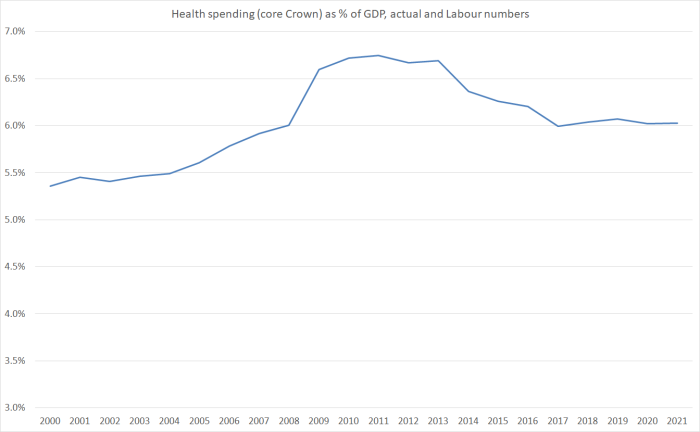
In this chart, I’ve shown core Crown health expenditure as a share of GDP since 2000, and including Labour’s plans for the next three budgets.  (Labour show total Crown numbers, but I’ve taken their policy initiative numbers –  ie changes from PREFU –  and applied them to the core Crown data, which Treasury has a readily accessible time series for.  The differences between core and total Crown in this sector are small.)
Labour health

In other words, on these numbers health as a share of GDP over the next three years would be less than it was for most of the current government’s term, and virtually identical to what it was in Labour’s last full year in government, 2007/08.    Some of the peaks a few years ago were understandable –  the economy was weak, and recessions don’t reduce health spending demands.  But even so, we know that there are strong pressures for the health share of GDP to increase, as a result of improving technology (more options) and an ageing population.  Treasury’s “historical spending patterns” analysis in their Long-term Fiscal Statement last year had health spending rising from 6.2 per cent of GDP in 2015 to 6.8 per cent in 2030.

Without seeing more detail than Labour has released there really only seem to be two possible interpretations.  Either Labour hasn’t allowed for the ongoing (ie from here) population and cost increases in their health sector spending numbers, or there must be much less in the way of increases in health outputs than the documents seem to want to have us believe (eg “reversing years of underfunding”).  One has potential fiscal implications.  The other perhaps political ones.    Glancing through Labour’s health policy, which seems quite specific, I’m more inclined to the former possibility (ie not allowing for population and cost pressures), but I’d be happy to shown otherwise.

Eyeballing that chart –  and as someone with no expertise in health –  it would look more reasonable to expect that health spending might be more like 6.5 per cent of GDP by the end of the decade, in a climate where a party is promising more stuff not less, and with no strategy to (say) shift more of the burden back onto upper income citizens.

2018 commentary resumes here:  in other words, despite all the talk in their own campaign documents and rhetoric about systematic underfunding of health, Labour’s proposed spending on health –  carefully laid out numbers – as a share of GDP just wasn’t consistent with the rhetoric.   They – and perhaps even the previous government –  may not have been specifically aware of, say, the Middlemore problems, and perhaps more generally things really are worse than they could have realised in Opposition.   But it seems implausible to think that a party talking up underfunding –  and well aware, for example, of the constant pressure on DHBs to produce surpluses come what may –  could have supposed that, on their proposed delivery models and views on entitlements, operating spending on health of only 6 per cent of GDP could have been enough.     That was stuff they should have recognised and acknowledged going into the election.

As I noted in last year’s post, one could do the same exercise for education.  This is another quote from that post:

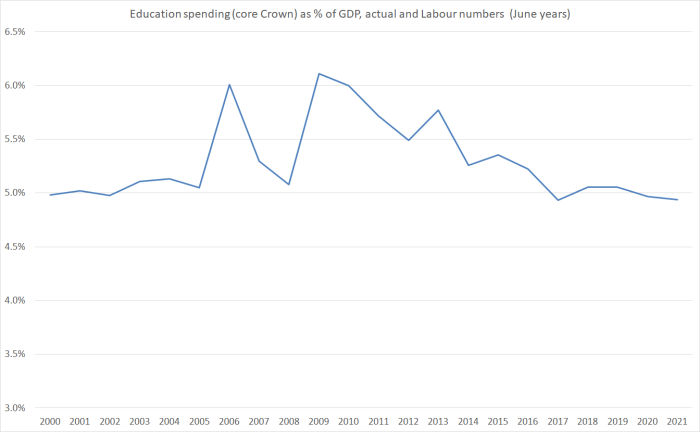
One could do much the same exercise for education.  Labour has seven line items in its “new investments” table.  Most of them are very specific (including increased student allowances and the transitions towards zero-fees tertiary education).     There is a general (large) item labelled “Delivering a Modern Education System” but in the manifesto there are a lot of things that look like they are covered by that.    There isn’t any suggestion that general inflation and population cost increases are included, but perhaps they are.  But again, here is the chart of education spending as a share of GDP, including Labour’s numbers for the next three years.
labour education.png

I’m not altogether sure what some of those earlier spikes were (perhaps something to do with interest-free student loans), but again what is striking is that Labour’s plans appear to involve spending slightly less on education as a share of GDP than when they were last in government.  And that more or less flat track from here doesn’t suggest a party responding to this stuff

National has chosen to undermine quality as a cost-saving measure. After nine years of being under resourced and overstretched, our education sector is under immense pressure and the quality of education is suffering. The result is a narrowing of the curriculum, more burnt out teachers, and falling tertiary education participation.

and at the same time committing to flagship policies around things like student allowances and fee-free tertiary study.

Again, it begins to look as though Labour has included in its education numbers the ongoing multi-year costs of its own new policies, but not the ongoing cost increases resulting from wage and price inflation and population increases.  Again, I’d happily be shown otherwise.

Of course, there is some unallocated spending in Labour’s numbers, but the amounts are very small for the next few years, and some of these sectors are very large.  And although population growth pressures are forecast to ease a little in the next few years, inflation is forecast to pick up and settle around the middle of the target range, so there are likely to be increased general cost pressures (including, for example, wage pressures if as Labour state in the fiscal plan document “by the end of our first term, we expect to see unemployment in New Zealand among the lowest in the OECD, from the current position of 13th”).

How much does it matter?  After all, we don’t know many specifics on the policy initiatives National (and/or its support partners) might fund in the next term, and there was the strong suggestion the other night of a new “families package” in 2020 (which would come from any operating allowance).  Quite probably the next few years will be tough, in budget terms, for whoever forms the government.  After all, the terms of trade isn’t expected to increase further, and inflation is.  And there is a sense that in a number of areas of government spending things have been run a bit too tight in recent years.      On the other hand, Labour participated in this ritual exercise and it looks as though they may have implied rather more fiscal degrees of freedom than were actually there, if –  critical point –  they happened to want to produce a surplus track very like National’s.

2018 commentary resumes again. But all that led me to wonder quite why Labour had made the commitments it had.  Here is a final, slightly shorter, quote

……perhaps the bigger question one might reasonably put to both sides is why the focus on (almost identical) rising surpluses?   These are the numbers.
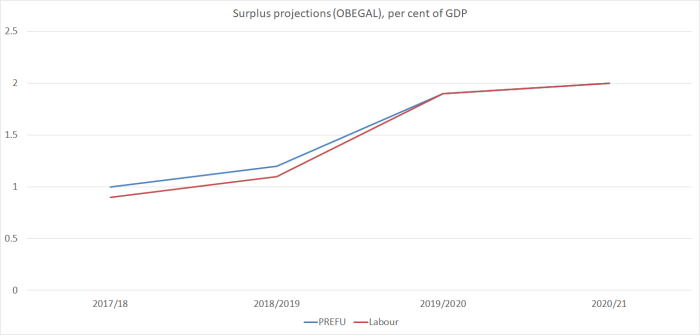
labour surplusWhen net core Crown debt is already as low as 9.2 per cent of GDP –  not on the measure Treasury, the government and Labour all prefer, but the simple straightforward metric –  what is the economic case for material operating surpluses at all?   With the output gap around zero and unemployment above the NAIRU, it is not as if the economy is overheating (the other usual case for running surpluses).   Even just a balanced budget would slowly further lower the debt to GDP ratios.   One could mount quite a reasonable argument for somewhat lower taxes (if you were a party of the right) or somewhat higher targeted spending (if you were a party of the left, campaigning on structural underfunding of various key government spending areas).

Labour is promising to spend (and tax –  thus the surpluses are the same) more than National.  But their commitment (rule 4) was to keep core Crown expenditure “around 30% of GDP”, not “comfortably below 30 per cent”.

labour spending

28.5 per cent is quite a lot lower than 30 per cent (almost $5 billion in 2020/21 – not cumulatively, as GDP is forecast to to be about $323 billion). And 30 per cent wasn’t described as a ceiling. And in the last two years of the previous Labour government, core Crown spending was 30.6 per cent of GDP (06/07) and 30 per cent of GDP (07/08).

It is a curious spectacle to see a party campaigning on serious structural underfunding of various public services and yet proposing to cut government spending as a share of GDP.  It would be difficult to achieve –  given the various specific policy promises –  but you have to wonder, at least a little, why one would set out to try.     We simply aren’t in some highly-indebted extremely vulnerable place.

Here endeth the quotes from last year

I’m not one of those persuaded by the siren calls that the government should be borrowing heavily because interest rates are low.   For a start, our interest rates are still among the very highest in the OECD.   And interest rate outcomes aren’t the result of some random-number lottery: they are low for a reason (having to do in no small part with future expected rates of growth).   I’m also cautious about the lack of “policy space” to cope with the next serious recession.   But in the debate around this year’s Budget, or the next couple, most aren’t suggesting the government should rush out and adopt fiscal parameters that might deliver net debt of 50 or 70 per cent of GDP a decade hence.   Instead, Labour simply bound itself to the same, arbitrary, net debt target as National had run with, just achieved a couple of years later than National planned to do so.

I don’t agree with everything in this extract from Matthew Hooton’s Herald column the other day, but the gist seems about right.

Robertson has convinced himself that sticking to his commitment is essential to maintain the confidence of the business community and financial markets.

He remembers the Winter of Discontent of 2000 and is determined to avoid at all costs investors and business becoming actively hostile to the new regime.

But this just shows Robertson’s naivety about the business and finance communities and woeful ignorance of what drives confidence in either.

At a net 22 per cent of GDP, New Zealand’s debt is already low compared with the rest of the world. If carefully signalled and communicated by Robertson and his Treasury officials, it is implausible that a further extension of the 20 per cent debt target to, say, 2025, would provoke a materially adverse reaction from the business community or financial markets, especially if emphasis was placed on investments in infrastructure and human capital.

Moreover, the business and financial communities well understand and accept that the fundamental difference between Labour and National governments — at least theoretically — is that the former believes in bigger government than the latter.

And yet –  see the graph immediately above- Labour campaigned on continued reductions in government operating expenditure as a share of GDP, all the time claiming that core services were underfunded.   And in her press conference yesterday, the Prime Minister indicated that Labour would be sticking to its self-imposed Budget Responsibility Rules.  As I illustrated above, under the operating spending limb of those Rules there is plenty of slack, but the binding rule on this occasion is the net debt goal they have committed to.  And net debt isn’t just affected by any increase in operating spending, but also in any action the government takes to address claims of (previously unrecognised) backlogs in capital investment.

Labour seem to have first got themselves into this hole from (a) a desperate desire not to leave room to be painted as irresponsible potential economic managers, and (b) an inability to persuasively make an alternative case.  And all of this was laid down at a time when, perhaps, it seemed that the chances of having to actually deliver, in government, were slim.     But, in the old line, the first rule of holes is “stop digging”.  At present, Labour –  while claiming things are much worse than even they realised –  seem to be setting out to dig themselves even deeper in.   In a way, perhaps, it is admirable that they seem to want to follow through on a pre-election commitment.  But that narrative about fixing public services, and reversing what they regarded as severe underfunding in many areas (now worse, they claim, than they previously recognised) seemed quite like a pre-election commitment as well, even if it didn’t have precise numbers and dates on it.

(And yes, my natural inclinations are towards smaller government.  There are plenty of things I would cut back on, notably addressing NZS issues.  This post isn’t an unconditional advocacy for bigger government, or any sort of statement of faith in the likely quality of much government spending, just pointing to the tortured, almost indefensible, logic of the government’s own position.   And for those who worry about the interest rate consequences of higher net debt, I tackled that in another post last year.)


More on population and per capita GDP

My quick post on Saturday, in response to someone’s comment, was designed simply to illustrate what should have been quite an obvious point: looking across countries in any particular year, countries with large populations don’t tend to be richer (per capita GDP) than countries with small populations.  Just among the very big countries, the United States is towards the top of the GDP per capita rankings (beaten by a bunch of small countries), and China, India, Indonesia, Pakistan, and Brazil are not.   Since both the physical sizes of countries, and their populations, are the outcomes of all sorts of historical factors, it wasn’t an observation about immigration policy or (wince) “population policy”.    And, of course, GDP per capita isn’t everything: moderately well-off large countries are typically more powerful (defence or offence) than small rich ones.

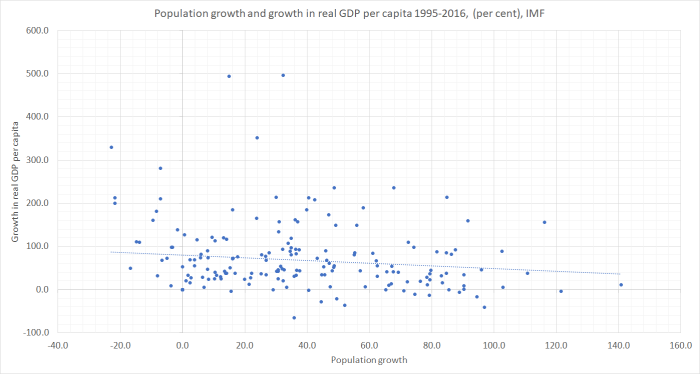
But, continuing to play with the same data download from the IMF WEO database (190 or so countries and territories) for the period since 1995, is there any obvious relationship betweeen population growth rates, and growth in real per capita GDP?

Here is the chart

population 9 Aug 1 all countries

Actually, I’ve left out three extreme outliers –  all oil producers.  Equatorial Guinea had growth in real GDP per capita of about 2500 per cent over the period, and UAE and Qatar had population growth of 300-400 per cent (in one case, with falling real GDP per capita, and in the other with a moderate increase).

There is basically no relationship between the two series –  again, each dot is a country.  The simple linear regression line is downward-sloping but that probably wouldn’t be a statistically significant relationship.  Bear in mind though that simply charting population growth and per capita GDP growth for the same period could have shown an upward-sloping relationship even if there was no causal link from faster population growth to faster per capita economic growth: countries with rapid growth in real GDP per capita might be expected to attract more people (immigrants flow towards opportunity) and perhaps even induce higher birth rates.   But there is no sign of even that sort of relationship, across all countries, and over this period of 20 years or so (this sort of reverse causality is a big problem looking at annual data, but much less so looking at long periods).

The full sample of countries includes a huge range of types of countries –  from war-torn poverty stricken basket cases (Syria, Somalia, Afghanistan) to tiny remote islands (Tuvalu), as well as places with strong institutions, good connections, and an established record of economic performance.   How do this simple bivariate relationships look if we focus just on these latter countries?

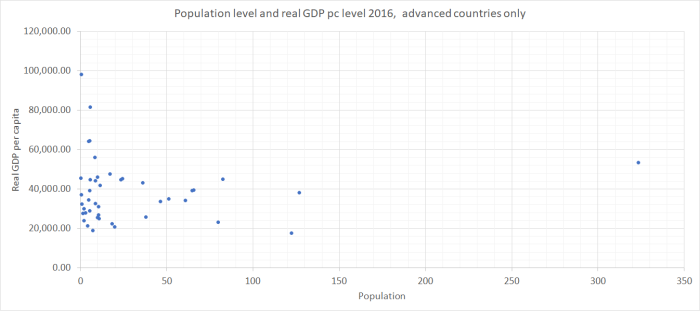
In various posts over the years, I’ve used a sample of about 40 fairly advanced countries, encompassing the members of the OECD and the EU, as well as Taiwan and Singapore.   There is still a lot of difference among these countries: places that were non-market communist economies only 30 years ago, the odd place (eg Mexico) that is more like an honorary member of the group of advanced countries, as well as the places with very high productivity (France, Germany, United States, Ireland, Norway).  And there are countries as small as Malta or Luxembourg, and as large as the United States.  This group leaves out countries that appear to be rich only because of oil.

Here is the simplest plot: of the levels of population and GDP per capita in 2016.

popn advanced 1

This time, the simple regression line is very slightly upward sloping.  Remove the US and it changes sign.  Remove all the countries with more than 50 million population and it is still downward sloping.

But what about growth rates?  For quite a few of these countries, GDP per capita is pretty shaky before about 1995 (communist-era and immediate post-communist transition).  That’s why I’ve done all these charts for just the last 20 years or so.  But that also happens to be a period when there has been a lot more population movement between advanced countries (especially in Europe).

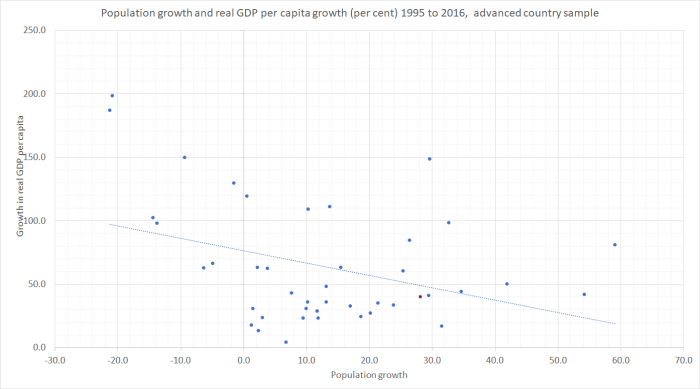
popn advanced 2

Recall that even if there was no causal relationship running from population growth to growth in real GDP per capita, there was a possibility that we might have seen an upward-sloping relationship simply from any link between successful economies drawing in more people (as happened in Ireland most obviously –  net immigration rising well after the boom in per capita GDP and productivity).  But, in fact, across these 40 or so advanced countries, any relationship is downward sloping.  Across these countries in this period, faster population growth has been associated with slower real per capita GDP growth. (For the eagle-eyed among you, New Zealand is the red dot.)

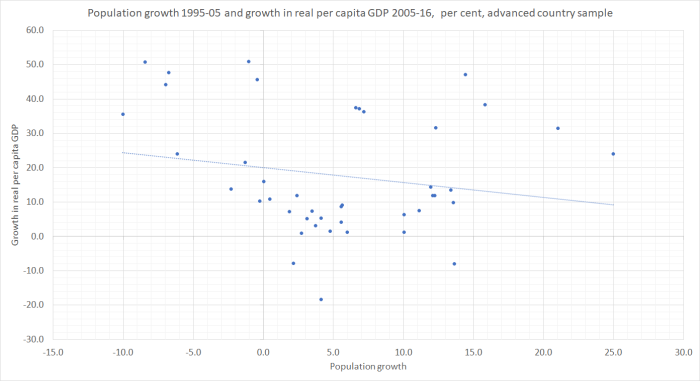
And in this final chart, I’ve broken the period in two.  I’ve charted, for each country, population growth in the first 10 years of the period (1995 to 2005) against real GDP per capita in the second half of the period (2005 to 2016).  In other words, none of the population growth variable is directly caused by the growth in the real per capita GDP variable.

popn advanced 3

The downward-sloping relationships is weaker this time –  less of the variance in GDP growth is explained simply by prior population growth –  but again it is downward-sloping, and not the upward-sloping line many of the immigration-policy boosters in New Zealand would like us to believe.   I forgot to mark New Zealand on this chart –  we are one of the dots a bit below the line with 12 per cent population growth –  but there is nothing unusual about New Zealand’s place on either chart.

If one wants to get more sophisticated, one could look at growth in labour productivity or total factor productivity, rather than just real GDP per capita.  Especially for TFP, one becomes dependent on the model used in estimating TFP and the available sample of countries drops away,  As for labour productivity, in earlier posts I’ve illustrated the lack of a positive relationship between population growth and productivity growth (and recall that New Zealand has managed better real per capita GDP growth than productivity growth, by working longer hours), and that –  for example –  if anything business investment as a share of GDP has been negatively correlated with population growth across advanced countries.  That is the opposite of what might been expected if population growth –  and immigration –  was typically boosting the productivity and per capita income prospects of recipient countries.

It is past time we started backing our own people, not looking to replace or augment them with a mythical group from across the water.  Part of that involves the government getting serious about facing up to the disappointing economic outcomes of our long-running Think Big economic and social experiment with large scale immigration.  As part of that, in turn, a serious review of immigration policy by the Productivity Commission –  there have been two in Australia in the last 15 years –  would be a good place to start.


Population and real GDP per capita

I noticed a few comments to another of my posts about possible links between population size and economic performance.  My working assumption is that, on average, across all countries, there isn’t any such relationship.   Apart from anything else, if there were a positive relationship –  that was more than chance –  it would suggest that two countries merging would increase their respective real incomes.  And yet for at least the last 70 years, we’ve had steadily more countries emerging.  No doubt economics isn’t the only thing at work in those choices –  people might be willing to pay a price to be “free” and self-governing –  but it isn’t likely to be an irrelevant consideration either.

But what do the data show?   Here I’ve just used the IMF World Economic Outlook database data for 2016.

The first chart shows the relationship –  for the 193 countries/territories the IMF reports data for –  between real GDP per capita (in purchasing power parity terms) and population (each dot is one country).   The population term is expressed in logs.

popn and real GDP pc

As (I would have) expected, there is basically no relationship at all.   The simple linear regression line is actually slightly downward sloping, but that won’t pass any test of statistical significance.  Perhaps one could craft a story in which the top 10 countries (in terms of per capita income) all have quite small populations –  the biggest is around 5 million people – but since oil plays a big part in most of those individual cases even then one shouldn’t make too much of the point.

And here is the chart if we look only at the countries with populations from 0.5 million (a tenth of New Zealand’s) to 50 million (ten times New Zealand’s).  Since that is a much more compressed scale –  not everything from Tuvalu to the People’s Republic of China –  this time the population variable isn’t expressed in logs.

popn and real GDP pc 0.5 to 50m For those with sharp eyesight, New Zealand is a dot coloured orange.

Again, there really isn’t any sort of relationship.  Again, the simple regression line is downward sloping, but there are lots of countries with very small populations and very low per capita incomes.   But even within this more-compressed range of populations, there is no sign at all of any sort of upward sloping relationship –  the idea that, on average, a higher population will be associated with higher per capita incomes.

Of course, within each of these dots there are complex historical relationships, as to how population in any particular country came to be what it was (some about conquest, making big countries out of small one; sometimes the historical carrying capacity of the land; in some the role of slavery (eg forced depopulation from Africa), in others the role of immigration policy.   Some locations offer better prospects than others and will, typically, have attracted or retained poeple accordingly.

But this post isn’t attempting to get into any of that. it is simply observing that at the most elementary level of numerical analysis there is no sign that countries with larger populations tend to be richer (whether as a matter of cause, or of effect).

A modern, high-value economy

That is what Regional Development minister Shane Jones says Taranaki is “transitioning to”.

And yet of the $20 million of government giveaways (your money and mine) designed

to help future-proof the Taranaki region by diversifying its economy, creating additional jobs and leveraging off the strong base the region has established through its oil, gas and agricultural sectors.

$5 million is going towards earthquake-strengthening a rather attractive provincial Anglican church, recently raised in status to a cathedral (more cathedrals as there are fewer Anglicans), and $13.3 million is going to build walking tracks on Mt Egmont.

It has more of a feel of a museum –  built, and natural –  than building or enhancing a “modern, high value economy” (such things rarely being built –  or enhanced –  by governments splashing cash around).

Perhaps there is a good case for more walking tracks in Taranaki.  I’m not, in principle, opposed.  It is crown land, and needs managing.  Nonetheless, it is hard to think of any country that has got to the global productivity or income frontiers with an emphasis on tourism.

As for the church building, I like it and I’ve worshipped there.   But what about it makes the earthquake strengthening of a private building a matter for national taxpayers to support?   Again, perhaps at least there is an element of consistency –  better perhaps than a government prohibiting demolition and yet not putting any money in.   But how it is consistent with lifting the longer-term economic performance of the economy –  regional or national –  is quite beyond me.

Then again, this seems to be a government that on the one hand isn’t keen on oil and gas, or dairy –  the two biggest outward-focused industries in Taranaki – and on the other isn’t interested in doing anything serious about getting the real exchange rate down.  So perhaps the hope isn’t really that today’s package will do anything much of substance –  certainly not to lift medium-term regional economic performance – but perhaps it might placate the natives for a month or two?


Inadequate Treasury advice

I wrote about the new –  and last ever –  Policy Targets Agreement when it was released by the incoming Governor and the Minister of Finance last week.  Mostly the changes were pretty small, and in some cases you had to wonder why they bothered (since the PTA system itself is to be scrapped when the planned amendments to the Reserve Bank Act are passsed later this year).

I lodged Official Information Act requests with the Reserve Bank and Treasury for background papers relevant to the new PTA.  I wasn’t very optimistic about what I might get from the Reserve Bank –  both because of a culture of secrecy, and because the incoming Governor probably wasn’t covered by the Official Information Act when he was negotiating this major instrument of public policy.   But The Treasury kindly pointed out that they had already pro-actively (if not very visibly) released several papers, including Treasury’s own advice to the Minister of Finance, and two Cabinet papers.

(I would link to those papers, but Treasury has been upgrading its website this week and the link they provided me with no longer works.  If I manage to trace one that does work I will update this.)  [UPDATE 9/4.   Here is the new link to those papers,]

Those papers help answer the question about why they bothered with the small changes.  The Treasury advice to the Minister of Finance was dated 7 February, well before Treasury had formulated its advice on Stage 1 of the Reserve Bank Act review, and before the Independent Expert Advisory Panel had reported. In other words, well before it was decided that PTAs would soon be done away with altogether.  Indeed, there are suggestions in the paper that most of the relevant work had been done 18 months ago –  they say they consulted “a number of economists and market participants over 2016” –  when they thought the Minister would be replacing Graeme Wheeler early last year (rather than falling back on the unlawful “acting Governor” route to deal with the election period).  Interestingly,  the advice suggests Treasury favoured, on balance, increasing the focus on the 2 per cent target midpoint and de-emphasising the 1 to 3 per cent target range, but the Minister appears to have rejected that option.

There are two Cabinet papers among the material that was released.  One was from 19 February, before the Minister had engaged with the Governor-designate on the possible wording of the PTA.  In that short document the Minister outlines for his colleagues the draft PTA he would be suggesting to Adrian Orr.  The other was from 19 March, advising his colleagues of the text he had agreed with Orr.

The differences in the two texts are small, but in my view the changes represent improvements relative to the Minister’s draft (for example, keeping the political waffle about climate change, inclusive economies etc, clear of the material dealing with the Reserve Bank’s own responsibilities).  Presumably Orr would have consulted senior Reserve Bank staff, but on the basis of what has been released so far, we don’t know.

The documents suggest that The Treasury has played the lead (official) role in reshaping the Policy Targets Agreement (the Treasury advice to the Minister refers to them having consulted the Bank, but there is no suggestion that the Bank staff had necessarily agreed with the recommendations, or any suggestion of a separate Reserve Bank paper).  In a way, the lead role for The Treasury makes sense –  macroeconomic policy parameters should be set primarily by the Minister, not the Governor-designate.  On the other hand, The Treasury will typically not have the degree of expertise, or depth, in issues around monetary policy that the Reserve Bank should have.   I welcome the Minister’s announcement that in future, when the Minister directly sets the operational goal for monetary policy, he will be required to do so after having regard to the advice (publicly disclosed) of both the Reserve Bank and The Treasury.

My main prompt for this post, however, was one element of The Treasury advice which seriously concerned me, and represented a grossly inadequate treatment of an important issue.

In Treasury’s advice to the Minister, they have an appendix dealing with a couple of aspects of the Policy Targets Agreement where they didn’t propose change.  The one I’m interested in was the question of the level of the inflation target itself.

Treasury note that “there have been a number of arguments advanced by commentators over recent years in favour of either a higher or lower inflation target”.

Treasury notes, correctly, that

The main argument in favour of increasing inflation targets is in order to ensure that central banks will have enough scope to lower interest rates in the face of a large contractionary economic shock that may result in monetary policy reaching the effective lower bound of [nominal] interest rates

Amazingly, this issue is dismissed in a mere two sentences.  As they note

a higher inflation target would lead to higher costs of inflation at all times, whereas the risks of a lower bound event occur infrequently

But instead of moving on to offer some numerical analysis, or even plausible scenarios, the government’s principal economic advisers simply observe that

Given this, the costs of a higher inflation target may outweigh the benefits

Or may not. But Treasury doesn’t seem to know, and doesn’t offer the Minister (or us) any substantive analysis.

Here is one scenario.  Recessions seem to come round about once a decade, and in typical recessions (admittedly a small sample) the Reserve Bank has needed to cut interest rates by around 500 basis points.  If it can only cut interest rates by, say, 250 basis points, and that difference meant even just 2 per cent additional lost output (eg the unemployment rate one percentage point higher than otherwise for two years, the annual costs of a higher –  but still low –  inflation rate would have to be quite large, for the costs of a higher target to outweigh the benefits.  Perhaps my scenario is wrong, but Treasury doesn’t offer one at all.

Treasury devotes more space to the possibility of lowering the inflation target.  They aren’t keen on that –  some of their arguments are fine, others flawed at best –  but even then they seem determined to play down the near-zero effective lower bound on nominal interest rates, noting that (emphasis added)

a lower inflation target marginally increases the risk that the ELB [effective lower bound] may be reached, thereby providing monetary policy marginally less space to respond to shocks

Those who have sometimes called for cutting the target probably have in mind cutting the target midpoint from 2 per cent to 1 per cent (where it was in the early days of inflation targeting).    When interest rates are 8 per cent, that might make only a marginal difference to the chances of the lower bound being reached –  indeed, that was standard Reserve Bank advice in years gone by, when the lower bound was treated as a curiosity of little or no relevance to New Zealand.   But when the OCR is at 1.75 per cent (and the central bank thinks the output gap and unemployment gaps are near zero) a 1 percentage point cut in the inflation target would hugely reduce the effective monetary policy space for dealing with serious adverse shocks.  The floor would be hit with relatively minor adverse shocks.

And they conclude this way

New Zealand’s inflation target has been changed a number of times in the past and frequent changes to the level of the target could undermine the credibility of the regime.

There were two changes in the level of the target inside six years, which was unfortunate.  But the most recent of those changes was 16 years ago.  At that time, the idea of running out of monetary policy room in New Zealand was little more than a theoretical possibility.  Now it seems quite likely whenever the next recession happens here, and has already happened to numerous other advanced countries.

As I hope readers recognise by now, I regard an increase in the inflation target as an undesirable outcome, a second-best option.  I would rather the authorities (Reserve Bank, Treasury, and the Minister of Finance) treated as a matter of urgency removing directly –  and with preannounced certainty and credibility –  the extent to which the near-zero lower bound on nominal interest rates bites, by reducing or removing the incentives in the face of negative interest rates for people (large holders of financial assets, rather than transactions balances) to shift to holding physical cash.   Even just ensuring that the Reserve Bank gets inflation up to around 2 per cent –  rather than the 1.4 per cent (core) inflation has averaged for the last five years –  would help.

But there is nothing about any of this in The Treasury’s advice on the main instrument of New Zealand macroeconomic policy.  It seems extraordinarily inadequate.  Perhaps they have provided some other, more in-depth, advice on these sorts of issues –  in which case it might be good to proactively release that –  but there is no hint of, or allusion to, any deeper thinking in the PTA advice.   “Wellbeing” is all the (content-lite) rage at The Treasury these days.  I’m not a fan, but perhaps they should reflect that one of the biggest things policymakers can do to avoid adverse hits to “wellbeing” is to avoid unnecessarily severe or protracted recessions (and spells of unemployment).     Indifference on this score is all the more inexcusable when the limitations arise wholly and solely from policymaker/legislator choices –  whether around the level of the inflation target or the system of physical currency issues (and the prohibitions on innovation in that sector).  Ordinary New Zealanders –  not Treasury officials –  risk having to live with the consequences of their malign apparent indifference.

As it happens, a reader last night sent me a link to a couple of new pieces on exactly these sorts of issues.  The first was the (brilliantly-titled) “Crisis, Rinse, Repeat” column by Berkeley economist and economic historian Brad Delong.  He concludes

It has now been 11 years since the start of the last crisis, and it is only a matter of time before we experience another one – as has been the rule for modern capitalist economies since at least 1825. When that happens, will we have the monetary- and fiscal-policy space to address it in such a way as to prevent long-term output shortfalls? The current political environment does not inspire much hope.

And his column took me on to recent work by his colleagues David and Christina Romer, and in particular to a recently-published lecture on macroeconomic policy and the aftermath of financial crises.

The authors focus on financial crises (and I have a few questions about which events are included and which are not), rather than recessions more generally, but it isn’t obvious to me why their results wouldn’t generalise.   Here is their abstract.

Analysis based on a new measure of financial distress for 24 advanced economies in the postwar period shows substantial variation in the aftermath of financial crises. This paper examines the role that macroeconomic policy plays in explaining this variation. We find that the degree of monetary and fiscal policy space prior to financial distress—that is, whether the policy interest rate is above the zero lower bound and whether the debt-to-GDP ratio is relatively low—greatly affects the aftermath of crises. The decline in output following a crisis is less than 1% when a country possesses both types of policy space, but almost 10% when it has neither. The difference is highly statistically significant and robust to the measures of policy space and the sample. We also consider the mechanisms by which policy space matters. We find that monetary and fiscal policy are used more aggressively when policy space is ample. Financial distress itself is also less persistent when there is policy space. The findings may have implications for policy during both normal times and periods of acute financial distress.

These are really huge differences.  And they reflect a combination (a) a substantive lack of capacity, and (b) a reluctance to use aggressively what capacity still exists when the bottom of the barrel is getting close.

Here is the chart they use for monetary policy space (and lack thereof).

romer chart

(the dotted lines are confidence bands)

The Romers offer some thoughts on the policy implications, including

Very low inflation means that nominal interest rates tend to be low, so monetary policy space is inherently limited. A somewhat higher target rate of inflation might actually be the more prudent course of action if policymakers want to be able to reduce interest rates when needed.

Our finding that policy space matters substantially through the degree to which policy is used during crises also implies difficult decisions. For example, it is not enough to have ample fiscal space at the start of a crisis. For the space to be useful in combating the crisis, policymakers have to actually enact aggressive fiscal expansion. However, countercyclical fiscal policy has become so politically controversial that policymakers might refuse to use it the next time a country faces a crisis.

What of New Zealand (included in their empirical sample)?      We have plenty of “fiscal space” –  both gross and net debt are pretty low (around the lower quartile of OECD countries).  In a technical sense that might substitute to some extent for a lack of monetary policy capacity (if a recession hit today, we start with an OCR at 1.75 per cent, while most countries were at 5 per cent or more going into the last recession).    But fiscal deficits blow out quite quickly in recessions anyway –  as the automatic stabilisers do their work –  and can anyone honestly assure New Zealanders that governments would be willing to engage in much larger than usual, more sustained than usual, active fiscal stimulus if a new and serious recession hits at some stage?  Of course they can’t.  Politicians can’t precommit (and even Treasury can’t precommit what its advice would be) and the political constraints on a willingness to actively choose to take on large deficits far into the future –  perhaps on projects of questionable merit –  would almost certainly be quite real (as they were in so many countries after 2008).  So we are better placed than some because of the fiscal capacity –  itself less than it was here in 2008 –  but we really should be taking steps to re-establish effective monetary policy capacity.  That might involve (my preference) dealing directly with the lower bound, it might involve changing the inflation target, it might involve putting more pressure on the Bank to get inflation up to 2 per cent, or it might even involve asking questions about whether inflation targeting (as distinct from levels targeting) offers more crisis resilience (senior US monetary policymakers have openly been discussing some of those latter issues).

There is no sign, for now, that The Treasury is taking the issue at all seriously, and there has been no sign –  in speeches, or Statements of Intent –  that the Reserve Bank has been doing so.  That needs to change.   Perhaps it is a good opportunity for the new Governor.  But the Minister –  rightly focused on employment issues –  should really be taking the lead, and insisting on getting better quality analysis and advice, engaging with the real risks and offering practical solutions, than what was on offer when the PTA was being reviewed.

Reviewing the Board’s charter

In the recent report of the Independent Expert Advisory Panel, and subsequent Treasury advice, on the Reserve Bank Act, one of the things that surprised me was the way both groups (independent advisers and Treasury) simply seemed to take for granted the current role of the Board of the Reserve Bank and seemed to assume that the Board had done its role well and effectively.     The issue is simply not raised in the respective reports, even though the role of the Board is quite unusual – whether in a domestic public sector role, or in comparison with overseas central banks and financial regulatory agencies.  And so even though the government is proposing changes to the decisionmaking structure for monetary policy (and probably, later, for the financial regulatory functions) there is simply no serious analysis at all questioning whether, in light of experience, the role of the Board remains appropriate.   And that is even though few people I’ve ever discussed the matter with –  some ex-Board members apart perhaps –  thought that the Board was doing effectively a useful job on behalf of the Minister and the public.  At the Treasury-convened consultation meeting I attended, no one had a good word to say for the Board.

I’ve outlined the nature of my concerns previously (most recently here).   The Board has very little power –  other than in the appointment of the Governor –  and no resources of its own (that latter issue is touched on in the reports), and –  whatever the merits of the unusual model on paper –  it has ended up, over decades, serving mostly as providing cover for successive Governors. Even though their role is largely to review the Governor’s performance, in 15 years of publishing Annual Reports they have never once uttered even a modestly critical comment of the Bank or the Governor.  Since no one is perfect, that track record just reinforces the conclusion that the Board adds little or no value –  for the public, although no doubt it has proved useful to troubled Governors.   They provided no protection for Stephen Toplis or the BNZ when Graeme Wheeler deployed his entire senior management team to attempt to silence an independent critic.  And they egged on Graeme Wheeler when he used his official position, and public resources,  to attack me for drawing to his attention, and publicising, what proved to be a leak of the OCR.

With different people, perhaps it could do a better job, but the institutional incentives militate against that ever happening –  the Board is simply too close to management (the Governor himself is a member), and even the name (with suggestions of a corporate board) works against a proper conception of an arms-length body providing serious review, challenge, and scrutiny of a very powerful public agency.  Awkward individual members –  and there has often been at least one, sometimes with hobbyhorse issues –  aren’t much more than a nuisance with no outlet.  In my view, far more fundamental change is needed: either turn the Board into a proper decisionmaking body (as with a typical Crown entity),  abolish it, or if arms-length review and scrutiny is the goal, the relevant entity needs to be established outside the Reserve Bank, with independent resources and an independent mindset, and no sense that their role is to champion the Bank.

But in the Independent Expert Advisory Panel’s report there was a sentence  –  the very last one in the body of the report –  that caught my eye.

114. The Board has a code of conduct. The Panel recommends that this be reviewed in light of the legislative changes.

So I asked the Board for a copy of its code of conduct.   Apparently, there isn’t actually a document of that name, but the assumption is that the Panel was referring to a document rather grandly described as the “Charter for the Board”, which they released to me in full.

When I see the word “charter” I have in mind something that those who founded an entity might have issued, establishing and empowering the entity (dictionaries seem to back that interpretation).  Google tells me that, for example, there is a Radio New Zealand Charter, actually included in statute.  It is described thus

The Charter is an important document which sets out our operating principles.

It defines what we do so that everyone – staff, listeners and other stake-holders – can easily understand our objectives and what we are expected to provide for the New Zealand taxpayer.

and is readily available, for all to see, on the website.

The Reserve Bank Act sets out what the Reserve Bank Board is supposed to do.  The Minister of Finance’s letter of expectation to the Board can fill that out a bit.

The Reserve Bank Board’s “charter” doesn’t seem to have any status, except a set of agreed arrangements among the people who happen from time to time to find themselves serving together as the Board.  No wonder the independent panel loosely termed in a “code of conduct”.

Most of the document probably isn’t of much interest, but a few bits (and a few omissions) caught my eye.  First, there was the secrecy.  From the very first line

This Charter is confidential to RBNZ staff and directors. It must not be released to external parties without approval from the Chair of the Board or Governor.

Given that the Board exists solely to serve the interests of the Minister and the public, surely it would be normal, and natural, for a document of this sort to be routinely available on the website?   The Wellington City Council, for example – a notoriously OIA-averse body – manages to have its code of conduct for councillors readily accessible.   What, one wonders, is the Board trying to protect?  Probably nothing –  it is just the mindset.

There are questionable assertions (emphasis added)

The Board may advise the Governor on any matter relating to the performance of the Bank’s functions and the exercise of its powers. The Governor is not required to act on the Board’s advice, but is required to have regard to it.

Nowhere in the Act, that I can see, is there a requirement for the Governor to “have regard” for the Board’s advice –  a term that itself has legal meaning.  A Governor might be foolish to simply ignore advice from the Board, but the Board is set up primarily to review the Governor’s performance,  not to provide advice on policy or management issues.

The “Charter” goes on

Where advice relates to matters of significance, the Board may give that advice to the Governor in writing, having first discussed the matter with the Governor in a Board meeting.

The Board will maintain a record of any formal Board advice given to the Governor.

That is interesting. I have asked for copies of any such written advice.  I suspect there will have been none, but time will tell.

I’ve noted previously that the Board has no independent resources.  It doesn’t even appear to have a general right to whatever Bank information it considers it requires

The Governor will ensure that the Board has access to information, Bank staff and other resources that the Governor, in consultation with the Chair, considers the Board may require to perform its functions effectively.

In other words, the Governor determines what resources the Board has access to, even though the Board’s prime role is to scrutinise and hold to account the Governor.  Sure he is supposed to consult with the Chair –  and in practice can’t totally play hard-ball (since the Board could then conclude he wasn’t adequately doing his job), but the initiative and blocking veto rests with the Governor, not with the Board.

And they have a whole section on public communications, in which this is the most important clause.

The Governor has sole responsibility for the external communications of the Bank. The Chair and/or Deputy Chair, where required by statute or regulation such as by the Finance and Expenditure Committee of Parliament, may speak in those capacities. In no other circumstances shall a Non-Executive Director speak for the Bank or comment publicly on the conduct of the Bank’s functions.

In other words, no Board member –  chair, deputy chair or not –  will ever speak in public except when required by law to do so.  In this clause, the Board appears to be agreeing among themselves that, as a matter of principle, they will never speak –  even via the chair –  to any media in response to inquiries (whether about their processes, Annual Reports, OIA releases, or anything else or about their activities).   How can this possibly be consistent with open government?

The clause must be music to the ears of management.   Back when the current governance model was first set up, one of the big internal concerns was that the Board would become an independent source of commentary on monetary policy (it was why, at the time, the Governor still chaired the Board –  even though it existed to hold him to account).   And it seems quite right that Board members should operate under a policy of not offering running commentary on individual OCR – or LVR –  decisions, or the state of the economy.      But for the Board members to broaden that out and simply refuse to respond to, say, media inquiries on their own conduct, including their reviews of the Bank’s actions and performance, should be quite incredible.  It should be unacceptable.   These people are ministerial appointees, paid to serve the Minister and the public, and should be subject to scrutiny, and willing to make themselves (perhaps primarily through the chair) openly accountable –  not just when compelled to by law.

They might, for example, reasonably be challenged by a journalist over their apparent failure to comply with the basic provisions of the Public Records Act.     There are, it appears, no records of the process the Board undertook, over 15 months, leading to the appointment of the new Governor.    It is a pretty basic statutory requirement, which the Board is not exempt from.   (Curiously, in the Board’s charter there is no general commitment, or requirement, to keep proper records, or the comply with statutory provisions such as the Official Information Act or the Public Records Act.

But the omission that really did surprise me, at least a little, was that there was nothing in this “Charter” or code of conduct, about the handling of conflicts of interests.  Even the Act recognises that such conflicts are possible.

In considering the appointment or reappointment of a person to the office of non-executive director of the Bank, the Minister shall have regard, in relation to that office, to

  • that person’s knowledge, skill, and experience;
  • and the likelihood of any conflict between the interests of the Bank and any interests which that person has or represents.

The Act prohibits anyone who is “an employee of a registered bank or a licensed insurer’ from serving as a director, but there are few other restrictions.   For example, people who are Board members of regulated institutions are not prohibited from serving on the Reserve Bank Board, nor are people who serve as professional advisers (eg lawyers) to regulated institutions.  Someone who works for a payment system provider, or a clearing house –  or who is on their Board, or a consultant to such entities –  could have a clear conflict in respect of the Reserve Bank’s physical currency or NZClear operations.

These aren’t just hypotheticals.  One of the current Board members is also a member of the board of directors of a major insurer –  and the Reserve Bank, in addition to its ongoing supervisory and regulatory responsibilities in that sector, is now dealing with the recent failure of an insurance company, and the role of the Reserve Bank.

I suspect the Board does have some internal practices regarding the handling of all sort of potential conflicts of interests –  and they themselves can’t control who the Minister of Finance chooses to appoint.     But they look like the sort of thing that should be properly documented –  and disclosed – in any sort of code of conduct, or “Charter” for a major public agency.  The concerns are attentuated to some extent by the fact that the Board has few decisionmaking powers, but they have the right to offer advice on any of the Bank’s responsibilities and assert – see above – that the Governor is required to have regard to their advice.  And the members all have privileged access to information on both monetary policy and (probably particularly) regulatory policy.    I’m not sure what the appropriate boundaries are –  given the role of the Board as it stands –  but I hope the Board does, and can articulate their policies and practices.

The Board has not done, and is not doing, a good job.  It is set up by Parliament to serve our interests –  public, Parliament, and Minister –  but constantly seems to see itself mostly as a servant, and defender, of Bank management.  Those are two quite different roles.  The so-called Charter adds a little more to the list of concerns, and the reasons why the government, as part of the current review, should more seriously consider far-reaching structural change, reconfiguring the role of the Board and the way that public-funded review and assessment functions are undertaken.  The current model isn’t working, at least for anyone other than Bank management.

A “very, very healthy economy”?

In his press conference with the Minister of Finance, the day before taking office last week, the new Governor of the Reserve Bank offered some brief and gratuitous thoughts on the state of the New Zealand economy.

Orr said he was happy with where the economy was at the moment.

“I’d say that we are running a very, very healthy economy at the moment,” he said.

In one sense, it doesn’t greatly matter what the Governor of the Reserve Bank thinks.  His primary (monetary policy) job is to keep core inflation near 2 per cent (something Graeme Wheeler failed to do).  There isn’t much connection between whether or not an economy is doing well in some medium-term fundamental sense and the average inflation rate.

Then again, Orr is now the most prominent (and powerful) public sector economist, and was sharing a stage with the Minister of Finance.  Intended or not, his comments could reasonably be seen as an endorsement of economic management and performance by past and present governments. An endorsement of the status quo in fact.

Perhaps that wasn’t the Governor’s intention. Perhaps it was just the first thing that came to mind on his big day and he didn’t stop to think what he was saying? But perhaps he genuinely believes it, which in some ways would be even more concerning.   Especially as it is presented as an unconditional, absolute, statement, with two intensifiers.  If we take the Governor seriously, things must really be doing well here.

I’m not sure what the Governor had in mind.  But when I rack my brain and look for whatever positives I could find, this is what I came up with:

  • the terms of trade are near record levels,
  • government debt is pretty low, and the government operating accounts are in surplus,
  • the financial system appears to be sound,
  • after nine years above, the unemployment rate is now finally down to around the level the Reserve Bank thinks of as the NAIRU (the non-accelerating inflation rate of unemployment).

Try as I might, I couldn’t find anything more that suggested a “very very healthy” economy.  There were a few other indicators that perhaps a lay observer might try to cite, but economists probably shouldn’t:

  • employment rates are quite high.  We don’t put too many regulatory/tax obstacles in the path of employment (a good thing), but employment is a still cost –  foregone leisure –  not a particular achievement.  Unemployment and underemployment rates are typically the better indicators (when lots of people want work and can’t find it that is a problem),
  • interest rates are low.  As they are around the world, reflecting how difficult the advanced world has found it to achieve sustained growth since the last recession.  Ours remain well above those in most other advanced countries,
  • our balance of payments current account deficit is less than it was (and the external debt –  % of GDP –  is less than it was).  This is partly a reflection of unexpectedly low interest rates –  servicing costs are less than they were, and partly of pretty subdued investment,
  • headline annual GDP growth rates have not been high –  by standards of earlier growth phases –  but have sounded respectable enough (typically with a 3 in front of them).   But much of that simply reflects unusually rapid population growth rates.

And on the other hand, and in no particular order

  • how could we go past house prices?  How can the Governor –  of all people –  consider our economy to be “very very healthy” when house and urban land prices are so far out of whack that few young can any longer afford to buy a basic first home?
  • even if, on some metrics, we’ve done less badly than some countries in the last decade, almost the whole advanced world has done absolutely poorly.  Investment and productivity growth have typically been weak, and interest rates have needed to be astonishingly low for prolonged periods (not yet over) simply to support demand and activity.
  • real per capita GDP growth, even at peak, has been weaker than in previous recoveries,
  • if most of the advanced world has done quite poorly, New Zealand started so far behind that we needn’t have been badly affected.  Simply catching up some way towards the frontier would have been a considerable achievement.  But we haven’t. There has now been almost no labour productivity growth here for the last five or six years, and that shows no sign of changing yet.
  • inflation has been (is still) persistently below target (and thus below the level successive governments and Governors have considered desirable for the best possible economic outcomes),
  • although interest rates are low in absolute terms, they remain above those in most other advanced countries, for reasons that have nothing to do (see above) with superior productivity performance.
  • rates of business investment remain very subdued (despite, for example, the strong terms of trade, or rapid rates of population growth).
  • the growth in the economy has continued to be concentrated in the non-tradables sectors, rather than the bits in which New Zealand firms successfully compete against international competition here or abroad.   I haven’t shown this (indicative) chart for a while
  • T and NT to Dec 17
  • relatedly, the export share of GDP has been shrinking, when a typical aspect of any successful economic catch-up has involved a rising share of exports, as the success of domestic policy and domestic firms translates into more firms and more products beating the world (in turn, enabling more of what the world produces to be imported).
  • the real exchange rate remains very high, well out of line with developments in relative productivity and terms of trade trends.
  • meanwhile, among the other relatively poor OECD members many that did far more wrenching economic reforms than we did 25 or 30 years ago (and they needed to do more) really are making progress to catch the OECD leaders. In some cases, their average productivity levels are already at New Zealand levels, and almost all are growing faster than New Zealand.

And all that without even getting to the risks and costs that seem set to flow from grappling with things like improving water quality, and with successive government’s commitments to reducing carbon emissions, in a country with some of the highest marginal abatement costs anywhere.

Quite how the Governor can seriously think –  if he really does –  that this is a “very very healthy” economy is a bit beyond me.  It has the feel of ill-considered quasi-political rhetoric.  In a post a few weeks ago (with charts illustrating some of the points above) I called it a rather moribund economy, and that still seems right to me.

My young daughter asked me “what boring stuff are you writing about this morning”.  I told her it was about the health, or otherwise, of New Zealand’s economy.  “Does the economy have cancer?” she asked.  It isn’t like that I said, more like some chronic condition that won’t kill us, probably won’t even end in a crisis, but constantly holds us back from achieving what we might, from delivering better material living standards for New Zealanders.   The Governor of the Reserve Bank has a defined and limited job to do, which he can do whether or not the chronic ailment is fixed.  But he shouldn’t use his office and bully pulpit it provides to help politicians evade responsibility for the decades of disappointment.  The status quo has failed, is failing, and seems set to go on failing.

Real interest gaps remain large

There has been a bit of coverage lately about the fact that New Zealand 10 year bond yields have dropped to around, or just slightly below, those in the United States.    Here is the chart, using monthly OECD data, of the gap between the two.

NZ less US

Since interest rates were liberalised here in the mid-80s, the only other time our 10 year rates have been lower than those in the United States was in late 1993 and very early 1994.  That phase didn’t last long.  Bear in mind that back then we were targeting an inflation rate centred on 1 per cent –  lower than the US, and lower than the Reserve Bank of New Zealand is charged with targeting now.

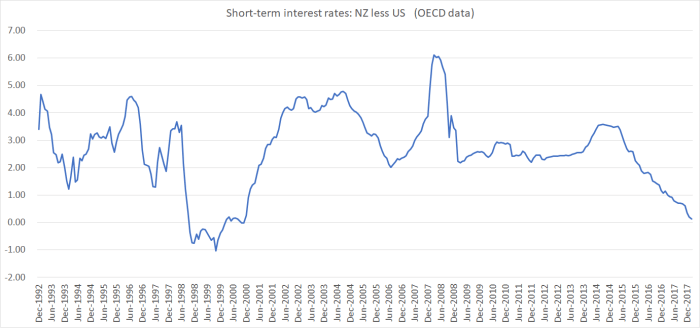
As the chart illustrates, the spreads moves around quite a bit, but the recent narrowing in the spread looks to be significant –  it is (roughly) a two standard deviation event.  Then again, so is the narrowing in the short-term interest rate spread.  Usually our short-term interest rates are well above those in the United States, but by later this year it is widely expected that their short-term interest rates will be higher than ours.   When that sort of reversal is expected to last for a while, it will be reflected in the bond yield spread as well.

NZ less US short

The Federal Reserve’s policymakers expect to raise the Fed funds rate to, and even at bit above neutral, in the next year or two (“longer-run” in the chart below is a proxy for FOMC members’ view of neutral), while there is nothing similar in our own Reserve Bank’s published projections.

Fed projections

I’ve made considerable play of the persistent gap between our real interest rates and those abroad.    Do these recent developments suggest that if there was a problem it is now just going away?

Well, the gap between our bond yields and those in some other advanced countries has also narrowed.    Even the gap between Australian bond yields and our own –  a gap which has been remarkably stable over 20 years –  is narrower than it was (although all else equal their higher inflation target should be expected to result in Australian yields typically exceeding our own).

But here is the gap between our 10 year bond yields and those in some other small inflation-targeting OECD countries.

nz less scandis

There doesn’t seem to be anything out of the ordinary going on there (and 10 year bond yields in Switzerland –  like those in Japan and Germany –  are a bit constrained by being almost zero already).

And here is the gap between New Zealand’s 10 year bond yields and the median of yields in all those countries the OECD has data for for the entire 25 year period.

nz less median

If one simply focuses on the last 15 years –  when our inflation target was increased to 2 per cent (midpoint) –  the current spread is not very different to the average for that period.

There simply isn’t much sign of the persistent gap between our real long-term interest rates and those in other advanced countries going away.

In fact, dig just a little deeper and even the story vis-a-vis the US is a bit less encouraging.  Both countries now have long-term inflation-indexed government bonds, the yields on which are a pretty good read on long-term real interest rates.  US government inflation-indexed 20 year bond yields are currently about 0.9 per cent (even with pretty wayward US fiscal policy).  The Reserve Bank reports that our 17 year indexed bond yesterday yielded 1.82 and our 22 year bond was yielding 2.0 per cent.    A full percentage point gap on a 20 year bond –  even if a bit less than it was – still adds up to an enormous difference over time.  Markets aren’t convinced New Zealand and US real interest rates are sustainably converging any time soon (and, to those who want to throw in claims that the US is bigger or central to the system or whatever, recall that US bond 10 year yields are currently among the highest in the OECD –  in other words, it is quite possible for small advanced countries to have lower interest rates, over long terms, than the US).

The other thing markets don’t appear convinced about is that the Reserve Bank will achieve the 2 per cent inflation target (set for it again this week).   One can proxy this by looking at the gap between inflation-indexed bond yields (real yields) and nominal bond yields.

Here is the US version, using constant-maturity yields for the real and nominal series.

us breakevens

For the last year or so, markets have again been behaving as if the Fed is likely to deliver inflation around 2 per cent over the next 10 years.

But here is the (cruder) New Zealand version.   I’ve just used data on the RB website –  their 10 year nominal government bond yield, and the yields on the two indexed bonds either side of 2028 –  one maturing in September 2025, and the other maturing in September 2030.  Right now, 10 years ahead is almost exactly halfway between those two maturity dates.

NZ breakevens

Halfway between those two lines, for the latest observation, is a touch under 1.3 per cent.    It is a long way from the target of 2 per cent, and the gap is showing no signs of closing.

There are two challenges it seems:

  • if the government is at all serious about beginning to lift productivity growth and close the productivity gaps, they need to think a lot harder –  and be willing to do something about –  the things in the policy framework that continue to deliver us much higher real interest rates than those in other advanced countries,
  • and the new Governor has some work to do if he is to convince people that he is really serious about delivering future inflation averaging around 2 per cent.  Since the government itself just renewed that target, it should concern them –  and their representatives on the Reserve Bank Board –  that the target doesn’t appear to be taken that seriously by people investing money who have a direct stake in the outcome.

How key appointments are made

After a spate of posts in the last few days about the Reserve Bank reforms, I’d intended to change topics for a while.   But then I noticed that the new Opposition spokesperson on Finance, Amy Adams, had weighed in, expressing concerns about a couple of aspects of what the Minister of Finance had announced on Monday.

This is how interest.co.nz reported Adams’ concerns

Under the new Policy Targets Agreement (PTA), [actually, under the amended Act] a seven-member Board – with four internal Reserve Bank members and three external appointees, selected by the Minister on the recommendation from the RBNZ board – will be established.

There will be a Treasury representative who will sit on the committee as well but will not have voting rights.

Adams says the fact that Robertson is able to appoint almost half of the board “creates a live question about the degree to which that allows him to exert political influence.”

Although National supports the introduction of the MPC, she says the Reserve Bank already operates with an informal decision-making committee within the bank and that process was working well.

Adams has also taken a swipe at the fact a Treasury representative will sit on the MPC.

“They are the senior Government official, their job is to deliver on the Government’s objective,” she says.

“So, you’re effectively going to have a senior Government official that reports to the Minister and three people who are appointed by and able to be removed by the Minister, sitting in and influencing those decisions and those discussions.”

I don’t want to spend much time on the issue of having a non-voting Treasury representative as part of the new Monetary Policy Committee (MPC).  Reasonable people can differ on the merits of that, and whether there are any real benefits.  On balance, I favour the model the Minister of Finance has adopted.   But in terms of the concerns Adams raises, it is worth remembering that in Australia the Secretary to the Treasury (in a more politicised public service) is a voting member of the RBA Board, and no one questions the operational independence of the RBA.  And in a more direct parallel to the model proposed here, in the UK –  under a modern governance system established only 20 years ago  –  there is a non-voting Treasury representative at MPC meetings, and that seems to have been generally accepted to have worked well, and not to have undermined the independence of the Bank of England (although the individualist approach –  where MPC members can speak out –  probably provides an added safeguard).    It will be important to look at the specifics of the legislation on this point, and for there to be good protocols in place, but I don’t think that what has been announced to date poses particular problems.   If the Minister wants to put pressure on the Governor (now) or the Committee later on specific OCR decisions, he doesn’t need mid-senior level Treasury officials to do so.

In that interest.co.nz article, I’m quoted as suggesting that Amy Adams is “completely wrong” in her point about the appointment process.  That is for two, quite different, reasons:

  • first, Amy Adams’ comments suggest she hasn’t understood that the Minister will only be able to appoint people nominated by the Board (as is the case for the Governor now).  The Minister can reject nominees, but can never replace those names with his own people.   The Minister has no discretion.
  • second, direct and largely unfettered ministerial appointment is the way we typically do things in the New Zealand system of government, including for very sensitive positions for which the integrity and independence of the individuals is paramount.   It is also the way most key decisionmakers on monetary policy in other countries like our own are appointed.

Here is how appointments are made to various key public sector roles in New Zealand

Chief Justice Governor-General on advice of the PM
Other judges Gov-Gen on advice of Attorney-General
Police Commissioner Gov Gen on advice of the PM
Electoral Commissioners Gov Gen on advice of House of Representatives
Auditor General Gov Gen on advice of House of Reps
Ombudsmen Gov Gen on advice of House of Reps
Privacy Commissioner Gov Gen on advice of Minister of Justice
Human Rights Commissioners Gov Gen on advice of Minister of Justice
Commerce Commission Gov Gen on advice of Minister of Commerce
Parole Board Gov Gen on advice of Attorney General
Health and Disability Commissioner Gov Gen on advice of Minister of Health
Broadcasting Standards Authority Gov Gen on advice of Minister of Broadcasting
Electricity Authority Gov Gen on advice of Minister of Energy
IPCA Gov Gen on advice of House of Representatives
Takeovers Panel Gov Gen on advice of Minister of Commerce
Transport Accident Investigation Commission Gov Gen on advice of Minister of Transport
Financial Markets Authority Gov Gen on advice of Minister of Commerce

And, of course, the Governor-General is appointed by the Queen on the advice of the Prime Minister.

Every single one of these really important positions  –  with the potential to do considerable mischief as well as good –  is appointed directly by elected politicians.  It is how we get accountability –  we can toss out politicians, they are forced to take questions in Parliament etc etc.   In some cases, there might be statutory qualifications appointees have to meet –  eg lawyer of seven years standing –  but I’m not aware that in any of these key public roles the relevant Minister, or Parliament itself, is constrained to only appoint someone other people have given them as nominations.

There is no obvious reason why the key decisionmaking roles at the Reserve Bank should be any different  (and the key roles at the Bank aren’t the Board itself –  which is really just a nominating (and cheerleading) committee –  but the Governor and the members of the future Monetary Policy Committee).  These people have a great deal of effective discretion and, if they get things wrong, can cause, or materially exacerbate, recessions or booms.  The standard approach anywhere else in the New Zealand public sector would be for such appointments to be made by the Governor-General on the advice of the Minister of Finance.   We can hold the Minister accountable, but have no way of holding the Board accountable (indeed, when the new MPC is appointed most of the Board members themselves will have been appointed by the previous government).

Direct and unfettered appointment by an elected politicians is also the way for most monetary policy decisionmakers in other countries like ours.     There is a nice summary table in this Reserve Bank Bulletin article from few years back.     As just a few examples:

  • in Australia, all members of the Reserve Bank Board (the monetary policy decisionmaking body), including the Governor and Deputy Governor are appointed directly by politicians,
  • the same is true in Norway,
  • in the UK, seven of the nine MPC members are directly appointed by the Chancellor of the Exchequer (two are senior staff, appointed by the Governor),
  • ECB Governing Board members are all directly appointed by politicians
  • All members of the US Federal Reserve Board of Governors are appointed by the President, subject to Senate confirmation.  (Heads of the regional Feds –  who sit, by rotation, on the FOMC – are not, and there is some question about the constitutionality of those arrangements.)
  • All members of the Swedish monetary policy board are appointed by a parliamentary committee,
  • Bank of Japan monetary policy members are appointed by the Cabinet
  • In Israel, five of the six MPC members are appointed by the government (one by the Governor).

It would be a much more normal approach, and one that provides ongoing democratic legitimacy, for the Governor and Deputy Governor and all external members of the MPC to be appointed directly by (the Governor-General on the advice of) the Minister of Finance.  Those choices shouldn’t be restricted to those on a list delivered by faceless company directors, with no subject expertise and no democratic legitimacy or accountability (and who may well have been mostly appointed by the previous government).  If the MPC is to have more than two internals –  as the Minister proposed in his announcement on Monday – perhaps it would be reasonable for one additional internal to be appointed by the Governor, in consultation with the Minister (the Bank of England approach).     There is no obvious role –  or likely added value –  from involving the Board in the process at all.  Arguably, involving them in appointments not only lacks democratic legitimacy, but also detracts from their primary role of (on behalf of the public and the Minister) holding appointees to account.

As I’ve suggested previously, if there was still unease about the Minister appointing cronies –  though see the long list above of important positions that ministers do directly appoint to –  I’ve suggested there might be merit in requiring non-binding confirmation hearings before Parliament’s Finance and Expenditure Committee before the Minister’s appointees take up their roles.   This approach has been adopted in the UK.

As I hope I’ve shown, the model I’ve argued for –  and will continue to advocate –  is not some radical politicisation of monetary policymaking, nor even some idiosyncratic Reddell scheme.  It is the normal way we do things in New Zealand.  It is the way most democracies appoint most of their monetary policy decisionmakers. (It was also much the model advocated by one other submitter to the review.)  One might have hoped that the Opposition spokesperson on Finance, herself a former senior minister, would know that.

Then again, one might have hoped that The Treasury and the Independent Expert Advisory Panel (appointed by the Minister to assist with the review of the Reserve Bank Act) might have recognised that.

As part of Monday’s announcement, a variety of papers were (commendably) pro-actively released.  One of those papers was the report of the Independent Expert Advisory Panel.   This is their discussion of appointment processes

The Panel recommends that all MPC members are appointed by the Minister of Finance on the recommendation of the Board. This is the current process for appointing the Governor. As each committee member will hold considerable decision-making powers that impact on the wider public, the Panel considers Ministerial appointments necessary to ensure members have democratic legitimacy. Ministerial appointments are consistent with typical international practice, and the arrangement whereby the Minister appoints on the recommendation of the Board should be retained to ensure merit-based selection of external MPC members, and to limit the risk that policy decisions of the MPC are politically influenced.

They don’t seem to have recognised at all the distinction between the Minister being free to appoint whoever he or she wishes – the typical model abroad, or for other government agencies here –  and a situation where the Minister can appoint only those someone else has nominated.  The former has democratic legitimacy (even if it has other risks), while the latter provides little more than a figleaf.  And, frankly, if I were worried about political influence on decisions, I’d probably be more concerned about the Police Commissioner and judges –  see table above –  but the Panel doesn’t even engage with these parallels.  They appear to have been signed-up members (perhaps only implicitly) to the “central banks are different” school of thought, beloved of central bankers.  Central banks are just one of many important official agencies and, without compelling arguments to the contrary, should be subject to much the same appointment, governance and transparency provisions as those other agencies.  The Panel makes no effort to identify the compelling argument for such a different approach.

Then again, it appears that The Treasury was no better, and their failure is even less excusable, given their role as one of the public sector central agencies.       Treasury’s advice to the Minister of Finance on Stage 1 of the Reserve Bank Act review was released, as was the Regulatory Impact Statement that accompanied the Minister’s Cabinet paper.

In the Treasury advice there is only this

the Treasury does not support the Reserve Bank’s recommendation to have internal MPC members appointed by the Reserve Bank Board on the recommendation of the Governor. This is because it would mean decision-makers are not directly appointed by a democratically elected Minister, as is the typical practice internationally, and also because it would introduce a hierarchy into the committee, with the Governor having an explicit power over other committee members.

Treasury shows no sign at all of having recognised the distinction between the fig-leaf approach (Minister can appoint only people others have nominated) and genuine appointment by a democratically elected Minister.  The latter is the typical practice internationally.  The former is the  –  highly unusual –  model for the Reserve Bank.

Perhaps even more astonishingly –  given that the advice document no doubt had length constraints and was highlighting only points where there was disagreement with the Panel –  the Regulatory Impact Statement also shows no sign of recognising the standard New Zealand model for key appointments, or the typical central banking practice, as a serious option for consideration here.    They claim to have restricted the options they evaluate to those “the Treasury considers most appropriate”, and yet they include no discussion at all of what should really have been a default option –  appointment as most key public sector appointments are done in New Zealand, by the Governor-General on the (unfettered) advice of the Minister of Finance.  There might prove to be compelling reasons to depart in some respects from that model, but not to include it at all seems to border on the negligent.

Revisiting 1996

After the 1996 election, and as a small part of the deal whereby New Zealand First went into government with National, the Policy Targets Agreement governing monetary policy was amended.  The first section now read, adding the text I’ve underlined.

1. Price Stability Target

Consistent with section 8 of the Act and with the provisions of this agreement, the Reserve Bank shall formulate and implement monetary policy with the intention of maintaining a stable general level of prices, so that monetary policy can make its maximum contribution to sustainable economic growth, employment and development opportunities within the New Zealand economy.

Going into that election, New Zealand First had campaigned for material changes to the way monetary policy was run.  What it got was an increase in the target range (from 0 to 2 per cent, to 1 to 3 per cent) and those new words.   Inside the Bank, we never paid any attention to the words ever again.   They never came up in policy deliberations.   They were seen as some mix of political rhetoric and a statement of the obvious –  from our perspective, pursuing price stability was the best and only contribution monetary policy could make to those other worthy things.  Note that in negotiating the drafting, Don Brash even got the crucial word “sustainable” in.

In the new Policy Targets Agreement signed yesterday, this is how the equivalent paragraph reads.

1. Monetary policy objective

a) Under Section 8 of the Act the Reserve Bank is required to conduct monetary policy with the goal of maintaining a stable general level of prices.

b) The conduct of monetary policy will maintain a stable general level of prices, and contribute to supporting maximum sustainable employment within the economy.

All but equivalent I’d say.   Curiously enough, I didn’t see the parallel drawn in the material Treasury released (including the RIS) on the new formulation of the monetary policy objective.

To be sure, as I noted in yesterday’s post on the PTA, the new PTA does include a couple of other references to employment.  Employment is added to the list of things where the Reserve Bank Governor is supposed to seek to avoid “unnecessary instability”.  However, this is the clause the Reserve Bank has been relying on in the last few years to defend its belated and reluctant response to core inflation outcomes persistently well below the target midpoint.  And the Bank will be required to discuss, in each Monetary Policy Statement, how current OCR decisions are contributing to supporting maximum sustainable employment.   The Minister has attempted to suggest that this provision will give bite to the new employment focus.  If he really believes that, then –  despite all the time he spent on FEC  in Opposition –  he obviously hasn’t looked at all carefully at how the Reserve Bank complies with the current statutory provisions governing Monetary Policy Statements –  formulaic at best.  As I noted yesterday, it is easy to predict the formulaic language now –  brand new recruits could write the words, (and may well do so).

I’ve been a bit ambivalent about changing the statutory (or PTA) goal for monetary policy.   Active discretionary monetary policy exists for output and employment stabilisation reasons, and in principle it is worth recognising that.   Since day one of the current Reserve Bank Act, that focus has been implicit in the way Policy Targets have been constructed.  It is not a new thing.    On the other hand, there has been a suspicion that Grant Robertson was more interested in things looking a bit different –  like that wording Winston Peters had introduced in 1996 – than in things actually operating differently, and thus on occasion I’ve suggested this change was more about political positioning and “virtue-signalling” than anything else.

And that might be fine if the Reserve Bank had been doing a superlative job in the last decade, but somehow there was still debate in some quarters as to whether output/employment stabilisation was a legitimate objective at all.  But they haven’t.   Core inflation has been persistently below the target midpoint –  the focus of the PTA –  for years, and even on their own (diverse) estimates –  see their chart below – the unemployment rate was above the NAIRU for almost all the decade.

nairu x2

That combination just shouldn’t have been.    Monetary policy – again on the Bank’s own reckoning –  works much faster than that.  Instead, through some combination of forecasting mistakes and biases towards tighter policy –  recall Graeme Wheeler’s repeated hankering for “normalisation” and his actual ill-judged tightening cycle –  they allowed the economy to run below capacity for years, more people than necessary to stay unemployed for longer, and didn’t even come close to deliver inflation averaging around 2 per cent.

And yet when –  as he was on Radio New Zealand this morning – the Minister of Finance is asked what difference the new PTA (and proposed statutory amendment) will make he flounders, and won’t even refer to the experience of the last decade.    His officials seem to be as bad.  In the Regulatory Impact Statement section on the proposed new objective, here is what The Treasury had to say

The main non-monetised benefit is to ensure that monetary policy decision-makers continue to give due regard to the short term impacts of monetary policy on the real economy. This is intended to improve the wellbeing of New Zealanders by ensuring that monetary policy seeks to minimise, or does not exacerbate, periods of economic decline.

The new Governor’s comments yesterday were along similar lines –  just recognising how things are done already.

So the experience of the last decade is just fine is it?   If so, the proposed law change really must be just about political rhetoric and positioning.

To be clear, there are limits to how much any new words themselves could have changed the Reserve Bank’s approach to monetary policy.  And, as everyone recognises, in the longer-term, monetary policy can only affect nominal variables (inflation, price level, nominal GDP etc) not real ones (employment and output).   But the government –  supported by advice from The Treasury –  appears to have chosen the weakest formulation possible, with little or no effective buttressing elsewhere in the Policy Targets Agreement.   There is, for example, no requirement to publish estimates/forecasts of “maximum sustainable employment” or associated concepts such as the NAIRU, and no requirement to account, look backwards, for how monetary policy has done in effectively minimising cyclical deviations in employment/unemployment.

Individuals and organisational culture matter a lot.   Arguably they matter more, at the margins, than precise wording in documents like the PTA.    The Reserve Bank’s culture appears over the last decade to have backward-looking, constantly fighting the last war –  surprisingly strong inflation in the years running up to 2008 –  insular, and –  as has been the case for decades –  not really much interested in labour market outcomes at all.  In all that, they’ve been backed by the Reserve Bank’s Board.

Adrian Orr is a strong character, and has an incentive –  all those Stage 2 review battles to fight –  to at least sound different than his predecessor Graeme Wheeler.  Then again, he emerged through a selection process undertaken by the Board –  which was explicitly happy with what had happened in the previous decade –  and his Minister has given no indication that he is anything other than happy with the actual past conduct of monetary policy.  A pessimist would suggest that, to the extent we see change, it will be cosmetic more than substantive.  Cosmetics have their place, but substance –  avoiding repeats of situations where at the same time core inflation is well below target and unemployment is well above a NAIRU, including in the next recession – matters rather more.

It is interesting to ponder how the new Governor –  single decisionmaker for now –  will address the question of what “maximum sustainable employment” is.      I’m expecting something reasonably vacuous and circular –  “since we (again) forecast inflation getting back to target in a couple of years time, by definition – by construction of our model –  employment must be close to the sustainable maximum”.    Doing so will be easier because the employment rate has no public resonance in the way that the unemployment (or even underemployment) rates do.

But here is a chart of HLFS employment rates since the survey began in 1996.

employment rates by sex

Female employment rates have been trending upwards, as one might expect as part of social changes.   However, male employment rates (73.4 per cent) are still well below where they were in 1986 (77.2 per cent).   In plain English senses, there is little reason to suppose we are anywhere near maximum sustainable employment rates for the economy as a whole.  I’m sure the plain English sense isn’t intended, but still.

And those male employment rates aren’t just about more young people being in tertiary education –  who are, in any case, outweighed by more old people working.  Here are the three prime-age male employment rates

employment rate prime age males For all three groups, employment rates now are materially below those thirty years ago, in a more deregulated labour market.

It just reinforces my sense that in making changes they’d have been better off using unemployment rates as a reference point, and requiring the Bank to produce a richer array of labour market analysis.   The actual new wording will easily translate to nothing if that is what the Governor wants.

And, finally, almost in passing, there has been coverage of former Reserve Bank chief economist Arthur Grimes’s criticisms of the change in the monetary policy objective, in which he talked of a “disastrous route”, a “crazy target”, the potential for the changes to destabilise the economy and so on.  He went on to assert that most episodes of financial instability in the world have flowed from the the United States, and a lot of that has been caused by their dual objective system.

I’m not quite sure which episodes Arthur has in mind with that latter comment, although I assume that the 2008/09 crisis is the principal one he is thinking of.   It is perhaps worth remembering that our Reserve Bank itself has produced research suggesting that the way it was reacting to incoming data in the decade or two prior to 2008 was very similar to the way the Federal Reserve and the Reserve Bank of Australia were reacting.   That isn’t surprising. In practice, whatever the precise wording of the respective mandates, all three were functioning as flexible inflation targeters.  It hasn’t been easy to rerun the model for the last decade –  since for a prolonged period the Fed was at an effective interest rate floor.       The way the two Antipodean central banks have conducted policy have still been fairly similar and thus –  even though neither reached the effective interest rate floor –  both countries have had below-target inflation in the context of labour markets that haven’t exactly been overheating (the RBA still thinks unemployment there is above the NAIRU).

Of course, these comments are a bit of a double-edged sword.  I think Arthur Grimes is quite wrong in his suggestion that our changes are very damaging and dangerous.  On the other hand, they are also a reminder that individuals and institutional cultures (and blindspots) often matter more than precise specifications of statutory objectives.  Changing the statutory mandate here, in deliberately vague ways, won’t make any helpful difference –  other than perhaps in political marketing –  unless the new Governor is about to lead some material culture change, and bring a fresh focus on avoiding prolonged periods of unnecessarily high unemployment.

It is his first day, so only time will tell.  For now, the signs aren’t encouraging.  But perhaps there will pleasant surprises in store.