Banking conduct and culture – the Governor again

It can be hard to keep up with the twists and turns of the new Governor of the Reserve Bank (a living argument for the need to entrench committee-based decisionmaking –  and, at that, committees that are not under the thumb of the Governor).  Take conduct issues and the Australian Royal Commission as a prime example.

Not many weeks ago –  he has only been in the job for two months –  Orr was apparently content that there were no significant conduct problems here.   That was a bit of a surprise, given the common ownership of many of the financial institutions operating here and the fact –  not to put too fine a point on it –  that only a decade ago we’d been sending people to prison for the way they’d run finance companies.  But, according to the Governor, things were different  –  the culture here was “infinitely better”.    We certainly didn’t need a Royal Commission.

It wasn’t clear what these conduct issues had to do with the Governor anyway –  the Reserve Bank is a prudential regulator (soundness and stability) not a conduct one.  And the Governor did move on to acknowledge that any decision on Royal Commissions or the like wasn’t a matter for him –  the establishment of the Australian one was a highly political call.

But then, before we knew where we were, the Governor had done a volte faceperhaps uneasy that the Financial Markets Authority –  which is a conduct regulator –  was going to get the limelight, and any kudos that came from putting pressure on the banks.  And so we had a joint demarche from the Governor and the chief executive of the FMA, summoning banks to a meeting and demanding –  like some populist political figures, rather than officials in a country governed by the rule of law –  that banks prove their innocence.

There wasn’t much doubt as to the sort of stuff the Governor (and the FMA head) were talking about  –  their letter explicitly referenced the Australian Royal Commission, and the FMA’s own conduct guide.

Last week, the Governor and his FMA counterpart moved on to life insurance companies, sending them a very similarly worded set of demands.

And then a document appeared on the Reserve Bank’s website late last week, under the heading

Banking conduct and culture – The Reserve Bank’s role and efforts ahead

Release date
24 May 2018
An article by Reserve Bank Governor Adrian Orr.

One could only assume it was going to be more of the same.  But as I read it, it became clear that the Governor had changed horses again.   This time we got a very defensive three page essay on banking and banking regulation, apparently in the leadup to the release of the Financial Stability Report tomorrow morning –  the new Governor’s first.

It opens with lots of bluster about various public concerns about banks since the 2008/09 crisis

Globally, and especially following the mid-2009 financial crisis, there has been significant, vocal, public concern about the drivers and cultures of bank behaviour. Are banks too profitable, too short-term, incentivised to over-lend, insufficiently sound, too large to be managed, too global to be regulated, and too open to operational and security risks?

without ever once stopping to note that New Zealand and Australian banks came through that episode in fine shape, and that most of the questions the Governor is referring to relate to places where there were systemic banking failures, and government bailouts of major institutions.

Then we get some references to the Australian environment

The plethora of recent Australian-led banking inquiries is unprecedented, the most significant being the ongoing Australian Royal Commission into Misconduct in the Banking, Superannuation and Financial Services Industry.  The concerns that gave rise to these inquiries should be heeded, not just by Australian-owned banks, but by all financial service providers in New Zealand, including our own domestically-owned banks and insurers.

never once noting the febrile Australian political environment, and casting aspersions by association (using taxpayer resources to do so) without offering a shred of evidence.  It is what populists do.

And then we get this odd claim

The general public hear plenty of noise from these institutions and local commentators as to whether we are doing too much, or too little, too often. The noise is confusing to the non-expert.  We get that.  The topic is technical, we deal with institutions in confidence at times, and many New Zealanders have not experienced first-hand a financial crisis. 

Actually, we hear very little from the banks.  By all accounts, they are scared of crossing the Reserve Bank in public (recall the previous Governor’s attempt to shut down Stephen Toplis).  And the Reserve Bank itself is highly secretive –  note its refusal to offer any open accounting for its conduct around the Westpac capital models or Kiwibank capital instrument cases.  If the Governor is foreshadowing a new openness from the Reserve Bank on such regulatory issues that would be welcome, but the past has been his Bank’s failure not that of the banks, local commentators, or the public (to whom he seems to be trying to talk down).  Acknowledging that the Reserve Bank can, and has, made mistakes would be a helpful start, a signal of being in earnest.

The Governor moves on to set out three sets of expectations for banks.

First, operating in New Zealand.

This means they must abide by the laws of the land, and these are often different to where they came from. For example, we need the locally incorporated banks to have local directors, who are bound by domestic law and must attest to the bank being sound. These directors should be closest to the bank decision making, and are liable for these decisions.

and so on.  So far, so banal.  The Governor outlines no specific concerns, and appears to be trying to operate by slur – the “evil Australian banks who think they can come here and act as if this is Australia”.    That is no way for a central bank Governor to operate.

The second is a lengthy statement of the point that foreign banks operating here have both home and host regulators.  That’s true, but it isn’t clear that the Governor has a point, and certainly not one related to that “Banking conduct and culture” heading.

Weirdly, he repeats a line he ran in an interview a few weeks ago

No foreign government can commit their current or future taxpayers to bailing out foreign country depositors or shareholders. It is untenable politically.

As I noted then, this is simply irrelevant

For a start, the question of how we manage the failure of a bank in New Zealand has nothing whatever to do with the idea of foreign taxpayers bailing out New Zealand depositors.  I’m not aware that anyone supposed that was very likely.  Indeed, all our planning –  including the requirement for most deposit-taking banks to incorporate locally –  has been based on the idea that New Zealand is on its own (although for the Australian banking groups, whatever happens in the event of failure is likely to be negotiated by politicians from the two countries).   Instead the general issue here is

  • should a large bank simply be allowed to close if it fails, and handled through normal liquidation procedures (few would say yes to that).
  • if not, how best can the bank be kept open,
  • it could be bailed out by the government (benefiting all creditors, including foreign wholesale ones),
  • or the OBR tool could be used, in which all creditors’ claims would be immediately “haircut”, so that the losses fall on shareholders and creditors not on taxpayers but  the bank’s doors remain open.

But the Governor concludes this particular section by asserting that OBR is the failure management resolution tool, when as he knows that isn’t his call –  it is a decision for the Minister of Finance at the time, probably after extended haggling with the Australian government.

The Governor’s third point is

Third, and finally, when we regulate any licensed entity we need to do so in a manner that is both sound (safe) and efficient (dynamic and competitive).

Which is more or less fine (actually, the requirement is around the system as a whole not the individual institution), but a propos of nothing that is apparent in the Governor’s statement.

All of this seems to have rather little (ie nothing) to do with “conduct and culture” but with banks’ gripes about the Reserve Bank’s handling of its responsibilities.

Recent bankers’ complaints about our activities tend to focus on three issues: NZ-specific capital, the role of attestation requirements, and the need to prove their ability to resolve a bank failure inside the legal and fiscal bounds of New Zealand.

to which the Governor’s response is a single sentence dismissal

These are all part of doing business here in New Zealand. It is profitable business, and our goal is for consumers to be well served, taxpayers’ money preserved, and our financial systems sound and efficient.

That isn’t serious policymaking or serious accountability, it is just a set of rhetorical assertions, trying to take cover under the Governor’s joint efforts with the FMA to suggest there is something amiss in the way banks are running themselves in dealing with individual customers.

The Governor goes on

Our aspiration is to have the best ‘regulator-regulated’ relationship in the world built on mutual respect.  This doesn’t mean we will always agree with regulated entities. What it does mean is we will be clear and consistent on our position, engage with regulated entities in open and responsive manner, and balance soundness and efficiency considerations.   This is our service promise to regulated entities. 

I’m not sure it is in the public interest for the “regulator-regulated relationship” to be “best in the world” –  regulatory capture is a really significant risk, and perhaps especially when the regulator has recently done as poorly, and had such atrocious feedback, as the Reserve Bank’s regulatory function.   Not many weeks ago the Governor was pledging to take that feedback seriously and bring about change –  I praised him for it –  but that sentiment all appears lost now.

And so the Governor attempts to bring all this back under the heading of “conduct and culture”.  He claims

All said and done, the effectiveness of all of our efforts rests very much on the conduct and culture of the banks that operate in New Zealand. Culture determines ‘how they do things’.

Actually, that is nonsense.  The Reserve Bank is a prudential regulator, not a conduct one, and the perceived failure of the Reserve Bank in this area over recent years (all that feedback captured in the New Zealand Initiative report) is much more about the conduct and culture of the Reserve Bank of New Zealand than about anything to do with the banks operating here.   A defensive mentality, that doesn’t welcome criticism or scrutiny,  policy measures put out in a rush without decent supporting analysis, and so on.  Those are Reserve Bank failures.  They weren’t the fault of the current Governor, but it is his responsibility to fix that culture.

But then the Governor closes his statement with an attempt to articulate what he means by culture.

  • Do banks acknowledge they are operating in New Zealand – and the responsibilities this implies?
  • Do banks acknowledge the home-host regulator relationship, giving each appropriate respect?  And,
  • Are banks willing to compete in both a sound and efficient manner for the long-term – beyond the tenure of a current CEO or Board? This means investing in the people, systems and capabilities needed for a sustainable New Zealand bank business.

For a start, none of this bears any relationship to the culture and conduct stuff he and the FMA had been demanding of banks, stemming from the Royal Commission.  It is a sign of a Governor on the defensive, trying rhetoric rather than analysis.

How, for example, are banks supposed to prove to the Governor’s satisfaction that they ‘acknowledge they are operating in New Zealand –  and the responsibilities this implies”?  Does that mean just accepting whatever the Governor says or does without challenge?  If the Governor has specific concerns –  thinks the banks have broken the law –  he should take those matters up with them individually.  Otherwise, he should get off his bully pulpit and simply do his job, including fixing up his own institution.

As for his second point, what is “appropriate respect”.  I want banks that obey the law, and challenge it and the Bank when they seem to be doing a poor job.  Respect, Governor, is earned by a track record of consistent competent performance, not demanded as some sort of right.

And as for the final point, it is really very little to do with the Reserve Bank.  If an individual bank were, say, to take a view that prospects in New Zealand were poor, and it was looking to wind down its business here over time, that is matter for the shareholders, not for the New Zealand prudential regulator.   Banks themselves might reasonably ask whether the Reserve Bank is regulating beyond the term of the existing Governor.   But again, if the Governor has specific concerns –  within his statutory mandate –  he should raise them with the banks concerned, and outline them in the FSR.

It was a strange statement, and attracted little media attention (perhaps the Governor is already talking so often that his words have become cheap talk).  It should probably have attracted more, given the rather desperate attempt to cloak a pushback against the banks, around prudential regulatory policy, with his populist “culture and conduct” cause.  It was all a bit empty.

By the time the FSR comes out tomorrow it will have been six days since this recent statement was issued. Who knows what tack the Governor will be taking by then.  It really isn’t good enough –  we should be able to expect a stable and predictable regulatory voice, engaging in substantive issues (if there are such) in substantive ways.  I hope some journalists or MPs take the opportunity tomorrow to call him out on the way in which he has been operating.
 

New Zealand and the PRC: some US testimony

For almost 20 years now, the United States has had

The United States-China Economic and Security Review Commission is a congressional commission of the United States government. Created through a congressional mandate in October 2000, it is responsible for monitoring and investigating national security and trade issues between the United States and People’s Republic of China. The Commission holds regular hearings and roundtables, produces an annual report on its findings, and provides recommendations to Congress on legislative actions related to China.

The twelve commissioners are appointed to two-year terms by the majority and minority leaders of the U.S. Senate, and by the minority leader and speaker of the U.S. House of Representatives.

Not long ago, the Commission was hearing testimony about PRC activities in both Europe and in east Asia and Australasia. I only noticed this in a story this morning running under (what turns out to be) a somewhat exaggerated headline of

NZ should be kicked out of Five Eyes – ex-CIA analyst

As it happens, all the relevant testimony –  written and oral – is online, in a document  – the report of the Commission to leaders of the House and Senate – published a few weeks ago.

I’m not sure how often New Zealand comes up in testimony before Congress, or congressional committees.  One hopes that when we do, it is generally more favourable than what the Commission heard a few weeks ago.

The key relevant witnesses were a couple of people from US think-tanks, specialists in PRC-related issues.   In respect of New Zealand, there wasn’t much very new, mostly drawing on the work of Anne-Marie Brady (and John Garnaut in primarily an Australian context).   And yet it is sobering to see your own country described in these terms, and to reflect on the extent to which our political leaders have allowed themselves to be compromised in ways that serve the ends of the PRC.

Here was how the co-chair of the Commission, former senator Jim Talent, opened the session

The activities of the United Front Work Department, which coordinates the CCP’s overseas influence operations, deserve more scrutiny–and a careful response. Australia and New Zealand, members of the “Five Eyes” intelligence-sharing network, have seen a sharp rise in political donations and media investment from United Front Work Department-affiliated entities, and even individuals affiliated with the United Front Work Department and People’s Liberation Army holding office. Beijing also incentivizes political figures in Australia and New Zealand to parrot its line on issues it deems important.

And comments from Amy Searight of the Centre for Strategic and International Studies, whose testimony related primarily to South East Asia.  These were from her oral testimony.

Recent studies on Australia and New Zealand have demonstrated the extensive and centrally coordinated efforts through CCP-led mechanisms to influence public debates and policy outcomes in these countries. John Garnaut and Anne-Marie Brady have both described their respective countries as “canaries in the coal mine” of Chinese political influence efforts. If countries with strong democratic institutions like Australia and New Zealand are vulnerable to Chinese influence and domestic political interference, one can imagine that countries in Southeast Asia, which have weaker governance, less transparency, and in some cases higher levels of corruption, would be even more susceptible.

She asserted that

Ultimately, China seeks to build a new order in Asia on its own terms where countries in the region will enjoy the benefits of economic linkages for the price of paying political deference to China’s interests and prerogatives.

In terms of the instruments of influence that China deploys, it primarily uses traditional tools of statecraft–aid, investment, commercial linkages and active diplomacy. The Belt and Road Initiative, along with the Asia Infrastructure Investment Bank, have become the primary tools for China’s economic diplomacy…..

It’s also important to note that China resorts to economic coercion, both to directly punish countries that act in defiance of its interests and to demonstrate to others the cost of defiance, and the most notable example here is in the case of the Philippines. When the Philippines challenged Chinese seizure of Scarborough Shoal in the South China Sea in 2012, Beijing sought to punish Manila by cutting off imports of bananas and other farm goods.

and

Recent examinations of Chinese political influence activities in Australia and New Zealand have revealed a number of mechanisms through which the CCP seeks to influence domestic debate in these countries. At the heart of most influence activities is the United Front Work Department, UFWD. UFWD efforts have focused heavily on overseas Chinese populations in Australia and New Zealand, including businessmen, community leaders, and students, but their efforts are not limited to ethnic Chinese and increasingly target the non-ethnic Chinese people in these countries. And we’ve seen allegations that have caused some real concern and public debate over a number of incidents, which include things like Beijing-linked political donors buying access and influence with party politicians; universities being coopted by generous donors for research institutions that have dubious neutrality in their academic pursuits; and voices that are coerced and silenced by networks on college campuses and elsewhere that are mobilized to silence criticism of Beijing. So these cases, the recent revelations in Australia and New Zealand, I think point the way for questions that should be investigated in the cases of U.S. allies and partners in Southeast Asia.

And these comments were from her written submission

Recent examinations of China’s political influence activities in Australia and New Zealand have revealed a number of mechanisms through which the CCP seeks to influence domestic debate in these countries. At the heart of most influence activities is the United Front Work Department (UFWD). UFWD efforts have focused heavily on overseas Chinese populations in Australia and New Zealand, including businessmen, community leaders and students. But their efforts are not limited to ethnic Chinese, and increasingly target non-ethnic Chinese people in these countries. Influence activities are broad and varied in these countries, but the allegations that have sparked the most concern include Beijing-linked political donors buying access and influence with party politicians; universities being coopted by financial largesse for research institutions that have dubious neutrality in their academic pursuits; and voices that are coerced and silenced by networks on college campuses and elsewhere that are mobilized to silence criticism of Beijing.

The second expert to testify was Peter Mattis, apparently a former CIA analyst but now Fellow in the China Program at the Jamestown Foundation.

First point is that Australia and New Zealand both face substantial problems with interference by the Chinese Communist Party. In both cases, the CCP has gotten very close to or inside the political core, if you will, of both countries. The primary difference between the two has simply been their reaction. The problems that are there include the narrowing of Chinese voices, the CCP’s essential monopolization of the media outlets, the takeover of community organizations, and in a sense denying the rights of Chinese Australians and Chinese New Zealanders to exercise the rights of freedom of association and freedom of speech in public forums. And this relates to the political systems of these countries primarily because if these are the–if CCP backed people are the heads of these Chinese community organizations in those two countries, and politicians use them as their sort of advisors or their guide to what the Chinese community is thinking, it means that they really essentially have a CCP firewall, if you will, between the political class in both countries and the Chinese communities that live within them.

There is the supporting of those voices that speak productively, in Beijing’s terms, about China, and there is the issue of suppressing voices that don’t through denial of visas, through pressure placed on institutions, and in some cases sort of calls directly to those individuals. There’s also the issue of what you might call a three-way transaction where retired officials or politicians take on consulting jobs, if you will, ….. it’s a bit of a proof to the pudding of Lenin’s apocryphal comment that only a capitalist will pay for the rope that’s used to hang him.

With respect to the reactions, in New Zealand, both the last prime minister, Bill English, and Jacinda Ardern, have denied that there’s a problem at all, and although the current prime minister has said that the attempts to intimidate and to steal materials from scholar AnneMarie Brady will be investigated, that’s a far cry from any sort of productive action when you have people who have lied on immigration forms that are now sitting as members of parliament.

And to quickly move to a recommendation, I think that at some level the Five Eyes or the Four Eyes need to have a discussion about whether or not New Zealand can remain given this problem with the political core, and it needs to be put in those terms so that New Zealand’s government understands that the consequences are substantial for not thinking through and addressing some of the problems that they face.

The Commission also reproduces the interchange between witnesses and Commission members.  Some excerpts

HEARING CO-CHAIR TALENT: Mr. Mattis, two questions. Mr. Mattis, you said that you noted that New Zealand is part of the Five Eyes arrangement, and you, I think you said in your oral testimony that the United States should consider that on an ongoing basis, and I think the suggestion here is that there is some risk that they may have been compromised to the point that perhaps we shouldn’t continue that arrangement. Am I reading you correctly that that’s an option we ought to take into account, and how high would you assess the risk? …

MR. MATTIS: The answer is yes, that’s precisely what I was implying, that it should be considered on an ongoing basis, and the way some of what was described to me is that, yes, some of these individuals had not, don’t have direct access to the product of NZSIS or the Ministry of Defense, but because they were close to the prime minister, in the case of Bill English, that anything on China that was briefed to Bill English was briefed to Mr. Yang Jian, and therefore it may not be sort of official day-to-day access, but in terms of the conversations, the briefings, it was entirely present within the system. And I think because it has gotten very close to the political core, one of the major, one of the major fundraisers for Jacinda Ardern’s party has United Front links, that you have to say this is close enough to the central political core of the New Zealand system that we have to think about whether or not they take action and what kinds of action, what do they do to reduce the risk

and

DR. SEARIGHT: Can I just add something on the New Zealand point? You know Peter raises some really important concerns, and he’s more knowledgeable about some of the specifics than I am, so I don’t discount his concerns, but I would say that the Five Eyes relationship with New Zealand is extremely important to New Zealand, and it’s one of the few pillars we have in our relationship.

We don’t have a free trade agreement with New Zealand. Obviously we walked away from TPP. We haven’t exempted them inthe steel and aluminum tariffs. I heard an earful about this when I was just in New Zealand two weeks ago. But I think there may be a disconnect between the political level and the bureaucratic level, I mean the government. The bureaucratic level is really turning on China and sees its connection with the United States and Australia as really significant in that sharpening of their policies, their thinking about China, and we heard a lot of thinking that was encouraging. And so I would just say I would be very cautious about cutting off a Five Eyes relationship because I think that really could have some tremendous negative blowback and push New Zealand in a direction that we would not be happy about.

MR. MATTIS: Two other points. I didn’t say cut it off. I said consider it because we–and you just highlighted a number of carrots that are on the table. There are sticks and carrots that we have with New Zealand, and I think on this issue we need to consider how to apply them and sort of encourage New Zealand to find the political will if they can find it because it does, especially in their system, given what has to come from the prime minister’s office, it is a question of politics, not a question of knowledge at the bureaucratic level.

Pretty sobering stuff, to have affairs in your own country described thus.

What was, perhaps, new was Dr Searight’s comments from her recent visit to New Zealand, in which she noted

The bureaucratic level is really turning on China and sees its connection with the United States and Australia as really significant in that sharpening of their policies, their thinking about China, and we heard a lot of thinking that was encouraging

It would be interesting to know who, and what, she meant by that (perhaps the intelligence agencies or Defence, rather than MFAT?).  To the public, there is no sign of any unease, or any change of course.  And of course our political leaders –  of all parties –  keep blithely on, preferring (for example) to avoid awkward issues like Jian Yang or Raymond Huo (the latter now chairing a major parliamentary committee) and to pretend that there are no issues.

I was reading yesterday the New Zealand China Council’s report on options for New Zealand to participate in the Belt and Road Initiative (the one in which the previous government agreed to work with the PRC towards a “fusion of civilisations”).  This report was paid for by the Ministry of Foreign Affairs and Trade, and the Secretary of Foreign Affairs and Trade and the head of NZTE sit on the board of the China Council.

It was quite as obsequious, and deferential, as ever.  In the preface, Council chair (and former Deputy Prime Minister) Don McKinnon gave a single mention to the need for New Zealand’s involvement to be considered in the light of New Zealand’s “deeply held values”.  That sounded briefly encouraging, but throughout the rest of the 40 page report there was no further mention of, or identification of, values.  One was left assuming that for the China Council, and perhaps their sponsors, the only “value” that mattered was the dollar one – as much trade as possible, never upsetting the interests of the Council’s corporate membership.

I’ve also been reading over the last few days, Clive Hamilton’s book on PRC influence activities in Australia (although with some references to New Zealand), Silent Invasion.  This was the book that the author’s long-time publisher pulled out of publishing at the last minute worried about the threat of (PRC-related) legal action.  Based on where I’ve got to so far, the book does have its weaknesses, but it also gathers a wide range of well-documented information on PRC activities in this part of the world, and we’d be foolish to think that things here are materially different than they are in Australia.  But as I read, it occurred to me that I hadn’t seen a single review of the book –  or article about its substance –  in any New Zealand outlet (although the Beijing-aligned New Zealand China Friendship Society did link to a negative review from an Australia paper).  It is as if the willed-blindness to the nature of the PRC regime, and its interests in keeping New Zealand and Australia quiescent by whatever means, and its attempts to use ethnic Chinese abroad in its interests (whether they really want to or not) extends not just to our political and business leaders but to all or most of our media as well.

I can’t see how kicking us out of Five Eyes helps anyone, except perhaps the PRC.  And in the current climate, the US Administration certainly doesn’t help the case of those interested in a serious sustained pushback against PRC influence activities, and aggression in and around the South and East China Seas, and in countries like Pakistan, the Maldives, Cambodia etc.  But the flakey and inconstant nature of the US at present doesn’t change the character of the issue, and shouldn’t distract us from the nature of the reprehensible regime our politicians and business leaders constantly want to make nice to.  Our Foreign Minister is in Beijing this weekend, but presumably will be as deferential as ever, seeking new deals with the regime, and keeping very quiet about what it seems to be doing here and abroad.

As I noted a week or two back, this government seems more like Neville Chamberlain than Michael Joseph Savage (whose government took a strong stand in the late 1930s).  The previous government was, of course, just as bad (and remain so now in Opposition), but I don’t suppose comparisons with Savage mean much to them.

UPDATE: A Herald story on this material, including some reactions from politicians  –  “nothing to see here”   – and academics.


Lifting productivity (and fixing housing, etc): what I’d do

When, a week or so ago, I wrote about how our political (and bureaucratic) leaders appeared to have given up hope, and to have lost any serious interest in turning around New Zealand’s dismal long-term productivity performance (and even worse short-term performance), and linked to my recent speech on such themes, a few commenters asked what policies I would implement, given the option.  One was specific enough to invite a “top 10 policies” list.

In what follows, I’m not suggesting that all these proposals are equally important.  It is also worth recogising that some are designed to directly improve economic performance, at least one is primarily about compensating some potential losers who might otherwise be a roadblock in the way of overdue reform, and some at improving confidence in our political system and associated institutions.   Part of what needs to accompany any significant reform package is a strong accepted sense that the politicians making the changes are working first and foremost in the interests of New Zealanders and their families, people of all ages, stages, and levels on the socioeconomic scale.  Change is, almost inevitably, costly and disruptive to some –  one reason why it doesn’t happen –  but people can be ready to accept disruptive change if they recognise it as something we do together, rather than something being done to them.

Some of these policies were included in a call to embrace radical reform I outlined (and elaborated on more than I can do in this longer list) shortly after Jacinda Ardern became Labour Party leader.

  1. Cut the residence approvals target from the current 45000 per annum to a range of 10000 to 15000 per annum (in per capita terms, something similar to policy in the United States
    • within the residence policy, eliminate the preferential Pacific and Samoan quotas, to focus solely on skills, refugees (and foreign spouses of NZers)
    • make temporary work visas (maximum three years) generally available, subject to the employer paying an annual fee to the Crown of $20000 per annum per worker, or 10 per cent of salary whichever is larger,
    • eliminate most work rights for foreign students (other than Master/Phd)
    • remove the substantial subsidy for foreign PhD students
  2. Move to a Nordic system of taxing income, in which income from capital (profits, interest etc) is taxed at a considerably lower rate than income from labour (and considerably lower than at present –  say 15 per cent).
    • a progressive consumption tax would also have considerable appeal but (a) hasn’t been tried anywhere, and (b) a shift to such a system has major distributional implications.
    • eliminate R&D grants and/or tax credits.
  3. Legislate to allow two-storey houses to be built, at the owner’s discretion, on any land (subject only to narrow exclusions around, say, flood plains or serious land instability).
  4. (To the extent not inconsistent with 3 above) legislate to entrench existing planning restrictions at a neighbourhood level, while allowing neighbourhoods to vary such restrictions on a 75 per cent favourable vote of affected land owners.  (As a reminder, such provisions would parallel to a considerable extent the covenants that are voluntarily established on-market for many private residential developments.)
  5. Because I would expect 1 and 3 above together to result in a sharp sustained reduction in house and urban land prices, establish a compensation scheme under which, say, owner-occupiers selling within 10 years of purchase at less than, say, 75 per cent of what they paid for a house, could claim half of any additional losses back from the government (up to a maximum of say $100000).  It would be expensive but (a) the costs would spread over multiple years, and (b) who wants to pretend that the current disastrous housing market isn’t costly in all sorts of fiscal (accommodation supplements) and non-fiscal ways.
  6. Establish a Commerce Commission inquiry (or a Royal Commission if necessary) to get to the bottom of why building product prices appear so high in New Zealand, not ruling out direct government intervention in the market if the issue is found to be primarily one of lack of sufficient competition.
  7. Lift the age of eligibility for NZS to 68 (increasing by, say, four months a year, so that it would take nine years to get to that age) and beyond that index the age to future improvements in life expectancy.
    • tighten the residency requirements, so that receipt of full NZS would require 30 years of residence in New Zealand itself (and not treating, as at present, residence in Australia as counting as residence in New Zealand for these purposes).
  8. Institute a congestion-pricing regime for Auckland and Wellington.
  9. Reinstitute interest on student loans, perhaps at a government bond rate (still in effect concessional), while lifting amounts that can be borrowed
    • replace fee-free policy, with a somewhat more generous robustly means-tested student allowance for high-achieving students.
  10. Consider instituting a universal child allowance (radical as this may sound, it was an option covered in the 2025 Taskforce report)
  11. Replace the Secretary to the Treasury, appointing someone with a mandate to build an excellent institution, providing robust advice on lifting economic performance.  The Prime Minister or Minister of Finance can’t do it alone, and the current Treasury doesn’t appear to be up to, or that interested in, the job.
  12. Wind-up the New Zealand Superannuation Fund, using the proceeds to repay public debt
    • consider shifting ACC to a pay-as-you-go basis (public money-pots are corrosive of good government and a wise allocation of resources)
  13. End industry assistance (such as film subsidies), except when the government is purely a vehicle for collecting and enforcing industry levies to fund themselves).
  14. Since this package would be likely to be net fiscal negative (at least in the short-term), adopt as a medium-term target an operating deficit of 1 per cent of GDP, and be willing to allow net debt (currently around 7 per cent of GDP) to rise to 25 per cent of GDP.  (A modest deficit of that size will be consistent with stable debt to GDP ratios over time.)
  15. Prioritise a substantial improvement in water quality in streams and rivers.
  16. Require postal ballots of residents for all major new items of local authority spending (some size threshold to be determined, perhaps relative to annual rates revenue), and establish provision for recall petitions for members of local authorities.
    • prohibit local councils from undertaking investments in individual commercial operations.
  17. Overhaul the Official Information Act, to provide for pro-active release of major documents (notably Cabinet papers) as the default standard, and to amend existing provisions frequently used to delay or prevent release of official information (with parallel changes to the LGOIMA for local government).
  18. Mandate the (all but real-time) disclosure of all political donations in excess of $200, and ensure that the political donations law is written in such a way that it encompasses (for example) donations through charity auctions.
  19. Prohibit former politicians and senior government officials taking paid roles in organisations controlled, directly or indirectly, by foreign governments, and impose a three-year stand-down period on any former minister taking a position in an enterprise s/he was involved in regulating (directly or indirectly) as a minister.

There are all sorts of other policy changes I’d no doubt be happy with, and whole areas I haven’t even touched on.  One is infrastructure finance. I have no particular problem with the interesting ideas that are around on innovative vehicles (used in the United States) allowing infrastructure debt to be tied to the specific landowners where the development is occurring, rather than as a general charge on local councils).  But on my set of policies, expected population growth for the country as a whole would drop to something less than half a per cent a year, reaching zero before too long (as the total fertility rate is now well below replacement) so that action on that issue is much less pressing than if we continue with the deeply flawed “big New Zealand” policy of successive governments.

I haven’t mentioned emissions targets either, but such targets would be hugely easier, and less costly and disruptive, to meet under this set of policies, than under the set we are actually operating.  I haven’t mentioned capital gains taxes: I don’t really believe the case for them has been made, but equally a well-designed CGT probably won’t do much harm.  But with the land market fixed, there wouldn’t be much revenue, at least from the housing side (which attracts so much attention).  Having fixed the land market, one could even follow the US example and include owner-occupied houses in a CGT net (with rollover relief): again it would raise very little revenue, but it might better meet some people’s sense of fairness.

The macroeconomic bottom line of this set of policies I would expect would include:

  • affordable houses,
  • materially lower real interest rates (relative to the rest of the world),
  • a substantially lower real exchange rate,
  • materially more business investment (including foreign investment), especially in the tradables sector, and in time
  • higher exports and imports as a share of GDP,
  • higher productivity, and
  • higher wages.

And a New Zealand that was really working for New Zealanders.

Thoughts/comments/reactions welcome.


Over-egging the pudding

Yesterday it was one of our leading political journalists suggesting of the proposed agreement between the EU and New Zealand

But a free trade deal with Europe has the potential to be transformative for the entire country, with the potential to grow this little rock-star economy even further.

And today on Stuff we find Business New Zealand’s chief executive Kirk Hope, suggesting that such a deal would be the “holy grail” (this is in fact the headline in the hard copy version), and ending by asking

Could now be NZ’s long-awaited hour?

That scale of benefits is about as well-grounded in fact, and unlikely, as the creative literature around the grail itself.

It would be one thing if a genuine free-trade agreement were in prospect –  although even then the scale of the possible would scarcely be transformative for New Zealand –  but Kirk Hope, and everyone else from the Minister on down, knows it isn’t.

But he seems determined to keep up the spin

Such deals are central to NZ’s prosperity

Well, no.  There are, probably, some modest economic benefits that have flowed from some of deals done over recent decades, but not even MFAT would claim for the China-New Zealand deal the scale of benefits Kirk Hope wants to claim (the entire increase in New Zealand exports since then).   Such assertions are nonsensical, without foundation, and arguably worse than that.   People discredit the worthy, indeed noble, cause of free trade with such over-egged claims.

And ‘central to our prosperity” in a country that has experienced barely any productivity growth for five years, and where overall exports and imports as a share of GDP have been shrinking?

Then there is the questionable, not entirely straightforward, representation of New Zealand’s trade with the EU countries.

New Zealand is well known as an agricultural producer, but we are more than just that – our services trade to the EU made up 41 per cent of our total exports in 2017.  These ranged from the education and training industry to financial and insurance services, alongside professional services such as engineering and architectural consultancies.

Well, yes, no doubt.  But as I pointed out yesterday by far the largest component of New Zealand services exports to the EU (or the euro-area) is in the form of Europeans taking holidays in New Zealand.  Export education also ranks quite high on the list.  Neither is likely to be affected at all by any EU-New Zealand deal.

Canada and the EU reached an agreement a few years ago (the Comprehensive Economic and Trade Agreement), still not fully in force because of obstacles in the ratification process.  I had a quick look round to see what the estimates were of the gains to Canada.

I found a study by the Canadian Parliamentary Budget Office. It won’t be the last word by any means, but equally it wasn’t just done by a couple of backroom opponents of the deal.  This is some of what the study says of that deal

  • CETA will lead to some gains for Canada, but they will be modest.
  • Canada and the European Union have different tariff levels going into the agreement. Canada’s tariffs are higher on average (weighted). Canadian and European exporters both faced tariffs greater than 10 per cent on almost 500 products (Harmonised System, 6-digit level).
  • Canada will gain in terms of increased economic output (almost $8 billion, or 0.4 per cent of GDP, over the long term) and investment (0.6 per cent of GDP), even though the trade balance deteriorates. Greater specialisation and increased production efficiency lead to net economic gains.
  • The diversion of trade to the EU will reduce Canada’s exports to the United States by more than a billion 2015 dollars over the long term. To the rest of the world, by another third of a billion dollars.

The predicted gain (in the quantifiable areas) to GDP is 0.4 per cent (not very different from the 0.5 per cent estimate –  from an EU study –  bandied around in talk of a New Zealand deal), for a country that is reducing its tariffs by more than the EU will be.  That wouldn’t be the case in a New Zealand deal –  and recall that tariffs mostly hurt the citizens of the country that imposes them.  It is also good to see, amid all the talk of possible increased EU-NZ trade, estimates of the extent of trade diversion: one of key risks/costs of such preferential agreements.

None of this is to suggest that the Canada deal is bad for Canadians (or Europeans for that matter), just that if there are gains, they are small.  It is most unlikely to be any different for a New Zealand-EU agreement.    And whatever the trade effects, reaching behind respective borders to constrain the freedom of governments to regulate, or not, is pernicious, chipping away at the flexibility of elected governments.  That might be part of the raison d’etre of the EU hierarchy, but it isn’t supposed to be the New Zealand way.

Perhaps the clue to this over-egged, utterly unconvincing, piece is in the final paragraph.

To pull off an FTA with the EU would be an outstanding achievement for this still-new Government.

Anyone can do a deal, the question (as yet unknown) is the character and quality of any deal.  But from the tone of that final comment, one might deduce that Hope’s column is more about trying to curry favour with the new government –   business and the government being offside on various other issues –  than it is about serious analysis.  Stuff should probably have charged him for the sycophancy: advertising space rather than the business op-ed pages would have been a better positioning for it.

(What was going to have been today’s more substantive post will be along later.)

Conduct among the regulators

As we know, the Reserve Bank and the Financial Markets Authority have been playing the populist politicians, “demanding” that banks (in particular) prove that they are not guilty of the sort of misconduct coming to light in the Australian Royal Commission.  The Governor had told us he thought New Zealand banks were different, until either he saw which way the political winds were blowing, or saw the FMA getting on the bandwagon and didn’t want to be left behind.  But proving your own innocence is simply not something anyone in a free society should be required to do.

But what about the regulatory agencies themselves?  They don’t deal directly with the general public very much, but if they are mounting their bully pulpits and demanding banks (private businesses) prove themselves, we might first reasonably expect the highest possible standards from them.  After all, the FMA and the Reserve Bank are public institutions; they work for us.

How can you say to your brother, ‘Brother, let me take the speck out of your eye,’ when you yourself fail to see the plank in your own eye? You hypocrite, first take the plank out of your eye, and then you will see clearly to remove the speck from your brother’s eye.

How, for example, do the boards of these institutions handle conflicts of interest?   This is a particularly significant issue for the FMA, where the Board has direct responsibility for all the agency’s decisionmaking (the administration of things like the Financial Markets Conduct Act and associated rules and regulations).  They make decisions directly affecting specific businesses, and interests.

It is less of a direct issue at the Reserve Bank, where the Board itself has few powers.  But Board members are still privy to considerable amounts of inside information, and have preferential access to the ear of the Governor.  The Bank runs a commercial business (NZClear), and has significant property interests (the building on The Terrace) and major commercial contracts around notes and coins.

A few months ago when the Independent Expert Advisory Panel reviewing the Reserve Bank Act reported, they included in their report this reference

114. The Board has a code of conduct. The Panel recommends that this be reviewed in light of the legislative changes.

So I asked for it, lodging a simple request

Please supply me with a copy of the code of conduct.

And the Bank responded quite quickly.   There was, I was told,

no Board document of that name, but the Charter outlines conduct expected of Directors.

The text of the “Charter” is at that previous link.   I’ve written about the so-called charter previously.  But one thing I didn’t notice then –  and recall, they say this document describes expected behaviours of directors –  is that there was nothing dealing with possible conflicts of interests, and how those should be handled.    That seems more than a little surprising.

I’ve previously had minutes of Board meetings released to me under the Official Information Act, and there was no sign in any of them that conflicts of interest are appropriately disclosed, and handled, or rules meaning that no member with a conflict is able to participate in matters relevant to that discussion. For example, one Board member is also a director of an insurance company, and the Bank is prudential regulator of insurers.  The Board, and the Bank, can’t control who ministers appoint to the Board, but they have clear responsibility to manage any conflicts.

I’m not suggesting actual impropriety –  I assume they must (surely?) have some unwritten practices –  but I wonder how they would prove their innocence to some crusading bureaucrat or politician?  Paper trails matter and, as I’ve noted previously, the Board has form in that area, being in clear breach of the Public Records Act in the way it conducts its regular business.  For a government agency, that is pretty clear misconduct.

What of the FMA Board?  They get marks for this explicit statement on their website

The FMA Board recognises conflicts of interest as serious governance issues. The FMA maintains a Board Conflicts Policy which manages how interests are to be disclosed, registered and properly managed in relation to any matter that the FMA is considering.

So I asked specifically for this document, which they released in full a few days ago.

FMA Board Conflicts Policy

For the most part, it looks pretty good. They seem to define conflicts reasonably broadly (at least in some respects), and recognise that such conflicts might arise from the interests and activities of spouses, partners, and children.   There is active requirement to disclose, and an encouragement to be open and broad in applying the policy –  members are even referred to a relevant Supreme Court case.

6. A Member who is interested in a matter:
(a) must not vote or take part in any discussion or decision of the Board or any Committee relating to the matter or otherwise participate in any activity of FMA that relates to the matter;
(b) must not sign any document relating to the entry into of a transaction or the initiation of the matter; and
(c) is to be disregarded for the purpose for forming a quorum for that part of a meeting of the Board or Committee during which a discussion or decision relating to the matter occurs or is made.

And they are required to advise the Minister of any breach of the policy.   I was quite impressed.  Until I came to this, near the end.

The Chairperson may, by prior written notice to the Board permit one or more Members to remain involved in a matter to which they have an interest if the Chairperson is satisfied that it is in the public interest to do so. Such permission may be subject to any condition which the chairperson considers necessary. All such permissions must be disclosed in FMA’s annual report.

Not even a majority of the Board has to agree, just the chair.  How can it ever be appropriate for someone with a conflict of interest to be, or remain, involved in the FMA’s determination of a matter in which they have an interest?  The Board has a range of members, and presumably can call on outside expertise on any matter on which it needs advice.  It seems almost unconceivable that there could be a circumstance in which a person’s contribution was so unique and irreplaceable that they should remain involved despite having declared and established a conflict of interest.    It is, perhaps, some small comfort that any such occasions have to be disclosed in the Annual Report (I didn’t see any in the latest Annual Report) –  but the Annual Report comes out with a considerable lag (and probably isn’t widely read).  Since making this sort of exception isn’t a breach of the rules, it doesn’t even need to be disclosed to the Minister at the time.

That rule, set up by the Board to govern its own conduct, falls well short of the sort of expectations we should have for a powerful public agency.  It should be clear and straightforward: if you have a conflict, you take no further involvement, and go out of your way to stay clear of this issue.  At very least, it is potential misconduct –  inappropriate conduct –  by the Board of the FMA, an institution content to demand that banks prove their innocence.

I could go on.  Compliance with the letter and the spirit of the Official Information Act is one of those standards of conduct we might expect from our regulatory agencies.  The Reserve Bank falls a long way short of the mark on that one (they are, for example, still fighting to keep secret their analysis, from last November, of the extent to which Kiwibuil might crowd out other construction).

And then there were some of the issues I wrote about a couple of weeks ago, whether neither the Bank nor the FMA could reasonably be considered to have met the sort of standard they expect –  under law, or not –  from others.

Wasteful and ill-disciplined councils

Mostly this blog is focused on national policy issues and national economic developments.  But local government matters too.  Often the choices local government make affect us at least as much as questionable central government choices do, and  –  so it seems –  they are typically based on less-robust analysis, and with less transparency and serious accountability.  The cavalier approach towards the use of our money –  from people who would not be so rash in their private lives, with their own money –  would almost beggar belief.   “Almost” except that public choice literature has been analysing for decades the incentives, and absence of constraints, that lead to such behaviour.

In the headlines this week have been the efforts of the Auckland Council.  The Mayor, it appears, commissioned a $1 million report on a possible new ($1.5 billion) sports stadium, which his own fellow councillors have not been allowed copies of.  The Mayor and his office –  again – defy for months the provisions of the Local Government Official Information and Meetings Act (the local government equivalent of the OIA).   The first element of the purpose statement in the LGOIMA is

The purposes of this Act are—

(a) to increase progressively the availability to the public of official information held by local authorities, and to promote the open and public transaction of business at meetings of local authorities, in order—

(i) to enable more effective participation by the public in the actions and decisions of local authorities; and

(ii)to promote the accountability of local authority members and officials,—

and thereby to enhance respect for the law and to promote good local government in New Zealand:

Something that too many mayors, councillors, and local government bureaucrats seem to treat with contempt.

The Wellington City Council is at least as bad as any of them.  On the LGOIMA, I gather that requesters have still not been able to get from the council documents relating to the subsidy the residents of Wellington are paying to Singapore Airlines (now to provide additional flights between Wellington and Melbourne).   It is as if councillors  –  and their staff –  believe we work for them, not the other way round.

On spending, we don’t have anything quite as expensive as a $1.5 billion stadium –  not happening for now, but presumably only a matter of time.  But that is about $1000 per Aucklander.    Here, we’ve had the desperate desire of councillors to kick in $100 million or so to extend (privately-owned) Wellington airport’s runway (a project fortunately stymied, at least for now, by the courts), $90 million to refurbish and strengthen the Wellington Town Hall, $165 million for a convention centre and film museum.  Not one of those projects would be likely to survive the scrutiny of a proper cost-benefit analysis, but that, of course, doesn’t deter our council.

And the waste –  and the arrogance – flows all the way down to individual neighbourhoods.  I live in Island Bay, a pleasant seaside community of about 8000, where the residents as a group tend to vote for big-government parties (around 60 per cent of the party vote in last year’s election went to Labour and the Greens).  We had the misfortune to be the test-bed for the Council’s cycleway policy (which I wrote about here).

The plan was for a cheap cycleway all the way from Island Bay to the city.  Never mind that the supporting analysis never stacked up, or that hilly Wellington is one of the least propitious places for cycleways anywhere.  Years later, we have a deeply unpopular cycleway to nowhere (running a couple of kilometres along one of the safer wider roads in Wellington, before petering out just as things start to get tricky for the few potential cyclists).  The Council spent $1.7 million putting the thing in –  originally they thought to spend less than that getting the whole way into the city –  and is about to spend another $4 million to change the scheme, and in doing so they still avoid responding to the clearly expressed preferences of residents in a fairly well-designed and run “vote” organised by the residents’ association.   $700 per resident –  almost as bad as a sports stadium on Auckland’s waterfront, and a great deal of aggravation later – all to impose something that local residents simply don’t want, and wouldn’t choose to spend their money on.  But councillors have a dream……while we have a nightmare (expensive, unattractive, and dangerous).  One might suppose that on an issue that affects no one outside the local neighbourhood, majority local preferences should be an absolute basis for not proceeding, not wasting public money.  As it is, there is next to no effective accountability, since Island Bay is subsumed in a larger ward and of the local councillors who voted for the scheme, one resigned shortly afterwards to become an MP in rock-solid Labour seat, and the other has announced he is moving to Christchurch and will be standing down at the next election.  The Residents’ Association is reduced to taking costly and risky legal action against their own council.

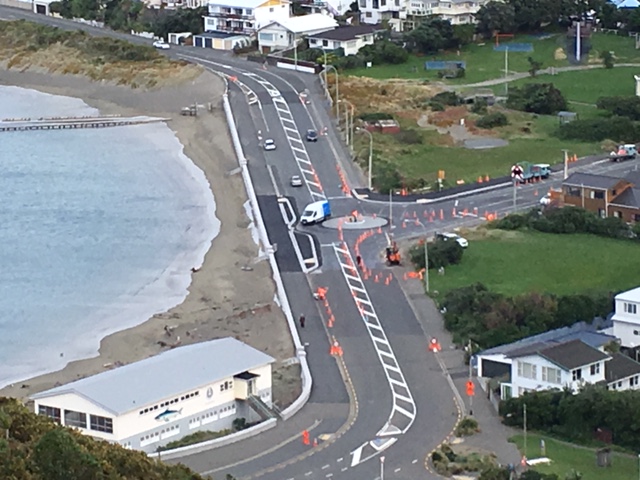
But today I wanted to highlight another small Wellington City Council excess.  It is of no wider interest, except as symptomatic of the way our money is wasted by councillors up and down the country.  As I said, Island Bay is a pleasant seaside place.  Just to the left of the photo, fishing boats lie at rest, and the eponymous island guards the entrance.  There is a pleasant sandy beach, good for swimming (if somewhat bracing).   There weren’t a lot of people around when I took this photo on a cool late-autumn morning, but on summer afternoons the beach is often crowded and finding somewhere to park can be a challenge.

island bay

And so what is the Wellington City Council in the process of doing?  Why, removing probably half a dozen carparks  on the main road (you can see where the dark new seal is by the van) –  and others on the side street –  as part of putting in a new roundabout.  This little project is said to be costing $400000.  There was, it appears, no consultation with either residents or beach users.

Both roads are wide, and neither is particularly busy (I walk down there most days).  There is no obvious problem, no apparent record of accidents, but that doesn’t stop the Council frittering away public money.  I guess we should be grateful for small mercies: a few years ago when the sea wall was damaged in a storm, some councillors wanted to rip up the road (past the new roundabout) altogether and let the sea “take back its own”.  Fortunately, they lost that battle.

Each individual project like this doesn’t sound like much.  But they add up, and before you know where you are, hundreds of millions of hard-pressed ratepayer’s money is being lavished on the big stuff with little rigour, less transparency, and not much accountability.   It is a shame there is no way to have councillors put rather more of their own money on the line: perhaps for each new initiative they vote for councillors could consider making a personal contribution equal to, say, ten times the average per capita cost of the project in question.   When the mayor, Justin Lester writes a personal cheque for $4000 as a contribution to the convention centre, and another for $2500 for the town hall refurbishment or the runway extension, I’d start taking the views that underpin his wastefulness (with other people’s money) a little more seriously.  Of course, even then it might just be considered a campaign expense on a journey towards Parliament.  Instead, we go on with citizens being plundered to pursue the whims of councillors and specific vested interests.


Amy Adams and the National economic model

National Party finance spokesperson Amy Adams was interviewed on TVNZ’s Q&A programme on Sunday.   Amid the to-ing and fro-ing on aspects of the government’s Budget, there was an odd exchange about the underpinnings of economic growth in New Zealand.

AMY Can I just finish, though? Can I just finish? Even Treasury is saying that the GDP growth that they’re forecasting is only held up because of strong and, in fact, growing immigration numbers — something that Grant Robertson went on about for nine years in opposition. So it’s been driven by immigration, industrial law changes, foreign direct investment, new taxes. Those things will slow the economy.

CORIN Are you seriously criticising this government for relying on immigration to grow its economy when your government relied on immigration and housing?

AMY Am I going to get a chance to answer? Okay, so what I’m going to say, Corin, is that for nine years in opposition, Grant Robertson made a big deal about the fact that immigration and the net flow of migrants into New Zealand was what was holding up the economy. What I’m pointing out is that Treasury, in its own estimates in the Budget, has said it is continuing strong immigration that is going to continue to see GDP held up. We’ve always argued that you need a good inflow of skilled workers. We’ve never made any bones about that, but this is a government, again, that talked one game in opposition and is entirely going the other way in government.

CORIN Fair enough — that’s a fair point, but it’s a bit rich to criticise them for relying on immigration.

AMY I’m not criticising them for doing it; I’m saying I’m criticising them for breaking their promises about what they said. They said in the campaign they would slash immigration, and now it’s strong immigration numbers that they’re looking at, or at least, Treasury are looking at to support those figures.

If I’m reading Adams correctly she appears to be

  • criticising the government for not carrying through on what she describes as their promises to “slash migration”,
  • arguing that, on Treasury’s account, continued migration-led population growth is a key element in the GDP growth forecast over the next few years (Treasury having revised up its medium-term immigration assumptions), and
  • acknowledging that in National’s term in government, the numbers relied very heavily on large immigration inflows.

I’m mostly interested in that final point.  On my analysis of Labour’s manifesto, there was never a promise to “slash” migration, or even to take steps that would cut the net inflow for more than a year.  And those were policies put in place when Andrew Little was still leader; from her silence on the issue once she became leader it was pretty clear Jacinda Ardern didn’t really believe in those policies.  There was no change promised in the centrepiece of our immigration policy: the residence approvals target number of 45000 non-citizens per annum.    (There hasn’t yet been any sign of the modest changes Labour did promise –  some sensible, some not – although we are told they are coming.)

But what of National’s approach to economic policy.   A couple of weeks ago, the National Party leader was touting his party’s economic credentials

When I was Economic Development Minister, our plan for the economy was set out in the Business Growth Agenda.

The BGA comprised over 500 different initiatives all designed to make it easier to do business by investing in infrastructure, removing red tape, and helping Kiwis develop the skills needed in a modern economy.

Some of those were big, some were small. I’ll admit some weren’t as exciting spending a billion dollars every year.

But together they were effective.

New Zealand has one of the best performing economies in the developed world.

But, in fact, what it came down to mostly was a lot more people, and the activity that a lot more people generate.  At least Amy Adams seems to recognise that.

In the five years to the end of 2012, New Zealand’s population is estimated to have increased by 4.3 per cent, and in the five years to the end of 2017 the increase is estimated to have been 9.3 per cent.    More than all that increase resulted from changes in net migration (the natural increase was smaller in the second period than in the first).  Coping with a lot more people – especially when the increase is unexpected – generates a lot of economic activity (people need houses, schools, shops, offices etc), but not necessarily a lot more long-term economic opportunities to support the increased number of people.

Note that I deliberately used the words “not necessarily”.  At some times, and in some circumstances, migrants can help create or tap whole new opportunities, helping to lift economywide productivity, increase the outward-orientation of the economy (and the associated investment), and so on.  But it is an empirical question, that has to be reviewed in the light of experience.  Sadly, there is little or no sign that we’ve seen those sorts of gains here.

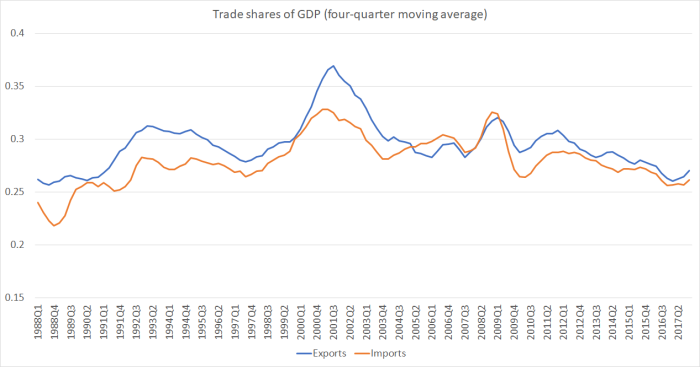
I’ve pointed out previously (perhaps ad nauseum) that total labour productivity growth in New Zealand in the last five years was only about 1.5 per cent.  Over that period, too, trade with the rest of the world (exports and imports) have been shrinking.

trade shares may 18

When National first came to office 10 years ago they recognised that sustainably successful economies tend to be ones that find more and better products and firms that successfully take on the world (in turn, enabling us to import and consume more from the rest of the world).  Perhaps unsurprisingly, foreign trade rated no mention from Amy Adams.

So we’ve had

  • little or no productivity growth in the wake of the population surge,
  • a shrinkage in the proportion of our economy traded with the rest of the world, and
  • increasingly ruinous house prices in much of the country.

Twenty years ago when people first started to worry a bit that there wasn’t much sign of New Zealand catching up again with the rest of the advanced world, one hypothesis that did the rounds for a while was that of ‘the cheque is in the mail” –  just be patient, and the gains would materialise soon.   They didn’t then, but perhaps this time is different?

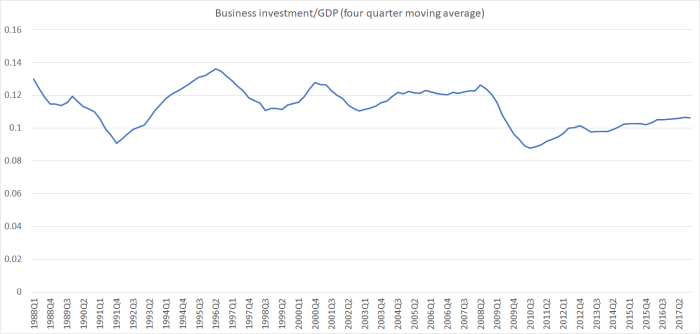
One place we might look for signs of that is business investment.  But, as even the Reserve Bank Governor has been pointing out, that has been pretty muted.   Here is business investment (total gross fixed capital formation less government and residential investment spending) as a share of GDP.

bus investment may 18

That mightn’t look too bad to you –  after all, the line has been edging up over the last few years.  But even now the share of the economy devoted to business investment is lower than in every quarter from 1993 to 2008, and we’ve had much larger and more sustained total population increases this time round than in the previous couple of cycles.  More people need more capital.  It doesn’t look as if business has been planning for even better times ahead, more or less just meeting the domestic demands of the rising population itself.  (And as I illustrated on Friday, Treasury doesn’t expect any recovery in the export/import shares of GDP in the next few years.)

Consistent with that, here is a chart I’ve shown previously, using SNZ’s annual capital stock data.

cap stock growth may 18Growth in the per capita “productive” capital stock –  public and private, but excluding houses –  has been low and has been trending downwards.  I’ve also shown (orange line) a proxy for natural resources per capita: since natural resources themselves are fixed, this is just the inverse of the rate of population growth.  Per capita natural resources are falling.  That mightn’t be a problem –  it is, after all, true of every country with a growing population – if other resources were taking the place of the natural ones.  But there has been no sign –  in business investment, productivity, or the foreign trade data –  of that here.
Productivity growth here (real GDP per hour worked) in the last five years was 1.5 per cent in total.  The best-performing eight OECD economies averaged 11.3 per cent over the most recent five years (some to 2016, some to 2017).  Most of those countries are still a bit poorer and/or less productive than New Zealand –  but not all (the list includes Turkey, Slovakia, and Korea). And those gaps are now a greater deal smaller than they were even five years ago.  New Zealand GDP per capita is currently around $60000.  If we’d managed 10 per cent productivity growth over the last five years –  instead of 1.5 per cent – the economy would be around $5000 bigger per man, woman, and child.  Just think of the possibilities that would have opened up, individually and collectively.

Instead, pretty much all we had was the activity generated by a lot more people, and more working hours for those already here.  Probably inadvertently, the National Party finance spokesperson has finally acknowledged it.

Of course, the outlook under the current government is more of the same, or even worse.  The immigration policies of the two main parties are all but identical in substance (although the cyclical dimension does appear to be turning), but the new government throws into the mix the ban on oil and gas exploration, a determination to do more on water standards, and to do much more around emissions.  Perhaps each of those policies is individually worthy, but they are all likely to come at an economic cost, a cost exacerbated if policy keeps on trying to drive up the population –  in a location that hasn’t shown the (beneficial) economic fruits of such a policy for a long time now.  And should the government somehow manage an acceleration of the rate of housebuilding, that too will only squeeze out –  through higher interest and real exchange rates – more of the business opportunities that might otherwise have supported a growth in material living standards.

More people, at least in New Zealand, isn’t a path to higher productivity, and higher productivity is what aspirations for higher material living standards rely on.  More people is just a path to more activity to accommodate more people –  skewing the economy inwards again, and undermining our prospects of ever getting back towards that upper tier of advanced economies.  On this score, Amy Adams (and her leader) appear quite as blind as Grant Robertson (and his). It is only two years until the next election campaign will be getting underway: the Adams interview doesn’t suggest any sign of a rethink of policy, or even a recognition that activity is no substitute for productivity.  And the latter is sorely lacking in New Zealand.


This is what productivity means

Presbyterian Support Northern is hosting a series of lectures on different aspects relevant to the wellbeing of children.  The first lectures were given by Australian Labor MP, and former economics professor, Andrew Leigh.  I wrote about his lectures here.

I was asked to speak on something around productivity and the wellbeing of children (thus there are huge areas highly relevant to child wellbeing that I simply don’t touch on).  This was how my talk opened.

Imagine a country in which the average age at death was only about 45, 6 per cent of children died before their first birthday, and another 1.5 per cent before they turned five.  Not many children are vaccinated.

Most kids get to primary school –  in fact it is compulsory –  but only a minority attend secondary school.  By age 15 not much more than 15 per cent of young people are still at school.   Only a handful do any post-secondary education (total university numbers are about 1 per cent of those in primary school).   Houses are typically small –  not much dedicated space for doing homework – even though families are bigger than we are used to.   Perhaps one in ten households has a telephone and despite the street lights in the central cities most people don’t have electricity at home.

Tuberculosis is a significant risk (accounting for seven per cent of all deaths).  Coal fires – the main means of heating and of fuel for cooking – mean that air quality in the cities is pretty dreadful, perhaps especially on still winter days.  Deaths from bronchitis far exceed what we now see in advanced countries. There isn’t much traffic-related pollution though – few cars, so people mostly walk or take the tram.  The biggest city is finally about to get a proper sewerage system, but most people outside the cities have nothing of the sort.      And washing clothes is done largely by hand – imagine coping with those larger families.

Maternal mortality rates have fallen a lot but are still ten times those in 2018 in advanced countries.  One in every 50 female deaths is from childbirth-related conditions –  which leaves some kids without mothers almost from the start.

Welfare assistance against the vagaries of life is patchy.  Most people don’t live long enough to be eligible for a mean-tested age pension.   Orphans aren’t in a great position either, and there is nothing systematic for those who are seriously disabled.  There is a semi-public hospital system, but most medical costs fall on individuals and families, and there just isn’t much that can be done about many conditions.

There are public holidays, and school holidays, but no annual leave entitlements.  No doubt the comfortably-off take the occasional holiday away from home, but most don’t, because most can’t (afford it). Only recently has a rail route between the two largest cities been opened –  but it takes 20 hours for cities only 400 miles apart.

I wouldn’t choose to live in that country.  Would you?

And yet my grandparents did live there –  they were all kids then.  This was New Zealand 100 years or so ago, just prior to World War One.  I took most of that data from the 1913 New Zealand Official Yearbook.

And if it all sounds pretty bleak, New Zealand was probably the wealthiest place, with best material living standards, of any country on earth.   In the decade leading up to World War One, New Zealand’s per capita income was (on average) the highest in the world (jostling with Australia and the US, with the UK a bit further behind).    The historical GDP estimates are inevitably a bit imprecise, but on statistic after statistic in that 1913 Yearbook, New Zealand showed up better than the other rich countries the compilers had data for.

The difference in material living standards between then and now is productivity –  the new ideas, new products, new ways of doing old stuff, making more from what we have.   Of other influences on material wellbeing, the terms of trade haven’t changed much taken over 100 years as a whole, and people work a shorter proportion of their lives now (whether in the market or in the home) than they did in 1913.  Then, most (who survived infancy) were in work by 14, and dead by 65.    Productivity is that enormous difference between what we enjoy today, and what my grandparent had as kids in middle-class New Zealand families on the eve of World War One.

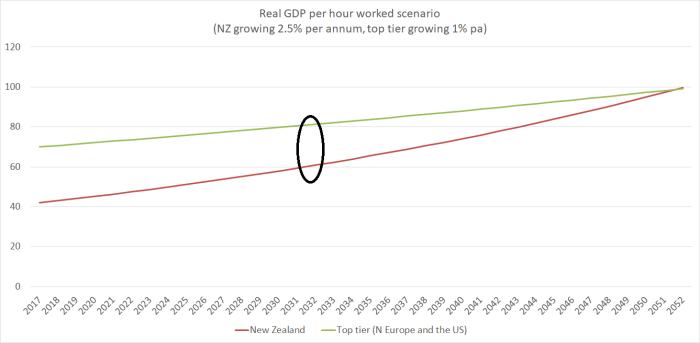
And yet, by international standards we’ve done badly.  We’ve gone from top of class to perhaps 30th today.  It would take a two-thirds lift in average productivity for us to match today’s top-tier (a bunch of –  small and large –  northern European countries,  and the United States).

That’s bad.  On the other hand, think of the possibilities it leaves open.  We don’t need to blaze trails at the productivity frontiers: making significant inroads on the gap between us and the top-tier would make a big difference to us, and to our kids.  And economic failure tends to fall most heavily on those at the bottom, so getting a significant lift in productivity opens up possibilities for everyone, including the disadvantaged.

In this address I’m not focused on the how –  the specific policies that might make a real difference.  My focus is on highlighting the difference that could be made, and calling for our leaders –  political and bureaucratic –  to start acting as if they believe things can be better, getting in train processes that might identify what is really important for productivity here in New Zealand, and then getting on with it.  Despite occasional references in speeches, our political leaders seem to have more or less given up, focusing on other stuff.

There is a (valuable) place for redistribution and policies that address immediate needs now –  it isn’t an either/or – but just as no possible redistributive policies in 1913 could  possibly have given people today’s material living standards, so any new redistributive policies now will inevitably make much less difference than markedly lifting our productivity performace would.  I’ve banged on here about how dismal productivity growth in New Zealand has been in the last five years in particular (a total of 1.5 per cent).  The best-performing OECD countries over the most recent five years were averaging more than 2 per cent productivity growth per annum –  and all of them were countries catching up with the most productive economies, just as we once aspired to do.   If we’d managed 2 per cent productivity growth per annum in the last five years, per capita GDP would be around $5000 per head higher (per man, woman, and child) today.

Catching up to the top tier will, in a phrase from Nietzche, take a “long obedience in the same direction” –  setting a course and sticking to it.  But here is a scenario in which the top tier countries achieve 1 per cent average annual productivity growth, and we manage 2.5 per cent average annual productivity growth. Here’s what that scenario looks like:

scenario

I’ve marked the point, 15 years or so hence, where the gap would have closed by half.

Could it be done?  Well, on OECD numbers the G7 countries as a group have managed average productivity growth in the last 15 years of about 1.1 per cent per annum, and plenty of OECD countries –  each in catch-up mode (Korea, Turkey, and various eastern and central European countries) – have matched or exceeded 2.5 per cent annual productivity growth over that period as a whole.   Mine is just a scenario, but it doesn’t look like one that should be beyond New Zealand –  and unlike any of those other countries, we were the richest and most productive country in the world barely more than a century ago.

The full text of my address is here.  It includes a plug for fixing the manifest evil –  by outcome if not by intent –  that is our housing and urban land market, which systematically skews away from those at the margins, where (inter alia) our particularly disadvantaged children are typically found.

I end this way:

Judging by the inaction of our leaders in tackling the persistent productivity failure, it suggests that when it comes to crunch ours (regardless of party) care much less about the kids –  of this generation and the next – than the cheap rhetoric of election campaigns might suggest. Giving up on productivity –  in practice, and whatever the rhetoric – is a betrayal of our kids (and their kids).  And most especially it betrays the children towards the bottom of the socioeconomic scales, those who typically end up paying the most severe price of economic and social failure.

Productivity isn’t just some abstract plaything of economists. It makes a real and tangible difference, opening up whole new possibilities and options. We need, and should able to achieve, a whole lot more of it. Our kids deserve no less.

Scattered thoughts on Budget 2018

The possible new fiscal institution first, and them some comments on some of the numbers.

It was interesting to see the joint statement from James Shaw and Grant Robertson that the government is looking to move ahead with some sort of independent fiscal institution.   This had been a Greens cause more than a Labour one –  former leader Metiria Turei had openly called for a new body –  and although the pledge had formed part of the pre-election Budget Responsibility Rules, I’d been beginning to wonder whether the government would follow through.  After all, Treasury has never been keen on a potential alternative source of fiscal advice/analysis, even though the independent review of their fiscal advice and analysis a few years ago by the former head of the IMF Fiscal Affairs Department had been positive on the idea that New Zealand establish a Fiscal Council (and the OECD had also recommended it).

There were few specifics in yesterday’s statement

Public consultation will be launched in August on establishing an independent body to better inform public debate in our democracy, Associate Finance Minister James Shaw announced today.

“We are pleased to take forward a Green Party idea developed before the last election to see a body formed which could provide all political parties with independent, non-partisan costings on their policies,” says James Shaw.

“That way we can reduce political point-scoring and attempts to create unreasonable doubt about a party’s policy figures. That will mean better debate about the ideas being put forward.

“We are proposing a new institution independent of Ministers that would provide the public with an assessment of government forecasts and cost political parties’ policies,” says Grant Robertson.

“This independent fiscal institution (IFI) would crunch the numbers on political parties’ election policies in a credible and consistent way,” says James Shaw.

Indeed, the statement is a reminder that there are two very different roles being discussed here:

  • costing political parties’ election promises, and
  • monitoring and assessing government (Treasury surely?) fiscal forecasts, and perhaps government fiscal strategy.

As I’ve written previously, I am generally positive on the second of those roles, but am sceptical of the former.  Notwithstanding last year’s debates about “fiscal holes”, I don’t see a gap in the market (after all, surely “pointscoring” is part of the point of election campaigns?), and I suspect any such costings office would tend to become an additional research service for small parties (the Australian office seems to have been used mainly by the Greens), and not much used either by the main parties (with more resources, including in the form of supporters’ own expertise), or by any right-wing parties (given the social democratic leanings of those likely to be doing this sort of work, probably on rotation or secondment from The Treasury).

Of the second leg, these were some of my earlier comments

A Fiscal Council seems more likely to add value if it is positioned (normally) at one remove from the detailed forecasting business, offering advice and analysis on the fiscal rules themselves (design and implementation) and how best to think about the appropriate fiscal policy rules.  The Council might also, for example, be able to provide some useful advice on what material might usefully be included in the PREFU  (before the election, I noted that routine publication of a baseline scenario that projected expenditure using the inflation and population pressures used in the Treasury economic forecasts would be a helpful step forward).

There is unlikely to be a simple-to-replicate off-the-shelf model that can quickly be adopted here, and some work will be needed on devising a cost-effective sustainable model, relevant to New Zealand’s specific circumstances.  That is partly about the details of the legislation (mandate, resourcing etc), but also partly about identifying the right sort of mix of people –  some mix of specific professional expertise, an independent cast of mind, communications skills, and so on.  A useful Fiscal Council won’t be constantly disagreeing with Treasury or the Minister of Finance (but won’t be afraid to do so when required), but will be bringing different perspectives to bear on the issues, to inform a better quality independent debate on fiscal issues.

I hope to offer some more-detailed thoughts when the public consultation phase of the policy development occurs.  In the meantime, I’d continue to urge ministers (and Treasury) to think about broadening the ambit of any new council, to include external monitoring analysis of monetary policy and perhaps the other responsibilities of the Reserve Bank.

…it wouldn’t be about second-guessing individual OCR decisions or specific sets of forecasts, but offering perspectives on the framework and rules, and some periodic ex-post assessment.    In a small country, it would also have the appeal of offering some critical mass to any new Council.

What of this year’s numbers?

I’m not someone who champions big government.  In fact, I think we could do the things the state should be doing, and do them well –  better than they are being done now – with a smaller share of GDP devoted to government spending.

But as outside observer of left-wing politics in government, I continue to find charts like this a bit surprising.

core crown expensese 2018 budget

Not only is government spending over the next four fiscal years planned/projected to be a smaller share of GDP than in the last four years under the previous government, but that government spending share averages less than in every single year of the Clark/Cullen government.   In the interim, nothing has been done to raise the NZS eligibility age, so that that particular fiscal outlay is becoming more burdensome every year.  And all the campaign rhetoric –  and actually the rhetoric in government –  is about rebuilds, past underfunding etc etc.   Something doesn’t seem to add up.  I suspect, as I’ve argued previously, that the aggregate spending line can’t, and won’t, be held over the next few years.

And you will recall that the Labour-Greens pledge around government spending was (as it first appeared last May)

4. The Government will take a prudent approach to ensure expenditure is phased, controlled, and directed to maximise its benefits. The Government will maintain its expenditure to within the recent historical range of spending to GDP ratio.

During the global financial crisis Core Crown spending rose to 34% of GDP. However, for the last 20 years, Core Crown spending has been around 30% of GDP and we will manage our expenditure carefully to continue this trend.

In the separate release on the rules yesterday, that second paragraph now reads

Core Crown spending has averaged around 30% of GDP for the past 20 years. The Treasury forecasts show we are staying below this – peaking at 28.5% of GDP in 2018/19.

It is as if 30 per cent has become a ceiling –  staying below it a badge of honour for the government –  rather than something to fluctuate around.

Perhaps the Minister would defend himself by noting that over the forecast period the economy is running at capacity, and he needs to allow for the inevitable next recession at some point.   But with planned spending averaging 28.5 per cent of forecast GDP, it would take an unexpected 8 per cent fall in nominal GDP (relative to the current forecast path), with no change at all in government spending (say, wage settlements being lower etc) for government spending to equal 31 per cent of GDP, even in a single year in the depths of such a recession.  And even 31 per cent wouldn’t be out of the recent historical range of the spending to GDP ratio.   Again, relative to the political rhetoric, something doesn’t compute.

There are also some puzzling things in the Treasury macro forecasts –  which are Treasury’s responsibility, not that of the Minister of Finance.    Here is the difference in the interest rate projections of the Reserve Bank and The Treasury.  The Bank forecasts the OCR directly, while The Treasury forecasts the 90 day bill rate, but you can easily see the difference.

rb and tsy int rates

Only last week, the new Governor (over)confidently told us that official interest rates “will” remain on hold for some time to come.  The Treasury clearly doesn’t believe him, reckoning that by this time next year we’ll already have had 50 to 75 basis points on OCR increases, with lots more increases in the following two years.

Even though I think the Governor was expressing himself too strongly, I just don’t believe the Treasury numbers at all.    They imply a lot of pent-up inflation pressures building up now that can only be nipped in the bud if the Bank gets on with the job and tightens policy.    And yet, on Treasury’s own numbers, the output gap has increased from around -1.5 per cent of GDP (for several years) to around zero now, and there has been only a very modest increase in core inflation.  It is hard to see how the quite small projected increase in capacity pressures will now finally get core inflation back to 2 per cent –  requiring quite a lift in the inflation rate from here –  and how those pressures are likely to appear if people really thought such a significant tightening of the OCR was in prospect.   As it is, on these Treasury numbers, it is another three years until inflation gts back to 2 per cent.  That is even slower than in the Reserve Bank projections.

Also a bit sobering were the Treasury export forecasts.  From time to time the government talks –  as its predecessor did – about lifting exports (and imports presumably) as part of a successful reorientation of the economy.  Treasury clearly doesn’t believe that any such reorientation is underway.

exports to gdp budget 2018

Just some more of the same dismal picture.  But I guess that is what one would expect when the two parties just keep on with much the same policies that got us where we are today, with the economy less open (as measured by trade shares) than it was averaging 25 years ago).

I mentioned earlier the uncertain timing of the next recession.  If the Treasury projections come to pass we’ll have gone 12 years (since the 2010 double-dip recession) without a recession.  That is possible, but it probably isn’t an outcome people should be planning on.  I noticed last night this chart from a recent survey of US fund managers.

next recession

Quite possibly, like economists, fund managers picked six of the last three recessions.  Nonetheless, it is a salutary reminder of where things can go wrong.  For example:

  • The Fed could end up overtightening (often a contributor to past downturns),
  • Emerging market stresses (eg Turkey and Argentina) could foreshadow something more widespreads,
  • Economic data in the euro-area seems to be weakening, and the likely new Italian government doesn’t look like a force to increase confidence and resilience in the euro,
  • and of the course there are risks around China, and in the Middle East –  trade wars and other aspects of geopolitics.

Nearer to home, some straws in the wind are also starting to pile up.

I don’t do medium-term economic forecasts –  nor does any wise person – but with the terms of trade assumed to hold at near-record highs, there is a sense that the macro picture the government is using, and selling, is a little too good to last.  In that respect –  but probably only –  it is eerily reminiscent of the start of 2008 when The Treasury revised its advice and confirmed to the then government of the day that it thought the higher revenue levels were likely to be permanent. Little did they realise…….

Of course, our government debt levels are very low –  net debt is only 7.3 per cent of GDP –  so these risks aren’t some sort of existential threat (although any new global downturn will greatly exacerbate fiscal problems elsewhere, and further constrain policy freedom of action and limit the ability of the advanced world to bounce back quickly).  But our authorities do need to be more actively planning for the next downturn: it will come, and when it does it appears that the government and the Reserve Bank have not yet done anything much to assure that they have anything the freedom of monetary policy action we can usually count on.  (Perhaps instead of offering his unsolicited thoughts on all and sundry political issues, the Governor could substantively address that issue, which is core to his remit.)


Israel: economic success, or not

I’m out of town this morning, so just something brief and prescheduled:

Israel has been in the media a lot this week.  Much of that has been about the confrontation on the Gaza border.

But it has also been the 70th anniversary of the founding of the state of Israel.  In many respects it is an astonishing achievement, even if I remain sceptical of its longevity.  Sadly, demography and history seem to be against them.  Demography? 400 million Arabs and 80 million Iranians, few of whom seem reconciled to the idea of a permanent state of Israel.  History?  Well, the Crusader states lasted longer than 70 years, but were wiped out.  More recently, Smyrna (let alone the cleansing of the millenia-old Jewish community in Baghdad).

But the economic achievement of Israel can be, and often is, overstated. I noted on Kiwiblog the other day, a celebratory post, including this

In 70 years, Israel has become one of the world’s leading scientific and technological companies[countries?]. 45 of their top inventions are listed here.

12 Israelis have won Nobel Prizes – one literature, three peace, two economics, six chemistry. (Note a further 155 Jews in other countries have won a Nobel Prize, comprising 22% of all nobel prizes since 1901 despite being just 0.25% of the world’s population).

A few of their inventions are:

  • cellphones
  • Intel chips
  • ICQ
  • Polio vaccine
  • antivirus software
  • ingestible video cameras for cancer detection
  • USB flash drives

All of which is pretty impressive.  But what does it amount at an economywide level?

As regular readers will know I frequently point out that over recent decades New Zealand’s cumulative growth in productivity (real GDP per hour worked) has been lower than in almost all other OECD countries.  And we started below the average and had been aiming to catch up.

But how has Israel done by comparison?  This chart just shows the ratio of real GDP per hour worked for New Zealand and Israel relative to that of the United States (as a representative high productivity OECD economy), starting from 1981 because that is when the Israel data starts.

israel nz comparison

We’ve done badly, and they’ve done even worse.

I’m sure there are all sorts of explanations.  For example, Israel spends a large chunk of its GDP on defence and security, and even if that demand spurs innovations in some specific industries, it is unlikely to be a long-term positive for economywide productivity.  As I’ve pointed out previously, Israel is also remote – albeit in different ways to New Zealand: political barriers, security fears etc, limit the opportunities for trade and investment.   And Israel doesn’t exactly have the least heavily-regulated economy in the OECD.

But it is also hard to go past the elephant in the room.  To listen to the advocates of economic benefits of immigration, Israel should really the poster-child, the unquestionable success story.  Any Jewish person anywhere can move to Israel and claim citizenship, and large numbers have.  Population growth in Israel in recent decades has been faster than anywhere else in the OECD –  partly birth rates and partly migration – and (for whatever reason) Jewish people tend to come quite highly-skilled.   That part of the population growth has probably been a boon from a defence and security perspective, and of course the Law of Return is pretty fundamental to Israel’s sense of national identity, and its founding purpose.

But evidence of economic gains appears elusive.