Pandering to the PRC

The capital’s daily newspaper the Dominion-Post had an editorial that must have warmed hearts in the Beehive and MFAT.   “Fawning” would not be too strong a word for it.

The handshakes appeared warm, the smiles generous. Prime Minister Jacinda Ardern described the talks as constructive.  China’s President Xi Jinping said New Zealand was a “sincere friend and co-operative partner”, one of his country’s closest relationships with the developed West.

Job done. Trust restored. Many billions of dollars in trade secured

Trust?  In a regime responsible for so much evil at home and intimidation abroad (wasn’t it only this week PRC fighters were intimidating free and democratic Taiwan)?  Surely not even the PM and MFAT take that line seriously?  But I guess “trust” was more about what the CCP rulers were supposed to feel towards the New Zealand government, the Prime Minister having abased herself, and joined the principle-less ranks of New Zealand politicians dealing with the PRC and eager for some deals and donations.

Then there was a little lesson to dear readers not to expect governments to speak up on the abuses of the PRC.  There is “a great deal of money at stake” don’t you know, and it isn’t the done thing to speak up.  Know your place peasants, we act for the business community.

The newspaper channels the convenient, but false, line about how much power the PRC wields over New Zealand, oblivious to the fact that countries make their own prosperity. Individual firms who over-expose themselves to thugs shouldn’t expect backing from the rest of the community, let alone from our government.  Unless, of course, our government –  once known for rhetoric about “kindness” – thinks the thugs are just fine.

And then the fawning editorial departs completely from reality, trotting out the weird line touted by David Parker a few months back that somehow we could be a conduit between “two competing superpowers” as if (a) either side would be interested, and (b) the United States and the PRC were really much the same, moral equivalents.

But it was the NZME stable of media that was really all in with Beijing today.  In no particular order I noted these pieces:

First, John Key was back, talking about how “critical” the PRC relationship was and that nothing should be allowed to get in the way.    The government is told to mind its words, and there was the bizarre assertion that

“China is the only country effectively where have unfettered access to all parts…If we treat that relationship properly we will continue to prosper off the back of that.”

Setting aside the more general claimed that New Zealand “prospers” –  when it actually languishes and has closed no productivity gaps in the last decade, or two, or three –  ask services exporters about “unfettered access to the PRC” or potential foreign investors about “technology transfers”.

He goes on

The Former Prime Minister said people don’t need to be concerned by China’s involvement in New Zealand.

I guess he would say that wouldn’t he? He works for companies trying to do business in China, he worked closely with former PLA intelligence official, Jian Yang, in his caucus, and seemed totally content with the fawning adulation his party president Peter Goodfellow has given to  Xi Jinping and the regime.   And all those party donations must have come very much in handy.

The article ends

He said our relationship with China needs to be treated really carefully.

Even John Key seems to know this is a subservient relationship he champions, about deals and donations, not about any natural friendship or commonality of values.  Values are simply of no account, it seems, in a Key view of the PRC.

And then there was the Wednesday column from NZME’s columnist Fran O’Sullivan, who travelled to Beijing, courtesy of Air New Zealand –  a big corporate very keen to keep on good terms with Beijing.  That travel support was disclosed, but not the fact that O’Sullivan –  along with Jian Yang and Raymond Huo and others –  sits on the Advisory Board of the (largely government-funded) propaganda outfit the New Zealand China Council, or that she is head of something called the China Business Summit.   It wasn’t particularly fawning, but it was framed around conveying PRC messages, and a sense that New Zealand governments owed something to Beijing.  Certainly no sense of Beijing as something of a rogue actor, at home and abroad.  More gushy was O’Sullivan’s piece in the big “China Business” supplement to today’s paper.   It isn’t so much that O’Sullivan’s views are necessarily wrong –  appeasement will always have its defenders, in 1938 and now – as the total absence of any alternative perspective in the nation’s largest paper.

The Herald was back to its fawning, if patronising to the PM, self in its editorial on the Prime Minister’s visit to Beijing.  The online title “PM makes a good start on China repair” casts her as some naughty schoolgirl who has now come to herself and made amends, as if there was ever anything to make amends for.   The Herald also did not like, one bit, the idea that the government might have dared to think that the PRC was not always a force for good, whether in the Pacific or the wider world.  As if it was channelling the People’s Daily –  then again, Beijing is reported to substantially influence the Herald’s Chinese language offshoot –  we read

In Beijing on Monday President Xi Jinping told the Prime Minister, “Our two sides must trust each other”. That is a message we must take to heart. Trust does not mean closing our eyes to possible risks but it means we should look for evidence of a threat rather than assume one is there.

No evidence of the PRC being an untrustworthy partner?  No, of course not.  Forget, shall we, small things like the GCSB joining other countries in calling out PRC state-sponsored intellectual property theft?  Or Beijing’s actions in pressuring Chinese language media here and in other western countries?  Or the intimidation of ethnic Chinese who speak up about the regime?  Let alone, the way Beijing operates around Taiwan, the South China Sea, or as regards it own people –  despite being party to all manner of international human rights covenants.  A trustworthy lot, the Herald reckons.  Yeah right.

They do get briefly descriptive

China is a monolithic state where ruling Communist Party controls every level of government and every sector of the economy. It is a nuclear-armed superpower and makes many of the world’s consumer goods.

I presume it was accidental that that first sentence was so all-encompassing that it must have included Huawei?

And then we get back to the cravenly creative.

Xi is more autocratic than any leader of China since Mao Tse Tung and is asserting China’s external interests more strongly. But he is doing so in proper ways, through diplomacy and development aid, notably the “belt and road” infrastructure schemes.

“Proper ways”!   None so blind as those who choose to look the other way.  If Taiwan or the South China Sea, or ethnic Chinese in New Zealand and other countries, don’t bother you, if state-sponsored intellectual property theft bothers you not at all, if widely-recognised attempts at economic coercion don’t bother you, then perhaps the Herald is quite right.  Most people will wonder if the text was just lifted from the People’s Daily.   And wasn’t “economic coercion” precisely what the China-panderers would have us worry about?

The first half of the very final paragraph might also have been lifted from a CCP propaganda sheet

China has been a superpower for a long time and it has not flexed its muscle much further than the South China Sea to which it has an historic claim.

“Historic claim” indeed –  a proposition for which there is very little evidence.  And might it be too much to have pointed readers to aggressive PRC activity in the East China Sea, its invasion of Vietnam in 1979, its confrontations with India –  as well as all that other interference and pressure touched on earlier.  Not the stuff friendly powers do.

But, channelling Beijing to the end, the Herald tells us that the PRC had “earned” trust (precisely how, they don’t attempt to explain) and that

Our Government now needs to show the Prime Minister’s one-day visit was not a one-day wonder.

Just stay flat on your face Prime Minister and the Herald and its business advertisers will be happy.

As I noted a bit earlier, there is a full 28 page China Business supplement to today’s paper.  It is pretty fawning from start (the front page leads with “Jacinda Ardern: Mission Accomplished”) to the end (the full page advert from Huawei).  There is the odd interesting piece in the supplement but not a word that might upset Beijing (or probably even MFAT and their front, the China Council).    The only bits I really wanted to highlights were two columns suggesting that it was simply illegitimate for New Zealand to express any serious unease about one of the most awful regimes on the planet.

There was a column by Todd McClay, National’s foreign affairs spokesman, who nailed his colours firmly to the mast last year talking of the Xinjiang “vocational training camps” (a million or more people in concentration and indoctrination camps) being no business of anyone’s but the PRC.   This time

Where we have differences, like the death penalty or South China Sea, we have learnt to raise them respectfully and diplomatically, directly between officials, leaders and ministers, and not via the media.   This is a respect that must be maintained.

Mr McClay and his party can choose to respect the butchers of Beijing if they choose, but don’t come asking for my vote while they do.  To him/them, it is all about deals and donations, and nothing else.  If he’d been the trade spokesman in December 1938 perhaps he’d have stressed how important it was to be respectful of Adolf Hitler and his henchmen and not let some local disturbance like Kristallnacht colour any sort of relationship.  It is sickening, and there is no evidence that the current Prime Minister is any different.   I thought this New Zealander studying matters Chinese at ANU put it well

(As it happens, I don’t think the PM should have been speaking out in Beijing,  She simply shouldn’t have been there, like some supplicant indifferent to the evil prepetrated daily by her hosts.)

And then there was the egregious but revealing column by a senior lawyer who is also involved in the China Council, repeating the myth that somehow the PRC is “critically important to our economic security” and offering a lecture concerned that New Zealand is “driving away” PRC investment in New Zealand –  and all that advisory work I suppose.

In business, we typically seek to avoid getting offside with a major customer.  If we have differences we tend to try to deal with those with great care with a view to preserving the business relationship beyond the immediate issue. Politicians may well disagree with me but I’d argue that fundamentally the approach should not be much different when we have a divergence of views or concerns with a major trading partner.

I guess if Ms Quinn wants to deal with thugs we probably shouldn’t prevent her from doing so.  But if you sup with the devil, or provide advisory services for the Mafia or its affiliates, don’t expect to be looked on favourably.  It is private firms that deal with Chinese companies, the New Zealand government – supposedly representing all New Zealanders, not just a few business interests – does not having a “trading partner”.  It is a government, not a business.  Private firms –  and the individuals involved –  must make their own calls about morality, but from reading article after article like this, it is almost as if they’ve chosen not to care.  Care or not, they make themselves complicit in what the regime does.   Private businesses, pursuing personal economic interests, shouldn’t be allowed to skew our foreign policy to their private ends.

It is all relentless.  Earlier today someone emailed me wondering how long it would be before the Herald was emulating papers like the Washington Post in publishing paid PRC propaganda inserts.   In the Herald’s case, why would the PRC waste money when they can get the one-sided propaganda for free?

[UPDATE: A reader points to People’s Daily material that the Herald is already running.]

But I guess it was a good day for the China Council, MFAT, and the Beehive –  unless, that is, readers actually stopped to think about the pap they are expected to swallow.

The Herald also made room today for a column from Labour MP, and chair of the Justice committee, in which he presents what can only be called a “creative reimagining” of the way in which he had led his Labour colleagues to block Anne-Marie Brady from appearing to discuss foreign interference, was backed in that stance by the Prime Minister’s office, until the blowback was just too great and he had to backdown and agree to open the inquiry to public submissions.  Amid the creativity, it was encouraging to read –  very belatedly – that Huo will recuse himself from involvement in the foreign interference bit of the inquiry (or does he just mean the Brady bits?) “to avoid any perceived conflict of interest”.


House prices

House prices keep going up.    In the decade to December 2007 (roughly peak to peak), real house prices in New Zealand rose by about 71 per cent.  In the (just over a) decade since December 2007, they’ve risen by another 34 per cent, bringing the total increase in real house prices in little over two decades to 130 per cent.   Not that it really should be a relevant comparison, but productivity growth (real GDP per hour worked) totalled about 22 per cent over the same period.

In parts of the country, notably Auckland, the housing market has levelled off over the last couple of years.  But on the most recent QV numbers, real house prices across the nation as a whole have risen again in the last year.

There is no good or necessary reason why, on a well-constructed like-for-like index, real house prices should show any particular trend over time.  Of course, as people get wealthier and technology improves people might reasonable demand bigger and/or better-specified houses, and they might be more expensive –  in real terms –  than a typical house from decades earlier.  But what we’ve seen is substantial increases in the real prices of constant-quality houses.   That is mostly down to the active and passive choices of successive people at the top of central and local government.  In a country with abundant land, create artificial scarcity around residential land and (real) prices will rise, a lot (especially if the regulatory scarcity is exacerbated by rapid policy-driven population growth).

In opposition prior to 2008, National sometimes talked a good talk about fixing the situation. In opposition prior to 2017, Labour sometimes talked a good talk about fixing the situation.  A Green Party leader, now long departed, even got herself in trouble by talking about the desirability of big drops in house prices, and the possibility of aligning policy to produce house price to income ratios of perhaps 3 to 4 (in many fast-growing US cities those ratios are under 3.5).   She only said it once.  I’ve been sceptical that her Green colleagues would ever allow the sort of freedom and flexibility that sort of outcome might take,  even if (which seems unclear) they might be sympathetic to the end.

It has been hard to know what to make of the current government as a whole.  Neither Andrew Little nor Jacinda Ardern as Labour leaders has ever openly embraced land use reform.  Instead, we had all sort of policies to distract, or paper over cracks –  foreign buyer bans, ringfencing, bright line tests, KiwiBuild, talk of capital gains taxes etc.    But never getting to the heart of the issue, and never willing to openly embrace a goal of materially lower house prices.

But there was always Phil Twyford.  Sure, he was responsible for KiwiBuild, which was never going to solve any real problem, but he showed signs of understanding the real regulatory issues. In Opposition, and on this specific issue, he’d stood shoulder to shoulder, sharing an op-ed, with the libertarians at the New Zealand Initiative.   And now that he was Minister, he even had access to one or two very good officials.

But the government’s term is now more than half over, and not much action had been seen.  Not even many words really, although there had been this in the Speech from the Throne

This government will remove the Auckland urban growth boundary and free up density controls.

But a couple of weeks ago Twyford was invited to address the New Zealand Initiative members’ retreat, where he gave a meaty speech on fixing the housing market.

The Initiative responded enthusiastically (here is Oliver Hartwich’s brief summary), and I have seen the speech described as “the most coherent and comprehensive political statement on housing we have seen in our lifetimes”.  And, mostly, it does read well –  better than anything we heard from National ministers in government, or from National’s current housing spokesperson.

The bit I liked the most was this

Our aim is to bring down urban land prices by flooding the market with development opportunities.

That doesn’t sound like a minister with a vision of (say) flat nominal house prices, taking 30 or 50 years to get price to income ratios back to where they used to be, and where they should be.  It sounds like someone who is serious.

And yet, I remain sceptical.  Perhaps Phil Twyford’s heart is really in this.

But is the Prime Minister’s?  Even though housing was a significant campaign issue, even though she has been in office for 18 months now, we’ve never heard her putting her authority behind fixing the housing disaster at source, let alone substantially lowering house prices.

And is the Green Party on board?  Quintessentially the party of well-paid inner-city urban liberals, are they really on board with bigger (physical footprint) cities, or with encouraging intense competition among landowners for their land to be developed next.  Some of them seem to believe that it would somehow be morally virtuous –  and “solve” the affordability issues –  if people lived instead in today’s equivalent of shoeboxes.

Of course, this could be one of those issues in which National and Labour got together and pushed through major legislative change.  It could have been so under the previous government, but wasn’t.  Why is a solution like that more likely now?

And sometimes talk of lowering land prices is really just cosmetic.  If you establish a vehicle whereby property owners will have to pay development costs in an annual rate over, say, 30 years, that will –  all else equal –  lower new section prices, but won’t change one iota the cost of housing.  To do that, you have to be committed to removing, or substantially reducing, the artificial scarcity that policymakers themselves created.

And then there is local government, the most immediate source of the problem.  Local governments actually impose the zoning rules.  Local governments set their own (arbitrary) debt ceilings –  and some NZIER work a few years ago highlighted how relatively low those ceilings typically are –  and make their own choices about using (not using, mostly) differential rating schedules, which could help ensure costs of new development are appropriately allocated.  Local governments –  while often talking of ‘debt constraints’ – choose to spend money on vanity projects, or ideological agendas, like (in the Wellington case) cycleways, runway extensions, convention centres, or old Town Halls.   And councils, and councillors, are all too-often champions of the know-it-all shoebox approach (we know what cities should look like, and we want people in high rise apartment blocks on this particular street, and the like).  Also, for all the talk about accommodating growth, actually all any region of New Zealand has managed in recent decades is lots of population growth: large scale new private industries and associated productivity growth (the sort of thing that might really capture the imagination, including of voters) has been scarce to non-existent.

There is quite a bit to like in the speech (as well as some questionable stuff –  including the laughable notion of looking to Australia for a lead on housing, or the wrongheaded notion that somehow too much resource has gone into residential property and not into the “productive economy”).  But for all the fine words, how optimistic should we be?

I’d say not very.  There are those domestic political factors I outlined above; for example, in a multi-party government with little that unites the parties, the only major reforms that get done will be those the Prime Minister fully embraces and champions, and our Prime Minister has shown no sign of embracing this sort of reform (or the implied fall in house prices).

There is the lack of international precedent.  For several years, I’ve been posing the quite genuine question as to whether anyone can point to an example of a country or region that had once messed up its housing and land use law this badly and then fixed the problem at source.  There are places that never got into the mess (including many parts of the US) and Japan is also a tantalising story, but they aren’t answers to my question about fixing a mess once created (and once an increasing share of the population becomes fearful of the personal economic risks of house prices falling –  more and more of them every year).   Perhaps New Zealand really could be first –  single chamber Parliament and all that means far-reaching reform (for good and ill) can be done here.  But aren’t you then back to the point in the previous paragraph: is there really the drive from the top (not just Ardern, but Robertson, Davis, Peters, Shaw) that is going to push through legislation and face down councils (and, in many cases, residents/voters)?

My scepticism doesn’t count for anything much on its own.  But market prices should.  When, for example, there was beginning to be a serious prospect of US company tax cuts a year to two back, you saw the effects straightaway in share prices. That is how markets typically work, looking forward and pricing the prospect (and probability) of change.   The Minister of Housing might be entirely serious, but in this specific sense there is no sign that his words are treated as a credible indication that significant change is actually coming. Were it otherwise, we’d already see urban (and peripheral) land prices falling, a lot.   Sure, some inner-city sites offering better intensification options might hold up, or even rise, in value, but across regions as a whole the thrust of the mooted reform is about markedly easing artificial scarcity.  If it were to happen, as Twyford talks of, median land prices in and around our cities would already be falling quite considerably.    I’m not aware of any such trends (though I’d welcome comments that pointed us in the direction of evidence that it is happening).

Perhaps the market is just wrong and the government will in the end surprise us all.  But there is a certain wisdom of crowds and – even as we might welcome the rhetoric of one minister – it is wise to respect it.  Courageous leaders can up-end conventional wisdom and change reality.  I really hope it happens this time, for the good of the country and (more personally) for the good of my own kids.   But it will take more than a pretty good speech to persuade me it is the most likely outcome.

Immigration is inherently a political issue

In the few days after the Christchurch shootings, a few of the more rabid on the left appeared to want to rule out of court any discussion – ever –  about immigration policy.  Immigration was good –  was their prior –  and more immigration better, and no correspondence could be entered into.  Decent people don’t discuss such issues, except perhaps to celebrate.

The other day we had a similar sort of voice from another point on the political compass, this time in a column from Kirk Hope, the head of the leading lobby group advocating for the interests of businesses, BusinessNZ.   Despite counting myself pretty strongly pro-market (not at all the same as pro-business) I don’t often agree with Hope (I just googled his name and the name of this blog to remind myself of some of his more-egregious previous claims).  But Stuff seems to think him worth publishing, and he does head a pretty big advocacy group.

Hope’s key assertion?

One of the challenges we must face is for our politicians to stop treating the topic of immigration and immigrants as politics.

What a breathtaking proposition.   One of the most substantial instruments of government economic and social policy and Kirk Hope thinks that it shouldn’t be debated by politicians (let alone, presumably, the rest of us). Politics isn’t a bad thing –  as Hope seems to imply –  but something pretty fundamental, a big part of how we decide (and refine that view) what sort of country this will be.

As it happens, Kirk Hope never actually says how he thinks immigration policy should be decided, if not by politicians, weighed competing interests and claims.  Perhaps by BusinessNZ?   He never even tells us what his own preferred policy is.  Perhaps is he just some open-borders absolutist who thinks the very idea of an “immigration policy” is abhorent?   Probably not (there aren’t really very many advocates anywhere for such a policy).  My guess is that he’d like to keep on with something like our current immigration policy (probably the most aggressive anywhere in the advanced world), and just a bit more.   He doesn’t tell us, just urges that “politics” be removed from the process, all while advancing a mix of threadbare and/or flawed arguments for high rates of non-citizen immigration.

So how does Hope make his case?

First, there is the tired rhetorical trope about “a nation of immigrants”

It is a truth that New Zealanders are immigrants or the descendants of immigrants, and we are ethnically diverse.

Which is pretty meaningless, offensive, and acts to diminish people’s sense of identity with New Zealand.  If all human beings are ultimately descended from people emerging from, say, the Rift Valley, at very least everyone other than perhaps Kenyans and Tanzanians is descended from immigrants.  But what of it?  Closer to home, the ancestors of the Maori population came many hundreds of years ago.  They have no other home.  I’m have no idea of Hope’s ancestry, but I’m one of those (of European descent) with no other home but New Zealand –  I’ve never known an ancestor who wasn’t born in New Zealand.  But again, so what?  It is simply irrelevant to the question of how many people we should import now, on what terms, with what skills or backgrounds.   Like many who run the line, Hope makes no effort to draw out any logical implications from his factual statement –  presumably because there aren’t any.

Then we get another factual statement with few/no implications

It is also true that the demographics for New Zealanders born in New Zealand tell a story of aging and regional depopulation.

And?   People leave regions when the opportunities in those regions aren’t particularly attractive.   There is no obvious role for central planners (like Mr Hope) to argue for policy initiatives to repopulate areas they happen to think aren’t growing fast enough.  I suspect that Hope is also hoping to skate over the evidence that New Zealanders have been leaving the region of Auckland for most of the last 20+ years.   And if great opportunities do exist in particular regions, wage adjustments are likely to act as an effective signal (higher wages never seem to be part of how business lobby groups think markets should deal with incipient “labour shortages”).

Then we get a grab bag of statements inviting a “so what?”

We will soon have more people aged over 65 than under 15 years of age. Auckland and New Zealand will be dependent on immigration for skills. Two out of every five New Zealanders will live in Auckland, nearly a third of them Asian.

Isn’t it great –  something to celebrate –  that life expectancy is improving so much that there is an increasing share of the population aged (well) over 65?  Apparently not to Mr Hope.     Or was his (central planning again?) concern that New Zealand couples aren’t having enough babies?

And what of that strange claim about skills?  Is Mr Hope deliberately avoiding the OECD skills data showing not only that New Zealand workers had among the very highest skill levels in the OECD, but that immigrant workers on average had lower skills than natives (that gap is smaller in New Zealand than most, but still there)?  Let alone the official SNZ data that confirmed again last month how poorly the Auckland economy does (GDP per capita) relative to, say, big cities in many other (overall more successful, typically with less immigration) OECD countries.   Inconvenient I suppose.

Then claims start getting more far-fetched

The labour market needs to grow by 1.5 per cent to support moderate economic growth of 2.5 per cent, but actual labour market growth tends to be under 1 per cent. Workforce exits are increasing, while workforce entry levels are modest and declining.   Our people shortage is getting worse.

This is just nonsense stuff.  Sure, all else equal, if your population growth rate is faster so will the rate of growth of GDP.  But – unless you are raising an army –  total GDP doesn’t much matter to anyone.  What matters, more closely, is real GDP per capita and the real GDP per hour worked that undermines that per capita growth.   If, say, the population were static –  as it now is in many OECD countries – 1.5 per cent annual GDP growth would be a quite reasonable outcome.    As Mr Hope surely knows, we’ve had almost no productivity growth recently (despite, because of, or just coinciding with very strong immigration).

A central planner apparently to the core –  did he tell the (generally pro-market) people at BusinessNZ this when he was hired? –  Mr Hope is alarmed about “people shortages”.   This just incoherent stuff, and he shows no sign that he has looked, even cursorily, at how countries are managing where the population is flat or even falling a bit?  As a hint –  but he could check the data himself –  most are achieving faster growth in per capita income and productivity than New Zealand is.

He offers some strange arguments about how we need immigrants to “replace” New Zealanders who are retiring and yet a little later on even he acknowledges that  immigrants themselves get old.  If there are fiscal problems associated with increasing life expectancies –  and there are – why wouldn’t you tackle those directly (eg raising the NZS eligibility age)?

We are then get back to some other claims

Immigration contributes to population and economic growth, provides an expanded talent pool, helps us understand overseas markets, and contributes to the diversity and vitality of New Zealand communities.

I’d be impressed –  though still not thinking that immigration policy should be taken out of the realm of politics –  if he’d claimed (and offered New Zealand evidence for) that rapid New Zealand immigration had boosted productivity growth.  We never know the counterfactual, of course, but in our decades of high non-citizen immigration, we’ve made no progress at all in closing the productivity gaps, and have actually fallen further behind.  Oh, and “understand overseas markets”…..well, perhaps, except that New Zealand has one of the very worst exports (as a share of GDP) performances of any OECD country –  levels and changes –  despite all that immigration.

Not content with the evidence-free-zone so far, Hope ups his rhetoric

Our people shortage is critical now because of the opportunities that are opening for New Zealand business.

The successful completion of the giant Pacific trade deal CPTPP and the likely completion of an European-New Zealand trade deal mean 46 more markets will soon be open to enhanced trade with New Zealand businesses.

So, while our markets are expanding our working population is reducing.

So despite having probably the largest (per capita) non-citizen programme in the OECD, it just isn’t enough.    He calls for even more.

Even serious defenders of the New Zealand immigration programme will be embarrassed by this particular line.  After all, no serious analyst claims that CPTPP will be worth more than perhaps a 1 per cent boost to GDP –  and serious analysts would claim those gains would come through terms and trade and higher productivity, not conditioned on even more people.  As for the EU, I know Hope is a big advocate of that possible deal, but as I pointed out in debunking an earlier article containing his over-egged claims (that the EU deal might finally be what transformed our –  already –  “rockstar economy”), the best sober estimate of the GDP gains from Canada’s “free trade” agreement with the EU was about 0.5 per cent.

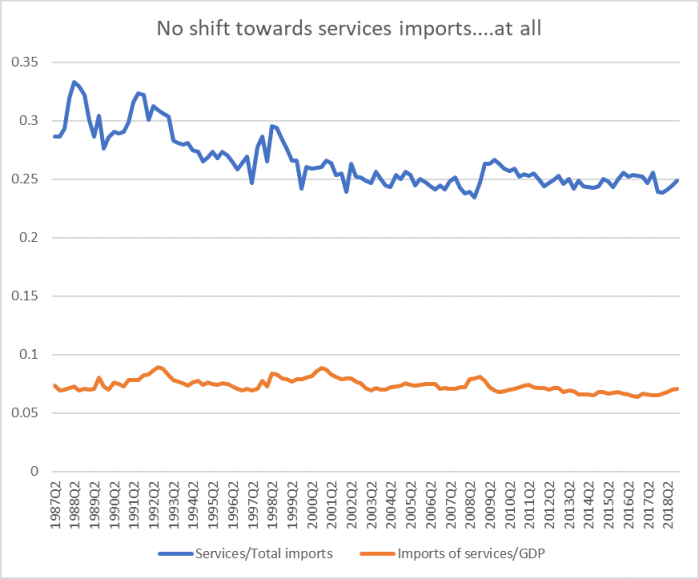
And wasn’t there the small point that, despite all the various trade deals New Zealand has signed up over recent decades – including those with Australia and the PRC –  and the reduction in global agricultural protectionism, exports and imports have been falling as a share of New Zealand GDP.  Perhaps another million migrants will make all the difference?  But perhaps not.

Hope ends by getting out the violins

We need to ensure that our political thinking more clearly acknowledges that we are an immigrant nation at our core, that we truly value diversity, that we are inclusive and will celebrate and support new New Zealanders as we all grow our economy and standard of living, contributing to our communities and our future.

I could –  and would- reframe this as something along these lines

We need to ensure that our political thinking more clearly acknowledges that after one of the largest-scale immigration programmes undertaken anywhere in recent decades, there is little or no evidence of economic gains for New Zealanders, and at least the possibility that such rapid rates of immigration, to a location so remote, have made us poorer rather than richer.  Responsibility for that rests not with the migrants themselves –  almost all of them as simply pursuing the best for themselves and their families –  but with our own political and business leaders, who have championed an ideological cause (with both globalist and bigger-New Zealand strands) even as the economic evidence in support of their claims has failed to arrive.  Notwithstanding a wider range of ethnic restaurants (and associated consumption diversity), there has simply been no compelling evidence –  as there is none globally –  that “diversity and inclusion” (as distinct from the ongoing contest of ideas) has produced any economic gains whatever.    If anything, New Zealanders at the bottom of the socio-economic heaps have been paying an increasing price for this obeisance to an “elite” ideology.

I’m still left rather gobsmacked that a supposedly serious public figure can, apparently seriously, suggest that immigration is other than a natural and appropriate subject for intensive political debate.   What is more fundamental to a country than the people who make it up, and yet that is what immigration policy influences very heavily, at least when done on the huge scale our politicians have chosen in New Zealand.  Even at a narrowly-economic level, it represents a significant change in the overall resource mix and productive structure of the economy (especially in a country as natural resource dependent as New Zealand or Australia).

Immigration policy doesn’t make that much difference in any particular year, but we’ve been running something like current immigration policy now since the early 1990s.  In 1992, New Zealand’s population was about 3.5 million. In the years from 1992/93, we’ve granted residence status to more than 1.1 million non-citizens.  That is a huge number.   Some, perhaps many, will think it is a “good thing” –  for various possible reasons –  and others will think it a disastrously bad choice (that’s my view, even if more apparent in hindsight than it could have been in 1992).  Even among those who think it a bad choice, some (me) will emphasise overall economic performance arguments.  Others might emphasise real world second-bests around housing, or traffice congestion, or just a preference for being small.  Others again might emphasise environmental pressures.  Others might raise concerns about precisely the sort of “diversity” Kirk Hope and the cheerleaders celebrate, highlighting issues around cohesion, trust, mutual support etc. And others too might be uneasy about large-scale immigration does to the relative place of Maori in New Zealand.  Some might just think that the ideological etc make-up of future New Zealand should be determined by the individual choices of New Zealanders, not by politicians skewing the future population one way or another.  But all those disputes are naturally and appropriately the stuff of politics.   Given our relative economic underperformance, notwithstanding decades of large scale immigration, all these angles should be debated more vigorously, not less.

Most of my own arguments around New Zealand’s immigration policy have been economic in nature.  On its own, the economic track record should have been more than enough basis for a rethink, were it not for the ideological priors of the champions.  Perhaps the most accessible version of my economic story is here, in a speech I did 18 months or so ago.

I have occasionally commented on various social and cultural dimensions, including in two posts sparked by the 2017 New Zealand Initiative report on immigration policy (here and here) and in some remarks on diversity, and its limits in a stable democracy, here.

I was also reading yesterday an  interesting article from the latest issue of The Atlantic by David Frum on US immigration, experience and policy.  Frum is a pretty determined never-Trumper, and yet he concludes his article this way

Reducing immigration, and selecting immigrants more carefully, will enable the country to more quickly and successfully absorb the people who come here, and to ensure equality of opportunity to both the newly arrived and the long-settled—to restore to Americans the feeling of belonging to one united nation, responsible for the care and flourishing of all its people.

Every country is different, but it is worth recalling that US immigration policy –  under all recent presidents – has targeted non-citizens inflow about one third those of New Zealand (in per capita terms).  I don’t agree with everything in his article, and some of the issues are different for New Zealand than for the US –  there is a more plausible argument in the US context that immigration is roughly a wash (in economic terms) for natives than there is here – but I thought it was a piece worth reading and reflecting on.  I wonder what Mr Hope would make of it?


The Second XI takes charge

The current government –  like its predecessor –  hasn’t done much that’s good.  Neither has done anything to even begin to deal with New Zealand’s longstanding productivity growth underperformance (for the current government, better – apparently – to pretend it doesn’t matter and talk a lot about “wellbeing” instead).

But they have made some modest reforms to the Reserve Bank, which take effect today.   After almost 30 years, the Governor is no longer the sole legal decisionmaker around monetary policy (he remains in sole charge of all the rest of what the Bank does), and a newly-created statutory Monetary Policy Committee has taken over (with surprisingly little media coverage, including no profiles of these new statutory policymakers, who will heavily shape how New Zealand handles the next recession).

Moving to a legislated committee-based system for making monetary policy decisions has been a cause of mine for almost 20 years now. It is the way almost all other major decisions in public life (and much of business and non-profit life) are made, from Cabinet on down to the local school’s board of trustees.  Earlier this decade, I greatly upset the then-Governor by even writing a limited-circulation internal discussion paper proposing such a reform, and first media coverage I had after leaving the Bank was for a revised and updated paper along similar lines.   To their considerable credit –  and I don’t credit them for much –  the Green Party had also been championing reform in this area for some time.  Labour was late to the issue –  and showed little sign of really caring much – but as the largest component of the government, reform wouldn’t have happened without them.

The new model MPC will be an improvement on what went before it. It is good to have it now clear in law that the government of the day sets the target (taking advice, consulting etc, but in the end the Minister sets the target and is accountable for it). And the final form of the new system is a little better than what the Minister of Finance was first promising (MPC members were initially to be prevented from airing their views in open at all), or than the Governor appeared to be championing (when he was reported as suggesting he didn’t want economists as external members of the MPC).

But, to a considerable extent, the reforms represent a lost opportunity.  We’ve ended up with a system designed to be dominated by the Governor, and with not much more openness and accountability than we’ve had before. In practice, it looks likely to be a system little different than the Bank operated since about 2002, when “external advisers” were first appointed to the (then) Official Cash Rate Advisory Committee.   There is little reason to suppose that the policy mistakes of the last decade (recall the enthusiastic rate hikes in 2014 and the reluctant unwinds, and nearly a decade of undershooting the inflation target) would have been avoided if this particular system had been put in place in 2009.

It looks, mostly, like cosmetic change –  cosmetics which suit both Reserve Bank management and the government, neither of whom was interested in the sort of open and accountable, disputatious at times, central banks of the sort they have in Sweden, the UK, or the United States.  It is there in the official documents –  the relentless drive for “consensus”, of which I noted recently

“Consensus” isn’t a recipe for getting the best answers, but for lowest common denominator answers that everyone can live with.  It isn’t really a recipe for a robust examination of competing arguments and analyses either –  at least unless one has exceptional people (which is always unlikely, almost by definition) –  and especially when management has (a) an inbuilt majority, and (b) control of all the research and analysis resources (and of the pen in drafting MPSs etc).

As always, there is the law and there is practice.  It will take some time for the new system to bed down.  Perhaps the published minutes will prove more revealing than currently seems likely. Perhaps MPC members –  internal and external –  will be willing to give periodic speeches and interviews outlining views different from those of the Governor.  Time will tell.  I hope it works better than I expect. But I’m not holding my breath.

The members of the new MPC was finally announced late last week.    Recall that the committee has four internal members and three external members, and hence a built-in management majority.  There is no necessity for the internal members to all vote together (if things ever come to a vote –  recall all that talk of “consensus”), but the internals (in their day jobs) all work for the Governor.   In future, the Deputy Governor will be appointed by the Minister, but only on the recommendation of the Board, who in  turn must consult the Governor (in practice, the Deputy Governor will be the Governor’s appointee).  The other internals will just be senior staff appointed to their positions in the Bank by the Governor, and hoping for pay rises, promotion, resource allocations to their areas, all in the sole gift of the Governor.  A good Governor will, of course, encourage challenge, debate, active disagreement etc etc.  Rather more average Governors –  and the typical Governor is likely to be rather more average – won’t, especially not in public fora.  So although on paper the internal members of the MPC are statutory appointees (in respect of that specific role), they are just part of the Bank’s management structure, and under the old and new law work wholly to the Governor.

And what of the three external members, who were appointed last week?   Notionally, they were appointed by the Minister of Finance –  it is his press release at the link – but in law the Minister (elected by the voters) has little or no say in who serves on the committee that, at least on paper, has the biggest say in cyclical macro management.  The Minister can only appoint people recommended by the Bank’s Board (most of whom were appointed under the previous government).  And the Board –  despite being charged in law with holding the Governor to account – works very closely with the Governor, mostly providing cover and support for the Governor. In fact, the Governor is a member of the Board.    And all the resources of the Board are provided by…..the Governor.   So we can be pretty safe in assuming that no one with whom the Governor is uncomfortable with is ever going to find their way onto the Monetary Policy Committee.        Since this is new legislation, and this feature has been pointed out repeatedly, one can only assume that is deliberate intent.

And if the Board has no independent resources, neither do the external members of the MPC.  This could become a matter of some contention over the next few years.  It did at the Bank of England after their reforms 20 years ago, although since the appointees in the UK system had more independent status (directly appointed by the Chancellor) and were “bigger beasts” with more forthright tendencies, perhaps here the externals will just go along.  They will have no independent research or analysis resources, and no ability to require specific pieces of work to be done by staff.  They will be largely dependent on their own resources, and perhaps any public commentary, while almost always being outnumbered.  It could drive really able people silly, but then actual appointees will have been selected for (probable) docility.

Which brings me to the members of the committee themselves, who haven’t yet had much/any media scrutiny.    In the title of this post, I characterised them as the Second XI.  That is a deliberate and careful phrasing.  A big school might, say, have six or even ten cricket teams, some comprised of people with no talent but a bit of enthusiasm and a desire for some exercise with their mates on a Saturday afternoon.   But on my reading this is a Second XI; people who aren’t bad, or grossly unqualified for the role, and yet who  –  individually and collectively – don’t represent a committee of the sort of stature for which we might have hoped.  That is true of both of the internal and external members.  Lee Germon captained the New Zealand Cricket team for a while, but was widely regarded as not quite up to it, not really justifying his own selection.  The new MPC, at least taken as a whole, seems a bit like that.  Other advanced countries mostly seem to do better.

I’m not someone who thinks the MPC should necessarily be dominated by economists (although the expert advice to the committee should be), but when the Governor was talking of not wanting economists at all as external members I thought he had gone too far.  Clearly others agreed, and as it happens all seven members were economists by training and education.

But of the internals, none stands out on that score. It isn’t helped by the fact that the Bank is currently without a Chief Economist, and one of the internal appointees –  Yuong Ha –  has been appointed as not much more than a placeholder (a one year term) until they manage to fill the position (it isn’t a great look that in an organisation like the Bank, where economics skills have historically been central, there wasn’t a natural successor to the former (demoted and then resigned) Chief Economist).  Perhaps in time the fulltime successor will add some real intellectual stature and gravitas to the MPC.  In the meantime, the Minister should have rejected a one-year appointment of a mid-level internal appointee: independence is partly about security of tenure, and any mid-career person appointed for one year only is going to have the boss’s views and interests in mind.

Of the other internals, for my money to Deputy Governor Geoff Bascand is probably, at this stage, the best of them.   I have plenty of disagreements with Geoff, and I wonder if there is any track record of him disagreeing robustly with his boss (whether Wheeler or Orr) on policy.  He was also one of the internal champions of the OCR tightening cycle in 2014, but he does have a track record of thoughtful speeches on some macroeconomic topics (if not really monetary policy itself).  Arguably, he is better equipped for the MPC than for his day job (Head of Financial Stability).

As for the Governor, the fact that he went for a year as sole decisionmaker on monetary policy and didn’t see fit to give us even a single on-the-record speech on monetary policy, the cylical state of the economy etc, should be telling.  His interests seem to lie elsewhere.  That might matter less if the other management appointees were real stars (after all, the Governor has a wide range of responsibilities) but they aren’t.

What of the externals?  Three economists have been appointed: Caroline Saunders, Bob Buckle, and Peter Harris.  Again, it is surprising that no media outlet (I’ve seen) has done interviews with or profiles of them.

Both Buckle and Harris are older –  Buckle is retired (and Professor Emeritus) from Victoria University, and Harris while billed as an “economic consultant” must be at least in his late 60s.   That was partly inevitable as a result of the decision to make the MPC jobs substantial (50 working days a year was the expectation), but not large enough to be even half-time, let alone fulltime.  Actual or potential conflicts or interest would rule many others who might have been interested or suitable.

The third appointee, Caroline Saunders, is also an academic (with a couple of other ministerial appointments) –  and the only one of the seven MPC members I’ve never met.  Quite how one squeezes in a 50 day part-time role with a fulltime job at Lincoln is an interesting question, but that is her problem and that of her employers.  Although she is an economist, her interests and experience don’t appear to encompass monetary policy or macroeconomics at all (her publications are here).  But I thought it might be telling that her most recent publication was as a co-author (with a couple of colleagues) of a new book on “wellbeing economics”.  As it happens, after I made some negative comments here recently about the government’s focus on wellbeing – suggesting it was a distraction from dealing with the productivity issues –  a PR firm working with the authors sent me a copy of the book. I haven’t yet read it, but as I’ve dipped in one is left with impression that Prof Saunders may be more useful to the Governor (and government?) in championing his interest in all sorts of (loosely) left-wing issues, rather than in advancing the cause of good monetary policy decisionmaking and communication.

One of the skills asked for in the advertisement last year for external MPC members was “exceptional communication skills”.    Time will tell, but my impression would be that neither Buckle nor Harris (of whom Google shows up very little in the last 15 years) would qualify on that score.  Perhaps the Board changed its mind about the skill sets?

One area where I do have some concern is around the role of the Minister of Finance in these appointments.  In principle, I think the Minister should be relatively free to appoint his or her own preferred candidates, and should be fully accountable for those choices (including through the sort of non-binding “confirmation hearings” –  of the sort UK MPC members face – that I’ve proposed for New Zealand).  As it is, on paper the Minister has no say at all (can reject Board nominees, but nothing more).

But then I’m a bit troubled by the way in which the Board –  all but one appointed by the previous government – ended up delivering to the Minister for his rubber stamp a person who was formally a political adviser in Michael Cullen’s office when Cullen was Minister of Finance (Peter Harris) and another who appears to be right on with the government’s “wellbeing” programme.     They look a lot like the sort of people that a left-wing Minister of Finance –  one close to Michael Cullen –  might have ended up appointing directly.     I don’t think Peter Harris is grossly unqualifed for the role, but I am uneasy that one of the very first external appointees is a former political adviser to a former Minister of Finance of the same party as the one making the appointment.   Note too that the only appointee Labour has so far made to the Reserve Bank’s Board was another former political adviser in the office of a former senior Labour minister.    He too (Chris Eichbaum) is not manifestly unqualified for the role, but I’m not sure it is entirely a good look first up. (I don’t think former political advisers should be perpetually disqualified, but it might be more confidence-enhancing had they been appointed by the other party from the one for which they used to work –  thus Paul Dyer, former adviser in Bill English’s office, would probably be better qualified for the MPC roles than any of the recent external appointees.)

I’m left wondering what sort of behind-the-scenes dealings went on to secure these appointments.  I hope the answer is none.  I’d have no particular problem if, while the applications were open, the Minister had encouraged friends or allies to consider applying. I’d be much less comfortable if he had involvement beyond that, prior to actually receiving recommendations from the Board.  It isn’t that I disapprove of politicians making appointments, but by law these particular appointment are not ones the Minister is supposed to be able to influence.    So any backroom dealing is something it is then hard to hold him to account for.    Perhaps nothing went on, but I have lodged a series of Official Information Act requests with the Minister, Treasury, and the Board of the Bank about any contacts (written or oral) between them on this issue.

In the meantime, given the role these appointees are supposed, by law, to be playing, it might be appropriate for the media to start asking them some hard questions, including around preparedness for the next serious recession, given the very real limits on how much further the Reserve Bank could cut the OCR.

(On a related matter, I saw a suggestion this morning that personnel changes at the Reserve Bank explain the Bank’s now more-dovish stance, notably the departure of longserving former chief economist John McDermott who, as this story put it, was responsible for the forecasts etc that led to bad policy calls in 2014.  But, for all their faults, the Reserve Bank’s inflation forecasts at that time were typically lower than the published forecasts of New Zealand economic forecasters, and those forecasts were embraced enthusiastically by senior management.   Among those deliberating on monetary policy at the time, Geoff Bascand – now a member of the statutory committee -seemed quite as hawkish as anyone.    There weren’t many local dissenters at all at the time –  of those with views in the public domain, this was the only one I found.  And, perhaps entirely coincidentally, the small handful of internal sceptics were dumped off the key advisory committee just as a rate-hiking cycle got underway in 2014.)


Banking without interest

In this morning’s Dominion-Post their personal finance columnist Janine Starks has an introductory article about Islamic approaches to finance.  The key, specific, dimension is the prohibition on interest.

That prohibition, in one form or another, was once common across Judaism, Islam, and Christianity.  It is one of the few aspects of teaching where the Christian church has, pretty much universally, changed its teaching, and personally I’m not convinced the change was well-grounded.  I’ve therefore long been intrigued by experiments with interest-free approaches to finance –  some of which manage it in form not in substance, but others are the real deal.  Once upon a time, having an innocuous New Zealand passport and some interest in the issue, I even participated in an IMF mission to Iran to advise them on the possibilities for a market-based monetary policy consonant with interest-free principles.

This morning’s article reminded me of a couple of posts I had written in the early days of this blog, starting from Islamic banking but focused primarily on the notion of mortgage products that did not involve an interest rate. The first was here and included these extracts

I’ve long been intrigued by the ideas and practice of interest-free finance.  My own Christian tradition for centuries banned, or regarded with intense disfavour, lending at interest.  That drew first on Old Testament provisions, which prohibited Israelites from lending to fellow Israelites in need at interest (while allowing loans at interest to outsiders).  The stance was reinforced by perspectives from Aristotle, rediscovered in the Middle Ages, arguing for the inherent sterility of money.  Prohibitions on lending at interest were eventually removed but  it remains a powerful vision for some (for me).   Within the Christian community, outfits like the Kingdom Resources Trust in Christchurch try to put it into practice.

The injunctions against interest are apparently much stronger and more pervasive in the Koran. In his recent book, Beggar Thy Neighbour, Charles Geisst reports that “of all the prohibitions against undesirable activities in the Koran, usury is mentioned the most.  Interest, or riba, is considered usury and no distinction is made between them”.   This was a distinctly counter-cultural stance, as compound interest had apparently been common among Arabs before the coming of Islam.

If interest is prohibited, profit-sharing arrangements –  equity finance, in effect – are not frowned on at all.  They have a element of uncertain return – economic risk –  for which some reward is appropriate. Predominantly-Muslim countries, and individual Muslims. have grappled with how to apply the prohibitions on interest in today’s world.  The large Muslim minority in the UK and the large financial sector with global connections has led to considerable interest there.  In his pre-crisis heyday, Gordon Brown wanted London to become the global centre of Islamic banking.

and

An alternative type of product might be an equity-based housing finance product.  In conventional housing finance markets, the purchaser puts up some equity, and a lender provides the balance.  The lender receives an interest-rate and is exposed to the (hopefully small) risk that the borrower defaults and that the house can’t be sold for enough to cover all the outstanding debt.  Any increases in the value of the house – whether changes in market prices generally, or as a result of improvements/extensions – accrue to the owner.

But it would be technically quite feasible to envisage a model in which the person wanting a house to live in, and the financier, became equity partners in a joint business venture to own the house.  You, the, resident would presumably pay rent to the joint venture, some portion of which would be passed to the equity finance partner, and when the house was eventually sold gains and losses would be shared, proportionately, between you and the equity partner.  You have risk, the equity financier has risk, and no one is paying or receiving interest –  in form or in substance.  It would be simple enough, technically, to structure the contract to allow the resident’s equity share to rise over time (instead of “principal repayments”, one uses the funds for equity repurchases from the JV partner).

I’m not sure if such contracts exist anywhere in the Islamic world.  In the West, without the theological concerns about interest, there is good reason why they don’t exist.

If I’m a young person in the West buying a first house, a bank might lend me 90 per cent of the value of the house.  Most mortgages are table mortgages and are repaid gradually, so that in time the owner’s equity share is large, heading for 100 per cent.  All the Bank cares about after that is my ability to service the debt.  And that depends largely on avoiding prolonged periods of unemployment.  If house prices fall that poses a risk –  banks can call in a mortgage if the value of the collateral drops below the value of the mortgage –  but it typically only crystallises if the flow debt service isn’t being met, and if house prices fall so far that not all the debt can be repaid when the house is sold up.   Within limits – quite wide limits – banks don’t care about or monitor the maintenance you do on your house.  If you don’t do the maintenance, mostly it is your loss.  And they don’t care at all about changes in market rentals in your neighbourhood, or for your specific type of house.  Conventional mortgages are simple, easy, and cheap to monitor.

But equity-sharing contracts would be enormously costly to monitor and manage, especially in a country with such a variegated housing stock (rather than lots of high-rise uniform apartments).  If you are only an equity partner in a house, your incentive to do maintenance is attenuated –  and likely to weaken especially in periods of personal financial stress.  So a financier providing a large equity stake would probably want to pre-specify maintenance obligations and standards (and would then need to monitor compliance).  You’d need to negotiate all alterations and extensions.  Rental rates vary, as do market values.  Perhaps a real rental yield could be pre-specified in the initial contract, but any arrangement for the resident to gradually buy out the outside equity partner requires an agreement on market value at the time of the transaction.  Transactions costs rapidly start to mount.  They might work within a relatively closed community – say, a local church community where effective monitoring costs might be reduced, or a small mosque-based credit union  –  but it is difficult to see them being effective, and economic, more generally.

In their recent book House of Debt, the US academics Atif Mian and Amir Sufi, argued that equity-sharing contracts should become the norm for housing finance.  They argue that such contracts would materially reduce the risk of financial crises, and that the main reason such contracts aren’t common is because of the tax system and the role of US government agencies.  I’m very sceptical of both claims, and would post the note I wrote on why –  but it would take 20 working days to get OIA clearance.  This post is quite long enough, but if anyone is interested I can explain my scepticism in a later post.

The follow-up post was here.  It is hard to excerpt so I won’t try.

In the last few weeks there has been (understandably I guess) a lot of rhetoric about common values etc etc, but actually there are really important –  and mutually inconsistent – belief systems in our world, or even our country.  As I noted in something else I was writing earlier this week

In fact, the notion of (serious) shared values falls down quickly in the presence of anyone –  secularist, Christian, Muslim –  who takes their faith seriously, as a source of authority and rule for life.  In some of these areas, serious Muslims and serious Christians have more in common with each other than either do with aggressive secular liberals. In others, not –  after all, most of the aggressive secular liberals have grown up in societies still suffused with the legacy of 1500 years of Christianity, and the way it shaped art, literature, government, individual rights and so on.

The approach to interest, and finance more generally, is one of those differences.


The Governor’s talk

It was pleasant to walk along Wellington’s waterfront this morning to hear the Governor of the Reserve Bank speaking at a local function centre.  Given the numbers who turned up –  many of them Bank staff –  they could probably have saved a few dollars by holding the event on their own premises, but, I guess, it is other people’s money.

As the Governor explicitly noted that he would “look forward to the blogs”, I should probably do my bit.

A week ago when this event was announced, I devoted a whole (short) post to the announcement of the event, including the indication that they would be filming the speech and making that footage available on the web.   Doing so is a genuine step forward and I hope it becomes standard practice.

In that earlier post I noted

I have been critical of the Reserve Bank Governor for not yet having given an on-the-record speech about either of his main functions, monetary policy or financial regulation/supervision.  Next week marks a year since he took up the job

Unfortunately a year has now passed and we still haven’t had a substantive on-the-record speech about either of his main functions –  the sort of speech that would be standard, and quite expected, under any other Governor and in any other country.

Today’s speech was billed this way

Reserve Bank Governor Adrian Orr will talk about the future of New Zealand’s monetary policy framework  …..The revised monetary policy framework comes into effect on 1 April 2019. It is an outcome of the recent Phase 1 review of the Reserve Bank Act.    Adrian Orr will talk about changes to how monetary policy decisions are made in New Zealand, including greater transparency and accountability.

But there wasn’t very much about the new monetary policy framework (any aspect of it) at all.  You can read the text for yourself (and on this occasion the speech delivered was recognisably similar to the published text, which is not always the case I gather).

The whole event started rather oddly, with a fairly lengthy greeting in Maori from someone whose name I didn’t catch but who had no apparent connection to the Reserve Bank.  Only a small portion of whatever he said was translated, so I suspect very few attendees had any idea what he’d been saying.  He did, however, take the opportunity to make a few digs in English about the Foreshore and Seabed Act – of infamous memory – including at a former Labour MP from that era who was apparently in the room.  That seemed rather inappropriate in a Reserve Bank function.  Not even the Governor has yet claimed Reserve Bank responsibility for the foreshore and seabed.

The Governor did, however, tell us that someone else in the room had just agreed to be a “kaumatua” to the Reserve Bank – a title apparently quite in vogue in trendy government agencies, but not having an obvious place in way Parliament set up the governance of the Reserve Bank.  Isn’t all that stuff –  leadership, nurturing talent, resolving disputes –  among the functions of those tedious prosaic statutory roles such as Governor, Deputy Governor, and Board members?  But there is, we are told, a forthcoming Bulletin article, “RBNZ’s Strategic Approach to Te Ao Maori”.  That will be something to look forward to, no doubt involving more expensive and tortured efforts to explain why a macro-focused government agency, which deals with general public hardly at all, needs such a strategy and not (say) a Catholic one, a secular humanist one, a Pacific one, or an NZRFU one?   For an organisation that claims to be underfunded, they certainly seem to take every opportunity to spend resources on stuff other than their core business.

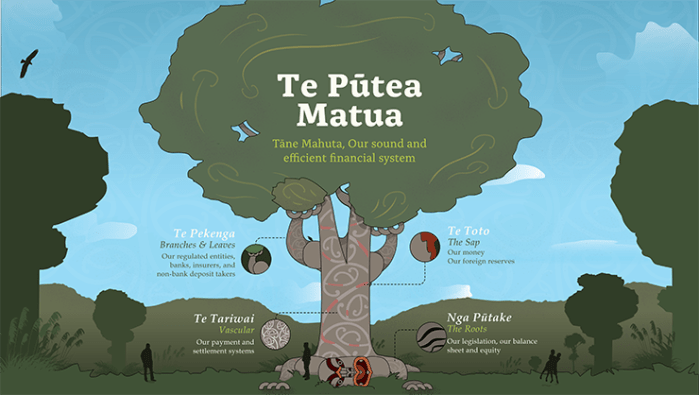
The Governor keeps on doubling down with his tree god nonsense, urging us to think of the Bank as akin to Tane Mahuta, the mythological forest god.   He delivered his speech flanked by two screens of this cartoonish graphic.

rbnz-tane-mahuta.png

He claimed this myth –  which has precisely nothing to do with central banking – “is” (not “was”) “central to the Maori belief system”.    Those who bothered by such things might suggest it was “cultural appropriation” –  although, ever deferential, he did stress that he asked permission to use the myth – but as I’ve noted in an earlier post

Pre-evangelisation, Maori had their own tree god, Tane Mahuta.    As far as I can tell, not many believe any longer in this local tree god: when I looked up the 2013 Census data, there were lots of Maori recording no religion, and there were plenty of Catholics and Anglicans.  But there wasn’t a category shown for tree gods, or any of the other deities (Wikipedia has a list of at least 35 of them).

As a recent commenter on another post noted

Imagine the reaction if the Bundesbank president started discussing policy in terms of Odin and Thor…. he’d get locked up…

And in addition to those references, we got the same warmed-over inaccurate nonsense the Governor has  run repeatedly about the creation of the Reserve Bank ‘letting the sunshine in” on the New Zealand economy and financial system.  I happen to agree that the creation of the Reserve Bank was, on balance, a good thing, but you’d not know from listening to the Governor that we’d had a stable financial system and a highly prosperous and productive economy without one.

What the speech really tended to show was a Governor with not much interest in the core business of the Bank (price stability, financial regulation, notes and coins, and a few ancillary bits and pieces).    Each of those functions matter.  It is important they are done well.  When they are done well, most people should have little interest in the Reserve Bank.

But, so he told us, the Governor is bothered that when they went out to “the community” (no polling results or the like, but I’ll take his word for it), people said they had significant trust in the Bank, but didn’t really know what it did.   But then they don’t really need to, any more than (say) I need know anything much about many of the dozens of government organisations you can find listed here (and I’m a geeky policy person, and still have no idea what, say, the Accreditation Council does).  How much does the person in the street know about, say, the organisation of our judiciary, or the distinction between the New Zealand Defence Force and the Ministry of Defence.  I’d struggle to even tell you what the Ministry of Housing and Urban Development does.

But it isn’t good enough for the Governor. So, on the one hand, we get cartoon versions of Monetary Policy Statements and Financial Stability Reports.  And on the other, considerably more worryingly, we get attempts by an overtly left-wing Governor to tie himself and the institution he leads to a whole series of trendy left-wing causes.  I’m sure he is not directly partisanly political, but his colours are firmly staked to an ideological mast, in ways that are potentially quite damaging.  After all, if he wants citizens to have confidence in his organisation around its core functions, those who aren’t sympathetic to his overt left-wing agenda will be less inclined to trust him even on the core issues he has responsibility for.  A new centre-right government at some point (ok, just kidding, but at least a new National one) might also be less inclined to trust him.   And, in championing these causes, he creates unrealistic expectations about what central banks can actually do, and opens the Bank up to pressure in future to join in promoting some other government’s set of ideological causes.

As an example of what I mean, here is an extract from the speech.

In the world today, the dynamics of global and national economies are interacting to a greater extent and, at times, working at cross-purposes. Underlying these interactions are social and political movements driven by a desire for greater well-being, both for current and future generations.

More recently we have been confronted with the issue of climate change, and its complex and powerful economic and financial impact.

We have barely scratched the surface in understanding the intergenerational impacts of these developments.

This desire for well-being is regularly reflected in discontent along the lines of economic, gender, racial, and intergenerational inequities – to name just a few. Therefore, ensuring social inclusion as a way forward in capitalist societies is necessary.

The first of those paragraphs barely even makes sense.  The rest do, but none of it has anything to do with central banks doing their jobs.    If this text appeared in a speech from Grant Robertson or James Shaw it might be quite unexceptionable –  it is the sort of stuff left-wing politicians say –  but what is a (supposedly neutral non-partisan) Governor doing spouting off about his views as to how “capitalist societies” should move forward.  Since it is what he is paid for, I’d rather hear him on the New Zealand cyclical economic situation, financial stability risks, positioning monetary policy for the next serious downturn or whatever.  Intrinsically less interesting perhaps, but that is the job he and his institution are paid to do.

The Governor –  particularly in his oral delivery –  was claiming a much wider mandate for himself from the newly amended Reserve Bank Act.  He is wrong to do so.

Even the badly-worded new Remit (replacement for the Policy Targets Agreement) makes that clear

remit

Whatever good monetary policy does –  and it is only the monetary policy bits of the Act that are changed –  it is “by” doing the same old stuff: leaning against cyclical fluctuations and maintaining medium-term price stability.

Here is the purpose statement from the amended Act

purpose RB

Yes, the current government’s waffly rhetoric about “wellbeing: and a “sustainable and productive economy” is enacted, but even this legislation is clear that –  whatever else the rest of government does (or doesn’t) do, the Reserve Bank makes its contribution by doing (well) the same old basics: monetary policy, a focus on a sound and efficient financial system, and notes and coins.

Inclusion –  gender, racial, religious, ideological, socioeconomic or whatever –  just isn’t the Reserve Bank’s territory.  Neither is climate change or other “social or political movements”.  Some of those issues may be quite important. Most are very interesting.  But if the Governor wants to pursue them perhaps he could create a blog in spare time (I wouldn’t recommend it), stand for Parliament, or put in a belated application to be the new Secretary to the Treasury.  All that other stuff will either distract the Reserve Bank’s attention (and perhaps suggest it already has too many resources), and/or skew support for the Reserve Bank along ideological lines in ways that are quite unhelpful in the longer-term (the Governor talked often of “legitimacy” and that dubious left-wing concept “social licence”).  The Governor talked of “our need to be a good global citizen”, but actually the New Zealand Parliament set up the Bank, and resourced it, to be a quite limited New Zealand government agency.

I could go on, but will bring this towards an end.   Three final points:

The Governor did mention briefly his proposals to substantially increase bank capital requirements. Nothing much of the substance, but he claimed that the Bank is open-minded and urged people to get their submissions in.  That is well and good, but it might be helpful to potential submitters –  including those not from the banks, who the Governor claimed to be keen to hear from – if the Bank actually released the supporting material –  for example, the Analytical Note on aspects of the economic impact that the Deputy Governor promised in his speech now more than a month ago, or the supporting information for ad hoc claims the Governor made on this issue at his MPS press conference more than six weeks ago.   It is more than three months since the proposal was released, and process is looking increasingly shoddy, as if they hope to run out the clock rather than provide substantive evidence for their proposals.   (Incidentally, in his delivered speech –  but not in the published text –  the Governor claimed that “we know” that significant bank failures cause significant damage for “all future generations”.  Perhaps that is another claim he might like to substantiate.  But it is probably just another one from off the top of his head.)

As I noted at the start, a former Labour MP was present.  That former MP was Tim Barnett who now leads what looks like a worthy organisation called FinCap which is

a new entity driven by the public good, acting in the interests of New Zealanders seeking budgeting and financial capability advice.

Sounds worthy. The Governor seemed keen on it, and said that the Reserve Bank would be endorsing this organisation in public.  Thus far, probably fine.  What was much less acceptable was to hear the Governor of the Reserve Bank say that he would be “coercing banks” to support it.  One hopes he wasn’t entirely serious, but when a regulator already wields a great deal of power on a wide range of fronts, they have to bend over backwards to avoid even suggesting any pressure (let alone ‘coercing’) on regulated entities to do things the regulator personally might like, but for which he or she has no statutory mandate.

Finally, the Governor ends the speech talking of how he and the Bank are going to “maximise their mandate”. I suspect he has in mind actually doing as much as possible to fulfil the mandate he has been given by Parliament, but it does sound awfully like a bureaucrat looking to expand –  to the maximum-  the role and scope of his bureau.  That isn’t what we need. We need a pretty boring organisation getting on and doing the (important, but quite limited) basics well.  At present, they are some very considerable margin away from the goal he articulates of being the “world’s best central bank” –  and nothing in this speech, or the others the Governor has given (and his term is now one-fifth over already) suggests they are making any progress towards it. If anything – and as evidenced in this speech – they are drifting further away.

But they turned on a good sausage roll, it was a good chance to catch up with a few people I hadn’t seen for a while…..and it really was a nice morning for a walk.

Just a shame about the central bank that was on display.

Deferring to Beijing

The Prime Minister is off to Beijing, to spend April Fools’ Day chatting with Xi Jinping and Li Keqiang, leaders of the brutal Chinese Communist Party regime.

It has seemed as if the carrot and the stick have both been at work in the PRC’s effort to keep the New Zealand government in line.   We had the failure of the Prime Minister to secure a visit Beijing last year.  Perhaps there really were some “scheduling difficulties” but no one really believes that was the whole story.  Only a few weeks ago the impeccably well-connected former New Zealand Ambassador to Beijing, John McKinnon, was telling us that a visit would happen but “not necessarily soon”.   And then suddenly 15 March happened, and suddenly a one day visit is scheduled at short notice.

In the meantime, we’d had the need to cancel the grand opening of the New Zealand-China Year of Tourism, at the PRC’s behest.  No one really supposes it was just “scheduling difficulties” –  even in a modestly sized bureaucracy if the key person does happen to be busy, you find someone else to turn up to significant events that matter to you and your friends.  But the bureaucratic and political “elites” scurried around, made clear their obeisance, and had the PM make coordinated statements with the CCP’s representative in New Zealand, and before long the opening of the year of tourism was back on again.  Lucky us, we were told, we were even getting a PRC government minister.

Who knows quite what really was going on.  Neither government is going to give a straight account.  But no one really doubts that the PRC was more than a little miffed at New Zealand and its government (the National Opposition was meanwhile doing its very best to demonstrate its cowed and subservient approach –  from Simon Bridges and Peter Goodfellow on down through Jian Yang).  Perhaps the New Zealand government hadn’t actually said or done much –  not a word of concern had ever been expressed by the Prime Minister –  but the PRC had previously had New Zealand pretty much where it wanted our government, and it wouldn’t do to let them back away from that silent subservience (on anything that concerns Beijing).   And their approach –  pretty mild in the scheme of things (no apparent deliberate hold-ups of coal deliveries, canola seed orders or whatever) –  seems to have been quite enough to scare the locals and bring the government more or less back into line for now.   The Huawei situation still hasn’t gone Beijing’s way – perhaps it eventually will, perhaps it won’t –  but probably even Beijing recognised that a heavy-handed approach over that specific issue might well enrage the natives and spark a political backlash (against them) at a time when they had other battles to fight (notably Canada).  And they’ve already demonstrated that even the mildest, deniable, expressions of unease can get official Wellington not just jumping, back asking how high.  Of one of the most odious and evil regimes on the planet (which has little substantial clout over New Zealand, except perhaps among a few businesses that have chosen to over-expose themselves to supping with the devil).  Much relief at the New Zealand China Council, in MFAT, among our universities…..and, no doubt, in Beijing.

And so the Prime Minister will head off to Beijing for lunch, tea, or whatever with Xi Jinping.   If anything of substance is on the agenda –  and the main purpose of the visit appears to be being seen in Beijing, so quite possibly nothing will –  we can confident that it won’t be things like:

  • Xinjiang,
  • the South China Sea,
  • the East China Sea,
  • Taiwan (PRC threats to),
  • the abduction, and continued detention, of two Canadians,
  • attempts to use economic coercion on Australia and Canada,
  • state-sponsored thefts of intellectual property,
  • the imprisonment, torture and intimidation of Christians,
  • the organ transplant business (highly dubious acquisition of organs),
  • other domestic repression (such as this, just this week).

And should there be any mention of Xinjiang (which seems unlikely, since she’ll say nothing critical here), it is perhaps more likely to be along the lines of “so tell me about those vocational training camps….”.

Most likely it will be an act of supplication on her part (“please Mr Xi, could we please have some more FTA…….please”), and a beneficient smile from the CCP rulers of Beijing. bestowing some sort of favour on one coming so compliantly.  More of this –  never ever saying anything that might upset Beijing – and perhaps we can be helpful again.

Why would an, apparently decent, person do this?  Does she (and one could ask the same of Simon Bridges) represent no values, no morality?  Is there any sense of national self-respect?

Which brings us nicely to how these parties operate at home.  A few weeks ago there was one day flurry of excitement when Labour MP Raymond Huo got his Labour colleagues on the Justice select committee to agree to block a request from Anne-Marie Brady to appear before the committee as part of its inquiry into possible foreign interference in our election.  This bit of the inquiry had been requested by the government after public submissions on the wider review of the 2017 election had already closed.    National’s Nick Smith, to his credit, took this public.  The Prime Minister’s office initially defended the effort to bar Brady, claiming that government departments could tell the committee all they needed to know (isn’t that a typical minister-captured-by-officials sort of line?).  And then the resistance collapsed and word came that Huo had been told to rethink.

And then the waters closed over the story and no more was heard (even before the 15 March murders).  None of our media seemed remotely interested in pursuing the story –  asking those other Labour MPs on the committee, for example, about what they’d been thinking when they blocked one of New Zealand’s experts on such matters (at least as regards the PRC), or asking the Prime Minister what her office had been doing backing Huo.  Let alone asking pointed questions of Huo, and insisting on answers.  For example, about he can possibly chair the committee, or have even involved himself in the specific decision on Brady, when he himself is the subject of serious concerns identified in Brady’s Magic Weapons paper (reported/excerpted in this post).  They might even have asked the National MPs –  who had done the decent thing in taking the issue public, and who perhaps even warned Huo that his stance would backfire –  why they still seem unbothered about Huo serving as chair on this particular issue.  How come they didn’t insist –  and aren’t now insisting – that he recuse himself?  It would be a quite standard application of any decent conflict of interest policy (even Shane Jones had declared his conflict of interest).

But, as it happens, the Huo-chaired committee has reopened submissions, from anyone. You have until 26 April to make a submission.  This is, quite clearly, what should have happened in the first place, once Andrew Little belatedly asked the committee to focus on foreign interference issues.  They’ve even approached Professor Brady and invited her to submit, and she says she will do so.

But it has hardly been done with good grace by the government members (all Labour in this case.  Here is Raymond Huo in the Stuff article earlier in the week on the reopening.

Huo said reopening submissions and updating the terms of reference had always been the preferred option of the committee.

“I should emphasise, Labour members of the committee did not ‘block’ Prof Brady or anyone from making a submission as the due process is to reopen the submission session, which would allow and encourage anyone who’s interested to make a submission,” he said.

The perception that Labour members, chaired by a Chinese-born MP, blocked her submission was so entrenched that nobody seemed to care about the due process, he said.

How does he even say this stuff with a straight face?  He was chair of the committee.  He was quite at liberty all along to have moved a motion to reopen submissions.  Instead, not ony did he not do that but he persuaded his Labour colleagues –  who should have known better – to go along with blocking the efforts of National members to allow even Professor Brady to submit. And all the time with a clear conflict of interest which it appears that, even now, he doesn’t acknowledge.  It would have been much better for him, at this late date, if he’d just kept quiet –  if he couldn’t bring himself to apologise –  than to open his mouth and further condemn himself.

Then again, it is not as if National MPs are calling on him out on it.

It is also worth bearing in mind that the reopened inquiry is (presumably deliberately) conveniently narrow in focus.  This is the notice from the Committee.

huo inquiry

I suppose people can submit on anything relevant to that broader question of “how New Zealand can protect its democracy from inappropriate foreign interference” (is there “appropriate” foreign interference –  perhaps the committee could offer its thoughts on that point in their eventual report?), but there is pretty clear steer on what members (chaired by Huo) actually want to hear about.

I’m no more keen than the next person on private emails of candidates or political parties being hacked, but to be honest I don’t see it as more or less of a concern than foreign powers hacking anyone New Zealander’s emails.  Official New Zealand government websites etc (as the PRC hack of the US government personnel database) might be more concerning.

As for the second item, I guess I don’t use Facebook, and we’ve all heard of these Russian bot-farms, but it looks a lot like a second-order issue in a New Zealand context (where Russian interests seem slight).  I’ve not heard any credible suggestion that the 2017 election here was influenced by such activity.

And, as for the third item, at present the law allows foreign entities to make (small) direct donations to political parties, and there are (apparently) few/no restrictions on such donations to local election campaigns.    There probably is a real issue there –  and it is one on which the National Party seems to have had a belated conversion –  but it is almost certainly less of an issue than legal donations made by New Zealand citizens and residents (individuals and companies) where there is reason to be concerned that even the ostensible donor has associations with, and interests to pursue with, a foreign power whose interests are not routinely aligned with those of New Zealanders.  But the committee shows no sign of being interested in pursuing that avenue.

I have had an exchange with someone encouraging me to submit, not as any sort of expert in the specific issues, but as a concerned New Zealander. I probably won’t do so, for two reasons.

The first involves the framing of the inquiry.  It is set up in a way that suggests that if there is an issue, around protecting our democracy (not just specific election results) from foreign interference, then (a) the responsibility rests abroad (bad foreign actors pursuing their interests, and innocent put-upon New Zealanders, and (b) that the answers are likely to lie with new laws or new powers for government agencies etc.

Evil regimes –  notably the CCP-controlled regime in Beijing –  will do what they will do.   But in my reading of the situation, very little about what is problematic in New Zealand is down to Beijing, it is about the choices –  quite explicit, and frequently renewed –  made by New Zealand MPs, ministers, and political parties.  Thus, as I’ve noted here before, I don’t (broadly) disagree with many of the policy recommendations Anne-Marie Brady has put forward.  And I do think the foreign donations law  – and donations law generally –  should be explicitly tightened so that only people enrolled to vote in New Zealand can donate (thus no corporate donations), and all donations above, say, $200 will be disclosed in near real-time.  Perhaps –  but I’m not convinced –  there is a place for some sort of register of people working for foreign interests.

But none of this gets near the real issue.  Things like:

  • party presidents of both main parties tripping off to Beijing to sing the praises of the regime and its leader (in public),
  • both main parties having MPs with strong United Front affiliations and widely seen as close to the PRC Embassy,
  • the way governments of both main parties stay almost totally silent on gross human rights abuses, and external threats, committed or posed by the PRC,
  • a National MP who formerly worked for the PRC military intelligence system, is/was a Communist Party member, and who acknowledges –  openly, to the Herald –  misrepresenting his past on his immigration/citizenship forms (and who is very much in the good graces of the PRC Embassy and its affiliate organisations in New Zealand),
  • the fact that no government agency has done anything about those acknowledged misrepresentations,
  • the fact that all political parties are now totally quiet on Jian Yang (none will call out his position as unacceptable), and that no political party seems bother about Huo (not even about him chairing the committee on foreign interference),
  • the fact that our two main parties got together to bestow a royal honour on someone with very strong PRC/CCP affiliations for what amounts to services to Beijing,
  • and the fact that the main parties (more so National in the past, although that may be changing now that Labour is in government) is totally unbothered about raising large amounts of donations from parts of the ethnic Chinese community that are closely aligned with PRC interests.

Decent parties wouldn’t do any of that.  New Zealand political parties do.  Beijing doesn’t make them make those choices.  None of those actions appears to be against the law (well, misrepresentation on the forms may well have been, but my focus is on the response of government and political parties).   Each of those things could be fixed now.  Today. No law changes needed, no inquiries needed, but the word would go out from party leaders –  who’d suddenly had an outbreak of decency –  that this sort of stuff just isn’t on.    But nothing happens.

Instead, we have a half-hearted inquiry, run by the very people – National and Labour Party MPs – who are the source of the problem. Perhaps individually they are decent people, but they are active participants in a corrupted system.  Probably both sides have an interest in appearing a bit open –  Labour is probably keen on playing the (US Democratic Party) card about social media or email hacking, and National seems willing to promote essentially cosmetic change around foreign donations.  But they show no sign of wanting to confront the real issue: themselves, and their party leaders (Ardern, Bridges, Haworth, Goodfellow).  The problem isn’t primarily Beijing – evil states will pursue their interests in whatever way they can –  but them.

And so anyone who submits to this inquiry, let alone appears, risks giving the inquiry a degree of legitimacy it doesn’t deserve.  It is a bit like the choices parties in troubled semi-democracies have to make about whether to participate or not to participate is the least-worst choice.  I won’t criticise anyone for appearing –  and someone of Professor Brady’s stature will likely attract considerable coverage, at “the hearing the chairman tried to ban” – but it isn’t choice people should make without careful thought.

After all, in addition to the bigger picture issues around the two main parties’ complicity (and it isn’t obvious the others are any better, just less important), the inquiry is still being chaired by Raymond Huo, the man with strong United Front connections, the man who adapted one of Xi Jinping’s quotes as the Labour slogan among the ethnic Chinese community, a man who (in a quote from Brady’s paper) apparently said

In 2009, at a meeting organized by the Peaceful Reunification of China Association of New Zealand to celebrate Tibetan Serf Liberation Day, Huo said that as a “person from China” (中国人) he would promote China’s Tibet policies to the New Zealand Parliament.

You really couldn’t make it up.    But no wonder Xi Jinping is happy to host the Prime Minister.  She is the leader of Huo’s party, she controls select committee apppointments and chairmanships.  She, via Andrew Little, controlled the narrow scope of the inquiry.

And all for what?  Deals and flow of donations.  Most people would thought she was better than that.

For anyone who wants another angle  –  to Brady’s – on Huo, here is an article (scroll down) from 2017 by the commentator who goes by the pseudonym of Jichang Lulu.

It should be sufficiently clear that Huo is another United Frontling. There’s nothing surprising about his incorporation of Xi’s personality cult into electoral politics, or his silence regarding the revelations about Yang Jian’s background. Regardless of his views on non-China related issues (which do indeed differ from the National Party’s), Huo isn’t Yang’s opponent as far as the CCP agenda is concerned. For united-front purposes, Huo is simply an egg in another basket.

By focusing on two key individuals from both sides of New Zealand politics, I have attempted to show how successful united-front tactics have been in ensuring permanent control of the Chinese community politics by hedging against democratic power shifts. This is only one of its successes. I refer you to Brady’s work for an overview of the extent of its penetration in politics beyond the Chinese diaspora, business and media. Its pervasive character helps explain why the reaction to the Yang case has been so muted, suggesting a ‘code of silence’, with the most senior figures in the major parties essentially glossing over the problem.

And, more generally, he ends this way

The Brady report isn’t about finding spies. Reactions seem to be addressing a straw-man. Raymond Huo, the Xi-quoter, denied “insinuations against his character”, but it’s not clear that any have been made. If anything, Huo is consistent in his support for CCP policies and increased PRC influence in New Zealand. This is not a spy thriller, but a story about the institutions of a democratic country being coopted to serve the agenda of a much larger state ruled by an authoritarian regime. Most of the people involved may very well have acted legally at all times, and their support for certain policies isn’t necessarily an issue of moral ‘character’. The issue is whether the actions of many members of the NZ elite are a risk for the country’s security, independence and democratic system. The latter has obviously been damaged. …..

The intersection of each of ‘National’ and ‘Labour’ with ‘Chinese’ is firmly under the aegis of the United Front. Perfunctory reactions from top politicians are a sign that UF successes aren’t limited to that community. Such control over an advanced democracy is something the united-front pioneers in the 1920s and 1930s could hardly have predicted.


Updating the Governor’s OCR view

In the wake of the Reserve Bank’s Monetary Policy Statement in February I wrote

As for the overall tone of the monetary policy conclusions to the statement, count me sceptical.  …for the Governor to suggest that the risks now are really even balanced, even at some relatively near-term horizon, seems to suggest he is falling into the same trap that beguiled the Bank for much of the last decade; the belief that somewhere, just around the corner, inflation pressures are finally going to build sufficiently that they will need to raise the OCR. We’ve come through a cyclical recovery, the reconstruction after a series of highly-destructive earthquakes, strong terms of trade, and a huge unexpected population surge, and none of it has been enough to really support higher interest rates. The OCR now is lower than it was at the end of the last recession, and still core inflation struggles to get anywhere 2 per cent. There is no lift in imported inflation, no significant new surges in domestic demand in view, and as the Bank notes business investment is pretty subdued. Instead actual GDP growth has been easing, population growth is easing, employment growth is easing, confidence is pretty subdued, the heat in the housing market (for now at least) is easing. Oh, and several of the major components of the world economy – China and the euro-area – are weakening, and the Australian economy (important to New Zealand through a host of channels) also appears to be easing, centred in one of the most cyclically-variable parts of the economy, construction. …

From a starting point with inflation still below target midpoint after all these years, it would seem much more reasonable to suppose that if there is an OCR adjustment in the next year or so, it is (much) more likely to be a cut than an increase.

The Governor appears now to have come round to that view.   If his re-think is overdue, it is welcome nonetheless.

I don’t take issue with much about his statement. but two lines did catch my eye.  The first was this one (emphasis added)

This weaker [global] outlook has prompted central banks to ease their expected monetary policy stances, placing upward pressure on the New Zealand dollar.

Perhaps that is correct –  although in the data the effect looks small –  but it is quite a dangerous line to walk down.  Either an easier stance of policy was warranted here on the New Zealand fundamemtals (including our exposure to the world economy) or it wasn’t (it was).   The exchange rate should be largely irrelevant to that choice, and reintroducing it like this risks some sort of MCI mentality taking hold.  He’ll remember those bad old days.

And the second, of course, was this claim

As capacity pressures build, consumer price inflation is expected to rise to around the mid-point of our target range at 2 percent.

To which one can really only say two things, a) yeah right, and b) isn’t this the same story the Bank has been telling for almost the entire decade?  Of course, as the former chief economist used to point out, in one sense they had to believe it –  if it wasn’t something they could say hand on heart then they should have adjusted policy already.  But if they really believe capacity pressures are going to intensify from here, they must now be in a pretty small minority.

Even though the data suggest that the Bank should have an easing bias in place (and perhaps should already have had a lower OCR in place), I was a little surprised that having walked past the opportunity in February, the Governor chose to act now.  After all, this is the last OCR decision that he will take as the Bank’s sole decisionmaker on monetary policy.  On Monday, the new statutory Monetary Policy Committee will take over responsibility.  Even though I’ve been consistently running the line that the Governor will, in effect, control all the appointments to the MPC and will effectively control the overall votes, I’d assumed he’d want to observe the proprieties and at least pretend that the new voters might make a difference –  might see things differently from him.

On paper, the Governor’s statement that

the more likely direction of our next OCR move is down.

doesn’t mean much. I’m sure he made this decision with two of the likely new MPC members (Deputy Governor Bascand and the very new Assistant Governor Hawkesby), but the new MPC will have four other members, most probably the new (as yet unannounced) chief economist, and three externals.  Most likely the externals (in particular) won’t want to rock the boat –  they’ll have been selected partly for that quality – but they might quite reasonably see the data differently than the Governor.  That could get a little awkward.   Perhaps the Governor ran risks whichever tack he took, but he could easily have explicitly noted the regime change and could then have eschewed any sort of bias statement (leaving the rest of the statement pretty much as it was).

(Presumably the Minister of Finance will finally announce the MPC members today or Friday.  When he does, I would be delighted to revise my view that they’ll have been selected for their inoffensiveness, if such a revision is warranted.  But I’m not holding my breath.)

And what of inflation?   As readers will know I have been tantalised by the implied inflation expectations derived from the indexed and nominal government bond markets.  Here is the latest update of that chart, the last observation being yesterday’s.

breakevens mar 19

Implied inflation expectations (for the average over the next 10 years) –  implied by people with money at stake, or the opportunity to stake it to clear out anomalies – have been nowhere near target for almost five years now.  In the last few months they have been dropping away again and now are barely 1 per cent.   The Reserve Bank never references this series, but they really should, even if only to make the case for why they think there is no meaningful information in it.

Perhaps you are thinking this is just a global phenomenon.  After all, nominal bond yields have been falling pretty much everywhere.  But here are the 10 year inflation breakevens for the US

us breakevens mar 19

Not only have the breakevens rebounded (risen) in recent weeks, but they remain near the Fed’s target inflation rate (also 2 per cent).

With core inflation still below target after all these years, market-based expectations measures low and weakening, with increasing unease about the world economy (including the economies of our two largest trading partners), with most of forces that impelled the (productivity-less) growth in recent years having exhausted themselves, and with weak business survey measures, the case for a lower OCR already looks pretty strong.

What, realistically, would be the worst that could happen if the Bank had cut and the cut turned out to be unnecessary?  Unemployment would be a bit lower, even if temporarily, and core inflation might rise to the height of, say,  2,2 or even 2.4 per cent.  Perhaps not desirable outcomes in their own right –  the focus is supposed to be 2 per cent — but after all these years undershooting the target hardly likely to destabilise public or market confidence in the Bank’s conduct of monetary policy and delivery of medium-term price stability.

UPDATE:  The Minister of Finance has announced the appointments to the MPC this morning.  My initial reaction is that there is no need to revise my judgement about the structure and likely dynamics of the MPC.  It is quite disconcerting that one (internal) member has been appointed for only a one year term, which will place that person even more than usually under the heavy influence of the Governor.  The Minister would have been better to have started the committee with 3 internals and 2 externals and made the final external appointment when the new permanent Chief Economist is finally appointed.

The shift from services to goods in NZ international trade

I wrote the other day about the woeful underperformance of our tradables sector, suggesting that it was past time for the Minister of Finance and the Secretary to the Treasury to actually engage with, and respond to, the underperformance.

Instead, this morning I stumbled on a speech given the other day by the Secretary to the Treasury that, in this regard, is not much better than just making stuff up.   The address was to an outfit called the New Zealand India Trade Alliance.   I’m sure there is lots of worthy detailed stuff in it, but my eye fell on this line

New Zealand is taking a more productive and effective path. We recognise the importance of continuing to focus on building a resilient workforce with flexible skills, and that we should expect and enable the economy to adapt to change as it happens.

One of the most positive changes for New Zealand has been digitalisation. It has thrown open opportunities to sell services and deliver them to other countries in a fraction of a second, in addition to selling goods delivered in days or weeks.

This shift in trade from physical goods to services is very evident in the trade between New Zealand and India.

It wasn’t a speech I’d normally have read, but this line –  the “shift in trade from physical goods to services” –  had been highlighted in a tweet retweeted by the (able and respected) MFAT Deputy Secretary responsible for trade negotiations etc.

It appears to be true in respect of the (fairly small) trade between India and New Zealand (Makhlouf quotes some numbers).  But it just isn’t happening for the New Zealand economy as a whole.  In this chart, I’ve shown two lines: for the whole country, exports of services as a share of total exports and exports of services as a share of GDP.

services X mar 19

Services exports now (from New Zealand) are about the same share of total exports as they were 20 years ago.  And, consistent with the fact that total exports as a share of GDP has shrunk over that time, so has total services exports as a share of GDP.

And, as I noted in the post the other day, this is although we are heavily subsidising some parts of services exports –  the film industry notably, but also the export education sector (by bundling work rights, residence points etc together with the sale of education services, an issue that may have been of some salience for services exports to India).

How can we hope to see half-decent analysis and policy advice from the government’s (self-described) lead economic adviser, when the Secretary to the Treasury won’t even face basic facts?  There is nothing intrinsically wrong with goods exports –  in a successful economy we’d probably have more exports (and imports) of both goods and services – but there simply is no aggregate New Zealand shift from good exports to services occurring.

I’m not a mercantilist, and it is important to look at the imports side as well.  Perhaps the Secretary really had in mind imports of services?  But that doesn’t help either.

services M 2

Almost 42 years, and no shift from physical imports to services imports at all.


Destroying the economy in one fell swoop

When I got to page 7 in this morning’s Dominion-Post I wasn’t sure at first that my eyes weren’t deceiving me.    I read it again, and even then wondered if what I was reading was a typo.  But these people seemed to be deadly serious.

open letter

Their demand is there in bold: that the government take steps to reduce (net) greenhouse gas emissions to zero by 2025.  Their demand doesn’t appear to be conditional on other countries doing anything.  It is simply flagellation –  but not self-flagellation (in which these individuals themselves commit to reducing all direct and indirect emissions associated with their own consumption and production to zero by 2025)  but a brutal whipping delivered to everyone.   Not even our government, evincing no concern for productivity or for lifting the performance of the underperforming New Zealand economy, would be that stupid or (electorally) suicidal.  (In fact, that left me half-wondering if this was really intended as a piece of political theatre –  get together a group advocating something so recklessly stupid and costly that the government’s own proposed net-zero by 2050 target will seem moderate and reasonable.   But many of the names of the petition –  a couple of hundred visible in the advert, and another 2000 or so who’ve signed –  appear to be “true believer” types.  And all their rhetoric suggests they are in deadly earnest.)

It all comes complete with the typical zealot’s demand –  “this is no time for party politics” (further down the advert) –  as if their propositions (and time frames) were so self-evidently (or by revelation) true, that no further debate should be countenanced.  End of story.   And yet, perhaps not surprisingly, of the key figures in this organisation one is the former leader of the Green Party and another is a former Greens Regional Councillor (I didn’t recognise the other names, but it wouldn’t surprise me if a quick search revealed other strong Green Party ties).  Green Party politics is just fine it seems, but not anyone else’s?

It is now March 2019.  That means these crusaders claim to seriously believe that in just six (and a bit) years we should reduce all (net) emissions to zero.  Sure, the trees that are already growing will offset a bit, and a few more trees will be planted in the coming years (but any tree planted today is still going to be rather small in 2025).    The offsets (the LULUCF bit) just don’t make that much difference (as this MFE chart illustrates).

emissions

They seem to be calling for probably a 70-75 per cent reduction in gross emissions (animal, energy or whatever) in a mere six years.  Being true believers I presume they will also be wanting international air (and sea) travel emissions –  which aren’t included  in the official framework but are just as polluting  –  radically slashed in six years.

I noticed in their advert a comment that “Solutions DO exist”, so out of curiosity I looked up their website.    Here is the Deeper Thinking section.  From the introduction

We will not accept action on climate change that further increases inequality, takes away democracy [but it was “no time for party politics”?], destroys our natural ecosystems, or compromises human rights. Some scientists think they can geo-engineer the planet by blocking the sun or changing the chemistry of the oceans. That is not our vision. In fact, this kind of change will make it even more difficult to reduce emissions.

We need a change of values that puts the everyday rights and needs of people before the profits of corporations. A change that values Nature, and respects its limits. A change that truly honours Te Tiriti o Waitangi, by which we mean recognizing the holistic world views of tangata whenua, their perspective of being intrinsically connected to the earth, the role of mana whenua in discussions and decision making, and the importance of environmental integrity to the health and wellbeing of communities who sustain themselves from it.

Make of that what you will.

There was a promise that one day (before 2025?) their website will have some more concrete material on “better alternatives”, but it isn’t there yet.  In fairness, they do finally mention economics.

Climate change is about economics. That is why it is hard. It is not possible to address climate change without changing our economic system. Resources and the ability to absorb pollution are limited. We cannot keep growing the economy without growing environmental damage. Much has been written over the last 40 years about the economics of ‘enough’ rather than ‘more’ which can give us a better way of life with less damage to the climate, the water, and each other. Aiming at human wellbeing rather than industrial growth, accepting the limits of nature and natural resources and valuing things other than just money is the basis.

Take that third sentence.  It would probably be better, and more honestly, reframed as “it is not possible to cut gross emissions by 70 per cent in six years, especially when half your emissions are from animals, without destroying New Zealand’s economy, severely undermining material living standards and [see the first block of their text], and (most likely) materially increasing inequality”.  But, perhaps, the signatories would feel better.

So what would this involve?  Well, first it would almost destroy our tourism industry (and our export education industry), which relies on air travel, and where there are as yet no commercially viable replacements for emitting fuels.   Then it would destroy our pastoral industries –  animals emit and, whatever the technological innovations, will still substantially be doing so six years from now.

I presume the signatories have dreamy visions about electric cars, trucks, and trains.  But, as of now, almost the entire stock is powered by petrol or diesel.  What do they propose?  Confiscation of all existing vehicles, with or without compensation?   And while it is fine to talk up the possibilities of wind (and the dreadful visual pollution it entails) or solar, we’ve yet to see anywhere the sort of (economic) large-scale battery storage deployed in ways that suggest a quick replacement of the full fleet is in any way sensible, or economic.   Many of us –  old fogies like me, but more importantly poor people – don’t want to buy new vehicles, which are very expensive (petrol or electric).

Presumably much of the building and construction industry is also a gonna –  a lot of emissions involved in producing cement.   That will be a bit of an issue in a country with one of the fastest population growth rates in the advanced world.   Perhaps raupo cottages are an alternative?

One is rather left wondering how New Zealanders earn their way in the world –  literally, profitable activities competing on world markets –  in this vision.  It wouldn’t “just” be a matter of sustaining growth –  a concept that seems distasteful (at best) to these people –  but of sustaining even the material living standards we have now, which lag well behind those in leading advanced economies (and thus constraining all sorts of personal and government choices).  Run through a list of New Zealand exports, and there won’t be that much left (a bit of wine, some fruit, a few services (ones that don’t rely on consultants jetting in to other countries, and……?).  I guess the exchange rate would plummet, but –  given the constraint of zero net emissions –  it is hard to see what viable new outward-oriented business would be likely to spring up here, so far from the rest of the world (and distance means, among other things, emissions).

The current government has talked of a commitment to a net-zero by 2050 target (although after their consultation process we have yet to see the final form of that commtment).  I wrote last year about the potential economic consequences of adopting such a goal, drawing mainly on the NZIER work commissioned for the consultation process by the Ministry for the Environment themselves.

The Minister for Climate Change has made the public claim that his net-zero target (by 2050 –  which would give us six times as long to adjust) would be a “massive economic boost“.    But that isn’t what the NZIER modelling showed.  This quote is from the government’s own consultative document

The analysis by NZIER suggests that GDP will continue to grow but will be in the range of 10 per cent to 22 per cent less in 2050, compared with taking no further action on climate change.

As I noted at the time

Those are breathtakingly large numbers (future GDP gains) for a government to simply propose walking away from. 

The hair-shirt the government proposed to compel all to wear was going to be astonishingly costly.

And then there were the (in)equality implications.  Recall that this was for a net-zero target by 2025 (still 31 years away, not six).

In my previous post, I quoted the MfE text

Our modelling suggests the households that are in the lowest 20 per cent bracket for income may be more than twice as affected, on a relative basis, than those households with an average income.

Which is quite bad enough. But it is all the more stark when you see the chart in the NZIER report, drawn from some work done for them by Infometrics  (in this chart they are looking only at the additional estimated losses from moving from the 50 per cent target to a net-zero target).

emissions distribution

Specifically, people in the bottom two income quintiles will be hit six times as hard as people in the top quintile.    Like MfE in the consultation document, NZIER rush to the client’s defence and suggest that redistribution policies could alleviate this.   You wouldn’t thought that sort of advocacy was their role –  having been commissioned to do modelling –  but more importantly, they should know as well as anyone that when governments adopt policies to materially shrink the economy, it is even harder than usual to persuade voters in the upper quintiles to agree to give up even more to mitigate the losses the worst off are exposed to.   Redistribution tends to win more favour when everyone is getting better off.

But, never mind, I guess, the signatories will feel better, and it is –  so they tell us –  no time for party politics.  Just destroy material living standards with one fell swoop, no doubt hoping –  with the best of intentions no doubt – that something will turn up.

(Of course, if they were at all serious about doing all this, in a way that hurt New Zealanders least, among their policy prescriptions would be a sharp and permanent cut in immigration numbers.  I made that case to the Productivity Commisson inquiry.   But since the Green Party also likes to position itself as the equal-top most pro-immigration political party, one can only assume –  again –  that the point of the exercise, in practice (whatever their best intentions) is to maximise the pain of the sort of adjustment they propose.  Flagellation in other words.)