The Fed and Lehmans

On the day of the US mid-term elections it seems appropriate to have a US topic.

I read a lot of books each year.  Many of them provide a fresh angle on some or other issue I’m interested in, but few lead me directly to change my mind.  Professor Laurence Ball’s The Fed and Lehman Brothers is one of the exceptions.   I wasn’t pre-disposed to expect much from Ball (a professor of economics at Johns Hopkins university): my impressions of him were formed by his visit to New Zealand 20 years ago when, as Reserve Bank professorial fellow at Victoria University, he somewhat embarrassed his hosts by suggesting that the conduct of key elements of fiscal policy should be handed over to independent technocrats.  Interesting idea I suppose, but given that the point of spending public money on the fellowship had been to buttress public support for an independent Reserve Bank, it didn’t really help, especially in an election year with Winston Peters in the ascendant.

But the new book looked intriguing. As it turned out, it was much more than that, and I’d go as far as to call it a “must-read” for any serious student of the 2008/09 financial crisis.

It is a very careful and detailed study focused largely on one question: could the US authorities have lawfully prevented the failure of Lehmans that fateful weekend in September 2008 if they had wanted to?   Key decisionmakers have claimed, at the time and subsequently, that there were no lawful options open to the Fed (Bernanke, for example, is quite explicit in his claim that the authorities could only have intervened in breach of the law).  Ball shows, pretty conclusively, that such claims are simply wrong.  The decision not to provide liquidity support to the Lehmans group was just that, a choice.  And he goes on to illustrate that although in law any decision to have provided liquidity support (or not) rested solely with the Board of Governors of the Federal Reserve, in fact the key player was the US Secretary to the Treasury, Hank Paulson, with the Fed apparently deferring to his preferences.

Under the Federal Reserve Act as it stood in 2008, the Fed could lend to non-banks (as Lehmans then was, and as Bear Stearns had been) only in “unusual and exigent circumstances”.  Most commentators will agree that in September 2008 –  a year into an unfolding financial crisis, shortly after the US government had intervened to support the mortgage agencies –  that particular strand of the legal test could readily have been passed, in respect of a major investment bank closely intertwined with the rest of the wholesale financial system in the US and abroad (Lehmans had major operations in London).  The other strand of the legal test was that any loans had to be “secured to the satisfaction of the Reserve Bank” making the loan.  There apparently wasn’t much (or any) case law on this provision, but it was generally accepted within the Fed that the Federal Reserve shouldn’t be lending if they weren’t pretty sure of getting their money back.

But what wasn’t in the statute was a requirement that the borrower itself still be solvent (positive net equity).   A financial institution’s directors would presumably have quite severe limits on their ability (or willingness to risk doing so) to trade while insolvent, but from the point of view of the Federal Reserve, considering providing lender of last resort liquidity support, the relevant issue wasn’t the solvency of the institution, but the adequacy of the specific collateral the Fed would receive to cover any loan.  Nonetheless, senior policymakers have since claimed that Lehmans was insolvent and that, in any case, there was insufficient good collateral to support a loan of the size that might have been required.    Ball challenges both claims.

He does so using an array of published material, including regulatory filings, bankruptcy examiners’ reports, and the report (and supporting documents) of the Financial Crisis Inquiry Commission.

On the solvency front, one issue Ball has to grapple with is that when Lehmans was placed in bankruptcy there proved to be a considerable shortfall in net assets: not just shareholders (who lost everything) but creditors lost significant sums (and some court cases are still unresolved).   But that is a quite different issue from whether there was positive net value in the business at the point where the decision not to provide liquidity support was being made.  Economists have long recognised the concept of “bankruptcy costs”, and Ball makes a pretty compelling case that the bankruptcy process itself resulted in significant transfers of value to other parties that would be unlikely to have occurred in a more orderly process (the three areas he singles out relate to the termination of derivatives contracts, the fire sale of subsidiaries, and the disruption of various investment projects (mainly in real estate) that Lehmans was party to.  But on a going concern basis Ball concludes his detailed analysis this way

…the best available evidence suggests that Lehman was on the border between solvency and insolvency based on realistic mark-to-market accounting, and it was probably solvent based on its assets’ fundamental values.

As noted earlier, the critical (legal) criterion wasn’t about institutional solvency, but about the specific collateral the Fed could have obtained.

You might have assumed –  in a hazy way I think I did –  that by the end Lehmans wouldn’t have had much decent collateral left.  Perhaps you assumed that if the Fed had lent, it would all have been “secured” on dodgy commercial real estate loans.  But, as Ball demonstrates, that view is quite wrong.    Lehmans had been funding a large proportion of its balance sheet (as was the norm then for investment banks) through repos using fairly high-quality securities (ones that Fed was happy to accept), and the run on Lehmans primarily took the form of counterparties not being willing to roll over this repo finance (itself an interesting phenomenon, given that repo contracts should have left any counterparty with a clean ownership of the collateral security in the event of bankruptcy). But to the extent the repos didn’t roll over –  and it was clear they wouldn’t have on the Monday morning without Fed support – Lehman would still have been left with the (good quality) securities.  It also had long-term funding on its balance sheet, which couldn’t go anywhere in the short-term.  Ball demonstrates that Lehman had sufficient volumes of good quality acceptable collateral that it could have secured a large enough Fed loan to have replaced all its short-term funding if necessary.   The numbers would have been large, but as Ball points out no larger than the amounts injected into AIG a few days later (for a risky equity stake), or lent to Morgan Stanley a short time later.

There is an important distinction to be made here.  The issue Ball is dealing with is not whether the US authorities should have taken over, and recapitalised, Lehmans.  His argument –  nested in the liquidity provisions of the Federal Reserve Act –  is that liquidity support could (lawfully) have been provided, and that had it been provided it would have opened the way to a less costly, less disruptive, resolution over the following months.  Perhaps it would have been possible to inject more private equity to the holding company and enable it to continue as a going concern.  But if not, the prospects for a takeover of the business would have been greater –  for example, a key obstacle to Barclays taking over Lehmans was the need for a shareholder vote which would have taken at least a month –  or it would have been possible to have sold subsidiaries –  including the valuable asset management subsidiary –  in a more orderly and competitive process.  At worst, a more orderly wind-down would have been facilitated.

One of the other things Ball documents is the work that had gone on inside the Fed over several months, right up to the fateful weekend, on possible liquidity support mechanisms for Lehmans.  It seems pretty clear that there was never a presumption inside the Fed that if a private buyer was not be found that Lehmans would simply be left to the tender mercies of the bankruptcy administrator.  (In fact, as he notes even when Lehmans was forced to file for bankruptcy, the Fed provided substantial liquidity support to keep the New York broker-dealer subsidiary open for several days until Barclays committed to purchase it.)

So why didn’t the Fed prove willing to provide liquidity support for the whole group?  Ball argues, pretty conclusively, that the key player here was Secretary to the Treasury, Hank Paulson.  In law, the Secretary to the Treasury (or anyone else in the Administration) had no role in such decisions.   And it is not as if, in the specifics of the time and system, Paulson had any greater political legitimacy than, say, Bernanke.  Both were appointed by (outgoing) President Bush, and both had been confirmed by the Senate.   Presumptively, Paulson was likely to be out of office in January 2009 no matter who won the election, while Bernanke had more of his term to run.  But, of course, the politics around Wall St “bailouts” had been turning increasingly nasty since the Bear Stearns intervention (where the Treasury had got involved, implicitly underwriting the Fed’s credit risk) and Paulson –  a strong personality –  was quite open that he didn’t want to be remembered by history as Mr Bailout.  Perhaps the distinction between well-collateralised liquidity support and (actual or implicit) equity support got bypassed in the heat of the moment.

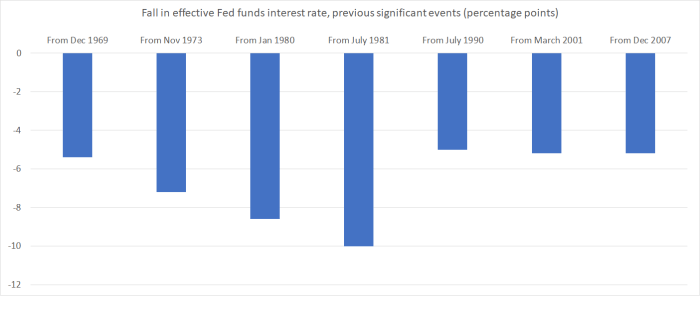
But the other relevant aspect, given the political aversion to more “bailouts”, seems to have been a sense within the Fed that the pressures on Lehmans had been so well-foreshadowed, over months, that its failure wouldn’t prove that disruptive.  Key players now claim that that wasn’t their view –  Bernanke is on record claiming that he always knew it would be a “catastrophe” –   but Ball demonstrates that such claims are simply inconsistent with what the Fed was saying or doing at the time.  For example, the FOMC met two days after the Lehmans failure.  Had the Fed thought the Lehmans failure would prove “catastrophic”, or even just aggravating the severity of the recession, a cut to the Fed funds rate would surely have been in order.  There wasn’t one.  And the published records of the meeting show no sign of any heightened concern or anxiety about the financial system or spillover effects to the economy.  If that was the prevailing view at the top levels of the Fed, it makes more sense as to why central bankers would defer to political pressure not to have provided (liquidity) support for Lehmans.

Central bankers don’t emerge with much credit from Ball’s book.  Anyone can make mistakes in the heat of the moment –  even a large institution with a deep bench like the Federal Reserve –  but what is perhaps more troubling is the suggestion (which seems pretty convincing to me) that key players (Bernanke, Geithner and Paulson) had been spinning the situation in their memoirs, rather than confronting the specifics of the data and the law.  Perhaps I become a bit more sympathetic than I was to (former BOE Governor) Mervyn King’s choice to avoid memoirs, and a defence of his involvement, in his own post-crisis book.  Thank goodness then for the efforts of a careful, apparently dispassionate, academic like Ball.

Of course, to agree with Ball’s conclusion that the Fed could have provided liquidity support to Lehmans if it had wished to do so is not to immediately jump to the conclusion that they should have done so.   Although it isn’t the focus of his book, it is pretty clear that Ball thinks such support should have been given.

A counter-argument could have a number of strands:

  • first, Lehmans had been under pressure for months to raise additional outside equity, and had failed to do so.  Had they done so, even at deeply discounted prices, it is unlikely that the wholesale run would have developed as it did (and even had it done so, the politics of liquidity support might have been different),
  • second, had Lehmans been a bank supervised by the Fed it would probably not have been allowed to stay open even as long as it did without new capital.  In bankruptcy courts, the relevant test might be whether there are still positive net assets, but bank supervisors who are doing their job should have been intervening pretty strongly –  including using directive powers –  before any question arose as to whether net assets were still (perhaps barely) positive, and
  • third, there is still the unanswered question (which may never be satisfactorily resolved) as to just how much the Lehmans failure exacerbated the recession.  Counterfactual history is hard.   The consensus view at present is that the adverse effects were large, but if much of the disruption would have happened anyway –  even if Lehmans had been left limping for a couple of months on liquidity life-support –  the case for intervention is weaker than many would allow (and, for example, AIG’s plight was largely unrelated to the Lehmans failure).  After all, there is a salutary place for market discipline, including around the urgency of injecting new capital when dark clouds loom.

I was one of those who tended to welcome the decision not to “bail out” Lehmans (better still not to have intervened around Bear Stearns months earlier) but I probably haven’t distinguished clearly enough between liquidity and solvency support.   The latter option –  which wasn’t something the Fed could have done anyway –  isn’t the focus of this book, but Ball does make a pretty persuasive case around liquidity support, including based just on facts that were available at the time (on the aftermath, no one could be certain).

I could still mount a counter-argument based on the first couple of bullet points above.  Providing liquidity support in such circumstances would have sent a signal to boards and managers of other institutions that any urgency to raise new capital, at deep discounted prices, was less than it might have seemed.  On the information availabe at the time, that would have been unfortunate.   Then again, within days that whole argument was tossed out the window as the authorities rushed to respond to a deepening crisis.

But perhaps what finally gets me over the line in thinking the Fed made a mistake, in not lending and in deferring to Paulson (in a politicised time six weeks out from an election), is an assessment of the probabilities.  Perhaps the Lehmans failure really wasn’t that big a deal.  Perhaps the Fed at the time was justified in its view that a failure could be managed without too much spillover downside.  But operating in a world of heightened uncertainty, no one could really know.  There had to be a chance that simply allowing Lehmans to go into bankruptcy –  the largest bankruptcy in US history, all done in rush –  would prove very very disruptive and economically costly.  But if providing strongly-collateralised liquidity support, quite possibly at a high interest rate and with ample haircuts, could have alleviated that risk –  even if it was only a 10 per cent risk – it is hard not to conclude (even without the benefit of hindsight) that the central bank should have acted.  After all, lender of last resort provisions are put in statutes for a purpose –  and not just a decorative one.


That will be $2 million and would you like fries with that?

Yesterday afternoon the Governor of the Reserve Bank and the chief executive of the Financial Markets Authority released their report on bank conduct and culture.  Despite highlighting several times in the report that this was really none of their business (of course they phrased it more bureaucratically: “neither regulator has a direct legislative mandate for regulating the conduct of providers of core banking services”), they’d spent an estimated $2 million of public money to mount their bully pulpit, lecture the banks, lobby for more powers for themselves.    And yet, rather lost among the soundbites –  especially those from the Governor loudly lamenting the apparent risks of “complacency” – was this simple summary (from the second page of the Executive Summary)

…culture and conduct issues do not appear to be widespread in banks in New Zealand at this point in time.

Perhaps these regulatory agencies should stick to their core responsibilities, assigned by law.   Developing a culture of doing excellently what Parliament asked them to do, of being open and accountable to citizens, and avoiding overreaching their mandate (relying on implicit threats) would be good to see from both the Reserve Bank and the FMA.  All government agencies should know their limits and stick within them.  Perhaps their respective boards should be asking some hard questions of management.

Oh, and dealing effectively with complaints made against, or to, the agencies themselves would also represent quite a (welcome) change.  Physician heal thyself.

But getting back to the report itself, the simple truth is that there just wasn’t much there.  Not much economic analysis –  just somewhat ad hoc “sermons” –  no cross-industry comparative analysis, and not even the simple acknowledgement that in institutions run by human beings mistakes will be made from time to time.

Perhaps there is something in the line that it was rather a once-over-lightly review.  Perhaps too neither institution really had a strong interest in finding serious problems –  just enough for the Governor to advance his ambitions with more portentous lectures on how private businesses needed to run themselves better.

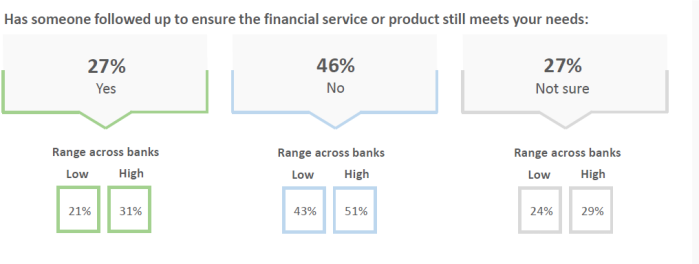
But it was well-known for months that the review was underway.  There was plenty of opportunity for any serious systematic issues –  whether in a single bank or across the system –  to be brought to light by those adversely affected.  And, as it happens, as part of the review the FMA and RBNZ commissioned a poll, surveying the experiences people had had with their own banks, and their trust in banks and the banking system.   It isn’t clear from the published report how the (on-line only) sample was selected, but I thought the results were quite reassuring.

There was this summary, for example

culture 1

It often seems as though every second shop I go into has staffed trained to attempt to sell products I don’t want or need (“City Council rubbish bags?” I’m routinely asked –  and never buy –  at the local New World), so if only a quarter of bank customers have had staff offer them financial products they don’t want or need, bank marketing must be a bit better targeted than I’d realised.

There is also a degree of unrealism about some of the questions.  I’m quite sure that when I’ve dealt with my bank they have rarely put my long-term financial interests first.  Why would they?  They are a profit-maximising private business looking to maximise value for shareholders, but through a repeat-game business where alienating the customers is often detrimental to the longer-term interests of shareholders too.  (And for many products the bank may have no idea what my “long-term financial interests” actually are.)

Or there was this question.

Q: ‘After purchasing a financial service or product, such as credit card, insurance, loan, term deposit, KiwiSaver, etc., has someone followed up to ensure the product continues to meet your needs and is still suitable for you?’

culture 2

Surely even at best this is only a nice to have?  Annoying calls from firms “just following up to see that everything is okay” have a cost (to the recipient too).  And there is some (considerable) onus on customers.  If I reflect on this question, I probably have a couple of credit cards I no longer need –  and am paying a small amount to the ANZ for each year – and no one has rung to check whether they are still “meeting my needs”.  But I don’t expect them to.  I’m an adult.

I’m not totally laissez-faire on such matters.  There are dangers that long-term contracts, hard to get out of, could be sold to people who simply don’t understand them. (Occupational pension schemes that people had no choice but to join are another example.)  It is reasonable for society to have (legal) protections built into the system.  But this report highlights precisely no systematic problems.   The report briefly, and reasonably, mentions a class of “vulnerable customers”, but again it was not apparent that there are either systematic problems or easy solutions.

Perhaps the most publicised part of the report is the initiative by the FMA and Reserve Bank to try to get all banks to stop sales-related incentives for frontline staff.   Given that the two institutions acknowledge that their legal mandates are limited it isn’t clear how much this is more than bluff, bravado, and a bit of pushing at an open door (some banks already being in the process of phasing out such incentives).  I hold no brief for specific remuneration practices, but I was struck by how little actual analysis there was in the report, including the role of sales-based incentives in a whole range of other sorts of firms and industries.  I didn’t explicitly check, but when I bought a car a few weeks ago I didn’t assume other than that the salesman would be benefiting personally if I happened to buy a car from him.  No doubt he knew that I knew.  There are risks, and one deals with them by some mix of dealing with reputable firms (invested in their brand), mechanic checks, and so on.  It isn’t clear in what respect the FMA and the Reserve Bank think basic banking products are so different.   There are no perfect ways of resolving agency issues (even within organisations), again something missing from the report.  Then again, rhetoric is cheap and serious analysis is hard (and grabs fewer headlines).

One of the Governor’s consistent themes is that banks –  and indeed private business more generally –  are too short-term in focus. He never produces any evidence to support his claim, or to back his view that he is better placed than private shareholders and managers to appropriately factor in time horizons, conditioned on the huge uncertainty everyone faces.   It shows through again in this report.  There are several claims that banks are too focused on short-term customer value or satisfaction, but no evidence is adduced to support this.   Frankly, I’d find it a little surprising if it were true.  Lifetime customer value is an approach that has been around in the marketing etc literature for 30 years now (and the basic idea won’t been unknown prior to that), and if banks really were just prioritising the short-term presumably they’d run into trouble eventually?  And yet New Zealand (and Australian) banks –  outside the immediate post-liberalisarion period –  have been both stable and profitable over many many decades, and haven’t even been losing customers to newer better providers more willing or able (or something) to meet customers’ long-term needs.

So, overall, I wasn’t impressed.  From the beginning, the review looked like a bit of power and influence grab –  especially by the new Governor, playing politics – bidding for more resources.  It came at a time when the banks –  legitimate private businesses (not, as the Minister of Finance put it this morning, operating as some sort of “privilege”) –  were (and are) in a weak position to stand up for themselves (given the bad stories from Australia).  And so banks, who face a market test every single day –  not just the share market, but customers with the ability to take their business elsewhere –  have to quietly put up with lectures from senior bureaucrats who’ve never faced such tests, never had to put their ideas or products to the market, deferentially swearing to go along and do as Orr and Everett say.   And, of course, if the banks do end up having to put in place more reports, more systems, more compliance checks, well, the burden of regulation always falls less heavily on big established players than on small operators or new entrants.  And so the big players –  more deft at playing the political/bureaucratic games – don’t really have much to worry about.  But customers might.

None of this is to suggest that ethics and morality (two words absent from the report)should be unimportant in business.  Without them, the basis for trust –  central to well- functioning markets and societies –  is corroded and eventually lost.  But it also isn’t clear that yet more mandated reports, yet more boxes to check, yet more rules to get legal sign-off on compliance with, is any sort of real substitute for the sort of personal and institutional integrity many hanker after.  I’m a trustee of a couple of superannuation schemes, which the FMA is responsible for regulating, and I’m struck by the sheer cost and additional complexity new waves of rules add –  even rules specifying the maximum number of words in one specific report –  and the contrast between that and the likely value being added for members.  And the improbability that the thicket of rules will really do much the stop the rogues.  Or even to cultivate a culture of honour and decency –  as distinct from formal compliance –  among the promoters and adminstrators of such schemes.

Deposit insurance, OBR etc

This wasn’t going to be the topic of today’s post, but I see Stuff has a story up based largely on a conversation I had late last week with their journalist Rob Stock.  (NB In the first version I saw a couple of hours ago a rather important ‘not” was omitted from this sentence “But a big bank failure was imminent, he said”).

New Zealand is being tipped to join the rest of the OECD in having a government-backed bank deposit guarantee scheme.

Under the Reserve Bank’s Open Bank Resolution scheme (OBR), depositors at a failing bank might have to take a “haircut” with some of their money being taken to recapitalise their bank, and get it open for business again quickly.

But former Reserve Bank head of financial markets Michael Reddell is tipping an end for OBR following the release of a discussion paper into the future of the Reserve Bank.

The background to this was the release last week of a joint Reserve Bank/Treasury consultative document as part of phase 2 of the review of the Reserve Bank Act.  I haven’t yet read the whole document, although a reader who has tells me it is a fairly substantive (and thus welcome) piece.  But when Rob Stock got in touch to suggest he would like to talk about the reappearance of the OBR (Open Bank Resolution), I read the relevant section (chapter 4) on “Should there be depositor protection in New Zealand?”

Stock is not a fan of the OBR option and was uneasy as to why it was appearing in the consultative document.  My response was along the lines that OBR had played a key role in Reserve Bank thinking about failure management for almost 20 years now.  Any new consultative document (especially a joint RB/Treasury effort) had to build from where policy/rhetoric had been but that, nonetheless, my read of the document suggested a clear framing pointing towards (officials favouring) New Zealand adopting deposit insurance.

Treasury has favoured such a change for some years, while the Reserve Bank had historically been quite resistant –  mostly, on my reading, because they take a rather naive wishful-thinking approach which ignores twin realpolitik pressures that ministers will face if a major bank is at the point of failure.    They believe in the value of market discipline (as, surely, in some sense most people do) and don’t want to do anything that might acknowledge that it isn’t always going to be a feasible (political) option.   In my view, in reaching for something nearer a first-best model in an idealised world, they increase the chances of third or fourth best outcomes.  A well-run deposit insurance scheme isn’t perfect, but offers the prospect of a decent second-best set of outcomes.  And, for what it is worth, would bring New Zealand into line with the rest of the advanced world.  As the consultative document makes clear, of the OECD countries only New Zealand and Israel don’t have deposit insurance, and Israel has already indicated that it is going to introduce a scheme.

As I noted, it was hard to see why any of the parties in the current government would be resistant to introducing deposit insurance (the Greens had been openly calling for such a reform) and there had been signs that although the “old guard” of the Reserve Bank had been resistant to deposit insurance the new Governor was likely to be more receptive. (And in the off-the-record speech Orr gave a few months ago, it was reported that among his comments was “deposit insurance is coming”.)   National had been resistant, but relevant context for that included the way they were landed with the aftermath –  and losses – of the retail deposit guarantee scheme after coming into government late in 2008.  The retail deposit guarantee scheme bore almost no relationship to a proper deposit insurance scheme –  being introduced at the height of a crisis, primarily covering unsupervised institutions and then knowingly undercharging those institutions for the risk being assumed.  But it is relevant (together with National’s bailout of AMI) in revealing how politicians are likely to behave under pressure in a financial crisis.

Why do I favour deposit insurance (as a second best)?   I’ve covered this ground in other posts, but just briefly again.   I see little or no prospect that, in event of the failure of a major bank, politicians will let retail depositors lose their money (reliance on OBR assumes exactly the opposite interpretation).    If so, it is better to force depositors themselves to pay for that protection up-front, in the form of a modest annual insurance premium.

At present, with the four biggest banks all being subsidiaries of Australian bank parents, the failure of a major domestic bank is only seriously likely to occur if the parent is also in serious trouble. (And the 5th biggest bank is government owned –  enough said really.) If the parent isn’t in serious trouble, there would be a strong expectation that the parent would recapitalise any troubled subsidiary and/or perhaps manage a gradual exit from the New Zealand market.

It simply isn’t very credible to suppose that if the ANZ banking group is failing, and the New Zealand subsidiary is also in serious trouble, a New Zealand government will let New Zealand depositors of ANZ lose (perhaps lots of) money while their Australian cousins and siblings (often literally given the size of the diaspora), depositors with the ANZ, are bailed out by (or covered by deposit protection by) the Australian government.   It isn’t as if there is any very credible scenario in which the New Zealand government’s debt position had got so bad that the government could claim “we’d like to help, but just can’t”, and the optics (and substance) would be doubly difficult because it is generally recognised that a concomitant to making OBR work would probably be to extend guarantees to the liabilities of other (non-failing) banks –  otherwise, in an atmosphere of crisis transferring funds to the failing bank will look very attractive to many.

My view on this is reinforced by the practical examples of bailouts we’ve seen.  Sure, the previous Labour government let many small finance companies fail without intervening, but then the deposit guarantee scheme happened. AMI policyholders were bailed out, when there was no good public policy grounds (other than the politics of redistribution etc) for doing so.  And, beyond banking, we had the bail-out of Air New Zealand in 2001. In the account of that episode that Alan Bollard (then Secretary to the Treasury) told, uncertainty about what might happen in the wake of any failure was a big part of the then Prime Minister’s decision.  It would be the same with the failure of any systemic bank.   It isn’t an ideal response, but it is an understandable one, and one has to build institutions around the limitations and constraints of democratic politics.

(The other reason why OBR is never likely to be used for big banks, is that in any failure of a major bank, trans-Tasman politics is likely to be to the fore, with a great deal of pressure from Australia for the failure of the bank group’s operations on both sides of the Tasman to be handled together/similarly.  It was a little curious that nothing of this was mentioned in the chapter of the consultative document.)

If there is no established depositor protection mechanism and if politicians blanch at the point of failure –  as almost inevitably they will –  then in practice what is most likely to happen is that everyone will be bailed out.   And that really would be quite unfortunate  – big wholesale creditors, who really should be on their own (and able to manage risk in diversified portfolios), losing along with granny.   And so one argument is that deposit insurance allows us to ring-fence and protect (and charge for the insurance upfront) retail depositors, while leaving wholesale creditors to their own devices in the event of failure.  In other words, a proper deposit insurance scheme could increase the chances that OBR can actually be used to haircut the sort of people (funders) that most agree should lose in the event of a bank failure.

There were a few things in the Stock article where I’m quoted in a way that at least somewhat misrepresents what I said.

Reddell said he expected the deposit insurance to win out and the scheme to be run by the Government.

An EQC-like fund would be created to collect insurance premiums from all depositors, with no banks allowed to opt out, he said.

The question here had been about which private insurer would be strong enough to provide the deposit insurance.  My response was that it was most unlikely such a scheme would be run through a private insurer –  they too can become stressed in serious crises –  and that what one would expect would be a government-run and underwritten fund, accumulating levies over the decades, and helping to cover any losses in the event of a major failure.

The premium would be about 10 basis points on deposits, so a deposit account paying interest of 3 per cent, would be cut to 2.9 per cent, with the rest funding the deposit guarantee premiums, Reddell said.

Here the question was mostly about who would bear the cost of the insurance. My point was that one would expect the cost to fall primarily on depositors (rather than say, borrowers or shareholders).  The size of any premium (which should be differentiated by the riskiness of the institution) would be a matter to be determined, and varied over time, but I did note to Stock that for an AA rated bank that cost might be quite modest.   I noted that although CDS (credit default swap) premia had increased since, in the half decade or so leading up to the 2008 financial crisis the premia for Australasian banks had typically been only around 10 basis points.

In other guarantee schemes each depositor only has a maximum amount of their money guaranteed. The paper mentions $50,000, but Reddell said the scheme, if introduced, would have a cap of around $100,000.

My point was that a cap of only $50000 (an idea mooted in the paper) didn’t seem particularly credible, and based on the levels of coverage in many overseas schemes (and under the deposit guarantee scheme) I would expect any deposit insurance scheme cap to be at least $100000.   Set the cap too low and it will end up being unilaterally changed at the point of crisis, with no compensating revenue to cover the additional insurance being granted.

And finally

But a big bank failure was not imminent, he said.

“Canada has gone over 100 years without a big bank failure. There’s no reason to think we will get one in the next few decades,” he said.

Of course, failures are always possible, but much of the mindset and literature is too influenced by either US examples (where the state has had far too big a role in banking), or those from emerging markets.   Canada provides a very striking contrast, but even in New Zealand or Australia the only period of systemic stress in the 20th century was in the period (the late 1980s) when a previously over-regulated system was deregulated quite quickly and everyone (lenders, borrowers, regulators) struggled to get to grips with applying sound banking practices in an unfamiliar environment.   A once in a hundred year systemic bank failure is something authorities have to plan for, and given the choice between collecting modest annual insurance premia for a hundred years to cover some (or even all) of the cost of bailing out retail depositors, and doing nothing and (most probably) bailing them out anyway, I know which second-best alternative I’d choose.

I hope the government agrees, and acts to implement a deposit insurance regime for New Zealand.  There are lots of operational details to work out if they do, and those aren’t the focus of this consultation document, but deposit insurance is the way we should be heading.

Restructuring the Reserve Bank

Seven months (and counting) into his term as Governor, Adrian Orr still hasn’t deigned to deliver an on-the-record speech on either of his main areas of statutory responsibility (monetary policy and financial stability) but he has this morning done what it seems almost all new CEOs –  public sector and private sector –  now do, and restructured his senior management, ousting or demoting several top managers, elevating one or two, and opening up a raft of vacancies.  Public sector senior management restructurings seem to generate most of the Situations Vacant business for the Dominion-Post newspaper these days.

A few people have asked my thoughts on the restructuring, so…..

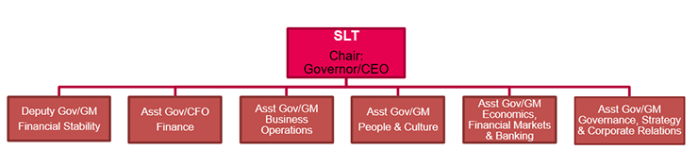
As a first observation, I give credit to the Governor for resisting the temptation of across the board grade inflation (although there is at least one example, see below).  Every public sector senior management advert one sees –  I pay attention mostly because my wife has been in the market – is full of Deputy Chief Executive roles (not infrequently five or ten of them).  The Bank’s Act constrains the number of Deputy Governor positions (only one, in the bill before the House at present) but if he’d wanted to, all these SLT positions could have been designated Deputy Chief Executive roles.  As it is, having resisted title inflation, the Governor might find some potential applicants a bit more hesistant than otherwise: an Assistant Governor (even for Economics, Financial, and Banking) may sound less glamorous than a Deputy Chief Executive title.

This is the new structure, which looks a lot like those for all manner of public sector organisations.new-leadership-team-structure

Three of those positions are filled straight away.

Appointments to Senior Leadership Team
Geoff Bascand – (Currently Deputy Governor and Head of Financial Stability) has accepted a role on the SLT as Deputy Governor and General Manager of Financial Stability.
Lindsay Jenkin (currently Head of Human Resources) has accepted a role on the SLT as Assistant Governor/General Manager of People and Culture
Mike Wolyncewicz (currently Chief Financial Officer and Head of Financial Services Group) has accepted a role on the SLT as Assistant Governor/ Chief Financial Officer Finance.

Of those two appointments (Bascand and Wolyncewicz) seem sensible and appropriate.  Bascand currently holds a statutory Deputy Governor appointment and would have been hard to shift even if the Governor had wanted him out.  His role is slightly –  though perhaps sensibly – diminished as he will no longer have overall senior management responsibility for financial markets.

To be blunt, the new Assistant Governor for People and Culture has the feel of tokenism on two counts.   The first count relates to the current tendency for HR managers to be given glorified titles and to report directly to the chief executive (the message supposedly being “we value our people”, as if organisations never did when HR was a fairly low-level support role).  Line managers are the people who convey (by their actions mostly) to staff the extent to which they are valued (or otherwise).   And the second relates to the incumbent, who just is not particularly impressive.  As someone put it to me, perhaps she might be okay in some modest commercial operation, but she never showed any sign of being suited for a key leadership role in a significant policy organisation.  But….she is a woman, and in promoting her Adrian Orr manages –  after 84 years –  to have a woman in a top tier role (although still not in a key role in policy or operational areas, the raison d’etre for the organisation).   It will have been an easy win to simply grade-inflate the Manager, Human Resources role.  After all, as he said a few months ago

We will be working actively. We are just going to have to be far more aggressive at getting the gender balance balanced,” Orr said in a recent interview

(And before I get angry emails or anonymous comments from past or present Reserve Bank staff, I will reiterate my view –  and it is only mine –  that there are no conceivable grounds on which Lindsay Jenkin would be in the top tier of a major policy organisation other than her sex.  I wish it were otherwise.)

In the entire restructuring, the person one should probably feel most sorry for is Sean Mills, Assistant Governor and Head of Operations, whose job is dis-established and who is leaving the Bank, having joined under a year ago.  I suppose he knew the risks –  taking on a direct report job in the hiatus between Governors, when no one had any idea who the new Governor would be or what structure he or she would prefer.  I’ve never met Mills, and have heard nothing good or bad about him, but it is always a bit tough to lose your job after less than a year.

Two long-serving key senior managers –  both in their roles for 11 years now –  are demoted as part of the restructuring, one perhaps a bit more obviously than the other.

The first is Toby Fiennes, currently Head of Prudential Supervision.  His role –  a big job –  appears to have been split in two.

Toby Fiennes (currently Head of Prudential Supervision Department) has accepted the role of Head of Department for Financial Stability Policy and Analytics.

with one of his current managers (very able) taking up the role responsible for actual oversight of financial institutions.

Andy Wood has accepted the new role of Head of Department for Financial System Oversight.

I always had some time for Fiennes (although I’ve probably criticised speeches and articles here) and thought him in some respects the best of the main departmental heads.  Perhaps it is just that the job has gotten so big that the Governor no longer wanted one person doing it, but the new role is much-diminished relative to what he has been doing for the last decade.   And Geoff Bascand already had the key overall financial stability role, so there was no possible promotion opportunity.

The bigger, and more obvious, demotion is that of (current) Assistant Governor and Head of Economics, John McDermott.

John McDermott (currently Assistant Governor and Head of Economics) has accepted the role of Chief Economist and Head of Department for Economics in the Economics, Financial Markets and Banking Group.

After 11.5 years as a direct report to the Governor, and almost as long with the Assistant Governor title, McDermott loses both.

I’m always hesitant to write much about McDermott.  He was my boss for six years, and while we had our differences we sat across from each other for years and exchanged views on all manner of work and family things.  I liked him, was looking just the other day at the personal gift he gave me when I left the Bank, and I was genuinely pleased to applaud his daughter’s award the other night at the Wellington East Girls’ College prizegiving.

Unfortunately, I don’t think he was the person for the role he has held for eleven years, and which he never really grew into or made of that position what it should have become.  He has a strong track record as a researcher, and apparently was for quite a while the most widely-cited New Zealand economics researcher, but the key senior manager for monetary policy –  effectively a deputy governor without the title – required more than McDermott had to offer.   In public view, this was apparent in speeches and Monetary Policy Statement press conferences.  And thus, sad as it perhaps is for John, I think the Governor has made the right choice.  Whether McDermott stays for much longer in the diminished position he will now take up perhaps depends a lot on who gets vacant (and crucial) new role of Assistant Governor for Economics, Financial Markets, and Banking).

Two other senior managers in core roles leaving the Bank

Mark Perry (Head of Financial Markets)…..elected to leave the Reserve Bank.

Bernard Hodgetts (Head of Macro-Financial Department, who is currently seconded as Director Reserve Bank Review in the Treasury) has also chosen to leave the Reserve Bank after he finishes his role leading the review.

The Head of Department for Financial Markets won’t be an easy role to fill –  I wouldn’t have thought there were any obvious internal candidates.

Three more comments on the review:

  • even if a role like “Assistant Governor, Governance, Strategy and Corporate Relations” is the sort of title one sees in lots of government agencies, it feels like another example of grade inflation.  Presumably this involves the communications functions, the Board Secretary, and churning out the myriad hoop-jumping documents like the Statement of Intent.  People with “strategy” in their title in public sector organisation are rarely at the heart of what the organisation do.
  • there will be a lot of focus on who gets the role of Assistant Governor, Economics, Financial Markets, and Banking.  This is (slightly) bigger role than Murray Sherwin held 20 years ago, without the benefit of the Deputy Governor title.    We will have to wait until the adverts appear to see whether the Governor is after a policy leader (someone who really knows this stuff) or a generic public service manager.  If –  as I hope –  the former, it has been speculated to me that the Governor may try to attract back to the Bank the current Treasury chief economist Tim Ng (whose talents would be better used doing almost anything than wellbeing budgets).  Another possibility is the current Treasury deputy secretary for macro, Bryan Chapple who has a central banking background and led some of the financial markets reform work at MBIE.  No doubt there will be others applying, especially as the holder of the position is almost certainly to be a statutory appointee to the new Monetary Policy Committee.
  • this restructuring also probably helps clarify who will be the four internal members of the new Monetary Policy Committee.  The Governor and Deputy Governor will be members ex officio, and it is hard to see how the other positions would not be given to the Assistant Governor, Economics, Financial Markets,and Banking) and to John McDermott, as head of the Economics Department.

Overall, the restructuring is quite a mixed bag.   There are some good appointments and some poor ones already, and quite a lot will depend on a handful of the remaining appointments (especially the quality of person they can attract to that Assistant Governor role –  which, notwithstanding my earlier cautions about grade inflation, really should be a deputy chief executive position, both for recruitment reasons and for the stature and standing of the person in international central banking circles).

If I have a caveat about the overall structure, it is probably that the Bank would be better for having at least one senior policy person –  whether as Deputy Governor or so Advisor to the Governor –  who didn’t have a demanding line management role.  Such roles aren’t uncommon in other central banks, but I guess it depends on the Governor’s own preferred operating style.

And since I have the opportunity of a post about the Bank, I should note that I have not abandoned the issue of the Governor’s total non-transparency in respect of his speech about transparency to the Transparency International AGM (at which he was introduced by the State Services Commissioner, who has responsibilities for open government).  I am pleased to see this issue has had a little bit of media attention, including this article which pointed out that 90 per cent of Transparency International’s funding comes from the taxpayer.  I have an Official Information Act request in with the Bank for any briefing notes or text the Governor used, for any recordings that may exist, and if none do for a summary of what was said (memories –  very fresh, since I lodged the request within hours of the Governor delivering his speech – are official information too.   I don’t expect much, but there is a point to be made –  all the more so given the topic, the audience, the introducer, and the funding source for the body to which he was speaking. I can’t imagine Orr said anything very controversial, in which case why the secrecy? And if what he said was controversial –  foreshadowing for example Monday’s forthcoming culture review – it shouldn’t be said only to select private audiences.  It was simply an unnecessary own-goal, some sort of silly reassertion (perhaps Wheeler like) of a Reserve Bank perception that it really should be above such trivial matters as disclosure, transparency and the Official Information Act.


Did state houses make much difference to housing supply?

I’ve been among those suggesting that the KiwiBuild programme –  even if it involved the government itself directly commissioning the building of new houses that no existing developer already had in prospect –  was unlikely to increase overall housing supply very much, or affect overall average house prices very much.  It was never clear how such a programme could affect overall housing supply very much.  For it to do so, there would have to be large unexploited profits left sitting on the table by private developers (properties selling for far more than it would cost to bring new developments to market).  If that isn’t so –  and we don’t see any obvious signs of such unexploited opportunities – whatever the government itself builds or commissions is just likely to mostly displace and replace houses that the private sector would have built.   (There is another possibility, that the government not only displaces most private building, but goes on building at a loss even beyond that point, but there is nothing in the PR around the programme to suggest that is what they have in mind.)

I also know the line the government and its defenders run that somehow KiwiBuild will “work” –  whatever that means –  by building particular types of houses the market isn’t providing.  But even to the extent that is so, what of it?   If the morass of regulation makes it uneconomic to build many new moderate-sized homes (although do recall that the flagship houses are four bedrooms), demand reallocates.  Decades ago many young couples started out with a brand new (small) house in a remote suburb with few facilities and not even a lawn (I’m just old enough to remember our (new) street in Christchurch where what would become front lawns were planted with potatoes, apparently to get the impurities out of the soil).  These days they don’t.   But is there any sign that the prices of the existing modest-sized houses have increased disproportionately relative to house prices more generally?  I’m not aware of any, and that isn’t really surprising, when by far the biggest issue in high urban house prices is land prices.   And KiwiBuild does nothing at all about them.

In my post earlier in the week, I mentioned the state house building programme initiated by the first Labour government, and often touted as the inspiration for today’s KiwiBuild programme.   In passing, and thinking as I wrote, I wondered if the (substantial) construction programme associated with the state houses programme had made much difference to overall housing supply.  It wasn’t something I’d ever given much thought to previously, but once one begins to think about it, of course it makes sense to doubt that that massive state intervention really made much difference on that specific count.  (It is quite probable that it materially increased availability for some –  small –  class of potential tenants private landlords were reluctant to touch.  It is also clear that it chewed up vast amounts of land, probably rather inefficiently – a couple of weeks ago I was driving through a state house neighbourhood a few blocks from where I grew up in Auckland and marvelled  –  not in a positive way – to see such small state houses on such large sections.)

There isn’t any easy way to compellingly answer my question.  Perhaps some academic researcher could turn their attentions to it at some point.   But out of interest I dug out a few charts.

This one (from Te Ara) shows the stock of state houses.

stock of state houses

(Interesting to see that the stock actually dropped a little during the term of the Kirk-Rowling Labour government).

And this chart shows annual data for both the number of new state houses built and those existing ones sold (something initiated by the 1950s National government).

state-houses-built-and-sold-graph

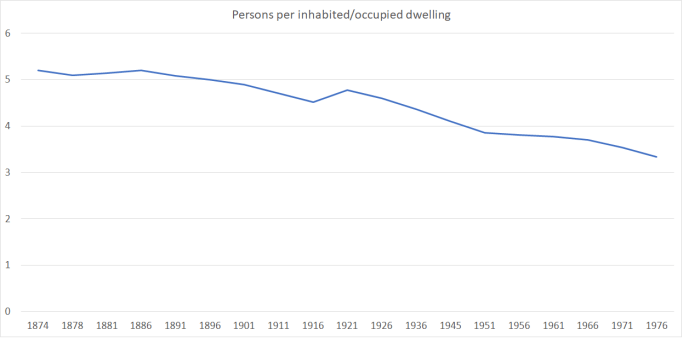
One way of looking at whether there is prima facie reason to think the state house programme might have made much medium-term differenc is to look at the population to dwellings ratio.

This chart is drawn from census data reproduced (up to the 1970s) in Bloomfield’s collection of New Zealand historical statistics.

person per dwelling.png

The spacing isn’t even –  censuses were skipped in 1931 and 1941 –  but all I really wanted to highlight was the strong downward trend over the 90 years from the mid 1880s to the mid 1970s.  The only interruption to the trend was in the single inter-censal period from 1916 to 1921.  It is more or less what one would expect, as people got wealthier, families got smaller (and, at least late in the period, divorce got more common).    Had the state not been building, there isn’t much reason to suppose that –  over time, and in the absence of building and land use restrictions –  the private sector would not have done so.  After all, they had done so in the decades prior to the state housebuilding programme (I was little surprised to see that even over the period encompassing the Great Depression –   1926 to 1936 –  the population to dwellings ratio fell).

Sadly, what might have been the cleanest test –  the 30000+ state houses built in the first decade or so of the programme –  also happened to mostly coincide with World War Two and the period of tight controls on all manner of things (including existing house sales) in the years following the war.  And government-imposed credit constraints remained an issue for the private sector for much of the post-war decades.

But I’d suggest that the burden of proof is really on the advocates of KiwiBuild to show that even very big government-inspired housebuilding projects really make much difference to the overall housing supply situation in the long-term.  After all, when the government owned many of our banks, most of our power companies, most of our radio and TV, and so on, mostly it didn’t supplement the stock of private businesses, it (rationally, from a private sector perspective) displaced them or crowded them out.  If the government were really serious about fixing the housing market, and making housing once again affordable for working class families, not just helping along well-paid professional couples, they’d free up the urban land market.  Sadly, there is no more sign of that under this government than under its predecessor.

On which note, there is a column today on interest.co.nz by Peter Dunne in which he begins thus

Kiwibuild is beginning to look more and more like no more than one of Edmund Blackadder’s cunning plans.

He has some good lines

It is worth recalling that in its election policy just one year ago Labour promised that it would “build 100,000 high quality affordable homes over 10 years”. The policy went on to talk about curbing homelessness through building affordable homes in the $350-450,000 price range.

The implication was unambiguous – Labour’s approach was going to be far more activist than National, and Kiwibuild would be Its primary policy to deal with homelessness and the housing crisis.

and

So far, just 18 Kiwibuild homes have been built, and another 447 are on track for completion by July 2019, leaving a shortfall of 535 on its first year 1,000 homes target.

Put another way, a first year achievement rate of just under 47%. And there has been a subtle but clear rewrite of the Kiwibuild objective.

According to the Kiwibuild website, the objective is now the much more passive one to “deliver 100,000 homes for first home buyers over the next decade”.

So, no longer will the government build “100,000 high quality affordable homes”. And no longer does “affordable” mean $350-450,000, but $650,000.

Moreover, now the plan is merely to “deliver” 100,000 homes, which, in the best Blackadder fashion, means accumulating all the new homes already being built over the next 10 years by the private sector anyway, and dressing them up as Kiwibuild homes.

But it is perhaps worth recalling here that Peter Dunne was a minister in the previous National-led government, and in particular held the one vote in Parliament that was sufficient to block the reforms (inadequate and insufficient as they would have been) that National was seeking to make.  I hope I don’t need to say again that I’m no defender of National’s record –  and lack of courage –  in this area in government, but it is a little rich for Dunne to snipe from the sidelines (legitimately in substance perhaps) when he personally blocked beginning to tackle some of the root causes of our obscene housing market failure.


Is that the best you can do Prime Minister?

There was a headline on Newsroom this morning “Ardern softly raises concern over Uighurs”.  That sounded interesting, even if that “softly” word was a bit of a giveway.  Here is what the article actually said

Ardern told media at her weekly post-cabinet press conference that she was concerned by the Uighur’s plight, although she had not recently been briefed on the subject.

She said she might raise her concerns at a future meeting with Chinese officials, but made no firm commitment.

“Generally speaking we take the opportunity to raise issues of concern,[but] it would be pre-emptive to say what I would discuss,” she said.

Presumably she was asked a question and had to say something.  That she was “concerned” was about as weak as you could possibly get –  by contrast her Labor counterpart in Australia yesterday managed a “gravely disturbing”.    The Prime Minister apparently went on to play down the issue further by specifically noting that she hadn’t been briefed recently.  When a Prime Minister cares about an issue, the briefings will come quickly.

And then, in case anyone (businesses, donors, Yikun Zhang or the like) was worried that she might have said too much, when asked if she would raise her concerns with the Chinese government she couldn’t muster more than “I might”.

This for one of the gravest and most large scale abuses in modern times, being committed by a Security Council member.  And the Prime Minister having called only recently for “kindness” to be some watchword of policy.   Not much on display if you are a Uighur.

The Newsroom article, which seemed to be doing as much as possible to put the Prime Minister in a good light, ended with this comment.

Ardern flagged human rights concerns in a recent meeting with Li Xi, the Party Secretary of Guangdong Province, who visited earlier this year, as reported by Newsroom.

And so I clicked through to that article to refresh my memory.

“We acknowledged of course we are both countries on different development paths, that the nature of our political systems, but that we’ve always as our two countries found ways to discuss those differences in a way that works for our relationship, and I put human rights under that category,” Ardern said.

The detention of Uighur Muslims in Chinese “re-education camps”, the subject of concern by a United Nations panel, was raised under that banner, Ardern said.

Asked of Li’s response to the human rights issues, Ardern said: “It was heard and received.”

I suppose it is good to know it was mentioned, but a mere mention in a private meeting hardly seems likely to bother Beijing.  And hardly likely to reassure New Zealanders that our elected “leaders” actually care much about the imprisonment of a million people, for little more than being who they are, let alone the more recent report of those Uighurs not in prison having regime spies forced on them, living in their houses to report on their attitudes and behaviours.

As it happens, we have a PRC perspective on the Prime Minister’s meeting last month with Li Xi, available on the PRC embassy website.  This was the meeting where, so the PRC reports, the Prime Minister suggested strengthening relations between the Labour Party and the Chinese Communist Party (emphasis added)

New Zealand is ready to deepen bilateral cooperation with China in economics and trade, tourism and innovation, strengthen party-to-party exchanges

Isn’t there quite enough obsequious praise of Xi Jinping, courting of CCP-connected donors etc from Labour figures already?

Of course, the PRC account doesn’t mention the Prime Minister raising any human rights issues (which isn’t to suggest they weren’t mentioned) but how seriously do you suppose they would have taken any concerns anyway when they can report that the Prime Minister said this (again, emphasis added)

Ardern said New Zealand and China have something in common in improving people’s wellbeing, protecting the environment, and enhancing coordinated development, adding that the development strategies of both sides are highly compatible, with broad room for cooperation.

I guess at the most reductionist level there is something to the first point: both governments probably do want to lift the wellbeing of their people, although in the PRC case even that is arguable (control and submission to the interests of the Party seems more paramount).   But it is a statement that is devoid of meaning, or moral content, when you contrast what a free and democratic society might mean by such statements, and what a regime that runs mass concentration camps, allows little no religious freedom, little or no freedom of expression, and no lawful vehicle for changing the government might mean.   As for “development strategies” being “highly compatible”, is the Prime Minister giving a nod of approval to strategies that involve widespread theft of intellectual property, the absence (boasted of by the chief justice) of the rule of law, growing state control of even private companies (let alone a massive credit-fuelled, and highly inefficient, domestic boom that ran for some years)?  It is just shameless pandering.

I don’t suppose the PRC is going to change any of its policies because New Zealand expresses disapproval, but what we hear from the Prime Minister and from the PRC’s reports gives us no basis to think the PRC would even believe that New Zealand governments cared.

Which is a good opportunity to include this tweet I noticed yesterday from someone abroad who comments on China issues.

The Churchill quote –  from his famous ‘iron curtain” speech – is very apposite, but in the specific New Zealand context, and the way our politicians court the regime and fear doing or saying anything even slightly controversial, the commentators own line was a nice place to end.

It comes back to the values, not bank balances, we want to have for ourselves and for our children.

Fortune for the favoured

The coverage in recent days of the first (branded) KiwiBuild houses –  one purchased by a young well-travelled couple, no children, she just graduating as a doctor, he something in marketing –  brought to mind the books I’d had sitting on a pile for ages intended for a post about the first Labour government’s state house building programme (we used to be told that the KiwiBuild vision was modelled on the earlier programme).

As for the KiwiBuild houses themselves, even the purchasers are unashamed in talking up their good fortune (at the expense of the taxpayer).

The owners of one of the new homes have compared their purchase to winning Lotto.

Couple Derryn Jayne and Fletcher Ross paid $649,000 for their four bedroom home, which they said is great value for money, compared to prices elsewhere in Auckland.

They had given up hope of finding a house on the open market after a year-long search.

Which, frankly, is a bit odd.  Of course house prices in Auckland –  and much of the rest of the country – are obscene, but even in Auckland you can pick up a first house for well under $649000.   I googled houses for sale in Clendon Park for example.  It mightn’t be a suburb entirely to everyone’s taste but my in-laws lived there until a decade or so ago.  And it is a first house we are talking about, where it isn’t obvious why the taxpayer should be assisting a lucky young couple into a brand-new four bedroom house.

Defenders of the government are quoted in the media.  There is an article in this morning’s Dominion-Post (which I can’t find online) in which, for example, Shamubeel Eaqub notes that

…the eligibility criteria were broad. “People also may not know how challenging it is to be a doctor without a private practice and with large debts.  I have heard stories of young doctors leaving places like Queenstown because they couldn’t see a way of ever owning a home there.”

Another person quoted in the article observes “even doctors have to start somewhere”.

No doubt. And no doubt it is quite tough for many people starting out, even professionally-qualified couples.  But lets just think for a moment about people rather further down the income ladder, typically without the sort of future income advancement opportunities that (many) doctors have.  Teachers and nurses for example, or motor mechanics, or retail managers, hairdressers, and so on.   If we “need” special lotteries to help favoured young professional couples into homes, how are people further down the income scale ever supposed to manage?  Ah, but, says the minister Phil Twyford, that is to miss the point: apparently KiwiBuild isn’t supposed to help low-income families, even though if there was ever a case for direct state intervention in the market it would surely be for those people rather further down the income scale; the sorts of people who not many decades ago could reasonably have expected to buy a basic first house.

An Auckland University economist (Ryan Greenaway-McGreevy) is also quoted in the article.  He argues, sensibly enough, that “it shouldn’t be a surprise that a new doctor could qualify. ‘Perhaps it speaks to how unffordable housing has become.'”

Which is, surely, the point.  Most people further down the income scale, and especially in Auckland, simply can’t afford to purchase a house at all, at least not without ruinously overburdening themselves. The economist goes on to suggest that KiwiBuild will lower prices for everyone.   Even if that were true, it still wouldn’t justify a lottery in which the favoured few pick up a house below market price at the expense of the taxpayer.  But, of course, there is little sign that it will be true –  many of the early KiwiBuild projects are just rebadging construction that was already going to happen, and over time there is no clear reason as to why we should not expect any specific KiwiBuild construction not to displace private sector activity that would otherwise have taken place.

And surely the evidence against that optimistic hypothesis is in the market prices.   If people really believed that whatever the government was doing –  KiwiBuild or whatever –  was going to lower house and urban land prices over time, then those prices would be dropping already, perhaps quite steeply.  Sure, Auckland prices seem to have gone sideways over the last 18 months or so –  after a huge surge over the previous few years –  but those in many other urban areas are still rising (in both real and nominal terms).   Over the last five years, the REINZ numbers now indicate that Auckland and non-Auckland house prices have risen at around the same rate (on average 8 to 9 per cent per annum).  CPI inflation is, by contrast, averaging under 2 per cent.   When nothing has been done to fix the land market, and most KiwiBuild construction is likely to simply displace private sector construction, none of that should be very surprising.  KiwiBuild is producing photo-ops, and Lotto-like wins for the favoured (and lucky) middle class few, but it is no fix  –  not even any material part of a fix –  to the dysfunctional housing market successive governments have delivered us.

And what of the first Labour government’s state-housing programme?  Actually, it didn’t do a lot for people at the very bottom either.  In the mid 1930s there was much talk of “urban slums”.   Ben Schrader’s history of state housing in New Zealand has a nice quote from a newspaper editorial written just a couple of weeks after the 1935 election, contrasting the newly built National War Memorial Carillion tower with the surrounding neighbourhood (in Wellington’s Mt Cook)

“The Tower was built right in the middle of Wellington’s slum area, and a stone’s throw away from it, men, women, and children are making a different kind of sacrifice.  They live  in squalor and dirt, in little shacks lacking even the ordinary comforts of existence.”

But the state house programme wasn’t for these people. They couldn’t afford the rents.  In fact, as Schrader records, one contemporary critic calculated that a worker would have to earn 20 per cent above “the weekly living wage (the amount the Arbitration Court determined was necessary to support a familiy in “reasonable comfort’) to be able to afford the rent on a state house.    In its defence, Labour argued that people moving into state houses would free up other houses for poorer people –   and in those immediate post-Depression years without the sort of tight land use controls we have today perhaps there was even something to that story (but I’m not aware of any evidence to confirm that conclusion).  But it certainly wasn’t a programme targeted to help those at the bottom (indeed, when later governments offered to sell state house to sitting tenants there was often a material wealth transfer to the fortunate minority).   And for the first decade or more Maori was also explicitly excluded.  Again from Schrader:

“This thinking [around separatism] was challenged in 1944 after the Department of Native Affairs surveyed Maori housing conditions in the industrial Auckland suburb of Panmure.  It found Maori crowding into tents and shacks made from rusting corrugated iron and discarded packing cases. Cooking was mostly done over open fires and sanitary conditions were primitive. Sobered by this and other similar reports, the government agreed in 1948 to build state houses for Maori.”

As for the photo-ops in an earlier age, everyone is familiar with the picture of Prime Minister Savage helping to carry the dining table into the first state house in Miramar, but Schrader records

“The Fife Lane function was so successful that a coterie of cabinet ministers repeated the furniture-carrying stunt at the opening of the first state house in each of the main cities.”

I wonder how more photos of Jacinda Ardern and Phil Twyford appearing with new KiwiBuild owners there will be?  And how people further down the income scale –  perhaps mostly Labour voters –  will be feeling about their own prospects of ever owning a modest house (not even a four bedroom brand new one) in one of our major cities.  That only seems likely if the government were to tackle the regulatory constraints on our urban land market, and despite the pre-election talk there is still as little sign of that so far as there was action under the previous government.  Very little.

(On a completely different topic, I’d just add my voice to the long list of those seriously troubled by the government’s decision to give residency to an imprisoned Czech convicter of dishonesty, and convicted and imprisoned for drug importing, and not even to be willing to explain why.   Personally, I can’t conceive any circumstances under which I would support giving such a privilege to a person with such a –  very recent – background, the more so when such a person comes from an EU country –  none of them is perfect, but none is Somalia or the People’s Republic of China.  There are plenty of decent and honest people who would like to live here, and we only take so many: why favour the Czech drug smuggler over any of them?   As with the extraordinary exercise of ministerial discretion under the previous government to grant Peter Thiel citizenship, these sorts of cases point to a need for much more openness and accountability.  If you want ministers to exercise personal discretion in your favour, you should expect all the details of your case to be published routinely, so that ministers can be properly held to account.  It simply isn’t good enough to have the Prime Minister tell us we should “read between the lines” and then refuse to go further.   Why would we be inclined to believe that ministerial discretion is being appropriately exercised in this case –  and that a drug smuggler with gang associations should be free to stay among us – when the track record (under both parties) inspires so little confidence?

I noted that there are plenty of decent and honest people who would be keen to live in New Zealand.  Stuff’s new article on the utter failure of the Immigration New Zealand arm of MBIE to take seriously the scams suggests that many of those who do get to live here probaby do so at the expense of the honest and decent ones.

[head of immigration advisory agency Carmeto] Malkiat believed most visa applications contained some level of exaggeration and misrepresentation, and significant number involved substantial corruption. There was now a generational pattern of exploited migrants in turn exploiting the next wave to arrive, he said.

“The reality is that if all immigration advisers speak up, 80 to 90 per cent of all applications are wrong, and should not be approved – it is a massive number,” he said.

“Most of the industry exists because of fraud. If there was no fraud, many advisers and lawyers would leave the industry [because they wouldn’t be needed].”

It was clear Immigration NZ was not equipped to deal with the widespread fraud that it was encountering, Malkiat said.

Former immigration minister Tuariki Delamere, now an immigration adviser himself, said he too had sent tip-offs to INZ but seen no action. “I sympathise with that adviser [Malkiat] doing that. Senior [INZ] staff have said to me they are understaffed and there are so many [cases to investigate]. I sympathise with them … but I am happy you are exposing it because the only way you stop [these frauds] is by prosecuting them and publicising it.”

Lawyer Alastair McClymont said he “used to tell INZ about them all the time as well – but nothing ever happened”.

Immigration New Zealand declined to comment on the complaints about its service.

That final line says it all really.  It is a disgrace.  Whether through these immigration scams or the political donations process, Labour and National in turn preside over the increasing corruption of the New Zealand system.    And yet their inaction –  and silence –  suggests they just don’t care. )


Three central bankers

Three heads of central banks feature in this (perhaps rather bitsy) post.

The first is one of the heroes of modern central banking, Paul Volcker.  Now aged 91, and clearly ailing, he has a new (co-authored) book out tomorrow, part memoir and part (apparently) his perspectives on various public policy challenges now facing the US.  (His successor Alan Greenspan, now aged 92, also had a new book out a couple of weeks ago.   At this rate, Don Brash –  a mere stripling at 78  –  could be just getting going.)

There are various articles and interviews around (I liked this one with the FT’s Gillian Tett) but what I wanted to write about was an extract from the Volcker book, published last week by Bloomberg (and which a reader drew to my attention), under the heading “What’s wrong with the 2 per cent inflation target”.     Volcker was, of course, the person who as head of the Federal Reserve from 1979 to 1987 took the lead role in ensuring that monetary policy was finally run sufficiently tightly, for long enough, to get US inflation enduring down.   One can debate how much was the man, and how much was an idea whose time had come, but it was on his watch that the hard choices were made.

This was, of course, before the days of formal inflation targeting.  Volcker has never been a supporter, citing approvingly in his article Alan Greenspan’s famous response to a mid -1990s challenge from Janet Yellen.

Yellen asked Greenspan: “How do you define price stability?” He gave what I see as the only sensible answer: “That state in which expected changes in the general price level do not effectively alter business or household decisions.” Yellen persisted: “Could you please put a number on that?”

The Fed finally came to do so, now adopting its own numerical target (2 per cent annual increases in the private consumption deflator.

Volcker takes the opportunity to blame us, writing of his visit to New Zealand in 1988 (when I recall meeting him).

The changes included narrowing the central bank’s focus to a single goal: bringing the inflation rate down to a predetermined target. The new government set an annual inflation rate of zero to 2 percent as the central bank’s key objective. The simplicity of the target was seen as part of its appeal — no excuses, no hedging about, one policy, one instrument. Within a year or so the inflation rate fell to about 2 percent.

The central bank head, Donald Brash, became a kind of traveling salesman. He had a lot of customers. After all, those regression models calculated by staff trained in econometrics have to be fed numbers, not principles.

He is probably a little unfair.  Rightly or wrongly, the rest of the world would have got there anyway (eg Canada adopted an independent inflation target very shortly after we did), and in time it was the New Zealand inflation target that was revised up to fall more into line with an international consensus centred on something around 2 per cent. His bigger point is that he doen’t like tight numerical targets: some of his reasons are defensible, but it is also worth recalling the Volcker was in his prime in an age when there was much less transparency and accountability more generally.

But my bigger concern with the article, and argument, is about what comes across as complacency about the risks the US (and many other countries) face when the next serious recession hits.  He is opposed to any steps to push inflation up to, or even a bit above, 2 per cent, and he also  doesn’t propose doing anything to remove, or even ease, the constraint posed by the near-zero lower bound on nominal interest rates.

Deflation, or even a period when monetary policy is constrained in its ability to bring the economy back to normal levels of utilisation following a serious recession, just doesn’t seem to be a risk that bothers him, provided financial system risks are kept in check.

The lesson, to me, is crystal clear. Deflation is a threat posed by a critical breakdown of the financial system. Slow growth and recurrent recessions without systemic financial disturbances, even the big recessions of 1975 and 1982, have not posed such a risk.

I found that a fairly breathtaking claim.  After all, the effective Fed funds interest rate in 1974 had peaked at around 13 per cent, and in 1981 it had peaked at around 19 per cent.  There was a huge amount of room for real and nominal interest rates to fall.  Right now, the Fed funds target rate is 2.0 to 2.25 per cent.

For most of history the Federal Reserve didn’t announce an interest rate target, but in this chart I’ve shown the change in the actual effective Fed funds rate (as traded) for each of the significant policy easing cycles since the late 1960s.

fed funds cuts

The median cut was 5.4 percentage points (not inconsistent with the typical scale of interest rate cuts in other countries, including New Zealand, faced with serious downturns).  Some of those falls were probably falls in inflation expectations, but even in the last three events –  when inflation expectations have been more stable –  cuts of 5 percentage points have been observed. (I was going to use the word “required” there, but there seems little doubt that policy rates would have been cut further after 2007 –  consistent, for example, with standard Taylor rule prescriptions –  if it had not been for the lower bound on nominal rates.)

And what of the current situation?  With a Fed funds target rate of about 2 per cent, if a serious recession hit today the Federal Reserve has conventional policy leeway of perhaps 2 percentage points (if they treat 0 to 0.25 per cent as the floor next time as they did last time) or perhaps as much as 2.75-3 percentage points (if they treat the effective floor as more like the -0.75 per cent a couple of European countries have operated with).  The Fed has given no public hint that they would actually be prepared to take policy rates negative in the next recession, so for now markets can only guess –  and perhaps hope.   But either way, the conventional monetary policy leeway is much less than was used in any of the significant US downturns of the previous 50 years.   That should be worrying someone like Paul Volcker more than it seems to, especially when three other considerations are taken into acount:

  • when markets know those limitations –  and firms and households will quickly learn them when the recession comes –  inflation expectations are likely to drop away more quickly than usual, because no one will be able to count on the Fed being able to keep inflation near target,
  • US fiscal policy has been so badly debauched that there is going to be little (political) leeway for material discretionary fiscal stimulus in the next recession, and
  • most other advanced countries have even less conventional monetary policy capacity now than the US does (and even less than usual relative to past history).

Reasonable people can quibble about the place of formal inflation targeting, but there needs to be much more urgency in planning to cope with the next serious recession, whatever its source or precise timing.

As readers know, I was not one of the biggest fans of former Reserve Bank Governor Graeme Wheeler.  But in Herald economics columnist Brian Fallow’s article last Friday there was some quotes from a recent speech Wheeler had given in Washington that had me nodding fairly approvingly as I read.

If the advanced economies face a recession in the next few years, much of the burden for stimulus will fall on fiscal policy, Wheeler says. The scope to cut interest rates is limited as policy rates in several countries remain at or near historic lows. Countries accounting for a quarter of global GDP have policy rates at or below 0.5 per cent, whereas policy cuts in recessions have often been of the order of 5 percentage points.

“In such a situation central banks would rely on additional quantitative easing and governments would face considerable pressure to expand their budget deficits through spending increases and/or tax cuts.”

They are words that need more attention even in a New Zealand context, where the OCR is only 1.75 per cent.  It was 8.25 per cent going into the last serious downturn.

Wheeler’s speech (a copy of which Brian Fallow kindly, and with permission, passed on) – to a conference on sovereign debt management –  is mostly about debt management issues.  It has a number of interesting charts from various publications, including this sobering one.

wheeler chart

Perhaps what interested me was that in his discussion of the issues and risks, Wheeler seemed not to touch at all on the two approaches often used in very heavily indebted countries –  even advanced countries – facing serious new stresses: default and/or surprise sustained inflation.   To the credit of successive New Zealand governments, fiscal policy here is in pretty good shape, and debt is low, but looking around the world it would perhaps be a surprise if Greece is the only advanced country to default on its sovereign debt (or actively seek to inflate it away) in the first half of this century.

And finally, our own current Governor.  He has just brought up seven months in office without a substantive public speech on the main policy areas he has responsibility for; monetary policy and financial stability.   It is quite extraordinary. He has been free with his thoughts on climate change, infrastructure financing, tree gods, and so on and so forth, while batting away questions about the next serious recession and its risks in a rather glib, excessively complacent, way (hint: QE and its variants is not –  based on international experience – an adequate answer).

Anyway, the Governor has repeatedly told us about his commitment to greater openness and communications.  I’ve been a sceptical of that claim –  both because every Governor says it in his or her own way, but also because of the track record that is already building.  There have been, as I said, no substantive speeches from Orr on his main areas of legal responsibility.  Speeches that are published apparently bear little or no relationship to what the Governor actually says to the specific audience.  There have been no steps taken to, say, match the RBA in making generally available the answers senior central bankers give in Q&A sessions after speeches, and we heard not long ago of a speech Orr gave to a private organisation, commenting loosely on matters of considerable interest to markets and those monitoring the organisation, but with no external record of what was said.

And it seems that there is likely to be another example today.  The next Monetary Policy Statement is due next week, as is the joint FMA-RB statement on bank conduct and culture (FMA responsibility that the Governor has barged into), both surely rather sensitive matters.  And yet the Governor is giving a significant speech this evening at the annual meeting of the lobby group Transparency International.

Guest Speaker: Adrian Orr

Adrian’s speech will encourage discussion about the relevance of transparency, accountability and integrity in the New Zealand financial sector.

Adrian Orr will be introduced by State Services Commissioner, Peter Hughes, and thanked by new Justice Secretary, Andrew Kibblewhite.

And yet his speech –  to Transparency International, introduced by the State Services Commissioner, thanked by the head of the Prime Minister’s department –  on transparency, is to be, well, totally non-transparent.  From the Reserve Bank’s page for published speeches

Upcoming speeches
There is nothing scheduled.
It seems like a bad look all round: for Transparency International (admittedly a private body) and its senior public service people doing the introductions, and for the Bank itself.   This isn’t some mid-level central banker doing a routine talk to the Taihape Lions Club, but the Governor himself on a topic of a great deal of interest –  to a body itself reportedly committed to more transparency and better governance.
I’d encourage the Bank to rethink, and to make available a script (or preferably a recording, given the Governor’s style) of his speech, and of the subsequent Q&A session.  It should be standard practice, and Transparency International would be a good place to start.

Australia: not even close to the most successful economy

In another useful reminder as to why I don’t subscribe to The Economist –  with a news, politics, and international affairs junkie 15 year old I’m tempted from time to time – it was hard to go past the heading of that magazine’s lead story this week:

What the world can learn from Australia: It is perhaps the most successful rich country

In the text, they make it clear that the “most successful” claim specifically includes economic success.

Okay, I’m happy to grant that Australia has done well around fiscal policy –  government revenue and expenditure as a share of GDP have been stable and moderate, and government debt has been kept low.   But Switzerland does about as well, and Sweden has much lower net government debt (large net assets), and both those countries manage productivity levels that are reasonably materially higher (almost 10 per cent more) than Australia.

Productivity is, in the old phrase, if not everything in the longer-term about economic performance then almost everything.  And here is a simple chart showing two comparisons, using OECD data which start in 1970.   The first line compares Australia’s real GDP per hour worked to the median of the top-tier group I’ve used in various posts and articles this year (the US, France, Belgium, Netherlands, Germany and Denmark).   And the second line compares Australia to Norway.

australia performance

Did anyone in The Economist think of Norway –  not only does it have much higher average productivity (think oil and gas and few people –  and good institutions/smart people) but huge net government financial assets?

Average productivity in that frontier group of six is 20 per cent higher than in Australia.  In Norway it is 50 per cent higher.  And 50 years ago, Australia outperformed the median member of the six, and was level pegging with Norway.   Sure, the last 25 years or so haven’t been too bad, but at that rate of convergence it would take another couple of hundred years  (or more) to catch up again to the top tier group.    And even the very modest convergence has been supported by massive new natural resource developments.  Blessed with those opportunities if a country can’t do better than Australia has done, there looks to be something quite badly wrong.

And here is the ABS measure of real net national disposable income per capita, which takes account of (a) changes in the terms of trade, and (b) the portion of the GDP gains accruing to Australians.

RNNDI

They had a good 15 years, but there has been no growth in this measure of real purchasing power this decade.

What might be so very wrong?   Well, I’m sure there are plenty of micro regulatory things Australia  –  like every country –  could do better.      But what really stands out about Australia, relative to the other countries, is its rate of population growth.   Indeed, this is what The Economist really seems to like about Australia, lauding the country’s “enthusiasm” for immigration.   Whether one looks from 1970, or just over the last quarter century or even the last decade, Australia’s rate of population growth has materially outstripped those of the other countries.   In the last 25 years, Australia’s population (UN annual numbers) increased by 41 per cent, while the population of the median of those high productivity group of six rose by 13 per cent.    The difference isn’t wholly about migration, but immigration is the bit governments make choices about.

In a country with an export base almost entirely dependent on a fixed stock of natural resources –  farm products, mineral products, tourism – and actually with foreign trade shares of GDP among the very lowest in the OECD, it is bordering on the insane to be actively importing lots and lots more people (as successive Australian governments have been doing in the last 15 years or so).     It is a quite different matter in countries –  like most advanced OECD countries now –  that are trading the fruit of ideas, or that are tightly bound into sophisticated manufacturing supply chains.  But this is Australia –  one of the most remote countries on that planet which (like New Zealand) has failed over decades to develop many outward-oriented industries that don’t depend largely on natural resources (or immigration subsidies around export education).    The fruit of the (vast) natural resources is, to a first approximation, just spread more thinly.   Being based in a global city –  the ultimate ideas trading location –  in northern Europe I guess these considerations simply never occur to The Economist’s writers, who probably enjoy the beaches and the climate when they jet into Australia without troubling themselves over whether or not the natives are actually earning leading first world incomes.  Hint: they aren’t (any longer).

And thus I end up agreeing with The Economist. 

“Even more remarkable is Australia’s enthusiasm for immigration”

Truly astonishing in fact, in the specific circumstances of Australia.  The enthusiasm of Australian governments for high immigration to Australia is just as wrongheaded –  and more culpable –  as that of The Economist’s editorial writers.  All sorts of daft ideas have had their day over history.   This one –  at least in modern Australia –  seems based more on belief and ideology than any serious evidence that Australians themselves might actually be benefiting from the immigration.

(And that without even considering the house prices, traffic congestion etc –  all of which, immigration advocates will note, could –  in principle – be fixed separately, but of course in practice aren’t. )

UPDATE: A post from a couple of months back that made similar points, but with some different data and a longer time horizon.


“Free from interference” – Ardern

In an interview earlier this week the Prime Minister claimed, once again, that New Zealand politics was free from interference from the People’s Republic of China (or anywhere else).     Were that statement true, it seems pretty clear that we’d be unique.  And yet she makes it anyway.  (And, of course, no leader of any other political party challenges her fairyland denial.)

I could, but won’t, link to stories and reports of PRC interference activity in pretty much every other country.  There are the obvious places like Taiwan.  And there are the places New Zealanders barely even think of, such as Greenland.  And almost everywhere in between – Tonga, Palau, Norway, Sweden, the Czech Republic, Papua New Guinea, Australia, the United States, Greece, Israel, numerous countries in Africa, the Maldives, Pakistan, Malaysia, Cambodia and so on and so on.   There just isn’t anything that unique about New Zealand –  indeed, Anne-Marie Brady’s paper was written as one case study of how the PRC operates in many different countries.

What about Australia, for example?  There was a new, and substantial, article out yesterday.   It opens this way

CHINA has a concerning plan to infiltrate and interfere with Australia at the highest levels. And it has national security experts on high alert.

And proceeds to quote extensively a number of Australian experts in the area.

Here is Prof Rory Medcalf of ANU’s National Security College

But a determined focus by China to influence and take control of the “tone and policy choices” of decision-makers in the West has been a game-changer for spying, he said.

“In some ways, the espionage problem is probably worse than it was during the Cold War.”

and

But a determined focus by China to influence and take control of the “tone and policy choices” of decision-makers in the West has been a game-changer for spying, he said.

“In some ways, the espionage problem is probably worse than it was during the Cold War.”

and

Professor Medcalf claimed China operated entire departments whose goal is “to co-op and exploit goodwill and friendly voices in foreign countries in order to increase China’s power and influence” abroad.

“That’s all kinds of seemingly innocent friendship societies and business lobby groups and so forth, but it provides a bridge for long-term Chinese influence,” he said.

In a New Zealand context, think Yikun Zhang or Raymond Huo, for example.

Another expert

The telecommunications giant Huawei was blocked from bidding to develop and rollout Australia’s 5G mobile network due to security concerns.

According to ASPI cybersecurity expert Tom Uren, it would have been impossible to employ Huawei without some degree of risk.

“The main concern is that they could covertly intercept our communications and get access to our devices — computers, phones, anything with a signal,”

Perhaps the PM thinks this just isn’t an issue here?

Controlling members of the Chinese community in Australia seemed to be a major priority, Prof Medcalf said.

“We’ve got a large and diverse number of Chinese communities — 1.2 million people approximately — and the Communist Party wants to silence descent and criticism. In order to stay in power, the Chinese regime needs complete content from its own population.

“Criticism anywhere is a threat, especially criticism that can echo from outside within China.”

Summing up

But what is the actual goal of this new and unprecedented era of espionage, particularly for a participant as active as China?

“It differs from country to country but I think there are three or four key objectives for China in respect to Australia,” Prof Medcalf said.

“China wants to weaken the Australia-US alliance to reduce the possibility that Australia would support America in a conflict in the Asian region.

“It’s also trying to silence Australia’s independent voice in the Indo-Pacific region to make it less critical of Chinese policy. Many countries in South-East Asia look to Australia to be a solid voice. If that can be silenced, other voices can potentially be silenced as well.”

China also has an interest in growing its technological advantage in both a military and civilian sense, and Australia is home to both quality, cutting-edge research and sensitive materials shared by allies.

“And as I’ve pointed out, the final goal is to do with seeking to control Chinese communities in Australia,” Prof Medcalf said.

“It’s really important to note that this increased awareness is not about being anti-Chinese. It’s about protecting Australia and Australians. That includes Chinese Australians. If we let foreign powers intimidate communities here, we have failed to protect their freedoms.”

Perhaps one day our Prime Minister could enlighten us on where she thinks the issues, and threats, are so different (non-existent apparently) for New Zealand?      She might, perhaps, one day, comment on the presence in our Parliament of a former PLA intelligence official, Communist Party member, and close associate of the PRC Embassy.  No problems there either I guess?   There are none so blind as those who determinedly refuse to see.

It all seems to be part of the same scared-of-your-own-shadow, never ever risk upsetting Beijing, policy –  betokening a craven lack of any self-respect (let alone engaging honestly with voters) that has come to increasingly characterise New Zealand governments and political parties over the last decade or more.    Mostly it probably doesn’t need overt Beijing pressure: rather our political “leaders” have trained themselves to anticipate potential pressure points, with discretionary grovelling (adulation of the regime from party presidents Haworth and Goodfellow) thrown in for good measure.

I was reading a piece the other day that reminded me of visits in times past by people Beijing was most unhappy with.  There was the Dalai Lama for example, or democracy advocate and imprisoned (and then exiled) dissident Wei Jingsheng.   Looking up the latter’s visit in 2002 I stumbled across this piece, from the days when ACT was more courageous.

The chairman of the Overseas Chinese Democracy Movement – Wei Jingsheng is in New Zealand for a week. Mr Wei has spent nearly 20 years in jail in China. He wrote some of the more famous statements calling for democracy 10 years before the Tianamen Square protests.

Parliaments around the world have honoured Mr Wei for his principled stand for democracy. The Australian Parliament last week put on a function for him. Then he comes to Helengrad. Foreign Affairs Minister Phil Goff only agreed to meet him in his electorate office. Rodney Hide attended a function for Mr Wei on Saturday night at Auckland’s Dynasty Restaurant, organised by the Auckland Chinese community. He was surprised to see Jonathan Hunt attending a Labour Party function in the next room.

“This is a stroke of good fortune,” thought Rodney. “I’ll introduce the Speaker to Mr Wei.”

“I’d be honoured to meet him,” Hunt said, “but at the appropriate time” – ie after China becomes a democracy.

The Speaker let Tu Wylie camp in Parliament but he won’t meet the man whom millions of Chinese recognise as their “Nelson Mandela”.

At least Goff met him somewhere.

There was the reminder that in 2002 then Acting Prime Minister Jim Anderton and Foreign Minister Phil Goff had met the visiting Dalai Lama at Parliament.

(These days, Phil Goff funds his mayoral campaign with a large mainland donation, and is routinely photographed with prominent United Front figures and visiting members of the brutal regime in Beijing.)

A few years later, Helen Clark was willing to have only a chat in an airport lounge in Brisbane, and by the time John Key took office he was ruling out such a meeting altogether.

And so we move forward in time. In 2015, MFAT –  at the request of their minister – was issuing warnings to National MPs not to attend Falun Gong celebrations, because the Chinese wouldn’t like it.  Or two years ago when then Deputy Prime Minister Bill English refused –  at the last minute, having previously accepted the meeting  – to meeting two leading figures in the Hong Kong pro-democracy movement.  Mr English denied this cancellation had anything to do with Chinese political pressure, while conceding that

Mr English said a scheduled meeting with Anson Chan and Martin Lee did not go ahead earlier this week after he was informed there were diplomatic sensitivities.

In other words, the PRC Embassy saw that the message got to MFAT, who strongly advised the Deputy Prime Minister to cancel.   Back in those days –  was it only two years ago – there was even an Opposition spokesperson willing to take a stand.  Just before leaving politics, Labour’s foreign affairs spokesman, who did meet with Martin Lee and Anson Chan –  both highly respected figures –  noted

The government should not have cancelled the meeting with Mr English, he said.

“It is a point of principle that New Zealand decides who it meets with, without interference from other countries – it’s very, very simple.

Who supposes now that either Labour or National leaders or ministers –  maybe not even the most junior of backbenchers –  would agree to meet Martin Lee, Anson Chan, the Dalai Lama, Wei Jingsheng.  Or those investigating serious claims of official murders to support organ transplant businesses. Or…or…or.

What MP or Minister, let alone Prime Minister or Leader of the Opposition will call out some of the most egregious abuses of recent times –  the mass imprisonment in Xinjiang?

Call it interference, call it influence, call it whatever you like, but it is an approach totally out of step with New Zealand values and aspirations, and all too much in step with Beijing.   And, on the other hand, both National and Labour party president seem to fall over themselves to praise the regime and its leader.

Call it coincidence if you like (but no one will believe it) but our (hand selected) ethnic Chinese list MPs, aren’t New Zealand born and raised, but recent migrants with strong ongoing ties to the Beijing regime, both never ever heard having uttered a disapproving word of Beijing and its approaches.   Same goes, it appears, for Yikun Zhang’s associate Colin Zheng –  who National Party president Peter Goodfellow is keen to encourage into the candidate selection process.  Is it remotely likely that either main party would countenance an ethnic Chinese candidate who was themselves Falun Gong, or someone with the House Church background, or who advocated vocally for independence for Taiwan, or who simply spoke out strongly against all manner of PRC human rights abuses and foreign policy aggressions?    What planet does the Prime Minister think we live on when she claims there is no PRC interference/influence on New Zealand politics.  In areas like these, New Zealand politics seems almost totally compromised by Beijing?

Of course, it isn’t all about party donations – disclosed or not, carefully kept below disclosure thresholds or not.  Trade matters too, but again that is simply to make the point about how New Zealand leaders have allowed themselves to be cowed by Beijing.  Decent countries don’t engage in attempts at economic coercion when someone says something they don’t agree with.  Beijing does, repeatedly.  And our politicians behave like battered wives, making excuses for their abuser, and reluctant (with less excuse than the abused wife) to actually make a stand.   If anything, they feed a sense a vulnerability, with lectures (false) about New Zealand economic dependence on China, and encouragement to the tourism and export education industries to make themselves more exposed to trade with a country that has proved quite willing to use threats and economic coercion to bring countries back into line.  (By contrast, there have been calls recently in Australia for universities to look to better manage their exposures, to reduce their vulnerability to future disruptions to the flow of Chinese students –  a rather more robust approach than anticipatory caving in to Beijing’s preferences.)

The measure of what you value is the price you are willing to pay for it.  Our politicians seem to put almost no value on a robust independence from Beijing, even though in New Zealand’s case the maximum conceivable downside (in economic terms concentrated in tourism and (subsidised) export education) is so much smaller than for many countries nearer China.  Too many donations, and too much pressure from a few entities at the “big end” of town, all aided and abetted by our Ministry of Foreign Affairs and Trade.  Our universities, where you might in some ideal world hope for a robust defence of freedom, and freedom of speech, seem more interested in business deals with PRC government entities –  see, just this week, Victoria University’s membership of a partnership of universities to promote the Belt and Road Initiative.

A commenter asked me the other day what I thought should be done.  My response was along these lines.

There are also gradations of response. I’m not suggesting NZ put itself in the vanguard of an international move to consistently fight the PRC’s domestic human rights abuses – dreadful as they are, and good as the occasional word would be. It would be a good start if our political parties stopped praising the regime and its leader, stopped telling stories (self-serving) about our economic reliance (stressing instead that we make our own prosperity), and agreed – perhaps in some sort of accord – that (that includes the Phil Goff mayoral campaign) would not take donations from abroad and would not take donations or support/associate with people regarded as having strong ties to the PRC and its United Front organisations. The removal of JIan Yang and Raymond Huo from Parliament would be good – quietly perhaps (outcome matters more than noise) – and – wary of identity politics as I am – I’d be delighted to see selected for lists or seats ethnic Chinese NZers who were (say) Falun Gong practitioners, advocates of Taiwanese independence, or (individually) willing to speak up and speak out about the human rights abuses.

Mostly these aren’t matters of legislative change, but about self-regard and self-reliance.

(And, of course, for other –  macroeconomic –  reasons I would sharply reduce our immigration targets generally, which would have the incidental, but helpful ,specific side effect of stopping future influxes of Beijing-sympathetic migrants, and allow more space for the existing ethnic Chinese NZers to build and maintain independent and diverse media, community associations and so on.)

We can’t change the world.  But we can change ourselves, demand better from our politicians, look out better for the interests of our fellow citizens, the ethnic Chinese New Zealanders, many of whom never came from the PRC at all, and many of those who did came to embrace the sort of freedom, democracy, and rule of law that has long prevailed here.  Sadly, the current crop of politicians have no interest, and simply abet the Prime Minister in her absurd claims that there is no PRC interference/influence in New Zealand –  the PRC being not just any state, but one of the more heinous on the planet.

Finally, many readers will already have seen it, but Anne-Marie Brady posted this last night.

The list is longer than is immediately visible there. It brings together links that demonstrate something of the character and connections (and alleged treatment of people in his own home area), and sympathies/loyalties of Yikun Zhang, the man both National and Labour are happy to court – and to honour.   Both sides should be ashamed.  Both should urgently revisit their fundraising, and if they had really discovered any decency would consider returning all and any donations arranged by or on behalf of Yikun Zhang and others (no doubt a small group at his level) of his connections and apparent loyalties.

And voters in Southland might start demanding answers as to quite what their mayor is doing trailing round China with Yikun Zhang, such a close associate and supporter of such an evil regime.