The illegitimate central bank

A standard proposition in the literature on delegating public powers to unelected (agents or) agencies in a free and democratic society is that such agencies should operate in a way that leaves no basis for any reasonable person to suspect that those running the agencies are using their platform, and the associated public resources and powers, for any purpose other than the very specific ones Parliament has provided those powers/resources for.   Abuses and departures from this norm need not –  and fortunately in New Zealand rarely do –  involve officeholders seeking to personally enrich themselves or their families.  Here it is more likely to take the form of using the platform/powers provided for specific narrow purposes to advance the personal ideological and policy preferences of top managers/Board in quite unrelated areas.

The fact that those individuals, in abusing their powers, do so believing –  probably quite sincerely –  that they are doing so in some conception of the “public interest” is wholly beside the point.    We have elections, and a wider of contest of ideas in the public square, to advance causes.   The fact that those individuals might be advancing the views of the government of the day is not just beside the point, but getting towards the heart of it.   The whole case – the only real case –  for delegating substantive policymaking powers (as distinct from narrow implementation/operations) rests with the notions that (a) the policy in question is separable from the rest of policy, and (b) those charged with it won’t be pursuing partisan or ideological agendas.  If not, we might as well have elected ministers make decisions (we can kick them out) and keep the agencies quietly in the backroom as advisers and implementers.

Central banks –  or rather central bankers – have long been at risk of falling into this trap, particularly as more of them were granted operational autonomy around monetary policy.   Rightly or wrongly, people tend to pay quite a bit of attention to central banks (probably rightly given how much difference their monetary policy actions can make to economic outcomes over, say, a 1 to 3 year horizon).   When they speak, the idea has been their words on monetary policy should influence expectations and behaviour –  on the presumption that the speaker has no agenda other than the narrow one s/he is charged with.      Central banks are also often supposed to be a repository of expertise and wisdom.   Sadly, even in the narrow specialist areas central banks have formal responsibility for that, too often neither has really been true (that isn’t just a comment about New Zealand).  But central banks do tend to have lots of resources, and provide cheap copy for media (literally, presumably, in the case of op-eds like the Governor’s one that I wrote about earlier this week).

But if your central bankers are using their position to advance personal ideological or partisan agendas –  or are perceived to be doing so, even if that is not their conscious intent – the legitimacy and authority of the institution itself will be damaged.  And if you believe that gubernatorial words can usefully shape expectations, it is likely that the effectiveness of the institution will be eroded as well.   A Labour voter will be less inclined to give serious heed to a Governor suspected of serving National interests or ideological preferences than if they think that person is only interested in doing his/her specific job.  And vice versa if the roles are reversed.    And if a Governor is perceived to be advancing partisan interests, the effectiveness of that Governor when operating under a government of a different political stripe is also likely to be impeded.

Wise people who have been “inside the temple” recognise the issue and risks.   Academic and former Bank of England MPC member Willem Buiter has written about it, as has former Fed vice-chair Alan Blinder.  More recently, former Bank of England Deputy Governor Paul Tucker devoted an entire book to the issues around Unelected Power.   It has also been a theme of mine.

Don Brash was Governor of the Reserve Bank for a long time.  Before coming to the Bank he’d been an unsuccessful National Party candidate.   After he left the Bank he went straight into Parliament as a National Party MP and later was briefly the ACT leader.    His interests always seemed more in ideas/policies than in specific parties, but there wasn’t much doubt about where on the spectrum of policy preferences he stood.   In some quarters, even if he never said anything much on topics outside his remit, that left a residue of mistrust.  I doubt Jim Anderton, or perhaps even Winston Peters, even really saw him as a neutral technocratic figure.  But probably where Don really stepped over the mark was quite late in his time at the Reserve Bank, with his speech to the 2001 Knowledge Wave conference. (I wrote about it here.)  The details don’t matter now, but it saw the unelected Governor use his position to champion policies that bore no relation to matters he was responsible for.  As it happens, in many/most cases they were quite at odds with the views of the government of the day, but it should have been just as unacceptable had he been championing preferences of that particular government.    Senior staff, including me, advised him against it –  and the version delivered was materially less out of line than the draft –  in many cases, including mine, even if we happened to personally agree with the substance of what the Governor was saying.   Fortunately Don welcomed challenge/dissent/debate.

One can debate the strengths and weaknesses and records of the two subsequent Governors. I imagine that both were fairly sympathetic to the governments of the day when they were first appointed, but there was never much ground to suppose that either was using his office to openly advance his personal ideological or political agendas.

With the current Governor, now almost halfway through his five year term,  almost from the first he has consistently used his office to openly champion causes for which he has no responsibility, even as his actual conduct in the things he is responsible for leaves a great deal to be desired.     If the Governor presided over consistently excellent, ahead of the game, monetary policy, if his radical policy initiatives around banking regulation had been well-grounded and authoritative, perhaps the wider abuse of office would be a little less worrying –  a worrying foible perhaps, but  arguably incidental to the success of the stewardship of the things he was responsible for.  It would still be worrying –  as it would if, for example, the Chief Justice or the Police Commissioner were openly using their offices to advance their personal political agendas –  but underlying  excellence tends to buy some grudging respect.

Sadly, that isn’t the Orr Reserve Bank.  It is as if the Governor really isn’t very interested in his core functions or even in building strong core capability beneath him.   Transparency and accountability around core responsibilities also seem to be alien concepts. Openness to debate and challenge –  whether inside or outside the Bank –  on core responsibilities also seem alien to him.  And, on the other hand, is very interested in using his powerful position to champion all sorts of issues dear to his own heart, and that of his ideological allies.  I don’t suppose the Governor necessarily sees himself as championing Labour’s interests or that of the Green Party (the two he would seem to have most in common with) but that is the effect when he weighs in on one topic after another, never in much depth, but consistently advancing those personal agendas in a quite undisciplined way.

There has been example after example of this sort of thing going back to when he first took office in 2018, whether it was views on agriculture, on infrastructure, on climate change, on fiscal policy, on Maori economic development, alleged short-termism or whatever.  It remains notable just how few, and unserious, have been the Governor’s speeches on core responsibilities, and how many his speeches and commentaries on these other issues.  It flows down the organisation.  We had another example yesterday.

The Bank from time to time sends out newsletters to those signed up to its email list.  Yesterday’s one was from one of Orr’s deputy chief executives, the Assistant Governor Simone Robbers (she of the 17 person communications department, among other bits of her domain).
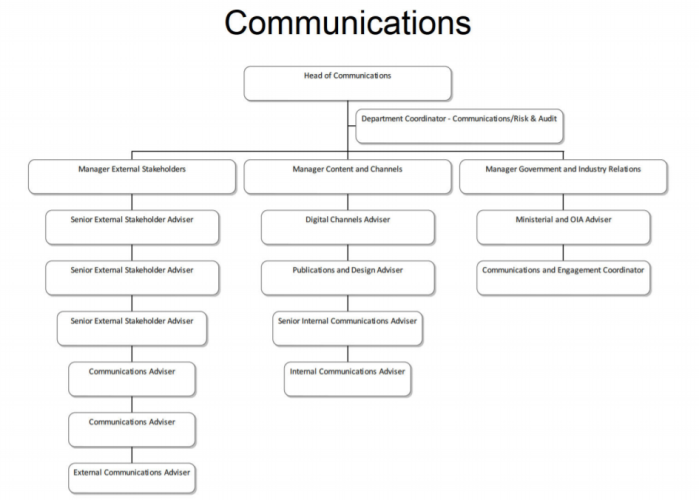
RB corporate 2

The full text of the email is here.  It was sent out under the heading “Our priorities and key progress on our mahi” (“mahi” apparently means work, but whether in Maori it carries a sense of responsibilities or of self-chosen agendas isn’t clear to me).   Among the Bank’s self-chosen roles appears to be the campaign to change the name of the country, given the repeated use of “Aotearoa” for New Zealand.

The newsletter isn’t long but it is quite telling.

It begins with this bumpf

While a new ‘normal’ is emerging in New Zealand after the initial response to the COVID-19 pandemic, the pandemic continues to have significant and ongoing consequences across the globe. We are actively engaging with our Central Banking colleagues around the world to share policy advice and insights. As explained in this recent op-ed from Governor Adrian Orr, it is clear from our discussions that the COVID-19 health shock is impacting nations in similar ways, however, the economic and policy impacts differ greatly.

I wrote about that content-lite zone on Monday.

Here in Aotearoa, although we have successfully contained the virus, and many parts of the economy are back up and running, households and businesses face uncertain times and potential further disruption as the full economic impacts of the pandemic become evident.

Name of the country aside, I guess it is unexceptional, but also rather empty.  She goes on

We at the Reserve Bank, Te Pūtea Matua, need to keep working together with all of Government and industry, just like we did at the start of the pandemic, to respond to the challenges. We need to be prepared to manage our economic recovery well, while not losing sight of delivering for the long-term interests of all those in Aotearoa.

These “long-term interests” –  whatever they are –  are simply not something the Reserve Bank has responsibility for.  It seems to be cover dreamed up by the Governor to weigh in on anything he chooses.

And that is it on anything even close to the core responsibilities of the Bank.   Inflation –  let alone inflation expectations – doesn’t get a mention at all.  Nor does (un)employment, that the Bank was so keen on talking about last year.  Nor, perhaps to no one’s surprise, does the utter failure to have had the banking system positioned for negative interest rates –  supposed now to be work in progress, in a highly core area, but no mention here whatever.  Instead, we learn what the Bank has been devoting its energies to

Alongside supporting the economy and all New Zealanders by providing liquidity to banks and coordinating monetary and fiscal policy settings, we have also continued to deliver on our commitments including:

  • Jointly working with The Treasury to see the new Reserve Bank of New Zealand Bill introduced to Parliament
  • Publishing the Statement of Intent (SOI) for 2020-2023 and further embedding our Tāne Mahuta narrative
  • Agreeing to a new five-year Funding Agreement to ensure our long term commitments are met
  • Progressing our Te Ao Māori strategy through our economic research and proactive outreach to regulated entities, Government and Māori partners
  • Working closely with our fellow Council of Financial Regulators (CoFR) members to manage and co-ordinate regulatory work to enable the financial sector to focus on their customers.

During this time, some of our initiatives have received sharper focus as we look to respond to COVID-19 challenges. For example, the financial inclusion issues that are being faced by everyday New Zealanders. We congratulate the banking sector for their leadership in recently becoming the first living wage accredited industry in New Zealand.  It is also a good time to deepen our collective understanding of climate change risk in the financial sector, and ensuring we are all taking a long term and sustainable approach to economic recovery and future resilience.

We are using this period to consider what is ahead and what steps we need to take so we can live up to our vision of being ‘A Great Team and Best Central Bank’ and deliver as kaitiaki (caretaker) against the commitments we made in our SOI.

Actually, the Bank doesn’t “coordinate monetary and fiscal settings”: the Minister of Finance sets the Bank a target, and the government sets fiscal policy, and then the Bank (MPC) is just charged with getting on and doing its monetary policy job, given all of that.

But even set that to one side, what do we see prioritised?    Well, there is the tree god nonsense that the Governor seems so fond of.   Perhaps it does little harm –  although as I’ve unpicked it in the past it is often actively misleading –  but right up there at number two on the list?    Then, of course, we get the Bank’s Maori strategy –  something that is not clear is necessary at all (in a wholesale-focused organisation) –  or which has generated anything of substance (and no research, despite the claims here) in support of the Bank’s actual statutory responsibilities.  But it advances the Governor’s personal whims and preferences I guess.

Then we move off the bullet point list and on to the next paragraph, and even more highly questionable stuff.  There is that line about “financial inclusion” which, whatever it means, clearly has nothing whatever to do with the Bank’s twin responsibilities for financial stability and macroeconomic stabilisation.   There might be some worthy issues there, at least on some reckonings, but they are nothing to do with the Bank.

Then –  and this was the one that caught my eye –  there is the weird reference to the banking sector and the so-called “living wage”.    I’m sure the Green Party must love that settlement, and whatever deals banks want to sign up to for their staff is really their affair, but what has it to do with a prudential regulator, the Reserve Bank –  which is not, repeat, some general regulator of all banking sector activities?    I suppose we should be grateful not to see the Bank praising the Kiwibank decision to refuse banking facilities to lawful and creditworthy businesses doing business that the Governor profoundly disapproves of.

But perhaps that is encompassed by the next sentence.

“It is also a good time to deepen our collective understanding of climate change risk in the financial sector”

Not clear why it is a “good time” (one might have supposed a higher priority now might be, for example, understanding the risks to the financial sector from a prolonged downturn and limited monetary policy response, or to have understood better the issues and options around macro-stabilisation and the (current) effective lower bound on nominal interest rates).  But, for what it is worth, I think we can pretty easily conclude that the risks of climate change to the New Zealand financial sector are vanishingly small.  But acknowledging that might make the Governor’s position – endlessly weighing in on these personal causes –  seem more obviously inappropriate.

And who knows what lurks beneath that

ensuring we are all taking a long term and sustainable approach to economic recovery and future resilience

It isn’t even clear whether the “we” is supposed to refer to the Reserve Bank or the rest of us.  What is clear is that none of it has anything much to do with the monetary policy responsibilities of the Bank –  the bits actually to be able recovery.  Full employment, conditioned on price stability, should be what matters, but none of that gets a mention at all.

And then Robbers ends with this

We are using this period to consider what is ahead and what steps we need to take so we can live up to our vision of being ‘A Great Team and Best Central Bank’ and deliver as kaitiaki (caretaker) against the commitments we made in our SOI.

As I noted earlier in the week there was a speech on this topic a month ago.  It was startlingly empty, devoid of any real sense of (a) why this goal made sense, (b) how the Bank, and those it works for, might know if it was achieving the goal, or (c) what steps management was taking to deliver on the goal.  When he delivered the speech, I noted down a strange comment from the Governor about how it is “therapeutic” to be able to think about these issues.  Even at the time it struck me as a luxury most private businesses wouldn’t have, and one one might not expect a central bank grappling with a deep economic downturn, falling inflation expectations, rising unemployment etc  to have either, at least if it were doing its job.  Then again, the Bank has a big budget and no real accountability so I guess the Governor can simply pursue his whims.

And that is about it.

In a way none of it was that surprising.  This is the Reserve Bank that Orr has been creating in his own image: one that simply isn’t doing its job well, doesn’t have its eye on the ball, shows no sign of thinking deeply about the core challenges it should be addressing….all while pursuing the personal ideological agendas of the Governor (and his handpicked senior management –  most probably you don’t get or keep a job on the top team –  or perhaps further down the organisation either- unless you are all-in with his alternative, non-statutory agenda).  We deserve a lot better, the economy needs more, but there is no sign that the Bank’s Board –  paid to hold the Governor to account –  or the Minister of Finance care.  It is just another marker on the journey of the degrading of the capability of our economic institutions, and of the legitimacy and authority of our autonomous central bank.

There was one final thing I noticed deep down the email (which had various links to other bits and pieces).  As I’ve noted regularly, the new Monetary Policy Committee has now been in place since 1 April last year.  In that entire time, including through some of the bigger macro challenges in modern times, we’ve heard not a word from any of the three external members of the Committee, the ones carefully selected to not be awkward for the Governor, to meet the government’s gender quota, and to exclude –  consciously and deliberately – anyone with current monetary policy or macro expertise.  But now we have.  There is a couple of minute Youtube clip where we see and hear from the externals.   Not, of course, that they say anything of substance, anything about actual monetary policy, inflation, employment or anything.  But they wax lyrical about a wonderful collegial process, and what a learning opportunity has been –  and about how they don’t pay much attention to things for six weeks and then get together, with no undue influence from anyone.  No doubt they are all deeply sincere, but it did have a bit of sense of a hostage video, produced to show that the Committee really exists. It should assuage no concerns at all about the structure, the people, the lack of transparency, and the lack of accountability.
Not expecting enough inflation

I’ve been banging on about the decline in inflation expectations, and the apparent indifference of the Reserve Bank to that, for most of this year.

It was different late last year.  Then, the Bank was making the case –  at least after the event –  for easing monetary policy fairly aggressively with one of the considerations being avoiding the risk of inflation expectations settling lower than was really consistent with the target.  Then –  last year –  the Governor went so far as to suggest that he would prefer to be in a situation where hindsight proved that they had overdone things a little, with expectations rising, and needing to think about raising the OCR again.   They were totally conventional sorts of line for central bankers to enunciate, especially if they were getting uneasy about approaching the conventional limits of the OCR.  I commended the Bank at the time.

This year the Bank –  Governor and MPC –  seem to have given up again, just when it matters; amid the most severe economic downturn in ages, amid significant actual falls in inflation expectations.  As a reminder, unless steps have been taken to remove the effective lower bound on nominal interest rates (and that has not been done anywhere yet) then the lower inflation expectations are, all else equal, the less monetary policy capacity there is to do the core macro-stabilisation job of monetary policy.   And that risks being a self-reinforcing dynamic.

There is no single or ideal measure of inflation expectations.  There are different classes of people/firms for whom such expectations matter, and different time horizons that matter.   Very short-term expectations get thrown around by the short-term noise (notably fluctuations in oil prices).  Very long-term expectations (a) may not matter much (since there are few very long-term nominal contracts) and (b) probably won’t tell one much about the current conduct of macro policy (whatever inflation is going to be between, say, 2045 and 2050 isn’t likely to much influenced by whatever is going on now, or those –  ministers or MPCs –  making monetary policy decisions now.

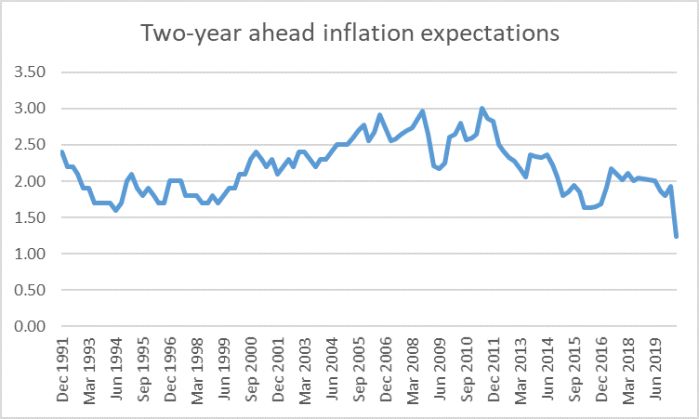
For a long time, the Reserve Bank’s preferred measure of inflation expectations was the two-year ahead measure from the Bank’s survey of the expectations of several dozen moderately-informed or expert observers.  Two years got beyond the high-frequency noise, and the survey only added questions about five and ten years expectations in 2017.

2 yr expecs july 2020

In the latest published survey expectations fall very sharply.    There will be an update on this series published next week.  I wouldn’t be surprised if there was a bit of a bounce, but I wouldn’t expect it to be large.  The Reserve Bank’s own Monetary Policy Statement will be released the following week.  Perhaps they may have become a bit more optimistic, but recall that in May their inflation outlook –  even backed by their beliefs about the efficacy of their LSAP bond purchases –  was very weak.   Two years ahead their preferred scenario had inflation just getting back up to about 1 per cent.

Now, of course, things are somewhat freer in New Zealand than they were back when those earlier surveys and forecasts were done –  perhaps even more so, sooner, than most expected back then.  On the other hand, the border restrictions remain firmly in place and the wider world economy –  which seems to get all too little comment here –  is only getting worse.   I noticed in the Dom-Post this morning that that is now the official advice of The Treasury to the Minister of Finance.

All of this is, however, known by people participating in the government bond market.  And since the New Zealand government now issues a fairly wide range of bonds, and a mix of conventional bonds and inflation-indexed bonds, we can get a timely read on the inflation rates that, if realised, would leave investors equally well off having held a conventional bond or an inflation-indexed bond (the “breakevens”).   They aren’t a formal measure of inflation expectations, and at times can be affected by extreme illiquidity events, but it is also unlikely there is no relevant information (although Reserve Bank commentary tends to act as if this data can/should be completely ignored).

For a long time, there was only a single indexed bond on issue in New Zealand.  The Bank had persuaded the government to issue them back in the mid 1990s, but then emerging budget surpluses meant issuance was discontinued.  The single indexed bond matured in February 2016.  For a long time the longest conventional bond was a 10 year maturity.  But even with all those limitations, the gap between the indexed bond yield and the Bank’s 10 year conventional bond rate looked plausibly consistent with “true” inflation expectations.  Through much of the 00s, for example, the breakeven was edging up to average about 2.5 per cent.   Recall that there was never much of the indexed bond on issue, and never much liquidity either.

Since 2012 there has been a new programme of inflation-indexed bond issuance, and there are now four maturities on issue (September 2025. 2030. 2035, and 2040).   Go back five or six years to the time when the Reserve Bank (and most the market) thought higher interest rates were in order and you find that the breakevens were close to 2 per cent.  Given that in 2012 the government had slightly reframed the Reserve Bank’s monetary policy goal to require them to focus on the target midpoint of 2 per cent, breakevens around that level were what one would have hoped to see.  And did.

After that, things started to go wrong, with the breakevens beginning to fall persistently below target.  As it happens, of course, by this time it was increasingly realised that actual core inflation was also falling below target.

But what of the more recent period?   One problem in doing this sort of analysis, if you don’t have access to a Bloomberg terminal, is that the data on the Reserve Bank website used to provide yields for the four individual inflation-indexed bonds, but only benchmark five and ten year yields for conventional bonds (ie not yields on specifically identified individual bonds).  That didn’t much over very short-term horizon –  there just aren’t that many bonds on issue –  but potentially did for slightly longer-term comparisons.  However, in the last week the Bank has started releasing daily data on yields on all the individual government bonds on issue, indexed and conventional, back to the start of 2018.  That is most welcome.  As it happens, the government has also now started issuing a conventional bond maturing in May 2041, reasonably close to the maturity of the longest inflation-indexed bond.

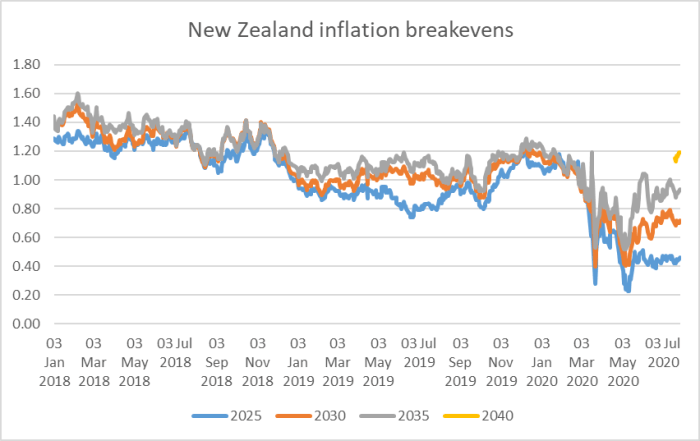
In this chart I’ve calculated breakevens as follows:

  • take each of the indexed bond maturity (September 2025, 2030, 2035 and 2040)
  • use conventional bonds maturing in April 2025 and May 2041, and interpolated between bonds maturity in April 2027 and April 2033, and between bonds maturing in April 2033 and April 2037 (to give implied conventional bond yield for April 2030 and April 2035)
  • calculate the difference between each indexed bond and the yield on the conventional bond with the closest maturity date.

long-term breakevens

These breakevens, or implied inflation expectations, were uncomfortably low (relative to the target) even back in 2018. Things have only got worse since then.

Not that these are not breakeven inflation rates (or expectations) for a single year –  say 2025-  in the way that survey expectations (including the RB survey) are.  They are indications about average CPI inflation over the whole period to, say, 2025.

I thought there were several things that were interesting about the chart:

  • breakevens seemed to be trending downwards (if only modestly) well before the current recession began.  That seemed pretty rational –  the growth phase (here or abroad) wasn’t likely to last forever, and it was becoming increasingly clear that central banks were likely to feel quite constrained in the next downturn,
  • the divergence between the blue line and the other two this time last year.  That was when the Reserve Bank felt obliged to cut the OCR quite bit, and to start running those lines I referred to at the start of this post about downside risks around inflation expectations.  One could interpret the subsequent closure of the gap as a mark of some credibility for the Reserve Bank.  Expectations of inflation over the next five years rose a bit, and the gap between the 2025 and later expectations closed up again.
  • the sharp decline in the breakevens, for all three maturities, beginning in March.  Some of that will have been about the extreme illiquidity event in global (and local) bond markets in mid-March (something similar happened in 2008/09), prompting various central banks, including our own, to intervene in bond markets,
  • perhaps most importantly, the substantial divergence that has now opened up between the breakevens for the period to 2025 and those for the longer maturities.  All three lines picked up to some extent after the Reserve Bank added inflation-indexed bonds to the list of assets they would buy under LSAP, but since then the breakeven for the period to 2025 has gone basically nowhere, sitting at just above 0.4 per cent per annum (compared to an inflation target over the period of 2 per cent per annum).  By contrast, the grey line is back close to 1 per cent, not that much below where it was last year.   Even these lines understate the extent of divergence, because the breakeven to 2035 includes the five years to 2025.    If we could back out an implied breakeven just for the five years from 2030 to 2035 it might be around 1.3 per cent –  still not great, still not consistent with the target, but no worse than last year.
  • to the extent one can yet read anything into the 20 year numbers, and implied breakeven inflation rate for 2035 to 2040 would be higher still, although still below 2 per cent.

There are pluses and minus to be taken from all this.

The positive feature is that if one looks 15 years ahead, markets don’t expect New Zealand to deliver on a 2 per cent inflation target, but their (implied) view on that is no worse now than it was last year.  That isn’t great but it is better than the alternative.   On the other hand, it tells you almost nothing about the current conduct of monetary policy, since (a) current monetary policy won’t be affecting inflation outcomes 15 years hence, and (b) almost certainly, neither will the current key players (Orr or Robertson).

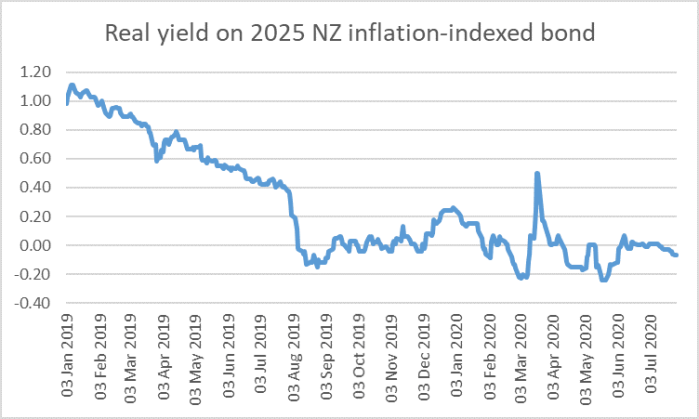
The negative feature is just how weak those five-year average expectations are, averaging around 0.4 per cent, well below the bottom of the target range, let alone the 2 per cent midpoint the MPC is supposed to focus on.   And this is the horizon that current monetary policy is affecting, and which the current key players (Orr, Robertson, and the MPC) will be affecting.    And these breakevens are down so far this year that real interest rates have not fallen much at all.   Here, for example, is the real yield on the 2025 inflation-indexed bond.

2025 real yield

No change over a year.  Or even if there was something odd going on at the end of July last year, no material change since (say) February this year, even as a severe recession and deflationary shock hit New Zealand and the world.  Even with the Reserve Bank intervening to support this market.   That is a pretty damning commentary on monetary policy simply not doing its job –  real yields over a five year horizon will always be heavily influenced by expected changes in short-term real policy rates.

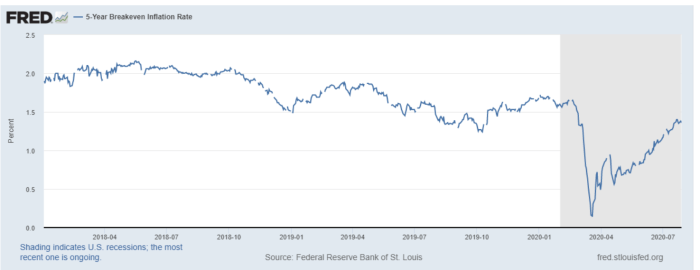
As a final cautionary note, the deflationary shock was pretty much global in its effect, but here is the five year breakeven chart for the United States since the start of 2018.

US 5 yr

Not only can you see how much closer the breakeven has been to the Fed’s target for the inflation rate but, more importantly in the current context, how strongly the five-year breakeven has rebounded since March.   It is a very different picture to what we’ve seen in New Zealand.   There are some differences: the respective inflation-indexed bonds are slightly differently specified, and the Fed is not buying indexed bonds (unlike the RBNZ). But all else equal, the fact that the RB is buying indexed bonds and the Fed is not should be pushing New Zealand breakevens up relative to those in the US.  [UPDATE: A reader  draws my attention to the fact that the Fed is buying TIPS.]

The Governor and the MPC seem to have been all too keen to abdicate responsibility in this crisis, deferring almost everything to fiscal policy and simply refusing to cut the OCR further.  How much fiscal stimulus to do is a political matter outside the Bank’s control, but however much the government has done –  and it will soon be doing less, as the wage subsidy ends –  it is increasingly clear that the Reserve Bank is simply not doing enough.  Low and falling inflation expectations are inappropriate, inconsistent with the mandate, at the best of times, but far more troubling when central banks are unwilling to take official short-term rates deeply negative.  The Governor and his colleagues seemed to know that last year when it wasn’t much of an issue, but to have forgotten –  or simply chosen to ignore it –  this year.  It is as if they are simply indifferent to the (un)employment consequences.  That shouldn’t be acceptable, including to the Bank’s Board and the Minister of Finance who are responsible to us for the MPC’s stewardship.


Empty vessels

A month or so ago I went along to hear the Governor of the Reserve Bank speak at the Law and Economics Association in Wellington.   LEANZ is a pretty geeky sort of organisation (or attracts pretty geeky sorts of people) and against the background it was quite surprising how little substance there was to the Governor’s speech, which was billed as “Delivering on Great and Best” at the Reserve Bank.  That is the Governor’s grandiose vision: his predecessor claimed to want the Bank to be the “best small central bank” in the world (although did little or nothing about it, including no relevant benchmarking) but Orr takes that a giant step further and claims to want to be the best central bank in the world.   You might think that harmless –  always good to aim high etc –  but in a small country, not very prosperous, it isn’t clear that it is even a sensible goal, and in practice it seems to function mainly as a way of distracting attention from the manifest inadequacies of the Bank, especially under the stewardship of Orr.

I don’t want to spend any time on last month’s speech –  there really isn’t much there –  but it came to mind when I read yet another empty piece from the Governor yesterday, this time a column in the Sunday Star-Times. I don’t suppose economists were the target audience, but a couple of non-economists I talked it over with seemed to have much the same reaction to it that I did.

It is framed as some sort of disclosure of the inner secrets of the central bankers’ temples.

As New Zealand’s Reserve Bank we hear directly ‘from the horse’s mouth’ what our global colleagues are experiencing and doing.

Thing is, there is this new-fangled invention called the internet, and we too can read all about the activities of other central banks, the speeches of their bosses, the minutes of their decision-making committees.    In New Zealand’s case, of course, there has been not a single serious speech on monetary policy or the economic situation from the Governor or any other member of the MPC since they finally woke up to the economic threat Covid, and associated responses (public and private), posed.  But that generally isn’t the case in other advanced countries.   Check out, just as examples, the websites of the Fed, the ECB, the RBA, or the Bank of England.   We can read them, or media reports of them, for ourselves.

But, setting that to one side for the moment, what fresh insights does the Governor have for us from his chats with his central banking peers abroad?

From our most recent interactions it is clear that the common and (almost) simultaneous Covid-19 health shock is impacting nations in similar ways, but the policy reactions and outlooks ahead vary greatly.

Hard to know what the first part of this is actually supposed to mean –  after all, the health risk might have been similar across countries, but the actual experience of the “health shock” varied, and varies still, very greatly.  And as for the second half of the sentence, it isn’t clear whether he is talking about economic policy responses, public health responses or what, let alone which outlook –  economic or virus – he is talking about.  It seems to be the economic side of things, judging from the next sentence.

The differences are in large part explained by the initial health of their economy, the underlying drivers of economic activity, and the degree of success in containing Covid-19.

But then it is not clear at all what he is basing anything of this on.   Some countries have a rich array of high frequency official data, in some cases even monthly GDP data.  Here in New Zealand, our latest official labour market relates to the March quarter.     We’ll get an update on that –  for the whole of a quarter centred back in mid-May –  early next month, but we’ll have no read at all on GDP for that June quarter until mid-September.  Not that long ago there was a general sense that our June quarter GDP might have fallen quite a bit further than that in most other advanced countries –  sufficiently onerous (rightly or wrongly) was our “lockdown” – but we are still flying blind even on that.

The column appears to be some sort of effort to suggest the New Zealand economy is now doing (relatively) well, but Orr cites no data to support that implication, unsurprisingly perhaps as there really is little such data.

He goes on

The more robust an economy was when first impacted by the pandemic, the more options and flexibility its local policymakers had to respond.

I guess it must be some sort of self-reinforcing conventional wisdom among economic policy elites, but where is the evidence for the claim?   Almost every advanced country has done very little very monetary policy and a great deal with fiscal policy –  whether it is the highly indebted US and UK, or countries with little public debt like New Zealand and Australia.

Orr continues

Amongst this ‘robust’ group, the initial policy actions have been very similar.

They generally included: ensuring credit and cash is cheap and accessible, increased government spending and investment, support for employers to pay wages and access credit, and additional welfare payments.

Although, of course, as already noted the typical central bank –  including the RBNZ –  has done very little that matters (lots of sound and fury though), and although I haven’t checked I’d surprised if credit conditions haven’t tightened in other countries too, as they have in New Zealand.   And what Orr doesn’t seem to want you to reflect on is that most of the sorts of measures he lists are palliatives: there is place for those, but they do little or nothing to get economies promptly back towards full employment.    That is/was the job of monetary policy, but central banks –  including our MPC –  seem to have abdicated that responsibility, with politicians (including ours) apparently content to let them.

However, the economic impact has varied significantly, especially across sectors of each economy.

The more reliant a nation is on primary production (especially food export revenue) and the manufacture of durable goods (especially e-technology), the better it has fared.

By contrast, the more reliant a nation is on the provision of face-to-face services (e.g., tourism and hospitality) the bigger their fall.

There seems to be no evidence for the loose claims in the second sentence.  At least in the OECD there is really only one country heavily reliant on “food export revenue”, and we just don’t have any data yet on how overall economic performance is doing, let alone how it will do as, for example, the wage subsidy ends.   (Oh, and if you are tantalised by, say, PMI readings above 50 –  as I heard the Minister of Finance going on about in the House last week –  recall that (a) these are directional measures only, and (b) our initial trough, even on these surveys was deep)

Then there was this odd comment

Common for all nations is that uncertainty and economic confidence is highly-related to perceptions that the pandemic is regionally ‘contained’.

Not quite sure what “regionally” has in mind here, but in New Zealand itself at present there appears to be no locally-transmitted Covid, in the wider South Pacific and east Asian region there isn’t much, and yet uncertainty remains high, confidence remains modest, because people realise (a) how easily things could unravel, and (b) increasingly, the severity of the worldwide economic downturn.

There was then this loose comment

The common view amongst our international colleagues is that their local economy cannot perform at capacity with the pandemic.

I guess it depends how you define capacity, but sure when people were forced by state edict to stay home many could not work at all.  Once we are beyond that point, again Orr’s interpretation of what his colleagues are saying seems like an abdication of responsibility by central bankers.  There are market-clearing interest rates (and exchange rates), but central bankers have decided to do little or nothing about getting actual rates to line up with those market-clearing rates.  They are simply content, it seems, to accommodate sustained higher unemployment.  Coming from someone who last year was only too keen to talk up the new employment references in the Bank’s mandate, it is somewhat surprising.

In general, household spending and business investment continues to lag behind incomes and earnings. This highlights one limitation of easy monetary conditions in expanding demand.

It does nothing of the sort.  What it highlights is the utter failure of macro policy in current conditions.  The first sentence of the Governor’s comment –  re saving and investment – is almost a classic statement of the case for temporarily much lower interest rates.  And yet, in New Zealand, the Governor and the MPC have pledged not to do anything about the OCR until at least March, never mind the attendant excess capacity.

The Governor turns to the future

Looking ahead, accurate prediction is impossible, but preparedness is necessary and feasible.

The type of scenarios policymakers are mulling include: options for when/if a vaccine is developed; the establishment of Covid-19 ‘safe’ trade and travel bubbles; and the management of rolling waves of regionally-contained Covid-19 outbreaks.

Accurate prediction is always impossible.  But that second paragraph is all about stuff that has nothing whatever to do with central banks.  And as he comes towards the end of his columns we get a series of content-lite bromides.  Thus

Globally, the general conclusions are that economic activity needs ongoing support by both government and central banks, and that government fiscal policy is the most potent.

Yes, we know that central banks have done almost nothing, so it is hardly surprising that whatever mitigation of the economic damage is being done by fiscal policy.  The Governor seems unable to distinguish timeframes: fiscal policy is/was good at offsetting immediate income losses, but monetary policy works powerfully on slightly longer lags, and the economic challenges aren’t going away.

Oh, and even the Governor recognises the limitations –  technical, or more likely political – to fiscal policy

There is also much awareness that fiscal policy cannot subsidise everyone forever. Examples of more targeted government interventions – such as sustainable infrastructure initiatives, and retraining and people mobility are being shared.

These policies are more complex to create and implement, especially at pace and scale.

Interest rates and exchange rates, by contrast, adjust almost instantly, get in all the cracks, and require no state mortgage on all our futures.

The Governor moves on to matters perhaps a bit closer to his responsibility.

Financial stability is also a key focus. The current broad consensus is that banks must be focused on the long-term interests of their customers, which will take strong regional bank leadership.

But it is not clear, at all, what that second sentence means.  Whose “broad consensus”?  And what about the interests, short or long term, of the people who actually own the banks.  And what is this “strong regional bank leadership” all about.   Oh, and how does the Governor square whatever it is with the (apparently entirely rational) tightening in credit conditions reported in the Bank’s recent survey.

Then we get this strange paragraph

The financial markets’ tools for measuring risk and allocating money must also be switched on and working, to best assist the reallocation of economic effort. The current big change drivers are more local-regional trade, simpler supply chains, and the rapid adoption of technology to deliver services.

Whatever it is supposed to mean, you might suppose that adjustments in interest rates and exchange rates would be among those “financial market tools”.  And quite what relevance does “simpler supply chains” have in a New Zealand, where few firms are part of complex supply chains, and I’d have thought we really didn’t want many people focused on “more local-regional trade” when our ministers and officials keep talking up keeping international trade connections strong.

And he ends

New Zealand had a robust economic starting point at the onset of the pandemic. We have a backbone of primary production and exports. And, for now, a credible containment of the Covid-19 virus.

But, we also have significant reliance on services that require face-to-face interaction. We need to be prepared for multiple health and economic scenarios so as to best manage through the pandemic and arrive at a more sustainable economic place.

But even if you agree with each of those individual sentence (and, at a pinch, I probably could) aren’t you left wondering “so what?”   And with no sense at all that whatever happens here, we in the teeth of a worsening global economic downturn, with monetary policy doing little or nothing and even the Governor –  most vocal champion of more use of fiscal policy in recent years – articulating a view that fiscal policy has its limits.

Surely we deserve more substance, on stuff the Bank is actually responsible for, from the Governor?  And from his senior management members of the MPC.  As for the external members, they collect a lot of money from the taxpayer each year, and yet seem to operate as if being invisible, silent, and unaccountable is some sort of badge of honour.

One would like to think that there is more depth, more substance, to offer but the Bank refuses to release any supporting analysis, publishes no relevant research, exposes most of the MPC members to no public scrutiny, and for those we do hear from –  the Governor foremost –  there is a disturbing sense of people really rather out of their depth, and perhaps just not that interested.  More fun to play tree gods and talk climate change than to actually do the core macro stabilisation role Parliament has charged them with, in the midst of the most severe global downturn in a long time, one in which little beyond immediate mitigation is being done to get countries quickly back to full employment.  Policymakers here are no better, but whatever is being done here, the less that is being done abroad, the more we need our own policymakers to be doing.  Unemployment is a terrible thing, and yet it barely rates an allusion in the Governor’s column.  As for inflation, it is a core part of the Bank’s responsibility, expectations have been falling here and abroad –  risking compounding the macrostabilisation challenges –  and it got not a mention at all.

Back in that speech a month ago, the Governor indicated that the government would be introducing new legislation reforming Reserve Bank governance before the House rises for the election (so this week or next).  That reform is long overdue, but under current stewardship –  Governor, Minister –  we should no more expect improvement from these next changes that we secured from the establishment of the MPC.  You’ll recall that the Governor and Minister got together to blackball anyone with current monetary policy or macro expertise from serving on the MPC.    That gap is really starting to show up now.

Credit conditions

The Reserve Bank conducts a six-monthly survey of banks on aspects of credit conditions, trying to get at things not just captured in headline base bank lending rates.  The last regular survey was conducted in March but, of course, quite a lot has happened since then.  So, to their credit, the Bank has conducted a one-off additional survey in June to try to get a sense of how Covid and the associated economic disruption has changed things.    The numbers and the Bank’s write-up are here.  There is a good series of summary charts at the back of the write-up, some of which I will be using in what follows.

The survey has both current/backward looking questions and questions about the outlook, differentiated by type of borrower (SME (turnover less than $50m per annum), household, corporate, agriculture, and commercial property).   Here is the Bank’s note

The June Survey was completed in the last two weeks of June 2020 by 12 New Zealand registered banks, including all of the five largest banks. The period covers credit conditions observed over the first six months of 2020 and asks how banks expect them to evolve over the second half of the year.

In the face of a severe, unexpected, economic downturn, and a substantial lift in uncertainty about the outlook, you’d probably have expected credit conditions to have tightened.  For any given level of interest rates, banks would be less willing to lend.   That would be an entirely rational response, even if banks were quite confident about their overall financial health based on the existing loan book.  Credit demand –  which respondents are also asked about –  is a bit more ambiguous: credit demand for new activities might reasonably be expected to take a hit, but some borrowers will have a heightened demand for credit to tide them over a sudden unexpected loss of income.

What we see in the survey is, more or less, what one might have expected.  Sadly, the survey hasn’t been running long enough to benchmark the data against developments in previous recessions.

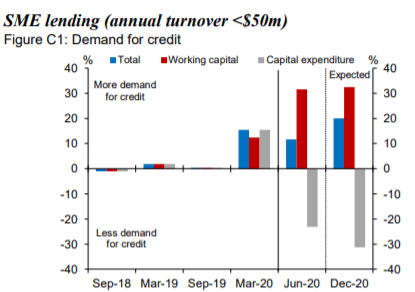
On the demand side, the two competing effects are most visible in the responses for SMEs.

cconditions 1

Working capital demand has increased a lot, and is expected to increase a lot more in the second half of the year, while demand to finance capital expenditure has fallen quite a bit and is expected to fall a lot further.     The picture for bigger corporates is similar, if perhaps not as stark.   Overall demand for credit increased for these two business categories, but fell for all the others.  “Credit availability” fell, as one would expect, across all these subsectors, and is expected to tighten further in the second half of the year.

One of the good things about this release write-up is that the Reserve Bank has released detailed disaggregated data from the survey that they do not usually publish.  Quite why they don’t publish it routinely is an interesting question, but then this is an organisation not exactly known for its routine transparency –  although you’d think that data collected under a statutory mandate, collated at tsaxpayers’ expense, should be routinely published.

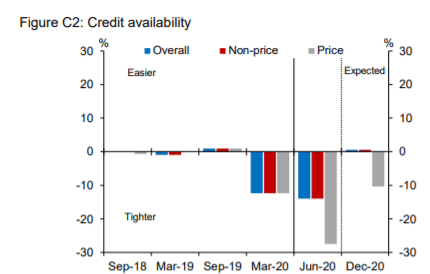
Anyway, the data are there this time.    First, there is a distinction between the price and non-price aspects of credit availability, actual and expected.  Higher credit spreads will be the key aspect of price.

For households (mortgage and personal lending) all the actual and expected tightening in credit availability took the form of non-price measures, but for all four business categories the price effect (higher credit margins over base lending rates) dominated.  Here again, as illustration, is the chart for SMEs.

c conditions 2

There is a further degree of disaggregation on the aspects of the credit availability responses, but only for the period already been.  For each subsector respondents are asked about:

  • collateral requirements,
  • serviceability requirements,
  • maturity and repayment terms,
  • covenants,
  • interest markups
  • other price factors.

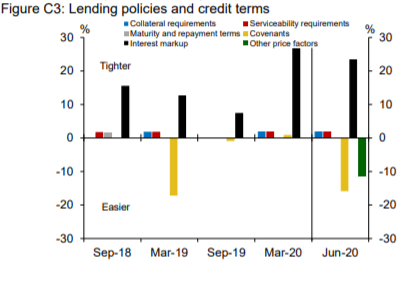
For households, the only material changes were (tighter) serviceability requirements.  That is interesting –  if not too surprising –  given (a) slightly lower interest rates, and (b) some temporary easing in the Bank’s LVR restrictions.

Here is the chart for SMEs

CC SME

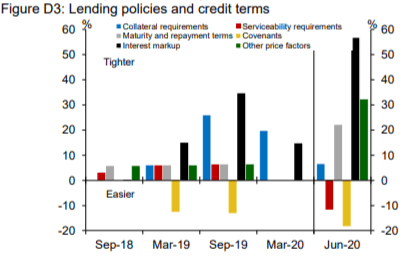
and for larger corporates

CC corporate

There are some interesting differences, but the stark similarity is in the higher interest rate mark-ups.  For both subgroups, covenant requirements appear to have eased – one guesses semi-involuntarily as many borrowers will probably have blown through previous loan covenants.  I don’t know quite what to make of the differences in the green bars –  “other price factors” – but would welcome any comments/suggestions.

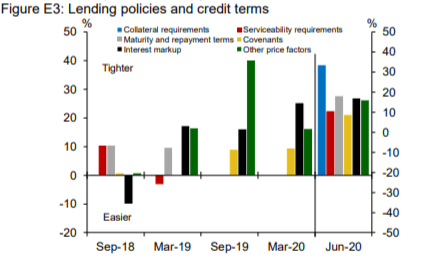
What of commercial property loans?

cc comm property

That’s pretty stark.  For every component, policies and conditions have tightened, apparently quite materially.  Perhaps not too surprising –  and in many past downturns –  commercial property loans, especially those on new developments, have been a key source of bank losses-  but interesting nonetheless.

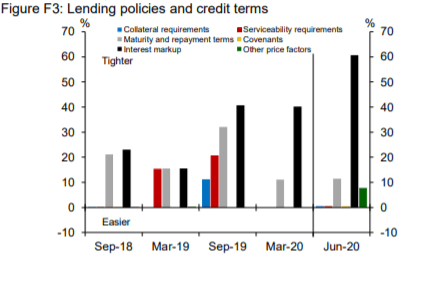
And, finally, agricultural loans.  Farmers keep farming, and –  for the moment anyway –  commodity prices have held up. But in any global economic downturn, commodity prices often bear the brunt. In this case, the adjustment by lenders appears to have been mostly in the interest mark-up agricultural borrowers face.  As the graph shows, credit spreads have been widening for some time, in the face of some mix of factors including the Bank’s markedly increased capital requirements (farm borrowers tend to have alternative sources of finance).

cc agric

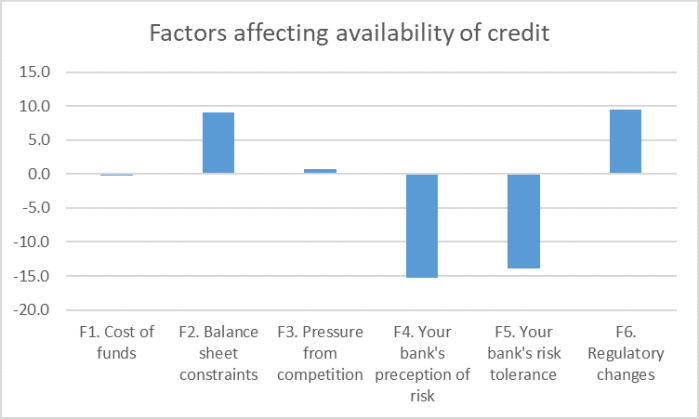
The final component of the survey asks about factors influencing the availability of credit.  There isn’t a line for “severe unexpected recession etc”, but here were the interesting aggregate responses to the standard list of items.

cc factors

Cost of funds is almost invisible as an issue –  whether wider credit spreads in funding markets or lower base (OCR etc) rates –  and so is any change in competitive pressures.

Respondents suggested that regulatory changes had been helpful –  presumably this will refer to the temporary suspension of the OCR restrictions, the temporary delay in the increase in minimum capital ratios, and perhaps the temporary reduction in the minimum core funding ratios.  Together these changes have, as one might expect, worked to mitigate a tightening in credit availability, but note the aggregate effect is not that large.   On the other side of course, the two material effects are an adverse change in the banks’ assessment of risk, and in the willingness of banks to take any given level of risk.  Both seem highly rational and sensible responses in a climate like that of recent months.

What to make of it all?   Probably none of the results is terribly surprising, and it will be interesting to see how these results compare with those of the next regular survey in September (when we must hope the Bank will again release more-disaggregated data).

I guess what struck me was the widening in the credit spreads business borrowers have been facing.  The published time series data from the Reserve Bank on business lending rate is pretty lousy –  a single series for “SME new overdraft rate”.   That headline rate has fallen only about 70 basis points this year.   That isn’t too surprising –  since the OCR has fallen 75 basis points, and floating mortgage and bank bill rates not much more.  The credit conditions survey tells us that typical business credit spreads over base rates have risen (probably quite rationally so in the changed economic climate).  But we also know that inflation expectations have fallen quite a lot –  data from the indexed bond market suggests about 70 basis points this year.  In other words, the combination of increased risk perceptions and a passive central bank doing little or nothing, in the face of one of the most severe economic downturns, here and abroad, for many decades, real business lending rates are rising.     That is quite insane outcome, but a choice made by Orr and the MPC, and apparently condoned by the government (and the Opposition for that matter).  It is quite extraordinary, almost certainly without precedent in a country with (a) a floating exchange rate, and (b) a sound financial system, and (c) sound government finances.

One half of the government’s brain seems to recognise the issue.  They just extended the scheme whereby small businesses can get interest-free loans from the government.   Quite why they think those favoured few –  in many cases, probably some of the worst credits –  should be able to borrow at zero while the rest of the economy  (but especially the business sector) borrows at materially positive real interest rates, often complemented by tightening non-price conditions is a bit beyond me.

Oh, and remember that this surveys suggest banks expect credit conditions to tighten further from here.

National’s five-point plan

At the end of my post yesterday morning I noted briefly

Of course, if Labour’s approach is bad, at least (being the government) it is on the table.  It is now less than two months until voting starts and we have no idea what National’s approach might be, but no reason to suppose it would be materially different or better.

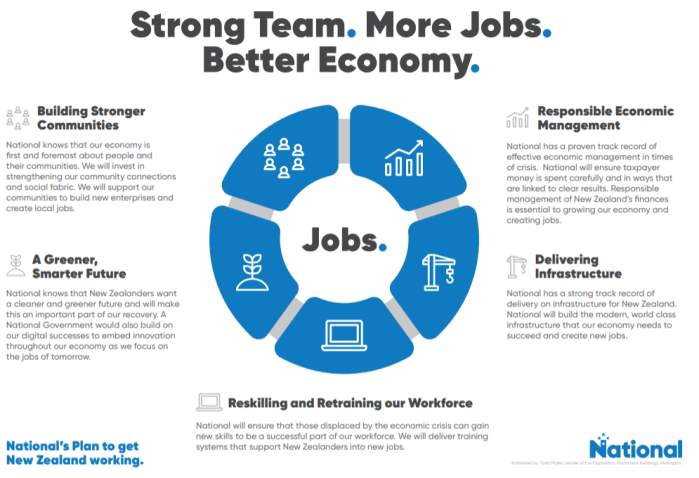
Within a couple of hours we had a plan from National, or at least what Todd Muller describes as “the framework for the party’s Plan to create more jobs and a better economy”.   Just like the Prime Minister, he has a five-point plan, outlined in a speech given in Christchurch yesterday.   If you want the potted version there is even a one-page graphic.

graphic nat

I was no more impressed than with Muller’s previous speech, although at least he has dropped the (historically ill-grounded) paeans to Michael Joseph Savage.   There still seems to be a great deal of me-too-ism about it: we’ll be just like Labour only more competent.   If he has values and a political philosophy, they seem to bear little or no relationship to those the National Party was built on.    It is the sort of speech any (losing) centrist Labour Party leader could have given.

It is explicitly an economic speech, but there was no obvious economic framework, no sign that he or his advisers had thought hard about what has ailed the New Zealand economy for a long time, about how National might fix it, and how that might tie together with the immediate recovery needs (having been accused by one commenter yesterday of being an “armchair theorist”, here was my post-Covid note on such issues).

Anyway, to step through the speech.  First, there was the flawed framing.

According to the Reserve Bank, New Zealand faces its worst economic downturn for 160 years. I don’t think the magnitude of that has yet sunk in to the public or the media. That’s partly because, these past few weeks, everyone has quite rightly been more preoccupied with the shambles at the border and in our quarantine centres. But, if the Reserve Bank is to be believed, ahead of us lies the greatest economic and jobs crisis that anyone in this room has ever known.

Even though the fall in the GDP in the month of April was absolutely huge –  could we have measured it, perhaps 40 per cent –  no one supposes that what lies ahead is worse than New Zealand’s experience of the Great Depression.   Most likely, what we face is something more like, perhaps a bit worse than, the severity of the late 80s and early 90s.  That’s quite bad enough.

And a scale of loss and dislocation that National, at least in this framework speech, appears to have no answer for.

Thus, we learn that they are quite happy with macro policy as it stands and don’t appear to think the Reserve Bank needs to be doing anything more (than the little they have done so far).  And we get rather florid rhetoric on fiscal policy, supported by (it appears) nothing.

Since the Fiscal Responsibility Act, the economic and political debate in New Zealand has tended to be on the quantity of borrowing or debt repayment each year. These remain critically important. Getting back to fiscal surplus and then paying down debt to 20 per cent of GDP is necessary, not least because New Zealand will inevitably confront another natural, economic or health disaster in the next couple of decades or beyond. But just as important is to focus on the quality of spending.

Labour forecasts net core debt will reach 53.6 per cent of GDP in 2024 under their policies. That’s an eye-wateringly high level. We will work hard to try to keep it lower than that, which would put New Zealand in a better position to recover. But of far greater longer-term importance is that Labour projects that under its policies, but with a far stronger economic environment than we face today, net core debt will still be as high as 42 per cent by 2034. That means Labour intends a mere 11 per cent reduction in net core debt, over a decade. At that rate, we will not get back to the safe 20 per cent mark until perhaps the mid-2050s.

National does not regard Labour’s attitude as anything like prudent. It would leave an enormous debt, not so much to our children but to our grandchildren. And it would leave our children and grandchildren – and also ourselves – profoundly vulnerable were the global economic and strategic outlook anything other blissful for three successive decades. Covid-19, the trade war between the US and China and this city’s recent history all say that is not a safe bet.

There aren’t many specifics there but Muller is clear that National would be spending less (not necessarily a lot less, but less) than Labour, so that source of support for a faster demand recovery is apparently off the table.   He plays up the debt numbers but never mentions the large assets (NZSF) on the other side, which mean that even the peak debt numbers would last year have put us among the less indebted half of the OECD.  He never engages at all with the possibility that lower long-term interest rates might –  just might –  make a higher long-term debt ratio sensible.  And, of course, there is no hint of when he expects to get back to 20 per cent of GDP, or on what sort of path.

(To be clear, I am not a fan of high levels of public debt, but on a proper measure we’d peak at around 40 per cent of GDP even on this government’s numbers.  And like most rhetorical fiscal hawks in the current context, he offers no other path for a prompt return to full employment).

And then, of course, there is the question of how seriously to take the talk of future fiscal restraint. There was this, for example,

Let me tell you what that means in practice. In 2020/21 and 2021/22, my Government will not be scared of investing more in retraining, if we are confident it will genuinely improve productivity, lower unemployment, increase the tax take, reduce the cost of welfare and improve wellbeing over the following decade. My Government will not be scared of investing over the next decade more in the first 1000 days of life, if we are confident it will improve outcomes from the school system for a generation. Similarly, social housing and mental health. Nor will my Government be afraid of investing more in roads and public transport, if we are confident they will still be improving New Zealand’s productivity 50 or 100 years hence. And my Government will not be afraid to invest more in water storage or carbon-replacement technologies, if they will support higher living standards and greater wellbeing on an even longer timeframe.

It would be surprising if a public transport project now were boosting productivity 100 years hence, but you are left wondering what Muller wouldn’t be spending on.

Now, to be fair, he tells us there will be a series of major speeches outlining details of the five point plan.   But the gist –  what was in yesterday’s speech –  wasn’t encouraging,   Of their headings

Responsible Economic Management consisted of nothing but rhetoric.  We can probably all agree that quality of spending matters, but there is little in National’s track record suggesting they’ve done much better on that in the past (just different specific waste) and –  more importantly –  no clue as to why we’d think they’d better in future.  Labour has been spraying money at favoured entities in recent weeks, but which ones (specifically) is National opposing?

Delivering infrastructure had this promise

Before the end of this month, I will announce the biggest infrastructure package in this country’s history. It will include roads, rail, public transport, hospitals, schools and water.

My heart sank somewhat.  A new and different Think Big? But lets see the specifics.

Muller boasts of delivery, but wasn’t it the previous National government that put in place the contracting structure for Transmission Gully.  And I’m always a bit surprised at National using the Christchurch repair and rebuild process as a plus.

Reskilling and retraining our workers is flavour of the day (it was a big part of the PM’s speech the other day too), this time with rhetoric about capturing something called the “Creativity Wave” in the 2020s.    But from a party offering no more macro stimulus to demand (see above), uninterested in our high real exchange rate, and (previously) opposed to fees-free it all has the feel of rhetoric and displacing headline unemployment figures at present.   When there are jobs on offer, firms and individuals tend to invest in the skill development required.

A Greener, Smarter Future may be good political rhetoric, or the sort most Labour ministers could have delivered, but seems about as empty.   This section concludes thus

National’s vision is of a post-Covid economy that is greener, smarter and better than the one we had before.

Sounds fine, but what (specifically) is the government’s role in getting there, and what is National proposing to do to give us some hope of achieving all this environmental stuff while also reversing the decades-long decline in relative productivity?  Nothing was on offer in this speech.

And finally, there was

Building Stronger Communities.  I’m sure Muller is genuine about some of this, but what of this gratuitous line

Every community needs strong community institutions to maintain and enhance their social capital. Many of those institutions were damaged a generation ago, and I don’t believe they have been repaired.

Another opportunity for Muller to have a go at the reforms instituted by the 4th Labour government and by his own mentor and former boss Jim Bolger?  So the decline of churches, sport clubs, Scouts and Guides, marriage and so on is down the evil reforms of the 80s and 90s is it?  If so, which of those reforms does he think specifically contributed and which is he proposing to undo?    Of course, the answer to the latter question is “none of them”.  It is just shallow opportunistic political rhetoric.

I don’t really disagree with Muller that

our opponent doesn’t believe in having a plan, hasn’t delivered on her promises, and has a track record of failure across the board.

But when he claims

Ladies and Gentlemen, in the end, I have a very simple message for you and all New Zealanders this election campaign: National has a plan to rebuild our communities and our economy, to get Kiwis back to work and to deal with the economic and jobs crisis.

There was nothing at all in the speech to lead any reasonable observer to think it was so.   Perhaps those future “major speeches” will give us something concrete, as part of a serious well-thought-out strategy that links the immediate challenges with the longer-term deep-seated problems in the New Zealand economy.  But on what we’ve seen so far, I wouldn’t be optimistic about that.


Economic policy malaise

Reflecting on the economic outlook, it hasn’t been the best of weeks.

Across the Tasman, a large chunk of Australia –  key market/source of exports, imports, investment etc – is locked down again for six weeks.   It is a reminder, including to anyone contemplating investment decisions, how easily things can be blown off track again.  And that is in a country with a death rate still (slightly) lower than New Zealand’s.  The coronavirus situation in much of the rest of the world doesn’t look that great either, and with it the outlook for the world economy.  Perhaps, at the margin, that troubled world economy contributed to the decision announced this morning to close Comalco.

Closer to home, the NZIER QSBO results were out.   ANZ’s commentary summed it up succinctly but bleakly under the heading “Worrying”.  Of course the June quarter outcomes will have been dreadful, but the forward-looking indicators weren’t really much better.   These sorts of surveys don’t always have much predictive power –  more unexpected stuff happens –  but they paint a pretty bleak picture of how businesses were seeing things just a couple of weeks ago.  Again from the ANZ

Today’s data will be worrying for the RBNZ and Government; firms are reportedly hunkering down, shedding workers, and cutting prices. But more monetary stimulus is needed, and an aggressive, front-loaded approach is warranted.

And all that is despite the massive fiscal spend over the last four months, which has for now replaced a fair chunk of the lost private sector income during that period, even as it saddles us –  and future governments –  with much more severe constraints on fiscal freedom of action in the years to come.    All that income support (in one form or another) will have helped keep private spending quite a bit higher than otherwise.  All the talk was about “tiding over”, but to what, to when?  It has always had the feel of a policy approach dreamed up back in late February/early March when the government (and Reserve Bank) were still refusing to take very seriously that economic shock that was already engulfing the world.

In that context, it was interesting to have confirmation from the Prime Minister that the wage subsidy scheme will not be extended further –  and given that firms get it as a lump sum, presumably the bulk of what will ever be paid out even under the extended scheme will already have been paid out.     Ending the scheme seems appropriate –  extending it the first time was probably more about politics than economics.    Anything else would have looked like a bizarre attempt to freeze chunks of the economy as they were six months ago, refusing to face the reality of a changed world.    But the scheme was putting large amounts of cash in the pockets of people in the private sector, supporting spending and holding GDP higher than otherwise.  And what comes after it?

Part of the answer, of course, is the higher-than-otherwise benefit paid to those who’ve lost their jobs as a result of Covid.   But it is only for 12 weeks, is still mostly about income replacement (buying time) rather than supporting a self-sustaining recovery in underlying economic activity, and of course many people just won’t be eligible for it.  Perhaps the government will decide to extend this scheme, but even if that were to happen it has its own problems (deterring the search for a new job).

One might, perhaps, have hoped for signs of a serious, rigorous, well-thought-out strategy from the Prime Minister.  As it happens, she gave a pre-election speech to her party’s Congress on Sunday.   As her party is odds-on favourite to dominate the next government I read it, twice actually.  In the speech the Prime Minister purported to offer a plan – a five-point plan even.

Today I am announcing our 5 point plan for our economic recovery.

It’s about investing in our people, it’s about jobs, preparing for our future, supporting our small businesses, entrepreneurs and job creators and positioning ourselves globally.

Sadly, she showed no sign of actually understanding how economies work or prosperity arises.    Anyone, what of the five points?

Which brings me to point one of our plan – investing in our people.

Whence follows a list of handouts, which might (or might not) individually make sense, but by no stretch of the imagination or language can be called investments.  Income support is fine, but it is no basis for recovery.

Perhaps this was a little closer to “investment”

That’s why we made a $1.6 billion investment in trades and apprenticeships training, which includes making all apprenticeships free.

We’ve also made those areas of vocational training where we need people the most like building and construction and mental health support workers – all free. The potential impact of these policies is huge.

Except that this is the government that had already introduced the fees-free policy, only for it be revealed that it was mostly income support too (transfers to people who would already have been undertaking tertiary education anyway).    And the new measures could have a feel of measures designed more to keep headline unemployment down than to actually revive the economy.

Even the Prime Minister recognises that training isn’t much use if there are no jobs.

But retraining isn’t enough if there aren’t jobs to go into at the end of it.

And this is where the second part of our plan kicks in, what I like to simply call, jobs, jobs, jobs.

She proceeds to run through some government initiatives.

First is the Big New Zealand Upgrade Programme designed to tackle our core infrastructure deficit. We announced it at the beginning of the year, and it amounts to $12 billion of road, rail, public transport, school and health capital funding. It could not have come at a better time.

That programme may or may not have merit, but as she says it was announced in January,  judged appropriate/necessary then –  pre-Covid.  It was factored into economic forecasts, including those of the Reserve Bank, then.  On to some other spending.

As part of our COVID response we have committed funding to providing an additional 8000 public houses, bring the total number of state and transitional houses to be built by this Government to over 18,000 by 2024 – thank you Megan Woods and Kainga Ora.

It is the largest house building programme of any Government in decades, and I’m proud of it.

But when we’re talking about infrastructure, it’s not just about the projects we in the government are responsible for, we also have the opportunity to partner with communities, with iwi and local government.

That’s what the $2.6 billion worth of shovel ready projects we announced earlier this week were all about.

Things like Home Ground, a project by the Auckland City Mission that will provide 80 apartments with wrap-around support and care, or the Poverty Bay Rugby Park Grandstand, least Kiri Allen stage a sit-in, right through to the Invercargill inner-city development.

It would take someone closer to the detailed data than I am to unpick quite how much of this is really new spending, and how much is just putting details to spending programmes (like the PGF) already allowed for.  Nor is there any sense of (a) displacement (lots more state houses will, almost certainly, mean fewer private houses being built) or (b) value-for-money (what is the taxpayer doing funding the Invercargill city redevelopment, throwing more money at KiwiRail or –  wonder of wonders –  tens of millions at the Wanganui port.

And then at the end of the “jobs, jobs, jobs” section we get this

Collectively these projects are estimated to create over 20,000 jobs in the next five years.

No analysis to support that number (and we’ve seen before how PGF job estimates are concocted) but even if it is correct, total employment in New Zealand is about 2.8 million people.   “Jobs, jobs, jobs”, even on the PM’s numbers, looks tiny.

She goes on to list a few environmental jobs projects.  Perhaps they are worthwhile, but they certainly aren’t a private sector led recovery.

But moving along

That brings me to the third plank of our plan – preparing for the future.

The whole of that plank is here

Restoring our environment is one thing, decarbonising it is another.

Investments in waste management and improving energy generation will be key- and this is where I am signalling there is more to come.

Preparing for the future also means supporting our businesses to innovate, especially as we go through a period of digital transformation.

There will be few among us who haven’t changed our routines and habits as a result of COVID-19. By the end of lockdown I can confirm that Damien O’Connor did indeed discover the unmute button on zoom.

We want to support our small businesses through this digital transition, which is why we established a $10 million fund to incentivise e-commerce and train more digital advisors.

It’s also why we will keep encouraging innovation in all forms. So we’ve created a $150 million fund to provide loans to R&D-intensive businesses.

Well, okay.  If you are of the left, you might find that appealing, but even then you’d have to concede there wasn’t much to it, not much that will help generate a rapid and strong economic recovery.

But there is, it appears, a role for the private sector.

All of this builds to the fourth part of our plan, supporting our small businesses, our entrepreneurs and our job creators

Which sounds good, until you read the text and realise that all she has to offer is the wage subsidy scheme, and the small business interest-free loan scheme, which was extended for a few months.    Income support etc has its place, but it isn’t the foundation for a strong robust economy or a rapid return to full employment.

And what of the final plank?

And the final plank of our five-point plan is to continue to position New Zealand globally as a place to trade with, to invest in, and eventually to visit again.

This has been an export-led lockdown, and so too will it be an export-led recovery.

Sounds good as an aspiration, but frankly seems unlikely.   What does Labour have to offer specifically?

That’s why a few months ago we provided $200m to help exporters re-engage with international markets, and support firms looking to export for the first time.

It’s also why we continue to expand our trade relationships. The limitations of the last few months didn’t stop us launching our free trade agreement talks with the UK …

We are investing $400 million in tourism because we know it is part of our future, and because open borders will be again too. It is not a matter of if, but when it is safe.

And on that, we already have work underway.

We are progressing with all the checks and balances needed for a trans-Tasman bubble, and also on reconnecting with our Pacific neighbours. We have a framework in place that will help Cabinet make a decision on when quarantine free travel with these parts of the world should resume.

All pretty small beer really.  No one supposes that a UK preferential trade agreement is going to matter very much, and in recent weeks we’ve heard David Parker fulminating about the frustrations of the EU’s position on trade negotiations with them.   And, of course, this is the economy that –  for all the talk of trade agreements –  has had foreign trade shares (exports and imports) falling as a share of GDP this century, the high point of this wave of globalisation.   There is also no sense of recognising that the real exchange rate remains very high –  not down at all, despite the big hit to one of our main tradables sectors.   And all this was nicely complemented by the government’s primary industries strategy announced early in the week and now championed as Labour Party policy, which (as the economist Cameron Bagrie pointed out) involved primary exports falling as a share of GDP over the next decade, even as that sector was supposedly going to help lead the recovery.

And that was it.  That, apparently, was the government’s economic recovery plan.

Typically we look to monetary policy at the main counter-cyclical stabilisation tool.  Ideally, it might be complemented by good pro-productivity structural reforms – of that sort successive New Zealand governments have lost interest in –  but they take time to design well and implement –  whereas monetary policy can be deployed very quickly.

Of course, in the context of the Covid shock it would have made sense to have deployed fiscal policy and monetary policy together.  Even if monetary policy can be deployed very quickly, it does not put money in the pockets of households instantly (and in the context of a “lockdown” and the immediate (quite rational) fear-induced drop in economic activity, there was a place for immediate income support.  But if monetary policy does not work instantly that is why it should be being deployed aggressively and early.  Had monetary policy been used aggressively and early –  starting back in February when the first OCR cut should have been done – by now we would be seeing quite a lot of the fruits (the full effects of monetary policy adjustments typically take 12-18 months), providing a stimulus to demand and activity as the fiscal support is wound back (as it is being, on announced government policy).

As it is, we have had almost nothing from monetary policy.  The OCR was cut belatedly, then an irrational floor was put on the OCR by a Monetary Policy Committee that was still struggling to comprehend the severity of what they were facing.  And because the Reserve Bank reacted only slowly and to a very limited extent, we’ve ended up with hardly any fall in real interest rates at all (inflation expectations have fallen almost as much as the OCR).   The exchange rate hasn’t fallen at all.  The Reserve Bank likes to make great play of their LSAP programme, but it mostly works –  if at all –  by lowering interest rates and underpinning inflation expectations.  And since we know expectations have fallen, and real interest rates have barely fallen, at the very best the LSAP programme can only have stopped things tightening.  In the Prime Minister’s words, this is a really severe global economic downturn……and yet monetary policy has done almost nothing; none of that necessary support is now in place even as the fiscal income support winds back and the domestic and world economies remain deeply troubled.

Of course, the failure of the Reserve Bank to do anything much useful rests initially with the Governor and his committee (the one he so dominates that we’ve never heard a word from any of the three external members, the one he ensured had no one with serious ongoing expertise in monetary policy appointed to it).  But they are officials, ultimately accountable to the elected government.  In fact, ever since the Parliament made the Bank operationally autonomous in 1989, the Act has always recognised that officials could get things wrong, and allowed for the Minister of Finance to directly override (transparently) the Bank.  The current government carried those provisions into its reform of the Reserve Bank, but now –  in a really severe economic downturn, in which the Reserve Bank is simply not doing its job –  they seem too conservative, too scared, to use well-established statutory powers.  They are happy to put in place limited zero-interest loan schemes for small businesses, but unwilling to ensure that –  amid the bleak economic outlook –  market prices for business and household credit are anywhere near that low.   In effect, that means they prefer to let more businesses fail, more people end up languishing on the dole, more “scarring” (a point the PM made in her speech) as if wishful thinking and idle hope was a substitute for serious policy.

Right from the start of the coronavirus, this government’s approach has been –  in essence –  to provide lots of income support and hope that the world gets back to normal pretty quickly.   It was a dangerous and deluded approach from the start, something that becomes more evident with each passing month.  All the more so as other countries’ governments are similarly failing to do much that might support a robust recovery elsewhere.  The current New Zealand government seems to have no ideas, no plan, to be unwilling to use the (low cost) powers they do have to help get relative prices better attuned to supporting recovery.  There is a growing risk that we are drifting into another of those periods –  perhaps worse this time –  as we saw after 2008, when it took 10 years to get the unemployment rate back to something like normal (with little or no productivity growth), and no one much among the political elites (either side) seemed to really care.

Of course, if Labour’s approach is bad, at least (being the government) it is on the table.  It is now less than two months until voting starts and we have no idea what National’s approach might be, but no reason to suppose it would be materially different or better.


On the trail of negative interest rates

I’m still less than entirely well, so posts here will stay less frequent and less regular than usual for a while yet.   That means things like last week’s OCR decision pass by with little comment (my only one will be, in what conceivable world five years ago would a severe global recession, the drying up of a major local export industry, falling inflation and inflation expectations here and abroad, and recognised downside risks be met with precisely no monetary policy action?).

But I see that the Governor has been out giving interviews –  the ones I noticed were with Stuff and the Herald – and some of his comments conveniently tie in with what I was wanting to write about the results of an OIA request to the Bank that belatedly turned up in my inbox on Monday, on the elusive question of what the Bank is (and isn’t) doing about negative interest rates.

You’ll recall that in the second half of last year the Governor was dead-keen on the option of negative interest rates.  It wasn’t just a passing comment, but a very substantial interview.   Who knows, perhaps the rest of the MPC didn’t agree with him, but he was supposed to be the spokesman for the Committee as a whole.  We don’t know what the other MPC members –  the ones who don’t, at least on paper, work for Orr –  think, and they seem to exist in a state of purdah, refusing ever to make speeches or give interviews.

As recently as the Governor’s speech on 10 March this year –  when he and his colleagues were still attempting to play down the economic challenges of Covid – the Governor outlined his preferred tools.  He promised then that

We will provide our full analysis of each of these tools against the principles we hold in coming weeks – so that people can fully understand our thinking and, of course, provide input.

None of that analysis has ever been published.  The list of tools was clearly organised in order of the Governor’s then preference: forward guidance (just a variant on what they always do) was first, and then

Negative OCR

Reduction of the OCR to the effective lower bound (the point at which further OCR cuts become ineffective), which may be below zero. The Reserve Bank could consider changes to the cash system to mitigate cash hoarding if lower deposit rates led to significant hoarding.

Not only did a negative OCR appear to be in play, but that really encouraging second sentence suggested they might actually have considered doing something –  they are technically easy things to do – to allow the OCR to have been cut even further below the negative levels which at present could lead to large-scale shifts into physical cash.

That was then.  A few days later the MPC decreed that in fact that OCR would not be changed, up or down, from 0.25 per cent for a year, claiming the matter was really ou of their hands as “banks weren’t ready”.

It was, and remains, a very strange argument given that:

  • several other advanced countries had had negative official rates for some years,
  • a large share of global government bonds had been trading with negative yields for some years,
  • in New Zealand the first negative yields (on indexed government bonds) were recorded last year, at about the time of that interview the Governor gave,
  • the Reserve Bank had shown revived interest in these issues for a couple of years, and
  • that eight years previously an internal working group (set up by the then Governor, chaired by me) recommended that relevant departments should ensure that (a) the Bank’s own operating systems, and (b) commercial banks’ systems could cope with negative interest rates.  Those recommendations were accepted at the time.

In other words, if the Bank’s claims now are really true, commercial banks seem to have been astonishingly (or conveniently, since banks hate negative interest rates) remiss and (more importantly, since it is a powerful public agency) the Reserve Bank ((Governor, Deputy Governor, MPC –  and the Board paid to hold them to account) had to have been asleep at the wheel.  Given a decade’s advance notice of the risk that market-clearing interest rates would go negative here too, they would appear to have done nothing.  That would be egregious neglect –  for which people at the bottom, the involuntarily unemployed, would pay the price.

The Bank, of course, likes to claim that it is highly transparent –  they have been at it again this week – even as they remain as obstructive as possible on anything they don’t want to be transparent about.    The negative interest rates situation has been one of those topics.  For example, they’ve staunchly refused to release any of the background or advisory papers the MPC received running up to 16 March, on this or any aspect of monetary policy (as a reminder, the government itself has been pro-actively open, even with papers that may embarrass some or other bits of government).

I had one go with an Official Information Act request that got nowhere.  But it is a bit harder to stonewall Parliament, and thanks to the efforts of the National Party members of the Epidemic Response Committee we got some useful material out of the Bank.    The Bank didn’t want to draw any attention to this material, but it was there on Parliament’s website, and I wrote about it here.

The Bank told MPs that they’d started to take things seriously at the end of last year

More broadly, bank supervisors raised the issue of preparedness for negative interest rates at banking sector workshops in December 2019.

In late January 2020, the Reserve Bank’s Head of Supervision sent a letter to banks’ chief executives formally requesting they report on the status of their systems and capability.

By late January, of course, Wuhan was already locked-down.

The Bank told the MPs that there had been a range of issues identified, and while they hoped banks were doing something about them, it didn’t want to put any pressure on banks because they were busy people, and had other priorities (which, even if so, would not have been the case had the Bank done its job several years earlier).

None of this was very satisfactory.  They never explained –  or were pressured to –  their own past failures, nor why these alleged readiness issues had not been obstacles in other advanced countries (the euro-area, Sweden, Switzerland, Denmark, Japan), the prevalence of negative wholesale rates abroad.

A few weeks later again, the Governor told the Finance and Expenditure Committee (hearing on the May MPS) that a letter had gone out to banks just the previous week apparently urging or requiring them to have systems ready by the end of the year.   I then lodged a further OIA request

OIA 16 may

Section 105 is the dreadful provision in the Reserve Bank Act which allows the Bank to avoid any scrutiny of its bank regulatory activities under the OIA.  When the response to this OIA arrived this week, they had invoked it to allow themselves (so they claimed) to refuse to release anything in response to item (a) in my request.    This is a provision that, to the extent it had any merit, is designed to protect highly sensitive individual institution material in the middle of a banking crisis (in fact, of course, anything commercially confidential is already protected, and reasonably so, under the OIA).  The readiness of banks’ systems and document for negative interest rates is clearly not primarily –  barely at all – a prudential issue, but primarily a monetary policy one.  But that doesn’t stop the Bank –  the ones that always claim to be so transparent.

However, the Bank did belatedly release what I was after under the second and third strands of my request.  The full response is here.

The 29 January letter is on page 4 of the response.  It is a catch-all letter from the head of bank supervision drawing attention to various issues large and small that the Bank wanted to deal with this year (among the latter, the Bank’s Maori strategy).  Here is the relevant text on negative interest rates

wood negative

Okay I guess, but with little or no sense of urgency.

There is a three page table summarising the responses from each individual bank (although remarkably one banks appears to have never even responded), complete with this interesting  somewhat defensive observation from the Reserve Bank which I had not initially noticed.

“We acknowledge the banks’ responses to our letter of 29 January were a preliminary assessment of their readiness to implement negative interest rates.”

The table is interesting.  Of the 19 banks, a fair number are described as ready, but it is fair to note that a number of issues are also highlighted, in some cases in enough detail to be genuinely somewhat enlightening.    This is all, however, material that could have been pro-actively published in March, and which the Governor –  and those commenting on his draft speech –  must have been aware of on 10 March.

Perhaps it is also worth noting that these are individual bank responses, without the benefit of any RB pushing and prodding to better understand how binding perceived constraints might be, what workarounds might be possible, let alone with any sign of the Bank itself having learned from the experience of their counterparts in countries that had operated with negative interest rates for years.

Anyway, all this was then somewhat overtaken by the new letter, dated 7 May.  It is from the Deputy Governor, Geoff Bascand to the chief executives of banks.    This must have represented the Bank’s (or MPC’s) thinking at the time of the May MPS, although there is no hint –  of course –  of it in the minutes of the MPC meeting.   The letter set out a deadline of 1 December 2020 for banks to ensure that they were capable (with status reports due yesterday).  That wasn’t news, but what was was how limited the Bank’s requirement’s (and ambitions) now are, in the middle of the deepest economic slump in a long time.

Bascand letter

In other words, they’ve just given up on negative retail interest rates.    It isn’t true that in other countries there have been no negative retail interest rates, even with policy rates slightly negative (here is story from just last year of negative retail mortgage rates in Denmark, and recall that lending rates are usually higher than funding rates).  And, of course, look back up to the quote from the Governor’s March speech –  as recently as then they were open to the possibility of taking the steps that might allow the OCR usefully to be cut more deeply than other countries have done.

Coming back to today, what also interested me was that the Governor continues to muddy the waters on this.  In his interview with Stuff there are quite a few comments about negative interest rates.

The Reserve Bank is still warning retail banks to get ready for a negative official cash rate. Rolling this out has been said to be difficult because banks systems weren’t ready and some contracts with depositors didn’t envisage a negative interest rate – effectively a charge on depositors.

Orr said most banks were in a good position to deal with negative rates.

“Some large multinational banks have been dealing with negative interest rates for a long time and some of the smaller banks, which have much simpler systems, are good to go,” Orr said.

“Only a handful of banks” were having difficulty with negative rates.

Orr appeared to downplay the extent to which a negative rate would impact all areas of a bank.

“What we’re doing at the moment is double checking with all of the banks, so they’re not trying to get absolutely everything capable of a negative [rate] because we don’t need absolutely everything.

“We’re saying it’s a small proportion; it’s the wholesale side of the business,” Orr said.

Ordinary depositors likely wouldn’t notice a difference because rates would still be positive for depositors.

“Internationally the experience has been that banks have been highly reluctant to go below zero for a deposit.

“In fact, retail banks’ reluctance to pass on negative rates to consumers are likely to act as a brake on the Reserve Bank’s appetite to push rates lower.

“There is a limit to how far negative wholesale rates can go in large part because the retail rates end up holding up,” he said.

Read that and you wouldn’t know that the Reserve Bank had told banks they didn’t need to bother about negative retail rates –  in fact, you’d get the impression it was banks that could never envisage offering such products, even though they are on offer in other countries.

But you’d also get the impression that the Governor was more concerned for banks than for the New Zealand economy and the people who become unemployed because monetary policy isn’t doing its job.  If his Committee had aggressively cut the OCR another 100 basis points, to (say) the -0.75 per cent often envisaged as an effective floor until steps are taken to disincentivise cash hoarding, not only would the banks that had prepared themselves got on with things, and presumably been advantaged, but the others would have snapped to pretty quickly and got workarounds in place.  (That, after all, must have been what happened in other countries, and is more like the way the rest of government operated –  when a wage subsidy was decided on, MSD wasn’t given nine months to do systems testing etc; when a small business loan scheme was decided on IRD didn’t months to prepare).

And there is no sign at all of the Reserve Bank taking seriously steps to remove the obstacles to a more deeply negative OCR, even though those obstacles are all of the public sector’s making.

Perhaps none of this would matter very much if you believed the spin about what good monetary policy was doing overall, including through the LSAP programme.    But it is just spin.   Benchmark term deposit rates have been falling a bit more recently, but that means they are now 85-90 basis points lower than they were at the start of the year.  But, of course, expectations of future inflation have also fallen quite a lot.  There is a range of possible measures, but a reasonable pick might be a fall of about 60 basis points.  In other words, real retail deposit rates are down perhaps 30 basis points in the midst of a savage slump for which there is no obvious end.   The exchange rate is usually a key buffer for New Zealand, a significant part of how the monetary transmission mechanism works.  It bounces around a bit, but at present the TWI is sitting almost bang-on the average level for the second half of last year.  For all the handwaving and big numbers (around the LSAP) monetary policy just isn’t doing its job, and the Bank seems to have little interest in it doing so.

On Monday I went to hear a speech the Governor gave.  In the course of that address he seemed to defend monetary policy doing not much on the grounds that “the expenditure had to be immediate”.  And at one level, for the March/June quarters no one is really going to dispute that –  monetary policy doesn’t work that fast, and there was a need (or a good case) for lots of immediate income support, especially for people rendered unable to work by government fiat.  But that was then.    Wage subsidies have replaced lost income (a large chunk of it) for a few months –  at the expense of an increased involuntary burden on taxpayers to come – but meanwhile we are still in a deep recession, still have our borders largely closed, and the state of the world economy appears to be worsening.  Monetary policy should have been positioned –  and should now be positioned, it isn’t too late –  to support domestic demand and activity through the (probably protracted) recovery phase –  much lower interest rates, and a much lower exchange rate.  As it is, monetary policy –  designed as the primary countercylical tool – has done almost nothing and the Bank seems quite unbothered about that.

It isn’t good enough.  We need better from the Governor and his Committee (including, for example, to actually hear the excuses of the rest of the Committee members), and we need the Bank’s Board –  hopeless cause I guess –  to be doing its job holding the Committee to account.  But, of course, the person who could make this all happen is the Minister of Finance, who has long-established directive powers, but seems to prefer to do nothing, content to spend taxpayers’ money while doing nothing to remove the roadblock to getting market price signals better aligned with responding aggressively to our economic plight.  Don’t rock the boat, don’t be bold, don’t worry too much about the actual unemployed seems to be the government’s approach.  Robertson and his boss like to invoke memories of the first Labour government, but it is hard to imagine those big figures in Labour’s history being happy to sit by and see a central bank wave its arms and do nothing to get us quickly back to full employment.


Pursuing Jian Yang, and the travesty that is NZ politics

TVNZ’s Q&A programme yesterday had a short segment (and article here) on their continuing, unsuccessful, attempt to get National list MP Jian Yang to talk to them.  It isn’t as if Jian Yang seems to have a particular thing against TVNZ –  I don’t have too much problem if an MP refuses to deal with one particular media outlet –  because for years now he has refused to talk to any English-language media, talking only to safe CCP influenced or controlled Chinese language outlets, who can be counted on to give him an easy and unchallenging time and not ask any awkward questions.

It is almost three years now since Newsroom and the Financial Times began to reveal Jian Yang’s past as a member of the Chinese Communist Party and long-serving member of the PRC’s military foreign intelligence system, where he’d been training spies.  Over subsequent weeks it emerged that, whether he or not he had been straight with the National Party when they’d recruited him in 2011, he’d lied about his past in his applications for New Zealand residency and citizenship.   In fact, challenged on the point he was quite open about it: he’d actively misrepresented his past because his CCP bosses had insisted on it when he first left the PRC.  And people with his sort of background didn’t get to leave the PRC to do foreign study without the regime and Party being able to rely him.  Jian Yang has claimed he isn’t a CCP member any longer –  as if this was just a matter of letting an annual subscription lapse –  but academic experts, including Canterbury University’s Anne-Marie Brady, have made the case that no one ever leaves the CCP voluntarily: you can be expelled, but once you’ve cast your lot in with them (and only a small minority of PRC citizens are CCP members, smaller than the proportion of Germans who were Nazi Party members) you are part of that movement for keeps.  Jian Yang could, of course, remove the scepticism by openly criticising the evil regime –  former Soviet spies who defected did that –  but never once, in all his years in Parliament has there been as much as a hint of disloyalty to the CCP/PRC.

It was good to see Q&A make a story of Jian Yang’s (now) 2.5 years of refusal to talk to any English language media –  not just about his past, but also about his present (eg his role last year in organising a meeting for Simon Bridges with Guo Shengkun, CCP Politburo member with responsibility for “domestic security” (think of those Uighur concentration camps, as just a start on intensifying CCP repression)).   Or the way Jian Yang continues to associate closely with the PRC Embassy and all sorts of CCP-affiliated or United Front groups, the sort of conduct that had the sober former diplomat Charles Finny declare on Q&A a couple of years ago that given Jian Yang’s associations with the Embassy he was always very careful what he said in front of Jian Yang (or Labour’s Raymond Huo).    Or perhaps it would be good if Jian Yang would answer questions around why several PRC migrants Q&A talked to about him refused to be identified on screen, explaining that they feared the reach of the CCP/PRC whether here or as regards family members back in China.    Perhaps these people have nothing at all to worry about. But they certainly believe the regime is running protection for Jian Yang –  a New Zealand MP.

Q&A also had a brief interview with Jamil Anderlini, the New Zealand who lived for a long time in Beijing and is now the Asian editor of the Financial Times, who claimed not just that our traditional allies look quite askance at the Jian Yang situation –  the man was on Parliament’s Foreign Affairs Committee for a time –  but that his contacts in the CCP suggested that the CCP itself treated the National Party as something of a laughing stock over this issue, the suggestion being something like “useful gullible idiots”.

Back when the Jian Yang story first broke, perhaps one could wonder if National themselves had been deceived by Jian Yang; not looking very hard, they’d not found anything, except someone to pull in the dollars for them.  The Newsroom/FT story broke on the eve of the election and by then there wasn’t much National could do about him (and his list place) even if they’d wanted to.  But that was three years ago.

Even then there was the despicable effort by a then senior Cabinet minister (Attorney General  and minister responsible for the SIS and GCSB) at a candidates’ meeting to tar as somehow “racist” any questions about Jian Yang’s CCP/PLA past, going on to claim that Anne-Marie Brady was a xenophobe (“doesn’t like any foreigners at all”).

But it wasn’t just  a second-tier figure, perhaps caught on the hop in a meeting he didn’t really want to be at.   In the last three years, National has had three leaders:  Bill English (who was then Prime Minister), Simon Bridges, and now Todd Muller.    They’ve each had plenty of time to think carefully and hard about Jian Yang and where their interests and loyalties lie.  And each of them  –  there is nothing to tell them apart on this issue –  has provided complete cover for Jian Yang.   In fact, Jian Yang has been promoted.  He clearly isn’t a caucus highflier, but he keeps rising a bit further up the caucus rankings, he now chairs a parliamentary select committee (perhaps not a very important one, but we have someone with his background chairing a government administration committee?) and the National Party Board has picked him out for a favoured position on National’s list for this year’s election (recall that Jian Yang has business interests with National’s president, the ever-obsequious (to Beijing) Peter Goodfellow).  One of National’s most senior MPs shares an office in Auckland with Jian Yang.

The real issue now isn’t about Jian Yang’s own choices, but about the rest of our political system (and much of our media for that matter).   It clearly suits Jian Yang to avoid any English-language media –  he is, after all, elected by all National Party voters, not just a few CCP-aligned ethnic Chinese one – but if the leadership of the National Party had even an ounce of decency on these issues it really wouldn’t be Jian Yang’s choice at all.  It would be as simple as “front up, honestly and fully, pretty whenever you are asked, and if not well forget about any caucus seniority, in fact forget about a list place at all at the next election”.   No one  doubts that if  any of that succession of leaders had wanted Jian Yang to be accountable to the public and to voters he’d do so, or he’d be gone.  So his silence is the silence of Bill English, Simon Bridges and now Todd Muller.   The same “leaders” who’ve been, for example, utterly unbothered by Todd McClay’s defence of the Uighur concentration camps, and who utter not a word about the activities of the PRC/CCP at home, abroad, or here.   Totally sold-out.

It is a marker of just how deep the decline of New Zealand has become.  As I noted in a post shortly after the first Jian Yang revelations,  at no time from the 1950s to the 1980s would it even be conceivable that we’d have (any of the mainstream parties would have) allowed a former KGB/GRU officer, still maintaining close ties to the Soviet Embassy, to have served in our Parliament.  There was some moral clarity back then about what we believed and stood for, and what that evil empire stood for. (Of course, Labour in particular tolerated Bill Sutch in top positions).

But now whatever values some individuals may perhaps still have, they seem to count for less than appeasing the CCP/PRC, and prioritising party funding and the interests of a small group of New Zealand corporates (and universities) over the values of most New Zealanders.  I’m particularly hard on National, both because Jian Yang is National MP and because I’m the sort of person who might normally be expected to mostly vote National.  But also because all three of those recent National leaders have suggested that, in one form or another, they are Christians –  English at least was known to be a practising Catholic.  The PRC regime ruthlessly persecutes the Christian churches, and yet that draws forth not a word from either the senior figures in the National Party or from the lesser lights among the Christian members of the caucus (let alone prominent incoming ones like Luxon, who ran a business that chose to pander to the regime).   The persecution of the churches has not yet reached the stage of the Uighur concentration camps, but then National members won’t stand up or speak out on that either –  not even junior MPs who might be plausibly deniable for the leadership.

But it isn’t just National.    Every other party in Parliament (and those out of Parliament) seem about as bad.  The biggest of those parties is, of course, Labour.  A Labour member has been Prime Minister almost ever since the first Jian Yang revelations.  And not a word of condemnation or complaint has come from her either, not one.  No Labour MP has ever been heard to deplore the fact that we had a CCP member closely linked to the PRC Embassy sitting on the National benches of Parliament, chairing a select committee no less.  It is as if the Prime Minister is more interested in being kind to Jian Yang, kind (subservient) to Madame Wu, and utterly interested in the integrity of New Zealand politics or the values and political traditions of New Zealand.  And again, not even any junior caucus members have broken ranks, not even once.   The strong suspicion has to be that Labour cares no more about decency and integrity than National, and is probably just a bit envious that National has been better at pulling CCP-linked donations (although is that changing now that Labour is in office?) And why be surprised? After all, Labour has Raymond Huo in its ranks, with well-documented United Front involvements, and they just put another United Front person in a winnable position on their list.  And all those corrupted corporates and universities, only interested in the next dollar, will be in the ear of ministers urging them always to appease, never to take a stand.  And of course, National and Labour together have shown no interest in any serious reform of the electoral finance laws to meaningfully prevent foreign political donations, let alone the sort of self-denying ordinance that recognises that some donations –  even from New Zealand citizens –  simply should not be taken, no matter how many dollars are on offer.  And Labour was principally responsible for the travesty of the select committee inquiry on foreign interference risks (even though the biggest issue is less about foreign interference, and more craven domestic subservience).

The big issue isn’t really Jian Yang.  National could have found a way of quietly getting him to retire and found some less obviously egregious replacement.  The bigger issue is that National had no interest in doing so, and Labour no interest in criticising them for not doing so.  They pay no price for acting as, in effect, the agents of the CCP in New Zealand (even as they all no doubt tell themselves that somehow what is in their best interests is also in ours).   It was good that Q&A did the clip they did, but it is hardly mainstream TV (the programme mainly for the handful of political junkies).  Other journalists have from time to time asked Jian Yang for an interview, and been equally unsuccessful, but there is almost never any follow through. The PM and the Leader of the Opposition front up for media interviews every week, perhaps even most days, and there is no pursuit of this issue, there is no campaign in the pages of the Herald or the Stuff outlets.  Nothing.  The evils of the CCP/PRC just isn’t one of those things that exercises or concerns establishment New Zealand.  It is disgraceful.

A few weeks ago the Inter-Parliamentary Alliance on China was launched, comprising legislators from a range of western countries with concerns about the PRC, and from a range of places on the usual left-right political compass.   This was from their website

Developing a coherent response to the rise of the People’s Republic of China (PRC) as led by the Chinese Communist Party is a defining challenge for the world’s democratic states. This challenge will outlast individual governments and administrations; its scope transcends party politics and traditional divides between foreign and domestic policy.

The assumptions that once underpinned our engagement with Beijing no longer correspond to the reality. The Chinese Communist Party repeatedly and explicitly states its intention to expand its global influence. As a direct result, democratic values and practices have come under increasing pressure.

When countries have stood up to Beijing, they have done so alone. Rather than mounting a common defence of shared principles, countries have instead been mindful of their own national interests, which are increasingly dependent on the People’s Republic of China for crucial minerals, components, and products.

No country should have to bear the burden of standing up for fundamental liberties and the integrity of the international order by itself.

The Inter-Parliamentary Alliance on China has been created to promote a coordinated response among democratic states to challenges posed by the present conduct and future ambitions of the People’s Republic of China. We believe that the natural home for this partnership is in the freely elected national legislatures of our peoples. Coordination at this level allows us to meet a challenge that will persist through changes in individual governments and administrations. We firmly believe that there is strength in unity and continuity. By developing a common set of principles and frameworks that transcend domestic party divisions and international borders, our democracies will be able to keep the rules based and human rights systems true to their founding purposes

It was sadly notable that at the launch there were no New Zealand MPs, even though (so Anne-Marie Brady reported) numerous of them had been approached.    It was interesting, and perhaps a little encouraging, that last week Simon O’Connor (from National) and Louisa Wall (from Labour) joined this initiative.  O’Connor is currently chair of Parliament’s Foreign Affairs Committee and Wall is a member.

But count me more than a little sceptical.   It has the feel of some sort of deal worked out between National and Labour, for a bare minimum degree of association, announced belatedly.   There is no statement from O’Connor or Wall about the nature of their concerns with the PRC –  at home, abroad, or here –  and, of course, no journalist appears to have asked them for comment (or reported a refusal to comment).   Is O’Connor really comfortable with having a CCP affiliated member, close to the PRC Embassy, who refuses to engage with voters or the media, and who has never ever said anything remotely critical of the PRC as a member of his caucus, someone who could be a junior minister if National is elected?  MPs are usually only too ready to criticise people on the other side.  How comfortable is Wall about Jian Yang or National’s extreme deference?  Or has the Labour Party hierarchy told her to simply sign up and then keep very quiet?  I’d like to be wrong on this  –  I was briefly encouraged by the O’Connnor/Wall news –  but so far there is nothing to suggest I am.


Measuring how much monetary policy has eased

A couple of months ago I wrote a post about the work former Reserve Bank researcher Leo Krippner had been doing – over much of the last decade –  on trying to reduce all the influences on the government bond yield curve to a single number, to represent the effects not just of changes in the OCR (or similar rates in other countries) but also what are loosely called ‘unconventional policies’ undertake in the presence of the (actual or effective) lower bound on the OCR itself, whether central bank jawboning or, for example, asset purchase programmes.

As I noted then

This work wasn’t very relevant to New Zealand itself for a long time (there were internal sceptics as to whether it should even be done)….and yet now it is. (In his speech a couple of weeks ago the Governor even suggested the Bank might publish a semi-official series of such a measure.)   Leo’s work has been recognised in various places abroad –  cited in public by at least one Fed Reserve president, and honoured by the house journal of the central banking community, Central Banking magazine ..,  Leo left the Reserve Bank last year, but is continuing to update his work and earlier this week circulated a note with a Shadow Short Rate series for New Zealand, now that we operate with a formal OCR floor (and ceiling) and in the presence of the MPC’s commitment to buy $30 billion of government bonds over the coming year.

The size of the LSAP programme has been increased substantially since then.

Still more recently, Leo has updated his models for the other advanced economies he looks at, in a way that enables us to look at consistent estimates of the extent of monetary easing across eight advanced economies/areas.

Here is Leo’s estimate of the extent of the overall easing, as reflected in the Shadow Short Rate estimates for each country, since the end of last year (to the end of May).

SSR

Perhaps three things stand out from this chart:

  • little or no effective easing in the countries/monetary areas where the official short-term rate was already negative.  Perhaps central bank interventions were relevant in other markets, perhaps for a time they stopped government bond rates rising much, but on this metric, no effective easing relative to the position just a few months back.
  • the largest easing has been in the United States and Canada.  That is no surprise: official short-term rates late last year were quite a bit higher in the US and Canada than anywhere else in this group of advanced economies,
  • Leo’s estimate of the New Zealand SSR suggests an easing equivalent to 117 basis points.    Recall that the OCR itself was cut by 75 basis points and so, if one accepts this as a good estimate for how much some mix of the LSAP programme and forward guidance is doing, all the rest is not thought to be worth more than about 40 basis points.    Not exactly consistent with the tone of the continued rhetoric from the Governor, who repeatedly insists –  he was at again on CNN yesterday (whoever runs their Twitter account seemed breathlessly excited that the Governor was on CNN) –  how much difference his MPC’s LSAP programme is making.

Leo has taken his estimates of the SSRs all the way back to the 1990s (the more yield curve information the better for trying to distill what is normal and what is not).  So out of interest I had a look at what happened in the previous severe recession.

When the recession of 2008/09 started all these countries except Japan had official policy rates clearly above zero.  In those circumstances, the SSR is much the same as the official rate.

In this chart, I’ve shown the median SSRs for (a) the big 4 central banks in the sample (US, euro-area, UK, Japan) and (b)  all eight central banks from mid-2007 to the end of 2014.

SSR2

On these measures, monetary policy kept easing (on the whole) until well into 2013 –  in some cases by official rate cuts, in some by QE measures, in some cases by forward guidance (or perhaps just growing doubts in markets about when official rates might ever need to rise).

In this chart, I’ve shown the fall in the estimated SSRs for each country from mid-2007 (about the peak in rates, including in New Zealand) to (a) mid-2009, and (b) to the lowest point in the period in the chart.

SSR3

One almost needs a different scale to compare these estimates with those for the  –  more savage –  economic downturn we are now in the midst of (see first chart).

And bear in the mind that in both episodes inflation expectations have fallen quite a lot in many most of these countries.  Adjust for that and the differences in the falls in the real (inflation-adjusted) SSRs would be even more stark.

Now it is certainly true that back in 2013 (say) longer-term government bond yields were still quite a bit higher than they are now (in the US, for example, 10 year rates in mid 2013 were about 2 per cent).  But then estimates of neutral rates have also fallen over that period.

I’m not entirely convinced by the SSR approach.  I set out some of the reasons in my earlier post, and in exchanging notes with Leo I don’t think he would disagree with any of those individual points.   Perhaps the simplest to explain point is one Leo himself included in his paper releasing the New Zealand results: the SSR is not a rate that can be transacted (unlike an OCR), and in New Zealand longer-term interest rates don’t tend to directly affect many borrowers other than the government itself (and monetary policy isn’t supposed to be about shaping the government’s behaviour –  it is a market mechanism, designed to change relative prices facing private sector firms and households).    I’m also a little uneasy about the fact that the Reserve Bank’s LSAP is explicitly targeting mainly long-term interest rates –  which, among other things, is impairing what information might be in those rates, which relate to periods well beyond the current crisis –  while, say, the Australian and US asset purchase programmes are (sensibly) targeted at the shorter end of the bond yield curve (horizons relevant to this recession, and in a sense trying to mimic what a lower policy rate itself will tend to bring about directly if those central banks were willing to cut their policy rates further).

There is also the point I noted in my earlier post that for New Zealand Leo treats the effective floor on the OCR as being 0.25 per cent.  But since that last post, the Governor has explicitly reiterated that it is a temporary floor only –  now only 9 months until the commitment expires –  as he did again yesterday in his CNN interview.  Leo advises that if the effective floor were set a bit lower, the SSR estimate itself would be closer to the OCR.  In other words, the extent of the fall in the New Zealand SSR may actually be skewed higher than is really warranted.

If I have my doubts about the indicator, it is still of some value in providing summary estimates across both time and country, it is the sort of methodology the Bank has in the past expressed enthusiasm for (without tying itself to specific numbers), his approach has received approbation from his peers in yield curve modelling etc, and Leo’s estimates are made available, including on his website.   And they leave us with the twin points that:

  • the extent of monetary policy easing in New Zealand this time is little more than that of the cut in the OCR itself,
  • the extent of the falls in the SSRs in all countries (even Japan) is much less than we saw in the period of the last serious recession.

It is fine for central bankers to talk –  as the Governor does –  of fiscal policy carrying the main load at present but

a)  there was significant fiscal support provided in all these economies (including New Zealand)  in the last episode as well,

b) fiscal policy operates coercively (relying wholly on the sovereign power to tax) and for many purposes –  other, say, than basic income support –  is inferior to monetary policy for stabilisation and recovery purposes,

c) in most if not all these countries recovery after 2008/09  –  best proxied probably by a return to normal of unemployment rates –  took (a) far longer than was expected then, and (b) far longer than most are still envisaging for a recovery now from this more severe downturn, and

d) fiscal policy has its limits (quite probably close to being reached, and more “political” than technical), in a way that monetary policy properly run –  ie not imposing an artificial floor on policy rates –  does not.  It is all the odder that central banks like ours (with the acquiescence of excessively conservative politicians) are acting so starkly to hold up interest rates at time when very  weak investment demand and a high precautionary savings demand would almost certainly deliver short-term market-clearing interest rates that are deeply negative (and while “market-clearing” might seem bloodless to you, what it means in practice is clearing the labour market and supporting a prompt return to full employment).


Me too

No, not that one.  This one is the  apparent desperate desire of the new leader of the National Party to align himself with the aims and ambitions of the current government.   It was all there in his speech on Sunday (complete with his desire to suggest that he had really become what they call in the US a “cafeteria Catholic”, and that his faith would make no difference to any government he led).

I saw a National-aligned commentator this morning commenting sceptically

Perhaps, but I don’t think that even in those sorts of circumstances opposition parties used that sort of approach in New Zealand towards the end of three term governments.  I was never a John Key fan, and there were a few issues where he actively chose to adopt questionable policies adopted under the Clark government, but even Key promised more (even if he never delivered) than just to be a more competent executor of Labour’s agenda.  I went back yesterday and read a few of those 2008 speeches just to check. (And the 2008 campaign took place amid a  severe recession and global financial crisis, both deepening by the day.)

Who knows, perhaps it will win a few votes.  Perhaps, but if you believe the stuff Labour, New Zealand First, and the Greens say they want to do, why not vote for them?   After all, if execution has not exactly been a hallmark of the government –  and Muller, of course, makes some entirely fair points there – why not vote for people who really believe it, rather than the pale imitations who just want office (or, in some cases, may just be in the wrong party).  After all, there is such a thing as learning-by-doing and some ministers at least are likely to improve with time.   Muller himself has no ministerial experience (as a reminder, a country is not a company), and his deputy was a fairly junior minister at the end of the previous National government where she was not regarded well by officials and as Minister of Education managed to deliver a speech as wordy and hard to read as a piece of legislation.

Setting aside the heartwarming biographical bits, the speech seemed to be a mix of spin, historical errors, and an utter lack of any ambition or promise.

There was, for example, the laughable description of the wage subsidy scheme as “bipartisan”.  I guess New Zealand First and Labour make up the coalition Cabinet, so perhaps that really is bipartisan, but just because you supported an initiative the government took doesn’t make it a “bipartisan” one.  It is doubly strange because a few lines later he notes that we can’t “freeze-frame our economy, with never-ending and unaffordable wage subsidy schemes”.   Were they “unaffordable” or bipartisan” or both?

Muller is clearly keen on selling the merits of the Key-English government, and I know it is a commonplace to say they “got us through” the “global financial crisis” as if (a) there was much specific to get through (the crisis itself was mostly other countries’ problems, and (b) it had not taken 10 years –  10 years –  for the unemployment rate to get back to pre-recession full employment levels.   Might not be a very promising line for suggesting National is well-placed to handle this recession/recovery better.

There was the strange claim too that the previous National government did not raise taxes.  Even if you allow for the GST/income tax switch as roughly neutral, this was the government that raised effective corporate tax rates, imposed a brightline test (and thus tax) on housing, dramatically increased tobacco taxes, increased the taxation of Kiwisaver, and so on. And and there was fiscal drag too.   The emphasis of the fiscal adjustment might have been on the spending side, but there were increased taxes.

There was also the weird claim that “Bill English developed the Living Standards Framework”, except….he didn’t, Treasury did.  And all while not offering the sort of analysis and advice that the Minister and his office often claimed to really want.   Pledging to use it in future National Budgets is just another example of the me-too ism and the same avoidance of the hard issues –  productivity failure –  that seemed to drive The Treasury in the first place.

As a young man Muller worked for Jim Bolger when the latter was Prime Minister…..but only after the reform era had already ended.   Now he is desperate to distance himself and National from the reform era –  sounding a lot like Grant Robertson used to sound re the Reserve Bank Act, even as his actual reforms made next to no difference.   Thus we read

I was in for a bit of a shock when my own party took over in 1990 and moved even faster, allowing unemployment to reach 11 per cent in 1992 – the worst since the Great Depression, but a record that will probably be broken over the next year.

I think both Labour and National could have done those economic reforms more gently, more caringly and with a greater sense of love for our fellow Kiwis.

If we look across the Tasman to our sibling rivals in Australia, it pains me to say that Bob Hawke, Paul Keating and John Howard managed the reform process better than David Lange, or my friend and mentor Jim Bolger.

I believe the speed and sequencing of the economic reforms did terrible harm to the institutions of our communities, and to far too many of our families.

The same Australia whose unemployment rate in the 1991/92 period peaked at almost exactly the same (11.1 vs 11.2 per cent) as New Zealand’s, and whose unemployment rate has been higher than New Zealand’s for most of the subsequent 30 years.     Quite what does Todd Muller think  –  specifically –  should have been done differently?   This cartoon is from the late 80s.

douglas

And yet despite disowning his own party from its second to last term in government, Muller expects us to believe that we can count on them to handle the recovery better because  “economic management is in our National DNA”.  The same party that (a) was happy for the unemployment rate to stay unnecessarily high for 10 years, and (b) which made no progress at all (rather the contrary) in closing the glaring productivity gaps, reversing the decades of underperformance.  Oh, and which promised to fix the housing market and did almost nothing.   Why would we?

It was sad and sobering to get through Muller’s speech, reread it again slowly and carefully, and find not a hint of any concern about productivity (however expressed) or housing.  It isn’t that long ago since National put out a discussion document on the economy which did actually seem to recognise the productivity failings, and that those failings mattered for whatever else individuals or governments might want to do.  No more apparently, even though the failure hasn’t just been magic-ed away with the virus.   And if house prices may fall back a bit during the current recession –  as they did (15 per cent or so in real terms) in the last recession –  that isn’t fixing the underlying problems is it?  No ambition, no promise, not even any mention.

All we seem to get is the promise of a bigger welfare state.   But again, if that is what you want why vote National?

If you were really erring on the generous side, determined to find a silver lining, there was this line near the end of the speech.

I’m proud of what National and New Zealand has achieved since then [when he joined National in 1988], but I do not yet see an economy that is truly internationally competitive or agile enough to maintain and improve our standard of living.

And yet there is not even a hint of what he means, or what he or his party proposes might be done.   You wouldn’t know, for example, that the productivity gaps are larger than they were, that foreign trade as a share of GDP is smaller than it was.  And with no serious policy, it looks as feels just as empty as when current government ministers, then in Opposition, suggested things could be better –  but offered no serious clue as to how that might happen.  They are as vacuous as each other.

Oh, and then there was the truly weird attempt to appropriate the legacy of Michael Joseph Savage

We would not use this term in today’s more secular and diverse age, but, in the 1930s, Michael Joseph Savage spoke of “applied Christianity”. As I’ve said, something like that will guide my Government.

Savage faced the last economic crisis of the magnitude of what is ahead of us, and was forced to borrow. He launched a major public works programme. At the end of it, New Zealand had the first of many state houses for low income workers, and significant infrastructure to power an improving economy – including large-scale hydroelectric schemes on South Island rivers and lakes.

It sort of makes some sense when Labour does it.  Whether or not there is much truth to what they (Ardern, Robertson) say, at least he was the first Labour Prime Minister –  some Labour figures still like to display his photo in their offices and homes.  It is pretty weird when National does it, and even worse when their “facts” are so misleadingly bad.

Thus, the Great Depression –  New Zealand style, where it was bad –  was largely over the time Labour took office in December 1935 (as it was in Australia and in the UK –  the latter overwhelmingly our major market).  Real GDP had recovered to pre-Depression levels and the unemployment rate was falling.   Through the Depression, governments had not been “forced” to borrow, they had largely been unable to borrow –  as National’s finance spokesman knows well –  and had actually defaulted on some of their debt.    And although Muller swears by his macroeconomic orthodoxy –  and thus professes himself entirely unbothered about a Reserve Bank doing almost nothing to counter this recession –  the first significant legislative act of the incoming Savage government was to nationalise the Reserve Bank and give the government progressively more power to use Reserve Bank credit.     The Savage government did borrow domestically, it did build state houses (all while doing little to actually prepare for the coming war) but……it also ran New Zealand into crisis in late 1938 and early 1939.  Unable to borrow internationally, and yet with a fixed exchange rate, the foreign reserves held by the Reserve Bank and the trading banks fell away very sharply (variety of influences), and government’s response was to slap on exchange controls and import licensing, regimes that didn’t finally disappear until the 1980s.

And then there was that interesting claim about hydroelectric capacity.  I hadn’t heard of that before, so I went looking.  There was a good reason I hadn’t heard of it before: it just didn’t happen. Muller seems to have simply made it up.

I went to the old yearbooks and found nice detailed tables of (what they called) public works spending (which does not include state houses).  Combine that with some historical GDP estimates, and you get something like this chart.

public works

Public works spending was held up in the early stages of the Depression –  including, the record shows, the Waitaki hydro scheme, partly to keep people in work –  but were cut deeply as the situation worsened and the foreign borrowing constraints became tighter.  The trough was the worst year of the Depression for New Zealand –  that to March 1933 –  and thereafter public works spending increased.  It is certainly true that the rate of increase picked up with Labour in office but even at the end of the period was no higher as a share of GDP (about 2 per cent) than it had been a decade ago under Forbes and Coates.

And what of hydro developments.  To my pleasant surprise, the data for those were broken out separately.  Here is public works spending on “Development of water power” as a share of  total public works spending.

public works2

So the hydro share of public spending works spending actually peaked in the year to March 1933, and it was pretty much downhill thereafter.   Of course, total spending on hydro also increased but in the last peacetime years (to March 1939 and 1940) it  no higher –  in real terms, or as a share of GDP –  than it had been in 1928 ( and less than it was 1932) –  this for a technology where underlying demand  was increasing very rapidly, and for which the state had taken effective control of the development of new power generation.

I don’t know where Muller got his story from.  But surely they have people who can do the basics like fact-checking an important speech by a new leader?  Then again, perhaps it really didn’t matter, because all they wanted to do was to swear allegiance to the Labour legacy, real or imagined, past or present.

Muller suggests that he would be a one-of-a-kind Prime Minister

In my lifetime, New Zealand Prime Ministers have tended to be kind, competent or bold. Some have managed to be two of those things. My background in business and politics, and my grounding here in Te Puna, mean I plan to be all three – kind, competent and bold.

There was no sign of any boldness in the substance of the speech, and not much evidence that he has basic competence nailed either.

Oh, and he’s promoted  his Chinese Communist Party member, former part of the PLA military intelligence system, who acknowledges lying about his past to get into New Zealand, further up the caucus rankings.  If that qualifies as kind, competent, or bold he must have a different dictionary to mine.   Shameful is a better word for it.