A dairy stress test

I’ve been a bit slow to get around to writing about the material the Reserve Bank released last week about the dairy stress test it conducted with the five largest dairy-sector lenders late last year.

I’ve long been of the view (and on record here) that, almost no matter how severe the dairy situation becomes, dairy loans would not represent a threat to the soundness of the New Zealand financial system.  That is a top-down analysis based on

  • the size of capital of the New Zealand banking system (around $36bn),
  • the overseas ownership of all the main dairy-lending banks, and the absence of correlated exposures in most of them (dairy loans aren’t a big part of the Australian parents’ books),
  • the fact that any losses on the dairy book will crystallise gradually, allowing other retained earnings, or outside injections of new capital, to buttress the overall position of the New Zealand banks, and
  • that while dairy losses could in time be a part of a wider set of banking system losses (eg if severe losses also mounted on the housing portfolio), it is almost inconceivable that in such a scenario New Zealand’s exchange rate would not fall a lot further.  A NZD/USD exchange rate of, say, .39 (where it got to in 2000) covers over quite a lot of weakness in the international prices of whole milk powder (in turn mitigating the severity of the dairy losses themselves).

There are counters to each of these points, but in the end I think they come down to this: if the Australasian banks ever face really large losses on their housing loans, the banks could be in trouble.  I think that is very unlikely: house prices are held up by a combination of regulatory land use restrictions and population pressures, and vanilla housing lending has rarely if ever collapsed a banking system (as the Reserve Bank itself has acknowledged).  You might disagree, but my real point is that dairy loans themselves aren’t going to threaten the soundness of the system. Much wealth will be lost.  And many of the individual loans may have been ill-judged (by borrower and lender) but that is a different issue, and almost in the nature of a market economy operating under (the real world) conditions of uncertainty.

That is all top-down perspectives. But the stress test was useful precisely because it aims to be a bottom-up approach: working with the banks on how their actual dairy portfolios would behave under two pre-specified scenarios.  Note what the exercise wasn’t: it didn’t look at the implications for loans to dairy companies themselves, or to suppliers to the dairy industry (companies or farmer), and also didn’t look at the impact on loan losses elsewhere in the portfolio resulting from the stresses on the dairy sector itself (eg retailers or builders or residential mortgages or… in dairy-dependent towns).  Note that it was also only a rather provisional exercise, indicative more than definitive, and a basis for ongoing discussions between the Reserve Bank and individual banks.

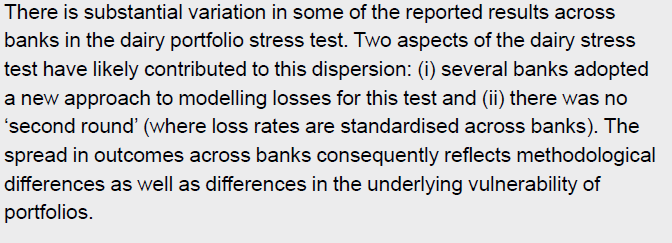
stress test extract

That does tend to suggest we should use the higher loss estimates rather than the lower ones (since banks have fewer incentives to overstate the loss implications than to understate them).

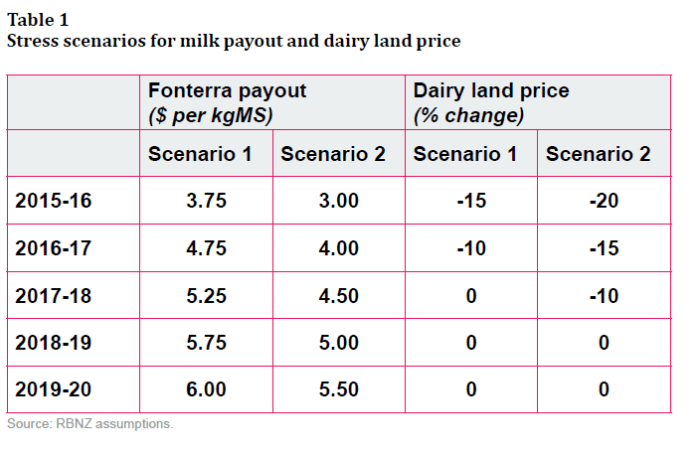
Here are the scenarios the Reserve Bank specified.

stress test scenariosI’m largely going to ignore Scenario 1 from here on.  As the long-term average real milk price is probably only around the assumed 2017/18 level, Scenario 1 doesn’t represent much of a stress test at all.  The banks and the industry would have to be have been very rickety for a scenario like that to have presented a banking system problem.  I think the Reserve Bank should also have discounted these results, rather than highlighting them in their press release.

Scenario 2 does look much more like a real stress-test.  But even if one thought the series of payout assumptions might be reasonable (2015/16 won’t have been that low, but some of the out years could still be lower than assumed here), I was surprised by the dairy land price assumptions.  Despite a really severe adjustment in the payout path (absolutely, and probably relative to farmer expectations), dairy land prices are assumed to fall by just under 40 per cent (the cumulative effect of those three annual falls).

That might sound like a lot, but:

  • when the Reserve Bank did its housing stress test, it assumed a 50 per cent fall in Auckland house prices.  People still need to live somewhere, while they don’t need to farm cows.
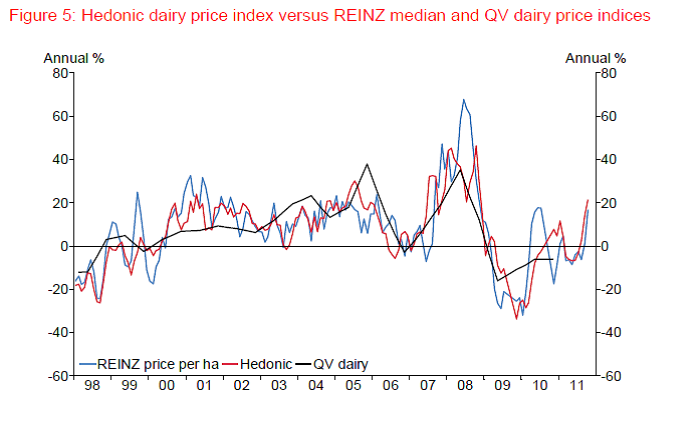
  • we’ve already a dairy land price scare not long ago.  Here is a chart of the (“hedonic”)dairy land price index the Reserve Bank developed for REINZ (despite which, we don’t have general access to the series).

dairy farm pricesIn a single year, dairy land prices fell by more than 30 per cent –  and that was a severe, but very short-lived, fall in milk prices, and a rise in dairy non-performing loans that was still moderate compared to what we see in Scenario 2 in the current stress test.   Perhaps deliberately, the Reserve Bank’s stress test does not seem to have taken account of a second round of selling (forced or voluntary), and the potential for that to drive land prices well below what might be a longer-term equilibrium level.  Overshoots routinely happen in such markets, where liquidity is thin to non-existent, uncertainty is rampant, and potential buyers are few.  As Eric Crampton’s discussion highlights, one difference between now and 2009 will be that potential buyers are probably much more aware of how significant the barriers are to any offshore buyers (who might otherwise be a stabilizing force in the market).

Loan losses evaluated on total dairy land prices falls of perhaps 60 per cent might be a more realistic stress test –  recall, that stress tests aren’t central predictions, they are a scenario to test robustness against.  Loan losses went up by 5 percentage points on the move from the (not very stressful) Scenario 1 to Scenario 2.   The pattern of losses on loans should rise non-linearly as the test gets more stressful, and moving from a 40 per cent land price fall scenario to a 60 per cent scenario is a bit more of a land price adjustment than moving from Scenarios 1 to 2.

There are lots of other points of detail I could question (some things in the article just aren’t made as clear as they could be), but will just highlight one.

The Reserve Bank has long emphasized the desirability of having a capital framework for banks in which risk weights (whether imposed by the Bank, or flowing from the internal models of the major banks) do not have the effect of making capital requirements pro-cyclical.  If capital requirements fall in asset booms and rise in shakeouts, the capital requirements will tend to amplify credit and asset price cycles (an existing stock of capital will go ever further as the boom proceeds, and ever less far – encouraging banks to rein in lending even more –  as the bust proceeds).  And yet the stress-testing article suggests that pro-cyclicality is deeply embedded in the modelling, at least for the dairy portfolio –  itself the largest single chunk of banks’ commercial lending.

Here is what I mean.

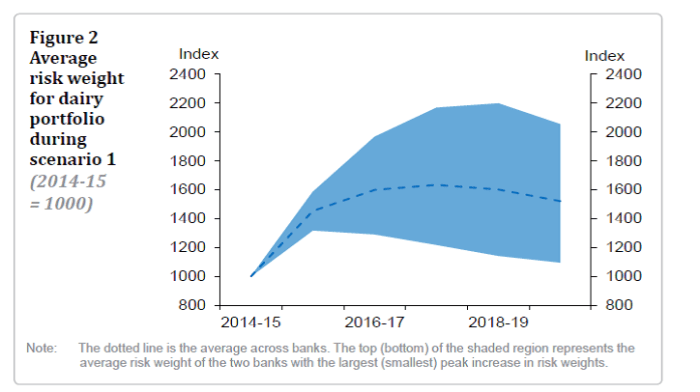
risk weights dairy

This chart shows the average risk weight for the banks’ dairy portfolios under Scenario 1.  Recall that Scenario 1 was not very demanding at all, and yet the average risk weight on dairy loans increases by 60 per cent  (eg, from, say, 70 per cent to 112 per cent).  No doubt deliberately, the Bank does not reveal how much further risk weights increase in the much more onerous Scenario 2.     Even if it is not that much further, this sort of highly pro-cyclical pattern of risk weights looks like a bug that needs some serious attention.

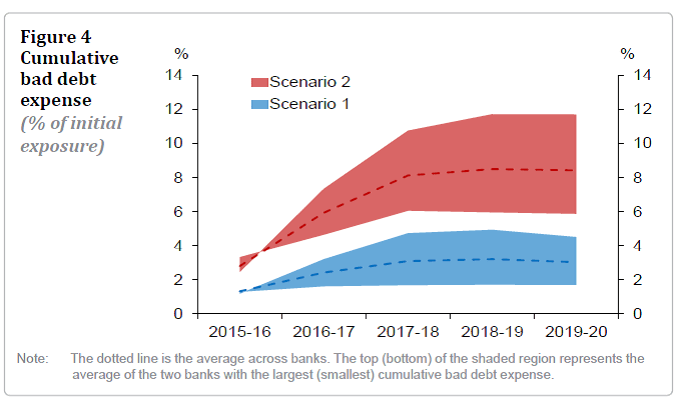
To recap, in Scenario 2, bad debt expenses average 8 per cent of dairy exposures.

dairy bad debts

But, as the Bank noted (see extract above), not all banks were as conservative as others.  If we take the pessimistic end of the Scenario 2 range, we would have bad debt expenses of perhaps 11.5 per cent of dairy exposures.  But, as noted above, the near-40 per cent fall in land prices  in Scenario 2 still looks too shallow for such a fully-worked-through scenario.  If land prices were to fall 60 per cent would it be implausible that in such an scenario, with all the second round effects accounted for and allowing for the non-linear loss profiles, the banks could face losses not of the “3 to 8 per cent of their total dairy exposures”  that the Reserve Bank highlighted, but something more like 20 to 25 per cent of their total loans to dairy farmers?    I deliberately pose it as a question, rather than a confident assertion, and it is –  deliberately – the result of a stressed scenario, but it is probably a question people should be posing to the Reserve Bank.

Cross-party support for high immigration policies

My post yesterday about the Prime Minister’s immigration interview at the weekend prompted a few comments from people keen to pin the responsibility for the current policy on John Key and offering thoughts on what electoral motives National might have for favouring high rates of non-citizen immigration.

Now, of course, any incumbent government (especially one that has held office for more than seven years) must accept some responsibility for current policies.  Especially on matters that don’t require legislation, if they didn’t like the current policy, they could have changed it.

But, as I’ve pointed out on various occasions, current policy is not some bold new innovation of the current government.  It is, more or less, a continuation of the policies of previous governments since at least the start of the 1990s.  A couple of weeks ago, I linked to the 2014 immigration policies of the various smaller parties, not one of which suggested any material disquiet with the regime. (I didn’t link to the 2014 Labour policy, and they now appear to have taken down their 2014 policies, but here is a 2014 summary of the various party immigration policies. Labour seemed then to favour more use of immigration policy in a counter-cyclical way, but there is no obvious disquiet with the overall target levels.)

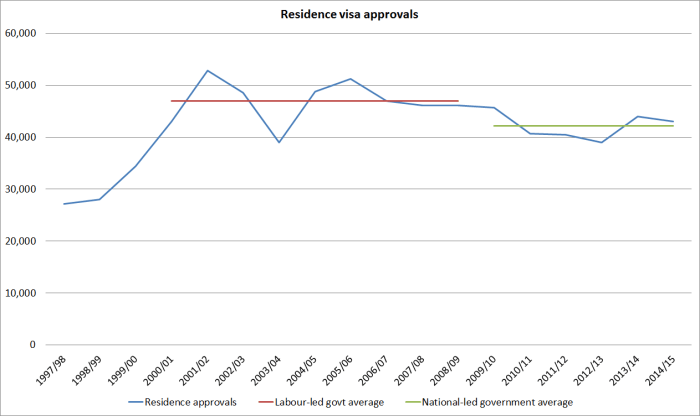
And what of the practice?  The MBIE website has a series for residence approvals for each year back to 1997/98.  Here is a chart of that data, including averages for the previous Labour-led governments (2000/01 to 2008/09) and the current National-led governments (2009/10 to 2014/15).

residence approvals

The target number of approvals (45000 to 50000 per annum) has not changed from one government to the other, and the average number of residence approvals has actually been slightly lower under the current government than it was under the previous government (probably largely reflecting the fact that labour market conditions have been more difficult in recent years).  As the population is now 20 per cent larger than it was in 2000, annual residence approvals as a share of the existing population are now quite a bit lower than they were back then (albeit still very high by international standards – roughly three times, per capita, legal immigration to the United States).

There have been plenty of refinements of policies over time –  some for the better, others not.  We’ve had changes in the eligibility for parent visas, changes in the points offered for people moving to places other than Auckland, and an increased orientation in granting entry to people with specific job offers (an approach criticized – I think rightly – in the new Fry and Glass book).  But the overall approach to residence approvals has had much more continuity than difference from one government to the next.  And only people who get a residence visa can stay here permanently.

What of some of the other visa types?  Foreign students are a reasonably significant export market, and if there has been some (material) change in policy over the granting work rights to longer-term students while they are here, overall student visa numbers haven’t changed much from one government to the other.

student visas.png

Ideally, one might have hoped that we’d be seeing more students than 10-15 years ago, but mediocre universities and a high exchange rate are obstacles to that.

The number of working holiday scheme visas granted has increased hugely.

whs visas

But (a) if you didn’t know the dates of the change of government, you couldn’t tell from the chart, and (b) much of the more recent expansion of working holiday programmes seems to have been in pursuit of votes for the Security Council seat, a goal shared and pursued by both main parties.  Moreover, although 60000 visas were granted last year, these people are typically only in New Zealand for a few months.  I don’t have any strong views on working holiday schemes, although in papers released last year, even Treasury expressed some unease.

The number of people granted work visas has also trended up very strongly –  most strongly when the unemployment was very low –  over the period since 1997/98.

work visas.png

But again, there is no obvious difference between the experiences under National and Labour led governments.  Much of the trend reflects the change of approach under which most people who obtain residence visas do so from within New Zealand. In the 1990s, most people who got residence visas did so directly from abroad, but now the most common model is for someone to come on a work (or student) visas, get established in a specific job here, and then apply for a residence visa.  That aids the integration of the people who do come but, as Fry and Glass note, may not help attract the very best people.

The point of this post so far has been to illustrate the substantial continuity, and commonality of approach, from one government to the next.

But on the off chance that anyone thinks ‘but Winston is different’, recall that Winston Peters was Deputy Prime Minister and Treasurer in the National-New Zealand First government from 1996 to 1998, and was Foreign Minister in the Labour-led government of 2005 to 2008.

I tracked down a copy of the (very long) 1996 coalition agreement between National and New Zealand First.  Immigration policy is dealt with on page 45. Here is what it said:

Statement of General Direction:
The goal is to have an immigration policy that reflects New Zealand’s needs in terms of skills, ability of the community to absorb in relation to infrastructure and recognising the diversity of the current New Zealand population. Such a policy will take into account the capacity of this nation to meet the general economic and social needs of New Zealanders.

Key Initiatives of Policy:

To maintain current immigration flows as per the last quarter of 1996 until the Population Conference has been held in May 1997.

  • Introduce a strict four year probationary period.
  • Introduce a limited overstayer amnesty following agreement upon appropriate definition and objectives of the amnesty
  • Health screening of overseas visitors.
  • Population Conference/strategy.
  • Clamp down on refugee scams.
  • Increased resources to policing immigration policies

Whatever you make of the specifics, it doesn’t have the ring of something dramatically different from what had gone before (or what came after).  (And for those of a historical bent, here is the programme –  with comments from the then Prime Minister and the then Minister of Immigration –  for that Population Conference.)

By 2005, confidence and supply agreements were rather shorter, but this is what the Labour-New Zealand First agreement said about immigration

Immigration

• Conduct a full review of immigration legislation and administrative practices within the immigration service, to ensure the system meets the needs of New Zealand in the 21st century and has appropriate mechanisms for ensuring the system is not susceptible to fraud or other abuse, and taking note of other items raised by New Zealand First.

Again, not suggesting any very material changes of policy.

Of course, minority parties have to prioritise.  My point is only that over 25 years in practice our high levels of inward non-citizen migration have been the result of a widely-shared consensus among our political parties (and bureaucrats). Some might have been zealous for it, and others just not that bothered.  Perhaps that outcome has been a good thing, leading to real economic gains, or perhaps not (it would nice if the advocates could show us the evidence of those gains), but it certainly isn’t a Key innovation.


Central bank communications

I had not been going to write any more now about the Reserve Bank’s investigation into the possible OCR leak (I voluntarily passed them hard but partial information; what conclusions they are able to draw from that information is up to them)  and the related, more important, issues of how they handle releases, lock-ups etc.  But overnight Marek Petrus, former communications director at the Czech central bank, got in touch and drew my attention to a couple of posts on the issue which he had put on his own very interesting blog, Lombard Rates.  He has also left a substantial comment on my earlier post on reforming Reserve Bank releases.

Petrus’s two posts are here (more specific) and here (more general).  He argues as follows

Based on my experience, organizing lock-ups for interest rate-decision releases is not a standard, wide-spread practice among central banks.

As far as I know, few central banks provide information on rate decisions under embargo, be it via lock-ups or other means (the Czech National Bank, where I set up that lock-up regime for news agencies some years ago, is one of those few).

Still, lock-ups do make sense, but mostly for technical, complex matters that require a lot of explanation (a specific example is releasing Inflation Reports or Financial Stability Reports). Providing information on a rate decision and the main reasons behind such decision under an embargo longer than, say, 5-10 minutes is not worth the risk.

My suggestion for the RBNZ, or any central bank considering ways to employ or redesign an embargo technique, would be to organize the standard lock-ups only to provide detailed explanations on complex publications or complicated technical, regulatory matters. The most market sensitive information (such as the rate announcement) should either be released under no embargo at all, or be made available to a small group of journalists via a tight, 10-15 minute lock-up. That would help reporters get the facts right and avoid making a factual error under stress.

No market participant or analyst should have access to this sensitive kind of information before the official release. That to me is the first line of defense against an embarrassing information leak. Afterwards, an open press conference could be held for journalists and TV cameras, and a separate background seminar organized for analysts, to explain the decision and answer detailed questions. However, this press conference and the background seminar are, as rule held, only after a rate decision has been published, and has thus become part of public domain.

I agree with the gist of these comments, although I’m not sure about holding background briefings for analysts after the release.  When we first did Monetary Policy Statements in New Zealand we did exactly that, but the sessions were not popular (clients wanted immediate explanations, and after that the market economists wanted to move on to other things).  Perhaps more importantly, comments on the monetary policy outlook and projections should be made openly and on-the-record or not at all.

UPDATE: Petrus has got in touch to clarify what he meant about an analysts’ briefing:

I did not mean to suggest that a seminar for analysts should be organised behind closed doors (i.e. only on background).

Quite the opposite: It should be made public, streamed live as a video webcast and later made available online as a video recording. By writing about “background seminar”, I meant to say that background and detailed information about a policy decision and the latest forecast should be routinely provided by a central bank via such analyst meetings.

The most transparent central banks, such as Sweden’s Riksbank and the Czech National Bank, make such analyst meetings public by providing a live webcast and making the video recording available via online services such as YouTube for every member of the public to watch.

See for instance: https://www.youtube.com/playlist?list=PL7V-SFaHLX4LcIZjld51kktczHEj36hJ9

That would appear to be an excellent approach for our Reserve Bank to consider adopting.

No, Prime Minister

The Prime Minister was also on TV3’s The Nation last weekend.  Most of the interview was about immigration.

Late last year, I wrote about some earlier, probably rather off-the-cuff, remarks that Key had made about immigration, in which he described the recent high net migration inflows as a “time of great celebration”.

The TV3 interview was a rather more substantial occasion (The Nation isn’t exactly a mass market programme), and it was about the issues, not just an opportunity to attack his political opponents.  The Prime Minister will no doubt have been briefed for it by his own DPMC officials, and perhaps also by MBIE, the government department responsible for immigration (administration and policy).  And yet I was surprised just how insubstantial his answers were, and a little alarmed at the central planner’s mentality that they evinced.  On Radio New Zealand yesterday, Matthew Hooton described the current government as the most interventionist since the 1970s.  That mentality was fully on display in John Key’s interview.  I had to watch the interview again to be sure that I had correctly heard a Prime Minister from an avowedly centre-right party declare that there was an optimum number of (immigrant) truck drivers.

I was pleased to see that the interviewer kept the focus on the flows of non-New Zealand citizens.  New Zealand can’t, and shouldn’t try to, control the comings and goings of New Zealand citizens.  We can’t even, and shouldn’t try to, control the outflows of non-New Zealand citizens –  the people who come and, after a time, find that New Zealand isn’t quite right for them, or just find an even better opportunity somewhere else.    But every inflow of a non New Zealand citizen requires the approval of the New Zealand government  –  that is what immigration policy is about. (As a matter of policy, we allow any Australian citizens to move here without advance approval but (a) that is still a New Zealand policy choice, and (b) the numbers involved are pretty modest (over the last 40 years the annual net inflow of Australians has fluctuated between 0 and 3500)).

The Prime Minister, of course, was keen to emphasise the fall in the net outflow of New Zealanders.   In the data released yesterday, there was still a net outflow of 3890 New Zealanders to Australia over the last year.  That is, by the standards of recent decades, a small net outflow, but the people who know New Zealand best  –  New Zealanders –  are still choosing to leave rather than to return (and to a country where real per capita income has been falling for the last couple of years, and hasn’t grown in seven years).  That should be telling the Prime Minister something.

The interviewer kept trying to push the Prime Minister to name an “optimal number” for the inflow of non New Zealanders.  He consistently refused to do so, asserting that there was no limit to number of arrivals he would be happy with “so long as they add value to New Zealand”.  Oddly, neither he nor the interviewer mentioned that actual government policy is rather different.  After all, there is a target level for the number of residence approvals granted (45000 to 5000o per annum), that target is approved by Cabinet, and the target has not changed for quite a long time.   Despite all the fluctuations in the number of foreign students, or short-term workers, the residence approvals programme is the main way in which immigration policy boosts the population over time. Broadly speaking, I think it is a sensible way to run immigration policy –  we shouldn’t be playing around with the target each year in the light of immediate pressure, but setting some medium-term targets and reviewing them from time to time.    But there was simply no discussion as to whether 45000 to 50000 is the best target, or how we might know.  Why not, for example, 30000 per annum more?  Or fewer?

In fairness to the Prime Minister, there was also nothing explicit along the lines often found in MBIE documents, lauding New Zealand’s immigration policy as a “critical economic enabler” or a “key lever” in economic strategy.  But he didn’t seem far from that either, but with equally little evidence.  He asserts that immigration is a source of growth, without ever being quite clear what he had in mind.

Everyone recognizes that increases in immigration boost demand, and tend to boost total GDP.  Bur our real interest should be in per capita or per hour worked measures, whether of GDP or of national income –  and, to be even more specific, in what, if any, gains there are to those who were already here.  From an economic policy perspective, immigration makes sense if it makes those of us who were already here better off.  But despite running one of the largest immigration programmes in the advanced world, neither the Prime Minister, nor his advisers in MBIE and Treasury, have been able to produce any evidence that New Zealanders as a whole have been made better off.  In his interview, the Prime Minister didn’t even try to make the case, to (for example) outline the channels by which he believes New Zealanders are being made better off.  (And, in fairness, the interviewer didn’t push him to do so.)

Instead, the Prime Minister seemed reduced to assertions that the high rate of immigration is a “sign of success” or even “a badge of honour”, asserting that people don’t want to come to countries that aren’t doing well.

It is surprising that anyone takes that line of argument seriously.  At the grim extreme, Turkey, Lebanon and Jordan –  none of them terribly well-performing – have been very attractive places to non-natives in the last few years.   They are simply (much) less bad than Syria.  But more generally, immigrants tend to move from poorer countries to richer countries, and for all its disappointing performance over 60 years or more, New Zealand still offers higher incomes than most of the countries of the world.  That people want to come here simply reflects what we already know, that New Zealand is better off than most places.  It sheds no light at all on whether New Zealanders are benefiting from the large scale immigration programme run by successive governments.  And that should be the question we constantly ask.

It is not as if this is some unimportant question: if New Zealand’s productivity growth or per capita income growth was outstripping that of all its peers there might still be an interesting question as to what contribution immigration was making to that outperformance.  But only a handful of people would care much –  there would be plenty of prosperity to go round.  But we’ve kept on underperforming for decades, despite the allegedly productivity-enhancing immigration programme.

And yet the Prime Minister is adamant that “we need these people”.

I’m not entirely sure why.  There are plenty of people around to offer cynical explanations of anything and everything John Key does.  Perhaps there is merit to that –  as for most politicians –  when it comes to tactical choices.  But the large-scale immigration programme seems to be one of those things which he genuinely believes in.

No doubt it helps that his official advisers (Treasury and MBIE) keep telling him we benefit from the immigration programme, even if they don’t offer –  or even really try to offer – any evidence of those benefits.  That inclination is probably reinforced by the fact that the global elites among whom he moves treat the benefits of immigration as almost axiomatic.

And I don’t suppose he has ever seriously engaged with the fact that, despite its poor productivity record, New Zealand has had some of the highest real interest rates in the advanced world for at least the last 25 years, or the possible connection from that (and the associated high real exchange rate) to the weakness of business investment in New Zealand, and the failure to make any progress towards his own government’s (well-motivated but questionable) goal of markedly increasing the export share of GDP.

But I suspect that a significant part of why Key supports such a large immigration programme is because he buys into the skill shortages story.  It was the only story that he used in the TV3 interview.  Employers tell MBIE, and those taking surveys, that they can’t find staff locally, and that if they can’t find staff it will impede their ability to grow their business.  MBIE certainly believes the story –  as I wrote about a while ago, it suffuses their annual report on migration trends.

What I find remarkable in this document, as in other MBIE immigration work I’ve seen, is the absence of any sense of market processes, and how the market might sort these things out.  For example, if there are excellent opportunities here which New Zealanders are simply ignoring in their rush to get to Australia, surely we’d expect real wages to increase here?    If that happened, some of the opportunities might disappear.  Some New Zealanders might change their minds about going to Australia.  Some people might regard more training as worthwhile, to better equip themselves for those higher-paying opportunities.  Some will switch jobs from less rewarding ones, to the ones where the returns are now higher.  Some people might work harder or stay in the workforce longer.  But not one of these market mechanisms is even discussed.  And this from a key economic agency, implementing the policy of a vaguely centre-right government?  Does it not occur to them that “shortages” don’t happen in most markets, and when they do they are usually just a sign that the price has not adjusted.  Why does MBIE think that labour is different?

Although MBIE and the government seem to see immigration largely as a labour market phenomenon (“a critical economic enabler”), the price of labour  “wages”  appears only once in the entire document (purely descriptively).  “Price” does not appear at all.  In fact, “productivity” and “competition” each appear only once, in neither case in the context of an analytical sentence.  “Labour market” does appear repeatedly, but almost always only descriptively.  There is simply no sense, anywhere in the document, of a competitive market process at work.  If one were being unkind, one might think MBIE saw the role of government as being to ensure that the right pegs were in the right holes.

And that seemed to be how the Prime Minister saw it, as he talked of the need to juggle which occupations were on, and off, the approved list, and never once talking about market adjustments, changes in wages etc.  In fact, it was where the comment about the optimal number of immigrant truck drivers came in –  apparently truck drivers have recently been removed from the list.

From an individual employer level it all makes some sense. Importing a foreign worker really can relieve an individual firm’s shortages.  But it simply doesn’t do so economywide, and isn’t necessary anyway.  Markets and price/wage adjustments take care of reconciling supply and demand, in and across markets. One might have hoped that the Prime Minister of a centre-right government might, just once, have made that point.

When I make the point about market adjustment, I often get some sceptical comments –  higher wages, I’m told, would price producers out of the market.  But if we decided to have a much lower level of immigration a lot of things would change.  Some industries would shrink markedly.  We’d have a fairly flat population, so we’d probably have a much smaller construction sector, freeing up a lot of labour.  We’d have lower interest rates, and a lower real exchange rate.  Resources would, over time, shift from the non-tradables sector to the tradables sector, as more offshore opportunities became viable for smart New Zealand firms.  In some sub-sectors which have been favoured by immigration policy  –  dairy workers for examples –  wages might be expected to rise somewhat, to attract more New Zealanders into the industry.  But remember that the real exchange rate would be lower.    We simply don’t need government officials deciding which particular skills to import this year.

These arguments aren’t remotely new even in a New Zealand context.  In a chapter in the Oxford History of New Zealand in 1981, Victoria University economic historian Professor Gary Hawke wrote

“Ironically, the success with which full employment was pursued until the late 1960s led to frequent claims that labour was in short supply so that more immigrants were desirable. The output of an individual industrialist might indeed have been constrained by the unavailability of labour so that more migrants would have been beneficial to the firm, especially if the costs of migration could be shifted to taxpayers generally through government subsidies. But migrants also demanded goods and services, especially if they arrived in family groups or formed households soon after arrival and so required housing and social services such as schools and health services. The economy as a whole then remained just as “short of labour” after their arrival.”

But 35 years on Radio New Zealand was still leading its news bulletins last night with a story along the lines of “despite record net migration flows, employers claim skill shortages are as severe as ever”.  We simply shouldn’t be surprised.  Immigration simply does not ease skill shortages in the economy as a whole or, typically, ease pressure on resources. Across a range of colonies of settlement, Prof James Belich illustrated that point quite effectively in his 2009 book Replenishing the Earth.

If there are real gains to New Zealanders from large scale immigration –  and the onus really should be on the Prime Minister and other advocates to demonstrate those gains –  they simply don’t come that way.

Finally, Auckland. The Prime Minister was astonishingly upbeat in his story about Auckland, and dismissive of the implications for house prices.  Now, we can all accept that high immigration does not cause housing market problems, and serious affordability issues, when housing and land supply are only lightly regulated.  But that isn’t the New Zealand situation.  The government has been unwilling or unable to legislate to facilitate the sort of physical growth of Auckland that would have kept urban land (and house) prices in check.  Given that, it is quite reasonable to ascribe much of the rise in Auckland house prices to the immigration policy that the government can, but won’t, change.

But the Prime Minister simply falls back on “global city” arguments. He asserts that Auckland has “reinvented itself”, and now competes on a global stage with cities like Sydney, Dubai, London and so on.  According to the Prime Minister, young Aucklanders simply cannot expect house prices to come down again –  this is, we are told, the price of being a “global city”.

This is really nonsense on two counts.  The first, of course, is that there are plenty of successful fast-growing cities in the United States where real house prices have not risen materially at all, and where price to income ratios remain about as low as they were in New Zealand for decades.  As just two examples, Houston and Atlanta are both materially larger, fast-growing, by most counts more successful, and home to much more international business than Auckland is.   Yes, real house prices in Sydney and London and Auckland might not ever come down, but if so in each of them that is a direct result of government choices –  constraining the supply of urban land in the face of population pressure (in the New Zealand case, the population pressure itself mostly resulting from immigration policy choices).

But perhaps more concerning is that there is just no evidence of this Auckland economic success.  Auckland’s population has grown much faster than that of the rest of the country, and Auckland is much bigger than any other place in New Zealand.  According to the champions of the immigration programme, and of the application of agglomerationist ideas more generally, this should have seen Auckland’s economic performance pulling away from that of the rest of the country.  If anything, the data suggest that the opposite is happening.  I ran this chart, from the regional GDP data, a couple of weeks ago.

nom gdp pc akld vs rest

If Auckland has “reinvented itself” anywhere other than in the heads of the Auckland Council and government officials, it doesn’t look to have been for the better.

The regional GDP data aren’t an ideal measure by any means –  and they can be a bit cyclical, as in the short-term Auckland benefits from the initial boost to spending from high immigration flows, and suffers when immigration slows –  but once again there is just no sign of the gains (incremental or transformational) that the advocates of the immigration programme, as a key economic lever, would have been looking for.    International trade isn’t growing (share of GDP), productivity growth remains disappointing, our biggest and fast growing city is slipping relatively.  All we are left with is some large distributional effects: firms in the non-tradables sector do okay, but those in the tradables sector suffer (and others never even get started); those who own land in Auckland do well, while those who ever want to buy into that market suffer.  And so on.

There are plenty of year to year fluctuations in overall net migration numbers. They shouldn’t really be the focus, and even if they were there are distinct limits to what governments can do about them.  But we deserve a much more compelling case for how the large scale medium-term immigration programme is benefiting New Zealanders as a whole than the Prime Minister (or his officials and ministers) has given us.


The inquiry into the possible OCR leak

I see that Stuff has an article up about the Reserve Bank’s inquiry into the possible leak of the OCR decision.

Michael Reddell, a former senior economist at the Reserve Bank, who now runs a blog which has been sharply critical of the central bank, claims he was told that the official cash rate (OCR) would be cut an hour before the decision was announced.

The Reserve Bank has confirmed that following an allegation, it had launched an investigation.

“We are aware of an allegation that information may have been leaked ahead of the OCR announcement on 10 March,” a spokesman of the bank said.

There is no “claims” about it. I have given a copy of the email (minus the name of the sender) I received at 8:04am on the OCR release day to the Reserve Bank’s inquiry.  That email read as follows:

We have just heard that the Reserve Bank is cutting by 25 basis points.

I have been consistently clear that the email in its own right is not confirmation that a leak occurred,  but it is troubling nonetheless, and raises the serious possibility of a leak.  When I drew the matter to the attention of the Reserve Bank, they also expressed immediate concern and appropriately moved to initiate an inquiry.

When I first received the email, I was not sure what to make of it.  I checked the exchange rate pages and was relieved to find there had been no movement.  I also wasn’t sure whether to believe the report  –  after all, a cut was not widely expected that day.  Seeing no movement in the exchange rate, not being sure if the report was accurate (and not wanting to be scoffed at by the Bank if they weren’t in fact cutting), and knowing that the key Reserve Bank people would in any case  be in lock-ups, I did not pass on the information to the Reserve Bank (John McDermott and Mike Hannah) until shortly after 9am on MPS day.

I still fervently hope that the investigation is able firmly to conclude that no leak occurred.  Regardless of whether it did or not, the risk of leaks remains and the Bank would be wise to tighten up its procedures and further reduce the risks.


A period piece: the NZ financial sector following nuclear war

On Saturday one of the local churches was holding a garage sale.  My 9 year old likes such sales, searching out additions to her collection of small treasures.  But this sale also had several boxes of books they were giving away –  titles sufficiently obscure that no one, it was thought, would even pay a dollar or two for them. My family stocked up on books, and among our pile was a period piece, a report by the New Zealand Planning Council “New Zealand After Nuclear War”.

This report was published in 1987, funded from $125000 allocated by the then government from “reparations paid as a consequence of the sinking of the Rainbow Warrior in Auckland Harbour”.  It even, so I just discovered, got a mention in the New York Times.

The scenario the authors used was a pretty serious one –  a major nuclear war in the Northern Hemisphere, and a limited number of nuclear strikes, mostly on defence and communications related facilities, in Australia.  New Zealand isn’t directly involved in this war, but we hardly escape unscathed.  Apart from anything else, we were (and are) heavily dependent on foreign trade.  One of the aspects of the scenario is an electromagnetic pulse which, apparently, could have undermined (“instantly cripple”) computers, phones, electricity networks etc.

I haven’t read the full report, but the chapter that caught my eye –  in this age of stress tests –  was “Initial Impacts on the Financial Sector”.   The authors don’t seem to have consulted the Reserve Bank, but they did talk to Treasury, to at least one of the banks, and glancing through the list of acknowledgements I saw various names of people with banking or related backgrounds.

All the chapters are brief, but this was a serious attempt to think through the issues, albeit perhaps in way that assumed a degree of post-war resilience that doesn’t quite ring true.

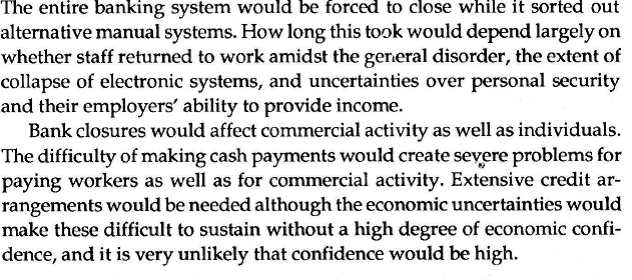
I was initially staggered at the suggestion that banks might need to shut for only a couple of days, as much because staff might be unsettled as for any other reasons

bank closure

But as I read on, the authors were very conscious of some of the other problems.  The risk, for example, that electronic records could be destroyed, or barely usable.

bank closure 2

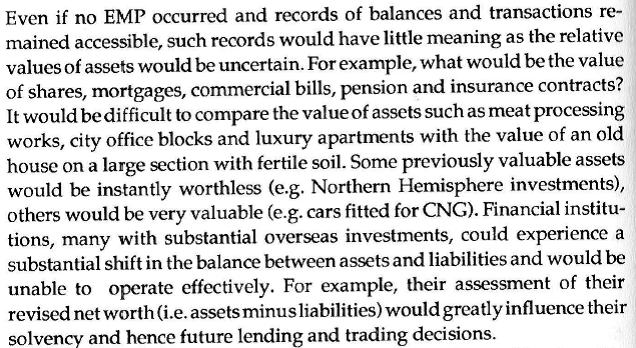
And, in the longer-term even more importantly, the extreme uncertainty about asset values.

asset values

What, for example, would be a book full of dairy loans be worth in a world in which much of the population abroad had been wiped out?  Or, since this was 1987, what might loans to Judge, Equiticorp, Chase and so on have been worth.  Oh, but I forgot, not much anyway.

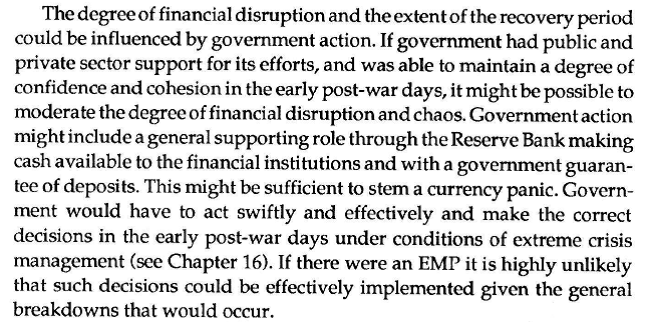
They see a considerable role for government support for the banking system.

govt support

And conclude, perhaps least plausibly, with the suggestion that pre-war planning might “moderate the adjustment process”

policyI

I don’t want to be particularly critical of this piece.  If from this distance the prospect of nuclear war seems less real than perhaps it did in the 1980s, it is still worth thinking these sorts of issues through, and people do what they can in the time they have –  in the case of this report, that was not overly much time.  And I spent quite a lot of time over the years in planning for some, rather less severe, contingencies –  Y2K, and as part of the wider government planning a decade or so ago around bird flu risks.  I led a team inside the Reserve Bank working on policy and banking system preparedness for bird flu.  As a result of that work two bankers’ reactions are seared in my brain: the senior manager at TSB, clearly unimpressed at having us visit, who turned around, and pointed out the window towards Mt Egmont and announced “we have more immediate risks we prepare for here”, and the head of risk at one of the major banks who told us very confidently, when we asked about rollover risks for offshore funding in the event of a global bird flu, that such markets could and would never seize up (this a mere two years before the crisis).

But there were still a few surprises about the report.  Perhaps because it was written only a couple of years after liberalization, there is not a single mention of the exchange rate, or interest rates, in the entire chapter.  These days, I’m sure people would put much greater attention on the panic and market chaos that would be likely to ensue as this (scenario) nuclear war was getting underway.  The aftermath might be truly awful, even in New Zealand, but the transition would be really pretty bad too.  The global financial panic in the first days of World War One was documented in a recent book, and bad as World War I turned out to be, no one had any sense of the scale of that disaster when extreme financial crisis nonetheless ensued.  Since the aftermath of nuclear conflict might be almost unknowably awful, if authorities were ever to think of contingency planning for remote events of this sort, it might be more productive to focus their efforts on the period in which hope is fading, fear is soaring, but the institutions and infrastructure have not yet been destroyed.

Credit pre-dates money, and relies on trust.  But in what could anyone trust in the sort of world the authors of this Planning Council report try to grapple with?


The Ombudsman on the OIA

The new Chief Ombudsman, Peter Boshier, had some encouraging comments in his interview about the Official Information Act with TV3’s The Nation that was broadcast over the weekend (transcript here).

In some cases, they involved walking back some earlier surprising comments.  In an interview with Fairfax only a couple of months ago Boshier said that, despite the huge backlog of complaints and very long delays

Turning to parliament for more resources and money wasn’t tenable, he said,

But now he tells us that he has a request before Parliament for more budget resources

That request should fall on receptive ears.  In their recent financial review of the Office of the Ombudsman, Parliament’s Government Administration Committee noted that, despite the efforts of the previous Chief Ombudsman to improve efficiency

Nevertheless, we believe the Office is under-resourced and over-worked, and would benefit from additional resources.

Boshier talks in a way which suggests a commitment to making the Official Information Act work in a way that respects, and gives tangible form to,  the stated purpose of the Act

The purposes of this Act are, consistently with the principle of the Executive Government’s responsibility to Parliament,—

(a) to increase progressively the availability of official information to the people of New Zealand in order—

(i) to enable their more effective participation in the making and administration of laws and policies; and

(ii) to promote the accountability of Ministers of the Crown and officials,—

and thereby to enhance respect for the law and to promote the good government of New Zealand:

and its Principle of Availability

The question whether any official information is to be made available, where that question arises under this Act, shall be determined, except where this Act otherwise expressly requires, in accordance with the purposes of this Act and the principle that the information shall be made available unless there is good reason for withholding it.

He spoke several times of his view that we should think of it as a freedom of information act (the title used in several other countries), noting

I think that there should be a premise that why don’t we make information available? Let’s start with the default position of ‘why not?’ instead of ‘why should we?’

Although he didn’t mention it, greater use of pro-active release of material by ministers and agencies would be consistent with this sort of approach (and typically cheaper for agencies too).

Boshier is planning to meet with all the political parties in Parliament to discuss his expectations and aspirations, and the standards to which he will be holding government agencies.  It is though perhaps a little disappointing that instead of meeting with the Prime Minister and/or the Minister of State Services, he will only be meeting the Prime Minister’s chief of staff.

But his goals seem good.  He says he isn’t going to tolerate agencies going against the spirit of the Act in respect of meeting deadlines –  using all 20 working days, rather than releasing material as soon as reasonably practicable (the statutory requirement).  That sounds good, although I had a conversation a few weeks ago with one of his staff that suggested that that attitude has not yet seeped all the way down the organization –  or at least that staff can still be too trusting of agencies and their excuses for delays.

In one concrete measure,

when we get a complaint or an official information request and we ask an agency’s view, we will give them 28 days. I think it’s too long, so I’ve started to a) cut down that down to something like 14

And he is hoping to use any additional resources to clear out the current backlog (650 cases more than 12 months old) and get the Office onto a basis in which 70 per cent of complaints can be resolved within three months, and all complaints dealt with in 12 months.  If that can be achieved, it would be a huge step forward (but would, no doubt, prompt more complaints, since people might believe a complaint might actually make a difference, in timeframes that matter).  There was talk of greater use of ADR techniques, which sounded interesting, but there were no specifics.

Boshier also announced that

as of the 1st of July, we intend to move towards publishing what I’ll call league tables. We pretty much know who are really good compliers with the act and those who are not, and probably it will be good for the public to know that as well.

It sounds very well-intentioned, but I’m a little skeptical.  We will need to see the details of what is planned, and the Office of the Ombudsman will need to be willing to revise those details in the light of experience.

The Official Information Act, and its local government counterpart, covers a huge number of organisations (including every school Board of Trustees) most of which probably get very few requests (or at least very few that they consciously treat under the provisions of this legislation).  I wonder which organizations the Office is planning to cover in its league tables?

Perhaps a list that encompassed each government minister, public service departments, non public service departments, the Reserve Bank, and some of the larger crown agents, autonomous crown entities, and independent crown entities might be a good place to start.

But perhaps more importantly, what are they planning to measure and report?  If league tables are to be used to heighten pressure on agencies, and yet those league tables can be easily or materially gamed, they could be almost worse than useless.

Much of what we should care about in respect of compliance with the Act isn’t easily measured in ways that are amenable to league tables.  It is about compliance with the spirit and principles of the Act.

It might be useful to know how many OIA requests have been responded to within 20 working days, and track those proportions for each agency over time, but…..if many requests are of a sort that should be turned round in three working days, and others are genuinely complex, how is that going to be reduced to a useful league table?

At present, when agencies respond to occasional requests about how many OIA requests they receive they have no particular incentive to gloss the numbers.  Technically, any request to any agency for information, of almost any sort, has to be treated as if it were explicitly a request under the OIA, but few count every approach.  League tables, designed to exert pressure, change the incentive.

Take the Reserve Bank as one illustrative example (and not to criticize the Bank, it is just the agency I know best).  The Bank generates a considerable volume of financial statistics and publishes a lot of material on its website (although, like many websites, unless you are familiar with the site specific material can sometimes be hard to find).  The Bank gets a lot of simple requests re data, simply dealt with in a very quick email response, or answer to a phone call. Those requests aren’t included in the 51 requests the Bank reported receiving last financial year.  But a league table could easily capture all these requests, and the quick response times (which are welcome), without shedding any real light on the issues of concern around the handling of the more contentious OIA requests.

Or take the Governor’s press conferences, at the release of the MPS and FSR.  As far as I can tell, each question is technically a request for information, covered by the Official Information Act.  Each answer is given within seconds of the request being made.  Over a full year, that would be easily another 100 requests lodged and expeditiously dealt with, without shedding any light on how the Bank handles requests for material it doesn’t want to release.

I’m sure those who know other agencies or departments in detail could readily come up with similar opportunities to game the statistics and any league tables.

It is good that the Onbudsman reckons he knows who the good performers are, and who the bad performers are, and that he wants to let the public know, but I suspect he is going to have a very hard time reflecting those assessments in any sort of league table.  This is mostly about attitudes, and they are fairly easy to spot, but hard to attach a number to.

Finally, the Ombudsman was asked about agencies charging for OIA requests, and specifically about the stance of the Reserve Bank.  He avoided the specific issue of the Reserve Bank’s approach, but commented more generally

 if we were to call this a freedom of information act and not an official information act, it gives the right tone. There should be an assumption that you can get information in a freedom way – that is without cost. That’s my starting point.

I do not support charging as a general rule.

That is welcome.

It is, however, quite a change of stance over only a few months. In that Fairfax interview in January he had said

“I think the Reserve Bank’s response is actually very fair. When I looked at it I couldn’t fault it. As a statement of principle it was perfectly fair and it’s one to which I subscribe,”

And, as the Reserve Bank itself revealed, the Ombudsman’s office had advised the Bank, as recently as November, that

Ms Kember [Principal Adviser in the Ombudsman’s Policy and Professional Practice Advisory Group] said that the Ombudsmen generally consider both that it was reasonable for agencies to charge in accordance with the guidelines and that the charges imposed within those guidelines are likely also to be reasonable. She said it is surprising that more agencies don’t make greater use of charging as one of the tools available to manage their overall workload and processes for responses where this would be helpful.

November was, however, before the new Ombudsman had taken office.

The Chief Ombudsman’s heart appears to be in the right place, and the direction of his comments yesterday is very much one that I would support. The Office of the Ombudsman has some legal powers and should have some moral authority which he may be able to use to lift the compliance of government agencies with the letter and spirit of the Official Information Act.  His predecessor was reluctant to use that authority.  But much also depends on political leadership.  There were some encouraging comments in response to Boshier’s interview from the Greens, but are the leaders of the National and Labour parties likely to treat this an issue that matters?

In the end, the Ombudsman can go only so far.  As I’ve pointed out previously, the relevant provisions of the Official Information Act itself appear to allow a more active use of charging than is envisaged either in the government guidelines on charging, or in the comments yesterday from the Ombudsman.  Good practice –  few agencies actually do charge – need not be as stringent as the provisions of the Act allow, but it might be timely to review the statutory provisions to buttress a sense, now apparently shared by the Chief Ombudsman, that official information should largely be available freely, in both senses of the word.


Some idling on the money supply

I don’t find aggregate measures of the money supply particularly enlightening, and usually when I focus on the money and credit aggregates at all it is on the credit side of things.  In a floating exchange rate system, credit growth tends to result in money creation, rather than vice versa.  Whether it results just in money creation, or in some mix of money and offshore financing, depends largely what people do as a result of whatever gave rise to the credit creation.

Cross-country monetary aggregate comparisons are also fraught.  Different countries measure the money supply in different ways, and the importance of the types of institutions whose liabilities are captured in the money supply measures differ from one country to another (banks are much less important in the US than in most other advanced countries).

All that said, I put a chart of money supply growth since 2007 in my post yesterday.  I did so simply to respond to a not-overly-well-considered claim by Kirk Hope that New Zealand had not relied on monetary policy, or money supply growth in particular, to the same extent as the other large industrial countries he cited.

Then I noticed that a few people had looked at the chart and concluded that New Zealand had had wildly rapid growth in its broad money supply, one observing that

One reason house-price inflation took off: QE.NZ. We may not have had QE officially, but compared to “New Zealand has had the second fastest rate of money supply growth” of all major developed countries – around half of which was borrowed into existence to buy houses.

So I thought I should do a slightly better chart.  After all, countries with faster population growth should probably expect faster money supply growth (they need more), and it makes sense to look at these things in real terms –  after all, Japan has had deflation over that period and Turkey has had rather high inflation.

For what it is worth the OECD has broad money supply data for 19 countries (including the euro area as a whole) and I added in the German data I used in the post yesterday.  For those countries, I got population data from the IMF and inflation data from the OECD, and calculated real money supply growth per capita for those countries between 2007 (just before the recession) and 2015.

And here is the resulting chart

broad money

I’m not sure I’d want to take much from it.  On this measure, and despite having had larger cuts in interest rates than all (?) of these countries since 2007, we’ve had rather moderate real per capita money supply growth (although still ahead of the UK, Japan and the euro-area of the dreaded QE).  It has been faster than underlying productivity growth to be sure, but not dramatically so.

Bank balance sheets just haven’t been growing very rapidly (in real per capita terms) over that period.  And much of the credit (and money supply) growth, I would argue, is the endogenous response to higher house prices, rather than some independent factor pushing house prices up.  The interaction of planning restrictions and population pressure have pushed real house (+land)prices in our biggest city up sharply, and unsurprisingly people need to take out larger loans than previously to purchase houses.  When they take out such loans, the stock of credit rises, and so does the stock of deposits (the money supply).  If, in aggregate, people treat higher house prices as new wealth and consume more then over time money supply growth will tend to lag behind credit (their spending will flow into a current account deficit, funded typically by bank foreign borrowing).  If, on the other hand, people in aggregate treat higher house prices as an additional cost, undermining their sense of well-being, the effect could be the other way around.  But just because credit/money rises we shouldn’t necessarily think of banks as the driving force in the process –  more an accommodating one, mostly responding to other structural (and perhaps speculative) forces.

Reforming Reserve Bank releases

I went into town this morning to talk to the Reserve Bank’s inquiry looking into the possible leak of last week’s OCR announcement (see last paragraph here).  I still have no idea whether there really was a leak, but it seems likely, and if so it seems likely to have come from one or other of the lock-ups the Bank runs, for analysts and for the media.

But the discussion this morning got me thinking again about some of the Reserve Bank’s processes around OCR decisions and Monetary Policy Statements. Insiders will recognize some old familiar arguments.

In many ways, it is remarkable that the Reserve Bank has not had an OCR leak, deliberate or inadvertent, before now (the memory of a couple of other earlier ones –  one deliberate and wilful, one inadvertent, are still seared in my memory).  As the Governor noted in his press conference last week, the decision to cut the OCR had been made the previous Friday –  six days before the announcement.  That delay is shorter than it used to be –  at one stage, the OCR decision was being made more than two weeks prior to release – but much much longer that it needs to be, or than is the typical practice in other countries.  In other countries, official interest rate decisions are typically announced within hours of the decision being made.  Draft news releases announcing the decision (and covering the range of possible options) must be part of the package of papers before the respective decision-making committees.

Delays have not always been that long in New Zealand. Prior to the introduction of the OCR in 1999, the Governor used to finalise any announcement on monetary policy (since we weren’t setting a specific interest rate, the announcements were more about the Bank’s overall take on things) at a 7:30am meeting in his office on the morning of the release of the Monetary Policy Statement.

The long lag between the Governor taking the OCR decision and the release of that decision arises solely because the Reserve Bank has chosen to release, four times a year, Monetary Policy Statements at exactly the same time as the OCR announcement (in fact the OCR announcement on these occasions is chapter one of the Monetary Policy Statement).  Long documents take much longer to finalise than one page OCR announcements do.

But there is no need for the two documents to be so intertwined.  Other central banks typically don’t do it that way.  In fact, in law, the Reserve Bank only has to publish two MPSs a year.    And, frankly, the MPSs (which are shorter than they used to be) often don’t add very much beyond what was in press release –  or certainly not much that couldn’t wait for a few days.  I’d favour the Bank moving to a system of monthly OCR reviews (well, 11 months a year), making the announcement the day the decision is made, and moving to publish two, or at most three, Monetary Policy Statements a year, not tied to the date of any particular OCR announcement.  On the one hand, it would improve security and markedly reduce the opportunity for inadvertent leaks, and on the other it might encourage the MPSs to become vehicles for more substantial background analysis and evaluation, along the lines of what the statutory provisions seems to envisage.

The counter-argument, of course, is that monetary policy is forecast-based, and so we need to see the forecasts to make sense of the policy.  It is fine argument in principle, but bears little relationship to reality.  Mostly, central banks respond to the immediate flow of data.  Yes, those data have implications for what happens in future, but almost all the information is typically in the initial revision of view –  about where things are right now, or perhaps a few months ago.  And, of course, as anyone who has been inside these processes knows, the forecasts are often adjusted to reflected the Governor’s priors about policy and policy messaging (the stuff dealt with in a couple of paragraphs in the press release).  That isn’t a criticism –  we know so little about the future that I think it is mostly right, proper and sensible as an approach.  But a full set of forecasts, and all the commentary that goes with them just isn’t necessary for the policy messages to be got across effectively. In fact, often less text is better than more on a policy announcement day –  there is less chance of inadvertent differences of emphasis etc.

My other suggestion is to consider discontinuing lockups.    Other central banks typically (as far as I know) don’t do them: they put the policy announcement out in the public domain, including as much or as little elaboration in the statement as the occasion warrants, and leave it to analysts and markets to work it out for themselves (sometimes with the benefit of later, open, press conferences).

There is case for lock-ups for some sorts of releases.  Government budgets seem like a reasonable example, when there is a multitude of announcements, often of complex unfamiliar material.  Or the release of major in-depth reports on some specialized aspect of government (which might be hard to report well, but perhaps not very market-sensitive).  It isn’t obvious that OCR announcements fit that bill.

Of course, the Bank does not typically do lockups for the OCR announcements that don’t come as part of Monetary Policy Statements, suggesting that –  in principle at least –  the Bank agrees that OCR announcements don’t need lockups.  The lockups must be for the rest of the MPS documents.  But they are quite familiar in structure and content, and little of the content is particularly complex or unfamiliar.

The Bank’s lock-ups come with two sets of risks.  The first is the risk of leaks.  The information in OCR announcements is enormously market sensitive –  look at how much and how quickly the exchange rate moved on last week’s announcement, creating a huge incentive for someone to try to cheat.  40 years ago it might have easy to secure people in an ordinary room, with no risk of them being able to communicate with outsiders.  Central bankers weren’t at much of a disadvantage in managing those who might want to cheat.  It is hard to believe that the playing field is quite so level these days, with all the advances in technology, including very small scale technology.   At least while I was at the Bank, the analysts’ lock-up used to occur in a room in which people could be seen quite easily from neighbouring apartments (other clever ways of signaling, getting round the rules, were covered in this recent New Yorker article –  more, outside fiction, than I had ever read about bridge).  Perhaps no one ever abused the systems, but why take the chance that someone one day finds (or just exploits) a way around the Bank’s precautions?       Perhaps they did last week.

The second risk, and perhaps more often practically important, is that the lock-ups are not just occasions when people are shut in a room with a document and left to digest it.  In these lock-ups staff, often quite senior staff, are available to answer questions and offer clarifying comments.  There is often plenty of ambiguity around Reserve Bank statements –  it isn’t like the specifics of a technical Budget announcement  –  and that creates the risk that attendees of a lock-up get information on the Bank’s views and interpretations that isn’t available to everyone else, or that people get slightly different messages depending on who they happen to talk to in the lock-ups.

It is quite valid for the Reserve Bank to have messages it wants to convey with OCR releases.  Those messages should be written down –  debated and refined internally as required –  and then be available to everyone. Further comment shouldn’t really be necessary, but if it is necessary or desirable to have occasional press conferences then at least (as the Bank does) they can be audible/visible to all (via the webcast).

On another, different, Reserve Bank topic, I was talking the other day to a business person who had been visited by Reserve Bank staff on their regular business visits, gathering conjunctural information.  This person told me that he had asked the staff whether the Bank was doing any work on reforming the governance of the institution. The staff apparently responded that they were doing so.

If this report is accurate it is quite newsworthy.  Previous reports had led us to believe that the Bank had done extensive work on possible governance reforms, but had completed the project.  They would not release any of the papers relating to the work.  Information that The Treasury released a few months ago confirmed that the Bank’s work has been discontinued, and that the Minister of Finance had indicated (against Treasury’s preferences) that he did not want work in that area continued with.  Perhaps some journalist might care to ask the Bank whether this report is accurate, and whether they do have work underway on governance reforms.  If they do, and if the Minister is becoming more interested, that would be very welcome news.   But perhaps some young economist just had the wrong end of the stick, or misinterpreted the question?

A strange op-ed from a business lobby group

There is a strange op-ed in the Dominion-Post this morning from Kirk Hope, the new chief executive of BusinessNZ.  I can’t yet see it online, but the point of the piece seemed to be that there is (a) more to New Zealand than dairy, and (b) New Zealand isn’t in a recession.

If he’d stopped there, I’d have no problem with the story.  But he went on to paint a rosy picture of how New Zealand is doing, and has been handling things, relative to other countries.

There is, for example, the claim that our rate of GDP growth (2.5 per cent in 2015)

“…is better than most developed countries.  The current rate of growth in the United States is 2.4 per cent, while in Britain it is 2.2 per cent, in Germany 1.7 per cent and in Japan 1.3 per cent.”

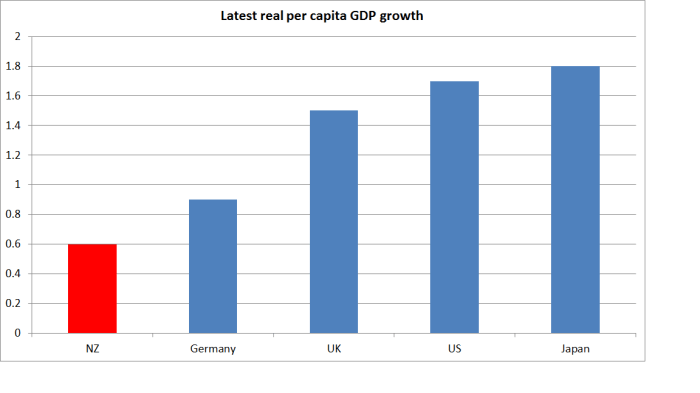
Was he perhaps not aware that New Zealand has been experiencing considerably faster population growth than all these countries?  Using the 2015 population growth data from the IMF WEO database, here is how per capita GDP growth looks for those five countries.

real gpd pc kirk hope

Spot the disappointing performer.  It gets worse, of course, because our terms of trade have been falling.  Real per capita national income actually fell a little in New Zealand last year.

In the short-term, it isn’t a disastrous performance (and there are countries we’ve done better than), but it isn’t very good either.

Amid his rampant optimism, Hope also injects this argument:

“Just as importantly, we are fortunate to have escaped one of the key mistakes made in other parts of the world in the aftermath of the global financial crisis.  While other countries chose to expand their money supply with quantitative easing to shore up their economies, New Zealand instead opted for investing in infrastructure –  roads and broadband –  which is a far more growth-enhancing approach”.

Of course New Zealand didn’t do any quantitative easing. Other countries did so only when policy interest rates got to around zero and they concluded that they couldn’t do anything much more with conventional monetary policy.

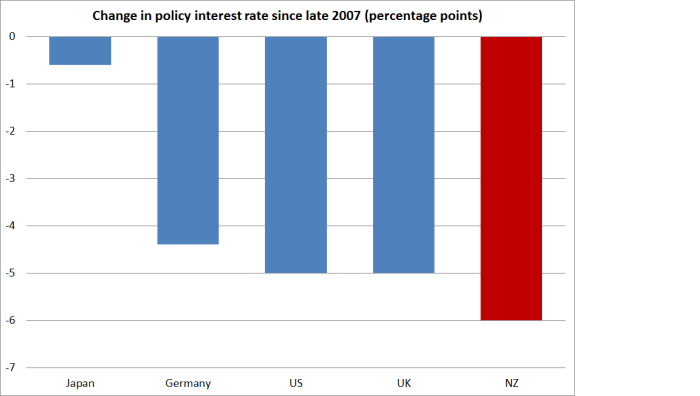
But which of Hope’s countries has cut interest rates further since 2007/08?

policy int rates

Why, New Zealand.

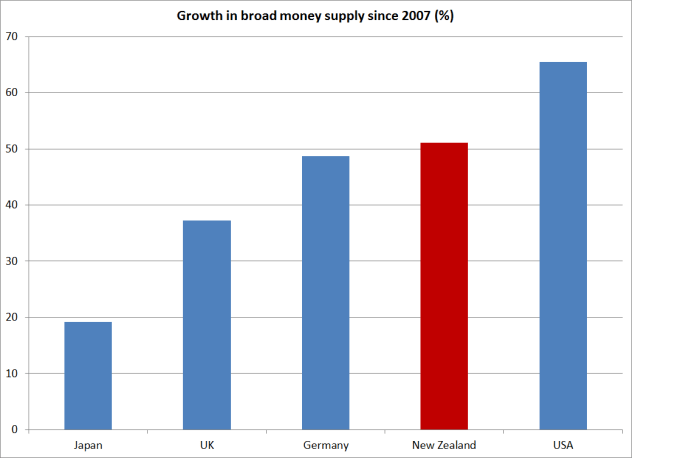
And what of the money supply itself?  Well, of the five countries, New Zealand has had the second fastest rate of money supply growth.

money supply

The euro-area as a whole has had money supply growth even weaker than the UK’s –  a mark of the problems the euro region has had.

As for “investing”, I suspect that few of Hope’s own member businesses will have been undertaking projects on quite such shaky or non-existent cost-benefit analyses as those which underpinned much of the public investment that occurs in New Zealand.  I’m still flabbergasted at the memory of asking a senior minister at a seminar a few years ago why there had been no cost-benefit analysis for one major initiative and being told, with a smile, that it was because he already knew the answer.